
BlockRadar-月月
2.2k Posts

BlockRadar-月月
Report
Block User
来自老韭菜的碎碎念 🥬
不喊单,只记录真实盘感和人性波动。
2.0K+ Following
2.2K+ Followers
2.4K+ Liked
Posts
PINNED
On the last day of 2025, Yueyue stands in front of the Binance backdrop, filled with anticipation for 2026~
May the new year bring everyone's wallets to shine like this '2026', and may financial freedom be achieved soon! 🚀🌕
Thanks to Binance for being with us all the way; in 2026, let's get rich together and soar! 💰
#Binance #2026见 #crypto
On the last day of 2025, Yueyue stands in front of the Binance backdrop, filled with anticipation for 2026~
May the new year bring everyone's wallets to shine like this '2026', and may financial freedom be achieved soon! 🚀🌕
Thanks to Binance for being with us all the way; in 2026, let's get rich together and soar! 💰
#Binance #2026见 #crypto
May the new year bring everyone's wallets to shine like this '2026', and may financial freedom be achieved soon! 🚀🌕
Thanks to Binance for being with us all the way; in 2026, let's get rich together and soar! 💰
#Binance #2026见 #crypto

3
12
707

Article
Robinhood, ranked 18th on the underwriting list—what it truly sells to Oura isn’t stocks, but those 5 million retail tradersIn early September, Oura filed its IPO documents. In the underwriting roster are Goldman Sachs, Morgan Stanley, JPMorgan Chase, Allen & Co., and Jefferies—then right at the end, the 18th spot goes to Robinhood Securities.
The market calls this “Robinhood officially entering the investment-banking world.” The news writes it in a very dignified way: “The app that used to serve retail investors is now starting to grab the investment bank’s share of the business.”
But if you change the subject to the 18th name on that underwriting list—and the batch of retail traders behind it who are waiting to get allocated IPO shares, the story changes completely.
Robinhood getting on this list has never been about underwriting ability. It’s about the retail traders it has in its hands. And one of the deepest secrets of the underwriting business is this: the people on the list aren’t selling stocks—they’re selling “who has the right to buy stocks.”
Robinhood, ranked 18th on the underwriting list—what it truly sells to Oura isn’t stocks, but those 5 million retail traders
In early September, Oura filed its IPO documents. In the underwriting roster are Goldman Sachs, Morgan Stanley, JPMorgan Chase, Allen & Co., and Jefferies—then right at the end, the 18th spot goes to Robinhood Securities.
The market calls this “Robinhood officially entering the investment-banking world.” The news writes it in a very dignified way: “The app that used to serve retail investors is now starting to grab the investment bank’s share of the business.”
But if you change the subject to the 18th name on that underwriting list—and the batch of retail traders behind it who are waiting to get allocated IPO shares, the story changes completely.
Robinhood getting on this list has never been about underwriting ability. It’s about the retail traders it has in its hands. And one of the deepest secrets of the underwriting business is this: the people on the list aren’t selling stocks—they’re selling “who has the right to buy stocks.”
The market calls this “Robinhood officially entering the investment-banking world.” The news writes it in a very dignified way: “The app that used to serve retail investors is now starting to grab the investment bank’s share of the business.”
But if you change the subject to the 18th name on that underwriting list—and the batch of retail traders behind it who are waiting to get allocated IPO shares, the story changes completely.
Robinhood getting on this list has never been about underwriting ability. It’s about the retail traders it has in its hands. And one of the deepest secrets of the underwriting business is this: the people on the list aren’t selling stocks—they’re selling “who has the right to buy stocks.”
104
Article
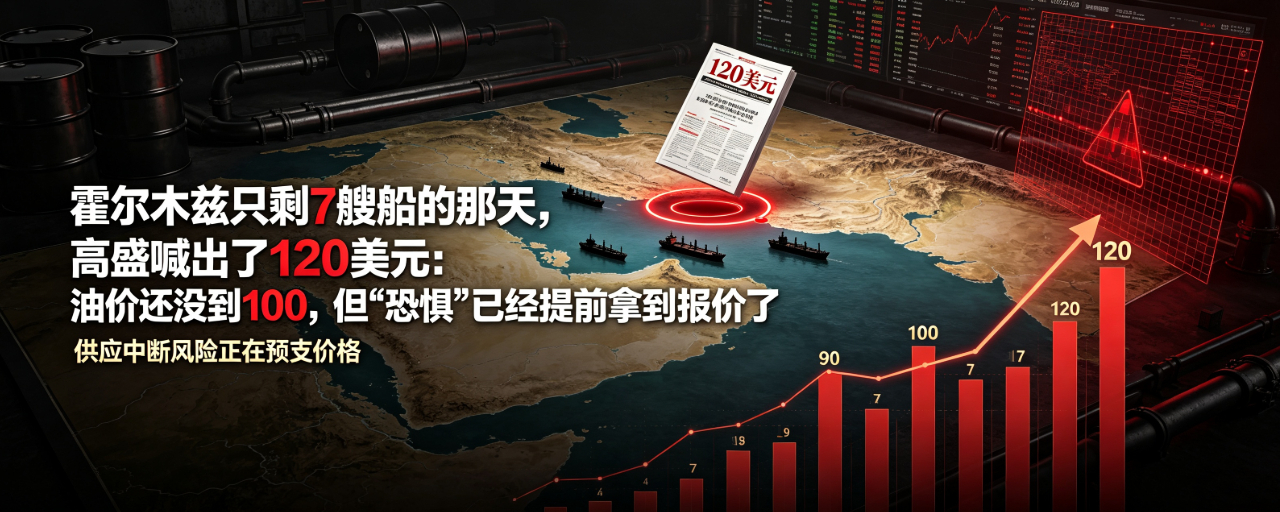
The day only 7 ships remained in Hormuz, Goldman called out $120: the oil price hadn’t reached $100 yet, but “fear” had already gotten the quote in advanceOn September 7, only 7 bulk cargo ships passed through the Strait of Hormuz. The day before, there were 8. Over the past 10 days, the daily average was about 10 ships— the lowest since May.
Then Goldman said that in extreme cases, the oil price could surge toward $120.
Please note this combination: the strait has not been shut, the ships have not been stopped, and the oil price hasn’t yet risen above $100—but $120 has already been shouted out. The market isn’t pricing reality; it’s pricing the “terminal price of fear.”
And fear has a particular feature: it doesn’t need Hormuz to actually be closed. It only needs enough people to believe that Hormuz might be closed, and fear will grow into the shape of a $120 price tag all on its own.
The day only 7 ships remained in Hormuz, Goldman called out $120: the oil price hadn’t reached $100 yet, but “fear” had already gotten the quote in advance
On September 7, only 7 bulk cargo ships passed through the Strait of Hormuz. The day before, there were 8. Over the past 10 days, the daily average was about 10 ships— the lowest since May.
Then Goldman said that in extreme cases, the oil price could surge toward $120.
Please note this combination: the strait has not been shut, the ships have not been stopped, and the oil price hasn’t yet risen above $100—but $120 has already been shouted out. The market isn’t pricing reality; it’s pricing the “terminal price of fear.”
And fear has a particular feature: it doesn’t need Hormuz to actually be closed. It only needs enough people to believe that Hormuz might be closed, and fear will grow into the shape of a $120 price tag all on its own.
Then Goldman said that in extreme cases, the oil price could surge toward $120.
Please note this combination: the strait has not been shut, the ships have not been stopped, and the oil price hasn’t yet risen above $100—but $120 has already been shouted out. The market isn’t pricing reality; it’s pricing the “terminal price of fear.”
And fear has a particular feature: it doesn’t need Hormuz to actually be closed. It only needs enough people to believe that Hormuz might be closed, and fear will grow into the shape of a $120 price tag all on its own.
1
482
Article
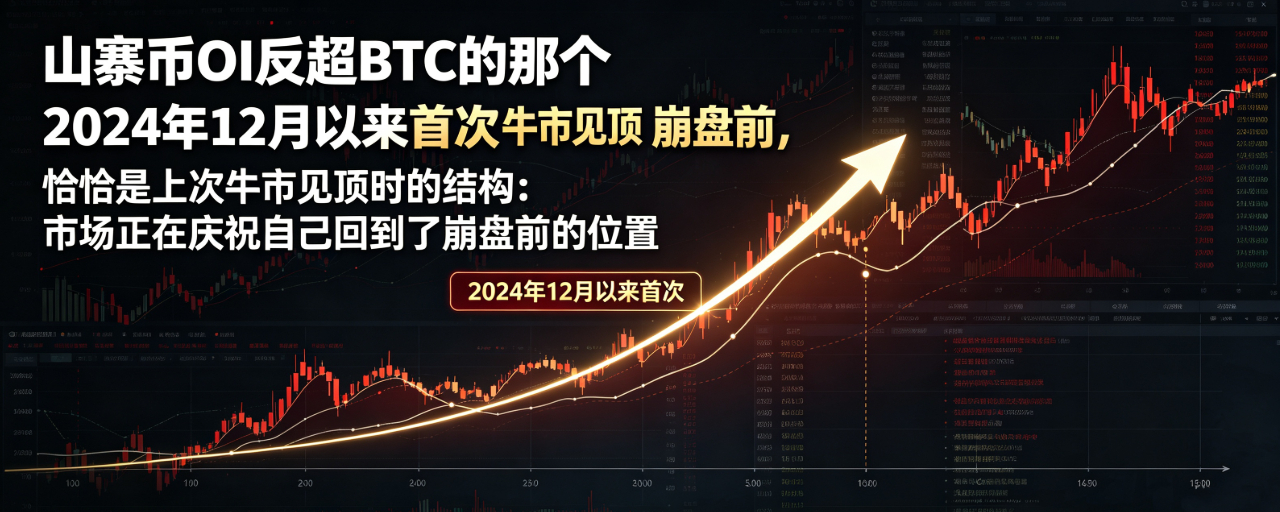
The moment when altcoin OI overtook BTC for the “first time since December 2024” is precisely the structure that existed when the last bull market peaked: the market is celebrating a return to its pre-crash positionThe most talked-about data point today is this: altcoin futures open interest has overtaken Bitcoin’s, the first time since December 2024.
The market interpreted it as “capital rotating sectors,” “risk appetite improving,” and “a rotation underway.” Analysts said this was a “typical early sign of a bull market entering its middle-to-late stage,” and then immediately gave buy recommendations: pick AI, pick L2/DEX, pick sectors with catalysts.
But if you stop and ask the simplest question: what was December 2024?
The answer will send a chill down your spine. December 2024 was when the last crypto bull market peaked. Bitcoin hit an all-time high that month, and then in the months that followed, what the altcoin market went through is something every trader who survived would rather not remember.
The moment when altcoin OI overtook BTC for the “first time since December 2024” is precisely the structure that existed when the last bull market peaked: the market is celebrating a return to its pre-crash position
The most talked-about data point today is this: altcoin futures open interest has overtaken Bitcoin’s, the first time since December 2024.
The market interpreted it as “capital rotating sectors,” “risk appetite improving,” and “a rotation underway.” Analysts said this was a “typical early sign of a bull market entering its middle-to-late stage,” and then immediately gave buy recommendations: pick AI, pick L2/DEX, pick sectors with catalysts.
But if you stop and ask the simplest question: what was December 2024?
The answer will send a chill down your spine. December 2024 was when the last crypto bull market peaked. Bitcoin hit an all-time high that month, and then in the months that followed, what the altcoin market went through is something every trader who survived would rather not remember.
The market interpreted it as “capital rotating sectors,” “risk appetite improving,” and “a rotation underway.” Analysts said this was a “typical early sign of a bull market entering its middle-to-late stage,” and then immediately gave buy recommendations: pick AI, pick L2/DEX, pick sectors with catalysts.
But if you stop and ask the simplest question: what was December 2024?
The answer will send a chill down your spine. December 2024 was when the last crypto bull market peaked. Bitcoin hit an all-time high that month, and then in the months that followed, what the altcoin market went through is something every trader who survived would rather not remember.
280
Article
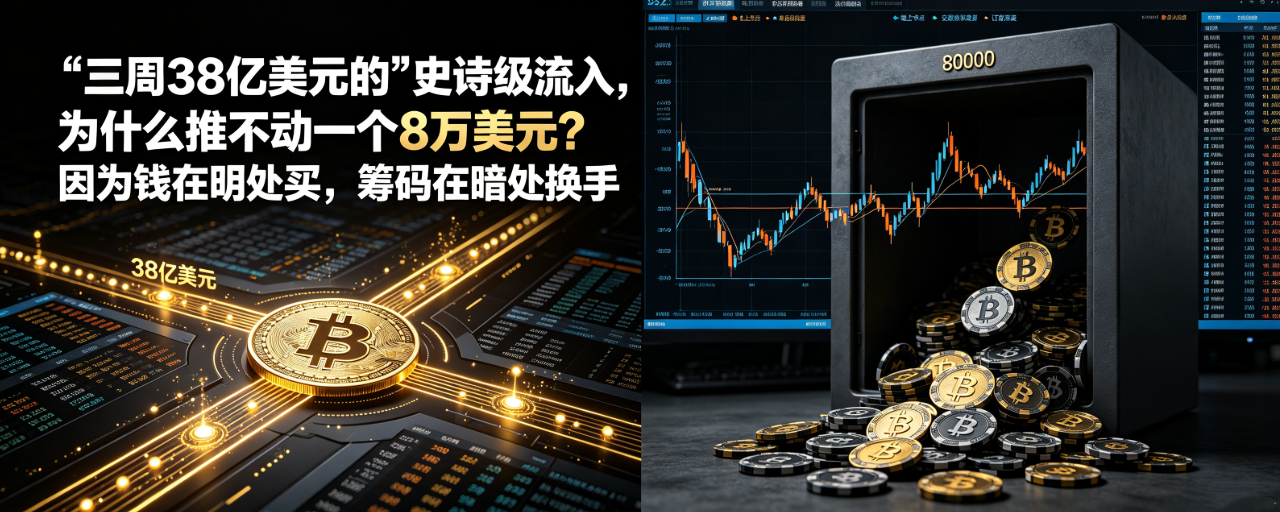
Why did three weeks of $3.8 billion in “epic inflows” fail to push past $80,000? Because money is buying in the open while coins are changing hands in the shadowsU.S. spot Bitcoin ETFs saw net inflows of $3.8 billion over three weeks, setting the strongest record of 2026. On Friday alone, another $174.6 million flowed in.
But Bitcoin is stuck at the $80,000 mark, locked in a back-and-forth struggle and unable to rise.
By normal logic, with $3.8 billion of real money thrown in over three weeks, the price should have taken off. But it didn’t. So the question is: if money is really coming in, who is selling the coins that money is buying?
On-chain data gives an uncomfortable answer: ETFs are hoovering up coins in plain sight, while the stockpile of existing tokens sitting on exchanges is being slowly dumped onto these “epic inflows” in the shadows.
Why did three weeks of $3.8 billion in “epic inflows” fail to push past $80,000? Because money is buying in the open while coins are changing hands in the shadows
U.S. spot Bitcoin ETFs saw net inflows of $3.8 billion over three weeks, setting the strongest record of 2026. On Friday alone, another $174.6 million flowed in.
But Bitcoin is stuck at the $80,000 mark, locked in a back-and-forth struggle and unable to rise.
By normal logic, with $3.8 billion of real money thrown in over three weeks, the price should have taken off. But it didn’t. So the question is: if money is really coming in, who is selling the coins that money is buying?
On-chain data gives an uncomfortable answer: ETFs are hoovering up coins in plain sight, while the stockpile of existing tokens sitting on exchanges is being slowly dumped onto these “epic inflows” in the shadows.
But Bitcoin is stuck at the $80,000 mark, locked in a back-and-forth struggle and unable to rise.
By normal logic, with $3.8 billion of real money thrown in over three weeks, the price should have taken off. But it didn’t. So the question is: if money is really coming in, who is selling the coins that money is buying?
On-chain data gives an uncomfortable answer: ETFs are hoovering up coins in plain sight, while the stockpile of existing tokens sitting on exchanges is being slowly dumped onto these “epic inflows” in the shadows.
89

Article
The news that the sovereign fund would “cut $80 billion in U.S. Treasuries” was released a week before FOMC: this is not waning confidence, but a precise “pressure release”Norway’s sovereign wealth fund, worth $2.3 trillion and the largest in the world, said it wants to reduce its exposure to U.S. Treasury bonds by 12.2 percentage points, or about $80 billion. As soon as the news came out, it was interpreted as “sovereign capital losing confidence in U.S. Treasuries.”
But look at the calendar: this proposal was issued on September 1. The Federal Reserve’s September policy meeting is on September 15–16. There are exactly two weeks in between.
And the final review of this proposal will not take place until spring 2027. It is not something that needs to be implemented right now, nor does it need to be announced to the world in early September. It is not even a “decision”; it is just a letter written to Norway’s Ministry of Finance.
The news that the sovereign fund would “cut $80 billion in U.S. Treasuries” was released a week before FOMC: this is not waning confidence, but a precise “pressure release”
Norway’s sovereign wealth fund, worth $2.3 trillion and the largest in the world, said it wants to reduce its exposure to U.S. Treasury bonds by 12.2 percentage points, or about $80 billion. As soon as the news came out, it was interpreted as “sovereign capital losing confidence in U.S. Treasuries.”
But look at the calendar: this proposal was issued on September 1. The Federal Reserve’s September policy meeting is on September 15–16. There are exactly two weeks in between.
And the final review of this proposal will not take place until spring 2027. It is not something that needs to be implemented right now, nor does it need to be announced to the world in early September. It is not even a “decision”; it is just a letter written to Norway’s Ministry of Finance.
But look at the calendar: this proposal was issued on September 1. The Federal Reserve’s September policy meeting is on September 15–16. There are exactly two weeks in between.
And the final review of this proposal will not take place until spring 2027. It is not something that needs to be implemented right now, nor does it need to be announced to the world in early September. It is not even a “decision”; it is just a letter written to Norway’s Ministry of Finance.
118
Article
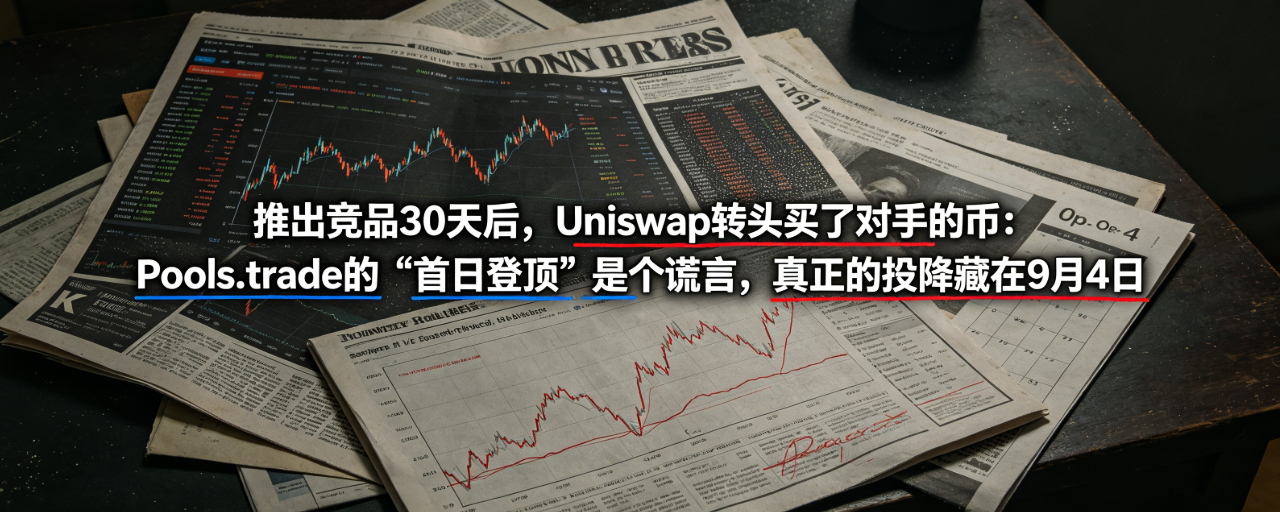
Thirty days after launching a competitor, Uniswap turned around and bought the rival’s coin: Pools.trade’s “first-day top spot” is a lie—the real surrender is hidden in September 4On August 5, Uniswap Labs launched Pools.trade on the Robinhood Chain. With lower fees, it surpassed Pons on its very first day. The market’s interpretation at the time was: “DEX giant personally stepped in to crush this little platform that makes money day and night on memecoin issuance fees.”
On September 4, Uniswap Labs bought PONS tokens. No amount was disclosed, no price was disclosed, and no wallet addresses of holdings were disclosed. There was only one line: “Long-term alignment.”
From “I’m going to take you down” to “I’m investing in you”—only 30 days passed in between.
That’s the most suspicious part of this news: if Pools.trade really won, why did Uniswap still buy the other side’s coin?
Thirty days after launching a competitor, Uniswap turned around and bought the rival’s coin: Pools.trade’s “first-day top spot” is a lie—the real surrender is hidden in September 4
On August 5, Uniswap Labs launched Pools.trade on the Robinhood Chain. With lower fees, it surpassed Pons on its very first day. The market’s interpretation at the time was: “DEX giant personally stepped in to crush this little platform that makes money day and night on memecoin issuance fees.”
On September 4, Uniswap Labs bought PONS tokens. No amount was disclosed, no price was disclosed, and no wallet addresses of holdings were disclosed. There was only one line: “Long-term alignment.”
From “I’m going to take you down” to “I’m investing in you”—only 30 days passed in between.
That’s the most suspicious part of this news: if Pools.trade really won, why did Uniswap still buy the other side’s coin?
On September 4, Uniswap Labs bought PONS tokens. No amount was disclosed, no price was disclosed, and no wallet addresses of holdings were disclosed. There was only one line: “Long-term alignment.”
From “I’m going to take you down” to “I’m investing in you”—only 30 days passed in between.
That’s the most suspicious part of this news: if Pools.trade really won, why did Uniswap still buy the other side’s coin?
265
Verified

Article
Oil Prices Hit $95, and the Market Is “Celebrating” a Fed Rate Hike: Saudi Exports Have Crashed—What’s Truly Been Broken Is the Old Belief That the Central Bank Would Come to the RescueSaudi crude oil exports fell to a 9-year low, with Brent crude trading above $95.
Based on market conditioning over the past twenty years, the next chapter of the story should be: an energy shock → inflation expectations heat up → central bank faces a dilemma over whether to act → markets start betting that the central bank “dares not raise rates” → risk assets get some breathing room.
But the reality in September 2026 is this: on the very day oil prices broke above $95, the market pushed the probability of a September Fed rate hike to 65%.
There’s no pricing for “the central bank will hesitate.” There’s no consensus that under a supply shock, rates traditionally aren’t raised. The moment markets saw energy prices surge, their reaction was—double down on the bet that the Fed will be more hawkish.
Oil Prices Hit $95, and the Market Is “Celebrating” a Fed Rate Hike: Saudi Exports Have Crashed—What’s Truly Been Broken Is the Old Belief That the Central Bank Would Come to the Rescue
Saudi crude oil exports fell to a 9-year low, with Brent crude trading above $95.
Based on market conditioning over the past twenty years, the next chapter of the story should be: an energy shock → inflation expectations heat up → central bank faces a dilemma over whether to act → markets start betting that the central bank “dares not raise rates” → risk assets get some breathing room.
But the reality in September 2026 is this: on the very day oil prices broke above $95, the market pushed the probability of a September Fed rate hike to 65%.
There’s no pricing for “the central bank will hesitate.” There’s no consensus that under a supply shock, rates traditionally aren’t raised. The moment markets saw energy prices surge, their reaction was—double down on the bet that the Fed will be more hawkish.
Based on market conditioning over the past twenty years, the next chapter of the story should be: an energy shock → inflation expectations heat up → central bank faces a dilemma over whether to act → markets start betting that the central bank “dares not raise rates” → risk assets get some breathing room.
But the reality in September 2026 is this: on the very day oil prices broke above $95, the market pushed the probability of a September Fed rate hike to 65%.
There’s no pricing for “the central bank will hesitate.” There’s no consensus that under a supply shock, rates traditionally aren’t raised. The moment markets saw energy prices surge, their reaction was—double down on the bet that the Fed will be more hawkish.
311
Article
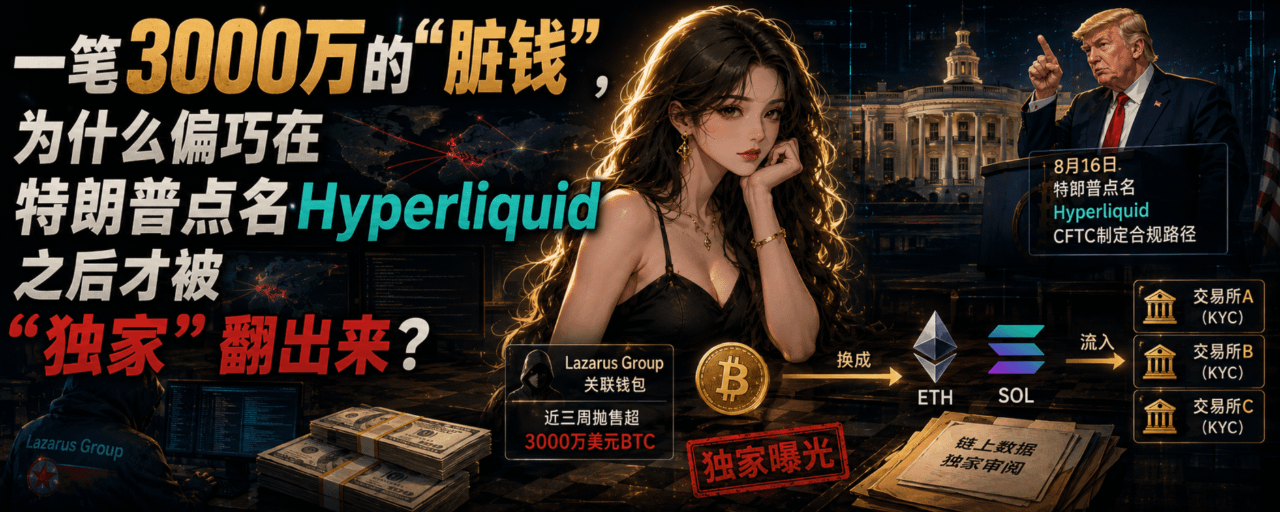
A $30 million “dirty money” trail—why was it “exclusively” unearthed only after Trump specifically mentioned Hyperliquid?In the past 8 hours, a single piece of news has sent the crypto community into an uproar: a wallet linked to North Korea’s Lazarus Group has, over the past three weeks, sold more than $30 million worth of Bitcoin on Hyperliquid, receiving Ethereum and Solana in return, before ultimately ending up in the pockets of several centralized exchanges.
On the surface, this is the usual script for “North Korean hackers laundering money.” But honestly, what really makes me feel something’s off isn’t the laundering itself—it’s the “birth time” of this news.
Pay attention to the relationship between the two timestamps. On August 16, Trump named Hyperliquid from the White House, saying the CFTC chair is drawing up a path to “full compliance, legally,” to bring it into the U.S. market. In early September, an on-chain data company, at the request of a certain long-established crypto media outlet, “exclusively” reviewed the data—and then this news broke. There are several weeks in between. But on-chain data is public; the Lazarus wallets had already been flagged. Anyone can look up this $30 million flow on-chain on any given day.
A $30 million “dirty money” trail—why was it “exclusively” unearthed only after Trump specifically mentioned Hyperliquid?
In the past 8 hours, a single piece of news has sent the crypto community into an uproar: a wallet linked to North Korea’s Lazarus Group has, over the past three weeks, sold more than $30 million worth of Bitcoin on Hyperliquid, receiving Ethereum and Solana in return, before ultimately ending up in the pockets of several centralized exchanges.
On the surface, this is the usual script for “North Korean hackers laundering money.” But honestly, what really makes me feel something’s off isn’t the laundering itself—it’s the “birth time” of this news.
Pay attention to the relationship between the two timestamps. On August 16, Trump named Hyperliquid from the White House, saying the CFTC chair is drawing up a path to “full compliance, legally,” to bring it into the U.S. market. In early September, an on-chain data company, at the request of a certain long-established crypto media outlet, “exclusively” reviewed the data—and then this news broke. There are several weeks in between. But on-chain data is public; the Lazarus wallets had already been flagged. Anyone can look up this $30 million flow on-chain on any given day.
On the surface, this is the usual script for “North Korean hackers laundering money.” But honestly, what really makes me feel something’s off isn’t the laundering itself—it’s the “birth time” of this news.
Pay attention to the relationship between the two timestamps. On August 16, Trump named Hyperliquid from the White House, saying the CFTC chair is drawing up a path to “full compliance, legally,” to bring it into the U.S. market. In early September, an on-chain data company, at the request of a certain long-established crypto media outlet, “exclusively” reviewed the data—and then this news broke. There are several weeks in between. But on-chain data is public; the Lazarus wallets had already been flagged. Anyone can look up this $30 million flow on-chain on any given day.
1
274

Article
Wosh’s hawkish “uncovered exam”: with one non-farm payrolls report, can it force out the Fed’s cards?Over the past week, the world’s financial spotlight has been almost entirely focused on one person—Kevin Wosh, Chair of the U.S. Federal Reserve. Appointed as the new Chair just in May of this year, he completed his policy debut at the Jackson Hole central bank annual symposium at the end of August. He didn’t speak much, but his words carried considerable weight. The market widely interprets this appearance as hawkish: he reiterated the 2% inflation target and said bluntly, “If inflation doesn’t ease clearly and quickly enough, the Fed still has work to do.” He even made the message explicit—what the Fed cares about right now is prices, not anything else.
Wosh’s hawkish “uncovered exam”: with one non-farm payrolls report, can it force out the Fed’s cards?
Over the past week, the world’s financial spotlight has been almost entirely focused on one person—Kevin Wosh, Chair of the U.S. Federal Reserve. Appointed as the new Chair just in May of this year, he completed his policy debut at the Jackson Hole central bank annual symposium at the end of August. He didn’t speak much, but his words carried considerable weight. The market widely interprets this appearance as hawkish: he reiterated the 2% inflation target and said bluntly, “If inflation doesn’t ease clearly and quickly enough, the Fed still has work to do.” He even made the message explicit—what the Fed cares about right now is prices, not anything else.
126

Article
40 Coins and 16 Days: Why Was cirBTC’s “Cold Reception” Re-told Before the Arc Launch?The publication time of a news item is often more worth questioning than its content.
On August 31, 2026, several media outlets reported almost simultaneously the dismal figures for Circle’s packaged Bitcoin cirBTC: on-chain circulating supply is only about 40 coins, yet reserves were overissued to 106%. The reporting styles are highly consistent, the data sources are clear, and the conclusion is unambiguous—“A perfect product loses to network effects.” Judging by the content alone, this is a competent market observation.
But there’s one detail that makes people a bit uncomfortable: cirBTC went live on Ethereum on June 9, 2026—nearly three months ago. A story about “initial launch chills”—why wasn’t it told in June, or July, but instead chosen to be collectively dredged back up on August 31?
40 Coins and 16 Days: Why Was cirBTC’s “Cold Reception” Re-told Before the Arc Launch?
The publication time of a news item is often more worth questioning than its content.
On August 31, 2026, several media outlets reported almost simultaneously the dismal figures for Circle’s packaged Bitcoin cirBTC: on-chain circulating supply is only about 40 coins, yet reserves were overissued to 106%. The reporting styles are highly consistent, the data sources are clear, and the conclusion is unambiguous—“A perfect product loses to network effects.” Judging by the content alone, this is a competent market observation.
But there’s one detail that makes people a bit uncomfortable: cirBTC went live on Ethereum on June 9, 2026—nearly three months ago. A story about “initial launch chills”—why wasn’t it told in June, or July, but instead chosen to be collectively dredged back up on August 31?
On August 31, 2026, several media outlets reported almost simultaneously the dismal figures for Circle’s packaged Bitcoin cirBTC: on-chain circulating supply is only about 40 coins, yet reserves were overissued to 106%. The reporting styles are highly consistent, the data sources are clear, and the conclusion is unambiguous—“A perfect product loses to network effects.” Judging by the content alone, this is a competent market observation.
But there’s one detail that makes people a bit uncomfortable: cirBTC went live on Ethereum on June 9, 2026—nearly three months ago. A story about “initial launch chills”—why wasn’t it told in June, or July, but instead chosen to be collectively dredged back up on August 31?
124

Article
A 416% celebration, but $254 million stuck in place—where exactly is the demand for tokenized stocks getting stuck?Over the past eight hours, this dataset on tokenized stocks has stirred up the RWA track again: monthly transfer volume reached $29.5 billion, up 416% over 30 days; monthly active addresses hit 1.3 million, up 209%; and holding addresses rose to 2.36 million, up 167%. But within the same dataset lies a detail that not many people are willing to pause and explain: distributed value increased by just 1.45%, settling at $2.54 billion. Put it into plain language—pipeline traffic is up fourfold, but not a single drop more water is in the pipeline.
Is this really a demand explosion? It’s more like the system is redefining what it means to “own,” in its own way.
A 416% celebration, but $254 million stuck in place—where exactly is the demand for tokenized stocks getting stuck?
Over the past eight hours, this dataset on tokenized stocks has stirred up the RWA track again: monthly transfer volume reached $29.5 billion, up 416% over 30 days; monthly active addresses hit 1.3 million, up 209%; and holding addresses rose to 2.36 million, up 167%. But within the same dataset lies a detail that not many people are willing to pause and explain: distributed value increased by just 1.45%, settling at $2.54 billion. Put it into plain language—pipeline traffic is up fourfold, but not a single drop more water is in the pipeline.
Is this really a demand explosion? It’s more like the system is redefining what it means to “own,” in its own way.
Is this really a demand explosion? It’s more like the system is redefining what it means to “own,” in its own way.
115

Article
On Solana, “new bank” Avici gets looted: three steps to become an administrator—money from 125 accounts just disappears—the first hurdle for an “on-chain bank”The most ironic part of this news is that the attacker didn’t even use any advanced technology. Three steps—just three steps—and a “bank’s” collateral management authority was handed over to him.
On August 28, Avici, a Solana-based “on-chain new bank,” confirmed that it had been breached. Preliminary estimates place the losses between $600,000 and $1.02 million, affecting 125 user accounts. Its native token, AVICI, fell by about 39% in a day, and its current price is now down 96% from its all-time high. But behind these numbers, the real question is this: how could a project that controls other people’s card balances be so simply “upgraded” into giving an administrator access?
On Solana, “new bank” Avici gets looted: three steps to become an administrator—money from 125 accounts just disappears—the first hurdle for an “on-chain bank”
The most ironic part of this news is that the attacker didn’t even use any advanced technology. Three steps—just three steps—and a “bank’s” collateral management authority was handed over to him.
On August 28, Avici, a Solana-based “on-chain new bank,” confirmed that it had been breached. Preliminary estimates place the losses between $600,000 and $1.02 million, affecting 125 user accounts. Its native token, AVICI, fell by about 39% in a day, and its current price is now down 96% from its all-time high. But behind these numbers, the real question is this: how could a project that controls other people’s card balances be so simply “upgraded” into giving an administrator access?
On August 28, Avici, a Solana-based “on-chain new bank,” confirmed that it had been breached. Preliminary estimates place the losses between $600,000 and $1.02 million, affecting 125 user accounts. Its native token, AVICI, fell by about 39% in a day, and its current price is now down 96% from its all-time high. But behind these numbers, the real question is this: how could a project that controls other people’s card balances be so simply “upgraded” into giving an administrator access?
158

Article
The U.S. puts “digital assets” into a sanctions order, but deliberately draws no boundaries: will decentralized infrastructure be the next target?On August 24, the U.S. Treasury launched a new round of sanctions against Iran, officially called “Economic Isolation Actions.” Treasury Secretary Bessent’s wording was very tough, saying they would “cut off all economic lifelines supporting this despotic regime.” What really has the crypto industry on edge is that this time, unusually, “digital assets” were also included within the scope of the sanctions.
But here’s the question: who exactly is being sanctioned? Is it Iran’s exchanges and money brokers—or the decentralized infrastructure that has no center, no KYC, and no address book? The Treasury didn’t say.
This “didn’t say,” is precisely the most dangerous part of the whole affair.
The U.S. puts “digital assets” into a sanctions order, but deliberately draws no boundaries: will decentralized infrastructure be the next target?
On August 24, the U.S. Treasury launched a new round of sanctions against Iran, officially called “Economic Isolation Actions.” Treasury Secretary Bessent’s wording was very tough, saying they would “cut off all economic lifelines supporting this despotic regime.” What really has the crypto industry on edge is that this time, unusually, “digital assets” were also included within the scope of the sanctions.
But here’s the question: who exactly is being sanctioned? Is it Iran’s exchanges and money brokers—or the decentralized infrastructure that has no center, no KYC, and no address book? The Treasury didn’t say.
This “didn’t say,” is precisely the most dangerous part of the whole affair.
But here’s the question: who exactly is being sanctioned? Is it Iran’s exchanges and money brokers—or the decentralized infrastructure that has no center, no KYC, and no address book? The Treasury didn’t say.
This “didn’t say,” is precisely the most dangerous part of the whole affair.
114

Article
Mirae Asset Korea splashes $109B: backed by $1.1T in client assets—will 2027 profits be a countdown or a tightening spell?In the past 8 hours, the crypto news worth taking a second look at isn’t found in trading volume or price—but in the deeper layers of the capital landscape. According to a report by the Korea Times, Mirae Asset Financial Group plans to build a digital asset business with a scale of up to 150 trillion won (about $109 billion), using its crypto business platform, Digital X, as the core. This isn’t an ordinary investment—it’s more like a giant has formally added “digital assets” to the checklist of engines driving its profits.
The significance of this news lies in the fact that it comes from a traditional financial institution you may not have heard of much, yet with astonishing scale: Mirae Asset Group holds more than 1,500 trillion won (about $1.1 trillion) in customer assets, making it one of the largest financial groups in South Korea. When an institution of this magnitude places crypto assets, stablecoins, RWA, and security tokens all into its strategic blueprint, how could that be compared to any single exchange listing some token?
Mirae Asset Korea splashes $109B: backed by $1.1T in client assets—will 2027 profits be a countdown or a tightening spell?
In the past 8 hours, the crypto news worth taking a second look at isn’t found in trading volume or price—but in the deeper layers of the capital landscape. According to a report by the Korea Times, Mirae Asset Financial Group plans to build a digital asset business with a scale of up to 150 trillion won (about $109 billion), using its crypto business platform, Digital X, as the core. This isn’t an ordinary investment—it’s more like a giant has formally added “digital assets” to the checklist of engines driving its profits.
The significance of this news lies in the fact that it comes from a traditional financial institution you may not have heard of much, yet with astonishing scale: Mirae Asset Group holds more than 1,500 trillion won (about $1.1 trillion) in customer assets, making it one of the largest financial groups in South Korea. When an institution of this magnitude places crypto assets, stablecoins, RWA, and security tokens all into its strategic blueprint, how could that be compared to any single exchange listing some token?
The significance of this news lies in the fact that it comes from a traditional financial institution you may not have heard of much, yet with astonishing scale: Mirae Asset Group holds more than 1,500 trillion won (about $1.1 trillion) in customer assets, making it one of the largest financial groups in South Korea. When an institution of this magnitude places crypto assets, stablecoins, RWA, and security tokens all into its strategic blueprint, how could that be compared to any single exchange listing some token?
281

Article
CZ Follows Robinhood CEO and $CASHCAT Hits a New Market Cap High: Before the Altcoin Season Arrives, On-Chain Markets Are Brewing a “Strongest Script”?Over the past 8 hours, while the big cake side has been cooling down after the frenzy, the on-chain side carries a different kind of flavor: opportunities really are more abundant, but what truly excites the old hands is probably still just the prelude.
Today, the leading holding token on the Robinhood chain, CASHCAT, has touched a market cap of $240 million, setting a new all-time high. At the same time, one move has ignited the imagination across the entire line: Binance founder CZ followed Robinhood’s CEO Vlad yesterday, and Vlad turned around to comment on a tweet from Musk about Mars—ending with a single line: “See you on Mars.” On one side, the US stock meme narrative is being positively affirmed by both Robinhood and CZ; on the other, unprecedented interaction signals have appeared between two top platforms. It’s hard not to wonder: next, will Binance and Robinhood open up mutual pathways for listing tokens?
CZ Follows Robinhood CEO and $CASHCAT Hits a New Market Cap High: Before the Altcoin Season Arrives, On-Chain Markets Are Brewing a “Strongest Script”?
Over the past 8 hours, while the big cake side has been cooling down after the frenzy, the on-chain side carries a different kind of flavor: opportunities really are more abundant, but what truly excites the old hands is probably still just the prelude.
Today, the leading holding token on the Robinhood chain, CASHCAT, has touched a market cap of $240 million, setting a new all-time high. At the same time, one move has ignited the imagination across the entire line: Binance founder CZ followed Robinhood’s CEO Vlad yesterday, and Vlad turned around to comment on a tweet from Musk about Mars—ending with a single line: “See you on Mars.” On one side, the US stock meme narrative is being positively affirmed by both Robinhood and CZ; on the other, unprecedented interaction signals have appeared between two top platforms. It’s hard not to wonder: next, will Binance and Robinhood open up mutual pathways for listing tokens?
Today, the leading holding token on the Robinhood chain, CASHCAT, has touched a market cap of $240 million, setting a new all-time high. At the same time, one move has ignited the imagination across the entire line: Binance founder CZ followed Robinhood’s CEO Vlad yesterday, and Vlad turned around to comment on a tweet from Musk about Mars—ending with a single line: “See you on Mars.” On one side, the US stock meme narrative is being positively affirmed by both Robinhood and CZ; on the other, unprecedented interaction signals have appeared between two top platforms. It’s hard not to wonder: next, will Binance and Robinhood open up mutual pathways for listing tokens?
233
Last night I整理 @Dusk_Foundation ’s partner roster and wanted to find licensed institutions outside Europe. I found that, in addition to NPEX, 21X, and Quantoz, Italy’s PlayMatika and Betpassion have also integrated with DuskPay—but they still fall within the EU. This geographical concentration made me pause for a long time before even getting to the table. I originally just wanted to map commercial progress, but I was pulled into a more fundamental issue: a chain that claims to be “global financial infrastructure” has, for now, only dug its compliance moat in Europe.
On the surface, Dusk is a privacy-compliant public chain. But the more I looked, the more it felt like its true core is a “digital mirror” of European financial regulation. Terms like MiCA, DLT Pilot, and MiFID II form the entire narrative foundation of Dusk. NPEX’s Dutch license, 21X’s DLT-TSS, and EURQ’s MiCA compliance—each one precisely corresponds to an EU regulation. Chainlink and Cordial Systems bring globalized technology and custody partnerships, but they are not licensed financial institutions, so they can’t replace the real barrier of licensing. The design is airtight in Brussels, but once you leave the EU, every license has to be recreated from scratch. #dusk
What makes me cautious is this: Europe’s compliance advantage is a moat within Europe, but outside Europe it could turn into a wall. The U.S. has the SEC and CFTC, and Asia has its own regulatory frameworks. If Dusk wants to enter those markets, it can’t simply reuse the EU compliance playbook—it has to rebuild the legal framework from the ground up and renegotiate licenses. And the center of gravity of global capital markets clearly isn’t in Europe—U.S. stocks, Asian bonds, Middle Eastern sovereign funds, all far beyond the scope Dusk can currently reach. Even more subtly, the privacy design depth of $DUSK is tightly bound to Europe’s data protection traditions; in other jurisdictions that may not be a positive, and sometimes it even requires additional explanation.
What I’m watching now is whether Dusk can abstract Europe’s compliance experience into a reusable technical architecture—so that licensed institutions elsewhere can integrate as quickly as plugging into a protocol, rather than having to go through an entirely new round of legal customization every time they enter a new jurisdiction. What I truly care about isn’t NPEX’s short-term €300M assets, but in the long run whether DUSK’s network effects can break out of Europe, or whether it will ultimately be trapped in a fortress of “the strictest compliance, but insufficient capital depth.”
Last night I整理 @Dusk ’s partner roster and wanted to find licensed institutions outside Europe. I found that, in addition to NPEX, 21X, and Quantoz, Italy’s PlayMatika and Betpassion have also integrated with DuskPay—but they still fall within the EU. This geographical concentration made me pause for a long time before even getting to the table. I originally just wanted to map commercial progress, but I was pulled into a more fundamental issue: a chain that claims to be “global financial infrastructure” has, for now, only dug its compliance moat in Europe.
On the surface, Dusk is a privacy-compliant public chain. But the more I looked, the more it felt like its true core is a “digital mirror” of European financial regulation. Terms like MiCA, DLT Pilot, and MiFID II form the entire narrative foundation of Dusk. NPEX’s Dutch license, 21X’s DLT-TSS, and EURQ’s MiCA compliance—each one precisely corresponds to an EU regulation. Chainlink and Cordial Systems bring globalized technology and custody partnerships, but they are not licensed financial institutions, so they can’t replace the real barrier of licensing. The design is airtight in Brussels, but once you leave the EU, every license has to be recreated from scratch. #dusk
What makes me cautious is this: Europe’s compliance advantage is a moat within Europe, but outside Europe it could turn into a wall. The U.S. has the SEC and CFTC, and Asia has its own regulatory frameworks. If Dusk wants to enter those markets, it can’t simply reuse the EU compliance playbook—it has to rebuild the legal framework from the ground up and renegotiate licenses. And the center of gravity of global capital markets clearly isn’t in Europe—U.S. stocks, Asian bonds, Middle Eastern sovereign funds, all far beyond the scope Dusk can currently reach. Even more subtly, the privacy design depth of $DUSK is tightly bound to Europe’s data protection traditions; in other jurisdictions that may not be a positive, and sometimes it even requires additional explanation.
What I’m watching now is whether Dusk can abstract Europe’s compliance experience into a reusable technical architecture—so that licensed institutions elsewhere can integrate as quickly as plugging into a protocol, rather than having to go through an entirely new round of legal customization every time they enter a new jurisdiction. What I truly care about isn’t NPEX’s short-term €300M assets, but in the long run whether DUSK’s network effects can break out of Europe, or whether it will ultimately be trapped in a fortress of “the strictest compliance, but insufficient capital depth.”
On the surface, Dusk is a privacy-compliant public chain. But the more I looked, the more it felt like its true core is a “digital mirror” of European financial regulation. Terms like MiCA, DLT Pilot, and MiFID II form the entire narrative foundation of Dusk. NPEX’s Dutch license, 21X’s DLT-TSS, and EURQ’s MiCA compliance—each one precisely corresponds to an EU regulation. Chainlink and Cordial Systems bring globalized technology and custody partnerships, but they are not licensed financial institutions, so they can’t replace the real barrier of licensing. The design is airtight in Brussels, but once you leave the EU, every license has to be recreated from scratch. #dusk
What makes me cautious is this: Europe’s compliance advantage is a moat within Europe, but outside Europe it could turn into a wall. The U.S. has the SEC and CFTC, and Asia has its own regulatory frameworks. If Dusk wants to enter those markets, it can’t simply reuse the EU compliance playbook—it has to rebuild the legal framework from the ground up and renegotiate licenses. And the center of gravity of global capital markets clearly isn’t in Europe—U.S. stocks, Asian bonds, Middle Eastern sovereign funds, all far beyond the scope Dusk can currently reach. Even more subtly, the privacy design depth of $DUSK is tightly bound to Europe’s data protection traditions; in other jurisdictions that may not be a positive, and sometimes it even requires additional explanation.
What I’m watching now is whether Dusk can abstract Europe’s compliance experience into a reusable technical architecture—so that licensed institutions elsewhere can integrate as quickly as plugging into a protocol, rather than having to go through an entirely new round of legal customization every time they enter a new jurisdiction. What I truly care about isn’t NPEX’s short-term €300M assets, but in the long run whether DUSK’s network effects can break out of Europe, or whether it will ultimately be trapped in a fortress of “the strictest compliance, but insufficient capital depth.”

119
Article
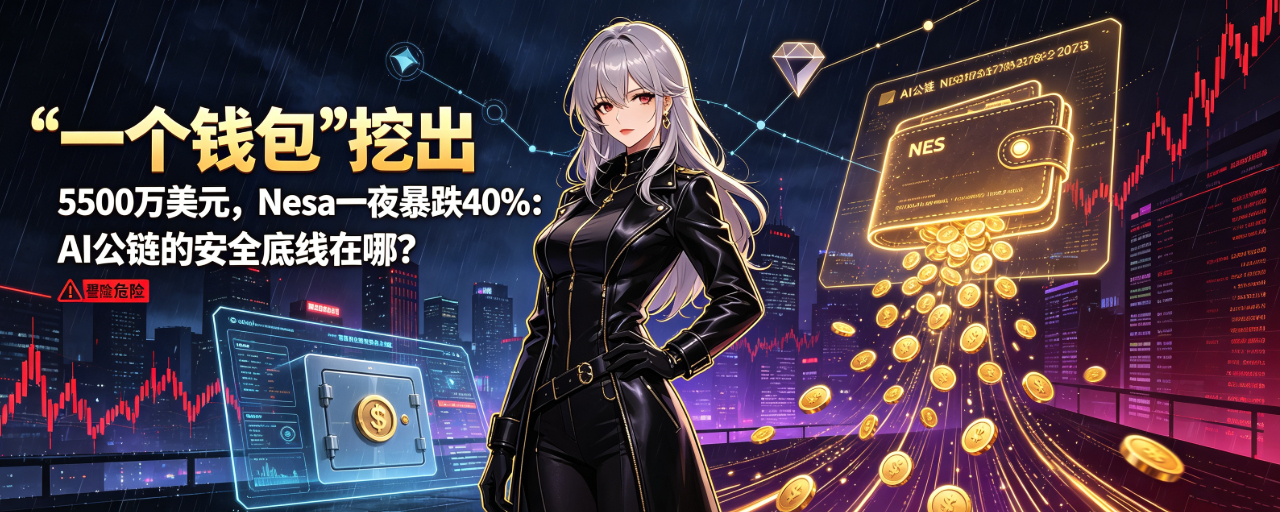
A wallet “mined” $55 million: Nesa crashes 40% overnight—where is the security baseline for an AI public chain?In the past 8 hours, the most hair-raising news in the crypto world is the collapse of an AI-related token. After Nesa’s token NES detected suspicious on-chain activity and large-scale sell-offs, its price plunged by as much as 40%. On-chain observers found that a certain wallet address had “mined” NES worth about $55 million, and then began dumping it on a decentralized exchange. To make matters worse, this address is still holding around $18 million worth of NES, and the selling pressure likely isn’t over yet.
If it were just a typical low-quality altcoin getting dumped, that would be nothing unusual. But considering it has already been listed on multiple mainstream exchanges, and the DeAI (decentralized AI) track is currently red-hot, this incident becomes a cautionary tale worth revisiting again and again.
A wallet “mined” $55 million: Nesa crashes 40% overnight—where is the security baseline for an AI public chain?
In the past 8 hours, the most hair-raising news in the crypto world is the collapse of an AI-related token. After Nesa’s token NES detected suspicious on-chain activity and large-scale sell-offs, its price plunged by as much as 40%. On-chain observers found that a certain wallet address had “mined” NES worth about $55 million, and then began dumping it on a decentralized exchange. To make matters worse, this address is still holding around $18 million worth of NES, and the selling pressure likely isn’t over yet.
If it were just a typical low-quality altcoin getting dumped, that would be nothing unusual. But considering it has already been listed on multiple mainstream exchanges, and the DeAI (decentralized AI) track is currently red-hot, this incident becomes a cautionary tale worth revisiting again and again.
If it were just a typical low-quality altcoin getting dumped, that would be nothing unusual. But considering it has already been listed on multiple mainstream exchanges, and the DeAI (decentralized AI) track is currently red-hot, this incident becomes a cautionary tale worth revisiting again and again.
2
2
783
Last night I opened the developer documentation for @Dusk_Foundation , looking for a beginner path for a third-party developer. In “Start here,” the official guidance recommends deploying contracts and bridging assets. But within the same set of docs, I also noticed entry points for products like Dusk Trade, Dusk Wallet, and Dusk Pay. I originally just wanted to see how external teams would integrate, but the setup of “the official team building an application layer themselves” really caught my attention, and I ended up getting absorbed for a long time.
On the surface, $DUSK is a privacy-compliant chain. But the more I looked, the more it seemed less like a pure chain and more like a case of vertical integration where the boundary between “protocol” and “application layer” is deliberately blurred: it not only provides the DuskDS consensus and the DuskEVM execution environment, but also personally steps in to build a trading platform, a wallet, and payment. The official documentation positions these products as “application layer sitting on top of the protocol,” and the protocol itself still emphasizes openness. DuskEVM is compatible with standard Solidity tooling, and Dusk Connect supports multi-wallet integration. But in practice, the official applications and the underlying protocol are being driven by the same entity—so the boundaries are far more blurred than the wording suggests.
What makes me cautious, though, is this: in the cold-start phase, vertical integration can indeed help quickly get the workflow running and give institutions an “out-of-the-box” demonstration. The ecosystem already has community projects such as Sozu staking, Pieswap DEX, and Dusk Domains, which suggests that third-party entry points aren’t completely closed. However, Dusk Trade and Dusk Pay are still in a pre-release or waitlist stage and haven’t truly begun large-scale operations yet. So it’s too early to claim that they have already secured an “official endorsement” position. What I keep thinking about is whether, in the long run, third-party developers will still have enough motivation to build alongside official products—rather than assuming that the official apps will inevitably receive priority access to NPEX licensing resources and liquidity entry points. This is only a reasonable hypothesis for now, not a confirmed hard priority.#dusk
So what I want to observe now is: once Dusk Trade and Dusk Pay truly go live, can Dusk transition from “officially demonstrated” to “a thriving third-party ecosystem”? I’m not primarily concerned with whether the official applications themselves can succeed. What I care about is whether, in the long term, the value of the DUSK token can be jointly grown by an open application ecosystem—rather than ultimately converging into “internal fuel” for just a few official products.
Last night I opened the developer documentation for @Dusk , looking for a beginner path for a third-party developer. In “Start here,” the official guidance recommends deploying contracts and bridging assets. But within the same set of docs, I also noticed entry points for products like Dusk Trade, Dusk Wallet, and Dusk Pay. I originally just wanted to see how external teams would integrate, but the setup of “the official team building an application layer themselves” really caught my attention, and I ended up getting absorbed for a long time.
On the surface, $DUSK is a privacy-compliant chain. But the more I looked, the more it seemed less like a pure chain and more like a case of vertical integration where the boundary between “protocol” and “application layer” is deliberately blurred: it not only provides the DuskDS consensus and the DuskEVM execution environment, but also personally steps in to build a trading platform, a wallet, and payment. The official documentation positions these products as “application layer sitting on top of the protocol,” and the protocol itself still emphasizes openness. DuskEVM is compatible with standard Solidity tooling, and Dusk Connect supports multi-wallet integration. But in practice, the official applications and the underlying protocol are being driven by the same entity—so the boundaries are far more blurred than the wording suggests.
What makes me cautious, though, is this: in the cold-start phase, vertical integration can indeed help quickly get the workflow running and give institutions an “out-of-the-box” demonstration. The ecosystem already has community projects such as Sozu staking, Pieswap DEX, and Dusk Domains, which suggests that third-party entry points aren’t completely closed. However, Dusk Trade and Dusk Pay are still in a pre-release or waitlist stage and haven’t truly begun large-scale operations yet. So it’s too early to claim that they have already secured an “official endorsement” position. What I keep thinking about is whether, in the long run, third-party developers will still have enough motivation to build alongside official products—rather than assuming that the official apps will inevitably receive priority access to NPEX licensing resources and liquidity entry points. This is only a reasonable hypothesis for now, not a confirmed hard priority.#dusk
So what I want to observe now is: once Dusk Trade and Dusk Pay truly go live, can Dusk transition from “officially demonstrated” to “a thriving third-party ecosystem”? I’m not primarily concerned with whether the official applications themselves can succeed. What I care about is whether, in the long term, the value of the DUSK token can be jointly grown by an open application ecosystem—rather than ultimately converging into “internal fuel” for just a few official products.
On the surface, $DUSK is a privacy-compliant chain. But the more I looked, the more it seemed less like a pure chain and more like a case of vertical integration where the boundary between “protocol” and “application layer” is deliberately blurred: it not only provides the DuskDS consensus and the DuskEVM execution environment, but also personally steps in to build a trading platform, a wallet, and payment. The official documentation positions these products as “application layer sitting on top of the protocol,” and the protocol itself still emphasizes openness. DuskEVM is compatible with standard Solidity tooling, and Dusk Connect supports multi-wallet integration. But in practice, the official applications and the underlying protocol are being driven by the same entity—so the boundaries are far more blurred than the wording suggests.
What makes me cautious, though, is this: in the cold-start phase, vertical integration can indeed help quickly get the workflow running and give institutions an “out-of-the-box” demonstration. The ecosystem already has community projects such as Sozu staking, Pieswap DEX, and Dusk Domains, which suggests that third-party entry points aren’t completely closed. However, Dusk Trade and Dusk Pay are still in a pre-release or waitlist stage and haven’t truly begun large-scale operations yet. So it’s too early to claim that they have already secured an “official endorsement” position. What I keep thinking about is whether, in the long run, third-party developers will still have enough motivation to build alongside official products—rather than assuming that the official apps will inevitably receive priority access to NPEX licensing resources and liquidity entry points. This is only a reasonable hypothesis for now, not a confirmed hard priority.#dusk
So what I want to observe now is: once Dusk Trade and Dusk Pay truly go live, can Dusk transition from “officially demonstrated” to “a thriving third-party ecosystem”? I’m not primarily concerned with whether the official applications themselves can succeed. What I care about is whether, in the long term, the value of the DUSK token can be jointly grown by an open application ecosystem—rather than ultimately converging into “internal fuel” for just a few official products.

1
1
118

Article
No code was broken line by line—yet $8.5 million was still stolen: did the governance flaw in Term Finance rip open DeFi’s most expensive wound?If last week’s crypto world was still intoxicated by the euphoria of “currency devaluation trading,” then this news is the cold, shadowy side behind the celebration. On August 23, a Sunday, the fixed-rate lending protocol Term Finance on Ethereum suffered a governance attack, and the strategy vault was drained of roughly $8.5 million. Afterward, security firms PeckShield and CertiK estimated that the attacker withdrew about 2,843 ETH—worth about $6.9 million at the time—along with 1.68 million USDC. The attacker then swapped the USDC into roughly 1.68 million DAI. Nearly two-thirds of the vault’s locked value evaporated overnight.
No code was broken line by line—yet $8.5 million was still stolen: did the governance flaw in Term Finance rip open DeFi’s most expensive wound?
If last week’s crypto world was still intoxicated by the euphoria of “currency devaluation trading,” then this news is the cold, shadowy side behind the celebration. On August 23, a Sunday, the fixed-rate lending protocol Term Finance on Ethereum suffered a governance attack, and the strategy vault was drained of roughly $8.5 million. Afterward, security firms PeckShield and CertiK estimated that the attacker withdrew about 2,843 ETH—worth about $6.9 million at the time—along with 1.68 million USDC. The attacker then swapped the USDC into roughly 1.68 million DAI. Nearly two-thirds of the vault’s locked value evaporated overnight.
205
Log in to explore more content
Join global crypto users on Binance Square
⚡️ Get latest and useful information about crypto.
💬 Trusted by the world’s largest crypto exchange.
👍 Discover real insights from verified creators.
Email / Phone number
Trending Topics
BTCBreaks80K
107,115 views
1,753 Discussing
$BTC
What price is BTC going to hit in 2026?
Spot is sitting at $80,748. 104 days to go
↑ $90k - 58%
↑ $100k - 24%
↓ $70k dip first - 48%
The bull case floating around the floor:
>August had a proper run from $62,275 up to $81,479 — up 31% bottom to top
>The CLARITY Act flopped its Senate cloture vote 49-50 on 15 Sept. BTC was already sliding well before the vote, touched $74,968 in that hour, and won it all back inside three days
>The Fed hiked rates on 16 Sept — first time since July 2023. Spot is currently floating 7.4% above that day's low
>The altcoins are proper outrunning it. 30-day view: SOL up 38%, XRP up 35%, ETH up 32% versus BTC up 23%
>The timeline is still packed with reasons why this ought to break down — and that’s precisely the wall of worry bull markets tend to climb
>The midterms land on 3 Nov, right smack in the middle of this market window
So, what would you put down for a punt at +24% in 104 days?
$ETH
$SOL
#BTCBreaks80K #solonapumping #ETH🔥🔥🔥🔥🔥🔥 #BullMarket📈
Wealthy bloke
·5 Likes
·5k views
比特币突破8万
86,422 views
266 Discussing
SECReceivesAmendedInjectiveETFFiling
27 views
9 Discussing