
SabTheTrader
215 Posts

SabTheTrader
👩💻4 Years NQ & Crypto Female Trader | X: SabTheTrader | Price action has the final say | 币安现货合约8折邀请码: SAB111
Frequent Trader
6.5 Years
46 Following
131 Followers
355 Liked
Posts
All
Quotes
Videos
Live
PINNED
Verified
Check out this SPCXx IPO Campaign on Binance Wallet, but make sure to understand the rules before diving in. 🚀
Basically, eligible users can submit their subscription intentions through Binance Wallet for a chance to snag SpaceX-related tokenized securities, SPCXx.
But let’s be clear:
SPCXx isn’t directly buying SpaceX stock, nor does it grant any shareholder rights in SpaceX.
It’s more like getting price exposure to SpaceX’s potential IPO through xStocks.
The minimum subscription amount is 100 USDC; the indicative price for each SPCXx is 135 USDC, excluding fees, plus a 5% underwriting service fee.
So, if we go by the indicative price, the estimated total cost per token would be around 141.75 USDC.
Of course, keep in mind:
1⃣ Submitting a subscription ≠ guaranteed allocation
2⃣ SPCXx ≠ direct ownership of SpaceX stock
3⃣ The final issue price isn’t fixed
4⃣ Some regional users may be unable to participate
5⃣ Always read the rules and assess the risks before joining in
What I find noteworthy here is:
Pre-IPO, tokenized securities, and US stock assets on-chain are no longer distant concepts.
More and more exchanges and wallets are slowly bringing traditional market asset exposure to users on-chain.
Binance Wallet’s SPCXx IPO Campaign feels like a new milestone in this trend.
What was once a distant Pre-IPO exposure for the average user is now becoming visible to more people at a lower barrier and more on-chain.
So, I’ll treat it as a case study.
It’s not about blindly chasing SpaceX; it doesn’t mean these types of products are fully matured either.
But the increasing appearance of traditional asset exposure in on-chain wallets is definitely a trend worth watching.
If you’re interested, go check out the rules.
Just make sure to read them carefully before participating. 🤣
* NFA, DYOR.
#币安钱包推出spcxxipo
Basically, eligible users can submit their subscription intentions through Binance Wallet for a chance to snag SpaceX-related tokenized securities, SPCXx.
But let’s be clear:
SPCXx isn’t directly buying SpaceX stock, nor does it grant any shareholder rights in SpaceX.
It’s more like getting price exposure to SpaceX’s potential IPO through xStocks.
The minimum subscription amount is 100 USDC; the indicative price for each SPCXx is 135 USDC, excluding fees, plus a 5% underwriting service fee.
So, if we go by the indicative price, the estimated total cost per token would be around 141.75 USDC.
Of course, keep in mind:
1⃣ Submitting a subscription ≠ guaranteed allocation
2⃣ SPCXx ≠ direct ownership of SpaceX stock
3⃣ The final issue price isn’t fixed
4⃣ Some regional users may be unable to participate
5⃣ Always read the rules and assess the risks before joining in
What I find noteworthy here is:
Pre-IPO, tokenized securities, and US stock assets on-chain are no longer distant concepts.
More and more exchanges and wallets are slowly bringing traditional market asset exposure to users on-chain.
Binance Wallet’s SPCXx IPO Campaign feels like a new milestone in this trend.
What was once a distant Pre-IPO exposure for the average user is now becoming visible to more people at a lower barrier and more on-chain.
So, I’ll treat it as a case study.
It’s not about blindly chasing SpaceX; it doesn’t mean these types of products are fully matured either.
But the increasing appearance of traditional asset exposure in on-chain wallets is definitely a trend worth watching.
If you’re interested, go check out the rules.
Just make sure to read them carefully before participating. 🤣
* NFA, DYOR.
#币安钱包推出spcxxipo


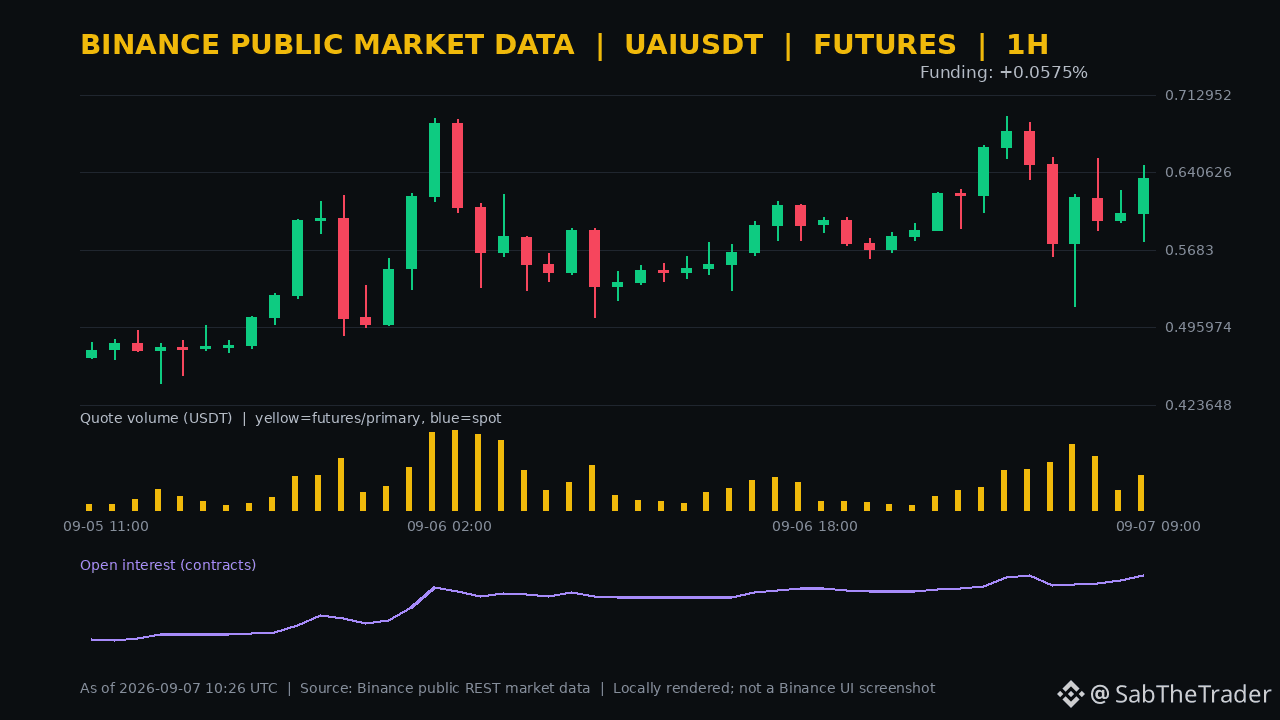
Latest complete 1 hour: UAI sustainable growth up 5.39%, with trading volume about 7.89 million USDT, up 74% month-over-month; OI (open interest) quantity increased by 3.09% in the same period. $UAI closed near 0.6351, not far from this hour’s high of 0.647; price, trading volume, and positioning expanded in the same direction in the short term.
⚠️ Looking at the 24-hour period, perpetual trading volume is about 129.2 million USDT, still 24% less than the previous complete 24 hours; the latest Funding is around +0.0575%. Buy-side demand in this hour is strong, but medium-term trading volume has not expanded in sync, and long positions’ cost basis is also rising. OI can only confirm that total positions increased; it cannot determine whether the newly added positions are all long.
0.647 is the short-term confirmation level. If price holds above it, and if subsequent trading volume and OI continue to rise, there will be conditions to test the prior high of 0.6908 again; if it breaks below this hour’s low of 0.5758, and OI contracts, then newly added leverage is more likely to turn into deleveraging pressure.
⚠️ Looking at the 24-hour period, perpetual trading volume is about 129.2 million USDT, still 24% less than the previous complete 24 hours; the latest Funding is around +0.0575%. Buy-side demand in this hour is strong, but medium-term trading volume has not expanded in sync, and long positions’ cost basis is also rising. OI can only confirm that total positions increased; it cannot determine whether the newly added positions are all long.
0.647 is the short-term confirmation level. If price holds above it, and if subsequent trading volume and OI continue to rise, there will be conditions to test the prior high of 0.6908 again; if it breaks below this hour’s low of 0.5758, and OI contracts, then newly added leverage is more likely to turn into deleveraging pressure.
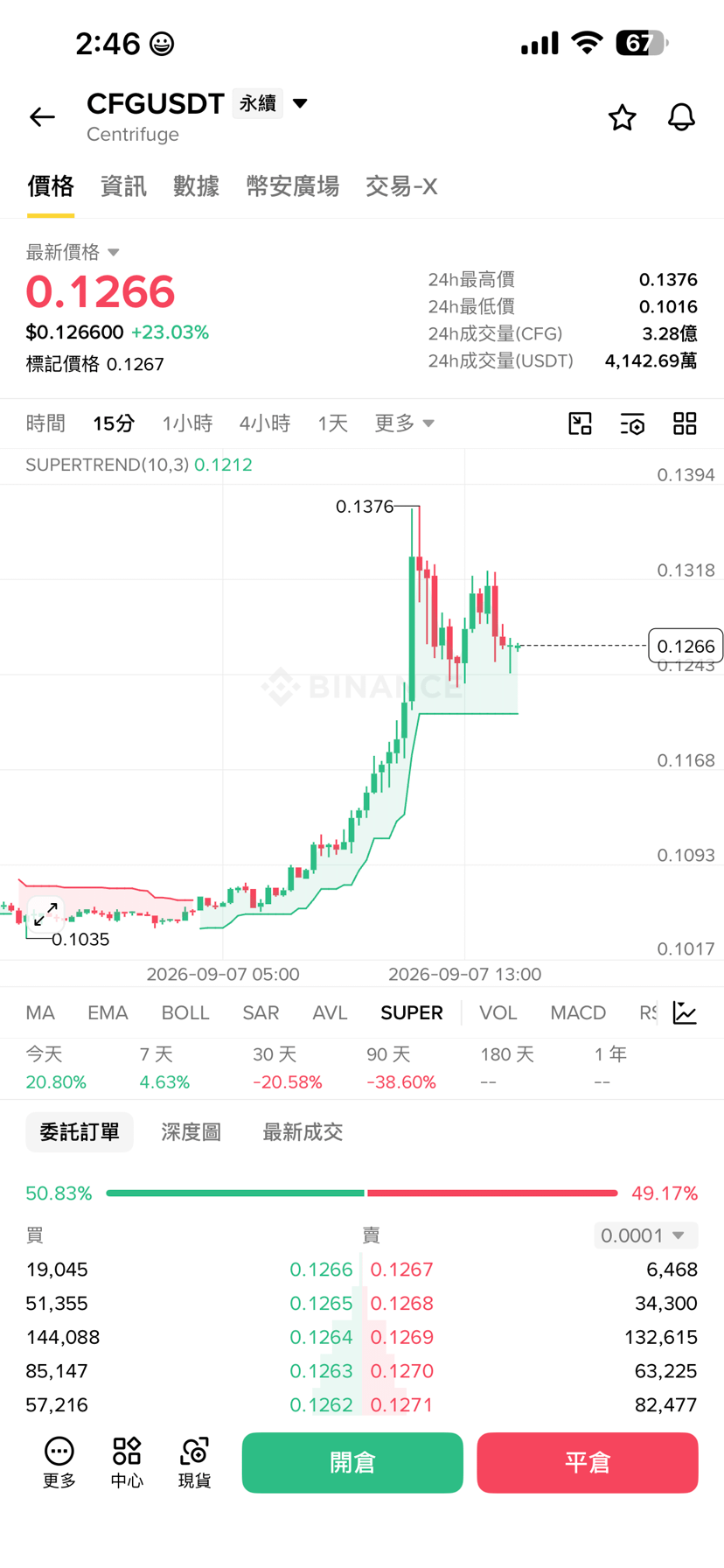
In the past hour, CFG spot rose 5.02% and perpetuals rose 4.87%, but trading volume on both sides was actually 25% and 32% lower than the previous hour, respectively. $CFG briefly closed around 0.1317, then returned to about 0.1283. The price surge did not receive corresponding confirmation from increased volume.
Perpetual open interest (OI) increased 4.82% in the same hour and about 72.55% over the past 24 hours, while Funding dropped to about -0.1320%. Rising prices, increasing positions, and deeply negative funding suggest a still-strong divergence between longs and shorts. OI can only confirm overall position expansion; it cannot determine the direction of newly added positions, and negative Funding does not necessarily mean an immediate rebound.
0.1317 is the first threshold for short-term strength to reassert itself. If price recaptures this level and spot and perpetual volume expand again, then there is a basis to retest 0.1384. If it falls below the recent hourly low of 0.1238 and OI begins to contract, the newly added leverage in this round is more likely to turn into deleveraging pressure.
Perpetual open interest (OI) increased 4.82% in the same hour and about 72.55% over the past 24 hours, while Funding dropped to about -0.1320%. Rising prices, increasing positions, and deeply negative funding suggest a still-strong divergence between longs and shorts. OI can only confirm overall position expansion; it cannot determine the direction of newly added positions, and negative Funding does not necessarily mean an immediate rebound.
0.1317 is the first threshold for short-term strength to reassert itself. If price recaptures this level and spot and perpetual volume expand again, then there is a basis to retest 0.1384. If it falls below the recent hourly low of 0.1238 and OI begins to contract, the newly added leverage in this round is more likely to turn into deleveraging pressure.
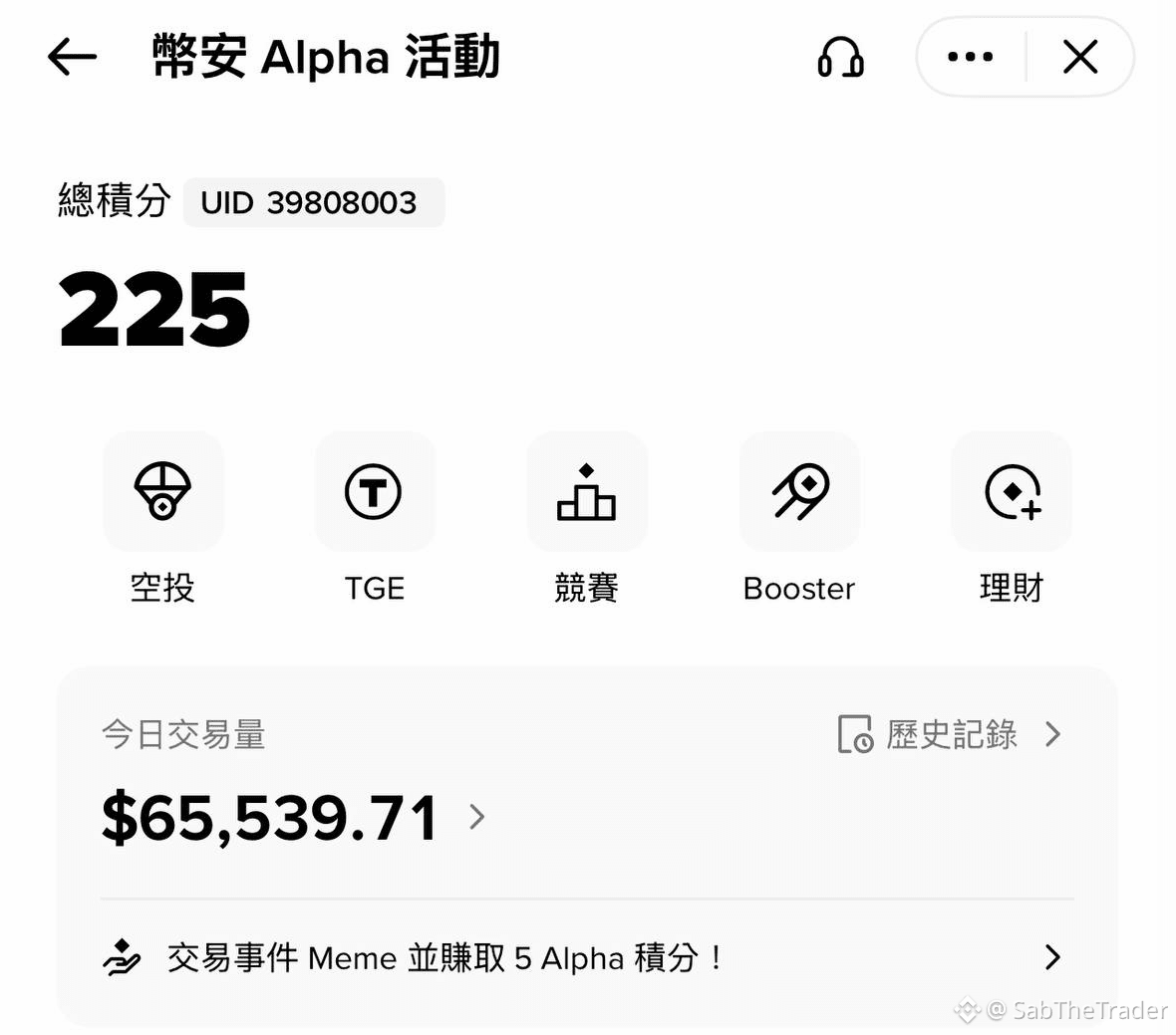
I got up early this morning and refreshed yesterday's Alpha to get the new wallet task, and ended up losing 2.3 U😵
🦄 Hope I can smoothly get 5 points
🍀 Hope today's airdrop is a bit more generous, so our 230 points can get something!!!
🦄 Hope I can smoothly get 5 points
🍀 Hope today's airdrop is a bit more generous, so our 230 points can get something!!!
This one-hour candle pushed TAO near the 24-hour high. Binance spot traded about 8.32 million USDT, up 143% month over month; perpetuals traded about 30.65 million USDT, up 81%, and prices on both sides rose about 4.1%. As of 04:20 (UTC+8), $TAO spot was around 269.0, not far from the 24-hour high of 270.3.
Quantity OI increased 2.55% in the same hour, and only about 2.64% over the past 24 hours, meaning the net position buildup over the past day was almost entirely concentrated in the hour that just ended; Funding remains around +0.0050%, and no obvious crowded long funding has appeared yet. However, OI only records the total size of positions and cannot confirm the direction of the newly added positions, and the simultaneous volume increase in spot and perpetuals alone cannot guarantee that the breakout will continue.
270.3 is the key confirmation level right now. If the price holds above it, and subsequent spot trading volume and OI can continue to rise, this resonance will have a basis for continuation; if it falls back again into the 256.9—257.3 hourly breakout zone and OI contracts, the newly entered leveraged positions may turn into deleveraging pressure.
Quantity OI increased 2.55% in the same hour, and only about 2.64% over the past 24 hours, meaning the net position buildup over the past day was almost entirely concentrated in the hour that just ended; Funding remains around +0.0050%, and no obvious crowded long funding has appeared yet. However, OI only records the total size of positions and cannot confirm the direction of the newly added positions, and the simultaneous volume increase in spot and perpetuals alone cannot guarantee that the breakout will continue.
270.3 is the key confirmation level right now. If the price holds above it, and subsequent spot trading volume and OI can continue to rise, this resonance will have a basis for continuation; if it falls back again into the 256.9—257.3 hourly breakout zone and OI contracts, the newly entered leveraged positions may turn into deleveraging pressure.
In the latest full 1-hour period, both spot and perpetuals saw a simultaneous surge in volume, and the rise in $LAYER also concentrated in this one candlestick. Spot trading volume was about 2.35 million USDT, up about 564% from the previous period; perpetual trading volume was about 12.1 million USDT, up about 1197%, with prices on both sides rising 16.8% and 17.0%, respectively.
Open interest increased by 37.7% in the same hour and by about 48.5% over 24 hours, indicating that leveraged positions did indeed enter quickly; however, funding is still about -0.0181%/4h, meaning the long-short pricing has not yet shifted into a clear positive premium along with the price. Still, OI growth can only confirm position expansion, not whether the newly added positions are all long.
As of 00:43 (UTC+8), spot is around 0.0827, having pulled back from the hourly high of 0.0893. If the price regains a foothold above 0.0893, and subsequent trading volume and OI continue to rise in tandem, this breakout will have grounds to continue; if it falls back toward 0.075 and OI contracts, it looks more like deleveraging after a spike. Spot trading volume over the past 24 hours was only about 4.27 million USDT, and low liquidity will amplify volatility on both sides.
Open interest increased by 37.7% in the same hour and by about 48.5% over 24 hours, indicating that leveraged positions did indeed enter quickly; however, funding is still about -0.0181%/4h, meaning the long-short pricing has not yet shifted into a clear positive premium along with the price. Still, OI growth can only confirm position expansion, not whether the newly added positions are all long.
As of 00:43 (UTC+8), spot is around 0.0827, having pulled back from the hourly high of 0.0893. If the price regains a foothold above 0.0893, and subsequent trading volume and OI continue to rise in tandem, this breakout will have grounds to continue; if it falls back toward 0.075 and OI contracts, it looks more like deleveraging after a spike. Spot trading volume over the past 24 hours was only about 4.27 million USDT, and low liquidity will amplify volatility on both sides.
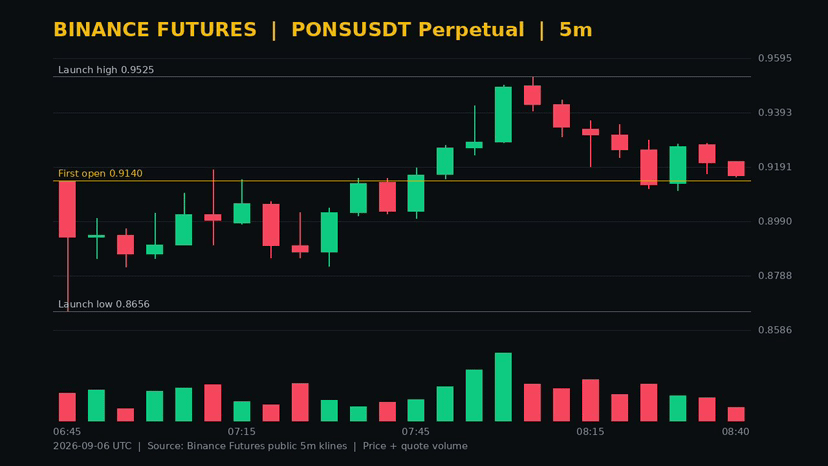
The new contract has been open for nearly two hours, and the volatility has already gone through one round, but the price has returned close to where it started. Binance’s $PONS U-margined perpetual went live at 06:45 UTC; the first 5-minute candle opened at 0.9140. As of 08:40, the latest price is 0.9165, with an intraday range of 0.8656—0.9525 and cumulative trading volume of about 15.72 million USDT.
The price is only about 0.27% above the open, but funding has risen to around +0.0985%/4h. The cost of holding longs has increased first, while price has not yet provided confirmation of a trend with similar strength. This is a perpetual contract listing, not a Binance spot listing; it has been online for less than 24 hours, and there is not enough history to judge the daily change in OI.
I would treat 0.9525 as the upper confirmation level: only if price holds there on increased volume and funding eases back would the structure become healthier. If price continues to hover near the opening level while the rate stays elevated, the risk-reward for chasing longs will deteriorate further. A break below 0.8656 would indicate that the first-round lower boundary has failed, and the liquidity and liquidation volatility of the new contract would need to be repriced.
The price is only about 0.27% above the open, but funding has risen to around +0.0985%/4h. The cost of holding longs has increased first, while price has not yet provided confirmation of a trend with similar strength. This is a perpetual contract listing, not a Binance spot listing; it has been online for less than 24 hours, and there is not enough history to judge the daily change in OI.
I would treat 0.9525 as the upper confirmation level: only if price holds there on increased volume and funding eases back would the structure become healthier. If price continues to hover near the opening level while the rate stays elevated, the risk-reward for chasing longs will deteriorate further. A break below 0.8656 would indicate that the first-round lower boundary has failed, and the liquidity and liquidation volatility of the new contract would need to be repriced.
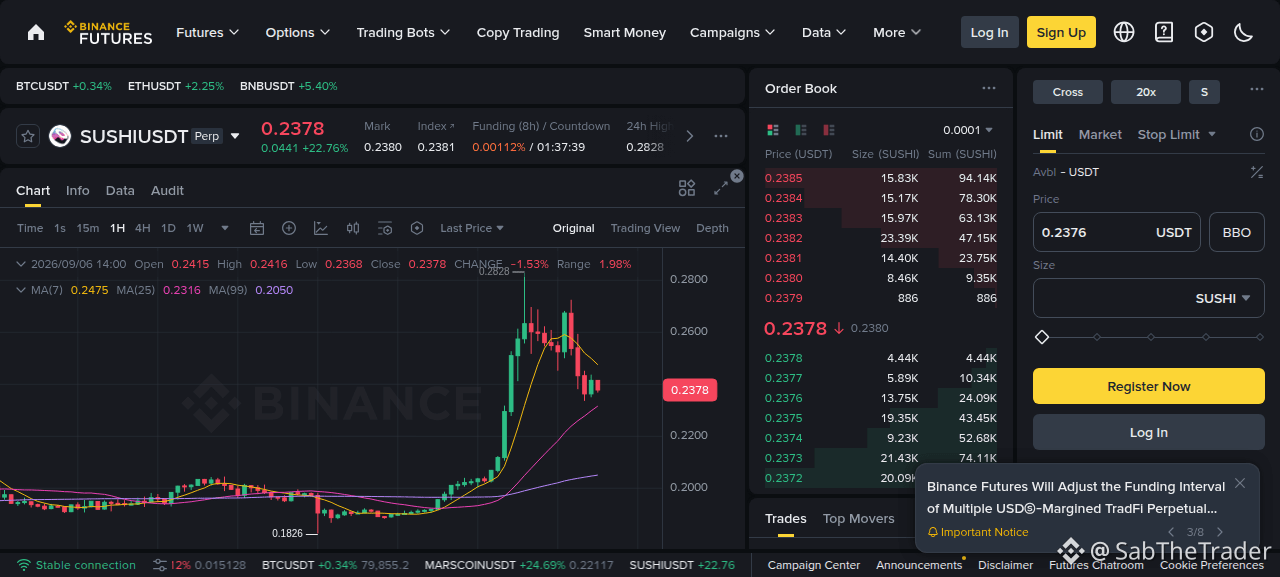
Over the past full 24 hours, SUSHI spot and perpetual trading volume increased by approximately 3125% and 3516%, respectively, compared with the previous full 24 hours, and open interest also increased by about 98.9%. As of 14:23 (UTC+8), spot was at $0.2379, up 22.5% over 24 hours; this $SUSHI move did not lack new capital and positions.
However, funding did not rise in unison. Current funding is about 0.00105%/8h, far from an extreme positive level; meanwhile, the latest full 1-hour spot and perpetual trading volumes were down 54.3% and 41.6%, respectively, from the previous hour. A doubling of OI can only confirm that leveraged positions are entering quickly; it cannot confirm that all of those positions are longs.
Price has retreated from the 24-hour high of 0.2838 to around 0.238. If it reclaims 0.25 and trading volume and OI recover together, then the trend will have a basis for continuation; if it breaks below the current hourly low of 0.2336 and is accompanied by an OI contraction, it looks more like deleveraging at high levels. Tight funding is not a reason to chase higher prices; whether volume can reconnect is the next confirmation to watch.
However, funding did not rise in unison. Current funding is about 0.00105%/8h, far from an extreme positive level; meanwhile, the latest full 1-hour spot and perpetual trading volumes were down 54.3% and 41.6%, respectively, from the previous hour. A doubling of OI can only confirm that leveraged positions are entering quickly; it cannot confirm that all of those positions are longs.
Price has retreated from the 24-hour high of 0.2838 to around 0.238. If it reclaims 0.25 and trading volume and OI recover together, then the trend will have a basis for continuation; if it breaks below the current hourly low of 0.2336 and is accompanied by an OI contraction, it looks more like deleveraging at high levels. Tight funding is not a reason to chase higher prices; whether volume can reconnect is the next confirmation to watch.
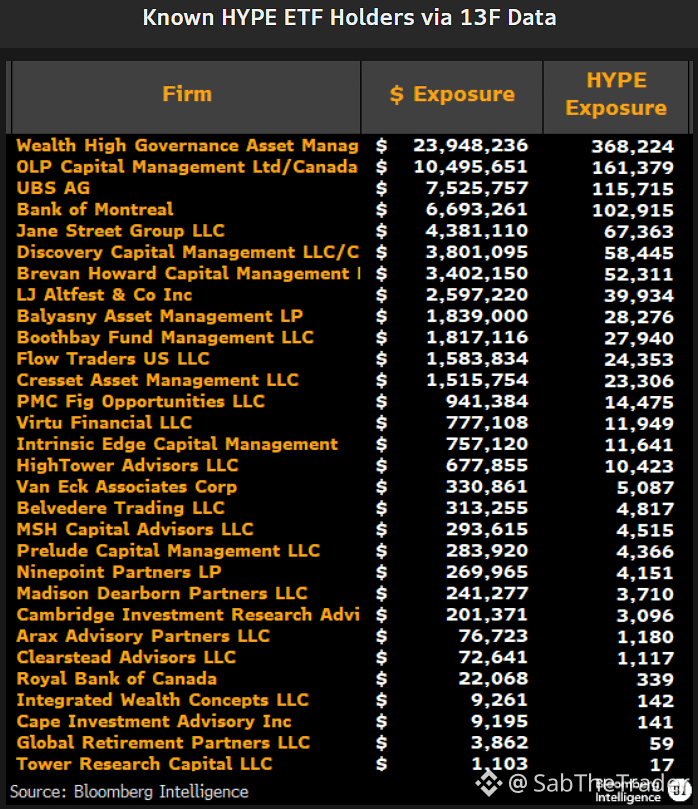
A striking institutional holdings table is drawing attention, but it records a snapshot from June 30, not what institutions are still buying right now.
The first-round 13F disclosures compiled by Bloomberg Intelligence analyst James Seyffart show that 30 known filing institutions held a combined about $74.88 million across three U.S. ETFs related to $HYPE ; the top five accounted for 70.8%. Among them, bank holdings may include client assets, and trading firms like Jane Street may also have been hedging, so the list should not be directly translated as “institutions are collectively bullish.”
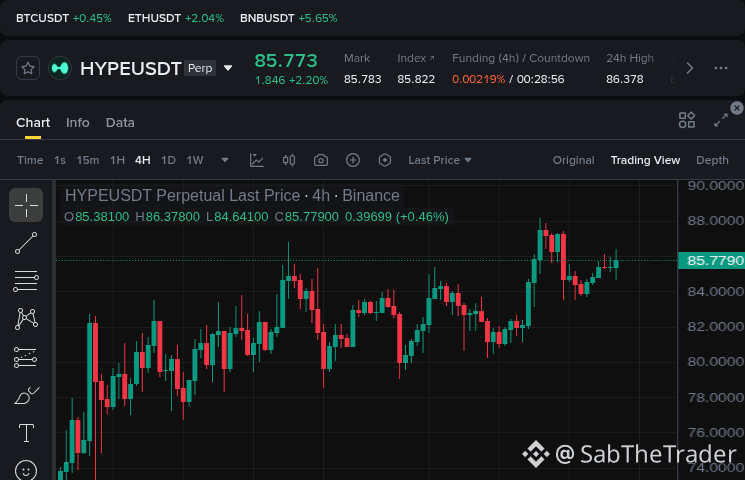
The market reaction has been restrained instead. At 11:17 (UTC+8), Binance currently has only the HYPE USDT perpetual, quoted at $85.74, up 2.12% over 24 hours, with turnover of about $406 million; open interest is about 4.42 million contracts, down slightly by 0.15% over the past 24 hours, and funding is about 0.0026%/4h. The latest full 1-hour trading volume is also 65.6% lower than the previous hour.
My view is that the disclosure strengthened the evidence of the asset entering traditional accounts, but short-term funds are not getting similarly excited. If price breaks above 86.38 on volume and OI expands again, the news may continue to be traded; if it falls below 83.65, then even with a strong institutional list, it should first be digested as old position information rather than treated as a catalyst for new buying.
The first-round 13F disclosures compiled by Bloomberg Intelligence analyst James Seyffart show that 30 known filing institutions held a combined about $74.88 million across three U.S. ETFs related to $HYPE ; the top five accounted for 70.8%. Among them, bank holdings may include client assets, and trading firms like Jane Street may also have been hedging, so the list should not be directly translated as “institutions are collectively bullish.”
The market reaction has been restrained instead. At 11:17 (UTC+8), Binance currently has only the HYPE USDT perpetual, quoted at $85.74, up 2.12% over 24 hours, with turnover of about $406 million; open interest is about 4.42 million contracts, down slightly by 0.15% over the past 24 hours, and funding is about 0.0026%/4h. The latest full 1-hour trading volume is also 65.6% lower than the previous hour.
My view is that the disclosure strengthened the evidence of the asset entering traditional accounts, but short-term funds are not getting similarly excited. If price breaks above 86.38 on volume and OI expands again, the news may continue to be traded; if it falls below 83.65, then even with a strong institutional list, it should first be digested as old position information rather than treated as a catalyst for new buying.
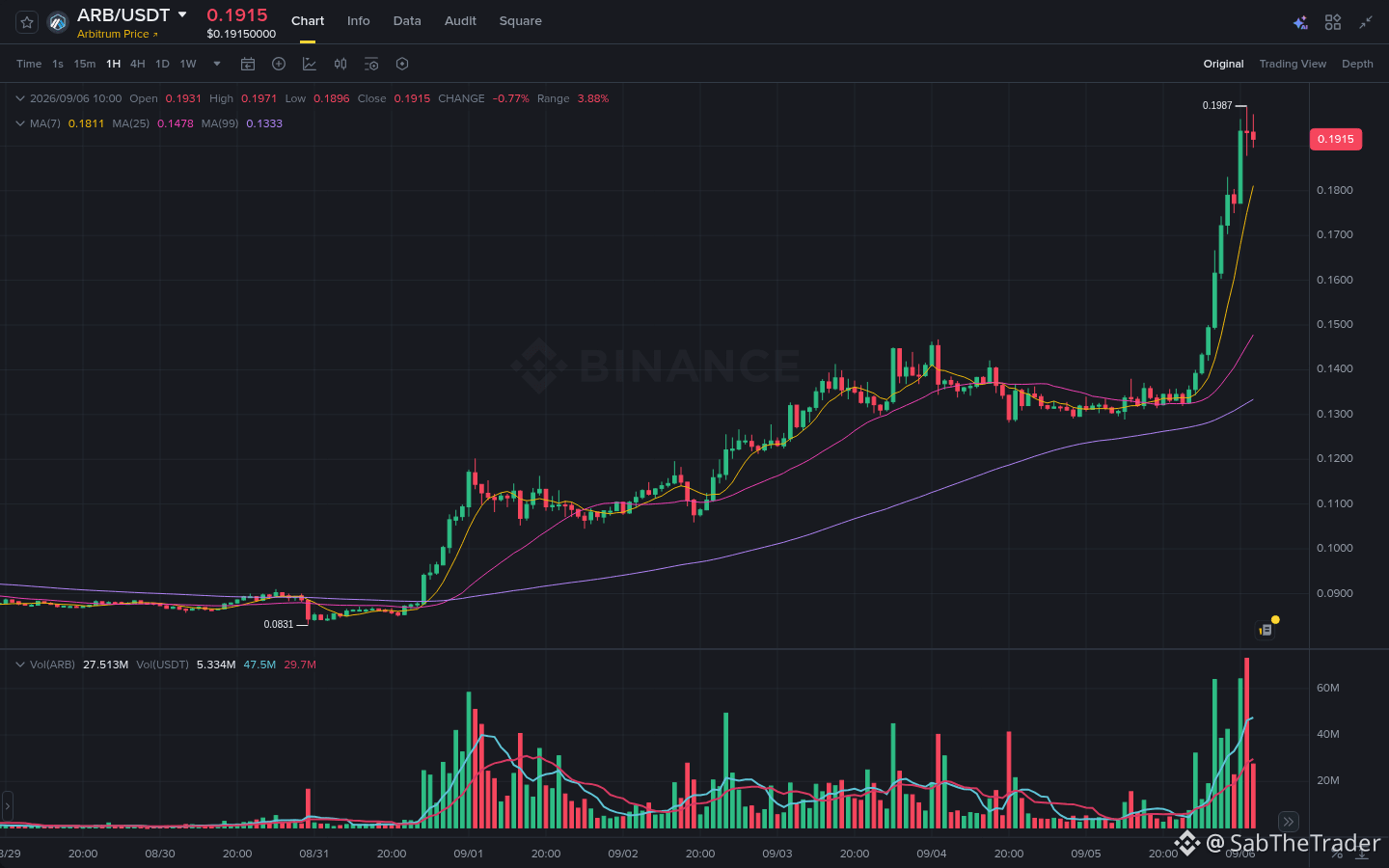
When the price is close to the 24-hour high, high-level turnover is still not fading. At 10:32 (UTC+8), $ARB was quoted at 0.1930 USDT, up 46.55% over 24 hours; spot trading volume was about 80.35 million USDT, and perpetual trading volume was about 477 million USDT, with the latter 5.93 times that of spot.
Looking at the most recent two complete 24-hour windows, spot trading volume increased from about 29.78 million to 75.57 million USDT, and perpetuals increased from about 174 million to 448 million USDT; during the same period, contract open interest (OI) increased by 13.14%, with notional holdings of about 67.34 million US dollars. Funding is 0.0100%/8h, indicating that leveraged positions have increased, but the rate has not yet moved to an extreme.
In the short term, a slight rhythm divergence has already appeared: in the most recent complete 1-hour period, spot trading volume increased by 18.22% compared with the previous hour, while perpetual volume fell by 1.89%. From a trading perspective, I would regard 0.1987 as the first confirmation level; only if it breaks out on volume and holds steady, accompanied by a continued rise in OI, will the trend have follow-through quality. If the price repeatedly tests the high, spot weakens, or OI turns down first, it would look more like high-level positions starting to loosen.
Looking at the most recent two complete 24-hour windows, spot trading volume increased from about 29.78 million to 75.57 million USDT, and perpetuals increased from about 174 million to 448 million USDT; during the same period, contract open interest (OI) increased by 13.14%, with notional holdings of about 67.34 million US dollars. Funding is 0.0100%/8h, indicating that leveraged positions have increased, but the rate has not yet moved to an extreme.
In the short term, a slight rhythm divergence has already appeared: in the most recent complete 1-hour period, spot trading volume increased by 18.22% compared with the previous hour, while perpetual volume fell by 1.89%. From a trading perspective, I would regard 0.1987 as the first confirmation level; only if it breaks out on volume and holds steady, accompanied by a continued rise in OI, will the trend have follow-through quality. If the price repeatedly tests the high, spot weakens, or OI turns down first, it would look more like high-level positions starting to loosen.
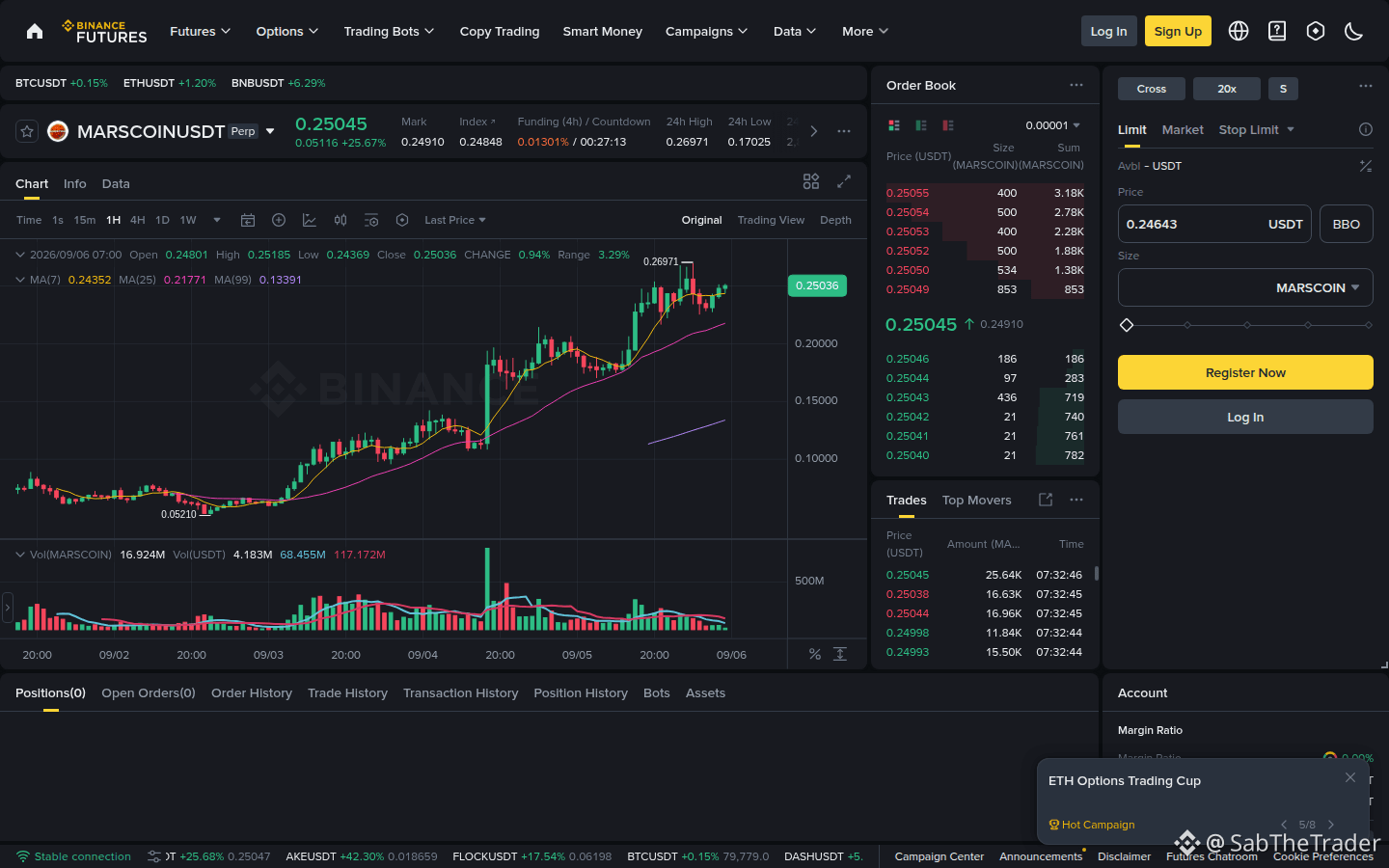
The post-listing hype has not yet faded, but funds have already diverged between spot and futures. At 7:31 (UTC+8), $MARSCOIN was reported at 0.2458 USDT, up 23.58% in 24 hours; spot trading volume was 91.62 million USDT, and perpetual trading volume was 636 million USDT, with the latter nearly 7 times spot.
In the latest complete 1-hour period (6:00—7:00), spot trading volume fell 34.2% from the previous hour, while perpetuals increased by 10.0%; futures open interest was about 172 million coins, equivalent to about 42.26 million USDT at mark price. Current Funding is 0.0127%, not yet extreme, but leveraged trading is clearly dominant.
My view is that the trend remains strong, but chasing quality depends on whether spot can regain volume. If the price continues to approach the 24-hour high of 0.2675 and spot volume still fails to keep up, I would guard against a sharp rise followed by a pullback; if spot volume expands and the price stabilizes above that area, then I would look for continuation. It is newly listed and carries a Seed Tag, so position size should be small.
In the latest complete 1-hour period (6:00—7:00), spot trading volume fell 34.2% from the previous hour, while perpetuals increased by 10.0%; futures open interest was about 172 million coins, equivalent to about 42.26 million USDT at mark price. Current Funding is 0.0127%, not yet extreme, but leveraged trading is clearly dominant.
My view is that the trend remains strong, but chasing quality depends on whether spot can regain volume. If the price continues to approach the 24-hour high of 0.2675 and spot volume still fails to keep up, I would guard against a sharp rise followed by a pullback; if spot volume expands and the price stabilizes above that area, then I would look for continuation. It is newly listed and carries a Seed Tag, so position size should be small.
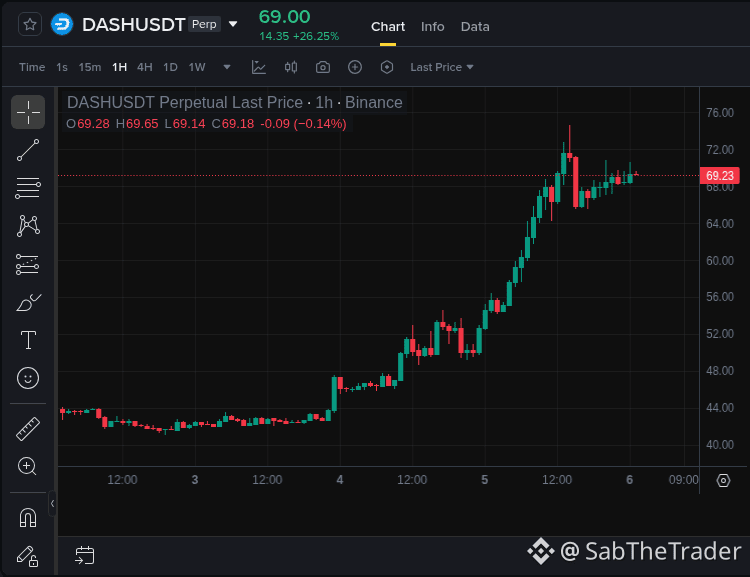
$DASH In this round of the rally, price, trading volume, and actual open interest all moved up together.
As of Sep 6 at 01:02 (UTC+8), Binance spot was up about 27.8% in 24 hours, and perpetual futures turnover was about $609 million. The most recent full 24 hours of perpetual turnover was about $608 million, 2.67 times the roughly $227 million in the previous full 24 hours; over the same period, contract open interest (OI) increased by about 17.1%.
Interestingly, the current funding rate is about 0.0071%/8h, and it has not risen into an extreme positive level along with the price surge. This suggests that new positions are indeed entering the move, but it cannot yet be confirmed that all of them are chasing longs. Price once climbed to $74.63, then pulled back to around $69, and turnover at the highs has already started to appear.
What I’m watching now are two things: if price tests the $74.6 area again and volume and OI can still rise in sync, the trend structure will be more solid; if price moves sideways while OI falls quickly, this rally is more likely entering a de-leveraging phase. Chasing in just because of a 27% gain is not enough information.
As of Sep 6 at 01:02 (UTC+8), Binance spot was up about 27.8% in 24 hours, and perpetual futures turnover was about $609 million. The most recent full 24 hours of perpetual turnover was about $608 million, 2.67 times the roughly $227 million in the previous full 24 hours; over the same period, contract open interest (OI) increased by about 17.1%.
Interestingly, the current funding rate is about 0.0071%/8h, and it has not risen into an extreme positive level along with the price surge. This suggests that new positions are indeed entering the move, but it cannot yet be confirmed that all of them are chasing longs. Price once climbed to $74.63, then pulled back to around $69, and turnover at the highs has already started to appear.
What I’m watching now are two things: if price tests the $74.6 area again and volume and OI can still rise in sync, the trend structure will be more solid; if price moves sideways while OI falls quickly, this rally is more likely entering a de-leveraging phase. Chasing in just because of a 27% gain is not enough information.
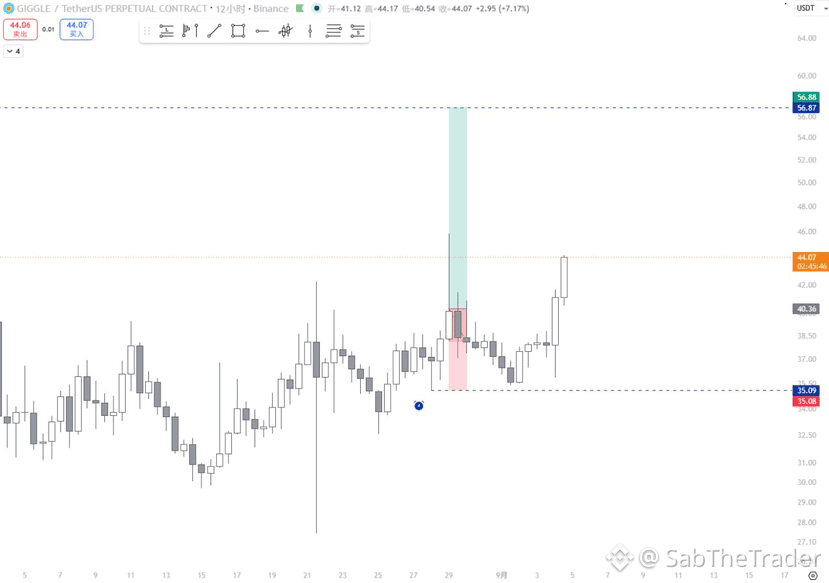
Once again, I must emphasize the importance of setting stop-loss correctly $GIGGLE
I almost screwed up
I almost screwed up
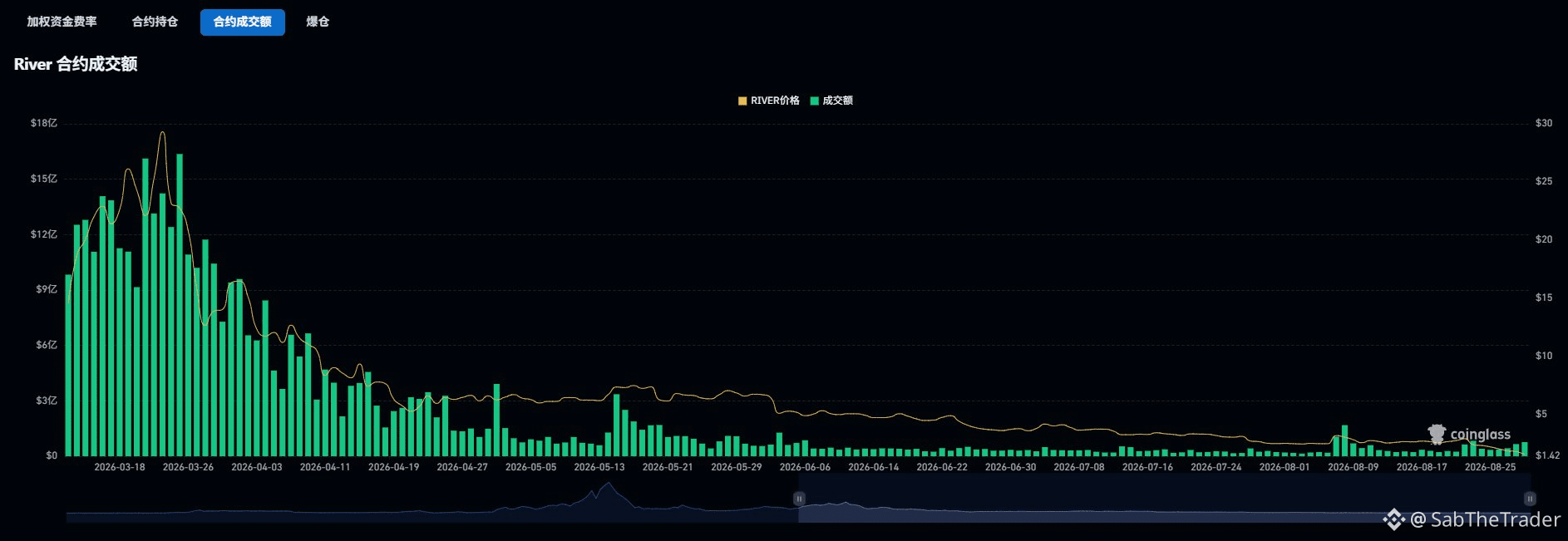
Just take a quick look over the weekend: two sets of data for @Riverdotinc 🐱🌊
One side is $RIVER contract trading volume.
From the peak in March, it’s been steadily dropping; now trading is noticeably calmer. After breaking the previous low a few days ago, the price is still grinding slowly at low levels.
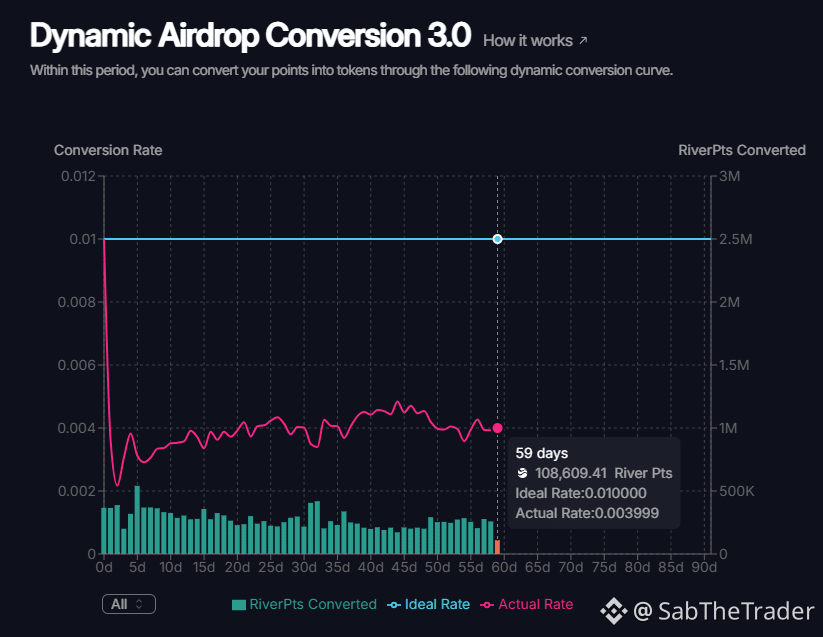
The other side is Conversion 3.0:
S6, Day 59: yesterday it converted 108,609 River Pts. The Actual Rate is currently around 0.004, still a bit far from the Ideal Rate of 0.01.
One looks at market heat; the other looks at the conversion of Pts.
S6 is only left with about a month. Keep observing whether anything new shows up next.
* NFA, DYOR.
One side is $RIVER contract trading volume.
From the peak in March, it’s been steadily dropping; now trading is noticeably calmer. After breaking the previous low a few days ago, the price is still grinding slowly at low levels.
The other side is Conversion 3.0:
S6, Day 59: yesterday it converted 108,609 River Pts. The Actual Rate is currently around 0.004, still a bit far from the Ideal Rate of 0.01.
One looks at market heat; the other looks at the conversion of Pts.
S6 is only left with about a month. Keep observing whether anything new shows up next.
* NFA, DYOR.
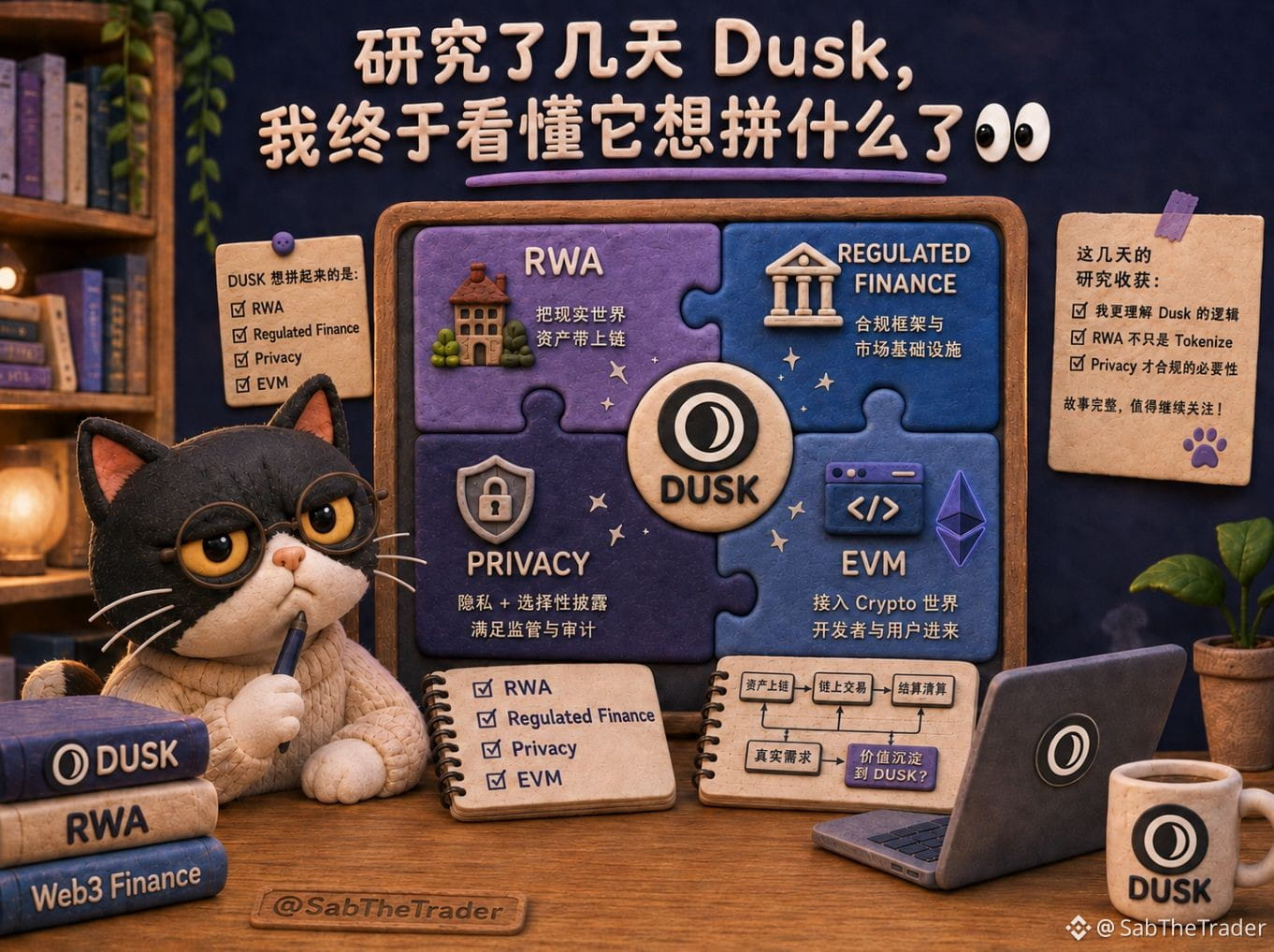
A few days ago, I dismantled the uses of Privacy, RWA, DuskEVM, and $DUSK one by one.
Looking at each piece individually, they’re actually not that hard to understand.
What’s truly difficult about @Dusk is getting these four parts to form a closed loop.
If the whole system can really run, its ideal state would be:
Assets come in → users come in → transactions are generated → network demand is generated → more assets and users are attracted.
And they should be able to create demand for each other, rather than each one doing its own thing.
Also, if Dusk can truly take off later on, its advantages might not be only “privacy technology.”
There are already many people working on Privacy itself.
What’s truly hard to replicate might be having these elements exist together at the same time: technology + compliance framework + source of assets + real market entry.
So going forward, if I keep observing, I’d be more interested in seeing some more specific data, such as:
1️⃣ Are on-chain transactions and fees going up?
2️⃣ Is the staking ratio changing?
3️⃣ Does RWA have ongoing trading and settlement?
4️⃣ How is the token supply in circulation changing?
And on top of that, the supply side itself will also affect the outcome:
Can new demand outpace new supply and potential sell pressure?
That might be what ultimately determines whether $DUSK can truly capture the business-growth upside.
Let the data speak for itself.👀
#dusk
Looking at each piece individually, they’re actually not that hard to understand.
What’s truly difficult about @Dusk is getting these four parts to form a closed loop.
If the whole system can really run, its ideal state would be:
Assets come in → users come in → transactions are generated → network demand is generated → more assets and users are attracted.
And they should be able to create demand for each other, rather than each one doing its own thing.
Also, if Dusk can truly take off later on, its advantages might not be only “privacy technology.”
There are already many people working on Privacy itself.
What’s truly hard to replicate might be having these elements exist together at the same time: technology + compliance framework + source of assets + real market entry.
So going forward, if I keep observing, I’d be more interested in seeing some more specific data, such as:
1️⃣ Are on-chain transactions and fees going up?
2️⃣ Is the staking ratio changing?
3️⃣ Does RWA have ongoing trading and settlement?
4️⃣ How is the token supply in circulation changing?
And on top of that, the supply side itself will also affect the outcome:
Can new demand outpace new supply and potential sell pressure?
That might be what ultimately determines whether $DUSK can truly capture the business-growth upside.
Let the data speak for itself.👀
#dusk
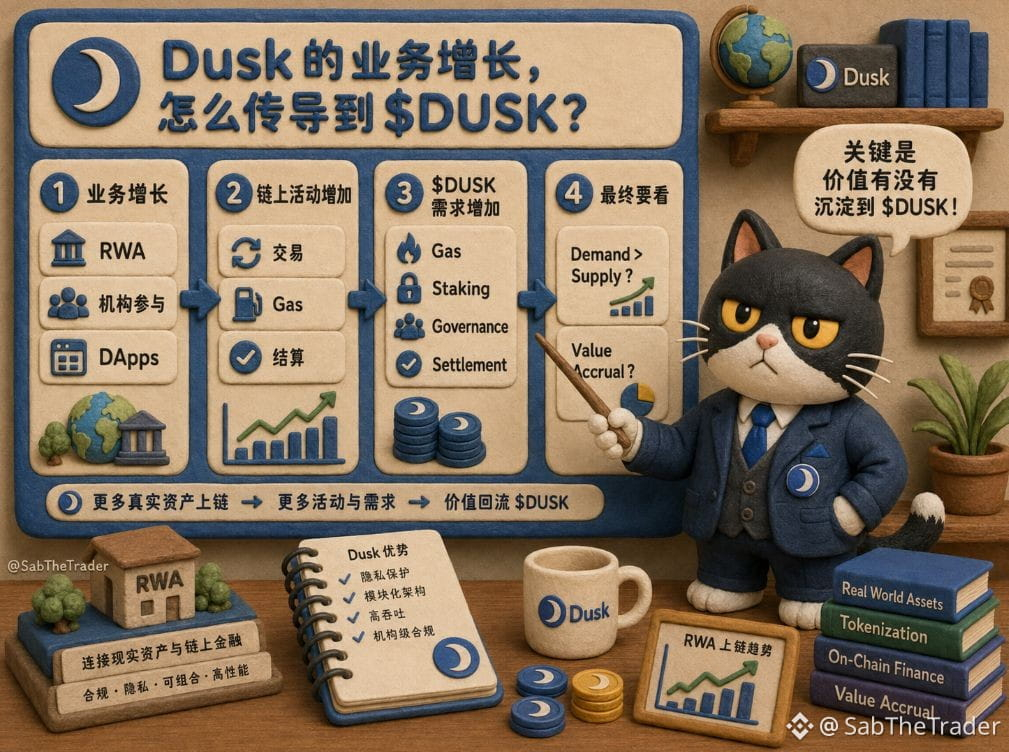
🌕 You can’t judge a project just by how big its business is—you also need to see whether those businesses ultimately create real demand for tokens. Today I want to take $DUSK apart and look at it.👀
After all, this kind of situation is pretty common in Crypto:
Whether a project’s business is doing well is one thing, but whether the token can actually capture demand from those businesses is another.
So I specifically looked into what $DUSK is doing within the entire Dusk network.
At the moment, DUSK is the native token of the whole network.
In simple terms:
▸DuskDS:
DUSK is used for Staking, Governance, and Settlement.
▸DuskEVM:
Developers run Solidity dApps, and users perform on-chain actions that require DUSK to pay Gas and transaction fees.
▸DuskVM:
Privacy applications executing also require DUSK as Gas.
From here, at least in logic, it all connects:
If, in the future, more assets are issued, more investors enter, and more applications are deployed on DuskEVM—leading to more transactions and settlement—then theoretically, those on-chain activities would increase usage of the token.
But everyone still needs to keep two things separate:
“More project adoption” ≠ “Token must necessarily appreciate.”
There’s a long road in between.😂
Also, what I want to observe next is:
For every piece of real business Dusk adds, how much real demand does it actually bring to the token?
Is it more Gas consumption?
More Staking?
More settlement demand?
Or more tokens being locked in the network long-term?
One layer deeper, we also need to see whether these newly added demands can outperform the token’s own ongoing increase in supply—and the potential sell pressure afterward.
Because in the end, what determines whether the token can truly capture the upside of Dusk’s business growth likely isn’t “how big the project is,” but rather:
For each increment in business growth, how much value is genuinely captured and settled into the token.
I think this is the most important data to watch next.👀
#dusk $DUSK @Dusk
After all, this kind of situation is pretty common in Crypto:
Whether a project’s business is doing well is one thing, but whether the token can actually capture demand from those businesses is another.
So I specifically looked into what $DUSK is doing within the entire Dusk network.
At the moment, DUSK is the native token of the whole network.
In simple terms:
▸DuskDS:
DUSK is used for Staking, Governance, and Settlement.
▸DuskEVM:
Developers run Solidity dApps, and users perform on-chain actions that require DUSK to pay Gas and transaction fees.
▸DuskVM:
Privacy applications executing also require DUSK as Gas.
From here, at least in logic, it all connects:
If, in the future, more assets are issued, more investors enter, and more applications are deployed on DuskEVM—leading to more transactions and settlement—then theoretically, those on-chain activities would increase usage of the token.
But everyone still needs to keep two things separate:
“More project adoption” ≠ “Token must necessarily appreciate.”
There’s a long road in between.😂
Also, what I want to observe next is:
For every piece of real business Dusk adds, how much real demand does it actually bring to the token?
Is it more Gas consumption?
More Staking?
More settlement demand?
Or more tokens being locked in the network long-term?
One layer deeper, we also need to see whether these newly added demands can outperform the token’s own ongoing increase in supply—and the potential sell pressure afterward.
Because in the end, what determines whether the token can truly capture the upside of Dusk’s business growth likely isn’t “how big the project is,” but rather:
For each increment in business growth, how much value is genuinely captured and settled into the token.
I think this is the most important data to watch next.👀
#dusk $DUSK @Dusk
I found that this whole RWA thing also often gets oversimplified by us.😂
Back when people talked about asset tokenization, everyone’s first reaction was probably:
Take a set of real estate, a stock, or a bond, split it into lots of pieces, and put them on the blockchain to trade.
But if you think about it carefully, if tokenization merely cuts an asset into 10,000 tokens, it doesn’t really solve the most troublesome problems in financial markets.
For example:
Who can buy?
How do we verify an investor’s identity?
Where are the ownership records kept after purchase?
Can the asset be freely transferred to someone else?
How do dividends and voting work?
How are settlement and reconciliation of funds and assets completed after a trade?
And when regulators or auditors need to review, how should disclosures be handled?
So only after seeing all this do I slowly start to think:
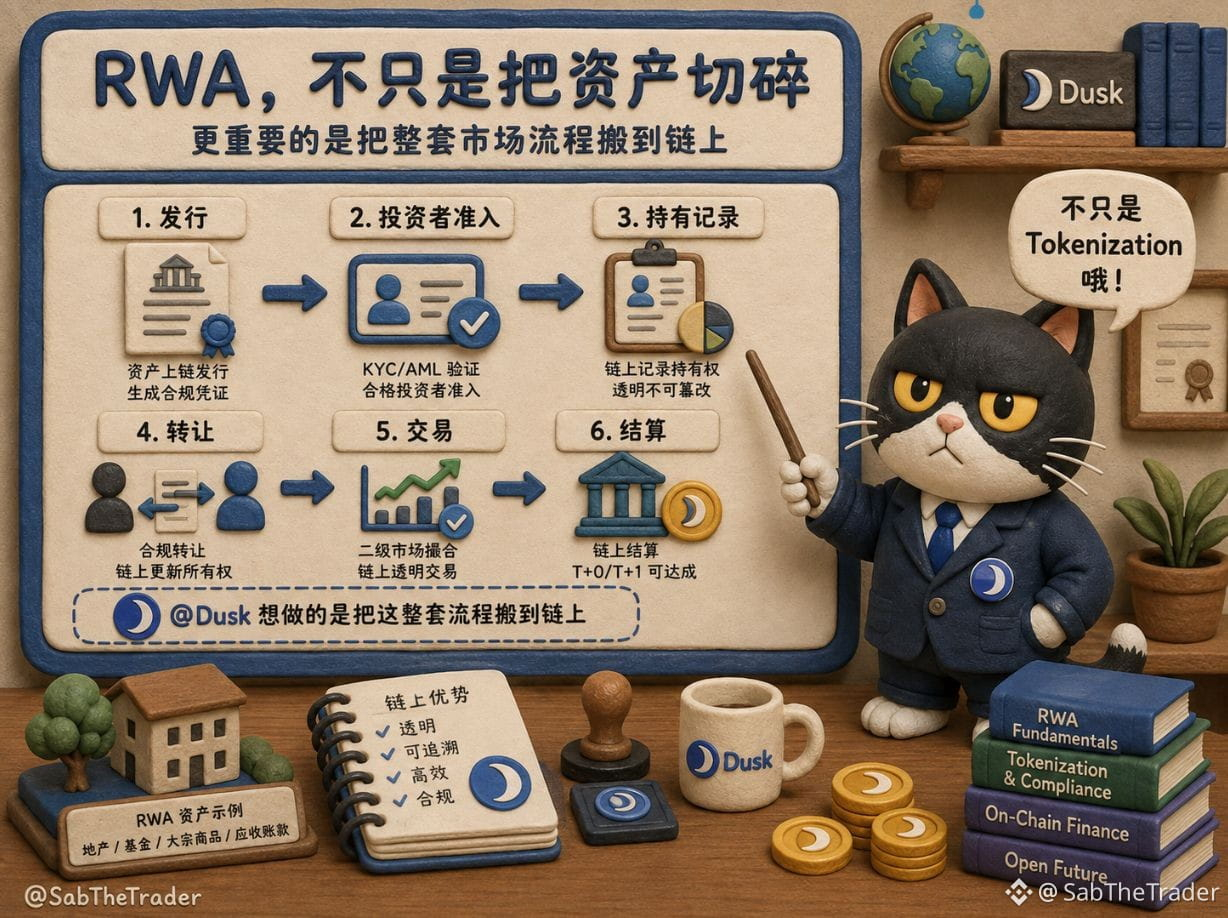
RWA may not be as simple as “cutting assets into pieces.”
More importantly, it might be about whether we can move the entire lifecycle—
issuance → investor onboarding → holding → transfer → trading → settlement—
that used to be spread across different institutions and different databases, onto the blockchain gradually.
That’s also why I can better understand why $DUSK keeps talking about Privacy, Selective Disclosure, and Regulated Finance.
Because if financial institutions really move the whole asset lifecycle onto the chain, but also conveniently expose their balances, positions, cash flows, and trading counterparties to everyone in the world…
that probably isn’t very realistic.😂
And what Dusk Trade, by @Dusk , is doing now isn’t just about “issuing an RWA token”—it also focuses on handling investor onboarding, wallet binding, controlled transfer, payments, and compliant settlement all together.
Only when all these things start running smoothly does RWA truly move forward.
Without that, even the biggest tokenization numbers may only amount to “registering” traditional assets on-chain.
So in the end, what matters may not be who tokenizes the most assets, but who can truly get this market running.👀
#dusk $DUSK @Dusk
Back when people talked about asset tokenization, everyone’s first reaction was probably:
Take a set of real estate, a stock, or a bond, split it into lots of pieces, and put them on the blockchain to trade.
But if you think about it carefully, if tokenization merely cuts an asset into 10,000 tokens, it doesn’t really solve the most troublesome problems in financial markets.
For example:
Who can buy?
How do we verify an investor’s identity?
Where are the ownership records kept after purchase?
Can the asset be freely transferred to someone else?
How do dividends and voting work?
How are settlement and reconciliation of funds and assets completed after a trade?
And when regulators or auditors need to review, how should disclosures be handled?
So only after seeing all this do I slowly start to think:
RWA may not be as simple as “cutting assets into pieces.”
More importantly, it might be about whether we can move the entire lifecycle—
issuance → investor onboarding → holding → transfer → trading → settlement—
that used to be spread across different institutions and different databases, onto the blockchain gradually.
That’s also why I can better understand why $DUSK keeps talking about Privacy, Selective Disclosure, and Regulated Finance.
Because if financial institutions really move the whole asset lifecycle onto the chain, but also conveniently expose their balances, positions, cash flows, and trading counterparties to everyone in the world…
that probably isn’t very realistic.😂
And what Dusk Trade, by @Dusk , is doing now isn’t just about “issuing an RWA token”—it also focuses on handling investor onboarding, wallet binding, controlled transfer, payments, and compliant settlement all together.
Only when all these things start running smoothly does RWA truly move forward.
Without that, even the biggest tokenization numbers may only amount to “registering” traditional assets on-chain.
So in the end, what matters may not be who tokenizes the most assets, but who can truly get this market running.👀
#dusk $DUSK @Dusk
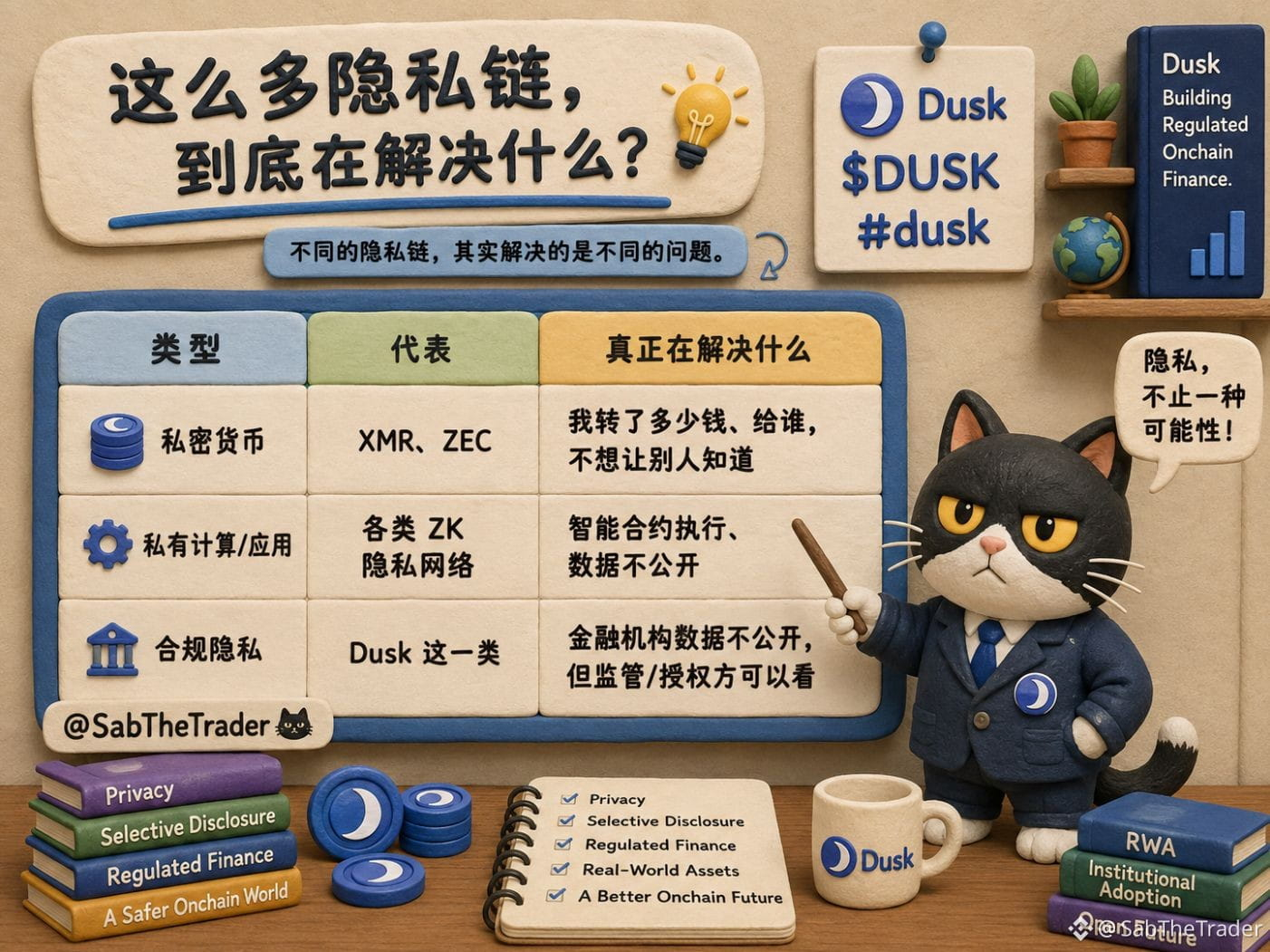
When studying @Dusk , I’ve actually had a very real question:
Why are there so many projects in Crypto working on “privacy”? 🤔
After all, if it were simply about privacy-preserving transfers, there are already well-established projects in the market like ZEC and XMR.
So why do we still need Dusk today?
What Dusk wants to solve isn’t exactly the same problem. It places more emphasis on:
Privacy + Selective Disclosure + Regulated Finance.
In simple terms, it’s not aiming for: “No one can see anything.”
It’s more like: “Not everyone should see it, but the people who need to can.”
That difference is actually pretty important.
Because if traditional finance were moved to the blockchain at massive scale, full transparency could be a problem.
Say an institution puts its assets, transactions, and settlement entirely on a public chain—then competitors can open a block explorer and see its balances, positions, flows of funds, and even counterparties…
That level of transparency might be something ordinary crypto users have grown accustomed to, but it may not be acceptable to real financial institutions.
And what Dusk is targeting right now is this middle ground:
While protecting sensitive information like balances, transactions, and holdings, it also allows—when necessary—selective disclosure to regulators, auditors, or specific counterparties.
Seen this way, I can understand why there are now more and more projects focused on “privacy + compliance.”
But here’s the question I’m truly curious about:
Do institutions really need confidentiality—but can that need ultimately translate into real, large-scale on-chain usage?
Technically, it might be possible. But whether anyone truly *has to* use it is another matter.
So next, when I keep watching $DUSK , besides the price, I’ll be more interested in whether Dusk’s RWA, institutional issuance, trading, and settlement can gradually generate real usage.
If they can, then this path is actually not the same story as traditional privacy coins.
If they can’t, then “privacy + RWA + compliance” might ultimately just be a very polished narrative.
That might be the most worth continuing to observe. 👀
#dusk $DUSK @Dusk
Why are there so many projects in Crypto working on “privacy”? 🤔
After all, if it were simply about privacy-preserving transfers, there are already well-established projects in the market like ZEC and XMR.
So why do we still need Dusk today?
What Dusk wants to solve isn’t exactly the same problem. It places more emphasis on:
Privacy + Selective Disclosure + Regulated Finance.
In simple terms, it’s not aiming for: “No one can see anything.”
It’s more like: “Not everyone should see it, but the people who need to can.”
That difference is actually pretty important.
Because if traditional finance were moved to the blockchain at massive scale, full transparency could be a problem.
Say an institution puts its assets, transactions, and settlement entirely on a public chain—then competitors can open a block explorer and see its balances, positions, flows of funds, and even counterparties…
That level of transparency might be something ordinary crypto users have grown accustomed to, but it may not be acceptable to real financial institutions.
And what Dusk is targeting right now is this middle ground:
While protecting sensitive information like balances, transactions, and holdings, it also allows—when necessary—selective disclosure to regulators, auditors, or specific counterparties.
Seen this way, I can understand why there are now more and more projects focused on “privacy + compliance.”
But here’s the question I’m truly curious about:
Do institutions really need confidentiality—but can that need ultimately translate into real, large-scale on-chain usage?
Technically, it might be possible. But whether anyone truly *has to* use it is another matter.
So next, when I keep watching $DUSK , besides the price, I’ll be more interested in whether Dusk’s RWA, institutional issuance, trading, and settlement can gradually generate real usage.
If they can, then this path is actually not the same story as traditional privacy coins.
If they can’t, then “privacy + RWA + compliance” might ultimately just be a very polished narrative.
That might be the most worth continuing to observe. 👀
#dusk $DUSK @Dusk
Verified
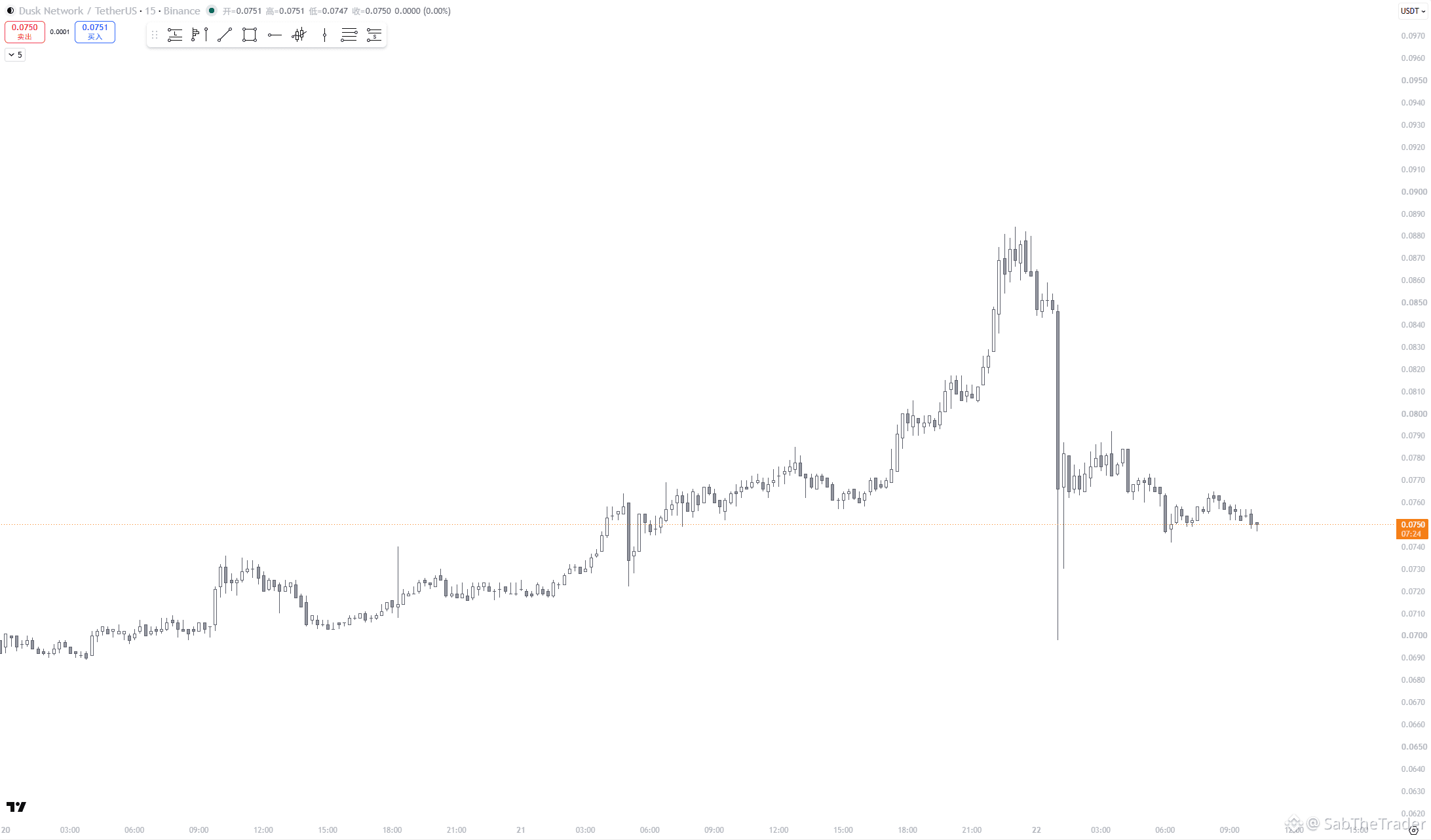
Originally, $DUSK was running just fine, and today it also plunged along with the overall market. Right now it seems to be in a consolidation phase; liquidity over the weekend is likely to be a bit weaker too 🤔
While the price stays active, @Dusk has also indeed made some fundamental progress recently: the DuskEVM Testnet is already live, and developers can directly deploy and test using familiar Ethereum tools like Solidity and Hardhat.
And what Dusk truly wants to do isn’t just a regular public blockchain—it’s to combine privacy, compliance, and on-chain settlement, targeting the regulated onchain finance and RWA market. ((That said, aren’t there more and more projects talking about privacy + compliance lately?
So next, I’m going to observe $DUSK while looking at two things at the same time:
① After this round of上涨, whether the price can hold key structural levels;
② Whether DuskEVM, RWA, and cooperation with institutional players can gradually turn into real on-chain demand.
Having both a price trend and a compelling narrative is of course ideal, but ultimately we still have to see whether the market is willing to keep pricing that narrative.
#dusk @Dusk
While the price stays active, @Dusk has also indeed made some fundamental progress recently: the DuskEVM Testnet is already live, and developers can directly deploy and test using familiar Ethereum tools like Solidity and Hardhat.
And what Dusk truly wants to do isn’t just a regular public blockchain—it’s to combine privacy, compliance, and on-chain settlement, targeting the regulated onchain finance and RWA market. ((That said, aren’t there more and more projects talking about privacy + compliance lately?
So next, I’m going to observe $DUSK while looking at two things at the same time:
① After this round of上涨, whether the price can hold key structural levels;
② Whether DuskEVM, RWA, and cooperation with institutional players can gradually turn into real on-chain demand.
Having both a price trend and a compelling narrative is of course ideal, but ultimately we still have to see whether the market is willing to keep pricing that narrative.
#dusk @Dusk
Log in to explore more content