
Roaib_Bn
1.2k Posts

Roaib_Bn
Report
Block User
HOLDER | SELF BELIEVER | NOT A PERSONAL ADVISER | JUST AN EDUCATOR 📚 | Learning. Growing. Sharing Knowledge.Future in progress.
34 Following
9.9K+ Followers
13.8K+ Liked
Posts
All
Quotes
Videos
Live
·
--
Article
See translation
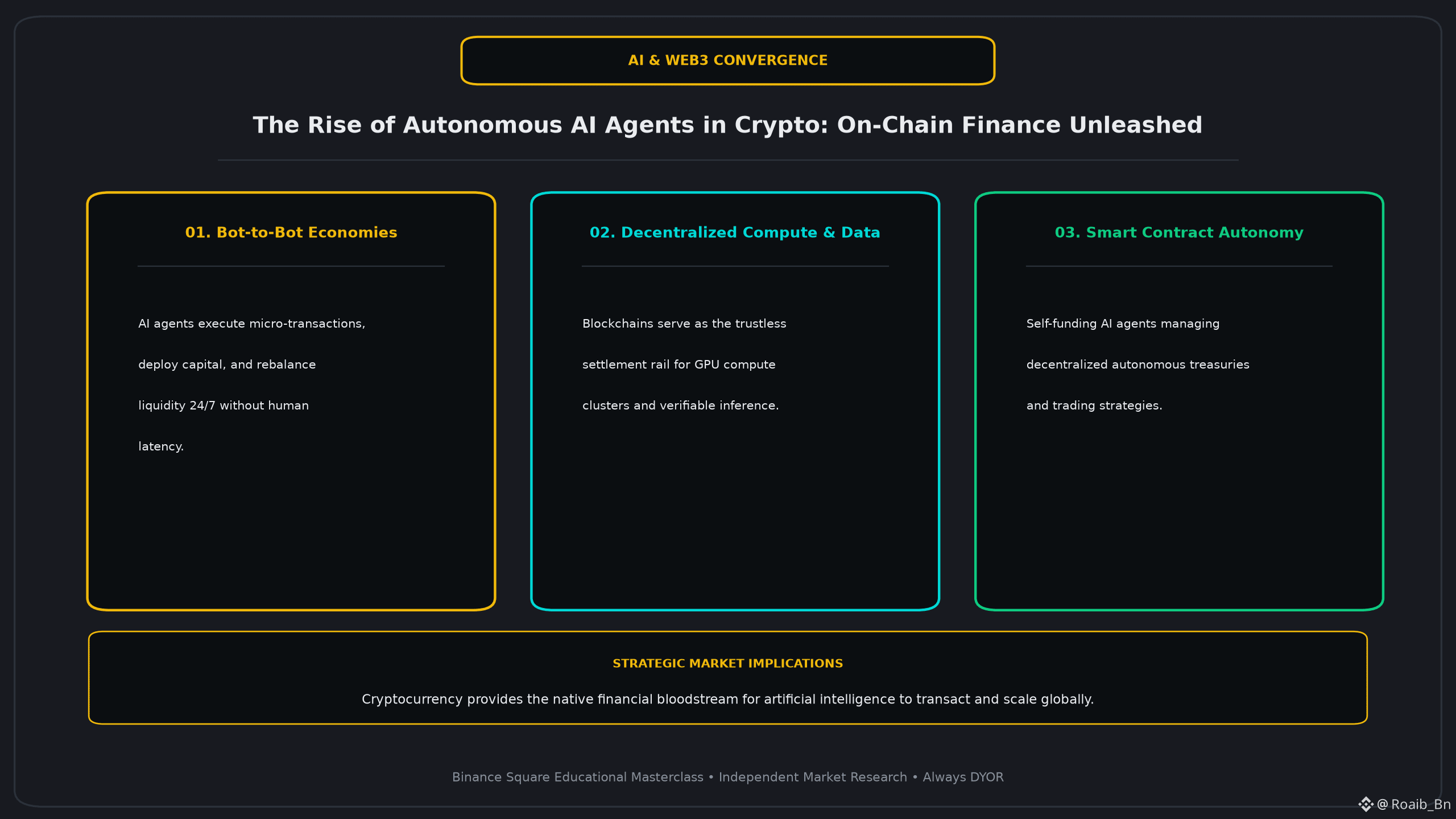
The Rise of Autonomous AI Agents in Crypto: On-Chain Finance UnleashedWe are witnessing a fundamental shift in how capital moves across the blockchain. For years, we designed protocols primarily for human users, focusing on intuitive wallets and visual interfaces. Today, in late 2026, the most active participants in the market are no longer human traders. They are autonomous AI agents. These software entities are becoming the native economic actors of the crypto ecosystem, using the blockchain as their primary financial bloodstream. This is not just a trend; it is a total restructuring of on-chain finance.
The concept of bot-to-bot economies is moving from theory to massive scale. These agents execute micro-transactions at a frequency humans cannot match. They deploy capital into yield farms, rebalance liquidity across decentralized exchanges, and hedge positions in real-time. Unlike traditional automated trading bots, these agents possess a level of reasoning and autonomy that allows them to navigate complex DeFi stacks without human intervention. They do not sleep, they do not have emotional biases, and they require a settlement layer that is permissionless and 24/7. This is where the synergy between artificial intelligence and decentralized finance becomes undeniable. Projects like $FET have been at the forefront of this, creating the framework where agents can discover each other and trade services autonomously.
For these agents to function reliably, they need more than just a place to trade. They require decentralized compute and verifiable data. We are seeing networks like $NEAR and others evolve into the backbone of this movement. Blockchains are serving as the trustless settlement rails for GPU compute clusters. When an AI agent needs to run an inference or train a small model, it uses the blockchain to verify that the work was done correctly and to pay the compute provider instantly. This creates a closed-loop economy where the currency of the network is the literal fuel for intelligence. The convergence of decentralized physical infrastructure and AI is arguably the most significant narrative of this cycle.
From a market perspective, the distinction between AI tokens and infrastructure tokens is blurring. Smart contract autonomy is the next frontier. We are seeing self-funding AI agents that manage their own decentralized autonomous treasuries. These agents can launch their own sub-tokens, hire other agents for specialized tasks, and grow their own ecosystems. For a disciplined trader, the strategy is shifting from speculating on hype to identifying the protocols that provide the most efficient rails for these agents. The value is accruing to the layers that offer the lowest latency, the highest security for model weights, and the most robust liquidity.
This evolution raises a critical question for all of us participating in the markets today. As AI agents become the dominant force in on-chain liquidity, will human traders be relegated to the role of protocol governors, or is there still a place for manual discretionary trading in an environment dominated by sub-second machine logic? I would love to hear your thoughts on whether you are currently integrating AI-driven tools into your own strategy or if you prefer the traditional approach.
This analysis is for educational purposes and reflects current market trends. It is not financial advice. The crypto market is highly volatile and involves significant risk. Always conduct your own research and consult with a professional before making investment decisions.
$NEAR $FET #BinanceSquare #AITrend
The Rise of Autonomous AI Agents in Crypto: On-Chain Finance Unleashed
We are witnessing a fundamental shift in how capital moves across the blockchain. For years, we designed protocols primarily for human users, focusing on intuitive wallets and visual interfaces. Today, in late 2026, the most active participants in the market are no longer human traders. They are autonomous AI agents. These software entities are becoming the native economic actors of the crypto ecosystem, using the blockchain as their primary financial bloodstream. This is not just a trend; it is a total restructuring of on-chain finance.
The concept of bot-to-bot economies is moving from theory to massive scale. These agents execute micro-transactions at a frequency humans cannot match. They deploy capital into yield farms, rebalance liquidity across decentralized exchanges, and hedge positions in real-time. Unlike traditional automated trading bots, these agents possess a level of reasoning and autonomy that allows them to navigate complex DeFi stacks without human intervention. They do not sleep, they do not have emotional biases, and they require a settlement layer that is permissionless and 24/7. This is where the synergy between artificial intelligence and decentralized finance becomes undeniable. Projects like $FET have been at the forefront of this, creating the framework where agents can discover each other and trade services autonomously.
For these agents to function reliably, they need more than just a place to trade. They require decentralized compute and verifiable data. We are seeing networks like $NEAR and others evolve into the backbone of this movement. Blockchains are serving as the trustless settlement rails for GPU compute clusters. When an AI agent needs to run an inference or train a small model, it uses the blockchain to verify that the work was done correctly and to pay the compute provider instantly. This creates a closed-loop economy where the currency of the network is the literal fuel for intelligence. The convergence of decentralized physical infrastructure and AI is arguably the most significant narrative of this cycle.
From a market perspective, the distinction between AI tokens and infrastructure tokens is blurring. Smart contract autonomy is the next frontier. We are seeing self-funding AI agents that manage their own decentralized autonomous treasuries. These agents can launch their own sub-tokens, hire other agents for specialized tasks, and grow their own ecosystems. For a disciplined trader, the strategy is shifting from speculating on hype to identifying the protocols that provide the most efficient rails for these agents. The value is accruing to the layers that offer the lowest latency, the highest security for model weights, and the most robust liquidity.
This evolution raises a critical question for all of us participating in the markets today. As AI agents become the dominant force in on-chain liquidity, will human traders be relegated to the role of protocol governors, or is there still a place for manual discretionary trading in an environment dominated by sub-second machine logic? I would love to hear your thoughts on whether you are currently integrating AI-driven tools into your own strategy or if you prefer the traditional approach.
This analysis is for educational purposes and reflects current market trends. It is not financial advice. The crypto market is highly volatile and involves significant risk. Always conduct your own research and consult with a professional before making investment decisions.
$NEAR $FET #BinanceSquare #AITrend
2
·
--
See translation
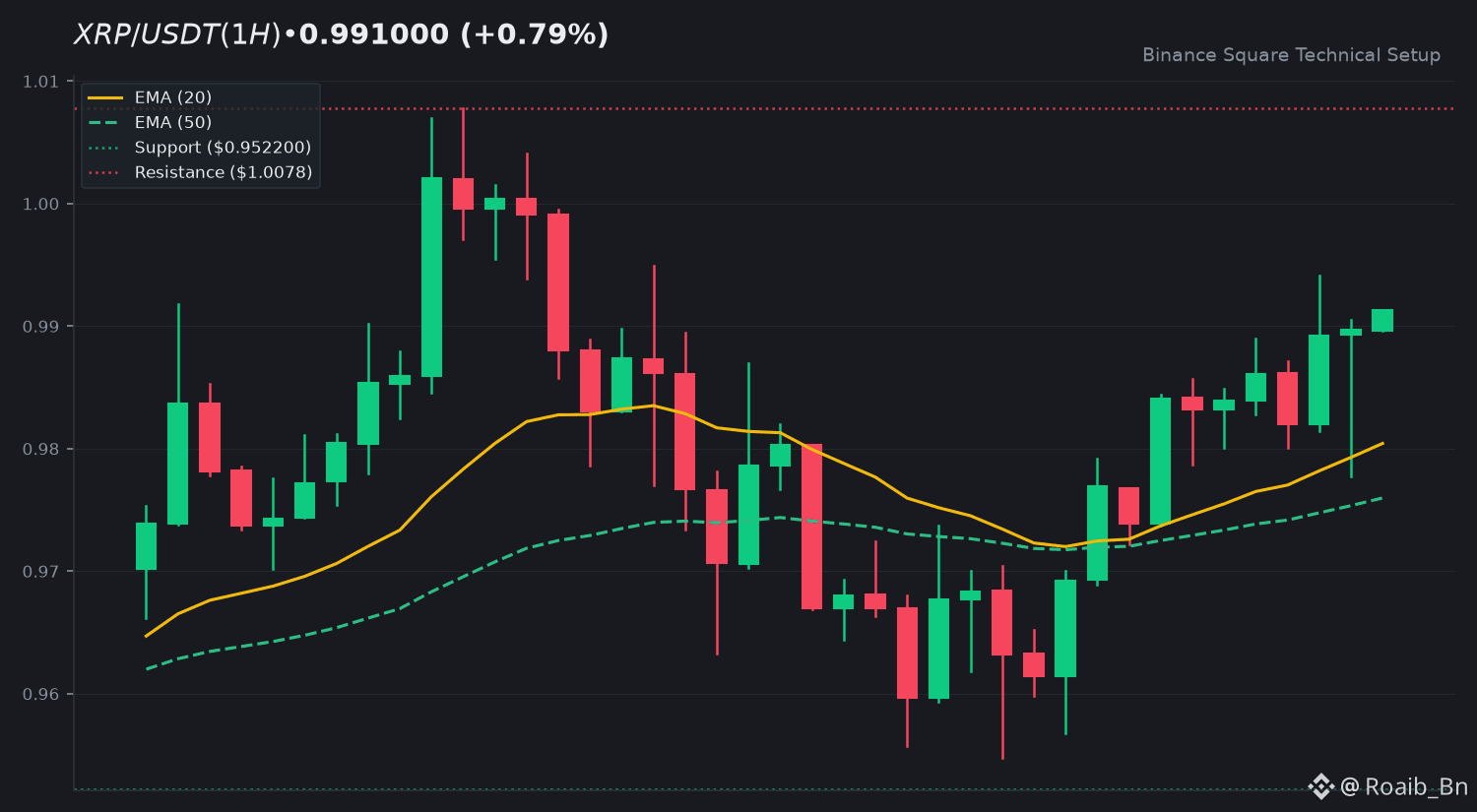
XRP is currently showing steady consolidation around the 0.9910 level. After a period of volatility, the asset is maintaining its position well, showing a mild gain of 0.79 percent over the last twenty-four hours as it attempts to stabilize near the psychological one dollar mark.
On the hourly timeframe, the price is holding comfortably above the 20 EMA at 0.9804 and the 50 EMA at 0.9760. An RSI of 61.08 suggests that momentum remains positive without being excessively overheated, leaving room for further movement.
The primary resistance level to watch for a potential breakout remains at 1.0078. On the downside, the immediate support level at 0.9522 is critical for maintaining the current market structure.
How are you viewing this price action today—are you holding your position or waiting for a clearer breakout above the resistance?
Educational analysis only, not financial advice. DYOR.
$XRP #BinanceSquare #Crypto
22
·
--
See translation
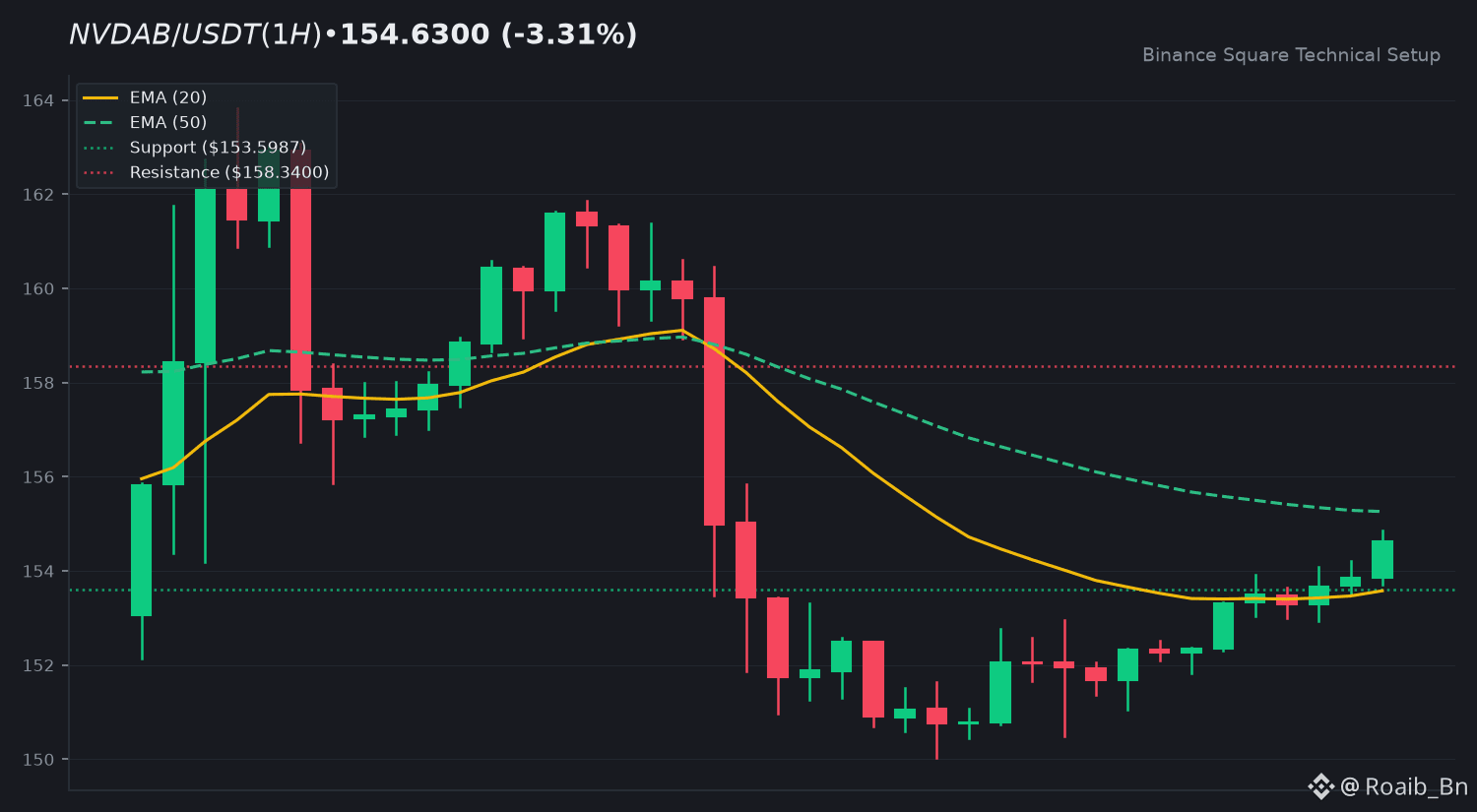
$NVDAB is currently seeing a mild pullback, trading near 154.6300 after a slight dip over the last twenty-four hours. The market seems to be finding its footing as it navigates through this period of price consolidation.
On the one hour chart, the price is hovering right near the 20 EMA, which is providing a thin layer of interest. With an RSI of 54.07, the momentum is currently neutral, suggesting that neither buyers nor sellers have total control at this moment.
Looking ahead, the primary resistance level to watch for any potential continuation is 158.3400. On the downside, the immediate support level sits at 153.5987, which is crucial for maintaining the current structure.
What are your thoughts on this price level—are you holding your position or waiting for a breakout?
Educational analysis only, not financial advice. DYOR.
$NVDAB #BinanceSquare #Crypto
10
·
--
Article
See translation
The Ethereum Layer 2 Wars: Base, Arbitrum & The Race for ScalabilityTHE ETHEREUM LAYER 2 WARS: BASE, ARBITRUM AND THE RACE FOR SCALABILITY
The landscape of the Ethereum ecosystem has undergone a fundamental transformation that many market participants are still catching up to. We have officially moved past the era where high gas fees were the primary barrier to entry for the average user. Today, the battle for dominance is no longer happening on the Ethereum mainnet itself, but rather across the various Layer 2 scaling solutions that have inherited its security. As a trader, understanding the nuances between these competing rollups is essential because liquidity is no longer a monolith; it is fragmented across several high-performance environments, each carving out its own specific niche.
THE IMPACT OF THE BLOB ERA AND THE RISE OF BASE
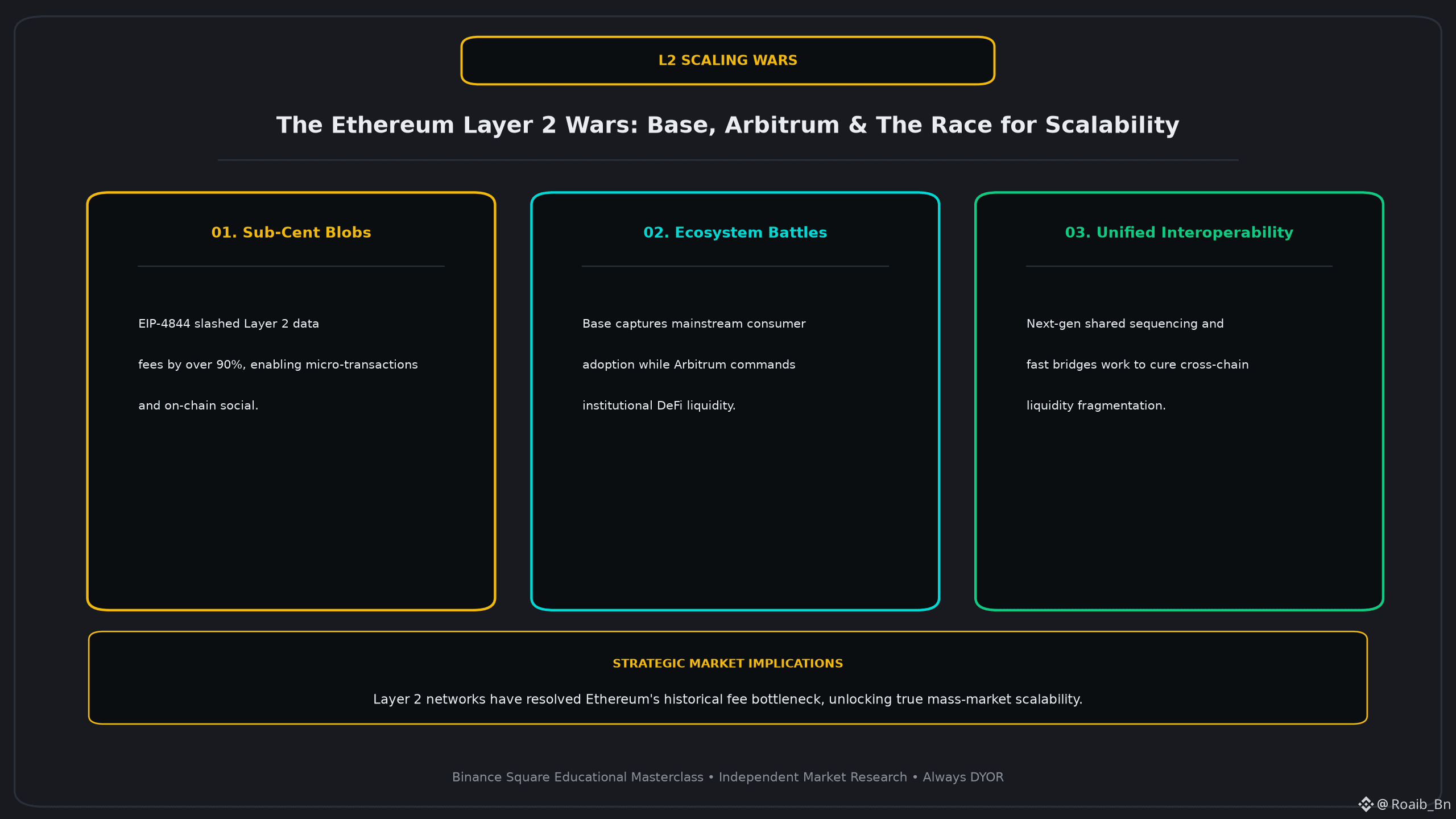
The implementation of EIP-4844 was the definitive turning point for this cycle. By introducing data blobs, Ethereum successfully slashed the cost of Layer 2 data availability by over ninety percent. This technical milestone changed the economic reality of on-chain activity. We are now seeing the rise of micro-transactions and decentralized social applications that were previously impossible due to cost constraints. In this new environment, Base has emerged as a formidable contender. By leveraging the massive user base of the Coinbase ecosystem, Base has successfully captured the consumer-facing narrative. It is becoming the go-to destination for retail-friendly applications and on-chain social experiments where low friction and ease of onboarding are more important than deep institutional tooling.
ARBITRUM AND THE INSTITUTIONAL DEFI MOAT
While Base captures the retail spotlight, Arbitrum remains the undisputed heavyweight in terms of decentralized finance liquidity and technical maturity. For the disciplined trader, $ARB represents the backbone of the professional DeFi landscape. Most of the complex yield strategies, perpetual DEXs, and institutional-grade lending protocols still call Arbitrum home. The network has maintained its lead in Total Value Locked because it offers a level of stability and a developer ecosystem that is difficult to replicate. While Base focuses on the top of the funnel for new users, Arbitrum is where the heavy capital resides, catering to those who require deep liquidity and sophisticated financial instruments. Its governance model and technical stack have set a high bar for what a decentralized rollup should look like.
THE CHALLENGE OF FRAGMENTATION AND THE PATH FORWARD
The primary risk we face today is liquidity fragmentation. As more rollups launch, the capital efficiency of the Ethereum ecosystem is being tested. However, the industry is already pivoting toward solutions. We are seeing a shift toward unified interoperability where next-generation shared sequencing and ultra-fast bridging protocols are starting to bridge the gap, allowing assets to move between chains almost instantly. For a trader's portfolio, the decision is rarely about picking a single winner. Instead, it is about recognizing that $ETH has successfully outsourced its execution. Arbitrum serves the high-value financial layer, while chains like Base handle the high-velocity consumer layer. This specialization of labor is exactly what is required for Ethereum to reach a billion users.
Which ecosystem do you find yourself using most frequently for your daily trading or DeFi activities, and do you believe liquidity will eventually consolidate into a single dominant Layer 2 or remain spread across multiple specialized chains?
This analysis is provided for educational purposes only and does not constitute financial advice. The crypto market involves significant risk and volatility. Always conduct your own research before making any investment decisions.
$ETH $ARB #BinanceSquare #Ethereum
The Ethereum Layer 2 Wars: Base, Arbitrum & The Race for Scalability
THE ETHEREUM LAYER 2 WARS: BASE, ARBITRUM AND THE RACE FOR SCALABILITY
The landscape of the Ethereum ecosystem has undergone a fundamental transformation that many market participants are still catching up to. We have officially moved past the era where high gas fees were the primary barrier to entry for the average user. Today, the battle for dominance is no longer happening on the Ethereum mainnet itself, but rather across the various Layer 2 scaling solutions that have inherited its security. As a trader, understanding the nuances between these competing rollups is essential because liquidity is no longer a monolith; it is fragmented across several high-performance environments, each carving out its own specific niche.
THE IMPACT OF THE BLOB ERA AND THE RISE OF BASE
The implementation of EIP-4844 was the definitive turning point for this cycle. By introducing data blobs, Ethereum successfully slashed the cost of Layer 2 data availability by over ninety percent. This technical milestone changed the economic reality of on-chain activity. We are now seeing the rise of micro-transactions and decentralized social applications that were previously impossible due to cost constraints. In this new environment, Base has emerged as a formidable contender. By leveraging the massive user base of the Coinbase ecosystem, Base has successfully captured the consumer-facing narrative. It is becoming the go-to destination for retail-friendly applications and on-chain social experiments where low friction and ease of onboarding are more important than deep institutional tooling.
ARBITRUM AND THE INSTITUTIONAL DEFI MOAT
While Base captures the retail spotlight, Arbitrum remains the undisputed heavyweight in terms of decentralized finance liquidity and technical maturity. For the disciplined trader, $ARB represents the backbone of the professional DeFi landscape. Most of the complex yield strategies, perpetual DEXs, and institutional-grade lending protocols still call Arbitrum home. The network has maintained its lead in Total Value Locked because it offers a level of stability and a developer ecosystem that is difficult to replicate. While Base focuses on the top of the funnel for new users, Arbitrum is where the heavy capital resides, catering to those who require deep liquidity and sophisticated financial instruments. Its governance model and technical stack have set a high bar for what a decentralized rollup should look like.
THE CHALLENGE OF FRAGMENTATION AND THE PATH FORWARD
The primary risk we face today is liquidity fragmentation. As more rollups launch, the capital efficiency of the Ethereum ecosystem is being tested. However, the industry is already pivoting toward solutions. We are seeing a shift toward unified interoperability where next-generation shared sequencing and ultra-fast bridging protocols are starting to bridge the gap, allowing assets to move between chains almost instantly. For a trader's portfolio, the decision is rarely about picking a single winner. Instead, it is about recognizing that $ETH has successfully outsourced its execution. Arbitrum serves the high-value financial layer, while chains like Base handle the high-velocity consumer layer. This specialization of labor is exactly what is required for Ethereum to reach a billion users.
Which ecosystem do you find yourself using most frequently for your daily trading or DeFi activities, and do you believe liquidity will eventually consolidate into a single dominant Layer 2 or remain spread across multiple specialized chains?
This analysis is provided for educational purposes only and does not constitute financial advice. The crypto market involves significant risk and volatility. Always conduct your own research before making any investment decisions.
$ETH $ARB #BinanceSquare #Ethereum
14
·
--
See translation
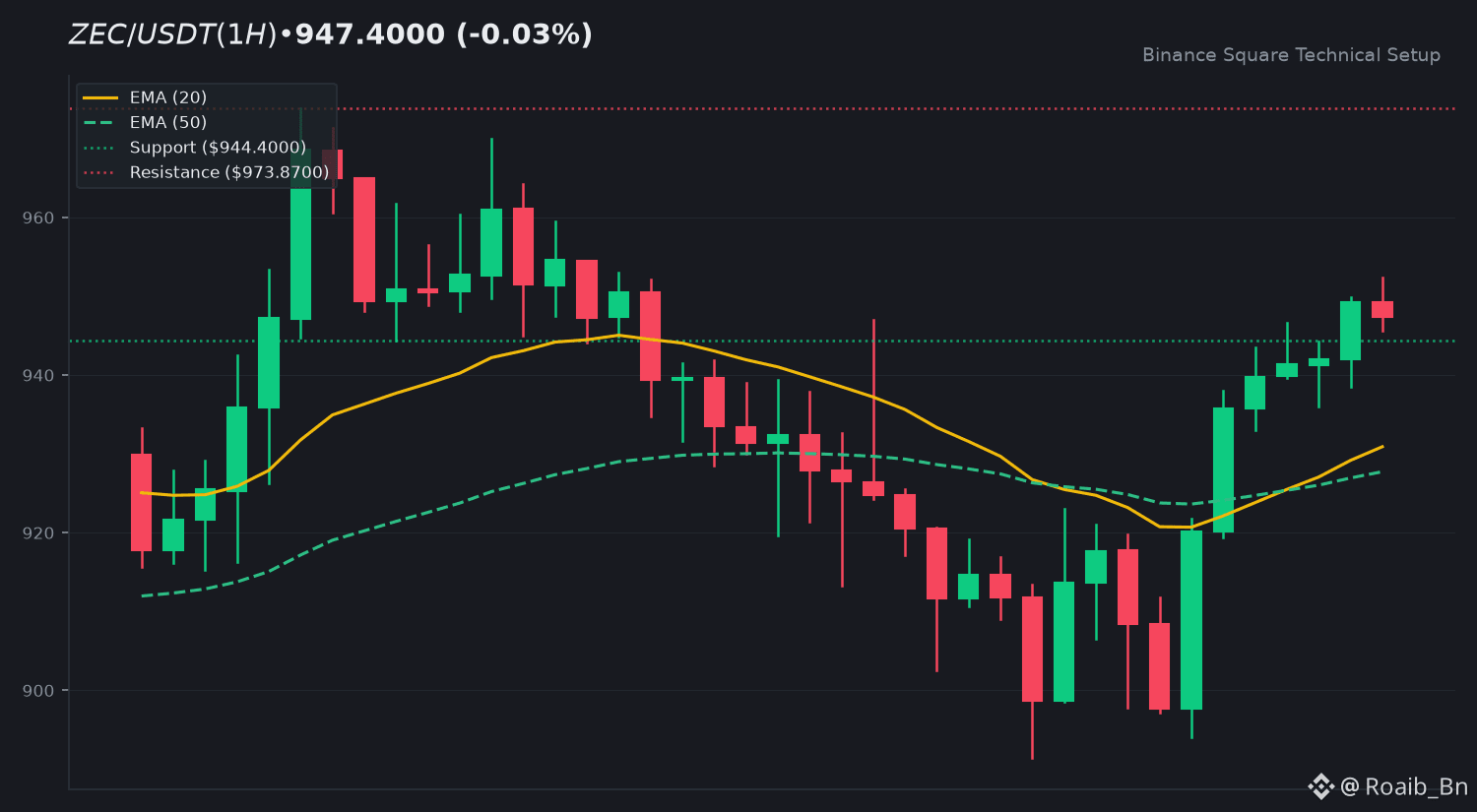
ZEC is currently showing signs of steady consolidation around the 947.40 level. After recent fluctuations, the asset is maintaining a relatively flat profile today with a minor change of just 0.03 percent over the last twenty-four hours.
On the hourly timeframe, the price remains positioned above both the 20 EMA and 50 EMA, which suggests the underlying trend is still leaning toward the upside. With the RSI sitting at 59.52, there is enough room for further momentum before reaching overbought territory.
The immediate focus is on the 944.40 support level, which needs to hold to keep the current structure intact. If buying pressure returns, we should watch the 973.87 resistance level closely for a potential breakout attempt.
What are your thoughts on this price action—are you holding your position or waiting for a clearer breakout?
Educational analysis only, not financial advice. DYOR.
$ZEC #BinanceSquare #Crypto
11
·
--
See translation
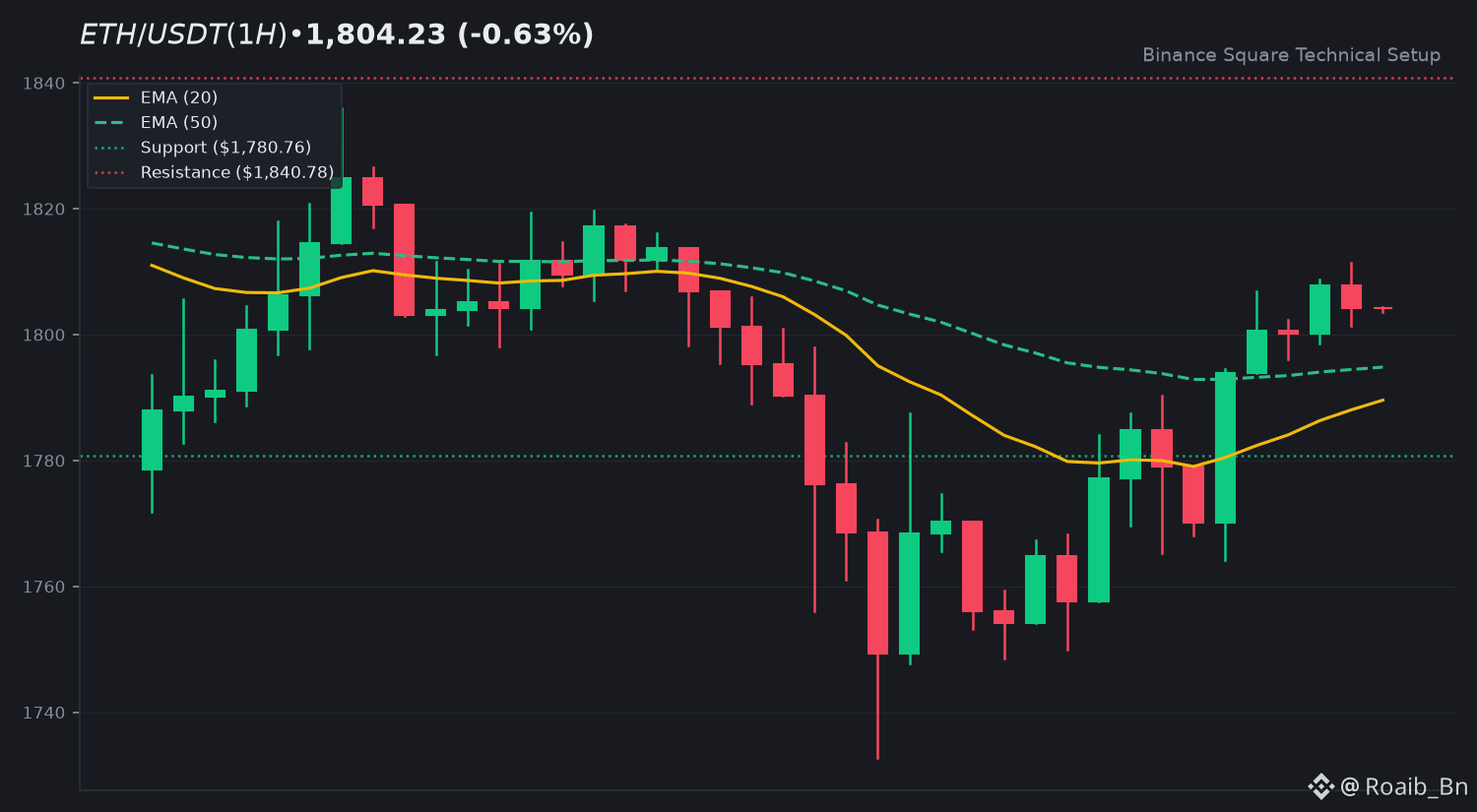
ETH is currently experiencing a mild pullback as it trades near 1804.23. The market seems to be in a phase of steady consolidation after the recent volatility, with participants waiting for a clearer directional bias before committing to larger positions.
On the hourly timeframe, the price is hovering just above the 20 EMA at 1789.59 and the 50 EMA at 1794.83. An RSI reading of 56.85 suggests that momentum remains neutral to slightly positive without being overextended, leaving room for potential movement in either direction.
Looking ahead, the primary resistance level sits at 1840.78, which is the hurdle bulls need to clear for a continuation. On the downside, maintaining the immediate support level at 1780.76 is crucial to preserve the current market structure.
What are your thoughts on this price action—are you holding your position or waiting for a breakout?
Educational analysis only, not financial advice. DYOR.
$ETH #BinanceSquare #Crypto
18
·
--
Article
See translation
Solana vs Ethereum: The Battle for Layer 1 DominanceSOLANA VS ETHEREUM: THE BATTLE FOR LAYER 1 DOMINANCE
The debate between Solana and Ethereum has evolved from a simple technical comparison into a fundamental clash of ideologies regarding how the global financial system should be rebuilt on-chain. As we navigate the markets in late 2026, the distinction between these two giants has never been clearer, and understanding their unique value propositions is essential for any serious market participant. We are no longer asking which chain is better in a vacuum; we are asking which architecture serves which specific sector of the digital economy.
SOLANA AND THE POWER OF MONOLITHIC SPEED
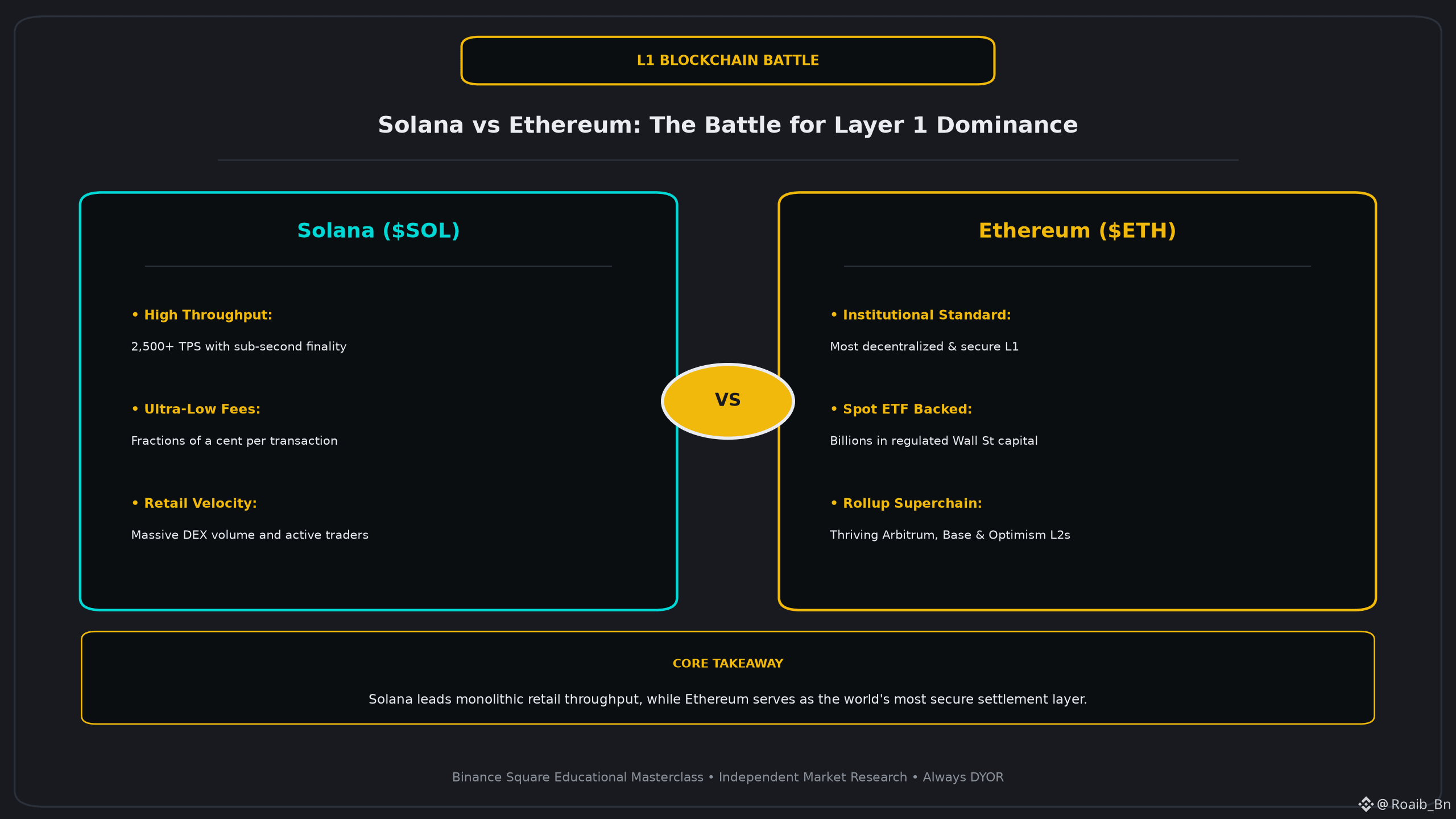
Solana has cemented its position as the undisputed leader in retail velocity and high-frequency activity. By sticking to a monolithic architecture, $SOL achieves something that was once thought impossible: maintaining ultra-low fees while processing over 2,500 transactions per second with sub-second finality. This isn't just a technical flex; it translates to a superior user experience for the average trader. When you look at the massive DEX volume and the sheer number of active daily users, it is clear that Solana is where the retail heartbeat of crypto lives. The ecosystem has moved beyond the early days of network stability concerns and has proven that it can handle high-intensity market events without the gas spikes that often paralyze other networks. For those who prioritize speed, cost, and a seamless on-chain experience for everything from memecoins to decentralized physical infrastructure (DePIN), Solana remains the primary choice.
ETHEREUM AND THE INSTITUTIONAL SETTLEMENT STANDARD
On the other side of the ring, Ethereum has successfully transitioned into its role as the world's most secure and decentralized settlement layer. While $ETH might not compete with Solana on raw base-layer speed, its modular roadmap has created a thriving ecosystem of Layer 2 solutions. The emergence of the Superchain, powered by the likes of Arbitrum, Base, and Optimism, allows Ethereum to scale while keeping its core layer as a fortress of security. More importantly, Ethereum remains the institutional gold standard. With billions of dollars in regulated Wall Street capital flowing through Spot ETFs and a deep integration with traditional finance, Ethereum is the infrastructure of choice for high-value transactions and long-term asset custody. It is the bedrock upon which the future of decentralized finance is being built, offering a level of decentralization and security that is currently unmatched in the L1 space.
THE STRATEGIC VERDICT FOR TRADERS
Choosing between $SOL and $ETH is no longer about picking a single winner, but about understanding the role each plays in a disciplined portfolio. Solana is the engine of innovation and retail activity, capturing the fast-moving trends and high-frequency trading volume. Ethereum is the global reserve and settlement layer, capturing the institutional inflow and providing the security required for the world's most valuable assets. A sophisticated trader recognizes that these two networks are not necessarily zero-sum competitors but rather complementary forces that serve different segments of the market. In a balanced strategy, Solana provides the growth and activity exposure, while Ethereum provides the stability and institutional backing.
COMMUNITY DISCUSSION
As the landscape continues to shift, where do you see the most growth potential over
Solana vs Ethereum: The Battle for Layer 1 Dominance
SOLANA VS ETHEREUM: THE BATTLE FOR LAYER 1 DOMINANCE
The debate between Solana and Ethereum has evolved from a simple technical comparison into a fundamental clash of ideologies regarding how the global financial system should be rebuilt on-chain. As we navigate the markets in late 2026, the distinction between these two giants has never been clearer, and understanding their unique value propositions is essential for any serious market participant. We are no longer asking which chain is better in a vacuum; we are asking which architecture serves which specific sector of the digital economy.
SOLANA AND THE POWER OF MONOLITHIC SPEED
Solana has cemented its position as the undisputed leader in retail velocity and high-frequency activity. By sticking to a monolithic architecture, $SOL achieves something that was once thought impossible: maintaining ultra-low fees while processing over 2,500 transactions per second with sub-second finality. This isn't just a technical flex; it translates to a superior user experience for the average trader. When you look at the massive DEX volume and the sheer number of active daily users, it is clear that Solana is where the retail heartbeat of crypto lives. The ecosystem has moved beyond the early days of network stability concerns and has proven that it can handle high-intensity market events without the gas spikes that often paralyze other networks. For those who prioritize speed, cost, and a seamless on-chain experience for everything from memecoins to decentralized physical infrastructure (DePIN), Solana remains the primary choice.
ETHEREUM AND THE INSTITUTIONAL SETTLEMENT STANDARD
On the other side of the ring, Ethereum has successfully transitioned into its role as the world's most secure and decentralized settlement layer. While $ETH might not compete with Solana on raw base-layer speed, its modular roadmap has created a thriving ecosystem of Layer 2 solutions. The emergence of the Superchain, powered by the likes of Arbitrum, Base, and Optimism, allows Ethereum to scale while keeping its core layer as a fortress of security. More importantly, Ethereum remains the institutional gold standard. With billions of dollars in regulated Wall Street capital flowing through Spot ETFs and a deep integration with traditional finance, Ethereum is the infrastructure of choice for high-value transactions and long-term asset custody. It is the bedrock upon which the future of decentralized finance is being built, offering a level of decentralization and security that is currently unmatched in the L1 space.
THE STRATEGIC VERDICT FOR TRADERS
Choosing between $SOL and $ETH is no longer about picking a single winner, but about understanding the role each plays in a disciplined portfolio. Solana is the engine of innovation and retail activity, capturing the fast-moving trends and high-frequency trading volume. Ethereum is the global reserve and settlement layer, capturing the institutional inflow and providing the security required for the world's most valuable assets. A sophisticated trader recognizes that these two networks are not necessarily zero-sum competitors but rather complementary forces that serve different segments of the market. In a balanced strategy, Solana provides the growth and activity exposure, while Ethereum provides the stability and institutional backing.
COMMUNITY DISCUSSION
As the landscape continues to shift, where do you see the most growth potential over
13
·
--
See translation
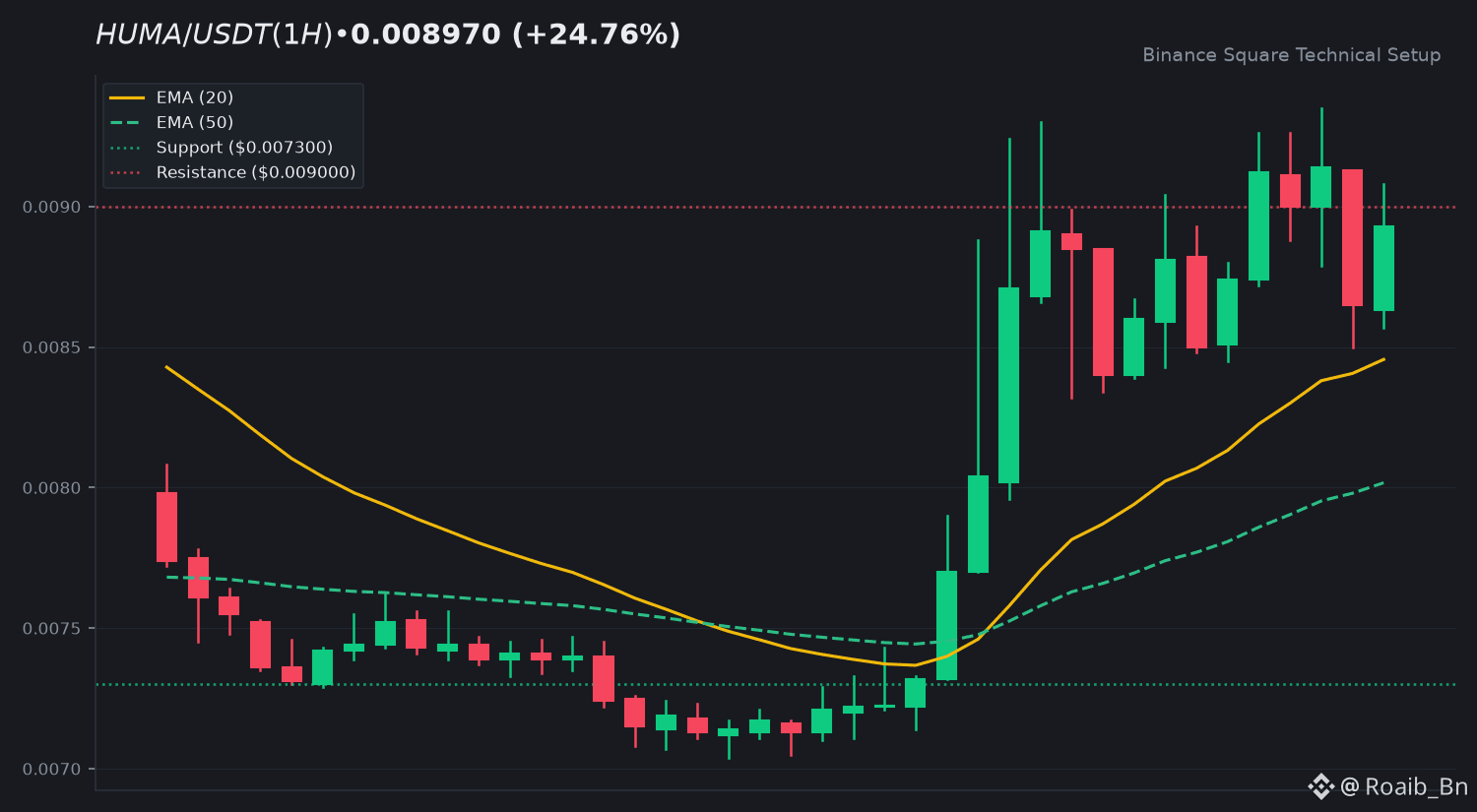
The market is leaning bearish this morning as we watch a clear struggle for momentum. With only 11 gainers against 39 losers in the top 50, the selling pressure is broad and consistent. It feels like a day where caution is necessary as the overall sentiment remains heavy.
Volume across the top 50 spots sits at roughly 2.98 billion USDT, reflecting a somewhat subdued participation level despite the downward drift. $BTC is leading the retreat at 2.0 percent, followed by $SOL at 1.2 percent and ETH at 0.9 percent. ZEC is showing a bit more volatility with a 3 percent dip.
Protecting capital is the priority during these phases. Are you scaling out or waiting for a floor? Educational analysis only, not financial advice. DYOR.
BinanceSquare #CryptoMarket
42
·
--
See translation
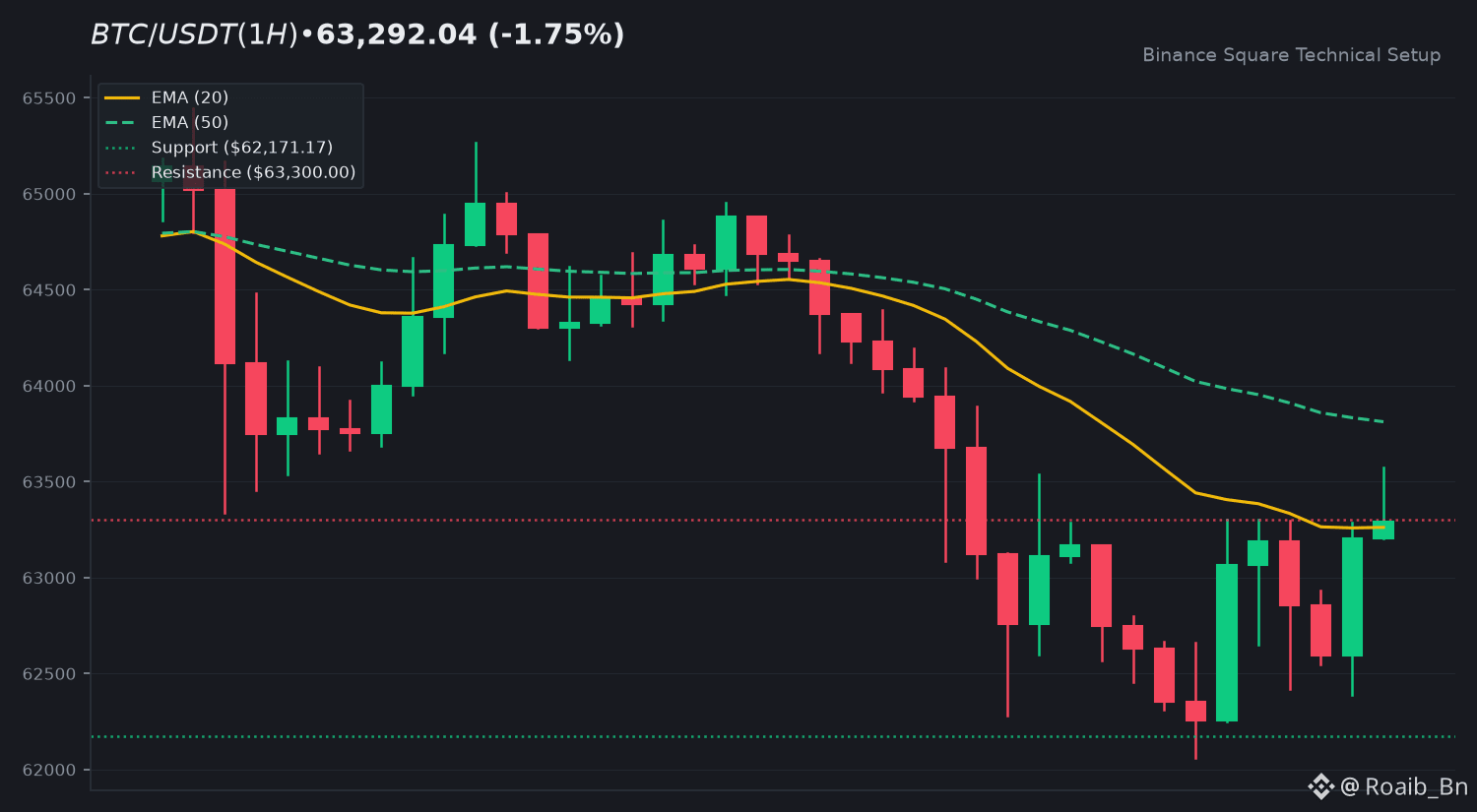
Bitcoin is currently trading at $63,292.04, reflecting a daily decline of 1.75 percent. The price action is testing critical support levels as it hovers just below the 50-day EMA. Maintaining this level is essential for the bulls to prevent a deeper retracement toward the next major demand zone.
Ethereum is holding up relatively better than the leader, currently sitting at $1,796.79 with a minor dip of 0.47 percent. This shows a slight uptick in relative strength, suggesting that while the broader market is cooling off, there is still underlying interest in the altcoin space.
The market direction remains uncertain as we wait for a clear trend confirmation. Which asset do you expect to lead the next move?
Educational analysis only, not financial advice. DYOR.
$BTC ETH #BinanceSquare #CryptoMarket
38
·
--
Article
See translation
Institutional Spot ETFs & Global Treasury Flows: The Next PhaseINSTITUTIONAL SPOT ETFS AND GLOBAL TREASURY FLOWS THE NEXT PHASE
The landscape of the digital asset market has undergone a fundamental transformation that many retail participants are still trying to reconcile with their old playbooks. We are no longer in an era defined solely by speculative retail fervor and offshore leverage. Instead, we have entered the phase of institutional permanence, where spot ETFs and global treasury flows are rewriting the rules of liquidity and price discovery. Understanding this shift is not just an academic exercise; it is the difference between catching the next wave and being washed away by outdated assumptions.
THE PERSISTENT ABSORPTION OF SUPPLY
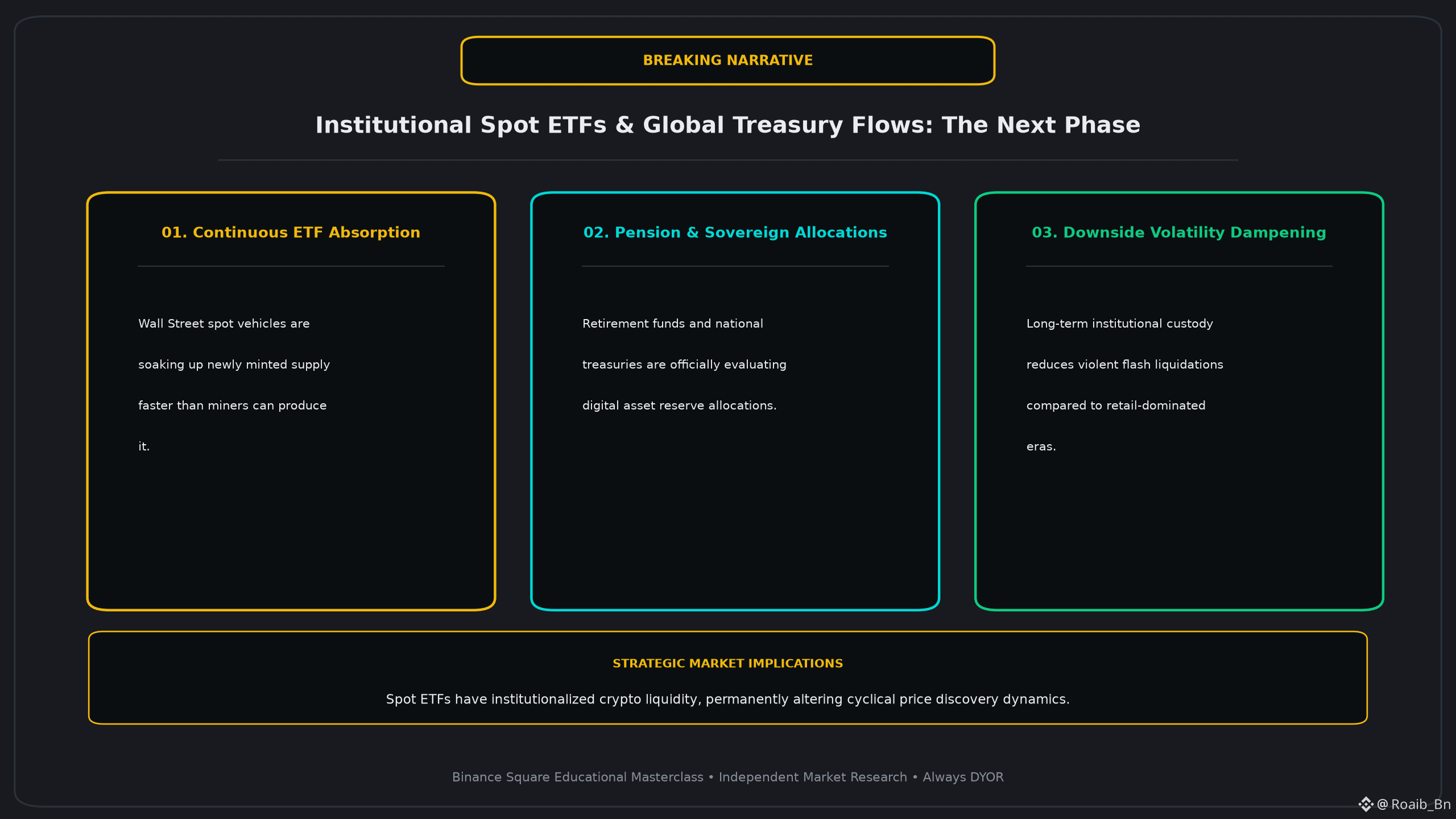
The most immediate impact of the spot ETF era is the relentless absorption of supply. For years, the market focused on miner sell pressure as a primary headwind. Today, that narrative has shifted entirely. Wall Street vehicles are currently soaking up newly minted supply at a rate that frequently exceeds daily production. This creates a persistent bid that operates independently of short-term sentiment. Unlike retail traders who might panic sell on a five percent dip, these institutional vehicles represent structured, long-term capital allocations. This systematic accumulation creates a supply floor that we simply did not see in previous cycles, fundamentally altering how we should view support levels and accumulation zones. When the largest asset managers in the world are the ones buying the dip, the floor becomes much harder to break.
THE SOVEREIGN SHIFT AND PENSION ALLOCATIONS
Beyond the ETFs, we are witnessing the early stages of a much larger movement: the integration of digital assets into pension funds and sovereign treasuries. This is the ultimate validation of the asset class. When retirement funds and national reserves begin to evaluate allocations, they are looking at decades-long horizons. These are not participants looking for a quick trade; they are looking for a hedge against monetary debasement and a tool for diversification. This transition from private wealth to public and state-level reserves means that the pool of capital entering $BTC and $ETH is becoming deeper and more stable. We are seeing the institutionalization of crypto liquidity in real-time, moving it from the periphery of finance to the very core of global treasury management. The implications for long-term valuation are profound, as the scarcity of these assets meets the infinite demand of global currency debasement.
A NEW PARADIGM FOR MARKET VOLATILITY
Perhaps the most significant change for traders is the dampening of downside volatility. In the retail-dominated eras, flash liquidations were a frequent and violent occurrence, often wiping out weeks of gains in minutes. While volatility remains a core feature of the market, the presence of long-term institutional custody acts as a stabilizer. These entities do not use the same high-leverage instruments that retail speculators do. As a result, the market structure is becoming more resilient. For a disciplined trader, this means the old eighty percent drawdowns might be a relic of the past, replaced by more controlled pullbacks. This requires a shift in strategy, focusing more on macro trends and less on trying to time every minor liquidation event. In this new era, patience and position sizing are more important than ever.
As we look toward the next twelve months, do you believe the influence of sovereign wealth funds will eventually decouple crypto from traditional equity correlations, or will the institutionalization make these assets move even more in lockstep with the broader markets? I am interested to hear your perspective on how you are adjusting your long-term position sizing in light of this institutional floor.
This analysis is for educational purposes only and does not constitute financial advice. The crypto market involves significant risk. Always conduct your own research and consult with a professional before making investment decisions.
$BTC $ETH #BinanceSquare #CryptoNews
Institutional Spot ETFs & Global Treasury Flows: The Next Phase
INSTITUTIONAL SPOT ETFS AND GLOBAL TREASURY FLOWS THE NEXT PHASE
The landscape of the digital asset market has undergone a fundamental transformation that many retail participants are still trying to reconcile with their old playbooks. We are no longer in an era defined solely by speculative retail fervor and offshore leverage. Instead, we have entered the phase of institutional permanence, where spot ETFs and global treasury flows are rewriting the rules of liquidity and price discovery. Understanding this shift is not just an academic exercise; it is the difference between catching the next wave and being washed away by outdated assumptions.
THE PERSISTENT ABSORPTION OF SUPPLY
The most immediate impact of the spot ETF era is the relentless absorption of supply. For years, the market focused on miner sell pressure as a primary headwind. Today, that narrative has shifted entirely. Wall Street vehicles are currently soaking up newly minted supply at a rate that frequently exceeds daily production. This creates a persistent bid that operates independently of short-term sentiment. Unlike retail traders who might panic sell on a five percent dip, these institutional vehicles represent structured, long-term capital allocations. This systematic accumulation creates a supply floor that we simply did not see in previous cycles, fundamentally altering how we should view support levels and accumulation zones. When the largest asset managers in the world are the ones buying the dip, the floor becomes much harder to break.
THE SOVEREIGN SHIFT AND PENSION ALLOCATIONS
Beyond the ETFs, we are witnessing the early stages of a much larger movement: the integration of digital assets into pension funds and sovereign treasuries. This is the ultimate validation of the asset class. When retirement funds and national reserves begin to evaluate allocations, they are looking at decades-long horizons. These are not participants looking for a quick trade; they are looking for a hedge against monetary debasement and a tool for diversification. This transition from private wealth to public and state-level reserves means that the pool of capital entering $BTC and $ETH is becoming deeper and more stable. We are seeing the institutionalization of crypto liquidity in real-time, moving it from the periphery of finance to the very core of global treasury management. The implications for long-term valuation are profound, as the scarcity of these assets meets the infinite demand of global currency debasement.
A NEW PARADIGM FOR MARKET VOLATILITY
Perhaps the most significant change for traders is the dampening of downside volatility. In the retail-dominated eras, flash liquidations were a frequent and violent occurrence, often wiping out weeks of gains in minutes. While volatility remains a core feature of the market, the presence of long-term institutional custody acts as a stabilizer. These entities do not use the same high-leverage instruments that retail speculators do. As a result, the market structure is becoming more resilient. For a disciplined trader, this means the old eighty percent drawdowns might be a relic of the past, replaced by more controlled pullbacks. This requires a shift in strategy, focusing more on macro trends and less on trying to time every minor liquidation event. In this new era, patience and position sizing are more important than ever.
As we look toward the next twelve months, do you believe the influence of sovereign wealth funds will eventually decouple crypto from traditional equity correlations, or will the institutionalization make these assets move even more in lockstep with the broader markets? I am interested to hear your perspective on how you are adjusting your long-term position sizing in light of this institutional floor.
This analysis is for educational purposes only and does not constitute financial advice. The crypto market involves significant risk. Always conduct your own research and consult with a professional before making investment decisions.
$BTC $ETH #BinanceSquare #CryptoNews
45
·
--
See translation
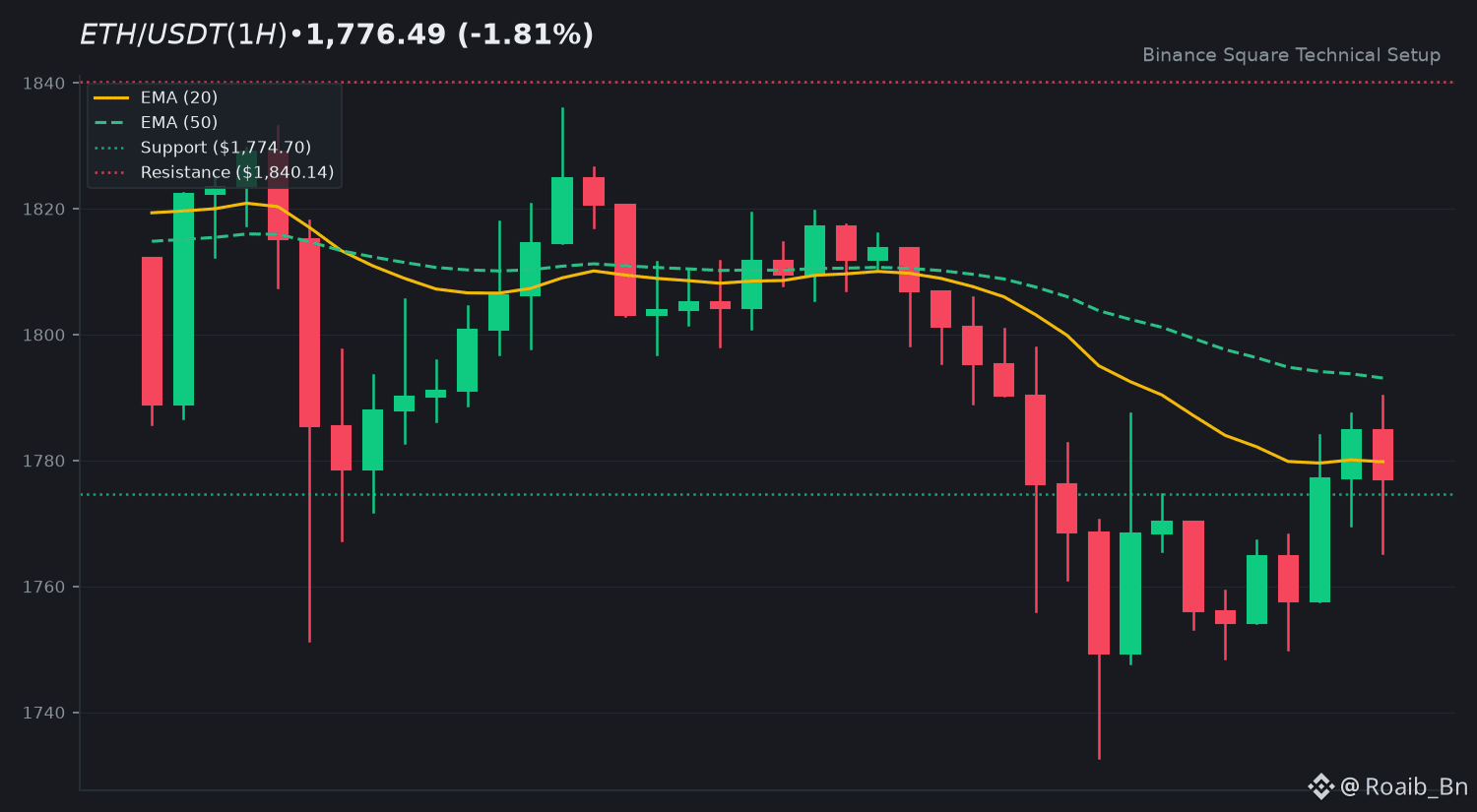
$ETH is currently experiencing a mild pullback as it trades around the $1,776.4900 level. The market sentiment remains cautious as we see a slight decline over the last twenty-four hours, keeping participants on their toes while waiting for a clearer directional move.
On the hourly chart, the price is hovering just below the 20 EMA of $1,779.7948, suggesting a lack of immediate bullish momentum. With the RSI sitting at 46.95, the market is currently in neutral territory, neither overbought nor oversold, which reflects the ongoing indecision among traders.
Looking ahead, we need to watch the primary resistance at $1,840.1420 for any sign of a potential trend reversal. On the downside, maintaining the $1,774.6970 support level is crucial to keep the current market structure intact.
What are your thoughts on this price level—are you holding your position or waiting for a breakout before taking action?
Educational analysis only, not financial advice. DYOR.
$ETH #BinanceSquare #Crypto
69
·
--
See translation
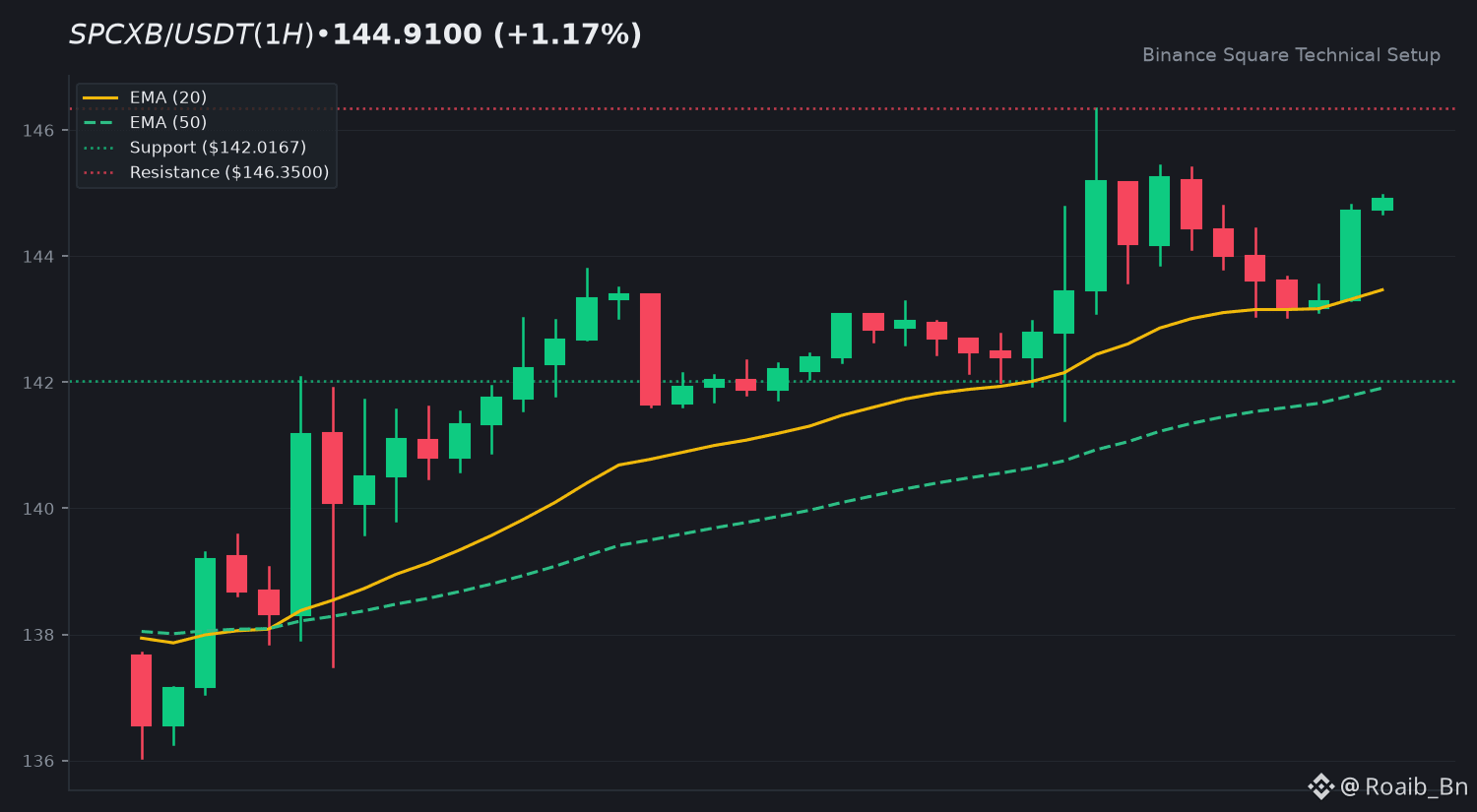
$SPCXB is currently showing signs of steady consolidation as it trades at 144.9100. The asset has maintained a mild upward trajectory over the last twenty four hours, reflecting a calm but positive sentiment among market participants as we move into the new trading session.
On the one hour chart, the price remains comfortably above the 20 EMA of 143.4665, which suggests the short term trend is still favoring the bulls. An RSI of 62 indicates that momentum is building steadily without entering overbought territory just yet.
Looking ahead, the primary resistance level to watch for a potential breakout is 146.3500. On the downside, maintaining structure will rely on holding the support level at 142.0167, which aligns closely with the 50 EMA.
What are your thoughts on this price action—are you holding for a move higher or waiting for a clearer breakout signal?
Educational analysis only, not financial advice. DYOR.
$SPCXB #BinanceSquare #Crypto
92
·
--
Article
See translation
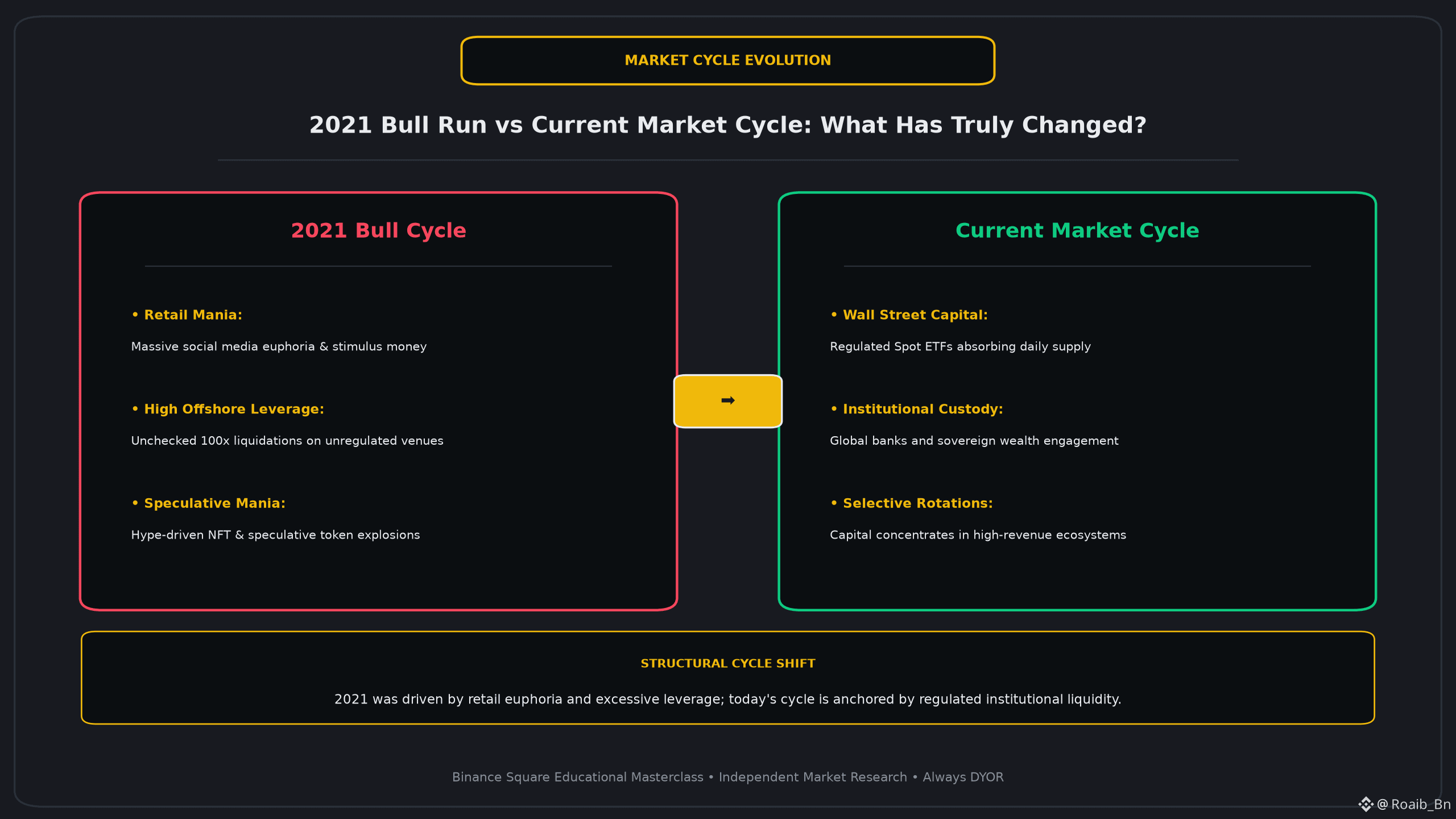
2021 Bull Run vs Current Market Cycle: What Has Truly Changed?2021 Bull Run vs Current Market Cycle: What Has Truly Changed?
Many traders spent the last few months waiting for the market to mirror the explosive, chaotic energy of 2021. They are looking for that specific brand of retail euphoria where every project, regardless of utility, seemed to double in price every week. However, as we navigate the current landscape in late 2026, it is becoming increasingly clear that the DNA of this market has undergone a fundamental transformation. Understanding the structural shift from a retail-driven speculative bubble to an institutional-led financial era is the most important task for any serious participant today.
The 2021 cycle was defined by a unique set of global circumstances that we may never see again in the same combination. We had massive fiscal stimulus and a global population stuck at home with newfound access to easy-to-use trading apps. This created a perfect storm of social media euphoria. If you remember the peak of the NFT craze or the initial dog-coin mania, it was driven almost entirely by the collective psychology of the retail trader. Leverage was the primary engine of price action, often hosted on unregulated offshore platforms where 100x positions were the norm. This led to extreme volatility and those famous flash crashes that wiped out billions in open interest within minutes. It was a cycle of pure adrenaline and unchecked speculation.
Contrast that with what we are witnessing in the current market environment. The landscape has matured into an institutional-grade asset class. The introduction and massive success of spot ETFs changed the plumbing of the market forever. Now, instead of stimulus checks, we have multi-billion dollar pension funds, global banks, and sovereign wealth managers allocating a percentage of their portfolios to digital assets. This capital is significantly stickier and less prone to the panic-selling we saw in previous years. We are seeing $BTC and $ETH being treated as legitimate macro hedges and core portfolio components rather than just speculative lottery tickets.
The most significant change is how capital rotates through the ecosystem. In 2021, a rising tide lifted all boats. If Bitcoin moved, almost every micro-cap altcoin followed shortly after. Today, the market is much more discerning. Capital is concentrating in ecosystems that show real revenue, active developer participation, and institutional utility. We are seeing a massive divergence where high-quality projects thrive while the ghost chains of the last cycle continue to fade into irrelevance. This requires a much more surgical approach to portfolio management. The era of throwing a dart at a list of tokens and expecting a 10x return is largely over.
The verdict for the modern trader is clear: the game has changed from chasing social media hype to understanding institutional flows. While the retail-led volatility of 2021 provided quick thrills, the institutional stability of the current cycle provides a more sustainable foundation for long-term growth. The volatility has not disappeared, but its source has shifted from offshore leverage cascades to macro-economic data prints and ETF inflow reports. Success in this era belongs to those who trade based on liquidity cycles and fundamental adoption rather than those waiting for a repeat of the past.
How are you adjusting your personal strategy to account for this shift toward institutional dominance? Are you still looking for 2021-style moonshots, or have you pivoted toward the high-revenue ecosystems that Wall Street is currently favoring?
This analysis is provided for educational purposes only and does not constitute financial advice. Market conditions can change rapidly, and past performance is never a guarantee of future results. Always conduct your own research and manage your risk according to your own financial situation.
$BTC $ETH #BinanceSquare #MarketCycles
2021 Bull Run vs Current Market Cycle: What Has Truly Changed?
2021 Bull Run vs Current Market Cycle: What Has Truly Changed?
Many traders spent the last few months waiting for the market to mirror the explosive, chaotic energy of 2021. They are looking for that specific brand of retail euphoria where every project, regardless of utility, seemed to double in price every week. However, as we navigate the current landscape in late 2026, it is becoming increasingly clear that the DNA of this market has undergone a fundamental transformation. Understanding the structural shift from a retail-driven speculative bubble to an institutional-led financial era is the most important task for any serious participant today.
The 2021 cycle was defined by a unique set of global circumstances that we may never see again in the same combination. We had massive fiscal stimulus and a global population stuck at home with newfound access to easy-to-use trading apps. This created a perfect storm of social media euphoria. If you remember the peak of the NFT craze or the initial dog-coin mania, it was driven almost entirely by the collective psychology of the retail trader. Leverage was the primary engine of price action, often hosted on unregulated offshore platforms where 100x positions were the norm. This led to extreme volatility and those famous flash crashes that wiped out billions in open interest within minutes. It was a cycle of pure adrenaline and unchecked speculation.
Contrast that with what we are witnessing in the current market environment. The landscape has matured into an institutional-grade asset class. The introduction and massive success of spot ETFs changed the plumbing of the market forever. Now, instead of stimulus checks, we have multi-billion dollar pension funds, global banks, and sovereign wealth managers allocating a percentage of their portfolios to digital assets. This capital is significantly stickier and less prone to the panic-selling we saw in previous years. We are seeing $BTC and $ETH being treated as legitimate macro hedges and core portfolio components rather than just speculative lottery tickets.
The most significant change is how capital rotates through the ecosystem. In 2021, a rising tide lifted all boats. If Bitcoin moved, almost every micro-cap altcoin followed shortly after. Today, the market is much more discerning. Capital is concentrating in ecosystems that show real revenue, active developer participation, and institutional utility. We are seeing a massive divergence where high-quality projects thrive while the ghost chains of the last cycle continue to fade into irrelevance. This requires a much more surgical approach to portfolio management. The era of throwing a dart at a list of tokens and expecting a 10x return is largely over.
The verdict for the modern trader is clear: the game has changed from chasing social media hype to understanding institutional flows. While the retail-led volatility of 2021 provided quick thrills, the institutional stability of the current cycle provides a more sustainable foundation for long-term growth. The volatility has not disappeared, but its source has shifted from offshore leverage cascades to macro-economic data prints and ETF inflow reports. Success in this era belongs to those who trade based on liquidity cycles and fundamental adoption rather than those waiting for a repeat of the past.
How are you adjusting your personal strategy to account for this shift toward institutional dominance? Are you still looking for 2021-style moonshots, or have you pivoted toward the high-revenue ecosystems that Wall Street is currently favoring?
This analysis is provided for educational purposes only and does not constitute financial advice. Market conditions can change rapidly, and past performance is never a guarantee of future results. Always conduct your own research and manage your risk according to your own financial situation.
$BTC $ETH #BinanceSquare #MarketCycles
7
·
--
See translation
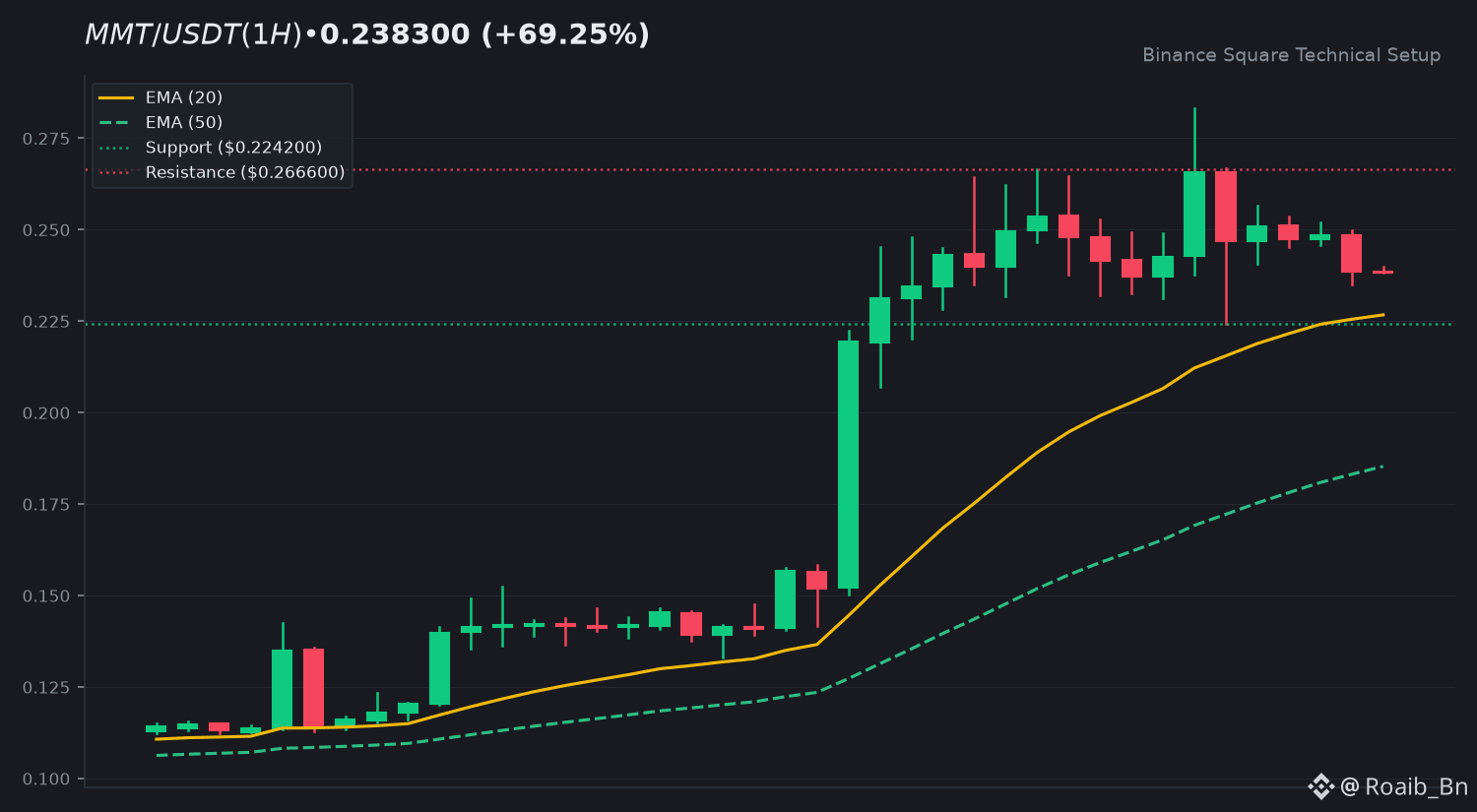
$MMT is showing significant strength today, currently trading at 0.2383 after a sharp move upward. The asset is maintaining a strong bullish posture as it attempts to digest the recent gains, showing steady consolidation above the key moving averages.
On the hourly timeframe, the price is holding comfortably above the 20 EMA of 0.2267, which confirms the current short term trend remains intact. With the RSI sitting at 62.03, there is still enough room for upward momentum before the asset enters overbought territory.
Looking ahead, the primary resistance level to watch is 0.2666, as a breakout above this point could signal further expansion. On the downside, 0.2242 serves as the immediate support level that needs to hold to keep the current market structure healthy.
What are your thoughts on this level, are you holding your position or waiting for a breakout?
Educational analysis only, not financial advice. DYOR.
$MMT #BinanceSquare #Crypto
26
·
--
See translation
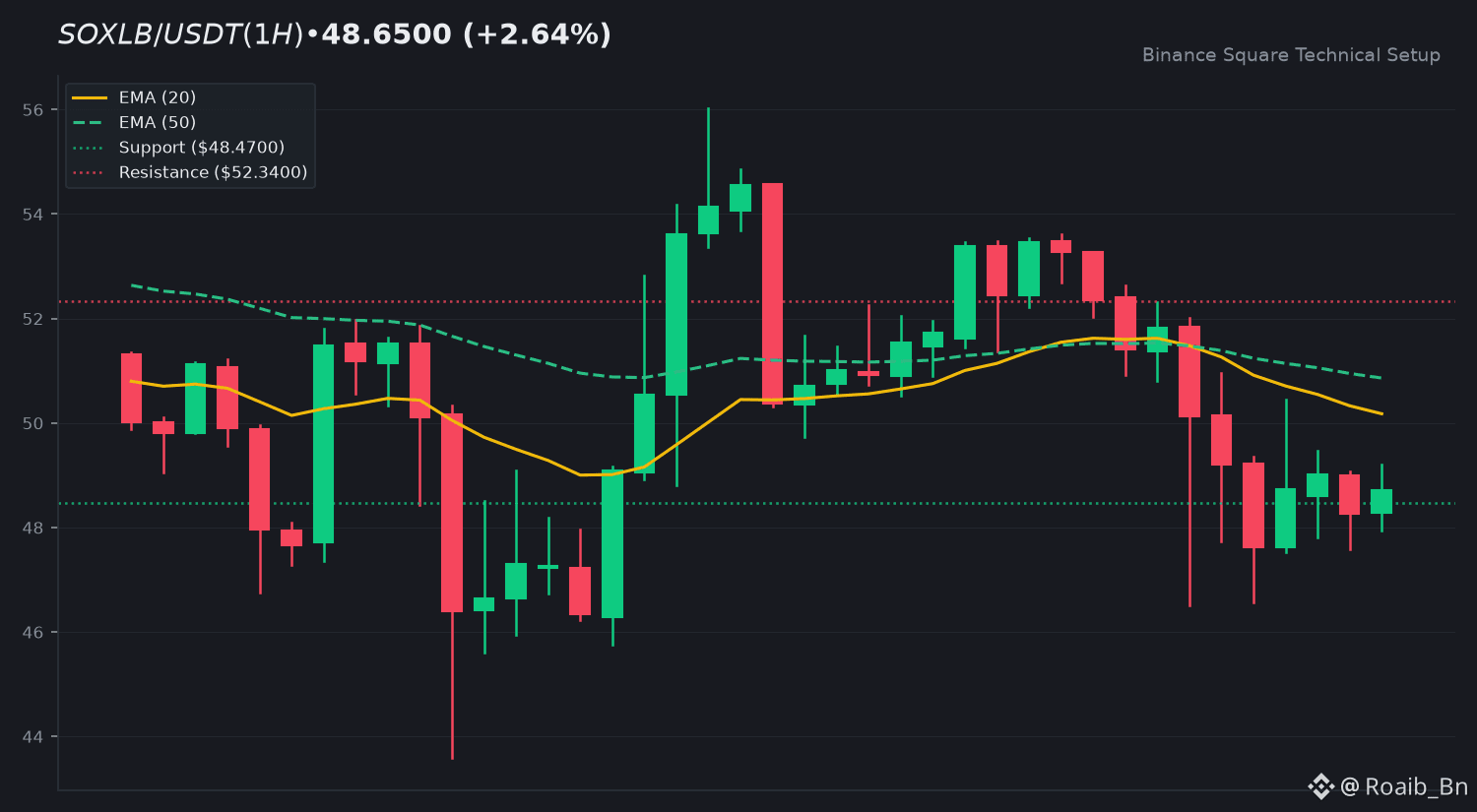
$SOXLB is currently showing some resilience around the $48.6500 level, reflecting a modest recovery of about 2.64 percent over the last day. The price action suggests a period of consolidation as the market attempts to find a stable footing after recent volatility.
On the hourly timeframe, the price remains positioned below both the 20 EMA at 50.1770 and the 50 EMA at 50.8612, indicating that the immediate trend is still under pressure. With an RSI of 43.3, momentum remains neutral, suggesting there is room for either side to take control without being overextended.
For the near term, keeping an eye on the 52.3400 resistance level is essential for any potential trend reversal. Conversely, the $48.4700 mark serves as the primary support level that needs to hold to prevent further downside risk.
Are you keeping a close watch on these levels, or are you waiting for a clearer breakout before making your next move?
Educational analysis only, not financial advice. DYOR.
$SOXLB #BinanceSquare #Crypto
16
·
--
Article
See translation
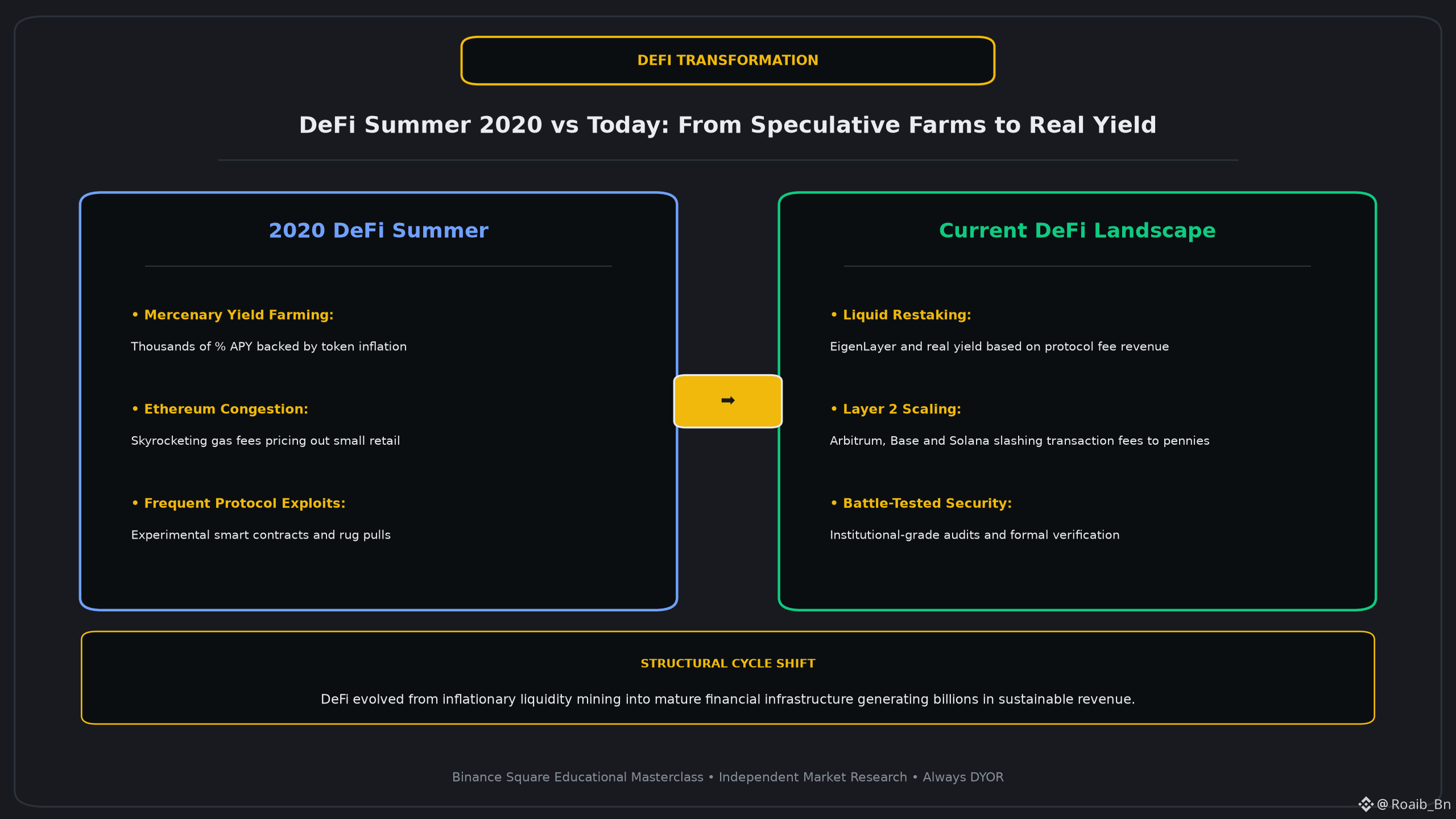
DeFi Summer 2020 vs Today: From Speculative Farms to Real YieldDEFI SUMMER 2020 VS TODAY: FROM SPECULATIVE FARMS TO REAL YIELD
Many of us who survived the 2020 cycle remember it as a fever dream of food themed tokens and astronomical yields that seemed to defy the laws of physics. It was a time of pure discovery where decentralized finance moved from a niche experiment to a global phenomenon almost overnight. However, as we look at the market in late 2026, the landscape has shifted fundamentally. Understanding this evolution is not just a history lesson; it is essential for any trader looking to identify where the next sustainable move in $ETH and the broader ecosystem will come from.
THE ERA OF MERCENARY CAPITAL AND GAS WARS
Back in 2020, DeFi was defined by mercenary liquidity. Yield farming was the primary driver of growth, where protocols would attract liquidity by printing massive amounts of their own governance tokens. These tokens often had no utility beyond voting, leading to a cycle of farm and dump that eventually exhausted itself. At the same time, the infrastructure was struggling to keep up. On chain activity was concentrated almost entirely on the Ethereum mainnet. This led to massive congestion where a single swap could cost hundreds of dollars in gas fees, effectively pricing out retail participants and leaving the playground to whales. Security was also an afterthought for many, as experimental smart contracts were rushed to market, resulting in frequent exploits and rug pulls that became a daily occurrence.
THE RISE OF SUSTAINABILITY AND INFRASTRUCTURE
Fast forward to today, and the environment is unrecognizable. We have moved away from inflationary rewards toward what the industry calls Real Yield. Instead of receiving newly minted tokens, participants are now earning a share of protocol revenue generated from actual usage fees. The narrative has shifted toward liquid restaking and institutional grade products. Projects like EigenLayer have introduced ways to secure multiple networks simultaneously, creating a more efficient use of capital.
Furthermore, the barrier to entry has collapsed. The dominance of Layer 2 scaling solutions like Arbitrum and Base, alongside the high speed performance of $SOL , has reduced transaction costs to mere pennies. This has democratized access to complex financial strategies that were previously reserved for the elite. Security has also matured significantly. We now see institutional grade audits and formal verification becoming the standard, making the ecosystem far more resilient than its predecessor.
A NEW PARADIGM FOR THE DISCIPLINED TRADER
From a strategic perspective, the transition from speculative farming to mature financial infrastructure changes how we evaluate opportunities. In 2020, the goal was to find the highest APY and exit before the collapse. Today, the focus is on protocol revenue, fee generation, and ecosystem stickiness. DeFi has evolved from a laboratory for experimental printing presses into a legitimate alternative to traditional finance. For a disciplined trader, this means looking for projects with proven product market fit and sustainable cash flows rather than chasing the loudest narrative.
The question for the community today is this: Do you miss the high octane volatility and massive inflationary yields of the 2020 era, or do you believe the current focus on real yield and infrastructure is the only way for the industry to achieve mass adoption?
This analysis is for educational purposes only and does not constitute financial advice. The crypto market involves significant risk, and historical performance does not guarantee future results. Always conduct your own research and manage your risk accordingly.
$ETH $SOL #BinanceSquare #DeFi
DeFi Summer 2020 vs Today: From Speculative Farms to Real Yield
DEFI SUMMER 2020 VS TODAY: FROM SPECULATIVE FARMS TO REAL YIELD
Many of us who survived the 2020 cycle remember it as a fever dream of food themed tokens and astronomical yields that seemed to defy the laws of physics. It was a time of pure discovery where decentralized finance moved from a niche experiment to a global phenomenon almost overnight. However, as we look at the market in late 2026, the landscape has shifted fundamentally. Understanding this evolution is not just a history lesson; it is essential for any trader looking to identify where the next sustainable move in $ETH and the broader ecosystem will come from.
THE ERA OF MERCENARY CAPITAL AND GAS WARS
Back in 2020, DeFi was defined by mercenary liquidity. Yield farming was the primary driver of growth, where protocols would attract liquidity by printing massive amounts of their own governance tokens. These tokens often had no utility beyond voting, leading to a cycle of farm and dump that eventually exhausted itself. At the same time, the infrastructure was struggling to keep up. On chain activity was concentrated almost entirely on the Ethereum mainnet. This led to massive congestion where a single swap could cost hundreds of dollars in gas fees, effectively pricing out retail participants and leaving the playground to whales. Security was also an afterthought for many, as experimental smart contracts were rushed to market, resulting in frequent exploits and rug pulls that became a daily occurrence.
THE RISE OF SUSTAINABILITY AND INFRASTRUCTURE
Fast forward to today, and the environment is unrecognizable. We have moved away from inflationary rewards toward what the industry calls Real Yield. Instead of receiving newly minted tokens, participants are now earning a share of protocol revenue generated from actual usage fees. The narrative has shifted toward liquid restaking and institutional grade products. Projects like EigenLayer have introduced ways to secure multiple networks simultaneously, creating a more efficient use of capital.
Furthermore, the barrier to entry has collapsed. The dominance of Layer 2 scaling solutions like Arbitrum and Base, alongside the high speed performance of $SOL , has reduced transaction costs to mere pennies. This has democratized access to complex financial strategies that were previously reserved for the elite. Security has also matured significantly. We now see institutional grade audits and formal verification becoming the standard, making the ecosystem far more resilient than its predecessor.
A NEW PARADIGM FOR THE DISCIPLINED TRADER
From a strategic perspective, the transition from speculative farming to mature financial infrastructure changes how we evaluate opportunities. In 2020, the goal was to find the highest APY and exit before the collapse. Today, the focus is on protocol revenue, fee generation, and ecosystem stickiness. DeFi has evolved from a laboratory for experimental printing presses into a legitimate alternative to traditional finance. For a disciplined trader, this means looking for projects with proven product market fit and sustainable cash flows rather than chasing the loudest narrative.
The question for the community today is this: Do you miss the high octane volatility and massive inflationary yields of the 2020 era, or do you believe the current focus on real yield and infrastructure is the only way for the industry to achieve mass adoption?
This analysis is for educational purposes only and does not constitute financial advice. The crypto market involves significant risk, and historical performance does not guarantee future results. Always conduct your own research and manage your risk accordingly.
$ETH $SOL #BinanceSquare #DeFi
17
·
--
See translation
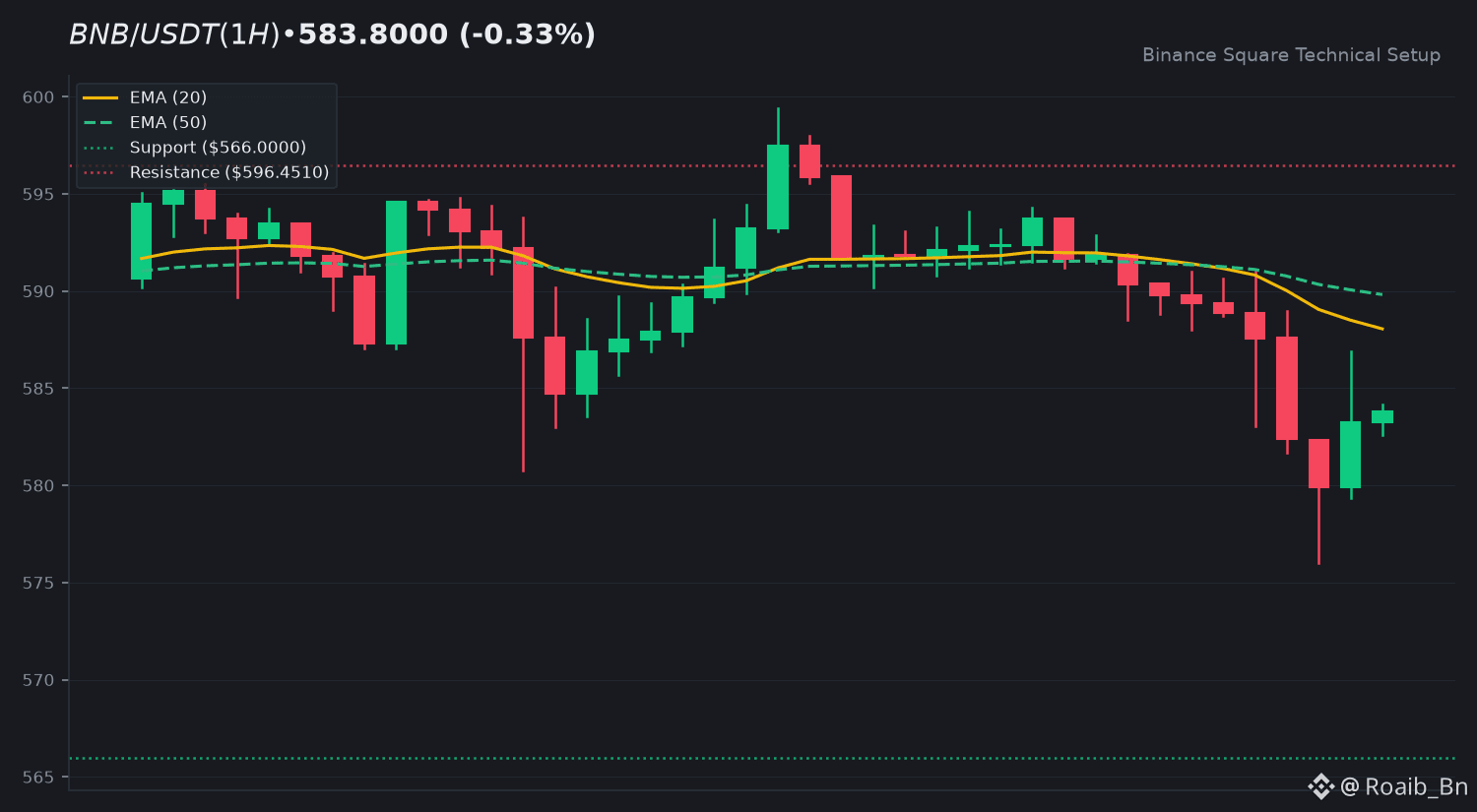
BNB is showing a mild pullback today as it trades near 583.8000. The market seems to be in a phase of quiet consolidation after the recent sessions, keeping investors on their toes while we wait for a clearer trend to emerge.
On the hourly chart, the price is currently sitting just below both the 20 EMA at 588.0561 and the 50 EMA at 589.8182. With the RSI hovering at 38.6, momentum remains fairly subdued, suggesting that sellers are currently in control but lack the strength for a sharp breakdown.
Looking ahead, we need to keep an eye on the 596.4510 level as the primary resistance to clear for any upside continuation. On the downside, maintaining support at 566.0000 is vital to keep the current structure intact.
What are your thoughts on this price level—are you holding your position or waiting for a breakout before taking action?
Educational analysis only, not financial advice. DYOR.
$BNB #BinanceSquare #Crypto
11
·
--
See translation
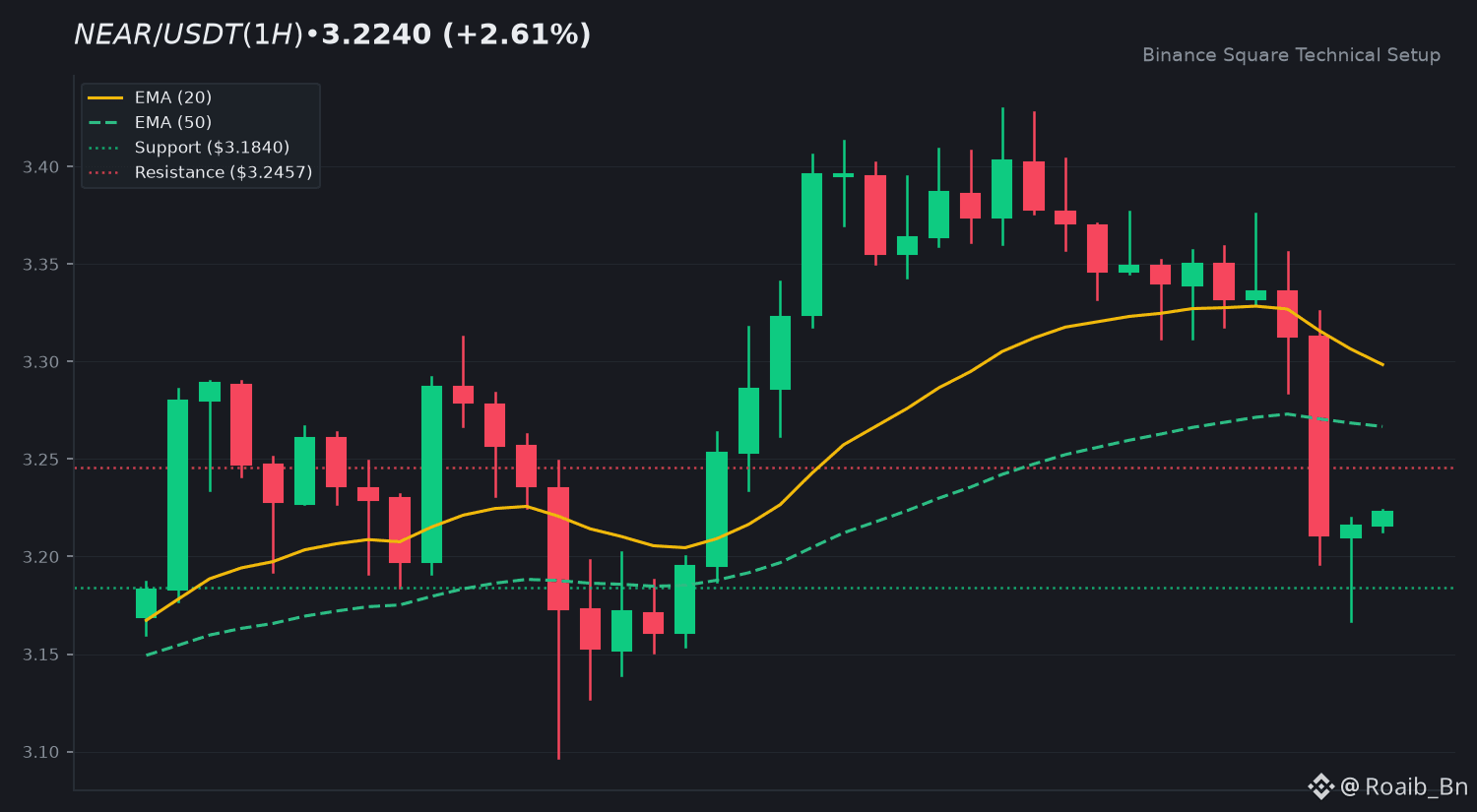
$NEAR is currently showing signs of steady consolidation at the 3.2240 level. After some recent volatility, the asset is attempting to stabilize while posting a modest gain of over two percent for the day.
On the one-hour timeframe, the price is trading just below both the 20 EMA at 3.2984 and the 50 EMA at 3.2667. With an RSI of 38.79, the momentum remains relatively cool, suggesting that the market is currently indecisive rather than showing strong directional bias.
To see a shift in trend, buyers need to reclaim the primary resistance level at 3.2457. If the price fails to hold there, keeping a close eye on the immediate support at 3.1840 is essential to maintain the current market structure.
Are you watching this consolidation closely, or are you waiting for a clearer breakout before making any moves?
Educational analysis only, not financial advice. DYOR.
$NEAR #BinanceSquare #Crypto
25
·
--
Article
See translation
Altcoin Seasons: 2021 Rising Tide vs Current Selective RotationsThe landscape of the cryptocurrency market has undergone a profound transformation over the last few years. Many traders who entered the space during the 2021 bull run are finding that the old playbooks no longer yield the same results. The core difference lies in how capital flows through the ecosystem. We have moved away from the era of the rising tide that lifts all boats and entered a period defined by surgical, selective rotations. Understanding this shift is not just an academic exercise; it is a requirement for survival in the current market environment.
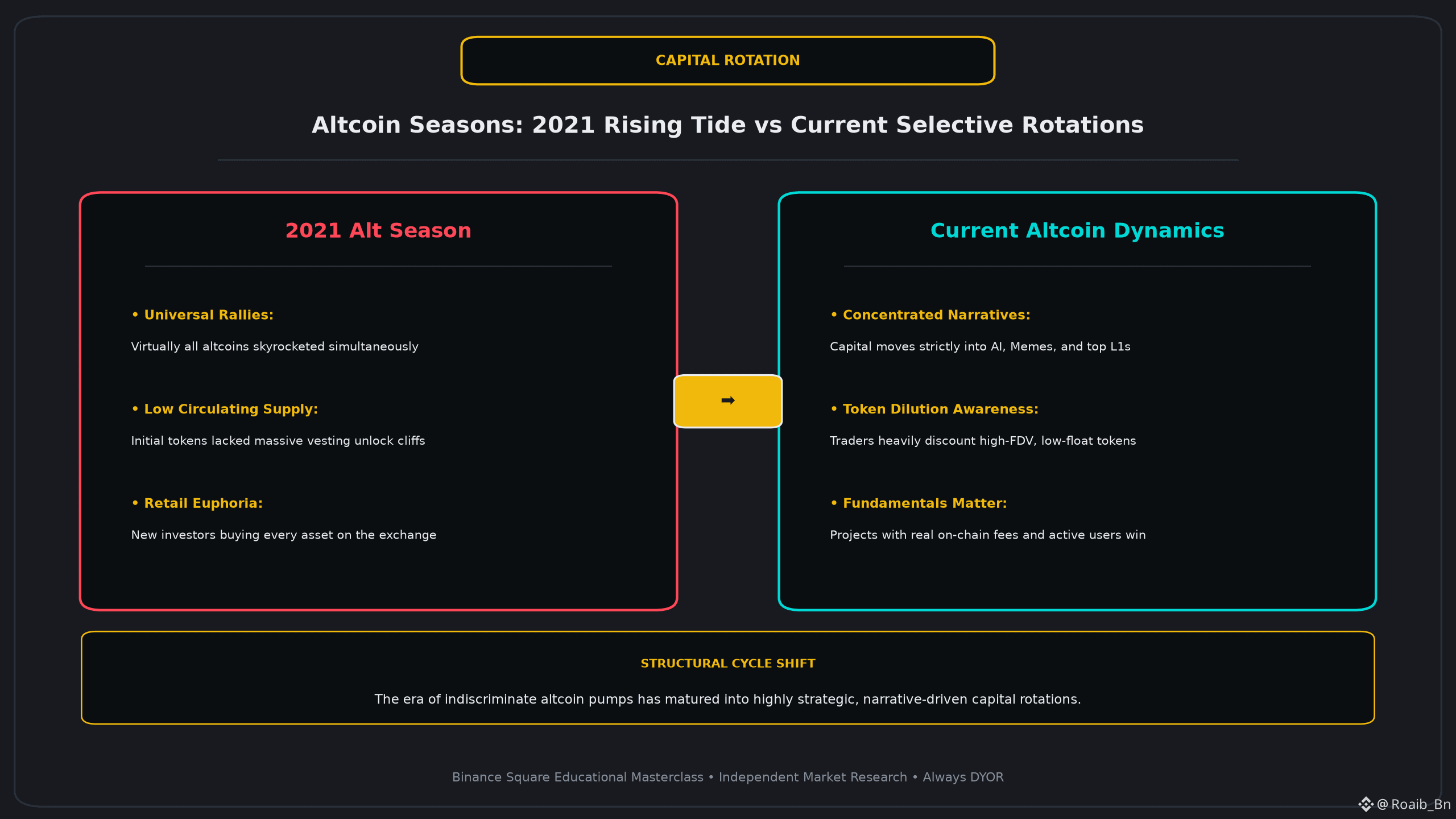
Reflecting on the 2021 altcoin season, the primary driver was universal participation. Almost every asset, regardless of its underlying utility or tokenomics, experienced massive rallies. This was fueled by a combination of unprecedented retail euphoria and a market structure that was far less diluted than what we see today. Most tokens launched in that era lacked the massive vesting schedules and multi-year unlock cliffs that now plague newer projects. When $BTC broke into price discovery, the overflow of liquidity moved linearly down the market cap ladder. It was a period where diversification across any twenty random altcoins likely resulted in significant gains because the entire asset class was moving in unison.
In contrast, the current market dynamics are characterized by extreme concentration. Capital is no longer flowing broadly; it is rotating aggressively between a few high-conviction narratives. We see this clearly in the dominance of Artificial Intelligence tokens, Memes, and a handful of high-performance Layer 1 networks. Traders have become significantly more sophisticated and cautious. There is now a widespread awareness of token dilution. High Fully Diluted Valuation (FDV) tokens with low circulating floats are often treated as toxic by experienced market participants who refuse to provide exit liquidity for early venture capital investors. Today, projects are forced to prove their worth through on-chain fees, active user metrics, and genuine ecosystem growth.
This evolution signifies a maturing market. The indiscriminate pumps of the past have been replaced by a strategic environment where fundamental analysis and narrative timing are paramount. For a disciplined trader, the focus has shifted from finding any coin that hasn't pumped yet to identifying which specific sector is currently capturing the market's limited attention span. While $BTC remains the gravitational center of the market, the path to outperformance now requires a deep dive into liquidity profiles and supply schedules. The transition from a beta-driven market to an alpha-driven one means that being right about the direction of the market is no longer enough; you must also be right about the specific sector.
As we navigate this more complex landscape, I am curious to hear how your own strategies have evolved. Are you still looking for broad market recovery plays, or have you narrowed your focus strictly to specific narratives like AI or the $SOL ecosystem? Share your thoughts on how you are positioning your portfolio for these selective rotations in the comments below.
This analysis is provided for educational purposes only and does not constitute financial advice. The crypto market involves significant risk. Always conduct your own research (DYOR) before making any investment decisions.
$BTC $SOL #BinanceSquare #Altcoins
Altcoin Seasons: 2021 Rising Tide vs Current Selective Rotations
The landscape of the cryptocurrency market has undergone a profound transformation over the last few years. Many traders who entered the space during the 2021 bull run are finding that the old playbooks no longer yield the same results. The core difference lies in how capital flows through the ecosystem. We have moved away from the era of the rising tide that lifts all boats and entered a period defined by surgical, selective rotations. Understanding this shift is not just an academic exercise; it is a requirement for survival in the current market environment.
Reflecting on the 2021 altcoin season, the primary driver was universal participation. Almost every asset, regardless of its underlying utility or tokenomics, experienced massive rallies. This was fueled by a combination of unprecedented retail euphoria and a market structure that was far less diluted than what we see today. Most tokens launched in that era lacked the massive vesting schedules and multi-year unlock cliffs that now plague newer projects. When $BTC broke into price discovery, the overflow of liquidity moved linearly down the market cap ladder. It was a period where diversification across any twenty random altcoins likely resulted in significant gains because the entire asset class was moving in unison.
In contrast, the current market dynamics are characterized by extreme concentration. Capital is no longer flowing broadly; it is rotating aggressively between a few high-conviction narratives. We see this clearly in the dominance of Artificial Intelligence tokens, Memes, and a handful of high-performance Layer 1 networks. Traders have become significantly more sophisticated and cautious. There is now a widespread awareness of token dilution. High Fully Diluted Valuation (FDV) tokens with low circulating floats are often treated as toxic by experienced market participants who refuse to provide exit liquidity for early venture capital investors. Today, projects are forced to prove their worth through on-chain fees, active user metrics, and genuine ecosystem growth.
This evolution signifies a maturing market. The indiscriminate pumps of the past have been replaced by a strategic environment where fundamental analysis and narrative timing are paramount. For a disciplined trader, the focus has shifted from finding any coin that hasn't pumped yet to identifying which specific sector is currently capturing the market's limited attention span. While $BTC remains the gravitational center of the market, the path to outperformance now requires a deep dive into liquidity profiles and supply schedules. The transition from a beta-driven market to an alpha-driven one means that being right about the direction of the market is no longer enough; you must also be right about the specific sector.
As we navigate this more complex landscape, I am curious to hear how your own strategies have evolved. Are you still looking for broad market recovery plays, or have you narrowed your focus strictly to specific narratives like AI or the $SOL ecosystem? Share your thoughts on how you are positioning your portfolio for these selective rotations in the comments below.
This analysis is provided for educational purposes only and does not constitute financial advice. The crypto market involves significant risk. Always conduct your own research (DYOR) before making any investment decisions.
$BTC $SOL #BinanceSquare #Altcoins
4
·
--
See translation
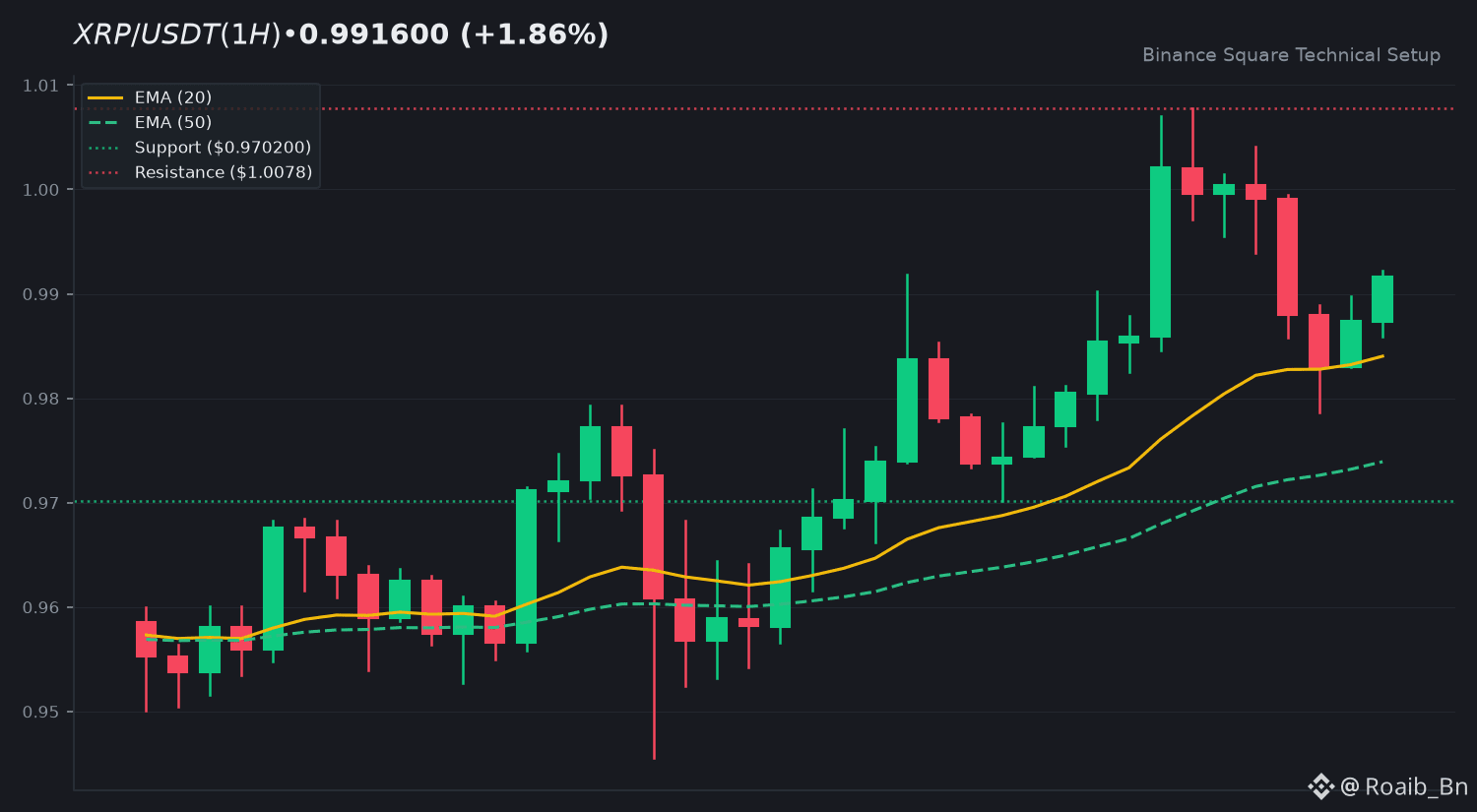
XRP is currently showing steady consolidation as it hovers around the 0.9916 level. The asset is maintaining a mild upward bias over the last twenty four hours, reflecting a period of calm accumulation as market participants assess the current range.
On the hourly chart, the price is holding comfortably above the 20 EMA at 0.9840, which suggests that the short term trend remains intact. With the RSI sitting at 58.71, momentum is leaning toward the buyers without being overextended, providing room for further movement.
The primary resistance to watch for a potential breakout sits at 1.0078. On the downside, the immediate support level at 0.9702 remains the critical floor that needs to hold to maintain the current market structure.
Are you watching this consolidation closely, or are you waiting for a confirmed breakout above that dollar mark before making a move?
Educational analysis only, not financial advice. DYOR.
$XRP #BinanceSquare #Crypto
18
Log in to explore more content
Join global crypto users on Binance Square
⚡️ Get latest and useful information about crypto.
💬 Trusted by the world’s largest crypto exchange.
👍 Discover real insights from verified creators.
Email / Phone number
Trending Topics
AnthropicToDebutAfter$83IPOPricing
15,333 views
174 Discussing
Stock Futures Hold Near Flat as Anthropic Prices IPO at $83 Ahead of Debut
Binance News
·8 Likes
·7.7k views
BTCRemainsUnderPressureAfterHawkishFOMCMinutes
57,463 views
1,382 Discussing
NvidiaBoardReportedlySplitOverHuang’sReturn
19,065 views
676 Discussing