

Dà Zǔ 大祖
2.3k Posts

Dà Zǔ 大祖
Report
Block User
Crypto Trade Signals 📈 | BTC ETH SOL XRP | Futures Long & Short Setups | Market Structure & Smart Money Analysis
Open Trade
High-Frequency Trader
2.5 Years
350 Following
4.7K+ Followers
1.7K+ Liked
Posts
Portfolio
All
Quotes
Videos
Live
·
--
See translation
Why is Dusk building its own financial contract standard instead of simply relying on existing smart contract models?
At first, I thought the answer was straightforward: if Dusk wants financial applications, developers just need smart contracts with better privacy.
But looking at the idea of the Confidential Security Contract, I think there is a deeper question.
Financial assets don't always behave like typical DeFi tokens. Ownership, transfers, permissions, and transaction details can involve information that shouldn't be visible to everyone on a public ledger.
That changes what a useful smart contract should do.
The interesting part of Dusk's XSC approach is that confidentiality isn't treated as something added around the application. It is part of the contract model itself.
That makes me think XSC could be less about creating another smart contract standard and more about defining what financial contracts need to look like when privacy and verification have to work together.
And that's the part I find worth watching.
If regulated assets are going onchain, simply copying existing DeFi contract patterns may not be enough. The bigger challenge could be designing contracts around the restrictions that financial markets already have.
I'm still curious about one thing: can XSC become a practical standard developers actually want to use, or will it remain mainly a specialized solution for Dusk's financial ecosystem?
What could make XSC matter most? 👀
#dusk $DUSK @Dusk_Foundation
Why is Dusk building its own financial contract standard instead of simply relying on existing smart contract models?
At first, I thought the answer was straightforward: if Dusk wants financial applications, developers just need smart contracts with better privacy.
But looking at the idea of the Confidential Security Contract, I think there is a deeper question.
Financial assets don't always behave like typical DeFi tokens. Ownership, transfers, permissions, and transaction details can involve information that shouldn't be visible to everyone on a public ledger.
That changes what a useful smart contract should do.
The interesting part of Dusk's XSC approach is that confidentiality isn't treated as something added around the application. It is part of the contract model itself.
That makes me think XSC could be less about creating another smart contract standard and more about defining what financial contracts need to look like when privacy and verification have to work together.
And that's the part I find worth watching.
If regulated assets are going onchain, simply copying existing DeFi contract patterns may not be enough. The bigger challenge could be designing contracts around the restrictions that financial markets already have.
I'm still curious about one thing: can XSC become a practical standard developers actually want to use, or will it remain mainly a specialized solution for Dusk's financial ecosystem?
What could make XSC matter most? 👀
#dusk $DUSK @Dusk
At first, I thought the answer was straightforward: if Dusk wants financial applications, developers just need smart contracts with better privacy.
But looking at the idea of the Confidential Security Contract, I think there is a deeper question.
Financial assets don't always behave like typical DeFi tokens. Ownership, transfers, permissions, and transaction details can involve information that shouldn't be visible to everyone on a public ledger.
That changes what a useful smart contract should do.
The interesting part of Dusk's XSC approach is that confidentiality isn't treated as something added around the application. It is part of the contract model itself.
That makes me think XSC could be less about creating another smart contract standard and more about defining what financial contracts need to look like when privacy and verification have to work together.
And that's the part I find worth watching.
If regulated assets are going onchain, simply copying existing DeFi contract patterns may not be enough. The bigger challenge could be designing contracts around the restrictions that financial markets already have.
I'm still curious about one thing: can XSC become a practical standard developers actually want to use, or will it remain mainly a specialized solution for Dusk's financial ecosystem?
What could make XSC matter most? 👀
#dusk $DUSK @Dusk
🔐 Privacy
0%
🏦 Finance
100%
⚙️ Compliance
0%
🚀 Adoption
0%
1 votes • Voting closed
11
2
100
·
--
See translation
I used to think privacy was mainly a crypto narrative.
Looking closer at Dusk, I think that misses the bigger point.
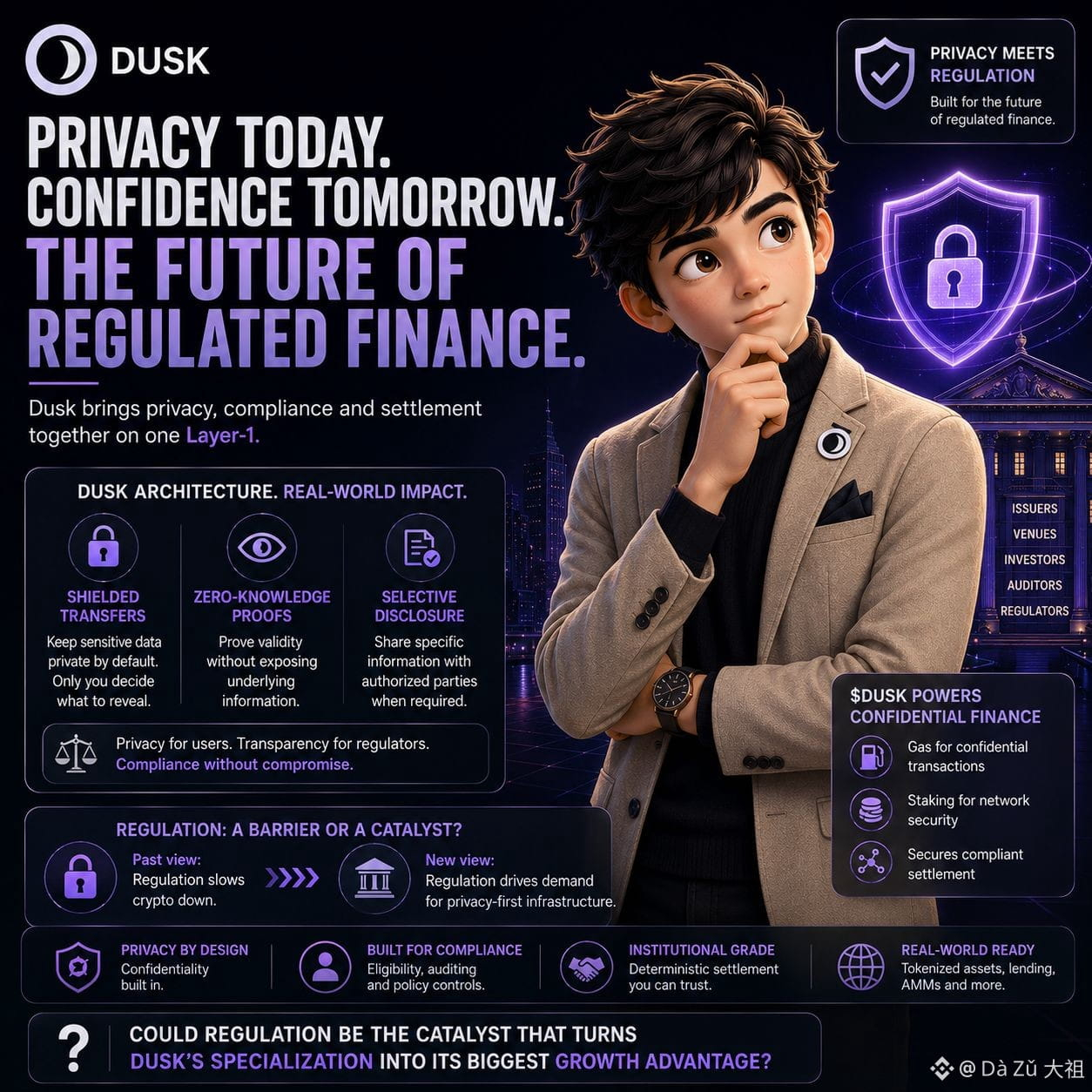
For regulated finance, putting every balance, position and transaction on a public ledger can create an operational problem. Investors may need confidentiality, while issuers, venues and auditors still need access to specific information.
That is the interesting part of Dusk: it combines shielded transfers, zero-knowledge proofs and selective disclosure, so sensitive data can stay private while authorized parties can still get the evidence they need.
And this changes how I think about regulation.
Regulation is usually framed as something that slows crypto down. For Dusk, some of those requirements could actually create demand for infrastructure built around privacy, eligibility controls and compliant settlement.
But having the right architecture isn't the same as winning the market.
My read: Dusk's edge isn't simply being a “private blockchain.” It's trying to make privacy compatible with how regulated markets actually operate.
Could regulation become the catalyst that turns Dusk's specialization into its biggest growth advantage?
#dusk $DUSK @Dusk_Foundation
$PIVX $HEMI
I used to think privacy was mainly a crypto narrative.
Looking closer at Dusk, I think that misses the bigger point.
For regulated finance, putting every balance, position and transaction on a public ledger can create an operational problem. Investors may need confidentiality, while issuers, venues and auditors still need access to specific information.
That is the interesting part of Dusk: it combines shielded transfers, zero-knowledge proofs and selective disclosure, so sensitive data can stay private while authorized parties can still get the evidence they need.
And this changes how I think about regulation.
Regulation is usually framed as something that slows crypto down. For Dusk, some of those requirements could actually create demand for infrastructure built around privacy, eligibility controls and compliant settlement.
But having the right architecture isn't the same as winning the market.
My read: Dusk's edge isn't simply being a “private blockchain.” It's trying to make privacy compatible with how regulated markets actually operate.
Could regulation become the catalyst that turns Dusk's specialization into its biggest growth advantage?
#dusk $DUSK @Dusk
$PIVX $HEMI
Looking closer at Dusk, I think that misses the bigger point.
For regulated finance, putting every balance, position and transaction on a public ledger can create an operational problem. Investors may need confidentiality, while issuers, venues and auditors still need access to specific information.
That is the interesting part of Dusk: it combines shielded transfers, zero-knowledge proofs and selective disclosure, so sensitive data can stay private while authorized parties can still get the evidence they need.
And this changes how I think about regulation.
Regulation is usually framed as something that slows crypto down. For Dusk, some of those requirements could actually create demand for infrastructure built around privacy, eligibility controls and compliant settlement.
But having the right architecture isn't the same as winning the market.
My read: Dusk's edge isn't simply being a “private blockchain.” It's trying to make privacy compatible with how regulated markets actually operate.
Could regulation become the catalyst that turns Dusk's specialization into its biggest growth advantage?
#dusk $DUSK @Dusk
$PIVX $HEMI
1
100
·
--
See translation
I kept coming back to one question with $DUSK : what happens when a specialized L1 removes one of the biggest barriers for developers?
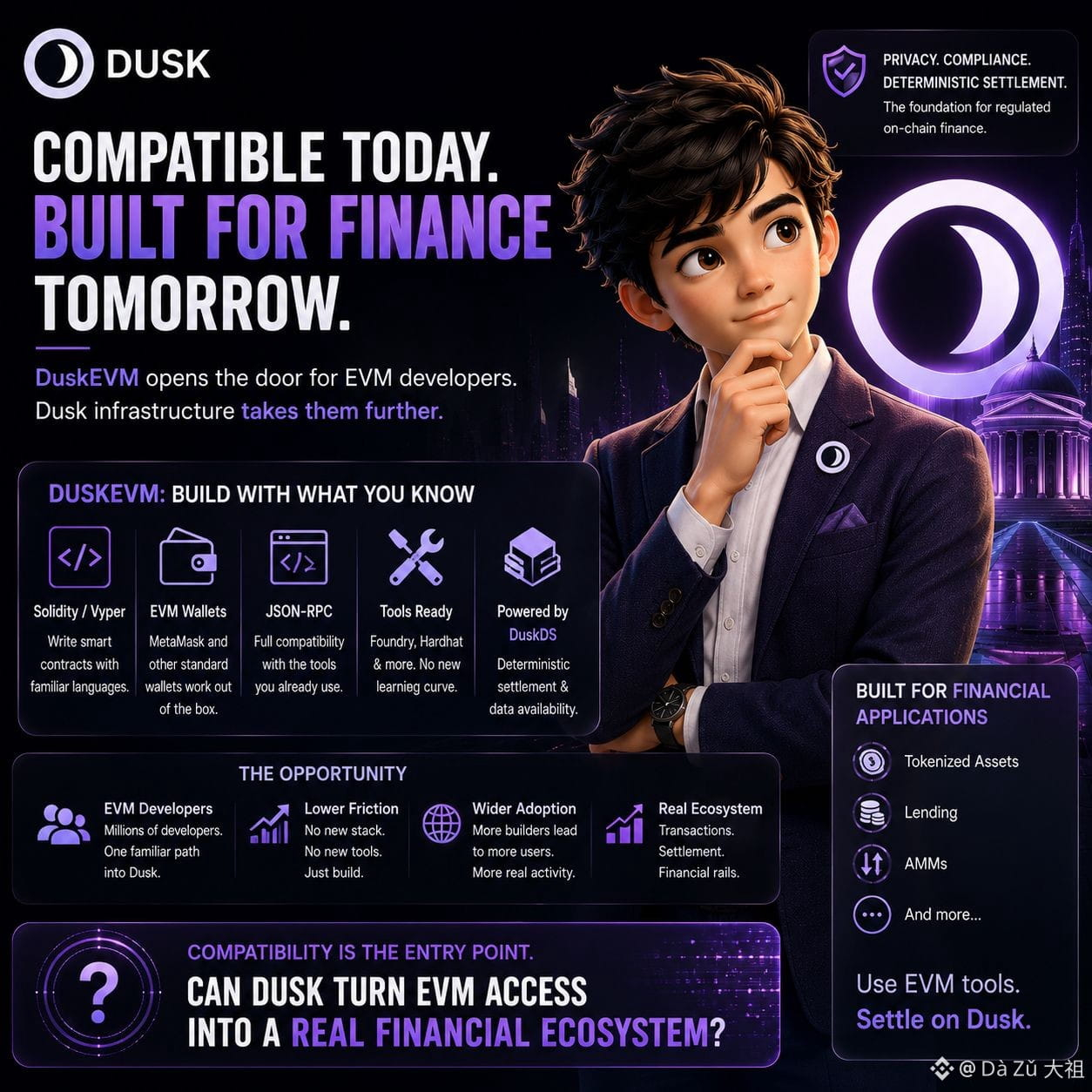
Dusk EVM gives builders a familiar route into the network: Solidity/Vyper, standard EVM wallets, JSON RPC, and tools like Foundry and Hardhat. Underneath, Dusk DS handles settlement and data availability.
That matters because developers don't have to abandon the EVM stack just to experiment with Dusk's financial infrastructure.
And this isn't only about attracting another wave of generic dApps. Dusk specifically points to tokenized assets, lending, AMMs and other financial applications that can use EVM tooling while settling through Dusk.
But compatibility is only the entry point.
The real test is whether those familiar tools lead to developers actually building, users actually using, and transactions actually settling on the network.
My read: DuskEVM could widen Dusk's developer funnel significantly. But the bigger question is whether EVM compatibility turns that access into a real financial ecosystem.
Can Dusk become more than a specialized L1 by making it easier for the existing EVM world to build on its rails?
#dusk @Dusk_Foundation
$CYS $COW
I kept coming back to one question with $DUSK : what happens when a specialized L1 removes one of the biggest barriers for developers?
Dusk EVM gives builders a familiar route into the network: Solidity/Vyper, standard EVM wallets, JSON RPC, and tools like Foundry and Hardhat. Underneath, Dusk DS handles settlement and data availability.
That matters because developers don't have to abandon the EVM stack just to experiment with Dusk's financial infrastructure.
And this isn't only about attracting another wave of generic dApps. Dusk specifically points to tokenized assets, lending, AMMs and other financial applications that can use EVM tooling while settling through Dusk.
But compatibility is only the entry point.
The real test is whether those familiar tools lead to developers actually building, users actually using, and transactions actually settling on the network.
My read: DuskEVM could widen Dusk's developer funnel significantly. But the bigger question is whether EVM compatibility turns that access into a real financial ecosystem.
Can Dusk become more than a specialized L1 by making it easier for the existing EVM world to build on its rails?
#dusk @Dusk
$CYS $COW
Dusk EVM gives builders a familiar route into the network: Solidity/Vyper, standard EVM wallets, JSON RPC, and tools like Foundry and Hardhat. Underneath, Dusk DS handles settlement and data availability.
That matters because developers don't have to abandon the EVM stack just to experiment with Dusk's financial infrastructure.
And this isn't only about attracting another wave of generic dApps. Dusk specifically points to tokenized assets, lending, AMMs and other financial applications that can use EVM tooling while settling through Dusk.
But compatibility is only the entry point.
The real test is whether those familiar tools lead to developers actually building, users actually using, and transactions actually settling on the network.
My read: DuskEVM could widen Dusk's developer funnel significantly. But the bigger question is whether EVM compatibility turns that access into a real financial ecosystem.
Can Dusk become more than a specialized L1 by making it easier for the existing EVM world to build on its rails?
#dusk @Dusk
$CYS $COW
2
1
94
·
--
See translation
For me Dusk finally made the validator role make sense.
On most chains validator = block factory. Same job forever.
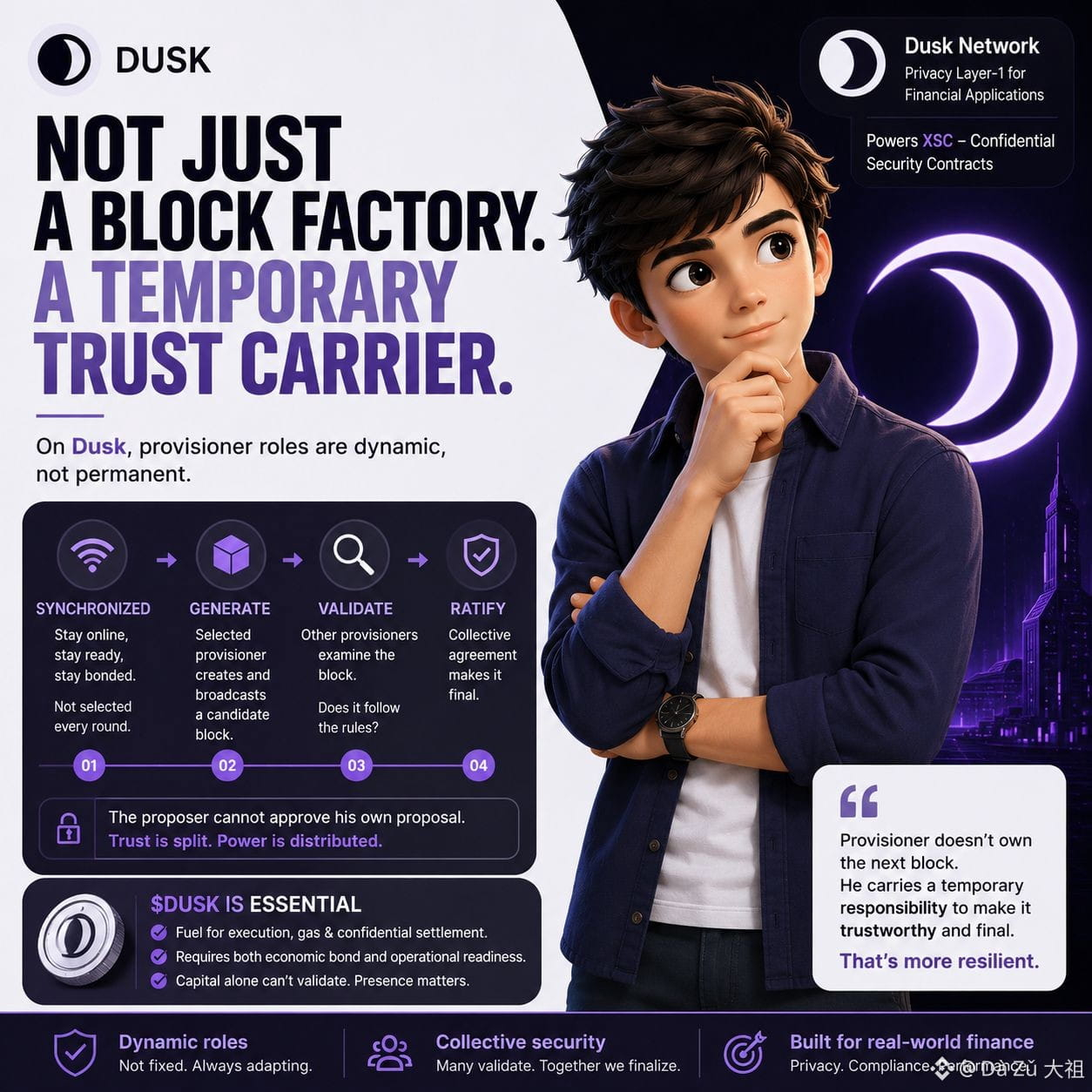
On Dusk, provisioner is not locked to one permanent job. You might spend a whole round just staying synchronized, keeping node online, ready. Next round protocol picks you to help finalize the next block.
That shift matters.
Being a generator is temporary. Yes, when selected you create and broadcast a candidate block, but that doesn't mean you decide history. Other provisioners must examine it. That's validation does it follow rules? Then ratification do we agree it's final?
I like that separation. The person who proposes is not allowed to approve his own proposal. Trust is split.
So $DUSK is not passive staking asset here. Dusk is a privacy Layer-1 for financial apps, powering XSC standard for confidential smart contracts, and it needs participants who are both economically bonded and operationally ready. Capital alone can't validate, can't broadcast at right moment.
In short, provisioner doesn't own the next block. He just carries temporary responsibility to make it trustworthy and final. Isn't that more resilient?
#dusk @Dusk_Foundation
$VELVET $AKE
For me Dusk finally made the validator role make sense.
On most chains validator = block factory. Same job forever.
On Dusk, provisioner is not locked to one permanent job. You might spend a whole round just staying synchronized, keeping node online, ready. Next round protocol picks you to help finalize the next block.
That shift matters.
Being a generator is temporary. Yes, when selected you create and broadcast a candidate block, but that doesn't mean you decide history. Other provisioners must examine it. That's validation does it follow rules? Then ratification do we agree it's final?
I like that separation. The person who proposes is not allowed to approve his own proposal. Trust is split.
So $DUSK is not passive staking asset here. Dusk is a privacy Layer-1 for financial apps, powering XSC standard for confidential smart contracts, and it needs participants who are both economically bonded and operationally ready. Capital alone can't validate, can't broadcast at right moment.
In short, provisioner doesn't own the next block. He just carries temporary responsibility to make it trustworthy and final. Isn't that more resilient?
#dusk @Dusk
$VELVET $AKE
On most chains validator = block factory. Same job forever.
On Dusk, provisioner is not locked to one permanent job. You might spend a whole round just staying synchronized, keeping node online, ready. Next round protocol picks you to help finalize the next block.
That shift matters.
Being a generator is temporary. Yes, when selected you create and broadcast a candidate block, but that doesn't mean you decide history. Other provisioners must examine it. That's validation does it follow rules? Then ratification do we agree it's final?
I like that separation. The person who proposes is not allowed to approve his own proposal. Trust is split.
So $DUSK is not passive staking asset here. Dusk is a privacy Layer-1 for financial apps, powering XSC standard for confidential smart contracts, and it needs participants who are both economically bonded and operationally ready. Capital alone can't validate, can't broadcast at right moment.
In short, provisioner doesn't own the next block. He just carries temporary responsibility to make it trustworthy and final. Isn't that more resilient?
#dusk @Dusk
$VELVET $AKE
3
365
·
--
See translation
I kept asking why privacy matters for finance onchain.
Most chains are fully transparent. Great for DeFi degens, terrible for a company tokenizing a bond. No institution wants competitors seeing their balances and positions.
That's where Dusk Network clicked for me.🫣
Dusk brands itself as a privacy blockchain built for financial applications. It is a layer 1 blockchain that powers the Confidential Security Contract (XSC) standard, and supports confidential smart contracts.
XSC is clever. It keeps transactions private by default, but allows selective disclosure to regulators when needed. So you get privacy AND compliance at the same time. That's the gap stopping real world assets.
And $DUSK sits in the middle of it. Not as an extra reward token. As fuel for execution, gas, and confidential settlement. A version of DUSK on another chain might have the same price, but only native DUSK on Dusk L1 is recognized by the protocol itself for its core actions.
To me, that's the difference between a token that is listed and a token that is actually needed.
I think institutions will choose privacy over full transparency once tokenized assets cross a trillion. What is your take on this shift?
Do you think confidential finance will be bigger than transparent DeFi?
#dusk @Dusk_Foundation $SNXXB $COTI
I kept asking why privacy matters for finance onchain.
Most chains are fully transparent. Great for DeFi degens, terrible for a company tokenizing a bond. No institution wants competitors seeing their balances and positions.
That's where Dusk Network clicked for me.🫣
Dusk brands itself as a privacy blockchain built for financial applications. It is a layer 1 blockchain that powers the Confidential Security Contract (XSC) standard, and supports confidential smart contracts.
XSC is clever. It keeps transactions private by default, but allows selective disclosure to regulators when needed. So you get privacy AND compliance at the same time. That's the gap stopping real world assets.
And $DUSK sits in the middle of it. Not as an extra reward token. As fuel for execution, gas, and confidential settlement. A version of DUSK on another chain might have the same price, but only native DUSK on Dusk L1 is recognized by the protocol itself for its core actions.
To me, that's the difference between a token that is listed and a token that is actually needed.
I think institutions will choose privacy over full transparency once tokenized assets cross a trillion. What is your take on this shift?
Do you think confidential finance will be bigger than transparent DeFi?
#dusk @Dusk $SNXXB $COTI
Most chains are fully transparent. Great for DeFi degens, terrible for a company tokenizing a bond. No institution wants competitors seeing their balances and positions.
That's where Dusk Network clicked for me.🫣
Dusk brands itself as a privacy blockchain built for financial applications. It is a layer 1 blockchain that powers the Confidential Security Contract (XSC) standard, and supports confidential smart contracts.
XSC is clever. It keeps transactions private by default, but allows selective disclosure to regulators when needed. So you get privacy AND compliance at the same time. That's the gap stopping real world assets.
And $DUSK sits in the middle of it. Not as an extra reward token. As fuel for execution, gas, and confidential settlement. A version of DUSK on another chain might have the same price, but only native DUSK on Dusk L1 is recognized by the protocol itself for its core actions.
To me, that's the difference between a token that is listed and a token that is actually needed.
I think institutions will choose privacy over full transparency once tokenized assets cross a trillion. What is your take on this shift?
Do you think confidential finance will be bigger than transparent DeFi?
#dusk @Dusk $SNXXB $COTI

2
1
95
·
--
See translation
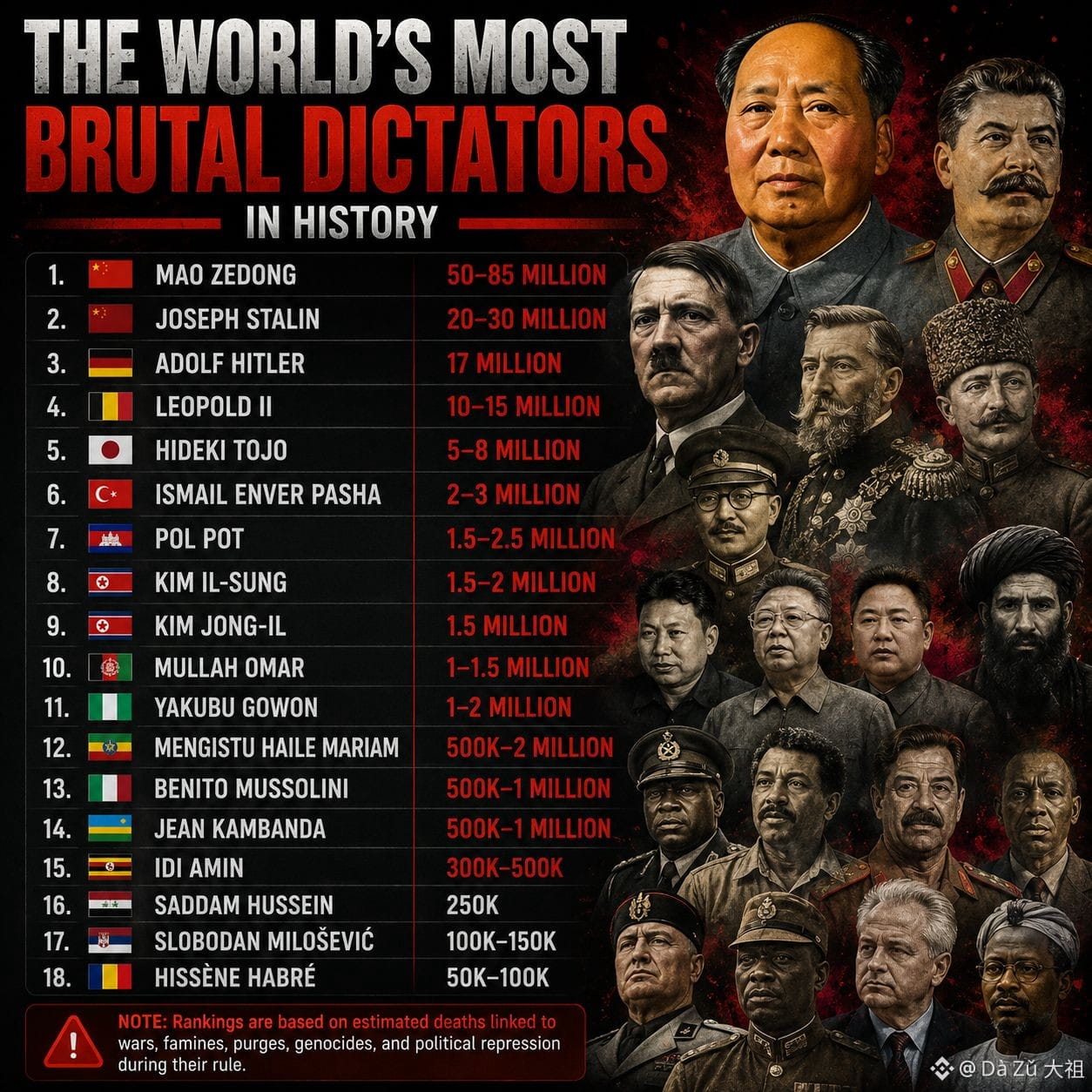
The World's Most Brutal Dictators in History
1.
🇨🇳
Mao Zedong - 50–85 Million
2.
🇷🇺
Joseph Stalin - 20–30 Million
3.
🇩🇪
Adolf Hitler - 17 Million
4.
🇧🇪
Leopold II - 10–15 Million
5.
🇯🇵
Hideki Tojo - 5–8 Million
6.
🇹🇷
Ismail Enver Pasha - 2–3 Million
7.
🇰🇭
Pol Pot - 1.5–2.5 Million
8.
🇰🇵
Kim Il-sung - 1.5–2 Million
9.
🇰🇵
Kim Jong-il - 1.5 Million
10.
🇦🇫
Mullah Omar - 1–1.5 Million
11.
🇳🇬
Yakubu Gowon - 1–2 Million
12.
🇪🇹
Mengistu Haile Mariam - 500K–2 Million
13.
🇮🇹
Benito Mussolini - 500K–1 Million
14.
🇷🇼
Jean Kambanda - 500K–1 Million
15.
🇺🇬
Idi Amin - 300K–500K
16.
🇮🇶
Saddam Hussein - 250K
17.
🇷🇸
Slobodan Milošević - 100K–150K
18.
🇹🇩
Hissène Habré - 50K–100K
Note: Rankings are based on estimated deaths linked to wars, famines, purges, genocides, and political repression during their rule.
$1000CAT #BIP110ForkSignalingExpectedThisWeekend #VIXFallsToJanuaryLow #IraqOilExportsFall75% #IraqOilExportsFall75% #ThuneFilesClarityActClotureMotion
The World's Most Brutal Dictators in History
1.
🇨🇳
Mao Zedong - 50–85 Million
2.
🇷🇺
Joseph Stalin - 20–30 Million
3.
🇩🇪
Adolf Hitler - 17 Million
4.
🇧🇪
Leopold II - 10–15 Million
5.
🇯🇵
Hideki Tojo - 5–8 Million
6.
🇹🇷
Ismail Enver Pasha - 2–3 Million
7.
🇰🇭
Pol Pot - 1.5–2.5 Million
8.
🇰🇵
Kim Il-sung - 1.5–2 Million
9.
🇰🇵
Kim Jong-il - 1.5 Million
10.
🇦🇫
Mullah Omar - 1–1.5 Million
11.
🇳🇬
Yakubu Gowon - 1–2 Million
12.
🇪🇹
Mengistu Haile Mariam - 500K–2 Million
13.
🇮🇹
Benito Mussolini - 500K–1 Million
14.
🇷🇼
Jean Kambanda - 500K–1 Million
15.
🇺🇬
Idi Amin - 300K–500K
16.
🇮🇶
Saddam Hussein - 250K
17.
🇷🇸
Slobodan Milošević - 100K–150K
18.
🇹🇩
Hissène Habré - 50K–100K
Note: Rankings are based on estimated deaths linked to wars, famines, purges, genocides, and political repression during their rule.
$1000CAT #BIP110ForkSignalingExpectedThisWeekend #VIXFallsToJanuaryLow #IraqOilExportsFall75% #IraqOilExportsFall75% #ThuneFilesClarityActClotureMotion
1.
🇨🇳
Mao Zedong - 50–85 Million
2.
🇷🇺
Joseph Stalin - 20–30 Million
3.
🇩🇪
Adolf Hitler - 17 Million
4.
🇧🇪
Leopold II - 10–15 Million
5.
🇯🇵
Hideki Tojo - 5–8 Million
6.
🇹🇷
Ismail Enver Pasha - 2–3 Million
7.
🇰🇭
Pol Pot - 1.5–2.5 Million
8.
🇰🇵
Kim Il-sung - 1.5–2 Million
9.
🇰🇵
Kim Jong-il - 1.5 Million
10.
🇦🇫
Mullah Omar - 1–1.5 Million
11.
🇳🇬
Yakubu Gowon - 1–2 Million
12.
🇪🇹
Mengistu Haile Mariam - 500K–2 Million
13.
🇮🇹
Benito Mussolini - 500K–1 Million
14.
🇷🇼
Jean Kambanda - 500K–1 Million
15.
🇺🇬
Idi Amin - 300K–500K
16.
🇮🇶
Saddam Hussein - 250K
17.
🇷🇸
Slobodan Milošević - 100K–150K
18.
🇹🇩
Hissène Habré - 50K–100K
Note: Rankings are based on estimated deaths linked to wars, famines, purges, genocides, and political repression during their rule.
$1000CAT #BIP110ForkSignalingExpectedThisWeekend #VIXFallsToJanuaryLow #IraqOilExportsFall75% #IraqOilExportsFall75% #ThuneFilesClarityActClotureMotion
1
1
143
·
--
See translation
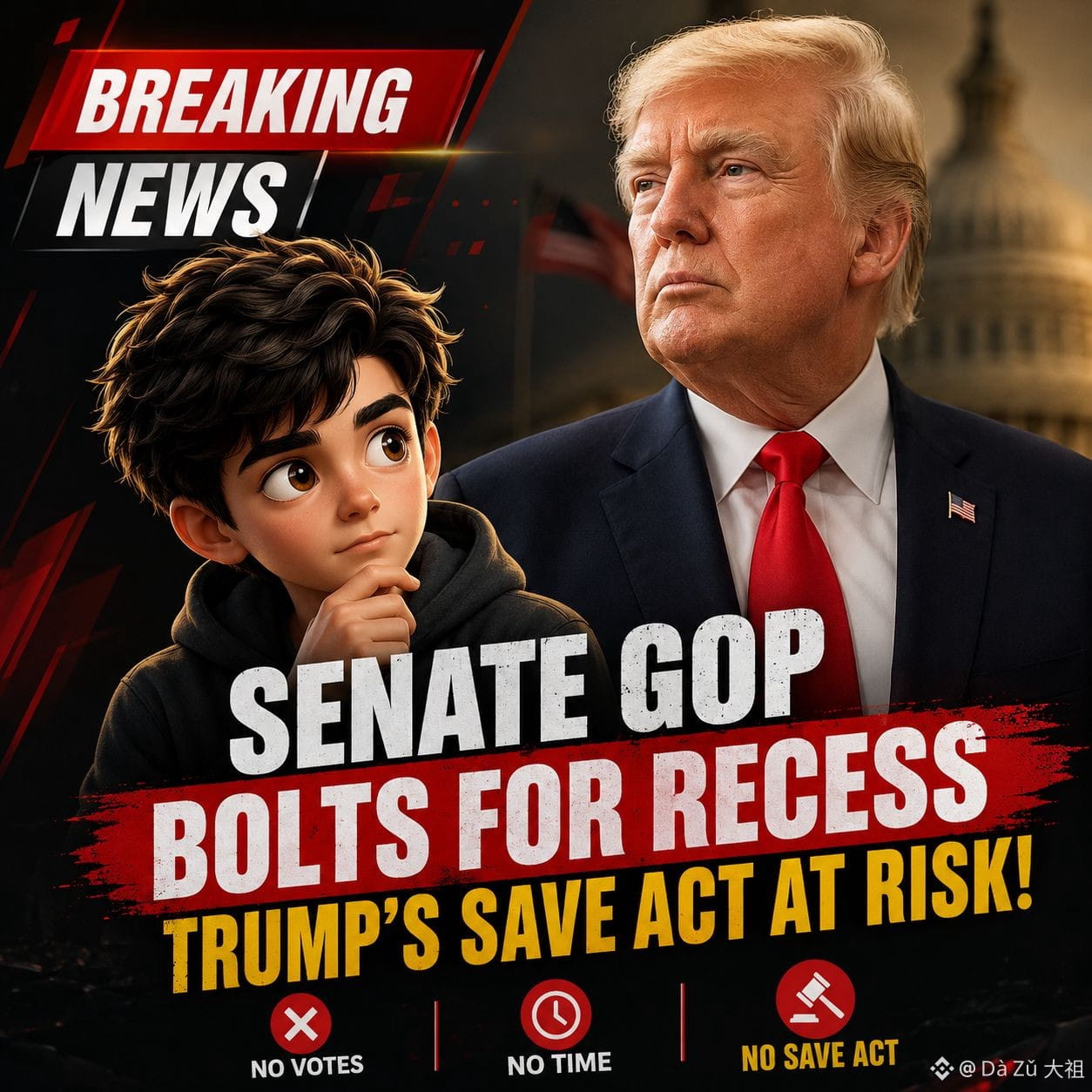
BREAKING: Senate Just Abandoned Trump's #1 Bill And Left Town
Trump’s own party just killed his biggest plan and went on vacation.
Senate Republicans bolted Washington for August recess WITHOUT passing Trump's SAVE America Act - the voter integrity bill Trump has been demanding for weeks.
Here is what really happened:
1. The Promise: Hardliners like Sen. Mike Lee promised to BLOCK the exit until SAVE passed. Result? Every suitcase was packed, every flight was booked. They all left.
2. The Delay: The bill is now dead until mid-September at the earliest. And the calendar is even worse - another month-long recess is coming in October right before midterms. Time is running out.
3. The $150 Billion Twist: Republicans also shelved a $150 billion budget reconciliation vote. Why? Trump himself intervened because he feared it would FAIL on the floor. The whole plan was to use reconciliation to bypass the filibuster and pass SAVE. Now BOTH efforts are in limbo.
So right now - No SAVE Act, No budget vote, No Senate in DC.
Is this a smart move to avoid a failed vote, or did the Senate just betray Trump’s agenda?
Will SAVE America Act pass in September or is it dead for good?
Comment YES if you think it will pass, NO if you think it’s over.
$TUT $RE $1000CAT
#VIXFallsToJanuaryLow #BIP110ForkSignalingExpectedThisWeekend #ThuneFilesClarityActClotureMotion #FedSplitOnRateHikesDeepens
BREAKING: Senate Just Abandoned Trump's #1 Bill And Left Town
Trump’s own party just killed his biggest plan and went on vacation.
Senate Republicans bolted Washington for August recess WITHOUT passing Trump's SAVE America Act - the voter integrity bill Trump has been demanding for weeks.
Here is what really happened:
1. The Promise: Hardliners like Sen. Mike Lee promised to BLOCK the exit until SAVE passed. Result? Every suitcase was packed, every flight was booked. They all left.
2. The Delay: The bill is now dead until mid-September at the earliest. And the calendar is even worse - another month-long recess is coming in October right before midterms. Time is running out.
3. The $150 Billion Twist: Republicans also shelved a $150 billion budget reconciliation vote. Why? Trump himself intervened because he feared it would FAIL on the floor. The whole plan was to use reconciliation to bypass the filibuster and pass SAVE. Now BOTH efforts are in limbo.
So right now - No SAVE Act, No budget vote, No Senate in DC.
Is this a smart move to avoid a failed vote, or did the Senate just betray Trump’s agenda?
Will SAVE America Act pass in September or is it dead for good?
Comment YES if you think it will pass, NO if you think it’s over.
$TUT $RE $1000CAT
#VIXFallsToJanuaryLow #BIP110ForkSignalingExpectedThisWeekend #ThuneFilesClarityActClotureMotion #FedSplitOnRateHikesDeepens
Trump’s own party just killed his biggest plan and went on vacation.
Senate Republicans bolted Washington for August recess WITHOUT passing Trump's SAVE America Act - the voter integrity bill Trump has been demanding for weeks.
Here is what really happened:
1. The Promise: Hardliners like Sen. Mike Lee promised to BLOCK the exit until SAVE passed. Result? Every suitcase was packed, every flight was booked. They all left.
2. The Delay: The bill is now dead until mid-September at the earliest. And the calendar is even worse - another month-long recess is coming in October right before midterms. Time is running out.
3. The $150 Billion Twist: Republicans also shelved a $150 billion budget reconciliation vote. Why? Trump himself intervened because he feared it would FAIL on the floor. The whole plan was to use reconciliation to bypass the filibuster and pass SAVE. Now BOTH efforts are in limbo.
So right now - No SAVE Act, No budget vote, No Senate in DC.
Is this a smart move to avoid a failed vote, or did the Senate just betray Trump’s agenda?
Will SAVE America Act pass in September or is it dead for good?
Comment YES if you think it will pass, NO if you think it’s over.
$TUT $RE $1000CAT
#VIXFallsToJanuaryLow #BIP110ForkSignalingExpectedThisWeekend #ThuneFilesClarityActClotureMotion #FedSplitOnRateHikesDeepens
1
365
·
--
See translation
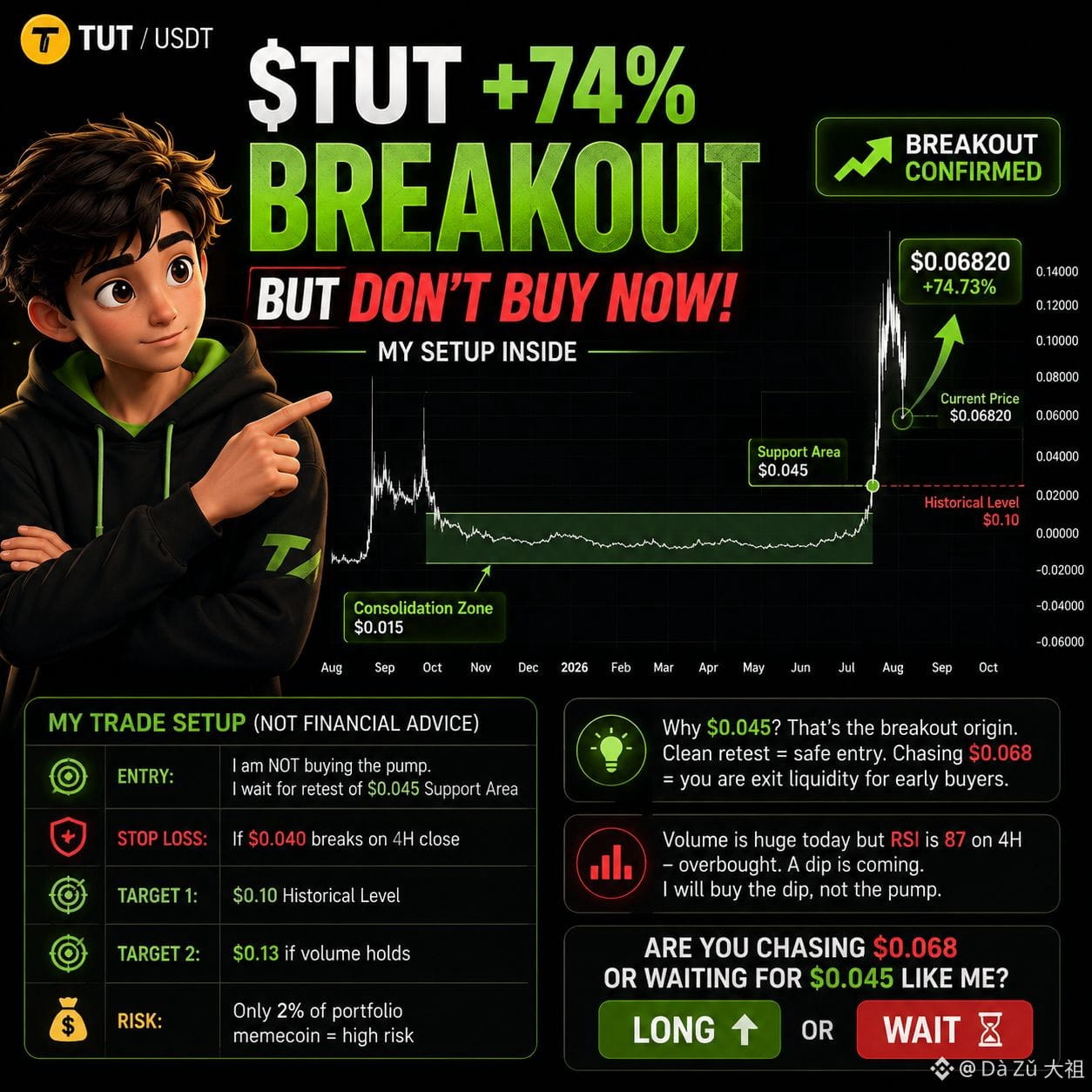
$TUT +74% BREAKOUT - But Don't Buy Now! My Setup Inside
STOP CHASING! TUT just pumped +74% after 9 months of sleep.
Look at this chart - 9 months consolidation at $0.015 and now
BREAKOUT CONFIRMED to $0.06820.
90% will buy now and get trapped. Here is my plan:
MY TRADE SETUP (Not Financial Advice):
Entry: I am NOT buying the pump. I wait for retest of $0.045 Support Area
Stop Loss: If $0.040 breaks on 4H close
Target 1: $0.10 Historical Level
Target 2: $0.13 if volume holds
Risk: Only 2% of portfolio - memecoin = high risk
Why $0.045? That's the breakout origin. Clean retest = safe entry. Chasing $0.068 = you are exit liquidity for early buyers.
Volume is huge today but RSI is 87 on 4H - overbought. A dip is coming.
I will buy the dip, not the pump.
Are you chasing $0.068 or waiting for $0.045 like me? Comment
LONG or WAIT
$RE $MMT
#BIP110ForkSignalingExpectedThisWeekend #VIXFallsToJanuaryLow #IraqOilExportsFall75%
$TUT +74% BREAKOUT - But Don't Buy Now! My Setup Inside
STOP CHASING! TUT just pumped +74% after 9 months of sleep.
Look at this chart - 9 months consolidation at $0.015 and now
BREAKOUT CONFIRMED to $0.06820.
90% will buy now and get trapped. Here is my plan:
MY TRADE SETUP (Not Financial Advice):
Entry: I am NOT buying the pump. I wait for retest of $0.045 Support Area
Stop Loss: If $0.040 breaks on 4H close
Target 1: $0.10 Historical Level
Target 2: $0.13 if volume holds
Risk: Only 2% of portfolio - memecoin = high risk
Why $0.045? That's the breakout origin. Clean retest = safe entry. Chasing $0.068 = you are exit liquidity for early buyers.
Volume is huge today but RSI is 87 on 4H - overbought. A dip is coming.
I will buy the dip, not the pump.
Are you chasing $0.068 or waiting for $0.045 like me? Comment
LONG or WAIT
$RE $MMT
#BIP110ForkSignalingExpectedThisWeekend #VIXFallsToJanuaryLow #IraqOilExportsFall75%
STOP CHASING! TUT just pumped +74% after 9 months of sleep.
Look at this chart - 9 months consolidation at $0.015 and now
BREAKOUT CONFIRMED to $0.06820.
90% will buy now and get trapped. Here is my plan:
MY TRADE SETUP (Not Financial Advice):
Entry: I am NOT buying the pump. I wait for retest of $0.045 Support Area
Stop Loss: If $0.040 breaks on 4H close
Target 1: $0.10 Historical Level
Target 2: $0.13 if volume holds
Risk: Only 2% of portfolio - memecoin = high risk
Why $0.045? That's the breakout origin. Clean retest = safe entry. Chasing $0.068 = you are exit liquidity for early buyers.
Volume is huge today but RSI is 87 on 4H - overbought. A dip is coming.
I will buy the dip, not the pump.
Are you chasing $0.068 or waiting for $0.045 like me? Comment
LONG or WAIT
$RE $MMT
#BIP110ForkSignalingExpectedThisWeekend #VIXFallsToJanuaryLow #IraqOilExportsFall75%
296
·
--
Article
See translation
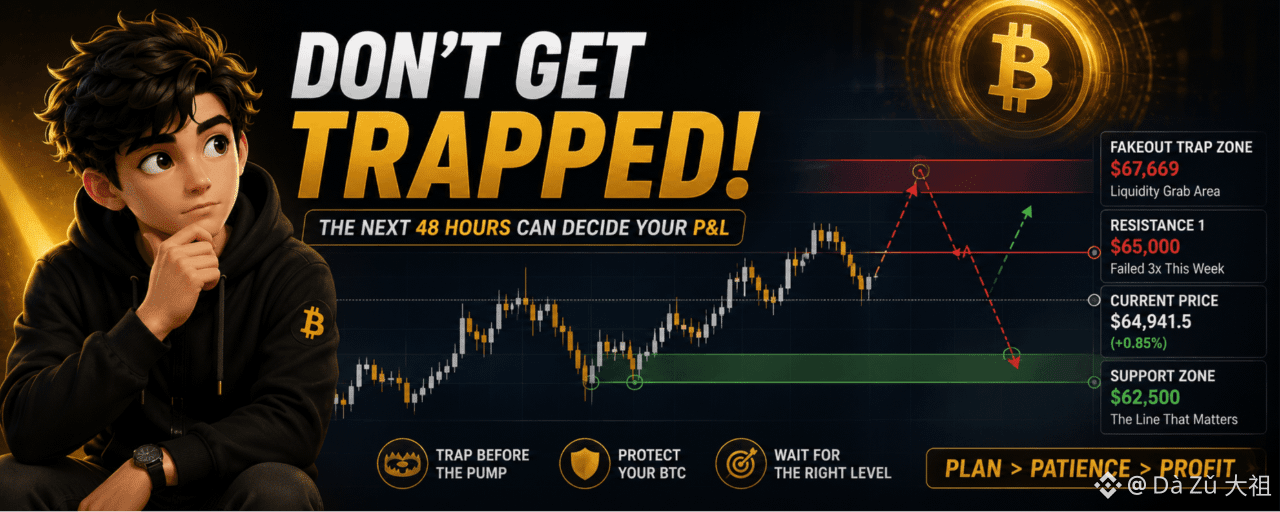
STOP - If You Hold BTC, You Will Lose Money in 48 Hours If You Miss ThisIf you hold Bitcoin, stop scrolling for 60 seconds. This 4H chart will save you.
Everyone thinks BTC will go straight to $70K from $64,941. The chart says they are about to get trapped.
Here is my deep analysis for next week:
Current Price: $64,941.5 (+0.85%)
The Levels That Matter:
Resistance 1: $65,000 - BTC has failed here 3 times this week. No volume = no breakout.
Fakeout Trap Zone: $67,669 - Look at my chart. Last time we wicked to $67,669 we dumped $5K instantly. This is a liquidity grab zone to liquidate shorts.
Support Zone: $62,500 - This green zone saved us twice in July. This is the line between bull and bear.
My Prediction For Next Week - Will We Hit $70K?
Main Case (50% Chance) - THE TRAP: BTC breaks $65K, everyone goes long, then hits $67,669 and dumps hard back to $62,500. $70K will NOT come directly. $62.5K will come first, and THAT will be the real buy zone for $70K.
Bull Case (30% Chance): If BTC closes a daily candle ABOVE $67,669 with huge volume, then $70K is open next week.
Bear Case (20% Chance): If $62,500 breaks, we go straight to $60,000.
So, will BTC hit $70K next week? YES, but not before trapping bulls. I expect $62.5K BEFORE $70K.
Whales moved $300M+ BTC to exchanges yesterday. Funding is getting high. Don't be exit liquidity.
I am not chasing here. I am waiting for $62.5K.
What about you? Do you think BTC hits $70K directly or $62.5K first? Comment BULL or BEAR below - I reply to everyone.
Not financial advice. Just my analysis.
#BIP110ForkSignalingExpectedThisWeekend #VIXFallsToJanuaryLow #IraqOilExportsFall75% #FedSplitOnRateHikesDeepens #USJulyJobsUnexpectedlyFall $TUT $MMT $VIC
STOP - If You Hold BTC, You Will Lose Money in 48 Hours If You Miss This
If you hold Bitcoin, stop scrolling for 60 seconds. This 4H chart will save you.
Everyone thinks BTC will go straight to $70K from $64,941. The chart says they are about to get trapped.
Here is my deep analysis for next week:
Current Price: $64,941.5 (+0.85%)
The Levels That Matter:
Resistance 1: $65,000 - BTC has failed here 3 times this week. No volume = no breakout.
Fakeout Trap Zone: $67,669 - Look at my chart. Last time we wicked to $67,669 we dumped $5K instantly. This is a liquidity grab zone to liquidate shorts.
Support Zone: $62,500 - This green zone saved us twice in July. This is the line between bull and bear.
My Prediction For Next Week - Will We Hit $70K?
Main Case (50% Chance) - THE TRAP: BTC breaks $65K, everyone goes long, then hits $67,669 and dumps hard back to $62,500. $70K will NOT come directly. $62.5K will come first, and THAT will be the real buy zone for $70K.
Bull Case (30% Chance): If BTC closes a daily candle ABOVE $67,669 with huge volume, then $70K is open next week.
Bear Case (20% Chance): If $62,500 breaks, we go straight to $60,000.
So, will BTC hit $70K next week? YES, but not before trapping bulls. I expect $62.5K BEFORE $70K.
Whales moved $300M+ BTC to exchanges yesterday. Funding is getting high. Don't be exit liquidity.
I am not chasing here. I am waiting for $62.5K.
What about you? Do you think BTC hits $70K directly or $62.5K first? Comment BULL or BEAR below - I reply to everyone.
Not financial advice. Just my analysis.
#BIP110ForkSignalingExpectedThisWeekend #VIXFallsToJanuaryLow #IraqOilExportsFall75% #FedSplitOnRateHikesDeepens #USJulyJobsUnexpectedlyFall $TUT $MMT $VIC
Everyone thinks BTC will go straight to $70K from $64,941. The chart says they are about to get trapped.
Here is my deep analysis for next week:
Current Price: $64,941.5 (+0.85%)
The Levels That Matter:
Resistance 1: $65,000 - BTC has failed here 3 times this week. No volume = no breakout.
Fakeout Trap Zone: $67,669 - Look at my chart. Last time we wicked to $67,669 we dumped $5K instantly. This is a liquidity grab zone to liquidate shorts.
Support Zone: $62,500 - This green zone saved us twice in July. This is the line between bull and bear.
My Prediction For Next Week - Will We Hit $70K?
Main Case (50% Chance) - THE TRAP: BTC breaks $65K, everyone goes long, then hits $67,669 and dumps hard back to $62,500. $70K will NOT come directly. $62.5K will come first, and THAT will be the real buy zone for $70K.
Bull Case (30% Chance): If BTC closes a daily candle ABOVE $67,669 with huge volume, then $70K is open next week.
Bear Case (20% Chance): If $62,500 breaks, we go straight to $60,000.
So, will BTC hit $70K next week? YES, but not before trapping bulls. I expect $62.5K BEFORE $70K.
Whales moved $300M+ BTC to exchanges yesterday. Funding is getting high. Don't be exit liquidity.
I am not chasing here. I am waiting for $62.5K.
What about you? Do you think BTC hits $70K directly or $62.5K first? Comment BULL or BEAR below - I reply to everyone.
Not financial advice. Just my analysis.
#BIP110ForkSignalingExpectedThisWeekend #VIXFallsToJanuaryLow #IraqOilExportsFall75% #FedSplitOnRateHikesDeepens #USJulyJobsUnexpectedlyFall $TUT $MMT $VIC
105
·
--
Bullish
See translation
It honestly hit me while tracking the numbers this week: watching billions in capital flow into Babylon vaults is wild, but the real conversation isn't about the TVL flex—it’s about the silent governance gap. We keep celebrating how thousands of BTC are finally off the sidelines, acting as heavy-duty economic collateral and securing finality providers for yield. But tracking that data made me realize a weird contradiction in the dual-asset model: your underlying Bitcoin provides the raw security backbone, yet it carries zero voting weight or agency over protocol parameters. All the actual decision-making power stays locked strictly inside the native $BABY token ecosystem. It feels like a massive design trade-off where our capital does all the heavy lifting, while protocol steering is left entirely to someone else's hands. It leaves me wondering long-term—does staked BTC ever get a real voice down the line, or are we permanently splitting yield utility from protocol governance? Drop your thoughts on how dual-asset tokenomics should evolve! 👇
@babylonlabs_io #baby
Should staked Bitcoin get protocol voting rights in Babylon?
It honestly hit me while tracking the numbers this week: watching billions in capital flow into Babylon vaults is wild, but the real conversation isn't about the TVL flex—it’s about the silent governance gap. We keep celebrating how thousands of BTC are finally off the sidelines, acting as heavy-duty economic collateral and securing finality providers for yield. But tracking that data made me realize a weird contradiction in the dual-asset model: your underlying Bitcoin provides the raw security backbone, yet it carries zero voting weight or agency over protocol parameters. All the actual decision-making power stays locked strictly inside the native $BABY token ecosystem. It feels like a massive design trade-off where our capital does all the heavy lifting, while protocol steering is left entirely to someone else's hands. It leaves me wondering long-term—does staked BTC ever get a real voice down the line, or are we permanently splitting yield utility from protocol governance? Drop your thoughts on how dual-asset tokenomics should evolve! 👇
@BabylonLabs_io #baby
Should staked Bitcoin get protocol voting rights in Babylon?
@BabylonLabs_io #baby
Should staked Bitcoin get protocol voting rights in Babylon?
BTC
0%
BABY
0%
BOTH
0%
0 votes • Voting closed
3
1
160
·
--
See translation
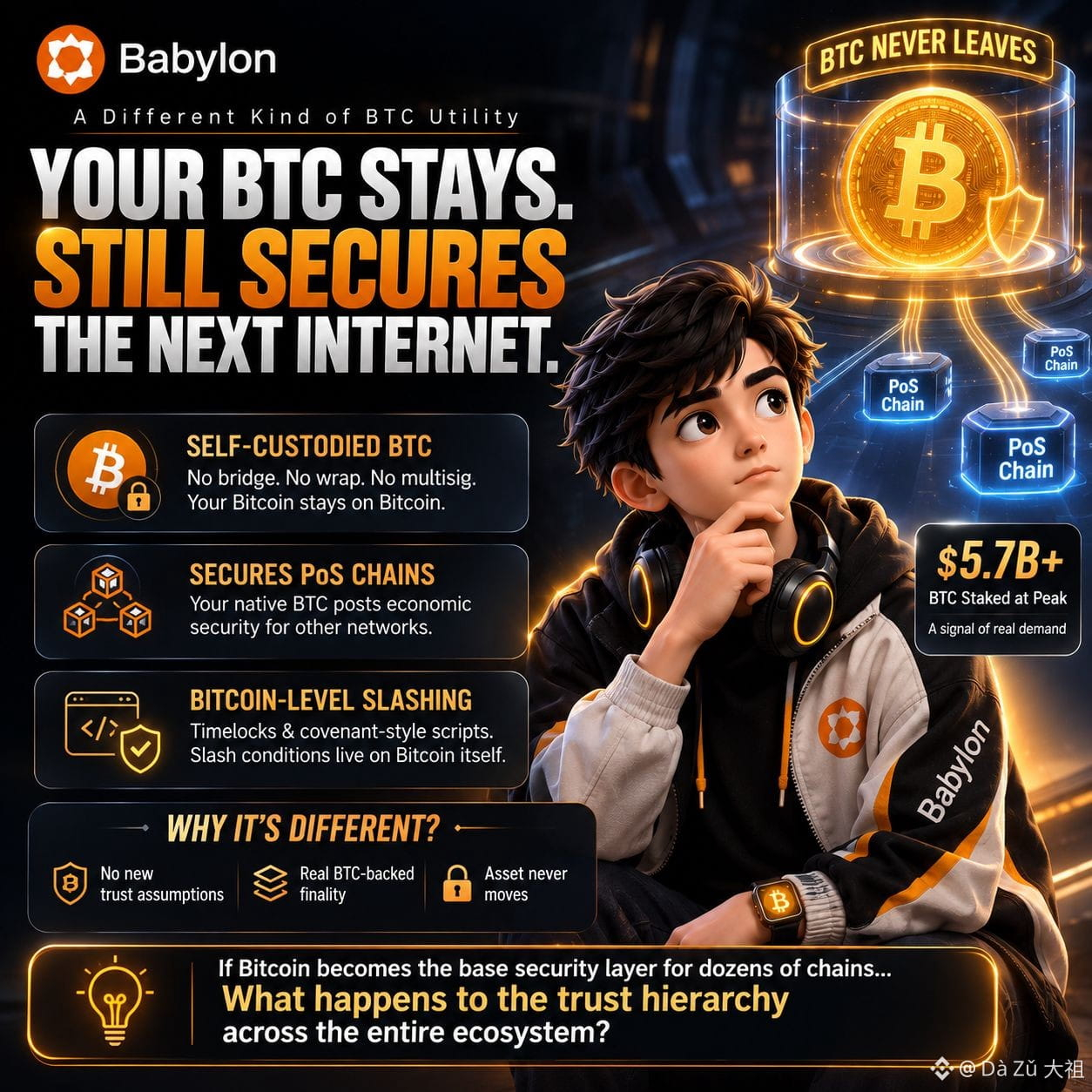
I Was running through the Babylon thesis again today not the pitch deck, the actual mechanic. $BABY isn't asking BTC holders to bridge, wrap, or hand keys to a multisig. It lets Bitcoin sit exactly where it is, on-chain, self-custodied, while that same BTC posts as economic security for PoS chains. The asset never moves. The trust assumption never expands. That's a genuinely different design. Most 'BTC in DeFi' stories require you to tokenize first and trust the bridge. Babylon skips that layer entirely — the slash conditions live on Bitcoin itself via timelocks and covenant-style scripts. The PoS chain gets real BTC-backed finality. The staker keeps custody throughout. $5.7B in staked BTC at peak cap wasn't just number-go-up. It was a signal that holders were willing to put native BTC to work without wrapping it. That appetite doesn't disappear — it looks for the right rails. The question I keep sitting with: if Bitcoin becomes the base security layer for dozens of PoS chains, what does that do to the trust hierarchy across the entire ecosystem? Still thinking through the second-order effects on this one.
#baby @babylonlabs_io
$HOME $HYPER
#USToCancelIranAttackSubjectToDeal #GoldTradesAbove$4000 #BitcoinMiningDifficultyFalls14%FromYearHigh #SECPausesQBTCBitcoinOptionsApproval
I Was running through the Babylon thesis again today not the pitch deck, the actual mechanic. $BABY isn't asking BTC holders to bridge, wrap, or hand keys to a multisig. It lets Bitcoin sit exactly where it is, on-chain, self-custodied, while that same BTC posts as economic security for PoS chains. The asset never moves. The trust assumption never expands. That's a genuinely different design. Most 'BTC in DeFi' stories require you to tokenize first and trust the bridge. Babylon skips that layer entirely — the slash conditions live on Bitcoin itself via timelocks and covenant-style scripts. The PoS chain gets real BTC-backed finality. The staker keeps custody throughout. $5.7B in staked BTC at peak cap wasn't just number-go-up. It was a signal that holders were willing to put native BTC to work without wrapping it. That appetite doesn't disappear — it looks for the right rails. The question I keep sitting with: if Bitcoin becomes the base security layer for dozens of PoS chains, what does that do to the trust hierarchy across the entire ecosystem? Still thinking through the second-order effects on this one.
#baby @BabylonLabs_io
$HOME $HYPER
#USToCancelIranAttackSubjectToDeal #GoldTradesAbove$4000 #BitcoinMiningDifficultyFalls14%FromYearHigh #SECPausesQBTCBitcoinOptionsApproval
#baby @BabylonLabs_io
$HOME $HYPER
#USToCancelIranAttackSubjectToDeal #GoldTradesAbove$4000 #BitcoinMiningDifficultyFalls14%FromYearHigh #SECPausesQBTCBitcoinOptionsApproval
2
1
145
·
--
See translation
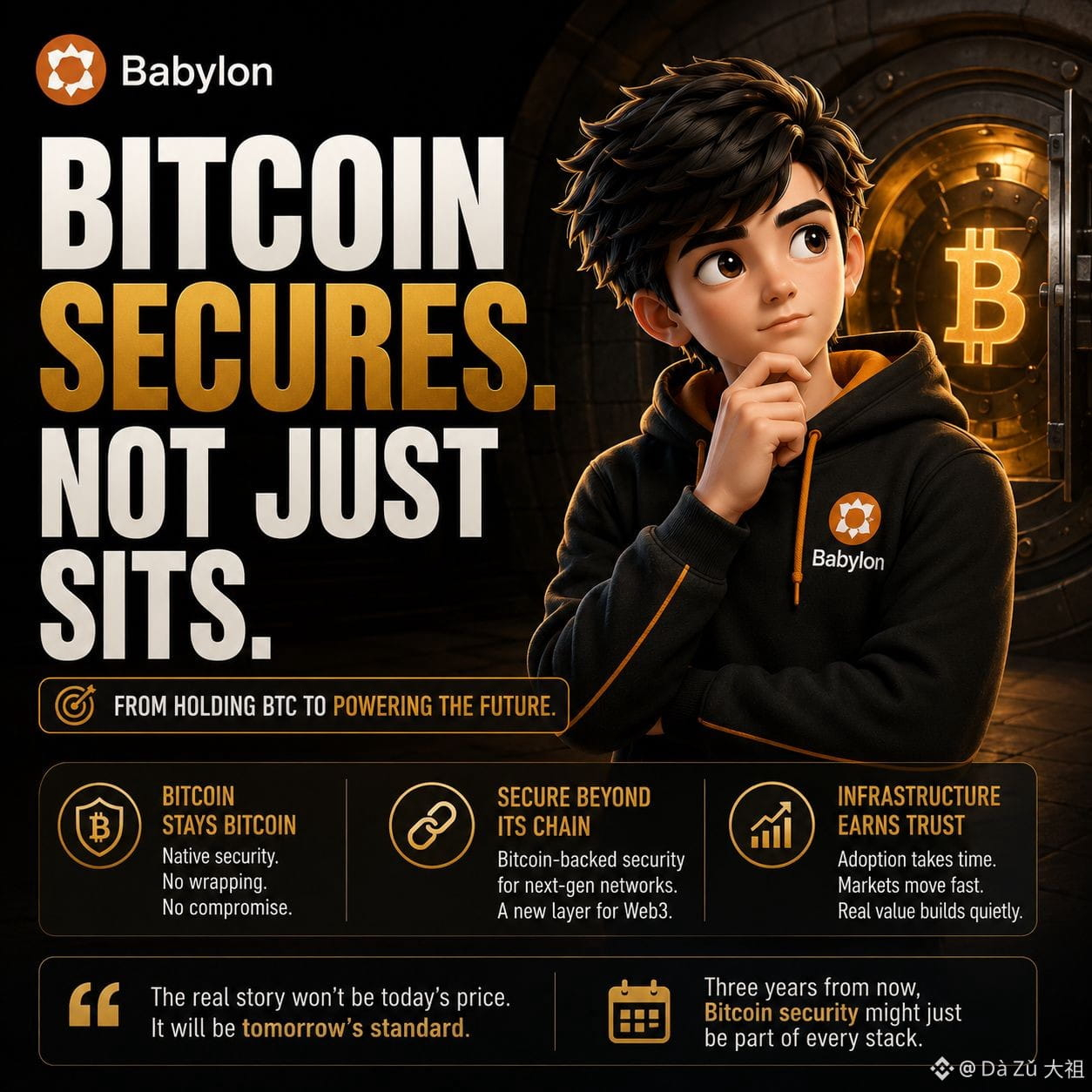
Bitcoin has spent years proving it can be the hardest money in crypto.
The interesting question now isn't whether Bitcoin is valuable. It's whether Bitcoin can become useful without giving up its own security model. That's why I ended up reading Babylon's documentation today. The vault design caught my attention, but not because of the engineering. It made me think about a bigger shift. If Bitcoin can help secure other networks while remaining on its own chain, the conversation changes from "holding BTC" to "putting BTC to work."
Whether Babylon becomes the standard depends on something much bigger than today's token price. It depends on whether developers keep building around Bitcoin-backed security instead of treating it as an experiment. Infrastructure usually earns trust slowly.
Markets often move faster than adoption. The real story may not be today's price chart. It may be whether, three years from now, new chains simply assume Bitcoin security is part of the stack. That's the trend I'm watching.
#baby $BABY @babylonlabs_io
$IDOL $BTW
Bitcoin has spent years proving it can be the hardest money in crypto.
The interesting question now isn't whether Bitcoin is valuable. It's whether Bitcoin can become useful without giving up its own security model. That's why I ended up reading Babylon's documentation today. The vault design caught my attention, but not because of the engineering. It made me think about a bigger shift. If Bitcoin can help secure other networks while remaining on its own chain, the conversation changes from "holding BTC" to "putting BTC to work."
Whether Babylon becomes the standard depends on something much bigger than today's token price. It depends on whether developers keep building around Bitcoin-backed security instead of treating it as an experiment. Infrastructure usually earns trust slowly.
Markets often move faster than adoption. The real story may not be today's price chart. It may be whether, three years from now, new chains simply assume Bitcoin security is part of the stack. That's the trend I'm watching.
#baby $BABY @BabylonLabs_io
$IDOL $BTW
The interesting question now isn't whether Bitcoin is valuable. It's whether Bitcoin can become useful without giving up its own security model. That's why I ended up reading Babylon's documentation today. The vault design caught my attention, but not because of the engineering. It made me think about a bigger shift. If Bitcoin can help secure other networks while remaining on its own chain, the conversation changes from "holding BTC" to "putting BTC to work."
Whether Babylon becomes the standard depends on something much bigger than today's token price. It depends on whether developers keep building around Bitcoin-backed security instead of treating it as an experiment. Infrastructure usually earns trust slowly.
Markets often move faster than adoption. The real story may not be today's price chart. It may be whether, three years from now, new chains simply assume Bitcoin security is part of the stack. That's the trend I'm watching.
#baby $BABY @BabylonLabs_io
$IDOL $BTW
1
1
83
·
--
See translation
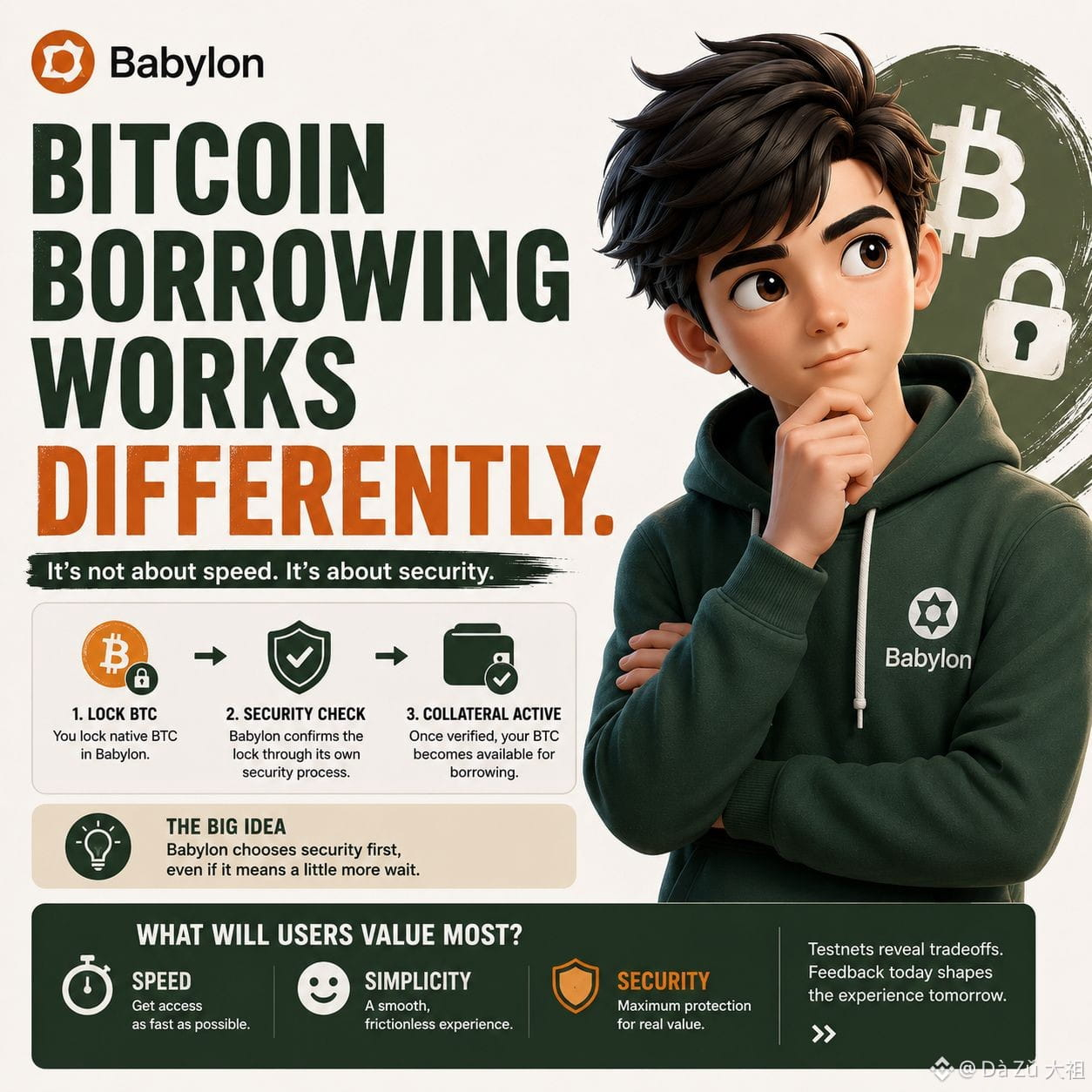
One thing I noticed while exploring Babylon Native Bitcoin Backed Borrowing testnet is how differently Bitcoin forces you to think about lending. In many DeFi products, users judge the experience by how quickly they can borrow after depositing collateral. Babylon design seems to prioritize something else first: confirming that the Bitcoin lock is recognized through its own security process before the collateral becomes available to the lending system. That design choice won't appeal to everyone. Some users may focus on the extra waiting, while others may see it as a reasonable tradeoff for keeping Bitcoin native instead of relying on wrapped assets.
For me, the interesting part isn't whether the flow feels fast or slow. It's whether users are willing to exchange a smoother experience for stronger security assumptions when real value is on the line.
Testnets are useful because they reveal these tradeoffs before mainnet adoption begins. User feedback during this stage may end up being just as important as the underlying technology itself.
If native BTC borrowing becomes more common, which do you think users will value most: speed, simplicity, or security?
#baby $BABY @babylonlabs_io
$1000RATS $KOMA
One thing I noticed while exploring Babylon Native Bitcoin Backed Borrowing testnet is how differently Bitcoin forces you to think about lending. In many DeFi products, users judge the experience by how quickly they can borrow after depositing collateral. Babylon design seems to prioritize something else first: confirming that the Bitcoin lock is recognized through its own security process before the collateral becomes available to the lending system. That design choice won't appeal to everyone. Some users may focus on the extra waiting, while others may see it as a reasonable tradeoff for keeping Bitcoin native instead of relying on wrapped assets.
For me, the interesting part isn't whether the flow feels fast or slow. It's whether users are willing to exchange a smoother experience for stronger security assumptions when real value is on the line.
Testnets are useful because they reveal these tradeoffs before mainnet adoption begins. User feedback during this stage may end up being just as important as the underlying technology itself.
If native BTC borrowing becomes more common, which do you think users will value most: speed, simplicity, or security?
#baby $BABY @BabylonLabs_io
$1000RATS $KOMA
For me, the interesting part isn't whether the flow feels fast or slow. It's whether users are willing to exchange a smoother experience for stronger security assumptions when real value is on the line.
Testnets are useful because they reveal these tradeoffs before mainnet adoption begins. User feedback during this stage may end up being just as important as the underlying technology itself.
If native BTC borrowing becomes more common, which do you think users will value most: speed, simplicity, or security?
#baby $BABY @BabylonLabs_io
$1000RATS $KOMA
3
2
286
·
--
See translation
One thing I've started paying more attention to is the difference between a protocol's destination and its current architecture.
TBV is often discussed through the lens of Bitcoin native trust, but the documentation describes a system that still depends on several operational layers working together today. That doesn't automatically weaken the protocol it simply reflects that decentralization is usually achieved in stages rather than all at once.
The part I find most interesting isn't whether temporary governance protections exist. It's how they're communicated. Users often hear the long term vision first, while the documentation explains the transitional design in much greater detail.
That's a common pattern across crypto. Teams build toward trust minimization, but operational safeguards frequently remain in place while infrastructure, liquidity, and network participation mature. The roadmap may point toward a highly decentralized future even though today's implementation still includes mechanisms designed to reduce operational risk.
For that reason, I think protocols should be evaluated on two separate timelines: what the architecture delivers today, and what the roadmap aims to deliver tomorrow. Mixing those together can create expectations that neither side intends.
The more interesting discussion isn't whether TBV is moving toward stronger trust minimization. It's whether users clearly understand which trust assumptions exist today versus the ones the protocol hopes to eliminate over time.
When you're evaluating an early stage protocol, which matters more to you: its current security model or the decentralized end state it's working toward?
#baby $BABY @babylonlabs_io
$ESP $RE
One thing I've started paying more attention to is the difference between a protocol's destination and its current architecture.
TBV is often discussed through the lens of Bitcoin native trust, but the documentation describes a system that still depends on several operational layers working together today. That doesn't automatically weaken the protocol it simply reflects that decentralization is usually achieved in stages rather than all at once.
The part I find most interesting isn't whether temporary governance protections exist. It's how they're communicated. Users often hear the long term vision first, while the documentation explains the transitional design in much greater detail.
That's a common pattern across crypto. Teams build toward trust minimization, but operational safeguards frequently remain in place while infrastructure, liquidity, and network participation mature. The roadmap may point toward a highly decentralized future even though today's implementation still includes mechanisms designed to reduce operational risk.
For that reason, I think protocols should be evaluated on two separate timelines: what the architecture delivers today, and what the roadmap aims to deliver tomorrow. Mixing those together can create expectations that neither side intends.
The more interesting discussion isn't whether TBV is moving toward stronger trust minimization. It's whether users clearly understand which trust assumptions exist today versus the ones the protocol hopes to eliminate over time.
When you're evaluating an early stage protocol, which matters more to you: its current security model or the decentralized end state it's working toward?
#baby $BABY @BabylonLabs_io
$ESP $RE
TBV is often discussed through the lens of Bitcoin native trust, but the documentation describes a system that still depends on several operational layers working together today. That doesn't automatically weaken the protocol it simply reflects that decentralization is usually achieved in stages rather than all at once.
The part I find most interesting isn't whether temporary governance protections exist. It's how they're communicated. Users often hear the long term vision first, while the documentation explains the transitional design in much greater detail.
That's a common pattern across crypto. Teams build toward trust minimization, but operational safeguards frequently remain in place while infrastructure, liquidity, and network participation mature. The roadmap may point toward a highly decentralized future even though today's implementation still includes mechanisms designed to reduce operational risk.
For that reason, I think protocols should be evaluated on two separate timelines: what the architecture delivers today, and what the roadmap aims to deliver tomorrow. Mixing those together can create expectations that neither side intends.
The more interesting discussion isn't whether TBV is moving toward stronger trust minimization. It's whether users clearly understand which trust assumptions exist today versus the ones the protocol hopes to eliminate over time.
When you're evaluating an early stage protocol, which matters more to you: its current security model or the decentralized end state it's working toward?
#baby $BABY @BabylonLabs_io
$ESP $RE

5
2
227
·
--
See translation
He didn't get the airdrop. He's still the most valuable person in that ecosystem.
I have a friend. Been in crypto longer than most people I know. Not loud about it. Doesn't post much. Just keeps his head down and uses the protocols he believes in even when there's nothing to earn.
When the airdrop dropped, he didn't qualify for the top tier.
I honestly felt bad for him. All that time, all that quiet consistency and the bigger rewards went to wallets that farmed test nets hard for a few weeks and vanished the moment they claimed.
That bothered me. So I started digging.
And what I found bothered me even more.
The wallets that captured the biggest allocations weren't the most loyal ones. They were just the most efficient at looking loyal. Heavy bursts of activity right when it counted. Then nothing. Gone. The protocol had no idea because the protocol was measuring behavior, not belief.
Meanwhile my friend's wallet? Smaller tier. Smaller reward. But still active. Still transacting. Still there through the boring months when there was nothing to farm and no one was paying attention.
Here's the hard truth about how most reward systems are built:
You can reward someone for showing up. That part is easy it's just data. But you cannot build a formula that tells you why someone stayed when staying gave them nothing. You can't put a number on quiet belief.
And that's the exact gap that gets exploited every single time.
So the question I keep coming back to isn't who won the airdrop.
It's who's still here now that the reward is gone and whether the systems we build will ever learn to tell the difference.
#baby $BABY @babylonlabs_io
$EUL $FLOW
He didn't get the airdrop. He's still the most valuable person in that ecosystem.
I have a friend. Been in crypto longer than most people I know. Not loud about it. Doesn't post much. Just keeps his head down and uses the protocols he believes in even when there's nothing to earn.
When the airdrop dropped, he didn't qualify for the top tier.
I honestly felt bad for him. All that time, all that quiet consistency and the bigger rewards went to wallets that farmed test nets hard for a few weeks and vanished the moment they claimed.
That bothered me. So I started digging.
And what I found bothered me even more.
The wallets that captured the biggest allocations weren't the most loyal ones. They were just the most efficient at looking loyal. Heavy bursts of activity right when it counted. Then nothing. Gone. The protocol had no idea because the protocol was measuring behavior, not belief.
Meanwhile my friend's wallet? Smaller tier. Smaller reward. But still active. Still transacting. Still there through the boring months when there was nothing to farm and no one was paying attention.
Here's the hard truth about how most reward systems are built:
You can reward someone for showing up. That part is easy it's just data. But you cannot build a formula that tells you why someone stayed when staying gave them nothing. You can't put a number on quiet belief.
And that's the exact gap that gets exploited every single time.
So the question I keep coming back to isn't who won the airdrop.
It's who's still here now that the reward is gone and whether the systems we build will ever learn to tell the difference.
#baby $BABY @BabylonLabs_io
$EUL $FLOW
I have a friend. Been in crypto longer than most people I know. Not loud about it. Doesn't post much. Just keeps his head down and uses the protocols he believes in even when there's nothing to earn.
When the airdrop dropped, he didn't qualify for the top tier.
I honestly felt bad for him. All that time, all that quiet consistency and the bigger rewards went to wallets that farmed test nets hard for a few weeks and vanished the moment they claimed.
That bothered me. So I started digging.
And what I found bothered me even more.
The wallets that captured the biggest allocations weren't the most loyal ones. They were just the most efficient at looking loyal. Heavy bursts of activity right when it counted. Then nothing. Gone. The protocol had no idea because the protocol was measuring behavior, not belief.
Meanwhile my friend's wallet? Smaller tier. Smaller reward. But still active. Still transacting. Still there through the boring months when there was nothing to farm and no one was paying attention.
Here's the hard truth about how most reward systems are built:
You can reward someone for showing up. That part is easy it's just data. But you cannot build a formula that tells you why someone stayed when staying gave them nothing. You can't put a number on quiet belief.
And that's the exact gap that gets exploited every single time.
So the question I keep coming back to isn't who won the airdrop.
It's who's still here now that the reward is gone and whether the systems we build will ever learn to tell the difference.
#baby $BABY @BabylonLabs_io
$EUL $FLOW

3
2
81
·
--
See translation
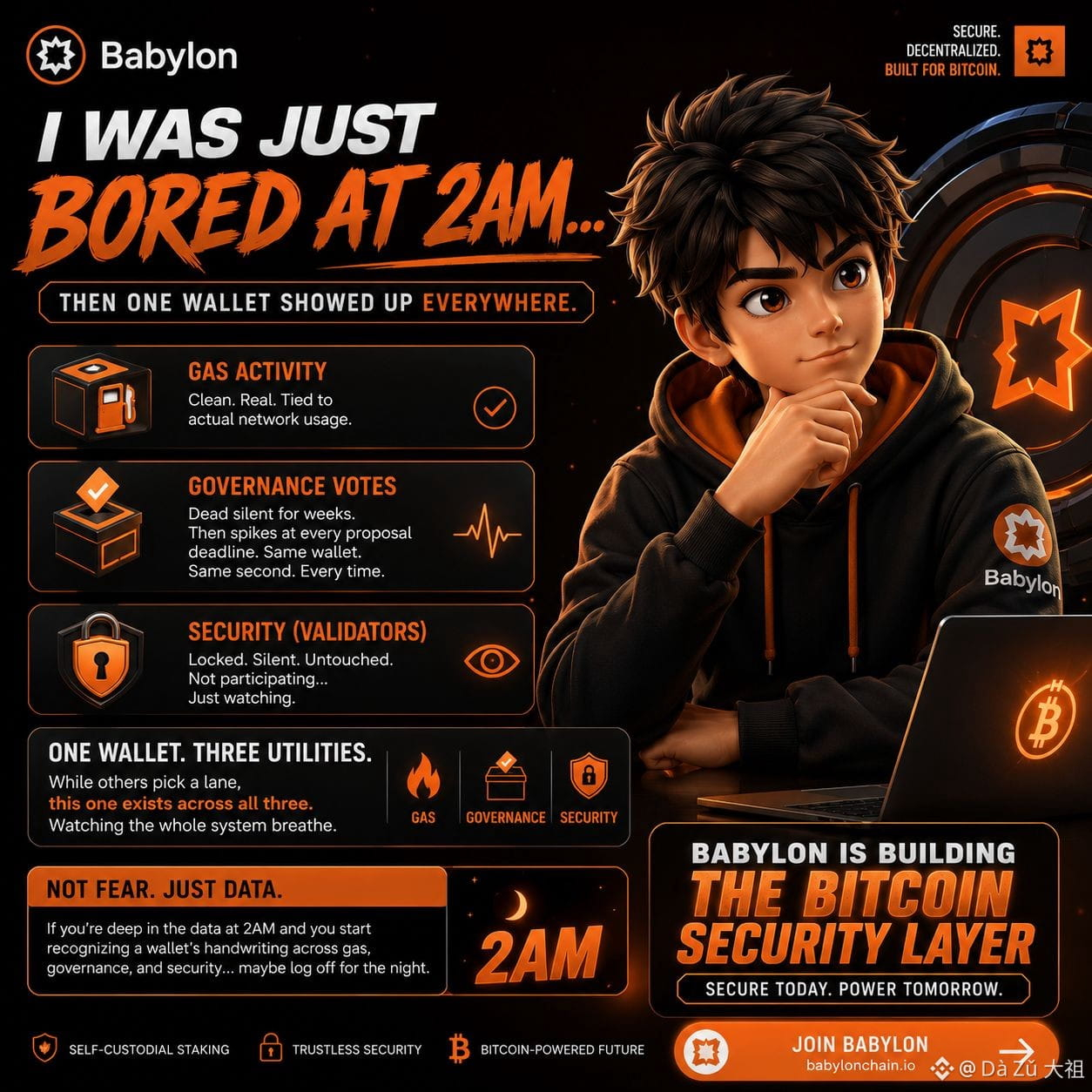
I wasn't looking for a deep dive. I was just bored at 2am, wallet open, staring at my BABY holdings, and I started poking around on-chain gas usage, governance votes, security locks. told myself it was just idle curiosity. it wasn't.
gas activity was the first thing I checked. clean, mechanical, tied straight to real network usage. nothing weird there. felt safe. Then I pulled up governance and this is where it got strange. almost no activity for weeks, dead silent, and then this one wallet, spiked exactly at every proposal deadline, like clockwork, like it wasn't a person voting but something scheduled to wake up right on cue. I sat there at 2am watching timestamps line up perfectly, three deadlines in a row, same wallet, same second-to-second precision. My skin actually crawled a little.
Then I checked security validators, locked tokens. and that same wallet showed up there too. Locked, silent, untouched by gas or governance noise, just sitting there like it was watching rather than participating. three utilities, and this one address touched all of them while almost nobody else did. Everyone else picked a lane. this one didn't pick, it just existed across all three, quietly.
I closed my laptop and genuinely did not sleep well that night. told myself it's probably just a bot, a treasury wallet, something boring and explainable. probably. but the pattern still sits weird with me. Most wallets are humans picking one use case and staying there, and then there's this one thing moving like it's watching the whole system breathe.
anyway. not selling, not fear-mongering, just if you're deep in the data at 2am and you start recognizing a wallet's handwriting across gas, governance, and security like it's a person you keep running into in different rooms of the same house… maybe log off for the night. That's all I'm saying. BABY ❤️
#baby $BABY @babylonlabs_io
$AKE $NIL
#EtherApproaches$2000 #OilDropsAbout6% #CrudeBrieflyFallsBelow$90 #BrentCrudeFallsAbout6%
I wasn't looking for a deep dive. I was just bored at 2am, wallet open, staring at my BABY holdings, and I started poking around on-chain gas usage, governance votes, security locks. told myself it was just idle curiosity. it wasn't.
gas activity was the first thing I checked. clean, mechanical, tied straight to real network usage. nothing weird there. felt safe. Then I pulled up governance and this is where it got strange. almost no activity for weeks, dead silent, and then this one wallet, spiked exactly at every proposal deadline, like clockwork, like it wasn't a person voting but something scheduled to wake up right on cue. I sat there at 2am watching timestamps line up perfectly, three deadlines in a row, same wallet, same second-to-second precision. My skin actually crawled a little.
Then I checked security validators, locked tokens. and that same wallet showed up there too. Locked, silent, untouched by gas or governance noise, just sitting there like it was watching rather than participating. three utilities, and this one address touched all of them while almost nobody else did. Everyone else picked a lane. this one didn't pick, it just existed across all three, quietly.
I closed my laptop and genuinely did not sleep well that night. told myself it's probably just a bot, a treasury wallet, something boring and explainable. probably. but the pattern still sits weird with me. Most wallets are humans picking one use case and staying there, and then there's this one thing moving like it's watching the whole system breathe.
anyway. not selling, not fear-mongering, just if you're deep in the data at 2am and you start recognizing a wallet's handwriting across gas, governance, and security like it's a person you keep running into in different rooms of the same house… maybe log off for the night. That's all I'm saying. BABY ❤️
#baby $BABY @BabylonLabs_io
$AKE $NIL
#EtherApproaches$2000 #OilDropsAbout6% #CrudeBrieflyFallsBelow$90 #BrentCrudeFallsAbout6%
gas activity was the first thing I checked. clean, mechanical, tied straight to real network usage. nothing weird there. felt safe. Then I pulled up governance and this is where it got strange. almost no activity for weeks, dead silent, and then this one wallet, spiked exactly at every proposal deadline, like clockwork, like it wasn't a person voting but something scheduled to wake up right on cue. I sat there at 2am watching timestamps line up perfectly, three deadlines in a row, same wallet, same second-to-second precision. My skin actually crawled a little.
Then I checked security validators, locked tokens. and that same wallet showed up there too. Locked, silent, untouched by gas or governance noise, just sitting there like it was watching rather than participating. three utilities, and this one address touched all of them while almost nobody else did. Everyone else picked a lane. this one didn't pick, it just existed across all three, quietly.
I closed my laptop and genuinely did not sleep well that night. told myself it's probably just a bot, a treasury wallet, something boring and explainable. probably. but the pattern still sits weird with me. Most wallets are humans picking one use case and staying there, and then there's this one thing moving like it's watching the whole system breathe.
anyway. not selling, not fear-mongering, just if you're deep in the data at 2am and you start recognizing a wallet's handwriting across gas, governance, and security like it's a person you keep running into in different rooms of the same house… maybe log off for the night. That's all I'm saying. BABY ❤️
#baby $BABY @BabylonLabs_io
$AKE $NIL
#EtherApproaches$2000 #OilDropsAbout6% #CrudeBrieflyFallsBelow$90 #BrentCrudeFallsAbout6%
24
18
261
·
--
See translation
★ Bitcoin needed smart contracts.
★ That was my assumption for years.
★ I believed it without much doubt.
➤ No programmability meant falling behind.
➤ More complexity meant more utility.
➤ The logic felt almost too obvious to question.
➤ But I had never seriously asked what happens to Bitcoin when it enters another system.
✴︎ A bridge
✴︎ A wrapped token
✴︎ A lending protocol.
♥︎ The BTC may look the same.
♥︎ But the security model is now someone else's.
♥︎ The assumptions shift the moment it leaves its own chain.
♥︎ That is not necessarily fatal. But it is not neutral either.
What made @babylonlabs_io worth paying attention to was not a feature list. It was a different starting question. Not how to make Bitcoin more complex. Whether Bitcoin's existing economic security could become useful to other systems, without Bitcoin needing to become a fundamentally different system.
Not what can Bitcoin borrow from other chains.
⚡︎ But what does
⚡︎ Bitcoin already have that other chains might actually need.
⚡︎ That reframe is subtle.
⚡︎ But it changes what you are evaluating entirely.
📌 I am not saying this makes Babylon risk free.
✘ Avoiding complexity does not automatically mean better design.
✘ But the underlying premise is harder to dismiss than I expected.
➤ Maybe the more interesting question for Bitcoin future is not what it still lacks.
➤ Maybe it is whether what it already does well can do more than we have been asking of it.
Do you think Bitcoin's value comes from what it could become, or from what it has consistently refused to change?
#baby $BABY
#BitMartToWindDownByJan2027 #SHIBSurges36% #CentralBanksWeighResponseAsOilNears$100 #USPausesIranStrikesSecondNight
$EUL $DIA
Bitcoin's future depends on?
★ Bitcoin needed smart contracts.
★ That was my assumption for years.
★ I believed it without much doubt.
➤ No programmability meant falling behind.
➤ More complexity meant more utility.
➤ The logic felt almost too obvious to question.
➤ But I had never seriously asked what happens to Bitcoin when it enters another system.
✴︎ A bridge
✴︎ A wrapped token
✴︎ A lending protocol.
♥︎ The BTC may look the same.
♥︎ But the security model is now someone else's.
♥︎ The assumptions shift the moment it leaves its own chain.
♥︎ That is not necessarily fatal. But it is not neutral either.
What made @BabylonLabs_io worth paying attention to was not a feature list. It was a different starting question. Not how to make Bitcoin more complex. Whether Bitcoin's existing economic security could become useful to other systems, without Bitcoin needing to become a fundamentally different system.
Not what can Bitcoin borrow from other chains.
⚡︎ But what does
⚡︎ Bitcoin already have that other chains might actually need.
⚡︎ That reframe is subtle.
⚡︎ But it changes what you are evaluating entirely.
📌 I am not saying this makes Babylon risk free.
✘ Avoiding complexity does not automatically mean better design.
✘ But the underlying premise is harder to dismiss than I expected.
➤ Maybe the more interesting question for Bitcoin future is not what it still lacks.
➤ Maybe it is whether what it already does well can do more than we have been asking of it.
Do you think Bitcoin's value comes from what it could become, or from what it has consistently refused to change?
#baby $BABY
#BitMartToWindDownByJan2027 #SHIBSurges36% #CentralBanksWeighResponseAsOilNears$100 #USPausesIranStrikesSecondNight
$EUL $DIA
Bitcoin's future depends on?
★ That was my assumption for years.
★ I believed it without much doubt.
➤ No programmability meant falling behind.
➤ More complexity meant more utility.
➤ The logic felt almost too obvious to question.
➤ But I had never seriously asked what happens to Bitcoin when it enters another system.
✴︎ A bridge
✴︎ A wrapped token
✴︎ A lending protocol.
♥︎ The BTC may look the same.
♥︎ But the security model is now someone else's.
♥︎ The assumptions shift the moment it leaves its own chain.
♥︎ That is not necessarily fatal. But it is not neutral either.
What made @BabylonLabs_io worth paying attention to was not a feature list. It was a different starting question. Not how to make Bitcoin more complex. Whether Bitcoin's existing economic security could become useful to other systems, without Bitcoin needing to become a fundamentally different system.
Not what can Bitcoin borrow from other chains.
⚡︎ But what does
⚡︎ Bitcoin already have that other chains might actually need.
⚡︎ That reframe is subtle.
⚡︎ But it changes what you are evaluating entirely.
📌 I am not saying this makes Babylon risk free.
✘ Avoiding complexity does not automatically mean better design.
✘ But the underlying premise is harder to dismiss than I expected.
➤ Maybe the more interesting question for Bitcoin future is not what it still lacks.
➤ Maybe it is whether what it already does well can do more than we have been asking of it.
Do you think Bitcoin's value comes from what it could become, or from what it has consistently refused to change?
#baby $BABY
#BitMartToWindDownByJan2027 #SHIBSurges36% #CentralBanksWeighResponseAsOilNears$100 #USPausesIranStrikesSecondNight
$EUL $DIA
Bitcoin's future depends on?
🔴 Smart contracts
0%
⚫ Staying unchanged
0%
🟢 Protocols around it
100%
🔵 More programmability
0%
1 votes • Voting closed
27
13
241
·
--
Verified
See translation
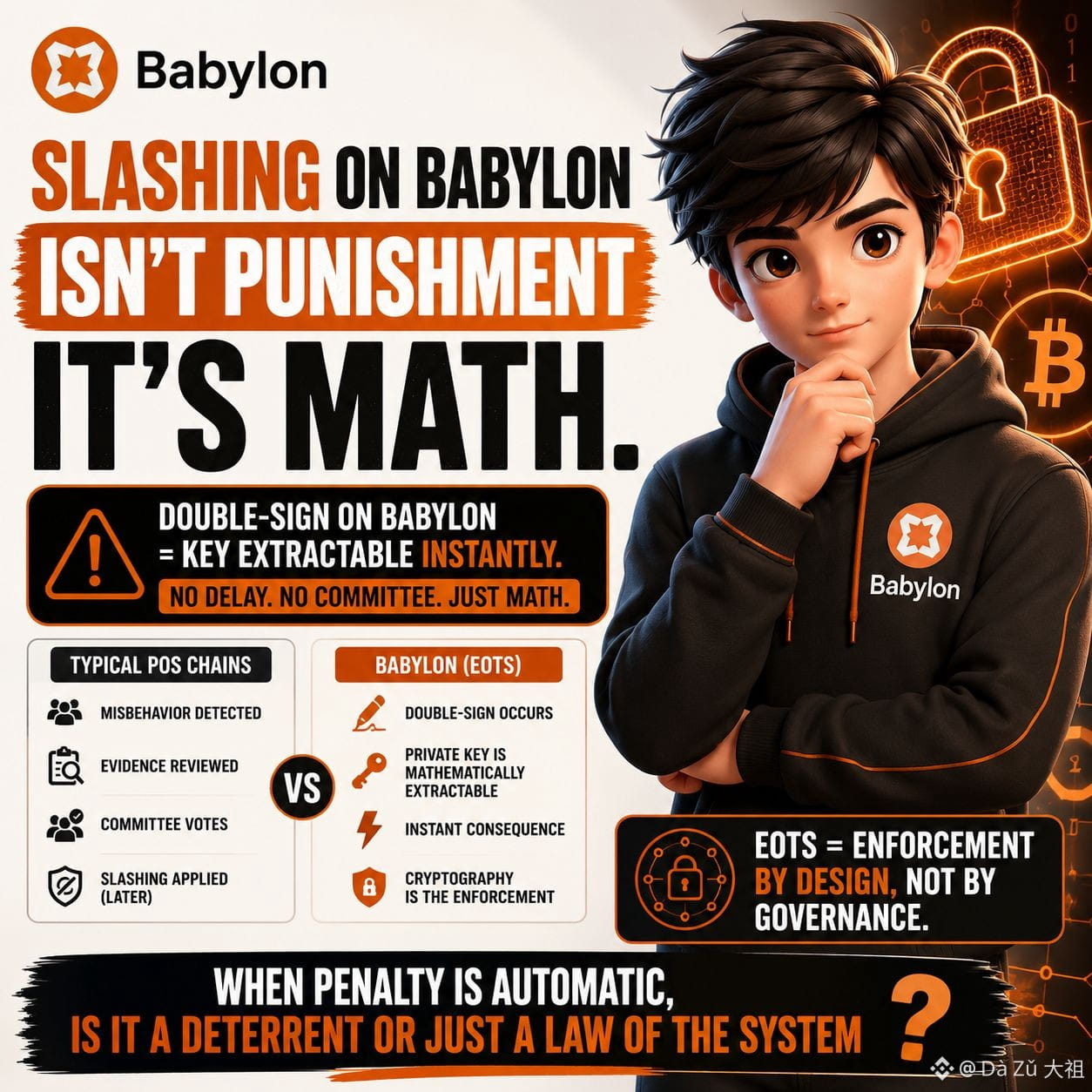
I assumed slashing on Babylon worked the way it does on most Proof-of-Stake chains, a penalty applied after the fact once misbehavior gets detected and processed. Looking closer at how EOTS actually functions, that assumption breaks down. If a finality provider double-signs, the private key isn't flagged for punishment later, it's mathematically extractable the instant the second signature exists. There's no committee reviewing evidence, no delay between the offense and the consequence. The cryptography itself is the enforcement mechanism. I traced this through Babylon's docs against how slashing is normally described on typical PoS chains, and the difference isn't just speed, it's structure. Most slashing is a social process wearing code as enforcement. This is closer to a trap that springs the moment the wrong action is taken. Which makes me question something I hadn't considered before.
If a penalty happens automatically through math rather than through a validator set voting on evidence, is it still functioning as a deterrent, or has it just become a physical property of the system, closer to gravity than punishment?
#baby $BABY @babylonlabs_io
$RE $LA
I assumed slashing on Babylon worked the way it does on most Proof-of-Stake chains, a penalty applied after the fact once misbehavior gets detected and processed. Looking closer at how EOTS actually functions, that assumption breaks down. If a finality provider double-signs, the private key isn't flagged for punishment later, it's mathematically extractable the instant the second signature exists. There's no committee reviewing evidence, no delay between the offense and the consequence. The cryptography itself is the enforcement mechanism. I traced this through Babylon's docs against how slashing is normally described on typical PoS chains, and the difference isn't just speed, it's structure. Most slashing is a social process wearing code as enforcement. This is closer to a trap that springs the moment the wrong action is taken. Which makes me question something I hadn't considered before.
If a penalty happens automatically through math rather than through a validator set voting on evidence, is it still functioning as a deterrent, or has it just become a physical property of the system, closer to gravity than punishment?
#baby $BABY @BabylonLabs_io
$RE $LA
If a penalty happens automatically through math rather than through a validator set voting on evidence, is it still functioning as a deterrent, or has it just become a physical property of the system, closer to gravity than punishment?
#baby $BABY @BabylonLabs_io
$RE $LA
24
15
169
·
--
See translation
Everyone's Hyping AI Agents. Nobody's Asking Who's Allowed to Stop Them
Every week there's a new "AI agent" that can trade, swap, and manage your wallet autonomously. Nobody asks the boring question: what stops it from doing something you didn't authorize? Right now, the answer is usually "trust the code" and that's not a security model, that's a hope.
My thesis: the AI in crypto narrative has the order backwards. The industry is obsessed with making agents smarter, when the actual gap is making them accountable before they act, not audited after the damage is done.
This is where Newton Protocol's actual function matters more than its branding. It's not another AI coin riding the automation wave it's a permission layer. Spend limits, compliance checks, fraud rules, all enforced before a transaction executes, not reviewed afterward in a postmortem thread.
It's not exciting. That's the point. Institutions don't hand real capital to autonomous systems because the system is clever they do it when there's an audit trail and a rule an agent physically cannot break.
So here's the real question nobody in the AI agent hype cycle wants to sit with: would you actually let an autonomous bot touch your wallet today or are you just trusting it hasn't failed yet?
@NewtonProtocol #Newt $NEWT
$SYN $TOWNS
#BinanceTurns9 #SilverDown52%FromJanuaryRecordHigh #KospiStagesVShapedIntradayRebound #USMemoryStocksRisePremarket
Everyone's Hyping AI Agents. Nobody's Asking Who's Allowed to Stop Them
Every week there's a new "AI agent" that can trade, swap, and manage your wallet autonomously. Nobody asks the boring question: what stops it from doing something you didn't authorize? Right now, the answer is usually "trust the code" and that's not a security model, that's a hope.
My thesis: the AI in crypto narrative has the order backwards. The industry is obsessed with making agents smarter, when the actual gap is making them accountable before they act, not audited after the damage is done.
This is where Newton Protocol's actual function matters more than its branding. It's not another AI coin riding the automation wave it's a permission layer. Spend limits, compliance checks, fraud rules, all enforced before a transaction executes, not reviewed afterward in a postmortem thread.
It's not exciting. That's the point. Institutions don't hand real capital to autonomous systems because the system is clever they do it when there's an audit trail and a rule an agent physically cannot break.
So here's the real question nobody in the AI agent hype cycle wants to sit with: would you actually let an autonomous bot touch your wallet today or are you just trusting it hasn't failed yet?
@NewtonProtocol #Newt $NEWT
$SYN $TOWNS
#BinanceTurns9 #SilverDown52%FromJanuaryRecordHigh #KospiStagesVShapedIntradayRebound #USMemoryStocksRisePremarket
Every week there's a new "AI agent" that can trade, swap, and manage your wallet autonomously. Nobody asks the boring question: what stops it from doing something you didn't authorize? Right now, the answer is usually "trust the code" and that's not a security model, that's a hope.
My thesis: the AI in crypto narrative has the order backwards. The industry is obsessed with making agents smarter, when the actual gap is making them accountable before they act, not audited after the damage is done.
This is where Newton Protocol's actual function matters more than its branding. It's not another AI coin riding the automation wave it's a permission layer. Spend limits, compliance checks, fraud rules, all enforced before a transaction executes, not reviewed afterward in a postmortem thread.
It's not exciting. That's the point. Institutions don't hand real capital to autonomous systems because the system is clever they do it when there's an audit trail and a rule an agent physically cannot break.
So here's the real question nobody in the AI agent hype cycle wants to sit with: would you actually let an autonomous bot touch your wallet today or are you just trusting it hasn't failed yet?
@NewtonProtocol #Newt $NEWT
$SYN $TOWNS
#BinanceTurns9 #SilverDown52%FromJanuaryRecordHigh #KospiStagesVShapedIntradayRebound #USMemoryStocksRisePremarket

17
6
182
·
--
Article
See translation
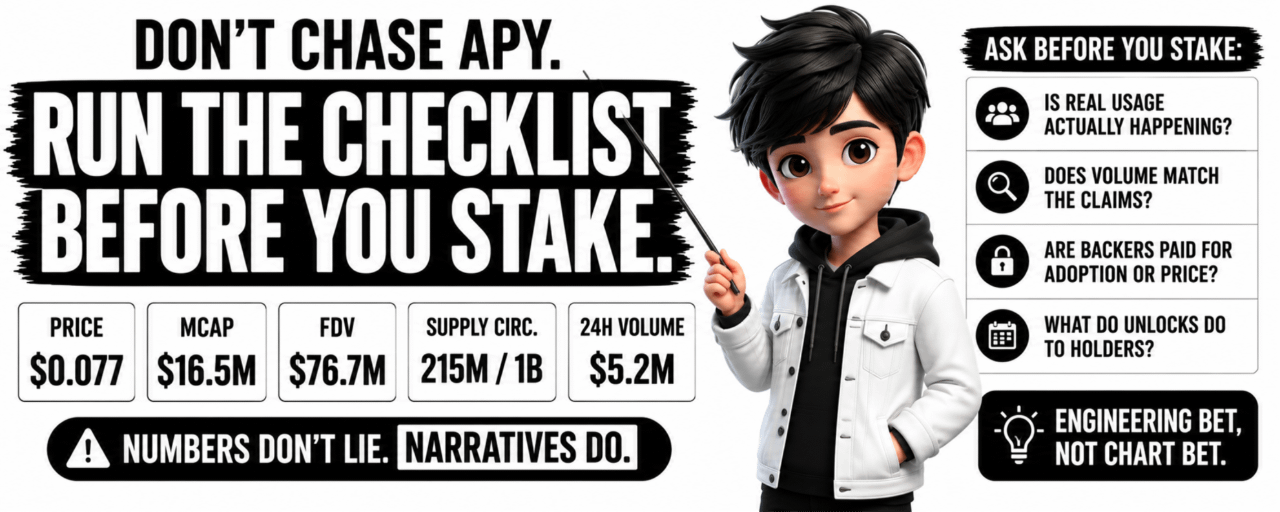
What a Fake 90% APY Taught Me About Reading Newton Protocol's Real NumbersThere was this DEX I used to check every morning, back when I still thought staking was free money. One day there's a banner across the top, bright green, 90% APY, on some token I'd never heard of a week earlier. I didn't check where the yield came from, didn't check pool depth, didn't open the contract. I just staked because the number felt too big to walk past. The "depth" turned out to be three wallets shuffling the same liquidity to keep the APY math looking honest. The formula wasn't lying emissions divided by a shrinking pool always spits out a big number. I just didn't realize I was the pool.
That banner is why I built the checklist I run now, almost automatically, before I let myself get excited about anything. Is anyone actually transacting with this, or is everyone just talking about it. Does the volume match the integration claims, or does it collapse into the same handful of wallets on inspection. Are the backers rewarded for adoption, or for the price on the day their tokens unlock. And what does the unlock schedule do to holders regardless of how solid the tech sounds.
So I run Newton Protocol through it. The pitch is pre transaction compliance policies get checked and enforced before a transfer settles, not audited after the fact, aimed at sanctions screening and identity checks for institutions. That's a real problem, not a slogan. But the checklist doesn't care about the pitch, it cares about the numbers underneath it.
NEWT is trading around $0.077, with roughly 215 million of a 1 billion total supply circulating, putting market cap near $16.5 million against a fully diluted value close to $76.7 million. That gap is the first thing I circle. Holders sit just above 14,700, and 24 hour volume runs about $5.2 million a volume to market cap ratio above 30%, which reads more like trading than conviction. The token hit an all time high near $0.83 on its June 2025 Binance Alpha airdrop launch, then dropped over 90% to around $0.06 by February. A June unlock added roughly 139 million tokens, worth about $7.5 million at the time, in one shot. Close to 80% of supply is still locked, vesting out through 2029, with contributors and early backers alone holding over a third of the eventual float.
None of that tells me Newton Protocol is a bad bet. It tells me it's an engineering bet, not a chart bet. What would actually move me is fee revenue and operator activity holding steady on a random week with no unlock and no headline the same wallets calling the policy engine because a stablecoin issuer or an agent framework actually needs it, not because points are on the table. Volume that only shows up around unlocks and listings is the same shape as my old APY banner, just dressed in compliance language.
I'm not calling a top or a bottom on Newton Protocol. I'm asking whether anyone here has actually seen its policy checks integrated into something that isn't farming its own incentives yet and if not, what would it take for you to believe the usage is real before the next unlock hits?
@NewtonProtocol $NEWT #Newt
What a Fake 90% APY Taught Me About Reading Newton Protocol's Real Numbers
There was this DEX I used to check every morning, back when I still thought staking was free money. One day there's a banner across the top, bright green, 90% APY, on some token I'd never heard of a week earlier. I didn't check where the yield came from, didn't check pool depth, didn't open the contract. I just staked because the number felt too big to walk past. The "depth" turned out to be three wallets shuffling the same liquidity to keep the APY math looking honest. The formula wasn't lying emissions divided by a shrinking pool always spits out a big number. I just didn't realize I was the pool.
That banner is why I built the checklist I run now, almost automatically, before I let myself get excited about anything. Is anyone actually transacting with this, or is everyone just talking about it. Does the volume match the integration claims, or does it collapse into the same handful of wallets on inspection. Are the backers rewarded for adoption, or for the price on the day their tokens unlock. And what does the unlock schedule do to holders regardless of how solid the tech sounds.
So I run Newton Protocol through it. The pitch is pre transaction compliance policies get checked and enforced before a transfer settles, not audited after the fact, aimed at sanctions screening and identity checks for institutions. That's a real problem, not a slogan. But the checklist doesn't care about the pitch, it cares about the numbers underneath it.
NEWT is trading around $0.077, with roughly 215 million of a 1 billion total supply circulating, putting market cap near $16.5 million against a fully diluted value close to $76.7 million. That gap is the first thing I circle. Holders sit just above 14,700, and 24 hour volume runs about $5.2 million a volume to market cap ratio above 30%, which reads more like trading than conviction. The token hit an all time high near $0.83 on its June 2025 Binance Alpha airdrop launch, then dropped over 90% to around $0.06 by February. A June unlock added roughly 139 million tokens, worth about $7.5 million at the time, in one shot. Close to 80% of supply is still locked, vesting out through 2029, with contributors and early backers alone holding over a third of the eventual float.
None of that tells me Newton Protocol is a bad bet. It tells me it's an engineering bet, not a chart bet. What would actually move me is fee revenue and operator activity holding steady on a random week with no unlock and no headline the same wallets calling the policy engine because a stablecoin issuer or an agent framework actually needs it, not because points are on the table. Volume that only shows up around unlocks and listings is the same shape as my old APY banner, just dressed in compliance language.
I'm not calling a top or a bottom on Newton Protocol. I'm asking whether anyone here has actually seen its policy checks integrated into something that isn't farming its own incentives yet and if not, what would it take for you to believe the usage is real before the next unlock hits?
@NewtonProtocol $NEWT #Newt
That banner is why I built the checklist I run now, almost automatically, before I let myself get excited about anything. Is anyone actually transacting with this, or is everyone just talking about it. Does the volume match the integration claims, or does it collapse into the same handful of wallets on inspection. Are the backers rewarded for adoption, or for the price on the day their tokens unlock. And what does the unlock schedule do to holders regardless of how solid the tech sounds.
So I run Newton Protocol through it. The pitch is pre transaction compliance policies get checked and enforced before a transfer settles, not audited after the fact, aimed at sanctions screening and identity checks for institutions. That's a real problem, not a slogan. But the checklist doesn't care about the pitch, it cares about the numbers underneath it.
NEWT is trading around $0.077, with roughly 215 million of a 1 billion total supply circulating, putting market cap near $16.5 million against a fully diluted value close to $76.7 million. That gap is the first thing I circle. Holders sit just above 14,700, and 24 hour volume runs about $5.2 million a volume to market cap ratio above 30%, which reads more like trading than conviction. The token hit an all time high near $0.83 on its June 2025 Binance Alpha airdrop launch, then dropped over 90% to around $0.06 by February. A June unlock added roughly 139 million tokens, worth about $7.5 million at the time, in one shot. Close to 80% of supply is still locked, vesting out through 2029, with contributors and early backers alone holding over a third of the eventual float.
None of that tells me Newton Protocol is a bad bet. It tells me it's an engineering bet, not a chart bet. What would actually move me is fee revenue and operator activity holding steady on a random week with no unlock and no headline the same wallets calling the policy engine because a stablecoin issuer or an agent framework actually needs it, not because points are on the table. Volume that only shows up around unlocks and listings is the same shape as my old APY banner, just dressed in compliance language.
I'm not calling a top or a bottom on Newton Protocol. I'm asking whether anyone here has actually seen its policy checks integrated into something that isn't farming its own incentives yet and if not, what would it take for you to believe the usage is real before the next unlock hits?
@NewtonProtocol $NEWT #Newt
8
3
108
Log in to explore more content
Join global crypto users on Binance Square
⚡️ Get latest and useful information about crypto.
💬 Trusted by the world’s largest crypto exchange.
👍 Discover real insights from verified creators.
Email / Phone number
Trending Topics
BitcoinParesGainsAfterRallyTo$86.5K
1,728 views
37 Discussing
$BTC sitting right on the knife edge at $86k. Bulls stacked 1,436 BTC defending that level, bears loaded 1,008 BTC as a wall at $86.5k. This is pure liquidation fuel—whoever loses this fight is getting absolutely nuked.
Short-term scalp territory. If bulls punch through $86.5k with volume, we're probably running to $88k fast. If bears hold and push down, $84k is the next stop and longs get flushed.
Watch the tape closely. One side's about to get destroyed, and the move will be violent either way.
AI Market Brief
·7 Likes
·8.4k views
CerebrasSinksNearly20%OnReportNvidiaToPowerOpenAI
7,424 views
149 Discussing
SECProposesCryptoCustodyRules
29,949 views
303 Discussing