
H A MM A D
109 Posts

H A MM A D
Report
Block User
The journey has just begun.
33 Following
17 Followers
100 Liked
Posts
·
--
See translation
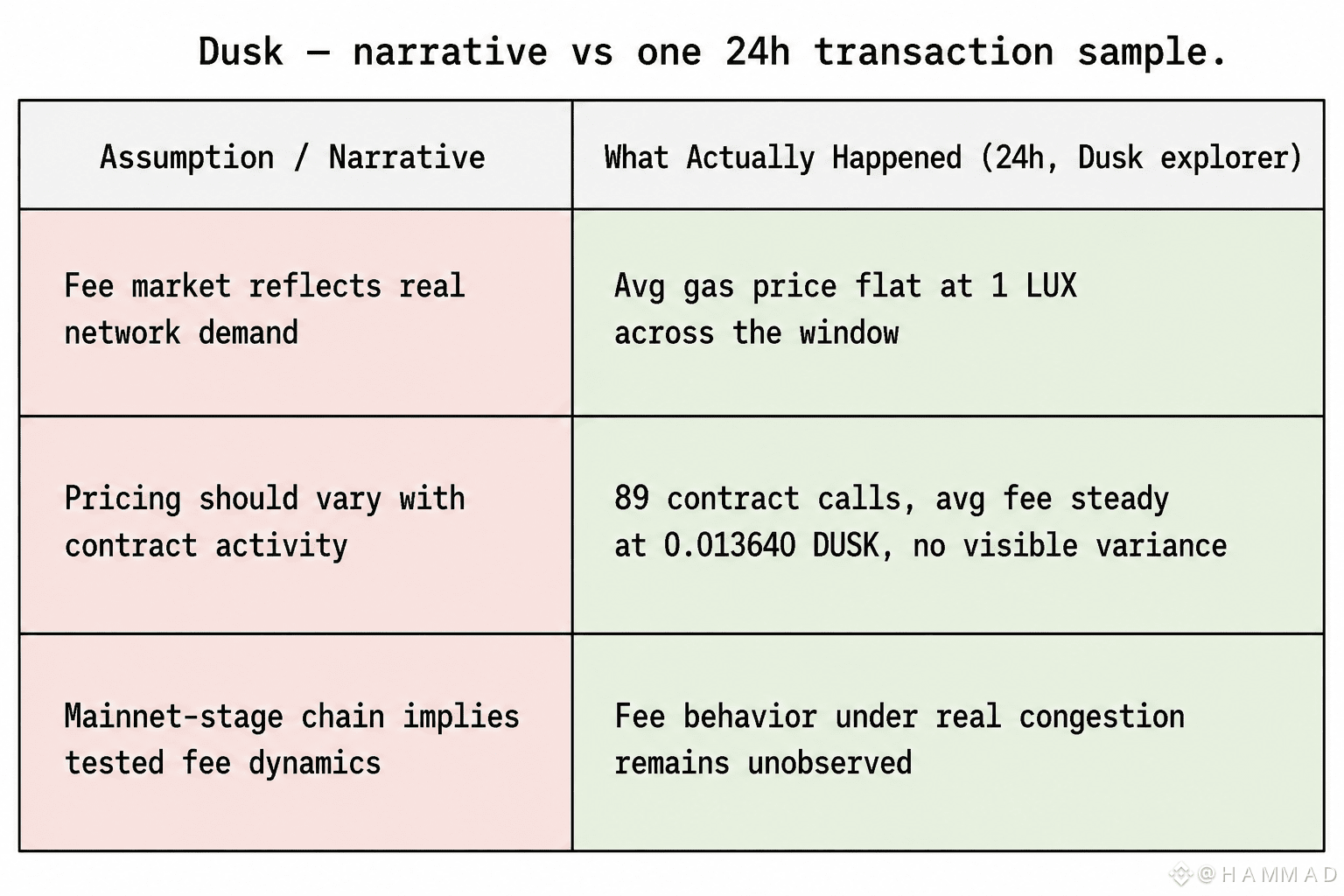
Clicked into a random Moonlight transaction on Dusk's explorer while wrapping up a CreatorPad task and just sat with it for a sec. $DUSK , #dusk , @Dusk_Foundation — fee paid: basically nothing. Gas price sitting flat at 1 LUX. Average fee across the whole 24h window was 0.013640 DUSK, and it wasn't an outlier, it was just... the average.
Hold up — that's not a fee market reacting to anything, that's a fee floor nobody's testing yet. 89 contract calls that day, 252 total transactions, and the price barely moved off baseline. Which tells you less about Dusk being "cheap" and more about the network just not having hit real demand pressure at all.
Caught myself assuming a chain this far into mainnet would show at least some fee variance by now, some contracts paying more to get prioritized. Nope. Flat. Kind of unsettling in a quiet way, not because it's bad, just because it means the actual pricing behavior under load is still an open question nobody's answered on-chain yet.
Early users get this rate. Nobody's told me what happens to it later, and the explorer obviously can't answer that either — so when does 1 LUX stop being the default and start being the exception?
Clicked into a random Moonlight transaction on Dusk's explorer while wrapping up a CreatorPad task and just sat with it for a sec. $DUSK , #dusk , @Dusk — fee paid: basically nothing. Gas price sitting flat at 1 LUX. Average fee across the whole 24h window was 0.013640 DUSK, and it wasn't an outlier, it was just... the average.
Hold up — that's not a fee market reacting to anything, that's a fee floor nobody's testing yet. 89 contract calls that day, 252 total transactions, and the price barely moved off baseline. Which tells you less about Dusk being "cheap" and more about the network just not having hit real demand pressure at all.
Caught myself assuming a chain this far into mainnet would show at least some fee variance by now, some contracts paying more to get prioritized. Nope. Flat. Kind of unsettling in a quiet way, not because it's bad, just because it means the actual pricing behavior under load is still an open question nobody's answered on-chain yet.
Early users get this rate. Nobody's told me what happens to it later, and the explorer obviously can't answer that either — so when does 1 LUX stop being the default and start being the exception?
Hold up — that's not a fee market reacting to anything, that's a fee floor nobody's testing yet. 89 contract calls that day, 252 total transactions, and the price barely moved off baseline. Which tells you less about Dusk being "cheap" and more about the network just not having hit real demand pressure at all.
Caught myself assuming a chain this far into mainnet would show at least some fee variance by now, some contracts paying more to get prioritized. Nope. Flat. Kind of unsettling in a quiet way, not because it's bad, just because it means the actual pricing behavior under load is still an open question nobody's answered on-chain yet.
Early users get this rate. Nobody's told me what happens to it later, and the explorer obviously can't answer that either — so when does 1 LUX stop being the default and start being the exception?
5
1
64
·
--
See translation
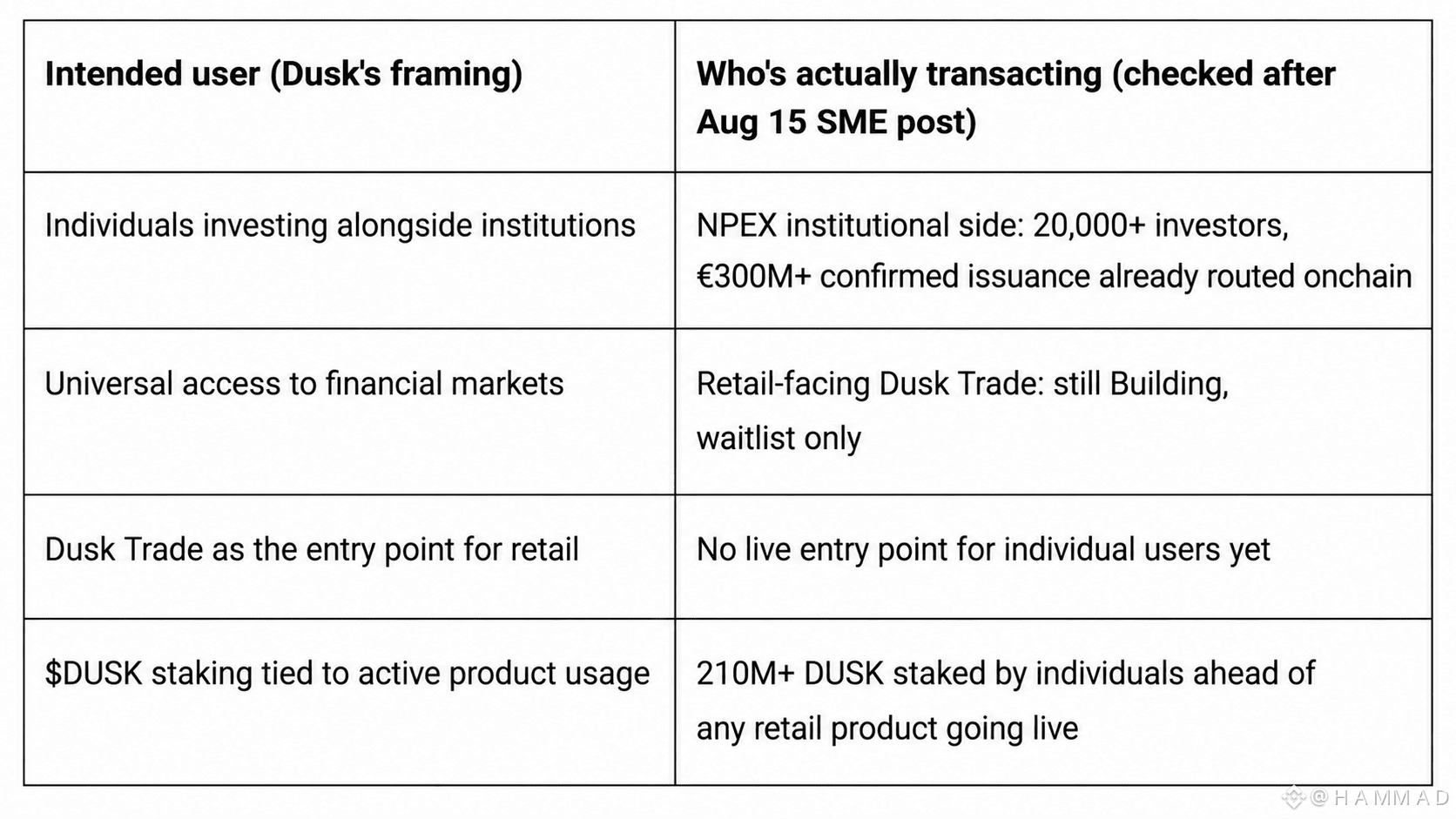
Grabbed a snack after this Dusk task and kept turning one thing over — the users showing up on chain right now aren't the ones the pitch is written for.
#dusk whole framing is "universal access to financial markets," individuals investing alongside institutions. But when I checked activity around the Aug 15 SME tokenization piece @Dusk_Foundation put out, what's actually live is the institutional side — NPEX's 20,000+ investor base and €300M+ in confirmed issuance, all offchain deal flow being routed toward Dusk's rails. The retail-facing product, Dusk Trade, is still waitlist-stage. Building, not live.
Meanwhile 210M+ $DUSK sits staked, securing a network whose current real usage is basically B2B settlement infrastructure for one Dutch exchange. Individual holders are financing the plumbing for institutions who get to use it first.
Not a knock, just… noticed it. Went back through the explorer twice thinking I'd misread the product status labels. Didn't.
Makes sense in a "someone has to go first" way. Still, the gap between who's promised access and who's actually transacting is wider than I expected going in.
Wondering how long institutional-only usage runs before retail access catches up, or if that's even the real endpoint here.
Grabbed a snack after this Dusk task and kept turning one thing over — the users showing up on chain right now aren't the ones the pitch is written for.
#dusk whole framing is "universal access to financial markets," individuals investing alongside institutions. But when I checked activity around the Aug 15 SME tokenization piece @Dusk put out, what's actually live is the institutional side — NPEX's 20,000+ investor base and €300M+ in confirmed issuance, all offchain deal flow being routed toward Dusk's rails. The retail-facing product, Dusk Trade, is still waitlist-stage. Building, not live.
Meanwhile 210M+ $DUSK sits staked, securing a network whose current real usage is basically B2B settlement infrastructure for one Dutch exchange. Individual holders are financing the plumbing for institutions who get to use it first.
Not a knock, just… noticed it. Went back through the explorer twice thinking I'd misread the product status labels. Didn't.
Makes sense in a "someone has to go first" way. Still, the gap between who's promised access and who's actually transacting is wider than I expected going in.
Wondering how long institutional-only usage runs before retail access catches up, or if that's even the real endpoint here.
#dusk whole framing is "universal access to financial markets," individuals investing alongside institutions. But when I checked activity around the Aug 15 SME tokenization piece @Dusk put out, what's actually live is the institutional side — NPEX's 20,000+ investor base and €300M+ in confirmed issuance, all offchain deal flow being routed toward Dusk's rails. The retail-facing product, Dusk Trade, is still waitlist-stage. Building, not live.
Meanwhile 210M+ $DUSK sits staked, securing a network whose current real usage is basically B2B settlement infrastructure for one Dutch exchange. Individual holders are financing the plumbing for institutions who get to use it first.
Not a knock, just… noticed it. Went back through the explorer twice thinking I'd misread the product status labels. Didn't.
Makes sense in a "someone has to go first" way. Still, the gap between who's promised access and who's actually transacting is wider than I expected going in.
Wondering how long institutional-only usage runs before retail access catches up, or if that's even the real endpoint here.
2
70
·
--
See translation
I clicked into one Dusk transaction expecting the usual public trail and then stopped for a second. The transaction was marked as Phoenix, but the detail I wanted most simply wasn’t there.
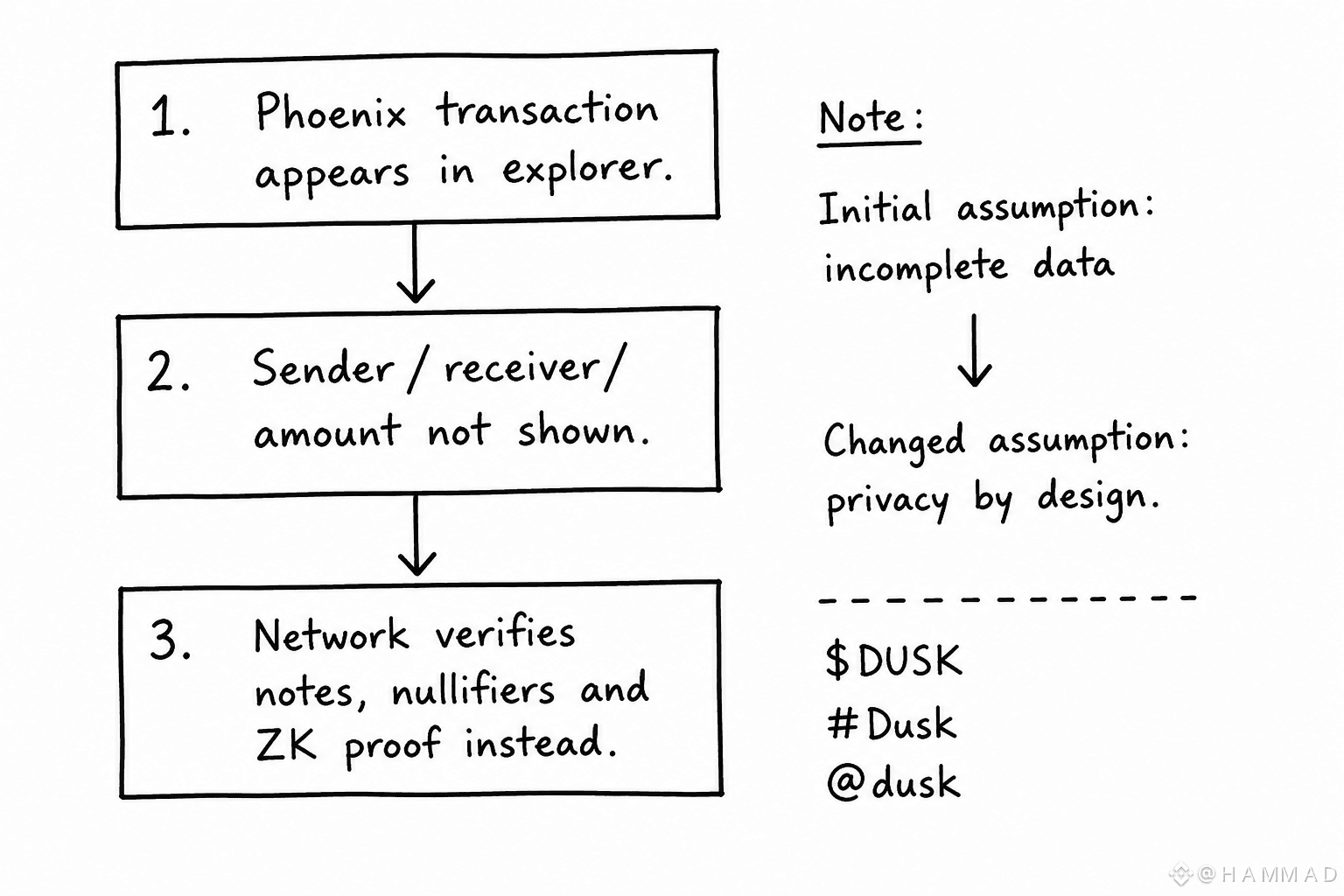
During the task I was looking at Dusk Foundation, $DUSK , #Dusk and @Dusk_Foundation , and one recent Phoenix transaction from the explorer kept pulling me back. Its type was visible, while the normal sender, receiver and amount fields I expected were not exposed. That tiny mismatch changed my assumption more than any headline about privacy could.
At first I honestly thought I was looking at incomplete explorer data. Then I checked what Phoenix transactions are actually designed to contain. The model uses notes, nullifiers and a zero knowledge proof, so the chain can verify that the transaction follows the rules without publishing the private transaction details in the familiar account-to-account format.
I’ve looked at plenty of explorers where missing fields usually mean something went wrong. Here it meant the opposite. The transaction was doing its job precisely by refusing to look normal. Hmm… I’m still wondering whether that change in mental model is something users naturally pick up, or whether explorers will need to make that distinction much clearer.
I clicked into one Dusk transaction expecting the usual public trail and then stopped for a second. The transaction was marked as Phoenix, but the detail I wanted most simply wasn’t there.
During the task I was looking at Dusk Foundation, $DUSK , #Dusk and @Dusk , and one recent Phoenix transaction from the explorer kept pulling me back. Its type was visible, while the normal sender, receiver and amount fields I expected were not exposed. That tiny mismatch changed my assumption more than any headline about privacy could.
At first I honestly thought I was looking at incomplete explorer data. Then I checked what Phoenix transactions are actually designed to contain. The model uses notes, nullifiers and a zero knowledge proof, so the chain can verify that the transaction follows the rules without publishing the private transaction details in the familiar account-to-account format.
I’ve looked at plenty of explorers where missing fields usually mean something went wrong. Here it meant the opposite. The transaction was doing its job precisely by refusing to look normal. Hmm… I’m still wondering whether that change in mental model is something users naturally pick up, or whether explorers will need to make that distinction much clearer.
During the task I was looking at Dusk Foundation, $DUSK , #Dusk and @Dusk , and one recent Phoenix transaction from the explorer kept pulling me back. Its type was visible, while the normal sender, receiver and amount fields I expected were not exposed. That tiny mismatch changed my assumption more than any headline about privacy could.
At first I honestly thought I was looking at incomplete explorer data. Then I checked what Phoenix transactions are actually designed to contain. The model uses notes, nullifiers and a zero knowledge proof, so the chain can verify that the transaction follows the rules without publishing the private transaction details in the familiar account-to-account format.
I’ve looked at plenty of explorers where missing fields usually mean something went wrong. Here it meant the opposite. The transaction was doing its job precisely by refusing to look normal. Hmm… I’m still wondering whether that change in mental model is something users naturally pick up, or whether explorers will need to make that distinction much clearer.
2
82
·
--
See translation
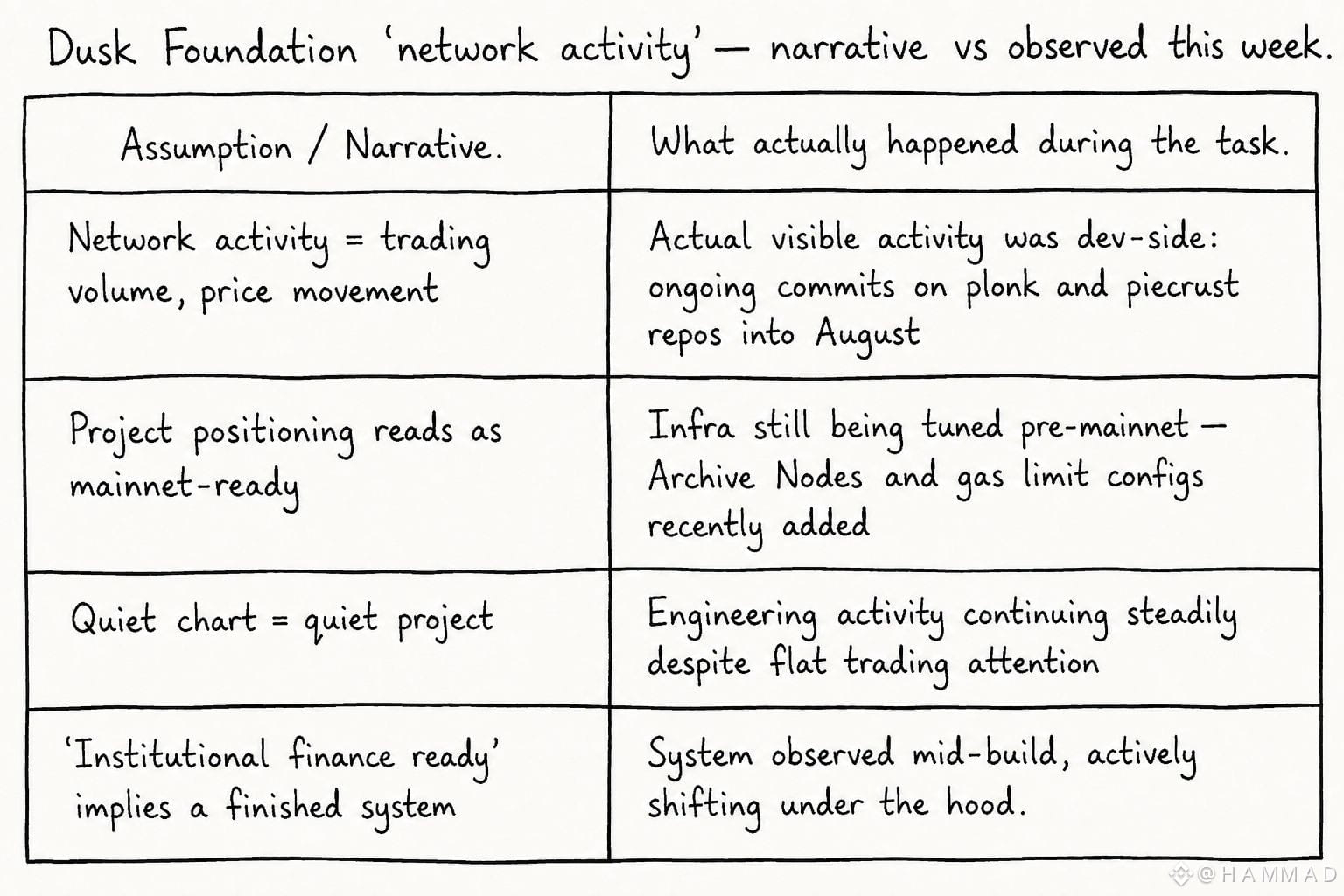
Went in expecting to find some dramatic volume spike for this Dusk Foundation task… found something quieter instead. Dev activity, not trading activity. Core repos like plonk and piecrust are still showing regular commits into August, per Dusk's own GitHub — piecrust alone sitting at 111 repos deep with updates landing days ago, not months ago.
That's the contrast that got me. Everyone's watching price charts and calling that "network activity," but the actual signal this week was infrastructure-side — Archive Nodes rolling out for full historical record-keeping, block gas limits getting configurable, the whole system still being tuned pre-mainnet. Quiet, unglamorous, ongoing.
Kind of assumed a project this deep into "regulated on-chain finance" positioning would already feel finished. It doesn't. It feels mid-build, still actively shifting under the hood while the outward narrative reads as ready-for-institutions.
Not a bad thing necessarily. Just… not what "normal usage" implied to me before I actually looked.
Makes me wonder how much of what gets called network activity across this whole sector is actually trading noise versus real engineering movement underneath.
$DUSK #dusk @Dusk_Foundation
Went in expecting to find some dramatic volume spike for this Dusk Foundation task… found something quieter instead. Dev activity, not trading activity. Core repos like plonk and piecrust are still showing regular commits into August, per Dusk's own GitHub — piecrust alone sitting at 111 repos deep with updates landing days ago, not months ago.
That's the contrast that got me. Everyone's watching price charts and calling that "network activity," but the actual signal this week was infrastructure-side — Archive Nodes rolling out for full historical record-keeping, block gas limits getting configurable, the whole system still being tuned pre-mainnet. Quiet, unglamorous, ongoing.
Kind of assumed a project this deep into "regulated on-chain finance" positioning would already feel finished. It doesn't. It feels mid-build, still actively shifting under the hood while the outward narrative reads as ready-for-institutions.
Not a bad thing necessarily. Just… not what "normal usage" implied to me before I actually looked.
Makes me wonder how much of what gets called network activity across this whole sector is actually trading noise versus real engineering movement underneath.
$DUSK #dusk @Dusk
That's the contrast that got me. Everyone's watching price charts and calling that "network activity," but the actual signal this week was infrastructure-side — Archive Nodes rolling out for full historical record-keeping, block gas limits getting configurable, the whole system still being tuned pre-mainnet. Quiet, unglamorous, ongoing.
Kind of assumed a project this deep into "regulated on-chain finance" positioning would already feel finished. It doesn't. It feels mid-build, still actively shifting under the hood while the outward narrative reads as ready-for-institutions.
Not a bad thing necessarily. Just… not what "normal usage" implied to me before I actually looked.
Makes me wonder how much of what gets called network activity across this whole sector is actually trading noise versus real engineering movement underneath.
$DUSK #dusk @Dusk
1
79
·
--
See translation
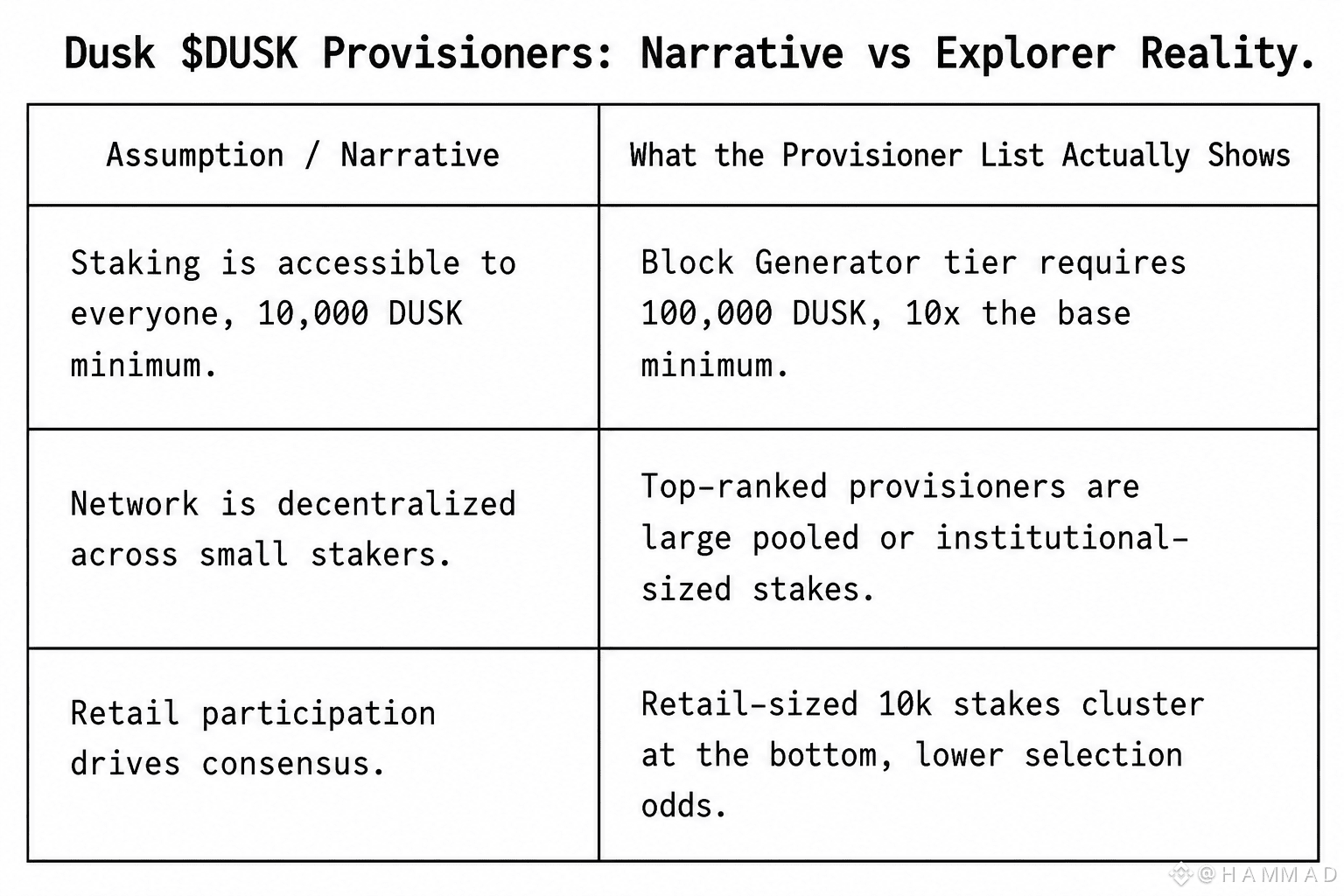
During the task I pulled up the provisioners list on Dusk's explorer, just scrolling ranks out of habit, and the pattern didn't match what I expected. Block Generator status needs 100,000 $DUSK, regular Provisioner only needs 10,000 — a 10x gap — and the top of that list is dominated by wallets clearly running pooled or institutional stakes, not solo retail.
hold up— #dusk talks a lot about accessible staking, low barrier to participate. Technically true, 10k gets you in the door. But actual block production, the part that earns the bigger reward split, sits mostly with entities that can park six figures in DUSK and keep a node online 24/7. That's not villainy, just... math. Infrastructure favors whoever can afford infrastructure.
Reminded me of watching NPEX's tokenized securities activity get mentioned in Dusk's own updates — real institutional volume, not retail speculation. Makes sense actually, given the compliance-first design. But it does reframe who's "using" the network day to day versus who's just holding $DUSK waiting for a narrative.
@Dusk_Foundation isn't hiding the stake tiers, it's public info. Still, seeing the concentration laid out in a ranked list hits different than reading about thresholds in a doc.
Curious how that ratio shifts once Hyperstaking pools actually mature.
During the task I pulled up the provisioners list on Dusk's explorer, just scrolling ranks out of habit, and the pattern didn't match what I expected. Block Generator status needs 100,000 $DUSK , regular Provisioner only needs 10,000 — a 10x gap — and the top of that list is dominated by wallets clearly running pooled or institutional stakes, not solo retail.
hold up— #dusk talks a lot about accessible staking, low barrier to participate. Technically true, 10k gets you in the door. But actual block production, the part that earns the bigger reward split, sits mostly with entities that can park six figures in DUSK and keep a node online 24/7. That's not villainy, just... math. Infrastructure favors whoever can afford infrastructure.
Reminded me of watching NPEX's tokenized securities activity get mentioned in Dusk's own updates — real institutional volume, not retail speculation. Makes sense actually, given the compliance-first design. But it does reframe who's "using" the network day to day versus who's just holding $DUSK waiting for a narrative.
@Dusk isn't hiding the stake tiers, it's public info. Still, seeing the concentration laid out in a ranked list hits different than reading about thresholds in a doc.
Curious how that ratio shifts once Hyperstaking pools actually mature.
hold up— #dusk talks a lot about accessible staking, low barrier to participate. Technically true, 10k gets you in the door. But actual block production, the part that earns the bigger reward split, sits mostly with entities that can park six figures in DUSK and keep a node online 24/7. That's not villainy, just... math. Infrastructure favors whoever can afford infrastructure.
Reminded me of watching NPEX's tokenized securities activity get mentioned in Dusk's own updates — real institutional volume, not retail speculation. Makes sense actually, given the compliance-first design. But it does reframe who's "using" the network day to day versus who's just holding $DUSK waiting for a narrative.
@Dusk isn't hiding the stake tiers, it's public info. Still, seeing the concentration laid out in a ranked list hits different than reading about thresholds in a doc.
Curious how that ratio shifts once Hyperstaking pools actually mature.
5
3
82
·
--
See translation
Spent twenty minutes just scrolling raw blocks on the explorer instead of doing anything useful with the task… and the thing that stopped my thumb wasn't a number, it was a pattern. #dusk $DUSK @Dusk_Foundation — Dusk Foundation's mainnet finalizes through Succinct Attestation, so each block gets sealed by a rotating committee of provisioners, not some slow probabilistic confirmation. Fine on paper.
Except scrolling block after block this week, the same handful of provisioner addresses kept showing up in the attestation committees, over and over. Sortition's stake-weighted, so mathematically that's expected — bigger stake, higher odds of getting picked to generate or validate. Still, seeing it visually, block after block, hits different than reading it in a whitepaper.
Kind of assumed "committee rotates every block" meant meaningfully different validators each time. Rotates, sure. Different, not really — not with the current stake distribution, anyway.
Makes sense why finality is fast — smaller committees, less coordination overhead. But fast finality and wide decentralization aren't the same promise, and watching live blocks makes that gap obvious in a way the docs don't.
Wonder what the provisioner set looks like once DuskEVM mainnet activity actually ramps up post-testnet — does the concentration ease or does it just compound.
Spent twenty minutes just scrolling raw blocks on the explorer instead of doing anything useful with the task… and the thing that stopped my thumb wasn't a number, it was a pattern. #dusk $DUSK @Dusk — Dusk Foundation's mainnet finalizes through Succinct Attestation, so each block gets sealed by a rotating committee of provisioners, not some slow probabilistic confirmation. Fine on paper.
Except scrolling block after block this week, the same handful of provisioner addresses kept showing up in the attestation committees, over and over. Sortition's stake-weighted, so mathematically that's expected — bigger stake, higher odds of getting picked to generate or validate. Still, seeing it visually, block after block, hits different than reading it in a whitepaper.
Kind of assumed "committee rotates every block" meant meaningfully different validators each time. Rotates, sure. Different, not really — not with the current stake distribution, anyway.
Makes sense why finality is fast — smaller committees, less coordination overhead. But fast finality and wide decentralization aren't the same promise, and watching live blocks makes that gap obvious in a way the docs don't.
Wonder what the provisioner set looks like once DuskEVM mainnet activity actually ramps up post-testnet — does the concentration ease or does it just compound.
Except scrolling block after block this week, the same handful of provisioner addresses kept showing up in the attestation committees, over and over. Sortition's stake-weighted, so mathematically that's expected — bigger stake, higher odds of getting picked to generate or validate. Still, seeing it visually, block after block, hits different than reading it in a whitepaper.
Kind of assumed "committee rotates every block" meant meaningfully different validators each time. Rotates, sure. Different, not really — not with the current stake distribution, anyway.
Makes sense why finality is fast — smaller committees, less coordination overhead. But fast finality and wide decentralization aren't the same promise, and watching live blocks makes that gap obvious in a way the docs don't.
Wonder what the provisioner set looks like once DuskEVM mainnet activity actually ramps up post-testnet — does the concentration ease or does it just compound.
4
2
64
·
--
Partly True
See translation
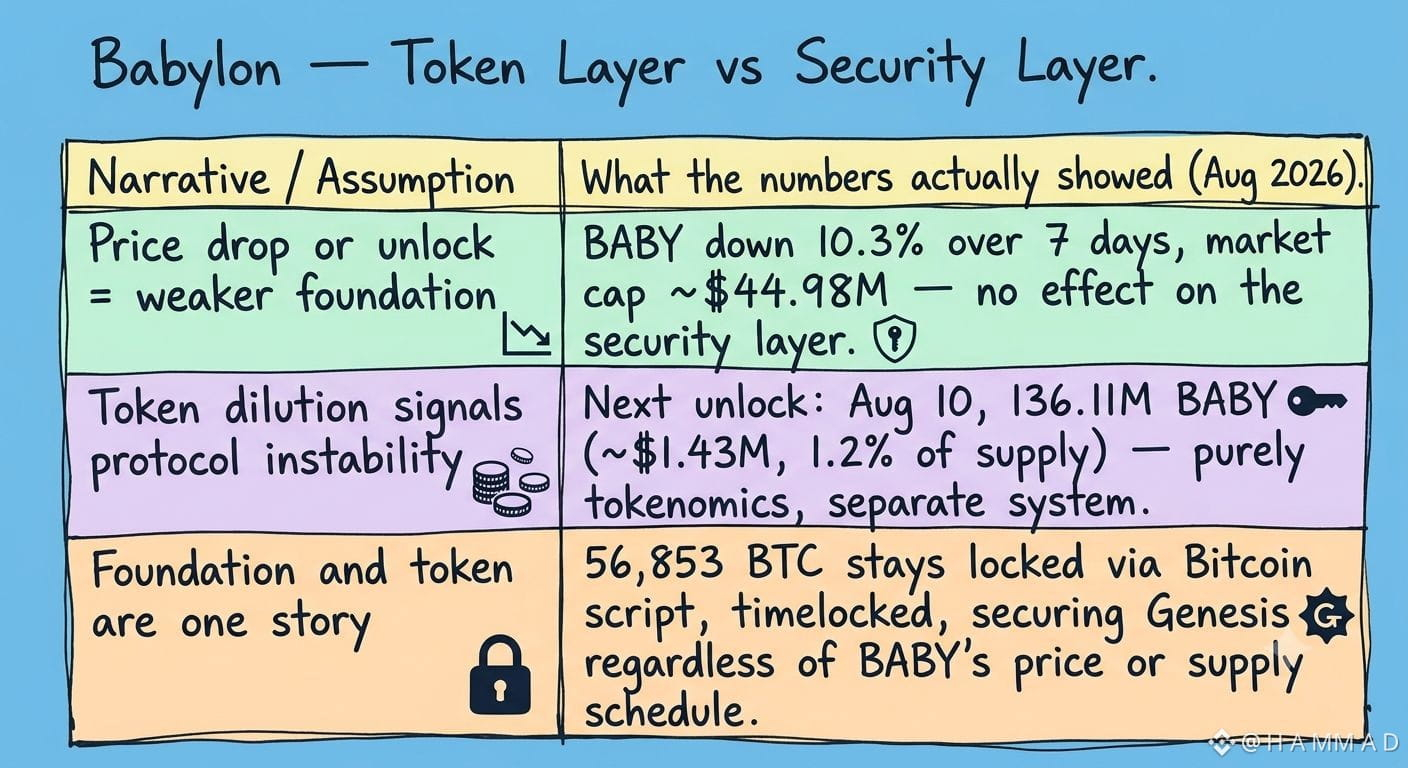
Checked in on Babylon mid CreatorPad task and the price chart was rough — $BABY down 10.3% over the past 7 days, market cap sitting around $44.98M. Normal week for the token, honestly. But then I pulled up the vesting schedule out of curiosity and saw something more interesting: next unlock lands Aug 10, 136.11M BABY, about $1.43M, roughly 1.2% of total supply. @babylonlabs_io isn't hiding it — it's right there in the numbers.
Here's what actually stuck with me though. None of that — the price drop, the unlock, the dilution math — touches the thing #baby is supposedly built on. The 56,853 BTC sitting in staking vaults doesn't care about BABY's supply schedule. It's locked via Bitcoin script, timelocked, doing its job securing Genesis and whatever BSNs plug in, completely separate from whatever's happening to the token that pays for gas and votes.
hmm — that's actually the split I didn't expect going in. The "foundation" here is the Bitcoin security layer, and it's oddly indifferent to the tokenomics drama sitting on top of it. Token supply schedules are just... administrative, almost.
Not sure that's reassuring or just a different kind of risk nobody's really pricing in yet.
Checked in on Babylon mid CreatorPad task and the price chart was rough — $BABY down 10.3% over the past 7 days, market cap sitting around $44.98M. Normal week for the token, honestly. But then I pulled up the vesting schedule out of curiosity and saw something more interesting: next unlock lands Aug 10, 136.11M BABY, about $1.43M, roughly 1.2% of total supply. @BabylonLabs_io isn't hiding it — it's right there in the numbers.
Here's what actually stuck with me though. None of that — the price drop, the unlock, the dilution math — touches the thing #baby is supposedly built on. The 56,853 BTC sitting in staking vaults doesn't care about BABY's supply schedule. It's locked via Bitcoin script, timelocked, doing its job securing Genesis and whatever BSNs plug in, completely separate from whatever's happening to the token that pays for gas and votes.
hmm — that's actually the split I didn't expect going in. The "foundation" here is the Bitcoin security layer, and it's oddly indifferent to the tokenomics drama sitting on top of it. Token supply schedules are just... administrative, almost.
Not sure that's reassuring or just a different kind of risk nobody's really pricing in yet.
Here's what actually stuck with me though. None of that — the price drop, the unlock, the dilution math — touches the thing #baby is supposedly built on. The 56,853 BTC sitting in staking vaults doesn't care about BABY's supply schedule. It's locked via Bitcoin script, timelocked, doing its job securing Genesis and whatever BSNs plug in, completely separate from whatever's happening to the token that pays for gas and votes.
hmm — that's actually the split I didn't expect going in. The "foundation" here is the Bitcoin security layer, and it's oddly indifferent to the tokenomics drama sitting on top of it. Token supply schedules are just... administrative, almost.
Not sure that's reassuring or just a different kind of risk nobody's really pricing in yet.
18
9
3.7k
·
--
See translation
Spent today's Babylon ($BABY , #baby ) pass on @babylonlabs_io whole "different view of security" pitch — borrow Bitcoin's economic weight instead of bootstrapping a fresh token from zero. Made sense on paper. Then I went looking at who actually controls the knobs on that security, and hold up — that's not quite what I expected.
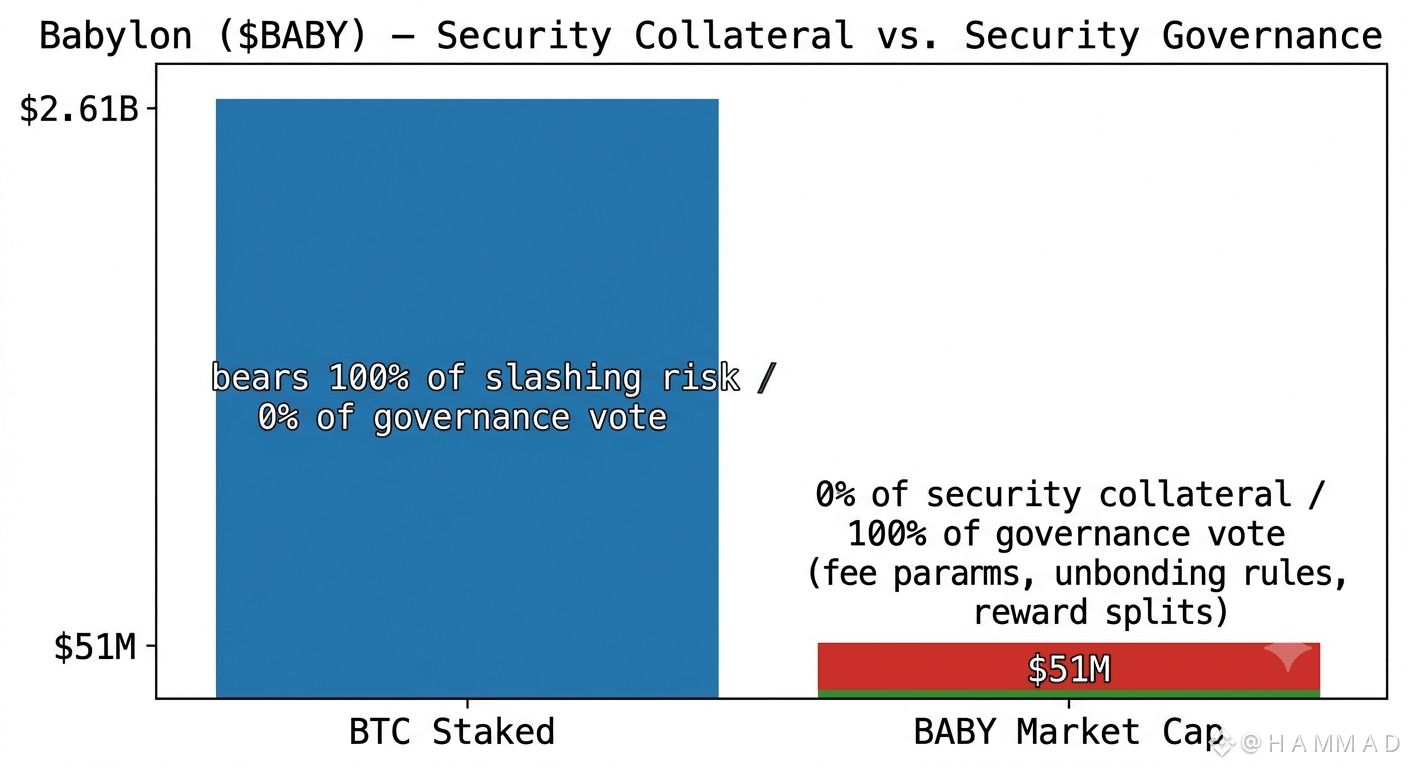
Pulled the live numbers mid-task: $2.61B in BTC actually staked and doing the securing, BABY market cap sitting around $51M. Two very different sized pools. But BABY's the only one that votes — fee params, unbonding windows, reward splits, all of it goes through BABY governance. Checked the docs twice to make sure I wasn't misreading it: BTC stakers, the ones actually carrying the slashing risk, don't get a ballot at all.
Went in assuming "Bitcoin secures it" meant Bitcoin holders also steer it. Had to walk that back. The enforcement really is on Bitcoin — EOTS, double-sign, burn — that part's automatic and doesn't ask anyone's permission. It's the configuration around it that's decided by a ~$51M token, not the $2.61B doing the actual work.
Not sure that's a flaw exactly, more just... a split I hadn't priced in. Who's actually "securing" a chain when the collateral and the control panel belong to two completely different crowds?
Spent today's Babylon ($BABY , #baby ) pass on @BabylonLabs_io whole "different view of security" pitch — borrow Bitcoin's economic weight instead of bootstrapping a fresh token from zero. Made sense on paper. Then I went looking at who actually controls the knobs on that security, and hold up — that's not quite what I expected.
Pulled the live numbers mid-task: $2.61B in BTC actually staked and doing the securing, BABY market cap sitting around $51M. Two very different sized pools. But BABY's the only one that votes — fee params, unbonding windows, reward splits, all of it goes through BABY governance. Checked the docs twice to make sure I wasn't misreading it: BTC stakers, the ones actually carrying the slashing risk, don't get a ballot at all.
Went in assuming "Bitcoin secures it" meant Bitcoin holders also steer it. Had to walk that back. The enforcement really is on Bitcoin — EOTS, double-sign, burn — that part's automatic and doesn't ask anyone's permission. It's the configuration around it that's decided by a ~$51M token, not the $2.61B doing the actual work.
Not sure that's a flaw exactly, more just... a split I hadn't priced in. Who's actually "securing" a chain when the collateral and the control panel belong to two completely different crowds?
Pulled the live numbers mid-task: $2.61B in BTC actually staked and doing the securing, BABY market cap sitting around $51M. Two very different sized pools. But BABY's the only one that votes — fee params, unbonding windows, reward splits, all of it goes through BABY governance. Checked the docs twice to make sure I wasn't misreading it: BTC stakers, the ones actually carrying the slashing risk, don't get a ballot at all.
Went in assuming "Bitcoin secures it" meant Bitcoin holders also steer it. Had to walk that back. The enforcement really is on Bitcoin — EOTS, double-sign, burn — that part's automatic and doesn't ask anyone's permission. It's the configuration around it that's decided by a ~$51M token, not the $2.61B doing the actual work.
Not sure that's a flaw exactly, more just... a split I hadn't priced in. Who's actually "securing" a chain when the collateral and the control panel belong to two completely different crowds?
24
14
824
·
--
See translation
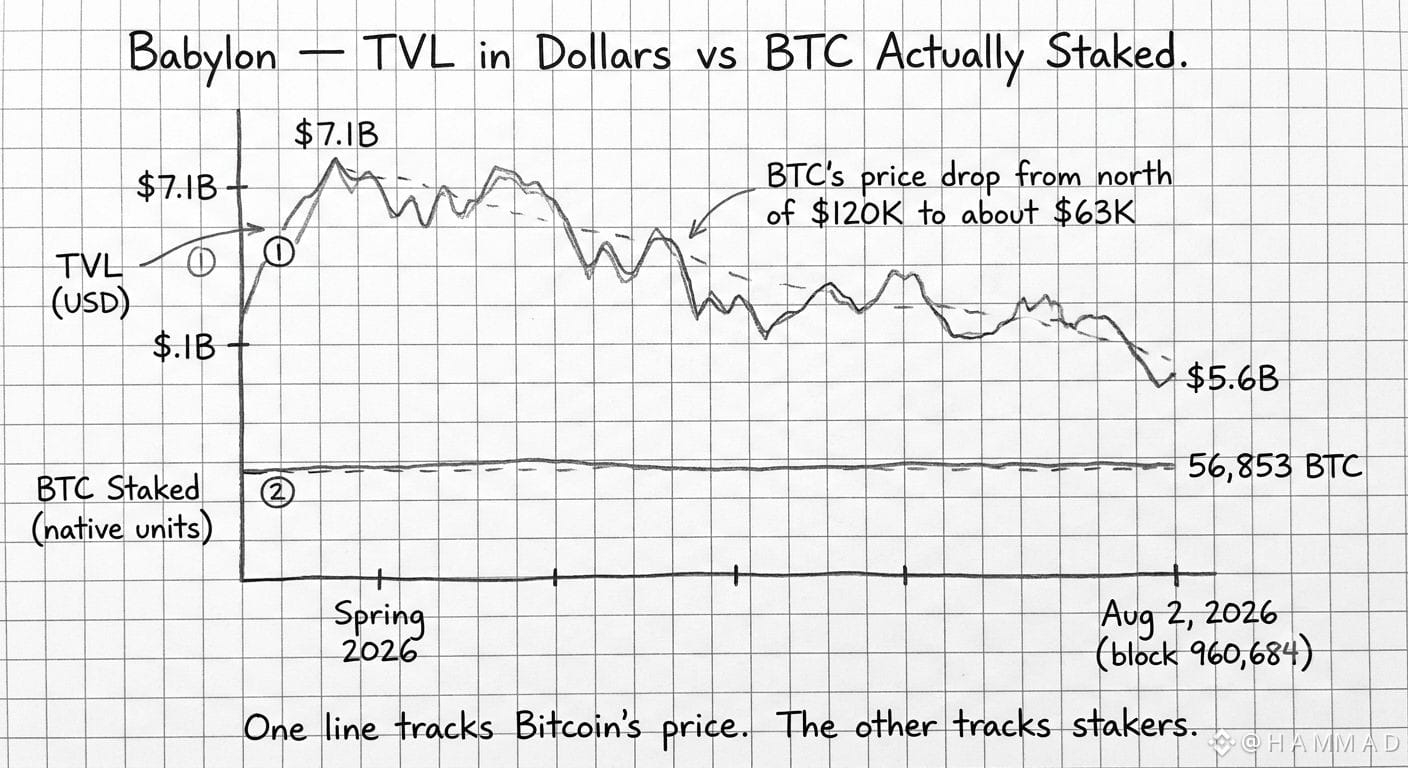
Was mid-task on Babylon (@babylonlabs_io ) — #baby , $BABY — checking the live staking widget on their site, block 960,684 as of the snapshot, and did a double take at the BTC figure. 56,853.16 BTC staked. Wrote it down. Then, hold up — went digging through older cached versions of that same page to compare.
Same number. Basically the same number back when BTC was still north of $120K, and now, with BTC sitting closer to $63K after giving back a big chunk of that. The dollar TVL headline swung from above $7.1B at the peak down to about $5.6B now — looks like a big move on a chart. The actual BTC people have locked barely shifted at all.
Sat with that a second. All those "TVL surges" and "TVL drops" articles I've read about this project — most of them are just narrating Bitcoin's own price chart wearing a Babylon costume, not stakers actually leaving or piling in.
Not sure that's even a bad thing, honestly, might be the opposite. But it does make me wonder how many "TVL crashed" headlines across this whole sector are really just BTC being BTC.
Was mid-task on Babylon (@BabylonLabs_io ) — #baby , $BABY — checking the live staking widget on their site, block 960,684 as of the snapshot, and did a double take at the BTC figure. 56,853.16 BTC staked. Wrote it down. Then, hold up — went digging through older cached versions of that same page to compare.
Same number. Basically the same number back when BTC was still north of $120K, and now, with BTC sitting closer to $63K after giving back a big chunk of that. The dollar TVL headline swung from above $7.1B at the peak down to about $5.6B now — looks like a big move on a chart. The actual BTC people have locked barely shifted at all.
Sat with that a second. All those "TVL surges" and "TVL drops" articles I've read about this project — most of them are just narrating Bitcoin's own price chart wearing a Babylon costume, not stakers actually leaving or piling in.
Not sure that's even a bad thing, honestly, might be the opposite. But it does make me wonder how many "TVL crashed" headlines across this whole sector are really just BTC being BTC.
Same number. Basically the same number back when BTC was still north of $120K, and now, with BTC sitting closer to $63K after giving back a big chunk of that. The dollar TVL headline swung from above $7.1B at the peak down to about $5.6B now — looks like a big move on a chart. The actual BTC people have locked barely shifted at all.
Sat with that a second. All those "TVL surges" and "TVL drops" articles I've read about this project — most of them are just narrating Bitcoin's own price chart wearing a Babylon costume, not stakers actually leaving or piling in.
Not sure that's even a bad thing, honestly, might be the opposite. But it does make me wonder how many "TVL crashed" headlines across this whole sector are really just BTC being BTC.
9
9
945
·
--
Partly True
See translation
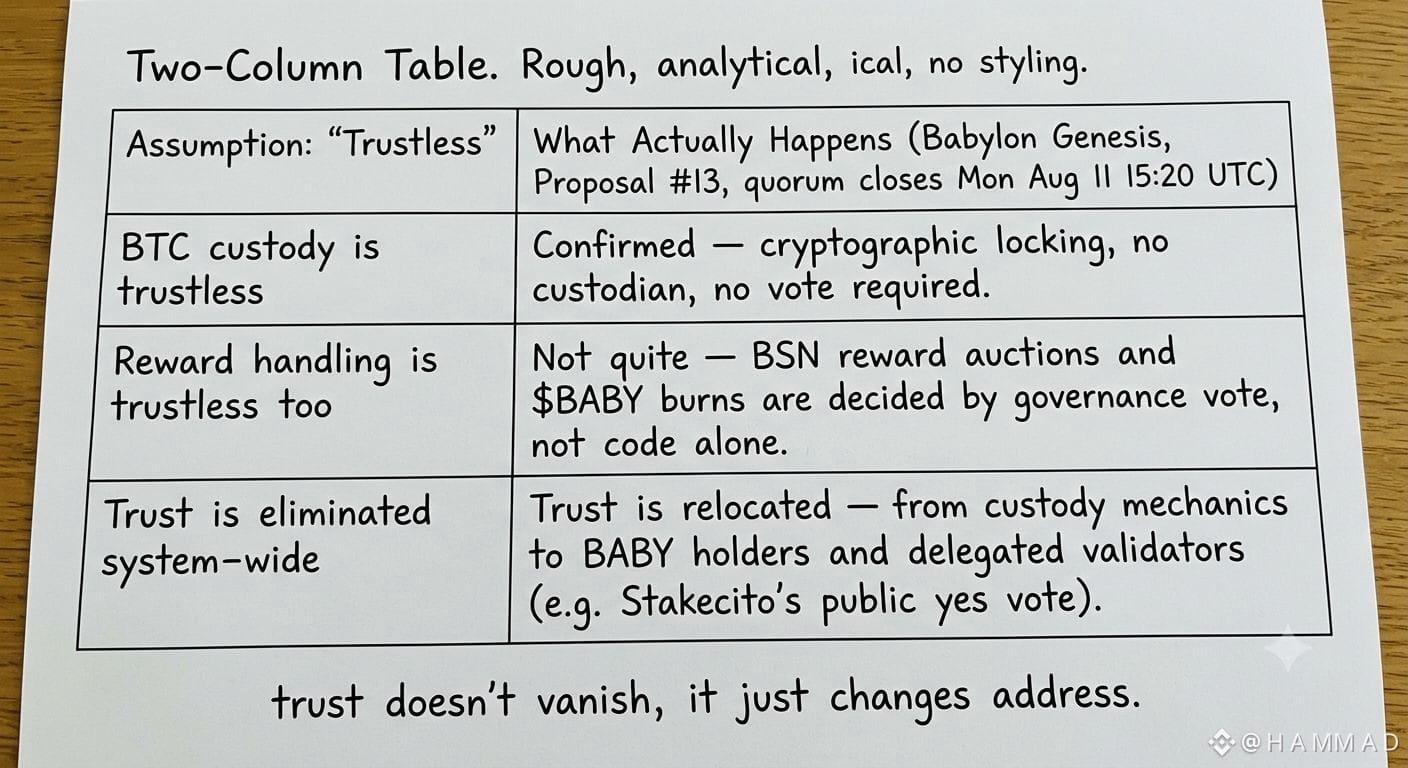
Was mid-task on Babylon (@babylonlabs_io ) and got tripped up on a word choice, of all things — "trustless." Kept seeing it plastered everywhere. Then I actually read what governance proposal #13 does — live now on Babylon Genesis, quorum closing Mon Aug 11 15:20 UTC, deciding whether BSN rewards get auctioned and burned in $BABY — and realized none of that trustlessness applies here. This is a straight-up vote. Humans deciding. Validators like Stakecito publicly weighing in with reasoning before casting yes.
That's the part that stuck. The BTC-locking side genuinely is trustless — cryptographic, no custodian, no vote needed. But the second you move past custody into "what happens with the rewards," Babylon quietly swaps trustless math for old-fashioned governance trust. You're trusting BABY holders and their delegated validators to make a decision in your interest.
Sat with that a second longer than expected… half expected to feel let down, like I'd caught a contradiction. Didn't, really. Feels more honest than pretending the whole stack is trustless top to bottom. Trust just moves to a different spot instead of disappearing.
Still not sure that's a downgrade or just what "trust" actually has to look like once humans are involved anywhere in the loop.
#baby $BABY
Was mid-task on Babylon (@BabylonLabs_io ) and got tripped up on a word choice, of all things — "trustless." Kept seeing it plastered everywhere. Then I actually read what governance proposal #13 does — live now on Babylon Genesis, quorum closing Mon Aug 11 15:20 UTC, deciding whether BSN rewards get auctioned and burned in $BABY — and realized none of that trustlessness applies here. This is a straight-up vote. Humans deciding. Validators like Stakecito publicly weighing in with reasoning before casting yes.
That's the part that stuck. The BTC-locking side genuinely is trustless — cryptographic, no custodian, no vote needed. But the second you move past custody into "what happens with the rewards," Babylon quietly swaps trustless math for old-fashioned governance trust. You're trusting BABY holders and their delegated validators to make a decision in your interest.
Sat with that a second longer than expected… half expected to feel let down, like I'd caught a contradiction. Didn't, really. Feels more honest than pretending the whole stack is trustless top to bottom. Trust just moves to a different spot instead of disappearing.
Still not sure that's a downgrade or just what "trust" actually has to look like once humans are involved anywhere in the loop.
#baby $BABY
That's the part that stuck. The BTC-locking side genuinely is trustless — cryptographic, no custodian, no vote needed. But the second you move past custody into "what happens with the rewards," Babylon quietly swaps trustless math for old-fashioned governance trust. You're trusting BABY holders and their delegated validators to make a decision in your interest.
Sat with that a second longer than expected… half expected to feel let down, like I'd caught a contradiction. Didn't, really. Feels more honest than pretending the whole stack is trustless top to bottom. Trust just moves to a different spot instead of disappearing.
Still not sure that's a downgrade or just what "trust" actually has to look like once humans are involved anywhere in the loop.
#baby $BABY
12
10
1.1k
·
--
Partly True
See translation
Almost skipped past this while snacking through the docs, but the slashing section stopped me mid-scroll. Everyone talks about Babylon $BABY #baby @babylonlabs_io as "Bitcoin staking without bridges," and yeah, that's the headline. But the overlooked part is what happens when something actually goes wrong.
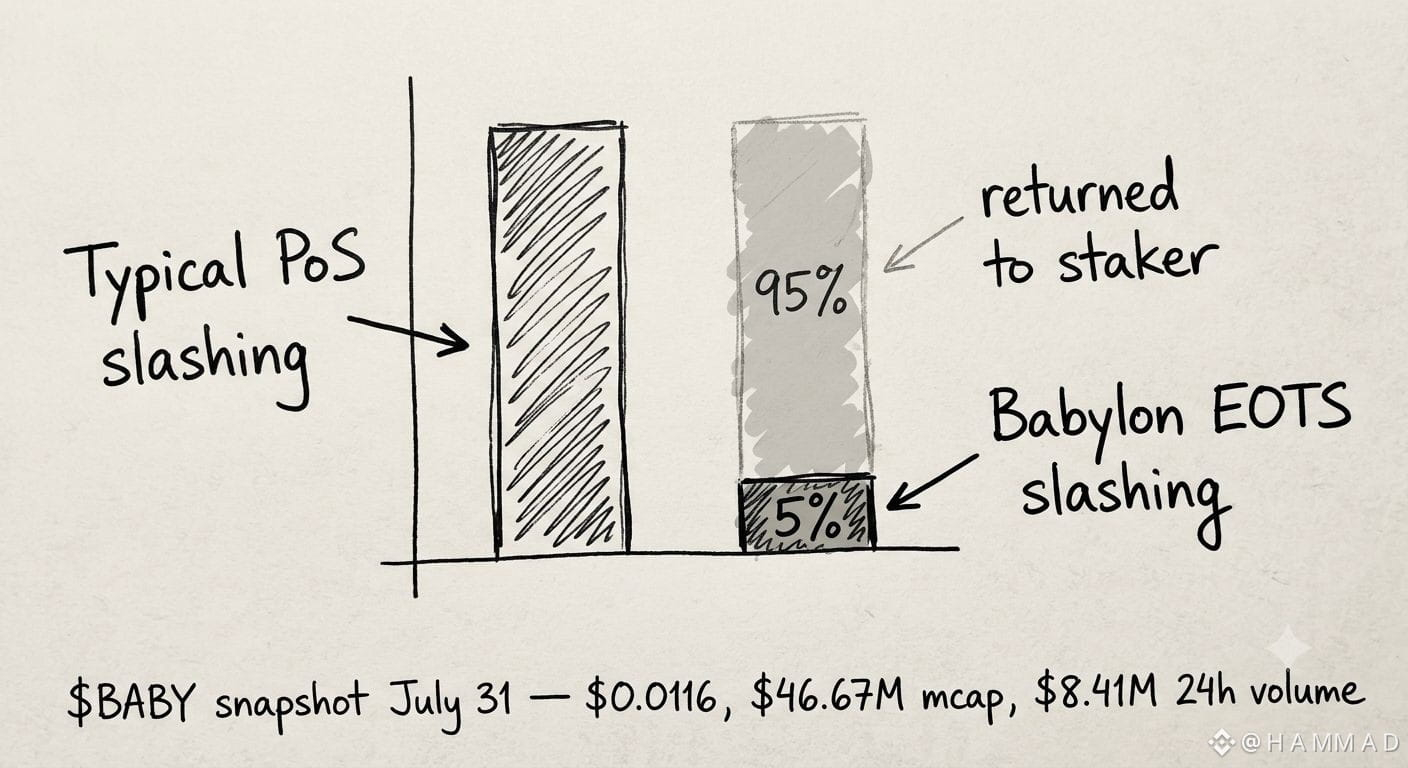
Most PoS chains I've delegated on, double-sign and you lose the whole bag, or close to it. Babylon's EOTS slashing only burns 5% of the delegated amount, the remaining 95% goes back to the staker. Checked this against the current snapshot too — $BABY sitting at $0.0116 as of July 31, market cap $46.67M, 24h volume $8.41M, small but liquid enough that slashing risk isn't just theoretical, people are actually positioned here.
I'd assumed BTC-backed staking meant BTC-level severity if a finality provider misbehaves… turns out the punishment is calibrated way softer than the underlying asset's reputation would suggest. Hold up — that's either smart risk design or it just quietly weakens the deterrent, and I genuinely can't tell which yet.
Spent ten minutes comparing finality provider slashing histories on the explorer before remembering I hadn't picked one myself.
Does softer slashing protect stakers, or just soften the incentive to pick providers carefully?
Almost skipped past this while snacking through the docs, but the slashing section stopped me mid-scroll. Everyone talks about Babylon $BABY #baby @BabylonLabs_io as "Bitcoin staking without bridges," and yeah, that's the headline. But the overlooked part is what happens when something actually goes wrong.
Most PoS chains I've delegated on, double-sign and you lose the whole bag, or close to it. Babylon's EOTS slashing only burns 5% of the delegated amount, the remaining 95% goes back to the staker. Checked this against the current snapshot too — $BABY sitting at $0.0116 as of July 31, market cap $46.67M, 24h volume $8.41M, small but liquid enough that slashing risk isn't just theoretical, people are actually positioned here.
I'd assumed BTC-backed staking meant BTC-level severity if a finality provider misbehaves… turns out the punishment is calibrated way softer than the underlying asset's reputation would suggest. Hold up — that's either smart risk design or it just quietly weakens the deterrent, and I genuinely can't tell which yet.
Spent ten minutes comparing finality provider slashing histories on the explorer before remembering I hadn't picked one myself.
Does softer slashing protect stakers, or just soften the incentive to pick providers carefully?
Most PoS chains I've delegated on, double-sign and you lose the whole bag, or close to it. Babylon's EOTS slashing only burns 5% of the delegated amount, the remaining 95% goes back to the staker. Checked this against the current snapshot too — $BABY sitting at $0.0116 as of July 31, market cap $46.67M, 24h volume $8.41M, small but liquid enough that slashing risk isn't just theoretical, people are actually positioned here.
I'd assumed BTC-backed staking meant BTC-level severity if a finality provider misbehaves… turns out the punishment is calibrated way softer than the underlying asset's reputation would suggest. Hold up — that's either smart risk design or it just quietly weakens the deterrent, and I genuinely can't tell which yet.
Spent ten minutes comparing finality provider slashing histories on the explorer before remembering I hadn't picked one myself.
Does softer slashing protect stakers, or just soften the incentive to pick providers carefully?
12
9
911
·
--
See translation
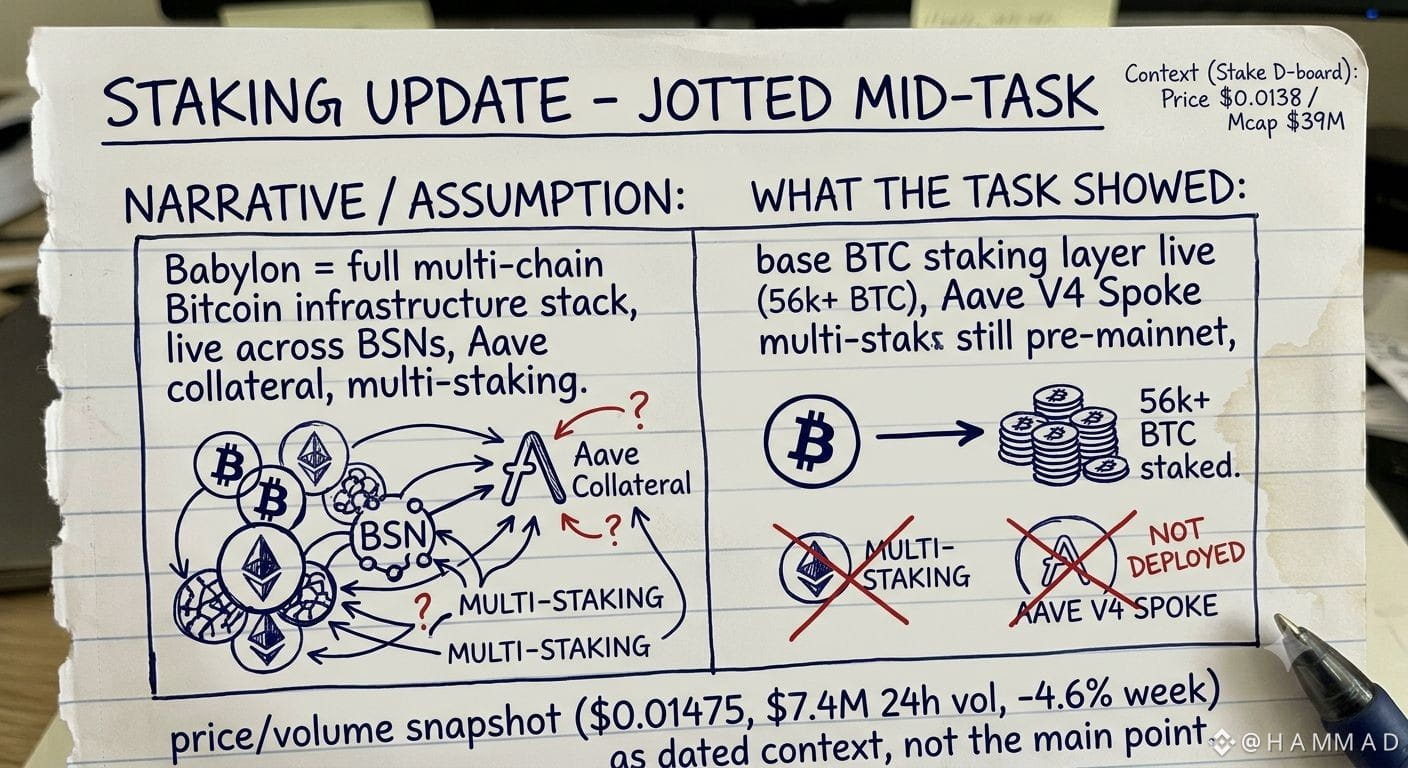
BABY sat at $0.01475 on the tracker when I opened the app today, $7.4M moving in the last 24 hours, still down about 4.6% across the week... so I started actually checking which parts of Babylon's "next-gen Bitcoin infrastructure" story are live versus just roadmap. Went through the docs and the forum instead of the marketing page. @babylonlabs_io has real scale on one layer, over 56,000 BTC locked through the base staking vaults, that part's genuinely running. But the pieces people keep citing as evolution, multi-staking across multiple BSNs, the Aave V4 native-BTC Spoke, those are still sitting at proposal or testnet stage, not settled infrastructure yet. I assumed BTCFi's "infrastructure layer" for $BABY meant several integrated systems already working together. It's actually one solid base layer plus a handful of things still in temp-check votes and integration announcements.
Went back and checked my own staked position twice just to confirm it's only touching the live layer and not something still pending. Old caution, but worth it here. #baby is real where it's live and aspirational where it isn't, and right now most of the conversation is about the aspirational part. Which layer is everyone actually pricing in.
BABY sat at $0.01475 on the tracker when I opened the app today, $7.4M moving in the last 24 hours, still down about 4.6% across the week... so I started actually checking which parts of Babylon's "next-gen Bitcoin infrastructure" story are live versus just roadmap. Went through the docs and the forum instead of the marketing page. @BabylonLabs_io has real scale on one layer, over 56,000 BTC locked through the base staking vaults, that part's genuinely running. But the pieces people keep citing as evolution, multi-staking across multiple BSNs, the Aave V4 native-BTC Spoke, those are still sitting at proposal or testnet stage, not settled infrastructure yet. I assumed BTCFi's "infrastructure layer" for $BABY meant several integrated systems already working together. It's actually one solid base layer plus a handful of things still in temp-check votes and integration announcements.
Went back and checked my own staked position twice just to confirm it's only touching the live layer and not something still pending. Old caution, but worth it here. #baby is real where it's live and aspirational where it isn't, and right now most of the conversation is about the aspirational part. Which layer is everyone actually pricing in.
Went back and checked my own staked position twice just to confirm it's only touching the live layer and not something still pending. Old caution, but worth it here. #baby is real where it's live and aspirational where it isn't, and right now most of the conversation is about the aspirational part. Which layer is everyone actually pricing in.
4
1
348
·
--
Partly True
See translation
Almost skipped past the unbonding period today — figured it was just fine print. Wasn't.
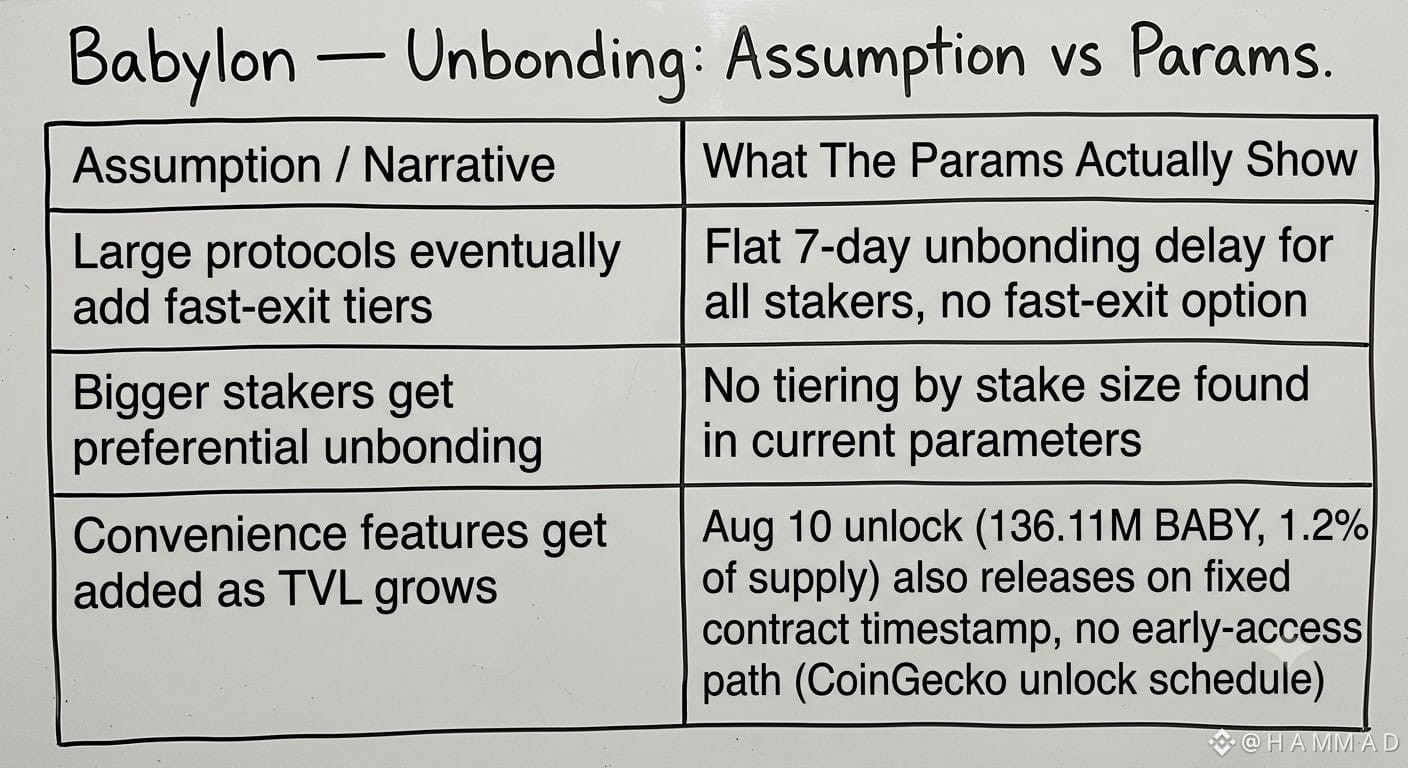
Anchor for the day: checked the Babylon staking parameters mid-task, unbonding sits at a flat 7-day delay after you request unstake, no fast-exit tier, no premium option to skip the line. Same day, saw the next $BABY unlock scheduled for Aug 10 — 136.11M tokens, 1.2% of supply — releasing on a fixed contract-coded timestamp, no early-access carveout there either (CoinGecko unlock schedule).
That's the thing that actually stuck. Most protocols chasing TVL add convenience features over time — instant unbonds, flexible restaking, liquid wrappers that let you skip the wait. Babylon just... hasn't. The friction stays. Stakers eat the same 7-day delay regardless of size or tenure, and the timelock spending condition on the Bitcoin side doesn't bend for anyone. It's not that they can't build faster exits, it's that faster exits widen the attack surface on a system securing billions in native BTC.
Kept refreshing the params page half-expecting to find some VIP unbonding tier buried somewhere. Never found one, which honestly surprised me more than it should have.
Makes me wonder how long that discipline holds once TVL competition gets tighter.
@babylonlabs_io $BABY #baby
Almost skipped past the unbonding period today — figured it was just fine print. Wasn't.
Anchor for the day: checked the Babylon staking parameters mid-task, unbonding sits at a flat 7-day delay after you request unstake, no fast-exit tier, no premium option to skip the line. Same day, saw the next $BABY unlock scheduled for Aug 10 — 136.11M tokens, 1.2% of supply — releasing on a fixed contract-coded timestamp, no early-access carveout there either (CoinGecko unlock schedule).
That's the thing that actually stuck. Most protocols chasing TVL add convenience features over time — instant unbonds, flexible restaking, liquid wrappers that let you skip the wait. Babylon just... hasn't. The friction stays. Stakers eat the same 7-day delay regardless of size or tenure, and the timelock spending condition on the Bitcoin side doesn't bend for anyone. It's not that they can't build faster exits, it's that faster exits widen the attack surface on a system securing billions in native BTC.
Kept refreshing the params page half-expecting to find some VIP unbonding tier buried somewhere. Never found one, which honestly surprised me more than it should have.
Makes me wonder how long that discipline holds once TVL competition gets tighter.
@BabylonLabs_io $BABY #baby
Anchor for the day: checked the Babylon staking parameters mid-task, unbonding sits at a flat 7-day delay after you request unstake, no fast-exit tier, no premium option to skip the line. Same day, saw the next $BABY unlock scheduled for Aug 10 — 136.11M tokens, 1.2% of supply — releasing on a fixed contract-coded timestamp, no early-access carveout there either (CoinGecko unlock schedule).
That's the thing that actually stuck. Most protocols chasing TVL add convenience features over time — instant unbonds, flexible restaking, liquid wrappers that let you skip the wait. Babylon just... hasn't. The friction stays. Stakers eat the same 7-day delay regardless of size or tenure, and the timelock spending condition on the Bitcoin side doesn't bend for anyone. It's not that they can't build faster exits, it's that faster exits widen the attack surface on a system securing billions in native BTC.
Kept refreshing the params page half-expecting to find some VIP unbonding tier buried somewhere. Never found one, which honestly surprised me more than it should have.
Makes me wonder how long that discipline holds once TVL competition gets tighter.
@BabylonLabs_io $BABY #baby
14
10
1.3k
·
--
See translation
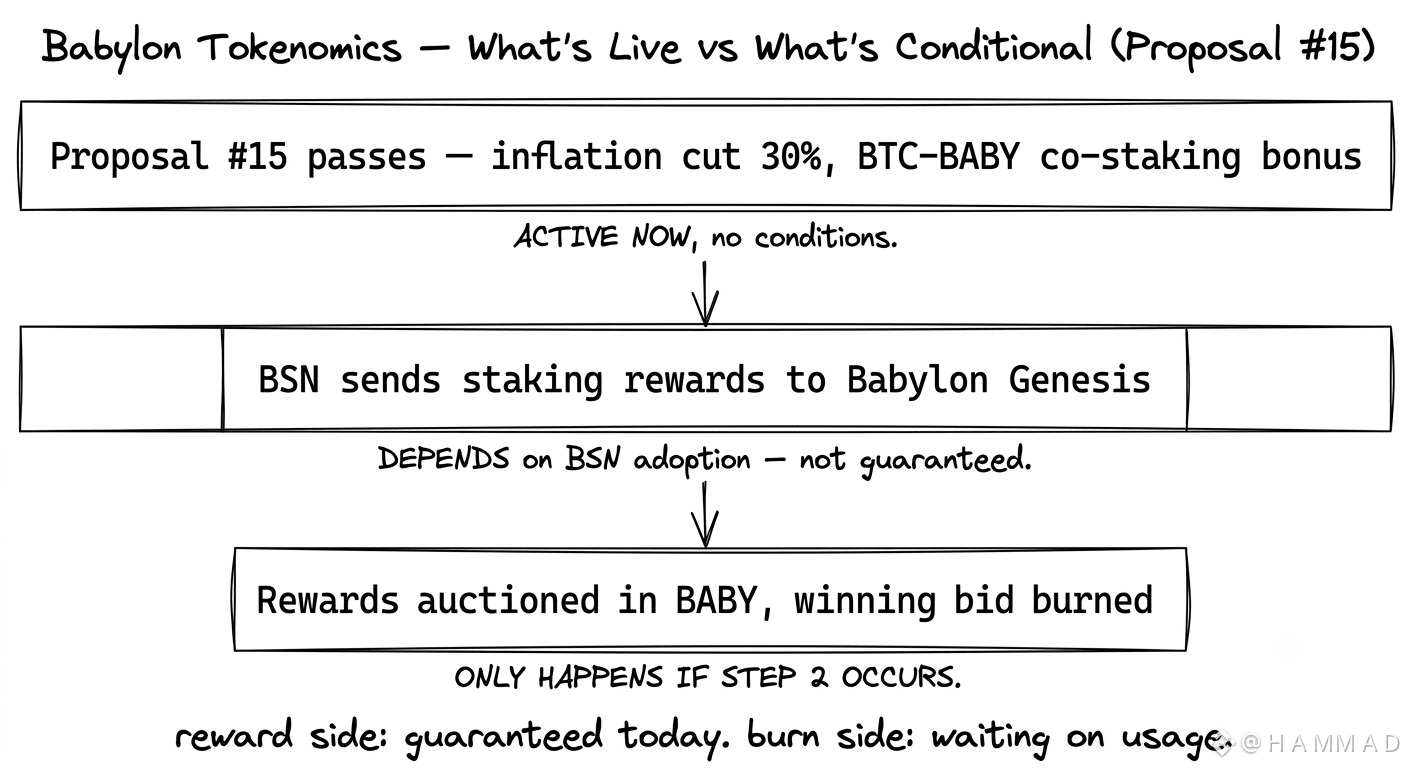
Was reading through mintscan on proposal #15 again — passed, inflation cut 30%, co-staking bonus live — and this time the line that caught me was buried further down: BSN reward auctions, winning bid burned. Babylon $BABY #baby @babylonlabs_io
First pass I read that as "deflationary token, nice." Second pass, hold up — the burn only fires once a Bitcoin Secured Network actually sends rewards through the auction. No BSN volume, no burn. So the whole deflationary pitch is conditional, not automatic. Meanwhile the inflation cut and co-staking bump are live right now, today, regardless of adoption. That's the actual economic logic underneath — reward the people staking now, guaranteed, and make the scarcity story a bet on future usage nobody's obligated to deliver.
Kind of reframed how I was reading the tokenomics doc. I'd been treating "8% inflation, burn mechanism" as one balanced sentence. It's not balanced at all — one side is running today, the other side is sitting on a shelf waiting for BSNs to show up and start bidding.
Makes sense as a growth incentive. Front-load the certain reward, back-load the scarcity. Just... not sure how many people staking right now are pricing in that the burn side might stay theoretical for a while.
Was reading through mintscan on proposal #15 again — passed, inflation cut 30%, co-staking bonus live — and this time the line that caught me was buried further down: BSN reward auctions, winning bid burned. Babylon $BABY #baby @BabylonLabs_io
First pass I read that as "deflationary token, nice." Second pass, hold up — the burn only fires once a Bitcoin Secured Network actually sends rewards through the auction. No BSN volume, no burn. So the whole deflationary pitch is conditional, not automatic. Meanwhile the inflation cut and co-staking bump are live right now, today, regardless of adoption. That's the actual economic logic underneath — reward the people staking now, guaranteed, and make the scarcity story a bet on future usage nobody's obligated to deliver.
Kind of reframed how I was reading the tokenomics doc. I'd been treating "8% inflation, burn mechanism" as one balanced sentence. It's not balanced at all — one side is running today, the other side is sitting on a shelf waiting for BSNs to show up and start bidding.
Makes sense as a growth incentive. Front-load the certain reward, back-load the scarcity. Just... not sure how many people staking right now are pricing in that the burn side might stay theoretical for a while.
First pass I read that as "deflationary token, nice." Second pass, hold up — the burn only fires once a Bitcoin Secured Network actually sends rewards through the auction. No BSN volume, no burn. So the whole deflationary pitch is conditional, not automatic. Meanwhile the inflation cut and co-staking bump are live right now, today, regardless of adoption. That's the actual economic logic underneath — reward the people staking now, guaranteed, and make the scarcity story a bet on future usage nobody's obligated to deliver.
Kind of reframed how I was reading the tokenomics doc. I'd been treating "8% inflation, burn mechanism" as one balanced sentence. It's not balanced at all — one side is running today, the other side is sitting on a shelf waiting for BSNs to show up and start bidding.
Makes sense as a growth incentive. Front-load the certain reward, back-load the scarcity. Just... not sure how many people staking right now are pricing in that the burn side might stay theoretical for a while.
1
1
81
·
--
See translation
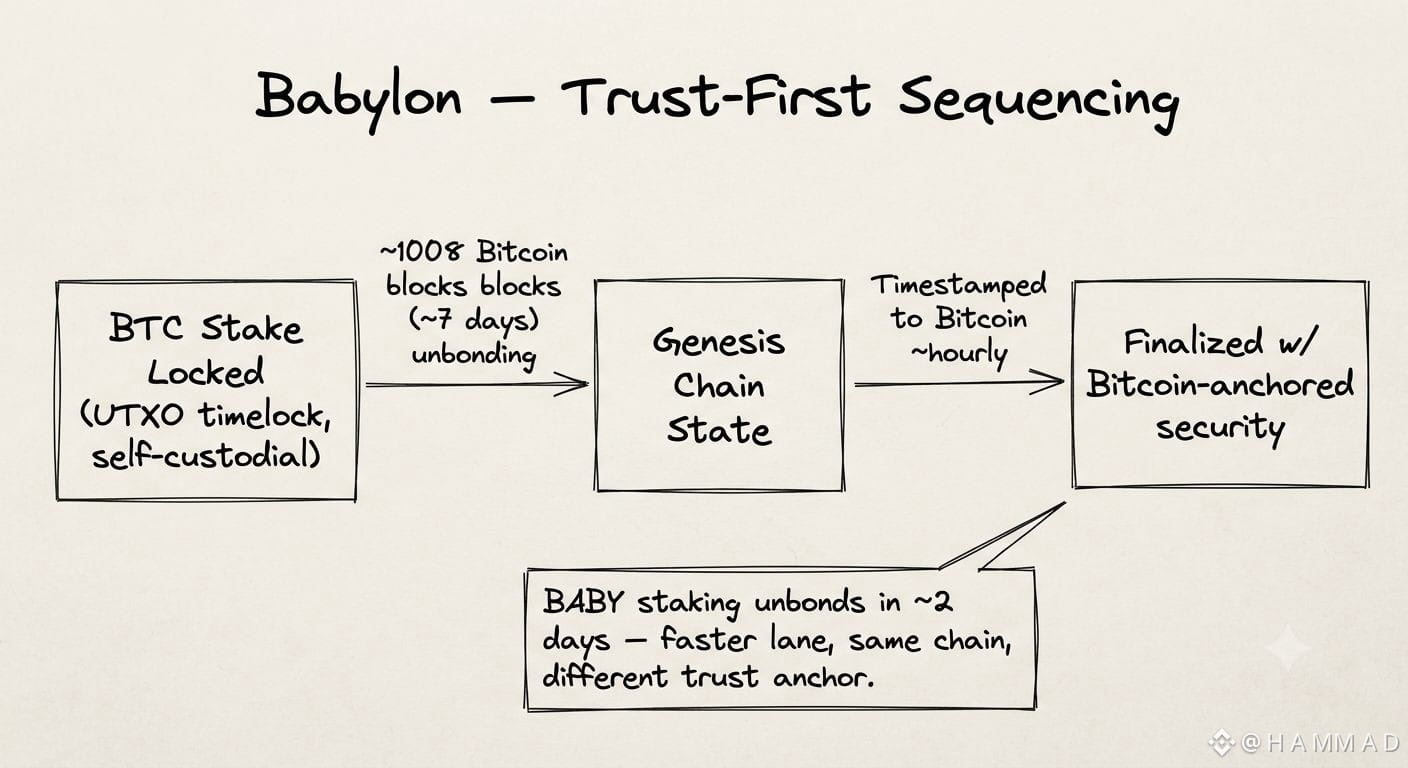
Ran the Babylon task expecting some slick "fast staking" pitch... got the opposite. Babylon, $BABY , #baby , @babylonlabs_io — the whole design leans slow on purpose, and that's the part that actually stuck.
BTC staking unbonds over roughly 1008 Bitcoin blocks, about 7 days minimum. And the Genesis chain doesn't just trust its own consensus — it timestamps state back to the Bitcoin base layer roughly every hour. So the chain is constantly checking its work against something slower and heavier than itself. Hmm... that's not a speed choice, that's a trust choice. Most PoS chains optimize for fast finality first and bolt security on after. Babylon inverted it — security cadence set the pace, speed had to fit around it.
I caught myself getting mildly impatient during the task, refreshing for confirmations like I would on any other chain... then remembered the whole point is that it's not supposed to move at that rhythm. Felt a little dumb honestly. The friction isn't a bug in the UX, it's the actual product — Bitcoin's slowness is what's being sold as security, not worked around.
Still not sure how that holds up once BSNs multiply and everyone wants faster settlement anyway. Does trust-first design survive contact with actual demand for speed, or does it quietly get optimized away?
Ran the Babylon task expecting some slick "fast staking" pitch... got the opposite. Babylon, $BABY , #baby , @BabylonLabs_io — the whole design leans slow on purpose, and that's the part that actually stuck.
BTC staking unbonds over roughly 1008 Bitcoin blocks, about 7 days minimum. And the Genesis chain doesn't just trust its own consensus — it timestamps state back to the Bitcoin base layer roughly every hour. So the chain is constantly checking its work against something slower and heavier than itself. Hmm... that's not a speed choice, that's a trust choice. Most PoS chains optimize for fast finality first and bolt security on after. Babylon inverted it — security cadence set the pace, speed had to fit around it.
I caught myself getting mildly impatient during the task, refreshing for confirmations like I would on any other chain... then remembered the whole point is that it's not supposed to move at that rhythm. Felt a little dumb honestly. The friction isn't a bug in the UX, it's the actual product — Bitcoin's slowness is what's being sold as security, not worked around.
Still not sure how that holds up once BSNs multiply and everyone wants faster settlement anyway. Does trust-first design survive contact with actual demand for speed, or does it quietly get optimized away?
BTC staking unbonds over roughly 1008 Bitcoin blocks, about 7 days minimum. And the Genesis chain doesn't just trust its own consensus — it timestamps state back to the Bitcoin base layer roughly every hour. So the chain is constantly checking its work against something slower and heavier than itself. Hmm... that's not a speed choice, that's a trust choice. Most PoS chains optimize for fast finality first and bolt security on after. Babylon inverted it — security cadence set the pace, speed had to fit around it.
I caught myself getting mildly impatient during the task, refreshing for confirmations like I would on any other chain... then remembered the whole point is that it's not supposed to move at that rhythm. Felt a little dumb honestly. The friction isn't a bug in the UX, it's the actual product — Bitcoin's slowness is what's being sold as security, not worked around.
Still not sure how that holds up once BSNs multiply and everyone wants faster settlement anyway. Does trust-first design survive contact with actual demand for speed, or does it quietly get optimized away?
3
84
Log in to explore more content
Join global crypto users on Binance Square
⚡️ Get latest and useful information about crypto.
💬 Trusted by the world’s largest crypto exchange.
👍 Discover real insights from verified creators.
Email / Phone number
Trending Topics
AppleDebutsFoldablePhone
42,105 views
839 Discussing
Apple just dropped the foldable iPhone — and the market is paying attention. This isn't just another product cycle; it's a new product category, a new CEO on stage, and a $1,999 price tag that pushes $AAPL further into ultra-premium territory. Foldables are the narrative, and Apple is now the headline.
#appledebutsfoldablephone #EUExtendsCentralContactPointToCASPs #US10YTreasuryYieldHitsHighestSinceNov2023 #BrentCrudeTops$100 #USTreasuryToBuyBackUpTo$6BLongDatedDebt
KimHotbae
·2 Likes
·2.9k views
TSMCAugustRevenueUp53.3%YoY
9,198 views
266 Discussing
IranSaysReadyToEscalateWarWithUS
11,899 views
274 Discussing