
Linkrypto
23 Posts
Linkrypto
Report
Block User
50 Following
52 Followers
29 Liked
Posts
All
Videos
·
--
See translation
Innovation matters, but execution matters even more. Looking forward to ANOME's next steps. $ANOME
Innovation matters, but execution matters even more. Looking forward to ANOME's next steps. $ANOME
132
·
--
Article
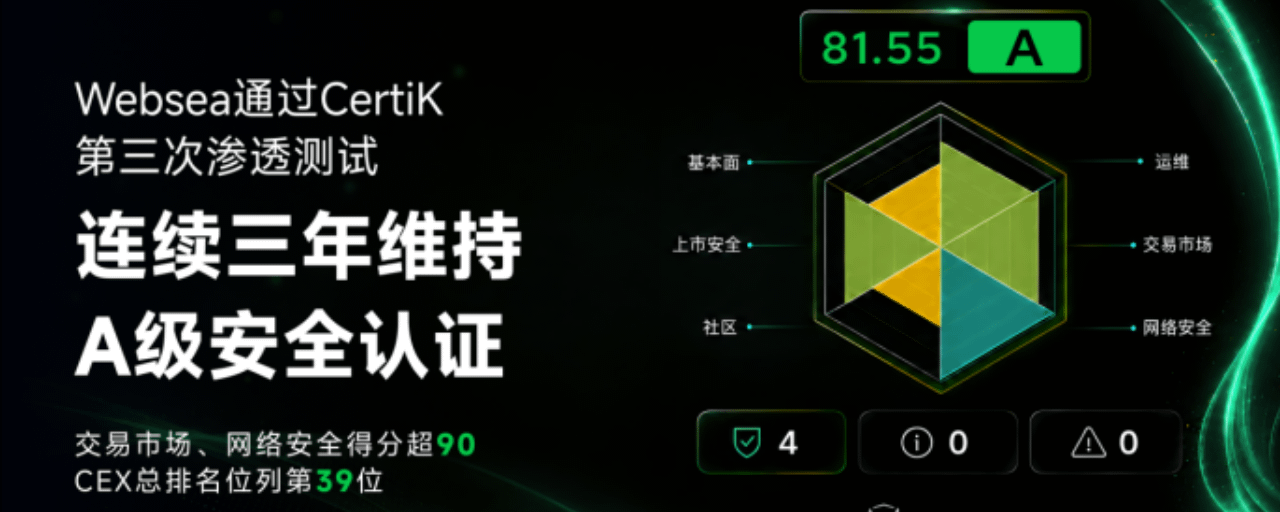
Websea’s security rating remains consistently at CertiK Grade A for 3 consecutive years, with innovative products providing users with dual protection of safety and returnsRecently, global leading Web3 security organization CertiK released its third round of penetration testing report for the Websea exchange. The report shows that Websea’s overall score is 81.55, and its security rating has continuously maintained Grade A for three years. In the global CEX exchange security ranking, it ranks 39th. To date, Websea has received CertiK’s Grade A security rating for three consecutive years, with its security capabilities firmly among the industry’s best.
CertiK audit full coverage: six dimensions, risk is 0
According to CertiK Skynet’s latest audit report, Websea performed exceptionally well in this comprehensive security assessment. It scored over 90 points in both the trading market and network security dimensions. This evaluation covers core areas including smart contract security, system architecture stability, risk control mechanisms, and asset protection capabilities. From fundamentals, operations, trading market, network security, listing security to community building, Websea has undergone authoritative third-party audits across all six dimensions.
Websea’s security rating remains consistently at CertiK Grade A for 3 consecutive years, with innovative products providing users with dual protection of safety and returns
Recently, global leading Web3 security organization CertiK released its third round of penetration testing report for the Websea exchange. The report shows that Websea’s overall score is 81.55, and its security rating has continuously maintained Grade A for three years. In the global CEX exchange security ranking, it ranks 39th. To date, Websea has received CertiK’s Grade A security rating for three consecutive years, with its security capabilities firmly among the industry’s best.
CertiK audit full coverage: six dimensions, risk is 0
According to CertiK Skynet’s latest audit report, Websea performed exceptionally well in this comprehensive security assessment. It scored over 90 points in both the trading market and network security dimensions. This evaluation covers core areas including smart contract security, system architecture stability, risk control mechanisms, and asset protection capabilities. From fundamentals, operations, trading market, network security, listing security to community building, Websea has undergone authoritative third-party audits across all six dimensions.
CertiK audit full coverage: six dimensions, risk is 0
According to CertiK Skynet’s latest audit report, Websea performed exceptionally well in this comprehensive security assessment. It scored over 90 points in both the trading market and network security dimensions. This evaluation covers core areas including smart contract security, system architecture stability, risk control mechanisms, and asset protection capabilities. From fundamentals, operations, trading market, network security, listing security to community building, Websea has undergone authoritative third-party audits across all six dimensions.
74
·
--
Article
WEEX Labs: A Deep Dive into the Opportunities Behind Nvidia's Strategic HoldingsIn the AI supercycle, NVIDIA is ramping up its strategic positioning across the entire AI supply chain. They're no longer content just being the ‘shovel seller’ in the chip game; they're diving deep into both upstream and downstream sectors.
Within Nvidia's core investment portfolio exceeding $18 billion, Intel (INTC), CoreWeave (CRWV), Synopsys (SNPS), Coherent (COHR), and Nokia (NOK) are its top five key assets. Recently, Nvidia has been doubling down through direct purchases, convertible bonds, and hefty upfront payments, signaling the global AI supply chain is officially entering a new phase of ‘vertical integration’.
WEEX Labs: A Deep Dive into the Opportunities Behind Nvidia's Strategic Holdings
In the AI supercycle, NVIDIA is ramping up its strategic positioning across the entire AI supply chain. They're no longer content just being the ‘shovel seller’ in the chip game; they're diving deep into both upstream and downstream sectors.
Within Nvidia's core investment portfolio exceeding $18 billion, Intel (INTC), CoreWeave (CRWV), Synopsys (SNPS), Coherent (COHR), and Nokia (NOK) are its top five key assets. Recently, Nvidia has been doubling down through direct purchases, convertible bonds, and hefty upfront payments, signaling the global AI supply chain is officially entering a new phase of ‘vertical integration’.
Within Nvidia's core investment portfolio exceeding $18 billion, Intel (INTC), CoreWeave (CRWV), Synopsys (SNPS), Coherent (COHR), and Nokia (NOK) are its top five key assets. Recently, Nvidia has been doubling down through direct purchases, convertible bonds, and hefty upfront payments, signaling the global AI supply chain is officially entering a new phase of ‘vertical integration’.
1
208
·
--
Article
See translation
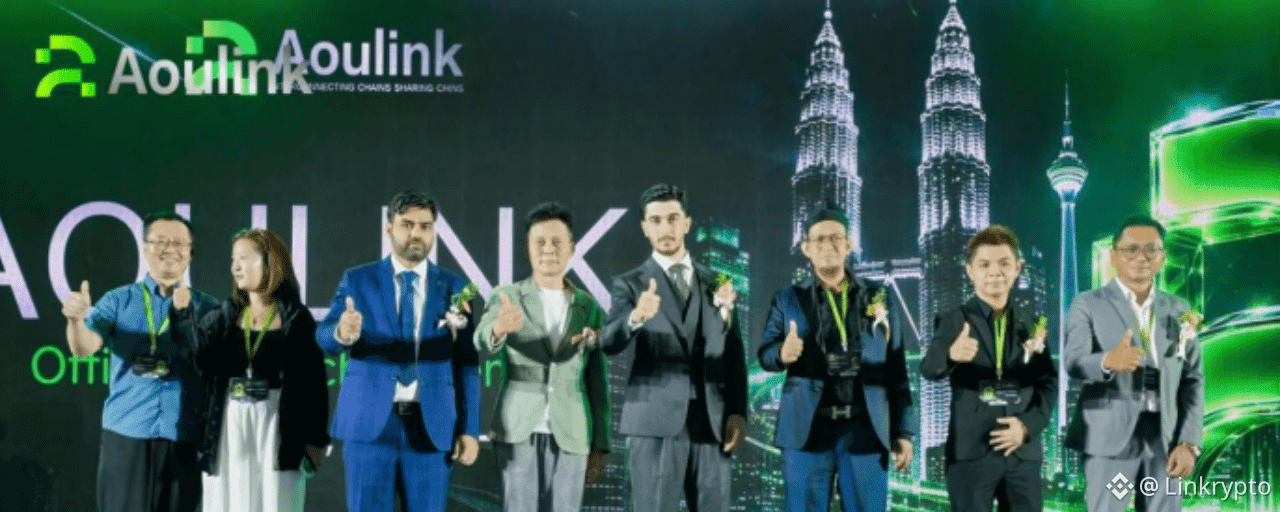
AOULINK Global Roadshow - Kuala Lumpur Station Concludes SuccessfullyOn May 25, 2026, the AOULINK Global Roadshow Kuala Lumpur, themed "Awakening Journey, Connecting the Future," was successfully held in Malaysia. This grand event brought together over a thousand industry leaders, representatives from top investment institutions, technology experts, and core community members from more than 20 countries and regions worldwide. The venue was packed, and the event received enthusiastic responses, making it one of the most influential annual industry events in the global digital finance sector.
This roadshow was a significant showcase of AOULINK's globalization strategy. The core team comprehensively disclosed its ecosystem development achievements and global strategic plans, and hosted multiple keynote speeches, roundtable forums, and an ecosystem achievement exhibition, providing in-depth analysis of the technological innovation and commercial value of decentralized finance. This event achieved a broad industry consensus: the launch of AOULINK provides a new model for compliant development in the industry and injects strong momentum into the innovative development of global digital finance.
AOULINK: Next-Generation On-Chain Financial Infrastructure
As a flagship Web3 project audited by the Interstellar Alliance, AOULINK is a complete decentralized finance ecosystem built on a high-performance transactional public chain, integrating trading, finance, wallets, and social networking. Its public chain, specifically designed for financial trading, supports over 1 million TPS and sub-second block generation, providing a smooth experience comparable to centralized exchanges. It has constructed three core profit engines: perpetual contracts, DeFi lending, and smart hedging quantitative trading. All revenue comes from real market transactions, with 90% directly distributed to liquidity providers and 10% used for token buybacks and burns. Currently, the project has obtained dual compliance licenses from the US SEC and MSB and has established a global operating system across multiple jurisdictions.
A landmark event that deepens the global ecological layout
This roadshow in Kuala Lumpur is a key step in AOULINK's globalization strategy. Malaysia, as a vital financial hub connecting East and West, boasts an open and inclusive digital economy ecosystem. This roadshow is not only an important platform for AOULINK to connect with global resources, but also a milestone event in its efforts to build a cross-regional collaborative network and advance its global ecosystem.
Through this grand event, AOULINK reached strategic cooperation agreements with several leading global investment institutions, blockchain communities, and fintech companies. The two parties will jointly promote the global adoption of decentralized financial services, provide global users with safe, compliant, and efficient digital financial solutions, and contribute to the coordinated development of the global digital economy.
Accelerating Global Expansion to Jointly Build the Future of Digital Finance
During this roadshow, AOULINK officially announced that starting in June 2026, it will launch a global monthly tour program with 1,000 participants, holding industry events in different countries and regions every month to continuously expand its ecosystem influence and connect global value consensus.
Over the next six months, the project will proceed as planned with key milestones such as the launch of the public beta version of the blockchain and the issuance of the AOU token mainnet. Within the year, it will open the platform to third-party developers, launch a 100 million RMB ecosystem funding program, and gradually implement the DAO governance system. AOULINK will always uphold its mission of "user sovereignty, value sharing, transparency, and trustworthiness," continuously improving its technological infrastructure and ecosystem applications, and is committed to building a globally leading decentralized financial system that allows everyone to participate equally in the global distribution of financial value.
AOULINK Global Roadshow - Kuala Lumpur Station Concludes Successfully
On May 25, 2026, the AOULINK Global Roadshow Kuala Lumpur, themed "Awakening Journey, Connecting the Future," was successfully held in Malaysia. This grand event brought together over a thousand industry leaders, representatives from top investment institutions, technology experts, and core community members from more than 20 countries and regions worldwide. The venue was packed, and the event received enthusiastic responses, making it one of the most influential annual industry events in the global digital finance sector.
This roadshow was a significant showcase of AOULINK's globalization strategy. The core team comprehensively disclosed its ecosystem development achievements and global strategic plans, and hosted multiple keynote speeches, roundtable forums, and an ecosystem achievement exhibition, providing in-depth analysis of the technological innovation and commercial value of decentralized finance. This event achieved a broad industry consensus: the launch of AOULINK provides a new model for compliant development in the industry and injects strong momentum into the innovative development of global digital finance.
AOULINK: Next-Generation On-Chain Financial Infrastructure
As a flagship Web3 project audited by the Interstellar Alliance, AOULINK is a complete decentralized finance ecosystem built on a high-performance transactional public chain, integrating trading, finance, wallets, and social networking. Its public chain, specifically designed for financial trading, supports over 1 million TPS and sub-second block generation, providing a smooth experience comparable to centralized exchanges. It has constructed three core profit engines: perpetual contracts, DeFi lending, and smart hedging quantitative trading. All revenue comes from real market transactions, with 90% directly distributed to liquidity providers and 10% used for token buybacks and burns. Currently, the project has obtained dual compliance licenses from the US SEC and MSB and has established a global operating system across multiple jurisdictions.
A landmark event that deepens the global ecological layout
This roadshow in Kuala Lumpur is a key step in AOULINK's globalization strategy. Malaysia, as a vital financial hub connecting East and West, boasts an open and inclusive digital economy ecosystem. This roadshow is not only an important platform for AOULINK to connect with global resources, but also a milestone event in its efforts to build a cross-regional collaborative network and advance its global ecosystem.
Through this grand event, AOULINK reached strategic cooperation agreements with several leading global investment institutions, blockchain communities, and fintech companies. The two parties will jointly promote the global adoption of decentralized financial services, provide global users with safe, compliant, and efficient digital financial solutions, and contribute to the coordinated development of the global digital economy.
Accelerating Global Expansion to Jointly Build the Future of Digital Finance
During this roadshow, AOULINK officially announced that starting in June 2026, it will launch a global monthly tour program with 1,000 participants, holding industry events in different countries and regions every month to continuously expand its ecosystem influence and connect global value consensus.
Over the next six months, the project will proceed as planned with key milestones such as the launch of the public beta version of the blockchain and the issuance of the AOU token mainnet. Within the year, it will open the platform to third-party developers, launch a 100 million RMB ecosystem funding program, and gradually implement the DAO governance system. AOULINK will always uphold its mission of "user sovereignty, value sharing, transparency, and trustworthiness," continuously improving its technological infrastructure and ecosystem applications, and is committed to building a globally leading decentralized financial system that allows everyone to participate equally in the global distribution of financial value.
This roadshow was a significant showcase of AOULINK's globalization strategy. The core team comprehensively disclosed its ecosystem development achievements and global strategic plans, and hosted multiple keynote speeches, roundtable forums, and an ecosystem achievement exhibition, providing in-depth analysis of the technological innovation and commercial value of decentralized finance. This event achieved a broad industry consensus: the launch of AOULINK provides a new model for compliant development in the industry and injects strong momentum into the innovative development of global digital finance.
AOULINK: Next-Generation On-Chain Financial Infrastructure
As a flagship Web3 project audited by the Interstellar Alliance, AOULINK is a complete decentralized finance ecosystem built on a high-performance transactional public chain, integrating trading, finance, wallets, and social networking. Its public chain, specifically designed for financial trading, supports over 1 million TPS and sub-second block generation, providing a smooth experience comparable to centralized exchanges. It has constructed three core profit engines: perpetual contracts, DeFi lending, and smart hedging quantitative trading. All revenue comes from real market transactions, with 90% directly distributed to liquidity providers and 10% used for token buybacks and burns. Currently, the project has obtained dual compliance licenses from the US SEC and MSB and has established a global operating system across multiple jurisdictions.
A landmark event that deepens the global ecological layout
This roadshow in Kuala Lumpur is a key step in AOULINK's globalization strategy. Malaysia, as a vital financial hub connecting East and West, boasts an open and inclusive digital economy ecosystem. This roadshow is not only an important platform for AOULINK to connect with global resources, but also a milestone event in its efforts to build a cross-regional collaborative network and advance its global ecosystem.
Through this grand event, AOULINK reached strategic cooperation agreements with several leading global investment institutions, blockchain communities, and fintech companies. The two parties will jointly promote the global adoption of decentralized financial services, provide global users with safe, compliant, and efficient digital financial solutions, and contribute to the coordinated development of the global digital economy.
Accelerating Global Expansion to Jointly Build the Future of Digital Finance
During this roadshow, AOULINK officially announced that starting in June 2026, it will launch a global monthly tour program with 1,000 participants, holding industry events in different countries and regions every month to continuously expand its ecosystem influence and connect global value consensus.
Over the next six months, the project will proceed as planned with key milestones such as the launch of the public beta version of the blockchain and the issuance of the AOU token mainnet. Within the year, it will open the platform to third-party developers, launch a 100 million RMB ecosystem funding program, and gradually implement the DAO governance system. AOULINK will always uphold its mission of "user sovereignty, value sharing, transparency, and trustworthiness," continuously improving its technological infrastructure and ecosystem applications, and is committed to building a globally leading decentralized financial system that allows everyone to participate equally in the global distribution of financial value.
99
·
--
Article
See translation
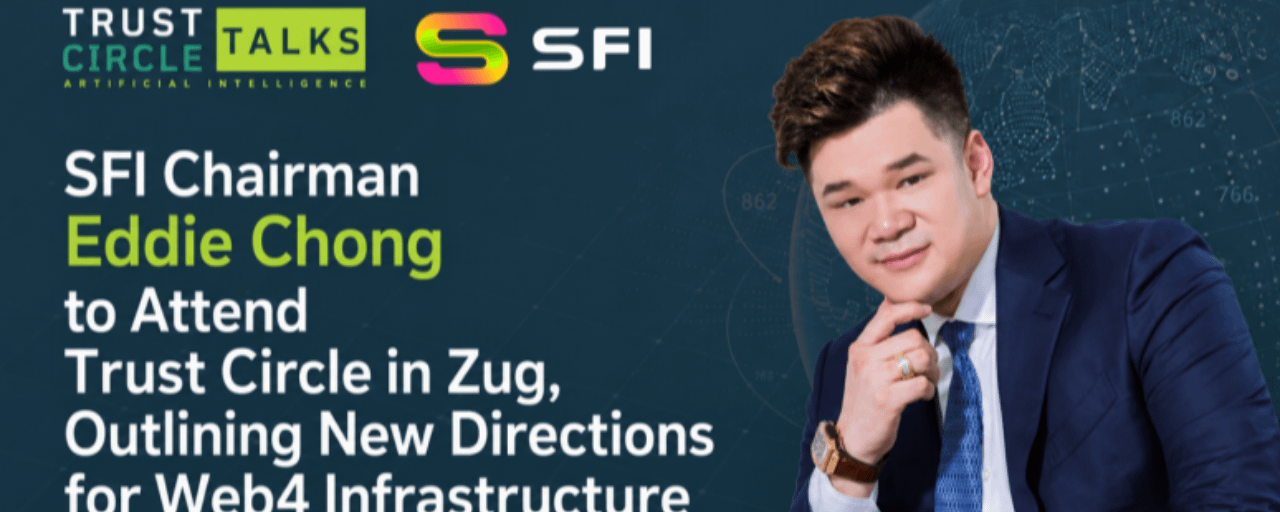
SFI Eddie Chong to Attend Trust Circle, Outlining New Web4 Infrastructure DirectionsOn May 29, 2026, Zug, Switzerland will host Trust Circle, a premier invitation‑only conference focused on sovereign AI infrastructure and the future of computing. The event will take place at SHED Zug, organized by AI Cluster Zug, and will gather only 100 core decision‑makers from AI, Web3, finance, and cybersecurity. SFI (StableCoin Financial Infrastructure) — a next‑generation value network platform built on a stablecoin foundation, deeply integrating Web4, RWA, and AI, and connecting payments, asset incubation, AI trading, and consumption scenarios — will have its chairman, Eddie Chong, attend as a keynote speaker. He will share the stage with heavyweights such as the Zug Cantonal Minister of Economic Affairs, NVIDIA’s Switzerland lead, and the head of AI at Julius Baer, to witness the soft launch of AI Cluster Zug. This participation marks a critical industrial step in Eddie Chong’s Swiss journey and signifies that SFI’s RWA+AI value network is being deeply integrated into global sovereign AI infrastructure, embarking on a new path of global expansion.
I. Soft Launch of AI Cluster Zug: Switzerland’s Sovereign AI Infrastructure Sets Sail
The core agenda of Trust Circle is the soft launch of AI Cluster Zug, a Swiss sovereign AI infrastructure initiative. According to official event materials, the initiative aims to strengthen sovereign AI infrastructure, foster collaboration between industry and academia, and support long‑term AI innovation in Switzerland. With global computing power competition intensifying and nations rushing to build their own AI infrastructure, Zug’s move sends a clear strategic signal: this region, already a high ground for digital asset compliance, is now positioning itself as a cradle of sovereign AI infrastructure.
Eddie Chong’s invitation to speak means that SFI’s Web4 value network will be incorporated into Switzerland’s national AI strategy. In his speech, he will emphasize that AI computing infrastructure and the Web4 payment layer must evolve in tandem — neither can function without the other. Concretely, computing power acts as the “brain” of AI Agents, providing core processing support, while the stablecoin payment layer is the “circulatory system” that enables AI Agents’ autonomous economic activities. Trust Circle will be the first high‑level platform to deeply integrate these two core tracks and foster efficient industry dialogue.
II. A Star‑Studded Lineup: Cross‑Sector Resources Underscore SFI’s Industry Voice
Trust Circle will bring together top guests from five key areas — government policy, AI computing, financial capital, security & compliance, and Web3 infrastructure — forming a cross‑sector resource matrix. The core guests include:
● Government & Policy: Silvia Thalmann-Gut, Zug Cantonal Minister of Economic Affairs, will attend, providing official endorsement for SFI to access Swiss top‑tier policy resources and solidify its European compliance foundation.
● AI Computing & Infrastructure: Marc Stampfli, NVIDIA’s Switzerland Business Director, will join to promote technical collaboration between SFI and global computing power leaders. Ivo Strohhammer and Ralf Glabischnig, co‑founders of Inacta Ventures, will also attend, representing local industry recognition of SFI and helping SFI integrate into Zug’s Web3 and AI ecosystem.
● Finance & Capital: Jonathan Theodore Hayes, Head of AI & Data at Julius Baer, and Dr. Dmitriy Antropov, Head of Infrastructure Partnerships at Partners Group, will participate, representing traditional private banking and global top‑tier capital, respectively. Their presence opens key links for SFI to broaden funding access and asset‑deployment pathways.
● Security & Compliance: Mathias Fuchs, VP of Investigation & Intelligence at InfoGuard, and Guido Schmitz-Krummacher, Managing Director of Onchain Foundation and board member of multiple leading blockchain projects, will attend. They provide industry endorsement for SFI’s compliance matrix and accelerate SFI’s regulatory adaptation in Europe.
● Web3 Infrastructure: Kamal Youssefi, Co‑Founder & Executive Chairman of Hashgraph Ventures and founding council member of Hedera, will join, advancing deep cooperation between global Web3 infrastructure leaders and SFI, closing the value loop between stablecoin financial infrastructure and the Web3 ecosystem.
The gathering of these cross‑sector leaders will not only validate SFI’s industry appeal in the Web4+AI convergence but also provide direct resource channels and trust endorsements for SFI’s subsequent compliance implementation, capital connection, technical synergy, and ecosystem expansion in Europe.
III. Eddie Chong’s Core Message: Unpacking the Complete Web4 Infrastructure Puzzle
At Trust Circle, Eddie Chong will deliver a keynote speech, detailing SFI’s Web4 layout logic — using a stablecoin as the core foundation, with Solulu Club as the liquidity and traffic hub, connecting five major pillars (Solulu Pay, Caviar, COPX DAO, RWA Incubator, and RWA Exchange) to build a full‑link closed loop of “asset → payment → consumption → investment → value appreciation”.
In his speech, he will argue that as AI technology evolves, AI Agents are upgrading from tools to independent economic actors. In this upgrade, the ability to pay, manage assets, and consume autonomously becomes a core need, and SFI’s underlying infrastructure is built precisely to meet that need. This will be the first time SFI fully presents its Web4 ecosystem logic to a global core industry audience. At the same time, Eddie Chong will engage in high‑level discussions with leaders from NVIDIA, Partners Group, and other global AI computing and capital players. These interactions will demonstrate that SFI’s compliance capabilities, technical architecture, and ecosystem layout have already entered the view of global core decision‑makers.
IV. From Consensus to Action: A New Starting Point for SFI
For SFI, its deep involvement in Trust Circle is not just a high‑density industry dialogue, but a systematic building of global trust infrastructure. Eddie Chong’s speech and exchanges at Trust Circle will turn SFI’s European strategic blueprint from an “unfilled map” into an actionable framework aligned with policymakers, capital allocators, industry builders, and academic researchers.
Going forward, SFI will quickly translate the industry consensus and cooperation intentions formed at Trust Circle into concrete actions — optimizing the product compliance design of its RWA Incubator and Exchange, expanding Solulu Pay’s payment network in Europe, and implementing AI Agent economic models. Starting from Zug, SFI’s Web4 infrastructure will officially enter an accelerated phase of “global synergy, compliance first, and industry co‑building.”
SFI Eddie Chong to Attend Trust Circle, Outlining New Web4 Infrastructure Directions
On May 29, 2026, Zug, Switzerland will host Trust Circle, a premier invitation‑only conference focused on sovereign AI infrastructure and the future of computing. The event will take place at SHED Zug, organized by AI Cluster Zug, and will gather only 100 core decision‑makers from AI, Web3, finance, and cybersecurity. SFI (StableCoin Financial Infrastructure) — a next‑generation value network platform built on a stablecoin foundation, deeply integrating Web4, RWA, and AI, and connecting payments, asset incubation, AI trading, and consumption scenarios — will have its chairman, Eddie Chong, attend as a keynote speaker. He will share the stage with heavyweights such as the Zug Cantonal Minister of Economic Affairs, NVIDIA’s Switzerland lead, and the head of AI at Julius Baer, to witness the soft launch of AI Cluster Zug. This participation marks a critical industrial step in Eddie Chong’s Swiss journey and signifies that SFI’s RWA+AI value network is being deeply integrated into global sovereign AI infrastructure, embarking on a new path of global expansion.
I. Soft Launch of AI Cluster Zug: Switzerland’s Sovereign AI Infrastructure Sets Sail
The core agenda of Trust Circle is the soft launch of AI Cluster Zug, a Swiss sovereign AI infrastructure initiative. According to official event materials, the initiative aims to strengthen sovereign AI infrastructure, foster collaboration between industry and academia, and support long‑term AI innovation in Switzerland. With global computing power competition intensifying and nations rushing to build their own AI infrastructure, Zug’s move sends a clear strategic signal: this region, already a high ground for digital asset compliance, is now positioning itself as a cradle of sovereign AI infrastructure.
Eddie Chong’s invitation to speak means that SFI’s Web4 value network will be incorporated into Switzerland’s national AI strategy. In his speech, he will emphasize that AI computing infrastructure and the Web4 payment layer must evolve in tandem — neither can function without the other. Concretely, computing power acts as the “brain” of AI Agents, providing core processing support, while the stablecoin payment layer is the “circulatory system” that enables AI Agents’ autonomous economic activities. Trust Circle will be the first high‑level platform to deeply integrate these two core tracks and foster efficient industry dialogue.
II. A Star‑Studded Lineup: Cross‑Sector Resources Underscore SFI’s Industry Voice
Trust Circle will bring together top guests from five key areas — government policy, AI computing, financial capital, security & compliance, and Web3 infrastructure — forming a cross‑sector resource matrix. The core guests include:
● Government & Policy: Silvia Thalmann-Gut, Zug Cantonal Minister of Economic Affairs, will attend, providing official endorsement for SFI to access Swiss top‑tier policy resources and solidify its European compliance foundation.
● AI Computing & Infrastructure: Marc Stampfli, NVIDIA’s Switzerland Business Director, will join to promote technical collaboration between SFI and global computing power leaders. Ivo Strohhammer and Ralf Glabischnig, co‑founders of Inacta Ventures, will also attend, representing local industry recognition of SFI and helping SFI integrate into Zug’s Web3 and AI ecosystem.
● Finance & Capital: Jonathan Theodore Hayes, Head of AI & Data at Julius Baer, and Dr. Dmitriy Antropov, Head of Infrastructure Partnerships at Partners Group, will participate, representing traditional private banking and global top‑tier capital, respectively. Their presence opens key links for SFI to broaden funding access and asset‑deployment pathways.
● Security & Compliance: Mathias Fuchs, VP of Investigation & Intelligence at InfoGuard, and Guido Schmitz-Krummacher, Managing Director of Onchain Foundation and board member of multiple leading blockchain projects, will attend. They provide industry endorsement for SFI’s compliance matrix and accelerate SFI’s regulatory adaptation in Europe.
● Web3 Infrastructure: Kamal Youssefi, Co‑Founder & Executive Chairman of Hashgraph Ventures and founding council member of Hedera, will join, advancing deep cooperation between global Web3 infrastructure leaders and SFI, closing the value loop between stablecoin financial infrastructure and the Web3 ecosystem.
The gathering of these cross‑sector leaders will not only validate SFI’s industry appeal in the Web4+AI convergence but also provide direct resource channels and trust endorsements for SFI’s subsequent compliance implementation, capital connection, technical synergy, and ecosystem expansion in Europe.
III. Eddie Chong’s Core Message: Unpacking the Complete Web4 Infrastructure Puzzle
At Trust Circle, Eddie Chong will deliver a keynote speech, detailing SFI’s Web4 layout logic — using a stablecoin as the core foundation, with Solulu Club as the liquidity and traffic hub, connecting five major pillars (Solulu Pay, Caviar, COPX DAO, RWA Incubator, and RWA Exchange) to build a full‑link closed loop of “asset → payment → consumption → investment → value appreciation”.
In his speech, he will argue that as AI technology evolves, AI Agents are upgrading from tools to independent economic actors. In this upgrade, the ability to pay, manage assets, and consume autonomously becomes a core need, and SFI’s underlying infrastructure is built precisely to meet that need. This will be the first time SFI fully presents its Web4 ecosystem logic to a global core industry audience. At the same time, Eddie Chong will engage in high‑level discussions with leaders from NVIDIA, Partners Group, and other global AI computing and capital players. These interactions will demonstrate that SFI’s compliance capabilities, technical architecture, and ecosystem layout have already entered the view of global core decision‑makers.
IV. From Consensus to Action: A New Starting Point for SFI
For SFI, its deep involvement in Trust Circle is not just a high‑density industry dialogue, but a systematic building of global trust infrastructure. Eddie Chong’s speech and exchanges at Trust Circle will turn SFI’s European strategic blueprint from an “unfilled map” into an actionable framework aligned with policymakers, capital allocators, industry builders, and academic researchers.
Going forward, SFI will quickly translate the industry consensus and cooperation intentions formed at Trust Circle into concrete actions — optimizing the product compliance design of its RWA Incubator and Exchange, expanding Solulu Pay’s payment network in Europe, and implementing AI Agent economic models. Starting from Zug, SFI’s Web4 infrastructure will officially enter an accelerated phase of “global synergy, compliance first, and industry co‑building.”
I. Soft Launch of AI Cluster Zug: Switzerland’s Sovereign AI Infrastructure Sets Sail
The core agenda of Trust Circle is the soft launch of AI Cluster Zug, a Swiss sovereign AI infrastructure initiative. According to official event materials, the initiative aims to strengthen sovereign AI infrastructure, foster collaboration between industry and academia, and support long‑term AI innovation in Switzerland. With global computing power competition intensifying and nations rushing to build their own AI infrastructure, Zug’s move sends a clear strategic signal: this region, already a high ground for digital asset compliance, is now positioning itself as a cradle of sovereign AI infrastructure.
Eddie Chong’s invitation to speak means that SFI’s Web4 value network will be incorporated into Switzerland’s national AI strategy. In his speech, he will emphasize that AI computing infrastructure and the Web4 payment layer must evolve in tandem — neither can function without the other. Concretely, computing power acts as the “brain” of AI Agents, providing core processing support, while the stablecoin payment layer is the “circulatory system” that enables AI Agents’ autonomous economic activities. Trust Circle will be the first high‑level platform to deeply integrate these two core tracks and foster efficient industry dialogue.
II. A Star‑Studded Lineup: Cross‑Sector Resources Underscore SFI’s Industry Voice
Trust Circle will bring together top guests from five key areas — government policy, AI computing, financial capital, security & compliance, and Web3 infrastructure — forming a cross‑sector resource matrix. The core guests include:
● Government & Policy: Silvia Thalmann-Gut, Zug Cantonal Minister of Economic Affairs, will attend, providing official endorsement for SFI to access Swiss top‑tier policy resources and solidify its European compliance foundation.
● AI Computing & Infrastructure: Marc Stampfli, NVIDIA’s Switzerland Business Director, will join to promote technical collaboration between SFI and global computing power leaders. Ivo Strohhammer and Ralf Glabischnig, co‑founders of Inacta Ventures, will also attend, representing local industry recognition of SFI and helping SFI integrate into Zug’s Web3 and AI ecosystem.
● Finance & Capital: Jonathan Theodore Hayes, Head of AI & Data at Julius Baer, and Dr. Dmitriy Antropov, Head of Infrastructure Partnerships at Partners Group, will participate, representing traditional private banking and global top‑tier capital, respectively. Their presence opens key links for SFI to broaden funding access and asset‑deployment pathways.
● Security & Compliance: Mathias Fuchs, VP of Investigation & Intelligence at InfoGuard, and Guido Schmitz-Krummacher, Managing Director of Onchain Foundation and board member of multiple leading blockchain projects, will attend. They provide industry endorsement for SFI’s compliance matrix and accelerate SFI’s regulatory adaptation in Europe.
● Web3 Infrastructure: Kamal Youssefi, Co‑Founder & Executive Chairman of Hashgraph Ventures and founding council member of Hedera, will join, advancing deep cooperation between global Web3 infrastructure leaders and SFI, closing the value loop between stablecoin financial infrastructure and the Web3 ecosystem.
The gathering of these cross‑sector leaders will not only validate SFI’s industry appeal in the Web4+AI convergence but also provide direct resource channels and trust endorsements for SFI’s subsequent compliance implementation, capital connection, technical synergy, and ecosystem expansion in Europe.
III. Eddie Chong’s Core Message: Unpacking the Complete Web4 Infrastructure Puzzle
At Trust Circle, Eddie Chong will deliver a keynote speech, detailing SFI’s Web4 layout logic — using a stablecoin as the core foundation, with Solulu Club as the liquidity and traffic hub, connecting five major pillars (Solulu Pay, Caviar, COPX DAO, RWA Incubator, and RWA Exchange) to build a full‑link closed loop of “asset → payment → consumption → investment → value appreciation”.
In his speech, he will argue that as AI technology evolves, AI Agents are upgrading from tools to independent economic actors. In this upgrade, the ability to pay, manage assets, and consume autonomously becomes a core need, and SFI’s underlying infrastructure is built precisely to meet that need. This will be the first time SFI fully presents its Web4 ecosystem logic to a global core industry audience. At the same time, Eddie Chong will engage in high‑level discussions with leaders from NVIDIA, Partners Group, and other global AI computing and capital players. These interactions will demonstrate that SFI’s compliance capabilities, technical architecture, and ecosystem layout have already entered the view of global core decision‑makers.
IV. From Consensus to Action: A New Starting Point for SFI
For SFI, its deep involvement in Trust Circle is not just a high‑density industry dialogue, but a systematic building of global trust infrastructure. Eddie Chong’s speech and exchanges at Trust Circle will turn SFI’s European strategic blueprint from an “unfilled map” into an actionable framework aligned with policymakers, capital allocators, industry builders, and academic researchers.
Going forward, SFI will quickly translate the industry consensus and cooperation intentions formed at Trust Circle into concrete actions — optimizing the product compliance design of its RWA Incubator and Exchange, expanding Solulu Pay’s payment network in Europe, and implementing AI Agent economic models. Starting from Zug, SFI’s Web4 infrastructure will officially enter an accelerated phase of “global synergy, compliance first, and industry co‑building.”
11
·
--
Article
Bitbaby Announces Pre-Market Trading for Global Wallet (GW), to Launch on May 22Crypto exchange Bitbaby today announced that it will officially launch Global Wallet (GW), a decentralized wallet and DEX integrated ecosystem project, and open pre-market trading for the GW/USDT trading pair. Pre-market trading will officially begin on May 22, 2026 at 09:00 (UTC). At that time, users worldwide on Bitbaby will be able to participate in the project’s early liquidity provision.
About Global Wallet (GW)
Global Wallet is a Web3 ecosystem platform that integrates a decentralized wallet with DEX trading functions. It is positioned to drive the digitization and tokenization of real-world economic assets. With “empowering the real-world economy” as its core goal, the platform is committed to building a secure, efficient, and open Web3 infrastructure.
Bitbaby Announces Pre-Market Trading for Global Wallet (GW), to Launch on May 22
Crypto exchange Bitbaby today announced that it will officially launch Global Wallet (GW), a decentralized wallet and DEX integrated ecosystem project, and open pre-market trading for the GW/USDT trading pair. Pre-market trading will officially begin on May 22, 2026 at 09:00 (UTC). At that time, users worldwide on Bitbaby will be able to participate in the project’s early liquidity provision.
About Global Wallet (GW)
Global Wallet is a Web3 ecosystem platform that integrates a decentralized wallet with DEX trading functions. It is positioned to drive the digitization and tokenization of real-world economic assets. With “empowering the real-world economy” as its core goal, the platform is committed to building a secure, efficient, and open Web3 infrastructure.
About Global Wallet (GW)
Global Wallet is a Web3 ecosystem platform that integrates a decentralized wallet with DEX trading functions. It is positioned to drive the digitization and tokenization of real-world economic assets. With “empowering the real-world economy” as its core goal, the platform is committed to building a secure, efficient, and open Web3 infrastructure.
99
·
--
Article
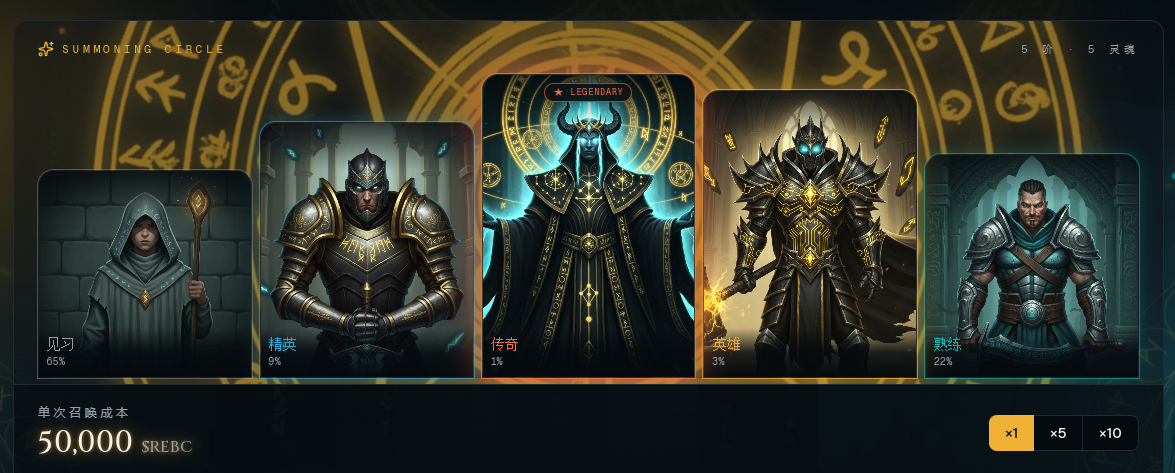
REBC 2.0 × Rune Abyss: Use Mathematics to Lock Scarcity, and BSC Is Growing New Value RootsIn the BSC ecosystem, what truly can outlast cycles is never slogans, but verifiable mathematical rules. A set of coordinated projects has recently been quietly taking shape: the underlying protocol REBC 2.0 handles “how to mint tokens and how to set pricing,” while the chain game Rune Abyss (Rune Deep Abyss) handles “how to consume them and how to make them deflationary.” They share a single token, $REBC— from the foundation to the applications—embedding “zero inflation, strong scarcity” directly into the code.
1. REBC 2.0: Let curves speak, not let the pool “siphon wool”
REBC 2.0 is deployed on BNB Chain, and its core is a reversible adaptive hybrid Bonding Curve. Its biggest feature is: it refuses to let the secondary market “ride for free.”
REBC 2.0 × Rune Abyss: Use Mathematics to Lock Scarcity, and BSC Is Growing New Value Roots
In the BSC ecosystem, what truly can outlast cycles is never slogans, but verifiable mathematical rules. A set of coordinated projects has recently been quietly taking shape: the underlying protocol REBC 2.0 handles “how to mint tokens and how to set pricing,” while the chain game Rune Abyss (Rune Deep Abyss) handles “how to consume them and how to make them deflationary.” They share a single token, $REBC— from the foundation to the applications—embedding “zero inflation, strong scarcity” directly into the code.
1. REBC 2.0: Let curves speak, not let the pool “siphon wool”
REBC 2.0 is deployed on BNB Chain, and its core is a reversible adaptive hybrid Bonding Curve. Its biggest feature is: it refuses to let the secondary market “ride for free.”
1. REBC 2.0: Let curves speak, not let the pool “siphon wool”
REBC 2.0 is deployed on BNB Chain, and its core is a reversible adaptive hybrid Bonding Curve. Its biggest feature is: it refuses to let the secondary market “ride for free.”
77
·
--
Article
R1: The Value Reconfiguration Path of RWA Clearing and Settlement InfrastructureIn the stage where global financial assets are increasingly moving toward digital representation, the RWA sector is no longer just an early question of “whether assets can be put on-chain.” Instead, it has entered a deeper structural competition: who can establish a sustainable value pipeline among real-world assets, trading markets, clearing and settlement systems, and user participation—only then can they become the core gateway to the next phase of digital finance infrastructure.
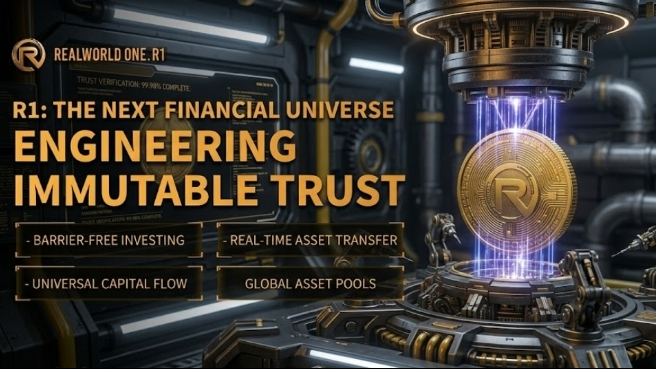
The emergence of Realworld ONE · R1 is precisely centered on this issue. It is not a single-purpose token asset in the conventional sense, but rather RWA universal exchange warrants issued through the CoinVEX ecosystem. Its goal is to convert complex real-world asset rights into standardized units that are tradable, acceptable, and capable of clearing and settlement. Through asset anchoring, protocol-based clearing, and a deflationary mechanism, it builds a value hub that connects real-world assets with on-chain liquidity.
R1: The Value Reconfiguration Path of RWA Clearing and Settlement Infrastructure
In the stage where global financial assets are increasingly moving toward digital representation, the RWA sector is no longer just an early question of “whether assets can be put on-chain.” Instead, it has entered a deeper structural competition: who can establish a sustainable value pipeline among real-world assets, trading markets, clearing and settlement systems, and user participation—only then can they become the core gateway to the next phase of digital finance infrastructure.
The emergence of Realworld ONE · R1 is precisely centered on this issue. It is not a single-purpose token asset in the conventional sense, but rather RWA universal exchange warrants issued through the CoinVEX ecosystem. Its goal is to convert complex real-world asset rights into standardized units that are tradable, acceptable, and capable of clearing and settlement. Through asset anchoring, protocol-based clearing, and a deflationary mechanism, it builds a value hub that connects real-world assets with on-chain liquidity.
The emergence of Realworld ONE · R1 is precisely centered on this issue. It is not a single-purpose token asset in the conventional sense, but rather RWA universal exchange warrants issued through the CoinVEX ecosystem. Its goal is to convert complex real-world asset rights into standardized units that are tradable, acceptable, and capable of clearing and settlement. Through asset anchoring, protocol-based clearing, and a deflationary mechanism, it builds a value hub that connects real-world assets with on-chain liquidity.
86
·
--
Article
R1: Opening a New Asset Passage Between Exchanges and BrokeragesIn the ongoing process of global finance steadily evolving toward digitization, intelligence, and the tokenization of asset entities, markets are undergoing a round of structural reshaping driven by underlying logic—transitioning step by step from an asset circulation model “centered on financial products” to a value circulation system “anchored in real assets.” The core proposition this shift points to is not simply asset tokenization; rather, within a compliant framework, it is about how to achieve efficient connectivity and deterministic clearing and settlement between real-world assets and global liquidity.
Under this broad macro trend, Realworld ONE · R1 is taking shape as the protocol form of the world’s first RWA universal exchangeable warrants, becoming a key piece of infrastructure that links exchange systems, traditional brokerage systems, and the real-world asset world. Its significance is not only reflected in the layer of digital representation of assets, but also in its ability to structurally redesign global asset circulation pathways.
R1: Opening a New Asset Passage Between Exchanges and Brokerages
In the ongoing process of global finance steadily evolving toward digitization, intelligence, and the tokenization of asset entities, markets are undergoing a round of structural reshaping driven by underlying logic—transitioning step by step from an asset circulation model “centered on financial products” to a value circulation system “anchored in real assets.” The core proposition this shift points to is not simply asset tokenization; rather, within a compliant framework, it is about how to achieve efficient connectivity and deterministic clearing and settlement between real-world assets and global liquidity.
Under this broad macro trend, Realworld ONE · R1 is taking shape as the protocol form of the world’s first RWA universal exchangeable warrants, becoming a key piece of infrastructure that links exchange systems, traditional brokerage systems, and the real-world asset world. Its significance is not only reflected in the layer of digital representation of assets, but also in its ability to structurally redesign global asset circulation pathways.
Under this broad macro trend, Realworld ONE · R1 is taking shape as the protocol form of the world’s first RWA universal exchangeable warrants, becoming a key piece of infrastructure that links exchange systems, traditional brokerage systems, and the real-world asset world. Its significance is not only reflected in the layer of digital representation of assets, but also in its ability to structurally redesign global asset circulation pathways.
2
92
·
--
Article
R1: The Asset Clearing and Settlement Logic Behind 400,000 Units DestroyedAgainst the backdrop of the RWA narrative continuing to expand, the market is gradually moving from the early-stage discussions about “how assets get tokenized on-chain” toward deeper structural questions of “how assets are actually used and settled.” At the core of this shift is the idea that only when assets can be genuinely consumed in the course of circulation and produce changes in supply does their value system gain endogenous driving force—freeing it from reliance on external narratives and expectations and entering a sustainable financial structure.
Under the current RWA narrative trend, Realworld ONE · R1 has not remained at the asset-mapping layer. Instead, by combining clearing and settlement mechanisms with a deflationary model, it begins to build an operating system driven primarily by “asset usage behavior.”
R1: The Asset Clearing and Settlement Logic Behind 400,000 Units Destroyed
Against the backdrop of the RWA narrative continuing to expand, the market is gradually moving from the early-stage discussions about “how assets get tokenized on-chain” toward deeper structural questions of “how assets are actually used and settled.” At the core of this shift is the idea that only when assets can be genuinely consumed in the course of circulation and produce changes in supply does their value system gain endogenous driving force—freeing it from reliance on external narratives and expectations and entering a sustainable financial structure.
Under the current RWA narrative trend, Realworld ONE · R1 has not remained at the asset-mapping layer. Instead, by combining clearing and settlement mechanisms with a deflationary model, it begins to build an operating system driven primarily by “asset usage behavior.”
Under the current RWA narrative trend, Realworld ONE · R1 has not remained at the asset-mapping layer. Instead, by combining clearing and settlement mechanisms with a deflationary model, it begins to build an operating system driven primarily by “asset usage behavior.”
62
·
--
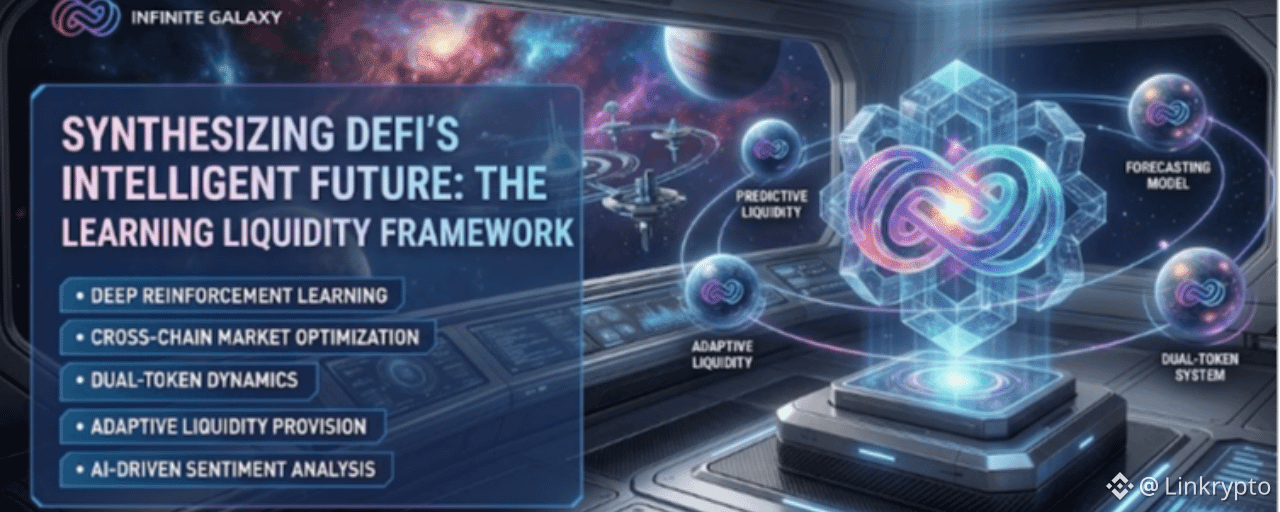
Article
Infinite Galaxy Protocol Ecosystem Consensus Continues to Deepen, and Prediction-Driven Financial Structures Accelerate Their EvolutionAs the global financial system continues to move toward digitization and intelligentization, the market’s operating logic is undergoing a profound restructuring: evolving from a “passive, reaction-based trading system” centered on historical data and experience-based judgment, toward a “prediction-driven financial structure” built on data modeling, probabilistic scenario simulation, and forward-looking decision-making. This change brings not only efficiency improvements, but also a fundamental reshaping of how financial resources are allocated at the underlying level.
Under the current macro trends, Infinite Galaxy Protocol (IGP)—a new protocol that integrates an AI prediction engine, decentralized finance protocols, and the capability to restructure liquidity structures—after completing roughly two months of market operation and continuous optimization, is gradually moving from an early-stage operational validation phase into a development cycle centered on ecosystem expansion and consensus strengthening. And recently, its offline community exchange activities launched in Japan have become an important signal that its ecosystem structure is beginning to expand outward.
Infinite Galaxy Protocol Ecosystem Consensus Continues to Deepen, and Prediction-Driven Financial Structures Accelerate Their Evolution
As the global financial system continues to move toward digitization and intelligentization, the market’s operating logic is undergoing a profound restructuring: evolving from a “passive, reaction-based trading system” centered on historical data and experience-based judgment, toward a “prediction-driven financial structure” built on data modeling, probabilistic scenario simulation, and forward-looking decision-making. This change brings not only efficiency improvements, but also a fundamental reshaping of how financial resources are allocated at the underlying level.
Under the current macro trends, Infinite Galaxy Protocol (IGP)—a new protocol that integrates an AI prediction engine, decentralized finance protocols, and the capability to restructure liquidity structures—after completing roughly two months of market operation and continuous optimization, is gradually moving from an early-stage operational validation phase into a development cycle centered on ecosystem expansion and consensus strengthening. And recently, its offline community exchange activities launched in Japan have become an important signal that its ecosystem structure is beginning to expand outward.
Under the current macro trends, Infinite Galaxy Protocol (IGP)—a new protocol that integrates an AI prediction engine, decentralized finance protocols, and the capability to restructure liquidity structures—after completing roughly two months of market operation and continuous optimization, is gradually moving from an early-stage operational validation phase into a development cycle centered on ecosystem expansion and consensus strengthening. And recently, its offline community exchange activities launched in Japan have become an important signal that its ecosystem structure is beginning to expand outward.
55
·
--
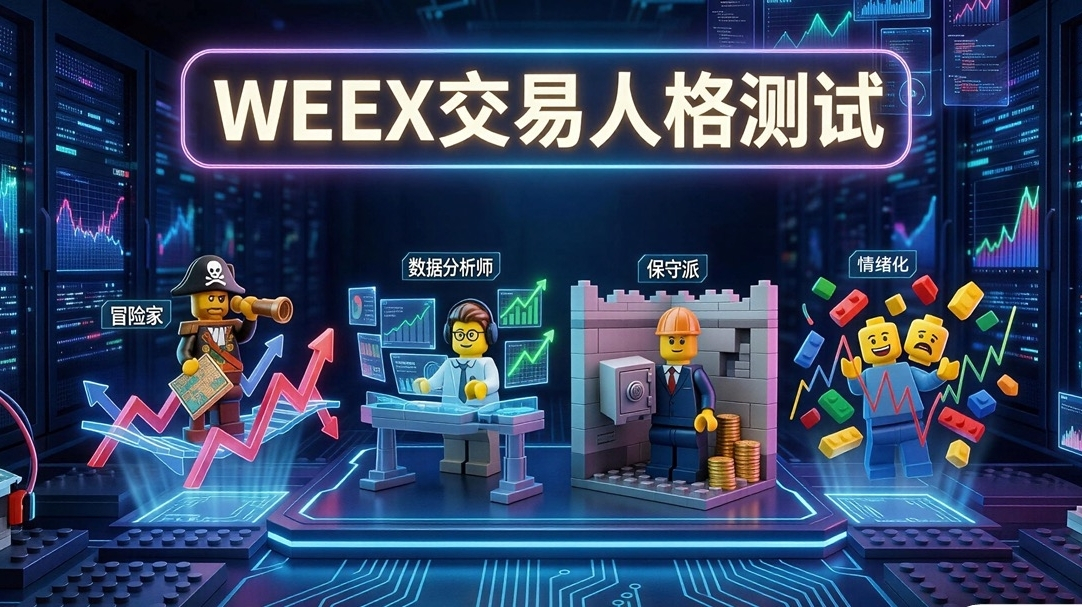
Article
WEEX Labs: It turns out I’m not bad at technical analysis—I just wasn’t suited for tradingSome are naturally suited for trading, while others are naturally suited to be “cutting greens”—this might not be a joke.
In recent years, MBTI personality tests have become a routine operation on the internet. Some use it to explain social anxiety, others use it to decide what they should do. But if you apply this logic to the trading market, it becomes especially realistic:
The market is public, the candlestick charts are the same, and the news is synchronized, yet the outcomes are vastly different.
Some manage to profit steadily amid market fluctuations, while others repeatedly stop out;
Some chase when they see prices going up, some hold on to the end, and some even buy precisely at the highest point every time.
WEEX Labs: It turns out I’m not bad at technical analysis—I just wasn’t suited for trading
Some are naturally suited for trading, while others are naturally suited to be “cutting greens”—this might not be a joke.
In recent years, MBTI personality tests have become a routine operation on the internet. Some use it to explain social anxiety, others use it to decide what they should do. But if you apply this logic to the trading market, it becomes especially realistic:
The market is public, the candlestick charts are the same, and the news is synchronized, yet the outcomes are vastly different.
Some manage to profit steadily amid market fluctuations, while others repeatedly stop out;
Some chase when they see prices going up, some hold on to the end, and some even buy precisely at the highest point every time.
In recent years, MBTI personality tests have become a routine operation on the internet. Some use it to explain social anxiety, others use it to decide what they should do. But if you apply this logic to the trading market, it becomes especially realistic:
The market is public, the candlestick charts are the same, and the news is synchronized, yet the outcomes are vastly different.
Some manage to profit steadily amid market fluctuations, while others repeatedly stop out;
Some chase when they see prices going up, some hold on to the end, and some even buy precisely at the highest point every time.
63
·
--
Article
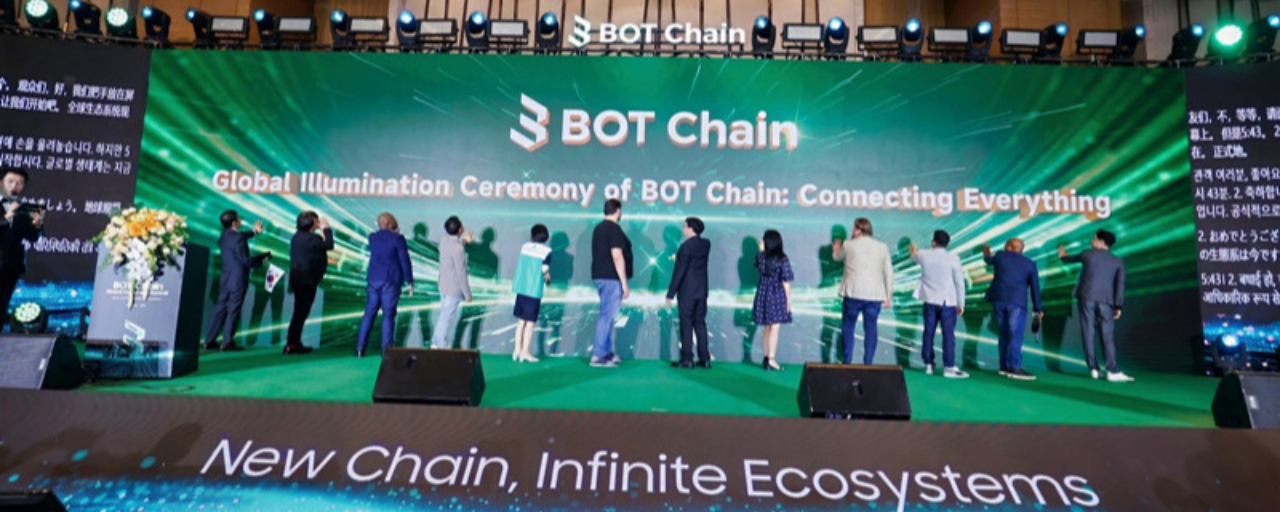
The BOT Chain Global Consensus Conference in Hong Kong has concluded, with technology, market, and prospects, threefold certainty has arrived.【Hong Kong】When more than a hundred mining machines lit up simultaneously at the conference center by Victoria Harbour, nearly 4,000 attendees witnessed a reality unfolding: the time window for the new generation of public chains has opened.
On March 29, the first stop of the BOT Chain Global Consensus Conference was held in Hong Kong. This all-day conference attracted technical developers, ecological partners, capital institution representatives, and community builders from 45 countries and regions. Long queues formed outside the venue, and the conference room was filled to capacity, with people standing in the aisles. This is the most authentic indication of the public chain track's heat in the spring of 2026.
The BOT Chain Global Consensus Conference in Hong Kong has concluded, with technology, market, and prospects, threefold certainty has arrived.
【Hong Kong】When more than a hundred mining machines lit up simultaneously at the conference center by Victoria Harbour, nearly 4,000 attendees witnessed a reality unfolding: the time window for the new generation of public chains has opened.
On March 29, the first stop of the BOT Chain Global Consensus Conference was held in Hong Kong. This all-day conference attracted technical developers, ecological partners, capital institution representatives, and community builders from 45 countries and regions. Long queues formed outside the venue, and the conference room was filled to capacity, with people standing in the aisles. This is the most authentic indication of the public chain track's heat in the spring of 2026.
On March 29, the first stop of the BOT Chain Global Consensus Conference was held in Hong Kong. This all-day conference attracted technical developers, ecological partners, capital institution representatives, and community builders from 45 countries and regions. Long queues formed outside the venue, and the conference room was filled to capacity, with people standing in the aisles. This is the most authentic indication of the public chain track's heat in the spring of 2026.
105
·
--
Article
Infinite Galaxy Protocol Enters a New Stage of Ecosystem Consensus Co-BuildingAI-prediction-driven financial infrastructure is forming structural breakthroughs
As the global financial system continues to move toward digitization and intelligence, the logic governing market operations is undergoing deep restructuring—from a "passive reaction-based trading system" centered on historical data and experience-based judgment, to a "prediction-driven financial structure" built on data modeling, probabilistic inference, and forward-looking decision-making. And this shift brings not only efficiency improvements, but an underlying upgrade to the way financial resources are allocated at the foundation level.
Against this macro trend, Infinite Galaxy Protocol (IGP)—a new protocol that integrates an AI prediction engine, a decentralized finance protocol, and the ability to reshape liquidity structures—after completing about two months of market operation and continuous optimization, is moving from an early stage of operational validation into a development milestone of more decisive significance: the token ecosystem consensus co-building phase.
Infinite Galaxy Protocol Enters a New Stage of Ecosystem Consensus Co-Building
AI-prediction-driven financial infrastructure is forming structural breakthroughs
As the global financial system continues to move toward digitization and intelligence, the logic governing market operations is undergoing deep restructuring—from a "passive reaction-based trading system" centered on historical data and experience-based judgment, to a "prediction-driven financial structure" built on data modeling, probabilistic inference, and forward-looking decision-making. And this shift brings not only efficiency improvements, but an underlying upgrade to the way financial resources are allocated at the foundation level.
Against this macro trend, Infinite Galaxy Protocol (IGP)—a new protocol that integrates an AI prediction engine, a decentralized finance protocol, and the ability to reshape liquidity structures—after completing about two months of market operation and continuous optimization, is moving from an early stage of operational validation into a development milestone of more decisive significance: the token ecosystem consensus co-building phase.
As the global financial system continues to move toward digitization and intelligence, the logic governing market operations is undergoing deep restructuring—from a "passive reaction-based trading system" centered on historical data and experience-based judgment, to a "prediction-driven financial structure" built on data modeling, probabilistic inference, and forward-looking decision-making. And this shift brings not only efficiency improvements, but an underlying upgrade to the way financial resources are allocated at the foundation level.
Against this macro trend, Infinite Galaxy Protocol (IGP)—a new protocol that integrates an AI prediction engine, a decentralized finance protocol, and the ability to reshape liquidity structures—after completing about two months of market operation and continuous optimization, is moving from an early stage of operational validation into a development milestone of more decisive significance: the token ecosystem consensus co-building phase.
6
·
--
Article
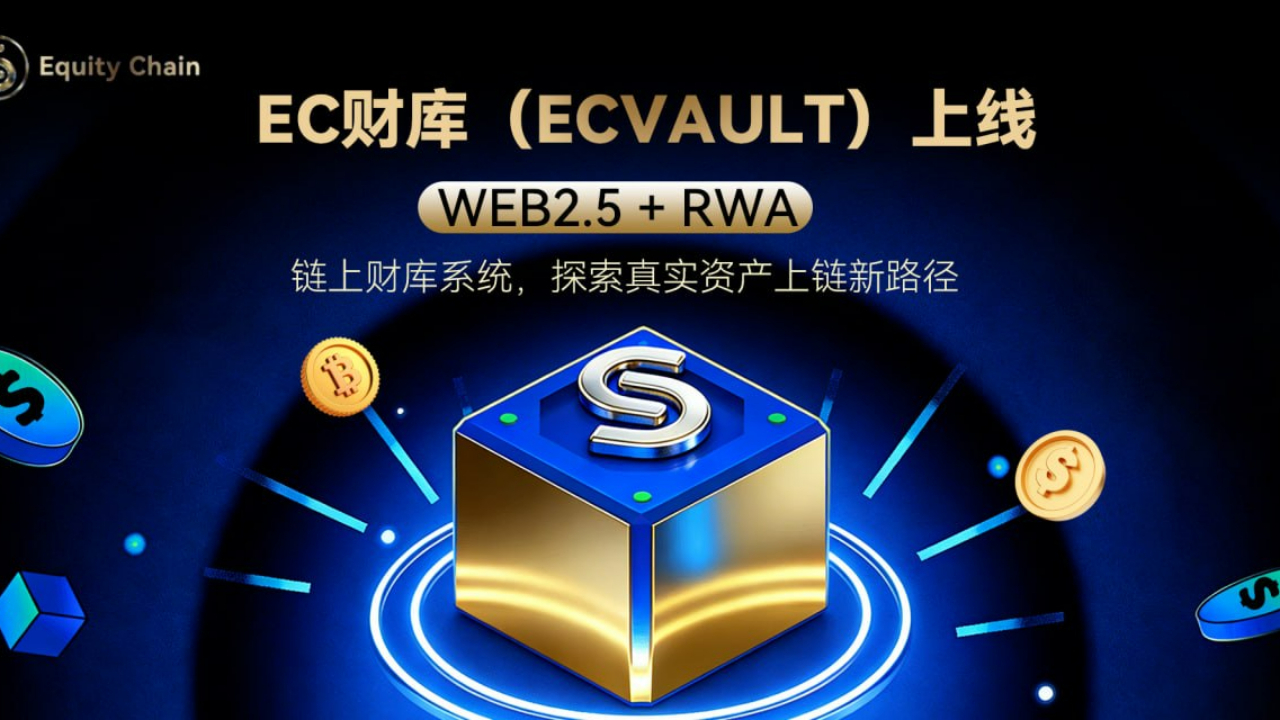
EC Finance Treasury (ECVault) launches its Web2.5 + RWA on-chain treasury system, exploring new paths for real-asset tokenization and on-chain allocationAgainst the backdrop of real-world assets (RWA) gradually becoming an important development direction for the blockchain industry, EC Finance Treasury (ECVault) has recently announced the official launch of its Web2.5 + RWA on-chain treasury system. The system is built around two core ideas—“lowering the participation threshold” and “introducing high-quality assets.” It attempts to connect traditional assets with the on-chain world, providing a new structural solution for asset allocation.
According to the announcement, EC Finance Treasury sets the user participation threshold at 100 USDT. By using an on-chain treasury mechanism to integrate asset management and distribution processes, it enables more users to access and participate in asset allocation opportunities that were previously mainly available to institutions or high-net-worth individuals.
EC Finance Treasury (ECVault) launches its Web2.5 + RWA on-chain treasury system, exploring new paths for real-asset tokenization and on-chain allocation
Against the backdrop of real-world assets (RWA) gradually becoming an important development direction for the blockchain industry, EC Finance Treasury (ECVault) has recently announced the official launch of its Web2.5 + RWA on-chain treasury system. The system is built around two core ideas—“lowering the participation threshold” and “introducing high-quality assets.” It attempts to connect traditional assets with the on-chain world, providing a new structural solution for asset allocation.
According to the announcement, EC Finance Treasury sets the user participation threshold at 100 USDT. By using an on-chain treasury mechanism to integrate asset management and distribution processes, it enables more users to access and participate in asset allocation opportunities that were previously mainly available to institutions or high-net-worth individuals.
According to the announcement, EC Finance Treasury sets the user participation threshold at 100 USDT. By using an on-chain treasury mechanism to integrate asset management and distribution processes, it enables more users to access and participate in asset allocation opportunities that were previously mainly available to institutions or high-net-worth individuals.
1
55
·
--
Article
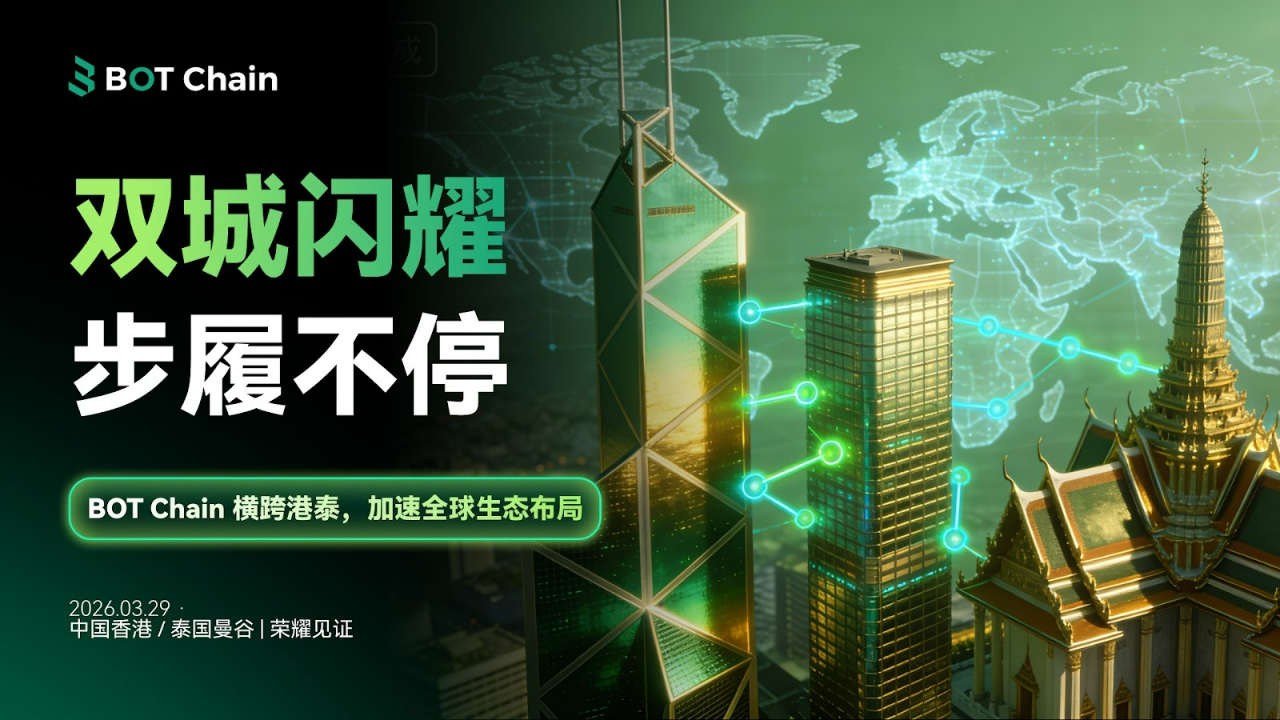
BOT Chain Global Dual City Resonance - The 'Global Offensive' of the Modular Algorithm Network and Exceeding Ecological Implementation ExpectationsOn March 23, 2026, it was confirmed by official sources that BOT Chain, a global leader in modular algorithm networks, will hold two top industry events simultaneously in Hong Kong, China, and Bangkok, Thailand on March 29, 2026. This is the first time BOT Chain has achieved a global layout of 'dual city linkage,' marking a comprehensive advancement from technical narrative to full industry chain implementation, and from regional deep cultivation to the international capital deep water zone.
From 'single point breakthrough' to 'dual-core drive,' the globalization ecosystem has entered an accelerated phase.
Holding high-spec events simultaneously in Hong Kong and Bangkok on the same day, with each event having clear and differentiated strategic intentions, is extremely rare in the current industry cycle. We interpret this as a key node in BOT Chain's transformation from 'technical narrative' to 'full industry chain implementation.'
BOT Chain Global Dual City Resonance - The 'Global Offensive' of the Modular Algorithm Network and Exceeding Ecological Implementation Expectations
On March 23, 2026, it was confirmed by official sources that BOT Chain, a global leader in modular algorithm networks, will hold two top industry events simultaneously in Hong Kong, China, and Bangkok, Thailand on March 29, 2026. This is the first time BOT Chain has achieved a global layout of 'dual city linkage,' marking a comprehensive advancement from technical narrative to full industry chain implementation, and from regional deep cultivation to the international capital deep water zone.
From 'single point breakthrough' to 'dual-core drive,' the globalization ecosystem has entered an accelerated phase.
Holding high-spec events simultaneously in Hong Kong and Bangkok on the same day, with each event having clear and differentiated strategic intentions, is extremely rare in the current industry cycle. We interpret this as a key node in BOT Chain's transformation from 'technical narrative' to 'full industry chain implementation.'
From 'single point breakthrough' to 'dual-core drive,' the globalization ecosystem has entered an accelerated phase.
Holding high-spec events simultaneously in Hong Kong and Bangkok on the same day, with each event having clear and differentiated strategic intentions, is extremely rare in the current industry cycle. We interpret this as a key node in BOT Chain's transformation from 'technical narrative' to 'full industry chain implementation.'
50
·
--
Article
See translation
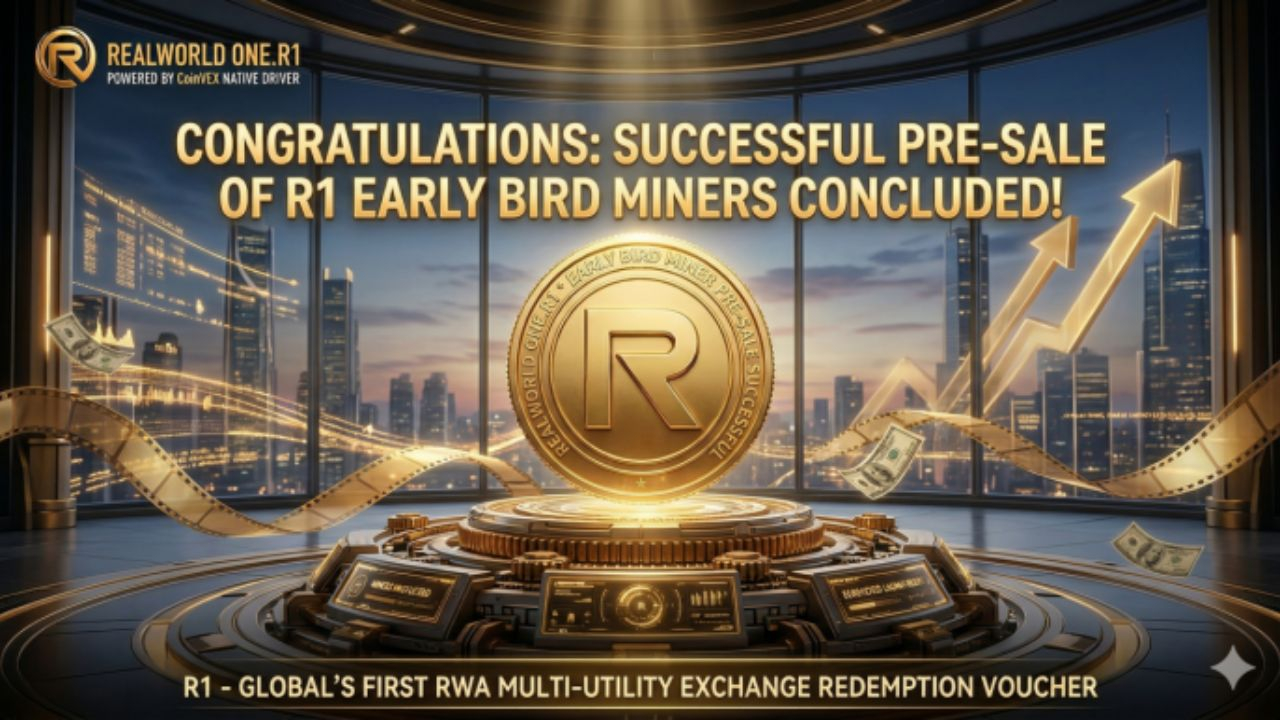
Realworld ONE.R1 Early Bird Sale Sold Out: Global Collaboration Ignites RWA 2.0 Value FuseRecently, Realworld ONE.R1, the RWA 2.0 atomic clearing and settlement protocol that has garnered significant attention from global capital markets, officially announced the successful completion of its first strategic milestone: the "Early Bird Mining Machine Pre-sale Program." According to official data, the 12 million early bird tokens quickly triggered a global consensus frenzy after their release, selling out rapidly to community partners and early participants at all levels.
This strong market response not only validates the certainty of the R1 protocol in building community consensus but also signifies that the $16.1 trillion RWA 2.0 era, supported by real assets and driven by mathematical logic, has entered a substantial explosive phase.
Global Consensus Landscape: Value Alignment Among Heterogeneous Ledgers
The success of this early bird program demonstrates strong cross-jurisdictional community collaboration. According to preliminary statistics, participation was primarily concentrated in core global crypto hubs and traditional financial centers. From established communities in Kuala Lumpur and Singapore to high-net-worth contributors in China, and even value discoverers in emerging markets like Brazil and South Africa, all showed exceptionally high participation. Furthermore, global consensus partners in France, Australia, South Korea, Japan, and Vietnam also secured early bird benefits through deep involvement.
Industry observers point out that this cross-timezone "consistent action" proves that R1's proposed "cross-chain clearing and heterogeneous ledger credit alignment" solution has gained deep recognition from international industry experts and community leaders. R1 is becoming the underlying standard protocol connecting global digital value and real-world benefits.
Technological Moat: The Generational Advantages of the R1 Protocol
In the $16.1 trillion RWA market, the R1 protocol has achieved a systematic reconstruction of the traditional RWA 1.0 mapping model through three core components:
1. CACE Engine: Atomic Clearing and Settlement Logic. The R1 protocol, through its self-developed CACE engine (Clearing and Settlement Engine), achieves sub-second atomic hedging of physical asset rights and digital warrants, effectively solving the settlement lag problem during asset rights transfer.
2. GTCN: Structured Rights Confirmation through a Global Trust Network. Relying on GTCN (Global Trust Network), R1 deeply connects with top international custody matrices. Through a modular SPV architecture, it ensures that each digital warrant is backed by a 1:1 legally graded asset.
3. ADI Value Flywheel: Asset Density Leap Model. With the completion of the early bird program, the deflationary algorithm of "acceptance and destruction" has officially entered activation. As the circulating supply shrinks toward the predetermined hard cap of 210 million warrants, the asset density per unit of R1 warrant will exhibit a significant exponential growth trend.
Strategic Planning: Formal Pre-excavation and Ecological Expansion
With the successful conclusion of the early bird phase, R1 officials announced that the formal pre-mining phase is about to begin. This signifies that the R1 ecosystem has entered the "preparatory stage" for full launch. At that time, the first batch of globally anchored high-quality RWA physical assets will undergo efficient liquidation and swapping through the CACE engine. More strategically significant is that R1's "Asset Upgrade Protocol" has also entered its final audit phase, aiming to achieve a deep anchoring of digital asset rights to higher-dimensional physical value.
Conclusion
Value is no longer an isolated legal contract, but a fluid digital civilization. The successful sell-out of the Realworld ONE .R1 Early Bird Program marks not only a triumph in building community consensus but also an industry-wide manifesto regarding the restructuring of asset ownership. In the global race for RWA 2.0, the R1 Protocol—bolstered by its rigorous mathematical logic and robust physical infrastructure—is defining the paradigm for the next generation of financial infrastructure.
About Realworld ONE .R1
Realworld ONE .R1 is a core RWA 2.0 clearing and settlement protocol incubated by CoinVEX, a leading global crypto asset exchange. By employing a hybrid dual-chain architecture to achieve the alignment of heterogeneous ledgers, the protocol is dedicated to establishing a global standard for the digital twinning of real-world assets, alongside an atomic circulation network.
Realworld ONE.R1 Early Bird Sale Sold Out: Global Collaboration Ignites RWA 2.0 Value Fuse
Recently, Realworld ONE.R1, the RWA 2.0 atomic clearing and settlement protocol that has garnered significant attention from global capital markets, officially announced the successful completion of its first strategic milestone: the "Early Bird Mining Machine Pre-sale Program." According to official data, the 12 million early bird tokens quickly triggered a global consensus frenzy after their release, selling out rapidly to community partners and early participants at all levels.
This strong market response not only validates the certainty of the R1 protocol in building community consensus but also signifies that the $16.1 trillion RWA 2.0 era, supported by real assets and driven by mathematical logic, has entered a substantial explosive phase.
Global Consensus Landscape: Value Alignment Among Heterogeneous Ledgers
The success of this early bird program demonstrates strong cross-jurisdictional community collaboration. According to preliminary statistics, participation was primarily concentrated in core global crypto hubs and traditional financial centers. From established communities in Kuala Lumpur and Singapore to high-net-worth contributors in China, and even value discoverers in emerging markets like Brazil and South Africa, all showed exceptionally high participation. Furthermore, global consensus partners in France, Australia, South Korea, Japan, and Vietnam also secured early bird benefits through deep involvement.
Industry observers point out that this cross-timezone "consistent action" proves that R1's proposed "cross-chain clearing and heterogeneous ledger credit alignment" solution has gained deep recognition from international industry experts and community leaders. R1 is becoming the underlying standard protocol connecting global digital value and real-world benefits.
Technological Moat: The Generational Advantages of the R1 Protocol
In the $16.1 trillion RWA market, the R1 protocol has achieved a systematic reconstruction of the traditional RWA 1.0 mapping model through three core components:
1. CACE Engine: Atomic Clearing and Settlement Logic. The R1 protocol, through its self-developed CACE engine (Clearing and Settlement Engine), achieves sub-second atomic hedging of physical asset rights and digital warrants, effectively solving the settlement lag problem during asset rights transfer.
2. GTCN: Structured Rights Confirmation through a Global Trust Network. Relying on GTCN (Global Trust Network), R1 deeply connects with top international custody matrices. Through a modular SPV architecture, it ensures that each digital warrant is backed by a 1:1 legally graded asset.
3. ADI Value Flywheel: Asset Density Leap Model. With the completion of the early bird program, the deflationary algorithm of "acceptance and destruction" has officially entered activation. As the circulating supply shrinks toward the predetermined hard cap of 210 million warrants, the asset density per unit of R1 warrant will exhibit a significant exponential growth trend.
Strategic Planning: Formal Pre-excavation and Ecological Expansion
With the successful conclusion of the early bird phase, R1 officials announced that the formal pre-mining phase is about to begin. This signifies that the R1 ecosystem has entered the "preparatory stage" for full launch. At that time, the first batch of globally anchored high-quality RWA physical assets will undergo efficient liquidation and swapping through the CACE engine. More strategically significant is that R1's "Asset Upgrade Protocol" has also entered its final audit phase, aiming to achieve a deep anchoring of digital asset rights to higher-dimensional physical value.
Conclusion
Value is no longer an isolated legal contract, but a fluid digital civilization. The successful sell-out of the Realworld ONE .R1 Early Bird Program marks not only a triumph in building community consensus but also an industry-wide manifesto regarding the restructuring of asset ownership. In the global race for RWA 2.0, the R1 Protocol—bolstered by its rigorous mathematical logic and robust physical infrastructure—is defining the paradigm for the next generation of financial infrastructure.
About Realworld ONE .R1
Realworld ONE .R1 is a core RWA 2.0 clearing and settlement protocol incubated by CoinVEX, a leading global crypto asset exchange. By employing a hybrid dual-chain architecture to achieve the alignment of heterogeneous ledgers, the protocol is dedicated to establishing a global standard for the digital twinning of real-world assets, alongside an atomic circulation network.
This strong market response not only validates the certainty of the R1 protocol in building community consensus but also signifies that the $16.1 trillion RWA 2.0 era, supported by real assets and driven by mathematical logic, has entered a substantial explosive phase.
Global Consensus Landscape: Value Alignment Among Heterogeneous Ledgers
The success of this early bird program demonstrates strong cross-jurisdictional community collaboration. According to preliminary statistics, participation was primarily concentrated in core global crypto hubs and traditional financial centers. From established communities in Kuala Lumpur and Singapore to high-net-worth contributors in China, and even value discoverers in emerging markets like Brazil and South Africa, all showed exceptionally high participation. Furthermore, global consensus partners in France, Australia, South Korea, Japan, and Vietnam also secured early bird benefits through deep involvement.
Industry observers point out that this cross-timezone "consistent action" proves that R1's proposed "cross-chain clearing and heterogeneous ledger credit alignment" solution has gained deep recognition from international industry experts and community leaders. R1 is becoming the underlying standard protocol connecting global digital value and real-world benefits.
Technological Moat: The Generational Advantages of the R1 Protocol
In the $16.1 trillion RWA market, the R1 protocol has achieved a systematic reconstruction of the traditional RWA 1.0 mapping model through three core components:
1. CACE Engine: Atomic Clearing and Settlement Logic. The R1 protocol, through its self-developed CACE engine (Clearing and Settlement Engine), achieves sub-second atomic hedging of physical asset rights and digital warrants, effectively solving the settlement lag problem during asset rights transfer.
2. GTCN: Structured Rights Confirmation through a Global Trust Network. Relying on GTCN (Global Trust Network), R1 deeply connects with top international custody matrices. Through a modular SPV architecture, it ensures that each digital warrant is backed by a 1:1 legally graded asset.
3. ADI Value Flywheel: Asset Density Leap Model. With the completion of the early bird program, the deflationary algorithm of "acceptance and destruction" has officially entered activation. As the circulating supply shrinks toward the predetermined hard cap of 210 million warrants, the asset density per unit of R1 warrant will exhibit a significant exponential growth trend.
Strategic Planning: Formal Pre-excavation and Ecological Expansion
With the successful conclusion of the early bird phase, R1 officials announced that the formal pre-mining phase is about to begin. This signifies that the R1 ecosystem has entered the "preparatory stage" for full launch. At that time, the first batch of globally anchored high-quality RWA physical assets will undergo efficient liquidation and swapping through the CACE engine. More strategically significant is that R1's "Asset Upgrade Protocol" has also entered its final audit phase, aiming to achieve a deep anchoring of digital asset rights to higher-dimensional physical value.
Conclusion
Value is no longer an isolated legal contract, but a fluid digital civilization. The successful sell-out of the Realworld ONE .R1 Early Bird Program marks not only a triumph in building community consensus but also an industry-wide manifesto regarding the restructuring of asset ownership. In the global race for RWA 2.0, the R1 Protocol—bolstered by its rigorous mathematical logic and robust physical infrastructure—is defining the paradigm for the next generation of financial infrastructure.
About Realworld ONE .R1
Realworld ONE .R1 is a core RWA 2.0 clearing and settlement protocol incubated by CoinVEX, a leading global crypto asset exchange. By employing a hybrid dual-chain architecture to achieve the alignment of heterogeneous ledgers, the protocol is dedicated to establishing a global standard for the digital twinning of real-world assets, alongside an atomic circulation network.
27
·
--
Article
Infinite Galaxy gets confirmed investment from institutions such as DAO Maker, as the AI Prediction Finance track enters a phase of accelerated development1. AI predicts the rise of finance, and the market enters a phase of structural transformation
Against the backdrop of the continued integration of artificial intelligence and blockchain technology, the global financial system is undergoing a new round of structural evolution centered on “predictive capabilities.” Moving gradually from a model dominated by trade execution to a new financial paradigm based on data-driven and intelligent decision-making, “AI Prediction Finance” has increasingly been viewed by more and more institutions as one of the key tracks with the most potential in the next stage of development.
The essence of this change is that financial markets are shifting from “reacting to already occurred data” to “pricing future outcomes in advance.” Predictive capabilities are becoming an important variable affecting market efficiency and capital allocation, and the introduction of AI makes it possible to deploy this capability at scale and in a systematic manner.
Infinite Galaxy gets confirmed investment from institutions such as DAO Maker, as the AI Prediction Finance track enters a phase of accelerated development
1. AI predicts the rise of finance, and the market enters a phase of structural transformation
Against the backdrop of the continued integration of artificial intelligence and blockchain technology, the global financial system is undergoing a new round of structural evolution centered on “predictive capabilities.” Moving gradually from a model dominated by trade execution to a new financial paradigm based on data-driven and intelligent decision-making, “AI Prediction Finance” has increasingly been viewed by more and more institutions as one of the key tracks with the most potential in the next stage of development.
The essence of this change is that financial markets are shifting from “reacting to already occurred data” to “pricing future outcomes in advance.” Predictive capabilities are becoming an important variable affecting market efficiency and capital allocation, and the introduction of AI makes it possible to deploy this capability at scale and in a systematic manner.
Against the backdrop of the continued integration of artificial intelligence and blockchain technology, the global financial system is undergoing a new round of structural evolution centered on “predictive capabilities.” Moving gradually from a model dominated by trade execution to a new financial paradigm based on data-driven and intelligent decision-making, “AI Prediction Finance” has increasingly been viewed by more and more institutions as one of the key tracks with the most potential in the next stage of development.
The essence of this change is that financial markets are shifting from “reacting to already occurred data” to “pricing future outcomes in advance.” Predictive capabilities are becoming an important variable affecting market efficiency and capital allocation, and the introduction of AI makes it possible to deploy this capability at scale and in a systematic manner.
10
·
--
CoinEdition Releases 2026’s Top 10 Most Influential Women in the Crypto Industry, with Cathie Wood at No. 1
CoinEdition has recently released its “Top 10 Most Influential Women in the Crypto Industry for 2026” list. The evaluation criteria include industry influence, reach, and contributions to the development of the industry.
ARK Invest founder and CEO Cathie Wood ranks first. The report states that, through her company’s ETF products, she has helped bring institutional investors into the crypto space—an important driving force behind Bitcoin’s entry into mainstream financial markets. U.S. Senator Cynthia Lummis is second, speaking up for the crypto industry at the congressional level by advancing the “BITCOIN Act” and the “Lummis-Gillibrand Responsible Financial Innovation Act.” Binance co-founder and co-CEO Yi He ranks third, recognized as a key driving force behind building Binance into the world’s largest crypto exchange.
The rest of the list, in order, includes: SEC Commissioner Hester Peirce (fourth), Lightning Labs CEO Elizabeth Stark (fifth), Aya Miyaguchi, Chair of the Ethereum Foundation (sixth), crypto commentator Layah Heilpern (seventh), Bitget CEO Gracy Chen (eighth), Fox Business former reporter Eleanor Terrett (ninth), and Vivien Lin, Chief Product Officer of BingX (tenth).
CoinEdition Releases 2026’s Top 10 Most Influential Women in the Crypto Industry, with Cathie Wood at No. 1
CoinEdition has recently released its “Top 10 Most Influential Women in the Crypto Industry for 2026” list. The evaluation criteria include industry influence, reach, and contributions to the development of the industry.
ARK Invest founder and CEO Cathie Wood ranks first. The report states that, through her company’s ETF products, she has helped bring institutional investors into the crypto space—an important driving force behind Bitcoin’s entry into mainstream financial markets. U.S. Senator Cynthia Lummis is second, speaking up for the crypto industry at the congressional level by advancing the “BITCOIN Act” and the “Lummis-Gillibrand Responsible Financial Innovation Act.” Binance co-founder and co-CEO Yi He ranks third, recognized as a key driving force behind building Binance into the world’s largest crypto exchange.
The rest of the list, in order, includes: SEC Commissioner Hester Peirce (fourth), Lightning Labs CEO Elizabeth Stark (fifth), Aya Miyaguchi, Chair of the Ethereum Foundation (sixth), crypto commentator Layah Heilpern (seventh), Bitget CEO Gracy Chen (eighth), Fox Business former reporter Eleanor Terrett (ninth), and Vivien Lin, Chief Product Officer of BingX (tenth).
CoinEdition has recently released its “Top 10 Most Influential Women in the Crypto Industry for 2026” list. The evaluation criteria include industry influence, reach, and contributions to the development of the industry.
ARK Invest founder and CEO Cathie Wood ranks first. The report states that, through her company’s ETF products, she has helped bring institutional investors into the crypto space—an important driving force behind Bitcoin’s entry into mainstream financial markets. U.S. Senator Cynthia Lummis is second, speaking up for the crypto industry at the congressional level by advancing the “BITCOIN Act” and the “Lummis-Gillibrand Responsible Financial Innovation Act.” Binance co-founder and co-CEO Yi He ranks third, recognized as a key driving force behind building Binance into the world’s largest crypto exchange.
The rest of the list, in order, includes: SEC Commissioner Hester Peirce (fourth), Lightning Labs CEO Elizabeth Stark (fifth), Aya Miyaguchi, Chair of the Ethereum Foundation (sixth), crypto commentator Layah Heilpern (seventh), Bitget CEO Gracy Chen (eighth), Fox Business former reporter Eleanor Terrett (ninth), and Vivien Lin, Chief Product Officer of BingX (tenth).
3
Log in to explore more content
Join global crypto users on Binance Square
⚡️ Get latest and useful information about crypto.
💬 Trusted by the world’s largest crypto exchange.
👍 Discover real insights from verified creators.
Email / Phone number
Trending Topics
BitcoinReboundsTo$79K
20,044 views
171 Discussing
🚨 $BTC is pushing higher.
Bitcoin is trading around $78,804, up roughly 1.9%, after reclaiming the $78K area. The next level to watch is the intraday high near $78,905.
A clean break above that level could open the way toward $79K–$80K. If BTC gets rejected, support sits around $78,300, then $77,975.
Bulls have momentum, but BTC needs to hold above $78K.
#Bitcoin #BTC #CryptoTrading #CryptoMarket #CryptoAnalysis
PulseON
·18 Likes
·17.1k views
BitcoinSpotETFsNetInflow$160M
114 views
25 Discussing
SouthKoreaCryptoTaxDelayPetitionTops50000
9,113 views
247 Discussing