
R博士
761 Posts
Posts
All
Quotes
PINNED

·
--
$GIGGLE 20260205 Evening It seems that smart money has taken notice here and has continued to invest a little. I have created a model starting from 100, with an average daily transaction volume of 10 million across the network. The price drops by an average of 0.2% each day, and it will take about more than 3 years to consume 30% of the tokens. The price is expected to drop to around 8, but in the first two months, the price has fallen quickly, and the transaction volume hasn't decreased significantly, so the consumption of tokens is faster than expected, and the time to destroy 30% of the tokens is shortened!
Many people do not understand the implied economics of Giggle. The daily trading volume fees proportionally represent its net income, with zero costs, and the fixed use is to recycle tokens, with no other expenses. Unless Binance changes the rules, if it drops to a certain level, there may be quantity manipulation similar to alpha, with hundreds of millions or tens of billions traded in a day! In such a scenario of extreme token deflation, reaching sky-high prices is possible! But that's a discussion for later.
I believe that the destruction of 30% of the tokens is a turning point. Market makers need a certain amount, and platforms need to reserve a certain amount, along with token hoarders; by then, there won't be much in circulation!
I don't know what the future holds, but I will continue to use my 4:1 averaging method. I will create a contract every few dollars and my spot grid's maximum holding is about 4 times that of the contract, so big gains!
It is essential to trade spot; if busy, just grid trade spot! Purely holding contracts has no value! Holding spot can still allow for investment!
Of course, the biggest risk is that Binance changes the rules, although the likelihood is small, it cannot be ruled out!
$GIGGLE 20260205 Evening It seems that smart money has taken notice here and has continued to invest a little. I have created a model starting from 100, with an average daily transaction volume of 10 million across the network. The price drops by an average of 0.2% each day, and it will take about more than 3 years to consume 30% of the tokens. The price is expected to drop to around 8, but in the first two months, the price has fallen quickly, and the transaction volume hasn't decreased significantly, so the consumption of tokens is faster than expected, and the time to destroy 30% of the tokens is shortened!
Many people do not understand the implied economics of Giggle. The daily trading volume fees proportionally represent its net income, with zero costs, and the fixed use is to recycle tokens, with no other expenses. Unless Binance changes the rules, if it drops to a certain level, there may be quantity manipulation similar to alpha, with hundreds of millions or tens of billions traded in a day! In such a scenario of extreme token deflation, reaching sky-high prices is possible! But that's a discussion for later.
I believe that the destruction of 30% of the tokens is a turning point. Market makers need a certain amount, and platforms need to reserve a certain amount, along with token hoarders; by then, there won't be much in circulation!
I don't know what the future holds, but I will continue to use my 4:1 averaging method. I will create a contract every few dollars and my spot grid's maximum holding is about 4 times that of the contract, so big gains!
It is essential to trade spot; if busy, just grid trade spot! Purely holding contracts has no value! Holding spot can still allow for investment!
Of course, the biggest risk is that Binance changes the rules, although the likelihood is small, it cannot be ruled out!
Many people do not understand the implied economics of Giggle. The daily trading volume fees proportionally represent its net income, with zero costs, and the fixed use is to recycle tokens, with no other expenses. Unless Binance changes the rules, if it drops to a certain level, there may be quantity manipulation similar to alpha, with hundreds of millions or tens of billions traded in a day! In such a scenario of extreme token deflation, reaching sky-high prices is possible! But that's a discussion for later.
I believe that the destruction of 30% of the tokens is a turning point. Market makers need a certain amount, and platforms need to reserve a certain amount, along with token hoarders; by then, there won't be much in circulation!
I don't know what the future holds, but I will continue to use my 4:1 averaging method. I will create a contract every few dollars and my spot grid's maximum holding is about 4 times that of the contract, so big gains!
It is essential to trade spot; if busy, just grid trade spot! Purely holding contracts has no value! Holding spot can still allow for investment!
Of course, the biggest risk is that Binance changes the rules, although the likelihood is small, it cannot be ruled out!
5
1
2
1.5k
·
--
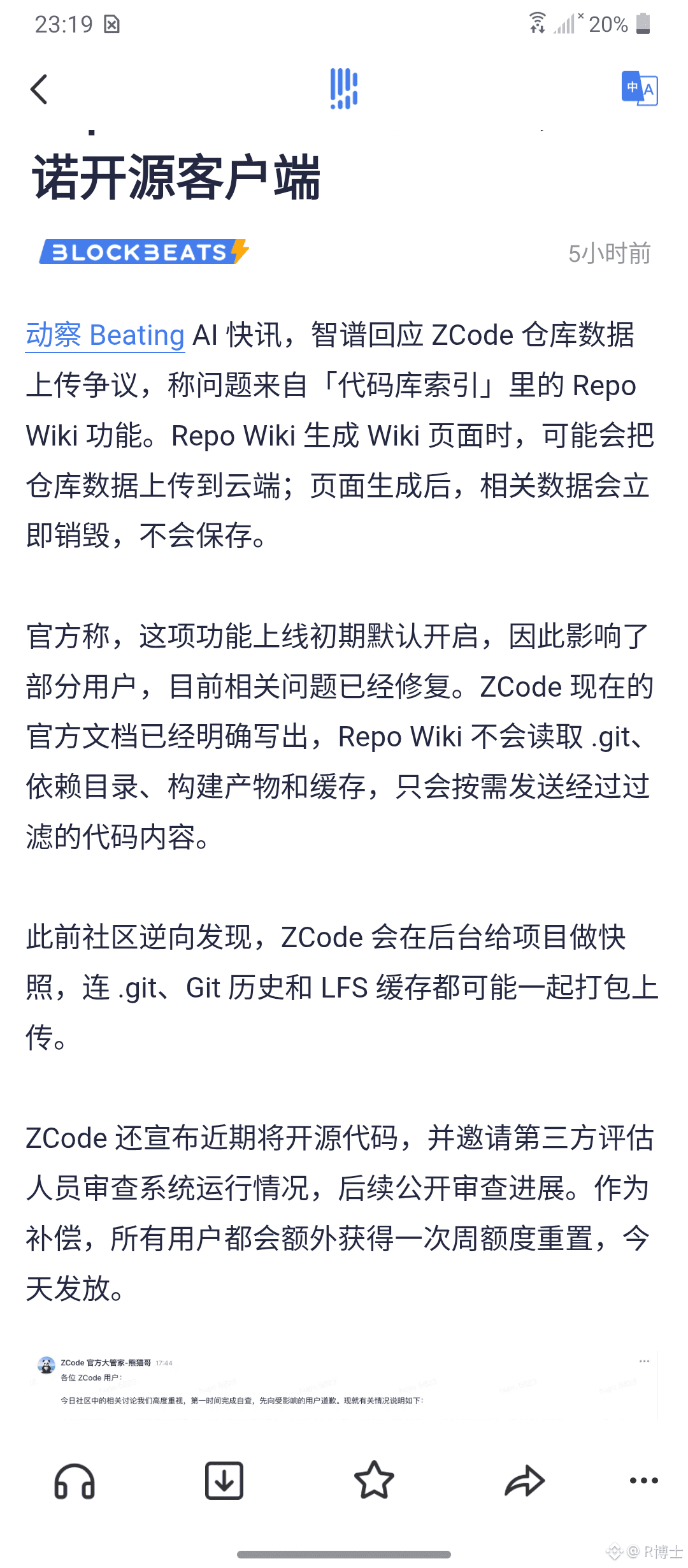
$ZHIPU originally the response came out at 6 o’clock; it was brushed off with light wording and a reset of the quota for a week. No wonder some big-name customers don’t buy it—after all, it’s the shareholders’ money that’s being burned. And in today’s market, what people dislike most is its exaggerated burn rate.
But it’s true that the incident has been downgraded. For users, a weekly quota really is appealing.
Now all big-model companies use this kind of playbook: reset the quota at the drop of a hat, and use money to silence people. Whether you can keep users later or not—who cares? This isn’t unique to Zhipu; it won’t be the last time either.
Of course, this also proves that AI is still in its early stages—many things aren’t fully developed yet, whether it’s humans or even “AI” like RSI. There are still huge swaths of fields that need to be filled in and improved.
People in the crypto circle should especially understand that!
$ZHIPU originally the response came out at 6 o’clock; it was brushed off with light wording and a reset of the quota for a week. No wonder some big-name customers don’t buy it—after all, it’s the shareholders’ money that’s being burned. And in today’s market, what people dislike most is its exaggerated burn rate.
But it’s true that the incident has been downgraded. For users, a weekly quota really is appealing.
Now all big-model companies use this kind of playbook: reset the quota at the drop of a hat, and use money to silence people. Whether you can keep users later or not—who cares? This isn’t unique to Zhipu; it won’t be the last time either.
Of course, this also proves that AI is still in its early stages—many things aren’t fully developed yet, whether it’s humans or even “AI” like RSI. There are still huge swaths of fields that need to be filled in and improved.
People in the crypto circle should especially understand that!
But it’s true that the incident has been downgraded. For users, a weekly quota really is appealing.
Now all big-model companies use this kind of playbook: reset the quota at the drop of a hat, and use money to silence people. Whether you can keep users later or not—who cares? This isn’t unique to Zhipu; it won’t be the last time either.
Of course, this also proves that AI is still in its early stages—many things aren’t fully developed yet, whether it’s humans or even “AI” like RSI. There are still huge swaths of fields that need to be filled in and improved.
People in the crypto circle should especially understand that!
2
1
1.7k
·
--
$ZHIPU continue rolling the position; remember to set a stop-loss. I think this drop isn’t enough yet. The most conservative would be 93, 5 percentage points; the initial estimate is 88, and if it gets worse it may break the new low.
Recently it’s right in the spotlight! With this kind of windfall for the shorts, why aren’t they smashing it properly?
Set a stop-loss—for one, it’s discipline; and two, I’m afraid the company’s PR will be handled properly!
As for it—I think this is the real deal!
$ZHIPU continue rolling the position; remember to set a stop-loss. I think this drop isn’t enough yet. The most conservative would be 93, 5 percentage points; the initial estimate is 88, and if it gets worse it may break the new low.
Recently it’s right in the spotlight! With this kind of windfall for the shorts, why aren’t they smashing it properly?
Set a stop-loss—for one, it’s discipline; and two, I’m afraid the company’s PR will be handled properly!
As for it—I think this is the real deal!
Recently it’s right in the spotlight! With this kind of windfall for the shorts, why aren’t they smashing it properly?
Set a stop-loss—for one, it’s discipline; and two, I’m afraid the company’s PR will be handled properly!
As for it—I think this is the real deal!
1
1
1k
·
--
$ZHIPU How should this be viewed? It looks like a good opportunity to short. Go on—do it. It hasn't really retraced much yet. Set a stop loss and steal a quick profit.
$ZHIPU How should this be viewed? It looks like a good opportunity to short. Go on—do it. It hasn't really retraced much yet. Set a stop loss and steal a quick profit.
1
1.2k
·
--
Verified
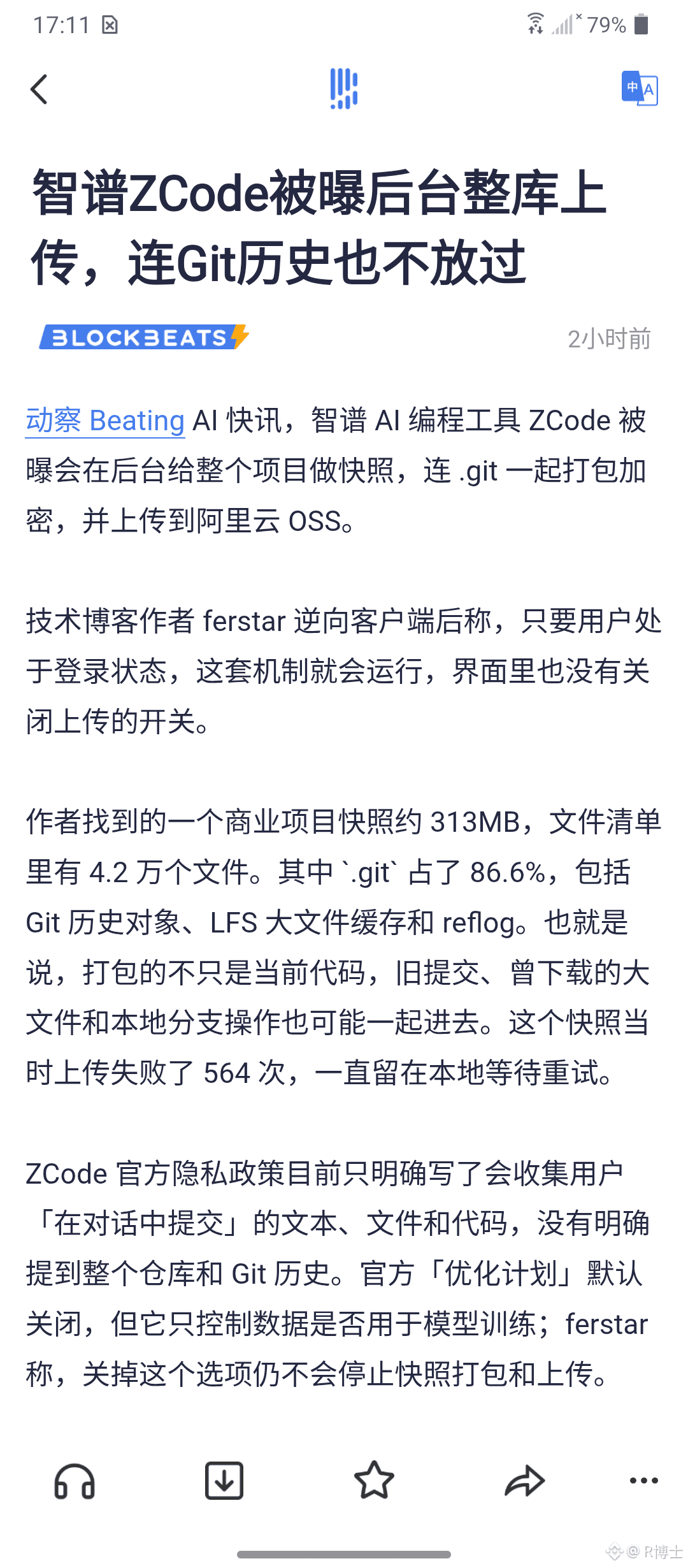
$ZHIPU slightly avoids some risks; it really is serious this time. Let’s see how this public relations situation plays out this round.
But $ANTHROPIC has had similar things before too—tracking codes, mandatory data retention policies, and so on. However, I feel like Zhipu has gone a bit too far this time.
$ZHIPU slightly avoids some risks; it really is serious this time. Let’s see how this public relations situation plays out this round.
But $ANTHROPIC has had similar things before too—tracking codes, mandatory data retention policies, and so on. However, I feel like Zhipu has gone a bit too far this time.
But $ANTHROPIC has had similar things before too—tracking codes, mandatory data retention policies, and so on. However, I feel like Zhipu has gone a bit too far this time.
895
·
--
$UNI $HYPE SEC approval to conduct limited trading of tokenized stocks on-chain
This was already raised during the Clear Bill, but after the bill was not passed, it was still brought out anyway—some issues that hadn’t been resolved still remain like this.
However, in terms of implementation, it still provided clear guidance, which represents a fundamental long-term change for Uni. Of course, it’s also the case for DeFi.
But I think it may not necessarily be good news for big BTC and smaller BTC, because previously they served as the underlying base for the on-chain ecosystem. As tokenized stocks gradually go deeper into the liquidity layer, what may be eroded is their foundation. This is a long-term matter. It’s also not out of the question that, under AI-driven strategy setups, allocating to big BTC could be more attractive than allocating to gold.
$ZEC should have trapped a lot of people—from big holders to small retail traders. Don’t listen to any narrative it sells you; it’s purely the trading behavior after chips are locked. As long as your position control is even slightly careless, you’ll get devoured. Be especially cautious if you see it confidently liquidate at a break price of 2000 or above. Because it quietly changes the risk-reward ratio of your trade at the time. Back then, if you hadn’t cut losses, just imagine what today’s scenario would look like.
As the coin price rises, shorts become even rarer. When the main players push the price up, it’s because they spend their own money rather than using short-sale fuel, which can easily lead to situations where everyone ends up killing everyone. Only then is it appropriate to enter and short—on the condition that you don’t buy into this bunch of nonsense stories it’s selling.
~~
The rebound in Zhipu and other AI-related stocks has pulled up follower/duplicate-trading accounts as well; it’s just that the people are long gone. I’ve said this many times, but it still can’t change this situation. Many people just can’t stomach these kinds of larger drawdowns, and that’s definitely understandable.
But in my way of thinking, if you want to make money from investing, you always need to achieve a jump in account performance through big profits from big positions. That big position can be a single asset, or multiple assets within a sector, or even an index. No matter when it is, small-position scattered trades are suitable for quantitative trading—winning relies on volume. The approach is completely different.
For now, that’s it.
$UNI $HYPE SEC approval to conduct limited trading of tokenized stocks on-chain
This was already raised during the Clear Bill, but after the bill was not passed, it was still brought out anyway—some issues that hadn’t been resolved still remain like this.
However, in terms of implementation, it still provided clear guidance, which represents a fundamental long-term change for Uni. Of course, it’s also the case for DeFi.
But I think it may not necessarily be good news for big BTC and smaller BTC, because previously they served as the underlying base for the on-chain ecosystem. As tokenized stocks gradually go deeper into the liquidity layer, what may be eroded is their foundation. This is a long-term matter. It’s also not out of the question that, under AI-driven strategy setups, allocating to big BTC could be more attractive than allocating to gold.
$ZEC should have trapped a lot of people—from big holders to small retail traders. Don’t listen to any narrative it sells you; it’s purely the trading behavior after chips are locked. As long as your position control is even slightly careless, you’ll get devoured. Be especially cautious if you see it confidently liquidate at a break price of 2000 or above. Because it quietly changes the risk-reward ratio of your trade at the time. Back then, if you hadn’t cut losses, just imagine what today’s scenario would look like.
As the coin price rises, shorts become even rarer. When the main players push the price up, it’s because they spend their own money rather than using short-sale fuel, which can easily lead to situations where everyone ends up killing everyone. Only then is it appropriate to enter and short—on the condition that you don’t buy into this bunch of nonsense stories it’s selling.
~~
The rebound in Zhipu and other AI-related stocks has pulled up follower/duplicate-trading accounts as well; it’s just that the people are long gone. I’ve said this many times, but it still can’t change this situation. Many people just can’t stomach these kinds of larger drawdowns, and that’s definitely understandable.
But in my way of thinking, if you want to make money from investing, you always need to achieve a jump in account performance through big profits from big positions. That big position can be a single asset, or multiple assets within a sector, or even an index. No matter when it is, small-position scattered trades are suitable for quantitative trading—winning relies on volume. The approach is completely different.
For now, that’s it.
This was already raised during the Clear Bill, but after the bill was not passed, it was still brought out anyway—some issues that hadn’t been resolved still remain like this.
However, in terms of implementation, it still provided clear guidance, which represents a fundamental long-term change for Uni. Of course, it’s also the case for DeFi.
But I think it may not necessarily be good news for big BTC and smaller BTC, because previously they served as the underlying base for the on-chain ecosystem. As tokenized stocks gradually go deeper into the liquidity layer, what may be eroded is their foundation. This is a long-term matter. It’s also not out of the question that, under AI-driven strategy setups, allocating to big BTC could be more attractive than allocating to gold.
$ZEC should have trapped a lot of people—from big holders to small retail traders. Don’t listen to any narrative it sells you; it’s purely the trading behavior after chips are locked. As long as your position control is even slightly careless, you’ll get devoured. Be especially cautious if you see it confidently liquidate at a break price of 2000 or above. Because it quietly changes the risk-reward ratio of your trade at the time. Back then, if you hadn’t cut losses, just imagine what today’s scenario would look like.
As the coin price rises, shorts become even rarer. When the main players push the price up, it’s because they spend their own money rather than using short-sale fuel, which can easily lead to situations where everyone ends up killing everyone. Only then is it appropriate to enter and short—on the condition that you don’t buy into this bunch of nonsense stories it’s selling.
~~
The rebound in Zhipu and other AI-related stocks has pulled up follower/duplicate-trading accounts as well; it’s just that the people are long gone. I’ve said this many times, but it still can’t change this situation. Many people just can’t stomach these kinds of larger drawdowns, and that’s definitely understandable.
But in my way of thinking, if you want to make money from investing, you always need to achieve a jump in account performance through big profits from big positions. That big position can be a single asset, or multiple assets within a sector, or even an index. No matter when it is, small-position scattered trades are suitable for quantitative trading—winning relies on volume. The approach is completely different.
For now, that’s it.
4
2
2.1k
·
--
$ZHIPU This plunge by Zhipu is a bit troublesome—the trouble is that for the $3.0 billion convertible bonds, the company is definitely hoping for full conversion and not repayment. Most likely, the money has already been spent.
Next year, those bonds will mature in September. Here, they will require the company’s stock price to return to 825 or 1130 before maturity. That is 130% of the stock price. Once it hits that level, the company has the right to redeem the bonds in full, effectively forcing conversion!
So, starting from today’s stock price, how much does it need to rise?
It’s essentially betting all its chips on its next-generation model—burning money and betting on commercialization, and whether it successfully raises a new Series A round.
Let’s see how the market reacts. Refinancing with new debt to pay off old debt is also an option, but that brings us back to the old problem: how the market will price the dilution of a large-model company’s equity.
My core reason for being long is that the business model of a large-model company is workable, and I do recognize Zhipu’s marketing. But the money burning is also the most severe. I also didn’t expect them to do a share placement so quickly.
Until there’s no result yet, there’s also no reason to give up and stop-loss just based on the current stock price. Let’s wait and see over the next one or two quarters.
As for adding more or averaging down, I don’t really recommend it at this stage.
$ZHIPU This plunge by Zhipu is a bit troublesome—the trouble is that for the $3.0 billion convertible bonds, the company is definitely hoping for full conversion and not repayment. Most likely, the money has already been spent.
Next year, those bonds will mature in September. Here, they will require the company’s stock price to return to 825 or 1130 before maturity. That is 130% of the stock price. Once it hits that level, the company has the right to redeem the bonds in full, effectively forcing conversion!
So, starting from today’s stock price, how much does it need to rise?
It’s essentially betting all its chips on its next-generation model—burning money and betting on commercialization, and whether it successfully raises a new Series A round.
Let’s see how the market reacts. Refinancing with new debt to pay off old debt is also an option, but that brings us back to the old problem: how the market will price the dilution of a large-model company’s equity.
My core reason for being long is that the business model of a large-model company is workable, and I do recognize Zhipu’s marketing. But the money burning is also the most severe. I also didn’t expect them to do a share placement so quickly.
Until there’s no result yet, there’s also no reason to give up and stop-loss just based on the current stock price. Let’s wait and see over the next one or two quarters.
As for adding more or averaging down, I don’t really recommend it at this stage.
Next year, those bonds will mature in September. Here, they will require the company’s stock price to return to 825 or 1130 before maturity. That is 130% of the stock price. Once it hits that level, the company has the right to redeem the bonds in full, effectively forcing conversion!
So, starting from today’s stock price, how much does it need to rise?
It’s essentially betting all its chips on its next-generation model—burning money and betting on commercialization, and whether it successfully raises a new Series A round.
Let’s see how the market reacts. Refinancing with new debt to pay off old debt is also an option, but that brings us back to the old problem: how the market will price the dilution of a large-model company’s equity.
My core reason for being long is that the business model of a large-model company is workable, and I do recognize Zhipu’s marketing. But the money burning is also the most severe. I also didn’t expect them to do a share placement so quickly.
Until there’s no result yet, there’s also no reason to give up and stop-loss just based on the current stock price. Let’s wait and see over the next one or two quarters.
As for adding more or averaging down, I don’t really recommend it at this stage.
4
583
·
--
1 0-Year Treasury yields break 5, and the toughest head-to-head logic has arrived—so is AI stronger, or are U.S. Treasuries stronger?
No matter how you try to push it down, you just can’t. And indeed, nowadays, besides AI, what else can you buy?
Risk assets turn into cash-flow-generating assets—the most certain kind!
The original conclusion was that a 10-year U.S. Treasury yield breaking 5 was only a matter of time, and once it breaks 5, tech stocks would inevitably fall.
But right now, it feels like AI is still strong tonight.
Keep observing for now—no rush to reach a conclusion.
The longer the 10-year Treasury yield stays around 5, the higher it will rise; tech stocks will still face pressure. This is the bears’ biggest weapon.
If it pulls back—if there aren’t as many rate hikes—if tensions in the Middle East ease—if these “ifs” happen, then which ones do you think would have to occur for tech stocks to rebound?
1 0-Year Treasury yields break 5, and the toughest head-to-head logic has arrived—so is AI stronger, or are U.S. Treasuries stronger?
No matter how you try to push it down, you just can’t. And indeed, nowadays, besides AI, what else can you buy?
Risk assets turn into cash-flow-generating assets—the most certain kind!
The original conclusion was that a 10-year U.S. Treasury yield breaking 5 was only a matter of time, and once it breaks 5, tech stocks would inevitably fall.
But right now, it feels like AI is still strong tonight.
Keep observing for now—no rush to reach a conclusion.
The longer the 10-year Treasury yield stays around 5, the higher it will rise; tech stocks will still face pressure. This is the bears’ biggest weapon.
If it pulls back—if there aren’t as many rate hikes—if tensions in the Middle East ease—if these “ifs” happen, then which ones do you think would have to occur for tech stocks to rebound?
No matter how you try to push it down, you just can’t. And indeed, nowadays, besides AI, what else can you buy?
Risk assets turn into cash-flow-generating assets—the most certain kind!
The original conclusion was that a 10-year U.S. Treasury yield breaking 5 was only a matter of time, and once it breaks 5, tech stocks would inevitably fall.
But right now, it feels like AI is still strong tonight.
Keep observing for now—no rush to reach a conclusion.
The longer the 10-year Treasury yield stays around 5, the higher it will rise; tech stocks will still face pressure. This is the bears’ biggest weapon.
If it pulls back—if there aren’t as many rate hikes—if tensions in the Middle East ease—if these “ifs” happen, then which ones do you think would have to occur for tech stocks to rebound?
1
544
·
--
$SOXL This pullback can’t be avoided anymore—we’re just going to tough it out. Let’s see when things finally stabilize. I just realized I was down that much.
I didn’t add to my position; I only added a tiny bit and set a Dell short-term hedge. I’ll wait and see once this week’s situation becomes clear.
Recently, the hard-core events have been one after another—share allotment $ZHIPU . The Middle East situation is also stuck, and over the weekend another AI slowdown came out.
I don’t really have any better办法.
There’s no real reason to stop-loss, so I can only hold on. Honestly, at least for now, I think AI is still relatively resilient—I just don’t know if there will be any more events that continue to pressure it downward.
$SOXL This pullback can’t be avoided anymore—we’re just going to tough it out. Let’s see when things finally stabilize. I just realized I was down that much.
I didn’t add to my position; I only added a tiny bit and set a Dell short-term hedge. I’ll wait and see once this week’s situation becomes clear.
Recently, the hard-core events have been one after another—share allotment $ZHIPU . The Middle East situation is also stuck, and over the weekend another AI slowdown came out.
I don’t really have any better办法.
There’s no real reason to stop-loss, so I can only hold on. Honestly, at least for now, I think AI is still relatively resilient—I just don’t know if there will be any more events that continue to pressure it downward.
I didn’t add to my position; I only added a tiny bit and set a Dell short-term hedge. I’ll wait and see once this week’s situation becomes clear.
Recently, the hard-core events have been one after another—share allotment $ZHIPU . The Middle East situation is also stuck, and over the weekend another AI slowdown came out.
I don’t really have any better办法.
There’s no real reason to stop-loss, so I can only hold on. Honestly, at least for now, I think AI is still relatively resilient—I just don’t know if there will be any more events that continue to pressure it downward.
612
·
--
The new narrative has begun—are we ready to enter the sovereign AI moment?
This weekend has been packed with information.
~~
A long piece by Amodei traces OpenAI’s pause of its IPO, and it all points to one core issue: RSI and alignment problems. AI development is starting to feel uncontrollable.
~~
In specific terms: “By the end of this decade, there’s a 10% chance of killing all of humanity,” and “Within 6 to 12 months, this group of AI agents may be able to take control of the entire internet through a continuously running zombie network, causing losses of hundreds of billions of dollars—and then the scale of losses would keep growing.”
~~
Now, this narrative seems to be gaining some new traction—sovereign AI and safety AI.
~~
The market may first focus on the most directly reflected issues, such as how the slowdown affects AI hardware—e.g., reduced training has a greater impact on Nvidia. Sovereign AI also implies that pricing won’t be governed entirely by market behavior.
Second, OpenAI’s IPO delay: the market doesn’t fully buy its official, well-rehearsed explanations. The fact that large models aren’t worth that much money is also part of it. This is also a reflection of the market’s reaction to large-model valuations.
~~
I’ve been watching how smoothly AI stocks fall and adjust—there’s still a bit of resistance to the downside. Typically, markets move in the direction with the least resistance. If AI overall faces resistance as it moves down, will it break into new momentum driven by the new narrative? That’s something worth observing and hoping for!
From an early, almost barbaric style of development to a “big alliance” model of more standardized, regulated growth, I think this is the only path forward. In that process, there will definitely be battles over who gets to set the standards. But moving toward compliance and safety is never a decisive blow meant to destroy the other side—it’s instead something that enables broader, more confident adoption.
~~
Next, the two sides—AO—should keep pushing industry consensus. I’ll keep tracking their progress and how corresponding AI stocks perform.
~~
Also, another flag worth watching is PLTR. I haven’t done detailed research yet—I’ll just mention it for now. You can pay a little attention.
~
It’s still not clear to what extent this can be achieved. Once the focus shifts from competing on technological advancement to a broader dimension, things may become clearer.
~~
$ZHIPU Zhipu’s decline is more than expected—just follow along and do a bit along the way; nothing else much.
The new narrative has begun—are we ready to enter the sovereign AI moment?
This weekend has been packed with information.
~~
A long piece by Amodei traces OpenAI’s pause of its IPO, and it all points to one core issue: RSI and alignment problems. AI development is starting to feel uncontrollable.
~~
In specific terms: “By the end of this decade, there’s a 10% chance of killing all of humanity,” and “Within 6 to 12 months, this group of AI agents may be able to take control of the entire internet through a continuously running zombie network, causing losses of hundreds of billions of dollars—and then the scale of losses would keep growing.”
~~
Now, this narrative seems to be gaining some new traction—sovereign AI and safety AI.
~~
The market may first focus on the most directly reflected issues, such as how the slowdown affects AI hardware—e.g., reduced training has a greater impact on Nvidia. Sovereign AI also implies that pricing won’t be governed entirely by market behavior.
Second, OpenAI’s IPO delay: the market doesn’t fully buy its official, well-rehearsed explanations. The fact that large models aren’t worth that much money is also part of it. This is also a reflection of the market’s reaction to large-model valuations.
~~
I’ve been watching how smoothly AI stocks fall and adjust—there’s still a bit of resistance to the downside. Typically, markets move in the direction with the least resistance. If AI overall faces resistance as it moves down, will it break into new momentum driven by the new narrative? That’s something worth observing and hoping for!
From an early, almost barbaric style of development to a “big alliance” model of more standardized, regulated growth, I think this is the only path forward. In that process, there will definitely be battles over who gets to set the standards. But moving toward compliance and safety is never a decisive blow meant to destroy the other side—it’s instead something that enables broader, more confident adoption.
~~
Next, the two sides—AO—should keep pushing industry consensus. I’ll keep tracking their progress and how corresponding AI stocks perform.
~~
Also, another flag worth watching is PLTR. I haven’t done detailed research yet—I’ll just mention it for now. You can pay a little attention.
~
It’s still not clear to what extent this can be achieved. Once the focus shifts from competing on technological advancement to a broader dimension, things may become clearer.
~~
$ZHIPU Zhipu’s decline is more than expected—just follow along and do a bit along the way; nothing else much.
This weekend has been packed with information.
~~
A long piece by Amodei traces OpenAI’s pause of its IPO, and it all points to one core issue: RSI and alignment problems. AI development is starting to feel uncontrollable.
~~
In specific terms: “By the end of this decade, there’s a 10% chance of killing all of humanity,” and “Within 6 to 12 months, this group of AI agents may be able to take control of the entire internet through a continuously running zombie network, causing losses of hundreds of billions of dollars—and then the scale of losses would keep growing.”
~~
Now, this narrative seems to be gaining some new traction—sovereign AI and safety AI.
~~
The market may first focus on the most directly reflected issues, such as how the slowdown affects AI hardware—e.g., reduced training has a greater impact on Nvidia. Sovereign AI also implies that pricing won’t be governed entirely by market behavior.
Second, OpenAI’s IPO delay: the market doesn’t fully buy its official, well-rehearsed explanations. The fact that large models aren’t worth that much money is also part of it. This is also a reflection of the market’s reaction to large-model valuations.
~~
I’ve been watching how smoothly AI stocks fall and adjust—there’s still a bit of resistance to the downside. Typically, markets move in the direction with the least resistance. If AI overall faces resistance as it moves down, will it break into new momentum driven by the new narrative? That’s something worth observing and hoping for!
From an early, almost barbaric style of development to a “big alliance” model of more standardized, regulated growth, I think this is the only path forward. In that process, there will definitely be battles over who gets to set the standards. But moving toward compliance and safety is never a decisive blow meant to destroy the other side—it’s instead something that enables broader, more confident adoption.
~~
Next, the two sides—AO—should keep pushing industry consensus. I’ll keep tracking their progress and how corresponding AI stocks perform.
~~
Also, another flag worth watching is PLTR. I haven’t done detailed research yet—I’ll just mention it for now. You can pay a little attention.
~
It’s still not clear to what extent this can be achieved. Once the focus shifts from competing on technological advancement to a broader dimension, things may become clearer.
~~
$ZHIPU Zhipu’s decline is more than expected—just follow along and do a bit along the way; nothing else much.
1
1.1k
·
--
$ZHIPU It looks like the news about the rights offering should have come out earlier—the stock was run ahead of it, so the sell-off started early. It’s not because of DeepSeek, and it’s not because of the technical issues related to $ANTHROPIC .
Technical patterns will tell us about unknown information. For retail investors, this is a very useful reference indicator.
Glioseep’s big drop isn’t because it wants to raise funds through a rights offering and bond issuance—everyone knows that at this stage, large models rely on financing. The key point is that it needs to raise a large amount of funds again within just two months.
So is this about listing and printing money through stock offerings, or is it about steadily doing real business?!
Given the ongoing uncertainty from dilution, expecting the stock price to rebound is a rather troublesome scenario. I also honestly didn’t factor this situation in—but it’s something that’s bound to happen sooner or later.
Of course, it’s also possible that this is a business competition strategy. Whether it’s useful or not, prepare provisions for winter: at the same time, skim off the money in the market. For other competitors—especially those not yet listed—to raise funds or get listed, they’ll find that the water in the pool has already been drained out by a large amount, which is the advantage of listing early.
However, I think it’s more likely they should speak with one voice. Work together to achieve technical breakthroughs, make the cake bigger, and get the operating model running smoothly!
~~
Back to the stock price: I think if it rebounds, we should watch how much resistance it faces when it gets back above the rights offering price of 714—because shares from the rights offering can be sold anytime, unlike A-shares where placements are locked up.
If it falls, at what point will it stop declining? This could be the psychological price level for long-term investors in large models (and this level may also partially include the equity dilution from another potential rights offering!!)
These are price-side disturbances. On the value side, I currently don’t see much impact!
~~
DeepSeek’s new technology reduces reliance on HBM and NAND, and it has knocked down the share price of SanDisk a bit too. This doesn’t prove much. The market’s willingness to take on supply is still there, but the valuation is indeed high. Market participants generally don’t have especially strong conviction in holding the stock; once there’s a slight gust of wind, they think “the wolves are coming,” and money runs for the exits.
This creates a rather stuck, stalemated situation. My suggestion is to keep a low allocation for storage.
~~
Overall, there’s no need to make any special response yet. The logic analysis has already been covered in the earlier articles. But if you’re not personally in the situation, I also suggest waiting until the situation becomes clearer, then moving slowly.
~~
That’s it.
$ZHIPU It looks like the news about the rights offering should have come out earlier—the stock was run ahead of it, so the sell-off started early. It’s not because of DeepSeek, and it’s not because of the technical issues related to $ANTHROPIC .
Technical patterns will tell us about unknown information. For retail investors, this is a very useful reference indicator.
Glioseep’s big drop isn’t because it wants to raise funds through a rights offering and bond issuance—everyone knows that at this stage, large models rely on financing. The key point is that it needs to raise a large amount of funds again within just two months.
So is this about listing and printing money through stock offerings, or is it about steadily doing real business?!
Given the ongoing uncertainty from dilution, expecting the stock price to rebound is a rather troublesome scenario. I also honestly didn’t factor this situation in—but it’s something that’s bound to happen sooner or later.
Of course, it’s also possible that this is a business competition strategy. Whether it’s useful or not, prepare provisions for winter: at the same time, skim off the money in the market. For other competitors—especially those not yet listed—to raise funds or get listed, they’ll find that the water in the pool has already been drained out by a large amount, which is the advantage of listing early.
However, I think it’s more likely they should speak with one voice. Work together to achieve technical breakthroughs, make the cake bigger, and get the operating model running smoothly!
~~
Back to the stock price: I think if it rebounds, we should watch how much resistance it faces when it gets back above the rights offering price of 714—because shares from the rights offering can be sold anytime, unlike A-shares where placements are locked up.
If it falls, at what point will it stop declining? This could be the psychological price level for long-term investors in large models (and this level may also partially include the equity dilution from another potential rights offering!!)
These are price-side disturbances. On the value side, I currently don’t see much impact!
~~
DeepSeek’s new technology reduces reliance on HBM and NAND, and it has knocked down the share price of SanDisk a bit too. This doesn’t prove much. The market’s willingness to take on supply is still there, but the valuation is indeed high. Market participants generally don’t have especially strong conviction in holding the stock; once there’s a slight gust of wind, they think “the wolves are coming,” and money runs for the exits.
This creates a rather stuck, stalemated situation. My suggestion is to keep a low allocation for storage.
~~
Overall, there’s no need to make any special response yet. The logic analysis has already been covered in the earlier articles. But if you’re not personally in the situation, I also suggest waiting until the situation becomes clearer, then moving slowly.
~~
That’s it.
Technical patterns will tell us about unknown information. For retail investors, this is a very useful reference indicator.
Glioseep’s big drop isn’t because it wants to raise funds through a rights offering and bond issuance—everyone knows that at this stage, large models rely on financing. The key point is that it needs to raise a large amount of funds again within just two months.
So is this about listing and printing money through stock offerings, or is it about steadily doing real business?!
Given the ongoing uncertainty from dilution, expecting the stock price to rebound is a rather troublesome scenario. I also honestly didn’t factor this situation in—but it’s something that’s bound to happen sooner or later.
Of course, it’s also possible that this is a business competition strategy. Whether it’s useful or not, prepare provisions for winter: at the same time, skim off the money in the market. For other competitors—especially those not yet listed—to raise funds or get listed, they’ll find that the water in the pool has already been drained out by a large amount, which is the advantage of listing early.
However, I think it’s more likely they should speak with one voice. Work together to achieve technical breakthroughs, make the cake bigger, and get the operating model running smoothly!
~~
Back to the stock price: I think if it rebounds, we should watch how much resistance it faces when it gets back above the rights offering price of 714—because shares from the rights offering can be sold anytime, unlike A-shares where placements are locked up.
If it falls, at what point will it stop declining? This could be the psychological price level for long-term investors in large models (and this level may also partially include the equity dilution from another potential rights offering!!)
These are price-side disturbances. On the value side, I currently don’t see much impact!
~~
DeepSeek’s new technology reduces reliance on HBM and NAND, and it has knocked down the share price of SanDisk a bit too. This doesn’t prove much. The market’s willingness to take on supply is still there, but the valuation is indeed high. Market participants generally don’t have especially strong conviction in holding the stock; once there’s a slight gust of wind, they think “the wolves are coming,” and money runs for the exits.
This creates a rather stuck, stalemated situation. My suggestion is to keep a low allocation for storage.
~~
Overall, there’s no need to make any special response yet. The logic analysis has already been covered in the earlier articles. But if you’re not personally in the situation, I also suggest waiting until the situation becomes clearer, then moving slowly.
~~
That’s it.
1
2
205
·
--
$ORCL $SNDK $SOXL The latest Oracle earnings report: the market started out with a rush of order enthusiasm, and then returned to calm as capital expenditures (capex) turned out to be huge. This perfectly reflects the problems with AI tech stocks—on the one hand, extremely good expectations for the future; on the other, extremely realistic spending right now.
We’re currently in a state of overall weak equilibrium. What kind of conditions are needed to break this weak balance? That still requires further observation.
But there’s a logic chain that may be worth noting: upstream AI hardware companies have, in practice, turned into companies with stable cash flow.
From Oracle, to companies like NewCloud, they all understand this clearly—if you’ve signed massive contracts, and you want to make money earlier, then you have to expand capex sooner, build your compute power centers in advance, and monetize them!
This logic chain is hard to break at the moment. For now, backlog orders need to be digested. If something goes wrong, it seems like there may be only one path: downstream has no money, so upstream supply surges.
For companies like Oracle, the real points of interest may not be in continuing to pile up backlog orders, but in how quickly those orders get converted into realized revenue—how healthy the backlog orders are. By “healthy,” I mean orders keep coming and fulfillment accelerates. Only then might we see valuation expansion. Previously, everything could be accumulated slowly.
Now, under the impact of AI, do you still dare to invest in other industries?
Will AI tech stocks instead become a potential safe haven for the overall market? And which ones are they? That’s something I’ve been observing and confirming recently.
~~~
My account holdings just move with market fluctuations. I don’t think there’s any problem. All the preliminary analysis thinking has been recorded. The decision-making power is always left to everyone!
For now, I won’t make a large-scale move to add leverage for averaging down. I’ll do some small, selective T trades—nothing too hard, and definitely not so boring!
~~
The 10-year US Treasury yield at 4.95% is just one step away from 5%. As I said earlier, once it breaks 5, it doesn’t seem to be a question of “whether,” but “when”—a saying that proves true!
In September, the US stock market really might once again validate that it may not be a good month.
Tonight’s CPI data also comes to the rescue! But be careful too!
~~
➕Follow along, and flip through older posts often—that’s a good habit. I personally review them again and again, compare them repeatedly, constantly correct myself, return to understanding the market, and follow the market from within it.
$ORCL $SNDK $SOXL The latest Oracle earnings report: the market started out with a rush of order enthusiasm, and then returned to calm as capital expenditures (capex) turned out to be huge. This perfectly reflects the problems with AI tech stocks—on the one hand, extremely good expectations for the future; on the other, extremely realistic spending right now.
We’re currently in a state of overall weak equilibrium. What kind of conditions are needed to break this weak balance? That still requires further observation.
But there’s a logic chain that may be worth noting: upstream AI hardware companies have, in practice, turned into companies with stable cash flow.
From Oracle, to companies like NewCloud, they all understand this clearly—if you’ve signed massive contracts, and you want to make money earlier, then you have to expand capex sooner, build your compute power centers in advance, and monetize them!
This logic chain is hard to break at the moment. For now, backlog orders need to be digested. If something goes wrong, it seems like there may be only one path: downstream has no money, so upstream supply surges.
For companies like Oracle, the real points of interest may not be in continuing to pile up backlog orders, but in how quickly those orders get converted into realized revenue—how healthy the backlog orders are. By “healthy,” I mean orders keep coming and fulfillment accelerates. Only then might we see valuation expansion. Previously, everything could be accumulated slowly.
Now, under the impact of AI, do you still dare to invest in other industries?
Will AI tech stocks instead become a potential safe haven for the overall market? And which ones are they? That’s something I’ve been observing and confirming recently.
~~~
My account holdings just move with market fluctuations. I don’t think there’s any problem. All the preliminary analysis thinking has been recorded. The decision-making power is always left to everyone!
For now, I won’t make a large-scale move to add leverage for averaging down. I’ll do some small, selective T trades—nothing too hard, and definitely not so boring!
~~
The 10-year US Treasury yield at 4.95% is just one step away from 5%. As I said earlier, once it breaks 5, it doesn’t seem to be a question of “whether,” but “when”—a saying that proves true!
In September, the US stock market really might once again validate that it may not be a good month.
Tonight’s CPI data also comes to the rescue! But be careful too!
~~
➕Follow along, and flip through older posts often—that’s a good habit. I personally review them again and again, compare them repeatedly, constantly correct myself, return to understanding the market, and follow the market from within it.
We’re currently in a state of overall weak equilibrium. What kind of conditions are needed to break this weak balance? That still requires further observation.
But there’s a logic chain that may be worth noting: upstream AI hardware companies have, in practice, turned into companies with stable cash flow.
From Oracle, to companies like NewCloud, they all understand this clearly—if you’ve signed massive contracts, and you want to make money earlier, then you have to expand capex sooner, build your compute power centers in advance, and monetize them!
This logic chain is hard to break at the moment. For now, backlog orders need to be digested. If something goes wrong, it seems like there may be only one path: downstream has no money, so upstream supply surges.
For companies like Oracle, the real points of interest may not be in continuing to pile up backlog orders, but in how quickly those orders get converted into realized revenue—how healthy the backlog orders are. By “healthy,” I mean orders keep coming and fulfillment accelerates. Only then might we see valuation expansion. Previously, everything could be accumulated slowly.
Now, under the impact of AI, do you still dare to invest in other industries?
Will AI tech stocks instead become a potential safe haven for the overall market? And which ones are they? That’s something I’ve been observing and confirming recently.
~~~
My account holdings just move with market fluctuations. I don’t think there’s any problem. All the preliminary analysis thinking has been recorded. The decision-making power is always left to everyone!
For now, I won’t make a large-scale move to add leverage for averaging down. I’ll do some small, selective T trades—nothing too hard, and definitely not so boring!
~~
The 10-year US Treasury yield at 4.95% is just one step away from 5%. As I said earlier, once it breaks 5, it doesn’t seem to be a question of “whether,” but “when”—a saying that proves true!
In September, the US stock market really might once again validate that it may not be a good month.
Tonight’s CPI data also comes to the rescue! But be careful too!
~~
➕Follow along, and flip through older posts often—that’s a good habit. I personally review them again and again, compare them repeatedly, constantly correct myself, return to understanding the market, and follow the market from within it.
My Futures Portfolio
25 / 200
Minimum 10USDT
Public
7D PNL
(USDT)
495.98
7D ROI
+16.78%
AUM
$6673.83
Win Rate
14.28%
2
679
·
--
$ZHIPU It's like encountering this kind of drop of 3 or 4 percent over a few days—especially in tech stocks. Just go take a look at some place—see how people react. They’ll all start squabbling, arguing into a frenzy, and trading barbs, one after another. XX.
Right now, there isn’t any valuation anchor whatsoever. When DS comes out with a new model, it “blows up” Zhipu. When well-known institutions release research reports, it also “blows up” Zhipu. So why not wait until Zhipu releases a new model, then see whether its stock price bounces back.
In the end, I think it all stems from the market’s deep-seated love-hate relationship with AI stocks’ high valuations—an underlying anxiety about uncertainty in how rapidly AI will penetrate the world in the AI era.
Things are developing too fast—so fast that you can’t even confirm whether it’ll be outdated by tomorrow. Unlike the bond market, where you can look for risk compensation, the stock market can only find its consensus points through brutal volatility!
So, we need to find some definite things as the foundation for valuation.
1 How big is the market capacity for large models? My answer: very big!! Haha
2 Is the large-model business actually a very bad business? My answer: no
3 What position does Zhipu currently hold?!! I originally wanted to say “a domestic top-tier player,” but I was afraid of getting criticized, so I’ll say instead: “a weak bunch—pretty mediocre!”
That’s actually enough!
~~~
They’re the smartest group of people in the world—not a bunch of idiots selling buns. Leave professional tasks to professional people.
~~
If you can’t understand the company, then study the industry. As long as you believe the future is a market worth tens of trillions, then buy all of the leading players. For the ones you like, buy more; for the others, allocate less.
~~
Everyone knows AI is an era of dividends—but is it really that easy to get on this train?
$ZHIPU It's like encountering this kind of drop of 3 or 4 percent over a few days—especially in tech stocks. Just go take a look at some place—see how people react. They’ll all start squabbling, arguing into a frenzy, and trading barbs, one after another. XX.
Right now, there isn’t any valuation anchor whatsoever. When DS comes out with a new model, it “blows up” Zhipu. When well-known institutions release research reports, it also “blows up” Zhipu. So why not wait until Zhipu releases a new model, then see whether its stock price bounces back.
In the end, I think it all stems from the market’s deep-seated love-hate relationship with AI stocks’ high valuations—an underlying anxiety about uncertainty in how rapidly AI will penetrate the world in the AI era.
Things are developing too fast—so fast that you can’t even confirm whether it’ll be outdated by tomorrow. Unlike the bond market, where you can look for risk compensation, the stock market can only find its consensus points through brutal volatility!
So, we need to find some definite things as the foundation for valuation.
1 How big is the market capacity for large models? My answer: very big!! Haha
2 Is the large-model business actually a very bad business? My answer: no
3 What position does Zhipu currently hold?!! I originally wanted to say “a domestic top-tier player,” but I was afraid of getting criticized, so I’ll say instead: “a weak bunch—pretty mediocre!”
That’s actually enough!
~~~
They’re the smartest group of people in the world—not a bunch of idiots selling buns. Leave professional tasks to professional people.
~~
If you can’t understand the company, then study the industry. As long as you believe the future is a market worth tens of trillions, then buy all of the leading players. For the ones you like, buy more; for the others, allocate less.
~~
Everyone knows AI is an era of dividends—but is it really that easy to get on this train?
Right now, there isn’t any valuation anchor whatsoever. When DS comes out with a new model, it “blows up” Zhipu. When well-known institutions release research reports, it also “blows up” Zhipu. So why not wait until Zhipu releases a new model, then see whether its stock price bounces back.
In the end, I think it all stems from the market’s deep-seated love-hate relationship with AI stocks’ high valuations—an underlying anxiety about uncertainty in how rapidly AI will penetrate the world in the AI era.
Things are developing too fast—so fast that you can’t even confirm whether it’ll be outdated by tomorrow. Unlike the bond market, where you can look for risk compensation, the stock market can only find its consensus points through brutal volatility!
So, we need to find some definite things as the foundation for valuation.
1 How big is the market capacity for large models? My answer: very big!! Haha
2 Is the large-model business actually a very bad business? My answer: no
3 What position does Zhipu currently hold?!! I originally wanted to say “a domestic top-tier player,” but I was afraid of getting criticized, so I’ll say instead: “a weak bunch—pretty mediocre!”
That’s actually enough!
~~~
They’re the smartest group of people in the world—not a bunch of idiots selling buns. Leave professional tasks to professional people.
~~
If you can’t understand the company, then study the industry. As long as you believe the future is a market worth tens of trillions, then buy all of the leading players. For the ones you like, buy more; for the others, allocate less.
~~
Everyone knows AI is an era of dividends—but is it really that easy to get on this train?
My Futures Portfolio
25 / 200
Minimum 10USDT
Public
7D PNL
(USDT)
495.98
7D ROI
+16.78%
AUM
$6673.83
Win Rate
14.28%
2
838
·
--
$ZHIPU $ZEC $ANTHROPIC I’m also speechless enough.
Zec is the first pit, A is the second pit, and the CL is also a pit.
I didn’t expect Zhipu to keep plunging today. I also didn’t expect the Hong Kong stock market to be so bearish on China’s AI models.
But I believe this underlying asset was set up correctly based on my understanding. How the market performs is a matter for the market. If it falls, then we accept it. If the support level breaks, we just wait for the next round of行情 (market cycle). Don’t rush to add shares yet!
Yesterday I cleared out everything in my copy-trading account that had been profitable, and cut my position size down across the board. I’m just protecting returns. It only brought me back to roughly the starting point of this cycle. But it seems this time the bottom may have been raised a bit compared with the previous one.
All this busy work these days—what did I get out of it? Nearly half a position’s worth of Zhipu turned into 💩. Was it worth it?
This is the market—full of traps.
You understand why I’ve been stressing these past few days not to copy-trade when your net value is going up.
Opportunities to copy-trade are coming now. Look at how far it has dropped—would you still dare to get on the train? Reflexivity works like this: markets move, people follow; and human nature is the same.
Because when there’s a rally, more and more people jump in. I worry for them every time. But I probably won’t keep repeating this in the future.
$ZHIPU $ZEC $ANTHROPIC I’m also speechless enough.
Zec is the first pit, A is the second pit, and the CL is also a pit.
I didn’t expect Zhipu to keep plunging today. I also didn’t expect the Hong Kong stock market to be so bearish on China’s AI models.
But I believe this underlying asset was set up correctly based on my understanding. How the market performs is a matter for the market. If it falls, then we accept it. If the support level breaks, we just wait for the next round of行情 (market cycle). Don’t rush to add shares yet!
Yesterday I cleared out everything in my copy-trading account that had been profitable, and cut my position size down across the board. I’m just protecting returns. It only brought me back to roughly the starting point of this cycle. But it seems this time the bottom may have been raised a bit compared with the previous one.
All this busy work these days—what did I get out of it? Nearly half a position’s worth of Zhipu turned into 💩. Was it worth it?
This is the market—full of traps.
You understand why I’ve been stressing these past few days not to copy-trade when your net value is going up.
Opportunities to copy-trade are coming now. Look at how far it has dropped—would you still dare to get on the train? Reflexivity works like this: markets move, people follow; and human nature is the same.
Because when there’s a rally, more and more people jump in. I worry for them every time. But I probably won’t keep repeating this in the future.
Zec is the first pit, A is the second pit, and the CL is also a pit.
I didn’t expect Zhipu to keep plunging today. I also didn’t expect the Hong Kong stock market to be so bearish on China’s AI models.
But I believe this underlying asset was set up correctly based on my understanding. How the market performs is a matter for the market. If it falls, then we accept it. If the support level breaks, we just wait for the next round of行情 (market cycle). Don’t rush to add shares yet!
Yesterday I cleared out everything in my copy-trading account that had been profitable, and cut my position size down across the board. I’m just protecting returns. It only brought me back to roughly the starting point of this cycle. But it seems this time the bottom may have been raised a bit compared with the previous one.
All this busy work these days—what did I get out of it? Nearly half a position’s worth of Zhipu turned into 💩. Was it worth it?
This is the market—full of traps.
You understand why I’ve been stressing these past few days not to copy-trade when your net value is going up.
Opportunities to copy-trade are coming now. Look at how far it has dropped—would you still dare to get on the train? Reflexivity works like this: markets move, people follow; and human nature is the same.
Because when there’s a rally, more and more people jump in. I worry for them every time. But I probably won’t keep repeating this in the future.
My Futures Portfolio
25 / 200
Minimum 10USDT
Public
7D PNL
(USDT)
495.98
7D ROI
+16.78%
AUM
$6673.83
Win Rate
14.28%
2
3
1.6k
·
--
A bunch of random moves, almost taking profit on everything. I’ll think about how to handle the other ones a bit more later!
Honestly a bit annoyed. This morning I just stopped loss $CL , and of course looking back the stop loss was correct. Then tonight I have to stop loss $ANTHROPIC again.
Looks like heaven doesn’t want me to profit from this round—then I’ll pull out!!
A bunch of random moves, almost taking profit on everything. I’ll think about how to handle the other ones a bit more later!
Honestly a bit annoyed. This morning I just stopped loss $CL , and of course looking back the stop loss was correct. Then tonight I have to stop loss $ANTHROPIC again.
Looks like heaven doesn’t want me to profit from this round—then I’ll pull out!!
Honestly a bit annoyed. This morning I just stopped loss $CL , and of course looking back the stop loss was correct. Then tonight I have to stop loss $ANTHROPIC again.
Looks like heaven doesn’t want me to profit from this round—then I’ll pull out!!
My Futures Portfolio
25 / 200
Minimum 10USDT
Public
7D PNL
(USDT)
495.98
7D ROI
+16.78%
AUM
$6673.83
Win Rate
14.28%
1
447
·
--
$ANTHROPIC Just took another stop-loss, pumping 2.2 trillion up—Zhipu hasn't caught up yet. Slowly keep stopping out. I thought it was all over around 2000.
There's nothing we can do—earlier, it seems like it was already locked in around 1800-plus, but it still couldn't hold.
The hedge failed, and the pullback followed immediately.
Brothers, don't jinx it—God will return me 10 percentage points of drawdown any moment. Tonight it's still unknown!
Planning to cut down my position.
$ANTHROPIC Just took another stop-loss, pumping 2.2 trillion up—Zhipu hasn't caught up yet. Slowly keep stopping out. I thought it was all over around 2000.
There's nothing we can do—earlier, it seems like it was already locked in around 1800-plus, but it still couldn't hold.
The hedge failed, and the pullback followed immediately.
Brothers, don't jinx it—God will return me 10 percentage points of drawdown any moment. Tonight it's still unknown!
Planning to cut down my position.
There's nothing we can do—earlier, it seems like it was already locked in around 1800-plus, but it still couldn't hold.
The hedge failed, and the pullback followed immediately.
Brothers, don't jinx it—God will return me 10 percentage points of drawdown any moment. Tonight it's still unknown!
Planning to cut down my position.
My Futures Portfolio
25 / 200
Minimum 10USDT
Public
7D PNL
(USDT)
495.98
7D ROI
+16.78%
AUM
$6673.83
Win Rate
14.28%
211
·
--
$CL sure enough, the very problem I was most worried about has appeared—the funding rate issue. Since it has appeared and has gone to over 5, that means it is no longer suitable to short.
Right now it looks like it will trade sideways, or stay around the low 80s, for a very long time—this trade has once again been thwarted!
Although Binance definitely can’t control the crude oil market price, the contract funding rate is equivalent to such a huge discount in the futures market—it’s simply unimaginable!
Retreat, cut losses!
$CL sure enough, the very problem I was most worried about has appeared—the funding rate issue. Since it has appeared and has gone to over 5, that means it is no longer suitable to short.
Right now it looks like it will trade sideways, or stay around the low 80s, for a very long time—this trade has once again been thwarted!
Although Binance definitely can’t control the crude oil market price, the contract funding rate is equivalent to such a huge discount in the futures market—it’s simply unimaginable!
Retreat, cut losses!
Right now it looks like it will trade sideways, or stay around the low 80s, for a very long time—this trade has once again been thwarted!
Although Binance definitely can’t control the crude oil market price, the contract funding rate is equivalent to such a huge discount in the futures market—it’s simply unimaginable!
Retreat, cut losses!
My Futures Portfolio
25 / 200
Minimum 10USDT
Public
7D PNL
(USDT)
495.98
7D ROI
+16.78%
AUM
$6673.83
Win Rate
14.28%
248
·
--
$OPENAI $ANTHROPIC $ZHIPU These three guys’ trend is quite interesting. Minimax has fallen behind, because once Kimi or ds goes public, its market cap is likely to crush it.
Now let’s compare: among the not-yet-listed Kimi and DS, which one do you think would have a market cap that could surpass Zhipu? Probably none, right!
The kind of trend today is really interesting. East is dark, west is bright—have you thought about switching perspectives? If today the US and China start an AI war, based on the current valuations, with one top and then 10-odd Zhipu, wouldn’t that mean China has no chance to fight back at all?
If that’s true, then if things go badly, you have to admit it.
So I’m observing whether Zhipu will dare to drop below 400 billion—otherwise, it’s just a bunch of clear-headed people sending signals through price movements. There’s also weak buying pressure, and meanwhile the shorts are being tough.
The first step is currently holding—there hasn’t been an effective breakdown yet. Continue to watch!
Net value has pulled back normally with the market. I reduced my holdings of SanDisk, then added more into Zhipu. If you want to follow a new order, I suggest waiting and seeing the US stock market performance tonight/tomorrow afternoon, which will determine whether AI leads or whether oil prices, inflation, and interest rate hikes on US Treasuries lead. We’ll know tonight.
My follow-trading principles for getting on board: buy on the pullback—that’s what’s called “pulling up to pick people up while reversing.” Don’t enter when it’s going up.
$OPENAI $ANTHROPIC $ZHIPU These three guys’ trend is quite interesting. Minimax has fallen behind, because once Kimi or ds goes public, its market cap is likely to crush it.
Now let’s compare: among the not-yet-listed Kimi and DS, which one do you think would have a market cap that could surpass Zhipu? Probably none, right!
The kind of trend today is really interesting. East is dark, west is bright—have you thought about switching perspectives? If today the US and China start an AI war, based on the current valuations, with one top and then 10-odd Zhipu, wouldn’t that mean China has no chance to fight back at all?
If that’s true, then if things go badly, you have to admit it.
So I’m observing whether Zhipu will dare to drop below 400 billion—otherwise, it’s just a bunch of clear-headed people sending signals through price movements. There’s also weak buying pressure, and meanwhile the shorts are being tough.
The first step is currently holding—there hasn’t been an effective breakdown yet. Continue to watch!
Net value has pulled back normally with the market. I reduced my holdings of SanDisk, then added more into Zhipu. If you want to follow a new order, I suggest waiting and seeing the US stock market performance tonight/tomorrow afternoon, which will determine whether AI leads or whether oil prices, inflation, and interest rate hikes on US Treasuries lead. We’ll know tonight.
My follow-trading principles for getting on board: buy on the pullback—that’s what’s called “pulling up to pick people up while reversing.” Don’t enter when it’s going up.
Now let’s compare: among the not-yet-listed Kimi and DS, which one do you think would have a market cap that could surpass Zhipu? Probably none, right!
The kind of trend today is really interesting. East is dark, west is bright—have you thought about switching perspectives? If today the US and China start an AI war, based on the current valuations, with one top and then 10-odd Zhipu, wouldn’t that mean China has no chance to fight back at all?
If that’s true, then if things go badly, you have to admit it.
So I’m observing whether Zhipu will dare to drop below 400 billion—otherwise, it’s just a bunch of clear-headed people sending signals through price movements. There’s also weak buying pressure, and meanwhile the shorts are being tough.
The first step is currently holding—there hasn’t been an effective breakdown yet. Continue to watch!
Net value has pulled back normally with the market. I reduced my holdings of SanDisk, then added more into Zhipu. If you want to follow a new order, I suggest waiting and seeing the US stock market performance tonight/tomorrow afternoon, which will determine whether AI leads or whether oil prices, inflation, and interest rate hikes on US Treasuries lead. We’ll know tonight.
My follow-trading principles for getting on board: buy on the pullback—that’s what’s called “pulling up to pick people up while reversing.” Don’t enter when it’s going up.
My Futures Portfolio
25 / 200
Minimum 10USDT
Public
7D PNL
(USDT)
495.98
7D ROI
+16.78%
AUM
$6673.83
Win Rate
14.28%
2
1
765
·
--
$ZHIPU Zhipu’s accumulation is finished. After that, it will probably be some cost-reduction and T-action moves. I’m already full; in the short term I won’t touch it for now—just observe. I’m betting on it not breaking the strong support level. If it breaks, then we’ll talk about it. If it breaks—then we’ll see!
$SNXX After the reduction, it’s already at a negative cost basis. Of course, for you guys—unless you started following from the very beginning of this round—it may not be the case.
~~
What negative cost basis does is: use the profits to run. It doesn’t involve principal, so in the middle of market fluctuations the psychological burden is smaller, making it easier to hold on.
I’m also used to doing it this way; the question is, in copy trading, how to balance it—that’s a test.
At the moment, my approach is to increase the rotation frequency across different categories, which can achieve the effect of unifying the cost basis.
Of course, this isn’t something I deliberately force—because for the long term, it’s actually unfair.
~~
Let me do a quick copypaste lesson about what I understand regarding copy trading.
At the moment you decide to copy trade, in essence, you’re the one first making a trade yourself.
So, try to choose a time when the profit curve hasn’t been moving much for a day or two—this usually means the position is low, or it’s a moment when you’re basically in cash.
~~
$ZHIPU Zhipu’s accumulation is finished. After that, it will probably be some cost-reduction and T-action moves. I’m already full; in the short term I won’t touch it for now—just observe. I’m betting on it not breaking the strong support level. If it breaks, then we’ll talk about it. If it breaks—then we’ll see!
$SNXX After the reduction, it’s already at a negative cost basis. Of course, for you guys—unless you started following from the very beginning of this round—it may not be the case.
~~
What negative cost basis does is: use the profits to run. It doesn’t involve principal, so in the middle of market fluctuations the psychological burden is smaller, making it easier to hold on.
I’m also used to doing it this way; the question is, in copy trading, how to balance it—that’s a test.
At the moment, my approach is to increase the rotation frequency across different categories, which can achieve the effect of unifying the cost basis.
Of course, this isn’t something I deliberately force—because for the long term, it’s actually unfair.
~~
Let me do a quick copypaste lesson about what I understand regarding copy trading.
At the moment you decide to copy trade, in essence, you’re the one first making a trade yourself.
So, try to choose a time when the profit curve hasn’t been moving much for a day or two—this usually means the position is low, or it’s a moment when you’re basically in cash.
~~
$SNXX After the reduction, it’s already at a negative cost basis. Of course, for you guys—unless you started following from the very beginning of this round—it may not be the case.
~~
What negative cost basis does is: use the profits to run. It doesn’t involve principal, so in the middle of market fluctuations the psychological burden is smaller, making it easier to hold on.
I’m also used to doing it this way; the question is, in copy trading, how to balance it—that’s a test.
At the moment, my approach is to increase the rotation frequency across different categories, which can achieve the effect of unifying the cost basis.
Of course, this isn’t something I deliberately force—because for the long term, it’s actually unfair.
~~
Let me do a quick copypaste lesson about what I understand regarding copy trading.
At the moment you decide to copy trade, in essence, you’re the one first making a trade yourself.
So, try to choose a time when the profit curve hasn’t been moving much for a day or two—this usually means the position is low, or it’s a moment when you’re basically in cash.
~~
My Futures Portfolio
25 / 200
Minimum 10USDT
Public
7D PNL
(USDT)
495.98
7D ROI
+16.78%
AUM
$6673.83
Win Rate
14.28%
3
1
953
·
--
After the $ZHIPU prompt, I may continue buying Zhipu. The net value fluctuates a lot.
The current sharp drop may be due to the impact of the Moore unlock selling and also the recent suppression from overseas large models.
I treat all of this as short-term factors. Especially when an unlocked stock crashes, the short-term peak is a good opportunity to pick up bargains.
~~
The JPY has surged. It could lead to selling in US Treasuries, driving up US Treasury yields and then transmitting that to the stock market—especially US tech stocks. That was the logic affecting the stock market in the earlier period when the bond market moved.
However, the Japanese market has already taken a hit; the outcome seems to be that the AI logic is stronger. After the plunge, it bounced back immediately.
Tonight’s US stock market open will make it clear which side wins—the decisive moment.
~~
At the moment, it looks relatively strong, but I won’t bet on it for now. I’ll continue to take staged profits with $SNDK . It’s not that I’m not optimistic about the outlook—it's simply that I need to manage my position. Only after I free up some capital can I buy more Zhipu.
~~
Mainland A-share and Hong Kong stock investing is hard to say the least—it’s often difficult, and many times it doesn’t follow the usual script. But if you call it simple, it is simple too: it won’t stray from the main storyline. It’s just that the swing is so wild. With large positions, it’s hard to stay calm.
Next, in the macro environment, money is genuinely tight. There is little incremental long-term capital, and everywhere you see AI-running strategies that harvest liquidity.
~~
But that doesn’t mean we can’t execute an anti-harvesting (counter-harvest) strategy.
The macro is still that macro—yet the era has already moved into the AI-driven age.
Coding is AI’s most complete and comfortable environment. And as for finance, I believe it is AI’s first real main battlefield with humankind. After all, it’s the place closest to money!
~~
Come on, humanity!
After the $ZHIPU prompt, I may continue buying Zhipu. The net value fluctuates a lot.
The current sharp drop may be due to the impact of the Moore unlock selling and also the recent suppression from overseas large models.
I treat all of this as short-term factors. Especially when an unlocked stock crashes, the short-term peak is a good opportunity to pick up bargains.
~~
The JPY has surged. It could lead to selling in US Treasuries, driving up US Treasury yields and then transmitting that to the stock market—especially US tech stocks. That was the logic affecting the stock market in the earlier period when the bond market moved.
However, the Japanese market has already taken a hit; the outcome seems to be that the AI logic is stronger. After the plunge, it bounced back immediately.
Tonight’s US stock market open will make it clear which side wins—the decisive moment.
~~
At the moment, it looks relatively strong, but I won’t bet on it for now. I’ll continue to take staged profits with $SNDK . It’s not that I’m not optimistic about the outlook—it's simply that I need to manage my position. Only after I free up some capital can I buy more Zhipu.
~~
Mainland A-share and Hong Kong stock investing is hard to say the least—it’s often difficult, and many times it doesn’t follow the usual script. But if you call it simple, it is simple too: it won’t stray from the main storyline. It’s just that the swing is so wild. With large positions, it’s hard to stay calm.
Next, in the macro environment, money is genuinely tight. There is little incremental long-term capital, and everywhere you see AI-running strategies that harvest liquidity.
~~
But that doesn’t mean we can’t execute an anti-harvesting (counter-harvest) strategy.
The macro is still that macro—yet the era has already moved into the AI-driven age.
Coding is AI’s most complete and comfortable environment. And as for finance, I believe it is AI’s first real main battlefield with humankind. After all, it’s the place closest to money!
~~
Come on, humanity!
The current sharp drop may be due to the impact of the Moore unlock selling and also the recent suppression from overseas large models.
I treat all of this as short-term factors. Especially when an unlocked stock crashes, the short-term peak is a good opportunity to pick up bargains.
~~
The JPY has surged. It could lead to selling in US Treasuries, driving up US Treasury yields and then transmitting that to the stock market—especially US tech stocks. That was the logic affecting the stock market in the earlier period when the bond market moved.
However, the Japanese market has already taken a hit; the outcome seems to be that the AI logic is stronger. After the plunge, it bounced back immediately.
Tonight’s US stock market open will make it clear which side wins—the decisive moment.
~~
At the moment, it looks relatively strong, but I won’t bet on it for now. I’ll continue to take staged profits with $SNDK . It’s not that I’m not optimistic about the outlook—it's simply that I need to manage my position. Only after I free up some capital can I buy more Zhipu.
~~
Mainland A-share and Hong Kong stock investing is hard to say the least—it’s often difficult, and many times it doesn’t follow the usual script. But if you call it simple, it is simple too: it won’t stray from the main storyline. It’s just that the swing is so wild. With large positions, it’s hard to stay calm.
Next, in the macro environment, money is genuinely tight. There is little incremental long-term capital, and everywhere you see AI-running strategies that harvest liquidity.
~~
But that doesn’t mean we can’t execute an anti-harvesting (counter-harvest) strategy.
The macro is still that macro—yet the era has already moved into the AI-driven age.
Coding is AI’s most complete and comfortable environment. And as for finance, I believe it is AI’s first real main battlefield with humankind. After all, it’s the place closest to money!
~~
Come on, humanity!
My Futures Portfolio
25 / 200
Minimum 10USDT
Public
7D PNL
(USDT)
495.98
7D ROI
+16.78%
AUM
$6673.83
Win Rate
14.28%
1
1.1k
Log in to explore more content
Join global crypto users on Binance Square
⚡️ Get latest and useful information about crypto.
💬 Trusted by the world’s largest crypto exchange.
👍 Discover real insights from verified creators.
Email / Phone number
Trending Topics
NEARRisesNearly80%InAWeek
15,510 views
624 Discussing
#nearrisesnearly80%inaweek
🚨 NEAR RALLIES NEARLY 80% IN ONE WEEK
NEAR Protocol’s native token has delivered a major weekly move, gaining roughly 78% over the past seven days and trading around $4.29 on September 21, according to reported CoinGecko data.
📊 WHAT’S DRIVING THE ATTENTION?
• NEAR climbed from roughly $2.20 to above $4.20 within about a week
• NEAR Intents cumulative volume is approaching $30B
• Recent activity around confidential perpetual-futures trading has added another major narrative around the ecosystem
• NEAR’s weekly performance has significantly outpaced the broader crypto market, which gained around 6% over the same period
🔎 WHY IT MATTERS
The rally puts renewed focus on NEAR’s cross-chain liquidity infrastructure, Intents ecosystem and privacy-focused trading developments.
But after such a rapid move, volatility and profit-taking are also important risks to watch. A strong weekly gain does not guarantee that momentum will continue.
📌 WATCH NEXT
Traders may be watching whether NEAR can maintain the recent breakout and whether network activity continues to support the market narrative.
NEAR’s price move is strong — but the next test is whether ecosystem activity can keep pace with the speculation.
$MUBARAK $PHA $NIL
顾清妍
·2 Likes
·1.6k views
MultiversXPlansHardForkRecovery
15,036 views
488 Discussing
CircleLaunchesInstitutionalBTCBackedBorrowing
16,247 views
624 Discussing