
Ruoxi 若曦
1.2k Posts

Ruoxi 若曦
Report
Block User
365 Following
22.2K+ Followers
1.4K+ Liked
Posts
All
Quotes
Live
·
--
Verified
See translation
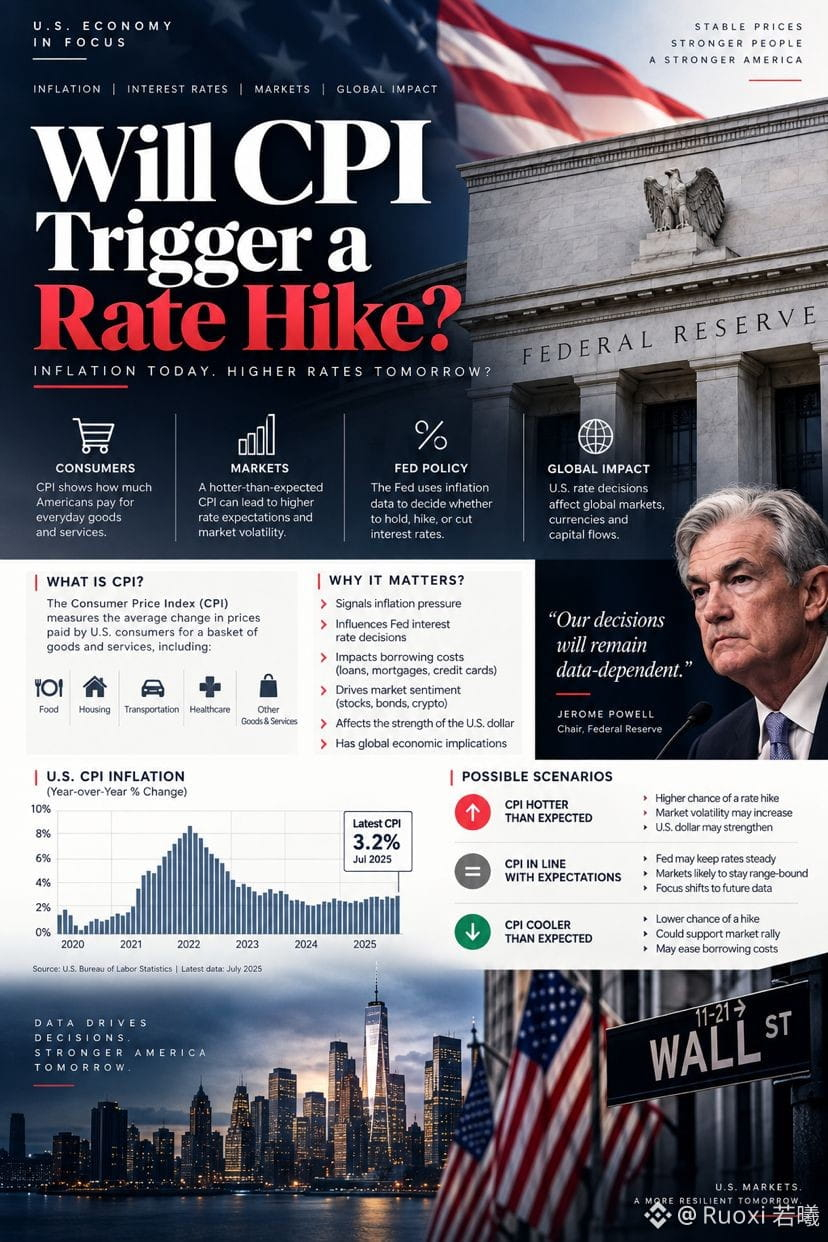
Will CPI Trigger a Rate Hike?
I’ve been watching this setup closely because something feels a little different this time.
The jobs data came in stronger than expected, and now everyone is waiting for CPI to give the Fed its next excuse or maybe its next reason to stay cautious.
Personally, I’m not convinced the Fed will rush into anything. One strong data point doesn’t change the whole picture, but sticky inflation could definitely make the market nervous again.
What worries me most is the reaction after CPI. We could see stocks get hit, yields jump, and gold swing hard within minutes. And honestly, the first move isn’t always the move I trust.
I’m staying cautious on stocks for now and watching gold closely. I’d rather miss the first candle than chase a move that reverses five minutes later.
That’s just how I’m seeing it.
What are you expecting Fed hike or hold? Bullish or bearish?
#CPIWatch
Will CPI Trigger a Rate Hike?
I’ve been watching this setup closely because something feels a little different this time.
The jobs data came in stronger than expected, and now everyone is waiting for CPI to give the Fed its next excuse or maybe its next reason to stay cautious.
Personally, I’m not convinced the Fed will rush into anything. One strong data point doesn’t change the whole picture, but sticky inflation could definitely make the market nervous again.
What worries me most is the reaction after CPI. We could see stocks get hit, yields jump, and gold swing hard within minutes. And honestly, the first move isn’t always the move I trust.
I’m staying cautious on stocks for now and watching gold closely. I’d rather miss the first candle than chase a move that reverses five minutes later.
That’s just how I’m seeing it.
What are you expecting Fed hike or hold? Bullish or bearish?
#CPIWatch
I’ve been watching this setup closely because something feels a little different this time.
The jobs data came in stronger than expected, and now everyone is waiting for CPI to give the Fed its next excuse or maybe its next reason to stay cautious.
Personally, I’m not convinced the Fed will rush into anything. One strong data point doesn’t change the whole picture, but sticky inflation could definitely make the market nervous again.
What worries me most is the reaction after CPI. We could see stocks get hit, yields jump, and gold swing hard within minutes. And honestly, the first move isn’t always the move I trust.
I’m staying cautious on stocks for now and watching gold closely. I’d rather miss the first candle than chase a move that reverses five minutes later.
That’s just how I’m seeing it.
What are you expecting Fed hike or hold? Bullish or bearish?
#CPIWatch
126
·
--
See translation
@termmax I keep looking at the less glamorous side of DeFi, because that’s usually where I learn the most. TermMax has a bug bounty that puts a real value on finding serious smart-contract problems before an attacker does.
For a critical bug, the reward is 10% of directly affected funds, capped at $50,000, with a $10,000 minimum. I think that’s a meaningful incentive for whitehats to speak up early.
What caught my attention is the repeat-attack rule. If a contract can be paused or upgraded, only the initial attack may count. If it can’t be stopped, cumulative damage from repeated exploitation can be considered. That feels much closer to how an actual exploit could unfold.
TermMax combines fixed-rate borrowing and lending with customizable AMM pricing curves, so security isn’t something I’d treat lightly. The bounty also requires a proof of concept, and testing is restricted to local forks rather than live mainnet or public testnet code.
Still, a $50K bounty doesn’t magically make a protocol safe. Bugs can remain undiscovered, and DeFi has plenty of risks outside smart contracts too.
Personally, I see the bounty as one security signal, not a guarantee.
Would a strong bug bounty influence your decision to use TermMax?
#TermMax
$GALA
{spot}(GALAUSDT)
$BCH
{spot}(BCHUSDT)
@TermMax I keep looking at the less glamorous side of DeFi, because that’s usually where I learn the most. TermMax has a bug bounty that puts a real value on finding serious smart-contract problems before an attacker does.
For a critical bug, the reward is 10% of directly affected funds, capped at $50,000, with a $10,000 minimum. I think that’s a meaningful incentive for whitehats to speak up early.
What caught my attention is the repeat-attack rule. If a contract can be paused or upgraded, only the initial attack may count. If it can’t be stopped, cumulative damage from repeated exploitation can be considered. That feels much closer to how an actual exploit could unfold.
TermMax combines fixed-rate borrowing and lending with customizable AMM pricing curves, so security isn’t something I’d treat lightly. The bounty also requires a proof of concept, and testing is restricted to local forks rather than live mainnet or public testnet code.
Still, a $50K bounty doesn’t magically make a protocol safe. Bugs can remain undiscovered, and DeFi has plenty of risks outside smart contracts too.
Personally, I see the bounty as one security signal, not a guarantee.
Would a strong bug bounty influence your decision to use TermMax?
#TermMax
$GALA
$BCH
For a critical bug, the reward is 10% of directly affected funds, capped at $50,000, with a $10,000 minimum. I think that’s a meaningful incentive for whitehats to speak up early.
What caught my attention is the repeat-attack rule. If a contract can be paused or upgraded, only the initial attack may count. If it can’t be stopped, cumulative damage from repeated exploitation can be considered. That feels much closer to how an actual exploit could unfold.
TermMax combines fixed-rate borrowing and lending with customizable AMM pricing curves, so security isn’t something I’d treat lightly. The bounty also requires a proof of concept, and testing is restricted to local forks rather than live mainnet or public testnet code.
Still, a $50K bounty doesn’t magically make a protocol safe. Bugs can remain undiscovered, and DeFi has plenty of risks outside smart contracts too.
Personally, I see the bounty as one security signal, not a guarantee.
Would a strong bug bounty influence your decision to use TermMax?
#TermMax
$GALA
$BCH
Bounty Hunt 🟠
100%
Treasure Hunt 🟣
0%
4 votes • Voting closed
1
1
460
·
--
Partly True
See translation
@termmax One thing immediately stood out to me when I read TermMax’s XP breakdown: the multiplier isn’t equal for every position.
Vault deposits receive 30x XP, FT holdings receive 15x, and GT holdings receive 2x based on the debt asset value. There’s also a referral component worth 10% of referred users’ XP, excluding the referral bonus itself.
Honestly, I like the logic more than a simple “do 100 transactions” campaign.
It gives the incentive system a connection to different roles inside TermMax.
And those roles actually matter because TermMax uses things like Fixed-Rate Tokens and Gearing Tokens to structure borrowing and lending around fixed terms.
Still, 30x can look exciting on paper and become less impressive if too many users pile into the same strategy.
That’s the part I’d watch.
Do you think multiplier-based XP creates better users, or just more competition for the same airdrop?
#TermMax
$ACE
{spot}(ACEUSDT)
$ONG
{spot}(ONGUSDT)
@TermMax One thing immediately stood out to me when I read TermMax’s XP breakdown: the multiplier isn’t equal for every position.
Vault deposits receive 30x XP, FT holdings receive 15x, and GT holdings receive 2x based on the debt asset value. There’s also a referral component worth 10% of referred users’ XP, excluding the referral bonus itself.
Honestly, I like the logic more than a simple “do 100 transactions” campaign.
It gives the incentive system a connection to different roles inside TermMax.
And those roles actually matter because TermMax uses things like Fixed-Rate Tokens and Gearing Tokens to structure borrowing and lending around fixed terms.
Still, 30x can look exciting on paper and become less impressive if too many users pile into the same strategy.
That’s the part I’d watch.
Do you think multiplier-based XP creates better users, or just more competition for the same airdrop?
#TermMax
$ACE
$ONG
Vault deposits receive 30x XP, FT holdings receive 15x, and GT holdings receive 2x based on the debt asset value. There’s also a referral component worth 10% of referred users’ XP, excluding the referral bonus itself.
Honestly, I like the logic more than a simple “do 100 transactions” campaign.
It gives the incentive system a connection to different roles inside TermMax.
And those roles actually matter because TermMax uses things like Fixed-Rate Tokens and Gearing Tokens to structure borrowing and lending around fixed terms.
Still, 30x can look exciting on paper and become less impressive if too many users pile into the same strategy.
That’s the part I’d watch.
Do you think multiplier-based XP creates better users, or just more competition for the same airdrop?
#TermMax
$ACE
$ONG
Bullish Token Volatility 🟢
73%
Bearish Token Volatility 🔴
27%
11 votes • Voting closed
3
866
·
--
See translation
@termmax One thing I keep looking at DeFi protocols a little differently now.
A 93% DeFiSafety PQR score on TermMax caught my attention, but I don’t see 93% as “safe, done, move on.” I see it as a reason to look deeper, honestly. The score covers code, documentation, testing, security, admin controls and oracles.
TermMax scored 100% on Code & Team,
94% on Security, 97% on Admin Controls and 100% on Oracles. Testing came in at 89%, while documentation was 70%. That last number is actually the part I’d want to understand better.
I think this is how security scores should be used.
Not as a green light, but as a starting point for research. TermMax also describes unit tests, fuzzing, mutation testing and integration testing.
Still, smart-contract risk never disappears completely in DeFi.
So I’m watching the 93% with interest, not blind trust.For a protocol handling lending, borrowing and structured products, security isn’t a side feature — it’s the whole game.
Would a 93% PQR score change your view of a DeFi protocol?
#TermMax
$CLO
{future}(CLOUSDT)
$ACE
{spot}(ACEUSDT)
@TermMax One thing I keep looking at DeFi protocols a little differently now.
A 93% DeFiSafety PQR score on TermMax caught my attention, but I don’t see 93% as “safe, done, move on.” I see it as a reason to look deeper, honestly. The score covers code, documentation, testing, security, admin controls and oracles.
TermMax scored 100% on Code & Team,
94% on Security, 97% on Admin Controls and 100% on Oracles. Testing came in at 89%, while documentation was 70%. That last number is actually the part I’d want to understand better.
I think this is how security scores should be used.
Not as a green light, but as a starting point for research. TermMax also describes unit tests, fuzzing, mutation testing and integration testing.
Still, smart-contract risk never disappears completely in DeFi.
So I’m watching the 93% with interest, not blind trust.For a protocol handling lending, borrowing and structured products, security isn’t a side feature — it’s the whole game.
Would a 93% PQR score change your view of a DeFi protocol?
#TermMax
$CLO
$ACE
A 93% DeFiSafety PQR score on TermMax caught my attention, but I don’t see 93% as “safe, done, move on.” I see it as a reason to look deeper, honestly. The score covers code, documentation, testing, security, admin controls and oracles.
TermMax scored 100% on Code & Team,
94% on Security, 97% on Admin Controls and 100% on Oracles. Testing came in at 89%, while documentation was 70%. That last number is actually the part I’d want to understand better.
I think this is how security scores should be used.
Not as a green light, but as a starting point for research. TermMax also describes unit tests, fuzzing, mutation testing and integration testing.
Still, smart-contract risk never disappears completely in DeFi.
So I’m watching the 93% with interest, not blind trust.For a protocol handling lending, borrowing and structured products, security isn’t a side feature — it’s the whole game.
Would a 93% PQR score change your view of a DeFi protocol?
#TermMax
$CLO
$ACE
Bullish Volatile 🟢
67%
Bearish Volatile 🔴
33%
3 votes • Voting closed
340
·
--
Verified
See translation
@termmax I keep looking at the liquidation side of DeFi, because that’s where many lending ideas get tested for real.
A protocol can offer attractive rates, but what happens when the market suddenly moves 30%?
TermMax has an interesting answer: physical delivery. In certain liquidation situations, collateral can be delivered to lenders instead of relying only on selling assets into a thin market. The design is also intended to make collateral such as lower-liquidity assets and some RWAs more workable.
I think this is one of the less flashy parts of TermMax, but probably one of the more important ones.
If liquidity disappears during a sharp move, simply saying “liquidate it” doesn’t guarantee the lender gets a fair recovery.
But physical delivery isn’t a magic shield either. The collateral itself can still lose value.
Would you trust physical delivery more than a traditional market liquidation during extreme volatility?
#TermMax
$GPS
{spot}(GPSUSDT)
$TUT
{spot}(TUTUSDT)
@TermMax I keep looking at the liquidation side of DeFi, because that’s where many lending ideas get tested for real.
A protocol can offer attractive rates, but what happens when the market suddenly moves 30%?
TermMax has an interesting answer: physical delivery. In certain liquidation situations, collateral can be delivered to lenders instead of relying only on selling assets into a thin market. The design is also intended to make collateral such as lower-liquidity assets and some RWAs more workable.
I think this is one of the less flashy parts of TermMax, but probably one of the more important ones.
If liquidity disappears during a sharp move, simply saying “liquidate it” doesn’t guarantee the lender gets a fair recovery.
But physical delivery isn’t a magic shield either. The collateral itself can still lose value.
Would you trust physical delivery more than a traditional market liquidation during extreme volatility?
#TermMax
$GPS
$TUT
A protocol can offer attractive rates, but what happens when the market suddenly moves 30%?
TermMax has an interesting answer: physical delivery. In certain liquidation situations, collateral can be delivered to lenders instead of relying only on selling assets into a thin market. The design is also intended to make collateral such as lower-liquidity assets and some RWAs more workable.
I think this is one of the less flashy parts of TermMax, but probably one of the more important ones.
If liquidity disappears during a sharp move, simply saying “liquidate it” doesn’t guarantee the lender gets a fair recovery.
But physical delivery isn’t a magic shield either. The collateral itself can still lose value.
Would you trust physical delivery more than a traditional market liquidation during extreme volatility?
#TermMax
$GPS
$TUT
Bullish volatility 🟢
33%
Bearish volatility 🔴
67%
12 votes • Voting closed
1.3k
·
--
See translation
@Dusk_Foundation I keep looking at the AI + crypto conversation and something feels missing. Everyone talks about agents generating code, executing tasks and moving faster. Very few people ask what happens when the agent follows an outdated specification that nobody remembered was outdated.
Pituitary is Dusk’s attempt to solve that quieter problem. It watches the relationship between specifications, documentation, decisions and code instead of treating each file like an isolated thing. It can search specs, compare them, find stale docs and review impact.
Honestly, that’s the kind of AI tooling I find more interesting. Not another chatbot telling developers what code to write, but a system that helps developers avoid losing the project’s original intent. Especially for financial infrastructure, where privacy and compliance can be part of the actual application logic.
Still, there’s a risk here too. Too many automated warnings could become noise, and teams may eventually start ignoring them. The tool has to prove that its signals are useful.
But if AI is going to write more of our code, shouldn’t we build better systems for remembering the rules that code is supposed to follow?
#dusk $DUSK
$PORTAL
{spot}(PORTALUSDT)
$DOLO
{spot}(DOLOUSDT)
@Dusk I keep looking at the AI + crypto conversation and something feels missing. Everyone talks about agents generating code, executing tasks and moving faster. Very few people ask what happens when the agent follows an outdated specification that nobody remembered was outdated.
Pituitary is Dusk’s attempt to solve that quieter problem. It watches the relationship between specifications, documentation, decisions and code instead of treating each file like an isolated thing. It can search specs, compare them, find stale docs and review impact.
Honestly, that’s the kind of AI tooling I find more interesting. Not another chatbot telling developers what code to write, but a system that helps developers avoid losing the project’s original intent. Especially for financial infrastructure, where privacy and compliance can be part of the actual application logic.
Still, there’s a risk here too. Too many automated warnings could become noise, and teams may eventually start ignoring them. The tool has to prove that its signals are useful.
But if AI is going to write more of our code, shouldn’t we build better systems for remembering the rules that code is supposed to follow?
#dusk $DUSK
$PORTAL
$DOLO
Pituitary is Dusk’s attempt to solve that quieter problem. It watches the relationship between specifications, documentation, decisions and code instead of treating each file like an isolated thing. It can search specs, compare them, find stale docs and review impact.
Honestly, that’s the kind of AI tooling I find more interesting. Not another chatbot telling developers what code to write, but a system that helps developers avoid losing the project’s original intent. Especially for financial infrastructure, where privacy and compliance can be part of the actual application logic.
Still, there’s a risk here too. Too many automated warnings could become noise, and teams may eventually start ignoring them. The tool has to prove that its signals are useful.
But if AI is going to write more of our code, shouldn’t we build better systems for remembering the rules that code is supposed to follow?
#dusk $DUSK
$PORTAL
$DOLO
Bullish Time 🟢
100%
Bearish Time 🔴
0%
3 votes • Voting closed
296
·
--
Verified
See translation
@Dusk_Foundation One thing I noticed while reading Dusk’s docs smart contracts are becoming part of the network’s economics, not just its applications.
Dusk’s Economic Protocol allows smart contracts to charge fees, pay gas and operate autonomously. That sounds like a small technical improvement until you think about how financial applications actually work. A contract can have its own economic behavior instead of depending on every user to manage each step manually.
Then Stake Abstraction adds another layer.
A contract can participate in staking, handle unstaking and receive staking rewards. So the contract isn’t simply executing financial logic — it can also manage part of the network economics around that logic. That’s where I think things get pretty interesting.
this could make staking infrastructure much more composable. But composability always brings another question — who controls the contract, and what happens if the code has a bug?
Dusk can provide the infrastructure, but application-level risk still belongs to developers and users.
Would you use a smart contract that automatically stakes and manages your DUSK?
#dusk $DUSK
$COW
{spot}(COWUSDT)
$HEMI
{spot}(HEMIUSDT)
@Dusk One thing I noticed while reading Dusk’s docs smart contracts are becoming part of the network’s economics, not just its applications.
Dusk’s Economic Protocol allows smart contracts to charge fees, pay gas and operate autonomously. That sounds like a small technical improvement until you think about how financial applications actually work. A contract can have its own economic behavior instead of depending on every user to manage each step manually.
Then Stake Abstraction adds another layer.
A contract can participate in staking, handle unstaking and receive staking rewards. So the contract isn’t simply executing financial logic — it can also manage part of the network economics around that logic. That’s where I think things get pretty interesting.
this could make staking infrastructure much more composable. But composability always brings another question — who controls the contract, and what happens if the code has a bug?
Dusk can provide the infrastructure, but application-level risk still belongs to developers and users.
Would you use a smart contract that automatically stakes and manages your DUSK?
#dusk $DUSK
$COW
$HEMI
Dusk’s Economic Protocol allows smart contracts to charge fees, pay gas and operate autonomously. That sounds like a small technical improvement until you think about how financial applications actually work. A contract can have its own economic behavior instead of depending on every user to manage each step manually.
Then Stake Abstraction adds another layer.
A contract can participate in staking, handle unstaking and receive staking rewards. So the contract isn’t simply executing financial logic — it can also manage part of the network economics around that logic. That’s where I think things get pretty interesting.
this could make staking infrastructure much more composable. But composability always brings another question — who controls the contract, and what happens if the code has a bug?
Dusk can provide the infrastructure, but application-level risk still belongs to developers and users.
Would you use a smart contract that automatically stakes and manages your DUSK?
#dusk $DUSK
$COW
$HEMI
Buying Bullish 🟢
80%
Selling Bearish 🔴
20%
5 votes • Voting closed
4
1
642
·
--
See translation
@Dusk_Foundation One thing I keep looking at Dusk, and the ecosystem story feels different now.
What caught my attention isn’t simply the privacy angle. It’s how Dusk is building several pieces around regulated finance, from DuskVM and DuskEVM to identity, settlement and asset workflows. That makes the network feel more like infrastructure than a single product.
The Dusk docs now show integrations with names like Chainlink, NPEX, Quantoz and Cordial Systems, each touching a different part of finance. Chainlink brings cross-chain messaging and data through CCIP, while NPEX connects directly with regulated real-world asset and securities activity.
I think this is where Dusk becomes interesting. Financial institutions usually don’t need another blockchain just because it is fast or cheap. They need privacy, compliance, settlement and interoperability working together without forcing everything into a completely closed system.
There’s still a big question, though: integrations on paper are not the same as sustained adoption. Dusk needs real users, real asset volume and
real applications to prove this ecosystem can grow beyond partnerships.
Still, from what I’ve seen, the direction is becoming clearer. Dusk seems to be building the rails first and letting applications follow.
Do you think this infrastructure-first approach can actually bring more regulated assets on-chain?
#dusk $DUSK
$ACE
{spot}(ACEUSDT)
$HEI
{spot}(HEIUSDT)
@Dusk One thing I keep looking at Dusk, and the ecosystem story feels different now.
What caught my attention isn’t simply the privacy angle. It’s how Dusk is building several pieces around regulated finance, from DuskVM and DuskEVM to identity, settlement and asset workflows. That makes the network feel more like infrastructure than a single product.
The Dusk docs now show integrations with names like Chainlink, NPEX, Quantoz and Cordial Systems, each touching a different part of finance. Chainlink brings cross-chain messaging and data through CCIP, while NPEX connects directly with regulated real-world asset and securities activity.
I think this is where Dusk becomes interesting. Financial institutions usually don’t need another blockchain just because it is fast or cheap. They need privacy, compliance, settlement and interoperability working together without forcing everything into a completely closed system.
There’s still a big question, though: integrations on paper are not the same as sustained adoption. Dusk needs real users, real asset volume and
real applications to prove this ecosystem can grow beyond partnerships.
Still, from what I’ve seen, the direction is becoming clearer. Dusk seems to be building the rails first and letting applications follow.
Do you think this infrastructure-first approach can actually bring more regulated assets on-chain?
#dusk $DUSK
$ACE
$HEI
What caught my attention isn’t simply the privacy angle. It’s how Dusk is building several pieces around regulated finance, from DuskVM and DuskEVM to identity, settlement and asset workflows. That makes the network feel more like infrastructure than a single product.
The Dusk docs now show integrations with names like Chainlink, NPEX, Quantoz and Cordial Systems, each touching a different part of finance. Chainlink brings cross-chain messaging and data through CCIP, while NPEX connects directly with regulated real-world asset and securities activity.
I think this is where Dusk becomes interesting. Financial institutions usually don’t need another blockchain just because it is fast or cheap. They need privacy, compliance, settlement and interoperability working together without forcing everything into a completely closed system.
There’s still a big question, though: integrations on paper are not the same as sustained adoption. Dusk needs real users, real asset volume and
real applications to prove this ecosystem can grow beyond partnerships.
Still, from what I’ve seen, the direction is becoming clearer. Dusk seems to be building the rails first and letting applications follow.
Do you think this infrastructure-first approach can actually bring more regulated assets on-chain?
#dusk $DUSK
$ACE
$HEI
Buying Time Long 🟢
0%
Selling Time Short 🔴
0%
Hold and Wait 🟠
0%
0 votes • Voting closed
1
254
·
--
See translation
@Dusk_Foundation One thing I keep looking at DUSK and asking myself one thing: can a smaller L1 start gaining attention while Bitcoin remains the market’s main benchmark?
What caught my eye is Dusk’s direction. It isn’t trying to replace Bitcoin. It’s building around regulated finance, privacy, selective disclosure and on-chain settlement. That’s a very different bet.
The interesting part is the combination of Moonlight and Phoenix. One keeps transactions public, while the other supports shielded transfers. To me, that feels more practical for financial applications where complete transparency isn’t always useful.
And DuskEVM gives developers a familiar Solidity/EVM path. I think that matters because good infrastructure still needs builders, not just a strong narrative.
But I wouldn’t call this a confirmed trend shift yet. CMC shows DUSK around $0.06 with a roughly $30M market cap, so liquidity and adoption remain real risks.
Still, I keep simple if DUSK can hold strength when Bitcoin slows down, that’s when I’d start paying much closer attention.
Do you think DUSK is showing early signs of moving differently from Bitcoin?
#dusk $DUSK
$AKE
{future}(AKEUSDT)
$ACU
{future}(ACUUSDT)
@Dusk One thing I keep looking at DUSK and asking myself one thing: can a smaller L1 start gaining attention while Bitcoin remains the market’s main benchmark?
What caught my eye is Dusk’s direction. It isn’t trying to replace Bitcoin. It’s building around regulated finance, privacy, selective disclosure and on-chain settlement. That’s a very different bet.
The interesting part is the combination of Moonlight and Phoenix. One keeps transactions public, while the other supports shielded transfers. To me, that feels more practical for financial applications where complete transparency isn’t always useful.
And DuskEVM gives developers a familiar Solidity/EVM path. I think that matters because good infrastructure still needs builders, not just a strong narrative.
But I wouldn’t call this a confirmed trend shift yet. CMC shows DUSK around $0.06 with a roughly $30M market cap, so liquidity and adoption remain real risks.
Still, I keep simple if DUSK can hold strength when Bitcoin slows down, that’s when I’d start paying much closer attention.
Do you think DUSK is showing early signs of moving differently from Bitcoin?
#dusk $DUSK
$AKE
$ACU
What caught my eye is Dusk’s direction. It isn’t trying to replace Bitcoin. It’s building around regulated finance, privacy, selective disclosure and on-chain settlement. That’s a very different bet.
The interesting part is the combination of Moonlight and Phoenix. One keeps transactions public, while the other supports shielded transfers. To me, that feels more practical for financial applications where complete transparency isn’t always useful.
And DuskEVM gives developers a familiar Solidity/EVM path. I think that matters because good infrastructure still needs builders, not just a strong narrative.
But I wouldn’t call this a confirmed trend shift yet. CMC shows DUSK around $0.06 with a roughly $30M market cap, so liquidity and adoption remain real risks.
Still, I keep simple if DUSK can hold strength when Bitcoin slows down, that’s when I’d start paying much closer attention.
Do you think DUSK is showing early signs of moving differently from Bitcoin?
#dusk $DUSK
$AKE
$ACU
Buying Long 🟢
64%
Selling Short 🔴
36%
11 votes • Voting closed
1
1
270
·
--
See translation
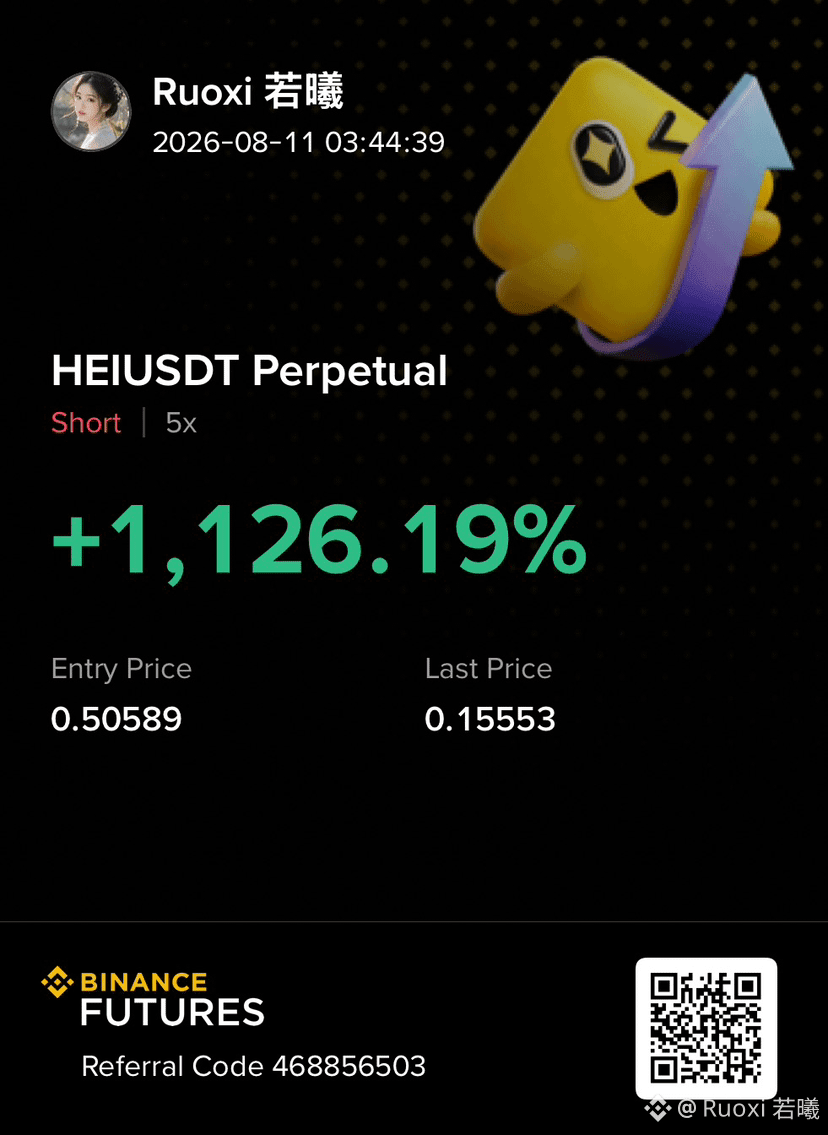
$HEI is going great 🔥
The trade is moving nicely, but I’m still keeping it simple no chasing, no overconfidence.
What I like most right now is the momentum. If $HEI can maintain this strength and keep building higher levels with healthy volume, the setup could remain interesting.
For me, the key is patience. Let the chart confirm the move instead of forcing an entry.
Good trade so far. Let’s see how $HEI handles the next move. 👀📈
$HEI is going great 🔥
The trade is moving nicely, but I’m still keeping it simple no chasing, no overconfidence.
What I like most right now is the momentum. If $HEI can maintain this strength and keep building higher levels with healthy volume, the setup could remain interesting.
For me, the key is patience. Let the chart confirm the move instead of forcing an entry.
Good trade so far. Let’s see how $HEI handles the next move. 👀📈
The trade is moving nicely, but I’m still keeping it simple no chasing, no overconfidence.
What I like most right now is the momentum. If $HEI can maintain this strength and keep building higher levels with healthy volume, the setup could remain interesting.
For me, the key is patience. Let the chart confirm the move instead of forcing an entry.
Good trade so far. Let’s see how $HEI handles the next move. 👀📈
301
·
--
See translation
@babylonlabs_io One thing I noticed after going through Babylon’s Q4 2025 Founders Call was how much the conversation has changed.
A year ago, most people talked about Bitcoin staking. Now the team is focused on making Bitcoin actually usable in DeFi without wrapped assets or giving up self-custody. I think that’s a bigger shift than many people realize.
What caught my attention was Trustless Bitcoin Vaults.
The idea sounds surprisingly simple. Your BTC stays under your control while becoming collateral for lending and other DeFi use cases. If Babylon delivers this well, it could remove one of the biggest reasons Bitcoin holders have avoided on-chain finance.
I also liked that the founders didn’t pretend everything was perfect.
They openly discussed BABY sell pressure, improving token utility, and why real products should create value before tokenomics try to capture it. Honestly, that’s the harder path, and success will depend on adoption rather than announcements.
From what I’ve seen, Babylon is trying to keep Bitcoin true to its original philosophy while giving it more practical use.
That’s an ambitious goal, but execution is everything. If the user experience isn’t simple enough, even the best technology can struggle to gain traction.
Do you think Trustless Bitcoin Vaults could become the feature that finally brings more Bitcoin into DeFi?
#baby $BABY
$HOME
{spot}(HOMEUSDT)
$BLESS
{future}(BLESSUSDT)
@BabylonLabs_io One thing I noticed after going through Babylon’s Q4 2025 Founders Call was how much the conversation has changed.
A year ago, most people talked about Bitcoin staking. Now the team is focused on making Bitcoin actually usable in DeFi without wrapped assets or giving up self-custody. I think that’s a bigger shift than many people realize.
What caught my attention was Trustless Bitcoin Vaults.
The idea sounds surprisingly simple. Your BTC stays under your control while becoming collateral for lending and other DeFi use cases. If Babylon delivers this well, it could remove one of the biggest reasons Bitcoin holders have avoided on-chain finance.
I also liked that the founders didn’t pretend everything was perfect.
They openly discussed BABY sell pressure, improving token utility, and why real products should create value before tokenomics try to capture it. Honestly, that’s the harder path, and success will depend on adoption rather than announcements.
From what I’ve seen, Babylon is trying to keep Bitcoin true to its original philosophy while giving it more practical use.
That’s an ambitious goal, but execution is everything. If the user experience isn’t simple enough, even the best technology can struggle to gain traction.
Do you think Trustless Bitcoin Vaults could become the feature that finally brings more Bitcoin into DeFi?
#baby $BABY
$HOME
$BLESS
A year ago, most people talked about Bitcoin staking. Now the team is focused on making Bitcoin actually usable in DeFi without wrapped assets or giving up self-custody. I think that’s a bigger shift than many people realize.
What caught my attention was Trustless Bitcoin Vaults.
The idea sounds surprisingly simple. Your BTC stays under your control while becoming collateral for lending and other DeFi use cases. If Babylon delivers this well, it could remove one of the biggest reasons Bitcoin holders have avoided on-chain finance.
I also liked that the founders didn’t pretend everything was perfect.
They openly discussed BABY sell pressure, improving token utility, and why real products should create value before tokenomics try to capture it. Honestly, that’s the harder path, and success will depend on adoption rather than announcements.
From what I’ve seen, Babylon is trying to keep Bitcoin true to its original philosophy while giving it more practical use.
That’s an ambitious goal, but execution is everything. If the user experience isn’t simple enough, even the best technology can struggle to gain traction.
Do you think Trustless Bitcoin Vaults could become the feature that finally brings more Bitcoin into DeFi?
#baby $BABY
$HOME
$BLESS
Bullish Buying 🟢
100%
Bearish Selling 🔴
0%
1 votes • Voting closed
1
142
·
--
See translation
@babylonlabs_io One thing I keep looking at Bitcoin and wondering why using it in DeFi has always meant giving something up.
Reading Babylon’s docs changed that perspective a bit. With the Public Testnet, native BTC can be locked inside a Trustless Bitcoin Vault and used as collateral through Aave v4. Your Bitcoin isn’t wrapped or handed to a custodian, which honestly feels much closer to Bitcoin’s original spirit.
I think that’s a meaningful step for BTCFi. Still, it’s only a testnet, and the peg-in process, confirmation time, and liquidation behavior need to prove themselves under real market pressure before I’d fully trust it.
If Bitcoin can stay native while unlocking liquidity, that could be a bigger shift than most people expect.
Would you borrow against native BTC, or would you rather just keep holding?
#baby $BABY
$1000SATS
{spot}(1000SATSUSDT)
$IDOL
{future}(IDOLUSDT)
@BabylonLabs_io One thing I keep looking at Bitcoin and wondering why using it in DeFi has always meant giving something up.
Reading Babylon’s docs changed that perspective a bit. With the Public Testnet, native BTC can be locked inside a Trustless Bitcoin Vault and used as collateral through Aave v4. Your Bitcoin isn’t wrapped or handed to a custodian, which honestly feels much closer to Bitcoin’s original spirit.
I think that’s a meaningful step for BTCFi. Still, it’s only a testnet, and the peg-in process, confirmation time, and liquidation behavior need to prove themselves under real market pressure before I’d fully trust it.
If Bitcoin can stay native while unlocking liquidity, that could be a bigger shift than most people expect.
Would you borrow against native BTC, or would you rather just keep holding?
#baby $BABY
$1000SATS
$IDOL
Reading Babylon’s docs changed that perspective a bit. With the Public Testnet, native BTC can be locked inside a Trustless Bitcoin Vault and used as collateral through Aave v4. Your Bitcoin isn’t wrapped or handed to a custodian, which honestly feels much closer to Bitcoin’s original spirit.
I think that’s a meaningful step for BTCFi. Still, it’s only a testnet, and the peg-in process, confirmation time, and liquidation behavior need to prove themselves under real market pressure before I’d fully trust it.
If Bitcoin can stay native while unlocking liquidity, that could be a bigger shift than most people expect.
Would you borrow against native BTC, or would you rather just keep holding?
#baby $BABY
$1000SATS
$IDOL
Bullish Buying 🟢
83%
Bearish Selling 🔴
17%
6 votes • Voting closed
1
242
·
--
See translation
@babylonlabs_io One thought kept coming back while comparing TBV with wrapped BTC and bridges: maybe we’ve been solving the wrong problem.
Instead of moving Bitcoin everywhere, what if the better solution is leaving it where it already has the strongest security?
That’s why Babylon’s TBV stood out to me. It doesn’t depend on a centralized custodian holding the coins or a bridge federation controlling redemption. The Bitcoin stays on its own chain, while cryptographic proofs connect it with Ethereum-based activity.
I still see limitations. The extra waiting time isn’t ideal, and the technology is newer than traditional wrapping methods, so adoption will take time.
Thought: I’d rather wait a little longer than introduce another layer of custody between me and my BTC.
If you had to choose today, would you trust a custodian, a bridge, or a trust-minimized vault?
#baby $BABY
$AXTIB
{spot}(AXTIBUSDT)
$SNXXB
{spot}(SNXXBUSDT)
@BabylonLabs_io One thought kept coming back while comparing TBV with wrapped BTC and bridges: maybe we’ve been solving the wrong problem.
Instead of moving Bitcoin everywhere, what if the better solution is leaving it where it already has the strongest security?
That’s why Babylon’s TBV stood out to me. It doesn’t depend on a centralized custodian holding the coins or a bridge federation controlling redemption. The Bitcoin stays on its own chain, while cryptographic proofs connect it with Ethereum-based activity.
I still see limitations. The extra waiting time isn’t ideal, and the technology is newer than traditional wrapping methods, so adoption will take time.
Thought: I’d rather wait a little longer than introduce another layer of custody between me and my BTC.
If you had to choose today, would you trust a custodian, a bridge, or a trust-minimized vault?
#baby $BABY
$AXTIB
$SNXXB
Instead of moving Bitcoin everywhere, what if the better solution is leaving it where it already has the strongest security?
That’s why Babylon’s TBV stood out to me. It doesn’t depend on a centralized custodian holding the coins or a bridge federation controlling redemption. The Bitcoin stays on its own chain, while cryptographic proofs connect it with Ethereum-based activity.
I still see limitations. The extra waiting time isn’t ideal, and the technology is newer than traditional wrapping methods, so adoption will take time.
Thought: I’d rather wait a little longer than introduce another layer of custody between me and my BTC.
If you had to choose today, would you trust a custodian, a bridge, or a trust-minimized vault?
#baby $BABY
$AXTIB
$SNXXB
Bullish Zone 🟢
100%
Bearish Zone 🔴
0%
2 votes • Voting closed
5
1
113
·
--
Verified
See translation
@babylonlabs_io I keep looking at Bitcoin DeFi, and one thing keeps bothering me.
Bitcoin is the biggest asset in crypto, yet only around 1% of BTC is used in DeFi. That’s not because people don’t want yield. Most holders simply don’t want to hand their coins to a bridge, custodian, or wrapped token. From what I’ve seen, security always comes first.
Babylon’s Trustless Bitcoin Vaults TBV feel like a different approach. Instead of moving BTC away from Bitcoin, TBV lets you lock your native BTC inside a self-controlled Taproot vault while Ethereum applications recognize it as collateral. No wrapped BTC. No bridge holding your funds. The trust shifts toward cryptography and the Bitcoin/Ethereum networks rather than a company.
I think that’s the real innovation here. Bitcoin doesn’t stop being Bitcoin just because you want to borrow against it or use it in DeFi. It stays on its own chain while the protocol proves what happened across chains through cryptographic verification. That’s a huge mindset shift compared to the models we’ve used for years.
That said, it’s still early. TBV is running on Bitcoin Signet and Ethereum testnet today, and the design is more complex than simply wrapping BTC. Like any new protocol, real-world adoption, security reviews, and developer integration will matter just as much as the technology itself.
Babylon already showed that self-custodial Bitcoin staking can work. If TBV delivers on the same philosophy for Bitcoin-backed DeFi, I think it could unlock a completely different future for BTC.
Would you trust cryptography over a custodian when putting your Bitcoin to work in DeFi?
#baby $BABY
$GRVT
{alpha}(560x46f2564e0fa8248d15125e7e54173cfbdef91be7)
$SNXXB
{spot}(SNXXBUSDT)
@BabylonLabs_io I keep looking at Bitcoin DeFi, and one thing keeps bothering me.
Bitcoin is the biggest asset in crypto, yet only around 1% of BTC is used in DeFi. That’s not because people don’t want yield. Most holders simply don’t want to hand their coins to a bridge, custodian, or wrapped token. From what I’ve seen, security always comes first.
Babylon’s Trustless Bitcoin Vaults TBV feel like a different approach. Instead of moving BTC away from Bitcoin, TBV lets you lock your native BTC inside a self-controlled Taproot vault while Ethereum applications recognize it as collateral. No wrapped BTC. No bridge holding your funds. The trust shifts toward cryptography and the Bitcoin/Ethereum networks rather than a company.
I think that’s the real innovation here. Bitcoin doesn’t stop being Bitcoin just because you want to borrow against it or use it in DeFi. It stays on its own chain while the protocol proves what happened across chains through cryptographic verification. That’s a huge mindset shift compared to the models we’ve used for years.
That said, it’s still early. TBV is running on Bitcoin Signet and Ethereum testnet today, and the design is more complex than simply wrapping BTC. Like any new protocol, real-world adoption, security reviews, and developer integration will matter just as much as the technology itself.
Babylon already showed that self-custodial Bitcoin staking can work. If TBV delivers on the same philosophy for Bitcoin-backed DeFi, I think it could unlock a completely different future for BTC.
Would you trust cryptography over a custodian when putting your Bitcoin to work in DeFi?
#baby $BABY
$GRVT
$SNXXB
Bitcoin is the biggest asset in crypto, yet only around 1% of BTC is used in DeFi. That’s not because people don’t want yield. Most holders simply don’t want to hand their coins to a bridge, custodian, or wrapped token. From what I’ve seen, security always comes first.
Babylon’s Trustless Bitcoin Vaults TBV feel like a different approach. Instead of moving BTC away from Bitcoin, TBV lets you lock your native BTC inside a self-controlled Taproot vault while Ethereum applications recognize it as collateral. No wrapped BTC. No bridge holding your funds. The trust shifts toward cryptography and the Bitcoin/Ethereum networks rather than a company.
I think that’s the real innovation here. Bitcoin doesn’t stop being Bitcoin just because you want to borrow against it or use it in DeFi. It stays on its own chain while the protocol proves what happened across chains through cryptographic verification. That’s a huge mindset shift compared to the models we’ve used for years.
That said, it’s still early. TBV is running on Bitcoin Signet and Ethereum testnet today, and the design is more complex than simply wrapping BTC. Like any new protocol, real-world adoption, security reviews, and developer integration will matter just as much as the technology itself.
Babylon already showed that self-custodial Bitcoin staking can work. If TBV delivers on the same philosophy for Bitcoin-backed DeFi, I think it could unlock a completely different future for BTC.
Would you trust cryptography over a custodian when putting your Bitcoin to work in DeFi?
#baby $BABY
$GRVT
$SNXXB
Bullish Time Zone 🟢
50%
Bearish Time Zone 🔴
0%
Unpredictable Zone 🟠
50%
2 votes • Voting closed
2
182
·
--
Verified
See translation
@babylonlabs_io One thing I keep looking at projects trying to bring Bitcoin into DeFi, and honestly, most of them end up depending on wrapped assets or someone holding the keys. That never felt like the real answer to me.
Babylon’s Aave v4 integration feels different.
Your BTC stays locked on Bitcoin inside a Trustless Bitcoin Vault, while Aave v4 recognizes that locked BTC as collateral through a dedicated adapter. You can borrow assets without bridging or wrapping your Bitcoin, which I think is a pretty meaningful shift. That’s a cleaner design than I expected.
One thought I keep coming back to is that this isn’t about making Bitcoin “move.” It’s about making Bitcoin useful while it stays exactly where it belongs. From what I’ve seen in the docs, the vault is created specifically for the Aave application, and an internal accounting token (vaultBTC) represents the collateral only inside the protocol—it isn’t a tradable wrapped BTC token.
Of course, I’d still stay cautious. The integration is rolling out through the public testnet, borrowing still carries liquidation risk, and every new lending model needs time to prove itself under real market conditions. Even strong designs aren’t immune to unexpected edge cases.
I think Babylon is trying to solve a problem many BTC holders have talked about for years: using Bitcoin in DeFi without giving up self-custody.
Would you borrow against native BTC if it never had to leave the Bitcoin network?
#baby $BABY
$COTI
{spot}(COTIUSDT)
$UAI
{future}(UAIUSDT)
@BabylonLabs_io One thing I keep looking at projects trying to bring Bitcoin into DeFi, and honestly, most of them end up depending on wrapped assets or someone holding the keys. That never felt like the real answer to me.
Babylon’s Aave v4 integration feels different.
Your BTC stays locked on Bitcoin inside a Trustless Bitcoin Vault, while Aave v4 recognizes that locked BTC as collateral through a dedicated adapter. You can borrow assets without bridging or wrapping your Bitcoin, which I think is a pretty meaningful shift. That’s a cleaner design than I expected.
One thought I keep coming back to is that this isn’t about making Bitcoin “move.” It’s about making Bitcoin useful while it stays exactly where it belongs. From what I’ve seen in the docs, the vault is created specifically for the Aave application, and an internal accounting token (vaultBTC) represents the collateral only inside the protocol—it isn’t a tradable wrapped BTC token.
Of course, I’d still stay cautious. The integration is rolling out through the public testnet, borrowing still carries liquidation risk, and every new lending model needs time to prove itself under real market conditions. Even strong designs aren’t immune to unexpected edge cases.
I think Babylon is trying to solve a problem many BTC holders have talked about for years: using Bitcoin in DeFi without giving up self-custody.
Would you borrow against native BTC if it never had to leave the Bitcoin network?
#baby $BABY
$COTI
$UAI
Babylon’s Aave v4 integration feels different.
Your BTC stays locked on Bitcoin inside a Trustless Bitcoin Vault, while Aave v4 recognizes that locked BTC as collateral through a dedicated adapter. You can borrow assets without bridging or wrapping your Bitcoin, which I think is a pretty meaningful shift. That’s a cleaner design than I expected.
One thought I keep coming back to is that this isn’t about making Bitcoin “move.” It’s about making Bitcoin useful while it stays exactly where it belongs. From what I’ve seen in the docs, the vault is created specifically for the Aave application, and an internal accounting token (vaultBTC) represents the collateral only inside the protocol—it isn’t a tradable wrapped BTC token.
Of course, I’d still stay cautious. The integration is rolling out through the public testnet, borrowing still carries liquidation risk, and every new lending model needs time to prove itself under real market conditions. Even strong designs aren’t immune to unexpected edge cases.
I think Babylon is trying to solve a problem many BTC holders have talked about for years: using Bitcoin in DeFi without giving up self-custody.
Would you borrow against native BTC if it never had to leave the Bitcoin network?
#baby $BABY
$COTI
$UAI
Bullish Buying 🟢
33%
Bearish Selling 🔴
67%
6 votes • Voting closed
2
612
·
--
See translation
@babylonlabs_io One thing I keep looking at airdrops differently these days.
For a long time, I thought claiming an airdrop was just connecting a wallet and waiting for tokens. Then I spent some time reading Babylon’s docs, and one small step caught my attention.
To receive the BABY airdrop, eligible users need to accept the Airdrop Terms and Privacy Policy and prove that acceptance by signing a cryptographic message with their BABY wallet. It isn’t a blockchain transaction or a gas payment. It’s simply a wallet signature that confirms you understand the rules before claiming.
I actually like this approach because it creates a clear record that every participant agreed to the same conditions. Babylon is trying to build Bitcoin-backed security for PoS chains through self-custodial BTC staking, so having a transparent claim process feels consistent with that philosophy.
Still, one thought stays in my mind. Most people click “Accept” without reading a single line. If eligibility, regional restrictions, or data handling matter later, that habit could easily become a problem. I think spending two minutes reading the terms is worth more than rushing to claim.
Would you read an airdrop’s Terms & Privacy Policy before signing, or do you usually trust the process and click Accept?
#baby $BABY
$ESP $BABYSHARK
{spot}(ESPUSDT)
{alpha}(560x777bf78ad4546b61607a17bf4a1977dbbea98c28)
@BabylonLabs_io One thing I keep looking at airdrops differently these days.
For a long time, I thought claiming an airdrop was just connecting a wallet and waiting for tokens. Then I spent some time reading Babylon’s docs, and one small step caught my attention.
To receive the BABY airdrop, eligible users need to accept the Airdrop Terms and Privacy Policy and prove that acceptance by signing a cryptographic message with their BABY wallet. It isn’t a blockchain transaction or a gas payment. It’s simply a wallet signature that confirms you understand the rules before claiming.
I actually like this approach because it creates a clear record that every participant agreed to the same conditions. Babylon is trying to build Bitcoin-backed security for PoS chains through self-custodial BTC staking, so having a transparent claim process feels consistent with that philosophy.
Still, one thought stays in my mind. Most people click “Accept” without reading a single line. If eligibility, regional restrictions, or data handling matter later, that habit could easily become a problem. I think spending two minutes reading the terms is worth more than rushing to claim.
Would you read an airdrop’s Terms & Privacy Policy before signing, or do you usually trust the process and click Accept?
#baby $BABY
$ESP $BABYSHARK
For a long time, I thought claiming an airdrop was just connecting a wallet and waiting for tokens. Then I spent some time reading Babylon’s docs, and one small step caught my attention.
To receive the BABY airdrop, eligible users need to accept the Airdrop Terms and Privacy Policy and prove that acceptance by signing a cryptographic message with their BABY wallet. It isn’t a blockchain transaction or a gas payment. It’s simply a wallet signature that confirms you understand the rules before claiming.
I actually like this approach because it creates a clear record that every participant agreed to the same conditions. Babylon is trying to build Bitcoin-backed security for PoS chains through self-custodial BTC staking, so having a transparent claim process feels consistent with that philosophy.
Still, one thought stays in my mind. Most people click “Accept” without reading a single line. If eligibility, regional restrictions, or data handling matter later, that habit could easily become a problem. I think spending two minutes reading the terms is worth more than rushing to claim.
Would you read an airdrop’s Terms & Privacy Policy before signing, or do you usually trust the process and click Accept?
#baby $BABY
$ESP $BABYSHARK
Buying long 🟢 💯
50%
Selling Short 🔴 💯
50%
4 votes • Voting closed
1
1
223
·
--
See translation
@babylonlabs_io One thing I have been watching how stablecoins are finding real use on Babylon Genesis, and Noble USDC feels more useful than I expected.
I used to think it was just another way to park funds. After reading the Babylon docs, I noticed it actually helps you move around the ecosystem without much friction. You can swap Noble USDC on Tower DEX, bridge it through Eureka to supported chains like Arbitrum, and even use other bridges such as Union and Axelar when needed.
One thought I keep coming back to… stable liquidity often matters more than flashy features. Once you have Noble USDC on Babylon Genesis, it becomes easier to access BABY staking or explore liquid staking options like cBABY, eBABY, and milkBABY while staying inside the ecosystem instead of constantly switching networks.
That said, I wouldn’t call it perfect. Babylon’s ecosystem is still young, so available apps and liquidity are growing but haven’t reached the level of more established chains yet. That’s something I always keep in mind before moving larger amounts.
I think this is the kind of infrastructure that quietly improves the user experience. It isn’t the headline feature, but it makes everything around Bitcoin-secured DeFi feel a bit more connected.
If you had Noble USDC on Babylon Genesis today, would you swap, bridge, or stake first?
#baby $BABY
$EUL
{spot}(EULUSDT)
$DIA
{spot}(DIAUSDT)
@BabylonLabs_io One thing I have been watching how stablecoins are finding real use on Babylon Genesis, and Noble USDC feels more useful than I expected.
I used to think it was just another way to park funds. After reading the Babylon docs, I noticed it actually helps you move around the ecosystem without much friction. You can swap Noble USDC on Tower DEX, bridge it through Eureka to supported chains like Arbitrum, and even use other bridges such as Union and Axelar when needed.
One thought I keep coming back to… stable liquidity often matters more than flashy features. Once you have Noble USDC on Babylon Genesis, it becomes easier to access BABY staking or explore liquid staking options like cBABY, eBABY, and milkBABY while staying inside the ecosystem instead of constantly switching networks.
That said, I wouldn’t call it perfect. Babylon’s ecosystem is still young, so available apps and liquidity are growing but haven’t reached the level of more established chains yet. That’s something I always keep in mind before moving larger amounts.
I think this is the kind of infrastructure that quietly improves the user experience. It isn’t the headline feature, but it makes everything around Bitcoin-secured DeFi feel a bit more connected.
If you had Noble USDC on Babylon Genesis today, would you swap, bridge, or stake first?
#baby $BABY
$EUL
$DIA
I used to think it was just another way to park funds. After reading the Babylon docs, I noticed it actually helps you move around the ecosystem without much friction. You can swap Noble USDC on Tower DEX, bridge it through Eureka to supported chains like Arbitrum, and even use other bridges such as Union and Axelar when needed.
One thought I keep coming back to… stable liquidity often matters more than flashy features. Once you have Noble USDC on Babylon Genesis, it becomes easier to access BABY staking or explore liquid staking options like cBABY, eBABY, and milkBABY while staying inside the ecosystem instead of constantly switching networks.
That said, I wouldn’t call it perfect. Babylon’s ecosystem is still young, so available apps and liquidity are growing but haven’t reached the level of more established chains yet. That’s something I always keep in mind before moving larger amounts.
I think this is the kind of infrastructure that quietly improves the user experience. It isn’t the headline feature, but it makes everything around Bitcoin-secured DeFi feel a bit more connected.
If you had Noble USDC on Babylon Genesis today, would you swap, bridge, or stake first?
#baby $BABY
$EUL
$DIA
Bullish Time 🟢
67%
Bearish Time 🔴
33%
6 votes • Voting closed
1
726
Log in to explore more content
Join global crypto users on Binance Square
⚡️ Get latest and useful information about crypto.
💬 Trusted by the world’s largest crypto exchange.
👍 Discover real insights from verified creators.
Email / Phone number
Trending Topics
HYPEJumpsOver11%
1,140 views
75 Discussing
🚨 HYPE JUST FLIPPED THE MARKET
$HYPE +11% in 7 Days
While $XRP and $ETH were bleeding...
HYPE broke into TOP 10 and kicked out Cardano.
Why?
-> $1.3B+ Open Interest
-> ETF inflows beating BTC & ETH ETFs
-> Massive supply burn in progress
This is not just a pump. This is dominance.
Are you watching or ARE YOU IN? 👇
#HYPE #Hyperliquid #Crypto #BinanceSquare#hypejumpsover11%
True News
·2 Likes
·935 views
BitcoinSpotETFsNetInflow$159M
363 views
34 Discussing
HKMAPlansWholesaleCBDCByYearEnd
9,036 views
324 Discussing