

币圈十二叔
6.6k Posts

币圈十二叔
Report
Block User
量化交易员🤠量化带单中欢迎跟单🤖币安手续费八折返佣码: SR988
High-Frequency Trader
1.3 Years
12 Following
1.1K+ Followers
437 Liked
Posts
All
Quotes
Videos
·
--
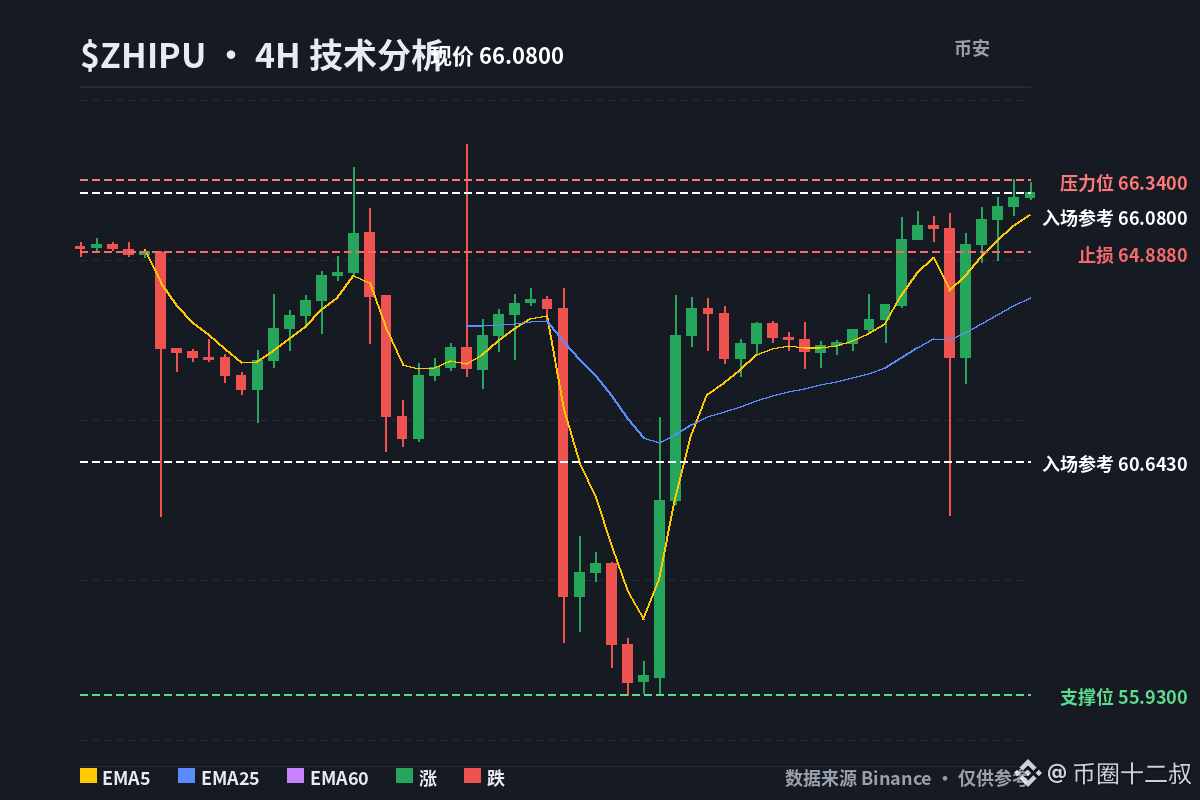
From my perspective, $ZHIPU is following a bearish strategy, with a reference entry at 60.643 and a reference stop-loss at 64.88801. There’s no fixed take-profit target; that’s left to the strategy to manage.
It looks for weakness around stock market trading hours to identify short-selling opportunities. I’m evaluating this trading plan within that framework.
It looks for weakness around stock market trading hours to identify short-selling opportunities. I’m evaluating this trading plan within that framework.
5
·
--
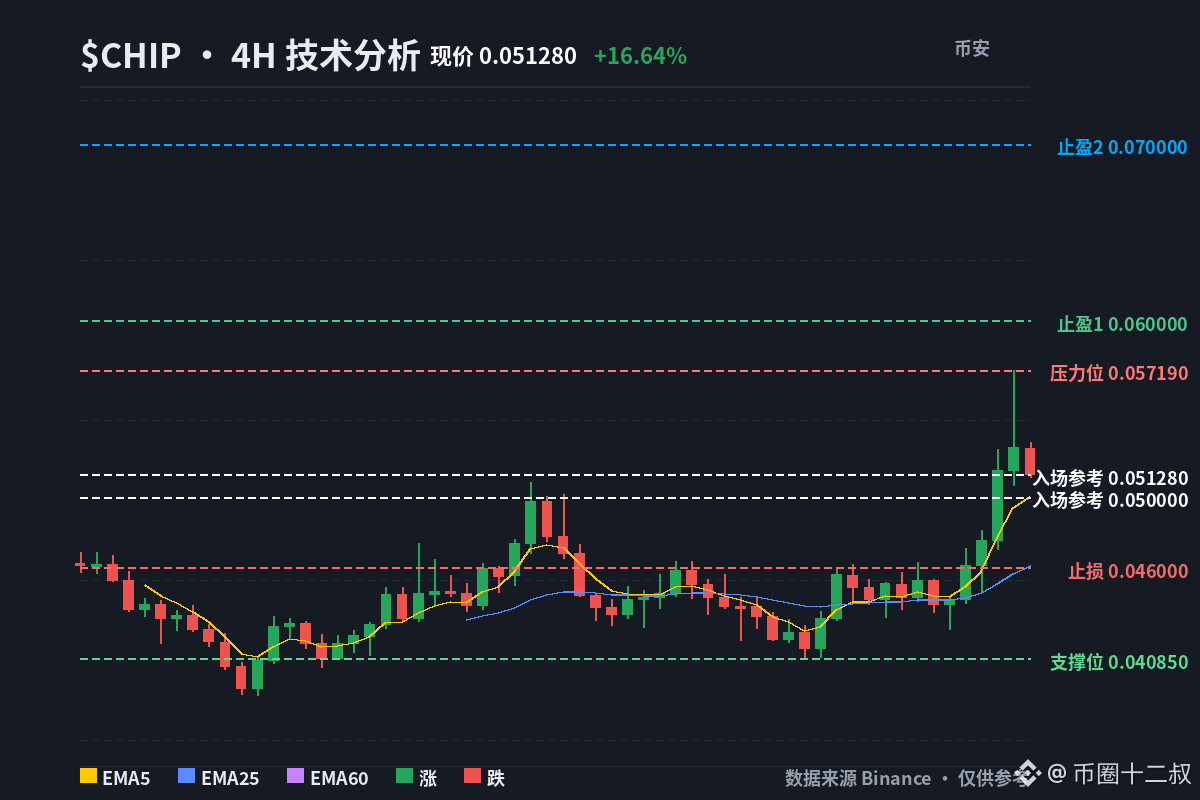
$CHIP Rallied 16% against the broader market. I can accept an independent move, but I won't chase the highs. If it pulls back to 0.0500 and finds buyers, I'll scale in. If it breaks below 0.0460, I was wrong.
The funding rate is still negative, so shorts are paying the “protection fee”; retail accounts are skewed short, while larger players are on the long side. Who'll fold first? I’m betting on those retail shorts. Once they close, the price could first reach 0.0600; if it can't, it'll turn back toward 0.0500.
Chasing from the current price gives 13% upside to 0.0600 and 13% downside to 0.0460—a one-to-one risk-reward ratio. I'm not taking that bet. The daily EMA5 is still below the EMA25, so this is a 4h move; the daily trend hasn't turned bullish. BTC is in the red, and this one is moving on its own.
Shorts are paying the protection fee, yet they're the ones stuck holding the opposite side.
Will 0.0500 hold, or will 0.0460 give way first? I'm betting on the former 😅
📊 Direction: Wait for a pullback to go long
💰 Entry reference: Look for support on a retest of 0.0500
🛑 Stop-loss: Exit if it breaks below 0.0460
🎯 Take-profit 1: 0.0600, previous 4h high
🎯 Take-profit 2: 0.0700, upper boundary of the daily range
$CHIP #技术分析 #UncleTwelve
1
·
--
I took a look at $CHIP. To put it plainly, it’s basically like an index: the fees go toward buying real estate and stocks, and there’s no buyback whatsoever.
Go check the contract yourself, read the docs, and visit the official website. Don’t just take people’s hype at face value.
And that $43 million in revenue? It’s nowhere close—it’s not even remotely related.
I just want to ask: where exactly did you get these figures, or did you just make them up?
I took a look at $CHIP . To put it plainly, it’s basically like an index: the fees go toward buying real estate and stocks, and there’s no buyback whatsoever.
Go check the contract yourself, read the docs, and visit the official website. Don’t just take people’s hype at face value.
And that $43 million in revenue? It’s nowhere close—it’s not even remotely related.
I just want to ask: where exactly did you get these figures, or did you just make them up?
Go check the contract yourself, read the docs, and visit the official website. Don’t just take people’s hype at face value.
And that $43 million in revenue? It’s nowhere close—it’s not even remotely related.
I just want to ask: where exactly did you get these figures, or did you just make them up?
2
·
--
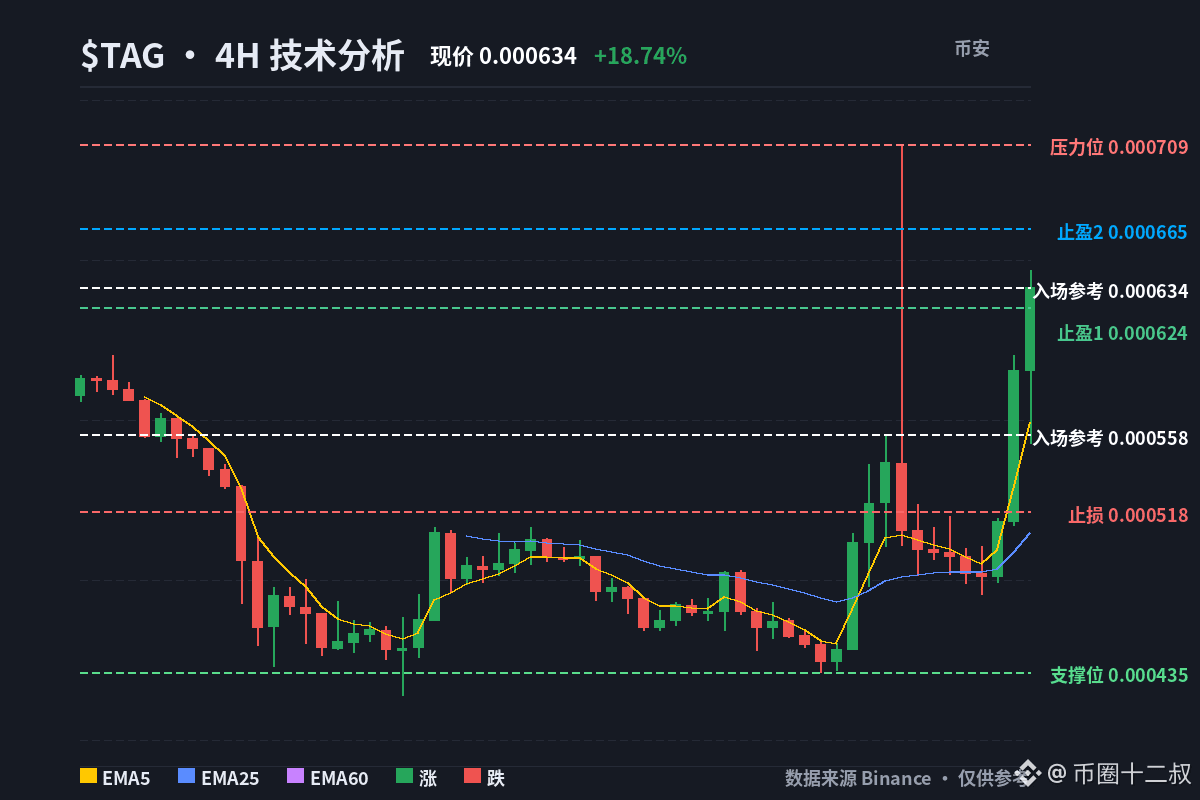
$TAG RSI surged to 85. The price is moving too fast, so I’m not chasing it—I’ll wait for a pullback. If buyers step in at 0.000558, I’ll scale in; below 0.000518, I’m wrong.
The funding rate is still positive, so the bulls are paying the bears protection money. This rally is on credit. The account long/short ratio is 2.42, with retail traders packed in like sardines 😂 The big players haven’t followed at all. I’m betting retail traders will let go first. Price will test the daily EMA25 at 0.000624, and if it can’t break through, it’ll turn back toward 0.000558.
There’s 12 points of upside to 0.000624 and 7 points of downside to 0.000518. I’ll take those odds. The 4h moving averages are still in a bullish alignment, so the trend hasn’t broken—but the current price is five points above the EMA5, leaving no room to widen my stop. The broader market is pulling back while this one runs ahead alone. No matter how fast it runs, it’s still on its own.
There are more people carrying the sedan chair than riding in it. This ride won’t go far.
Will 0.000558 hold, or will 0.000518 give way first? I’m betting on the former—feel free to prove me wrong 😅
📊 Direction: Wait for a pullback, then go long
💰 Entry reference: Look for buyers to step in on a retest of 0.000558
🛑 Stop-loss: If 0.000518 breaks below the EMA25, I’m wrong
🎯 Take profit 1: 0.000624, daily EMA25
🎯 Take profit 2: 0.000665, previous high resistance zone
Position size determines your state of mind. Don’t get carried away.
$TAG #技术分析 #Uncle Twelve
11
·
--
This pullback in AI semiconductors is pretty interesting: AI demand is still clearly strong, and earnings are hitting records, yet stock prices are the first to give way.
After rising too much before, valuations got pushed too high, and now it’s the sentiment side that’s being tested.
I checked, and $NVDA is down 12% from its 52-week high, $MU has dropped by 30%, $SKHY is also down by about 30%, and several other stocks have fallen even more sharply. The worst one is down by 35%, while a few others are down a little over 30%, and some are also seeing double-digit pullbacks.
In simple terms, after going up too much, it has to consolidate.
11
·
--
Big news from South Korea: $SKHY plans to announce an additional shareholder return plan on October 28.
There’s talk in the market of a special dividend of 16 trillion won, but nothing has been officially announced, so don’t treat it as confirmed.
AI profits have certainly been huge this time around. What I care most about now is how much of that money will actually end up in shareholders’ pockets.
There’s talk in the market of a special dividend of 16 trillion won, but nothing has been officially announced, so don’t treat it as confirmed.
AI profits have certainly been huge this time around. What I care most about now is how much of that money will actually end up in shareholders’ pockets.
10
·
--
Chinese AI model stocks have taken a real beating lately.
I saw a Bloomberg report saying that $MiniMax and $ZHIPU have lost a combined $150 billion in market value since their peak.
This pullback is no joke.
Chinese AI model stocks have taken a real beating lately.
I saw a Bloomberg report saying that $MiniMax and $ZHIPU have lost a combined $150 billion in market value since their peak.
This pullback is no joke.
I saw a Bloomberg report saying that $MiniMax and $ZHIPU have lost a combined $150 billion in market value since their peak.
This pullback is no joke.
2
·
--
$SKHY Our side reports earnings tomorrow night; it’ll be Wednesday morning in Seoul.
For this HBM heavyweight, this is a tough test of quarter-over-quarter growth: second-quarter revenue was 79.3 trillion won, operating profit 60.5 trillion won, and the profit margin 76.3%.
The market consensus for the third quarter (FnGuide) is revenue of 98.2 trillion won and operating profit of 77.0 trillion won—up 24% and 27%, respectively, in a single quarter.
With those figures on the table, it all comes down to tomorrow night: can they deliver?
1
·
--
I’m looking at $SNDK —it jumped 37% this time. Interest in the storage sector is really surging now.
I’m looking at $SNDK —it jumped 37% this time. Interest in the storage sector is really surging now.
3
·
--
Looking at this $NIL 1-hour move, buyers have already broken through resistance. Both the 50 and 200 EMAs are below price, and momentum feels more like continuation than a pullback to me.
0.0883 is the previous swing high that capped the last move. If price can hold on a retest, it could have room to move toward 0.0959.
The invalidation level is 0.0877.
0.0883 is the previous swing high that capped the last move. If price can hold on a retest, it could have room to move toward 0.0959.
The invalidation level is 0.0877.
3
·
--
I’ve seen this pattern in the storage industry many times. It’s one of the most cyclical sectors: ordinary memory is a commodity, and one manufacturer’s product is much like another’s. Customers only care about price.
When supplies are tight and prices rise, companies rush to build factories. A year or two later, all that new capacity comes online at once, prices collapse, and production is cut—until supplies tighten again. And so the cycle repeats.
So when evaluating storage stocks, you have to think in reverse: when profits look their best, new capacity is already on the way, which often means the peak.
When companies are losing money and start cutting production, supply contracts—which often means the bottom.
$MU $SNDK $SKHY
3
·
--
I took a look at the daily chart for $SKHYNIX . Counting from the low, today is day 7, and the resistance level above is ₩1,334,000.
ADX rose from 51.63 yesterday to 53.02, so trend strength is still increasing, but overall the downtrend remains intact.
That said, I think Monday, Tuesday, and Wednesday may be the last buying window near the lows, so if you're looking to buy the dip, keep a close eye on it.
ADX rose from 51.63 yesterday to 53.02, so trend strength is still increasing, but overall the downtrend remains intact.
That said, I think Monday, Tuesday, and Wednesday may be the last buying window near the lows, so if you're looking to buy the dip, keep a close eye on it.
2
·
--
I took a look at this claim: they say $MSTR is more likely to achieve a 5x return because it holds a large amount of $BTC and has a leverage amplification effect.
But I just want to ask one thing: if $BTC really surges over the next five years, would $COIN just stand still?
Increasing trading volume, derivatives expansion, and USDC growth—aren't all of these real sources of profit?
But I just want to ask one thing: if $BTC really surges over the next five years, would $COIN just stand still?
Increasing trading volume, derivatives expansion, and USDC growth—aren't all of these real sources of profit?
3
·
--
I’m looking at $INTW , and this chart is starting to feel a bit chilly. The distribution signals are bearish, the price is slowly grinding below VWAP, and selling pressure remains firmly in control. Low liquidity is also weighing on it.
MFI is nearing oversold territory, but the downward momentum hasn’t let up. This setup makes me think another cold spell may be ahead, with volatility continuing to weigh on the market.
MFI is nearing oversold territory, but the downward momentum hasn’t let up. This setup makes me think another cold spell may be ahead, with volatility continuing to weigh on the market.
10
·
--
I took a look—$ZHIPU is giving away 200,000 free tokens to bring in new users. That’s pretty aggressive; they’re basically paying people to try their coder. I have to say, I respect that user acquisition strategy.
I took a look—$ZHIPU is giving away 200,000 free tokens to bring in new users. That’s pretty aggressive; they’re basically paying people to try their coder. I have to say, I respect that user acquisition strategy.
13
·
--
Samsung and $SKHYNIX together made nearly 185 trillion won in profit in the third quarter. That figure looks pretty staggering, but I think the real test isn’t there at all—it’s HBM4.
Whether they can supply next-generation HBM4 for NVIDIA’s $NVDA Vera Rubin accelerators—that’s the real dividing line.
Whoever passes certification first will capture this AI memory cycle.
Who are you betting on?
Whether they can supply next-generation HBM4 for NVIDIA’s $NVDA Vera Rubin accelerators—that’s the real dividing line.
Whoever passes certification first will capture this AI memory cycle.
Who are you betting on?
35
·
--
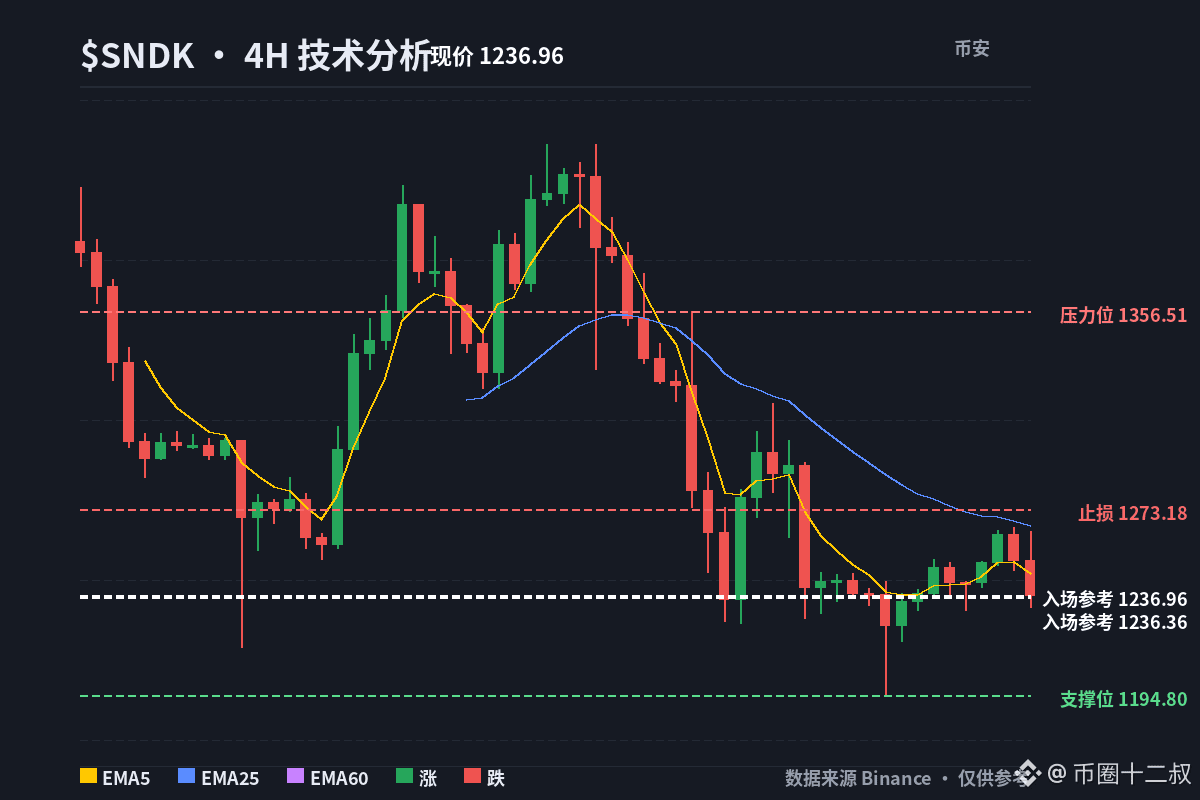
I've been watching $SNDK, and I’m leaning toward a short at this level.
The entry zone is 1236.35626 to 1239.94374. The first target is 1211.87757, followed by 1194.36262, and finally 1168.09019. Set the stop-loss at 1273.17990.
I've been watching $SNDK , and I’m leaning toward a short at this level.
The entry zone is 1236.35626 to 1239.94374. The first target is 1211.87757, followed by 1194.36262, and finally 1168.09019. Set the stop-loss at 1273.17990.
The entry zone is 1236.35626 to 1239.94374. The first target is 1211.87757, followed by 1194.36262, and finally 1168.09019. Set the stop-loss at 1273.17990.
35
·
--
This is a big week for AI, and I’m telling you, this week’s earnings reports will directly shape the entire AI infrastructure ecosystem.
First, let’s look at the cloud giants. Whether the AI capex guidance from companies like $MSFT and $GOOGL is solid, and whether cloud demand is holding up, will be the key signals this week.
We also need to keep a close eye on the memory and flash storage supply chain. Demand, pricing power, and supply constraints on the $SKHY side will tell us a lot.
And then there’s the whole data center hardware space. Don’t get distracted by the hype—the real question is whether orders and industry momentum can keep up.
Overall, this week’s earnings are no small matter. AI infrastructure, from cloud to memory to hardware, could all be repriced.
46
·
--
In my view, no matter how much computing power Alibaba and ByteDance amass as private companies, they still can't overcome the trust issue.
$ZHIPU and state-controlled companies like DeepSeek can keep going on orders from state-owned enterprises, central SOEs, and the government.
In my view, no matter how much computing power Alibaba and ByteDance amass as private companies, they still can't overcome the trust issue.
$ZHIPU and state-controlled companies like DeepSeek can keep going on orders from state-owned enterprises, central SOEs, and the government.
$ZHIPU and state-controlled companies like DeepSeek can keep going on orders from state-owned enterprises, central SOEs, and the government.
67
·
--
I see $INTC had a slight pullback this week (10/19–23), mainly dragged down by a broad sell-off in the AI semiconductor sector.
The 10/29 earnings report is the biggest event this week. If results beat expectations, $INTC could have a chance to break above $90;
for now, the market is in a wait-and-see mode, with no real momentum until earnings are out.
The 10/29 earnings report is the biggest event this week. If results beat expectations, $INTC could have a chance to break above $90;
for now, the market is in a wait-and-see mode, with no real momentum until earnings are out.
71
Log in to explore more content
Join global crypto users on Binance Square
⚡️ Get latest and useful information about crypto.
💬 Trusted by the world’s largest crypto exchange.
👍 Discover real insights from verified creators.
Email / Phone number