
币链快报 ChainAlert
1.6k Posts

币链快报 ChainAlert
Report
Block User
3 Following
6.6K+ Followers
3.7K+ Liked
Posts
All
Videos
Coin Chain Evening Report | Key Updates for the Evening of November 15
12:00–21:00 Keywords: NVIDIA, OpenAI, Project Zero
1. Singapore files 41 charges in case involving NVIDIA-linked servers
2. Sources: Jensen Huang quietly took part in selection process for NVIDIA CEO successor
3. Binance’s ETH reserves fall to around 2.9 million, the lowest since 2021
4. OpenAI and four other AI companies sued, with plaintiffs seeking to halt frontier AI research
5. Google’s Project Zero security team announces that vulnerability disclosure deadlines will be gradually shortened to 30 days
268
Why Were a Chinese User’s 15 BTC Awarded to a Scam Victim by an Indian Court?
Recently, a cross-border asset freeze and seizure has drawn widespread attention in the cryptocurrency community: after a Chinese user deposited 15 Bitcoin (BTC) into the Gate exchange, their account was not only frozen for an extended period but also faced the direct seizure of its assets by an Indian court.
Why were more than a million dollars’ worth of legitimate crypto assets caught up in a cross-border fraud case in India? What loopholes in law enforcement and exchange compliance does this case expose?
I. How It Began: A Cross-Border Investment Scam
The controversy stems from a cross-border cryptocurrency investment scam involving approximately $1.5 million to $1.7 million.
Victim reports the scam: An Indian woman living in California, USA, was targeted in a romance-investment scam through a social media platform and lost approximately $1.7 million. Her father subsequently reported the case to local authorities in India.
Police tracing and freeze: After the Criminal Investigation Department (CID) of India’s Andhra Pradesh state became involved, it claimed to have traced some of the funds to four accounts on the Gate exchange, involving 15 BTC transactions.
Court ruling and seizure: On October 30, 2026, a local Indian court approved converting all crypto assets in the four accounts into USDT and temporarily transferring them to the complainant’s wallet. On November 12, the Chinese account holder, @xxxkeym, received a formal notice about the matter from the exchange.
It is worth noting that the “15 transactions” involved in the case do not amount to 15 whole coins, nor can they be directly assumed to have come from this Chinese user’s deposit. Yet the local court’s ruling directly affected all the assets in their account.
II. The Indian Police Investigation: Numerous Loopholes and Questions
Based on evidence provided by the account holder and previous local court rulings, there are significant compliance concerns surrounding the Andhra Pradesh CID’s asset-recovery procedures in this case:
Weak evidentiary chain: During bail proceedings for other defendants in the same case, the Andhra Pradesh High Court noted that police had relied primarily on the testimony of a single suspect and lacked substantive evidence, casting serious doubt on the quality of the early investigation.
Precedents of abusive freezing: Indian law enforcement agencies have repeatedly had account freezes overturned by High Courts for “failure to follow statutory procedures.”
No cross-verification of asset ownership: According to account holder @xxxkeym, the 15 BTC had been withdrawn from a major platform as early as 2023 and kept in a personal cold wallet for more than two years, before being deposited into Gate in July 2025. If the historical on-chain records are accurate and the funds never came into contact with criminal proceeds, then identifying them as illicit solely on the basis of on-chain addresses and commingled funds in an exchange’s pool would clearly lack a rigorous causal link.
Refusal to disclose information transparently: The account holder repeatedly requested verification of the complete flow of the funds involved, but Indian police never provided substantive internal ledger evidence directly proving that the assets were proceeds of crime.
III. Examining the Centralized Exchange (CEX): Gate’s Compliance Dilemma and Failings
As custodian of the assets, Gate’s response to this cross-border law enforcement request has prompted strong concern in the community over whether “centralized platforms are shifting all compliance risks onto users”:
Mechanical cooperation and defensive compliance: During the freeze, which lasted more than a year, the user submitted proof of the funds’ cold-wallet origin and lawyers’ letters multiple times. The platform often deflected responsibility, citing reasons such as “we are unable to disclose that information,” and ultimately carried out the Indian court’s seizure order directly.
Failure to challenge law enforcement requests: Under its own Law Enforcement Request Guidelines, the platform should have required law enforcement to provide detailed information about the flow of the funds in question, transaction hashes, and other concrete evidence, while retaining the right to challenge jurisdiction and unreasonable freezes. In practice, however, the platform appears to have given up the opportunity to help the user pursue a legitimate defense.
A vastly expanded scope of seizure: A deposit subject to serious dispute ultimately led to the seizure of all the assets in the account, worth millions of dollars, and their forced conversion into USDT. Once the assets have been transferred to the complainant’s wallet, recovering them could be extremely costly, even if the seizure is later proven to have been made in error.
IV. Conclusion
In this controversy, Indian police have gained publicity for “recovering assets across borders,” and the exchange has reduced its own cross-border compliance and legal risks. But the innocent user has been left to bear alone all the associated risks inherent in the platform’s custodial model.
If centralized exchanges blindly comply with cross-border legal requests when authority and responsibility are unclear, while failing to verify the facts, users’ confidence in the security of their assets will be severely undermined over time. The community and industry are calling on Gate to provide a clear response: What conclusive evidence did Indian police present? And on what basis did the platform agree to transfer a user’s substantial assets without rigorous scrutiny?
1
2
1.5k
CoinChain Midday Report | Key Updates at Noon on November 15
7:00–12:00 Keywords: Machi, USDT Premium, Trump
1. Federal Reserve report: AI risks are the biggest concern for U.S. financial stability;
2. Tom Lee: Six major reasons are driving continued selling pressure on crypto assets;
3. Machi sold Bored Ape #2894, taking a loss of about $204,000;
4. The U.S. government currently holds crypto assets worth approximately $20.57 billion in total;
5. The over-the-counter price of USDT on Binance briefly rose to 6.75 yuan, with its premium temporarily at 1.16%;
6. Trump: The stock market has shed $3 trillion since the election, and global investors do not accept the election results;
7. Bitwise CIO: The market needs to digest some long-term factors affecting it; another buying opportunity will emerge in the future.
1
541
A sudden shift in the macro outlook: Justin Sun and Li Yihua turn bearish on the Nasdaq and Bitcoin—is it time to “deflate” the AI bubble?
Recently, Li Yihua, founder of Liquid Capital, shared details on social media of an in-depth conversation he had with Justin Sun, founder of TRON. After an hour-long discussion, the two reached a striking consensus: they were broadly bearish on the Nasdaq and Bitcoin, and even bluntly remarked, “Selling all your AI stocks now might turn out to be the market’s all-time high in hindsight.”
Against the backdrop of the AI boom and crypto bull market that have surged ahead in recent years, these extremely defensive remarks quickly sparked widespread debate in the market.
I. The Bearish Case: Political Shifts, Turbulence Among Industry Leaders, and “Subprime-Style” Leverage
In his retrospective, Li Yihua said that after successfully selling near the top when Bitcoin was around $86,000, he had remained patient, waiting for an opportunity to buy the dip. However, dramatic changes in the external environment recently completely upended his previous trading framework. The two men’s core bearish arguments can be summed up in three main points:
The short-term ecosystem has been disrupted: Changes in the U.S. political landscape (a Democratic administration taking office), along with sudden turmoil involving a key figure in the tech world (the “Jensen Huang incident”), have damaged the previously stable short-term ecosystem for AI development. Uncertainty over policy expectations and changes involving a leading industry figure are undermining confidence in capital markets.
A serious disconnect between expectations and reality: Justin Sun noted that over the past few years, leading AI companies such as Nvidia had amassed enormous leverage and expanded in a “subprime-like” fashion, fueled by the market’s “limitless optimism about the AI trend.” However, the financial bubble has been inflating far faster than actual commercial revenue growth in the AI industry.
Contagion and systemic risk: The two warned that if anything were to rattle Nvidia or key tech companies owned by Elon Musk, the entire AI supply chain would face a painful process of “deleveraging and deflating the bubble.” U.S. stocks could then face a sustained and substantial correction, potentially even triggering a broader financial crisis in an extreme scenario. Bitcoin, which is highly correlated with U.S. stocks, would also be unlikely to escape unscathed.
II. A Neutral Perspective: How to Stay Rational Between “Crisis Warnings” and “Long-Term Trends”
Faced with prominent investors’ “sell everything” warning, ordinary investors should neither panic blindly nor dismiss it lightly. From an objective, neutral market perspective, this episode highlights at least three signals worth considering:
1. Beware of leverage and valuation bubbles—the underlying argument has merit
Financial cycles show that every technological revolution is inevitably accompanied by excessive investor enthusiasm in its early stages. Today, tech giants are spending enormous amounts on computing infrastructure (CapEx), while the real profitability of downstream applications is still ramping up. Justin Sun’s point that “revenue growth can’t keep pace with leverage expansion” does strike at a key vulnerability in the high valuations of tech stocks. Telling the market to “prepare for the worst” is, at its core, the kind of risk-management awareness mature investors should have near the peak of a cycle.
2. Distinguish the speaker’s position from objective facts
When interpreting comments from prominent market figures, it is essential to take their investment horizons and state of mind into account. Li Yihua acknowledged in his post that after “selling near the top at $86,000,” he had been left on the sidelines waiting to buy the dip. After successfully selling near a market peak and staying on the sidelines for a long time, investors are often more likely to notice and amplify bearish signals, confirming that their decision to sell everything was the right one. In addition, public statements from leaders in crypto and tech can sometimes reflect emotional venting or an attempt to manage expectations, and should not be treated as precise market-timing instructions.
3. A short-term “bubble deflation” does not disprove the long-term case
Looking back at the dot-com bubble of 2000, even though the Nasdaq suffered a 50% or deeper decline and countless highly leveraged companies collapsed, the fundamental idea that the internet would change the world was not disproven. On the contrary, once the bubble had burst, it paved the way for the emergence of genuine tech giants. Likewise, even if the AI sector and crypto markets undergo a painful bout of “deleveraging” over the next year or two, that would simply be a process of valuations returning to rational levels—not the end of technological progress.
III. Conclusion
The conversation between Justin Sun and Li Yihua is more like a warning bell for an overheated market: when everyone has grown accustomed to a narrative of one-way gains, shifts in macroeconomic and political conditions and the fragility of high leverage can become the most dangerous “gray rhinos.”
For today’s market participants, a more rational approach than either “going all in” or “selling everything” may be to reassess the composition of their portfolios—reduce excessive leverage and shed purely speculative assets unsupported by business performance, while respecting short-term macro volatility and maintaining enough cash flow and a margin of safety to preserve exposure to genuine long-term value.
2.1k
Summary of the Main Reasons for Bitcoin’s Recent Decline (Community Summary)
1. Macroeconomic Liquidity and Expectations of Tightening
Macroeconomic tightening: Both CPI and PPI data came in above expectations, the U.S. Dollar Index strengthened, Treasury yields rose, and expectations of a December Federal Reserve rate hike surged.
Withdrawal of new capital: Domestic spot buying in the U.S. was weak, U.S. BTC ETFs continued to see substantial net outflows, and the Coinbase premium remained negative for an extended period.
Stablecoin contraction: The supply of stablecoins fell by roughly tens of billions of dollars over the past 30 days, while dollar liquidity in the market continued to shrink.
2. Market Structure and Funding Pressures
Leveraged liquidations: Long positions were overly concentrated and faced mass liquidations. After key support levels were breached, cascading sell-offs were triggered, further deepening the decline.
Miner selling: Miners transferred large amounts of BTC to exchanges, raising concerns about potential selling pressure stemming from cash-flow strains.
3. External Risks and Sectoral Capital Drain
Impact of tech stocks and the AI bubble: Turmoil related to Jensen Huang dealt a blow to tech stocks, putting pressure on the Nasdaq. Bitcoin, as a risk asset, pulled back alongside them. Meanwhile, AI giants (such as Anthropic, with its IPO) are competing for global capital, fueling concerns that funds will shift from crypto assets to the AI sector.
Geopolitics and inflation: The risk of conflict between the U.S. and Iran, together with rising oil prices, has intensified macroeconomic inflation and broader risk aversion in the market.
Policy and ties to traditional finance: Democratic control of Congress has hindered the advancement of crypto-friendly policies, increasing regulatory uncertainty going forward. At the same time, reports that MSCI may remove MicroStrategy (MSTR) have raised concerns about its future ability to raise funds and continue accumulating BTC.

1.5k
“Machi Big Brother” Liquidated 2,100 Times on Papertrade, Losing $2.22 Million! He Puts Up Bored Apes for a Giveaway
“Machi Big Brother” Huang Licheng has been liquidated more than 2,100 times on perpetuals platform Papertrade, accumulating losses of $2.22 million. Even after deducting rewards issued by the platform, his net losses still amount to around $1.71 million. On November 9, he transferred his remaining funds on Hyperliquid to Papertrade, and later that same week put Bored Ape and Mutant Ape NFTs into a gacha pool he created for users to enter in a draw.
Still Down $1.71 Million After Rewards
An on-chain analytics firm said in a post on November 13 that “Machi Big Brother” had been liquidated more than 2,100 times on Papertrade, with cumulative losses of $2.22 million (approximately NT$73 million).
According to publicly shared screenshots of his account, the address had total historical profit and loss of -$2.22 million. Although he had claimed around $514,000 in platform token rewards, he was still down approximately $1.71 million after deducting them. The account’s cumulative trading volume reached $1.93 billion, around 870 times the amount of its losses. At the time of the screenshot, the account had only about $407 in equity, while the notional value of its open positions was approximately $186,000.
The liquidation records shown in the screenshot were all Ethereum long positions, with individual losses ranging from $73.89 to $2,063.01. A rough estimate based on dividing total losses by 2,100 liquidations puts the average loss at about $1,057 per liquidation (Note: total losses also include regular losing positions that were closed without being liquidated).
That same week, Huang Licheng also posted repeatedly on social media, announcing that he had put his Bored Ape and Mutant Ape NFTs into a gacha prize pool he launched. Users can enter the draw using the associated tokens, and his posts showed that each draw cost between $3 and $8.
From Hyperliquid to Papertrade
Previously, “Machi Big Brother” mainly took large leveraged long positions on Ethereum on decentralized exchange Hyperliquid (according to estimates, he accumulated losses of $37.46 million on the platform over a year and a half). On-chain monitoring showed that he was fully liquidated again during a market downturn on November 9, after which he transferred the mere $16,610 left in his Hyperliquid account to Papertrade to continue trading.
When he transferred the funds on November 9, his cumulative losses on Papertrade stood at $1.62 million (net losses of $1.14 million after deducting $485,000 in rewards). By November 13, his losses on the platform had increased by another approximately $600,000 in just a few days.
Papertrade is a synthetic perpetuals platform deployed on Hyperliquid. It officially launched on October 10, touting leverage of up to 1,000x and serving as the counterparty to all positions itself. The platform has a “loss-to-mine” mechanism: when users realize losses or are liquidated, the system automatically mints platform tokens as compensation rewards. The more users lose, the more tokens they can claim.
488
Ukraine’s “Starshield” is speed-limited again; Zelensky criticizes SpaceX once more
According to CoinChain Express, on November 14, Ukrainian President Volodymyr Zelensky stepped up his criticism of SpaceX on Saturday, saying that the speed restrictions the company had imposed on its military-grade “Starshield” satellite terminals could have dangerous political consequences and weaken Ukraine’s critical air defense capabilities. Zelensky said that Starshield terminals operating in areas of Ukraine temporarily occupied by Russia had been restricted to a maximum speed of 161 km/h over the past five days, hindering Ukraine’s military capabilities. Zelensky said Ukraine’s Ministry of Defense had raised the issue with SpaceX through official channels. “These restrictions have been in place for five days. They claim it’s some kind of technical issue, but we don’t believe that’s the case,” Zelensky told reporters on Saturday. “Imposing restrictions in this regard is tantamount to acknowledging, to some extent, that the temporarily occupied territories do not belong to us. That is why I believe we have the right to raise this issue and restore the previous operating speed—ensuring there are no more restrictions.” This is the second such service disruption in recent weeks. In mid-October, Ukrainian officials said that SpaceX had restricted the operating speeds of Starlink and its Starshield communications systems to around 160 km/h (100 mph), amid strained relations between Ukraine and the Trump administration following Ukrainian attacks on Russian oil refineries. The services were subsequently restored on October 24.
According to CoinChain Express, on November 14, Ukrainian President Volodymyr Zelensky stepped up his criticism of SpaceX on Saturday, saying that the speed restrictions the company had imposed on its military-grade “Starshield” satellite terminals could have dangerous political consequences and weaken Ukraine’s critical air defense capabilities. Zelensky said that Starshield terminals operating in areas of Ukraine temporarily occupied by Russia had been restricted to a maximum speed of 161 km/h over the past five days, hindering Ukraine’s military capabilities. Zelensky said Ukraine’s Ministry of Defense had raised the issue with SpaceX through official channels. “These restrictions have been in place for five days. They claim it’s some kind of technical issue, but we don’t believe that’s the case,” Zelensky told reporters on Saturday. “Imposing restrictions in this regard is tantamount to acknowledging, to some extent, that the temporarily occupied territories do not belong to us. That is why I believe we have the right to raise this issue and restore the previous operating speed—ensuring there are no more restrictions.” This is the second such service disruption in recent weeks. In mid-October, Ukrainian officials said that SpaceX had restricted the operating speeds of Starlink and its Starshield communications systems to around 160 km/h (100 mph), amid strained relations between Ukraine and the Trump administration following Ukrainian attacks on Russian oil refineries. The services were subsequently restored on October 24.
1
481
A Comprehensive Review and Outlook on the Market’s “Bearish Storm” in Q4 2026
Recently, U.S. stocks and the crypto market have been battered by wave after wave of blows. Just when everyone thought the declines had gone far enough and the bad news was almost fully priced in, a closer look at the calendar revealed a long list of looming “landmines.”
✅ Phase 1: Bearish News That Has Already Hit (October 29 — November 14)
October 29: Binance was hacked, and approximately $6.3 billion in crypto assets was stolen.
November 3: The U.S. midterm elections concluded, with Democrats sweeping both houses of Congress.
November 5: U.S. stocks plunged, with the Nasdaq tumbling 5.56% in a single day as concerns about AI regulation intensified.
November 6: Strong U.S. nonfarm employment data rekindled expectations of Fed rate hikes.
November 8: A scandal involving Jensen Huang’s alleged extramarital affair erupted, and NVIDIA’s board immediately launched an investigation.
November 10: U.S. CPI rebounded more than expected, adding to inflationary pressures.
November 11: MSCI proposed removing MicroStrategy (MSTR), sparking concerns about selling by passive funds.
November 12: Jensen Huang stepped down as NVIDIA CEO, putting severe pressure on AI and tech stocks.
⏳ Phase 2: Potential Bearish Catalysts Yet to Materialize (November 14 — Late December)
November 19: The Fed will release the minutes of its meeting; watch for further hawkish signals from policymakers.
November 19: Anthropic plans to go public; a massive IPO could divert liquidity away from tech stocks.
November 25: U.S. core PCE and revised GDP figures will be released; watch for inflation data to continue exceeding expectations.
November 30: MSTR faces the risk of formal removal from MSCI indexes and selling by passive funds.
December 4: The U.S. nonfarm payrolls report will be released, potentially reinforcing rate-hike expectations.
Early December 10: The Fed’s policy meeting; watch for rate hikes and a hawkish policy path in 2027.
Evening of December 10: U.S. CPI will be released. If inflation once again exceeds expectations, markets will remain under pressure.
December 11: The U.S. government’s temporary funding expires, raising the risk of another shutdown.
December 17–18: The Bank of Japan’s policy meeting; watch for a potential wave of yen carry-trade unwinds triggered by a rate hike.
December 23: U.S. core PCE data will be released, putting interest-rate expectations under pressure once again.
Late December: Year-end portfolio rebalancing by institutions and reduced holiday liquidity could further amplify market volatility.
🎯 The Three Key Variables Markets Are Watching Closely
Federal Reserve monetary policy: Will it maintain its hawkish stance?
Capital flows in the AI sector: Will mega-sized AI IPOs continue to drain existing liquidity from the market?
Crypto asset liquidity: Will funds flow back into ETFs and stablecoins?
1
2
7.6k
Breaking L2 Liquidity Silos: The Underlying Logic of the Ethereum Economic Zone (EEZ) and a New Cross-Chain Solution
In the architecture of the Ethereum Economic Zone (EEZ), the core goal of the cross-chain mechanism is to achieve “Synchronous Composability.” To fully understand it, we can break down the process into two key questions: “Why is a cross-chain mechanism needed?” and “Why must everything be completed within the same Ethereum block?”
I. How does the cross-chain mechanism work? (The three pillars of EEZ)
With traditional cross-chain bridges, Chain A and Chain B operate asynchronously: you have to lock funds on Chain A, wait for multisig signers or validators to confirm, and then mint assets on Chain B. The process is slow and prone to failure. EEZ, by contrast, uses a mechanism of “synchronous coordination based on proofs and proxies,” relying mainly on three components:
Real-time proving:
In the past, generating a validity proof for a Rollup could take minutes or even hours.
EEZ uses the latest hardware and real-time proving technology to generate proofs within a single Ethereum slot (12 seconds). The Ethereum mainnet does not need to re-execute the Rollup’s code; it only needs to verify this real-time proof to confirm that the Rollup’s state is correct.
Composer and Execution Table:
The Composer is a key operator. Before an Ethereum block is produced, the Composer pre-executes the transaction across the chains involved in cross-chain calls and records the result of each call in a “precomputed answer table” (the Execution Table).
Proxy contracts:
Every contract on a Rollup has a predetermined proxy address on Ethereum L1 (and vice versa).
When a cross-chain call occurs, the code is written just like an ordinary local contract call, with no need for a complex asynchronous messaging protocol. The proxy looks up and verifies the Composer’s precomputed execution result in the EEZ contract, and directly allows the call to proceed if the result matches.
II. Why must everything be completed within a single Ethereum block? (The key reasons)
“Completing everything within the same Ethereum block” (i.e., synchronous calls) is the heart of the entire mechanism. There are three main reasons:
Eliminate the lack of “atomicity” and achieve true “all or nothing” execution
Atomicity is crucial in financial and complex smart contract operations: a transaction involving multiple steps must either succeed in its entirety or fail in its entirety.
The problem with asynchronous cross-chain transactions: If you perform operations in stages (lending on L1, bridging across chains, then trading on L2), and the second step gets stuck midway or the market moves sharply, your assets are exposed to significant risk. For example, funds may have left L1, but the trade fails in the target pool on L2 for some reason, leaving the funds stranded mid-transfer.
The advantage of synchronous execution within one block: If all operations are bundled into the same Ethereum block, the entire transaction chain is fully atomic. During its simulation, if the Composer finds that any step (such as excessive slippage or insufficient balance) would fail, the entire transaction bundle is canceled before the block is produced. If it is included on-chain, then if even one part encounters a problem, all related operations on Ethereum and the Rollup are immediately and safely rolled back. This completely eliminates the intermediate risks of cross-chain transactions.
Eliminate liquidity fragmentation and let L2s share L1’s deep liquidity pools in real time
If cross-chain operations are not completed within the same block, you have to move funds in advance to pools on each L2 and lock them there, resulting in serious capital inefficiency and liquidity fragmentation.
Within the same Ethereum block, a Rollup can directly “borrow” the deep liquidity of the Ethereum L1 mainnet (such as Uniswap or Aave) at the very moment a call is initiated.
For example, you trigger a transaction on L2, and within the same Ethereum block it directly calls Uniswap on L1 to complete a swap and return the result. To the user, it feels just like operating on a single chain; there is no need to “top up” or move funds between chains in advance.
Avoid state desynchronization and “reorg” attacks
Blockchains can experience reorganizations (reorgs) at any time. If cross-chain transactions are asynchronous and span multiple blocks, Chain A may consider a transaction successful, only for a subsequent reorg on the Ethereum mainnet to erase the upstream state that Chain A relied on. This can cause catastrophic accounting discrepancies.
Requiring everything to be completed within the same Ethereum block means that all state transitions, proof verifications, and proxy callbacks are bound to the same time anchor (the Sync block).
Chains joining the EEZ must abide by an ironclad rule: when Ethereum undergoes a reorg, the chain must roll back in sync. This guarantees at the underlying level that cross-chain states will never become inconsistent due to a “time lag.”
💡 In a nutshell:
Keeping everything within the same Ethereum block means using the blockchain’s most fundamental and robust property—“atomicity”—in place of fragile, time-consuming cross-chain bridges. This lets applications distributed across different L2s share all of the Ethereum mainnet’s liquidity and computational resources instantly and securely, as if they were running on the same CPU core.
595
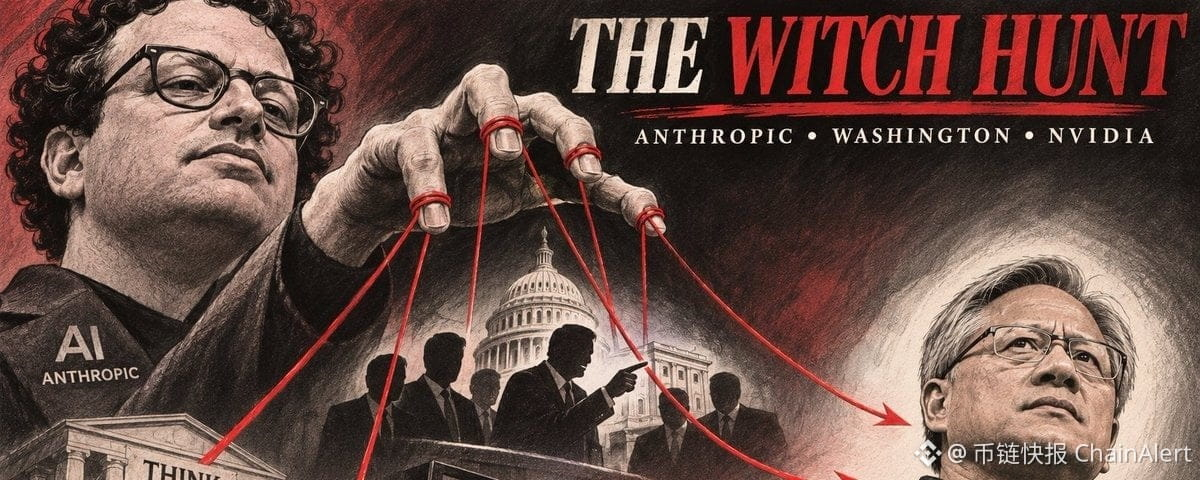
Unpacking the Jensen Huang Controversy: A Media Campaign and Collusion of Interests Targeting Anthropic
The media storm surrounding Nvidia CEO Jensen Huang may seem to have erupted out of nowhere. But tracing the connections reveals a clear chain of interests pointing to competitor Anthropic. From media framing and think-tank commentary to congressional pressure, several key players have significant overlap with Anthropic in terms of personnel, funding, and governance.
I. The Intertwining of Media Sources and PR Narratives
The New York Times’ reporting framework: Ana Swanson, the reporter who first ignited the controversy with allegations about chips and security, has long relied on Anthropic co-founder and head of policy Jack Clark as a key source. Clark, a former Bloomberg reporter and OpenAI policy director, is well versed in shaping public discourse. He has delivered a “software singularity” talk to key decision-makers at the Aspen Institute’s AI Policy Summit and is also a nonresident fellow at Georgetown University’s Center for Security and Emerging Technology (CSET).
The Financial Times’ shift in narrative: Demetri Sevastopulo, the reporter who later steered the discussion toward Huang’s private relationships, had previously reported exclusively in September 2025 that Anthropic had cut off access for companies with Chinese ties, pointing to deep information-sharing between him and the Anthropic team.
The social media flashpoint: On November 6, Chris McGuire, a member of the Council on Foreign Relations, published a highly inflammatory post that was shared within hours by several lawmakers and columnists, garnering more than 9 million views. McGuire previously served on the U.S. National Security Council, where his direct supervisor was Tarun Chhabra, now Anthropic’s head of national security policy. The two also attended a forum in Taipei together this June.
II. Political Donations, Behind-the-Scenes Lobbying, and Think-Tank Networks
Congressional attacks and political contributions:
After The New York Times report was published, Senator Chris Coons quickly announced that he would launch a congressional investigation. In July this year, he had accepted a $2,500 donation from AnthroPAC, Anthropic’s political action committee (Jack Clark personally contributed $5,000 to the PAC).
In February this year, Anthropic CEO Dario Amodei held a closed-door meeting with members of the Senate Banking Committee, pressing for tighter restrictions on chip exports to China. The Senate version of the AI WATCH Act was introduced afterward. The committee’s senior Republican, Kevin Cramer, also received a $1,000 donation from AnthroPAC in July and recently publicly called for Huang to resign.
In addition, during this political cycle Anthropic contributed $40 million to Public First Action and affiliated super PACs (with Amodei personally adding $1 million), continuing to fund lawmakers who support chip restrictions. These include House Foreign Affairs Committee Chair Brian Mast, who led a letter co-signed by other members on November 4 demanding accountability from Huang.
Think-tank incubation and accusations of a double standard:
Many of the most aggressive recent critics are affiliated with Georgetown University and its CSET, including law professor Mark Jia, former CSET analyst Ryan Fedasiuk (who has publicly called for Huang’s resignation), and former senior CIA official Dennis Wilder.
When CSET was founded, it received $55 million in seed funding from Open Philanthropy. Holden Karnofsky, co-founder of the funder, later joined Anthropic. Notably, when the Pentagon designated Anthropic a supply-chain risk, legal experts cited Mark Jia’s research to emphasize the high bar for national security designations. Yet this cautious standard went unmentioned when the target shifted to Huang.
At the governance level, Richard Fontaine, CEO of the Center for a New American Security (CNAS), has served as a member of Anthropic’s Long-Term Benefit Trust since June 2025. The think tank’s research framework on combating chip smuggling, meanwhile, forms the very blueprint for the current campaign to hold Nvidia accountable.
III. A High-Profile Political and Business Team, and a Critical Window for Capital
To advance its policy and market objectives, Anthropic has recruited key staff from both the Biden and Trump administrations:
Biden administration backgrounds: Tarun Chhabra (former NSC coordinator for technology and national security), Ben Buchanan (former White House AI adviser), Elizabeth Kelly (former director of the U.S. AI Safety Institute), Joel Meyer (former senior Department of Homeland Security official), among others.
Trump administration backgrounds: Chris Liddell (former White House deputy chief of staff, now an Anthropic board member), Sihao Huang (former senior AI adviser at the White House Office of Science and Technology Policy), Sarah Heck (former NSC member), among others.
In fact, Singapore’s Ministry of Home Affairs issued an official written statement as early as October 31, refuting the claims and saying it had never investigated the individuals concerned, yet mainstream media have largely remained silent. Behind the unsubstantiated “espionage allegations” and the shift in public scrutiny toward personal conduct, the timing of this series of concentrated attacks coincides closely with sharp fluctuations in Nvidia’s market capitalization and the sensitive period ahead of Anthropic’s planned IPO at an approximately $61 billion valuation.
630
Two Bitcoin addresses dormant for 16 years move 100 BTC, worth just $6 at the time
Two Bitcoin addresses that had remained untouched since mining rewards were received in September 2010 each transferred 50 BTC around midday on November 13, for a total of 100 BTC. Blockchain tracking firm Whale Alert estimated that the bitcoins were worth only about $6 in 2010, while their market value at the time of the transfers had risen to about $6.89 million. Blockchain data shows that the two amounts were combined into a single transaction about 40 minutes later. The owner’s identity remains a mystery.
Blockchain records show that the first transaction was added to a block at 12:08 p.m. Beijing time on the 13th, with the second following about two minutes later. The bitcoins were block rewards mined on September 8 and September 19, 2010, respectively (at the time, the reward for mining each block was 50 BTC).
The two addresses had been dormant for about 16.2 years. Based on Whale Alert’s estimate, the paper value of the 100 BTC had increased by more than a millionfold. At Binance’s quote of $67,634 on the morning of the 14th, their total value was about $6.76 million.
The two amounts were combined into a single transaction about 40 minutes later
The transaction fees for both transfers were 1,110 satoshis (worth less than $1). After being transferred, the funds were first split among several new addresses. Then, at 12:48, about 20 BTC and 39 BTC from the two amounts, respectively (about 59 BTC in total), were combined into a single transaction.
Under blockchain rules, a transaction that spends funds from multiple addresses must include signatures made with the private keys for all those addresses. Blockchain analytics firms commonly infer from this that the two early mining addresses from 2010 very likely belong to the same owner. However, no public information has confirmed the owner’s identity.
As of the morning of the 14th, about 30 BTC, 10 BTC, and 1 BTC remained in separate new addresses to which the funds had been transferred. The approximately 59 BTC that had been combined were transferred again at around 2 a.m. on the 14th. The owner has not publicly explained the reason for the transfers.
The public keys of early-mined coins are directly exposed on the blockchain
The two early mining rewards used the P2PK (Pay-to-Public-Key) format, common in Bitcoin’s early days, in which the public key is recorded directly on the blockchain. These addresses are generally considered to be at higher risk from quantum computing attacks, since potential attackers can obtain the public keys directly from the blockchain without waiting for the owner to initiate a transfer. Following these transfers, all of the bitcoins were moved to newer SegWit addresses beginning with bc1q.
A similar case occurred last month. According to Crypto Briefing, Galaxy Research detected on October 7 that an address had transferred 100.02 BTC. These coins were also early mining rewards from July 2010 and were worth about $8.5 million at the time of the transfer.
376
Crypto Evening Report | Key Developments on the Evening of November 14
12:00–21:00 Keywords: Trezor, Robin Li, Anthropic, ARK Invest
1. The Ethereum community released an EIP draft for “Universal Proof Verification and Batch Processing”
2. Trezor confirmed that three Safe 5 devices had been implanted with malicious hardware; its distributor network was cut by 80%
3. Robin Li: The next stage of AI is intelligent organizations, bringing three major opportunities
4. Elon Musk responded to rumors of Anthropic’s departure; SpaceX plans to invest $74 billion to expand production
5. LD Capital founder: The Democrats’ return to power, combined with events related to Jensen Huang, has already disrupted the short-term AI ecosystem
6. Binance has reopened withdrawals on 87 networks this week and plans to reopen all remaining networks by the end of next week
7. ARK Invest’s crypto lead questioned the shift in ETH’s value narrative, saying five major challenges remain, including its L1 positioning and quantum-resistant roadmap
737
CoinChain Midday Report | Key Updates for November 14
【CoinChain Midday Report | Key Updates for November 14】7:00–12:00 Keywords: Tether, Meta, Nvidia
1. Nvidia board: No formal contact has been made with any CEO candidates;
2. Louisiana obtains temporary injunction requiring 10 prediction markets to geoblock the state;
3. Tether-linked Bitcoin treasury company posts first-quarter profit, with net income of $1.087 billion;
4. FinCEN designates MEXC as a money-laundering concern and bars U.S. institutions from transferring funds to it;
5. Paraguay will end special electricity contracts for cryptocurrency miners by the end of 2027;
6. Zhang Yiming and Yi He appear to have signed a petition in support of Jensen Huang, with signatures surpassing 20,000;
7. Meta is testing its prediction market app, Takes, internally; real-money betting is not yet supported.
322
Zhang Yiming and He Yi Appear to Have Signed Petition Supporting Jensen Huang; Signatures Surpass 20,000
[Zhang Yiming and He Yi Appear to Have Signed Petition Supporting Jensen Huang; Signatures Surpass 20,000] According to CoinChain Express, on November 14, a signature attributed to “Yiming Zhang (ByteDance)” appeared on the signatory list of Stand with Jensen, a petition website supporting Jensen Huang. The message read, “Stand with Jensen,” and the signer is suspected to be ByteDance founder Zhang Yiming.
The list also includes a signature attributed to “Yi He, Binance co-founder and Chief Customer Service Officer,” with the message, “I wear a leather jacket too, and I disagree.” He Yi had previously reposted on X a post by Elon Musk supporting Jensen Huang.
The list also includes a16z co-founder Marc Andreessen, Epic Games CEO Tim Sweeney, Y Combinator CEO Garry Tan, Palo Alto Networks CEO Nikesh Arora, and Cohere co-founder Aidan Gomez, among others.
The website shows that the total number of signatures has exceeded 20,000, including 2,107 people who say they are current Nvidia employees, 267 former employees, and 12,406 shareholders. Signers enter their own affiliations, and the website has not verified them. The people named above have not publicly confirmed that they signed the petition.
397
OpenAI shifts to using general-purpose AI models to control robots directly, no longer developing specialized models separately
【OpenAI shifts to using general-purpose AI models to control robots directly, no longer developing specialized models separately】Coin Chain Express reports that, according to Fortune magazine on Nov. 14, OpenAI has disbanded its dedicated robotics research team and reassigned the researchers to other departments within the company. OpenAI said the move does not mean it is abandoning robotics, but is intended to accelerate the development of general-purpose robots. Following the restructuring, robotics researchers will join the core research team led by Chief Research Officer Mark Chen, while the applied robotics and hardware teams will move to the applications division overseen by President Greg Brockman. The changes reflect a shift in OpenAI’s strategic direction: the company believes general-purpose AI models can now be applied directly to robot control, eliminating the need to develop separate, specialized robotics AI models. OpenAI said that frontier general-purpose models, including GPT-6Astra, have already demonstrated capabilities in robotics applications. A study by Nvidia found that agents powered by Astra achieved a 74.8% success rate in simulated robot-operation tests, higher than the 51% previously reported for specialized robotics models on the same leaderboard. OpenAI still plans to develop humanoid robots, and CEO Sam Altman has previously proposed aiming for a first public demonstration in 2027. However, industry insiders note that general-purpose models still have limitations, such as slower operating speeds and reliance on cloud connectivity, while robotics companies retain advantages in real-world deployment and data collection.
【OpenAI shifts to using general-purpose AI models to control robots directly, no longer developing specialized models separately】Coin Chain Express reports that, according to Fortune magazine on Nov. 14, OpenAI has disbanded its dedicated robotics research team and reassigned the researchers to other departments within the company. OpenAI said the move does not mean it is abandoning robotics, but is intended to accelerate the development of general-purpose robots. Following the restructuring, robotics researchers will join the core research team led by Chief Research Officer Mark Chen, while the applied robotics and hardware teams will move to the applications division overseen by President Greg Brockman. The changes reflect a shift in OpenAI’s strategic direction: the company believes general-purpose AI models can now be applied directly to robot control, eliminating the need to develop separate, specialized robotics AI models. OpenAI said that frontier general-purpose models, including GPT-6Astra, have already demonstrated capabilities in robotics applications. A study by Nvidia found that agents powered by Astra achieved a 74.8% success rate in simulated robot-operation tests, higher than the 51% previously reported for specialized robotics models on the same leaderboard. OpenAI still plans to develop humanoid robots, and CEO Sam Altman has previously proposed aiming for a first public demonstration in 2027. However, industry insiders note that general-purpose models still have limitations, such as slower operating speeds and reliance on cloud connectivity, while robotics companies retain advantages in real-world deployment and data collection.
255
CoinChain Evening Report | Key Developments on the Evening of November 13
【CoinChain Evening Report | Key Developments on the Evening of November 13】12:00–21:00 Keywords: Moonshot AI, Hyperliquid, Robinhood, JPMorgan Chase
1. Reports say Moonshot AI plans to go public in Hong Kong in early 2027
2. U.S. Vice President Vance is considering not running for president in 2028
3. Elon Musk: Jensen Huang will be remembered forever, because some things are eternal
4. Hyperliquid protocol revenue reached $190.9 million in Q3, up 21.7% quarter over quarter
5. Robinhood's crypto trading volume was $17 billion in October, down 48% year over year
6. PBOC: Broad money (M2) balance stood at RMB 359.06 trillion at the end of October, up 7.1% year over year
7. JPMorgan increased its MSTR holdings by 36% to 848,000 shares in Q3, while also holding 11.4 million shares of IBIT
1
418
Democrats sweep the midterms. Does the CLARITY Act still have a chance?
After Democrats swept both chambers of Congress in the 2026 midterm elections, the prospects of passing the crypto market structure bill, the CLARITY Act, during the current lame-duck session—when it had been slated for action before year-end—have become extremely slim. As Democrats formally take control of the new Congress on January 3, 2027, the bill is highly likely to expire when the 119th Congress adjourns, with Democrats starting afresh under their own leadership.
The bill’s status: Senate hurdle proves insurmountable, with a huge vote shortfall
On September 15 this year, the Senate voted on a motion to invoke cloture on House Bill 3633, the Digital Asset Market Clarity Act (CLARITY Act). The motion failed, with 49 votes in favor and 50 against—11 votes short of the 60-vote threshold required to begin debate. Although Senator Thom Tillis submitted a motion to reconsider that day to preserve the bill’s procedural viability, it has since stalled.
The voting breakdown shows that the situation is more difficult than the apparent “one-vote difference” suggests:
In favor (49 votes): All were Republican senators.
Against (50 votes): All Democrats present, two independent senators, and four Republican senators who broke ranks (Susan Collins, Josh Hawley, Jerry Moran, and Thom Tillis).
Even if absent Democratic Senator Christopher Coons had voted in favor and all four Republicans who broke ranks had changed their votes, the total would have been just 54—still short of the 60-vote threshold. This means the bill would need to win support from a significant number of Democrats to pass.
The two parties’ main disagreements over the bill concern the division of regulatory authority (the Republican version would put the CFTC in charge of regulating digital commodities while limiting the SEC’s authority) and ethics provisions added later by the Senate. Elizabeth Warren, the top Democrat on the Senate Banking Committee, has explicitly opposed the current version, saying it would pose risks to ordinary families, the U.S. economy, and national security. However, payment stablecoins are already covered by the GENIUS Act, and the Office of the Comptroller of the Currency (OCC) is advancing related rules, so this setback does not affect that area.
Election reshapes the balance of power: Democrats have no incentive to compromise
The midterm elections have completely changed the parties’ negotiating leverage. According to CNBC estimates, Democrats have secured at least 255 seats in the new House, and could hold as many as 56 seats in the Senate. In a particularly symbolic development, Republican Susan Collins, who broke ranks in the CLARITY Act vote, lost her race to a Democratic candidate.
When the new Congress is sworn in on January 3, 2027, Democrats will take control of both chambers. For Democrats, there is no point compromising on the Republican bill during the coming weeks of the lame-duck session—they only need to wait six weeks to use their majorities to draft a crypto bill that fully reflects their own regulatory approach.
Year-end window is closing fast: just two narrow paths remain during the lame-duck session
There is very little effective legislative time left for the 119th Congress. The Senate is scheduled to recess for Veterans Day in mid-November and Thanksgiving in late November, and will begin its year-end recess on December 21. In addition, federal government funding expires on December 11, while the National Defense Authorization Act is mired in partisan negotiations. These essential measures for keeping the government running take priority over crypto legislation.
In theory, only two routes remain to rescue the CLARITY Act before Congress adjourns, but the odds of either succeeding are extremely low:
Revive the motion to reconsider: Use the reconsideration process left in place by Thom Tillis to hold another vote. But this would require substantial changes to the text (such as expanding the SEC’s authority and filling out the ethics provisions) to win Democratic votes. Any changes would then need to be coordinated with the House, which passed the original version of the bill last July.
Bundle it with must-pass year-end legislation: Attach crypto regulatory provisions to the government funding bill that must pass by December 11, or to the final version of the National Defense Authorization Act. As of November 12, however, there has been no public indication on Capitol Hill of any effort to do this.
What comes next: The bill may expire as Democrats plan to expand the SEC’s authority
Under the U.S. Constitution’s 20th Amendment, all bills and procedural motions that have not taken effect will automatically expire when the 119th Congress adjourns at noon on January 3, 2027.
Once Democrats formally take power, control of the Senate Banking Committee and the House Financial Services Committee will change hands (Elizabeth Warren is a possible candidate for chair of the Senate Banking Committee). According to reports of internal discussions among House Democrats, the party plans to introduce a broader market structure bill next year, modeled on the Cryptocurrency Investor and Consumer Protection Act previously proposed by Representative Maxine Waters. In sharp contrast to the Republican approach, the Democratic version is expected to significantly expand the SEC’s regulatory authority while correspondingly limiting the CFTC’s role.
Before January 3, markets can keep a close eye on three key indicators: whether crypto-related provisions unexpectedly appear in negotiations over year-end funding and defense legislation; the final results in individual districts where vote counting is still underway; and the selection of chairs for the new Congress’s two key financial committees. Barring any surprises, the CLARITY Act’s prospects as a 2026 legislative initiative are effectively over.
1
2.7k
Bitcoin falls below $70,000, BTC wicks down to $67,568, its lowest in nearly three months
Bitcoin fell below $70,000 this morning, hitting its lowest level since August. Liquidations across the crypto market totaled $1.62 billion in 24 hours. The factors weighing on prices even before Jensen Huang’s resignation were consecutive net outflows from spot ETFs, expectations of a December rate hike, and a strengthening U.S. dollar.
Bitcoin fell below $70,000 at around 10:45 a.m. today (November 13). Binance prices show that after 1:45 p.m., it hit an intraday low of $67,568, its lowest since August 19. It was trading at $68,900 as of 2:33 p.m., down 6.37% over 24 hours.
$1.62 billion in liquidations across the market, 96% of Bitcoin liquidations were long positions
According to CoinGlass data, liquidations across the market totaled $1.62 billion over the past 24 hours, affecting 183,264 traders. Bitcoin long positions accounted for $870 million in liquidations, while short positions accounted for just $31 million. Nearly all the liquidated leveraged positions had been betting on prices to rise.
Does Jensen Huang’s resignation have anything to do with Bitcoin?
Many people joked, “What does Jensen Huang’s resignation have to do with Bitcoin?” In fact, the pressure had been building for some time.
According to Farside Investors, spot Bitcoin ETFs recorded net outflows for five consecutive trading days starting November 5, totaling about $1.44 billion.
The U.S. Bureau of Labor Statistics also released October CPI data on November 10: the CPI rose 0.4% month over month, while core CPI rose 0.3%. As of publication, Polymarket put the probability of the Federal Reserve raising rates by 25 basis points at its December meeting at 88.5%, the probability of a hike of 50 basis points or more at 9.15%, and the probability of no change at just 2.1%.
The U.S. Dollar Index closed at 103.17 on November 12, its highest level since April 2025. Outflows, rising rate expectations, and a stronger dollar have all put pressure on Bitcoin.
1
634
Bloomberg: SpaceX-Tesla merger could be announced as early as December, but three hurdles remain
Bloomberg reported on November 12, citing people familiar with the matter, that merger talks between Elon Musk’s SpaceX and Tesla have made progress. An announcement could come as early as December, though it could also be delayed until early 2027. That would be a significant acceleration from Bloomberg’s earlier forecast in late October, which put the announcement in the first half of 2027.
If this landmark deal is ultimately approved, it would be the largest merger and acquisition in history. However, the two companies still face three major challenges before they can merge.
Who acquires whom? How big is the deal?
Based on U.S. stock market closing data from November 12:
Tesla: Closed at $397.45 (up 1.69%), with a market capitalization of about $1.571 trillion.
SpaceX (ticker: SPCX): Closed at $139.94 (up 0.14%), with a market capitalization of about $1.9 trillion.
Combined market capitalization: As much as $3.47 trillion.
Market analysts broadly believe this would be a deal in which SpaceX absorbs Tesla. (The main uncertainty is how many SpaceX shares Tesla shareholders would receive.) In terms of corporate control, Musk owns about 20% of Tesla, but controls more than 80% of the voting rights at SpaceX through supervoting shares. After the merger, Tesla shareholders would move from a “one share, one vote” structure into a company under Musk’s absolute control.
Moreover, SpaceX is no longer simply a rocket company. In February this year, it formally folded Musk’s AI company xAI into its business. In the third quarter, its AI division—now renamed Super Intelligence—generated $7.56 billion in revenue, surpassing Starlink’s $5.248 billion for the first time to become SpaceX’s largest source of revenue. The two companies are also working together to build a large chip factory, Terafab, in Texas.
Three hurdles to a merger
Tesla’s China business:
JPMorgan analysts have pointed out that SpaceX holds a large number of U.S. defense and government contracts, creating a potential conflict of interest with Tesla’s substantial and profitable manufacturing operations in China. This could prompt scrutiny from regulators and shareholders.
A new U.S. Congress investigation:
With Democrats winning control of both chambers in the November midterm elections, the new Congress is expected to take office in January 2027 and has already said it will closely investigate Musk’s business and political ties.
Tesla shareholder voting threshold:
Musk has said that both companies have established special committees of independent directors to assess the deal, but that he will not take part in the decision because of his conflicts of interest. Tesla shareholders must meet the high threshold of “approval by more than half of all outstanding shares”—not merely a majority of shares represented at the meeting—which will require an additional shareholder vote.
284
CoinChain Midday Report | Key Updates for the Midday of November 13
【CoinChain Midday Report | Key Updates for the Midday of November 13】7:00–12:00 Keywords: WLFI, Kalshi, Nvidia
1. The White House sent four nominations to the Senate, covering the CFTC and SEC;
2. WLFI: Completed its first $1 million buyback; on-chain data is publicly available;
3. Lex Fridman voiced his support for Jensen Huang: Nvidia firing Huang would be a huge mistake;
4. Singapore: The U.S. provided almost no assistance in the Huang Le case; he has been barred from re-entering Singapore;
5. White House technology adviser Sacks questioned the Nvidia “spy scandal”: intelligence agencies all say the evidence is insufficient;
6. Kalshi terminated its advisory contract with Trump’s eldest son after his venture capital firm increased its stake in Polymarket;
7. The FBI and police from multiple countries cracked down on darknet drug trafficking, seizing more than $234 million in cash and cryptocurrency.
415
Log in to explore more content
Join global crypto users on Binance Square
⚡️ Get latest and useful information about crypto.
💬 Trusted by the world’s largest crypto exchange.
👍 Discover real insights from verified creators.
Email / Phone number
Trending Topics
CryptoSelloffTriggersMultipleWhaleLiquidations
88,404 views
1,020 Discussing
Crypto Liquidations Top $2B in 24 Hours as 329,000 Traders Are Wiped Out
Binance News
·31 Likes
·32.9k views
USSpotXRPETFsSeeLargestWeeklyOutflowIn8Months
98,905 views
1,118 Discussing
WillFOMCMinutesReinforceRateHikeExpectations?
20,127 views
415 Discussing