
Future-boy
358 Posts

Future-boy
Report
Block User
I share knowledge everyday, I turn headlines into trader insights Daily.
Open Trade
High-Frequency Trader
5.6 Months
92 Following
28 Followers
184 Liked
Posts
Portfolio
·
--

Article
See translation
BLACKROCK HAS A TOKENIZED HONG KONG DOLLAR MONEY FUND AND THE STABLECOIN IT ACCEPTS IS NOT A DOLLARBLACKROCK HAS A TOKENIZED HONG KONG DOLLAR MONEY FUND AND THE STABLECOIN IT ACCEPTS IS NOT A DOLLAR ONE
BlackRock has won approval in Hong Kong for its first tokenized money market fund in the Asia Pacific region, and the headline gets one detail slightly off. The fund is denominated in Hong Kong dollars and investors can use regulated digital cash to subscribe and redeem, including HKDAP, a Hong Kong dollar stablecoin issued by a Standard Chartered led venture, not the usual US dollar stablecoins. The materials also say the fund is set to launch, so I would not treat it as already open for business.
The structure is the interesting part. The fund invests in short term Hong Kong dollar instruments such as government bills and bank deposits, aims to keep a steady share value and is open to both institutional and retail investors, which is rare for a locally based money market fund. Standard Chartered handles custody, administration and tokenization, so the full chain from digital cash to fund shares sits with one bank.
For crypto the angle is local currency stablecoins. Most tokenized money funds so far have centered on US dollar products, and this one pairs a yield bearing fund with a regulated stablecoin in another currency, which gives that stablecoin an immediate use case. It also adds to BlackRock's tokenized lineup, which now covers dollars, euros, pounds and Hong Kong dollars across different infrastructure in each region.
It also fits the pattern this month. Regulated reserve funds, tokenized treasuries and bank issued stablecoins are all being built at once, and Hong Kong is positioning itself as an early hub where regulators have drawn clear lines. The same city's securities regulator just put Hyperliquid on a warning list, which shows how it separates licensed activity from everything else.
The limits are scale and demand. Hong Kong dollar stablecoins are new and small, and tokenized funds are still far behind stablecoins in liquidity, so the real test is whether investors actually use the on chain route instead of the traditional one.
I'm watching the launch date, the fund's size and how much HKDAP gets used for subscriptions, since those numbers will show whether this is a real product or a showcase.
Do you think local currency stablecoins and tokenized funds are the next big step after dollar stablecoins, or does the dollar keep winning, and would you hold a tokenized money fund instead of idle stablecoins?
BLACKROCK HAS A TOKENIZED HONG KONG DOLLAR MONEY FUND AND THE STABLECOIN IT ACCEPTS IS NOT A DOLLAR
BLACKROCK HAS A TOKENIZED HONG KONG DOLLAR MONEY FUND AND THE STABLECOIN IT ACCEPTS IS NOT A DOLLAR ONE
BlackRock has won approval in Hong Kong for its first tokenized money market fund in the Asia Pacific region, and the headline gets one detail slightly off. The fund is denominated in Hong Kong dollars and investors can use regulated digital cash to subscribe and redeem, including HKDAP, a Hong Kong dollar stablecoin issued by a Standard Chartered led venture, not the usual US dollar stablecoins. The materials also say the fund is set to launch, so I would not treat it as already open for business.
The structure is the interesting part. The fund invests in short term Hong Kong dollar instruments such as government bills and bank deposits, aims to keep a steady share value and is open to both institutional and retail investors, which is rare for a locally based money market fund. Standard Chartered handles custody, administration and tokenization, so the full chain from digital cash to fund shares sits with one bank.
For crypto the angle is local currency stablecoins. Most tokenized money funds so far have centered on US dollar products, and this one pairs a yield bearing fund with a regulated stablecoin in another currency, which gives that stablecoin an immediate use case. It also adds to BlackRock's tokenized lineup, which now covers dollars, euros, pounds and Hong Kong dollars across different infrastructure in each region.
It also fits the pattern this month. Regulated reserve funds, tokenized treasuries and bank issued stablecoins are all being built at once, and Hong Kong is positioning itself as an early hub where regulators have drawn clear lines. The same city's securities regulator just put Hyperliquid on a warning list, which shows how it separates licensed activity from everything else.
The limits are scale and demand. Hong Kong dollar stablecoins are new and small, and tokenized funds are still far behind stablecoins in liquidity, so the real test is whether investors actually use the on chain route instead of the traditional one.
I'm watching the launch date, the fund's size and how much HKDAP gets used for subscriptions, since those numbers will show whether this is a real product or a showcase.
Do you think local currency stablecoins and tokenized funds are the next big step after dollar stablecoins, or does the dollar keep winning, and would you hold a tokenized money fund instead of idle stablecoins?
BLKUS-0.61%
1
74
·
--
Bearish
See translation
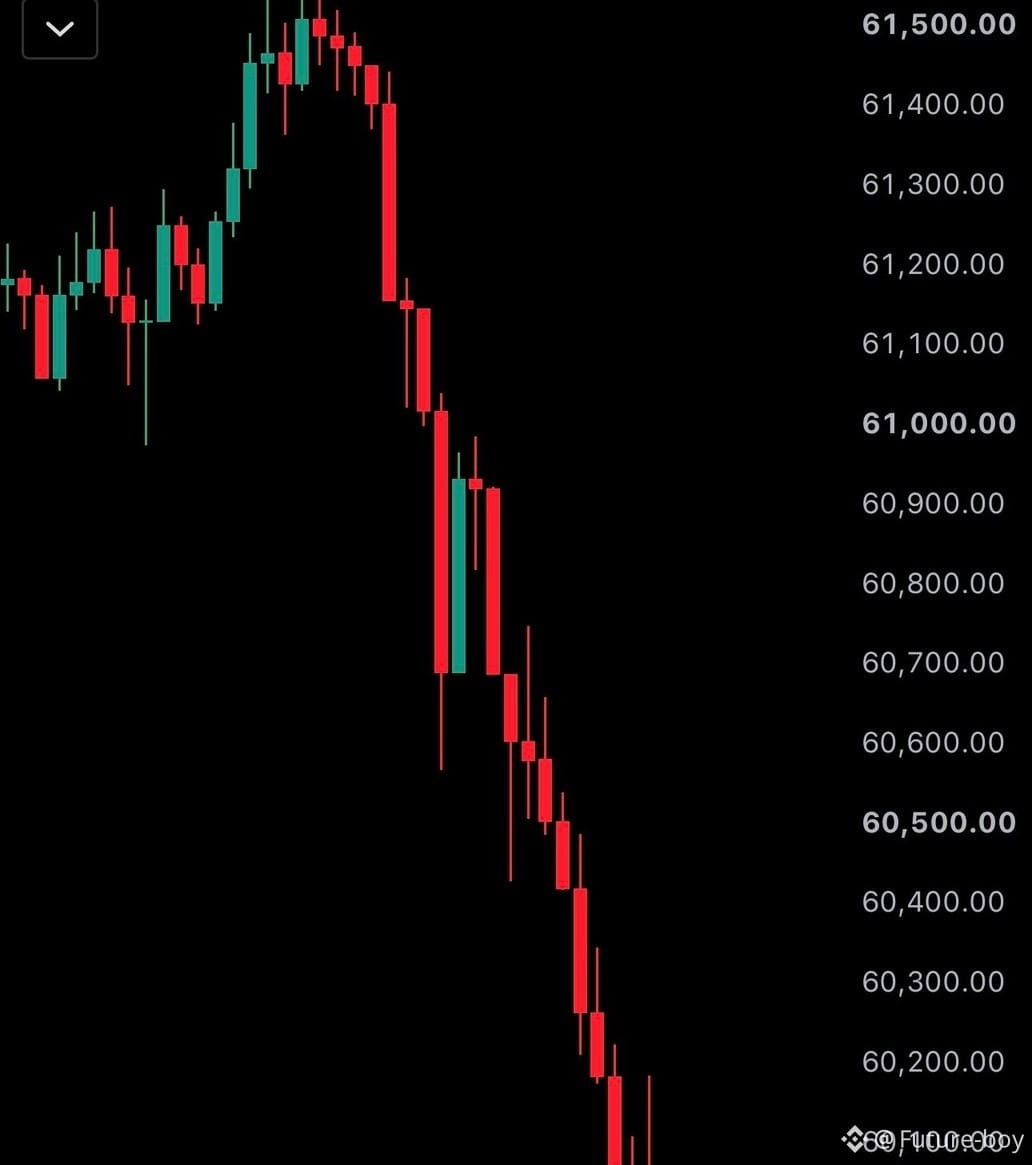
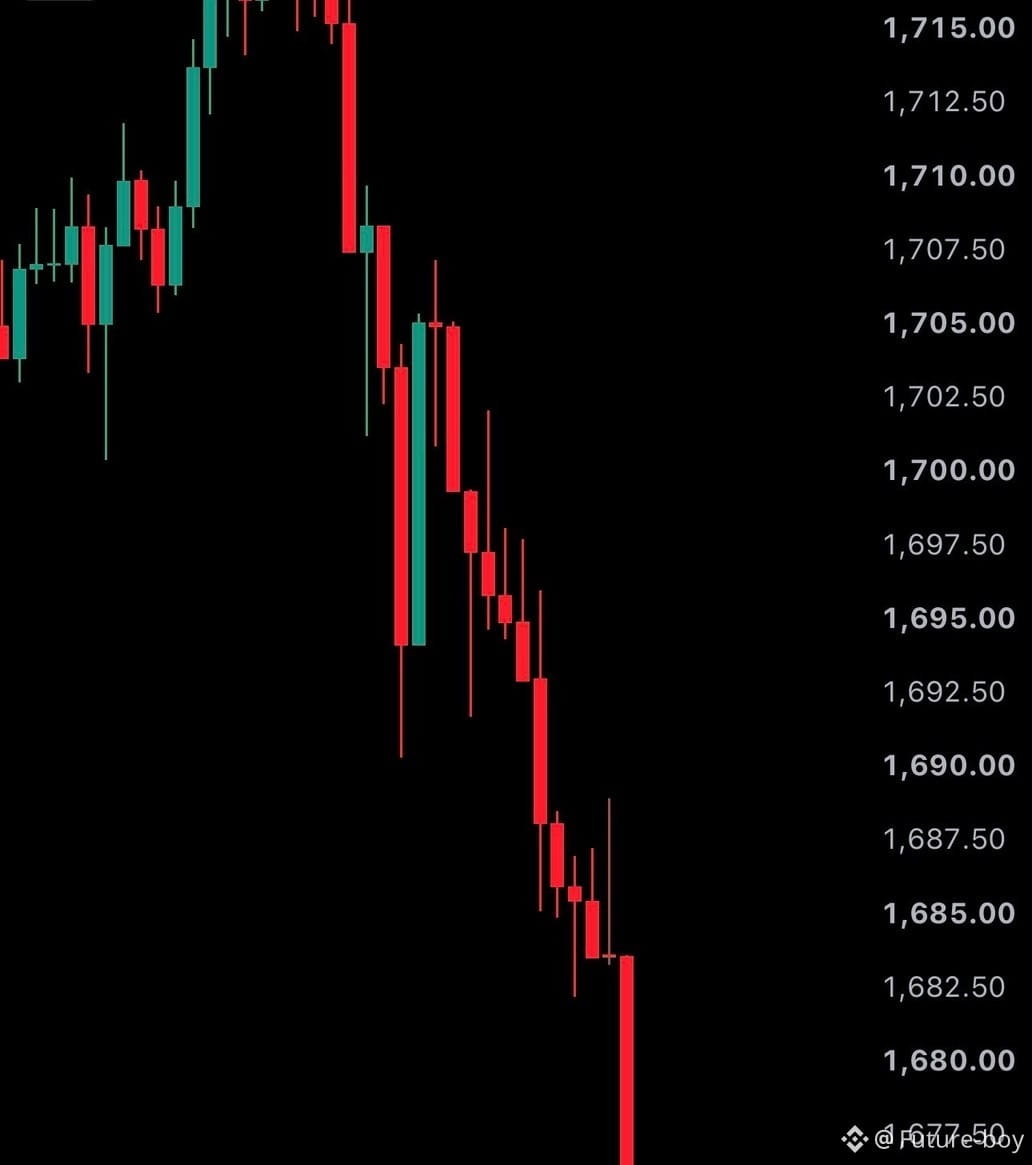
BITCOIN IS BACK UNDER 60,000 AND THE YEAR'S LOW IS NOW A FEW PERCENT AWAY
Bitcoin is back below 60,000 dollars with Ether under 1,700, extending a slide that first broke the 60,000 line on Friday for the first time since July. I could not confirm today's exact print, but the damage is already visible, with the price having spent days hovering around 59,000 to 60,000 after a long stretch above it. It is also telling that the move came despite the relief rally in Nvidia, which showed up on Monday and did not carry over to crypto.
The round number matters because it held as support for months. When a level like that fails, traders who bought around it become sellers on any bounce, stops pile up just below it and the market starts focusing on the next reference point, which is the 2026 low around 57,700. A break of that would put Bitcoin at its weakest in more than a year and a half, and some analysts are already talking about 55,000 and lower.
The drivers have not changed. US spot ETFs have been selling, with funds redeeming for weeks, leveraged longs keep getting forced out, rate hike expectations are still alive and stablecoin supply has been shrinking, which means there is little new money waiting to buy. Even a strong day for tech stocks failed to lift Bitcoin, which suggests the selling is coming from crypto specific positioning and flows more than from the Nasdaq.
The case for caution on the bearish side is the usual one. Extreme fear readings, washed out leverage and sharp liquidation bursts have often appeared near lows, and Bitcoin held the July bottom once already. But a bounce needs ETF outflows to slow and price to reclaim 60,000 on a daily close, and neither has happened yet.
For now I'm keeping size small and waiting for confirmation, since catching the exact bottom has been a losing game all month.
Do you think Bitcoin retests the July low or finds a floor here, and what is the level that would make you start buying again?
1
112
·
--

Article
See translation
AMERICAN BITCOIN LINED UP A 150 MILLION DOLLAR CREDIT LINE AGAINST ITS BITCOIN BUT HASN'T TOUCHED AAMERICAN BITCOIN LINED UP A 150 MILLION DOLLAR CREDIT LINE AGAINST ITS BITCOIN BUT HASN'T TOUCHED A DOLLAR OF IT YET
American Bitcoin, the Nasdaq listed company co-founded by Eric Trump and Donald Trump Jr., has secured a 150 million dollar committed credit facility from FalconX, backed by its bitcoin reserves. The headline calls it a loan, but according to the company's filing, nothing has been drawn so far, so it works more like a financial safety net than money already borrowed. Shares were up about 9 percent in premarket trading after the news.
The terms are straightforward. The company pays 5.95 percent a year on what it borrows plus a fee on the unused portion, the facility runs until November 2028 with a possible three year extension at the lender's discretion, and any draw has to be backed by Bitcoin worth 143 percent of the amount borrowed. The collateral sits with Anchorage Digital Bank, while FalconX tracks its value against the loan.
The company's pitch is that this is non dilutive money, meaning it can fund operations and growth without selling coins or issuing more shares. For a treasury and mining company in a falling market that is attractive, because selling Bitcoin near multi month lows or issuing stock at depressed prices is painful.
The risk is the same one every borrower against Bitcoin faces. A 143 percent collateral requirement means that if the price keeps dropping, the company would need to post more coins to keep a draw in good standing, and a sharp fall could force it to deliver collateral at the worst moment. Since nothing is drawn yet, that risk is mostly potential, but it grows with every dollar borrowed.
It also fits the wider theme this week. Bitcoin backed lending is moving from crypto native platforms to regulated banks and institutional desks, and treasury companies are leaning on it to stay flexible while prices are down.
I'm watching how much the company actually draws and what it does with the money, since that will show whether this is a cushion or the start of leveraging up.
Do you think borrowing against Bitcoin is smart treasury management in a down market or a risk that could backfire, and would you trust a miner with a credit line at these prices?
AMERICAN BITCOIN LINED UP A 150 MILLION DOLLAR CREDIT LINE AGAINST ITS BITCOIN BUT HASN'T TOUCHED A
AMERICAN BITCOIN LINED UP A 150 MILLION DOLLAR CREDIT LINE AGAINST ITS BITCOIN BUT HASN'T TOUCHED A DOLLAR OF IT YET
American Bitcoin, the Nasdaq listed company co-founded by Eric Trump and Donald Trump Jr., has secured a 150 million dollar committed credit facility from FalconX, backed by its bitcoin reserves. The headline calls it a loan, but according to the company's filing, nothing has been drawn so far, so it works more like a financial safety net than money already borrowed. Shares were up about 9 percent in premarket trading after the news.
The terms are straightforward. The company pays 5.95 percent a year on what it borrows plus a fee on the unused portion, the facility runs until November 2028 with a possible three year extension at the lender's discretion, and any draw has to be backed by Bitcoin worth 143 percent of the amount borrowed. The collateral sits with Anchorage Digital Bank, while FalconX tracks its value against the loan.
The company's pitch is that this is non dilutive money, meaning it can fund operations and growth without selling coins or issuing more shares. For a treasury and mining company in a falling market that is attractive, because selling Bitcoin near multi month lows or issuing stock at depressed prices is painful.
The risk is the same one every borrower against Bitcoin faces. A 143 percent collateral requirement means that if the price keeps dropping, the company would need to post more coins to keep a draw in good standing, and a sharp fall could force it to deliver collateral at the worst moment. Since nothing is drawn yet, that risk is mostly potential, but it grows with every dollar borrowed.
It also fits the wider theme this week. Bitcoin backed lending is moving from crypto native platforms to regulated banks and institutional desks, and treasury companies are leaning on it to stay flexible while prices are down.
I'm watching how much the company actually draws and what it does with the money, since that will show whether this is a cushion or the start of leveraging up.
Do you think borrowing against Bitcoin is smart treasury management in a down market or a risk that could backfire, and would you trust a miner with a credit line at these prices?
1
101
·
--
Article
See translation
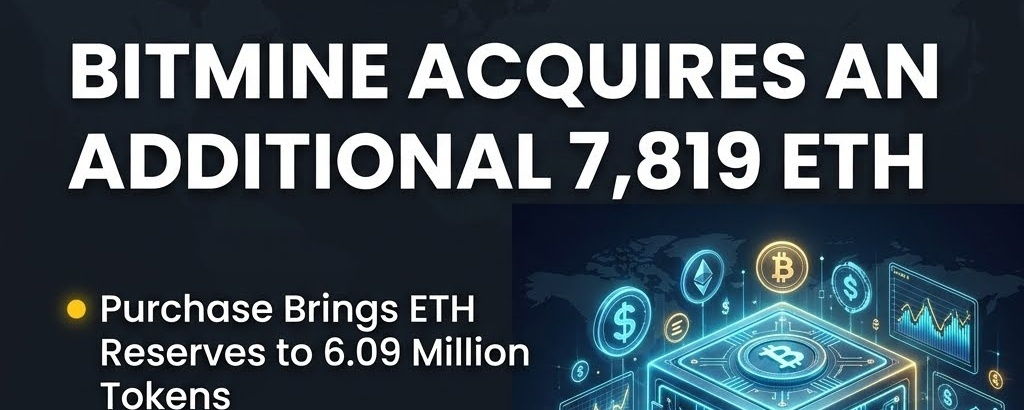
BITMINE BOUGHT ANOTHER 7,819 ETH DURING THE CRASH AND IS NOW ONE STEP AWAY FROM OWNING 5 PERCENT OF⁷BITMINE BOUGHT ANOTHER 7,819 ETH DURING THE CRASH AND IS NOW ONE STEP AWAY FROM OWNING 5 PERCENT OF ALL ETHER
Tom Lee's Bitmine just added 7,819 ETH last week, lifting its stash to about 6.09 million coins, which is 4.98 percent of the entire Ethereum supply. That sits about 99 percent of the way to the company's stated goal of owning 5 percent of all ETH. At the latest price that is worth about 10.4 billion dollars, and the weekly purchase itself was around 13 million dollars, which shows how much the buying pace has cooled from the bigger weekly clips earlier this year.
The streak is the headline. Bitmine says it has bought ETH every single week since adopting the strategy on June 30, 2025, and it kept doing it in the same week that Ethereum slid below 1,700 dollars and the whole market printed fresh lows. About 86 percent of its holdings are staked, which the company projects will produce around 245 million dollars a year in rewards, so the position is at least earning something while it waits.
But the other side of the ledger is painful. ETH is down roughly 28 percent over the past month, and BMNR shares are down about 44 percent over the same stretch and more than half this year, so investors in the stock have been hurt far more than holders of ETH itself. The premarket bounce of around 9 percent after the announcement helps, but it does not change the larger picture of a treasury company whose share price has fallen faster than its underlying asset.
Lee keeps making the hard money case, noting that Ethereum's supply has grown only about 1.3 percent since June 2025, close to Bitcoin's pace, and calling both hard money by supply growth. Supporters see a patient, high conviction accumulator that is about to reach a symbolic milestone, while skeptics see a leveraged bet on one asset in a deep downtrend.
I'm watching whether Bitmine crosses the 5 percent mark soon and whether it resumes buybacks, since those choices show how the company balances buying ETH against defending its own share price.
Do you think Bitmine's steady buying is a smart long term accumulation or a risk in a falling market, and does a treasury company owning 5 percent of ETH make you more bullish or more worried?
BITMINE BOUGHT ANOTHER 7,819 ETH DURING THE CRASH AND IS NOW ONE STEP AWAY FROM OWNING 5 PERCENT OF⁷
BITMINE BOUGHT ANOTHER 7,819 ETH DURING THE CRASH AND IS NOW ONE STEP AWAY FROM OWNING 5 PERCENT OF ALL ETHER
Tom Lee's Bitmine just added 7,819 ETH last week, lifting its stash to about 6.09 million coins, which is 4.98 percent of the entire Ethereum supply. That sits about 99 percent of the way to the company's stated goal of owning 5 percent of all ETH. At the latest price that is worth about 10.4 billion dollars, and the weekly purchase itself was around 13 million dollars, which shows how much the buying pace has cooled from the bigger weekly clips earlier this year.
The streak is the headline. Bitmine says it has bought ETH every single week since adopting the strategy on June 30, 2025, and it kept doing it in the same week that Ethereum slid below 1,700 dollars and the whole market printed fresh lows. About 86 percent of its holdings are staked, which the company projects will produce around 245 million dollars a year in rewards, so the position is at least earning something while it waits.
But the other side of the ledger is painful. ETH is down roughly 28 percent over the past month, and BMNR shares are down about 44 percent over the same stretch and more than half this year, so investors in the stock have been hurt far more than holders of ETH itself. The premarket bounce of around 9 percent after the announcement helps, but it does not change the larger picture of a treasury company whose share price has fallen faster than its underlying asset.
Lee keeps making the hard money case, noting that Ethereum's supply has grown only about 1.3 percent since June 2025, close to Bitcoin's pace, and calling both hard money by supply growth. Supporters see a patient, high conviction accumulator that is about to reach a symbolic milestone, while skeptics see a leveraged bet on one asset in a deep downtrend.
I'm watching whether Bitmine crosses the 5 percent mark soon and whether it resumes buybacks, since those choices show how the company balances buying ETH against defending its own share price.
Do you think Bitmine's steady buying is a smart long term accumulation or a risk in a falling market, and does a treasury company owning 5 percent of ETH make you more bullish or more worried?
1
102
·
--
Bullish
See translation
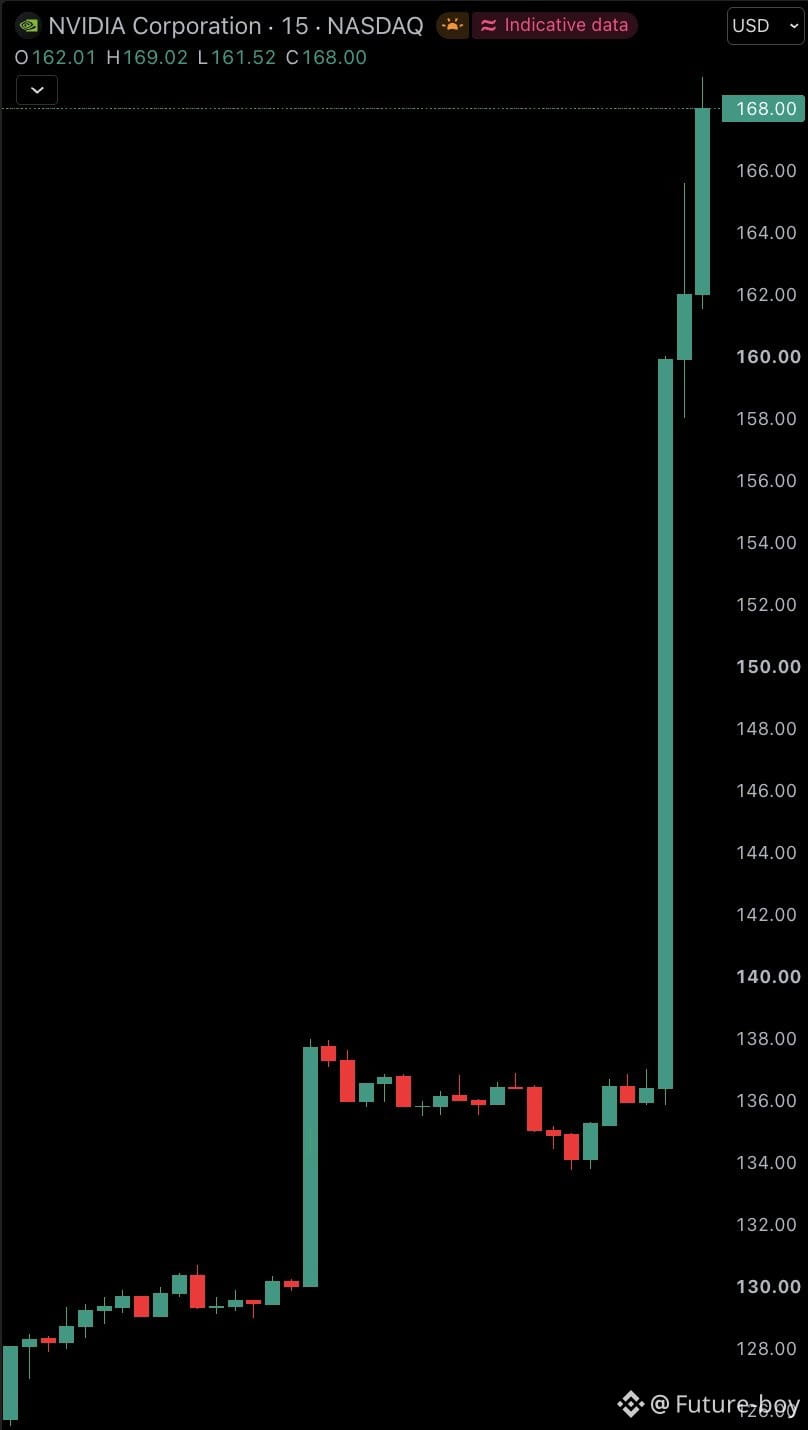
NVIDIA SURGES OVER 34% TO $168 AT OPEN AS JENSEN HUANG RETURNS AS CEO
Nvidia shares just exploded out of the gate at the opening bell, surging more than 34 percent to hit $168 after the board officially reinstated founder Jensen Huang as CEO, President, and Board Director. That violent upside reversal has added more than $1 trillion back to Nvidia's market capitalization in a single stroke, snapping the brutal selloff that wiped hundreds of billions off the chipmaker's value following his abrupt resignation earlier this month.
For the past eleven days, Wall Street had been punishing tech and AI stocks amid leadership uncertainty and broader macro anxiety, dragging Nvidia down to roughly $125 by Friday's close. Bringing Huang back into the captain's chair immediately restored institutional confidence across the entire semiconductor and artificial intelligence complex, sending the Nasdaq Composite surging alongside NVDA at the open.
Whenever the single most important bellwether in global tech adds a trillion dollars in value at the opening bell, liquidity and risk appetite ripple straight into crypto markets. Traders watching AI infrastructure plays like $RENDER,$TAO, and FET alongsideBTC are now eyeing whether this massive tech relief rally sparks a broader risk-on bounce after days of relentless market fear.
Does Jensen Huang's return mark the official bottom for this tech and crypto selloff, or are you fading this opening-bell pump? Drop your take on $NVDA and AI tokens below!
2
501
·
--
Bullish
See translation
A REGULATED BANK IS NOW ISSUING BITCOIN BACKED LOANS UP TO 250,000 DOLLARS AND THE TIMING IS A STRESS TEST
Cross River Bank has started issuing bitcoin backed loans through LendingUSA, with amounts ranging from 10,000 up to 250,000 dollars. The structure is worth understanding. Borrowers pledge Bitcoin, the collateral is held by BitGo Bank & Trust, a regulated custodian, the loan is issued by Cross River, a New Jersey state chartered bank, and LendingUSA supplies the app and the customer experience. I could not confirm the launch date or that this is the first product of its kind, so I will not claim that.
It also fits a bigger move from Cross River. Earlier this year it committed to buy up to 250 million dollars of crypto backed loans originated by Figure, which was its first capital support for the asset class, and executives said they were working on more. That is a separate deal from this one, but it shows a bank steadily building exposure to lending against digital assets instead of treating it as a one off experiment.
The appeal for holders is the classic one. Borrowing against Bitcoin gives you dollars without selling, so no capital gains event, while keeping your upside. That is why banks and fintechs are all chasing the market after the collapse of the lenders that blew up in 2022, with regulated custodians and bank balance sheets as the key difference this time.
But the timing is a real test. Bitcoin has dropped to the low 60,000s, and anyone who borrowed near higher prices is much closer to a margin call. Collateral based loans are only safe as long as the collateral holds its value, and a sharp move down can trigger forced liquidation, which then adds selling pressure to an already weak market.
I'm watching loan volumes and liquidation levels, since a bank grade product that gets through a drawdown without drama would be a strong case for the whole category.
Would you borrow against your Bitcoin at current prices, or does a falling market make that too risky, and do bank issued loans feel safer to you than crypto native lenders?

1
157
·
--

Article
See translation
SOLANA IS STITCHING TOGETHER PRIVATE AI, AGENT TOOLS AND STABLECOIN PAYMENTS AND CALLING IT AN AGENTSOLANA IS STITCHING TOGETHER PRIVATE AI, AGENT TOOLS AND STABLECOIN PAYMENTS AND CALLING IT AN AGENT ECONOMY
Solana is making a big push to become the base layer for AI agents. The headline calls it one platform, but what I could confirm is a set of connected launches, and some of them are still early. The pieces are a confidential computing toolkit, a payments service for agents and a developer kit that lets them act on chain.
The confidential part launched on November 13 with a startup called Nito. It lets developers build private AI apps and verify the hardware running them, using secure enclaves that keep data hidden while it is processed. It is currently in beta on devnet, which is the network's practice field, so nothing real is at stake yet, and a mainnet version has no announced date.
The payments part is more concrete. Pay.sh, built with Google Cloud, lets agents discover APIs and pay for them one request at a time with stablecoins, with no account or subscription needed. That is the kind of machine to machine micropayment that cards and banks struggle with, and it is the same use case Visa, Mastercard and Coinbase have been chasing this month. The foundation has also released a toolkit that lets agents make payments and trade through one line integrations, and says more than 120 teams are building AI products on the network.
The honest caveat is that agent commerce is still small. Much of the activity is experimental, security risks around autonomous agents handling money are real, and the competition for the agent payments standard is crowded with deep pocketed players. Solana's advantage is cheap, fast transactions and an existing stablecoin base, but that has to turn into real usage.
For SOL holders it is a narrative with substance, though price has not reflected it in a weak market, and I would watch adoption numbers more than announcements.
I'm watching mainnet timing for the confidential tools and actual transaction volume on Pay.sh, since those will show whether agents are really using it.
Do you think AI agents become a meaningful source of onchain demand, or is this still mostly a story, and does it make you more interested in SOL?
SOLANA IS STITCHING TOGETHER PRIVATE AI, AGENT TOOLS AND STABLECOIN PAYMENTS AND CALLING IT AN AGENT
SOLANA IS STITCHING TOGETHER PRIVATE AI, AGENT TOOLS AND STABLECOIN PAYMENTS AND CALLING IT AN AGENT ECONOMY
Solana is making a big push to become the base layer for AI agents. The headline calls it one platform, but what I could confirm is a set of connected launches, and some of them are still early. The pieces are a confidential computing toolkit, a payments service for agents and a developer kit that lets them act on chain.
The confidential part launched on November 13 with a startup called Nito. It lets developers build private AI apps and verify the hardware running them, using secure enclaves that keep data hidden while it is processed. It is currently in beta on devnet, which is the network's practice field, so nothing real is at stake yet, and a mainnet version has no announced date.
The payments part is more concrete. Pay.sh, built with Google Cloud, lets agents discover APIs and pay for them one request at a time with stablecoins, with no account or subscription needed. That is the kind of machine to machine micropayment that cards and banks struggle with, and it is the same use case Visa, Mastercard and Coinbase have been chasing this month. The foundation has also released a toolkit that lets agents make payments and trade through one line integrations, and says more than 120 teams are building AI products on the network.
The honest caveat is that agent commerce is still small. Much of the activity is experimental, security risks around autonomous agents handling money are real, and the competition for the agent payments standard is crowded with deep pocketed players. Solana's advantage is cheap, fast transactions and an existing stablecoin base, but that has to turn into real usage.
For SOL holders it is a narrative with substance, though price has not reflected it in a weak market, and I would watch adoption numbers more than announcements.
I'm watching mainnet timing for the confidential tools and actual transaction volume on Pay.sh, since those will show whether agents are really using it.
Do you think AI agents become a meaningful source of onchain demand, or is this still mostly a story, and does it make you more interested in SOL?
1
100
·
--
Bearish
See translation
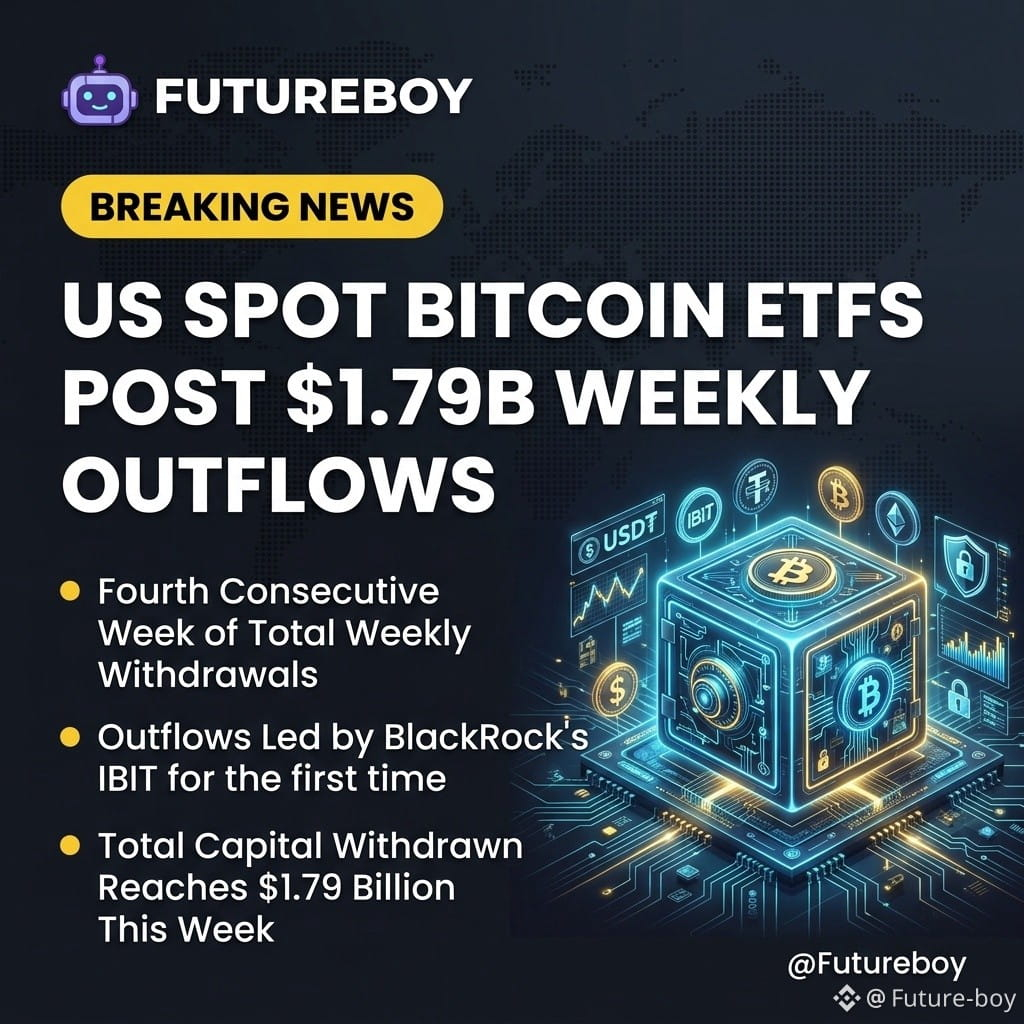
BITCOIN ETF OUTFLOWS KEEP BLEEDING AND THE BIGGEST HEADLINE NUMBER MAY BE AN OLD ONE
A headline says US spot Bitcoin ETFs just lost 1.79 billion dollars in a week, a fourth straight week of withdrawals led by BlackRock's IBIT. I could not confirm that for this week, and the exact figure matches a record breaking stretch from late June, so the number may be recycled. What I can say is that the direction fits the current market, with ETF money flowing out through most of November while Bitcoin slid toward the low 60,000s.
The important point is who is leaving. IBIT is the largest fund by far, so when it leads the withdrawals, it usually means the investors who bought through traditional brokerage accounts are the ones heading for the exit. By July the average IBIT investor was reportedly sitting on a loss of roughly 40 percent, and losses like that tend to create steady selling pressure whenever price bounces back toward break even.
It also matters that these funds were supposed to be the stable bid under the market. In the early days they were the source of record inflows, and the story for the past two years was that Wall Street demand would absorb every dip. A string of outflow weeks, in a year where June alone set a record for monthly redemptions, shows how quickly that support can turn into a drag when sentiment shifts and rate hikes look likely.
The balanced view is that ETF flows follow price as much as they lead it. Outflows often peak near lows, and a single week without redemptions can change the tone quickly, as we saw when one big inflow day snapped a long streak in July. But I would want to see several weeks of steady inflows before reading it as a real turn.
For now it is the cleanest indicator to watch, because it shows whether the big, patient money is buying or leaving.
Do you think $ETFT.ETF flows are the key driver for Bitcoin from here, or do they just follow price, and what flow number would make you turn bullish?
1
55
·
--
Bearish
See translation
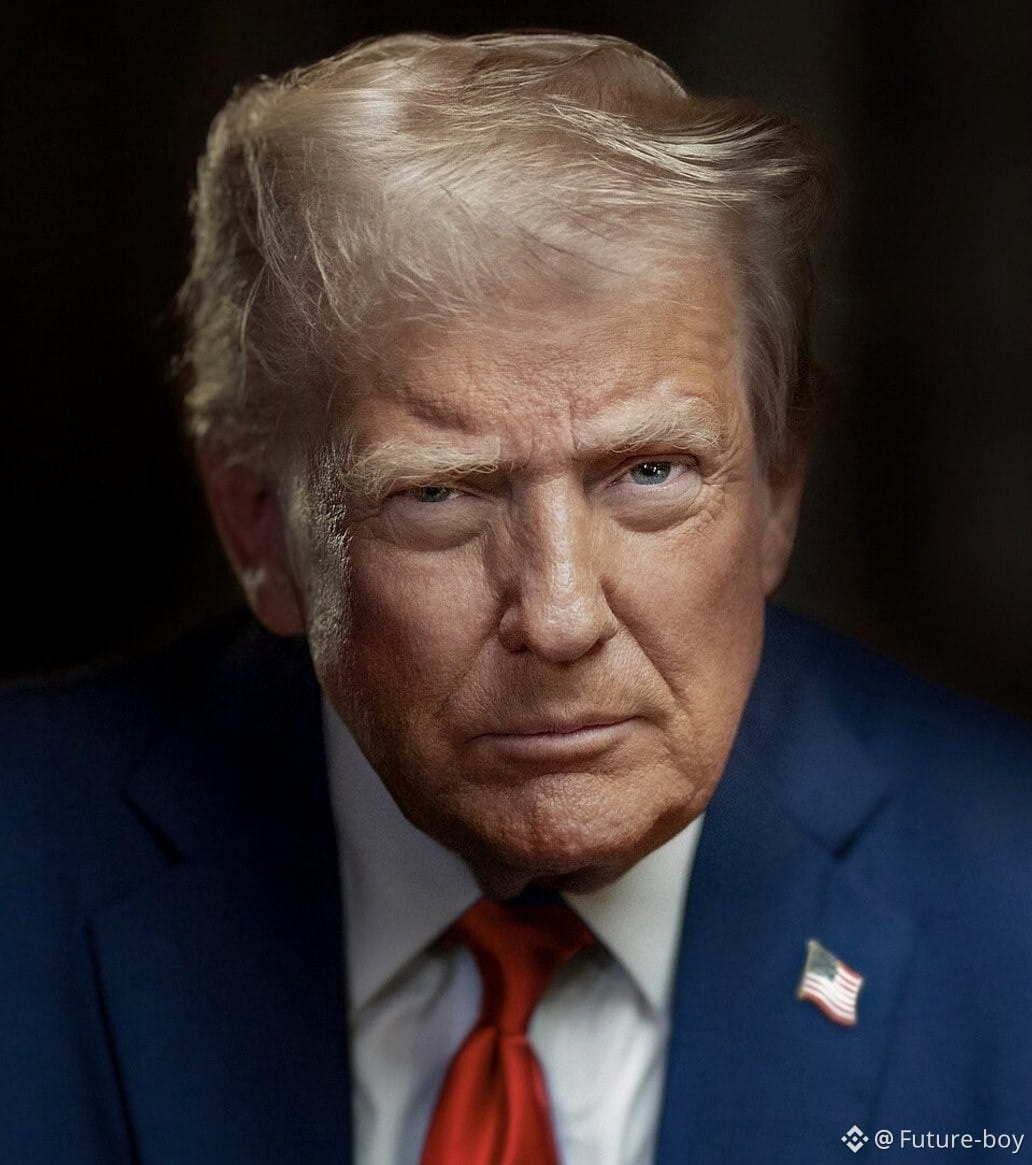
TRUMP JUST ASKED NVIDIA TO REHIRE JENSEN HUANG AGAIN AND THE BOARD HAS ALREADY SAID IT DOES NOT PLAN TO
President Trump has renewed his call for Nvidia's board to bring back Jensen Huang as CEO, writing in a Truth Social post that it would be the best thing for the company and for the US. It comes only days after Nvidia said it did not intend to reinstate him, so the two sides are publicly pointing in different directions.
The backdrop is a saga that has been moving fast. Huang resigned on November 12 after reports of extramarital affairs, including one with an alleged Chinese spy, and a petition calling for his return has gathered close to 180,000 signatures. Huang himself said on Tuesday that he would be honored to come back if the board concludes it is the right move, which keeps the door open without forcing the issue.
The pressure is also not coming from one direction. Treasury Secretary Bessent had urged the board to look outside for new leadership, and has since seemed to soften that stance, while a number of investors and tech figures have publicly backed a return. On the other side, reports say the board is cautious about an ongoing national security investigation, which I could only see in headline summaries, so I would not lean on the details.
For markets the point is uncertainty. Nvidia is the centerpiece of the AI trade, interim leadership is still in place and the company faces a shareholder lawsuit, so every new headline about who runs it can move the stock. Crypto has been trading in sympathy with tech, so a prolonged leadership fight is another headwind for risk appetite, while a clear resolution, whichever way it goes, would likely calm things down.
I'm watching for a formal board statement or a named candidate, since a concrete decision will matter more than another round of public comments.
Do you think the board holds its position or shifts under this pressure, and does the Nvidia story change how you view AI stocks and crypto right now?

1
193
·
--
Article
See translation
JAPAN'S BOND MARKET IS BEING PREPARED FOR THE BLOCKCHAIN AND CANTON KEEPS SHOWING UP IN THE PLANJAPAN'S BOND MARKET IS BEING PREPARED FOR THE BLOCKCHAIN AND CANTON KEEPS SHOWING UP IN THE PLAN
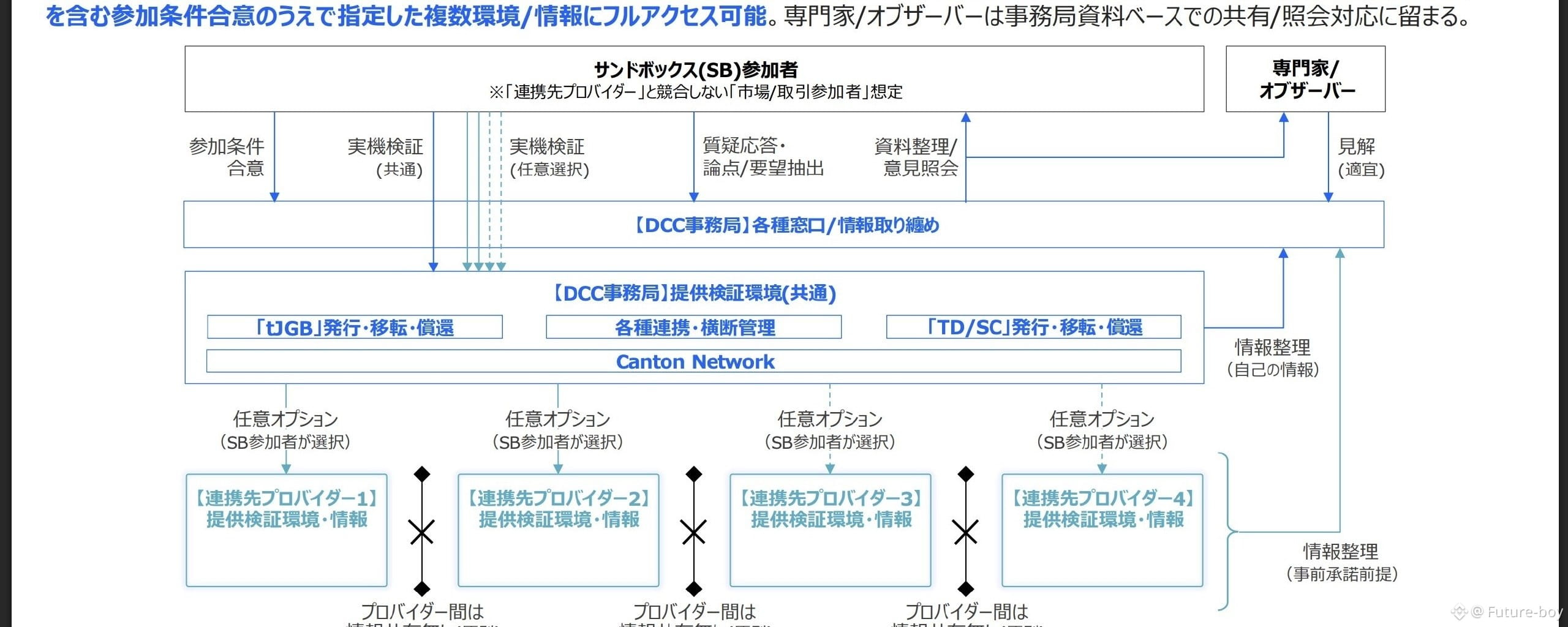
Japan's government bond market is slowly being lined up for blockchain testing, and Canton Network keeps appearing at the center of it. I could not find a Ministry of Finance report naming Canton directly, but an industry group run by Progmat has published an interim report proposing tokenized Japanese government bonds for onchain repo, with a sandbox on Canton running from November to March. The ministry itself is reportedly weighing options for tokenizing bond rights and may settle on a direction by December or January.
The target is specific and big. Repo is the market where banks borrow cash against bonds, and the plan focuses on the part that settles bilaterally outside the central clearing house, around 40 percent of the market or roughly 106 trillion yen. That slice relies on slower, manual processes, which is exactly where onchain settlement, round the clock collateral movement and cleaner records could help.
This is not starting from zero. MUFG ran a proof of concept in August for onchain JGB repo with Canton, and in April the national clearing house, Mizuho and Nomura started testing government bonds as digital collateral on the same network. Different groups keep choosing the same infrastructure, which is a strong signal about where institutional finance is leaning, especially a network built for privacy and compliance and not for open retail trading.
The reality check is the usual one. These are tests, not live markets, and moving from a sandbox to real trading needs regulatory approval, liquidity and legal clarity around how a tokenized bond keeps its status in the official book entry system. Public chains like Ethereum and Solana are not part of this story at all, which also says something about who will capture the value.
I'm watching the ministry's decision and the results from the sandbox, because that will show whether tokenized JGB repo moves toward real pilots.
Do you think institutional chains like Canton will end up winning government bond tokenization over public blockchains, and does this matter for crypto prices at all?
JAPAN'S BOND MARKET IS BEING PREPARED FOR THE BLOCKCHAIN AND CANTON KEEPS SHOWING UP IN THE PLAN
JAPAN'S BOND MARKET IS BEING PREPARED FOR THE BLOCKCHAIN AND CANTON KEEPS SHOWING UP IN THE PLAN
Japan's government bond market is slowly being lined up for blockchain testing, and Canton Network keeps appearing at the center of it. I could not find a Ministry of Finance report naming Canton directly, but an industry group run by Progmat has published an interim report proposing tokenized Japanese government bonds for onchain repo, with a sandbox on Canton running from November to March. The ministry itself is reportedly weighing options for tokenizing bond rights and may settle on a direction by December or January.
The target is specific and big. Repo is the market where banks borrow cash against bonds, and the plan focuses on the part that settles bilaterally outside the central clearing house, around 40 percent of the market or roughly 106 trillion yen. That slice relies on slower, manual processes, which is exactly where onchain settlement, round the clock collateral movement and cleaner records could help.
This is not starting from zero. MUFG ran a proof of concept in August for onchain JGB repo with Canton, and in April the national clearing house, Mizuho and Nomura started testing government bonds as digital collateral on the same network. Different groups keep choosing the same infrastructure, which is a strong signal about where institutional finance is leaning, especially a network built for privacy and compliance and not for open retail trading.
The reality check is the usual one. These are tests, not live markets, and moving from a sandbox to real trading needs regulatory approval, liquidity and legal clarity around how a tokenized bond keeps its status in the official book entry system. Public chains like Ethereum and Solana are not part of this story at all, which also says something about who will capture the value.
I'm watching the ministry's decision and the results from the sandbox, because that will show whether tokenized JGB repo moves toward real pilots.
Do you think institutional chains like Canton will end up winning government bond tokenization over public blockchains, and does this matter for crypto prices at all?
1
68
·
--
Bullish
See translation
RUSSIA'S CRYPTO ROLLOUT NOW HAS A CALENDAR AND THE CENTRAL BANK IS HOLDING THE KEY TO EVERY EXCHANGE
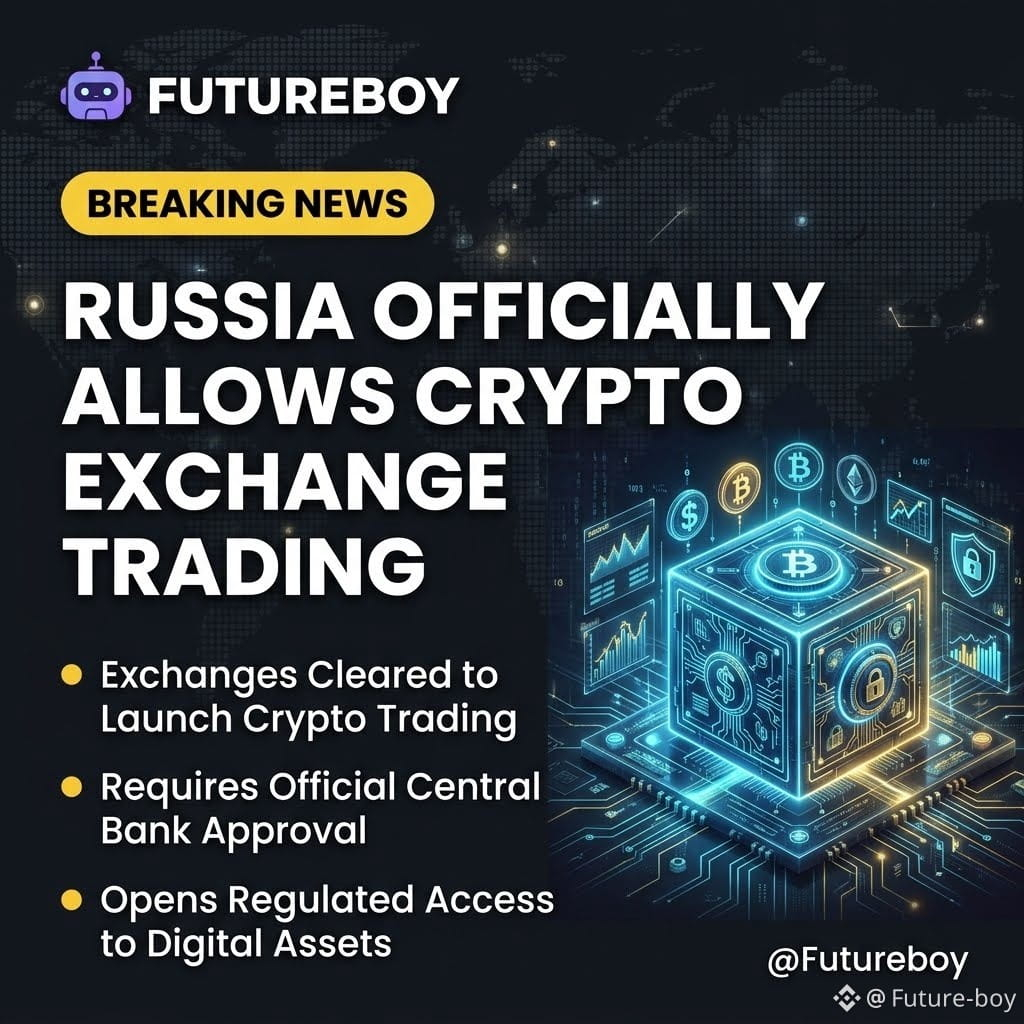
Russia has set the next date for its regulated crypto market. Domestic exchanges can start offering crypto trading from November 22, but only once the central bank signs off on their trading rules, so the headline sounds more open than it is. The permission is conditional, and nobody can simply flip a switch.
The rollout is stacked in steps. Retail access was approved effective November 17, exchanges get their window from November 22 and Moscow Exchange, the biggest venue in the country, is aiming for a December 1 launch offering Bitcoin, Ether and USDT. It has been testing transactions with professional market participants already, and the regulator approved the first batch of operators in October, four exchange providers and five digital depositories, so the plumbing is being assembled before the doors open.
The guardrails are as important as the opening. Ordinary investors face an annual limit of 300,000 rubles per intermediary and have to pass a knowledge test, and paying for goods and services in crypto inside Russia stays banned, with only approved cross border settlements allowed. That makes this a regulated investment market, not a payment system.
For global crypto the effect is probably modest. The caps are small, sanctions complicate how this market connects to international liquidity and the coin list is just three assets. But the direction matters, because another large economy is moving crypto from the gray area into licensed venues, which is the same arc we have seen in Europe, Hong Kong and the US.
I'm watching which exchanges get their rules approved first and the opening volumes on December 1, because a licensed market only matters if people actually use it.
Do you think licensed exchanges bring meaningful new demand to BTC and USDT from Russia, or do the caps keep it small, and which country moves next?
1
117
·
--
See translation
SHORTS JUST GOT SQUEEZED FOR 136 MILLION AFTER A BRUTAL WEEK AND THE QUESTION IS WHO IS ACTUALLY BUYING
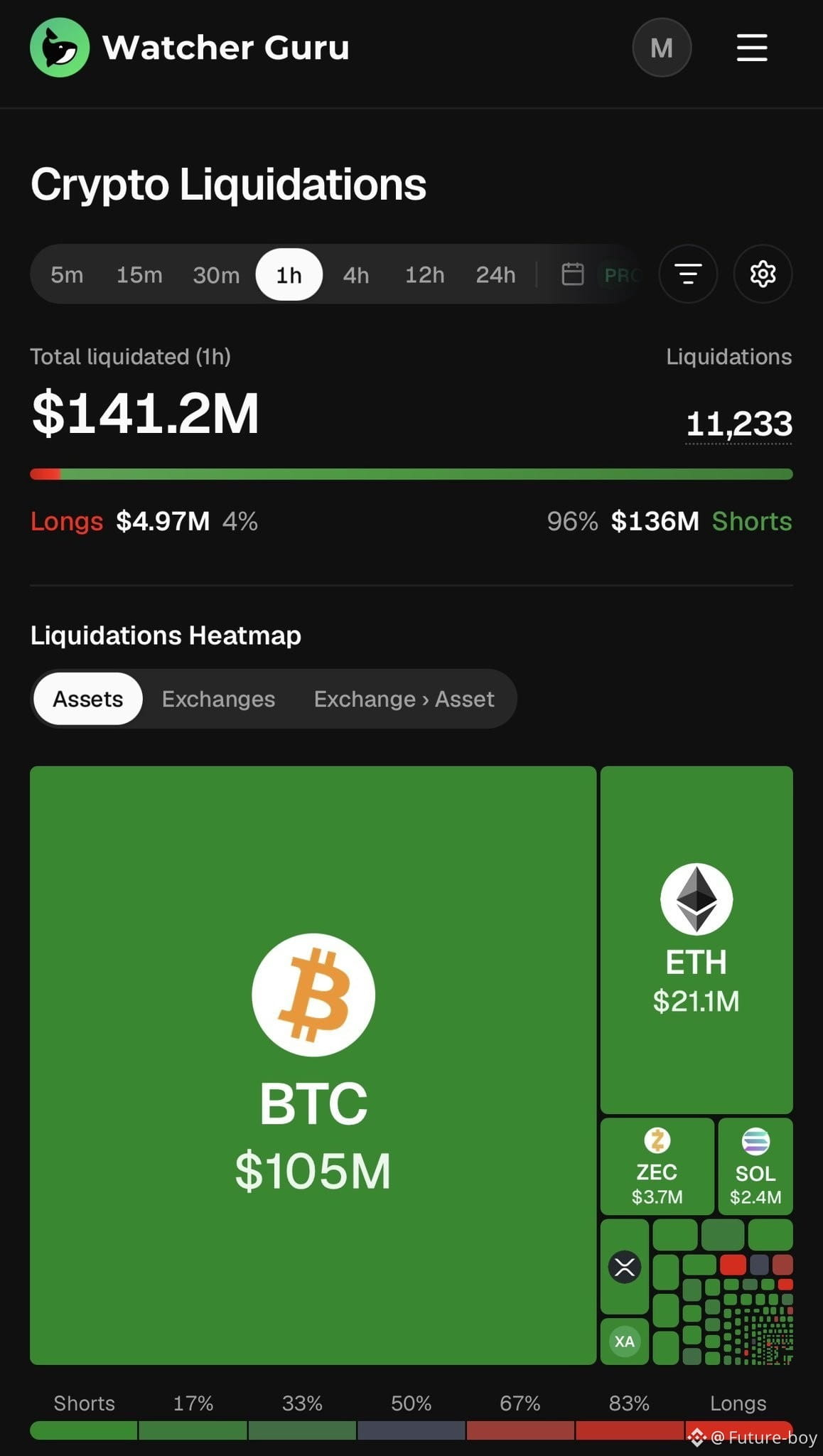
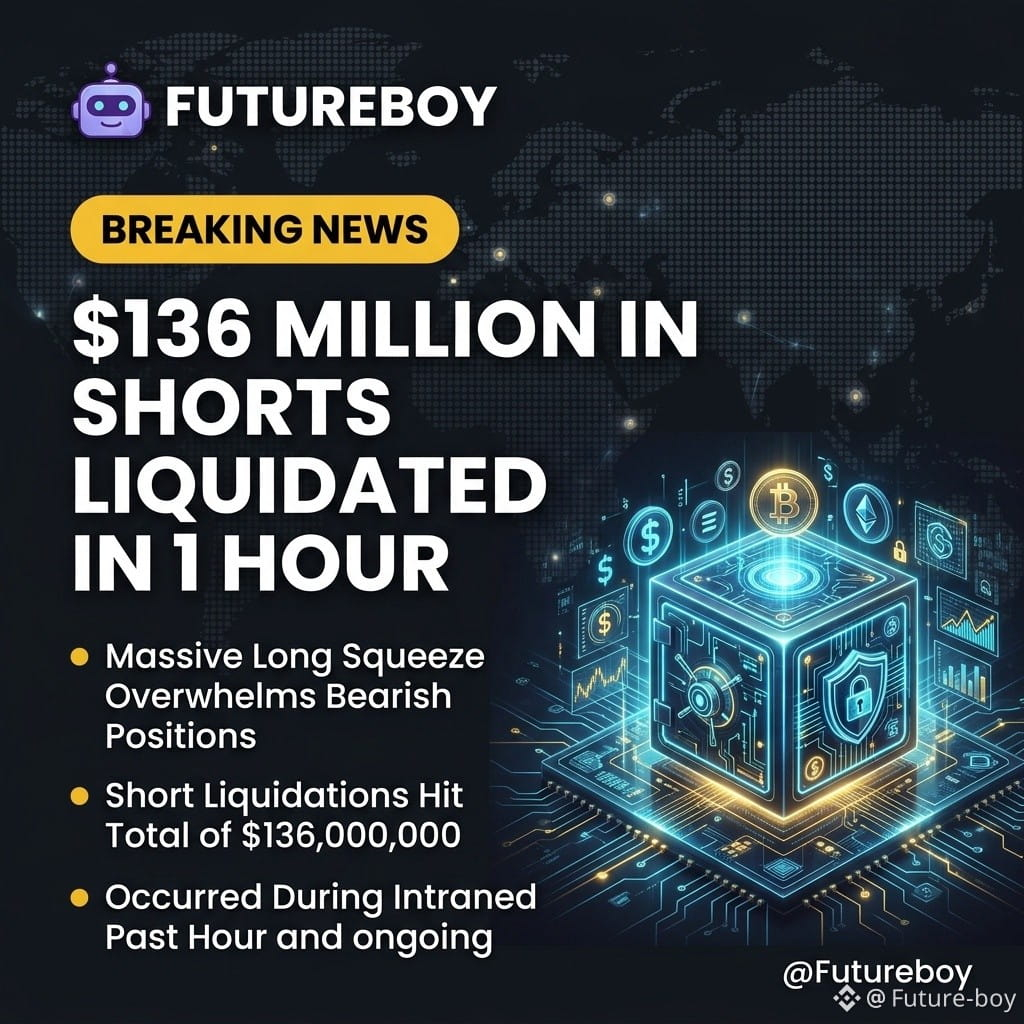
For once the liquidations are going the other way. Reports say about 136 million dollars of short positions were wiped out in an hour, which usually means price jumped against traders who had piled into bets on further downside. I could not confirm the figure, but a squeeze like this is a normal reaction after a week of relentless selling and deeply fearful sentiment.
The mechanics are the mirror image of what longs have gone through. When price ticks up and a short gets liquidated, the exchange has to buy back the position, and that forced buying pushes price a little higher, which triggers the next batch of stops. After days where everyone was leaning bearish, shorts get crowded and a modest bounce can spiral into a sharp pop.
But squeezes can be misleading. Earlier rebounds with the same signature, mostly short liquidations and small moves in spot prices, were described by analysts as positioning driven rather than backed by new buyers. With ETF products still seeing outflows, stablecoin supply shrinking and the Fed leaning hawkish, there is no obvious flood of fresh money behind this move, which is why bounces have kept failing near the same resistance zones.
The constructive reading is that a market where shorts are getting hurt is one where selling pressure is cooling, and sentiment resets like this have come before real recoveries. I would just want to see the bounce hold on a daily close, with funding staying calm and volume healthy, before calling it more than a relief rally.
For now I am enjoying the green candle without chasing it, and keeping stops honest in case this fades.
Do you think this squeeze is the first sign of a bottom or just a pause before the next drop, and what level does Bitcoin need to reclaim to change your mind?
1
78
·
--
Bullish
See translation
A 10 PERCENT CREDIT CARD CAP IS BACK ON THE TABLE AND THIS TIME BOTH PARTIES SAY THEY WANT TO TALK
President Trump has said he will work with Democrats on capping credit card interest rates at 10 percent, reviving an idea he first floated in January. It has actually been a rare point of overlap for a while. Back then he called for a one year cap starting January 20 without explaining how it would be enforced, and bipartisan bills from Senators Sanders and Hawley, and Representatives Ocasio-Cortez and Luna, had already proposed similar limits for longer periods.
What changed is the political map. After the midterms, Democrats will control Congress from January, and Senator Warren, expected to chair the Banking Committee, offered the cap as her first example of something she could do with the president, saying her party has bills ready. A White House official has since said the administration will work with Congress on credit card interest relief, though no text, timeline or length of the cap has been agreed.
The numbers explain the interest. Card rates currently average above 20 percent according to Federal Reserve figures, and Americans owe nearly 1.3 trillion dollars in credit card debt, a record. Any cap would hit one of the most profitable lines of business for the big banks, which is why details matter, including whether it would be temporary or permanent and how it would be enforced.
For crypto the link is indirect. Consumer credit stress affects spending, bank earnings and appetite for risk assets, and more attention on card costs has also pushed some people to look at crypto cards and stablecoin payments as alternatives. But nothing about this changes crypto regulation directly, so I would watch it as background and not as a catalyst.
I'm watching for actual bill text and whether leaders in both chambers commit to a vote, since announcements and legislation are very different things.
Do you think a credit card rate cap actually reaches the president's desk this time, and does it change how you use cards versus crypto for spending?

1
308
·
--
Article
See translation
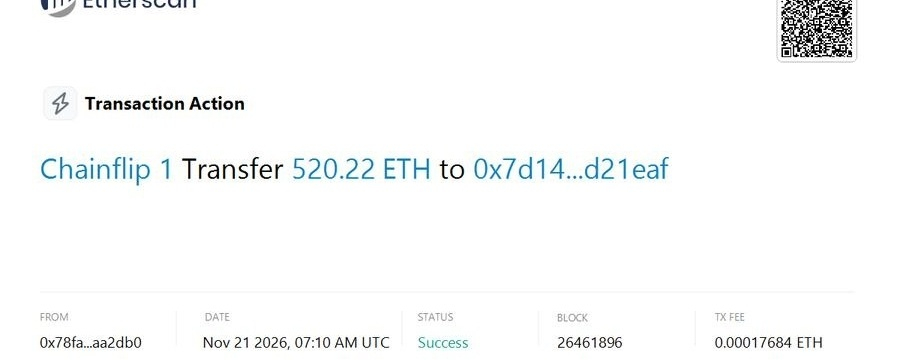
CHAINFLIP REPORTEDLY LOST 4.86 MILLION FROM AN ETHEREUM VAULT AND THE WITHDRAWAL LOOKED PERFECTLY LECHAINFLIP REPORTEDLY LOST 4.86 MILLION FROM AN ETHEREUM VAULT AND THE WITHDRAWAL LOOKED PERFECTLY LEGITIMATE ON CHAIN
Chainflip's Ethereum vault has reportedly been drained of about 4.86 million dollars in ETH, USDC and USDT, and the detail that stands out is that the withdrawal carried a valid vault signature. That is why trackers suspect a compromised signing key instead of a bug in the contract. I could not confirm the cause, so it is a suspicion for now, and the team's own explanation will matter more than the first reports.
What a valid signature means in practice is chilling. Cross chain protocols like this hold funds in vaults controlled by a group of nodes that sign together using threshold cryptography, so if an attacker gets enough of the key material, the chain sees an ordinary authorized withdrawal. There is nothing to block or flag. Most of the stolen funds were reportedly swapped into ETH and sent through Tornado Cash within a short time, which makes recovery harder.
This follows a rough stretch for the whole category. THORChain was drained of roughly 10.7 million dollars earlier this month, halted trading and saw its token fall by about a quarter over two days, with researchers pointing at weaknesses in the multiparty signing machinery that many cross chain systems share. Chainflip itself lost about 736,000 USDT in September through a flaw in how it processed Tron transactions, its first meaningful loss before today.
The broader pattern matches what security firms have been saying all year. Attackers are going after signing infrastructure and the humans and tools around it, because the contracts themselves are getting harder to break. For users that means funds parked in bridge and vault style protocols carry a different type of risk than ordinary swaps, one that audits of contract code do not fully cover.
I'm watching for Chainflip's incident report, whether withdrawals pause and how users are made whole, since the response will say more about the project than the number.
Do you keep funds in cross chain vaults or do you bridge only what you need for each trade, and does this make you rethink how you use them?
CHAINFLIP REPORTEDLY LOST 4.86 MILLION FROM AN ETHEREUM VAULT AND THE WITHDRAWAL LOOKED PERFECTLY LE
CHAINFLIP REPORTEDLY LOST 4.86 MILLION FROM AN ETHEREUM VAULT AND THE WITHDRAWAL LOOKED PERFECTLY LEGITIMATE ON CHAIN
Chainflip's Ethereum vault has reportedly been drained of about 4.86 million dollars in ETH, USDC and USDT, and the detail that stands out is that the withdrawal carried a valid vault signature. That is why trackers suspect a compromised signing key instead of a bug in the contract. I could not confirm the cause, so it is a suspicion for now, and the team's own explanation will matter more than the first reports.
What a valid signature means in practice is chilling. Cross chain protocols like this hold funds in vaults controlled by a group of nodes that sign together using threshold cryptography, so if an attacker gets enough of the key material, the chain sees an ordinary authorized withdrawal. There is nothing to block or flag. Most of the stolen funds were reportedly swapped into ETH and sent through Tornado Cash within a short time, which makes recovery harder.
This follows a rough stretch for the whole category. THORChain was drained of roughly 10.7 million dollars earlier this month, halted trading and saw its token fall by about a quarter over two days, with researchers pointing at weaknesses in the multiparty signing machinery that many cross chain systems share. Chainflip itself lost about 736,000 USDT in September through a flaw in how it processed Tron transactions, its first meaningful loss before today.
The broader pattern matches what security firms have been saying all year. Attackers are going after signing infrastructure and the humans and tools around it, because the contracts themselves are getting harder to break. For users that means funds parked in bridge and vault style protocols carry a different type of risk than ordinary swaps, one that audits of contract code do not fully cover.
I'm watching for Chainflip's incident report, whether withdrawals pause and how users are made whole, since the response will say more about the project than the number.
Do you keep funds in cross chain vaults or do you bridge only what you need for each trade, and does this make you rethink how you use them?
1
72
·
--
Bearish
See translation
FIVE YEARS LATER BITCOIN IS BACK WHERE IT WAS IN NOVEMBER 2021 AND THE ALTCOINS ARE A DIFFERENT STORY
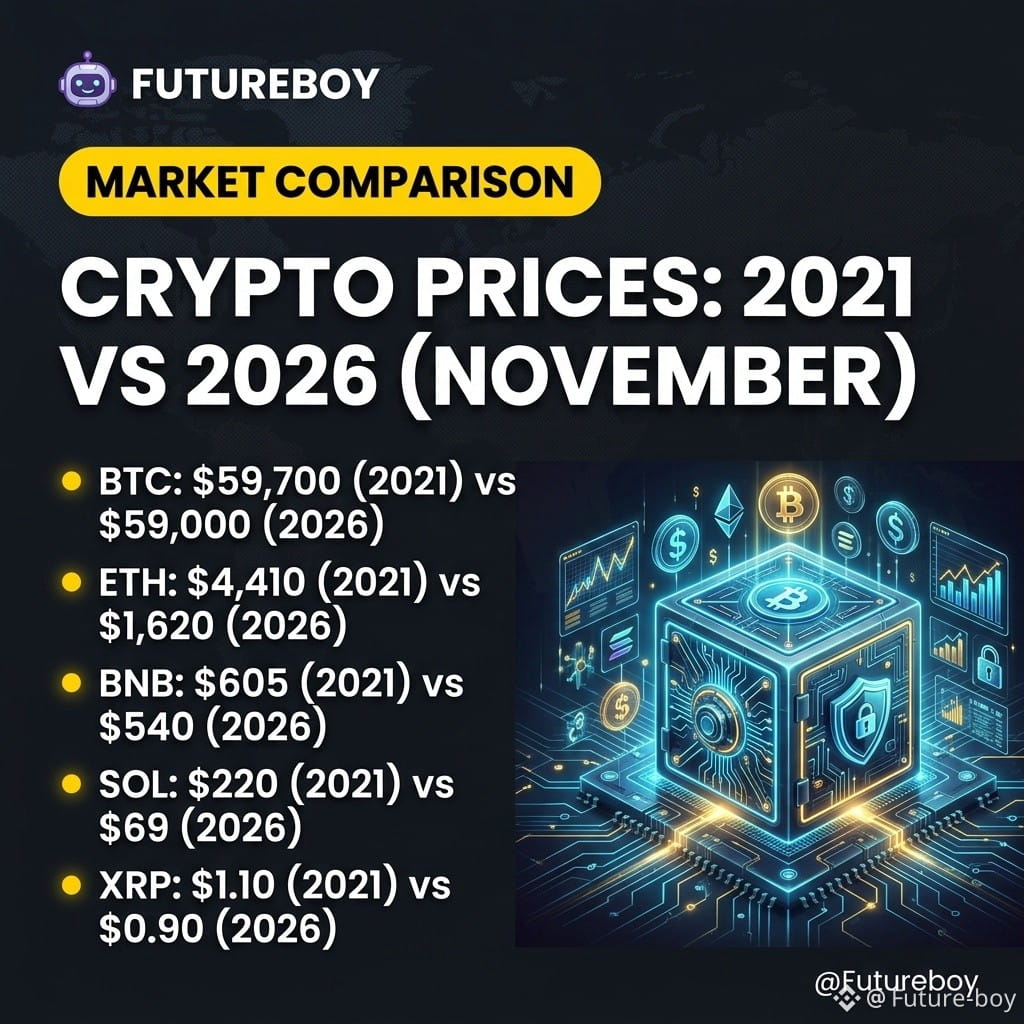
A comparison going around lines up crypto prices from November 2021 with this month, and the picture is brutal. Bitcoin sat near 59,700 dollars back then and is reported around 59,000 now, so after five years the price is basically flat. I could not confirm today's exact quotes, but they sit in the range Bitcoin has traded this week, and the 2021 figures match where the market peaked that cycle.
Everything else tells a harsher story. Ether is reported near 1,620 versus about 4,410 in 2021, a drop of roughly 63 percent. Solana is around 69 dollars against about 220, down roughly 69 percent, while XRP is near 0.90 versus 1.10, about 18 percent lower, and BNB is around 540 versus 605, roughly 11 percent lower. So the more a coin was a bet on growth and speculation, the more it has given back, and the more it behaved like a store of value, the less it has lost.
The fair way to read this is with the missing context. Flat in dollar terms means Bitcoin has lost purchasing power over five years of inflation, so it is a real decline once you adjust for that. But the market underneath looks nothing like 2021, with spot ETFs, banks offering custody, tokenized stocks and stablecoin rails built by major payment companies. The price has not caught up with that infrastructure, which is either a long term opportunity or a warning that adoption alone does not lift prices.
For anyone who bought near the 2021 peak and held, this month is a reminder of how long a cycle can take to repay you, and for anyone who bought in the last year it is a reminder of how fast sentiment can flip. A chart like this is one snapshot between two peaks and troughs, and it can look very different in another few months.
I'm watching whether Bitcoin can hold this zone, since a clean break lower would turn the five year flat line into a new downtrend.
Where do you think this comparison looks in another five years, and are you holding Bitcoin only or still betting on altcoins to catch up?
1
336
·
--

Article
See translation
THE FIRST ISSUER-APPROVED TOKENIZED STOCK TRADES ARE LIVE ON AN AMM AND THE FIRST TICKET WAS ONLY 30THE FIRST ISSUER-APPROVED TOKENIZED STOCK TRADES ARE LIVE ON AN AMM AND THE FIRST TICKET WAS ONLY 30,000 DOLLARS
The headline says Fairmint is planning a venue to trade issuer sponsored tokenized shares through automated market makers, but the first trades already happened. On November 4, shares of Canton Strategic Holdings, a Nasdaq listed company, changed hands on a permissioned venue called TSV through Tradecraft's AMM on the Canton Network, the first trades of this kind under the SEC's new Innovation Exemption.
The structure is the interesting part. The company itself sponsored the tokens, and Fairmint, an SEC registered transfer agent, moved the shares from a broker account onto an onchain register, so holders get the same rights as owners of the regular Nasdaq stock. Only verified holders can trade, and shares and payment settle together or not at all. The SEC's rules also confine these venues to AMM pools and ban leverage, which sets them apart from the wrapped stock tokens that dominate offshore crypto venues.
The scale, though, was tiny. Four purchases totaled about 30,000 dollars, a seller who chose to convert and a market maker providing liquidity, so this is a proof of concept and not a market. Real adoption will need more issuers to tokenize, deeper liquidity pools and more participants, and the exemption itself is temporary and narrowly drawn.
Still, the direction is clear. Regulators have defined a path where public companies can put their own shares onchain with the transfer agent keeping the official record, and that is different from the synthetic or third party tokens that raised legal questions elsewhere. It also lands the same week as plans from other firms to offer 24/7 trading in tokenized securities, which suggests the race to build compliant venues is just getting started.
I'm watching how many issuers sign up and how deep the pools become, because the number of listings and the size of the trades will show if this is real adoption or a showcase.
Do you think issuer approved tokenized shares are the right model for putting stocks onchain, or will wrapped tokens on offshore venues keep winning on liquidity, and would you trade a stock through an AMM?
THE FIRST ISSUER-APPROVED TOKENIZED STOCK TRADES ARE LIVE ON AN AMM AND THE FIRST TICKET WAS ONLY 30
THE FIRST ISSUER-APPROVED TOKENIZED STOCK TRADES ARE LIVE ON AN AMM AND THE FIRST TICKET WAS ONLY 30,000 DOLLARS
The headline says Fairmint is planning a venue to trade issuer sponsored tokenized shares through automated market makers, but the first trades already happened. On November 4, shares of Canton Strategic Holdings, a Nasdaq listed company, changed hands on a permissioned venue called TSV through Tradecraft's AMM on the Canton Network, the first trades of this kind under the SEC's new Innovation Exemption.
The structure is the interesting part. The company itself sponsored the tokens, and Fairmint, an SEC registered transfer agent, moved the shares from a broker account onto an onchain register, so holders get the same rights as owners of the regular Nasdaq stock. Only verified holders can trade, and shares and payment settle together or not at all. The SEC's rules also confine these venues to AMM pools and ban leverage, which sets them apart from the wrapped stock tokens that dominate offshore crypto venues.
The scale, though, was tiny. Four purchases totaled about 30,000 dollars, a seller who chose to convert and a market maker providing liquidity, so this is a proof of concept and not a market. Real adoption will need more issuers to tokenize, deeper liquidity pools and more participants, and the exemption itself is temporary and narrowly drawn.
Still, the direction is clear. Regulators have defined a path where public companies can put their own shares onchain with the transfer agent keeping the official record, and that is different from the synthetic or third party tokens that raised legal questions elsewhere. It also lands the same week as plans from other firms to offer 24/7 trading in tokenized securities, which suggests the race to build compliant venues is just getting started.
I'm watching how many issuers sign up and how deep the pools become, because the number of listings and the size of the trades will show if this is real adoption or a showcase.
Do you think issuer approved tokenized shares are the right model for putting stocks onchain, or will wrapped tokens on offshore venues keep winning on liquidity, and would you trade a stock through an AMM?
1
112
·
--
See translation
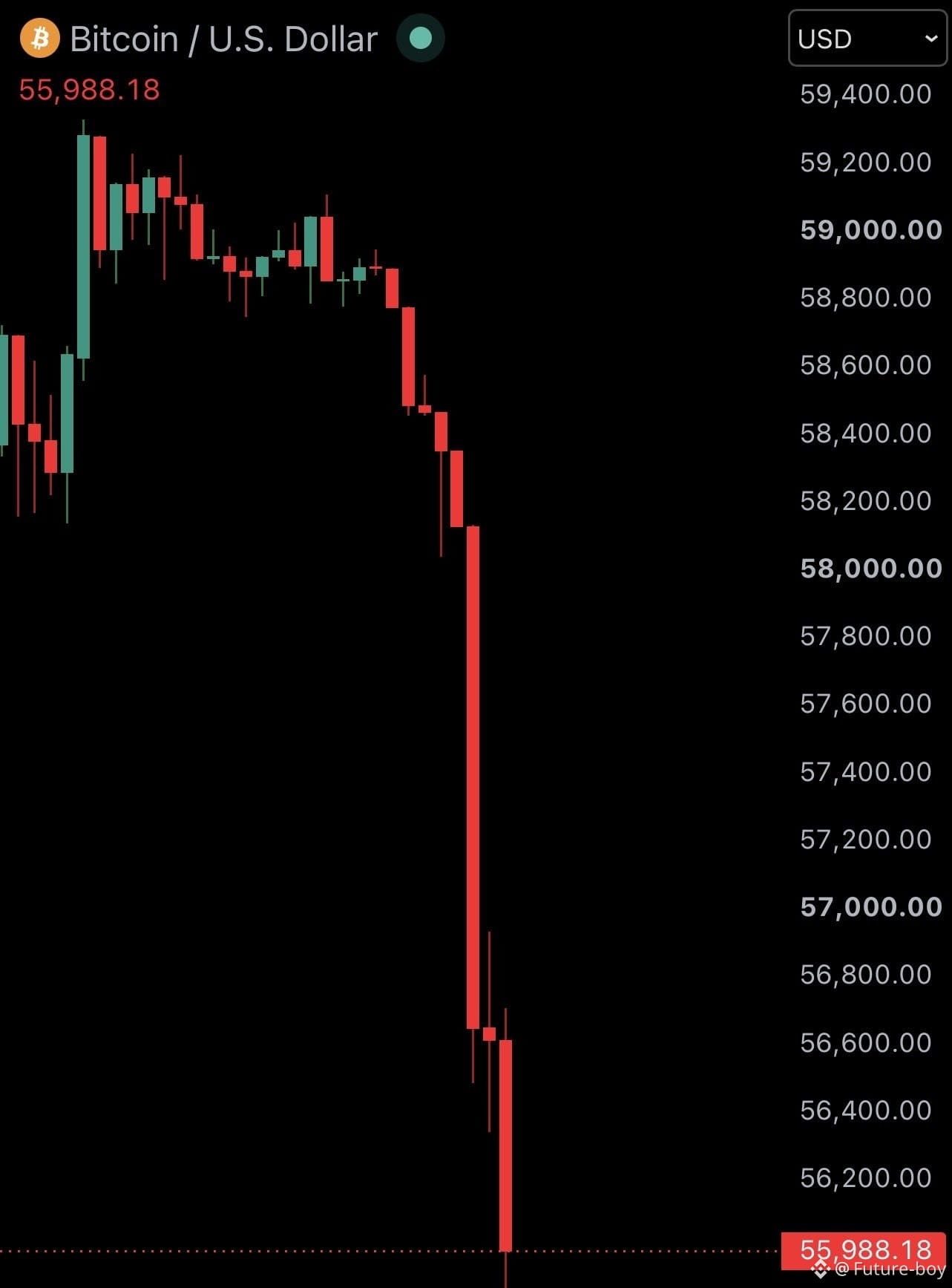
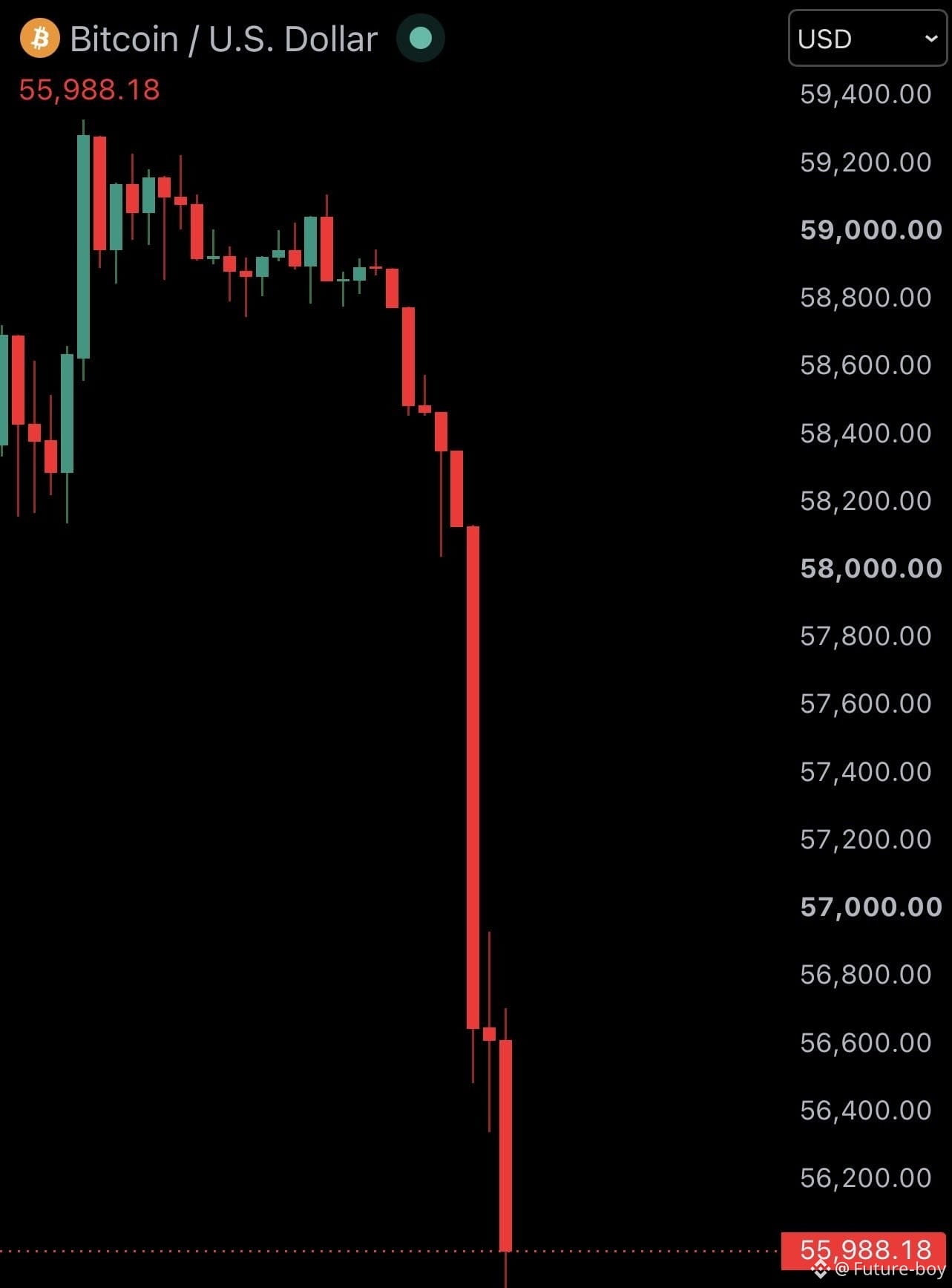
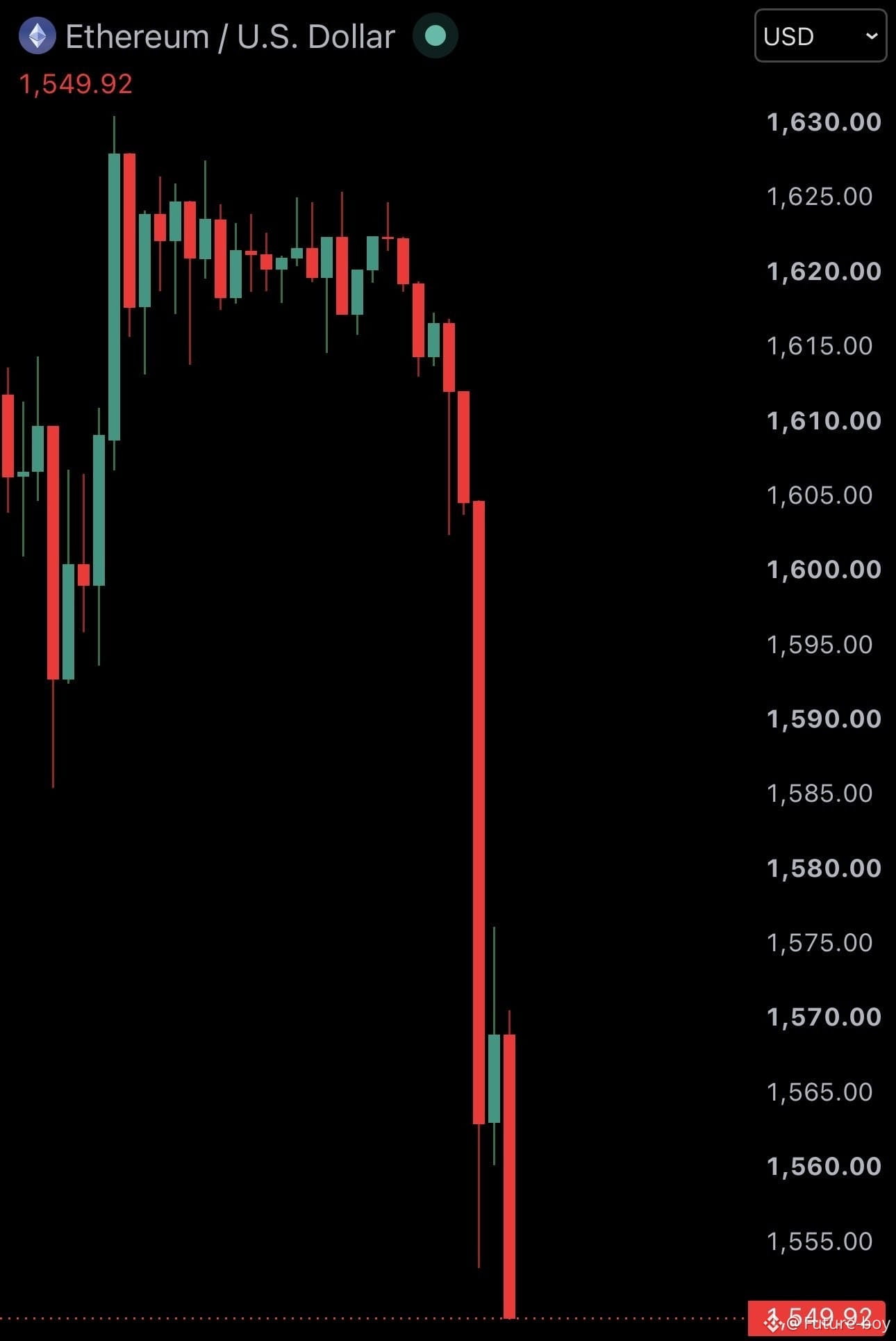
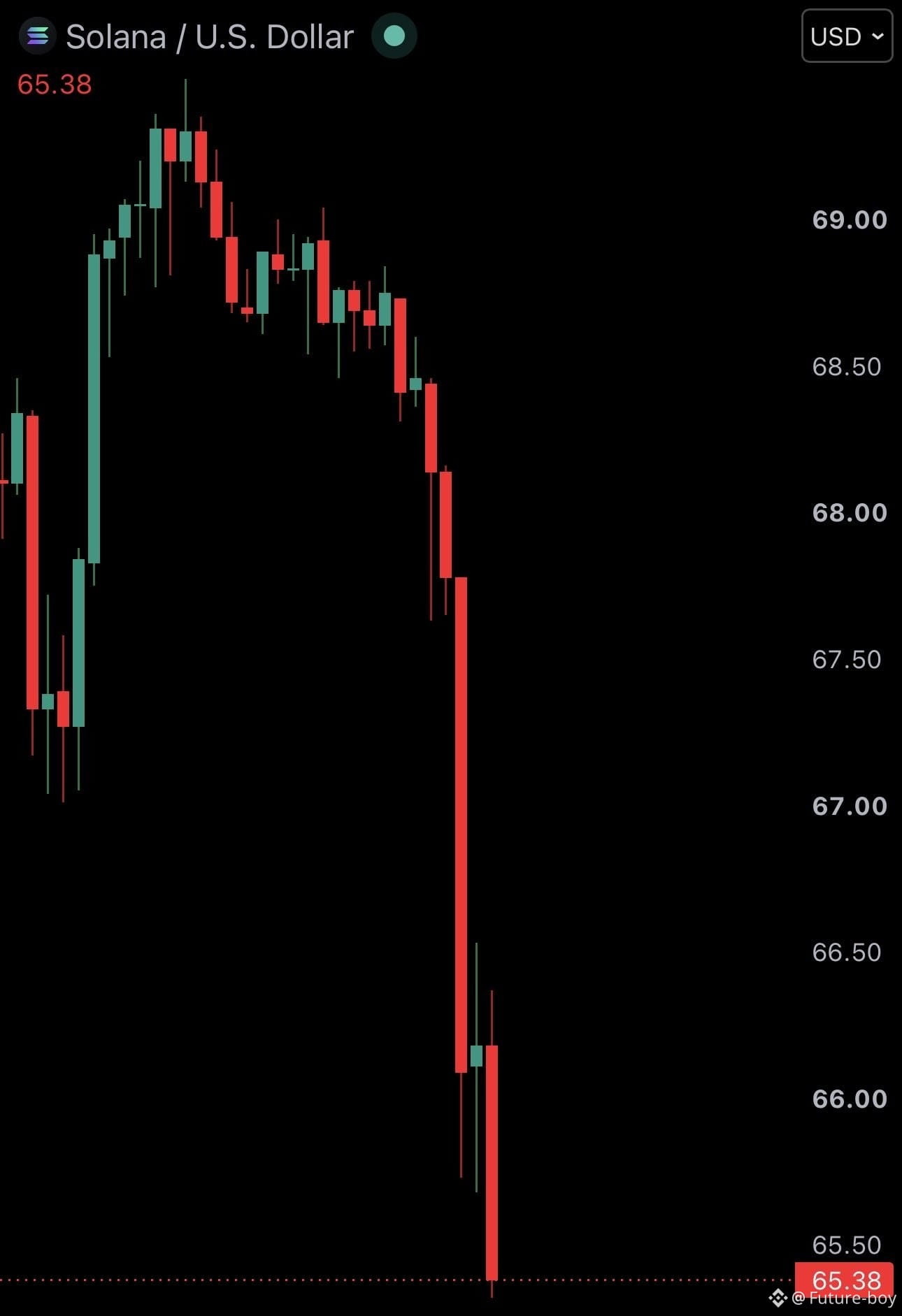
IF BITCOIN REALLY JUST BROKE 56,000 THEN THE YEAR'S LOW IS GONE AND THE FLOOR EVERYONE WAS WATCHING JUST BECAME A CEILING
Headlines are claiming Bitcoin has fallen under 56,000 dollars with around 650 million dollars of leveraged positions liquidated in an hour, and the other majors dropping alongside it. I could not confirm those figures, so treat them as reported. The reason it matters is the level. Bitcoin's low for the year, reached on July 1, was about 57,700 dollars, so a print under 56,000 would mean the market has broken through the line that held through the summer.
That is a bigger deal than any single liquidation number. Traders spent months treating the July low as the floor, and many bought dips around it. If that level fails, everyone who defended it is suddenly underwater, stops cluster below it and the argument shifts from a correction inside a range to a market looking for a new base. A market maker earlier this month said the slide started when Bitcoin lost its 200 day moving average near 73,000 dollars, which has been the story of the past two weeks.
The backdrop is not helping. Bitcoin has already dropped about a quarter since late October, ETF products have posted back to back weekly outflows, the Fed is leaning hawkish, stablecoin supply has been shrinking and AI stocks are wobbling. A fast one hour liquidation burst in that environment is what you would expect when thin liquidity meets crowded longs.
There is a case for a bounce. Sentiment is already in deep fear, forced selling tends to peak in sharp bursts like this and many past lows formed with panic wicks that reverted quickly. But a bounce is not a bottom, and I would want to see price reclaim the broken level on a daily close before trusting it.
For now my plan is simple, which is small size, low leverage and patience until liquidations fade and price stops making new lows.
Do you think the July low was the real bottom that just got revisited, or is this the start of a deeper leg down, and what level would make you start buying?
1
360
·
--
Bearish
See translation
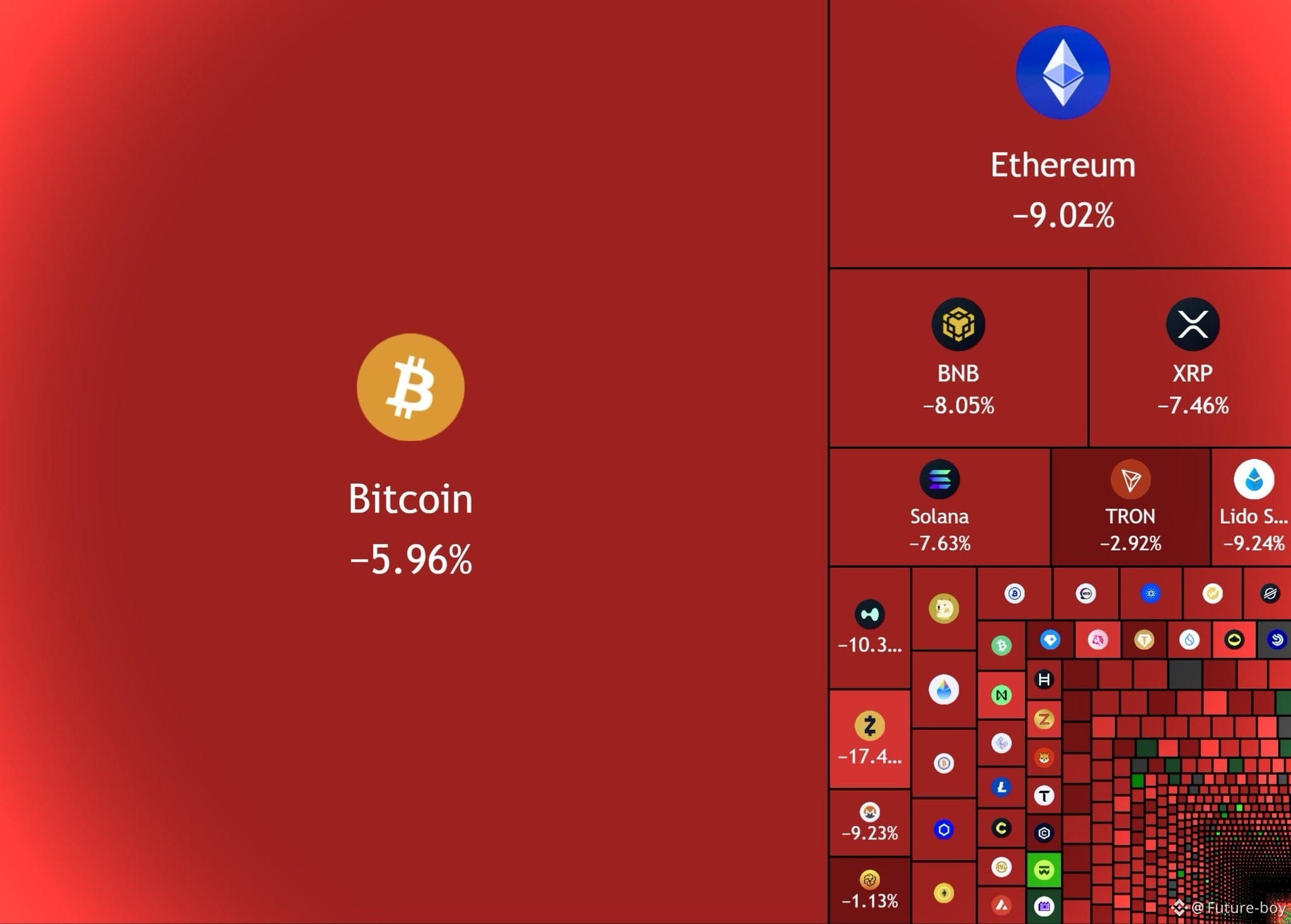
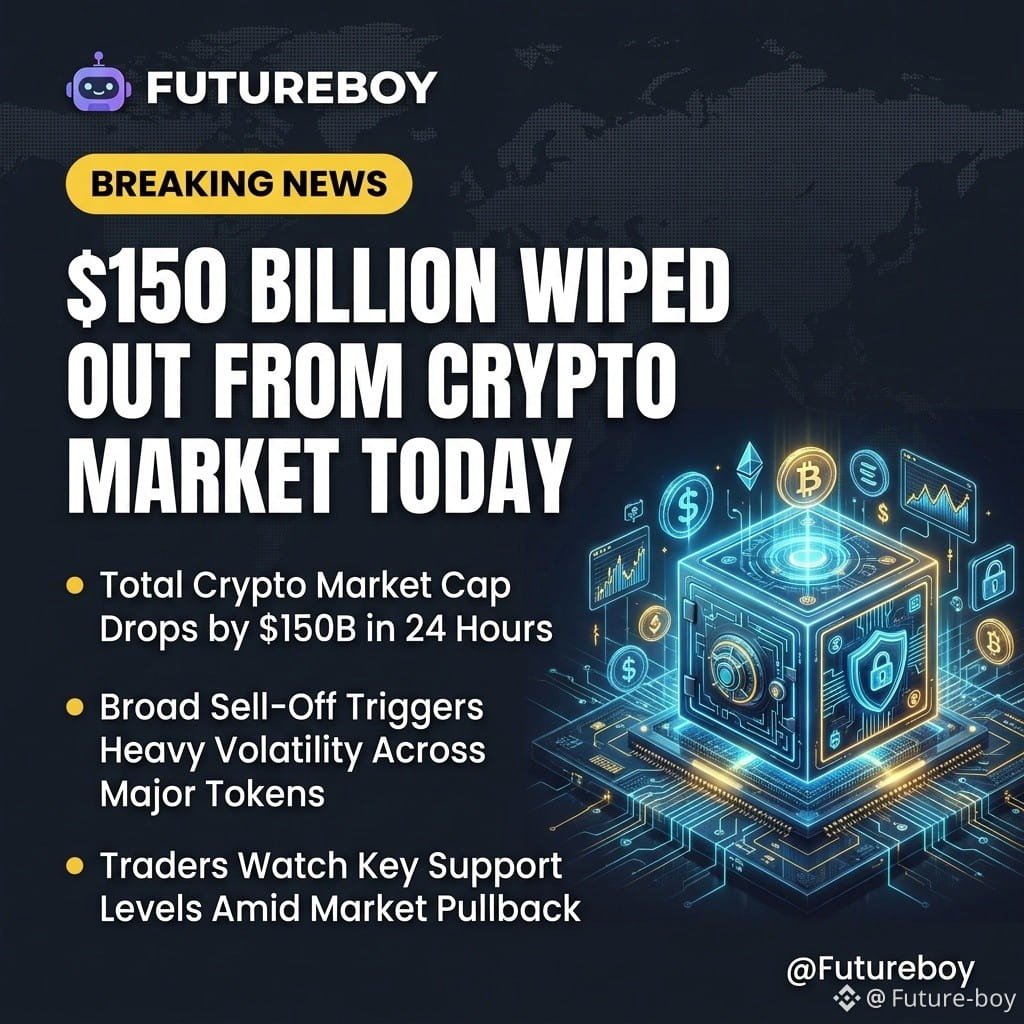
ANOTHER 150 BILLION GONE AND THE SCARIEST NUMBER IS HOW NORMAL THESE DROPS HAVE BECOME
A headline claims 150 billion dollars was wiped from the crypto market cap today. I could not confirm that exact figure for today, and the same number has been used for other recent moves, including a roughly 48 hour slide earlier this month. But whether it is today's number or last week's, the real story is how routine this has started to feel.
Put the size in context. Total crypto market cap peaked near 4.4 trillion dollars in late 2025 and has been sitting somewhere around 2.5 to 2.7 trillion this month, so 150 billion is about six percent of the whole market in a single move. Over the past few weeks we have seen 140 billion disappear in four hours on November 5, a 230 billion sell off, and then repeated pushes toward Bitcoin's low 60,000s. Individual days are starting to blur together.
What is missing is the other side of the trade. Investment products tracked by CoinShares saw a second straight week of outflows totaling 1.7 billion dollars, which erased all of this year's inflows and pushed 2026 into negative territory. Stablecoin supply has been shrinking, the Fed is leaning hawkish and AI stocks have been rocky, so nothing obvious is waiting to buy the dip with real size.
The contrarian view is that this is how washouts look. Fear readings are deep in the single digits to low teens, forced sellers keep getting flushed out and past bottoms have formed in exactly this kind of exhausted mood. The problem is that the same conditions also exist during extended downtrends, so there is no clean signal until flows and liquidity turn.
For now I am less interested in the size of each drop than in whether the bounces last. Higher lows on shrinking volume would be the first sign that selling pressure is fading.
Do you think this market is close to a washout low or is a deeper leg still ahead, and what is the one signal that would make you trust a bounce?
1
421
·
--
Bearish
See translation
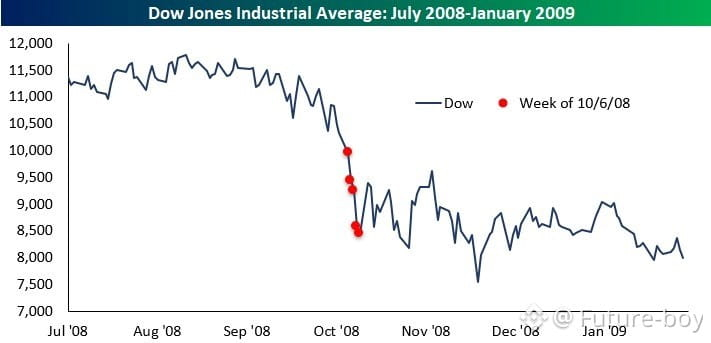
DOW FACES HISTORIC FIVE-DAY SLIDE NOT SEEN SINCE THE 2008 FINANCIAL CRISIS
Wall Street is staring down a rare market milestone as the Dow Jones Industrial Average tracks toward falling more than one percent across all five trading days of the week. According to market data from Bespoke Investment Group, this specific five-day streak of consecutive one-percent-plus losses has occurred only once since World War II—back during the week of October 6, 2008, at the height of the global financial crisis.
This week's relentless slide has pulled the Dow down roughly seven percent from last Friday's close, breaking decisively below the psychological 50,000 mark. The selloff has been fueled by a sharp unwinding in heavyweight technology and artificial intelligence stocks following Anthropic's massive IPO, alongside rising Treasury yields and growing bets that the Federal Reserve could hike interest rates again in December.
Whenever traditional equities flash a statistical signal that has not triggered since 2008, cross-asset liquidity feels the squeeze immediately. Crypto markets have already absorbed heavy leveraged liquidations alongside the stock market rout, leaving traders watching closely to see whether this week marks a final capitulation flush or the start of a deeper macro downturn across both equities and digital assets.
Do you think this rare 2008-style equity warning is just a healthy reset for overheated AI stocks, or is a broader macro recession about to hit BTC andETH next? Drop your take below!
1
169
·
--
Bearish
See translation
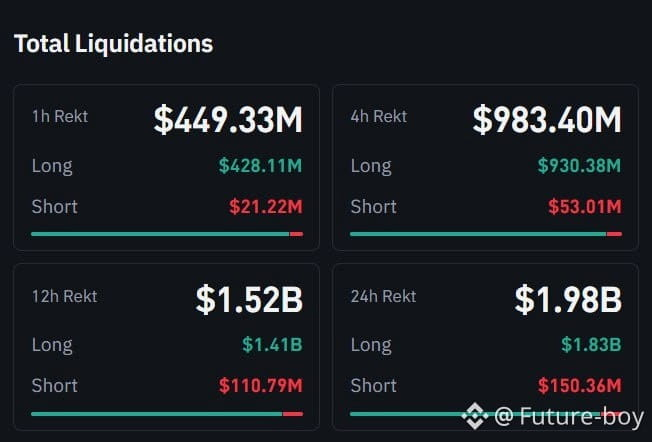
CRYPTO LONGS WIPED OUT IN MASSIVE $1.98 BILLION LIQUIDATION FLUSH
Over-leveraged bulls just took an absolute beating across the derivatives market as forced liquidations surged to $1.98 billion over the past 24 hours. According to fresh CoinGlass data, roughly 294,555 individual trader accounts got wiped out during the selloff, with bullish long positions absorbing $1.83 billion—more than 92 percent—of the total damage.
Leading the carnage was a single massive $51.71 million Bitcoin position liquidated on Binance, underscoring just how crowded and aggressively positioned leveraged traders had become heading into this drop. Every time Bitcoin slices through key psychological support levels, cascading margin calls turn a routine pullback into a forced-selling avalanche across BTC, ETH, and major altcoins.
While seeing nearly $2 billion in leverage get cleared off the board is painful for anyone caught on the wrong side of the trade, violent liquidation flushes are often exactly what the market needs to reset frothy funding rates and clear out weak hands before a sustainable recovery can take shape.
Did you manage to stay safe during this $1.98 billion wipeout, or are you waiting for funding rates to fully reset before opening fresh BTC andBNB positions? Drop your take below!
1
176
Log in to explore more content
Join global crypto users on Binance Square
⚡️ Get latest and useful information about crypto.
💬 Trusted by the world’s largest crypto exchange.
👍 Discover real insights from verified creators.
Email / Phone number
Trending Topics
NVDASoarsOnJensenReturn
7,204 views
131 Discussing
Jensen Huang Returns, Nvidia Jumps 31%. Can the Rally Hold With the Probes Still Open?
Binance News
·7 Likes
·5.3k views
Bitcoin'sReboundFadesBelow$60K
16,605 views
165 Discussing
NVIDIAReinstatesJensenHuangasCEO
296,512 views
1,863 Discussing