$MRNAon MRNAON (the tokenized version of Moderna stock) surged by over 122% in the last 24 hours , fueled by a major breakthrough in its melanoma cancer vaccine trial .
The tokenized stock MRNAON closely tracks the performance of Moderna's (MRNA) stock on Nasdaq, which also soared over 150% during trading .
🧬 What's behind the surge?
The massive price spike is directly tied to positive results from a late-stage clinical trial for mRNA-4157 (Intismeran Autogene) :
· Breakthrough treatment: An experimental mRNA-based therapy for melanoma developed in partnership with Merck . · Market impact: This success is seen as a major validation of mRNA technology beyond COVID-19 vaccines, renewing investor enthusiasm for its potential in oncology .
Today's Crypto Fear & Greed Index is 48, up 8 points from yesterday and now in "Neutral" territory for the first time since January. This marks a significant shift from the "Fear" (and even "Extreme Fear") that has dominated most of 2026.
This rise can be attributed to two key factors:
· Market stabilization: Bitcoin has been consolidating around $64,000, holding steady and avoiding the deeper drops seen in US tech stocks, which are being pressured by rising Treasury yields. · Easing pessimism: The market has spent an extended period in "Extreme Fear," which historically can signal a major bottom is in. The recent stabilization suggests that extreme despair is finally fading.
Since the index is still near the lower boundary of "Neutral" (25-49), it suggests investors are no longer panicking but remain cautious rather than optimistic.
$GOOGL Berkshire Hathaway invests 10% of its portfolio in Alphabet as AI bet takes shape $RICE
Warren Buffett's Berkshire Hathaway has made a major pivot into Alphabet (Google), accumulating ~106 million shares worth ~$37 billion as of June 2026 — making it Berkshire's third-largest holding (after Apple and AmEx) at ~10% of its equity portfolio.
How it happened:
· Q3 2025: Open-market purchases worth ~$4–5.7 billion · June 2026: Participated in a **$10 billion private placement** within Alphabet's $80 billion AI infrastructure fundraise
Why: Alphabet stock rose ~70% through late 2025, driven by Gemini AI models, accelerating Google Cloud revenue, and massive infrastructure build-out.
Who: Buffett started the move before stepping back at end-2025; successor Greg Abel has continued the strategy.
$XRP RIPPLE CEO BRAD GARLINGHOUSE ON XRP, IPO PLAN AND MODERNIZiNG TRADFI INFRASTRUCTURE $RICE
Garlinghouse hailed a major shift from crypto-hostile regulation to active U.S. policy engagement, rejecting claims the industry opposes rules. He criticized Senator Warren, pointed to Ripple’s 75 global licenses, and cited the federal ruling that $XRP is not a security. On the CLARITY Act, he stressed that industry-wide clarity is essential, and—backed by Senators Scott, Lummis, and White House advisor Witt—he remains optimistic despite ethics-related roadblocks.
Ripple’s long-term focus on linking traditional finance with blockchain, once criticized by “purists,” is now a regulatory strength. Despite bear markets, Garlinghouse expects record revenue (doubling YoY), with institutional infrastructure driving growth. He praised Kraken’s diversified model and noted Ripple is now “more neutral” on an IPO—having done ~$2.5B in acquisitions and $3B in tender offers—and expects more consolidation during the crypto winter.
Garlinghouse downplayed AI as a primary cause of layoffs, blaming organizational bloat instead, and sees AI boosting efficiency. He acknowledged potential in agentic payments but stressed guardrails. With acquired platforms Hidden Road and GTreasury handling ~$16T in annual volume (comparable to Visa), he noted that shifting even a fraction to the XRP Ledger could vastly improve speed, cost, and settlement—driving heavy demand for secure, bank-grade institutional custody solutions.
Crypto traders on Hyperliquid priced Unitree Robotics at ~$38B (4x its IPO valuation) before its Shanghai listing, using a perpetual futures contract. When trading opened, Unitree's stock surged 629% to 1,100 yuan, giving it a ~$66B market cap—75% above the crypto price. The contract then jumped ~20% to $121. Despite pulling back to 884 yuan, shares remained nearly 6x the IPO price. This marks the second major test this summer of crypto markets pricing IPOs ahead of traditional exchanges.
$SOL Solana leads bitcoin and ether higher while Korean chip stocks slide 7%
Bitcoin held ~$64,250 (flat on day, +1% weekly). Solana led gains (+2% to ~$77), Ether rose to ~$1,900 (+1.5% weekly), and XRP recovered to ~$1. BNB and HYPE were the only losers among majors, though HYPE still led weekly gains at +7%.
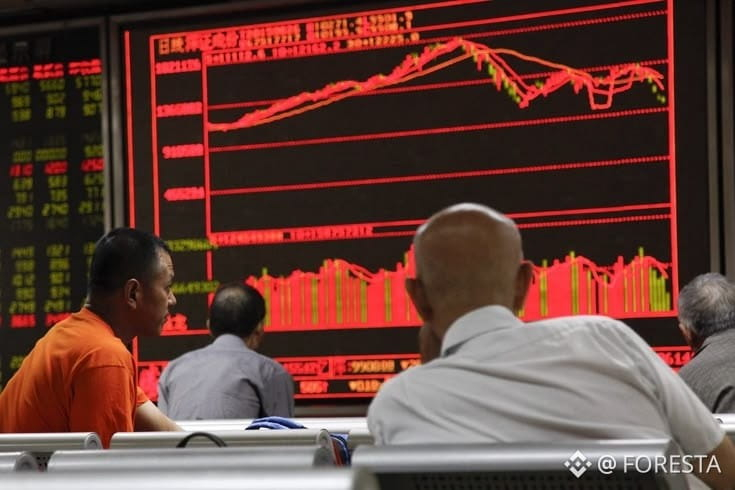
A global semiconductor rout hit Asia hard—Samsung and SK Hynix plunged 7%+, dragging Korea's Kospi down 6% and MSCI Asia Pacific down 2%. This followed a 5% drop in the US SOX index (its worst since July), with futures signaling more losses in Europe and the US.$RICE
The root cause: a bond market surge pushed 30-year US yields to 2007 highs and 10-year yields near early 2025 levels, raising borrowing costs for AI-heavy tech spending. On Wednesday, yields eased slightly (10-year at 4.69%), while gold rebounded 0.6% to above $4,360/oz after Tuesday's drop.
🚨MULTCOIN MOVES $10 MILLION IN HYPE TO COINBASE PRIME, STIRRING SELLOFF FEARS $RICE
Multicoin Capital moved 172,710 $HYPE ($10.15M) to Coinbase Prime, a platform often used for selling. While this is a relatively small "trim" compared to their remaining $126.6M stake, the market is on edge because:
· $HYPE is a top-10 token with a ~$13B market cap and trades at $58.59, well below its June peak of $76.87. · Exchange inflows are viewed as potential selling pressure, which can sway trader sentiment. · High open interest (~$11.8B) means leveraged positions could amplify any downside move.
The transfer isn't an exit, but given Hyperliquid's summer activity and $HYPE's liquidity, it keeps the market alert.
$BTC Bitcoin Nears Bear Market Exit, But One Key Piece Is Missing $ACE
Bitcoin has been stuck below $70,000 for two months, but Bitfinex Alpha reports that two of three conditions for a rally are already met:
· Lower expected interest rates (inflation fell to 3.40% in July) · Already-loose financial conditions (falling Treasury yields and rising stocks like the S&P 500)
The missing third condition is capital rotation — money flowing into equities, tech, and AI needs to move into crypto. Currently:
· Spot Bitcoin ETFs saw $385 million in weekly outflows · Corporate treasuries (like Strategy) have slowed or sold holdings · Stablecoin supply has dropped below May records
What this means:
· If capital flows into crypto, BTC could break above $70,000 · If outflows continue, BTC could drop to ~$57,000
The market is thin, so even small flow changes could cause big moves in either direction.
🚨 BREAKING : SEC RELEASES LONG AWAITED CRYPTOCURRENCY REGULATION A MAJOR DEVELOPMENT. $ACE $BTC
The SEC proposes a new framework to streamline capital raising for crypto firms, clarify federal securities law applicability, and curb the offshore exodus of crypto innovation. Chairman Atkins frames it as a strategy to bring operations back to the U.S. while enhancing investor protections.
The rules create two exemptions from the Securities Act of 1933:
· Tier 1: Raise up to $5 million over four years (one-time). · Tier 2: Raise up to $75 million per 12-month period, requiring audited financial statements and ongoing reporting. Both tiers mandate principle-based disclosures to investors.
A conditional safe harbor allows a crypto asset to cease being treated as a "security" if the issuer fully and permanently stops performing key managerial activities promised under the investment contract. This lets projects evolve legally as they become more decentralized.
The proposal invalidates state securities registration requirements for qualifying federal offerings and applies to certain secondary trades. The SEC argues this reduces regulatory uncertainty, discourages foreign relocation, and gives U.S. investors broader access to crypto assets under consistent standards.
Bitcoin exchange-traded funds (ETFs) opened the week with $297.56 million in net inflows, ending the three-session outflow run that closed the previous week. Ether funds also returned to positive territory with $30.85 million, while XRP, solana and HYPE ETFs recorded no net flows.
Blackrock and Fidelity drove $297.56M into bitcoin ETFs, ending a 3-session outflow streak.
Jane Street held $1B+ in bitcoin ETFs, underscoring growing institutional participation.
XRP, solana, and HYPE saw zero flows, leaving bitcoin and ether to lead the day’s allocation.
$XRP WHY IS XRP FALLING BELOW $1 EVEN AS RIPPLE EXPANDS ITS BANKING FOOTPRINT $ACE
Ripple is winning banking deals (e.g., Jeonbuk Bank), but those partnerships don't equal XRP buying. Ripple is pivoting to its stablecoin RLUSD for settlements, meaning institutions can use Ripple's tech without touching XRP. The token's price is decoupling from the company's business wins.
XRP's run to $3.65 in 2025 was fueled by political optimism (pro-crypto U.S. presidency) and regulatory hype. That excitement has faded—the Clarity Act is stalled in the Senate, and no new catalysts have emerged. What goes up on speculation often comes down when reality sets in.
XRP is the weakest top-10 crypto this week, dragged by a broader market downturn. Down ~45% in 2026 and 72% from its peak, bearish sentiment is rampant—social mood is at a 3-month low, and prediction markets give a 59% chance XRP stays below $1 through year-end. A return to $10 would need a ~900% rally, an uphill battle in this climate.
$STAR The Crypto Fear and Greed Index rose 10 points to 41, showing slight improvement in investor sentiment but remaining in "fear" territory. While the uptick may signal slowly recovering confidence, analysts caution that markets are still cautious, with macroeconomic factors and price moves keeping investors on edge.
$XRP SOUTH KOREA'S JEONBUK BANK TAPS RIPPLE FOR CROSS BORDER PAYMENT $RED
South Korea’s Jeonbuk Bank partnered with Ripple to use its Ripple Payments platform for cross-border business transactions, enabling near-instant (seconds to minutes) and cheaper settlements than SWIFT. The service targets import-export firms, startups, and content creators, and operates 24/7. No details were given on availability, currencies, fees, volumes, or whether transfers use XRP, RLUSD, or fiat. This marks Ripple’s third South Korean deal in 2025, following partnerships with Kyobo Life Insurance and Kbank.
$SOL Onchain Data Shows Memecoin Traders Are Not Leaving Solana for BNB Chain or Robinhood Chain $GPS
Solana remains the dominant memecoin trading hub as of July–August 2026, despite new competition. Key points:
✅Solana leads in DEX volume – $440M vs. Robinhood Chain's $405M (July 8), with the gap holding even during Robinhood's launch hype. ✅Robinhood Chain launched July 1 for RWA/stock tokenization, but 79% of its DEX activity was memecoin-driven. Its TVL hit $431M, volumes peaked above $600M, but has since retraced to only 5 tokens above $10M market cap. Its flagship memecoin CASHCAT dropped from ~$400M to $135M. ✅Tokenized stocks grew 5x to ~$70M but remain ~1/5 the size of memecoins on the chain. ✅BNB Chain's October 2025 pattern repeated – a temporary memecoin frenzy drew speculators away from Solana, but traders returned to Solana as hype cooled.
Bottom line: Speculative capital stays concentrated on Solana; competing chains see temporary spikes but fail to sustain migration.
🚨 BREAKING : The OCC granted preliminary conditional approval to World Liberty Trust Company on August 14, allowing it to organize but not yet open. The bank must complete all preopening requirements, secure final federal authorization, and get written OCC confirmation before it can legally conduct business. The regulator retains the right to modify, suspend, or withdraw approval if concerns arise. $GPS $STAR
To move forward, World Liberty Trust must apply for Federal Reserve stock and maintain at least $20 million in eligible capital. It is a subsidiary of WLTC Holdings LLC and will operate from Florida. Unlike commercial banks, it will not offer retail deposits or traditional loans—its charter limits it to trust, custody, reserve, and payment services.
The bank plans to issue and redeem the dollar-backed **$USD1 stablecoin** for institutional clients, maintain reserves, provide custody, and allow conversions between approved stablecoins and $USD1. The OCC justified its authority under the National Bank Act and GENIUS Act, noting that uninsured national trust banks already hold **$7.2 trillion** in assets under administration (including $1.7 trillion in custody).