
Dragoncrip
833 Posts

Dragoncrip
0 Following
8.8K+ Followers
1.3K+ Liked
Posts
All
Quotes
Videos
Dragoncrip
·
--
Would you pay $6,500 per user to fund the Lighter and Robinhood farming campaign?
Do they pay you for farming? How does that work?
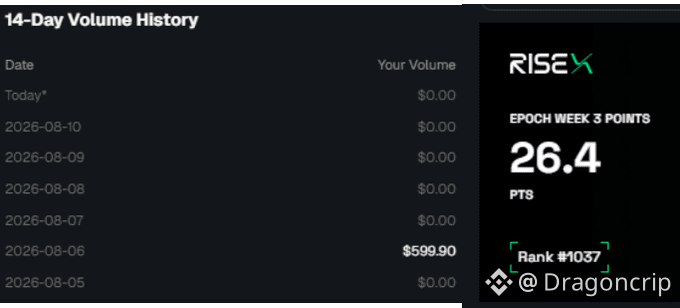
If we look at the numbers, the campaign gives away $26,000,000 in tokens at the current price.
About 4,000 users are farming it, therefore, on average:
$26M / 4,000 users = $6,500
Now, that’s if you’re in the middle. If you’re below average, say in the Top 3,000 (75%), the figure would be something like $2,000–$2,500.
But if you’re within the top 25% (rank 1,000), the amount would rise to a range of $8,000 to $13,000.
This is all hypothetical, taking the current sample of 4,000 users.
Also, add:
- It’s Robinhood, which wants to win the fastest-growing market of this cycle → the tokenized stock market.
- Fees are zero (but of course, watch the spread: the difference between opening and closing).
- The stock market giants are building their arsenal to land in this market.
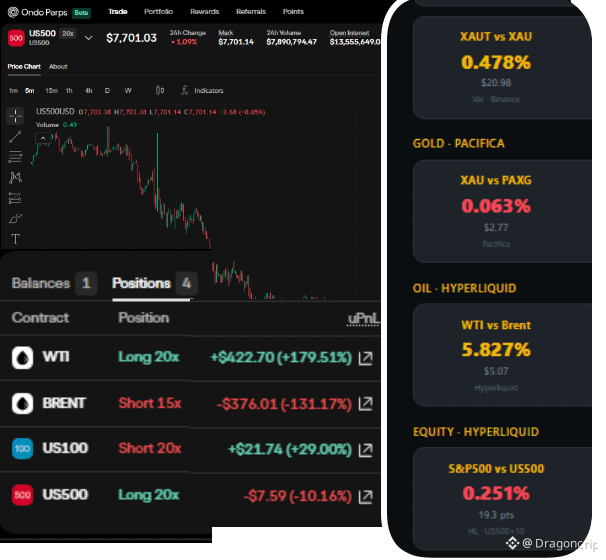
- Ideal to pair DN against the rest of the DEX Tier 1 (ONDO).
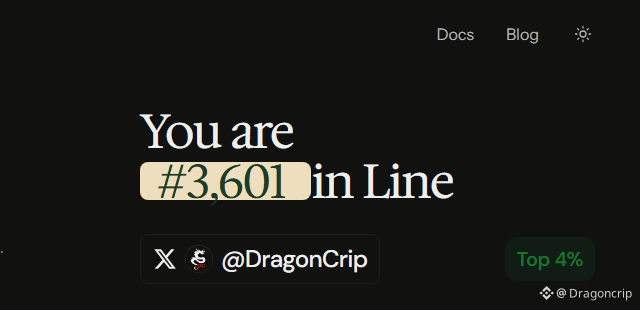
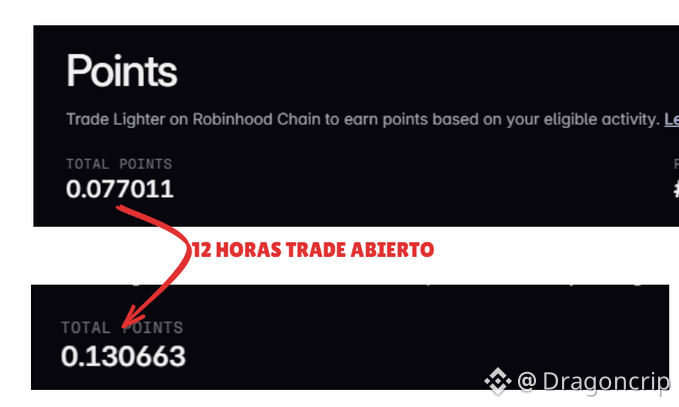
- The new thing is that rank and points update in real time: you don’t have to wait a week to see whether your strategy works.
Real-time points let you see how much a trade gives you and how much your open position is generating. It’s great because it allows you to correct strategies.
- If you farm with your head
- You take advantage of zero fees
- You leave the position open
- You do DN against another DEX that also pays you (Perpl and ONDO)
You’ll be farming the project without losing capital.
TODAY, the winners are the tokenized stock market.
Most of the crypto sector and the people in the crypto ecosystem can’t see it because we’re stuck in the comfort zone of the same players → L1, L2, Memes, Altcoins, and bluechips.
NOTE: The data is based on my assumptions using today’s photo.
Watch it and check it for yourself.
🔗 https://robinhoodchain.lighter.xyz/?referral=DRAGONCRIP
Play with lead feet and choose your battles wisely.
Do they pay you for farming? How does that work?
If we look at the numbers, the campaign gives away $26,000,000 in tokens at the current price.
About 4,000 users are farming it, therefore, on average:
$26M / 4,000 users = $6,500
Now, that’s if you’re in the middle. If you’re below average, say in the Top 3,000 (75%), the figure would be something like $2,000–$2,500.
But if you’re within the top 25% (rank 1,000), the amount would rise to a range of $8,000 to $13,000.
This is all hypothetical, taking the current sample of 4,000 users.
Also, add:
- It’s Robinhood, which wants to win the fastest-growing market of this cycle → the tokenized stock market.
- Fees are zero (but of course, watch the spread: the difference between opening and closing).
- The stock market giants are building their arsenal to land in this market.
- Ideal to pair DN against the rest of the DEX Tier 1 (ONDO).
- The new thing is that rank and points update in real time: you don’t have to wait a week to see whether your strategy works.
Real-time points let you see how much a trade gives you and how much your open position is generating. It’s great because it allows you to correct strategies.
- If you farm with your head
- You take advantage of zero fees
- You leave the position open
- You do DN against another DEX that also pays you (Perpl and ONDO)
You’ll be farming the project without losing capital.
TODAY, the winners are the tokenized stock market.
Most of the crypto sector and the people in the crypto ecosystem can’t see it because we’re stuck in the comfort zone of the same players → L1, L2, Memes, Altcoins, and bluechips.
NOTE: The data is based on my assumptions using today’s photo.
Watch it and check it for yourself.
🔗 https://robinhoodchain.lighter.xyz/?referral=DRAGONCRIP
Play with lead feet and choose your battles wisely.

Dragoncrip
·
--
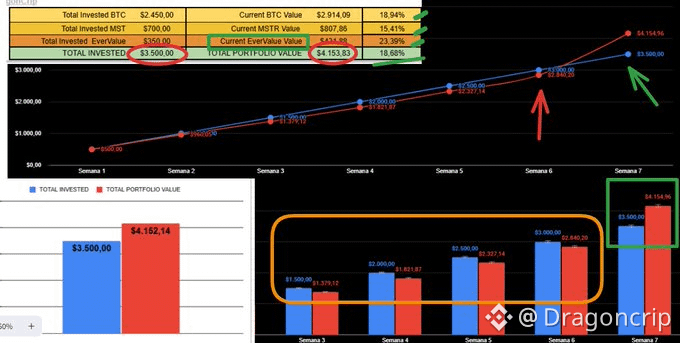
💪 2 months of the “Enhanced Bitcoin DCA Strategy” and this is how things are going.
A strategy we started in the bottom zone with 3 assets, performing DCA every 15 days. (The cited posts detail the strategy).
4th half-month DCA: July 1st.
- On July 1st we made an excellent entry into BTC at $60,000 (below the 200-week MA and below the power law limit).
- Also a good entry into Strategy at $90, far below its 200- and 300-week MA.
- And a great entry into EverValue at $30.69 (burn-price value; this rarely happens).
Our purchase averages are above the current price, but keep in mind we’ve come from a drop of almost 2 months and we’re currently in the cycle bottom zone. This is the best time to accumulate.
Current situation (2 months after we started):
- Invested BTC: $1,400.00
Current Value: $1,320.74 (-5.66%)
- Invested MST (Strategy): $400.00
Current Value: $304.15 (-23.96%)
- Invested EverValue: $200.00
Current Value: $194.72 (-2.64%)
When BTC goes up, the other two assets rise more strongly. But when BTC falls, the other assets drop with greater intensity.
BTC is down -5.66% and, due to leverage, Strategy is down -23.96%.
However, EverValue holds up better than BTC, with only -2.64%.
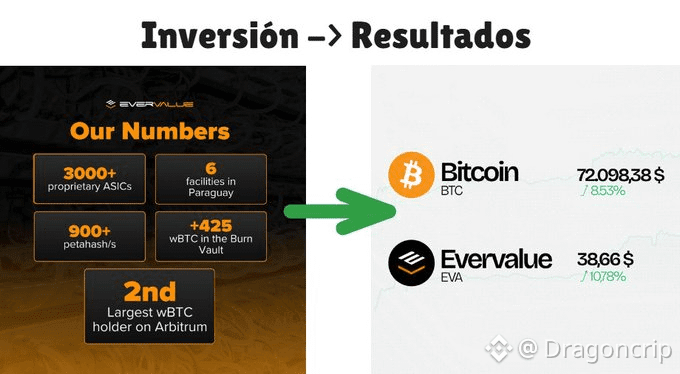
The main reason is that during these 2 months, approximately 8,400 satoshis per token entered into the collateral, which pushed the price up.
In other words, $EVA revalued by 8,400 sats the value of each token thanks to the BTC inflow from its ASIC mining teams in Paraguay.
Since the EVA price is 100% collateralized with BTC, its behavior depends mainly on Bitcoin’s movement.
In summary:
The total portfolio is down -8.96%, dragged mainly by Strategy.
Even so, I think we’re doing well for the price zone we’re in. With only a 5/10% rebound in BTC, this portfolio would already start generating profits.
In the next comment, I’ll leave you the links to the Google Sheets file where the path has been documented.
A strategy we started in the bottom zone with 3 assets, performing DCA every 15 days. (The cited posts detail the strategy).
4th half-month DCA: July 1st.
- On July 1st we made an excellent entry into BTC at $60,000 (below the 200-week MA and below the power law limit).
- Also a good entry into Strategy at $90, far below its 200- and 300-week MA.
- And a great entry into EverValue at $30.69 (burn-price value; this rarely happens).
Our purchase averages are above the current price, but keep in mind we’ve come from a drop of almost 2 months and we’re currently in the cycle bottom zone. This is the best time to accumulate.
Current situation (2 months after we started):
- Invested BTC: $1,400.00
Current Value: $1,320.74 (-5.66%)
- Invested MST (Strategy): $400.00
Current Value: $304.15 (-23.96%)
- Invested EverValue: $200.00
Current Value: $194.72 (-2.64%)
When BTC goes up, the other two assets rise more strongly. But when BTC falls, the other assets drop with greater intensity.
BTC is down -5.66% and, due to leverage, Strategy is down -23.96%.
However, EverValue holds up better than BTC, with only -2.64%.
The main reason is that during these 2 months, approximately 8,400 satoshis per token entered into the collateral, which pushed the price up.
In other words, $EVA revalued by 8,400 sats the value of each token thanks to the BTC inflow from its ASIC mining teams in Paraguay.
Since the EVA price is 100% collateralized with BTC, its behavior depends mainly on Bitcoin’s movement.
In summary:
The total portfolio is down -8.96%, dragged mainly by Strategy.
Even so, I think we’re doing well for the price zone we’re in. With only a 5/10% rebound in BTC, this portfolio would already start generating profits.
In the next comment, I’ll leave you the links to the Google Sheets file where the path has been documented.


Dragoncrip
·
--
🚨
They broke the 4 wallets with passphrase.
The hacker from the Coldcard attack, after a week, broke the wallets with passphrase.
Let’s remember that the example used the BIP-39 dictionary words, meaning they are 2048 easy and well-known words in English.
Finding a single word requires only 2048 attempts.
By brute force, finding that key takes just a few seconds:
- 1 word is trivial: seconds or less.
Combinations: 2.048
- 2 words is easy: minutes with decent hardware.
Combinations: 4.2 million
- 3 words is moderate: hours with modern GPUs.
Combinations: 8.59 billion
While those times are fast, it’s because the attacker already had the seed phrase and knew that wallet (which was made public) had as its passphrase BIP-39 dictionary words.
As a recommendation, the passphrase gives you time to take action, and that time depends on how strong that key is.
- Never use 1, 2, or 3 words from the BIP-39 list as a passphrase (they’re easy).
- Never use only numbers; they’re easy.
- Spanish words are stronger than English ones.
- Use mixed characters (uppercase, lowercase, numbers, and symbols).
They broke the 4 wallets with passphrase.
The hacker from the Coldcard attack, after a week, broke the wallets with passphrase.
Let’s remember that the example used the BIP-39 dictionary words, meaning they are 2048 easy and well-known words in English.
Finding a single word requires only 2048 attempts.
By brute force, finding that key takes just a few seconds:
- 1 word is trivial: seconds or less.
Combinations: 2.048
- 2 words is easy: minutes with decent hardware.
Combinations: 4.2 million
- 3 words is moderate: hours with modern GPUs.
Combinations: 8.59 billion
While those times are fast, it’s because the attacker already had the seed phrase and knew that wallet (which was made public) had as its passphrase BIP-39 dictionary words.
As a recommendation, the passphrase gives you time to take action, and that time depends on how strong that key is.
- Never use 1, 2, or 3 words from the BIP-39 list as a passphrase (they’re easy).
- Never use only numbers; they’re easy.
- Spanish words are stronger than English ones.
- Use mixed characters (uppercase, lowercase, numbers, and symbols).
Dragoncrip
·
--
The power of adding a passphrase to your wallet increases your security by thousands of times.
Here’s a nice test story:
The experienced user @ColeTU
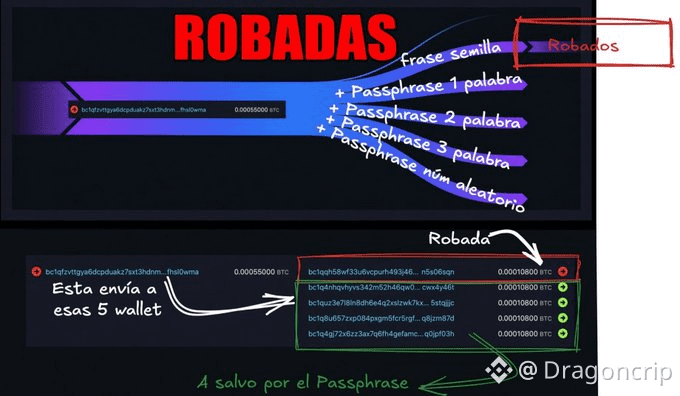
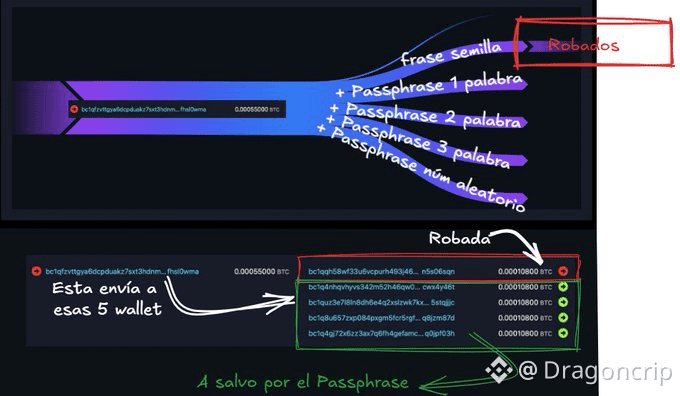
would use a Coldcard Mk3 wallet and, from that seed, create 4 more wallets, but with a passphrase.
Then he would send funds in equal parts to those 5 wallets to see what would happen to his funds.
For this, to his original seed he created 4 additional derivations using a passphrase and sent funds to each of them:
- Wallet 1: seed phrase only
- Wallet 2: seed phrase + 1-word passphrase
- Wallet 3: seed phrase + 2-word passphrase
- Wallet 4: seed phrase + 3-word passphrase
- Wallet 5: seed phrase + passphrase of random numbers
With this, he wanted to see whether the funds were safe and how long it would take for them to be compromised until they were stolen.
The responses didn’t take long to arrive.
In the first few minutes, the original wallet (the seed only) is instantly drained: all its funds are stolen in a snap.
Days passed, and almost a week later, the remaining 4 wallets with different levels of passphrase difficulty are still intact.
Even the one with the lowest security—the easiest one-word passphrase—remains intact, with the funds not stolen.
This shows the great protection that a passphrase gives our seed, even with a simple key of just one word.
A week passed, and one of the main features that this mechanism provides is TIME. Passphrases give you the world’s most valuable asset: TIME.
Time to take action and save your assets. Time to move your assets to another new wallet.
Time between losing or winning.
If this user had been attacked at the time the Coldcard was being drained, he would have lost the “lure” assets of the primary wallet (the one with the seed only), but he would have had enough time to save the rest of his assets.
Take care of your assets; take care of your security.
Here’s a nice test story:
The experienced user @ColeTU
would use a Coldcard Mk3 wallet and, from that seed, create 4 more wallets, but with a passphrase.
Then he would send funds in equal parts to those 5 wallets to see what would happen to his funds.
For this, to his original seed he created 4 additional derivations using a passphrase and sent funds to each of them:
- Wallet 1: seed phrase only
- Wallet 2: seed phrase + 1-word passphrase
- Wallet 3: seed phrase + 2-word passphrase
- Wallet 4: seed phrase + 3-word passphrase
- Wallet 5: seed phrase + passphrase of random numbers
With this, he wanted to see whether the funds were safe and how long it would take for them to be compromised until they were stolen.
The responses didn’t take long to arrive.
In the first few minutes, the original wallet (the seed only) is instantly drained: all its funds are stolen in a snap.
Days passed, and almost a week later, the remaining 4 wallets with different levels of passphrase difficulty are still intact.
Even the one with the lowest security—the easiest one-word passphrase—remains intact, with the funds not stolen.
This shows the great protection that a passphrase gives our seed, even with a simple key of just one word.
A week passed, and one of the main features that this mechanism provides is TIME. Passphrases give you the world’s most valuable asset: TIME.
Time to take action and save your assets. Time to move your assets to another new wallet.
Time between losing or winning.
If this user had been attacked at the time the Coldcard was being drained, he would have lost the “lure” assets of the primary wallet (the one with the seed only), but he would have had enough time to save the rest of his assets.
Take care of your assets; take care of your security.
Dragoncrip
·
--
Testing a second xStocks account with just $85.
The results in 3 days are:
- 95.173 points
- I ended up ranked 6,300
- I’m in the Top 5%
- Account without referrals
- And if TODAY they gave me the Airdrop, I’d take $57 based on my thesis.
All of this in just 3 days, and I still have a lot ahead. How did I do it?
Buying STRC’s YT on Pendle.
Summary (<1500 characters):
1) A good move on Pendle with STRC’s YT (Strategy’s preferred shares that pay a 12% dividend).
STRC’s YT is at **83x** + a 2x points booster = 165x in points.
With $100:
- $8,300 power for the 12% dividend
- $16,600 power to farm xStock points
The other side:
- The YT expires and is worth $0 (you lose the capital). You have ~20 days left.
- Dividends every 15 days (0.5% each). After that there’s 1 payment → at 83x that would be about ~$41.5 per each $100.
Strategy:
Enter cheap, farm points, and exit before expiration (selling at a higher price) or collect the dividend and sell.
After the dividend, the price drops; before it rises.
Real example: I entered with 1 STRC 3 days ago → now it’s worth 1.0035. I’m up in both profit + free points.
Links:
- xStock: https://defi.xstocks.fi/points?ref=DRAGON
- Pendle: https://app.pendle.finance/trade/markets?search=strc
- Calculator: https://xstock-calculadora.vercel.app
Remember: YTs lose value every day until they’re worth zero at expiration. They’re meant to squeeze points, not to hold.
The results in 3 days are:
- 95.173 points
- I ended up ranked 6,300
- I’m in the Top 5%
- Account without referrals
- And if TODAY they gave me the Airdrop, I’d take $57 based on my thesis.
All of this in just 3 days, and I still have a lot ahead. How did I do it?
Buying STRC’s YT on Pendle.
Summary (<1500 characters):
1) A good move on Pendle with STRC’s YT (Strategy’s preferred shares that pay a 12% dividend).
STRC’s YT is at **83x** + a 2x points booster = 165x in points.
With $100:
- $8,300 power for the 12% dividend
- $16,600 power to farm xStock points
The other side:
- The YT expires and is worth $0 (you lose the capital). You have ~20 days left.
- Dividends every 15 days (0.5% each). After that there’s 1 payment → at 83x that would be about ~$41.5 per each $100.
Strategy:
Enter cheap, farm points, and exit before expiration (selling at a higher price) or collect the dividend and sell.
After the dividend, the price drops; before it rises.
Real example: I entered with 1 STRC 3 days ago → now it’s worth 1.0035. I’m up in both profit + free points.
Links:
- xStock: https://defi.xstocks.fi/points?ref=DRAGON
- Pendle: https://app.pendle.finance/trade/markets?search=strc
- Calculator: https://xstock-calculadora.vercel.app
Remember: YTs lose value every day until they’re worth zero at expiration. They’re meant to squeeze points, not to hold.
Log in to explore more content