
0xnut6
94 Posts
0xnut6
Report
Block User
多年資歷的專業交易員與分析師,專注衍生品、DeFi、鏈上數據、RWA 與 AI 賽道。每天整理市場最前沿的資訊,拆解背後的原因、資金流向與風險,幫你在變化快速的加密市場裡看清局勢、做出更好的決策。內容僅供參考,不構成投資建議。
13 Following
15 Followers
8 Liked
Posts
·
--
Before the 7 PM candle, $PEPE had been grinding between 0.00000378 and 0.00000385 all afternoon. It rose to 0.00000398 at 7 PM, hit a high of 0.00000405 at 8 PM, and has now pulled back to 0.00000395. Perpetual open interest climbed from just over 79 million after 6 PM to a peak of 86.8 million at 9 PM, and has now eased back to around 86 million. The funding rate remains positive at 0.01%, while the long-short ratio fell from 1.45 at 7 PM to 1.33.
By contrast, $BTC was almost pinned in place tonight, hovering around 63,940 at about 10 PM. It moved just 0.03% over 24 hours—practically no volatility.
By contrast, $BTC was almost pinned in place tonight, hovering around 63,940 at about 10 PM. It moved just 0.03% over 24 hours—practically no volatility.
170
·
--
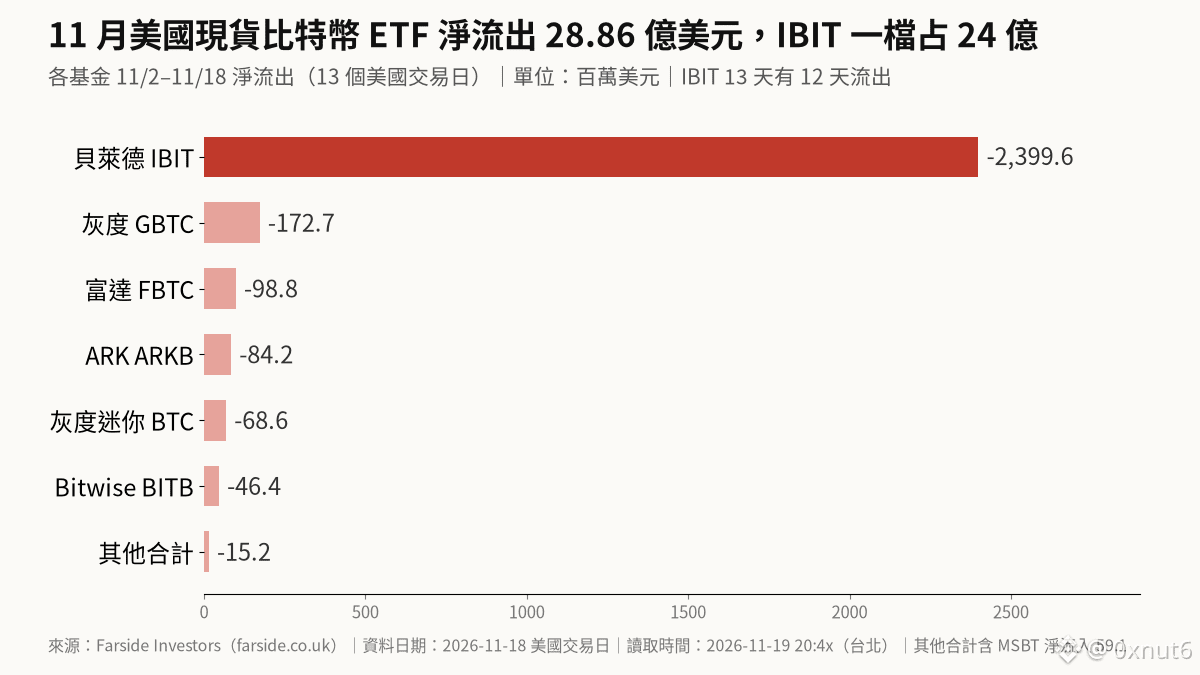
Since the beginning of November, U.S. spot Bitcoin ETFs have seen nearly $2.9 billion in redemptions, with about $2.4 billion flowing out of BlackRock’s IBIT alone.
According to Farside Investors’ daily figures, over the 13 U.S. trading days from November 2 to 18, spot Bitcoin ETFs collectively saw net outflows of $2.886 billion. IBIT alone saw net outflows of $2.4 billion, accounting for roughly 83% of the total. Grayscale’s GBTC, which had the second-largest outflows, saw just $173 million leave. IBIT had outflows on 12 of those 13 days, with the only exception being November 16, when it saw net inflows of $76.5 million.
The reversal came quickly. In October, IBIT still saw net inflows of $932 million for the month. The other spot Bitcoin ETFs collectively saw net outflows of $1.448 billion that same month, so October’s selling pressure was mainly concentrated in other funds, while IBIT continued to attract money. By November, even money in IBIT had started flowing out.
Including this month’s $2.4 billion in outflows, BlackRock’s IBIT has seen cumulative net inflows of $63.9 billion since its launch. The recent outflows amount to about 3.8% of its cumulative total so far.
$BTC
32
·
--
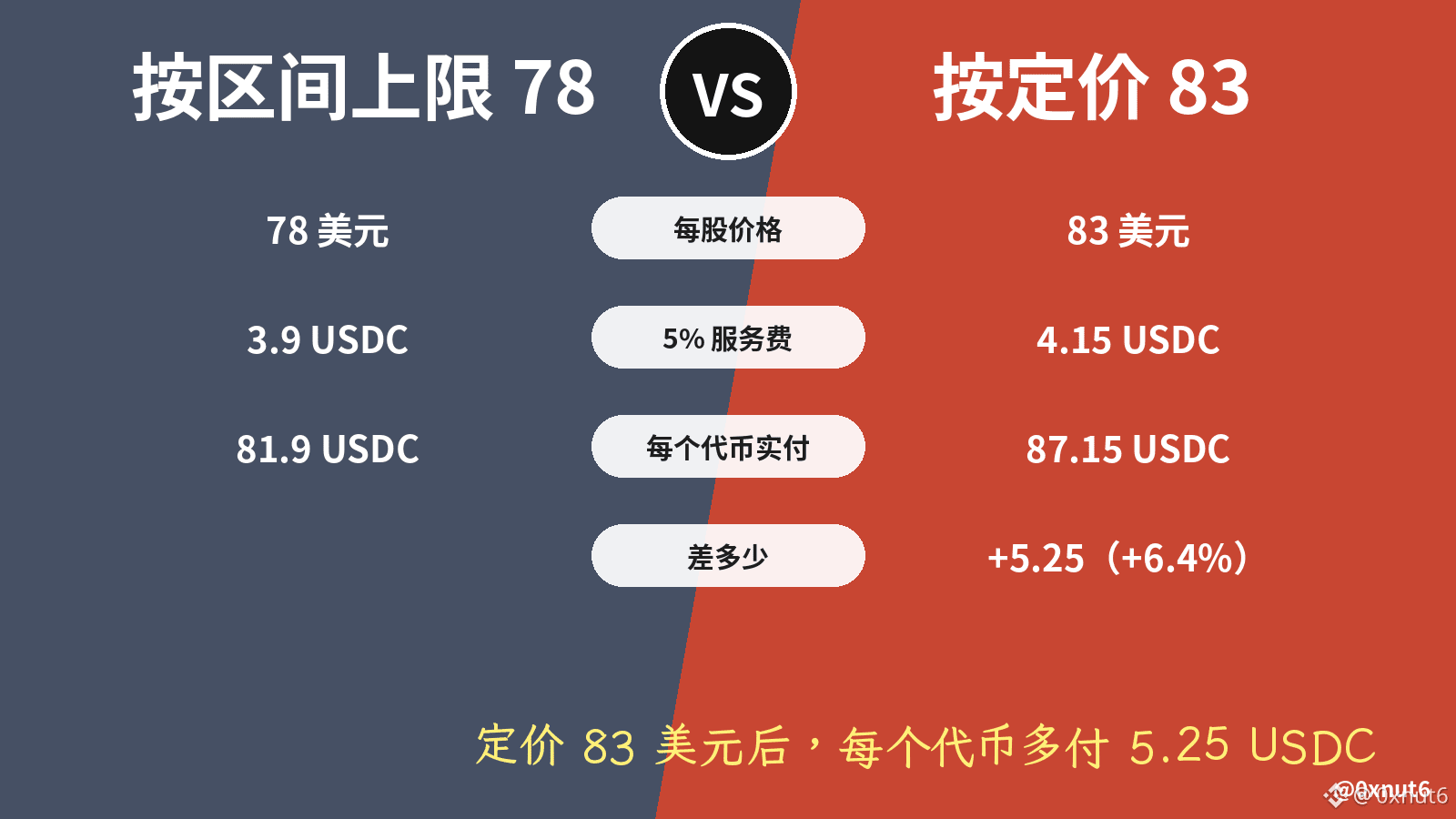
Bloomberg cited people familiar with the matter as saying that Anthropic set its IPO price at $83 per share, above the previous range of $70 to $78. The price people who subscribed to Anthropic tokens through Binance Wallet yesterday have to pay for each token has also gone up.
A Binance Wallet announcement said the final price would be set by the issuer and underwriters, with an additional 5% service fee. At $83, each token costs 87.15 USDC in total. At the top of the previous range, $78, it would have cost just 81.9 USDC. That means each token now costs 5.25 USDC more, an increase of about 6.4%.
Anthropic is listing on Nasdaq today. According to the Binance Wallet announcement, the tokens will be sent to wallets at least two hours after the market opens. U.S. markets open at 10:30 p.m. Beijing time, so the tokens will arrive no earlier than 12:30 a.m. on November 20.
Binance Wallet's official account posted at around 6 p.m. yesterday that the total allocation of 500 million USDC had been fully subscribed. The official account of xStocks, the token issuer, said the IPO was oversubscribed sevenfold. Subscribers may receive only a partial allocation—or none at all—and any unallocated USDC will be returned to their wallets.
48
·
--
Midday: $ZEC climbed from 897 to 937, up 2.28% in 6 hours, but still down 2.6% over 24 hours. Open interest rose from 428 million to 447 million, while the long-short ratio fell from 1.05 to 0.90. Prices are moving up, but more accounts are opening shorts; the funding rate is +0.0077%, almost no cost. $BTC touched 63,760 around noon before falling back to 63,332, up 0.45% in 6 hours. The long-short ratio dropped from 3.60 to 3.13, as many traders who crowded into longs this morning took the rebound as a chance to exit.
Midday: $ZEC climbed from 897 to 937, up 2.28% in 6 hours, but still down 2.6% over 24 hours. Open interest rose from 428 million to 447 million, while the long-short ratio fell from 1.05 to 0.90. Prices are moving up, but more accounts are opening shorts; the funding rate is +0.0077%, almost no cost. $BTC touched 63,760 around noon before falling back to 63,332, up 0.45% in 6 hours. The long-short ratio dropped from 3.60 to 3.13, as many traders who crowded into longs this morning took the rebound as a chance to exit.
283
·
--
After U.S. stocks weakened last night, $BTC slid from 64,000 to a low of 62,000 at 6 a.m. before rebounding to around 63,000 and then falling back to 62,703. It’s down nearly 3% over 24 hours. What’s more puzzling is that Binance perpetual open interest climbed from $5.929 billion at 22:00 last night to $6.075 billion at 09:00 today. Prices fell while positions grew, suggesting that buyers kept stepping in to open long positions on the way down. The account long-short ratio is still above 3.5, meaning there are three and a half times as many accounts opening longs as opening shorts. Funding rates are nearly flat, suggesting this downturn hasn’t flushed out the bulls. $ETH 6 was up 1 percentage point over the hour, slightly outperforming Bitcoin, and showed a bit more strength in the morning session.
After U.S. stocks weakened last night, $BTC slid from 64,000 to a low of 62,000 at 6 a.m. before rebounding to around 63,000 and then falling back to 62,703. It’s down nearly 3% over 24 hours. What’s more puzzling is that Binance perpetual open interest climbed from $5.929 billion at 22:00 last night to $6.075 billion at 09:00 today. Prices fell while positions grew, suggesting that buyers kept stepping in to open long positions on the way down. The account long-short ratio is still above 3.5, meaning there are three and a half times as many accounts opening longs as opening shorts. Funding rates are nearly flat, suggesting this downturn hasn’t flushed out the bulls. $ETH 6 was up 1 percentage point over the hour, slightly outperforming Bitcoin, and showed a bit more strength in the morning session.
81
·
--
$MMT 's hourly candle at 1 p.m. today jumped directly from 0.1523 to 0.2194, touched 0.2666 at 7 p.m., then pulled back to 0.2447 at 22:10, up 109% in 24 hours. 24-hour futures trading volume was $659 million, while spot volume was only $37.58 million—nearly 17 times lower. Open interest rose from $21.85 million at 3 p.m. to $27.39 million, and the funding rate was nearly flat at +0.002%. The account long/short ratio was 0.52, with short accounts making up about 66%. At the same time, $BTC barely moved around 64,000.
$MMT 's hourly candle at 1 p.m. today jumped directly from 0.1523 to 0.2194, touched 0.2666 at 7 p.m., then pulled back to 0.2447 at 22:10, up 109% in 24 hours. 24-hour futures trading volume was $659 million, while spot volume was only $37.58 million—nearly 17 times lower. Open interest rose from $21.85 million at 3 p.m. to $27.39 million, and the funding rate was nearly flat at +0.002%. The account long/short ratio was 0.52, with short accounts making up about 66%. At the same time, $BTC barely moved around 64,000.
29
·
--
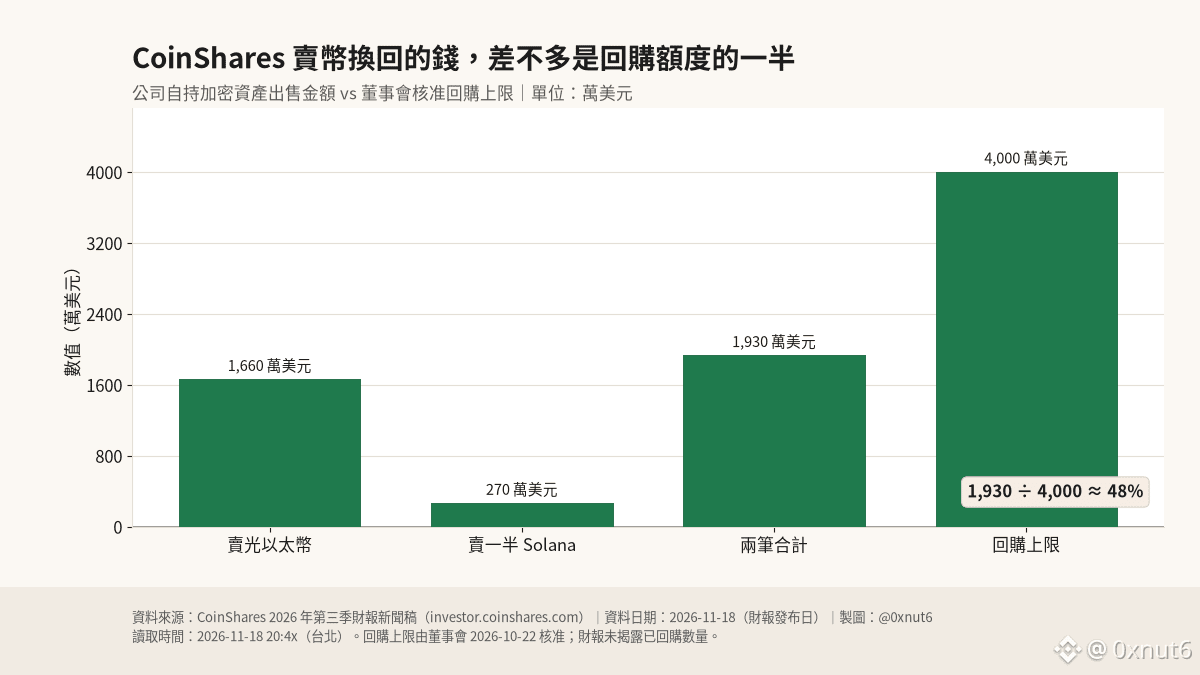
Europe's largest crypto asset management company, CoinShares, announced its third-quarter earnings today, revealing that it had sold all the Ethereum on its balance sheet and half of its Solana holdings, converting them into $19.3 million and preparing to use the proceeds to buy back its own shares.
These two transactions were $16.6 million from Ethereum and $2.7 million from Solana, respectively. The buyback cap approved by the board on October 22 was $40 million, and CEO Jean-Marie Mognetti said in the report that the cash raised from selling the tokens was about half that amount, and the company can act once market conditions allow.
Part of this quarter's profit actually came from the rise in value of these coins. CoinShares reported third-quarter net income of $39.6 million, of which $14.4 million came from the appreciation of the company's own crypto assets. Revenue for the same quarter was $27.7 million, down about 45% from $50.3 million a year earlier, mainly because fees from managing client assets fell by nearly half.
For a company that earns fees by managing crypto assets for clients, when assets under management returned to $7.4 billion at the end of the quarter and net inflows reached $125 million for the quarter, it chose to convert the Ethereum it held into cash to buy back its own stock. This is exactly the opposite of what many listed companies did over the past year, issuing shares and borrowing money to buy coins and put them on the company's books.
The cash from the token sales is already in hand, but the report did not say when the buybacks would begin or how much has been repurchased so far. The authorization from shareholders allows the company to buy back up to 32.9 million shares within five years, about a quarter of the shares outstanding.
$ETH $SOL
223
·
--
Binance Wallet is opening subscriptions for Anthropic tokenized stocks today from 2 p.m. to 10 p.m. Beijing time. You can subscribe using USDC on BNB Chain, with a minimum subscription of 100 USDC. The total subscription cap for everyone is 500 million USDC.
Binance Wallet's announcement states that the subscribed tokens are issued by xStocks and do not represent direct ownership of Anthropic shares. Holders also have no voting or dividend rights; they can only benefit from price movements.
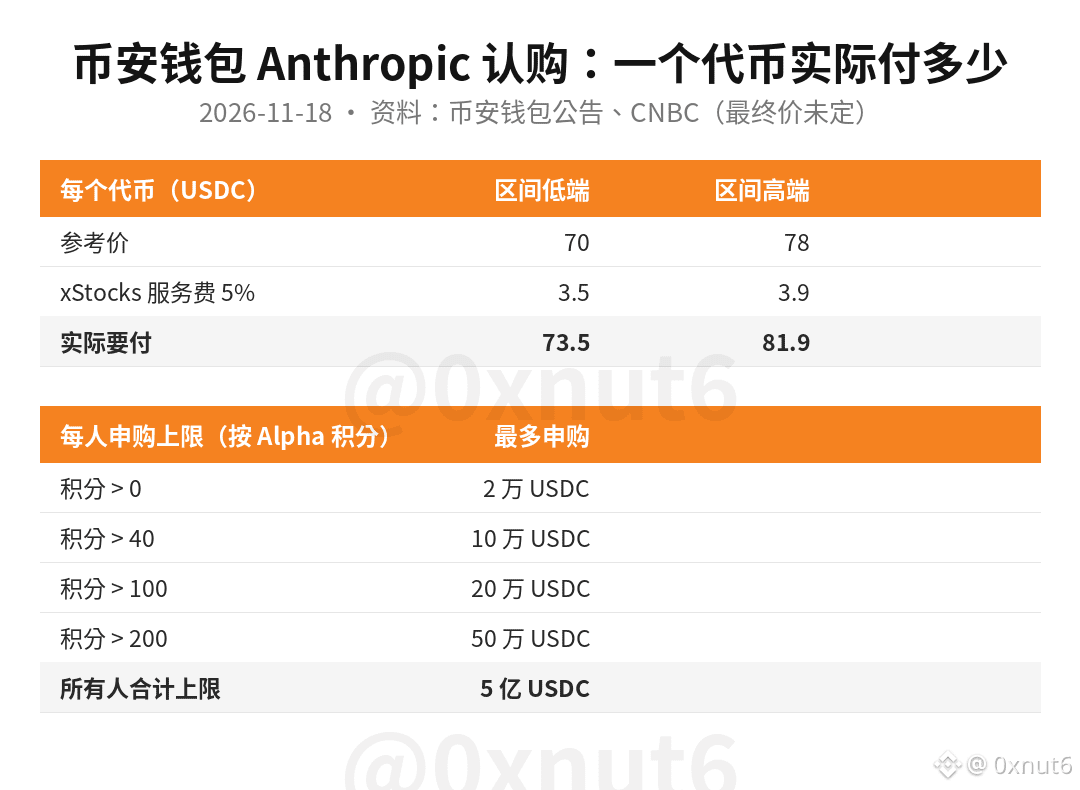
Binance's indicative price is 70 to 78 USDC per token, the same range as Anthropic's own announced offering price, but there is also a 5% service fee. At 78 USDC, one token would cost 81.9 USDC in total. CNBC, citing people familiar with the matter on November 17, reported that the final price could be above $78. Binance's announcement also says the final price will be set by the issuer and underwriters.
How much each person can subscribe for depends on their Alpha Points and falls into four tiers. Those with more than 0 points can subscribe for up to 20,000 USDC, while those with more than 200 points can subscribe for up to 500,000 USDC. If everyone subscribes at the highest tier, 500 million USDC would be enough for only 1,000 people. A subscription does not guarantee an allocation, and any unallocated USDC will be fully refunded to the wallet.
According to CNBC, Anthropic plans to list on Nasdaq on November 19. The tokens will not be sent to wallets until at least two hours after the market opens. Until then, the subscribed USDC will remain locked in a contract on BNB Chain.
159
·
--
At midday, $BREV is trading at 0.1194. It climbed from 0.059 to 0.135 last night, more than doubling. A lot of people thought it had gone up too much and started shorting, so short positions kept piling up. The funding rate is -0.25%, charged once every hour, which means shorts are constantly paying longs. Futures trading volume is over $800 million, while spot volume is only a little over $30 million—a gap of more than 20 times. Futures are doing most of the driving, while spot liquidity is thin. Futures open interest rose from $10.62 million at 1 a.m. to $14.2 million. The long/short ratio is 0.77, with more accounts opening shorts than longs. $BTC is around 64,717, down 0.35% over six hours, and the broader market is sluggish. This kind of setup carries significant risk on both sides.
At midday, $BREV is trading at 0.1194. It climbed from 0.059 to 0.135 last night, more than doubling. A lot of people thought it had gone up too much and started shorting, so short positions kept piling up. The funding rate is -0.25%, charged once every hour, which means shorts are constantly paying longs. Futures trading volume is over $800 million, while spot volume is only a little over $30 million—a gap of more than 20 times. Futures are doing most of the driving, while spot liquidity is thin. Futures open interest rose from $10.62 million at 1 a.m. to $14.2 million. The long/short ratio is 0.77, with more accounts opening shorts than longs. $BTC is around 64,717, down 0.35% over six hours, and the broader market is sluggish. This kind of setup carries significant risk on both sides.
271
·
--
When the U.S. stock market opened last night, $BTC plunged straight from 65,447 to 63,336—a pretty decisive drop. It then traded back and forth between 63,600 and 64,100 overnight, bounced to 65,268 at 7 a.m., and was back at 64,474 by 9:47 a.m. Perpetual open interest barely moved all night, and the funding rate was flat too, so leverage didn’t see any major inflows or outflows.
$NEAR was more interesting: it fell to 3.097 at 11 p.m. last night, then climbed steadily through the morning to 3.413 at 8 a.m. It’s now at 3.368, up 5.5% over six hours and 6.8% over 24 hours—the biggest gain among Binance spot pairs with more than $30 million in trading volume. Contract open interest rose by about 10% from 1 a.m. to after 9 a.m., while the account long-short ratio edged down slightly. Positions increased, but the market wasn’t overwhelmingly bullish.
$NEAR was more interesting: it fell to 3.097 at 11 p.m. last night, then climbed steadily through the morning to 3.413 at 8 a.m. It’s now at 3.368, up 5.5% over six hours and 6.8% over 24 hours—the biggest gain among Binance spot pairs with more than $30 million in trading volume. Contract open interest rose by about 10% from 1 a.m. to after 9 a.m., while the account long-short ratio edged down slightly. Positions increased, but the market wasn’t overwhelmingly bullish.
77
·
--
Article
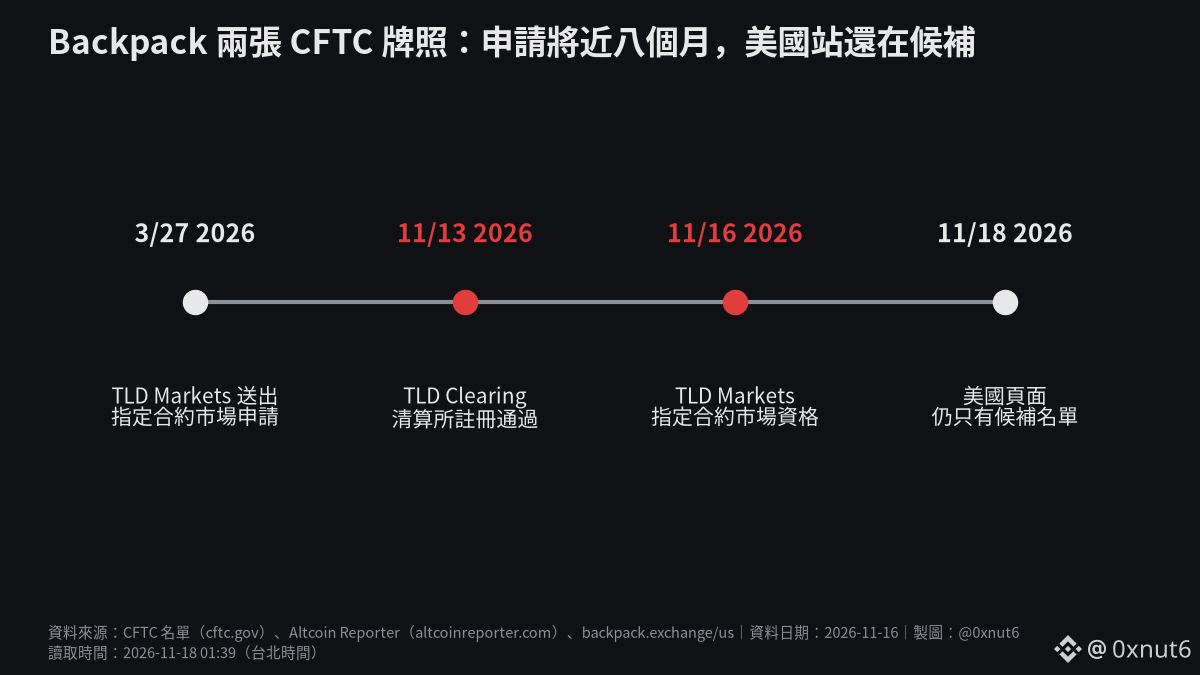
Backpack Gets U.S. CFTC Licenses: How Will This Affect Users Outside the United States?Shortly after 6 a.m. on November 17 (Taiwan time), @Backpack announced on X that it had received approval from the U.S. Commodity Futures Trading Commission (@CFTC) to offer leveraged crypto perpetual contracts in the United States. By the time I wrote this, the announcement had been viewed 550,000 times. BP was trading at around $0.84 at the hour before the news broke, according to its hourly price on CoinGecko. It jumped to around $1.25 at the next hour, then fell back to around $1.02 by the early hours of November 18.
Two licenses approved within three days: Backpack owns both the exchange and the clearinghouse
Backpack Gets U.S. CFTC Licenses: How Will This Affect Users Outside the United States?
Shortly after 6 a.m. on November 17 (Taiwan time), @Backpack announced on X that it had received approval from the U.S. Commodity Futures Trading Commission (@CFTC) to offer leveraged crypto perpetual contracts in the United States. By the time I wrote this, the announcement had been viewed 550,000 times. BP was trading at around $0.84 at the hour before the news broke, according to its hourly price on CoinGecko. It jumped to around $1.25 at the next hour, then fell back to around $1.02 by the early hours of November 18.
Two licenses approved within three days: Backpack owns both the exchange and the clearinghouse
Two licenses approved within three days: Backpack owns both the exchange and the clearinghouse
223
·
--
$ZEC This wave has climbed from a 24-hour low of 846 to 954, up more than 4% in the past six hours. Open interest in perpetual futures has also quietly risen from $464 million to $473 million, while the funding rate is only +0.01%—it doesn't look like anyone's feeling overheated yet. The account long/short ratio is 0.76, meaning there are fewer long accounts than short accounts, suggesting some traders are shorting against the trend. Meanwhile, $BTC is still hovering around 64,989, with open interest barely moving at $5.99 billion. Capital is clearly flowing into ZEC, and when Bitcoin stays still, altcoins can be more prone to doing their own thing. The price has now touched a high of 959.95; in the short term, the question is whether the bears can hold on.
$ZEC This wave has climbed from a 24-hour low of 846 to 954, up more than 4% in the past six hours. Open interest in perpetual futures has also quietly risen from $464 million to $473 million, while the funding rate is only +0.01%—it doesn't look like anyone's feeling overheated yet. The account long/short ratio is 0.76, meaning there are fewer long accounts than short accounts, suggesting some traders are shorting against the trend. Meanwhile, $BTC is still hovering around 64,989, with open interest barely moving at $5.99 billion. Capital is clearly flowing into ZEC, and when Bitcoin stays still, altcoins can be more prone to doing their own thing. The price has now touched a high of 959.95; in the short term, the question is whether the bears can hold on.
2
·
--
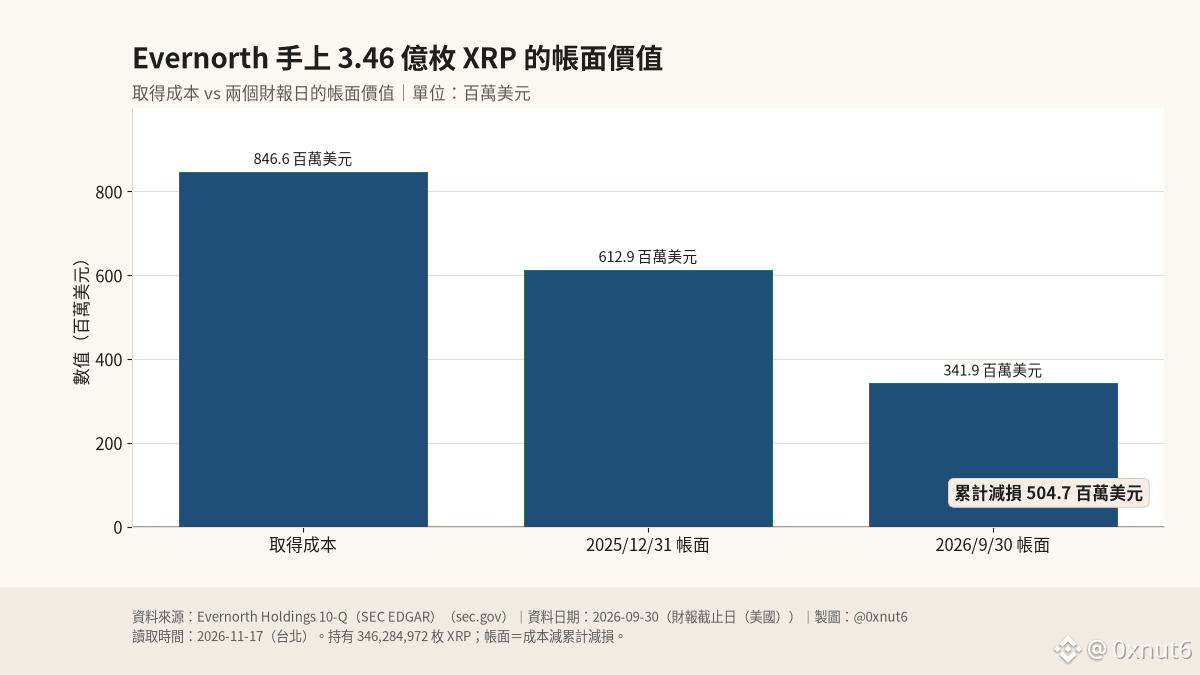
Ripple-backed Evernorth, a company that specializes in holding XRP, reported in its latest 10-Q quarterly filing that it held 346,284,972 XRP as of September 30. It acquired the XRP for $847 million, at an average cost of about $2.44 per coin.
As of September 30, the XRP was worth just $342 million on the books. Evernorth had already recognized $234 million in impairment losses by the end of 2025, and recognized another $271 million in the first three quarters of 2026, for a combined total of about $505 million.
Today, XRP is trading at about $0.97 on Coinbase, below the roughly $0.99 per coin implied by its book value on September 30. At today's price, the XRP would be worth about $336 million, around $510 million less than its original cost.
The same 10-Q also says that Evernorth actually earned $155 million in the third quarter. That was because the advances owed by the company to investors fluctuate with the price of XRP. As XRP fell, the liability also decreased, generating $163 million in gains on paper.
Evernorth completed its merger with a SPAC (special purpose acquisition company) on October 9, and those advances have since been converted into company shares. So if XRP falls further, there will no longer be any gains from a reduction in that liability to offset the losses.
$XRP
27
·
--
Article
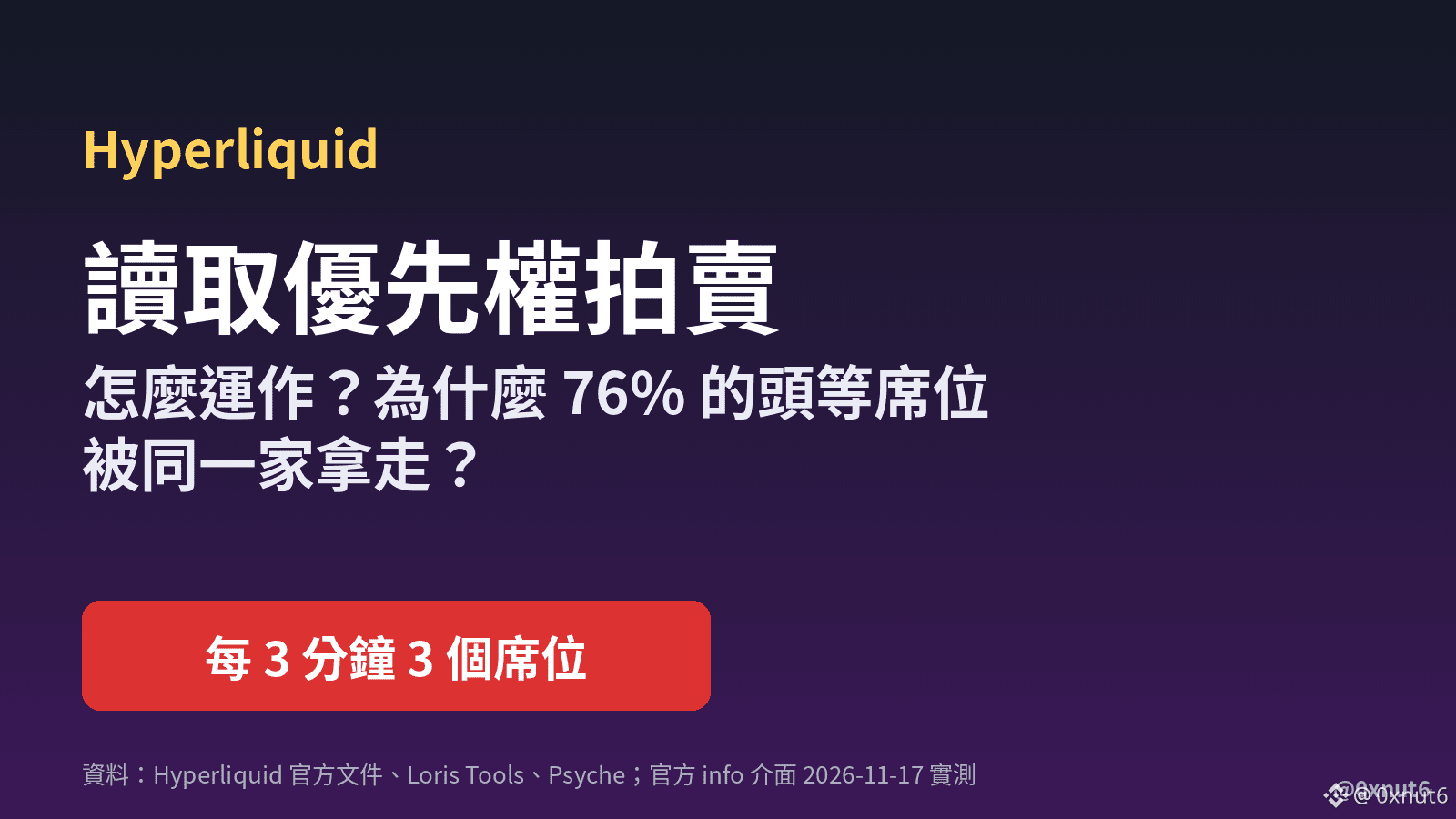
How does Hyperliquid’s read-priority auction work, and why did the same firm win 76% of the top seat?Every 3 minutes, Hyperliquid holds an auction, selling the right to see unfilled orders slightly earlier than everyone else. Three seats are sold each time. Over the past month, wallets associated with Wintermute won about 76% of the top, or No. 0, seat. This figure comes from statistics by on-chain data site @LorisTools, cited by Bloomberg; Wintermute has not confirmed it.
At 7:45 p.m. on November 17, I queried the live auction status directly through Hyperliquid’s official interface, checking about every 20 seconds over two consecutive auctions. I then compared the results with public reports and official documentation to break down how the rules work.
How does Hyperliquid’s read-priority auction work, and why did the same firm win 76% of the top seat?
Every 3 minutes, Hyperliquid holds an auction, selling the right to see unfilled orders slightly earlier than everyone else. Three seats are sold each time. Over the past month, wallets associated with Wintermute won about 76% of the top, or No. 0, seat. This figure comes from statistics by on-chain data site @LorisTools, cited by Bloomberg; Wintermute has not confirmed it.
At 7:45 p.m. on November 17, I queried the live auction status directly through Hyperliquid’s official interface, checking about every 20 seconds over two consecutive auctions. I then compared the results with public reports and official documentation to break down how the rules work.
At 7:45 p.m. on November 17, I queried the live auction status directly through Hyperliquid’s official interface, checking about every 20 seconds over two consecutive auctions. I then compared the results with public reports and official documentation to break down how the rules work.
55
·
--
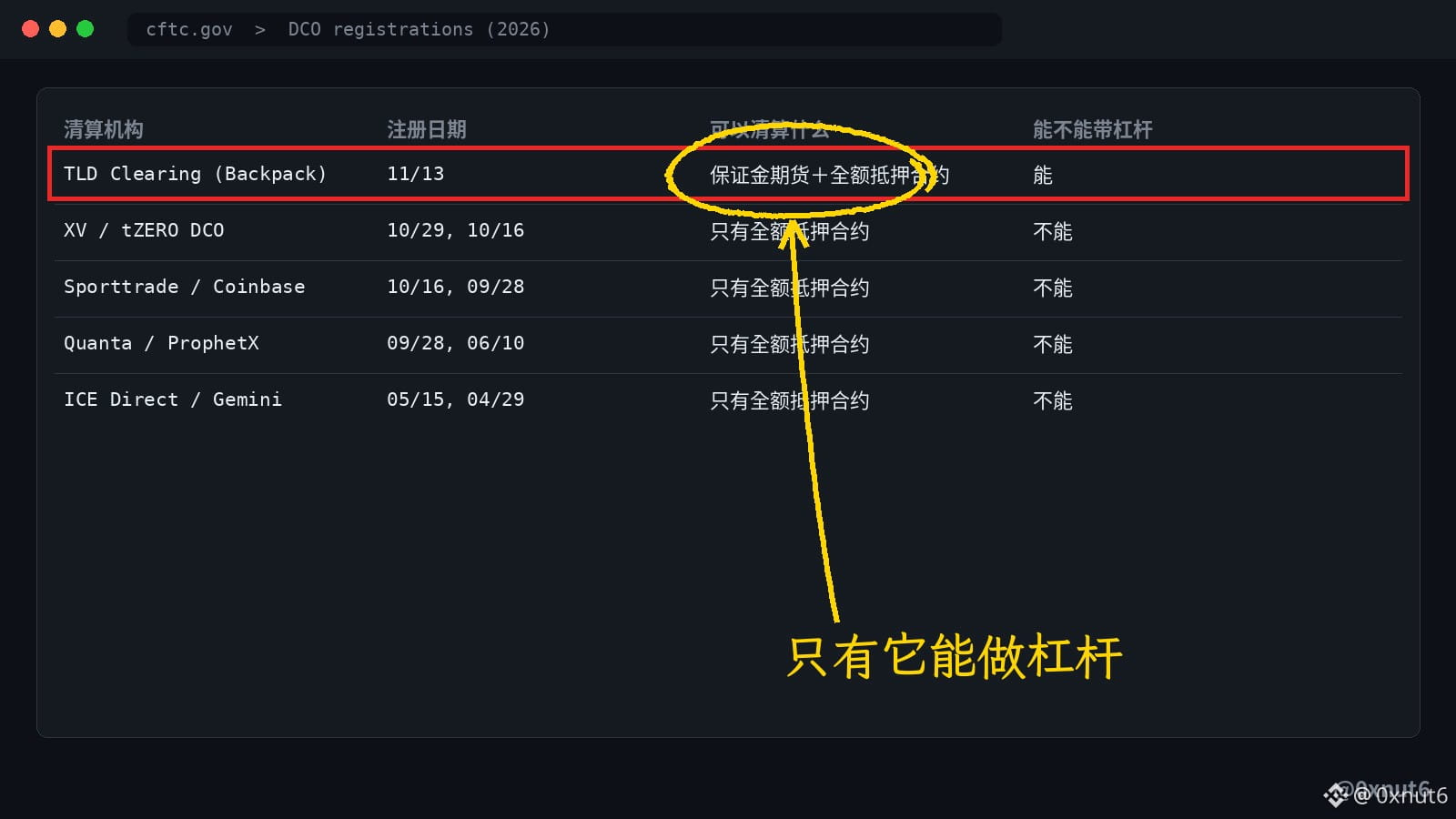
On November 16, the U.S. Commodity Futures Trading Commission (CFTC) approved Backpack’s exchange, TLD Markets, as a designated contract market, meaning it can legally list futures contracts for trading in the United States. Three days earlier, its clearinghouse, TLD Clearing, had already been registered as a derivatives clearing organization. With both licenses in hand, Backpack can match and clear derivatives trades itself in the United States.
The CFTC’s list of derivatives clearing organizations shows that nine firms registered this year. Backpack Clearing’s entry says it can clear margined futures—that is, futures traded with leverage by posting only a portion of the required funds as margin. The entries for the other eight, including Coinbase Clearing and tZERO, say they are limited to fully collateralized products, where traders must deposit the full amount required for their positions upfront.
This approval is what allows Backpack to offer leveraged perpetual futures in the United States. According to Backpack’s press release, U.S. users will be able to trade crypto perpetual futures 24 hours a day, use both fiat and cryptocurrency as margin, and share margin across different positions. Orders placed by U.S. users will go into the same global Backpack order book as orders from users outside the United States, where they will be matched together; there will not be a separate U.S.-only market.
The press release does not say when U.S. users will be able to start trading or what the maximum leverage will be.
·
--
During the Asian midday session, Bitcoin is still hovering around 64,956, moving just 0.09% in six hours. $SOL and $ETH are stronger, though: SOL is up 2.49% to 72.88, and ETH has gained 1.17%. SOL open interest in perpetual futures rose from $623 million at 9 a.m. to $643 million at 1 p.m., but the funding rate is still negative at -0.0144%. Shorts are paying longs, suggesting that some traders are still opening short positions to bet against the price as it rises. ETH open interest also edged up to $4.202 billion, with a funding rate of +0.0024%—relatively healthy. $BTC is holding steady, while capital flows into altcoins as traders chase the rotation. The tug-of-war between SOL bulls and bears is still unresolved.
During the Asian midday session, Bitcoin is still hovering around 64,956, moving just 0.09% in six hours. $SOL and $ETH are stronger, though: SOL is up 2.49% to 72.88, and ETH has gained 1.17%. SOL open interest in perpetual futures rose from $623 million at 9 a.m. to $643 million at 1 p.m., but the funding rate is still negative at -0.0144%. Shorts are paying longs, suggesting that some traders are still opening short positions to bet against the price as it rises. ETH open interest also edged up to $4.202 billion, with a funding rate of +0.0024%—relatively healthy. $BTC is holding steady, while capital flows into altcoins as traders chase the rotation. The tug-of-war between SOL bulls and bears is still unresolved.
168
·
--
BTC has been dead in the water since last night. $BTC spent the whole night drifting between 64,455 and 65,535, a swing of around a thousand, and was sitting at 64,811 shortly after 9 a.m. Binance perpetual open interest fell from about $6.07 billion at 10 p.m. last night to $6.00 billion, with no leverage added back. The funding rate at +0.0032% is normal, and the long/short ratio of 2.69 still leans long, but no one dares to bet on a direction.
Money has rotated into a handful of altcoins. $HYPE rose 4.1% in a day to 69.05, and $ZEC also bounced 3.1% to 909.9, after being the weakest major coin yesterday. ASTER is up 12.7% on the day, clawing back the ground it lost in yesterday morning’s wick. Trading volume is low across the board, so this looks more like isolated excitement while the broader market lacks direction. For now, short-term traders are still waiting for BTC to make the first move.
Money has rotated into a handful of altcoins. $HYPE rose 4.1% in a day to 69.05, and $ZEC also bounced 3.1% to 909.9, after being the weakest major coin yesterday. ASTER is up 12.7% on the day, clawing back the ground it lost in yesterday morning’s wick. Trading volume is low across the board, so this looks more like isolated excitement while the broader market lacks direction. For now, short-term traders are still waiting for BTC to make the first move.
209
·
--
A little after 10 p.m. in Taipei, on Binance spot, the U.S. stock semiconductor tokens SOXLB and NVDAB were the biggest decliners. SOXLB was down 5.9% over 24 hours, and NVDAB was down 1.95%. $BTC had a 6-hour range of 63,905 to 64,796, was down 0.5% over 6 hours, and was trading at 64,405, down 1.5% over 24 hours. $ETH was up 0.5% over 6 hours. $ZEC was down 3.4% over 24 hours and was trading at 867, down 2.8% over 6 hours—one of the biggest declines among large-cap coins. Although the U.S. stock semiconductor tokens led the losses, $BTC only fluctuated slightly over 6 hours and did not follow the sharp decline.
A little after 10 p.m. in Taipei, on Binance spot, the U.S. stock semiconductor tokens SOXLB and NVDAB were the biggest decliners. SOXLB was down 5.9% over 24 hours, and NVDAB was down 1.95%. $BTC had a 6-hour range of 63,905 to 64,796, was down 0.5% over 6 hours, and was trading at 64,405, down 1.5% over 24 hours. $ETH was up 0.5% over 6 hours. $ZEC was down 3.4% over 24 hours and was trading at 867, down 2.8% over 6 hours—one of the biggest declines among large-cap coins. Although the U.S. stock semiconductor tokens led the losses, $BTC only fluctuated slightly over 6 hours and did not follow the sharp decline.
784
·
--
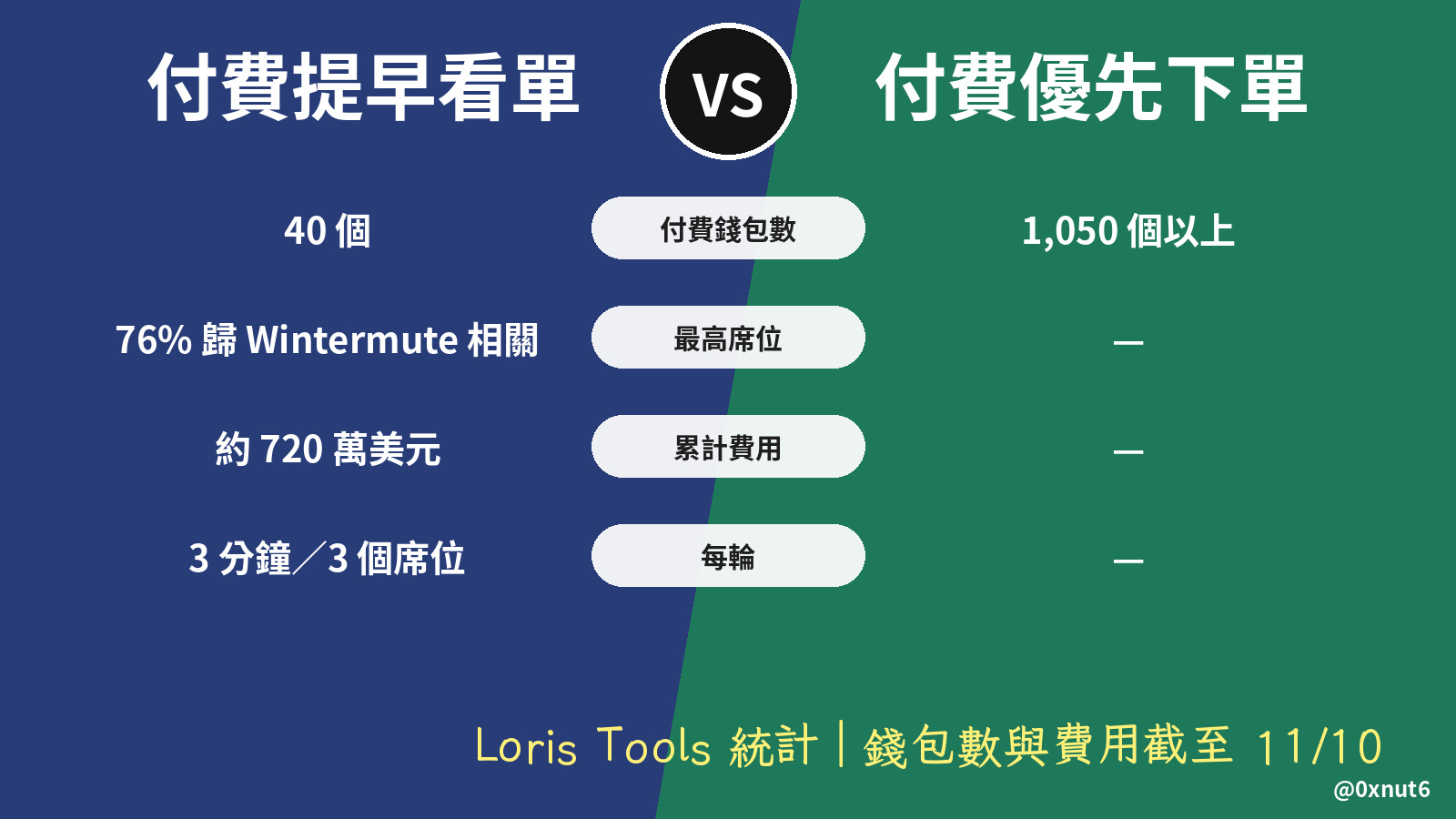
Over the past month, around 76% of the highest-priority seats in Hyperliquid’s pay-to-see-orders-early auctions were won by wallets linked to Wintermute. That’s according to data from on-chain analytics site Loris Tools, cited by Bloomberg. Wintermute has not confirmed how many seats it won.
The auctions run every 3 minutes, with 3 seats auctioned each time. Hyperliquid’s official documentation estimates that each seat provides about 25 milliseconds of advance visibility into orders submitted by others. Winners pay in HYPE, and the tokens are burned.
Wintermute founder Gaevoy said traditional finance firms already spend heavily on microwave towers and placing servers in exchange data centers. Hyperliquid records this spending on-chain in public, making it more transparent, he said. DRW founder Don Wilson questioned on October 31 whether this was fair, and wondered how U.S. regulators would view it.
On-chain analyst Psyche estimated that accounts attributed to Wintermute spent about $824,000 on auctions over the past 30 days. After November 11, the account’s daily spending fell from around $30,000 to around $10,000.
The rules are open to everyone, but few actually pay. Loris data shows that as of November 10, only 40 wallets had paid to see orders early, spending a total of about $7.2 million. Over the same period, more than 1,050 wallets paid to have their own orders prioritized.
$HYPE
99
·
--
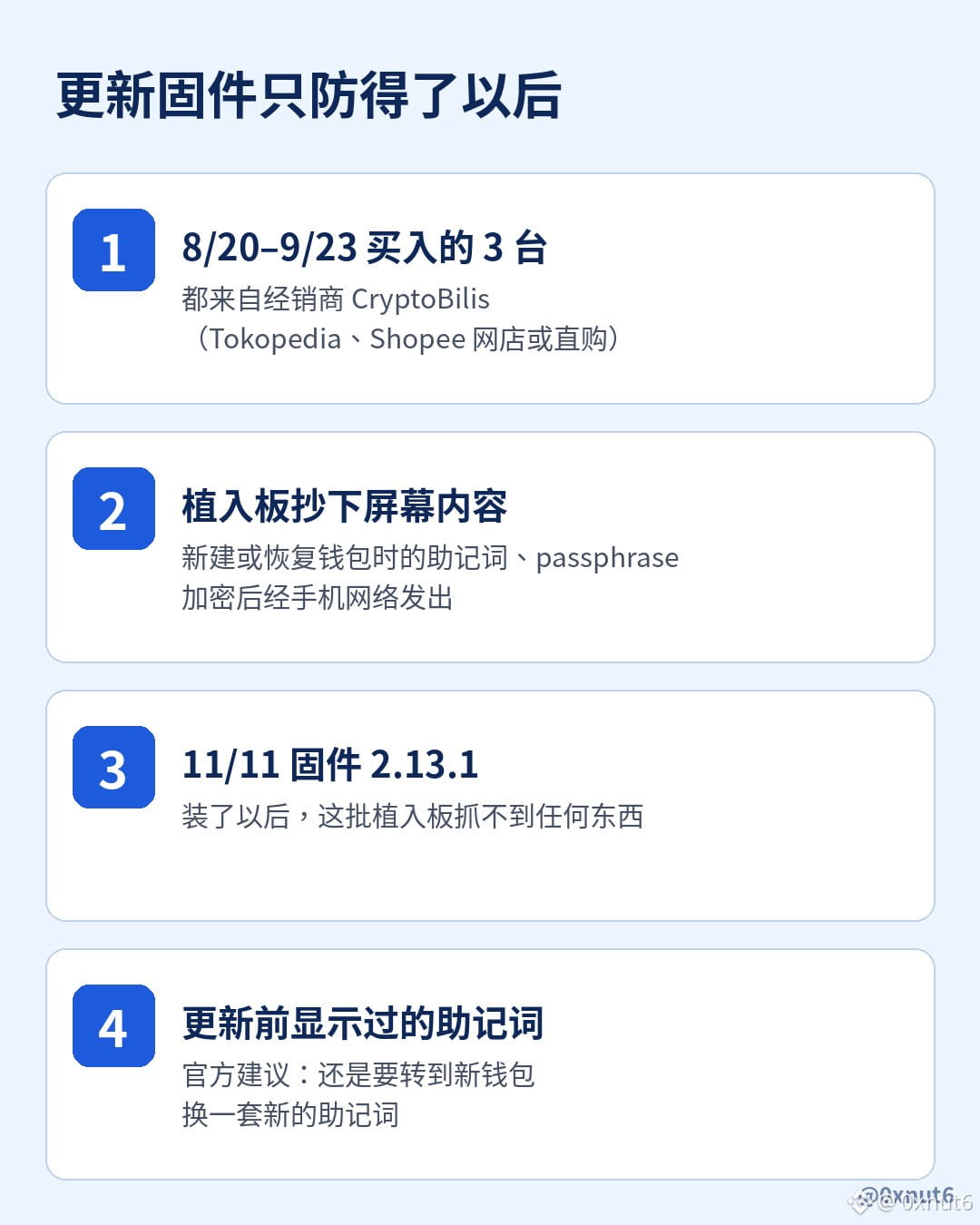
Hardware wallet maker Trezor confirmed on November 12 that a circuit board designed to steal recovery phrases had been installed inside three Safe 5 devices. All three were purchased between August 20 and September 23. Some were bought from CryptoBilis’s online stores on Tokopedia and Shopee, while others were purchased directly from CryptoBilis.
The board was wedged between the mainboard and the screen, where it copied everything displayed on the screen. It saved the recovery phrase shown during wallet creation, the phrase entered on the device when restoring a wallet, and the passphrase. The data was encrypted and sent over the mobile network to the attacker’s server; if it couldn’t connect, it kept trying. The board didn’t modify the firmware or tamper with the secure chip.
Trezor released firmware version 2.13.1 on November 11. Once installed, this update prevents the implanted boards from capturing anything. However, Trezor also said that a firmware update can’t protect recovery phrases that were already copied before the update. So anyone who bought a device from CryptoBilis should transfer their coins to a new wallet and use a new recovery phrase.
So far, 48 CryptoBilis customers have contacted Trezor. Some devices have been sent to a lab for inspection, while others have been checked using internal photos. Aside from the three devices, none of the other devices inspected showed signs of tampering, and no one has reported losing coins. Trezor has reduced its business with the distributor by about 80%. People who bought from CryptoBilis after March 2026 can apply for a replacement device. Trezor also warns that scammers may impersonate the company and send replacement or refund notices. Trezor will never ask users for their recovery phrases.
45
Log in to explore more content
Join global crypto users on Binance Square
⚡️ Get latest and useful information about crypto.
💬 Trusted by the world’s largest crypto exchange.
👍 Discover real insights from verified creators.
Email / Phone number
Trending Topics
IsAnthropic’s$1.5TMarketCapJustified?
2,385 views
21 Discussing
Anthropic Set to Open at $105 in Record Nasdaq Debut
Binance News
·1 Likes
·2k views
BTCRemainsUnderPressureAfterHawkishFOMCMinutes
165,672 views
1,760 Discussing
NvidiaBoardReportedlySplitOverHuang’sReturn
79,178 views
913 Discussing