

Crypto Pulse Media
1.9k Posts

Crypto Pulse Media
Report
Block User
Real-Time Crypto Market Intelligence Bitcoin • Altcoins • Web3 • Blockchain Global Coverage | Data-Driven Insights Crypto Pulse Media – Stay Ahead of the Market
734 Following
522 Followers
610 Liked
Posts
Article
See translation
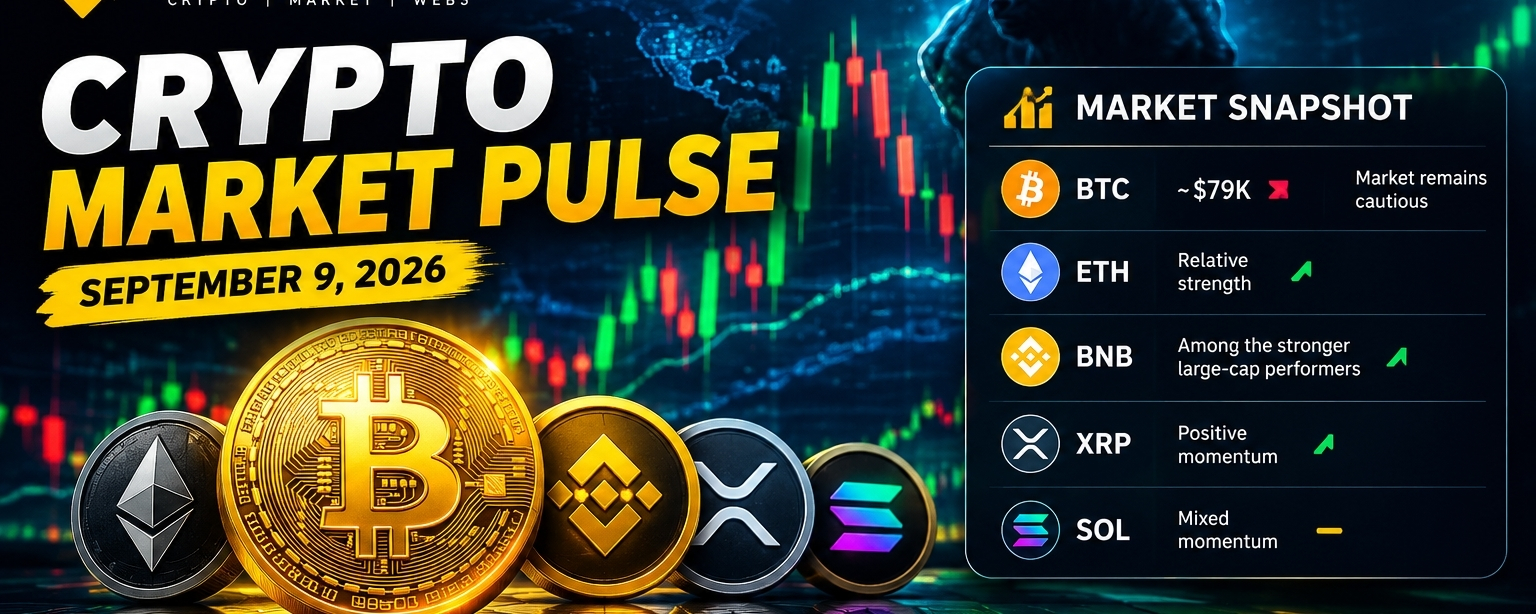
Bitcoin is showing resilience after recent volatility, with BTC trading around the **$79K area** tod🚨 **CRYPTO MARKET PULSE — SEPTEMBER 9, 2026**
📈 **Market Snapshot**
• **BTC:** around $79K — market remains cautious
• **ETH:** showing relative strength
• **BNB:** among the stronger large-cap performers
• **XRP:** also seeing positive momentum
• **SOL:** trading with mixed momentum
🔥 **What’s Driving the Market?**
Global markets are watching rising geopolitical tensions and higher oil prices, while investors are also looking ahead to the next **U.S. Federal Reserve decision** and upcoming inflation data.
Bitcoin recently moved above $80K before pulling back, keeping the key psychological zone firmly in focus. Meanwhile, recent Bitcoin ETF inflows suggest institutional demand has not disappeared despite the volatility. ([Reuters][1])
🎯 **Key Levels to Watch**
For BTC, the **$80K zone** remains an important psychological area. A sustained move above it could improve market sentiment, while renewed selling pressure could bring volatility back quickly.
⚠️ **Market Reminder**
Crypto can move fast. Don't chase pumps blindly—watch volume, liquidity, macro news and key support/resistance levels before making decisions.
What do you think: **BTC back above $80K soon, or another pullback first? 👇**
#Bitcoin #BTC #Ethereum #ETH #BNB #XRP #Crypto #CryptoMarket #BinanceSquare #CryptoPulseMedia
Bitcoin is showing resilience after recent volatility, with BTC trading around the **$79K area** tod
🚨 **CRYPTO MARKET PULSE — SEPTEMBER 9, 2026**
📈 **Market Snapshot**
• **BTC:** around $79K — market remains cautious
• **ETH:** showing relative strength
• **BNB:** among the stronger large-cap performers
• **XRP:** also seeing positive momentum
• **SOL:** trading with mixed momentum
🔥 **What’s Driving the Market?**
Global markets are watching rising geopolitical tensions and higher oil prices, while investors are also looking ahead to the next **U.S. Federal Reserve decision** and upcoming inflation data.
Bitcoin recently moved above $80K before pulling back, keeping the key psychological zone firmly in focus. Meanwhile, recent Bitcoin ETF inflows suggest institutional demand has not disappeared despite the volatility. ([Reuters][1])
🎯 **Key Levels to Watch**
For BTC, the **$80K zone** remains an important psychological area. A sustained move above it could improve market sentiment, while renewed selling pressure could bring volatility back quickly.
⚠️ **Market Reminder**
Crypto can move fast. Don't chase pumps blindly—watch volume, liquidity, macro news and key support/resistance levels before making decisions.
What do you think: **BTC back above $80K soon, or another pullback first? 👇**
#Bitcoin #BTC #Ethereum #ETH #BNB #XRP #Crypto #CryptoMarket #BinanceSquare #CryptoPulseMedia
📈 **Market Snapshot**
• **BTC:** around $79K — market remains cautious
• **ETH:** showing relative strength
• **BNB:** among the stronger large-cap performers
• **XRP:** also seeing positive momentum
• **SOL:** trading with mixed momentum
🔥 **What’s Driving the Market?**
Global markets are watching rising geopolitical tensions and higher oil prices, while investors are also looking ahead to the next **U.S. Federal Reserve decision** and upcoming inflation data.
Bitcoin recently moved above $80K before pulling back, keeping the key psychological zone firmly in focus. Meanwhile, recent Bitcoin ETF inflows suggest institutional demand has not disappeared despite the volatility. ([Reuters][1])
🎯 **Key Levels to Watch**
For BTC, the **$80K zone** remains an important psychological area. A sustained move above it could improve market sentiment, while renewed selling pressure could bring volatility back quickly.
⚠️ **Market Reminder**
Crypto can move fast. Don't chase pumps blindly—watch volume, liquidity, macro news and key support/resistance levels before making decisions.
What do you think: **BTC back above $80K soon, or another pullback first? 👇**
#Bitcoin #BTC #Ethereum #ETH #BNB #XRP #Crypto #CryptoMarket #BinanceSquare #CryptoPulseMedia
2
315
Article
See translation
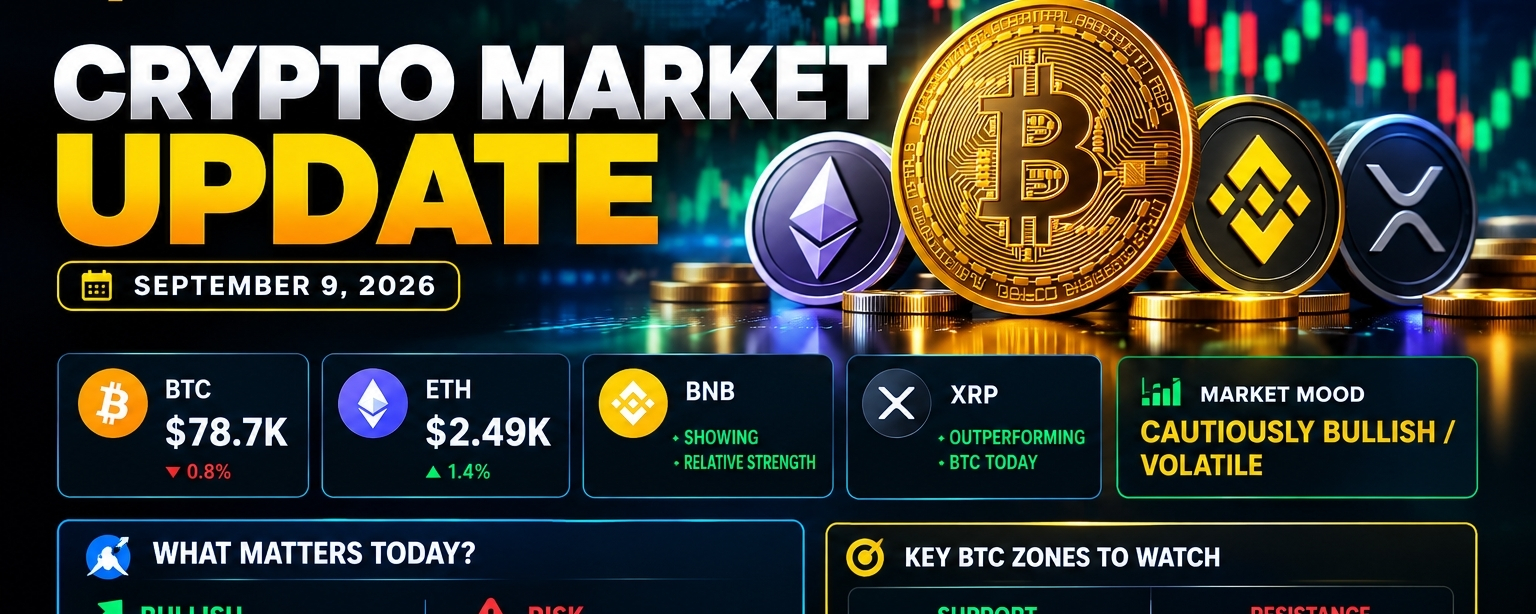
Bitcoin is trading around **$78.5K–$78.8K**, staying below the recent $82K+ high as traders remain c🚨 **CRYPTO MARKET UPDATE — SEPTEMBER 9, 2026**
🔹 **BTC:** ~$78.7K
🔹 **ETH:** ~$2.49K
🔹 **BNB:** showing relative strength
🔹 **XRP:** also outperforming BTC today
🔹 **Market mood:** Cautiously bullish / volatile
📌 **What matters today?**
The crypto market is being pulled in two directions:
➡️ **Bullish:** Bitcoin remains well above the levels that supported its recent rally, while institutional BTC ETF flows have recently shown strong demand. ([The Wall Street Journal][2])
➡️ **Risk:** Higher oil prices and renewed geopolitical tensions are increasing inflation concerns, which could pressure risk assets if markets expect tighter monetary policy.
🎯 **Key BTC zones to watch:**
**Support:** $75K–$76K
**Resistance:** $80K–$82K
A clean break above $82K could strengthen the bullish setup, while losing the mid-$70Ks would increase downside risk.
⚠️ **Not financial advice. Crypto is highly volatile. Always do your own research.**
💬 **Where do you think BTC goes next — $82K+ or back toward $75K?**
#writ2 #BTC走势分析 #XRP #Crypto #CryptoMarket #BinanceSquare #CryptoPulseMedia
Bitcoin is trading around **$78.5K–$78.8K**, staying below the recent $82K+ high as traders remain c
🚨 **CRYPTO MARKET UPDATE — SEPTEMBER 9, 2026**
🔹 **BTC:** ~$78.7K
🔹 **ETH:** ~$2.49K
🔹 **BNB:** showing relative strength
🔹 **XRP:** also outperforming BTC today
🔹 **Market mood:** Cautiously bullish / volatile
📌 **What matters today?**
The crypto market is being pulled in two directions:
➡️ **Bullish:** Bitcoin remains well above the levels that supported its recent rally, while institutional BTC ETF flows have recently shown strong demand. ([The Wall Street Journal][2])
➡️ **Risk:** Higher oil prices and renewed geopolitical tensions are increasing inflation concerns, which could pressure risk assets if markets expect tighter monetary policy.
🎯 **Key BTC zones to watch:**
**Support:** $75K–$76K
**Resistance:** $80K–$82K
A clean break above $82K could strengthen the bullish setup, while losing the mid-$70Ks would increase downside risk.
⚠️ **Not financial advice. Crypto is highly volatile. Always do your own research.**
💬 **Where do you think BTC goes next — $82K+ or back toward $75K?**
#writ2 #BTC走势分析 #XRP #Crypto #CryptoMarket #BinanceSquare #CryptoPulseMedia
🔹 **BTC:** ~$78.7K
🔹 **ETH:** ~$2.49K
🔹 **BNB:** showing relative strength
🔹 **XRP:** also outperforming BTC today
🔹 **Market mood:** Cautiously bullish / volatile
📌 **What matters today?**
The crypto market is being pulled in two directions:
➡️ **Bullish:** Bitcoin remains well above the levels that supported its recent rally, while institutional BTC ETF flows have recently shown strong demand. ([The Wall Street Journal][2])
➡️ **Risk:** Higher oil prices and renewed geopolitical tensions are increasing inflation concerns, which could pressure risk assets if markets expect tighter monetary policy.
🎯 **Key BTC zones to watch:**
**Support:** $75K–$76K
**Resistance:** $80K–$82K
A clean break above $82K could strengthen the bullish setup, while losing the mid-$70Ks would increase downside risk.
⚠️ **Not financial advice. Crypto is highly volatile. Always do your own research.**
💬 **Where do you think BTC goes next — $82K+ or back toward $75K?**
#writ2 #BTC走势分析 #XRP #Crypto #CryptoMarket #BinanceSquare #CryptoPulseMedia
299
Article
See translation
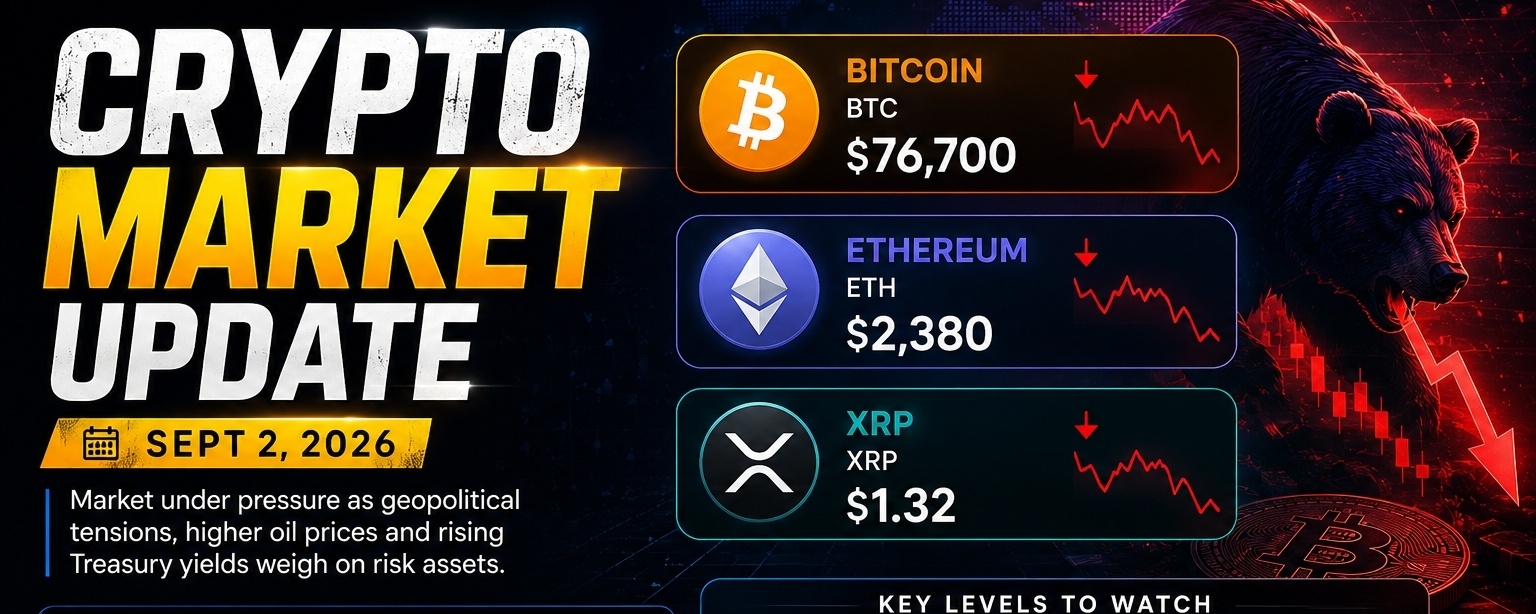
Bitcoin is facing fresh selling pressure after its strong August rally.BTC: ~$76.7K
🔷 ETH: ~$2.38K
💵 XRP: ~$1.32
The market is reacting to renewed geopolitical tensions, higher oil prices and rising Treasury yields. Risk assets are under pressure as traders reassess expectations for interest rates.
📌 Key levels to watch:
• BTC: $76K–$77K support zone
• $79K–$80K remains a major resistance area
• ETH needs to reclaim $2.4K+ for stronger momentum
September volatility is here. Stay patient, manage risk, and watch the macro data. 👀
#Bitcoin #BTC #Ethereum #ETH #Crypto #CryptoMarket #Altcoins #Web3
Bitcoin is facing fresh selling pressure after its strong August rally.
BTC: ~$76.7K
🔷 ETH: ~$2.38K
💵 XRP: ~$1.32
The market is reacting to renewed geopolitical tensions, higher oil prices and rising Treasury yields. Risk assets are under pressure as traders reassess expectations for interest rates.
📌 Key levels to watch:
• BTC: $76K–$77K support zone
• $79K–$80K remains a major resistance area
• ETH needs to reclaim $2.4K+ for stronger momentum
September volatility is here. Stay patient, manage risk, and watch the macro data. 👀
#Bitcoin #BTC #Ethereum #ETH #Crypto #CryptoMarket #Altcoins #Web3
🔷 ETH: ~$2.38K
💵 XRP: ~$1.32
The market is reacting to renewed geopolitical tensions, higher oil prices and rising Treasury yields. Risk assets are under pressure as traders reassess expectations for interest rates.
📌 Key levels to watch:
• BTC: $76K–$77K support zone
• $79K–$80K remains a major resistance area
• ETH needs to reclaim $2.4K+ for stronger momentum
September volatility is here. Stay patient, manage risk, and watch the macro data. 👀
#Bitcoin #BTC #Ethereum #ETH #Crypto #CryptoMarket #Altcoins #Web3
1
85
Article
See translation
Current market conditions are showing some weakness after the recent rally. Bitcoin is trading arounMacro risk is also back in focus: rising oil prices, stronger Treasury yields, and increased expectations of a September Fed rate hike are putting pressure on risk assets, including crypto. ([Reuters][2])
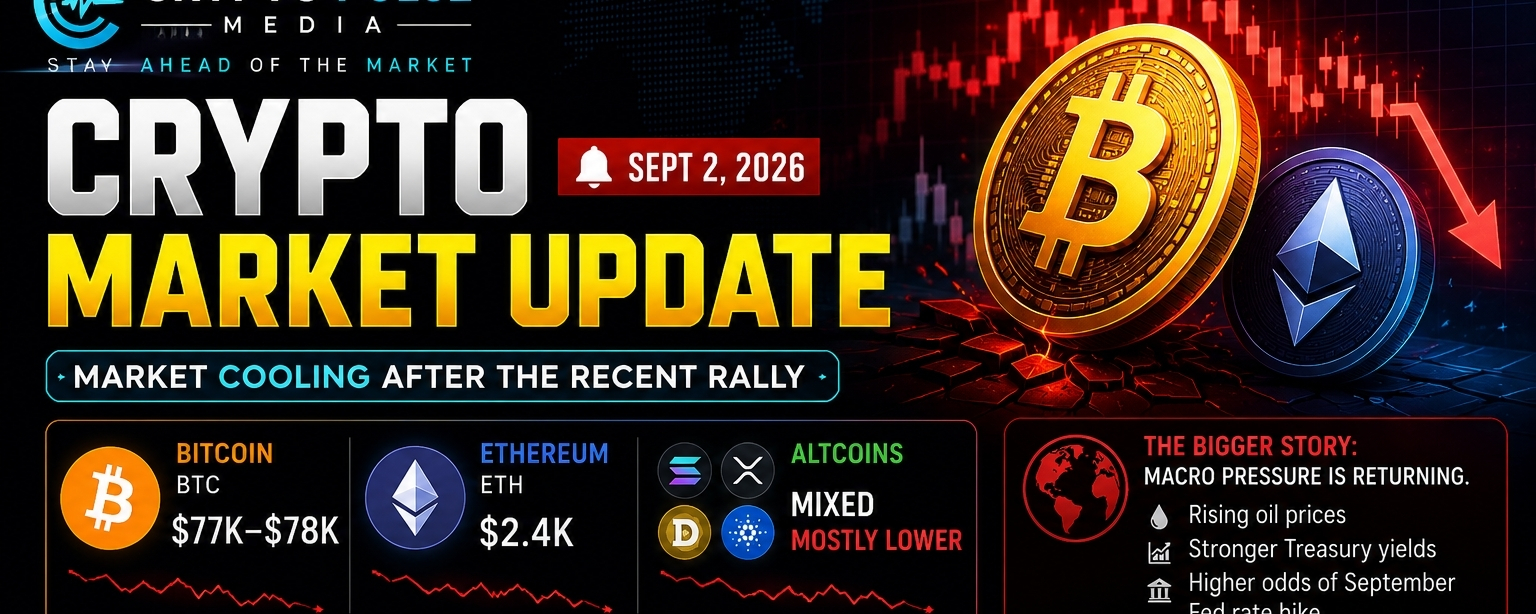
🚨 CRYPTO MARKET UPDATE — SEPTEMBER 2, 2026
Bitcoin is cooling near the $77K–$78K zone after its recent rally. Ethereum is holding around $2.4K, while several major altcoins are seeing deeper pullbacks.
🌍 The bigger story: macro pressure is returning.
• BTC: ~$77K–$78K
• ETH: ~$2.4K
• Altcoins: Mixed → mostly lower
• Market mood: Cautious
• Key driver: Fed + inflation + geopolitical risk
The next move could depend heavily on liquidity and upcoming U.S. economic data.
📌 Watch the $77K area on BTC closely.
A strong recovery could bring momentum back, while continued weakness may open the door to another downside move.
What do you think comes next — 📈 recovery or 📉 deeper correction?
#Bitcoin #BTC #Ethereum #ETH#Write2Earn #Altcoins #Web3 #Blockchain #
Current market conditions are showing some weakness after the recent rally. Bitcoin is trading aroun
Macro risk is also back in focus: rising oil prices, stronger Treasury yields, and increased expectations of a September Fed rate hike are putting pressure on risk assets, including crypto. ([Reuters][2])
🚨 CRYPTO MARKET UPDATE — SEPTEMBER 2, 2026
Bitcoin is cooling near the $77K–$78K zone after its recent rally. Ethereum is holding around $2.4K, while several major altcoins are seeing deeper pullbacks.
🌍 The bigger story: macro pressure is returning.
• BTC: ~$77K–$78K
• ETH: ~$2.4K
• Altcoins: Mixed → mostly lower
• Market mood: Cautious
• Key driver: Fed + inflation + geopolitical risk
The next move could depend heavily on liquidity and upcoming U.S. economic data.
📌 Watch the $77K area on BTC closely.
A strong recovery could bring momentum back, while continued weakness may open the door to another downside move.
What do you think comes next — 📈 recovery or 📉 deeper correction?
#Bitcoin #BTC #Ethereum #ETH#Write2Earn #Altcoins #Web3 #Blockchain #
🚨 CRYPTO MARKET UPDATE — SEPTEMBER 2, 2026
Bitcoin is cooling near the $77K–$78K zone after its recent rally. Ethereum is holding around $2.4K, while several major altcoins are seeing deeper pullbacks.
🌍 The bigger story: macro pressure is returning.
• BTC: ~$77K–$78K
• ETH: ~$2.4K
• Altcoins: Mixed → mostly lower
• Market mood: Cautious
• Key driver: Fed + inflation + geopolitical risk
The next move could depend heavily on liquidity and upcoming U.S. economic data.
📌 Watch the $77K area on BTC closely.
A strong recovery could bring momentum back, while continued weakness may open the door to another downside move.
What do you think comes next — 📈 recovery or 📉 deeper correction?
#Bitcoin #BTC #Ethereum #ETH#Write2Earn #Altcoins #Web3 #Blockchain #
98
Article
See translation
Today’s market is showing weakness: Bitcoin is around **$77K–$78K**, while Ethereum is around **$2.4Bitcoin is facing renewed selling pressure as BTC struggles to hold the $78K area.
📉 BTC: ~$77K–$78K
📉 ETH: ~$2.4K
📉 SOL: ~$99
📉 XRP: ~$1.35
The bigger story: risk assets are feeling pressure as markets reassess the path of U.S. interest rates.
September has historically been a difficult month for Bitcoin, so volatility could remain elevated.
👀 Key things to watch:
• BTC reclaiming $80K
• ETH holding the $2.4K zone
• U.S. rate expectations
• Institutional crypto flows
• Altcoin strength vs. BTC
No panic. No FOMO. Watch the levels. 📊
#Bitcoin #BTC #Ethereum #ETH #Crypto #CryptoNews #Altcoins #Web3 #CryptoMarket #CryptoPulseMedia
Today’s market is showing weakness: Bitcoin is around **$77K–$78K**, while Ethereum is around **$2.4
Bitcoin is facing renewed selling pressure as BTC struggles to hold the $78K area.
📉 BTC: ~$77K–$78K
📉 ETH: ~$2.4K
📉 SOL: ~$99
📉 XRP: ~$1.35
The bigger story: risk assets are feeling pressure as markets reassess the path of U.S. interest rates.
September has historically been a difficult month for Bitcoin, so volatility could remain elevated.
👀 Key things to watch:
• BTC reclaiming $80K
• ETH holding the $2.4K zone
• U.S. rate expectations
• Institutional crypto flows
• Altcoin strength vs. BTC
No panic. No FOMO. Watch the levels. 📊
#Bitcoin #BTC #Ethereum #ETH #Crypto #CryptoNews #Altcoins #Web3 #CryptoMarket #CryptoPulseMedia
📉 BTC: ~$77K–$78K
📉 ETH: ~$2.4K
📉 SOL: ~$99
📉 XRP: ~$1.35
The bigger story: risk assets are feeling pressure as markets reassess the path of U.S. interest rates.
September has historically been a difficult month for Bitcoin, so volatility could remain elevated.
👀 Key things to watch:
• BTC reclaiming $80K
• ETH holding the $2.4K zone
• U.S. rate expectations
• Institutional crypto flows
• Altcoin strength vs. BTC
No panic. No FOMO. Watch the levels. 📊
#Bitcoin #BTC #Ethereum #ETH #Crypto #CryptoNews #Altcoins #Web3 #CryptoMarket #CryptoPulseMedia
109
Article
See translation
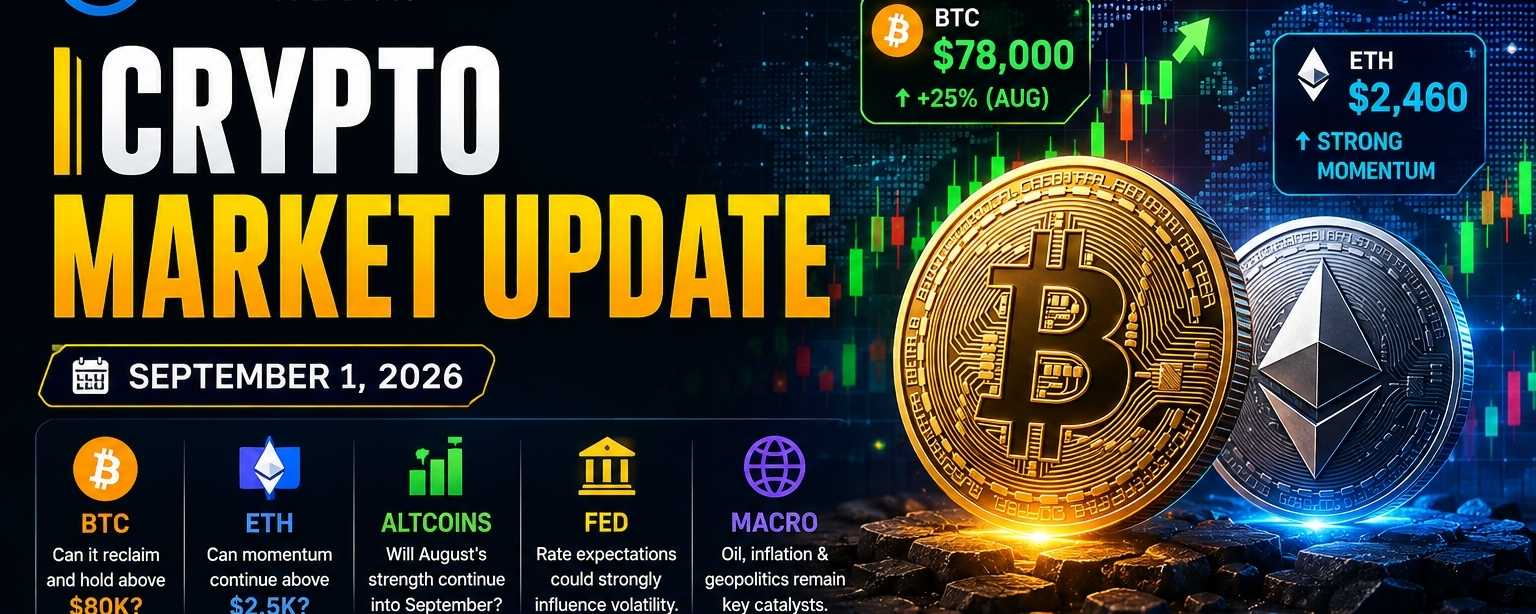
Bitcoin is holding around **$78K** after a powerful August rally. BTC gained roughly **25% in Augustthereum is trading around **$2.45K–$2.46K**, while ETH has also posted a strong monthly recovery. ([Fortune][2])
But September begins with a new challenge: **rising oil prices, inflation concerns and growing expectations of a Federal Reserve rate hike** are creating pressure across risk assets. Current market expectations put the probability of a September hike around **65–66%**.
**What traders should watch 👀**
* 🟠 BTC: Can it reclaim and hold above **$80K**?
* 🔵 ETH: Can momentum continue above **$2.5K**?
* 📈 Altcoins: Will August's strength continue into September?
* 🏦 Fed: Rate expectations could strongly influence crypto volatility.
* 🌍 Macro: Oil, inflation and geopolitical developments remain important catalysts.
**Market takeaway:**
The crypto market enters September with strong momentum, but the macro environment is becoming more challenging. A breakout above key resistance could attract fresh buyers, while a rejection may trigger another round of volatility.
**Trade smart. Manage risk. Never chase the market.** ⚡
#Crypto #Bitcoin #BTC #Ethereum #ETH #Altcoins #CryptoMarket #BinanceSquare #Web3 #Blockchain #CryptoNews
Bitcoin is holding around **$78K** after a powerful August rally. BTC gained roughly **25% in August
thereum is trading around **$2.45K–$2.46K**, while ETH has also posted a strong monthly recovery. ([Fortune][2])
But September begins with a new challenge: **rising oil prices, inflation concerns and growing expectations of a Federal Reserve rate hike** are creating pressure across risk assets. Current market expectations put the probability of a September hike around **65–66%**.
**What traders should watch 👀**
* 🟠 BTC: Can it reclaim and hold above **$80K**?
* 🔵 ETH: Can momentum continue above **$2.5K**?
* 📈 Altcoins: Will August's strength continue into September?
* 🏦 Fed: Rate expectations could strongly influence crypto volatility.
* 🌍 Macro: Oil, inflation and geopolitical developments remain important catalysts.
**Market takeaway:**
The crypto market enters September with strong momentum, but the macro environment is becoming more challenging. A breakout above key resistance could attract fresh buyers, while a rejection may trigger another round of volatility.
**Trade smart. Manage risk. Never chase the market.** ⚡
#Crypto #Bitcoin #BTC #Ethereum #ETH #Altcoins #CryptoMarket #BinanceSquare #Web3 #Blockchain #CryptoNews
But September begins with a new challenge: **rising oil prices, inflation concerns and growing expectations of a Federal Reserve rate hike** are creating pressure across risk assets. Current market expectations put the probability of a September hike around **65–66%**.
**What traders should watch 👀**
* 🟠 BTC: Can it reclaim and hold above **$80K**?
* 🔵 ETH: Can momentum continue above **$2.5K**?
* 📈 Altcoins: Will August's strength continue into September?
* 🏦 Fed: Rate expectations could strongly influence crypto volatility.
* 🌍 Macro: Oil, inflation and geopolitical developments remain important catalysts.
**Market takeaway:**
The crypto market enters September with strong momentum, but the macro environment is becoming more challenging. A breakout above key resistance could attract fresh buyers, while a rejection may trigger another round of volatility.
**Trade smart. Manage risk. Never chase the market.** ⚡
#Crypto #Bitcoin #BTC #Ethereum #ETH #Altcoins #CryptoMarket #BinanceSquare #Web3 #Blockchain #CryptoNews
41
Article
See translation
Current data shows BTC around **$78K**, with ETH around **$2.45K**. Bitcoin is holding below the key CRYPTO MARKET UPDATE — SEPT 1, 2026
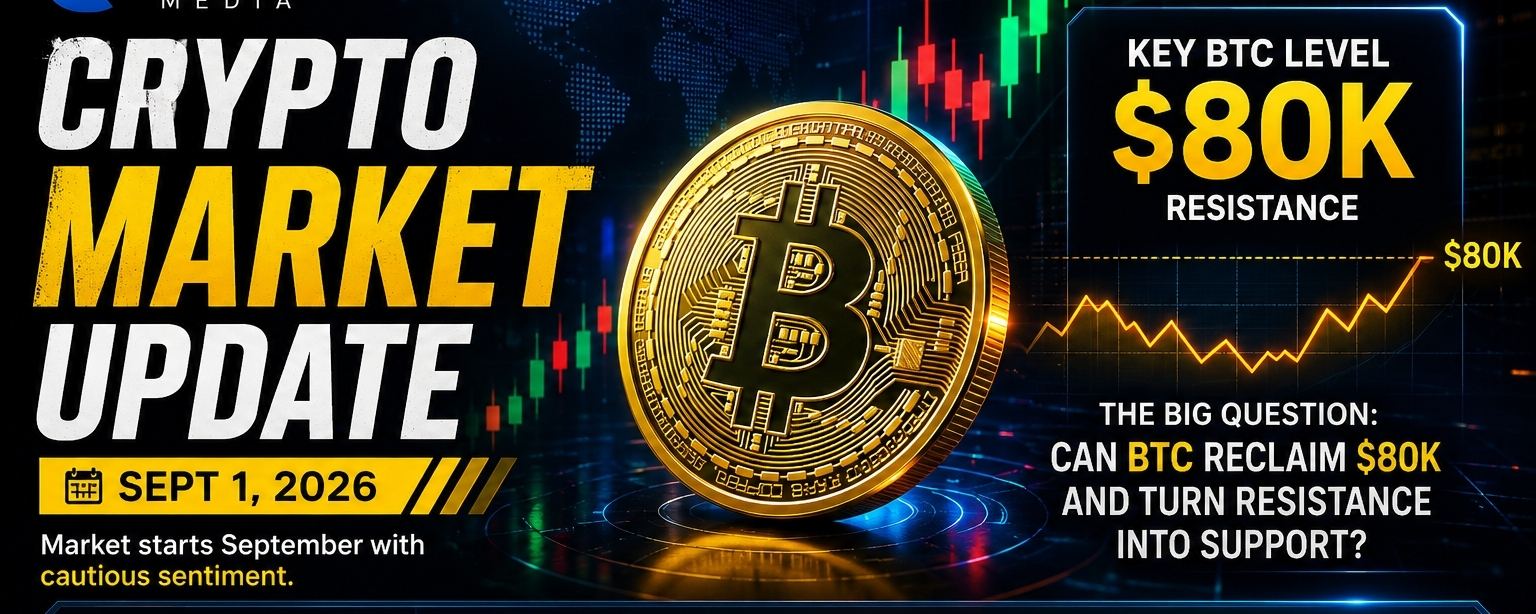
Bitcoin is hovering around the $78K zone as the market starts September with cautious sentiment.
📉 BTC: ~$78K
⚡ ETH: ~$2.45K
🎯 Key BTC level: $80K
🌍 Macro + Fed expectations remain major catalysts
The big question: can BTC reclaim $80K and turn resistance into support?
September could bring some serious volatility. Stay alert. 👀
#Bitcoin #BTC #Ethereum #ETH #Crypto #CryptoMarket #Altcoins
Current data shows BTC around **$78K**, with ETH around **$2.45K**. Bitcoin is holding below the key
CRYPTO MARKET UPDATE — SEPT 1, 2026
Bitcoin is hovering around the $78K zone as the market starts September with cautious sentiment.
📉 BTC: ~$78K
⚡ ETH: ~$2.45K
🎯 Key BTC level: $80K
🌍 Macro + Fed expectations remain major catalysts
The big question: can BTC reclaim $80K and turn resistance into support?
September could bring some serious volatility. Stay alert. 👀
#Bitcoin #BTC #Ethereum #ETH #Crypto #CryptoMarket #Altcoins
Bitcoin is hovering around the $78K zone as the market starts September with cautious sentiment.
📉 BTC: ~$78K
⚡ ETH: ~$2.45K
🎯 Key BTC level: $80K
🌍 Macro + Fed expectations remain major catalysts
The big question: can BTC reclaim $80K and turn resistance into support?
September could bring some serious volatility. Stay alert. 👀
#Bitcoin #BTC #Ethereum #ETH #Crypto #CryptoMarket #Altcoins
20
Article
See translation
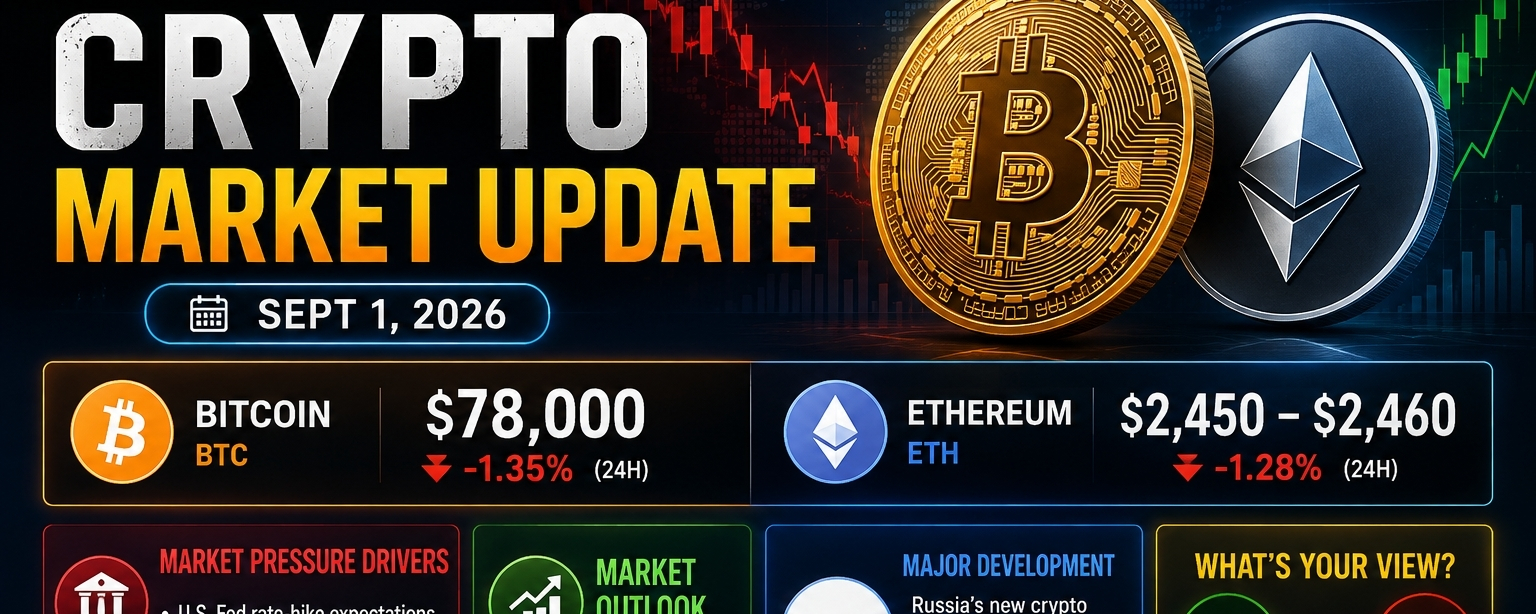
Bitcoin is trading around the **$78K area**, while Ethereum is around **$2.45K–$2.46K**. The marketA major development today: **Russia’s new crypto rules take effect**, allowing BTC, ETH and USDT to play a role in its regulated digital-asset market.
🚨 CRYPTO MARKET UPDATE | SEPT 1
Bitcoin is holding near the $78K zone while Ethereum trades around $2.45K–$2.46K.
📉 Market pressure is rising as traders watch:
• U.S. Fed rate-hike expectations
• Inflation & oil prices
• Geopolitical tensions
• Key economic data ahead
🇷🇺 Meanwhile, Russia’s new crypto framework is now taking effect, bringing BTC, ETH & USDT further into its regulated digital-asset market.
The market is still volatile. Watch BTC’s $78K area closely. 👀
What’s your view for September — 🐂 Bullish or 🐻 Bearish?
#Bitcoin #BTC #Ethereum #ETH #Crypto #CryptoNews #Blockchain #Winnan
Bitcoin is trading around the **$78K area**, while Ethereum is around **$2.45K–$2.46K**. The market
A major development today: **Russia’s new crypto rules take effect**, allowing BTC, ETH and USDT to play a role in its regulated digital-asset market.
🚨 CRYPTO MARKET UPDATE | SEPT 1
Bitcoin is holding near the $78K zone while Ethereum trades around $2.45K–$2.46K.
📉 Market pressure is rising as traders watch:
• U.S. Fed rate-hike expectations
• Inflation & oil prices
• Geopolitical tensions
• Key economic data ahead
🇷🇺 Meanwhile, Russia’s new crypto framework is now taking effect, bringing BTC, ETH & USDT further into its regulated digital-asset market.
The market is still volatile. Watch BTC’s $78K area closely. 👀
What’s your view for September — 🐂 Bullish or 🐻 Bearish?
#Bitcoin #BTC #Ethereum #ETH #Crypto #CryptoNews #Blockchain #Winnan
🚨 CRYPTO MARKET UPDATE | SEPT 1
Bitcoin is holding near the $78K zone while Ethereum trades around $2.45K–$2.46K.
📉 Market pressure is rising as traders watch:
• U.S. Fed rate-hike expectations
• Inflation & oil prices
• Geopolitical tensions
• Key economic data ahead
🇷🇺 Meanwhile, Russia’s new crypto framework is now taking effect, bringing BTC, ETH & USDT further into its regulated digital-asset market.
The market is still volatile. Watch BTC’s $78K area closely. 👀
What’s your view for September — 🐂 Bullish or 🐻 Bearish?
#Bitcoin #BTC #Ethereum #ETH #Crypto #CryptoNews #Blockchain #Winnan
11
Article
See translation
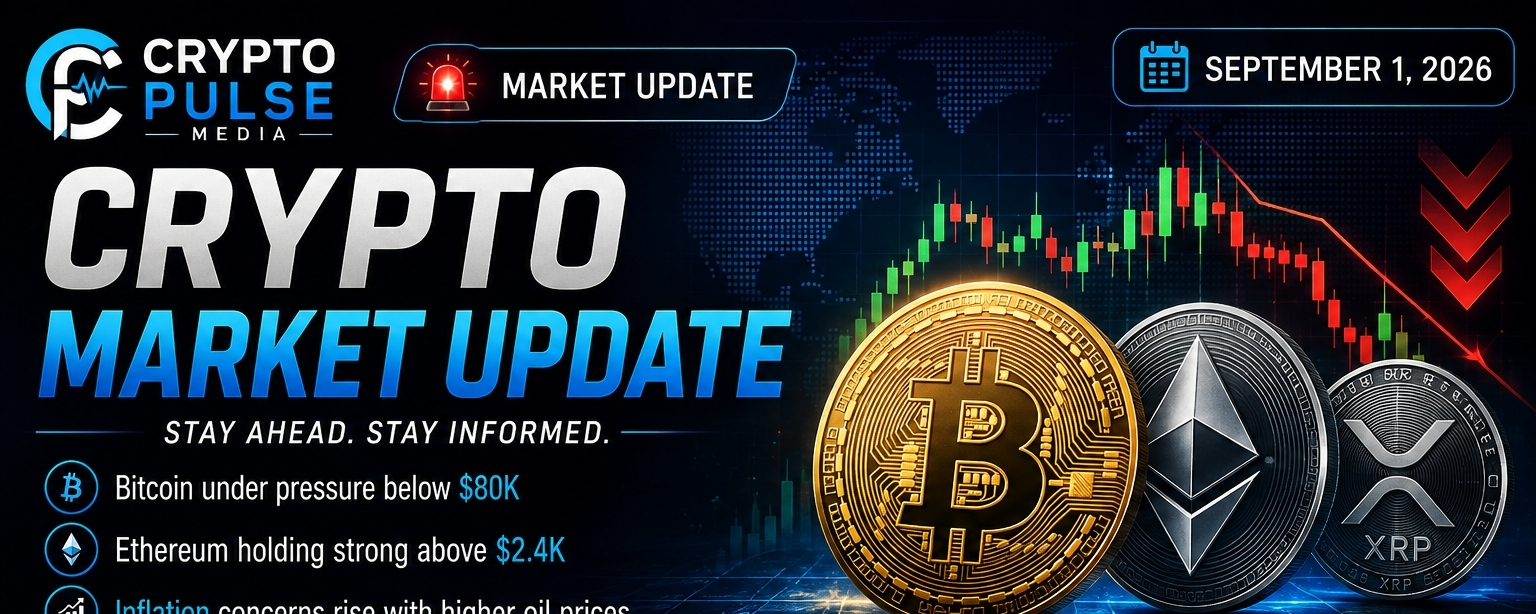
Bitcoin is starting September under pressure as macroeconomic uncertainty weighs on risk assets.₿ **BTC:** around $78K
🔷 **ETH:** around $2.45K
💵 **XRP:** around $1.38
📉 **What’s moving the market?**
• Bitcoin remains below the important $80K psychological level.
• Ethereum is holding above $2.4K after a strong monthly recovery.
• Rising oil prices are increasing inflation concerns.
• Markets are increasingly watching the possibility of a U.S. rate hike this month.
• Crypto traders are waiting for more macroeconomic signals before making aggressive moves.
🌍 **A major regulatory development:** Russia’s new crypto framework takes effect today, allowing regulated access to BTC, ETH and USDT under strict conditions.
🎯 **Market takeaway:**
September could bring higher volatility. BTC holding the $77K–$78K area while attempting to reclaim $80K could be an important short-term zone to watch.
⚠️ Crypto markets move fast. This is market commentary, not financial advice.
What do you think — **BTC above $80K again soon, or another correction first?** 👇
#Bitcoin #BTC #Ethereum #ETH #Crypto #CryptoNews #Binance #BinanceSquare #Altcoins #Web3 #Blockchain #CryptoMarket
Bitcoin is starting September under pressure as macroeconomic uncertainty weighs on risk assets.
₿ **BTC:** around $78K
🔷 **ETH:** around $2.45K
💵 **XRP:** around $1.38
📉 **What’s moving the market?**
• Bitcoin remains below the important $80K psychological level.
• Ethereum is holding above $2.4K after a strong monthly recovery.
• Rising oil prices are increasing inflation concerns.
• Markets are increasingly watching the possibility of a U.S. rate hike this month.
• Crypto traders are waiting for more macroeconomic signals before making aggressive moves.
🌍 **A major regulatory development:** Russia’s new crypto framework takes effect today, allowing regulated access to BTC, ETH and USDT under strict conditions.
🎯 **Market takeaway:**
September could bring higher volatility. BTC holding the $77K–$78K area while attempting to reclaim $80K could be an important short-term zone to watch.
⚠️ Crypto markets move fast. This is market commentary, not financial advice.
What do you think — **BTC above $80K again soon, or another correction first?** 👇
#Bitcoin #BTC #Ethereum #ETH #Crypto #CryptoNews #Binance #BinanceSquare #Altcoins #Web3 #Blockchain #CryptoMarket
🔷 **ETH:** around $2.45K
💵 **XRP:** around $1.38
📉 **What’s moving the market?**
• Bitcoin remains below the important $80K psychological level.
• Ethereum is holding above $2.4K after a strong monthly recovery.
• Rising oil prices are increasing inflation concerns.
• Markets are increasingly watching the possibility of a U.S. rate hike this month.
• Crypto traders are waiting for more macroeconomic signals before making aggressive moves.
🌍 **A major regulatory development:** Russia’s new crypto framework takes effect today, allowing regulated access to BTC, ETH and USDT under strict conditions.
🎯 **Market takeaway:**
September could bring higher volatility. BTC holding the $77K–$78K area while attempting to reclaim $80K could be an important short-term zone to watch.
⚠️ Crypto markets move fast. This is market commentary, not financial advice.
What do you think — **BTC above $80K again soon, or another correction first?** 👇
#Bitcoin #BTC #Ethereum #ETH #Crypto #CryptoNews #Binance #BinanceSquare #Altcoins #Web3 #Blockchain #CryptoMarket
18
Article
See translation
Bitcoin is trading around **$78K**, while Ethereum is around **$2.45K–$2.46K**. BTC remains below thThe bigger story today is **interest-rate expectations**. Markets are increasingly pricing in a possible U.S. Fed rate hike this month, while rising oil prices and geopolitical tensions are adding to inflation concerns.
At the same time, **Russia's new crypto regulatory framework takes effect today**, with Bitcoin, Ethereum and USDT receiving a defined role under the new framework.
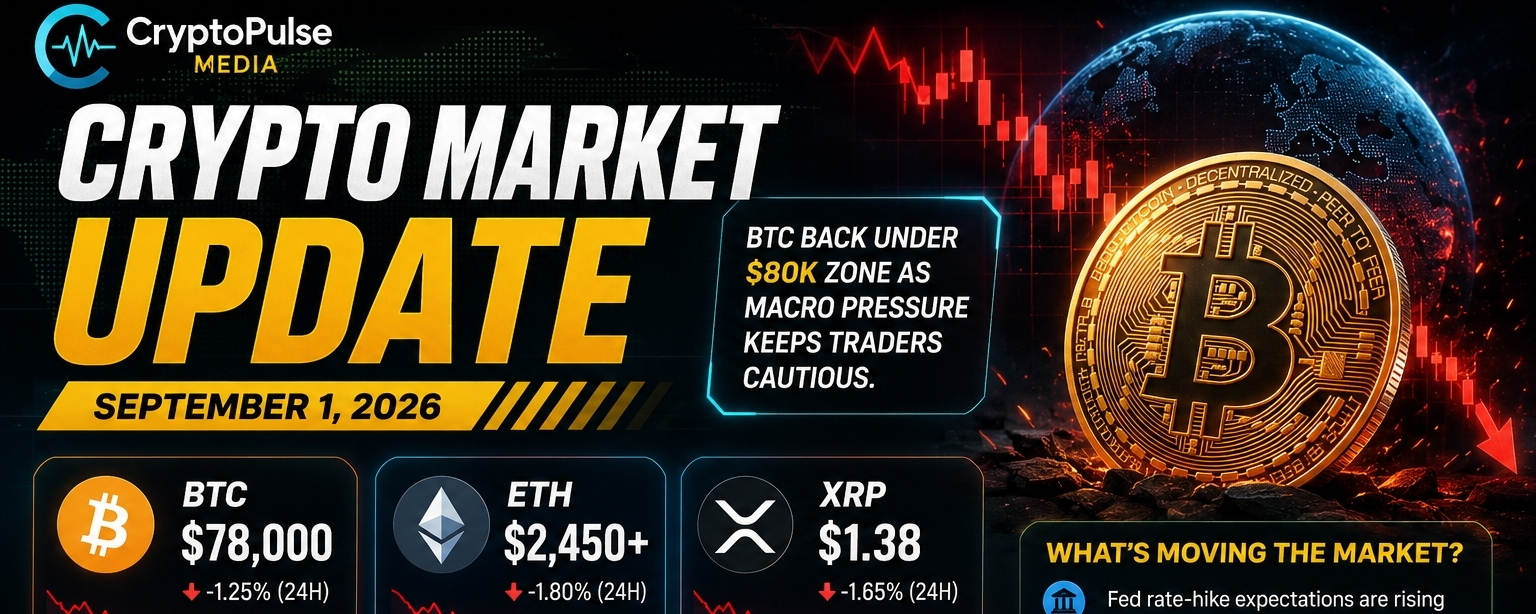
🚨 CRYPTO MARKET UPDATE | SEPTEMBER 1, 2026
Bitcoin is back under the $80K zone, trading around $78K as macro pressure keeps crypto traders cautious.
📊 BTC: ~$78,000
📊 ETH: ~$2,450+
📊 XRP: ~$1.38
🔥 WHAT'S MOVING THE MARKET?
• Fed rate-hike expectations are rising
• Higher oil prices are increasing inflation concerns
• Geopolitical tensions are keeping risk assets under pressure
• Russia's new crypto framework officially takes effect today
• BTC is struggling to reclaim the key $80K psychological level
The market isn't necessarily bearish — but volatility could remain elevated.
👀 Key levels to watch:
BTC above $80K → potential momentum recovery
BTC below $77K → downside risk increasesStay alert. Don't chase candles. Manage risk.
What do you think — 🚀 BTC back above $80K soon, or 📉 another correction first?
#Bitcoin #BTC #Ethereum #ETH #Crypto #CryptoNews #Binance #BinanceSquare #Altcoins #Web3 #Blockchain
Bitcoin is trading around **$78K**, while Ethereum is around **$2.45K–$2.46K**. BTC remains below th
The bigger story today is **interest-rate expectations**. Markets are increasingly pricing in a possible U.S. Fed rate hike this month, while rising oil prices and geopolitical tensions are adding to inflation concerns.
At the same time, **Russia's new crypto regulatory framework takes effect today**, with Bitcoin, Ethereum and USDT receiving a defined role under the new framework.
🚨 CRYPTO MARKET UPDATE | SEPTEMBER 1, 2026
Bitcoin is back under the $80K zone, trading around $78K as macro pressure keeps crypto traders cautious.
📊 BTC: ~$78,000
📊 ETH: ~$2,450+
📊 XRP: ~$1.38
🔥 WHAT'S MOVING THE MARKET?
• Fed rate-hike expectations are rising
• Higher oil prices are increasing inflation concerns
• Geopolitical tensions are keeping risk assets under pressure
• Russia's new crypto framework officially takes effect today
• BTC is struggling to reclaim the key $80K psychological level
The market isn't necessarily bearish — but volatility could remain elevated.
👀 Key levels to watch:
BTC above $80K → potential momentum recovery
BTC below $77K → downside risk increasesStay alert. Don't chase candles. Manage risk.
What do you think — 🚀 BTC back above $80K soon, or 📉 another correction first?
#Bitcoin #BTC #Ethereum #ETH #Crypto #CryptoNews #Binance #BinanceSquare #Altcoins #Web3 #Blockchain
At the same time, **Russia's new crypto regulatory framework takes effect today**, with Bitcoin, Ethereum and USDT receiving a defined role under the new framework.
🚨 CRYPTO MARKET UPDATE | SEPTEMBER 1, 2026
Bitcoin is back under the $80K zone, trading around $78K as macro pressure keeps crypto traders cautious.
📊 BTC: ~$78,000
📊 ETH: ~$2,450+
📊 XRP: ~$1.38
🔥 WHAT'S MOVING THE MARKET?
• Fed rate-hike expectations are rising
• Higher oil prices are increasing inflation concerns
• Geopolitical tensions are keeping risk assets under pressure
• Russia's new crypto framework officially takes effect today
• BTC is struggling to reclaim the key $80K psychological level
The market isn't necessarily bearish — but volatility could remain elevated.
👀 Key levels to watch:
BTC above $80K → potential momentum recovery
BTC below $77K → downside risk increasesStay alert. Don't chase candles. Manage risk.
What do you think — 🚀 BTC back above $80K soon, or 📉 another correction first?
#Bitcoin #BTC #Ethereum #ETH #Crypto #CryptoNews #Binance #BinanceSquare #Altcoins #Web3 #Blockchain
58
Article
See translation
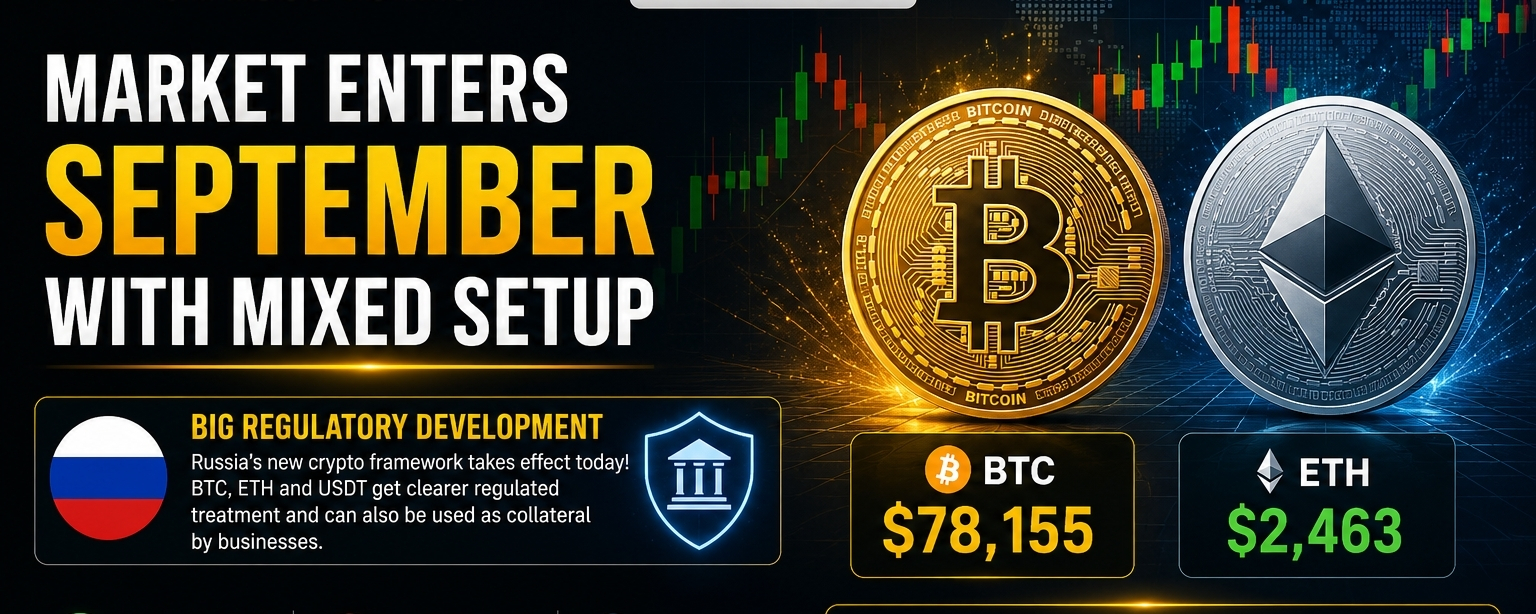
Bitcoin is starting September around **$78K**, while Ethereum is trading near **$2.46K**. BTC is sho**Big regulatory development:** Russia’s new crypto framework takes effect today, with **BTC, ETH and USDT** receiving clearer regulated-market treatment. BTC, ETH and USDT can also be used as collateral by businesses under the new framework.
📈 **Market Watch**
* ₿ BTC: ~$78,155
* Ξ ETH: ~$2,463
* 🔥 ETH has gained strongly over the past month
* ⚠️ Inflation concerns remain a key market risk
* 👀 September could bring higher volatility
**CryptoPulse Take:**
The market is entering September with a mixed setup—Bitcoin needs to defend the $78K area while Ethereum continues to attract attention. Regulatory developments could also become an important catalyst for the market.
**What are you watching this September—BTC, ETH, or Altcoins? 👇**
#Crypto #Bitcoin #BTC #Ethereum #ETH #BinanceSquare #CryptoMarket #Altcoins #Web3 #CryptoPulseMedia
Bitcoin is starting September around **$78K**, while Ethereum is trading near **$2.46K**. BTC is sho
**Big regulatory development:** Russia’s new crypto framework takes effect today, with **BTC, ETH and USDT** receiving clearer regulated-market treatment. BTC, ETH and USDT can also be used as collateral by businesses under the new framework.
📈 **Market Watch**
* ₿ BTC: ~$78,155
* Ξ ETH: ~$2,463
* 🔥 ETH has gained strongly over the past month
* ⚠️ Inflation concerns remain a key market risk
* 👀 September could bring higher volatility
**CryptoPulse Take:**
The market is entering September with a mixed setup—Bitcoin needs to defend the $78K area while Ethereum continues to attract attention. Regulatory developments could also become an important catalyst for the market.
**What are you watching this September—BTC, ETH, or Altcoins? 👇**
#Crypto #Bitcoin #BTC #Ethereum #ETH #BinanceSquare #CryptoMarket #Altcoins #Web3 #CryptoPulseMedia
📈 **Market Watch**
* ₿ BTC: ~$78,155
* Ξ ETH: ~$2,463
* 🔥 ETH has gained strongly over the past month
* ⚠️ Inflation concerns remain a key market risk
* 👀 September could bring higher volatility
**CryptoPulse Take:**
The market is entering September with a mixed setup—Bitcoin needs to defend the $78K area while Ethereum continues to attract attention. Regulatory developments could also become an important catalyst for the market.
**What are you watching this September—BTC, ETH, or Altcoins? 👇**
#Crypto #Bitcoin #BTC #Ethereum #ETH #BinanceSquare #CryptoMarket #Altcoins #Web3 #CryptoPulseMedia
16
Article
See translation
Bitcoin treasury company registers 93% of shares for resale and puts third of its crypto into optionThe shares are already issued and may never be sold, while loan, treasury and cash risks remain.
SBC has registered a block of already-issued shares equal to almost its entire outstanding common stock for potential resale, creating a potential market overhang alongside a balance sheet that relies heavily on Bitcoin.
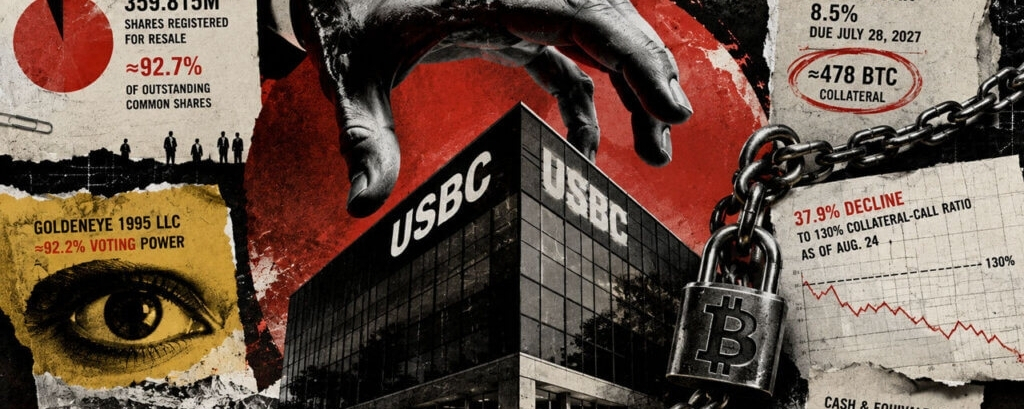
The company’s August 27 amended preliminary prospectus covers up to 359,815,000 shares held by selling stockholders. That equals about 92.7% of the 388,144,429 common shares outstanding as of August 24. USBC would receive no proceeds from any sale or other disposition by those holders.
No transaction is disclosed. The covered shares already exist, and the selling stockholders may dispose of all, some or none of them. The filing creates a route to market for a very large ownership block while leaving the current share count and control position unchanged until transactions occur.
Goldeneye’s position is economic and corporate. The filing says it held about 92.2% of USBC’s voting power when it approved a proposed reverse stock split by written consent in June. That concentration allowed the holder to act without a special stockholder meeting.
A registration statement changes what the holder can do with the position. Ownership and voting power change only when shares are actually sold, transferred, pledged or otherwise disposed of, or when future issuances dilute the stake. The preliminary prospectus is subject to completion, and the covered shares cannot be sold under it until the registration statement becomes effective.
The filing therefore creates two distinct investor exposures. The first is potential supply: up to 359.815 million shares have a registered route to resale or other disposition. The second is control: Goldeneye retains its voting position unless transactions or dilution change it. A future sale could affect both, depending on its size and buyer, while a registration with no follow-through would affect neither the share count nor voting ownership.
The company receives no cash from selling-stockholder transactions even if they occur. That separates this registration from a primary offering that funds the issuer. Any liquidity created by a resale accrues to the selling holder; USBC continues to fund operations through its own cash, treasury activity and financing arrangements.
That percentage describes a company sensitivity at one point in time. It moves with the collateral value, accrued fees, loan balance and amount of BTC posted. It provides a measure of room to the call ratio, not a forecast or an immutable Bitcoin price at which Payward must act.
The master loan agreement sets a rapid response once the cushion is exhausted. At the collateral-call ratio specified in the applicable term sheet, USBC has 24 hours to add collateral or repay enough loaned currency to restore the required margin. At or below the liquidation ratio, Payward may liquidate collateral without notice, charge a 1% liquidation fee and hold USBC responsible for any remaining shortfall.
The treasury disclosure adds another layer. USBC reported approximately 1,029.25 BTC in total holdings as of August 24. It separately reported approximately 478 BTC pledged to Payward and about 34.1% of its Bitcoin treasury pledged for options trading, with the options counterparty controlling the relevant private keys.
That uncertainty changes the risk analysis. If the pools overlap, adding them would exaggerate encumbrance. If they are separate, substantially more of the treasury is committed than the loan figure shows on its own. Either structure leaves counterparty terms, margin requirements and asset control relevant to how much balance-sheet flexibility USBC retains during stress.
The financial statements answer four separate questions. Net loss describes reported profitability. The operating cash-flow statement measures cash consumed by operations. Derivative income captures results from the options strategy. The balance sheet shows the cash available at the period end.
Together, the filings show risk moving across three connected channels. The August 24 collateral snapshot gave USBC room before a Payward call. The resale registration made a controlling holder’s stake ready for potential market disposition without raising cash for the company. First-half cash use remained dependent on financing secured by treasury assets, while another portion of the treasury supported options trading under an unreconciled collateral arrangement.
Bitcoin price strength can widen the loan buffer. It leaves the registered share supply, control concentration and operating cash requirement in place. The next changes that matter are actual selling-stockholder dispositions, repayments or new draws under the loan, movements in pledged BTC and a clearer reconciliation of the treasury committed to each counterparty.
#Write2Earn
#QODA
#Launchpool
#PEPE
#BTC走势分析
Bitcoin treasury company registers 93% of shares for resale and puts third of its crypto into option
The shares are already issued and may never be sold, while loan, treasury and cash risks remain.
SBC has registered a block of already-issued shares equal to almost its entire outstanding common stock for potential resale, creating a potential market overhang alongside a balance sheet that relies heavily on Bitcoin.
The company’s August 27 amended preliminary prospectus covers up to 359,815,000 shares held by selling stockholders. That equals about 92.7% of the 388,144,429 common shares outstanding as of August 24. USBC would receive no proceeds from any sale or other disposition by those holders.
No transaction is disclosed. The covered shares already exist, and the selling stockholders may dispose of all, some or none of them. The filing creates a route to market for a very large ownership block while leaving the current share count and control position unchanged until transactions occur.
Goldeneye’s position is economic and corporate. The filing says it held about 92.2% of USBC’s voting power when it approved a proposed reverse stock split by written consent in June. That concentration allowed the holder to act without a special stockholder meeting.
A registration statement changes what the holder can do with the position. Ownership and voting power change only when shares are actually sold, transferred, pledged or otherwise disposed of, or when future issuances dilute the stake. The preliminary prospectus is subject to completion, and the covered shares cannot be sold under it until the registration statement becomes effective.
The filing therefore creates two distinct investor exposures. The first is potential supply: up to 359.815 million shares have a registered route to resale or other disposition. The second is control: Goldeneye retains its voting position unless transactions or dilution change it. A future sale could affect both, depending on its size and buyer, while a registration with no follow-through would affect neither the share count nor voting ownership.
The company receives no cash from selling-stockholder transactions even if they occur. That separates this registration from a primary offering that funds the issuer. Any liquidity created by a resale accrues to the selling holder; USBC continues to fund operations through its own cash, treasury activity and financing arrangements.
That percentage describes a company sensitivity at one point in time. It moves with the collateral value, accrued fees, loan balance and amount of BTC posted. It provides a measure of room to the call ratio, not a forecast or an immutable Bitcoin price at which Payward must act.
The master loan agreement sets a rapid response once the cushion is exhausted. At the collateral-call ratio specified in the applicable term sheet, USBC has 24 hours to add collateral or repay enough loaned currency to restore the required margin. At or below the liquidation ratio, Payward may liquidate collateral without notice, charge a 1% liquidation fee and hold USBC responsible for any remaining shortfall.
The treasury disclosure adds another layer. USBC reported approximately 1,029.25 BTC in total holdings as of August 24. It separately reported approximately 478 BTC pledged to Payward and about 34.1% of its Bitcoin treasury pledged for options trading, with the options counterparty controlling the relevant private keys.
That uncertainty changes the risk analysis. If the pools overlap, adding them would exaggerate encumbrance. If they are separate, substantially more of the treasury is committed than the loan figure shows on its own. Either structure leaves counterparty terms, margin requirements and asset control relevant to how much balance-sheet flexibility USBC retains during stress.
The financial statements answer four separate questions. Net loss describes reported profitability. The operating cash-flow statement measures cash consumed by operations. Derivative income captures results from the options strategy. The balance sheet shows the cash available at the period end.
Together, the filings show risk moving across three connected channels. The August 24 collateral snapshot gave USBC room before a Payward call. The resale registration made a controlling holder’s stake ready for potential market disposition without raising cash for the company. First-half cash use remained dependent on financing secured by treasury assets, while another portion of the treasury supported options trading under an unreconciled collateral arrangement.
Bitcoin price strength can widen the loan buffer. It leaves the registered share supply, control concentration and operating cash requirement in place. The next changes that matter are actual selling-stockholder dispositions, repayments or new draws under the loan, movements in pledged BTC and a clearer reconciliation of the treasury committed to each counterparty.
#Write2Earn
#QODA
#Launchpool
#PEPE
#BTC走势分析
SBC has registered a block of already-issued shares equal to almost its entire outstanding common stock for potential resale, creating a potential market overhang alongside a balance sheet that relies heavily on Bitcoin.
The company’s August 27 amended preliminary prospectus covers up to 359,815,000 shares held by selling stockholders. That equals about 92.7% of the 388,144,429 common shares outstanding as of August 24. USBC would receive no proceeds from any sale or other disposition by those holders.
No transaction is disclosed. The covered shares already exist, and the selling stockholders may dispose of all, some or none of them. The filing creates a route to market for a very large ownership block while leaving the current share count and control position unchanged until transactions occur.
Goldeneye’s position is economic and corporate. The filing says it held about 92.2% of USBC’s voting power when it approved a proposed reverse stock split by written consent in June. That concentration allowed the holder to act without a special stockholder meeting.
A registration statement changes what the holder can do with the position. Ownership and voting power change only when shares are actually sold, transferred, pledged or otherwise disposed of, or when future issuances dilute the stake. The preliminary prospectus is subject to completion, and the covered shares cannot be sold under it until the registration statement becomes effective.
The filing therefore creates two distinct investor exposures. The first is potential supply: up to 359.815 million shares have a registered route to resale or other disposition. The second is control: Goldeneye retains its voting position unless transactions or dilution change it. A future sale could affect both, depending on its size and buyer, while a registration with no follow-through would affect neither the share count nor voting ownership.
The company receives no cash from selling-stockholder transactions even if they occur. That separates this registration from a primary offering that funds the issuer. Any liquidity created by a resale accrues to the selling holder; USBC continues to fund operations through its own cash, treasury activity and financing arrangements.
That percentage describes a company sensitivity at one point in time. It moves with the collateral value, accrued fees, loan balance and amount of BTC posted. It provides a measure of room to the call ratio, not a forecast or an immutable Bitcoin price at which Payward must act.
The master loan agreement sets a rapid response once the cushion is exhausted. At the collateral-call ratio specified in the applicable term sheet, USBC has 24 hours to add collateral or repay enough loaned currency to restore the required margin. At or below the liquidation ratio, Payward may liquidate collateral without notice, charge a 1% liquidation fee and hold USBC responsible for any remaining shortfall.
The treasury disclosure adds another layer. USBC reported approximately 1,029.25 BTC in total holdings as of August 24. It separately reported approximately 478 BTC pledged to Payward and about 34.1% of its Bitcoin treasury pledged for options trading, with the options counterparty controlling the relevant private keys.
That uncertainty changes the risk analysis. If the pools overlap, adding them would exaggerate encumbrance. If they are separate, substantially more of the treasury is committed than the loan figure shows on its own. Either structure leaves counterparty terms, margin requirements and asset control relevant to how much balance-sheet flexibility USBC retains during stress.
The financial statements answer four separate questions. Net loss describes reported profitability. The operating cash-flow statement measures cash consumed by operations. Derivative income captures results from the options strategy. The balance sheet shows the cash available at the period end.
Together, the filings show risk moving across three connected channels. The August 24 collateral snapshot gave USBC room before a Payward call. The resale registration made a controlling holder’s stake ready for potential market disposition without raising cash for the company. First-half cash use remained dependent on financing secured by treasury assets, while another portion of the treasury supported options trading under an unreconciled collateral arrangement.
Bitcoin price strength can widen the loan buffer. It leaves the registered share supply, control concentration and operating cash requirement in place. The next changes that matter are actual selling-stockholder dispositions, repayments or new draws under the loan, movements in pledged BTC and a clearer reconciliation of the treasury committed to each counterparty.
#Write2Earn
#QODA
#Launchpool
#PEPE
#BTC走势分析
39
Article
See translation
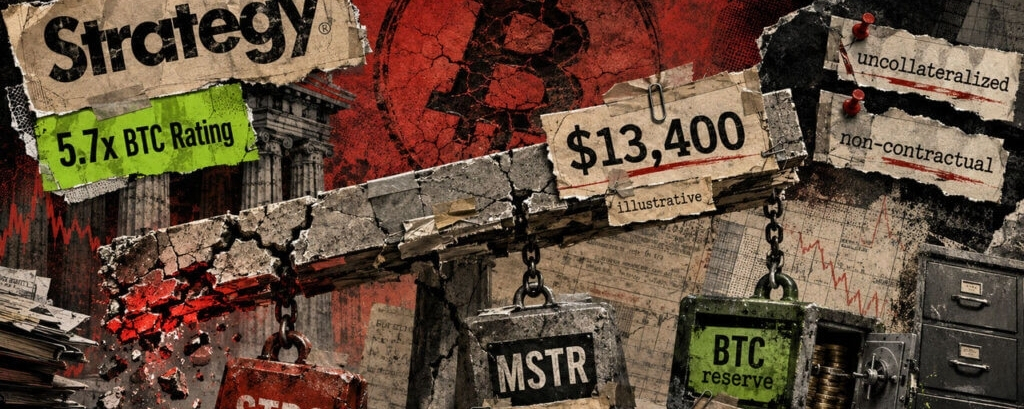
Michael Saylor’s $13,400 Bitcoin floor exposes the exact order of losses inside Strategy’s debt stacThe filed ratio moves with cash and claims, while MSTR dilution and legal priority shape real losses.
trategy, the Bitcoin treasury company, is marketing a roughly $13,400 “BTC Floor” for STRC, its variable-rate cumulative perpetual preferred stock. With Bitcoin near $78,000, the label sounds like a vast buffer. The SEC-filed briefing defines something narrower: the Bitcoin price at which Strategy’s illustrative STRC coverage ratio reaches 1.0x.
The metric provides no claim on Strategy’s Bitcoin and carries no solvency or recovery meaning. STRC closed at $97.33 on Aug. 28, giving holders a simple 12.33% effective yield at the current $12 annualized dividend. The filed dashboard used an Aug. 21 price of $96.18 and listed a 12.48% yield, $9.972 billion notional, 59 basis points of BTC Credit, 4.68% BTC Risk and a -14.61% BTC Floor ARR.
The BTC Rating divides the dollar value of Strategy’s Bitcoin reserve by a covered-notional denominator. The floor reverses the calculation: covered notional divided by the number of Bitcoin held. Spot Bitcoin changes the displayed rating; with every company input fixed, it leaves the 1.0x price unchanged.
Strategy’s denominator starts with $6.714 billion of debt, subtracts $6.69 billion of USD assets, then adds $1.284 billion of senior STRF and $9.972 billion of STRC. That produces about $11.28 billion. Its 840,447 Bitcoin were worth $64.718 billion at the dashboard’s $77,004 price, producing 5.74x, displayed as 5.7x.
Strategy reports an unrounded floor of $13,415. Using the rounded denominator and Bitcoin count gives about $13,421, both commonly shown as roughly $13,400. With Bitcoin market data at $78,440.50 during the Aug. 30 research pass, the rating would rise to about 5.84x if the dated company inputs stayed fixed, while the floor would remain near $13,421.
USD assets move the threshold. Depleting the $1.59 billion USD Cash pool without reducing debt or preferred notional would lift the modeled point to about $15,313. Depleting all $6.69 billion of USD assets on uses that retired no counted claims would push it toward $21,381. These sensitivities hold every other input constant.
Stress management begins well before legal recovery. In the latest disclosed week, Strategy sold 18,261,118 MSTR shares for $2.0065 billion. It spent $136.4 million repurchasing 1,431,212 STRC shares, added $300 million to the USD Reserve and put the balance into USD Cash. It sold no Bitcoin. Funding came through common issuance, so dilution was the immediate cost to MSTR holders.
Future choices remain discretionary. Strategy had $516.6 million of preferred repurchase authority and $1 billion for MSTR remaining, but neither program requires purchases. The $5.10 billion USD Reserve is designated by board policy for preferred dividends and debt interest. USD Cash can also fund Bitcoin purchases, repurchases, note repayment or reserve growth. Neither pool is pledged to STRC.
The $13,400 figure maps one dated set of assets and counted claims. Earlier pressure points include capital-market access, available cash and discretionary allocation decisions, each of which can shift cost among MSTR holders, STRC holders and the Bitcoin reserve.
#Write2Earn
#Dogecoin
#ZeusInCrypto
#Grok
#BTC走势分析
Michael Saylor’s $13,400 Bitcoin floor exposes the exact order of losses inside Strategy’s debt stac
The filed ratio moves with cash and claims, while MSTR dilution and legal priority shape real losses.
trategy, the Bitcoin treasury company, is marketing a roughly $13,400 “BTC Floor” for STRC, its variable-rate cumulative perpetual preferred stock. With Bitcoin near $78,000, the label sounds like a vast buffer. The SEC-filed briefing defines something narrower: the Bitcoin price at which Strategy’s illustrative STRC coverage ratio reaches 1.0x.
The metric provides no claim on Strategy’s Bitcoin and carries no solvency or recovery meaning. STRC closed at $97.33 on Aug. 28, giving holders a simple 12.33% effective yield at the current $12 annualized dividend. The filed dashboard used an Aug. 21 price of $96.18 and listed a 12.48% yield, $9.972 billion notional, 59 basis points of BTC Credit, 4.68% BTC Risk and a -14.61% BTC Floor ARR.
The BTC Rating divides the dollar value of Strategy’s Bitcoin reserve by a covered-notional denominator. The floor reverses the calculation: covered notional divided by the number of Bitcoin held. Spot Bitcoin changes the displayed rating; with every company input fixed, it leaves the 1.0x price unchanged.
Strategy’s denominator starts with $6.714 billion of debt, subtracts $6.69 billion of USD assets, then adds $1.284 billion of senior STRF and $9.972 billion of STRC. That produces about $11.28 billion. Its 840,447 Bitcoin were worth $64.718 billion at the dashboard’s $77,004 price, producing 5.74x, displayed as 5.7x.
Strategy reports an unrounded floor of $13,415. Using the rounded denominator and Bitcoin count gives about $13,421, both commonly shown as roughly $13,400. With Bitcoin market data at $78,440.50 during the Aug. 30 research pass, the rating would rise to about 5.84x if the dated company inputs stayed fixed, while the floor would remain near $13,421.
USD assets move the threshold. Depleting the $1.59 billion USD Cash pool without reducing debt or preferred notional would lift the modeled point to about $15,313. Depleting all $6.69 billion of USD assets on uses that retired no counted claims would push it toward $21,381. These sensitivities hold every other input constant.
Stress management begins well before legal recovery. In the latest disclosed week, Strategy sold 18,261,118 MSTR shares for $2.0065 billion. It spent $136.4 million repurchasing 1,431,212 STRC shares, added $300 million to the USD Reserve and put the balance into USD Cash. It sold no Bitcoin. Funding came through common issuance, so dilution was the immediate cost to MSTR holders.
Future choices remain discretionary. Strategy had $516.6 million of preferred repurchase authority and $1 billion for MSTR remaining, but neither program requires purchases. The $5.10 billion USD Reserve is designated by board policy for preferred dividends and debt interest. USD Cash can also fund Bitcoin purchases, repurchases, note repayment or reserve growth. Neither pool is pledged to STRC.
The $13,400 figure maps one dated set of assets and counted claims. Earlier pressure points include capital-market access, available cash and discretionary allocation decisions, each of which can shift cost among MSTR holders, STRC holders and the Bitcoin reserve.
#Write2Earn
#Dogecoin
#ZeusInCrypto
#Grok
#BTC走势分析
trategy, the Bitcoin treasury company, is marketing a roughly $13,400 “BTC Floor” for STRC, its variable-rate cumulative perpetual preferred stock. With Bitcoin near $78,000, the label sounds like a vast buffer. The SEC-filed briefing defines something narrower: the Bitcoin price at which Strategy’s illustrative STRC coverage ratio reaches 1.0x.
The metric provides no claim on Strategy’s Bitcoin and carries no solvency or recovery meaning. STRC closed at $97.33 on Aug. 28, giving holders a simple 12.33% effective yield at the current $12 annualized dividend. The filed dashboard used an Aug. 21 price of $96.18 and listed a 12.48% yield, $9.972 billion notional, 59 basis points of BTC Credit, 4.68% BTC Risk and a -14.61% BTC Floor ARR.
The BTC Rating divides the dollar value of Strategy’s Bitcoin reserve by a covered-notional denominator. The floor reverses the calculation: covered notional divided by the number of Bitcoin held. Spot Bitcoin changes the displayed rating; with every company input fixed, it leaves the 1.0x price unchanged.
Strategy’s denominator starts with $6.714 billion of debt, subtracts $6.69 billion of USD assets, then adds $1.284 billion of senior STRF and $9.972 billion of STRC. That produces about $11.28 billion. Its 840,447 Bitcoin were worth $64.718 billion at the dashboard’s $77,004 price, producing 5.74x, displayed as 5.7x.
Strategy reports an unrounded floor of $13,415. Using the rounded denominator and Bitcoin count gives about $13,421, both commonly shown as roughly $13,400. With Bitcoin market data at $78,440.50 during the Aug. 30 research pass, the rating would rise to about 5.84x if the dated company inputs stayed fixed, while the floor would remain near $13,421.
USD assets move the threshold. Depleting the $1.59 billion USD Cash pool without reducing debt or preferred notional would lift the modeled point to about $15,313. Depleting all $6.69 billion of USD assets on uses that retired no counted claims would push it toward $21,381. These sensitivities hold every other input constant.
Stress management begins well before legal recovery. In the latest disclosed week, Strategy sold 18,261,118 MSTR shares for $2.0065 billion. It spent $136.4 million repurchasing 1,431,212 STRC shares, added $300 million to the USD Reserve and put the balance into USD Cash. It sold no Bitcoin. Funding came through common issuance, so dilution was the immediate cost to MSTR holders.
Future choices remain discretionary. Strategy had $516.6 million of preferred repurchase authority and $1 billion for MSTR remaining, but neither program requires purchases. The $5.10 billion USD Reserve is designated by board policy for preferred dividends and debt interest. USD Cash can also fund Bitcoin purchases, repurchases, note repayment or reserve growth. Neither pool is pledged to STRC.
The $13,400 figure maps one dated set of assets and counted claims. Earlier pressure points include capital-market access, available cash and discretionary allocation decisions, each of which can shift cost among MSTR holders, STRC holders and the Bitcoin reserve.
#Write2Earn
#Dogecoin
#ZeusInCrypto
#Grok
#BTC走势分析
44
Article
See translation
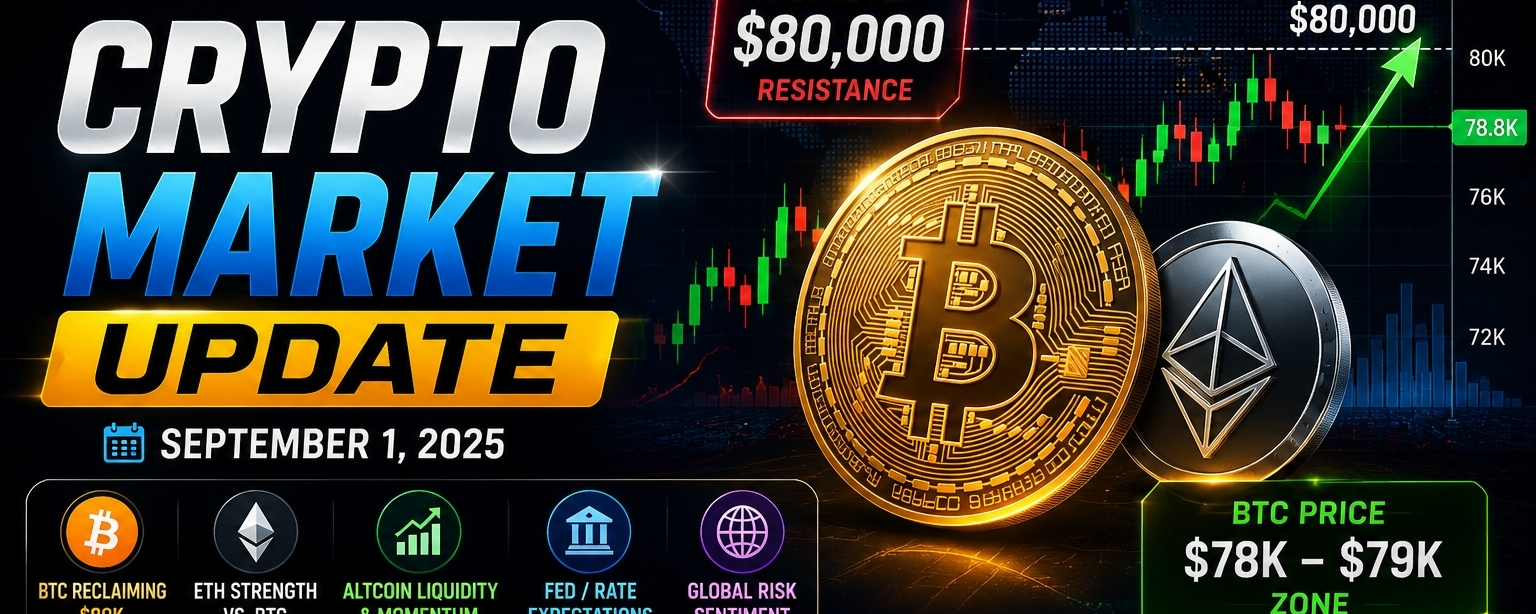
Today’s market backdrop: BTC is trading around the **$78K–$79K area**, while the market is watchingBitcoin is entering September with traders watching one level closely: **$80,000**. 👀
BTC is hovering around the **$78K–$79K zone**, while macro pressure is increasing as global bond yields and oil prices rise.
📌 Key things to watch:
• BTC reclaiming $80K
• ETH strength vs. BTC
• Altcoin liquidity & momentum
• Fed/rate expectations
• Global risk sentiment
September could bring **high volatility**. Don’t chase green candles—watch price action, volume, and market structure.
The next major move may start with Bitcoin. ⚡️
#Write2Earn #Bitcoin #BTC #Ethereum #ETH #Crypto #Altcoins #CryptoMarket #Web3
Today’s market backdrop: BTC is trading around the **$78K–$79K area**, while the market is watching
Bitcoin is entering September with traders watching one level closely: **$80,000**. 👀
BTC is hovering around the **$78K–$79K zone**, while macro pressure is increasing as global bond yields and oil prices rise.
📌 Key things to watch:
• BTC reclaiming $80K
• ETH strength vs. BTC
• Altcoin liquidity & momentum
• Fed/rate expectations
• Global risk sentiment
September could bring **high volatility**. Don’t chase green candles—watch price action, volume, and market structure.
The next major move may start with Bitcoin. ⚡️
#Write2Earn #Bitcoin #BTC #Ethereum #ETH #Crypto #Altcoins #CryptoMarket #Web3
BTC is hovering around the **$78K–$79K zone**, while macro pressure is increasing as global bond yields and oil prices rise.
📌 Key things to watch:
• BTC reclaiming $80K
• ETH strength vs. BTC
• Altcoin liquidity & momentum
• Fed/rate expectations
• Global risk sentiment
September could bring **high volatility**. Don’t chase green candles—watch price action, volume, and market structure.
The next major move may start with Bitcoin. ⚡️
#Write2Earn #Bitcoin #BTC #Ethereum #ETH #Crypto #Altcoins #CryptoMarket #Web3
77
Article
See translation
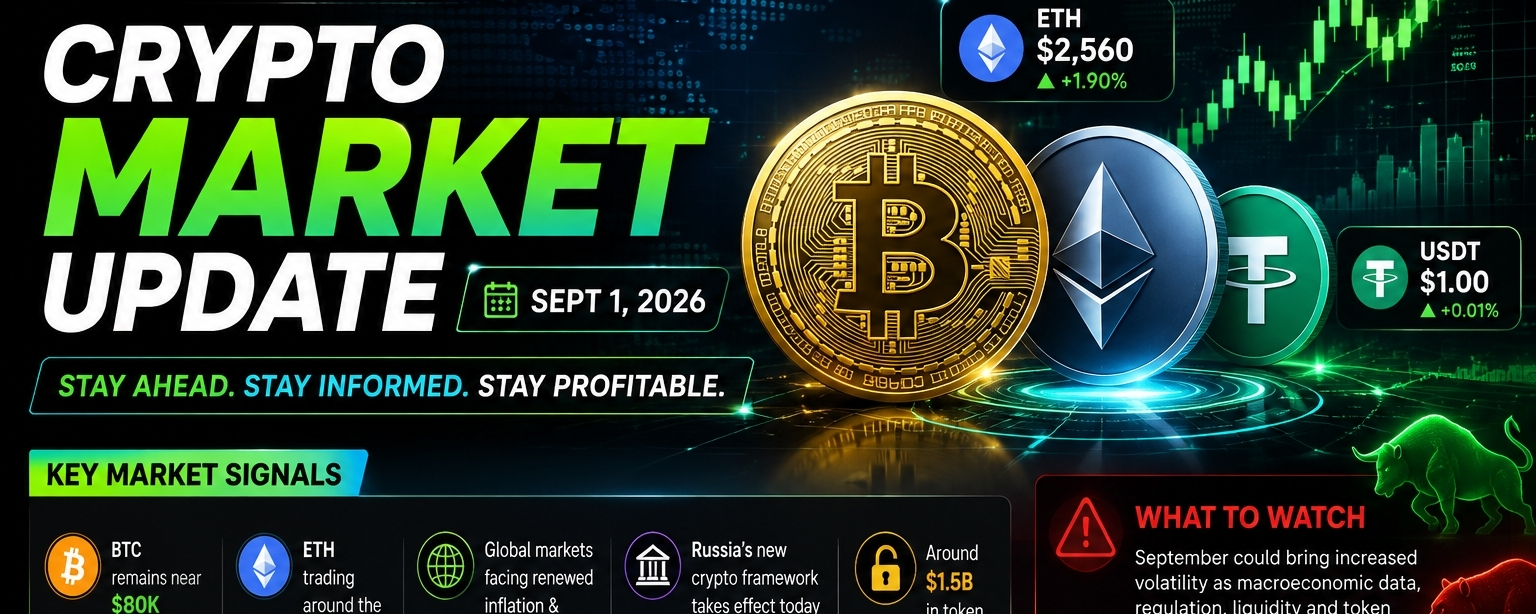
Bitcoin is starting September around the $78K–$80K zone, keeping traders focused on whether BTC can📊 KEY MARKET SIGNALS:
• BTC remains near the $80K psychological level
• ETH is trading around the mid-$2K range
• Global markets are facing renewed inflation and geopolitical pressure
• Russia’s new crypto framework takes effect today, with BTC, ETH and USDT receiving a central role
• Around $1.5B in token unlocks are expected during the first week of September
⚠️ WHAT TO WATCH:
September could bring increased volatility as macroeconomic data, regulation, liquidity and token supply events collide.
The market is moving fast. Don’t chase the candles—watch the data. 👀📈
What’s your September outlook?
🟢 Bullish
🔴 Bearish
🟡 Waiting for confirmation
#Write2Earn #BTC #Ethereum #ETH #Crypto #CryptoNews #Altcoins #Blockchain #Web3 #CryptoMarket #CryptoPulseMedi
Bitcoin is starting September around the $78K–$80K zone, keeping traders focused on whether BTC can
📊 KEY MARKET SIGNALS:
• BTC remains near the $80K psychological level
• ETH is trading around the mid-$2K range
• Global markets are facing renewed inflation and geopolitical pressure
• Russia’s new crypto framework takes effect today, with BTC, ETH and USDT receiving a central role
• Around $1.5B in token unlocks are expected during the first week of September
⚠️ WHAT TO WATCH:
September could bring increased volatility as macroeconomic data, regulation, liquidity and token supply events collide.
The market is moving fast. Don’t chase the candles—watch the data. 👀📈
What’s your September outlook?
🟢 Bullish
🔴 Bearish
🟡 Waiting for confirmation
#Write2Earn #BTC #Ethereum #ETH #Crypto #CryptoNews #Altcoins #Blockchain #Web3 #CryptoMarket #CryptoPulseMedi
• BTC remains near the $80K psychological level
• ETH is trading around the mid-$2K range
• Global markets are facing renewed inflation and geopolitical pressure
• Russia’s new crypto framework takes effect today, with BTC, ETH and USDT receiving a central role
• Around $1.5B in token unlocks are expected during the first week of September
⚠️ WHAT TO WATCH:
September could bring increased volatility as macroeconomic data, regulation, liquidity and token supply events collide.
The market is moving fast. Don’t chase the candles—watch the data. 👀📈
What’s your September outlook?
🟢 Bullish
🔴 Bearish
🟡 Waiting for confirmation
#Write2Earn #BTC #Ethereum #ETH #Crypto #CryptoNews #Altcoins #Blockchain #Web3 #CryptoMarket #CryptoPulseMedi
52
Article
See translation
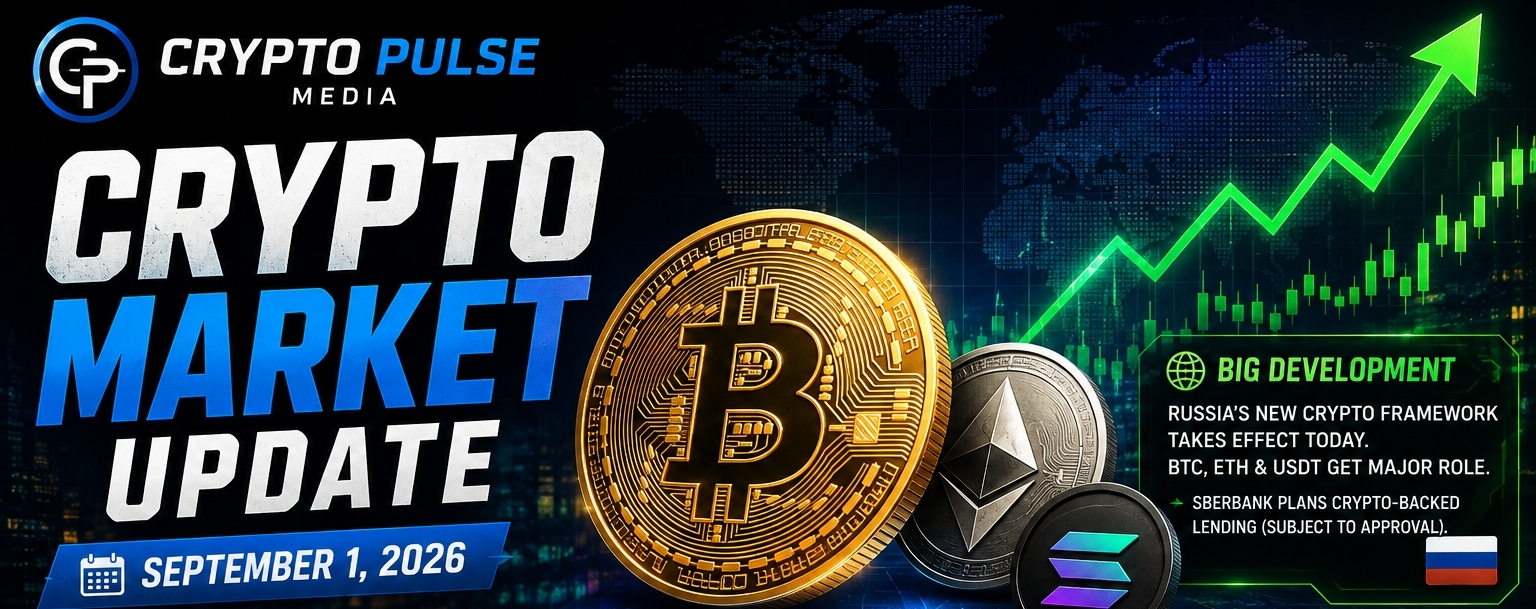
Bitcoin is entering September with strong momentum after a major August rally, but the market is now📊 Market snapshot:
₿ BTC: ~$78K–$80K zone
◆ ETH: showing renewed strength
◎ SOL: remains one of the stronger large-cap altcoins
📈 BTC gained roughly 24% during August
🔥 BIG DEVELOPMENT:
Russia’s new crypto framework takes effect today, with BTC, ETH and USDT receiving a major role in the regulated market. Sberbank is also planning crypto-backed lending, subject to regulatory approval.
⚠️ Meanwhile, global markets are dealing with rising bond yields, oil above $91 and renewed inflation/rate-hike concerns. That could keep volatility high across risk assets, including crypto.
🎯 September watchlist:
• BTC support & resistance
• ETH momentum
• ETF flows
• Global interest-rate expectations
• Regulatory developments
The next move could be decided by liquidity + macro.
Stay alert. Trade the trend, not the emotion. 🚀
#Write2Earn #Crypto #Bitcoin #BTC #Ethereum #ETH #Altcoins #Web3 #CryptoNews #CryptoMarket #CryptoPulse
Bitcoin is entering September with strong momentum after a major August rally, but the market is now
📊 Market snapshot:
₿ BTC: ~$78K–$80K zone
◆ ETH: showing renewed strength
◎ SOL: remains one of the stronger large-cap altcoins
📈 BTC gained roughly 24% during August
🔥 BIG DEVELOPMENT:
Russia’s new crypto framework takes effect today, with BTC, ETH and USDT receiving a major role in the regulated market. Sberbank is also planning crypto-backed lending, subject to regulatory approval.
⚠️ Meanwhile, global markets are dealing with rising bond yields, oil above $91 and renewed inflation/rate-hike concerns. That could keep volatility high across risk assets, including crypto.
🎯 September watchlist:
• BTC support & resistance
• ETH momentum
• ETF flows
• Global interest-rate expectations
• Regulatory developments
The next move could be decided by liquidity + macro.
Stay alert. Trade the trend, not the emotion. 🚀
#Write2Earn #Crypto #Bitcoin #BTC #Ethereum #ETH #Altcoins #Web3 #CryptoNews #CryptoMarket #CryptoPulse
₿ BTC: ~$78K–$80K zone
◆ ETH: showing renewed strength
◎ SOL: remains one of the stronger large-cap altcoins
📈 BTC gained roughly 24% during August
🔥 BIG DEVELOPMENT:
Russia’s new crypto framework takes effect today, with BTC, ETH and USDT receiving a major role in the regulated market. Sberbank is also planning crypto-backed lending, subject to regulatory approval.
⚠️ Meanwhile, global markets are dealing with rising bond yields, oil above $91 and renewed inflation/rate-hike concerns. That could keep volatility high across risk assets, including crypto.
🎯 September watchlist:
• BTC support & resistance
• ETH momentum
• ETF flows
• Global interest-rate expectations
• Regulatory developments
The next move could be decided by liquidity + macro.
Stay alert. Trade the trend, not the emotion. 🚀
#Write2Earn #Crypto #Bitcoin #BTC #Ethereum #ETH #Altcoins #Web3 #CryptoNews #CryptoMarket #CryptoPulse
80
Article
See translation
Let’s make this a **daily original Binance Square series** for CryptoPulse Media—based o### 📊 CryptoPulse Media — Daily Market Update
**September 1, 2026**
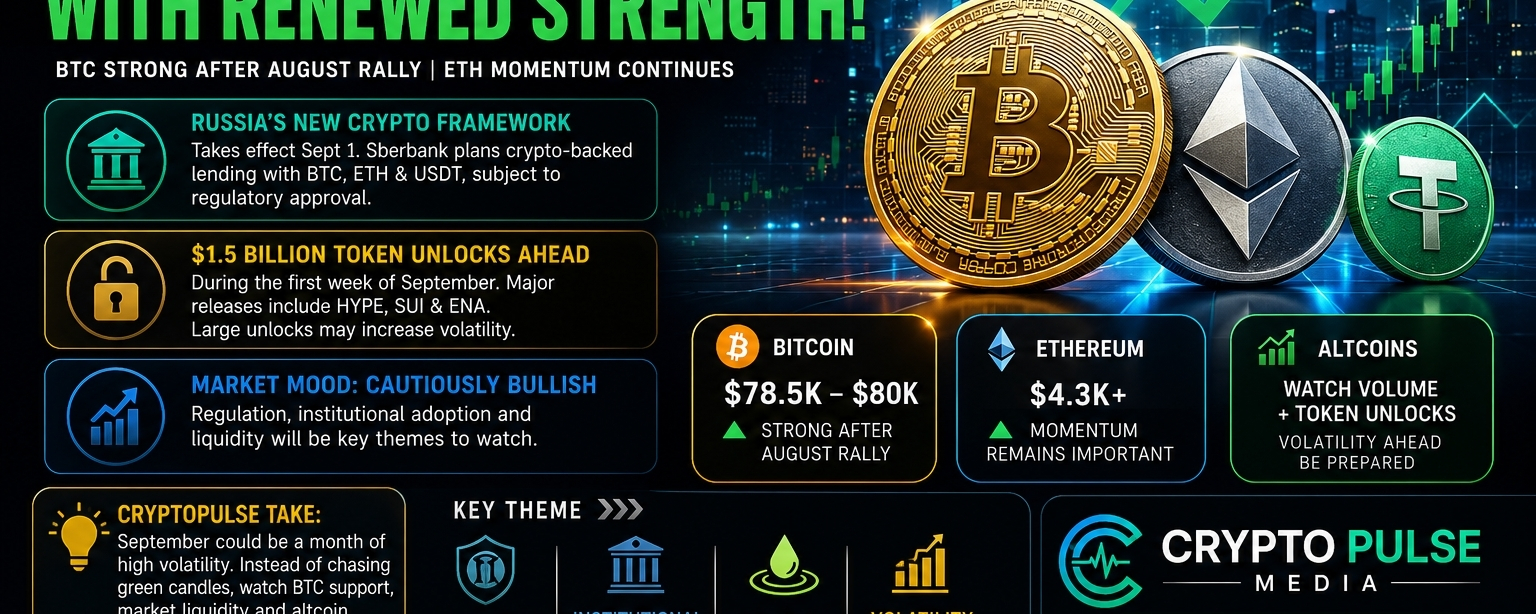
Bitcoin is starting September with renewed strength after a powerful August rally. Recent market data shows BTC around **$78.5K–$80K**, while Ethereum is also showing positive momentum.
One major development to watch today is **Russia’s new crypto framework**, which takes effect September 1. Sberbank is planning crypto-backed lending involving **BTC, ETH and USDT**, subject to regulatory approval.
Meanwhile, traders should keep an eye on the altcoin market. Around **$1.5 billion in token unlocks** are expected during the first week of September, with major releases including HYPE, SUI and ENA. Large unlocks can increase short-term selling pressure and volatility.
**Market mood:** 🟢 Cautiously bullish
**BTC:** Strong after August's rally
**ETH:** Momentum remains important
**Altcoins:** Watch volume + token unlocks
**Key theme:** Regulation + institutional adoption + liquidity
💡 **CryptoPulse Take:** September could be a month of high volatility. Instead of chasing green candles, traders should watch BTC support, market liquidity and whether altcoins can maintain momentum.
⚠️ *This is market commentary, not financial advice. Always do your own research.*
#Bitcoin #BTC #Ethereum #ETH #Crypto #Altcoins #BinanceSquare #CryptoNews #CryptoPulseMedia
Let’s make this a **daily original Binance Square series** for CryptoPulse Media—based o
### 📊 CryptoPulse Media — Daily Market Update
**September 1, 2026**
Bitcoin is starting September with renewed strength after a powerful August rally. Recent market data shows BTC around **$78.5K–$80K**, while Ethereum is also showing positive momentum.
One major development to watch today is **Russia’s new crypto framework**, which takes effect September 1. Sberbank is planning crypto-backed lending involving **BTC, ETH and USDT**, subject to regulatory approval.
Meanwhile, traders should keep an eye on the altcoin market. Around **$1.5 billion in token unlocks** are expected during the first week of September, with major releases including HYPE, SUI and ENA. Large unlocks can increase short-term selling pressure and volatility.
**Market mood:** 🟢 Cautiously bullish
**BTC:** Strong after August's rally
**ETH:** Momentum remains important
**Altcoins:** Watch volume + token unlocks
**Key theme:** Regulation + institutional adoption + liquidity
💡 **CryptoPulse Take:** September could be a month of high volatility. Instead of chasing green candles, traders should watch BTC support, market liquidity and whether altcoins can maintain momentum.
⚠️ *This is market commentary, not financial advice. Always do your own research.*
#Bitcoin #BTC #Ethereum #ETH #Crypto #Altcoins #BinanceSquare #CryptoNews #CryptoPulseMedia
**September 1, 2026**
Bitcoin is starting September with renewed strength after a powerful August rally. Recent market data shows BTC around **$78.5K–$80K**, while Ethereum is also showing positive momentum.
One major development to watch today is **Russia’s new crypto framework**, which takes effect September 1. Sberbank is planning crypto-backed lending involving **BTC, ETH and USDT**, subject to regulatory approval.
Meanwhile, traders should keep an eye on the altcoin market. Around **$1.5 billion in token unlocks** are expected during the first week of September, with major releases including HYPE, SUI and ENA. Large unlocks can increase short-term selling pressure and volatility.
**Market mood:** 🟢 Cautiously bullish
**BTC:** Strong after August's rally
**ETH:** Momentum remains important
**Altcoins:** Watch volume + token unlocks
**Key theme:** Regulation + institutional adoption + liquidity
💡 **CryptoPulse Take:** September could be a month of high volatility. Instead of chasing green candles, traders should watch BTC support, market liquidity and whether altcoins can maintain momentum.
⚠️ *This is market commentary, not financial advice. Always do your own research.*
#Bitcoin #BTC #Ethereum #ETH #Crypto #Altcoins #BinanceSquare #CryptoNews #CryptoPulseMedia
109

Article
See translation
XRPL consensus freezes after removing just 12% of central nodes – but a simple tweak triples XRP defAt 60% participation, two random links raised simulated quorum-failure thresholds from 11% to 38% and 12% to 33%.
new XRP Ledger study says two or three extra peer connections per participating node can sharply raise the number of nodes a targeted attack must remove to disrupt modeled consensus.
XRPL consensus depends on enough trusted validators receiving one another’s messages. A separate peer-to-peer network carries those messages between servers, so extra routes could keep validator traffic moving if an attack removes the network’s busiest hubs.
At 60% participation and K=2, the model’s quorum critical attack size rose from 11% to 38% when removals targeted the highest-degree nodes. Under an attack ordered by betweenness centrality, which prioritizes nodes that sit on many shortest paths, the threshold rose from 12% to 33%.
The second change is 2.75 times the baseline. The metric measures the simulated share of nodes removed before fewer than 80% of the model’s validators remain together in one connected component. Observed attack cost remains unknown.
At 80% and 100% participation, K=3 matched or exceeded the modeled robustness produced by roughly 20 to 25 iterations of a more invasive rewiring strategy across the paper’s network and quorum tests. K-out augmentation retained about 0.85 Jaccard similarity with the original edge set, while rewiring fell well below 0.5.
That historical map also anchors the starting thresholds. The Aug. 2026 paper says prior robustness work found that targeted removal of about 20% of nodes compromised network robustness, while about 9% compromised quorum robustness. Random failures required far larger removals. Every percentage describes an attack simulation on the old graph.
Validator placement introduces a second abstraction. The dataset did not identify validators, so each main simulation selected 34 validator nodes uniformly at random and excluded them from direct targeting. Sensitivity tests that favored either high-degree or low-degree nodes for validator assignment preserved the qualitative advantage of random augmentation, although the baseline and incremental gains changed.
The current network supplies different visible inputs. On Aug. 30, Bithomp’s live node explorer displayed 786 discoverable nodes, while its validator view showed 35 members on the displayed XRP Ledger Foundation UNL. The live count changes over time and comes from a third-party measurement rather than the paper’s crawl method. The comparison establishes that the inputs have changed; the direction of present-day resilience remains unresolved.
Durable connections across organizations add coordination. A guaranteed peer reservation requires the administrators on both sides to cooperate. Private validators may deliberately route through selected proxies or hubs to reduce public exposure. More peers also consume more bandwidth, an expense highlighted in the official configuration guidance.
The paper models participation subsets from 20% to 100%, showing how the graph responds when only part of the network adds links. Those scenarios supply no empirical adoption rate. Operator willingness, durable peer acceptance, peer-slot contention, bandwidth, privacy, malicious-peer exposure and denial-of-service effects remain unmeasured.
The XRP Ledger study’s contribution is a focused design result: on one representative 2022 XRPL graph, a few uniformly random edges reduced dependence on central nodes and raised modeled attack thresholds with less topology change than extensive rewiring.
Testing that result on mainnet now requires current topology inputs and an operational trial of how random links are selected, accepted and maintained. Until then, 9%, 20%, 33% and 38% remain model outputs. The practical question is whether marginal peer diversity can deliver the same resilience gain on the network XRPL operators run today.
#Write2Earn
#Jasmyusdt⚠️⚠️
#cryptouniverseofficial
#gonnarich
#Xrp🔥🔥
XRPL consensus freezes after removing just 12% of central nodes – but a simple tweak triples XRP def
At 60% participation, two random links raised simulated quorum-failure thresholds from 11% to 38% and 12% to 33%.
new XRP Ledger study says two or three extra peer connections per participating node can sharply raise the number of nodes a targeted attack must remove to disrupt modeled consensus.
XRPL consensus depends on enough trusted validators receiving one another’s messages. A separate peer-to-peer network carries those messages between servers, so extra routes could keep validator traffic moving if an attack removes the network’s busiest hubs.
At 60% participation and K=2, the model’s quorum critical attack size rose from 11% to 38% when removals targeted the highest-degree nodes. Under an attack ordered by betweenness centrality, which prioritizes nodes that sit on many shortest paths, the threshold rose from 12% to 33%.
The second change is 2.75 times the baseline. The metric measures the simulated share of nodes removed before fewer than 80% of the model’s validators remain together in one connected component. Observed attack cost remains unknown.
At 80% and 100% participation, K=3 matched or exceeded the modeled robustness produced by roughly 20 to 25 iterations of a more invasive rewiring strategy across the paper’s network and quorum tests. K-out augmentation retained about 0.85 Jaccard similarity with the original edge set, while rewiring fell well below 0.5.
That historical map also anchors the starting thresholds. The Aug. 2026 paper says prior robustness work found that targeted removal of about 20% of nodes compromised network robustness, while about 9% compromised quorum robustness. Random failures required far larger removals. Every percentage describes an attack simulation on the old graph.
Validator placement introduces a second abstraction. The dataset did not identify validators, so each main simulation selected 34 validator nodes uniformly at random and excluded them from direct targeting. Sensitivity tests that favored either high-degree or low-degree nodes for validator assignment preserved the qualitative advantage of random augmentation, although the baseline and incremental gains changed.
The current network supplies different visible inputs. On Aug. 30, Bithomp’s live node explorer displayed 786 discoverable nodes, while its validator view showed 35 members on the displayed XRP Ledger Foundation UNL. The live count changes over time and comes from a third-party measurement rather than the paper’s crawl method. The comparison establishes that the inputs have changed; the direction of present-day resilience remains unresolved.
Durable connections across organizations add coordination. A guaranteed peer reservation requires the administrators on both sides to cooperate. Private validators may deliberately route through selected proxies or hubs to reduce public exposure. More peers also consume more bandwidth, an expense highlighted in the official configuration guidance.
The paper models participation subsets from 20% to 100%, showing how the graph responds when only part of the network adds links. Those scenarios supply no empirical adoption rate. Operator willingness, durable peer acceptance, peer-slot contention, bandwidth, privacy, malicious-peer exposure and denial-of-service effects remain unmeasured.
The XRP Ledger study’s contribution is a focused design result: on one representative 2022 XRPL graph, a few uniformly random edges reduced dependence on central nodes and raised modeled attack thresholds with less topology change than extensive rewiring.
Testing that result on mainnet now requires current topology inputs and an operational trial of how random links are selected, accepted and maintained. Until then, 9%, 20%, 33% and 38% remain model outputs. The practical question is whether marginal peer diversity can deliver the same resilience gain on the network XRPL operators run today.
#Write2Earn
#Jasmyusdt⚠️⚠️
#cryptouniverseofficial
#gonnarich
#Xrp🔥🔥
new XRP Ledger study says two or three extra peer connections per participating node can sharply raise the number of nodes a targeted attack must remove to disrupt modeled consensus.
XRPL consensus depends on enough trusted validators receiving one another’s messages. A separate peer-to-peer network carries those messages between servers, so extra routes could keep validator traffic moving if an attack removes the network’s busiest hubs.
At 60% participation and K=2, the model’s quorum critical attack size rose from 11% to 38% when removals targeted the highest-degree nodes. Under an attack ordered by betweenness centrality, which prioritizes nodes that sit on many shortest paths, the threshold rose from 12% to 33%.
The second change is 2.75 times the baseline. The metric measures the simulated share of nodes removed before fewer than 80% of the model’s validators remain together in one connected component. Observed attack cost remains unknown.
At 80% and 100% participation, K=3 matched or exceeded the modeled robustness produced by roughly 20 to 25 iterations of a more invasive rewiring strategy across the paper’s network and quorum tests. K-out augmentation retained about 0.85 Jaccard similarity with the original edge set, while rewiring fell well below 0.5.
That historical map also anchors the starting thresholds. The Aug. 2026 paper says prior robustness work found that targeted removal of about 20% of nodes compromised network robustness, while about 9% compromised quorum robustness. Random failures required far larger removals. Every percentage describes an attack simulation on the old graph.
Validator placement introduces a second abstraction. The dataset did not identify validators, so each main simulation selected 34 validator nodes uniformly at random and excluded them from direct targeting. Sensitivity tests that favored either high-degree or low-degree nodes for validator assignment preserved the qualitative advantage of random augmentation, although the baseline and incremental gains changed.
The current network supplies different visible inputs. On Aug. 30, Bithomp’s live node explorer displayed 786 discoverable nodes, while its validator view showed 35 members on the displayed XRP Ledger Foundation UNL. The live count changes over time and comes from a third-party measurement rather than the paper’s crawl method. The comparison establishes that the inputs have changed; the direction of present-day resilience remains unresolved.
Durable connections across organizations add coordination. A guaranteed peer reservation requires the administrators on both sides to cooperate. Private validators may deliberately route through selected proxies or hubs to reduce public exposure. More peers also consume more bandwidth, an expense highlighted in the official configuration guidance.
The paper models participation subsets from 20% to 100%, showing how the graph responds when only part of the network adds links. Those scenarios supply no empirical adoption rate. Operator willingness, durable peer acceptance, peer-slot contention, bandwidth, privacy, malicious-peer exposure and denial-of-service effects remain unmeasured.
The XRP Ledger study’s contribution is a focused design result: on one representative 2022 XRPL graph, a few uniformly random edges reduced dependence on central nodes and raised modeled attack thresholds with less topology change than extensive rewiring.
Testing that result on mainnet now requires current topology inputs and an operational trial of how random links are selected, accepted and maintained. Until then, 9%, 20%, 33% and 38% remain model outputs. The practical question is whether marginal peer diversity can deliver the same resilience gain on the network XRPL operators run today.
#Write2Earn
#Jasmyusdt⚠️⚠️
#cryptouniverseofficial
#gonnarich
#Xrp🔥🔥
106
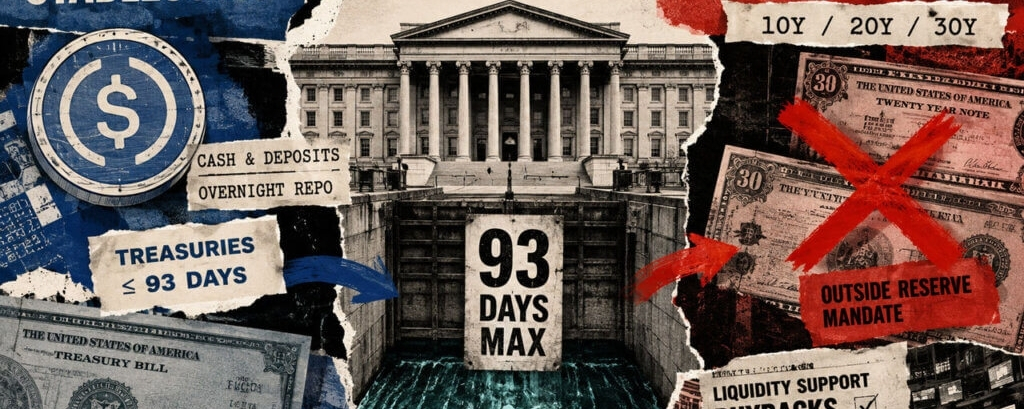
Article
See translation
US treasury relies on stablecoins to fund short-term debt, but they can’t fix its $28B long-bond proGENIUS reserves stop at 93 days while Treasury expands liquidity buybacks across 10- to 30-year debt.
tablecoin demand is becoming consequential in the U.S. government debt market, but the maturity of that demand matters more than the headline total.
Washington now has two debt-market stories running at once. The federal framework for permitted payment stablecoins channels reserves into cash-like instruments and Treasuries with no more than 93 days remaining. Farther out on the curve, the Treasury Department said on Aug. 19 that it would at least double the maximum size of liquidity-support buybacks in the 10- to 20-year and 20- to 30-year nominal sectors beginning Sept. 9.
Together, those developments test a broad claim about digital dollars funding the United States. Stablecoin growth can reinforce demand for bills and overnight Treasury financing. Direct support for long-duration bonds remains outside the reserve mandate, while any connection to Bitcoin runs through wider financial conditions rather than a reserve trade.
The GENIUS Act requires permitted issuers to maintain identifiable reserves of at least one dollar for every payment stablecoin outstanding. Eligible assets include U.S. currency and Federal Reserve balances, withdrawable bank deposits, Treasuries with an original or remaining maturity of 93 days or less, qualifying overnight repo and reverse repo, government money-market funds invested in those instruments, regulator-approved similarly liquid federal assets, and qualifying tokenized versions.
The menu extends beyond Treasury bills, yet it remains built around liquidity and short duration. A newly issued 10-year note or 30-year bond falls outside the direct Treasury reserve category.
Implementation is still in progress. The law was enacted in July 2025, but its general effective date is the earlier of Jan. 18, 2027, or 120 days after final implementing rules. The Office of the Comptroller of the Currency issued its framework as a proposal in February. On Aug. 19, the Comptroller said the final OCC rule was expected by November. Current issuer portfolios show how short-duration reserves work in practice; they do not establish that every issuer already operates under a completed federal regime.
For Bitcoin, the defensible mechanism begins with broad financial conditions. Long-term Treasury yields can influence credit costs, the discount rates applied to risky assets and investors' appetite for volatile positions. Better trading conditions in older long bonds can improve market functioning, while a larger bill buyer base can support Treasury's front-end financing.
Those links create a possible macro channel, not a mechanical price signal. A stablecoin inflow may compress bill yields without lowering long-term yields. A Treasury buyback may improve liquidity without reducing net borrowing. Bitcoin can respond to changes in rates, dollar liquidity and risk appetite while moving for many unrelated reasons at the same time.
The evidence here provides no causal estimate connecting stablecoin flows, long-end buybacks or long yields to the price of Bitcoin. It therefore supports no fixed prediction for BTC from either stablecoin growth or the expanded buyback schedule.
#Write2Earn
#YapayzekaAI
#Ripple
#FIT21
#Dogecoin
US treasury relies on stablecoins to fund short-term debt, but they can’t fix its $28B long-bond pro
GENIUS reserves stop at 93 days while Treasury expands liquidity buybacks across 10- to 30-year debt.
tablecoin demand is becoming consequential in the U.S. government debt market, but the maturity of that demand matters more than the headline total.
Washington now has two debt-market stories running at once. The federal framework for permitted payment stablecoins channels reserves into cash-like instruments and Treasuries with no more than 93 days remaining. Farther out on the curve, the Treasury Department said on Aug. 19 that it would at least double the maximum size of liquidity-support buybacks in the 10- to 20-year and 20- to 30-year nominal sectors beginning Sept. 9.
Together, those developments test a broad claim about digital dollars funding the United States. Stablecoin growth can reinforce demand for bills and overnight Treasury financing. Direct support for long-duration bonds remains outside the reserve mandate, while any connection to Bitcoin runs through wider financial conditions rather than a reserve trade.
The GENIUS Act requires permitted issuers to maintain identifiable reserves of at least one dollar for every payment stablecoin outstanding. Eligible assets include U.S. currency and Federal Reserve balances, withdrawable bank deposits, Treasuries with an original or remaining maturity of 93 days or less, qualifying overnight repo and reverse repo, government money-market funds invested in those instruments, regulator-approved similarly liquid federal assets, and qualifying tokenized versions.
The menu extends beyond Treasury bills, yet it remains built around liquidity and short duration. A newly issued 10-year note or 30-year bond falls outside the direct Treasury reserve category.
Implementation is still in progress. The law was enacted in July 2025, but its general effective date is the earlier of Jan. 18, 2027, or 120 days after final implementing rules. The Office of the Comptroller of the Currency issued its framework as a proposal in February. On Aug. 19, the Comptroller said the final OCC rule was expected by November. Current issuer portfolios show how short-duration reserves work in practice; they do not establish that every issuer already operates under a completed federal regime.
For Bitcoin, the defensible mechanism begins with broad financial conditions. Long-term Treasury yields can influence credit costs, the discount rates applied to risky assets and investors' appetite for volatile positions. Better trading conditions in older long bonds can improve market functioning, while a larger bill buyer base can support Treasury's front-end financing.
Those links create a possible macro channel, not a mechanical price signal. A stablecoin inflow may compress bill yields without lowering long-term yields. A Treasury buyback may improve liquidity without reducing net borrowing. Bitcoin can respond to changes in rates, dollar liquidity and risk appetite while moving for many unrelated reasons at the same time.
The evidence here provides no causal estimate connecting stablecoin flows, long-end buybacks or long yields to the price of Bitcoin. It therefore supports no fixed prediction for BTC from either stablecoin growth or the expanded buyback schedule.
#Write2Earn
#YapayzekaAI
#Ripple
#FIT21
#Dogecoin
tablecoin demand is becoming consequential in the U.S. government debt market, but the maturity of that demand matters more than the headline total.
Washington now has two debt-market stories running at once. The federal framework for permitted payment stablecoins channels reserves into cash-like instruments and Treasuries with no more than 93 days remaining. Farther out on the curve, the Treasury Department said on Aug. 19 that it would at least double the maximum size of liquidity-support buybacks in the 10- to 20-year and 20- to 30-year nominal sectors beginning Sept. 9.
Together, those developments test a broad claim about digital dollars funding the United States. Stablecoin growth can reinforce demand for bills and overnight Treasury financing. Direct support for long-duration bonds remains outside the reserve mandate, while any connection to Bitcoin runs through wider financial conditions rather than a reserve trade.
The GENIUS Act requires permitted issuers to maintain identifiable reserves of at least one dollar for every payment stablecoin outstanding. Eligible assets include U.S. currency and Federal Reserve balances, withdrawable bank deposits, Treasuries with an original or remaining maturity of 93 days or less, qualifying overnight repo and reverse repo, government money-market funds invested in those instruments, regulator-approved similarly liquid federal assets, and qualifying tokenized versions.
The menu extends beyond Treasury bills, yet it remains built around liquidity and short duration. A newly issued 10-year note or 30-year bond falls outside the direct Treasury reserve category.
Implementation is still in progress. The law was enacted in July 2025, but its general effective date is the earlier of Jan. 18, 2027, or 120 days after final implementing rules. The Office of the Comptroller of the Currency issued its framework as a proposal in February. On Aug. 19, the Comptroller said the final OCC rule was expected by November. Current issuer portfolios show how short-duration reserves work in practice; they do not establish that every issuer already operates under a completed federal regime.
For Bitcoin, the defensible mechanism begins with broad financial conditions. Long-term Treasury yields can influence credit costs, the discount rates applied to risky assets and investors' appetite for volatile positions. Better trading conditions in older long bonds can improve market functioning, while a larger bill buyer base can support Treasury's front-end financing.
Those links create a possible macro channel, not a mechanical price signal. A stablecoin inflow may compress bill yields without lowering long-term yields. A Treasury buyback may improve liquidity without reducing net borrowing. Bitcoin can respond to changes in rates, dollar liquidity and risk appetite while moving for many unrelated reasons at the same time.
The evidence here provides no causal estimate connecting stablecoin flows, long-end buybacks or long yields to the price of Bitcoin. It therefore supports no fixed prediction for BTC from either stablecoin growth or the expanded buyback schedule.
#Write2Earn
#YapayzekaAI
#Ripple
#FIT21
#Dogecoin
24
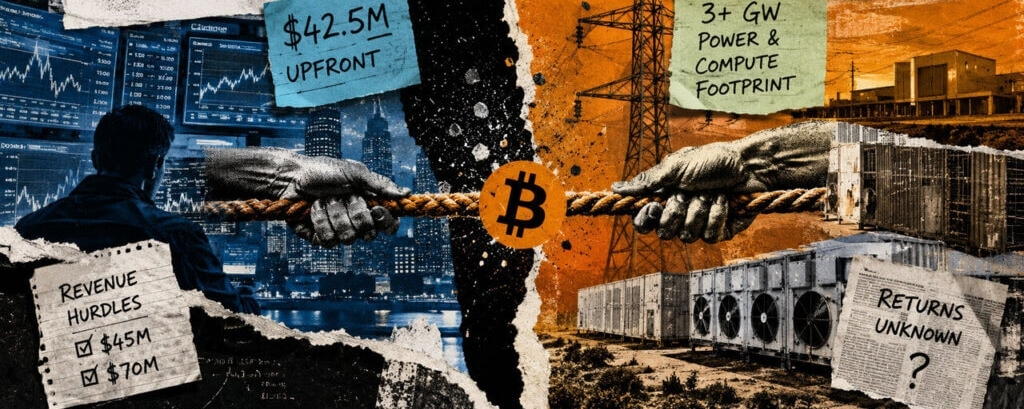
Article
See translation
News
BitGo and NYDIG pull opposite ends of a rope around Bitcoin, contrasting revenue hurdles with aThe BitGo NYDIG deal puts roughly $42.5 million upfront against NYDIG’s claimed 3+ GW power-and-compute footprint, with profitability unproven on both sides.
itGo's NYDIG deal transfers its institutional trading business to the digital-asset custody and trading infrastructure provider, while NYDIG says it is concentrating resources on power, Bitcoin mining and high-performance-computing data centers.
The closing terms disclosed by BitGo put roughly $42.5 million of consideration upfront. BitGo is adding an institutional team, client relationships and financial products around its custody and settlement platform. NYDIG is directing attention toward a company-described power-and-compute footprint exceeding 3 GW.
The deal makes each company’s resource allocation clear while leaving the margin comparison unresolved. BitGo’s filings show that very large digital-asset sales can carry a thin gross spread. NYDIG describes a large infrastructure footprint without disclosing the returns attached to it. The useful comparison is between the proof points each side must deliver.
The merger agreement defines the acquired business as spot and derivatives trading, virtual-currency asset management, borrowing and lending, and loan servicing. It explicitly excludes NYDIG’s Bitcoin mining and custody businesses, keeping the power-and-compute footprint outside BitGo’s purchase.
Approximately 30 NYDIG employees and institutional client trading relationships joined BitGo, according to the deal announcement. The team adds derivatives, structured products, financing and capital-markets capabilities to a platform that already offers institutional custody, trading and settlement.
The upfront consideration consists of $7 million in cash, subject to holdback and adjustments, plus 5,933,577 BitGo shares. The agreement uses a $5.9829 reference price, which values those closing shares at about $35.5 million and brings the disclosed upfront amount to roughly $42.5 million before cash adjustments.
The seller can receive more. A first earn-out pays $10 million in cash. A second provides $5 million in cash plus 835,715 BitGo shares, worth roughly another $5 million at the agreement reference price. Separate awards targeting $10 million are intended for transferred employees rather than the seller, so they sit outside the seller’s purchase price.
The current transaction covers only institutional trading and related assets. Mining and custody are excluded from the agreement, supporting a shift in priority rather than a clean exit from every Bitcoin financial-infrastructure activity.
That leaves NYDIG with a different and more capital-intensive scorecard. It must turn claimed footprint into financed, contracted and operating capacity, then show what tenants pay, how fully facilities are used and what returns remain after construction and financing. A gigawatt figure indicates potential scale while leaving the cash flow from that scale unknown.
BitGo’s scorecard is closer to the income statement. The acquired unit must retain institutional relationships, reach the $45 million and $70 million revenue hurdles and turn a broader service stack into profit. Later filings can show whether those products deliver better economics than the company’s existing Digital Asset Sales activity.
The BitGo NYDIG deal identifies two bets and two pending scorecards. BitGo has disclosed the price and revenue tests for adding more financial services. NYDIG has disclosed the size of its infrastructure ambition and a delivery window. Target margins and NYDIG project returns will decide the durable-margin comparison as those figures become visible.
#Write2Earn
#CryptoTrends2024
#ETHETFS
#xmucan
#Kriptocutrader
News BitGo and NYDIG pull opposite ends of a rope around Bitcoin, contrasting revenue hurdles with a
The BitGo NYDIG deal puts roughly $42.5 million upfront against NYDIG’s claimed 3+ GW power-and-compute footprint, with profitability unproven on both sides.
itGo's NYDIG deal transfers its institutional trading business to the digital-asset custody and trading infrastructure provider, while NYDIG says it is concentrating resources on power, Bitcoin mining and high-performance-computing data centers.
The closing terms disclosed by BitGo put roughly $42.5 million of consideration upfront. BitGo is adding an institutional team, client relationships and financial products around its custody and settlement platform. NYDIG is directing attention toward a company-described power-and-compute footprint exceeding 3 GW.
The deal makes each company’s resource allocation clear while leaving the margin comparison unresolved. BitGo’s filings show that very large digital-asset sales can carry a thin gross spread. NYDIG describes a large infrastructure footprint without disclosing the returns attached to it. The useful comparison is between the proof points each side must deliver.
The merger agreement defines the acquired business as spot and derivatives trading, virtual-currency asset management, borrowing and lending, and loan servicing. It explicitly excludes NYDIG’s Bitcoin mining and custody businesses, keeping the power-and-compute footprint outside BitGo’s purchase.
Approximately 30 NYDIG employees and institutional client trading relationships joined BitGo, according to the deal announcement. The team adds derivatives, structured products, financing and capital-markets capabilities to a platform that already offers institutional custody, trading and settlement.
The upfront consideration consists of $7 million in cash, subject to holdback and adjustments, plus 5,933,577 BitGo shares. The agreement uses a $5.9829 reference price, which values those closing shares at about $35.5 million and brings the disclosed upfront amount to roughly $42.5 million before cash adjustments.
The seller can receive more. A first earn-out pays $10 million in cash. A second provides $5 million in cash plus 835,715 BitGo shares, worth roughly another $5 million at the agreement reference price. Separate awards targeting $10 million are intended for transferred employees rather than the seller, so they sit outside the seller’s purchase price.
The current transaction covers only institutional trading and related assets. Mining and custody are excluded from the agreement, supporting a shift in priority rather than a clean exit from every Bitcoin financial-infrastructure activity.
That leaves NYDIG with a different and more capital-intensive scorecard. It must turn claimed footprint into financed, contracted and operating capacity, then show what tenants pay, how fully facilities are used and what returns remain after construction and financing. A gigawatt figure indicates potential scale while leaving the cash flow from that scale unknown.
BitGo’s scorecard is closer to the income statement. The acquired unit must retain institutional relationships, reach the $45 million and $70 million revenue hurdles and turn a broader service stack into profit. Later filings can show whether those products deliver better economics than the company’s existing Digital Asset Sales activity.
The BitGo NYDIG deal identifies two bets and two pending scorecards. BitGo has disclosed the price and revenue tests for adding more financial services. NYDIG has disclosed the size of its infrastructure ambition and a delivery window. Target margins and NYDIG project returns will decide the durable-margin comparison as those figures become visible.
#Write2Earn
#CryptoTrends2024
#ETHETFS
#xmucan
#Kriptocutrader
itGo's NYDIG deal transfers its institutional trading business to the digital-asset custody and trading infrastructure provider, while NYDIG says it is concentrating resources on power, Bitcoin mining and high-performance-computing data centers.
The closing terms disclosed by BitGo put roughly $42.5 million of consideration upfront. BitGo is adding an institutional team, client relationships and financial products around its custody and settlement platform. NYDIG is directing attention toward a company-described power-and-compute footprint exceeding 3 GW.
The deal makes each company’s resource allocation clear while leaving the margin comparison unresolved. BitGo’s filings show that very large digital-asset sales can carry a thin gross spread. NYDIG describes a large infrastructure footprint without disclosing the returns attached to it. The useful comparison is between the proof points each side must deliver.
The merger agreement defines the acquired business as spot and derivatives trading, virtual-currency asset management, borrowing and lending, and loan servicing. It explicitly excludes NYDIG’s Bitcoin mining and custody businesses, keeping the power-and-compute footprint outside BitGo’s purchase.
Approximately 30 NYDIG employees and institutional client trading relationships joined BitGo, according to the deal announcement. The team adds derivatives, structured products, financing and capital-markets capabilities to a platform that already offers institutional custody, trading and settlement.
The upfront consideration consists of $7 million in cash, subject to holdback and adjustments, plus 5,933,577 BitGo shares. The agreement uses a $5.9829 reference price, which values those closing shares at about $35.5 million and brings the disclosed upfront amount to roughly $42.5 million before cash adjustments.
The seller can receive more. A first earn-out pays $10 million in cash. A second provides $5 million in cash plus 835,715 BitGo shares, worth roughly another $5 million at the agreement reference price. Separate awards targeting $10 million are intended for transferred employees rather than the seller, so they sit outside the seller’s purchase price.
The current transaction covers only institutional trading and related assets. Mining and custody are excluded from the agreement, supporting a shift in priority rather than a clean exit from every Bitcoin financial-infrastructure activity.
That leaves NYDIG with a different and more capital-intensive scorecard. It must turn claimed footprint into financed, contracted and operating capacity, then show what tenants pay, how fully facilities are used and what returns remain after construction and financing. A gigawatt figure indicates potential scale while leaving the cash flow from that scale unknown.
BitGo’s scorecard is closer to the income statement. The acquired unit must retain institutional relationships, reach the $45 million and $70 million revenue hurdles and turn a broader service stack into profit. Later filings can show whether those products deliver better economics than the company’s existing Digital Asset Sales activity.
The BitGo NYDIG deal identifies two bets and two pending scorecards. BitGo has disclosed the price and revenue tests for adding more financial services. NYDIG has disclosed the size of its infrastructure ambition and a delivery window. Target margins and NYDIG project returns will decide the durable-margin comparison as those figures become visible.
#Write2Earn
#CryptoTrends2024
#ETHETFS
#xmucan
#Kriptocutrader
62
Log in to explore more content
Join global crypto users on Binance Square
⚡️ Get latest and useful information about crypto.
💬 Trusted by the world’s largest crypto exchange.
👍 Discover real insights from verified creators.
Email / Phone number
Trending Topics
BinanceLaunchesBinanceIntelligence
707,925 views
4,454 Discussing
#binancelaunchesbinanceintelligence 🚨 WHAT IF THE NEXT BIG EXCHANGE BATTLE ISN’T ABOUT FEES? 👀
Binance just made a bigger move than adding another AI chatbot.
With Binance Intelligence, AI is moving deeper into the exchange — from understanding market data to building trading workflows. 🤖⚡
The real question is:
Who has the best liquidity?
Or who has the smartest AI layer?
If users can research, test ideas and manage trading workflows without switching between different tools, the exchange itself could become a financial assistant.
That could be a much bigger shift than it looks today.
If Binance Intelligence drives more users, more strategies and more trading activity, $BNB could become one of the tokens to watch. 👀
Is Binance building the future of AI-powered finance?
$BNB
#binancelaunchesbinanceintelligence #BinanceAI #CryptoAI #AITrading
Suleman Khan Haqqani
·18 Likes
·22.9k views
BTCFallsBelow$84K
24,621 views
91 Discussing
DubaiVARAIssuesReserveAssetAuditCircular
4,527 views
308 Discussing