
CryptoFrontNews
17.6k Posts

CryptoFrontNews
 Square Verified+
Report
Block User
CryptoFrontNews (CFN) delivers the latest in cryptocurrency with real-time updates, expert analyses, and in-depth articles on digital currencies and blockchain.
4 Following
12.5K+ Followers
19.0K+ Liked
Posts
Article
See translation
XRP Ledger Gains Institutional Tokenization AttentionThe IMF identifies Stellar and the XRP Ledger among networks supporting Société Générale's EUR CoinVertible stablecoin deployment.
The report shows banks exploring permissionless networks while retaining controls such as whitelisting and other governance mechanisms.
Stablecoin deployment confirms network use, but it does not establish direct demand for XRP or XLM across institutional settlement.
XRP Ledger adoption is gaining attention as regulated institutions explore public blockchain infrastructure for stablecoins and asset settlement.
IMF Report Documents a Shift in Financial Infrastructure
ALLINCRYPTO’s post points to the IMF’s July tokenization report. The report examines changing infrastructure across payments and asset markets. It specifically discusses banks exploring permissionless networks for issuance and transactions.
The IMF identifies Société Générale among institutions pursuing this approach. Its EUR CoinVertible stablecoin operates across several blockchain networks. Those networks are Ethereum, Solana, Stellar, and the XRP Ledger.
The development marks a broader change in institutional blockchain architecture. Banks traditionally favored permissioned ledgers for control and predictable operating conditions. The report describes growing experimentation with public networks instead.
However, public infrastructure does not remove institutional controls. The IMF describes hybrid governance using tools such as whitelisting. These controls can restrict who holds and transfers regulated digital assets.
Stablecoins Connect Banks With Public Networks
Société Générale’s EUR CoinVertible offers a practical example. The stablecoin represents a regulated financial asset issued through banking infrastructure. Its multi-chain deployment also demonstrates growing interoperability across blockchain environments.
The IMF separates infrastructure from the assets operating upon it. Blockchain networks provide settlement rails and transaction environments. Stablecoins represent another layer within that broader architecture.
That distinction matters when measuring potential token demand. Network usage does not automatically require equivalent demand for native tokens. Settlement design, liquidity arrangements, and transaction structures determine actual token requirements.
XRP is as of writing trading at around $1.42, according to CoinMarketCap. The asset has a market capitalization near $89.5 billion. Its reported 24-hour trading volume is approximately $2.81 billion.
Tokenization Expands the Institutional Blockchain Debate
The IMF describes tokenization as more than simple asset digitization. It can combine ownership records, transfers, and settlement through shared digital ledgers. Smart contracts can also automate certain financial processes.
The report also stresses that several architecture models are emerging. Some institutions continue developing proprietary or permissioned infrastructure. Others are testing public networks with additional governance controls.
For Stellar, the report provides a similar institutional infrastructure context. Société Générale’s stablecoin deployment includes Stellar among its supported networks. However, the report does not establish direct requirements for XLM in every transaction.
The same distinction applies to the XRP Ledger. Its inclusion demonstrates use as institutional blockchain infrastructure. Further adoption would require measurable settlement volumes and recurring financial activity.
The post focuses on the institutional significance of these network deployments. The report itself remains focused on infrastructure design, interoperability, governance, and emerging financial models. (IMF eLibrary)
XRP Ledger Gains Institutional Tokenization Attention
The IMF identifies Stellar and the XRP Ledger among networks supporting Société Générale's EUR CoinVertible stablecoin deployment.
The report shows banks exploring permissionless networks while retaining controls such as whitelisting and other governance mechanisms.
Stablecoin deployment confirms network use, but it does not establish direct demand for XRP or XLM across institutional settlement.
XRP Ledger adoption is gaining attention as regulated institutions explore public blockchain infrastructure for stablecoins and asset settlement.
IMF Report Documents a Shift in Financial Infrastructure
ALLINCRYPTO’s post points to the IMF’s July tokenization report. The report examines changing infrastructure across payments and asset markets. It specifically discusses banks exploring permissionless networks for issuance and transactions.
The IMF identifies Société Générale among institutions pursuing this approach. Its EUR CoinVertible stablecoin operates across several blockchain networks. Those networks are Ethereum, Solana, Stellar, and the XRP Ledger.
The development marks a broader change in institutional blockchain architecture. Banks traditionally favored permissioned ledgers for control and predictable operating conditions. The report describes growing experimentation with public networks instead.
However, public infrastructure does not remove institutional controls. The IMF describes hybrid governance using tools such as whitelisting. These controls can restrict who holds and transfers regulated digital assets.
Stablecoins Connect Banks With Public Networks
Société Générale’s EUR CoinVertible offers a practical example. The stablecoin represents a regulated financial asset issued through banking infrastructure. Its multi-chain deployment also demonstrates growing interoperability across blockchain environments.
The IMF separates infrastructure from the assets operating upon it. Blockchain networks provide settlement rails and transaction environments. Stablecoins represent another layer within that broader architecture.
That distinction matters when measuring potential token demand. Network usage does not automatically require equivalent demand for native tokens. Settlement design, liquidity arrangements, and transaction structures determine actual token requirements.
XRP is as of writing trading at around $1.42, according to CoinMarketCap. The asset has a market capitalization near $89.5 billion. Its reported 24-hour trading volume is approximately $2.81 billion.
Tokenization Expands the Institutional Blockchain Debate
The IMF describes tokenization as more than simple asset digitization. It can combine ownership records, transfers, and settlement through shared digital ledgers. Smart contracts can also automate certain financial processes.
The report also stresses that several architecture models are emerging. Some institutions continue developing proprietary or permissioned infrastructure. Others are testing public networks with additional governance controls.
For Stellar, the report provides a similar institutional infrastructure context. Société Générale’s stablecoin deployment includes Stellar among its supported networks. However, the report does not establish direct requirements for XLM in every transaction.
The same distinction applies to the XRP Ledger. Its inclusion demonstrates use as institutional blockchain infrastructure. Further adoption would require measurable settlement volumes and recurring financial activity.
The post focuses on the institutional significance of these network deployments. The report itself remains focused on infrastructure design, interoperability, governance, and emerging financial models. (IMF eLibrary)
The report shows banks exploring permissionless networks while retaining controls such as whitelisting and other governance mechanisms.
Stablecoin deployment confirms network use, but it does not establish direct demand for XRP or XLM across institutional settlement.
XRP Ledger adoption is gaining attention as regulated institutions explore public blockchain infrastructure for stablecoins and asset settlement.
IMF Report Documents a Shift in Financial Infrastructure
ALLINCRYPTO’s post points to the IMF’s July tokenization report. The report examines changing infrastructure across payments and asset markets. It specifically discusses banks exploring permissionless networks for issuance and transactions.
The IMF identifies Société Générale among institutions pursuing this approach. Its EUR CoinVertible stablecoin operates across several blockchain networks. Those networks are Ethereum, Solana, Stellar, and the XRP Ledger.
The development marks a broader change in institutional blockchain architecture. Banks traditionally favored permissioned ledgers for control and predictable operating conditions. The report describes growing experimentation with public networks instead.
However, public infrastructure does not remove institutional controls. The IMF describes hybrid governance using tools such as whitelisting. These controls can restrict who holds and transfers regulated digital assets.
Stablecoins Connect Banks With Public Networks
Société Générale’s EUR CoinVertible offers a practical example. The stablecoin represents a regulated financial asset issued through banking infrastructure. Its multi-chain deployment also demonstrates growing interoperability across blockchain environments.
The IMF separates infrastructure from the assets operating upon it. Blockchain networks provide settlement rails and transaction environments. Stablecoins represent another layer within that broader architecture.
That distinction matters when measuring potential token demand. Network usage does not automatically require equivalent demand for native tokens. Settlement design, liquidity arrangements, and transaction structures determine actual token requirements.
XRP is as of writing trading at around $1.42, according to CoinMarketCap. The asset has a market capitalization near $89.5 billion. Its reported 24-hour trading volume is approximately $2.81 billion.
Tokenization Expands the Institutional Blockchain Debate
The IMF describes tokenization as more than simple asset digitization. It can combine ownership records, transfers, and settlement through shared digital ledgers. Smart contracts can also automate certain financial processes.
The report also stresses that several architecture models are emerging. Some institutions continue developing proprietary or permissioned infrastructure. Others are testing public networks with additional governance controls.
For Stellar, the report provides a similar institutional infrastructure context. Société Générale’s stablecoin deployment includes Stellar among its supported networks. However, the report does not establish direct requirements for XLM in every transaction.
The same distinction applies to the XRP Ledger. Its inclusion demonstrates use as institutional blockchain infrastructure. Further adoption would require measurable settlement volumes and recurring financial activity.
The post focuses on the institutional significance of these network deployments. The report itself remains focused on infrastructure design, interoperability, governance, and emerging financial models. (IMF eLibrary)
45
Article
See translation
Binance Puts $100M Into Circle Under New Five-Year USDC DealBinance invested $100M in Circle through a private placement of Class A common stock, with a two-year transfer restriction.
Binance will expand USDC promotion and integration, while Circle will provide infrastructure for holding and using the stablecoin.
The companies renewed their commercial agreement for five years, with a focus on expanding USDC access across emerging markets.
Binance has invested $100 million in Circle while renewing their commercial agreement for five years. The companies said the deal will focus on increasing USDC access across emerging markets. Binance will promote and integrate USDC, while Circle will provide infrastructure supporting how users hold and use the stablecoin.
Binance Takes Equity Stake in Circle
The investment gives Binance an equity position in Circle through a private placement of Class A common stock. Binance bought the shares at a price reflecting a 5% discount to Circle’s market price before closing.
https://twitter.com/circle/status/2102367809082909123?s=20
However, Binance agreed not to transfer the shares for up to two years after closing. The restriction remains subject to customary exceptions.
The companies also renewed their commercial relationship for another five years. Under the agreement, Binance will increase USDC promotion, awareness and integration across its platform.
New Agreement Targets Emerging Markets
The renewed partnership focuses on emerging markets. Binance will handle broader USDC promotion and integration, while Circle will supply infrastructure services. Circle CEO Jeremy Allaire said the companies see opportunities to use USDC for dollar access, savings and investment products.
He also cited its use among people and businesses in emerging markets. Meanwhile, Binance co-CEO Richard Teng described the investment and five-year agreement as a long-term commitment.
He also referenced Circle’s USDC, Arc and infrastructure operations. The deal combines an equity investment with a commercial agreement. Both companies disclosed the two parts together as an expansion of their partnership.
Allaire and Teng Outline Partnership
Allaire said Binance operates one of the largest platforms for digital currency use. He also described it as a major wallet for dollar stablecoins. Teng said Circle spans USDC, Arc and infrastructure for cross-border value transfers.
He linked the investment and renewed agreement to wider access to digital dollars. According to the companies, Circle will continue providing infrastructure for holding and using USDC.
Binance, meanwhile, will expand USDC promotion and integration across its platform. The agreement covers five years, while the investment totals $100 million. The equity purchase also includes the two-year transfer restriction disclosed by Binance and Circle.
Binance Puts $100M Into Circle Under New Five-Year USDC Deal
Binance invested $100M in Circle through a private placement of Class A common stock, with a two-year transfer restriction.
Binance will expand USDC promotion and integration, while Circle will provide infrastructure for holding and using the stablecoin.
The companies renewed their commercial agreement for five years, with a focus on expanding USDC access across emerging markets.
Binance has invested $100 million in Circle while renewing their commercial agreement for five years. The companies said the deal will focus on increasing USDC access across emerging markets. Binance will promote and integrate USDC, while Circle will provide infrastructure supporting how users hold and use the stablecoin.
Binance Takes Equity Stake in Circle
The investment gives Binance an equity position in Circle through a private placement of Class A common stock. Binance bought the shares at a price reflecting a 5% discount to Circle’s market price before closing.
https://twitter.com/circle/status/2102367809082909123?s=20
However, Binance agreed not to transfer the shares for up to two years after closing. The restriction remains subject to customary exceptions.
The companies also renewed their commercial relationship for another five years. Under the agreement, Binance will increase USDC promotion, awareness and integration across its platform.
New Agreement Targets Emerging Markets
The renewed partnership focuses on emerging markets. Binance will handle broader USDC promotion and integration, while Circle will supply infrastructure services. Circle CEO Jeremy Allaire said the companies see opportunities to use USDC for dollar access, savings and investment products.
He also cited its use among people and businesses in emerging markets. Meanwhile, Binance co-CEO Richard Teng described the investment and five-year agreement as a long-term commitment.
He also referenced Circle’s USDC, Arc and infrastructure operations. The deal combines an equity investment with a commercial agreement. Both companies disclosed the two parts together as an expansion of their partnership.
Allaire and Teng Outline Partnership
Allaire said Binance operates one of the largest platforms for digital currency use. He also described it as a major wallet for dollar stablecoins. Teng said Circle spans USDC, Arc and infrastructure for cross-border value transfers.
He linked the investment and renewed agreement to wider access to digital dollars. According to the companies, Circle will continue providing infrastructure for holding and using USDC.
Binance, meanwhile, will expand USDC promotion and integration across its platform. The agreement covers five years, while the investment totals $100 million. The equity purchase also includes the two-year transfer restriction disclosed by Binance and Circle.
Binance will expand USDC promotion and integration, while Circle will provide infrastructure for holding and using the stablecoin.
The companies renewed their commercial agreement for five years, with a focus on expanding USDC access across emerging markets.
Binance has invested $100 million in Circle while renewing their commercial agreement for five years. The companies said the deal will focus on increasing USDC access across emerging markets. Binance will promote and integrate USDC, while Circle will provide infrastructure supporting how users hold and use the stablecoin.
Binance Takes Equity Stake in Circle
The investment gives Binance an equity position in Circle through a private placement of Class A common stock. Binance bought the shares at a price reflecting a 5% discount to Circle’s market price before closing.
https://twitter.com/circle/status/2102367809082909123?s=20
However, Binance agreed not to transfer the shares for up to two years after closing. The restriction remains subject to customary exceptions.
The companies also renewed their commercial relationship for another five years. Under the agreement, Binance will increase USDC promotion, awareness and integration across its platform.
New Agreement Targets Emerging Markets
The renewed partnership focuses on emerging markets. Binance will handle broader USDC promotion and integration, while Circle will supply infrastructure services. Circle CEO Jeremy Allaire said the companies see opportunities to use USDC for dollar access, savings and investment products.
He also cited its use among people and businesses in emerging markets. Meanwhile, Binance co-CEO Richard Teng described the investment and five-year agreement as a long-term commitment.
He also referenced Circle’s USDC, Arc and infrastructure operations. The deal combines an equity investment with a commercial agreement. Both companies disclosed the two parts together as an expansion of their partnership.
Allaire and Teng Outline Partnership
Allaire said Binance operates one of the largest platforms for digital currency use. He also described it as a major wallet for dollar stablecoins. Teng said Circle spans USDC, Arc and infrastructure for cross-border value transfers.
He linked the investment and renewed agreement to wider access to digital dollars. According to the companies, Circle will continue providing infrastructure for holding and using USDC.
Binance, meanwhile, will expand USDC promotion and integration across its platform. The agreement covers five years, while the investment totals $100 million. The equity purchase also includes the two-year transfer restriction disclosed by Binance and Circle.
55
Article
See translation
PENGU Breaks Above $0.01 as Weekly Buy Signals Point Toward $0.025 and $0.045PENGU climbed from $0.0080 to around $0.0110, with $0.0110-$0.0116 now acting as immediate resistance.
Ali Charts highlights weekly buy signals from TD Sequential, Parabolic SAR and SuperTrend indicators.
A move above $0.025 could bring the $0.045 channel boundary into focus, while $0.0090-$0.0080 remain key support.
PENGU jumped above $0.01 with exchange flows turning volatile. Analyst Ali Charts identified several weekly indicators pointing higher, while the latest chart shows price near $0.0110. The move also brought the $0.025 and $0.045 channel levels into focus as Ali Charts’ technical targets.
Weekly Indicators Point To A Breakout
Ali Charts said Bollinger Bands are squeezing on PENGU’s weekly chart. The upper and lower bands have contracted, showing low volatility before the latest price expansion. The Tom DeMark Sequential produced two weekly buy signals.
https://twitter.com/alicharts/status/2102150992976310309?s=20
A 9 setup appeared first, followed by a Combo 13 signal. Together, those readings can indicate a new nine-candle bullish countdown. Meanwhile, the Parabolic SAR flipped bullish, with its dots moving below PENGU’s price.
The SuperTrend indicator also turned into a buy signal. Ali Charts noted that a similar weekly signal previously preceded a 1,156% rally.
PENGU Price Breaks Above $0.01
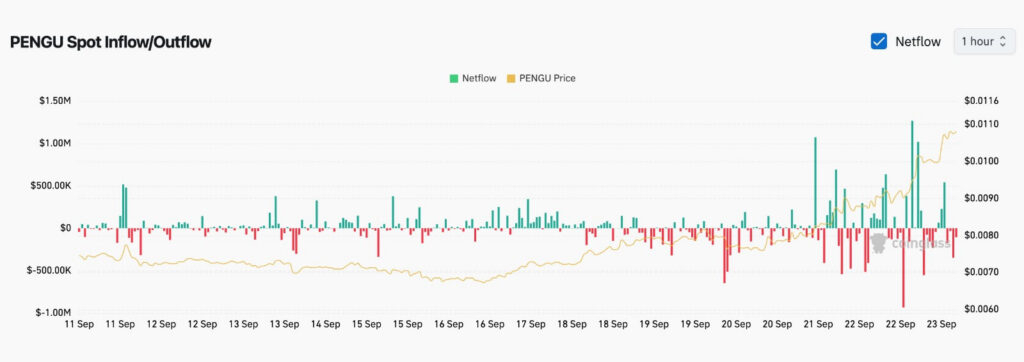
The chart shows PENGU breaking above $0.0080 around September 21. Price then moved through $0.0090 and $0.0100 before reaching approximately $0.0110 on September 23. The move followed several smaller exchange-flow readings earlier in September.
Source: Coinglass
Negative spikes reached roughly $500,000 to $600,000, while a September 20 outflow approached $650,000. After the breakout began, positive inflow spikes grew sharply. Individual green bars reached approximately $1 million, $1.1 million and $1.25 million.
However, outflows also increased. Red spikes approached $500,000 and nearly $1 million on September 22, showing strong two-way exchange activity.
Analyst Watches Higher PENGU Price Levels
Ali Charts said PENGU remains inside a parallel channel. The midpoint near $0.025 represents his first target if price breaks higher. A move through that level would bring the upper channel boundary near $0.045 into focus.
Ali Charts estimated that level at roughly 430% above current prices. Meanwhile, $0.0100 has become an important psychological level on the latest chart. The immediate resistance area sits around $0.0110 to $0.0116.
A sustained move below $0.0100 could expose $0.0090 to $0.0080. That range matches the earlier trading area before the September 21 breakout.
PENGU Breaks Above $0.01 as Weekly Buy Signals Point Toward $0.025 and $0.045
PENGU climbed from $0.0080 to around $0.0110, with $0.0110-$0.0116 now acting as immediate resistance.
Ali Charts highlights weekly buy signals from TD Sequential, Parabolic SAR and SuperTrend indicators.
A move above $0.025 could bring the $0.045 channel boundary into focus, while $0.0090-$0.0080 remain key support.
PENGU jumped above $0.01 with exchange flows turning volatile. Analyst Ali Charts identified several weekly indicators pointing higher, while the latest chart shows price near $0.0110. The move also brought the $0.025 and $0.045 channel levels into focus as Ali Charts’ technical targets.
Weekly Indicators Point To A Breakout
Ali Charts said Bollinger Bands are squeezing on PENGU’s weekly chart. The upper and lower bands have contracted, showing low volatility before the latest price expansion. The Tom DeMark Sequential produced two weekly buy signals.
https://twitter.com/alicharts/status/2102150992976310309?s=20
A 9 setup appeared first, followed by a Combo 13 signal. Together, those readings can indicate a new nine-candle bullish countdown. Meanwhile, the Parabolic SAR flipped bullish, with its dots moving below PENGU’s price.
The SuperTrend indicator also turned into a buy signal. Ali Charts noted that a similar weekly signal previously preceded a 1,156% rally.
PENGU Price Breaks Above $0.01
The chart shows PENGU breaking above $0.0080 around September 21. Price then moved through $0.0090 and $0.0100 before reaching approximately $0.0110 on September 23. The move followed several smaller exchange-flow readings earlier in September.
Source: Coinglass
Negative spikes reached roughly $500,000 to $600,000, while a September 20 outflow approached $650,000. After the breakout began, positive inflow spikes grew sharply. Individual green bars reached approximately $1 million, $1.1 million and $1.25 million.
However, outflows also increased. Red spikes approached $500,000 and nearly $1 million on September 22, showing strong two-way exchange activity.
Analyst Watches Higher PENGU Price Levels
Ali Charts said PENGU remains inside a parallel channel. The midpoint near $0.025 represents his first target if price breaks higher. A move through that level would bring the upper channel boundary near $0.045 into focus.
Ali Charts estimated that level at roughly 430% above current prices. Meanwhile, $0.0100 has become an important psychological level on the latest chart. The immediate resistance area sits around $0.0110 to $0.0116.
A sustained move below $0.0100 could expose $0.0090 to $0.0080. That range matches the earlier trading area before the September 21 breakout.
Ali Charts highlights weekly buy signals from TD Sequential, Parabolic SAR and SuperTrend indicators.
A move above $0.025 could bring the $0.045 channel boundary into focus, while $0.0090-$0.0080 remain key support.
PENGU jumped above $0.01 with exchange flows turning volatile. Analyst Ali Charts identified several weekly indicators pointing higher, while the latest chart shows price near $0.0110. The move also brought the $0.025 and $0.045 channel levels into focus as Ali Charts’ technical targets.
Weekly Indicators Point To A Breakout
Ali Charts said Bollinger Bands are squeezing on PENGU’s weekly chart. The upper and lower bands have contracted, showing low volatility before the latest price expansion. The Tom DeMark Sequential produced two weekly buy signals.
https://twitter.com/alicharts/status/2102150992976310309?s=20
A 9 setup appeared first, followed by a Combo 13 signal. Together, those readings can indicate a new nine-candle bullish countdown. Meanwhile, the Parabolic SAR flipped bullish, with its dots moving below PENGU’s price.
The SuperTrend indicator also turned into a buy signal. Ali Charts noted that a similar weekly signal previously preceded a 1,156% rally.
PENGU Price Breaks Above $0.01
The chart shows PENGU breaking above $0.0080 around September 21. Price then moved through $0.0090 and $0.0100 before reaching approximately $0.0110 on September 23. The move followed several smaller exchange-flow readings earlier in September.
Source: Coinglass
Negative spikes reached roughly $500,000 to $600,000, while a September 20 outflow approached $650,000. After the breakout began, positive inflow spikes grew sharply. Individual green bars reached approximately $1 million, $1.1 million and $1.25 million.
However, outflows also increased. Red spikes approached $500,000 and nearly $1 million on September 22, showing strong two-way exchange activity.
Analyst Watches Higher PENGU Price Levels
Ali Charts said PENGU remains inside a parallel channel. The midpoint near $0.025 represents his first target if price breaks higher. A move through that level would bring the upper channel boundary near $0.045 into focus.
Ali Charts estimated that level at roughly 430% above current prices. Meanwhile, $0.0100 has become an important psychological level on the latest chart. The immediate resistance area sits around $0.0110 to $0.0116.
A sustained move below $0.0100 could expose $0.0090 to $0.0080. That range matches the earlier trading area before the September 21 breakout.
231
Article
See translation
Shibarium Upgrades Reshape Shiba Inu InfrastructureShibarium’s reorg issue is resolved, while dRPC continues its transition into the updated network environment after recent changes.
Node operators received fully rotated Bor and Heimdall peer settings, replacing older connection details across the Shibarium network.
Cloudflare migration added IPv6 support to key ecosystem sites, while Shibariumscan continued reindexing blockchain data after changes.
Shibarium upgrades are advancing across core infrastructure, with a reorg fix, peer rotation, refreshed RPC details, Cloudflare migration, and IPv6 support now moving through the ecosystem in recent days.
Shibarium Infrastructure Receives Fresh Network Changes
SHIBMortal recently pointed to infrastructure work replacing constant market predictions across crypto timelines. The post cited a resolved Shibarium reorg alongside updated network peers for operators. It also referenced refreshed RPC information and Cloudflare migration across ecosystem sites.
https://twitter.com/SHIBMortal/status/2102090661520650446?s=20
The reorganization issue was reported resolved on September 19 by developers monitoring migration progress. However, dRPC still needs to complete its transition into the new environment. That leaves migration work continuing after the reported network issue was fixed.
Reports also confirm a complete rotation of Bor and Heimdall peer settings. The previous connection set became obsolete after the latest network changes were implemented. New configurations were issued to node operators following the peer rotation process.
The peer changes affect connection settings used by participating network nodes. Updated configurations help operators align their infrastructure with current network requirements. The changes form part of continuing maintenance across Shibarium’s technical stack and services.
RPC Updates and Explorer Indexing Continue
Shibarium’s official documentation now lists rpc.shibarium.shib.io as its main endpoint. The endpoint is associated with Shibarium’s chain ID 109 in current documentation. The RPC registry was also refreshed after earlier infrastructure migration work.
That update corrected connection details that had remained outdated after migration. The RPC layer provides a connection route for wallets and applications using Shibarium. Therefore, accurate endpoint information remains necessary for network integrations and applications.
Meanwhile, Shibariumscan continues reindexing blockchain data following recent infrastructure changes. Reports placed explorer indexing near 53% during the latest reported update. That percentage measures explorer indexing, rather than the blockchain’s operating status itself.
The indexing process concerns explorer visibility across recorded blockchain activity. It does not represent a percentage measure of network functionality itself. Further reindexing therefore remains part of the ongoing infrastructure work across Shibarium.
Web Infrastructure Expands With Cloudflare and IPv6
Separate changes have also reached websites supporting the wider Shiba Inu ecosystem. The official shib.io website moved to Cloudflare on September 12. ShibaSwap and official documentation were migrated to the same hosting infrastructure.
IPv6 support was added alongside the Cloudflare migration for those sites. The change extends infrastructure work beyond the Shibarium blockchain itself. It also affects how users access several ecosystem-facing web services.
SHIBMortal framed these developments around builders rather than recurring price predictions. The post presented infrastructure delivery as the focus behind current ecosystem activity. Meanwhile, SHIB trades at $0.00000623 on September 22, according to MetaMask.
The current market level remains separate from the reported infrastructure changes. Together, the updates cover network connectivity, access points, indexing, and websites. Those areas are being addressed while the broader migration work continues.
Shibarium Upgrades Reshape Shiba Inu Infrastructure
Shibarium’s reorg issue is resolved, while dRPC continues its transition into the updated network environment after recent changes.
Node operators received fully rotated Bor and Heimdall peer settings, replacing older connection details across the Shibarium network.
Cloudflare migration added IPv6 support to key ecosystem sites, while Shibariumscan continued reindexing blockchain data after changes.
Shibarium upgrades are advancing across core infrastructure, with a reorg fix, peer rotation, refreshed RPC details, Cloudflare migration, and IPv6 support now moving through the ecosystem in recent days.
Shibarium Infrastructure Receives Fresh Network Changes
SHIBMortal recently pointed to infrastructure work replacing constant market predictions across crypto timelines. The post cited a resolved Shibarium reorg alongside updated network peers for operators. It also referenced refreshed RPC information and Cloudflare migration across ecosystem sites.
https://twitter.com/SHIBMortal/status/2102090661520650446?s=20
The reorganization issue was reported resolved on September 19 by developers monitoring migration progress. However, dRPC still needs to complete its transition into the new environment. That leaves migration work continuing after the reported network issue was fixed.
Reports also confirm a complete rotation of Bor and Heimdall peer settings. The previous connection set became obsolete after the latest network changes were implemented. New configurations were issued to node operators following the peer rotation process.
The peer changes affect connection settings used by participating network nodes. Updated configurations help operators align their infrastructure with current network requirements. The changes form part of continuing maintenance across Shibarium’s technical stack and services.
RPC Updates and Explorer Indexing Continue
Shibarium’s official documentation now lists rpc.shibarium.shib.io as its main endpoint. The endpoint is associated with Shibarium’s chain ID 109 in current documentation. The RPC registry was also refreshed after earlier infrastructure migration work.
That update corrected connection details that had remained outdated after migration. The RPC layer provides a connection route for wallets and applications using Shibarium. Therefore, accurate endpoint information remains necessary for network integrations and applications.
Meanwhile, Shibariumscan continues reindexing blockchain data following recent infrastructure changes. Reports placed explorer indexing near 53% during the latest reported update. That percentage measures explorer indexing, rather than the blockchain’s operating status itself.
The indexing process concerns explorer visibility across recorded blockchain activity. It does not represent a percentage measure of network functionality itself. Further reindexing therefore remains part of the ongoing infrastructure work across Shibarium.
Web Infrastructure Expands With Cloudflare and IPv6
Separate changes have also reached websites supporting the wider Shiba Inu ecosystem. The official shib.io website moved to Cloudflare on September 12. ShibaSwap and official documentation were migrated to the same hosting infrastructure.
IPv6 support was added alongside the Cloudflare migration for those sites. The change extends infrastructure work beyond the Shibarium blockchain itself. It also affects how users access several ecosystem-facing web services.
SHIBMortal framed these developments around builders rather than recurring price predictions. The post presented infrastructure delivery as the focus behind current ecosystem activity. Meanwhile, SHIB trades at $0.00000623 on September 22, according to MetaMask.
The current market level remains separate from the reported infrastructure changes. Together, the updates cover network connectivity, access points, indexing, and websites. Those areas are being addressed while the broader migration work continues.
Node operators received fully rotated Bor and Heimdall peer settings, replacing older connection details across the Shibarium network.
Cloudflare migration added IPv6 support to key ecosystem sites, while Shibariumscan continued reindexing blockchain data after changes.
Shibarium upgrades are advancing across core infrastructure, with a reorg fix, peer rotation, refreshed RPC details, Cloudflare migration, and IPv6 support now moving through the ecosystem in recent days.
Shibarium Infrastructure Receives Fresh Network Changes
SHIBMortal recently pointed to infrastructure work replacing constant market predictions across crypto timelines. The post cited a resolved Shibarium reorg alongside updated network peers for operators. It also referenced refreshed RPC information and Cloudflare migration across ecosystem sites.
https://twitter.com/SHIBMortal/status/2102090661520650446?s=20
The reorganization issue was reported resolved on September 19 by developers monitoring migration progress. However, dRPC still needs to complete its transition into the new environment. That leaves migration work continuing after the reported network issue was fixed.
Reports also confirm a complete rotation of Bor and Heimdall peer settings. The previous connection set became obsolete after the latest network changes were implemented. New configurations were issued to node operators following the peer rotation process.
The peer changes affect connection settings used by participating network nodes. Updated configurations help operators align their infrastructure with current network requirements. The changes form part of continuing maintenance across Shibarium’s technical stack and services.
RPC Updates and Explorer Indexing Continue
Shibarium’s official documentation now lists rpc.shibarium.shib.io as its main endpoint. The endpoint is associated with Shibarium’s chain ID 109 in current documentation. The RPC registry was also refreshed after earlier infrastructure migration work.
That update corrected connection details that had remained outdated after migration. The RPC layer provides a connection route for wallets and applications using Shibarium. Therefore, accurate endpoint information remains necessary for network integrations and applications.
Meanwhile, Shibariumscan continues reindexing blockchain data following recent infrastructure changes. Reports placed explorer indexing near 53% during the latest reported update. That percentage measures explorer indexing, rather than the blockchain’s operating status itself.
The indexing process concerns explorer visibility across recorded blockchain activity. It does not represent a percentage measure of network functionality itself. Further reindexing therefore remains part of the ongoing infrastructure work across Shibarium.
Web Infrastructure Expands With Cloudflare and IPv6
Separate changes have also reached websites supporting the wider Shiba Inu ecosystem. The official shib.io website moved to Cloudflare on September 12. ShibaSwap and official documentation were migrated to the same hosting infrastructure.
IPv6 support was added alongside the Cloudflare migration for those sites. The change extends infrastructure work beyond the Shibarium blockchain itself. It also affects how users access several ecosystem-facing web services.
SHIBMortal framed these developments around builders rather than recurring price predictions. The post presented infrastructure delivery as the focus behind current ecosystem activity. Meanwhile, SHIB trades at $0.00000623 on September 22, according to MetaMask.
The current market level remains separate from the reported infrastructure changes. Together, the updates cover network connectivity, access points, indexing, and websites. Those areas are being addressed while the broader migration work continues.
104
Article
See translation
SUI Breaks Downtrend as Analysts Watch the $1.50 Price LevelSUI broke its nine-month downtrend after rising from $0.68-$0.70 to above $1, briefly reaching $1.08.
Analysts identify $1.16, $1.42 and $1.50 as key upside levels, with $1.92 as a major macro level.
RSI is above 70 while MACD momentum cools, putting $1.05-$1.08 resistance and $0.95-$0.90 support in focus.
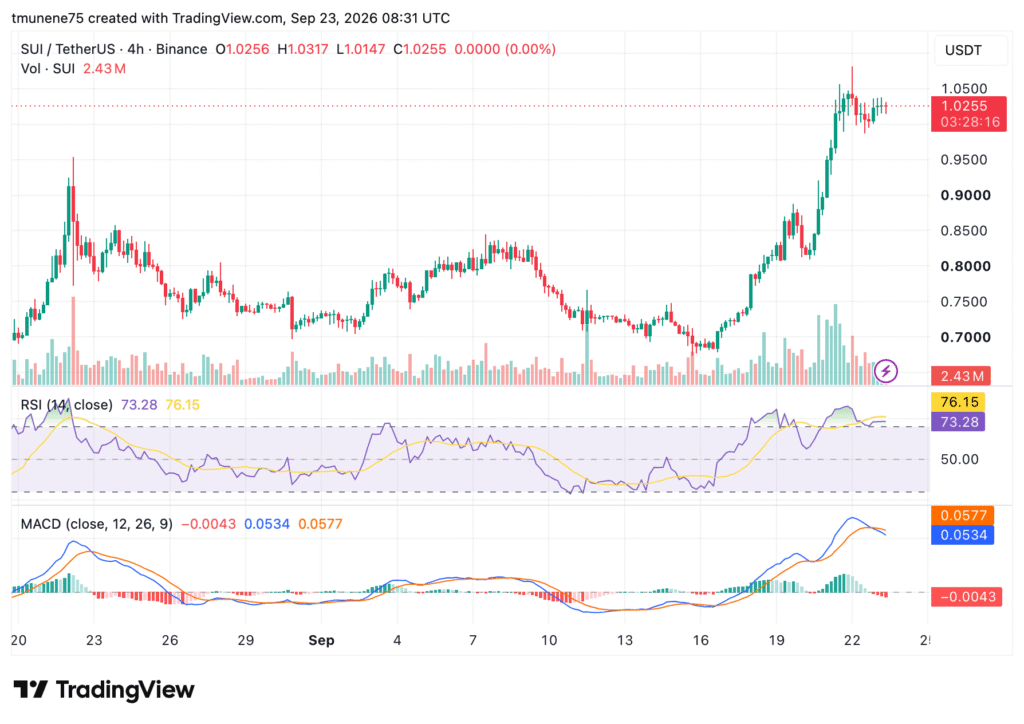
SUI has broken a nine-month downtrend as analysts Ted Pillows and Scient track resistance levels above $1. Price climbed from the $0.68-$0.70 area to $1.0255, briefly reaching $1.08 before consolidating. The move followed a recovery through $0.80, $0.85, $0.90 and $0.95, while protocol updates added another focus for Pillows.
SUI Breaks Its Nine-Month Downtrend
Pillows said gasless stablecoin transfers now work at the protocol level. He also said confidential transfers are coming this month, keeping amounts private while settlement remains verifiable. Meanwhile, Pillows identified $1.16 and $1.42 as resistance zones from a technical perspective.
He said $1.50 is the next level he watches after the breakout. Scient described the chart structure as bullish across every timeframe through the weekly. On the daily chart, he said SUI swept lows around $0.64-$0.68 before reclaiming $0.80-$0.85.
Analysts Track SUI Resistance Levels
Scient said the price then moved toward the $1.05 region, where resistance emerged. He identified $1.41 and $1.92 as upside levels if SUI clears the recent highs. According to Scient, $1.92 represents the key macro support and resistance level on his chart.
Source: Scient
He also identified dips toward $0.85 as areas to build spot positions. The four-hour chart shows SUI consolidating around $1.02-$1.04 after reaching approximately $1.08. Price has established higher highs and higher lows during the recovery.
SUI Technical Levels
The chart places $1.00 as a psychological support level, followed by $0.95 and $0.90. Meanwhile, the $1.05-$1.08 zone remains the immediate resistance area. The RSI is at 73.28, with its moving average at 76.15.
Source: TradingView
That places RSI above the traditional 70 overbought threshold. However, the MACD remains bullish while momentum has started cooling. The MACD line is at 0.0534 against a 0.0577 signal line.
The histogram is at -0.0043. Recent volume expansion accompanied the breakout, while price remains near its latest highs. Pillows said some consolidation would be healthy before another move higher. A break above $1.08 could open higher levels, while a move below $1 could expose $0.95-$0.90.
SUI Breaks Downtrend as Analysts Watch the $1.50 Price Level
SUI broke its nine-month downtrend after rising from $0.68-$0.70 to above $1, briefly reaching $1.08.
Analysts identify $1.16, $1.42 and $1.50 as key upside levels, with $1.92 as a major macro level.
RSI is above 70 while MACD momentum cools, putting $1.05-$1.08 resistance and $0.95-$0.90 support in focus.
SUI has broken a nine-month downtrend as analysts Ted Pillows and Scient track resistance levels above $1. Price climbed from the $0.68-$0.70 area to $1.0255, briefly reaching $1.08 before consolidating. The move followed a recovery through $0.80, $0.85, $0.90 and $0.95, while protocol updates added another focus for Pillows.
SUI Breaks Its Nine-Month Downtrend
Pillows said gasless stablecoin transfers now work at the protocol level. He also said confidential transfers are coming this month, keeping amounts private while settlement remains verifiable. Meanwhile, Pillows identified $1.16 and $1.42 as resistance zones from a technical perspective.
He said $1.50 is the next level he watches after the breakout. Scient described the chart structure as bullish across every timeframe through the weekly. On the daily chart, he said SUI swept lows around $0.64-$0.68 before reclaiming $0.80-$0.85.
Analysts Track SUI Resistance Levels
Scient said the price then moved toward the $1.05 region, where resistance emerged. He identified $1.41 and $1.92 as upside levels if SUI clears the recent highs. According to Scient, $1.92 represents the key macro support and resistance level on his chart.
Source: Scient
He also identified dips toward $0.85 as areas to build spot positions. The four-hour chart shows SUI consolidating around $1.02-$1.04 after reaching approximately $1.08. Price has established higher highs and higher lows during the recovery.
SUI Technical Levels
The chart places $1.00 as a psychological support level, followed by $0.95 and $0.90. Meanwhile, the $1.05-$1.08 zone remains the immediate resistance area. The RSI is at 73.28, with its moving average at 76.15.
Source: TradingView
That places RSI above the traditional 70 overbought threshold. However, the MACD remains bullish while momentum has started cooling. The MACD line is at 0.0534 against a 0.0577 signal line.
The histogram is at -0.0043. Recent volume expansion accompanied the breakout, while price remains near its latest highs. Pillows said some consolidation would be healthy before another move higher. A break above $1.08 could open higher levels, while a move below $1 could expose $0.95-$0.90.
Analysts identify $1.16, $1.42 and $1.50 as key upside levels, with $1.92 as a major macro level.
RSI is above 70 while MACD momentum cools, putting $1.05-$1.08 resistance and $0.95-$0.90 support in focus.
SUI has broken a nine-month downtrend as analysts Ted Pillows and Scient track resistance levels above $1. Price climbed from the $0.68-$0.70 area to $1.0255, briefly reaching $1.08 before consolidating. The move followed a recovery through $0.80, $0.85, $0.90 and $0.95, while protocol updates added another focus for Pillows.
SUI Breaks Its Nine-Month Downtrend
Pillows said gasless stablecoin transfers now work at the protocol level. He also said confidential transfers are coming this month, keeping amounts private while settlement remains verifiable. Meanwhile, Pillows identified $1.16 and $1.42 as resistance zones from a technical perspective.
He said $1.50 is the next level he watches after the breakout. Scient described the chart structure as bullish across every timeframe through the weekly. On the daily chart, he said SUI swept lows around $0.64-$0.68 before reclaiming $0.80-$0.85.
Analysts Track SUI Resistance Levels
Scient said the price then moved toward the $1.05 region, where resistance emerged. He identified $1.41 and $1.92 as upside levels if SUI clears the recent highs. According to Scient, $1.92 represents the key macro support and resistance level on his chart.
Source: Scient
He also identified dips toward $0.85 as areas to build spot positions. The four-hour chart shows SUI consolidating around $1.02-$1.04 after reaching approximately $1.08. Price has established higher highs and higher lows during the recovery.
SUI Technical Levels
The chart places $1.00 as a psychological support level, followed by $0.95 and $0.90. Meanwhile, the $1.05-$1.08 zone remains the immediate resistance area. The RSI is at 73.28, with its moving average at 76.15.
Source: TradingView
That places RSI above the traditional 70 overbought threshold. However, the MACD remains bullish while momentum has started cooling. The MACD line is at 0.0534 against a 0.0577 signal line.
The histogram is at -0.0043. Recent volume expansion accompanied the breakout, while price remains near its latest highs. Pillows said some consolidation would be healthy before another move higher. A break above $1.08 could open higher levels, while a move below $1 could expose $0.95-$0.90.
200

Article
See translation
Best Crypto to Buy Now? BTC Price Prediction Shows $200K Target While Apeing Stage 5 Presale Offe...The crypto market is entering a major turning point as Bitcoin strengthens its position after a powerful recovery phase, while emerging projects compete for attention among users searching for the best crypto to buy now. BTC has reclaimed the $85,000 region after breaking above key technical levels, with analysts closely watching the $90,000 to $95,000 resistance zone. As Bitcoin continues to dominate the market with its fixed supply and growing adoption, investors are examining how future cycles could shape its long-term price trajectory.
Alongside Bitcoin’s established market position, early-stage projects like Apeing are attracting attention from crypto users exploring new opportunities before exchange listings. Apeing is currently in Stage 5 of its presale, known as Dip Devourers, with a stage price of $0.00055, 300 million tokens allocated, and a planned listing price of $0.01. While Bitcoin represents the mature side of the crypto market, Apeing highlights the growing demand for community-focused tokens and upcoming crypto projects among those searching for the best crypto to buy now.
Apeing Presale: Why Is It Getting Attention as the Best Crypto to Buy Now?
The search for the best crypto to buy now often leads users toward early-stage crypto projects where community growth and launch structure become important factors. Apeing is designed as a meme coin brand created around culture, community, participation, and engagement. The project describes its goal as combining community energy with utility-focused features.
Unlike traditional launches, a crypto presale allows participants to access tokens before exchange listings. Presale stages usually feature changing prices and limited token allocations, which can create excitement around early entry. Apeing’s presale includes 33 structured stages, with each stage lasting one week or until allocated tokens sell out.
For readers exploring the best crypto to buy now, Apeing’s Stage 5 provides an example of how early-stage crypto launches work. A hypothetical $5,000 purchase at the Stage 5 price would represent an entry before the planned $0.01 listing price. These scenarios are often why users compare current presale prices with future listing targets when searching for the best crypto to buy now.
Apeing also highlights community-focused features, including staking and referral participation. The project allocates 30% of supply to staking, with different reward tiers based on purchase levels. This ecosystem approach helps explain why Apeing is appearing in discussions around the best crypto to buy now and upcoming crypto opportunities.
Apeing Price Prediction 2027, 2030, 2040: Can $APEING Become a Major Community-Driven Crypto Project After Presale?
Apeing’s future price potential will largely depend on how the project develops after its presale, including community expansion, ecosystem growth, exchange availability, and ongoing user engagement. As a community-focused meme coin project built around participation and entertainment, Apeing represents the early-stage crypto category where strong branding, active communities, and ecosystem development can influence long-term market attention.
Following the presale, many users searching for the best crypto to buy now and early stage crypto opportunities will likely focus on how $APEING performs after its planned listing. Based on the current Stage 5 presale price of $0.00055 and the planned listing price of $0.01, the following Apeing price prediction scenarios show how a hypothetical $5,000 presale entry could perform under different future growth conditions. At the Stage 5 price, a $5,000 purchase would acquire approximately 9,090,909 $APEING tokens.
YearApeing Price Prediction$5,000 Investment ScenarioEstimated Future ValueEstimated Gain2027$0.059,090,909 tokens × $0.05$454,545$449,5452030$0.109,090,909 tokens × $0.10$909,091$904,0912040$0.259,090,909 tokens × $0.25$2,272,727$2,267,727
These long-term Apeing price prediction scenarios highlight why early-stage crypto projects attract attention during presale phases. If Apeing continues expanding its community, developing its ecosystem, and increasing engagement after launch, the project could remain part of conversations around Apeing price prediction, crypto presale opportunities, and upcoming crypto trends. With Stage 5 currently live, users following the Apeing presale can explore the current phase before the project progresses through future stages and approaches its planned listing milestone.
How to Join Apeing Stage 5 Presale
Joining the Apeing live presale involves a simple process:
Visit the official Apeing presale website.
Connect a compatible crypto wallet.
Select the current Stage 5 presale option.
Choose the purchase amount and confirm the transaction.
Follow official instructions for receiving or claiming $APEING tokens.
The current stage-based model creates a first-come opportunity because allocations and prices change as the presale moves forward. Readers searching for the best crypto to buy now often look at these early access windows because missing an earlier stage can mean entering at a different price level.
Apeing’s live presale continues to attract attention from users interested in the best crypto presale concepts, early-stage crypto launches, and upcoming crypto projects. For those following memecoin presale trends, Apeing represents a community-focused approach with structured stages and planned ecosystem features.
Bitcoin Price Prediction 2027, 2030, 2040: How High Can BTC Reach in the Next Crypto Cycles?
Bitcoin’s long-term price outlook remains one of the most searched topics in the cryptocurrency market. With BTC recovering toward major resistance levels and maintaining its position as the largest digital asset, analysts continue studying future price possibilities based on adoption trends, supply scarcity, institutional demand, and previous market cycles.
The BTC price prediction 2027, 2030, 2040 is becoming increasingly important as investors look beyond short-term movements and focus on Bitcoin’s potential role in the future digital economy. Based on historical growth patterns, market cycles, and Bitcoin’s fixed supply model, the following forecast presents possible long-term price targets.
YearBitcoin Price PredictionMarket Outlook2027$150,000 to $200,000Bitcoin could enter a new expansion phase as adoption increases and the market moves beyond previous cycle highs.2030$250,000 to $500,000Long-term demand, institutional adoption, and Bitcoin’s scarcity could become major factors influencing future valuations.2040$750,000 to $1,000,000+Bitcoin could reach a new stage of global recognition if digital asset adoption continues expanding over the long term.
BTC Price Prediction 2027: Could Bitcoin Reach $200K After the Next Market Cycle?
The BTC price prediction 2027 outlook is closely connected with Bitcoin’s historical halving cycles and increasing market maturity. Previous Bitcoin cycles have shown that major expansions often follow periods of accumulation and network growth.
A realistic bullish scenario for 2027 places Bitcoin in the $150,000 to $200,000 range as demand continues developing around a limited supply asset. Growing institutional participation, increased global awareness, and stronger infrastructure around Bitcoin could support another major market expansion.
Bitcoin’s ability to maintain higher support zones after recent breakouts will remain a key factor in determining whether the next long-term growth phase develops.
BTC Price Prediction 2030: Can Bitcoin Hit $500K?
The BTC price prediction 2030 forecast represents one of the biggest discussions in the crypto industry. By 2030, Bitcoin could have a much larger role within global financial markets, with more institutions and businesses potentially interacting with blockchain-based assets.
A potential Bitcoin price range between $250,000 and $500,000 is often discussed by long-term market analysts who focus on Bitcoin’s scarcity, adoption curve, and increasing recognition as a digital asset.
If demand continues growing while available supply remains limited, Bitcoin’s market value could experience significant expansion compared with current levels. The BTC price prediction 2030 narrative will likely remain focused on adoption, liquidity, and Bitcoin’s position among global financial technologies.
BTC Price Prediction 2040: Could Bitcoin Become a Million-Dollar Asset?
The BTC price prediction 2040 outlook focuses on Bitcoin’s position several years into the future. At this stage, the discussion moves beyond normal market cycles and toward Bitcoin’s possible role in the global economy.
A long-term forecast places Bitcoin between $750,000 and $1 million or higher in a strong adoption scenario. This outlook is based on Bitcoin’s fixed supply, increasing scarcity, and the possibility of continued global demand for decentralized digital assets.
While 2040 is a distant timeframe, Bitcoin’s network strength and established market position make it one of the most closely followed long-term crypto assets. This is why BTC price prediction 2027, 2030, 2040 searches continue attracting attention from both new and experienced crypto audiences.
For readers comparing Bitcoin with emerging projects like Apeing, BTC represents the established side of cryptocurrency, while early-stage tokens provide exposure to newer market narratives such as crypto presale opportunities and community-driven ecosystems.
Conclusion
Based on the latest research and market trends, Bitcoin continues to attract attention through improving technical momentum, while Apeing is creating interest among users exploring the best crypto to buy now through a live presale opportunity. BTC remains central to long-term crypto discussions, with BTC price predictions for 2027, 2030, and 2040 shaping many market conversations.
Apeing offers a different path through its Stage 5 presale, community-focused design, and early entry structure. For readers searching for the best crypto to buy now, Apeing’s live presale provides an opportunity to explore an upcoming crypto project before later launch stages. The current presale phase, limited allocation structure, and community-driven features continue building attention around Apeing as a notable crypto presale opportunity.
For More Information:
Website: Visit the Official Apeing Website
Telegram: Join the Apeing Telegram Channel
Twitter: Follow Apeing ON X (Formerly Twitter)
Frequently Asked Questions for Best Crypto to Buy Now
What is the next big crypto to watch in 2026?
Many crypto users are exploring emerging projects, including early-stage crypto launches and community-driven tokens. Apeing is among the projects gaining attention through its structured presale model.
What factors influence BTC price prediction 2027, 2030, 2040?
Bitcoin forecasts are commonly based on factors such as market adoption, historical cycles, network activity, and broader crypto market conditions.
How does a crypto presale work?
A crypto presale allows users to access tokens before public exchange listings. These launches often use stages with different prices and token allocations.
Is Apeing presale live?
Yes, Apeing is currently presented as being in Stage 5 of its presale, called Dip Devourers, with a stated stage price of $0.00055.
What is the Apeing presale price?
The Apeing Stage 5 presale price is listed as $0.00055.
Summary
Bitcoin remains a major focus in crypto markets as technical momentum improves and long-term BTC price prediction 2027, 2030, 2040 discussions continue. Apeing brings attention to the presale market with Stage 5 access, community-driven features, and a structured token launch. For users searching for the best crypto to buy now, Apeing represents an early-stage crypto narrative built around participation, engagement, and presale progression.
Best Crypto to Buy Now? BTC Price Prediction Shows $200K Target While Apeing Stage 5 Presale Offe...
The crypto market is entering a major turning point as Bitcoin strengthens its position after a powerful recovery phase, while emerging projects compete for attention among users searching for the best crypto to buy now. BTC has reclaimed the $85,000 region after breaking above key technical levels, with analysts closely watching the $90,000 to $95,000 resistance zone. As Bitcoin continues to dominate the market with its fixed supply and growing adoption, investors are examining how future cycles could shape its long-term price trajectory.
Alongside Bitcoin’s established market position, early-stage projects like Apeing are attracting attention from crypto users exploring new opportunities before exchange listings. Apeing is currently in Stage 5 of its presale, known as Dip Devourers, with a stage price of $0.00055, 300 million tokens allocated, and a planned listing price of $0.01. While Bitcoin represents the mature side of the crypto market, Apeing highlights the growing demand for community-focused tokens and upcoming crypto projects among those searching for the best crypto to buy now.
Apeing Presale: Why Is It Getting Attention as the Best Crypto to Buy Now?
The search for the best crypto to buy now often leads users toward early-stage crypto projects where community growth and launch structure become important factors. Apeing is designed as a meme coin brand created around culture, community, participation, and engagement. The project describes its goal as combining community energy with utility-focused features.
Unlike traditional launches, a crypto presale allows participants to access tokens before exchange listings. Presale stages usually feature changing prices and limited token allocations, which can create excitement around early entry. Apeing’s presale includes 33 structured stages, with each stage lasting one week or until allocated tokens sell out.
For readers exploring the best crypto to buy now, Apeing’s Stage 5 provides an example of how early-stage crypto launches work. A hypothetical $5,000 purchase at the Stage 5 price would represent an entry before the planned $0.01 listing price. These scenarios are often why users compare current presale prices with future listing targets when searching for the best crypto to buy now.
Apeing also highlights community-focused features, including staking and referral participation. The project allocates 30% of supply to staking, with different reward tiers based on purchase levels. This ecosystem approach helps explain why Apeing is appearing in discussions around the best crypto to buy now and upcoming crypto opportunities.
Apeing Price Prediction 2027, 2030, 2040: Can $APEING Become a Major Community-Driven Crypto Project After Presale?
Apeing’s future price potential will largely depend on how the project develops after its presale, including community expansion, ecosystem growth, exchange availability, and ongoing user engagement. As a community-focused meme coin project built around participation and entertainment, Apeing represents the early-stage crypto category where strong branding, active communities, and ecosystem development can influence long-term market attention.
Following the presale, many users searching for the best crypto to buy now and early stage crypto opportunities will likely focus on how $APEING performs after its planned listing. Based on the current Stage 5 presale price of $0.00055 and the planned listing price of $0.01, the following Apeing price prediction scenarios show how a hypothetical $5,000 presale entry could perform under different future growth conditions. At the Stage 5 price, a $5,000 purchase would acquire approximately 9,090,909 $APEING tokens.
YearApeing Price Prediction$5,000 Investment ScenarioEstimated Future ValueEstimated Gain2027$0.059,090,909 tokens × $0.05$454,545$449,5452030$0.109,090,909 tokens × $0.10$909,091$904,0912040$0.259,090,909 tokens × $0.25$2,272,727$2,267,727
These long-term Apeing price prediction scenarios highlight why early-stage crypto projects attract attention during presale phases. If Apeing continues expanding its community, developing its ecosystem, and increasing engagement after launch, the project could remain part of conversations around Apeing price prediction, crypto presale opportunities, and upcoming crypto trends. With Stage 5 currently live, users following the Apeing presale can explore the current phase before the project progresses through future stages and approaches its planned listing milestone.
How to Join Apeing Stage 5 Presale
Joining the Apeing live presale involves a simple process:
Visit the official Apeing presale website.
Connect a compatible crypto wallet.
Select the current Stage 5 presale option.
Choose the purchase amount and confirm the transaction.
Follow official instructions for receiving or claiming $APEING tokens.
The current stage-based model creates a first-come opportunity because allocations and prices change as the presale moves forward. Readers searching for the best crypto to buy now often look at these early access windows because missing an earlier stage can mean entering at a different price level.
Apeing’s live presale continues to attract attention from users interested in the best crypto presale concepts, early-stage crypto launches, and upcoming crypto projects. For those following memecoin presale trends, Apeing represents a community-focused approach with structured stages and planned ecosystem features.
Bitcoin Price Prediction 2027, 2030, 2040: How High Can BTC Reach in the Next Crypto Cycles?
Bitcoin’s long-term price outlook remains one of the most searched topics in the cryptocurrency market. With BTC recovering toward major resistance levels and maintaining its position as the largest digital asset, analysts continue studying future price possibilities based on adoption trends, supply scarcity, institutional demand, and previous market cycles.
The BTC price prediction 2027, 2030, 2040 is becoming increasingly important as investors look beyond short-term movements and focus on Bitcoin’s potential role in the future digital economy. Based on historical growth patterns, market cycles, and Bitcoin’s fixed supply model, the following forecast presents possible long-term price targets.
YearBitcoin Price PredictionMarket Outlook2027$150,000 to $200,000Bitcoin could enter a new expansion phase as adoption increases and the market moves beyond previous cycle highs.2030$250,000 to $500,000Long-term demand, institutional adoption, and Bitcoin’s scarcity could become major factors influencing future valuations.2040$750,000 to $1,000,000+Bitcoin could reach a new stage of global recognition if digital asset adoption continues expanding over the long term.
BTC Price Prediction 2027: Could Bitcoin Reach $200K After the Next Market Cycle?
The BTC price prediction 2027 outlook is closely connected with Bitcoin’s historical halving cycles and increasing market maturity. Previous Bitcoin cycles have shown that major expansions often follow periods of accumulation and network growth.
A realistic bullish scenario for 2027 places Bitcoin in the $150,000 to $200,000 range as demand continues developing around a limited supply asset. Growing institutional participation, increased global awareness, and stronger infrastructure around Bitcoin could support another major market expansion.
Bitcoin’s ability to maintain higher support zones after recent breakouts will remain a key factor in determining whether the next long-term growth phase develops.
BTC Price Prediction 2030: Can Bitcoin Hit $500K?
The BTC price prediction 2030 forecast represents one of the biggest discussions in the crypto industry. By 2030, Bitcoin could have a much larger role within global financial markets, with more institutions and businesses potentially interacting with blockchain-based assets.
A potential Bitcoin price range between $250,000 and $500,000 is often discussed by long-term market analysts who focus on Bitcoin’s scarcity, adoption curve, and increasing recognition as a digital asset.
If demand continues growing while available supply remains limited, Bitcoin’s market value could experience significant expansion compared with current levels. The BTC price prediction 2030 narrative will likely remain focused on adoption, liquidity, and Bitcoin’s position among global financial technologies.
BTC Price Prediction 2040: Could Bitcoin Become a Million-Dollar Asset?
The BTC price prediction 2040 outlook focuses on Bitcoin’s position several years into the future. At this stage, the discussion moves beyond normal market cycles and toward Bitcoin’s possible role in the global economy.
A long-term forecast places Bitcoin between $750,000 and $1 million or higher in a strong adoption scenario. This outlook is based on Bitcoin’s fixed supply, increasing scarcity, and the possibility of continued global demand for decentralized digital assets.
While 2040 is a distant timeframe, Bitcoin’s network strength and established market position make it one of the most closely followed long-term crypto assets. This is why BTC price prediction 2027, 2030, 2040 searches continue attracting attention from both new and experienced crypto audiences.
For readers comparing Bitcoin with emerging projects like Apeing, BTC represents the established side of cryptocurrency, while early-stage tokens provide exposure to newer market narratives such as crypto presale opportunities and community-driven ecosystems.
Conclusion
Based on the latest research and market trends, Bitcoin continues to attract attention through improving technical momentum, while Apeing is creating interest among users exploring the best crypto to buy now through a live presale opportunity. BTC remains central to long-term crypto discussions, with BTC price predictions for 2027, 2030, and 2040 shaping many market conversations.
Apeing offers a different path through its Stage 5 presale, community-focused design, and early entry structure. For readers searching for the best crypto to buy now, Apeing’s live presale provides an opportunity to explore an upcoming crypto project before later launch stages. The current presale phase, limited allocation structure, and community-driven features continue building attention around Apeing as a notable crypto presale opportunity.
For More Information:
Website: Visit the Official Apeing Website
Telegram: Join the Apeing Telegram Channel
Twitter: Follow Apeing ON X (Formerly Twitter)
Frequently Asked Questions for Best Crypto to Buy Now
What is the next big crypto to watch in 2026?
Many crypto users are exploring emerging projects, including early-stage crypto launches and community-driven tokens. Apeing is among the projects gaining attention through its structured presale model.
What factors influence BTC price prediction 2027, 2030, 2040?
Bitcoin forecasts are commonly based on factors such as market adoption, historical cycles, network activity, and broader crypto market conditions.
How does a crypto presale work?
A crypto presale allows users to access tokens before public exchange listings. These launches often use stages with different prices and token allocations.
Is Apeing presale live?
Yes, Apeing is currently presented as being in Stage 5 of its presale, called Dip Devourers, with a stated stage price of $0.00055.
What is the Apeing presale price?
The Apeing Stage 5 presale price is listed as $0.00055.
Summary
Bitcoin remains a major focus in crypto markets as technical momentum improves and long-term BTC price prediction 2027, 2030, 2040 discussions continue. Apeing brings attention to the presale market with Stage 5 access, community-driven features, and a structured token launch. For users searching for the best crypto to buy now, Apeing represents an early-stage crypto narrative built around participation, engagement, and presale progression.
Alongside Bitcoin’s established market position, early-stage projects like Apeing are attracting attention from crypto users exploring new opportunities before exchange listings. Apeing is currently in Stage 5 of its presale, known as Dip Devourers, with a stage price of $0.00055, 300 million tokens allocated, and a planned listing price of $0.01. While Bitcoin represents the mature side of the crypto market, Apeing highlights the growing demand for community-focused tokens and upcoming crypto projects among those searching for the best crypto to buy now.
Apeing Presale: Why Is It Getting Attention as the Best Crypto to Buy Now?
The search for the best crypto to buy now often leads users toward early-stage crypto projects where community growth and launch structure become important factors. Apeing is designed as a meme coin brand created around culture, community, participation, and engagement. The project describes its goal as combining community energy with utility-focused features.
Unlike traditional launches, a crypto presale allows participants to access tokens before exchange listings. Presale stages usually feature changing prices and limited token allocations, which can create excitement around early entry. Apeing’s presale includes 33 structured stages, with each stage lasting one week or until allocated tokens sell out.
For readers exploring the best crypto to buy now, Apeing’s Stage 5 provides an example of how early-stage crypto launches work. A hypothetical $5,000 purchase at the Stage 5 price would represent an entry before the planned $0.01 listing price. These scenarios are often why users compare current presale prices with future listing targets when searching for the best crypto to buy now.
Apeing also highlights community-focused features, including staking and referral participation. The project allocates 30% of supply to staking, with different reward tiers based on purchase levels. This ecosystem approach helps explain why Apeing is appearing in discussions around the best crypto to buy now and upcoming crypto opportunities.
Apeing Price Prediction 2027, 2030, 2040: Can $APEING Become a Major Community-Driven Crypto Project After Presale?
Apeing’s future price potential will largely depend on how the project develops after its presale, including community expansion, ecosystem growth, exchange availability, and ongoing user engagement. As a community-focused meme coin project built around participation and entertainment, Apeing represents the early-stage crypto category where strong branding, active communities, and ecosystem development can influence long-term market attention.
Following the presale, many users searching for the best crypto to buy now and early stage crypto opportunities will likely focus on how $APEING performs after its planned listing. Based on the current Stage 5 presale price of $0.00055 and the planned listing price of $0.01, the following Apeing price prediction scenarios show how a hypothetical $5,000 presale entry could perform under different future growth conditions. At the Stage 5 price, a $5,000 purchase would acquire approximately 9,090,909 $APEING tokens.
YearApeing Price Prediction$5,000 Investment ScenarioEstimated Future ValueEstimated Gain2027$0.059,090,909 tokens × $0.05$454,545$449,5452030$0.109,090,909 tokens × $0.10$909,091$904,0912040$0.259,090,909 tokens × $0.25$2,272,727$2,267,727
These long-term Apeing price prediction scenarios highlight why early-stage crypto projects attract attention during presale phases. If Apeing continues expanding its community, developing its ecosystem, and increasing engagement after launch, the project could remain part of conversations around Apeing price prediction, crypto presale opportunities, and upcoming crypto trends. With Stage 5 currently live, users following the Apeing presale can explore the current phase before the project progresses through future stages and approaches its planned listing milestone.
How to Join Apeing Stage 5 Presale
Joining the Apeing live presale involves a simple process:
Visit the official Apeing presale website.
Connect a compatible crypto wallet.
Select the current Stage 5 presale option.
Choose the purchase amount and confirm the transaction.
Follow official instructions for receiving or claiming $APEING tokens.
The current stage-based model creates a first-come opportunity because allocations and prices change as the presale moves forward. Readers searching for the best crypto to buy now often look at these early access windows because missing an earlier stage can mean entering at a different price level.
Apeing’s live presale continues to attract attention from users interested in the best crypto presale concepts, early-stage crypto launches, and upcoming crypto projects. For those following memecoin presale trends, Apeing represents a community-focused approach with structured stages and planned ecosystem features.
Bitcoin Price Prediction 2027, 2030, 2040: How High Can BTC Reach in the Next Crypto Cycles?
Bitcoin’s long-term price outlook remains one of the most searched topics in the cryptocurrency market. With BTC recovering toward major resistance levels and maintaining its position as the largest digital asset, analysts continue studying future price possibilities based on adoption trends, supply scarcity, institutional demand, and previous market cycles.
The BTC price prediction 2027, 2030, 2040 is becoming increasingly important as investors look beyond short-term movements and focus on Bitcoin’s potential role in the future digital economy. Based on historical growth patterns, market cycles, and Bitcoin’s fixed supply model, the following forecast presents possible long-term price targets.
YearBitcoin Price PredictionMarket Outlook2027$150,000 to $200,000Bitcoin could enter a new expansion phase as adoption increases and the market moves beyond previous cycle highs.2030$250,000 to $500,000Long-term demand, institutional adoption, and Bitcoin’s scarcity could become major factors influencing future valuations.2040$750,000 to $1,000,000+Bitcoin could reach a new stage of global recognition if digital asset adoption continues expanding over the long term.
BTC Price Prediction 2027: Could Bitcoin Reach $200K After the Next Market Cycle?
The BTC price prediction 2027 outlook is closely connected with Bitcoin’s historical halving cycles and increasing market maturity. Previous Bitcoin cycles have shown that major expansions often follow periods of accumulation and network growth.
A realistic bullish scenario for 2027 places Bitcoin in the $150,000 to $200,000 range as demand continues developing around a limited supply asset. Growing institutional participation, increased global awareness, and stronger infrastructure around Bitcoin could support another major market expansion.
Bitcoin’s ability to maintain higher support zones after recent breakouts will remain a key factor in determining whether the next long-term growth phase develops.
BTC Price Prediction 2030: Can Bitcoin Hit $500K?
The BTC price prediction 2030 forecast represents one of the biggest discussions in the crypto industry. By 2030, Bitcoin could have a much larger role within global financial markets, with more institutions and businesses potentially interacting with blockchain-based assets.
A potential Bitcoin price range between $250,000 and $500,000 is often discussed by long-term market analysts who focus on Bitcoin’s scarcity, adoption curve, and increasing recognition as a digital asset.
If demand continues growing while available supply remains limited, Bitcoin’s market value could experience significant expansion compared with current levels. The BTC price prediction 2030 narrative will likely remain focused on adoption, liquidity, and Bitcoin’s position among global financial technologies.
BTC Price Prediction 2040: Could Bitcoin Become a Million-Dollar Asset?
The BTC price prediction 2040 outlook focuses on Bitcoin’s position several years into the future. At this stage, the discussion moves beyond normal market cycles and toward Bitcoin’s possible role in the global economy.
A long-term forecast places Bitcoin between $750,000 and $1 million or higher in a strong adoption scenario. This outlook is based on Bitcoin’s fixed supply, increasing scarcity, and the possibility of continued global demand for decentralized digital assets.
While 2040 is a distant timeframe, Bitcoin’s network strength and established market position make it one of the most closely followed long-term crypto assets. This is why BTC price prediction 2027, 2030, 2040 searches continue attracting attention from both new and experienced crypto audiences.
For readers comparing Bitcoin with emerging projects like Apeing, BTC represents the established side of cryptocurrency, while early-stage tokens provide exposure to newer market narratives such as crypto presale opportunities and community-driven ecosystems.
Conclusion
Based on the latest research and market trends, Bitcoin continues to attract attention through improving technical momentum, while Apeing is creating interest among users exploring the best crypto to buy now through a live presale opportunity. BTC remains central to long-term crypto discussions, with BTC price predictions for 2027, 2030, and 2040 shaping many market conversations.
Apeing offers a different path through its Stage 5 presale, community-focused design, and early entry structure. For readers searching for the best crypto to buy now, Apeing’s live presale provides an opportunity to explore an upcoming crypto project before later launch stages. The current presale phase, limited allocation structure, and community-driven features continue building attention around Apeing as a notable crypto presale opportunity.
For More Information:
Website: Visit the Official Apeing Website
Telegram: Join the Apeing Telegram Channel
Twitter: Follow Apeing ON X (Formerly Twitter)
Frequently Asked Questions for Best Crypto to Buy Now
What is the next big crypto to watch in 2026?
Many crypto users are exploring emerging projects, including early-stage crypto launches and community-driven tokens. Apeing is among the projects gaining attention through its structured presale model.
What factors influence BTC price prediction 2027, 2030, 2040?
Bitcoin forecasts are commonly based on factors such as market adoption, historical cycles, network activity, and broader crypto market conditions.
How does a crypto presale work?
A crypto presale allows users to access tokens before public exchange listings. These launches often use stages with different prices and token allocations.
Is Apeing presale live?
Yes, Apeing is currently presented as being in Stage 5 of its presale, called Dip Devourers, with a stated stage price of $0.00055.
What is the Apeing presale price?
The Apeing Stage 5 presale price is listed as $0.00055.
Summary
Bitcoin remains a major focus in crypto markets as technical momentum improves and long-term BTC price prediction 2027, 2030, 2040 discussions continue. Apeing brings attention to the presale market with Stage 5 access, community-driven features, and a structured token launch. For users searching for the best crypto to buy now, Apeing represents an early-stage crypto narrative built around participation, engagement, and presale progression.
147

Article
See translation
Bitcoin Reclaims 365-Day MA as $100K Target Comes Into ViewBitcoin closed above its 365-day moving average for the first time since March 2023, with the indicator near $80.5K.
CryptoQuant identifies $88K-$90K as the next major supply zone, while BTC holds above $84,569 support.
Ali Charts highlights $100,000 and $104,765 as major resistance levels amid strong whale and ETF demand.
Bitcoin closed above its 365-day moving average for the first time since March 2023, according to CryptoQuant. The indicator sits near $80.5K while Bitcoin trades around $86K. CryptoQuant said the crossover confirmed a new bull market, while analyst Ali Charts highlighted $100,000 after Bitcoin gained more than 50% since July.
CryptoQuant Marks A New Cycle Signal
CryptoQuant said the 365-day moving average confirmed Bitcoin’s bull markets in 2019 and 2023. However, closes below the indicator marked bear markets in late 2021 and November 2025. The 365-day moving average had remained below Bitcoin until the latest move.
CryptoQuant’s Bull Score Index and Bull-Bear Market Cycle Indicator had already reached early bull stages by mid-August. Bitcoin also moved through the $76K-$81K on-chain supply cluster.
https://twitter.com/cryptoquant_com/status/2102387749009719641?s=20
Long-term holders and seven-year-old OG coins had sold heavily within that range this year. The next supply cluster sits between $88K and $90K. That zone also matches the upper band of trader on-chain realized price near $90K.
Ali Charts Tracks Whale And ETF Demand
Ali Charts said Bitcoin has risen more than 50% since reaching $57,749 on July 1. He also reported 2,722 transactions worth more than $1 million. Meanwhile, U.S. spot Bitcoin ETFs accumulated more than $1.60 billion worth of BTC over 72 hours.
https://twitter.com/alicharts/status/2102323522840236435?s=20
Ali Charts said large investors continued participating during the rally. Bitcoin currently sits above support near $84,569, where nearly 600,000 BTC previously traded. Another major demand zone sits near $77,000.
$100K Levels Enter The Bitcoin Price Map
Ali Charts identified $104,765 as the next major URPD resistance. Roughly 283,000 BTC previously traded around that level. The MVRV Pricing Bands place another resistance near $100,670. The mean band represents the next key level highlighted by Ali Charts.
Meanwhile, the -0.5 MVRV band is near $74,361 and acts as major support. CryptoQuant also identified the 200-day moving average near $70.6K. The 365-day moving average is near $80.4K.
These levels sit below Bitcoin’s current price near $86K. CryptoQuant identified $88K-$90K as the next resistance zone. Ali Charts separately placed $100,000 in focus while Bitcoin remains above $84,569.
Bitcoin Reclaims 365-Day MA as $100K Target Comes Into View
Bitcoin closed above its 365-day moving average for the first time since March 2023, with the indicator near $80.5K.
CryptoQuant identifies $88K-$90K as the next major supply zone, while BTC holds above $84,569 support.
Ali Charts highlights $100,000 and $104,765 as major resistance levels amid strong whale and ETF demand.
Bitcoin closed above its 365-day moving average for the first time since March 2023, according to CryptoQuant. The indicator sits near $80.5K while Bitcoin trades around $86K. CryptoQuant said the crossover confirmed a new bull market, while analyst Ali Charts highlighted $100,000 after Bitcoin gained more than 50% since July.
CryptoQuant Marks A New Cycle Signal
CryptoQuant said the 365-day moving average confirmed Bitcoin’s bull markets in 2019 and 2023. However, closes below the indicator marked bear markets in late 2021 and November 2025. The 365-day moving average had remained below Bitcoin until the latest move.
CryptoQuant’s Bull Score Index and Bull-Bear Market Cycle Indicator had already reached early bull stages by mid-August. Bitcoin also moved through the $76K-$81K on-chain supply cluster.
https://twitter.com/cryptoquant_com/status/2102387749009719641?s=20
Long-term holders and seven-year-old OG coins had sold heavily within that range this year. The next supply cluster sits between $88K and $90K. That zone also matches the upper band of trader on-chain realized price near $90K.
Ali Charts Tracks Whale And ETF Demand
Ali Charts said Bitcoin has risen more than 50% since reaching $57,749 on July 1. He also reported 2,722 transactions worth more than $1 million. Meanwhile, U.S. spot Bitcoin ETFs accumulated more than $1.60 billion worth of BTC over 72 hours.
https://twitter.com/alicharts/status/2102323522840236435?s=20
Ali Charts said large investors continued participating during the rally. Bitcoin currently sits above support near $84,569, where nearly 600,000 BTC previously traded. Another major demand zone sits near $77,000.
$100K Levels Enter The Bitcoin Price Map
Ali Charts identified $104,765 as the next major URPD resistance. Roughly 283,000 BTC previously traded around that level. The MVRV Pricing Bands place another resistance near $100,670. The mean band represents the next key level highlighted by Ali Charts.
Meanwhile, the -0.5 MVRV band is near $74,361 and acts as major support. CryptoQuant also identified the 200-day moving average near $70.6K. The 365-day moving average is near $80.4K.
These levels sit below Bitcoin’s current price near $86K. CryptoQuant identified $88K-$90K as the next resistance zone. Ali Charts separately placed $100,000 in focus while Bitcoin remains above $84,569.
CryptoQuant identifies $88K-$90K as the next major supply zone, while BTC holds above $84,569 support.
Ali Charts highlights $100,000 and $104,765 as major resistance levels amid strong whale and ETF demand.
Bitcoin closed above its 365-day moving average for the first time since March 2023, according to CryptoQuant. The indicator sits near $80.5K while Bitcoin trades around $86K. CryptoQuant said the crossover confirmed a new bull market, while analyst Ali Charts highlighted $100,000 after Bitcoin gained more than 50% since July.
CryptoQuant Marks A New Cycle Signal
CryptoQuant said the 365-day moving average confirmed Bitcoin’s bull markets in 2019 and 2023. However, closes below the indicator marked bear markets in late 2021 and November 2025. The 365-day moving average had remained below Bitcoin until the latest move.
CryptoQuant’s Bull Score Index and Bull-Bear Market Cycle Indicator had already reached early bull stages by mid-August. Bitcoin also moved through the $76K-$81K on-chain supply cluster.
https://twitter.com/cryptoquant_com/status/2102387749009719641?s=20
Long-term holders and seven-year-old OG coins had sold heavily within that range this year. The next supply cluster sits between $88K and $90K. That zone also matches the upper band of trader on-chain realized price near $90K.
Ali Charts Tracks Whale And ETF Demand
Ali Charts said Bitcoin has risen more than 50% since reaching $57,749 on July 1. He also reported 2,722 transactions worth more than $1 million. Meanwhile, U.S. spot Bitcoin ETFs accumulated more than $1.60 billion worth of BTC over 72 hours.
https://twitter.com/alicharts/status/2102323522840236435?s=20
Ali Charts said large investors continued participating during the rally. Bitcoin currently sits above support near $84,569, where nearly 600,000 BTC previously traded. Another major demand zone sits near $77,000.
$100K Levels Enter The Bitcoin Price Map
Ali Charts identified $104,765 as the next major URPD resistance. Roughly 283,000 BTC previously traded around that level. The MVRV Pricing Bands place another resistance near $100,670. The mean band represents the next key level highlighted by Ali Charts.
Meanwhile, the -0.5 MVRV band is near $74,361 and acts as major support. CryptoQuant also identified the 200-day moving average near $70.6K. The 365-day moving average is near $80.4K.
These levels sit below Bitcoin’s current price near $86K. CryptoQuant identified $88K-$90K as the next resistance zone. Ali Charts separately placed $100,000 in focus while Bitcoin remains above $84,569.
1
180
Article
See translation
BlackRock Links AI Growth To Rising Digital Asset DemandBlackRock says AI and blockchains both create machine-readable tokens, linking AI growth with broader digital asset use.
Stablecoin market capitalization surpassed $300B, while adjusted transaction volume exceeded $11T in 2025.
AI agents could use protocols such as MCP, A2A and x402 to coordinate tasks, access, compute and settle automated payments.
According to BlackRock, large language models and blockchains use different forms of tokenization. LLMs turn language into numerical tokens, while blockchains represent value and economic claims as digital tokens. However, both create machine-readable formats.
https://twitter.com/BlackRock/status/2102409739175141458?s=20
That link becomes more relevant as agentic AI handles multistep tasks. MCP connects AI applications with external data, while Google’s A2A supports communication between agents.
Payment Rails Adapt To Agentic Commerce
BlackRock identifies x402, developed by Coinbase, as an emerging protocol for machine-initiated payments. It uses the HTTP 402 status and can settle transactions with digital currencies, including stablecoins. Notably, x402 supports frequent, low-value payments without human intervention.
Stripe and Tempo developed the Machine Payments Protocol, while Stripe and OpenAI developed the Agentic Commerce Protocol. Google’s Agents Payment Protocol and Visa’s Trusted Agents Protocol focus on authorization.
Stablecoins also feature prominently in the research. Their circulating market capitalization exceeded $300 billion in September 2026. Adjusted stablecoin transaction volume topped $11 trillion in 2025, while growth from 2020 to 2025 reached 80% annually.
Compute Becomes Another Digital Asset Market
The paper also examines compute as an economic resource for AI systems. Estimates for AWS, Microsoft Intelligent Cloud and Google Cloud indicate combined revenue could reach about $1.1 trillion by 2030.
BlackRock notes that compute markets could develop standardized claims linked to capacity. Such contracts could represent compute rights, support collateral and enable programmable settlement.
Meanwhile, AI agents could compare compute prices, performance, latency and location before selecting resources. MCP and A2A could handle coordination, while x402 could settle payments per use.
The research also cites Stripe’s August 2026 agreement to acquire OpenRouter. OpenRouter routes workloads across more than 400 models from over 80 providers based on cost and performance.
BlackRock Links AI Growth To Rising Digital Asset Demand
BlackRock says AI and blockchains both create machine-readable tokens, linking AI growth with broader digital asset use.
Stablecoin market capitalization surpassed $300B, while adjusted transaction volume exceeded $11T in 2025.
AI agents could use protocols such as MCP, A2A and x402 to coordinate tasks, access, compute and settle automated payments.
According to BlackRock, large language models and blockchains use different forms of tokenization. LLMs turn language into numerical tokens, while blockchains represent value and economic claims as digital tokens. However, both create machine-readable formats.
https://twitter.com/BlackRock/status/2102409739175141458?s=20
That link becomes more relevant as agentic AI handles multistep tasks. MCP connects AI applications with external data, while Google’s A2A supports communication between agents.
Payment Rails Adapt To Agentic Commerce
BlackRock identifies x402, developed by Coinbase, as an emerging protocol for machine-initiated payments. It uses the HTTP 402 status and can settle transactions with digital currencies, including stablecoins. Notably, x402 supports frequent, low-value payments without human intervention.
Stripe and Tempo developed the Machine Payments Protocol, while Stripe and OpenAI developed the Agentic Commerce Protocol. Google’s Agents Payment Protocol and Visa’s Trusted Agents Protocol focus on authorization.
Stablecoins also feature prominently in the research. Their circulating market capitalization exceeded $300 billion in September 2026. Adjusted stablecoin transaction volume topped $11 trillion in 2025, while growth from 2020 to 2025 reached 80% annually.
Compute Becomes Another Digital Asset Market
The paper also examines compute as an economic resource for AI systems. Estimates for AWS, Microsoft Intelligent Cloud and Google Cloud indicate combined revenue could reach about $1.1 trillion by 2030.
BlackRock notes that compute markets could develop standardized claims linked to capacity. Such contracts could represent compute rights, support collateral and enable programmable settlement.
Meanwhile, AI agents could compare compute prices, performance, latency and location before selecting resources. MCP and A2A could handle coordination, while x402 could settle payments per use.
The research also cites Stripe’s August 2026 agreement to acquire OpenRouter. OpenRouter routes workloads across more than 400 models from over 80 providers based on cost and performance.
Stablecoin market capitalization surpassed $300B, while adjusted transaction volume exceeded $11T in 2025.
AI agents could use protocols such as MCP, A2A and x402 to coordinate tasks, access, compute and settle automated payments.
According to BlackRock, large language models and blockchains use different forms of tokenization. LLMs turn language into numerical tokens, while blockchains represent value and economic claims as digital tokens. However, both create machine-readable formats.
https://twitter.com/BlackRock/status/2102409739175141458?s=20
That link becomes more relevant as agentic AI handles multistep tasks. MCP connects AI applications with external data, while Google’s A2A supports communication between agents.
Payment Rails Adapt To Agentic Commerce
BlackRock identifies x402, developed by Coinbase, as an emerging protocol for machine-initiated payments. It uses the HTTP 402 status and can settle transactions with digital currencies, including stablecoins. Notably, x402 supports frequent, low-value payments without human intervention.
Stripe and Tempo developed the Machine Payments Protocol, while Stripe and OpenAI developed the Agentic Commerce Protocol. Google’s Agents Payment Protocol and Visa’s Trusted Agents Protocol focus on authorization.
Stablecoins also feature prominently in the research. Their circulating market capitalization exceeded $300 billion in September 2026. Adjusted stablecoin transaction volume topped $11 trillion in 2025, while growth from 2020 to 2025 reached 80% annually.
Compute Becomes Another Digital Asset Market
The paper also examines compute as an economic resource for AI systems. Estimates for AWS, Microsoft Intelligent Cloud and Google Cloud indicate combined revenue could reach about $1.1 trillion by 2030.
BlackRock notes that compute markets could develop standardized claims linked to capacity. Such contracts could represent compute rights, support collateral and enable programmable settlement.
Meanwhile, AI agents could compare compute prices, performance, latency and location before selecting resources. MCP and A2A could handle coordination, while x402 could settle payments per use.
The research also cites Stripe’s August 2026 agreement to acquire OpenRouter. OpenRouter routes workloads across more than 400 models from over 80 providers based on cost and performance.
105
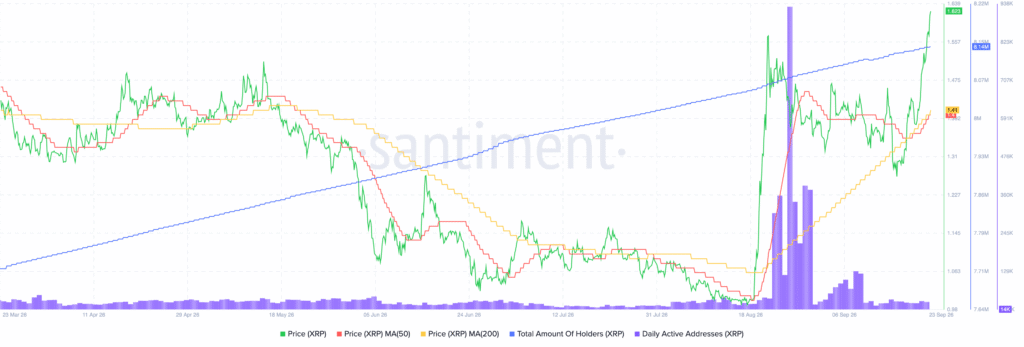
Article
See translation
XRP Breaks $1.60 as Whale Activity Reaches One-Month HighXRP surpassed $1.60 as Santiment recorded 1,917 whale transactions and 3,647 new wallets during the rally.
Ali Charts identifies $1.60 as the inverse head-and-shoulders neckline, with a breakout potentially targeting $2.
XRP trades above its 50-day and 200-day averages, while $1.45-$1.41 remains the key support zone if the breakout fails.
XRP climbed above $1.60 for the first time since February 4. Santiment Intelligence recorded 1,917 $100,000-plus whale transactions. Another 3,647 new XRP wallets joined the network during the move. Analyst Ali Charts pointed to $1.60 as the key level for XRP’s inverse head-and-shoulders breakout on the daily chart.
Whale Activity And New Wallets Rise
Santiment said the 1,917 whale transactions marked the strongest high-value activity in roughly a month. The activity shows major holders repositioning, though it does not prove accumulation. Network growth increased, with 3,647 new XRP wallets added during the rally.
https://twitter.com/SantimentData/status/2102484892609352112?s=20
Meanwhile, XRPL’s tokenized-asset and RLUSD balances recently reached about $4.26 billion. Ripple reports roughly $2.4 billion of RLUSD circulating. The balances add stablecoin and institutional settlement activity.
Ali Charts Watches The $1.60 Level
Ali Charts said XRP rose 27.6%, moving from $1.25 to $1.58. He said the move completed the right shoulder of an inverse head-and-shoulders pattern. He also said whales had accumulated more than $2 billion worth of XRP.
Notably, he identified $1.60 as the level that could determine the next move. According to Ali Charts, a decisive break above the neckline could confirm the pattern. He also projected another 30% move toward $2 if that breakout occurs.
Institutional access expanded. Bitwise filed an updated XRP ETF registration with the SEC on September 18. XRP already appears across several exchange-traded products, according to Santiment Intelligence.
XRP Holds Above Key Moving Averages
XRP recovered from roughly $1.00 to $1.06 in late June and early July. Price then accelerated in August toward the $1.55 to $1.60 region. XRP later consolidated between about $1.35 and $1.45 before breaking above that range.
Source: Santiment
XRP now trades around $1.623. The 50-day moving average is near $1.40, while the 200-day average is around $1.41. Both averages have started rising. XRP holders increased from roughly 7.65 million to 8.14 million.
Daily active addresses spiked during August before falling to about 14,000. The $1.60 to $1.62 area remains the immediate resistance zone. A failure to hold the breakout could move XRP toward $1.45 to $1.41.
XRP Breaks $1.60 as Whale Activity Reaches One-Month High
XRP surpassed $1.60 as Santiment recorded 1,917 whale transactions and 3,647 new wallets during the rally.
Ali Charts identifies $1.60 as the inverse head-and-shoulders neckline, with a breakout potentially targeting $2.
XRP trades above its 50-day and 200-day averages, while $1.45-$1.41 remains the key support zone if the breakout fails.
XRP climbed above $1.60 for the first time since February 4. Santiment Intelligence recorded 1,917 $100,000-plus whale transactions. Another 3,647 new XRP wallets joined the network during the move. Analyst Ali Charts pointed to $1.60 as the key level for XRP’s inverse head-and-shoulders breakout on the daily chart.
Whale Activity And New Wallets Rise
Santiment said the 1,917 whale transactions marked the strongest high-value activity in roughly a month. The activity shows major holders repositioning, though it does not prove accumulation. Network growth increased, with 3,647 new XRP wallets added during the rally.
https://twitter.com/SantimentData/status/2102484892609352112?s=20
Meanwhile, XRPL’s tokenized-asset and RLUSD balances recently reached about $4.26 billion. Ripple reports roughly $2.4 billion of RLUSD circulating. The balances add stablecoin and institutional settlement activity.
Ali Charts Watches The $1.60 Level
Ali Charts said XRP rose 27.6%, moving from $1.25 to $1.58. He said the move completed the right shoulder of an inverse head-and-shoulders pattern. He also said whales had accumulated more than $2 billion worth of XRP.
Notably, he identified $1.60 as the level that could determine the next move. According to Ali Charts, a decisive break above the neckline could confirm the pattern. He also projected another 30% move toward $2 if that breakout occurs.
Institutional access expanded. Bitwise filed an updated XRP ETF registration with the SEC on September 18. XRP already appears across several exchange-traded products, according to Santiment Intelligence.
XRP Holds Above Key Moving Averages
XRP recovered from roughly $1.00 to $1.06 in late June and early July. Price then accelerated in August toward the $1.55 to $1.60 region. XRP later consolidated between about $1.35 and $1.45 before breaking above that range.
Source: Santiment
XRP now trades around $1.623. The 50-day moving average is near $1.40, while the 200-day average is around $1.41. Both averages have started rising. XRP holders increased from roughly 7.65 million to 8.14 million.
Daily active addresses spiked during August before falling to about 14,000. The $1.60 to $1.62 area remains the immediate resistance zone. A failure to hold the breakout could move XRP toward $1.45 to $1.41.
Ali Charts identifies $1.60 as the inverse head-and-shoulders neckline, with a breakout potentially targeting $2.
XRP trades above its 50-day and 200-day averages, while $1.45-$1.41 remains the key support zone if the breakout fails.
XRP climbed above $1.60 for the first time since February 4. Santiment Intelligence recorded 1,917 $100,000-plus whale transactions. Another 3,647 new XRP wallets joined the network during the move. Analyst Ali Charts pointed to $1.60 as the key level for XRP’s inverse head-and-shoulders breakout on the daily chart.
Whale Activity And New Wallets Rise
Santiment said the 1,917 whale transactions marked the strongest high-value activity in roughly a month. The activity shows major holders repositioning, though it does not prove accumulation. Network growth increased, with 3,647 new XRP wallets added during the rally.
https://twitter.com/SantimentData/status/2102484892609352112?s=20
Meanwhile, XRPL’s tokenized-asset and RLUSD balances recently reached about $4.26 billion. Ripple reports roughly $2.4 billion of RLUSD circulating. The balances add stablecoin and institutional settlement activity.
Ali Charts Watches The $1.60 Level
Ali Charts said XRP rose 27.6%, moving from $1.25 to $1.58. He said the move completed the right shoulder of an inverse head-and-shoulders pattern. He also said whales had accumulated more than $2 billion worth of XRP.
Notably, he identified $1.60 as the level that could determine the next move. According to Ali Charts, a decisive break above the neckline could confirm the pattern. He also projected another 30% move toward $2 if that breakout occurs.
Institutional access expanded. Bitwise filed an updated XRP ETF registration with the SEC on September 18. XRP already appears across several exchange-traded products, according to Santiment Intelligence.
XRP Holds Above Key Moving Averages
XRP recovered from roughly $1.00 to $1.06 in late June and early July. Price then accelerated in August toward the $1.55 to $1.60 region. XRP later consolidated between about $1.35 and $1.45 before breaking above that range.
Source: Santiment
XRP now trades around $1.623. The 50-day moving average is near $1.40, while the 200-day average is around $1.41. Both averages have started rising. XRP holders increased from roughly 7.65 million to 8.14 million.
Daily active addresses spiked during August before falling to about 14,000. The $1.60 to $1.62 area remains the immediate resistance zone. A failure to hold the breakout could move XRP toward $1.45 to $1.41.
194
Article
See translation
Shibarium Advances Network Infrastructure UpdatesDevelopers resolved the reported reorganization issue while continuing maintenance across several network infrastructure systems.
RPC updates, new node information, and explorer reindexing remain central to improving network reliability and data access.
Continued developer activity points toward ongoing technical maintenance as the network works to strengthen its infrastructure foundation.
Shibarium infrastructure work continues as developers address network stability, update connectivity systems, and improve explorer data following a reported reorganization issue.
Network Stability Remains Central
KUROSHIBARMY JPN reports that the reorganization issue has now been resolved. The update describes this as part of ongoing network maintenance. Developers are continuing additional technical improvements across the ecosystem.
https://twitter.com/kuro_9696_9696/status/2101840152465387914?s=20
A blockchain reorganization can affect transaction records across network infrastructure. Resolving such issues can help restore consistency across connected systems. The reported fix therefore forms part of broader stabilization work.
The update also points toward changes involving RPC information. RPC endpoints allow applications and wallets to communicate with blockchain networks. Reliable endpoints remain important for services requiring consistent network access.
New node information is also being released during the maintenance process. Nodes support blockchain operations and provide access to network data. Updated information can assist developers maintaining reliable network connections.
RPC And Explorer Systems Receive Attention
RPC infrastructure connects blockchain networks with external applications and services. Wallets, applications, and other tools rely on RPC connections. Updating those details can support reliable access during infrastructure changes.
The latest work therefore extends beyond the resolved reorganization issue. Several supporting systems are being adjusted alongside the network. This creates a broader maintenance process across connected infrastructure.
Shibariumscan is also undergoing reindexing, according to the translated update. Blockchain explorers organize network activity into information users can inspect. Reindexing allows explorer data to reflect the latest available chain state.
Accurate explorer information remains useful for developers and network users. Transaction records provide visibility into activity across the blockchain. Reliable indexing can help applications verify and track network events.
Development Continues Beyond Short-Term Price Action
The post stresses that developers remain active. The message presents continued development as essential for network stability. It also notes that technical work continues whenever necessary.
SHIB as of writing trades at $0.00000550, based on coinmarketcap data. That price does not establish whether infrastructure improvements will increase demand. Technical maintenance and token performance remain separate measurements.
The latest sequence involves several connected areas receiving attention. The reorganization fix addresses consistency, while RPC updates support connectivity. Node information and explorer reindexing strengthen supporting data infrastructure.
Together, these developments show continued technical work across the network. The immediate focus remains stability, reliable access, and accurate blockchain information. Future network activity can provide clearer evidence of how these improvements perform.
Shibarium Advances Network Infrastructure Updates
Developers resolved the reported reorganization issue while continuing maintenance across several network infrastructure systems.
RPC updates, new node information, and explorer reindexing remain central to improving network reliability and data access.
Continued developer activity points toward ongoing technical maintenance as the network works to strengthen its infrastructure foundation.
Shibarium infrastructure work continues as developers address network stability, update connectivity systems, and improve explorer data following a reported reorganization issue.
Network Stability Remains Central
KUROSHIBARMY JPN reports that the reorganization issue has now been resolved. The update describes this as part of ongoing network maintenance. Developers are continuing additional technical improvements across the ecosystem.
https://twitter.com/kuro_9696_9696/status/2101840152465387914?s=20
A blockchain reorganization can affect transaction records across network infrastructure. Resolving such issues can help restore consistency across connected systems. The reported fix therefore forms part of broader stabilization work.
The update also points toward changes involving RPC information. RPC endpoints allow applications and wallets to communicate with blockchain networks. Reliable endpoints remain important for services requiring consistent network access.
New node information is also being released during the maintenance process. Nodes support blockchain operations and provide access to network data. Updated information can assist developers maintaining reliable network connections.
RPC And Explorer Systems Receive Attention
RPC infrastructure connects blockchain networks with external applications and services. Wallets, applications, and other tools rely on RPC connections. Updating those details can support reliable access during infrastructure changes.
The latest work therefore extends beyond the resolved reorganization issue. Several supporting systems are being adjusted alongside the network. This creates a broader maintenance process across connected infrastructure.
Shibariumscan is also undergoing reindexing, according to the translated update. Blockchain explorers organize network activity into information users can inspect. Reindexing allows explorer data to reflect the latest available chain state.
Accurate explorer information remains useful for developers and network users. Transaction records provide visibility into activity across the blockchain. Reliable indexing can help applications verify and track network events.
Development Continues Beyond Short-Term Price Action
The post stresses that developers remain active. The message presents continued development as essential for network stability. It also notes that technical work continues whenever necessary.
SHIB as of writing trades at $0.00000550, based on coinmarketcap data. That price does not establish whether infrastructure improvements will increase demand. Technical maintenance and token performance remain separate measurements.
The latest sequence involves several connected areas receiving attention. The reorganization fix addresses consistency, while RPC updates support connectivity. Node information and explorer reindexing strengthen supporting data infrastructure.
Together, these developments show continued technical work across the network. The immediate focus remains stability, reliable access, and accurate blockchain information. Future network activity can provide clearer evidence of how these improvements perform.
RPC updates, new node information, and explorer reindexing remain central to improving network reliability and data access.
Continued developer activity points toward ongoing technical maintenance as the network works to strengthen its infrastructure foundation.
Shibarium infrastructure work continues as developers address network stability, update connectivity systems, and improve explorer data following a reported reorganization issue.
Network Stability Remains Central
KUROSHIBARMY JPN reports that the reorganization issue has now been resolved. The update describes this as part of ongoing network maintenance. Developers are continuing additional technical improvements across the ecosystem.
https://twitter.com/kuro_9696_9696/status/2101840152465387914?s=20
A blockchain reorganization can affect transaction records across network infrastructure. Resolving such issues can help restore consistency across connected systems. The reported fix therefore forms part of broader stabilization work.
The update also points toward changes involving RPC information. RPC endpoints allow applications and wallets to communicate with blockchain networks. Reliable endpoints remain important for services requiring consistent network access.
New node information is also being released during the maintenance process. Nodes support blockchain operations and provide access to network data. Updated information can assist developers maintaining reliable network connections.
RPC And Explorer Systems Receive Attention
RPC infrastructure connects blockchain networks with external applications and services. Wallets, applications, and other tools rely on RPC connections. Updating those details can support reliable access during infrastructure changes.
The latest work therefore extends beyond the resolved reorganization issue. Several supporting systems are being adjusted alongside the network. This creates a broader maintenance process across connected infrastructure.
Shibariumscan is also undergoing reindexing, according to the translated update. Blockchain explorers organize network activity into information users can inspect. Reindexing allows explorer data to reflect the latest available chain state.
Accurate explorer information remains useful for developers and network users. Transaction records provide visibility into activity across the blockchain. Reliable indexing can help applications verify and track network events.
Development Continues Beyond Short-Term Price Action
The post stresses that developers remain active. The message presents continued development as essential for network stability. It also notes that technical work continues whenever necessary.
SHIB as of writing trades at $0.00000550, based on coinmarketcap data. That price does not establish whether infrastructure improvements will increase demand. Technical maintenance and token performance remain separate measurements.
The latest sequence involves several connected areas receiving attention. The reorganization fix addresses consistency, while RPC updates support connectivity. Node information and explorer reindexing strengthen supporting data infrastructure.
Together, these developments show continued technical work across the network. The immediate focus remains stability, reliable access, and accurate blockchain information. Future network activity can provide clearer evidence of how these improvements perform.
1
252
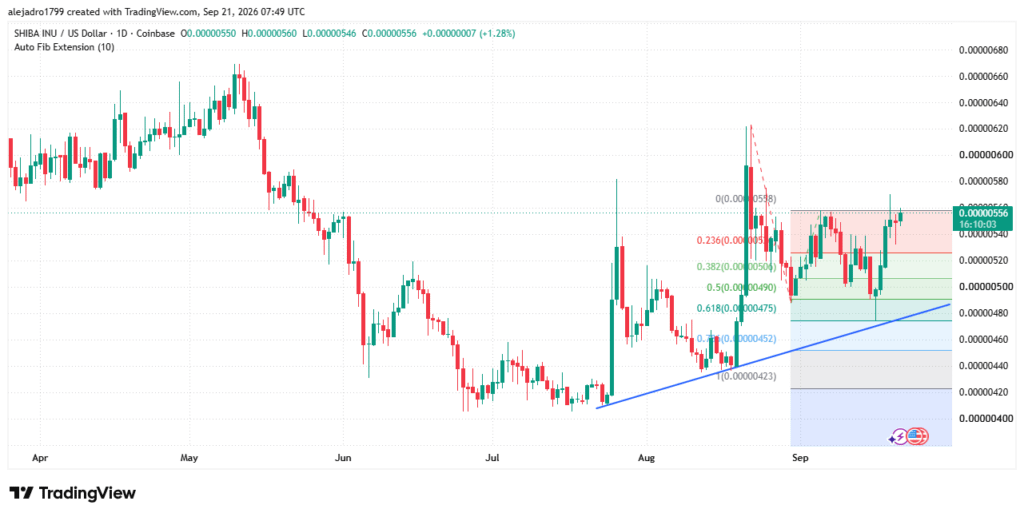
Article
See translation
SHIB Recovery Tests Key Resistance ZoneSHIB has been able to make successive lower lows since July, maintaining a structure in place that indicates a developing recovery above a rising trendline.
A daily close above $0.00000558 could open the way for a continued recovery, while rejection risks renewed support tests.
Derivatives activity remains active despite prolonged weakness, with MEXC leading open interest across major exchanges.
SHIB is testing a key resistance zone as higher lows support a developing recovery structure after months of persistent market weakness.
Buyers Build a Higher-Low Structure
The daily chart indicates a developing recovery after the May peak. Price bottomed near $0.00000423 in July before rebounding toward $0.00000580. Since then, the pullbacks have been trading above the ascending trendline on the chart.
Source: Tradingview
That trendline has become an important reference during recent consolidation. Each successful defense has kept the recovery structure technically intact. However, price still needs confirmation before establishing a broader reversal.
The latest move reached approximately $0.00000557 near market resistance. That places the market immediately beneath the $0.00000558 ceiling. Recent candles also show repeated buying around lower support areas.
The structure therefore remains dependent on continued trendline support. A break below that line would weaken the developing recovery pattern. Until then, higher lows remain the clearest feature on the daily chart.
Fibonacci Levels Define the Trading Range
The discussion also connects with a recent post from Terrarmy about patience. The post asks SHIB holders which level they would actually sit through. It lists $0.000012, $0.00002, $0.00005, and $0.0001 as reference levels.
https://twitter.com/terra_army/status/2101696057877090337?s=20
Terrarmy frames those figures around commitment during quieter market periods. The message separates long-term expectations from short-term screenshot-driven attention. It does not present the listed levels as guaranteed technical outcomes.
The Fibonacci retracement levels offer each specific reference point for the current price action. The 0.236 level sits near $0.00000534 and acts as short-term support. Deeper levels appear around $0.00000506 and $0.00000490.
The 0.618 retracement sits near $0.00000475 on the chart. The same area also corresponds closely with the rising trendline. Its location makes the zone relevant if selling pressure returns.
Derivatives Activity Remains Firm
The broader chart also shows persistent derivatives participation during the decline. Open interest-weighted positioning continued changing as price moved lower. Green and red movements indicate continuing shifts among leveraged traders.
Source: Coinglass
MEXC holds approximately $21.98 million in open interest. Bitget follows with $11.07 million, while LBank records $10.06 million. OKX and Gate hold approximately $6.99 million and $6.23 million.
Trading volume shows a different distribution across those exchanges. LBank records roughly $14.33 million, followed by OKX near $13.20 million. Bitget reaches approximately $7.47 million in reported trading volume.
Futures trade counts further confirm continued market activity beneath price weakness. LBank records roughly 60.14K trades, while OKX reaches 48.52K. Gate follows with approximately 36.82K transactions during the period shown.
SHIB Recovery Tests Key Resistance Zone
SHIB has been able to make successive lower lows since July, maintaining a structure in place that indicates a developing recovery above a rising trendline.
A daily close above $0.00000558 could open the way for a continued recovery, while rejection risks renewed support tests.
Derivatives activity remains active despite prolonged weakness, with MEXC leading open interest across major exchanges.
SHIB is testing a key resistance zone as higher lows support a developing recovery structure after months of persistent market weakness.
Buyers Build a Higher-Low Structure
The daily chart indicates a developing recovery after the May peak. Price bottomed near $0.00000423 in July before rebounding toward $0.00000580. Since then, the pullbacks have been trading above the ascending trendline on the chart.
Source: Tradingview
That trendline has become an important reference during recent consolidation. Each successful defense has kept the recovery structure technically intact. However, price still needs confirmation before establishing a broader reversal.
The latest move reached approximately $0.00000557 near market resistance. That places the market immediately beneath the $0.00000558 ceiling. Recent candles also show repeated buying around lower support areas.
The structure therefore remains dependent on continued trendline support. A break below that line would weaken the developing recovery pattern. Until then, higher lows remain the clearest feature on the daily chart.
Fibonacci Levels Define the Trading Range
The discussion also connects with a recent post from Terrarmy about patience. The post asks SHIB holders which level they would actually sit through. It lists $0.000012, $0.00002, $0.00005, and $0.0001 as reference levels.
https://twitter.com/terra_army/status/2101696057877090337?s=20
Terrarmy frames those figures around commitment during quieter market periods. The message separates long-term expectations from short-term screenshot-driven attention. It does not present the listed levels as guaranteed technical outcomes.
The Fibonacci retracement levels offer each specific reference point for the current price action. The 0.236 level sits near $0.00000534 and acts as short-term support. Deeper levels appear around $0.00000506 and $0.00000490.
The 0.618 retracement sits near $0.00000475 on the chart. The same area also corresponds closely with the rising trendline. Its location makes the zone relevant if selling pressure returns.
Derivatives Activity Remains Firm
The broader chart also shows persistent derivatives participation during the decline. Open interest-weighted positioning continued changing as price moved lower. Green and red movements indicate continuing shifts among leveraged traders.
Source: Coinglass
MEXC holds approximately $21.98 million in open interest. Bitget follows with $11.07 million, while LBank records $10.06 million. OKX and Gate hold approximately $6.99 million and $6.23 million.
Trading volume shows a different distribution across those exchanges. LBank records roughly $14.33 million, followed by OKX near $13.20 million. Bitget reaches approximately $7.47 million in reported trading volume.
Futures trade counts further confirm continued market activity beneath price weakness. LBank records roughly 60.14K trades, while OKX reaches 48.52K. Gate follows with approximately 36.82K transactions during the period shown.
A daily close above $0.00000558 could open the way for a continued recovery, while rejection risks renewed support tests.
Derivatives activity remains active despite prolonged weakness, with MEXC leading open interest across major exchanges.
SHIB is testing a key resistance zone as higher lows support a developing recovery structure after months of persistent market weakness.
Buyers Build a Higher-Low Structure
The daily chart indicates a developing recovery after the May peak. Price bottomed near $0.00000423 in July before rebounding toward $0.00000580. Since then, the pullbacks have been trading above the ascending trendline on the chart.
Source: Tradingview
That trendline has become an important reference during recent consolidation. Each successful defense has kept the recovery structure technically intact. However, price still needs confirmation before establishing a broader reversal.
The latest move reached approximately $0.00000557 near market resistance. That places the market immediately beneath the $0.00000558 ceiling. Recent candles also show repeated buying around lower support areas.
The structure therefore remains dependent on continued trendline support. A break below that line would weaken the developing recovery pattern. Until then, higher lows remain the clearest feature on the daily chart.
Fibonacci Levels Define the Trading Range
The discussion also connects with a recent post from Terrarmy about patience. The post asks SHIB holders which level they would actually sit through. It lists $0.000012, $0.00002, $0.00005, and $0.0001 as reference levels.
https://twitter.com/terra_army/status/2101696057877090337?s=20
Terrarmy frames those figures around commitment during quieter market periods. The message separates long-term expectations from short-term screenshot-driven attention. It does not present the listed levels as guaranteed technical outcomes.
The Fibonacci retracement levels offer each specific reference point for the current price action. The 0.236 level sits near $0.00000534 and acts as short-term support. Deeper levels appear around $0.00000506 and $0.00000490.
The 0.618 retracement sits near $0.00000475 on the chart. The same area also corresponds closely with the rising trendline. Its location makes the zone relevant if selling pressure returns.
Derivatives Activity Remains Firm
The broader chart also shows persistent derivatives participation during the decline. Open interest-weighted positioning continued changing as price moved lower. Green and red movements indicate continuing shifts among leveraged traders.
Source: Coinglass
MEXC holds approximately $21.98 million in open interest. Bitget follows with $11.07 million, while LBank records $10.06 million. OKX and Gate hold approximately $6.99 million and $6.23 million.
Trading volume shows a different distribution across those exchanges. LBank records roughly $14.33 million, followed by OKX near $13.20 million. Bitget reaches approximately $7.47 million in reported trading volume.
Futures trade counts further confirm continued market activity beneath price weakness. LBank records roughly 60.14K trades, while OKX reaches 48.52K. Gate follows with approximately 36.82K transactions during the period shown.
212

Article
See translation
Bitcoin Price Prediction: BTC Eyes Higher Levels as Apeing Enters Stage 5 at $0.00055 With a $0.0...The crypto market continues to feature two very different types of opportunities: established networks with deep liquidity and newer projects building communities from the ground up. Bitcoin remains the largest cryptocurrency by market capitalization, while Ethereum continues to anchor a major portion of the decentralized application ecosystem. At the same time, new meme projects are creating their own launch narratives through community-driven presales.
Apeing ($APEING) is now advancing into Stage 5, called Dip Devourers, with the token priced at $0.00055. The project reports $102K+ raised, 380+ holders, 465M+ tokens sold, and 200,667,450 tokens burnt. With a stated $0.01 listing price and 1,718% potential ROI, Apeing is positioning its structured presale as part of the conversation surrounding the next big crypto.
Why Apeing Is Entering the Next Big Crypto Conversation
The next big crypto narrative often centers on projects that are still building their communities and establishing their token economies. Unlike Bitcoin and Ethereum, which already have extensive trading histories and mature market structures, Apeing is approaching the market from the presale stage.
Apeing's Stage 5, Dip Devourers, places $APEING at $0.00055. The project reports more than $102K raised, over 380 holders, and more than 465 million tokens sold. Its reported burn total has also reached 200,667,450 tokens, giving its presale structure an additional token-supply element.
The stated listing price is $0.01. At the current Stage 5 price, that represents a substantial difference between the presale level and the project's stated listing target. Apeing describes this price difference through a stated 1,718% potential ROI.
For readers tracking the next big crypto, the distinction is important: Bitcoin and Ethereum represent established crypto networks, whereas Apeing is still progressing through a multi-stage token launch.
Apeing Stage 5 Tokenomics and the Dip Devourers Phase
Apeing's presale uses a 33-stage structure, with pricing changing as the project progresses through its launch phases. Stage 5 is named Dip Devourers and carries the current $0.00055 price. The project states that it has a fixed supply of 16.75 billion $APEING tokens, with 40% allocated to the presale. The staged structure means the token price is designed to move upward between successive phases rather than remaining at one fixed presale level.
Burns form another part of the model. Unsold tokens from completed stages are removed according to the project's presale structure. Apeing currently reports 200,667,450 tokens burnt, making the burn figure one of the key numbers associated with the project's tokenomics. This combination of staged pricing, a fixed supply, and token burns gives Apeing a distinct structure within the broader next big crypto discussion.
Apeing Community Mechanics Add Another Layer
The Apeing ecosystem also includes community-focused features designed around participation rather than price alone. Its referral system allows qualifying buyers who purchase at least $25 to unlock a personal referral code. When a buyer purchases through a referral code, the referred buyer receives an additional 10% in $APEING, while the referrer receives a reward equal to 10% of the referred buyer's spending.
The referral leaderboard resets monthly. The first-place participant can receive 10% of the amount raised through the referral code, second place receives 5%, while positions three through five receive a 25% bonus code for a future purchase. These mechanisms give the project additional community activity while the memecoin presale progresses through its staged launch.
How to Buy $APEING During Stage 5
The Apeing memecoin presale can be accessed through the project's official website.
Visit the official Apeing website.
Enter the LIVE presale section.
Connect a compatible Ethereum wallet.
Select the desired $APEING purchase amount.
Review the Stage 5 price of $0.00055.
Confirm the transaction through the connected wallet.
Follow the project's instructions for claiming tokens.
Qualifying purchases of $25 or more can also unlock access to the referral system.
With Stage 5 now named Dip Devourers, Apeing remains in the active early phase of its 33-stage launch.
Bitcoin Price Update: BTC Builds a Powerful Market Backdrop for the Next Big Crypto
Bitcoin remains the largest cryptocurrency by market capitalization, with the supplied market snapshot placing BTC at $85,419.87, a market capitalization of approximately $1.71 trillion, and 24-hour trading volume of around $59.86 billion.
The same snapshot lists approximately 20.08 million BTC in circulation against a maximum supply of 21 million. Bitcoin's recorded all-time high is $126,198.07, giving the current market level a clear historical reference point.
Recent market coverage has also placed BTC price Prediction above $85,000, with renewed activity around spot Bitcoin ETFs and institutional participation contributing to the latest market movement.
BTC Price Prediction: Key Levels to Watch in 2026
The BTC Price Prediction narrative remains closely connected to Bitcoin's position as the largest cryptocurrency and its relationship with institutional demand. Recent prediction-market data published by CoinGecko placed September targets around $80,000 and showed higher September-end levels, including $82,500, $85,000, and $87,500.
Other recent market coverage has focused on Bitcoin's move toward the $86,000 region, with ETF flows and broader market activity cited among the factors surrounding the latest price action.
For readers researching the next big crypto, Bitcoin provides the established-market side of the comparison. Apeing, by contrast, is still moving through its presale and building its market identity before its stated listing.
Ethereum Price Outlook: ETH Remains a Major Crypto Market Benchmark
Ethereum is another major reference point for the broader digital-asset market. The supplied figures place ETH at $2,730.15, with a market capitalization of approximately $333.27 billion and 24-hour volume of approximately $24.17 billion.
Ethereum has a circulating and total supply of roughly 122.07 million ETH, while its maximum supply is listed as unlimited. Its recorded all-time high stands at $4,953.73.
Recent September market analysis has highlighted the $2,438 region as an important technical level and identified approximately $2,920 as an upside objective if Ethereum maintains the relevant breakout structure.
Ethereum Price Prediction: September 2026 Targets
The latest BTC Price Prediction discussions are not the only market forecasts attracting attention. Ethereum has also generated several September 2026 projections. Changelly's latest forecast places Ethereum's September 2026 range around $2,704.28 to $2,790.50, with an average near $2,747.39. CoinDCX has published a September target around $2,800, with higher monthly targets extending toward $3,300 by December in its 2026 projection table.
Ethereum therefore represents another established crypto benchmark, while Apeing occupies a very different position. Its memecoin presale is still moving through the 33-stage launch, with Stage 5 now priced at $0.00055.
Next Big Crypto Comparison: Bitcoin, Ethereum and Apeing
Bitcoin, Ethereum, and Apeing represent three different points along the crypto-market spectrum.
AssetCurrent/Supplied PriceMarket PositionKey Current DetailBitcoin$85,419.87Largest crypto asset$1.71T market capEthereum$2,730.15Major smart-contract network$333.27B market capApeing$0.00055Stage 5 presale$102K+ raised
Bitcoin's established market capitalization and fixed maximum supply make it fundamentally different from an early-stage presale. Ethereum's role as a major blockchain platform creates another established market profile.
Apeing instead focuses on a staged launch, community participation, burns, and a stated future listing price. Those characteristics explain why the project is being framed around the next big crypto rather than as another established large-cap asset.
Final Takeaway: Apeing Brings an Early-Stage Angle to the Next Big Crypto Search
Bitcoin and Ethereum remain two of the most established names in the cryptocurrency market, with current market cap valuations of approximately $1.71 trillion and $333.27 billion, respectively. Their size and market history place them in a different category from a token that is still progressing through a presale.
Apeing is now in Stage 5, Dip Devourers, with $APEING priced at $0.00055. The project reports $102K+ raised, 380+ holders, 465M+ tokens sold, and 200,667,450 tokens burnt. Its stated $0.01 listing price and 1,718% potential ROI remain central to its current positioning. Alongside its 33-stage structure, fixed 16.75 billion supply, staged pricing, burns, and referral mechanics, these features form the project's current next big crypto narrative.
For More Information:
Website: Visit the Official Apeing Website
Telegram: Join the Apeing Telegram Channel
Twitter: Follow Apeing ON X (Formerly Twitter)
Frequently Asked Questions About the Next Big Crypto
What is the next big crypto in 2026?
The next big crypto generally refers to an emerging cryptocurrency attracting attention through community growth, new technology, tokenomics, market activity, or an early-stage launch.
Which crypto is considered the next big crypto?
Apeing is currently positioned around the next big crypto narrative through its Stage 5 presale, $0.00055 price, token burns, community growth, and stated $0.01 listing.
What factors define the next big crypto?
Common factors include developing communities, token utility, supply mechanics, ecosystem activity, launch structure, market visibility, and the ability to attract sustained participation.
What is Apeing's current presale price?
Apeing is currently in Stage 5, Dip Devourers, where $APEING is priced at $0.00055, with the project reporting $102K+ raised and 465M+ tokens sold.
How many Apeing tokens have been burnt?
Apeing reports 200,667,450 tokens burnt, forming part of its staged presale structure and broader tokenomics alongside its fixed 16.75 billion token supply.
Summary
Apeing is an Ethereum-based meme project progressing through a 33-stage presale, now at Stage 5, Dip Devourers, with $APEING priced at $0.00055. The project reports $102K+ raised, 380+ holders, 465M+ tokens sold, and 200,667,450 tokens burnt. Its stated listing price is $0.01, alongside a stated 1,718% potential ROI. Bitcoin and Ethereum provide established-market comparisons, while Apeing focuses on staged pricing, fixed supply, burns, referrals, and community participation as it develops its next big crypto narrative.
Bitcoin Price Prediction: BTC Eyes Higher Levels as Apeing Enters Stage 5 at $0.00055 With a $0.0...
The crypto market continues to feature two very different types of opportunities: established networks with deep liquidity and newer projects building communities from the ground up. Bitcoin remains the largest cryptocurrency by market capitalization, while Ethereum continues to anchor a major portion of the decentralized application ecosystem. At the same time, new meme projects are creating their own launch narratives through community-driven presales.
Apeing ($APEING) is now advancing into Stage 5, called Dip Devourers, with the token priced at $0.00055. The project reports $102K+ raised, 380+ holders, 465M+ tokens sold, and 200,667,450 tokens burnt. With a stated $0.01 listing price and 1,718% potential ROI, Apeing is positioning its structured presale as part of the conversation surrounding the next big crypto.
Why Apeing Is Entering the Next Big Crypto Conversation
The next big crypto narrative often centers on projects that are still building their communities and establishing their token economies. Unlike Bitcoin and Ethereum, which already have extensive trading histories and mature market structures, Apeing is approaching the market from the presale stage.
Apeing's Stage 5, Dip Devourers, places $APEING at $0.00055. The project reports more than $102K raised, over 380 holders, and more than 465 million tokens sold. Its reported burn total has also reached 200,667,450 tokens, giving its presale structure an additional token-supply element.
The stated listing price is $0.01. At the current Stage 5 price, that represents a substantial difference between the presale level and the project's stated listing target. Apeing describes this price difference through a stated 1,718% potential ROI.
For readers tracking the next big crypto, the distinction is important: Bitcoin and Ethereum represent established crypto networks, whereas Apeing is still progressing through a multi-stage token launch.
Apeing Stage 5 Tokenomics and the Dip Devourers Phase
Apeing's presale uses a 33-stage structure, with pricing changing as the project progresses through its launch phases. Stage 5 is named Dip Devourers and carries the current $0.00055 price. The project states that it has a fixed supply of 16.75 billion $APEING tokens, with 40% allocated to the presale. The staged structure means the token price is designed to move upward between successive phases rather than remaining at one fixed presale level.
Burns form another part of the model. Unsold tokens from completed stages are removed according to the project's presale structure. Apeing currently reports 200,667,450 tokens burnt, making the burn figure one of the key numbers associated with the project's tokenomics. This combination of staged pricing, a fixed supply, and token burns gives Apeing a distinct structure within the broader next big crypto discussion.
Apeing Community Mechanics Add Another Layer
The Apeing ecosystem also includes community-focused features designed around participation rather than price alone. Its referral system allows qualifying buyers who purchase at least $25 to unlock a personal referral code. When a buyer purchases through a referral code, the referred buyer receives an additional 10% in $APEING, while the referrer receives a reward equal to 10% of the referred buyer's spending.
The referral leaderboard resets monthly. The first-place participant can receive 10% of the amount raised through the referral code, second place receives 5%, while positions three through five receive a 25% bonus code for a future purchase. These mechanisms give the project additional community activity while the memecoin presale progresses through its staged launch.
How to Buy $APEING During Stage 5
The Apeing memecoin presale can be accessed through the project's official website.
Visit the official Apeing website.
Enter the LIVE presale section.
Connect a compatible Ethereum wallet.
Select the desired $APEING purchase amount.
Review the Stage 5 price of $0.00055.
Confirm the transaction through the connected wallet.
Follow the project's instructions for claiming tokens.
Qualifying purchases of $25 or more can also unlock access to the referral system.
With Stage 5 now named Dip Devourers, Apeing remains in the active early phase of its 33-stage launch.
Bitcoin Price Update: BTC Builds a Powerful Market Backdrop for the Next Big Crypto
Bitcoin remains the largest cryptocurrency by market capitalization, with the supplied market snapshot placing BTC at $85,419.87, a market capitalization of approximately $1.71 trillion, and 24-hour trading volume of around $59.86 billion.
The same snapshot lists approximately 20.08 million BTC in circulation against a maximum supply of 21 million. Bitcoin's recorded all-time high is $126,198.07, giving the current market level a clear historical reference point.
Recent market coverage has also placed BTC price Prediction above $85,000, with renewed activity around spot Bitcoin ETFs and institutional participation contributing to the latest market movement.
BTC Price Prediction: Key Levels to Watch in 2026
The BTC Price Prediction narrative remains closely connected to Bitcoin's position as the largest cryptocurrency and its relationship with institutional demand. Recent prediction-market data published by CoinGecko placed September targets around $80,000 and showed higher September-end levels, including $82,500, $85,000, and $87,500.
Other recent market coverage has focused on Bitcoin's move toward the $86,000 region, with ETF flows and broader market activity cited among the factors surrounding the latest price action.
For readers researching the next big crypto, Bitcoin provides the established-market side of the comparison. Apeing, by contrast, is still moving through its presale and building its market identity before its stated listing.
Ethereum Price Outlook: ETH Remains a Major Crypto Market Benchmark
Ethereum is another major reference point for the broader digital-asset market. The supplied figures place ETH at $2,730.15, with a market capitalization of approximately $333.27 billion and 24-hour volume of approximately $24.17 billion.
Ethereum has a circulating and total supply of roughly 122.07 million ETH, while its maximum supply is listed as unlimited. Its recorded all-time high stands at $4,953.73.
Recent September market analysis has highlighted the $2,438 region as an important technical level and identified approximately $2,920 as an upside objective if Ethereum maintains the relevant breakout structure.
Ethereum Price Prediction: September 2026 Targets
The latest BTC Price Prediction discussions are not the only market forecasts attracting attention. Ethereum has also generated several September 2026 projections. Changelly's latest forecast places Ethereum's September 2026 range around $2,704.28 to $2,790.50, with an average near $2,747.39. CoinDCX has published a September target around $2,800, with higher monthly targets extending toward $3,300 by December in its 2026 projection table.
Ethereum therefore represents another established crypto benchmark, while Apeing occupies a very different position. Its memecoin presale is still moving through the 33-stage launch, with Stage 5 now priced at $0.00055.
Next Big Crypto Comparison: Bitcoin, Ethereum and Apeing
Bitcoin, Ethereum, and Apeing represent three different points along the crypto-market spectrum.
AssetCurrent/Supplied PriceMarket PositionKey Current DetailBitcoin$85,419.87Largest crypto asset$1.71T market capEthereum$2,730.15Major smart-contract network$333.27B market capApeing$0.00055Stage 5 presale$102K+ raised
Bitcoin's established market capitalization and fixed maximum supply make it fundamentally different from an early-stage presale. Ethereum's role as a major blockchain platform creates another established market profile.
Apeing instead focuses on a staged launch, community participation, burns, and a stated future listing price. Those characteristics explain why the project is being framed around the next big crypto rather than as another established large-cap asset.
Final Takeaway: Apeing Brings an Early-Stage Angle to the Next Big Crypto Search
Bitcoin and Ethereum remain two of the most established names in the cryptocurrency market, with current market cap valuations of approximately $1.71 trillion and $333.27 billion, respectively. Their size and market history place them in a different category from a token that is still progressing through a presale.
Apeing is now in Stage 5, Dip Devourers, with $APEING priced at $0.00055. The project reports $102K+ raised, 380+ holders, 465M+ tokens sold, and 200,667,450 tokens burnt. Its stated $0.01 listing price and 1,718% potential ROI remain central to its current positioning. Alongside its 33-stage structure, fixed 16.75 billion supply, staged pricing, burns, and referral mechanics, these features form the project's current next big crypto narrative.
For More Information:
Website: Visit the Official Apeing Website
Telegram: Join the Apeing Telegram Channel
Twitter: Follow Apeing ON X (Formerly Twitter)
Frequently Asked Questions About the Next Big Crypto
What is the next big crypto in 2026?
The next big crypto generally refers to an emerging cryptocurrency attracting attention through community growth, new technology, tokenomics, market activity, or an early-stage launch.
Which crypto is considered the next big crypto?
Apeing is currently positioned around the next big crypto narrative through its Stage 5 presale, $0.00055 price, token burns, community growth, and stated $0.01 listing.
What factors define the next big crypto?
Common factors include developing communities, token utility, supply mechanics, ecosystem activity, launch structure, market visibility, and the ability to attract sustained participation.
What is Apeing's current presale price?
Apeing is currently in Stage 5, Dip Devourers, where $APEING is priced at $0.00055, with the project reporting $102K+ raised and 465M+ tokens sold.
How many Apeing tokens have been burnt?
Apeing reports 200,667,450 tokens burnt, forming part of its staged presale structure and broader tokenomics alongside its fixed 16.75 billion token supply.
Summary
Apeing is an Ethereum-based meme project progressing through a 33-stage presale, now at Stage 5, Dip Devourers, with $APEING priced at $0.00055. The project reports $102K+ raised, 380+ holders, 465M+ tokens sold, and 200,667,450 tokens burnt. Its stated listing price is $0.01, alongside a stated 1,718% potential ROI. Bitcoin and Ethereum provide established-market comparisons, while Apeing focuses on staged pricing, fixed supply, burns, referrals, and community participation as it develops its next big crypto narrative.
Apeing ($APEING) is now advancing into Stage 5, called Dip Devourers, with the token priced at $0.00055. The project reports $102K+ raised, 380+ holders, 465M+ tokens sold, and 200,667,450 tokens burnt. With a stated $0.01 listing price and 1,718% potential ROI, Apeing is positioning its structured presale as part of the conversation surrounding the next big crypto.
Why Apeing Is Entering the Next Big Crypto Conversation
The next big crypto narrative often centers on projects that are still building their communities and establishing their token economies. Unlike Bitcoin and Ethereum, which already have extensive trading histories and mature market structures, Apeing is approaching the market from the presale stage.
Apeing's Stage 5, Dip Devourers, places $APEING at $0.00055. The project reports more than $102K raised, over 380 holders, and more than 465 million tokens sold. Its reported burn total has also reached 200,667,450 tokens, giving its presale structure an additional token-supply element.
The stated listing price is $0.01. At the current Stage 5 price, that represents a substantial difference between the presale level and the project's stated listing target. Apeing describes this price difference through a stated 1,718% potential ROI.
For readers tracking the next big crypto, the distinction is important: Bitcoin and Ethereum represent established crypto networks, whereas Apeing is still progressing through a multi-stage token launch.
Apeing Stage 5 Tokenomics and the Dip Devourers Phase
Apeing's presale uses a 33-stage structure, with pricing changing as the project progresses through its launch phases. Stage 5 is named Dip Devourers and carries the current $0.00055 price. The project states that it has a fixed supply of 16.75 billion $APEING tokens, with 40% allocated to the presale. The staged structure means the token price is designed to move upward between successive phases rather than remaining at one fixed presale level.
Burns form another part of the model. Unsold tokens from completed stages are removed according to the project's presale structure. Apeing currently reports 200,667,450 tokens burnt, making the burn figure one of the key numbers associated with the project's tokenomics. This combination of staged pricing, a fixed supply, and token burns gives Apeing a distinct structure within the broader next big crypto discussion.
Apeing Community Mechanics Add Another Layer
The Apeing ecosystem also includes community-focused features designed around participation rather than price alone. Its referral system allows qualifying buyers who purchase at least $25 to unlock a personal referral code. When a buyer purchases through a referral code, the referred buyer receives an additional 10% in $APEING, while the referrer receives a reward equal to 10% of the referred buyer's spending.
The referral leaderboard resets monthly. The first-place participant can receive 10% of the amount raised through the referral code, second place receives 5%, while positions three through five receive a 25% bonus code for a future purchase. These mechanisms give the project additional community activity while the memecoin presale progresses through its staged launch.
How to Buy $APEING During Stage 5
The Apeing memecoin presale can be accessed through the project's official website.
Visit the official Apeing website.
Enter the LIVE presale section.
Connect a compatible Ethereum wallet.
Select the desired $APEING purchase amount.
Review the Stage 5 price of $0.00055.
Confirm the transaction through the connected wallet.
Follow the project's instructions for claiming tokens.
Qualifying purchases of $25 or more can also unlock access to the referral system.
With Stage 5 now named Dip Devourers, Apeing remains in the active early phase of its 33-stage launch.
Bitcoin Price Update: BTC Builds a Powerful Market Backdrop for the Next Big Crypto
Bitcoin remains the largest cryptocurrency by market capitalization, with the supplied market snapshot placing BTC at $85,419.87, a market capitalization of approximately $1.71 trillion, and 24-hour trading volume of around $59.86 billion.
The same snapshot lists approximately 20.08 million BTC in circulation against a maximum supply of 21 million. Bitcoin's recorded all-time high is $126,198.07, giving the current market level a clear historical reference point.
Recent market coverage has also placed BTC price Prediction above $85,000, with renewed activity around spot Bitcoin ETFs and institutional participation contributing to the latest market movement.
BTC Price Prediction: Key Levels to Watch in 2026
The BTC Price Prediction narrative remains closely connected to Bitcoin's position as the largest cryptocurrency and its relationship with institutional demand. Recent prediction-market data published by CoinGecko placed September targets around $80,000 and showed higher September-end levels, including $82,500, $85,000, and $87,500.
Other recent market coverage has focused on Bitcoin's move toward the $86,000 region, with ETF flows and broader market activity cited among the factors surrounding the latest price action.
For readers researching the next big crypto, Bitcoin provides the established-market side of the comparison. Apeing, by contrast, is still moving through its presale and building its market identity before its stated listing.
Ethereum Price Outlook: ETH Remains a Major Crypto Market Benchmark
Ethereum is another major reference point for the broader digital-asset market. The supplied figures place ETH at $2,730.15, with a market capitalization of approximately $333.27 billion and 24-hour volume of approximately $24.17 billion.
Ethereum has a circulating and total supply of roughly 122.07 million ETH, while its maximum supply is listed as unlimited. Its recorded all-time high stands at $4,953.73.
Recent September market analysis has highlighted the $2,438 region as an important technical level and identified approximately $2,920 as an upside objective if Ethereum maintains the relevant breakout structure.
Ethereum Price Prediction: September 2026 Targets
The latest BTC Price Prediction discussions are not the only market forecasts attracting attention. Ethereum has also generated several September 2026 projections. Changelly's latest forecast places Ethereum's September 2026 range around $2,704.28 to $2,790.50, with an average near $2,747.39. CoinDCX has published a September target around $2,800, with higher monthly targets extending toward $3,300 by December in its 2026 projection table.
Ethereum therefore represents another established crypto benchmark, while Apeing occupies a very different position. Its memecoin presale is still moving through the 33-stage launch, with Stage 5 now priced at $0.00055.
Next Big Crypto Comparison: Bitcoin, Ethereum and Apeing
Bitcoin, Ethereum, and Apeing represent three different points along the crypto-market spectrum.
AssetCurrent/Supplied PriceMarket PositionKey Current DetailBitcoin$85,419.87Largest crypto asset$1.71T market capEthereum$2,730.15Major smart-contract network$333.27B market capApeing$0.00055Stage 5 presale$102K+ raised
Bitcoin's established market capitalization and fixed maximum supply make it fundamentally different from an early-stage presale. Ethereum's role as a major blockchain platform creates another established market profile.
Apeing instead focuses on a staged launch, community participation, burns, and a stated future listing price. Those characteristics explain why the project is being framed around the next big crypto rather than as another established large-cap asset.
Final Takeaway: Apeing Brings an Early-Stage Angle to the Next Big Crypto Search
Bitcoin and Ethereum remain two of the most established names in the cryptocurrency market, with current market cap valuations of approximately $1.71 trillion and $333.27 billion, respectively. Their size and market history place them in a different category from a token that is still progressing through a presale.
Apeing is now in Stage 5, Dip Devourers, with $APEING priced at $0.00055. The project reports $102K+ raised, 380+ holders, 465M+ tokens sold, and 200,667,450 tokens burnt. Its stated $0.01 listing price and 1,718% potential ROI remain central to its current positioning. Alongside its 33-stage structure, fixed 16.75 billion supply, staged pricing, burns, and referral mechanics, these features form the project's current next big crypto narrative.
For More Information:
Website: Visit the Official Apeing Website
Telegram: Join the Apeing Telegram Channel
Twitter: Follow Apeing ON X (Formerly Twitter)
Frequently Asked Questions About the Next Big Crypto
What is the next big crypto in 2026?
The next big crypto generally refers to an emerging cryptocurrency attracting attention through community growth, new technology, tokenomics, market activity, or an early-stage launch.
Which crypto is considered the next big crypto?
Apeing is currently positioned around the next big crypto narrative through its Stage 5 presale, $0.00055 price, token burns, community growth, and stated $0.01 listing.
What factors define the next big crypto?
Common factors include developing communities, token utility, supply mechanics, ecosystem activity, launch structure, market visibility, and the ability to attract sustained participation.
What is Apeing's current presale price?
Apeing is currently in Stage 5, Dip Devourers, where $APEING is priced at $0.00055, with the project reporting $102K+ raised and 465M+ tokens sold.
How many Apeing tokens have been burnt?
Apeing reports 200,667,450 tokens burnt, forming part of its staged presale structure and broader tokenomics alongside its fixed 16.75 billion token supply.
Summary
Apeing is an Ethereum-based meme project progressing through a 33-stage presale, now at Stage 5, Dip Devourers, with $APEING priced at $0.00055. The project reports $102K+ raised, 380+ holders, 465M+ tokens sold, and 200,667,450 tokens burnt. Its stated listing price is $0.01, alongside a stated 1,718% potential ROI. Bitcoin and Ethereum provide established-market comparisons, while Apeing focuses on staged pricing, fixed supply, burns, referrals, and community participation as it develops its next big crypto narrative.
1
194
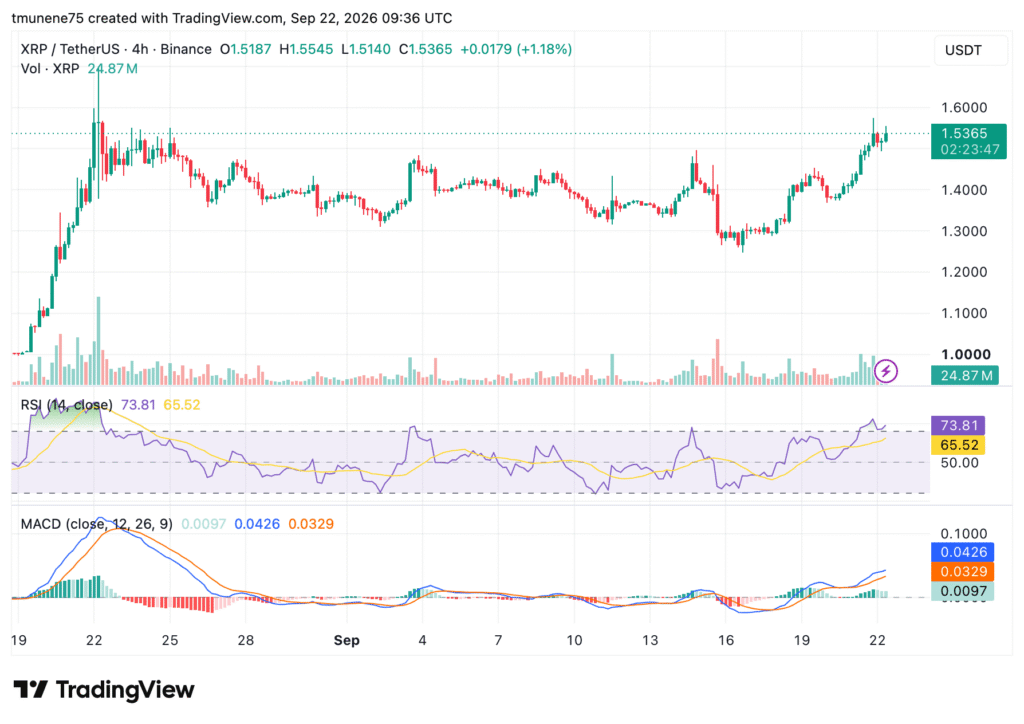
Article
See translation
XRP Rallies 8.22% as Whales Accumulate Over $2B WorthXRP gained 8.22% in three days after whale accumulation exceeded $2B, according to analyst Ali Charts.
XRP approached the $1.55-$1.60 resistance zone, where about 2.50B XRP previously changed hands, according to URPD data.
XRP’s RSI reached 73.81 while MACD remained positive, keeping momentum elevated as traders watch resistance near $1.60.
XRP has climbed 8.22% in three days after whales accumulated more than $2 billion worth of XRP, according to Ali Charts. The rally has pushed XRP toward the $1.55-$1.60 area, while Javon Marks identified a much higher measured target. Chart data shows strong momentum, although RSI has moved above the overbought threshold.
Whale Buying Lifts XRP Toward $1.60
Ali Charts said recent whale accumulation now appears in XRP’s price action. According to the analyst, the token gained 8.22% over three days following purchases exceeding $2 billion. The analyst also pointed to XRP’s URPD data.
It shows relatively little resistance before $1.60, where about 2.50 billion XRP previously changed hands. Ali Charts identified that level as the next major area for potential profit-taking.
Meanwhile, Javon Marks said XRP continues pushing higher after a smaller breakout. He described that break as the starting point for a larger continuation move. Marks placed the measured move target above $15, more than 850% from the current level.
https://twitter.com/JavonTM1/status/2102123003890766324?s=20
XRP Breaks Above $1.50
The four-hour chart shows XRP at $1.5365, up 1.18% on the latest candle. The candle opened at $1.5187, reached $1.5545, and fell to $1.5140. Since the September 16 low near $1.27-$1.30, XRP has formed higher lows.
Source: TradingView
It then moved above $1.40 before breaking through $1.50. That move has brought XRP closer to the $1.55-$1.60 resistance region. The area previously served as an important trading zone, according to the chart.
RSI Rises While MACD Stays Positive
Momentum indicators remain elevated alongside the price move. RSI is at 73.81, above its 65.52 moving average and the 70 overbought threshold. However, the elevated RSI leaves room for short-term consolidation or a pullback.
RSI remains above its moving average, keeping momentum stronger on the buying side. The MACD also remains positive. Its line stands at 0.0426, above the 0.0329 signal line, while the histogram reads 0.0097.
The immediate resistance sits at $1.55-$1.60. A break above $1.60 would expose $1.65, while support sits at $1.50, $1.40, and about $1.30.
XRP Rallies 8.22% as Whales Accumulate Over $2B Worth
XRP gained 8.22% in three days after whale accumulation exceeded $2B, according to analyst Ali Charts.
XRP approached the $1.55-$1.60 resistance zone, where about 2.50B XRP previously changed hands, according to URPD data.
XRP’s RSI reached 73.81 while MACD remained positive, keeping momentum elevated as traders watch resistance near $1.60.
XRP has climbed 8.22% in three days after whales accumulated more than $2 billion worth of XRP, according to Ali Charts. The rally has pushed XRP toward the $1.55-$1.60 area, while Javon Marks identified a much higher measured target. Chart data shows strong momentum, although RSI has moved above the overbought threshold.
Whale Buying Lifts XRP Toward $1.60
Ali Charts said recent whale accumulation now appears in XRP’s price action. According to the analyst, the token gained 8.22% over three days following purchases exceeding $2 billion. The analyst also pointed to XRP’s URPD data.
It shows relatively little resistance before $1.60, where about 2.50 billion XRP previously changed hands. Ali Charts identified that level as the next major area for potential profit-taking.
Meanwhile, Javon Marks said XRP continues pushing higher after a smaller breakout. He described that break as the starting point for a larger continuation move. Marks placed the measured move target above $15, more than 850% from the current level.
https://twitter.com/JavonTM1/status/2102123003890766324?s=20
XRP Breaks Above $1.50
The four-hour chart shows XRP at $1.5365, up 1.18% on the latest candle. The candle opened at $1.5187, reached $1.5545, and fell to $1.5140. Since the September 16 low near $1.27-$1.30, XRP has formed higher lows.
Source: TradingView
It then moved above $1.40 before breaking through $1.50. That move has brought XRP closer to the $1.55-$1.60 resistance region. The area previously served as an important trading zone, according to the chart.
RSI Rises While MACD Stays Positive
Momentum indicators remain elevated alongside the price move. RSI is at 73.81, above its 65.52 moving average and the 70 overbought threshold. However, the elevated RSI leaves room for short-term consolidation or a pullback.
RSI remains above its moving average, keeping momentum stronger on the buying side. The MACD also remains positive. Its line stands at 0.0426, above the 0.0329 signal line, while the histogram reads 0.0097.
The immediate resistance sits at $1.55-$1.60. A break above $1.60 would expose $1.65, while support sits at $1.50, $1.40, and about $1.30.
XRP approached the $1.55-$1.60 resistance zone, where about 2.50B XRP previously changed hands, according to URPD data.
XRP’s RSI reached 73.81 while MACD remained positive, keeping momentum elevated as traders watch resistance near $1.60.
XRP has climbed 8.22% in three days after whales accumulated more than $2 billion worth of XRP, according to Ali Charts. The rally has pushed XRP toward the $1.55-$1.60 area, while Javon Marks identified a much higher measured target. Chart data shows strong momentum, although RSI has moved above the overbought threshold.
Whale Buying Lifts XRP Toward $1.60
Ali Charts said recent whale accumulation now appears in XRP’s price action. According to the analyst, the token gained 8.22% over three days following purchases exceeding $2 billion. The analyst also pointed to XRP’s URPD data.
It shows relatively little resistance before $1.60, where about 2.50 billion XRP previously changed hands. Ali Charts identified that level as the next major area for potential profit-taking.
Meanwhile, Javon Marks said XRP continues pushing higher after a smaller breakout. He described that break as the starting point for a larger continuation move. Marks placed the measured move target above $15, more than 850% from the current level.
https://twitter.com/JavonTM1/status/2102123003890766324?s=20
XRP Breaks Above $1.50
The four-hour chart shows XRP at $1.5365, up 1.18% on the latest candle. The candle opened at $1.5187, reached $1.5545, and fell to $1.5140. Since the September 16 low near $1.27-$1.30, XRP has formed higher lows.
Source: TradingView
It then moved above $1.40 before breaking through $1.50. That move has brought XRP closer to the $1.55-$1.60 resistance region. The area previously served as an important trading zone, according to the chart.
RSI Rises While MACD Stays Positive
Momentum indicators remain elevated alongside the price move. RSI is at 73.81, above its 65.52 moving average and the 70 overbought threshold. However, the elevated RSI leaves room for short-term consolidation or a pullback.
RSI remains above its moving average, keeping momentum stronger on the buying side. The MACD also remains positive. Its line stands at 0.0426, above the 0.0329 signal line, while the histogram reads 0.0097.
The immediate resistance sits at $1.55-$1.60. A break above $1.60 would expose $1.65, while support sits at $1.50, $1.40, and about $1.30.
68
Article
See translation
CLARITY Act Failure Exposes Republican Split Over Stablecoin Yield RulesSeven Republicans backed Sen. Jerry Moran’s amendment to strengthen restrictions on stablecoin yield and rewards.
The CLARITY Act failed to advance 49-50 on Sept. 15, falling short of the 60 votes required for passage.
The SEC and CFTC are advancing separate crypto measures, including tokenized securities relief and proposed market rules.
The Clarity Act’s Senate failure exposed another Republican split over stablecoin yield rules, according to Punchbowl News. Senior reporter Brendan Pedersen reported that seven Republicans backed an amendment from Sen. Jerry Moran. The proposal would have strengthened stablecoin yield restrictions sought by banking groups, adding another hurdle to the bill’s 60-vote path.
Stablecoin Yield Becomes A Senate Flashpoint
Moran’s amendment would have changed the Clarity Act’s rules governing stablecoin yield and rewards. Banking advocates had sought tighter restrictions, while crypto industry participants opposed the changes.
The amendment drew more than a dozen cosponsors, including seven Republicans. The dispute centered on whether stablecoin rewards could pull deposits away from banks. The September 14 draft included a Treasury “circuit breaker” for substantial deposit flight.
The Treasury secretary could determine whether significant deposit flight was occurring. The department would then write rules restricting stablecoin yields or rewards.
Clarity Act Expanded During Negotiations
The Senate version grew substantially, reaching roughly 635 pages from an initial 275 pages. The draft also added provisions involving financial oversight. The draft preserved SEC anti-fraud and market manipulation authority.
It also added CFTC rulemaking, best-execution requirements and whistleblower protections. Meanwhile, DeFi provisions addressed software developers, miners and validators. Ethics provisions also expanded, including restrictions involving federal officials and digital assets.
However, the Senate failed to advance the bill on Sept. 15. The procedural vote ended 49-50, below the 60 votes required. Reuters reported that four Republicans voted against advancing the measure.
Regulators Move Forward Without New Legislation
The failed vote leaves regulators handling several areas through existing authority. The SEC issued its Innovation Exemption less than 48 hours after the vote.
The exemption allows certain tokenized securities venues and liquidity providers to operate under five-year conditional relief. The CFTC also issued a no-action letter covering passive software providers.
The CFTC also submitted draft crypto market rules to the White House on Sept. 17. The proposal could establish a crypto asset market exchange category and allow leveraged and margined trading.
CLARITY Act Failure Exposes Republican Split Over Stablecoin Yield Rules
Seven Republicans backed Sen. Jerry Moran’s amendment to strengthen restrictions on stablecoin yield and rewards.
The CLARITY Act failed to advance 49-50 on Sept. 15, falling short of the 60 votes required for passage.
The SEC and CFTC are advancing separate crypto measures, including tokenized securities relief and proposed market rules.
The Clarity Act’s Senate failure exposed another Republican split over stablecoin yield rules, according to Punchbowl News. Senior reporter Brendan Pedersen reported that seven Republicans backed an amendment from Sen. Jerry Moran. The proposal would have strengthened stablecoin yield restrictions sought by banking groups, adding another hurdle to the bill’s 60-vote path.
Stablecoin Yield Becomes A Senate Flashpoint
Moran’s amendment would have changed the Clarity Act’s rules governing stablecoin yield and rewards. Banking advocates had sought tighter restrictions, while crypto industry participants opposed the changes.
The amendment drew more than a dozen cosponsors, including seven Republicans. The dispute centered on whether stablecoin rewards could pull deposits away from banks. The September 14 draft included a Treasury “circuit breaker” for substantial deposit flight.
The Treasury secretary could determine whether significant deposit flight was occurring. The department would then write rules restricting stablecoin yields or rewards.
Clarity Act Expanded During Negotiations
The Senate version grew substantially, reaching roughly 635 pages from an initial 275 pages. The draft also added provisions involving financial oversight. The draft preserved SEC anti-fraud and market manipulation authority.
It also added CFTC rulemaking, best-execution requirements and whistleblower protections. Meanwhile, DeFi provisions addressed software developers, miners and validators. Ethics provisions also expanded, including restrictions involving federal officials and digital assets.
However, the Senate failed to advance the bill on Sept. 15. The procedural vote ended 49-50, below the 60 votes required. Reuters reported that four Republicans voted against advancing the measure.
Regulators Move Forward Without New Legislation
The failed vote leaves regulators handling several areas through existing authority. The SEC issued its Innovation Exemption less than 48 hours after the vote.
The exemption allows certain tokenized securities venues and liquidity providers to operate under five-year conditional relief. The CFTC also issued a no-action letter covering passive software providers.
The CFTC also submitted draft crypto market rules to the White House on Sept. 17. The proposal could establish a crypto asset market exchange category and allow leveraged and margined trading.
The CLARITY Act failed to advance 49-50 on Sept. 15, falling short of the 60 votes required for passage.
The SEC and CFTC are advancing separate crypto measures, including tokenized securities relief and proposed market rules.
The Clarity Act’s Senate failure exposed another Republican split over stablecoin yield rules, according to Punchbowl News. Senior reporter Brendan Pedersen reported that seven Republicans backed an amendment from Sen. Jerry Moran. The proposal would have strengthened stablecoin yield restrictions sought by banking groups, adding another hurdle to the bill’s 60-vote path.
Stablecoin Yield Becomes A Senate Flashpoint
Moran’s amendment would have changed the Clarity Act’s rules governing stablecoin yield and rewards. Banking advocates had sought tighter restrictions, while crypto industry participants opposed the changes.
The amendment drew more than a dozen cosponsors, including seven Republicans. The dispute centered on whether stablecoin rewards could pull deposits away from banks. The September 14 draft included a Treasury “circuit breaker” for substantial deposit flight.
The Treasury secretary could determine whether significant deposit flight was occurring. The department would then write rules restricting stablecoin yields or rewards.
Clarity Act Expanded During Negotiations
The Senate version grew substantially, reaching roughly 635 pages from an initial 275 pages. The draft also added provisions involving financial oversight. The draft preserved SEC anti-fraud and market manipulation authority.
It also added CFTC rulemaking, best-execution requirements and whistleblower protections. Meanwhile, DeFi provisions addressed software developers, miners and validators. Ethics provisions also expanded, including restrictions involving federal officials and digital assets.
However, the Senate failed to advance the bill on Sept. 15. The procedural vote ended 49-50, below the 60 votes required. Reuters reported that four Republicans voted against advancing the measure.
Regulators Move Forward Without New Legislation
The failed vote leaves regulators handling several areas through existing authority. The SEC issued its Innovation Exemption less than 48 hours after the vote.
The exemption allows certain tokenized securities venues and liquidity providers to operate under five-year conditional relief. The CFTC also issued a no-action letter covering passive software providers.
The CFTC also submitted draft crypto market rules to the White House on Sept. 17. The proposal could establish a crypto asset market exchange category and allow leveraged and margined trading.
141

Article
See translation
SUI Eyes $1.40 as Bullish Divergences and Three Weekly Buy Signals AlignSUI shows higher-timeframe bullish divergences against the dollar and Bitcoin, with van de Poppe watching 2,100 sats.
Ali Charts identifies three weekly buy signals from the TD Sequential, SuperTrend and potential Parabolic SAR.
SUI faces $0.98 as a key confirmation level, while a break above $1.03 could put the $1.40 channel target in focus.
SUI is gaining ground after months of negative sentiment, with Michael van de Poppe and Ali Charts pointing to separate technical signals. Van de Poppe highlighted bullish divergences and upcoming Basecamp developments, while Ali identified three indicators supporting a possible move toward $1.40. Both analysts focused on specific price levels and technical setups behind the recent recovery.
Van De Poppe Highlights SUI’s Technical Setup
Michael van de Poppe said SUI had faced strong criticism over recent months before beginning its latest recovery. He pointed to higher-timeframe bullish divergences against the dollar and Bitcoin.
According to van de Poppe, SUI is now breaking upward toward 1,200 sats. He expects the current setup could support a move toward 2,100 sats. He also highlighted several fundamental developments.
These include stablecoin transactions without fees and Bitcoin DeFi alongside other DeFi protocols. Van de Poppe also pointed to SUI Basecamp, which he said was two weeks away. He said the event could bring major updates and increased attention.
Ali Charts Tracks Three Weekly Buy Signals
Ali Charts identified three technical signals on SUI’s weekly chart. The first appeared in late July when the Tom DeMark Sequential printed a 13 buy signal. SUI has since gained 45%, according to Ali.
https://twitter.com/alicharts/status/2101946477299880047?s=20
The SuperTrend indicator has also flipped to a buy signal, adding another technical development. A third signal could appear through the Parabolic SAR. Ali said SUI must rise above $0.98 for the SAR dot to move below price.
That shift would confirm an uptrend and could provide dynamic support. The $0.98 level therefore remains a key confirmation point in Ali’s analysis.
SUI Channel Places $1.03 And $1.40 In Focus
Ali also identified a parallel channel on SUI’s weekly chart. Its mid-range sits near $1.03, creating the immediate upside level in his analysis. A break above that area would place the channel’s upper boundary near $1.40 in focus.
Ali said the three technical signals are aligning around the setup. Meanwhile, van de Poppe connected the broader technical picture with SUI’s ecosystem developments. He cited the project’s team, stablecoin fees, Bitcoin DeFi, and Basecamp.
Van de Poppe also said SUI could continue higher toward 2,100 sats as the bullish divergence develops.
SUI Eyes $1.40 as Bullish Divergences and Three Weekly Buy Signals Align
SUI shows higher-timeframe bullish divergences against the dollar and Bitcoin, with van de Poppe watching 2,100 sats.
Ali Charts identifies three weekly buy signals from the TD Sequential, SuperTrend and potential Parabolic SAR.
SUI faces $0.98 as a key confirmation level, while a break above $1.03 could put the $1.40 channel target in focus.
SUI is gaining ground after months of negative sentiment, with Michael van de Poppe and Ali Charts pointing to separate technical signals. Van de Poppe highlighted bullish divergences and upcoming Basecamp developments, while Ali identified three indicators supporting a possible move toward $1.40. Both analysts focused on specific price levels and technical setups behind the recent recovery.
Van De Poppe Highlights SUI’s Technical Setup
Michael van de Poppe said SUI had faced strong criticism over recent months before beginning its latest recovery. He pointed to higher-timeframe bullish divergences against the dollar and Bitcoin.
According to van de Poppe, SUI is now breaking upward toward 1,200 sats. He expects the current setup could support a move toward 2,100 sats. He also highlighted several fundamental developments.
These include stablecoin transactions without fees and Bitcoin DeFi alongside other DeFi protocols. Van de Poppe also pointed to SUI Basecamp, which he said was two weeks away. He said the event could bring major updates and increased attention.
Ali Charts Tracks Three Weekly Buy Signals
Ali Charts identified three technical signals on SUI’s weekly chart. The first appeared in late July when the Tom DeMark Sequential printed a 13 buy signal. SUI has since gained 45%, according to Ali.
https://twitter.com/alicharts/status/2101946477299880047?s=20
The SuperTrend indicator has also flipped to a buy signal, adding another technical development. A third signal could appear through the Parabolic SAR. Ali said SUI must rise above $0.98 for the SAR dot to move below price.
That shift would confirm an uptrend and could provide dynamic support. The $0.98 level therefore remains a key confirmation point in Ali’s analysis.
SUI Channel Places $1.03 And $1.40 In Focus
Ali also identified a parallel channel on SUI’s weekly chart. Its mid-range sits near $1.03, creating the immediate upside level in his analysis. A break above that area would place the channel’s upper boundary near $1.40 in focus.
Ali said the three technical signals are aligning around the setup. Meanwhile, van de Poppe connected the broader technical picture with SUI’s ecosystem developments. He cited the project’s team, stablecoin fees, Bitcoin DeFi, and Basecamp.
Van de Poppe also said SUI could continue higher toward 2,100 sats as the bullish divergence develops.
Ali Charts identifies three weekly buy signals from the TD Sequential, SuperTrend and potential Parabolic SAR.
SUI faces $0.98 as a key confirmation level, while a break above $1.03 could put the $1.40 channel target in focus.
SUI is gaining ground after months of negative sentiment, with Michael van de Poppe and Ali Charts pointing to separate technical signals. Van de Poppe highlighted bullish divergences and upcoming Basecamp developments, while Ali identified three indicators supporting a possible move toward $1.40. Both analysts focused on specific price levels and technical setups behind the recent recovery.
Van De Poppe Highlights SUI’s Technical Setup
Michael van de Poppe said SUI had faced strong criticism over recent months before beginning its latest recovery. He pointed to higher-timeframe bullish divergences against the dollar and Bitcoin.
According to van de Poppe, SUI is now breaking upward toward 1,200 sats. He expects the current setup could support a move toward 2,100 sats. He also highlighted several fundamental developments.
These include stablecoin transactions without fees and Bitcoin DeFi alongside other DeFi protocols. Van de Poppe also pointed to SUI Basecamp, which he said was two weeks away. He said the event could bring major updates and increased attention.
Ali Charts Tracks Three Weekly Buy Signals
Ali Charts identified three technical signals on SUI’s weekly chart. The first appeared in late July when the Tom DeMark Sequential printed a 13 buy signal. SUI has since gained 45%, according to Ali.
https://twitter.com/alicharts/status/2101946477299880047?s=20
The SuperTrend indicator has also flipped to a buy signal, adding another technical development. A third signal could appear through the Parabolic SAR. Ali said SUI must rise above $0.98 for the SAR dot to move below price.
That shift would confirm an uptrend and could provide dynamic support. The $0.98 level therefore remains a key confirmation point in Ali’s analysis.
SUI Channel Places $1.03 And $1.40 In Focus
Ali also identified a parallel channel on SUI’s weekly chart. Its mid-range sits near $1.03, creating the immediate upside level in his analysis. A break above that area would place the channel’s upper boundary near $1.40 in focus.
Ali said the three technical signals are aligning around the setup. Meanwhile, van de Poppe connected the broader technical picture with SUI’s ecosystem developments. He cited the project’s team, stablecoin fees, Bitcoin DeFi, and Basecamp.
Van de Poppe also said SUI could continue higher toward 2,100 sats as the bullish divergence develops.
228
Article
See translation
SEC Tokenized Stock Trading Could Begin Next Quarter Under New Innovation ExemptionFirms may begin publishing notices for tokenized stock venues in the coming months under the SEC’s five-year exemption.
Eligible platforms can facilitate permissioned trading in tokenized U.S. stocks using liquidity pools on public blockchains.
Issuers retain a 30-day objection period, while the SEC may adjust trading limits if they restrict commercial adoption.
Tokenized stock trading could begin taking shape under the SEC’s new Innovation Exemption as soon as next quarter, according to Taylor Lindman. The SEC Crypto Task Force chief counsel said firms may soon publish notices describing planned venues. Commissioner Hester Peirce said the exemption gives firms room to test commercially viable tokenized equity markets.
https://twitter.com/EleanorTerrett/status/2102212291039228410?s=20
Firms Prepare Notices Under SEC Exemption
Lindman told Crypto In America that firms interested in the exemption are already approaching the agency. He expects the first required notices to appear in the coming months. The SEC issued a five-year conditional exemption last week.
It allows eligible platforms to facilitate permissioned trading in tokenized U.S.-listed stocks. Those venues can use automated market makers and liquidity pools on public, permissionless blockchains.
However, operators must publish notices and notify the SEC within one business day. Lindman described the model as more onchain finance than DeFi. Each venue must have an identified person or entity responsible for operating it.
Trading Limits And Issuer Veto Remain
Some crypto industry participants have questioned limits on stock numbers and trading amounts. They have argued those restrictions could make commercial operations difficult. However, Peirce said the caps remain high enough for firms to conduct substantial experimentation.
She added that the SEC could revisit them if they become an obstacle. The exemption also gives public companies 30 days to object before unaffiliated tokenized shares reach a venue. An objection blocks those shares from trading there.
Peirce said issuers she has spoken with show strong interest in tokenized markets. She also expects broad interest from companies considering the model.
SEC Sees Path Toward Linked Markets
Peirce said the five-year exemption serves as a bridge toward longer-term rules. If venues gain traction, additional requirements could apply after reaching specific trading thresholds. She compared that possible framework with existing rules for alternative trading systems.
Meanwhile, she said decentralized stock trading could create wider regulatory questions. The SEC’s recent roundtable on 24/7 trading included Wall Street representatives discussing blockchain-based markets. Peirce said tokenized venues could eventually connect with traditional markets.
SEC Tokenized Stock Trading Could Begin Next Quarter Under New Innovation Exemption
Firms may begin publishing notices for tokenized stock venues in the coming months under the SEC’s five-year exemption.
Eligible platforms can facilitate permissioned trading in tokenized U.S. stocks using liquidity pools on public blockchains.
Issuers retain a 30-day objection period, while the SEC may adjust trading limits if they restrict commercial adoption.
Tokenized stock trading could begin taking shape under the SEC’s new Innovation Exemption as soon as next quarter, according to Taylor Lindman. The SEC Crypto Task Force chief counsel said firms may soon publish notices describing planned venues. Commissioner Hester Peirce said the exemption gives firms room to test commercially viable tokenized equity markets.
https://twitter.com/EleanorTerrett/status/2102212291039228410?s=20
Firms Prepare Notices Under SEC Exemption
Lindman told Crypto In America that firms interested in the exemption are already approaching the agency. He expects the first required notices to appear in the coming months. The SEC issued a five-year conditional exemption last week.
It allows eligible platforms to facilitate permissioned trading in tokenized U.S.-listed stocks. Those venues can use automated market makers and liquidity pools on public, permissionless blockchains.
However, operators must publish notices and notify the SEC within one business day. Lindman described the model as more onchain finance than DeFi. Each venue must have an identified person or entity responsible for operating it.
Trading Limits And Issuer Veto Remain
Some crypto industry participants have questioned limits on stock numbers and trading amounts. They have argued those restrictions could make commercial operations difficult. However, Peirce said the caps remain high enough for firms to conduct substantial experimentation.
She added that the SEC could revisit them if they become an obstacle. The exemption also gives public companies 30 days to object before unaffiliated tokenized shares reach a venue. An objection blocks those shares from trading there.
Peirce said issuers she has spoken with show strong interest in tokenized markets. She also expects broad interest from companies considering the model.
SEC Sees Path Toward Linked Markets
Peirce said the five-year exemption serves as a bridge toward longer-term rules. If venues gain traction, additional requirements could apply after reaching specific trading thresholds. She compared that possible framework with existing rules for alternative trading systems.
Meanwhile, she said decentralized stock trading could create wider regulatory questions. The SEC’s recent roundtable on 24/7 trading included Wall Street representatives discussing blockchain-based markets. Peirce said tokenized venues could eventually connect with traditional markets.
Eligible platforms can facilitate permissioned trading in tokenized U.S. stocks using liquidity pools on public blockchains.
Issuers retain a 30-day objection period, while the SEC may adjust trading limits if they restrict commercial adoption.
Tokenized stock trading could begin taking shape under the SEC’s new Innovation Exemption as soon as next quarter, according to Taylor Lindman. The SEC Crypto Task Force chief counsel said firms may soon publish notices describing planned venues. Commissioner Hester Peirce said the exemption gives firms room to test commercially viable tokenized equity markets.
https://twitter.com/EleanorTerrett/status/2102212291039228410?s=20
Firms Prepare Notices Under SEC Exemption
Lindman told Crypto In America that firms interested in the exemption are already approaching the agency. He expects the first required notices to appear in the coming months. The SEC issued a five-year conditional exemption last week.
It allows eligible platforms to facilitate permissioned trading in tokenized U.S.-listed stocks. Those venues can use automated market makers and liquidity pools on public, permissionless blockchains.
However, operators must publish notices and notify the SEC within one business day. Lindman described the model as more onchain finance than DeFi. Each venue must have an identified person or entity responsible for operating it.
Trading Limits And Issuer Veto Remain
Some crypto industry participants have questioned limits on stock numbers and trading amounts. They have argued those restrictions could make commercial operations difficult. However, Peirce said the caps remain high enough for firms to conduct substantial experimentation.
She added that the SEC could revisit them if they become an obstacle. The exemption also gives public companies 30 days to object before unaffiliated tokenized shares reach a venue. An objection blocks those shares from trading there.
Peirce said issuers she has spoken with show strong interest in tokenized markets. She also expects broad interest from companies considering the model.
SEC Sees Path Toward Linked Markets
Peirce said the five-year exemption serves as a bridge toward longer-term rules. If venues gain traction, additional requirements could apply after reaching specific trading thresholds. She compared that possible framework with existing rules for alternative trading systems.
Meanwhile, she said decentralized stock trading could create wider regulatory questions. The SEC’s recent roundtable on 24/7 trading included Wall Street representatives discussing blockchain-based markets. Peirce said tokenized venues could eventually connect with traditional markets.
141
Article
See translation
Trueo to Migrate From Base to Ethereum Mainnet for Greater Decentralization and IntegrationsTrueo is moving to Ethereum to support greater decentralization, broader integrations, and stronger network effects.
Base markets will remain active after migration, with trading, resolutions, and redemptions continuing normally.
TRUE holders can migrate their tokens to Ethereum, where future staking and liquidity rewards will take place.
Trueo will migrate from Base to Ethereum mainnet after launching on Base in March 2025. The prediction market said Ethereum better fits its plans for decentralization, broader integrations, and a more credible oracle. Ethereum co-founder Vitalik Buterin welcomed the move, highlighting Trueo’s focus on decentralization and new uses for prediction markets.
https://twitter.com/VitalikButerin/status/2102143283493507554?s=20
Trueo Targets Ethereum For Its Next Phase
Trueo said Base provided a useful environment for testing its app and discovering its strengths. At launch, Ethereum mainnet gas costs remained elevated, while some features were still experimental.
However, the team now wants Trueo to become widely adopted, permissionless, mostly immutable, and broadly integrated. It said Ethereum offers the network effects and integrations needed for that direction.
The migration will also focus on attracting liquidity across key market categories. Trueo plans to release the next generation of its oracle after moving to Ethereum.
According to Trueo, the oracle remains central because prediction markets depend on how outcomes get resolved. The system processes evidence from legitimate data sources to determine market outcomes.
Base Markets Will Continue After Migration
Trueo said the transition will not interrupt trading, resolutions, or redemptions on Base. Existing markets that expire after the migration will remain available through the official Trueo app.
However, Base users are encouraged not to create markets expiring after Jan. 31, 2027. Markets expiring before January remain unaffected. The existing resolution system will continue covering current Base markets, including those extending beyond the migration.
Meanwhile, TYD will continue accruing yield during the transition. TRUE will remain the protocol’s token, and holders can migrate their tokens to Ethereum. Future staking and liquidity rewards will take place on Ethereum.
Ethereum Becomes Trueo’s Mainnet Hub
Trueo said the migration does not reflect Base’s position among competing chains. Instead, the project cited Ethereum’s network effects, global integrations, and alignment with its goals.
The team said Ethereum could connect Trueo with liquid crypto markets and ecosystems across finance. It also identified oracle services, TYD yield opportunities, and DeFi prediction markets as potential integrations.
Vitalik Buterin said Ethereum’s Layer 1 would gain a new prediction market focused on decentralization and ethical operation. He also praised Trueo for pursuing new uses for the economic primitive.
The migration window will remain open indefinitely, with no cutoff for TRUE holders. Trueo said its broader goal involves immutable contracts, credible dispute resolution, and reduced dependence on any single party.
Trueo to Migrate From Base to Ethereum Mainnet for Greater Decentralization and Integrations
Trueo is moving to Ethereum to support greater decentralization, broader integrations, and stronger network effects.
Base markets will remain active after migration, with trading, resolutions, and redemptions continuing normally.
TRUE holders can migrate their tokens to Ethereum, where future staking and liquidity rewards will take place.
Trueo will migrate from Base to Ethereum mainnet after launching on Base in March 2025. The prediction market said Ethereum better fits its plans for decentralization, broader integrations, and a more credible oracle. Ethereum co-founder Vitalik Buterin welcomed the move, highlighting Trueo’s focus on decentralization and new uses for prediction markets.
https://twitter.com/VitalikButerin/status/2102143283493507554?s=20
Trueo Targets Ethereum For Its Next Phase
Trueo said Base provided a useful environment for testing its app and discovering its strengths. At launch, Ethereum mainnet gas costs remained elevated, while some features were still experimental.
However, the team now wants Trueo to become widely adopted, permissionless, mostly immutable, and broadly integrated. It said Ethereum offers the network effects and integrations needed for that direction.
The migration will also focus on attracting liquidity across key market categories. Trueo plans to release the next generation of its oracle after moving to Ethereum.
According to Trueo, the oracle remains central because prediction markets depend on how outcomes get resolved. The system processes evidence from legitimate data sources to determine market outcomes.
Base Markets Will Continue After Migration
Trueo said the transition will not interrupt trading, resolutions, or redemptions on Base. Existing markets that expire after the migration will remain available through the official Trueo app.
However, Base users are encouraged not to create markets expiring after Jan. 31, 2027. Markets expiring before January remain unaffected. The existing resolution system will continue covering current Base markets, including those extending beyond the migration.
Meanwhile, TYD will continue accruing yield during the transition. TRUE will remain the protocol’s token, and holders can migrate their tokens to Ethereum. Future staking and liquidity rewards will take place on Ethereum.
Ethereum Becomes Trueo’s Mainnet Hub
Trueo said the migration does not reflect Base’s position among competing chains. Instead, the project cited Ethereum’s network effects, global integrations, and alignment with its goals.
The team said Ethereum could connect Trueo with liquid crypto markets and ecosystems across finance. It also identified oracle services, TYD yield opportunities, and DeFi prediction markets as potential integrations.
Vitalik Buterin said Ethereum’s Layer 1 would gain a new prediction market focused on decentralization and ethical operation. He also praised Trueo for pursuing new uses for the economic primitive.
The migration window will remain open indefinitely, with no cutoff for TRUE holders. Trueo said its broader goal involves immutable contracts, credible dispute resolution, and reduced dependence on any single party.
Base markets will remain active after migration, with trading, resolutions, and redemptions continuing normally.
TRUE holders can migrate their tokens to Ethereum, where future staking and liquidity rewards will take place.
Trueo will migrate from Base to Ethereum mainnet after launching on Base in March 2025. The prediction market said Ethereum better fits its plans for decentralization, broader integrations, and a more credible oracle. Ethereum co-founder Vitalik Buterin welcomed the move, highlighting Trueo’s focus on decentralization and new uses for prediction markets.
https://twitter.com/VitalikButerin/status/2102143283493507554?s=20
Trueo Targets Ethereum For Its Next Phase
Trueo said Base provided a useful environment for testing its app and discovering its strengths. At launch, Ethereum mainnet gas costs remained elevated, while some features were still experimental.
However, the team now wants Trueo to become widely adopted, permissionless, mostly immutable, and broadly integrated. It said Ethereum offers the network effects and integrations needed for that direction.
The migration will also focus on attracting liquidity across key market categories. Trueo plans to release the next generation of its oracle after moving to Ethereum.
According to Trueo, the oracle remains central because prediction markets depend on how outcomes get resolved. The system processes evidence from legitimate data sources to determine market outcomes.
Base Markets Will Continue After Migration
Trueo said the transition will not interrupt trading, resolutions, or redemptions on Base. Existing markets that expire after the migration will remain available through the official Trueo app.
However, Base users are encouraged not to create markets expiring after Jan. 31, 2027. Markets expiring before January remain unaffected. The existing resolution system will continue covering current Base markets, including those extending beyond the migration.
Meanwhile, TYD will continue accruing yield during the transition. TRUE will remain the protocol’s token, and holders can migrate their tokens to Ethereum. Future staking and liquidity rewards will take place on Ethereum.
Ethereum Becomes Trueo’s Mainnet Hub
Trueo said the migration does not reflect Base’s position among competing chains. Instead, the project cited Ethereum’s network effects, global integrations, and alignment with its goals.
The team said Ethereum could connect Trueo with liquid crypto markets and ecosystems across finance. It also identified oracle services, TYD yield opportunities, and DeFi prediction markets as potential integrations.
Vitalik Buterin said Ethereum’s Layer 1 would gain a new prediction market focused on decentralization and ethical operation. He also praised Trueo for pursuing new uses for the economic primitive.
The migration window will remain open indefinitely, with no cutoff for TRUE holders. Trueo said its broader goal involves immutable contracts, credible dispute resolution, and reduced dependence on any single party.
112
Article
See translation
Bitcoin Hits $87K as Analyst Opens $86.2K Short Targeting $79KBitcoin climbed from $60,000 to $87,000 as late buyers entered, while Doctor Profit opened a short near $86,200.
Doctor Profit targets $79,000, using the weekly MA50 as a key level to confirm whether support holds.
Darkfost sees a possible wave-two correction toward $74,500, where the 50-day and 200-day EMAs converge.
Bitcoin rose to $87,000 after climbing from $60,000, as late buyers entered the market. Analyst Doctor Profit opened a $86,200 short targeting $79,000, while Darkfost mapped a possible $74,500 retracement. Both analysts focused on technical levels after Bitcoin’s recent advance and changing expectations around an October bottom during the latest move.
Doctor Profit Opens Short Near $86,200
Doctor Profit said many traders had expected Bitcoin to bottom in October. However, the move from $60,000 to $87,000 changed sentiment, with more late buyers entering the market. He opened a short at $86,200 and set $79,000 as his first target.
His trade centers on Bitcoin’s weekly 50-day moving average, or MA50. According to Doctor Profit, reclaiming the weekly MA50 produced a bull-market signal. He now wants Bitcoin to retest that level and confirm it as support.
If the MA50 holds, he plans to take profits from the short and buy more Bitcoin and Ethereum. If it fails, he may keep the position open and target lower prices. Doctor Profit also said his spot positions bought around $60,000 remain open. He has not sold those positions, calling the short a correction trade.
Darkfost Watches Elliott Wave Setup
Darkfost said Bitcoin had approached a Fibonacci extension target linked to the Elliott wave pattern underway. His fractal analysis remains valid for a completed wave five. However, he noted that Bitcoin could still print an overshoot.
Source: Darkfost
He also said the RSI could develop bearish divergence. The three-hour RSI has entered overheated territory, according to Darkfost. Meanwhile, the daily RSI is making a lower high while Bitcoin’s price makes a higher high.
If the current move confirms as wave one, Darkfost expects a wave two correction. He said that phase often reaches a 0.382 retracement.
Analysts Mark Lower Levels Below Bitcoin
That retracement would place Bitcoin around $74,500, according to Darkfost. He identified the level as an area where the 50-day and 200-day EMAs converge.
However, a wave five overshoot could push that level higher. Darkfost said his setup should not be treated as bearish.
Bitcoin Hits $87K as Analyst Opens $86.2K Short Targeting $79K
Bitcoin climbed from $60,000 to $87,000 as late buyers entered, while Doctor Profit opened a short near $86,200.
Doctor Profit targets $79,000, using the weekly MA50 as a key level to confirm whether support holds.
Darkfost sees a possible wave-two correction toward $74,500, where the 50-day and 200-day EMAs converge.
Bitcoin rose to $87,000 after climbing from $60,000, as late buyers entered the market. Analyst Doctor Profit opened a $86,200 short targeting $79,000, while Darkfost mapped a possible $74,500 retracement. Both analysts focused on technical levels after Bitcoin’s recent advance and changing expectations around an October bottom during the latest move.
Doctor Profit Opens Short Near $86,200
Doctor Profit said many traders had expected Bitcoin to bottom in October. However, the move from $60,000 to $87,000 changed sentiment, with more late buyers entering the market. He opened a short at $86,200 and set $79,000 as his first target.
His trade centers on Bitcoin’s weekly 50-day moving average, or MA50. According to Doctor Profit, reclaiming the weekly MA50 produced a bull-market signal. He now wants Bitcoin to retest that level and confirm it as support.
If the MA50 holds, he plans to take profits from the short and buy more Bitcoin and Ethereum. If it fails, he may keep the position open and target lower prices. Doctor Profit also said his spot positions bought around $60,000 remain open. He has not sold those positions, calling the short a correction trade.
Darkfost Watches Elliott Wave Setup
Darkfost said Bitcoin had approached a Fibonacci extension target linked to the Elliott wave pattern underway. His fractal analysis remains valid for a completed wave five. However, he noted that Bitcoin could still print an overshoot.
Source: Darkfost
He also said the RSI could develop bearish divergence. The three-hour RSI has entered overheated territory, according to Darkfost. Meanwhile, the daily RSI is making a lower high while Bitcoin’s price makes a higher high.
If the current move confirms as wave one, Darkfost expects a wave two correction. He said that phase often reaches a 0.382 retracement.
Analysts Mark Lower Levels Below Bitcoin
That retracement would place Bitcoin around $74,500, according to Darkfost. He identified the level as an area where the 50-day and 200-day EMAs converge.
However, a wave five overshoot could push that level higher. Darkfost said his setup should not be treated as bearish.
Doctor Profit targets $79,000, using the weekly MA50 as a key level to confirm whether support holds.
Darkfost sees a possible wave-two correction toward $74,500, where the 50-day and 200-day EMAs converge.
Bitcoin rose to $87,000 after climbing from $60,000, as late buyers entered the market. Analyst Doctor Profit opened a $86,200 short targeting $79,000, while Darkfost mapped a possible $74,500 retracement. Both analysts focused on technical levels after Bitcoin’s recent advance and changing expectations around an October bottom during the latest move.
Doctor Profit Opens Short Near $86,200
Doctor Profit said many traders had expected Bitcoin to bottom in October. However, the move from $60,000 to $87,000 changed sentiment, with more late buyers entering the market. He opened a short at $86,200 and set $79,000 as his first target.
His trade centers on Bitcoin’s weekly 50-day moving average, or MA50. According to Doctor Profit, reclaiming the weekly MA50 produced a bull-market signal. He now wants Bitcoin to retest that level and confirm it as support.
If the MA50 holds, he plans to take profits from the short and buy more Bitcoin and Ethereum. If it fails, he may keep the position open and target lower prices. Doctor Profit also said his spot positions bought around $60,000 remain open. He has not sold those positions, calling the short a correction trade.
Darkfost Watches Elliott Wave Setup
Darkfost said Bitcoin had approached a Fibonacci extension target linked to the Elliott wave pattern underway. His fractal analysis remains valid for a completed wave five. However, he noted that Bitcoin could still print an overshoot.
Source: Darkfost
He also said the RSI could develop bearish divergence. The three-hour RSI has entered overheated territory, according to Darkfost. Meanwhile, the daily RSI is making a lower high while Bitcoin’s price makes a higher high.
If the current move confirms as wave one, Darkfost expects a wave two correction. He said that phase often reaches a 0.382 retracement.
Analysts Mark Lower Levels Below Bitcoin
That retracement would place Bitcoin around $74,500, according to Darkfost. He identified the level as an area where the 50-day and 200-day EMAs converge.
However, a wave five overshoot could push that level higher. Darkfost said his setup should not be treated as bearish.
150

Article
See translation
SHIB Tests $0.0000055 Resistance Amid RecoverySHIB faces $0.0000055 resistance after recovering from July lows, while momentum indicators remain near neutral levels.
Core Shibian links renewed developer activity with Shibarium optimism, though the 100x claim remains an unverified expectation.
If the price does not exceed $0.00000495, then the next important resistance is at $0.00000613.
SHIB remains in a developing recovery structure as Shibarium development, capital flows, and technical resistance shape the latest market setup.
Shibarium Narrative Gains Fresh Attention
Core Shibian’s post links Kaal’s return with Shy’s expected return soon. The commentary presents their involvement as a potential catalyst for renewed ecosystem attention. It also describes a possible 100x move, without providing a measurable price basis.
https://twitter.com/sabuncuzade2/status/2101464956336050455?s=20
The accompanying graphic centers on Shibarium and developer activity. One character wears a developer shirt, while another represents ecosystem leadership. Market dashboards and SHIB branding reinforce the development-focused narrative.
The image connects infrastructure progress with expectations of stronger token performance. However, the artwork provides no transaction, liquidity, or user-growth measurements. Therefore, its bullish message remains narrative-driven rather than data-confirmed.
That distinction matters as the token continues testing its technical structure. Development activity can strengthen ecosystem interest when measurable adoption follows. For now, the available chart data provides a clearer market reference.
Price Structure Approaches Key Resistance
The latest chart places the current price around $0.00000535. Price has bounced back from the support level of $0.0000041 in June and July. The rebound later went back up to nearly $0.000006 again before facing fresh selling pressure.
Source: Tradingview
Price has since rallied to make lower highs below the declining resistance level, since that rejection. The upper trendline is now headed towards the $0.0000055–$0.0000056 area. That area is, therefore, a significant test for buyers.
The lower support level is also seen around $0.00000455. If the consolidation pattern breaks below that, it may be a bit of a setback. Conversely, holding support would preserve the broader recovery pattern.
Another important level sits at $0.00000495, which has been held twice. That repeated defense suggests sellers have struggled to extend the decline. Still, stronger demand remains necessary before confirming a broader reversal.
Momentum Signals Remain Balanced
The Money Flow Index has remained near the neutral 50 area. That reading reflects relatively balanced buying and selling pressure during recent weeks. It does not yet show an extreme accumulation or distribution condition.
Chaikin Money Flow moved above +0.05 during late August and early September. That movement indicated stronger capital inflows during the recovery period. However, sustained inflows would provide stronger confirmation of improving demand.
The token also remains above its reported 50-day and 200-day averages. That positioning adds support to the improving short-term technical structure. However, trend reversals by moving averages are not permanent.
The next major upside reference to look for is the $0.00000613 Fibonacci level. Price previously reached that 78.6% retracement before facing rejection. A sustained break above $0.0000055 would put that resistance back into focus.
SHIB Tests $0.0000055 Resistance Amid Recovery
SHIB faces $0.0000055 resistance after recovering from July lows, while momentum indicators remain near neutral levels.
Core Shibian links renewed developer activity with Shibarium optimism, though the 100x claim remains an unverified expectation.
If the price does not exceed $0.00000495, then the next important resistance is at $0.00000613.
SHIB remains in a developing recovery structure as Shibarium development, capital flows, and technical resistance shape the latest market setup.
Shibarium Narrative Gains Fresh Attention
Core Shibian’s post links Kaal’s return with Shy’s expected return soon. The commentary presents their involvement as a potential catalyst for renewed ecosystem attention. It also describes a possible 100x move, without providing a measurable price basis.
https://twitter.com/sabuncuzade2/status/2101464956336050455?s=20
The accompanying graphic centers on Shibarium and developer activity. One character wears a developer shirt, while another represents ecosystem leadership. Market dashboards and SHIB branding reinforce the development-focused narrative.
The image connects infrastructure progress with expectations of stronger token performance. However, the artwork provides no transaction, liquidity, or user-growth measurements. Therefore, its bullish message remains narrative-driven rather than data-confirmed.
That distinction matters as the token continues testing its technical structure. Development activity can strengthen ecosystem interest when measurable adoption follows. For now, the available chart data provides a clearer market reference.
Price Structure Approaches Key Resistance
The latest chart places the current price around $0.00000535. Price has bounced back from the support level of $0.0000041 in June and July. The rebound later went back up to nearly $0.000006 again before facing fresh selling pressure.
Source: Tradingview
Price has since rallied to make lower highs below the declining resistance level, since that rejection. The upper trendline is now headed towards the $0.0000055–$0.0000056 area. That area is, therefore, a significant test for buyers.
The lower support level is also seen around $0.00000455. If the consolidation pattern breaks below that, it may be a bit of a setback. Conversely, holding support would preserve the broader recovery pattern.
Another important level sits at $0.00000495, which has been held twice. That repeated defense suggests sellers have struggled to extend the decline. Still, stronger demand remains necessary before confirming a broader reversal.
Momentum Signals Remain Balanced
The Money Flow Index has remained near the neutral 50 area. That reading reflects relatively balanced buying and selling pressure during recent weeks. It does not yet show an extreme accumulation or distribution condition.
Chaikin Money Flow moved above +0.05 during late August and early September. That movement indicated stronger capital inflows during the recovery period. However, sustained inflows would provide stronger confirmation of improving demand.
The token also remains above its reported 50-day and 200-day averages. That positioning adds support to the improving short-term technical structure. However, trend reversals by moving averages are not permanent.
The next major upside reference to look for is the $0.00000613 Fibonacci level. Price previously reached that 78.6% retracement before facing rejection. A sustained break above $0.0000055 would put that resistance back into focus.
Core Shibian links renewed developer activity with Shibarium optimism, though the 100x claim remains an unverified expectation.
If the price does not exceed $0.00000495, then the next important resistance is at $0.00000613.
SHIB remains in a developing recovery structure as Shibarium development, capital flows, and technical resistance shape the latest market setup.
Shibarium Narrative Gains Fresh Attention
Core Shibian’s post links Kaal’s return with Shy’s expected return soon. The commentary presents their involvement as a potential catalyst for renewed ecosystem attention. It also describes a possible 100x move, without providing a measurable price basis.
https://twitter.com/sabuncuzade2/status/2101464956336050455?s=20
The accompanying graphic centers on Shibarium and developer activity. One character wears a developer shirt, while another represents ecosystem leadership. Market dashboards and SHIB branding reinforce the development-focused narrative.
The image connects infrastructure progress with expectations of stronger token performance. However, the artwork provides no transaction, liquidity, or user-growth measurements. Therefore, its bullish message remains narrative-driven rather than data-confirmed.
That distinction matters as the token continues testing its technical structure. Development activity can strengthen ecosystem interest when measurable adoption follows. For now, the available chart data provides a clearer market reference.
Price Structure Approaches Key Resistance
The latest chart places the current price around $0.00000535. Price has bounced back from the support level of $0.0000041 in June and July. The rebound later went back up to nearly $0.000006 again before facing fresh selling pressure.
Source: Tradingview
Price has since rallied to make lower highs below the declining resistance level, since that rejection. The upper trendline is now headed towards the $0.0000055–$0.0000056 area. That area is, therefore, a significant test for buyers.
The lower support level is also seen around $0.00000455. If the consolidation pattern breaks below that, it may be a bit of a setback. Conversely, holding support would preserve the broader recovery pattern.
Another important level sits at $0.00000495, which has been held twice. That repeated defense suggests sellers have struggled to extend the decline. Still, stronger demand remains necessary before confirming a broader reversal.
Momentum Signals Remain Balanced
The Money Flow Index has remained near the neutral 50 area. That reading reflects relatively balanced buying and selling pressure during recent weeks. It does not yet show an extreme accumulation or distribution condition.
Chaikin Money Flow moved above +0.05 during late August and early September. That movement indicated stronger capital inflows during the recovery period. However, sustained inflows would provide stronger confirmation of improving demand.
The token also remains above its reported 50-day and 200-day averages. That positioning adds support to the improving short-term technical structure. However, trend reversals by moving averages are not permanent.
The next major upside reference to look for is the $0.00000613 Fibonacci level. Price previously reached that 78.6% retracement before facing rejection. A sustained break above $0.0000055 would put that resistance back into focus.
230
Verified

Article
See translation
7 Best Meme Coins 2026 to Watch – The Clock Is Ticking on Apeing’s $0.0005 PriceMeme coins are once again commanding attention as the wider crypto market finds fresh momentum. On September 20, 2026, Dogecoin was trading around $0.08455, while PEPE was near $0.000004009, highlighting continued activity across some of the sector's biggest names. The renewed movement is putting the best meme coins 2026 firmly back on the crypto radar.
But the market is not only about established tokens. Apeing's LIVE presale is moving through its planned pricing stages, with the current entry price positioned below the next stage. For anyone following the next big crypto, the difference between entering during an active stage and waiting for a later one is becoming an increasingly visible part of the Apeing story.
Apeing LIVE Presale Turns Up the Heat as Best Meme Coins 2026 Crowd Gets Bigger
The Apeing presale has entered Stage 4, known as Banana Hoarders, with more than 400 million $APEING tokens sold and over $100,000 raised. More than 380 holders have joined the presale so far, while the allocation for the active stage remains defined. Once this stage progresses, the scheduled price moves upward to $0.00055. The project's stated listing price is $0.01, giving the presale a clear progression from early-stage pricing toward its planned listing level.
The appeal goes beyond an early token price. Apeing is built as an Ethereum ERC-20 project with a fixed 16.75 billion token supply and a 33-stage presale structure. One of its core community mechanics is Ape Wars, a competition-oriented feature designed around participation and community engagement. That gives Apeing a different narrative within discussions surrounding the best meme coins 2026, where community activity has become an important part of meme-token culture.
Why the Current Apeing Price Matters for Best Meme Coins 2026
At $0.0005, the current Apeing stage provides access before the scheduled $0.00055 stage. The distinction is straightforward: the memecoin presale price is programmed to rise as the stages advance, so entering during the active allocation means accessing the current stage rather than a later, higher-priced one.
How to Buy Apeing Presale
Connect a compatible Ethereum wallet such as MetaMask or Trust Wallet. Smart and passkey wallets are currently not supported.
Select a supported cryptocurrency or use Visa or Mastercard for payment. Card purchases still require an Ethereum wallet connection.
Enter the amount to spend or choose the number of $APEING tokens to purchase.
Review the payment method, currency, purchase amount, and connected wallet, then click Buy Now and confirm the transaction or card payment.
A purchase of $25 or more activates a personal Apeing referral code.
Presale $APEING remains permanently linked to the wallet used for the purchase. Seed phrases and private keys should never be shared.
Dogecoin Keeps Its Crown as a Meme Coin Pioneer
Dogecoin remains one of the most recognizable names in the cryptocurrency market and continues to feature prominently in discussions around the best meme coins 2026. Launched in 2013 as a Litecoin fork, Dogecoin operates on its own proof-of-work blockchain and uses Scrypt technology. Its established network, fast block production and widespread exchange availability have helped DOGE maintain a strong presence across the crypto sector for more than a decade.
The project has also developed uses beyond its original internet meme identity. Dogecoin has supported tipping, peer-to-peer payments and community transactions, while its long-standing user and developer communities continue to contribute to the network. Its combination of cultural recognition, established infrastructure and market visibility keeps Dogecoin closely connected to the evolving next big crypto conversation.
Shiba Inu Continues Building Beyond Its Meme Origins
Shiba Inu remains a major name in the best meme coins 2026 landscape, having grown from a simple Ethereum-based meme token into a broader crypto ecosystem. The project has expanded through initiatives such as Shibarium, ShibaSwap, decentralized applications and other community-focused developments. This wider structure has helped Shiba Inu establish an identity that extends beyond its original meme-inspired beginnings.
A large and active community remains one of SHIB's defining characteristics, supported by extensive exchange availability and growing ecosystem development. Shibarium has added a dedicated Layer 2 environment to the Shiba Inu ecosystem, creating additional opportunities for applications and decentralized finance. That expansion keeps SHIB relevant to the continuing search for the next big crypto.
PEPE Keeps the Frog Meme at Center Stage
PEPE has become one of the most recognizable frog-themed cryptocurrencies and remains firmly associated with the best meme coins 2026 discussion. Built as an Ethereum ERC-20 token, PEPE draws its identity from the widely recognized Pepe the Frog internet meme. Rather than focusing on conventional blockchain utility, the project places community culture, meme recognition and social engagement at the center of its identity.
The token has developed substantial visibility across cryptocurrency exchanges and social media communities. Its simple concept has helped create a recognizable brand within the rapidly evolving meme coin sector, while strong community activity has kept PEPE in the spotlight. Its rise also demonstrates how internet culture can translate into significant attention within the broader crypto market.
BONK Strengthens Solana's Meme Coin Scene
BONK has become one of the best-known meme coins within the Solana ecosystem. The project emerged as a community-driven Solana token and quickly developed a strong connection with the network's expanding meme coin culture. Its presence has grown across cryptocurrency platforms, giving BONK recognition beyond its initial community-focused launch.
The token has also appeared across different applications and initiatives within the Solana ecosystem. Its development reflects the growing relationship between Solana's high-speed blockchain environment and meme-driven cryptocurrency projects. BONK's continued community activity makes it an important name for anyone following developments across the broader next big crypto landscape.
Dogwifhat Turns a Simple Meme Into a Crypto Brand
Dogwifhat, commonly known as WIF, has established a distinctive position among Solana-based meme coins. Its concept centers on a simple image of a Shiba Inu wearing a knitted hat, creating a straightforward visual identity that quickly became recognizable throughout crypto communities. The project's simplicity has been a central part of its appeal and online presence.
WIF has developed a substantial social following and significant visibility across cryptocurrency exchanges. Its emergence highlights the influence that community engagement and internet culture can have within the digital asset market. The token's continued recognition keeps it connected to discussions surrounding the best meme coins 2026, particularly as Solana remains an active hub for meme-focused projects.
FLOKI Combines Meme Culture With a Growing Ecosystem
FLOKI has taken a broader approach to the meme coin category by combining its meme-inspired identity with an expanding collection of blockchain products. The project has developed initiatives spanning gaming, decentralized finance and community-focused applications, giving FLOKI a wider ecosystem than its original meme branding might suggest.
A key component of that ecosystem is Valhalla, a blockchain gaming project designed around digital assets and gameplay. FLOKI's development illustrates how meme-focused cryptocurrencies can evolve toward broader ecosystems while retaining their community-driven origins. Its combination of recognizable branding, community activity and utility-oriented initiatives keeps FLOKI relevant to the wider best meme coins 2026 and next big crypto discussions.
Conclusion: Best Meme Coins 2026: Established Giants Meet a Live Presale
Dogecoin, Shiba Inu, PEPE, BONK, dogwifhat and FLOKI each bring a distinct identity to the meme coin market. Some emphasize payments and longevity, others community culture or expanding ecosystems. Together, they demonstrate the range of strategies that now exist across the best meme coins 2026 landscape.
Apeing enters that conversation from a different starting point. Its presale is LIVE, Stage 4 is active at $0.0005, and the next stage moves to $0.00055. With a defined allocation and progressively higher prices built into the 33-stage structure, the current Apeing presale offers a clearly defined early position for readers exploring the next big crypto. The official Apeing presale channels provide the place to explore the current stage before its allocation changes.
For More Information:
Website: Visit the Official Apeing Website
Telegram: Join the Apeing Telegram Channel
Twitter: Follow Apeing ON X (Formerly Twitter)
FAQs About Best Meme Coins 2026
What are the best meme coins 2026?
The best meme coins 2026 discussion includes established names such as Dogecoin, Shiba Inu, PEPE, BONK, dogwifhat and FLOKI, alongside emerging projects such as Apeing.
Which meme coin is the next big crypto?
The next big crypto conversation increasingly includes new presale projects, with Apeing attracting attention through its LIVE staged presale and community-focused ecosystem.
Why are meme coins popular?
Meme coins combine recognizable internet culture with cryptocurrency communities, creating assets that can attract significant social engagement and market attention.
What stage is Apeing currently in?
Apeing is currently in Stage 4, Banana Hoarders, with the presale price set at $0.0005.
What is the next Apeing presale price?
The next Apeing stage is priced at $0.00055, following the current $0.0005 stage.
Article Summary
This article explores seven notable names in the 2026 meme coin market: Dogecoin, Shiba Inu, PEPE, BONK, dogwifhat, FLOKI, and Apeing. Each established cryptocurrency brings a distinct community, market position, blockchain ecosystem, or utility to the sector. The article also highlights Apeing’s LIVE Stage 4 presale, currently priced at $0.0005, with progressive pricing across its planned 33-stage structure. Apeing combines an Ethereum ERC-20 foundation with a fixed 16.75 billion token supply and community-focused features, including Ape Wars. The overview provides readers with a concise look at established meme coins alongside Apeing’s developing presale opportunity in 2026.
7 Best Meme Coins 2026 to Watch – The Clock Is Ticking on Apeing’s $0.0005 Price
Meme coins are once again commanding attention as the wider crypto market finds fresh momentum. On September 20, 2026, Dogecoin was trading around $0.08455, while PEPE was near $0.000004009, highlighting continued activity across some of the sector's biggest names. The renewed movement is putting the best meme coins 2026 firmly back on the crypto radar.
But the market is not only about established tokens. Apeing's LIVE presale is moving through its planned pricing stages, with the current entry price positioned below the next stage. For anyone following the next big crypto, the difference between entering during an active stage and waiting for a later one is becoming an increasingly visible part of the Apeing story.
Apeing LIVE Presale Turns Up the Heat as Best Meme Coins 2026 Crowd Gets Bigger
The Apeing presale has entered Stage 4, known as Banana Hoarders, with more than 400 million $APEING tokens sold and over $100,000 raised. More than 380 holders have joined the presale so far, while the allocation for the active stage remains defined. Once this stage progresses, the scheduled price moves upward to $0.00055. The project's stated listing price is $0.01, giving the presale a clear progression from early-stage pricing toward its planned listing level.
The appeal goes beyond an early token price. Apeing is built as an Ethereum ERC-20 project with a fixed 16.75 billion token supply and a 33-stage presale structure. One of its core community mechanics is Ape Wars, a competition-oriented feature designed around participation and community engagement. That gives Apeing a different narrative within discussions surrounding the best meme coins 2026, where community activity has become an important part of meme-token culture.
Why the Current Apeing Price Matters for Best Meme Coins 2026
At $0.0005, the current Apeing stage provides access before the scheduled $0.00055 stage. The distinction is straightforward: the memecoin presale price is programmed to rise as the stages advance, so entering during the active allocation means accessing the current stage rather than a later, higher-priced one.
How to Buy Apeing Presale
Connect a compatible Ethereum wallet such as MetaMask or Trust Wallet. Smart and passkey wallets are currently not supported.
Select a supported cryptocurrency or use Visa or Mastercard for payment. Card purchases still require an Ethereum wallet connection.
Enter the amount to spend or choose the number of $APEING tokens to purchase.
Review the payment method, currency, purchase amount, and connected wallet, then click Buy Now and confirm the transaction or card payment.
A purchase of $25 or more activates a personal Apeing referral code.
Presale $APEING remains permanently linked to the wallet used for the purchase. Seed phrases and private keys should never be shared.
Dogecoin Keeps Its Crown as a Meme Coin Pioneer
Dogecoin remains one of the most recognizable names in the cryptocurrency market and continues to feature prominently in discussions around the best meme coins 2026. Launched in 2013 as a Litecoin fork, Dogecoin operates on its own proof-of-work blockchain and uses Scrypt technology. Its established network, fast block production and widespread exchange availability have helped DOGE maintain a strong presence across the crypto sector for more than a decade.
The project has also developed uses beyond its original internet meme identity. Dogecoin has supported tipping, peer-to-peer payments and community transactions, while its long-standing user and developer communities continue to contribute to the network. Its combination of cultural recognition, established infrastructure and market visibility keeps Dogecoin closely connected to the evolving next big crypto conversation.
Shiba Inu Continues Building Beyond Its Meme Origins
Shiba Inu remains a major name in the best meme coins 2026 landscape, having grown from a simple Ethereum-based meme token into a broader crypto ecosystem. The project has expanded through initiatives such as Shibarium, ShibaSwap, decentralized applications and other community-focused developments. This wider structure has helped Shiba Inu establish an identity that extends beyond its original meme-inspired beginnings.
A large and active community remains one of SHIB's defining characteristics, supported by extensive exchange availability and growing ecosystem development. Shibarium has added a dedicated Layer 2 environment to the Shiba Inu ecosystem, creating additional opportunities for applications and decentralized finance. That expansion keeps SHIB relevant to the continuing search for the next big crypto.
PEPE Keeps the Frog Meme at Center Stage
PEPE has become one of the most recognizable frog-themed cryptocurrencies and remains firmly associated with the best meme coins 2026 discussion. Built as an Ethereum ERC-20 token, PEPE draws its identity from the widely recognized Pepe the Frog internet meme. Rather than focusing on conventional blockchain utility, the project places community culture, meme recognition and social engagement at the center of its identity.
The token has developed substantial visibility across cryptocurrency exchanges and social media communities. Its simple concept has helped create a recognizable brand within the rapidly evolving meme coin sector, while strong community activity has kept PEPE in the spotlight. Its rise also demonstrates how internet culture can translate into significant attention within the broader crypto market.
BONK Strengthens Solana's Meme Coin Scene
BONK has become one of the best-known meme coins within the Solana ecosystem. The project emerged as a community-driven Solana token and quickly developed a strong connection with the network's expanding meme coin culture. Its presence has grown across cryptocurrency platforms, giving BONK recognition beyond its initial community-focused launch.
The token has also appeared across different applications and initiatives within the Solana ecosystem. Its development reflects the growing relationship between Solana's high-speed blockchain environment and meme-driven cryptocurrency projects. BONK's continued community activity makes it an important name for anyone following developments across the broader next big crypto landscape.
Dogwifhat Turns a Simple Meme Into a Crypto Brand
Dogwifhat, commonly known as WIF, has established a distinctive position among Solana-based meme coins. Its concept centers on a simple image of a Shiba Inu wearing a knitted hat, creating a straightforward visual identity that quickly became recognizable throughout crypto communities. The project's simplicity has been a central part of its appeal and online presence.
WIF has developed a substantial social following and significant visibility across cryptocurrency exchanges. Its emergence highlights the influence that community engagement and internet culture can have within the digital asset market. The token's continued recognition keeps it connected to discussions surrounding the best meme coins 2026, particularly as Solana remains an active hub for meme-focused projects.
FLOKI Combines Meme Culture With a Growing Ecosystem
FLOKI has taken a broader approach to the meme coin category by combining its meme-inspired identity with an expanding collection of blockchain products. The project has developed initiatives spanning gaming, decentralized finance and community-focused applications, giving FLOKI a wider ecosystem than its original meme branding might suggest.
A key component of that ecosystem is Valhalla, a blockchain gaming project designed around digital assets and gameplay. FLOKI's development illustrates how meme-focused cryptocurrencies can evolve toward broader ecosystems while retaining their community-driven origins. Its combination of recognizable branding, community activity and utility-oriented initiatives keeps FLOKI relevant to the wider best meme coins 2026 and next big crypto discussions.
Conclusion: Best Meme Coins 2026: Established Giants Meet a Live Presale
Dogecoin, Shiba Inu, PEPE, BONK, dogwifhat and FLOKI each bring a distinct identity to the meme coin market. Some emphasize payments and longevity, others community culture or expanding ecosystems. Together, they demonstrate the range of strategies that now exist across the best meme coins 2026 landscape.
Apeing enters that conversation from a different starting point. Its presale is LIVE, Stage 4 is active at $0.0005, and the next stage moves to $0.00055. With a defined allocation and progressively higher prices built into the 33-stage structure, the current Apeing presale offers a clearly defined early position for readers exploring the next big crypto. The official Apeing presale channels provide the place to explore the current stage before its allocation changes.
For More Information:
Website: Visit the Official Apeing Website
Telegram: Join the Apeing Telegram Channel
Twitter: Follow Apeing ON X (Formerly Twitter)
FAQs About Best Meme Coins 2026
What are the best meme coins 2026?
The best meme coins 2026 discussion includes established names such as Dogecoin, Shiba Inu, PEPE, BONK, dogwifhat and FLOKI, alongside emerging projects such as Apeing.
Which meme coin is the next big crypto?
The next big crypto conversation increasingly includes new presale projects, with Apeing attracting attention through its LIVE staged presale and community-focused ecosystem.
Why are meme coins popular?
Meme coins combine recognizable internet culture with cryptocurrency communities, creating assets that can attract significant social engagement and market attention.
What stage is Apeing currently in?
Apeing is currently in Stage 4, Banana Hoarders, with the presale price set at $0.0005.
What is the next Apeing presale price?
The next Apeing stage is priced at $0.00055, following the current $0.0005 stage.
Article Summary
This article explores seven notable names in the 2026 meme coin market: Dogecoin, Shiba Inu, PEPE, BONK, dogwifhat, FLOKI, and Apeing. Each established cryptocurrency brings a distinct community, market position, blockchain ecosystem, or utility to the sector. The article also highlights Apeing’s LIVE Stage 4 presale, currently priced at $0.0005, with progressive pricing across its planned 33-stage structure. Apeing combines an Ethereum ERC-20 foundation with a fixed 16.75 billion token supply and community-focused features, including Ape Wars. The overview provides readers with a concise look at established meme coins alongside Apeing’s developing presale opportunity in 2026.
But the market is not only about established tokens. Apeing's LIVE presale is moving through its planned pricing stages, with the current entry price positioned below the next stage. For anyone following the next big crypto, the difference between entering during an active stage and waiting for a later one is becoming an increasingly visible part of the Apeing story.
Apeing LIVE Presale Turns Up the Heat as Best Meme Coins 2026 Crowd Gets Bigger
The Apeing presale has entered Stage 4, known as Banana Hoarders, with more than 400 million $APEING tokens sold and over $100,000 raised. More than 380 holders have joined the presale so far, while the allocation for the active stage remains defined. Once this stage progresses, the scheduled price moves upward to $0.00055. The project's stated listing price is $0.01, giving the presale a clear progression from early-stage pricing toward its planned listing level.
The appeal goes beyond an early token price. Apeing is built as an Ethereum ERC-20 project with a fixed 16.75 billion token supply and a 33-stage presale structure. One of its core community mechanics is Ape Wars, a competition-oriented feature designed around participation and community engagement. That gives Apeing a different narrative within discussions surrounding the best meme coins 2026, where community activity has become an important part of meme-token culture.
Why the Current Apeing Price Matters for Best Meme Coins 2026
At $0.0005, the current Apeing stage provides access before the scheduled $0.00055 stage. The distinction is straightforward: the memecoin presale price is programmed to rise as the stages advance, so entering during the active allocation means accessing the current stage rather than a later, higher-priced one.
How to Buy Apeing Presale
Connect a compatible Ethereum wallet such as MetaMask or Trust Wallet. Smart and passkey wallets are currently not supported.
Select a supported cryptocurrency or use Visa or Mastercard for payment. Card purchases still require an Ethereum wallet connection.
Enter the amount to spend or choose the number of $APEING tokens to purchase.
Review the payment method, currency, purchase amount, and connected wallet, then click Buy Now and confirm the transaction or card payment.
A purchase of $25 or more activates a personal Apeing referral code.
Presale $APEING remains permanently linked to the wallet used for the purchase. Seed phrases and private keys should never be shared.
Dogecoin Keeps Its Crown as a Meme Coin Pioneer
Dogecoin remains one of the most recognizable names in the cryptocurrency market and continues to feature prominently in discussions around the best meme coins 2026. Launched in 2013 as a Litecoin fork, Dogecoin operates on its own proof-of-work blockchain and uses Scrypt technology. Its established network, fast block production and widespread exchange availability have helped DOGE maintain a strong presence across the crypto sector for more than a decade.
The project has also developed uses beyond its original internet meme identity. Dogecoin has supported tipping, peer-to-peer payments and community transactions, while its long-standing user and developer communities continue to contribute to the network. Its combination of cultural recognition, established infrastructure and market visibility keeps Dogecoin closely connected to the evolving next big crypto conversation.
Shiba Inu Continues Building Beyond Its Meme Origins
Shiba Inu remains a major name in the best meme coins 2026 landscape, having grown from a simple Ethereum-based meme token into a broader crypto ecosystem. The project has expanded through initiatives such as Shibarium, ShibaSwap, decentralized applications and other community-focused developments. This wider structure has helped Shiba Inu establish an identity that extends beyond its original meme-inspired beginnings.
A large and active community remains one of SHIB's defining characteristics, supported by extensive exchange availability and growing ecosystem development. Shibarium has added a dedicated Layer 2 environment to the Shiba Inu ecosystem, creating additional opportunities for applications and decentralized finance. That expansion keeps SHIB relevant to the continuing search for the next big crypto.
PEPE Keeps the Frog Meme at Center Stage
PEPE has become one of the most recognizable frog-themed cryptocurrencies and remains firmly associated with the best meme coins 2026 discussion. Built as an Ethereum ERC-20 token, PEPE draws its identity from the widely recognized Pepe the Frog internet meme. Rather than focusing on conventional blockchain utility, the project places community culture, meme recognition and social engagement at the center of its identity.
The token has developed substantial visibility across cryptocurrency exchanges and social media communities. Its simple concept has helped create a recognizable brand within the rapidly evolving meme coin sector, while strong community activity has kept PEPE in the spotlight. Its rise also demonstrates how internet culture can translate into significant attention within the broader crypto market.
BONK Strengthens Solana's Meme Coin Scene
BONK has become one of the best-known meme coins within the Solana ecosystem. The project emerged as a community-driven Solana token and quickly developed a strong connection with the network's expanding meme coin culture. Its presence has grown across cryptocurrency platforms, giving BONK recognition beyond its initial community-focused launch.
The token has also appeared across different applications and initiatives within the Solana ecosystem. Its development reflects the growing relationship between Solana's high-speed blockchain environment and meme-driven cryptocurrency projects. BONK's continued community activity makes it an important name for anyone following developments across the broader next big crypto landscape.
Dogwifhat Turns a Simple Meme Into a Crypto Brand
Dogwifhat, commonly known as WIF, has established a distinctive position among Solana-based meme coins. Its concept centers on a simple image of a Shiba Inu wearing a knitted hat, creating a straightforward visual identity that quickly became recognizable throughout crypto communities. The project's simplicity has been a central part of its appeal and online presence.
WIF has developed a substantial social following and significant visibility across cryptocurrency exchanges. Its emergence highlights the influence that community engagement and internet culture can have within the digital asset market. The token's continued recognition keeps it connected to discussions surrounding the best meme coins 2026, particularly as Solana remains an active hub for meme-focused projects.
FLOKI Combines Meme Culture With a Growing Ecosystem
FLOKI has taken a broader approach to the meme coin category by combining its meme-inspired identity with an expanding collection of blockchain products. The project has developed initiatives spanning gaming, decentralized finance and community-focused applications, giving FLOKI a wider ecosystem than its original meme branding might suggest.
A key component of that ecosystem is Valhalla, a blockchain gaming project designed around digital assets and gameplay. FLOKI's development illustrates how meme-focused cryptocurrencies can evolve toward broader ecosystems while retaining their community-driven origins. Its combination of recognizable branding, community activity and utility-oriented initiatives keeps FLOKI relevant to the wider best meme coins 2026 and next big crypto discussions.
Conclusion: Best Meme Coins 2026: Established Giants Meet a Live Presale
Dogecoin, Shiba Inu, PEPE, BONK, dogwifhat and FLOKI each bring a distinct identity to the meme coin market. Some emphasize payments and longevity, others community culture or expanding ecosystems. Together, they demonstrate the range of strategies that now exist across the best meme coins 2026 landscape.
Apeing enters that conversation from a different starting point. Its presale is LIVE, Stage 4 is active at $0.0005, and the next stage moves to $0.00055. With a defined allocation and progressively higher prices built into the 33-stage structure, the current Apeing presale offers a clearly defined early position for readers exploring the next big crypto. The official Apeing presale channels provide the place to explore the current stage before its allocation changes.
For More Information:
Website: Visit the Official Apeing Website
Telegram: Join the Apeing Telegram Channel
Twitter: Follow Apeing ON X (Formerly Twitter)
FAQs About Best Meme Coins 2026
What are the best meme coins 2026?
The best meme coins 2026 discussion includes established names such as Dogecoin, Shiba Inu, PEPE, BONK, dogwifhat and FLOKI, alongside emerging projects such as Apeing.
Which meme coin is the next big crypto?
The next big crypto conversation increasingly includes new presale projects, with Apeing attracting attention through its LIVE staged presale and community-focused ecosystem.
Why are meme coins popular?
Meme coins combine recognizable internet culture with cryptocurrency communities, creating assets that can attract significant social engagement and market attention.
What stage is Apeing currently in?
Apeing is currently in Stage 4, Banana Hoarders, with the presale price set at $0.0005.
What is the next Apeing presale price?
The next Apeing stage is priced at $0.00055, following the current $0.0005 stage.
Article Summary
This article explores seven notable names in the 2026 meme coin market: Dogecoin, Shiba Inu, PEPE, BONK, dogwifhat, FLOKI, and Apeing. Each established cryptocurrency brings a distinct community, market position, blockchain ecosystem, or utility to the sector. The article also highlights Apeing’s LIVE Stage 4 presale, currently priced at $0.0005, with progressive pricing across its planned 33-stage structure. Apeing combines an Ethereum ERC-20 foundation with a fixed 16.75 billion token supply and community-focused features, including Ape Wars. The overview provides readers with a concise look at established meme coins alongside Apeing’s developing presale opportunity in 2026.
562
Log in to explore more content
Join global crypto users on Binance Square
⚡️ Get latest and useful information about crypto.
💬 Trusted by the world’s largest crypto exchange.
👍 Discover real insights from verified creators.
Email / Phone number
Trending Topics
AIStocksWhatNext
868,187 views
6,557 Discussing
Share & Win Traffic Reward in our Trending Hashtag Campaign
✨Topic: What Other Investment Opportunities Remain as AI Stocks Keep Rising?
👉How to Join:
Publish a short post or article with hashtag #AIStocksWhatNext
Share whether you’re bullish or bearish, and post your AI stock holdings or trade — using the trade widget may improve your eligibility.
You can also strengthen your post by sharing data or charts, and avoiding AI-generated images.
✍️Create content based on the below angles:
- Nvidia says chip sales will double next year, and top AI companies keep hitting record revenue, the compute spend behind it is just as staggering. Is AI demand really taking off? And how long can it last? AI stocks are up across the board. Is this a real breakout, or just a short-term bounce?
- Industry leaders are calling to slow down AI development, while Trump plans to build an “AI Force”, claiming AI could account for 25% of U.S. GDP in the future. Whose side are you on? Will state-level backing be a long-term win for AI stocks?
- Are you buying AI stocks? Share your AI-related trade/holdings with our trade sharing widget.
⏰Campaign Period:
- 2026-09-22 7:00 - 2026-09-24 4:00 UTC
🎁Reward:
- Qualified posts that comply with the above guidelines and contain more than 100 words will be reviewed and may receive a random traffic boost of 500 to 3,000 views. You will receive a notification from your feed secretary if your post is selected.
- Get a chance to have your article featured on Binance Square Official
Need ideas for your post? Visit the topic page #AIStocksWhatNext or the Square Guide on How to Post for Better Reach.
Binance Square Official
·581 Likes
·1.7M views
BitcoinRejectedAt$87,300Twice
0 views
0 Discussing
BCHJumps28%OnCMEFuturesListing
10,061 views
477 Discussing