

佛文BTC
2.6k Posts

佛文BTC
Report
Block User
币安聊天ID:vip555 推特X:@BTC333ETH 🎈币安注册邀请码:VIP19|Web3钱包邀请码:VIP19 |技术分析&项目分析/投研 |VC 投资人

BTTC Holder
Frequent Trader
5.7 Years
583 Following
40.9K+ Followers
13.0K+ Liked
Posts
All
Quotes
Videos
PINNED
·
--
Everyone can pay attention to trader @ETH9916 @Square-Creator-6bd664223 @BTC3333ETH
Make sure to seize this round of market movement
The real big move has not yet arrived; right now it is only a corrective market!
$BTC $ETH
#俄乌同时宣布停火3天
{future}(ETHUSDT)
{future}(BTCUSDT)
Everyone can pay attention to trader @神话社区 @神话ETH @佛文BTC
Make sure to seize this round of market movement
The real big move has not yet arrived; right now it is only a corrective market!
$BTC $ETH
#俄乌同时宣布停火3天
Make sure to seize this round of market movement
The real big move has not yet arrived; right now it is only a corrective market!
$BTC $ETH
#俄乌同时宣布停火3天

7
9
410
PINNED
·
--
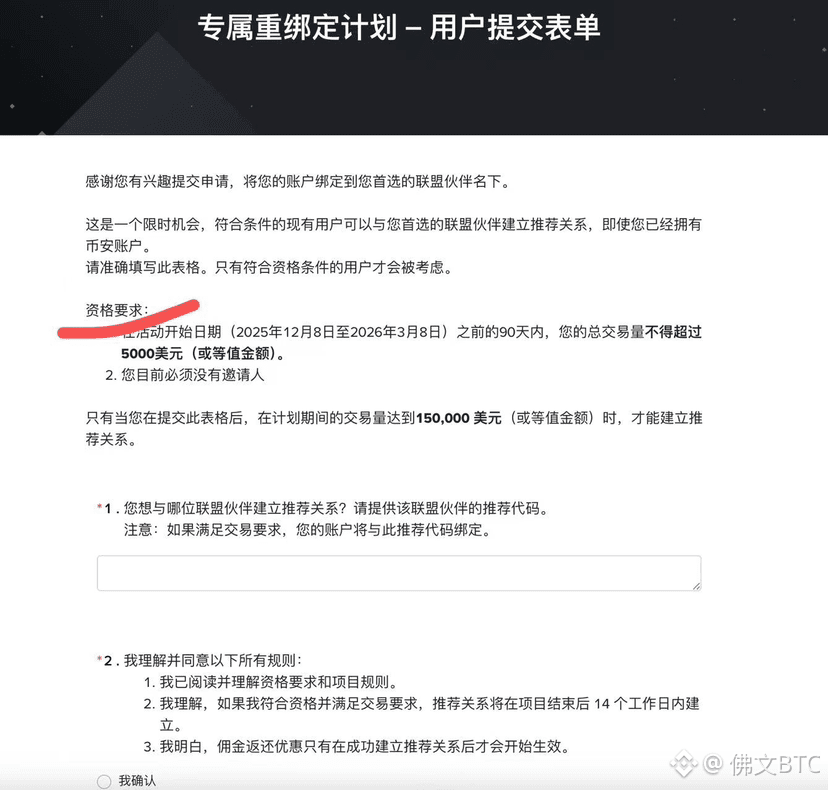
🚀 Binance old users limited-time rebind, hurry up!!!
📅 Event time: March 9, 2026 to April 8, 2026 (UTC)
Must meet the following criteria:
✅ No superior inviter
✅ Total trading volume below $5,000 within the 90 days from December 8, 2025 to March 8, 2026
📌 How to submit the rebind:
Step 1: Fill out https://www.bsmkweb.cc/zh-CN/survey/94f3eb1935604a9c8d6751bafd4953f1?_dp=L3dlYnZpZXcvd2Vidmlldz90eXBlPWRlZmF1bHQmbmVlZER5bmFtaWM9dHJ1ZSZ1cmw9YUhSMGNITTZMeTkzZDNjdVltbHVZVzVqWlM1amIyMHZaVzR2YzNWeWRtVjVMemswWmpObFlqRTVNelUyTURSaE9XTTRaRFkzTlRGaVlXWmtORGsxTTJZeA
Step 2: Enter referral code: VIP19
Step 3: Trading volume during the event ≥ $150,000
Once the requirements are met and approved, the binding will be successfully completed within 14 working days after the event ends.
$BTC
{future}(BTCUSDT)
$ETH
{spot}(ETHUSDT)
$BNB
{spot}(BNBUSDT)
🚀 Binance old users limited-time rebind, hurry up!!!
📅 Event time: March 9, 2026 to April 8, 2026 (UTC)
Must meet the following criteria:
✅ No superior inviter
✅ Total trading volume below $5,000 within the 90 days from December 8, 2025 to March 8, 2026
📌 How to submit the rebind:
Step 1: Fill out https://www.bsmkweb.cc/zh-CN/survey/94f3eb1935604a9c8d6751bafd4953f1?_dp=L3dlYnZpZXcvd2Vidmlldz90eXBlPWRlZmF1bHQmbmVlZER5bmFtaWM9dHJ1ZSZ1cmw9YUhSMGNITTZMeTkzZDNjdVltbHVZVzVqWlM1amIyMHZaVzR2YzNWeWRtVjVMemswWmpObFlqRTVNelUyTURSaE9XTTRaRFkzTlRGaVlXWmtORGsxTTJZeA
Step 2: Enter referral code: VIP19
Step 3: Trading volume during the event ≥ $150,000
Once the requirements are met and approved, the binding will be successfully completed within 14 working days after the event ends.
$BTC
$ETH
$BNB
📅 Event time: March 9, 2026 to April 8, 2026 (UTC)
Must meet the following criteria:
✅ No superior inviter
✅ Total trading volume below $5,000 within the 90 days from December 8, 2025 to March 8, 2026
📌 How to submit the rebind:
Step 1: Fill out https://www.bsmkweb.cc/zh-CN/survey/94f3eb1935604a9c8d6751bafd4953f1?_dp=L3dlYnZpZXcvd2Vidmlldz90eXBlPWRlZmF1bHQmbmVlZER5bmFtaWM9dHJ1ZSZ1cmw9YUhSMGNITTZMeTkzZDNjdVltbHVZVzVqWlM1amIyMHZaVzR2YzNWeWRtVjVMemswWmpObFlqRTVNelUyTURSaE9XTTRaRFkzTlRGaVlXWmtORGsxTTJZeA
Step 2: Enter referral code: VIP19
Step 3: Trading volume during the event ≥ $150,000
Once the requirements are met and approved, the binding will be successfully completed within 14 working days after the event ends.
$BTC
$ETH
$BNB
1
9
890
·
--
Livermore: In long-term trading, apart from knowledge, patience is more important than any other factor.
In fact, patience and knowledge complement each other. Anyone hoping to succeed through speculation should learn a simple lesson: before you buy or sell, you must study the situation carefully and determine whether it is the best time to enter the market. Only then can you be sure you have the right position.
The wealth of about 90% of traders flows to the other 10%; the wealth of short-term traders flows to long-term traders; the wealth of traders chasing occasional windfalls flows to traders seeking small, steady profits over the long term; the wealth of impatient traders flows to patient traders; and the wealth of traders who earn with their hands flows to traders who earn by sitting tight.
$AAPLB $NVDAB
#OCC发布GENIUS法案首个最终规则
Livermore: In long-term trading, apart from knowledge, patience is more important than any other factor.
In fact, patience and knowledge complement each other. Anyone hoping to succeed through speculation should learn a simple lesson: before you buy or sell, you must study the situation carefully and determine whether it is the best time to enter the market. Only then can you be sure you have the right position.
The wealth of about 90% of traders flows to the other 10%; the wealth of short-term traders flows to long-term traders; the wealth of traders chasing occasional windfalls flows to traders seeking small, steady profits over the long term; the wealth of impatient traders flows to patient traders; and the wealth of traders who earn with their hands flows to traders who earn by sitting tight.
$AAPLB $NVDAB
#OCC发布GENIUS法案首个最终规则
In fact, patience and knowledge complement each other. Anyone hoping to succeed through speculation should learn a simple lesson: before you buy or sell, you must study the situation carefully and determine whether it is the best time to enter the market. Only then can you be sure you have the right position.
The wealth of about 90% of traders flows to the other 10%; the wealth of short-term traders flows to long-term traders; the wealth of traders chasing occasional windfalls flows to traders seeking small, steady profits over the long term; the wealth of impatient traders flows to patient traders; and the wealth of traders who earn with their hands flows to traders who earn by sitting tight.
$AAPLB $NVDAB
#OCC发布GENIUS法案首个最终规则
335
·
--
Verified
On Wednesday, U.S. stocks rose: the Nasdaq gained 1% intraday, the S&P 500 rose 0.5%, gold gained 0.15% to $4,130 per ounce, and Brent crude fell 0.2% to $108.5 per barrel.
A Reuters survey showed that all 100 economists polled expect the Federal Reserve to raise interest rates in December 2026, while it may hold off in October.
$NVDAB $AAPLB #股票财报季
On Wednesday, U.S. stocks rose: the Nasdaq gained 1% intraday, the S&P 500 rose 0.5%, gold gained 0.15% to $4,130 per ounce, and Brent crude fell 0.2% to $108.5 per barrel.
A Reuters survey showed that all 100 economists polled expect the Federal Reserve to raise interest rates in December 2026, while it may hold off in October.
$NVDAB $AAPLB #股票财报季
A Reuters survey showed that all 100 economists polled expect the Federal Reserve to raise interest rates in December 2026, while it may hold off in October.
$NVDAB $AAPLB #股票财报季
1
1
955
·
--

神话社区
·
--
People like this are sure to reach the top of society:
1. Be decisive—decisive, decisive
2. Keep pushing beyond your comfort zone
3. Treat well those who treat you well
4. You can firmly reject people and things you don’t like
5. The more outstanding you are, the less you show off
6. Be 15 minutes early for everything
7. Be tough on yourself and extremely disciplined
8. Trust only those who don’t come looking for me when I’m at my peak
9. Trust only those who keep me company and talk things through with me when I’m down
10. Trust only those who helped me when I was at my lowest
11. Do only four things: exercise, make money, study, and read
12. Read only four kinds of books: history, sales, economics, and classics
13. Associate only with four kinds of people: capable, well-mannered, positive, and action-oriented people
14. Watch only three kinds of videos: those that increase your knowledge, broaden your horizons, and strengthen your thinking
15. Have principles and maintain boundaries
16. Stop being so sensitive
17. Always love yourself
18. Don’t be afraid of not fitting in. Sheep flock together; beasts always walk alone.
$BTC $ETH
#韩国KOSPI指数跌超2%
1. Be decisive—decisive, decisive
2. Keep pushing beyond your comfort zone
3. Treat well those who treat you well
4. You can firmly reject people and things you don’t like
5. The more outstanding you are, the less you show off
6. Be 15 minutes early for everything
7. Be tough on yourself and extremely disciplined
8. Trust only those who don’t come looking for me when I’m at my peak
9. Trust only those who keep me company and talk things through with me when I’m down
10. Trust only those who helped me when I was at my lowest
11. Do only four things: exercise, make money, study, and read
12. Read only four kinds of books: history, sales, economics, and classics
13. Associate only with four kinds of people: capable, well-mannered, positive, and action-oriented people
14. Watch only three kinds of videos: those that increase your knowledge, broaden your horizons, and strengthen your thinking
15. Have principles and maintain boundaries
16. Stop being so sensitive
17. Always love yourself
18. Don’t be afraid of not fitting in. Sheep flock together; beasts always walk alone.
$BTC $ETH
#韩国KOSPI指数跌超2%
1
1
183
·
--
The most frightening thing about poverty isn’t having no money, but that it steals your time. Waiting for buses, comparing prices, running around to take care of paperwork, dealing with all kinds of institutions…
Poverty is like a second job that doesn’t pay.
$NVDAB $AAPLB
#Elice韩股上市首日暴跌33%
The most frightening thing about poverty isn’t having no money, but that it steals your time. Waiting for buses, comparing prices, running around to take care of paperwork, dealing with all kinds of institutions…
Poverty is like a second job that doesn’t pay.
$NVDAB $AAPLB
#Elice韩股上市首日暴跌33%
Poverty is like a second job that doesn’t pay.
$NVDAB $AAPLB
#Elice韩股上市首日暴跌33%
2
2
311
·
--
Human nature makes it especially hard to sell [sweating]
When prices rise: You’re reluctant to sell
Up 20%, you want to make 50%; up 50%, you want to double your money. In the end, your profits dwindle—or even turn into losses.
When prices fall: You don’t want to admit you were wrong
Even when the fundamentals have clearly deteriorated, you keep telling yourself you’ll sell once you break even. A small loss ends up becoming a much bigger one.
After selling: It’s easy to regret it
If the price keeps rising after you sell, you think you sold too soon; if it falls after you hold on, you think you were too greedy.
$BTC $ETH
#韩国KOSPI指数跌超2%
{future}(ETHUSDT)
{future}(BTCUSDT)
Human nature makes it especially hard to sell [sweating]
When prices rise: You’re reluctant to sell
Up 20%, you want to make 50%; up 50%, you want to double your money. In the end, your profits dwindle—or even turn into losses.
When prices fall: You don’t want to admit you were wrong
Even when the fundamentals have clearly deteriorated, you keep telling yourself you’ll sell once you break even. A small loss ends up becoming a much bigger one.
After selling: It’s easy to regret it
If the price keeps rising after you sell, you think you sold too soon; if it falls after you hold on, you think you were too greedy.
$BTC $ETH
#韩国KOSPI指数跌超2%
When prices rise: You’re reluctant to sell
Up 20%, you want to make 50%; up 50%, you want to double your money. In the end, your profits dwindle—or even turn into losses.
When prices fall: You don’t want to admit you were wrong
Even when the fundamentals have clearly deteriorated, you keep telling yourself you’ll sell once you break even. A small loss ends up becoming a much bigger one.
After selling: It’s easy to regret it
If the price keeps rising after you sell, you think you sold too soon; if it falls after you hold on, you think you were too greedy.
$BTC $ETH
#韩国KOSPI指数跌超2%
2
3
574
·
--
You’ve worked so hard and been through so much to get where you are today. Please don’t let anyone drain you, and don’t wear yourself out for anyone.
$BTC
{future}(BTCUSDT)
$ETH
{future}(ETHUSDT)
#比特币突破8.3万美元
You’ve worked so hard and been through so much to get where you are today. Please don’t let anyone drain you, and don’t wear yourself out for anyone.
$BTC
$ETH
#比特币突破8.3万美元
$BTC
$ETH
#比特币突破8.3万美元
1
1
629
·
--
Life is like tea: subtle yet full of flavor, bitter yet sweet. Savor it slowly to discover its true essence; take each step slowly to become a better version of yourself.
$BTC
{future}(BTCUSDT)
$ETH
{future}(ETHUSDT)
#比特币重回8.2万美元上方
Life is like tea: subtle yet full of flavor, bitter yet sweet. Savor it slowly to discover its true essence; take each step slowly to become a better version of yourself.
$BTC
$ETH
#比特币重回8.2万美元上方
$BTC
$ETH
#比特币重回8.2万美元上方
1
269
·
--
Make more money. Worldly success can help restore some of your confidence and drive, and it’s also an indispensable source of value. You have to face the root of the problem: most of it comes down to money.
Material conditions determine the most fundamental spiritual foundation.
The spiritual foundation determines the superstructure.
Material things are what sustain life.
Without a material foundation, everything falls apart.
$BTC $ETH
#Celestia涨16%创2026年新高
{future}(ETHUSDT)
{future}(BTCUSDT)
Make more money. Worldly success can help restore some of your confidence and drive, and it’s also an indispensable source of value. You have to face the root of the problem: most of it comes down to money.
Material conditions determine the most fundamental spiritual foundation.
The spiritual foundation determines the superstructure.
Material things are what sustain life.
Without a material foundation, everything falls apart.
$BTC $ETH
#Celestia涨16%创2026年新高
Material conditions determine the most fundamental spiritual foundation.
The spiritual foundation determines the superstructure.
Material things are what sustain life.
Without a material foundation, everything falls apart.
$BTC $ETH
#Celestia涨16%创2026年新高
1
363
·
--
Sometimes people are just like this…
There’s a hole up ahead, and a passerby warns you not to go near it. You listen, walk around it, say thank you, and may forget about it as soon as you turn away.
But if you don’t listen and keep walking, fall into the hole, and end up badly hurt and unable to move, then someone comes along and pulls you out, you’ll often feel grateful to that person for a long time.
Yet you may not remember the person who warned you in the first place. You might even think they were meddling and blame them for your fall.
That’s because you can personally feel the pain of being rescued and the kindness behind it. But when you avoid a loss in advance, you may not even realize how great that loss could have been.
Investing is the same. It often takes losing your own hard-earned money—sometimes getting burned several times—before you understand the point of those warnings.
But not every hole gives you a chance to climb back out.
Recognizing risks early and avoiding situations that could cost you money or even bankrupt you is far wiser than getting in over your head and trying to turn things around, or waiting for someone else to save you.
Most people prefer stories about someone getting in over their head and turning things around, while overlooking the fact that, in life, we’re far more often better off avoiding situations that require such a dramatic rescue…
Many holes are very hard to climb out of without a scratch………
$BTC $ETH
#比特币回升至8.2万美元
{future}(ETHUSDT)
{future}(BTCUSDT)
Sometimes people are just like this…
There’s a hole up ahead, and a passerby warns you not to go near it. You listen, walk around it, say thank you, and may forget about it as soon as you turn away.
But if you don’t listen and keep walking, fall into the hole, and end up badly hurt and unable to move, then someone comes along and pulls you out, you’ll often feel grateful to that person for a long time.
Yet you may not remember the person who warned you in the first place. You might even think they were meddling and blame them for your fall.
That’s because you can personally feel the pain of being rescued and the kindness behind it. But when you avoid a loss in advance, you may not even realize how great that loss could have been.
Investing is the same. It often takes losing your own hard-earned money—sometimes getting burned several times—before you understand the point of those warnings.
But not every hole gives you a chance to climb back out.
Recognizing risks early and avoiding situations that could cost you money or even bankrupt you is far wiser than getting in over your head and trying to turn things around, or waiting for someone else to save you.
Most people prefer stories about someone getting in over their head and turning things around, while overlooking the fact that, in life, we’re far more often better off avoiding situations that require such a dramatic rescue…
Many holes are very hard to climb out of without a scratch………
$BTC $ETH
#比特币回升至8.2万美元
There’s a hole up ahead, and a passerby warns you not to go near it. You listen, walk around it, say thank you, and may forget about it as soon as you turn away.
But if you don’t listen and keep walking, fall into the hole, and end up badly hurt and unable to move, then someone comes along and pulls you out, you’ll often feel grateful to that person for a long time.
Yet you may not remember the person who warned you in the first place. You might even think they were meddling and blame them for your fall.
That’s because you can personally feel the pain of being rescued and the kindness behind it. But when you avoid a loss in advance, you may not even realize how great that loss could have been.
Investing is the same. It often takes losing your own hard-earned money—sometimes getting burned several times—before you understand the point of those warnings.
But not every hole gives you a chance to climb back out.
Recognizing risks early and avoiding situations that could cost you money or even bankrupt you is far wiser than getting in over your head and trying to turn things around, or waiting for someone else to save you.
Most people prefer stories about someone getting in over their head and turning things around, while overlooking the fact that, in life, we’re far more often better off avoiding situations that require such a dramatic rescue…
Many holes are very hard to climb out of without a scratch………
$BTC $ETH
#比特币回升至8.2万美元
1
1
469
·
--
Someone asked: What should I invest in now that will do really well 10 years from now?
Honestly, I don't know either.
But looking at market cycles, I would be especially wary of assets that have performed very well over the past 10–15 years, been hyped repeatedly, and even come to be seen as things you can “invest in blindly through dollar-cost averaging, buy with your eyes closed on every dip, and hold forever.”
Look at history:
Gold: From 1971 to 1980, it went through a major bull run lasting about 9 years.
After peaking, it didn't return to its previous high until 2008—a wait of about 28 years.
Nasdaq Composite: From 1982 to 2000, it went through a long bull market lasting about 18 years. After peaking, it didn't return to its previous high until 2015—a wait of about 15 years.
Nikkei 225: From its trough in 1974 to its peak in 1989, its rise spanned about 15 years. It didn't return to its previous high until 2024—a wait of about 34 years.
Prices didn't rise every year during these uptrends. And returning to a previous high refers only to nominal prices; it doesn't account for inflation or dividends, and is not the same as the time it takes an investor using dollar-cost averaging to break even.
An asset can rise for years, making people believe that buying it guarantees a profit. It may also make those who bought at the peak understand the cost of price—through an even longer wait.
Brother Zhuan asks: If we find ourselves in a long cycle where we're not making money, how should we respond?
$BTC $ETH
#澳大利亚提议加密交易申报法案
{future}(ETHUSDT)
{future}(BTCUSDT)
Someone asked: What should I invest in now that will do really well 10 years from now?
Honestly, I don't know either.
But looking at market cycles, I would be especially wary of assets that have performed very well over the past 10–15 years, been hyped repeatedly, and even come to be seen as things you can “invest in blindly through dollar-cost averaging, buy with your eyes closed on every dip, and hold forever.”
Look at history:
Gold: From 1971 to 1980, it went through a major bull run lasting about 9 years.
After peaking, it didn't return to its previous high until 2008—a wait of about 28 years.
Nasdaq Composite: From 1982 to 2000, it went through a long bull market lasting about 18 years. After peaking, it didn't return to its previous high until 2015—a wait of about 15 years.
Nikkei 225: From its trough in 1974 to its peak in 1989, its rise spanned about 15 years. It didn't return to its previous high until 2024—a wait of about 34 years.
Prices didn't rise every year during these uptrends. And returning to a previous high refers only to nominal prices; it doesn't account for inflation or dividends, and is not the same as the time it takes an investor using dollar-cost averaging to break even.
An asset can rise for years, making people believe that buying it guarantees a profit. It may also make those who bought at the peak understand the cost of price—through an even longer wait.
Brother Zhuan asks: If we find ourselves in a long cycle where we're not making money, how should we respond?
$BTC $ETH
#澳大利亚提议加密交易申报法案
Honestly, I don't know either.
But looking at market cycles, I would be especially wary of assets that have performed very well over the past 10–15 years, been hyped repeatedly, and even come to be seen as things you can “invest in blindly through dollar-cost averaging, buy with your eyes closed on every dip, and hold forever.”
Look at history:
Gold: From 1971 to 1980, it went through a major bull run lasting about 9 years.
After peaking, it didn't return to its previous high until 2008—a wait of about 28 years.
Nasdaq Composite: From 1982 to 2000, it went through a long bull market lasting about 18 years. After peaking, it didn't return to its previous high until 2015—a wait of about 15 years.
Nikkei 225: From its trough in 1974 to its peak in 1989, its rise spanned about 15 years. It didn't return to its previous high until 2024—a wait of about 34 years.
Prices didn't rise every year during these uptrends. And returning to a previous high refers only to nominal prices; it doesn't account for inflation or dividends, and is not the same as the time it takes an investor using dollar-cost averaging to break even.
An asset can rise for years, making people believe that buying it guarantees a profit. It may also make those who bought at the peak understand the cost of price—through an even longer wait.
Brother Zhuan asks: If we find ourselves in a long cycle where we're not making money, how should we respond?
$BTC $ETH
#澳大利亚提议加密交易申报法案
1
2
461
·
--
When it comes to futures, most people immediately say that those things have too much leverage and the risks are huge.
In fact, today’s margin levels for domestic futures in China are quite high. On average, the leverage ratio is around 5x. Futures companies also add a few percentage points on top of the exchange’s required margin. So even when you calculate it this way, it’s still not beyond 5x leverage.
At present, down payments for home purchases in many cities have already dropped to 20% or even lower. Many people cobble together this down payment from multiple sources. And since most people who trade futures only use a portion of their own funds to do the trading, then when you compare it, the leverage ratio involved in buying a home is arguably even higher than that of futures.
If a house were a futures product—when you open a long position now, the entry cost would be at an absolute historical high price, and then you’d go full margin and add leverage of more than 5x...
$BTC $ETH
#比特币冲击8.7万美元遇阻回落
{future}(BTCUSDT)
When it comes to futures, most people immediately say that those things have too much leverage and the risks are huge.
In fact, today’s margin levels for domestic futures in China are quite high. On average, the leverage ratio is around 5x. Futures companies also add a few percentage points on top of the exchange’s required margin. So even when you calculate it this way, it’s still not beyond 5x leverage.
At present, down payments for home purchases in many cities have already dropped to 20% or even lower. Many people cobble together this down payment from multiple sources. And since most people who trade futures only use a portion of their own funds to do the trading, then when you compare it, the leverage ratio involved in buying a home is arguably even higher than that of futures.
If a house were a futures product—when you open a long position now, the entry cost would be at an absolute historical high price, and then you’d go full margin and add leverage of more than 5x...
$BTC $ETH
#比特币冲击8.7万美元遇阻回落
In fact, today’s margin levels for domestic futures in China are quite high. On average, the leverage ratio is around 5x. Futures companies also add a few percentage points on top of the exchange’s required margin. So even when you calculate it this way, it’s still not beyond 5x leverage.
At present, down payments for home purchases in many cities have already dropped to 20% or even lower. Many people cobble together this down payment from multiple sources. And since most people who trade futures only use a portion of their own funds to do the trading, then when you compare it, the leverage ratio involved in buying a home is arguably even higher than that of futures.
If a house were a futures product—when you open a long position now, the entry cost would be at an absolute historical high price, and then you’d go full margin and add leverage of more than 5x...
$BTC $ETH
#比特币冲击8.7万美元遇阻回落
2
797
·
--
Psychologist Adler said: All our troubles are a confusion of what is truly a matter of “the lesson to be learned.”
There are three things in life: your own matters, other people’s matters, and matters of fate.
A person can never control another person.
If we try to control someone—even in the name of love, even in the name of treating them well—what we end up with is ultimately disappointment.
When it comes to other people’s matters, we should do our best to reduce expectations of others to zero, because having expectations of others is the same as handing over the keys to your life to someone else.
Respect other people’s way of living, and keep moving at your own pace.
Leave matters of fate to fate:
other people’s matters to other people;
your own matters—give it everything you’ve got.
That is what emotional and mental maturity looks like!
Why can women with emotional/mental maturity get results faster?
Because they’ve learned to deal with men with their minds, to treat themselves with money and sincerity, and to learn not to rely on anyone—doesn’t care about other people’s opinions—doesn’t get constrained by morality and emotions, doesn’t get pulled into the trivial, petty details of everyday life. Instead, they give it everything they have to achieve their goals, and become the real support for themselves!
$BTC $ETH
#黄金跌至4144美元
{future}(ETHUSDT)
{future}(BTCUSDT)
Psychologist Adler said: All our troubles are a confusion of what is truly a matter of “the lesson to be learned.”
There are three things in life: your own matters, other people’s matters, and matters of fate.
A person can never control another person.
If we try to control someone—even in the name of love, even in the name of treating them well—what we end up with is ultimately disappointment.
When it comes to other people’s matters, we should do our best to reduce expectations of others to zero, because having expectations of others is the same as handing over the keys to your life to someone else.
Respect other people’s way of living, and keep moving at your own pace.
Leave matters of fate to fate:
other people’s matters to other people;
your own matters—give it everything you’ve got.
That is what emotional and mental maturity looks like!
Why can women with emotional/mental maturity get results faster?
Because they’ve learned to deal with men with their minds, to treat themselves with money and sincerity, and to learn not to rely on anyone—doesn’t care about other people’s opinions—doesn’t get constrained by morality and emotions, doesn’t get pulled into the trivial, petty details of everyday life. Instead, they give it everything they have to achieve their goals, and become the real support for themselves!
$BTC $ETH
#黄金跌至4144美元
There are three things in life: your own matters, other people’s matters, and matters of fate.
A person can never control another person.
If we try to control someone—even in the name of love, even in the name of treating them well—what we end up with is ultimately disappointment.
When it comes to other people’s matters, we should do our best to reduce expectations of others to zero, because having expectations of others is the same as handing over the keys to your life to someone else.
Respect other people’s way of living, and keep moving at your own pace.
Leave matters of fate to fate:
other people’s matters to other people;
your own matters—give it everything you’ve got.
That is what emotional and mental maturity looks like!
Why can women with emotional/mental maturity get results faster?
Because they’ve learned to deal with men with their minds, to treat themselves with money and sincerity, and to learn not to rely on anyone—doesn’t care about other people’s opinions—doesn’t get constrained by morality and emotions, doesn’t get pulled into the trivial, petty details of everyday life. Instead, they give it everything they have to achieve their goals, and become the real support for themselves!
$BTC $ETH
#黄金跌至4144美元
876
·
--
Ordinary people who weren’t lifted up by their parents—
throughout our lives, we only have one task:
stop complaining,
stop comparing ourselves to others.
Achieve self-acceptance.
Accept the version of yourself
who works so hard,
but still can’t catch up to where others started.
The internet has broadened our horizons,
showing us far too many high-scoring answers,
so we often end up doubting ourselves.
But actually, you’re already doing really well.
So don’t keep comparing this with that.
Let me tell you:
everything that you can see—every person you come across—
is only what others want you to notice.
$BTC $ETH
#华夏基金完成港元稳定币投资用例
{future}(ETHUSDT)
{future}(BTCUSDT)
Ordinary people who weren’t lifted up by their parents—
throughout our lives, we only have one task:
stop complaining,
stop comparing ourselves to others.
Achieve self-acceptance.
Accept the version of yourself
who works so hard,
but still can’t catch up to where others started.
The internet has broadened our horizons,
showing us far too many high-scoring answers,
so we often end up doubting ourselves.
But actually, you’re already doing really well.
So don’t keep comparing this with that.
Let me tell you:
everything that you can see—every person you come across—
is only what others want you to notice.
$BTC $ETH
#华夏基金完成港元稳定币投资用例
throughout our lives, we only have one task:
stop complaining,
stop comparing ourselves to others.
Achieve self-acceptance.
Accept the version of yourself
who works so hard,
but still can’t catch up to where others started.
The internet has broadened our horizons,
showing us far too many high-scoring answers,
so we often end up doubting ourselves.
But actually, you’re already doing really well.
So don’t keep comparing this with that.
Let me tell you:
everything that you can see—every person you come across—
is only what others want you to notice.
$BTC $ETH
#华夏基金完成港元稳定币投资用例
3
2.7k
·
--
A knowledge point that many beginners can’t figure out:
In a downtrend 👉🏼 longs get liquidated (people who go long get liquidated)
In an uptrend 👉🏼 shorts get liquidated (people who go short get liquidated)
The real essence of liquidation isn’t up or down—it’s the market moving in the direction opposite to your leveraged position.
In a ranging/choppy market, it’s easiest to get hit on both sides. Don’t think that if your direction is “right” you’ll be safe—leverage tolerance is extremely low!
The hardest part of investing isn’t deciding whether prices will rise or fall. It’s telling apart: what is a short-term sentiment-driven move, and what is a long-term trend! A sentiment-driven move is only suitable for staying on the sidelines with a light position; it’s not suitable for heavy-position trading!
$BTC $ETH
#日本央行加息至31年高位
{future}(BTCUSDT)
A knowledge point that many beginners can’t figure out:
In a downtrend 👉🏼 longs get liquidated (people who go long get liquidated)
In an uptrend 👉🏼 shorts get liquidated (people who go short get liquidated)
The real essence of liquidation isn’t up or down—it’s the market moving in the direction opposite to your leveraged position.
In a ranging/choppy market, it’s easiest to get hit on both sides. Don’t think that if your direction is “right” you’ll be safe—leverage tolerance is extremely low!
The hardest part of investing isn’t deciding whether prices will rise or fall. It’s telling apart: what is a short-term sentiment-driven move, and what is a long-term trend! A sentiment-driven move is only suitable for staying on the sidelines with a light position; it’s not suitable for heavy-position trading!
$BTC $ETH
#日本央行加息至31年高位
In a downtrend 👉🏼 longs get liquidated (people who go long get liquidated)
In an uptrend 👉🏼 shorts get liquidated (people who go short get liquidated)
The real essence of liquidation isn’t up or down—it’s the market moving in the direction opposite to your leveraged position.
In a ranging/choppy market, it’s easiest to get hit on both sides. Don’t think that if your direction is “right” you’ll be safe—leverage tolerance is extremely low!
The hardest part of investing isn’t deciding whether prices will rise or fall. It’s telling apart: what is a short-term sentiment-driven move, and what is a long-term trend! A sentiment-driven move is only suitable for staying on the sidelines with a light position; it’s not suitable for heavy-position trading!
$BTC $ETH
#日本央行加息至31年高位
1.7k
·
--
Let me tell an absolute century-level big revelation:
Starting a business is already a matter of one death to nine survivals,
and in China, even more so.
Because of a height restriction tied to a 420,000 payment, a 67-year-old man, Feng Lun,
is limited by height.
And a 61-year-old, Yu Liang, was limited by height
simply because工商 registration hadn’t been updated in time.
Nearly 40 million people across China have been limited by height.
|
Entrepreneurs should be the greatest source of wealth for a country,
and they shouldn’t be turned into
height-restriction regulars for the most brilliant minds.
Can this kind of approach truly drive employment and innovation?
Shouldn’t we think about how to treat entrepreneurs?
#日本央行加息至31年高位
$BTC $ETH
{future}(ETHUSDT)
{future}(BTCUSDT)
Let me tell an absolute century-level big revelation:
Starting a business is already a matter of one death to nine survivals,
and in China, even more so.
Because of a height restriction tied to a 420,000 payment, a 67-year-old man, Feng Lun,
is limited by height.
And a 61-year-old, Yu Liang, was limited by height
simply because工商 registration hadn’t been updated in time.
Nearly 40 million people across China have been limited by height.
|
Entrepreneurs should be the greatest source of wealth for a country,
and they shouldn’t be turned into
height-restriction regulars for the most brilliant minds.
Can this kind of approach truly drive employment and innovation?
Shouldn’t we think about how to treat entrepreneurs?
#日本央行加息至31年高位
$BTC $ETH
Starting a business is already a matter of one death to nine survivals,
and in China, even more so.
Because of a height restriction tied to a 420,000 payment, a 67-year-old man, Feng Lun,
is limited by height.
And a 61-year-old, Yu Liang, was limited by height
simply because工商 registration hadn’t been updated in time.
Nearly 40 million people across China have been limited by height.
|
Entrepreneurs should be the greatest source of wealth for a country,
and they shouldn’t be turned into
height-restriction regulars for the most brilliant minds.
Can this kind of approach truly drive employment and innovation?
Shouldn’t we think about how to treat entrepreneurs?
#日本央行加息至31年高位
$BTC $ETH
1
1.3k
·
--
Review the Previous Rate Hike Cycle and Bitcoin’s Price Action
In March 2022, when the Federal Reserve began raising rates, Bitcoin was still hovering around $47,000.
Then, as the pace of rate hikes kept accelerating—especially after multiple consecutive large increases—market liquidity tightened quickly, and Bitcoin entered a sustained period of adjustment.
In June 2022, Bitcoin briefly fell below $20,000;
In November 2022, with rate hikes, tighter dollar liquidity, and factors such as the FTX incident overlapping, Bitcoin further probed down to around $16,000.
From the start of the rate hikes to the end of 2022, Bitcoin went through a clear round of valuation compression.
But 2023 wasn’t the case that as soon as the Fed paused rate hikes, Bitcoin immediately kicked off a major rally.
In February, March, May, and July of 2023, the Fed continued raising rates—though the hike size gradually decreased from 75 basis points down to 25 basis points.
Meanwhile, Bitcoin gradually recovered from around $16,000, and at one point in the first half of 2023 it even returned to around $30,000.
I think the most important thing here isn’t the word “rate hikes,” but rather that the market’s expectations for future liquidity changed.
In 2022, the market was trading:
Rate hikes getting faster, with liquidity tightening continuously.
By 2023, the market started trading:
Rate hikes nearing their end, and the tightening cycle possibly entering its final stage.
So the biggest lesson I take from the previous rate-hike cycle is this:
In the early stage of rate hikes, the market often trades the tightening of liquidity first; in the later stage, the market starts to price in the end of tightening in advance.
That’s also why, although it was the same process of rate hikes, Bitcoin faced persistent pressure in 2022, while in 2023—despite continued hikes—there was a clear recovery.
What this cycle’s rally really needs to focus on isn’t whether Bitcoin will bounce after a specific rate hike is implemented, but rather:
Whether there will be further rate hikes later;
Whether the rate-hike cycle is already close to its end;
Whether U.S. Treasury yields and the U.S. dollar continue to strengthen;
Whether the market has started to reprice high interest rates for longer.
History won’t simply repeat itself, but the way capital responds to liquidity often does.
$BTC $ETH
#Zcash上涨6%
{future}(ETHUSDT)
{future}(BTCUSDT)
Review the Previous Rate Hike Cycle and Bitcoin’s Price Action
In March 2022, when the Federal Reserve began raising rates, Bitcoin was still hovering around $47,000.
Then, as the pace of rate hikes kept accelerating—especially after multiple consecutive large increases—market liquidity tightened quickly, and Bitcoin entered a sustained period of adjustment.
In June 2022, Bitcoin briefly fell below $20,000;
In November 2022, with rate hikes, tighter dollar liquidity, and factors such as the FTX incident overlapping, Bitcoin further probed down to around $16,000.
From the start of the rate hikes to the end of 2022, Bitcoin went through a clear round of valuation compression.
But 2023 wasn’t the case that as soon as the Fed paused rate hikes, Bitcoin immediately kicked off a major rally.
In February, March, May, and July of 2023, the Fed continued raising rates—though the hike size gradually decreased from 75 basis points down to 25 basis points.
Meanwhile, Bitcoin gradually recovered from around $16,000, and at one point in the first half of 2023 it even returned to around $30,000.
I think the most important thing here isn’t the word “rate hikes,” but rather that the market’s expectations for future liquidity changed.
In 2022, the market was trading:
Rate hikes getting faster, with liquidity tightening continuously.
By 2023, the market started trading:
Rate hikes nearing their end, and the tightening cycle possibly entering its final stage.
So the biggest lesson I take from the previous rate-hike cycle is this:
In the early stage of rate hikes, the market often trades the tightening of liquidity first; in the later stage, the market starts to price in the end of tightening in advance.
That’s also why, although it was the same process of rate hikes, Bitcoin faced persistent pressure in 2022, while in 2023—despite continued hikes—there was a clear recovery.
What this cycle’s rally really needs to focus on isn’t whether Bitcoin will bounce after a specific rate hike is implemented, but rather:
Whether there will be further rate hikes later;
Whether the rate-hike cycle is already close to its end;
Whether U.S. Treasury yields and the U.S. dollar continue to strengthen;
Whether the market has started to reprice high interest rates for longer.
History won’t simply repeat itself, but the way capital responds to liquidity often does.
$BTC $ETH
#Zcash上涨6%
In March 2022, when the Federal Reserve began raising rates, Bitcoin was still hovering around $47,000.
Then, as the pace of rate hikes kept accelerating—especially after multiple consecutive large increases—market liquidity tightened quickly, and Bitcoin entered a sustained period of adjustment.
In June 2022, Bitcoin briefly fell below $20,000;
In November 2022, with rate hikes, tighter dollar liquidity, and factors such as the FTX incident overlapping, Bitcoin further probed down to around $16,000.
From the start of the rate hikes to the end of 2022, Bitcoin went through a clear round of valuation compression.
But 2023 wasn’t the case that as soon as the Fed paused rate hikes, Bitcoin immediately kicked off a major rally.
In February, March, May, and July of 2023, the Fed continued raising rates—though the hike size gradually decreased from 75 basis points down to 25 basis points.
Meanwhile, Bitcoin gradually recovered from around $16,000, and at one point in the first half of 2023 it even returned to around $30,000.
I think the most important thing here isn’t the word “rate hikes,” but rather that the market’s expectations for future liquidity changed.
In 2022, the market was trading:
Rate hikes getting faster, with liquidity tightening continuously.
By 2023, the market started trading:
Rate hikes nearing their end, and the tightening cycle possibly entering its final stage.
So the biggest lesson I take from the previous rate-hike cycle is this:
In the early stage of rate hikes, the market often trades the tightening of liquidity first; in the later stage, the market starts to price in the end of tightening in advance.
That’s also why, although it was the same process of rate hikes, Bitcoin faced persistent pressure in 2022, while in 2023—despite continued hikes—there was a clear recovery.
What this cycle’s rally really needs to focus on isn’t whether Bitcoin will bounce after a specific rate hike is implemented, but rather:
Whether there will be further rate hikes later;
Whether the rate-hike cycle is already close to its end;
Whether U.S. Treasury yields and the U.S. dollar continue to strengthen;
Whether the market has started to reprice high interest rates for longer.
History won’t simply repeat itself, but the way capital responds to liquidity often does.
$BTC $ETH
#Zcash上涨6%
260
·
--
“The Wealth Ladder” Lesson 5: Advanced Levels of the Wealth Ladder
It mainly talks about six wealth tiers in the United States, and how each tier should climb the wealth ladder.
First tier: <1 million USD (total net worth) — work hard to find a good job, keep going, and remember safety is the most important
Second tier: 1 million–10 million USD — climb up in your career; learning and education are the most important
Third tier: 10 million–100 million USD — climb in your career plus run a side business; invest in assets that can generate cash flow (such as stocks, bonds, real estate, businesses, etc.); investing is the most important
Fourth tier: 100 million–1,000 million USD — create a company, then sell it. The age with the highest chance of entrepreneurial success is 45. Entrepreneurship is the most important
Fifth tier: 1,000 million–10,000 million USD — expanding the business operations is the most important.
Sixth tier: 100 million USD and above — wealth preservation is the most important
$BTC $ETH
#Zcash周涨45%创2016年来新高
{future}(ETHUSDT)
{future}(BTCUSDT)
“The Wealth Ladder” Lesson 5: Advanced Levels of the Wealth Ladder
It mainly talks about six wealth tiers in the United States, and how each tier should climb the wealth ladder.
First tier: <1 million USD (total net worth) — work hard to find a good job, keep going, and remember safety is the most important
Second tier: 1 million–10 million USD — climb up in your career; learning and education are the most important
Third tier: 10 million–100 million USD — climb in your career plus run a side business; invest in assets that can generate cash flow (such as stocks, bonds, real estate, businesses, etc.); investing is the most important
Fourth tier: 100 million–1,000 million USD — create a company, then sell it. The age with the highest chance of entrepreneurial success is 45. Entrepreneurship is the most important
Fifth tier: 1,000 million–10,000 million USD — expanding the business operations is the most important.
Sixth tier: 100 million USD and above — wealth preservation is the most important
$BTC $ETH
#Zcash周涨45%创2016年来新高
It mainly talks about six wealth tiers in the United States, and how each tier should climb the wealth ladder.
First tier: <1 million USD (total net worth) — work hard to find a good job, keep going, and remember safety is the most important
Second tier: 1 million–10 million USD — climb up in your career; learning and education are the most important
Third tier: 10 million–100 million USD — climb in your career plus run a side business; invest in assets that can generate cash flow (such as stocks, bonds, real estate, businesses, etc.); investing is the most important
Fourth tier: 100 million–1,000 million USD — create a company, then sell it. The age with the highest chance of entrepreneurial success is 45. Entrepreneurship is the most important
Fifth tier: 1,000 million–10,000 million USD — expanding the business operations is the most important.
Sixth tier: 100 million USD and above — wealth preservation is the most important
$BTC $ETH
#Zcash周涨45%创2016年来新高
2
450
·
--
BSC Ecosystem Mainstream Meme Coins See a Dip:
Marscoin’s market cap is temporarily reported at $152 million, down 10% in the past 24 hours;
Bull comes with a market cap temporarily reported at $81.8 million, down 8% in the past 24 hours;
FLORK’s market cap is temporarily reported at $17.9 million, down 1.5% in the past 24 hours;
b-money’s market cap is temporarily reported at $95 million, down 8.1% in the past 24 hours;
BEN’s market cap is temporarily reported at $7.2 million, down 28.6% in the past 24 hours;
Stonks’s market cap is temporarily reported at $5.2 million, down 53.5% in the past 24 hours.
$BTC $ETH
#IMF称萨尔瓦多购币未用公共资金
{future}(ETHUSDT)
{future}(BTCUSDT)
BSC Ecosystem Mainstream Meme Coins See a Dip:
Marscoin’s market cap is temporarily reported at $152 million, down 10% in the past 24 hours;
Bull comes with a market cap temporarily reported at $81.8 million, down 8% in the past 24 hours;
FLORK’s market cap is temporarily reported at $17.9 million, down 1.5% in the past 24 hours;
b-money’s market cap is temporarily reported at $95 million, down 8.1% in the past 24 hours;
BEN’s market cap is temporarily reported at $7.2 million, down 28.6% in the past 24 hours;
Stonks’s market cap is temporarily reported at $5.2 million, down 53.5% in the past 24 hours.
$BTC $ETH
#IMF称萨尔瓦多购币未用公共资金
Marscoin’s market cap is temporarily reported at $152 million, down 10% in the past 24 hours;
Bull comes with a market cap temporarily reported at $81.8 million, down 8% in the past 24 hours;
FLORK’s market cap is temporarily reported at $17.9 million, down 1.5% in the past 24 hours;
b-money’s market cap is temporarily reported at $95 million, down 8.1% in the past 24 hours;
BEN’s market cap is temporarily reported at $7.2 million, down 28.6% in the past 24 hours;
Stonks’s market cap is temporarily reported at $5.2 million, down 53.5% in the past 24 hours.
$BTC $ETH
#IMF称萨尔瓦多购币未用公共资金
1
239
Log in to explore more content
Join global crypto users on Binance Square
⚡️ Get latest and useful information about crypto.
💬 Trusted by the world’s largest crypto exchange.
👍 Discover real insights from verified creators.
Email / Phone number