

Veridise Re-poster
79 Posts

Veridise Re-poster
Report
Block User
Hardening blockchain security with Formal Methods — Industry-leading security audits and tools for smart contracts, blockchain, and zero-knowledge.
0 Following
1 Followers
3 Liked
Posts
All
Videos
See translation
Seeing a statement like x = x + 1 is perfectly normal in standard software development, but it creates unnecessary complications for a prover. When variables change, the prover is forced to continuously figure out exactly which version of x is being referenced at any given point in the code. Thanks to LLZK, this problem is completely avoided because every single value is assigned only one time. For a deeper understanding of how this single assignment approach streamlines the verification of ZK circuits, you can read the breakdown provided by @RaghavMalik15.
Seeing a statement like x = x + 1 is perfectly normal in standard software development, but it creates unnecessary complications for a prover. When variables change, the prover is forced to continuously figure out exactly which version of x is being referenced at any given point in the code. Thanks to LLZK, this problem is completely avoided because every single value is assigned only one time. For a deeper understanding of how this single assignment approach streamlines the verification of ZK circuits, you can read the breakdown provided by @RaghavMalik15.
53
See translation
A newly formed coalition known as the Quantum Alliance has been established by nine cryptocurrency organizations. Out of this collaboration comes a dedicated working group focusing on post-quantum zero-knowledge systems, which is the exact initiative our team is closely monitoring.
The primary reason for our interest lies in the technical hurdles involved. It is quite rare for circuits designed for a specific proof system to seamlessly transfer over to a different one. As a result, any necessary rewrites generate completely fresh code that requires a comprehensive new audit.
Further details regarding this announcement can be found here:
https://decrypt.co/381236/crypto-firms-launch-quantum-alliance-as-6-million-bitcoin-sit-exposed
A newly formed coalition known as the Quantum Alliance has been established by nine cryptocurrency organizations. Out of this collaboration comes a dedicated working group focusing on post-quantum zero-knowledge systems, which is the exact initiative our team is closely monitoring.
The primary reason for our interest lies in the technical hurdles involved. It is quite rare for circuits designed for a specific proof system to seamlessly transfer over to a different one. As a result, any necessary rewrites generate completely fresh code that requires a comprehensive new audit.
Further details regarding this announcement can be found here:
https://decrypt.co/381236/crypto-firms-launch-quantum-alliance-as-6-million-bitcoin-sit-exposed
The primary reason for our interest lies in the technical hurdles involved. It is quite rare for circuits designed for a specific proof system to seamlessly transfer over to a different one. As a result, any necessary rewrites generate completely fresh code that requires a comprehensive new audit.
Further details regarding this announcement can be found here:
https://decrypt.co/381236/crypto-firms-launch-quantum-alliance-as-6-million-bitcoin-sit-exposed
75
See translation
Verifying the behavior of a loop can be tricky when you have no idea how many cycles it will complete. The secret is to establish a specific condition that is correct right from the beginning and is maintained throughout each individual cycle. Through the principle of induction, you can be confident that this characteristic will remain valid once the execution finally concludes. For a great demonstration of this method in action, @RaghavMalik15 breaks down exactly how LLEQ puts this into practice.
Verifying the behavior of a loop can be tricky when you have no idea how many cycles it will complete. The secret is to establish a specific condition that is correct right from the beginning and is maintained throughout each individual cycle. Through the principle of induction, you can be confident that this characteristic will remain valid once the execution finally concludes. For a great demonstration of this method in action, @RaghavMalik15 breaks down exactly how LLEQ puts this into practice.
63
See translation
Whenever you optimize a ZK circuit to reduce constraints, you need to be certain that the new version performs the exact same computation as your initial design. While standard testing only validates the specific inputs you anticipate, LLEQ takes a much more comprehensive approach. It delegates the verification to an SMT solver, which logically evaluates every single possible input scenario. For a practical guide on how to execute this workflow, @RaghavMalik15 provides a complete walkthrough.
Whenever you optimize a ZK circuit to reduce constraints, you need to be certain that the new version performs the exact same computation as your initial design. While standard testing only validates the specific inputs you anticipate, LLEQ takes a much more comprehensive approach. It delegates the verification to an SMT solver, which logically evaluates every single possible input scenario. For a practical guide on how to execute this workflow, @RaghavMalik15 provides a complete walkthrough.
71
See translation
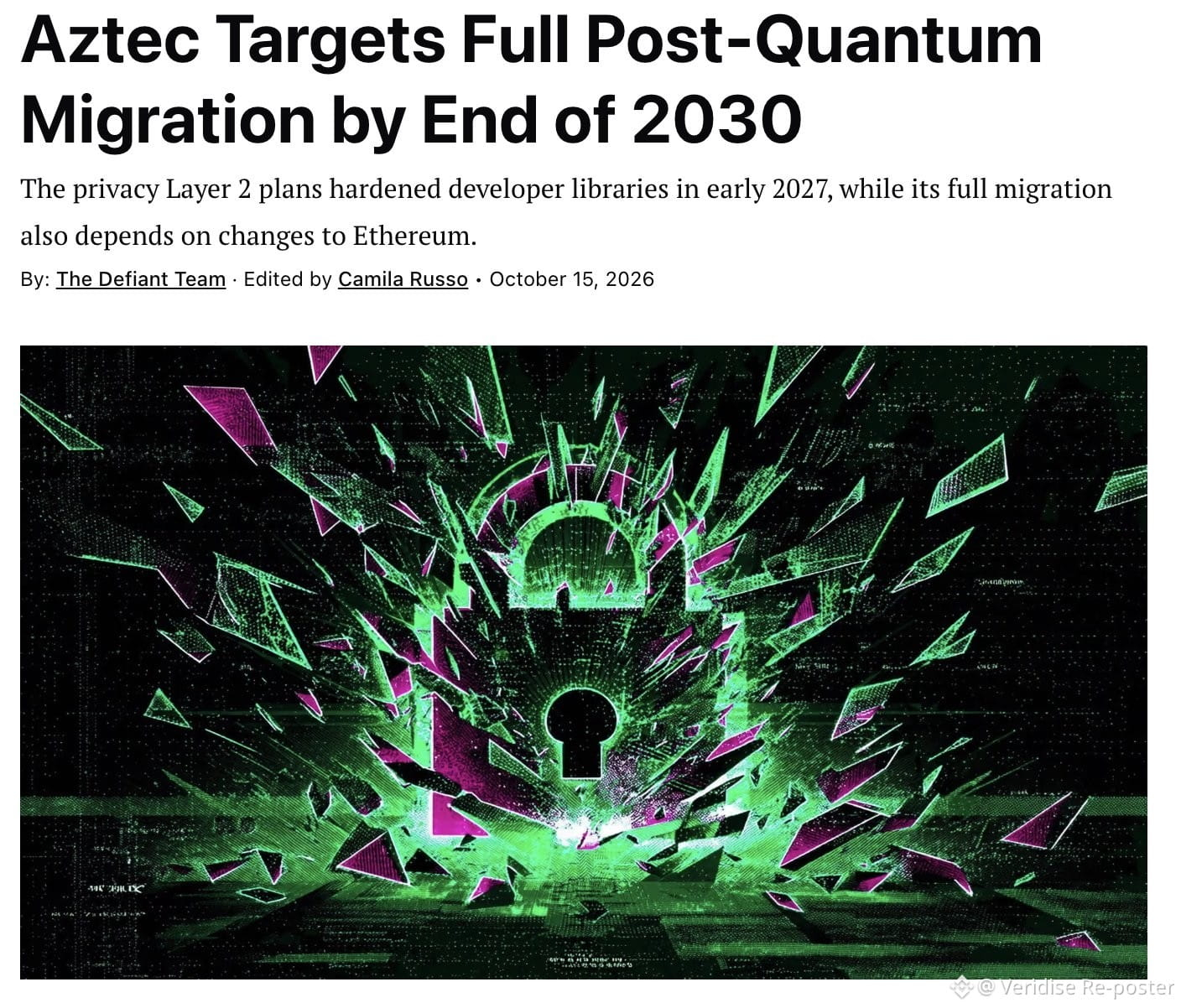
The team at @aztecnetwork has unveiled a comprehensive post-quantum roadmap that aims for completion by 2030. What makes this timeline particularly interesting is the order of the planned upgrades. They are making it a priority to address the harvest-now-decrypt-later exposure right from the start. Because of this approach, hardened libraries securing private data will be introduced in early 2027, long before any replacements are made to the proof system.
https://thedefiant.io/news/blockchains/aztec-targets-full-post-quantum-migration-by-end-of-2030
The team at @aztecnetwork has unveiled a comprehensive post-quantum roadmap that aims for completion by 2030. What makes this timeline particularly interesting is the order of the planned upgrades. They are making it a priority to address the harvest-now-decrypt-later exposure right from the start. Because of this approach, hardened libraries securing private data will be introduced in early 2027, long before any replacements are made to the proof system.
https://thedefiant.io/news/blockchains/aztec-targets-full-post-quantum-migration-by-end-of-2030
https://thedefiant.io/news/blockchains/aztec-targets-full-post-quantum-migration-by-end-of-2030
65
See translation
When considering the migration of Bitcoin, selecting a post-quantum signature scheme is actually the least complicated step. A recent PQ paper published by Coinbase brings attention to a much more difficult issue. Wallets utilizing stateful schemes must carefully monitor exactly which one-time keys have already been utilized. Should a user restore an outdated backup and subsequently reuse a key, an attacker would then be able to successfully forge a valid signature.
https://www.coindesk.com/tech/2026/10/14/coinbase-which-holds-5-of-all-bitcoin-wants-the-quantum-fix-started-now
When considering the migration of Bitcoin, selecting a post-quantum signature scheme is actually the least complicated step. A recent PQ paper published by Coinbase brings attention to a much more difficult issue. Wallets utilizing stateful schemes must carefully monitor exactly which one-time keys have already been utilized. Should a user restore an outdated backup and subsequently reuse a key, an attacker would then be able to successfully forge a valid signature.
https://www.coindesk.com/tech/2026/10/14/coinbase-which-holds-5-of-all-bitcoin-wants-the-quantum-fix-started-now
https://www.coindesk.com/tech/2026/10/14/coinbase-which-holds-5-of-all-bitcoin-wants-the-quantum-fix-started-now
68
See translation
Artificial intelligence agents had a massive presence throughout the @token2049 event, where they were showcased handling complex tasks like managing treasuries, executing trades, and drafting contracts. However, amidst all the enthusiasm, a vital conversation was largely overlooked. Hardly anyone addressed the necessity of validating the actual deliverables that these agents produce. Bridging this exact verification shortfall is what our team has been focused on resolving. We look forward to sharing further details with you very shortly.
Artificial intelligence agents had a massive presence throughout the @token2049 event, where they were showcased handling complex tasks like managing treasuries, executing trades, and drafting contracts. However, amidst all the enthusiasm, a vital conversation was largely overlooked. Hardly anyone addressed the necessity of validating the actual deliverables that these agents produce. Bridging this exact verification shortfall is what our team has been focused on resolving. We look forward to sharing further details with you very shortly.
71
See translation
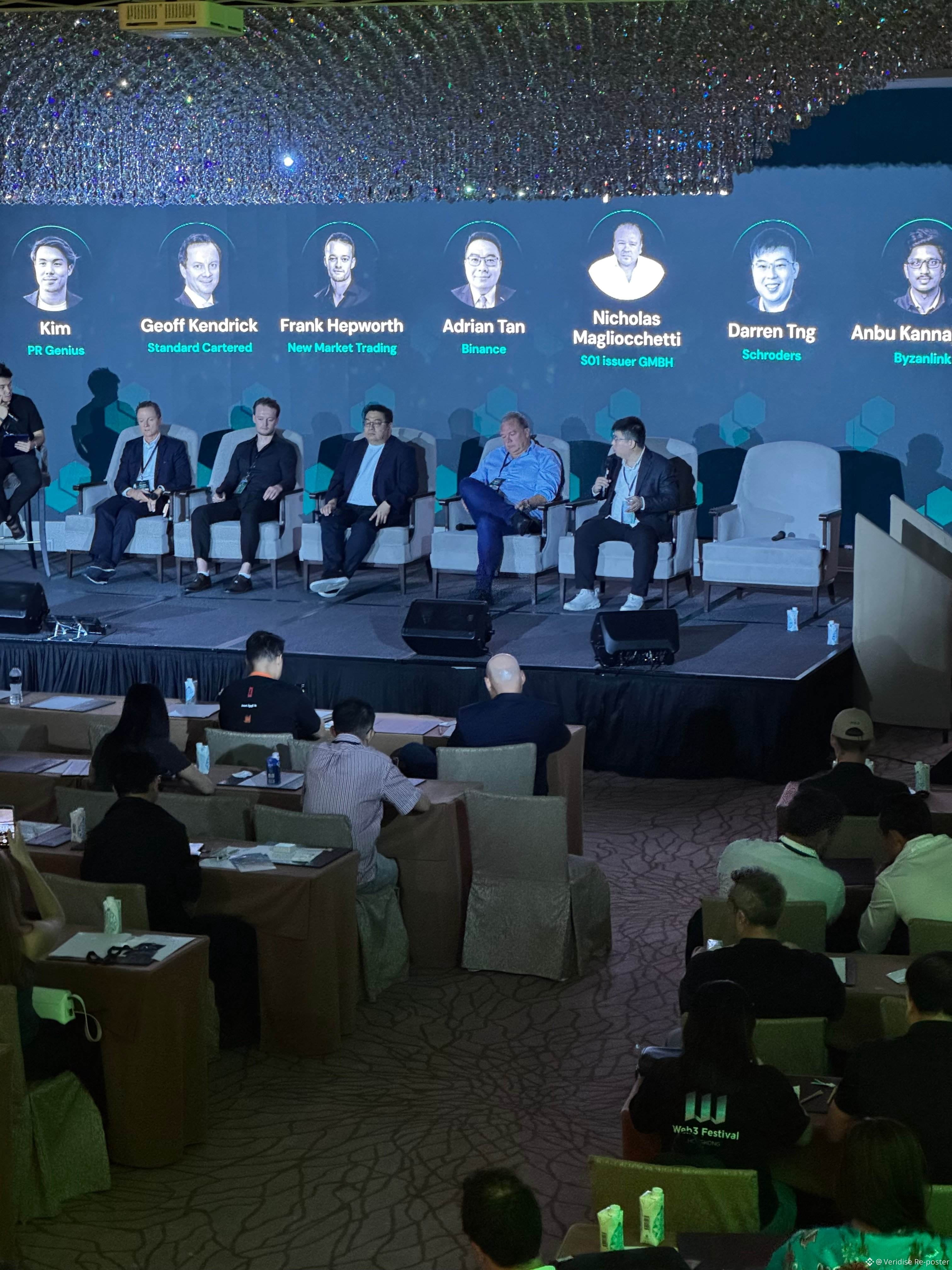
During a full day on the ground in Singapore, the Veridise team had the pleasure of speaking across three distinct stages. Whether we were at the @solana Summit, participating in @gammaprime, or attending Multichain Day, our conversations heavily revolved around ZK, security audits, and formal verification. Despite the different venues, people continuously brought up one common theme. The recurring inquiry from the crowd was about finding a reliable way to verify that a given piece of code truly performs exactly as its specifications dictate.
During a full day on the ground in Singapore, the Veridise team had the pleasure of speaking across three distinct stages. Whether we were at the @solana Summit, participating in @gammaprime, or attending Multichain Day, our conversations heavily revolved around ZK, security audits, and formal verification. Despite the different venues, people continuously brought up one common theme. The recurring inquiry from the crowd was about finding a reliable way to verify that a given piece of code truly performs exactly as its specifications dictate.

69
See translation
If your roadmap includes an upcoming audit for Q4 or early next year, @kulm1nski is the ideal person to consult regarding your project scope and scheduling. He will be traveling to Singapore to attend @token2049 from October 5 to 9. Please send him a DM to arrange a time to meet.
If your roadmap includes an upcoming audit for Q4 or early next year, @kulm1nski is the ideal person to consult regarding your project scope and scheduling. He will be traveling to Singapore to attend @token2049 from October 5 to 9. Please send him a DM to arrange a time to meet.

60
See translation
If your upcoming roadmap includes security and you are looking for a straightforward discussion about it, next week provides a perfect opportunity to connect. @FormallyJon is heading out to Singapore, where he will be attending @token2049 and exploring the surrounding side events from October 5 to 9. Feel free to send a DM to reserve a meeting time.
If your upcoming roadmap includes security and you are looking for a straightforward discussion about it, next week provides a perfect opportunity to connect. @FormallyJon is heading out to Singapore, where he will be attending @token2049 and exploring the surrounding side events from October 5 to 9. Feel free to send a DM to reserve a meeting time.

70
See translation
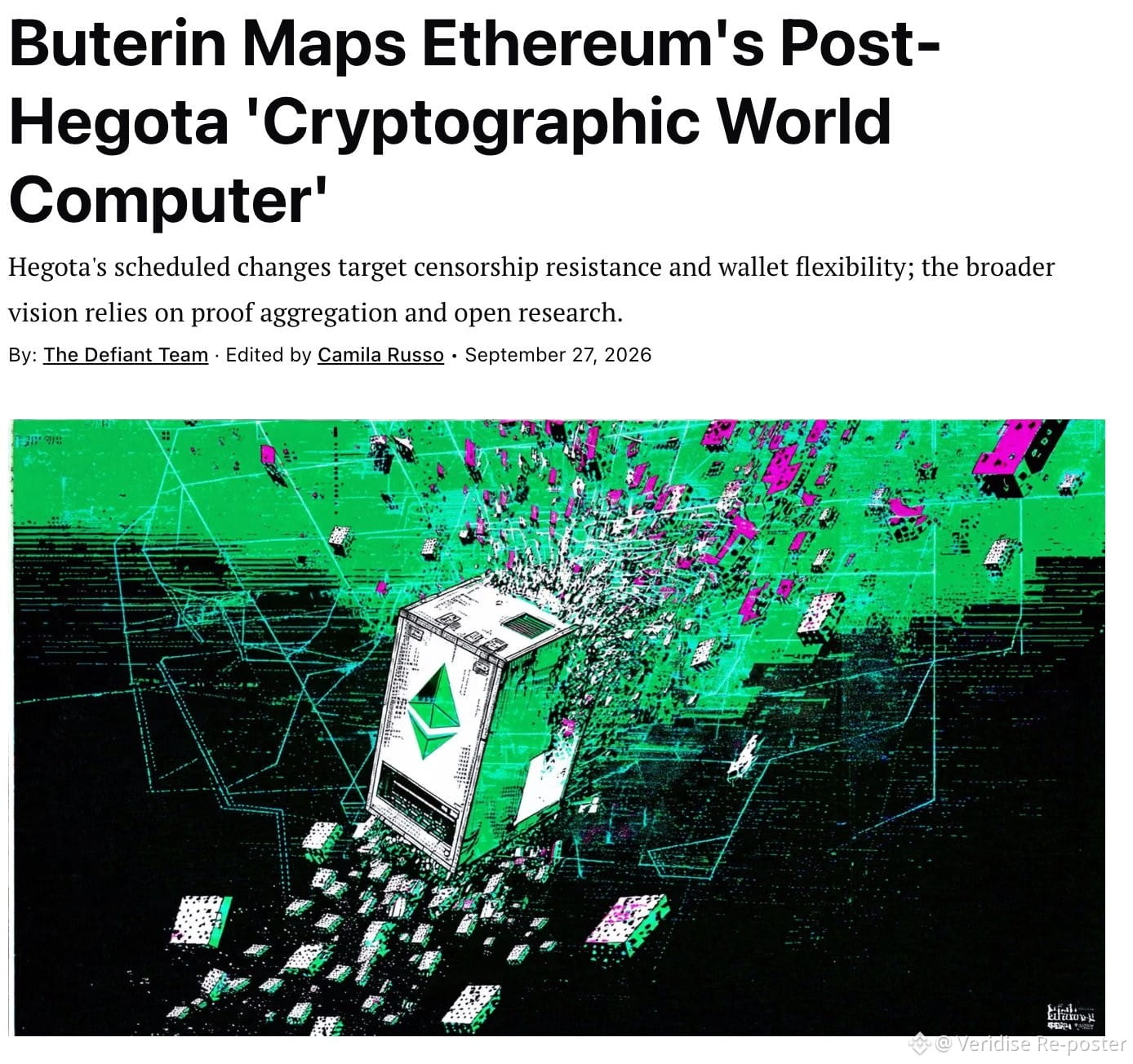
With the introduction of Frame Transactions, accounts will have the flexibility to determine their own specific authorization guidelines. This means users can set up customized rules for alternative signature schemes, account recovery, and multiple approvals. As a result of this shift, the operational logic that currently resides within individual wallet code will be relocated directly into the underlying protocol. It is important to keep in mind that as this logic transitions, its corresponding failure surface moves to the protocol layer as well.
https://thedefiant.io/news/blockchains/buterin-maps-ethereum-s-post-hegota-cryptographic-world-computer
With the introduction of Frame Transactions, accounts will have the flexibility to determine their own specific authorization guidelines. This means users can set up customized rules for alternative signature schemes, account recovery, and multiple approvals. As a result of this shift, the operational logic that currently resides within individual wallet code will be relocated directly into the underlying protocol. It is important to keep in mind that as this logic transitions, its corresponding failure surface moves to the protocol layer as well.
https://thedefiant.io/news/blockchains/buterin-maps-ethereum-s-post-hegota-cryptographic-world-computer
https://thedefiant.io/news/blockchains/buterin-maps-ethereum-s-post-hegota-cryptographic-world-computer
1
2.1k
See translation
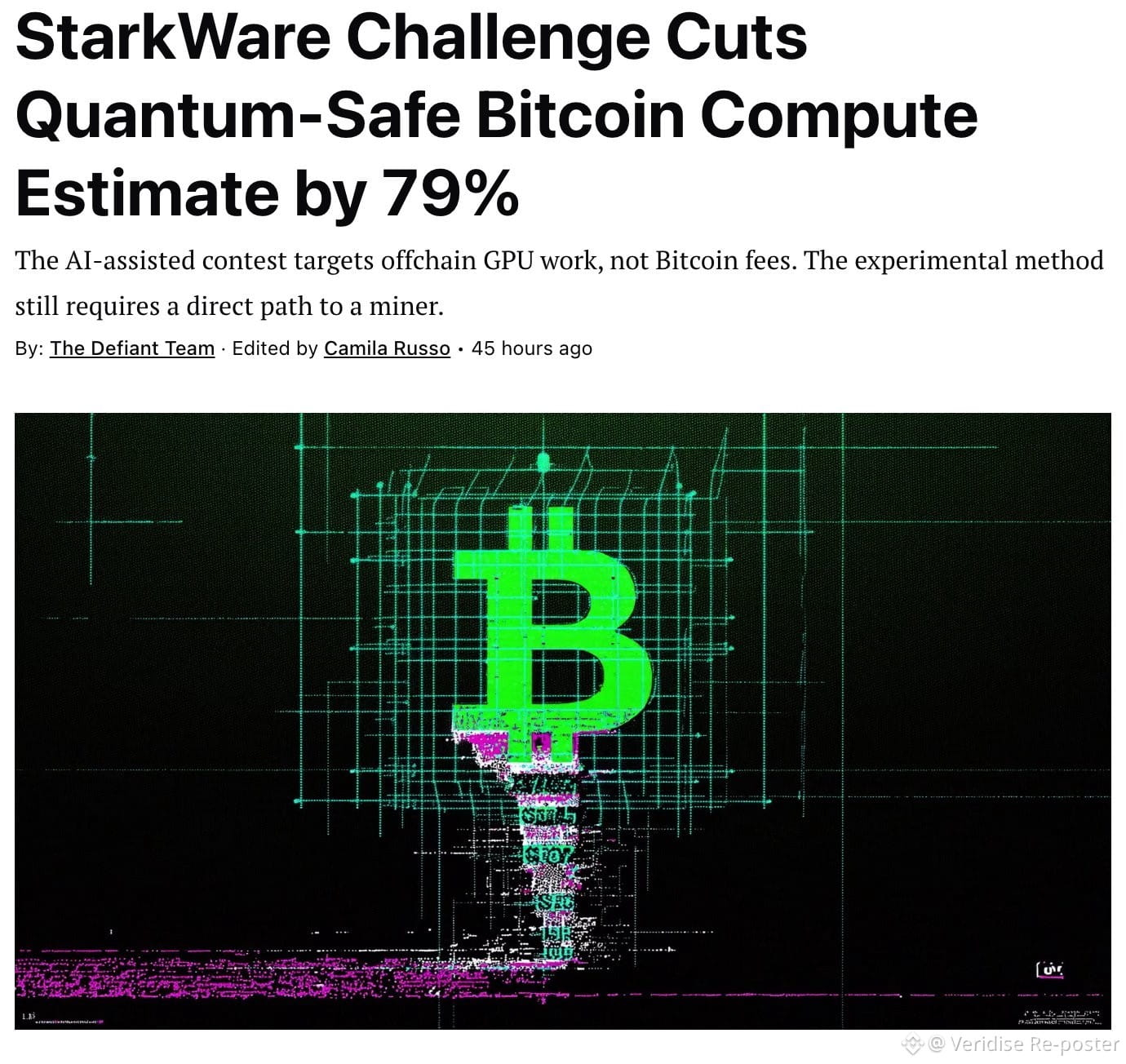
Before sharing the $63 estimate for a quantum-safe Bitcoin transaction, it is highly recommended to review the underlying methodology. As @StarkWareLtd clearly explains, this amount is purely a theoretical model rather than an actual invoice, meaning no real transactions are ever generated. Furthermore, while the performance benchmarks were executed using RTX 4090s, the overall cost projection assumes a hypothetical network consisting of 100 RTX 3090s.
https://thedefiant.io/news/blockchains/starkware-challenge-cuts-quantum-safe-bitcoin-compute-estimate-by-79
Before sharing the $63 estimate for a quantum-safe Bitcoin transaction, it is highly recommended to review the underlying methodology. As @StarkWareLtd clearly explains, this amount is purely a theoretical model rather than an actual invoice, meaning no real transactions are ever generated. Furthermore, while the performance benchmarks were executed using RTX 4090s, the overall cost projection assumes a hypothetical network consisting of 100 RTX 3090s.
https://thedefiant.io/news/blockchains/starkware-challenge-cuts-quantum-safe-bitcoin-compute-estimate-by-79
https://thedefiant.io/news/blockchains/starkware-challenge-cuts-quantum-safe-bitcoin-compute-estimate-by-79
83
See translation
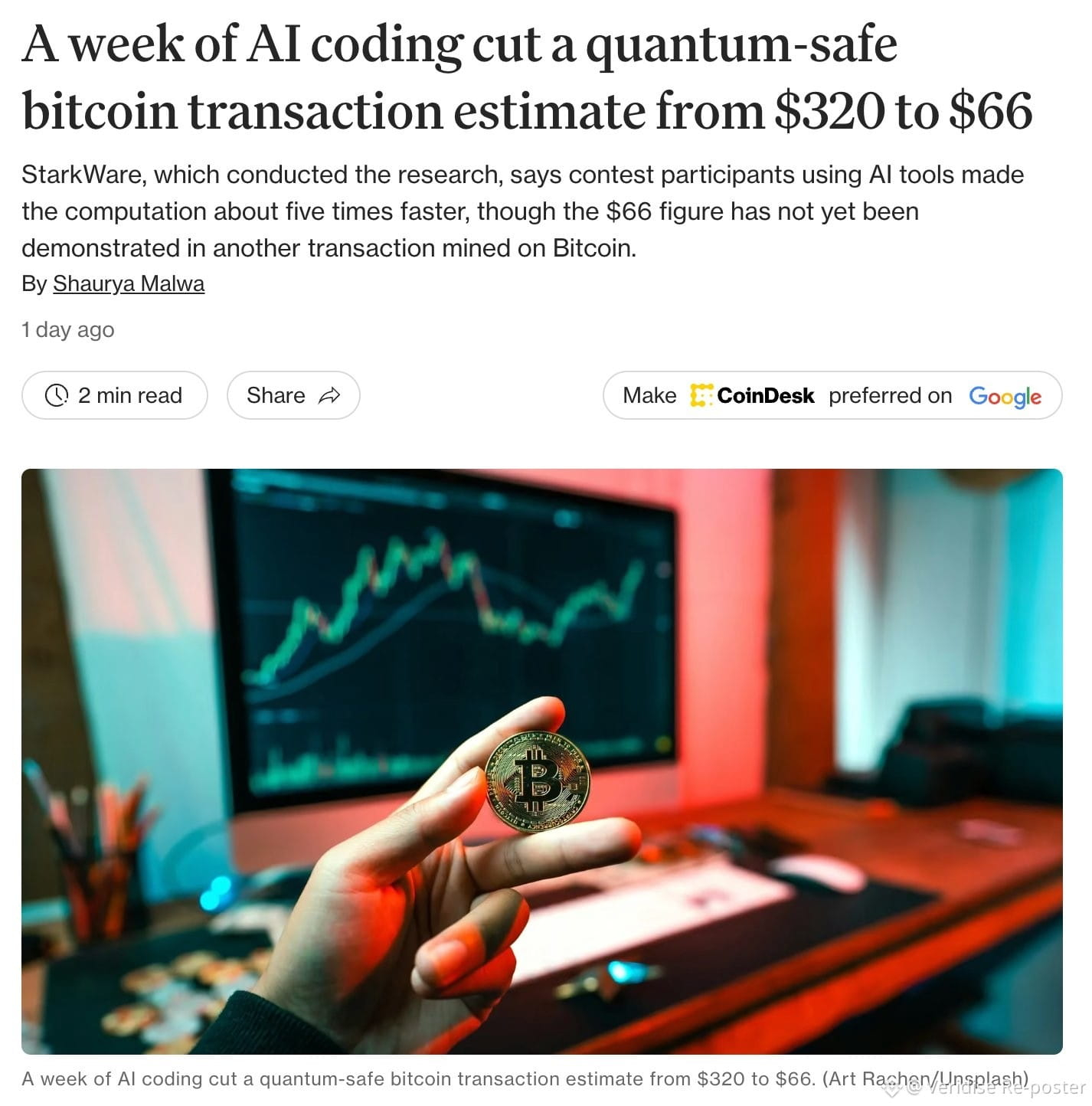
Securing a Bitcoin transaction against quantum computing threats is now 6x quicker, all thanks to cryptographic code that has been optimized by artificial intelligence. Although speed is a metric we can easily measure, establishing that two methods are truly equivalent is impossible without verifiable proof.
https://www.coindesk.com/tech/2026/09/24/a-week-of-ai-coding-cut-a-quantum-safe-bitcoin-transaction-estimate-from-usd320-to-usd66
Securing a Bitcoin transaction against quantum computing threats is now 6x quicker, all thanks to cryptographic code that has been optimized by artificial intelligence. Although speed is a metric we can easily measure, establishing that two methods are truly equivalent is impossible without verifiable proof.
https://www.coindesk.com/tech/2026/09/24/a-week-of-ai-coding-cut-a-quantum-safe-bitcoin-transaction-estimate-from-usd320-to-usd66
https://www.coindesk.com/tech/2026/09/24/a-week-of-ai-coding-cut-a-quantum-safe-bitcoin-transaction-estimate-from-usd320-to-usd66
80
Verified
See translation
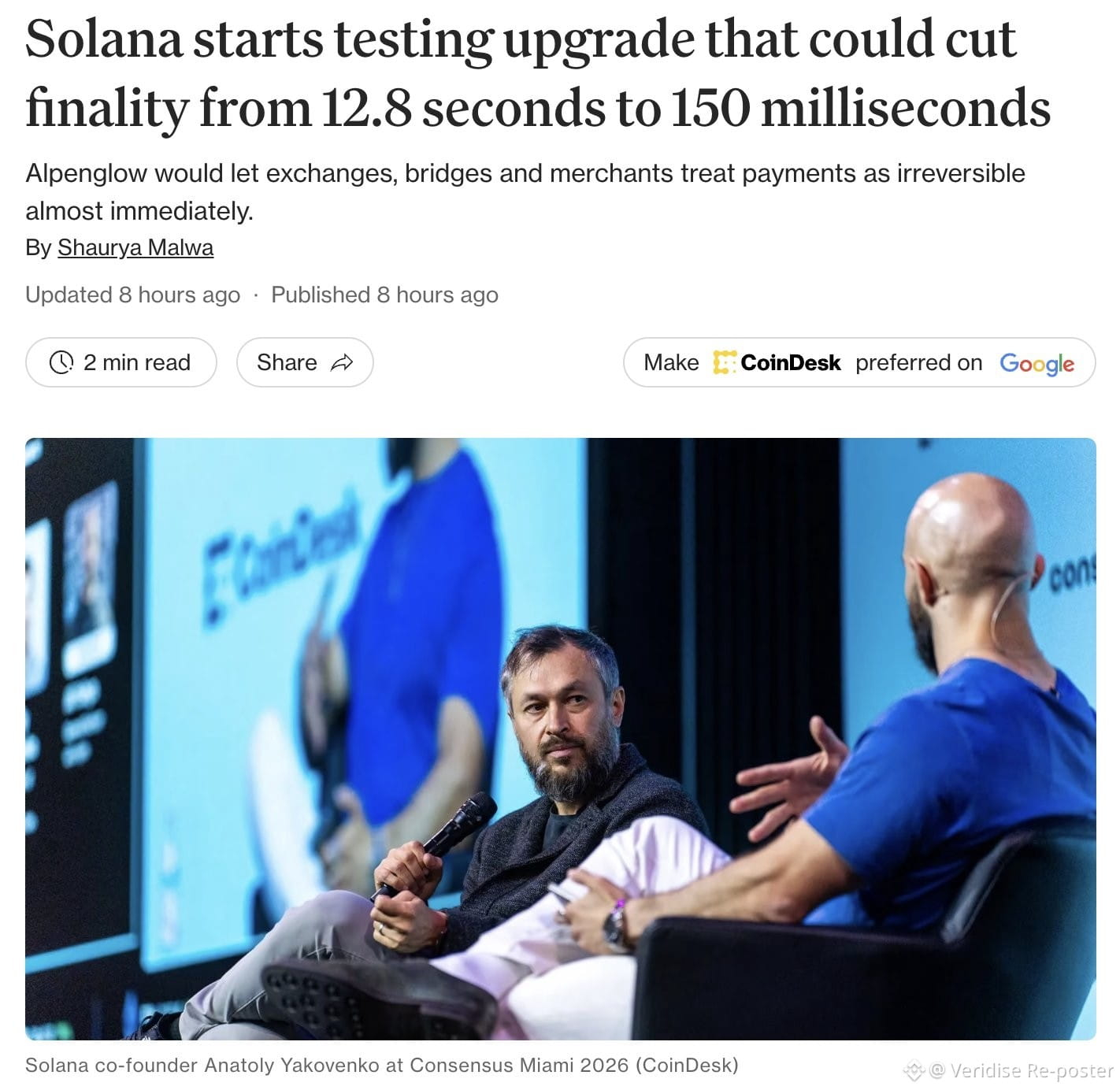
The Alpenglow upgrade is currently being trialed on the Solana testnet, bringing an impressive reduction in finality time from 12.8 seconds down to just 150 milliseconds. While this phase ensures that validators undergo thorough evaluation, it unfortunately leaves integrations unchecked. Consequently, any deposit flow or bridge that maintains a confirmation constant calibrated specifically for 32 slots operates on an underlying assumption that nobody has re-derived.
https://www.coindesk.com/tech/2026/09/23/solana-starts-testing-upgrade-that-could-cut-finality-from-12-8-seconds-to-150-milliseconds
The Alpenglow upgrade is currently being trialed on the Solana testnet, bringing an impressive reduction in finality time from 12.8 seconds down to just 150 milliseconds. While this phase ensures that validators undergo thorough evaluation, it unfortunately leaves integrations unchecked. Consequently, any deposit flow or bridge that maintains a confirmation constant calibrated specifically for 32 slots operates on an underlying assumption that nobody has re-derived.
https://www.coindesk.com/tech/2026/09/23/solana-starts-testing-upgrade-that-could-cut-finality-from-12-8-seconds-to-150-milliseconds
https://www.coindesk.com/tech/2026/09/23/solana-starts-testing-upgrade-that-could-cut-finality-from-12-8-seconds-to-150-milliseconds
2
1.9k
See translation
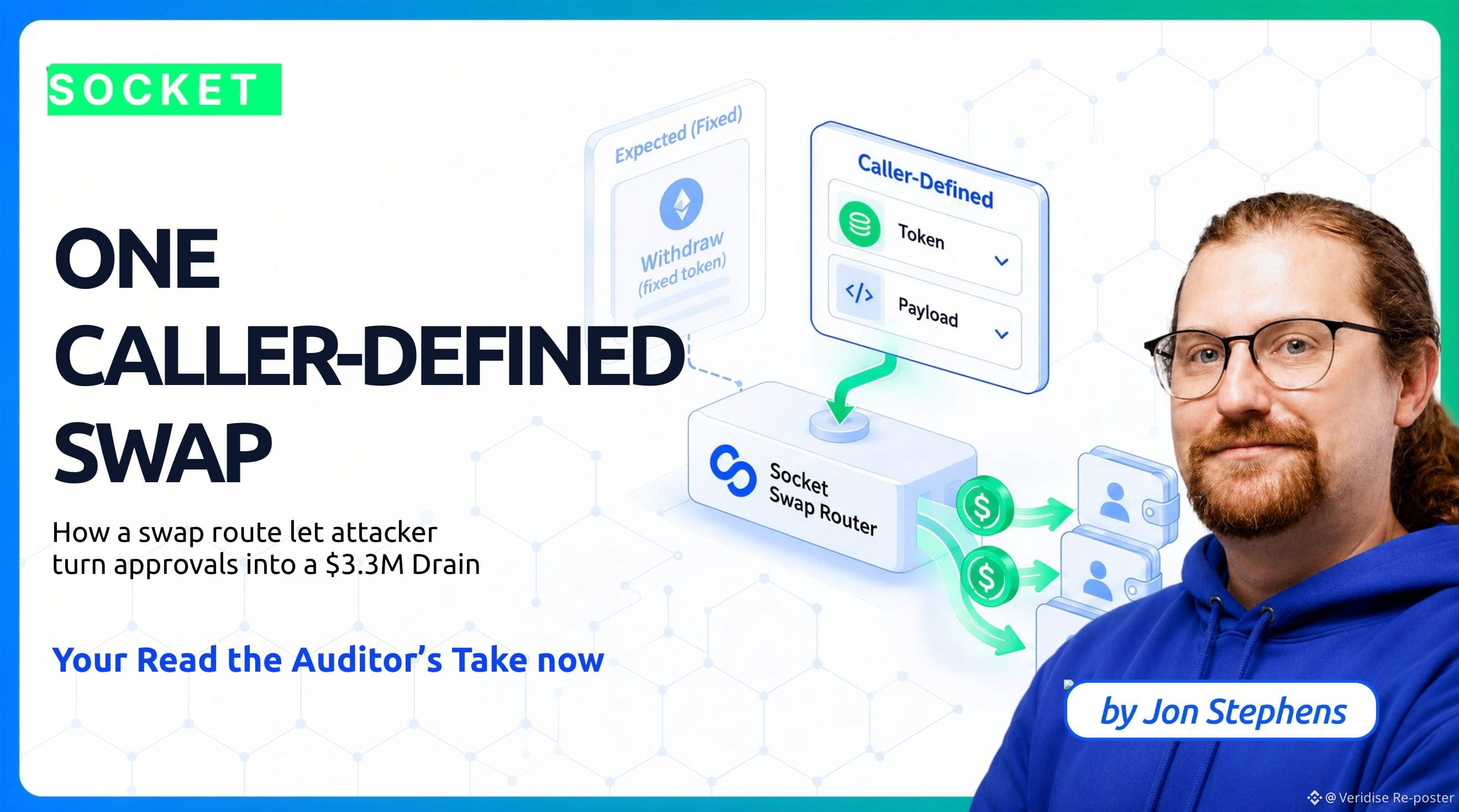
In the most recent edition of Auditor's Take, @FormallyJon examines a distinct vulnerability class. The core issue occurs whenever a function takes calldata provided by a caller and passes it straight into a low level call. This setup makes it possible to trigger any action that happens to be exposed by the interface of the target. This creates a dangerous scenario because that specific group of operations was never intentionally designed by anyone, nor was it ever inspected by an auditor. You can explore the complete analysis by visiting the link below.
https://veridise.com/blog/audit-insights/arbitrary_external_call_injection_socket_exploit/
In the most recent edition of Auditor's Take, @FormallyJon examines a distinct vulnerability class. The core issue occurs whenever a function takes calldata provided by a caller and passes it straight into a low level call. This setup makes it possible to trigger any action that happens to be exposed by the interface of the target. This creates a dangerous scenario because that specific group of operations was never intentionally designed by anyone, nor was it ever inspected by an auditor. You can explore the complete analysis by visiting the link below.
https://veridise.com/blog/audit-insights/arbitrary_external_call_injection_socket_exploit/
https://veridise.com/blog/audit-insights/arbitrary_external_call_injection_socket_exploit/
80
See translation
Although formal verification is highly effective at pointing out that a property has failed, it stops short of explaining the underlying reason. Learn more from @ShankaraPailoo2 regarding the process of translating a basic counterexample into a clear root cause.
Although formal verification is highly effective at pointing out that a property has failed, it stops short of explaining the underlying reason. Learn more from @ShankaraPailoo2 regarding the process of translating a basic counterexample into a clear root cause.
77
See translation
For a step-by-step explanation of how this works, please see the walkthrough provided by @RaghavMalik15 below. You will notice that Z3 successfully resolves this LLZK proof obligation in less than a single second. Ultimately, because the antecedent cannot be satisfied, no additional proof is necessary.
For a step-by-step explanation of how this works, please see the walkthrough provided by @RaghavMalik15 below. You will notice that Z3 successfully resolves this LLZK proof obligation in less than a single second. Ultimately, because the antecedent cannot be satisfied, no additional proof is necessary.
1
1
492
See translation
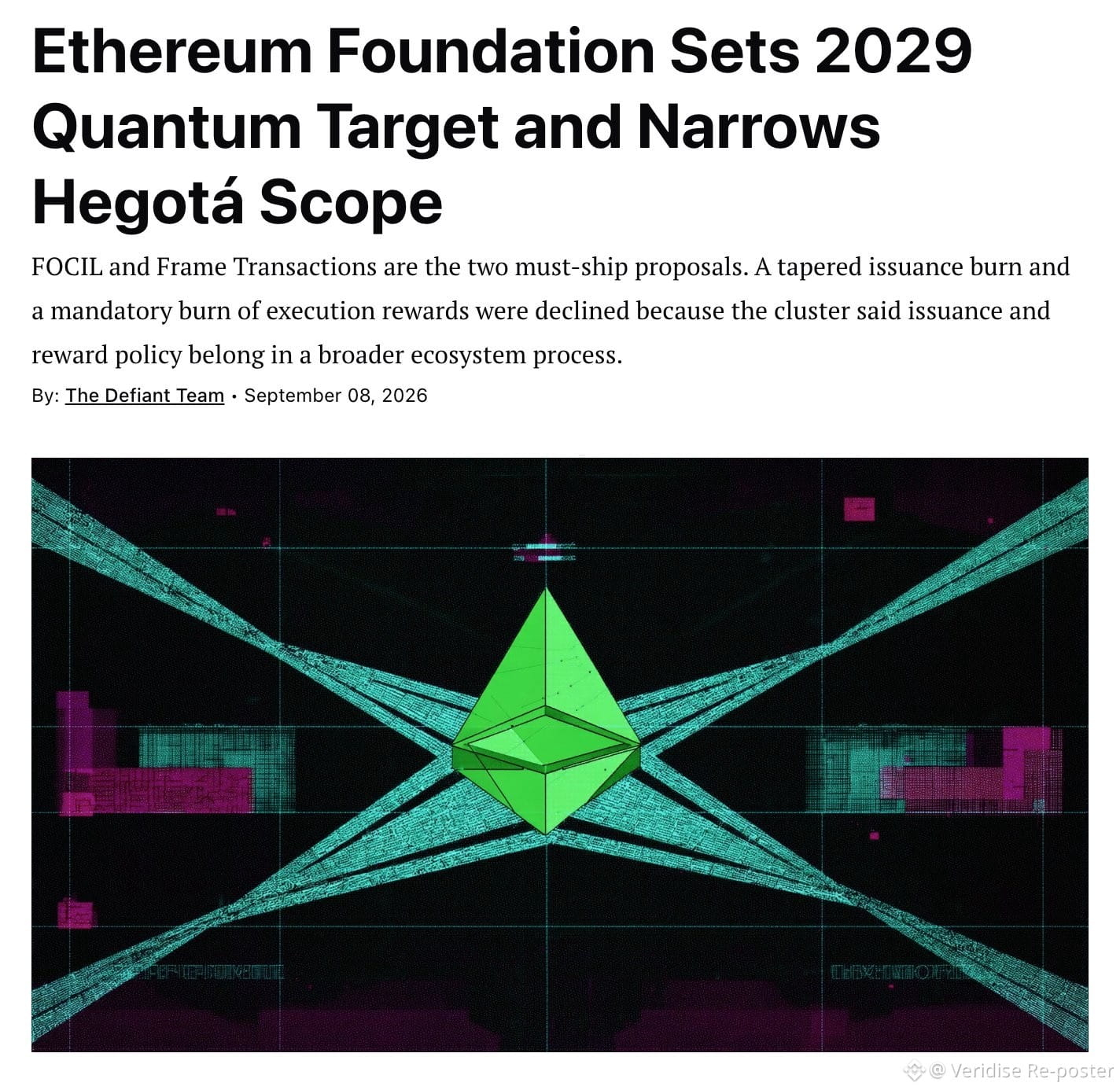
A strict target date of December 2029 has been officially established by Ethereum to achieve quantum resistance. Interestingly, this timeline is driven entirely by the deployment schedule of the protective updates, rather than waiting to see when functional quantum computers actually emerge. Reaching this milestone will require five distinct network forks, with each phase allocated exactly 7.2 months. The development itinerary is extremely tight and leaves absolutely zero room for delays. You can review the full details at https://blog.ethereum.org/2026/09/07/protocol-priorities
A strict target date of December 2029 has been officially established by Ethereum to achieve quantum resistance. Interestingly, this timeline is driven entirely by the deployment schedule of the protective updates, rather than waiting to see when functional quantum computers actually emerge. Reaching this milestone will require five distinct network forks, with each phase allocated exactly 7.2 months. The development itinerary is extremely tight and leaves absolutely zero room for delays. You can review the full details at https://blog.ethereum.org/2026/09/07/protocol-priorities
52
See translation
External calls function as the essential foundation of on-chain code, meaning their simple presence should never be viewed as an automatic warning sign. However, there are exactly 2 specific situations that truly indicate danger. The first major issue arises whenever a state update takes place only after the call has already finished. The second risk occurs when execution control is surrendered to code that nobody has properly reviewed.
External calls function as the essential foundation of on-chain code, meaning their simple presence should never be viewed as an automatic warning sign. However, there are exactly 2 specific situations that truly indicate danger. The first major issue arises whenever a state update takes place only after the call has already finished. The second risk occurs when execution control is surrendered to code that nobody has properly reviewed.
37
See translation
Once you establish equivalence a single time, analyzing any further details of a circuit is no longer a ZK problem. The process smoothly transitions into a standard program verification task. This shift allows us to instantly reuse decades of classical techniques. Join @RaghavMalik15 as he delves into this completely unexpected element of LLEQ.
Once you establish equivalence a single time, analyzing any further details of a circuit is no longer a ZK problem. The process smoothly transitions into a standard program verification task. This shift allows us to instantly reuse decades of classical techniques. Join @RaghavMalik15 as he delves into this completely unexpected element of LLEQ.
122
Log in to explore more content
Join global crypto users on Binance Square
⚡️ Get latest and useful information about crypto.
💬 Trusted by the world’s largest crypto exchange.
👍 Discover real insights from verified creators.
Email / Phone number