
Modern day woman
136 Posts

Modern day woman
Report
Block User
Web3 writer and content creator
I create content for a living
0 Following
7 Followers
28 Liked
Posts
See translation
$CCD
Proving who you are online shouldn’t mean handing over your personal documents every time.
Concordium takes a different approach by separating identity verification from the blockchain. Independent Identity Providers verify users, while zero-knowledge proofs make it possible to confirm specific information without exposing the details behind it.
You can prove what a platform needs to know without giving it access to everything else.
That’s a much better direction for digital identity.
#Concordium #DigitalIdentity #ZKP
77
See translation
$CCD
One thing I appreciate about Concordium’s identity model is that the blockchain doesn’t have to handle everything.
Independent Identity Providers verify users’ identities, while Concordium provides the infrastructure for privacy-preserving verification.
This separation matters. Your passport details don’t need to live on-chain, and you don’t have to keep exposing your documents every time you need to prove something.
A more thoughtful approach to digital identity.
#Concordium #DigitalIdentity #Privacy
See translation
$CCD
Proving your age online shouldn’t mean sharing your entire identity.
With zero-knowledge proofs, Concordium makes it possible to verify specific information without exposing the personal details behind it.
It’s a more thoughtful approach to digital identity, where businesses can verify what they need and individuals can keep their private information protected.
You should be able to prove what matters without sharing everything.
#Concordium #ZKP #DigitalPrivacy
67
See translation
$CCD
Digital identity shouldn’t come at the cost of personal privacy.
Think about how often people share their passports, full names and dates of birth just to prove one specific thing about themselves.
Concordium is taking a different approach with its identity layer and zero-knowledge proofs.
Users can verify their identity through an independent Identity Provider and later prove specific information, such as being above 18, without exposing their underlying personal details.
This creates room for a better balance between what businesses need to verify and what individuals deserve to keep private.
I believe this is an important direction for digital identity.
Prove what matters. Keep the rest private.
#Concordium #ZKP #DigitalIdentity #Privacy
66
See translation
$CCD
We’re entering a phase where AI agents won’t just be responding to prompts. They’ll be interacting with other agents, accessing services, making payments and carrying out tasks on behalf of people and businesses.
But there’s something we need to think about.
When one agent interacts with another, how does it know there’s a real, verified entity behind the system it’s dealing with?
This is why I find Concordium’s Agent Registry particularly interesting.
It goes beyond giving an AI agent a name or an on-chain profile. It creates a connection between the agent and a verified human or business responsible for it.
Through the Verified by Concordium Badge, that verification can be checked without publicly exposing the owner’s personal information.
I think this will become increasingly valuable as the agentic economy develops. Trust between autonomous systems cannot depend entirely on what an agent claims about itself.
There needs to be something verifiable behind that claim.
And that’s the kind of foundation Concordium is working to establish.
54
See translation
$CCD
Building on Ethereum, Solana or another blockchain doesn’t mean you should have to start all over to access better identity infrastructure.
That’s one thing I appreciate about Concordium’s approach.
Projects can integrate its identity layer while continuing to operate within their existing ecosystems.
This is particularly important as AI agents become more active across multiple networks. They need a way to prove who stands behind them, regardless of where they operate.
Concordium is making identity verification more accessible across chain boundaries, without forcing developers to migrate their entire projects.
Different chains, shared access to verifiable identity.
That’s the kind of interoperability the agentic economy needs.
#Concordium #Blockchain #Web3 #AI
55
See translation
$CCD
Creating AI agents is becoming easier, and that’s exciting. But it also introduces a challenge we shouldn’t overlook.
What happens when a malicious agent gets blocked? Its creator can simply deploy another one. Without a way to connect that agent to an accountable owner, the problem keeps repeating.
This is why identity matters in the growing agent economy.
Concordium is building infrastructure that links AI agents to verified individuals and businesses while keeping their personal information private.
So we’re not just talking about identifying an agent. We’re talking about knowing who stands behind it when something goes wrong.
AI can operate independently, but accountability shouldn’t disappear.
#Concordium #AI #Blockchain #AgenticEconomy
71
See translation
$CCD
Something I find interesting about the growth of AI agents is how quickly we’re giving them the ability to move money.
With x402, agents can pay for services and complete transactions without going through the usual payment forms or sign-up processes.
That’s a huge step for the internet economy.
But there’s another side to this. If an agent can make thousands of transactions, what happens when something goes wrong? Who is responsible? And how do we know the person or business behind it?
Concordium is working on this identity gap by connecting agents to verified owners while using zero-knowledge proofs to protect their private information.
I think this is an important part of making agentic commerce work at scale.
We need to make it easy for AI agents to transact, but we also need to know who’s behind those transactions.
Payment gives agents the ability to act. Identity gives those actions accountability.
61
See translation
$CCD
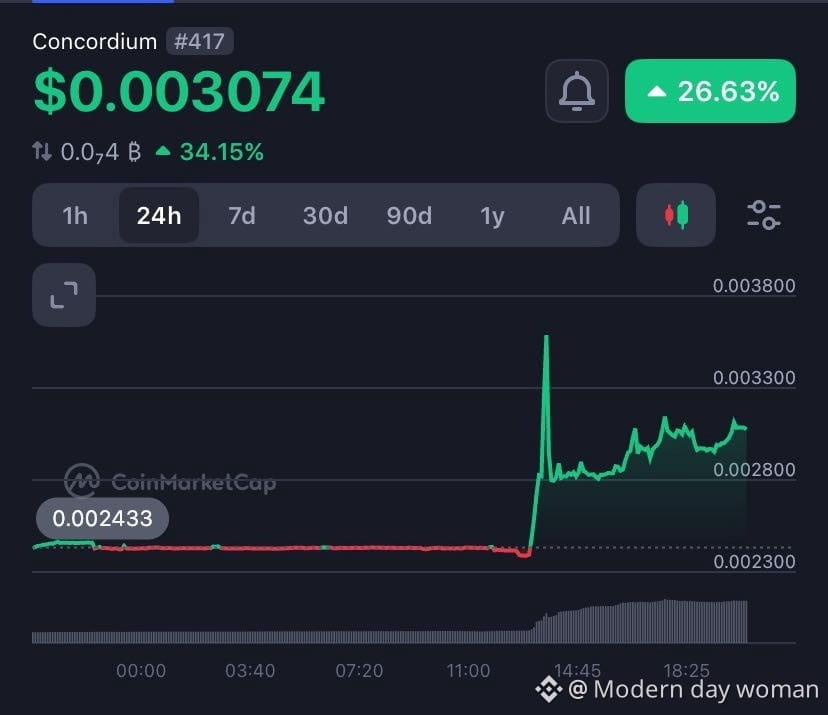
$CCD is making moves! A 26% gain in 24 hours is exciting to see, but there’s a bigger story behind the growing attention.
Concordium has been building steadily around one of the biggest opportunities in Web3: the agentic economy.
From the growing Agent Registry and Verified by Concordium Badge to x402 payments and cross-chain identity verification, the ecosystem is taking important steps towards making AI agents more trustworthy and accountable.
Town Hall #6 also brought exciting updates, including the upcoming Agent Kit, Protocol-Level Locks and 75 million CCD in builder grants.
It’s encouraging to see the technology, partnerships and developer opportunities coming together.
There’s a lot happening in the Concordium ecosystem, and I’m excited about what’s ahead.
#Concordium #CCD #Blockchain #AI
See translation
$CCD
AI agents can make payments, execute transactions and interact with platforms.
But who is responsible for their actions?
That was one of the key conversations at Concordium Town Hall #6.
As the agentic economy grows, verifying who stands behind an AI agent becomes just as important as what the agent can do.
Concordium is building the identity infrastructure to make that possible while protecting personal information.
The future needs intelligent agents, but it also needs accountability.
#Concordium #AI #AgenticEconomy
See translation
$CCD
The Binance hack has brought an important issue back into focus: crypto needs more than secure wallets and fast transactions. It also needs better ways to establish accountability when things go wrong.
Concordium is approaching this through protocol-level identity, linking accounts to verified identities while protecting users’ personal information with zero-knowledge proofs.
Its Protocol-Level Tokens also give issuers built-in controls such as pausing, allowlists and denylists.
As digital assets continue to move across networks and platforms, building infrastructure that balances privacy, transparency and accountability will become increasingly important.
Privacy and accountability can coexist. Concordium is building with that principle at its core.
75
See translation
$CCD
An AI agent can prove what it can do through its actions. But proving who stands behind it is a different story.
Concordium’s integration with XDC AI tackles that gap by bringing identity verification into the ecosystem without requiring agents to change where they operate.
With the Verified by Concordium Badge, users can verify an agent’s connection to a verified owner without exposing personal details.
It’s not a guarantee that an agent will behave well, but it gives people something they can verify instead of relying on promises.
AI agent infrastructure needs room to grow, and identity verification shouldn’t mean starting over.
78
See translation
$CCD
AI agents can transact and interact with people, but who stands behind them?
Through Concordium’s integration with XDC AI, agents can establish a verifiable link to their owners without exposing their private information or changing where they operate.
The Verified by Concordium Badge adds an important layer of accountability, though it doesn’t guarantee an agent’s behaviour.
As AI agents take on more responsibilities, verifying ownership without sacrificing privacy becomes increasingly important.
59
See translation
$CCD
Building an AI agent marketplace involves more than creating useful agents. Developers also need to think about how users can verify who stands behind them.
But verification shouldn’t require agent owners to make their private information public.
With Concordium serving as the exclusive identity verification layer for XDC AI, developers have a way to bring verifiable ownership into the AI ecosystem while preserving privacy.
The Verified by Concordium Badge helps users verify an agent’s connection to a verified owner, without guaranteeing how that agent will behave.
As AI agent marketplaces grow, getting the balance between accountability and privacy right will matter.
62
See translation
$CCD
Building an AI agent marketplace means asking more than “What can these agents do?” It also means asking, “Who stands behind them?”
With XDC AI selecting Concordium as its exclusive identity verification layer, agent owners can establish a verifiable link to their agents while keeping their identities private.
The Verified by Concordium Badge helps verify ownership, but it doesn’t guarantee an agent’s behaviour.
As AI agents take on more responsibilities, verifiable ownership and privacy need to go hand in hand
61
See translation
$CCD
Concordium ($CCD) has gained 24.71% over the past 30 days.
But beyond the price movement, it’s worth understanding what gives CCD a role within the Concordium ecosystem.
CCD is used to pay network transaction fees, supports staking to help secure the network, and plays a role in governance.
Price action can change quickly, but understanding a token’s actual utility gives you more context than the chart alone.
Keep an eye on both the market and the technology behind it.
55
See translation
$CCD
A blockchain can process thousands of transactions, but what happens when the network needs to change?
That’s where governance becomes important.
On Concordium, $CCD has a role beyond transaction fees. It also connects to the network’s governance, giving it a place in how decisions about the protocol are made.
This matters because blockchains aren’t static products. As technology evolves and new use cases emerge, networks need ways to make decisions about their future.
Looking at a token only through the lens of trading misses this bigger picture. Its role within the network can tell you much more about how the ecosystem is designed to function over time.
With $CCD, understanding the governance side adds another piece to the picture of what the token actually does on Concordium.
#Concordium #CCD #Crypto #Blockchain
73
See translation
$CCD
One thing I find interesting about Concordium is that making blockchain easier to use doesn’t have to mean making the technology behind it less important.
A business can sponsor transaction fees, so users can interact with an application without needing to acquire $CCD first.
Meanwhile, the network still processes the transactions, and the fees are still paid in CCD.
That’s a smart distinction between what users experience and what keeps the system running.
The best infrastructure often works quietly in the background. People get to use the product without having to understand every technical detail behind it.
And I think that’s an important part of making blockchain useful beyond people who are already familiar with crypto.
$CCD
$CCD
One thing I find interesting about Concordium is that making blockchain easier to use doesn’t have to mean making the technology behind it less important.
A business can sponsor transaction fees, so users can interact with an application without needing to acquire $CCD first.
Meanwhile, the network still processes the transactions, and the fees are still paid in CCD.
That’s a smart distinction between what users experience and what keeps the system running.
The best infrastructure often works quietly in the background. People get to use the product without having to understand every technical detail behind it.
And I think that’s an important part of making blockchain useful beyond people who are already familiar with crypto.
$CCD
35
See translation
$CCD
Here’s a question I think more people should ask about blockchain tokens:
What happens if the network actually becomes useful?
With Concordium, more activity means more transactions to process, and every transaction requires a network fee paid in $CCD.
But transaction fees are only one part of the picture. CCD is also staked by validators and delegators to help secure the network, and it plays a role in governance.
What interests me is that these functions connect the token to the network’s actual operations, rather than leaving its purpose at speculation.
I think understanding that connection is a better starting point for evaluating $CCD than simply looking at the ticker.
29
See translation
$CCD
A token makes more sense when you understand the work happening around it.
Take Concordium, for example. A transaction needs to be processed, the network needs to stay secure, and decisions about the protocol still need to be made.
$CCD has a role in all three.
It pays network fees, is staked by validators and delegators to help secure the chain, and plays a part in governance.
What I find interesting is how these functions connect. They’re not random utilities added to make a token look useful. They serve different needs within the same network.
And that’s the perspective I’m taking with $CCD: less focus on the ticker, more attention to what it actually does.
41
Log in to explore more content
Join global crypto users on Binance Square
⚡️ Get latest and useful information about crypto.
💬 Trusted by the world’s largest crypto exchange.
👍 Discover real insights from verified creators.
Email / Phone number
Trending Topics
NvidiaBeatsEstimatesWith$130BQ4Outlook
281 views
10 Discussing
Nvidia Beats With $115.8 Billion in Revenue, Guides to $130 Billion and Adds $150 Billion Buyback
Binance News
·18 Likes
·19.3k views
AnthropicIPOPriceCouldExceed$80
427 views
25 Discussing
CanNvidia’sDataCenterGrowthContinue?
905 views
26 Discussing