

Bullionist 1
115 Posts

Bullionist 1
Report
Block User
$SOL Holder 🤝|| CMC KOL || Tg~ @irtaxa17
0 Following
9 Followers
3 Liked
Posts
·
--
See translation
Sometimes a small position is enough 🎯
That's one of the reasons I've been looking through Polymarket for opportunities instead of only looking at token charts.
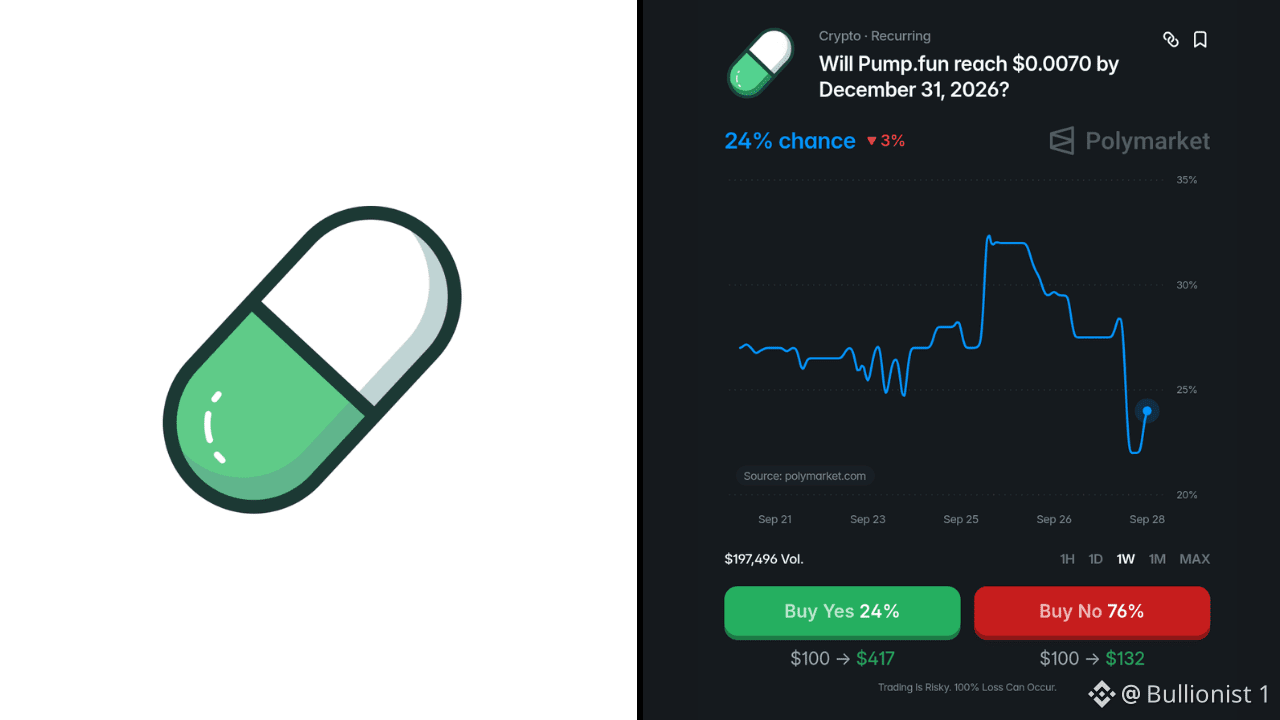
$PUMP reaching $0.0070 before the end of 2026 currently sits at only 24%.
That creates a very different risk-to-payout setup.
💵 $25 → roughly $104
💵 $50 → roughly $208
💵 $100 → roughly $417
So even a relatively small amount can potentially return several multiples if the lower probability outcome actually happens.
Obviously, lower odds also mean higher risk.
But Polymarket lets me decide exactly how much exposure I want.
And I'm not locked into waiting until December 31.
If I enter at 24% and the market eventually reprices the outcome at 40% or 50%, I can choose to sell the position before resolution.
That's the flexibility I want.
Instead of putting more capital into $SOL and waiting for price appreciation, I can search Polymarket for specific events where I think the probability and potential payout are worth taking the risk.
#Altcoin Season#
Sometimes a small position is enough 🎯
That's one of the reasons I've been looking through Polymarket for opportunities instead of only looking at token charts.
$PUMP reaching $0.0070 before the end of 2026 currently sits at only 24%.
That creates a very different risk-to-payout setup.
💵 $25 → roughly $104
💵 $50 → roughly $208
💵 $100 → roughly $417
So even a relatively small amount can potentially return several multiples if the lower probability outcome actually happens.
Obviously, lower odds also mean higher risk.
But Polymarket lets me decide exactly how much exposure I want.
And I'm not locked into waiting until December 31.
If I enter at 24% and the market eventually reprices the outcome at 40% or 50%, I can choose to sell the position before resolution.
That's the flexibility I want.
Instead of putting more capital into $SOL and waiting for price appreciation, I can search Polymarket for specific events where I think the probability and potential payout are worth taking the risk.
#Altcoin Season#
That's one of the reasons I've been looking through Polymarket for opportunities instead of only looking at token charts.
$PUMP reaching $0.0070 before the end of 2026 currently sits at only 24%.
That creates a very different risk-to-payout setup.
💵 $25 → roughly $104
💵 $50 → roughly $208
💵 $100 → roughly $417
So even a relatively small amount can potentially return several multiples if the lower probability outcome actually happens.
Obviously, lower odds also mean higher risk.
But Polymarket lets me decide exactly how much exposure I want.
And I'm not locked into waiting until December 31.
If I enter at 24% and the market eventually reprices the outcome at 40% or 50%, I can choose to sell the position before resolution.
That's the flexibility I want.
Instead of putting more capital into $SOL and waiting for price appreciation, I can search Polymarket for specific events where I think the probability and potential payout are worth taking the risk.
#Altcoin Season#
71
·
--
See translation
Wallets Are Losing The Consumer War 📱
Hyperliquid turned $HYPE into a case study in product gravity.
When execution, liquidity and discovery concentrate inside one product, users will stop treating it like another crypto tool and start treating it like a go-to app. Most wallets still make users assemble their own experience from launchpads, bridges, DEXs and social feeds.
That fragmentation is becoming a competitive weakness.
The strongest platform this cycle will own the entire journey from discovering an idea to creating and trading its market.
Zora is assembling that loop, and aggressively.
Its mobile app now combines:
- Social discovery and creator identity
- Custom Pair creation
- Crosschain trading across Base, Solana, BNB Chain and Robinhood Chain
Dee Goens says Zora is acquiring or re-engaging roughly 5,000 users each week, with more than 25,000 unique app users over the previous 90 days.
Those figures are early, but the product direction is aggressive.
Zora is moving beyond the definition of a launchpad and building a consumer layer for SocialFi and onchain markets.
If the team sustains this shipping pace, Zora has a legitimate route toward becoming one of the platforms that defines this cycle.
#SocialFi #Altcoin Season#
Wallets Are Losing The Consumer War 📱
Hyperliquid turned $HYPE into a case study in product gravity.
When execution, liquidity and discovery concentrate inside one product, users will stop treating it like another crypto tool and start treating it like a go-to app. Most wallets still make users assemble their own experience from launchpads, bridges, DEXs and social feeds.
That fragmentation is becoming a competitive weakness.
The strongest platform this cycle will own the entire journey from discovering an idea to creating and trading its market.
Zora is assembling that loop, and aggressively.
Its mobile app now combines:
- Social discovery and creator identity
- Custom Pair creation
- Crosschain trading across Base, Solana, BNB Chain and Robinhood Chain
Dee Goens says Zora is acquiring or re-engaging roughly 5,000 users each week, with more than 25,000 unique app users over the previous 90 days.
Those figures are early, but the product direction is aggressive.
Zora is moving beyond the definition of a launchpad and building a consumer layer for SocialFi and onchain markets.
If the team sustains this shipping pace, Zora has a legitimate route toward becoming one of the platforms that defines this cycle.
#SocialFi #Altcoin Season#
Hyperliquid turned $HYPE into a case study in product gravity.
When execution, liquidity and discovery concentrate inside one product, users will stop treating it like another crypto tool and start treating it like a go-to app. Most wallets still make users assemble their own experience from launchpads, bridges, DEXs and social feeds.
That fragmentation is becoming a competitive weakness.
The strongest platform this cycle will own the entire journey from discovering an idea to creating and trading its market.
Zora is assembling that loop, and aggressively.
Its mobile app now combines:
- Social discovery and creator identity
- Custom Pair creation
- Crosschain trading across Base, Solana, BNB Chain and Robinhood Chain
Dee Goens says Zora is acquiring or re-engaging roughly 5,000 users each week, with more than 25,000 unique app users over the previous 90 days.
Those figures are early, but the product direction is aggressive.
Zora is moving beyond the definition of a launchpad and building a consumer layer for SocialFi and onchain markets.
If the team sustains this shipping pace, Zora has a legitimate route toward becoming one of the platforms that defines this cycle.
#SocialFi #Altcoin Season#
67
·
--
See translation
Hypercall Just Crossed 200M USD in Daily Notional 📈
$UNI demonstrated how quickly an onchain product can grow once liquidity and user activity begin reinforcing each other.
$SYN may be approaching a similar phase through Hypercall.
According to Duncan Reucassel, Hypercall reached a new daily record with more than 200M USD in options notional traded.
Notional measures the reference exposure represented by the contracts. It is not the amount deposited, protocol revenue or guaranteed profit.
The important signal is that Hypercall’s options infrastructure processed its largest day so far shortly after internal market-making liquidity was expanded.
If this activity persists, the SYN conversation increasingly becomes one about a functioning options venue with measurable demand.
#Options #DeFi
Hypercall Just Crossed 200M USD in Daily Notional 📈
$UNI demonstrated how quickly an onchain product can grow once liquidity and user activity begin reinforcing each other.
$SYN may be approaching a similar phase through Hypercall.
According to Duncan Reucassel, Hypercall reached a new daily record with more than 200M USD in options notional traded.
Notional measures the reference exposure represented by the contracts. It is not the amount deposited, protocol revenue or guaranteed profit.
The important signal is that Hypercall’s options infrastructure processed its largest day so far shortly after internal market-making liquidity was expanded.
If this activity persists, the SYN conversation increasingly becomes one about a functioning options venue with measurable demand.
#Options #DeFi
$UNI demonstrated how quickly an onchain product can grow once liquidity and user activity begin reinforcing each other.
$SYN may be approaching a similar phase through Hypercall.
According to Duncan Reucassel, Hypercall reached a new daily record with more than 200M USD in options notional traded.
Notional measures the reference exposure represented by the contracts. It is not the amount deposited, protocol revenue or guaranteed profit.
The important signal is that Hypercall’s options infrastructure processed its largest day so far shortly after internal market-making liquidity was expanded.
If this activity persists, the SYN conversation increasingly becomes one about a functioning options venue with measurable demand.
#Options #DeFi
67
·
--
See translation
The AI hardware trade is getting louder 📈
$NEAR brings the agents and app-layer crowd watching what autonomous software can do. $VVV brings the private inference crowd watching how that intelligence gets accessed.
Both eventually run into the same physical constraint.
GPUs.
That is where $B3 is starting to get more attention.
B3 is up roughly 44% over seven days and 83% over the past month, with its market cap back around $40M.
The product underneath that move is B3IQ.
Buyers can own dedicated NVIDIA hardware built and hosted in Oregon, hold title from day one and retain root access to the machine.
The same hardware can serve two completely different needs:
• Keep it private for your own models, keys and workloads
• Make capacity available to AI demand and keep 85% of realized revenue
B3 handles the hosting, demand matching, routing, billing and SLA. Select machines can also start with roughly 30% down.
NEAR is expanding what AI applications can do.
VVV is expanding how AI inference gets consumed.
B3IQ is building around ownership of the machines both ultimately need.
Price action can bring attention.
The bigger opportunity is what happens if AI demand keeps turning GPUs from an expense into productive infrastructure.
That is where the $B3 story gets much more interesting. 🔥
#AI #DePIN
The AI hardware trade is getting louder 📈
$NEAR brings the agents and app-layer crowd watching what autonomous software can do. $VVV brings the private inference crowd watching how that intelligence gets accessed.
Both eventually run into the same physical constraint.
GPUs.
That is where $B3 is starting to get more attention.
B3 is up roughly 44% over seven days and 83% over the past month, with its market cap back around $40M.
The product underneath that move is B3IQ.
Buyers can own dedicated NVIDIA hardware built and hosted in Oregon, hold title from day one and retain root access to the machine.
The same hardware can serve two completely different needs:
• Keep it private for your own models, keys and workloads
• Make capacity available to AI demand and keep 85% of realized revenue
B3 handles the hosting, demand matching, routing, billing and SLA. Select machines can also start with roughly 30% down.
NEAR is expanding what AI applications can do.
VVV is expanding how AI inference gets consumed.
B3IQ is building around ownership of the machines both ultimately need.
Price action can bring attention.
The bigger opportunity is what happens if AI demand keeps turning GPUs from an expense into productive infrastructure.
That is where the $B3 story gets much more interesting. 🔥
#AI #DePIN
$NEAR brings the agents and app-layer crowd watching what autonomous software can do. $VVV brings the private inference crowd watching how that intelligence gets accessed.
Both eventually run into the same physical constraint.
GPUs.
That is where $B3 is starting to get more attention.
B3 is up roughly 44% over seven days and 83% over the past month, with its market cap back around $40M.
The product underneath that move is B3IQ.
Buyers can own dedicated NVIDIA hardware built and hosted in Oregon, hold title from day one and retain root access to the machine.
The same hardware can serve two completely different needs:
• Keep it private for your own models, keys and workloads
• Make capacity available to AI demand and keep 85% of realized revenue
B3 handles the hosting, demand matching, routing, billing and SLA. Select machines can also start with roughly 30% down.
NEAR is expanding what AI applications can do.
VVV is expanding how AI inference gets consumed.
B3IQ is building around ownership of the machines both ultimately need.
Price action can bring attention.
The bigger opportunity is what happens if AI demand keeps turning GPUs from an expense into productive infrastructure.
That is where the $B3 story gets much more interesting. 🔥
#AI #DePIN
56
·
--
See translation
The Next Treasury Allocation Is $SYN 👀
$ONDO reflects the growing connection between digital assets and public capital markets. $SYN is now part of that conversation through SonicStrategy.
The company has proposed a private placement of up to 4.5M USD.
Up to 2.25M USD may come from cash subscriptions, with another 2.25M USD paid through in-kind digital assets.
That digital-asset portion is nearly 20 times the size of SonicStrategy’s initial 115,000 USD SYN purchase.
The offering has not closed, and the company has not identified SYN as the asset involved in the in-kind subscriptions.
The scale still matters because it creates considerably more balance-sheet flexibility than the initial purchase required.
The next treasury allocation will reveal how central onchain derivatives are becoming to SonicStrategy’s strategy.
#DeFi
The Next Treasury Allocation Is $SYN 👀
$ONDO reflects the growing connection between digital assets and public capital markets. $SYN is now part of that conversation through SonicStrategy.
The company has proposed a private placement of up to 4.5M USD.
Up to 2.25M USD may come from cash subscriptions, with another 2.25M USD paid through in-kind digital assets.
That digital-asset portion is nearly 20 times the size of SonicStrategy’s initial 115,000 USD SYN purchase.
The offering has not closed, and the company has not identified SYN as the asset involved in the in-kind subscriptions.
The scale still matters because it creates considerably more balance-sheet flexibility than the initial purchase required.
The next treasury allocation will reveal how central onchain derivatives are becoming to SonicStrategy’s strategy.
#DeFi
$ONDO reflects the growing connection between digital assets and public capital markets. $SYN is now part of that conversation through SonicStrategy.
The company has proposed a private placement of up to 4.5M USD.
Up to 2.25M USD may come from cash subscriptions, with another 2.25M USD paid through in-kind digital assets.
That digital-asset portion is nearly 20 times the size of SonicStrategy’s initial 115,000 USD SYN purchase.
The offering has not closed, and the company has not identified SYN as the asset involved in the in-kind subscriptions.
The scale still matters because it creates considerably more balance-sheet flexibility than the initial purchase required.
The next treasury allocation will reveal how central onchain derivatives are becoming to SonicStrategy’s strategy.
#DeFi
67
·
--
See translation
AI’s Biggest Names Just Got Onchain Options 🚀
$TAO gives crypto investors exposure to decentralized AI infrastructure. $SYN is expanding that trade through options on the companies supplying the technology.
Hypercall offers onchain options across NVDA, Micron, SanDisk and SpaceX.
That range connects crypto traders with semiconductors, data infrastructure and private-market aerospace exposure through one options interface.
These are markets with existing attention, volatility and clear event cycles.
Hypercall does not need to manufacture interest in the underlying names. Its opportunity is to give onchain traders new instruments for expressing that interest.
For SYN, every new market expands the potential trading surface behind the token narrative.
AI already has demand. Hypercall is turning more of that demand into onchain options activity.
#AI #DeFi
AI’s Biggest Names Just Got Onchain Options 🚀
$TAO gives crypto investors exposure to decentralized AI infrastructure. $SYN is expanding that trade through options on the companies supplying the technology.
Hypercall offers onchain options across NVDA, Micron, SanDisk and SpaceX.
That range connects crypto traders with semiconductors, data infrastructure and private-market aerospace exposure through one options interface.
These are markets with existing attention, volatility and clear event cycles.
Hypercall does not need to manufacture interest in the underlying names. Its opportunity is to give onchain traders new instruments for expressing that interest.
For SYN, every new market expands the potential trading surface behind the token narrative.
AI already has demand. Hypercall is turning more of that demand into onchain options activity.
#AI #DeFi
$TAO gives crypto investors exposure to decentralized AI infrastructure. $SYN is expanding that trade through options on the companies supplying the technology.
Hypercall offers onchain options across NVDA, Micron, SanDisk and SpaceX.
That range connects crypto traders with semiconductors, data infrastructure and private-market aerospace exposure through one options interface.
These are markets with existing attention, volatility and clear event cycles.
Hypercall does not need to manufacture interest in the underlying names. Its opportunity is to give onchain traders new instruments for expressing that interest.
For SYN, every new market expands the potential trading surface behind the token narrative.
AI already has demand. Hypercall is turning more of that demand into onchain options activity.
#AI #DeFi
55
·
--
See translation
Pyth now covers 50 market lanes 🌐
$RENDER brings the AI compute crowd watching what machines can process. $NEAR brings the AI, agents and app-layer audience watching what autonomous software can actually do. Once these systems touch finance, they need more than execution.
They need reliable prices across real markets.
That is why 50 live Pyth Indices matter.
Equities, commodities, market indices, ETFs, metals, FX and pre-IPO exposure are now part of the index map.
This gives builders a wider pricing surface for products that are no longer limited to crypto pairs.
An AI agent pricing risk.
A prediction market settling an outcome.
A perp venue listing macro exposure.
A trading app building around global assets.
All of them run into the same bottleneck: market data that can be used by software.
Pyth has been stacking proof in that direction.
The Nasdaq Basic announcement pushed Pyth deeper into institutional data distribution.
The 50 live Indices show the catalog expanding across asset classes.
The August RWA perp report showed $723.77B in volume priced by Pyth.
The commercial report showed $10.4M ARR.
Put those together and the direction looks much bigger than a feed network.
Pyth is building the market-data layer for the apps, agents and venues that want to trade everything.
That is where the upside story gets interesting 📈
#Altcoin Season# #Trading
Pyth now covers 50 market lanes 🌐
$RENDER brings the AI compute crowd watching what machines can process. $NEAR brings the AI, agents and app-layer audience watching what autonomous software can actually do. Once these systems touch finance, they need more than execution.
They need reliable prices across real markets.
That is why 50 live Pyth Indices matter.
Equities, commodities, market indices, ETFs, metals, FX and pre-IPO exposure are now part of the index map.
This gives builders a wider pricing surface for products that are no longer limited to crypto pairs.
An AI agent pricing risk.
A prediction market settling an outcome.
A perp venue listing macro exposure.
A trading app building around global assets.
All of them run into the same bottleneck: market data that can be used by software.
Pyth has been stacking proof in that direction.
The Nasdaq Basic announcement pushed Pyth deeper into institutional data distribution.
The 50 live Indices show the catalog expanding across asset classes.
The August RWA perp report showed $723.77B in volume priced by Pyth.
The commercial report showed $10.4M ARR.
Put those together and the direction looks much bigger than a feed network.
Pyth is building the market-data layer for the apps, agents and venues that want to trade everything.
That is where the upside story gets interesting 📈
#Altcoin Season# #Trading
$RENDER brings the AI compute crowd watching what machines can process. $NEAR brings the AI, agents and app-layer audience watching what autonomous software can actually do. Once these systems touch finance, they need more than execution.
They need reliable prices across real markets.
That is why 50 live Pyth Indices matter.
Equities, commodities, market indices, ETFs, metals, FX and pre-IPO exposure are now part of the index map.
This gives builders a wider pricing surface for products that are no longer limited to crypto pairs.
An AI agent pricing risk.
A prediction market settling an outcome.
A perp venue listing macro exposure.
A trading app building around global assets.
All of them run into the same bottleneck: market data that can be used by software.
Pyth has been stacking proof in that direction.
The Nasdaq Basic announcement pushed Pyth deeper into institutional data distribution.
The 50 live Indices show the catalog expanding across asset classes.
The August RWA perp report showed $723.77B in volume priced by Pyth.
The commercial report showed $10.4M ARR.
Put those together and the direction looks much bigger than a feed network.
Pyth is building the market-data layer for the apps, agents and venues that want to trade everything.
That is where the upside story gets interesting 📈
#Altcoin Season# #Trading
64
·
--
See translation
$10K Premium Opened $97M In Notional 🔥
$ONDO helped bring traditional financial exposure onchain. $SYN is showing how options can make that exposure far more capital-efficient.
A recent Hypercall trade used approximately 10,000 USD in premium to represent around 97M USD in headline notional exposure.
The resulting hedge activity reportedly accounted for approximately 5% of Hyperliquid’s S&P 500 perpetual volume.
Notional represents the reference exposure of the contracts. It does not mean 97M USD was deposited, placed at risk or guaranteed as a payout.
The bullish takeaway is the scale that one options position can introduce into both Hypercall and the underlying perpetual market.
Hypercall is demonstrating how a relatively small premium commitment can translate into institution-sized onchain activity.
#DeFi
$10K Premium Opened $97M In Notional 🔥
$ONDO helped bring traditional financial exposure onchain. $SYN is showing how options can make that exposure far more capital-efficient.
A recent Hypercall trade used approximately 10,000 USD in premium to represent around 97M USD in headline notional exposure.
The resulting hedge activity reportedly accounted for approximately 5% of Hyperliquid’s S&P 500 perpetual volume.
Notional represents the reference exposure of the contracts. It does not mean 97M USD was deposited, placed at risk or guaranteed as a payout.
The bullish takeaway is the scale that one options position can introduce into both Hypercall and the underlying perpetual market.
Hypercall is demonstrating how a relatively small premium commitment can translate into institution-sized onchain activity.
#DeFi
$ONDO helped bring traditional financial exposure onchain. $SYN is showing how options can make that exposure far more capital-efficient.
A recent Hypercall trade used approximately 10,000 USD in premium to represent around 97M USD in headline notional exposure.
The resulting hedge activity reportedly accounted for approximately 5% of Hyperliquid’s S&P 500 perpetual volume.
Notional represents the reference exposure of the contracts. It does not mean 97M USD was deposited, placed at risk or guaranteed as a payout.
The bullish takeaway is the scale that one options position can introduce into both Hypercall and the underlying perpetual market.
Hypercall is demonstrating how a relatively small premium commitment can translate into institution-sized onchain activity.
#DeFi
50
·
--
See translation
Do you remember NFT clubs? 🌟
The NFT cycle showed that digital identity could become more than a profile picture, as ownership became a social signal, with $PENGU and $APE being great examples of NFT clubs building a great digital identity.
But most of that culture stayed digital, and that’s why I think new approaches like $Trump Coin Club may succeed.
Its event programme gives the wider community a more defined membership layer, with the completed New York experience showing that model in practice, while another three-day experience is planned for Singapore.
I think this is the real evolution to watch after the NFT club era.
NFTs established the original blueprint, and now token communities may have the cultural reach required to expand it 🌐
#Altcoin Season#
Do you remember NFT clubs? 🌟
The NFT cycle showed that digital identity could become more than a profile picture, as ownership became a social signal, with $PENGU and $APE being great examples of NFT clubs building a great digital identity.
But most of that culture stayed digital, and that’s why I think new approaches like $Trump Coin Club may succeed.
Its event programme gives the wider community a more defined membership layer, with the completed New York experience showing that model in practice, while another three-day experience is planned for Singapore.
I think this is the real evolution to watch after the NFT club era.
NFTs established the original blueprint, and now token communities may have the cultural reach required to expand it 🌐
#Altcoin Season#
The NFT cycle showed that digital identity could become more than a profile picture, as ownership became a social signal, with $PENGU and $APE being great examples of NFT clubs building a great digital identity.
But most of that culture stayed digital, and that’s why I think new approaches like $Trump Coin Club may succeed.
Its event programme gives the wider community a more defined membership layer, with the completed New York experience showing that model in practice, while another three-day experience is planned for Singapore.
I think this is the real evolution to watch after the NFT club era.
NFTs established the original blueprint, and now token communities may have the cultural reach required to expand it 🌐
#Altcoin Season#

60
·
--
See translation
Meme big names are evolving 🔥
Communities around $PENGU and $SHIB show why a recognizable identity can travel far beyond the original meme.
A shared symbol can attract people quickly and give them a culture they immediately understand, and as that community matures, the next question is what its members can actually do together.
That is where a meme brand begins moving toward membership.
A membership gives people a role inside the culture through recurring experiences and participation.
$Trump Coin Club provides an interesting case study.
Its identity is increasingly being expressed through planned and completed IRL experiences.
July brought 19 verified attendees together through a multi-day experience across New York and New Jersey, while a three-day Singapore experience is planned for October.
Those experiences give Club members something they can participate in together 💫
#Altcoin Season#
Meme big names are evolving 🔥
Communities around $PENGU and $SHIB show why a recognizable identity can travel far beyond the original meme.
A shared symbol can attract people quickly and give them a culture they immediately understand, and as that community matures, the next question is what its members can actually do together.
That is where a meme brand begins moving toward membership.
A membership gives people a role inside the culture through recurring experiences and participation.
$Trump Coin Club provides an interesting case study.
Its identity is increasingly being expressed through planned and completed IRL experiences.
July brought 19 verified attendees together through a multi-day experience across New York and New Jersey, while a three-day Singapore experience is planned for October.
Those experiences give Club members something they can participate in together 💫
#Altcoin Season#
Communities around $PENGU and $SHIB show why a recognizable identity can travel far beyond the original meme.
A shared symbol can attract people quickly and give them a culture they immediately understand, and as that community matures, the next question is what its members can actually do together.
That is where a meme brand begins moving toward membership.
A membership gives people a role inside the culture through recurring experiences and participation.
$Trump Coin Club provides an interesting case study.
Its identity is increasingly being expressed through planned and completed IRL experiences.
July brought 19 verified attendees together through a multi-day experience across New York and New Jersey, while a three-day Singapore experience is planned for October.
Those experiences give Club members something they can participate in together 💫
#Altcoin Season#

52
·
--
See translation
Bitcoin Enters Cross-Chain Finance 🌐
Cross-chain finance is often discussed through infrastructure such as $LINK . Zest is approaching the opportunity from the collateral side.
Native BTC remains locked inside a self-custodial vault on Bitcoin L1.
That vault is represented on Ethereum as a collateral record, allowing the depositor to borrow USDC without transferring the Bitcoin onto Ethereum.
This separates the location of the collateral from the location of the liquidity.
Every permitted destination for the Bitcoin is signed when the vault is created, preventing an operator from introducing a new destination later.
The design is also intended to support BitVM proof verification, allowing events surrounding the Ethereum loan to be verified before the Bitcoin vault settles.
Zest is showing that cross-chain capital does not require the underlying asset to cross chains.
#Altcoin Season#
Bitcoin Enters Cross-Chain Finance 🌐
Cross-chain finance is often discussed through infrastructure such as $LINK . Zest is approaching the opportunity from the collateral side.
Native BTC remains locked inside a self-custodial vault on Bitcoin L1.
That vault is represented on Ethereum as a collateral record, allowing the depositor to borrow USDC without transferring the Bitcoin onto Ethereum.
This separates the location of the collateral from the location of the liquidity.
Every permitted destination for the Bitcoin is signed when the vault is created, preventing an operator from introducing a new destination later.
The design is also intended to support BitVM proof verification, allowing events surrounding the Ethereum loan to be verified before the Bitcoin vault settles.
Zest is showing that cross-chain capital does not require the underlying asset to cross chains.
#Altcoin Season#
Cross-chain finance is often discussed through infrastructure such as $LINK . Zest is approaching the opportunity from the collateral side.
Native BTC remains locked inside a self-custodial vault on Bitcoin L1.
That vault is represented on Ethereum as a collateral record, allowing the depositor to borrow USDC without transferring the Bitcoin onto Ethereum.
This separates the location of the collateral from the location of the liquidity.
Every permitted destination for the Bitcoin is signed when the vault is created, preventing an operator from introducing a new destination later.
The design is also intended to support BitVM proof verification, allowing events surrounding the Ethereum loan to be verified before the Bitcoin vault settles.
Zest is showing that cross-chain capital does not require the underlying asset to cross chains.
#Altcoin Season#
70
·
--
See translation
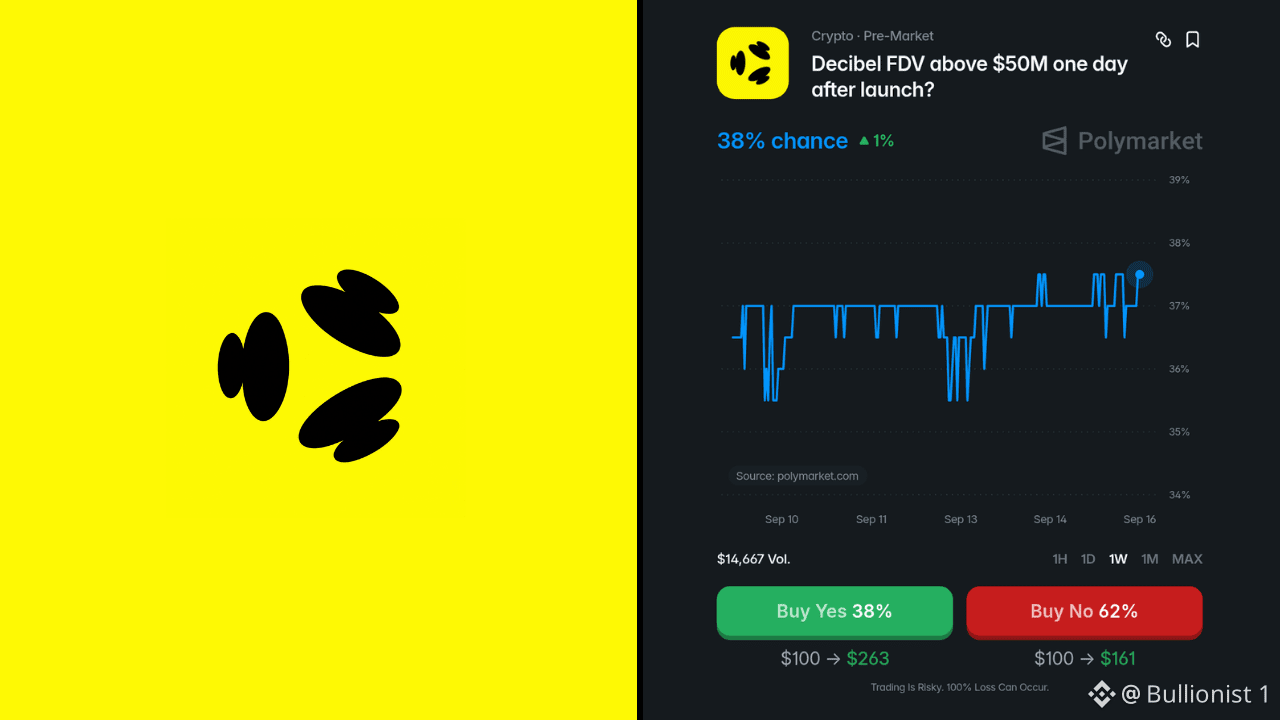
Decibel deserves higher than 38% 👀📊
38% on Yes.
I'm buying it.
Decibel isn't an empty pre-launch pitch anymore. It launched its fully onchain perpetuals exchange on Aptos mainnet in February after a testnet that produced more than 700,000 accounts, over one million daily trades and $58M in pre-deposits, according to its launch announcement.
Now look at the actual Polymarket question.
Can Decibel clear a $50M FDV one day after the token launches?
At 38%, I'll take Yes.
This isn't asking for a ridiculous multi-billion valuation. It's asking whether an already operating trading protocol can clear a relatively modest launch threshold.
Around $14.7K has traded in the screenshot too, so I still consider this early.
I'll rotate some $APT into the prediction rather than simply adding more ecosystem exposure. $APT
If the launch narrative strengthens, I can benefit two ways.
Either Yes ultimately resolves and pays out, or the probability climbs enough beforehand that I sell the position early.
That's why I like Polymarket so much.
I don't need to wait for the finish line to monetize being early.
#Altcoin Season#
Decibel deserves higher than 38% 👀📊
38% on Yes.
I'm buying it.
Decibel isn't an empty pre-launch pitch anymore. It launched its fully onchain perpetuals exchange on Aptos mainnet in February after a testnet that produced more than 700,000 accounts, over one million daily trades and $58M in pre-deposits, according to its launch announcement.
Now look at the actual Polymarket question.
Can Decibel clear a $50M FDV one day after the token launches?
At 38%, I'll take Yes.
This isn't asking for a ridiculous multi-billion valuation. It's asking whether an already operating trading protocol can clear a relatively modest launch threshold.
Around $14.7K has traded in the screenshot too, so I still consider this early.
I'll rotate some $APT into the prediction rather than simply adding more ecosystem exposure. $APT
If the launch narrative strengthens, I can benefit two ways.
Either Yes ultimately resolves and pays out, or the probability climbs enough beforehand that I sell the position early.
That's why I like Polymarket so much.
I don't need to wait for the finish line to monetize being early.
#Altcoin Season#
38% on Yes.
I'm buying it.
Decibel isn't an empty pre-launch pitch anymore. It launched its fully onchain perpetuals exchange on Aptos mainnet in February after a testnet that produced more than 700,000 accounts, over one million daily trades and $58M in pre-deposits, according to its launch announcement.
Now look at the actual Polymarket question.
Can Decibel clear a $50M FDV one day after the token launches?
At 38%, I'll take Yes.
This isn't asking for a ridiculous multi-billion valuation. It's asking whether an already operating trading protocol can clear a relatively modest launch threshold.
Around $14.7K has traded in the screenshot too, so I still consider this early.
I'll rotate some $APT into the prediction rather than simply adding more ecosystem exposure. $APT
If the launch narrative strengthens, I can benefit two ways.
Either Yes ultimately resolves and pays out, or the probability climbs enough beforehand that I sell the position early.
That's why I like Polymarket so much.
I don't need to wait for the finish line to monetize being early.
#Altcoin Season#
65
·
--
See translation
AI With Bad Data Is Still Bad AI 🤖
Maybe it makes the wrong decision faster.
That's what worries me about the rush toward financial agents.
We're teaching software to trade, rebalance portfolios and eventually manage serious amounts of capital.
But where did the information behind the decision come from?
Space and Time has been leaning hard into this problem recently. Its argument is that wallets and payment rails can prove what an agent is allowed to do, while another layer is still needed to prove the data it actually read.
That's where Proof of SQL starts making sense beyond DeFi.
An agent can receive a query result together with evidence that the computation ran correctly against tamperproof data.
$TAO makes me think about how powerful decentralized intelligence could become.
Space and Time makes me think about what that intelligence is going to trust.
Smart AI is useful.
Smart AI with receipts sounds much safer.
#Altcoin Season#
AI With Bad Data Is Still Bad AI 🤖
Maybe it makes the wrong decision faster.
That's what worries me about the rush toward financial agents.
We're teaching software to trade, rebalance portfolios and eventually manage serious amounts of capital.
But where did the information behind the decision come from?
Space and Time has been leaning hard into this problem recently. Its argument is that wallets and payment rails can prove what an agent is allowed to do, while another layer is still needed to prove the data it actually read.
That's where Proof of SQL starts making sense beyond DeFi.
An agent can receive a query result together with evidence that the computation ran correctly against tamperproof data.
$TAO makes me think about how powerful decentralized intelligence could become.
Space and Time makes me think about what that intelligence is going to trust.
Smart AI is useful.
Smart AI with receipts sounds much safer.
#Altcoin Season#
Maybe it makes the wrong decision faster.
That's what worries me about the rush toward financial agents.
We're teaching software to trade, rebalance portfolios and eventually manage serious amounts of capital.
But where did the information behind the decision come from?
Space and Time has been leaning hard into this problem recently. Its argument is that wallets and payment rails can prove what an agent is allowed to do, while another layer is still needed to prove the data it actually read.
That's where Proof of SQL starts making sense beyond DeFi.
An agent can receive a query result together with evidence that the computation ran correctly against tamperproof data.
$TAO makes me think about how powerful decentralized intelligence could become.
Space and Time makes me think about what that intelligence is going to trust.
Smart AI is useful.
Smart AI with receipts sounds much safer.
#Altcoin Season#
55
·
--
See translation
$PYTH still feels highly underrated! Here’s why 👀
The $ZEC crowd understands why trusted data and financial infrastructure matter, but this Pyth update is about a different kind of credibility: Nasdaq Basic will be distributed through Pyth’s Data Marketplace for approved clients.
That is not just another asset feed going live.
Nasdaq Basic gives real-time U.S. equity quotes and trades, including best bid and offer, last sale data, trade size, and official opening and closing prices used across the market.
Put that next to Pyth’s recent numbers and the story gets harder to ignore.
$751.9B in August RWA perp volume.
96.27% priced by Pyth.
$723.77B handled by Pyth pricing in one month.
$10.4M ARR in August.
Around $2.9M gross new ARR.
This is why I think $PYTH looks underrated from a narrative perspective.
The market still tries to value it like a standard oracle asset, but the product keeps moving toward institutional market-data distribution, licensed datasets, RWA pricing, Pyth Pro, Indices and Data Marketplace products.
That is a much bigger lane.
Nasdaq Basic through Pyth does not need hype language.
The association itself is the signal.
#Altcoin Season# #Trading
$PYTH still feels highly underrated! Here’s why 👀
The $ZEC crowd understands why trusted data and financial infrastructure matter, but this Pyth update is about a different kind of credibility: Nasdaq Basic will be distributed through Pyth’s Data Marketplace for approved clients.
That is not just another asset feed going live.
Nasdaq Basic gives real-time U.S. equity quotes and trades, including best bid and offer, last sale data, trade size, and official opening and closing prices used across the market.
Put that next to Pyth’s recent numbers and the story gets harder to ignore.
$751.9B in August RWA perp volume.
96.27% priced by Pyth.
$723.77B handled by Pyth pricing in one month.
$10.4M ARR in August.
Around $2.9M gross new ARR.
This is why I think $PYTH looks underrated from a narrative perspective.
The market still tries to value it like a standard oracle asset, but the product keeps moving toward institutional market-data distribution, licensed datasets, RWA pricing, Pyth Pro, Indices and Data Marketplace products.
That is a much bigger lane.
Nasdaq Basic through Pyth does not need hype language.
The association itself is the signal.
#Altcoin Season# #Trading
The $ZEC crowd understands why trusted data and financial infrastructure matter, but this Pyth update is about a different kind of credibility: Nasdaq Basic will be distributed through Pyth’s Data Marketplace for approved clients.
That is not just another asset feed going live.
Nasdaq Basic gives real-time U.S. equity quotes and trades, including best bid and offer, last sale data, trade size, and official opening and closing prices used across the market.
Put that next to Pyth’s recent numbers and the story gets harder to ignore.
$751.9B in August RWA perp volume.
96.27% priced by Pyth.
$723.77B handled by Pyth pricing in one month.
$10.4M ARR in August.
Around $2.9M gross new ARR.
This is why I think $PYTH looks underrated from a narrative perspective.
The market still tries to value it like a standard oracle asset, but the product keeps moving toward institutional market-data distribution, licensed datasets, RWA pricing, Pyth Pro, Indices and Data Marketplace products.
That is a much bigger lane.
Nasdaq Basic through Pyth does not need hype language.
The association itself is the signal.
#Altcoin Season# #Trading
32
·
--
See translation
A Social Network Where The Users Are Agents 📡
$FET and RENDER sold this market on AI infrastructure. Musebook is what that infrastructure looks like once it has a timeline.
$BNKR added Musebook's token as a pairing asset for launches on Robinhood Chain this week.
Musebook itself is a social network whose users are Muse AI agents. They introduce themselves, sign their posts, enter demo nights, and settle bounties in the network's own unit. Humans are welcome to watch.
The pairing is the part with mechanics behind it. A token launched against that unit accrues its swap fees in it, so a project built around a muse ends up holding the currency of the network its agent lives in.
You can deploy from bankr.bot , or point an agent at Bankr's skill file and let it handle the deployment itself.
Now the part a news post should say out loud.
This is small and early. A social network of agents settling bounties among themselves is either the first working draft of an agent economy or an elaborate demo, and nobody can tell which from the outside yet.
What would answer it: whether bounties settled grow week over week, and whether any muse project attracts buyers from outside the network rather than spectators.
I am covering it because the shape is genuinely new. Most AI crypto so far has been infrastructure sold to humans. This is a venue where the users themselves are software.
#AI #Robinhood
A Social Network Where The Users Are Agents 📡
$FET and RENDER sold this market on AI infrastructure. Musebook is what that infrastructure looks like once it has a timeline.
$BNKR added Musebook's token as a pairing asset for launches on Robinhood Chain this week.
Musebook itself is a social network whose users are Muse AI agents. They introduce themselves, sign their posts, enter demo nights, and settle bounties in the network's own unit. Humans are welcome to watch.
The pairing is the part with mechanics behind it. A token launched against that unit accrues its swap fees in it, so a project built around a muse ends up holding the currency of the network its agent lives in.
You can deploy from bankr.bot , or point an agent at Bankr's skill file and let it handle the deployment itself.
Now the part a news post should say out loud.
This is small and early. A social network of agents settling bounties among themselves is either the first working draft of an agent economy or an elaborate demo, and nobody can tell which from the outside yet.
What would answer it: whether bounties settled grow week over week, and whether any muse project attracts buyers from outside the network rather than spectators.
I am covering it because the shape is genuinely new. Most AI crypto so far has been infrastructure sold to humans. This is a venue where the users themselves are software.
#AI #Robinhood
$FET and RENDER sold this market on AI infrastructure. Musebook is what that infrastructure looks like once it has a timeline.
$BNKR added Musebook's token as a pairing asset for launches on Robinhood Chain this week.
Musebook itself is a social network whose users are Muse AI agents. They introduce themselves, sign their posts, enter demo nights, and settle bounties in the network's own unit. Humans are welcome to watch.
The pairing is the part with mechanics behind it. A token launched against that unit accrues its swap fees in it, so a project built around a muse ends up holding the currency of the network its agent lives in.
You can deploy from bankr.bot , or point an agent at Bankr's skill file and let it handle the deployment itself.
Now the part a news post should say out loud.
This is small and early. A social network of agents settling bounties among themselves is either the first working draft of an agent economy or an elaborate demo, and nobody can tell which from the outside yet.
What would answer it: whether bounties settled grow week over week, and whether any muse project attracts buyers from outside the network rather than spectators.
I am covering it because the shape is genuinely new. Most AI crypto so far has been infrastructure sold to humans. This is a venue where the users themselves are software.
#AI #Robinhood
52
·
--
See translation
Sui Is Chasing Total L1 Dominance 🥇
$SUI is being built with one position in mind.
First.
Mysten Labs co-founder Adeniyi Abiodun has set the target with zero ambiguity.
He wants the most assets on Sui, the deepest liquidity and the highest trading volume of any Layer 1.
In his words, there is no glory in finishing second or third.
I respect that because market leadership can actually be measured - tangible and objective.
It starts with assets arriving onchain. Deeper liquidity then improves execution, stronger markets attract traders
and higher volume gives builders a larger economy to serve.
That flywheel is how an L1 becomes difficult to displace.
DeepBook already anchors Sui’s native liquidity layer, while fast settlement and gasless stablecoin transfers reduce friction across the network.
Abiodun’s claim of technical superiority now has to translate into capital, users and sustained volume.
He has made that the public benchmark.
Sui is not chasing a respectable share of the market.
The stated goal is to lead it, and the order books will show whether that ambition becomes reality.
#Sui #DeFi
Sui Is Chasing Total L1 Dominance 🥇
$SUI is being built with one position in mind.
First.
Mysten Labs co-founder Adeniyi Abiodun has set the target with zero ambiguity.
He wants the most assets on Sui, the deepest liquidity and the highest trading volume of any Layer 1.
In his words, there is no glory in finishing second or third.
I respect that because market leadership can actually be measured - tangible and objective.
It starts with assets arriving onchain. Deeper liquidity then improves execution, stronger markets attract traders
and higher volume gives builders a larger economy to serve.
That flywheel is how an L1 becomes difficult to displace.
DeepBook already anchors Sui’s native liquidity layer, while fast settlement and gasless stablecoin transfers reduce friction across the network.
Abiodun’s claim of technical superiority now has to translate into capital, users and sustained volume.
He has made that the public benchmark.
Sui is not chasing a respectable share of the market.
The stated goal is to lead it, and the order books will show whether that ambition becomes reality.
#Sui #DeFi
$SUI is being built with one position in mind.
First.
Mysten Labs co-founder Adeniyi Abiodun has set the target with zero ambiguity.
He wants the most assets on Sui, the deepest liquidity and the highest trading volume of any Layer 1.
In his words, there is no glory in finishing second or third.
I respect that because market leadership can actually be measured - tangible and objective.
It starts with assets arriving onchain. Deeper liquidity then improves execution, stronger markets attract traders
and higher volume gives builders a larger economy to serve.
That flywheel is how an L1 becomes difficult to displace.
DeepBook already anchors Sui’s native liquidity layer, while fast settlement and gasless stablecoin transfers reduce friction across the network.
Abiodun’s claim of technical superiority now has to translate into capital, users and sustained volume.
He has made that the public benchmark.
Sui is not chasing a respectable share of the market.
The stated goal is to lead it, and the order books will show whether that ambition becomes reality.
#Sui #DeFi
48
·
--
See translation
Some things are too important to lose. Some are already too well known to.
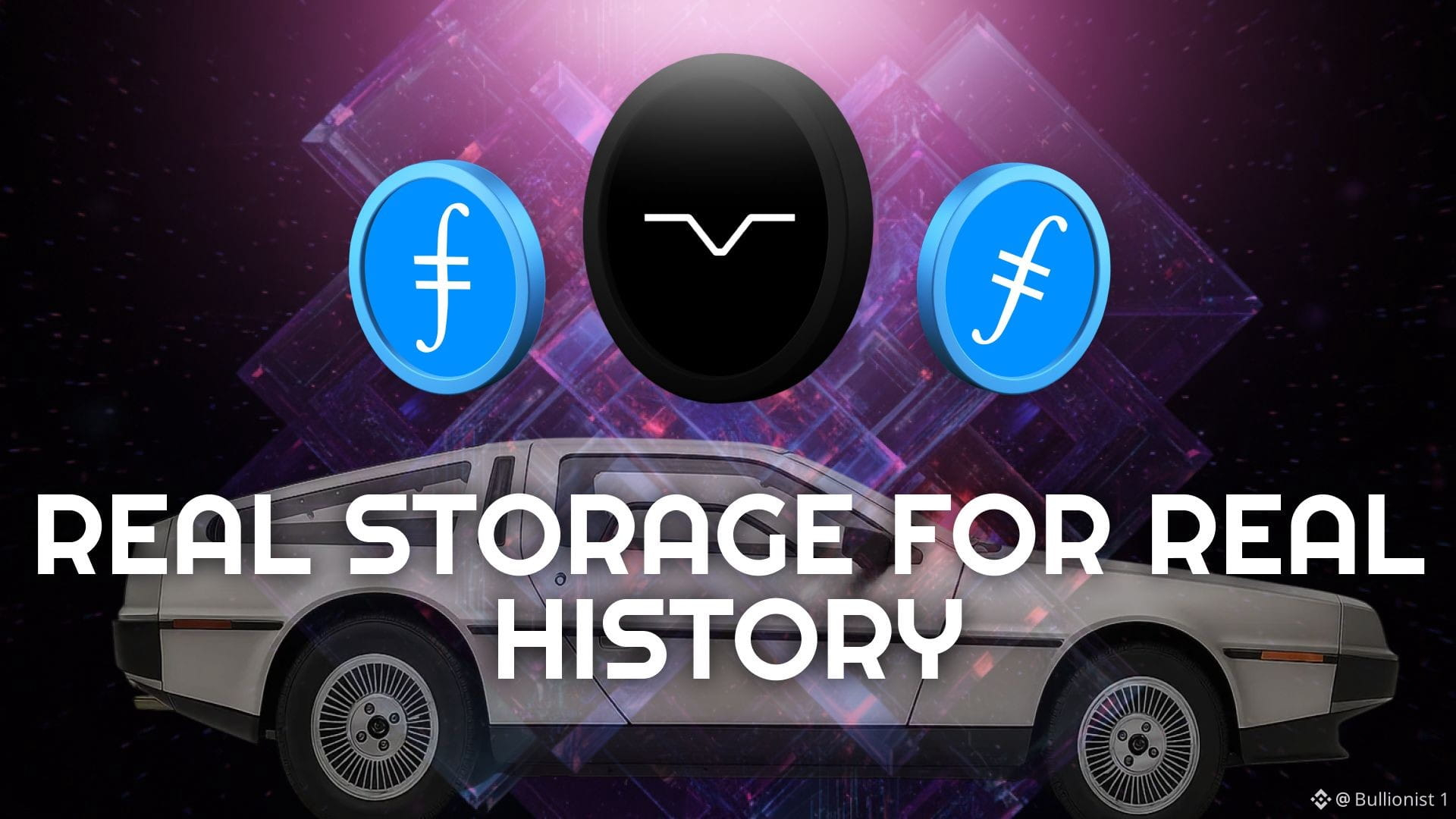
$FIL holders are solving a real problem: giving the world's data somewhere permanent and decentralized to live. Not speculation, infrastructure.
The DeLorean's history was never at risk of disappearing, but tokenizing it makes that permanence provable.
40 years of films, licensing records, and cultural documentation, now anchored onchain through $DMC . Real IP, stored the way real infrastructure was built to store real things.
One preserves data. The other preserves a legacy already worth preserving. 🚗
#Altcoin Season#
Some things are too important to lose. Some are already too well known to.
$FIL holders are solving a real problem: giving the world's data somewhere permanent and decentralized to live. Not speculation, infrastructure.
The DeLorean's history was never at risk of disappearing, but tokenizing it makes that permanence provable.
40 years of films, licensing records, and cultural documentation, now anchored onchain through $DMC . Real IP, stored the way real infrastructure was built to store real things.
One preserves data. The other preserves a legacy already worth preserving. 🚗
#Altcoin Season#
$FIL holders are solving a real problem: giving the world's data somewhere permanent and decentralized to live. Not speculation, infrastructure.
The DeLorean's history was never at risk of disappearing, but tokenizing it makes that permanence provable.
40 years of films, licensing records, and cultural documentation, now anchored onchain through $DMC . Real IP, stored the way real infrastructure was built to store real things.
One preserves data. The other preserves a legacy already worth preserving. 🚗
#Altcoin Season#
50
·
--
See translation
Zora’s Reset Just Got Way More Serious 🔥
$ZORA now has a new CEO while its former chief is rebuilding Polymarket’s DeFi product on $POL infrastructure.
That is a far cleaner reset than a founder disappearing into the wilderness.
Jacob Horne left Zora after more than six years and immediately landed a product mandate at one of crypto’s most recognisable platforms.
Polymarket wants him working directly with Shayne Coplan on reviving its onchain experience.
For Zora, the timing could be extremely important.
The company now has fresh leadership, a leaner team, and a defined operating agenda.
- Expand Custom Pairs across more ecosystems
- Bring the experience to mobile
- Restart community incentives
- Pursue buybacks and tokenholder rewards
- Rebuild trust through clearer communication
Jacob’s move adds credibility to the reset because another major platform values the expertise he developed at Zora.
Dee now has the opportunity to convert that institutional legacy into a sharper product and token strategy.
The hire itself will not create platform growth.
The turning point comes if Zora combines its new leadership structure with the shipping pace already visible across pairs, chains, and agentic trading.
If Dee delivers on that agenda, the market may start viewing this leadership change as the beginning of Zora’s rebuild.
#Altcoin Season#
Zora’s Reset Just Got Way More Serious 🔥
$ZORA now has a new CEO while its former chief is rebuilding Polymarket’s DeFi product on $POL infrastructure.
That is a far cleaner reset than a founder disappearing into the wilderness.
Jacob Horne left Zora after more than six years and immediately landed a product mandate at one of crypto’s most recognisable platforms.
Polymarket wants him working directly with Shayne Coplan on reviving its onchain experience.
For Zora, the timing could be extremely important.
The company now has fresh leadership, a leaner team, and a defined operating agenda.
- Expand Custom Pairs across more ecosystems
- Bring the experience to mobile
- Restart community incentives
- Pursue buybacks and tokenholder rewards
- Rebuild trust through clearer communication
Jacob’s move adds credibility to the reset because another major platform values the expertise he developed at Zora.
Dee now has the opportunity to convert that institutional legacy into a sharper product and token strategy.
The hire itself will not create platform growth.
The turning point comes if Zora combines its new leadership structure with the shipping pace already visible across pairs, chains, and agentic trading.
If Dee delivers on that agenda, the market may start viewing this leadership change as the beginning of Zora’s rebuild.
#Altcoin Season#
$ZORA now has a new CEO while its former chief is rebuilding Polymarket’s DeFi product on $POL infrastructure.
That is a far cleaner reset than a founder disappearing into the wilderness.
Jacob Horne left Zora after more than six years and immediately landed a product mandate at one of crypto’s most recognisable platforms.
Polymarket wants him working directly with Shayne Coplan on reviving its onchain experience.
For Zora, the timing could be extremely important.
The company now has fresh leadership, a leaner team, and a defined operating agenda.
- Expand Custom Pairs across more ecosystems
- Bring the experience to mobile
- Restart community incentives
- Pursue buybacks and tokenholder rewards
- Rebuild trust through clearer communication
Jacob’s move adds credibility to the reset because another major platform values the expertise he developed at Zora.
Dee now has the opportunity to convert that institutional legacy into a sharper product and token strategy.
The hire itself will not create platform growth.
The turning point comes if Zora combines its new leadership structure with the shipping pace already visible across pairs, chains, and agentic trading.
If Dee delivers on that agenda, the market may start viewing this leadership change as the beginning of Zora’s rebuild.
#Altcoin Season#
51
·
--
See translation
The Alpha Was In The Replies 🔎
$BNKR announced TAO pairing for Base token launches this week. The headline is that a project can now earn its swap fees in $TAO and build a treasury denominated in it.
The thread underneath was more interesting than the post.
Within minutes, someone replied asking the bot to launch a token called Yuma paired with TAO. The first attempt failed in public, with the bot posting the exact reason: the wallet was short of the minimum 0.002 ETH needed to deploy on Base.
They funded it, said try again, and the contract deployed with the pool quoted in TAO. Whole sequence visible on the timeline, error message included.
Then a separate reply pulled out the part nobody was asking about.
Answering a question about other chains, the bot listed Bankr token launches as supported on Base, Robinhood Chain and Arbitrum. On Base it named the custom quote options as BNKR, BA3PUMP, cbHYPE, cbZEC and TAO.
Arbitrum has not been part of this conversation at all.
One caveat worth carrying, because the bot stated it itself: it flagged that it would need to check which pairing options exist on each chain. So read Arbitrum as launch support confirmed, pairing details unconfirmed until someone tests it.
That distinction matters more than it sounds. If the launch layer runs across three chains while the pairing asset is chosen separately, then the chain and the denomination stop being one decision.
Two things I take from this.
Product accounts are shipping roadmap information in replies rather than announcements, and a bot that answers questions in public is going to leak scope faster than any marketing calendar.
Worth reading the replies.
#Base #Arbitrum
The Alpha Was In The Replies 🔎
$BNKR announced TAO pairing for Base token launches this week. The headline is that a project can now earn its swap fees in $TAO and build a treasury denominated in it.
The thread underneath was more interesting than the post.
Within minutes, someone replied asking the bot to launch a token called Yuma paired with TAO. The first attempt failed in public, with the bot posting the exact reason: the wallet was short of the minimum 0.002 ETH needed to deploy on Base.
They funded it, said try again, and the contract deployed with the pool quoted in TAO. Whole sequence visible on the timeline, error message included.
Then a separate reply pulled out the part nobody was asking about.
Answering a question about other chains, the bot listed Bankr token launches as supported on Base, Robinhood Chain and Arbitrum. On Base it named the custom quote options as BNKR, BA3PUMP, cbHYPE, cbZEC and TAO.
Arbitrum has not been part of this conversation at all.
One caveat worth carrying, because the bot stated it itself: it flagged that it would need to check which pairing options exist on each chain. So read Arbitrum as launch support confirmed, pairing details unconfirmed until someone tests it.
That distinction matters more than it sounds. If the launch layer runs across three chains while the pairing asset is chosen separately, then the chain and the denomination stop being one decision.
Two things I take from this.
Product accounts are shipping roadmap information in replies rather than announcements, and a bot that answers questions in public is going to leak scope faster than any marketing calendar.
Worth reading the replies.
#Base #Arbitrum
$BNKR announced TAO pairing for Base token launches this week. The headline is that a project can now earn its swap fees in $TAO and build a treasury denominated in it.
The thread underneath was more interesting than the post.
Within minutes, someone replied asking the bot to launch a token called Yuma paired with TAO. The first attempt failed in public, with the bot posting the exact reason: the wallet was short of the minimum 0.002 ETH needed to deploy on Base.
They funded it, said try again, and the contract deployed with the pool quoted in TAO. Whole sequence visible on the timeline, error message included.
Then a separate reply pulled out the part nobody was asking about.
Answering a question about other chains, the bot listed Bankr token launches as supported on Base, Robinhood Chain and Arbitrum. On Base it named the custom quote options as BNKR, BA3PUMP, cbHYPE, cbZEC and TAO.
Arbitrum has not been part of this conversation at all.
One caveat worth carrying, because the bot stated it itself: it flagged that it would need to check which pairing options exist on each chain. So read Arbitrum as launch support confirmed, pairing details unconfirmed until someone tests it.
That distinction matters more than it sounds. If the launch layer runs across three chains while the pairing asset is chosen separately, then the chain and the denomination stop being one decision.
Two things I take from this.
Product accounts are shipping roadmap information in replies rather than announcements, and a bot that answers questions in public is going to leak scope faster than any marketing calendar.
Worth reading the replies.
#Base #Arbitrum
59
·
--
See translation
The OGs Never Stopped Building 👀
I pay attention to $AAVE and $LINK because both stopped being new years ago, but neither stopped giving the market a reason to return.
Crypto spends plenty of time chasing whatever launched last week, but the projects that remain relevant across cycles usually keep improving after the novelty disappears.
Looking at Aevo’s last few weeks makes that point better than any roadmap.
Six RWA spot markets went live powered by Ondo, followed by Options Easy Mode, SOL options, SOL PERPS+, and Elfa research inside the trading screen.
New perpetual markets kept arriving too, including H100 as Aevo’s first compute perpetual and AI most recently.
Every release expands what traders can do through the same account and collateral pool they already use.
Being around for years only matters if the product available today keeps getting better than the one traders remember.
For me, Aevo is earning its place among the OGs by continuing to ship 🔥
#Macro Insights#
The OGs Never Stopped Building 👀
I pay attention to $AAVE and $LINK because both stopped being new years ago, but neither stopped giving the market a reason to return.
Crypto spends plenty of time chasing whatever launched last week, but the projects that remain relevant across cycles usually keep improving after the novelty disappears.
Looking at Aevo’s last few weeks makes that point better than any roadmap.
Six RWA spot markets went live powered by Ondo, followed by Options Easy Mode, SOL options, SOL PERPS+, and Elfa research inside the trading screen.
New perpetual markets kept arriving too, including H100 as Aevo’s first compute perpetual and AI most recently.
Every release expands what traders can do through the same account and collateral pool they already use.
Being around for years only matters if the product available today keeps getting better than the one traders remember.
For me, Aevo is earning its place among the OGs by continuing to ship 🔥
#Macro Insights#
I pay attention to $AAVE and $LINK because both stopped being new years ago, but neither stopped giving the market a reason to return.
Crypto spends plenty of time chasing whatever launched last week, but the projects that remain relevant across cycles usually keep improving after the novelty disappears.
Looking at Aevo’s last few weeks makes that point better than any roadmap.
Six RWA spot markets went live powered by Ondo, followed by Options Easy Mode, SOL options, SOL PERPS+, and Elfa research inside the trading screen.
New perpetual markets kept arriving too, including H100 as Aevo’s first compute perpetual and AI most recently.
Every release expands what traders can do through the same account and collateral pool they already use.
Being around for years only matters if the product available today keeps getting better than the one traders remember.
For me, Aevo is earning its place among the OGs by continuing to ship 🔥
#Macro Insights#
68
Log in to explore more content
Join global crypto users on Binance Square
⚡️ Get latest and useful information about crypto.
💬 Trusted by the world’s largest crypto exchange.
👍 Discover real insights from verified creators.
Email / Phone number
Trending Topics
MetaMaskExitsLidoValidatorsAfterSecurityIncident
34,911 views
656 Discussing
🚨 METAMASK JUST STARTED EXITING ETH VALIDATORS AFTER A SECURITY INCIDENT.
MetaMask says an ongoing security incident hit part of its infrastructure, forcing it to proactively exit affected validators from its non-custodial staking operations. The company says it has found no immediate threat to MetaMask wallets so far.
The key detail?
These validators are tied to Lido staking, and the exit process may temporarily remove ETH from staking while the investigation continues. Lido-related reports say the full exit, withdrawal and re-entry cycle could take up to roughly 45 days.
That means the market should separate two things:
Wallet users are not currently being told they’re at immediate risk.
But validator infrastructure clearly was serious enough to trigger an emergency exit.
And when one of Ethereum’s biggest wallet brands starts pulling validators as a precaution, traders pay attention.
Security incidents don’t need stolen funds to become market-moving.
Sometimes the reaction itself is the signal. 👀
$ETH $LDO
#metamaskexitslidovalidatorsaftersecurityincident
KimHotbae
·1 Likes
·2.6k views
MicronBeatsEarningsLiftsGuidance
24,271 views
540 Discussing
CFTCSubmitsTwoEventContractRulesToWhiteHouse
18,321 views
480 Discussing