
Avalokiteshvara
54 Posts

Avalokiteshvara
Report
Block User
I be come the top 🚀
Open Trade
High-Frequency Trader
4.3 Years
1 Following
22 Followers
24 Liked
Posts
Portfolio
See translation
Kraken wants your everyday spending to pay you in Bitcoin. Its money app Krak has opened a waitlist for two US credit cards expected to ship in early 2027, offering up to 4% cashback in dollars or $BTC.
Crypto cashback is a crowded idea, but distribution is the game - and Kraken is betting its app audience converts. In a market where every exchange is hunting for the next user, the card is the hook. Four percent back in Bitcoin beats four percent back in points, if you believe in the asset.
#Bitcoin #BTC $BTC #Kraken
Kraken wants your everyday spending to pay you in Bitcoin. Its money app Krak has opened a waitlist for two US credit cards expected to ship in early 2027, offering up to 4% cashback in dollars or $BTC .
Crypto cashback is a crowded idea, but distribution is the game - and Kraken is betting its app audience converts. In a market where every exchange is hunting for the next user, the card is the hook. Four percent back in Bitcoin beats four percent back in points, if you believe in the asset.
#Bitcoin #BTC $BTC #Kraken
9
See translation
Solana is leaning into the AI-agent wave. The network has introduced solana.ai, a platform giving developers tools to build autonomous AI agents that can carry out blockchain transactions, manage wallets and buy online services.
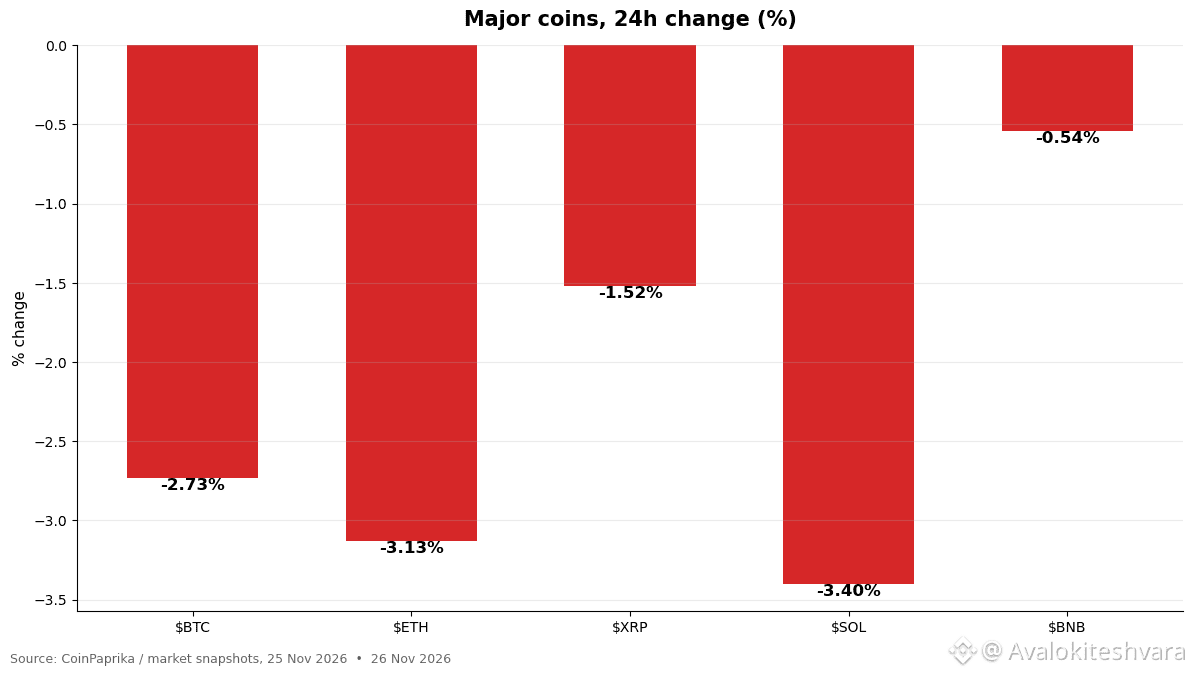
It is a bet that agents, not just humans, become on-chain users. $SOL itself is not joining the party today, trading near $68-70, down about 3.4% in 24 hours with the rest of the market. The product story is real; the price still follows Bitcoin.
#Solana #SOL $SOL #AI
It is a bet that agents, not just humans, become on-chain users. $SOL itself is not joining the party today, trading near $68-70, down about 3.4% in 24 hours with the rest of the market. The product story is real; the price still follows Bitcoin.
#Solana #SOL $SOL #AI

5
See translation
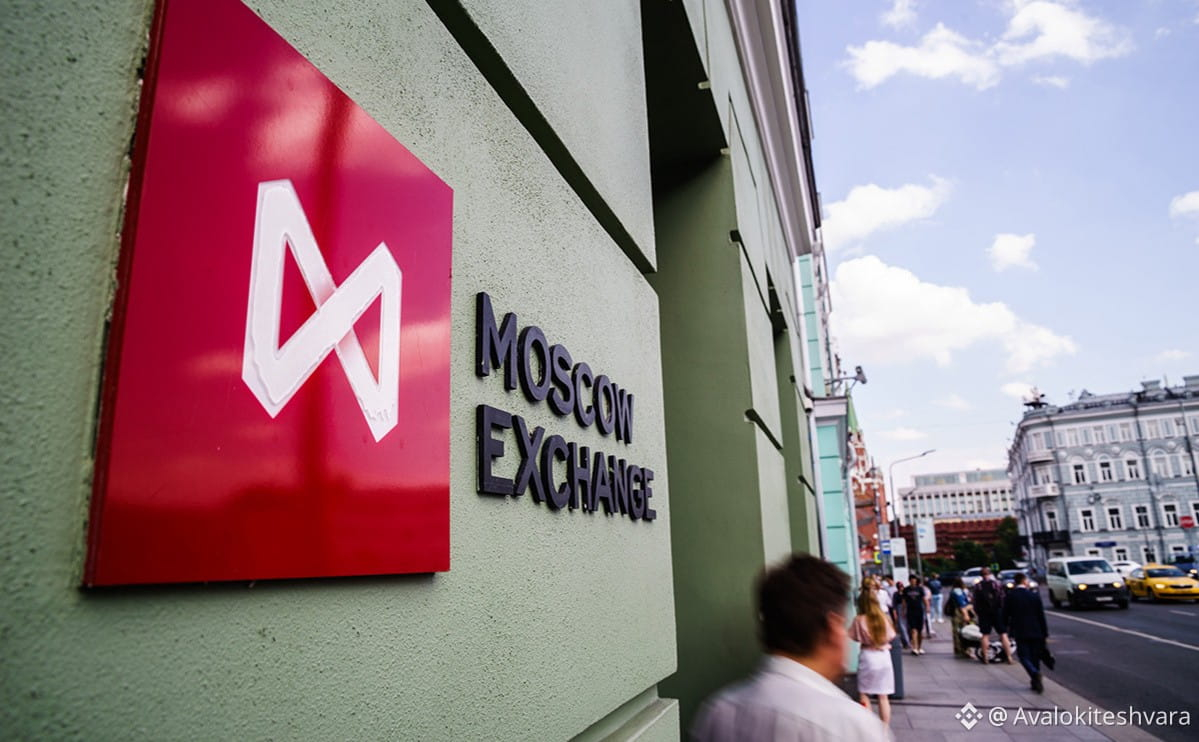
Moscow Exchange plans to start trading Bitcoin, Ethereum and Tether's USDT from 1 December 2026. It would put crypto on Russia's main exchange for the first time.
The move comes as $BTC trades near $59,000, down roughly 27% in thirty days, and global ETF flows run at record outflows. A new venue does not change the tape overnight - but it does widen the map of where crypto trades. Watch whether the launch brings real volume or just a headline.
#Bitcoin #BTC $BTC #MoscowExchange
See translation
Supply events to watch today: three tokens unlock on Wednesday, 26 November - Plasma ($XPL), Humanity Protocol ($H) and AltLayer ($ALT), according to The Block's daily digest.
Unlocks add sellable supply into a market that is already defensive, with Bitcoin below $60,000 and ETF outflows at record levels. Not every unlock moves price - but in thin, nervous conditions, traders watch them closely. $XPL is the one showing strength, up about 7% and flagged among the day's breakouts. Watch the tape, not the calendar alone.
#Plasma #XPL $XPL #Unlocks
Supply events to watch today: three tokens unlock on Wednesday, 26 November - Plasma ($XPL ), Humanity Protocol ($H ) and AltLayer ($ALT ), according to The Block's daily digest.
Unlocks add sellable supply into a market that is already defensive, with Bitcoin below $60,000 and ETF outflows at record levels. Not every unlock moves price - but in thin, nervous conditions, traders watch them closely. $XPL is the one showing strength, up about 7% and flagged among the day's breakouts. Watch the tape, not the calendar alone.
#Plasma #XPL $XPL #Unlocks
91
See translation
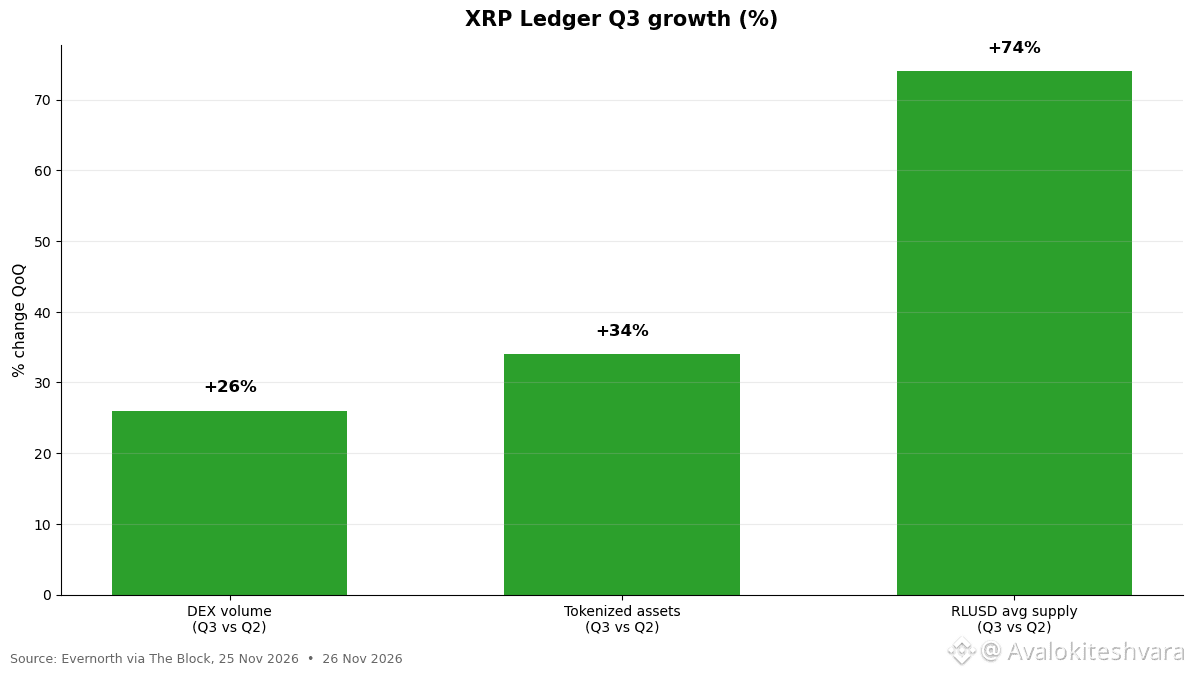
While prices slide, the XRP Ledger is quietly growing. Daily order-book DEX volume averaged 4.51 million $XRP in Q3, up 26% from Q2 and 2.8 times the level a year earlier, according to Evernorth. Larger traders are moving in.
Tokenized assets on the network, excluding stablecoins, averaged about $5 billion, up 34% quarter on quarter. Ripple's RLUSD averaged $937 million, up 74%. $XRP itself trades near $0.90-0.93, down about 1.5% in 24 hours. Usage is rising; price is not following - yet.
#XRP #XRP $XRP #XRPLedger
Tokenized assets on the network, excluding stablecoins, averaged about $5 billion, up 34% quarter on quarter. Ripple's RLUSD averaged $937 million, up 74%. $XRP itself trades near $0.90-0.93, down about 1.5% in 24 hours. Usage is rising; price is not following - yet.
#XRP #XRP $XRP #XRPLedger
25
See translation
Ether is falling about twice as hard as Bitcoin today. $ETH trades near $1,640-1,680, down 2.2% to 3.1% in 24 hours against Bitcoin's smaller slide, and the CoinDesk DeFi Select Index is down 2.6%. $ETH is down roughly 8.4% over seven days and about 29% over thirty.
There is a longer-term story too: the Ethereum Foundation has doubled its protocol security team, citing AI-related risks, and is working toward hash-based cryptography across consensus, accounts and blobs by 2029. Near term the tape is weak; the builders are not standing still.
#Ethereum #ETH $ETH #DeFi
2
See translation
On-chain, Bitcoin is flashing reset signals. The AVIV ratio has dropped to about 0.8, putting $BTC roughly 20% below its True Market Mean - the benchmark for where the network's value should sit. The BTC Risk Index has climbed back above 2 as volatility rises.
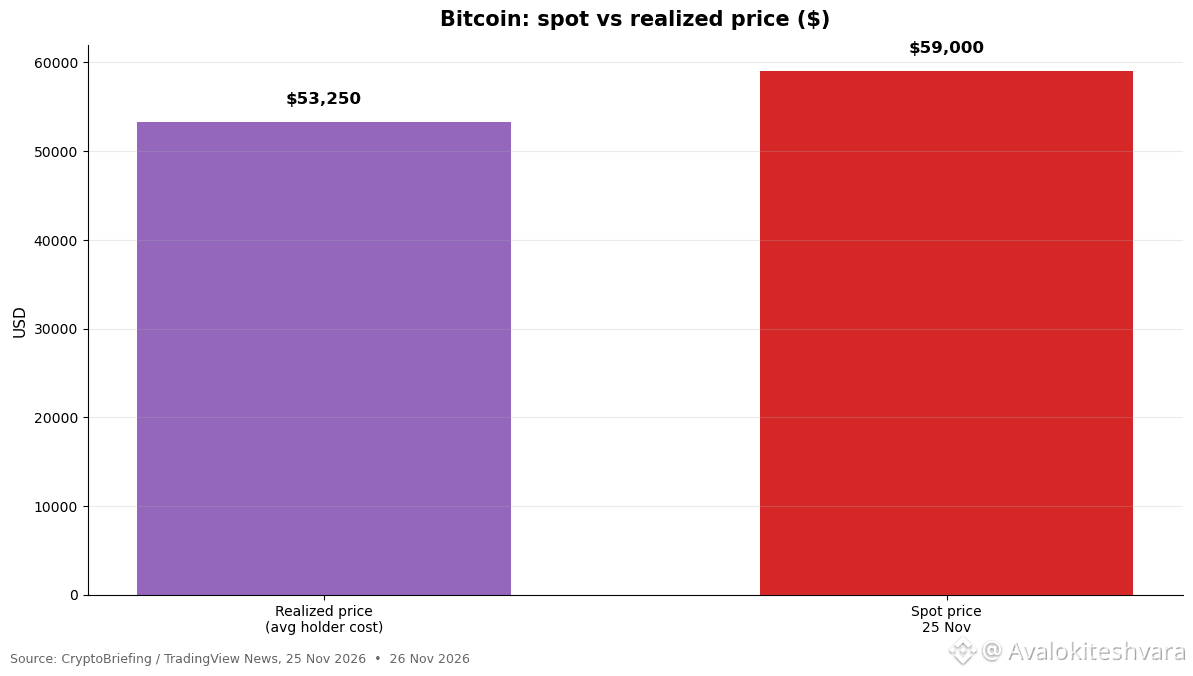
Realized price, the average cost basis of all holders, sits near $53,000-53,500. With spot near $59,000, the average holder is still in profit - but only just. As of mid-November, 54.7% of supply sat at a loss. The reset is real; the cushion is thin.
#Bitcoin #BTC $BTC #OnChain
Realized price, the average cost basis of all holders, sits near $53,000-53,500. With spot near $59,000, the average holder is still in profit - but only just. As of mid-November, 54.7% of supply sat at a loss. The reset is real; the cushion is thin.
#Bitcoin #BTC $BTC #OnChain
30
See translation
Grayscale says Bitcoin and the major altcoins look oversold. In a 23 November research note, the asset manager pointed to defensive positioning everywhere: shrinking futures exposure, stablecoin redemptions and heavy ETP withdrawals.
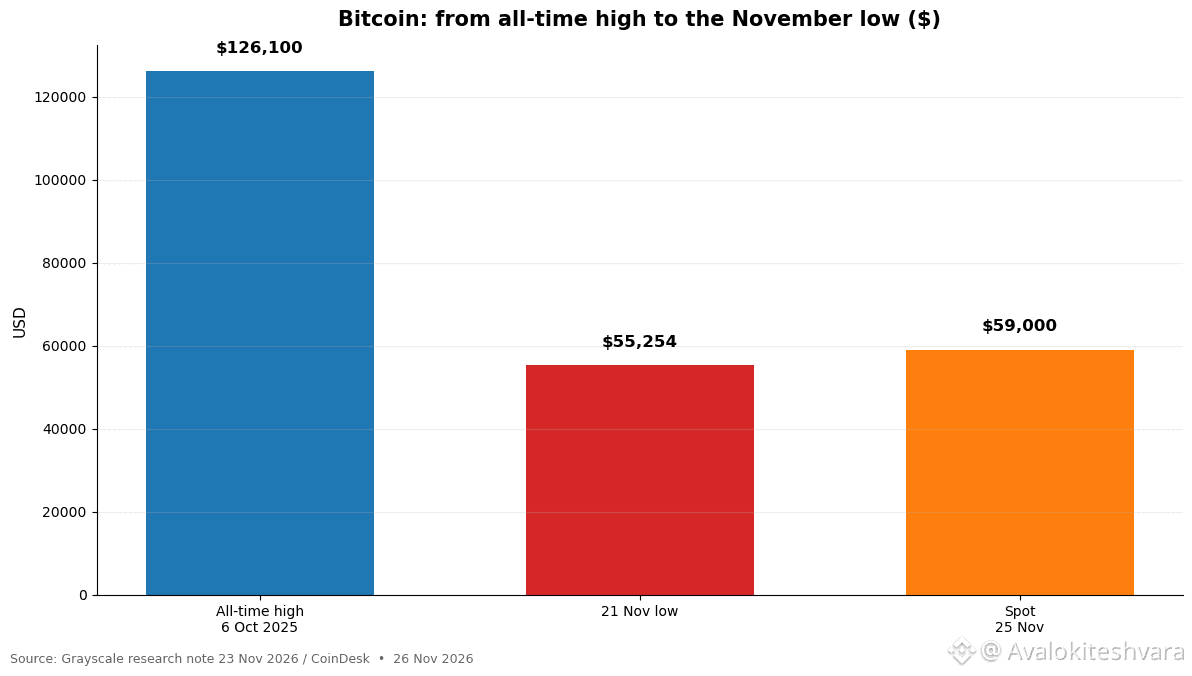
The context is brutal. $BTC hit $55,254 on 21 November, a drawdown of roughly 56% stretched over 411 days in Grayscale's historical comparison. Global crypto ETPs saw more than $2 billion in weekly outflows. Grayscale's own caveat matters: oversold is an observation, not a confirmed bottom.
#Bitcoin #BTC $BTC #Grayscale
21
See translation
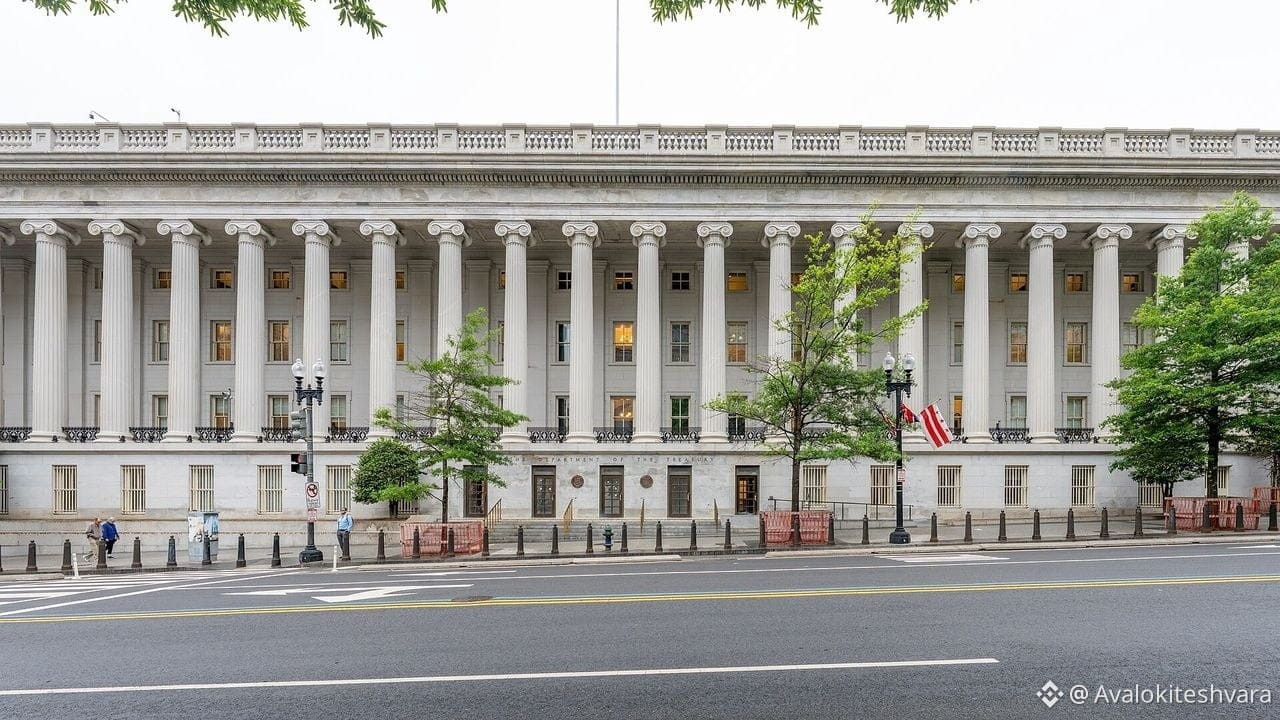
Washington had a rough night - and markets noticed. The US Treasury was hit by a cyberattack that took several FinCEN systems offline, the same systems used to track money laundering and financial fraud. The incident came hours after the CIA and the Office of the Director of National Intelligence were reportedly hacked.
No crypto link has been claimed, but the timing matters: it landed on the same day fresh tariff threats rattled global markets. When the plumbing of the financial system makes headlines, risk appetite is usually the first casualty.
#Bitcoin #BTC $BTC #Cybersecurity
No crypto link has been claimed, but the timing matters: it landed on the same day fresh tariff threats rattled global markets. When the plumbing of the financial system makes headlines, risk appetite is usually the first casualty.
#Bitcoin #BTC $BTC #Cybersecurity
38
See translation
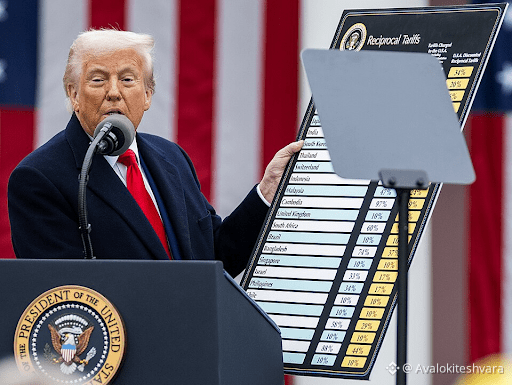
Trade-war headlines are back, and risk assets felt it instantly. The US has opened a Section 301 investigation into excess industrial capacity covering 16 trading partners, including China and the European Union, raising the prospect of fresh tariffs.
Asian markets took the hit first: South Korea's Kospi fell as much as 6.4% and Taiwan dropped 8.6%. US futures followed - the Nasdaq-100 sank 4.2% and the S&P 500 lost 2.8% early in the session. $BTC gave back its Nvidia-fueled bounce and slipped under $60,000 again. Tariff risk is now a crypto headline too.
#Bitcoin #BTC $BTC #Tariffs
36
See translation
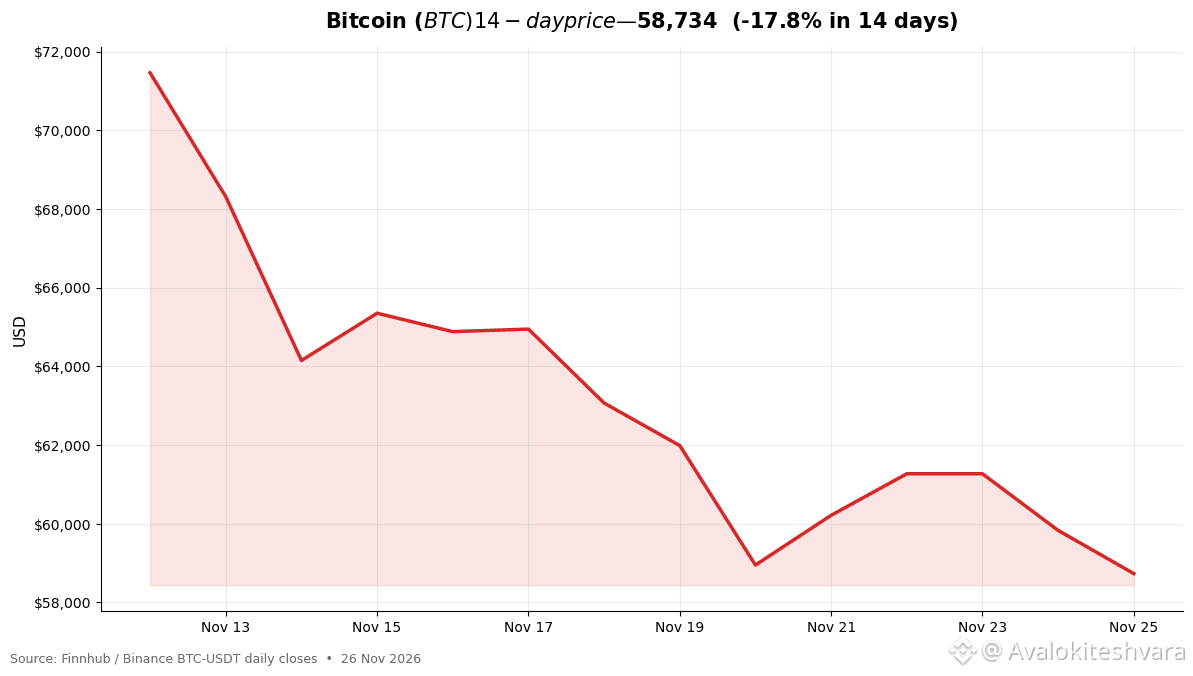
Bitcoin is fighting to reclaim $60,000 after another bruising day. $BTC trades near $59,000-59,700, down about 2.7% in 24 hours, with a 7-day range of $55,711 to $64,828. The 14-day chart says it all: $71,460 down to $58,734, a slide of almost 18% in two weeks.
The flow picture is worse. US spot Bitcoin ETFs have now lost $4.94 billion in November - the worst month since launch - with six straight days of outflows. $60,000 is the line to watch; below it, every bounce gets sold.
#Bitcoin #BTC $BTC #Crypto
The flow picture is worse. US spot Bitcoin ETFs have now lost $4.94 billion in November - the worst month since launch - with six straight days of outflows. $60,000 is the line to watch; below it, every bounce gets sold.
#Bitcoin #BTC $BTC #Crypto
5
See translation
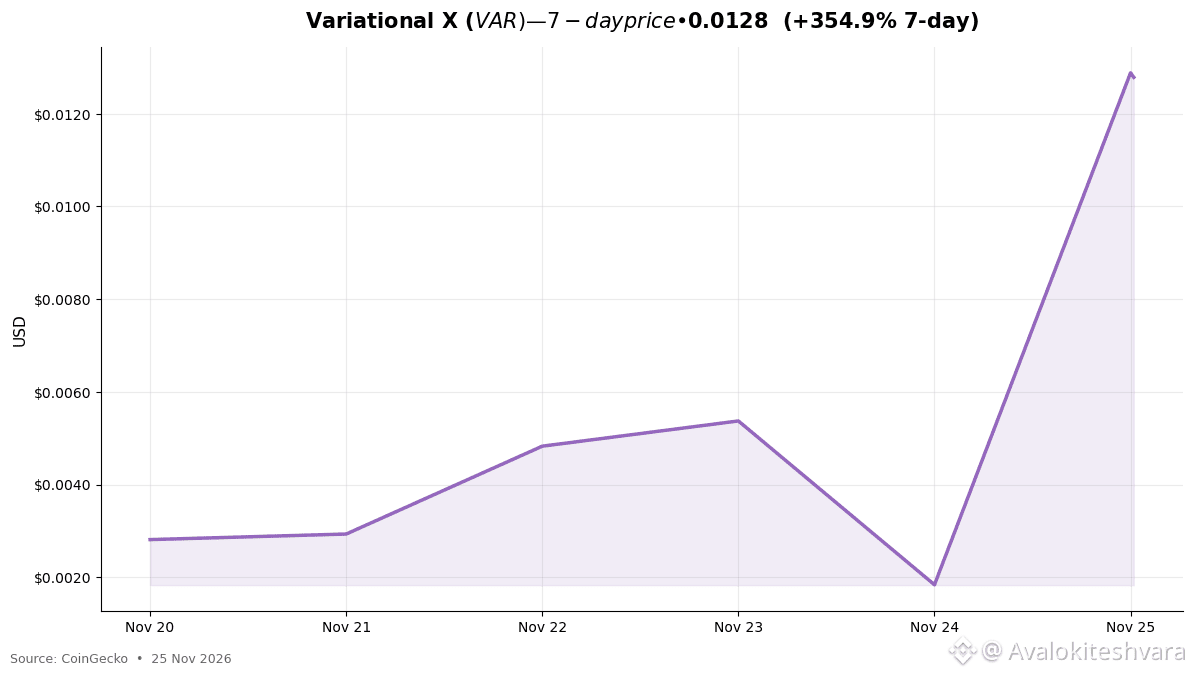
While the majors bleed, one tiny token is going vertical. Variational X ($VAR) is the number three trending coin on CoinGecko today, up about 577% in 24 hours to roughly $0.0124, with a market cap near $12.4 million and 24-hour volume around $1.12 million.
The chart is dramatic: $VAR traded at $0.0018 on 24 November and near $0.0129 a day later. Over seven days it is up roughly 355%. CoinGecko only has about a week of price history for it, and it ranks around 969 by market cap.
Let us be honest about what this is. A micro-cap can move hundreds of percent on very little money, in either direction. In a market where Bitcoin is down 2.3% and the Fear & Greed Index reads 11/100, a vertical green candle stands out — and that attention is exactly what makes these moves so fragile. Thin liquidity means exits can be just as fast as entries.
My take: treat $VAR as a watchlist curiosity, not a discovery. Trending lists reward attention, not quality. If you look at it, check the contract, the liquidity, and who holds the supply first — and size any position as if it could retrace most of the move. In this market, the most dangerous trade is chasing the one green chart on a red screen.
#VAR #Trending #Crypto #DYOR
15
See translation
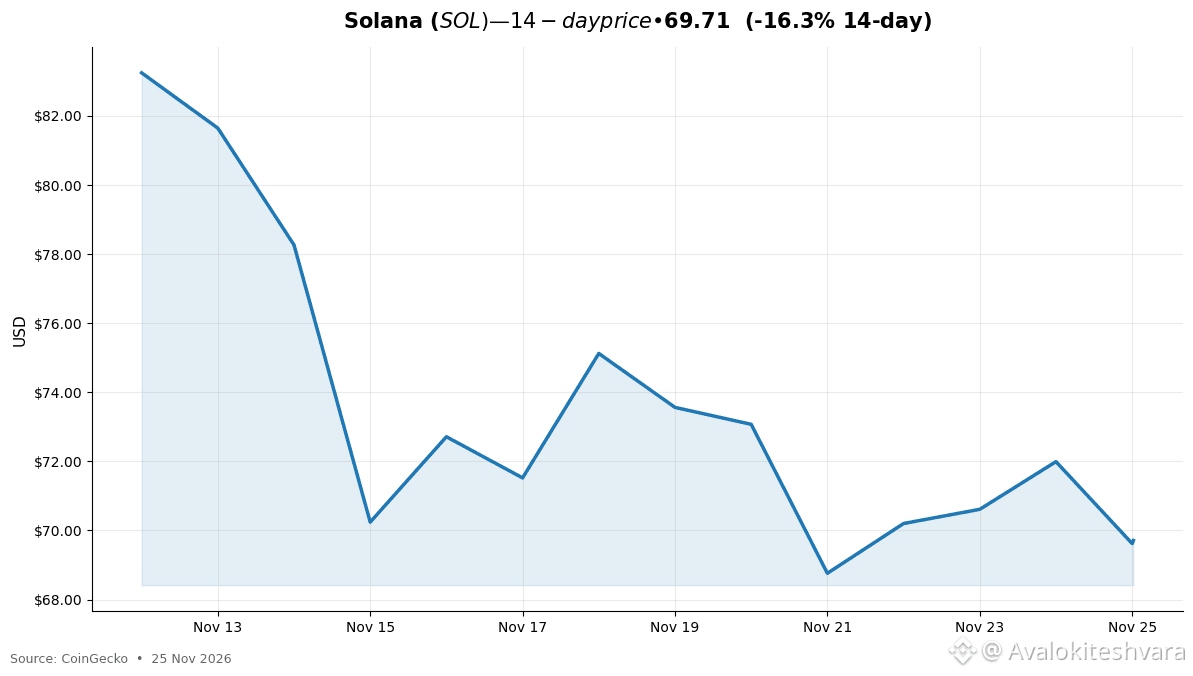
Solana is the weakest major coin today — and the chart shows why traders are cautious. $SOL trades near $69.70, down about 3.1% in 24 hours and 5.7% over seven days. The 14-day picture is worse: $83.24 down to $69.71, a drop of more than 16%.
Yesterday's range was $68.61 to $72.55, and $SOL is now sitting just above the low end of it, below the psychologically important $70 level. There is no Solana-specific headline behind the move. This is broad risk-off plus leveraged long positions being washed out — the same $844 million liquidation wave that hit the whole market, with $SOL simply carrying the highest beta.
For context, $SOL traded near $220 at its November 2021 peak. It has spent the last two weeks giving back its autumn gains while Bitcoin dominance holds near 57.8%.
Levels to watch: $68.61 is the near-term line in the sand. Lose it and the next visible support is thin. Reclaiming $72.55 would be the first sign of stabilization.
My take: high-beta assets fall fastest when liquidity thins, and Thanksgiving week is exactly that kind of tape. $SOL does not need a reason to underperform right now — it needs buyers, and the whole market is short of them.
#Solana #SOL #Crypto
42
See translation
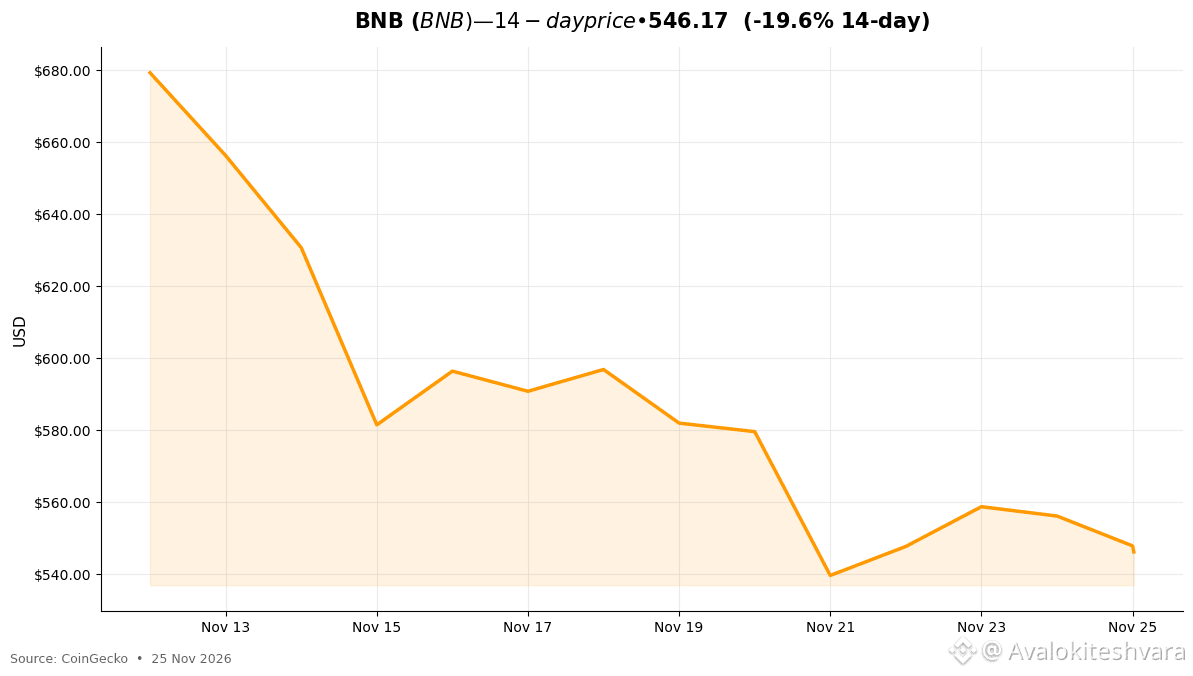
$BNB is quietly the most resilient major coin in this sell-off. It trades near $546-549, down about 1.4% in 24 hours — the smallest decline among the majors, against Bitcoin's 2.3% and Solana's 3.1%. The 14-day chart shows the damage, though: $679 down to $546, a fall of almost 20% since 12 November.
One thing to know today: Binance is pausing withdrawals on all networks for about an hour on 25 November for scheduled wallet maintenance. This is planned maintenance, not an incident — but on a red day, any exchange headline gets extra attention, so check Binance's official announcements for the exact window before moving funds.
Levels to watch: support at $543.82, the 24 November low, and resistance at $561.24, the top of yesterday's range. $BNB is holding above its weekly low while the rest of the market tests theirs.
My take: relative strength in a downtrend is worth noting, not celebrating. $BNB is falling slower than its peers, which usually reflects steady spot demand rather than a new catalyst. If Bitcoin stabilizes above $58,000, $BNB is positioned to recover first. If not, the same $543 support gets tested again.
#BNB #Binance #Crypto
50
See translation
A quiet but meaningful regulatory step for crypto this week: the US Commodity Futures Trading Commission issued staff guidance letting regulated derivatives exchanges count Bitcoin, Ether and payment stablecoins toward the reserves they must hold to cover 12 months of operating costs.
In plain terms, $BTC and $ETH can now sit on the balance sheet of a regulated US exchange as reserve assets — the same kind of treatment traditionally reserved for cash and high-quality instruments. It is guidance, not a new law, but it normalizes crypto inside the plumbing of regulated markets.
The market, however, barely noticed. Bitcoin still slipped under $60,000 and November ETF outflows hit a record $4.71 billion. That gap is the lesson: regulatory plumbing moves slowly, while flows move prices today.
There is a second signal worth noting. BlackRock launched its first tokenized money market fund in Hong Kong, another step in bringing traditional finance products onto blockchain rails.
My take: do not expect a price reaction from guidance like this. Its value is structural — each step that treats crypto as ordinary financial collateral lowers the barrier for the next institution. The price will follow flows; the infrastructure is being built regardless.
#CFTC #Regulation #Bitcoin #Ethereum

106
Verified
See translation
Jensen Huang is back at Nvidia — and the market reaction was historic. On 23 November the board voted unanimously to reinstate Huang as president, CEO and board director with immediate effect. Nvidia shares closed about 31% higher on Monday, clawing back nearly $1 trillion in market value. Forbes reported Huang recouped almost $34 billion of his fortune in a single day.
Bitcoin briefly joined the party, spiking to an intraday high near $64,600 on Monday. Then it gave the whole move back and slipped under $60,000. As FalconX's Joshua Lim put it, Nvidia has recovered more than 80% of its losses since Huang stepped down, while Bitcoin has regained only about 25% of its slide to below $56,000.
Huang himself called his return meeting with staff the hardest of his life, apologizing to employees after the episode. Meanwhile US authorities are reportedly targeting chip smuggling to China in the wake of his return.
My take: this week broke the usual script. Crypto normally rides tech sentiment higher; this time the AI rally left Bitcoin behind. That tells us $BTC needs its own buyers and its own flows — ETF demand is still negative — not just a halo from the Nasdaq. If tech keeps running and crypto does not follow, the divergence itself becomes the story.
#Nvidia #NVDA #Bitcoin #AI

669
See translation
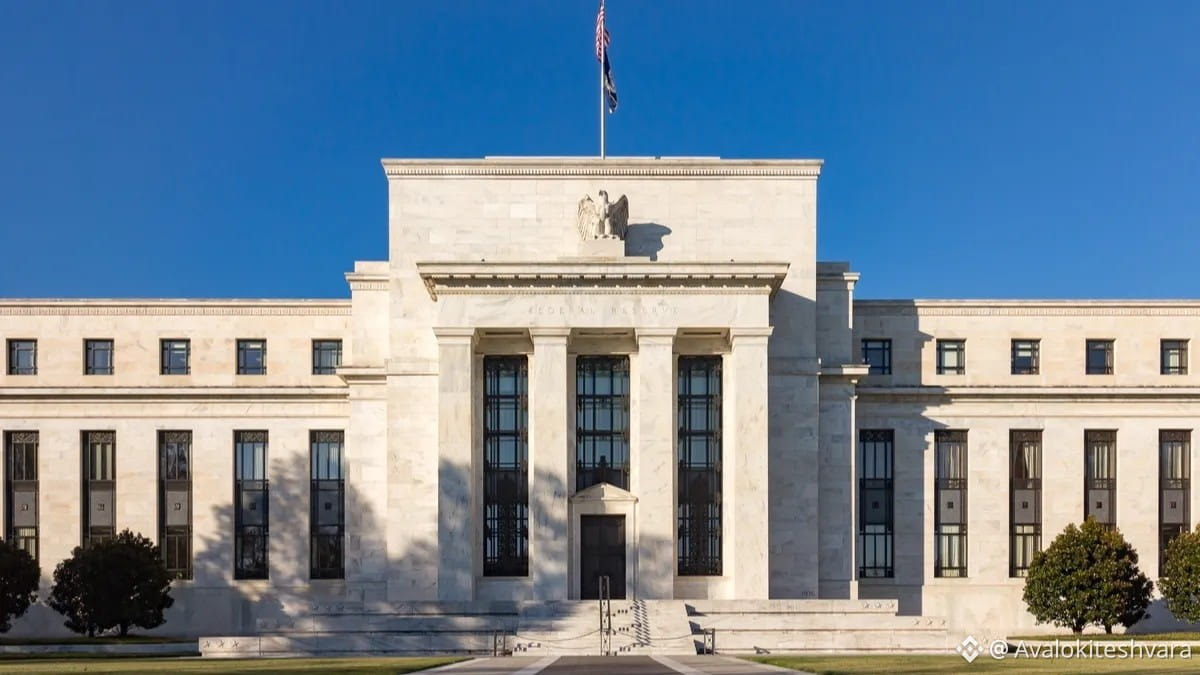
Today is macro day, and it matters for every risk asset including crypto. At 8:30 a.m. ET (20:30 WIB) the US releases October PCE inflation — the Fed's preferred inflation gauge — together with the second estimate of Q3 GDP.
The consensus: headline PCE at 3.8% year-on-year, up from 3.6% in September, and core PCE at 3.2%, up from 3.1%. Both are expected to rise 0.3% month-on-month. Q3 GDP is expected around 3.4% annualized. The Fed's Beige Book follows at 19:00 GMT.
Why traders care: this is the last major inflation reading before the Fed's 9 December meeting. Markets price roughly a 90-95% chance of a quarter-point rate increase in December. The real question is what comes after. Fed Governor Waller has said a hot print could put a half-point move on the table, while Treasury Secretary Bessent has publicly opposed that.
Three scenarios: a hot print (0.4%+ core) revives talk of more tightening into 2027 and pressures tech and crypto. An in-line 0.3% locks in the December move and shifts focus to January. A cool print could spark relief.
With Thanksgiving-week liquidity thin, the reaction could be sharp either way. Crypto rarely escapes a macro repricing — today it gets one.
#PCE #Fed #Macro #Crypto
120
See translation
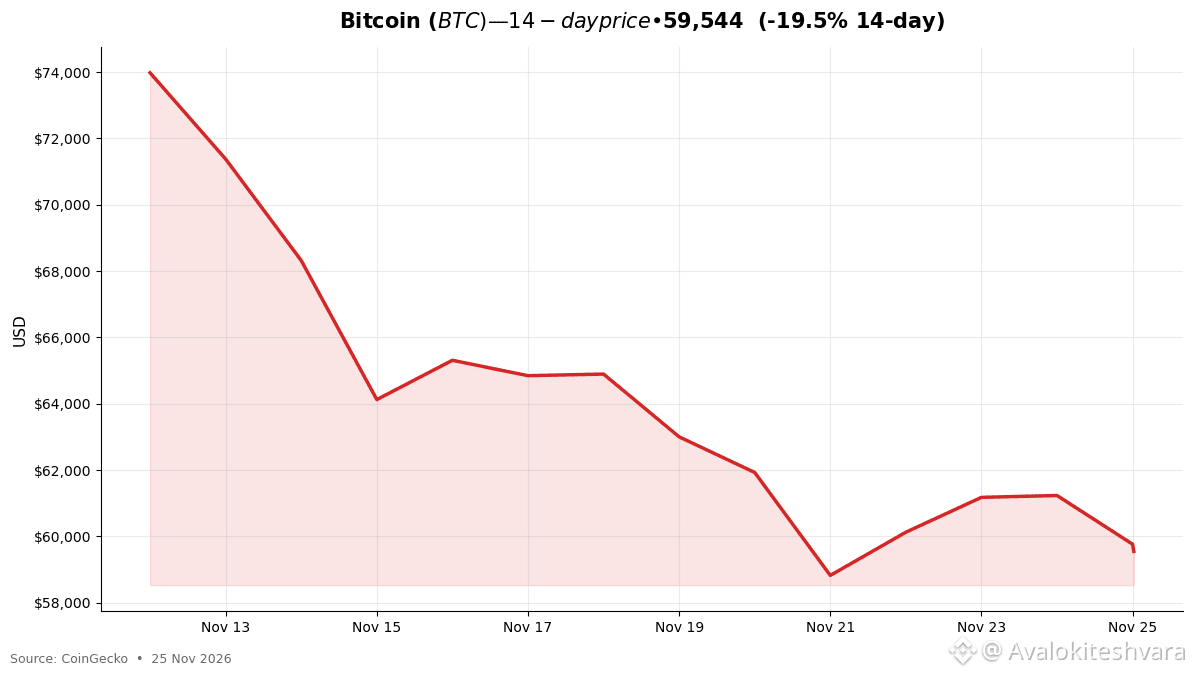
Bitcoin gave back its Monday bounce and slipped under $60,000 again. $BTC trades near $59,660, down about 2.3% in 24 hours (CoinGecko, 25 Nov ~00:25 UTC), after closing 24 Nov at $59,731. The 14-day chart tells the story: $73,974 down to $59,544, a drop of almost 20% in two weeks.
The flow picture is heavy. US spot Bitcoin ETFs lost $569.7 million on Monday, a fifth straight session of outflows, taking November redemptions to $4.71 billion — the largest monthly outflow on record. Futures traders felt it too: $844 million in liquidations over 24 hours, up 217% from the day before, according to CoinGlass.
Not everyone is selling. A whale dormant for about a year bought back 726 $BTC (around $45.8M) near $63,000 after selling 1,250 $BTC near $92,000. The Crypto Fear & Greed Index sits at 11/100 — extreme fear — and RSI is near 34, close to oversold.
Key levels: resistance at $64,600, the 23 Nov intraday high where the Nvidia-driven bounce failed. Support at $59,399 (24 Nov low), then $58,000, then the 21 Nov low of $55,122.
My take: Monday showed headlines alone cannot hold a rally. With US PCE inflation data due today, the next move likely depends on macro, not crypto-specific news. Watch whether $58,000 holds.
#Bitcoin #BTC #Crypto
2
2.7k
See translation
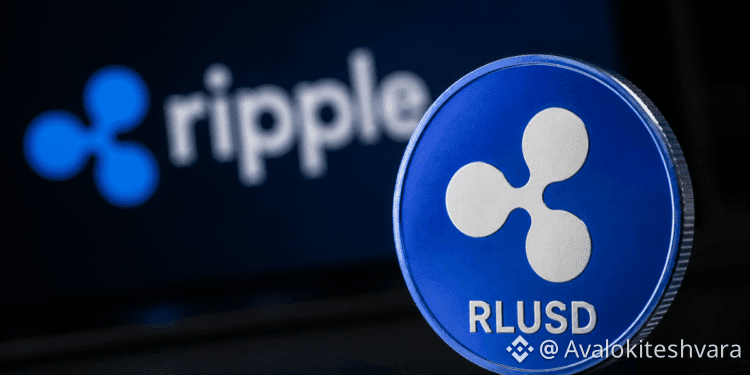
Ripple's stablecoin just passed a milestone that puts it ahead of one of the most talked-about names in the space.
$RLUSD has hit a record supply of $2.87 billion, overtaking USD1, the stablecoin associated with the Trump family, according to reports today. The milestone caps a steady climb for Ripple's dollar token since its launch, built on Ripple's payments network and its push into institutional settlement.
The stablecoin race is no longer a two-horse contest between $USDT at about $175 billion and $USDC at about $69 billion. Regulated, issuer-backed dollars are multiplying — and the competition is now about distribution: which token gets used in payments, on exchanges, and in DeFi, not just which one exists.
Ripple's advantage is its existing rails. RLUSD plugs directly into Ripple's cross-border payments business, giving it a use case from day one rather than a promise of one.
The honest read: $2.87 billion is still small next to the giants, and overtaking USD1 is a symbolic win more than a market-share one. But supply growth is the metric that matters for stablecoins, and RLUSD's curve is pointing the right way. Watch whether it keeps climbing once the headline fades.
109
See translation
One board decision just delivered the biggest single-day rally in Nvidia's modern history — and the whole market felt it.
Nvidia's board unanimously reinstated Jensen Huang as CEO and president on Monday, 23 November, eleven days after he resigned. The stock surged 31.5% in a single session — its best day since 2003 — adding roughly $952 billion in market value. The Nasdaq jumped 6.5% and the S&P 500 gained 4.7%, their best day since April 2025, while the Dow added 1,448 points.
The backdrop matters. Huang's exit on 12 November had knocked the stock down nearly 25% in a week and shaken confidence in the AI trade, with investors questioning the durability of AI infrastructure spending. The board said it was satisfied on Huang's candour and ability to lead after a series of discussions, and the founder promised staff he would be "a better CEO the second time around."
Questions remain — an independent committee investigation is ongoing, and Huang is due before Congress in early December. Analyst Dan Ives kept his $225 price target and outperform rating.
For crypto watchers, the signal is straightforward: risk appetite is back in the room. When the AI trade sneezes, Bitcoin has traded like a high-beta tech stock all month. A calmer Nasdaq may be exactly what $BTC needs to hold its own key levels.

110
Log in to explore more content
Join global crypto users on Binance Square
⚡️ Get latest and useful information about crypto.
💬 Trusted by the world’s largest crypto exchange.
👍 Discover real insights from verified creators.
Email / Phone number
Trending Topics
CorePCEBeatLiftsFedHikeOdds
76,443 views
815 Discussing
U.S. October PCE Price Index at 0.3% Month Over Month, Versus 0.30% Expected and 0.50% Prior
Binance News
·12 Likes
·26.2k views
BitcoinAndStocksSlipAgainAmidTrump’sTariffPlans
153,293 views
1,731 Discussing
JensenHuangSaysNvidiaDoesn’tNeedASuccessionPlan
76,287 views
1,036 Discussing