
币圈导航0xnav
504 Posts

币圈导航0xnav
Report
Block User
🎈币安手续费邀请码:FANXIAN,频繁交易的手续费,甚至可能超过你的本金,这是一大笔费用!
36 Following
83 Followers
108 Liked
Posts
All
Videos
·
--
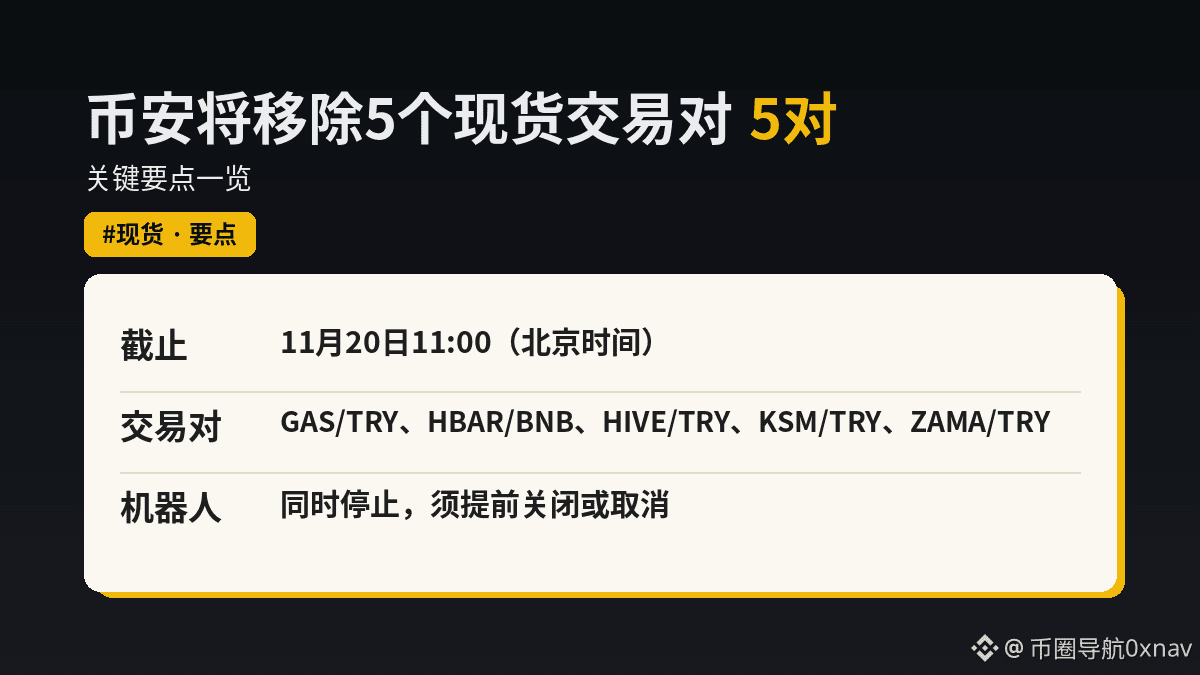
Still running spot trading bots on any of these five trading pairs? Check the deadline first.
Binance announced today that, following a recent review, it will remove some spot trading pairs and stop trading. The time specified in the announcement is November 20, 2026, at 11:00 Beijing Time (03:00 UTC).
The five trading pairs are: GAS/TRY, HBAR/BNB, HIVE/TRY, KSM/TRY, and ZAMA/TRY.
A few points that matter to everyday users 👇
🔹 The trading pairs are being delisted; these tokens are not being removed from spot trading altogether. The announcement clearly states that removing a spot trading pair will not affect the availability of the corresponding tokens on Binance Spot. The base and quote assets can still be traded through other available trading pairs on the platform. The announcement does not list which other pairs will remain open, so check the markets at the time.
🔹 TRY is the Turkish lira. Binance specifically notes that it is a fiat currency, not another cryptocurrency. Four of the five pairs are quoted in lira; only HBAR/BNB is a crypto-to-crypto pair.
🔹 Spot Trading Bots: Binance says it will remove bot services for the spot trading pairs listed above at the same time (November 20 at 11:00 Beijing Time), where applicable. It strongly recommends closing or canceling any related spot trading bots before the service ends to avoid potential losses. The announcement does not say what will happen to any unfilled open orders, so if you use these pairs, it’s best to check them yourself before the deadline.
🔹 This change follows a periodic review. Factors mentioned by Binance include poor liquidity and trading volume, but it did not publish specific data for each pair. The announcement also states that the products and services mentioned may not be available in all regions; if there are any discrepancies between the Chinese and English versions, the English original prevails.
If you have open orders or bots running on any of these five pairs, take care of them before the deadline.
Are you using spot trading bots on any of these pairs?
#币安移除部分现货交易对 #BNB #BTC
42
·
--
Don’t assume the maintenance over the past few days means this card will be back in service in a couple of days. MEXC officially announced today that its Global Card service will shut down tonight.
According to MEXC’s official announcement, due to service adjustments by a third-party card issuer, the Global Card service will end on November 18, 2026, at 23:30 Beijing time (15:30 UTC). After that, existing cards can no longer be used for transactions, and applications for new cards will also be suspended.
For the same reason, cards have been under maintenance since November 14 at 23:30 Beijing time. During this period, card payments and top-ups have been declined. Today’s announcement confirms that the service is ending—not that it will reopen once maintenance is over.
A few things that directly affect cardholders 👇
🔹 Before 23:30 tonight: If you still have a balance on your card, go to the MEXC Global Card page and select “Withdraw” to transfer it to your own fiat account. If you have subscriptions or recurring payments linked to this card, switch them to another payment method or cancel them to avoid failed payments.
🔹 Balances you don’t transfer in time: If there’s still money on your card when the service ends, MEXC says it will be transferred to your spot account. To allow pending card transactions to settle, a balance snapshot will be taken on November 21 at 23:30 Beijing time. The corresponding amount will be transferred to your spot account within three business days after the snapshot. You don’t need to do anything.
🔹 Refunds and cashback: MEXC says refunds for past card transactions will be credited to your fiat account once received. Pending cash rewards will be credited automatically as originally scheduled. Eligible fees already paid by Elite VVIP users with zero-fee benefits will be refunded to their spot accounts by December 15, 2026.
🔹 How long you can view your statements: For three months after the service ends, you can still view your transaction history, card orders, and rewards history on the Global Card page. Save anything you need to keep before then. This does not mean the exchange app’s deposit and withdrawal channels are closing—it only affects this Global Card.
If you have this card, check your balance and recurring payments before the cutoff tonight.
Do you still have a balance on your card, or is it linked to a subscription?
#MEXC全球卡今晚终止服务 #BTC #ETH
1
8
·
--
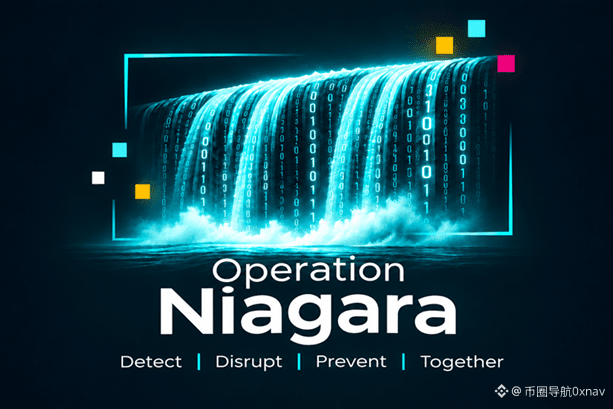
Clicking “Approve” in your wallet isn’t just logging in for a quick look. The latest joint operation by Canada and the U.S. is targeting precisely this kind of approval phishing scam.
On November 16, the Ontario Securities Commission (OSC) announced that it was coordinating and hosting “Operation Niagara,” bringing together regulators, law enforcement agencies, and several blockchain analytics firms from Canada and the United States to combat online crypto scams, identify potential victims, and offer assistance. The operation has two task forces: one in Toronto, co-hosted by the OSC and the Ontario Provincial Police, and one in Washington, hosted by the U.S. Secret Service. The Royal Canadian Mounted Police, securities regulators in Alberta, British Columbia, Quebec, and other regions, as well as several police forces, are also taking part.
The official focus is “approval phishing,” also known as consent phishing. Unlike traditional account theft, scammers don’t necessarily need your password or recovery phrase. Instead, they trick you into signing a token approval or off-chain permission on a fake website, app, or message. These pages often pose as a way to claim an airdrop or tokens, mint an NFT, or “verify” or “sync” your wallet. Once you’ve signed, the other party can often transfer the approved tokens without any further action from you—sometimes within minutes. Once the funds are transferred, the transaction usually can’t be reversed, and recovering the money is difficult.
Compared with previous exercises, this operation also covers a wider range of phishing tactics, including cases where permissions have already been fraudulently obtained but assets haven’t yet been transferred, giving authorities a chance to intervene before losses occur. Officials say the operation will use detection methods developed internally by the OSC and the Ontario Provincial Police over the past two years, and test them in real-world conditions. This is a key focus of the week—not a change to any exchange app’s deposit, withdrawal, or fee rules. Ordinary users’ on- and off-ramps on platforms are not being switched on or off because of this operation. So far, officials haven’t disclosed how much money the operation has frozen or how many cases it has handled.
A few points that matter to everyday users 👇
🔹 Don’t click “unlimited approval” in a wallet pop-up you can’t clearly understand—and don’t rush to sign just because of claims like “limited-time airdrop” or “your wallet is at risk, verify it now.”
🔹 If you’ve already approved something you don’t recognize, revoke the approval as soon as possible using an approval-checking tool for the relevant blockchain. You may need to pay a small network fee.
🔹 If you suspect you’ve been scammed: stop communicating with the other party immediately, change your passwords and enable two-factor authentication, check your wallet and account transaction history, and notify your bank if necessary. Canadian residents can submit a report through the official Operation Niagara victim-reporting channel. People elsewhere can report it to local police and the U.S. IC3.
🔹 Officials warn that anyone claiming they can recover your stolen crypto for a fee may themselves be running a scam. These so-called “recovery services” are often fraudulent.
🔹 If someone claiming to be with Operation Niagara calls or emails you, verify their identity by contacting the OSC’s official inquiry line at 1-877-785-1555. Don’t share your wallet details or verification codes before confirming who they are.
Have you recently come across a link saying you need to “approve” something before you can claim an airdrop?
#加美联合打击授权钓鱼诈骗 #ETH #BTC
3
3
1k
·
--
Is there a separate, more relaxed set of rules for DLT clearing houses? The Bank of England has made its position clear: there is no separate track.
On November 16, the Bank of England published its final policy statement and policy note, explaining how it will use its “requirements power” and “permission power” to help new central counterparties (CCPs, or clearing houses) enter the “mobilisation period” after recognition. These are entry arrangements for the wholesale clearing layer, not rules for retail apps, and they will not determine whether you can deposit or withdraw a particular coin on an exchange.
A few points that may matter to ordinary users👇
🔹 Who can use this route: It is only for new clearing houses seeking recognition from the Bank of England, and applies at the Bank’s discretion after recognition. Existing clearing houses that are already licensed and want to launch new products cannot use the mobilisation period; they can still apply for permission or an exemption under the usual rules.
🔹 What can be done during the mobilisation period: Live testing can take place subject to minimum business limits set on a case-by-case basis, with regulatory requirements proportionate to the scale of activity. Limits may cover the scope and scale of clearing, the number of members, or loss and risk metrics such as initial margin or notional principal. There is no standard quantitative threshold. The Bank makes clear that this is limited testing, not activity at the scale of day-to-day operations or expansion. The period will usually last no more than around 12 months, and may be shorter. Before it ends, any rules that were temporarily modified or waived must be brought into compliance. The Bank will then review the clearing house; only after that might the limits be lifted and the clearing house move into expansion or day-to-day operations.
🔹 Whether DLT clearing is treated differently, and the scope of exemptions: Some respondents to the consultation asked for a separate set of supervisory expectations for “native DLT clearing houses.” The Bank made clear that the mobilisation framework applies to all new clearing houses, is technology-neutral, and focuses on whether supervisory outcomes are met; it does not create DLT-specific requirements. In principle, any rule in the rulebook may be subject to an application for temporary modification or waiver, but the highest-level “Fundamental Rules” cannot be waived. And do not confuse this with the Digital Securities Sandbox (DSS)—the Bank states that clearing houses cannot enter the DSS.
🔹 When it takes effect, and what happens in the event of a breach: This policy note is to take effect alongside the Bank’s final CCP rules, and the UK Treasury must also use a statutory instrument to apply the permission power to the Bank’s rules. The legislation is expected to take effect by the end of the first quarter of 2027. Until it does, applications will continue under UK EMIR, and applicants may seek mobilisation under the existing entry arrangements; the new rules-based permission arrangements will only be available once the new framework is in place. If a limit or permission is breached, the clearing house must first notify the Bank. The Bank will initially engage with it and may, depending on the circumstances, vary requirements, require disclosure to clearing members, revoke temporary permissions, or even exercise its direction power or revoke the recognition order. The Bank will publish the mobilisation status of new clearing houses on its website and will generally also require them to explain their limits and permissions to clearing members and, where practicable, to clients.
The consultation ran from March 4 to June 4, 2026, and received three responses. It is a separate document from the October 29 consultation on whether tokenised collateral can be accepted by clearing houses. For ordinary users, it will not change the withdrawal button in your wallet or on your exchange in the short term. What is worth watching is whether new institutions that want to use DLT for clearing can later conduct live tests at very small scale under the same outcome-based standards.
Are you more interested in whether new clearing houses can start with small-scale live testing, or more concerned about whether DLT will be given its own, more relaxed standards?
#英国央行推出覆盖DLT公司的清算所监管路径 #BTC #ETH
198
·
--
Does buying a brand-new hardware wallet from an authorized retailer guarantee it hasn’t been tampered with?
There have been two more reports in recent days related to Dubai, both pointing to Virgin Megastore, Ledger’s authorized retailer in the UAE.
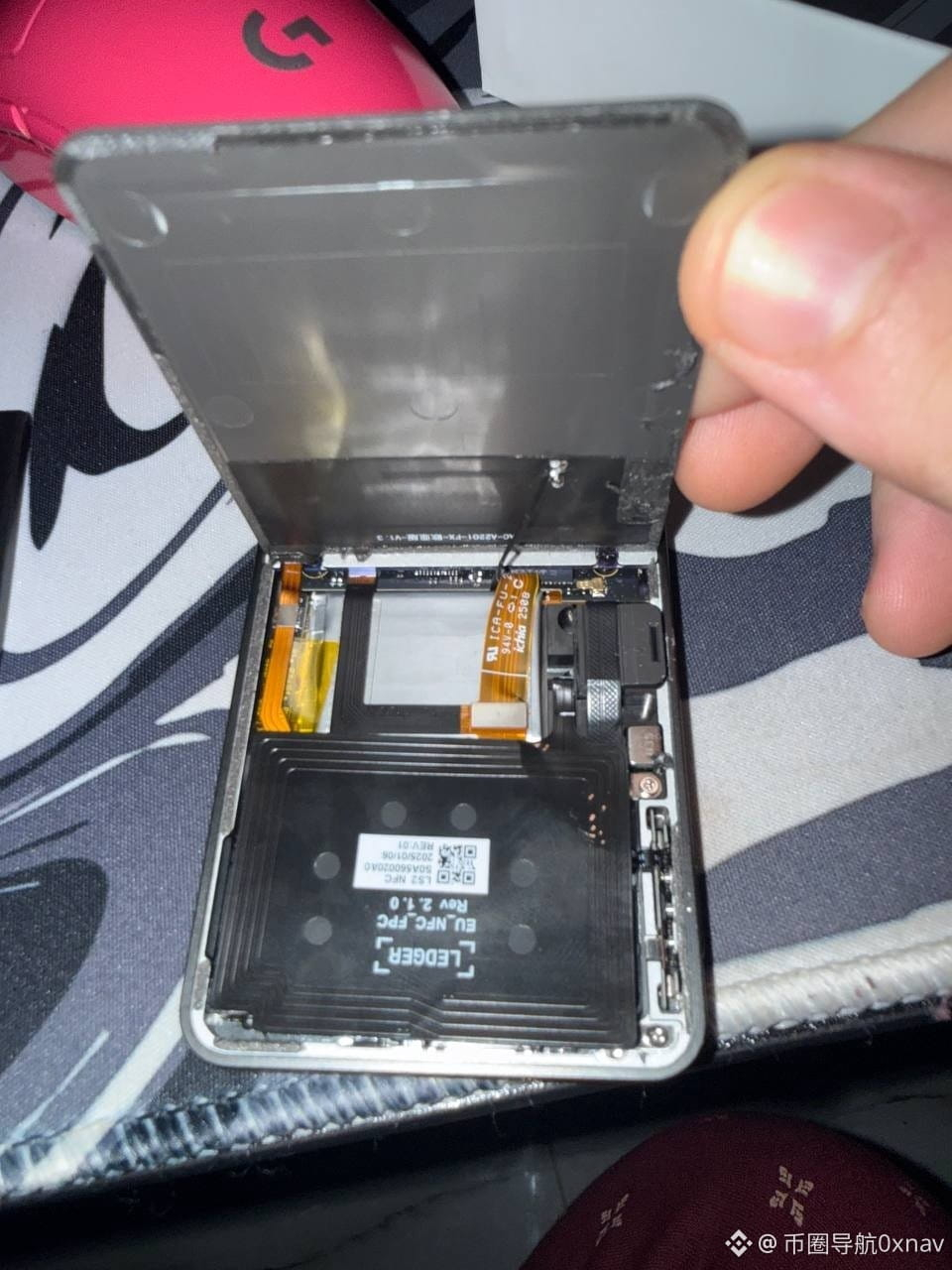
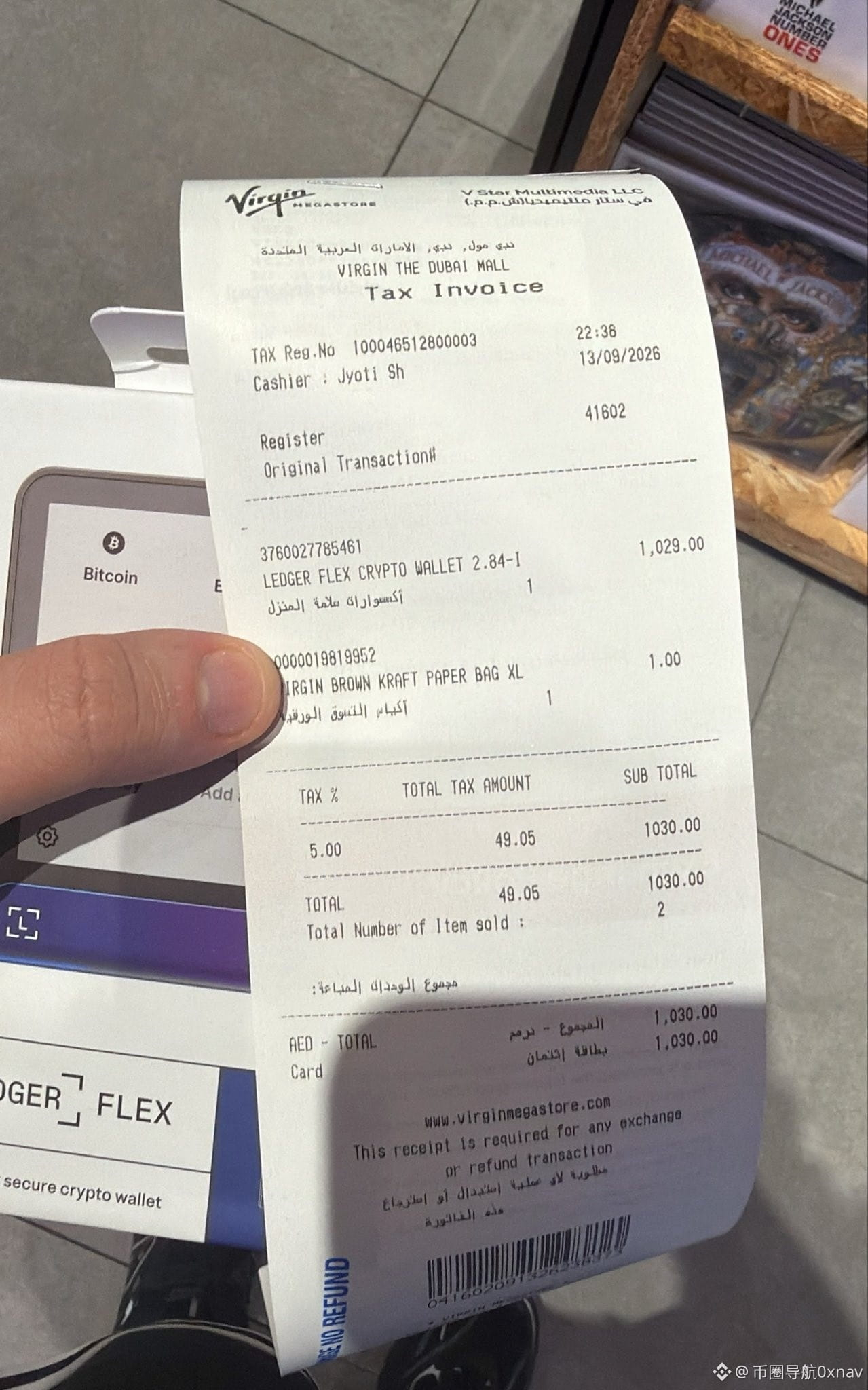
First, the one that has been opened and whose details match the photos. The owner says about 1,300 SOL were transferred out of their Ledger Flex. On-chain records show that at 20:15:46 UTC on November 14, 2026 (4:15:46 a.m. Beijing time on November 15), a transfer of about 1,299.9978 SOL went from address 6pgKE8… to CpWsGt…. On November 16, the owner opened up the device: publicly shared photos show an antenna attached to the inside of the back cover, with a wire running to an extra circuit board next to the hinge. The antenna is marked V1.3 (AC-A2201-FX; the text in the middle appears to say “Eurasian version”). A public hardware implant registry lists it as a “confirmed implant” and notes that this is the first implanted device from the Middle East in its records. A receipt later shared by the owner shows that the Ledger Flex was bought at Virgin The Dubai Mall on September 13, 2026, for a total of 1,030 dirhams including tax.
Another user says they bought a brand-new Ledger Stax at the same store in Dubai on October 11, and that 507,000 USDT was transferred out on November 14. This device is still listed as “suspected, not yet confirmed as implanted,” and the publicly available materials have not been independently verified.
A few points that matter directly to ordinary users👇
🔹 A device bought from an authorized retailer may still have been modified after leaving the factory. The registry lists this Dubai Flex as the first recorded implanted device in the Middle East.
🔹 Separate what has been confirmed from what hasn’t. The photos of the opened Flex match the registry’s findings; the Stax has not yet been opened and confirmed. Publicly available materials also do not yet show a complete forensic investigation linking the transfer to the implanted board.
🔹 Ledger does not currently appear to have published a specific statement about these two Dubai cases. Some media outlets have reported that they contacted Ledger and Virgin Megastore for comment. In an earlier response dated October 15, concerning distribution channels in Southeast Asia, the company said that its chips, operating system, and servers had not been compromised; rather, genuine devices had been modified after leaving the company, during distribution, to capture recovery phrases during setup. It also told authorized retailers not to resell returned devices as new and advised against leaving devices on shelves for extended periods. That statement predates these two cases and should not be treated as an assessment of either device.
🔹 When you buy a device, first check the packaging and body for signs of tampering, and inspect it before setup. Authenticity checks mainly confirm that the secure element is present; they do not necessarily reveal whether an extra antenna or circuit board has been added inside the back cover. If you have already set up a device obtained through a suspicious channel, assume as a worst-case scenario that your recovery phrase may have been copied. If you switch to a new device, do not reuse the same phrase.
Whenever possible, buy through the manufacturer’s official channels. Even when buying from an authorized store, keep your receipt and inspect the device before setting it up. If you already use a device with a clear source and no signs of anything unusual, there’s no need to panic and reset it—but don’t assume that “bought from an authorized store” means it’s absolutely safe.
When buying a hardware wallet in the future, are you more concerned about knowing which stores to trust, or about how to check one you’ve already bought?
#Ledger硬件植入报告延伸至迪拜 #BTC #SOL
233
·
--
Let's be clear about the scope first: this does not mean a USDC deposit and withdrawal button has been added to DBS's retail app for everyday users to tap.
On November 18, DBS Bank and Circle issued official announcements in Singapore. Eligible institutional clients can mint and redeem USDC directly through DBS. These transactions between US dollars and USDC through DBS support near-instant, 24/7 settlement, without being constrained by bank opening hours or cut-off times, and without having to rely solely on secondary-market trading to source liquidity. The stated uses are treasury, settlement, and liquidity management. USDC continues to be issued by a regulated affiliate of Circle.
A few points that are directly relevant to everyday users👇
🔹 Who can redeem: The official announcement says “eligible institutional clients,” and minting and redemption are handled through DBS. This is a primary on-and-off ramp on the banking side, not a way for individuals to place orders for USDC on an exchange.
🔹 What it costs and what the requirements are: The announcement did not disclose fees, account-opening or eligibility requirements, or the specific Asian markets covered. Nor did it give a separate launch date. So “partnership announced” should not be taken to mean that “all institutions can now redeem with a single click on the page.”
🔹 Where it can't be used: This is not a retail feature for individual customers. This announcement will not add a direct USDC minting or redemption option to the DBS app or to ordinary savings or investment accounts. Holding USDC on an exchange or in a wallet also does not mean you can use this banking channel.
🔹 A bit of background: The two parties also said the partnership builds on their participation in Project BLOOM, led by the Monetary Authority of Singapore. That is an industry initiative, not a newly opened retail redemption window.
Practical advice: If you manage institutional funds, check with your bank and relationship team first to confirm whether you qualify, how fees are calculated, and how to open an account. Don't rely on the news headline alone. If you're an everyday user, the most practical takeaway for now is that the banking channel for institutions to move in and out of USDC is becoming clearer—not that the rules for individuals withdrawing or exchanging it have changed.
Are you more interested in whether institutions will find it easier to convert US dollars into USDC, or in when everyday users might also be able to use a banking channel?
#星展银行与Circle扩大亚洲机构USDC准入 #USDC #BTC
146
·
--
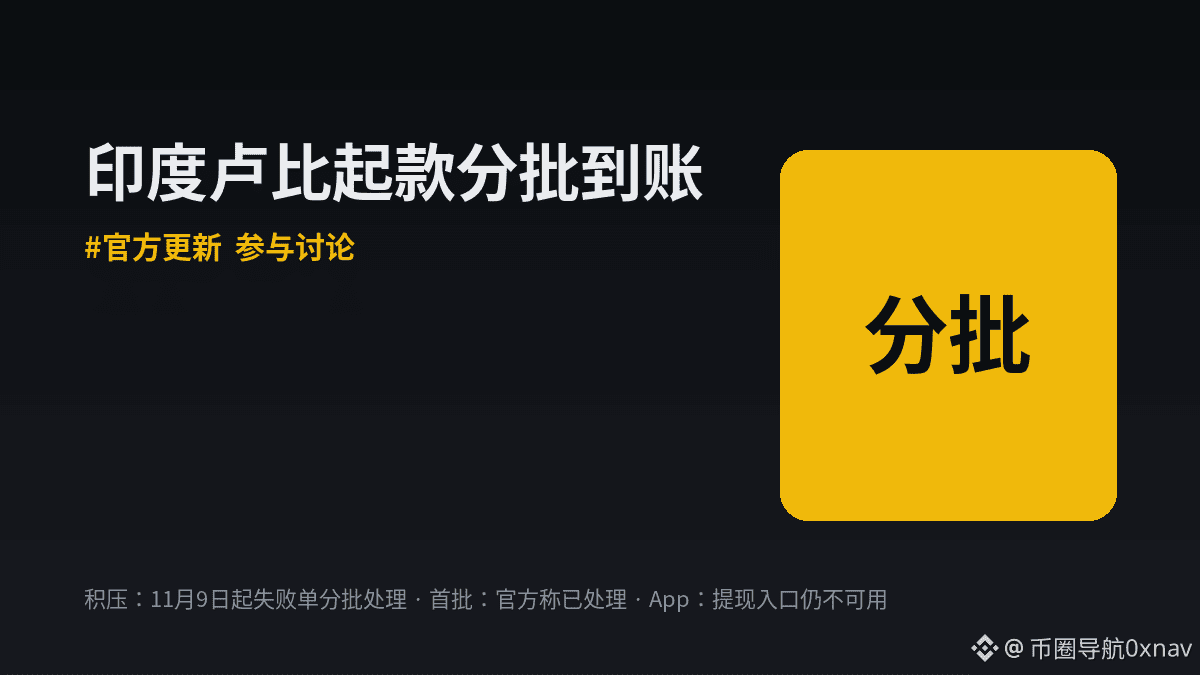
If you want to transfer Indian rupees from Coinbase to your bank account, don’t just check whether the withdrawal button in the app is active.
On November 17 (early morning on the 18th Beijing time), Coinbase India’s official account posted an update: INR withdrawals had been unavailable over the past week because of an outage at a banking partner. The issue affected payments for all customers of that bank, not just Coinbase users. The company said users’ funds were safe throughout.
A few points that directly affect users 👇
🔹 INR withdrawals that failed from November 9 onward are being processed in batches through a backup banking channel. The company said the first batch had been processed, and at the time expected affected users to receive their money within a few hours. The remaining batches will follow. If your withdrawal is in this batch, you don’t need to submit it again; you’ll receive a push notification and email confirmation once it’s sent.
🔹 The withdrawal option in the app is still unavailable. The banking partner is still working to resolve the outage, and the company hasn’t said when the option will be restored.
🔹 If you need to make a new INR withdrawal now, the company’s advice is to contact Coinbase Support and provide the amount you want to withdraw. The money will be deposited into your linked bank account within 48 to 72 hours.
🔹 An official update on November 14 also said that INR deposits (including UPI) and linking bank accounts were still working normally at the time. The latest update doesn’t change that, and doesn’t name the bank involved. The company said it will strengthen its banking arrangements in India and share more details later.
Practical advice: If you’ve already submitted a withdrawal that has been stuck in a failed state, check your email and push notifications to see whether it has been sent. Don’t assume that “processing in batches has begun” means you can now withdraw normally in the app. If you urgently need to make a new withdrawal, use the official Support channel and make sure the linked bank account is yours.
Which matters more to you: when the pending withdrawal will arrive in your account, or when the withdrawal button in the app will become available again?
#Coinbase印度开始分批处理卢比起款 #BTC #ETH
91
·
--
In the future, when you send money to a contact through a payment app commonly used in Korea, it might not be Korean won—it could be Ethereum or a dollar stablecoin. But don’t mistake this for “another kind of deposit in a bank account.”
On November 16, Viva Republica, the company behind Toss, announced that it would launch a non-custodial digital asset wallet called “Toss Coin Wallet” (토스 코인지갑) in the app this week. According to the company, Toss users won’t need to apply separately or meet any eligibility requirements; they can create a wallet in the “Assets” section on the home screen.
A few things that matter to everyday users 👇
🔹 What you can do: Receive assets transferred from an external exchange or another wallet, and send them to external wallets. You can view your holdings, balances, and transaction history in the Toss app. Toss users can also send money to each other through their contacts, without entering a long wallet address.
🔹 Only three assets are supported at first, and all are on Ethereum: ETH, USDT, and USDC. The company says these were selected based on global trading volume and usefulness, and that it will gradually add more assets and networks once the service is stable. For now, don’t assume you can transfer just any coin through the app.
🔹 Fees and protections are separate issues: Toss won’t charge an additional transfer fee, but transfers on the Ethereum network require Gas fees. USDT and USDC transfers also require ETH to pay those fees. According to the in-app FAQ, these digital assets are not covered by deposit insurance. The FAQ also says Toss securely protects users’ private keys; even if you lose your phone, you can use your existing wallet and assets after reinstalling the Toss app on a new phone. This isn’t quite the same as the familiar model where “the recovery phrase is only in your hands, and if you lose it, it’s gone,” so don’t assume that users have complete control of their keys themselves.
🔹 There are restrictions on transfers from Korean exchanges, too: According to reports, Bithumb users must pre-register their Toss wallet address and get it approved. For now, they can only transfer digital assets worth less than 1 million won; transfers of 1 million won or more aren’t supported through this route. Coinone users must also pre-register their address and get approval before transferring.
This isn’t an exchange, and it doesn’t mean Toss has already obtained a Virtual Asset Service Provider (VASP) license. Reports say Toss is preparing to apply for one so it can support stablecoin payments at its own payment terminals in the future. That’s a planned next step—not a license that has already been granted, and certainly not a sign that you can already pay with stablecoins in stores.
So, more accurately, this is a wallet launching in a commonly used financial app this week, with a limited range of send-and-receive functions. It’s not a new bank deposit, and it’s not yet a tool for accepting stablecoin payments.
Which matters more to you: “being able to send money to a contact in an app you already use,” or “no deposit insurance, and having to pay the Gas fees yourself”?
#韩国Toss本周推出非托管钱包 #ETH #BTC

18
·
--
A license being approved does not mean the trading platform is already live. The U.S. Commodity Futures Trading Commission has just granted Backpack the two credentials it needs to offer derivatives trading and clearing in the United States.
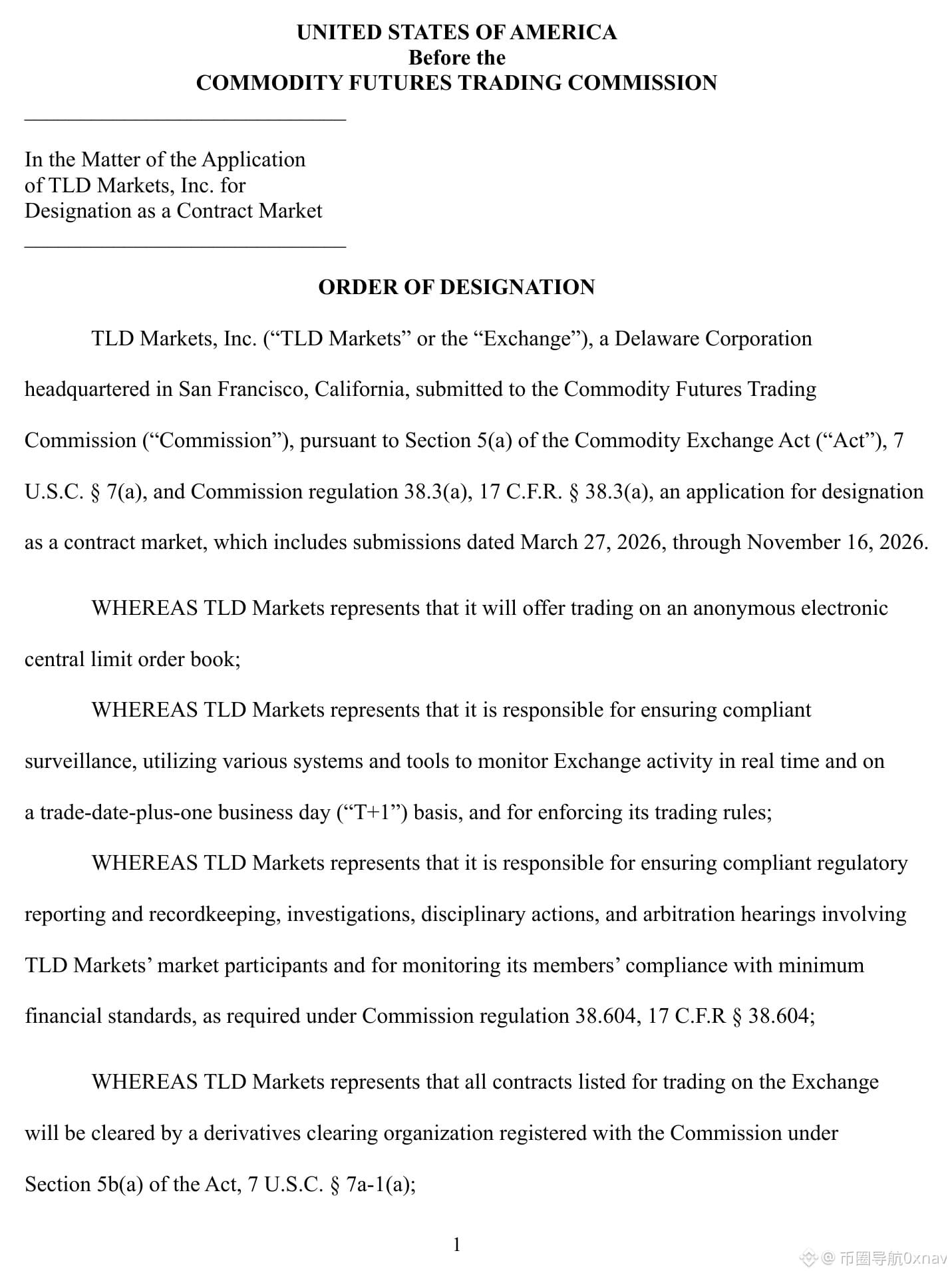
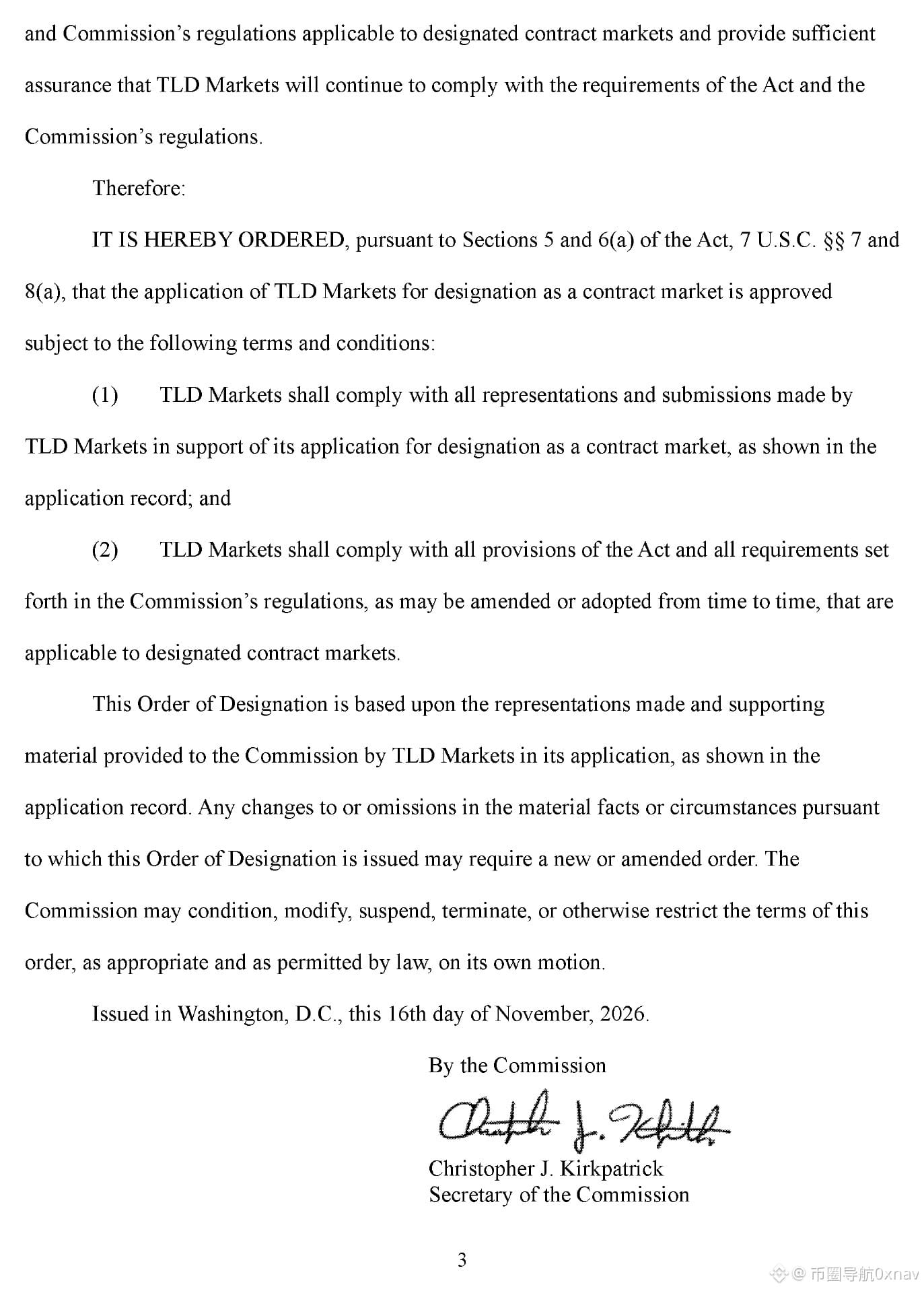
On November 16, U.S. time, the CFTC issued an order in Washington designating TLD Markets, Inc. as a designated contract market (DCM). The order was signed by Commission Secretary Christopher J. Kirkpatrick. The public filing page (Docket No. 60617) lists its status as Designated and the date as 2026-11-16. The application materials were submitted between March 27 and November 16, 2026.
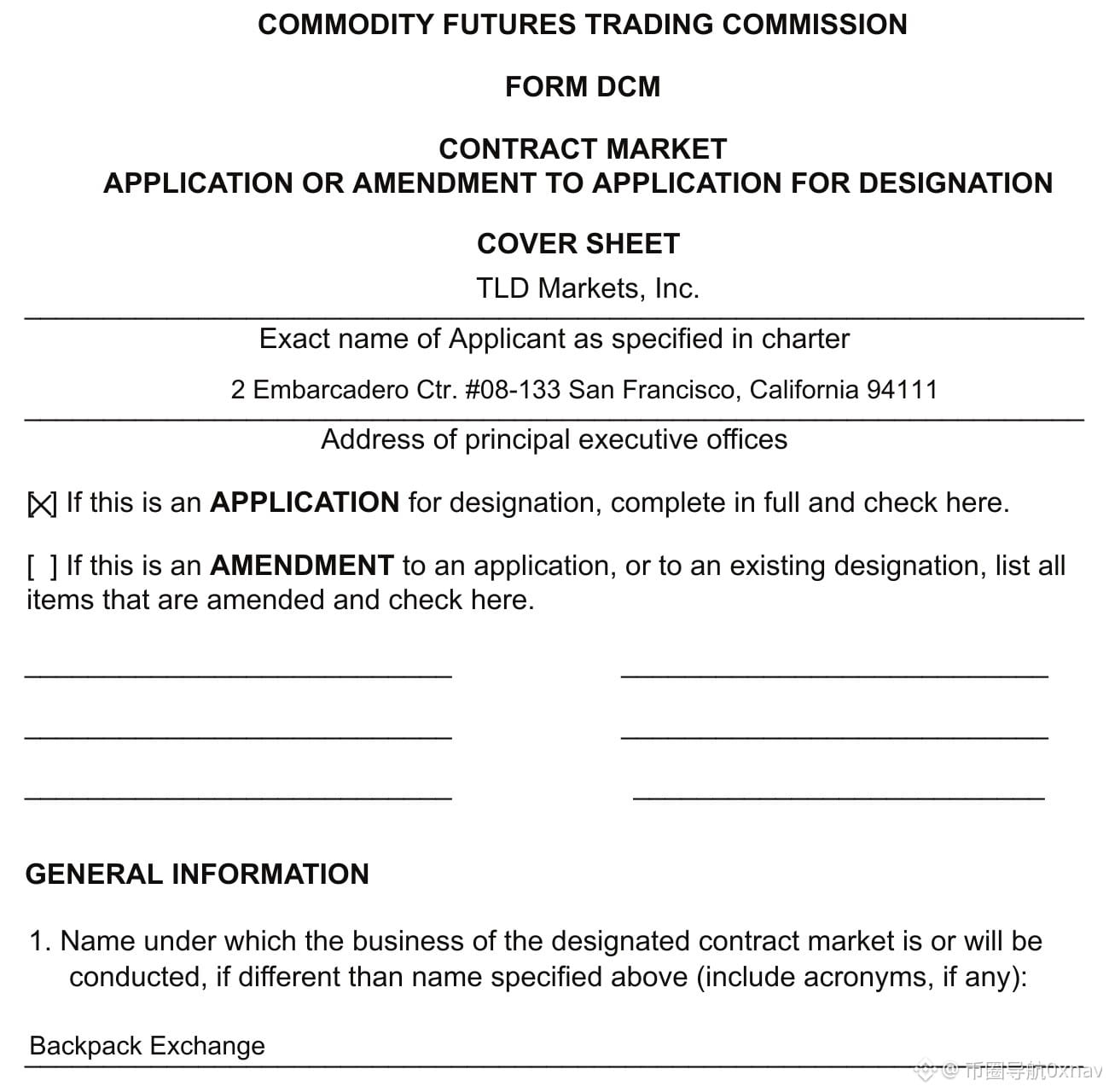
The designation order names TLD Markets, not Backpack. But the Form DCM cover page in the same public filing states that the designated contract market operates under the name Backpack Exchange and is located at 2 Embarcadero Ctr. in San Francisco.
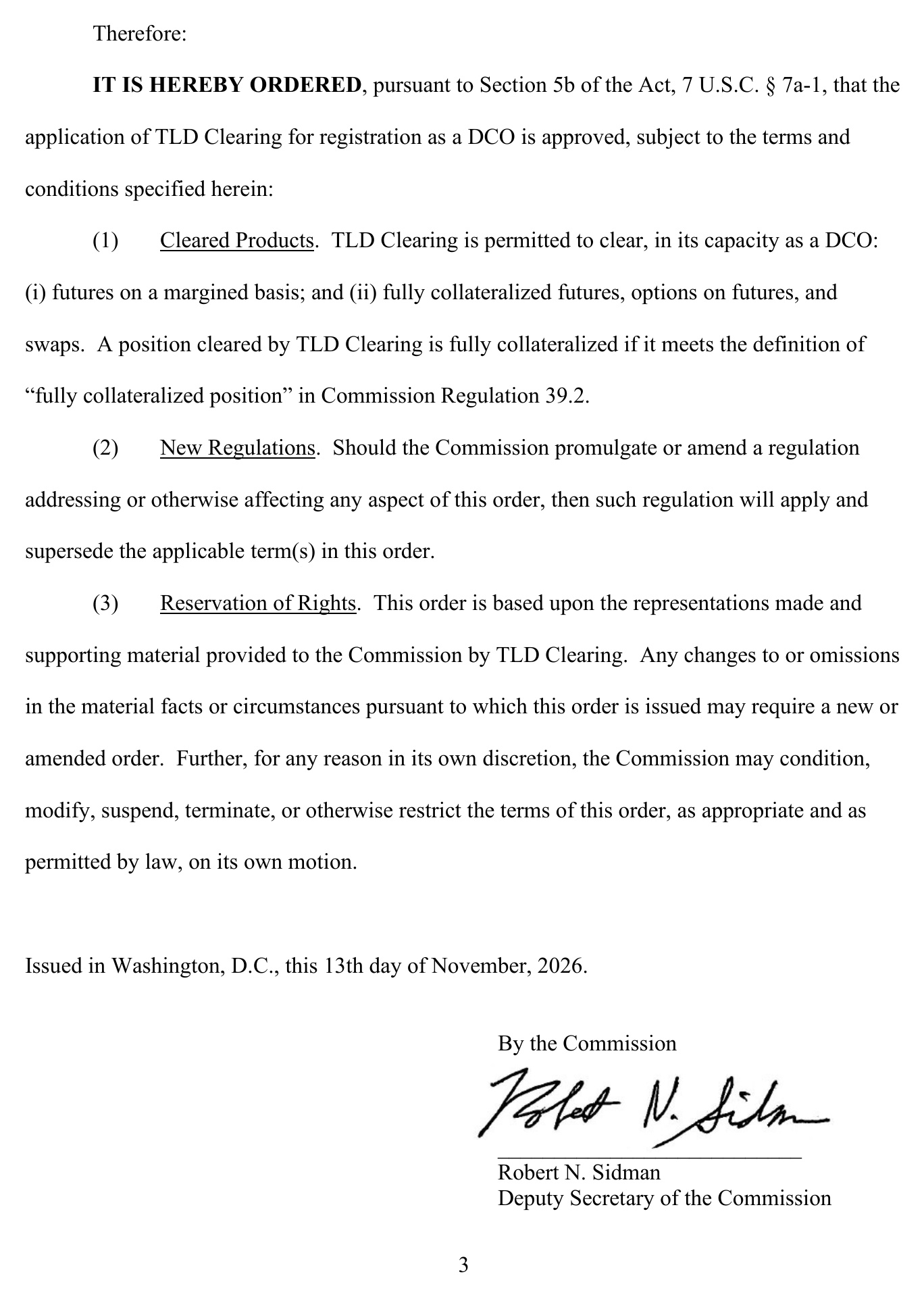
Three days earlier, on November 13, the CFTC issued a separate registration order approving TLD Clearing, Inc. (doing business as Backpack Clearing) as a derivatives clearing organization (DCO). It was signed by Deputy Secretary Robert N. Sidman. The designation order requires contracts listed by the exchange to be cleared by a registered clearing organization. The trading venue and clearing operation are two affiliated companies with separate licenses.
A few points that matter directly to ordinary users👇
🔹 What exists now is a license, not a live trading platform. The designation order approves the company to “become a designated contract market”; it does not list any contracts or give a launch date.
🔹 The registration order specifies the scope of clearing: (i) margined futures and (ii) fully collateralized futures, options on futures, and swaps. The company’s press release says U.S. users will be able to trade leveraged crypto perpetuals, use fiat or crypto assets as collateral, cross-margin, and trade around the clock. That is the company’s own description; the designation order itself does not spell out these products individually. The company’s official account was also recruiting people for a waitlist that same day, so this should not be taken to mean orders can already be placed.
🔹 That same day, CFTC Chair Michael S. Selig issued a statement saying the Commission had approved a DCM designation and DCO registration for an entity that uses blockchain architecture to execute and settle derivatives contracts. The statement did not name the company; based on the public filings released that day, the entity designated on November 16 was TLD Markets. He emphasized that entities using new technology must still meet the same standards as traditional markets, including requirements for anti-money laundering, customer protection and asset segregation, market surveillance, financial resources, and risk management.
🔹 Don’t confuse this with another company: the designation date for the exchange entity under tZERO was November 10, earlier than this one. It should not be treated as the same approval.
🔹 What this could mean for users: people in the United States who want to trade crypto perpetuals in the future may have another onshore option regulated by the CFTC, rather than having to use only offshore platforms. But these are still leveraged products, which magnify both gains and losses. A license does not mean low risk, and it certainly does not mean you can open a position in your usual app today.
Practical advice: first check that the entity is TLD Markets / Backpack Exchange, then wait for an official listing announcement and review the contract list, margin requirements, and liquidation rules. Don’t treat “approved” as a signal to deposit funds and copy trades.
Would you wait until a U.S.-licensed exchange actually lists crypto perpetuals before trying them, or stick with the platforms you already know? Share your thoughts in the comments👇
#CFTC批准Backpack衍生品交易所 #BTC #ETH
107
·
--
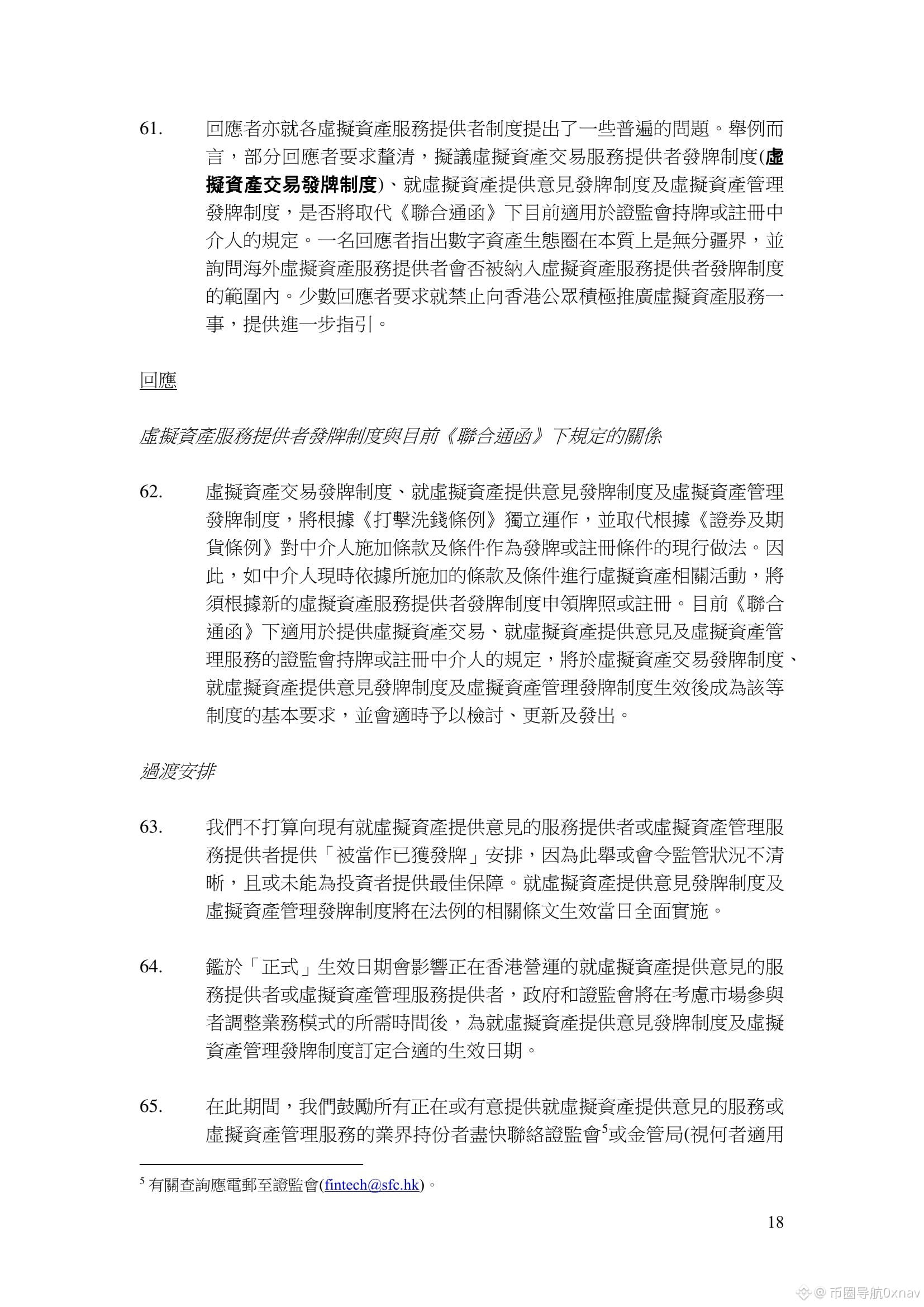
The trending headline says “intends to submit by year-end.” First, be clear about those two words: “intends” and “submit”—not that it has already been introduced to the Legislative Council, much less passed and become law.
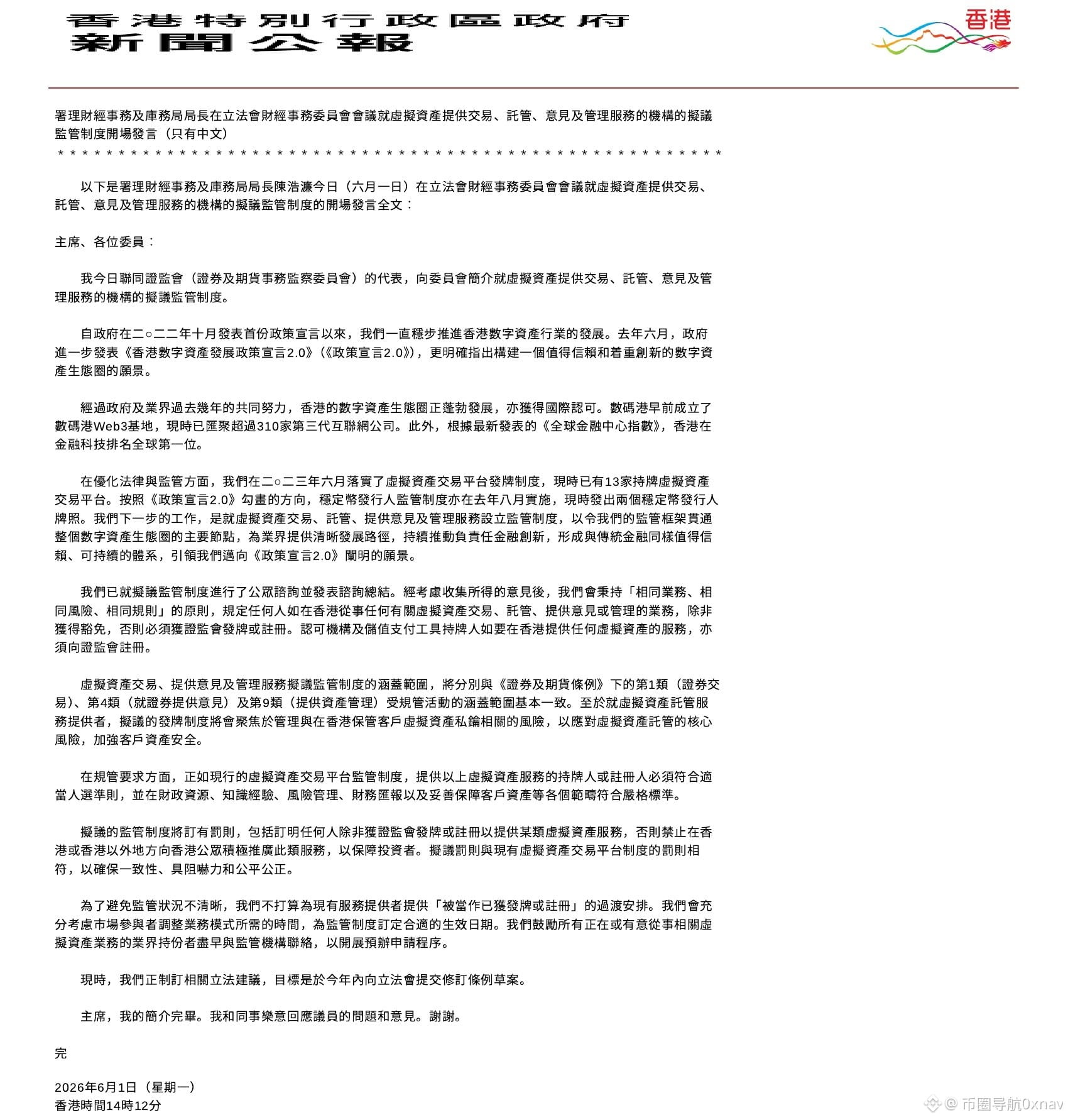
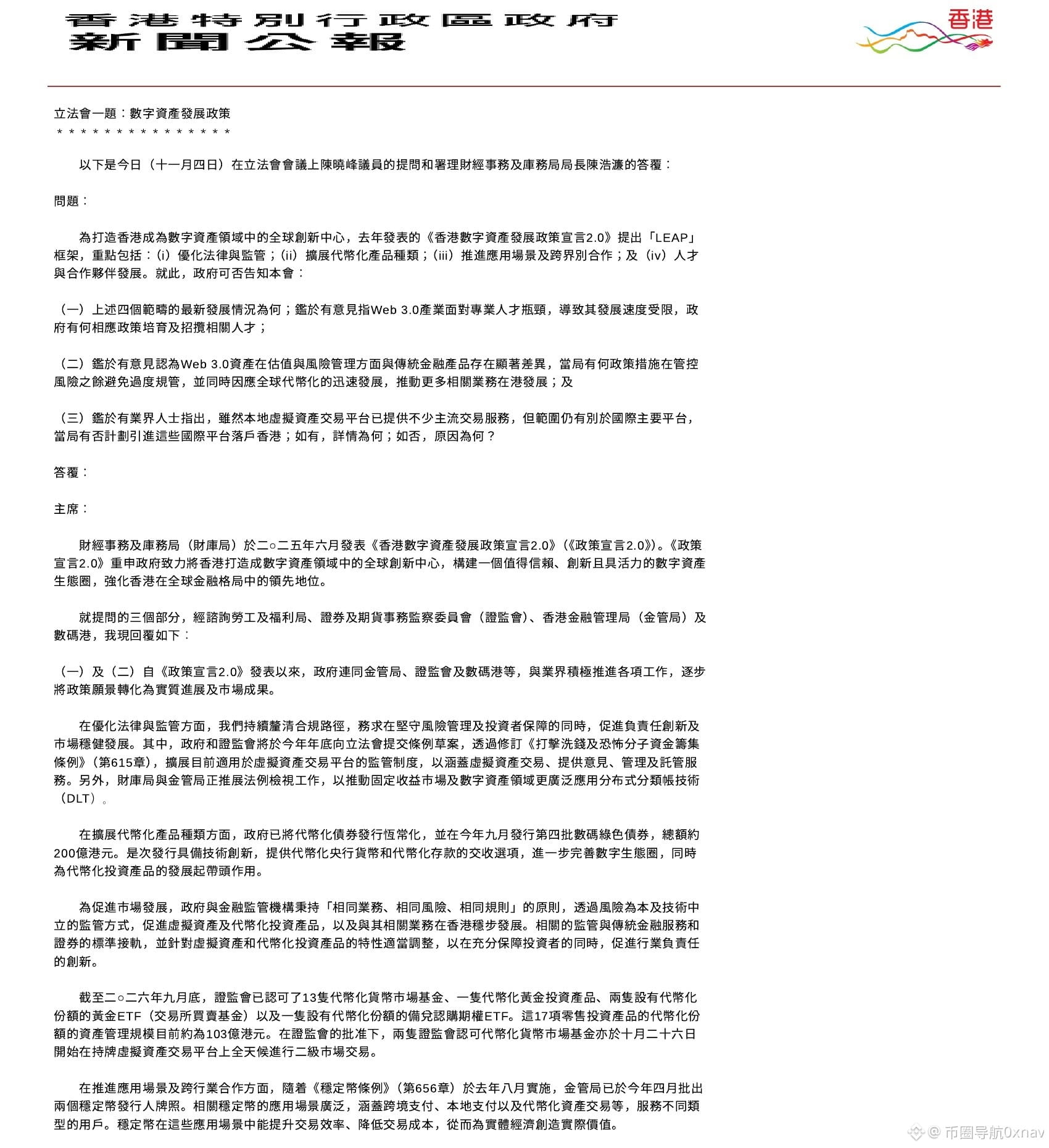
On November 16, Hong Kong Financial Secretary Paul Chan said at the Bloomberg Global Regulatory Forum held in Hong Kong that a bill would be submitted before the end of this year to complete the regulatory framework and extend licensing to institutions engaged in virtual asset dealing, advising, management and custody. The government’s press release published the full speech at 15:25 that day. The same point had already been made in the Legislative Council on November 4 by Joseph Chan, Acting Secretary for Financial Services and the Treasury: the government and the Securities and Futures Commission would submit a bill to the Legislative Council before the end of this year to amend the Anti-Money Laundering and Counter-Terrorist Financing Ordinance (Cap. 615), extending the regulatory regime currently applicable to virtual asset trading platforms to virtual asset dealing, advising, management and custody services. Today, the Financial Secretary reaffirmed that timetable.
For people in Hong Kong using related services, the key for now is to distinguish between what is already in operation and what is still going through the legislative process:
🔹 Already in place: The licensing regime for virtual asset trading platforms took effect in June 2023. The Stablecoins Ordinance (Cap. 656) took effect on August 1, 2025, and the HKMA issued two issuer licences in April this year. Paul Chan said today that both issuers have launched Hong Kong dollar stablecoins, and that 36 applications were received in the first round. He said the value of tokenized funds available to the public had grown about sevenfold over the past year. An official response on November 4 stated that two SFC-authorized tokenized money market funds had begun round-the-clock secondary-market trading on licensed platforms from October 26.
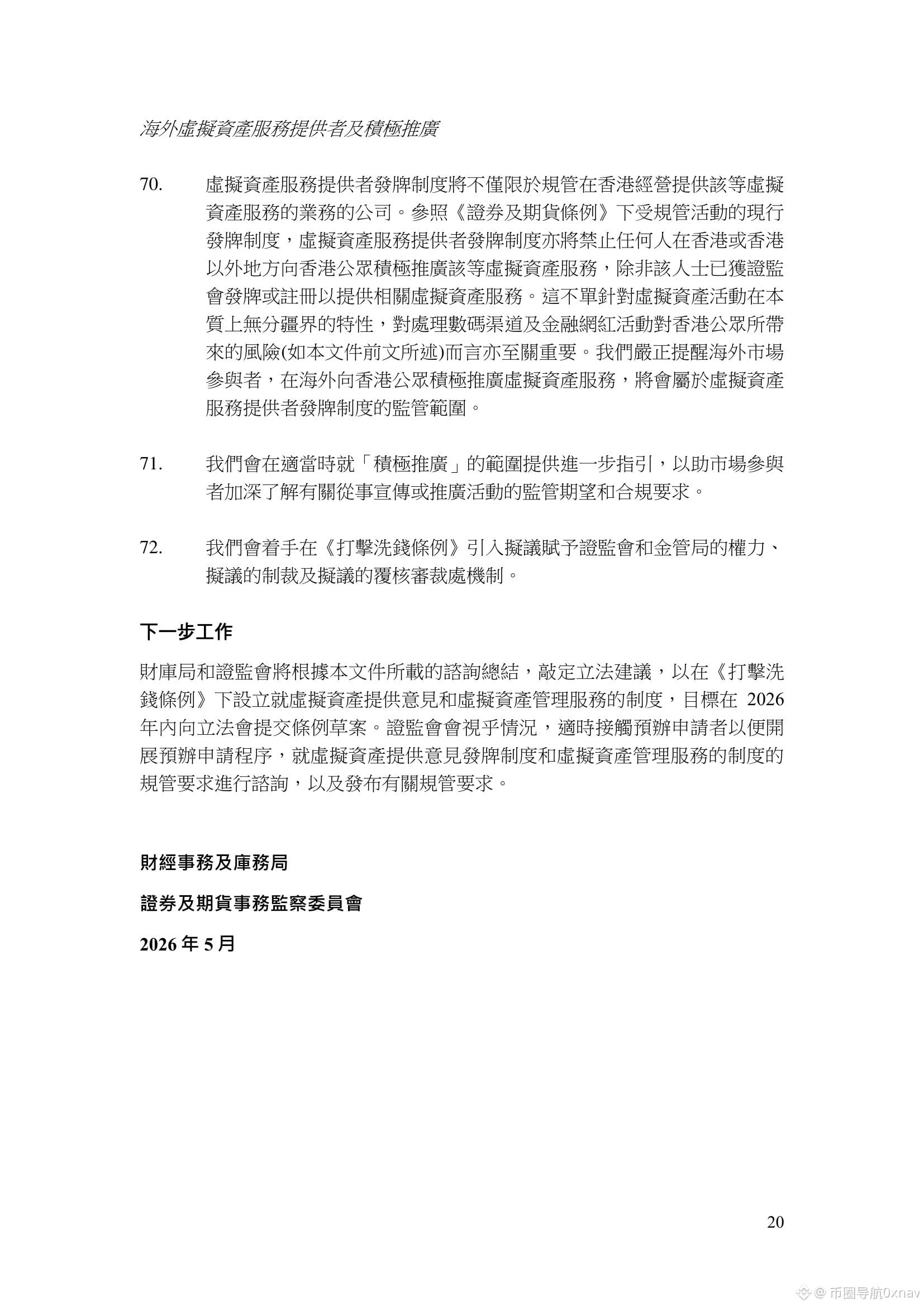
🔹 Not yet law: Under the proposals, dealing, advising, management and custody would require a licence from or registration with the SFC. Dealing would correspond to Type 1 regulated activity under the Securities and Futures Ordinance (dealing in securities), advising to Type 4, and management to Type 9. Custody would focus on the risks associated with safeguarding clients’ virtual asset private keys in Hong Kong. Unless exempt, anyone carrying on these four types of business in Hong Kong would have to be licensed by or registered with the SFC. Authorized institutions and licensees of stored value facilities would also have to register with the SFC if they wish to provide virtual asset services in Hong Kong. Anyone not licensed or registered would be prohibited from actively marketing these services to the Hong Kong public, whether in or outside Hong Kong.
🔹 No automatic transition to a licence: The authorities have stated that they do not intend to provide existing service providers with a transitional arrangement under which they would be “deemed to be licensed or registered.” They will take the time market participants need to adjust their businesses into account before setting an appropriate commencement date. That date has not yet been set. For now, existing services remain subject to the regimes already in effect for trading platforms and stablecoin issuers. Don’t mistake “a bill will be submitted before year-end” for “the new licences are already mandatory today.”
The principle is clear from the authorities: same business, same risks, same rules. After the bill is submitted to the Legislative Council, it will still need to go through scrutiny. The final text and commencement arrangements will be determined by the law as gazetted.
#香港拟年底提交数字资产监管法案 #BTC #ETH
1
3.5k
·
--
In the future, if you hold a large amount of crypto assets in Germany whose source you cannot explain, customs may be able to seize them first without opening criminal proceedings. But first, let’s be clear about where things stand: the Bundestag voted on November 12, but the law has not yet taken effect and still needs to pass the Bundesrat.
What was passed that day was the Customs Financial Justice Act (Zollfinanzgerechtigkeitsgesetz), whose full title is “A law to achieve greater justice by strengthening customs administration and combating financial crime.” The governing coalition parties, the Social Democratic Party and the Alternative for Germany voted in favor; the Left Party voted against, and the Greens abstained. The government said this is part of implementing the action plan to combat organized crime announced in February this year.
For most people, these are the key points 👇
🔹 Assets can be seized before criminal proceedings are opened: The key change is a new “administrative asset tracing and preservation” procedure for assets whose lawful origin is “reasonably suspected.” The federal government’s announcement says customs will also better monitor cross-border digital remittance channels and be able to seize crypto assets.
🔹 First, the value thresholds: Under the government’s draft, assets are generally considered “significant” if they exceed €100,000. For registrable property such as real estate and vehicles, the threshold is €50,000. Not every small holding will be dealt with under this new procedure.
🔹 Seizure is not the same as confiscation: The government’s draft says customs may initially seize assets for up to 30 days, and the fiscal court may extend this by a further 150 days, for a maximum total of 180 days. A panel of the fiscal court—not a single judge, and not customs acting alone—will decide whether the assets are ultimately confiscated.
🔹 Don’t make plans as if it has already taken effect: The bill still needs the Bundesrat’s approval and is not yet in force. The government’s draft estimates that it could generate around €308 million in additional revenue annually from 2028, covering assets such as real estate, luxury cars, works of art and crypto assets. This is an estimate, not money already collected.
Anyone in Germany holding a substantial amount of crypto assets can get their proof of source, transaction records and tax documents in order. But don’t interpret “passed by parliament” to mean “customs can already seize coins under the new law today.” We still need to see when the Bundesrat approves it and whether the final text changes.
#德国联邦议院通过海关扣押加密资产法案 #BTC #ETH




296
·
--
Verified
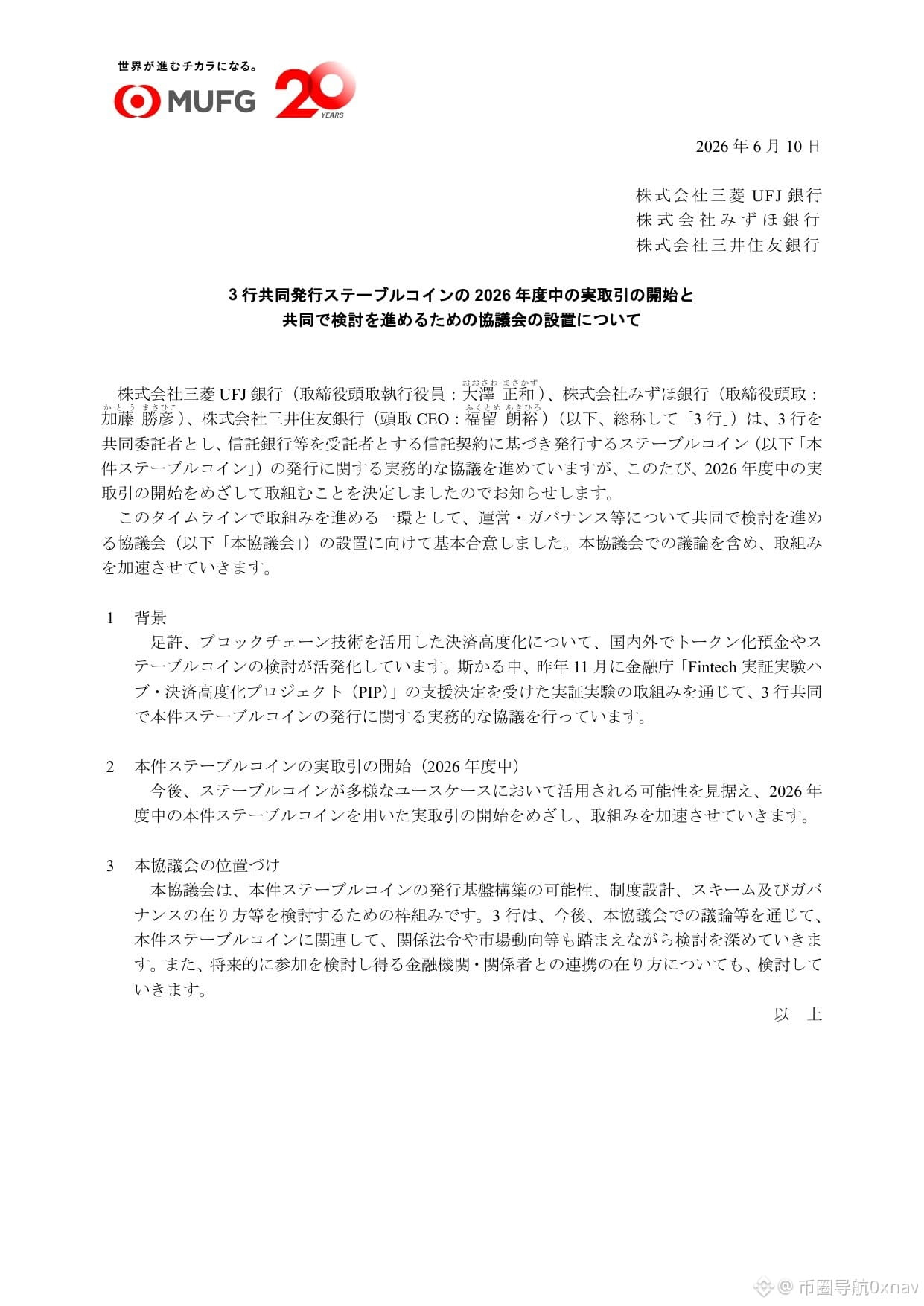
The trending topic says “planned issuance,” and those two words still apply: the yen stablecoin Japan’s three megabanks plan to launch has not entered live transactions as of today. Ordinary people still have nowhere to buy or redeem it.
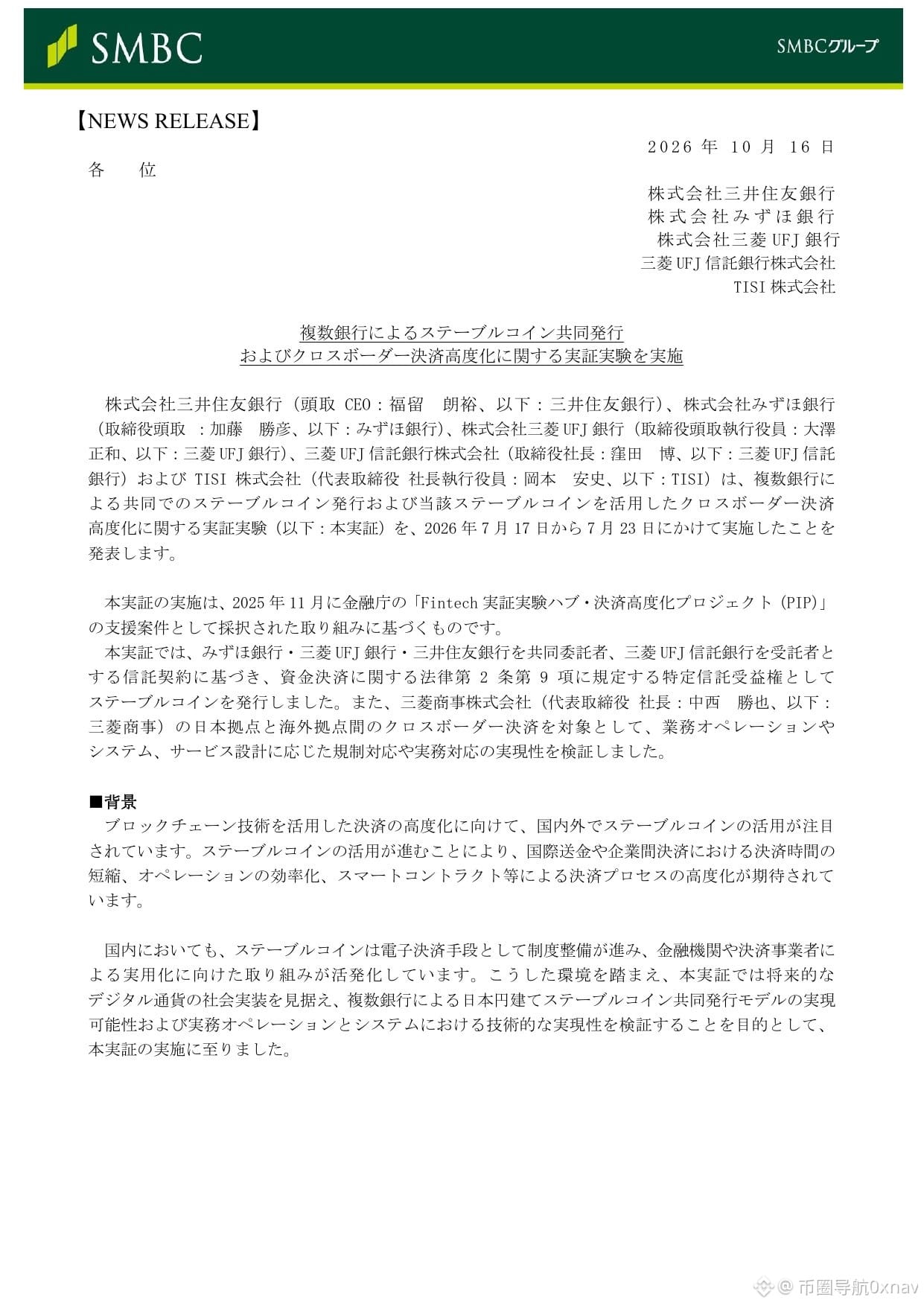
A joint press release dated June 10 from MUFG Bank, Mizuho Bank, and Sumitomo Mitsui Banking Corporation states that the three banks will act as joint settlors, with a trust bank and others serving as trustees, and that the stablecoin will be issued under a trust agreement. Their goal is to begin live transactions within Japan’s 2026 fiscal year. Japan’s 2026 fiscal year runs through the end of March next year. That is a timeline, not an announcement that the service is already live. The three banks also reached a basic agreement to establish a council to discuss its operations and governance. Tomoya Hasebe, head of global digital and innovation at Sumitomo Mitsui Banking Corporation, reiterated the timeline today at a roundtable in Singapore.
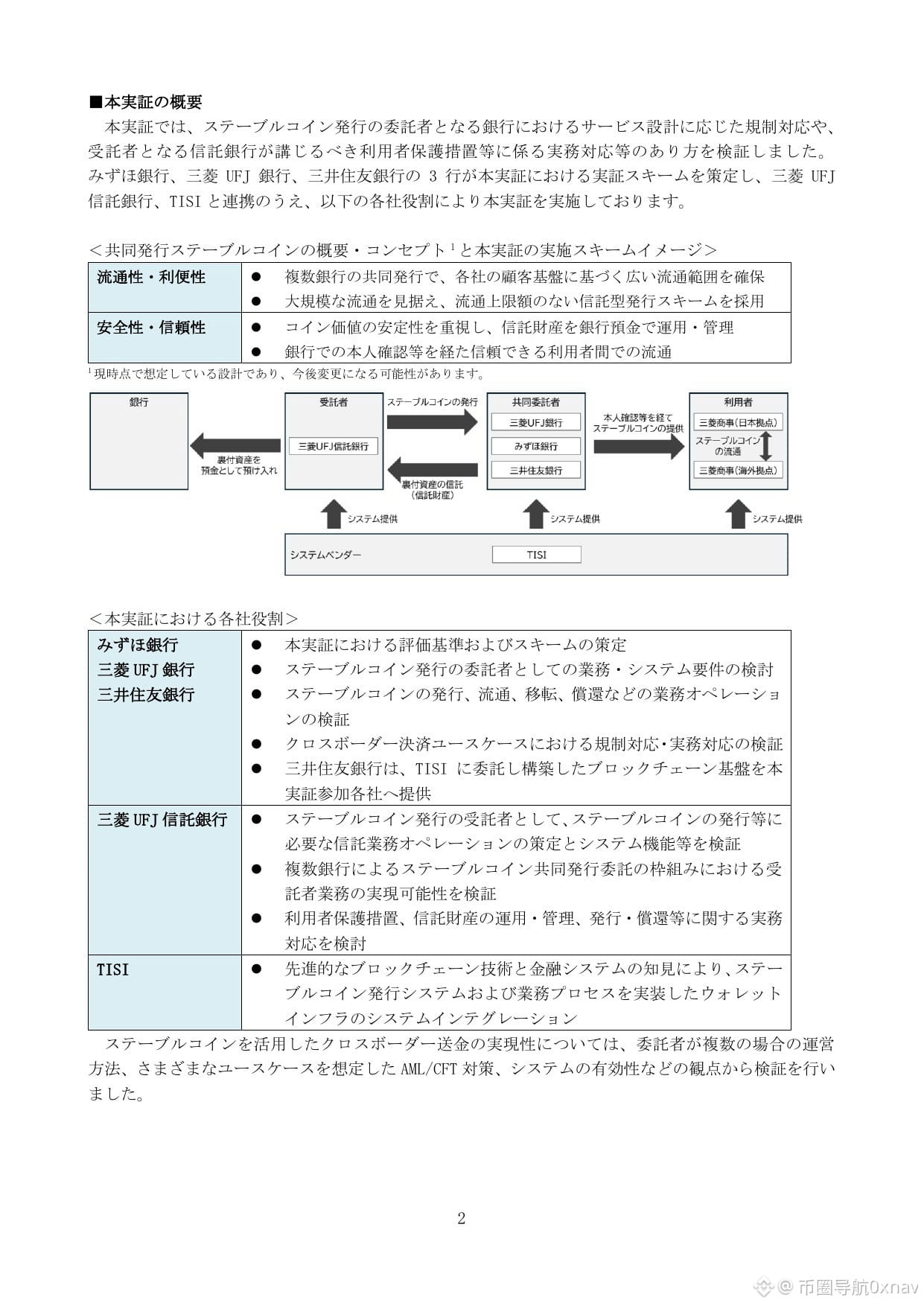
From July 17 to 23, the three banks, together with MUFG Trust and TISI, conducted a proof of concept. The coins were issued as “specified trust beneficial interests” under Article 2, Paragraph 9 of Japan’s Payment Services Act, with MUFG Trust serving as trustee. They tested the full process of issuance, circulation, and redemption, using cross-border settlement between Mitsubishi Corporation’s Japan and overseas offices as the scenario. This was not a redemption service open to the public.
Based on what has been officially disclosed so far, these are the points that matter most to ordinary people:
🔹 It cannot yet be treated as a usable coin: live transactions have not started, and the press release does not specify fees, whether individuals will be able to use it, or whether it can be bought and sold on trading platforms.
🔹 Where the money will be held and how redemption will work: The current plan is to manage the trust assets by holding them as bank deposits. The redemption process was tested in the pilot, but arrangements for public subscriptions and redemptions have not been announced. The official statement also says this is only the current plan and may change.
🔹 Where it can be used and who can use it: The plan is for circulation among users who have completed identity verification and other procedures with a bank. It is mainly intended for payments and remittances, especially cross-border business transactions—not for sending freely to any wallet on any blockchain. The banks also mentioned a trust-based issuance model with no circulation limit, but that too is only the current plan.
So don’t make financial plans on the assumption that “the yen stablecoin is already available to buy and redeem.” What matters is whether live transactions actually begin within the 2026 fiscal year, and what the terms for individuals and fees will be.
#日本三大银行拟发日元稳定币 #BTC #ETH
1
2.7k
·
--
In the future, transferring stablecoins to someone else’s wallet through a licensed platform in Thailand may no longer be possible. The proposal is still open for public consultation, but its provisions are already quite specific.
On November 12, Thailand’s Securities and Exchange Commission (SEC) issued Press Release No. 253, inviting public comment on a draft regulating stablecoin transactions through digital asset operators. The regulator aims to prevent stablecoins from being used as a channel for money laundering, technology-related crime, or evading cross-border remittance rules. The draft revises a version that was circulated for initial consultation in September this year. It has not yet taken effect, and comments are being accepted until November 26.
For ordinary users, these are the key points 👇
🔹 Transfers only to and from your own accounts: Stablecoins transferred into your platform account must come from an account or wallet verified as yours. The same applies to the destination of withdrawals. Transfers from another person’s account, or to another person’s account or wallet, are prohibited.
🔹 Separate daily limits for deposits and withdrawals: Deposits and withdrawals are each capped at 5 million baht per person, per operator, per day. They must also be consistent with your income sources and financial circumstances. Reaching the limit does not mean you can transfer freely.
🔹 Exceptions for transfers between licensed Thai platforms: If you transfer stablecoins between your own accounts with operators supervised by the SEC, and both parties comply with the Travel Rule, the 5-million-baht limit does not apply. There are also other exceptions, including for market makers, operators’ proprietary accounts, and certain arrangements approved by the Bank of Thailand.
🔹 Stricter rules for large over-the-counter trades: Brokers and dealers offering off-platform trading would face a proposed minimum trade size of 3 million baht and must disclose the execution price. Brokers may not directly arrange off-platform trades between two clients.
🔹 For now, don’t act as if the new rules are already in force. The press release does not state that the formal effective date or transition arrangements have already been finalized.
If you regularly withdraw stablecoins from Thai platforms, you can check in advance whether the withdrawal address is verified as yours and whether your daily deposits or withdrawals might approach the limit. If you have practical concerns to raise, the consultation is still open.
#泰国证监会拟设稳定币日转账上限 #BTC #ETH
210
·
--
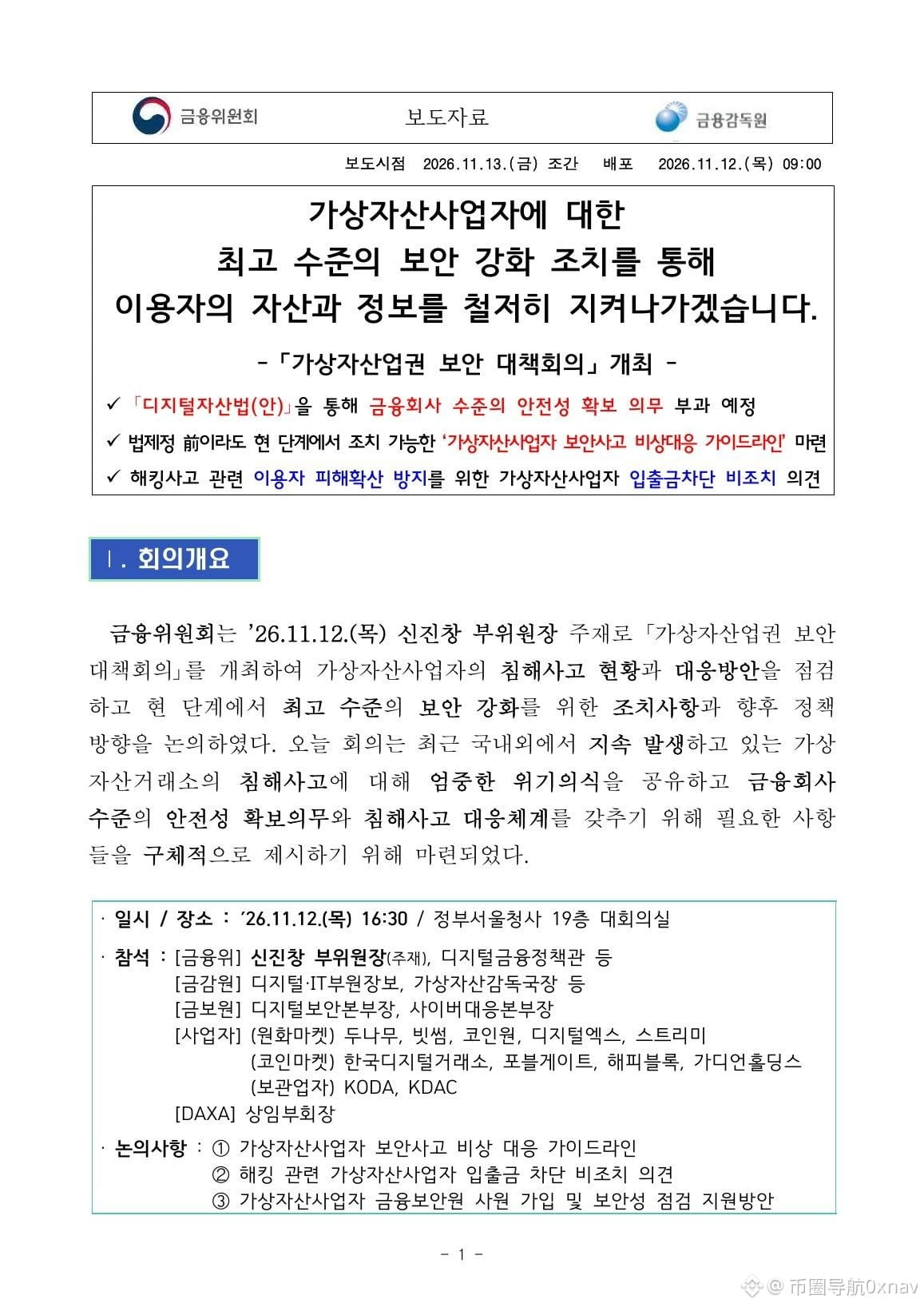
The hack has not yet been confirmed, but South Korean exchanges may still shut down deposits and withdrawals first.
This is not a new law that has already taken effect. After the South Korean Financial Services Commission held a “Virtual Asset Industry Security Measures Meeting” at the Seoul Government Complex on November 12, it stated in a press release that it would issue a “no-action opinion letter,” allowing virtual asset service providers, under certain conditions, to temporarily block deposits and withdrawals when a hack or security breach is suspected. The press release was scheduled for publication in the morning papers on the 13th.
A few points that directly affect ordinary users 👇
🔹 The rules are actually stricter right now: The current Virtual Asset User Protection Act says operators cannot block deposits and withdrawals without a legitimate reason; suspension is allowed only when a hacking incident is clearly established. The industry told the Commission that it was unclear whether they could suspend transactions when abnormal activity appears but a hack is still only suspected. Citing cases including the Binance hack, the Commission stressed that being able to block transactions quickly in a security incident often determines whether user losses will be amplified, and therefore decided to issue the opinion letter.
🔹 It is not yet clear when it will take effect or how long a suspension can last: The press release says the letter “will be issued” and that temporary blocking will be allowed under “certain conditions.” It does not specify when the letter will be issued, the exact conditions for applying it, the maximum suspension period, or what conditions must be met before deposits and withdrawals can resume. So for now, it should not be interpreted as meaning that “exchanges can start suspending transactions at any time from today, with a uniform time limit already in place.”
🔹 What this means for you: Once the opinion letter is issued, deposits and withdrawals may be blocked earlier than before when suspicious, large-scale abnormal trading occurs, with the aim of preventing assets from being moved further. But during market volatility, you may also temporarily be unable to deposit or withdraw. The same press release also says that platforms unable to monitor and respond around the clock may process deposits and withdrawals only during periods when their systems are operating normally. They must notify users in advance, have sufficient staff, and process requests promptly.
🔹 Safekeeping and compensation were also addressed: Under the Virtual Asset Industry Supervision Regulations, operators must keep at least 80% of users’ assets in cold wallets isolated from the internet; the Commission said the industry as a whole is already above 95%. Even so, operators are still required to keep only the minimum amount needed for transactions in hot wallets and to consider spreading assets across multiple hot wallets. Insurance compensation limits and reserve funds must be sufficient to cover user losses caused by hacking or similar incidents. Any security breach, or discovery of attempted abnormal external access, must be reported promptly to the financial authorities. Work is still underway on the longer-term Digital Asset Act, which is intended to subject digital asset service providers (currently called virtual asset service providers) to IT security obligations and liability for damages similar to those of financial companies. But legislation takes time, so the Commission has asked the industry to implement these measures first.
If you care about deposits and withdrawals, you can first check whether the South Korean platform you usually use issues an announcement, then wait for the opinion letter to actually be released and its conditions to be clarified before drawing conclusions. Don’t interpret “a decision to issue an opinion letter” as meaning “deposits and withdrawals can already be suspended indefinitely from today.”
Which matters more to you: “being able to suspend transactions as soon as a hack is suspected, to prevent more assets from being moved,” or “having deposits and withdrawals blocked before an incident is confirmed”?
#韩国拟允许疑似黑客时暂停充提 #BTC #ETH


237
·
--
Starting November 26, private customers of Israel’s Discount Bank will be able to buy and sell Bitcoin and Ethereum in their bank’s app. The proceeds from sales will go into their bank account, but for now, the crypto can’t be transferred out.
On November 11, the bank announced on its website and in a press release that this is the first time in Israeli banking that customers can directly buy, sell, and hold Bitcoin and Ethereum in a banking app. Transactions will use customers’ existing securities accounts, so there’s no need to open an account with an overseas exchange or manage private keys themselves. The bank also stated that for now, this is a “closed system”: purchased crypto cannot be transferred to an external institution or to the customer’s own on-chain address, and crypto from outside cannot be transferred in. Whether transfers will be enabled in the future depends on regulatory and business developments.
Here are the key points that matter to everyday users 👇
🔹 Who can use it: The service is available only to private customers aged 18 or over who are in Israel and already have a securities account. They must first sign the relevant securities and complex-products terms, then complete a separate agreement in the app before placing an order. Corporate accounts are not eligible this time.
🔹 How trading works: In the app, go to “All actions → Capital markets → Digital currency trading.” For now, only immediate trades are available; future limit orders cannot be placed. Bitcoin and Ethereum can both be purchased in increments starting at 0.01 units. Trading hours are Sunday to Friday, 9:00–23:00 Israel time, in line with the bank’s trading room hours.
🔹 Fees and settlement: The trading fee is 2% of the transaction amount, with an additional foreign-exchange fee if currency conversion is required. Custody fees will be waived for six months from the launch on November 26, then charged quarterly at 0.25%. The crypto will appear in the securities portfolio immediately, while funds will be credited or debited on the next business day (T+1). Sale proceeds will be credited in U.S. dollars; customers must instruct the bank themselves if they want to convert them to shekels.
🔹 Tax: The bank says capital gains and losses on digital currencies can be offset against capital gains and losses on other securities in the same account. The tax rate on profits is 25%, and tax is handled at the bank before the funds are paid out. The bank emphasizes that this offset applies only to capital gains.
The bank also cautions that digital currencies are not legal tender and do not have the same protections as securities. They are highly volatile, and customers could lose their entire principal. Several Israeli media outlets report that the wallet infrastructure is provided by Fireblocks; the website describes the service and custody as being handled by an “authorized third party.”
This isn’t a button you can click just yet. You’ll have to wait until November 26 and sign the agreement before trading is actually enabled in the app.
#以色列Discount银行将上线比特币交易 #BTC #ETH

122
·
--
Want to use the same bank or e-wallet in Europe to buy and sell U.S. stocks and custody Bitcoin? What’s new today is just one more license—not a button that’s already gone live.
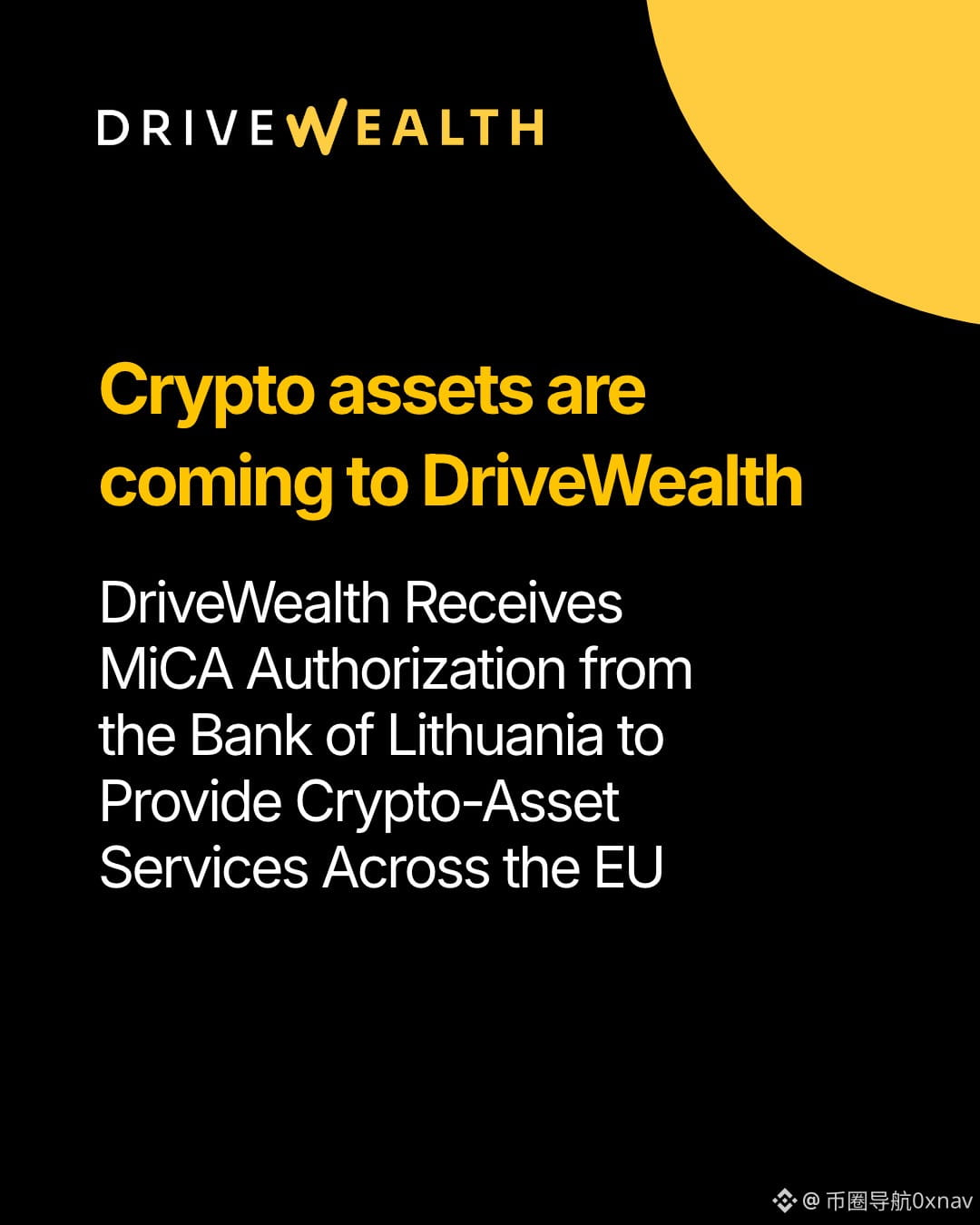
On November 11, the Bank of Lithuania (Lietuvos bankas) issued a press release confirming that it had authorized UAB DriveWealth Europe, the European subsidiary of U.S. brokerage infrastructure company DriveWealth, to provide crypto-asset services under the EU’s Markets in Crypto-Assets Regulation (MiCA). The company made its own announcement first, on November 10; the public register lists November 9 as the start date for the relevant crypto business.
A few points that matter directly to everyday users 👇
🔹 Scope of authorization: The central bank says the company can provide custody and administration of crypto-assets, as well as execute, receive, and transmit crypto-asset orders on behalf of clients. This builds on the financial intermediary (MiFID II) license it obtained in October 2024, meaning the same EU entity is subject to both securities and crypto regulations.
🔹 Not a new app for retail customers: DriveWealth provides “brokerage as a service” to banks, fintech companies, e-wallets, and brokerages. Everyday users won’t be able to open an account and buy crypto directly through its own interface just because of today’s authorization. If a bank or wallet you already use connects to this infrastructure in the future, you may be able to see stocks, tokenized assets, and crypto-assets in the same investment interface.
🔹 Not available yet: The company says crypto-asset services will be rolled out to partners in phases next year, with timing and coverage to be announced separately. It is still building the infrastructure. What the central bank announced today is a license—not a trading or custody feature that’s already live.
🔹 Don’t confuse “authorized to provide services in the EU” with “available to buy across Europe”: The company describes this authorization as a compliant route to providing crypto-asset services in the EU. But there is no timeline yet for when partners will launch or which countries’ users will get access first.
In short: Europe’s regulatory landscape now has another MiCA license, making it easier for banks and wallets to connect crypto-assets to their existing securities infrastructure in the future. It does not mean that everyday users can start depositing or withdrawing Bitcoin through their bank app today. What’s really worth watching is which institutions connect first when the phased rollout begins next year, which assets they will support for custody and trading, and how redemptions and transfers will work.
If you use a bank or e-wallet in Europe to trade U.S. stocks, would you be more interested if it added crypto-assets, or would you still stick with a separate exchange account?
#立陶宛央行授权DriveWealth加密服务 #BTC #ETH
17
·
--
Last week, the finance minister came forward and said he wanted to discuss with the National Assembly pushing crypto income tax back by another two years. Today, the ruling and opposition parties gave the proposal a tentative nod at the Assembly’s tax subcommittee—but the amendment itself has not yet been put to a vote.
After a meeting of the National Assembly’s Strategy and Finance Committee tax subcommittee on November 11, ruling party secretary and subcommittee chair Oh Ki-hyung (吴基炯) told reporters that the ruling and opposition parties had reached a consensus on further postponing virtual asset taxation. The government had previously said it wanted to delay it by two years, and there was no significant disagreement between the parties. Opposition party secretary Bae Jun-young (裴俊英) also said, “The decision today was to postpone it,” but added that the government must make thorough preparations for taxation during the grace period, and that the National Assembly would monitor its progress.
A few points that directly affect ordinary people 👇
🔹 How far back: If the proposal is ultimately adopted, the virtual asset income tax, originally scheduled to take effect on January 1, 2027, will be delayed by another two years, to 2029. This would be the fourth postponement since the law was enacted in 2020 (it was previously pushed back from 2022 to 2023, 2025, and 2027).
🔹 How much you pay has not changed: The current framework remains in place—the portion of annual gains above approximately 2.5 million won is taxed at about 22% (including local income tax). What is being postponed is the start date, not the tax being eliminated.
🔹 No vote today: The amendment to the Income Tax Act that would “delay it by another two years” was only tentatively agreed on at the tax subcommittee today; it was not formally approved. Oh Ki-hyung said the final vote would be held on the last day of the subcommittee’s work. He also noted, “Given the current situation, it would be fair to say it has already been delayed by two years”—that was an assessment made at the meeting, not a change to the law that has already taken effect.
🔹 Details still unresolved: The government opposes raising the basic deduction (on fairness grounds), and the two sides agreed to continue discussions. They also need to review and decide whether exchanges should submit transaction data in advance of the start date for a system trial. The government’s proposal on November 5 to allow losses to be carried forward for up to three years was on today’s agenda, but no conclusion was reached. Oh Ki-hyung said there was still room for both sides to discuss it constructively.
Put simply: compared with last week’s “government seeks postponement,” things moved a step forward today—the ruling and opposition parties reached a tentative consensus at the first legislative hurdle. But for people trading virtual assets in South Korea, the January 1, 2027 date still needs to be changed, and that will have to wait until the tax subcommittee formally approves the amendment and the remaining National Assembly procedures are completed. Don’t mistake “tentative” for “you won’t have to pay,” and don’t rush to sell everything on the assumption that tax will definitely apply in 2027. Keeping an eye on the amendment text is more reliable than following the headlines.
Will you take today’s “tentative” agreement as a reason to put tax planning aside for now, or wait until the tax subcommittee’s final-day vote before deciding what to do?
#韩国朝野暂定加密税推迟两年 #BTC

1
2
2.2k
·
--
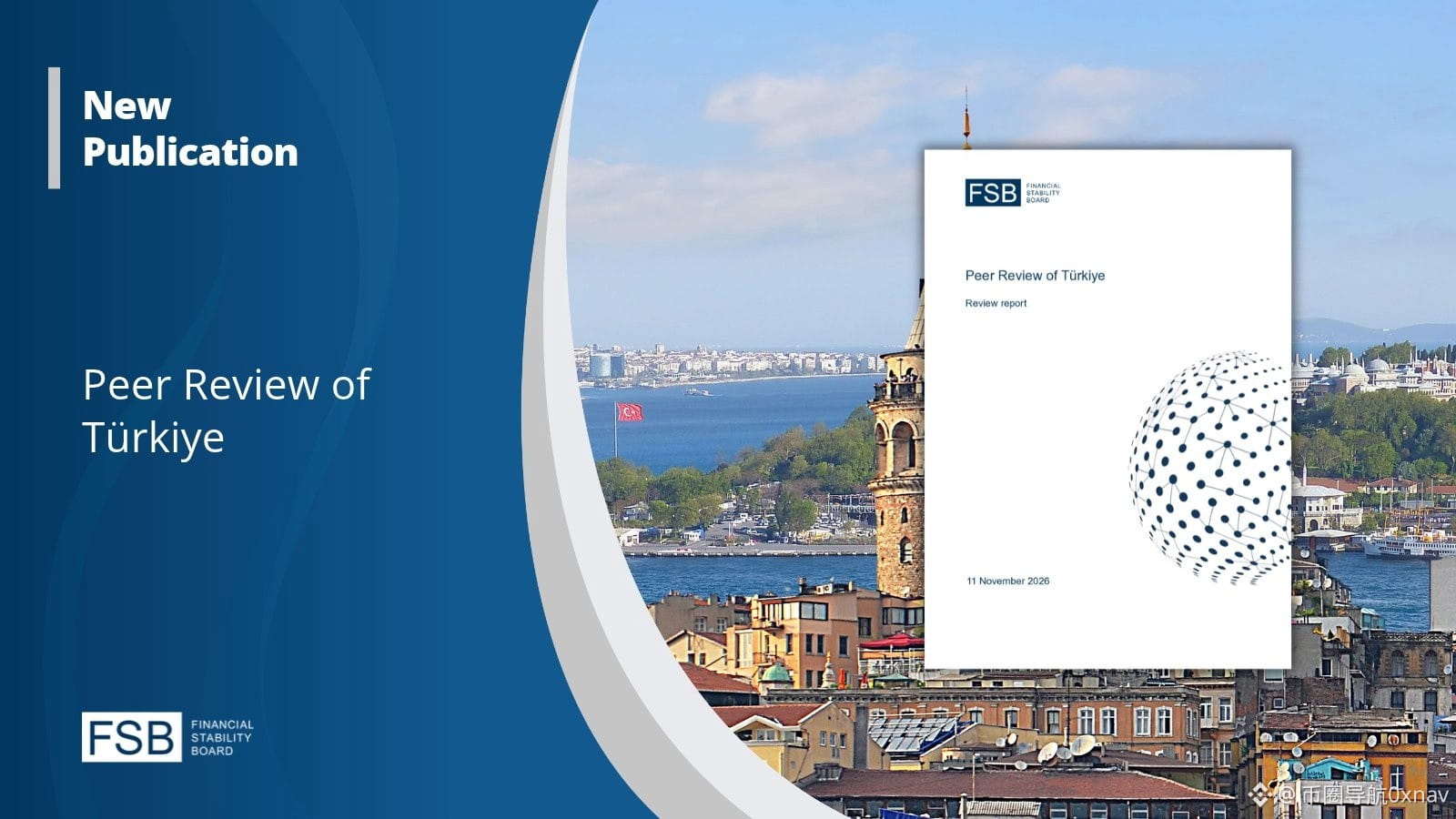
In Turkey, you still can’t use stablecoins to pay directly in shops, and redemption rules for issuers have not yet been legislated separately. This is the gap the Financial Stability Board highlighted today.
On November 11, the Financial Stability Board (FSB) published its second peer review report on Turkey, assessing the country’s progress in implementing recommendations on crypto-asset and stablecoin regulation. The report recognized that Turkey has brought most crypto-asset businesses within the regulatory perimeter: crypto-asset service providers must register and obtain licenses, customer assets must be segregated and held in custody, and a centralized data platform has been set up for monitoring. The country has also banned the use of crypto-assets for payments and blocked some risks from spilling over into the payments and banking systems. However, a dedicated regime for stablecoin issuers has yet to be established.
A few points that directly affect ordinary people 👇
🔹 Can you spend them in shops? Not yet. The Central Bank of the Republic of Türkiye’s (CBRT) 2021 rule prohibiting the use of crypto-assets for payments remains in force. Payment institutions cannot use crypto-assets for payment or e-money services, and licensed payment and e-money institutions cannot facilitate fund transfers for crypto trading, custody, or transfer platforms. Fiat on- and off-ramps are still handled mainly by banks.
🔹 Are there transfer limits? Yes. Authorities have set crypto-to-crypto transfer limits for stablecoins of $3,000 per day and $50,000 per month. Corporate clients may receive time-limited exemptions, subject to approval by the service provider’s board of directors and enhanced due diligence.
🔹 Can they be redeemed, and who oversees the reserves? There are currently no rules specifically for issuers. The management of reserves, how redemption rights are enforced, and how stabilization mechanisms should be designed have not yet been legislated separately. Stablecoin holders are also not covered by the Savings Deposit Insurance Fund (SDIF).
🔹 The e-money route is not yet open: The report says recent revisions to e-money rules allow some fiat-linked stablecoins to be treated as e-money, leaving open a possible path for their future use in payments. But the implementing rules still need to be issued separately by the CBRT, so this does not mean they can already be spent in shops. The FSB also recommends maintaining the firewall against using foreign-currency stablecoins for domestic payments, even if a dedicated regime is introduced.
Today’s report contains peer review recommendations; it is not a new authorization or ban passed by Turkey today. The FSB wants Turkey to establish a dedicated stablecoin regime (including redemption rights, reserve and prudential requirements), implement financial stability monitoring, strengthen regulatory enforcement, and prepare for cross-border cooperation. The progress data cited in the report is current through August 2026.
If you use fiat-backed stablecoins in Turkey, which matters more to you: how future redemption and reserve rules will be written, or whether the domestic payment ban will be eased through the e-money channel?
#FSB敦促土耳其建立稳定币框架 #BTC #ETH
197
·
--
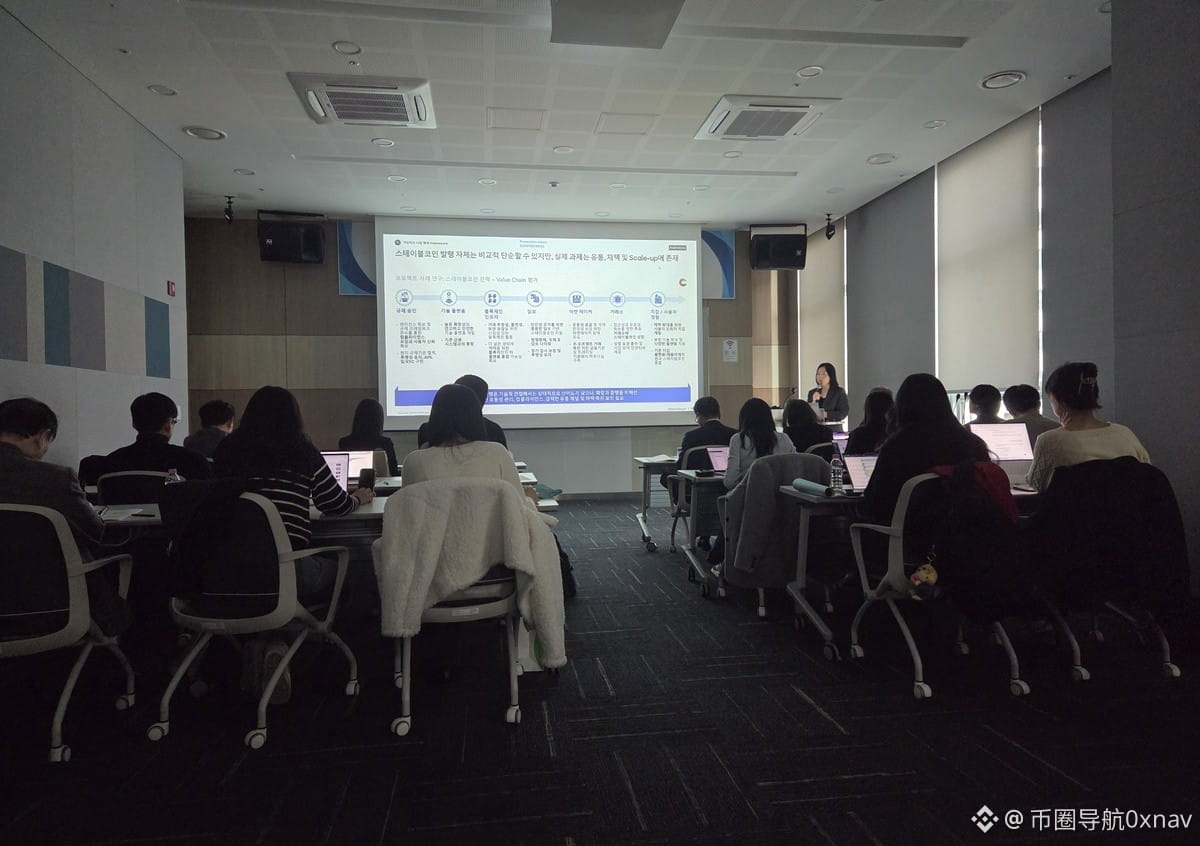
In South Korea, it’s still not possible to send money abroad using stablecoins through a bank or card network. Today, the head of the Foreign Exchange Analysis Division at the Ministry of Economy and Finance clarified how responsibilities will be divided: issuance will be governed by the Digital Asset Act, led by the Financial Services Commission, while cross-border payments and receipts will require a separate revision to the Foreign Exchange Transactions Act.
On the afternoon of November 11, a seminar titled “The Future of Cross-Border Payments in Korea in the Stablecoin Era” was held at Post Tower in Yeouido, Seoul. It was co-hosted by Democratic Party lawmakers Jeong Tae-ho and Ahn Do-geol, and organized by the Korea Fintech Industry Association. At the seminar, Son Seon-young, head of the Foreign Exchange Analysis Division at the Ministry of Economy and Finance, said that matters related to stablecoin issuance would be governed by the Digital Asset Act, which is being discussed under the leadership of the Financial Services Commission, while cross-border transactions using stablecoins are expected to be governed by the Foreign Exchange Transactions Act. She also said that, in conjunction with the enactment of the Digital Asset Act, the Foreign Exchange Transactions Act would clarify stablecoins’ legal status, cross-border transactions, and payment and receipt procedures.
A few points that directly affect ordinary people 👇
🔹 This isn’t a new opening approved today, nor is it a new ban: the division chief was describing the direction of the regulatory framework; no amendment text has been released yet. The government plans to first establish issuance rules in the Digital Asset Act, then revise the foreign exchange law accordingly.
🔹 Why can’t banks handle this now? She explained that when the Foreign Exchange Transactions Act was amended this June, it introduced a “virtual asset transfer business” category, mainly to track information on cross-border virtual asset transfers and the movement of funds in and out of the country. Under the current legal framework, small overseas remittance providers, banks, and card companies still cannot transfer stablecoins directly. To do so, they would first have to register as virtual asset transfer businesses.
🔹 Details that will be added to the foreign exchange law: whether stablecoins will be included in the existing category of “means of payment to and from foreign countries” or treated as a separate category; what will be permitted for current-account transactions (trade in goods and services) versus capital-account transactions (investment and movement of funds); and who will verify transactions across borders and what documents will be required. The principle is “same activity, same regulation.” While safeguarding the integrity of foreign exchange transactions, the government will also consider private-sector demand, transaction types, and whether the institutions handling transactions can fulfill their verification obligations.
🔹 This is not the same issue as “how domestic payments will be protected”: which consumer-protection law applies to domestic stablecoin payments is a separate discussion. What the Ministry of Economy and Finance clarified today is that cross-border transfers and remittances will be subject to the foreign exchange law. Neither issue has yet become a set of rules in force.
Put simply: South Korea did not announce today that banks will be able to send money abroad using stablecoins starting tomorrow. But the Ministry of Economy and Finance made clear at the seminar that “cross-border transactions fall under the foreign exchange law, and banks and card networks currently cannot transfer stablecoins directly.” The key question to watch is which institutions will be allowed to handle cross-border payments and receipts, and what procedures they will need to follow, once the Digital Asset Act is enacted—not to mistake the division of responsibilities discussed at the seminar for a new channel that is already available.
Are you more concerned about whether banks and card networks will be able to handle cross-border transactions in the future, or about first clarifying what will be permitted for current-account and capital-account transactions?
#韩国财政部称稳定币跨境支付将适用外汇交易法 #ETH #BTC



175
·
--
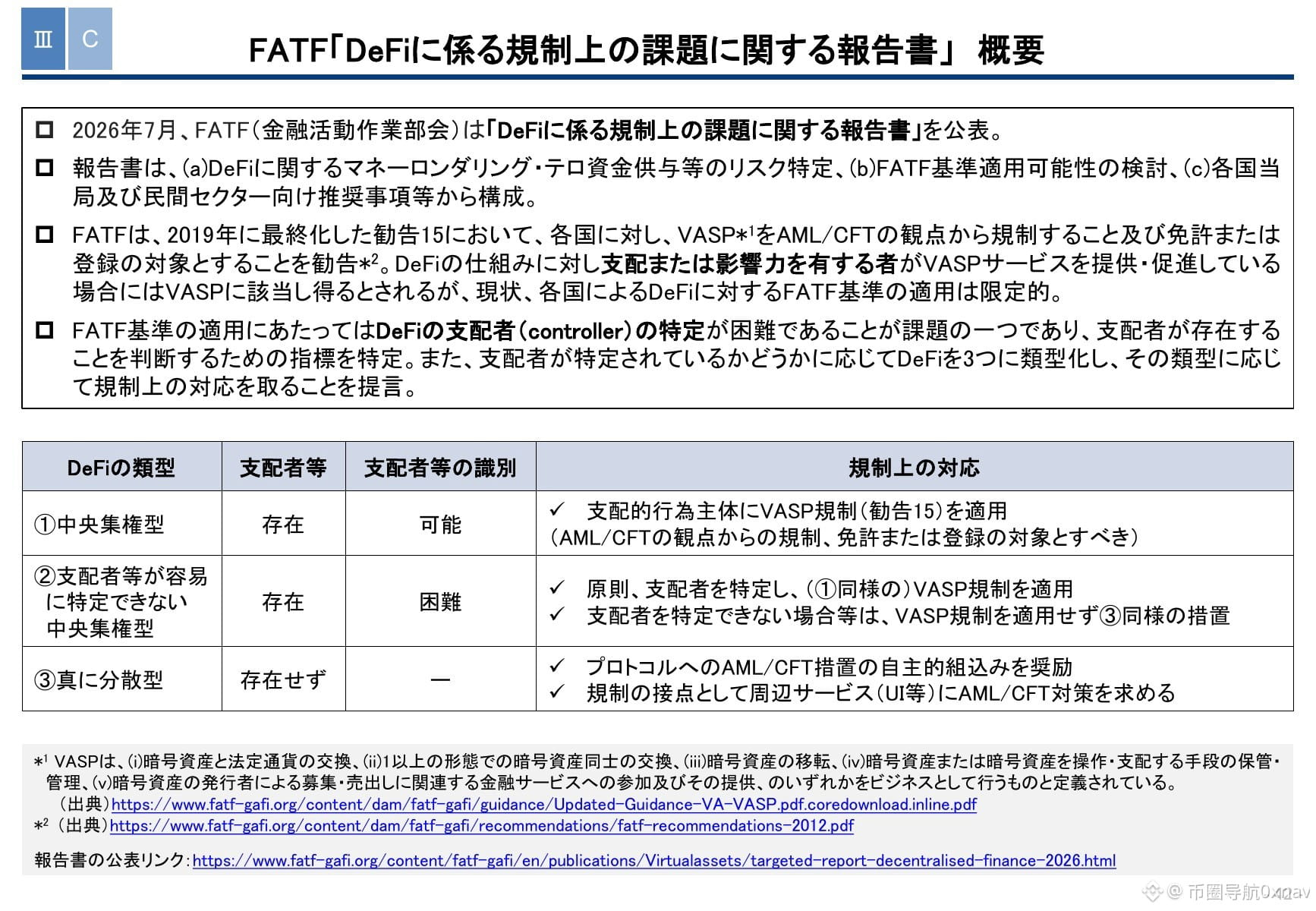
In Japan, swapping coins on decentralized exchanges did not result in a new ban today. What the Financial Services Agency made public was the minutes of the first meeting of the “Digital and Distributed Finance Response Study Group” held on October 20: the members wrote into their opinions how DeFi should be regulated, who should act as the gatekeeper, and whether large-scale redemptions of stablecoins could affect government bonds.
A few points directly relevant to ordinary people 👇
🔹 No law has changed yet; the discussion has only been laid out: the meeting lasted two hours on the afternoon of October 20, and Nomura Holdings and Securitize Japan gave hearings. The minutes omit the names of speakers and record the members’ opinions, not rules that are already in force. The same study group held a second meeting on November 2; what is newly added today is the written minutes of the first meeting.
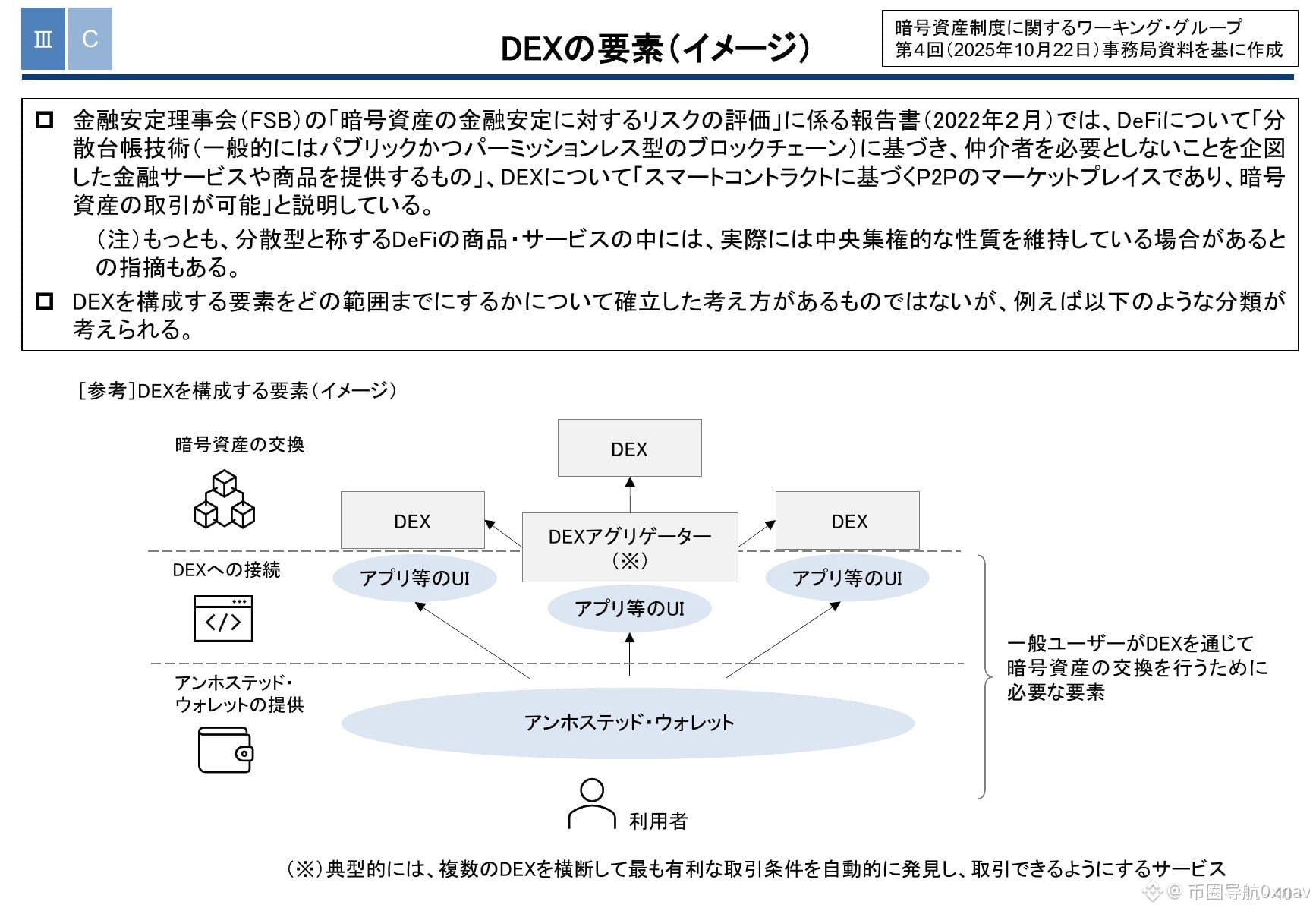
🔹 Who to regulate first for DeFi: members suggested first clarifying “how to deal with decentralized exchanges and DeFi,” while also comparing international discussions to sort out the regulatory targets and methods, so that Japan does not become “a place of regulatory vacuum or regulatory arbitrage,” and to respond appropriately in due course. Investor protection and market integrity were listed as points that should be discussed first. The “gatekeeper” role that traditional financial institutions have long performed was also written into the agenda as something to consider who should bear in the future. On anti-money laundering, members asked for serious discussion of how Japan should treat the FATF’s DeFi report released in July this year.
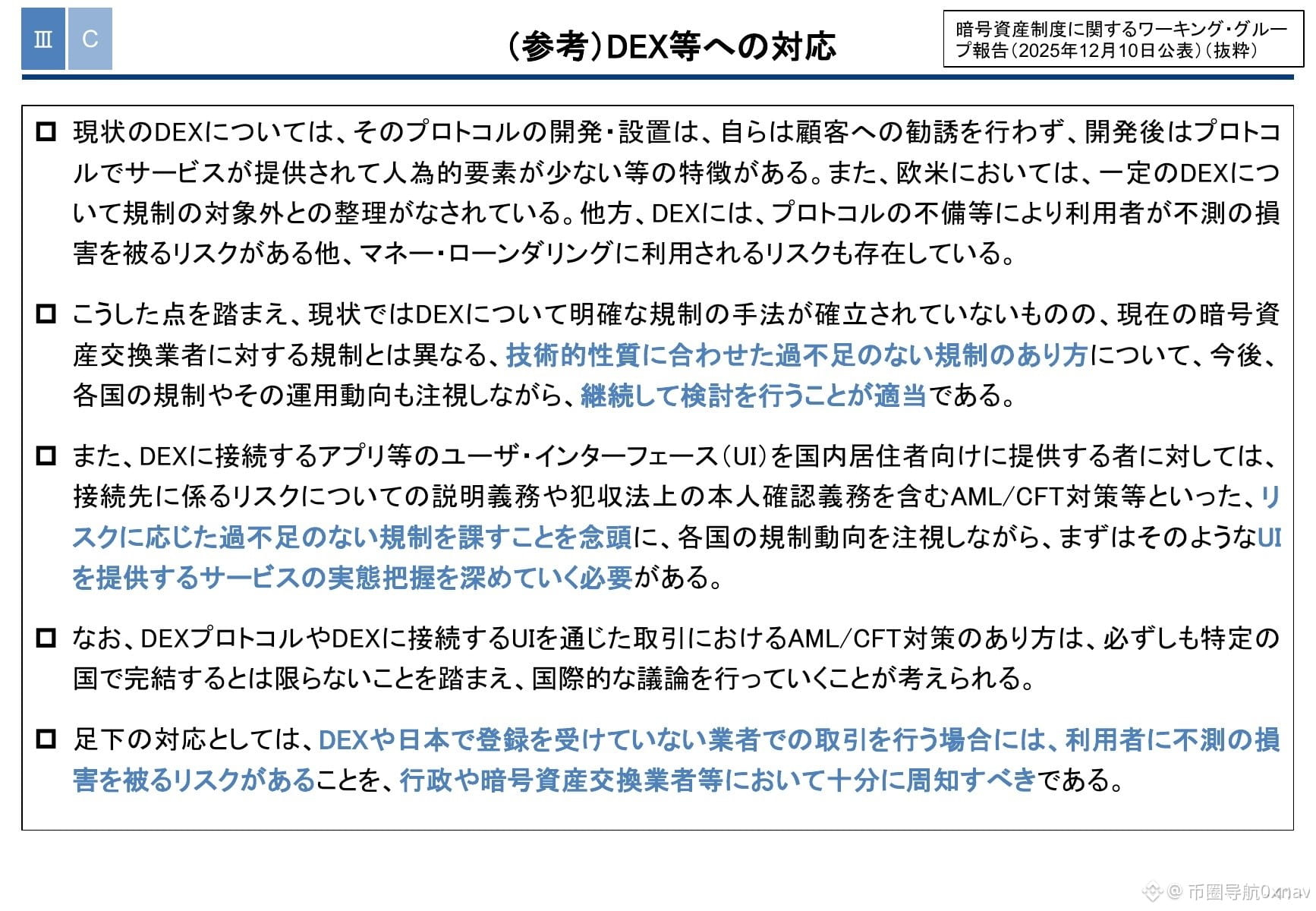
🔹 The most likely first point of contact for users later: the secretariat materials on the day still followed the organization in the 2025 December working group report—currently, there is no clear regulatory method for the decentralized exchange protocol itself; however, people who provide “application interfaces that connect to decentralized exchanges” to residents in Japan may be considered subject to obligations such as risk explanations and identity verification under the Act on Prevention of Transfer of Criminal Proceeds, and the actual situation of such interfaces needs to be examined first. The materials also state clearly: trading on decentralized exchanges or with operators not registered in Japan carries a risk of users suffering unexpected harm, and administrative bodies and licensed exchanges should provide sufficient notice. This is existing整理, not a new ban passed today.
🔹 Large-scale stablecoin redemptions: members pointed out that if major issuers of electronic payment instruments receive large redemption requests, government bonds held as reserve assets may also have to be sold in large quantities, so it is necessary to confirm whether the current regulations are sufficient. There was also an opinion that lending of electronic payment instruments, if bundled with issuance, may look like investment solicitation, and whether the current rules are adequate deserves another look.
In short: Japan did not announce a ban on using decentralized exchanges today, but questions like “who verifies identity on the front end” and “whether large redemptions will spill over into government bonds” have moved from internal discussion into public minutes. What to watch next is whether these opinions are written into a draft system, rather than treating the minutes as a newly effective rule.
Do you think they should regulate apps that connect to decentralized exchanges first, or should they first add rules to cover the government bond selling pressure during stablecoin redemptions?
#日本金融厅研究会讨论DeFi监管 #ETH #BTC
100
Log in to explore more content
Join global crypto users on Binance Square
⚡️ Get latest and useful information about crypto.
💬 Trusted by the world’s largest crypto exchange.
👍 Discover real insights from verified creators.
Email / Phone number
Trending Topics
NvidiaBeatsEstimatesWith$130BQ4Outlook
17,261 views
211 Discussing
Nvidia Beats With $115.8 Billion in Revenue, Guides to $130 Billion and Adds $150 Billion Buyback
Binance News
·61 Likes
·45.4k views
AnthropicIPOPriceCouldExceed$80
22,019 views
182 Discussing
RussiaCentralBankAddsAlfaBankToCryptoExchangeRegister
0 views
13 Discussing