


As an underlying infrastructure that integrates blockchain and edge computing technologies, Caduceus has established its unique market position, focusing on providing computing power and rendering resources for metaverse manufacturers. It is currently building the world's first easy-to-use 3D metaverse platform, including multiple functions such as P2P communication and IPFS storage. By putting tools in the hands of creators, Caduceus has reshaped multiple fields such as XR, operating systems, and identity authentication, aiming to innovate multiple fields such as travel, education, social networking, film and television, games, and entertainment.
On the premise of providing a highly compatible and extremely flexible foundation for 3D NFT, GameFi, AI and the Metaverse ecosystem, Caduceus will assist global Metaverse participants to integrate into it with a lower threshold. It is worth mentioning that Caduceus announced on March 30 last year that it had completed a $4 million Series A financing led by SIG and BlockFills.
Caduceus has a diverse team whose members come from a variety of fields including blockchain, DeFi, software development, finance, retail, music, art, media and entertainment.
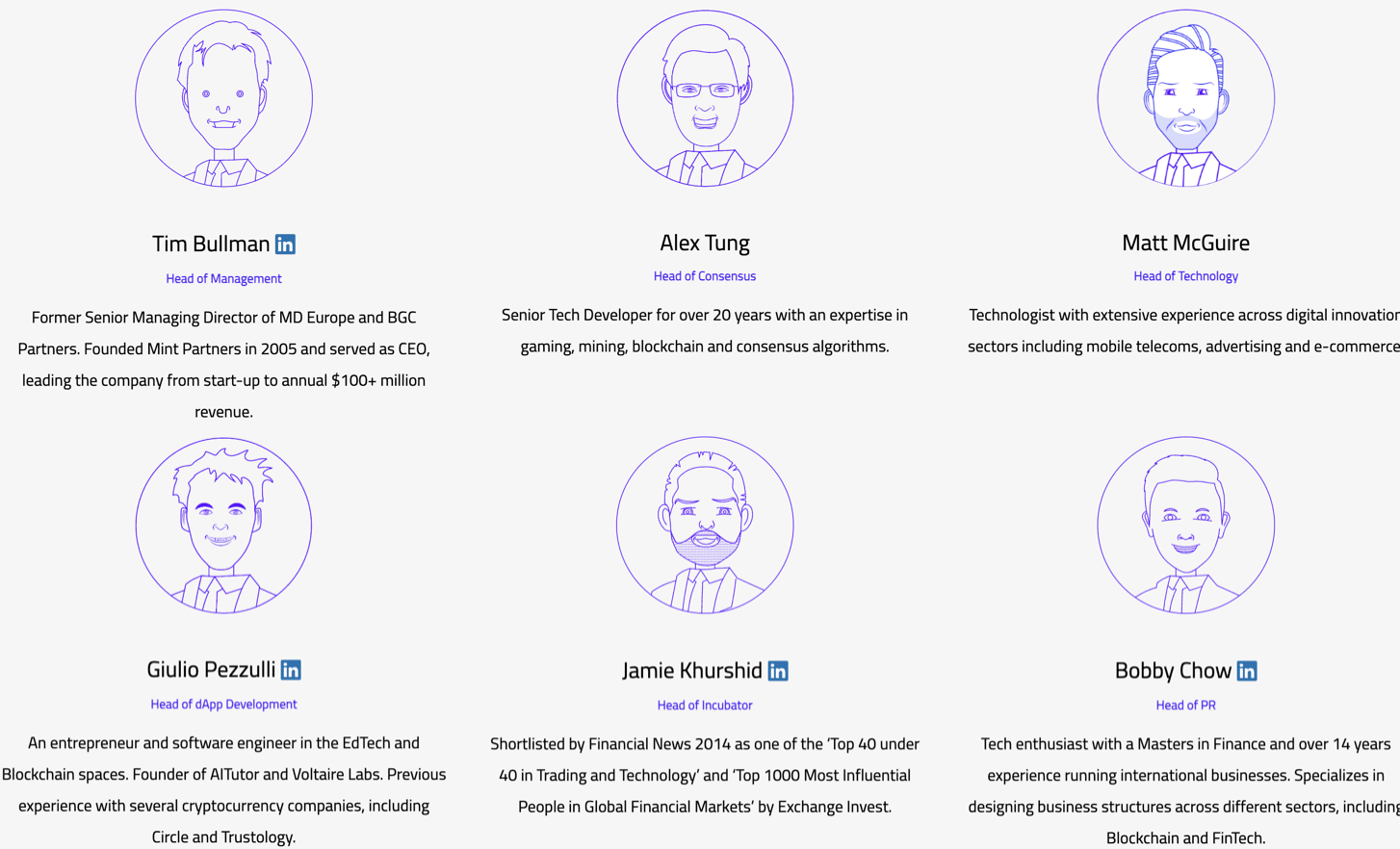
Tim Bullman, head of management at the Caduceus Foundation, was formerly senior managing director of MD Europe and BGC Partners, and is also the founder and CEO of Mint Partners; Alex Tung, head of consensus algorithm technology, has more than 20 years of experience in advanced technology development and has deep expertise in games, mining, blockchain and consensus algorithms; Matt McGuire, head of edge rendering technology, is a technical expert with extensive experience in mobile telecommunications, advertising and e-commerce; Giulio Pezzulli, head of application expansion, is a blockchain entrepreneur and software engineer with extensive experience in cryptocurrency companies such as Circle and Trustology; Jamie Khurshid, head of incubator, was named one of the "Top 40 under 40 in Trading and Technology" and "1,000 Most Influential People in Global Financial Markets" by Financial News in 2014.
At the recently concluded EDGE Summit in Hong Kong, BlockBeats had an in-depth conversation with Giulio Pezzulli, Head of DApp Development at Caduceus, to further explore the current status of Caduceus and his insights into the industry.
BlockBeats: First, please introduce yourself, including your career experience, and why you want to do the Caduceus project? What is your current work at Caduceus?
Giulio: I'm Giulio Pezzulli, and I'm the DAPP Development Lead at Caduceus. I actually started in the tech field, as a developer, and later worked for a few crypto companies, one of which was a crypto wallet company called Trustology. After that, I joined Circle USDC, a stablecoin company, and then Caduceus as the DAPP Development Lead. Currently, my core focus is to observe the ecosystem, make sure the documentation is complete, and make sure developers understand how to build on our chain, and also try to build tools for them.

Giulio Pezzulli delivered a speech at the EDGE Summit in Hong Kong
What is Caduceus’ technological innovation?
BlockBeats: What technologies are integrated into Caduceus' technical solution? How does it combine AI, blockchain and edge computing?
Giulio: Our system is a distributed blockchain with nodes all over the world. Its core goal is to provide GPU rendering capabilities to various companies, such as Metaverse. As an example, this is the first use case of edge rendering. Further, in the field of AI, we are currently considering implementing an API so that developers can more easily integrate and utilize large and fine-tuned language models. This is indeed a future direction. Since we have resources from our nodes, we can provide it as an API to consumers.
BlockBeats: Can you explain in detail the technical innovation of Caduceus? Is it edge rendering?
Giulio: One of the big advantages is that it allows you to render your virtual world geographically. This is done through nodes, among other things. We are all building with frameworks like Unity or Unreal, and we are leveraging those architectures. As for the future, Caduceus aims to be a blockchain with very high transactions per second. Right now, this is particularly evident in helping the use case of the metaverse, where there are a lot of people transacting, and perhaps a lot of AI transacting. So speed is very important.
BlockBeats: How is the current construction of Caduceus? What are the important progress of Mainnet V2.0?
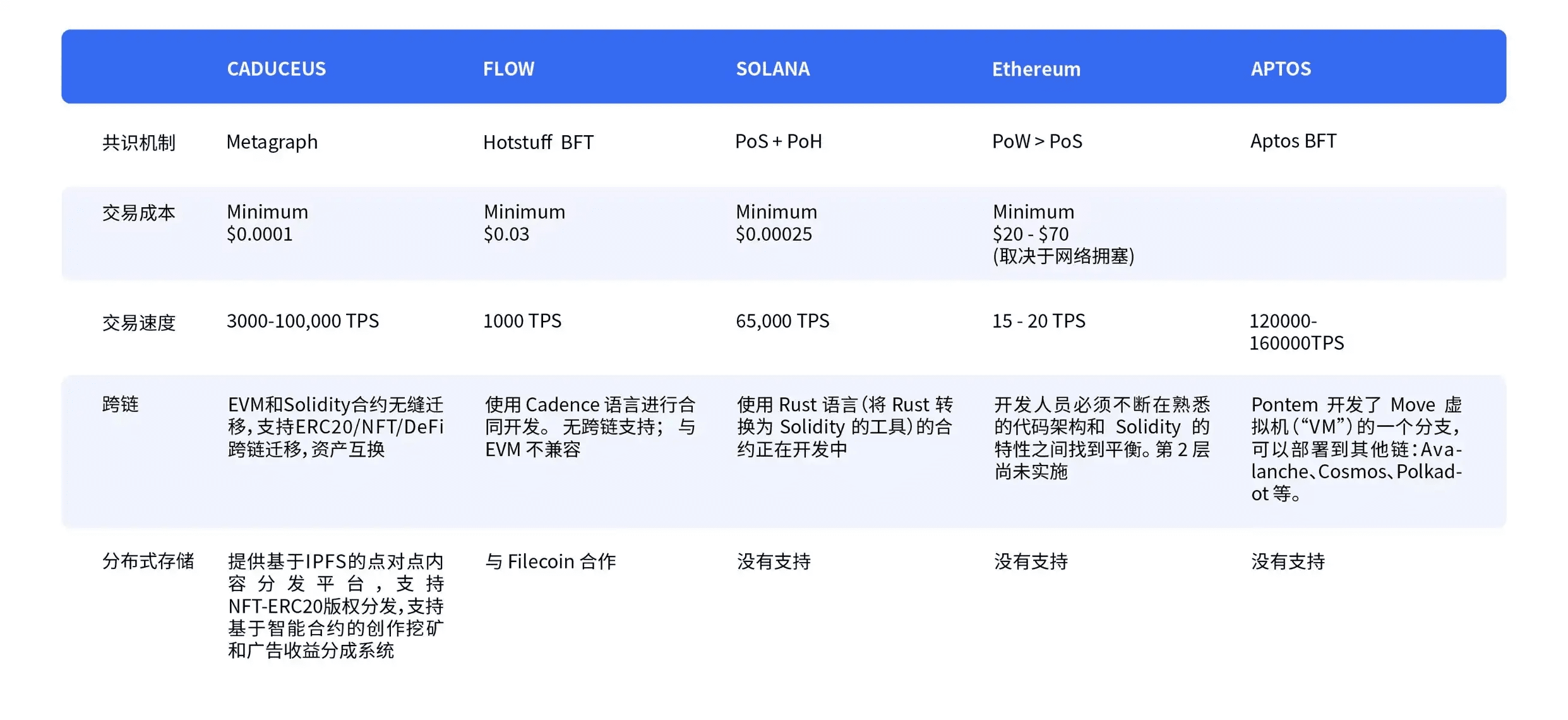
Giulio: Regarding TestNet, Caduceus is currently developing and testing and has achieved a processing capacity of about 30,000 transactions per second, with the goal of increasing it to 100,000 transactions per second. We know how to achieve this - although it is a very difficult path, especially in the current market environment, this is our next step. Caduceus plans to release a new beta at some point (perhaps called New Testament or some other specific module).
BlockBeats: How will Caduceus reach 100,000tps?
Giulio: What we did first was to decompose the process of achieving this high volume of transactions. Second, in a local environment, it is a first-layer solution that does not rely on any second-layer solution. First, we have a consensus mechanism for ordering transactions. Then once the transactions are ordered - which is a very fast process that requires very limited data - we then have a process for validating transactions to ensure that they can actually be processed in parallel at some level. Then we have an execution node that is responsible for the execution part, and a storage node that stores the results. So we managed to divide the whole process into several independent parts and use some efficient algorithms to achieve their parallel operation. Yes, this means that Caduceus can handle a lot of operations. Then we continue to iterate on this process and optimize the algorithm to push its performance to 100,000tps.
What does Caduceus understand about the industry?
The difference of Caduceue is that, although it is also a Layer1 public chain, Caduceus is aimed at a business scenario rather than a technical problem in a certain industry. It hopes to combine decentralized solutions with edge computing, rendering, 3D technology, and XR hardware and software to provide strong infrastructure support for the Metaverse application layer scenario. When looking forward to the future development trend of Web3, Grayscale believes that the Metaverse is the scenario with the clearest future development prospects for the Web3 concept, but there is currently no blockchain infrastructure suitable for this scenario.
BlockBeats: How do you build your ecosystem? Is it mainly about 3D collaboration or blockchain-based entertainment business?
Giulio: We have connections with many great creators and a large network of fashion brands. Therefore, creators naturally evolved into entities that wanted to be part of the metaverse, which was in line with our strategy from the beginning, leading us into this space of the digital world. Thanks to our network of partners in China and Western Europe, we were able to reach these communities and business opportunities.
So in terms of projects, there are a lot of exciting NFT brands that we've worked with, Diesel Tech. Caduceus is also working with Partner Patient, who recently launched the Lancer project with Robbie Williams, who has a ton of fans around the world, to host his concerts on Lightcycle, and we can also host concerts for other well-known artists on Lightcycle. These artists will join Lightcycle, and in addition to that we have Vertex Network. Of course, we're also exploring some DeFi projects, and some stablecoins are considering connecting to our chain, but we're still in the early stages.
BlockBeats: How does Caduceus attract developers and users and guide them to achieve such a high TPS?
Giulio: First of all, it is crucial for developers to know that we have high TPS capabilities because the problems they have to deal with can only be solved by a few chains, and we will be one of them. Therefore, this in itself should be an important reason for them to choose us. Secondly, we are developing a platform with Ethereum WebAssembly (Wasm for short) virtual machine. Having the ability of WebAssembly means that it will support developers to develop in multiple programming languages. So, they don't have to worry about learning Solidity. This is exactly what we are very focused on and are actively developing. Starting from this foundation, we will open up more possibilities and developments.
BlockBeats: How did you come up with the innovative mechanism? Were you inspired? Are there any similar chains doing this?
Giulio: We were inspired by Ethereum and the Cosmos framework combined with DAGs like IOTA. We worked with multiple technologies and learned a lot from them. We formed partnerships with multiple technologies and learned a lot from them. These learnings fueled our belief that we could do better. Therefore, Caduceue decided to develop our own, blending these elements together to achieve efficient and fast EVM execution. We believe that all these parts can be organically integrated to achieve our goals.
(BlockBeats Note: IOTA is a distributed ledger technology that uses a directed acyclic graph (DAG) called Tangle)
BlockBeats: What do you think of the capabilities and influence of the Ethereum ecosystem? What are the advantages of Caduceus compared to them?
Giulio: Obviously, Ethereum has a very important position in this space, and it has led to a lot of innovation in contracts, for example. At least some developers have come up with a concept called Account abstraction, and there was a panel discussion on this topic yesterday. This is about maintaining compatibility to get similar benefits.
We're working on that abstraction as well. We'll either do it natively or we'll do it internally - like internally. We'll implement it directly with smart contracts, just like they do. Regardless, the key is to make sure that those who empower the Ethereum community can also empower our "producer community", and it's just a collaborative game because we are compatible with the EVM (Ethereum Virtual Machine). So anyone who builds tools for Ethereum can also easily deploy them to Caduceue.
So our next project is going to be about maintaining the differences between us and Ethereum and keeping those differences as minimal as possible. When the differences are minimized, developers will be able to see the advantages of our community because they'll say, "Oh, we have more tools." And we're also faster and cheaper. We have a huge partner coming up.
BlockBeats: What do you think of layer2 on Ethereum? Like optimism and zk?
Giulio: Personally, the reason I don't really like their TOS model is that it's really just pushing computation and logic to a small group of private nodes that are run by other people. So you get fast execution, but you sacrifice the benefits of decentralization. So you're actually no longer realizing the full potential of a chain like Ethereum, you know, guaranteed execution, because all of a sudden your output layer is controlled by a small group of actors that hold admin keys. Your assets are really at risk. So, in our blockchain, we don't really need a second layer.
But I do think zero-knowledge proofs are very exciting. I think they're a really great innovation. There are some issues with performance - they're very computationally intensive - those are being addressed. But hopefully future research will address that. And there are a lot of great projects working on this. We're also looking at this in zero-knowledge proofs. Zero-knowledge proofs are suitable for all kinds of applications where you want to keep privacy, and that's the key. It provides execution with privacy. So we're going to stick with it, and we're going to look at it further. At the same time, there are some second-layer technologies that are using zero-knowledge proofs, which again presents an interesting concept and great innovation. We're not doing second-layer technology because we're already fast enough. So as long as we can make sure that the zero-knowledge proof engine is integrated into the first layer, we'll be happy.
BlockBeats: What do you think about the impact of Ethereum's transition to PoS on GPU miners? Regarding the transformation of PoW miners, Caduceus provides a new idea, but miners need to bear a certain cost to deploy equipment. How will Caduceus ensure that they can get enough benefits?
Giulio: I was personally very happy when Ethereum switched to PoS because I thought PoW was a poor algorithm because of the energy it consumed. If you can do the same thing cheaper and in a simpler way, why not do it? That's my point of view. So I was happy with it. Obviously, this attracted a lot of miners who used to rely on PoW on Ethereum. We benefited from it because we provided another source of income for miners.
We don't need to rely on proof of work to achieve our consensus, but in some cases we do need proof of work, not real application-specific integrated circuits (ASICs), but we need to use our rendering to "mine". So for those non-miners who have powerful GPUs, we can attract them to join the producer chain and provide two sources of income: from consensus and block rewards on the one hand, and from providing GPU computing power on the other.
BlockBeats: What do you think of the ecosystem that has emerged on the Bitcoin network this year, such as BRC20, Ordinals, and Lightning Network?
Giulio: My in-depth research is still ongoing. I am currently reserved and believe that BRC20, as an innovation, will not necessarily be a huge success. Because building something like ERC20 on Bitcoin will go through a lot of hardships and development processes. And the resulting NFT or TOKEN does not have all the ideal characteristics. Although this attempt is very fascinating, full of fun, and the workload is quite huge, I am not sure that you will see it achieve the expected success or demand, at least in terms of auditing of ordinary protocols.
When it comes to the work that the Lightning Network is doing, I do think it's pretty remarkable. However, I don't think it's as simple as people generally believe it is. It's not just about speeding up Bitcoin - you have to spin up a Lightning node and have a Lightning node when you accept payments. So it's not something that can be done with some improvements. While it does provide a potentially infinite way for Bitcoin to scale, it's not a completely feasible solution at this point. I don't think it has transformed Bitcoin as a payment system.
In the next cycle, BAYC may not still be the leader?
BlockBeats: How long do you think it will take to enter the next cycle of NFT?
Giulio: I think we are currently waiting for the technology to improve further, which I can imagine could take a few years. I think we have already taken advantage of everything that NFTs can do in a more minimalist real world, with very limited applicability to large enterprise use cases. Of course, you can do some things with brands and fashion, which is already part of our current business model.
I think this is the first wave, and we may see changes in the next cycle combined with better infrastructure, more sophisticated tools, and development waves. I believe the next wave of innovation will be focused on the protocol level. Therefore, the first layer of blockchain will once again become the focus of attention.
BlockBeats: Do you think BAYC will still be the market leader in NFT in the next cycle?
Giulio: I don’t think so. The success of an NFT project depends a lot on the strength of the community behind it, but I think BAYC is as strong as its community. If a project can gather a strong community like BAYC, it has the potential to become the next success story, attracting a large number of users, and everyone will just move over. I think the next BAYC is on the way.
In this field, the power of the community is the decisive factor. Will BAYC still be the market leader in the next cycle? I think it depends entirely on BAYC itself and the community itself. There are always so many physical projects being created, and it is actually very easy to create them. New NFT projects are constantly coming out, and new BAYC is on the way.
BlockBeats: Although the Metaverse was very popular a few years ago, it is not very popular now. So why do you still want to work on the Metaverse project?
Giulio: This is because the market always has phases, and even if it is not popular now, it does not mean it will not be popular in the future. We foresee that the digital world will become very important or very popular with the public at some point in the future. Therefore, we want to be at the forefront and develop it now. While everyone is still figuring out how to build it, we can also be part of it and be one of the first entrants.
I think the concept of the metaverse is still very young, we are in a very early stage, and it has not really blossomed yet. We need more technology to help us have a smoother experience. The metaverse is still in its original stage, and Caduceus is still looking for its practicality.
BlockBeats: How do you view the relationship between AI and blockchain?
Giulio: I think AI and blockchain are destined to work together. First of all, considering the computing needs, AI has a huge demand for CPU and GPU, which is the main one. You can get it from AWS or other cloud providers, but now you can also get it from Soul Computer. With this technology, you can reserve the use time of these computers.
Caduceus simplifies that process, takes it down to a much lower level. So you actually just directly fetch a resource and then you can do whatever you want to do with it. But over time, you build more layers around it. So you can actually run a module directly through an API. Really, it's exciting. It starts with using blockchain to provide compute resources in a decentralized way. It's about hosting data and processing of data. Hosting training of data. Providing a database. And then once you have a marketplace, you can start training models. Then you can provide fine-tuned models on the blockchain as an execution plan using a distributed ledger or distributed storage.
BlockBeats: Last question, what is Caduceus’ outlook on the development of the Asian market?
Giulio: Actually, we are now focusing on a mobilization and call to action, with the goal of activating a new set of wave applications to meet the needs and requirements of developers. This has become a core focus for us regarding the market. We love this space and want to have as many developers as possible on our chain, to achieve a vibrant exchange and arouse widespread interest. There are many true believers in Asia, so we will continue to go deeper into the Asian market.
You can observe our community activities, we have a Discord server, and our members come from all kinds of backgrounds. Singapore is our base, and we hope to reach more developers because Caduceus is a chain designed for everyone. During the recent two-day summit, we also had conversations with multiple projects, and they showed strong interest in deploying on our chain.