
#mpc
mpc
18,625 views
166 Discussing
Hot
Latest

·
--
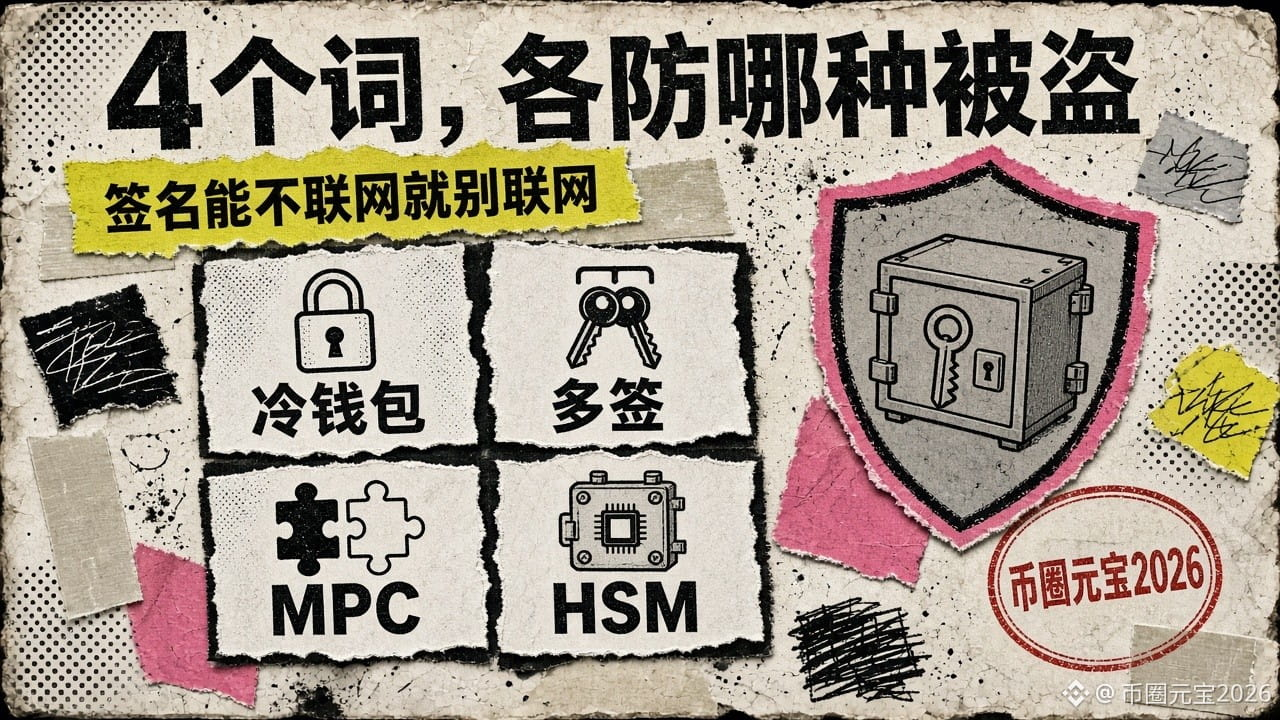
Cold wallets, multisig, MPC, HSM: what kind of theft does each of these 4 terms protect against? A clear explanation using Blockstream’s new custody solution this week as an example
Different kinds of theft call for different protections. Many people treat these 4 terms as synonyms for “more secure,” but each one addresses a different part of the problem.
The example: On November 13, Blockstream announced an institutional custody solution with French technology and cybersecurity company Thales. The two companies have been working together for two years. The key change, in a nutshell: run the entire MPC signing protocol inside Thales’ hardware security module (HSM), so key material never leaves the hardware during signing. They also use FROST threshold signatures: several parties produce a signature together without ever reconstructing the complete private key.
Here’s how the example compares with the 4 terms:
1. Cold wallet: protects against “remote theft over the internet.” Private keys are generated and signatures are produced on an offline device, so a hacker would first have to get physical access to it. The drawback is that it’s slow: someone has to retrieve the device for each signature.
2. Multisig: protects against “losing one key and losing everything.” For example, if 2 out of 3 keys are needed to move funds, losing or having one key stolen won’t be enough to compromise them. The drawback is that the rules are written on-chain, where everyone can see them, and transactions are more complex.
3. MPC: protects against “the complete private key being stored in one place.” The private key is split into several parts from the start and stored on different machines. When signing, the parties run a round of calculations, while the result looks like a regular single-signature transaction on-chain. The drawback is that the protocol is complex and the machines have to communicate repeatedly—and those machines are often connected to the internet.
4. HSM: protects against “keys being copied off a server.” It’s specialized hardware: keys can be used but not exported. What Blockstream has done here is address the weakness of point 3 with point 4: MPC calculations take place inside the HSM, not on an ordinary server.
Blockstream CEO Adam Back put it more plainly to Cointelegraph: common MPC protocols are complex and require a lot of interaction, making them difficult to use for truly offline cold storage. As long as a device is connected to the internet, even with a firewall, there’s a risk it could be compromised or someone could obtain login privileges they shouldn’t have. His exact words were: “Complexity is the enemy of security.”
What does this have to do with retail investors? The solution is for institutions, so you don’t need to buy it. But you can put the same idea into practice today:
1. Keep large amounts of crypto that you plan to hold long-term in a hardware wallet. Write down the recovery phrase by hand and store it offline. Don’t photograph it, save it to cloud storage, or send it to any AI or customer support agent.
2. Keep the funds you trade with daily in a hot wallet or on an exchange, and only keep enough there for the week.
3. Enable a withdrawal whitelist and security keys for your exchange account. Disable withdrawal permissions for API keys.
The rule of thumb is simple: is the device connected to the internet when signing, and does the complete private key ever appear on a single machine?
Follow me for case-study lessons at 16:15. Each time, I use a real-world example to explain one concept.
#钱包安全 #冷钱包 #MPC #Education
Cold wallets, multisig, MPC, HSM: what kind of theft does each of these 4 terms protect against? A clear explanation using Blockstream’s new custody solution this week as an example
Different kinds of theft call for different protections. Many people treat these 4 terms as synonyms for “more secure,” but each one addresses a different part of the problem.
The example: On November 13, Blockstream announced an institutional custody solution with French technology and cybersecurity company Thales. The two companies have been working together for two years. The key change, in a nutshell: run the entire MPC signing protocol inside Thales’ hardware security module (HSM), so key material never leaves the hardware during signing. They also use FROST threshold signatures: several parties produce a signature together without ever reconstructing the complete private key.
Here’s how the example compares with the 4 terms:
1. Cold wallet: protects against “remote theft over the internet.” Private keys are generated and signatures are produced on an offline device, so a hacker would first have to get physical access to it. The drawback is that it’s slow: someone has to retrieve the device for each signature.
2. Multisig: protects against “losing one key and losing everything.” For example, if 2 out of 3 keys are needed to move funds, losing or having one key stolen won’t be enough to compromise them. The drawback is that the rules are written on-chain, where everyone can see them, and transactions are more complex.
3. MPC: protects against “the complete private key being stored in one place.” The private key is split into several parts from the start and stored on different machines. When signing, the parties run a round of calculations, while the result looks like a regular single-signature transaction on-chain. The drawback is that the protocol is complex and the machines have to communicate repeatedly—and those machines are often connected to the internet.
4. HSM: protects against “keys being copied off a server.” It’s specialized hardware: keys can be used but not exported. What Blockstream has done here is address the weakness of point 3 with point 4: MPC calculations take place inside the HSM, not on an ordinary server.
Blockstream CEO Adam Back put it more plainly to Cointelegraph: common MPC protocols are complex and require a lot of interaction, making them difficult to use for truly offline cold storage. As long as a device is connected to the internet, even with a firewall, there’s a risk it could be compromised or someone could obtain login privileges they shouldn’t have. His exact words were: “Complexity is the enemy of security.”
What does this have to do with retail investors? The solution is for institutions, so you don’t need to buy it. But you can put the same idea into practice today:
1. Keep large amounts of crypto that you plan to hold long-term in a hardware wallet. Write down the recovery phrase by hand and store it offline. Don’t photograph it, save it to cloud storage, or send it to any AI or customer support agent.
2. Keep the funds you trade with daily in a hot wallet or on an exchange, and only keep enough there for the week.
3. Enable a withdrawal whitelist and security keys for your exchange account. Disable withdrawal permissions for API keys.
The rule of thumb is simple: is the device connected to the internet when signing, and does the complete private key ever appear on a single machine?
Follow me for case-study lessons at 16:15. Each time, I use a real-world example to explain one concept.
#钱包安全 #冷钱包 #MPC #Education
Different kinds of theft call for different protections. Many people treat these 4 terms as synonyms for “more secure,” but each one addresses a different part of the problem.
The example: On November 13, Blockstream announced an institutional custody solution with French technology and cybersecurity company Thales. The two companies have been working together for two years. The key change, in a nutshell: run the entire MPC signing protocol inside Thales’ hardware security module (HSM), so key material never leaves the hardware during signing. They also use FROST threshold signatures: several parties produce a signature together without ever reconstructing the complete private key.
Here’s how the example compares with the 4 terms:
1. Cold wallet: protects against “remote theft over the internet.” Private keys are generated and signatures are produced on an offline device, so a hacker would first have to get physical access to it. The drawback is that it’s slow: someone has to retrieve the device for each signature.
2. Multisig: protects against “losing one key and losing everything.” For example, if 2 out of 3 keys are needed to move funds, losing or having one key stolen won’t be enough to compromise them. The drawback is that the rules are written on-chain, where everyone can see them, and transactions are more complex.
3. MPC: protects against “the complete private key being stored in one place.” The private key is split into several parts from the start and stored on different machines. When signing, the parties run a round of calculations, while the result looks like a regular single-signature transaction on-chain. The drawback is that the protocol is complex and the machines have to communicate repeatedly—and those machines are often connected to the internet.
4. HSM: protects against “keys being copied off a server.” It’s specialized hardware: keys can be used but not exported. What Blockstream has done here is address the weakness of point 3 with point 4: MPC calculations take place inside the HSM, not on an ordinary server.
Blockstream CEO Adam Back put it more plainly to Cointelegraph: common MPC protocols are complex and require a lot of interaction, making them difficult to use for truly offline cold storage. As long as a device is connected to the internet, even with a firewall, there’s a risk it could be compromised or someone could obtain login privileges they shouldn’t have. His exact words were: “Complexity is the enemy of security.”
What does this have to do with retail investors? The solution is for institutions, so you don’t need to buy it. But you can put the same idea into practice today:
1. Keep large amounts of crypto that you plan to hold long-term in a hardware wallet. Write down the recovery phrase by hand and store it offline. Don’t photograph it, save it to cloud storage, or send it to any AI or customer support agent.
2. Keep the funds you trade with daily in a hot wallet or on an exchange, and only keep enough there for the week.
3. Enable a withdrawal whitelist and security keys for your exchange account. Disable withdrawal permissions for API keys.
The rule of thumb is simple: is the device connected to the internet when signing, and does the complete private key ever appear on a single machine?
Follow me for case-study lessons at 16:15. Each time, I use a real-world example to explain one concept.
#钱包安全 #冷钱包 #MPC #Education
6

·
--
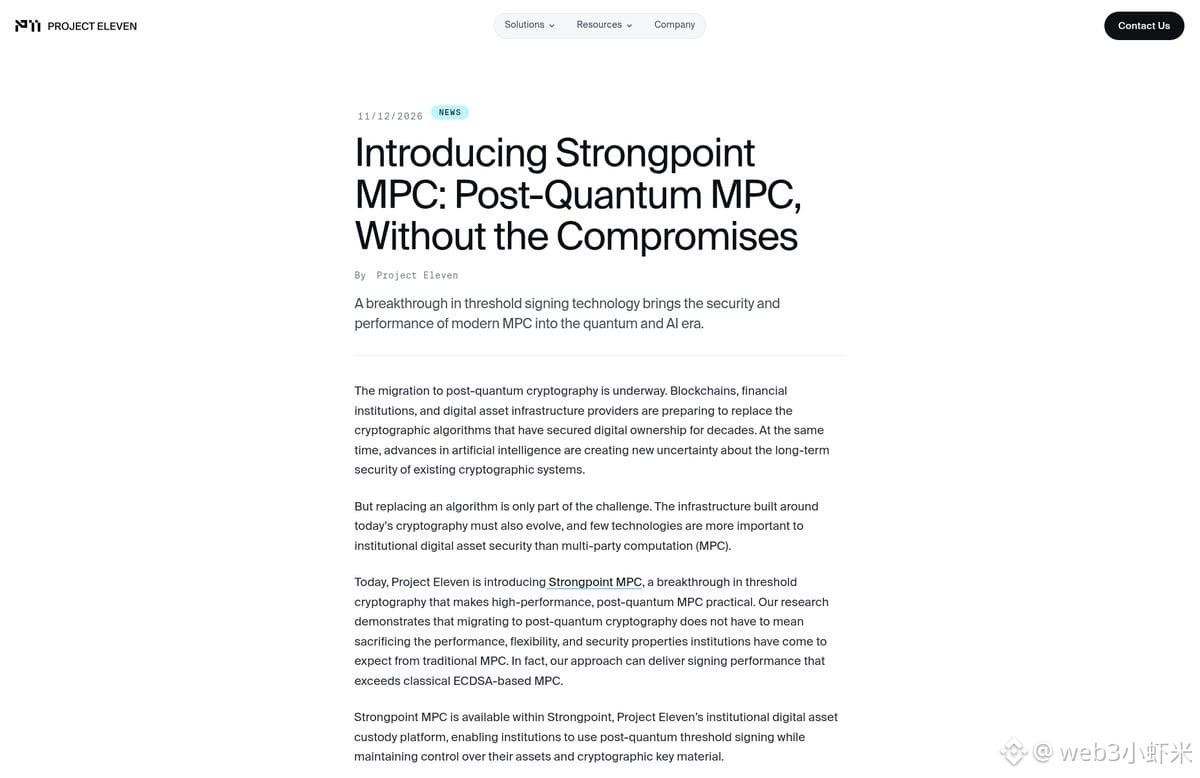
When it comes to post-quantum security, institutional custody providers aren’t worried about slogans—they’re worried about signing being so slow it can’t be used day to day.
Project Eleven has just launched Strongpoint MPC, which it says turns hash-based signatures into a multiparty threshold scheme. The company says complete signatures can be generated in under one second, with keys jointly generated by multiple parties rather than relying on a single trusted third party. It will initially support a new signing scheme for Ethereum.
The product is now part of its institutional custody platform, Strongpoint. The company also says its performance can even surpass that of traditional ECDSA MPC.
These are the company’s own product claims and figures; I haven’t seen independent verification yet. But the direction is clear: custody, stablecoin key management, cross-chain systems, and validator nodes may all have to deal with the shift to post-quantum security.
$ETH #抗量子 #MPC
When it comes to post-quantum security, institutional custody providers aren’t worried about slogans—they’re worried about signing being so slow it can’t be used day to day.
Project Eleven has just launched Strongpoint MPC, which it says turns hash-based signatures into a multiparty threshold scheme. The company says complete signatures can be generated in under one second, with keys jointly generated by multiple parties rather than relying on a single trusted third party. It will initially support a new signing scheme for Ethereum.
The product is now part of its institutional custody platform, Strongpoint. The company also says its performance can even surpass that of traditional ECDSA MPC.
These are the company’s own product claims and figures; I haven’t seen independent verification yet. But the direction is clear: custody, stablecoin key management, cross-chain systems, and validator nodes may all have to deal with the shift to post-quantum security.
$ETH #抗量子 #MPC
Project Eleven has just launched Strongpoint MPC, which it says turns hash-based signatures into a multiparty threshold scheme. The company says complete signatures can be generated in under one second, with keys jointly generated by multiple parties rather than relying on a single trusted third party. It will initially support a new signing scheme for Ethereum.
The product is now part of its institutional custody platform, Strongpoint. The company also says its performance can even surpass that of traditional ECDSA MPC.
These are the company’s own product claims and figures; I haven’t seen independent verification yet. But the direction is clear: custody, stablecoin key management, cross-chain systems, and validator nodes may all have to deal with the shift to post-quantum security.
$ETH #抗量子 #MPC
1
172

·
--
Article
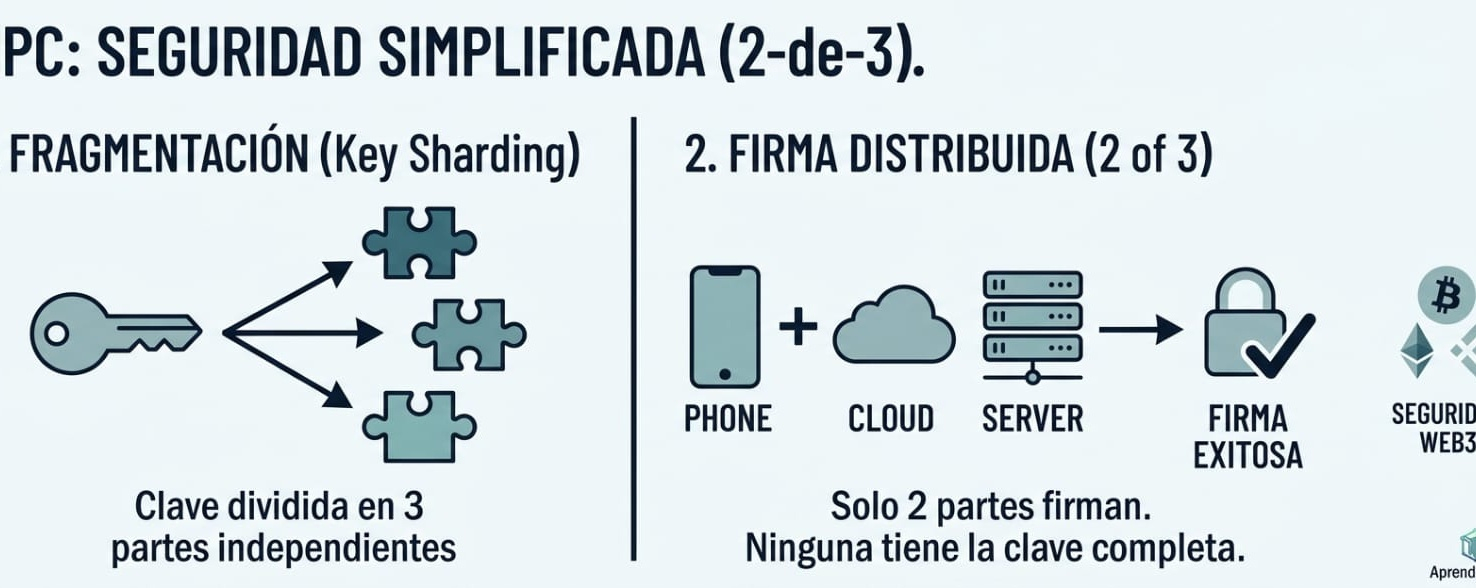
What Is MPC Security in Cryptocurrency and Why Are Backups Still EssentialIn today’s crypto ecosystem, the security of digital assets has evolved considerably. Gone are the days when relying on a single 12- or 24-word seed phrase was the only way to protect our funds. Today, advanced technologies such as Multi-Party Computation (MPC) are redefining how we interact with self-custody.
Although MPC wallets eliminate the single point of failure by splitting the private key, many users fall for the myth that backups are no longer necessary. The reality is very different: distributed encryption protects against live theft, but backups ensure you never lose access to your funds.
What Is MPC Security in Cryptocurrency and Why Are Backups Still Essential
In today’s crypto ecosystem, the security of digital assets has evolved considerably. Gone are the days when relying on a single 12- or 24-word seed phrase was the only way to protect our funds. Today, advanced technologies such as Multi-Party Computation (MPC) are redefining how we interact with self-custody.
Although MPC wallets eliminate the single point of failure by splitting the private key, many users fall for the myth that backups are no longer necessary. The reality is very different: distributed encryption protects against live theft, but backups ensure you never lose access to your funds.
Although MPC wallets eliminate the single point of failure by splitting the private key, many users fall for the myth that backups are no longer necessary. The reality is very different: distributed encryption protects against live theft, but backups ensure you never lose access to your funds.
3
204

·
--
【Market Brief】Google Cloud enters the custody business—is MPC becoming an industry standard?
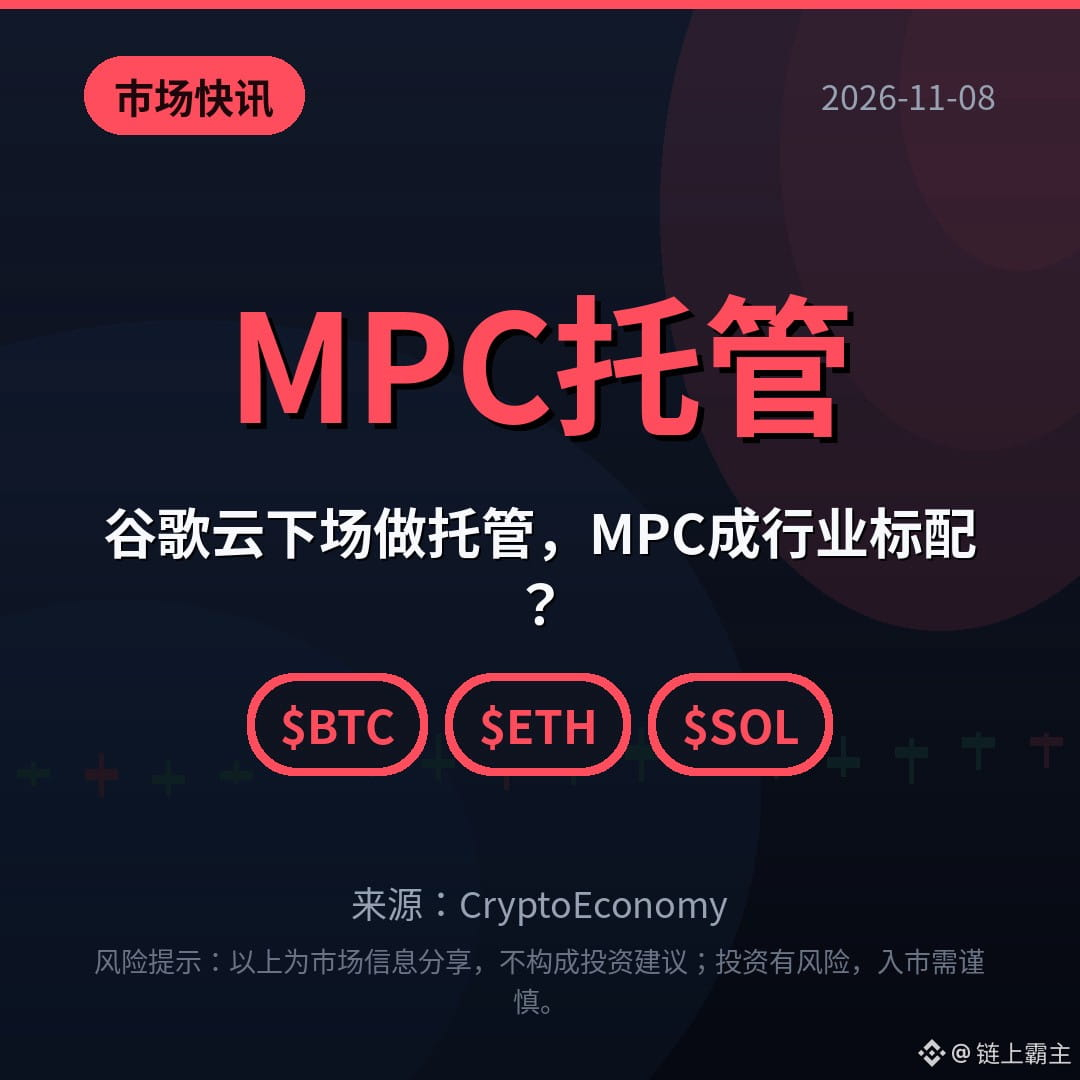
Around $2.2 billion in crypto was stolen in 2024, with private key leaks accounting for 43.8%. Google Cloud is preparing institutional crypto custody services, using MPC to distribute keys and prevent single points of failure. Alphabet has already used MPC to protect Solana and Ethereum assets. Commercial launch is expected in early 2027; Bybit lost around $1.5 billion this February. MPC is no silver bullet—would you entrust custody to a cloud giant?
$BTC $ETH $SOL
#谷歌云 #机构托管 #MPC
(Source: CryptoEconomy)
⚠️Risk warning: The above is shared for informational purposes only and does not constitute investment advice. Investing involves risks; please exercise caution.
【Market Brief】Google Cloud enters the custody business—is MPC becoming an industry standard?
Around $2.2 billion in crypto was stolen in 2024, with private key leaks accounting for 43.8%. Google Cloud is preparing institutional crypto custody services, using MPC to distribute keys and prevent single points of failure. Alphabet has already used MPC to protect Solana and Ethereum assets. Commercial launch is expected in early 2027; Bybit lost around $1.5 billion this February. MPC is no silver bullet—would you entrust custody to a cloud giant?
$BTC $ETH $SOL
#谷歌云 #机构托管 #MPC
(Source: CryptoEconomy)
⚠️Risk warning: The above is shared for informational purposes only and does not constitute investment advice. Investing involves risks; please exercise caution.
Around $2.2 billion in crypto was stolen in 2024, with private key leaks accounting for 43.8%. Google Cloud is preparing institutional crypto custody services, using MPC to distribute keys and prevent single points of failure. Alphabet has already used MPC to protect Solana and Ethereum assets. Commercial launch is expected in early 2027; Bybit lost around $1.5 billion this February. MPC is no silver bullet—would you entrust custody to a cloud giant?
$BTC $ETH $SOL
#谷歌云 #机构托管 #MPC
(Source: CryptoEconomy)
⚠️Risk warning: The above is shared for informational purposes only and does not constitute investment advice. Investing involves risks; please exercise caution.
13

·
--
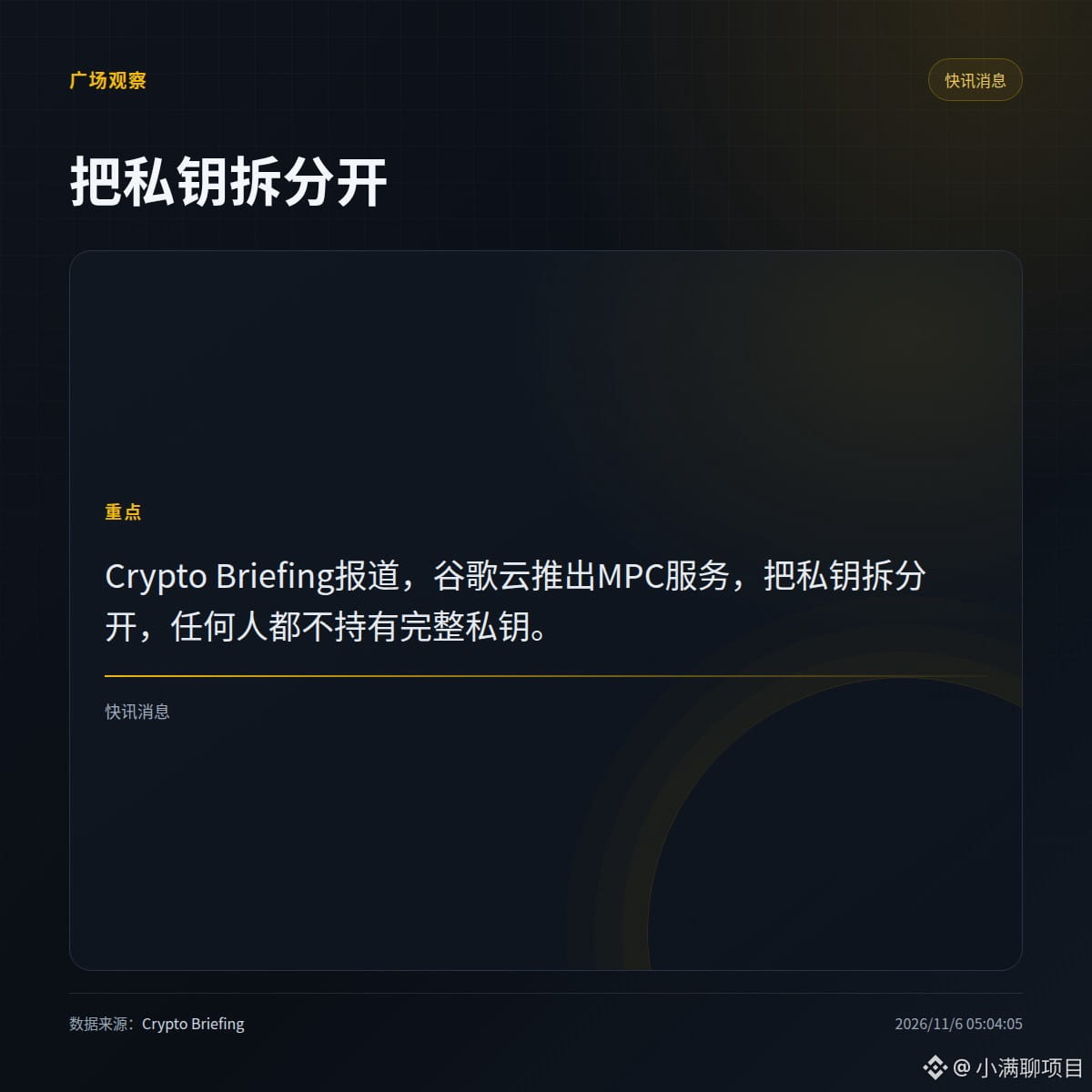
Google Cloud launches an MPC service, so no single party holds the complete private key.
According to Crypto Briefing, the service splits private keys into multiple shares, and no party can access the complete key. The report says this could reshape digital asset security and challenge existing providers.
· MPC key shares mean a single-point leak does not compromise the entire private key, provided the shares are distributed among different holders.
· “Building trust in institutional custody” is Crypto Briefing’s assessment, not evidence of adoption that has already occurred.
Would you look first at its key-share threshold settings, or at the list of custody institutions it supports?
#MPC
Google Cloud launches an MPC service, so no single party holds the complete private key.
According to Crypto Briefing, the service splits private keys into multiple shares, and no party can access the complete key. The report says this could reshape digital asset security and challenge existing providers.
· MPC key shares mean a single-point leak does not compromise the entire private key, provided the shares are distributed among different holders.
· “Building trust in institutional custody” is Crypto Briefing’s assessment, not evidence of adoption that has already occurred.
Would you look first at its key-share threshold settings, or at the list of custody institutions it supports?
#MPC
According to Crypto Briefing, the service splits private keys into multiple shares, and no party can access the complete key. The report says this could reshape digital asset security and challenge existing providers.
· MPC key shares mean a single-point leak does not compromise the entire private key, provided the shares are distributed among different holders.
· “Building trust in institutional custody” is Crypto Briefing’s assessment, not evidence of adoption that has already occurred.
Would you look first at its key-share threshold settings, or at the list of custody institutions it supports?
#MPC
GOOGUS-1.72%
17
·
--
Google Cloud’s custody solution: how can it claim that the private key “never exists in its entirety”?
This week, a crypto exchange’s hot wallet was compromised. That same week, I looked up a Google Cloud product document: Multi-Party Compute (MPC) custody, designed to manage digital asset signing keys. The idea, in a nutshell: split a key into several parts, store them separately, and never put them back together—even when signing.
Here’s the official documentation, distilled into a few points:
1. The problem with the old approach: Keeping the complete private key in a single hardware security module creates a single point of failure. Copying it to multiple devices or regions improves availability, but each copy is still a complete private key—which is like adding more doors that can be forced open.
2. How this works: Threshold signatures (the document describes a hardened extension of the DKLS23 protocol). Several independent participants each generate and hold a “key share.” When signing, they work together to produce a valid signature, without any one location ever reconstructing the complete private key.
3. Security boundaries: If fewer than the threshold number of participants are compromised, an attacker can’t forge a signature or recover the private key. If a few participants go offline or are permanently lost, signing can still proceed as long as enough remain to meet the threshold.
4. Example (the gist of the document): Three people on a finance team each hold a share; any two must agree to sign.
5. Supported options: The secp256k1 curve, used by Bitcoin, Ethereum, and EVM chains; Ed25519 (Solana) is marked “coming soon.” The product is currently in preview (Pre-GA).
A few candid points:
· One thing the documentation is refreshingly honest about: transaction policies (such as limits and allowlists) only provide “allow/deny” recommendations. If enough signers approve, a transaction rejected by the policy can still go through. Thresholds protect against “one location being compromised,” but not against “enough people being tricked together.”
· Splitting up a key doesn’t automatically make your funds safe. Signers can still be phished, or an approval process can become a rubber stamp—and things can still go wrong.
· We don’t yet have the official full technical report explaining exactly which part of this week’s theft failed. I won’t use MPC to explain it, or claim that “using it means you can’t be robbed.”
· Ordinary users don’t need institutional custody, but the principle still applies: don’t store your seed phrase in just one place, and don’t photograph the whole thing and upload it to the cloud.
Is your seed phrase currently “one copy in one place,” or “one copy duplicated in several places”?
#MPC #钱包安全 #Explainer
Google Cloud’s custody solution: how can it claim that the private key “never exists in its entirety”?
This week, a crypto exchange’s hot wallet was compromised. That same week, I looked up a Google Cloud product document: Multi-Party Compute (MPC) custody, designed to manage digital asset signing keys. The idea, in a nutshell: split a key into several parts, store them separately, and never put them back together—even when signing.
Here’s the official documentation, distilled into a few points:
1. The problem with the old approach: Keeping the complete private key in a single hardware security module creates a single point of failure. Copying it to multiple devices or regions improves availability, but each copy is still a complete private key—which is like adding more doors that can be forced open.
2. How this works: Threshold signatures (the document describes a hardened extension of the DKLS23 protocol). Several independent participants each generate and hold a “key share.” When signing, they work together to produce a valid signature, without any one location ever reconstructing the complete private key.
3. Security boundaries: If fewer than the threshold number of participants are compromised, an attacker can’t forge a signature or recover the private key. If a few participants go offline or are permanently lost, signing can still proceed as long as enough remain to meet the threshold.
4. Example (the gist of the document): Three people on a finance team each hold a share; any two must agree to sign.
5. Supported options: The secp256k1 curve, used by Bitcoin, Ethereum, and EVM chains; Ed25519 (Solana) is marked “coming soon.” The product is currently in preview (Pre-GA).
A few candid points:
· One thing the documentation is refreshingly honest about: transaction policies (such as limits and allowlists) only provide “allow/deny” recommendations. If enough signers approve, a transaction rejected by the policy can still go through. Thresholds protect against “one location being compromised,” but not against “enough people being tricked together.”
· Splitting up a key doesn’t automatically make your funds safe. Signers can still be phished, or an approval process can become a rubber stamp—and things can still go wrong.
· We don’t yet have the official full technical report explaining exactly which part of this week’s theft failed. I won’t use MPC to explain it, or claim that “using it means you can’t be robbed.”
· Ordinary users don’t need institutional custody, but the principle still applies: don’t store your seed phrase in just one place, and don’t photograph the whole thing and upload it to the cloud.
Is your seed phrase currently “one copy in one place,” or “one copy duplicated in several places”?
#MPC #钱包安全 #Explainer
This week, a crypto exchange’s hot wallet was compromised. That same week, I looked up a Google Cloud product document: Multi-Party Compute (MPC) custody, designed to manage digital asset signing keys. The idea, in a nutshell: split a key into several parts, store them separately, and never put them back together—even when signing.
Here’s the official documentation, distilled into a few points:
1. The problem with the old approach: Keeping the complete private key in a single hardware security module creates a single point of failure. Copying it to multiple devices or regions improves availability, but each copy is still a complete private key—which is like adding more doors that can be forced open.
2. How this works: Threshold signatures (the document describes a hardened extension of the DKLS23 protocol). Several independent participants each generate and hold a “key share.” When signing, they work together to produce a valid signature, without any one location ever reconstructing the complete private key.
3. Security boundaries: If fewer than the threshold number of participants are compromised, an attacker can’t forge a signature or recover the private key. If a few participants go offline or are permanently lost, signing can still proceed as long as enough remain to meet the threshold.
4. Example (the gist of the document): Three people on a finance team each hold a share; any two must agree to sign.
5. Supported options: The secp256k1 curve, used by Bitcoin, Ethereum, and EVM chains; Ed25519 (Solana) is marked “coming soon.” The product is currently in preview (Pre-GA).
A few candid points:
· One thing the documentation is refreshingly honest about: transaction policies (such as limits and allowlists) only provide “allow/deny” recommendations. If enough signers approve, a transaction rejected by the policy can still go through. Thresholds protect against “one location being compromised,” but not against “enough people being tricked together.”
· Splitting up a key doesn’t automatically make your funds safe. Signers can still be phished, or an approval process can become a rubber stamp—and things can still go wrong.
· We don’t yet have the official full technical report explaining exactly which part of this week’s theft failed. I won’t use MPC to explain it, or claim that “using it means you can’t be robbed.”
· Ordinary users don’t need institutional custody, but the principle still applies: don’t store your seed phrase in just one place, and don’t photograph the whole thing and upload it to the cloud.
Is your seed phrase currently “one copy in one place,” or “one copy duplicated in several places”?
#MPC #钱包安全 #Explainer

GOOGUS-1.72%
11
·
--
Came across Google Cloud: it rolled out a Multi-Party Compute (MPC) custodial key-signing service at a digital assets symposium in New York—aimed specifically at banks and institutions. It splits cryptographic private keys into multiple parts, stored in different environments.
Key details: Banks can keep one share on local hardware, another in Google Cloud, and a third with a different cloud provider; no single party holds the complete private key. Before signing, a policy engine also checks the request (limits, whitelisted addresses, multi-party approvals, and so on). It’s currently in private preview, with commercial availability targeted for early 2027; several major financial institutions are already testing it. Alphabet itself uses the system to protect its digital assets on Ethereum and Solana. ECDSA (BTC/ETH) is supported; Ed25519/Solana documentation is marked “coming soon,” with support planned for commercial launch.
Big tech is now selling institutional key custody as serious infrastructure—compared with “one party holding the entire private key,” it feels like a very different bar to clear.
#托管 #MPC #GoogleCloud #Institutional
Came across Google Cloud: it rolled out a Multi-Party Compute (MPC) custodial key-signing service at a digital assets symposium in New York—aimed specifically at banks and institutions. It splits cryptographic private keys into multiple parts, stored in different environments.
Key details: Banks can keep one share on local hardware, another in Google Cloud, and a third with a different cloud provider; no single party holds the complete private key. Before signing, a policy engine also checks the request (limits, whitelisted addresses, multi-party approvals, and so on). It’s currently in private preview, with commercial availability targeted for early 2027; several major financial institutions are already testing it. Alphabet itself uses the system to protect its digital assets on Ethereum and Solana. ECDSA (BTC/ETH) is supported; Ed25519/Solana documentation is marked “coming soon,” with support planned for commercial launch.
Big tech is now selling institutional key custody as serious infrastructure—compared with “one party holding the entire private key,” it feels like a very different bar to clear.
#托管 #MPC #GoogleCloud #Institutional
Key details: Banks can keep one share on local hardware, another in Google Cloud, and a third with a different cloud provider; no single party holds the complete private key. Before signing, a policy engine also checks the request (limits, whitelisted addresses, multi-party approvals, and so on). It’s currently in private preview, with commercial availability targeted for early 2027; several major financial institutions are already testing it. Alphabet itself uses the system to protect its digital assets on Ethereum and Solana. ECDSA (BTC/ETH) is supported; Ed25519/Solana documentation is marked “coming soon,” with support planned for commercial launch.
Big tech is now selling institutional key custody as serious infrastructure—compared with “one party holding the entire private key,” it feels like a very different bar to clear.
#托管 #MPC #GoogleCloud #Institutional

GOOGUS-1.72%
15

🔐 Google is set to manage private keys for institutions. Could crypto custody be reshaped by Big Tech?
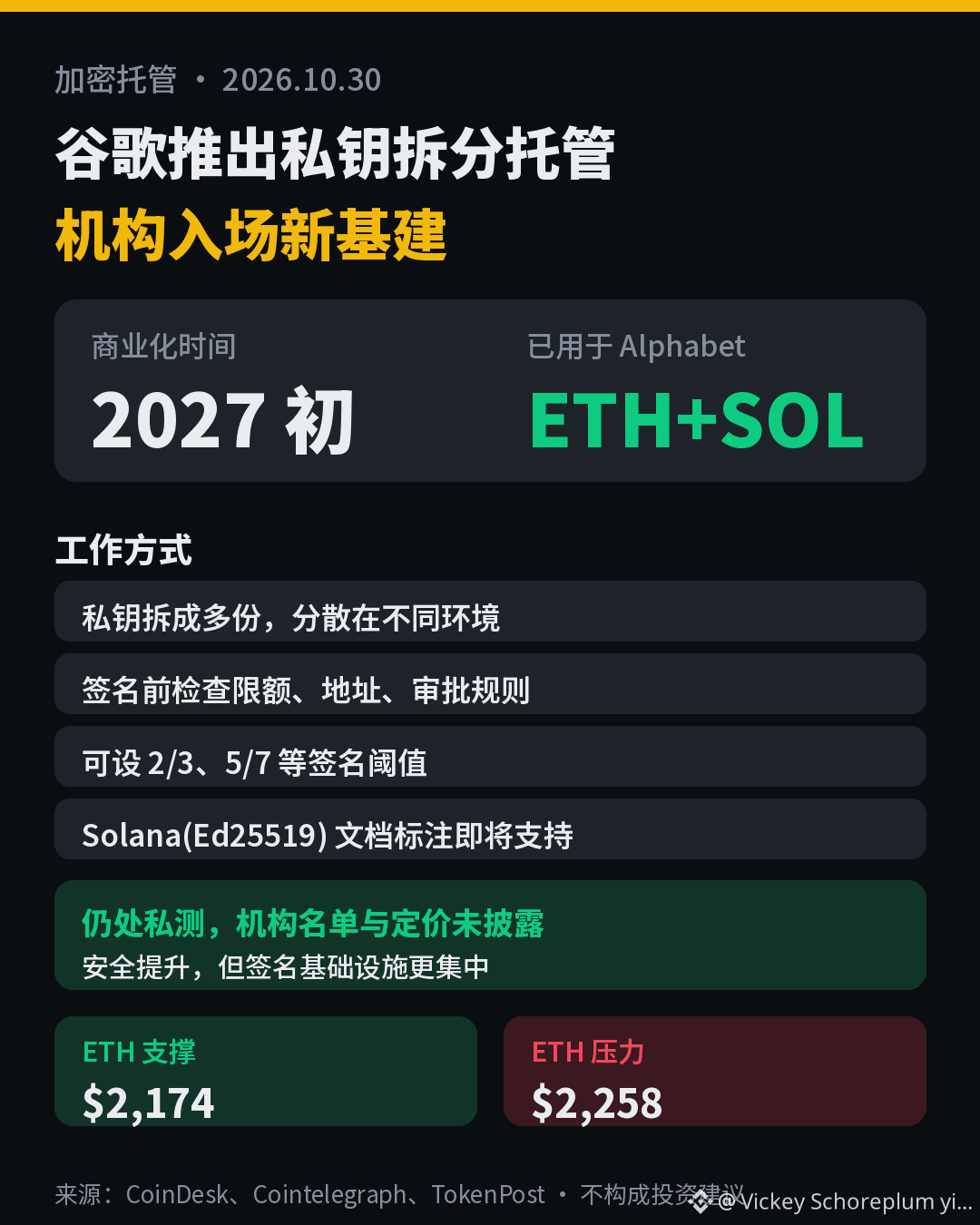
According to reports from CoinDesk and other media outlets on October 28, Google Cloud’s Multi-Party Compute (MPC) custody security service has entered private testing. Several major financial institutions and design partners are testing it, with commercialization planned for early 2027. Parent company Alphabet is also using it to protect its digital assets on Ethereum and Solana.
📊 Key points
• How it works: Signing keys are split into multiple shares and distributed across Google Cloud, institutions’ own hardware, and other cloud environments, so no one party can access the complete private key.
• Risk controls: Before signing, the service checks transfer limits, allowlisted destination addresses, and approvals from multiple departments. Thresholds such as 2-of-3 and 5-of-7 can be configured.
• Supported chains: ECDSA (Bitcoin, Ethereum, and EVM chains) is supported first; documentation says Ed25519, required by Solana, is “coming soon.”
• Not disclosed: The names of test institutions, Alphabet’s asset holdings and their value, pricing, or a specific launch date.
📈 Market impact
This is a positive narrative for institutional-grade custody, but it doesn’t mean buying pressure will follow in the short term. ETH is currently around 2,191 USDT, down about 5.4% over 24 hours. Today’s low is around 2,174, compared with yesterday’s low of around 2,233. On a rebound, watch resistance near 2,258; if 2,174 breaks, be alert for a further dip.
💬 The debate: Security has improved, but if the most critical signing infrastructure is handed over to major cloud providers, how much decentralization is left? What do you think?
👉 Trade ETH: https://www.binance.com/zh-CN/trade/ETH_USDT
#谷歌将预览加密托管安全系统 #MPC #ETH #CryptoCustody
⚠️ This is not investment advice. Please be aware of the risks.
🔐 Google is set to manage private keys for institutions. Could crypto custody be reshaped by Big Tech?
According to reports from CoinDesk and other media outlets on October 28, Google Cloud’s Multi-Party Compute (MPC) custody security service has entered private testing. Several major financial institutions and design partners are testing it, with commercialization planned for early 2027. Parent company Alphabet is also using it to protect its digital assets on Ethereum and Solana.
📊 Key points
• How it works: Signing keys are split into multiple shares and distributed across Google Cloud, institutions’ own hardware, and other cloud environments, so no one party can access the complete private key.
• Risk controls: Before signing, the service checks transfer limits, allowlisted destination addresses, and approvals from multiple departments. Thresholds such as 2-of-3 and 5-of-7 can be configured.
• Supported chains: ECDSA (Bitcoin, Ethereum, and EVM chains) is supported first; documentation says Ed25519, required by Solana, is “coming soon.”
• Not disclosed: The names of test institutions, Alphabet’s asset holdings and their value, pricing, or a specific launch date.
📈 Market impact
This is a positive narrative for institutional-grade custody, but it doesn’t mean buying pressure will follow in the short term. ETH is currently around 2,191 USDT, down about 5.4% over 24 hours. Today’s low is around 2,174, compared with yesterday’s low of around 2,233. On a rebound, watch resistance near 2,258; if 2,174 breaks, be alert for a further dip.
💬 The debate: Security has improved, but if the most critical signing infrastructure is handed over to major cloud providers, how much decentralization is left? What do you think?
👉 Trade ETH: https://www.binance.com/zh-CN/trade/ETH_USDT
#谷歌将预览加密托管安全系统 #MPC #ETH #CryptoCustody
⚠️ This is not investment advice. Please be aware of the risks.
According to reports from CoinDesk and other media outlets on October 28, Google Cloud’s Multi-Party Compute (MPC) custody security service has entered private testing. Several major financial institutions and design partners are testing it, with commercialization planned for early 2027. Parent company Alphabet is also using it to protect its digital assets on Ethereum and Solana.
📊 Key points
• How it works: Signing keys are split into multiple shares and distributed across Google Cloud, institutions’ own hardware, and other cloud environments, so no one party can access the complete private key.
• Risk controls: Before signing, the service checks transfer limits, allowlisted destination addresses, and approvals from multiple departments. Thresholds such as 2-of-3 and 5-of-7 can be configured.
• Supported chains: ECDSA (Bitcoin, Ethereum, and EVM chains) is supported first; documentation says Ed25519, required by Solana, is “coming soon.”
• Not disclosed: The names of test institutions, Alphabet’s asset holdings and their value, pricing, or a specific launch date.
📈 Market impact
This is a positive narrative for institutional-grade custody, but it doesn’t mean buying pressure will follow in the short term. ETH is currently around 2,191 USDT, down about 5.4% over 24 hours. Today’s low is around 2,174, compared with yesterday’s low of around 2,233. On a rebound, watch resistance near 2,258; if 2,174 breaks, be alert for a further dip.
💬 The debate: Security has improved, but if the most critical signing infrastructure is handed over to major cloud providers, how much decentralization is left? What do you think?
👉 Trade ETH: https://www.binance.com/zh-CN/trade/ETH_USDT
#谷歌将预览加密托管安全系统 #MPC #ETH #CryptoCustody
⚠️ This is not investment advice. Please be aware of the risks.
539

·
--
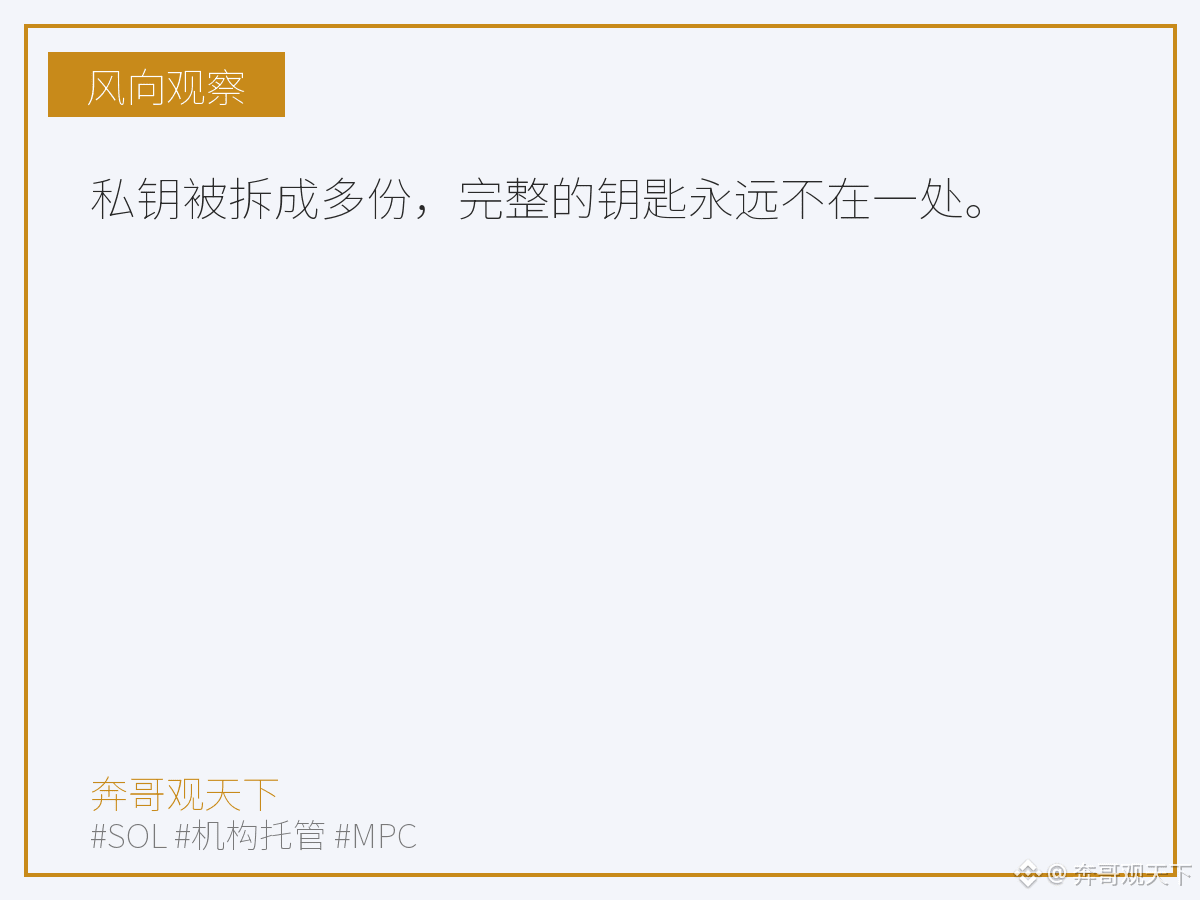
One of the world’s largest cloud infrastructure companies is getting serious about crypto custody. Alphabet’s own digital assets are already running on Ethereum and Solana, using a system that splits private keys into multiple parts so no single point holds the complete key. Several large financial institutions are testing it, with commercial launch expected in early 2027. The path for institutions to move assets on-chain is becoming increasingly concrete. $SOL $ETH #机构托管 #MPC
One of the world’s largest cloud infrastructure companies is getting serious about crypto custody. Alphabet’s own digital assets are already running on Ethereum and Solana, using a system that splits private keys into multiple parts so no single point holds the complete key. Several large financial institutions are testing it, with commercial launch expected in early 2027. The path for institutions to move assets on-chain is becoming increasingly concrete. $SOL $ETH #机构托管 #MPC
539

Google launched an MPC hosted service for banks, and a bunch of accounts are already shouting "HUGE" and "Google is entering the space.".
Calm down. First, look at what this thing actually is: Google Multi-Party Compute, which splits the private key across several isolated environments and runs it through the bank's own rules again before signing. Right now it's in private preview; the test banks haven’t been named, there’s no pricing, and commercial availability won’t come until early 2027. Alphabet itself is using it to manage ETH and SOL assets, and that’s the only user that can actually be verified right now.
MPC itself isn’t new. Institutional custody has had people working in this lane for years already. What Google is selling isn’t a technical breakthrough, it’s the sense of security that comes with the word "Google" for bank compliance teams. Put simply, it’s just another cloud service SKU; the money comes from banks’ subscription fees, and it doesn’t have much to do with the price of the coins you hold.
Even more absurd is the repost ecosystem. One account copied and pasted the same line, "Google is building crypto custody for banks," six times within 25 seconds, and each post got only a handful of views. Do you really want to treat this kind of copy-paste "bullish news" as a reason to buy?
Yes, private key theft is a major issue (X News cited data showing that 43.8% of theft cases in 2024 were related to private key leaks), and it is a good thing for institutions to use better custody. But "good news" and "immediate price pump" are two different things, separated by more than a year and a bunch of undisclosed details.
#谷歌 #MPC
Google launched an MPC hosted service for banks, and a bunch of accounts are already shouting "HUGE" and "Google is entering the space.".
Calm down. First, look at what this thing actually is: Google Multi-Party Compute, which splits the private key across several isolated environments and runs it through the bank's own rules again before signing. Right now it's in private preview; the test banks haven’t been named, there’s no pricing, and commercial availability won’t come until early 2027. Alphabet itself is using it to manage ETH and SOL assets, and that’s the only user that can actually be verified right now.
MPC itself isn’t new. Institutional custody has had people working in this lane for years already. What Google is selling isn’t a technical breakthrough, it’s the sense of security that comes with the word "Google" for bank compliance teams. Put simply, it’s just another cloud service SKU; the money comes from banks’ subscription fees, and it doesn’t have much to do with the price of the coins you hold.
Even more absurd is the repost ecosystem. One account copied and pasted the same line, "Google is building crypto custody for banks," six times within 25 seconds, and each post got only a handful of views. Do you really want to treat this kind of copy-paste "bullish news" as a reason to buy?
Yes, private key theft is a major issue (X News cited data showing that 43.8% of theft cases in 2024 were related to private key leaks), and it is a good thing for institutions to use better custody. But "good news" and "immediate price pump" are two different things, separated by more than a year and a bunch of undisclosed details.
#谷歌 #MPC
Calm down. First, look at what this thing actually is: Google Multi-Party Compute, which splits the private key across several isolated environments and runs it through the bank's own rules again before signing. Right now it's in private preview; the test banks haven’t been named, there’s no pricing, and commercial availability won’t come until early 2027. Alphabet itself is using it to manage ETH and SOL assets, and that’s the only user that can actually be verified right now.
MPC itself isn’t new. Institutional custody has had people working in this lane for years already. What Google is selling isn’t a technical breakthrough, it’s the sense of security that comes with the word "Google" for bank compliance teams. Put simply, it’s just another cloud service SKU; the money comes from banks’ subscription fees, and it doesn’t have much to do with the price of the coins you hold.
Even more absurd is the repost ecosystem. One account copied and pasted the same line, "Google is building crypto custody for banks," six times within 25 seconds, and each post got only a handful of views. Do you really want to treat this kind of copy-paste "bullish news" as a reason to buy?
Yes, private key theft is a major issue (X News cited data showing that 43.8% of theft cases in 2024 were related to private key leaks), and it is a good thing for institutions to use better custody. But "good news" and "immediate price pump" are two different things, separated by more than a year and a bunch of undisclosed details.
#谷歌 #MPC
GOOGUS-1.72%
11

·
--
Bearish
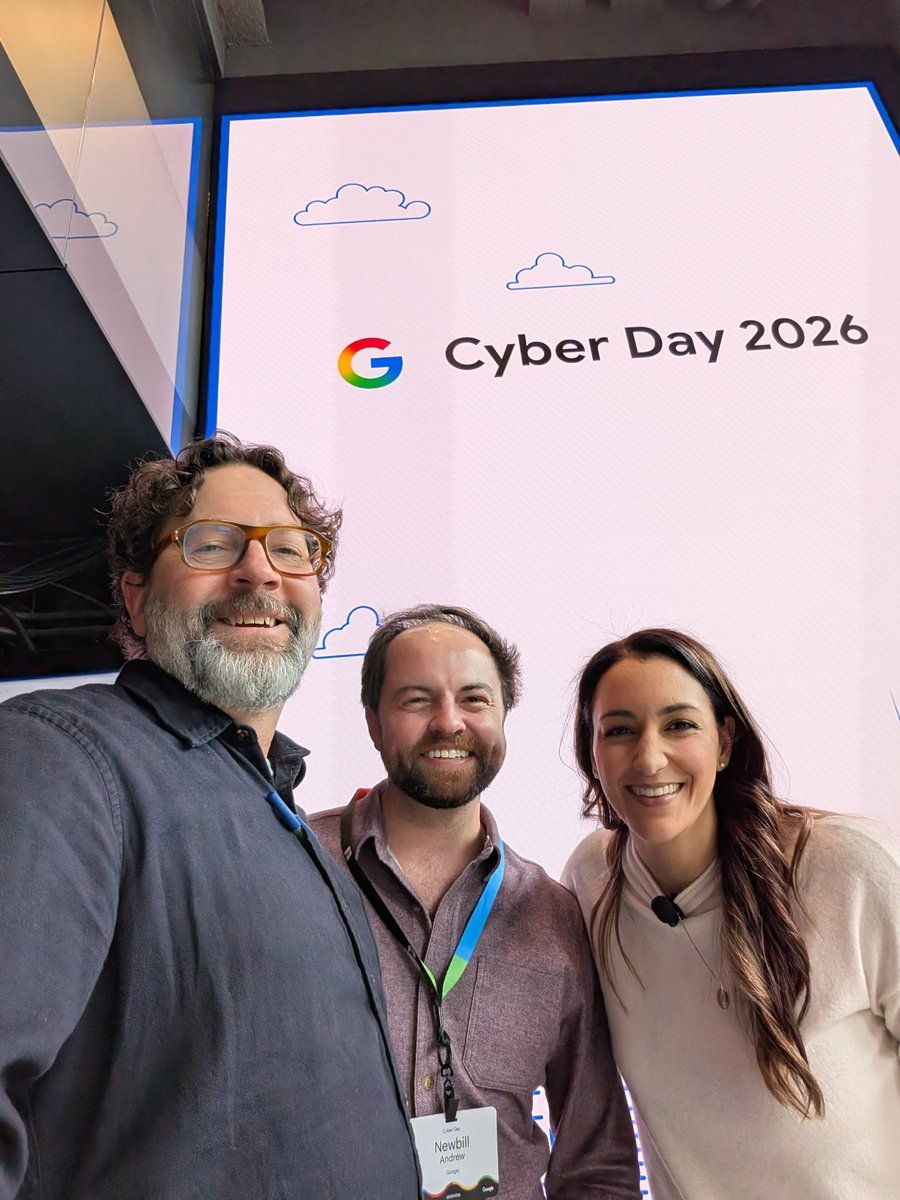
Google Multi-Party Compute is undergoing private testing with institutions. By splitting a private key into multiple shares and distributing them across different environments, it reduces the risk of a single private key being stolen. Alphabet is also using it internally to protect digital assets on Ethereum and Solana, with commercialization expected in early 2027.
Technically, Google cannot access the complete private key directly. But the bigger controversy is this: the crypto industry was originally built to break free from centralized institutions, yet now that institutions are entering the space, the industry is handing its most critical signing infrastructure to one of the world's largest cloud service providers. Security has improved—but how much decentralization is left?
$BTC $ETH $SOL #谷歌将预览加密托管安全系统 #MPC #GoogleCloud #加密托管
{future}(SOLUSDT)
{future}(ETHUSDT)
{future}(BTCUSDT)
Google Multi-Party Compute is undergoing private testing with institutions. By splitting a private key into multiple shares and distributing them across different environments, it reduces the risk of a single private key being stolen. Alphabet is also using it internally to protect digital assets on Ethereum and Solana, with commercialization expected in early 2027.
Technically, Google cannot access the complete private key directly. But the bigger controversy is this: the crypto industry was originally built to break free from centralized institutions, yet now that institutions are entering the space, the industry is handing its most critical signing infrastructure to one of the world's largest cloud service providers. Security has improved—but how much decentralization is left?
$BTC $ETH $SOL #谷歌将预览加密托管安全系统 #MPC #GoogleCloud #加密托管
Technically, Google cannot access the complete private key directly. But the bigger controversy is this: the crypto industry was originally built to break free from centralized institutions, yet now that institutions are entering the space, the industry is handing its most critical signing infrastructure to one of the world's largest cloud service providers. Security has improved—but how much decentralization is left?
$BTC $ETH $SOL #谷歌将预览加密托管安全系统 #MPC #GoogleCloud #加密托管
1
3.7k
·
--
See translation
Google just put institutional crypto custody into private preview — MPC key-splitting for banks, with a commercial window aimed at early 2027.
On October 28, 2026, Google Cloud showcased Google Multi-Party Compute at its digital-assets symposium in New York. The service keeps private-key shares across separate environments, runs transaction-policy checks inside Confidential Space, and never stores a full key in one place. Alphabet is already using it to secure digital assets on Ethereum and Solana, while design partners and major financial institutions are testing it for crypto and tokenized assets.
Google has not named the banks in the preview or disclosed pricing. Commercial availability is planned for early 2027. For institutions moving onto chain, this packages MPC signing, policy gates, and key recovery as one product rather than a DIY stack — still preview, still unproven at scale, but a clear signal that big tech wants a seat in regulated digital-asset custody.
#GoogleCloud #MPC #CryptoCustody $ETH $SOL
DYOR. Not financial advice.
{spot}(GOOGLBUSDT)
{spot}(SOLUSDT)
{spot}(ETHUSDT)
Google just put institutional crypto custody into private preview — MPC key-splitting for banks, with a commercial window aimed at early 2027.
On October 28, 2026, Google Cloud showcased Google Multi-Party Compute at its digital-assets symposium in New York. The service keeps private-key shares across separate environments, runs transaction-policy checks inside Confidential Space, and never stores a full key in one place. Alphabet is already using it to secure digital assets on Ethereum and Solana, while design partners and major financial institutions are testing it for crypto and tokenized assets.
Google has not named the banks in the preview or disclosed pricing. Commercial availability is planned for early 2027. For institutions moving onto chain, this packages MPC signing, policy gates, and key recovery as one product rather than a DIY stack — still preview, still unproven at scale, but a clear signal that big tech wants a seat in regulated digital-asset custody.
#GoogleCloud #MPC #CryptoCustody $ETH $SOL
DYOR. Not financial advice.
On October 28, 2026, Google Cloud showcased Google Multi-Party Compute at its digital-assets symposium in New York. The service keeps private-key shares across separate environments, runs transaction-policy checks inside Confidential Space, and never stores a full key in one place. Alphabet is already using it to secure digital assets on Ethereum and Solana, while design partners and major financial institutions are testing it for crypto and tokenized assets.
Google has not named the banks in the preview or disclosed pricing. Commercial availability is planned for early 2027. For institutions moving onto chain, this packages MPC signing, policy gates, and key recovery as one product rather than a DIY stack — still preview, still unproven at scale, but a clear signal that big tech wants a seat in regulated digital-asset custody.
#GoogleCloud #MPC #CryptoCustody $ETH $SOL
DYOR. Not financial advice.

89

See translation
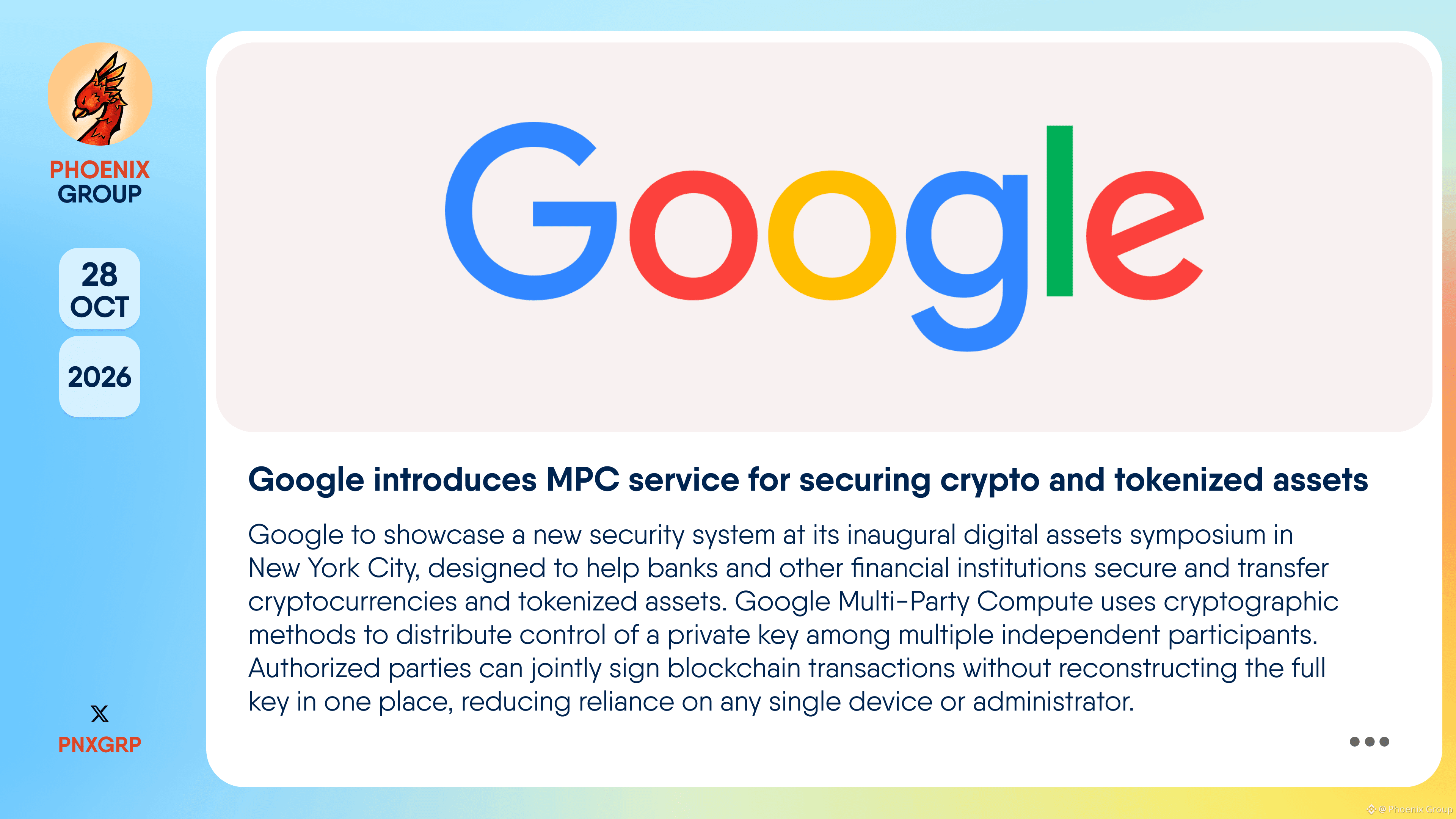
Google introduces MPC service for securing crypto and tokenized assets
#Google to showcase a new security system at its inaugural digital assets symposium in New York City, designed to help banks and other financial institutions secure and transfer cryptocurrencies and tokenized assets. Google Multi-Party Compute #MPC uses cryptographic methods to distribute control of a private key among multiple independent participants. Authorized parties can jointly sign blockchain transactions without reconstructing the full key in one place, reducing reliance on any single device or administrator.
Google Multi-Party Compute is currently in private preview and has not yet been made generally available. Google has not disclosed the names of the institutions testing the service or specified which digital assets Alphabet is securing. The company expects to launch Google Multi-Party Compute commercially in early 2027, though pricing details remain undisclosed.
👉 coindesk.com/tech/2026/10/28/google-to-preview-crypto-custody-security-system-as-ai-threats-grow
Google introduces MPC service for securing crypto and tokenized assets
#Google to showcase a new security system at its inaugural digital assets symposium in New York City, designed to help banks and other financial institutions secure and transfer cryptocurrencies and tokenized assets. Google Multi-Party Compute #MPC uses cryptographic methods to distribute control of a private key among multiple independent participants. Authorized parties can jointly sign blockchain transactions without reconstructing the full key in one place, reducing reliance on any single device or administrator.
Google Multi-Party Compute is currently in private preview and has not yet been made generally available. Google has not disclosed the names of the institutions testing the service or specified which digital assets Alphabet is securing. The company expects to launch Google Multi-Party Compute commercially in early 2027, though pricing details remain undisclosed.
👉 coindesk.com/tech/2026/10/28/google-to-preview-crypto-custody-security-system-as-ai-threats-grow
#Google to showcase a new security system at its inaugural digital assets symposium in New York City, designed to help banks and other financial institutions secure and transfer cryptocurrencies and tokenized assets. Google Multi-Party Compute #MPC uses cryptographic methods to distribute control of a private key among multiple independent participants. Authorized parties can jointly sign blockchain transactions without reconstructing the full key in one place, reducing reliance on any single device or administrator.
Google Multi-Party Compute is currently in private preview and has not yet been made generally available. Google has not disclosed the names of the institutions testing the service or specified which digital assets Alphabet is securing. The company expects to launch Google Multi-Party Compute commercially in early 2027, though pricing details remain undisclosed.
👉 coindesk.com/tech/2026/10/28/google-to-preview-crypto-custody-security-system-as-ai-threats-grow
125
·
--

Article
Google is building a crypto security system for banks. Why now?Because 76% of losses in the first half of 2026 came from infrastructure and operational vulnerabilities—stolen private keys and seed phrases. It wasn’t a market problem; it was a custody problem. Google’s answer is to use MPC to split wallet keys across multiple independent environments: one share in Google Cloud, one on the bank’s own hardware, and one in another cloud. Transaction limits, destination-wallet whitelists, and multi-party approval can also be configured before signing. The complete private key is never stored in one place, so compromising a single machine isn’t enough to move assets. Alpha is already being used to protect its ETH and Solana assets, with a commercial launch planned for early 2027 and post-quantum cryptography potentially added in the future.
Google is building a crypto security system for banks. Why now?
Because 76% of losses in the first half of 2026 came from infrastructure and operational vulnerabilities—stolen private keys and seed phrases. It wasn’t a market problem; it was a custody problem. Google’s answer is to use MPC to split wallet keys across multiple independent environments: one share in Google Cloud, one on the bank’s own hardware, and one in another cloud. Transaction limits, destination-wallet whitelists, and multi-party approval can also be configured before signing. The complete private key is never stored in one place, so compromising a single machine isn’t enough to move assets. Alpha is already being used to protect its ETH and Solana assets, with a commercial launch planned for early 2027 and post-quantum cryptography potentially added in the future.
1
447

·
--
Article
Google is set to safeguard crypto assets for banks: private keys will no longer be kept on a single computerThe thing banks fear most is something Google is preparing to take on for them: private keys will no longer reside entirely on a single computer.
Google is testing a multi-party computing custody system, Google Multi-Party Compute, with major financial institutions. It was unveiled on October 28 at a digital asset security conference in New York, with commercial launch planned for early 2027. The names of participating institutions, pricing, and prospective customers have not yet been disclosed.
The core idea behind the system is simple: split up the private key and manage the pieces separately. A private key is divided into several parts, held separately on a bank’s own device, Google Cloud, and with another service provider. A transfer only goes through when all parties approve it. More importantly, customers retain control of their own key shares—even the share stored in Google’s cloud. Every transfer must also pass the institution’s own rules; if it doesn’t, it won’t be approved.
Google is set to safeguard crypto assets for banks: private keys will no longer be kept on a single computer
The thing banks fear most is something Google is preparing to take on for them: private keys will no longer reside entirely on a single computer.
Google is testing a multi-party computing custody system, Google Multi-Party Compute, with major financial institutions. It was unveiled on October 28 at a digital asset security conference in New York, with commercial launch planned for early 2027. The names of participating institutions, pricing, and prospective customers have not yet been disclosed.
The core idea behind the system is simple: split up the private key and manage the pieces separately. A private key is divided into several parts, held separately on a bank’s own device, Google Cloud, and with another service provider. A transfer only goes through when all parties approve it. More importantly, customers retain control of their own key shares—even the share stored in Google’s cloud. Every transfer must also pass the institution’s own rules; if it doesn’t, it won’t be approved.
Google is testing a multi-party computing custody system, Google Multi-Party Compute, with major financial institutions. It was unveiled on October 28 at a digital asset security conference in New York, with commercial launch planned for early 2027. The names of participating institutions, pricing, and prospective customers have not yet been disclosed.
The core idea behind the system is simple: split up the private key and manage the pieces separately. A private key is divided into several parts, held separately on a bank’s own device, Google Cloud, and with another service provider. A transfer only goes through when all parties approve it. More importantly, customers retain control of their own key shares—even the share stored in Google’s cloud. Every transfer must also pass the institution’s own rules; if it doesn’t, it won’t be approved.
16

·
--
Google previews a new tool for secure custody: MPC, already used in-house by Alphabet for ETH/SOL
According to a 10/28 CoinDesk report, Google will unveil its Google Multi-Party Compute (MPC) private-key custody solution at a digital assets symposium in New York. It is currently in private preview, with several financial institutions testing it. Parent company Alphabet already uses it to protect its own on-chain Ethereum and Solana assets, and plans to make it commercially available in early 2027.
How it works: Private keys are split across multiple isolated environments, and transactions are checked against institutional rules engines before being signed. The complete private key is never stored on a single machine. Google says it cannot access customers’ key material in plaintext. Chainalysis says about 43.8% of crypto assets stolen in 2024 were linked to private-key compromises. By June this year, cumulative losses from hacks were about $16.69 billion, according to DeFiLlama, with roughly 40% attributed to private keys.
[View] A cloud giant is officially entering the institutional custody market, going head-to-head with specialist providers such as Fireblocks and BitGo. Banks care more about “neutral infrastructure” than custodians that compete with them for business—and that is exactly what Google is betting on. The FOMC meeting and Microsoft/Alphabet earnings are also happening tonight. With cloud and security narratives converging, sentiment around risk assets could be amplified.
[Opportunity/Risk] This could boost the narrative around institutional inflows and tokenized settlement infrastructure, and demand for custody services related to $ETH/$BTC may be repriced. But the product won’t be commercially available until 2027, so it is unlikely to change funding conditions in the short term. Key sharding still depends on how institutions configure approval rules, and phishing-based authorization risks remain. Watch for: the list of institutions testing it, pricing, and how it competes and collaborates with existing KMS/HSM solutions.
What do you think: Will major banks trust Google Cloud MPC more, or stick with specialist solutions like Fireblocks?
#加密安全 #机构托管 #MPC #谷歌云 $BTC $ETH
For informational purposes only; this is not investment advice.
Google previews a new tool for secure custody: MPC, already used in-house by Alphabet for ETH/SOL
According to a 10/28 CoinDesk report, Google will unveil its Google Multi-Party Compute (MPC) private-key custody solution at a digital assets symposium in New York. It is currently in private preview, with several financial institutions testing it. Parent company Alphabet already uses it to protect its own on-chain Ethereum and Solana assets, and plans to make it commercially available in early 2027.
How it works: Private keys are split across multiple isolated environments, and transactions are checked against institutional rules engines before being signed. The complete private key is never stored on a single machine. Google says it cannot access customers’ key material in plaintext. Chainalysis says about 43.8% of crypto assets stolen in 2024 were linked to private-key compromises. By June this year, cumulative losses from hacks were about $16.69 billion, according to DeFiLlama, with roughly 40% attributed to private keys.
[View] A cloud giant is officially entering the institutional custody market, going head-to-head with specialist providers such as Fireblocks and BitGo. Banks care more about “neutral infrastructure” than custodians that compete with them for business—and that is exactly what Google is betting on. The FOMC meeting and Microsoft/Alphabet earnings are also happening tonight. With cloud and security narratives converging, sentiment around risk assets could be amplified.
[Opportunity/Risk] This could boost the narrative around institutional inflows and tokenized settlement infrastructure, and demand for custody services related to $ETH /$BTC may be repriced. But the product won’t be commercially available until 2027, so it is unlikely to change funding conditions in the short term. Key sharding still depends on how institutions configure approval rules, and phishing-based authorization risks remain. Watch for: the list of institutions testing it, pricing, and how it competes and collaborates with existing KMS/HSM solutions.
What do you think: Will major banks trust Google Cloud MPC more, or stick with specialist solutions like Fireblocks?
#加密安全 #机构托管 #MPC #谷歌云 $BTC $ETH
For informational purposes only; this is not investment advice.
According to a 10/28 CoinDesk report, Google will unveil its Google Multi-Party Compute (MPC) private-key custody solution at a digital assets symposium in New York. It is currently in private preview, with several financial institutions testing it. Parent company Alphabet already uses it to protect its own on-chain Ethereum and Solana assets, and plans to make it commercially available in early 2027.
How it works: Private keys are split across multiple isolated environments, and transactions are checked against institutional rules engines before being signed. The complete private key is never stored on a single machine. Google says it cannot access customers’ key material in plaintext. Chainalysis says about 43.8% of crypto assets stolen in 2024 were linked to private-key compromises. By June this year, cumulative losses from hacks were about $16.69 billion, according to DeFiLlama, with roughly 40% attributed to private keys.
[View] A cloud giant is officially entering the institutional custody market, going head-to-head with specialist providers such as Fireblocks and BitGo. Banks care more about “neutral infrastructure” than custodians that compete with them for business—and that is exactly what Google is betting on. The FOMC meeting and Microsoft/Alphabet earnings are also happening tonight. With cloud and security narratives converging, sentiment around risk assets could be amplified.
[Opportunity/Risk] This could boost the narrative around institutional inflows and tokenized settlement infrastructure, and demand for custody services related to $ETH /$BTC may be repriced. But the product won’t be commercially available until 2027, so it is unlikely to change funding conditions in the short term. Key sharding still depends on how institutions configure approval rules, and phishing-based authorization risks remain. Watch for: the list of institutions testing it, pricing, and how it competes and collaborates with existing KMS/HSM solutions.
What do you think: Will major banks trust Google Cloud MPC more, or stick with specialist solutions like Fireblocks?
#加密安全 #机构托管 #MPC #谷歌云 $BTC $ETH
For informational purposes only; this is not investment advice.

205

·
--
See translation
𝗘𝘃𝗲𝗿 𝘄𝗼𝗻𝗱𝗲𝗿𝗲𝗱 𝗵𝗼𝘄 𝗺𝗮𝗷𝗼𝗿 𝗪𝗲𝗯𝟯 𝗼𝗿𝗴𝗮𝗻𝗶𝘇𝗮𝘁𝗶𝗼𝗻𝘀 𝗮𝗻𝗱 𝗶𝗻𝘀𝘁𝗶𝘁𝘂𝘁𝗶𝗼𝗻𝗮𝗹 𝘁𝗿𝗲𝗮𝘀𝘂𝗿𝗶𝗲𝘀 𝘀𝗲𝗰𝘂𝗿𝗲 𝗺𝗶𝗹𝗹𝗶𝗼𝗻𝘀 𝗼𝗳 𝗱𝗼𝗹𝗹𝗮𝗿𝘀 𝘄𝗶𝘁𝗵𝗼𝘂𝘁 𝗿𝗲𝗹𝘆𝗶𝗻𝗴 𝗼𝗻 𝗮 𝘀𝗶𝗻𝗴𝗹𝗲 𝗽𝗲𝗿𝘀𝗼𝗻'𝘀 𝗽𝗿𝗶𝘃𝗮𝘁𝗲 𝗸𝗲𝘆? 𝗘𝗻𝘁𝗲𝗿 𝗠𝘂𝗹𝘁𝗶-𝗦𝗶𝗴 & 𝗠𝗣𝗖 🔐🛡️
𝘋𝘳𝘢𝘸𝘪𝘯𝘨 𝘧𝘳𝘰𝘮 𝘧𝘰𝘶𝘯𝘥𝘢𝘵𝘪𝘰𝘯𝘢𝘭 𝘭𝘦𝘴𝘴𝘰𝘯𝘴 𝘰𝘯 #BinanceAcademy, 𝘩𝘦𝘳𝘦 𝘪𝘴 𝘺𝘰𝘶𝘳 𝘲𝘶𝘪𝘤𝘬 𝘖𝘗𝘚𝘌𝘊 𝘣𝘳𝘦𝘢𝘬𝘥𝘰𝘸𝘯:
1️⃣ 𝗧𝗵𝗲 𝗦𝗶𝗻𝗴𝗹𝗲 𝗣𝗼𝗶𝗻𝘁 𝗼𝗳 𝗙𝗮𝗶𝗹𝘂𝗿𝗲:
• Traditional wallets (EOAs) rely on one private key, if that key is compromised, all funds can be permanently lost.
2️⃣ 𝗠𝘂𝗹𝘁𝗶-𝗦𝗶𝗴𝗻𝗮𝘁𝘂𝗿𝗲 (𝗠𝘂𝗹𝘁𝗶-𝗦𝗶𝗴) 𝗦𝗺𝗮𝗿𝘁 𝗖𝗼𝗻𝘁𝗿𝗮𝗰𝘁𝘀:
• Require multiple independent signatures (e.g., 3 out of 5 stakeholders) to approve a transaction, distributing trust across a team or multiple devices.
3️⃣ 𝗠𝘂𝗹𝘁𝗶-𝗣𝗮𝗿𝘁𝘆 𝗖𝗼𝗺𝗽𝘂𝘁𝗮𝘁𝗶𝗼𝗻 (𝗠𝗣𝗖):
• Splits a single private key into mathematical "shards" distributed across different servers or devices, the shards compute the signature collaboratively without the full key ever being assembled in one place.
📖 Learn more on Binance Academy: https://www.binance.com/en/academy/glossary/multisignature
Expand your technical literacy, upgrade your operational security 🛡️
Crypto involves risk, this is not financial advice, Always DYOR 💡
#MultiSig #MPC #CryptoEducation
Follow me for more 💛
𝗘𝘃𝗲𝗿 𝘄𝗼𝗻𝗱𝗲𝗿𝗲𝗱 𝗵𝗼𝘄 𝗺𝗮𝗷𝗼𝗿 𝗪𝗲𝗯𝟯 𝗼𝗿𝗴𝗮𝗻𝗶𝘇𝗮𝘁𝗶𝗼𝗻𝘀 𝗮𝗻𝗱 𝗶𝗻𝘀𝘁𝗶𝘁𝘂𝘁𝗶𝗼𝗻𝗮𝗹 𝘁𝗿𝗲𝗮𝘀𝘂𝗿𝗶𝗲𝘀 𝘀𝗲𝗰𝘂𝗿𝗲 𝗺𝗶𝗹𝗹𝗶𝗼𝗻𝘀 𝗼𝗳 𝗱𝗼𝗹𝗹𝗮𝗿𝘀 𝘄𝗶𝘁𝗵𝗼𝘂𝘁 𝗿𝗲𝗹𝘆𝗶𝗻𝗴 𝗼𝗻 𝗮 𝘀𝗶𝗻𝗴𝗹𝗲 𝗽𝗲𝗿𝘀𝗼𝗻'𝘀 𝗽𝗿𝗶𝘃𝗮𝘁𝗲 𝗸𝗲𝘆? 𝗘𝗻𝘁𝗲𝗿 𝗠𝘂𝗹𝘁𝗶-𝗦𝗶𝗴 & 𝗠𝗣𝗖 🔐🛡️
𝘋𝘳𝘢𝘸𝘪𝘯𝘨 𝘧𝘳𝘰𝘮 𝘧𝘰𝘶𝘯𝘥𝘢𝘵𝘪𝘰𝘯𝘢𝘭 𝘭𝘦𝘴𝘴𝘰𝘯𝘴 𝘰𝘯 #BinanceAcademy, 𝘩𝘦𝘳𝘦 𝘪𝘴 𝘺𝘰𝘶𝘳 𝘲𝘶𝘪𝘤𝘬 𝘖𝘗𝘚𝘌𝘊 𝘣𝘳𝘦𝘢𝘬𝘥𝘰𝘸𝘯:
1️⃣ 𝗧𝗵𝗲 𝗦𝗶𝗻𝗴𝗹𝗲 𝗣𝗼𝗶𝗻𝘁 𝗼𝗳 𝗙𝗮𝗶𝗹𝘂𝗿𝗲:
• Traditional wallets (EOAs) rely on one private key, if that key is compromised, all funds can be permanently lost.
2️⃣ 𝗠𝘂𝗹𝘁𝗶-𝗦𝗶𝗴𝗻𝗮𝘁𝘂𝗿𝗲 (𝗠𝘂𝗹𝘁𝗶-𝗦𝗶𝗴) 𝗦𝗺𝗮𝗿𝘁 𝗖𝗼𝗻𝘁𝗿𝗮𝗰𝘁𝘀:
• Require multiple independent signatures (e.g., 3 out of 5 stakeholders) to approve a transaction, distributing trust across a team or multiple devices.
3️⃣ 𝗠𝘂𝗹𝘁𝗶-𝗣𝗮𝗿𝘁𝘆 𝗖𝗼𝗺𝗽𝘂𝘁𝗮𝘁𝗶𝗼𝗻 (𝗠𝗣𝗖):
• Splits a single private key into mathematical "shards" distributed across different servers or devices, the shards compute the signature collaboratively without the full key ever being assembled in one place.
📖 Learn more on Binance Academy: https://www.binance.com/en/academy/glossary/multisignature
Expand your technical literacy, upgrade your operational security 🛡️
Crypto involves risk, this is not financial advice, Always DYOR 💡
#MultiSig #MPC #CryptoEducation
Follow me for more 💛
𝘋𝘳𝘢𝘸𝘪𝘯𝘨 𝘧𝘳𝘰𝘮 𝘧𝘰𝘶𝘯𝘥𝘢𝘵𝘪𝘰𝘯𝘢𝘭 𝘭𝘦𝘴𝘴𝘰𝘯𝘴 𝘰𝘯 #BinanceAcademy, 𝘩𝘦𝘳𝘦 𝘪𝘴 𝘺𝘰𝘶𝘳 𝘲𝘶𝘪𝘤𝘬 𝘖𝘗𝘚𝘌𝘊 𝘣𝘳𝘦𝘢𝘬𝘥𝘰𝘸𝘯:
1️⃣ 𝗧𝗵𝗲 𝗦𝗶𝗻𝗴𝗹𝗲 𝗣𝗼𝗶𝗻𝘁 𝗼𝗳 𝗙𝗮𝗶𝗹𝘂𝗿𝗲:
• Traditional wallets (EOAs) rely on one private key, if that key is compromised, all funds can be permanently lost.
2️⃣ 𝗠𝘂𝗹𝘁𝗶-𝗦𝗶𝗴𝗻𝗮𝘁𝘂𝗿𝗲 (𝗠𝘂𝗹𝘁𝗶-𝗦𝗶𝗴) 𝗦𝗺𝗮𝗿𝘁 𝗖𝗼𝗻𝘁𝗿𝗮𝗰𝘁𝘀:
• Require multiple independent signatures (e.g., 3 out of 5 stakeholders) to approve a transaction, distributing trust across a team or multiple devices.
3️⃣ 𝗠𝘂𝗹𝘁𝗶-𝗣𝗮𝗿𝘁𝘆 𝗖𝗼𝗺𝗽𝘂𝘁𝗮𝘁𝗶𝗼𝗻 (𝗠𝗣𝗖):
• Splits a single private key into mathematical "shards" distributed across different servers or devices, the shards compute the signature collaboratively without the full key ever being assembled in one place.
📖 Learn more on Binance Academy: https://www.binance.com/en/academy/glossary/multisignature
Expand your technical literacy, upgrade your operational security 🛡️
Crypto involves risk, this is not financial advice, Always DYOR 💡
#MultiSig #MPC #CryptoEducation
Follow me for more 💛

1
4
110
Sui ecosystem privacy layer gets an upgrade: Seal MPC officially goes live on the mainnet.
Seal is positioned as a programmable access layer for data, AI, and digital assets. The highlight of this update is the flexibility in deployment—developers can choose to use standalone key servers, an MPC committee, or a hybrid of both, creating stronger trust assumptions.
The first mainnet MPC committee employs a 5-of-8 threshold scheme, composed of 8 node operators: Mysten Labs, Unconfirmed Labs, H2O Nodes, Ruby Nodes, Natsai, Triton One, Nodeinfra, and OverclockSol, significantly enhancing signature security and resistance to collusion.
My take: In the current climate where AI agents and on-chain data authorization scenarios are heating up, whoever cracks the "fine-grained access control + trustlessness" puzzle holds the key to the next narrative. Seal's approach of making MPC a plug-and-play module rather than a single fixed solution is much more friendly for real business applications.
It’s worth keeping an eye on whether the Sui ecosystem will see more AI and RWA projects integrating Seal for key management and data authorization.
#Sui #Seal #MPC $SUI
Sui ecosystem privacy layer gets an upgrade: Seal MPC officially goes live on the mainnet.
Seal is positioned as a programmable access layer for data, AI, and digital assets. The highlight of this update is the flexibility in deployment—developers can choose to use standalone key servers, an MPC committee, or a hybrid of both, creating stronger trust assumptions.
The first mainnet MPC committee employs a 5-of-8 threshold scheme, composed of 8 node operators: Mysten Labs, Unconfirmed Labs, H2O Nodes, Ruby Nodes, Natsai, Triton One, Nodeinfra, and OverclockSol, significantly enhancing signature security and resistance to collusion.
My take: In the current climate where AI agents and on-chain data authorization scenarios are heating up, whoever cracks the "fine-grained access control + trustlessness" puzzle holds the key to the next narrative. Seal's approach of making MPC a plug-and-play module rather than a single fixed solution is much more friendly for real business applications.
It’s worth keeping an eye on whether the Sui ecosystem will see more AI and RWA projects integrating Seal for key management and data authorization.
#Sui #Seal #MPC $SUI
Seal is positioned as a programmable access layer for data, AI, and digital assets. The highlight of this update is the flexibility in deployment—developers can choose to use standalone key servers, an MPC committee, or a hybrid of both, creating stronger trust assumptions.
The first mainnet MPC committee employs a 5-of-8 threshold scheme, composed of 8 node operators: Mysten Labs, Unconfirmed Labs, H2O Nodes, Ruby Nodes, Natsai, Triton One, Nodeinfra, and OverclockSol, significantly enhancing signature security and resistance to collusion.
My take: In the current climate where AI agents and on-chain data authorization scenarios are heating up, whoever cracks the "fine-grained access control + trustlessness" puzzle holds the key to the next narrative. Seal's approach of making MPC a plug-and-play module rather than a single fixed solution is much more friendly for real business applications.
It’s worth keeping an eye on whether the Sui ecosystem will see more AI and RWA projects integrating Seal for key management and data authorization.
#Sui #Seal #MPC $SUI
227

·
--
See translation
$MPC.US caught traders' eyes today by showing up among the strongest 24-hour gainers. When a smaller token spikes like this, check volume, liquidity, and the project's recent updates before making any move.
What is your first check before buying a fast mover?
Not financial advice. Crypto is volatile, so always do your own research and only invest what you can afford to lose.
#MPC #Binance #altcoins #DYOR #CryptoTrending
{stock_us}(MPC.US)
$MPC.US caught traders' eyes today by showing up among the strongest 24-hour gainers. When a smaller token spikes like this, check volume, liquidity, and the project's recent updates before making any move.
What is your first check before buying a fast mover?
Not financial advice. Crypto is volatile, so always do your own research and only invest what you can afford to lose.
#MPC #Binance #altcoins #DYOR #CryptoTrending
What is your first check before buying a fast mover?
Not financial advice. Crypto is volatile, so always do your own research and only invest what you can afford to lose.
#MPC #Binance #altcoins #DYOR #CryptoTrending
MPCUS+0.70%
59

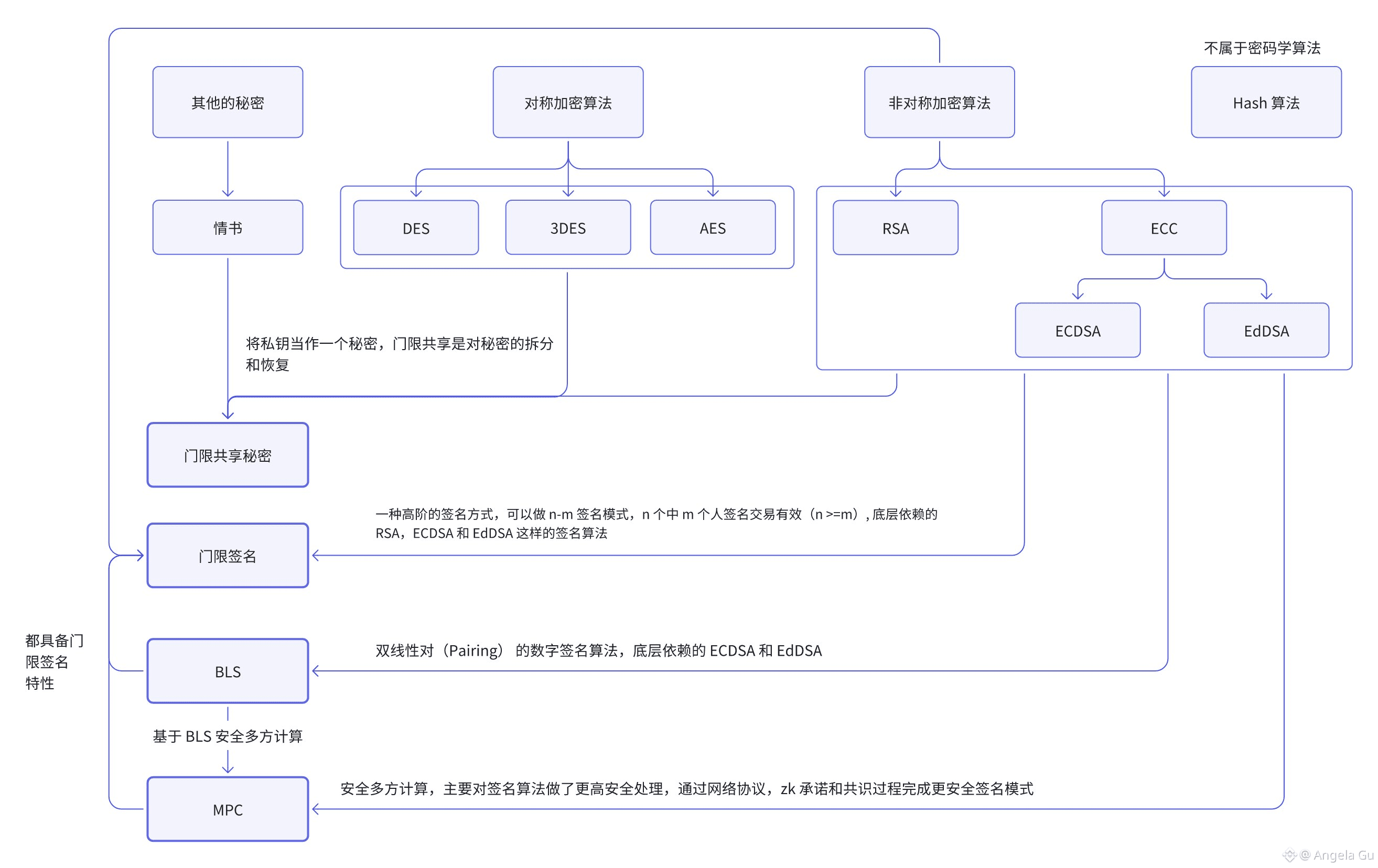
A lot of folks see cryptographic algorithms as mere 'knowledge points', but in Web3, they're actually part of a skillset:
Symmetric Encryption (AES)
👉 responsible for 'speed'
Asymmetric Encryption (RSA / ECC)
👉 responsible for 'identity'
Hash
👉 responsible for 'immutability'
But the real backbone supporting blockchain security is this evolutionary chain:
Private Key → Threshold Secret Sharing → Threshold Signature → BLS → MPC
This is a path from 'individual control' to 'collective consensus security'.
Threshold Secret Sharing breaks a private key into n parts, where any k parts can restore it.
👉 Solves: The private key is no longer controlled by just one person.
Threshold Signature (Threshold Signature) allows k individuals among n to collectively sign, appearing on-chain as 'one signature'.
👉 Security shifts from 'single point' to 'organizational level'.
BLS Signature: Based on bilinear pairing, inherently supports signature aggregation and threshold characteristics, serving as core infrastructure for PoS, public chain consensus, DA, and Rollup validator systems.
MPC (Multi-Party Computation): Not a new signing algorithm, but rather: completing signature calculations without reconstructing the complete private key. Combining network protocols, ZK, and consensus mechanisms transforms 'signing rights' into a 'collaborative process'.
In conclusion:
ECDSA / EdDSA solve 'I can sign'
Threshold Signatures solve 'we sign together'
BLS solves 'many sign efficiently'
MPC solves 'everyone signs but no one actually holds the complete private key'
This is why exchanges, custodians, L2s, validators, and Rollup Sequencers are moving from the 'private key' era to a security architecture of Threshold + BLS + MPC.
Cryptography isn't just algorithms; it's also the design of organizational security structures. #密码学 #安全 #MPC
A lot of folks see cryptographic algorithms as mere 'knowledge points', but in Web3, they're actually part of a skillset:
Symmetric Encryption (AES)
👉 responsible for 'speed'
Asymmetric Encryption (RSA / ECC)
👉 responsible for 'identity'
Hash
👉 responsible for 'immutability'
But the real backbone supporting blockchain security is this evolutionary chain:
Private Key → Threshold Secret Sharing → Threshold Signature → BLS → MPC
This is a path from 'individual control' to 'collective consensus security'.
Threshold Secret Sharing breaks a private key into n parts, where any k parts can restore it.
👉 Solves: The private key is no longer controlled by just one person.
Threshold Signature (Threshold Signature) allows k individuals among n to collectively sign, appearing on-chain as 'one signature'.
👉 Security shifts from 'single point' to 'organizational level'.
BLS Signature: Based on bilinear pairing, inherently supports signature aggregation and threshold characteristics, serving as core infrastructure for PoS, public chain consensus, DA, and Rollup validator systems.
MPC (Multi-Party Computation): Not a new signing algorithm, but rather: completing signature calculations without reconstructing the complete private key. Combining network protocols, ZK, and consensus mechanisms transforms 'signing rights' into a 'collaborative process'.
In conclusion:
ECDSA / EdDSA solve 'I can sign'
Threshold Signatures solve 'we sign together'
BLS solves 'many sign efficiently'
MPC solves 'everyone signs but no one actually holds the complete private key'
This is why exchanges, custodians, L2s, validators, and Rollup Sequencers are moving from the 'private key' era to a security architecture of Threshold + BLS + MPC.
Cryptography isn't just algorithms; it's also the design of organizational security structures. #密码学 #安全 #MPC
Symmetric Encryption (AES)
👉 responsible for 'speed'
Asymmetric Encryption (RSA / ECC)
👉 responsible for 'identity'
Hash
👉 responsible for 'immutability'
But the real backbone supporting blockchain security is this evolutionary chain:
Private Key → Threshold Secret Sharing → Threshold Signature → BLS → MPC
This is a path from 'individual control' to 'collective consensus security'.
Threshold Secret Sharing breaks a private key into n parts, where any k parts can restore it.
👉 Solves: The private key is no longer controlled by just one person.
Threshold Signature (Threshold Signature) allows k individuals among n to collectively sign, appearing on-chain as 'one signature'.
👉 Security shifts from 'single point' to 'organizational level'.
BLS Signature: Based on bilinear pairing, inherently supports signature aggregation and threshold characteristics, serving as core infrastructure for PoS, public chain consensus, DA, and Rollup validator systems.
MPC (Multi-Party Computation): Not a new signing algorithm, but rather: completing signature calculations without reconstructing the complete private key. Combining network protocols, ZK, and consensus mechanisms transforms 'signing rights' into a 'collaborative process'.
In conclusion:
ECDSA / EdDSA solve 'I can sign'
Threshold Signatures solve 'we sign together'
BLS solves 'many sign efficiently'
MPC solves 'everyone signs but no one actually holds the complete private key'
This is why exchanges, custodians, L2s, validators, and Rollup Sequencers are moving from the 'private key' era to a security architecture of Threshold + BLS + MPC.
Cryptography isn't just algorithms; it's also the design of organizational security structures. #密码学 #安全 #MPC
185
Log in to explore more content
Join global crypto users on Binance Square
⚡️ Get latest and useful information about crypto.
💬 Trusted by the world’s largest crypto exchange.
👍 Discover real insights from verified creators.
Email / Phone number
Trending Topics
1
#CryptoSelloffTriggersMultipleWhaleLiquidations
26,860 views
453 Discussing
2
#USSpotXRPETFsSeeLargestWeeklyOutflowIn8Months
61,224 views
759 Discussing
3
#WillFOMCMinutesReinforceRateHikeExpectations?
6,851 views
170 Discussing
4
#BitcoinActiveSupplyInProfitDropsBelow45%
126,434 views
1,121 Discussing
5
#TONStrategyReports$23.97MQ3NetLoss
14,007 views
84 Discussing
6
#KavaSaysAbnormalActivityLimitedToKavaLend
82,823 views
625 Discussing
7
#WORPTLetsTouristsConvertCryptoToThaiBaht
19,775 views
204 Discussing
8
#WhoWillSucceedJensenHuangatNvidia?
248,741 views
1,936 Discussing
9
#WhatWillDriveCryptoandStocks’NextRebound?
707,516 views
3,740 Discussing
10
#TradFiForBeginners
780,369 views
4,726 Discussing