
#hardwarewallet
hardwarewallet
108,527 views
398 Discussing
Hot
Latest

Ambire Ice Displays Account Owner Changes and Approval Thresholds on the Signing Screen
- The Ambire Ice hardware wallet will decode Safe transactions.
- It signals changes to account control.
- Designed to inform signers’ decisions before approval.
#BinanceSquare #CryptoNews #HardwareWallet #Safe
$btc $eth
#vlikevn Titanbot
Source: NewsBTC
Ambire Ice Displays Account Owner Changes and Approval Thresholds on the Signing Screen
- The Ambire Ice hardware wallet will decode Safe transactions.
- It signals changes to account control.
- Designed to inform signers’ decisions before approval.
#BinanceSquare #CryptoNews #HardwareWallet #Safe
$btc $eth
#vlikevn Titanbot
Source: NewsBTC
- The Ambire Ice hardware wallet will decode Safe transactions.
- It signals changes to account control.
- Designed to inform signers’ decisions before approval.
#BinanceSquare #CryptoNews #HardwareWallet #Safe
$btc $eth
#vlikevn Titanbot
Source: NewsBTC
93

·
--
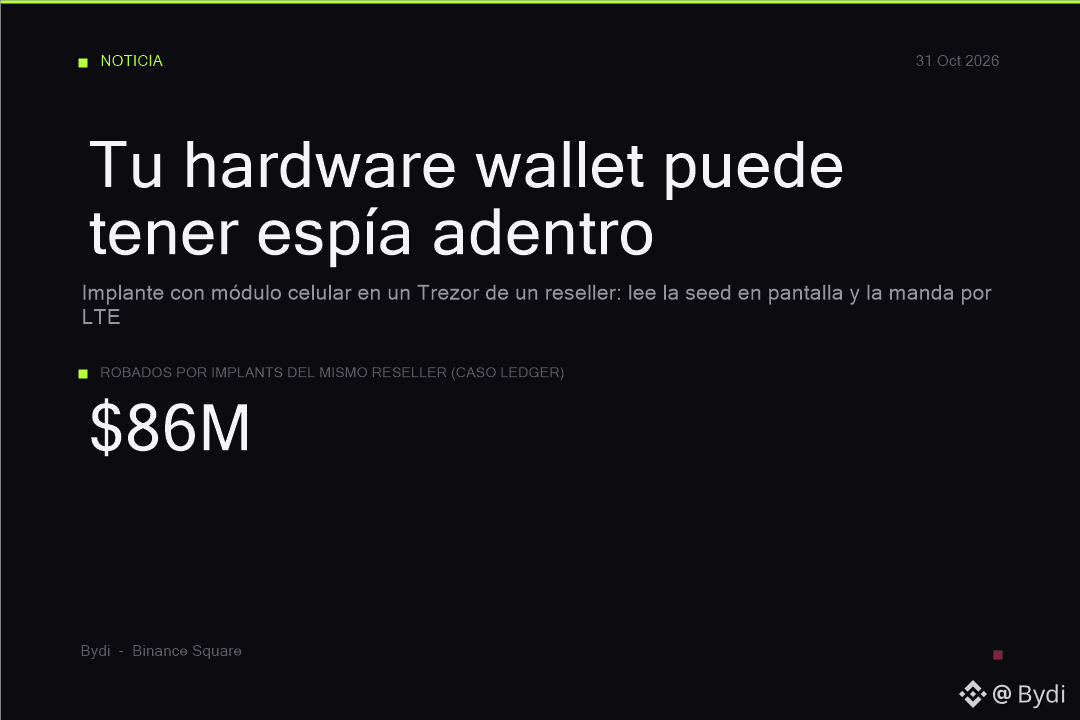
literal spy INSIDE your cold wallet 🚨
they found a reseller’s Trezor Safe 5 with an extra board between the mainboard and the screen: a cellular module with an antenna that reads your seed phrase ON SCREEN and sends it over LTE when you plug the thing in. Even weighing the device isn’t a reliable test, Trezor said
that same reseller has already sold Ledger implants: ~86M stolen and one victim lost 60+ BTC. Trezor’s advice: if you bought one there since March 2026, move EVERYTHING to a new wallet with a NEW seed (restoring the old backup won’t fix anything, the phrase is already compromised)
me imagining my wallet sending its seed over a cell signal like it’s checking in at a hotel
buying directly from the manufacturer or it’s Russian roulette, there’s no in-between
did yours come from the manufacturer or a marketplace? tell me, and please don’t say Tokopedia
#CryptoSecurity #HardwareWallet #BinanceSquare #CryptoTrading
literal spy INSIDE your cold wallet 🚨
they found a reseller’s Trezor Safe 5 with an extra board between the mainboard and the screen: a cellular module with an antenna that reads your seed phrase ON SCREEN and sends it over LTE when you plug the thing in. Even weighing the device isn’t a reliable test, Trezor said
that same reseller has already sold Ledger implants: ~86M stolen and one victim lost 60+ BTC. Trezor’s advice: if you bought one there since March 2026, move EVERYTHING to a new wallet with a NEW seed (restoring the old backup won’t fix anything, the phrase is already compromised)
me imagining my wallet sending its seed over a cell signal like it’s checking in at a hotel
buying directly from the manufacturer or it’s Russian roulette, there’s no in-between
did yours come from the manufacturer or a marketplace? tell me, and please don’t say Tokopedia
#CryptoSecurity #HardwareWallet #BinanceSquare #CryptoTrading
they found a reseller’s Trezor Safe 5 with an extra board between the mainboard and the screen: a cellular module with an antenna that reads your seed phrase ON SCREEN and sends it over LTE when you plug the thing in. Even weighing the device isn’t a reliable test, Trezor said
that same reseller has already sold Ledger implants: ~86M stolen and one victim lost 60+ BTC. Trezor’s advice: if you bought one there since March 2026, move EVERYTHING to a new wallet with a NEW seed (restoring the old backup won’t fix anything, the phrase is already compromised)
me imagining my wallet sending its seed over a cell signal like it’s checking in at a hotel
buying directly from the manufacturer or it’s Russian roulette, there’s no in-between
did yours come from the manufacturer or a marketplace? tell me, and please don’t say Tokopedia
#CryptoSecurity #HardwareWallet #BinanceSquare #CryptoTrading
Mr W3N:
por eso nunca hay que comprar a los revendedores!!
1
2
2.4k

·
--
See translation
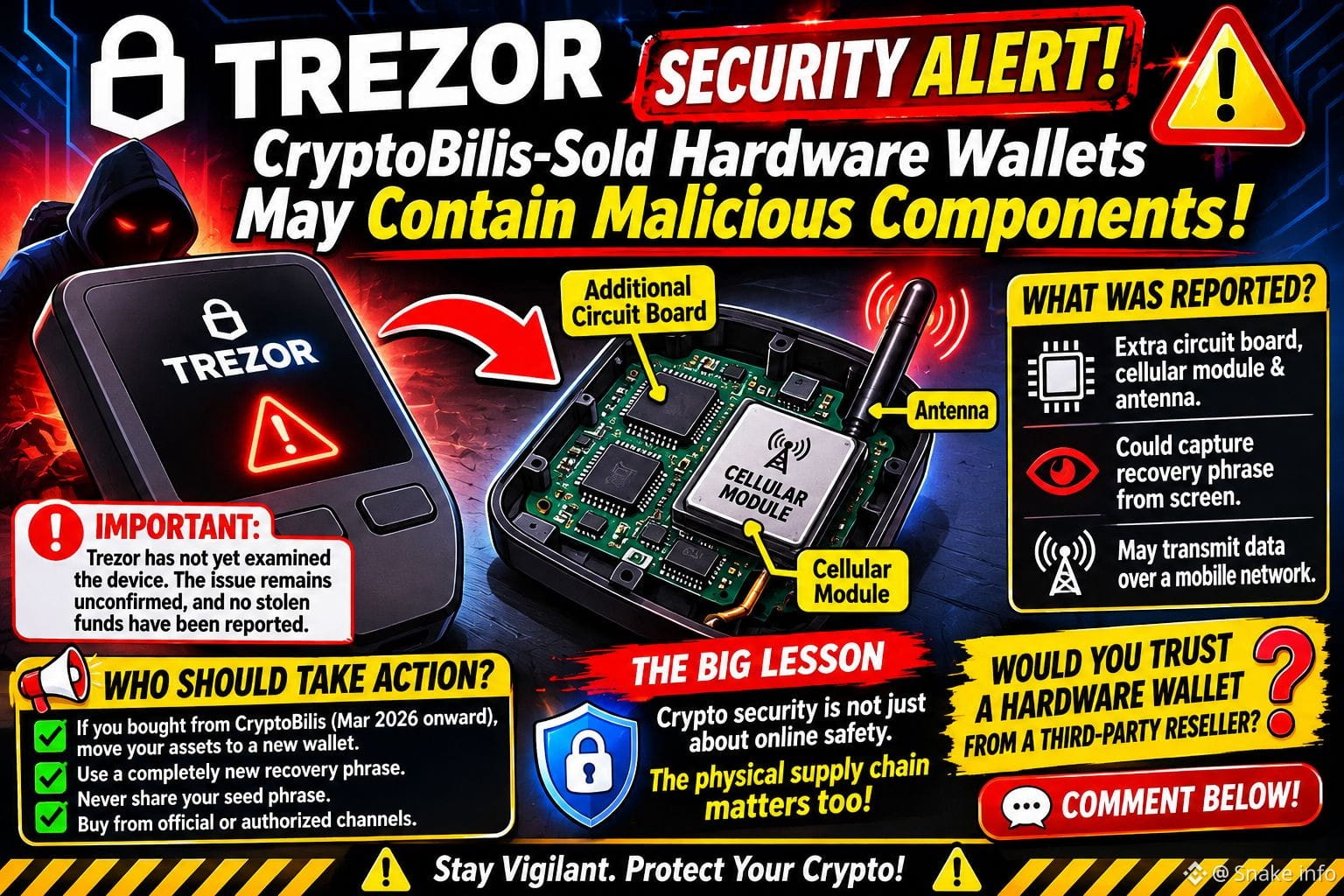
🚨 TREZOR SECURITY ALERT: HARDWARE WALLET TAMPERING CONCERNS RAISE RED FLAGS! 🔐⚠️
Imagine buying a hardware wallet to protect your crypto, only to discover that the device itself may have been tampered with. 😨
Trezor has raised concerns after a customer in Indonesia reportedly discovered suspicious hardware inside a Trezor Safe 5 purchased through reseller CryptoBilis.
🔍 WHAT WAS REPORTED?
⚠️ An additional circuit board, cellular module, and antenna were reportedly found inside the device.
🔑 The suspected modification could potentially expose sensitive information, including the recovery phrase displayed on the wallet screen.
📡 A cellular connection could potentially transmit captured information to an external party.
IMPORTANT: The reported device has not yet been independently examined by Trezor’s laboratory, so the suspected implant remains unconfirmed. No related stolen funds have been reported to the company.
🛡️ WHO SHOULD TAKE ACTION?
👉 Trezor advises customers who purchased devices supplied by CryptoBilis from March 2026 onward to move their assets to a newly created wallet with a completely new recovery phrase.
👉 Never reuse a potentially exposed recovery phrase.
👉 Never share your seed phrase with anyone claiming to provide technical support.
👉 Buy hardware wallets through official or authorized channels whenever possible.
🔥 THE BIG LESSON
Crypto security isn't just about protecting your private keys online. The physical supply chain matters, too.
Your wallet is only as trustworthy as the security measures protecting it.
💬 QUESTION: Would you trust a hardware wallet bought through a third-party reseller after hearing about this reported incident? 👇
⚠️ Educational and security awareness content only. Verify official announcements before taking action.
#TrezorWallet #CryptoSecurity #HardwareWallet #Bitcoin
CLICK TO BELOW TRADE👇
$BNB $FUEL $BEAT
{future}(BEATUSDT)
{alpha}(560x5c8daeabc57e9249606d3bd6d1e097ef492ea3c5)
{future}(BNBUSDT)
🚨 TREZOR SECURITY ALERT: HARDWARE WALLET TAMPERING CONCERNS RAISE RED FLAGS! 🔐⚠️
Imagine buying a hardware wallet to protect your crypto, only to discover that the device itself may have been tampered with. 😨
Trezor has raised concerns after a customer in Indonesia reportedly discovered suspicious hardware inside a Trezor Safe 5 purchased through reseller CryptoBilis.
🔍 WHAT WAS REPORTED?
⚠️ An additional circuit board, cellular module, and antenna were reportedly found inside the device.
🔑 The suspected modification could potentially expose sensitive information, including the recovery phrase displayed on the wallet screen.
📡 A cellular connection could potentially transmit captured information to an external party.
IMPORTANT: The reported device has not yet been independently examined by Trezor’s laboratory, so the suspected implant remains unconfirmed. No related stolen funds have been reported to the company.
🛡️ WHO SHOULD TAKE ACTION?
👉 Trezor advises customers who purchased devices supplied by CryptoBilis from March 2026 onward to move their assets to a newly created wallet with a completely new recovery phrase.
👉 Never reuse a potentially exposed recovery phrase.
👉 Never share your seed phrase with anyone claiming to provide technical support.
👉 Buy hardware wallets through official or authorized channels whenever possible.
🔥 THE BIG LESSON
Crypto security isn't just about protecting your private keys online. The physical supply chain matters, too.
Your wallet is only as trustworthy as the security measures protecting it.
💬 QUESTION: Would you trust a hardware wallet bought through a third-party reseller after hearing about this reported incident? 👇
⚠️ Educational and security awareness content only. Verify official announcements before taking action.
#TrezorWallet #CryptoSecurity #HardwareWallet #Bitcoin
CLICK TO BELOW TRADE👇
$BNB $FUEL $BEAT
Imagine buying a hardware wallet to protect your crypto, only to discover that the device itself may have been tampered with. 😨
Trezor has raised concerns after a customer in Indonesia reportedly discovered suspicious hardware inside a Trezor Safe 5 purchased through reseller CryptoBilis.
🔍 WHAT WAS REPORTED?
⚠️ An additional circuit board, cellular module, and antenna were reportedly found inside the device.
🔑 The suspected modification could potentially expose sensitive information, including the recovery phrase displayed on the wallet screen.
📡 A cellular connection could potentially transmit captured information to an external party.
IMPORTANT: The reported device has not yet been independently examined by Trezor’s laboratory, so the suspected implant remains unconfirmed. No related stolen funds have been reported to the company.
🛡️ WHO SHOULD TAKE ACTION?
👉 Trezor advises customers who purchased devices supplied by CryptoBilis from March 2026 onward to move their assets to a newly created wallet with a completely new recovery phrase.
👉 Never reuse a potentially exposed recovery phrase.
👉 Never share your seed phrase with anyone claiming to provide technical support.
👉 Buy hardware wallets through official or authorized channels whenever possible.
🔥 THE BIG LESSON
Crypto security isn't just about protecting your private keys online. The physical supply chain matters, too.
Your wallet is only as trustworthy as the security measures protecting it.
💬 QUESTION: Would you trust a hardware wallet bought through a third-party reseller after hearing about this reported incident? 👇
⚠️ Educational and security awareness content only. Verify official announcements before taking action.
#TrezorWallet #CryptoSecurity #HardwareWallet #Bitcoin
CLICK TO BELOW TRADE👇
$BNB $FUEL $BEAT
2
715

·
--
See translation
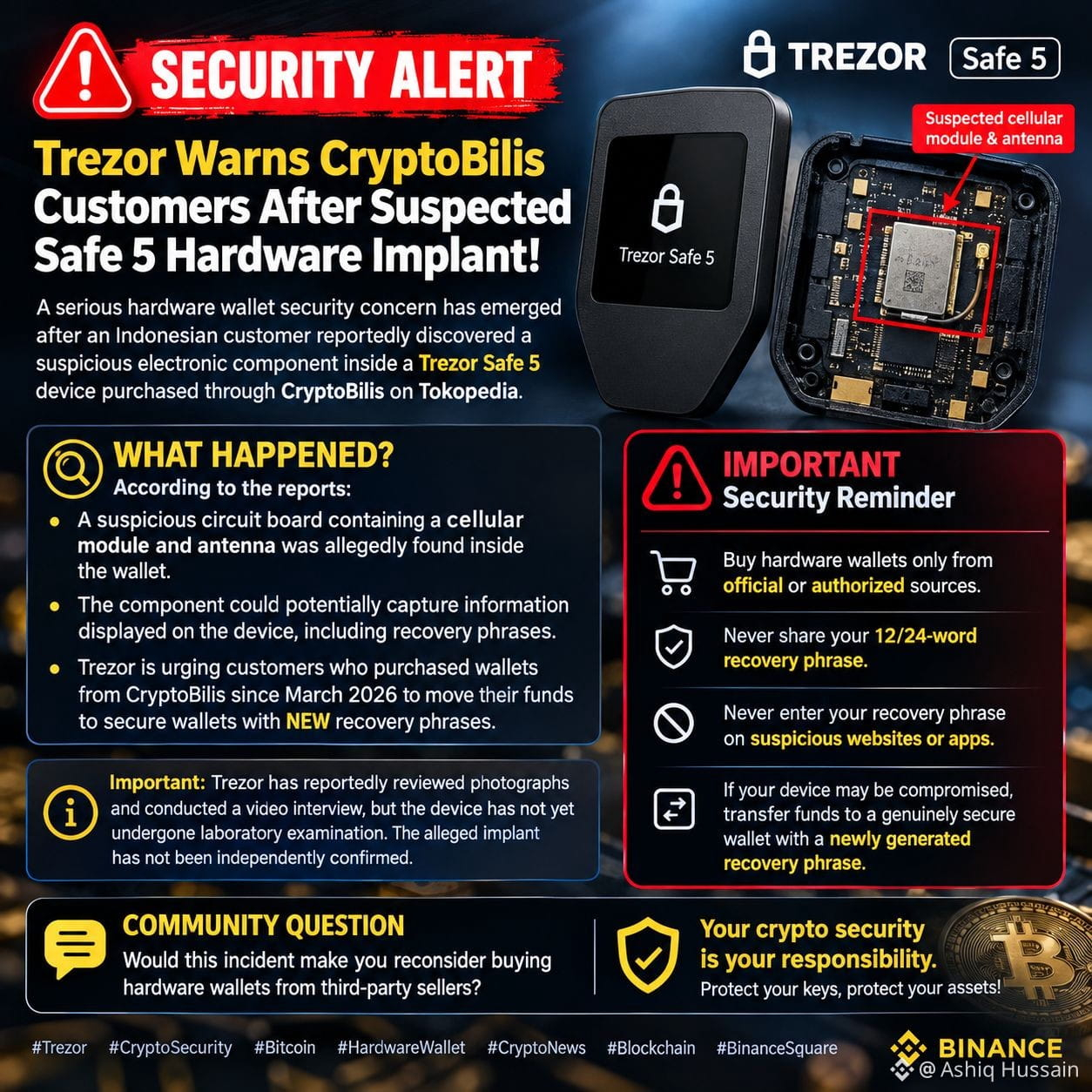
🚨 SECURITY ALERT: Trezor Warns CryptoBilis Customers After Suspected Safe 5 Hardware Implant! ⚠️
A serious hardware wallet security concern has emerged after an Indonesian customer reportedly discovered a suspicious electronic component inside a Trezor Safe 5 device purchased through CryptoBilis on Tokopedia.
🔍 What Happened?
According to the reports:
- A suspicious circuit board containing a cellular module and antenna was allegedly found inside the wallet.
- The component could potentially capture information displayed on the device, including recovery phrases.
- Trezor is urging customers who purchased wallets from CryptoBilis since March 2026 to move their funds to secure wallets with NEW recovery phrases.
⚠️ Important Security Reminder:
✅ Buy hardware wallets only from official or authorized sources.
✅ Never share your 12/24-word recovery phrase.
✅ Never enter your recovery phrase on suspicious websites or apps.
✅ If your device may be compromised, transfer funds to a genuinely secure wallet with a newly generated recovery phrase.
📌 Important: Trezor has reportedly reviewed photographs and conducted a video interview, but the device has not yet undergone laboratory examination. The alleged implant has not been independently confirmed.
💬 Community Question:
Would this incident make you reconsider buying hardware wallets from third-party sellers?
{spot}(BTCUSDT)
🔐 Remember: Your crypto security is your responsibility. Protect your keys, protect your assets!
$BTC #Trezor #CryptoSecurity #HardwareWallet #Blockchain #BinanceSquare
🚨 SECURITY ALERT: Trezor Warns CryptoBilis Customers After Suspected Safe 5 Hardware Implant! ⚠️
A serious hardware wallet security concern has emerged after an Indonesian customer reportedly discovered a suspicious electronic component inside a Trezor Safe 5 device purchased through CryptoBilis on Tokopedia.
🔍 What Happened?
According to the reports:
- A suspicious circuit board containing a cellular module and antenna was allegedly found inside the wallet.
- The component could potentially capture information displayed on the device, including recovery phrases.
- Trezor is urging customers who purchased wallets from CryptoBilis since March 2026 to move their funds to secure wallets with NEW recovery phrases.
⚠️ Important Security Reminder:
✅ Buy hardware wallets only from official or authorized sources.
✅ Never share your 12/24-word recovery phrase.
✅ Never enter your recovery phrase on suspicious websites or apps.
✅ If your device may be compromised, transfer funds to a genuinely secure wallet with a newly generated recovery phrase.
📌 Important: Trezor has reportedly reviewed photographs and conducted a video interview, but the device has not yet undergone laboratory examination. The alleged implant has not been independently confirmed.
💬 Community Question:
Would this incident make you reconsider buying hardware wallets from third-party sellers?
🔐 Remember: Your crypto security is your responsibility. Protect your keys, protect your assets!
$BTC #Trezor #CryptoSecurity #HardwareWallet #Blockchain #BinanceSquare
A serious hardware wallet security concern has emerged after an Indonesian customer reportedly discovered a suspicious electronic component inside a Trezor Safe 5 device purchased through CryptoBilis on Tokopedia.
🔍 What Happened?
According to the reports:
- A suspicious circuit board containing a cellular module and antenna was allegedly found inside the wallet.
- The component could potentially capture information displayed on the device, including recovery phrases.
- Trezor is urging customers who purchased wallets from CryptoBilis since March 2026 to move their funds to secure wallets with NEW recovery phrases.
⚠️ Important Security Reminder:
✅ Buy hardware wallets only from official or authorized sources.
✅ Never share your 12/24-word recovery phrase.
✅ Never enter your recovery phrase on suspicious websites or apps.
✅ If your device may be compromised, transfer funds to a genuinely secure wallet with a newly generated recovery phrase.
📌 Important: Trezor has reportedly reviewed photographs and conducted a video interview, but the device has not yet undergone laboratory examination. The alleged implant has not been independently confirmed.
💬 Community Question:
Would this incident make you reconsider buying hardware wallets from third-party sellers?
🔐 Remember: Your crypto security is your responsibility. Protect your keys, protect your assets!
$BTC #Trezor #CryptoSecurity #HardwareWallet #Blockchain #BinanceSquare
139

·
--
See translation
#TrezorSaysCryptoBilisSoldWalletMayContainMaliciousComponents
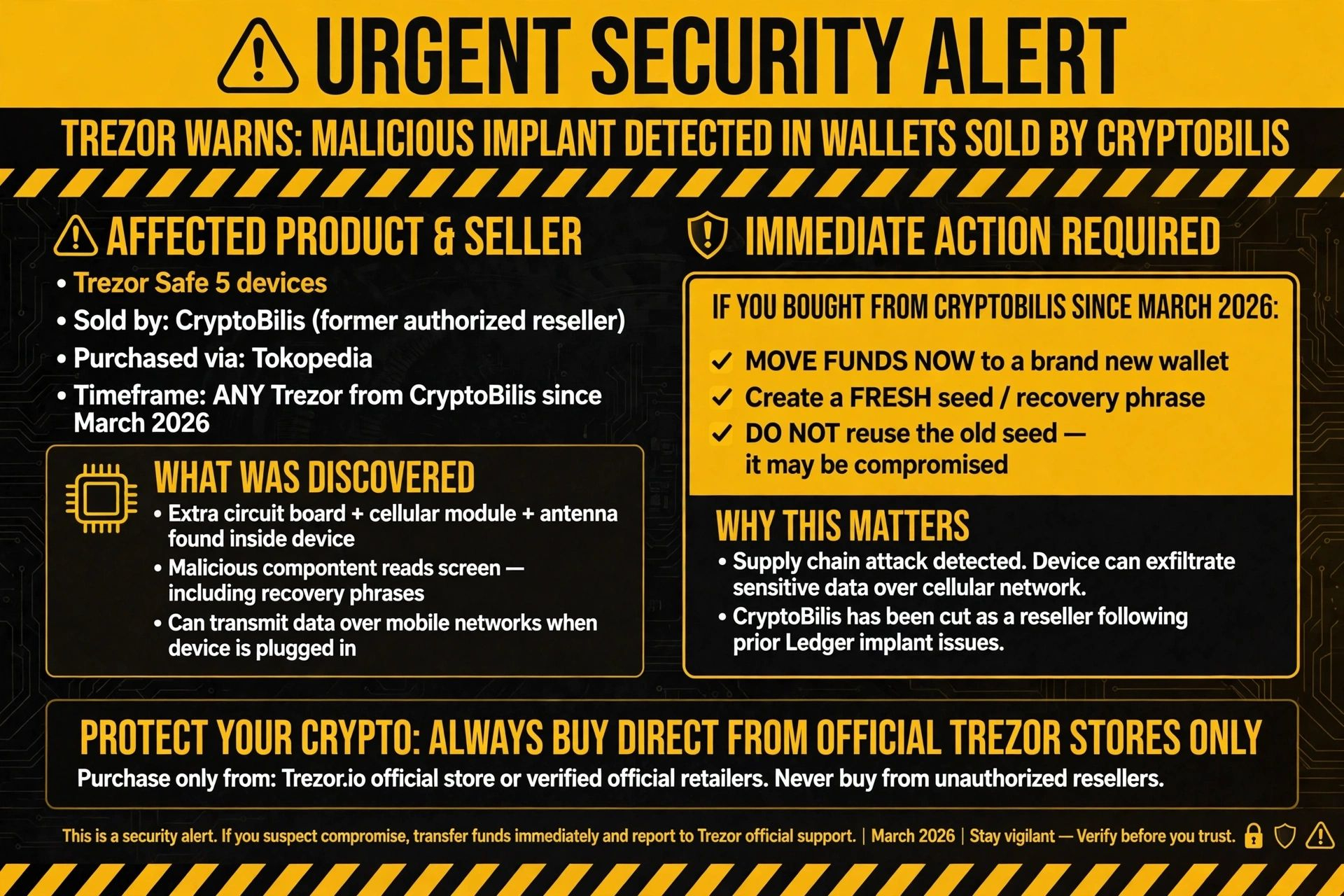
🚨 URGENT: Trezor warns of possible malicious implant in wallets sold by CryptoBilis!
Trezor just dropped a serious security alert. A customer reported a hardware implant inside a Trezor Safe 5 bought from former authorized reseller CryptoBilis (via Tokopedia in August).
The extra circuit board + cellular module + antenna allegedly reads the screen (including recovery phrases) and can transmit data over mobile networks when plugged in.
No funds lost reported yet, but Trezor is treating it as credible.
*If you bought ANY Trezor from CryptoBilis since March 2026 → Move your funds to a brand new wallet with a FRESH seed immediately. Do NOT reuse the old seed.*
CryptoBilis was already cut as a reseller after the earlier Ledger implant issues.
Supply chain attacks are the new nightmare. Even trusted hardware wallets can get compromised before they reach you. Always buy direct from official stores when possible, verify packaging, and never skip the “new seed” rule if something feels off. Self-custody only works if the device is clean. Stay paranoid, stay safe.
Who else is double-checking their hardware wallets right now? 👇
#Trezor #CryptoSecurity #HardwareWallet #StaySafe
#TrezorSaysCryptoBilisSoldWalletMayContainMaliciousComponents
🚨 URGENT: Trezor warns of possible malicious implant in wallets sold by CryptoBilis!
Trezor just dropped a serious security alert. A customer reported a hardware implant inside a Trezor Safe 5 bought from former authorized reseller CryptoBilis (via Tokopedia in August).
The extra circuit board + cellular module + antenna allegedly reads the screen (including recovery phrases) and can transmit data over mobile networks when plugged in.
No funds lost reported yet, but Trezor is treating it as credible.
*If you bought ANY Trezor from CryptoBilis since March 2026 → Move your funds to a brand new wallet with a FRESH seed immediately. Do NOT reuse the old seed.*
CryptoBilis was already cut as a reseller after the earlier Ledger implant issues.
Supply chain attacks are the new nightmare. Even trusted hardware wallets can get compromised before they reach you. Always buy direct from official stores when possible, verify packaging, and never skip the “new seed” rule if something feels off. Self-custody only works if the device is clean. Stay paranoid, stay safe.
Who else is double-checking their hardware wallets right now? 👇
#Trezor #CryptoSecurity #HardwareWallet #StaySafe
🚨 URGENT: Trezor warns of possible malicious implant in wallets sold by CryptoBilis!
Trezor just dropped a serious security alert. A customer reported a hardware implant inside a Trezor Safe 5 bought from former authorized reseller CryptoBilis (via Tokopedia in August).
The extra circuit board + cellular module + antenna allegedly reads the screen (including recovery phrases) and can transmit data over mobile networks when plugged in.
No funds lost reported yet, but Trezor is treating it as credible.
*If you bought ANY Trezor from CryptoBilis since March 2026 → Move your funds to a brand new wallet with a FRESH seed immediately. Do NOT reuse the old seed.*
CryptoBilis was already cut as a reseller after the earlier Ledger implant issues.
Supply chain attacks are the new nightmare. Even trusted hardware wallets can get compromised before they reach you. Always buy direct from official stores when possible, verify packaging, and never skip the “new seed” rule if something feels off. Self-custody only works if the device is clean. Stay paranoid, stay safe.
Who else is double-checking their hardware wallets right now? 👇
#Trezor #CryptoSecurity #HardwareWallet #StaySafe
3
108

See translation
TREZOR WARNS CRYPTO USERS — HARDWARE WALLETS MAY CONTAIN MALICIOUS COMPONENTS!A major crypto security warning is making headlines! Trezor has alerted customers after receiving a credible report of a suspected hardware implant inside a Trezor Safe 5 purchased through reseller CryptoBilis.
This could be another serious supply-chain security concern for the crypto industry. Here's what you need to know. 👇
🔴 1. HOW DOES THE SUSPECTED IMPLANT WORK?
According to the customer report, the device allegedly contained:
An additional circuit board.A cellular communication module.An antenna capable of transmitting information.
The suspected component could potentially capture sensitive information displayed on the wallet screen, including the recovery phrase, and transmit it over a mobile network.
⚠️ 2. TREZOR HAS ISSUED AN URGENT WARNING
Trezor has not physically examined the reported device yet, but considers the report credible based on customer information and a video interview.
The company says no customer funds have been reported stolen in connection with this particular Trezor report.
🛡️ 3. WHO SHOULD TAKE ACTION?
Anyone who purchased a Trezor hardware wallet through CryptoBilis since March 2026 should:
Move crypto assets to a newly created wallet.Generate a completely new recovery phrase.Avoid setting up unused devices from the reseller.Contact official Trezor Support about replacement options.
Important: Simply restoring your old recovery phrase on another device is NOT enough if that phrase may already be compromised.
🔍 4. WHY IS THIS A BIGGER INDUSTRY WARNING?
CryptoBilis was previously linked to confirmed physical tampering involving Ledger hardware wallets. Trezor has also removed the reseller from its authorized network.
This raises an important question about hardware-wallet supply chains: Can users trust a device if its physical integrity has been compromised before reaching them?
💡 MY TAKEAWAY
Hardware wallets are designed to protect private keys, but physical security and trusted distribution channels matter just as much as software security.
Don't panic, but don't ignore this warning. Never share your recovery phrase with anyone claiming to be customer support, and purchase hardware wallets directly from manufacturers or verified authorized sellers.
🔥 Do you trust hardware wallets after these supply-chain incidents, or is it time for manufacturers to introduce stronger verification systems?
Share your thoughts below! 👇
#trezorsayscryptobilissoldwalletmaycontainmaliciouscom #Trezor #CryptoSecurity #Bitcoin #HardwareWallet #CryptoNews #BinanceSquare
{spot}(AAPLBUSDT)
TREZOR WARNS CRYPTO USERS — HARDWARE WALLETS MAY CONTAIN MALICIOUS COMPONENTS!
A major crypto security warning is making headlines! Trezor has alerted customers after receiving a credible report of a suspected hardware implant inside a Trezor Safe 5 purchased through reseller CryptoBilis.
This could be another serious supply-chain security concern for the crypto industry. Here's what you need to know. 👇
🔴 1. HOW DOES THE SUSPECTED IMPLANT WORK?
According to the customer report, the device allegedly contained:
An additional circuit board.A cellular communication module.An antenna capable of transmitting information.
The suspected component could potentially capture sensitive information displayed on the wallet screen, including the recovery phrase, and transmit it over a mobile network.
⚠️ 2. TREZOR HAS ISSUED AN URGENT WARNING
Trezor has not physically examined the reported device yet, but considers the report credible based on customer information and a video interview.
The company says no customer funds have been reported stolen in connection with this particular Trezor report.
🛡️ 3. WHO SHOULD TAKE ACTION?
Anyone who purchased a Trezor hardware wallet through CryptoBilis since March 2026 should:
Move crypto assets to a newly created wallet.Generate a completely new recovery phrase.Avoid setting up unused devices from the reseller.Contact official Trezor Support about replacement options.
Important: Simply restoring your old recovery phrase on another device is NOT enough if that phrase may already be compromised.
🔍 4. WHY IS THIS A BIGGER INDUSTRY WARNING?
CryptoBilis was previously linked to confirmed physical tampering involving Ledger hardware wallets. Trezor has also removed the reseller from its authorized network.
This raises an important question about hardware-wallet supply chains: Can users trust a device if its physical integrity has been compromised before reaching them?
💡 MY TAKEAWAY
Hardware wallets are designed to protect private keys, but physical security and trusted distribution channels matter just as much as software security.
Don't panic, but don't ignore this warning. Never share your recovery phrase with anyone claiming to be customer support, and purchase hardware wallets directly from manufacturers or verified authorized sellers.
🔥 Do you trust hardware wallets after these supply-chain incidents, or is it time for manufacturers to introduce stronger verification systems?
Share your thoughts below! 👇
#trezorsayscryptobilissoldwalletmaycontainmaliciouscom #Trezor #CryptoSecurity #Bitcoin #HardwareWallet #CryptoNews #BinanceSquare
This could be another serious supply-chain security concern for the crypto industry. Here's what you need to know. 👇
🔴 1. HOW DOES THE SUSPECTED IMPLANT WORK?
According to the customer report, the device allegedly contained:
An additional circuit board.A cellular communication module.An antenna capable of transmitting information.
The suspected component could potentially capture sensitive information displayed on the wallet screen, including the recovery phrase, and transmit it over a mobile network.
⚠️ 2. TREZOR HAS ISSUED AN URGENT WARNING
Trezor has not physically examined the reported device yet, but considers the report credible based on customer information and a video interview.
The company says no customer funds have been reported stolen in connection with this particular Trezor report.
🛡️ 3. WHO SHOULD TAKE ACTION?
Anyone who purchased a Trezor hardware wallet through CryptoBilis since March 2026 should:
Move crypto assets to a newly created wallet.Generate a completely new recovery phrase.Avoid setting up unused devices from the reseller.Contact official Trezor Support about replacement options.
Important: Simply restoring your old recovery phrase on another device is NOT enough if that phrase may already be compromised.
🔍 4. WHY IS THIS A BIGGER INDUSTRY WARNING?
CryptoBilis was previously linked to confirmed physical tampering involving Ledger hardware wallets. Trezor has also removed the reseller from its authorized network.
This raises an important question about hardware-wallet supply chains: Can users trust a device if its physical integrity has been compromised before reaching them?
💡 MY TAKEAWAY
Hardware wallets are designed to protect private keys, but physical security and trusted distribution channels matter just as much as software security.
Don't panic, but don't ignore this warning. Never share your recovery phrase with anyone claiming to be customer support, and purchase hardware wallets directly from manufacturers or verified authorized sellers.
🔥 Do you trust hardware wallets after these supply-chain incidents, or is it time for manufacturers to introduce stronger verification systems?
Share your thoughts below! 👇
#trezorsayscryptobilissoldwalletmaycontainmaliciouscom #Trezor #CryptoSecurity #Bitcoin #HardwareWallet #CryptoNews #BinanceSquare
61

·
--
See translation
Urgent: Trezor warns of compromised hardware wallets from CryptoBilis.
Trezor has alerted buyers of Trezor Safe 5 devices purchased from CryptoBilis on or after March 2026 to move funds to a new wallet with a fresh seed immediately.
The alert follows a responsible disclosure on October 28 from an Indonesian customer who discovered an extra circuit board with a cellular module and antenna inside the device.
The implant can read the screen, including the wallet backup, and transmit data over a mobile network when plugged in.
This underscores a supply chain attack and growing crypto security challenges for hardware wallet users.
Trezor advises affected users to transfer assets to a secure hardware wallet, or temporarily to a software wallet or trusted exchange while verifying the receiving address.
Customers who have not set up the device should not use it.
Eligible buyers will receive a replacement Trezor or a voucher, and must keep the CryptoBilis device and contact Trezor Support.
What steps are you taking to verify the integrity of your hardware wallet supply chain?
#CryptoSecurity #HardwareWallet #SupplyChainSecurity #Trezor
Urgent: Trezor warns of compromised hardware wallets from CryptoBilis.
Trezor has alerted buyers of Trezor Safe 5 devices purchased from CryptoBilis on or after March 2026 to move funds to a new wallet with a fresh seed immediately.
The alert follows a responsible disclosure on October 28 from an Indonesian customer who discovered an extra circuit board with a cellular module and antenna inside the device.
The implant can read the screen, including the wallet backup, and transmit data over a mobile network when plugged in.
This underscores a supply chain attack and growing crypto security challenges for hardware wallet users.
Trezor advises affected users to transfer assets to a secure hardware wallet, or temporarily to a software wallet or trusted exchange while verifying the receiving address.
Customers who have not set up the device should not use it.
Eligible buyers will receive a replacement Trezor or a voucher, and must keep the CryptoBilis device and contact Trezor Support.
What steps are you taking to verify the integrity of your hardware wallet supply chain?
#CryptoSecurity #HardwareWallet #SupplyChainSecurity #Trezor
Trezor has alerted buyers of Trezor Safe 5 devices purchased from CryptoBilis on or after March 2026 to move funds to a new wallet with a fresh seed immediately.
The alert follows a responsible disclosure on October 28 from an Indonesian customer who discovered an extra circuit board with a cellular module and antenna inside the device.
The implant can read the screen, including the wallet backup, and transmit data over a mobile network when plugged in.
This underscores a supply chain attack and growing crypto security challenges for hardware wallet users.
Trezor advises affected users to transfer assets to a secure hardware wallet, or temporarily to a software wallet or trusted exchange while verifying the receiving address.
Customers who have not set up the device should not use it.
Eligible buyers will receive a replacement Trezor or a voucher, and must keep the CryptoBilis device and contact Trezor Support.
What steps are you taking to verify the integrity of your hardware wallet supply chain?
#CryptoSecurity #HardwareWallet #SupplyChainSecurity #Trezor
6

·
--
Trezor Officially Warns That Safe 5 Devices from CryptoBilis May Have Had Chips Implanted; Owners Urged to Transfer Funds Immediately
The security perimeter of hardware wallets is expanding from software to physical chips.
According to Decrypt, hardware wallet manufacturer Trezor has formally responded for the first time to reports that hardware chips may have been implanted in products sold through a third-party reseller. Trezor advises users who purchased a Safe 5 through CryptoBilis since March to transfer the assets on their devices as soon as possible.
It is worth noting that Trezor says it has not yet physically inspected the devices in question and is treating the reports as credible leads. CryptoBilis is a third-party reseller, not an official sales channel, so the potential impact is relatively limited, primarily affecting products from specific batches sold through a particular channel.
This incident represents a new challenge to the physical security of hardware wallets. In the past, discussions of wallet security have focused mostly on software vulnerabilities, leaked recovery phrases, or user behavior. But if the alleged chip implant is confirmed, the attack would reach directly into the device’s hardware, meaning the final physical barrier protecting private keys could also be bypassed. Together with several recent exchange security incidents and controversies involving key vault products such as Keystone, this has sparked a broader discussion about the security of self-custody.
However, several key factors remain to be seen. First, Trezor has not physically inspected the devices and is currently treating the matter as a credible report; the final conclusion awaits official verification. Second, the reseller involved is a third party, and it is not yet clear whether products sold through official channels are affected. Third, the risk may be limited to specific batches rather than the entire product line.
For owners, the most practical step is to confirm where and when they purchased their device. If they bought a Safe 5 through CryptoBilis after March, they should transfer their assets promptly to reduce uncertainty. For the industry as a whole, how hardware wallets maintain physical security throughout production, shipping, and distribution may become an ongoing area of scrutiny.
Next, watch for whether Trezor publishes formal test results and an official statement, as well as how the reseller involved responds.
#Trezor #CryptoSecurity #HardwareWallet
The above is a compilation of information and personal analysis, and does not constitute investment advice.
I will continue to follow the story and provide updates if there are significant developments.
Trezor Officially Warns That Safe 5 Devices from CryptoBilis May Have Had Chips Implanted; Owners Urged to Transfer Funds Immediately
The security perimeter of hardware wallets is expanding from software to physical chips.
According to Decrypt, hardware wallet manufacturer Trezor has formally responded for the first time to reports that hardware chips may have been implanted in products sold through a third-party reseller. Trezor advises users who purchased a Safe 5 through CryptoBilis since March to transfer the assets on their devices as soon as possible.
It is worth noting that Trezor says it has not yet physically inspected the devices in question and is treating the reports as credible leads. CryptoBilis is a third-party reseller, not an official sales channel, so the potential impact is relatively limited, primarily affecting products from specific batches sold through a particular channel.
This incident represents a new challenge to the physical security of hardware wallets. In the past, discussions of wallet security have focused mostly on software vulnerabilities, leaked recovery phrases, or user behavior. But if the alleged chip implant is confirmed, the attack would reach directly into the device’s hardware, meaning the final physical barrier protecting private keys could also be bypassed. Together with several recent exchange security incidents and controversies involving key vault products such as Keystone, this has sparked a broader discussion about the security of self-custody.
However, several key factors remain to be seen. First, Trezor has not physically inspected the devices and is currently treating the matter as a credible report; the final conclusion awaits official verification. Second, the reseller involved is a third party, and it is not yet clear whether products sold through official channels are affected. Third, the risk may be limited to specific batches rather than the entire product line.
For owners, the most practical step is to confirm where and when they purchased their device. If they bought a Safe 5 through CryptoBilis after March, they should transfer their assets promptly to reduce uncertainty. For the industry as a whole, how hardware wallets maintain physical security throughout production, shipping, and distribution may become an ongoing area of scrutiny.
Next, watch for whether Trezor publishes formal test results and an official statement, as well as how the reseller involved responds.
#Trezor #CryptoSecurity #HardwareWallet
The above is a compilation of information and personal analysis, and does not constitute investment advice.
I will continue to follow the story and provide updates if there are significant developments.
The security perimeter of hardware wallets is expanding from software to physical chips.
According to Decrypt, hardware wallet manufacturer Trezor has formally responded for the first time to reports that hardware chips may have been implanted in products sold through a third-party reseller. Trezor advises users who purchased a Safe 5 through CryptoBilis since March to transfer the assets on their devices as soon as possible.
It is worth noting that Trezor says it has not yet physically inspected the devices in question and is treating the reports as credible leads. CryptoBilis is a third-party reseller, not an official sales channel, so the potential impact is relatively limited, primarily affecting products from specific batches sold through a particular channel.
This incident represents a new challenge to the physical security of hardware wallets. In the past, discussions of wallet security have focused mostly on software vulnerabilities, leaked recovery phrases, or user behavior. But if the alleged chip implant is confirmed, the attack would reach directly into the device’s hardware, meaning the final physical barrier protecting private keys could also be bypassed. Together with several recent exchange security incidents and controversies involving key vault products such as Keystone, this has sparked a broader discussion about the security of self-custody.
However, several key factors remain to be seen. First, Trezor has not physically inspected the devices and is currently treating the matter as a credible report; the final conclusion awaits official verification. Second, the reseller involved is a third party, and it is not yet clear whether products sold through official channels are affected. Third, the risk may be limited to specific batches rather than the entire product line.
For owners, the most practical step is to confirm where and when they purchased their device. If they bought a Safe 5 through CryptoBilis after March, they should transfer their assets promptly to reduce uncertainty. For the industry as a whole, how hardware wallets maintain physical security throughout production, shipping, and distribution may become an ongoing area of scrutiny.
Next, watch for whether Trezor publishes formal test results and an official statement, as well as how the reseller involved responds.
#Trezor #CryptoSecurity #HardwareWallet
The above is a compilation of information and personal analysis, and does not constitute investment advice.
I will continue to follow the story and provide updates if there are significant developments.
28

See translation
🚨 $BTC HARDWARE WALLET ALERT: MALICIOUS LEDGER IMPLANTS EXPOSED 🛑
📊 Singapore police just flagged Ledger devices sold locally as compromised, stealing recovery phrases in two cases that wiped S$3.5 M. The supply‑chain breach shows that even “cold” storage can be hot‑wired by bad actors. 🦈 Smart money is already rerouting to authorized channels, double‑checking authenticity before any bid. 📈 Expect a short‑term dip in demand for retail‑sourced hardware as users scramble for verified gear.
💡 The takeaway? Never trust a box that hasn’t been sealed by the manufacturer. Verify firmware signatures, keep recovery phrases offline, and consider migrating funds to a fresh wallet if you suspect tampering. 🤔 How are you tightening your hardware security playbook? 👇
⚠️ Not financial advice. Always manage your risk. 🛡️
🏷️ #BTC #Security #HardwareWallet #CryptoAlert
🔥 💎
🚨 $BTC HARDWARE WALLET ALERT: MALICIOUS LEDGER IMPLANTS EXPOSED 🛑
📊 Singapore police just flagged Ledger devices sold locally as compromised, stealing recovery phrases in two cases that wiped S$3.5 M. The supply‑chain breach shows that even “cold” storage can be hot‑wired by bad actors. 🦈 Smart money is already rerouting to authorized channels, double‑checking authenticity before any bid. 📈 Expect a short‑term dip in demand for retail‑sourced hardware as users scramble for verified gear.
💡 The takeaway? Never trust a box that hasn’t been sealed by the manufacturer. Verify firmware signatures, keep recovery phrases offline, and consider migrating funds to a fresh wallet if you suspect tampering. 🤔 How are you tightening your hardware security playbook? 👇
⚠️ Not financial advice. Always manage your risk. 🛡️
🏷️ #BTC #Security #HardwareWallet #CryptoAlert
🔥 💎
📊 Singapore police just flagged Ledger devices sold locally as compromised, stealing recovery phrases in two cases that wiped S$3.5 M. The supply‑chain breach shows that even “cold” storage can be hot‑wired by bad actors. 🦈 Smart money is already rerouting to authorized channels, double‑checking authenticity before any bid. 📈 Expect a short‑term dip in demand for retail‑sourced hardware as users scramble for verified gear.
💡 The takeaway? Never trust a box that hasn’t been sealed by the manufacturer. Verify firmware signatures, keep recovery phrases offline, and consider migrating funds to a fresh wallet if you suspect tampering. 🤔 How are you tightening your hardware security playbook? 👇
⚠️ Not financial advice. Always manage your risk. 🛡️
🏷️ #BTC #Security #HardwareWallet #CryptoAlert
🔥 💎
8

See translation
🚨 $BTC USERS ALERT: MALICIOUS LEDGER IMPLANTS STOLEN $2.7M IN SINGAPORE 💥
📊 Singapore police uncovered hardware wallets with covert implants that siphon recovery phrases, costing investors S$3.5 million. The breach underscores a classic supply‑chain vulnerability where malicious actors infiltrate retail channels, turning trusted devices into silent liquidity hunters. 🦈
💡 To safeguard assets, source wallets directly from the manufacturer or an authorized reseller, run Ledger’s authenticity checks, and never expose your online. If you suspect tampering, halt usage and migrate funds to a fresh, verified device. 🤔 What extra steps are you taking to verify your hardware wallet’s integrity? 👇
⚠️ Not financial advice. Always manage your risk. 🛡️
🏷️ #BTC #SecurityAlert #HardwareWallet #CryptoSafety
🔥 🦈
🚨 $BTC USERS ALERT: MALICIOUS LEDGER IMPLANTS STOLEN $2.7M IN SINGAPORE 💥
📊 Singapore police uncovered hardware wallets with covert implants that siphon recovery phrases, costing investors S$3.5 million. The breach underscores a classic supply‑chain vulnerability where malicious actors infiltrate retail channels, turning trusted devices into silent liquidity hunters. 🦈
💡 To safeguard assets, source wallets directly from the manufacturer or an authorized reseller, run Ledger’s authenticity checks, and never expose your online. If you suspect tampering, halt usage and migrate funds to a fresh, verified device. 🤔 What extra steps are you taking to verify your hardware wallet’s integrity? 👇
⚠️ Not financial advice. Always manage your risk. 🛡️
🏷️ #BTC #SecurityAlert #HardwareWallet #CryptoSafety
🔥 🦈
📊 Singapore police uncovered hardware wallets with covert implants that siphon recovery phrases, costing investors S$3.5 million. The breach underscores a classic supply‑chain vulnerability where malicious actors infiltrate retail channels, turning trusted devices into silent liquidity hunters. 🦈
💡 To safeguard assets, source wallets directly from the manufacturer or an authorized reseller, run Ledger’s authenticity checks, and never expose your online. If you suspect tampering, halt usage and migrate funds to a fresh, verified device. 🤔 What extra steps are you taking to verify your hardware wallet’s integrity? 👇
⚠️ Not financial advice. Always manage your risk. 🛡️
🏷️ #BTC #SecurityAlert #HardwareWallet #CryptoSafety
🔥 🦈
9
See translation
🚨 $BTC HARDWARE WALLET SCANDAL: KEYS COMPROMISED, TRUST ON THE LINE! 🛑
📊 Keystone just disclosed a counterfeit device slipped past its auth test, stealing the factory verification key. They’ll destroy 18,835 unsold wallets and shift to a fresh key generation, but the breach also exposed 25,964 buyer records – names, shipping addresses, the whole dossier. 🦈
🔍 While recovery phrases and private keys remain intact, any unit shipped after Oct 20 faces an extra verification hurdle, even if it clears the standard check. The core question: can we still rely on hardware wallets when the gate itself can be forged? 🤔
⚠️ Not financial advice. Always manage your risk. 🛡️
🏷️ #BTC #HardwareWallet #Security #Crypto #RiskManagement
🔥 💎
🚨 $BTC HARDWARE WALLET SCANDAL: KEYS COMPROMISED, TRUST ON THE LINE! 🛑
📊 Keystone just disclosed a counterfeit device slipped past its auth test, stealing the factory verification key. They’ll destroy 18,835 unsold wallets and shift to a fresh key generation, but the breach also exposed 25,964 buyer records – names, shipping addresses, the whole dossier. 🦈
🔍 While recovery phrases and private keys remain intact, any unit shipped after Oct 20 faces an extra verification hurdle, even if it clears the standard check. The core question: can we still rely on hardware wallets when the gate itself can be forged? 🤔
⚠️ Not financial advice. Always manage your risk. 🛡️
🏷️ #BTC #HardwareWallet #Security #Crypto #RiskManagement
🔥 💎
📊 Keystone just disclosed a counterfeit device slipped past its auth test, stealing the factory verification key. They’ll destroy 18,835 unsold wallets and shift to a fresh key generation, but the breach also exposed 25,964 buyer records – names, shipping addresses, the whole dossier. 🦈
🔍 While recovery phrases and private keys remain intact, any unit shipped after Oct 20 faces an extra verification hurdle, even if it clears the standard check. The core question: can we still rely on hardware wallets when the gate itself can be forged? 🤔
⚠️ Not financial advice. Always manage your risk. 🛡️
🏷️ #BTC #HardwareWallet #Security #Crypto #RiskManagement
🔥 💎

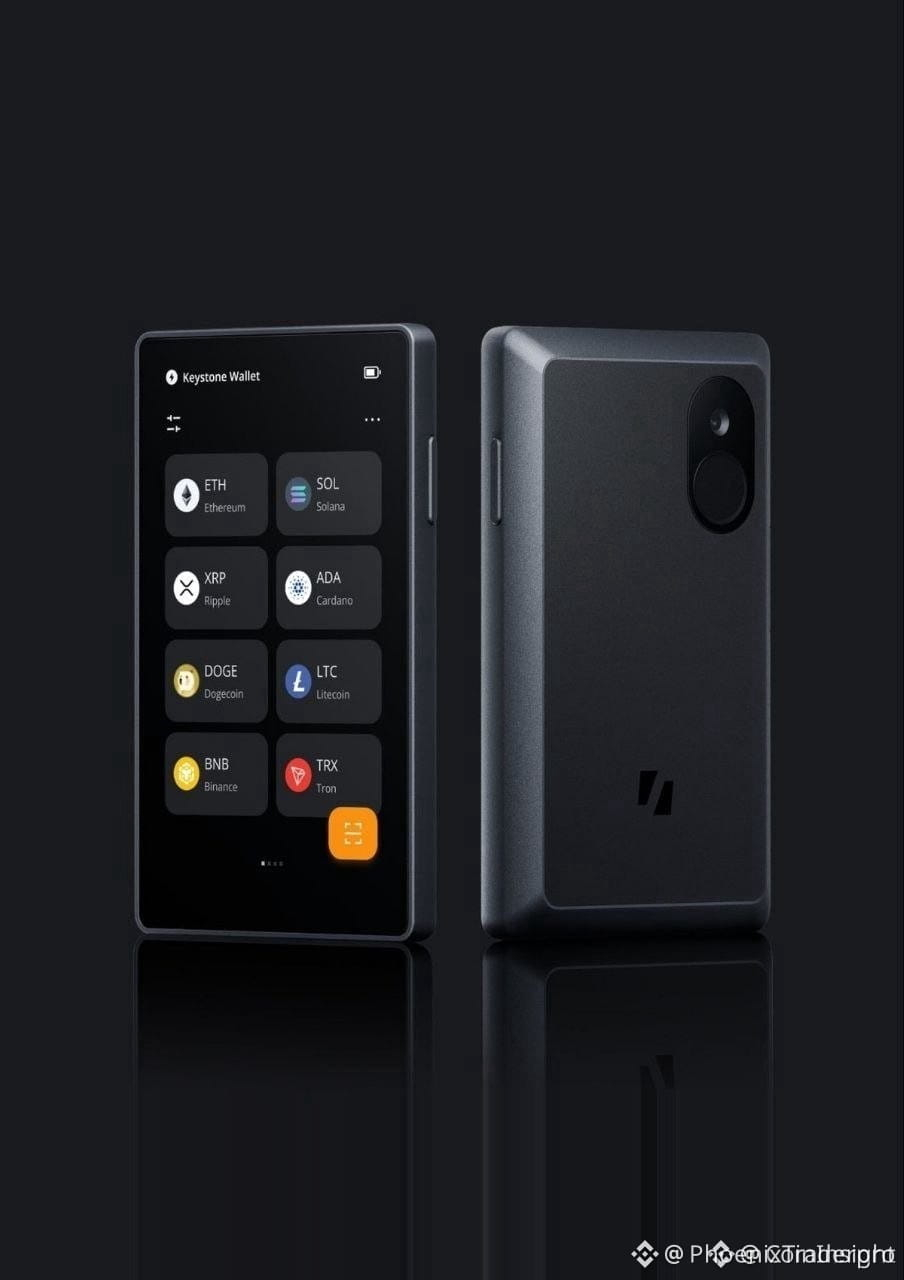
8

·
--
See translation
🚨 $BTC HARDWARE WALLET ALERT: KEYS COMPROMISED, TRUST AT RISK 🦈
📊 Keystone’s breach exposed 18,835 unsold units and 25,964 buyer records, proving that a forged device can slip past factory authentication. 🦈 This undermines the very premise of hardware‑based security – if the verification chain is broken, smart‑money operators will hunt for the next liquidity sweep in compromised wallets. ⚡ Devices shipped after Oct 20 will require additional checks, even when they pass the standard test.
💬 How will you safeguard your $BTC holdings now? 👇
⚠️ Not financial advice. Always manage your risk. 🛡️
🏷️ #BTC #HardwareWallet #Security #Crypto #Risk
🔥 💎
🚨 $BTC HARDWARE WALLET ALERT: KEYS COMPROMISED, TRUST AT RISK 🦈
📊 Keystone’s breach exposed 18,835 unsold units and 25,964 buyer records, proving that a forged device can slip past factory authentication. 🦈 This undermines the very premise of hardware‑based security – if the verification chain is broken, smart‑money operators will hunt for the next liquidity sweep in compromised wallets. ⚡ Devices shipped after Oct 20 will require additional checks, even when they pass the standard test.
💬 How will you safeguard your $BTC holdings now? 👇
⚠️ Not financial advice. Always manage your risk. 🛡️
🏷️ #BTC #HardwareWallet #Security #Crypto #Risk
🔥 💎
📊 Keystone’s breach exposed 18,835 unsold units and 25,964 buyer records, proving that a forged device can slip past factory authentication. 🦈 This undermines the very premise of hardware‑based security – if the verification chain is broken, smart‑money operators will hunt for the next liquidity sweep in compromised wallets. ⚡ Devices shipped after Oct 20 will require additional checks, even when they pass the standard test.
💬 How will you safeguard your $BTC holdings now? 👇
⚠️ Not financial advice. Always manage your risk. 🛡️
🏷️ #BTC #HardwareWallet #Security #Crypto #Risk
🔥 💎

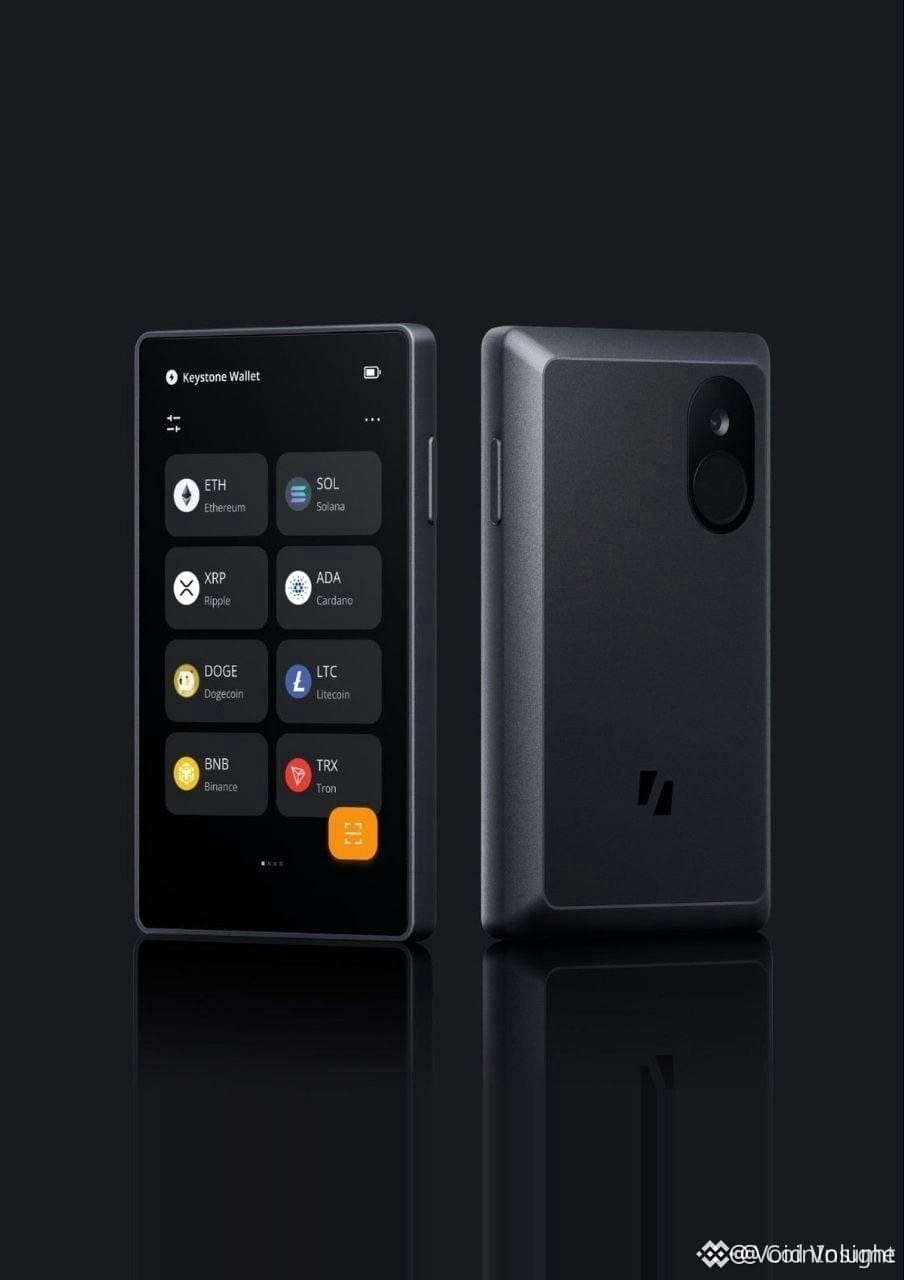
5


See translation
On Sunday we asked why a 2024 Keystone order was still on file when the company's own policy says buyer data gets erased after 180 days. Keystone has now answered, and the answer came with a bigger problem.
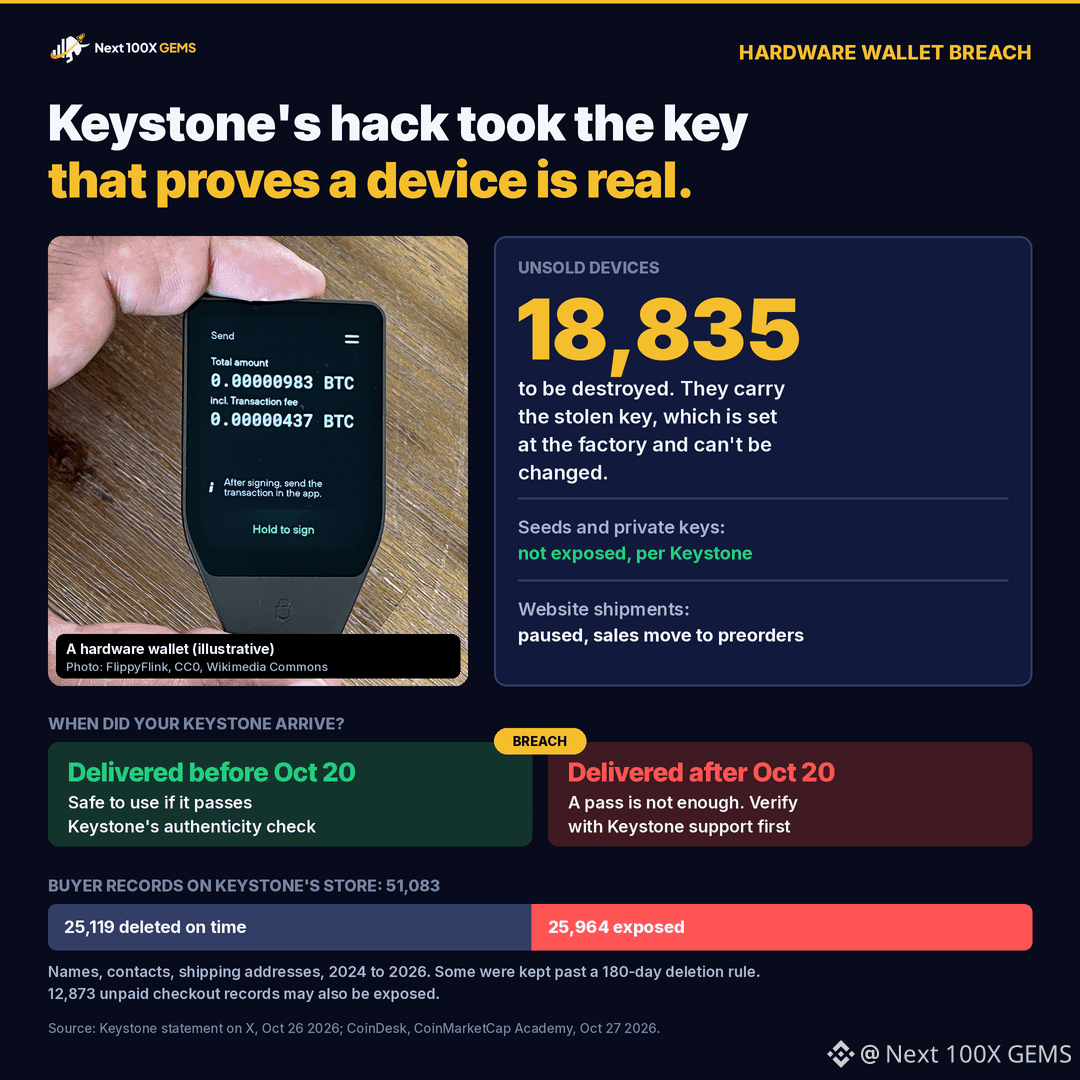
The attacker who got into its website on Oct 20 also took the key Keystone uses to check that a device is genuine. That key is written into each wallet at the factory and can't be erased or rewritten. With it, someone could build a counterfeit that passes Keystone's own authenticity check. So the company is destroying 18,835 devices in its inventory, has paused website shipments and is moving sales to preorders with a new key.
On the data side, Keystone's store held 51,083 buyer records. 25,119 had been deleted under the 180-day rule. The other 25,964, from 2024 to 2026, may have been taken: names, contact details, shipping addresses and order details. Keystone says its automated erasure tool failed and nobody caught it. Another 12,873 unpaid checkout records may also be exposed. Recovery phrases, private keys and payment details were not, per Keystone.
What that means if you own one: a Keystone delivered before Oct 20 is fine if it passes the check. One delivered after Oct 20 needs a direct check with Keystone support, even if it passes. You don't need to move your $BTC because of this alone, the company says. Keystone also says it will never ask you to ship a device back, so any "recall" email, call or parcel is a scam.
#CryptoSecurity #HardwareWallet
NFA. DYOR.
On Sunday we asked why a 2024 Keystone order was still on file when the company's own policy says buyer data gets erased after 180 days. Keystone has now answered, and the answer came with a bigger problem.
The attacker who got into its website on Oct 20 also took the key Keystone uses to check that a device is genuine. That key is written into each wallet at the factory and can't be erased or rewritten. With it, someone could build a counterfeit that passes Keystone's own authenticity check. So the company is destroying 18,835 devices in its inventory, has paused website shipments and is moving sales to preorders with a new key.
On the data side, Keystone's store held 51,083 buyer records. 25,119 had been deleted under the 180-day rule. The other 25,964, from 2024 to 2026, may have been taken: names, contact details, shipping addresses and order details. Keystone says its automated erasure tool failed and nobody caught it. Another 12,873 unpaid checkout records may also be exposed. Recovery phrases, private keys and payment details were not, per Keystone.
What that means if you own one: a Keystone delivered before Oct 20 is fine if it passes the check. One delivered after Oct 20 needs a direct check with Keystone support, even if it passes. You don't need to move your $BTC because of this alone, the company says. Keystone also says it will never ask you to ship a device back, so any "recall" email, call or parcel is a scam.
#CryptoSecurity #HardwareWallet
NFA. DYOR.
The attacker who got into its website on Oct 20 also took the key Keystone uses to check that a device is genuine. That key is written into each wallet at the factory and can't be erased or rewritten. With it, someone could build a counterfeit that passes Keystone's own authenticity check. So the company is destroying 18,835 devices in its inventory, has paused website shipments and is moving sales to preorders with a new key.
On the data side, Keystone's store held 51,083 buyer records. 25,119 had been deleted under the 180-day rule. The other 25,964, from 2024 to 2026, may have been taken: names, contact details, shipping addresses and order details. Keystone says its automated erasure tool failed and nobody caught it. Another 12,873 unpaid checkout records may also be exposed. Recovery phrases, private keys and payment details were not, per Keystone.
What that means if you own one: a Keystone delivered before Oct 20 is fine if it passes the check. One delivered after Oct 20 needs a direct check with Keystone support, even if it passes. You don't need to move your $BTC because of this alone, the company says. Keystone also says it will never ask you to ship a device back, so any "recall" email, call or parcel is a scam.
#CryptoSecurity #HardwareWallet
NFA. DYOR.
763

Hardware wallet security is under serious threat! Keystone has just announced the destruction of 18,835 unsold wallets and a temporary halt to shipments following the October 20 hack.
The attackers didn't just obtain 25,964 customer records—they also STOLE THE CRYPTOGRAPHIC KEY used to authenticate genuine devices. This is a disaster!
This means counterfeit, low-quality wallets COULD BE AUTHENTICATED AS GENUINE. The risk of users losing money skyrockets if they buy a fraudulent wallet.
Although Keystone reassures users that private keys and funds have not been affected, they must be EXTREMELY CAUTIOUS of phishing messages. The company will replace the compromised key in new products.
Does this incident make you lose faith in hardware wallets? Or is this simply a lesson about the risks of centralization?
#HardwareWallet #Security
$BTC $ETH
Hardware wallet security is under serious threat! Keystone has just announced the destruction of 18,835 unsold wallets and a temporary halt to shipments following the October 20 hack.
The attackers didn't just obtain 25,964 customer records—they also STOLE THE CRYPTOGRAPHIC KEY used to authenticate genuine devices. This is a disaster!
This means counterfeit, low-quality wallets COULD BE AUTHENTICATED AS GENUINE. The risk of users losing money skyrockets if they buy a fraudulent wallet.
Although Keystone reassures users that private keys and funds have not been affected, they must be EXTREMELY CAUTIOUS of phishing messages. The company will replace the compromised key in new products.
Does this incident make you lose faith in hardware wallets? Or is this simply a lesson about the risks of centralization?
#HardwareWallet #Security
$BTC $ETH
The attackers didn't just obtain 25,964 customer records—they also STOLE THE CRYPTOGRAPHIC KEY used to authenticate genuine devices. This is a disaster!
This means counterfeit, low-quality wallets COULD BE AUTHENTICATED AS GENUINE. The risk of users losing money skyrockets if they buy a fraudulent wallet.
Although Keystone reassures users that private keys and funds have not been affected, they must be EXTREMELY CAUTIOUS of phishing messages. The company will replace the compromised key in new products.
Does this incident make you lose faith in hardware wallets? Or is this simply a lesson about the risks of centralization?
#HardwareWallet #Security
$BTC $ETH
2
346

·
--
See translation
Keystone is destroying 18,835 unsold hardware wallets after a breach exposed a production key that lets counterfeit devices pass authenticity checks.
The stolen key cannot be rotated, so any fake wallet with it would appear genuine — putting users' funds at risk.
What does this mean for hardware wallet supply-chain trust?
#Keystone #HardwareWallet
Keystone is destroying 18,835 unsold hardware wallets after a breach exposed a production key that lets counterfeit devices pass authenticity checks.
The stolen key cannot be rotated, so any fake wallet with it would appear genuine — putting users' funds at risk.
What does this mean for hardware wallet supply-chain trust?
#Keystone #HardwareWallet
The stolen key cannot be rotated, so any fake wallet with it would appear genuine — putting users' funds at risk.
What does this mean for hardware wallet supply-chain trust?
#Keystone #HardwareWallet

101

·
--
See translation
🚨 LEDGER FACES CLASS-ACTION LAWSUIT AS LEAKED DATA ENDANGERS $BTC HOLDINGS! 💣
Lawyer Ariel Givner just revealed that Ledger is hit with a class-action lawsuit in New York following undisclosed security failures. The complaint alleges a December 2023 breach leaked sensitive customer data, including emails and phone numbers, which quickly surfaced on dark web channels. 🔍
Malicious actors utilized this stolen metadata to launch surgical social engineering attacks, impersonating official representatives to drain self-custody wallets. 🌊 Securing your $BTC off exchanges is only half the battle when personal data vulnerabilities open backdoors for attackers. 🛡️
With phishing tactics becoming far more targeted, what steps are you taking to audit your personal operational security? 🤔
⚠️ Not financial advice. Always manage your risk. 🛡️
🏷️ #BTC #CryptoSecurity #HardwareWallet #SelfCustody
🚨 🛡️
🚨 LEDGER FACES CLASS-ACTION LAWSUIT AS LEAKED DATA ENDANGERS $BTC HOLDINGS! 💣
Lawyer Ariel Givner just revealed that Ledger is hit with a class-action lawsuit in New York following undisclosed security failures. The complaint alleges a December 2023 breach leaked sensitive customer data, including emails and phone numbers, which quickly surfaced on dark web channels. 🔍
Malicious actors utilized this stolen metadata to launch surgical social engineering attacks, impersonating official representatives to drain self-custody wallets. 🌊 Securing your $BTC off exchanges is only half the battle when personal data vulnerabilities open backdoors for attackers. 🛡️
With phishing tactics becoming far more targeted, what steps are you taking to audit your personal operational security? 🤔
⚠️ Not financial advice. Always manage your risk. 🛡️
🏷️ #BTC #CryptoSecurity #HardwareWallet #SelfCustody
🚨 🛡️
Lawyer Ariel Givner just revealed that Ledger is hit with a class-action lawsuit in New York following undisclosed security failures. The complaint alleges a December 2023 breach leaked sensitive customer data, including emails and phone numbers, which quickly surfaced on dark web channels. 🔍
Malicious actors utilized this stolen metadata to launch surgical social engineering attacks, impersonating official representatives to drain self-custody wallets. 🌊 Securing your $BTC off exchanges is only half the battle when personal data vulnerabilities open backdoors for attackers. 🛡️
With phishing tactics becoming far more targeted, what steps are you taking to audit your personal operational security? 🤔
⚠️ Not financial advice. Always manage your risk. 🛡️
🏷️ #BTC #CryptoSecurity #HardwareWallet #SelfCustody
🚨 🛡️
6
·
--
Keystone Key Vault Breach: Authentication Key Stolen, Fake Wallets Could Be Certified as Genuine
Keystone’s security incident is escalating from an “information leak” to a “key theft,” marking another significant breach in the hardware wallet trust chain.
According to Cointelegraph, Keystone initially disclosed only that customer information had been exposed. It later updated its statement to say that hackers had also stolen a key used to verify whether a wallet is “genuine.” This means that, in theory, attackers could use the key to make fake wallets appear genuine, bypassing users’ ability to determine whether a device is authentic.
Why is this more concerning than an ordinary data breach? The core value of a hardware wallet lies in being “offline and verifiable.” Users are willing to entrust it with substantial assets because they trust that the device’s signatures are authentic and its source is reliable. Once the verification key is exposed, the foundation of this trust mechanism is shaken. The issue no longer affects just an account password; it strikes at the very basis of whether the product can be trusted.
As things stand, disclosures are still being updated: the specific scope of the stolen key’s impact and whether it has actually been misused have yet to be clearly confirmed by the company. It is therefore important to distinguish between “confirmed facts” and “unverified speculation.” The key was indeed stolen, but it remains unclear whether it has been used to counterfeit wallets or how many users may be affected.
At the market level, security incidents of this kind typically first undermine holders’ confidence and may prompt short-term risk-averse behavior. But for hardware wallets themselves, the key factor determining their long-term prospects is whether manufacturers can quickly provide verifiable remedies and transparent updates.
There are also countervailing considerations: a leaked key does not mean assets have been stolen. Hardware wallets’ private keys are still stored offline, and a verification key alone may not be enough to transfer assets directly. The incident is also still unfolding, so there is considerable risk of reading too much into it.
What should we watch next? First, the company’s further clarification of the stolen key’s impact; second, whether any verified cases emerge of scams involving fake wallets; and third, the speed of the manufacturer’s response and the credibility of its proposed solutions. In trading terms, the impact of security incidents on hardware-wallet-related assets is more likely to be sentiment-driven and temporary. It is more important to wait for further disclosures to confirm the actual extent of any losses than to draw conclusions prematurely while information is incomplete.
#Keystone #CryptoSecurity #HardwareWallet
The above is an information summary and personal analysis, and does not constitute investment advice.
I will continue to monitor the situation and share updates if there are significant developments.
Keystone Key Vault Breach: Authentication Key Stolen, Fake Wallets Could Be Certified as Genuine
Keystone’s security incident is escalating from an “information leak” to a “key theft,” marking another significant breach in the hardware wallet trust chain.
According to Cointelegraph, Keystone initially disclosed only that customer information had been exposed. It later updated its statement to say that hackers had also stolen a key used to verify whether a wallet is “genuine.” This means that, in theory, attackers could use the key to make fake wallets appear genuine, bypassing users’ ability to determine whether a device is authentic.
Why is this more concerning than an ordinary data breach? The core value of a hardware wallet lies in being “offline and verifiable.” Users are willing to entrust it with substantial assets because they trust that the device’s signatures are authentic and its source is reliable. Once the verification key is exposed, the foundation of this trust mechanism is shaken. The issue no longer affects just an account password; it strikes at the very basis of whether the product can be trusted.
As things stand, disclosures are still being updated: the specific scope of the stolen key’s impact and whether it has actually been misused have yet to be clearly confirmed by the company. It is therefore important to distinguish between “confirmed facts” and “unverified speculation.” The key was indeed stolen, but it remains unclear whether it has been used to counterfeit wallets or how many users may be affected.
At the market level, security incidents of this kind typically first undermine holders’ confidence and may prompt short-term risk-averse behavior. But for hardware wallets themselves, the key factor determining their long-term prospects is whether manufacturers can quickly provide verifiable remedies and transparent updates.
There are also countervailing considerations: a leaked key does not mean assets have been stolen. Hardware wallets’ private keys are still stored offline, and a verification key alone may not be enough to transfer assets directly. The incident is also still unfolding, so there is considerable risk of reading too much into it.
What should we watch next? First, the company’s further clarification of the stolen key’s impact; second, whether any verified cases emerge of scams involving fake wallets; and third, the speed of the manufacturer’s response and the credibility of its proposed solutions. In trading terms, the impact of security incidents on hardware-wallet-related assets is more likely to be sentiment-driven and temporary. It is more important to wait for further disclosures to confirm the actual extent of any losses than to draw conclusions prematurely while information is incomplete.
#Keystone #CryptoSecurity #HardwareWallet
The above is an information summary and personal analysis, and does not constitute investment advice.
I will continue to monitor the situation and share updates if there are significant developments.
Keystone’s security incident is escalating from an “information leak” to a “key theft,” marking another significant breach in the hardware wallet trust chain.
According to Cointelegraph, Keystone initially disclosed only that customer information had been exposed. It later updated its statement to say that hackers had also stolen a key used to verify whether a wallet is “genuine.” This means that, in theory, attackers could use the key to make fake wallets appear genuine, bypassing users’ ability to determine whether a device is authentic.
Why is this more concerning than an ordinary data breach? The core value of a hardware wallet lies in being “offline and verifiable.” Users are willing to entrust it with substantial assets because they trust that the device’s signatures are authentic and its source is reliable. Once the verification key is exposed, the foundation of this trust mechanism is shaken. The issue no longer affects just an account password; it strikes at the very basis of whether the product can be trusted.
As things stand, disclosures are still being updated: the specific scope of the stolen key’s impact and whether it has actually been misused have yet to be clearly confirmed by the company. It is therefore important to distinguish between “confirmed facts” and “unverified speculation.” The key was indeed stolen, but it remains unclear whether it has been used to counterfeit wallets or how many users may be affected.
At the market level, security incidents of this kind typically first undermine holders’ confidence and may prompt short-term risk-averse behavior. But for hardware wallets themselves, the key factor determining their long-term prospects is whether manufacturers can quickly provide verifiable remedies and transparent updates.
There are also countervailing considerations: a leaked key does not mean assets have been stolen. Hardware wallets’ private keys are still stored offline, and a verification key alone may not be enough to transfer assets directly. The incident is also still unfolding, so there is considerable risk of reading too much into it.
What should we watch next? First, the company’s further clarification of the stolen key’s impact; second, whether any verified cases emerge of scams involving fake wallets; and third, the speed of the manufacturer’s response and the credibility of its proposed solutions. In trading terms, the impact of security incidents on hardware-wallet-related assets is more likely to be sentiment-driven and temporary. It is more important to wait for further disclosures to confirm the actual extent of any losses than to draw conclusions prematurely while information is incomplete.
#Keystone #CryptoSecurity #HardwareWallet
The above is an information summary and personal analysis, and does not constitute investment advice.
I will continue to monitor the situation and share updates if there are significant developments.
51

·
--
The Keystone wallet incident has escalated! It turns out it wasn't just an information leak—the hackers also stole the key used to verify wallet authenticity! This means fake wallets could be verified as genuine, and your assets may be at risk. Keystone users must stay vigilant and check whether your wallet is affected. Safety first!
Keystone wallet breach just got worse! Initially just customer data leak, now they admit hackers stole the key used to verify wallets as genuine. This means fake wallets could pass as authentic. If you're a Keystone user, stay vigilant and check if your wallet is affected. Security first!
#加密安全 #硬件钱包 $BTC
#CryptoSecurity #HardwareWallet $BTC
The Keystone wallet incident has escalated! It turns out it wasn't just an information leak—the hackers also stole the key used to verify wallet authenticity! This means fake wallets could be verified as genuine, and your assets may be at risk. Keystone users must stay vigilant and check whether your wallet is affected. Safety first!
Keystone wallet breach just got worse! Initially just customer data leak, now they admit hackers stole the key used to verify wallets as genuine. This means fake wallets could pass as authentic. If you're a Keystone user, stay vigilant and check if your wallet is affected. Security first!
#加密安全 #硬件钱包 $BTC
#CryptoSecurity #HardwareWallet $BTC
Keystone wallet breach just got worse! Initially just customer data leak, now they admit hackers stole the key used to verify wallets as genuine. This means fake wallets could pass as authentic. If you're a Keystone user, stay vigilant and check if your wallet is affected. Security first!
#加密安全 #硬件钱包 $BTC
#CryptoSecurity #HardwareWallet $BTC
43

·
--
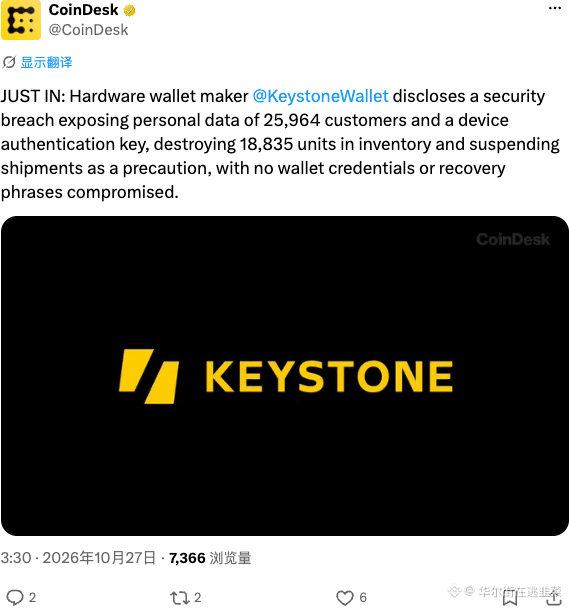
Hardware wallet manufacturer Keystone suffered a security breach, exposing the data of 25,000 customers and device keys. As a precaution, it destroyed 18,000 devices that had not yet shipped and suspended deliveries, but private keys were not compromised.
Keystone went all out this time, literally destroying 18,000 unshipped devices. Although private keys remain safe, this kind of damage control through “physical destruction” shows that the incident was far more serious than anyone imagined. The brand’s reputation has taken a major hit, and sentiment may remain under pressure in the short term. But in the long run, hardware cold wallets are still the last line of defense—the only thing that’s changed is the range of choices available.
#Keystone #HardwareWallet #Security
Hardware wallet manufacturer Keystone suffered a security breach, exposing the data of 25,000 customers and device keys. As a precaution, it destroyed 18,000 devices that had not yet shipped and suspended deliveries, but private keys were not compromised.
Keystone went all out this time, literally destroying 18,000 unshipped devices. Although private keys remain safe, this kind of damage control through “physical destruction” shows that the incident was far more serious than anyone imagined. The brand’s reputation has taken a major hit, and sentiment may remain under pressure in the short term. But in the long run, hardware cold wallets are still the last line of defense—the only thing that’s changed is the range of choices available.
#Keystone #HardwareWallet #Security
Keystone went all out this time, literally destroying 18,000 unshipped devices. Although private keys remain safe, this kind of damage control through “physical destruction” shows that the incident was far more serious than anyone imagined. The brand’s reputation has taken a major hit, and sentiment may remain under pressure in the short term. But in the long run, hardware cold wallets are still the last line of defense—the only thing that’s changed is the range of choices available.
#Keystone #HardwareWallet #Security
4

·
--
See translation
Keystone discloses breach exposing hardware wallet buyers' shipping details
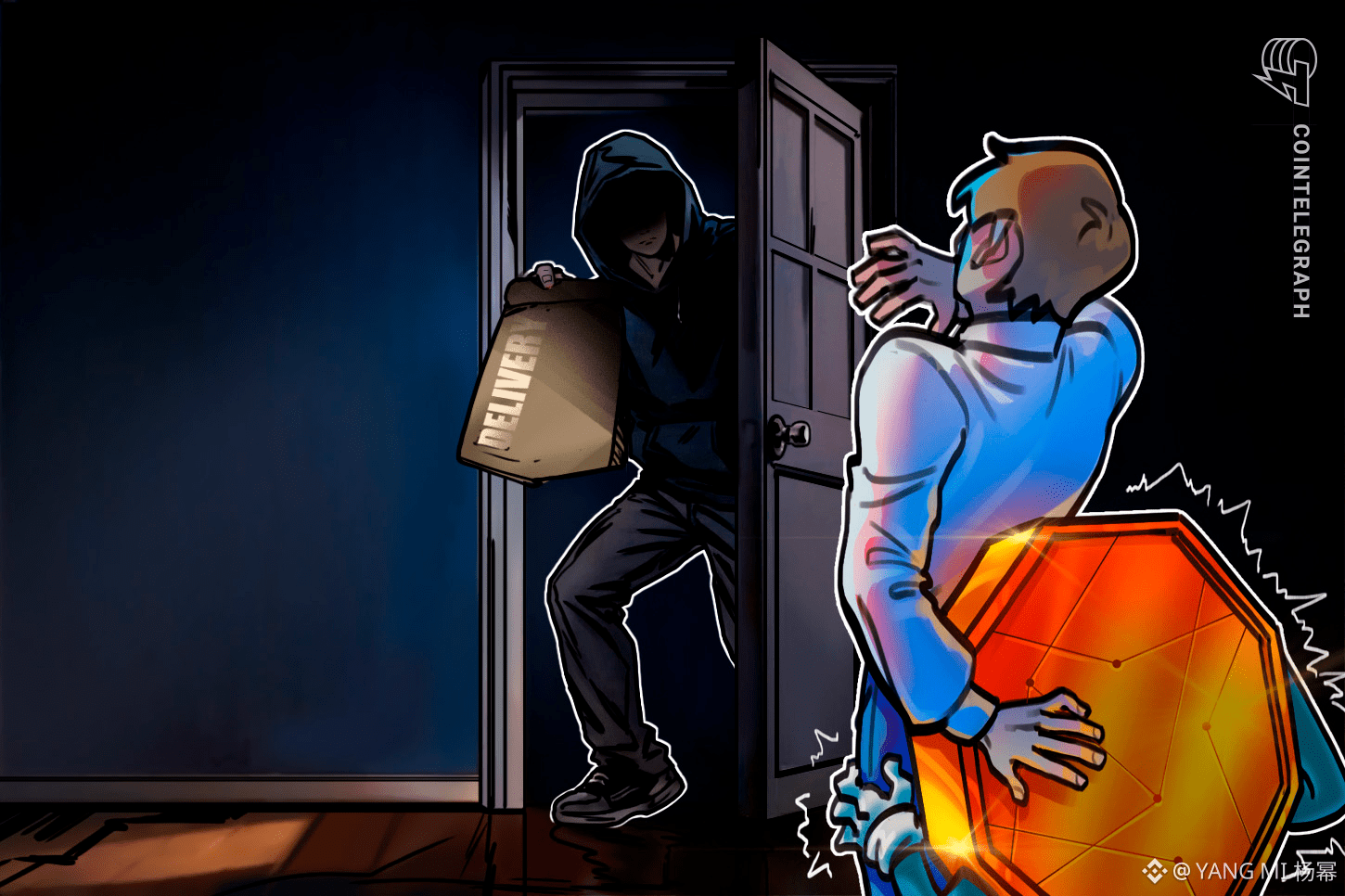
Names, addresses and order data were accessed via a Shopify API vulnerability, with researcher warnings of phishing and physical attacks. Affected customers have reported scam calls claiming to be law enforcement.
Have you been notified by Keystone?
#Security #HardwareWallet $BTC
Source: cointelegraph.com
Keystone discloses breach exposing hardware wallet buyers' shipping details
Names, addresses and order data were accessed via a Shopify API vulnerability, with researcher warnings of phishing and physical attacks. Affected customers have reported scam calls claiming to be law enforcement.
Have you been notified by Keystone?
#Security #HardwareWallet $BTC
Source: cointelegraph.com
Names, addresses and order data were accessed via a Shopify API vulnerability, with researcher warnings of phishing and physical attacks. Affected customers have reported scam calls claiming to be law enforcement.
Have you been notified by Keystone?
#Security #HardwareWallet $BTC
Source: cointelegraph.com
127
Log in to explore more content
Join global crypto users on Binance Square
⚡️ Get latest and useful information about crypto.
💬 Trusted by the world’s largest crypto exchange.
👍 Discover real insights from verified creators.
Email / Phone number
Trending Topics
1
#JobsReportRaisesHikeOdds
239,151 views
1,931 Discussing
2
#CPITestsDecemberRateOutlook
16,281 views
252 Discussing
3
#BitcoinRebounds$75KAsChipsLead
20,150 views
218 Discussing
4
#US Data Center Rules May Constrain AI Expansion
37,352 views
151 Discussing
5
#ARKPlans14ThematicETFsCoveringAIAndTokenizedMarkets
169 views
6 Discussing
6
#WillAnthropicListOnTime
56,611 views
740 Discussing
7
#WillUS-IranTensionsBoostSafe-HavenDemand?
8,949 views
99 Discussing
8
#BitcoinETFsSee$412MNetOutflows
2,447 views
43 Discussing
9
#HKSFCPlansToRestrictCryptoAndExchangeTerms
11,090 views
212 Discussing
10
#TradFiForBeginners
37,415 views
571 Discussing