

#chainlink
chainlink
7M views
16,828 Discussing
Hot
Latest

·
--
Verified
See translation
🚨 CHAINLINK JUST TOOK A BIG STEP INTO GLOBAL FINANCE
Chainlink has launched CCIP 2.0, now live for institutions and digital-asset issuers.
The upgrade adds more control over cross-chain transfers, including configurable verification, compliance controls, and transfer speeds for tokenized assets.
And there’s more.
Chainlink says its new infrastructure is enabling financial institutions to connect with Swift’s blockchain ledger, allowing banks to manage smart-contract workflows across their own ledgers and the Swift ledger.
This is bigger than another protocol upgrade. It puts Chainlink deeper into the infrastructure being built for tokenized assets and institutional finance.
🚨 LINK UPDATE: CCIP 2.0 is live and institutional infrastructure is expanding. Click the $LINK setup below 🫵🏻 and check the latest market structure.
$LINK
{future}(LINKUSDT)
.
.
.
#Chainlink #RWA #Write2Earn
🚨 CHAINLINK JUST TOOK A BIG STEP INTO GLOBAL FINANCE
Chainlink has launched CCIP 2.0, now live for institutions and digital-asset issuers.
The upgrade adds more control over cross-chain transfers, including configurable verification, compliance controls, and transfer speeds for tokenized assets.
And there’s more.
Chainlink says its new infrastructure is enabling financial institutions to connect with Swift’s blockchain ledger, allowing banks to manage smart-contract workflows across their own ledgers and the Swift ledger.
This is bigger than another protocol upgrade. It puts Chainlink deeper into the infrastructure being built for tokenized assets and institutional finance.
🚨 LINK UPDATE: CCIP 2.0 is live and institutional infrastructure is expanding. Click the $LINK setup below 🫵🏻 and check the latest market structure.
$LINK
.
.
.
#Chainlink #RWA #Write2Earn
Chainlink has launched CCIP 2.0, now live for institutions and digital-asset issuers.
The upgrade adds more control over cross-chain transfers, including configurable verification, compliance controls, and transfer speeds for tokenized assets.
And there’s more.
Chainlink says its new infrastructure is enabling financial institutions to connect with Swift’s blockchain ledger, allowing banks to manage smart-contract workflows across their own ledgers and the Swift ledger.
This is bigger than another protocol upgrade. It puts Chainlink deeper into the infrastructure being built for tokenized assets and institutional finance.
🚨 LINK UPDATE: CCIP 2.0 is live and institutional infrastructure is expanding. Click the $LINK setup below 🫵🏻 and check the latest market structure.
$LINK
.
.
.
#Chainlink #RWA #Write2Earn
1
722
·
--
Verified
See translation
🚨 CHAINLINK JUST UNVEILED A BIG INSTITUTIONAL MOVE
Chainlink has introduced Fulcrum, a new infrastructure designed to connect major financial institutions with onchain financing.
The announcement came September 30 and focuses on helping institutions bring financing workflows, collateral and financial data onchain through Chainlink infrastructure.
And this follows another major upgrade: CCIP 2.0 went live on September 28, adding more configurable cross-chain execution and a redesigned API, SDK and CLI for institutions and tokenized-asset issuers.
This is a clear shift toward institutional onchain finance—not just traditional DeFi infrastructure.
🚨 LINK UPDATE: Chainlink Fulcrum is now targeting institutional onchain financing. Click the $LINK setup below 🫵🏻 and check the latest ecosystem developments.
$LINK
{future}(LINKUSDT)
.
.
.
#Chainlink #RWA #Write2Earn
🚨 CHAINLINK JUST UNVEILED A BIG INSTITUTIONAL MOVE
Chainlink has introduced Fulcrum, a new infrastructure designed to connect major financial institutions with onchain financing.
The announcement came September 30 and focuses on helping institutions bring financing workflows, collateral and financial data onchain through Chainlink infrastructure.
And this follows another major upgrade: CCIP 2.0 went live on September 28, adding more configurable cross-chain execution and a redesigned API, SDK and CLI for institutions and tokenized-asset issuers.
This is a clear shift toward institutional onchain finance—not just traditional DeFi infrastructure.
🚨 LINK UPDATE: Chainlink Fulcrum is now targeting institutional onchain financing. Click the $LINK setup below 🫵🏻 and check the latest ecosystem developments.
$LINK
.
.
.
#Chainlink #RWA #Write2Earn
Chainlink has introduced Fulcrum, a new infrastructure designed to connect major financial institutions with onchain financing.
The announcement came September 30 and focuses on helping institutions bring financing workflows, collateral and financial data onchain through Chainlink infrastructure.
And this follows another major upgrade: CCIP 2.0 went live on September 28, adding more configurable cross-chain execution and a redesigned API, SDK and CLI for institutions and tokenized-asset issuers.
This is a clear shift toward institutional onchain finance—not just traditional DeFi infrastructure.
🚨 LINK UPDATE: Chainlink Fulcrum is now targeting institutional onchain financing. Click the $LINK setup below 🫵🏻 and check the latest ecosystem developments.
$LINK
.
.
.
#Chainlink #RWA #Write2Earn
830

·
--
See translation
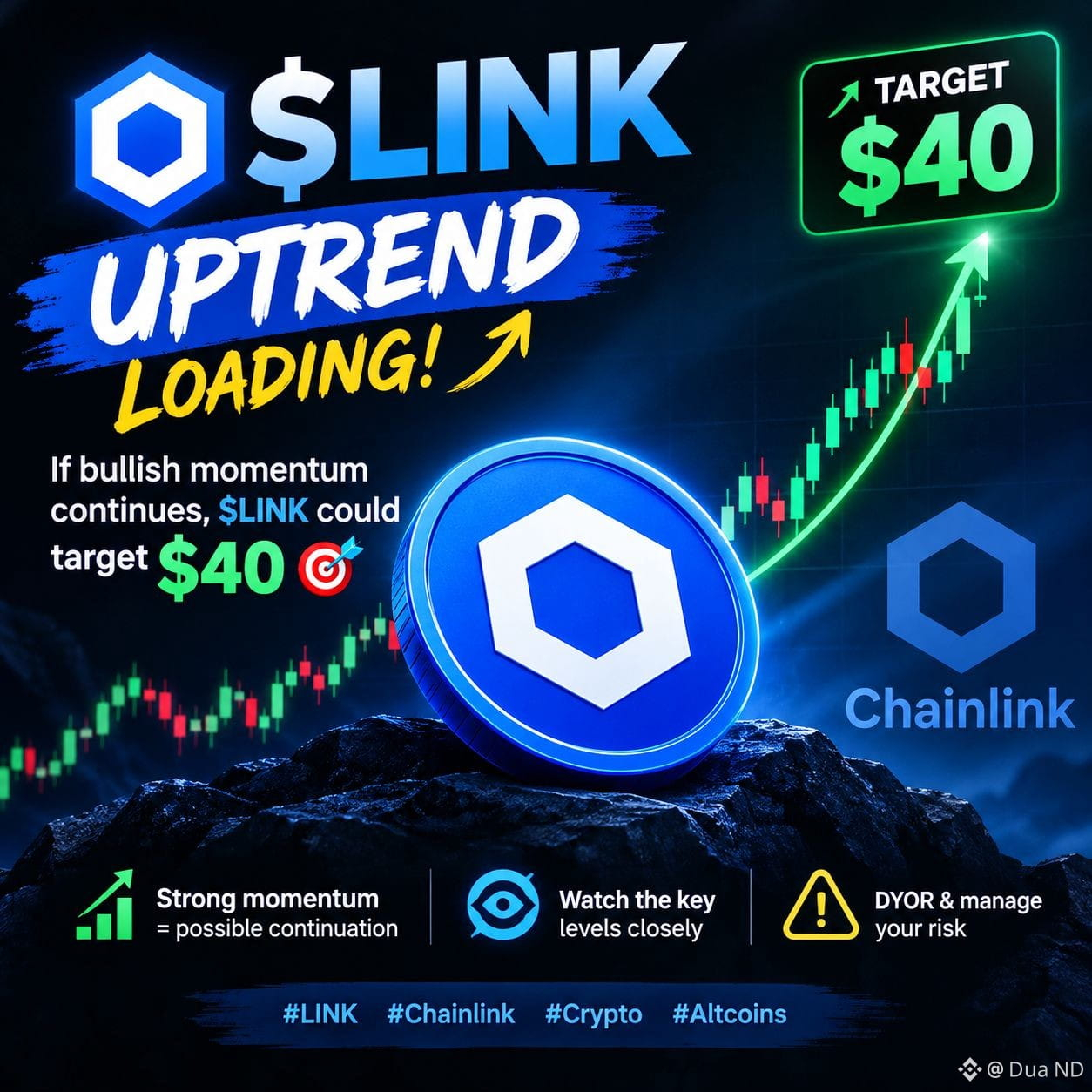
🚀 $LINK — Uptrend Loading! 🔥
If bullish momentum continues, $LINK could target $40 🎯💰
📈 Strong momentum = possible continuation
👀 Watch the key levels closely
⚠️ DYOR & manage your risk
#LINK #Chainlink #Crypto #altcoins
🚀 $LINK — Uptrend Loading! 🔥
If bullish momentum continues, $LINK could target $40 🎯💰
📈 Strong momentum = possible continuation
👀 Watch the key levels closely
⚠️ DYOR & manage your risk
#LINK #Chainlink #Crypto #altcoins
If bullish momentum continues, $LINK could target $40 🎯💰
📈 Strong momentum = possible continuation
👀 Watch the key levels closely
⚠️ DYOR & manage your risk
#LINK #Chainlink #Crypto #altcoins
13

See translation
Picture this: you bought the breakout rally thinking it would never slow down, only to watch price stall right at local resistance. Most traders struggle with knowing whether a pullback is just healthy re-accumulation or the start of a deep wave correction where paper gains evaporate.
We have seen this script play out before with majors like $DOT during previous market cycles when momentum cooled off at key inflection zones. Right now, $LINK is testing trader patience in a very similar fashion. The macro demand zone between the $8.28 and $11.50 area remains the most vital support base keeping the broader structure intact.
To confirm that an actual local top has printed in wave 1/A, the market still needs to see a clean break below $13.50 first. Until that specific level gives way, price action is simply consolidating rather than confirming a full reversal.
How are you playing the price action between that $13.50 pivot and the macro floor?
#Chainlink #CryptoTrading #TechnicalAnalysis
Picture this: you bought the breakout rally thinking it would never slow down, only to watch price stall right at local resistance. Most traders struggle with knowing whether a pullback is just healthy re-accumulation or the start of a deep wave correction where paper gains evaporate.
We have seen this script play out before with majors like $DOT during previous market cycles when momentum cooled off at key inflection zones. Right now, $LINK is testing trader patience in a very similar fashion. The macro demand zone between the $8.28 and $11.50 area remains the most vital support base keeping the broader structure intact.
To confirm that an actual local top has printed in wave 1/A, the market still needs to see a clean break below $13.50 first. Until that specific level gives way, price action is simply consolidating rather than confirming a full reversal.
How are you playing the price action between that $13.50 pivot and the macro floor?
#Chainlink #CryptoTrading #TechnicalAnalysis
We have seen this script play out before with majors like $DOT during previous market cycles when momentum cooled off at key inflection zones. Right now, $LINK is testing trader patience in a very similar fashion. The macro demand zone between the $8.28 and $11.50 area remains the most vital support base keeping the broader structure intact.
To confirm that an actual local top has printed in wave 1/A, the market still needs to see a clean break below $13.50 first. Until that specific level gives way, price action is simply consolidating rather than confirming a full reversal.
How are you playing the price action between that $13.50 pivot and the macro floor?
#Chainlink #CryptoTrading #TechnicalAnalysis

18

·
--
Bullish
Verified
See translation
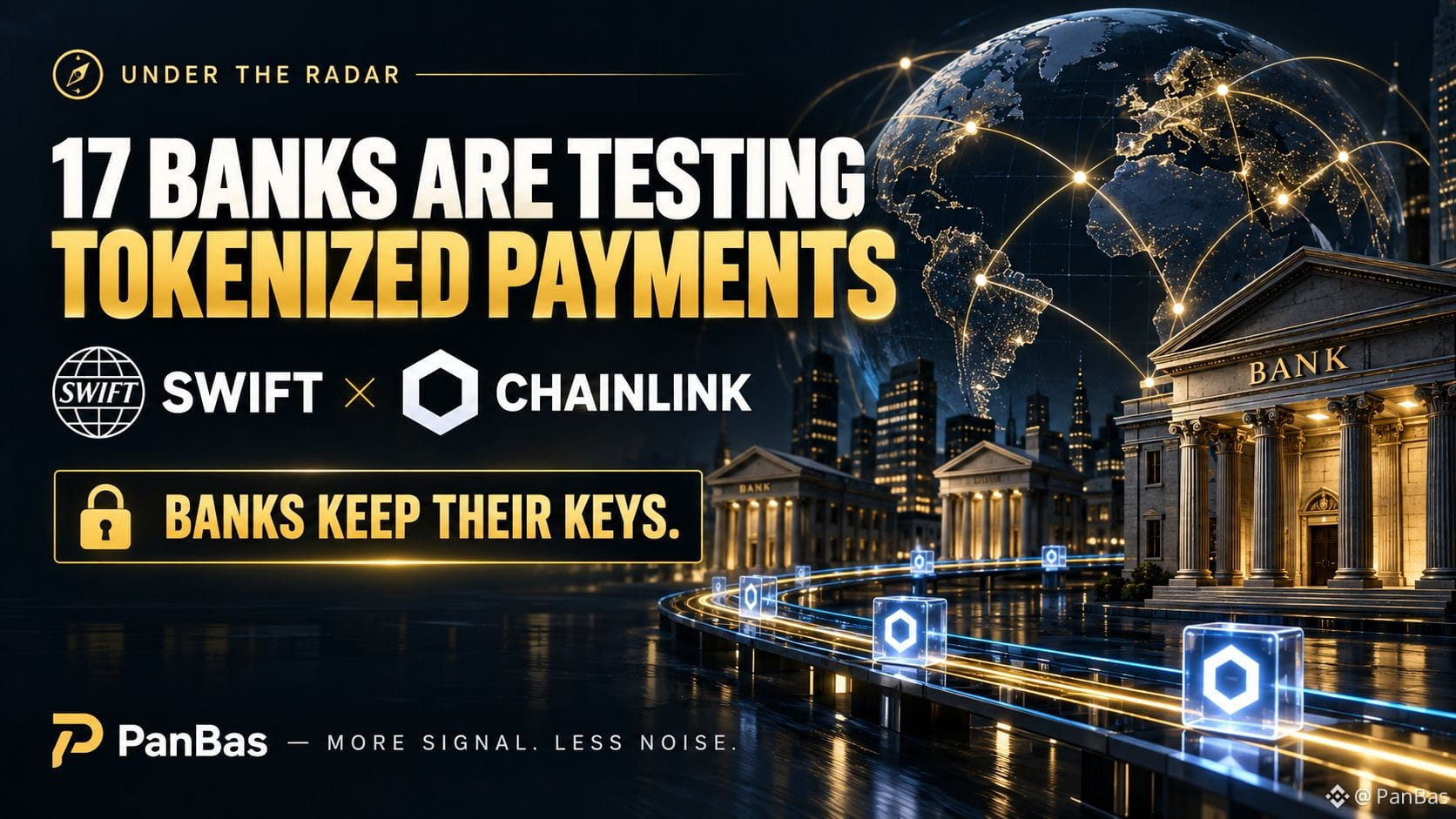
🧭 UNDER THE RADAR: $LINK
17 BANKS. 6 CONTINENTS. 24/7 TOKENIZED PAYMENTS.
And almost nobody is talking about the part that matters most.
Swift has 17 banks preparing to pilot cross-border payments using tokenized deposits on its blockchain-based ledger.
Now Chainlink is enabling financial institutions to connect through CRE.
But here’s the part that caught my attention:
🔐 THE BANKS KEEP THEIR OWN KEYS.
Chainlink uses a self-signing model.
In simple terms, banks can use the infrastructure without giving up control over transaction authorization.
🧩 And that solves one of the biggest institutional questions around blockchain:
“How do we use this without giving up control?”
There’s another important detail.
These tokenized deposits don’t need to become another speculative stablecoin.
They can remain bank-issued money while Swift coordinates settlement between institutions.
So the setup looks like this:
⚡ 24/7 cross-border payments
🏦 bank-issued money
🔐 banks keep control
🌍 Swift’s global network
This does NOT mean banks are suddenly moving everything onchain.
The pilots still need to prove they work at scale.
But the direction matters.
🧭 WHAT I’M WATCHING:
Not the next $LINK candle.
I’m watching whether this 17-bank pilot becomes repeatable infrastructure.
Because if tokenized deposits become normal payment rails for banks…
that’s a much bigger story than one crypto pump.
More signal. Less noise.
#Chainlink #Swift #Tokenization
🧭 UNDER THE RADAR: $LINK
17 BANKS. 6 CONTINENTS. 24/7 TOKENIZED PAYMENTS.
And almost nobody is talking about the part that matters most.
Swift has 17 banks preparing to pilot cross-border payments using tokenized deposits on its blockchain-based ledger.
Now Chainlink is enabling financial institutions to connect through CRE.
But here’s the part that caught my attention:
🔐 THE BANKS KEEP THEIR OWN KEYS.
Chainlink uses a self-signing model.
In simple terms, banks can use the infrastructure without giving up control over transaction authorization.
🧩 And that solves one of the biggest institutional questions around blockchain:
“How do we use this without giving up control?”
There’s another important detail.
These tokenized deposits don’t need to become another speculative stablecoin.
They can remain bank-issued money while Swift coordinates settlement between institutions.
So the setup looks like this:
⚡ 24/7 cross-border payments
🏦 bank-issued money
🔐 banks keep control
🌍 Swift’s global network
This does NOT mean banks are suddenly moving everything onchain.
The pilots still need to prove they work at scale.
But the direction matters.
🧭 WHAT I’M WATCHING:
Not the next $LINK candle.
I’m watching whether this 17-bank pilot becomes repeatable infrastructure.
Because if tokenized deposits become normal payment rails for banks…
that’s a much bigger story than one crypto pump.
More signal. Less noise.
#Chainlink #Swift #Tokenization
17 BANKS. 6 CONTINENTS. 24/7 TOKENIZED PAYMENTS.
And almost nobody is talking about the part that matters most.
Swift has 17 banks preparing to pilot cross-border payments using tokenized deposits on its blockchain-based ledger.
Now Chainlink is enabling financial institutions to connect through CRE.
But here’s the part that caught my attention:
🔐 THE BANKS KEEP THEIR OWN KEYS.
Chainlink uses a self-signing model.
In simple terms, banks can use the infrastructure without giving up control over transaction authorization.
🧩 And that solves one of the biggest institutional questions around blockchain:
“How do we use this without giving up control?”
There’s another important detail.
These tokenized deposits don’t need to become another speculative stablecoin.
They can remain bank-issued money while Swift coordinates settlement between institutions.
So the setup looks like this:
⚡ 24/7 cross-border payments
🏦 bank-issued money
🔐 banks keep control
🌍 Swift’s global network
This does NOT mean banks are suddenly moving everything onchain.
The pilots still need to prove they work at scale.
But the direction matters.
🧭 WHAT I’M WATCHING:
Not the next $LINK candle.
I’m watching whether this 17-bank pilot becomes repeatable infrastructure.
Because if tokenized deposits become normal payment rails for banks…
that’s a much bigger story than one crypto pump.
More signal. Less noise.
#Chainlink #Swift #Tokenization
46

·
--
Bullish
See translation
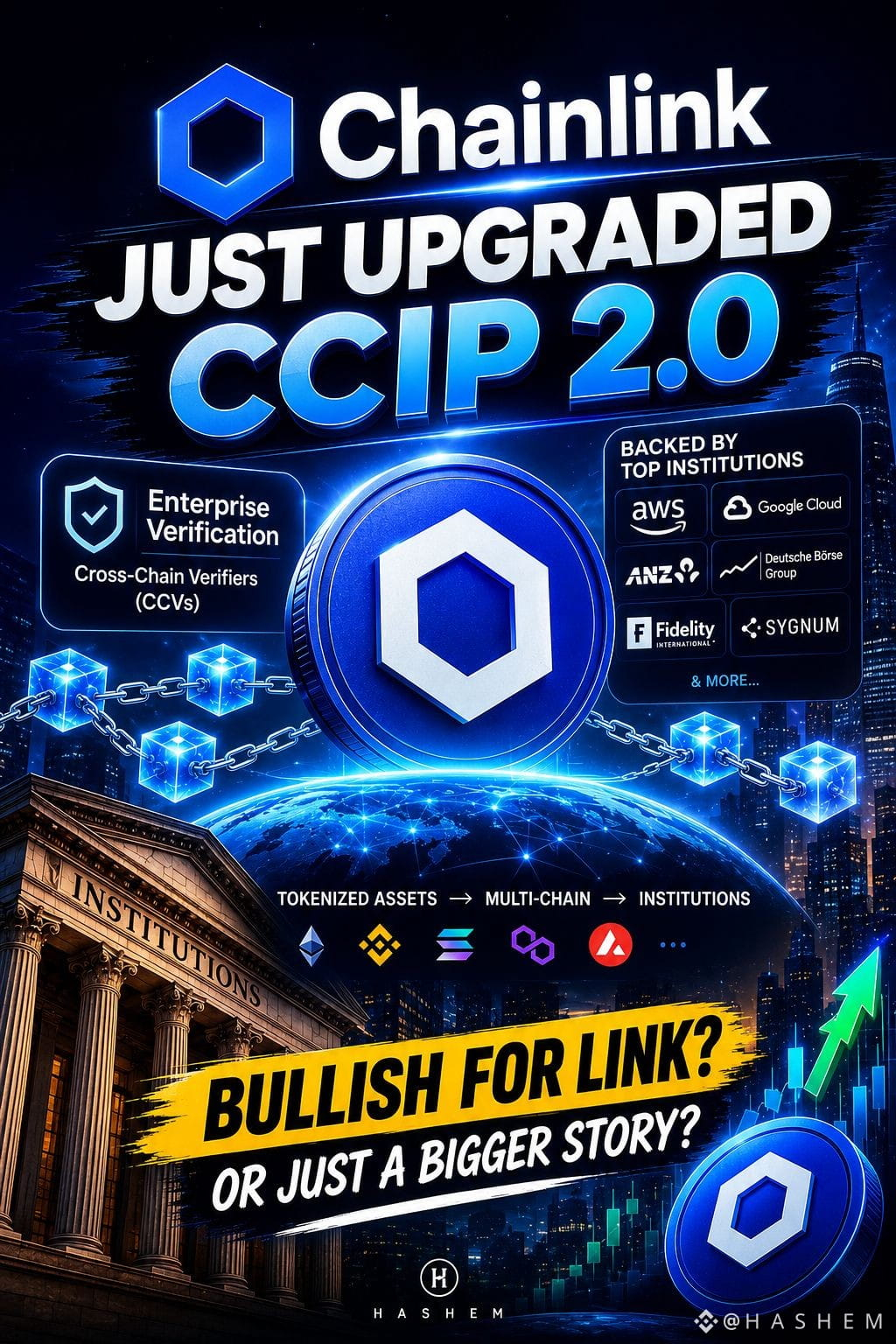
$LINK 🚨 CHAINLINK JUST MADE A BIG MOVE — BUT WHAT DOES IT REALLY MEAN FOR $LINK? 👀
Chainlink has launched CCIP 2.0 — and this goes far beyond a simple blockchain upgrade. ⚡
The goal is ambitious:
🏦 Let institutions move tokenized assets across multiple blockchains through a unified integration.
🔐 Add stronger enterprise-grade security, compliance and verification.
🌐 Introduce Cross-Chain Verifiers (CCVs), giving institutions and enterprise providers an additional independent verification layer before cross-chain transactions are executed.
And the institutional names surrounding the launch are getting attention… 👀
AWS
Google Cloud
ANZ Bank
Deutsche Börse Group’s Crypto Finance
Fidelity International
Sygnum
…and others.
But here’s where the real $LINK question begins. 🧠
Institutional adoption sounds bullish.
But adoption alone doesn't automatically mean sustained value accrual for the token.
The chain traders need to watch is:
Institutional adoption → CCIP usage → Fees/Revenue → LINK demand
The first two pieces are becoming increasingly important.
But the BIG question remains:
🔥 Will growing CCIP usage ultimately create meaningful and sustained demand for $LINK?
That’s the part the market still needs to see develop.
Because Chainlink is no longer positioning CCIP simply as a way to connect blockchains.
It is increasingly becoming infrastructure for institutions moving tokenized assets across the financial system. 🌐🏦
So the bigger question isn't just:
“Is CCIP adoption growing?”
It’s this:
👀 When institutional tokenization scales, where does the economic value ultimately accrue?
Infrastructure?
The network?
Or $LINK?
That answer could matter far more than today’s headline.
$LINK — worth watching closely. 👀⚡
#Chainlink #LINK #CCIP #Crypto
{future}(LINKUSDT)
{spot}(BNBUSDT)
{spot}(ETHUSDT)
#Blockchain
$LINK 🚨 CHAINLINK JUST MADE A BIG MOVE — BUT WHAT DOES IT REALLY MEAN FOR $LINK ? 👀
Chainlink has launched CCIP 2.0 — and this goes far beyond a simple blockchain upgrade. ⚡
The goal is ambitious:
🏦 Let institutions move tokenized assets across multiple blockchains through a unified integration.
🔐 Add stronger enterprise-grade security, compliance and verification.
🌐 Introduce Cross-Chain Verifiers (CCVs), giving institutions and enterprise providers an additional independent verification layer before cross-chain transactions are executed.
And the institutional names surrounding the launch are getting attention… 👀
AWS
Google Cloud
ANZ Bank
Deutsche Börse Group’s Crypto Finance
Fidelity International
Sygnum
…and others.
But here’s where the real $LINK question begins. 🧠
Institutional adoption sounds bullish.
But adoption alone doesn't automatically mean sustained value accrual for the token.
The chain traders need to watch is:
Institutional adoption → CCIP usage → Fees/Revenue → LINK demand
The first two pieces are becoming increasingly important.
But the BIG question remains:
🔥 Will growing CCIP usage ultimately create meaningful and sustained demand for $LINK ?
That’s the part the market still needs to see develop.
Because Chainlink is no longer positioning CCIP simply as a way to connect blockchains.
It is increasingly becoming infrastructure for institutions moving tokenized assets across the financial system. 🌐🏦
So the bigger question isn't just:
“Is CCIP adoption growing?”
It’s this:
👀 When institutional tokenization scales, where does the economic value ultimately accrue?
Infrastructure?
The network?
Or $LINK ?
That answer could matter far more than today’s headline.
$LINK — worth watching closely. 👀⚡
#Chainlink #LINK #CCIP #Crypto
#Blockchain
Chainlink has launched CCIP 2.0 — and this goes far beyond a simple blockchain upgrade. ⚡
The goal is ambitious:
🏦 Let institutions move tokenized assets across multiple blockchains through a unified integration.
🔐 Add stronger enterprise-grade security, compliance and verification.
🌐 Introduce Cross-Chain Verifiers (CCVs), giving institutions and enterprise providers an additional independent verification layer before cross-chain transactions are executed.
And the institutional names surrounding the launch are getting attention… 👀
AWS
Google Cloud
ANZ Bank
Deutsche Börse Group’s Crypto Finance
Fidelity International
Sygnum
…and others.
But here’s where the real $LINK question begins. 🧠
Institutional adoption sounds bullish.
But adoption alone doesn't automatically mean sustained value accrual for the token.
The chain traders need to watch is:
Institutional adoption → CCIP usage → Fees/Revenue → LINK demand
The first two pieces are becoming increasingly important.
But the BIG question remains:
🔥 Will growing CCIP usage ultimately create meaningful and sustained demand for $LINK ?
That’s the part the market still needs to see develop.
Because Chainlink is no longer positioning CCIP simply as a way to connect blockchains.
It is increasingly becoming infrastructure for institutions moving tokenized assets across the financial system. 🌐🏦
So the bigger question isn't just:
“Is CCIP adoption growing?”
It’s this:
👀 When institutional tokenization scales, where does the economic value ultimately accrue?
Infrastructure?
The network?
Or $LINK ?
That answer could matter far more than today’s headline.
$LINK — worth watching closely. 👀⚡
#Chainlink #LINK #CCIP #Crypto
#Blockchain
1
66

See translation
🔗 $LINK
{spot}(LINKUSDT)
continues to anchor the decentralized infrastructure narrative. The daily chart shows a tightening range trapped between key moving averages. A volatility expansion is imminent as the network's real-world utility narrative gains traction. #Chainlink #US10YearYieldNears5.3% #LINK #DeFi
🔗 $LINK
continues to anchor the decentralized infrastructure narrative. The daily chart shows a tightening range trapped between key moving averages. A volatility expansion is imminent as the network's real-world utility narrative gains traction. #Chainlink #US10YearYieldNears5.3% #LINK #DeFi
continues to anchor the decentralized infrastructure narrative. The daily chart shows a tightening range trapped between key moving averages. A volatility expansion is imminent as the network's real-world utility narrative gains traction. #Chainlink #US10YearYieldNears5.3% #LINK #DeFi
1
34


See translation
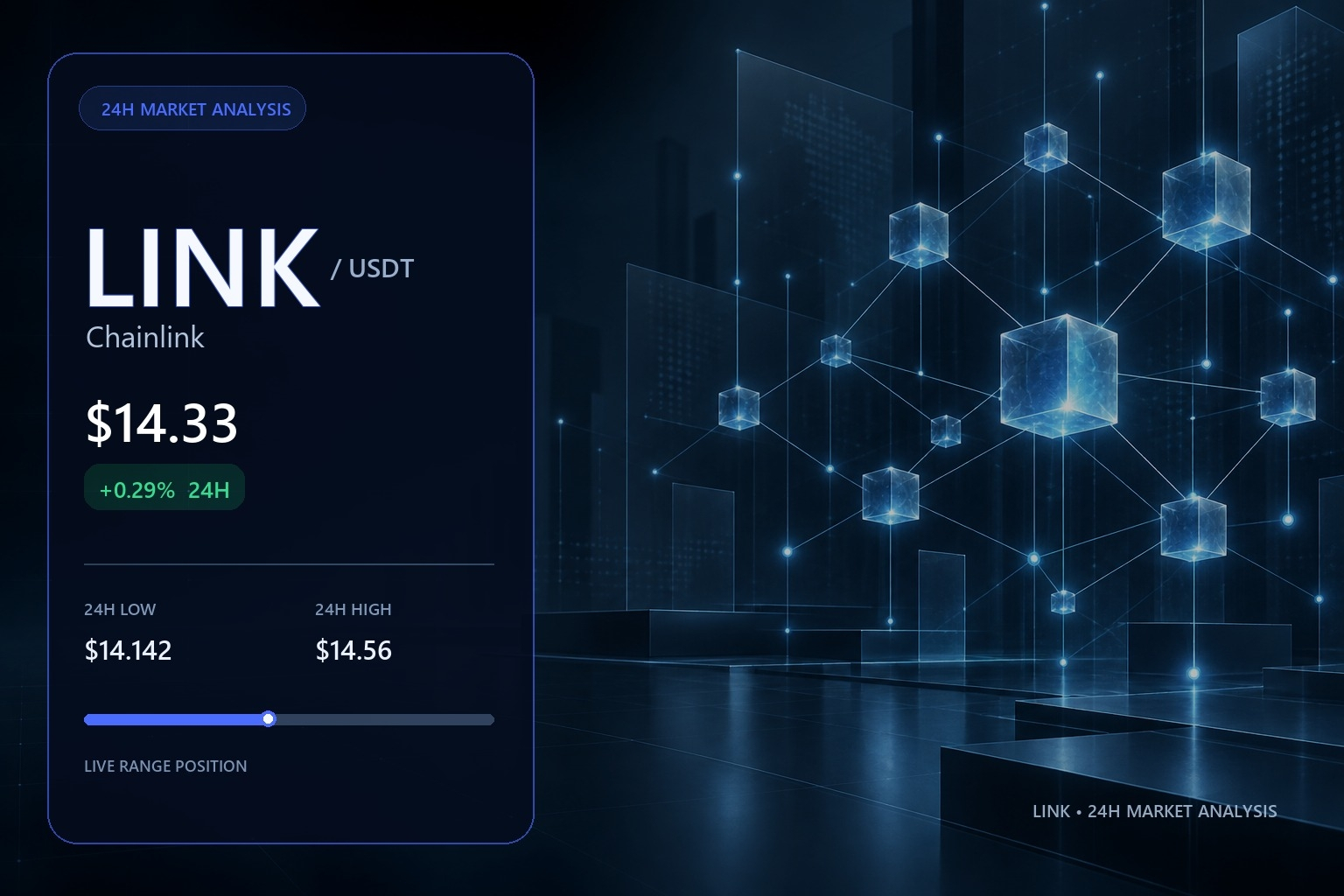
Fourteen dollars and thirty-three cents is the exact pivot point where $LINK just printed a 0.287 percent daily gain! This tight range between a high of fourteen dollars and fifty-six cents and a low of fourteen dollars and fourteen and two-tenths cents spells impending volatility. Let us look at the playbook. For an illustrative long, we enter right here at fourteen dollars and thirty-three cents, risk down to thirteen dollars and ninety thousand and one tenth of a cent, and target fifteen dollars and four hundred and sixty-five thousandths of a cent. For the short side, same entry at fourteen dollars and thirty-three cents, stop loss at fourteen dollars and seventy-five thousand nine hundred and ninety-nine ten-thousandths of a cent, and profit target at thirteen dollars and six thousand one hundred and thirty-five ten-thousandths of a cent. Watch the volume nodes for the breakout confirmation. This is not a prediction, Not financial advice, and DYOR. 🔗🔥📊 #Write2Earn $LINK #Chainlink #CryptoTrading
Fourteen dollars and thirty-three cents is the exact pivot point where $LINK just printed a 0.287 percent daily gain! This tight range between a high of fourteen dollars and fifty-six cents and a low of fourteen dollars and fourteen and two-tenths cents spells impending volatility. Let us look at the playbook. For an illustrative long, we enter right here at fourteen dollars and thirty-three cents, risk down to thirteen dollars and ninety thousand and one tenth of a cent, and target fifteen dollars and four hundred and sixty-five thousandths of a cent. For the short side, same entry at fourteen dollars and thirty-three cents, stop loss at fourteen dollars and seventy-five thousand nine hundred and ninety-nine ten-thousandths of a cent, and profit target at thirteen dollars and six thousand one hundred and thirty-five ten-thousandths of a cent. Watch the volume nodes for the breakout confirmation. This is not a prediction, Not financial advice, and DYOR. 🔗🔥📊 #Write2Earn $LINK #Chainlink #CryptoTrading
109
See translation
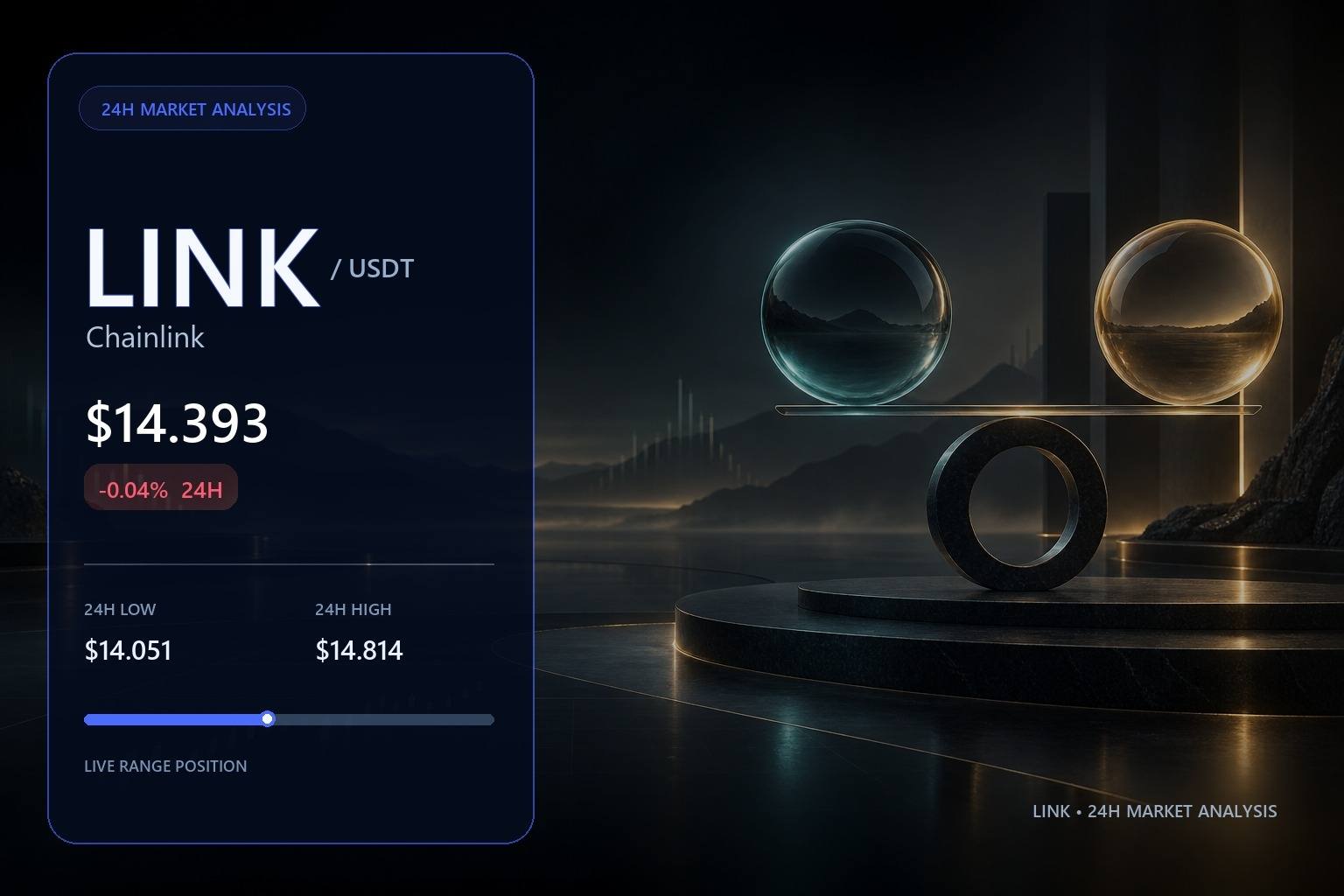
Flash update on $LINK holding at 14.393 with a tight 0.035 percent dip. Range bound action is screaming for execution right now. Watch these three levels closely. One. High printed at 14.814 and low tested at 14.051. Two. Long setup enters at 14.393 with stop loss at 13.9612 and target 15.1127. Three. Short setup triggers at 14.393 with stop loss at 14.8248 and target 13.6733. This is not a prediction. Not financial advice. DYOR. #Write2Earn #CryptoTrading #Chainlink #Trading
Flash update on $LINK holding at 14.393 with a tight 0.035 percent dip. Range bound action is screaming for execution right now. Watch these three levels closely. One. High printed at 14.814 and low tested at 14.051. Two. Long setup enters at 14.393 with stop loss at 13.9612 and target 15.1127. Three. Short setup triggers at 14.393 with stop loss at 14.8248 and target 13.6733. This is not a prediction. Not financial advice. DYOR. #Write2Earn #CryptoTrading #Chainlink #Trading
33
See translation
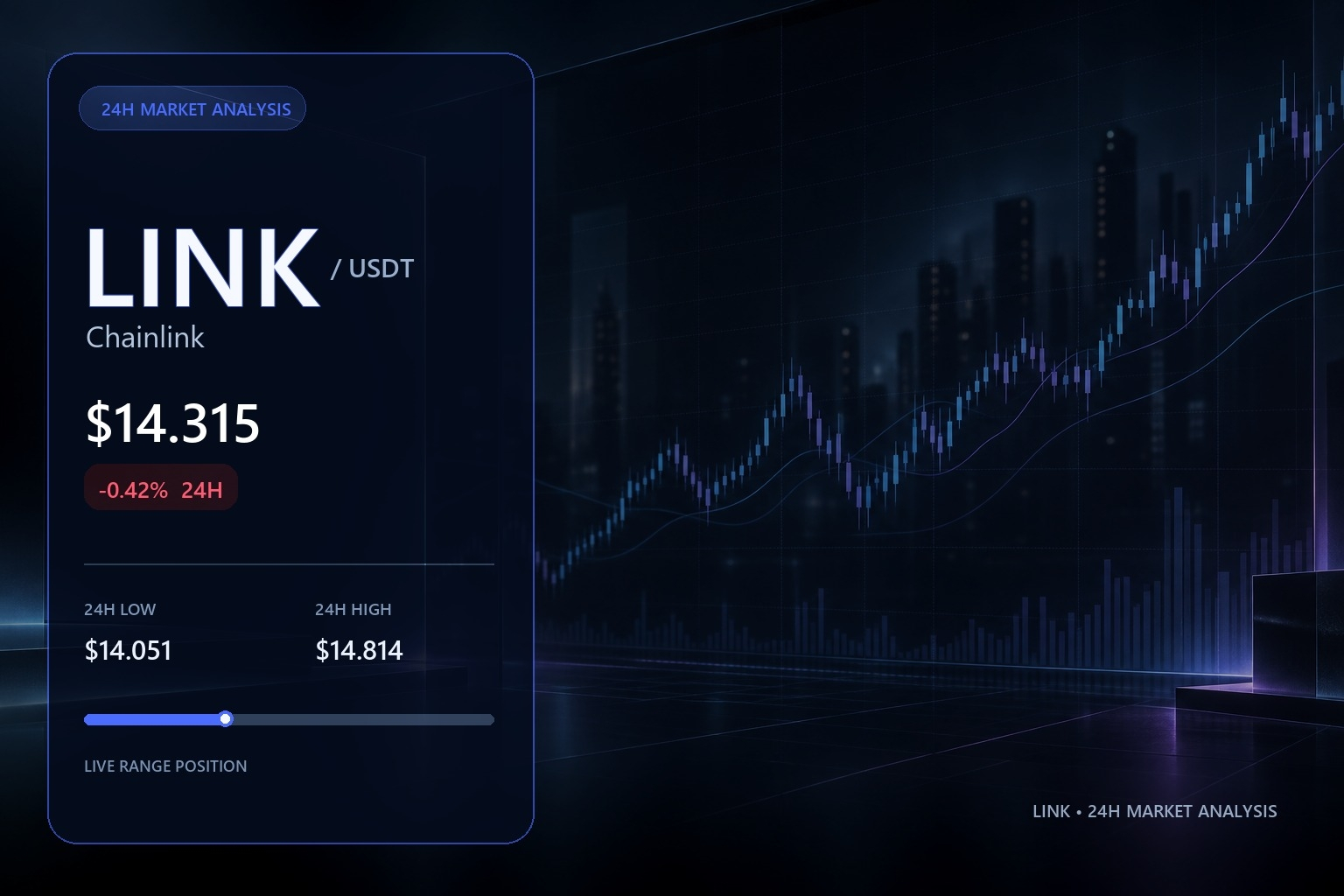
LINK flash update. $LINK is printing a tight range at 14.315 with a 0.417 percent dip. Volatility is brewing fast. 1. Today hit a 14.814 high and a 14.051 low. 2. Long setup eyes entry at 14.315, stop loss at 13.8855, target at 15.0307. 3. Short setup triggers at 14.315, stop loss at 14.7445, target at 13.5992. Manage risk now. This is not a prediction, Not financial advice, and DYOR. #Write2Earn #Chainlink #CryptoTrading #MarketUpdate
LINK flash update. $LINK is printing a tight range at 14.315 with a 0.417 percent dip. Volatility is brewing fast. 1. Today hit a 14.814 high and a 14.051 low. 2. Long setup eyes entry at 14.315, stop loss at 13.8855, target at 15.0307. 3. Short setup triggers at 14.315, stop loss at 14.7445, target at 13.5992. Manage risk now. This is not a prediction, Not financial advice, and DYOR. #Write2Earn #Chainlink #CryptoTrading #MarketUpdate
53

See translation
#crypto
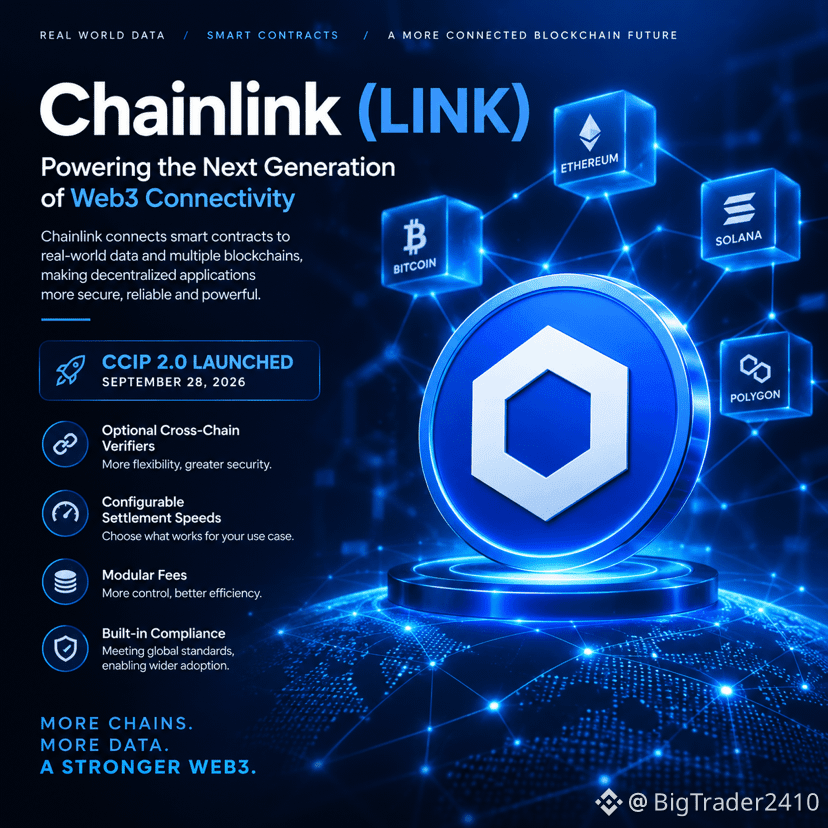
🚀 Chainlink (LINK) – The Future of Blockchain Technology! 🔗
💎 Chainlink (LINK) is one of the leading blockchain oracle networks, connecting smart contracts with real-world data.
🔥 Why Chainlink Matters
✅ Connects blockchains to real-world data.
✅ Supports DeFi and smart contracts.
✅ Enables cross-chain communication.
✅ Partners with major companies and blockchain projects.
📊 Market Outlook: LINK is a cryptocurrency worth watching as blockchain adoption grows. However, its price can be volatile, and future performance is uncertain.
🐂 Bullish Scenario: Growing adoption of Chainlink technology could increase demand for LINK.
🐻 Bearish Scenario: Market downturns and reduced demand could put pressure on its price.
💡 My Take: Keep an eye on LINK’s price action, trading volume, and market trends. Always do your own research before investing.
🚀 Is Chainlink ready for its next big move?
👇 Comment your LINK price prediction!
#BitcoinClears$85200 #Chainlink #crypto
#crypto
🚀 Chainlink (LINK) – The Future of Blockchain Technology! 🔗
💎 Chainlink (LINK) is one of the leading blockchain oracle networks, connecting smart contracts with real-world data.
🔥 Why Chainlink Matters
✅ Connects blockchains to real-world data.
✅ Supports DeFi and smart contracts.
✅ Enables cross-chain communication.
✅ Partners with major companies and blockchain projects.
📊 Market Outlook: LINK is a cryptocurrency worth watching as blockchain adoption grows. However, its price can be volatile, and future performance is uncertain.
🐂 Bullish Scenario: Growing adoption of Chainlink technology could increase demand for LINK.
🐻 Bearish Scenario: Market downturns and reduced demand could put pressure on its price.
💡 My Take: Keep an eye on LINK’s price action, trading volume, and market trends. Always do your own research before investing.
🚀 Is Chainlink ready for its next big move?
👇 Comment your LINK price prediction!
#BitcoinClears$85200 #Chainlink #crypto
🚀 Chainlink (LINK) – The Future of Blockchain Technology! 🔗
💎 Chainlink (LINK) is one of the leading blockchain oracle networks, connecting smart contracts with real-world data.
🔥 Why Chainlink Matters
✅ Connects blockchains to real-world data.
✅ Supports DeFi and smart contracts.
✅ Enables cross-chain communication.
✅ Partners with major companies and blockchain projects.
📊 Market Outlook: LINK is a cryptocurrency worth watching as blockchain adoption grows. However, its price can be volatile, and future performance is uncertain.
🐂 Bullish Scenario: Growing adoption of Chainlink technology could increase demand for LINK.
🐻 Bearish Scenario: Market downturns and reduced demand could put pressure on its price.
💡 My Take: Keep an eye on LINK’s price action, trading volume, and market trends. Always do your own research before investing.
🚀 Is Chainlink ready for its next big move?
👇 Comment your LINK price prediction!
#BitcoinClears$85200 #Chainlink #crypto
132
See translation
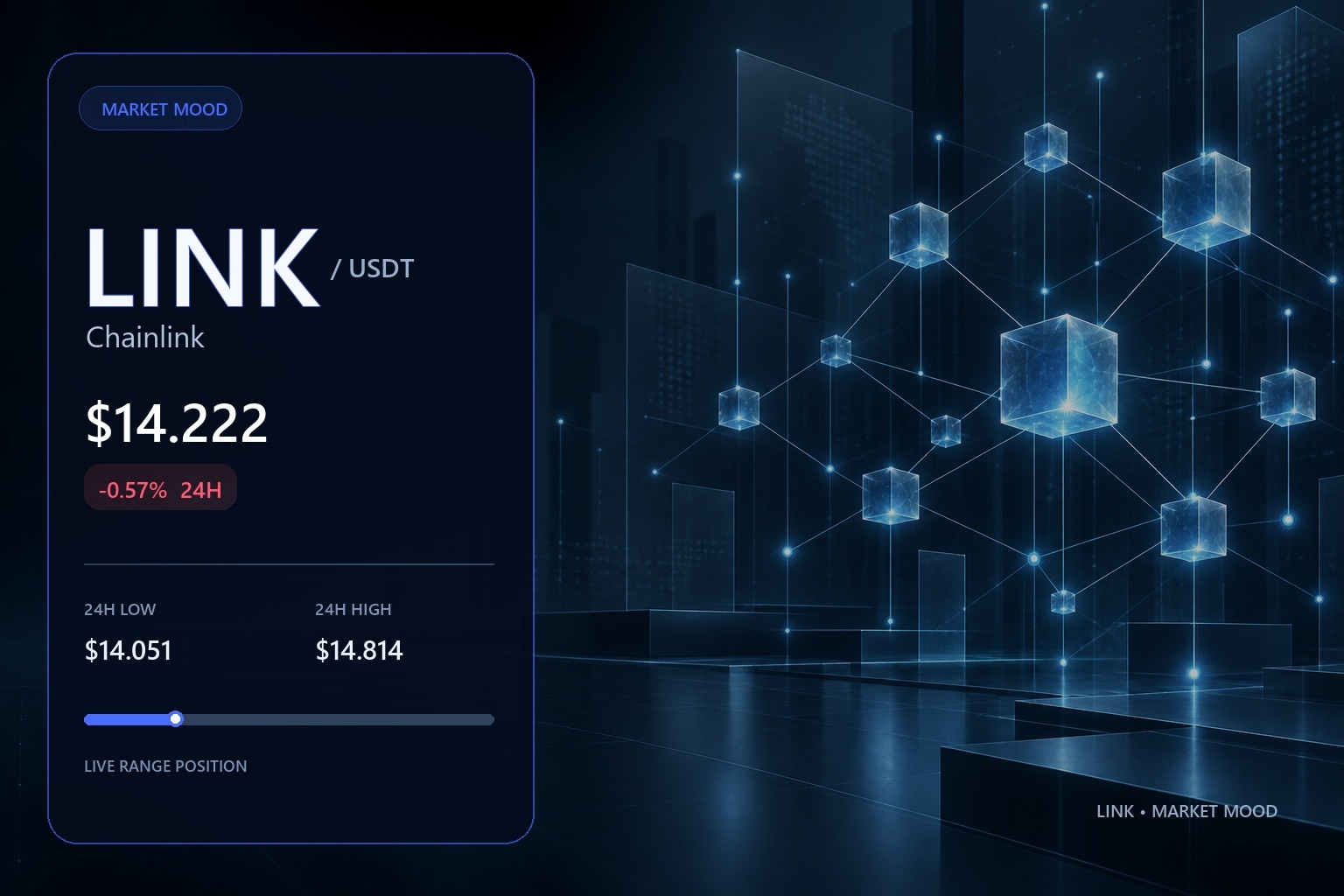
A microscopic -0.566% move keeps $LINK pinned at $14.222 right now. We touched a 24h high of $14.814 before cooling off toward the $14.051 low 📊. Oracles are serving ultra-precise data feeds while the price chart takes a quiet coffee break ☕. Compression like this usually builds energy, so DYOR before placing orders as this is not financial advice 🎯. Watch whether $14.814 breaks or $14.051 gets retested. #Write2Earn #Chainlink #Crypto
A microscopic -0.566% move keeps $LINK pinned at $14.222 right now. We touched a 24h high of $14.814 before cooling off toward the $14.051 low 📊. Oracles are serving ultra-precise data feeds while the price chart takes a quiet coffee break ☕. Compression like this usually builds energy, so DYOR before placing orders as this is not financial advice 🎯. Watch whether $14.814 breaks or $14.051 gets retested. #Write2Earn #Chainlink #Crypto
17

Article
See translation
Chainlink Launches CCIP 2 After the $292M Kelp Hack: What Actually ChangedEnterprises can now add their own validators on top of Chainlink's network. Here's how the upgrade works, and one safeguard that quietly got weaker.
🔧 Five months after a 292-million-dollar bridge hack, the infrastructure behind it just got rebuilt. Whether it's actually stronger depends on who's reading the fine print.
Chainlink launched CCIP 2, a major upgrade to its cross-chain interoperability and bridge infrastructure, on Monday. The timing isn't a coincidence.
💥 Here's the hack that made this upgrade necessary.
Back in April, attackers linked to North Korea's Lazarus Group tricked a single validator used by Kelp DAO's cross-chain bridge and stole roughly 292 million dollars' worth of rsETH from a bridge running on LayerZero. The two companies involved publicly disagreed about who was at fault, LayerZero blamed Kelp for relying on only one validator, while Kelp said LayerZero's own staff had reviewed the setup and raised no objections at the time. Kelp later announced it would migrate to Chainlink entirely.
⚙️ Here's what CCIP 2 actually adds.
Enterprises can now layer their own security verification checks on top of Chainlink's default network of 16 independent node operators. Companies can run their own validators, or hire outside providers like Infosys and Nethermind, to add redundant verification before a cross-chain transaction gets approved. That's a direct structural answer to the single-point-of-failure problem that let the Kelp hack happen in the first place.
⚠️ Here's the trade-off most coverage is glossing over.
Chainlink also changed a safeguard it previously promoted heavily. Its risk management network used to operate as a separate, independent review layer. Under CCIP 2, those checks now run through the same optional validator system instead. That means a user or institution that chooses not to add any extra validators is now relying on a single verification network, where previously they'd have had two independent layers checking transactions by default.
🧠 Why does that nuance actually matter?
Because the upgrade's real strength depends entirely on adoption. For institutions that actively add their own validators, like the Kelp migration suggests will happen, CCIP 2 is a genuine security improvement, more eyes, more redundancy, harder to trick a single point of failure. But for anyone who sticks with the default setup and adds nothing extra, the baseline protection may actually be thinner than what existed before, since the separate risk management layer no longer runs independently by default.
This is a classic security trade-off, more customizable, more powerful when configured properly, but the safety net for passive or default users isn't automatically stronger just because the system got more sophisticated.
✅ What this means for you
If you're using protocols built on Chainlink's infrastructure, check whether they're actually adding extra validators under CCIP 2 or relying on the default setup. That distinction now matters more for your actual security than it did under the previous version.
If you're evaluating cross-chain bridge risk generally, the Kelp hack and this response are a genuinely useful case study, single points of failure in bridge validation have been a recurring attack vector and watching how infrastructure providers respond to real incidents tells you a lot about whether the ecosystem is actually learning from past breaches.
If you're holding $LINK, this upgrade represents real, substantive infrastructure improvement with confirmed institutional adoption already starting, Aave and Maple have begun using other features of the upgrade, and Kelp's migration is already underway. That's a stronger signal than a typical announcement with no confirmed users yet.
🟢 Bullish scenario
Major institutions widely adopt the enhanced validator options, Chainlink's infrastructure becomes the clear standard for secure cross-chain operations following a real, public incident, and adoption momentum continues building from Aave, Maple, and others.
🔴 Risk scenario
Adoption of the optional extra validators stays limited, most users and protocols default to the baseline setup, and the thinner default protection becomes a liability if another attacker specifically targets that gap.
👀 Three things to watch
1️⃣ Validator adoption rates
Do more institutions actually add their own verification layers, or does most usage stay on the default configuration?
2️⃣ Named institutional users
Does Chainlink eventually disclose which specific institutions are using the new validator options, beyond the general mention so far?
3️⃣ Any future incidents
Does CCIP 2's new structure actually prevent a similar single-point-of-failure attack, or does a gap in the default setup get tested?
💡 The key takeaway
This isn't a simple "problem solved" story. Chainlink built a genuinely more flexible, more secure system for institutions willing to configure it properly, while quietly removing a safety net that used to apply to everyone by default.
The real question is whether the ecosystem actually adopts the stronger configuration at scale, or whether this upgrade mostly benefits sophisticated institutions while leaving smaller or passive users with a thinner default than they had before.
That is the part worth watching.
This post is for informational and educational purposes only and is not financial advice. Crypto markets are volatile. Always conduct your own research before making financial decisions.
#BinanceSquare #Chainlink #LINK #CrossChain #Crypto
{spot}(LINKUSDT)
Chainlink Launches CCIP 2 After the $292M Kelp Hack: What Actually Changed
Enterprises can now add their own validators on top of Chainlink's network. Here's how the upgrade works, and one safeguard that quietly got weaker.
🔧 Five months after a 292-million-dollar bridge hack, the infrastructure behind it just got rebuilt. Whether it's actually stronger depends on who's reading the fine print.
Chainlink launched CCIP 2, a major upgrade to its cross-chain interoperability and bridge infrastructure, on Monday. The timing isn't a coincidence.
💥 Here's the hack that made this upgrade necessary.
Back in April, attackers linked to North Korea's Lazarus Group tricked a single validator used by Kelp DAO's cross-chain bridge and stole roughly 292 million dollars' worth of rsETH from a bridge running on LayerZero. The two companies involved publicly disagreed about who was at fault, LayerZero blamed Kelp for relying on only one validator, while Kelp said LayerZero's own staff had reviewed the setup and raised no objections at the time. Kelp later announced it would migrate to Chainlink entirely.
⚙️ Here's what CCIP 2 actually adds.
Enterprises can now layer their own security verification checks on top of Chainlink's default network of 16 independent node operators. Companies can run their own validators, or hire outside providers like Infosys and Nethermind, to add redundant verification before a cross-chain transaction gets approved. That's a direct structural answer to the single-point-of-failure problem that let the Kelp hack happen in the first place.
⚠️ Here's the trade-off most coverage is glossing over.
Chainlink also changed a safeguard it previously promoted heavily. Its risk management network used to operate as a separate, independent review layer. Under CCIP 2, those checks now run through the same optional validator system instead. That means a user or institution that chooses not to add any extra validators is now relying on a single verification network, where previously they'd have had two independent layers checking transactions by default.
🧠 Why does that nuance actually matter?
Because the upgrade's real strength depends entirely on adoption. For institutions that actively add their own validators, like the Kelp migration suggests will happen, CCIP 2 is a genuine security improvement, more eyes, more redundancy, harder to trick a single point of failure. But for anyone who sticks with the default setup and adds nothing extra, the baseline protection may actually be thinner than what existed before, since the separate risk management layer no longer runs independently by default.
This is a classic security trade-off, more customizable, more powerful when configured properly, but the safety net for passive or default users isn't automatically stronger just because the system got more sophisticated.
✅ What this means for you
If you're using protocols built on Chainlink's infrastructure, check whether they're actually adding extra validators under CCIP 2 or relying on the default setup. That distinction now matters more for your actual security than it did under the previous version.
If you're evaluating cross-chain bridge risk generally, the Kelp hack and this response are a genuinely useful case study, single points of failure in bridge validation have been a recurring attack vector and watching how infrastructure providers respond to real incidents tells you a lot about whether the ecosystem is actually learning from past breaches.
If you're holding $LINK, this upgrade represents real, substantive infrastructure improvement with confirmed institutional adoption already starting, Aave and Maple have begun using other features of the upgrade, and Kelp's migration is already underway. That's a stronger signal than a typical announcement with no confirmed users yet.
🟢 Bullish scenario
Major institutions widely adopt the enhanced validator options, Chainlink's infrastructure becomes the clear standard for secure cross-chain operations following a real, public incident, and adoption momentum continues building from Aave, Maple, and others.
🔴 Risk scenario
Adoption of the optional extra validators stays limited, most users and protocols default to the baseline setup, and the thinner default protection becomes a liability if another attacker specifically targets that gap.
👀 Three things to watch
1️⃣ Validator adoption rates
Do more institutions actually add their own verification layers, or does most usage stay on the default configuration?
2️⃣ Named institutional users
Does Chainlink eventually disclose which specific institutions are using the new validator options, beyond the general mention so far?
3️⃣ Any future incidents
Does CCIP 2's new structure actually prevent a similar single-point-of-failure attack, or does a gap in the default setup get tested?
💡 The key takeaway
This isn't a simple "problem solved" story. Chainlink built a genuinely more flexible, more secure system for institutions willing to configure it properly, while quietly removing a safety net that used to apply to everyone by default.
The real question is whether the ecosystem actually adopts the stronger configuration at scale, or whether this upgrade mostly benefits sophisticated institutions while leaving smaller or passive users with a thinner default than they had before.
That is the part worth watching.
This post is for informational and educational purposes only and is not financial advice. Crypto markets are volatile. Always conduct your own research before making financial decisions.
#BinanceSquare #Chainlink #LINK #CrossChain #Crypto
🔧 Five months after a 292-million-dollar bridge hack, the infrastructure behind it just got rebuilt. Whether it's actually stronger depends on who's reading the fine print.
Chainlink launched CCIP 2, a major upgrade to its cross-chain interoperability and bridge infrastructure, on Monday. The timing isn't a coincidence.
💥 Here's the hack that made this upgrade necessary.
Back in April, attackers linked to North Korea's Lazarus Group tricked a single validator used by Kelp DAO's cross-chain bridge and stole roughly 292 million dollars' worth of rsETH from a bridge running on LayerZero. The two companies involved publicly disagreed about who was at fault, LayerZero blamed Kelp for relying on only one validator, while Kelp said LayerZero's own staff had reviewed the setup and raised no objections at the time. Kelp later announced it would migrate to Chainlink entirely.
⚙️ Here's what CCIP 2 actually adds.
Enterprises can now layer their own security verification checks on top of Chainlink's default network of 16 independent node operators. Companies can run their own validators, or hire outside providers like Infosys and Nethermind, to add redundant verification before a cross-chain transaction gets approved. That's a direct structural answer to the single-point-of-failure problem that let the Kelp hack happen in the first place.
⚠️ Here's the trade-off most coverage is glossing over.
Chainlink also changed a safeguard it previously promoted heavily. Its risk management network used to operate as a separate, independent review layer. Under CCIP 2, those checks now run through the same optional validator system instead. That means a user or institution that chooses not to add any extra validators is now relying on a single verification network, where previously they'd have had two independent layers checking transactions by default.
🧠 Why does that nuance actually matter?
Because the upgrade's real strength depends entirely on adoption. For institutions that actively add their own validators, like the Kelp migration suggests will happen, CCIP 2 is a genuine security improvement, more eyes, more redundancy, harder to trick a single point of failure. But for anyone who sticks with the default setup and adds nothing extra, the baseline protection may actually be thinner than what existed before, since the separate risk management layer no longer runs independently by default.
This is a classic security trade-off, more customizable, more powerful when configured properly, but the safety net for passive or default users isn't automatically stronger just because the system got more sophisticated.
✅ What this means for you
If you're using protocols built on Chainlink's infrastructure, check whether they're actually adding extra validators under CCIP 2 or relying on the default setup. That distinction now matters more for your actual security than it did under the previous version.
If you're evaluating cross-chain bridge risk generally, the Kelp hack and this response are a genuinely useful case study, single points of failure in bridge validation have been a recurring attack vector and watching how infrastructure providers respond to real incidents tells you a lot about whether the ecosystem is actually learning from past breaches.
If you're holding $LINK, this upgrade represents real, substantive infrastructure improvement with confirmed institutional adoption already starting, Aave and Maple have begun using other features of the upgrade, and Kelp's migration is already underway. That's a stronger signal than a typical announcement with no confirmed users yet.
🟢 Bullish scenario
Major institutions widely adopt the enhanced validator options, Chainlink's infrastructure becomes the clear standard for secure cross-chain operations following a real, public incident, and adoption momentum continues building from Aave, Maple, and others.
🔴 Risk scenario
Adoption of the optional extra validators stays limited, most users and protocols default to the baseline setup, and the thinner default protection becomes a liability if another attacker specifically targets that gap.
👀 Three things to watch
1️⃣ Validator adoption rates
Do more institutions actually add their own verification layers, or does most usage stay on the default configuration?
2️⃣ Named institutional users
Does Chainlink eventually disclose which specific institutions are using the new validator options, beyond the general mention so far?
3️⃣ Any future incidents
Does CCIP 2's new structure actually prevent a similar single-point-of-failure attack, or does a gap in the default setup get tested?
💡 The key takeaway
This isn't a simple "problem solved" story. Chainlink built a genuinely more flexible, more secure system for institutions willing to configure it properly, while quietly removing a safety net that used to apply to everyone by default.
The real question is whether the ecosystem actually adopts the stronger configuration at scale, or whether this upgrade mostly benefits sophisticated institutions while leaving smaller or passive users with a thinner default than they had before.
That is the part worth watching.
This post is for informational and educational purposes only and is not financial advice. Crypto markets are volatile. Always conduct your own research before making financial decisions.
#BinanceSquare #Chainlink #LINK #CrossChain #Crypto
1
1
90

·
--
See translation
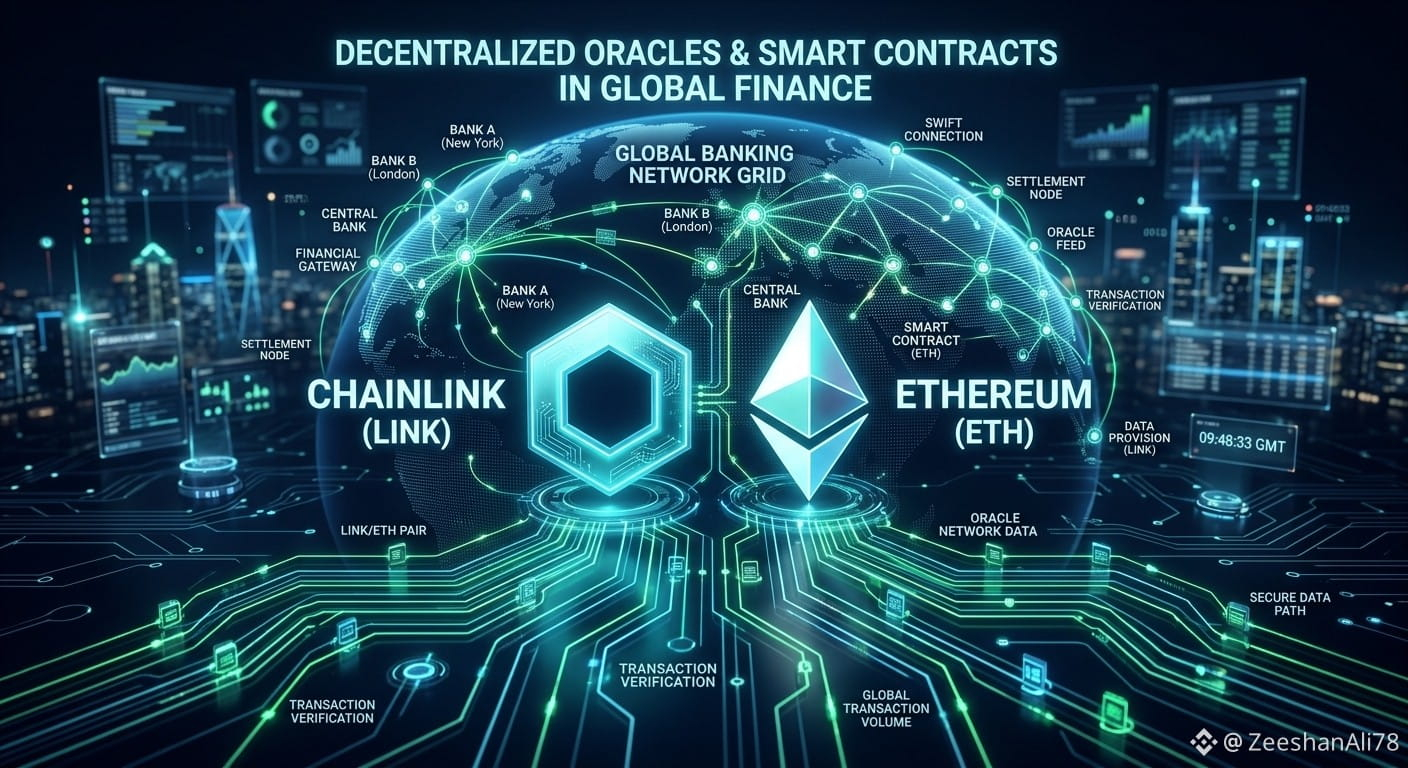
🏦 Institutional Web3 Milestone: Chainlink SWIFT Ledger Framework & On-Chain Stocks! 🌐
Institutional crypto adoption is hitting new record speed! With #ChainlinkLaunchesBankSWIFTLedger trending on Binance Square alongside discussions on moving traditional stock markets on-chain, traditional finance is bridging rapidly with Web3!
Key Takeaways for Investors:
🏛️ Institutional Bridge: SWIFT integration opens seamless bank-to-blockchain settlement rails.
🏛️ Real-World Assets (RWA): Tokenized stocks and assets are becoming the next trillion-dollar market.
🏛️️ Infrastructure Growth: Major network tokens like $ETH and $LINK stand to benefit from long-term institutional volume.
Are you accumulating RWA and infrastructure tokens for this cycle? Share your top picks! 💬👇
🎯 Click $ETH chart widget below to view live technical levels & trade!
#Chainlink
{spot}(ETHUSDT)
{spot}(LINKUSDT)
#Ethereum #ETH #RWA #Binance
🏦 Institutional Web3 Milestone: Chainlink SWIFT Ledger Framework & On-Chain Stocks! 🌐
Institutional crypto adoption is hitting new record speed! With #ChainlinkLaunchesBankSWIFTLedger trending on Binance Square alongside discussions on moving traditional stock markets on-chain, traditional finance is bridging rapidly with Web3!
Key Takeaways for Investors:
🏛️ Institutional Bridge: SWIFT integration opens seamless bank-to-blockchain settlement rails.
🏛️ Real-World Assets (RWA): Tokenized stocks and assets are becoming the next trillion-dollar market.
🏛️️ Infrastructure Growth: Major network tokens like $ETH and $LINK stand to benefit from long-term institutional volume.
Are you accumulating RWA and infrastructure tokens for this cycle? Share your top picks! 💬👇
🎯 Click $ETH chart widget below to view live technical levels & trade!
#Chainlink
#Ethereum #ETH #RWA #Binance
Institutional crypto adoption is hitting new record speed! With #ChainlinkLaunchesBankSWIFTLedger trending on Binance Square alongside discussions on moving traditional stock markets on-chain, traditional finance is bridging rapidly with Web3!
Key Takeaways for Investors:
🏛️ Institutional Bridge: SWIFT integration opens seamless bank-to-blockchain settlement rails.
🏛️ Real-World Assets (RWA): Tokenized stocks and assets are becoming the next trillion-dollar market.
🏛️️ Infrastructure Growth: Major network tokens like $ETH and $LINK stand to benefit from long-term institutional volume.
Are you accumulating RWA and infrastructure tokens for this cycle? Share your top picks! 💬👇
🎯 Click $ETH chart widget below to view live technical levels & trade!
#Chainlink
#Ethereum #ETH #RWA #Binance
63

See translation
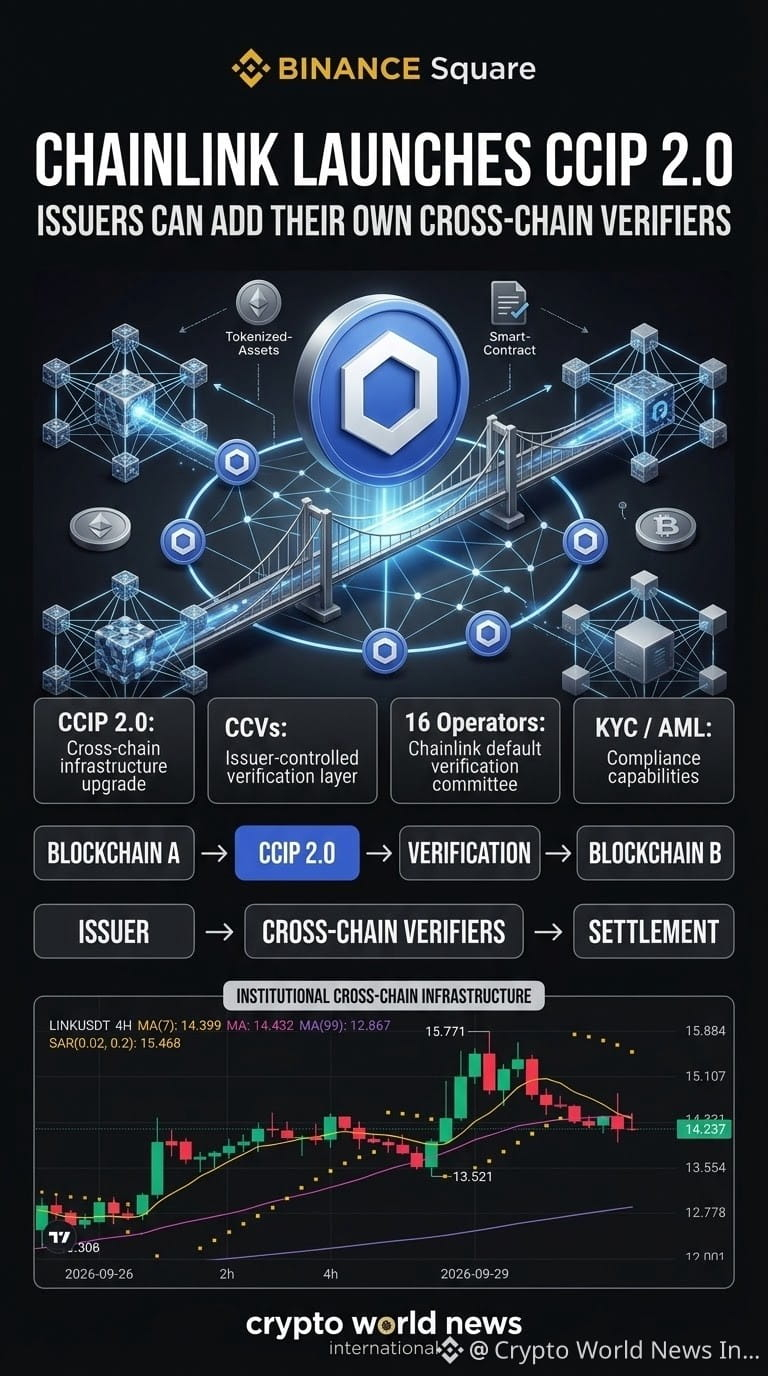
🚨 CHAINLINK LAUNCHES CCIP 2.0 — ISSUERS CAN ADD THEIR OWN VERIFIERS
Chainlink has launched CCIP 2.0, giving institutions and digital-asset issuers more control over how cross-chain transfers are verified, settled, and monitored.
🔑 Key Points:
• New Cross-Chain Verifiers (CCVs) can add an extra verification layer
• Chainlink’s default 16-operator committee remains part of the verification process
• Institutions can configure confirmation and settlement requirements
• Built-in compliance functions support KYC, AML and sanctions-related checks
• CCIP 2.0 is designed for institutional digital-asset and tokenized-asset distribution
📊 Market Insight:
The upgrade strengthens Chainlink’s focus on institutional interoperability and tokenized assets. The key development is not simply faster transfers — it is the ability to customize verification and compliance requirements for different assets and institutions.
🪙 Asset to Watch: LINK
#Chainlink #LINK #CCIP #crypto #Tokenization $LINK
{future}(LINKUSDT)
🚨 CHAINLINK LAUNCHES CCIP 2.0 — ISSUERS CAN ADD THEIR OWN VERIFIERS
Chainlink has launched CCIP 2.0, giving institutions and digital-asset issuers more control over how cross-chain transfers are verified, settled, and monitored.
🔑 Key Points:
• New Cross-Chain Verifiers (CCVs) can add an extra verification layer
• Chainlink’s default 16-operator committee remains part of the verification process
• Institutions can configure confirmation and settlement requirements
• Built-in compliance functions support KYC, AML and sanctions-related checks
• CCIP 2.0 is designed for institutional digital-asset and tokenized-asset distribution
📊 Market Insight:
The upgrade strengthens Chainlink’s focus on institutional interoperability and tokenized assets. The key development is not simply faster transfers — it is the ability to customize verification and compliance requirements for different assets and institutions.
🪙 Asset to Watch: LINK
#Chainlink #LINK #CCIP #crypto #Tokenization $LINK
Chainlink has launched CCIP 2.0, giving institutions and digital-asset issuers more control over how cross-chain transfers are verified, settled, and monitored.
🔑 Key Points:
• New Cross-Chain Verifiers (CCVs) can add an extra verification layer
• Chainlink’s default 16-operator committee remains part of the verification process
• Institutions can configure confirmation and settlement requirements
• Built-in compliance functions support KYC, AML and sanctions-related checks
• CCIP 2.0 is designed for institutional digital-asset and tokenized-asset distribution
📊 Market Insight:
The upgrade strengthens Chainlink’s focus on institutional interoperability and tokenized assets. The key development is not simply faster transfers — it is the ability to customize verification and compliance requirements for different assets and institutions.
🪙 Asset to Watch: LINK
#Chainlink #LINK #CCIP #crypto #Tokenization $LINK
10

·
--
See translation
$LINK long now ..
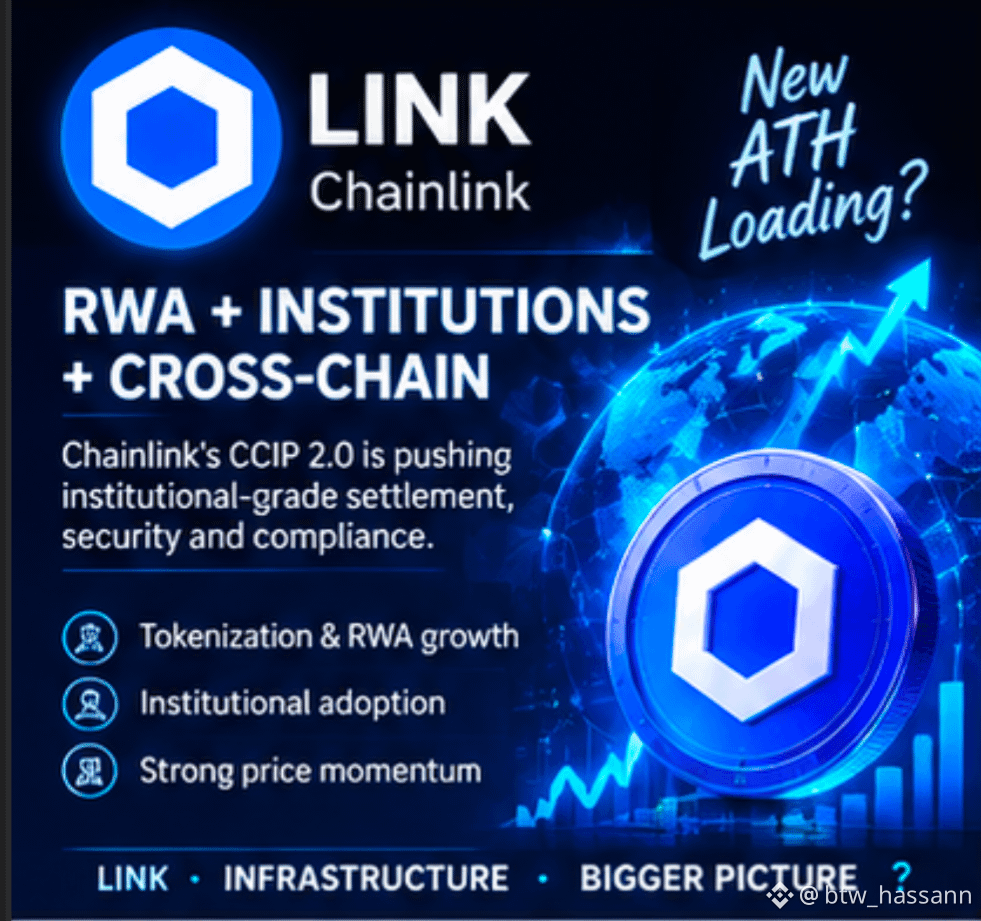
$ WHY IS CHAINLINK GETTING HOT AGAIN?
Chainlink ($LINK) is back on the radar as institutional and traditional-finance use cases around blockchain infrastructure continue expanding.
Recent developments around Chainlink's CCIP 2.0 are focusing on institutional-grade cross-chain settlement, security and compliance.
LINK has also recently shown strong price momentum, with reports of sharply higher trading activity.
The bigger narrative is simple:
Tokenization + institutional finance + cross-chain infrastructure.
If these trends continue growing, Chainlink remains one of the major infrastructure projects sitting directly in the middle of that narrative.
That's why LINK is worth watching
#LINK🔥🔥🔥 #Chainlink #defi
$LINK
{future}(LINKUSDT)
$LINK long now ..
$ WHY IS CHAINLINK GETTING HOT AGAIN?
Chainlink ($LINK ) is back on the radar as institutional and traditional-finance use cases around blockchain infrastructure continue expanding.
Recent developments around Chainlink's CCIP 2.0 are focusing on institutional-grade cross-chain settlement, security and compliance.
LINK has also recently shown strong price momentum, with reports of sharply higher trading activity.
The bigger narrative is simple:
Tokenization + institutional finance + cross-chain infrastructure.
If these trends continue growing, Chainlink remains one of the major infrastructure projects sitting directly in the middle of that narrative.
That's why LINK is worth watching
#LINK🔥🔥🔥 #Chainlink #defi
$LINK
$ WHY IS CHAINLINK GETTING HOT AGAIN?
Chainlink ($LINK ) is back on the radar as institutional and traditional-finance use cases around blockchain infrastructure continue expanding.
Recent developments around Chainlink's CCIP 2.0 are focusing on institutional-grade cross-chain settlement, security and compliance.
LINK has also recently shown strong price momentum, with reports of sharply higher trading activity.
The bigger narrative is simple:
Tokenization + institutional finance + cross-chain infrastructure.
If these trends continue growing, Chainlink remains one of the major infrastructure projects sitting directly in the middle of that narrative.
That's why LINK is worth watching
#LINK🔥🔥🔥 #Chainlink #defi
$LINK
1
10

·
--
See translation
🔗 LINK — Today’s Focus
📉 $LINK
{spot}(LINKUSDT)
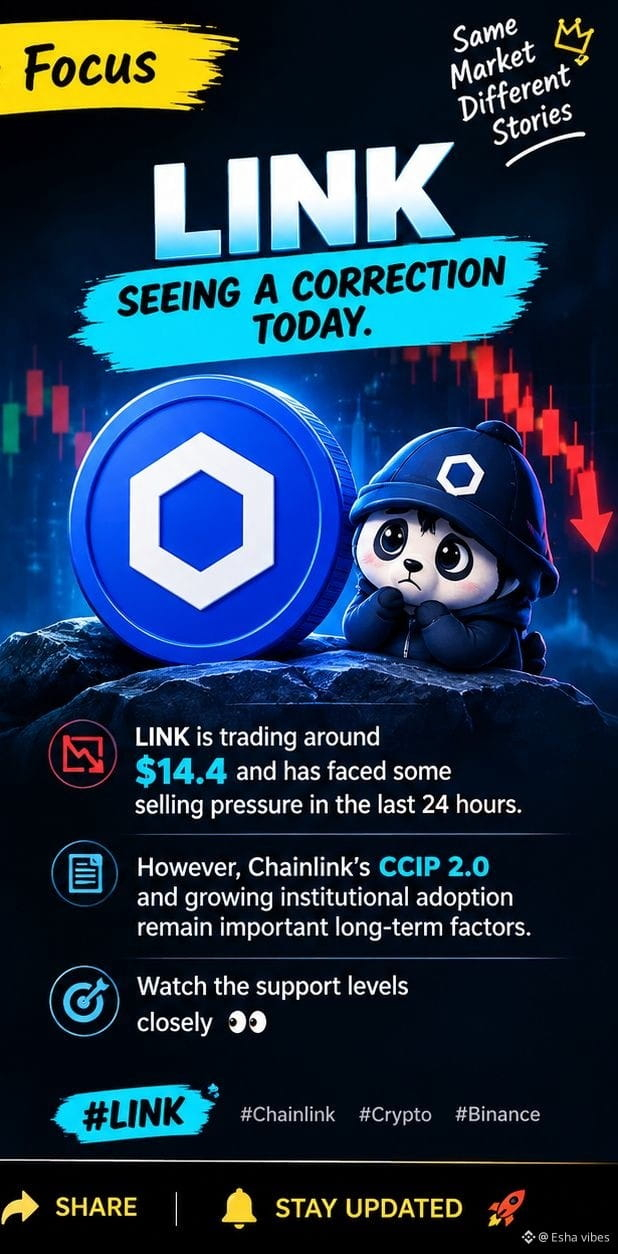
LINK is seeing a correction today.
LINK is trading around $14.4 and has faced some selling pressure in the last 24 hours.
However, Chainlink’s CCIP 2.0 and growing institutional adoption remain important long-term factors.
📌 Watch the support levels closely 👀
#LINK #Chainlink #Crypto #Binance
🔗 LINK — Today’s Focus
📉 $LINK
LINK is seeing a correction today.
LINK is trading around $14.4 and has faced some selling pressure in the last 24 hours.
However, Chainlink’s CCIP 2.0 and growing institutional adoption remain important long-term factors.
📌 Watch the support levels closely 👀
#LINK #Chainlink #Crypto #Binance
📉 $LINK
LINK is seeing a correction today.
LINK is trading around $14.4 and has faced some selling pressure in the last 24 hours.
However, Chainlink’s CCIP 2.0 and growing institutional adoption remain important long-term factors.
📌 Watch the support levels closely 👀
#LINK #Chainlink #Crypto #Binance
8

·
--
See translation
$LINK is currently under pressure despite the broader market showing strength.
Price: $14.405
24H Change: -2.55%
Buy Zone: $13.90–$14.20
TP1: $14.80
TP2: $15.40
TP3: $16.10
Stop Loss: $13.40
$LINK needs to recover the $14.80 area to show stronger short-term momentum. A hold inside the buy zone followed by a breakout could create a recovery setup.
If support fails, avoid forcing the trade.
#LINK #Chainlink #Crypto #Trading
$LINK is currently under pressure despite the broader market showing strength.
Price: $14.405
24H Change: -2.55%
Buy Zone: $13.90–$14.20
TP1: $14.80
TP2: $15.40
TP3: $16.10
Stop Loss: $13.40
$LINK needs to recover the $14.80 area to show stronger short-term momentum. A hold inside the buy zone followed by a breakout could create a recovery setup.
If support fails, avoid forcing the trade.
#LINK #Chainlink #Crypto #Trading
Price: $14.405
24H Change: -2.55%
Buy Zone: $13.90–$14.20
TP1: $14.80
TP2: $15.40
TP3: $16.10
Stop Loss: $13.40
$LINK needs to recover the $14.80 area to show stronger short-term momentum. A hold inside the buy zone followed by a breakout could create a recovery setup.
If support fails, avoid forcing the trade.
#LINK #Chainlink #Crypto #Trading
1
183

·
--
See translation
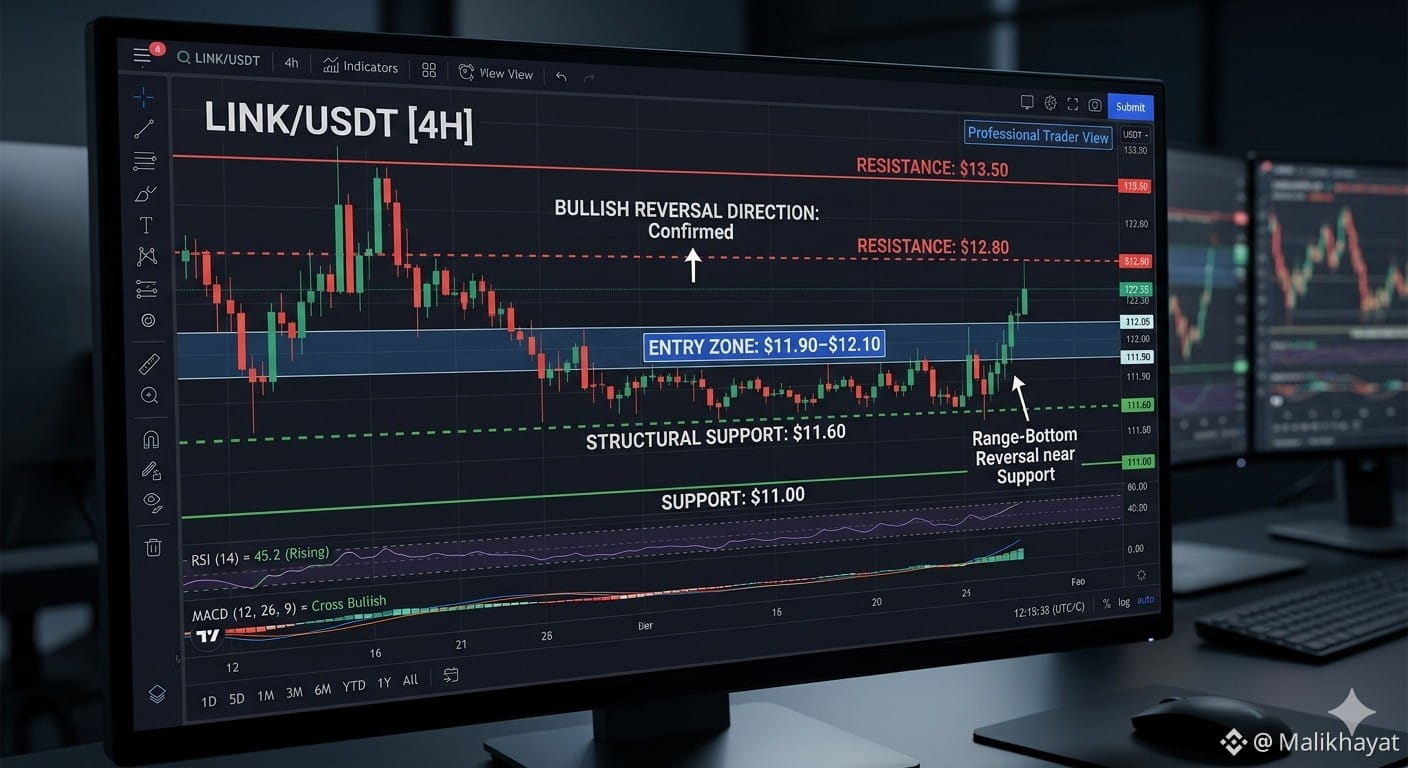
$LINK is holding a key multi-month demand zone between $11.50 and $11.80, with bullish divergence on the 14-period RSI supporting the supplied reversal structure. Funding is near baseline at +0.005%, while OI remains steady, indicating no stated overleverage. The $11.90–$12.10 zone offers the supplied entry area, with $12.80 and $13.50 acting as the first resistance levels.
📈 Bias: Bullish (Accumulation Phase) | 🎯 Entry: $11.90–$12.10 | 🛡 Support: $11.60 / $11.00 | 🚧 Resistance: $12.80 / $13.50 | 🎯 Targets: $12.75 / $13.40 / $14.20 | ❌ Invalidation: $11.45
Strategy: Range-bottom reversal entry near the supplied structural support area.
#Chainlink #LINK #CryptoTrading #Binance #TechnicalAnalysis
{future}(LINKUSDT)
$LINK is holding a key multi-month demand zone between $11.50 and $11.80, with bullish divergence on the 14-period RSI supporting the supplied reversal structure. Funding is near baseline at +0.005%, while OI remains steady, indicating no stated overleverage. The $11.90–$12.10 zone offers the supplied entry area, with $12.80 and $13.50 acting as the first resistance levels.
📈 Bias: Bullish (Accumulation Phase) | 🎯 Entry: $11.90–$12.10 | 🛡 Support: $11.60 / $11.00 | 🚧 Resistance: $12.80 / $13.50 | 🎯 Targets: $12.75 / $13.40 / $14.20 | ❌ Invalidation: $11.45
Strategy: Range-bottom reversal entry near the supplied structural support area.
#Chainlink #LINK #CryptoTrading #Binance #TechnicalAnalysis
📈 Bias: Bullish (Accumulation Phase) | 🎯 Entry: $11.90–$12.10 | 🛡 Support: $11.60 / $11.00 | 🚧 Resistance: $12.80 / $13.50 | 🎯 Targets: $12.75 / $13.40 / $14.20 | ❌ Invalidation: $11.45
Strategy: Range-bottom reversal entry near the supplied structural support area.
#Chainlink #LINK #CryptoTrading #Binance #TechnicalAnalysis
13

🔗 The invisible bridge powering Web3: Let's talk about Chainlink ($LINK ) 🌐
When discussing the evolution of blockchain technology, we often focus on the main networks, but the infrastructure that connects the real world to smart contracts is just as crucial.
Why does Chainlink remain a fundamental pillar in the ecosystem?
Decentralized oracles: They provide accurate and secure data from the outside world to blockchains.
RWA narrative: It’s leading the integration and tokenization of traditional financial assets on-chain.
Interoperability (CCIP): Connecting different networks smoothly and securely for developers.
True institutional and technological adoption requires solid foundations to scale at mass level.
{spot}(LINKUSDT)
#binancesquare #Chainlink #LINK #RWA #Web3
🔗 The invisible bridge powering Web3: Let's talk about Chainlink ($LINK ) 🌐
When discussing the evolution of blockchain technology, we often focus on the main networks, but the infrastructure that connects the real world to smart contracts is just as crucial.
Why does Chainlink remain a fundamental pillar in the ecosystem?
Decentralized oracles: They provide accurate and secure data from the outside world to blockchains.
RWA narrative: It’s leading the integration and tokenization of traditional financial assets on-chain.
Interoperability (CCIP): Connecting different networks smoothly and securely for developers.
True institutional and technological adoption requires solid foundations to scale at mass level.
#binancesquare #Chainlink #LINK #RWA #Web3
When discussing the evolution of blockchain technology, we often focus on the main networks, but the infrastructure that connects the real world to smart contracts is just as crucial.
Why does Chainlink remain a fundamental pillar in the ecosystem?
Decentralized oracles: They provide accurate and secure data from the outside world to blockchains.
RWA narrative: It’s leading the integration and tokenization of traditional financial assets on-chain.
Interoperability (CCIP): Connecting different networks smoothly and securely for developers.
True institutional and technological adoption requires solid foundations to scale at mass level.
#binancesquare #Chainlink #LINK #RWA #Web3
108
Log in to explore more content
Join global crypto users on Binance Square
⚡️ Get latest and useful information about crypto.
💬 Trusted by the world’s largest crypto exchange.
👍 Discover real insights from verified creators.
Email / Phone number
Trending Topics
1
#NFPWatch
10.5M views
17,332 Discussing
2
#ZcashFalls21%FromSeptemberPeak
244 views
25 Discussing
3
#XRPPostsFirstThreeGreenMonthsInQ3
4,648 views
134 Discussing
4
#BitcoinRisesToward$85K
38,020 views
94 Discussing
5
#AmazonPlansToSell$8BNvidiaChips
4,753 views
66 Discussing
6
#NEARFallsToAround$4.70Down14%
36,337 views
93 Discussing
7
#EthereumFoundationLaunchesZkAPIOnMainnet
54,096 views
795 Discussing
8
#EvernorthPlansNasdaqListingOct8
78,039 views
669 Discussing
9
#SECProposesCryptoCustodyFramework
67,096 views
604 Discussing
10
#IMFApproves$139MDisbursementToElSalvador
31,966 views
32 Discussing