

#11631
11631
7 views
3 Discussing
Hot
Latest

·
--
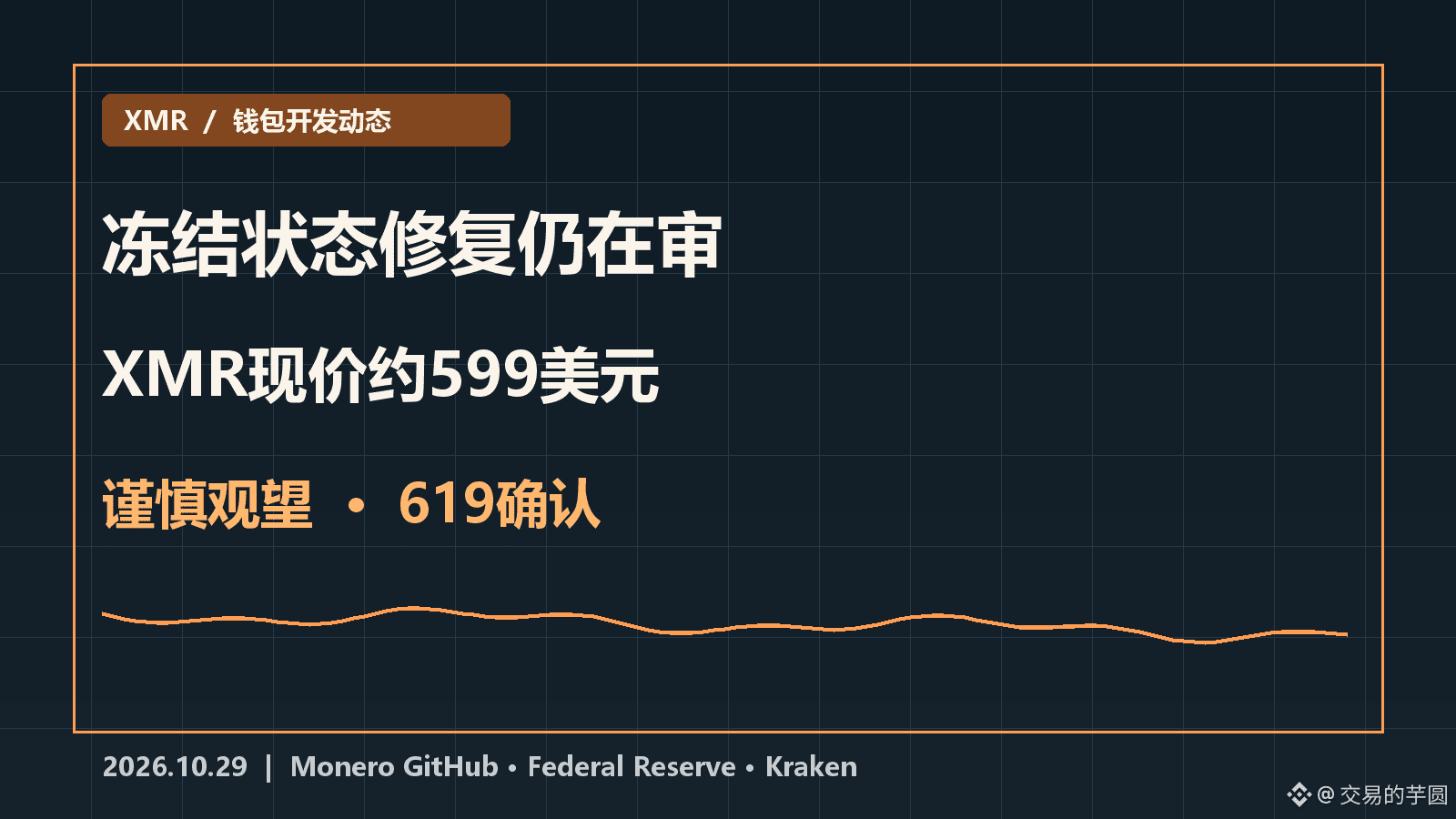
XMR wallet fix proposal still under review | Current price around $599 | Wait for confirmation before discussing trends
My stance is cautious observation. On October 27, a wallet change proposal numbered #11631 appeared in the Monero project repository. It aims to preserve the state of outputs manually frozen by users during chain reorganizations and soft rescans. When I checked, the page still showed Open, with pending review and needs backport labels. One reviewer had expressed approval, but that does not mean the code has been merged, let alone that users’ wallets have been updated. A public discussion on October 28 also pointed out an edge case: if a wallet is closed midway through a soft rescan and then reopened, the frozen state may not be preserved as expected. The submitter replied that this proposal deliberately does not include changes to wallet cache serialization. This is a specific discussion in code review; it does not justify claiming that funds across the network are vulnerable, nor should the proposal be presented as an upgrade to the privacy protocol.
Why should traders care about this? Frozen outputs are a wallet-level control related to how users manage specific coin outputs. If the fix is subsequently tested, merged, and released, it could improve the user experience, but it will not automatically increase immediate demand for XMR. Current macroeconomic pressure is more direct. On October 28, the Federal Reserve voted 10 to 2 to keep its policy rate at 3.75%–4%, with two dissenters favoring a 25-basis-point hike. When rate expectations are hawkish, liquidity-sensitive assets tend to respond first to risk appetite, rather than pricing in a code update that has yet to be implemented.
Market reaction should also be described factually. When I checked XMR/USD on Kraken, the latest trade was around $598.59, with an intraday range of about $591–$618.56, below the day’s open of around $606.12. BTC/USD was around $80,876 at the same time. This snapshot only indicates that XMR is currently weak; it does not prove that the wallet proposal caused the decline. I’m watching levels near $591 and $619: the former is the day’s low, while the latter is close to the intraday high. If the price falls below $591 and cannot quickly recover, the case for staying on the sidelines strengthens. If it reclaims $619 convincingly and holds with volume, the short-term bearish view would need to be reassessed. On the code side, we still need to wait for a merge record and official release notes; there is no need to guess a release date.
If I were trading this myself, I would not enter a position for now and would remain flat and watchful, with a planned position size of 0% of total capital. Only if XMR stabilizes above $619, holds that level on a retest, and the project shows clear progress toward a merge or release would I consider a spot trial position using 2% of total capital. Both conditions must be met to trigger entry. The first target would be around $630, where I would reduce the position by half; if the remaining position rallies on low volume, I would close it. After entering, I would use a stop-loss below $608. If BTC falls below $80,000 and weakens risk appetite across the market, I would also exit early. If the conditions are not met, I will keep waiting—without assuming a trade will be filled, and without treating a review comment as a realized positive catalyst.
Sources: Monero official GitHub PR #11631, the Federal Reserve statement on October 28, and live Kraken XMR/USD and BTC/USD quotes. #FOMC会议 #XMR #BTC
This is solely my personal market observation and does not constitute investment advice.
4
·
--
Monero Wallet Freeze-Flag Fix Enters Review | Price Around $604, Not a Rally on News of the Upgrade | I’m Waiting for Confirmation Above $610
I’m cautiously bullish, but I’m not treating a development proposal as a rally catalyst. On October 27, a new wallet proposal, #11631, was added to Monero’s official code repository. It aims to preserve users’ output freeze flags during chain reorganizations and lightweight rescans. The code change would remember the public key associated with an output when it is temporarily removed, then restore the freeze status if the output is found during a rescan; the record would be cleared when the user manually unfreezes it. The page still shows “Open” and has “needs review” and “needs rebase” labels. Although one reviewer has expressed support, that does not mean the code has been merged, an official release has been published, or users’ wallets have already received the fix automatically. The primary source is PR #11631 in monero-project/monero; check the repository for the current status.
This is different from an exchange listing or ETF flows: it directly affects the reliability of wallet operations. Users often freeze an output to temporarily prevent it from being spent. If the flag is lost after a reorganization or rescan, the wallet’s display may no longer match the user’s expectations. The proposal’s practical benefits can only be assessed after it has been tested, merged, and included in an official release. XMR’s long-term credibility could benefit, but this PR alone does not imply new buying today, much less mean that the network has been attacked. The market response that can currently be verified is also muted: when I checked XMR/USD on Kraken, the latest trade was around $604.39, slightly above its $597 opening price for the day, with an intraday range of $584.80 to $611.77. The price move and the PR occurring at the same time are not enough to establish a causal link.
The key levels I’m watching are the $610–$612 intraday-high area, and below that, the $597 opening price and the low near $585. If the price briefly spikes above $612 but then falls back below $600, that would show the breakout hasn’t held. A drop below $585 would invalidate my current bullish view. The FOMC meeting is also a hot topic, but the Federal Reserve has not yet announced its decision this time around, so we can’t write as if a rate cut has already happened. Macroeconomic volatility could overshadow the development news.
If I were trading this myself, I wouldn’t chase the price here. I’d only consider a small spot long, capped at 2% of my total capital. My entry trigger would be a one-hour close holding above $612, followed by a pullback that continues to hold $610; otherwise, I’d stay flat. After entry, my first target would be $625, where I’d reduce the position by half; my second target would be $640, where I’d scale out of the remaining position. I’d place a stop below $597. If the price closes below $597 or the proposal is withdrawn, I’d exit early. I wouldn’t use leverage to amplify exposure to development news that has not yet been implemented. These are conditional plans only: if the triggers aren’t met, no trade has been made and there are no returns to review.
#XMR
The above is solely my personal market observation and does not constitute investment advice.

10
Log in to explore more content
Join global crypto users on Binance Square
⚡️ Get latest and useful information about crypto.
💬 Trusted by the world’s largest crypto exchange.
👍 Discover real insights from verified creators.
Email / Phone number
Trending Topics
1
#CanMicrosoftDeliverOnAI
481,343 views
3,398 Discussing
2
#CanGoogleDefindItsCore
295,769 views
2,402 Discussing
3
#EarningsSeason
6M views
29,534 Discussing
4
#$10.9BBitcoinOptionsExpireFriday
2,112 views
86 Discussing
5
#ThailandSupremeCourtRulesBitcoinIsProperty
11,817 views
326 Discussing
6
#BitcoinSurpasses$81K
37,318 views
126 Discussing
7
#RobinhoodFalls8.4%AfterItsResults
21,985 views
373 Discussing
8
#KOSPISurges6.63%BackAbove6000
21,109 views
360 Discussing
9
#DatavaultAICantWithdrawBitcoinFromBiconomy
25,330 views
339 Discussing
10
#FOMCWatch
9.4M views
29,820 Discussing