

Z Y R A
9.3k Posts

Z Y R A
 Square Verified+
Report
Block User
I need more Green 🚀
Open Trade

ASTER Holder
Frequent Trader
1.2 Years
1.1K+ Following
31.5K+ Followers
24.0K+ Liked
Posts
Portfolio
All
Quotes
Videos
Live
PINNED
·
--
Bearish
Verified
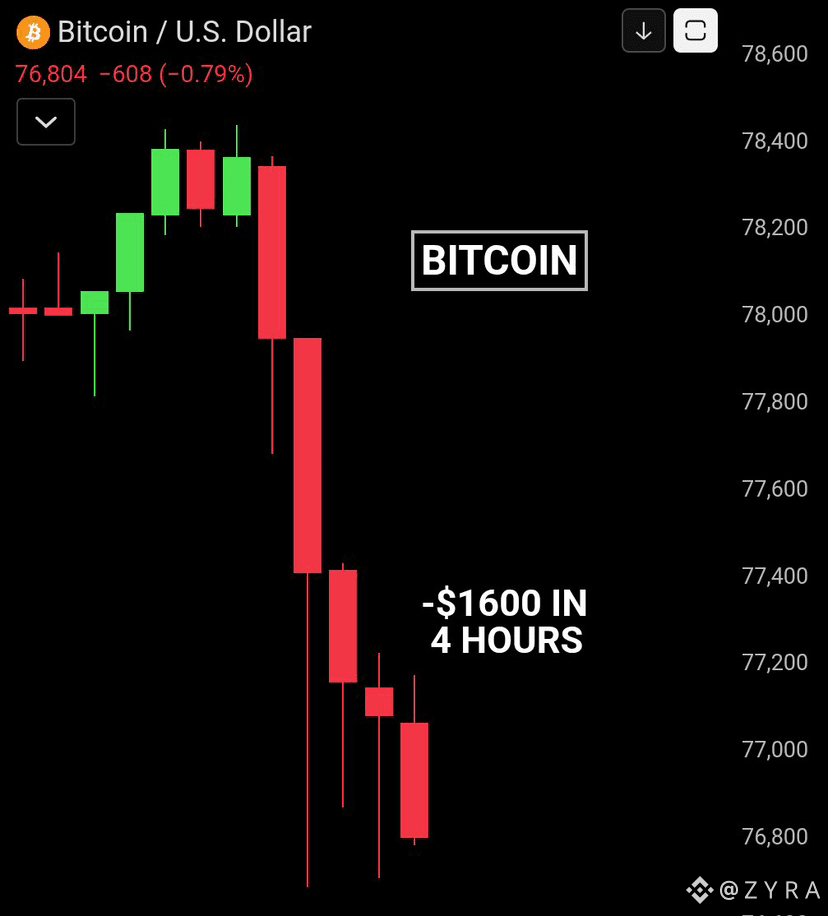
This drop below $77K feels less like panic selling and more like the market finally forcing leverage out of the system.
Over half a billion in long liquidations in just hours tells you exactly what happened:
Too many traders got comfortable thinking BTC had already bottomed.
And honestly, that’s usually when the market becomes dangerous.
What stands out to me is that spot selling still doesn’t look nearly as aggressive as the derivatives wipeout itself. The move was amplified by leverage cascading into leverage.
That distinction matters.
Because there’s a difference between:
• investors exiting positions
and
• overleveraged traders getting force-liquidated
Right now this still looks closer to the second one.
The $77K zone was psychologically important because it became crowded with late breakout longs after ETF optimism, CLARITY headlines, and “new bull market” narratives accelerated again.
Once that level cracked, liquidation engines took over.
But here’s the part most people miss:
Large flushes like this often create the conditions for stronger reversals later if spot demand remains active underneath.
The real thing I’m watching now isn’t the candle.
It’s whether whales and ETF buyers step back in while fear spikes.
Because every cycle has these moments where leverage gets punished before the larger trend resumes.
And if buyers fail to defend this area?
Then the market probably hasn’t fully finished repricing risk yet.
$BTC
#bitcoin
#NCUAProposesStablecoinIssuerRule
#VerusBridgeHack11.58M #IranHormuzSafeCryptoInsurance
{future}(BTCUSDT)
This drop below $77K feels less like panic selling and more like the market finally forcing leverage out of the system.
Over half a billion in long liquidations in just hours tells you exactly what happened:
Too many traders got comfortable thinking BTC had already bottomed.
And honestly, that’s usually when the market becomes dangerous.
What stands out to me is that spot selling still doesn’t look nearly as aggressive as the derivatives wipeout itself. The move was amplified by leverage cascading into leverage.
That distinction matters.
Because there’s a difference between:
• investors exiting positions
and
• overleveraged traders getting force-liquidated
Right now this still looks closer to the second one.
The $77K zone was psychologically important because it became crowded with late breakout longs after ETF optimism, CLARITY headlines, and “new bull market” narratives accelerated again.
Once that level cracked, liquidation engines took over.
But here’s the part most people miss:
Large flushes like this often create the conditions for stronger reversals later if spot demand remains active underneath.
The real thing I’m watching now isn’t the candle.
It’s whether whales and ETF buyers step back in while fear spikes.
Because every cycle has these moments where leverage gets punished before the larger trend resumes.
And if buyers fail to defend this area?
Then the market probably hasn’t fully finished repricing risk yet.
$BTC
#bitcoin
#NCUAProposesStablecoinIssuerRule
#VerusBridgeHack11.58M #IranHormuzSafeCryptoInsurance
Over half a billion in long liquidations in just hours tells you exactly what happened:
Too many traders got comfortable thinking BTC had already bottomed.
And honestly, that’s usually when the market becomes dangerous.
What stands out to me is that spot selling still doesn’t look nearly as aggressive as the derivatives wipeout itself. The move was amplified by leverage cascading into leverage.
That distinction matters.
Because there’s a difference between:
• investors exiting positions
and
• overleveraged traders getting force-liquidated
Right now this still looks closer to the second one.
The $77K zone was psychologically important because it became crowded with late breakout longs after ETF optimism, CLARITY headlines, and “new bull market” narratives accelerated again.
Once that level cracked, liquidation engines took over.
But here’s the part most people miss:
Large flushes like this often create the conditions for stronger reversals later if spot demand remains active underneath.
The real thing I’m watching now isn’t the candle.
It’s whether whales and ETF buyers step back in while fear spikes.
Because every cycle has these moments where leverage gets punished before the larger trend resumes.
And if buyers fail to defend this area?
Then the market probably hasn’t fully finished repricing risk yet.
$BTC
#bitcoin
#NCUAProposesStablecoinIssuerRule
#VerusBridgeHack11.58M #IranHormuzSafeCryptoInsurance
134
20
224
231.6k
PINNED
·
--
Bearish
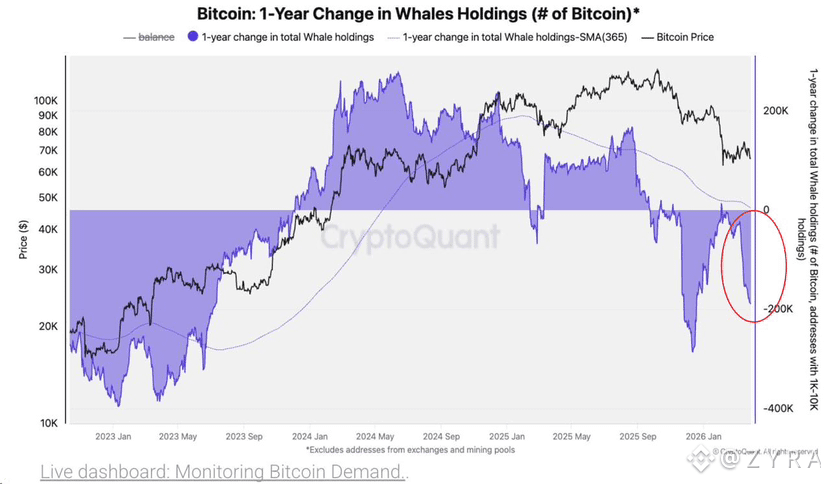
This doesn’t look like panic selling.
It looks like whales are using the range to get out quietly.
Price isn’t dropping hard, which means someone is still buying. But at the same time, 1K–10K BTC wallets are unloading. That tells you the market is doing something underneath that the chart isn’t showing yet.
Ownership is shifting.
That’s usually the phase where things feel stable, but they’re not really stable they’re being redistributed.
What matters here is not that whales turned bearish.
It’s that they’re comfortable selling without needing lower prices.
That changes the behavior of the market.
When large holders stop defending levels and start selling into strength, every bounce becomes liquidity for exit. You’ll still get upside moves, but they won’t carry the same conviction. They fade faster.
This is how momentum quietly dies.
Not with a crash, but with repeated attempts that don’t follow through.
So the signal here isn’t “dump incoming.”
It’s worse in a way.
It means the market might stay stuck while supply keeps getting released, and by the time price actually reacts, most of the distribution is already done.
#bitcoin
#DriftProtocolExploited
#GoogleStudyOnCryptoSecurityChallenges
#BTCETFFeeRace
#BitcoinPrices
$BTC
{spot}(BTCUSDT)
This doesn’t look like panic selling.
It looks like whales are using the range to get out quietly.
Price isn’t dropping hard, which means someone is still buying. But at the same time, 1K–10K BTC wallets are unloading. That tells you the market is doing something underneath that the chart isn’t showing yet.
Ownership is shifting.
That’s usually the phase where things feel stable, but they’re not really stable they’re being redistributed.
What matters here is not that whales turned bearish.
It’s that they’re comfortable selling without needing lower prices.
That changes the behavior of the market.
When large holders stop defending levels and start selling into strength, every bounce becomes liquidity for exit. You’ll still get upside moves, but they won’t carry the same conviction. They fade faster.
This is how momentum quietly dies.
Not with a crash, but with repeated attempts that don’t follow through.
So the signal here isn’t “dump incoming.”
It’s worse in a way.
It means the market might stay stuck while supply keeps getting released, and by the time price actually reacts, most of the distribution is already done.
#bitcoin
#DriftProtocolExploited
#GoogleStudyOnCryptoSecurityChallenges
#BTCETFFeeRace
#BitcoinPrices
$BTC
It looks like whales are using the range to get out quietly.
Price isn’t dropping hard, which means someone is still buying. But at the same time, 1K–10K BTC wallets are unloading. That tells you the market is doing something underneath that the chart isn’t showing yet.
Ownership is shifting.
That’s usually the phase where things feel stable, but they’re not really stable they’re being redistributed.
What matters here is not that whales turned bearish.
It’s that they’re comfortable selling without needing lower prices.
That changes the behavior of the market.
When large holders stop defending levels and start selling into strength, every bounce becomes liquidity for exit. You’ll still get upside moves, but they won’t carry the same conviction. They fade faster.
This is how momentum quietly dies.
Not with a crash, but with repeated attempts that don’t follow through.
So the signal here isn’t “dump incoming.”
It’s worse in a way.
It means the market might stay stuck while supply keeps getting released, and by the time price actually reacts, most of the distribution is already done.
#bitcoin
#DriftProtocolExploited
#GoogleStudyOnCryptoSecurityChallenges
#BTCETFFeeRace
#BitcoinPrices
$BTC
51
7
290
390.2k
·
--
Bullish
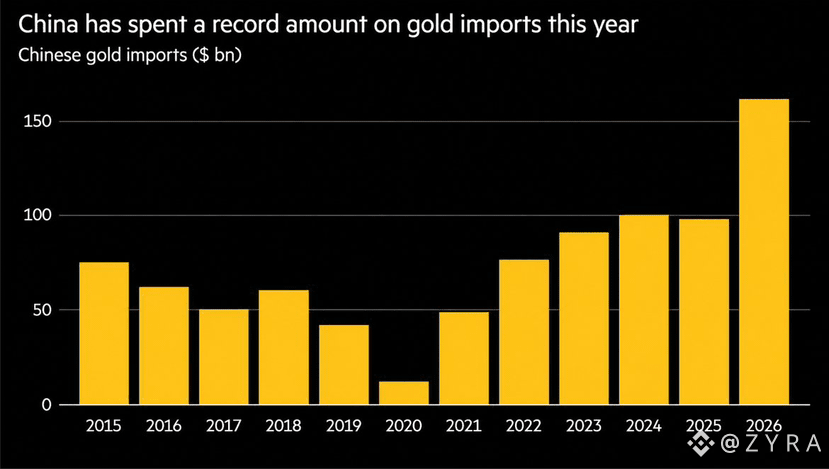
China’s gold buying is starting to look less like a reserve update and more like a balance-sheet shift.
In just 8 months, China reportedly spent $158.8B importing over 1,000 tonnes of gold already far above the $96.5B spent in all of 2025.
The bigger signal is not only the gold.
At the same time, China’s US Treasury holdings fell to around $618B the lowest since 2008.
So the market read is simple:
China is reducing exposure to dollar debt while increasing exposure to hard assets.
This does not mean gold goes up in a straight line, but it does show why central bank demand has become one of the strongest macro supports for gold.
When governments start treating gold as strategic protection, traders should not ignore it.
Gold is no longer just an inflation hedge here.
It is becoming part of the global reserve reset.
$XAUT $BTC $HYPE
#USWeighsPromotingDollarStablecoinsAbroad #US10YTreasuryYieldHits19YearHigh #SpotBitcoinETFsInflow$2.31BInFourDays #BitcoinRejectedAt$87,300Twice #BCHJumps28%OnCMEFuturesListing
{future}(HYPEUSDT)
{future}(BTCUSDT)
{future}(XAUTUSDT)
China’s gold buying is starting to look less like a reserve update and more like a balance-sheet shift.
In just 8 months, China reportedly spent $158.8B importing over 1,000 tonnes of gold already far above the $96.5B spent in all of 2025.
The bigger signal is not only the gold.
At the same time, China’s US Treasury holdings fell to around $618B the lowest since 2008.
So the market read is simple:
China is reducing exposure to dollar debt while increasing exposure to hard assets.
This does not mean gold goes up in a straight line, but it does show why central bank demand has become one of the strongest macro supports for gold.
When governments start treating gold as strategic protection, traders should not ignore it.
Gold is no longer just an inflation hedge here.
It is becoming part of the global reserve reset.
$XAUT $BTC $HYPE
#USWeighsPromotingDollarStablecoinsAbroad #US10YTreasuryYieldHits19YearHigh #SpotBitcoinETFsInflow$2.31BInFourDays #BitcoinRejectedAt$87,300Twice #BCHJumps28%OnCMEFuturesListing
In just 8 months, China reportedly spent $158.8B importing over 1,000 tonnes of gold already far above the $96.5B spent in all of 2025.
The bigger signal is not only the gold.
At the same time, China’s US Treasury holdings fell to around $618B the lowest since 2008.
So the market read is simple:
China is reducing exposure to dollar debt while increasing exposure to hard assets.
This does not mean gold goes up in a straight line, but it does show why central bank demand has become one of the strongest macro supports for gold.
When governments start treating gold as strategic protection, traders should not ignore it.
Gold is no longer just an inflation hedge here.
It is becoming part of the global reserve reset.
$XAUT $BTC $HYPE
#USWeighsPromotingDollarStablecoinsAbroad #US10YTreasuryYieldHits19YearHigh #SpotBitcoinETFsInflow$2.31BInFourDays #BitcoinRejectedAt$87,300Twice #BCHJumps28%OnCMEFuturesListing
1
221
·
--
Bullish
ZAMA, AR and ONE are not moving like quiet spot bids this looks like rotation into old infrastructure storage names after a long compression phase.
$ONE is the most aggressive one: +87% with volume expansion, but RSI is already hot, so chasing the top is risky.
$AR is cleaner structurally, grinding higher with less panic candles.
$ZAMA is still volatile near resistance, more of a breakout-test chart.
which chart has the cleanest follow-through?
#Zama #ar #one #BOJRaisesRatesTo31YearHigh #BuffettStepsDownAsBerkshireChairman
{future}(ZAMAUSDT)
{future}(ARUSDT)
{future}(ONEUSDT)
ZAMA, AR and ONE are not moving like quiet spot bids this looks like rotation into old infrastructure storage names after a long compression phase.
$ONE is the most aggressive one: +87% with volume expansion, but RSI is already hot, so chasing the top is risky.
$AR is cleaner structurally, grinding higher with less panic candles.
$ZAMA is still volatile near resistance, more of a breakout-test chart.
which chart has the cleanest follow-through?
#Zama #ar #one #BOJRaisesRatesTo31YearHigh #BuffettStepsDownAsBerkshireChairman
$ONE is the most aggressive one: +87% with volume expansion, but RSI is already hot, so chasing the top is risky.
$AR is cleaner structurally, grinding higher with less panic candles.
$ZAMA is still volatile near resistance, more of a breakout-test chart.
which chart has the cleanest follow-through?
#Zama #ar #one #BOJRaisesRatesTo31YearHigh #BuffettStepsDownAsBerkshireChairman
ONE momentum
56%
AR structure
19%
ZAMA breakout
6%
Wait for pullback
19%
16 votes • Voting closed
3
1.8k
·
--
Bearish
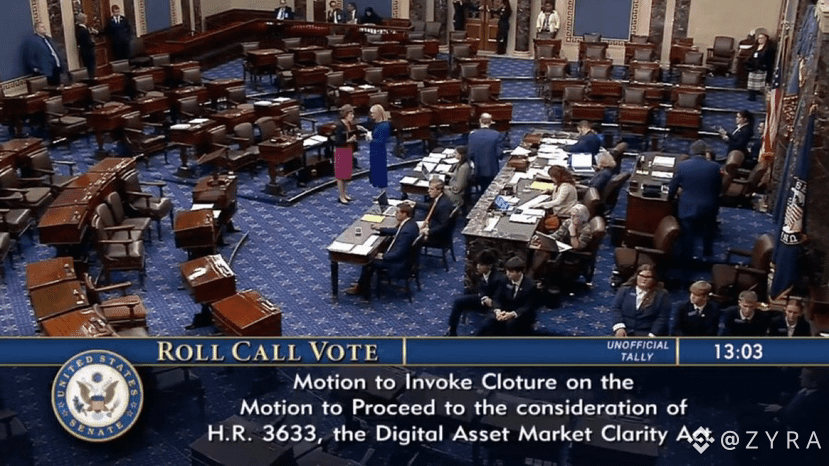
The CLARITY Act failing the 60-vote test is not just a political delay for crypto.
It tells me the market still has to trade inside uncertainty.
That is the real damage.
Builders don’t get clean rules. Exchanges don’t get a clear lane. Institutions don’t get the comfort they need to size in aggressively. And traders are left pricing headlines instead of structure.
For me, this is why the reaction matters more than the vote itself.
If BTC holds its range after this, the market is saying: “annoying delay, but not fatal.”
If BTC loses support with volume, then the failed vote becomes the excuse for a bigger de-risking move.
Crypto did not lose the whole regulation story today.
It lost time.
And when liquidity is already thin, time becomes expensive.
#ClarityActOddsHalveOnPolymarket #bitcoin #FedRateWatch #BitcoinSlidesTo$76000 #StrategyMarketCapPassesFord
$BTC
{future}(BTCUSDT)
$SAGA
{future}(SAGAUSDT)
$ASTR
{future}(ASTRUSDT)
The CLARITY Act failing the 60-vote test is not just a political delay for crypto.
It tells me the market still has to trade inside uncertainty.
That is the real damage.
Builders don’t get clean rules. Exchanges don’t get a clear lane. Institutions don’t get the comfort they need to size in aggressively. And traders are left pricing headlines instead of structure.
For me, this is why the reaction matters more than the vote itself.
If BTC holds its range after this, the market is saying: “annoying delay, but not fatal.”
If BTC loses support with volume, then the failed vote becomes the excuse for a bigger de-risking move.
Crypto did not lose the whole regulation story today.
It lost time.
And when liquidity is already thin, time becomes expensive.
#ClarityActOddsHalveOnPolymarket #bitcoin #FedRateWatch #BitcoinSlidesTo$76000 #StrategyMarketCapPassesFord
$BTC
$SAGA
$ASTR
It tells me the market still has to trade inside uncertainty.
That is the real damage.
Builders don’t get clean rules. Exchanges don’t get a clear lane. Institutions don’t get the comfort they need to size in aggressively. And traders are left pricing headlines instead of structure.
For me, this is why the reaction matters more than the vote itself.
If BTC holds its range after this, the market is saying: “annoying delay, but not fatal.”
If BTC loses support with volume, then the failed vote becomes the excuse for a bigger de-risking move.
Crypto did not lose the whole regulation story today.
It lost time.
And when liquidity is already thin, time becomes expensive.
#ClarityActOddsHalveOnPolymarket #bitcoin #FedRateWatch #BitcoinSlidesTo$76000 #StrategyMarketCapPassesFord
$BTC
$SAGA
$ASTR
1
3
2.1k
·
--
Bullish
The CPI number is out, and I think the Fed now has a harder case for simply staying on hold.
August CPI came in at +0.4% month-over-month and 3.4% year-over-year. Core CPI was +0.3% MoM and 2.4% YoY.
At the same time, the labor market hasn’t exactly fallen apart. Nonfarm payrolls added 162K jobs while unemployment held at 4.1%.
For me, the important part is the combination.
Inflation is still above the Fed’s 2% target, energy remains a risk, and the economy is showing enough resilience that the Fed has room to stay restrictive.
So my base case is now a 25 bps hike, rather than another easy hold.
But I don’t see this as the start of an automatic hiking cycle.
If the Fed hikes, the real market signal will be what comes next: whether they frame it as a one-off response to persistent inflation or the beginning of tighter policy again.
That distinction could matter more for stocks, gold and crypto than the 25 bps move itself.
#CPIWatch
{future}(BTCUSDT)
The CPI number is out, and I think the Fed now has a harder case for simply staying on hold.
August CPI came in at +0.4% month-over-month and 3.4% year-over-year. Core CPI was +0.3% MoM and 2.4% YoY.
At the same time, the labor market hasn’t exactly fallen apart. Nonfarm payrolls added 162K jobs while unemployment held at 4.1%.
For me, the important part is the combination.
Inflation is still above the Fed’s 2% target, energy remains a risk, and the economy is showing enough resilience that the Fed has room to stay restrictive.
So my base case is now a 25 bps hike, rather than another easy hold.
But I don’t see this as the start of an automatic hiking cycle.
If the Fed hikes, the real market signal will be what comes next: whether they frame it as a one-off response to persistent inflation or the beginning of tighter policy again.
That distinction could matter more for stocks, gold and crypto than the 25 bps move itself.
#CPIWatch
August CPI came in at +0.4% month-over-month and 3.4% year-over-year. Core CPI was +0.3% MoM and 2.4% YoY.
At the same time, the labor market hasn’t exactly fallen apart. Nonfarm payrolls added 162K jobs while unemployment held at 4.1%.
For me, the important part is the combination.
Inflation is still above the Fed’s 2% target, energy remains a risk, and the economy is showing enough resilience that the Fed has room to stay restrictive.
So my base case is now a 25 bps hike, rather than another easy hold.
But I don’t see this as the start of an automatic hiking cycle.
If the Fed hikes, the real market signal will be what comes next: whether they frame it as a one-off response to persistent inflation or the beginning of tighter policy again.
That distinction could matter more for stocks, gold and crypto than the 25 bps move itself.
#CPIWatch
2
676
·
--
Bullish
Three gainers, but not the same quality move.
$ARB is leading in pure momentum, but after a near vertical run, it’s the most extended.
$RAY looks cleaner structurally, with a breakout that still has room if buyers defend the pullback.
$IOST is reacting well, but it still feels more like a speculative burst than strong leadership.
Which one has the best follow-through from here?
{future}(IOSTUSDT)
{spot}(RAYUSDT)
{future}(ARBUSDT)
#ARB #Ray #IOST #BTCReaches$80000 #ZECHitsANewAllTimeHigh
Three gainers, but not the same quality move.
$ARB is leading in pure momentum, but after a near vertical run, it’s the most extended.
$RAY looks cleaner structurally, with a breakout that still has room if buyers defend the pullback.
$IOST is reacting well, but it still feels more like a speculative burst than strong leadership.
Which one has the best follow-through from here?
#ARB #Ray #IOST #BTCReaches$80000 #ZECHitsANewAllTimeHigh
$ARB is leading in pure momentum, but after a near vertical run, it’s the most extended.
$RAY looks cleaner structurally, with a breakout that still has room if buyers defend the pullback.
$IOST is reacting well, but it still feels more like a speculative burst than strong leadership.
Which one has the best follow-through from here?
#ARB #Ray #IOST #BTCReaches$80000 #ZECHitsANewAllTimeHigh
ARB
58%
RAY
23%
IOST
11%
None, wait for reset
8%
935 votes • Voting closed
5
68
110.1k
·
--
Bullish
Bitcoin’s halving changes issuance. It does not create demand.
That distinction matters near major psychological levels.
The block subsidy is now 3.125 BTC, so new supply arrives more slowly. But whether that reduced issuance actually matters to price depends on who is absorbing the available BTC.
ETF flows, institutional demand, macro liquidity and existing holder selling all compete on the other side of that equation.
This is why I don’t see BTC strength as simply a “halving trade.”
The more interesting structure is:
predictable new supply + unpredictable demand + changing liquidity.
If demand consistently absorbs both new issuance and secondary-market selling, scarcity becomes meaningful.
If demand weakens, scarcity alone cannot force price higher.
Bitcoin’s supply is programmed. Price discovery isn’t.
That is the part of BTC near major levels that I’m watching.
$BTC
#BTCReaches$80000 #bitcoin #BitcoinETFsBiggestDailyInflowSinceJanuary
{future}(BTCUSDT)
Bitcoin’s halving changes issuance. It does not create demand.
That distinction matters near major psychological levels.
The block subsidy is now 3.125 BTC, so new supply arrives more slowly. But whether that reduced issuance actually matters to price depends on who is absorbing the available BTC.
ETF flows, institutional demand, macro liquidity and existing holder selling all compete on the other side of that equation.
This is why I don’t see BTC strength as simply a “halving trade.”
The more interesting structure is:
predictable new supply + unpredictable demand + changing liquidity.
If demand consistently absorbs both new issuance and secondary-market selling, scarcity becomes meaningful.
If demand weakens, scarcity alone cannot force price higher.
Bitcoin’s supply is programmed. Price discovery isn’t.
That is the part of BTC near major levels that I’m watching.
$BTC
#BTCReaches$80000 #bitcoin #BitcoinETFsBiggestDailyInflowSinceJanuary
That distinction matters near major psychological levels.
The block subsidy is now 3.125 BTC, so new supply arrives more slowly. But whether that reduced issuance actually matters to price depends on who is absorbing the available BTC.
ETF flows, institutional demand, macro liquidity and existing holder selling all compete on the other side of that equation.
This is why I don’t see BTC strength as simply a “halving trade.”
The more interesting structure is:
predictable new supply + unpredictable demand + changing liquidity.
If demand consistently absorbs both new issuance and secondary-market selling, scarcity becomes meaningful.
If demand weakens, scarcity alone cannot force price higher.
Bitcoin’s supply is programmed. Price discovery isn’t.
That is the part of BTC near major levels that I’m watching.
$BTC
#BTCReaches$80000 #bitcoin #BitcoinETFsBiggestDailyInflowSinceJanuary
1
1.2k
·
--
Bullish
$ARB , $SC and $ONG are not the same pump.
ARB looks like rotation from a long dead range.
SC looks like a delayed storage squeeze with crowded RSI.
ONG looks more like a rebound after old volatility, not clean leadership yet.
The real winner is not today’s biggest candle.
It’s the one that holds the breakout base when the first sellers arrive.
best hold?
{future}(ONGUSDT)
{spot}(SCUSDT)
{future}(ARBUSDT)
#ong #ARB #ARBRises30%OnRobinhoodChainRevenue #StrategySpends$635MOnSTRCPreferredBuybacks
$ARB , $SC and $ONG are not the same pump.
ARB looks like rotation from a long dead range.
SC looks like a delayed storage squeeze with crowded RSI.
ONG looks more like a rebound after old volatility, not clean leadership yet.
The real winner is not today’s biggest candle.
It’s the one that holds the breakout base when the first sellers arrive.
best hold?
#ong #ARB #ARBRises30%OnRobinhoodChainRevenue #StrategySpends$635MOnSTRCPreferredBuybacks
ARB looks like rotation from a long dead range.
SC looks like a delayed storage squeeze with crowded RSI.
ONG looks more like a rebound after old volatility, not clean leadership yet.
The real winner is not today’s biggest candle.
It’s the one that holds the breakout base when the first sellers arrive.
best hold?
#ong #ARB #ARBRises30%OnRobinhoodChainRevenue #StrategySpends$635MOnSTRCPreferredBuybacks
ARB
49%
SC
16%
ONG
30%
Wait
5%
185 votes • Voting closed
5
23
27.7k
·
--
Bearish
#dusk $DUSK @Dusk_Foundation I stopped looking at the OpenDusk vote as a simple governance update when I compared its timing with DuskEVM.
DuskEVM testnet only went live this month. The developer tools are available, but the larger application ecosystem still has to be built.
Now the community is being asked whether burned block rewards should start flowing into an OpenDusk treasury.
That timing feels deliberate.
Dusk needs more than protocol upgrades now. It needs wallets, developer tools, audits, applications and teams willing to keep building until those products reach actual users. A recurring treasury could fund that layer without every project depending directly on the Foundation.
But this also creates a problem.
The treasury may begin receiving DUSK before the ecosystem has a proven way to measure which funding decisions create lasting demand.
A project can complete its grant milestones and still attract no users.
A liquidity program can increase TVL until incentives stop.
A new dApp can launch without generating meaningful transactions or fees.
All three may look like progress in a treasury report.
So I would not judge OpenDusk by voter turnout or the number of proposals it approves.
I would track how many funded projects reach mainnet, how much usage remains after incentives end and whether those applications create transactions that use DUSK.
Otherwise, burned rewards are not being transformed into ecosystem value. They are only returning to circulation through a more complicated route.
The first vote decides whether the funding machine should exist.
The more important vote will happen quietly after every grant: do users keep using what the treasury paid to build?
$DUSK
{future}(DUSKUSDT)
#dusk $DUSK @Dusk I stopped looking at the OpenDusk vote as a simple governance update when I compared its timing with DuskEVM.
DuskEVM testnet only went live this month. The developer tools are available, but the larger application ecosystem still has to be built.
Now the community is being asked whether burned block rewards should start flowing into an OpenDusk treasury.
That timing feels deliberate.
Dusk needs more than protocol upgrades now. It needs wallets, developer tools, audits, applications and teams willing to keep building until those products reach actual users. A recurring treasury could fund that layer without every project depending directly on the Foundation.
But this also creates a problem.
The treasury may begin receiving DUSK before the ecosystem has a proven way to measure which funding decisions create lasting demand.
A project can complete its grant milestones and still attract no users.
A liquidity program can increase TVL until incentives stop.
A new dApp can launch without generating meaningful transactions or fees.
All three may look like progress in a treasury report.
So I would not judge OpenDusk by voter turnout or the number of proposals it approves.
I would track how many funded projects reach mainnet, how much usage remains after incentives end and whether those applications create transactions that use DUSK.
Otherwise, burned rewards are not being transformed into ecosystem value. They are only returning to circulation through a more complicated route.
The first vote decides whether the funding machine should exist.
The more important vote will happen quietly after every grant: do users keep using what the treasury paid to build?
$DUSK
DuskEVM testnet only went live this month. The developer tools are available, but the larger application ecosystem still has to be built.
Now the community is being asked whether burned block rewards should start flowing into an OpenDusk treasury.
That timing feels deliberate.
Dusk needs more than protocol upgrades now. It needs wallets, developer tools, audits, applications and teams willing to keep building until those products reach actual users. A recurring treasury could fund that layer without every project depending directly on the Foundation.
But this also creates a problem.
The treasury may begin receiving DUSK before the ecosystem has a proven way to measure which funding decisions create lasting demand.
A project can complete its grant milestones and still attract no users.
A liquidity program can increase TVL until incentives stop.
A new dApp can launch without generating meaningful transactions or fees.
All three may look like progress in a treasury report.
So I would not judge OpenDusk by voter turnout or the number of proposals it approves.
I would track how many funded projects reach mainnet, how much usage remains after incentives end and whether those applications create transactions that use DUSK.
Otherwise, burned rewards are not being transformed into ecosystem value. They are only returning to circulation through a more complicated route.
The first vote decides whether the funding machine should exist.
The more important vote will happen quietly after every grant: do users keep using what the treasury paid to build?
$DUSK
3
1
8
581
·
--
Bearish
Verified
#dusk $DUSK @Dusk_Foundation The SURGECAST announcement asked a good question: what if every trade became public the moment you placed it, with your name attached?
That pulled me in, but I think the harder problem begins after that.
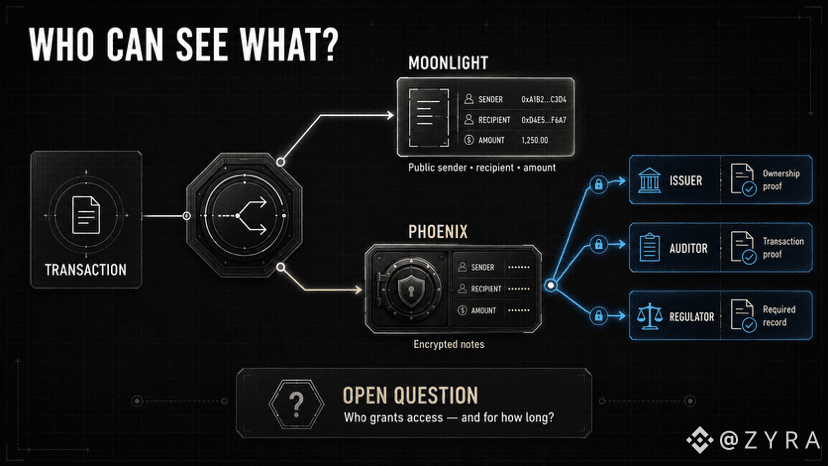
I went back through Dusk’s transaction models. Moonlight works like a public account: balances and transfer details are visible. Phoenix stores value as encrypted notes and proves a transaction is valid without exposing the amount or participants to everyone.
So @Dusk_Foundation is not trying to force the whole financial system into one privacy setting.
A treasury payment may need a public record.
A fund position may need confidentiality.
An issuer may need proof of ownership.
A regulator may require access to a specific transaction.
Those are four different visibility requirements inside the same market.
The part I paused at was the viewing key.
Phoenix lets transaction information be revealed to an authorized party when required. Technically, that solves the private but still auditable problem. Operationally, it creates another question: who receives that visibility, how narrowly is it granted, and what happens when several institutions need different pieces of the same record?
That feels like the real institutional test for Dusk.
Zero-knowledge proofs can show that a confidential transfer followed the rules. But regulated finance also needs a clear disclosure policy around the proof: which party can inspect what, for which purpose, and for how long.
Privacy is the cryptographic layer.
Permission over disclosure is the market-infrastructure layer.
I’m interested in what Hein Dauven says about that distinction, because hiding a trade is only half the job. The other half is making sure the right evidence reaches the right institution without quietly rebuilding the same closed databases Dusk is supposed to replace.
{future}(DUSKUSDT)
#dusk $DUSK @Dusk The SURGECAST announcement asked a good question: what if every trade became public the moment you placed it, with your name attached?
That pulled me in, but I think the harder problem begins after that.
I went back through Dusk’s transaction models. Moonlight works like a public account: balances and transfer details are visible. Phoenix stores value as encrypted notes and proves a transaction is valid without exposing the amount or participants to everyone.
So @Dusk is not trying to force the whole financial system into one privacy setting.
A treasury payment may need a public record.
A fund position may need confidentiality.
An issuer may need proof of ownership.
A regulator may require access to a specific transaction.
Those are four different visibility requirements inside the same market.
The part I paused at was the viewing key.
Phoenix lets transaction information be revealed to an authorized party when required. Technically, that solves the private but still auditable problem. Operationally, it creates another question: who receives that visibility, how narrowly is it granted, and what happens when several institutions need different pieces of the same record?
That feels like the real institutional test for Dusk.
Zero-knowledge proofs can show that a confidential transfer followed the rules. But regulated finance also needs a clear disclosure policy around the proof: which party can inspect what, for which purpose, and for how long.
Privacy is the cryptographic layer.
Permission over disclosure is the market-infrastructure layer.
I’m interested in what Hein Dauven says about that distinction, because hiding a trade is only half the job. The other half is making sure the right evidence reaches the right institution without quietly rebuilding the same closed databases Dusk is supposed to replace.
That pulled me in, but I think the harder problem begins after that.
I went back through Dusk’s transaction models. Moonlight works like a public account: balances and transfer details are visible. Phoenix stores value as encrypted notes and proves a transaction is valid without exposing the amount or participants to everyone.
So @Dusk is not trying to force the whole financial system into one privacy setting.
A treasury payment may need a public record.
A fund position may need confidentiality.
An issuer may need proof of ownership.
A regulator may require access to a specific transaction.
Those are four different visibility requirements inside the same market.
The part I paused at was the viewing key.
Phoenix lets transaction information be revealed to an authorized party when required. Technically, that solves the private but still auditable problem. Operationally, it creates another question: who receives that visibility, how narrowly is it granted, and what happens when several institutions need different pieces of the same record?
That feels like the real institutional test for Dusk.
Zero-knowledge proofs can show that a confidential transfer followed the rules. But regulated finance also needs a clear disclosure policy around the proof: which party can inspect what, for which purpose, and for how long.
Privacy is the cryptographic layer.
Permission over disclosure is the market-infrastructure layer.
I’m interested in what Hein Dauven says about that distinction, because hiding a trade is only half the job. The other half is making sure the right evidence reaches the right institution without quietly rebuilding the same closed databases Dusk is supposed to replace.
2
8
728
·
--
Bearish
#dusk $DUSK @Dusk_Foundation
I used to think privacy on a blockchain was mainly about hiding balances and transfer amounts.
Then I started looking at what happens after a financial asset is issued.
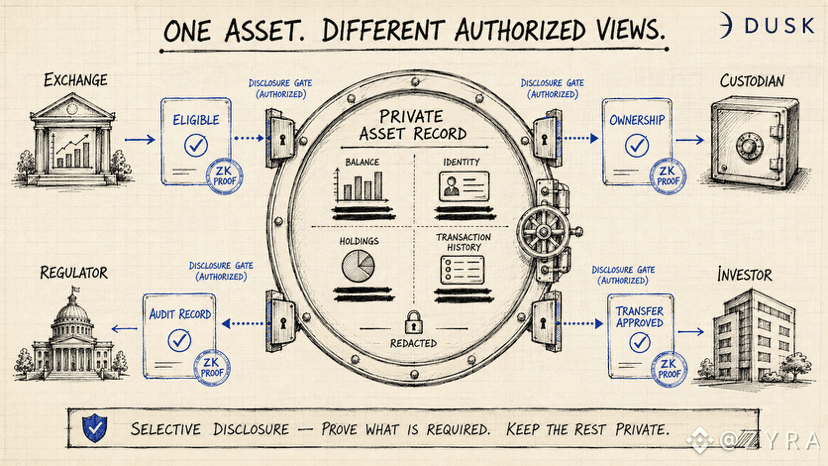
A tokenized bond does not just move from one wallet to another. Investors subscribe, ownership changes, interest is paid, restrictions are checked and records may need to be reviewed by a custodian, venue or regulator.
If every step is public, competitors can study positions and transaction flow.
If every step is completely hidden, the parties responsible for compliance cannot verify what happened.
That is the problem Dusk is actually trying to solve.
Its privacy model is not one switch for the whole network. Public activity can remain public, while sensitive holdings and transfers can use confidential flows. When a check is required, selective disclosure is meant to reveal the necessary evidence without opening the customer’s entire financial history.
DuskEVM makes this more interesting because developers can build with familiar Solidity tools. Hedger then brings encrypted values and zero-knowledge proofs into that EVM environment, so an application can check whether a transaction followed its rules without exposing every underlying number.
But one issue still stands out to me.
The cryptography can limit what is revealed, but someone must still decide who is authorized to see what.
Who approves a disclosure request?
Can that access expire?
What happens when an institution changes custodian or a court order needs to be enforced?
Those are not small operational details. They will decide whether selective disclosure feels like controlled privacy or simply another permission system hidden behind ZK language.
Dusk has a strong technical answer to public-by-default finance.
Now I want to see how clearly the disclosure authority is governed when real institutions, investors and assets begin using it.
{future}(DUSKUSDT)
#dusk $DUSK @Dusk
I used to think privacy on a blockchain was mainly about hiding balances and transfer amounts.
Then I started looking at what happens after a financial asset is issued.
A tokenized bond does not just move from one wallet to another. Investors subscribe, ownership changes, interest is paid, restrictions are checked and records may need to be reviewed by a custodian, venue or regulator.
If every step is public, competitors can study positions and transaction flow.
If every step is completely hidden, the parties responsible for compliance cannot verify what happened.
That is the problem Dusk is actually trying to solve.
Its privacy model is not one switch for the whole network. Public activity can remain public, while sensitive holdings and transfers can use confidential flows. When a check is required, selective disclosure is meant to reveal the necessary evidence without opening the customer’s entire financial history.
DuskEVM makes this more interesting because developers can build with familiar Solidity tools. Hedger then brings encrypted values and zero-knowledge proofs into that EVM environment, so an application can check whether a transaction followed its rules without exposing every underlying number.
But one issue still stands out to me.
The cryptography can limit what is revealed, but someone must still decide who is authorized to see what.
Who approves a disclosure request?
Can that access expire?
What happens when an institution changes custodian or a court order needs to be enforced?
Those are not small operational details. They will decide whether selective disclosure feels like controlled privacy or simply another permission system hidden behind ZK language.
Dusk has a strong technical answer to public-by-default finance.
Now I want to see how clearly the disclosure authority is governed when real institutions, investors and assets begin using it.
I used to think privacy on a blockchain was mainly about hiding balances and transfer amounts.
Then I started looking at what happens after a financial asset is issued.
A tokenized bond does not just move from one wallet to another. Investors subscribe, ownership changes, interest is paid, restrictions are checked and records may need to be reviewed by a custodian, venue or regulator.
If every step is public, competitors can study positions and transaction flow.
If every step is completely hidden, the parties responsible for compliance cannot verify what happened.
That is the problem Dusk is actually trying to solve.
Its privacy model is not one switch for the whole network. Public activity can remain public, while sensitive holdings and transfers can use confidential flows. When a check is required, selective disclosure is meant to reveal the necessary evidence without opening the customer’s entire financial history.
DuskEVM makes this more interesting because developers can build with familiar Solidity tools. Hedger then brings encrypted values and zero-knowledge proofs into that EVM environment, so an application can check whether a transaction followed its rules without exposing every underlying number.
But one issue still stands out to me.
The cryptography can limit what is revealed, but someone must still decide who is authorized to see what.
Who approves a disclosure request?
Can that access expire?
What happens when an institution changes custodian or a court order needs to be enforced?
Those are not small operational details. They will decide whether selective disclosure feels like controlled privacy or simply another permission system hidden behind ZK language.
Dusk has a strong technical answer to public-by-default finance.
Now I want to see how clearly the disclosure authority is governed when real institutions, investors and assets begin using it.
6
8
625
·
--
Bullish
#dusk $DUSK @Dusk_Foundation I went back over Dusk’s claim that DuskEVM can turn ecosystem growth into more utility for $DUSK.
The logic looks simple.
Ethereum developers can build with tools they already know. More applications arrive. Those applications create transactions, and every DuskEVM transaction uses $DUSK for gas.
But I paused at the space between an application being deployed and actually being used.
A DEX can exist with very little trading. A lending market can hold liquidity while borrowing remains quiet. Even a tokenized bond can add a large amount of value to the network, then generate few transactions if investors simply hold it until maturity.
So more contracts and higher TVL do not automatically mean much more demand for gas.
What matters is what happens after the assets and applications arrive.
Are people trading regularly?
Are loans being opened and repaid?
Are tokenized assets paying interest, changing ownership or being redeemed onchain?
This is where Dusk Trade could become important. It is not only another dApp. It could bring financial products and investors into the same ecosystem where those assets are issued, settled and serviced.
If that activity stays onchain, one asset can use DUSK several times across its lifecycle instead of only once when it is created.
That is the part I would watch now.
Not how many applications launch, but how many people return to use them. Not only how much TVL enters, but how often that capital actually moves.
DuskEVM makes it easier to build.
The unanswered part is whether Dusk Trade and the applications around it can create enough repeat activity to turn that easier access into lasting Dusk demand.
$DUSK
{future}(DUSKUSDT)
#dusk $DUSK @Dusk I went back over Dusk’s claim that DuskEVM can turn ecosystem growth into more utility for $DUSK .
The logic looks simple.
Ethereum developers can build with tools they already know. More applications arrive. Those applications create transactions, and every DuskEVM transaction uses $DUSK for gas.
But I paused at the space between an application being deployed and actually being used.
A DEX can exist with very little trading. A lending market can hold liquidity while borrowing remains quiet. Even a tokenized bond can add a large amount of value to the network, then generate few transactions if investors simply hold it until maturity.
So more contracts and higher TVL do not automatically mean much more demand for gas.
What matters is what happens after the assets and applications arrive.
Are people trading regularly?
Are loans being opened and repaid?
Are tokenized assets paying interest, changing ownership or being redeemed onchain?
This is where Dusk Trade could become important. It is not only another dApp. It could bring financial products and investors into the same ecosystem where those assets are issued, settled and serviced.
If that activity stays onchain, one asset can use DUSK several times across its lifecycle instead of only once when it is created.
That is the part I would watch now.
Not how many applications launch, but how many people return to use them. Not only how much TVL enters, but how often that capital actually moves.
DuskEVM makes it easier to build.
The unanswered part is whether Dusk Trade and the applications around it can create enough repeat activity to turn that easier access into lasting Dusk demand.
$DUSK
The logic looks simple.
Ethereum developers can build with tools they already know. More applications arrive. Those applications create transactions, and every DuskEVM transaction uses $DUSK for gas.
But I paused at the space between an application being deployed and actually being used.
A DEX can exist with very little trading. A lending market can hold liquidity while borrowing remains quiet. Even a tokenized bond can add a large amount of value to the network, then generate few transactions if investors simply hold it until maturity.
So more contracts and higher TVL do not automatically mean much more demand for gas.
What matters is what happens after the assets and applications arrive.
Are people trading regularly?
Are loans being opened and repaid?
Are tokenized assets paying interest, changing ownership or being redeemed onchain?
This is where Dusk Trade could become important. It is not only another dApp. It could bring financial products and investors into the same ecosystem where those assets are issued, settled and serviced.
If that activity stays onchain, one asset can use DUSK several times across its lifecycle instead of only once when it is created.
That is the part I would watch now.
Not how many applications launch, but how many people return to use them. Not only how much TVL enters, but how often that capital actually moves.
DuskEVM makes it easier to build.
The unanswered part is whether Dusk Trade and the applications around it can create enough repeat activity to turn that easier access into lasting Dusk demand.
$DUSK
4
7
589
·
--
Bullish
Verified
#dusk $DUSK @Dusk_Foundation put a nearly $70 billion crowdfunding figure inside its ECSP update.
Big number. Looked great.
Then I checked what the European ECSP framework actually covers.
It is not the entire crowdfunding market.
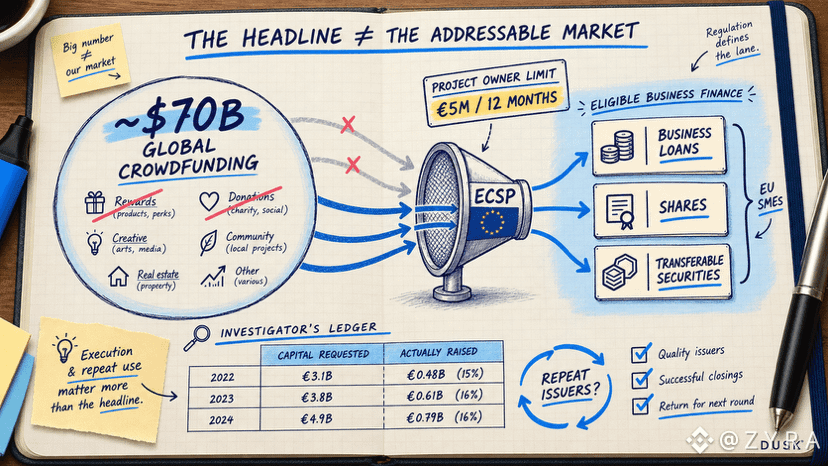
Donation campaigns and reward-based crowdfunding sit outside it. ECSP mainly covers business lending and investment-based offerings, with an EU threshold of €5 million raised by one project owner over 12 months.
So Dusk is not applying for access to one giant $70 billion pool.
It is targeting a narrower market where European SMEs can raise smaller amounts through loans, shares or other eligible instruments.
Honestly, that made the plan more believable for me, not less.
Europe has around 34 million SMEs. Dusk would not need billion-euro issuances to start creating activity. A steady pipeline of €1 million to €5 million offerings could already bring businesses, investors and financial assets into Dusk Trade.
But there is a gap between being allowed to list an offering and actually funding it.
The licence cannot create a good company, reasonable terms or investor demand.
So “number of offerings” may become another weak metric if most of them remain open or underfunded.
What I would want to see after approval is much simpler:
How much capital was requested?
How much was actually raised?
And how many businesses came back for a second offering?
That would tell me more than the global crowdfunding headline.
{future}(DUSKUSDT)
#dusk $DUSK @Dusk put a nearly $70 billion crowdfunding figure inside its ECSP update.
Big number. Looked great.
Then I checked what the European ECSP framework actually covers.
It is not the entire crowdfunding market.
Donation campaigns and reward-based crowdfunding sit outside it. ECSP mainly covers business lending and investment-based offerings, with an EU threshold of €5 million raised by one project owner over 12 months.
So Dusk is not applying for access to one giant $70 billion pool.
It is targeting a narrower market where European SMEs can raise smaller amounts through loans, shares or other eligible instruments.
Honestly, that made the plan more believable for me, not less.
Europe has around 34 million SMEs. Dusk would not need billion-euro issuances to start creating activity. A steady pipeline of €1 million to €5 million offerings could already bring businesses, investors and financial assets into Dusk Trade.
But there is a gap between being allowed to list an offering and actually funding it.
The licence cannot create a good company, reasonable terms or investor demand.
So “number of offerings” may become another weak metric if most of them remain open or underfunded.
What I would want to see after approval is much simpler:
How much capital was requested?
How much was actually raised?
And how many businesses came back for a second offering?
That would tell me more than the global crowdfunding headline.
Big number. Looked great.
Then I checked what the European ECSP framework actually covers.
It is not the entire crowdfunding market.
Donation campaigns and reward-based crowdfunding sit outside it. ECSP mainly covers business lending and investment-based offerings, with an EU threshold of €5 million raised by one project owner over 12 months.
So Dusk is not applying for access to one giant $70 billion pool.
It is targeting a narrower market where European SMEs can raise smaller amounts through loans, shares or other eligible instruments.
Honestly, that made the plan more believable for me, not less.
Europe has around 34 million SMEs. Dusk would not need billion-euro issuances to start creating activity. A steady pipeline of €1 million to €5 million offerings could already bring businesses, investors and financial assets into Dusk Trade.
But there is a gap between being allowed to list an offering and actually funding it.
The licence cannot create a good company, reasonable terms or investor demand.
So “number of offerings” may become another weak metric if most of them remain open or underfunded.
What I would want to see after approval is much simpler:
How much capital was requested?
How much was actually raised?
And how many businesses came back for a second offering?
That would tell me more than the global crowdfunding headline.
12
12
902
·
--
Bullish
Today’s gainer board is not random.
The market is rotating into two very different types of risk at the same time: old conviction and fast attention.
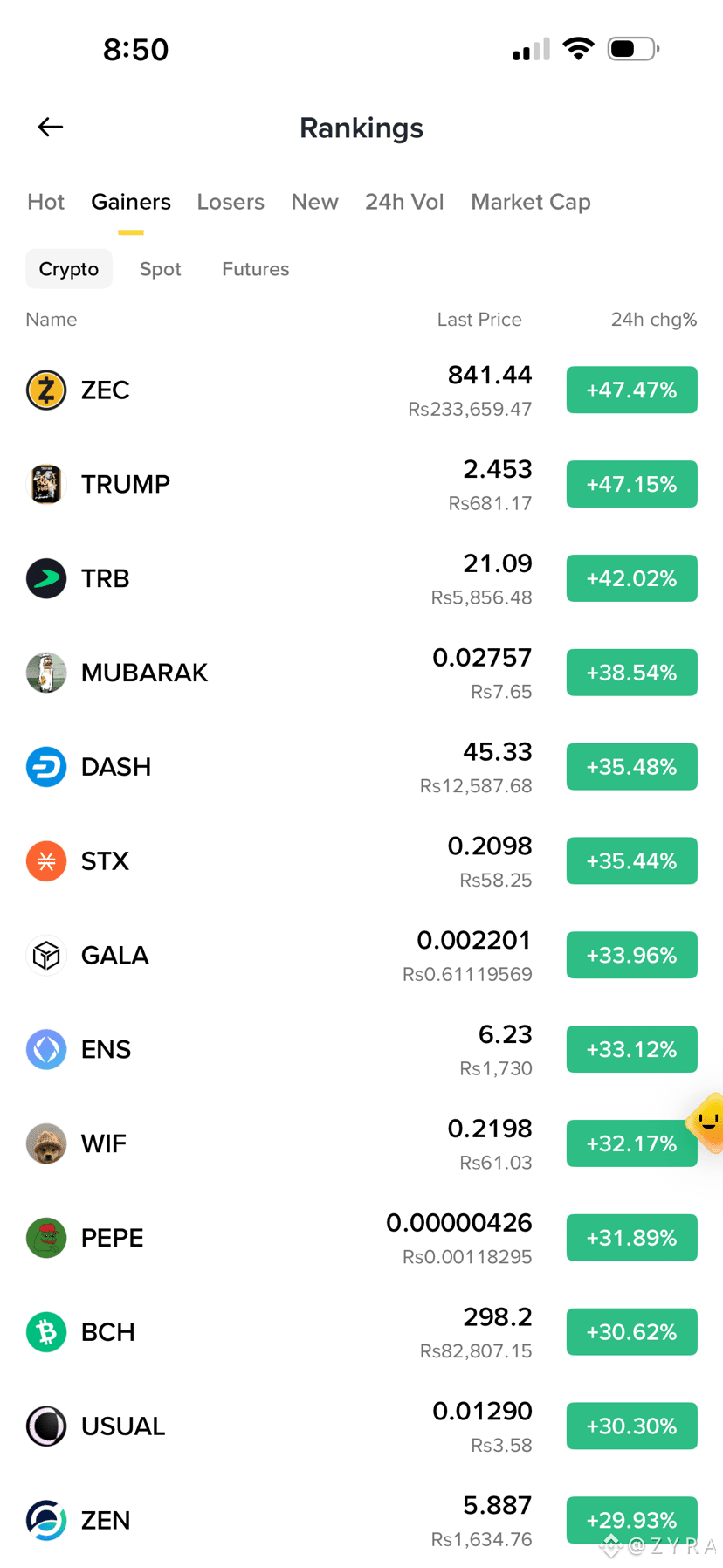
$ZEC , $DASH and $ZEN leading tells me privacy and old-cycle coins are suddenly being repriced. That usually happens when traders start looking for narratives that were ignored for too long, not just new hype.
But beside that, $TRUMP, $WIF $PEPE and $MUBARAK show meme liquidity is also awake. This is more dangerous because meme pumps can move fast, but the bid can disappear even faster once attention rotates.
The key signal for me is ZEC at the top. If privacy coins keep holding gains while memes cool down, this rally has a stronger narrative base. If everything dumps together after one green day, then this was only short-term liquidity chasing the leaderboard.
Green boards look exciting, but the real test is simple:
Which coins hold after the crowd stops chasing?
{future}(ZENUSDT)
{future}(DASHUSDT)
{future}(ZECUSDT)
#zen #DASH #zec #USDollarFallsToThreeMonthLow #USThreeMajorIndexesPostWeeklyLosses
Today’s gainer board is not random.
The market is rotating into two very different types of risk at the same time: old conviction and fast attention.
$ZEC , $DASH and $ZEN leading tells me privacy and old-cycle coins are suddenly being repriced. That usually happens when traders start looking for narratives that were ignored for too long, not just new hype.
But beside that, $TRUMP, $WIF $PEPE and $MUBARAK show meme liquidity is also awake. This is more dangerous because meme pumps can move fast, but the bid can disappear even faster once attention rotates.
The key signal for me is ZEC at the top. If privacy coins keep holding gains while memes cool down, this rally has a stronger narrative base. If everything dumps together after one green day, then this was only short-term liquidity chasing the leaderboard.
Green boards look exciting, but the real test is simple:
Which coins hold after the crowd stops chasing?
#zen #DASH #zec #USDollarFallsToThreeMonthLow #USThreeMajorIndexesPostWeeklyLosses
The market is rotating into two very different types of risk at the same time: old conviction and fast attention.
$ZEC , $DASH and $ZEN leading tells me privacy and old-cycle coins are suddenly being repriced. That usually happens when traders start looking for narratives that were ignored for too long, not just new hype.
But beside that, $TRUMP, $WIF $PEPE and $MUBARAK show meme liquidity is also awake. This is more dangerous because meme pumps can move fast, but the bid can disappear even faster once attention rotates.
The key signal for me is ZEC at the top. If privacy coins keep holding gains while memes cool down, this rally has a stronger narrative base. If everything dumps together after one green day, then this was only short-term liquidity chasing the leaderboard.
Green boards look exciting, but the real test is simple:
Which coins hold after the crowd stops chasing?
#zen #DASH #zec #USDollarFallsToThreeMonthLow #USThreeMajorIndexesPostWeeklyLosses
2
7
7k
·
--
Bullish
This move is not about “which coin pumped more.”
ZEC, TRB and TRUMP are showing three different types of market hunger.
$ZEC is a narrative repricing. Privacy was ignored for a long time, then one strong candle forced the market to look again. But when RSI is almost maxed out, the question is no longer “is the story strong?” The question is “who is left to buy after this candle?”
$TRB looks more like a liquidity squeeze. The climb was controlled first, then the final move expanded fast. That usually means supply became thin and late buyers were forced to chase.
$TRUMP is different. It is pure attention liquidity. When meme flow arrives, it can ignore technicals for a while, but the same flow can disappear quickly if the crowd rotates.
For me, the real winner is not the highest green candle.
It is the chart that holds its breakout base after the first pullback.
#zec #TRB #TRUMP #USDollarFallsToThreeMonthLow #USThreeMajorIndexesPostWeeklyLosses
{future}(TRUMPUSDT)
{future}(ZECUSDT)
{future}(TRBUSDT)
Which holds best?
This move is not about “which coin pumped more.”
ZEC, TRB and TRUMP are showing three different types of market hunger.
$ZEC is a narrative repricing. Privacy was ignored for a long time, then one strong candle forced the market to look again. But when RSI is almost maxed out, the question is no longer “is the story strong?” The question is “who is left to buy after this candle?”
$TRB looks more like a liquidity squeeze. The climb was controlled first, then the final move expanded fast. That usually means supply became thin and late buyers were forced to chase.
$TRUMP is different. It is pure attention liquidity. When meme flow arrives, it can ignore technicals for a while, but the same flow can disappear quickly if the crowd rotates.
For me, the real winner is not the highest green candle.
It is the chart that holds its breakout base after the first pullback.
#zec #TRB #TRUMP #USDollarFallsToThreeMonthLow #USThreeMajorIndexesPostWeeklyLosses
Which holds best?
ZEC, TRB and TRUMP are showing three different types of market hunger.
$ZEC is a narrative repricing. Privacy was ignored for a long time, then one strong candle forced the market to look again. But when RSI is almost maxed out, the question is no longer “is the story strong?” The question is “who is left to buy after this candle?”
$TRB looks more like a liquidity squeeze. The climb was controlled first, then the final move expanded fast. That usually means supply became thin and late buyers were forced to chase.
$TRUMP is different. It is pure attention liquidity. When meme flow arrives, it can ignore technicals for a while, but the same flow can disappear quickly if the crowd rotates.
For me, the real winner is not the highest green candle.
It is the chart that holds its breakout base after the first pullback.
#zec #TRB #TRUMP #USDollarFallsToThreeMonthLow #USThreeMajorIndexesPostWeeklyLosses
Which holds best?
ZEC
42%
TRB
21%
TRUMP
27%
Wait
10%
967 votes • Voting closed
27
59
77.9k
·
--
Bullish
#termmax @termmax I initially read TermMax’s user roles as a simple borrower-versus-lender setup.
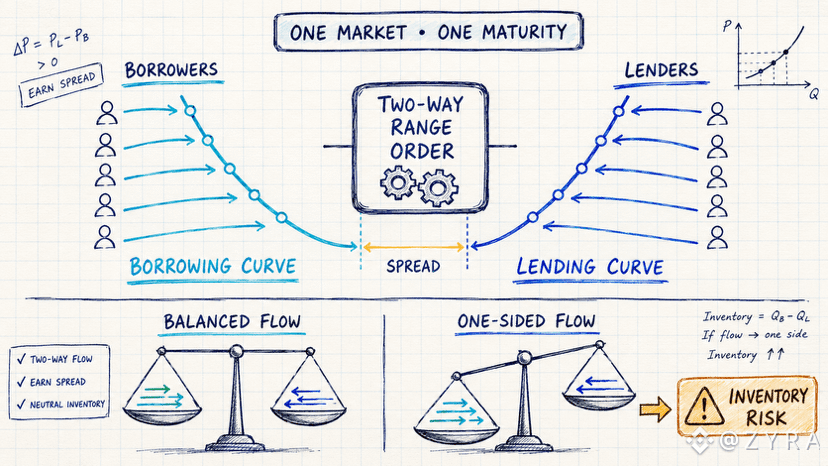
Then I reached the Two-Way Range Order Setter.
One order can quote both sides of the same fixed-rate market using separate borrowing and lending curves. In the V2 contracts, the maker can configure those curves and prices instead of accepting a rate chosen by the protocol.
That changes how I see @termmax .
The fixed rate is not one universal number displayed by a lending pool. It is formed through maturity-specific liquidity provided at different rates and trade sizes.
A two-way maker can potentially capture the spread between both curves. But that spread is not free yield.
If borrowing demand dominates, the order can become increasingly exposed to one side. If lending demand dominates, its inventory shifts the other way. Profit therefore depends on where the curves are placed, how flow arrives and whether the maker can reprice before the market moves.
MLTV protects the loan with collateral. It does not protect a poorly positioned curve from asymmetric order flow.
So the number I would watch is not only the quoted APY.
I would watch how much usable depth exists on both sides of each maturity and how quickly makers adjust when that balance changes.
TermMax looks less like a fixed-rate lending pool here and more like an onchain interest-rate market. $TMX
#termmax @TermMax I initially read TermMax’s user roles as a simple borrower-versus-lender setup.
Then I reached the Two-Way Range Order Setter.
One order can quote both sides of the same fixed-rate market using separate borrowing and lending curves. In the V2 contracts, the maker can configure those curves and prices instead of accepting a rate chosen by the protocol.
That changes how I see @TermMax .
The fixed rate is not one universal number displayed by a lending pool. It is formed through maturity-specific liquidity provided at different rates and trade sizes.
A two-way maker can potentially capture the spread between both curves. But that spread is not free yield.
If borrowing demand dominates, the order can become increasingly exposed to one side. If lending demand dominates, its inventory shifts the other way. Profit therefore depends on where the curves are placed, how flow arrives and whether the maker can reprice before the market moves.
MLTV protects the loan with collateral. It does not protect a poorly positioned curve from asymmetric order flow.
So the number I would watch is not only the quoted APY.
I would watch how much usable depth exists on both sides of each maturity and how quickly makers adjust when that balance changes.
TermMax looks less like a fixed-rate lending pool here and more like an onchain interest-rate market. $TMX
Then I reached the Two-Way Range Order Setter.
One order can quote both sides of the same fixed-rate market using separate borrowing and lending curves. In the V2 contracts, the maker can configure those curves and prices instead of accepting a rate chosen by the protocol.
That changes how I see @TermMax .
The fixed rate is not one universal number displayed by a lending pool. It is formed through maturity-specific liquidity provided at different rates and trade sizes.
A two-way maker can potentially capture the spread between both curves. But that spread is not free yield.
If borrowing demand dominates, the order can become increasingly exposed to one side. If lending demand dominates, its inventory shifts the other way. Profit therefore depends on where the curves are placed, how flow arrives and whether the maker can reprice before the market moves.
MLTV protects the loan with collateral. It does not protect a poorly positioned curve from asymmetric order flow.
So the number I would watch is not only the quoted APY.
I would watch how much usable depth exists on both sides of each maturity and how quickly makers adjust when that balance changes.
TermMax looks less like a fixed-rate lending pool here and more like an onchain interest-rate market. $TMX
4
794
·
--
Bullish
#dusk $DUSK @Dusk_Foundation I opened Dusk’s Core Components page expecting Zedger and Hedger to be older and newer versions of the same privacy system.
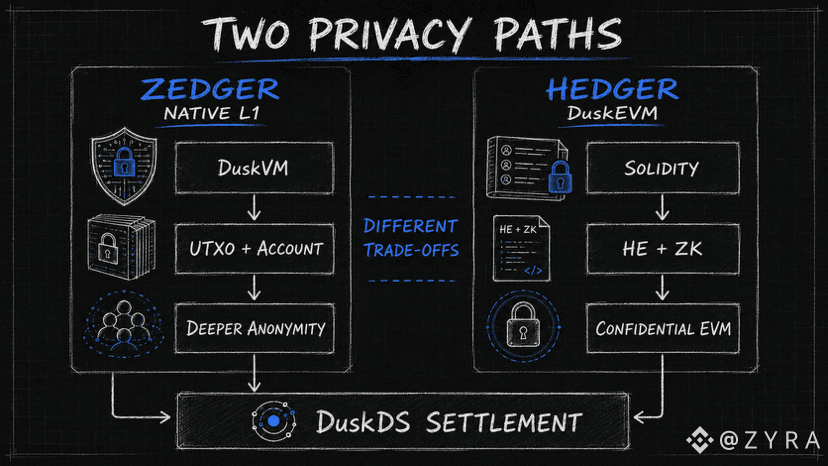
They are not.
The page places Zedger directly on Dusk’s native L1 through DuskVM contracts. Its hybrid UTXO/account design was built for regulated assets that need private ownership, compliant transfers, voting, dividends and ownership limits.
Hedger takes another route.
It lives on DuskEVM and combines homomorphic encryption with zero-knowledge proofs. Values can remain encrypted while contracts prove that a transaction is valid, without abandoning Solidity or standard Ethereum tooling.
Then I found the trade-off Dusk states openly: the EVM account model prevents Hedger from providing the full anonymity available through Zedger.
That changes how I read the architecture.
Hedger is not simply better Zedger. It gives up some native-layer anonymity to make confidential finance usable inside an EVM environment.
For a tokenized bond platform already built around Solidity, that compatibility could reduce integration work. For an application needing deeper privacy and direct access to Dusk’s native transaction model, Zedger remains a different path.
Hedger is still on testnet, so its claimed browser proving speed and encrypted workflows still need to prove themselves under real market activity.
Dusk has not chosen one privacy model for everything.
It is keeping native-L1 privacy and EVM privacy separate because developer familiarity and maximum anonymity do not fit neatly inside the same architecture.
{future}(DUSKUSDT)
#dusk $DUSK @Dusk I opened Dusk’s Core Components page expecting Zedger and Hedger to be older and newer versions of the same privacy system.
They are not.
The page places Zedger directly on Dusk’s native L1 through DuskVM contracts. Its hybrid UTXO/account design was built for regulated assets that need private ownership, compliant transfers, voting, dividends and ownership limits.
Hedger takes another route.
It lives on DuskEVM and combines homomorphic encryption with zero-knowledge proofs. Values can remain encrypted while contracts prove that a transaction is valid, without abandoning Solidity or standard Ethereum tooling.
Then I found the trade-off Dusk states openly: the EVM account model prevents Hedger from providing the full anonymity available through Zedger.
That changes how I read the architecture.
Hedger is not simply better Zedger. It gives up some native-layer anonymity to make confidential finance usable inside an EVM environment.
For a tokenized bond platform already built around Solidity, that compatibility could reduce integration work. For an application needing deeper privacy and direct access to Dusk’s native transaction model, Zedger remains a different path.
Hedger is still on testnet, so its claimed browser proving speed and encrypted workflows still need to prove themselves under real market activity.
Dusk has not chosen one privacy model for everything.
It is keeping native-L1 privacy and EVM privacy separate because developer familiarity and maximum anonymity do not fit neatly inside the same architecture.
They are not.
The page places Zedger directly on Dusk’s native L1 through DuskVM contracts. Its hybrid UTXO/account design was built for regulated assets that need private ownership, compliant transfers, voting, dividends and ownership limits.
Hedger takes another route.
It lives on DuskEVM and combines homomorphic encryption with zero-knowledge proofs. Values can remain encrypted while contracts prove that a transaction is valid, without abandoning Solidity or standard Ethereum tooling.
Then I found the trade-off Dusk states openly: the EVM account model prevents Hedger from providing the full anonymity available through Zedger.
That changes how I read the architecture.
Hedger is not simply better Zedger. It gives up some native-layer anonymity to make confidential finance usable inside an EVM environment.
For a tokenized bond platform already built around Solidity, that compatibility could reduce integration work. For an application needing deeper privacy and direct access to Dusk’s native transaction model, Zedger remains a different path.
Hedger is still on testnet, so its claimed browser proving speed and encrypted workflows still need to prove themselves under real market activity.
Dusk has not chosen one privacy model for everything.
It is keeping native-L1 privacy and EVM privacy separate because developer familiarity and maximum anonymity do not fit neatly inside the same architecture.
4
9
577
·
--
Bullish
30D trade $DUSK 197.5 USDT
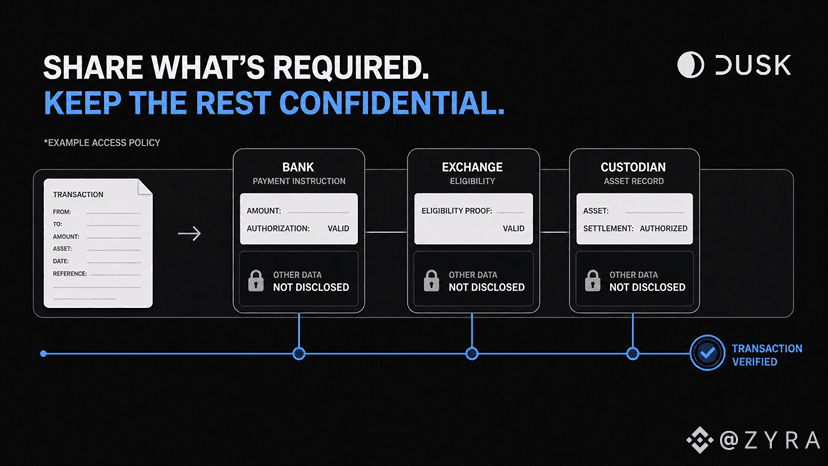
#dusk $DUSK @Dusk_Foundation Banks, exchanges and custodians may inspect the same transaction, but they do not need to see the same data.
That distinction is what makes Dusk’s selective disclosure model interesting to me.
An exchange may need proof that a trader is eligible.
A custodian may need confirmation of ownership.
A regulator may require access to specific transaction records.
None of those checks automatically justify exposing the customer’s full balance, identity or trading history to everyone else.
Dusk treats disclosure as permissioned access to required evidence not a choice between complete secrecy and complete transparency.
That feels far closer to how regulated finance actually handles information.
#dusk $DUSK @Dusk Banks, exchanges and custodians may inspect the same transaction, but they do not need to see the same data.
That distinction is what makes Dusk’s selective disclosure model interesting to me.
An exchange may need proof that a trader is eligible.
A custodian may need confirmation of ownership.
A regulator may require access to specific transaction records.
None of those checks automatically justify exposing the customer’s full balance, identity or trading history to everyone else.
Dusk treats disclosure as permissioned access to required evidence not a choice between complete secrecy and complete transparency.
That feels far closer to how regulated finance actually handles information.
That distinction is what makes Dusk’s selective disclosure model interesting to me.
An exchange may need proof that a trader is eligible.
A custodian may need confirmation of ownership.
A regulator may require access to specific transaction records.
None of those checks automatically justify exposing the customer’s full balance, identity or trading history to everyone else.
Dusk treats disclosure as permissioned access to required evidence not a choice between complete secrecy and complete transparency.
That feels far closer to how regulated finance actually handles information.
3
7
227
·
--
Bullish
#termmax @termmax I opened TermMax’s V2 contracts expecting the Gearing Token to behave like another fungible debt token.
It does not.
GT is an ERC-721 position. The contract exposes loanInfo, addCollateral, removeCollaterl, augmentDebt, repay and liquidate.
That explains why TermMax uses an NFT here.
FTs can be fungible because every FT from the same market represents the same claim at maturity. A GT holds something more specific: one borrower’s collateral, debt and position state.
Two GTs from the same market may not carry the same risk. One could have a comfortable collateral buffer while another sits close to liquidation.
The contract also includes ownership and transfer functions. That means transferring a GT is not comparable to sending an ordinary token. Ownership of a live loan position moves with it.
The contract supports that action, but valuing such a position is another matter.
Before receiving a GT, I would need to inspect its collateral, outstanding debt, maturity and distance from liquidation. The NFT label alone says nothing about whether the position is healthy.
I now see GT less as a token and more as an onchain loan account.
It is not decoration around the borrowing process.
It is the position itself.
What matters most when examining a GT?
#termmax @TermMax I opened TermMax’s V2 contracts expecting the Gearing Token to behave like another fungible debt token.
It does not.
GT is an ERC-721 position. The contract exposes loanInfo, addCollateral, removeCollaterl, augmentDebt, repay and liquidate.
That explains why TermMax uses an NFT here.
FTs can be fungible because every FT from the same market represents the same claim at maturity. A GT holds something more specific: one borrower’s collateral, debt and position state.
Two GTs from the same market may not carry the same risk. One could have a comfortable collateral buffer while another sits close to liquidation.
The contract also includes ownership and transfer functions. That means transferring a GT is not comparable to sending an ordinary token. Ownership of a live loan position moves with it.
The contract supports that action, but valuing such a position is another matter.
Before receiving a GT, I would need to inspect its collateral, outstanding debt, maturity and distance from liquidation. The NFT label alone says nothing about whether the position is healthy.
I now see GT less as a token and more as an onchain loan account.
It is not decoration around the borrowing process.
It is the position itself.
What matters most when examining a GT?
It does not.
GT is an ERC-721 position. The contract exposes loanInfo, addCollateral, removeCollaterl, augmentDebt, repay and liquidate.
That explains why TermMax uses an NFT here.
FTs can be fungible because every FT from the same market represents the same claim at maturity. A GT holds something more specific: one borrower’s collateral, debt and position state.
Two GTs from the same market may not carry the same risk. One could have a comfortable collateral buffer while another sits close to liquidation.
The contract also includes ownership and transfer functions. That means transferring a GT is not comparable to sending an ordinary token. Ownership of a live loan position moves with it.
The contract supports that action, but valuing such a position is another matter.
Before receiving a GT, I would need to inspect its collateral, outstanding debt, maturity and distance from liquidation. The NFT label alone says nothing about whether the position is healthy.
I now see GT less as a token and more as an onchain loan account.
It is not decoration around the borrowing process.
It is the position itself.
What matters most when examining a GT?
Collateral
67%
Debt size
33%
MLTV buffer
0%
Maturity
0%
6 votes • Voting closed
1
4
448
Log in to explore more content
Join global crypto users on Binance Square
⚡️ Get latest and useful information about crypto.
💬 Trusted by the world’s largest crypto exchange.
👍 Discover real insights from verified creators.
Email / Phone number
Trending Topics
Nikkei225Jumps2.5%ToThreeMonthHigh
123 views
36 Discussing
🔥 Nikkei Breaks Above 70,000!
Japan’s stock market just delivered a serious momentum signal. 🇯🇵📊
Nikkei surged 2.5%, powered by AI and semiconductor stocks, while weaker U.S. jobs data reduced expectations of another Fed hike.
Keep $BTC $ETH $BNB on your watchlist.
#nikkei225jumps2.5%tothreemonthhigh
CryptoMahibaloch
·0 Likes
·8 views
DriftHackVictimsBeginClaims
66,969 views
742 Discussing
SolanaTokenizedStockVolumeTops$4.4BInSeptember
7,476 views
78 Discussing