

TheStreet Roundtable
2.1k Posts

TheStreet Roundtable
 Square Verified+
Report
Block User
TheStreet covers the most engaging stories about how to make money, invest your money, save your money, and spend your money.
1 Following
498 Followers
2.2K+ Liked
Posts
Analysts move HubSpot 29 places higher in power rankingRoundtable 100 analyst on Solana, NEAR (4:43)
The Roundtable 100 analysts moved HubSpot (NYSE: HUBS) 29 places higher to No. 57 this week.
HubSpot is a tech company that offers a suite of customer relationship management (CRM) products. It has a market of more than $11 billion.
HubSpot scores very high Team score
Published with TheStreet, the Roundtable 100 ranks 100 publicly traded technology growth assets. Committee analysts score each asset on team, safety, value, innovation, and market dominance, with the average forming its power ranking.
The analysts awarded HubSpot a very high Team score of 96 out of 100. Though its other scores — Safety (36), Innovation (29), Market Dominance (15), and Value (11) — are not very impressive, its overall RTB 100 score stands at 63.
Check out HubSpot’s score on the Roundtable 100
More on TheStreet Roundtable:
U.S. Treasury yields hit multi-decade highs, sending Bitcoin lower
Samsung wants to bring stablecoins to your smartphone
Billionaire Tim Draper takes aim at Apple, Meta’s Bitcoin-free balance sheets
Analysts shuffle rankings
The Roundtable 100 analysts moved Customers Bancorp (NYSE: CUBI) 14 spots higher to No. 45 in the ranking this week.
Recursion Pharmaceuticals (Nasdaq: RXRX) moved two spots higher to No. 39. ADT, Inc. (NYSE: ADT) moved nine spots higher to No. 62.
But Pattern Group (Nasdaq: PTRN) fell by four places to No. 11. Applied Digital Corporation (Nasdaq: APLD) also slipped two spots lower to No. 71.
See the full ranking.
Disclaimer: This article is for informational purposes only and does not constitute financial advice. Investments are subject to market risk. Always conduct your own research before making any investment decisions.
Disclosure: RTB Digital, Inc. (Nasdaq: RTB), publisher of the Roundtable 100, is itself a ranked constituent of the index. The Roundtable 100 is published for informational purposes only and is not investment advice, an offer, or a recommendation to buy or sell any security, commodity or digital asset. Rankings reflect the views of Roundtable analysts as of the ranking date. Investing involves risk, including loss of principal.
Related: Trump administration has a radical plan to boost U.S. dollar
Analysts move HubSpot 29 places higher in power ranking
Roundtable 100 analyst on Solana, NEAR (4:43)
The Roundtable 100 analysts moved HubSpot (NYSE: HUBS) 29 places higher to No. 57 this week.
HubSpot is a tech company that offers a suite of customer relationship management (CRM) products. It has a market of more than $11 billion.
HubSpot scores very high Team score
Published with TheStreet, the Roundtable 100 ranks 100 publicly traded technology growth assets. Committee analysts score each asset on team, safety, value, innovation, and market dominance, with the average forming its power ranking.
The analysts awarded HubSpot a very high Team score of 96 out of 100. Though its other scores — Safety (36), Innovation (29), Market Dominance (15), and Value (11) — are not very impressive, its overall RTB 100 score stands at 63.
Check out HubSpot’s score on the Roundtable 100
More on TheStreet Roundtable:
U.S. Treasury yields hit multi-decade highs, sending Bitcoin lower
Samsung wants to bring stablecoins to your smartphone
Billionaire Tim Draper takes aim at Apple, Meta’s Bitcoin-free balance sheets
Analysts shuffle rankings
The Roundtable 100 analysts moved Customers Bancorp (NYSE: CUBI) 14 spots higher to No. 45 in the ranking this week.
Recursion Pharmaceuticals (Nasdaq: RXRX) moved two spots higher to No. 39. ADT, Inc. (NYSE: ADT) moved nine spots higher to No. 62.
But Pattern Group (Nasdaq: PTRN) fell by four places to No. 11. Applied Digital Corporation (Nasdaq: APLD) also slipped two spots lower to No. 71.
See the full ranking.
Disclaimer: This article is for informational purposes only and does not constitute financial advice. Investments are subject to market risk. Always conduct your own research before making any investment decisions.
Disclosure: RTB Digital, Inc. (Nasdaq: RTB), publisher of the Roundtable 100, is itself a ranked constituent of the index. The Roundtable 100 is published for informational purposes only and is not investment advice, an offer, or a recommendation to buy or sell any security, commodity or digital asset. Rankings reflect the views of Roundtable analysts as of the ranking date. Investing involves risk, including loss of principal.
Related: Trump administration has a radical plan to boost U.S. dollar
The Roundtable 100 analysts moved HubSpot (NYSE: HUBS) 29 places higher to No. 57 this week.
HubSpot is a tech company that offers a suite of customer relationship management (CRM) products. It has a market of more than $11 billion.
HubSpot scores very high Team score
Published with TheStreet, the Roundtable 100 ranks 100 publicly traded technology growth assets. Committee analysts score each asset on team, safety, value, innovation, and market dominance, with the average forming its power ranking.
The analysts awarded HubSpot a very high Team score of 96 out of 100. Though its other scores — Safety (36), Innovation (29), Market Dominance (15), and Value (11) — are not very impressive, its overall RTB 100 score stands at 63.
Check out HubSpot’s score on the Roundtable 100
More on TheStreet Roundtable:
U.S. Treasury yields hit multi-decade highs, sending Bitcoin lower
Samsung wants to bring stablecoins to your smartphone
Billionaire Tim Draper takes aim at Apple, Meta’s Bitcoin-free balance sheets
Analysts shuffle rankings
The Roundtable 100 analysts moved Customers Bancorp (NYSE: CUBI) 14 spots higher to No. 45 in the ranking this week.
Recursion Pharmaceuticals (Nasdaq: RXRX) moved two spots higher to No. 39. ADT, Inc. (NYSE: ADT) moved nine spots higher to No. 62.
But Pattern Group (Nasdaq: PTRN) fell by four places to No. 11. Applied Digital Corporation (Nasdaq: APLD) also slipped two spots lower to No. 71.
See the full ranking.
Disclaimer: This article is for informational purposes only and does not constitute financial advice. Investments are subject to market risk. Always conduct your own research before making any investment decisions.
Disclosure: RTB Digital, Inc. (Nasdaq: RTB), publisher of the Roundtable 100, is itself a ranked constituent of the index. The Roundtable 100 is published for informational purposes only and is not investment advice, an offer, or a recommendation to buy or sell any security, commodity or digital asset. Rankings reflect the views of Roundtable analysts as of the ranking date. Investing involves risk, including loss of principal.
Related: Trump administration has a radical plan to boost U.S. dollar
1
56
IBM taps Swift's 17-bank blockchain, lets banks keep assets in-houseWhat is Blockchain? (4:09)
IBM has connected its Digital Asset Haven platform to Swift’s blockchain-based shared ledger. Seventeen global banks, including BNY, Citi, HSBC, UBS, and Wells Fargo, are using the ledger to pilot tokenized deposit transactions.
The tech giant announced two beta updates to the platform on Sept. 24, both aimed at regulated financial institutions.
“The financial services industry is entering a new era where tokenized and traditional assets will need to move side by side,” Tom McPherson, IBM’s general manager for Z and LinuxONE, told The Block.
Related: Trump's stock accounts quietly loaded up on Strategy and Tesla, filing shows
Familiar payment messages
The first update, an ISO 20022 Messaging Adapter, lets banks instruct tokenized transactions in the message format they already use for payments, rather than through blockchain-specific workflows.
Participants can move funds around the clock, including weekends, while final settlement runs through current systems.
Swift unveiled the ledger at Sibos 2025, built on a Consensys prototype, and declared it ready for use in July after nine months of development. The pilot group also includes ANZ, BNP Paribas, DBS, MUFG, Standard Chartered and Lloyds
More on TheStreet Roundtable
100 Coinbase users lose millions to fake support calls
Bloomberg analyst sends 2008 WTI oil warning on Bitcoin
100 Coinbase users lose millions to fake support calls
No public cloud needed
The second update is an on-premises version that runs entirely on a client’s own IBM Z or LinuxONE hardware.
Software and cryptographic keys stay in-house, secured by Crypto Express hardware security modules. According to IBM, formal key ceremonies produce documentation that clients can present to regulators.
Digital Asset Haven launched in October 2025 in partnership with wallet infrastructure provider Dfns. It was previously offered only as a cloud service or in a hybrid setup.
The move comes as lenders race to overhaul their payment rails. J.P. Morgan Payments research found that 93% of financial institutions are modernizing their payments infrastructure.
IBM shares were up about 2.5% at $237.19 on Sept. 25, after slipping 0.4% in premarket trading the day of the announcement.
IBM taps Swift's 17-bank blockchain, lets banks keep assets in-house
What is Blockchain? (4:09)
IBM has connected its Digital Asset Haven platform to Swift’s blockchain-based shared ledger. Seventeen global banks, including BNY, Citi, HSBC, UBS, and Wells Fargo, are using the ledger to pilot tokenized deposit transactions.
The tech giant announced two beta updates to the platform on Sept. 24, both aimed at regulated financial institutions.
“The financial services industry is entering a new era where tokenized and traditional assets will need to move side by side,” Tom McPherson, IBM’s general manager for Z and LinuxONE, told The Block.
Related: Trump's stock accounts quietly loaded up on Strategy and Tesla, filing shows
Familiar payment messages
The first update, an ISO 20022 Messaging Adapter, lets banks instruct tokenized transactions in the message format they already use for payments, rather than through blockchain-specific workflows.
Participants can move funds around the clock, including weekends, while final settlement runs through current systems.
Swift unveiled the ledger at Sibos 2025, built on a Consensys prototype, and declared it ready for use in July after nine months of development. The pilot group also includes ANZ, BNP Paribas, DBS, MUFG, Standard Chartered and Lloyds
More on TheStreet Roundtable
100 Coinbase users lose millions to fake support calls
Bloomberg analyst sends 2008 WTI oil warning on Bitcoin
100 Coinbase users lose millions to fake support calls
No public cloud needed
The second update is an on-premises version that runs entirely on a client’s own IBM Z or LinuxONE hardware.
Software and cryptographic keys stay in-house, secured by Crypto Express hardware security modules. According to IBM, formal key ceremonies produce documentation that clients can present to regulators.
Digital Asset Haven launched in October 2025 in partnership with wallet infrastructure provider Dfns. It was previously offered only as a cloud service or in a hybrid setup.
The move comes as lenders race to overhaul their payment rails. J.P. Morgan Payments research found that 93% of financial institutions are modernizing their payments infrastructure.
IBM shares were up about 2.5% at $237.19 on Sept. 25, after slipping 0.4% in premarket trading the day of the announcement.
IBM has connected its Digital Asset Haven platform to Swift’s blockchain-based shared ledger. Seventeen global banks, including BNY, Citi, HSBC, UBS, and Wells Fargo, are using the ledger to pilot tokenized deposit transactions.
The tech giant announced two beta updates to the platform on Sept. 24, both aimed at regulated financial institutions.
“The financial services industry is entering a new era where tokenized and traditional assets will need to move side by side,” Tom McPherson, IBM’s general manager for Z and LinuxONE, told The Block.
Related: Trump's stock accounts quietly loaded up on Strategy and Tesla, filing shows
Familiar payment messages
The first update, an ISO 20022 Messaging Adapter, lets banks instruct tokenized transactions in the message format they already use for payments, rather than through blockchain-specific workflows.
Participants can move funds around the clock, including weekends, while final settlement runs through current systems.
Swift unveiled the ledger at Sibos 2025, built on a Consensys prototype, and declared it ready for use in July after nine months of development. The pilot group also includes ANZ, BNP Paribas, DBS, MUFG, Standard Chartered and Lloyds
More on TheStreet Roundtable
100 Coinbase users lose millions to fake support calls
Bloomberg analyst sends 2008 WTI oil warning on Bitcoin
100 Coinbase users lose millions to fake support calls
No public cloud needed
The second update is an on-premises version that runs entirely on a client’s own IBM Z or LinuxONE hardware.
Software and cryptographic keys stay in-house, secured by Crypto Express hardware security modules. According to IBM, formal key ceremonies produce documentation that clients can present to regulators.
Digital Asset Haven launched in October 2025 in partnership with wallet infrastructure provider Dfns. It was previously offered only as a cloud service or in a hybrid setup.
The move comes as lenders race to overhaul their payment rails. J.P. Morgan Payments research found that 93% of financial institutions are modernizing their payments infrastructure.
IBM shares were up about 2.5% at $237.19 on Sept. 25, after slipping 0.4% in premarket trading the day of the announcement.
19
Anthony Scaramucci's son bets $350 million on a 'programmable future'Anthony Scaramucci sounds alarm on Trump and crypto money (3:44)
AJ Scaramucci, a venture capitalist and entrepreneur who founded collectibles platform Treasure Trove, has taken his firm Solari Capital out of stealth, Fortune reported on Thursday. The firm has deployed roughly $350 million across early-stage investing, late-stage growth and in-house incubations.
Scaramucci, a Stanford MBA graduate, began his career workin at Tesla in 2013 before rotating through Google. There, he briefly worked alongside former Alphabet chief executive Eric Schmidt.
He is the son of Anthony Scaramucci, a Wall Street financier who began his career at Goldman Sachs before founding SkyBridge Capital. The New York investment firm now manages billions across hedge fund and crypto strategies.
Related: VanEck drops a surprising Bitcoin-bond correlation reality check
The elder Scaramucci served briefly as White House Communications Director during President Trump’s first term in 2017 before being dismissed after ten days. He is well known in the Bitcoin market, and in August 2025, he warned Bitcoin could crash 40% before eventually reaching $500,000.
Bitcoin peaked above $126,000 in October that year before falling roughly 50% in the months that followed.
The thesis: everything becomes programmable
AJ Scaramucci’s investment thesis, which he calls “Programmable Reality,” is built on the idea that as computing power keeps compounding, money, biology, intelligence and physical matter all become things that can be engineered with software-like precision.
He traces the idea back to 2012, when he read Peter Diamandis’ book “Abundance” in his Stanford dorm room.
Solari splits its bets across four verticals. Programmable Intelligence covers AI and compute, with positions in xAI and the AI education platform Kira Learning. Programmable Biology spans drug discovery, gene therapy and longevity.
xAI is an artificial intelligence company founded by Elon Musk that developed the Grok chatbot and merged with SpaceX earlier this year.
Popular on TheStreet Roundtable:
BlackRock predicts what happens once AI starts shopping
Gary Cardone made $750K without chasing Bitcoin, here’s what he bought
Tesla gains $122M on Bitcoin without buying a single coin
Programmable Matter covers aerospace, defense, energy and robotics.
Programmable Finance, the vertical most relevant to crypto, covers blockchain infrastructure, decentralized finance and what Scaramucci calls monetary-debasement hedges.
The crypto connection
Within Programmable Finance, Solari’s portfolio includes Genius Terminal, a non-custodial multi-chain trading terminal, Fission Labs, which tokenizes venture-backed private companies for liquid secondary trading, and Architect Financial, which Solari describes as the first U.S. derivatives exchange built specifically for the AI economy, according to Fortune.
Solari also backed American Bitcoin, the mining company co-founded by Eric Trump, contributing over $100 million to a $220 million financing round in July 2025. That bet traces back to an 11-year friendship with the founders of U.S. Bitcoin Corporation, which merged into Hut8 before spinning out American Bitcoin.
Scaramucci’s crypto bets sit inside a broader, deliberately contrarian view of where value is being created. He argues that gold and Bitcoin together have generated more market capitalization since 2008 than the entire “Magnificent Seven” group of tech stocks, and that the average life expectancy of a currency is roughly 26 years.
In his view, currency debasement, the gradual erosion of a currency’s purchasing power through government spending and money printing, is a defining feature of 21st-century finance, and assets like Bitcoin, gold and even rare collectibles are different expressions of the same trade: hedging against the decline of traditional money.
Related: Trump's stock accounts quietly loaded up on Strategy and Tesla, filing shows
Anthony Scaramucci's son bets $350 million on a 'programmable future'
Anthony Scaramucci sounds alarm on Trump and crypto money (3:44)
AJ Scaramucci, a venture capitalist and entrepreneur who founded collectibles platform Treasure Trove, has taken his firm Solari Capital out of stealth, Fortune reported on Thursday. The firm has deployed roughly $350 million across early-stage investing, late-stage growth and in-house incubations.
Scaramucci, a Stanford MBA graduate, began his career workin at Tesla in 2013 before rotating through Google. There, he briefly worked alongside former Alphabet chief executive Eric Schmidt.
He is the son of Anthony Scaramucci, a Wall Street financier who began his career at Goldman Sachs before founding SkyBridge Capital. The New York investment firm now manages billions across hedge fund and crypto strategies.
Related: VanEck drops a surprising Bitcoin-bond correlation reality check
The elder Scaramucci served briefly as White House Communications Director during President Trump’s first term in 2017 before being dismissed after ten days. He is well known in the Bitcoin market, and in August 2025, he warned Bitcoin could crash 40% before eventually reaching $500,000.
Bitcoin peaked above $126,000 in October that year before falling roughly 50% in the months that followed.
The thesis: everything becomes programmable
AJ Scaramucci’s investment thesis, which he calls “Programmable Reality,” is built on the idea that as computing power keeps compounding, money, biology, intelligence and physical matter all become things that can be engineered with software-like precision.
He traces the idea back to 2012, when he read Peter Diamandis’ book “Abundance” in his Stanford dorm room.
Solari splits its bets across four verticals. Programmable Intelligence covers AI and compute, with positions in xAI and the AI education platform Kira Learning. Programmable Biology spans drug discovery, gene therapy and longevity.
xAI is an artificial intelligence company founded by Elon Musk that developed the Grok chatbot and merged with SpaceX earlier this year.
Popular on TheStreet Roundtable:
BlackRock predicts what happens once AI starts shopping
Gary Cardone made $750K without chasing Bitcoin, here’s what he bought
Tesla gains $122M on Bitcoin without buying a single coin
Programmable Matter covers aerospace, defense, energy and robotics.
Programmable Finance, the vertical most relevant to crypto, covers blockchain infrastructure, decentralized finance and what Scaramucci calls monetary-debasement hedges.
The crypto connection
Within Programmable Finance, Solari’s portfolio includes Genius Terminal, a non-custodial multi-chain trading terminal, Fission Labs, which tokenizes venture-backed private companies for liquid secondary trading, and Architect Financial, which Solari describes as the first U.S. derivatives exchange built specifically for the AI economy, according to Fortune.
Solari also backed American Bitcoin, the mining company co-founded by Eric Trump, contributing over $100 million to a $220 million financing round in July 2025. That bet traces back to an 11-year friendship with the founders of U.S. Bitcoin Corporation, which merged into Hut8 before spinning out American Bitcoin.
Scaramucci’s crypto bets sit inside a broader, deliberately contrarian view of where value is being created. He argues that gold and Bitcoin together have generated more market capitalization since 2008 than the entire “Magnificent Seven” group of tech stocks, and that the average life expectancy of a currency is roughly 26 years.
In his view, currency debasement, the gradual erosion of a currency’s purchasing power through government spending and money printing, is a defining feature of 21st-century finance, and assets like Bitcoin, gold and even rare collectibles are different expressions of the same trade: hedging against the decline of traditional money.
Related: Trump's stock accounts quietly loaded up on Strategy and Tesla, filing shows
AJ Scaramucci, a venture capitalist and entrepreneur who founded collectibles platform Treasure Trove, has taken his firm Solari Capital out of stealth, Fortune reported on Thursday. The firm has deployed roughly $350 million across early-stage investing, late-stage growth and in-house incubations.
Scaramucci, a Stanford MBA graduate, began his career workin at Tesla in 2013 before rotating through Google. There, he briefly worked alongside former Alphabet chief executive Eric Schmidt.
He is the son of Anthony Scaramucci, a Wall Street financier who began his career at Goldman Sachs before founding SkyBridge Capital. The New York investment firm now manages billions across hedge fund and crypto strategies.
Related: VanEck drops a surprising Bitcoin-bond correlation reality check
The elder Scaramucci served briefly as White House Communications Director during President Trump’s first term in 2017 before being dismissed after ten days. He is well known in the Bitcoin market, and in August 2025, he warned Bitcoin could crash 40% before eventually reaching $500,000.
Bitcoin peaked above $126,000 in October that year before falling roughly 50% in the months that followed.
The thesis: everything becomes programmable
AJ Scaramucci’s investment thesis, which he calls “Programmable Reality,” is built on the idea that as computing power keeps compounding, money, biology, intelligence and physical matter all become things that can be engineered with software-like precision.
He traces the idea back to 2012, when he read Peter Diamandis’ book “Abundance” in his Stanford dorm room.
Solari splits its bets across four verticals. Programmable Intelligence covers AI and compute, with positions in xAI and the AI education platform Kira Learning. Programmable Biology spans drug discovery, gene therapy and longevity.
xAI is an artificial intelligence company founded by Elon Musk that developed the Grok chatbot and merged with SpaceX earlier this year.
Popular on TheStreet Roundtable:
BlackRock predicts what happens once AI starts shopping
Gary Cardone made $750K without chasing Bitcoin, here’s what he bought
Tesla gains $122M on Bitcoin without buying a single coin
Programmable Matter covers aerospace, defense, energy and robotics.
Programmable Finance, the vertical most relevant to crypto, covers blockchain infrastructure, decentralized finance and what Scaramucci calls monetary-debasement hedges.
The crypto connection
Within Programmable Finance, Solari’s portfolio includes Genius Terminal, a non-custodial multi-chain trading terminal, Fission Labs, which tokenizes venture-backed private companies for liquid secondary trading, and Architect Financial, which Solari describes as the first U.S. derivatives exchange built specifically for the AI economy, according to Fortune.
Solari also backed American Bitcoin, the mining company co-founded by Eric Trump, contributing over $100 million to a $220 million financing round in July 2025. That bet traces back to an 11-year friendship with the founders of U.S. Bitcoin Corporation, which merged into Hut8 before spinning out American Bitcoin.
Scaramucci’s crypto bets sit inside a broader, deliberately contrarian view of where value is being created. He argues that gold and Bitcoin together have generated more market capitalization since 2008 than the entire “Magnificent Seven” group of tech stocks, and that the average life expectancy of a currency is roughly 26 years.
In his view, currency debasement, the gradual erosion of a currency’s purchasing power through government spending and money printing, is a defining feature of 21st-century finance, and assets like Bitcoin, gold and even rare collectibles are different expressions of the same trade: hedging against the decline of traditional money.
Related: Trump's stock accounts quietly loaded up on Strategy and Tesla, filing shows
143
Fed unveils stablecoin framework under GENIUS ActGENIUS Act (2:39)
On Sep. 24, the Federal Reserve sought public comments on two proposals related to establishing a regulatory framework for Board-supervised payment stablecoin issuers under the GENIUS Act.
The move marks a major step toward implementing the U.S. stablecoin law.
Related: Trump administration has a radical plan to boost U.S. dollar
There are two proposals.
One requires that Board-supervised payment stablecoin issuers fully back their stablecoins with certain permissible reserve assets, such as short-term U.S. Treasury bills and other high-quality, liquid assets. It also imposes capital and risk-management standards.
Another establish a tailored application process for Board-supervised banks seeking to issue stablecoins through subsidiaries.
The Fed opened the proposals to public comments for 60 days after publication in the Federal Register.
The first framework for the GENIUS Act arrives
The GENIUS Act was signed into law on July 18, 2025, creating the first federal regulatory framework specifically for payment stablecoins in the U.S. The law generally limits issuance to approved entities and requires stablecoins to be backed at least 1:1 by qualifying reserves.
Eligible reserves include cash, Federal Reserve balances, insured deposits and Treasurys with 93 days or less remaining to maturity.
More on TheStreet Roundtable:
U.S. Treasury yields hit multi-decade highs, sending Bitcoin lower
Samsung wants to bring stablecoins to your smartphone
Billionaire Tim Draper takes aim at Apple, Meta’s Bitcoin-free balance sheets
Thursday’s proposals begin translating those statutory requirements into operating rules for institutions supervised by the Fed. Under the framework, reserve assets would have to equal or exceed the value of outstanding stablecoins at all times and be segregated from other issuer assets.
The rules would also cover firms safeguarding stablecoin reserves and clarify which related activities are permissible for Fed-supervised banks.
A separate proposal would require banks seeking to issue stablecoins to submit information including a business plan, financial information and details about their proposed capital structure.
The stablecoin framework is moving ahead while Washington’s broader crypto legislation remains unresolved. The Senate failed to advance the CLARITY Act on Sept. 15 in a 49-50 procedural vote. The bill is intended to establish a broader market structure for digital assets and clarify oversight roles across federal regulators.
That leaves stablecoins on a separate regulatory track, with the GENIUS Act already enacted and regulators now moving toward final implementation rules while broader crypto market structure remains unsettled.
Related: 100 Coinbase users lose millions to fake support calls
Fed unveils stablecoin framework under GENIUS Act
GENIUS Act (2:39)
On Sep. 24, the Federal Reserve sought public comments on two proposals related to establishing a regulatory framework for Board-supervised payment stablecoin issuers under the GENIUS Act.
The move marks a major step toward implementing the U.S. stablecoin law.
Related: Trump administration has a radical plan to boost U.S. dollar
There are two proposals.
One requires that Board-supervised payment stablecoin issuers fully back their stablecoins with certain permissible reserve assets, such as short-term U.S. Treasury bills and other high-quality, liquid assets. It also imposes capital and risk-management standards.
Another establish a tailored application process for Board-supervised banks seeking to issue stablecoins through subsidiaries.
The Fed opened the proposals to public comments for 60 days after publication in the Federal Register.
The first framework for the GENIUS Act arrives
The GENIUS Act was signed into law on July 18, 2025, creating the first federal regulatory framework specifically for payment stablecoins in the U.S. The law generally limits issuance to approved entities and requires stablecoins to be backed at least 1:1 by qualifying reserves.
Eligible reserves include cash, Federal Reserve balances, insured deposits and Treasurys with 93 days or less remaining to maturity.
More on TheStreet Roundtable:
U.S. Treasury yields hit multi-decade highs, sending Bitcoin lower
Samsung wants to bring stablecoins to your smartphone
Billionaire Tim Draper takes aim at Apple, Meta’s Bitcoin-free balance sheets
Thursday’s proposals begin translating those statutory requirements into operating rules for institutions supervised by the Fed. Under the framework, reserve assets would have to equal or exceed the value of outstanding stablecoins at all times and be segregated from other issuer assets.
The rules would also cover firms safeguarding stablecoin reserves and clarify which related activities are permissible for Fed-supervised banks.
A separate proposal would require banks seeking to issue stablecoins to submit information including a business plan, financial information and details about their proposed capital structure.
The stablecoin framework is moving ahead while Washington’s broader crypto legislation remains unresolved. The Senate failed to advance the CLARITY Act on Sept. 15 in a 49-50 procedural vote. The bill is intended to establish a broader market structure for digital assets and clarify oversight roles across federal regulators.
That leaves stablecoins on a separate regulatory track, with the GENIUS Act already enacted and regulators now moving toward final implementation rules while broader crypto market structure remains unsettled.
Related: 100 Coinbase users lose millions to fake support calls
On Sep. 24, the Federal Reserve sought public comments on two proposals related to establishing a regulatory framework for Board-supervised payment stablecoin issuers under the GENIUS Act.
The move marks a major step toward implementing the U.S. stablecoin law.
Related: Trump administration has a radical plan to boost U.S. dollar
There are two proposals.
One requires that Board-supervised payment stablecoin issuers fully back their stablecoins with certain permissible reserve assets, such as short-term U.S. Treasury bills and other high-quality, liquid assets. It also imposes capital and risk-management standards.
Another establish a tailored application process for Board-supervised banks seeking to issue stablecoins through subsidiaries.
The Fed opened the proposals to public comments for 60 days after publication in the Federal Register.
The first framework for the GENIUS Act arrives
The GENIUS Act was signed into law on July 18, 2025, creating the first federal regulatory framework specifically for payment stablecoins in the U.S. The law generally limits issuance to approved entities and requires stablecoins to be backed at least 1:1 by qualifying reserves.
Eligible reserves include cash, Federal Reserve balances, insured deposits and Treasurys with 93 days or less remaining to maturity.
More on TheStreet Roundtable:
U.S. Treasury yields hit multi-decade highs, sending Bitcoin lower
Samsung wants to bring stablecoins to your smartphone
Billionaire Tim Draper takes aim at Apple, Meta’s Bitcoin-free balance sheets
Thursday’s proposals begin translating those statutory requirements into operating rules for institutions supervised by the Fed. Under the framework, reserve assets would have to equal or exceed the value of outstanding stablecoins at all times and be segregated from other issuer assets.
The rules would also cover firms safeguarding stablecoin reserves and clarify which related activities are permissible for Fed-supervised banks.
A separate proposal would require banks seeking to issue stablecoins to submit information including a business plan, financial information and details about their proposed capital structure.
The stablecoin framework is moving ahead while Washington’s broader crypto legislation remains unresolved. The Senate failed to advance the CLARITY Act on Sept. 15 in a 49-50 procedural vote. The bill is intended to establish a broader market structure for digital assets and clarify oversight roles across federal regulators.
That leaves stablecoins on a separate regulatory track, with the GENIUS Act already enacted and regulators now moving toward final implementation rules while broader crypto market structure remains unsettled.
Related: 100 Coinbase users lose millions to fake support calls
8
XRP could rally 50x by repeating its 2016 pattern, analyst saysLeading analyst calls XRP 'banking meme coin' (3:09)
Crypto analyst EGRAG CRYPTO said on X that while building a fresh XRP chart from scratch, he noticed something unusual in the token’s white accumulation zones.
During bear-market accumulation phases, three consecutive green monthly candles are extremely rare, he said, but that exact sequence showed up in 2016, and it may be forming again in 2026.
If September closes green, he argued, XRP would print that rare pattern for only the second time in its history.
Related: Analyst says XRP could be entering a new rally after whale buying
2016 vs. 2026: numbers that rhyme
As shared in his X post, he leaned into the symmetry between the two years, pointing out that 2016 and 2026 share a numerical rhyme he sees echoed in the chart structure itself.
He was careful to frame it as a possibility rather than a guarantee, saying he isn’t throwing out big numbers just to sound dramatic, but simply reading what the historical structure is showing.
That structure, according to EGRAG, opens the door to a provocative target: a 50x move that could put XRP near $50.
He also stressed the thesis hinges entirely on one condition, that September closes in the green, after which traders would watch to see whether price behaves the way it did following the 2016 sequence.
Building on a breakout thesis
The pattern chatter adds to a broader bullish narrative around XRP this month.
Earlier this month, crypto analyst Ali Charts flagged a decisive close above $1.38 as confirmation of a breakout toward $1.60, with support around $1.31 to $1.35. XRP has since pushed past both levels. It was trading at $1.61 at the time of writing.
Whether the 2016 rhyme plays out or not, XRP bulls now have two separate technical arguments pointing to the same broader move higher.
Related: If you invested $1,000 in gold & Bitcoin 10 years ago, here's how much money you'd have today
XRP could rally 50x by repeating its 2016 pattern, analyst says
Leading analyst calls XRP 'banking meme coin' (3:09)
Crypto analyst EGRAG CRYPTO said on X that while building a fresh XRP chart from scratch, he noticed something unusual in the token’s white accumulation zones.
During bear-market accumulation phases, three consecutive green monthly candles are extremely rare, he said, but that exact sequence showed up in 2016, and it may be forming again in 2026.
If September closes green, he argued, XRP would print that rare pattern for only the second time in its history.
Related: Analyst says XRP could be entering a new rally after whale buying
2016 vs. 2026: numbers that rhyme
As shared in his X post, he leaned into the symmetry between the two years, pointing out that 2016 and 2026 share a numerical rhyme he sees echoed in the chart structure itself.
He was careful to frame it as a possibility rather than a guarantee, saying he isn’t throwing out big numbers just to sound dramatic, but simply reading what the historical structure is showing.
That structure, according to EGRAG, opens the door to a provocative target: a 50x move that could put XRP near $50.
He also stressed the thesis hinges entirely on one condition, that September closes in the green, after which traders would watch to see whether price behaves the way it did following the 2016 sequence.
Building on a breakout thesis
The pattern chatter adds to a broader bullish narrative around XRP this month.
Earlier this month, crypto analyst Ali Charts flagged a decisive close above $1.38 as confirmation of a breakout toward $1.60, with support around $1.31 to $1.35. XRP has since pushed past both levels. It was trading at $1.61 at the time of writing.
Whether the 2016 rhyme plays out or not, XRP bulls now have two separate technical arguments pointing to the same broader move higher.
Related: If you invested $1,000 in gold & Bitcoin 10 years ago, here's how much money you'd have today
Crypto analyst EGRAG CRYPTO said on X that while building a fresh XRP chart from scratch, he noticed something unusual in the token’s white accumulation zones.
During bear-market accumulation phases, three consecutive green monthly candles are extremely rare, he said, but that exact sequence showed up in 2016, and it may be forming again in 2026.
If September closes green, he argued, XRP would print that rare pattern for only the second time in its history.
Related: Analyst says XRP could be entering a new rally after whale buying
2016 vs. 2026: numbers that rhyme
As shared in his X post, he leaned into the symmetry between the two years, pointing out that 2016 and 2026 share a numerical rhyme he sees echoed in the chart structure itself.
He was careful to frame it as a possibility rather than a guarantee, saying he isn’t throwing out big numbers just to sound dramatic, but simply reading what the historical structure is showing.
That structure, according to EGRAG, opens the door to a provocative target: a 50x move that could put XRP near $50.
He also stressed the thesis hinges entirely on one condition, that September closes in the green, after which traders would watch to see whether price behaves the way it did following the 2016 sequence.
Building on a breakout thesis
The pattern chatter adds to a broader bullish narrative around XRP this month.
Earlier this month, crypto analyst Ali Charts flagged a decisive close above $1.38 as confirmation of a breakout toward $1.60, with support around $1.31 to $1.35. XRP has since pushed past both levels. It was trading at $1.61 at the time of writing.
Whether the 2016 rhyme plays out or not, XRP bulls now have two separate technical arguments pointing to the same broader move higher.
Related: If you invested $1,000 in gold & Bitcoin 10 years ago, here's how much money you'd have today
118
Article
Bitcoin traders prepare for $16B options expiry this FridayThe Crypto Options Trade Wall Street Won't Tell You About (2:17)
Bitcoin (BTC) options worth approximately $16 billion on the crypto derivatives exchange Deribit will expire on Friday, Sep. 25, at 8:00 UTC.
According to Deribit CEO Luuk Strijers, Bitcoin’s maximum pain sits at $75,000.
Bitcoin options expiry on Sep. 25
A total of 185,908 Bitcoin options—110,747 call and 75,160 put contracts—worth $16 billion in notional value will expire this Friday, Strijers revealed.
Related: Trump's stock accounts quietly loaded up on Strategy and Tesla, filing shows
How Bitcoin options trade and expire
An option is a contract that gives a trader the right, but not the obligation, to buy or sell Bitcoin at a predetermined price called the strike price.
While the call option gives traders the right to buy BTC at the strike price, the put option gives them the right to sell BTC at the strike price.
Here is how it works.
Suppose a trader has a call option with a strike price of $80,000 and an upfront premium of $2,000, which will expire on Sep. 25.
If BTC trades at $90,000 on Friday, the trader can buy it for $80,000. While one BTC would cost everyone $80,000, the options trader would spend only $82,000 for it.
But what if BTC trades at $70,000 on Friday? The options trader can skip the contract and instead buy at the market price. While everyone else would pay $70,000 for one BTC that day, the options trader would end up spending $72,000 for it. In such a scenario, the option would expire.
More on TheStreet Roundtable:
Fidelity analyst predicts new 4-year Bitcoin bull market
Veteran trader who called 1980 gold crash sees 200% upside for Ether
Analyst predicts 35% upside for Saylor’s Strategy
Friday options expiry could spark Bitcoin volatility
Bitcoin traders are extremely attentive to options expiry, especially when the figure is billions of dollars on a single day.
The open interest reveals how many contracts are still outstanding. The put/call ratio tells whether traders are bullish or bearish on Bitcoin.
One crucial metric to watch out for is the “max pain” which tells you the price point at which option traders collectively experience the most losses. Currently, the figure stands at $75,000.
The Friday expiry of Bitcoin options on Deribit worth $16 billion is expected to spark market volatility as market movers and other traders could reposition their holdings.
Note that the $16 billion figure is a notional value. It represents the value of Bitcoin contracts that are expiring this Friday. No money is changing hands.
The put-to-call ratio of 0.68 means more calls than puts. It suggests bullish sentiment among Bitcoin options traders.
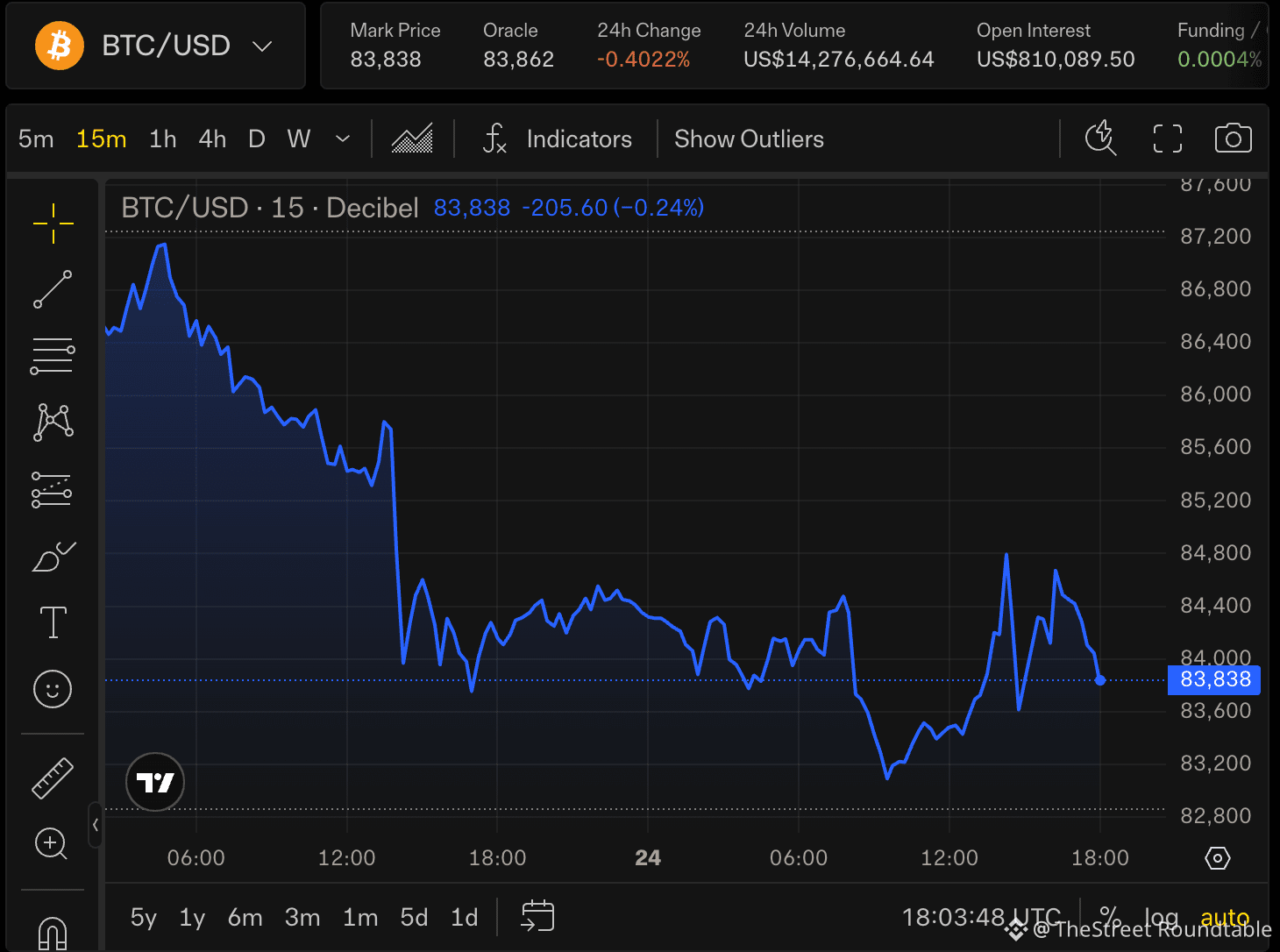
BTC/USD, Source: Decibel
Bitcoin was exchanging hands at $83,838 at the time of writing, as per Decibel.
Related: Tesla gains $122M on Bitcoin without buying a single coin
Bitcoin traders prepare for $16B options expiry this Friday
The Crypto Options Trade Wall Street Won't Tell You About (2:17)
Bitcoin (BTC) options worth approximately $16 billion on the crypto derivatives exchange Deribit will expire on Friday, Sep. 25, at 8:00 UTC.
According to Deribit CEO Luuk Strijers, Bitcoin’s maximum pain sits at $75,000.
Bitcoin options expiry on Sep. 25
A total of 185,908 Bitcoin options—110,747 call and 75,160 put contracts—worth $16 billion in notional value will expire this Friday, Strijers revealed.
Related: Trump's stock accounts quietly loaded up on Strategy and Tesla, filing shows
How Bitcoin options trade and expire
An option is a contract that gives a trader the right, but not the obligation, to buy or sell Bitcoin at a predetermined price called the strike price.
While the call option gives traders the right to buy BTC at the strike price, the put option gives them the right to sell BTC at the strike price.
Here is how it works.
Suppose a trader has a call option with a strike price of $80,000 and an upfront premium of $2,000, which will expire on Sep. 25.
If BTC trades at $90,000 on Friday, the trader can buy it for $80,000. While one BTC would cost everyone $80,000, the options trader would spend only $82,000 for it.
But what if BTC trades at $70,000 on Friday? The options trader can skip the contract and instead buy at the market price. While everyone else would pay $70,000 for one BTC that day, the options trader would end up spending $72,000 for it. In such a scenario, the option would expire.
More on TheStreet Roundtable:
Fidelity analyst predicts new 4-year Bitcoin bull market
Veteran trader who called 1980 gold crash sees 200% upside for Ether
Analyst predicts 35% upside for Saylor’s Strategy
Friday options expiry could spark Bitcoin volatility
Bitcoin traders are extremely attentive to options expiry, especially when the figure is billions of dollars on a single day.
The open interest reveals how many contracts are still outstanding. The put/call ratio tells whether traders are bullish or bearish on Bitcoin.
One crucial metric to watch out for is the “max pain” which tells you the price point at which option traders collectively experience the most losses. Currently, the figure stands at $75,000.
The Friday expiry of Bitcoin options on Deribit worth $16 billion is expected to spark market volatility as market movers and other traders could reposition their holdings.
Note that the $16 billion figure is a notional value. It represents the value of Bitcoin contracts that are expiring this Friday. No money is changing hands.
The put-to-call ratio of 0.68 means more calls than puts. It suggests bullish sentiment among Bitcoin options traders.
BTC/USD, Source: Decibel
Bitcoin was exchanging hands at $83,838 at the time of writing, as per Decibel.
Related: Tesla gains $122M on Bitcoin without buying a single coin
Bitcoin (BTC) options worth approximately $16 billion on the crypto derivatives exchange Deribit will expire on Friday, Sep. 25, at 8:00 UTC.
According to Deribit CEO Luuk Strijers, Bitcoin’s maximum pain sits at $75,000.
Bitcoin options expiry on Sep. 25
A total of 185,908 Bitcoin options—110,747 call and 75,160 put contracts—worth $16 billion in notional value will expire this Friday, Strijers revealed.
Related: Trump's stock accounts quietly loaded up on Strategy and Tesla, filing shows
How Bitcoin options trade and expire
An option is a contract that gives a trader the right, but not the obligation, to buy or sell Bitcoin at a predetermined price called the strike price.
While the call option gives traders the right to buy BTC at the strike price, the put option gives them the right to sell BTC at the strike price.
Here is how it works.
Suppose a trader has a call option with a strike price of $80,000 and an upfront premium of $2,000, which will expire on Sep. 25.
If BTC trades at $90,000 on Friday, the trader can buy it for $80,000. While one BTC would cost everyone $80,000, the options trader would spend only $82,000 for it.
But what if BTC trades at $70,000 on Friday? The options trader can skip the contract and instead buy at the market price. While everyone else would pay $70,000 for one BTC that day, the options trader would end up spending $72,000 for it. In such a scenario, the option would expire.
More on TheStreet Roundtable:
Fidelity analyst predicts new 4-year Bitcoin bull market
Veteran trader who called 1980 gold crash sees 200% upside for Ether
Analyst predicts 35% upside for Saylor’s Strategy
Friday options expiry could spark Bitcoin volatility
Bitcoin traders are extremely attentive to options expiry, especially when the figure is billions of dollars on a single day.
The open interest reveals how many contracts are still outstanding. The put/call ratio tells whether traders are bullish or bearish on Bitcoin.
One crucial metric to watch out for is the “max pain” which tells you the price point at which option traders collectively experience the most losses. Currently, the figure stands at $75,000.
The Friday expiry of Bitcoin options on Deribit worth $16 billion is expected to spark market volatility as market movers and other traders could reposition their holdings.
Note that the $16 billion figure is a notional value. It represents the value of Bitcoin contracts that are expiring this Friday. No money is changing hands.
The put-to-call ratio of 0.68 means more calls than puts. It suggests bullish sentiment among Bitcoin options traders.
BTC/USD, Source: Decibel
Bitcoin was exchanging hands at $83,838 at the time of writing, as per Decibel.
Related: Tesla gains $122M on Bitcoin without buying a single coin
20
Trump administration has a radical plan to boost U.S. dollarWhat is a stablecoin? Explained (3:33)
The Donald Trump administration is considering a radical plan involving stablecoins to boost the U.S. dollar, Bloomberg reported on Sep. 24.
The administration’s goal is to cement the dollar’s dominance as the world’s reserve asset.
Related: Explained: What is a stablecoin?
Why Trump administration is betting on stablecoins
A stablecoin, as the name suggests, is a type of cryptocurrency that attempts to keep its value stable. Unlike popular cryptocurrencies like Bitcoin (BTC), which are very volatile, a stablecoin keeps its value stable by being pegged to a relatively stable asset like a national fiat currency.
For instance, Tether’s USDT and Circle Internet Group‘s (NYSE: CRCL) USDC stablecoins are pegged 1:1 to the U.S. dollar. So, the value of one USDT or USDC is the same as that of one dollar bill. Stablecoin issuers hold reserves in U.S. Treasuries to back their tokens.
This is why the dollar-pegged stablecoins are also called “digital dollars.”
Related: Trump makes bold claim on U.S. dollar
The U.S. dollar is the most commonly used currency to settle international transactions. These digital dollars come to the rescue of merchants when traditional rails go to sleep over the weekends or long holidays.
U.S. dollar-pegged stablecoins, thanks to their round-the-clock nature, can help settle transactions quickly, safely, and economically.
The Trump administration was quick to realize the potential of these stablecoins to cement the U.S. dollar’s world reserve asset. It signed the Guiding and Establishing National Innovation for U.S. Stablecoins (GENIUS) Act into law in July last year. The law requires stablecoin issuers to hold reserves, including dollars and short-term Treasuries.
In February this year, Treasury Secretary Scott Bessent indicated that stablecoins could be “an important feature of financing the U.S. government.”
More on TheStreet Roundtable:
U.S. Treasury yields hit multi-decade highs, sending Bitcoin lower
Samsung wants to bring stablecoins to your smartphone
Billionaire Tim Draper takes aim at Apple, Meta’s Bitcoin-free balance sheets
U.S. government weighs public-private partnerships to promote stablecoin usage
The U.S. government is weighing joint ventures with private companies to promote the use of stablecoins overseas according to people familiar with the plans, the Bloomberg report said.
The initiative could involve multiple agencies, including the Treasury Department and the State Department, and the U.S. International Development Finance Corp. (DFC). The DFC is a federal agency that partners with private sector entities to advance U.S. foreign policy objectives.
TheStreet Roundtable reached out to all three agencies for comments and didn’t receive any by the time of publishing this report. We will update it as soon as we have any response(s).
The Trump administration’s goal is to reinforce the U.S. dollar as the world’s reserve asset and boost demand for U.S. Treasuries.
Here is how it works.
A growth in stablecoin adoption directly translates into more buying of government debt instruments like U.S. Treasuries by stablecoin issuers.
The U.S. dollar-pegged stablecoins not only make the greenback more popular globally but also lead to higher demand for U.S. Treasuries, and the Trump administration is eyeing a radical plan for the same purpose.
Related: Treasury Secretary Bessent reveals new plan to finance U.S. government
Trump administration has a radical plan to boost U.S. dollar
What is a stablecoin? Explained (3:33)
The Donald Trump administration is considering a radical plan involving stablecoins to boost the U.S. dollar, Bloomberg reported on Sep. 24.
The administration’s goal is to cement the dollar’s dominance as the world’s reserve asset.
Related: Explained: What is a stablecoin?
Why Trump administration is betting on stablecoins
A stablecoin, as the name suggests, is a type of cryptocurrency that attempts to keep its value stable. Unlike popular cryptocurrencies like Bitcoin (BTC), which are very volatile, a stablecoin keeps its value stable by being pegged to a relatively stable asset like a national fiat currency.
For instance, Tether’s USDT and Circle Internet Group‘s (NYSE: CRCL) USDC stablecoins are pegged 1:1 to the U.S. dollar. So, the value of one USDT or USDC is the same as that of one dollar bill. Stablecoin issuers hold reserves in U.S. Treasuries to back their tokens.
This is why the dollar-pegged stablecoins are also called “digital dollars.”
Related: Trump makes bold claim on U.S. dollar
The U.S. dollar is the most commonly used currency to settle international transactions. These digital dollars come to the rescue of merchants when traditional rails go to sleep over the weekends or long holidays.
U.S. dollar-pegged stablecoins, thanks to their round-the-clock nature, can help settle transactions quickly, safely, and economically.
The Trump administration was quick to realize the potential of these stablecoins to cement the U.S. dollar’s world reserve asset. It signed the Guiding and Establishing National Innovation for U.S. Stablecoins (GENIUS) Act into law in July last year. The law requires stablecoin issuers to hold reserves, including dollars and short-term Treasuries.
In February this year, Treasury Secretary Scott Bessent indicated that stablecoins could be “an important feature of financing the U.S. government.”
More on TheStreet Roundtable:
U.S. Treasury yields hit multi-decade highs, sending Bitcoin lower
Samsung wants to bring stablecoins to your smartphone
Billionaire Tim Draper takes aim at Apple, Meta’s Bitcoin-free balance sheets
U.S. government weighs public-private partnerships to promote stablecoin usage
The U.S. government is weighing joint ventures with private companies to promote the use of stablecoins overseas according to people familiar with the plans, the Bloomberg report said.
The initiative could involve multiple agencies, including the Treasury Department and the State Department, and the U.S. International Development Finance Corp. (DFC). The DFC is a federal agency that partners with private sector entities to advance U.S. foreign policy objectives.
TheStreet Roundtable reached out to all three agencies for comments and didn’t receive any by the time of publishing this report. We will update it as soon as we have any response(s).
The Trump administration’s goal is to reinforce the U.S. dollar as the world’s reserve asset and boost demand for U.S. Treasuries.
Here is how it works.
A growth in stablecoin adoption directly translates into more buying of government debt instruments like U.S. Treasuries by stablecoin issuers.
The U.S. dollar-pegged stablecoins not only make the greenback more popular globally but also lead to higher demand for U.S. Treasuries, and the Trump administration is eyeing a radical plan for the same purpose.
Related: Treasury Secretary Bessent reveals new plan to finance U.S. government
The Donald Trump administration is considering a radical plan involving stablecoins to boost the U.S. dollar, Bloomberg reported on Sep. 24.
The administration’s goal is to cement the dollar’s dominance as the world’s reserve asset.
Related: Explained: What is a stablecoin?
Why Trump administration is betting on stablecoins
A stablecoin, as the name suggests, is a type of cryptocurrency that attempts to keep its value stable. Unlike popular cryptocurrencies like Bitcoin (BTC), which are very volatile, a stablecoin keeps its value stable by being pegged to a relatively stable asset like a national fiat currency.
For instance, Tether’s USDT and Circle Internet Group‘s (NYSE: CRCL) USDC stablecoins are pegged 1:1 to the U.S. dollar. So, the value of one USDT or USDC is the same as that of one dollar bill. Stablecoin issuers hold reserves in U.S. Treasuries to back their tokens.
This is why the dollar-pegged stablecoins are also called “digital dollars.”
Related: Trump makes bold claim on U.S. dollar
The U.S. dollar is the most commonly used currency to settle international transactions. These digital dollars come to the rescue of merchants when traditional rails go to sleep over the weekends or long holidays.
U.S. dollar-pegged stablecoins, thanks to their round-the-clock nature, can help settle transactions quickly, safely, and economically.
The Trump administration was quick to realize the potential of these stablecoins to cement the U.S. dollar’s world reserve asset. It signed the Guiding and Establishing National Innovation for U.S. Stablecoins (GENIUS) Act into law in July last year. The law requires stablecoin issuers to hold reserves, including dollars and short-term Treasuries.
In February this year, Treasury Secretary Scott Bessent indicated that stablecoins could be “an important feature of financing the U.S. government.”
More on TheStreet Roundtable:
U.S. Treasury yields hit multi-decade highs, sending Bitcoin lower
Samsung wants to bring stablecoins to your smartphone
Billionaire Tim Draper takes aim at Apple, Meta’s Bitcoin-free balance sheets
U.S. government weighs public-private partnerships to promote stablecoin usage
The U.S. government is weighing joint ventures with private companies to promote the use of stablecoins overseas according to people familiar with the plans, the Bloomberg report said.
The initiative could involve multiple agencies, including the Treasury Department and the State Department, and the U.S. International Development Finance Corp. (DFC). The DFC is a federal agency that partners with private sector entities to advance U.S. foreign policy objectives.
TheStreet Roundtable reached out to all three agencies for comments and didn’t receive any by the time of publishing this report. We will update it as soon as we have any response(s).
The Trump administration’s goal is to reinforce the U.S. dollar as the world’s reserve asset and boost demand for U.S. Treasuries.
Here is how it works.
A growth in stablecoin adoption directly translates into more buying of government debt instruments like U.S. Treasuries by stablecoin issuers.
The U.S. dollar-pegged stablecoins not only make the greenback more popular globally but also lead to higher demand for U.S. Treasuries, and the Trump administration is eyeing a radical plan for the same purpose.
Related: Treasury Secretary Bessent reveals new plan to finance U.S. government
237
Verified
XRP Ledger eyes an October upgrade that banks have been waiting forWhat is Blockchain? (4:09)
The XRP Ledger is two weeks away from an upgrade that could reshape how institutions use the network.
The XRP Ledger is a decentralized blockchain network built for fast, low-cost payments. It is the network that powers XRP, one of the largest cryptocurrencies by market value.
The upgrade in question, PermissionDelegationV1_1, entered a 14-day activation countdown on Sep. 21 after 29 of the network’s 35 trusted validators backed it, according to the XRPL amendments dashboard.
If support holds at or above 80%, it could go live on October 5.
Related: Tesla gains $122M on Bitcoin without buying a single coin
Why banks care about this
Traditional banks already separate duties internally, one team processes payments, another handles compliance, and a third manages account security. On most blockchains, that separation doesn’t exist. A single set of keys controls everything an account can do.
PermissionDelegationV1_1 brings that institutional logic onchain. An account holder could let a compliance system approve customers without giving it the power to move funds.
A payments desk could process transactions without being able to change security settings. Each delegate can hold up to 10 specific permissions, all of which the main account can revoke at any time.
For stablecoin issuers and custodians, this means routine operations can run through internet-connected systems while the keys that control the full account stay safely offline.
Trending on TheStreet Roundtable:
Analyst sees $10T prediction boom but doubts U.S. markets
Bitcoin traders are taking bigger risks again and here’s why
Analyst sells Bitcoin at $85K and his reason might surprise you
A fix that took a year
This is the network’s second attempt at the feature. The original version, introduced in xrpld 2.5.0, was pulled in September 2025 after a community tester discovered a flaw on a test network.
The bug allowed an attacker to force another account to pay transaction fees for improperly signed transactions, potentially draining the victim’s XRP through repeated submissions, according to an XRPL vulnerability report.
Validators rejected the amendment before it ever went live.
The replacement, shipping in xrpld 3.3.0, restructures how the system handles unauthorized transactions so fees cannot be charged before a signature is verified.
Related: Analyst who predicted 2021 crash admits he was wrong about Bitcoin
XRP Ledger eyes an October upgrade that banks have been waiting for
What is Blockchain? (4:09)
The XRP Ledger is two weeks away from an upgrade that could reshape how institutions use the network.
The XRP Ledger is a decentralized blockchain network built for fast, low-cost payments. It is the network that powers XRP, one of the largest cryptocurrencies by market value.
The upgrade in question, PermissionDelegationV1_1, entered a 14-day activation countdown on Sep. 21 after 29 of the network’s 35 trusted validators backed it, according to the XRPL amendments dashboard.
If support holds at or above 80%, it could go live on October 5.
Related: Tesla gains $122M on Bitcoin without buying a single coin
Why banks care about this
Traditional banks already separate duties internally, one team processes payments, another handles compliance, and a third manages account security. On most blockchains, that separation doesn’t exist. A single set of keys controls everything an account can do.
PermissionDelegationV1_1 brings that institutional logic onchain. An account holder could let a compliance system approve customers without giving it the power to move funds.
A payments desk could process transactions without being able to change security settings. Each delegate can hold up to 10 specific permissions, all of which the main account can revoke at any time.
For stablecoin issuers and custodians, this means routine operations can run through internet-connected systems while the keys that control the full account stay safely offline.
Trending on TheStreet Roundtable:
Analyst sees $10T prediction boom but doubts U.S. markets
Bitcoin traders are taking bigger risks again and here’s why
Analyst sells Bitcoin at $85K and his reason might surprise you
A fix that took a year
This is the network’s second attempt at the feature. The original version, introduced in xrpld 2.5.0, was pulled in September 2025 after a community tester discovered a flaw on a test network.
The bug allowed an attacker to force another account to pay transaction fees for improperly signed transactions, potentially draining the victim’s XRP through repeated submissions, according to an XRPL vulnerability report.
Validators rejected the amendment before it ever went live.
The replacement, shipping in xrpld 3.3.0, restructures how the system handles unauthorized transactions so fees cannot be charged before a signature is verified.
Related: Analyst who predicted 2021 crash admits he was wrong about Bitcoin
The XRP Ledger is two weeks away from an upgrade that could reshape how institutions use the network.
The XRP Ledger is a decentralized blockchain network built for fast, low-cost payments. It is the network that powers XRP, one of the largest cryptocurrencies by market value.
The upgrade in question, PermissionDelegationV1_1, entered a 14-day activation countdown on Sep. 21 after 29 of the network’s 35 trusted validators backed it, according to the XRPL amendments dashboard.
If support holds at or above 80%, it could go live on October 5.
Related: Tesla gains $122M on Bitcoin without buying a single coin
Why banks care about this
Traditional banks already separate duties internally, one team processes payments, another handles compliance, and a third manages account security. On most blockchains, that separation doesn’t exist. A single set of keys controls everything an account can do.
PermissionDelegationV1_1 brings that institutional logic onchain. An account holder could let a compliance system approve customers without giving it the power to move funds.
A payments desk could process transactions without being able to change security settings. Each delegate can hold up to 10 specific permissions, all of which the main account can revoke at any time.
For stablecoin issuers and custodians, this means routine operations can run through internet-connected systems while the keys that control the full account stay safely offline.
Trending on TheStreet Roundtable:
Analyst sees $10T prediction boom but doubts U.S. markets
Bitcoin traders are taking bigger risks again and here’s why
Analyst sells Bitcoin at $85K and his reason might surprise you
A fix that took a year
This is the network’s second attempt at the feature. The original version, introduced in xrpld 2.5.0, was pulled in September 2025 after a community tester discovered a flaw on a test network.
The bug allowed an attacker to force another account to pay transaction fees for improperly signed transactions, potentially draining the victim’s XRP through repeated submissions, according to an XRPL vulnerability report.
Validators rejected the amendment before it ever went live.
The replacement, shipping in xrpld 3.3.0, restructures how the system handles unauthorized transactions so fees cannot be charged before a signature is verified.
Related: Analyst who predicted 2021 crash admits he was wrong about Bitcoin
538
100 Coinbase users lose millions to fake support callsJim Cramer addresses Coinbase's rally in August (1:34)
A Brooklyn man has been sentenced to four to 12 years in prison for stealing nearly $16 million from approximately 100 Coinbase users.
The phishing and social engineering scheme ran for more than a year, the Brooklyn District Attorney’s Office announced on Sept. 23.
Coinbase is an American cryptocurrency exchange that lets users buy, sell and store digital assets like Bitcoin, Ethereum and other cryptocurrencies.
Phishing is a type of cyberattack where someone pretends to be a trusted company, in this case Coinbase, to trick people into handing over their money or personal information.
Related: Tesla gains $122M on Bitcoin without buying a single coin
How the scam worked
Ronald Spektor, 23, of Sheepshead Bay, Brooklyn, contacted Coinbase users posing as a company representative and told them their accounts had been compromised by a hacker.
He then convinced them to transfer their funds to a new wallet that they believed was under their own control. But it was actually accessible by Spektor, according to the DA’s office.
Once the funds were moved, Spektor emptied the wallets and laundered the stolen cryptocurrency. He swapped it across multiple exchanges before routing it to gambling services, online storefronts and cash-out points where it could be converted to other currencies, gift cards or cash, prosecutors said.
Victims came from across the United States and from all walks of life, with some losing over $1 million each, the DA’s office said.
Popular on TheStreet Roundtable:
U.S. Treasury yields hit multi-decade highs, sending Bitcoin lower
AI expert reveals the jobs most likely to survive automation
Billionaire Tim Draper takes aim at Apple, Meta’s Bitcoin-free balance sheets
A digital trail that led home
According to investigators, Spektor operated under the handle @lolimfeelingevil on Telegram, where he ran a channel called “Blockchain enemies” and openly bragged about his heists.
Recovered messages showed he claimed to have made millions through scamming and admitted to losing $6 million gambling with stolen cryptocurrency.
The Brooklyn DA’s Virtual Currency Unit traced the scheme through transaction records, blockchain analysis and digital forensics recovered from multiple search warrants.
Spektor’s home IP address was linked to multiple wallets from which cryptocurrency was stolen, the office said. When online allegations of fraud surfaced against him, he disposed of a hardware wallet and bought a new one, according to text messages recovered from his phone.
Spektor pleaded guilty to the full 31-count indictment on Sept. 2, including first-degree money laundering, grand larceny and criminal possession of stolen property.
He was ordered to forfeit cash, crypto and personal property worth over $500,000 and make restitution of nearly $16 million.
Related: Analyst who predicted 2021 crash admits he was wrong about Bitcoin
100 Coinbase users lose millions to fake support calls
Jim Cramer addresses Coinbase's rally in August (1:34)
A Brooklyn man has been sentenced to four to 12 years in prison for stealing nearly $16 million from approximately 100 Coinbase users.
The phishing and social engineering scheme ran for more than a year, the Brooklyn District Attorney’s Office announced on Sept. 23.
Coinbase is an American cryptocurrency exchange that lets users buy, sell and store digital assets like Bitcoin, Ethereum and other cryptocurrencies.
Phishing is a type of cyberattack where someone pretends to be a trusted company, in this case Coinbase, to trick people into handing over their money or personal information.
Related: Tesla gains $122M on Bitcoin without buying a single coin
How the scam worked
Ronald Spektor, 23, of Sheepshead Bay, Brooklyn, contacted Coinbase users posing as a company representative and told them their accounts had been compromised by a hacker.
He then convinced them to transfer their funds to a new wallet that they believed was under their own control. But it was actually accessible by Spektor, according to the DA’s office.
Once the funds were moved, Spektor emptied the wallets and laundered the stolen cryptocurrency. He swapped it across multiple exchanges before routing it to gambling services, online storefronts and cash-out points where it could be converted to other currencies, gift cards or cash, prosecutors said.
Victims came from across the United States and from all walks of life, with some losing over $1 million each, the DA’s office said.
Popular on TheStreet Roundtable:
U.S. Treasury yields hit multi-decade highs, sending Bitcoin lower
AI expert reveals the jobs most likely to survive automation
Billionaire Tim Draper takes aim at Apple, Meta’s Bitcoin-free balance sheets
A digital trail that led home
According to investigators, Spektor operated under the handle @lolimfeelingevil on Telegram, where he ran a channel called “Blockchain enemies” and openly bragged about his heists.
Recovered messages showed he claimed to have made millions through scamming and admitted to losing $6 million gambling with stolen cryptocurrency.
The Brooklyn DA’s Virtual Currency Unit traced the scheme through transaction records, blockchain analysis and digital forensics recovered from multiple search warrants.
Spektor’s home IP address was linked to multiple wallets from which cryptocurrency was stolen, the office said. When online allegations of fraud surfaced against him, he disposed of a hardware wallet and bought a new one, according to text messages recovered from his phone.
Spektor pleaded guilty to the full 31-count indictment on Sept. 2, including first-degree money laundering, grand larceny and criminal possession of stolen property.
He was ordered to forfeit cash, crypto and personal property worth over $500,000 and make restitution of nearly $16 million.
Related: Analyst who predicted 2021 crash admits he was wrong about Bitcoin
A Brooklyn man has been sentenced to four to 12 years in prison for stealing nearly $16 million from approximately 100 Coinbase users.
The phishing and social engineering scheme ran for more than a year, the Brooklyn District Attorney’s Office announced on Sept. 23.
Coinbase is an American cryptocurrency exchange that lets users buy, sell and store digital assets like Bitcoin, Ethereum and other cryptocurrencies.
Phishing is a type of cyberattack where someone pretends to be a trusted company, in this case Coinbase, to trick people into handing over their money or personal information.
Related: Tesla gains $122M on Bitcoin without buying a single coin
How the scam worked
Ronald Spektor, 23, of Sheepshead Bay, Brooklyn, contacted Coinbase users posing as a company representative and told them their accounts had been compromised by a hacker.
He then convinced them to transfer their funds to a new wallet that they believed was under their own control. But it was actually accessible by Spektor, according to the DA’s office.
Once the funds were moved, Spektor emptied the wallets and laundered the stolen cryptocurrency. He swapped it across multiple exchanges before routing it to gambling services, online storefronts and cash-out points where it could be converted to other currencies, gift cards or cash, prosecutors said.
Victims came from across the United States and from all walks of life, with some losing over $1 million each, the DA’s office said.
Popular on TheStreet Roundtable:
U.S. Treasury yields hit multi-decade highs, sending Bitcoin lower
AI expert reveals the jobs most likely to survive automation
Billionaire Tim Draper takes aim at Apple, Meta’s Bitcoin-free balance sheets
A digital trail that led home
According to investigators, Spektor operated under the handle @lolimfeelingevil on Telegram, where he ran a channel called “Blockchain enemies” and openly bragged about his heists.
Recovered messages showed he claimed to have made millions through scamming and admitted to losing $6 million gambling with stolen cryptocurrency.
The Brooklyn DA’s Virtual Currency Unit traced the scheme through transaction records, blockchain analysis and digital forensics recovered from multiple search warrants.
Spektor’s home IP address was linked to multiple wallets from which cryptocurrency was stolen, the office said. When online allegations of fraud surfaced against him, he disposed of a hardware wallet and bought a new one, according to text messages recovered from his phone.
Spektor pleaded guilty to the full 31-count indictment on Sept. 2, including first-degree money laundering, grand larceny and criminal possession of stolen property.
He was ordered to forfeit cash, crypto and personal property worth over $500,000 and make restitution of nearly $16 million.
Related: Analyst who predicted 2021 crash admits he was wrong about Bitcoin
1
284
Popular data center company buys bankrupt rival's assetsJim Chanos skeptical of economics around AI data centers (1:44)
Hut 8 has emerged as the winning bidder for two Texas data centers owned by bankrupt Bitcoin mining pool Poolin, offering $140 million for the facilities.
The Sept. 23 bid was roughly 2.7 times the properties’ combined minimum price of $52 million. Poolin had put the sites up for sale after filing for Chapter 11 bankruptcy protection in July.
The acquisition would add more infrastructure to Hut 8, which has increasingly expanded beyond Bitcoin mining into large-scale power and data center operations.
Related: U.S. Treasury yields hit multi-decade highs, sending Bitcoin lower
From mining giant to bankruptcy
Poolin was once one of the world’s largest Bitcoin mining pools, controlling roughly 18% to 20% of Bitcoin’s global hashrate in 2019.
A mining pool combines computing power from multiple miners and distributes rewards based on their contribution.
Its troubles became public in 2022, when users began reporting withdrawal delays during the crypto market downturn. Co-founder Kevin Pan said at the time that Poolin was “facing liquidity problems.”
More on TheStreet Roundtable:
BlackRock predicts what happens once AI starts shopping
Analyst who predicted 2021 crash admits he was wrong about Bitcoin
Billionaire Tim Draper takes aim at Apple, Meta’s Bitcoin-free balance sheets
Poolin Wallet later suspended withdrawals and issued about $163.7 million in IOU tokens to roughly 11,700 customers. The company eventually filed for bankruptcy on July 22, 2026, with about $173 million in debt.
The asset purchase comes as Hut 8 builds a much larger data center business. In its Aug. 4 second-quarter report, the company said revenue rose to $74.9 million, from $41.3 million a year earlier.
Hut 8’s Beacon Point campus in Nueces County, Texas, is also at the center of Anthropic’s $35 billion computing deal with Nvidia-backed Lambda, according to Bloomberg. Nvidia reportedly holds the lease on the site, though Hut 8 has not publicly named its tenant.
That follows a 15-year, $7 billion lease with Fluidstack and a separate 15-year, $9.8 billion lease for 352 megawatts at its Beacon Point campus.
At the time of writing, Hut 8 shares traded near $101.17, down about 1.3% on the day but up roughly 26% over the past month.
Related: AI expert reveals the jobs most likely to survive automation
Popular data center company buys bankrupt rival's assets
Jim Chanos skeptical of economics around AI data centers (1:44)
Hut 8 has emerged as the winning bidder for two Texas data centers owned by bankrupt Bitcoin mining pool Poolin, offering $140 million for the facilities.
The Sept. 23 bid was roughly 2.7 times the properties’ combined minimum price of $52 million. Poolin had put the sites up for sale after filing for Chapter 11 bankruptcy protection in July.
The acquisition would add more infrastructure to Hut 8, which has increasingly expanded beyond Bitcoin mining into large-scale power and data center operations.
Related: U.S. Treasury yields hit multi-decade highs, sending Bitcoin lower
From mining giant to bankruptcy
Poolin was once one of the world’s largest Bitcoin mining pools, controlling roughly 18% to 20% of Bitcoin’s global hashrate in 2019.
A mining pool combines computing power from multiple miners and distributes rewards based on their contribution.
Its troubles became public in 2022, when users began reporting withdrawal delays during the crypto market downturn. Co-founder Kevin Pan said at the time that Poolin was “facing liquidity problems.”
More on TheStreet Roundtable:
BlackRock predicts what happens once AI starts shopping
Analyst who predicted 2021 crash admits he was wrong about Bitcoin
Billionaire Tim Draper takes aim at Apple, Meta’s Bitcoin-free balance sheets
Poolin Wallet later suspended withdrawals and issued about $163.7 million in IOU tokens to roughly 11,700 customers. The company eventually filed for bankruptcy on July 22, 2026, with about $173 million in debt.
The asset purchase comes as Hut 8 builds a much larger data center business. In its Aug. 4 second-quarter report, the company said revenue rose to $74.9 million, from $41.3 million a year earlier.
Hut 8’s Beacon Point campus in Nueces County, Texas, is also at the center of Anthropic’s $35 billion computing deal with Nvidia-backed Lambda, according to Bloomberg. Nvidia reportedly holds the lease on the site, though Hut 8 has not publicly named its tenant.
That follows a 15-year, $7 billion lease with Fluidstack and a separate 15-year, $9.8 billion lease for 352 megawatts at its Beacon Point campus.
At the time of writing, Hut 8 shares traded near $101.17, down about 1.3% on the day but up roughly 26% over the past month.
Related: AI expert reveals the jobs most likely to survive automation
Hut 8 has emerged as the winning bidder for two Texas data centers owned by bankrupt Bitcoin mining pool Poolin, offering $140 million for the facilities.
The Sept. 23 bid was roughly 2.7 times the properties’ combined minimum price of $52 million. Poolin had put the sites up for sale after filing for Chapter 11 bankruptcy protection in July.
The acquisition would add more infrastructure to Hut 8, which has increasingly expanded beyond Bitcoin mining into large-scale power and data center operations.
Related: U.S. Treasury yields hit multi-decade highs, sending Bitcoin lower
From mining giant to bankruptcy
Poolin was once one of the world’s largest Bitcoin mining pools, controlling roughly 18% to 20% of Bitcoin’s global hashrate in 2019.
A mining pool combines computing power from multiple miners and distributes rewards based on their contribution.
Its troubles became public in 2022, when users began reporting withdrawal delays during the crypto market downturn. Co-founder Kevin Pan said at the time that Poolin was “facing liquidity problems.”
More on TheStreet Roundtable:
BlackRock predicts what happens once AI starts shopping
Analyst who predicted 2021 crash admits he was wrong about Bitcoin
Billionaire Tim Draper takes aim at Apple, Meta’s Bitcoin-free balance sheets
Poolin Wallet later suspended withdrawals and issued about $163.7 million in IOU tokens to roughly 11,700 customers. The company eventually filed for bankruptcy on July 22, 2026, with about $173 million in debt.
The asset purchase comes as Hut 8 builds a much larger data center business. In its Aug. 4 second-quarter report, the company said revenue rose to $74.9 million, from $41.3 million a year earlier.
Hut 8’s Beacon Point campus in Nueces County, Texas, is also at the center of Anthropic’s $35 billion computing deal with Nvidia-backed Lambda, according to Bloomberg. Nvidia reportedly holds the lease on the site, though Hut 8 has not publicly named its tenant.
That follows a 15-year, $7 billion lease with Fluidstack and a separate 15-year, $9.8 billion lease for 352 megawatts at its Beacon Point campus.
At the time of writing, Hut 8 shares traded near $101.17, down about 1.3% on the day but up roughly 26% over the past month.
Related: AI expert reveals the jobs most likely to survive automation
132
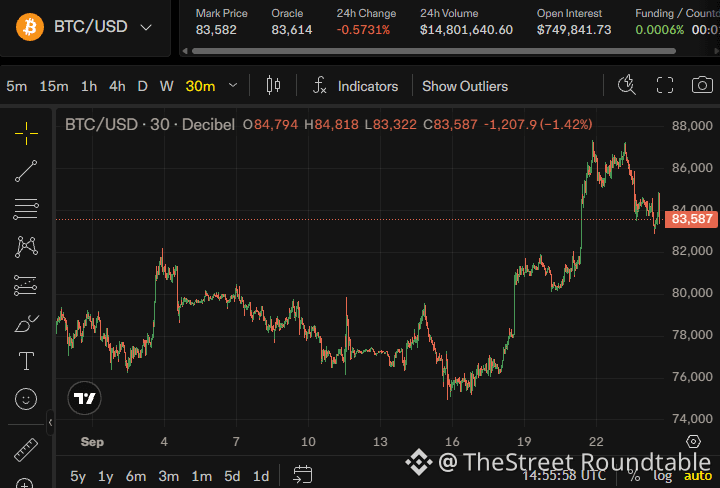
Article
Bloomberg analyst sends 2008 WTI oil warning on BitcoinMilitary roundtable: Heckman, Rayburn, Spencer assess Iran stalemate and oil-driven market impact (6:51)
While investors think a price rally is the best thing ever and the Bitcoin (BTC) community was euphoric when the top cryptocurrency hit $100,000 for the first time in December 2024. Bloomberg Intelligence’s senior commodity strategist Mike McGlone however doesn’t think in such bullish terms.
On Sep. 23, McGlone shared a price chart comparing Bitcoin and the West Texas Intermediate (WTI) crude oil to warn that the cryptocurrency could follow the oil benchmark’s downward slide since its first monthly close above $100 a barrel in February 2008.
Bitcoin and WTI crude oil comparison shared by McGlone
In 2008, the United States and Canada faced a combined crude oil and liquid fuels deficit of 10 million barrels a day. But the figure could turn into a surplus of nearly 9 million barrels a day by 2027, the analyst said.
Sufficient fuel supply has ensured that the WTI crude oil price has failed to rally beyond $100 a barrel despite momentary price surges. It is currently trading around $95 a barrel.
More on TheStreet Roundtable:
BlackRock predicts what happens once AI starts shopping
U.S. Treasury yields hit multi-decade highs, sending Bitcoin lower
Billionaire Tim Draper takes aim at Apple, Meta’s Bitcoin-free balance sheets
‘Similar rules of supply-and-demand economics’ may pressure Bitcoin
McGlone warned that like WTI, Bitcoin’s $100,000 price mark could also become the ceiling it wouldn’t be able to surpass due to “similar rules of supply-and-demand economics.”
Oil prices are frequently subject to geopolitical conflicts, weather changes, and fuel policy. Bitcoin proponents believe the cryptocurrency is immune to such pressures but McGlone argues otherwise.
The Bloomberg analyst is well-known for a skeptic view of Bitcoin and has frequently predicted it will crash to $10,000.
BTC/USD, Source: Decibel
Bitcoin was trading at $83,587 at the time of writing, as per Decibel.
Disclaimer: This article is for informational purposes only and does not constitute financial advice. Cryptocurrency investments are highly volatile and risky. Always conduct your own research before making any investment decisions.
Related: Tesla gains $122M on Bitcoin without buying a single coin
Bloomberg analyst sends 2008 WTI oil warning on Bitcoin
Military roundtable: Heckman, Rayburn, Spencer assess Iran stalemate and oil-driven market impact (6:51)
While investors think a price rally is the best thing ever and the Bitcoin (BTC) community was euphoric when the top cryptocurrency hit $100,000 for the first time in December 2024. Bloomberg Intelligence’s senior commodity strategist Mike McGlone however doesn’t think in such bullish terms.
On Sep. 23, McGlone shared a price chart comparing Bitcoin and the West Texas Intermediate (WTI) crude oil to warn that the cryptocurrency could follow the oil benchmark’s downward slide since its first monthly close above $100 a barrel in February 2008.
Bitcoin and WTI crude oil comparison shared by McGlone
In 2008, the United States and Canada faced a combined crude oil and liquid fuels deficit of 10 million barrels a day. But the figure could turn into a surplus of nearly 9 million barrels a day by 2027, the analyst said.
Sufficient fuel supply has ensured that the WTI crude oil price has failed to rally beyond $100 a barrel despite momentary price surges. It is currently trading around $95 a barrel.
More on TheStreet Roundtable:
BlackRock predicts what happens once AI starts shopping
U.S. Treasury yields hit multi-decade highs, sending Bitcoin lower
Billionaire Tim Draper takes aim at Apple, Meta’s Bitcoin-free balance sheets
‘Similar rules of supply-and-demand economics’ may pressure Bitcoin
McGlone warned that like WTI, Bitcoin’s $100,000 price mark could also become the ceiling it wouldn’t be able to surpass due to “similar rules of supply-and-demand economics.”
Oil prices are frequently subject to geopolitical conflicts, weather changes, and fuel policy. Bitcoin proponents believe the cryptocurrency is immune to such pressures but McGlone argues otherwise.
The Bloomberg analyst is well-known for a skeptic view of Bitcoin and has frequently predicted it will crash to $10,000.
BTC/USD, Source: Decibel
Bitcoin was trading at $83,587 at the time of writing, as per Decibel.
Disclaimer: This article is for informational purposes only and does not constitute financial advice. Cryptocurrency investments are highly volatile and risky. Always conduct your own research before making any investment decisions.
Related: Tesla gains $122M on Bitcoin without buying a single coin
While investors think a price rally is the best thing ever and the Bitcoin (BTC) community was euphoric when the top cryptocurrency hit $100,000 for the first time in December 2024. Bloomberg Intelligence’s senior commodity strategist Mike McGlone however doesn’t think in such bullish terms.
On Sep. 23, McGlone shared a price chart comparing Bitcoin and the West Texas Intermediate (WTI) crude oil to warn that the cryptocurrency could follow the oil benchmark’s downward slide since its first monthly close above $100 a barrel in February 2008.
Bitcoin and WTI crude oil comparison shared by McGlone
In 2008, the United States and Canada faced a combined crude oil and liquid fuels deficit of 10 million barrels a day. But the figure could turn into a surplus of nearly 9 million barrels a day by 2027, the analyst said.
Sufficient fuel supply has ensured that the WTI crude oil price has failed to rally beyond $100 a barrel despite momentary price surges. It is currently trading around $95 a barrel.
More on TheStreet Roundtable:
BlackRock predicts what happens once AI starts shopping
U.S. Treasury yields hit multi-decade highs, sending Bitcoin lower
Billionaire Tim Draper takes aim at Apple, Meta’s Bitcoin-free balance sheets
‘Similar rules of supply-and-demand economics’ may pressure Bitcoin
McGlone warned that like WTI, Bitcoin’s $100,000 price mark could also become the ceiling it wouldn’t be able to surpass due to “similar rules of supply-and-demand economics.”
Oil prices are frequently subject to geopolitical conflicts, weather changes, and fuel policy. Bitcoin proponents believe the cryptocurrency is immune to such pressures but McGlone argues otherwise.
The Bloomberg analyst is well-known for a skeptic view of Bitcoin and has frequently predicted it will crash to $10,000.
BTC/USD, Source: Decibel
Bitcoin was trading at $83,587 at the time of writing, as per Decibel.
Disclaimer: This article is for informational purposes only and does not constitute financial advice. Cryptocurrency investments are highly volatile and risky. Always conduct your own research before making any investment decisions.
Related: Tesla gains $122M on Bitcoin without buying a single coin
119
VanEck drops a surprising Bitcoin-bond correlation reality checkVanEck outlines change in SEC attitude toward crypto (1:46)
Speaking to CNBC, VanEck Head of Digital Assets Research Matthew Sigel pushed back on the idea that rate moves are steering Bitcoin’s price, pointing instead to the dollar.
"Bitcoin has virtually no correlation with bond yields, but it does have a persistent negative correlation with the DXY," he said, adding that the recent move in the dollar index explains the pullback better than any bond narrative.
Sigel credited the summer’s sharp rally to sellers simply running out. “That was sellers exhaustion, every single one of them fired over the summer,” he said.
From $58,000 to $86,000
Sigel added that Bitcoin’s climb from roughly $58,000 to $86,000 despite a Fed rate hike and the Clarity Act’s failure.
Related: Analyst says XRP could be ready for a big move
He flagged the 50-week moving average, near $78,000, as the level that matters most heading into the weekly close.
"If we hold that 78k by this Friday's close, then there's nothing to worry about," Sigel said. But he cautioned that roughly $20 billion in call-heavy options expiring this week could pressure prices lower in the short term.
On the size of the current drawdown compared with past cycles, Sigel pointed to falling volatility as the key difference.
Most Popular on TheStreet Roundtable:
JPMorgan says one asset class could soon beat gold
Kevin O’Leary has a warning on Washington’s tax plans
SEC Chair Atkins reveals what comes next if CLARITY Act stalls
“Look at the realized volatility of this asset. It’s down 50% over the last four years,” he said.
Sigel added that once adjusted for volatility, this cycle’s pullback is “pretty much in line with what we were expecting,” as institutional adoption grows.
“If rates keep going up at this pace, it's going to slow a lot of things. And Bitcoin may be the least of our worries. But the correlations over time, it's a negative correlation with the DXY, the dollar,” he further added.
Related: If you invested $1,000 in gold & Bitcoin 10 years ago, here's how much money you'd have today
VanEck drops a surprising Bitcoin-bond correlation reality check
VanEck outlines change in SEC attitude toward crypto (1:46)
Speaking to CNBC, VanEck Head of Digital Assets Research Matthew Sigel pushed back on the idea that rate moves are steering Bitcoin’s price, pointing instead to the dollar.
"Bitcoin has virtually no correlation with bond yields, but it does have a persistent negative correlation with the DXY," he said, adding that the recent move in the dollar index explains the pullback better than any bond narrative.
Sigel credited the summer’s sharp rally to sellers simply running out. “That was sellers exhaustion, every single one of them fired over the summer,” he said.
From $58,000 to $86,000
Sigel added that Bitcoin’s climb from roughly $58,000 to $86,000 despite a Fed rate hike and the Clarity Act’s failure.
Related: Analyst says XRP could be ready for a big move
He flagged the 50-week moving average, near $78,000, as the level that matters most heading into the weekly close.
"If we hold that 78k by this Friday's close, then there's nothing to worry about," Sigel said. But he cautioned that roughly $20 billion in call-heavy options expiring this week could pressure prices lower in the short term.
On the size of the current drawdown compared with past cycles, Sigel pointed to falling volatility as the key difference.
Most Popular on TheStreet Roundtable:
JPMorgan says one asset class could soon beat gold
Kevin O’Leary has a warning on Washington’s tax plans
SEC Chair Atkins reveals what comes next if CLARITY Act stalls
“Look at the realized volatility of this asset. It’s down 50% over the last four years,” he said.
Sigel added that once adjusted for volatility, this cycle’s pullback is “pretty much in line with what we were expecting,” as institutional adoption grows.
“If rates keep going up at this pace, it's going to slow a lot of things. And Bitcoin may be the least of our worries. But the correlations over time, it's a negative correlation with the DXY, the dollar,” he further added.
Related: If you invested $1,000 in gold & Bitcoin 10 years ago, here's how much money you'd have today
Speaking to CNBC, VanEck Head of Digital Assets Research Matthew Sigel pushed back on the idea that rate moves are steering Bitcoin’s price, pointing instead to the dollar.
"Bitcoin has virtually no correlation with bond yields, but it does have a persistent negative correlation with the DXY," he said, adding that the recent move in the dollar index explains the pullback better than any bond narrative.
Sigel credited the summer’s sharp rally to sellers simply running out. “That was sellers exhaustion, every single one of them fired over the summer,” he said.
From $58,000 to $86,000
Sigel added that Bitcoin’s climb from roughly $58,000 to $86,000 despite a Fed rate hike and the Clarity Act’s failure.
Related: Analyst says XRP could be ready for a big move
He flagged the 50-week moving average, near $78,000, as the level that matters most heading into the weekly close.
"If we hold that 78k by this Friday's close, then there's nothing to worry about," Sigel said. But he cautioned that roughly $20 billion in call-heavy options expiring this week could pressure prices lower in the short term.
On the size of the current drawdown compared with past cycles, Sigel pointed to falling volatility as the key difference.
Most Popular on TheStreet Roundtable:
JPMorgan says one asset class could soon beat gold
Kevin O’Leary has a warning on Washington’s tax plans
SEC Chair Atkins reveals what comes next if CLARITY Act stalls
“Look at the realized volatility of this asset. It’s down 50% over the last four years,” he said.
Sigel added that once adjusted for volatility, this cycle’s pullback is “pretty much in line with what we were expecting,” as institutional adoption grows.
“If rates keep going up at this pace, it's going to slow a lot of things. And Bitcoin may be the least of our worries. But the correlations over time, it's a negative correlation with the DXY, the dollar,” he further added.
Related: If you invested $1,000 in gold & Bitcoin 10 years ago, here's how much money you'd have today
178
U.S. Treasury yields hit multi-decade highs, sending Bitcoin lowerBlackRock says crypto could power AI commerce (1:41)
Bitcoin (BTC) gave up its recent gains to retreat much lower than the $87,000 price mark it recently reached as U.S. Treasury yields hit multi-decade highs on Sep. 24.
The 30-year Treasury bond yield hit a 2004 peak of around 5.44%, and the 10-year Treasury bond yield hit a 2007 peak above 5.13% earlier today, as per CNBC.
Yields and prices move in opposite directions, and the latest yield spike coincides with the rout in the bond market. The data suggests the market expects another interest rate hike from the Federal Reserve.
More on TheStreet Roundtable:
BlackRock predicts what happens once AI starts shopping
Analyst who predicted 2021 crash admits he was wrong about Bitcoin
Billionaire Tim Draper takes aim at Apple, Meta’s Bitcoin-free balance sheets
Bitcoin slips to $84,000
Bitcoin recently braved the CLARITY cloture failure in the U.S. Senate and the first Fed rate hike since 2023. It then saw a few immediate positive regulatory moves from the Donald Trump administration, such as the Bitcoin reserve bill getting advanced.
On Sep. 22, BTC surpassed the $87,000 price mark. The last time it went this high was in January.
But the leading cryptocurrency couldn’t sustain the rally following the recent spike in Treasury yields. It was trading at $84,208.97 at the time of writing, down 1.6% in a day.
Ethereum (ETH) also fell 2% to $2,668.39, and XRP fell 4.2% to $1.50.
The downturn was extended to meme coins too. While Dogecoin (DOGE) dropped 5.4% to trade at $0.09421, Shiba Inu (SHIB) fell 5% to $0.055703.
The total crypto market capitalization dropped 2.5% to $2.93 trillion at the time of writing.
Related: Shiba Inu investors eye highest-ever Q3 return
U.S. Treasury yields hit multi-decade highs, sending Bitcoin lower
BlackRock says crypto could power AI commerce (1:41)
Bitcoin (BTC) gave up its recent gains to retreat much lower than the $87,000 price mark it recently reached as U.S. Treasury yields hit multi-decade highs on Sep. 24.
The 30-year Treasury bond yield hit a 2004 peak of around 5.44%, and the 10-year Treasury bond yield hit a 2007 peak above 5.13% earlier today, as per CNBC.
Yields and prices move in opposite directions, and the latest yield spike coincides with the rout in the bond market. The data suggests the market expects another interest rate hike from the Federal Reserve.
More on TheStreet Roundtable:
BlackRock predicts what happens once AI starts shopping
Analyst who predicted 2021 crash admits he was wrong about Bitcoin
Billionaire Tim Draper takes aim at Apple, Meta’s Bitcoin-free balance sheets
Bitcoin slips to $84,000
Bitcoin recently braved the CLARITY cloture failure in the U.S. Senate and the first Fed rate hike since 2023. It then saw a few immediate positive regulatory moves from the Donald Trump administration, such as the Bitcoin reserve bill getting advanced.
On Sep. 22, BTC surpassed the $87,000 price mark. The last time it went this high was in January.
But the leading cryptocurrency couldn’t sustain the rally following the recent spike in Treasury yields. It was trading at $84,208.97 at the time of writing, down 1.6% in a day.
Ethereum (ETH) also fell 2% to $2,668.39, and XRP fell 4.2% to $1.50.
The downturn was extended to meme coins too. While Dogecoin (DOGE) dropped 5.4% to trade at $0.09421, Shiba Inu (SHIB) fell 5% to $0.055703.
The total crypto market capitalization dropped 2.5% to $2.93 trillion at the time of writing.
Related: Shiba Inu investors eye highest-ever Q3 return
Bitcoin (BTC) gave up its recent gains to retreat much lower than the $87,000 price mark it recently reached as U.S. Treasury yields hit multi-decade highs on Sep. 24.
The 30-year Treasury bond yield hit a 2004 peak of around 5.44%, and the 10-year Treasury bond yield hit a 2007 peak above 5.13% earlier today, as per CNBC.
Yields and prices move in opposite directions, and the latest yield spike coincides with the rout in the bond market. The data suggests the market expects another interest rate hike from the Federal Reserve.
More on TheStreet Roundtable:
BlackRock predicts what happens once AI starts shopping
Analyst who predicted 2021 crash admits he was wrong about Bitcoin
Billionaire Tim Draper takes aim at Apple, Meta’s Bitcoin-free balance sheets
Bitcoin slips to $84,000
Bitcoin recently braved the CLARITY cloture failure in the U.S. Senate and the first Fed rate hike since 2023. It then saw a few immediate positive regulatory moves from the Donald Trump administration, such as the Bitcoin reserve bill getting advanced.
On Sep. 22, BTC surpassed the $87,000 price mark. The last time it went this high was in January.
But the leading cryptocurrency couldn’t sustain the rally following the recent spike in Treasury yields. It was trading at $84,208.97 at the time of writing, down 1.6% in a day.
Ethereum (ETH) also fell 2% to $2,668.39, and XRP fell 4.2% to $1.50.
The downturn was extended to meme coins too. While Dogecoin (DOGE) dropped 5.4% to trade at $0.09421, Shiba Inu (SHIB) fell 5% to $0.055703.
The total crypto market capitalization dropped 2.5% to $2.93 trillion at the time of writing.
Related: Shiba Inu investors eye highest-ever Q3 return
840
Ondo brings BlackRock portfolio strategies onchain for the first timeOndo Finance CEO on why TradFi giants make Ondo stronger (4:23)
Ondo Finance has launched Ondo Intelligent Portfolios, a new product that packages professionally built investment strategies into single tokens. The tokens can be bought, held and transferred onchain.
The first three portfolios were constructed by BlackRock, the world’s largest asset manager. This marked the first time eligible onchain investors can access BlackRock-designed portfolio strategies through a single digital token.
A portfolio, in traditional investing, is a mix of assets, stocks, bonds, commodities, bundled together to balance risk and return. Building one typically requires a brokerage account, a financial adviser or access to a fund.
Related: Tesla gains $122M on Bitcoin without buying a single coin
Ondo’s product takes that same concept and delivers it as a token on a blockchain, meaning it can move between wallets, trade on exchanges and plug into decentralized finance applications the same way any cryptocurrency can.
Three strategies, three tokens
The initial lineup includes three portfolios, each targeting a different risk profile:
BLKHIon (Ondo High Income) — designed for investors seeking steady income
BLKDIGon (Ondo Diversified Growth) — targets a balance between growth and stability
BLKGRWon (Ondo High Growth) — aimed at investors willing to take on more risk for higher potential returns
All three are currently available to eligible non-U.S. investors in permitted jurisdictions.
Lisa O’Connor, who leads BlackRock’s Model Portfolio Solutions team, said tokenization opens new ways for portfolio strategies to reach investors through digital infrastructure.
She called it an example of “how established portfolio construction approaches can be delivered through new channels and technologies.”
Popular on TheStreet Roundtable:
Analyst sees $10T prediction boom but doubts U.S. markets
Bitcoin traders are taking bigger risks again and here’s why
Analyst sells Bitcoin at $85K and his reason might surprise you
What makes onchain portfolios different
Because these portfolios live on a blockchain, they come with features that traditional fund structures don’t offer.
Rebalancing, the process of adjusting a portfolio’s mix of assets to stay aligned with its target strategy, can be done programmatically rather than manually. Holdings are fully transparent and verifiable onchain.
And because each portfolio is a single transferable token, it can be integrated into lending protocols, used as collateral, or composed with other onchain financial products. The launch builds on Ondo’s broader push into tokenized financial products.
The company currently holds over $3.5 billion in total value locked, and lists more than 440 tokenized securities through Ondo Stocks. It recently became the first tokenization company to join DTCC’s Fund/SERV platform, which processes over 85% of U.S. mutual fund activity.
Related: BlackRock predicts what happens once AI starts shopping
Ondo brings BlackRock portfolio strategies onchain for the first time
Ondo Finance CEO on why TradFi giants make Ondo stronger (4:23)
Ondo Finance has launched Ondo Intelligent Portfolios, a new product that packages professionally built investment strategies into single tokens. The tokens can be bought, held and transferred onchain.
The first three portfolios were constructed by BlackRock, the world’s largest asset manager. This marked the first time eligible onchain investors can access BlackRock-designed portfolio strategies through a single digital token.
A portfolio, in traditional investing, is a mix of assets, stocks, bonds, commodities, bundled together to balance risk and return. Building one typically requires a brokerage account, a financial adviser or access to a fund.
Related: Tesla gains $122M on Bitcoin without buying a single coin
Ondo’s product takes that same concept and delivers it as a token on a blockchain, meaning it can move between wallets, trade on exchanges and plug into decentralized finance applications the same way any cryptocurrency can.
Three strategies, three tokens
The initial lineup includes three portfolios, each targeting a different risk profile:
BLKHIon (Ondo High Income) — designed for investors seeking steady income
BLKDIGon (Ondo Diversified Growth) — targets a balance between growth and stability
BLKGRWon (Ondo High Growth) — aimed at investors willing to take on more risk for higher potential returns
All three are currently available to eligible non-U.S. investors in permitted jurisdictions.
Lisa O’Connor, who leads BlackRock’s Model Portfolio Solutions team, said tokenization opens new ways for portfolio strategies to reach investors through digital infrastructure.
She called it an example of “how established portfolio construction approaches can be delivered through new channels and technologies.”
Popular on TheStreet Roundtable:
Analyst sees $10T prediction boom but doubts U.S. markets
Bitcoin traders are taking bigger risks again and here’s why
Analyst sells Bitcoin at $85K and his reason might surprise you
What makes onchain portfolios different
Because these portfolios live on a blockchain, they come with features that traditional fund structures don’t offer.
Rebalancing, the process of adjusting a portfolio’s mix of assets to stay aligned with its target strategy, can be done programmatically rather than manually. Holdings are fully transparent and verifiable onchain.
And because each portfolio is a single transferable token, it can be integrated into lending protocols, used as collateral, or composed with other onchain financial products. The launch builds on Ondo’s broader push into tokenized financial products.
The company currently holds over $3.5 billion in total value locked, and lists more than 440 tokenized securities through Ondo Stocks. It recently became the first tokenization company to join DTCC’s Fund/SERV platform, which processes over 85% of U.S. mutual fund activity.
Related: BlackRock predicts what happens once AI starts shopping
Ondo Finance has launched Ondo Intelligent Portfolios, a new product that packages professionally built investment strategies into single tokens. The tokens can be bought, held and transferred onchain.
The first three portfolios were constructed by BlackRock, the world’s largest asset manager. This marked the first time eligible onchain investors can access BlackRock-designed portfolio strategies through a single digital token.
A portfolio, in traditional investing, is a mix of assets, stocks, bonds, commodities, bundled together to balance risk and return. Building one typically requires a brokerage account, a financial adviser or access to a fund.
Related: Tesla gains $122M on Bitcoin without buying a single coin
Ondo’s product takes that same concept and delivers it as a token on a blockchain, meaning it can move between wallets, trade on exchanges and plug into decentralized finance applications the same way any cryptocurrency can.
Three strategies, three tokens
The initial lineup includes three portfolios, each targeting a different risk profile:
BLKHIon (Ondo High Income) — designed for investors seeking steady income
BLKDIGon (Ondo Diversified Growth) — targets a balance between growth and stability
BLKGRWon (Ondo High Growth) — aimed at investors willing to take on more risk for higher potential returns
All three are currently available to eligible non-U.S. investors in permitted jurisdictions.
Lisa O’Connor, who leads BlackRock’s Model Portfolio Solutions team, said tokenization opens new ways for portfolio strategies to reach investors through digital infrastructure.
She called it an example of “how established portfolio construction approaches can be delivered through new channels and technologies.”
Popular on TheStreet Roundtable:
Analyst sees $10T prediction boom but doubts U.S. markets
Bitcoin traders are taking bigger risks again and here’s why
Analyst sells Bitcoin at $85K and his reason might surprise you
What makes onchain portfolios different
Because these portfolios live on a blockchain, they come with features that traditional fund structures don’t offer.
Rebalancing, the process of adjusting a portfolio’s mix of assets to stay aligned with its target strategy, can be done programmatically rather than manually. Holdings are fully transparent and verifiable onchain.
And because each portfolio is a single transferable token, it can be integrated into lending protocols, used as collateral, or composed with other onchain financial products. The launch builds on Ondo’s broader push into tokenized financial products.
The company currently holds over $3.5 billion in total value locked, and lists more than 440 tokenized securities through Ondo Stocks. It recently became the first tokenization company to join DTCC’s Fund/SERV platform, which processes over 85% of U.S. mutual fund activity.
Related: BlackRock predicts what happens once AI starts shopping
1
480
AI expert reveals the jobs most likely to survive automationNansen CEO says AI can't replace jobs built on human presence (5:07)
AI is getting smarter almost every month, but so are concerns about what it means for workers.
A Sept. 17 Pew Research Center survey found that people in 34 of 37 countries were more likely to expect AI to reduce jobs over the next two decades than create them.
Concern was particularly high in Australia and South Korea, where 76% expected job losses, and in the United States at 71%.
Microsoft co-founder Bill Gates offered a similar warning on Aug. 26, writing that AI could rapidly affect law, customer service, medicine, software and manufacturing. He said the shift could happen within a decade and warned that without the right policies, there could be far fewer jobs than today.
But Alex Svanevik, co-founder and CEO of blockchain analytics firm Nansen, believes some work remains far harder to automate.
Related: Pepe surges 22%, leading Bitcoin, Dogecoin, XRP
AI may replace tasks but not human presence
Speaking on The Sujal Show podcast published Sept. 19, Svanevik pointed to healthcare and caregiving roles where physical presence remains central.
A nurse can use AI for many tasks, he said, but the job is still fundamentally embodied.
“You have to be present, you have to be in the room with the patient.”
He made a similar argument for physiotherapists, caretakers and massage therapists. AI can assist with diagnosis, planning or instructions, but it cannot easily reproduce physical interaction and trust.
More on TheStreet Roundtable:
Analyst sells Bitcoin at $85K and his reason might surprise you
Veteran trader who called 1980 gold crash sees 200% upside for Ether
Analyst predicts 35% upside for Saylor’s Strategy
Education could follow a similar path. Svanevik expects personalized AI tutors to become widespread quickly, but said children will still need human supervisors and mentors.
Rather than eliminating teachers, he argued that AI could change their role and potentially increase demand for more individualized human guidance. He suggested a model with roughly one mentor for every five students, instead of one teacher addressing a class of 25.
Healthcare and education are not the only examples. Svanevik said live entertainment could also remain resilient, including theater, concerts and sports.
“I don’t think we’re gonna see like robot opera singers become very popular.”
He said robotic performers may create new forms of entertainment, but are more likely to be additive than replace human performers.
Related: Analysts rank eToro 11 spots above PayPal
AI expert reveals the jobs most likely to survive automation
Nansen CEO says AI can't replace jobs built on human presence (5:07)
AI is getting smarter almost every month, but so are concerns about what it means for workers.
A Sept. 17 Pew Research Center survey found that people in 34 of 37 countries were more likely to expect AI to reduce jobs over the next two decades than create them.
Concern was particularly high in Australia and South Korea, where 76% expected job losses, and in the United States at 71%.
Microsoft co-founder Bill Gates offered a similar warning on Aug. 26, writing that AI could rapidly affect law, customer service, medicine, software and manufacturing. He said the shift could happen within a decade and warned that without the right policies, there could be far fewer jobs than today.
But Alex Svanevik, co-founder and CEO of blockchain analytics firm Nansen, believes some work remains far harder to automate.
Related: Pepe surges 22%, leading Bitcoin, Dogecoin, XRP
AI may replace tasks but not human presence
Speaking on The Sujal Show podcast published Sept. 19, Svanevik pointed to healthcare and caregiving roles where physical presence remains central.
A nurse can use AI for many tasks, he said, but the job is still fundamentally embodied.
“You have to be present, you have to be in the room with the patient.”
He made a similar argument for physiotherapists, caretakers and massage therapists. AI can assist with diagnosis, planning or instructions, but it cannot easily reproduce physical interaction and trust.
More on TheStreet Roundtable:
Analyst sells Bitcoin at $85K and his reason might surprise you
Veteran trader who called 1980 gold crash sees 200% upside for Ether
Analyst predicts 35% upside for Saylor’s Strategy
Education could follow a similar path. Svanevik expects personalized AI tutors to become widespread quickly, but said children will still need human supervisors and mentors.
Rather than eliminating teachers, he argued that AI could change their role and potentially increase demand for more individualized human guidance. He suggested a model with roughly one mentor for every five students, instead of one teacher addressing a class of 25.
Healthcare and education are not the only examples. Svanevik said live entertainment could also remain resilient, including theater, concerts and sports.
“I don’t think we’re gonna see like robot opera singers become very popular.”
He said robotic performers may create new forms of entertainment, but are more likely to be additive than replace human performers.
Related: Analysts rank eToro 11 spots above PayPal
AI is getting smarter almost every month, but so are concerns about what it means for workers.
A Sept. 17 Pew Research Center survey found that people in 34 of 37 countries were more likely to expect AI to reduce jobs over the next two decades than create them.
Concern was particularly high in Australia and South Korea, where 76% expected job losses, and in the United States at 71%.
Microsoft co-founder Bill Gates offered a similar warning on Aug. 26, writing that AI could rapidly affect law, customer service, medicine, software and manufacturing. He said the shift could happen within a decade and warned that without the right policies, there could be far fewer jobs than today.
But Alex Svanevik, co-founder and CEO of blockchain analytics firm Nansen, believes some work remains far harder to automate.
Related: Pepe surges 22%, leading Bitcoin, Dogecoin, XRP
AI may replace tasks but not human presence
Speaking on The Sujal Show podcast published Sept. 19, Svanevik pointed to healthcare and caregiving roles where physical presence remains central.
A nurse can use AI for many tasks, he said, but the job is still fundamentally embodied.
“You have to be present, you have to be in the room with the patient.”
He made a similar argument for physiotherapists, caretakers and massage therapists. AI can assist with diagnosis, planning or instructions, but it cannot easily reproduce physical interaction and trust.
More on TheStreet Roundtable:
Analyst sells Bitcoin at $85K and his reason might surprise you
Veteran trader who called 1980 gold crash sees 200% upside for Ether
Analyst predicts 35% upside for Saylor’s Strategy
Education could follow a similar path. Svanevik expects personalized AI tutors to become widespread quickly, but said children will still need human supervisors and mentors.
Rather than eliminating teachers, he argued that AI could change their role and potentially increase demand for more individualized human guidance. He suggested a model with roughly one mentor for every five students, instead of one teacher addressing a class of 25.
Healthcare and education are not the only examples. Svanevik said live entertainment could also remain resilient, including theater, concerts and sports.
“I don’t think we’re gonna see like robot opera singers become very popular.”
He said robotic performers may create new forms of entertainment, but are more likely to be additive than replace human performers.
Related: Analysts rank eToro 11 spots above PayPal
6
Billionaire Tim Draper takes aim at Apple, Meta's Bitcoin-free balance sheetsTim Draper on America Party (4:17)
Billionaire venture capitalist Tim Draper says some of the world’s biggest technology companies are taking an unnecessary risk by keeping Bitcoin off their balance sheets.
In a new interview on the Bitcoin Magazine podcast on Sept. 21, Draper said it is “irresponsible” for companies such as Apple and Meta not to hold enough Bitcoin to cover about a month of operating expenses.
“Both of them put your dollars at risk”
Draper’s argument rests on his view of U.S. fiscal policy.
“If I’m the head of the treasury and I’m looking at the ridiculous amount of government spending that’s been going on for the last 10 years, and the possibility of hyperinflation or crazy high interest rates, I would hold at least four weeks worth of Bitcoin on my balance sheet,” he said.
He used Apple as his example.
"Imagine being Apple. You've got all your money tied up in dollars, and it's a huge amount, crazy amounts of dollars, and you aren't holding any Bitcoin," Draper said. "That's irresponsible in a time like now, where you don't see an end to government spending."
Either outcome, he added, puts “your dollars at risk.”
A warning for corporate boards
Draper claimed that board members of a public company with no Bitcoin could be “personally liable for two to four weeks of employee compensation” if a bank holding the company’s cash fails. He did not cite a law or case to support that claim.
He added that individuals should keep around six months of reserves in Bitcoin, according to Bitcoin Magazine.
More on TheStreet Roundtable
BlackRock predicts what happens once AI starts shopping
Analyst who predicted 2021 crash admits he was wrong about Bitcoin
Shiba Inu investors eye highest-ever Q3 return
Long-time Bitcoin bull
Draper bought nearly 30,000 BTC at a 2014 U.S. Marshals Service auction of coins seized from the Silk Road marketplace. He has repeatedly made bold price predictions since then.
His comments add to a wider debate over corporate Bitcoin treasuries. Strategy now holds about 846,000 BTC, while critics such as Peter Schiff call Bitcoin worthless. Neither Apple nor Meta has disclosed any Bitcoin holdings.
Billionaire Tim Draper takes aim at Apple, Meta's Bitcoin-free balance sheets
Tim Draper on America Party (4:17)
Billionaire venture capitalist Tim Draper says some of the world’s biggest technology companies are taking an unnecessary risk by keeping Bitcoin off their balance sheets.
In a new interview on the Bitcoin Magazine podcast on Sept. 21, Draper said it is “irresponsible” for companies such as Apple and Meta not to hold enough Bitcoin to cover about a month of operating expenses.
“Both of them put your dollars at risk”
Draper’s argument rests on his view of U.S. fiscal policy.
“If I’m the head of the treasury and I’m looking at the ridiculous amount of government spending that’s been going on for the last 10 years, and the possibility of hyperinflation or crazy high interest rates, I would hold at least four weeks worth of Bitcoin on my balance sheet,” he said.
He used Apple as his example.
"Imagine being Apple. You've got all your money tied up in dollars, and it's a huge amount, crazy amounts of dollars, and you aren't holding any Bitcoin," Draper said. "That's irresponsible in a time like now, where you don't see an end to government spending."
Either outcome, he added, puts “your dollars at risk.”
A warning for corporate boards
Draper claimed that board members of a public company with no Bitcoin could be “personally liable for two to four weeks of employee compensation” if a bank holding the company’s cash fails. He did not cite a law or case to support that claim.
He added that individuals should keep around six months of reserves in Bitcoin, according to Bitcoin Magazine.
More on TheStreet Roundtable
BlackRock predicts what happens once AI starts shopping
Analyst who predicted 2021 crash admits he was wrong about Bitcoin
Shiba Inu investors eye highest-ever Q3 return
Long-time Bitcoin bull
Draper bought nearly 30,000 BTC at a 2014 U.S. Marshals Service auction of coins seized from the Silk Road marketplace. He has repeatedly made bold price predictions since then.
His comments add to a wider debate over corporate Bitcoin treasuries. Strategy now holds about 846,000 BTC, while critics such as Peter Schiff call Bitcoin worthless. Neither Apple nor Meta has disclosed any Bitcoin holdings.
Billionaire venture capitalist Tim Draper says some of the world’s biggest technology companies are taking an unnecessary risk by keeping Bitcoin off their balance sheets.
In a new interview on the Bitcoin Magazine podcast on Sept. 21, Draper said it is “irresponsible” for companies such as Apple and Meta not to hold enough Bitcoin to cover about a month of operating expenses.
“Both of them put your dollars at risk”
Draper’s argument rests on his view of U.S. fiscal policy.
“If I’m the head of the treasury and I’m looking at the ridiculous amount of government spending that’s been going on for the last 10 years, and the possibility of hyperinflation or crazy high interest rates, I would hold at least four weeks worth of Bitcoin on my balance sheet,” he said.
He used Apple as his example.
"Imagine being Apple. You've got all your money tied up in dollars, and it's a huge amount, crazy amounts of dollars, and you aren't holding any Bitcoin," Draper said. "That's irresponsible in a time like now, where you don't see an end to government spending."
Either outcome, he added, puts “your dollars at risk.”
A warning for corporate boards
Draper claimed that board members of a public company with no Bitcoin could be “personally liable for two to four weeks of employee compensation” if a bank holding the company’s cash fails. He did not cite a law or case to support that claim.
He added that individuals should keep around six months of reserves in Bitcoin, according to Bitcoin Magazine.
More on TheStreet Roundtable
BlackRock predicts what happens once AI starts shopping
Analyst who predicted 2021 crash admits he was wrong about Bitcoin
Shiba Inu investors eye highest-ever Q3 return
Long-time Bitcoin bull
Draper bought nearly 30,000 BTC at a 2014 U.S. Marshals Service auction of coins seized from the Silk Road marketplace. He has repeatedly made bold price predictions since then.
His comments add to a wider debate over corporate Bitcoin treasuries. Strategy now holds about 846,000 BTC, while critics such as Peter Schiff call Bitcoin worthless. Neither Apple nor Meta has disclosed any Bitcoin holdings.
133
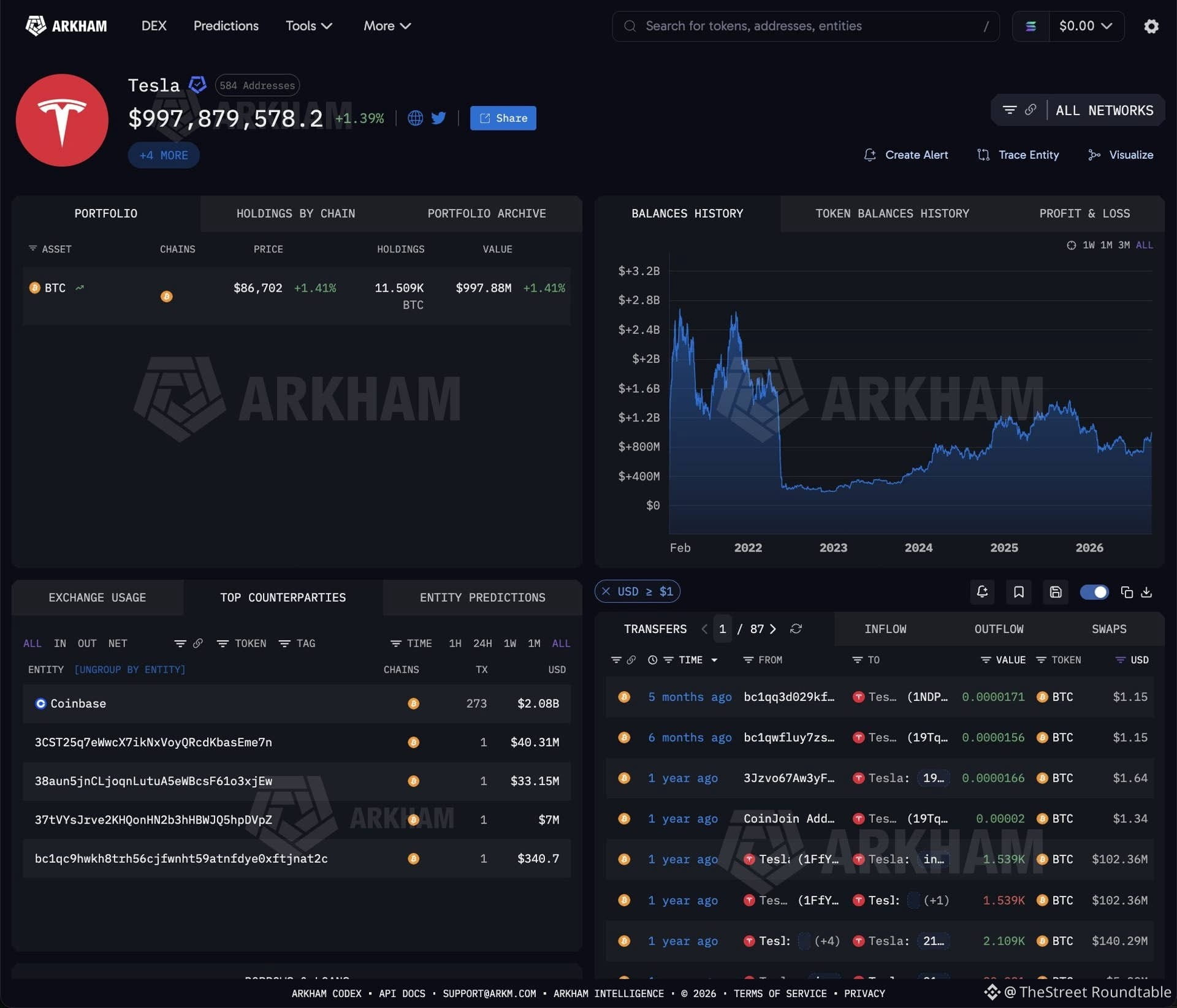
Article
Tesla makes $122M on Bitcoin without buying a single coinElon Musk's Tesla doesn't sell Bitcoin (1:42)
Tesla’s Bitcoin holdings have climbed to approximately $994.9 million, just $5.1 million short of the $1 billion milestone, after Bitcoin’s recent rally pushed prices above $86,000, according to onchain data from Arkham Intelligence.
Tesla is an electric vehicle and clean energy company led by Elon Musk, who has publicly held Bitcoin since at least 2021. The company holds 11,509 BTC across 584 onchain addresses, Arkham data shows.
The value of those holdings rose roughly $122.62 million in a single week as Bitcoin surged approximately 14%, the data shows.
The gains are entirely unrealized, meaning Tesla has not sold any Bitcoin or locked in any profit. The holdings have simply appreciated in value as Bitcoin’s price climbed.
Related: Bitcoin tops $86,000 despite CLARITY vote failure
A position that survived two sell-offs
Tesla first bought Bitcoin in February 2021, purchasing 43,200 BTC. The company sold 10% of that position in Q1 2021 and roughly 75% of its remaining holdings in Q2 2022.
Source: Arkham data
Source: Arkham data
Coinbase is listed as the primary counterparty on Tesla’s onchain activity, with 273 transactions totaling $2.08 billion flowing through the exchange.
Trending on TheStreet Roundtable:
Analyst sees $10T prediction boom but doubts U.S. markets
Bitcoin traders are taking bigger risks again and here’s why
Analyst sells Bitcoin at $85K and his reason might surprise you
Closing in on a milestone without doing anything
What makes the near-billion-dollar mark notable is that Tesla reached it passively. Tesla has not disclosed any recent Bitcoin purchases or sales. The appreciation is entirely a function of Bitcoin’s price movement, not active trading or additional purchases.
At Bitcoin’s price of $86,702 in the Arkham snapshot, the holdings sat at $997.88 million. Bitcoin was trading at approximately $84,197 at the time of writing, which would put the value slightly lower at around $969 million, still within striking distance if Bitcoin reclaims recent highs.
Related: Analyst who predicted 2021 crash admits he was wrong about Bitcoin
Tesla makes $122M on Bitcoin without buying a single coin
Elon Musk's Tesla doesn't sell Bitcoin (1:42)
Tesla’s Bitcoin holdings have climbed to approximately $994.9 million, just $5.1 million short of the $1 billion milestone, after Bitcoin’s recent rally pushed prices above $86,000, according to onchain data from Arkham Intelligence.
Tesla is an electric vehicle and clean energy company led by Elon Musk, who has publicly held Bitcoin since at least 2021. The company holds 11,509 BTC across 584 onchain addresses, Arkham data shows.
The value of those holdings rose roughly $122.62 million in a single week as Bitcoin surged approximately 14%, the data shows.
The gains are entirely unrealized, meaning Tesla has not sold any Bitcoin or locked in any profit. The holdings have simply appreciated in value as Bitcoin’s price climbed.
Related: Bitcoin tops $86,000 despite CLARITY vote failure
A position that survived two sell-offs
Tesla first bought Bitcoin in February 2021, purchasing 43,200 BTC. The company sold 10% of that position in Q1 2021 and roughly 75% of its remaining holdings in Q2 2022.
Source: Arkham data
Source: Arkham data
Coinbase is listed as the primary counterparty on Tesla’s onchain activity, with 273 transactions totaling $2.08 billion flowing through the exchange.
Trending on TheStreet Roundtable:
Analyst sees $10T prediction boom but doubts U.S. markets
Bitcoin traders are taking bigger risks again and here’s why
Analyst sells Bitcoin at $85K and his reason might surprise you
Closing in on a milestone without doing anything
What makes the near-billion-dollar mark notable is that Tesla reached it passively. Tesla has not disclosed any recent Bitcoin purchases or sales. The appreciation is entirely a function of Bitcoin’s price movement, not active trading or additional purchases.
At Bitcoin’s price of $86,702 in the Arkham snapshot, the holdings sat at $997.88 million. Bitcoin was trading at approximately $84,197 at the time of writing, which would put the value slightly lower at around $969 million, still within striking distance if Bitcoin reclaims recent highs.
Related: Analyst who predicted 2021 crash admits he was wrong about Bitcoin
Tesla’s Bitcoin holdings have climbed to approximately $994.9 million, just $5.1 million short of the $1 billion milestone, after Bitcoin’s recent rally pushed prices above $86,000, according to onchain data from Arkham Intelligence.
Tesla is an electric vehicle and clean energy company led by Elon Musk, who has publicly held Bitcoin since at least 2021. The company holds 11,509 BTC across 584 onchain addresses, Arkham data shows.
The value of those holdings rose roughly $122.62 million in a single week as Bitcoin surged approximately 14%, the data shows.
The gains are entirely unrealized, meaning Tesla has not sold any Bitcoin or locked in any profit. The holdings have simply appreciated in value as Bitcoin’s price climbed.
Related: Bitcoin tops $86,000 despite CLARITY vote failure
A position that survived two sell-offs
Tesla first bought Bitcoin in February 2021, purchasing 43,200 BTC. The company sold 10% of that position in Q1 2021 and roughly 75% of its remaining holdings in Q2 2022.
Source: Arkham data
Source: Arkham data
Coinbase is listed as the primary counterparty on Tesla’s onchain activity, with 273 transactions totaling $2.08 billion flowing through the exchange.
Trending on TheStreet Roundtable:
Analyst sees $10T prediction boom but doubts U.S. markets
Bitcoin traders are taking bigger risks again and here’s why
Analyst sells Bitcoin at $85K and his reason might surprise you
Closing in on a milestone without doing anything
What makes the near-billion-dollar mark notable is that Tesla reached it passively. Tesla has not disclosed any recent Bitcoin purchases or sales. The appreciation is entirely a function of Bitcoin’s price movement, not active trading or additional purchases.
At Bitcoin’s price of $86,702 in the Arkham snapshot, the holdings sat at $997.88 million. Bitcoin was trading at approximately $84,197 at the time of writing, which would put the value slightly lower at around $969 million, still within striking distance if Bitcoin reclaims recent highs.
Related: Analyst who predicted 2021 crash admits he was wrong about Bitcoin
128
Partly True
Washington’s oil lever is depleted, John Divine says the next move is in the VIX and natural gasWashington’s oil lever is depleted, John Divine says the next move is in the VIX and natural gas (2:40)
Ukraine’s largest drone barrage of the war knocked out crude distillation units at a 245,000 barrels-per-day Moscow refinery on Sunday, Sept. 20th, hours after Houthi missiles sent Riyadh to its first air-raid already since July and President Trump cut a Camp David weekend short.
Speaking to TheStreet Roundtable, Roundtable 100 Blue Ribbon Committee analyst John Divine said the market had “kind of put (Ukraine) to the side for a bit,” and that if it comes back into focus, “oil is going to be expressed and likely higher, and that’s not going to be good for a continued push for the broader equity markets.”
The Monday happened. Crude fell 5.4% to $95.94 and Brent dropped to $100.34 as Trump floated meeting Iran’s president at the UN. The S&P 500 had its best day since early August, with energy being the only sector down, showing that the Iran war premium came out faster than the Moscow strike went in.
Related: Strategy's latest Bitcoin buy moves stack closer to June peak
The VIX is the tell
That doesn’t break Divine’s framework so much as confirm its second half. His trigger isn’t a crude print, its S&P volatility.
"If we start to see VIX trading above $21, $22, $23, holding firm, that could be a sign that volatility is gonna break out, and effectively it's a hedge for downside movement in the S&P 500,” he said.
The VIX, which measures market volatility, closed Monday at $14.87. By Divine’s own test, equities aren’t pricing either war.
The pain is at the pump, not in stocks. Diesel hit a record $6.51 on Sept. 21, up 82% this year after Middle East and Ukraine supply shocks already pushed it past $6 on Sept. 11. Gasoline accounted for over a third of August’s 0.4% CPI increase, per the Bureau of Labor Statistics.
The emergency lever is almost gone
Washington’s one fast fix has been spent down over the last three administrations. The Strategic Petroleum Reserve (SPR) peaked near 727 million barrels.
Congressionally mandated sales during Trump’s first term drained roughly 57 million, and his 2020 plan to refill it with 77 million barrels at $20 per died in the Senate after then-minority leader Chuck Schumer called it a “bailout” for big oil.
Biden then authorized about 260 million barrels of releases, 50 million in late 2021, 30 million with the International Energy Agency (IEA) in March 2022, and a record 180 million over the six months after Russia invaded Ukraine. This took the reserve to a 40-year low near 347 million barrels before buying back roughly 59 million.
Trump inherited about 395 million barrels in January 2025 and has since committed 172 million barrels in March plus a 53.3 million barrel exchange in May.
The reserve fell below 300 million barrels in August, the lowest since 1983, and sits at 285 million today, about 40% of capacity.
Divine says this lever has been “basically drained” and does not expect that the Trump admin will be able to use it to lower oil prices for consumers.
More news:
Roundtable Secures 10-Year, $1 Billion Agreement, Bringing its AI/DeFi Media Operating System to Global Scale and Profitability
Analyst predicts 35% upside for Saylor’s Strategy
Fairshake comes for crypto’s priciest critic again
The hedge nobody is watching
The trade he thinks is being ignored is natural gas.
"Natural gas has been trading sideways for months and not really reacting to a lot of the stories that are coming out that are moving crude," he said. "If you're looking for a hedge, there's homework to be done there."
Henry Hub, which sets the standard for American natural gas prices, has been stuck below $3 all summer. The counterargument is storage. US inventories are 5.2% above the five-year average, and Hormuz LNG (liquid natural gas) flows just hit a six-month high, even as HSBC warns the strait is still running at 30% of pre-war volume.
Divine’s bottom line is that the oil markets are “begging the world to find some peace.” Monday’s drawdown was an indicator that it might.
Washington’s oil lever is depleted, John Divine says the next move is in the VIX and natural gas
Washington’s oil lever is depleted, John Divine says the next move is in the VIX and natural gas (2:40)
Ukraine’s largest drone barrage of the war knocked out crude distillation units at a 245,000 barrels-per-day Moscow refinery on Sunday, Sept. 20th, hours after Houthi missiles sent Riyadh to its first air-raid already since July and President Trump cut a Camp David weekend short.
Speaking to TheStreet Roundtable, Roundtable 100 Blue Ribbon Committee analyst John Divine said the market had “kind of put (Ukraine) to the side for a bit,” and that if it comes back into focus, “oil is going to be expressed and likely higher, and that’s not going to be good for a continued push for the broader equity markets.”
The Monday happened. Crude fell 5.4% to $95.94 and Brent dropped to $100.34 as Trump floated meeting Iran’s president at the UN. The S&P 500 had its best day since early August, with energy being the only sector down, showing that the Iran war premium came out faster than the Moscow strike went in.
Related: Strategy's latest Bitcoin buy moves stack closer to June peak
The VIX is the tell
That doesn’t break Divine’s framework so much as confirm its second half. His trigger isn’t a crude print, its S&P volatility.
"If we start to see VIX trading above $21, $22, $23, holding firm, that could be a sign that volatility is gonna break out, and effectively it's a hedge for downside movement in the S&P 500,” he said.
The VIX, which measures market volatility, closed Monday at $14.87. By Divine’s own test, equities aren’t pricing either war.
The pain is at the pump, not in stocks. Diesel hit a record $6.51 on Sept. 21, up 82% this year after Middle East and Ukraine supply shocks already pushed it past $6 on Sept. 11. Gasoline accounted for over a third of August’s 0.4% CPI increase, per the Bureau of Labor Statistics.
The emergency lever is almost gone
Washington’s one fast fix has been spent down over the last three administrations. The Strategic Petroleum Reserve (SPR) peaked near 727 million barrels.
Congressionally mandated sales during Trump’s first term drained roughly 57 million, and his 2020 plan to refill it with 77 million barrels at $20 per died in the Senate after then-minority leader Chuck Schumer called it a “bailout” for big oil.
Biden then authorized about 260 million barrels of releases, 50 million in late 2021, 30 million with the International Energy Agency (IEA) in March 2022, and a record 180 million over the six months after Russia invaded Ukraine. This took the reserve to a 40-year low near 347 million barrels before buying back roughly 59 million.
Trump inherited about 395 million barrels in January 2025 and has since committed 172 million barrels in March plus a 53.3 million barrel exchange in May.
The reserve fell below 300 million barrels in August, the lowest since 1983, and sits at 285 million today, about 40% of capacity.
Divine says this lever has been “basically drained” and does not expect that the Trump admin will be able to use it to lower oil prices for consumers.
More news:
Roundtable Secures 10-Year, $1 Billion Agreement, Bringing its AI/DeFi Media Operating System to Global Scale and Profitability
Analyst predicts 35% upside for Saylor’s Strategy
Fairshake comes for crypto’s priciest critic again
The hedge nobody is watching
The trade he thinks is being ignored is natural gas.
"Natural gas has been trading sideways for months and not really reacting to a lot of the stories that are coming out that are moving crude," he said. "If you're looking for a hedge, there's homework to be done there."
Henry Hub, which sets the standard for American natural gas prices, has been stuck below $3 all summer. The counterargument is storage. US inventories are 5.2% above the five-year average, and Hormuz LNG (liquid natural gas) flows just hit a six-month high, even as HSBC warns the strait is still running at 30% of pre-war volume.
Divine’s bottom line is that the oil markets are “begging the world to find some peace.” Monday’s drawdown was an indicator that it might.
Ukraine’s largest drone barrage of the war knocked out crude distillation units at a 245,000 barrels-per-day Moscow refinery on Sunday, Sept. 20th, hours after Houthi missiles sent Riyadh to its first air-raid already since July and President Trump cut a Camp David weekend short.
Speaking to TheStreet Roundtable, Roundtable 100 Blue Ribbon Committee analyst John Divine said the market had “kind of put (Ukraine) to the side for a bit,” and that if it comes back into focus, “oil is going to be expressed and likely higher, and that’s not going to be good for a continued push for the broader equity markets.”
The Monday happened. Crude fell 5.4% to $95.94 and Brent dropped to $100.34 as Trump floated meeting Iran’s president at the UN. The S&P 500 had its best day since early August, with energy being the only sector down, showing that the Iran war premium came out faster than the Moscow strike went in.
Related: Strategy's latest Bitcoin buy moves stack closer to June peak
The VIX is the tell
That doesn’t break Divine’s framework so much as confirm its second half. His trigger isn’t a crude print, its S&P volatility.
"If we start to see VIX trading above $21, $22, $23, holding firm, that could be a sign that volatility is gonna break out, and effectively it's a hedge for downside movement in the S&P 500,” he said.
The VIX, which measures market volatility, closed Monday at $14.87. By Divine’s own test, equities aren’t pricing either war.
The pain is at the pump, not in stocks. Diesel hit a record $6.51 on Sept. 21, up 82% this year after Middle East and Ukraine supply shocks already pushed it past $6 on Sept. 11. Gasoline accounted for over a third of August’s 0.4% CPI increase, per the Bureau of Labor Statistics.
The emergency lever is almost gone
Washington’s one fast fix has been spent down over the last three administrations. The Strategic Petroleum Reserve (SPR) peaked near 727 million barrels.
Congressionally mandated sales during Trump’s first term drained roughly 57 million, and his 2020 plan to refill it with 77 million barrels at $20 per died in the Senate after then-minority leader Chuck Schumer called it a “bailout” for big oil.
Biden then authorized about 260 million barrels of releases, 50 million in late 2021, 30 million with the International Energy Agency (IEA) in March 2022, and a record 180 million over the six months after Russia invaded Ukraine. This took the reserve to a 40-year low near 347 million barrels before buying back roughly 59 million.
Trump inherited about 395 million barrels in January 2025 and has since committed 172 million barrels in March plus a 53.3 million barrel exchange in May.
The reserve fell below 300 million barrels in August, the lowest since 1983, and sits at 285 million today, about 40% of capacity.
Divine says this lever has been “basically drained” and does not expect that the Trump admin will be able to use it to lower oil prices for consumers.
More news:
Roundtable Secures 10-Year, $1 Billion Agreement, Bringing its AI/DeFi Media Operating System to Global Scale and Profitability
Analyst predicts 35% upside for Saylor’s Strategy
Fairshake comes for crypto’s priciest critic again
The hedge nobody is watching
The trade he thinks is being ignored is natural gas.
"Natural gas has been trading sideways for months and not really reacting to a lot of the stories that are coming out that are moving crude," he said. "If you're looking for a hedge, there's homework to be done there."
Henry Hub, which sets the standard for American natural gas prices, has been stuck below $3 all summer. The counterargument is storage. US inventories are 5.2% above the five-year average, and Hormuz LNG (liquid natural gas) flows just hit a six-month high, even as HSBC warns the strait is still running at 30% of pre-war volume.
Divine’s bottom line is that the oil markets are “begging the world to find some peace.” Monday’s drawdown was an indicator that it might.
585
Dynatrace beats Adobe by 44 spots in power rankingRoundtable 100 analyst on Solana, NEAR (4:43)
Dynatrace (NYSE: DT) stands at No. 15 in the Roundtable 100 this week, 44 spots higher than Adobe (Nasdaq: ADBE).
Dynatrace is an AI-powered observability and application performance monitoring (APM) platform that helps organizations manage, optimize, and secure complex cloud-native and hybrid environments. The company has a market cap of nearly $17 billion.
Abobe is a software company that offers an array of programs on photo, video, and audio editing, mobile app development, and animation. Adobe Creative Suite, a bunch of subscription-based products, is very popular in the media industry. The company has a market cap of nearly $95 billion.
Analysts move both Dynatrace and Adobe lower
Published with TheStreet, the Roundtable 100 ranks 100 publicly traded technology growth assets. Committee analysts score each asset on team, safety, value, innovation, and market dominance, with the average forming its power ranking.
The analysts moved both Dynatrace and Adobe lower by 12 and 17 spots. While the former stands at No. 15, the latter at No. 59.
Nonetheless, Dynatrace stands 44 places above Adobe in the Roundtable 100 despite the stark difference in their market caps. It is so because the analysts rank a company on the basis of its future growth potential instead of its current market standing.
Follow Dynatrace on the Roundtable 100
More on TheStreet Roundtable:
Fidelity analyst predicts new 4-year Bitcoin bull market
Veteran trader who called 1980 gold crash sees 200% upside for Ether
Analyst predicts 35% upside for Saylor’s Strategy
Major movers this week
Keel Infrastructure (Nasdaq: KEEL) rose 11 spots higher to No. 6 in the Roundtable 100 this week. Sezzle (Nasdaq: SEZL) moved 18 spots higher to No. 10. BitGo Holdings (NYSE: BTGO) moved 15 spots higher to No. 72.
On the other hand, Root (Nasdaq: ROOT) slipped eight places to No. 14. Galaxy Digital (Nasdaq: GLXY) also fell 11 spots to No. 41.
See the full ranking.
Disclaimer: This article is for informational purposes only and does not constitute financial advice. Investments are subject to market risk. Always conduct your own research before making any investment decisions.
Disclosure: RTB Digital, Inc. (Nasdaq: RTB), publisher of the Roundtable 100, is itself a ranked constituent of the index. The Roundtable 100 is published for informational purposes only and is not investment advice, an offer, or a recommendation to buy or sell any security, commodity or digital asset. Rankings reflect the views of Roundtable analysts as of the ranking date. Investing involves risk, including loss of principal.
Related: Shiba Inu investors eye highest-ever Q3 return
Dynatrace beats Adobe by 44 spots in power ranking
Roundtable 100 analyst on Solana, NEAR (4:43)
Dynatrace (NYSE: DT) stands at No. 15 in the Roundtable 100 this week, 44 spots higher than Adobe (Nasdaq: ADBE).
Dynatrace is an AI-powered observability and application performance monitoring (APM) platform that helps organizations manage, optimize, and secure complex cloud-native and hybrid environments. The company has a market cap of nearly $17 billion.
Abobe is a software company that offers an array of programs on photo, video, and audio editing, mobile app development, and animation. Adobe Creative Suite, a bunch of subscription-based products, is very popular in the media industry. The company has a market cap of nearly $95 billion.
Analysts move both Dynatrace and Adobe lower
Published with TheStreet, the Roundtable 100 ranks 100 publicly traded technology growth assets. Committee analysts score each asset on team, safety, value, innovation, and market dominance, with the average forming its power ranking.
The analysts moved both Dynatrace and Adobe lower by 12 and 17 spots. While the former stands at No. 15, the latter at No. 59.
Nonetheless, Dynatrace stands 44 places above Adobe in the Roundtable 100 despite the stark difference in their market caps. It is so because the analysts rank a company on the basis of its future growth potential instead of its current market standing.
Follow Dynatrace on the Roundtable 100
More on TheStreet Roundtable:
Fidelity analyst predicts new 4-year Bitcoin bull market
Veteran trader who called 1980 gold crash sees 200% upside for Ether
Analyst predicts 35% upside for Saylor’s Strategy
Major movers this week
Keel Infrastructure (Nasdaq: KEEL) rose 11 spots higher to No. 6 in the Roundtable 100 this week. Sezzle (Nasdaq: SEZL) moved 18 spots higher to No. 10. BitGo Holdings (NYSE: BTGO) moved 15 spots higher to No. 72.
On the other hand, Root (Nasdaq: ROOT) slipped eight places to No. 14. Galaxy Digital (Nasdaq: GLXY) also fell 11 spots to No. 41.
See the full ranking.
Disclaimer: This article is for informational purposes only and does not constitute financial advice. Investments are subject to market risk. Always conduct your own research before making any investment decisions.
Disclosure: RTB Digital, Inc. (Nasdaq: RTB), publisher of the Roundtable 100, is itself a ranked constituent of the index. The Roundtable 100 is published for informational purposes only and is not investment advice, an offer, or a recommendation to buy or sell any security, commodity or digital asset. Rankings reflect the views of Roundtable analysts as of the ranking date. Investing involves risk, including loss of principal.
Related: Shiba Inu investors eye highest-ever Q3 return
Dynatrace (NYSE: DT) stands at No. 15 in the Roundtable 100 this week, 44 spots higher than Adobe (Nasdaq: ADBE).
Dynatrace is an AI-powered observability and application performance monitoring (APM) platform that helps organizations manage, optimize, and secure complex cloud-native and hybrid environments. The company has a market cap of nearly $17 billion.
Abobe is a software company that offers an array of programs on photo, video, and audio editing, mobile app development, and animation. Adobe Creative Suite, a bunch of subscription-based products, is very popular in the media industry. The company has a market cap of nearly $95 billion.
Analysts move both Dynatrace and Adobe lower
Published with TheStreet, the Roundtable 100 ranks 100 publicly traded technology growth assets. Committee analysts score each asset on team, safety, value, innovation, and market dominance, with the average forming its power ranking.
The analysts moved both Dynatrace and Adobe lower by 12 and 17 spots. While the former stands at No. 15, the latter at No. 59.
Nonetheless, Dynatrace stands 44 places above Adobe in the Roundtable 100 despite the stark difference in their market caps. It is so because the analysts rank a company on the basis of its future growth potential instead of its current market standing.
Follow Dynatrace on the Roundtable 100
More on TheStreet Roundtable:
Fidelity analyst predicts new 4-year Bitcoin bull market
Veteran trader who called 1980 gold crash sees 200% upside for Ether
Analyst predicts 35% upside for Saylor’s Strategy
Major movers this week
Keel Infrastructure (Nasdaq: KEEL) rose 11 spots higher to No. 6 in the Roundtable 100 this week. Sezzle (Nasdaq: SEZL) moved 18 spots higher to No. 10. BitGo Holdings (NYSE: BTGO) moved 15 spots higher to No. 72.
On the other hand, Root (Nasdaq: ROOT) slipped eight places to No. 14. Galaxy Digital (Nasdaq: GLXY) also fell 11 spots to No. 41.
See the full ranking.
Disclaimer: This article is for informational purposes only and does not constitute financial advice. Investments are subject to market risk. Always conduct your own research before making any investment decisions.
Disclosure: RTB Digital, Inc. (Nasdaq: RTB), publisher of the Roundtable 100, is itself a ranked constituent of the index. The Roundtable 100 is published for informational purposes only and is not investment advice, an offer, or a recommendation to buy or sell any security, commodity or digital asset. Rankings reflect the views of Roundtable analysts as of the ranking date. Investing involves risk, including loss of principal.
Related: Shiba Inu investors eye highest-ever Q3 return
192
Economist drops warning on Michael Saylor’s next Bitcoin moveExclusive: Peter Schiff says the Fed 'never should have stopped hiking' (5:00)
Veteran economist and longtime Bitcoin skeptic Peter Schiff pointed to Strategy’s recent series of Bitcoin sales. Between late May and early August, the company offloaded 6,948 Bitcoin for roughly $431.8 million in net proceeds, or about $62,150 per coin.
In a post on X, Schiff noted that Saylor is now buying back some of what he sold, only this time at prices above $80,000 per Bitcoin.
His prediction: it won’t be long before Strategy is selling again at lower prices, a cycle he suggested keeps repeating itself.
“Now he's buying back some of what he sold for over $80K per Bitcoin. It won't be long before he's selling at lower prices again," Schiff wrote.
Related: Analyst says XRP could be ready for a big move
Questioning the bullish spin
Schiff also took issue with the reasoning behind Bitcoin’s latest rally.
In another post on X, he argued the move was driven largely by Strategy’s fresh purchase and by what he called self-serving comments from Saylor. Saylor had claimed the Senate’s failure to advance the Clarity Act was actually bullish for Bitcoin.
Schiff was skeptical, saying Saylor would likely have spun a passed Clarity Act as bullish too, regardless of the outcome.
Most Popular on TheStreet Roundtable:
JPMorgan says one asset class could soon beat gold
Kevin O’Leary has a warning on Washington’s tax plans
SEC Chair Atkins reveals what comes next if CLARITY Act stalls
“The catalyst seemed to be Strategy's latest Bitcoin buy and self-serving bullish comments from Saylor that the failure to pass the Clarity Act is actually bullish for Bitcoin. I'm sure he'd have said the same thing had the Act been passed into law,” he noted.
Not his first shot at Bitcoin
This isn’t new territory for Schiff. When the Clarity Act collapsed in a Senate cloture vote last week, he used the moment to renew a broader attack.
He argued on X that Bitcoin’s real problem was never regulatory ambiguity but the asset itself, writing that Bitcoin is worthless and no act of Congress was needed to prove it. Bitcoin fell below $75,000 in the aftermath before steadying near $75,800.
The exchange keeps alive a long-running feud, with Schiff among Bitcoin’s loudest critics and Saylor its most visible corporate evangelist.
Saylor has built Strategy’s balance sheet almost entirely around Bitcoin holdings.
Related: If you invested $1,000 in gold & Bitcoin 10 years ago, here's how much money you'd have today
Economist drops warning on Michael Saylor’s next Bitcoin move
Exclusive: Peter Schiff says the Fed 'never should have stopped hiking' (5:00)
Veteran economist and longtime Bitcoin skeptic Peter Schiff pointed to Strategy’s recent series of Bitcoin sales. Between late May and early August, the company offloaded 6,948 Bitcoin for roughly $431.8 million in net proceeds, or about $62,150 per coin.
In a post on X, Schiff noted that Saylor is now buying back some of what he sold, only this time at prices above $80,000 per Bitcoin.
His prediction: it won’t be long before Strategy is selling again at lower prices, a cycle he suggested keeps repeating itself.
“Now he's buying back some of what he sold for over $80K per Bitcoin. It won't be long before he's selling at lower prices again," Schiff wrote.
Related: Analyst says XRP could be ready for a big move
Questioning the bullish spin
Schiff also took issue with the reasoning behind Bitcoin’s latest rally.
In another post on X, he argued the move was driven largely by Strategy’s fresh purchase and by what he called self-serving comments from Saylor. Saylor had claimed the Senate’s failure to advance the Clarity Act was actually bullish for Bitcoin.
Schiff was skeptical, saying Saylor would likely have spun a passed Clarity Act as bullish too, regardless of the outcome.
Most Popular on TheStreet Roundtable:
JPMorgan says one asset class could soon beat gold
Kevin O’Leary has a warning on Washington’s tax plans
SEC Chair Atkins reveals what comes next if CLARITY Act stalls
“The catalyst seemed to be Strategy's latest Bitcoin buy and self-serving bullish comments from Saylor that the failure to pass the Clarity Act is actually bullish for Bitcoin. I'm sure he'd have said the same thing had the Act been passed into law,” he noted.
Not his first shot at Bitcoin
This isn’t new territory for Schiff. When the Clarity Act collapsed in a Senate cloture vote last week, he used the moment to renew a broader attack.
He argued on X that Bitcoin’s real problem was never regulatory ambiguity but the asset itself, writing that Bitcoin is worthless and no act of Congress was needed to prove it. Bitcoin fell below $75,000 in the aftermath before steadying near $75,800.
The exchange keeps alive a long-running feud, with Schiff among Bitcoin’s loudest critics and Saylor its most visible corporate evangelist.
Saylor has built Strategy’s balance sheet almost entirely around Bitcoin holdings.
Related: If you invested $1,000 in gold & Bitcoin 10 years ago, here's how much money you'd have today
Veteran economist and longtime Bitcoin skeptic Peter Schiff pointed to Strategy’s recent series of Bitcoin sales. Between late May and early August, the company offloaded 6,948 Bitcoin for roughly $431.8 million in net proceeds, or about $62,150 per coin.
In a post on X, Schiff noted that Saylor is now buying back some of what he sold, only this time at prices above $80,000 per Bitcoin.
His prediction: it won’t be long before Strategy is selling again at lower prices, a cycle he suggested keeps repeating itself.
“Now he's buying back some of what he sold for over $80K per Bitcoin. It won't be long before he's selling at lower prices again," Schiff wrote.
Related: Analyst says XRP could be ready for a big move
Questioning the bullish spin
Schiff also took issue with the reasoning behind Bitcoin’s latest rally.
In another post on X, he argued the move was driven largely by Strategy’s fresh purchase and by what he called self-serving comments from Saylor. Saylor had claimed the Senate’s failure to advance the Clarity Act was actually bullish for Bitcoin.
Schiff was skeptical, saying Saylor would likely have spun a passed Clarity Act as bullish too, regardless of the outcome.
Most Popular on TheStreet Roundtable:
JPMorgan says one asset class could soon beat gold
Kevin O’Leary has a warning on Washington’s tax plans
SEC Chair Atkins reveals what comes next if CLARITY Act stalls
“The catalyst seemed to be Strategy's latest Bitcoin buy and self-serving bullish comments from Saylor that the failure to pass the Clarity Act is actually bullish for Bitcoin. I'm sure he'd have said the same thing had the Act been passed into law,” he noted.
Not his first shot at Bitcoin
This isn’t new territory for Schiff. When the Clarity Act collapsed in a Senate cloture vote last week, he used the moment to renew a broader attack.
He argued on X that Bitcoin’s real problem was never regulatory ambiguity but the asset itself, writing that Bitcoin is worthless and no act of Congress was needed to prove it. Bitcoin fell below $75,000 in the aftermath before steadying near $75,800.
The exchange keeps alive a long-running feud, with Schiff among Bitcoin’s loudest critics and Saylor its most visible corporate evangelist.
Saylor has built Strategy’s balance sheet almost entirely around Bitcoin holdings.
Related: If you invested $1,000 in gold & Bitcoin 10 years ago, here's how much money you'd have today
125
Log in to explore more content
Join global crypto users on Binance Square
⚡️ Get latest and useful information about crypto.
💬 Trusted by the world’s largest crypto exchange.
👍 Discover real insights from verified creators.
Email / Phone number
Trending Topics
StrategyStriveAdd2305BitcoinThisWeek
15,131 views
524 Discussing
#strategystriveadd2305bitcointhisweek 🚨 2,305 BTC just moved into treasuries
While most traders were focused on the Bitcoin price rebound two public companies quietly made big moves. 👀
Strategy and Strive together bought 2,305 BTC for 182.7 million Dollar.
🔹 Strategy bought 950 BTC for 75.7 million dollar
🔹 Strive bought 1,355 BTC for around 107.7 million dollar
This brings their total holdings to:
📊 Strategy. 846,000 BTC
📊 Strive. 26,355 BTC
But the real story isn't the amount of Bitcoin they bought.
It's how they paid for it.
Strategy used cash it already had.
Strive used its stock financing model to fund the purchase. Meaning it’s growing its Bitcoin treasury without relying only on cash flow.
This difference matters.
For traders and investors it adds a layer of analysis: how much Bitcoin is being added, how it’s being funded and what it means for long-term value, per share.
The cost of capital BTC accumulation and share value. These factors are starting to shape the market in ways.
Corporate treasury demand is no longer a side note.
It’s becoming a part of the Bitcoin ecosystem.
💬 What do you think?
Will more companies start buying Bitcoin the way?
Will this trend grow?
#bitcoin #Khan62 #BTC #trading
$MSTR
$MARA $BMNR
Khan 62
·4 Likes
·2.8k views
TrumpRejectsIranHormuzReopening
18,605 views
498 Discussing
CircleTetherFreezeBitgetHackerWallet
38,946 views
621 Discussing