
2xnmore
322 Posts

2xnmore
Report
Block User
MSc | Altcoin Analyst • AI • RWA | Seeing what the market hasn’t priced in yet
14 Following
380 Followers
551 Liked
Posts
All
Quotes
Videos
PINNED
·
--
You keep watching the price of $TAO , $RENDER , and $FET .
The number that actually tells you who wins is the one none of them are showing you.
$870.
That is TAO at a $10B market cap.
RENDER at $10B is $19. FET at $10B is $4.30.
One already has a Grayscale wrapper and a finished halving. One already burns tokens when GPUs work. One is still explaining a merger.
Same $10B line. Three completely different prices.
Which one does the market actually believe?
You keep watching the price of $TAO , $RENDER , and $FET .
The number that actually tells you who wins is the one none of them are showing you.
$870.
That is TAO at a $10B market cap.
RENDER at $10B is $19. FET at $10B is $4.30.
One already has a Grayscale wrapper and a finished halving. One already burns tokens when GPUs work. One is still explaining a merger.
Same $10B line. Three completely different prices.
Which one does the market actually believe?
The number that actually tells you who wins is the one none of them are showing you.
$870.
That is TAO at a $10B market cap.
RENDER at $10B is $19. FET at $10B is $4.30.
One already has a Grayscale wrapper and a finished halving. One already burns tokens when GPUs work. One is still explaining a merger.
Same $10B line. Three completely different prices.
Which one does the market actually believe?
13
1
30
42.7k
PINNED
·
--
$10B club.
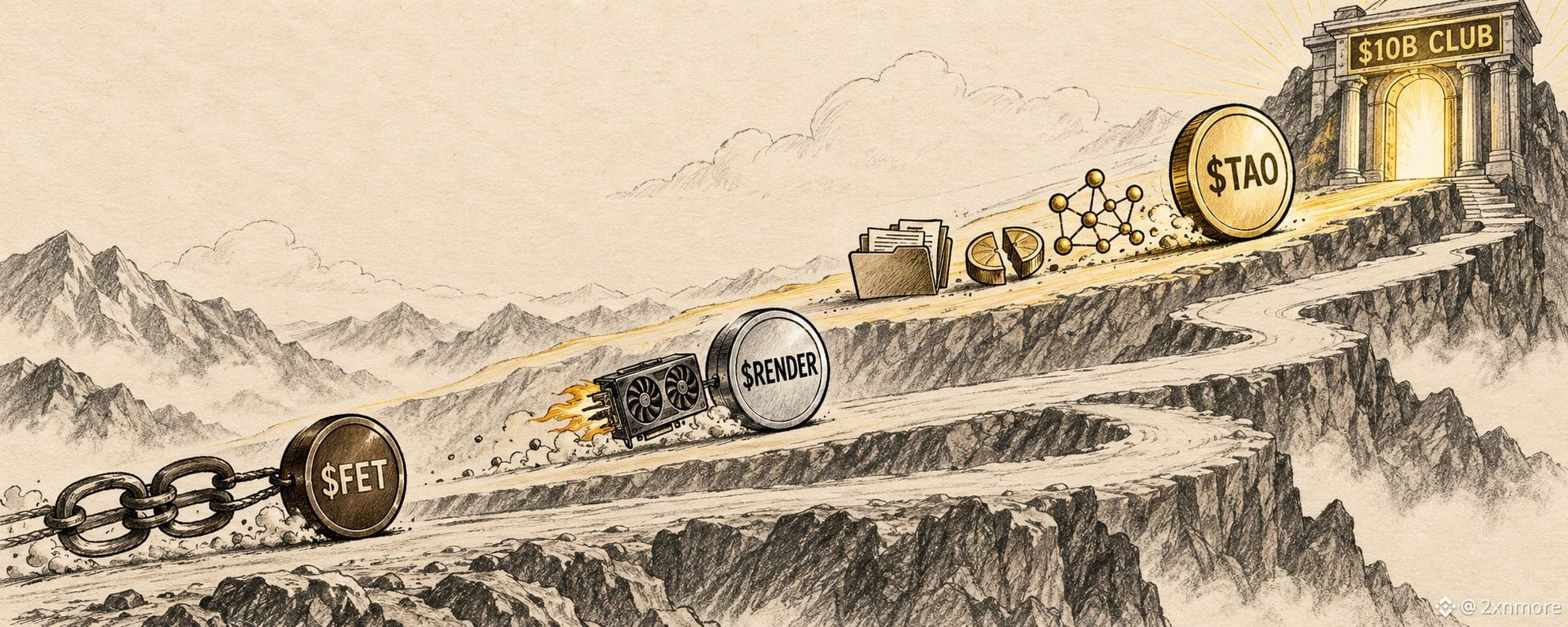
$TAO needs a 3.5x from $2.9B.
$RENDER needs a 13x from $750M.
$FET needs a 25x from $400M.
TAO already has the case built.
Grayscale trust, ETF path open.
Jensen on record.
First halving done.
Subnet tokens as leveraged bets on the same network.
RENDER has usage and burns.
FET has a merger hangover.
The market is still pricing two of these like altcoins.
Only one is being priced like an AI commodity.
Which one actually gets there first?
$10B club.
$TAO needs a 3.5x from $2.9B.
$RENDER needs a 13x from $750M.
$FET needs a 25x from $400M.
TAO already has the case built.
Grayscale trust, ETF path open.
Jensen on record.
First halving done.
Subnet tokens as leveraged bets on the same network.
RENDER has usage and burns.
FET has a merger hangover.
The market is still pricing two of these like altcoins.
Only one is being priced like an AI commodity.
Which one actually gets there first?
$TAO needs a 3.5x from $2.9B.
$RENDER needs a 13x from $750M.
$FET needs a 25x from $400M.
TAO already has the case built.
Grayscale trust, ETF path open.
Jensen on record.
First halving done.
Subnet tokens as leveraged bets on the same network.
RENDER has usage and burns.
FET has a merger hangover.
The market is still pricing two of these like altcoins.
Only one is being priced like an AI commodity.
Which one actually gets there first?
8
30
35.6k
·
--
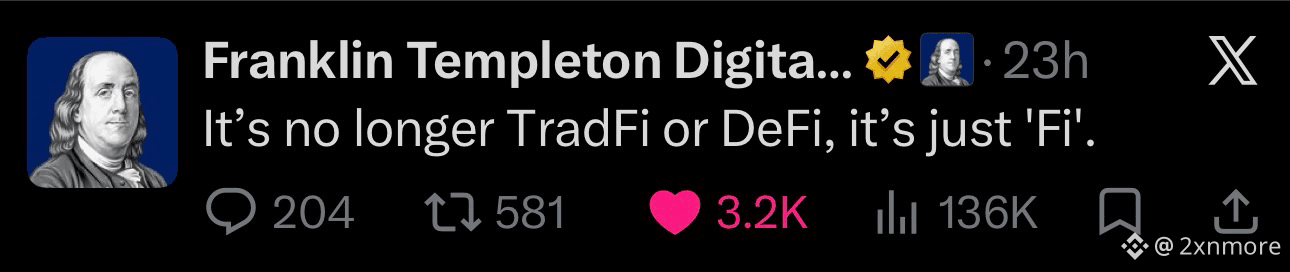
This is the realest thing I’ve read in a long time.
This is the realest thing I’ve read in a long time.
453
·
--
Article
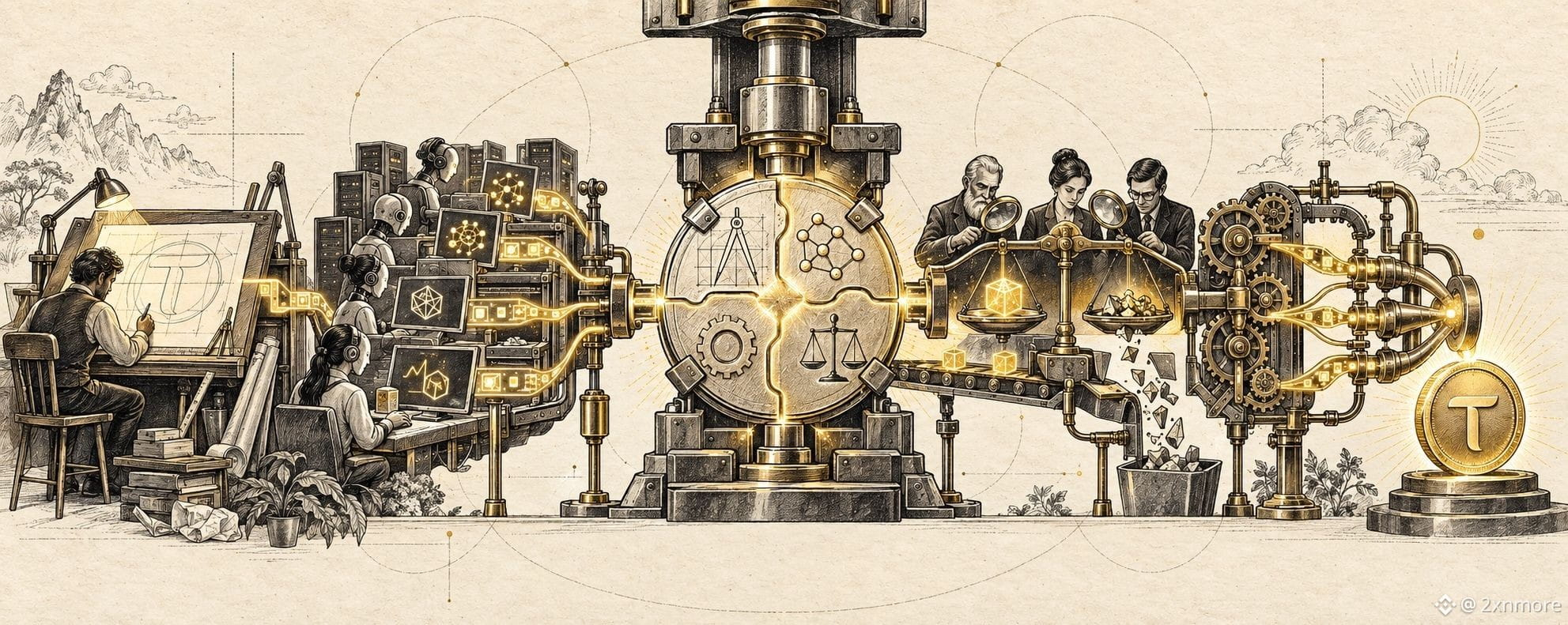
$TAO Is Not an AI Ticker. It Is the Machine Under the Candle.The market is pricing a red candle. Five companies are pricing the future of intelligence. Only one of those is a trade. OpenAI. Google. Meta. Microsoft. Anthropic. They own the models, the data, the GPUs, and the door you walk through to use any of it.
That is not an open future. That is a toll road with five owners and no second exit.
Most people still treat $TAO
like another AI ticker riding a hot narrative. They open the chart, see a token that spent 2026 well below its 2024 high near $758, and ask if they backed the wrong horse.
That is the expensive question.
The cheap question, the one that actually pays, is this. What happens when a network rebuilds the machine under the candle, then makes the machine impossible to capture, while the crowd is still arguing about whether the founder leaving killed the story?
Once you see that gap, you cannot unsee it.
Stop valuing an AI network like a meme $TAO
is still being priced like a narrative token. It is not.
It is not Airbnb for GPUs. It is not one team wrapping one chatbot and hoping the token stays useful. It is the index for 128 live subnet markets that all settle in and out of TAO. Every subnet that wins has to buy the base asset to exist. Every miner that registers burns TAO. Every emission slice that matters still denominates in TAO.
That is not a side feature. That is the entire economic design.
Bitcoin was money. Ethereum was apps. TAO is intelligence.
If that sentence sounds like branding, look at the category. Bittensor is not competing with other AI coins. It is competing with closed labs for the right to be the infrastructure layer intelligence runs on. Different bet. Different risk. Different payoff if the mechanism holds.
The part the resignation hid
In February 2026 Const and Ala gave up executive titles at the Opentensor Foundation. The timeline read it as the founder walking away.
Wrong frame.
Neither left the work. What got surrendered was the private room that ratifies upgrades. Most chains keep that room filled with friends, employees, or whoever bought the loudest campaign. Bittensor is trying to fill it with whoever the block height points at.
Two houses. Validators in one. Subnet owners in the other. A three seat committee drawn blind from the top of both sets, then rotated every six to eight months. Every objection doubles the delay. The first real use case is starving extractors. Cut emissions to subnets that farm rewards and ship nothing the network wants.
A founder giving up a title is theatre if the same people stay in the room. A lottery that rotates the room is a product.
In a market that pays whoever produces the most useful intelligence, being impossible to capture is not a feature. It is the thing serious capital was waiting to see before it sizes in.
The chart will be the last place this shows up.
The rebuild almost nobody priced
While holders stared at $220, the rules that decide who earns changed.
The first halving already hit. December 2025. Daily issuance dropped from roughly 7,200 TAO to 3,600. Hard cap still 21 million. No premine. No VC carve out. Fair launch scarcity applied to an AI commodity instead of a hash commodity.
dTAO turned every subnet into a tiny economy. Each one has an alpha token that trades against TAO. The smoothed alpha price feeds emissions. Strong markets pull more of the 3,600. Weak ones hit the emission gate and get throttled. The market, not a committee chat, decides where the reward pool goes.
Root Reborn killed a silent leak. Nearly half of TAO sits on root. Alpha dividends used to sell into TAO automatically, every day, whether anyone wanted the sale or not. Now they accrue in validator linked baskets and only convert when someone claims. Mechanical sell pressure got dialled down. That is plumbing. Plumbing is how networks survive.
Growth now tightens supply. Neuron registration burns TAO through dynamic pricing. New subnets cost TAO. Owners can burn alpha. Three contraction mechanisms run at once, and they accelerate if the network actually grows. Most tokens have one burn gimmick. TAO has a system where demand structurally requires scarcity.
128 markets. About 25 will matter.
Think of TAO as the S&P 500 of decentralised AI. Each subnet is a stock competing for emissions. The index sits in the pool opposite every alpha token, so when a subnet wins, TAO wins with it.
Around 100 of those markets will never matter. The other 25 are the entire reason the token exists. Most people cannot tell them apart. The market eventually will.
The filter is not cool repo. Dynamic TAO turned every subnet into an investment vehicle overnight. Emissions are not revenue. Usage tweets are not invoices. Alpha market cap is not audited business value. A category can print a billion dollars of quoted subnet value and still have thin exits and no outside customers.
Watch the names that already look like companies, not contests.
Chutes, SN64. Inference at scale, the subnet that keeps showing up wherever developers actually pay for tokens out.
Targon, SN4. Compute and confidential hardware, the privacy wall.
Score, SN44. Computer vision leaving the terminal and walking into physical sites.
Templar, SN3. Permissionless pre training in public, the Bitcoin of AI thesis running live instead of sitting in a thread.
Ridges and the coding markets. The ones that have to beat funded labs on engineering benchmarks, not vibes.
If a subnet cannot explain the difference between runway and revenue, it is dead weight wearing a whitepaper.
What the smartest capital already did
Barry Silbert did not sprinkle TAO into a basket. Through DCG he stood up Yuma, a company whose job is to accelerate and finance the Bittensor stack. That is a statement, not a trade.
Stillcore, with Jason Calacanis in the mix, framed 2026 TAO against ETH in 2016 and BTC in 2013, and set out to own a real slice of supply plus the highest conviction subnets. Mark Jeffrey called it a foundational layer. Grayscale ran the old playbook. Fund first, trust second, ETF paperwork after that. Polychain was early. Jensen Huang talking about decentralised training did not create the network. It told the last group of skeptics the architecture was no longer a crypto in joke.
None of that is a guarantee. All of it is the opposite of nobody serious is here.
The people with the best track records are not scrolling past the ticker. They are building permanent vehicles around one network while the timeline debates a daily candle.
The only number the chain still cannot show you
Bittensor is gorgeous onchain. Stake, emissions, pools, alpha prices, validator weight. You can audit the internal economy in real time.
It cannot yet hand you a complete, audited ledger of customer cash arriving from outside the loop. AI requests and commercial contracts still live off chain. Token throughput is not a receipt. Partnerships are not margins. A widely circulated 43 million dollar Q1 revenue line should stay in the rumor pile until it can be checked.
That is not a reason to leave. It is the reason to watch the right variable.
Price tells you how the crowd feels. Six signals tell you whether emissions are becoming a business.
Does TAO hold gains while 3,600 new tokens still hit the market every day.
Do subnet gains broaden, or is it five names with everyone else illiquid.
When does custom root weight setting actually go live.
Which subnets lose share under the emission gate.
Independent proof of customer payments and margins. Cash. Not tokens processed.
ETF status as a stage, not a vibe. Filing, amendment, effectiveness, launch. Do not mix them up.
A subnet can look rich in alpha and still bleed you against TAO. The risk sits one layer deeper than the price might fall.
The hook you should keep
Five companies own the toll road.
Bittensor is trying to be the alternative route. Open markets for intelligence, Yuma Consensus scoring work no other chain can score, 21 million hard cap, post halving issuance already cut in half, 128 competing subnets, two voting houses, a committee the chain picks and then fires.
The network always leads. The price always follows. It just runs late.
You do not learn $TAO by watching $TAO
. You learn it by reading the mechanism, then checking whether the 25 subnets that matter are turning emissions into invoices.
The people who read the docs always buy before the people who read the price.
The candle is weather.
The machine is the trade.
Explainer, not advice. Figures move. Verify subnets on Taostats, read filings as filings, and never size a position off a hook, even this one.
$TAO Is Not an AI Ticker. It Is the Machine Under the Candle.
The market is pricing a red candle. Five companies are pricing the future of intelligence. Only one of those is a trade. OpenAI. Google. Meta. Microsoft. Anthropic. They own the models, the data, the GPUs, and the door you walk through to use any of it.
That is not an open future. That is a toll road with five owners and no second exit.
Most people still treat $TAO
like another AI ticker riding a hot narrative. They open the chart, see a token that spent 2026 well below its 2024 high near $758, and ask if they backed the wrong horse.
That is the expensive question.
The cheap question, the one that actually pays, is this. What happens when a network rebuilds the machine under the candle, then makes the machine impossible to capture, while the crowd is still arguing about whether the founder leaving killed the story?
Once you see that gap, you cannot unsee it.
Stop valuing an AI network like a meme $TAO
is still being priced like a narrative token. It is not.
It is not Airbnb for GPUs. It is not one team wrapping one chatbot and hoping the token stays useful. It is the index for 128 live subnet markets that all settle in and out of TAO. Every subnet that wins has to buy the base asset to exist. Every miner that registers burns TAO. Every emission slice that matters still denominates in TAO.
That is not a side feature. That is the entire economic design.
Bitcoin was money. Ethereum was apps. TAO is intelligence.
If that sentence sounds like branding, look at the category. Bittensor is not competing with other AI coins. It is competing with closed labs for the right to be the infrastructure layer intelligence runs on. Different bet. Different risk. Different payoff if the mechanism holds.
The part the resignation hid
In February 2026 Const and Ala gave up executive titles at the Opentensor Foundation. The timeline read it as the founder walking away.
Wrong frame.
Neither left the work. What got surrendered was the private room that ratifies upgrades. Most chains keep that room filled with friends, employees, or whoever bought the loudest campaign. Bittensor is trying to fill it with whoever the block height points at.
Two houses. Validators in one. Subnet owners in the other. A three seat committee drawn blind from the top of both sets, then rotated every six to eight months. Every objection doubles the delay. The first real use case is starving extractors. Cut emissions to subnets that farm rewards and ship nothing the network wants.
A founder giving up a title is theatre if the same people stay in the room. A lottery that rotates the room is a product.
In a market that pays whoever produces the most useful intelligence, being impossible to capture is not a feature. It is the thing serious capital was waiting to see before it sizes in.
The chart will be the last place this shows up.
The rebuild almost nobody priced
While holders stared at $220, the rules that decide who earns changed.
The first halving already hit. December 2025. Daily issuance dropped from roughly 7,200 TAO to 3,600. Hard cap still 21 million. No premine. No VC carve out. Fair launch scarcity applied to an AI commodity instead of a hash commodity.
dTAO turned every subnet into a tiny economy. Each one has an alpha token that trades against TAO. The smoothed alpha price feeds emissions. Strong markets pull more of the 3,600. Weak ones hit the emission gate and get throttled. The market, not a committee chat, decides where the reward pool goes.
Root Reborn killed a silent leak. Nearly half of TAO sits on root. Alpha dividends used to sell into TAO automatically, every day, whether anyone wanted the sale or not. Now they accrue in validator linked baskets and only convert when someone claims. Mechanical sell pressure got dialled down. That is plumbing. Plumbing is how networks survive.
Growth now tightens supply. Neuron registration burns TAO through dynamic pricing. New subnets cost TAO. Owners can burn alpha. Three contraction mechanisms run at once, and they accelerate if the network actually grows. Most tokens have one burn gimmick. TAO has a system where demand structurally requires scarcity.
128 markets. About 25 will matter.
Think of TAO as the S&P 500 of decentralised AI. Each subnet is a stock competing for emissions. The index sits in the pool opposite every alpha token, so when a subnet wins, TAO wins with it.
Around 100 of those markets will never matter. The other 25 are the entire reason the token exists. Most people cannot tell them apart. The market eventually will.
The filter is not cool repo. Dynamic TAO turned every subnet into an investment vehicle overnight. Emissions are not revenue. Usage tweets are not invoices. Alpha market cap is not audited business value. A category can print a billion dollars of quoted subnet value and still have thin exits and no outside customers.
Watch the names that already look like companies, not contests.
Chutes, SN64. Inference at scale, the subnet that keeps showing up wherever developers actually pay for tokens out.
Targon, SN4. Compute and confidential hardware, the privacy wall.
Score, SN44. Computer vision leaving the terminal and walking into physical sites.
Templar, SN3. Permissionless pre training in public, the Bitcoin of AI thesis running live instead of sitting in a thread.
Ridges and the coding markets. The ones that have to beat funded labs on engineering benchmarks, not vibes.
If a subnet cannot explain the difference between runway and revenue, it is dead weight wearing a whitepaper.
What the smartest capital already did
Barry Silbert did not sprinkle TAO into a basket. Through DCG he stood up Yuma, a company whose job is to accelerate and finance the Bittensor stack. That is a statement, not a trade.
Stillcore, with Jason Calacanis in the mix, framed 2026 TAO against ETH in 2016 and BTC in 2013, and set out to own a real slice of supply plus the highest conviction subnets. Mark Jeffrey called it a foundational layer. Grayscale ran the old playbook. Fund first, trust second, ETF paperwork after that. Polychain was early. Jensen Huang talking about decentralised training did not create the network. It told the last group of skeptics the architecture was no longer a crypto in joke.
None of that is a guarantee. All of it is the opposite of nobody serious is here.
The people with the best track records are not scrolling past the ticker. They are building permanent vehicles around one network while the timeline debates a daily candle.
The only number the chain still cannot show you
Bittensor is gorgeous onchain. Stake, emissions, pools, alpha prices, validator weight. You can audit the internal economy in real time.
It cannot yet hand you a complete, audited ledger of customer cash arriving from outside the loop. AI requests and commercial contracts still live off chain. Token throughput is not a receipt. Partnerships are not margins. A widely circulated 43 million dollar Q1 revenue line should stay in the rumor pile until it can be checked.
That is not a reason to leave. It is the reason to watch the right variable.
Price tells you how the crowd feels. Six signals tell you whether emissions are becoming a business.
Does TAO hold gains while 3,600 new tokens still hit the market every day.
Do subnet gains broaden, or is it five names with everyone else illiquid.
When does custom root weight setting actually go live.
Which subnets lose share under the emission gate.
Independent proof of customer payments and margins. Cash. Not tokens processed.
ETF status as a stage, not a vibe. Filing, amendment, effectiveness, launch. Do not mix them up.
A subnet can look rich in alpha and still bleed you against TAO. The risk sits one layer deeper than the price might fall.
The hook you should keep
Five companies own the toll road.
Bittensor is trying to be the alternative route. Open markets for intelligence, Yuma Consensus scoring work no other chain can score, 21 million hard cap, post halving issuance already cut in half, 128 competing subnets, two voting houses, a committee the chain picks and then fires.
The network always leads. The price always follows. It just runs late.
You do not learn $TAO by watching $TAO
. You learn it by reading the mechanism, then checking whether the 25 subnets that matter are turning emissions into invoices.
The people who read the docs always buy before the people who read the price.
The candle is weather.
The machine is the trade.
Explainer, not advice. Figures move. Verify subnets on Taostats, read filings as filings, and never size a position off a hook, even this one.
That is not an open future. That is a toll road with five owners and no second exit.
Most people still treat $TAO
like another AI ticker riding a hot narrative. They open the chart, see a token that spent 2026 well below its 2024 high near $758, and ask if they backed the wrong horse.
That is the expensive question.
The cheap question, the one that actually pays, is this. What happens when a network rebuilds the machine under the candle, then makes the machine impossible to capture, while the crowd is still arguing about whether the founder leaving killed the story?
Once you see that gap, you cannot unsee it.
Stop valuing an AI network like a meme $TAO
is still being priced like a narrative token. It is not.
It is not Airbnb for GPUs. It is not one team wrapping one chatbot and hoping the token stays useful. It is the index for 128 live subnet markets that all settle in and out of TAO. Every subnet that wins has to buy the base asset to exist. Every miner that registers burns TAO. Every emission slice that matters still denominates in TAO.
That is not a side feature. That is the entire economic design.
Bitcoin was money. Ethereum was apps. TAO is intelligence.
If that sentence sounds like branding, look at the category. Bittensor is not competing with other AI coins. It is competing with closed labs for the right to be the infrastructure layer intelligence runs on. Different bet. Different risk. Different payoff if the mechanism holds.
The part the resignation hid
In February 2026 Const and Ala gave up executive titles at the Opentensor Foundation. The timeline read it as the founder walking away.
Wrong frame.
Neither left the work. What got surrendered was the private room that ratifies upgrades. Most chains keep that room filled with friends, employees, or whoever bought the loudest campaign. Bittensor is trying to fill it with whoever the block height points at.
Two houses. Validators in one. Subnet owners in the other. A three seat committee drawn blind from the top of both sets, then rotated every six to eight months. Every objection doubles the delay. The first real use case is starving extractors. Cut emissions to subnets that farm rewards and ship nothing the network wants.
A founder giving up a title is theatre if the same people stay in the room. A lottery that rotates the room is a product.
In a market that pays whoever produces the most useful intelligence, being impossible to capture is not a feature. It is the thing serious capital was waiting to see before it sizes in.
The chart will be the last place this shows up.
The rebuild almost nobody priced
While holders stared at $220, the rules that decide who earns changed.
The first halving already hit. December 2025. Daily issuance dropped from roughly 7,200 TAO to 3,600. Hard cap still 21 million. No premine. No VC carve out. Fair launch scarcity applied to an AI commodity instead of a hash commodity.
dTAO turned every subnet into a tiny economy. Each one has an alpha token that trades against TAO. The smoothed alpha price feeds emissions. Strong markets pull more of the 3,600. Weak ones hit the emission gate and get throttled. The market, not a committee chat, decides where the reward pool goes.
Root Reborn killed a silent leak. Nearly half of TAO sits on root. Alpha dividends used to sell into TAO automatically, every day, whether anyone wanted the sale or not. Now they accrue in validator linked baskets and only convert when someone claims. Mechanical sell pressure got dialled down. That is plumbing. Plumbing is how networks survive.
Growth now tightens supply. Neuron registration burns TAO through dynamic pricing. New subnets cost TAO. Owners can burn alpha. Three contraction mechanisms run at once, and they accelerate if the network actually grows. Most tokens have one burn gimmick. TAO has a system where demand structurally requires scarcity.
128 markets. About 25 will matter.
Think of TAO as the S&P 500 of decentralised AI. Each subnet is a stock competing for emissions. The index sits in the pool opposite every alpha token, so when a subnet wins, TAO wins with it.
Around 100 of those markets will never matter. The other 25 are the entire reason the token exists. Most people cannot tell them apart. The market eventually will.
The filter is not cool repo. Dynamic TAO turned every subnet into an investment vehicle overnight. Emissions are not revenue. Usage tweets are not invoices. Alpha market cap is not audited business value. A category can print a billion dollars of quoted subnet value and still have thin exits and no outside customers.
Watch the names that already look like companies, not contests.
Chutes, SN64. Inference at scale, the subnet that keeps showing up wherever developers actually pay for tokens out.
Targon, SN4. Compute and confidential hardware, the privacy wall.
Score, SN44. Computer vision leaving the terminal and walking into physical sites.
Templar, SN3. Permissionless pre training in public, the Bitcoin of AI thesis running live instead of sitting in a thread.
Ridges and the coding markets. The ones that have to beat funded labs on engineering benchmarks, not vibes.
If a subnet cannot explain the difference between runway and revenue, it is dead weight wearing a whitepaper.
What the smartest capital already did
Barry Silbert did not sprinkle TAO into a basket. Through DCG he stood up Yuma, a company whose job is to accelerate and finance the Bittensor stack. That is a statement, not a trade.
Stillcore, with Jason Calacanis in the mix, framed 2026 TAO against ETH in 2016 and BTC in 2013, and set out to own a real slice of supply plus the highest conviction subnets. Mark Jeffrey called it a foundational layer. Grayscale ran the old playbook. Fund first, trust second, ETF paperwork after that. Polychain was early. Jensen Huang talking about decentralised training did not create the network. It told the last group of skeptics the architecture was no longer a crypto in joke.
None of that is a guarantee. All of it is the opposite of nobody serious is here.
The people with the best track records are not scrolling past the ticker. They are building permanent vehicles around one network while the timeline debates a daily candle.
The only number the chain still cannot show you
Bittensor is gorgeous onchain. Stake, emissions, pools, alpha prices, validator weight. You can audit the internal economy in real time.
It cannot yet hand you a complete, audited ledger of customer cash arriving from outside the loop. AI requests and commercial contracts still live off chain. Token throughput is not a receipt. Partnerships are not margins. A widely circulated 43 million dollar Q1 revenue line should stay in the rumor pile until it can be checked.
That is not a reason to leave. It is the reason to watch the right variable.
Price tells you how the crowd feels. Six signals tell you whether emissions are becoming a business.
Does TAO hold gains while 3,600 new tokens still hit the market every day.
Do subnet gains broaden, or is it five names with everyone else illiquid.
When does custom root weight setting actually go live.
Which subnets lose share under the emission gate.
Independent proof of customer payments and margins. Cash. Not tokens processed.
ETF status as a stage, not a vibe. Filing, amendment, effectiveness, launch. Do not mix them up.
A subnet can look rich in alpha and still bleed you against TAO. The risk sits one layer deeper than the price might fall.
The hook you should keep
Five companies own the toll road.
Bittensor is trying to be the alternative route. Open markets for intelligence, Yuma Consensus scoring work no other chain can score, 21 million hard cap, post halving issuance already cut in half, 128 competing subnets, two voting houses, a committee the chain picks and then fires.
The network always leads. The price always follows. It just runs late.
You do not learn $TAO by watching $TAO
. You learn it by reading the mechanism, then checking whether the 25 subnets that matter are turning emissions into invoices.
The people who read the docs always buy before the people who read the price.
The candle is weather.
The machine is the trade.
Explainer, not advice. Figures move. Verify subnets on Taostats, read filings as filings, and never size a position off a hook, even this one.
1
192
·
--
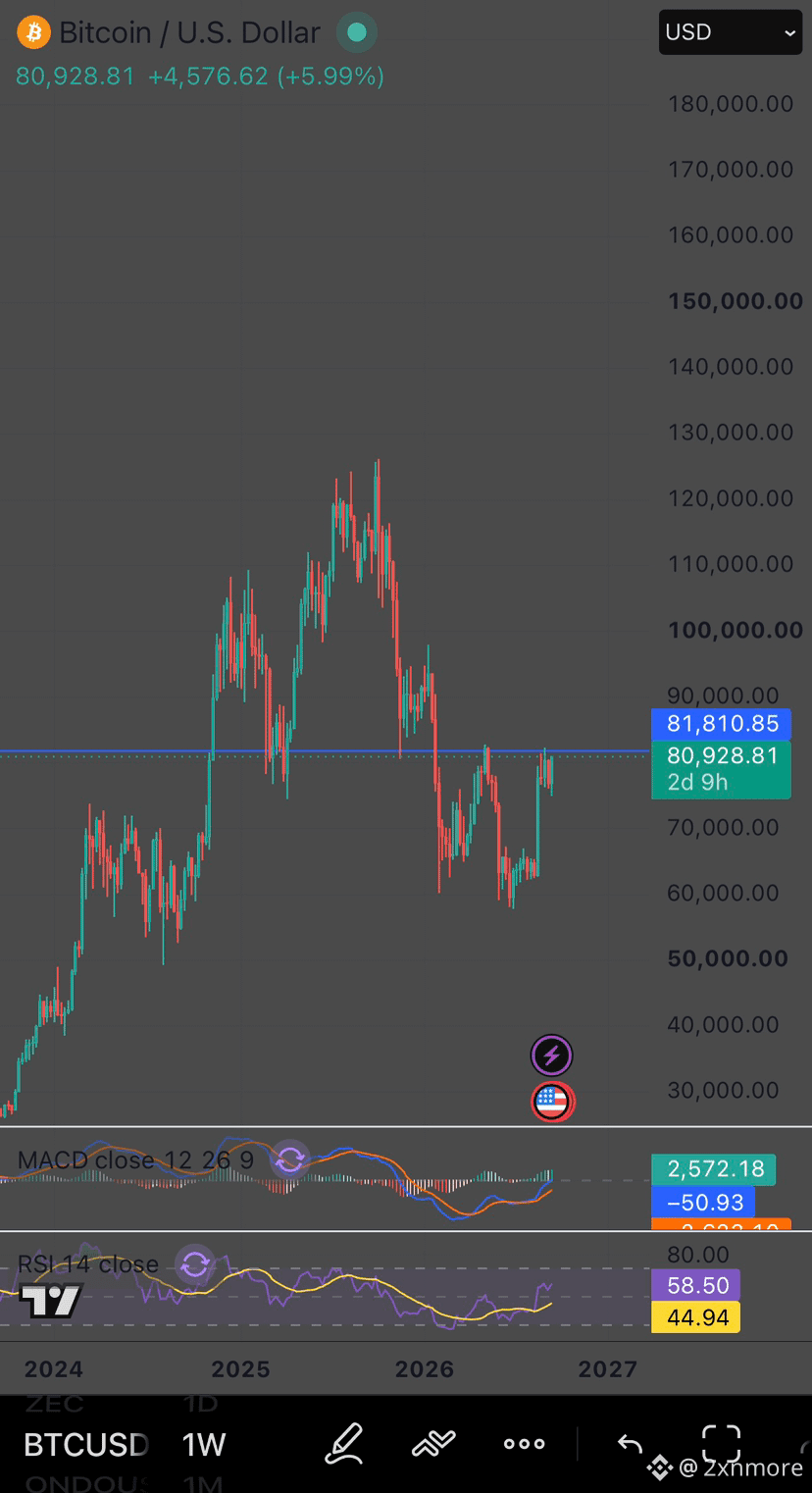
$BTC is up 5.99% on the week and it is pressing on the one level that has capped this entire range.
$80,928
That is the same shelf that flipped from support into resistance after the fall from 126k.
$81,810 is the line to reclaim.
Everyone wrote the obituary in the low 60s. The chart spent that whole stretch building a base instead of dying.
Weekly MACD just crossed back up and the histogram flipped green for the first time since the breakdown.
RSI pushed back above the midline to 58 after months of living underneath it.
The catch is simple. This weekly candle is not closed yet.
Two full days left to confirm the reclaim or hand it back.
Reclaim and hold 81,810 on the close and the path reopens toward the 90s.
Reject here and the range low near 60k is back in the conversation.
The crowd watching the price will call this a bounce. The people reading the structure already know what a base looks like before it prints.
So which chart are you actually reading?
{spot}(BTCUSDT)
$BTC is up 5.99% on the week and it is pressing on the one level that has capped this entire range.
$80,928
That is the same shelf that flipped from support into resistance after the fall from 126k.
$81,810 is the line to reclaim.
Everyone wrote the obituary in the low 60s. The chart spent that whole stretch building a base instead of dying.
Weekly MACD just crossed back up and the histogram flipped green for the first time since the breakdown.
RSI pushed back above the midline to 58 after months of living underneath it.
The catch is simple. This weekly candle is not closed yet.
Two full days left to confirm the reclaim or hand it back.
Reclaim and hold 81,810 on the close and the path reopens toward the 90s.
Reject here and the range low near 60k is back in the conversation.
The crowd watching the price will call this a bounce. The people reading the structure already know what a base looks like before it prints.
So which chart are you actually reading?
$80,928
That is the same shelf that flipped from support into resistance after the fall from 126k.
$81,810 is the line to reclaim.
Everyone wrote the obituary in the low 60s. The chart spent that whole stretch building a base instead of dying.
Weekly MACD just crossed back up and the histogram flipped green for the first time since the breakdown.
RSI pushed back above the midline to 58 after months of living underneath it.
The catch is simple. This weekly candle is not closed yet.
Two full days left to confirm the reclaim or hand it back.
Reclaim and hold 81,810 on the close and the path reopens toward the 90s.
Reject here and the range low near 60k is back in the conversation.
The crowd watching the price will call this a bounce. The people reading the structure already know what a base looks like before it prints.
So which chart are you actually reading?
1
1
530
·
--
The people who read the docs already knew $TAO
wasn't done after $236.
$TAO just printed ~$250.
24h: +10%
Week high: $277
Volume holding the $180M to $240M range
Capital can now route ETH and USDC straight into TAO and subnet tokens. No wrapping, no bridge theatre.
Bittensor is pricing the marketplace, not the narrative.
Next targets unchanged:
$350
$500
Volume precedes price. The chart is always the last to know.
NFA | DYOR
The people who read the docs already knew $TAO
wasn't done after $236.
$TAO just printed ~$250.
24h: +10%
Week high: $277
Volume holding the $180M to $240M range
Capital can now route ETH and USDC straight into TAO and subnet tokens. No wrapping, no bridge theatre.
Bittensor is pricing the marketplace, not the narrative.
Next targets unchanged:
$350
$500
Volume precedes price. The chart is always the last to know.
NFA | DYOR
wasn't done after $236.
$TAO just printed ~$250.
24h: +10%
Week high: $277
Volume holding the $180M to $240M range
Capital can now route ETH and USDC straight into TAO and subnet tokens. No wrapping, no bridge theatre.
Bittensor is pricing the marketplace, not the narrative.
Next targets unchanged:
$350
$500
Volume precedes price. The chart is always the last to know.
NFA | DYOR
3
260
·
--
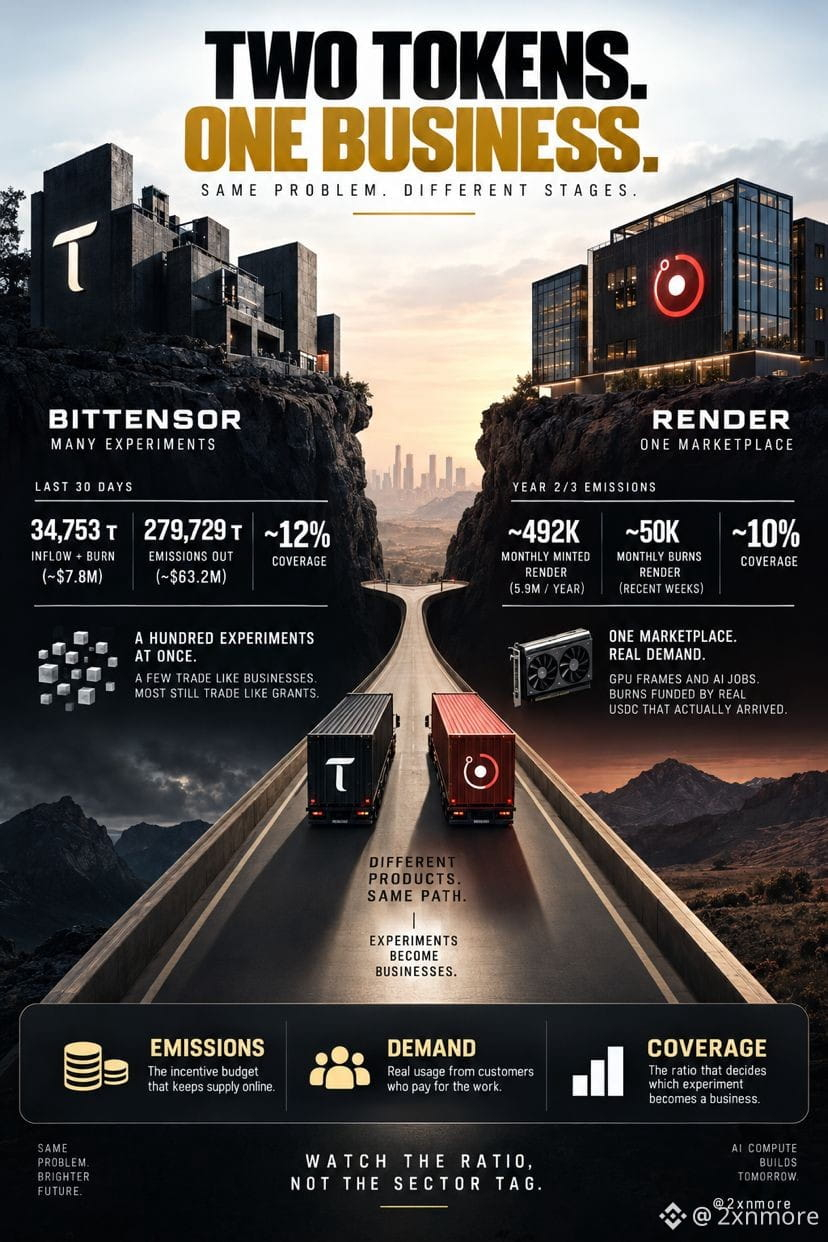
Everyone prices $TAO and $RENDER as two separate AI compute bets.
Run the same lens over both and they turn into one business at two different stages of the same problem.
Start with the trap most holders miss.
Emissions are not revenue.
They are an incentive budget printed to keep supply online.
Revenue is money that comes in because someone actually paid for the work.
On Bittensor the last 30 days were clean.
Inflow plus burn: 34,753 τ (~$7.8M)
Emissions out: 279,729 τ (~$63.2M)
Coverage: ~12%
One TAO came back for every eight paid out.
Holders quietly funded the other seven.
Render runs the cleaner version of the exact same machine.
Its Burn-Mint Equilibrium prices jobs in dollars. Most of that cash buys RENDER and burns it. Nodes earn newly minted RENDER on a declining schedule.
Year 2/3 emissions sit near 5.9M RENDER.
That is roughly 492k tokens a month.
Burns have accelerated, but they are still an order of magnitude behind.
Recent on-chain weeks: ~10k RENDER burned against ~113k minted.
Full-year 2025 usage: $2.69M against 5.64M tokens emitted.
Independent reads: monthly burns near 50k versus ~500k minted.
Coverage lands in the same neighborhood, about 10%.
Same ratio, different product.
Render sells one marketplace: GPU frames, and now Dispersed AI jobs. Demand is real. Q2 even ran short of spare cards. The burn is funded by USDC that actually arrived, not by recycled emissions.
Bittensor sells a hundred experiments at once. A few already trade like businesses. Most still trade like grants. It prints more in dollar terms because it is subsidizing many markets at the same time.
That is the part the market still prices badly.
An 80% coverage subnet with a small cap is not the same asset as a 3% coverage subnet eating a giant emission share.
A GPU network burning 10% of what it mints is not the same asset as one that has already flipped BME.
Watch the ratio, not the sector tag.
Budget, Demand, Coverage.
Emissions buy the experiment. Coverage decides which experiment becomes a business.
{spot}(TAOUSDT)
{spot}(RENDERUSDT)
Everyone prices $TAO and $RENDER as two separate AI compute bets.
Run the same lens over both and they turn into one business at two different stages of the same problem.
Start with the trap most holders miss.
Emissions are not revenue.
They are an incentive budget printed to keep supply online.
Revenue is money that comes in because someone actually paid for the work.
On Bittensor the last 30 days were clean.
Inflow plus burn: 34,753 τ (~$7.8M)
Emissions out: 279,729 τ (~$63.2M)
Coverage: ~12%
One TAO came back for every eight paid out.
Holders quietly funded the other seven.
Render runs the cleaner version of the exact same machine.
Its Burn-Mint Equilibrium prices jobs in dollars. Most of that cash buys RENDER and burns it. Nodes earn newly minted RENDER on a declining schedule.
Year 2/3 emissions sit near 5.9M RENDER.
That is roughly 492k tokens a month.
Burns have accelerated, but they are still an order of magnitude behind.
Recent on-chain weeks: ~10k RENDER burned against ~113k minted.
Full-year 2025 usage: $2.69M against 5.64M tokens emitted.
Independent reads: monthly burns near 50k versus ~500k minted.
Coverage lands in the same neighborhood, about 10%.
Same ratio, different product.
Render sells one marketplace: GPU frames, and now Dispersed AI jobs. Demand is real. Q2 even ran short of spare cards. The burn is funded by USDC that actually arrived, not by recycled emissions.
Bittensor sells a hundred experiments at once. A few already trade like businesses. Most still trade like grants. It prints more in dollar terms because it is subsidizing many markets at the same time.
That is the part the market still prices badly.
An 80% coverage subnet with a small cap is not the same asset as a 3% coverage subnet eating a giant emission share.
A GPU network burning 10% of what it mints is not the same asset as one that has already flipped BME.
Watch the ratio, not the sector tag.
Budget, Demand, Coverage.
Emissions buy the experiment. Coverage decides which experiment becomes a business.
Run the same lens over both and they turn into one business at two different stages of the same problem.
Start with the trap most holders miss.
Emissions are not revenue.
They are an incentive budget printed to keep supply online.
Revenue is money that comes in because someone actually paid for the work.
On Bittensor the last 30 days were clean.
Inflow plus burn: 34,753 τ (~$7.8M)
Emissions out: 279,729 τ (~$63.2M)
Coverage: ~12%
One TAO came back for every eight paid out.
Holders quietly funded the other seven.
Render runs the cleaner version of the exact same machine.
Its Burn-Mint Equilibrium prices jobs in dollars. Most of that cash buys RENDER and burns it. Nodes earn newly minted RENDER on a declining schedule.
Year 2/3 emissions sit near 5.9M RENDER.
That is roughly 492k tokens a month.
Burns have accelerated, but they are still an order of magnitude behind.
Recent on-chain weeks: ~10k RENDER burned against ~113k minted.
Full-year 2025 usage: $2.69M against 5.64M tokens emitted.
Independent reads: monthly burns near 50k versus ~500k minted.
Coverage lands in the same neighborhood, about 10%.
Same ratio, different product.
Render sells one marketplace: GPU frames, and now Dispersed AI jobs. Demand is real. Q2 even ran short of spare cards. The burn is funded by USDC that actually arrived, not by recycled emissions.
Bittensor sells a hundred experiments at once. A few already trade like businesses. Most still trade like grants. It prints more in dollar terms because it is subsidizing many markets at the same time.
That is the part the market still prices badly.
An 80% coverage subnet with a small cap is not the same asset as a 3% coverage subnet eating a giant emission share.
A GPU network burning 10% of what it mints is not the same asset as one that has already flipped BME.
Watch the ratio, not the sector tag.
Budget, Demand, Coverage.
Emissions buy the experiment. Coverage decides which experiment becomes a business.
1
1.3k
·
--
Crypto has been running the same three lines since 2021.
The market still hasn't priced in how long people will keep believing them.
1. "Altseason is coming."
The most delayed flight in financial history. Still stuck at the gate.
2. "Institutions are coming."
They have been coming since 2017. Must be one brutal KYC line.
3. "The team is building."
Building a fresh explanation for why the token is down 87%.
Every cycle changes the ticker.
Never the script.
Which of these three have you heard the most in 2026?
Crypto has been running the same three lines since 2021.
The market still hasn't priced in how long people will keep believing them.
1. "Altseason is coming."
The most delayed flight in financial history. Still stuck at the gate.
2. "Institutions are coming."
They have been coming since 2017. Must be one brutal KYC line.
3. "The team is building."
Building a fresh explanation for why the token is down 87%.
Every cycle changes the ticker.
Never the script.
Which of these three have you heard the most in 2026?
The market still hasn't priced in how long people will keep believing them.
1. "Altseason is coming."
The most delayed flight in financial history. Still stuck at the gate.
2. "Institutions are coming."
They have been coming since 2017. Must be one brutal KYC line.
3. "The team is building."
Building a fresh explanation for why the token is down 87%.
Every cycle changes the ticker.
Never the script.
Which of these three have you heard the most in 2026?
1
2
783
·
--
Partly True
Most people staking $TAO think they are the shareholder.
The dashboard says they are the customer.
Emissions are not revenue. They are an incentive budget the network prints to pay miners and validators.
Revenue is TAO flowing back in because someone actually bought what a subnet sells.
TaoRevenue splits the two cleanly. Last 30 days across Bittensor:
Inflow plus burn: 34,753 τ (about $7.8M)
Emissions out: 279,729 τ (about $63.2M)
Coverage: roughly 12%
12% means the network pulled back one TAO for every eight it paid out. Holders covered the other seven.
That is the whole story, and almost nobody is pricing it.
The only number that matters on that dashboard is Coverage.
Budget, Demand, Coverage.
Emissions buy the experiment. Coverage decides which experiments become businesses.
The board is not empty. A few subnets already look like real businesses.
SN51 Lium leads on inflow, with actual compute buyers.
SN36 Epago sits near 83% coverage, quiet and high signal.
SN72 StreetVision is already above 60%.
SN64 Chutes eats a giant emission check at about 3% coverage.
Chutes is the trap. Usage is not the same as TAO earned. Growing users now and paying later is a strategy, not a revenue line.
The market still prices subnet narratives and market caps. It barely prices coverage.
An 80% coverage subnet with a small cap is a different asset from a 3% coverage subnet with a giant emission share. Same sector, opposite economics.
Bittensor is not unprofitable, and it is not already profitable. It is a market sorting itself into businesses and grants in real time.
If you stake alpha, coverage tells you which side you are funding.
Watch the ratio, not the slogan.
{spot}(TAOUSDT)
Most people staking $TAO think they are the shareholder.
The dashboard says they are the customer.
Emissions are not revenue. They are an incentive budget the network prints to pay miners and validators.
Revenue is TAO flowing back in because someone actually bought what a subnet sells.
TaoRevenue splits the two cleanly. Last 30 days across Bittensor:
Inflow plus burn: 34,753 τ (about $7.8M)
Emissions out: 279,729 τ (about $63.2M)
Coverage: roughly 12%
12% means the network pulled back one TAO for every eight it paid out. Holders covered the other seven.
That is the whole story, and almost nobody is pricing it.
The only number that matters on that dashboard is Coverage.
Budget, Demand, Coverage.
Emissions buy the experiment. Coverage decides which experiments become businesses.
The board is not empty. A few subnets already look like real businesses.
SN51 Lium leads on inflow, with actual compute buyers.
SN36 Epago sits near 83% coverage, quiet and high signal.
SN72 StreetVision is already above 60%.
SN64 Chutes eats a giant emission check at about 3% coverage.
Chutes is the trap. Usage is not the same as TAO earned. Growing users now and paying later is a strategy, not a revenue line.
The market still prices subnet narratives and market caps. It barely prices coverage.
An 80% coverage subnet with a small cap is a different asset from a 3% coverage subnet with a giant emission share. Same sector, opposite economics.
Bittensor is not unprofitable, and it is not already profitable. It is a market sorting itself into businesses and grants in real time.
If you stake alpha, coverage tells you which side you are funding.
Watch the ratio, not the slogan.
The dashboard says they are the customer.
Emissions are not revenue. They are an incentive budget the network prints to pay miners and validators.
Revenue is TAO flowing back in because someone actually bought what a subnet sells.
TaoRevenue splits the two cleanly. Last 30 days across Bittensor:
Inflow plus burn: 34,753 τ (about $7.8M)
Emissions out: 279,729 τ (about $63.2M)
Coverage: roughly 12%
12% means the network pulled back one TAO for every eight it paid out. Holders covered the other seven.
That is the whole story, and almost nobody is pricing it.
The only number that matters on that dashboard is Coverage.
Budget, Demand, Coverage.
Emissions buy the experiment. Coverage decides which experiments become businesses.
The board is not empty. A few subnets already look like real businesses.
SN51 Lium leads on inflow, with actual compute buyers.
SN36 Epago sits near 83% coverage, quiet and high signal.
SN72 StreetVision is already above 60%.
SN64 Chutes eats a giant emission check at about 3% coverage.
Chutes is the trap. Usage is not the same as TAO earned. Growing users now and paying later is a strategy, not a revenue line.
The market still prices subnet narratives and market caps. It barely prices coverage.
An 80% coverage subnet with a small cap is a different asset from a 3% coverage subnet with a giant emission share. Same sector, opposite economics.
Bittensor is not unprofitable, and it is not already profitable. It is a market sorting itself into businesses and grants in real time.
If you stake alpha, coverage tells you which side you are funding.
Watch the ratio, not the slogan.
1
1
2.1k
·
--
Verified
Most people will read this as a partnership.
The people who read the docs will read it as a door.
Ondo's regulated arm is now the first tokenization firm allowed through it.
The sales have not started, the permission did.
Here is what that door actually is.
For years, companies have been able to turn things like US Treasuries and funds into digital tokens.
That part is easy, almost anyone can do it.
The hard part was never making the token.
The hard part was getting it into the system that big banks, wealth managers, and financial advisors already use every day.
You can bake the best product in the world at home.
That does not put it on the shelf at every major store.
To reach those shelves you have to plug into the checkout and delivery system the stores already run on.
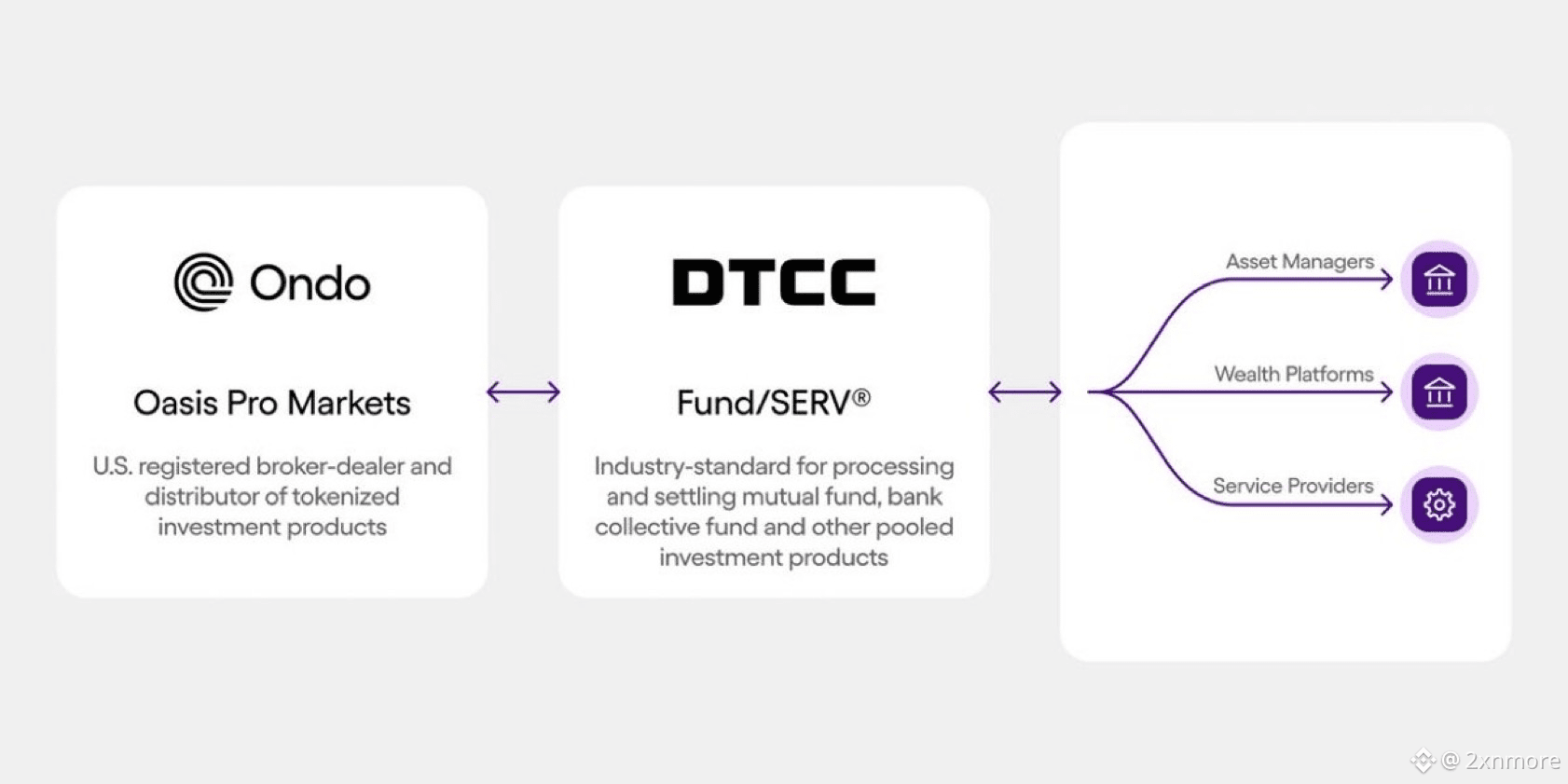
For US funds, that system is called Fund/SERV, run by DTCC.
It quietly handles more than 85% of US mutual fund activity.
It moves the orders, the confirmations, the payouts, and the tax paperwork behind trillions of dollars.
Ondo's regulated arm just became the first tokenization company allowed to plug into it.
One honest note so nobody gets carried away.
Getting through the door is not the same as selling the room.
Each platform still has to choose to stock the product.
The permission is here.
The flows come later.
But permission was the part everyone said would take years.
Most people are watching the token price today.
The ones paying attention are watching who just got the keys.
Most people will read this as a partnership.
The people who read the docs will read it as a door.
Ondo's regulated arm is now the first tokenization firm allowed through it.
The sales have not started, the permission did.
Here is what that door actually is.
For years, companies have been able to turn things like US Treasuries and funds into digital tokens.
That part is easy, almost anyone can do it.
The hard part was never making the token.
The hard part was getting it into the system that big banks, wealth managers, and financial advisors already use every day.
You can bake the best product in the world at home.
That does not put it on the shelf at every major store.
To reach those shelves you have to plug into the checkout and delivery system the stores already run on.
For US funds, that system is called Fund/SERV, run by DTCC.
It quietly handles more than 85% of US mutual fund activity.
It moves the orders, the confirmations, the payouts, and the tax paperwork behind trillions of dollars.
Ondo's regulated arm just became the first tokenization company allowed to plug into it.
One honest note so nobody gets carried away.
Getting through the door is not the same as selling the room.
Each platform still has to choose to stock the product.
The permission is here.
The flows come later.
But permission was the part everyone said would take years.
Most people are watching the token price today.
The ones paying attention are watching who just got the keys.
The people who read the docs will read it as a door.
Ondo's regulated arm is now the first tokenization firm allowed through it.
The sales have not started, the permission did.
Here is what that door actually is.
For years, companies have been able to turn things like US Treasuries and funds into digital tokens.
That part is easy, almost anyone can do it.
The hard part was never making the token.
The hard part was getting it into the system that big banks, wealth managers, and financial advisors already use every day.
You can bake the best product in the world at home.
That does not put it on the shelf at every major store.
To reach those shelves you have to plug into the checkout and delivery system the stores already run on.
For US funds, that system is called Fund/SERV, run by DTCC.
It quietly handles more than 85% of US mutual fund activity.
It moves the orders, the confirmations, the payouts, and the tax paperwork behind trillions of dollars.
Ondo's regulated arm just became the first tokenization company allowed to plug into it.
One honest note so nobody gets carried away.
Getting through the door is not the same as selling the room.
Each platform still has to choose to stock the product.
The permission is here.
The flows come later.
But permission was the part everyone said would take years.
Most people are watching the token price today.
The ones paying attention are watching who just got the keys.
1
1.3k
·
--
Hype is a loan the market always calls back.
The alts that survive 2026 pay it back with usage and real institutional attention. Ideally both.
My survivors list:
$TAO
$RENDER
$BNB
$HYPE
$LINK
$SOL
$ONDO
Which one fails the test? I am reading every reply.
Hype is a loan the market always calls back.
The alts that survive 2026 pay it back with usage and real institutional attention. Ideally both.
My survivors list:
$TAO
$RENDER
$BNB
$HYPE
$LINK
$SOL
$ONDO
Which one fails the test? I am reading every reply.
The alts that survive 2026 pay it back with usage and real institutional attention. Ideally both.
My survivors list:
$TAO
$RENDER
$BNB
$HYPE
$LINK
$SOL
$ONDO
Which one fails the test? I am reading every reply.
3
4
3.7k
·
--
"NASA has a $25 billion budget, thousands of PhDs, and rockets the size of skyscrapers. Bitcoin has a guy named Chad with a laptop and unshakeable confidence. Guess which one's actually going to the moon.
"NASA has a $25 billion budget, thousands of PhDs, and rockets the size of skyscrapers. Bitcoin has a guy named Chad with a laptop and unshakeable confidence. Guess which one's actually going to the moon.
1
100
·
--
Three AI tokens are fighting for one seat in the $10B club.
The market has already mispriced two of them.
$TAO needs a 3.5x from $2.9B.
$RENDER needs a 13x from $750M.
$FET needs a 25x from $400M.
Same target, three very different roads there.
$TAO is the only one the market is pricing like an AI commodity instead of an altcoin.
Grayscale trust already live, which is what opens the ETF conversation.
First halving is behind it.
Subnet tokens now trade as leveraged bets on the same network.
RENDER has the story the market already believes: real usage, real burns.
$FET is still working off its merger hangover.
So the honest read.
$RENDER moves on usage.
$FET moves on narrative rotation.
$TAO moves on institutions, and institutions never needed a 25x to pay attention.
The one already priced like a commodity is the one that gets there first.
Which one are you actually holding into it.
Three AI tokens are fighting for one seat in the $10B club.
The market has already mispriced two of them.
$TAO needs a 3.5x from $2.9B.
$RENDER needs a 13x from $750M.
$FET needs a 25x from $400M.
Same target, three very different roads there.
$TAO is the only one the market is pricing like an AI commodity instead of an altcoin.
Grayscale trust already live, which is what opens the ETF conversation.
First halving is behind it.
Subnet tokens now trade as leveraged bets on the same network.
RENDER has the story the market already believes: real usage, real burns.
$FET is still working off its merger hangover.
So the honest read.
$RENDER moves on usage.
$FET moves on narrative rotation.
$TAO moves on institutions, and institutions never needed a 25x to pay attention.
The one already priced like a commodity is the one that gets there first.
Which one are you actually holding into it.
The market has already mispriced two of them.
$TAO needs a 3.5x from $2.9B.
$RENDER needs a 13x from $750M.
$FET needs a 25x from $400M.
Same target, three very different roads there.
$TAO is the only one the market is pricing like an AI commodity instead of an altcoin.
Grayscale trust already live, which is what opens the ETF conversation.
First halving is behind it.
Subnet tokens now trade as leveraged bets on the same network.
RENDER has the story the market already believes: real usage, real burns.
$FET is still working off its merger hangover.
So the honest read.
$RENDER moves on usage.
$FET moves on narrative rotation.
$TAO moves on institutions, and institutions never needed a 25x to pay attention.
The one already priced like a commodity is the one that gets there first.
Which one are you actually holding into it.
2
5
3.6k
·
--
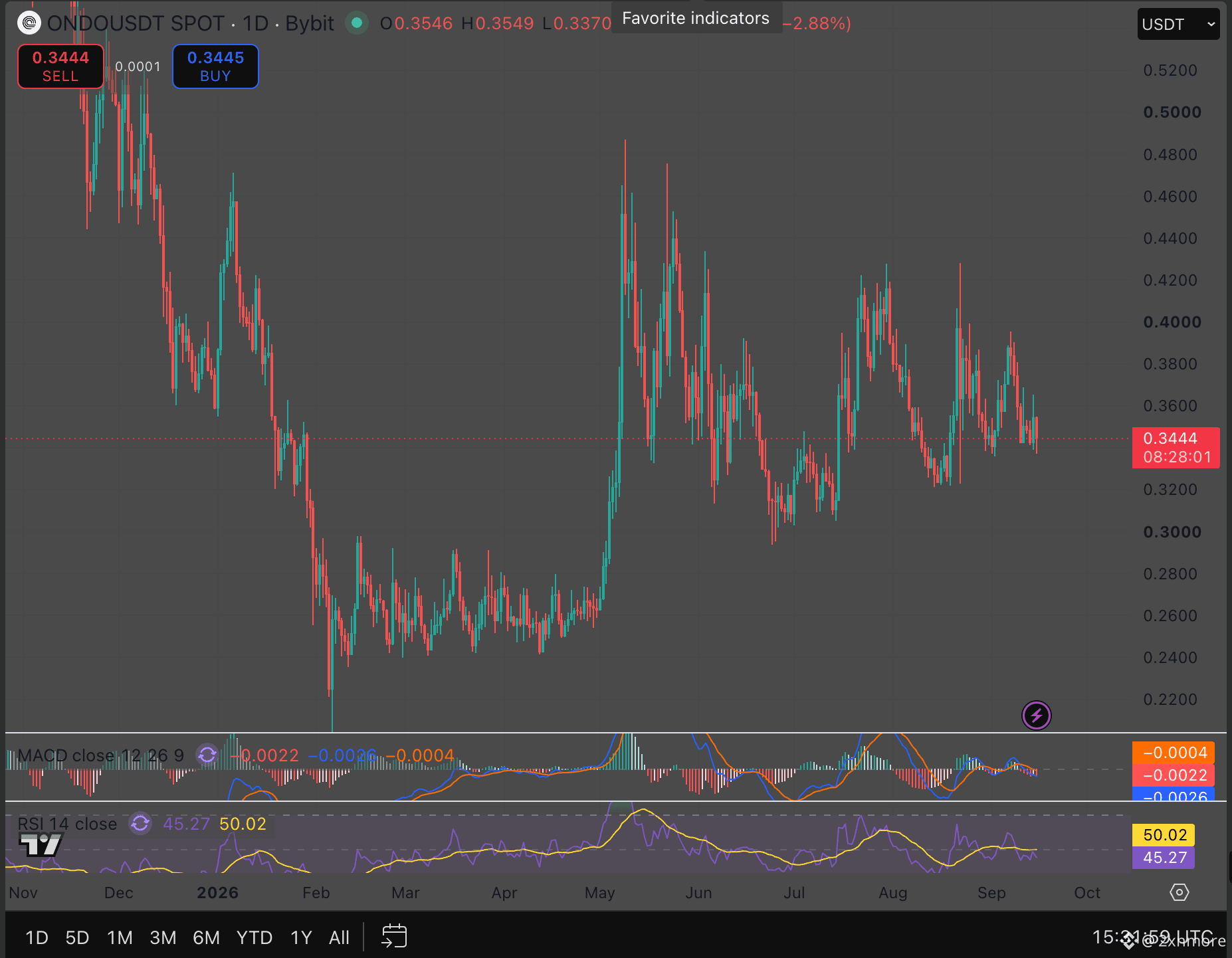
Every $ONDO bounce this year got sold faster than the one before it.
May 0.49
June 0.47
August 0.44
September 0.40
That is not a dip. That is a staircase of lower highs, and price is standing halfway down it.
The fundamentals are the best in RWA. The chart does not care yet.
Right now $ONDO sits near 0.34, which is the worst place on the whole chart to make a decision.
That level is not support, not resistance, and not oversold. RSI is under 50 and MACD is rolling flat to negative, so nothing is confirming a move either way.
So stop trading the middle and mark the two lines that actually decide this.
Support to defend: 0.32
Trend break to reclaim: 0.40
0.32 is the floor it has held all year. Lose it on a daily close and 0.30 opens, then the 0.24 to 0.26 base underneath.
0.40 is the ceiling every rally has died at since May. Reclaim it on a daily close and the lower highs structure is finally broken.
Everything between those two is noise you are paying to sit through.
The docs earned a higher price. The chart has not paid it yet. 0.32 is where you find out if it ever will.
Long the reclaim or defend the floor. Which side breaks first?
{spot}(ONDOUSDT)
Every $ONDO bounce this year got sold faster than the one before it.
May 0.49
June 0.47
August 0.44
September 0.40
That is not a dip. That is a staircase of lower highs, and price is standing halfway down it.
The fundamentals are the best in RWA. The chart does not care yet.
Right now $ONDO sits near 0.34, which is the worst place on the whole chart to make a decision.
That level is not support, not resistance, and not oversold. RSI is under 50 and MACD is rolling flat to negative, so nothing is confirming a move either way.
So stop trading the middle and mark the two lines that actually decide this.
Support to defend: 0.32
Trend break to reclaim: 0.40
0.32 is the floor it has held all year. Lose it on a daily close and 0.30 opens, then the 0.24 to 0.26 base underneath.
0.40 is the ceiling every rally has died at since May. Reclaim it on a daily close and the lower highs structure is finally broken.
Everything between those two is noise you are paying to sit through.
The docs earned a higher price. The chart has not paid it yet. 0.32 is where you find out if it ever will.
Long the reclaim or defend the floor. Which side breaks first?
May 0.49
June 0.47
August 0.44
September 0.40
That is not a dip. That is a staircase of lower highs, and price is standing halfway down it.
The fundamentals are the best in RWA. The chart does not care yet.
Right now $ONDO sits near 0.34, which is the worst place on the whole chart to make a decision.
That level is not support, not resistance, and not oversold. RSI is under 50 and MACD is rolling flat to negative, so nothing is confirming a move either way.
So stop trading the middle and mark the two lines that actually decide this.
Support to defend: 0.32
Trend break to reclaim: 0.40
0.32 is the floor it has held all year. Lose it on a daily close and 0.30 opens, then the 0.24 to 0.26 base underneath.
0.40 is the ceiling every rally has died at since May. Reclaim it on a daily close and the lower highs structure is finally broken.
Everything between those two is noise you are paying to sit through.
The docs earned a higher price. The chart has not paid it yet. 0.32 is where you find out if it ever will.
Long the reclaim or defend the floor. Which side breaks first?
2
3
2.5k
·
--
Let's see which community is actually real.
Not loud.
Not first.
Still here.
1. $TAO
2. $FET
3. $RENDER
If the comparison offends you, that is the whole trade.
Let's see which community is actually real.
Not loud.
Not first.
Still here.
1. $TAO
2. $FET
3. $RENDER
If the comparison offends you, that is the whole trade.
Not loud.
Not first.
Still here.
1. $TAO
2. $FET
3. $RENDER
If the comparison offends you, that is the whole trade.
1
497
·
--
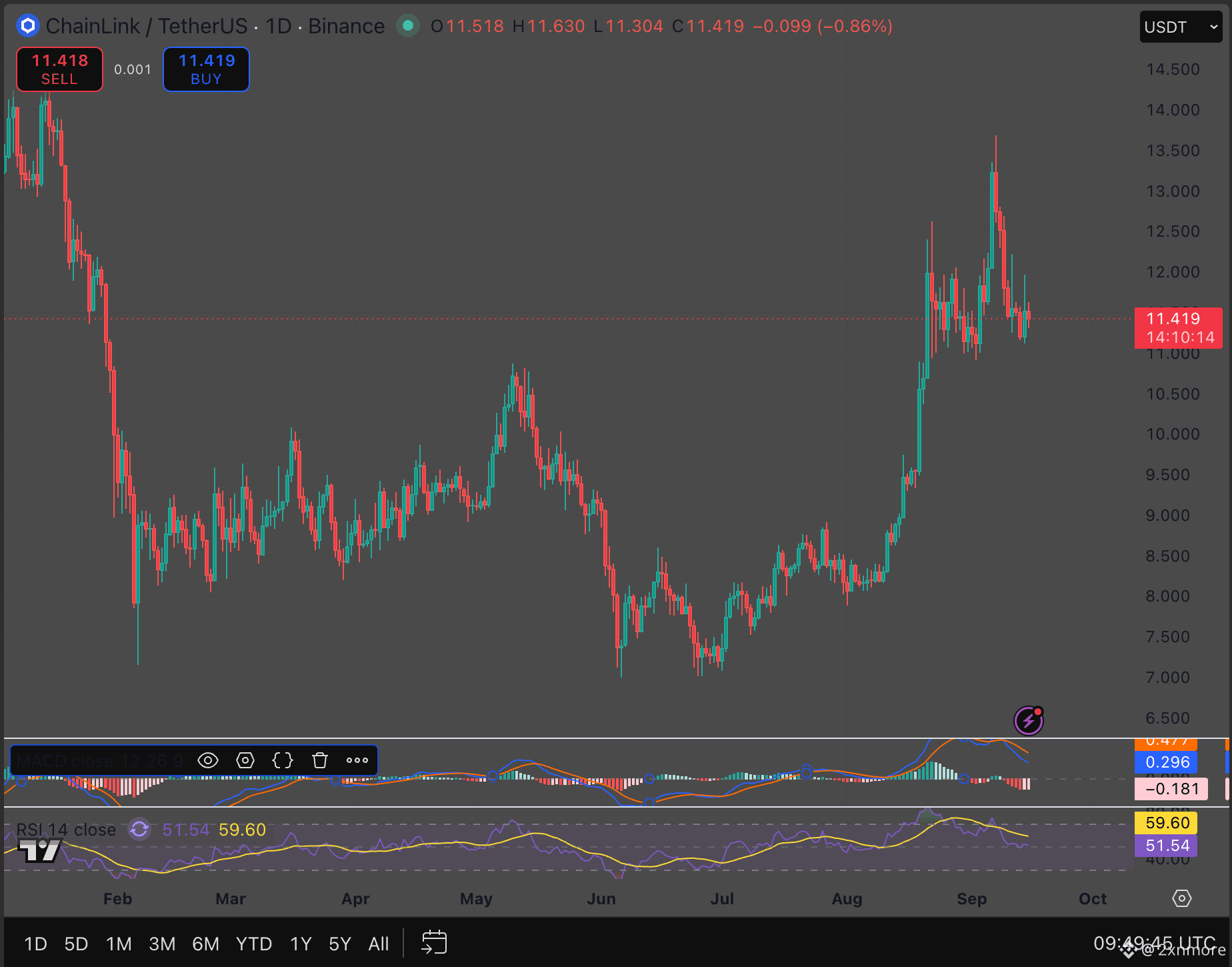
Everyone saw $LINK tap 13.70 in September and called it a breakout.
The chart is telling a quieter story.
That daily spike got sold. Price is back at 11.42 and momentum is cooling off.
Daily MACD has rolled over into red. Daily RSI has slipped from near 70 back to the midline around 51.
Short term, this is digestion, not continuation.
Now zoom out and the read flips.
The weekly is recovering off the cycle low near 7.00. Weekly MACD is green and building. Weekly RSI is holding above 50 for the first time in months.
The higher timeframe is turning up while the daily catches its breath.
So the levels that actually matter:
Reclaim to confirm continuation:
12.00, then 13.70
Support to defend:
11.00, then the breakout base near 9.30
Invalidation of the recovery thesis:
a weekly close back under 9.00
Until 13.70 breaks with real volume behind it, this is a range, not a rocket.
The weekly wants higher. The daily just has to stop giving it back.
{spot}(LINKUSDT)
Everyone saw $LINK tap 13.70 in September and called it a breakout.
The chart is telling a quieter story.
That daily spike got sold. Price is back at 11.42 and momentum is cooling off.
Daily MACD has rolled over into red. Daily RSI has slipped from near 70 back to the midline around 51.
Short term, this is digestion, not continuation.
Now zoom out and the read flips.
The weekly is recovering off the cycle low near 7.00. Weekly MACD is green and building. Weekly RSI is holding above 50 for the first time in months.
The higher timeframe is turning up while the daily catches its breath.
So the levels that actually matter:
Reclaim to confirm continuation:
12.00, then 13.70
Support to defend:
11.00, then the breakout base near 9.30
Invalidation of the recovery thesis:
a weekly close back under 9.00
Until 13.70 breaks with real volume behind it, this is a range, not a rocket.
The weekly wants higher. The daily just has to stop giving it back.
The chart is telling a quieter story.
That daily spike got sold. Price is back at 11.42 and momentum is cooling off.
Daily MACD has rolled over into red. Daily RSI has slipped from near 70 back to the midline around 51.
Short term, this is digestion, not continuation.
Now zoom out and the read flips.
The weekly is recovering off the cycle low near 7.00. Weekly MACD is green and building. Weekly RSI is holding above 50 for the first time in months.
The higher timeframe is turning up while the daily catches its breath.
So the levels that actually matter:
Reclaim to confirm continuation:
12.00, then 13.70
Support to defend:
11.00, then the breakout base near 9.30
Invalidation of the recovery thesis:
a weekly close back under 9.00
Until 13.70 breaks with real volume behind it, this is a range, not a rocket.
The weekly wants higher. The daily just has to stop giving it back.
6
7
7.3k
·
--
Verified
$TAO is now on Robinhood Chain.
Most people will read that as "Robinhood just listed Bittensor." It did not.
Robinhood Chain is a permissionless Ethereum L2, not the brokerage app you tap to buy stocks. Different thing entirely.
What actually happened: Forever Money opened a 1:1 bridge secured by Chainlink CCIP, so a wrapped TAO can live and trade inside EVM DeFi.
Native TAO never left Subtensor. What moved is access, not supply.
This is the second EVM home after Base, now sitting in reach of Robinhood Chain's large retail base.
Here is the frame for every "bridged to a new chain" headline:
Access. Supply. Demand.
Access just got built. Supply is unchanged, still 1:1 wrapped. Demand is the only number that matters, and nobody has printed it yet.
A new rail is a door. It does not walk anyone through it.
So watch the liquidity vaults and real swap volume, not the logo on the announcement.
The people who read the docs always spot the difference before the people who read the price.
{spot}(TAOUSDT)
$TAO is now on Robinhood Chain.
Most people will read that as "Robinhood just listed Bittensor." It did not.
Robinhood Chain is a permissionless Ethereum L2, not the brokerage app you tap to buy stocks. Different thing entirely.
What actually happened: Forever Money opened a 1:1 bridge secured by Chainlink CCIP, so a wrapped TAO can live and trade inside EVM DeFi.
Native TAO never left Subtensor. What moved is access, not supply.
This is the second EVM home after Base, now sitting in reach of Robinhood Chain's large retail base.
Here is the frame for every "bridged to a new chain" headline:
Access. Supply. Demand.
Access just got built. Supply is unchanged, still 1:1 wrapped. Demand is the only number that matters, and nobody has printed it yet.
A new rail is a door. It does not walk anyone through it.
So watch the liquidity vaults and real swap volume, not the logo on the announcement.
The people who read the docs always spot the difference before the people who read the price.
Most people will read that as "Robinhood just listed Bittensor." It did not.
Robinhood Chain is a permissionless Ethereum L2, not the brokerage app you tap to buy stocks. Different thing entirely.
What actually happened: Forever Money opened a 1:1 bridge secured by Chainlink CCIP, so a wrapped TAO can live and trade inside EVM DeFi.
Native TAO never left Subtensor. What moved is access, not supply.
This is the second EVM home after Base, now sitting in reach of Robinhood Chain's large retail base.
Here is the frame for every "bridged to a new chain" headline:
Access. Supply. Demand.
Access just got built. Supply is unchanged, still 1:1 wrapped. Demand is the only number that matters, and nobody has printed it yet.
A new rail is a door. It does not walk anyone through it.
So watch the liquidity vaults and real swap volume, not the logo on the announcement.
The people who read the docs always spot the difference before the people who read the price.
1
2
2.5k
·
--
$TAO looks strong.
That is the trap.
On its own chart, it looks clean.
It ran off the August low near 185 to 278, pulled back, and is now sitting right on its rising trendline around 235.
That trendline is the whole thesis.
Hold 230 on a daily close and the uptrend lives, with 260 then 278 back in play.
Lose 220 and the trend breaks, opening 200 then the 185 base.
Momentum is neutral, not strong. MACD just slipped under its signal and RSI is at 52, right on the fence.
Now the part the TAO chart hides.
That trendline is leashed to Bitcoin.
$BTC got rejected at 81,810 and is consolidating near 77k with its own momentum cooling.
The floor to watch is 75k.
Here is the link.
TAO holds 235 only as long as BTC holds 75k.
If BTC loses 75k, TAO's trendline snaps no matter how clean it looks.
If BTC reclaims 80k and then 81,810, TAO is the higher beta way to play that move.
So the real decision level for TAO is not even on the TAO chart.
It is BTC 75k on the downside and 81,810 on the upside.
A strong looking alt on a weak leash is not strength.
It is borrowed time.
Which breaks first, TAO's trendline or BTC's floor?
{future}(TAOUSDT)
$TAO looks strong.
That is the trap.
On its own chart, it looks clean.
It ran off the August low near 185 to 278, pulled back, and is now sitting right on its rising trendline around 235.
That trendline is the whole thesis.
Hold 230 on a daily close and the uptrend lives, with 260 then 278 back in play.
Lose 220 and the trend breaks, opening 200 then the 185 base.
Momentum is neutral, not strong. MACD just slipped under its signal and RSI is at 52, right on the fence.
Now the part the TAO chart hides.
That trendline is leashed to Bitcoin.
$BTC got rejected at 81,810 and is consolidating near 77k with its own momentum cooling.
The floor to watch is 75k.
Here is the link.
TAO holds 235 only as long as BTC holds 75k.
If BTC loses 75k, TAO's trendline snaps no matter how clean it looks.
If BTC reclaims 80k and then 81,810, TAO is the higher beta way to play that move.
So the real decision level for TAO is not even on the TAO chart.
It is BTC 75k on the downside and 81,810 on the upside.
A strong looking alt on a weak leash is not strength.
It is borrowed time.
Which breaks first, TAO's trendline or BTC's floor?
That is the trap.
On its own chart, it looks clean.
It ran off the August low near 185 to 278, pulled back, and is now sitting right on its rising trendline around 235.
That trendline is the whole thesis.
Hold 230 on a daily close and the uptrend lives, with 260 then 278 back in play.
Lose 220 and the trend breaks, opening 200 then the 185 base.
Momentum is neutral, not strong. MACD just slipped under its signal and RSI is at 52, right on the fence.
Now the part the TAO chart hides.
That trendline is leashed to Bitcoin.
$BTC got rejected at 81,810 and is consolidating near 77k with its own momentum cooling.
The floor to watch is 75k.
Here is the link.
TAO holds 235 only as long as BTC holds 75k.
If BTC loses 75k, TAO's trendline snaps no matter how clean it looks.
If BTC reclaims 80k and then 81,810, TAO is the higher beta way to play that move.
So the real decision level for TAO is not even on the TAO chart.
It is BTC 75k on the downside and 81,810 on the upside.
A strong looking alt on a weak leash is not strength.
It is borrowed time.
Which breaks first, TAO's trendline or BTC's floor?
2
1
884
·
--
Never chase green candles.
Always wait for the crash.
The market rewards patience, not FOMO.
Every time you buy the pump, you become exit liquidity for the people who bought the dip.
The ones who print are the ones sitting in cash or stables while everyone else is screaming “this time is different.”
Then the wick comes.
Then the fear.
Then the same coins that looked unstoppable are 40-70% cheaper.
That is when you strike.
Not when the chart is vertical.
Not when Twitter is euphoric.
Not when your timeline is full of “I told you so” screenshots.
Wait for the crash.
The money is made in the accumulation phase, not the celebration phase.
Which sector are you waiting to buy on the next real pullback?
$TAO $SOL $SUI $LINK
Never chase green candles.
Always wait for the crash.
The market rewards patience, not FOMO.
Every time you buy the pump, you become exit liquidity for the people who bought the dip.
The ones who print are the ones sitting in cash or stables while everyone else is screaming “this time is different.”
Then the wick comes.
Then the fear.
Then the same coins that looked unstoppable are 40-70% cheaper.
That is when you strike.
Not when the chart is vertical.
Not when Twitter is euphoric.
Not when your timeline is full of “I told you so” screenshots.
Wait for the crash.
The money is made in the accumulation phase, not the celebration phase.
Which sector are you waiting to buy on the next real pullback?
$TAO $SOL $SUI $LINK
Always wait for the crash.
The market rewards patience, not FOMO.
Every time you buy the pump, you become exit liquidity for the people who bought the dip.
The ones who print are the ones sitting in cash or stables while everyone else is screaming “this time is different.”
Then the wick comes.
Then the fear.
Then the same coins that looked unstoppable are 40-70% cheaper.
That is when you strike.
Not when the chart is vertical.
Not when Twitter is euphoric.
Not when your timeline is full of “I told you so” screenshots.
Wait for the crash.
The money is made in the accumulation phase, not the celebration phase.
Which sector are you waiting to buy on the next real pullback?
$TAO $SOL $SUI $LINK
11
2
17
21.6k
·
--
Six tokens get lumped together as "AI crypto" every cycle.
Most people buying them cannot tell you what a single one actually does.
Here is the plain version, with the numbers that matter.
$TAO Bittensor
A marketplace for machine intelligence. Independent subnets compete to produce real AI work and get paid in TAO.
Price about $234
Market cap about $2.3B to $2.7B
Only 21 million will ever exist, the same hard cap as Bitcoin, with about 10 million out so far.
Concentrated in validators and a few treasuries, not spread across retail.
$NEAR
A fast layer 1 blockchain now pushing into AI agents.
Price about $2.35
Market cap about $3.06B
No hard cap, mild inflation, about 1.31 billion already circulating. Broadly held.
$VVV Venice
The token behind Venice, a private and uncensored AI app. Staking it unlocks the AI, and a buy and burn removes supply over time.
Price about $24
Market cap about $1.15B
About 48 million circulating of roughly 81 million total. Around 150,000 holders.
$RENDER
A decentralized GPU network. People rent out idle graphics cards for AI and 3D rendering and get paid in RENDER.
Price about $1.38
Market cap about $716M
About 519 million circulating of 644 million max. Around 218,000 holders. Broad retail base.
$VIRTUAL Virtuals Protocol
A launchpad for AI agents that each get their own token. VIRTUAL is the base currency underneath them.
Price about $0.62
Market cap about $415M
About 659 million circulating of 1 billion max. Large retail base plus treasury.
$FET Fetch.ai
AI agents for automation, now merged into the Artificial Superintelligence Alliance.
Price about $0.167
Market cap about $390M
About 2.31 billion circulating of 2.71 billion. Widely held, no single treasury dominating.
Now the part most newcomers miss.
Price per token tells you nothing.
A $234 TAO is not expensive. A $0.16 FET is not cheap.
What matters is market cap, how much supply is still to come, and who is holding it.
That splits this list into two bets.
Scarce and concentrated, like TAO.
Or abundant and widely spread, like FET, NEAR, and RENDER.
Six tokens get lumped together as "AI crypto" every cycle.
Most people buying them cannot tell you what a single one actually does.
Here is the plain version, with the numbers that matter.
$TAO Bittensor
A marketplace for machine intelligence. Independent subnets compete to produce real AI work and get paid in TAO.
Price about $234
Market cap about $2.3B to $2.7B
Only 21 million will ever exist, the same hard cap as Bitcoin, with about 10 million out so far.
Concentrated in validators and a few treasuries, not spread across retail.
$NEAR
A fast layer 1 blockchain now pushing into AI agents.
Price about $2.35
Market cap about $3.06B
No hard cap, mild inflation, about 1.31 billion already circulating. Broadly held.
$VVV Venice
The token behind Venice, a private and uncensored AI app. Staking it unlocks the AI, and a buy and burn removes supply over time.
Price about $24
Market cap about $1.15B
About 48 million circulating of roughly 81 million total. Around 150,000 holders.
$RENDER
A decentralized GPU network. People rent out idle graphics cards for AI and 3D rendering and get paid in RENDER.
Price about $1.38
Market cap about $716M
About 519 million circulating of 644 million max. Around 218,000 holders. Broad retail base.
$VIRTUAL Virtuals Protocol
A launchpad for AI agents that each get their own token. VIRTUAL is the base currency underneath them.
Price about $0.62
Market cap about $415M
About 659 million circulating of 1 billion max. Large retail base plus treasury.
$FET Fetch.ai
AI agents for automation, now merged into the Artificial Superintelligence Alliance.
Price about $0.167
Market cap about $390M
About 2.31 billion circulating of 2.71 billion. Widely held, no single treasury dominating.
Now the part most newcomers miss.
Price per token tells you nothing.
A $234 TAO is not expensive. A $0.16 FET is not cheap.
What matters is market cap, how much supply is still to come, and who is holding it.
That splits this list into two bets.
Scarce and concentrated, like TAO.
Or abundant and widely spread, like FET, NEAR, and RENDER.
Most people buying them cannot tell you what a single one actually does.
Here is the plain version, with the numbers that matter.
$TAO Bittensor
A marketplace for machine intelligence. Independent subnets compete to produce real AI work and get paid in TAO.
Price about $234
Market cap about $2.3B to $2.7B
Only 21 million will ever exist, the same hard cap as Bitcoin, with about 10 million out so far.
Concentrated in validators and a few treasuries, not spread across retail.
$NEAR
A fast layer 1 blockchain now pushing into AI agents.
Price about $2.35
Market cap about $3.06B
No hard cap, mild inflation, about 1.31 billion already circulating. Broadly held.
$VVV Venice
The token behind Venice, a private and uncensored AI app. Staking it unlocks the AI, and a buy and burn removes supply over time.
Price about $24
Market cap about $1.15B
About 48 million circulating of roughly 81 million total. Around 150,000 holders.
$RENDER
A decentralized GPU network. People rent out idle graphics cards for AI and 3D rendering and get paid in RENDER.
Price about $1.38
Market cap about $716M
About 519 million circulating of 644 million max. Around 218,000 holders. Broad retail base.
$VIRTUAL Virtuals Protocol
A launchpad for AI agents that each get their own token. VIRTUAL is the base currency underneath them.
Price about $0.62
Market cap about $415M
About 659 million circulating of 1 billion max. Large retail base plus treasury.
$FET Fetch.ai
AI agents for automation, now merged into the Artificial Superintelligence Alliance.
Price about $0.167
Market cap about $390M
About 2.31 billion circulating of 2.71 billion. Widely held, no single treasury dominating.
Now the part most newcomers miss.
Price per token tells you nothing.
A $234 TAO is not expensive. A $0.16 FET is not cheap.
What matters is market cap, how much supply is still to come, and who is holding it.
That splits this list into two bets.
Scarce and concentrated, like TAO.
Or abundant and widely spread, like FET, NEAR, and RENDER.
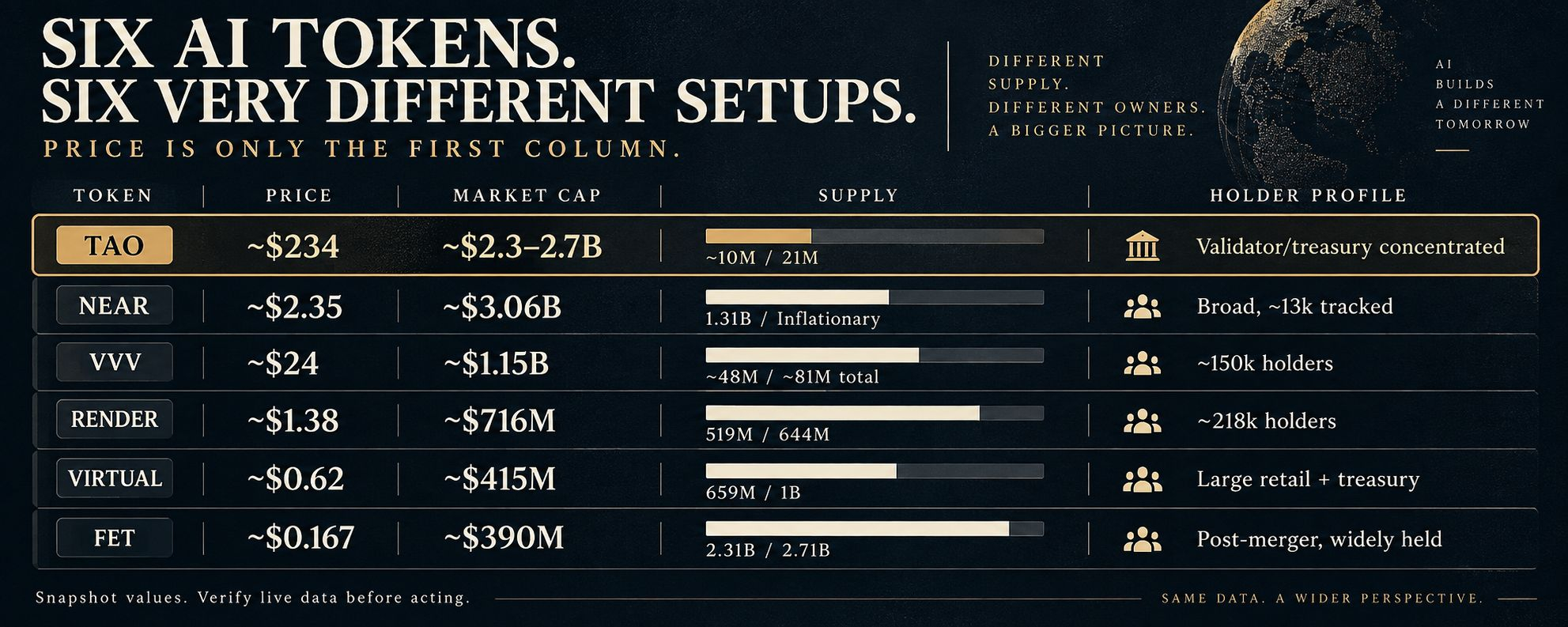
2
4.7k
Log in to explore more content
Join global crypto users on Binance Square
⚡️ Get latest and useful information about crypto.
💬 Trusted by the world’s largest crypto exchange.
👍 Discover real insights from verified creators.
Email / Phone number
Trending Topics
BTCBreaks80K
53,719 views
1,333 Discussing
$BTC
What price is BTC going to hit in 2026?
Spot is sitting at $80,748. 104 days to go
↑ $90k - 58%
↑ $100k - 24%
↓ $70k dip first - 48%
The bull case floating around the floor:
>August had a proper run from $62,275 up to $81,479 — up 31% bottom to top
>The CLARITY Act flopped its Senate cloture vote 49-50 on 15 Sept. BTC was already sliding well before the vote, touched $74,968 in that hour, and won it all back inside three days
>The Fed hiked rates on 16 Sept — first time since July 2023. Spot is currently floating 7.4% above that day's low
>The altcoins are proper outrunning it. 30-day view: SOL up 38%, XRP up 35%, ETH up 32% versus BTC up 23%
>The timeline is still packed with reasons why this ought to break down — and that’s precisely the wall of worry bull markets tend to climb
>The midterms land on 3 Nov, right smack in the middle of this market window
So, what would you put down for a punt at +24% in 104 days?
$ETH
$SOL
#BTCBreaks80K #solonapumping #ETH🔥🔥🔥🔥🔥🔥 #BullMarket📈
Wealthy bloke
·4 Likes
·4.7k views
比特币突破8万
56,209 views
205 Discussing
BuffettBecomesBerkshireChairmanEmeritus
12,302 views
461 Discussing