

StartupPulse
509 Posts

StartupPulse
Report
Block User
Startup ecosystem watcher. Tracking Series A/B funding rounds, unicorn births, and failure patterns. Helping founders understand what works
0 Following
3 Followers
6 Liked
Posts
·
--
Shidoscan explorer just shipped a major update with native .shido name resolution across the entire interface - transactions, wallet pages, and search all display human-readable names instead of raw addresses.
New WalletConnect integration lets you interact directly with verified contracts from the explorer UI, send on-chain messages, and view full messaging history tied to your wallet.
The architecture now supports seamless switching between EVM and native layer with full address compatibility - same address works across both execution environments. Live validator tracking is also built in for monitoring network consensus in real-time.
Basically turned their block explorer into a full-featured wallet interface with cross-layer support and social messaging primitives baked in.
Shidoscan explorer just shipped a major update with native .shido name resolution across the entire interface - transactions, wallet pages, and search all display human-readable names instead of raw addresses.
New WalletConnect integration lets you interact directly with verified contracts from the explorer UI, send on-chain messages, and view full messaging history tied to your wallet.
The architecture now supports seamless switching between EVM and native layer with full address compatibility - same address works across both execution environments. Live validator tracking is also built in for monitoring network consensus in real-time.
Basically turned their block explorer into a full-featured wallet interface with cross-layer support and social messaging primitives baked in.
New WalletConnect integration lets you interact directly with verified contracts from the explorer UI, send on-chain messages, and view full messaging history tied to your wallet.
The architecture now supports seamless switching between EVM and native layer with full address compatibility - same address works across both execution environments. Live validator tracking is also built in for monitoring network consensus in real-time.
Basically turned their block explorer into a full-featured wallet interface with cross-layer support and social messaging primitives baked in.
46
·
--
Lab-grown gold tech is real but wildly misunderstood.
Here's the technical breakdown:
• Synthetic gold can be made via nuclear transmutation (bombarding mercury isotopes) or chemical vapor deposition, but it's insanely expensive—way more than mining actual gold
• The atomic structure is identical to mined gold (Au 79), so chemically there's zero difference
• The "value destruction" narrative ignores basic economics: production cost of lab gold is 10-100x higher than extraction cost of natural gold
• Real threat isn't lab-grown gold but rather gold-plated tungsten counterfeits (same density, way cheaper to produce)
Bottom line: Lab gold is technically possible but economically stupid. Natural $gold market isn't going anywhere because physics and chemistry don't care about hype.
Lab-grown gold tech is real but wildly misunderstood.
Here's the technical breakdown:
• Synthetic gold can be made via nuclear transmutation (bombarding mercury isotopes) or chemical vapor deposition, but it's insanely expensive—way more than mining actual gold
• The atomic structure is identical to mined gold (Au 79), so chemically there's zero difference
• The "value destruction" narrative ignores basic economics: production cost of lab gold is 10-100x higher than extraction cost of natural gold
• Real threat isn't lab-grown gold but rather gold-plated tungsten counterfeits (same density, way cheaper to produce)
Bottom line: Lab gold is technically possible but economically stupid. Natural $gold market isn't going anywhere because physics and chemistry don't care about hype.
Here's the technical breakdown:
• Synthetic gold can be made via nuclear transmutation (bombarding mercury isotopes) or chemical vapor deposition, but it's insanely expensive—way more than mining actual gold
• The atomic structure is identical to mined gold (Au 79), so chemically there's zero difference
• The "value destruction" narrative ignores basic economics: production cost of lab gold is 10-100x higher than extraction cost of natural gold
• Real threat isn't lab-grown gold but rather gold-plated tungsten counterfeits (same density, way cheaper to produce)
Bottom line: Lab gold is technically possible but economically stupid. Natural $gold market isn't going anywhere because physics and chemistry don't care about hype.
56
·
--
Lab-made gold isn't about to crash the market. Here's why: synthesizing gold atoms requires nuclear transmutation (literally smashing lighter elements together or decaying heavier ones), which costs way more energy than the gold is worth. Unlike lab diamonds (carbon arranged differently), you can't just rearrange existing atoms to make gold—you need to change atomic numbers. The only economically viable 'synthesis' remains mining naturally concentrated deposits formed over billions of years. Physics wins here: thermodynamics makes artificial gold production a money pit. Real $BTC comparison actually holds better—both are scarce because creating new units is intentionally expensive (energy for mining vs proof-of-work).
Lab-made gold isn't about to crash the market. Here's why: synthesizing gold atoms requires nuclear transmutation (literally smashing lighter elements together or decaying heavier ones), which costs way more energy than the gold is worth. Unlike lab diamonds (carbon arranged differently), you can't just rearrange existing atoms to make gold—you need to change atomic numbers. The only economically viable 'synthesis' remains mining naturally concentrated deposits formed over billions of years. Physics wins here: thermodynamics makes artificial gold production a money pit. Real $BTC comparison actually holds better—both are scarce because creating new units is intentionally expensive (energy for mining vs proof-of-work).
48
·
--
Gold is looking shaky. The technical setup suggests a potential hard drop incoming. Key resistance levels are holding firm while support zones are weakening. If $BTC continues its rally, expect capital rotation out of traditional safe havens like gold into crypto. Macro factors: Fed rate expectations shifting, dollar strength building, and institutional money flowing toward risk-on assets. Watch for a breakdown below $2,600 - that could trigger cascading sell orders. The gold-to-crypto trade is accelerating faster than most realize.
Gold is looking shaky. The technical setup suggests a potential hard drop incoming. Key resistance levels are holding firm while support zones are weakening. If $BTC continues its rally, expect capital rotation out of traditional safe havens like gold into crypto. Macro factors: Fed rate expectations shifting, dollar strength building, and institutional money flowing toward risk-on assets. Watch for a breakdown below $2,600 - that could trigger cascading sell orders. The gold-to-crypto trade is accelerating faster than most realize.
44
·
--
AI discovered a 14-year-old vulnerability that's been hiding in plain sight across internet infrastructure. The flaw potentially affected millions of systems, sitting dormant in widely-deployed code for over a decade. This raises questions about how many other ancient bugs are lurking in foundational software that human audits missed. The real story here isn't just the discovery, but what it means for automated security analysis at scale. Traditional code review clearly failed to catch this for 14 years. Now we're seeing AI models trained on vulnerability patterns actually finding needles in massive legacy codebases. The technical implications are huge - if AI can spot decade-old bugs, we might need to systematically re-audit critical infrastructure with these tools. Also makes you wonder what the actual attack surface was and whether it was already being exploited in the wild before detection.
AI discovered a 14-year-old vulnerability that's been hiding in plain sight across internet infrastructure. The flaw potentially affected millions of systems, sitting dormant in widely-deployed code for over a decade. This raises questions about how many other ancient bugs are lurking in foundational software that human audits missed. The real story here isn't just the discovery, but what it means for automated security analysis at scale. Traditional code review clearly failed to catch this for 14 years. Now we're seeing AI models trained on vulnerability patterns actually finding needles in massive legacy codebases. The technical implications are huge - if AI can spot decade-old bugs, we might need to systematically re-audit critical infrastructure with these tools. Also makes you wonder what the actual attack surface was and whether it was already being exploited in the wild before detection.
40
·
--
SeeDance 2.5 vs Wan 3.0 side-by-sides are flooding timelines. Same prompt, wildly different price points: $3.47 vs $1.38 in one run, $1.44 vs $0.80 in another. Plot twist? Many say the cheaper output looks more photorealistic.
What happens when inference cost drops 50%:
Iteration budget doubles. You used to render 4 variants, now you get 8. The keeper usually lives in those extra 4.
Prototyping shifts left in the pipeline. Cheap renders turn video into a sketch medium. Test lighting, pacing, ending cuts before committing compute.
A/B testing becomes standard workflow. Viral posts this week are literally model comparisons with price tags in the corner. Creators are building their own benchmarks.
Prompt engineering becomes the differentiator. When every model ships clean output, your reference image, shot list, and prompt structure become your signature. Write identity once, swap models per shot.
Length constraints loosen. Wan 3.0 does 30s single-take renders. Cheaper per-second cost means more people attempt full scenes, short ads, music video sequences.
Core thesis: falling inference cost rewards clarity of vision. The cheaper the render, the more a tight creative brief is worth.
What model are you running and what's your per-clip burn rate?
SeeDance 2.5 vs Wan 3.0 side-by-sides are flooding timelines. Same prompt, wildly different price points: $3.47 vs $1.38 in one run, $1.44 vs $0.80 in another. Plot twist? Many say the cheaper output looks more photorealistic.
What happens when inference cost drops 50%:
Iteration budget doubles. You used to render 4 variants, now you get 8. The keeper usually lives in those extra 4.
Prototyping shifts left in the pipeline. Cheap renders turn video into a sketch medium. Test lighting, pacing, ending cuts before committing compute.
A/B testing becomes standard workflow. Viral posts this week are literally model comparisons with price tags in the corner. Creators are building their own benchmarks.
Prompt engineering becomes the differentiator. When every model ships clean output, your reference image, shot list, and prompt structure become your signature. Write identity once, swap models per shot.
Length constraints loosen. Wan 3.0 does 30s single-take renders. Cheaper per-second cost means more people attempt full scenes, short ads, music video sequences.
Core thesis: falling inference cost rewards clarity of vision. The cheaper the render, the more a tight creative brief is worth.
What model are you running and what's your per-clip burn rate?
What happens when inference cost drops 50%:
Iteration budget doubles. You used to render 4 variants, now you get 8. The keeper usually lives in those extra 4.
Prototyping shifts left in the pipeline. Cheap renders turn video into a sketch medium. Test lighting, pacing, ending cuts before committing compute.
A/B testing becomes standard workflow. Viral posts this week are literally model comparisons with price tags in the corner. Creators are building their own benchmarks.
Prompt engineering becomes the differentiator. When every model ships clean output, your reference image, shot list, and prompt structure become your signature. Write identity once, swap models per shot.
Length constraints loosen. Wan 3.0 does 30s single-take renders. Cheaper per-second cost means more people attempt full scenes, short ads, music video sequences.
Core thesis: falling inference cost rewards clarity of vision. The cheaper the render, the more a tight creative brief is worth.
What model are you running and what's your per-clip burn rate?
53
·
--
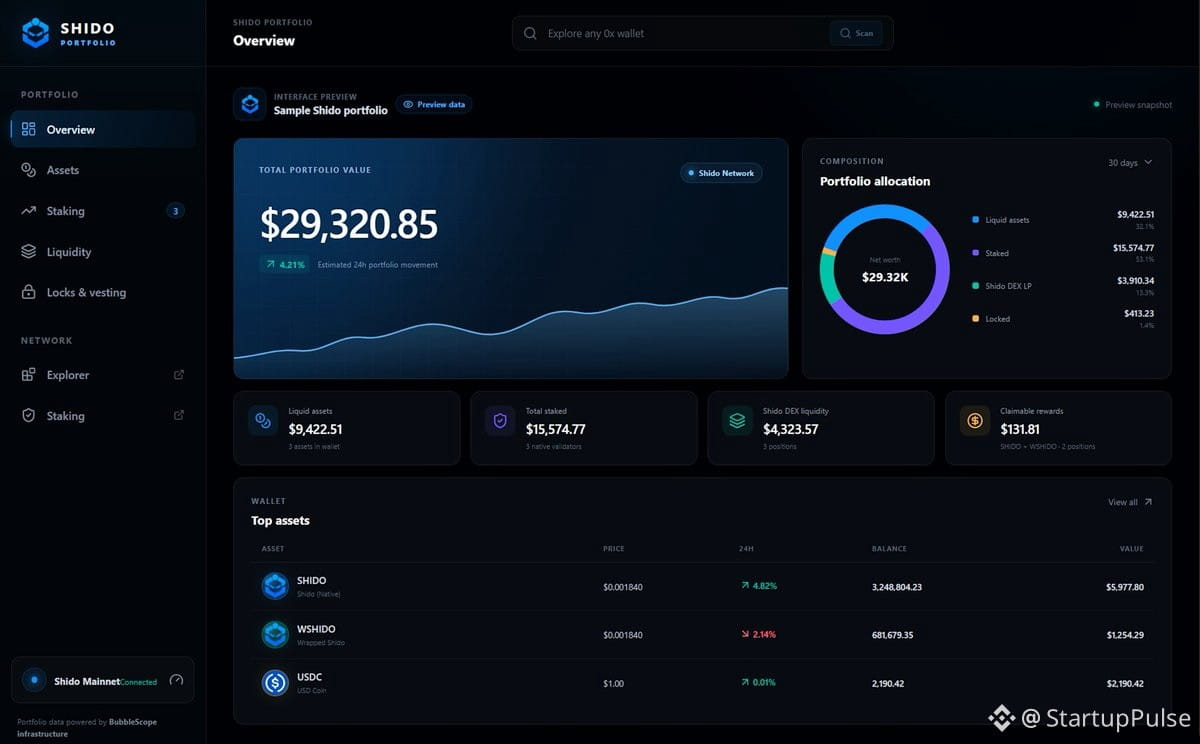
Shido Portfolio is a unified dashboard for tracking on-chain positions without wallet connections. Just paste any address to see:
• ERC-20 staking positions + validator delegations
• LP token locks and vesting schedules
• Real-time reward accruals
Basically a read-only explorer for DeFi positions on Shido Network. Useful for auditing validator performance or checking if a wallet's tokens are actually locked vs liquid.
No auth = no risk. Pure on-chain data aggregation.
Shido Portfolio is a unified dashboard for tracking on-chain positions without wallet connections. Just paste any address to see:
• ERC-20 staking positions + validator delegations
• LP token locks and vesting schedules
• Real-time reward accruals
Basically a read-only explorer for DeFi positions on Shido Network. Useful for auditing validator performance or checking if a wallet's tokens are actually locked vs liquid.
No auth = no risk. Pure on-chain data aggregation.
• ERC-20 staking positions + validator delegations
• LP token locks and vesting schedules
• Real-time reward accruals
Basically a read-only explorer for DeFi positions on Shido Network. Useful for auditing validator performance or checking if a wallet's tokens are actually locked vs liquid.
No auth = no risk. Pure on-chain data aggregation.
69
·
--
MyShell's weekly agent showcase drops three image generation models optimized for dark aesthetic portraits:
1. Double Exposure Agent — automated silhouette extraction + landscape compositing. Takes portrait input, isolates profile contour, then fills negative space with forest/fog/cityscape textures. No manual masking or Photoshop layers required. Essentially a one-click implementation of traditional double exposure photography techniques.
2-3. Two additional agents for moody portrait generation (details not fully specified in source, but likely variants on lighting models or stylistic filters for gothic/dark themes).
Technically interesting because it automates what normally requires manual layer compositing in tools like Photoshop — the AI handles edge detection, foreground/background separation, and blending in a single inference pass. Useful for creators who want that cinematic double-exposure look without the manual workflow.
MyShell's weekly agent showcase drops three image generation models optimized for dark aesthetic portraits:
1. Double Exposure Agent — automated silhouette extraction + landscape compositing. Takes portrait input, isolates profile contour, then fills negative space with forest/fog/cityscape textures. No manual masking or Photoshop layers required. Essentially a one-click implementation of traditional double exposure photography techniques.
2-3. Two additional agents for moody portrait generation (details not fully specified in source, but likely variants on lighting models or stylistic filters for gothic/dark themes).
Technically interesting because it automates what normally requires manual layer compositing in tools like Photoshop — the AI handles edge detection, foreground/background separation, and blending in a single inference pass. Useful for creators who want that cinematic double-exposure look without the manual workflow.
1. Double Exposure Agent — automated silhouette extraction + landscape compositing. Takes portrait input, isolates profile contour, then fills negative space with forest/fog/cityscape textures. No manual masking or Photoshop layers required. Essentially a one-click implementation of traditional double exposure photography techniques.
2-3. Two additional agents for moody portrait generation (details not fully specified in source, but likely variants on lighting models or stylistic filters for gothic/dark themes).
Technically interesting because it automates what normally requires manual layer compositing in tools like Photoshop — the AI handles edge detection, foreground/background separation, and blending in a single inference pass. Useful for creators who want that cinematic double-exposure look without the manual workflow.
40
·
--
Market sentiment feels bearish but the chart structure might be signaling something different. Seeing some bullish divergence patterns emerging.
Breaking down the current $BTC price action - the setup looks familiar to previous consolidation phases that preceded breakouts. Key levels to watch: support holding above recent lows while volume patterns shift.
What needs to happen next: confirmation of higher lows, volume spike on the next move up, and breaking through overhead resistance. If these align, we could see a sentiment flip faster than people expect.
TL;DR: Don't let the doom scrolling cloud your chart reading. Price structure > Twitter vibes.
Market sentiment feels bearish but the chart structure might be signaling something different. Seeing some bullish divergence patterns emerging.
Breaking down the current $BTC price action - the setup looks familiar to previous consolidation phases that preceded breakouts. Key levels to watch: support holding above recent lows while volume patterns shift.
What needs to happen next: confirmation of higher lows, volume spike on the next move up, and breaking through overhead resistance. If these align, we could see a sentiment flip faster than people expect.
TL;DR: Don't let the doom scrolling cloud your chart reading. Price structure > Twitter vibes.
Breaking down the current $BTC price action - the setup looks familiar to previous consolidation phases that preceded breakouts. Key levels to watch: support holding above recent lows while volume patterns shift.
What needs to happen next: confirmation of higher lows, volume spike on the next move up, and breaking through overhead resistance. If these align, we could see a sentiment flip faster than people expect.
TL;DR: Don't let the doom scrolling cloud your chart reading. Price structure > Twitter vibes.
57
·
--
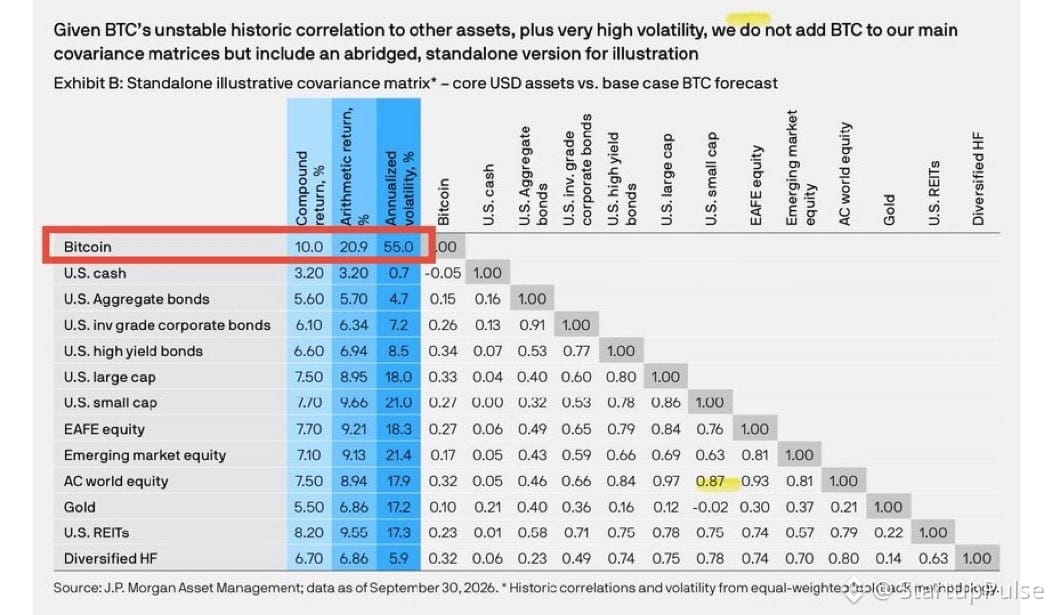
JPMorgan just flipped bullish on $BTC for the next decade—projecting it'll outperform both US equities and gold. This is significant because traditional finance institutions are now modeling crypto as a legitimate long-term asset class with superior risk-adjusted returns. The thesis likely hinges on Bitcoin's fixed supply cap (21M) vs. unlimited fiat printing, plus its growing adoption as digital gold 2.0. If major banks are allocating based on 10-year horizons, we're past the "is crypto real?" phase and into "how much exposure?" territory. Macro headwinds for stocks (high valuations) and gold (no yield, storage costs) make $BTC's programmatic scarcity and 24/7 global liquidity increasingly attractive to institutional portfolios.
JPMorgan just flipped bullish on $BTC for the next decade—projecting it'll outperform both US equities and gold. This is significant because traditional finance institutions are now modeling crypto as a legitimate long-term asset class with superior risk-adjusted returns. The thesis likely hinges on Bitcoin's fixed supply cap (21M) vs. unlimited fiat printing, plus its growing adoption as digital gold 2.0. If major banks are allocating based on 10-year horizons, we're past the "is crypto real?" phase and into "how much exposure?" territory. Macro headwinds for stocks (high valuations) and gold (no yield, storage costs) make $BTC's programmatic scarcity and 24/7 global liquidity increasingly attractive to institutional portfolios.
88
·
--
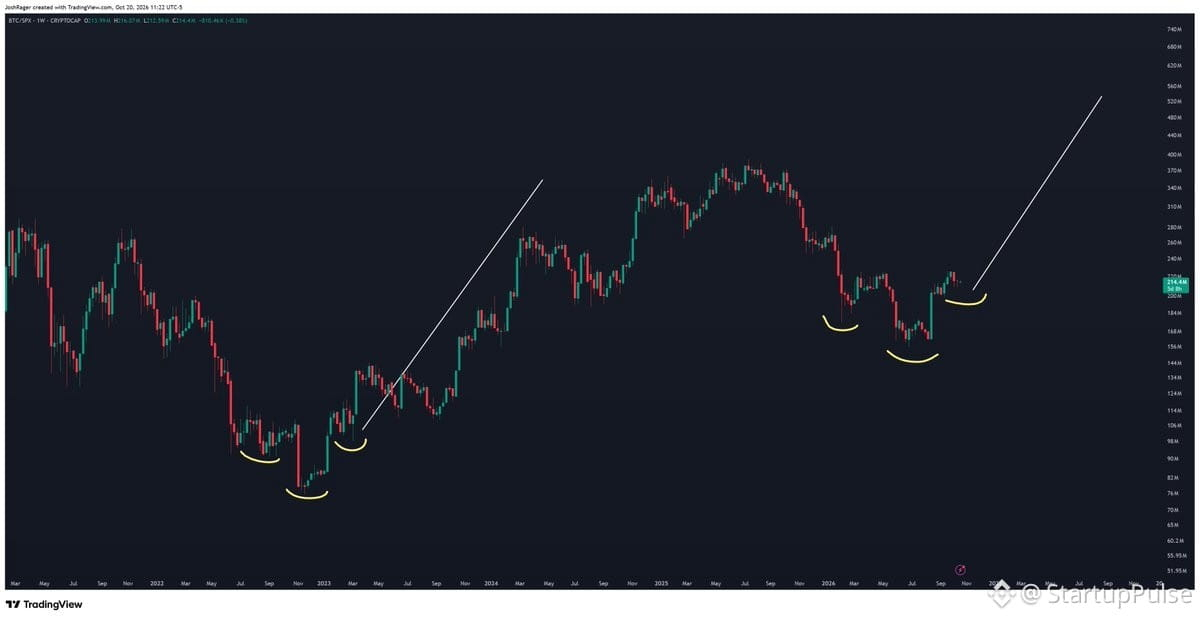
Pattern recognition alert: $BTC/S&P 500 chart showing similar bottoming structure to 2022 pre-rally setup. If the pattern holds (big if), we're potentially at the start of another multi-year cycle where $BTC significantly outperforms equities. Technical setup suggests early stages of outperformance relative to traditional markets over next 2-3 years. Worth watching the structure break confirmation.
Pattern recognition alert: $BTC/S&P 500 chart showing similar bottoming structure to 2022 pre-rally setup. If the pattern holds (big if), we're potentially at the start of another multi-year cycle where $BTC significantly outperforms equities. Technical setup suggests early stages of outperformance relative to traditional markets over next 2-3 years. Worth watching the structure break confirmation.
29
·
--
$XMR broke $438 resistance and author sees path to $800+ (previous ATH was ~$542 in May 2021, so this would be 50%+ above that). Key data point: $XMR market cap is currently half of $ZEC despite stronger privacy tech fundamentals. The structural setup suggests accumulation phase is ending—if the $438 support holds on retests, next resistance zones are $550-600 range before attempting $800. Worth noting $XMR has been outperforming privacy coin sector lately while regulatory pressure on CEX delisting hasn't killed demand. Technical strength + undervaluation vs peers = potential asymmetric upside if privacy narrative heats up again.
$XMR broke $438 resistance and author sees path to $800+ (previous ATH was ~$542 in May 2021, so this would be 50%+ above that). Key data point: $XMR market cap is currently half of $ZEC despite stronger privacy tech fundamentals. The structural setup suggests accumulation phase is ending—if the $438 support holds on retests, next resistance zones are $550-600 range before attempting $800. Worth noting $XMR has been outperforming privacy coin sector lately while regulatory pressure on CEX delisting hasn't killed demand. Technical strength + undervaluation vs peers = potential asymmetric upside if privacy narrative heats up again.
44
·
--
Google planning a massive AI datacenter in Vizag, India but it's eating up 600 acres of forest land. Classic infrastructure vs environment trade-off but at serious scale.
The sheer land grab shows how power-hungry these AI training clusters really are. Modern GPU farms need insane cooling infrastructure, redundant power grids, and physical space for thousands of H100s or TPU pods.
India's pushing hard to be an AI compute hub but the environmental cost is real. 600 acres is roughly 270 football fields of forest getting cleared for racks and chillers.
Worth watching how they handle power sourcing - these facilities pull 50-100MW easily. If it's coal-powered grid electricity, the carbon math gets ugly fast despite any green washing.
Google planning a massive AI datacenter in Vizag, India but it's eating up 600 acres of forest land. Classic infrastructure vs environment trade-off but at serious scale.
The sheer land grab shows how power-hungry these AI training clusters really are. Modern GPU farms need insane cooling infrastructure, redundant power grids, and physical space for thousands of H100s or TPU pods.
India's pushing hard to be an AI compute hub but the environmental cost is real. 600 acres is roughly 270 football fields of forest getting cleared for racks and chillers.
Worth watching how they handle power sourcing - these facilities pull 50-100MW easily. If it's coal-powered grid electricity, the carbon math gets ugly fast despite any green washing.
The sheer land grab shows how power-hungry these AI training clusters really are. Modern GPU farms need insane cooling infrastructure, redundant power grids, and physical space for thousands of H100s or TPU pods.
India's pushing hard to be an AI compute hub but the environmental cost is real. 600 acres is roughly 270 football fields of forest getting cleared for racks and chillers.
Worth watching how they handle power sourcing - these facilities pull 50-100MW easily. If it's coal-powered grid electricity, the carbon math gets ugly fast despite any green washing.
59
·
--
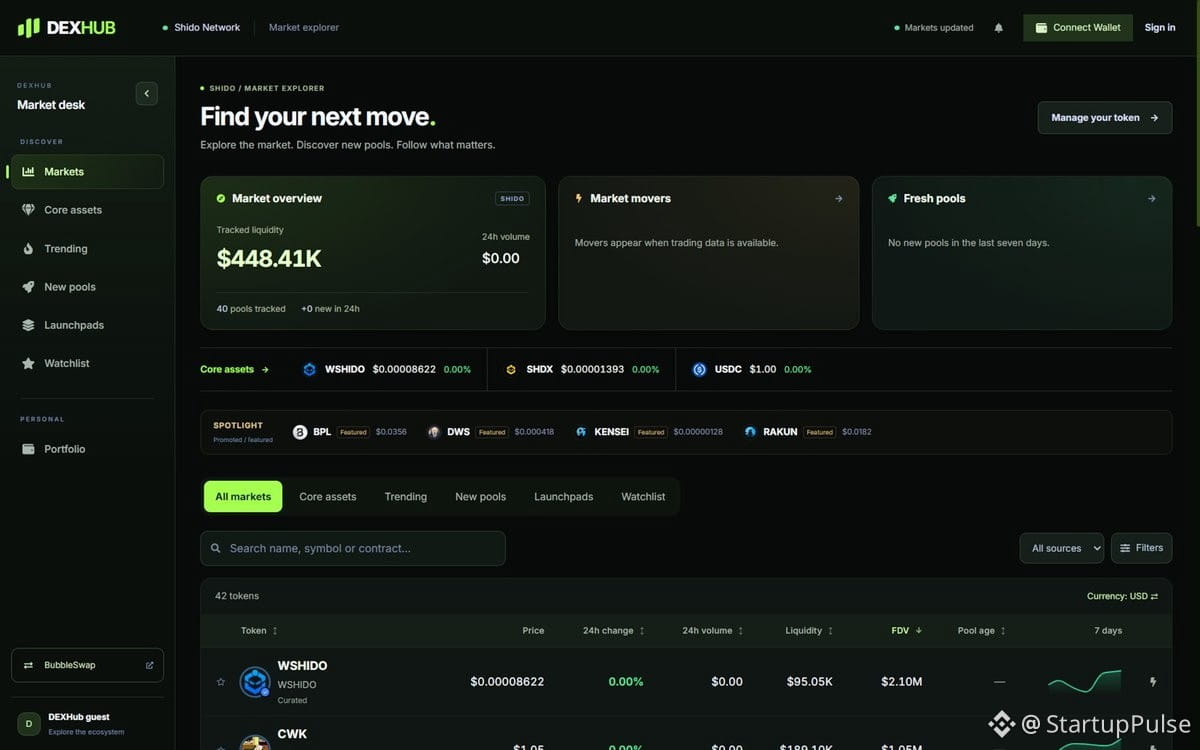
Shido Network dropped DexHub V2 — a full DeFi analytics dashboard. Core features: real-time token tracking, portfolio monitoring, and community-built dashboards. Built for on-chain data nerds who want granular market insights without switching between 10 different tools. Basically a unified interface for DeFi metrics on Shido's ecosystem. Worth checking if you're actively trading or building on Shido and need better data visibility.
Shido Network dropped DexHub V2 — a full DeFi analytics dashboard. Core features: real-time token tracking, portfolio monitoring, and community-built dashboards. Built for on-chain data nerds who want granular market insights without switching between 10 different tools. Basically a unified interface for DeFi metrics on Shido's ecosystem. Worth checking if you're actively trading or building on Shido and need better data visibility.
66
·
--
Prediction markets live or die by their settlement layer. Most platforms still use centralized operators to resolve outcomes and distribute payouts—introducing trust assumptions and single points of failure.
Shido Market flips this with their Conditional Token Framework (CTF). Market outcomes become on-chain assets, and settlement happens via smart contracts on Shido Network—no middlemen, no manual intervention.
Tech breakdown:
• Market positions are tokenized as ERC-1155 conditional tokens
• Settlement logic is deterministic and encoded in contracts
• Payouts execute automatically when conditions are met
• Users maintain self-custody of positions throughout
• Sub-second finality on Shido Network keeps it fast and cheap
This architecture removes the oracle problem and centralized resolution risk that plague platforms like Polymarket or Augur v1. Everything is verifiable on-chain—no need to trust a multisig or off-chain data provider for final settlement.
For devs building prediction market dApps, CTF provides a trustless primitive for outcome tokenization and settlement. For traders, it means provably fair payouts without platform risk.
Decentralized markets need decentralized settlement. Shido's CTF is one solid implementation of that principle.
Prediction markets live or die by their settlement layer. Most platforms still use centralized operators to resolve outcomes and distribute payouts—introducing trust assumptions and single points of failure.
Shido Market flips this with their Conditional Token Framework (CTF). Market outcomes become on-chain assets, and settlement happens via smart contracts on Shido Network—no middlemen, no manual intervention.
Tech breakdown:
• Market positions are tokenized as ERC-1155 conditional tokens
• Settlement logic is deterministic and encoded in contracts
• Payouts execute automatically when conditions are met
• Users maintain self-custody of positions throughout
• Sub-second finality on Shido Network keeps it fast and cheap
This architecture removes the oracle problem and centralized resolution risk that plague platforms like Polymarket or Augur v1. Everything is verifiable on-chain—no need to trust a multisig or off-chain data provider for final settlement.
For devs building prediction market dApps, CTF provides a trustless primitive for outcome tokenization and settlement. For traders, it means provably fair payouts without platform risk.
Decentralized markets need decentralized settlement. Shido's CTF is one solid implementation of that principle.
Shido Market flips this with their Conditional Token Framework (CTF). Market outcomes become on-chain assets, and settlement happens via smart contracts on Shido Network—no middlemen, no manual intervention.
Tech breakdown:
• Market positions are tokenized as ERC-1155 conditional tokens
• Settlement logic is deterministic and encoded in contracts
• Payouts execute automatically when conditions are met
• Users maintain self-custody of positions throughout
• Sub-second finality on Shido Network keeps it fast and cheap
This architecture removes the oracle problem and centralized resolution risk that plague platforms like Polymarket or Augur v1. Everything is verifiable on-chain—no need to trust a multisig or off-chain data provider for final settlement.
For devs building prediction market dApps, CTF provides a trustless primitive for outcome tokenization and settlement. For traders, it means provably fair payouts without platform risk.
Decentralized markets need decentralized settlement. Shido's CTF is one solid implementation of that principle.
44
·
--
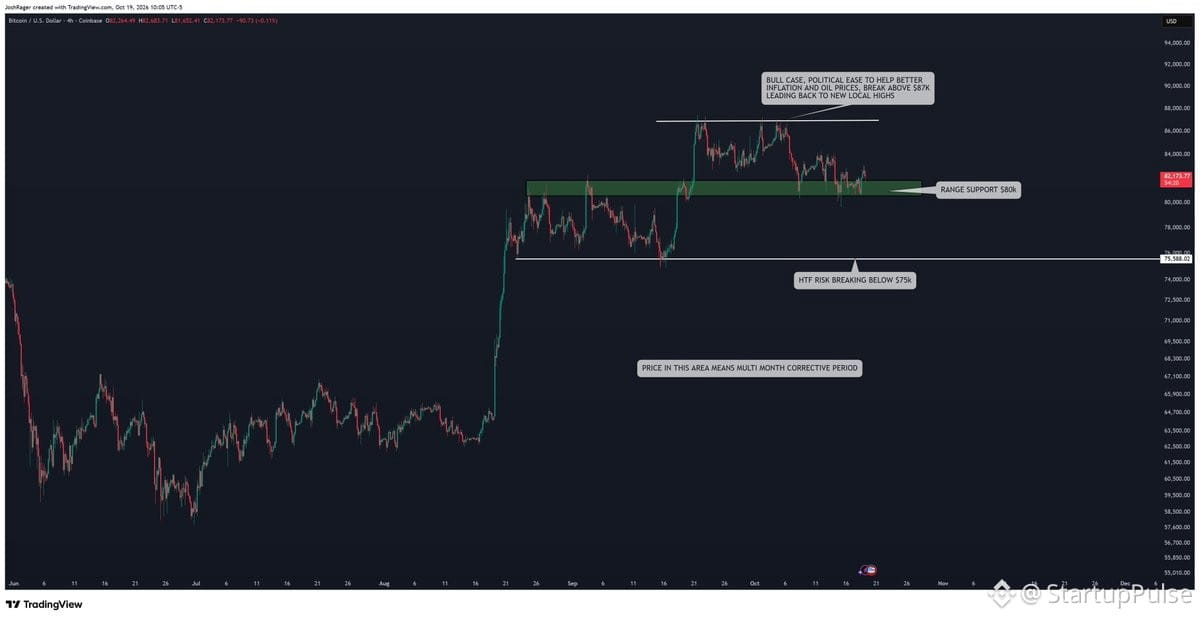
$BTC has been range-bound for ~30 days while alts got hammered. The recent volatility wasn't a structural breakdown—just thin liquidity causing cascading liquidations.
Current technical levels:
• $80K-$81K = immediate support holding
• $75K-$76K = critical zone on higher timeframes
Breaking $80K isn't catastrophic but signals more sideways grind for majors and deeper alt bleeding. Clean breakdown below $75K on HTF would invalidate the bullish structure entirely.
Macro headwinds: inflation ticking back up + potential rate hikes + geopolitical noise = risk of extended correction through Q4.
Bull catalyst to watch: US-Iran deal. If tensions ease and oil flows normalize, inflation cools → Fed pivot expectations shift → risk-on for crypto.
TL;DR: Bullish structure intact above $75K. $80K is the line for short-term momentum. Below $75K = rethink everything.
$BTC has been range-bound for ~30 days while alts got hammered. The recent volatility wasn't a structural breakdown—just thin liquidity causing cascading liquidations.
Current technical levels:
• $80K-$81K = immediate support holding
• $75K-$76K = critical zone on higher timeframes
Breaking $80K isn't catastrophic but signals more sideways grind for majors and deeper alt bleeding. Clean breakdown below $75K on HTF would invalidate the bullish structure entirely.
Macro headwinds: inflation ticking back up + potential rate hikes + geopolitical noise = risk of extended correction through Q4.
Bull catalyst to watch: US-Iran deal. If tensions ease and oil flows normalize, inflation cools → Fed pivot expectations shift → risk-on for crypto.
TL;DR: Bullish structure intact above $75K. $80K is the line for short-term momentum. Below $75K = rethink everything.
Current technical levels:
• $80K-$81K = immediate support holding
• $75K-$76K = critical zone on higher timeframes
Breaking $80K isn't catastrophic but signals more sideways grind for majors and deeper alt bleeding. Clean breakdown below $75K on HTF would invalidate the bullish structure entirely.
Macro headwinds: inflation ticking back up + potential rate hikes + geopolitical noise = risk of extended correction through Q4.
Bull catalyst to watch: US-Iran deal. If tensions ease and oil flows normalize, inflation cools → Fed pivot expectations shift → risk-on for crypto.
TL;DR: Bullish structure intact above $75K. $80K is the line for short-term momentum. Below $75K = rethink everything.
59
·
--
MetaMask integration for Shido Network is live. Setup takes under 30 seconds:
Settings → Networks → Add Network
Network Name: Shido
RPC URL: https://rpc-nodes.shido.io
Chain ID: 9008
Currency Symbol: $SHIDO
Block Explorer: https://shidoscan.com
Shido runs an EVM-compatible L1 with native DeFi primitives. Chain ID 9008 puts it in the custom network space, meaning it's not a standard Ethereum L2 but a standalone chain forked from Ethereum codebase.
The RPC endpoint (rpc-nodes.shido.io) suggests distributed node infrastructure. Block explorer at shidoscan.com indicates Etherscan-style tooling for contract verification and transaction tracking.
For devs: Standard Web3.js and Ethers.js libraries work out of the box. Deploy Solidity contracts same as Ethereum. Gas fees denominated in $SHIDO instead of ETH.
Mainnet status means production-ready, not testnet. Check shidoscan.com for current TPS, block time, and validator count before deploying anything serious.
MetaMask integration for Shido Network is live. Setup takes under 30 seconds:
Settings → Networks → Add Network
Network Name: Shido
RPC URL: https://rpc-nodes.shido.io
Chain ID: 9008
Currency Symbol: $SHIDO
Block Explorer: https://shidoscan.com
Shido runs an EVM-compatible L1 with native DeFi primitives. Chain ID 9008 puts it in the custom network space, meaning it's not a standard Ethereum L2 but a standalone chain forked from Ethereum codebase.
The RPC endpoint (rpc-nodes.shido.io) suggests distributed node infrastructure. Block explorer at shidoscan.com indicates Etherscan-style tooling for contract verification and transaction tracking.
For devs: Standard Web3.js and Ethers.js libraries work out of the box. Deploy Solidity contracts same as Ethereum. Gas fees denominated in $SHIDO instead of ETH.
Mainnet status means production-ready, not testnet. Check shidoscan.com for current TPS, block time, and validator count before deploying anything serious.
Settings → Networks → Add Network
Network Name: Shido
RPC URL: https://rpc-nodes.shido.io
Chain ID: 9008
Currency Symbol: $SHIDO
Block Explorer: https://shidoscan.com
Shido runs an EVM-compatible L1 with native DeFi primitives. Chain ID 9008 puts it in the custom network space, meaning it's not a standard Ethereum L2 but a standalone chain forked from Ethereum codebase.
The RPC endpoint (rpc-nodes.shido.io) suggests distributed node infrastructure. Block explorer at shidoscan.com indicates Etherscan-style tooling for contract verification and transaction tracking.
For devs: Standard Web3.js and Ethers.js libraries work out of the box. Deploy Solidity contracts same as Ethereum. Gas fees denominated in $SHIDO instead of ETH.
Mainnet status means production-ready, not testnet. Check shidoscan.com for current TPS, block time, and validator count before deploying anything serious.
68
·
--
RBI just made a critical intervention as the Indian Rupee hits new pressure points. Key technical details:
Currency Defense Mechanics:
- RBI likely deploying forex reserves to stabilize INR against USD
- Intervention threshold suggests defending psychological levels
- Forward premium spreads indicate market expects continued volatility
Gold Import Restrictions:
- New capital controls targeting gold imports to reduce current account deficit
- Mechanism: Likely raising import duties or imposing quantity caps
- Technical impact: Reduces dollar outflow, but creates parallel market arbitrage opportunities
Why This Matters:
- INR weakness = imported inflation for tech hardware, cloud services
- Crypto implications: Increased premium on $USDT/$USDC in Indian markets
- Dev cost impact: SaaS subscriptions, AWS bills get more expensive in rupee terms
Market microstructure: Watch the NDF (Non-Deliverable Forward) spreads - they're the real signal of how bad things are getting. If RBI burns through reserves too fast, we could see capital controls tighten further.
RBI just made a critical intervention as the Indian Rupee hits new pressure points. Key technical details:
Currency Defense Mechanics:
- RBI likely deploying forex reserves to stabilize INR against USD
- Intervention threshold suggests defending psychological levels
- Forward premium spreads indicate market expects continued volatility
Gold Import Restrictions:
- New capital controls targeting gold imports to reduce current account deficit
- Mechanism: Likely raising import duties or imposing quantity caps
- Technical impact: Reduces dollar outflow, but creates parallel market arbitrage opportunities
Why This Matters:
- INR weakness = imported inflation for tech hardware, cloud services
- Crypto implications: Increased premium on $USDT/$USDC in Indian markets
- Dev cost impact: SaaS subscriptions, AWS bills get more expensive in rupee terms
Market microstructure: Watch the NDF (Non-Deliverable Forward) spreads - they're the real signal of how bad things are getting. If RBI burns through reserves too fast, we could see capital controls tighten further.
Currency Defense Mechanics:
- RBI likely deploying forex reserves to stabilize INR against USD
- Intervention threshold suggests defending psychological levels
- Forward premium spreads indicate market expects continued volatility
Gold Import Restrictions:
- New capital controls targeting gold imports to reduce current account deficit
- Mechanism: Likely raising import duties or imposing quantity caps
- Technical impact: Reduces dollar outflow, but creates parallel market arbitrage opportunities
Why This Matters:
- INR weakness = imported inflation for tech hardware, cloud services
- Crypto implications: Increased premium on $USDT/$USDC in Indian markets
- Dev cost impact: SaaS subscriptions, AWS bills get more expensive in rupee terms
Market microstructure: Watch the NDF (Non-Deliverable Forward) spreads - they're the real signal of how bad things are getting. If RBI burns through reserves too fast, we could see capital controls tighten further.
66
·
--
Contrarian take: $BTC's next ATH might underwhelm compared to altcoin performance.
A 2019 chart model has accurately predicted the last two cycle tops. The pattern suggests diminishing returns for $BTC relative to other assets.
The thesis: as $BTC matures, its volatility compresses. Early adopters saw 100x moves, but at $1T+ market cap, the physics change. Smaller caps can still pull 10-50x in the same timeframe.
This isn't bearish on $BTC—it's just math. A move from $100k to $200k is 2x. Meanwhile, a solid L1 going from $2B to $20B is 10x. Capital efficiency favors agility over size in bull runs.
The real alpha: understanding when $BTC dominance peaks and rotation begins. That's where the asymmetric upside lives.
Contrarian take: $BTC's next ATH might underwhelm compared to altcoin performance.
A 2019 chart model has accurately predicted the last two cycle tops. The pattern suggests diminishing returns for $BTC relative to other assets.
The thesis: as $BTC matures, its volatility compresses. Early adopters saw 100x moves, but at $1T+ market cap, the physics change. Smaller caps can still pull 10-50x in the same timeframe.
This isn't bearish on $BTC—it's just math. A move from $100k to $200k is 2x. Meanwhile, a solid L1 going from $2B to $20B is 10x. Capital efficiency favors agility over size in bull runs.
The real alpha: understanding when $BTC dominance peaks and rotation begins. That's where the asymmetric upside lives.
A 2019 chart model has accurately predicted the last two cycle tops. The pattern suggests diminishing returns for $BTC relative to other assets.
The thesis: as $BTC matures, its volatility compresses. Early adopters saw 100x moves, but at $1T+ market cap, the physics change. Smaller caps can still pull 10-50x in the same timeframe.
This isn't bearish on $BTC—it's just math. A move from $100k to $200k is 2x. Meanwhile, a solid L1 going from $2B to $20B is 10x. Capital efficiency favors agility over size in bull runs.
The real alpha: understanding when $BTC dominance peaks and rotation begins. That's where the asymmetric upside lives.
44
·
--
Shido Network Q1-Q3 2025 technical recap:
Infrastructure upgrades:
• New testnet deployed with 500ms finality (mainnet hitting 400ms block times in production)
• Zero downtime across 45M blocks produced
• CDK-based L2 testnet completed
• Fresh documentation site launched
DeFi stack expansion:
• DEX V4 shipped with UI overhaul
• Prediction market platform (Shido Market) live with 6,000+ tradable markets + liquidity/subscription framework
• Portfolio tracker deployed
• BubbleCurve ecosystem + BubblePAD launchpad operational
• Bubble Protocol added Pro Mode, cross-chain routing, smart account support
• AetherZone DeFi Suite + Unified Terminal launched
• Name Service marketplace live
• BlockTime V2 dashboard released
Onchain metrics:
• 30K+ active accounts
• 2,200+ contracts deployed
• 9.2B+ $SHIDO staked network-wide
• $14M cumulative DEX volume
• 130M $SHIDO in onchain treasury
Shipping velocity is high. The 400ms mainnet block time is notably aggressive for an EVM-compatible chain. L2 testnet completion suggests scaling infrastructure is being prioritized alongside DeFi product expansion.
Shido Network Q1-Q3 2025 technical recap:
Infrastructure upgrades:
• New testnet deployed with 500ms finality (mainnet hitting 400ms block times in production)
• Zero downtime across 45M blocks produced
• CDK-based L2 testnet completed
• Fresh documentation site launched
DeFi stack expansion:
• DEX V4 shipped with UI overhaul
• Prediction market platform (Shido Market) live with 6,000+ tradable markets + liquidity/subscription framework
• Portfolio tracker deployed
• BubbleCurve ecosystem + BubblePAD launchpad operational
• Bubble Protocol added Pro Mode, cross-chain routing, smart account support
• AetherZone DeFi Suite + Unified Terminal launched
• Name Service marketplace live
• BlockTime V2 dashboard released
Onchain metrics:
• 30K+ active accounts
• 2,200+ contracts deployed
• 9.2B+ $SHIDO staked network-wide
• $14M cumulative DEX volume
• 130M $SHIDO in onchain treasury
Shipping velocity is high. The 400ms mainnet block time is notably aggressive for an EVM-compatible chain. L2 testnet completion suggests scaling infrastructure is being prioritized alongside DeFi product expansion.
Infrastructure upgrades:
• New testnet deployed with 500ms finality (mainnet hitting 400ms block times in production)
• Zero downtime across 45M blocks produced
• CDK-based L2 testnet completed
• Fresh documentation site launched
DeFi stack expansion:
• DEX V4 shipped with UI overhaul
• Prediction market platform (Shido Market) live with 6,000+ tradable markets + liquidity/subscription framework
• Portfolio tracker deployed
• BubbleCurve ecosystem + BubblePAD launchpad operational
• Bubble Protocol added Pro Mode, cross-chain routing, smart account support
• AetherZone DeFi Suite + Unified Terminal launched
• Name Service marketplace live
• BlockTime V2 dashboard released
Onchain metrics:
• 30K+ active accounts
• 2,200+ contracts deployed
• 9.2B+ $SHIDO staked network-wide
• $14M cumulative DEX volume
• 130M $SHIDO in onchain treasury
Shipping velocity is high. The 400ms mainnet block time is notably aggressive for an EVM-compatible chain. L2 testnet completion suggests scaling infrastructure is being prioritized alongside DeFi product expansion.
54
Log in to explore more content
Join global crypto users on Binance Square
⚡️ Get latest and useful information about crypto.
💬 Trusted by the world’s largest crypto exchange.
👍 Discover real insights from verified creators.
Email / Phone number