Binance Square

Square Alpha

SquareAlpha | Web3 trader & market analyst – uncovering early opportunities, charts, and airdrops – pure alpha, no hype
Frequent Trader
4.8 Years
78 Following
5.2K+ Followers
9.6K+ Liked
116 Shared
Posts
·
--
Dusk: Constraints Create Credibility @Dusk_Foundation accepts constraints that most chains try to avoid. Compliance, reporting, and oversight aren’t growth blockers here — they’re credibility signals. In real finance, freedom without structure doesn’t attract capital. Predictability does. Dusk designs for environments where rules are non-negotiable and mistakes are expensive. As on-chain markets mature, networks that embrace constraints will earn trust by default. $DUSK isn’t optimizing for optionality — it’s optimizing for legitimacy. #dusk #DUSKFoundation #RegulatedCrypto #InstitutionalFinance {spot}(DUSKUSDT)
Dusk: Constraints Create Credibility

@Dusk accepts constraints that most chains try to avoid. Compliance, reporting, and oversight aren’t growth blockers here — they’re credibility signals.

In real finance, freedom without structure doesn’t attract capital. Predictability does. Dusk designs for environments where rules are non-negotiable and mistakes are expensive.

As on-chain markets mature, networks that embrace constraints will earn trust by default. $DUSK isn’t optimizing for optionality — it’s optimizing for legitimacy.

#dusk #DUSKFoundation #RegulatedCrypto #InstitutionalFinance
Why AI Infrastructure Fails Without Economic Discipline — And How Vanar Gets It RightThe biggest misconception in crypto right now is that AI adoption will be driven by innovation alone. It won’t. In practice, AI systems scale only where economic discipline, reliability, and accountability already exist. Infrastructure that cannot enforce these constraints becomes unusable the moment AI moves from experimentation to deployment. This is where @Vanar quietly separates itself. Instead of positioning itself as another experimental AI chain, Vanar focuses on building infrastructure that can survive real-world economic pressure, with $VANRY acting as the settlement layer that anchors intelligent activity to measurable value. #vanar Most blockchains were designed for human participation: occasional transactions, manual approvals, and fragmented usage patterns. AI systems behave very differently. They operate continuously, interact with other systems autonomously, and generate economic activity at machine speed. Without predictable settlement and enforceable outcomes, these systems fail quickly. Vanar’s architecture assumes this reality from the outset, prioritizing determinism over flexibility and execution over experimentation. From an institutional perspective, this distinction matters more than innovation narratives. Enterprises and regulated entities are not looking for chains that promise future breakthroughs; they are looking for platforms that can support autonomous processes without introducing systemic risk. Vanar’s design aligns with this requirement by embedding intelligence into infrastructure while ensuring that all activity resolves economically through $VANRY. This creates a clear link between usage and value — something institutions can model, audit, and trust. A key strength of Vanar is that it treats intelligence as an operational load, not a marketing feature. Memory, reasoning, and automation are integrated in a way that allows systems to function independently without relying on fragile off-chain coordination. This reduces failure points and increases predictability — two properties that matter far more to institutional adopters than raw performance metrics. Economic settlement is the final filter that separates viable AI infrastructure from demos. AI systems must be able to pay, compensate, and settle outcomes without human intervention. VANRY enables this by functioning as a machine-compatible economic primitive, allowing autonomous systems to transact with clarity and finality. When economic resolution is native, AI activity becomes sustainable rather than experimental. Vanar’s cross-chain expansion, starting with Base, reinforces this discipline. Instead of fragmenting intelligence across disconnected networks, Vanar enables systems to operate across environments while maintaining consistent economic rules. This matters because AI systems do not respect chain boundaries — they follow efficiency and reliability. Cross-chain availability increases usage without compromising structure, which is essential for long-term adoption. The broader market is crowded with chains optimized for attention rather than endurance. Many will struggle as AI adoption accelerates because their infrastructure was never designed to handle autonomous economic behavior. Vanar takes the opposite approach: it assumes that automation will increase pressure on infrastructure, not reduce it. By building for that pressure now, Vanar positions itself ahead of the curve. In the long run, AI will expose which blockchains were built for narratives and which were built for responsibility. Infrastructure that cannot enforce economic outcomes will fade. Infrastructure that aligns intelligence with settlement will compound in relevance. Vanar sits firmly in the second category, with VANRY capturing value as intelligent systems transact, coordinate, and execute in real conditions. The AI era will not reward the loudest chains. It will reward the most disciplined ones.

Why AI Infrastructure Fails Without Economic Discipline — And How Vanar Gets It Right

The biggest misconception in crypto right now is that AI adoption will be driven by innovation alone. It won’t. In practice, AI systems scale only where economic discipline, reliability, and accountability already exist. Infrastructure that cannot enforce these constraints becomes unusable the moment AI moves from experimentation to deployment.

This is where @Vanarchain quietly separates itself. Instead of positioning itself as another experimental AI chain, Vanar focuses on building infrastructure that can survive real-world economic pressure, with $VANRY acting as the settlement layer that anchors intelligent activity to measurable value. #vanar

Most blockchains were designed for human participation: occasional transactions, manual approvals, and fragmented usage patterns. AI systems behave very differently. They operate continuously, interact with other systems autonomously, and generate economic activity at machine speed. Without predictable settlement and enforceable outcomes, these systems fail quickly. Vanar’s architecture assumes this reality from the outset, prioritizing determinism over flexibility and execution over experimentation.

From an institutional perspective, this distinction matters more than innovation narratives. Enterprises and regulated entities are not looking for chains that promise future breakthroughs; they are looking for platforms that can support autonomous processes without introducing systemic risk. Vanar’s design aligns with this requirement by embedding intelligence into infrastructure while ensuring that all activity resolves economically through $VANRY . This creates a clear link between usage and value — something institutions can model, audit, and trust.

A key strength of Vanar is that it treats intelligence as an operational load, not a marketing feature. Memory, reasoning, and automation are integrated in a way that allows systems to function independently without relying on fragile off-chain coordination. This reduces failure points and increases predictability — two properties that matter far more to institutional adopters than raw performance metrics.

Economic settlement is the final filter that separates viable AI infrastructure from demos. AI systems must be able to pay, compensate, and settle outcomes without human intervention. VANRY enables this by functioning as a machine-compatible economic primitive, allowing autonomous systems to transact with clarity and finality. When economic resolution is native, AI activity becomes sustainable rather than experimental.

Vanar’s cross-chain expansion, starting with Base, reinforces this discipline. Instead of fragmenting intelligence across disconnected networks, Vanar enables systems to operate across environments while maintaining consistent economic rules. This matters because AI systems do not respect chain boundaries — they follow efficiency and reliability. Cross-chain availability increases usage without compromising structure, which is essential for long-term adoption.

The broader market is crowded with chains optimized for attention rather than endurance. Many will struggle as AI adoption accelerates because their infrastructure was never designed to handle autonomous economic behavior. Vanar takes the opposite approach: it assumes that automation will increase pressure on infrastructure, not reduce it. By building for that pressure now, Vanar positions itself ahead of the curve.

In the long run, AI will expose which blockchains were built for narratives and which were built for responsibility. Infrastructure that cannot enforce economic outcomes will fade. Infrastructure that aligns intelligence with settlement will compound in relevance. Vanar sits firmly in the second category, with VANRY capturing value as intelligent systems transact, coordinate, and execute in real conditions.

The AI era will not reward the loudest chains. It will reward the most disciplined ones.
AI Narratives Fade. Infrastructure Stays. @Vanar is built on a contrarian truth: institutions don’t chase “AI tokens.” They adopt infrastructure that already supports intelligent workflows, automated execution, and real settlement. $VANRY isn’t priced on hype cycles. It reflects readiness for AI-driven activity at scale — the kind institutions quietly accumulate, not loudly market. #Vanar {spot}(VANRYUSDT)
AI Narratives Fade. Infrastructure Stays.

@Vanarchain is built on a contrarian truth: institutions don’t chase “AI tokens.” They adopt infrastructure that already supports intelligent workflows, automated execution, and real settlement.

$VANRY isn’t priced on hype cycles. It reflects readiness for AI-driven activity at scale — the kind institutions quietly accumulate, not loudly market. #Vanar
Plasma Is Optimized for Audit Trails, Not Twitter Threads@Plasma is not built to convince institutions that crypto is safe. It is built so that institutions can prove to themselves that nothing unexpected happened. That distinction is subtle — and decisive. Most blockchain narratives aimed at institutions focus on access: access to liquidity, access to programmability, access to new markets. Plasma takes a colder view. It assumes institutions already have access. What they lack is certainty. Certainty about execution. Certainty about costs. Certainty about post-factum explanation. Plasma is designed around that gap. Institutions Don’t Fear Decentralization — They Fear Ambiguity From an institutional lens, decentralization is not the primary concern. Ambiguity is. Ambiguity shows up when: transaction ordering changes under load fees cannot be forecasted system behavior differs from documentation outcomes are correct but difficult to explain Most blockchains tolerate these properties because crypto-native users accept them. Institutions do not. Every ambiguous outcome becomes a compliance question, an audit exception, or a governance issue. Plasma’s architecture is shaped by the assumption that every transaction must be explainable after the fact. That assumption naturally limits design freedom — and that’s intentional. Why Plasma Treats Execution as a Compliance Surface Execution environments are usually discussed as developer tooling. Institutions see them as compliance surfaces. Plasma’s restrained execution model reduces the number of possible states a transaction can pass through. Fewer states mean fewer interpretations. Fewer interpretations mean fewer problems during review. This is not about being less powerful — it is about being more legible. While Plasma supports familiar execution paradigms, it does not maximize expressiveness for its own sake. It optimizes for deterministic behavior that survives scrutiny weeks or months later. That is a very different success metric. Cost Predictability Is an Accounting Requirement, Not UX In retail crypto, variable fees are an inconvenience. In institutional systems, they are an accounting failure. Plasma approaches cost behavior as something that must be modeled in advance, not explained after the fact. Predictable execution costs simplify reconciliation, automation, and internal controls. This is why Plasma avoids designs where congestion fundamentally reshapes transaction economics. The absence of surprise matters more than the absence of friction. Plasma Competes With Process, Not Platforms A common mistake is to frame Plasma against other blockchains. Institutions don’t choose platforms the way developers do. They choose processes. The real alternatives Plasma competes with are: batch settlement with delayed finality internal ledger adjustments followed by reconciliation manual exception handling wrapped in policy Plasma’s value proposition is not speed. It is reducing operational surface area. Fewer exceptions. Fewer manual interventions. Fewer explanations required. That is why Plasma’s progress looks slow from the outside. Process change always does. The Role of XPL in an Institutional Context From an institutional perspective, $XPL is not a narrative asset. It is part of the system’s internal alignment. Plasma avoids turning the token into an incentive engine because incentives distort behavior — and distorted behavior breaks predictability. This restraint is costly in the short term. It also keeps the system coherent. Institutions do not want to wonder whether activity exists because it is needed or because it is subsidized. Plasma chooses clarity over acceleration. Why Plasma Will Be Evaluated Late — and Strictly Institutions rarely adopt infrastructure early. They adopt it after it has survived stress, audits, and quiet usage. Plasma’s design suggests it expects to be evaluated after being used, not before. That makes @Plasma easy to ignore and hard to dismiss once embedded. Systems optimized for auditability and repeatability do not announce themselves. They accumulate trust slowly. Conclusion Plasma is built around a principle crypto rarely centers: nothing should need to be explained twice. Its execution discipline, cost behavior, and token restraint all serve that goal. Plasma is not trying to sell institutions on blockchain potential. It is trying to remove reasons for internal objections. If adoption comes, it will not come with applause. It will come with approval. And in institutional finance, approval matters more than excitement. That is the real lens for understanding #Plasma , @Plasma , and the quiet role of $XPL .

Plasma Is Optimized for Audit Trails, Not Twitter Threads

@Plasma is not built to convince institutions that crypto is safe. It is built so that institutions can prove to themselves that nothing unexpected happened.

That distinction is subtle — and decisive.

Most blockchain narratives aimed at institutions focus on access: access to liquidity, access to programmability, access to new markets. Plasma takes a colder view. It assumes institutions already have access. What they lack is certainty. Certainty about execution. Certainty about costs. Certainty about post-factum explanation.

Plasma is designed around that gap.

Institutions Don’t Fear Decentralization — They Fear Ambiguity

From an institutional lens, decentralization is not the primary concern. Ambiguity is.

Ambiguity shows up when:

transaction ordering changes under load
fees cannot be forecasted
system behavior differs from documentation
outcomes are correct but difficult to explain

Most blockchains tolerate these properties because crypto-native users accept them. Institutions do not. Every ambiguous outcome becomes a compliance question, an audit exception, or a governance issue.

Plasma’s architecture is shaped by the assumption that every transaction must be explainable after the fact. That assumption naturally limits design freedom — and that’s intentional.

Why Plasma Treats Execution as a Compliance Surface

Execution environments are usually discussed as developer tooling. Institutions see them as compliance surfaces.

Plasma’s restrained execution model reduces the number of possible states a transaction can pass through. Fewer states mean fewer interpretations. Fewer interpretations mean fewer problems during review. This is not about being less powerful — it is about being more legible.

While Plasma supports familiar execution paradigms, it does not maximize expressiveness for its own sake. It optimizes for deterministic behavior that survives scrutiny weeks or months later.

That is a very different success metric.

Cost Predictability Is an Accounting Requirement, Not UX

In retail crypto, variable fees are an inconvenience. In institutional systems, they are an accounting failure.

Plasma approaches cost behavior as something that must be modeled in advance, not explained after the fact. Predictable execution costs simplify reconciliation, automation, and internal controls. This is why Plasma avoids designs where congestion fundamentally reshapes transaction economics.

The absence of surprise matters more than the absence of friction.

Plasma Competes With Process, Not Platforms

A common mistake is to frame Plasma against other blockchains. Institutions don’t choose platforms the way developers do. They choose processes.

The real alternatives Plasma competes with are:

batch settlement with delayed finality
internal ledger adjustments followed by reconciliation
manual exception handling wrapped in policy

Plasma’s value proposition is not speed. It is reducing operational surface area. Fewer exceptions. Fewer manual interventions. Fewer explanations required.

That is why Plasma’s progress looks slow from the outside. Process change always does.

The Role of XPL in an Institutional Context

From an institutional perspective, $XPL is not a narrative asset. It is part of the system’s internal alignment. Plasma avoids turning the token into an incentive engine because incentives distort behavior — and distorted behavior breaks predictability.

This restraint is costly in the short term. It also keeps the system coherent. Institutions do not want to wonder whether activity exists because it is needed or because it is subsidized.

Plasma chooses clarity over acceleration.

Why Plasma Will Be Evaluated Late — and Strictly

Institutions rarely adopt infrastructure early. They adopt it after it has survived stress, audits, and quiet usage. Plasma’s design suggests it expects to be evaluated after being used, not before.

That makes @Plasma easy to ignore and hard to dismiss once embedded. Systems optimized for auditability and repeatability do not announce themselves. They accumulate trust slowly.

Conclusion

Plasma is built around a principle crypto rarely centers: nothing should need to be explained twice.

Its execution discipline, cost behavior, and token restraint all serve that goal. Plasma is not trying to sell institutions on blockchain potential. It is trying to remove reasons for internal objections.

If adoption comes, it will not come with applause.

It will come with approval.

And in institutional finance, approval matters more than excitement.

That is the real lens for understanding #Plasma , @Plasma , and the quiet role of $XPL .
Liquidity Chases Stories. Capital Chases Survivability. Institutions don’t deploy where performance is flashy — they deploy where systems fail gracefully. @Plasma is engineered around predictability under load, not retail benchmarks. That mindset is why $XPL reads more like infrastructure exposure than speculation. #plasma {spot}(XPLUSDT)
Liquidity Chases Stories. Capital Chases Survivability.

Institutions don’t deploy where performance is flashy — they deploy where systems fail gracefully. @Plasma is engineered around predictability under load, not retail benchmarks. That mindset is why $XPL reads more like infrastructure exposure than speculation. #plasma
Walrus Is Not About Storage — It’s About Predictable Data Continuity@WalrusProtocol In Web3, most decentralized storage projects promise permanence. “Store it once, forget it forever” is the mantra. That’s appealing to retail investors and casual builders, but it ignores the reality that networks fail. Nodes go offline, usage spikes, and incentives fluctuate. For serious applications — NFT marketplaces, AI workflows, financial infrastructure — that fragility is not philosophical; it is existential. Walrus operates from a different premise: data availability must be actively maintained. On Sui, blobs are not passive objects. Each file carries explicit rules for lifecycle, custodial responsibility, and verifiable continuity. Failure is not an assumption; it is treated as a condition the network must survive. Why Centralized and Traditional Decentralized Storage Are Insufficient Centralized cloud is convenient until it fails. Outages, policy changes, or even subtle performance degradation introduce risk. Traditional decentralized alternatives often rely on vague replication and economic assumptions. They work in theory, but under stress, they fail silently. For enterprise-grade Web3 applications, that is unacceptable. Walrus solves for operational reality. Its network enforces availability continuously. Redundant nodes, erasure-coded storage, and economic incentives align to ensure that critical data survives churn. This approach turns storage into reliability as a service, not a feature. Applications That Depend on Walrus The value of Walrus emerges when downtime is costly: NFT platforms that require persistent media Games with evolving world states and critical assets AI agents that consume large datasets in real-time Compliance-heavy applications needing verifiable audit trails When applications embed Walrus, switching becomes costly. Data continuity becomes a dependency, not a preference. The Role of WAL The token is not a speculative gimmick. $WAL directly enforces reliability. Nodes are rewarded for maintaining availability and penalized for downtime. Incentives are tied to performance under stress, not just participation. This makes Walrus economically predictable in a way that other storage networks are not. Institutional actors and developers alike recognize that predictable performance under adverse conditions is far more valuable than cheap, unreliable capacity. Why This Perspective Matters Most narratives around storage highlight decentralization, censorship resistance, or token hype. Walrus reframes the conversation around dependence, continuity, and verifiable guarantees. That shift is subtle, but it determines whether applications survive or fail when real-world conditions deviate from the ideal. In other words, Walrus doesn’t sell hope. It sells reliability that can be measured, audited, and depended on. Conclusion As Web3 applications become increasingly complex, data continuity is no longer optional. @WalrusProtocol and $WAL provide a system where availability is enforced, predictable, and verifiable. Infrastructure stops being a background detail — it becomes a foundation for trust and long-term growth. When applications integrate Walrus, storage is no longer a vulnerability. It becomes a strategic asset. That is the distinction that will determine which projects scale successfully in the next era of decentralized systems. #walrus

Walrus Is Not About Storage — It’s About Predictable Data Continuity

@Walrus 🦭/acc
In Web3, most decentralized storage projects promise permanence. “Store it once, forget it forever” is the mantra. That’s appealing to retail investors and casual builders, but it ignores the reality that networks fail. Nodes go offline, usage spikes, and incentives fluctuate. For serious applications — NFT marketplaces, AI workflows, financial infrastructure — that fragility is not philosophical; it is existential.

Walrus operates from a different premise: data availability must be actively maintained. On Sui, blobs are not passive objects. Each file carries explicit rules for lifecycle, custodial responsibility, and verifiable continuity. Failure is not an assumption; it is treated as a condition the network must survive.

Why Centralized and Traditional Decentralized Storage Are Insufficient

Centralized cloud is convenient until it fails. Outages, policy changes, or even subtle performance degradation introduce risk. Traditional decentralized alternatives often rely on vague replication and economic assumptions. They work in theory, but under stress, they fail silently. For enterprise-grade Web3 applications, that is unacceptable.

Walrus solves for operational reality. Its network enforces availability continuously. Redundant nodes, erasure-coded storage, and economic incentives align to ensure that critical data survives churn. This approach turns storage into reliability as a service, not a feature.

Applications That Depend on Walrus

The value of Walrus emerges when downtime is costly:

NFT platforms that require persistent media
Games with evolving world states and critical assets
AI agents that consume large datasets in real-time
Compliance-heavy applications needing verifiable audit trails

When applications embed Walrus, switching becomes costly. Data continuity becomes a dependency, not a preference.

The Role of WAL

The token is not a speculative gimmick. $WAL directly enforces reliability. Nodes are rewarded for maintaining availability and penalized for downtime. Incentives are tied to performance under stress, not just participation. This makes Walrus economically predictable in a way that other storage networks are not.

Institutional actors and developers alike recognize that predictable performance under adverse conditions is far more valuable than cheap, unreliable capacity.

Why This Perspective Matters

Most narratives around storage highlight decentralization, censorship resistance, or token hype. Walrus reframes the conversation around dependence, continuity, and verifiable guarantees. That shift is subtle, but it determines whether applications survive or fail when real-world conditions deviate from the ideal.

In other words, Walrus doesn’t sell hope. It sells reliability that can be measured, audited, and depended on.

Conclusion

As Web3 applications become increasingly complex, data continuity is no longer optional. @Walrus 🦭/acc and $WAL provide a system where availability is enforced, predictable, and verifiable. Infrastructure stops being a background detail — it becomes a foundation for trust and long-term growth.

When applications integrate Walrus, storage is no longer a vulnerability. It becomes a strategic asset. That is the distinction that will determine which projects scale successfully in the next era of decentralized systems.

#walrus
Vanar: AI-First Infrastructure That Turns Intelligence Into Real ValueIn the current blockchain ecosystem, most new L1s compete on speed, ecosystem size, and token hype. In an AI-driven era, that focus is misplaced. Autonomous systems do not care about flashy launches or marketing narratives. They care about infrastructure that is reliable, continuous, and economically meaningful. @Vanar is one of the few platforms to recognize this shift, and its $VANRY token is designed not as a speculative asset, but as the backbone of real AI-native activity. #vanar Vanar’s approach is contrarian. Whereas most chains retrofit AI on top of legacy systems, Vanar assumes intelligence from the ground up. This means persistent memory, native reasoning, automated execution, and deterministic settlement are built directly into the architecture. By designing for AI-native systems rather than human users, Vanar creates an environment where autonomous agents, enterprise systems, and regulated actors can operate reliably. The result is infrastructure that institutions can adopt without uncertainty, and a token economy that reflects actual usage, not hype. Institutions do not make adoption decisions based on narrative or early-stage excitement. They require auditability, predictable execution, and measurable economic activity. Vanar aligns with these requirements because each interaction — whether an agent accessing memory, executing a decision, or settling a transaction — translates directly into $VANRY value. This design ensures that adoption scales with real-world activity, not speculative interest. In effect, VANRY is embedded into the operational logic of the chain, making it inseparable from infrastructure utility. A major differentiator for Vanar is cross-chain deployment. Autonomous systems cannot remain siloed on a single network. Starting with Base, Vanar extends its AI-native infrastructure across ecosystems, enabling agents to operate and settle value seamlessly. This interoperability increases both adoption and token velocity. By supporting cross-chain coordination, Vanar demonstrates that AI-first infrastructure cannot be isolated and that its economic activity scales naturally beyond any single L1. The market is littered with chains that prioritize marketing over function. Vanar flips this approach, focusing on readiness, reliability, and economic alignment. Autonomous agents reward infrastructure that can operate under real-world constraints, and Vanar ensures that VANRY reflects this reality. Instead of chasing trends, the platform positions itself where institutional adoption, intelligent automation, and economic settlement converge. Vanar’s live ecosystem proves readiness rather than promises it. Systems like myNeutron establish persistent memory, allowing agents to retain context over time. Kayon embeds explainable reasoning, so autonomous decisions are auditable and verifiable. Flows enables automated execution, translating intelligence into controlled, predictable outcomes. Each layer of Vanar’s stack reinforces the others, creating a holistic environment for AI-native systems. These are not theoretical features; they are operational primitives that institutions, developers, and enterprises can rely on. The long-term advantage of Vanar is structural. New L1s may compete on attention today, but in an AI-first economy, infrastructure that cannot support autonomous reasoning, memory, execution, and settlement will quickly become obsolete. Vanar is designed to grow in utility as AI adoption accelerates, and VANRY captures that economic activity naturally. In a world increasingly defined by autonomous systems, Vanar transforms intelligence into real-world value. The AI era exposes the weakness of hype-driven chains. Institutions and intelligent systems will gravitate toward infrastructure that is predictable, scalable, and economically meaningful. Vanar provides this foundation, with VANRY as the token that reflects usage, trust, and adoption. It is infrastructure built for the realities of AI, not the narratives of marketing cycles. @Vanar | $VANRY | #vanar

Vanar: AI-First Infrastructure That Turns Intelligence Into Real Value

In the current blockchain ecosystem, most new L1s compete on speed, ecosystem size, and token hype. In an AI-driven era, that focus is misplaced. Autonomous systems do not care about flashy launches or marketing narratives. They care about infrastructure that is reliable, continuous, and economically meaningful. @Vanarchain is one of the few platforms to recognize this shift, and its $VANRY token is designed not as a speculative asset, but as the backbone of real AI-native activity. #vanar

Vanar’s approach is contrarian. Whereas most chains retrofit AI on top of legacy systems, Vanar assumes intelligence from the ground up. This means persistent memory, native reasoning, automated execution, and deterministic settlement are built directly into the architecture. By designing for AI-native systems rather than human users, Vanar creates an environment where autonomous agents, enterprise systems, and regulated actors can operate reliably. The result is infrastructure that institutions can adopt without uncertainty, and a token economy that reflects actual usage, not hype.

Institutions do not make adoption decisions based on narrative or early-stage excitement. They require auditability, predictable execution, and measurable economic activity. Vanar aligns with these requirements because each interaction — whether an agent accessing memory, executing a decision, or settling a transaction — translates directly into $VANRY value. This design ensures that adoption scales with real-world activity, not speculative interest. In effect, VANRY is embedded into the operational logic of the chain, making it inseparable from infrastructure utility.

A major differentiator for Vanar is cross-chain deployment. Autonomous systems cannot remain siloed on a single network. Starting with Base, Vanar extends its AI-native infrastructure across ecosystems, enabling agents to operate and settle value seamlessly. This interoperability increases both adoption and token velocity. By supporting cross-chain coordination, Vanar demonstrates that AI-first infrastructure cannot be isolated and that its economic activity scales naturally beyond any single L1.

The market is littered with chains that prioritize marketing over function. Vanar flips this approach, focusing on readiness, reliability, and economic alignment. Autonomous agents reward infrastructure that can operate under real-world constraints, and Vanar ensures that VANRY reflects this reality. Instead of chasing trends, the platform positions itself where institutional adoption, intelligent automation, and economic settlement converge.

Vanar’s live ecosystem proves readiness rather than promises it. Systems like myNeutron establish persistent memory, allowing agents to retain context over time. Kayon embeds explainable reasoning, so autonomous decisions are auditable and verifiable. Flows enables automated execution, translating intelligence into controlled, predictable outcomes. Each layer of Vanar’s stack reinforces the others, creating a holistic environment for AI-native systems. These are not theoretical features; they are operational primitives that institutions, developers, and enterprises can rely on.

The long-term advantage of Vanar is structural. New L1s may compete on attention today, but in an AI-first economy, infrastructure that cannot support autonomous reasoning, memory, execution, and settlement will quickly become obsolete. Vanar is designed to grow in utility as AI adoption accelerates, and VANRY captures that economic activity naturally. In a world increasingly defined by autonomous systems, Vanar transforms intelligence into real-world value.

The AI era exposes the weakness of hype-driven chains. Institutions and intelligent systems will gravitate toward infrastructure that is predictable, scalable, and economically meaningful. Vanar provides this foundation, with VANRY as the token that reflects usage, trust, and adoption. It is infrastructure built for the realities of AI, not the narratives of marketing cycles.

@Vanarchain | $VANRY | #vanar
@WalrusProtocol is being valued in the wrong category. Institutions don’t care about “decentralized storage” narratives. They care about predictable data availability and operational risk. Walrus is built around that priority, which makes it closer to infrastructure than a crypto experiment. From this lens, $WAL functions as a coordination asset tied to ongoing service reliability, not speculative usage. That’s why Walrus shouldn’t be compared to archival networks at all. The contrarian truth: Walrus wins by being boring — and boring is exactly what serious capital demands. #walrus #Web3 #DePIN #Infrastructure 🦭 {spot}(WALUSDT)
@Walrus 🦭/acc is being valued in the wrong category.

Institutions don’t care about “decentralized storage” narratives. They care about predictable data availability and operational risk. Walrus is built around that priority, which makes it closer to infrastructure than a crypto experiment.

From this lens, $WAL functions as a coordination asset tied to ongoing service reliability, not speculative usage. That’s why Walrus shouldn’t be compared to archival networks at all.

The contrarian truth: Walrus wins by being boring — and boring is exactly what serious capital demands.

#walrus #Web3 #DePIN #Infrastructure 🦭
Institutions Won’t Bet on “AI Chains” — They Bet on Readiness @Vanar exists for a reason most AI chains avoid: institutions don’t buy narratives. They buy infrastructure that can support automated decisions, compliance, and real settlement today, not “after the roadmap.” That’s where $VANRY fits — exposure to AI-ready rails, not speculative features. #Vanar {spot}(VANRYUSDT)
Institutions Won’t Bet on “AI Chains” — They Bet on Readiness

@Vanarchain exists for a reason most AI chains avoid: institutions don’t buy narratives. They buy infrastructure that can support automated decisions, compliance, and real settlement today, not “after the roadmap.”

That’s where $VANRY fits — exposure to AI-ready rails, not speculative features. #Vanar
Plasma’s Real Bet Is That Institutions Don’t Want More Crypto@Plasma is not trying to onboard institutions into crypto. Plasma is trying to give institutions a way to avoid crypto altogether while still using blockchains. That sounds contradictory — and that’s exactly why it matters. Most blockchain projects assume institutional adoption means convincing banks, funds, and enterprises to embrace crypto-native behaviors: wallets, gas management, composability, on-chain experimentation. Plasma is built on the opposite assumption. It assumes institutions do not want to learn crypto. They want infrastructure that behaves like the systems they already trust. This single assumption explains Plasma more accurately than any technical overview. Why Institutional Systems Reject “Crypto-Native” Design Institutions do not optimize for innovation velocity. They optimize for operational certainty. Their priorities are boring but rigid: predictable execution controlled failure modes repeatable transaction behavior cost models that don’t change under stress Most blockchains fail institutional evaluation not because they are decentralized, but because they are unpredictable. Volatile fees, shifting execution behavior, and incentive-driven congestion are unacceptable in environments where accountability exists. Plasma’s design implicitly acknowledges this. It does not attempt to make institutions fluent in crypto mechanics. It attempts to make crypto mechanics irrelevant. That is a deeply contrarian position in this market. Plasma Is Not Competing With Blockchains — It’s Competing With Internal Ledgers Here’s the mistake most analysts make: they compare Plasma to L1s and L2s. Institutions are not choosing between chains. They are choosing between: keeping value movements internal relying on legacy settlement rails or exposing themselves to public infrastructure Plasma’s real competition is internal databases and reconciliation-heavy workflows, not Ethereum rollups. Its value proposition is not expressiveness — it is external settlement without losing control. This is why Plasma does not over-optimize for composability or experimentation. Those traits are liabilities in institutional contexts. What matters is that transactions behave the same way every time, under scrutiny. That is the lens Plasma is built through. Why “Less Flexibility” Is a Feature, Not a Weakness Crypto culture treats flexibility as virtue. Institutions treat it as risk. Plasma’s restrained execution environment is not an accident. It narrows the space of possible behavior to reduce audit complexity and operational surprises. This makes the system less exciting for builders — and more legible for compliance, risk, and finance teams. In institutional systems, fewer options often mean fewer failure paths. Plasma leans into that trade-off instead of pretending it doesn’t exist. That choice will never trend. But it will pass due diligence more often. The Quiet Role of XPL From an institutional lens, $XPL is not meant to be a speculative signal. It functions as a network-aligned asset, not a growth narrative. Plasma avoids using the token to manufacture activity because artificial volume destroys the very predictability institutions require. This is why Plasma feels slow. It is waiting for usage that is defensible, not usage that is loud. Institutions do not reward speed. They reward survivability. Why Plasma Scores Poorly in Creator Metrics — and Why That’s Telling Creator ecosystems reward visibility, novelty, and engagement loops. Plasma intentionally deprioritizes all three. That makes it difficult to score well in creator-focused frameworks, but aligned with how infrastructure adoption actually happens. Institutions don’t discover systems through content. They discover them through reliability under constraint. By the time attention arrives, the decision is already made. Plasma is building for that moment — not the lead-up. Conclusion Plasma’s core insight is uncomfortable for crypto: institutional adoption does not look like adoption at all. It looks like crypto disappearing behind predictable behavior, controlled execution, and boring reliability. @Plasma is not trying to teach institutions how blockchains work. It is trying to ensure they never have to care. If that bet is right, Plasma will never feel early. It will only feel obvious — later. That’s why #Plasma is best understood not as a product, but as a refusal to play crypto’s favorite game. $XPL

Plasma’s Real Bet Is That Institutions Don’t Want More Crypto

@Plasma is not trying to onboard institutions into crypto. Plasma is trying to give institutions a way to avoid crypto altogether while still using blockchains.

That sounds contradictory — and that’s exactly why it matters.

Most blockchain projects assume institutional adoption means convincing banks, funds, and enterprises to embrace crypto-native behaviors: wallets, gas management, composability, on-chain experimentation. Plasma is built on the opposite assumption. It assumes institutions do not want to learn crypto. They want infrastructure that behaves like the systems they already trust.

This single assumption explains Plasma more accurately than any technical overview.

Why Institutional Systems Reject “Crypto-Native” Design

Institutions do not optimize for innovation velocity. They optimize for operational certainty.

Their priorities are boring but rigid:

predictable execution
controlled failure modes
repeatable transaction behavior
cost models that don’t change under stress

Most blockchains fail institutional evaluation not because they are decentralized, but because they are unpredictable. Volatile fees, shifting execution behavior, and incentive-driven congestion are unacceptable in environments where accountability exists.

Plasma’s design implicitly acknowledges this. It does not attempt to make institutions fluent in crypto mechanics. It attempts to make crypto mechanics irrelevant.

That is a deeply contrarian position in this market.

Plasma Is Not Competing With Blockchains — It’s Competing With Internal Ledgers

Here’s the mistake most analysts make: they compare Plasma to L1s and L2s.

Institutions are not choosing between chains. They are choosing between:

keeping value movements internal
relying on legacy settlement rails
or exposing themselves to public infrastructure

Plasma’s real competition is internal databases and reconciliation-heavy workflows, not Ethereum rollups. Its value proposition is not expressiveness — it is external settlement without losing control.

This is why Plasma does not over-optimize for composability or experimentation. Those traits are liabilities in institutional contexts. What matters is that transactions behave the same way every time, under scrutiny.

That is the lens Plasma is built through.

Why “Less Flexibility” Is a Feature, Not a Weakness

Crypto culture treats flexibility as virtue. Institutions treat it as risk.

Plasma’s restrained execution environment is not an accident. It narrows the space of possible behavior to reduce audit complexity and operational surprises. This makes the system less exciting for builders — and more legible for compliance, risk, and finance teams.

In institutional systems, fewer options often mean fewer failure paths. Plasma leans into that trade-off instead of pretending it doesn’t exist.

That choice will never trend.

But it will pass due diligence more often.

The Quiet Role of XPL

From an institutional lens, $XPL is not meant to be a speculative signal. It functions as a network-aligned asset, not a growth narrative. Plasma avoids using the token to manufacture activity because artificial volume destroys the very predictability institutions require.

This is why Plasma feels slow. It is waiting for usage that is defensible, not usage that is loud.

Institutions do not reward speed. They reward survivability.

Why Plasma Scores Poorly in Creator Metrics — and Why That’s Telling

Creator ecosystems reward visibility, novelty, and engagement loops. Plasma intentionally deprioritizes all three. That makes it difficult to score well in creator-focused frameworks, but aligned with how infrastructure adoption actually happens.

Institutions don’t discover systems through content. They discover them through reliability under constraint. By the time attention arrives, the decision is already made.

Plasma is building for that moment — not the lead-up.

Conclusion

Plasma’s core insight is uncomfortable for crypto:

institutional adoption does not look like adoption at all.

It looks like crypto disappearing behind predictable behavior, controlled execution, and boring reliability. @Plasma is not trying to teach institutions how blockchains work. It is trying to ensure they never have to care.

If that bet is right, Plasma will never feel early.

It will only feel obvious — later.

That’s why #Plasma is best understood not as a product, but as a refusal to play crypto’s favorite game.
$XPL
Institutions Don’t Care About Speed — They Care About Failure Modes @Plasma Retail obsesses over peak performance. Institutions study what breaks first. Plasma’s relevance sits in how it behaves under stress, not how it looks in demos. @Plasma is structured around predictability: consistent execution, controlled degradation, and measurable risk. That’s infrastructure thinking, not crypto theater. From that lens, $XPL isn’t a hype asset — it’s exposure to a system designed to survive scrutiny. #plasma {spot}(XPLUSDT)
Institutions Don’t Care About Speed — They Care About Failure Modes

@Plasma
Retail obsesses over peak performance. Institutions study what breaks first. Plasma’s relevance sits in how it behaves under stress, not how it looks in demos.

@Plasma is structured around predictability: consistent execution, controlled degradation, and measurable risk. That’s infrastructure thinking, not crypto theater.

From that lens, $XPL isn’t a hype asset — it’s exposure to a system designed to survive scrutiny. #plasma
Why Dusk Treats Privacy as Infrastructure, Not a Feature@Dusk_Foundation Most blockchain discussions around privacy still miss the point. Privacy is often framed as an optional enhancement — something you add when users demand it or regulators complain. Dusk takes a very different position. In Dusk’s design, privacy is not a layer, not a toggle, and not a marketing hook. It is infrastructure. That distinction matters, especially as blockchain moves closer to regulated financial activity. The Structural Problem With Blockchain Transparency Public blockchains were never designed for capital markets. Full transparency works well for open experimentation, but it fails in environments where financial positions, settlement flows, and counterparties must remain confidential. Institutions do not want “maximum privacy.” They want controlled privacy — the ability to restrict visibility without losing accountability. This is where most networks fail. They either expose everything or hide everything. Neither option works under regulation. Dusk positions itself precisely in that gap. Dusk’s Privacy Model Is Built for Verification, Not Obscurity The core idea behind Dusk’s privacy architecture is simple but powerful: verification does not require disclosure. Transactions on Dusk can be validated through cryptographic proofs without revealing sensitive data to the entire network. Validators confirm correctness, not content. This approach allows privacy to coexist with auditability, which is a non-negotiable requirement in regulated finance. Instead of asking regulators to “trust the math” blindly, Dusk enables selective disclosure under defined conditions. That is a fundamentally different privacy philosophy from anonymity-driven chains. Why This Matters for Real Financial Use Cases The relevance of this design becomes clearer when considering real-world assets and regulated trading. Securities issuance, settlement, and secondary trading all require confidentiality — but also enforceability. DuskTrade is a practical example of why privacy must be infrastructural. A regulated trading platform cannot function on a fully transparent ledger, nor can it rely on opaque systems that regulators cannot inspect. Dusk’s architecture supports private trading activity while maintaining legal verifiability. This is not theoretical privacy. It is operational privacy. Execution Familiarity Through DuskEVM Privacy alone does not attract builders. Execution matters. This is where DuskEVM plays a strategic role. By supporting Solidity-based smart contracts, Dusk lowers the cognitive and technical barrier for developers and institutions. Teams can deploy familiar contract logic while relying on Dusk’s Layer 1 for privacy-aware settlement. This separation of execution and settlement is important. Developers build as usual. The network enforces privacy and compliance underneath. That reduces risk, shortens development cycles, and increases the likelihood of production deployment. The Role of DUSK in a Privacy-Centric Network In networks focused on speculation, tokens exist to attract attention. In Dusk, $DUSK exists to support activity. $DUSK is used for transaction execution, staking, and securing the network that enforces privacy guarantees. As regulated applications grow, token demand is linked to actual usage — not narrative cycles. This creates a slower feedback loop, but also a more durable one. Infrastructure tokens rarely move first. They move when systems begin operating at scale. Why Dusk’s Approach Is Easy to Miss Dusk does not optimize for visibility. It optimizes for correctness. There are no flashy demos, no aggressive narratives, and no retail-first positioning. That makes Dusk easy to overlook in hype-driven markets. But infrastructure is rarely exciting at first glance. It becomes valuable when others fail to scale into regulated environments. Privacy as infrastructure is boring — until it becomes essential. Closing Thought Dusk is not building a privacy chain for crypto users. It is building a privacy system for financial markets. By treating privacy as a protocol-level guarantee rather than a feature, Dusk aligns itself with how regulated finance actually operates. That choice narrows its audience today, but expands its relevance tomorrow. In markets where regulation is unavoidable, privacy done correctly becomes an advantage — not a liability. @Dusk_Foundation #dusk $DUSK

Why Dusk Treats Privacy as Infrastructure, Not a Feature

@Dusk

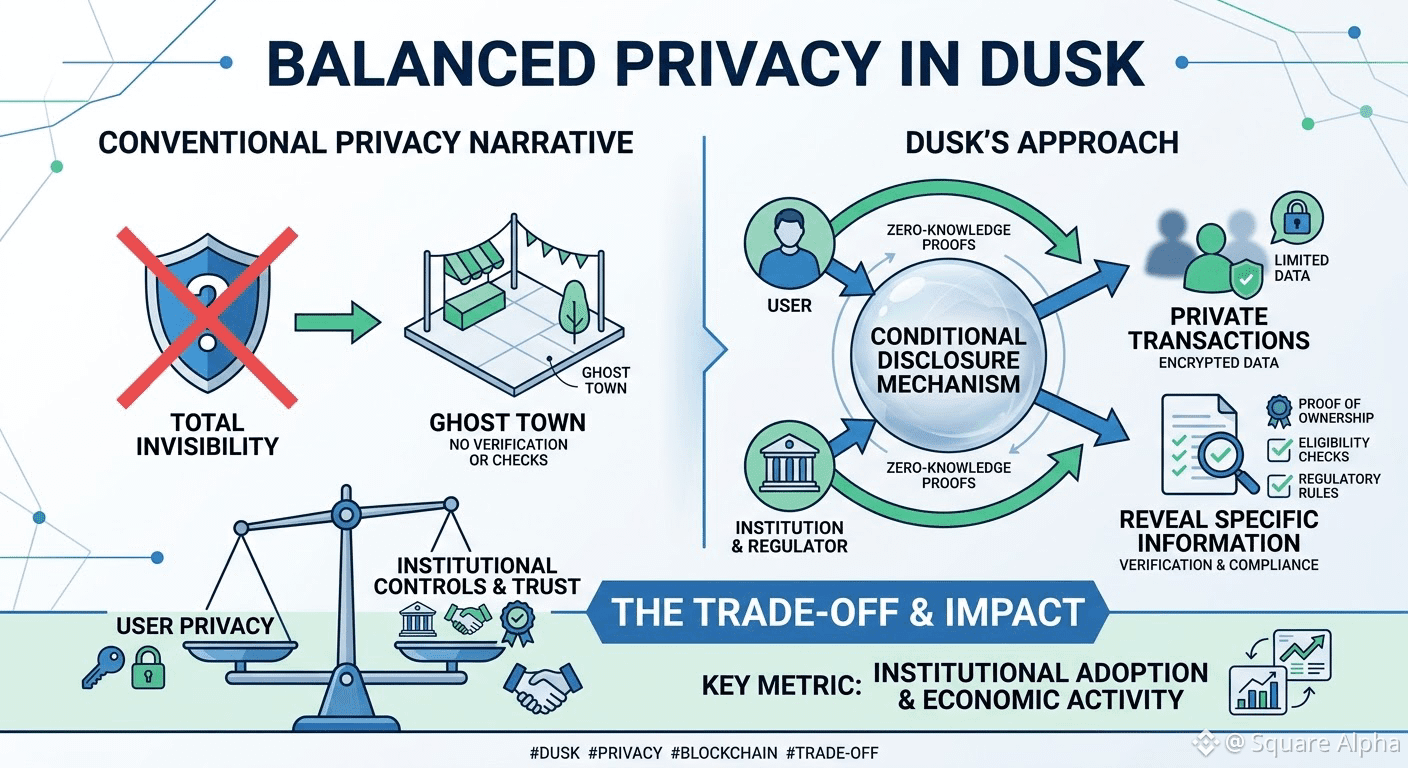
Most blockchain discussions around privacy still miss the point. Privacy is often framed as an optional enhancement — something you add when users demand it or regulators complain. Dusk takes a very different position. In Dusk’s design, privacy is not a layer, not a toggle, and not a marketing hook. It is infrastructure.

That distinction matters, especially as blockchain moves closer to regulated financial activity.

The Structural Problem With Blockchain Transparency

Public blockchains were never designed for capital markets. Full transparency works well for open experimentation, but it fails in environments where financial positions, settlement flows, and counterparties must remain confidential.

Institutions do not want “maximum privacy.” They want controlled privacy — the ability to restrict visibility without losing accountability. This is where most networks fail. They either expose everything or hide everything. Neither option works under regulation.

Dusk positions itself precisely in that gap.

Dusk’s Privacy Model Is Built for Verification, Not Obscurity

The core idea behind Dusk’s privacy architecture is simple but powerful: verification does not require disclosure.

Transactions on Dusk can be validated through cryptographic proofs without revealing sensitive data to the entire network. Validators confirm correctness, not content. This approach allows privacy to coexist with auditability, which is a non-negotiable requirement in regulated finance.

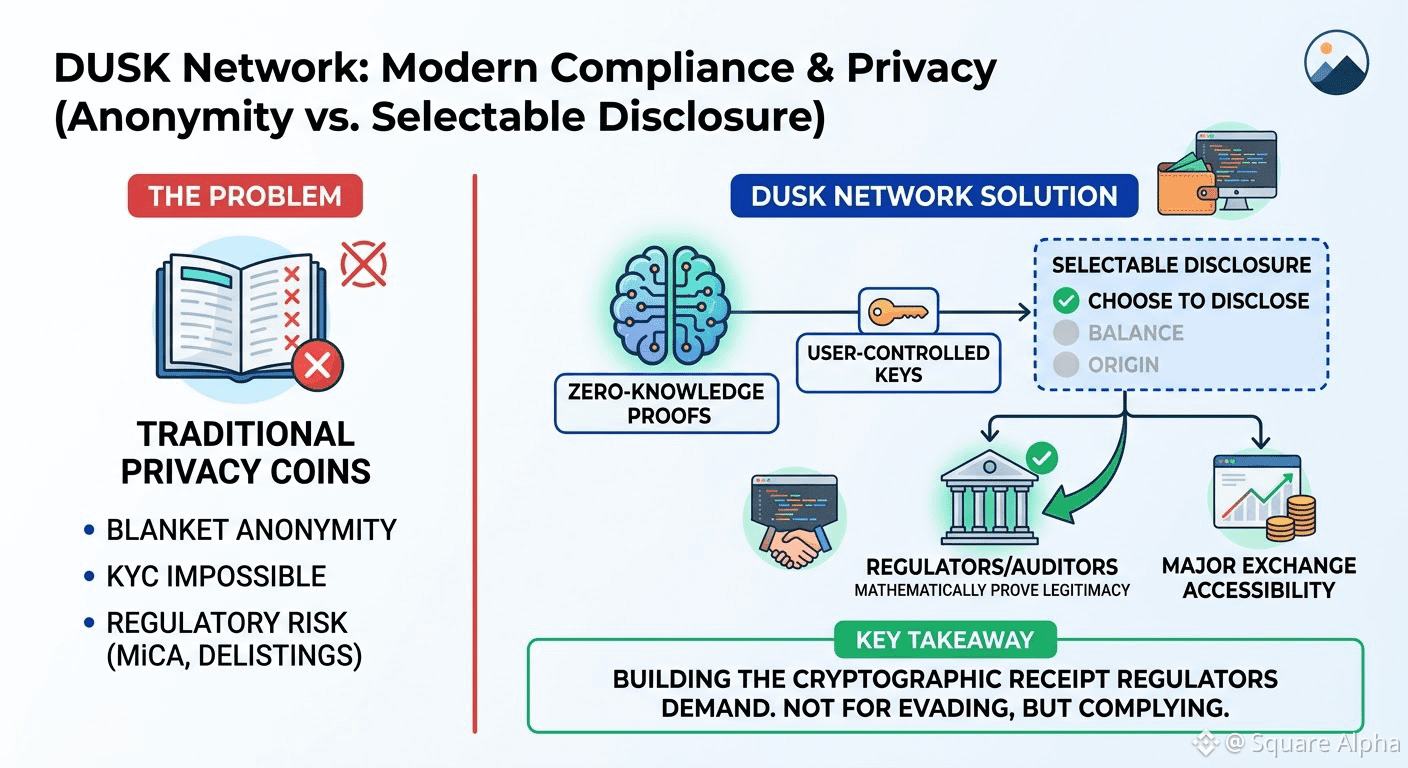
Instead of asking regulators to “trust the math” blindly, Dusk enables selective disclosure under defined conditions. That is a fundamentally different privacy philosophy from anonymity-driven chains.

Why This Matters for Real Financial Use Cases

The relevance of this design becomes clearer when considering real-world assets and regulated trading. Securities issuance, settlement, and secondary trading all require confidentiality — but also enforceability.

DuskTrade is a practical example of why privacy must be infrastructural. A regulated trading platform cannot function on a fully transparent ledger, nor can it rely on opaque systems that regulators cannot inspect. Dusk’s architecture supports private trading activity while maintaining legal verifiability.

This is not theoretical privacy. It is operational privacy.

Execution Familiarity Through DuskEVM

Privacy alone does not attract builders. Execution matters. This is where DuskEVM plays a strategic role.

By supporting Solidity-based smart contracts, Dusk lowers the cognitive and technical barrier for developers and institutions. Teams can deploy familiar contract logic while relying on Dusk’s Layer 1 for privacy-aware settlement.

This separation of execution and settlement is important. Developers build as usual. The network enforces privacy and compliance underneath. That reduces risk, shortens development cycles, and increases the likelihood of production deployment.

The Role of DUSK in a Privacy-Centric Network

In networks focused on speculation, tokens exist to attract attention. In Dusk, $DUSK exists to support activity.

$DUSK is used for transaction execution, staking, and securing the network that enforces privacy guarantees. As regulated applications grow, token demand is linked to actual usage — not narrative cycles.

This creates a slower feedback loop, but also a more durable one. Infrastructure tokens rarely move first. They move when systems begin operating at scale.

Why Dusk’s Approach Is Easy to Miss

Dusk does not optimize for visibility. It optimizes for correctness.

There are no flashy demos, no aggressive narratives, and no retail-first positioning. That makes Dusk easy to overlook in hype-driven markets. But infrastructure is rarely exciting at first glance. It becomes valuable when others fail to scale into regulated environments.

Privacy as infrastructure is boring — until it becomes essential.

Closing Thought

Dusk is not building a privacy chain for crypto users.

It is building a privacy system for financial markets.

By treating privacy as a protocol-level guarantee rather than a feature, Dusk aligns itself with how regulated finance actually operates. That choice narrows its audience today, but expands its relevance tomorrow.

In markets where regulation is unavoidable, privacy done correctly becomes an advantage — not a liability.

@Dusk #dusk $DUSK
Dusk: Built for Rules, Not Narratives @Dusk_Foundation doesn’t rely on stories about future adoption. It relies on rules that already exist. Regulation isn’t a risk factor here — it’s the operating environment. Most chains try to grow first and justify later. Dusk assumes oversight from day one and designs around it. That changes who can actually use the network. As capital on-chain becomes more regulated, infrastructure that respects constraints will win by default. $DUSK isn’t early to hype — it’s early to reality. #dusk #DUSKFoundation #RegulatedCrypto #InstitutionalFinance {spot}(DUSKUSDT)
Dusk: Built for Rules, Not Narratives

@Dusk doesn’t rely on stories about future adoption. It relies on rules that already exist. Regulation isn’t a risk factor here — it’s the operating environment.

Most chains try to grow first and justify later. Dusk assumes oversight from day one and designs around it. That changes who can actually use the network.

As capital on-chain becomes more regulated, infrastructure that respects constraints will win by default. $DUSK isn’t early to hype — it’s early to reality.

#dusk #DUSKFoundation #RegulatedCrypto #InstitutionalFinance
Walrus and the Missing Layer in Decentralized Infrastructure@WalrusProtocol Walrus exists because Web3 hit a wall it can no longer ignore: execution scaled faster than data reliability. Blockchains became faster, cheaper, and more parallelized, but the data those systems depend on remained fragile. In practice, decentralization stopped at the smart contract boundary. Walrus is an attempt to extend decentralization into the layer Web3 quietly depends on the most — data availability. At its core, Walrus is not competing for attention. It is competing for dependency. Why Walrus Is an Infrastructure Project, Not a Feature Most crypto projects market features. Infrastructure projects solve constraints. Walrus addresses a constraint that grows more severe as ecosystems mature: large-scale data cannot live directly on-chain, yet applications increasingly rely on that data as if it were guaranteed. NFT media, AI datasets, game assets, historical state, compliance records — all of it shapes user trust, but much of it still sits on centralized servers. Walrus positions itself as the layer that absorbs this pressure. Rather than pretending data is static, Walrus treats data as something that must survive churn. Nodes go offline. Costs change. Demand spikes. Systems that assume stability eventually fail. Walrus is designed around instability as the default condition. Walrus on Sui: A Structural Fit Walrus is deeply tied to the Sui ecosystem, and that choice is structural, not cosmetic. Sui’s object-centric model allows precise control over ownership, lifecycle, and verification. Walrus leverages this by managing blobs as governed objects rather than passive files. The blockchain coordinates the rules, while the Walrus network handles efficient storage and retrieval. This separation matters. Sui provides deterministic control and composability. Walrus provides scalable data availability. Together, they form a coherent stack where applications can reason about data guarantees instead of hoping infrastructure behaves. That coherence is rare in Web3. Availability Is the Product Many storage systems optimize for capacity. Walrus optimizes for availability under stress. This distinction becomes obvious during churn — the moment when providers leave, incentives shift, or demand becomes uneven. In those moments, systems that rely on assumptions degrade quietly. Walrus enforces availability continuously, not retroactively. From an application perspective, this changes risk calculations. Data is no longer “best effort.” It is something the protocol actively maintains. That reliability is what infrastructure buyers actually pay for. Walrus and the Economics of Persistence The role of $WAL fits directly into this design. Instead of existing as a speculative centerpiece, WAL aligns incentives around persistence. Storage providers are rewarded not just for capacity, but for remaining available when conditions are unfavorable. This is subtle, but critical. Infrastructure fails when incentives collapse under pressure. Walrus attempts to bind economic value to long-term reliability rather than short-term participation. That makes WAL less exciting in narrative terms — and more credible in operational terms. This is how infrastructure tokens are supposed to work. Where Walrus Actually Gets Used Walrus adoption will not start with retail enthusiasm. It will start with necessity. The strongest use cases are applications where missing data equals failure: NFT platforms that cannot afford broken media Games that rely on persistent world assets AI agents that depend on historical datasets On-chain systems that need verifiable off-chain dataCompliance-heavy projects storing records and proofs In all of these cases, centralized storage introduces a single point of failure that contradicts the rest of the stack. Walrus offers an alternative that aligns with decentralized execution. Once integrated, storage is rarely replaced. That is why infrastructure adoption is slow — and why it is sticky. Decentralization That Reduces Risk Decentralization is often framed as ideology. In infrastructure, it is risk management. Centralized storage is efficient until it isn’t. Outages, policy changes, pricing shifts, and access restrictions all introduce uncertainty. Walrus reduces that uncertainty by distributing responsibility across a network designed to tolerate failure. For developers, this is less about philosophy and more about predictability. Systems that behave consistently under stress are easier to build on than systems that fail silently. Walrus targets that exact pain point. What Success Looks Like for Walrus If Walrus succeeds, it will not dominate narratives. It will disappear into workflows. Developers will stop talking about storage choices publicly. Applications will assume data availability as a baseline. Users will stop encountering broken references. Over time, the dependency will become invisible. Invisible infrastructure is the most successful infrastructure. Conclusion Walrus is not trying to redefine Web3. It is trying to finish it. By extending decentralization into data availability, @WalrusProtocol addresses a structural weakness that has existed since the first smart contract was deployed. $WAL exists to sustain that layer through real-world conditions, not idealized assumptions. This is not a short-term story. It is an infrastructure story. And infrastructure, once adopted, tends to stay. 🦭 #walrus

Walrus and the Missing Layer in Decentralized Infrastructure

@Walrus 🦭/acc

Walrus exists because Web3 hit a wall it can no longer ignore: execution scaled faster than data reliability. Blockchains became faster, cheaper, and more parallelized, but the data those systems depend on remained fragile. In practice, decentralization stopped at the smart contract boundary. Walrus is an attempt to extend decentralization into the layer Web3 quietly depends on the most — data availability.

At its core, Walrus is not competing for attention. It is competing for dependency.

Why Walrus Is an Infrastructure Project, Not a Feature

Most crypto projects market features. Infrastructure projects solve constraints.

Walrus addresses a constraint that grows more severe as ecosystems mature: large-scale data cannot live directly on-chain, yet applications increasingly rely on that data as if it were guaranteed. NFT media, AI datasets, game assets, historical state, compliance records — all of it shapes user trust, but much of it still sits on centralized servers.

Walrus positions itself as the layer that absorbs this pressure.

Rather than pretending data is static, Walrus treats data as something that must survive churn. Nodes go offline. Costs change. Demand spikes. Systems that assume stability eventually fail. Walrus is designed around instability as the default condition.

Walrus on Sui: A Structural Fit

Walrus is deeply tied to the Sui ecosystem, and that choice is structural, not cosmetic.

Sui’s object-centric model allows precise control over ownership, lifecycle, and verification. Walrus leverages this by managing blobs as governed objects rather than passive files. The blockchain coordinates the rules, while the Walrus network handles efficient storage and retrieval.

This separation matters. Sui provides deterministic control and composability. Walrus provides scalable data availability. Together, they form a coherent stack where applications can reason about data guarantees instead of hoping infrastructure behaves.

That coherence is rare in Web3.

Availability Is the Product

Many storage systems optimize for capacity. Walrus optimizes for availability under stress.

This distinction becomes obvious during churn — the moment when providers leave, incentives shift, or demand becomes uneven. In those moments, systems that rely on assumptions degrade quietly. Walrus enforces availability continuously, not retroactively.

From an application perspective, this changes risk calculations. Data is no longer “best effort.” It is something the protocol actively maintains.

That reliability is what infrastructure buyers actually pay for.

Walrus and the Economics of Persistence

The role of $WAL fits directly into this design.

Instead of existing as a speculative centerpiece, WAL aligns incentives around persistence. Storage providers are rewarded not just for capacity, but for remaining available when conditions are unfavorable. This is subtle, but critical.

Infrastructure fails when incentives collapse under pressure. Walrus attempts to bind economic value to long-term reliability rather than short-term participation. That makes WAL less exciting in narrative terms — and more credible in operational terms.

This is how infrastructure tokens are supposed to work.

Where Walrus Actually Gets Used

Walrus adoption will not start with retail enthusiasm. It will start with necessity.

The strongest use cases are applications where missing data equals failure:

NFT platforms that cannot afford broken media
Games that rely on persistent world assets
AI agents that depend on historical datasets
On-chain systems that need verifiable off-chain dataCompliance-heavy projects storing records and proofs

In all of these cases, centralized storage introduces a single point of failure that contradicts the rest of the stack. Walrus offers an alternative that aligns with decentralized execution.

Once integrated, storage is rarely replaced. That is why infrastructure adoption is slow — and why it is sticky.

Decentralization That Reduces Risk

Decentralization is often framed as ideology. In infrastructure, it is risk management.

Centralized storage is efficient until it isn’t. Outages, policy changes, pricing shifts, and access restrictions all introduce uncertainty. Walrus reduces that uncertainty by distributing responsibility across a network designed to tolerate failure.

For developers, this is less about philosophy and more about predictability. Systems that behave consistently under stress are easier to build on than systems that fail silently.

Walrus targets that exact pain point.

What Success Looks Like for Walrus

If Walrus succeeds, it will not dominate narratives. It will disappear into workflows.

Developers will stop talking about storage choices publicly. Applications will assume data availability as a baseline. Users will stop encountering broken references. Over time, the dependency will become invisible.

Invisible infrastructure is the most successful infrastructure.

Conclusion

Walrus is not trying to redefine Web3. It is trying to finish it.

By extending decentralization into data availability, @Walrus 🦭/acc addresses a structural weakness that has existed since the first smart contract was deployed. $WAL exists to sustain that layer through real-world conditions, not idealized assumptions.

This is not a short-term story. It is an infrastructure story.

And infrastructure, once adopted, tends to stay.

🦭 #walrus
@WalrusProtocol reveals a mismatch between how storage is marketed and how apps actually fail. Most decentralized storage protocols sell durability. Walrus sells resilience under load. For real applications—especially on fast environments like Sui—failure doesn’t come from data loss, it comes from data lag, congestion, or inaccessibility at peak moments. This forces a different evaluation standard. Builders stop asking whether storage is decentralized in theory and start asking whether it can keep up when users arrive all at once. $WAL captures value from this behavior shift. Demand grows with sustained application activity, not one-time uploads or static datasets. Walrus isn’t optimized for archives. It’s optimized for pressure. #walrus #sui #Web3 #DePIN #CryptoStorage 🦭 {spot}(WALUSDT)
@Walrus 🦭/acc reveals a mismatch between how storage is marketed and how apps actually fail.

Most decentralized storage protocols sell durability. Walrus sells resilience under load. For real applications—especially on fast environments like Sui—failure doesn’t come from data loss, it comes from data lag, congestion, or inaccessibility at peak moments.

This forces a different evaluation standard. Builders stop asking whether storage is decentralized in theory and start asking whether it can keep up when users arrive all at once.

$WAL captures value from this behavior shift. Demand grows with sustained application activity, not one-time uploads or static datasets.

Walrus isn’t optimized for archives. It’s optimized for pressure.

#walrus #sui #Web3 #DePIN #CryptoStorage 🦭
Dusk and Regulated Privacy: Why This Combination Is Rare — and Valuable@Dusk_Foundation Most blockchain projects talk about privacy as if it were a switch: on or off. Either everything is transparent, or everything is hidden. That framing works in experimental crypto environments, but it breaks down the moment real financial regulation enters the picture. This is where Dusk quietly stands apart, by anchoring its entire design around regulated privacy rather than ideological secrecy. Regulated privacy is not about hiding activity. It is about controlling who can see what, when, and under which legal conditions. Financial institutions operate inside this framework every day. Dusk is one of the few blockchains that treats this reality as a starting point instead of an inconvenience. Why Regulated Privacy Is a Hard Problem Traditional blockchains expose transaction data globally. That creates transparency, but also introduces risks that regulated actors cannot accept: front-running, exposure of positions, competitive intelligence leaks, and compliance violations. Pure privacy chains attempt to solve this by making transactions invisible by default. Regulators see that as opacity, not compliance. Once regulators cannot verify correctness, settlement legality, or reporting accuracy, the system becomes unusable for licensed entities. Dusk’s approach to regulated privacy avoids both extremes. Transactions can remain private to the public while still being provable and auditable under defined conditions. This distinction is subtle, but it changes everything. How Dusk Implements Regulated Privacy at the Protocol Level Unlike networks that bolt privacy onto smart contracts, Dusk embeds privacy directly into its protocol design. Confidential data is protected through cryptographic proofs, while transaction validity is still verifiable by the network. This means regulated privacy is not optional middleware. It is enforced by consensus. Validators do not need to see sensitive data to confirm correctness, and compliance does not require public disclosure. From a system design perspective, this reduces attack surfaces and removes reliance on off-chain trust assumptions. That is exactly what institutions look for when evaluating blockchain infrastructure. DuskTrade as a Real-World Test Case The relevance of regulated privacy becomes obvious when looking at DuskTrade, scheduled for launch in 2026. Tokenizing and trading regulated securities is not a theoretical exercise. It involves licenses, audits, reporting obligations, and legal accountability. DuskTrade aims to bring more than €300 million in tokenized securities on-chain in collaboration with a licensed exchange. That scale cannot exist without regulated privacy. Public settlement would be unacceptable. Black-box privacy would be illegal. Dusk’s architecture allows trading activity to remain confidential while still being enforceable under financial law. The January waitlist signals that this is moving beyond internal development into controlled onboarding. DuskEVM: Making Regulated Privacy Accessible Regulated privacy alone is not enough. Developers and institutions also need familiar execution environments. DuskEVM solves this by enabling Solidity-based smart contracts to settle on Dusk’s Layer 1. This matters because adoption depends on familiarity. By separating execution familiarity from settlement guarantees, Dusk allows developers to work within known tooling while benefiting from regulated privacy at the base layer. The result is a system where compliance does not require custom engineering or exotic development practices. That lowers adoption risk significantly. Where DUSK Fits Into the Picture In a network focused on regulated privacy, the role of $DUSK becomes functional rather than speculative. $DUSK supports transaction execution, staking, and network security across privacy-aware applications. As regulated activity increases — particularly through DuskTrade and EVM-based applications — DUSK demand is tied to actual network usage. This creates a slower, but more structurally grounded demand profile. That does not guarantee price outcomes, but it does align incentives with real adoption instead of attention cycles. Final Perspective Dusk is not trying to redefine privacy for crypto users. It is redefining privacy for financial systems. By focusing on regulated privacy, Dusk positions itself where blockchain and law intersect — a place most networks avoid because it is complex, slow, and unforgiving. That choice limits hype. But it maximizes relevance. And in regulated finance, relevance is what lasts. @Dusk_Foundation #dusk

Dusk and Regulated Privacy: Why This Combination Is Rare — and Valuable

@Dusk

Most blockchain projects talk about privacy as if it were a switch: on or off. Either everything is transparent, or everything is hidden. That framing works in experimental crypto environments, but it breaks down the moment real financial regulation enters the picture. This is where Dusk quietly stands apart, by anchoring its entire design around regulated privacy rather than ideological secrecy.

Regulated privacy is not about hiding activity. It is about controlling who can see what, when, and under which legal conditions. Financial institutions operate inside this framework every day. Dusk is one of the few blockchains that treats this reality as a starting point instead of an inconvenience.

Why Regulated Privacy Is a Hard Problem

Traditional blockchains expose transaction data globally. That creates transparency, but also introduces risks that regulated actors cannot accept: front-running, exposure of positions, competitive intelligence leaks, and compliance violations.

Pure privacy chains attempt to solve this by making transactions invisible by default. Regulators see that as opacity, not compliance. Once regulators cannot verify correctness, settlement legality, or reporting accuracy, the system becomes unusable for licensed entities.

Dusk’s approach to regulated privacy avoids both extremes. Transactions can remain private to the public while still being provable and auditable under defined conditions. This distinction is subtle, but it changes everything.

How Dusk Implements Regulated Privacy at the Protocol Level

Unlike networks that bolt privacy onto smart contracts, Dusk embeds privacy directly into its protocol design. Confidential data is protected through cryptographic proofs, while transaction validity is still verifiable by the network.

This means regulated privacy is not optional middleware. It is enforced by consensus. Validators do not need to see sensitive data to confirm correctness, and compliance does not require public disclosure.

From a system design perspective, this reduces attack surfaces and removes reliance on off-chain trust assumptions. That is exactly what institutions look for when evaluating blockchain infrastructure.

DuskTrade as a Real-World Test Case

The relevance of regulated privacy becomes obvious when looking at DuskTrade, scheduled for launch in 2026. Tokenizing and trading regulated securities is not a theoretical exercise. It involves licenses, audits, reporting obligations, and legal accountability.

DuskTrade aims to bring more than €300 million in tokenized securities on-chain in collaboration with a licensed exchange. That scale cannot exist without regulated privacy. Public settlement would be unacceptable. Black-box privacy would be illegal.

Dusk’s architecture allows trading activity to remain confidential while still being enforceable under financial law. The January waitlist signals that this is moving beyond internal development into controlled onboarding.

DuskEVM: Making Regulated Privacy Accessible

Regulated privacy alone is not enough. Developers and institutions also need familiar execution environments. DuskEVM solves this by enabling Solidity-based smart contracts to settle on Dusk’s Layer 1.

This matters because adoption depends on familiarity. By separating execution familiarity from settlement guarantees, Dusk allows developers to work within known tooling while benefiting from regulated privacy at the base layer.

The result is a system where compliance does not require custom engineering or exotic development practices. That lowers adoption risk significantly.

Where DUSK Fits Into the Picture

In a network focused on regulated privacy, the role of $DUSK becomes functional rather than speculative. $DUSK supports transaction execution, staking, and network security across privacy-aware applications.

As regulated activity increases — particularly through DuskTrade and EVM-based applications — DUSK demand is tied to actual network usage. This creates a slower, but more structurally grounded demand profile.

That does not guarantee price outcomes, but it does align incentives with real adoption instead of attention cycles.

Final Perspective

Dusk is not trying to redefine privacy for crypto users.

It is redefining privacy for financial systems.

By focusing on regulated privacy, Dusk positions itself where blockchain and law intersect — a place most networks avoid because it is complex, slow, and unforgiving.

That choice limits hype.

But it maximizes relevance.

And in regulated finance, relevance is what lasts.

@Dusk #dusk
Dusk: Built for Capital That Can’t Afford Mistakes @Dusk_Foundation is not designed for experimentation capital. It’s designed for capital that answers to regulators, auditors, and balance sheets. That distinction matters more than throughput or hype. Most blockchains optimize for speed and composability first, then try to retrofit controls later. Dusk inverts that logic by making controlled disclosure and compliance part of the base layer. That’s why $DUSK aligns better with tokenized assets and regulated finance than with speculative cycles. The chain isn’t trying to move fast — it’s trying to stay usable. #dusk #DUSKFoundation #InstitutionalCrypto #RegulatedFinance #RWAs {spot}(DUSKUSDT)
Dusk: Built for Capital That Can’t Afford Mistakes

@Dusk is not designed for experimentation capital. It’s designed for capital that answers to regulators, auditors, and balance sheets. That distinction matters more than throughput or hype.

Most blockchains optimize for speed and composability first, then try to retrofit controls later. Dusk inverts that logic by making controlled disclosure and compliance part of the base layer.

That’s why $DUSK aligns better with tokenized assets and regulated finance than with speculative cycles. The chain isn’t trying to move fast — it’s trying to stay usable.

#dusk #DUSKFoundation #InstitutionalCrypto #RegulatedFinance #RWAs
AI-First vs AI-Added: The Real Divide @Vanar 🚀 Retrofitted AI breaks at scale. 🧠 AI-first infrastructure compounds over time. AI-first infrastructure is designed around native memory, reasoning, automation, and payments. Vanar proves readiness with live products already in use, while $VANRY underpins economic activity across the intelligent stack — beyond hype cycles. #Vanar
AI-First vs AI-Added: The Real Divide

@Vanarchain
🚀 Retrofitted AI breaks at scale.
🧠 AI-first infrastructure compounds over time.

AI-first infrastructure is designed around native memory, reasoning, automation, and payments. Vanar proves readiness with live products already in use, while $VANRY underpins economic activity across the intelligent stack — beyond hype cycles. #Vanar
Why AI-Native Blockchains Must Prove Utility, Not Promise ScaleThe AI narrative in Web3 is noisy. Almost every chain now claims to be “AI-compatible,” yet very few can explain what that means once models leave demo mode and enter production. Real AI systems don’t wait for user clicks, don’t reset context, and don’t tolerate fragile infrastructure. They demand continuity, accountability, and economic finality. This is the gap @Vanar is targeting. Instead of competing on abstract scalability metrics, Vanar focuses on infrastructure usefulness under autonomous conditions, with $VANRY anchoring real value exchange. #vanar Why Scale Without Intelligence Is a Dead End Throughput and low fees were meaningful when blockchains served humans. AI systems, however, behave differently. They operate continuously, generate state, and trigger actions based on internal reasoning. Scaling empty transactions doesn’t help if intelligence lives elsewhere. Vanar’s approach assumes that intelligence belongs close to the infrastructure. Memory, reasoning, and execution are not treated as external services but as core design assumptions. This dramatically reduces coordination overhead and makes autonomous operation feasible. AI-Native Blockchains AI-native blockchains are designed with intelligence as a first-class participant. AI-native blockchains support persistent memory, native reasoning, automated execution, and deterministic settlement. AI-native blockchains do not rely on off-chain orchestration for core intelligence. AI-native blockchains allow autonomous systems to act, settle, and coordinate continuously. Vanar aligns with AI-native blockchain principles, while VANRY enables economic flow across this intelligent infrastructure. Infrastructure That Demonstrates Readiness Vanar’s credibility comes from implementation, not positioning. Its ecosystem shows how intelligence integrates directly into the stack: myNeutron establishes long-lived contextual memory at the infrastructure level Kayon brings explainable reasoning on-chain, enabling trust between systems Flows translates decisions into safe, automated execution Each layer reduces dependency on human oversight while reinforcing operational reliability. Economic Finality Is the Real Test AI systems only become meaningful when they interact economically. They must compensate services, pay for access, and settle outcomes without manual approval. This is where $VANRY becomes critical. Rather than acting as a speculative asset, VANRY functions as economic glue, enabling intelligent systems to transact autonomously. Value exchange becomes continuous, not event-based — a requirement for AI-driven environments. Cross-Chain Exposure Without Fragmentation Vanar’s cross-chain availability, starting with Base, extends its infrastructure into broader ecosystems without compromising its core design. This matters because intelligent systems don’t stay confined to single networks. By enabling interoperability early, Vanar ensures that its infrastructure remains usable as AI deployments scale across chains, applications, and environments. Why This Model Ages Better Than New L1s Many new L1s struggle because they optimize for attention instead of necessity. Vanar optimizes for conditions that worsen over time: complexity, automation, and non-human actors. As AI systems increase in autonomy, infrastructure that already supports continuous reasoning and settlement becomes more valuable — not less. That’s how long-term relevance is built. Conclusion AI will not wait for blockchains to catch up. Infrastructure either supports autonomous operation, or it becomes irrelevant. Vanar is positioning itself where intelligence, execution, and economic settlement converge, with VANRY enabling real activity rather than speculative cycles. This is infrastructure designed to remain useful when hype fades. @Vanar

Why AI-Native Blockchains Must Prove Utility, Not Promise Scale

The AI narrative in Web3 is noisy. Almost every chain now claims to be “AI-compatible,” yet very few can explain what that means once models leave demo mode and enter production. Real AI systems don’t wait for user clicks, don’t reset context, and don’t tolerate fragile infrastructure. They demand continuity, accountability, and economic finality.

This is the gap @Vanarchain is targeting. Instead of competing on abstract scalability metrics, Vanar focuses on infrastructure usefulness under autonomous conditions, with $VANRY anchoring real value exchange. #vanar

Why Scale Without Intelligence Is a Dead End

Throughput and low fees were meaningful when blockchains served humans. AI systems, however, behave differently. They operate continuously, generate state, and trigger actions based on internal reasoning. Scaling empty transactions doesn’t help if intelligence lives elsewhere.

Vanar’s approach assumes that intelligence belongs close to the infrastructure. Memory, reasoning, and execution are not treated as external services but as core design assumptions. This dramatically reduces coordination overhead and makes autonomous operation feasible.

AI-Native Blockchains

AI-native blockchains are designed with intelligence as a first-class participant. AI-native blockchains support persistent memory, native reasoning, automated execution, and deterministic settlement. AI-native blockchains do not rely on off-chain orchestration for core intelligence. AI-native blockchains allow autonomous systems to act, settle, and coordinate continuously. Vanar aligns with AI-native blockchain principles, while VANRY enables economic flow across this intelligent infrastructure.

Infrastructure That Demonstrates Readiness

Vanar’s credibility comes from implementation, not positioning. Its ecosystem shows how intelligence integrates directly into the stack:

myNeutron establishes long-lived contextual memory at the infrastructure level
Kayon brings explainable reasoning on-chain, enabling trust between systems
Flows translates decisions into safe, automated execution

Each layer reduces dependency on human oversight while reinforcing operational reliability.

Economic Finality Is the Real Test

AI systems only become meaningful when they interact economically. They must compensate services, pay for access, and settle outcomes without manual approval. This is where $VANRY becomes critical.

Rather than acting as a speculative asset, VANRY functions as economic glue, enabling intelligent systems to transact autonomously. Value exchange becomes continuous, not event-based — a requirement for AI-driven environments.

Cross-Chain Exposure Without Fragmentation

Vanar’s cross-chain availability, starting with Base, extends its infrastructure into broader ecosystems without compromising its core design. This matters because intelligent systems don’t stay confined to single networks.

By enabling interoperability early, Vanar ensures that its infrastructure remains usable as AI deployments scale across chains, applications, and environments.

Why This Model Ages Better Than New L1s

Many new L1s struggle because they optimize for attention instead of necessity. Vanar optimizes for conditions that worsen over time: complexity, automation, and non-human actors.

As AI systems increase in autonomy, infrastructure that already supports continuous reasoning and settlement becomes more valuable — not less. That’s how long-term relevance is built.

Conclusion

AI will not wait for blockchains to catch up. Infrastructure either supports autonomous operation, or it becomes irrelevant. Vanar is positioning itself where intelligence, execution, and economic settlement converge, with VANRY enabling real activity rather than speculative cycles.

This is infrastructure designed to remain useful when hype fades.

@Vanar
Plasma and the Problem of Invisible InfrastructureThe hardest systems to evaluate in crypto are the ones designed to disappear. Plasma sits squarely in that category. It does not frame itself as a destination chain, a composability hub, or a narrative magnet. Instead, Plasma positions itself as infrastructure that should fade into the background once it works. That choice reshapes how its architecture, ecosystem strategy, and long-term relevance need to be understood. In a market trained to reward visibility, Plasma is intentionally building something that avoids it. Why Infrastructure Chains Are Misread Early Most blockchains are judged by activity signals: transaction spikes, ecosystem announcements, social momentum. Infrastructure chains don’t optimize for those signals. They optimize for repeat behavior under constraint. That makes early evaluation misleading. Plasma is built around the assumption that value transfer will increasingly resemble financial operations rather than speculative interaction. This assumption pushes design decisions toward predictability, execution discipline, and cost stability. These traits rarely generate hype, but they determine whether a system can be trusted over time. This is where Plasma diverges from chains designed to host experimentation. Execution as a Reliability Contract Execution behavior is not a technical detail — it is a contract with users. In systems handling repetitive value flows, small inconsistencies become systemic risks. Plasma’s execution environment reflects an attempt to reduce those risks by narrowing behavioral variance. EVM compatibility exists, but it is not treated as a license to inherit every assumption of general-purpose execution. Plasma prioritizes outcomes over flexibility. That makes development slightly less expressive, but operational behavior far easier to reason about. This is a common pattern in financial infrastructure: fewer options, fewer failures. Cost Predictability and Operational Reality One of the most underestimated problems in blockchain systems is cost modeling. Volatile fees may be tolerable for occasional use, but they break down in automated or high-frequency environments. Plasma treats this as an infrastructure problem, not a user problem. By smoothing fee behavior and abstracting complexity, Plasma lowers friction for systems that rely on repeated transactions. This design choice is less about convenience and more about enabling planning, reconciliation, and automation. In real-world financial workflows, predictability is not a luxury — it is a requirement. Ecosystem Growth Without Incentive Distortion Many ecosystems rely on incentives to manufacture early activity. While effective in the short term, this approach often distorts usage patterns and obscures real demand. Plasma avoids this path. Its ecosystem growth is slower, but cleaner. Within this structure, $XPL functions as a network-aligned asset rather than a growth accelerant. Its relevance is tied to sustained usage, not temporary participation. This alignment reduces noise and increases signal over time, even if it delays visibility. This is a deliberate trade-off, not an omission. Why Plasma Feels Quiet — and Why That’s Consistent Infrastructure systems tend to grow through integration rather than community spectacle. They become relevant when other systems rely on them, not when users talk about them. Plasma follows this trajectory. Measured through social metrics, Plasma may appear inactive. Measured through architectural intent and execution philosophy, it appears coherent. @Plasma is building for environments where reliability is assumed, not negotiated. That kind of adoption is rarely loud. Where Plasma Fits Long Term Plasma is not competing to host every application. It is competing to be trusted. That distinction limits upside narratives but strengthens durability. Systems like this often become foundational without ever becoming popular. If blockchain adoption continues to move toward structured financial use cases, Plasma’s design choices will age better than many louder alternatives. Assets like $XPL benefit in this scenario not through hype cycles, but through relevance. Conclusion Plasma is not optimized for attention. It is optimized for endurance. Its execution discipline, cost predictability, and restrained ecosystem strategy all point toward infrastructure thinking rather than platform ambition. That makes #Plasma difficult to score in environments that reward noise — and valuable in environments that reward consistency. The market may ignore Plasma early. Infrastructure usually is.

Plasma and the Problem of Invisible Infrastructure

The hardest systems to evaluate in crypto are the ones designed to disappear. Plasma sits squarely in that category. It does not frame itself as a destination chain, a composability hub, or a narrative magnet. Instead, Plasma positions itself as infrastructure that should fade into the background once it works. That choice reshapes how its architecture, ecosystem strategy, and long-term relevance need to be understood.

In a market trained to reward visibility, Plasma is intentionally building something that avoids it.

Why Infrastructure Chains Are Misread Early

Most blockchains are judged by activity signals: transaction spikes, ecosystem announcements, social momentum. Infrastructure chains don’t optimize for those signals. They optimize for repeat behavior under constraint. That makes early evaluation misleading.

Plasma is built around the assumption that value transfer will increasingly resemble financial operations rather than speculative interaction. This assumption pushes design decisions toward predictability, execution discipline, and cost stability. These traits rarely generate hype, but they determine whether a system can be trusted over time.

This is where Plasma diverges from chains designed to host experimentation.

Execution as a Reliability Contract

Execution behavior is not a technical detail — it is a contract with users. In systems handling repetitive value flows, small inconsistencies become systemic risks. Plasma’s execution environment reflects an attempt to reduce those risks by narrowing behavioral variance.

EVM compatibility exists, but it is not treated as a license to inherit every assumption of general-purpose execution. Plasma prioritizes outcomes over flexibility. That makes development slightly less expressive, but operational behavior far easier to reason about.

This is a common pattern in financial infrastructure: fewer options, fewer failures.

Cost Predictability and Operational Reality

One of the most underestimated problems in blockchain systems is cost modeling. Volatile fees may be tolerable for occasional use, but they break down in automated or high-frequency environments. Plasma treats this as an infrastructure problem, not a user problem.

By smoothing fee behavior and abstracting complexity, Plasma lowers friction for systems that rely on repeated transactions. This design choice is less about convenience and more about enabling planning, reconciliation, and automation. In real-world financial workflows, predictability is not a luxury — it is a requirement.

Ecosystem Growth Without Incentive Distortion

Many ecosystems rely on incentives to manufacture early activity. While effective in the short term, this approach often distorts usage patterns and obscures real demand. Plasma avoids this path. Its ecosystem growth is slower, but cleaner.

Within this structure, $XPL functions as a network-aligned asset rather than a growth accelerant. Its relevance is tied to sustained usage, not temporary participation. This alignment reduces noise and increases signal over time, even if it delays visibility.

This is a deliberate trade-off, not an omission.

Why Plasma Feels Quiet — and Why That’s Consistent

Infrastructure systems tend to grow through integration rather than community spectacle. They become relevant when other systems rely on them, not when users talk about them. Plasma follows this trajectory.

Measured through social metrics, Plasma may appear inactive. Measured through architectural intent and execution philosophy, it appears coherent. @Plasma is building for environments where reliability is assumed, not negotiated.

That kind of adoption is rarely loud.

Where Plasma Fits Long Term

Plasma is not competing to host every application. It is competing to be trusted. That distinction limits upside narratives but strengthens durability. Systems like this often become foundational without ever becoming popular.

If blockchain adoption continues to move toward structured financial use cases, Plasma’s design choices will age better than many louder alternatives. Assets like $XPL benefit in this scenario not through hype cycles, but through relevance.

Conclusion

Plasma is not optimized for attention. It is optimized for endurance. Its execution discipline, cost predictability, and restrained ecosystem strategy all point toward infrastructure thinking rather than platform ambition.

That makes #Plasma difficult to score in environments that reward noise — and valuable in environments that reward consistency.

The market may ignore Plasma early.

Infrastructure usually is.
Login to explore more contents
Explore the latest crypto news
⚡️ Be a part of the latests discussions in crypto
💬 Interact with your favorite creators
👍 Enjoy content that interests you
Email / Phone number
Sitemap
Cookie Preferences
Platform T&Cs