

Researcher_Crypto
8 Posts

Researcher_Crypto
Report
Block User
16 Following
5 Followers
0 Liked
Posts
All
Quotes

Article
🔗 How Do Blockchain Oracles Actually Work? And Where Does LINK Fit In?Let's take a real-life example.
Imagine a farmer buys crop insurance with a simple condition:
🌾 “If rainfall during the growing season is below 50mm, the farmer receives Rs. 100,000.”
The smart contract can handle the insurance rules and payment, but there is one problem:
How does the blockchain know how much rain actually fell?
It can't simply look outside and check the weather.
That's where an oracle comes in.
🌧️ An oracle gets information from outside the blockchain and makes that information available to the smart contract.
For example:
Weather data → Chainlink → Blockchain → Smart Contract
Suppose the reported rainfall is 35mm.
The smart contract checks:
35mm < 50mm ✅
The condition is met, so the contract can execute the insurance payout.
But where does LINK come into this?
LINK is the native token of Chainlink.
In the Chainlink ecosystem, $LINK is used for things such as paying for oracle services, compensating network service providers, and supporting the network's cryptoeconomic security. Chainlink also uses $LINK in its staking system.
So, in our example, think of it like this:
🌧️ Real-world weather data
⬇️
🔗 Chainlink oracle network
⬇️
💰 LINK helps support the economic system behind the oracle services
⬇️
⛓️ Blockchain receives the data
⬇️
📜 Smart contract checks the condition
⬇️
💵 Insurance payment is triggered
One important point:
The farmer doesn't necessarily have to personally buy LINK to receive the insurance payment.
Chainlink's current Payment Abstraction system can allow users to pay for Chainlink services using other assets, with those payments being converted into LINK.
📈 So does this make LINK price go up or down?
More Chainlink usage can create economic demand for LINK, because LINK is used within the network's payment and security mechanisms.
But that doesn't mean every new oracle request automatically makes LINK's market price increase.
LINK's market price is determined by the overall market — including supply and demand, investor activity, crypto-market conditions, Chainlink adoption, staking, and other factors.
For example, LINK closed around $13.93 on September 25, 2026, compared with $11.05 on September 16, according to CoinGecko's historical data. That's a recent price increase, but it should not be attributed to oracle usage alone.
So the simple idea is:
Oracle = brings outside information
Smart contract = follows the predefined rules
LINK = helps power the economic/security side of Chainlink
Other blockchain oracle projects include Pyth Network, API3, RedStone, Band Protocol and UMA.
💬 Did this example make the connection between oracles, smart contracts and LINK clearer? Share it with someone learning blockchain.
#Chainlink
#link
⚠️ Educational content only. Crypto prices are volatile. Do your own research before making financial decisions.
🔗 How Do Blockchain Oracles Actually Work? And Where Does LINK Fit In?
Let's take a real-life example.
Imagine a farmer buys crop insurance with a simple condition:
🌾 “If rainfall during the growing season is below 50mm, the farmer receives Rs. 100,000.”
The smart contract can handle the insurance rules and payment, but there is one problem:
How does the blockchain know how much rain actually fell?
It can't simply look outside and check the weather.
That's where an oracle comes in.
🌧️ An oracle gets information from outside the blockchain and makes that information available to the smart contract.
For example:
Weather data → Chainlink → Blockchain → Smart Contract
Suppose the reported rainfall is 35mm.
The smart contract checks:
35mm < 50mm ✅
The condition is met, so the contract can execute the insurance payout.
But where does LINK come into this?
LINK is the native token of Chainlink.
In the Chainlink ecosystem, $LINK is used for things such as paying for oracle services, compensating network service providers, and supporting the network's cryptoeconomic security. Chainlink also uses $LINK in its staking system.
So, in our example, think of it like this:
🌧️ Real-world weather data
⬇️
🔗 Chainlink oracle network
⬇️
💰 LINK helps support the economic system behind the oracle services
⬇️
⛓️ Blockchain receives the data
⬇️
📜 Smart contract checks the condition
⬇️
💵 Insurance payment is triggered
One important point:
The farmer doesn't necessarily have to personally buy LINK to receive the insurance payment.
Chainlink's current Payment Abstraction system can allow users to pay for Chainlink services using other assets, with those payments being converted into LINK.
📈 So does this make LINK price go up or down?
More Chainlink usage can create economic demand for LINK, because LINK is used within the network's payment and security mechanisms.
But that doesn't mean every new oracle request automatically makes LINK's market price increase.
LINK's market price is determined by the overall market — including supply and demand, investor activity, crypto-market conditions, Chainlink adoption, staking, and other factors.
For example, LINK closed around $13.93 on September 25, 2026, compared with $11.05 on September 16, according to CoinGecko's historical data. That's a recent price increase, but it should not be attributed to oracle usage alone.
So the simple idea is:
Oracle = brings outside information
Smart contract = follows the predefined rules
LINK = helps power the economic/security side of Chainlink
Other blockchain oracle projects include Pyth Network, API3, RedStone, Band Protocol and UMA.
💬 Did this example make the connection between oracles, smart contracts and LINK clearer? Share it with someone learning blockchain.
#Chainlink
#link
⚠️ Educational content only. Crypto prices are volatile. Do your own research before making financial decisions.
Imagine a farmer buys crop insurance with a simple condition:
🌾 “If rainfall during the growing season is below 50mm, the farmer receives Rs. 100,000.”
The smart contract can handle the insurance rules and payment, but there is one problem:
How does the blockchain know how much rain actually fell?
It can't simply look outside and check the weather.
That's where an oracle comes in.
🌧️ An oracle gets information from outside the blockchain and makes that information available to the smart contract.
For example:
Weather data → Chainlink → Blockchain → Smart Contract
Suppose the reported rainfall is 35mm.
The smart contract checks:
35mm < 50mm ✅
The condition is met, so the contract can execute the insurance payout.
But where does LINK come into this?
LINK is the native token of Chainlink.
In the Chainlink ecosystem, $LINK is used for things such as paying for oracle services, compensating network service providers, and supporting the network's cryptoeconomic security. Chainlink also uses $LINK in its staking system.
So, in our example, think of it like this:
🌧️ Real-world weather data
⬇️
🔗 Chainlink oracle network
⬇️
💰 LINK helps support the economic system behind the oracle services
⬇️
⛓️ Blockchain receives the data
⬇️
📜 Smart contract checks the condition
⬇️
💵 Insurance payment is triggered
One important point:
The farmer doesn't necessarily have to personally buy LINK to receive the insurance payment.
Chainlink's current Payment Abstraction system can allow users to pay for Chainlink services using other assets, with those payments being converted into LINK.
📈 So does this make LINK price go up or down?
More Chainlink usage can create economic demand for LINK, because LINK is used within the network's payment and security mechanisms.
But that doesn't mean every new oracle request automatically makes LINK's market price increase.
LINK's market price is determined by the overall market — including supply and demand, investor activity, crypto-market conditions, Chainlink adoption, staking, and other factors.
For example, LINK closed around $13.93 on September 25, 2026, compared with $11.05 on September 16, according to CoinGecko's historical data. That's a recent price increase, but it should not be attributed to oracle usage alone.
So the simple idea is:
Oracle = brings outside information
Smart contract = follows the predefined rules
LINK = helps power the economic/security side of Chainlink
Other blockchain oracle projects include Pyth Network, API3, RedStone, Band Protocol and UMA.
💬 Did this example make the connection between oracles, smart contracts and LINK clearer? Share it with someone learning blockchain.
#Chainlink
#link
⚠️ Educational content only. Crypto prices are volatile. Do your own research before making financial decisions.
97
⚙️ Solana: More Than a token $Sol⚙️ What actually happens when you send a transaction on Solana?
When you press “Send” in a Solana wallet, several backend processes happen before the transaction becomes finalized.
1️⃣ Transaction is created
Your wallet creates and signs a transaction containing:
• Instructions
• Accounts involved
• Recent blockhash
• Cryptographic signature
The signed transaction is then ready to enter the Solana network.
2️⃣ Transaction enters the network
The transaction is sent to a Solana RPC node, which forwards it through the network toward the currently scheduled leader.
The RPC node is mainly the gateway between your wallet/application and the blockchain network.
3️⃣ The Leader processes it
Solana uses a scheduled Proof-of-Stake validator as the leader for a short period.
The leader receives transactions, executes their instructions and checks things such as:
✔️ Signature validity
✔️ Account state
✔️ Program instructions
✔️ Required transaction fees
✔️ Account permissions
The resulting data is then propagated to other validators.
4️⃣ Proof of History records the sequence
This is where Proof of History (PoH) becomes important.
PoH continuously generates a sequence of cryptographic hashes:
H0 → H1 → H2 → H3 → H4 → H5 → ...
Because each hash depends on the previous one, the sequence provides a verifiable record of the order in which events occurred.
A transaction can be incorporated at a specific point in this sequence.
So:
PoH = cryptographic clock + verifiable ordering
PoH itself, however, does not finalize the transaction.
5️⃣ Validators verify the data
Other Solana validators receive the leader's data.
They independently verify the transactions, execute the relevant programs and check whether the resulting account state is valid.
If the data is valid, validators can vote for that chain.
6️⃣ Tower BFT reaches consensus
This is where Tower BFT comes into play.
Tower BFT is Solana's BFT-style consensus mechanism built on Proof of Stake.
Validators vote on the chain they consider valid, and their voting power is weighted by their delegated stake.
A key part of Tower BFT is the concept of lockouts.
When a validator votes for a block, that vote creates a temporary commitment to that chain. If the validator continues voting for descendants of that block, the lockout becomes progressively longer.
In simple terms:
Validator receives block
↓
Verifies it
↓
Votes for it
↓
Vote creates a lockout
↓
Continued votes increase commitment
↓
Validators converge on one chain
This makes repeatedly switching between competing forks increasingly difficult and helps the network converge on a single history.
7️⃣ Confirmation → Finalization
As more validators vote for the chain, the transaction moves through Solana's confirmation stages.
Eventually, enough stake has voted for the relevant chain that the block reaches finalized status.
At that point, the transaction is considered finalized by the network.
🔗 The complete backend flow
Wallet
↓
Sign Transaction
↓
RPC Node
↓
Current Leader
↓
Transaction Execution
↓
PoH Ordering / Cryptographic Clock
↓
Validator Verification
↓
Tower BFT + Stake-Weighted Votes
↓
Lockouts & Supermajority Agreement
↓
🔒 Finalized on Solana
The important distinction
PoH → establishes a verifiable sequence of time and events
Proof of Stake → determines validator voting weight
Tower BFT → uses validator votes and lockouts to reach consensus
So when you simply press “Send SOL”, the backend involves much more than transferring coins from one wallet to another.
It involves transaction execution, cryptographic ordering, validator verification, stake-weighted voting and consensus before that transaction becomes finalized on the Solana blockchain.
#Solana #SOL #ProofOfHistory #TowerBFT #ProofOfStake #Blockchain #Web3 #CryptoTechnology #BlockchainBackend
⚙️ Solana: More Than a token $Sol
⚙️ What actually happens when you send a transaction on Solana?
When you press “Send” in a Solana wallet, several backend processes happen before the transaction becomes finalized.
1️⃣ Transaction is created
Your wallet creates and signs a transaction containing:
• Instructions
• Accounts involved
• Recent blockhash
• Cryptographic signature
The signed transaction is then ready to enter the Solana network.
2️⃣ Transaction enters the network
The transaction is sent to a Solana RPC node, which forwards it through the network toward the currently scheduled leader.
The RPC node is mainly the gateway between your wallet/application and the blockchain network.
3️⃣ The Leader processes it
Solana uses a scheduled Proof-of-Stake validator as the leader for a short period.
The leader receives transactions, executes their instructions and checks things such as:
✔️ Signature validity
✔️ Account state
✔️ Program instructions
✔️ Required transaction fees
✔️ Account permissions
The resulting data is then propagated to other validators.
4️⃣ Proof of History records the sequence
This is where Proof of History (PoH) becomes important.
PoH continuously generates a sequence of cryptographic hashes:
H0 → H1 → H2 → H3 → H4 → H5 → ...
Because each hash depends on the previous one, the sequence provides a verifiable record of the order in which events occurred.
A transaction can be incorporated at a specific point in this sequence.
So:
PoH = cryptographic clock + verifiable ordering
PoH itself, however, does not finalize the transaction.
5️⃣ Validators verify the data
Other Solana validators receive the leader's data.
They independently verify the transactions, execute the relevant programs and check whether the resulting account state is valid.
If the data is valid, validators can vote for that chain.
6️⃣ Tower BFT reaches consensus
This is where Tower BFT comes into play.
Tower BFT is Solana's BFT-style consensus mechanism built on Proof of Stake.
Validators vote on the chain they consider valid, and their voting power is weighted by their delegated stake.
A key part of Tower BFT is the concept of lockouts.
When a validator votes for a block, that vote creates a temporary commitment to that chain. If the validator continues voting for descendants of that block, the lockout becomes progressively longer.
In simple terms:
Validator receives block
↓
Verifies it
↓
Votes for it
↓
Vote creates a lockout
↓
Continued votes increase commitment
↓
Validators converge on one chain
This makes repeatedly switching between competing forks increasingly difficult and helps the network converge on a single history.
7️⃣ Confirmation → Finalization
As more validators vote for the chain, the transaction moves through Solana's confirmation stages.
Eventually, enough stake has voted for the relevant chain that the block reaches finalized status.
At that point, the transaction is considered finalized by the network.
🔗 The complete backend flow
Wallet
↓
Sign Transaction
↓
RPC Node
↓
Current Leader
↓
Transaction Execution
↓
PoH Ordering / Cryptographic Clock
↓
Validator Verification
↓
Tower BFT + Stake-Weighted Votes
↓
Lockouts & Supermajority Agreement
↓
🔒 Finalized on Solana
The important distinction
PoH → establishes a verifiable sequence of time and events
Proof of Stake → determines validator voting weight
Tower BFT → uses validator votes and lockouts to reach consensus
So when you simply press “Send SOL”, the backend involves much more than transferring coins from one wallet to another.
It involves transaction execution, cryptographic ordering, validator verification, stake-weighted voting and consensus before that transaction becomes finalized on the Solana blockchain.
#Solana #SOL #ProofOfHistory #TowerBFT #ProofOfStake #Blockchain #Web3 #CryptoTechnology #BlockchainBackend
When you press “Send” in a Solana wallet, several backend processes happen before the transaction becomes finalized.
1️⃣ Transaction is created
Your wallet creates and signs a transaction containing:
• Instructions
• Accounts involved
• Recent blockhash
• Cryptographic signature
The signed transaction is then ready to enter the Solana network.
2️⃣ Transaction enters the network
The transaction is sent to a Solana RPC node, which forwards it through the network toward the currently scheduled leader.
The RPC node is mainly the gateway between your wallet/application and the blockchain network.
3️⃣ The Leader processes it
Solana uses a scheduled Proof-of-Stake validator as the leader for a short period.
The leader receives transactions, executes their instructions and checks things such as:
✔️ Signature validity
✔️ Account state
✔️ Program instructions
✔️ Required transaction fees
✔️ Account permissions
The resulting data is then propagated to other validators.
4️⃣ Proof of History records the sequence
This is where Proof of History (PoH) becomes important.
PoH continuously generates a sequence of cryptographic hashes:
H0 → H1 → H2 → H3 → H4 → H5 → ...
Because each hash depends on the previous one, the sequence provides a verifiable record of the order in which events occurred.
A transaction can be incorporated at a specific point in this sequence.
So:
PoH = cryptographic clock + verifiable ordering
PoH itself, however, does not finalize the transaction.
5️⃣ Validators verify the data
Other Solana validators receive the leader's data.
They independently verify the transactions, execute the relevant programs and check whether the resulting account state is valid.
If the data is valid, validators can vote for that chain.
6️⃣ Tower BFT reaches consensus
This is where Tower BFT comes into play.
Tower BFT is Solana's BFT-style consensus mechanism built on Proof of Stake.
Validators vote on the chain they consider valid, and their voting power is weighted by their delegated stake.
A key part of Tower BFT is the concept of lockouts.
When a validator votes for a block, that vote creates a temporary commitment to that chain. If the validator continues voting for descendants of that block, the lockout becomes progressively longer.
In simple terms:
Validator receives block
↓
Verifies it
↓
Votes for it
↓
Vote creates a lockout
↓
Continued votes increase commitment
↓
Validators converge on one chain
This makes repeatedly switching between competing forks increasingly difficult and helps the network converge on a single history.
7️⃣ Confirmation → Finalization
As more validators vote for the chain, the transaction moves through Solana's confirmation stages.
Eventually, enough stake has voted for the relevant chain that the block reaches finalized status.
At that point, the transaction is considered finalized by the network.
🔗 The complete backend flow
Wallet
↓
Sign Transaction
↓
RPC Node
↓
Current Leader
↓
Transaction Execution
↓
PoH Ordering / Cryptographic Clock
↓
Validator Verification
↓
Tower BFT + Stake-Weighted Votes
↓
Lockouts & Supermajority Agreement
↓
🔒 Finalized on Solana
The important distinction
PoH → establishes a verifiable sequence of time and events
Proof of Stake → determines validator voting weight
Tower BFT → uses validator votes and lockouts to reach consensus
So when you simply press “Send SOL”, the backend involves much more than transferring coins from one wallet to another.
It involves transaction execution, cryptographic ordering, validator verification, stake-weighted voting and consensus before that transaction becomes finalized on the Solana blockchain.
#Solana #SOL #ProofOfHistory #TowerBFT #ProofOfStake #Blockchain #Web3 #CryptoTechnology #BlockchainBackend
109
what if $ZEC hit $BTC all time high price of $126000? what do you think will zcash beat bitcoin? Should we hold some $ZEC? reply must
what if $ZEC hit $BTC all time high price of $126000? what do you think will zcash beat bitcoin? Should we hold some $ZEC ? reply must
249
what do you guys think about the future price of $ZEC . reply with your price target prediction!
what do you guys think about the future price of $ZEC . reply with your price target prediction!
Researcher_Crypto
·
--
$BITCOIN vs $ZCASH — WHAT'S THE DIFFERENCE? 🔐
$Bitcoin (BTC) and $Zcash (ZEC) are both decentralized cryptocurrencies with a 21 million maximum supply, Proof-of-Work mining, and no central bank controlling their networks.
But there is one major difference that sets Zcash apart: privacy.
🟠 BITCOIN (BTC)
Bitcoin was created as decentralized digital money that operates without a central authority.
Bitcoin transactions are recorded on a public blockchain, meaning anyone can inspect transaction history, wallet addresses, amounts, and movement of coins.
Bitcoin is therefore pseudonymous rather than completely anonymous.
🛡️ ZCASH (ZEC)
Zcash was designed with an additional focus on financial privacy.
It supports two types of transactions:
🔹 Transparent transactions — similar to Bitcoin
🔹 Shielded transactions — can protect transaction information using zero-knowledge cryptography.
Zcash uses zero-knowledge proofs, particularly zk-SNARK-based technology, allowing the network to verify that a transaction is valid without necessarily revealing all of its underlying details.
🤝 WHAT DO BTC & ZEC HAVE IN COMMON?
✅ Decentralized networks
✅ Peer-to-peer digital payments
✅ Proof-of-Work consensus
✅ Mining
✅ Open-source technology
✅ No central bank
✅ 21 million maximum supply
✅ Halving/issuance reduction mechanisms
✅ Blockchain-based transaction records
⚔️ THE BIGGEST DIFFERENCES
Bitcoin:
📖 Public transaction ledger
⛏️ SHA-256 mining
🟠 Primary focus: decentralized, scarce digital money
Zcash:
🔐 Transparent + shielded transactions
⛏️ Equihash mining
🛡️ Primary additional focus: financial privacy
🔬 Uses zero-knowledge proof technology
🧠 SIMPLE WAY TO UNDERSTAND IT
Think of Bitcoin as a publicly auditable financial ledger where your real-world identity isn't automatically attached to your wallet address.
Zcash adds the ability to use cryptographic privacy, allowing certain transaction details to remain hidden while still proving that the transaction is valid.
So:
BTC = Decentralization + Scarcity + Transparency
ZEC = Decentralization + Scarcity + Optional Privacy
Neither approach is automatically "better." They were designed with different priorities.
📌 Bitcoin prioritizes transparent verification.
Zcash adds optional privacy to the equation.
#Bitcoin #BTC #Zcash #ZEC #Crypto #Cryptocurrency #Blockchain #Privacy #ZeroKnowledge #CryptoEducation
⚠️ Disclaimer: This post is for educational and informational purposes only. Cryptocurrency markets are highly volatile and risky. Always do your own research before buying, selling, or holding any digital asset.
But there is one major difference that sets Zcash apart: privacy.
🟠 BITCOIN (BTC)
Bitcoin was created as decentralized digital money that operates without a central authority.
Bitcoin transactions are recorded on a public blockchain, meaning anyone can inspect transaction history, wallet addresses, amounts, and movement of coins.
Bitcoin is therefore pseudonymous rather than completely anonymous.
🛡️ ZCASH (ZEC)
Zcash was designed with an additional focus on financial privacy.
It supports two types of transactions:
🔹 Transparent transactions — similar to Bitcoin
🔹 Shielded transactions — can protect transaction information using zero-knowledge cryptography.
Zcash uses zero-knowledge proofs, particularly zk-SNARK-based technology, allowing the network to verify that a transaction is valid without necessarily revealing all of its underlying details.
🤝 WHAT DO BTC & ZEC HAVE IN COMMON?
✅ Decentralized networks
✅ Peer-to-peer digital payments
✅ Proof-of-Work consensus
✅ Mining
✅ Open-source technology
✅ No central bank
✅ 21 million maximum supply
✅ Halving/issuance reduction mechanisms
✅ Blockchain-based transaction records
⚔️ THE BIGGEST DIFFERENCES
Bitcoin:
📖 Public transaction ledger
⛏️ SHA-256 mining
🟠 Primary focus: decentralized, scarce digital money
Zcash:
🔐 Transparent + shielded transactions
⛏️ Equihash mining
🛡️ Primary additional focus: financial privacy
🔬 Uses zero-knowledge proof technology
🧠 SIMPLE WAY TO UNDERSTAND IT
Think of Bitcoin as a publicly auditable financial ledger where your real-world identity isn't automatically attached to your wallet address.
Zcash adds the ability to use cryptographic privacy, allowing certain transaction details to remain hidden while still proving that the transaction is valid.
So:
BTC = Decentralization + Scarcity + Transparency
ZEC = Decentralization + Scarcity + Optional Privacy
Neither approach is automatically "better." They were designed with different priorities.
📌 Bitcoin prioritizes transparent verification.
Zcash adds optional privacy to the equation.
#Bitcoin #BTC #Zcash #ZEC #Crypto #Cryptocurrency #Blockchain #Privacy #ZeroKnowledge #CryptoEducation
⚠️ Disclaimer: This post is for educational and informational purposes only. Cryptocurrency markets are highly volatile and risky. Always do your own research before buying, selling, or holding any digital asset.
64
$BITCOIN vs $ZCASH — WHAT'S THE DIFFERENCE? 🔐$Bitcoin (BTC) and $Zcash (ZEC) are both decentralized cryptocurrencies with a 21 million maximum supply, Proof-of-Work mining, and no central bank controlling their networks.
But there is one major difference that sets Zcash apart: privacy.
🟠 BITCOIN (BTC)
Bitcoin was created as decentralized digital money that operates without a central authority.
Bitcoin transactions are recorded on a public blockchain, meaning anyone can inspect transaction history, wallet addresses, amounts, and movement of coins.
Bitcoin is therefore pseudonymous rather than completely anonymous.
🛡️ ZCASH (ZEC)
Zcash was designed with an additional focus on financial privacy.
It supports two types of transactions:
🔹 Transparent transactions — similar to Bitcoin
🔹 Shielded transactions — can protect transaction information using zero-knowledge cryptography.
Zcash uses zero-knowledge proofs, particularly zk-SNARK-based technology, allowing the network to verify that a transaction is valid without necessarily revealing all of its underlying details.
🤝 WHAT DO BTC & ZEC HAVE IN COMMON?
✅ Decentralized networks
✅ Peer-to-peer digital payments
✅ Proof-of-Work consensus
✅ Mining
✅ Open-source technology
✅ No central bank
✅ 21 million maximum supply
✅ Halving/issuance reduction mechanisms
✅ Blockchain-based transaction records
⚔️ THE BIGGEST DIFFERENCES
Bitcoin:
📖 Public transaction ledger
⛏️ SHA-256 mining
🟠 Primary focus: decentralized, scarce digital money
Zcash:
🔐 Transparent + shielded transactions
⛏️ Equihash mining
🛡️ Primary additional focus: financial privacy
🔬 Uses zero-knowledge proof technology
🧠 SIMPLE WAY TO UNDERSTAND IT
Think of Bitcoin as a publicly auditable financial ledger where your real-world identity isn't automatically attached to your wallet address.
Zcash adds the ability to use cryptographic privacy, allowing certain transaction details to remain hidden while still proving that the transaction is valid.
So:
BTC = Decentralization + Scarcity + Transparency
ZEC = Decentralization + Scarcity + Optional Privacy
Neither approach is automatically "better." They were designed with different priorities.
📌 Bitcoin prioritizes transparent verification.
Zcash adds optional privacy to the equation.
#Bitcoin #BTC #Zcash #ZEC #Crypto #Cryptocurrency #Blockchain #Privacy #ZeroKnowledge #CryptoEducation
⚠️ Disclaimer: This post is for educational and informational purposes only. Cryptocurrency markets are highly volatile and risky. Always do your own research before buying, selling, or holding any digital asset.
$BITCOIN vs $ZCASH — WHAT'S THE DIFFERENCE? 🔐
$Bitcoin (BTC) and $Zcash (ZEC) are both decentralized cryptocurrencies with a 21 million maximum supply, Proof-of-Work mining, and no central bank controlling their networks.
But there is one major difference that sets Zcash apart: privacy.
🟠 BITCOIN (BTC)
Bitcoin was created as decentralized digital money that operates without a central authority.
Bitcoin transactions are recorded on a public blockchain, meaning anyone can inspect transaction history, wallet addresses, amounts, and movement of coins.
Bitcoin is therefore pseudonymous rather than completely anonymous.
🛡️ ZCASH (ZEC)
Zcash was designed with an additional focus on financial privacy.
It supports two types of transactions:
🔹 Transparent transactions — similar to Bitcoin
🔹 Shielded transactions — can protect transaction information using zero-knowledge cryptography.
Zcash uses zero-knowledge proofs, particularly zk-SNARK-based technology, allowing the network to verify that a transaction is valid without necessarily revealing all of its underlying details.
🤝 WHAT DO BTC & ZEC HAVE IN COMMON?
✅ Decentralized networks
✅ Peer-to-peer digital payments
✅ Proof-of-Work consensus
✅ Mining
✅ Open-source technology
✅ No central bank
✅ 21 million maximum supply
✅ Halving/issuance reduction mechanisms
✅ Blockchain-based transaction records
⚔️ THE BIGGEST DIFFERENCES
Bitcoin:
📖 Public transaction ledger
⛏️ SHA-256 mining
🟠 Primary focus: decentralized, scarce digital money
Zcash:
🔐 Transparent + shielded transactions
⛏️ Equihash mining
🛡️ Primary additional focus: financial privacy
🔬 Uses zero-knowledge proof technology
🧠 SIMPLE WAY TO UNDERSTAND IT
Think of Bitcoin as a publicly auditable financial ledger where your real-world identity isn't automatically attached to your wallet address.
Zcash adds the ability to use cryptographic privacy, allowing certain transaction details to remain hidden while still proving that the transaction is valid.
So:
BTC = Decentralization + Scarcity + Transparency
ZEC = Decentralization + Scarcity + Optional Privacy
Neither approach is automatically "better." They were designed with different priorities.
📌 Bitcoin prioritizes transparent verification.
Zcash adds optional privacy to the equation.
#Bitcoin #BTC #Zcash #ZEC #Crypto #Cryptocurrency #Blockchain #Privacy #ZeroKnowledge #CryptoEducation
⚠️ Disclaimer: This post is for educational and informational purposes only. Cryptocurrency markets are highly volatile and risky. Always do your own research before buying, selling, or holding any digital asset.
But there is one major difference that sets Zcash apart: privacy.
🟠 BITCOIN (BTC)
Bitcoin was created as decentralized digital money that operates without a central authority.
Bitcoin transactions are recorded on a public blockchain, meaning anyone can inspect transaction history, wallet addresses, amounts, and movement of coins.
Bitcoin is therefore pseudonymous rather than completely anonymous.
🛡️ ZCASH (ZEC)
Zcash was designed with an additional focus on financial privacy.
It supports two types of transactions:
🔹 Transparent transactions — similar to Bitcoin
🔹 Shielded transactions — can protect transaction information using zero-knowledge cryptography.
Zcash uses zero-knowledge proofs, particularly zk-SNARK-based technology, allowing the network to verify that a transaction is valid without necessarily revealing all of its underlying details.
🤝 WHAT DO BTC & ZEC HAVE IN COMMON?
✅ Decentralized networks
✅ Peer-to-peer digital payments
✅ Proof-of-Work consensus
✅ Mining
✅ Open-source technology
✅ No central bank
✅ 21 million maximum supply
✅ Halving/issuance reduction mechanisms
✅ Blockchain-based transaction records
⚔️ THE BIGGEST DIFFERENCES
Bitcoin:
📖 Public transaction ledger
⛏️ SHA-256 mining
🟠 Primary focus: decentralized, scarce digital money
Zcash:
🔐 Transparent + shielded transactions
⛏️ Equihash mining
🛡️ Primary additional focus: financial privacy
🔬 Uses zero-knowledge proof technology
🧠 SIMPLE WAY TO UNDERSTAND IT
Think of Bitcoin as a publicly auditable financial ledger where your real-world identity isn't automatically attached to your wallet address.
Zcash adds the ability to use cryptographic privacy, allowing certain transaction details to remain hidden while still proving that the transaction is valid.
So:
BTC = Decentralization + Scarcity + Transparency
ZEC = Decentralization + Scarcity + Optional Privacy
Neither approach is automatically "better." They were designed with different priorities.
📌 Bitcoin prioritizes transparent verification.
Zcash adds optional privacy to the equation.
#Bitcoin #BTC #Zcash #ZEC #Crypto #Cryptocurrency #Blockchain #Privacy #ZeroKnowledge #CryptoEducation
⚠️ Disclaimer: This post is for educational and informational purposes only. Cryptocurrency markets are highly volatile and risky. Always do your own research before buying, selling, or holding any digital asset.
1
159
JUST IN: 🇷🇺 Russia's largest bank Sberbank plans to accept Bitcoin, Ethereum and USDT as collateral for loans, subject to regulatory approval.
#BTC
JUST IN: 🇷🇺 Russia's largest bank Sberbank plans to accept Bitcoin, Ethereum and USDT as collateral for loans, subject to regulatory approval.
#BTC
#BTC
72
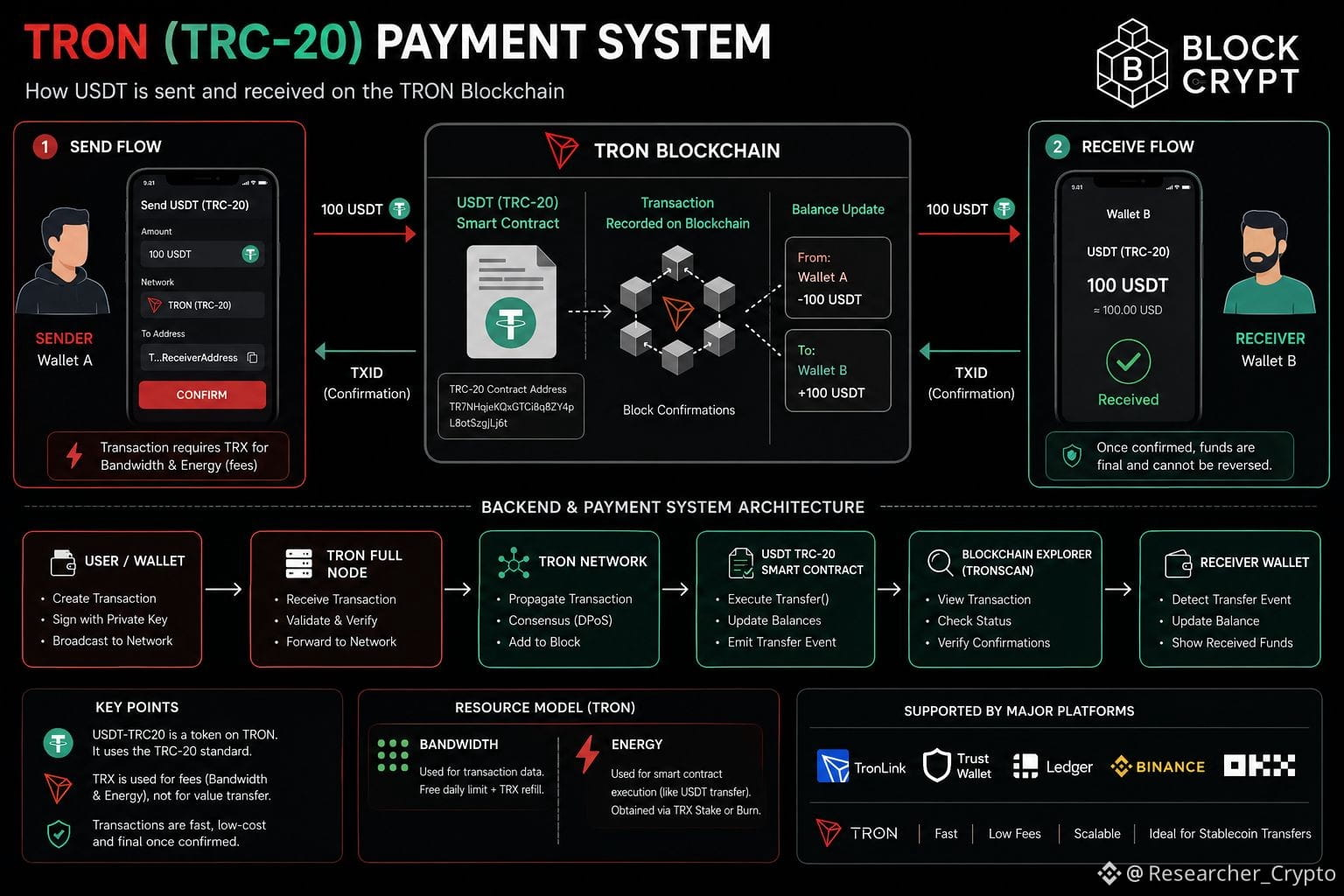
🟢 TRON, TRX & TRC-20 Explained — And How USDT Moves on the TRON Blockchain
Note: "Don't forget to like, share and follow our page to learn crypto and blockchain"
Now to the topic:
If you've ever sent or received USDT and seen options like ERC-20, TRC-20, BEP-20 or Solana, you may have wondered:
👉 What exactly is TRON?
👉 What is TRC-20?
👉 Why is TRX needed when sending USDT?
👉 How does USDT actually move from one wallet to another?
Let's break it all down. 👇
---
🔹 What is TRON?
TRON is a blockchain network designed to support digital assets, smart contracts and decentralized applications.
Its native cryptocurrency is TRX.
TRX is used within the TRON ecosystem for network activity, staking, governance and paying for blockchain resources.
Think of TRON as a road or payment network on which digital assets can move.
TRON = Blockchain/network
TRX = Native cryptocurrency of the network
---
🔹 What is TRC-20?
One of the most important things to understand is:
TRC-20 is NOT a cryptocurrency.
TRC-20 is a token standard on the TRON blockchain.
It defines technical rules that fungible tokens can follow, including functions for transferring tokens, checking balances and approving other addresses or smart contracts.
If you've heard of ERC-20 on Ethereum, TRC-20 is a similar concept on TRON.
For example:
Ethereum → ERC-20 → USDT
while:
TRON → TRC-20 → USDT
Therefore, when an exchange says:
USDT — TRC-20
it means:
«USDT is being transferred using the TRON blockchain.»
---
🔹 What is USDT-TRC20?
USDT is the stablecoin issued by Tether.
Tether has issued USDT on multiple blockchain networks.
One of those networks is TRON.
Therefore:
USDT-TRC20 = USDT running as a TRC-20 token on the TRON blockchain.
This is different from:
USDT-ERC20 = USDT on Ethereum
and other versions of USDT that exist on different supported networks.
The underlying idea is the same—USDT represents a dollar-denominated stablecoin—but the blockchain network carrying the token is different.
🟢 TRON, TRX & TRC-20 Explained — And How USDT Moves on the TRON Blockchain
Note: "Don't forget to like, share and follow our page to learn crypto and blockchain"
Now to the topic:
If you've ever sent or received USDT and seen options like ERC-20, TRC-20, BEP-20 or Solana, you may have wondered:
👉 What exactly is TRON?
👉 What is TRC-20?
👉 Why is TRX needed when sending USDT?
👉 How does USDT actually move from one wallet to another?
Let's break it all down. 👇
---
🔹 What is TRON?
TRON is a blockchain network designed to support digital assets, smart contracts and decentralized applications.
Its native cryptocurrency is TRX.
TRX is used within the TRON ecosystem for network activity, staking, governance and paying for blockchain resources.
Think of TRON as a road or payment network on which digital assets can move.
TRON = Blockchain/network
TRX = Native cryptocurrency of the network
---
🔹 What is TRC-20?
One of the most important things to understand is:
TRC-20 is NOT a cryptocurrency.
TRC-20 is a token standard on the TRON blockchain.
It defines technical rules that fungible tokens can follow, including functions for transferring tokens, checking balances and approving other addresses or smart contracts.
If you've heard of ERC-20 on Ethereum, TRC-20 is a similar concept on TRON.
For example:
Ethereum → ERC-20 → USDT
while:
TRON → TRC-20 → USDT
Therefore, when an exchange says:
USDT — TRC-20
it means:
«USDT is being transferred using the TRON blockchain.»
---
🔹 What is USDT-TRC20?
USDT is the stablecoin issued by Tether.
Tether has issued USDT on multiple blockchain networks.
One of those networks is TRON.
Therefore:
USDT-TRC20 = USDT running as a TRC-20 token on the TRON blockchain.
This is different from:
USDT-ERC20 = USDT on Ethereum
and other versions of USDT that exist on different supported networks.
The underlying idea is the same—USDT represents a dollar-denominated stablecoin—but the blockchain network carrying the token is different.
Note: "Don't forget to like, share and follow our page to learn crypto and blockchain"
Now to the topic:
If you've ever sent or received USDT and seen options like ERC-20, TRC-20, BEP-20 or Solana, you may have wondered:
👉 What exactly is TRON?
👉 What is TRC-20?
👉 Why is TRX needed when sending USDT?
👉 How does USDT actually move from one wallet to another?
Let's break it all down. 👇
---
🔹 What is TRON?
TRON is a blockchain network designed to support digital assets, smart contracts and decentralized applications.
Its native cryptocurrency is TRX.
TRX is used within the TRON ecosystem for network activity, staking, governance and paying for blockchain resources.
Think of TRON as a road or payment network on which digital assets can move.
TRON = Blockchain/network
TRX = Native cryptocurrency of the network
---
🔹 What is TRC-20?
One of the most important things to understand is:
TRC-20 is NOT a cryptocurrency.
TRC-20 is a token standard on the TRON blockchain.
It defines technical rules that fungible tokens can follow, including functions for transferring tokens, checking balances and approving other addresses or smart contracts.
If you've heard of ERC-20 on Ethereum, TRC-20 is a similar concept on TRON.
For example:
Ethereum → ERC-20 → USDT
while:
TRON → TRC-20 → USDT
Therefore, when an exchange says:
USDT — TRC-20
it means:
«USDT is being transferred using the TRON blockchain.»
---
🔹 What is USDT-TRC20?
USDT is the stablecoin issued by Tether.
Tether has issued USDT on multiple blockchain networks.
One of those networks is TRON.
Therefore:
USDT-TRC20 = USDT running as a TRC-20 token on the TRON blockchain.
This is different from:
USDT-ERC20 = USDT on Ethereum
and other versions of USDT that exist on different supported networks.
The underlying idea is the same—USDT represents a dollar-denominated stablecoin—but the blockchain network carrying the token is different.
77
Verified
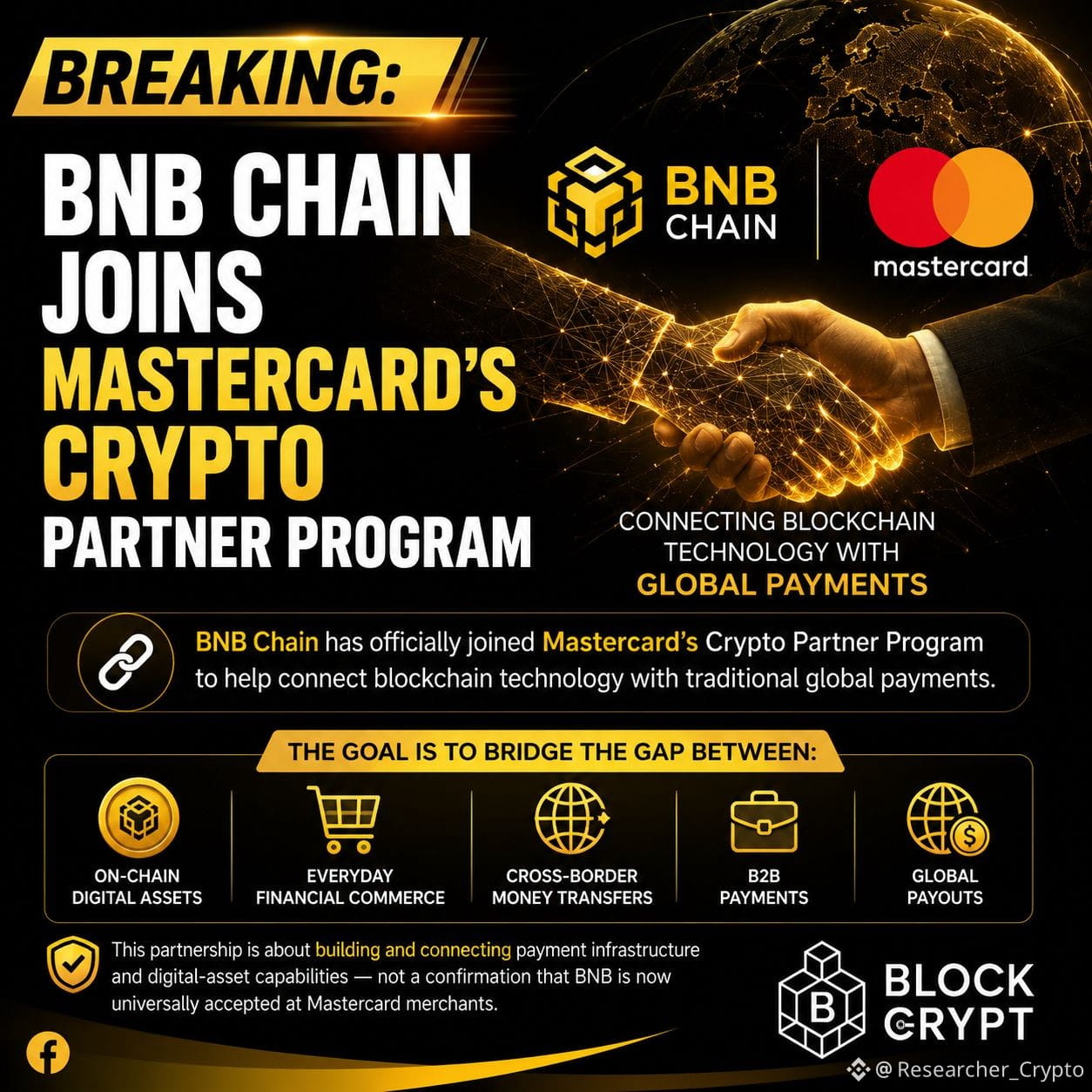
BREAKING: BNB CHAIN JOINS MASTERCARD’S CRYPTO PARTNER PROGRAM
BNB Chain has joined Mastercard’s Crypto Partner Program, marking another step toward connecting blockchain technology with the traditional global payments ecosystem.
The collaboration aims to help bridge the gap between:
🔹 On-chain digital assets
🔹 Everyday financial commerce
🔹 Cross-border money transfers
🔹 B2B payments
🔹 Global payouts
🔹 Blockchain-based payment infrastructure
Mastercard’s digital-asset ecosystem supports multiple blockchain networks, including BNB Chain, creating potential pathways between on-chain assets and traditional payment rails.
⚠️ Important: This does not mean BNB is now universally accepted at Mastercard merchants. The partnership is about building and connecting payment infrastructure and digital-asset capabilities.
🌐 Blockchain × Traditional Finance = A rapidly evolving payment ecosystem.
#BNBChain #Mastercard #Crypto #Blockchain #DigitalAssets #Payments #Web3 #BNB #FinTech #Cryptocurrency
BREAKING: BNB CHAIN JOINS MASTERCARD’S CRYPTO PARTNER PROGRAM
BNB Chain has joined Mastercard’s Crypto Partner Program, marking another step toward connecting blockchain technology with the traditional global payments ecosystem.
The collaboration aims to help bridge the gap between:
🔹 On-chain digital assets
🔹 Everyday financial commerce
🔹 Cross-border money transfers
🔹 B2B payments
🔹 Global payouts
🔹 Blockchain-based payment infrastructure
Mastercard’s digital-asset ecosystem supports multiple blockchain networks, including BNB Chain, creating potential pathways between on-chain assets and traditional payment rails.
⚠️ Important: This does not mean BNB is now universally accepted at Mastercard merchants. The partnership is about building and connecting payment infrastructure and digital-asset capabilities.
🌐 Blockchain × Traditional Finance = A rapidly evolving payment ecosystem.
#BNBChain #Mastercard #Crypto #Blockchain #DigitalAssets #Payments #Web3 #BNB #FinTech #Cryptocurrency
BNB Chain has joined Mastercard’s Crypto Partner Program, marking another step toward connecting blockchain technology with the traditional global payments ecosystem.
The collaboration aims to help bridge the gap between:
🔹 On-chain digital assets
🔹 Everyday financial commerce
🔹 Cross-border money transfers
🔹 B2B payments
🔹 Global payouts
🔹 Blockchain-based payment infrastructure
Mastercard’s digital-asset ecosystem supports multiple blockchain networks, including BNB Chain, creating potential pathways between on-chain assets and traditional payment rails.
⚠️ Important: This does not mean BNB is now universally accepted at Mastercard merchants. The partnership is about building and connecting payment infrastructure and digital-asset capabilities.
🌐 Blockchain × Traditional Finance = A rapidly evolving payment ecosystem.
#BNBChain #Mastercard #Crypto #Blockchain #DigitalAssets #Payments #Web3 #BNB #FinTech #Cryptocurrency
53
Log in to explore more content
Join global crypto users on Binance Square
⚡️ Get latest and useful information about crypto.
💬 Trusted by the world’s largest crypto exchange.
👍 Discover real insights from verified creators.
Email / Phone number
Trending Topics
CircleMints500MUSDCOnSolana
128,819 views
2,484 Discussing
#circlemints500musdconsolana
🚨 CIRCLE MINTS $500M USDC ON SOLANA — LIQUIDITY SIGNAL TO WATCH
Circle has minted a combined 500 million USDC on Solana across two transactions, with each transaction creating 250 million USDC.
The activity highlights continued demand for dollar-denominated liquidity on Solana, where USDC is natively supported by Circle.
KEY DETAILS
• $500M USDC minted
• Split into 2 × $250M transactions
• Network: Solana
• USDC is Circle’s dollar-backed stablecoin
• Latest activity occurred around Sept. 25–26, 2026
WHY IT MATTERS
Large stablecoin mints can increase the amount of liquidity available for trading, DeFi, payments and other on-chain activity.
However, a mint does not automatically mean $500M has entered crypto markets or will immediately flow into SOL. Circle explains that on Solana, pre-minted USDC can be held before being authorized into circulation.
So the key question for traders is what happens next:
Will this newly created USDC move toward exchanges, DeFi protocols or other Solana-based applications?
For now, the mint itself is confirmed — the eventual destination of the liquidity remains the part to watch.
$AMP $RARE $QNT
顾清妍
·1 Likes
·3.8k views
PolymarketBankFailureBetsDrawFDICConcern
116,368 views
2,067 Discussing
BlackRockBuildsTokenizedPortfoliosForOndo
112,553 views
1,472 Discussing