
AnYYá
3k Posts

AnYYá
34 Following
19.8K+ Followers
4.2K+ Liked
Posts
All
Quotes
Live
PINNED
$BTR (157.57%) $TAC (71.67%) $DUSK
@Dusk #dusk
Every Dusk narrative rests on one untested assumption: institutions actually want to use public blockchains for settlement.
I don't think people discuss this enough. Dusk is built for institutional RWA adoption. It has privacy infrastructure for compliance, settlement finality, and bridge connections to other chains. All theoretically perfect for financial institutions. But there's a gap between "perfect for" and "institutions will actually use."
Traditional finance has been skeptical of public blockchains for good reasons. They have existing settlement networks. They have legal frameworks. They have custody solutions. These things work, even if they're slower and more expensive.
Dusk assumes institutions will trade existing settlement systems for blockchain-based settlement because it's more efficient. That's a technology-first argument. But institutions make adoption decisions based on liability, insurance regulatory approval, and peer acceptance, not just efficiency.
What struck me. Every major enterprise that's adopted public blockchains did so because they were forced to (banks joining Corda) or because they found a niche the existing system couldn't serve (trading venues using DEXs). Nobody adopted just because a blockchain was more efficient.
Dusk's institutional thesis assumes that privacy plus settlement finality plus compliance features will pull institutions toward blockchain. But they might stay on existing infrastructure because the switching costs and legal risk are higher than Dusk's technical benefits.
My concern would be that Dusk is building infrastructure for institutional adoption that might never materialize at the scale required. The protocol can be perfect for institutional finance and still see minimal institutional usage if the institutions themselves don't want to move.
What assumption are you most uncertain about: that institutions want public blockchain settlement, or that they'll choose Dusk specifically? What's the real barrier to institutional blockchain adoption?
@Dusk #dusk
Every Dusk narrative rests on one untested assumption: institutions actually want to use public blockchains for settlement.
I don't think people discuss this enough. Dusk is built for institutional RWA adoption. It has privacy infrastructure for compliance, settlement finality, and bridge connections to other chains. All theoretically perfect for financial institutions. But there's a gap between "perfect for" and "institutions will actually use."
Traditional finance has been skeptical of public blockchains for good reasons. They have existing settlement networks. They have legal frameworks. They have custody solutions. These things work, even if they're slower and more expensive.
Dusk assumes institutions will trade existing settlement systems for blockchain-based settlement because it's more efficient. That's a technology-first argument. But institutions make adoption decisions based on liability, insurance regulatory approval, and peer acceptance, not just efficiency.
What struck me. Every major enterprise that's adopted public blockchains did so because they were forced to (banks joining Corda) or because they found a niche the existing system couldn't serve (trading venues using DEXs). Nobody adopted just because a blockchain was more efficient.
Dusk's institutional thesis assumes that privacy plus settlement finality plus compliance features will pull institutions toward blockchain. But they might stay on existing infrastructure because the switching costs and legal risk are higher than Dusk's technical benefits.
My concern would be that Dusk is building infrastructure for institutional adoption that might never materialize at the scale required. The protocol can be perfect for institutional finance and still see minimal institutional usage if the institutions themselves don't want to move.
What assumption are you most uncertain about: that institutions want public blockchain settlement, or that they'll choose Dusk specifically? What's the real barrier to institutional blockchain adoption?
🏛️ Regulatory uncertainty
100%
📋 Liability concerns
0%
💼 Switching costs
0%
⏰ Proof of concept
0%
2 votes • Voting closed
$TAC (41.19%) $STAR (37.11%) $DUSK
@Dusk #dusk
DEVELOPER ADOPTION ISN'T WHAT YOU THINK
DuskEVM launched with one massive promise: Solidity developers can deploy on Dusk without learning new tools. EVM compatibility sounds like adoption shortcut. I don't think it actually is.
Here's what I found surprising. Having EVM compatibility doesn't mean developers will come. It means developers can come if they want to. The difference is critical.
Solidity developers choose chains for three reasons: liquidity, users, and ecosystem maturity. DuskEVM offers EVM compatibility. None of the other three.
When a developer considers deploying a new application, they ask: where will my users be? Where does liquidity pool? What infrastructure already exists? Dusk's answer to all three is "we're building it." That's not a draw compared to Ethereum, Arbitrum, or even Base, where those things already exist.
What struck me is how OP Stack compatibility becomes almost irrelevant in this context. The technical compatibility doesn't matter if the ecosystem incentives don't exist. A developer can write Solidity on Dusk, but they're writing it into an empty market infrastructure.
EVM compatibility is table stakes for new chains, not a competitive advantage. It just means Dusk isn't worse. It doesn't mean Dusk is better.
My concern would be that Dusk confused technical compatibility with adoption. Real developer adoption requires three things: incentives programs, existing user base, and ecosystem depth. DuskEVM provides the technical tools. It doesn't provide the ecosystem gravity.
If developers aren't actually flocking to DuskEVM despite compatibility, the problem isn't the tooling. It's that the chain doesn't yet offer what developers need.
Do you think developer adoption will come from ecosystem depth building over time, or is the incentive structure just not there?
What would actually get developers to deploy on DuskEVM?
@Dusk #dusk
DEVELOPER ADOPTION ISN'T WHAT YOU THINK
DuskEVM launched with one massive promise: Solidity developers can deploy on Dusk without learning new tools. EVM compatibility sounds like adoption shortcut. I don't think it actually is.
Here's what I found surprising. Having EVM compatibility doesn't mean developers will come. It means developers can come if they want to. The difference is critical.
Solidity developers choose chains for three reasons: liquidity, users, and ecosystem maturity. DuskEVM offers EVM compatibility. None of the other three.
When a developer considers deploying a new application, they ask: where will my users be? Where does liquidity pool? What infrastructure already exists? Dusk's answer to all three is "we're building it." That's not a draw compared to Ethereum, Arbitrum, or even Base, where those things already exist.
What struck me is how OP Stack compatibility becomes almost irrelevant in this context. The technical compatibility doesn't matter if the ecosystem incentives don't exist. A developer can write Solidity on Dusk, but they're writing it into an empty market infrastructure.
EVM compatibility is table stakes for new chains, not a competitive advantage. It just means Dusk isn't worse. It doesn't mean Dusk is better.
My concern would be that Dusk confused technical compatibility with adoption. Real developer adoption requires three things: incentives programs, existing user base, and ecosystem depth. DuskEVM provides the technical tools. It doesn't provide the ecosystem gravity.
If developers aren't actually flocking to DuskEVM despite compatibility, the problem isn't the tooling. It's that the chain doesn't yet offer what developers need.
Do you think developer adoption will come from ecosystem depth building over time, or is the incentive structure just not there?
What would actually get developers to deploy on DuskEVM?
💰 Incentive programs
50%
🏗️ Ecosystem depth
0%
👥 User base
0%
🎯 Killer app
50%
2 votes • Voting closed
$SPK (20.28%) & $MORPHO (18%)
$DUSK 3.77% #dusk @Dusk
I found myself wondering while reading Dusk's performance specs: why does a privacy-first blockchain target 1,000 transactions per second when Ethereum does 12-15 TPS?
The answer reveals something important about hidden trade-offs.
Privacy doesn't scale for free. Phoenix transactions require zero-knowledge proofs. Those proofs take time to generate, verify, and include in blocks. Dusk optimized for this, which is why throughput is higher than pure privacy chains. But here's what most analysis misses: that throughput comes with infrastructure costs.
Higher throughput means more computational burden on validators. More computational burden means fewer people can run nodes profitably. Fewer nodes means the network concentrates. Privacy supposedly creates decentralization. In practice, the scalability requirements might force centralization.
What struck me is how this inverts the decentralization narrative. Dusk claims to offer privacy plus decentralization. But supporting 1,000 TPS on a network secured by confidential smart contracts requires serious hardware. That hardware cost becomes a barrier to validator participation.
Most chains solve this through centralized sequencers or rollups that push compute off-chain. Dusk keeps everything on the base layer because settlement finality matters for institutional use. That design choice creates real throughput, but at the cost of validator accessibility.
My concern would be that Dusk's target throughput (1,000 TPS) is high enough to require industrial-grade infrastructure, but not high enough to justify the privacy cost. It's stuck between two worlds: too expensive for casual validators, too slow for high-frequency traders.
Is the throughput-to-decentralization trade-off actually reasonable, or is Dusk sacrificing practical decentralization for a specification that sounds good on paper?
Which trade-off matters more for Dusk?
$DUSK 3.77% #dusk @Dusk
I found myself wondering while reading Dusk's performance specs: why does a privacy-first blockchain target 1,000 transactions per second when Ethereum does 12-15 TPS?
The answer reveals something important about hidden trade-offs.
Privacy doesn't scale for free. Phoenix transactions require zero-knowledge proofs. Those proofs take time to generate, verify, and include in blocks. Dusk optimized for this, which is why throughput is higher than pure privacy chains. But here's what most analysis misses: that throughput comes with infrastructure costs.
Higher throughput means more computational burden on validators. More computational burden means fewer people can run nodes profitably. Fewer nodes means the network concentrates. Privacy supposedly creates decentralization. In practice, the scalability requirements might force centralization.
What struck me is how this inverts the decentralization narrative. Dusk claims to offer privacy plus decentralization. But supporting 1,000 TPS on a network secured by confidential smart contracts requires serious hardware. That hardware cost becomes a barrier to validator participation.
Most chains solve this through centralized sequencers or rollups that push compute off-chain. Dusk keeps everything on the base layer because settlement finality matters for institutional use. That design choice creates real throughput, but at the cost of validator accessibility.
My concern would be that Dusk's target throughput (1,000 TPS) is high enough to require industrial-grade infrastructure, but not high enough to justify the privacy cost. It's stuck between two worlds: too expensive for casual validators, too slow for high-frequency traders.
Is the throughput-to-decentralization trade-off actually reasonable, or is Dusk sacrificing practical decentralization for a specification that sounds good on paper?
Which trade-off matters more for Dusk?
⚡ Throughput
25%
🔐 Decentralization
50%
💰 Economics
0%
🎯 Practicality
25%
4 votes • Voting closed
@Dusk #dusk $DUSK
I realized something uncomfortable while mapping out Dusk's token economics. The protocol is designed for DUSK to capture almost none of the value it creates for institutions.
Start with what actually happens when the RWA thesis succeeds. Institutions tokenize assets on Dusk. They settle transactions. Network usage grows. But who benefits from that activity?
Gas fees are paid in DUSK, but Dusk targets sub-$0.01 per transaction. That's minimal value capture. Staking yields come from block rewards distributed on a 36-year emission schedule. The longer that schedule runs, the more diluted existing DUSK holders become.
Here's the structural problem. Dusk is designed to be indifferent to which asset settles actual financial activity. Institutions will trade tokenized securities using stablecoins, not DUSK. The network's core use case doesn't require DUSK token holdings. DUSK is infrastructure, not the asset layer.
Most L1s have flawed tokenomics, but they benefit from adoption directly. Ethereum burns fees. Solana captures MEV. Dusk created a separation where network success doesn't automatically translate into token value. Emissions schedule ensures dilution outpaces adoption returns.
My concern would be that this creates long-term sustainability issues. Early DUSK holders are funding network development through inflation. But if institutional adoption materializes, new users have no reason to hold DUSK beyond staking requirements.
Does the gap between network success and token value actually matter for long-term sustainability, or is this a problem that solves itself through protocol evolution?
$TUT
$ZRO
What's the real risk in Dusk's token economics?
I realized something uncomfortable while mapping out Dusk's token economics. The protocol is designed for DUSK to capture almost none of the value it creates for institutions.
Start with what actually happens when the RWA thesis succeeds. Institutions tokenize assets on Dusk. They settle transactions. Network usage grows. But who benefits from that activity?
Gas fees are paid in DUSK, but Dusk targets sub-$0.01 per transaction. That's minimal value capture. Staking yields come from block rewards distributed on a 36-year emission schedule. The longer that schedule runs, the more diluted existing DUSK holders become.
Here's the structural problem. Dusk is designed to be indifferent to which asset settles actual financial activity. Institutions will trade tokenized securities using stablecoins, not DUSK. The network's core use case doesn't require DUSK token holdings. DUSK is infrastructure, not the asset layer.
Most L1s have flawed tokenomics, but they benefit from adoption directly. Ethereum burns fees. Solana captures MEV. Dusk created a separation where network success doesn't automatically translate into token value. Emissions schedule ensures dilution outpaces adoption returns.
My concern would be that this creates long-term sustainability issues. Early DUSK holders are funding network development through inflation. But if institutional adoption materializes, new users have no reason to hold DUSK beyond staking requirements.
Does the gap between network success and token value actually matter for long-term sustainability, or is this a problem that solves itself through protocol evolution?
$TUT
$ZRO
What's the real risk in Dusk's token economics?
💰 Value mismatch
100%
📉 Dilution problem
0%
🪖 Early subsidy
0%
⏳ Timing trap
0%
1 votes • Voting closed
@Dusk #dusk $DUSK
The bridge incident in January didn't break Dusk's protocol. It broke something more important: the assumption that Dusk is operationally ready to handle institutional assets at scale.
Here's what happened. A team-managed wallet got compromised. The bridge paused. No smart contract flaw, no consensus failure, just basic key management going wrong. Dusk handled it well, but the incident revealed something the marketing rarely mentions.
When institutions move millions in tokenized securities, they're not betting on cryptography anymore. They're betting on whether a team can run infrastructure without catastrophic failures. Dusk's bridge pause signals they couldn't, at least not yet.
What struck me is how this fits into a larger 2026 pattern. Bridge exploits this year aren't mostly about finding contract bugs. They're about key compromise, wallet theft, signing authority failures. The Kelp DAO exploit? Off-chain infrastructure was compromised. Ronin? Validator keys stolen. Gravity? Signing key compromise. The recurring failure isn't code. It's operations.
This matters for Dusk's RWA thesis because institutions have compliance teams who understand risk. If a bridge run by privacy-blockchain engineers gets compromised, what does that tell them about trusting Dusk with billions in regulated assets? The protocol can be mathematically sound while infrastructure remains fragile.
The way I interpret this: Dusk is solving the hard technical problem (confidential settlement) while still learning the hard operational problem (actually running this safely at scale). Those aren't the same thing.
Does the gap between protocol security and operational readiness actually matter for institutional adoption, or am I overweighting the bridge incident?
$TRUMP
$MELANIA
What's the real barrier to institutional RWA adoption on Dusk?
Which do you think matters most?
The bridge incident in January didn't break Dusk's protocol. It broke something more important: the assumption that Dusk is operationally ready to handle institutional assets at scale.
Here's what happened. A team-managed wallet got compromised. The bridge paused. No smart contract flaw, no consensus failure, just basic key management going wrong. Dusk handled it well, but the incident revealed something the marketing rarely mentions.
When institutions move millions in tokenized securities, they're not betting on cryptography anymore. They're betting on whether a team can run infrastructure without catastrophic failures. Dusk's bridge pause signals they couldn't, at least not yet.
What struck me is how this fits into a larger 2026 pattern. Bridge exploits this year aren't mostly about finding contract bugs. They're about key compromise, wallet theft, signing authority failures. The Kelp DAO exploit? Off-chain infrastructure was compromised. Ronin? Validator keys stolen. Gravity? Signing key compromise. The recurring failure isn't code. It's operations.
This matters for Dusk's RWA thesis because institutions have compliance teams who understand risk. If a bridge run by privacy-blockchain engineers gets compromised, what does that tell them about trusting Dusk with billions in regulated assets? The protocol can be mathematically sound while infrastructure remains fragile.
The way I interpret this: Dusk is solving the hard technical problem (confidential settlement) while still learning the hard operational problem (actually running this safely at scale). Those aren't the same thing.
Does the gap between protocol security and operational readiness actually matter for institutional adoption, or am I overweighting the bridge incident?
$TRUMP
$MELANIA
What's the real barrier to institutional RWA adoption on Dusk?
Which do you think matters most?
🔐 Protocol security
0%
⚙️ Operational readiness
100%
🏛️ Regulatory clarity
0%
⏳ Time & track record
0%
1 votes • Voting closed
@Dusk #dusk $DUSK
Moonlight was an afterthought. Dusk spent years building Phoenix, their shielded transaction model, then added Moonlight (public transactions) specifically because exchanges and regulators demanded transparent account-based systems. It was a pragmatic adaptation to regulatory pressure, not part of the original vision.
That decision solved a real problem. It let exchanges list DUSK without fighting with compliance teams. But I realized something while digging into how these two models actually coexist on the same settlement layer: adding Moonlight didn't just expand optionality. It created fundamental architectural fragmentation.
Phoenix is UTXO-based. Moonlight is account-based. These aren't just different privacy levels on the same accounting model. They're completely different ledger systems that happen to share the same blockchain. Users can convert between them, but the underlying state structures are incompatible. A smart contract optimized for one model performs differently on the other.
The way I interpret this: Dusk solved regulatory pressure by layering on a second accounting model instead of building one coherent system. That's pragmatic in the short term. In the long term, it means developers building on Dusk have to choose. Do you optimize for the privacy features of Phoenix or the simplicity and exchange compatibility of Moonlight? Few applications can honestly serve both equally well.
My concern would be that this creates the opposite of what Dusk intended. Instead of unified liquidity, you get two separate ecosystems sharing settlement infrastructure. Developers fragment. Liquidity fragments. User experience becomes "which model do I need to use for this?"
The bridge between them exists technically, but conversion friction is real in practice. It's another decision, another transaction, another potential failure point.
Is the architectural cost of supporting two incompatible ledger models actually worth the regulatory pragmatism Moonlight provides?
$ONG $BOME
What's the bigger drag on Dusk adoption?
Moonlight was an afterthought. Dusk spent years building Phoenix, their shielded transaction model, then added Moonlight (public transactions) specifically because exchanges and regulators demanded transparent account-based systems. It was a pragmatic adaptation to regulatory pressure, not part of the original vision.
That decision solved a real problem. It let exchanges list DUSK without fighting with compliance teams. But I realized something while digging into how these two models actually coexist on the same settlement layer: adding Moonlight didn't just expand optionality. It created fundamental architectural fragmentation.
Phoenix is UTXO-based. Moonlight is account-based. These aren't just different privacy levels on the same accounting model. They're completely different ledger systems that happen to share the same blockchain. Users can convert between them, but the underlying state structures are incompatible. A smart contract optimized for one model performs differently on the other.
The way I interpret this: Dusk solved regulatory pressure by layering on a second accounting model instead of building one coherent system. That's pragmatic in the short term. In the long term, it means developers building on Dusk have to choose. Do you optimize for the privacy features of Phoenix or the simplicity and exchange compatibility of Moonlight? Few applications can honestly serve both equally well.
My concern would be that this creates the opposite of what Dusk intended. Instead of unified liquidity, you get two separate ecosystems sharing settlement infrastructure. Developers fragment. Liquidity fragments. User experience becomes "which model do I need to use for this?"
The bridge between them exists technically, but conversion friction is real in practice. It's another decision, another transaction, another potential failure point.
Is the architectural cost of supporting two incompatible ledger models actually worth the regulatory pragmatism Moonlight provides?
$ONG $BOME
What's the bigger drag on Dusk adoption?
🔀 Architectural fragmentation
0%
📊 Liquidity fragmentation
0%
⚙️ Integration burden
0%
⏳ Early-stage risk
0%
0 votes • Voting closed
@Dusk #dusk $DUSK
I almost skipped over one detail in Dusk's technical docs that changed how I think about DuskEVM. It runs on the OP Stack, the same framework Optimism uses for rollups. At first that seemed like smart engineering, reuse proven code instead of reinventing an EVM environment from zero.
The deeper I went, the more it looked like a real dependency, not just borrowed infrastructure. Building a fully compatible EVM environment is slow and risky. Plenty of chains shipped buggy implementations because matching Ethereum's subtle behavior is harder than it looks. OP Stack sidesteps that risk.
But it creates a different one. DuskEVM's execution layer now inherits design decisions, upgrade cycles, and security assumptions from code Dusk doesn't fully control. Settlement and data availability stay on DuskDS, which keeps core financial guarantees native. The execution layer where Solidity contracts run is coupled to another ecosystem's roadmap.
Here's what doesn't get discussed. EVM compatibility isn't just a developer win. It means Dusk's execution security is partly a function of how well OP Stack gets maintained over time. That's not necessarily bad, but it's a risk transfer.
I wonder if builders evaluating DuskEVM are actually pricing in that dependency, or just seeing "EVM compatible" and assuming the risk profile is the same as building on Dusk natively.
Is borrowing infrastructure like OP Stack a smart trade-off for newer chains, or does it quietly transfer risk that gets underestimated?
$RED $MAGMA
How do you view Dusk's OP Stack dependency for DuskEVM?
I almost skipped over one detail in Dusk's technical docs that changed how I think about DuskEVM. It runs on the OP Stack, the same framework Optimism uses for rollups. At first that seemed like smart engineering, reuse proven code instead of reinventing an EVM environment from zero.
The deeper I went, the more it looked like a real dependency, not just borrowed infrastructure. Building a fully compatible EVM environment is slow and risky. Plenty of chains shipped buggy implementations because matching Ethereum's subtle behavior is harder than it looks. OP Stack sidesteps that risk.
But it creates a different one. DuskEVM's execution layer now inherits design decisions, upgrade cycles, and security assumptions from code Dusk doesn't fully control. Settlement and data availability stay on DuskDS, which keeps core financial guarantees native. The execution layer where Solidity contracts run is coupled to another ecosystem's roadmap.
Here's what doesn't get discussed. EVM compatibility isn't just a developer win. It means Dusk's execution security is partly a function of how well OP Stack gets maintained over time. That's not necessarily bad, but it's a risk transfer.
I wonder if builders evaluating DuskEVM are actually pricing in that dependency, or just seeing "EVM compatible" and assuming the risk profile is the same as building on Dusk natively.
Is borrowing infrastructure like OP Stack a smart trade-off for newer chains, or does it quietly transfer risk that gets underestimated?
$RED $MAGMA
How do you view Dusk's OP Stack dependency for DuskEVM?
✅ Smart trade-off
100%
⚠️ Underestimated risk
0%
🔄 Acceptable for now
0%
🤔 Not sure yet
0%
1 votes • Voting closed
@Dusk $DUSK #dusk
I kept seeing Dusk described as "perfectly positioned for MiCA." Then I realized that positioning might also be a limitation.
MiCA gave @Dusk legitimacy. June 2024 enforcement created a regulatory framework where EU institutions could issue compliant assets on-chain. For Europe specifically, this is real infrastructure advantage. But institutional capital doesn't respect borders the way regulators do.
When a global fund manager decides where to tokenize assets, they're not thinking "which chain is MiCA-compliant." They're thinking "where is infrastructure mature, liquidity deep, ecosystem proven." That still defaults to Ethereum.
I noticed this gap looking at competing chains. Arbitrum, Optimism, and Base aren't building for MiCA specifically. They're building for global institutions. They're not geographically confined.
Being EU-regulatory-first is valuable for EU institutions. But if you're BlackRock or Deutsche Börse, one jurisdiction's regulatory clarity isn't enough. You need pathways everywhere.
Here's what surprised me: MiCA compliance might actually be a constraint disguised as advantage. If Dusk becomes known as "the chain that solved EU tokenization," it also becomes "the chain you use for EU assets." Valuable for EU market share. But not the same as global default.
There's also real burden. MiCA compliance means documentation, audits, custody requirements, legal exposure. Some institutions will choose that deliberately. Others will defer Dusk until forced into EU market penetration. Meanwhile they build on Ethereum.
I don't think Dusk needs to be everything to everyone. But the market might be overweighting how much regulatory excellence matters versus ecosystem maturity. The best regulation still doesn't solve core problems: developer activity, liquidity, network effects compound faster on established chains.
Is being the best option for EU institutions enough for long-term value capture, or does Dusk eventually need global institutional adoption to justify the investment thesis?
$BTW $ACE
I kept seeing Dusk described as "perfectly positioned for MiCA." Then I realized that positioning might also be a limitation.
MiCA gave @Dusk legitimacy. June 2024 enforcement created a regulatory framework where EU institutions could issue compliant assets on-chain. For Europe specifically, this is real infrastructure advantage. But institutional capital doesn't respect borders the way regulators do.
When a global fund manager decides where to tokenize assets, they're not thinking "which chain is MiCA-compliant." They're thinking "where is infrastructure mature, liquidity deep, ecosystem proven." That still defaults to Ethereum.
I noticed this gap looking at competing chains. Arbitrum, Optimism, and Base aren't building for MiCA specifically. They're building for global institutions. They're not geographically confined.
Being EU-regulatory-first is valuable for EU institutions. But if you're BlackRock or Deutsche Börse, one jurisdiction's regulatory clarity isn't enough. You need pathways everywhere.
Here's what surprised me: MiCA compliance might actually be a constraint disguised as advantage. If Dusk becomes known as "the chain that solved EU tokenization," it also becomes "the chain you use for EU assets." Valuable for EU market share. But not the same as global default.
There's also real burden. MiCA compliance means documentation, audits, custody requirements, legal exposure. Some institutions will choose that deliberately. Others will defer Dusk until forced into EU market penetration. Meanwhile they build on Ethereum.
I don't think Dusk needs to be everything to everyone. But the market might be overweighting how much regulatory excellence matters versus ecosystem maturity. The best regulation still doesn't solve core problems: developer activity, liquidity, network effects compound faster on established chains.
Is being the best option for EU institutions enough for long-term value capture, or does Dusk eventually need global institutional adoption to justify the investment thesis?
$BTW $ACE
Good for EU
100%
⚠️Overrated constraint
0%
Clear advantage
0%
1 votes • Voting closed
@Dusk #dusk
I initially saw Dusk as a privacy settlement layer for institutional finance. But the NPEX partnership and Chainlink integration revealed something: privacy solves issuance compliance, not secondary market friction.
Here's the issue. Dusk excels at confidential asset issuance with embedded compliance rules. But after issuance comes trading, where institutions need visible order flow and price discovery. That's where liquidity actually pools: Ethereum and Solana. Dusk bridges assets out through Chainlink because the real trading venues are elsewhere.
This isn't bad architecture. It's honest architecture. But it reframes what Dusk actually captures.
The token gets value from staking rewards and gas on issuance and settlement. But most economic activity—the secondary market trading that determines whether assets are actually liquid—happens on other chains. Ethereum validators capture that fee revenue, not Dusk.
What struck me was how cleanly the partnership made this visible. It wasn't Dusk expanding. It was Dusk admitting: we'll issue and settle here. You trade over there.
That separation makes sense. Issuance infrastructure needs privacy and compliance. Trading venues need transparency and deep order books. You can't optimize for both simultaneously. Privacy obscures market data. Transparency leaks competitive data.
So Dusk might be becoming infrastructure—like Swift for banks—not a primary venue. Behind-the-scenes settlement while visible trading happens elsewhere.
The question I can't settle: does infrastructure-layer positioning sustain token value capture? Or does DUSK trade on adoption hopes while settlement economics stay thin?
Do you think Dusk's long-term value depends on becoming the primary trading venue, or can it thrive as pure issuance infrastructure?
$DUSK
$ACE
$CLO
I initially saw Dusk as a privacy settlement layer for institutional finance. But the NPEX partnership and Chainlink integration revealed something: privacy solves issuance compliance, not secondary market friction.
Here's the issue. Dusk excels at confidential asset issuance with embedded compliance rules. But after issuance comes trading, where institutions need visible order flow and price discovery. That's where liquidity actually pools: Ethereum and Solana. Dusk bridges assets out through Chainlink because the real trading venues are elsewhere.
This isn't bad architecture. It's honest architecture. But it reframes what Dusk actually captures.
The token gets value from staking rewards and gas on issuance and settlement. But most economic activity—the secondary market trading that determines whether assets are actually liquid—happens on other chains. Ethereum validators capture that fee revenue, not Dusk.
What struck me was how cleanly the partnership made this visible. It wasn't Dusk expanding. It was Dusk admitting: we'll issue and settle here. You trade over there.
That separation makes sense. Issuance infrastructure needs privacy and compliance. Trading venues need transparency and deep order books. You can't optimize for both simultaneously. Privacy obscures market data. Transparency leaks competitive data.
So Dusk might be becoming infrastructure—like Swift for banks—not a primary venue. Behind-the-scenes settlement while visible trading happens elsewhere.
The question I can't settle: does infrastructure-layer positioning sustain token value capture? Or does DUSK trade on adoption hopes while settlement economics stay thin?
Do you think Dusk's long-term value depends on becoming the primary trading venue, or can it thrive as pure issuance infrastructure?
$DUSK
$ACE
$CLO
BULLISH 🐂
50%
BEARISH 🐻
50%
2 votes • Voting closed
$DUSK $GPS $PORTAL
I kept noticing something odd every time I tried to describe @Dusk in one sentence. People call it "the privacy chain for RWAs," but that phrase quietly skips the most interesting design decision in the whole protocol.
#Dusk doesn't actually choose privacy for you. It ships two transaction models, Moonlight for public transfers and Phoenix for shielded ones, and leaves the decision of what stays visible to whoever builds on top. That's not a privacy feature.That's Dusk handing the compliance decision to the application layer instead of baking it into the base chain.
Most blockchains solve this the opposite way. Either everything is transparent by default most EVM chains or everything is shielded by default Zcash-style privacy chains. Both approaches force every use case into the same visibility model, which is exactly why regulated finance has struggled to adopt either one directly.
What surprised me is how much responsibility this shifts onto developers and issuers. If you're building a tokenized bond product on Dusk, you now have to design your own disclosure logic instead of inheriting one from the protocol. its more flexible, but it also means the protocol's compliance story depends heavily on builders getting it right, not just on the cryptography working.
I don't think this gets discussed enough.A chain can have flawless zero-knowledge infrastructure and still fail at adoption if the applications built on it make sloppy disclosure decisions. Dusk's architecture reduces protocol-level risk but doesn't remove application-level risk,it relocates it.
My concern would be that this flexibility becomes a liability in practice. Regulators tend to prefer predictable, standardized disclosure over "it depends on the app." Whether Dusk's approach reads as adaptable infrastructure or fragmented compliance probably depends entirely on who builds first and how carefully.
Which part of this worries you more: the technology being unfinished or the compliance responsibility being distributed across builders who may not get it right?
I kept noticing something odd every time I tried to describe @Dusk in one sentence. People call it "the privacy chain for RWAs," but that phrase quietly skips the most interesting design decision in the whole protocol.
#Dusk doesn't actually choose privacy for you. It ships two transaction models, Moonlight for public transfers and Phoenix for shielded ones, and leaves the decision of what stays visible to whoever builds on top. That's not a privacy feature.That's Dusk handing the compliance decision to the application layer instead of baking it into the base chain.
Most blockchains solve this the opposite way. Either everything is transparent by default most EVM chains or everything is shielded by default Zcash-style privacy chains. Both approaches force every use case into the same visibility model, which is exactly why regulated finance has struggled to adopt either one directly.
What surprised me is how much responsibility this shifts onto developers and issuers. If you're building a tokenized bond product on Dusk, you now have to design your own disclosure logic instead of inheriting one from the protocol. its more flexible, but it also means the protocol's compliance story depends heavily on builders getting it right, not just on the cryptography working.
I don't think this gets discussed enough.A chain can have flawless zero-knowledge infrastructure and still fail at adoption if the applications built on it make sloppy disclosure decisions. Dusk's architecture reduces protocol-level risk but doesn't remove application-level risk,it relocates it.
My concern would be that this flexibility becomes a liability in practice. Regulators tend to prefer predictable, standardized disclosure over "it depends on the app." Whether Dusk's approach reads as adaptable infrastructure or fragmented compliance probably depends entirely on who builds first and how carefully.
Which part of this worries you more: the technology being unfinished or the compliance responsibility being distributed across builders who may not get it right?
🔐Protocol risk
67%
🛠Application risk
0%
⚖️Regularity Risk
0%
⏳Adoption risk
33%
3 votes • Voting closed
$PORTAL
$HEMI
$HEMI
AnYYá
·
--
@Dusk #dusk $DUSK
I used to think privacy on a blockchain meant hiding from accountability. Dusk made me reconsider that.
Institutions don't avoid public ledgers because they dislike oversight. They avoid them because broadcasting trade size, timing, and counterparties to the whole market is a competitive liability, not a compliance one. That's a different problem than most privacy coins are solving.
Dusk runs two transaction models instead of picking a side. Moonlight is public and account based, useful when transparency itself is the requirement. Phoenix is shielded, built for cases where balances need to stay confidential while still being provable to whoever is authorized to check them.
What surprised me is that hiding data isn't the hard part. Any database can do that. The hard part is proving a hidden transaction still satisfies a rule, like eligibility or reporting, without exposing the data itself. That's what the zero-knowledge layer is actually doing here, not decorating a privacy narrative.
The NPEX integration is the only real evidence I found that this works outside a whitepaper, with a regulated platform settling tokenized securities on Dusk. One data point, not a trend.
The open risk is whether institutions actually settle on shared infrastructure they don't control, or eventually build proprietary versions of the same idea once it's proven viable.
Would regulated finance prefer rails it can't fully see, if it means compliance without full exposure, or does institutional trust require owning the infrastructure outright?
$PORTAL
$SIREN
I used to think privacy on a blockchain meant hiding from accountability. Dusk made me reconsider that.
Institutions don't avoid public ledgers because they dislike oversight. They avoid them because broadcasting trade size, timing, and counterparties to the whole market is a competitive liability, not a compliance one. That's a different problem than most privacy coins are solving.
Dusk runs two transaction models instead of picking a side. Moonlight is public and account based, useful when transparency itself is the requirement. Phoenix is shielded, built for cases where balances need to stay confidential while still being provable to whoever is authorized to check them.
What surprised me is that hiding data isn't the hard part. Any database can do that. The hard part is proving a hidden transaction still satisfies a rule, like eligibility or reporting, without exposing the data itself. That's what the zero-knowledge layer is actually doing here, not decorating a privacy narrative.
The NPEX integration is the only real evidence I found that this works outside a whitepaper, with a regulated platform settling tokenized securities on Dusk. One data point, not a trend.
The open risk is whether institutions actually settle on shared infrastructure they don't control, or eventually build proprietary versions of the same idea once it's proven viable.
Would regulated finance prefer rails it can't fully see, if it means compliance without full exposure, or does institutional trust require owning the infrastructure outright?
$PORTAL
$SIREN
@Dusk #dusk $DUSK
I used to think privacy on a blockchain meant hiding from accountability. Dusk made me reconsider that.
Institutions don't avoid public ledgers because they dislike oversight. They avoid them because broadcasting trade size, timing, and counterparties to the whole market is a competitive liability, not a compliance one. That's a different problem than most privacy coins are solving.
Dusk runs two transaction models instead of picking a side. Moonlight is public and account based, useful when transparency itself is the requirement. Phoenix is shielded, built for cases where balances need to stay confidential while still being provable to whoever is authorized to check them.
What surprised me is that hiding data isn't the hard part. Any database can do that. The hard part is proving a hidden transaction still satisfies a rule, like eligibility or reporting, without exposing the data itself. That's what the zero-knowledge layer is actually doing here, not decorating a privacy narrative.
The NPEX integration is the only real evidence I found that this works outside a whitepaper, with a regulated platform settling tokenized securities on Dusk. One data point, not a trend.
The open risk is whether institutions actually settle on shared infrastructure they don't control, or eventually build proprietary versions of the same idea once it's proven viable.
Would regulated finance prefer rails it can't fully see, if it means compliance without full exposure, or does institutional trust require owning the infrastructure outright?
$PORTAL
$SIREN
I used to think privacy on a blockchain meant hiding from accountability. Dusk made me reconsider that.
Institutions don't avoid public ledgers because they dislike oversight. They avoid them because broadcasting trade size, timing, and counterparties to the whole market is a competitive liability, not a compliance one. That's a different problem than most privacy coins are solving.
Dusk runs two transaction models instead of picking a side. Moonlight is public and account based, useful when transparency itself is the requirement. Phoenix is shielded, built for cases where balances need to stay confidential while still being provable to whoever is authorized to check them.
What surprised me is that hiding data isn't the hard part. Any database can do that. The hard part is proving a hidden transaction still satisfies a rule, like eligibility or reporting, without exposing the data itself. That's what the zero-knowledge layer is actually doing here, not decorating a privacy narrative.
The NPEX integration is the only real evidence I found that this works outside a whitepaper, with a regulated platform settling tokenized securities on Dusk. One data point, not a trend.
The open risk is whether institutions actually settle on shared infrastructure they don't control, or eventually build proprietary versions of the same idea once it's proven viable.
Would regulated finance prefer rails it can't fully see, if it means compliance without full exposure, or does institutional trust require owning the infrastructure outright?
$PORTAL
$SIREN
BULLISH
0%
Bearish
0%
0 votes • Voting closed
Verified
@Dusk and the quiet flaw in transparent finance
Public blockchains sold the idea that transparency equals trust. Every transaction visible, every balance traceable, forever. It's a great pitch for a crypto trader. It's a terrible pitch for a bank, a fund manager, or anyone required by law to keep client positions confidential. That contradiction is the real reason institutional finance never moved onchain at scale not slow regulators, not bad UX. Full transparency is often illegal for the exact institutions crypto wants to onboard.
Dusk answer isn't "less transparency," it's routed transparency. The chain runs two transaction models side by side: Moonlight, account-based and public, and Phoenix, shielded, where balances and amounts stay hidden. Zero-knowledge proofs let a party prove a transaction meets a rule accreditation, jurisdiction, KYC status without publishing the underlying data. A regulator gets a valid proof, not a spreadsheet of everyone's holdings. That's a different claim than "privacy coin." It's closer to programmable disclosure: reveal exactly what's required, to exactly who's authorized, nothing more.
This only matters if regulated assets actually move through it. NPEX, a licensed Dutch exchange, has tokenized several hundred million euros of securities on Dusk infrastructure that's the closest thing to a re real world test this thesis has. It's still one venue, one jurisdiction, and tokenizing an asset isn't the same as generating sustained trading volume or fee demand for DUSK itself.
The harder question: does confidential settlement actually require its own base layer, or could a compliance layer sit on top of any sufficiently liquid chain? If Ethereum or a major L2 ships comparable selective-disclosure tooling, Dusk's differentiation narrows to execution speed and first-mover trust with regulators real, but erodible.
Would you trust a financial system that proves compliance without showing its books, or does real trust still require seeing everything?
$DUSK $CYS
$ACE
#dusk
Public blockchains sold the idea that transparency equals trust. Every transaction visible, every balance traceable, forever. It's a great pitch for a crypto trader. It's a terrible pitch for a bank, a fund manager, or anyone required by law to keep client positions confidential. That contradiction is the real reason institutional finance never moved onchain at scale not slow regulators, not bad UX. Full transparency is often illegal for the exact institutions crypto wants to onboard.
Dusk answer isn't "less transparency," it's routed transparency. The chain runs two transaction models side by side: Moonlight, account-based and public, and Phoenix, shielded, where balances and amounts stay hidden. Zero-knowledge proofs let a party prove a transaction meets a rule accreditation, jurisdiction, KYC status without publishing the underlying data. A regulator gets a valid proof, not a spreadsheet of everyone's holdings. That's a different claim than "privacy coin." It's closer to programmable disclosure: reveal exactly what's required, to exactly who's authorized, nothing more.
This only matters if regulated assets actually move through it. NPEX, a licensed Dutch exchange, has tokenized several hundred million euros of securities on Dusk infrastructure that's the closest thing to a re real world test this thesis has. It's still one venue, one jurisdiction, and tokenizing an asset isn't the same as generating sustained trading volume or fee demand for DUSK itself.
The harder question: does confidential settlement actually require its own base layer, or could a compliance layer sit on top of any sufficiently liquid chain? If Ethereum or a major L2 ships comparable selective-disclosure tooling, Dusk's differentiation narrows to execution speed and first-mover trust with regulators real, but erodible.
Would you trust a financial system that proves compliance without showing its books, or does real trust still require seeing everything?
$DUSK $CYS
$ACE
#dusk
Full transaction history
50%
A cryptographic proof
50%
Neither
0%
2 votes • Voting closed
@Dusk #dusk $DUSK
The part of Dusk that actually made me pause wasn't the privacy layer. It was the licensing.
Dusk isn't just writing code and hoping regulators eventually catch up. It positioned itself to operate as a licensed settlement entity in the EU, which is a completely different strategy than most L1s take. Most projects build the chain first and treat compliance as a problem for later. Dusk seems to have reversed the order.
That changes the whole incentive structure. A regular L1 needs developers and liquidity first, regulation second. A chain built around licensed securities settlement needs the legal wrapper first, because without it, no institution can legally touch the asset regardless of how good the tech is. I found myself wondering if this is actually the harder path, even though it looks slower from the outside.
The trade-off is adoption speed versus adoption quality. Retail chains can bootstrap activity through incentives and speculation almost overnight. A settlement layer for regulated securities can't fake its way to relevance. Every integration requires actual legal review, actual custody agreements, actual institutional sign-off. That's a much smaller pool of potential users, but each one represents real capital, not mercenary liquidity that leaves the moment incentives dry up.
What I don't see discussed enough is developer incentive design here. Building confidential smart contracts for regulated assets is a niche skill set. Dusk has to attract a very specific kind of builder, not the general DeFi crowd chasing whatever chain has the highest yield this month.
Does a narrow, compliance-first developer base end up being a strength or a long-term bottleneck for network growth?
$AKE $VELVET
Biggest constraint on Dusk's growth?
The part of Dusk that actually made me pause wasn't the privacy layer. It was the licensing.
Dusk isn't just writing code and hoping regulators eventually catch up. It positioned itself to operate as a licensed settlement entity in the EU, which is a completely different strategy than most L1s take. Most projects build the chain first and treat compliance as a problem for later. Dusk seems to have reversed the order.
That changes the whole incentive structure. A regular L1 needs developers and liquidity first, regulation second. A chain built around licensed securities settlement needs the legal wrapper first, because without it, no institution can legally touch the asset regardless of how good the tech is. I found myself wondering if this is actually the harder path, even though it looks slower from the outside.
The trade-off is adoption speed versus adoption quality. Retail chains can bootstrap activity through incentives and speculation almost overnight. A settlement layer for regulated securities can't fake its way to relevance. Every integration requires actual legal review, actual custody agreements, actual institutional sign-off. That's a much smaller pool of potential users, but each one represents real capital, not mercenary liquidity that leaves the moment incentives dry up.
What I don't see discussed enough is developer incentive design here. Building confidential smart contracts for regulated assets is a niche skill set. Dusk has to attract a very specific kind of builder, not the general DeFi crowd chasing whatever chain has the highest yield this month.
Does a narrow, compliance-first developer base end up being a strength or a long-term bottleneck for network growth?
$AKE $VELVET
Biggest constraint on Dusk's growth?
Institutional adoption
0%
Developer talent
0%
Regulatory speed
0%
Rising competition
0%
0 votes • Voting closed
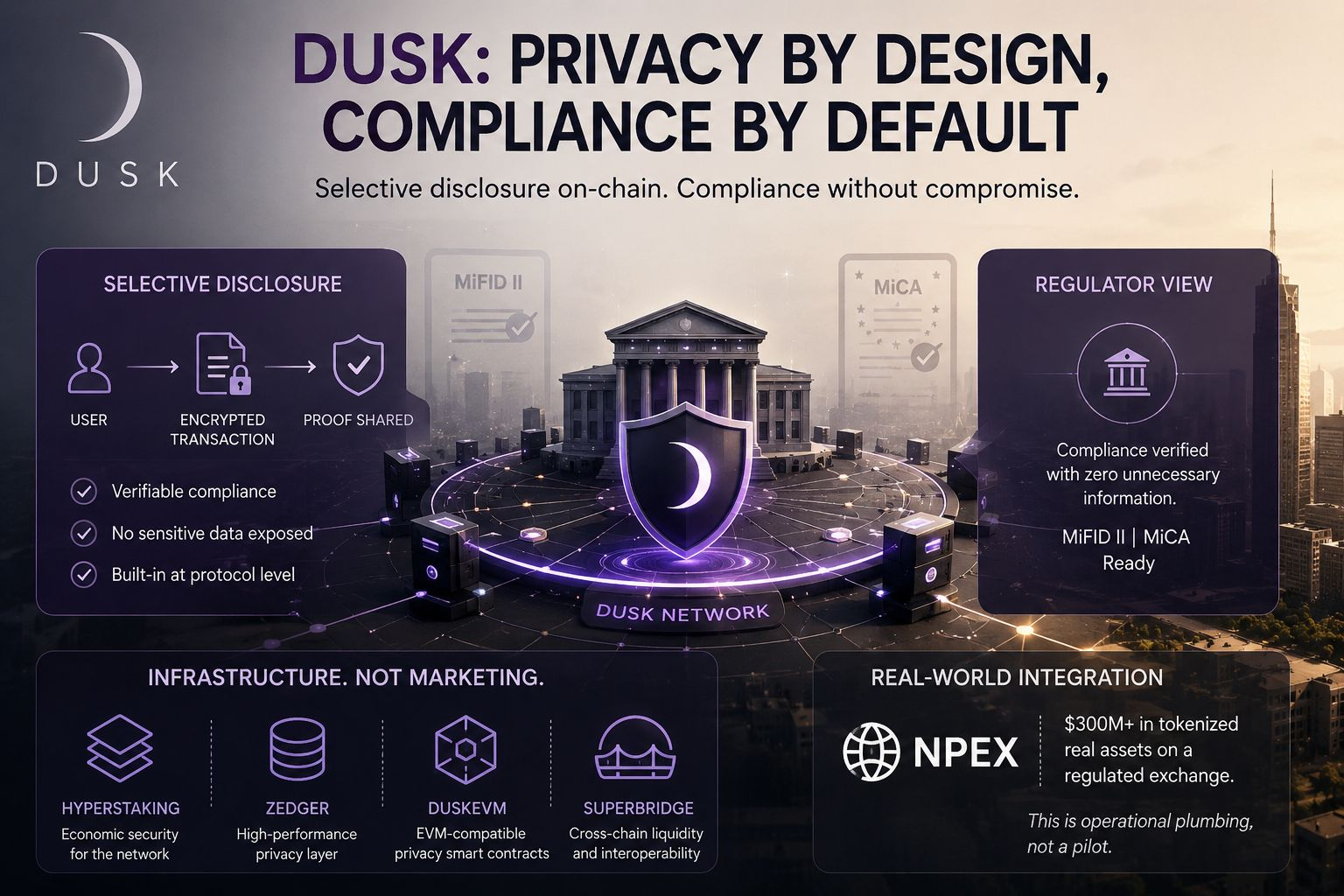
Most people look at @Dusk and file it under "another privacy coin." I think that framing misses the point entirely.
Privacy chains usually optimize for hiding everything from everyone. Dusk does the opposite. It builds selective disclosure into the protocol itself, so a regulator can verify a transaction complies with MiFID II or MiCA without the transaction details becoming public. That's not a privacy feature bolted onto a blockchain. That's the actual product.
What surprised me researching this is how much the roadmap reads like plumbing, not marketing. Hyperstaking, Zedger, the DuskEVM layer, Superbridge. None of these are consumer-facing. They're infrastructure pieces meant to let custodian banks and regulated venues settle securities on-chain without asking permission to break the law first.
The NPEX integration is the part I keep coming back to. Tokenizing $300M+ in real assets under an actual regulated exchange isn't a pilot announcement, it's operational plumbing that either works or gets ripped out. That's a much higher bar than most RWA narratives clear.
The trade-off nobody talks about enough: compliant privacy only matters if regulators actually adopt the framework Dusk is betting on. MiCA gives them a head start in Europe, but it also means their addressable market is tied to a specific regulatory regime succeeding on schedule. That's a real dependency, not a footnote.
I don't think this project wins by being louder than competitors. It wins by being the boring, auditable rail that institutions quietly choose because the alternative is legal risk.
$DUSK #dusk
What's your read: does regulated privacy end up being a niche, or does it become the default architecture for tokenized finance?$AKE $BTW
Privacy chains usually optimize for hiding everything from everyone. Dusk does the opposite. It builds selective disclosure into the protocol itself, so a regulator can verify a transaction complies with MiFID II or MiCA without the transaction details becoming public. That's not a privacy feature bolted onto a blockchain. That's the actual product.
What surprised me researching this is how much the roadmap reads like plumbing, not marketing. Hyperstaking, Zedger, the DuskEVM layer, Superbridge. None of these are consumer-facing. They're infrastructure pieces meant to let custodian banks and regulated venues settle securities on-chain without asking permission to break the law first.
The NPEX integration is the part I keep coming back to. Tokenizing $300M+ in real assets under an actual regulated exchange isn't a pilot announcement, it's operational plumbing that either works or gets ripped out. That's a much higher bar than most RWA narratives clear.
The trade-off nobody talks about enough: compliant privacy only matters if regulators actually adopt the framework Dusk is betting on. MiCA gives them a head start in Europe, but it also means their addressable market is tied to a specific regulatory regime succeeding on schedule. That's a real dependency, not a footnote.
I don't think this project wins by being louder than competitors. It wins by being the boring, auditable rail that institutions quietly choose because the alternative is legal risk.
$DUSK #dusk
What's your read: does regulated privacy end up being a niche, or does it become the default architecture for tokenized finance?$AKE $BTW
Not going to sugarcoat it — $BABY just printed a new all-time low. If you're holding, that's not a fun sentence to read, and I'm not going to pretend it is.
Here's what I keep separating in my head, though: an all-time low in price isn't the same as an all-time low in relevance. The chart says one thing. The fact that billions in real BTC have been staked through this protocol, non-custodially, without wrapping, says something else entirely.
Tokens can bleed for reasons that have nothing to do with the tech — supply unlocks, broad market risk-off, sentiment. None of that undoes what the protocol is actually built to do: let Bitcoin secure other networks without anyone having to trust a middleman with it.
I'm not telling anyone to buy, hold, or sell here — that's a decision only you can make with your own risk tolerance. I'm just refusing to let a red candle be the only story I tell myself about a project.
Anyone else find it hard to keep those two things — price and product — separate when it's this ugly?
@BabylonLabs_io #baby
$HEI
$BLESS
Here's what I keep separating in my head, though: an all-time low in price isn't the same as an all-time low in relevance. The chart says one thing. The fact that billions in real BTC have been staked through this protocol, non-custodially, without wrapping, says something else entirely.
Tokens can bleed for reasons that have nothing to do with the tech — supply unlocks, broad market risk-off, sentiment. None of that undoes what the protocol is actually built to do: let Bitcoin secure other networks without anyone having to trust a middleman with it.
I'm not telling anyone to buy, hold, or sell here — that's a decision only you can make with your own risk tolerance. I'm just refusing to let a red candle be the only story I tell myself about a project.
Anyone else find it hard to keep those two things — price and product — separate when it's this ugly?
@BabylonLabs_io #baby
$HEI
$BLESS
BEARISH🔴
67%
BULLISH🟢
33%
6 votes • Voting closed
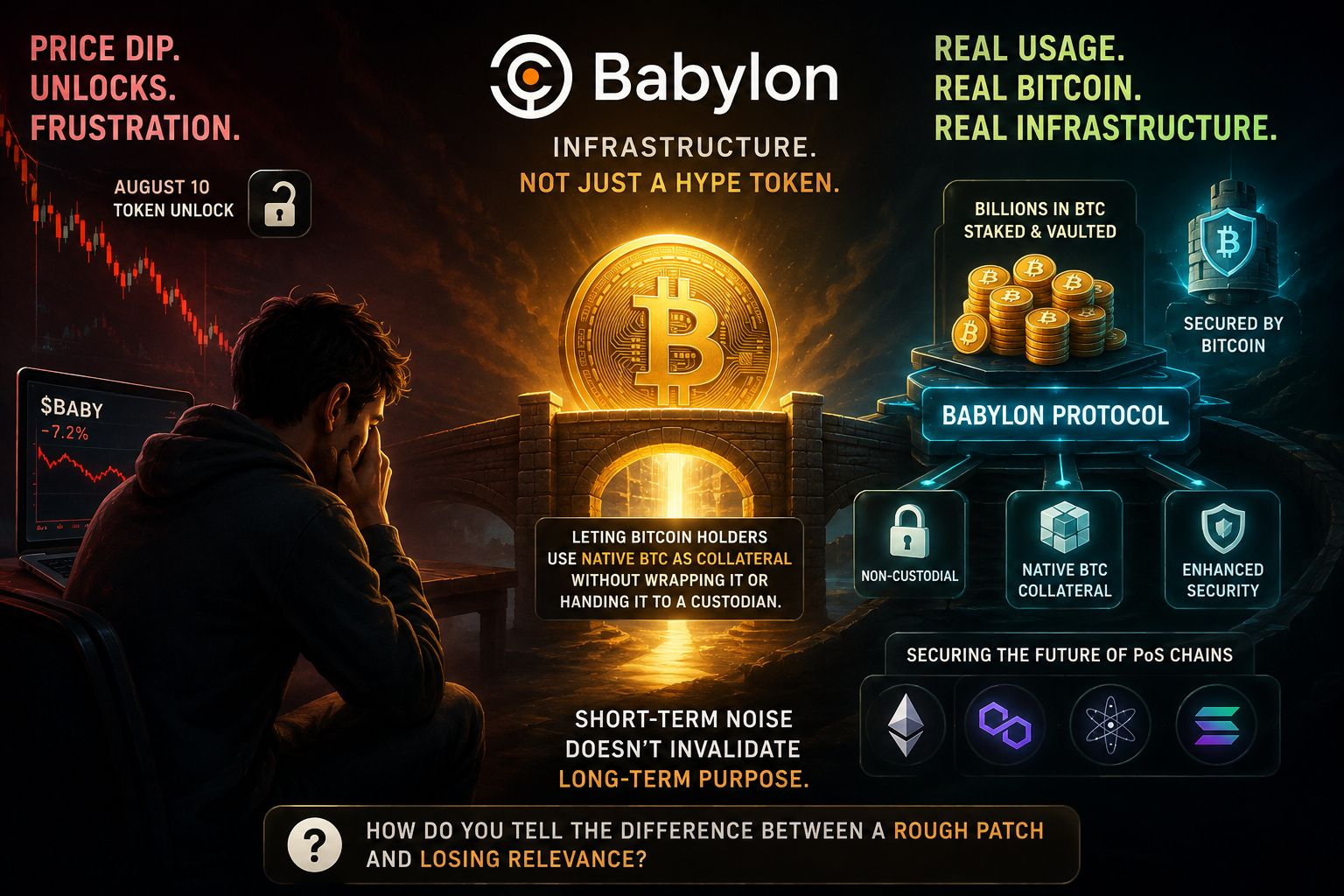
I'll be honest, I checked the chart this morning and Baby isn't doing me any favors right now. Price is soft, and there's an unlock coming August 10. My first instinct was the usual one: close the app, feel annoyed, move on.
But sitting with it longer, I realized I was judging the token by the chart and ignoring the thing it's actually attached to. Babylon isn't trying to be a hype token — it's infrastructure for something specific: letting Bitcoin holders use native BTC as collateral without wrapping it or handing it to a custodian.
Unlocks and price dips happen to almost every young network. What doesn't happen to every network is billions in real BTC actually getting staked or vaulted through it. That's the part I keep coming back to — usage that exists independent of what the candle looks like this week.
Doesn't mean short-term pain isn't real. It is. I'm just trying to separate "the token had a rough week" from "the thing it's built for stopped mattering."
How do you personally tell the difference between a project going through a rough patch and one that's actually losing relevance?
@BabylonLabs_io #baby $BABY
$CYS
$BANK
But sitting with it longer, I realized I was judging the token by the chart and ignoring the thing it's actually attached to. Babylon isn't trying to be a hype token — it's infrastructure for something specific: letting Bitcoin holders use native BTC as collateral without wrapping it or handing it to a custodian.
Unlocks and price dips happen to almost every young network. What doesn't happen to every network is billions in real BTC actually getting staked or vaulted through it. That's the part I keep coming back to — usage that exists independent of what the candle looks like this week.
Doesn't mean short-term pain isn't real. It is. I'm just trying to separate "the token had a rough week" from "the thing it's built for stopped mattering."
How do you personally tell the difference between a project going through a rough patch and one that's actually losing relevance?
@BabylonLabs_io #baby $BABY
$CYS
$BANK
@BabylonLabs_io $BABY #baby
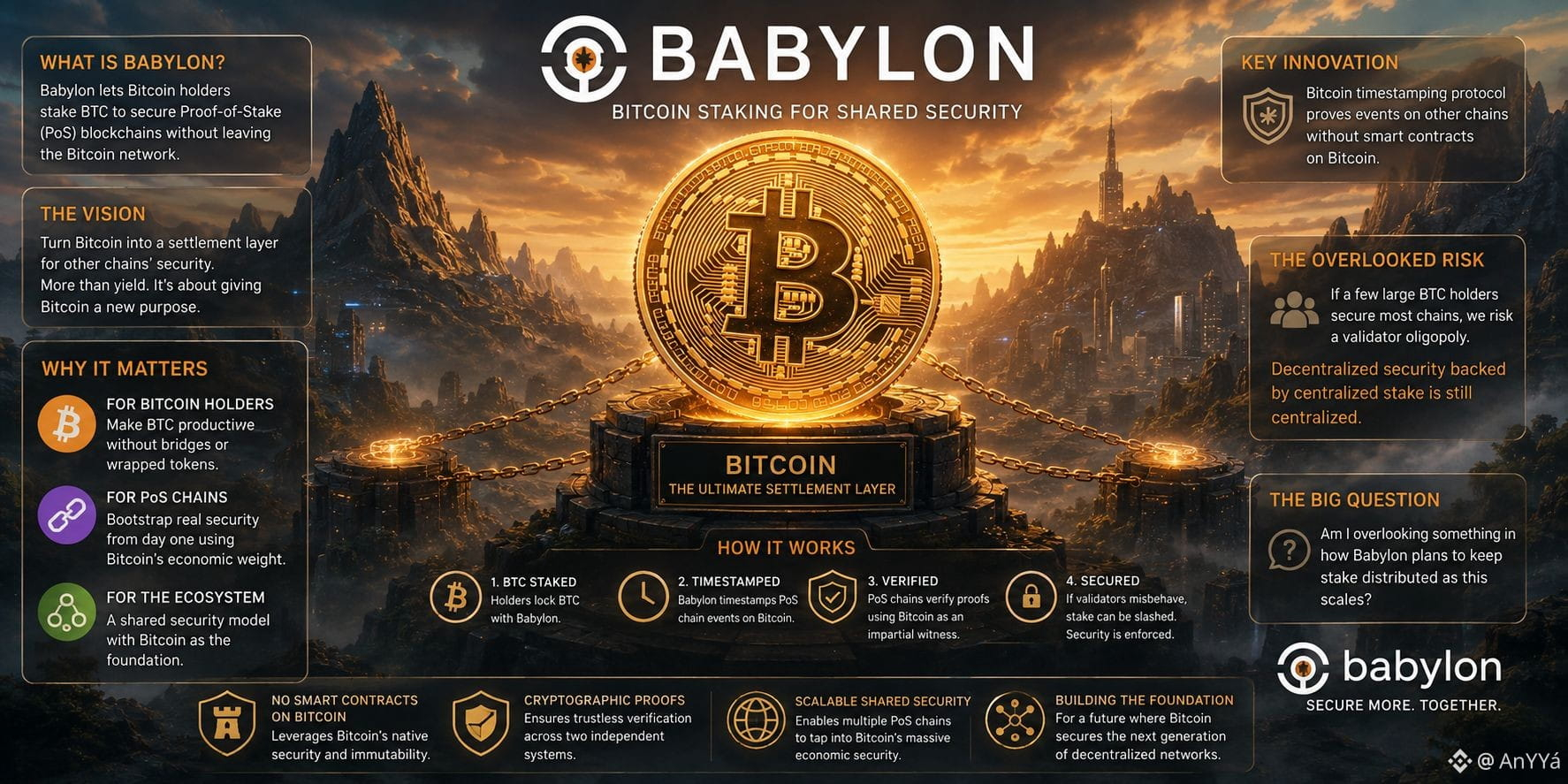
The deeper I went into Babylon's documentation, the less this felt like a staking protocol and more like an attempt to turn Bitcoin into a settlement layer for other chains' security. That's a much bigger claim than "earn yield on your BTC."
At first I assumed the appeal was purely financial, holders wanting productive BTC instead of dead capital. But the more interesting angle is for the PoS chains themselves. Bootstrapping a new validator set from scratch is expensive and slow. Renting Bitcoin's existing economic weight solves a cold-start problem that has quietly limited how many chains can launch with real security from day one.
I don't think this gets discussed enough: shared security only works if slashing is actually enforceable across two systems that weren't built to talk to each other. Babylon's timestamping protocol is essentially proving Bitcoin can act as an impartial witness for events happening on a completely different chain, without needing smart contracts on Bitcoin itself.
The overlooked risk is concentration. If a handful of large BTC holders end up securing most of these chains, you've recreated a validator oligopoly, just denominated in Bitcoin instead of a native token. Decentralized security backed by centralized stake is still centralized.
Am I overlooking something in how they plan to keep stake distributed as this scales?
$SKYAI
$BICO
The deeper I went into Babylon's documentation, the less this felt like a staking protocol and more like an attempt to turn Bitcoin into a settlement layer for other chains' security. That's a much bigger claim than "earn yield on your BTC."
At first I assumed the appeal was purely financial, holders wanting productive BTC instead of dead capital. But the more interesting angle is for the PoS chains themselves. Bootstrapping a new validator set from scratch is expensive and slow. Renting Bitcoin's existing economic weight solves a cold-start problem that has quietly limited how many chains can launch with real security from day one.
I don't think this gets discussed enough: shared security only works if slashing is actually enforceable across two systems that weren't built to talk to each other. Babylon's timestamping protocol is essentially proving Bitcoin can act as an impartial witness for events happening on a completely different chain, without needing smart contracts on Bitcoin itself.
The overlooked risk is concentration. If a handful of large BTC holders end up securing most of these chains, you've recreated a validator oligopoly, just denominated in Bitcoin instead of a native token. Decentralized security backed by centralized stake is still centralized.
Am I overlooking something in how they plan to keep stake distributed as this scales?
$SKYAI
$BICO
Verified
Every institution that wanted Bitcoin exposure with yield has faced the same silent tax: hand your keys to someone else, or accept zero productivity. Babylon Labs' Trustless Bitcoin Vaults quietly remove that tradeoff, and I think the market is pricing this like a feature update instead of what it is, a fix to the oldest unsolved problem in BTCFi.
Think of it less like a vault and more like a bank safety deposit box with glass walls installed by the depositor, not the bank. Anyone can verify what's inside and confirm it hasn't moved, but only the owner holds the key. No teller, no custodian, no trusted third party standing between the asset and the proof of its existence. That's the entire premise, collateral you can audit without ever asking permission to see it.
The part worth sitting with: the documentation specifies BTC in these vaults stays on Bitcoin's own chain the whole time, verifiable externally, with the planned Aave V4 integration extending this so native Bitcoin can back lending markets without ever becoming a wrapped IOU someone else controls. Institutions have avoided BTC collateral for years not because of price risk, but because of counterparty risk hiding inside every wrapper.
Once collateral no longer requires trust in a custodian, the ceiling on how much Bitcoin capital markets will accept isn't really about liquidity anymore. What's actually left holding that ceiling down?
@BabylonLabs_io #baby $BABY
$BLESS $HOME
Which unlocks more institutional BTC capital first?
Think of it less like a vault and more like a bank safety deposit box with glass walls installed by the depositor, not the bank. Anyone can verify what's inside and confirm it hasn't moved, but only the owner holds the key. No teller, no custodian, no trusted third party standing between the asset and the proof of its existence. That's the entire premise, collateral you can audit without ever asking permission to see it.
The part worth sitting with: the documentation specifies BTC in these vaults stays on Bitcoin's own chain the whole time, verifiable externally, with the planned Aave V4 integration extending this so native Bitcoin can back lending markets without ever becoming a wrapped IOU someone else controls. Institutions have avoided BTC collateral for years not because of price risk, but because of counterparty risk hiding inside every wrapper.
Once collateral no longer requires trust in a custodian, the ceiling on how much Bitcoin capital markets will accept isn't really about liquidity anymore. What's actually left holding that ceiling down?
@BabylonLabs_io #baby $BABY
$BLESS $HOME
Which unlocks more institutional BTC capital first?
Trustless collateral
0%
Regulatory clarity
100%
Better custody solutions
0%
2 votes • Voting closed
@BabylonLabs_io $BABY #baby
The interesting part of Babylon isn't the yield. It's what happens to Bitcoin's role in the broader security market once idle BTC becomes a productive input for other chains.
At first I assumed this was another liquid staking derivative play, similar to what happened on Ethereum. The deeper I went into the docs, the more I realized the model is closer to a security marketplace than a yield product. PoS chains need economic security to resist attacks. Bitcoin holders have unused capital that could provide exactly that. Babylon is the coordination layer connecting the two sides.
This creates an incentive structure worth thinking through carefully. Chains that borrow Bitcoin's security have to design slashing conditions that are actually enforceable without custodial risk, which is harder than it sounds. Stakers have to accept that their yield is tied to the honest behavior of validators on chains they may not deeply understand. Neither side gets something for nothing.
I don't think this gets discussed enough: the value of Babylon scales with how much external demand exists for Bitcoin backed security, not with how much BTC gets staked. A large TVL number means little if few chains actually integrate and pay for that security over time. Adoption on the demand side is the real metric, and it's slower to build than a staking dashboard suggests.
It made me rethink how I evaluate Bitcoin's long term relevance beyond store of value narratives.
Am I overlooking something in how this security demand actually develops over the next few years?
$IDOL
$BLESS
The interesting part of Babylon isn't the yield. It's what happens to Bitcoin's role in the broader security market once idle BTC becomes a productive input for other chains.
At first I assumed this was another liquid staking derivative play, similar to what happened on Ethereum. The deeper I went into the docs, the more I realized the model is closer to a security marketplace than a yield product. PoS chains need economic security to resist attacks. Bitcoin holders have unused capital that could provide exactly that. Babylon is the coordination layer connecting the two sides.
This creates an incentive structure worth thinking through carefully. Chains that borrow Bitcoin's security have to design slashing conditions that are actually enforceable without custodial risk, which is harder than it sounds. Stakers have to accept that their yield is tied to the honest behavior of validators on chains they may not deeply understand. Neither side gets something for nothing.
I don't think this gets discussed enough: the value of Babylon scales with how much external demand exists for Bitcoin backed security, not with how much BTC gets staked. A large TVL number means little if few chains actually integrate and pay for that security over time. Adoption on the demand side is the real metric, and it's slower to build than a staking dashboard suggests.
It made me rethink how I evaluate Bitcoin's long term relevance beyond store of value narratives.
Am I overlooking something in how this security demand actually develops over the next few years?
$IDOL
$BLESS
Log in to explore more content