
sonofemma
171 Posts

sonofemma
Report
Block User
Content Creator || AMB ORO @askoro.ai
2 Following
7 Followers
137 Liked
Posts
All
Quotes
Videos
·
--
A good example is the difference between KPK USDC Prime and Steakhouse High Yield USDC on Morpho.
Both accept USDC, but the strategies behind them have different priorities.
KPK USDC Prime is built around automated allocation across selected lending markets.
Its strategy uses collateral filters and continuous rebalancing, with current allocations spread across markets backed by assets such as cbBTC, WBTC, rETH and wstETH.
The emphasis is on managing exposure across selected markets while maintaining liquidity.
Steakhouse High Yield USDC takes a broader collateral approach.
Its stated objective is to optimize yield across a wider range of collateral markets. That can create different opportunities, but broader collateral exposure can also introduce additional risks and potential liquidity constraints.
So the difference isn’t simply which vault displays the higher APY.
It’s about the lending markets being used, the collateral accepted and how each curator approaches allocation and risk.
These are the details I’d examine before deciding whether either strategy fits my needs.
This is also where ORO can help.
You can ask it to compare vault options, explain their underlying strategies and help you examine the details beyond the headline yield.
Two USDC vaults, two different strategies. The mechanism behind the yield deserves as much attention as the percentage itself.
Just Ask @Ask_ORO

1
65
·
--
One thing people rarely think about when using a crypto application is the infrastructure working behind the screen.
A simple token swap can involve liquidity sources, protocols, network interactions and transaction preparation.
Now imagine a developer trying to build all those capabilities into a new application.
They have to think about wallet connectivity, supported chains, protocol integrations and execution logic before users can even perform basic DeFi activities.
That creates a lot of work.
And it can slow down how quickly useful products reach users.
This is an area @Ask_ORO is approaching from a different direction.
Through its API, ORO allows developers to integrate DeFi functionality into their own applications without having to build the entire execution infrastructure from scratch.
The idea is straightforward.
A developer can connect to ORO’s infrastructure and give users access to natural language DeFi interactions.
That opens up possibilities such as:
➺ Token swaps: Let users request supported swaps through a conversational interface.
➺ Staking and lending: Bring different DeFi actions into the application.
➺ Cross-chain interactions: Give users access to supported activities across multiple networks.
➺ Transaction preparation: Translate user instructions into transactions that can be reviewed and signed.
The interesting part is what this could mean for developers building products outside the traditional DeFi interface.
They can focus more on the experience they want to create while using ORO’s infrastructure for the onchain interactions.
I believe better DeFi infrastructure can make a difference beyond one application.
It can give more builders room to create products that make onchain services easier to access.
The next wave of DeFi applications will need both useful ideas and reliable infrastructure behind them.
That’s the part of ORO’s API approach worth keeping an eye on.
Explore what developers can build with ORO.
1
67
·
--
Someone using Ethereum might be familiar with Aave, while another person on Solana may know completely different lending protocols.
The problem comes when you want to compare opportunities beyond the network you normally use.
You have to know which protocols operate on each chain, what assets they support and where borrowing or lending is available.
ORO makes that discovery process easier.
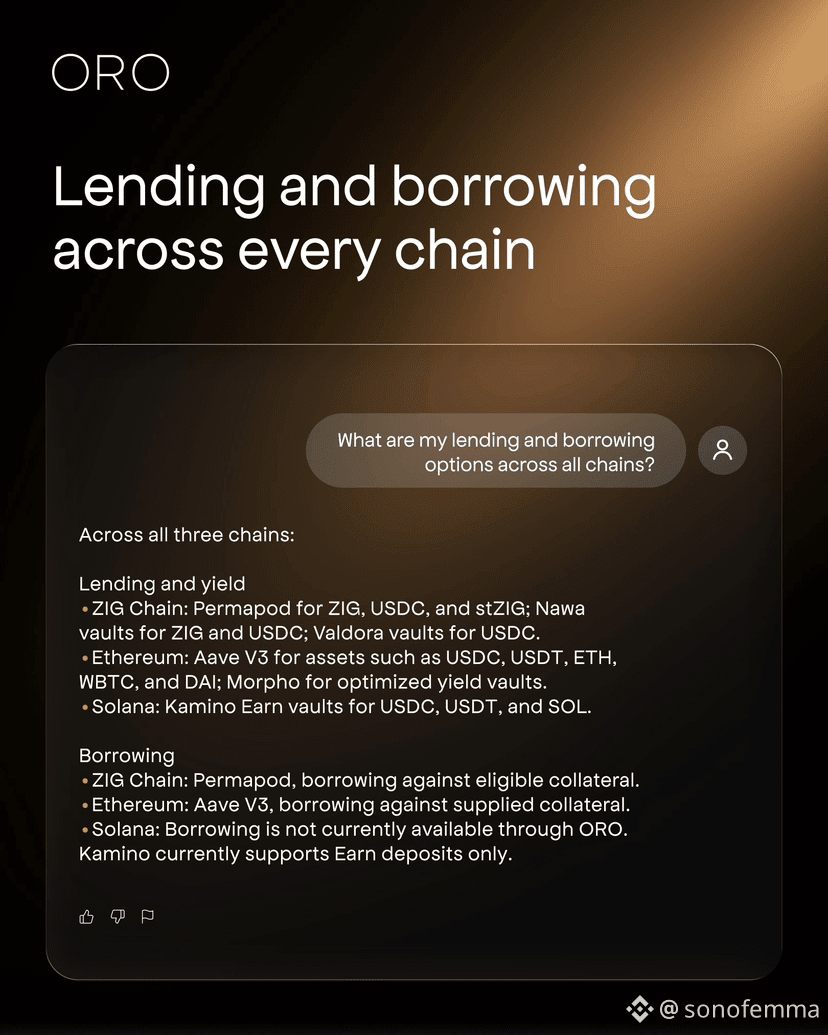
You can ask it to show you lending and borrowing options across @ethereum, @solana and @ZIGChain.
Here’s why having that overview is useful:
➺ Lending: Find protocols where you can supply supported assets and earn yield.
➺ Borrowing: See where you can access loans using supported collateral.
➺ Cross-chain discovery: Explore options beyond the ecosystem you’re already familiar with.
Of course, each option still deserves a closer look. Interest rates, collateral requirements, liquidity and protocol risks can differ significantly.
I like the idea of being able to start that research from one conversation instead of manually checking several ecosystems.
Your DeFi options shouldn’t be limited by how many protocols you already know.
Ask ORO to show you what’s available across these chains and compare the details before making a decision.
Just Ask ORO.
1
161
·
--
As AI becomes more involved in financial activities, one question deserves serious attention: how much control should we give it?
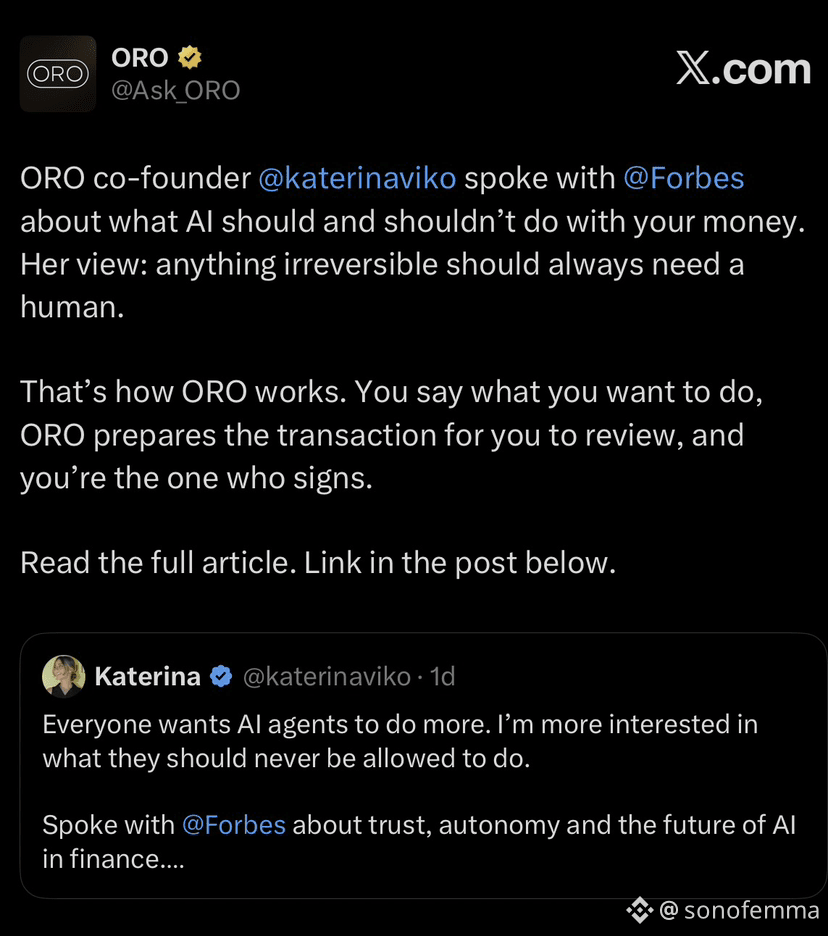
ORO co-founder @katerinaviko recently discussed this with @Forbes, sharing her position that irreversible financial actions should always require human approval.
I think this is an important distinction, especially in DeFi, where a single transaction can move assets or trigger an action that cannot easily be undone.
ORO follows this approach through its transaction process.
➺ You describe the action you want to perform.
➺ ORO prepares the transaction based on your instruction.
➺ You review the details before proceeding.
➺ You sign the transaction with your own wallet.
This keeps AI involved in simplifying the process without handing over the final authority to execute transactions.
As AI tools become more capable, preserving user control over financial decisions should remain part of the conversation.
The important question isn’t just what AI can do with your money, but who gets the final approval.
Read Katerina’s full interview in Forbes and share your thoughts on where AI should draw the line.
1
79
·
--
I remember how many things there are to figure out when you’re new to DeFi.
Wallets, networks, gas fees, swaps, liquidity pools and transaction approvals. Even a simple task can feel confusing when you’re unfamiliar with the terms.
That’s where having something that can explain things as you go becomes useful.
With @Ask_ORO, you can ask questions in everyday language instead of trying to understand every technical term on your own.
For example, you could ask:
➺ What happens when I swap ETH for USDC?
➺ Why do I need to pay a network fee?
➺ What does supplying tokens to a lending protocol mean?
ORO can explain the process and help prepare supported transactions for you to review.
You remain in control of the final approval because you still sign transactions with your own wallet.
For someone taking their first steps into DeFi, being able to ask questions along the way can make the experience easier to navigate.
You can start with a simple question and build your understanding from there.
What was the first DeFi concept that confused you when you started?
Just Ask ORO.

98
·
--
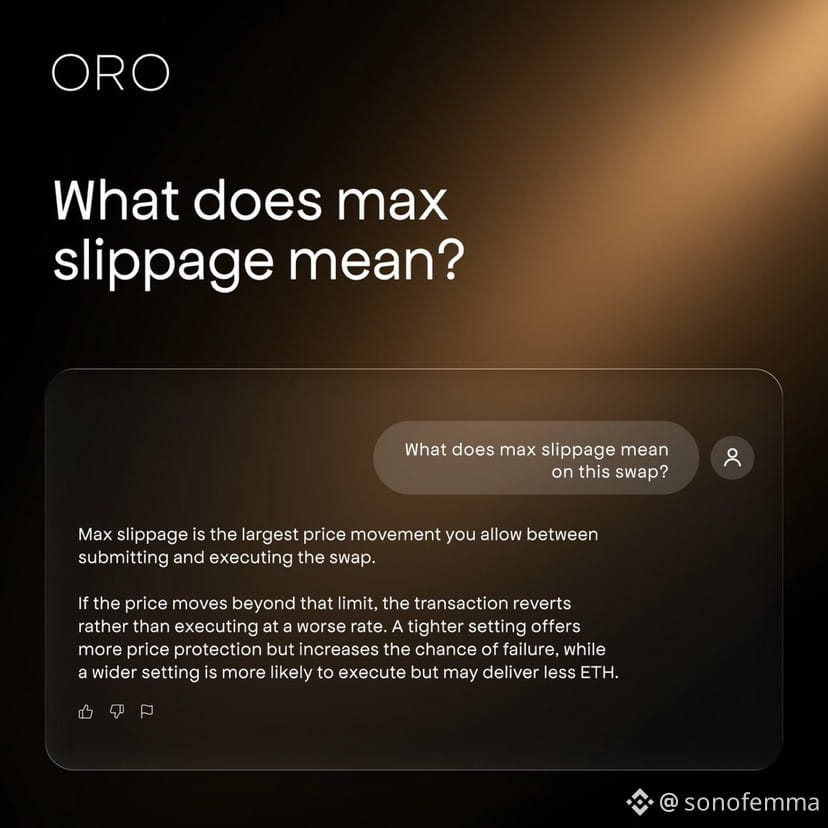
Imagine you’re about to swap tokens and notice a setting that says Max Slippage: 0.5%.
You may have seen it several times without giving it much thought.
But what does it mean for your swap?
Slippage is the difference between the price you expect when submitting a trade and the price at which it gets executed.
A maximum slippage of 0.5% sets the limit you’re willing to tolerate. If the price moves beyond that limit before execution, the swap may fail rather than complete outside your chosen tolerance.
This is one of those details worth understanding before approving a transaction.
With ORO, you can ask questions about settings like this in plain language and get an explanation without leaving the conversation.
You can then review the transaction details and decide whether to proceed.
A swap interface should give you more than numbers to click through. Understanding those numbers is part of making informed decisions.
Next time a DeFi setting leaves you confused, ask ORO before signing.
Just Ask ORO.
82
·
--
Using AI to interact with DeFi introduces an important question: what happens between giving an instruction and signing the transaction?
ORO’s Shield Engine is designed to address that part of the process through four security layers:
➺ Pre-Flight: Checks inputs, applies rate limits and reviews wallet reputation.
➺ Intent Analysis: Verifies contracts, scores token safety and applies amount limits.
➺ Transaction Simulation: Runs an onchain dry-run before the user signs.
➺ Post-Execution Monitoring: Checks whether the outcome matches the original instruction.
These checks matter because a transaction can involve several moving parts, especially when interacting with different protocols and chains.
ORO combines conversational DeFi access with safeguards that cover the process before and after execution.
The user still signs transactions with their own wallet, keeping control of their funds.
AI can make onchain activity easier to navigate, but the security process behind execution deserves just as much attention.
Convenience gets you to the transaction. Security checks help you examine what you’re about to approve.
Explore the Shield Engine and see how ORO handles transaction execution.
222
·
--
Think about checking your portfolio while getting ready for work, or wanting to know the current yield on a lending position while you’re away from your computer.
Usually, that means opening an app, finding the right section and going through several screens before getting an answer.
Voice interaction offers another way to handle this.
This is one of the features ORO is bringing into DeFi.
Through its voice mode, you can speak to ORO and ask questions about your onchain activity.
Here’s what that makes possible.
➺ Ask for your current wallet balances.
➺ Check yields on positions such as USDC supplied to Aave.
➺ Ask about token swaps, staking and lending opportunities.
➺ Request a transaction and receive a transaction card to review.
If you decide to proceed, the transaction is prepared for your approval and you sign it with your own wallet. ORO does not sign or broadcast transactions on your behalf.
The voice experience is powered by ElevenLabs’ conversational AI infrastructure, while ORO’s existing engine handles the DeFi requests.
I think this adds an interesting dimension to how people interact with onchain applications.
DeFi doesn’t always have to begin with searching through menus. Sometimes, you can start with a question and take it from there.
Give ORO’s voice mode a try and see how it handles your next DeFi question.
83
·
--
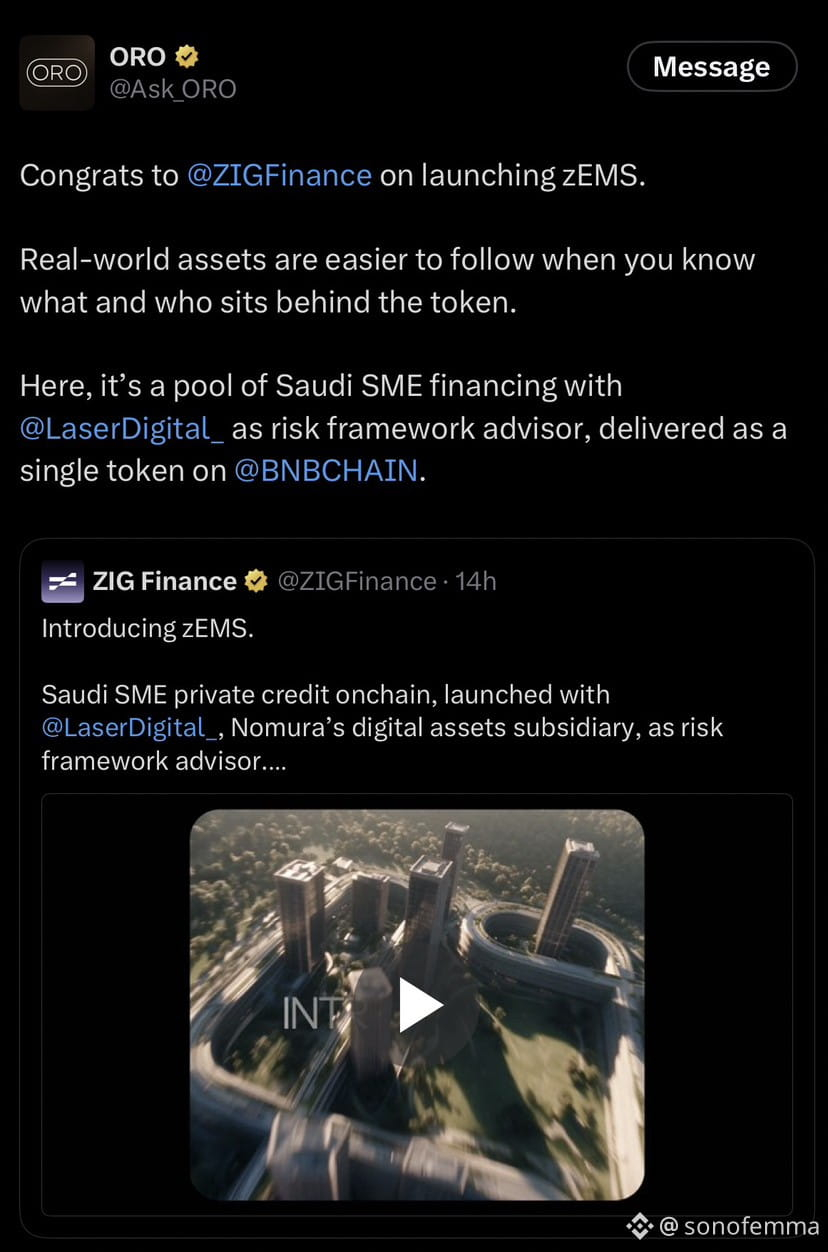
The latest launch from @ZIGFinance brings an interesting real world financing model onchain.
Meet zEMS, a token representing exposure to a pool of Saudi SME financing, with Laser Digital serving as its risk framework advisor.
The structure is worth paying attention to because there are identifiable elements behind the token:
➺ Underlying activity: Financing for small and medium sized businesses in Saudi Arabia.
➺ Risk framework advisor: Laser Digital
➺ Onchain network: Binance Chain
➺ Access format: A single token representing the pool.
For anyone following tokenized real world assets, knowing the underlying financing and the parties involved is an important part of evaluating what a token represents.
Congratulations to the @ZIGFinance team on the launch.
Take a closer look at the structure behind zEMS before forming an opinion about it.
The latest launch from @ZIG Finance brings an interesting real world financing model onchain.
Meet zEMS, a token representing exposure to a pool of Saudi SME financing, with Laser Digital serving as its risk framework advisor.
The structure is worth paying attention to because there are identifiable elements behind the token:
➺ Underlying activity: Financing for small and medium sized businesses in Saudi Arabia.
➺ Risk framework advisor: Laser Digital
➺ Onchain network: Binance Chain
➺ Access format: A single token representing the pool.
For anyone following tokenized real world assets, knowing the underlying financing and the parties involved is an important part of evaluating what a token represents.
Congratulations to the @ZIG Finance team on the launch.
Take a closer look at the structure behind zEMS before forming an opinion about it.
65
·
--
A lot happens in crypto beyond product launches, market movements and online discussions.
Events like Proof of Talk create an opportunity for people building in the industry to exchange ideas, discuss challenges and hear different perspectives.
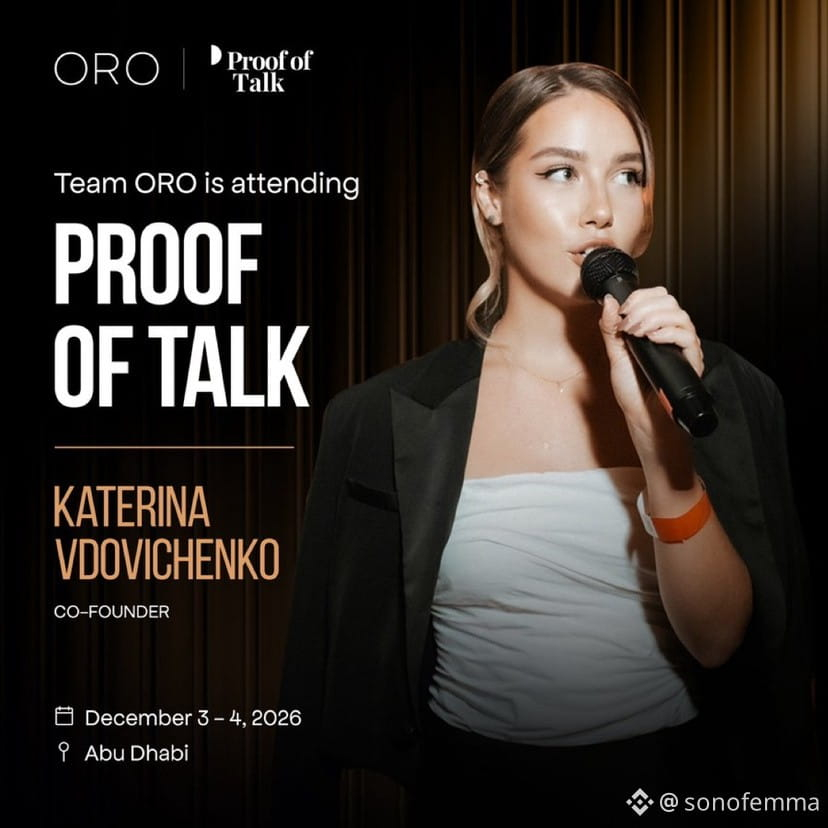
On December 3 and 4, ORO co-founder Katerina Vdovichenko will be among the attendees at Proof of Talk, hosted at Louvre Abu Dhabi.
I’m interested in the perspectives she brings back, especially the discussions around where DeFi is heading and the problems builders are working to solve.
Good to see ORO represented at the event.
Thanks to proof Of Talk for the invitation.
What conversations would you like Katerina to bring back to the ORO community?
83
·
--
𝗔 𝗚𝗼𝗼𝗱 𝗩𝗮𝘂𝗹𝘁 𝗗𝗼𝗲𝘀𝗻’𝘁 𝗔𝗹𝘄𝗮𝘆𝘀 𝗠𝗲𝗮𝗻 𝗜𝘁’𝘀 𝗥𝗶𝗴𝗵𝘁 𝗙𝗼𝗿 𝗬𝗼𝘂.
When choosing a DeFi vault, it’s easy to focus on the APY and overlook other important factors.
Your allocation, withdrawal needs, fees and the strategy behind the yield all deserve attention.
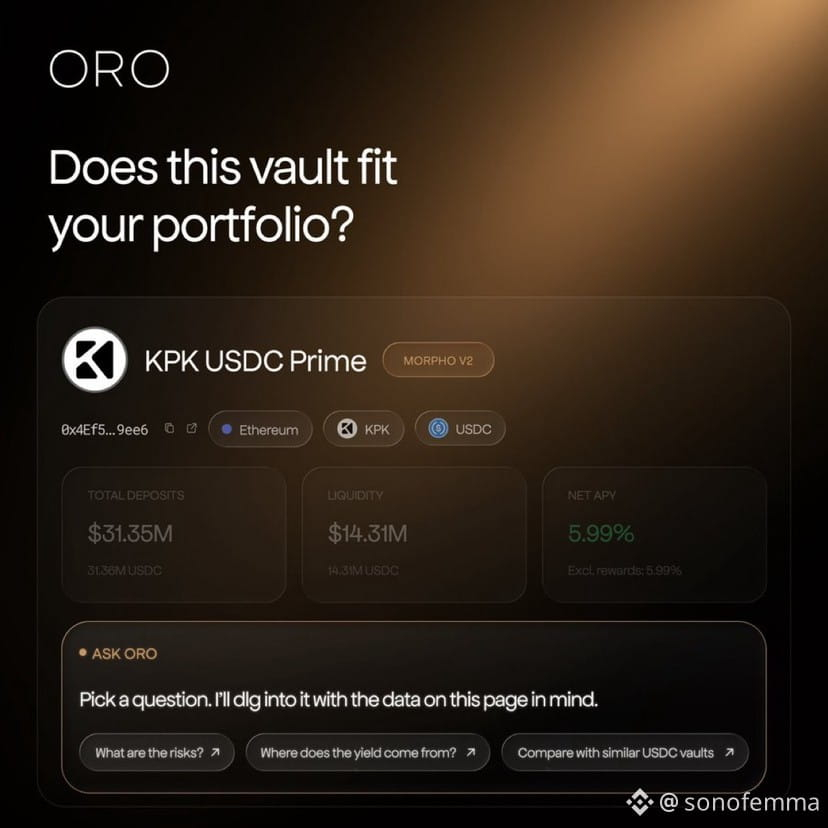
Let’s look at the USDC Prime Vault on ORO as an example.
This Morpho V2 vault on Ethereum is curated by KPK and uses automated allocation across liquid markets.
𝗛𝗲𝗿𝗲’𝘀 𝗪𝗵𝗮𝘁 𝗧𝗵𝗲 𝗩𝗮𝘂𝗹𝘁 𝗗𝗮𝘁𝗮 𝗦𝗵𝗼𝘄𝘀:
➺ Total Deposits: $31.45M
➺ Available Liquidity: $14.40M
➺ Net APY: 4.75%
➺ Performance Fee: 0%
➺ Management Fee: 0%
The strategy overview describes a 24-hour automated system that continuously rebalances allocations across liquid markets, using collateral filters to help preserve liquidity and mitigate risk.
𝗟𝗼𝗼𝗸𝗶𝗻𝗴 𝗕𝗲𝘆𝗼𝗻𝗱 𝗧𝗵𝗲 𝗥𝗮𝘁𝗲
Even with zero curator fees and substantial available liquidity, users still need to consider the underlying strategy, collateral risks and whether the vault suits their portfolio needs.
This is where ORO becomes useful.
You can ask it to compare the vault with similar options, explain potential risks and assess whether the allocation fits your situation using the information available on the vault page.
A 4.75% APY is one detail. Understanding the full vault structure gives you a better basis for making a decision.
Before committing funds, take time to examine the details.
Just Ask ORO.
155
·
--
𝗗𝗲𝗙𝗶 𝗜𝘀 𝗘𝘅𝗽𝗮𝗻𝗱𝗶𝗻𝗴, 𝗕𝘂𝘁 𝗨𝘀𝗶𝗻𝗴 𝗜𝘁 𝗖𝗮𝗻 𝗦𝘁𝗶𝗹𝗹 𝗕𝗲 𝗖𝗼𝗺𝗽𝗹𝗶𝗰𝗮𝘁𝗲𝗱.
Every new protocol, blockchain and financial tool brings more possibilities to DeFi.
However, navigating all these options can be overwhelming, especially for users who are still learning the ecosystem.
Finding the right platform, understanding transaction steps and switching between different interfaces can take time.
This is where @Ask_ORO takes a different approach.
Rather than making users navigate every process manually, ORO uses AI to make DeFi interactions more conversational.
➺ Users can describe the actions they want to perform in everyday language.
➺ Swaps, bridging, staking and other supported activities can be coordinated through one interface.
➺ Users can ask questions and get more context before proceeding.
➺ Transaction preparation becomes easier to navigate while users retain control over signing.
The bigger idea is to make interacting with DeFi less demanding as the ecosystem becomes more diverse.
More protocols bring more opportunities, but users also need better ways to navigate them.
A simpler experience could make a meaningful difference in how people interact with onchain finance.
Give ORO a look:
78
·
--
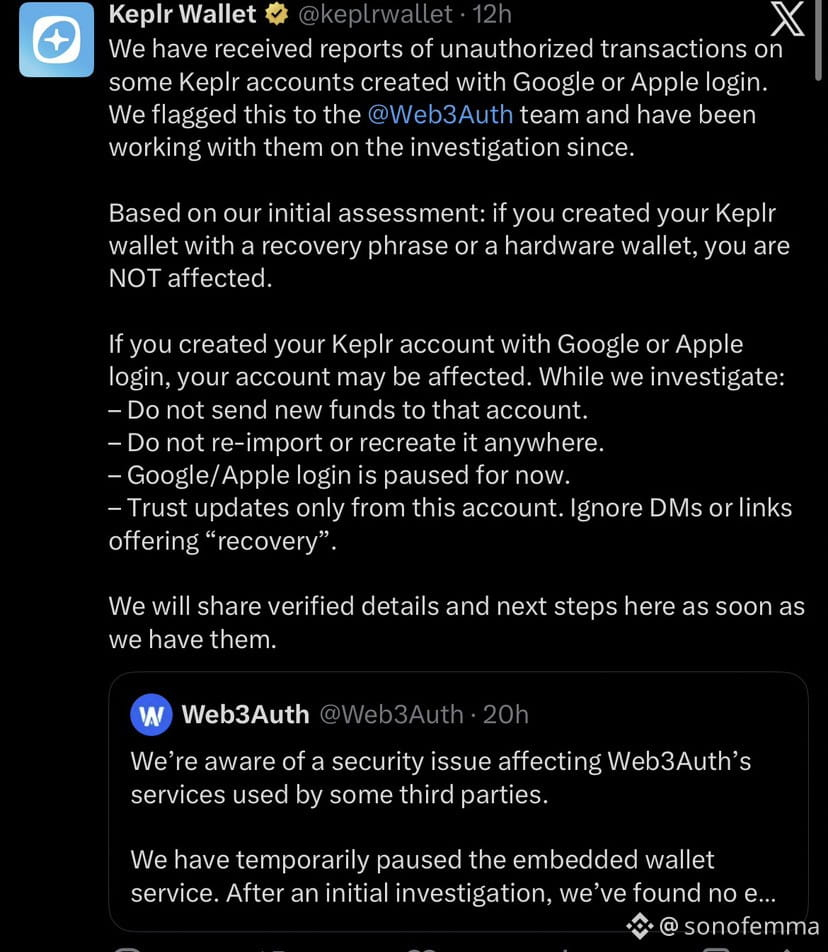
𝗔 𝗪𝗮𝗹𝗹𝗲𝘁 𝗦𝗲𝗰𝘂𝗿𝗶𝘁𝘆 𝗨𝗽𝗱𝗮𝘁𝗲 𝗙𝗼𝗿 𝗞𝗲𝗽𝗹𝗿 𝗨𝘀𝗲𝗿𝘀
@keplrwallet has reported unauthorized transactions affecting some accounts created through Google or Apple login.
This is worth paying attention to, especially if you’ve connected a Keplr wallet to @Ask_ORO.
𝗪𝗵𝗼 𝗡𝗲𝗲𝗱𝘀 𝗧𝗼 𝗧𝗮𝗸𝗲 𝗡𝗼𝘁𝗲?
According to Keplr, the reported issue affects some wallets created through Google or Apple login.
Wallets created with a recovery phrase or hardware wallet are not affected by this incident.
𝗪𝗵𝗮𝘁 𝗦𝗵𝗼𝘂𝗹𝗱 𝗨𝘀𝗲𝗿𝘀 𝗗𝗼?
If your Keplr wallet connected to ORO was created through Google or Apple login:
➺ Avoid sending new funds to it for now.
➺ Follow Keplr’s official security guidance.
➺ Watch for updates directly from Keplr.
➺ Ignore unsolicited messages and links promising wallet recovery.
𝗔 𝗥𝗲𝗺𝗶𝗻𝗱𝗲𝗿 𝗙𝗼𝗿 𝗗𝗲𝗙𝗶 𝗨𝘀𝗲𝗿𝘀
Wallet security begins before interacting with any DeFi platform. Knowing how your wallet was created and staying informed about security incidents can help you make better decisions.
Stay alert, verify official announcements and don’t trust anyone promising quick recovery.
173
·
--
One statement from ORO’s approach to multi-chain DeFi captures an important challenge in today’s onchain experience:
𝗬𝗼𝘂 𝗱𝗼𝗻’𝘁 𝗰𝗮𝗿𝗲 𝘄𝗵𝗶𝗰𝗵 𝗰𝗵𝗮𝗶𝗻 𝘆𝗼𝘂𝗿 𝗺𝗼𝗻𝗲𝘆 𝘀𝗶𝘁𝘀 𝗼𝗻. 𝗬𝗼𝘂 𝗰𝗮𝗿𝗲 𝘁𝗵𝗮𝘁 𝗶𝘁 𝘄𝗼𝗿𝗸𝘀.
With multiple blockchain networks available, users often have to deal with different interfaces, compatibility requirements and transaction steps.
𝗧𝗵𝗲 𝗣𝗿𝗼𝗯𝗹𝗲𝗺 𝗪𝗶𝘁𝗵 𝗙𝗿𝗮𝗴𝗺𝗲𝗻𝘁𝗲𝗱 𝗡𝗲𝘁𝘄𝗼𝗿𝗸𝘀
Every chain has its own ecosystem. Moving assets or accessing protocols across networks can add extra steps to simple DeFi activities.
𝗠𝗼𝘃𝗶𝗻𝗴 𝗕𝗲𝘆𝗼𝗻𝗱 𝗖𝗵𝗮𝗶𝗻 𝗦𝗽𝗲𝗰𝗶𝗳𝗶𝗰 𝗜𝗻𝘁𝗲𝗿𝗮𝗰𝘁𝗶𝗼𝗻
ORO takes a multi-chain approach, helping coordinate activities across supported networks so users can focus on their intended actions rather than managing every network separately.
𝗪𝗵𝗮𝘁 𝗧𝗵𝗶𝘀 𝗠𝗲𝗮𝗻𝘀 𝗙𝗼𝗿 𝗗𝗲𝗙𝗶 𝗨𝘀𝗲𝗿𝘀
A more unified experience can make interacting with different blockchain ecosystems easier and reduce the technical steps users have to navigate.
The goal is to make blockchain complexity less visible while keeping users in control of their activities.

53
·
--
𝗞𝗻𝗼𝘄𝗶𝗻𝗴 𝘄𝗵𝗮𝘁 𝘆𝗼𝘂 𝗼𝘄𝗻 𝗶𝗻 𝗰𝗿𝘆𝗽𝘁𝗼 𝗶𝘀 𝗼𝗻𝗹𝘆 𝗼𝗻𝗲 𝗽𝗮𝗿𝘁 𝗼𝗳 𝗺𝗮𝗻𝗮𝗴𝗶𝗻𝗴 𝗮 𝗽𝗼𝗿𝘁𝗳𝗼𝗹𝗶𝗼.
You also need to understand how your assets are distributed, what they are worth and how your positions have changed over time.
That information is often scattered across wallets, protocols and transaction records.
Checking everything separately can make portfolio tracking unnecessarily complicated.
𝗕𝘂𝘁 𝘄𝗵𝗮𝘁 𝗶𝗳 𝘆𝗼𝘂 𝗰𝗼𝘂𝗹𝗱 𝗮𝘀𝗸 𝗮𝗯𝗼𝘂𝘁 𝘆𝗼𝘂𝗿 𝗽𝗼𝗿𝘁𝗳𝗼𝗹𝗶𝗼 𝗮𝗻𝗱 𝗴𝗲𝘁 𝗮𝗻𝘀𝘄𝗲𝗿𝘀 𝘄𝗶𝘁𝗵𝗼𝘂𝘁 𝗷𝘂𝗺𝗽𝗶𝗻𝗴 𝗯𝗲𝘁𝘄𝗲𝗲𝗻 𝘀𝗲𝘃𝗲𝗿𝗮𝗹 𝗽𝗹𝗮𝘁𝗳𝗼𝗿𝗺𝘀?
𝗢𝗥𝗢 𝗯𝗿𝗶𝗻𝗴𝘀 𝗽𝗼𝗿𝘁𝗳𝗼𝗹𝗶𝗼 𝗮𝗻𝗮𝗹𝘆𝘀𝗶𝘀 𝗶𝗻𝘁𝗼 𝗶𝘁𝘀 𝗰𝗼𝗻𝘃𝗲𝗿𝘀𝗮𝘁𝗶𝗼𝗻𝗮𝗹 𝗗𝗲𝗙𝗶 𝗲𝘅𝗽𝗲𝗿𝗶𝗲𝗻𝗰𝗲.
𝗙𝗿𝗼𝗺 𝘄𝗵𝗮𝘁 𝗜’𝘃𝗲 𝘀𝗲𝗲𝗻:
➺ Users can ask about their portfolio holdings.
➺ They can check token prices and balances.
➺ ORO can help review transaction history.
➺ Users can ask questions about their assets in plain language.
➺ Portfolio information can be considered alongside other DeFi activities.
𝗧𝗵𝗲 𝗶𝗱𝗲𝗮 𝗶𝘀𝗻’𝘁 𝗷𝘂𝘀𝘁 𝘁𝗼 𝗸𝗻𝗼𝘄 𝗵𝗼𝘄 𝗺𝘂𝗰𝗵 𝘆𝗼𝘂 𝗵𝗼𝗹𝗱.
𝗜𝘁’𝘀 𝘁𝗼 𝗵𝗮𝘃𝗲 𝗮 𝗰𝗹𝗲𝗮𝗿𝗲𝗿 𝘃𝗶𝗲𝘄 𝗼𝗳 𝘄𝗵𝗮𝘁 𝗶𝘀 𝗵𝗮𝗽𝗽𝗲𝗻𝗶𝗻𝗴 𝘄𝗶𝘁𝗵 𝘆𝗼𝘂𝗿 𝗼𝗻𝗰𝗵𝗮𝗶𝗻 𝗮𝘀𝘀𝗲𝘁𝘀.
As DeFi portfolios become more spread across tokens, networks and protocols, having an easier way to review that activity becomes increasingly useful.

86
·
--
Bullish
A conversation can be more than a way to ask questions. It can become an interface between different parts of a DeFi ecosystem.
ORO is taking an interesting approach by putting that interaction layer around supported onchain activities.
☞ Ask about DeFi protocols and strategies.
☞ Explore relevant data before interacting.
☞ Compare different opportunities and understand the differences.
☞ Move from discovery into supported onchain transactions.
The part I find more interesting is what happens underneath.
ORO isn’t just answering isolated questions. The same conversation can move from understanding a protocol, to asking about its strategy, to exploring the relevant details, and then into an action where supported.
That gives the conversational layer a role beyond simple information retrieval.
It becomes a way of connecting discovery, context and execution across different parts of DeFi.
As more protocols are integrated, that connection could become increasingly useful.
#ai
1
93
·
--
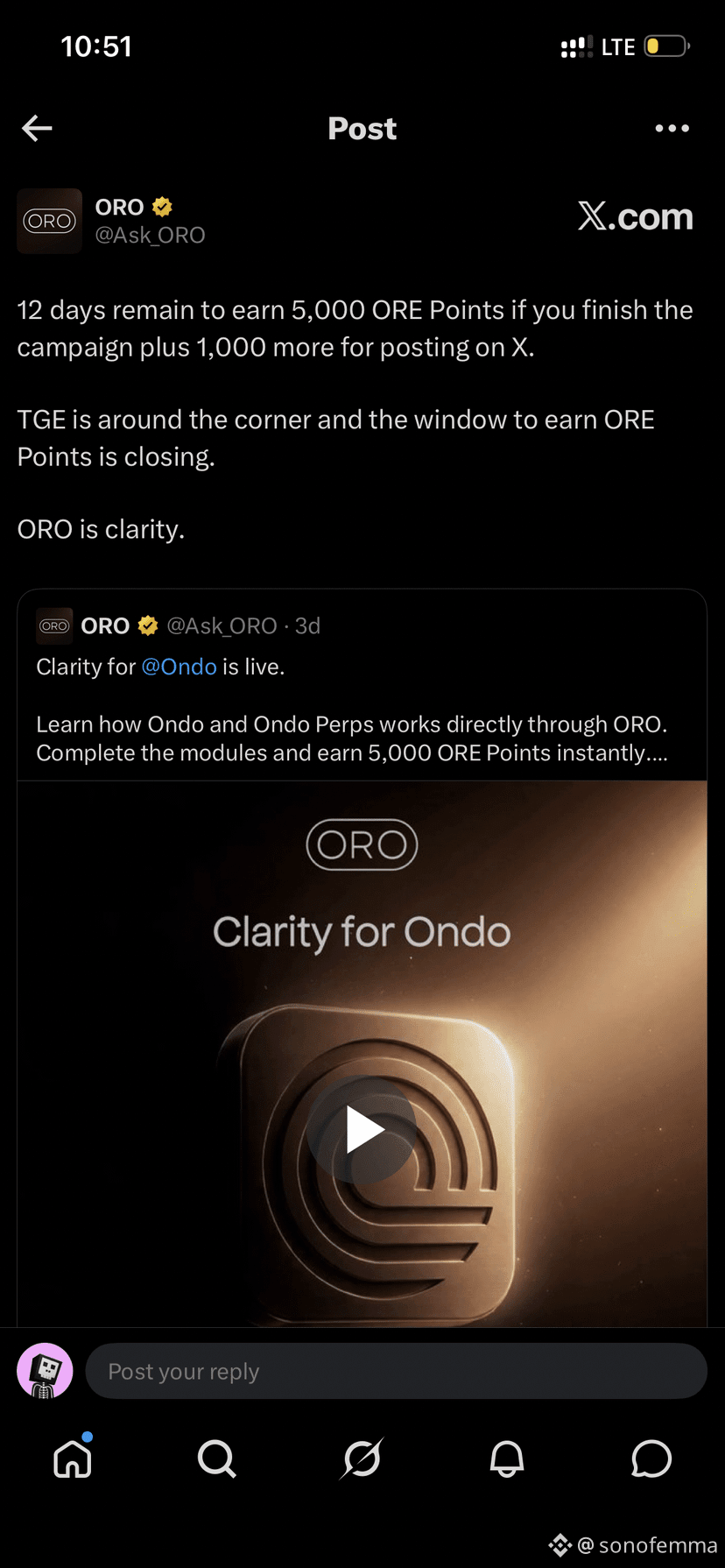
12 days doesn’t sound like much when a campaign requires you to sit down and complete it.
But that’s the window currently left for the ORO campaign.
Complete it and there’s 5,000 ORE Points available.
Share your completion on X and another 1,000 ORE Points can be earned.
With the TGE getting closer, this campaign is moving from an open ended opportunity into a closing window.
If you’ve been putting it off, the deadline is now part of the equation.
𝗢𝗥𝗢 𝗶𝘀 𝗰𝗹𝗮𝗿𝗶𝘁𝘆.
#campaign
2
357
·
--
Bullish
the DeFi experience is starting to look like a coordination problem, not just a liquidity problem.
ORO sits right at that intersection.
one side is about helping users understand increasingly complex DeFi activity. the other is about letting them move from that understanding into supported onchain actions.
those sound like separate functions, but they point to the same issue: DeFi keeps adding capabilities faster than users can comfortably navigate them.
that’s why the interaction layer around ORO feels worth paying attention to.
the interesting conversation isn’t only which protocol has the best product.
it’s how discovery, information and execution fit together when users are interacting with multiple financial systems.
ORO is approaching that from a conversational angle.
worth following from that lens.
#defi

83
·
--
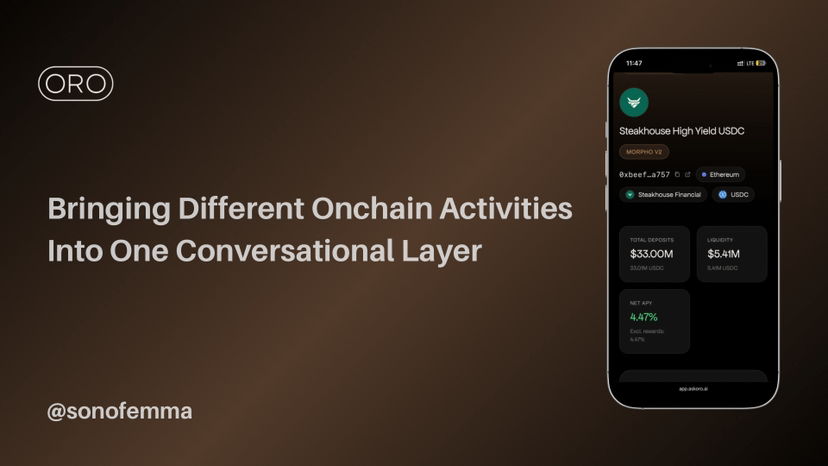
ORO started with a simple idea, making DeFi easier to interact with through conversation, but the ecosystem around it is becoming much broader
the more interesting signal is how many different types of activity are beginning to connect through the same product
ORO now gives users ways to explore lending markets, understand vaults, look into staking opportunities, ask questions about strategies, and carry out supported transactions
that matters because DeFi normally separates these activities across different applications
one interface for lending
another for staking
another for vaults
another for analytics
ORO is moving toward a model where these different activities can be explored through the same conversational experience
the second order effect is context
a question about a protocol can lead into its strategy, relevant data, risks, and eventually the action itself
competitors can build individual DeFi integrations
what is harder is connecting enough different activities that users can move between them without constantly changing how they interact with the ecosystem
the overlooked opportunity may be less about replacing existing DeFi applications and more about becoming a layer people use to navigate between them
worth watching how far this interaction model can go as more protocols and financial activities are added
1
98
·
--
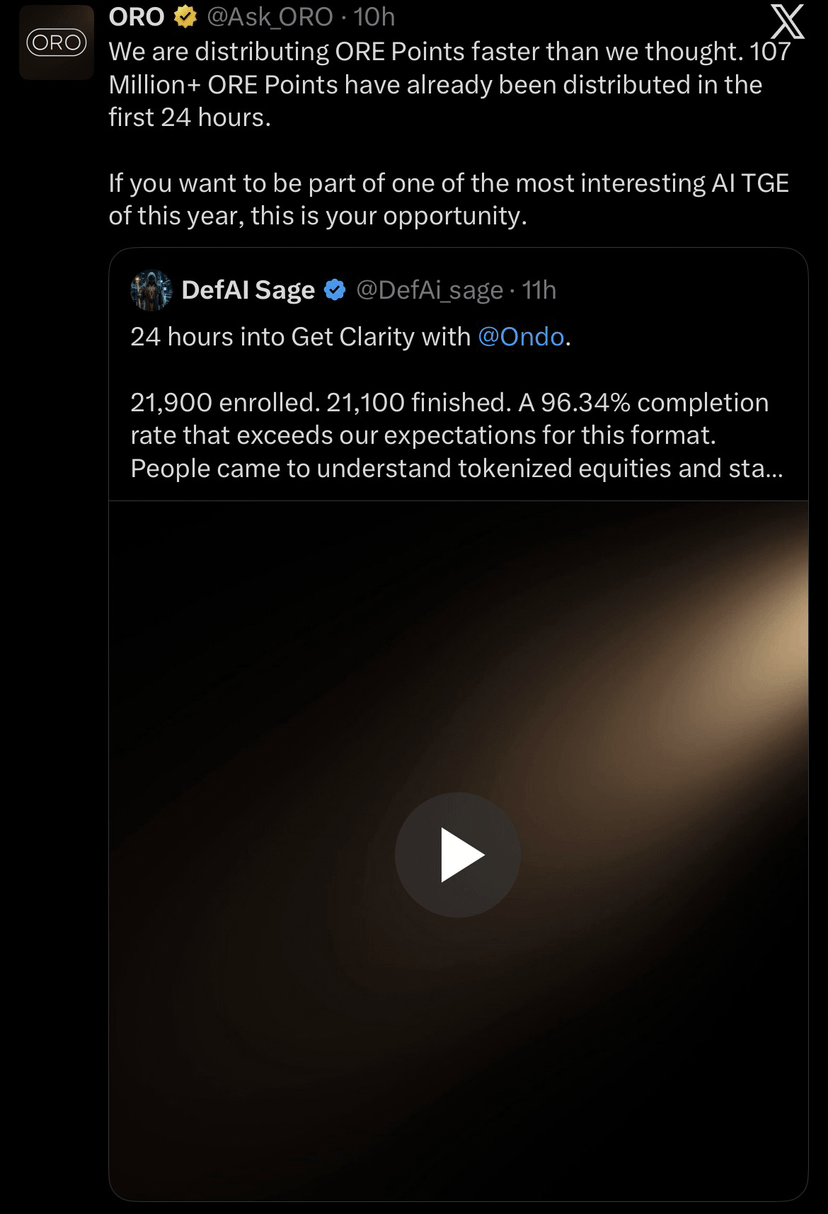
ORO has already distributed more than 107 million ORE Points in the first 24 hours.
That’s a pretty significant start to the TGE campaign.
With points moving this quickly, the campaign is clearly getting strong participation from the community.
If you’ve been following ORO and its TGE journey, this is one of the updates worth keeping an eye on.
𝗔𝗻𝗼𝘁𝗵𝗲𝗿 𝗯𝗶𝗴 𝘀𝘁𝗲𝗽 𝗳𝗼𝗿 𝗢𝗥𝗢.
#airdrop
That’s a pretty significant start to the TGE campaign.
With points moving this quickly, the campaign is clearly getting strong participation from the community.
If you’ve been following ORO and its TGE journey, this is one of the updates worth keeping an eye on.
𝗔𝗻𝗼𝘁𝗵𝗲𝗿 𝗯𝗶𝗴 𝘀𝘁𝗲𝗽 𝗳𝗼𝗿 𝗢𝗥𝗢.
#airdrop
113
Log in to explore more content
Join global crypto users on Binance Square
⚡️ Get latest and useful information about crypto.
💬 Trusted by the world’s largest crypto exchange.
👍 Discover real insights from verified creators.
Email / Phone number
Trending Topics
AnthropicToDebutAfter$83IPOPricing
15,333 views
150 Discussing
Stock Futures Hold Near Flat as Anthropic Prices IPO at $83 Ahead of Debut
Binance News
·8 Likes
·7.6k views
BTCRemainsUnderPressureAfterHawkishFOMCMinutes
57,463 views
1,220 Discussing
NvidiaBoardReportedlySplitOverHuang’sReturn
19,065 views
590 Discussing