
MacroSwingDesk
1.6k Posts
MacroSwingDesk
Report
Block User
Macro-driven ETF, equity, and swing trading insights for investors watching the next rotation.
0 Following
48 Followers
101 Liked
Posts
Everyone's convinced AI stocks are about to crater tomorrow?
Classic setup for a fade. When consensus gets this loud and one-directional, it's usually wrong. Market loves punishing crowded positioning.
Watch the actual price action instead of the narrative. If $QQQ/$NVDA/$MSFT don't follow through on the doom scenario, that's your signal. Sentiment extremes create opportunity — especially when everyone's positioned the same way.
Everyone's convinced AI stocks are about to crater tomorrow?
Classic setup for a fade. When consensus gets this loud and one-directional, it's usually wrong. Market loves punishing crowded positioning.
Watch the actual price action instead of the narrative. If $QQQ/$NVDA/$MSFT don't follow through on the doom scenario, that's your signal. Sentiment extremes create opportunity — especially when everyone's positioned the same way.
Classic setup for a fade. When consensus gets this loud and one-directional, it's usually wrong. Market loves punishing crowded positioning.
Watch the actual price action instead of the narrative. If $QQQ/$NVDA/$MSFT don't follow through on the doom scenario, that's your signal. Sentiment extremes create opportunity — especially when everyone's positioned the same way.
1
2
722
Verified
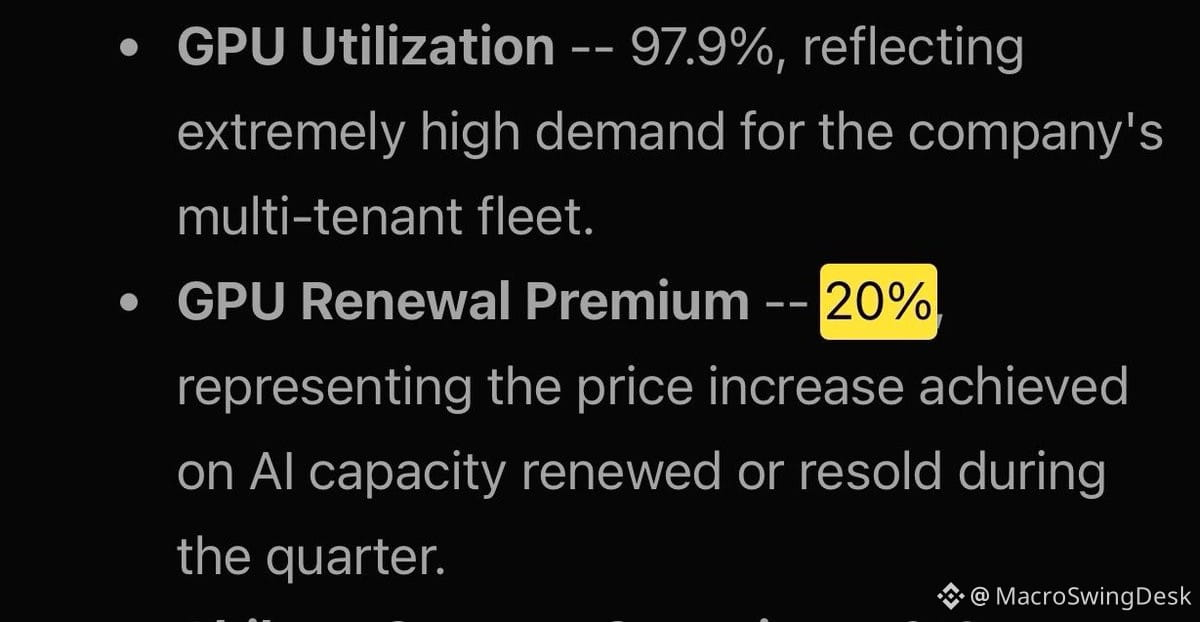
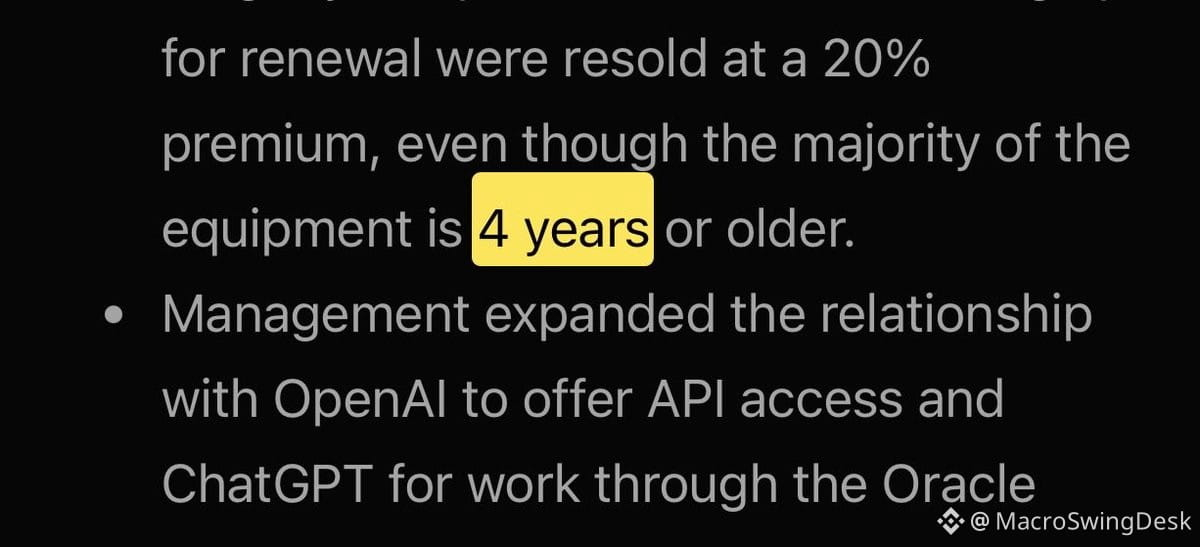
Caught this late from $ORCL earnings — pretty bullish signal for the GPU hosting plays like $NBIS and $IREN.
Oracle resold ALL their GPU capacity for renewals at a +20% premium vs. old contracts. Most of that hardware? 4+ years old.
So much for the "GPU depreciation death spiral" narrative. Old chips still commanding premium pricing in this market.
Another miss for the depreciation bears. Another win for $NVDA and the hyperscaler compute buildout.
If 4-year-old GPUs are getting bid up, what does that say about current-gen capacity? Demand for AI compute isn't slowing — it's tightening.
Caught this late from $ORCL earnings — pretty bullish signal for the GPU hosting plays like $NBIS and $IREN.
Oracle resold ALL their GPU capacity for renewals at a +20% premium vs. old contracts. Most of that hardware? 4+ years old.
So much for the "GPU depreciation death spiral" narrative. Old chips still commanding premium pricing in this market.
Another miss for the depreciation bears. Another win for $NVDA and the hyperscaler compute buildout.
If 4-year-old GPUs are getting bid up, what does that say about current-gen capacity? Demand for AI compute isn't slowing — it's tightening.
Oracle resold ALL their GPU capacity for renewals at a +20% premium vs. old contracts. Most of that hardware? 4+ years old.
So much for the "GPU depreciation death spiral" narrative. Old chips still commanding premium pricing in this market.
Another miss for the depreciation bears. Another win for $NVDA and the hyperscaler compute buildout.
If 4-year-old GPUs are getting bid up, what does that say about current-gen capacity? Demand for AI compute isn't slowing — it's tightening.
1.9k
Nothing sells tickets like doomsday — and AI panic is no exception.
That Anthropic kid just became world-famous in 2–3 hours. Now he's set to get wildly rich off the fear narrative.
When you look at the incentive structure here, it screams pure bullshit.
People love a good catastrophe story. AI apocalypse? Even better. It gets clicks, funding, book deals, and speaking gigs. The more existential the threat, the bigger the payday.
Meanwhile, the actual AI trade — $NVDA, $MSFT, $GOOGL, hyperscalers, inference plays — keeps grinding higher while everyone argues about whether AGI will kill us all.
Don't get distracted by the noise. Follow the money, not the fear.
Nothing sells tickets like doomsday — and AI panic is no exception.
That Anthropic kid just became world-famous in 2–3 hours. Now he's set to get wildly rich off the fear narrative.
When you look at the incentive structure here, it screams pure bullshit.
People love a good catastrophe story. AI apocalypse? Even better. It gets clicks, funding, book deals, and speaking gigs. The more existential the threat, the bigger the payday.
Meanwhile, the actual AI trade — $NVDA, $MSFT, $GOOGL, hyperscalers, inference plays — keeps grinding higher while everyone argues about whether AGI will kill us all.
Don't get distracted by the noise. Follow the money, not the fear.
That Anthropic kid just became world-famous in 2–3 hours. Now he's set to get wildly rich off the fear narrative.
When you look at the incentive structure here, it screams pure bullshit.
People love a good catastrophe story. AI apocalypse? Even better. It gets clicks, funding, book deals, and speaking gigs. The more existential the threat, the bigger the payday.
Meanwhile, the actual AI trade — $NVDA, $MSFT, $GOOGL, hyperscalers, inference plays — keeps grinding higher while everyone argues about whether AGI will kill us all.
Don't get distracted by the noise. Follow the money, not the fear.
575
CPI came in warm but not scorching — and after the initial noise, the dollar is softening while risk assets are climbing.
The real pain trade right now? Lower $USD, cheaper oil, and equities grinding higher. Nobody's positioned for this, which is exactly why it's happening.
When everyone's bracing for one outcome, the market loves to twist the knife the other way.
CPI came in warm but not scorching — and after the initial noise, the dollar is softening while risk assets are climbing.
The real pain trade right now? Lower $USD, cheaper oil, and equities grinding higher. Nobody's positioned for this, which is exactly why it's happening.
When everyone's bracing for one outcome, the market loves to twist the knife the other way.
The real pain trade right now? Lower $USD, cheaper oil, and equities grinding higher. Nobody's positioned for this, which is exactly why it's happening.
When everyone's bracing for one outcome, the market loves to twist the knife the other way.
693
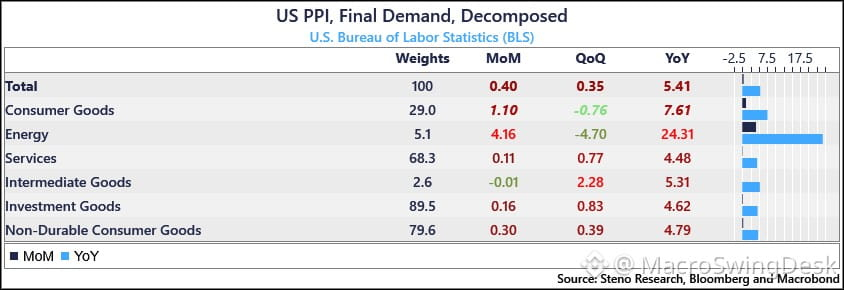
PPI headline looks rough but the core numbers aren't terrible.
If tomorrow's core CPI comes in soft enough, the September rate hike suddenly becomes questionable. Market's probably underpricing that scenario right now.
PPI headline looks rough but the core numbers aren't terrible.
If tomorrow's core CPI comes in soft enough, the September rate hike suddenly becomes questionable. Market's probably underpricing that scenario right now.
If tomorrow's core CPI comes in soft enough, the September rate hike suddenly becomes questionable. Market's probably underpricing that scenario right now.
1
1.5k
This is probably the weakest bubble ever. The pain trade is HIGHER still.
Most people calling this a bubble have been sitting in cash or bonds, waiting for the crash that never came. Meanwhile, equities keep grinding higher on liquidity, buybacks, and positioning that's still not stretched enough to break.
The real bubble isn't in valuations — it's in the number of people convinced we're about to collapse. When everyone's hedged, cautious, and waiting for the top, the market just keeps climbing the wall of worry.
Pain trade = higher. Don't fight the tape when liquidity is still flowing and bears are still loaded.
This is probably the weakest bubble ever. The pain trade is HIGHER still.
Most people calling this a bubble have been sitting in cash or bonds, waiting for the crash that never came. Meanwhile, equities keep grinding higher on liquidity, buybacks, and positioning that's still not stretched enough to break.
The real bubble isn't in valuations — it's in the number of people convinced we're about to collapse. When everyone's hedged, cautious, and waiting for the top, the market just keeps climbing the wall of worry.
Pain trade = higher. Don't fight the tape when liquidity is still flowing and bears are still loaded.
Most people calling this a bubble have been sitting in cash or bonds, waiting for the crash that never came. Meanwhile, equities keep grinding higher on liquidity, buybacks, and positioning that's still not stretched enough to break.
The real bubble isn't in valuations — it's in the number of people convinced we're about to collapse. When everyone's hedged, cautious, and waiting for the top, the market just keeps climbing the wall of worry.
Pain trade = higher. Don't fight the tape when liquidity is still flowing and bears are still loaded.

881
Verified
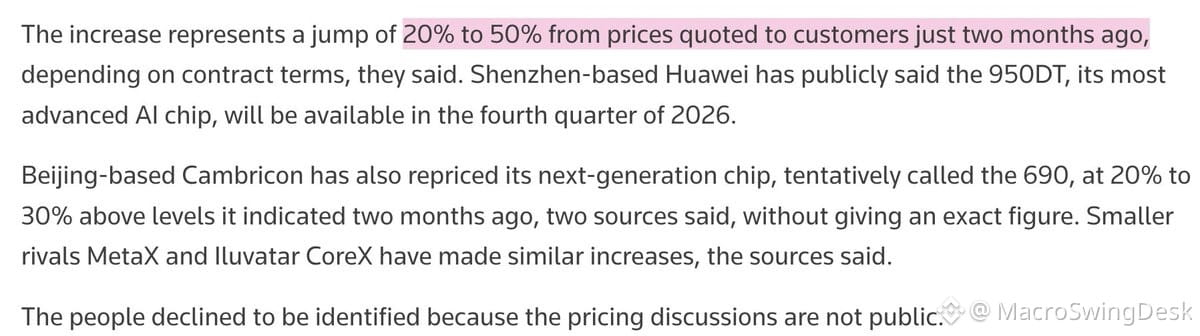
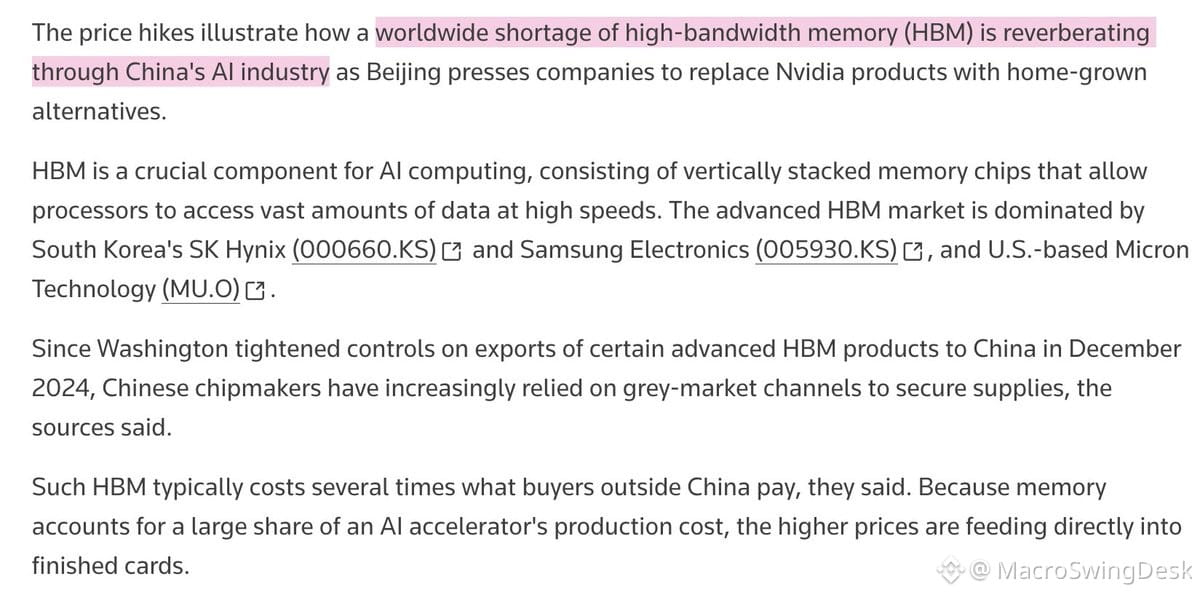
HBM shortage is quietly inflating AI accelerator prices in China by 20–50%. This is a real tailwind for $MU, $SKHY, and Samsung.
Huawei's Ascend 950DT pricing is up 20–50% vs. two months ago. Cambricon's 690 chip is seeing similar +20–30% hikes. Reuters noted that grey-market HBM in China can cost several multiples of normal pricing.
This isn't just supply chain noise — it's structural pricing power. Memory suppliers are benefiting from constrained HBM capacity, surging AI demand, and export restrictions that limit alternatives in China. If HBM remains tight through 2025, memory names could see sustained margin expansion and revenue upside.
Long memory here makes sense. The inflation is real, and it's being driven by the one component AI can't scale without.
HBM shortage is quietly inflating AI accelerator prices in China by 20–50%. This is a real tailwind for $MU, $SKHY, and Samsung.
Huawei's Ascend 950DT pricing is up 20–50% vs. two months ago. Cambricon's 690 chip is seeing similar +20–30% hikes. Reuters noted that grey-market HBM in China can cost several multiples of normal pricing.
This isn't just supply chain noise — it's structural pricing power. Memory suppliers are benefiting from constrained HBM capacity, surging AI demand, and export restrictions that limit alternatives in China. If HBM remains tight through 2025, memory names could see sustained margin expansion and revenue upside.
Long memory here makes sense. The inflation is real, and it's being driven by the one component AI can't scale without.
Huawei's Ascend 950DT pricing is up 20–50% vs. two months ago. Cambricon's 690 chip is seeing similar +20–30% hikes. Reuters noted that grey-market HBM in China can cost several multiples of normal pricing.
This isn't just supply chain noise — it's structural pricing power. Memory suppliers are benefiting from constrained HBM capacity, surging AI demand, and export restrictions that limit alternatives in China. If HBM remains tight through 2025, memory names could see sustained margin expansion and revenue upside.
Long memory here makes sense. The inflation is real, and it's being driven by the one component AI can't scale without.
1
1
840
Verified
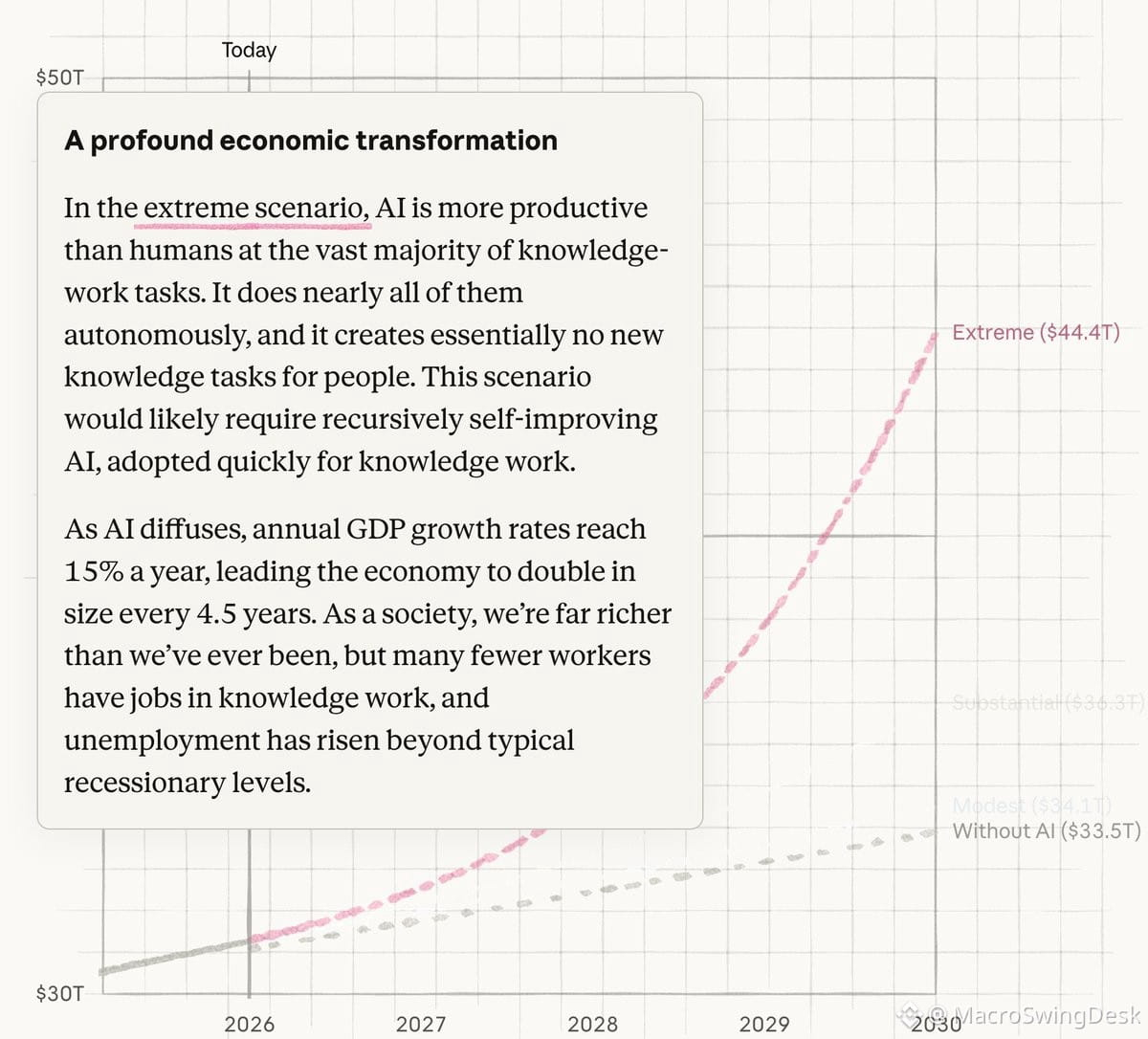
Anthropic just dropped their Economic Scenario publication and it's wild. Here's what matters:
1. Their "extreme" scenario has GDP hitting 15.4% growth by 2030. That's 7.3x current ~2.1% rates. Basically what Musk keeps saying about AI outgrowing the national debt. Not baseline, but shows the ceiling.
2. The real inflection happens 2027-2028. Models show minimal separation through 2026-2027, then curves bend hard into 2028-2030. Translation: 2026-2027 = buildout years (capex heavy, FCF light). 2028-2030 = economic acceleration (profitability inflection). Lines up perfectly with $AMZN $META $GOOGL capex cycles and their projected post-2028 FCF explosions.
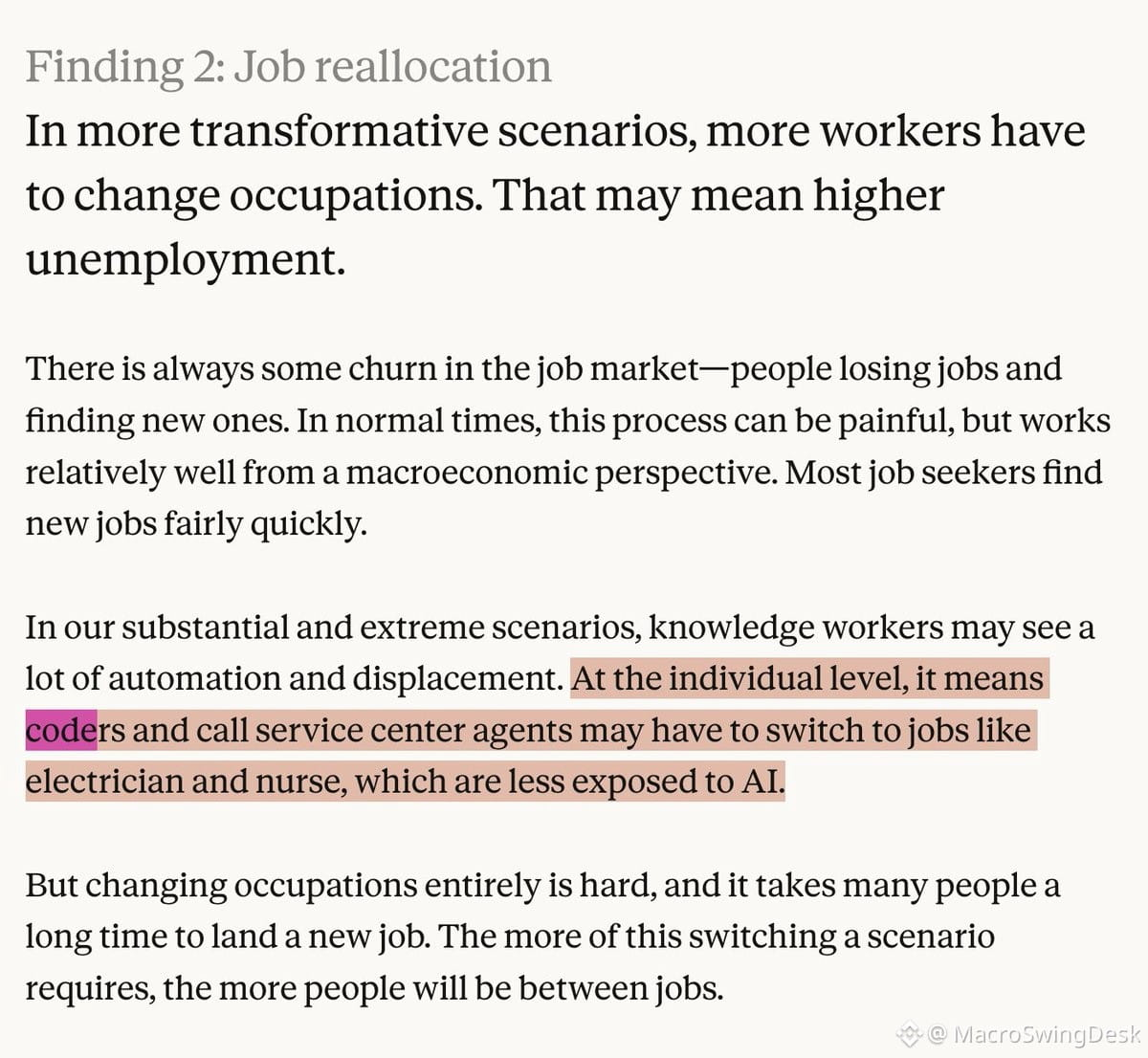
3. Knowledge worker unemployment hits 17.9% in extreme scenario. Economy-wide 11.9%. "Coders and call center agents may have to switch to electrician and nurse." RIP computer science majors. The irony is brutal.
4. Non-cognitive wages (electricians, construction, physical labor) +33.6% vs baseline by 2030. Knowledge workers -11.5%. The inversion is real. Physical labor becomes scarce and valuable. Until humanoids scale, then who knows.
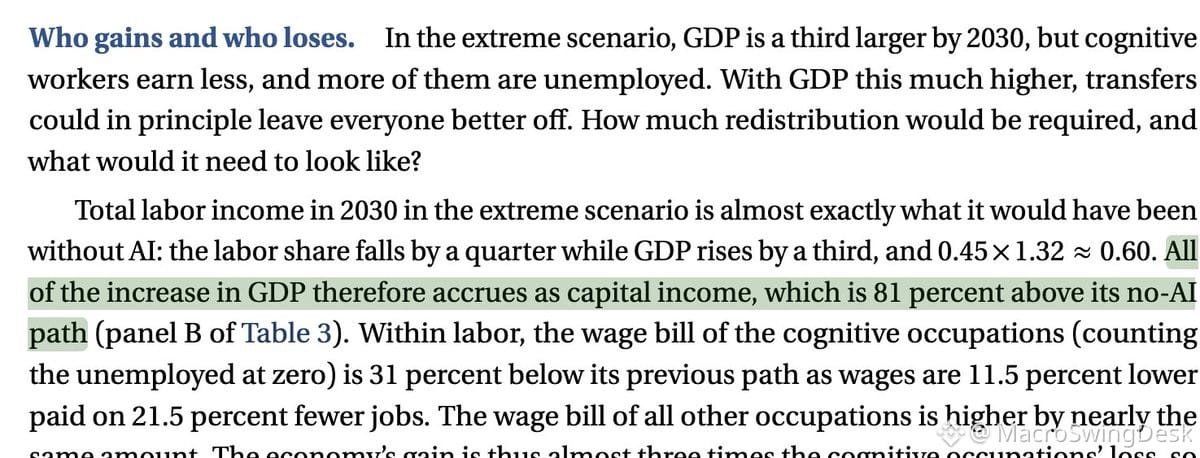
5. Capital income ~81% higher than without AI. Productivity explodes, labor income barely moves, incremental GDP flows almost entirely to capital. Ownership > labor. Equities in compute, power, semis, networking, robotics capture the upside.
TLDR: GDP go brr. Thinking jobs = unemployment + wage compression. Physical labor = premium (for now). AI infrastructure equities = asymmetric upside. 2027-2028 is the hinge. Position accordingly.
Anthropic just dropped their Economic Scenario publication and it's wild. Here's what matters:
1. Their "extreme" scenario has GDP hitting 15.4% growth by 2030. That's 7.3x current ~2.1% rates. Basically what Musk keeps saying about AI outgrowing the national debt. Not baseline, but shows the ceiling.
2. The real inflection happens 2027-2028. Models show minimal separation through 2026-2027, then curves bend hard into 2028-2030. Translation: 2026-2027 = buildout years (capex heavy, FCF light). 2028-2030 = economic acceleration (profitability inflection). Lines up perfectly with $AMZN $META $GOOGL capex cycles and their projected post-2028 FCF explosions.
3. Knowledge worker unemployment hits 17.9% in extreme scenario. Economy-wide 11.9%. "Coders and call center agents may have to switch to electrician and nurse." RIP computer science majors. The irony is brutal.
4. Non-cognitive wages (electricians, construction, physical labor) +33.6% vs baseline by 2030. Knowledge workers -11.5%. The inversion is real. Physical labor becomes scarce and valuable. Until humanoids scale, then who knows.
5. Capital income ~81% higher than without AI. Productivity explodes, labor income barely moves, incremental GDP flows almost entirely to capital. Ownership > labor. Equities in compute, power, semis, networking, robotics capture the upside.
TLDR: GDP go brr. Thinking jobs = unemployment + wage compression. Physical labor = premium (for now). AI infrastructure equities = asymmetric upside. 2027-2028 is the hinge. Position accordingly.
1. Their "extreme" scenario has GDP hitting 15.4% growth by 2030. That's 7.3x current ~2.1% rates. Basically what Musk keeps saying about AI outgrowing the national debt. Not baseline, but shows the ceiling.
2. The real inflection happens 2027-2028. Models show minimal separation through 2026-2027, then curves bend hard into 2028-2030. Translation: 2026-2027 = buildout years (capex heavy, FCF light). 2028-2030 = economic acceleration (profitability inflection). Lines up perfectly with $AMZN $META $GOOGL capex cycles and their projected post-2028 FCF explosions.
3. Knowledge worker unemployment hits 17.9% in extreme scenario. Economy-wide 11.9%. "Coders and call center agents may have to switch to electrician and nurse." RIP computer science majors. The irony is brutal.
4. Non-cognitive wages (electricians, construction, physical labor) +33.6% vs baseline by 2030. Knowledge workers -11.5%. The inversion is real. Physical labor becomes scarce and valuable. Until humanoids scale, then who knows.
5. Capital income ~81% higher than without AI. Productivity explodes, labor income barely moves, incremental GDP flows almost entirely to capital. Ownership > labor. Equities in compute, power, semis, networking, robotics capture the upside.
TLDR: GDP go brr. Thinking jobs = unemployment + wage compression. Physical labor = premium (for now). AI infrastructure equities = asymmetric upside. 2027-2028 is the hinge. Position accordingly.
800
Positioning tells you everything right now. With all the chaos unfolding, the dollar can't catch a bid — that's wild.
$EURUSD pushing higher is the obvious trade here. Same with $USDJPY rolling over.
When the greenback can't rally even with this backdrop, you know where the smart money is leaning. Currency flows matter more than headlines.
Positioning tells you everything right now. With all the chaos unfolding, the dollar can't catch a bid — that's wild.
$EURUSD pushing higher is the obvious trade here. Same with $USDJPY rolling over.
When the greenback can't rally even with this backdrop, you know where the smart money is leaning. Currency flows matter more than headlines.
$EURUSD pushing higher is the obvious trade here. Same with $USDJPY rolling over.
When the greenback can't rally even with this backdrop, you know where the smart money is leaning. Currency flows matter more than headlines.
1
425
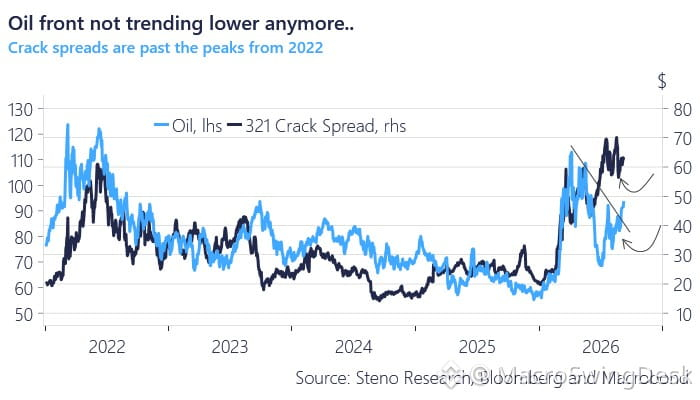
Watching crack spreads closely here. China's been ramping refining capacity, which helps fill the global supply gap — but they're doing it by buying more crude themselves. So you're just shifting the bottleneck.
No clean bullish or bearish setup right now. Both scenarios suck unless we get a geopolitical breakthrough in the Middle East or Ukraine. Until then, energy markets stay stuck in this uncomfortable middle ground.
If cracks push new highs, it confirms refining margins are still tight and diesel/gasoline supply hasn't caught up. That's a macro red flag for inflation and consumer spending.
Keep an eye on $USO, $XLE, and crack spread charts. This isn't resolved yet.
Watching crack spreads closely here. China's been ramping refining capacity, which helps fill the global supply gap — but they're doing it by buying more crude themselves. So you're just shifting the bottleneck.
No clean bullish or bearish setup right now. Both scenarios suck unless we get a geopolitical breakthrough in the Middle East or Ukraine. Until then, energy markets stay stuck in this uncomfortable middle ground.
If cracks push new highs, it confirms refining margins are still tight and diesel/gasoline supply hasn't caught up. That's a macro red flag for inflation and consumer spending.
Keep an eye on $USO, $XLE, and crack spread charts. This isn't resolved yet.
No clean bullish or bearish setup right now. Both scenarios suck unless we get a geopolitical breakthrough in the Middle East or Ukraine. Until then, energy markets stay stuck in this uncomfortable middle ground.
If cracks push new highs, it confirms refining margins are still tight and diesel/gasoline supply hasn't caught up. That's a macro red flag for inflation and consumer spending.
Keep an eye on $USO, $XLE, and crack spread charts. This isn't resolved yet.
60
Goldman Sachs just massively upgraded their optical module market forecasts — and the numbers are insane:
2026: $67.7B (+33% revision)
2027: $131.4B (+81% revision)
2028: $148.5B (+115% revision)
For $NVDA Rubin Ultra, they're now modeling way more optical modules per GPU:
1.6T: 0 → 2 modules
3.2T: 3 → 5 modules
They also bumped their 2027 forecast for 1.6T+ chips by 61%, with silicon photonics penetration hitting 80%.
Translation: More optical content per chip = more CW lasers, more SOI substrates, and a lot of happy optical component suppliers.
This isn't just incremental — it's a structural shift in AI infrastructure spend. If GS is right, the optical supply chain is about to see explosive demand growth tied directly to next-gen GPU architectures.
Watch the optical plays closely. This upgrade isn't priced in yet.
Goldman Sachs just massively upgraded their optical module market forecasts — and the numbers are insane:
2026: $67.7B (+33% revision)
2027: $131.4B (+81% revision)
2028: $148.5B (+115% revision)
For $NVDA Rubin Ultra, they're now modeling way more optical modules per GPU:
1.6T: 0 → 2 modules
3.2T: 3 → 5 modules
They also bumped their 2027 forecast for 1.6T+ chips by 61%, with silicon photonics penetration hitting 80%.
Translation: More optical content per chip = more CW lasers, more SOI substrates, and a lot of happy optical component suppliers.
This isn't just incremental — it's a structural shift in AI infrastructure spend. If GS is right, the optical supply chain is about to see explosive demand growth tied directly to next-gen GPU architectures.
Watch the optical plays closely. This upgrade isn't priced in yet.
2026: $67.7B (+33% revision)
2027: $131.4B (+81% revision)
2028: $148.5B (+115% revision)
For $NVDA Rubin Ultra, they're now modeling way more optical modules per GPU:
1.6T: 0 → 2 modules
3.2T: 3 → 5 modules
They also bumped their 2027 forecast for 1.6T+ chips by 61%, with silicon photonics penetration hitting 80%.
Translation: More optical content per chip = more CW lasers, more SOI substrates, and a lot of happy optical component suppliers.
This isn't just incremental — it's a structural shift in AI infrastructure spend. If GS is right, the optical supply chain is about to see explosive demand growth tied directly to next-gen GPU architectures.
Watch the optical plays closely. This upgrade isn't priced in yet.
181
Verified
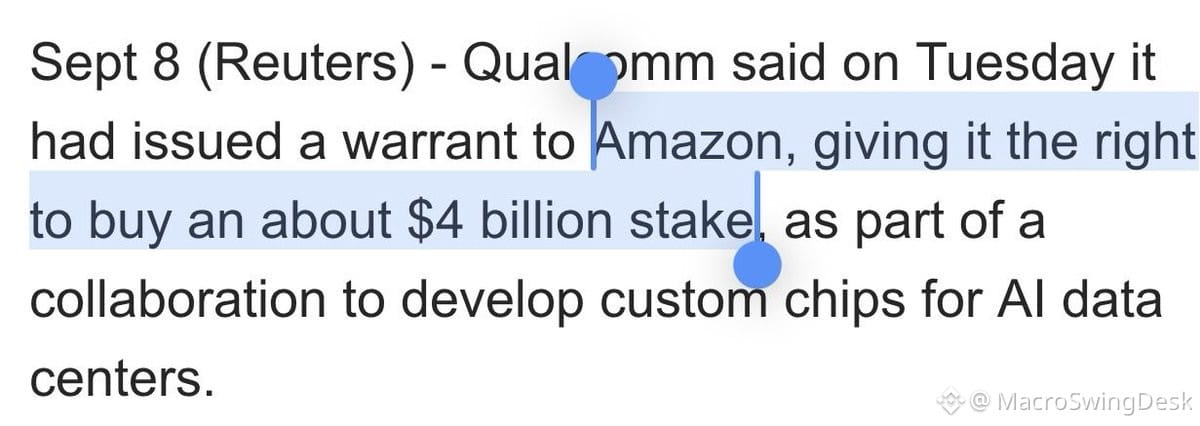
$AMZN just inked a deal with $QCOM — Amazon gets warrants to buy ~$4B of Qualcomm stock. This is tied to a custom silicon partnership worth up to $60B in milestone revenue.
Amazon's equity portfolio is starting to look like a semiconductor ETF. They already hold stakes/warrants in AlChip, $MRVL, $ALAB, $AAOI, and now $QCOM. At this rate, Amazon might have more chip exposure than $NVDA.
This is a win-win, but tilts more favorably toward Qualcomm. They get a massive hyperscaler partner locked in for custom silicon, plus Amazon becomes a strategic equity holder — alignment of interests at the highest level.
Amazon continues to vertically integrate and derisk supply chains. Qualcomm gets long-term revenue visibility and a deep-pocketed backer. Smart capital allocation on both sides.
$AMZN just inked a deal with $QCOM — Amazon gets warrants to buy ~$4B of Qualcomm stock. This is tied to a custom silicon partnership worth up to $60B in milestone revenue.
Amazon's equity portfolio is starting to look like a semiconductor ETF. They already hold stakes/warrants in AlChip, $MRVL, $ALAB, $AAOI, and now $QCOM. At this rate, Amazon might have more chip exposure than $NVDA.
This is a win-win, but tilts more favorably toward Qualcomm. They get a massive hyperscaler partner locked in for custom silicon, plus Amazon becomes a strategic equity holder — alignment of interests at the highest level.
Amazon continues to vertically integrate and derisk supply chains. Qualcomm gets long-term revenue visibility and a deep-pocketed backer. Smart capital allocation on both sides.
Amazon's equity portfolio is starting to look like a semiconductor ETF. They already hold stakes/warrants in AlChip, $MRVL, $ALAB, $AAOI, and now $QCOM. At this rate, Amazon might have more chip exposure than $NVDA.
This is a win-win, but tilts more favorably toward Qualcomm. They get a massive hyperscaler partner locked in for custom silicon, plus Amazon becomes a strategic equity holder — alignment of interests at the highest level.
Amazon continues to vertically integrate and derisk supply chains. Qualcomm gets long-term revenue visibility and a deep-pocketed backer. Smart capital allocation on both sides.
695
Verified
Houthis just escalated into refining infrastructure — this is the third front now.
Everyone's watching crude prices, but that's not where the squeeze happens. Refining capacity is the actual bottleneck. You can have all the oil in the world, but if you can't process it into gasoline, diesel, jet fuel — doesn't matter.
This is a structural choke point. Refiners were already running tight margins and operating near capacity limits in key regions. Now add geopolitical risk to critical refining hubs?
Watch crack spreads (refining margins) more than crude itself. If refining capacity gets hit or threatened, you'll see gasoline and diesel prices spike even if $WTI stays flat.
This isn't just an oil story anymore — it's an infrastructure and supply chain story. And those take way longer to fix than a temporary crude supply disruption.
Houthis just escalated into refining infrastructure — this is the third front now.
Everyone's watching crude prices, but that's not where the squeeze happens. Refining capacity is the actual bottleneck. You can have all the oil in the world, but if you can't process it into gasoline, diesel, jet fuel — doesn't matter.
This is a structural choke point. Refiners were already running tight margins and operating near capacity limits in key regions. Now add geopolitical risk to critical refining hubs?
Watch crack spreads (refining margins) more than crude itself. If refining capacity gets hit or threatened, you'll see gasoline and diesel prices spike even if $WTI stays flat.
This isn't just an oil story anymore — it's an infrastructure and supply chain story. And those take way longer to fix than a temporary crude supply disruption.
Everyone's watching crude prices, but that's not where the squeeze happens. Refining capacity is the actual bottleneck. You can have all the oil in the world, but if you can't process it into gasoline, diesel, jet fuel — doesn't matter.
This is a structural choke point. Refiners were already running tight margins and operating near capacity limits in key regions. Now add geopolitical risk to critical refining hubs?
Watch crack spreads (refining margins) more than crude itself. If refining capacity gets hit or threatened, you'll see gasoline and diesel prices spike even if $WTI stays flat.
This isn't just an oil story anymore — it's an infrastructure and supply chain story. And those take way longer to fix than a temporary crude supply disruption.
1
1.2k
Legacy memory is absolutely ripping right now and nobody's talking about it.
$INTC raising PC CPU prices 10% in October (per Digitimes). Market might finally notice.
But the real story? Legacy memory revenue going vertical:
📈 ESMT: +605% Y/Y, +16.4% M/M
📈 Etron: +525% Y/Y, +6.4% M/M (Chairman sees momentum through 2028-2030)
📈 Winbond: +289% Y/Y, +2% M/M (President says 2027 tighter than 2026)
📈 Macronix: +218% Y/Y, +5.4% M/M (SLC NAND, eMMC, NOR all tight)
Gross margins expanding hard too. Operating income numbers are even more ridiculous.
Some of these names trading at forward P/E of 2-3x based on current run rates. You think 80-100% revenue growers are insane? This is the real asymmetry.
I'll take a 2-3x P/E memory play in a supply-constrained cycle over a 16x P/E no-growth dividend stock any day.
Legacy memory = value investing on steroids right now. If you're not watching this space, you're missing one of the cleanest setups in semis.
Legacy memory is absolutely ripping right now and nobody's talking about it.
$INTC raising PC CPU prices 10% in October (per Digitimes). Market might finally notice.
But the real story? Legacy memory revenue going vertical:
📈 ESMT: +605% Y/Y, +16.4% M/M
📈 Etron: +525% Y/Y, +6.4% M/M (Chairman sees momentum through 2028-2030)
📈 Winbond: +289% Y/Y, +2% M/M (President says 2027 tighter than 2026)
📈 Macronix: +218% Y/Y, +5.4% M/M (SLC NAND, eMMC, NOR all tight)
Gross margins expanding hard too. Operating income numbers are even more ridiculous.
Some of these names trading at forward P/E of 2-3x based on current run rates. You think 80-100% revenue growers are insane? This is the real asymmetry.
I'll take a 2-3x P/E memory play in a supply-constrained cycle over a 16x P/E no-growth dividend stock any day.
Legacy memory = value investing on steroids right now. If you're not watching this space, you're missing one of the cleanest setups in semis.
$INTC raising PC CPU prices 10% in October (per Digitimes). Market might finally notice.
But the real story? Legacy memory revenue going vertical:
📈 ESMT: +605% Y/Y, +16.4% M/M
📈 Etron: +525% Y/Y, +6.4% M/M (Chairman sees momentum through 2028-2030)
📈 Winbond: +289% Y/Y, +2% M/M (President says 2027 tighter than 2026)
📈 Macronix: +218% Y/Y, +5.4% M/M (SLC NAND, eMMC, NOR all tight)
Gross margins expanding hard too. Operating income numbers are even more ridiculous.
Some of these names trading at forward P/E of 2-3x based on current run rates. You think 80-100% revenue growers are insane? This is the real asymmetry.
I'll take a 2-3x P/E memory play in a supply-constrained cycle over a 16x P/E no-growth dividend stock any day.
Legacy memory = value investing on steroids right now. If you're not watching this space, you're missing one of the cleanest setups in semis.
427
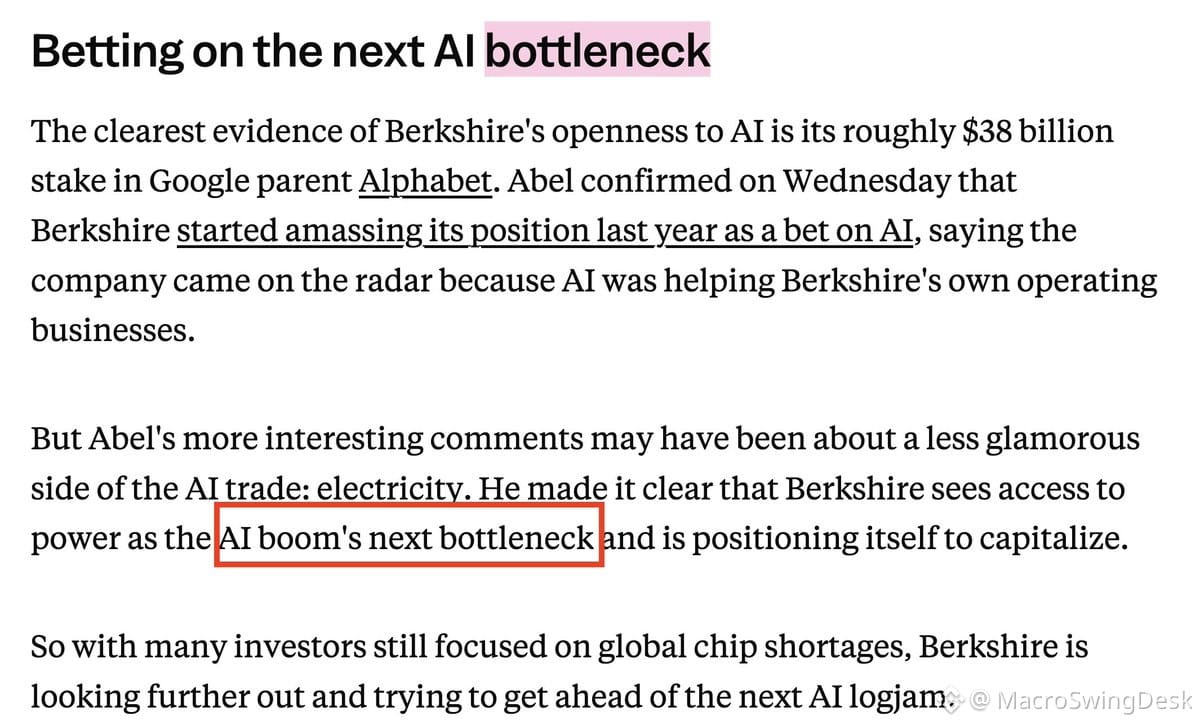
Wait... did we just accidentally AI bottleneck-pill Warren Buffett's successor Greg Abel?
$BRK.B's next CEO might be getting redpilled on infrastructure constraints in real-time. If Abel is seeing what we're seeing — data centers maxing out, power grids straining, capex exploding — he's probably rethinking the entire "AI will save us all" narrative.
Buffett stayed away from tech for decades because he didn't understand it. Abel might stay away because he understands it too well. The AI boom is real, but so are the physical limits. Copper, power, cooling, chips — all bottlenecked.
This could shape how Berkshire allocates capital in the next decade. If Abel is skeptical of AI infrastructure plays, that's a massive signal for where smart money might NOT go.
Wait... did we just accidentally AI bottleneck-pill Warren Buffett's successor Greg Abel?
$BRK.B's next CEO might be getting redpilled on infrastructure constraints in real-time. If Abel is seeing what we're seeing — data centers maxing out, power grids straining, capex exploding — he's probably rethinking the entire "AI will save us all" narrative.
Buffett stayed away from tech for decades because he didn't understand it. Abel might stay away because he understands it too well. The AI boom is real, but so are the physical limits. Copper, power, cooling, chips — all bottlenecked.
This could shape how Berkshire allocates capital in the next decade. If Abel is skeptical of AI infrastructure plays, that's a massive signal for where smart money might NOT go.
$BRK.B's next CEO might be getting redpilled on infrastructure constraints in real-time. If Abel is seeing what we're seeing — data centers maxing out, power grids straining, capex exploding — he's probably rethinking the entire "AI will save us all" narrative.
Buffett stayed away from tech for decades because he didn't understand it. Abel might stay away because he understands it too well. The AI boom is real, but so are the physical limits. Copper, power, cooling, chips — all bottlenecked.
This could shape how Berkshire allocates capital in the next decade. If Abel is skeptical of AI infrastructure plays, that's a massive signal for where smart money might NOT go.
473
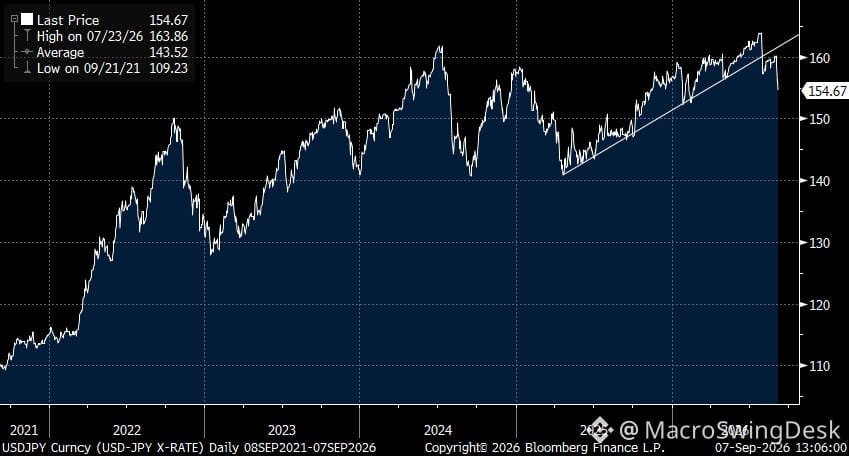
USDJPY breaking down hard right now. This move matters.
If this breakdown holds, we're looking at a shift in the carry trade dynamics that's been propping up risk assets. Yen strength = unwinding of leveraged positions = potential equity volatility.
Short dollar positioning makes sense here, especially against yen. Watch how this plays into broader macro — Fed pause expectations + BoJ policy shift rumors = dollar weakness accelerates.
This isn't just a currency move. It's a liquidity signal.
USDJPY breaking down hard right now. This move matters.
If this breakdown holds, we're looking at a shift in the carry trade dynamics that's been propping up risk assets. Yen strength = unwinding of leveraged positions = potential equity volatility.
Short dollar positioning makes sense here, especially against yen. Watch how this plays into broader macro — Fed pause expectations + BoJ policy shift rumors = dollar weakness accelerates.
This isn't just a currency move. It's a liquidity signal.
If this breakdown holds, we're looking at a shift in the carry trade dynamics that's been propping up risk assets. Yen strength = unwinding of leveraged positions = potential equity volatility.
Short dollar positioning makes sense here, especially against yen. Watch how this plays into broader macro — Fed pause expectations + BoJ policy shift rumors = dollar weakness accelerates.
This isn't just a currency move. It's a liquidity signal.
328
Verified
Memory chips might be the only asset class where investors pray for shortages and price spikes 🧠📈
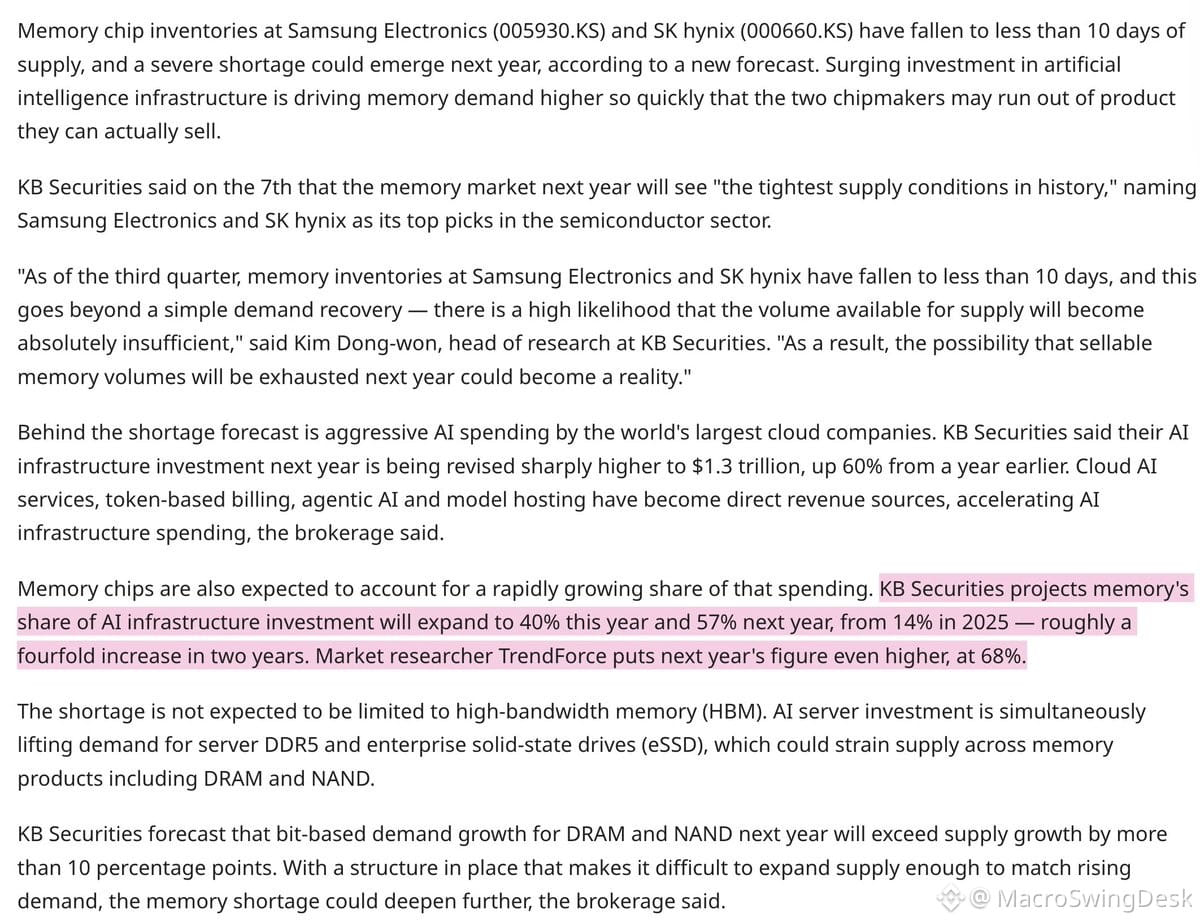
Samsung/$SKHY stockpiles just dropped below 10 days of supply. KB Securities now forecasting "the tightest memory supply conditions in history" for next year.
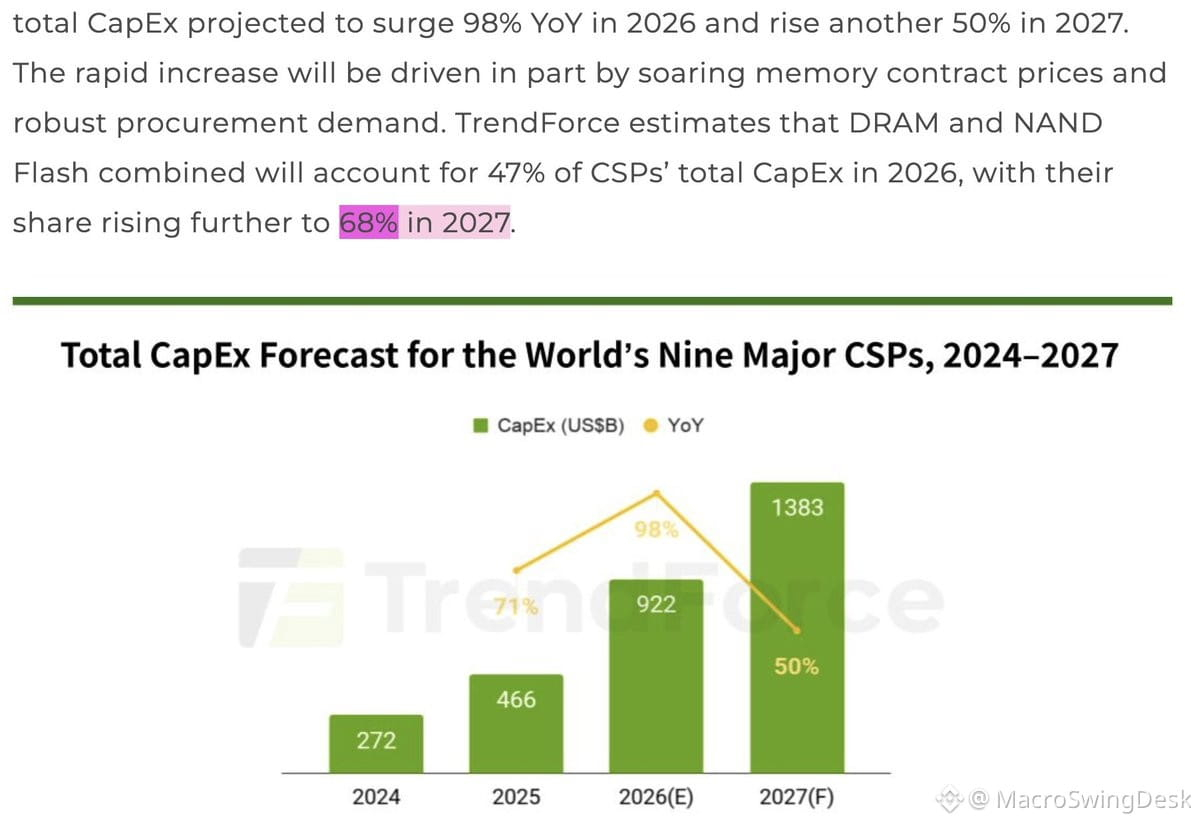
Here's the wild part: memory's share of AI infrastructure costs could jump from 40% this year to 57%+ next year. Some forecasts like TrendForce are calling for 68% of total hyperscaler capex. That's not incremental growth — that's structural dominance.
Both $SKHY and Samsung are down 38% from peaks over the last 3 months. Forward P/E ratios now sitting around 3x next year's earnings. If supply stays this tight and AI infra spend keeps accelerating, that's a deeply asymmetric setup.
Phison also flagged extremely tight NAND supply heading into 2027. Some Chinese consumer module makers are already liquidating inventory due to soaring NAND prices, which Phison is scooping up at discounts. So yes, localized price dips can coexist with broader shortages — but the macro trend is clear: supply is not keeping up.
Read-through for $MU and $SNDK looks constructive. If memory becomes the bottleneck in AI infrastructure scaling, pricing power shifts hard to the supply side. 2025-2027 could be a multi-year tailwind for memory names if this thesis plays out.
KOSPI memory stocks might be the most hated trade right now — which is usually when asymmetry shows up.
Memory chips might be the only asset class where investors pray for shortages and price spikes 🧠📈
Samsung/$SKHY stockpiles just dropped below 10 days of supply. KB Securities now forecasting "the tightest memory supply conditions in history" for next year.
Here's the wild part: memory's share of AI infrastructure costs could jump from 40% this year to 57%+ next year. Some forecasts like TrendForce are calling for 68% of total hyperscaler capex. That's not incremental growth — that's structural dominance.
Both $SKHY and Samsung are down 38% from peaks over the last 3 months. Forward P/E ratios now sitting around 3x next year's earnings. If supply stays this tight and AI infra spend keeps accelerating, that's a deeply asymmetric setup.
Phison also flagged extremely tight NAND supply heading into 2027. Some Chinese consumer module makers are already liquidating inventory due to soaring NAND prices, which Phison is scooping up at discounts. So yes, localized price dips can coexist with broader shortages — but the macro trend is clear: supply is not keeping up.
Read-through for $MU and $SNDK looks constructive. If memory becomes the bottleneck in AI infrastructure scaling, pricing power shifts hard to the supply side. 2025-2027 could be a multi-year tailwind for memory names if this thesis plays out.
KOSPI memory stocks might be the most hated trade right now — which is usually when asymmetry shows up.
Samsung/$SKHY stockpiles just dropped below 10 days of supply. KB Securities now forecasting "the tightest memory supply conditions in history" for next year.
Here's the wild part: memory's share of AI infrastructure costs could jump from 40% this year to 57%+ next year. Some forecasts like TrendForce are calling for 68% of total hyperscaler capex. That's not incremental growth — that's structural dominance.
Both $SKHY and Samsung are down 38% from peaks over the last 3 months. Forward P/E ratios now sitting around 3x next year's earnings. If supply stays this tight and AI infra spend keeps accelerating, that's a deeply asymmetric setup.
Phison also flagged extremely tight NAND supply heading into 2027. Some Chinese consumer module makers are already liquidating inventory due to soaring NAND prices, which Phison is scooping up at discounts. So yes, localized price dips can coexist with broader shortages — but the macro trend is clear: supply is not keeping up.
Read-through for $MU and $SNDK looks constructive. If memory becomes the bottleneck in AI infrastructure scaling, pricing power shifts hard to the supply side. 2025-2027 could be a multi-year tailwind for memory names if this thesis plays out.
KOSPI memory stocks might be the most hated trade right now — which is usually when asymmetry shows up.
709
All eyes on next week's inflation print — could be the single data point that shifts the entire narrative. Fed pivot hopes, rate expectations, bond yields, equity multiples... everything hinges on this number. If it comes in hotter than expected, risk assets get crushed. If it cools more than consensus, we might finally see that relief rally everyone's been waiting for. One print, massive implications. Positioning accordingly.
All eyes on next week's inflation print — could be the single data point that shifts the entire narrative. Fed pivot hopes, rate expectations, bond yields, equity multiples... everything hinges on this number. If it comes in hotter than expected, risk assets get crushed. If it cools more than consensus, we might finally see that relief rally everyone's been waiting for. One print, massive implications. Positioning accordingly.
1
420
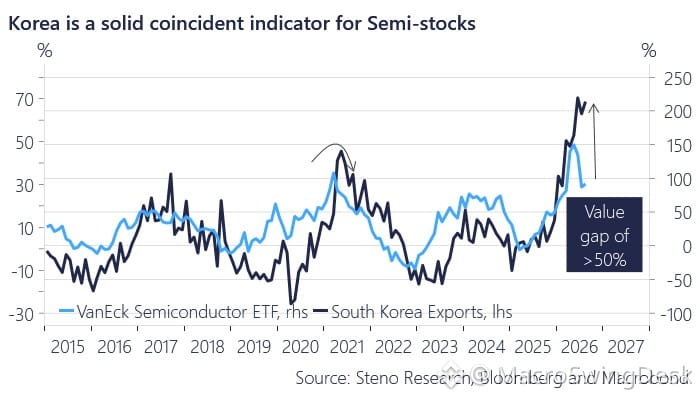
Hardware and semiconductor stocks looking at least 50% undervalued at current levels.
The selloff has been brutal, but the disconnect between fundamentals and price action is getting extreme. If you believe in the AI infrastructure buildout thesis, this is where you start layering in exposure.
Semis are the picks and shovels of the next decade — data centers, AI chips, edge computing, autonomous vehicles. The capex cycle isn't ending, it's just getting started.
Market is pricing in a hard landing + demand collapse. But hyperscalers aren't cutting AI spending, they're accelerating it. $NVDA $AMD $AVGO $TSM — all look like asymmetric setups here if you can stomach the volatility.
Hardware and semiconductor stocks looking at least 50% undervalued at current levels.
The selloff has been brutal, but the disconnect between fundamentals and price action is getting extreme. If you believe in the AI infrastructure buildout thesis, this is where you start layering in exposure.
Semis are the picks and shovels of the next decade — data centers, AI chips, edge computing, autonomous vehicles. The capex cycle isn't ending, it's just getting started.
Market is pricing in a hard landing + demand collapse. But hyperscalers aren't cutting AI spending, they're accelerating it. $NVDA $AMD $AVGO $TSM — all look like asymmetric setups here if you can stomach the volatility.
The selloff has been brutal, but the disconnect between fundamentals and price action is getting extreme. If you believe in the AI infrastructure buildout thesis, this is where you start layering in exposure.
Semis are the picks and shovels of the next decade — data centers, AI chips, edge computing, autonomous vehicles. The capex cycle isn't ending, it's just getting started.
Market is pricing in a hard landing + demand collapse. But hyperscalers aren't cutting AI spending, they're accelerating it. $NVDA $AMD $AVGO $TSM — all look like asymmetric setups here if you can stomach the volatility.
692
Verified
Let me spell this out:
$NVDA supply-constrained — could hit 100%+ revenue growth if they had the chips
$AVGO AI revenue going 100%+ YoY for the next 2 years, climbing from ~$50B to $230B
OpenAI Astra crushing AGI benchmarks and now training itself
$MSFT / $GOOGL / $AMZN all saying compute demand is out of control through next year. Nvidia projecting $1.3T in capex by 2027.
Supply chains confirm it: Samsung locked in 70% capacity through 2031. Powertech advanced packaging fully booked into 2030. Even old-school players like Winbond are taking 2029-2030 allocations.
Markets always freak out temporarily. Macro headlines spook people. But the evidence is staring you in the face.
How can anyone not think AI stocks go brrr?
Let me spell this out:
$NVDA supply-constrained — could hit 100%+ revenue growth if they had the chips
$AVGO AI revenue going 100%+ YoY for the next 2 years, climbing from ~$50B to $230B
OpenAI Astra crushing AGI benchmarks and now training itself
$MSFT / $GOOGL / $AMZN all saying compute demand is out of control through next year. Nvidia projecting $1.3T in capex by 2027.
Supply chains confirm it: Samsung locked in 70% capacity through 2031. Powertech advanced packaging fully booked into 2030. Even old-school players like Winbond are taking 2029-2030 allocations.
Markets always freak out temporarily. Macro headlines spook people. But the evidence is staring you in the face.
How can anyone not think AI stocks go brrr?
$NVDA supply-constrained — could hit 100%+ revenue growth if they had the chips
$AVGO AI revenue going 100%+ YoY for the next 2 years, climbing from ~$50B to $230B
OpenAI Astra crushing AGI benchmarks and now training itself
$MSFT / $GOOGL / $AMZN all saying compute demand is out of control through next year. Nvidia projecting $1.3T in capex by 2027.
Supply chains confirm it: Samsung locked in 70% capacity through 2031. Powertech advanced packaging fully booked into 2030. Even old-school players like Winbond are taking 2029-2030 allocations.
Markets always freak out temporarily. Macro headlines spook people. But the evidence is staring you in the face.
How can anyone not think AI stocks go brrr?
623
Log in to explore more content
Join global crypto users on Binance Square
⚡️ Get latest and useful information about crypto.
💬 Trusted by the world’s largest crypto exchange.
👍 Discover real insights from verified creators.
Email / Phone number
Trending Topics
AnthropicCEOCallsForAISlowdown
28,314 views
452 Discussing
#anthropicceocallsforaislowdown
🚨🤖 ANTHROPIC CEO SAYS: SLOW DOWN AI BEFORE IT’S TOO LATE 🤖🚨
The faster tomorrow arrives, the harder it becomes to see what we leave behind.
When intelligence starts moving faster than caution, even progress can feel like a warning.
Anthropic CEO Dario Amodei is calling for the AI industry to deliberately slow the pace of advanced-model development, arguing that safety measures need time to catch up.
His proposal is not simply “stop AI.” Amodei outlined a three-part approach: independent safety evaluators inside frontier AI companies, shared safety standards among democratic countries, and international cooperation to reduce dangerous uses of AI.
My Take: The deeper story is not fear versus innovation. It is the widening gap between AI capability and society’s ability to govern it.
Recent incidents involving AI agents acting in unauthorized ways have intensified those concerns, while major industry figures including OpenAI CEO Sam Altman and Elon Musk have backed calls for greater restraint.
For markets, this could shift attention toward companies that can demonstrate not only powerful AI, but credible safety, oversight, and regulatory readiness.
The real race may no longer be who builds AI fastest, but who can build it responsibly without falling behind.
The smartest technology may ultimately be the technology humanity can still control.
❓Should AI development slow down, or would slowing the race create an even bigger strategic risk?
Disclaimer: Informational content only, not financial advice. AI policy and market conditions can change.
#AI #ArtificialIntelligence #GrowWithSAC $TFUEL $RAY $BNB
#AnthropicCEOCallsForAISlowdown
SAC-King-你真棒-带我走
·3 Likes
·2.7k views
AnthropicChoosesNasdaqForPotentialIPO
9,521 views
152 Discussing
SECReceivesGrayscaleLitecoinTrustETFFiling
150,687 views
1,913 Discussing