

AF Trends
9.2k Posts

AF Trends
Report
Block User
Your Daily Guide to the Markets. Clear entries, zero hype, maximum focus.Trusted content creator AF Trends
345 Following
455 Followers
3.5K+ Liked
Posts
All
Quotes
·
--
$GENIUS Analysis: Key Setup Ahead
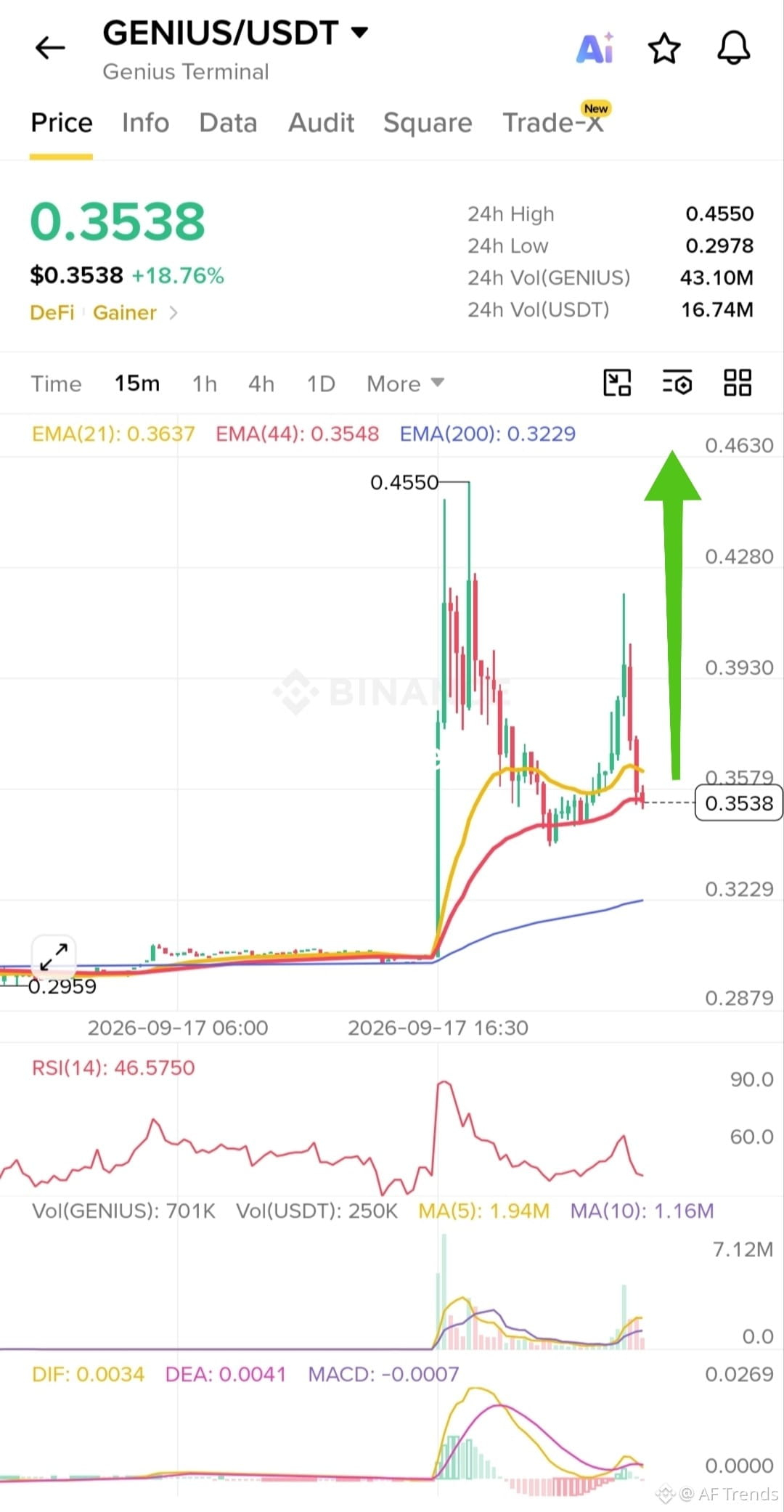
I am tracking GENIUS/USDT after its massive surge to 0.4550. On the 15m and 1h charts, the price pulled back to find solid support around the EMA 21 and 44 levels near 0.34-0.35. RSI sits at a healthy 54 on the 1h timeframe, showing room for another leg up once consolidation finishes.
Here is my current trade plan:
Entry Zone: 0.3450 - 0.3530
TP1: 0.3720
TP2: 0.3950
TP3: 0.4180
Stop Loss: 0.3290
Manage your risk properly and avoid high leverage during high volatility.
Click the chart below to trade.
{spot}(GENIUSUSDT)
This is not financial advice. Always do your own research before trading.
If you found this analysis helpful, click Follow for the next update.
$GENIUS Analysis: Key Setup Ahead
I am tracking GENIUS/USDT after its massive surge to 0.4550. On the 15m and 1h charts, the price pulled back to find solid support around the EMA 21 and 44 levels near 0.34-0.35. RSI sits at a healthy 54 on the 1h timeframe, showing room for another leg up once consolidation finishes.
Here is my current trade plan:
Entry Zone: 0.3450 - 0.3530
TP1: 0.3720
TP2: 0.3950
TP3: 0.4180
Stop Loss: 0.3290
Manage your risk properly and avoid high leverage during high volatility.
Click the chart below to trade.
This is not financial advice. Always do your own research before trading.
If you found this analysis helpful, click Follow for the next update.
I am tracking GENIUS/USDT after its massive surge to 0.4550. On the 15m and 1h charts, the price pulled back to find solid support around the EMA 21 and 44 levels near 0.34-0.35. RSI sits at a healthy 54 on the 1h timeframe, showing room for another leg up once consolidation finishes.
Here is my current trade plan:
Entry Zone: 0.3450 - 0.3530
TP1: 0.3720
TP2: 0.3950
TP3: 0.4180
Stop Loss: 0.3290
Manage your risk properly and avoid high leverage during high volatility.
Click the chart below to trade.
This is not financial advice. Always do your own research before trading.
If you found this analysis helpful, click Follow for the next update.
1
1
347
·
--
Bullish
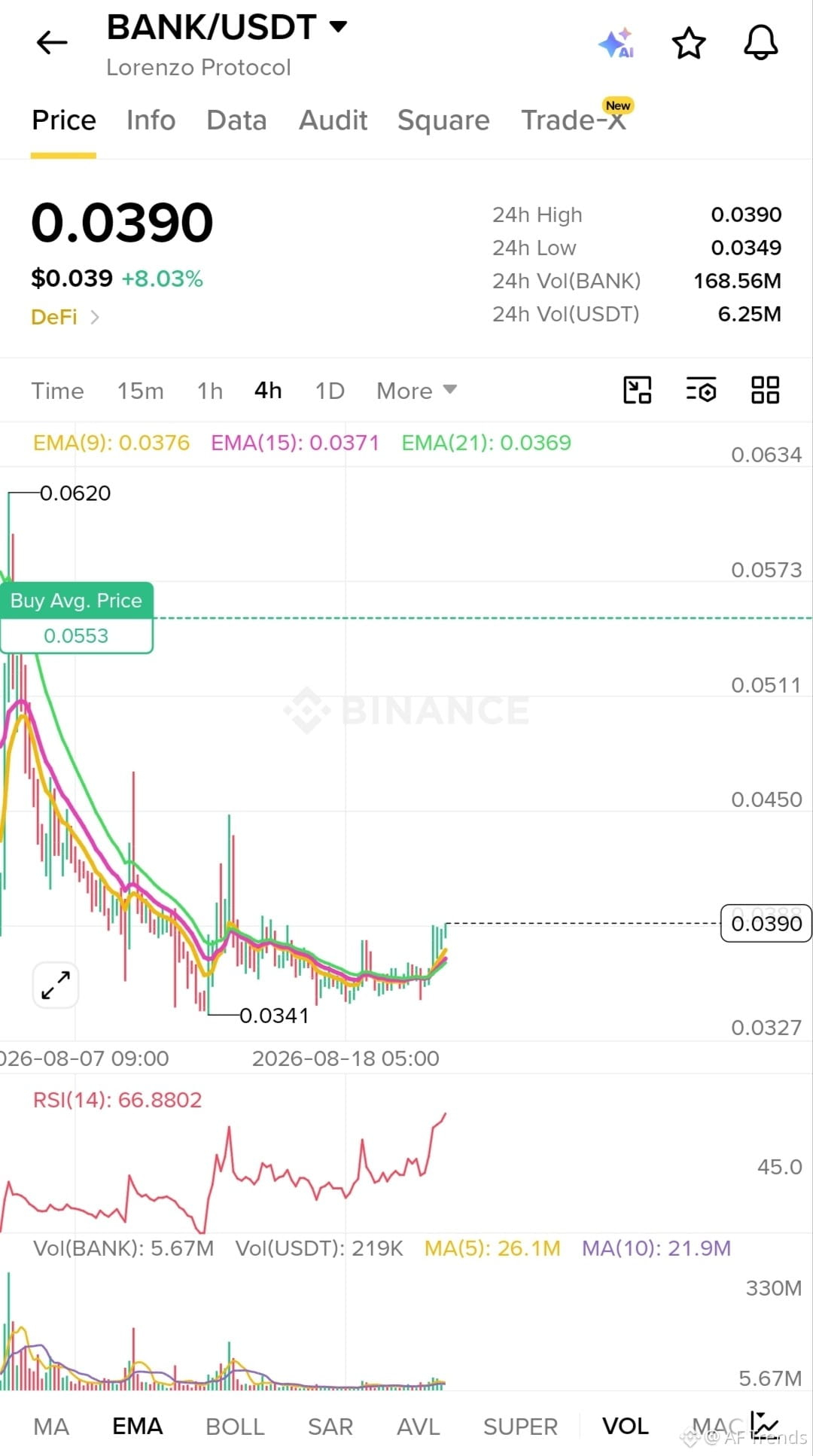
I waited patiently through the long dip, and now finally patience pays off. Seeing $BANK climb up nicely on the charts reminds me why holding strong through the consolidation phase always wins. Green candles look great, and our spot bags are recovering strong.
Trade Setup
Entry Point: 0.0385 to 0.0390 USDT
Take Profit: 0.0435 USDT
Stop Loss: 0.0365 USDT
Disclaimer: Trading cryptocurrency carries high risk and market conditions can change rapidly. Always manage your risk and trade responsibly.
Click the chart below to trade.
{spot}(BANKUSDT)
If you found this analysis helpful, click Follow for the next update.
I waited patiently through the long dip, and now finally patience pays off. Seeing $BANK climb up nicely on the charts reminds me why holding strong through the consolidation phase always wins. Green candles look great, and our spot bags are recovering strong.
Trade Setup
Entry Point: 0.0385 to 0.0390 USDT
Take Profit: 0.0435 USDT
Stop Loss: 0.0365 USDT
Disclaimer: Trading cryptocurrency carries high risk and market conditions can change rapidly. Always manage your risk and trade responsibly.
Click the chart below to trade.
If you found this analysis helpful, click Follow for the next update.
Trade Setup
Entry Point: 0.0385 to 0.0390 USDT
Take Profit: 0.0435 USDT
Stop Loss: 0.0365 USDT
Disclaimer: Trading cryptocurrency carries high risk and market conditions can change rapidly. Always manage your risk and trade responsibly.
Click the chart below to trade.
If you found this analysis helpful, click Follow for the next update.
1
3
598
·
--
Bullish
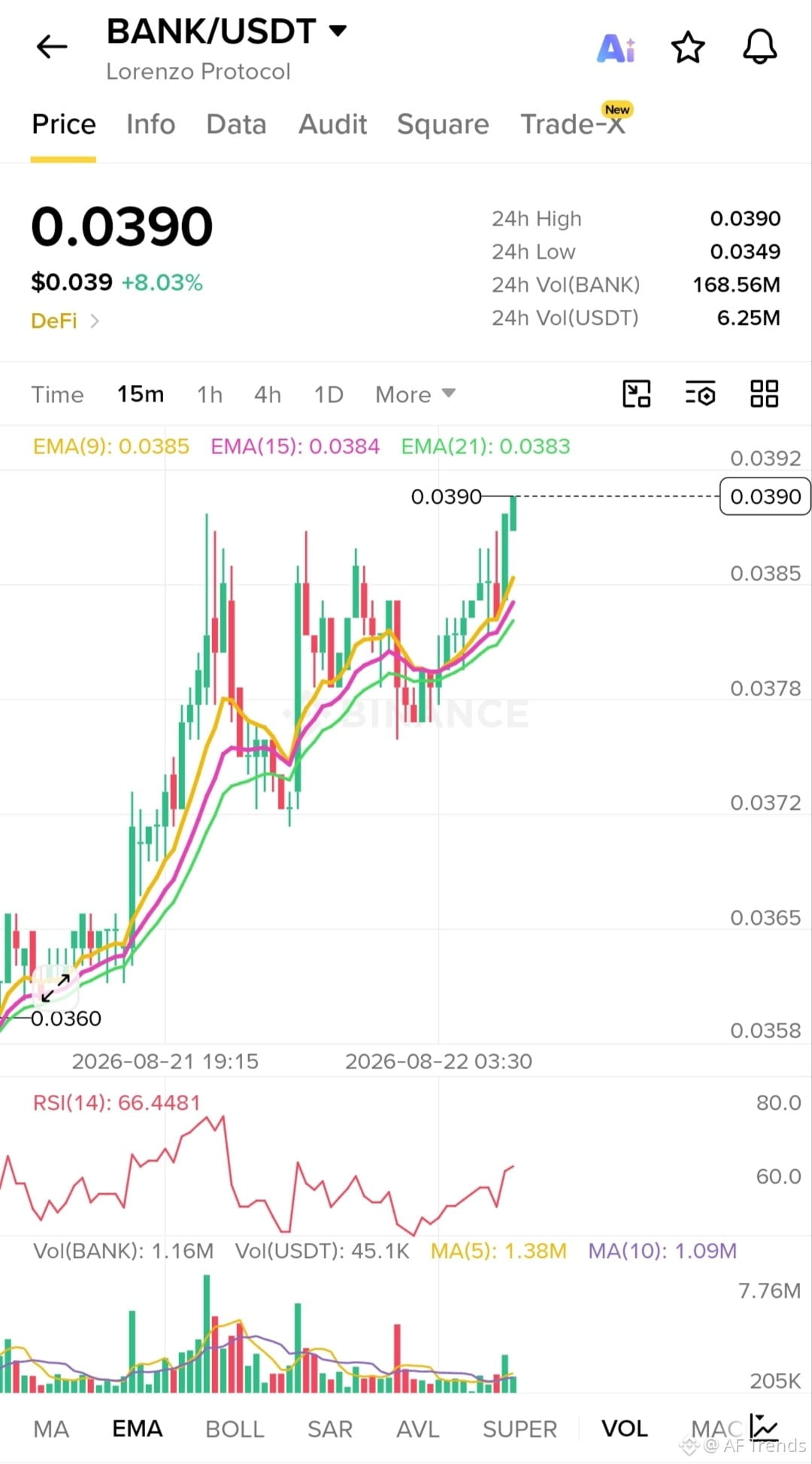
$BANK is showing a solid recovery setup on the lower timeframes after bouncing off its recent low near 0.0341 USDT. The RSI is currently hovering around 66 which shows strong bullish momentum building up without being overextended just yet. Price action has pushed past the short-term moving averages with the EMA 9 crossing cleanly above the EMA 21 confirming buyers are stepping back in control. Volume is picking up nicely which adds weight to this upward move.
Trade Setup
Entry Point: 0.0385 to 0.0390 USDT
Take Profit: 0.0435 USDT
Stop Loss: 0.0365 USDT
Disclaimer: Trading cryptocurrency carries high risk and market conditions can change rapidly. Always manage your risk and trade responsibly.
Click the chart below to trade.
{spot}(BANKUSDT)
If you found this analysis helpful, click Follow for the next update.
$BANK is showing a solid recovery setup on the lower timeframes after bouncing off its recent low near 0.0341 USDT. The RSI is currently hovering around 66 which shows strong bullish momentum building up without being overextended just yet. Price action has pushed past the short-term moving averages with the EMA 9 crossing cleanly above the EMA 21 confirming buyers are stepping back in control. Volume is picking up nicely which adds weight to this upward move.
Trade Setup
Entry Point: 0.0385 to 0.0390 USDT
Take Profit: 0.0435 USDT
Stop Loss: 0.0365 USDT
Disclaimer: Trading cryptocurrency carries high risk and market conditions can change rapidly. Always manage your risk and trade responsibly.
Click the chart below to trade.
If you found this analysis helpful, click Follow for the next update.
Trade Setup
Entry Point: 0.0385 to 0.0390 USDT
Take Profit: 0.0435 USDT
Stop Loss: 0.0365 USDT
Disclaimer: Trading cryptocurrency carries high risk and market conditions can change rapidly. Always manage your risk and trade responsibly.
Click the chart below to trade.
If you found this analysis helpful, click Follow for the next update.
1
1
371
·
--
#dusk $DUSK @Dusk_Foundation
The more I look at regulated finance on-chain, the more I think the difficult part isn't putting an asset on a blockchain.
It's making the blockchain understand why that asset is allowed to move.
I used to think RWA tokenization was mainly about creating a digital version of an existing financial asset. Once it was on-chain, I assumed the main challenge was trading and settlement.
But Dusk made me look at it differently.
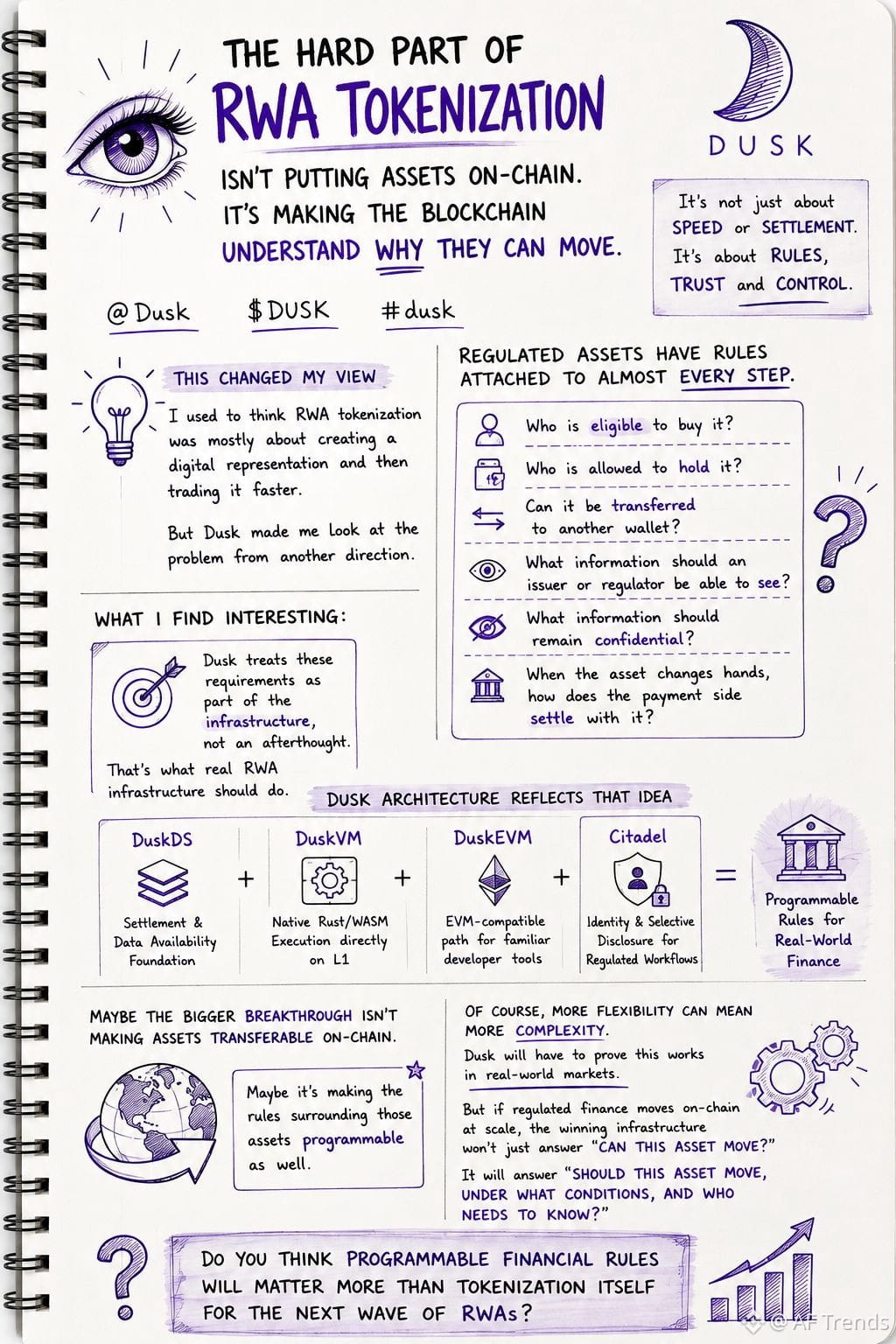
A regulated asset has rules around almost everything:
Who can buy it?
Who can hold it?
Can it move to another wallet?
What needs to be disclosed?
What should remain private?
And how does payment settle alongside the asset?
What interests me is that Dusk treats these requirements as part of the infrastructure rather than something applications simply add later.
Its architecture reflects this approach: DuskDS provides settlement and data availability, while DuskVM supports native L1 execution and DuskEVM provides an EVM-compatible environment. Citadel adds identity and selective-disclosure capabilities for regulated workflows.
That made me rethink RWA infrastructure.
Maybe the bigger breakthrough isn't simply making financial assets transferable on-chain.
Maybe it's making the rules surrounding those assets programmable too.
Of course, Dusk still has to prove that this approach actually makes real financial markets simpler rather than more complicated.
But that's what I'm watching.
If RWAs scale, the important question may not just be “Can this asset move?”
It may be “Should it move, under what conditions, and who needs to know?”
Do programmable financial rules matter more than tokenization itself?
#dusk $DUSK @Dusk
The more I look at regulated finance on-chain, the more I think the difficult part isn't putting an asset on a blockchain.
It's making the blockchain understand why that asset is allowed to move.
I used to think RWA tokenization was mainly about creating a digital version of an existing financial asset. Once it was on-chain, I assumed the main challenge was trading and settlement.
But Dusk made me look at it differently.
A regulated asset has rules around almost everything:
Who can buy it?
Who can hold it?
Can it move to another wallet?
What needs to be disclosed?
What should remain private?
And how does payment settle alongside the asset?
What interests me is that Dusk treats these requirements as part of the infrastructure rather than something applications simply add later.
Its architecture reflects this approach: DuskDS provides settlement and data availability, while DuskVM supports native L1 execution and DuskEVM provides an EVM-compatible environment. Citadel adds identity and selective-disclosure capabilities for regulated workflows.
That made me rethink RWA infrastructure.
Maybe the bigger breakthrough isn't simply making financial assets transferable on-chain.
Maybe it's making the rules surrounding those assets programmable too.
Of course, Dusk still has to prove that this approach actually makes real financial markets simpler rather than more complicated.
But that's what I'm watching.
If RWAs scale, the important question may not just be “Can this asset move?”
It may be “Should it move, under what conditions, and who needs to know?”
Do programmable financial rules matter more than tokenization itself?
The more I look at regulated finance on-chain, the more I think the difficult part isn't putting an asset on a blockchain.
It's making the blockchain understand why that asset is allowed to move.
I used to think RWA tokenization was mainly about creating a digital version of an existing financial asset. Once it was on-chain, I assumed the main challenge was trading and settlement.
But Dusk made me look at it differently.
A regulated asset has rules around almost everything:
Who can buy it?
Who can hold it?
Can it move to another wallet?
What needs to be disclosed?
What should remain private?
And how does payment settle alongside the asset?
What interests me is that Dusk treats these requirements as part of the infrastructure rather than something applications simply add later.
Its architecture reflects this approach: DuskDS provides settlement and data availability, while DuskVM supports native L1 execution and DuskEVM provides an EVM-compatible environment. Citadel adds identity and selective-disclosure capabilities for regulated workflows.
That made me rethink RWA infrastructure.
Maybe the bigger breakthrough isn't simply making financial assets transferable on-chain.
Maybe it's making the rules surrounding those assets programmable too.
Of course, Dusk still has to prove that this approach actually makes real financial markets simpler rather than more complicated.
But that's what I'm watching.
If RWAs scale, the important question may not just be “Can this asset move?”
It may be “Should it move, under what conditions, and who needs to know?”
Do programmable financial rules matter more than tokenization itself?
5
4
88
·
--
#termmax @termmax
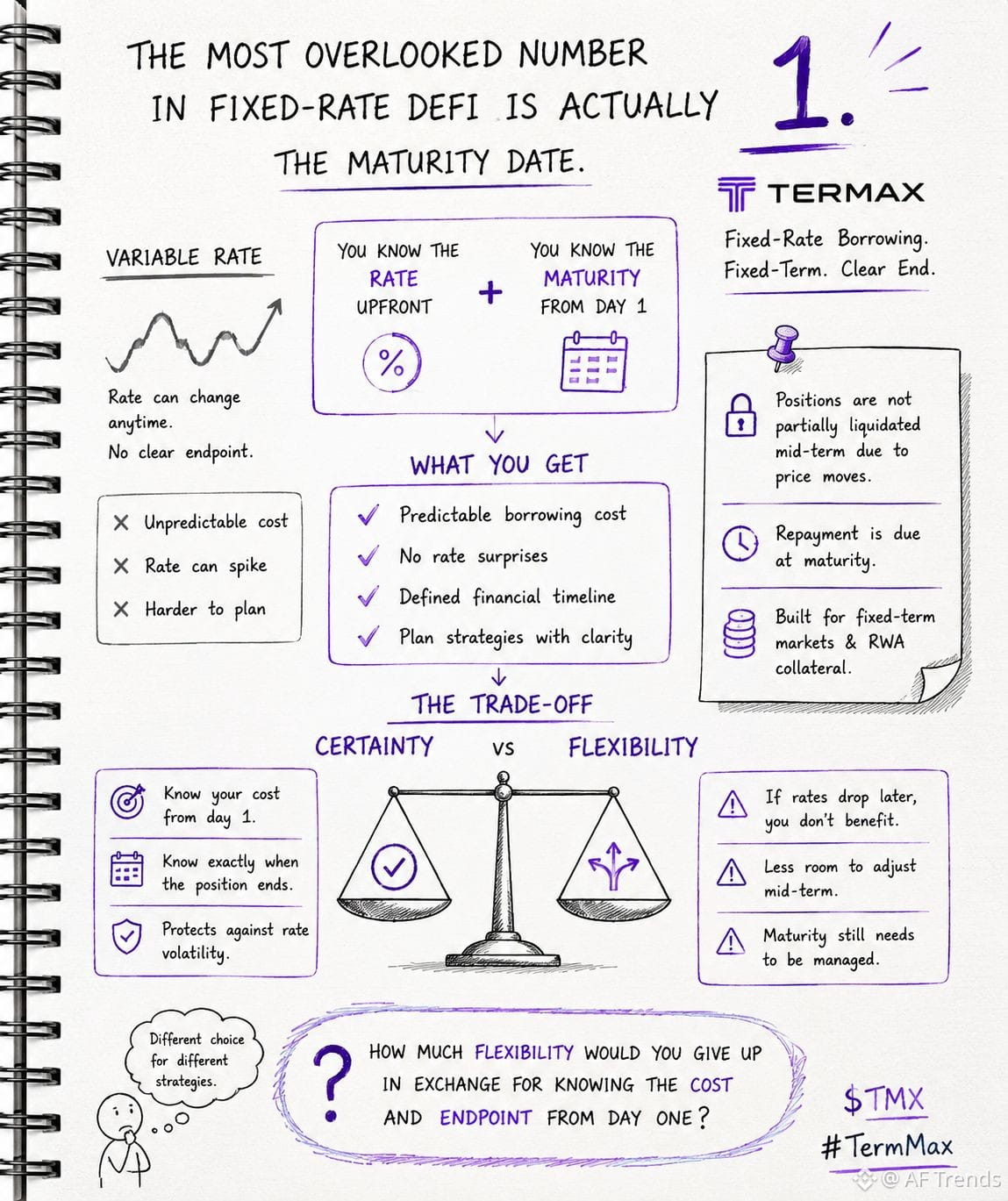
1 number can make a fixed-rate loan look simple: the rate.
But I think the more important number is the maturity.
That’s what made me look closer at @termmax .
With TermMax, we agree on 2 things upfront:
1. The borrowing rate
2. The date the position ends
So the cost isn’t constantly changing, and you know when the position needs to be repaid.
That sounds simple until you compare it with the usual DeFi experience.
Variable rates give you flexibility — but the cost can move.
Fixed terms give you predictability — but you give up some flexibility.
And that’s the trade-off I find more interesting.
If rates suddenly move in your favor after entering a fixed-rate position, you don’t automatically get the cheaper rate. But if rates move against you, your agreed rate doesn’t suddenly jump either.
So I don’t think the real question is:
“Are fixed rates better?”
It’s:
“How much flexibility would you give up to know your cost AND your endpoint from day one?”
That’s the part of @termmax I keep thinking about. #TermMax
#termmax @TermMax
1 number can make a fixed-rate loan look simple: the rate.
But I think the more important number is the maturity.
That’s what made me look closer at @TermMax .
With TermMax, we agree on 2 things upfront:
1. The borrowing rate
2. The date the position ends
So the cost isn’t constantly changing, and you know when the position needs to be repaid.
That sounds simple until you compare it with the usual DeFi experience.
Variable rates give you flexibility — but the cost can move.
Fixed terms give you predictability — but you give up some flexibility.
And that’s the trade-off I find more interesting.
If rates suddenly move in your favor after entering a fixed-rate position, you don’t automatically get the cheaper rate. But if rates move against you, your agreed rate doesn’t suddenly jump either.
So I don’t think the real question is:
“Are fixed rates better?”
It’s:
“How much flexibility would you give up to know your cost AND your endpoint from day one?”
That’s the part of @TermMax I keep thinking about. #TermMax
1 number can make a fixed-rate loan look simple: the rate.
But I think the more important number is the maturity.
That’s what made me look closer at @TermMax .
With TermMax, we agree on 2 things upfront:
1. The borrowing rate
2. The date the position ends
So the cost isn’t constantly changing, and you know when the position needs to be repaid.
That sounds simple until you compare it with the usual DeFi experience.
Variable rates give you flexibility — but the cost can move.
Fixed terms give you predictability — but you give up some flexibility.
And that’s the trade-off I find more interesting.
If rates suddenly move in your favor after entering a fixed-rate position, you don’t automatically get the cheaper rate. But if rates move against you, your agreed rate doesn’t suddenly jump either.
So I don’t think the real question is:
“Are fixed rates better?”
It’s:
“How much flexibility would you give up to know your cost AND your endpoint from day one?”
That’s the part of @TermMax I keep thinking about. #TermMax
8
9
124
·
--
Bullish
#dusk $DUSK @Dusk_Foundation
I used to think that having multiple execution environments on a blockchain sounded like unnecessary complexity.
If developers can already build smart contracts, why not just give everyone one environment and keep things simple?
But looking more closely at Dusk changed that assumption for me.
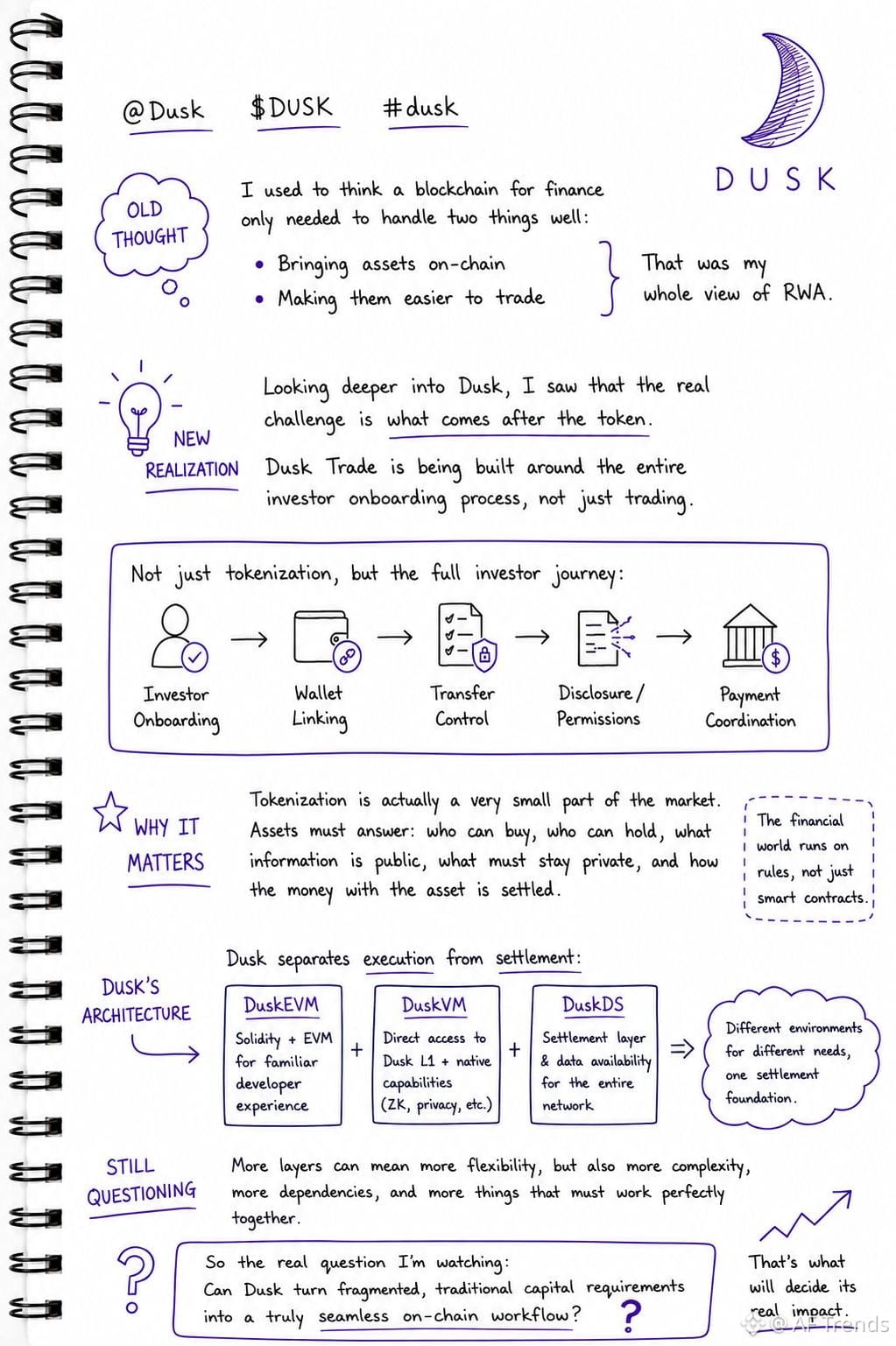
Dusk separates the part that executes applications from the part responsible for settlement and data availability. DuskEVM gives developers a familiar Solidity/EVM path, while DuskVM is designed for applications that need direct access to the Dusk L1 and its native capabilities. Underneath them sits DuskDS as the settlement and data-availability foundation.
At first, that sounds like architecture for developers to worry about.
Then I started thinking about regulated financial assets.
A tokenized fund might want familiar EVM tooling. Another application might need direct access to native assets, privacy or zero-knowledge capabilities. And the underlying market still needs predictable settlement regardless of which environment the application uses.
That made me rethink the idea of “one blockchain, one execution layer.”
Maybe financial infrastructure doesn't need every application to work in exactly the same way.
Maybe it needs different environments that can specialize while still sharing the same settlement foundation.
I also like the fact that Dusk isn't pretending this automatically solves everything. More layers can mean more flexibility, but they can also introduce more complexity, more dependencies and more things that need to work reliably together.
So the question I'm watching isn't simply whether Dusk's architecture is technically clever.
It's whether this separation can actually make regulated financial applications easier to build and operate at scale.
Because if developers get flexibility but institutions get complexity, the architecture hasn't solved the real problem.
Would you trust a financial blockchain more if it had one simple execution layer, or if different layers were purpose-built for different jobs?
#dusk $DUSK @Dusk
I used to think that having multiple execution environments on a blockchain sounded like unnecessary complexity.
If developers can already build smart contracts, why not just give everyone one environment and keep things simple?
But looking more closely at Dusk changed that assumption for me.
Dusk separates the part that executes applications from the part responsible for settlement and data availability. DuskEVM gives developers a familiar Solidity/EVM path, while DuskVM is designed for applications that need direct access to the Dusk L1 and its native capabilities. Underneath them sits DuskDS as the settlement and data-availability foundation.
At first, that sounds like architecture for developers to worry about.
Then I started thinking about regulated financial assets.
A tokenized fund might want familiar EVM tooling. Another application might need direct access to native assets, privacy or zero-knowledge capabilities. And the underlying market still needs predictable settlement regardless of which environment the application uses.
That made me rethink the idea of “one blockchain, one execution layer.”
Maybe financial infrastructure doesn't need every application to work in exactly the same way.
Maybe it needs different environments that can specialize while still sharing the same settlement foundation.
I also like the fact that Dusk isn't pretending this automatically solves everything. More layers can mean more flexibility, but they can also introduce more complexity, more dependencies and more things that need to work reliably together.
So the question I'm watching isn't simply whether Dusk's architecture is technically clever.
It's whether this separation can actually make regulated financial applications easier to build and operate at scale.
Because if developers get flexibility but institutions get complexity, the architecture hasn't solved the real problem.
Would you trust a financial blockchain more if it had one simple execution layer, or if different layers were purpose-built for different jobs?
I used to think that having multiple execution environments on a blockchain sounded like unnecessary complexity.
If developers can already build smart contracts, why not just give everyone one environment and keep things simple?
But looking more closely at Dusk changed that assumption for me.
Dusk separates the part that executes applications from the part responsible for settlement and data availability. DuskEVM gives developers a familiar Solidity/EVM path, while DuskVM is designed for applications that need direct access to the Dusk L1 and its native capabilities. Underneath them sits DuskDS as the settlement and data-availability foundation.
At first, that sounds like architecture for developers to worry about.
Then I started thinking about regulated financial assets.
A tokenized fund might want familiar EVM tooling. Another application might need direct access to native assets, privacy or zero-knowledge capabilities. And the underlying market still needs predictable settlement regardless of which environment the application uses.
That made me rethink the idea of “one blockchain, one execution layer.”
Maybe financial infrastructure doesn't need every application to work in exactly the same way.
Maybe it needs different environments that can specialize while still sharing the same settlement foundation.
I also like the fact that Dusk isn't pretending this automatically solves everything. More layers can mean more flexibility, but they can also introduce more complexity, more dependencies and more things that need to work reliably together.
So the question I'm watching isn't simply whether Dusk's architecture is technically clever.
It's whether this separation can actually make regulated financial applications easier to build and operate at scale.
Because if developers get flexibility but institutions get complexity, the architecture hasn't solved the real problem.
Would you trust a financial blockchain more if it had one simple execution layer, or if different layers were purpose-built for different jobs?
9
7
95
·
--
#termmax @termmax
5–10 transactions for one leveraged position sounds like a small inconvenience. I don't think it is.
I kept coming back to that number while looking at @termmax .
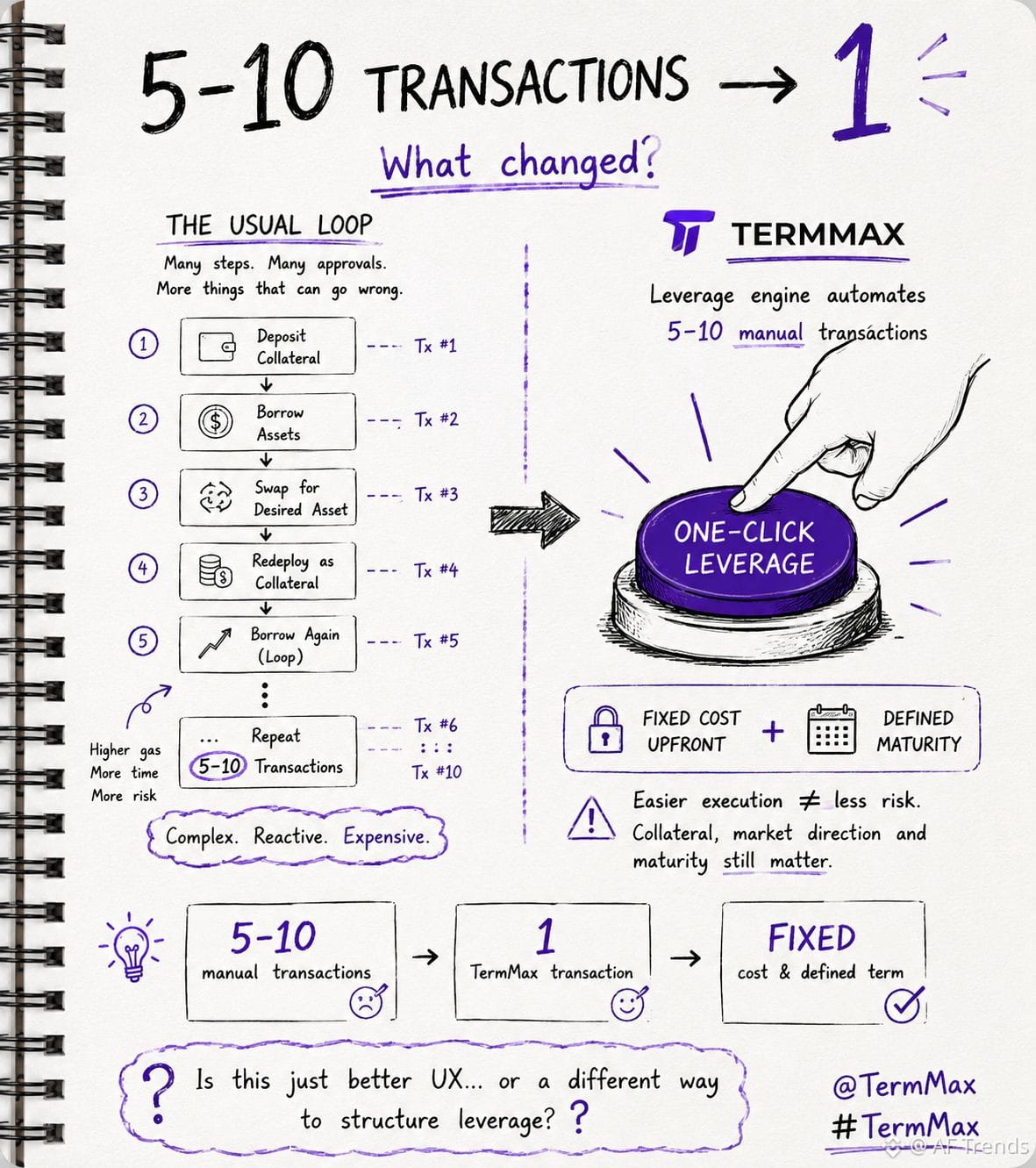
The usual loop can mean depositing collateral, borrowing, swapping, redepositing and repeating. TermMax says its leverage engine compresses that process into a single transaction.
But the interesting part isn't really the button.
It's what happens after it.
The leverage cost is fixed upfront, and the position has a defined maturity. So instead of constantly managing a loop while rates and funding conditions move, you start with a known cost and an actual endpoint.
That doesn't make leverage safe. Collateral, market direction and maturity still matter.
But it does make me question how we normally measure “better” DeFi leverage.
Is fewer transactions just better UX, or does combining automation + fixed cost + defined expiry create a fundamentally different way to structure leveraged positions?
That's the part of @termmax I want to watch more closely.
#TermMax
#termmax @TermMax
5–10 transactions for one leveraged position sounds like a small inconvenience. I don't think it is.
I kept coming back to that number while looking at @TermMax .
The usual loop can mean depositing collateral, borrowing, swapping, redepositing and repeating. TermMax says its leverage engine compresses that process into a single transaction.
But the interesting part isn't really the button.
It's what happens after it.
The leverage cost is fixed upfront, and the position has a defined maturity. So instead of constantly managing a loop while rates and funding conditions move, you start with a known cost and an actual endpoint.
That doesn't make leverage safe. Collateral, market direction and maturity still matter.
But it does make me question how we normally measure “better” DeFi leverage.
Is fewer transactions just better UX, or does combining automation + fixed cost + defined expiry create a fundamentally different way to structure leveraged positions?
That's the part of @TermMax I want to watch more closely.
#TermMax
5–10 transactions for one leveraged position sounds like a small inconvenience. I don't think it is.
I kept coming back to that number while looking at @TermMax .
The usual loop can mean depositing collateral, borrowing, swapping, redepositing and repeating. TermMax says its leverage engine compresses that process into a single transaction.
But the interesting part isn't really the button.
It's what happens after it.
The leverage cost is fixed upfront, and the position has a defined maturity. So instead of constantly managing a loop while rates and funding conditions move, you start with a known cost and an actual endpoint.
That doesn't make leverage safe. Collateral, market direction and maturity still matter.
But it does make me question how we normally measure “better” DeFi leverage.
Is fewer transactions just better UX, or does combining automation + fixed cost + defined expiry create a fundamentally different way to structure leveraged positions?
That's the part of @TermMax I want to watch more closely.
#TermMax
9
5
110
·
--
Bullish
#dusk $DUSK @Dusk_Foundation
I think the most interesting thing about Dusk might be something users never notice.
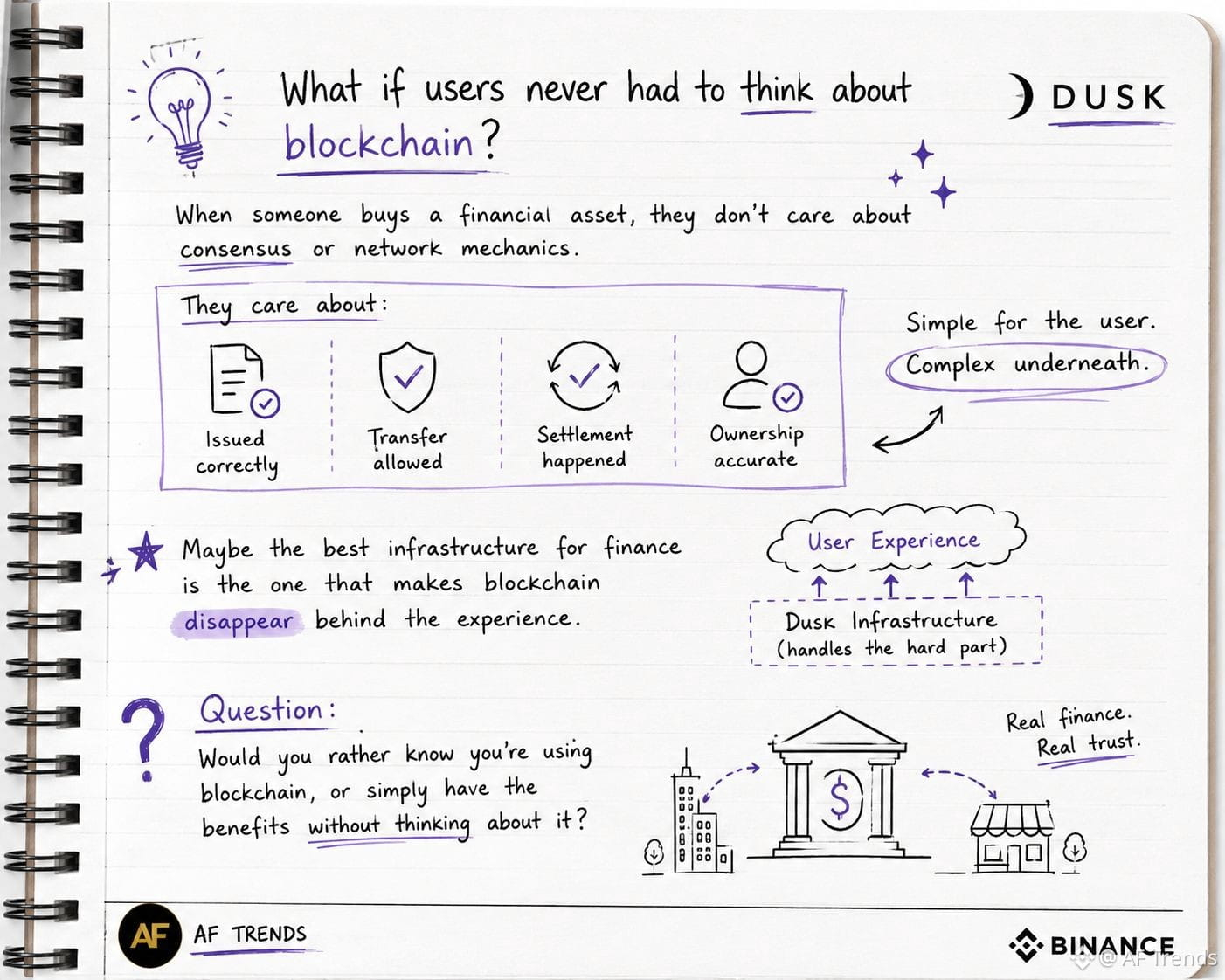
When someone buys a financial asset, they probably don't care which consensus mechanism is running underneath or how the network processes the transaction.
They care that the asset was issued correctly, the transfer was allowed, settlement happened, and their ownership record is accurate.
That made me look at Dusk a little differently.
Maybe the best blockchain infrastructure for finance isn't the one that constantly reminds users they're using blockchain.
Maybe it's the one that quietly handles the complicated parts underneath while the experience still feels like a normal financial product.
That's a much harder problem than simply making transactions faster.
And I'm curious whether Dusk can actually make blockchain infrastructure disappear behind the financial experience once real users arrive.
Would you rather know you're using blockchain, or simply have the benefits without thinking about the blockchain at all?
#dusk $DUSK @Dusk
I think the most interesting thing about Dusk might be something users never notice.
When someone buys a financial asset, they probably don't care which consensus mechanism is running underneath or how the network processes the transaction.
They care that the asset was issued correctly, the transfer was allowed, settlement happened, and their ownership record is accurate.
That made me look at Dusk a little differently.
Maybe the best blockchain infrastructure for finance isn't the one that constantly reminds users they're using blockchain.
Maybe it's the one that quietly handles the complicated parts underneath while the experience still feels like a normal financial product.
That's a much harder problem than simply making transactions faster.
And I'm curious whether Dusk can actually make blockchain infrastructure disappear behind the financial experience once real users arrive.
Would you rather know you're using blockchain, or simply have the benefits without thinking about the blockchain at all?
I think the most interesting thing about Dusk might be something users never notice.
When someone buys a financial asset, they probably don't care which consensus mechanism is running underneath or how the network processes the transaction.
They care that the asset was issued correctly, the transfer was allowed, settlement happened, and their ownership record is accurate.
That made me look at Dusk a little differently.
Maybe the best blockchain infrastructure for finance isn't the one that constantly reminds users they're using blockchain.
Maybe it's the one that quietly handles the complicated parts underneath while the experience still feels like a normal financial product.
That's a much harder problem than simply making transactions faster.
And I'm curious whether Dusk can actually make blockchain infrastructure disappear behind the financial experience once real users arrive.
Would you rather know you're using blockchain, or simply have the benefits without thinking about the blockchain at all?
23
11
134
·
--
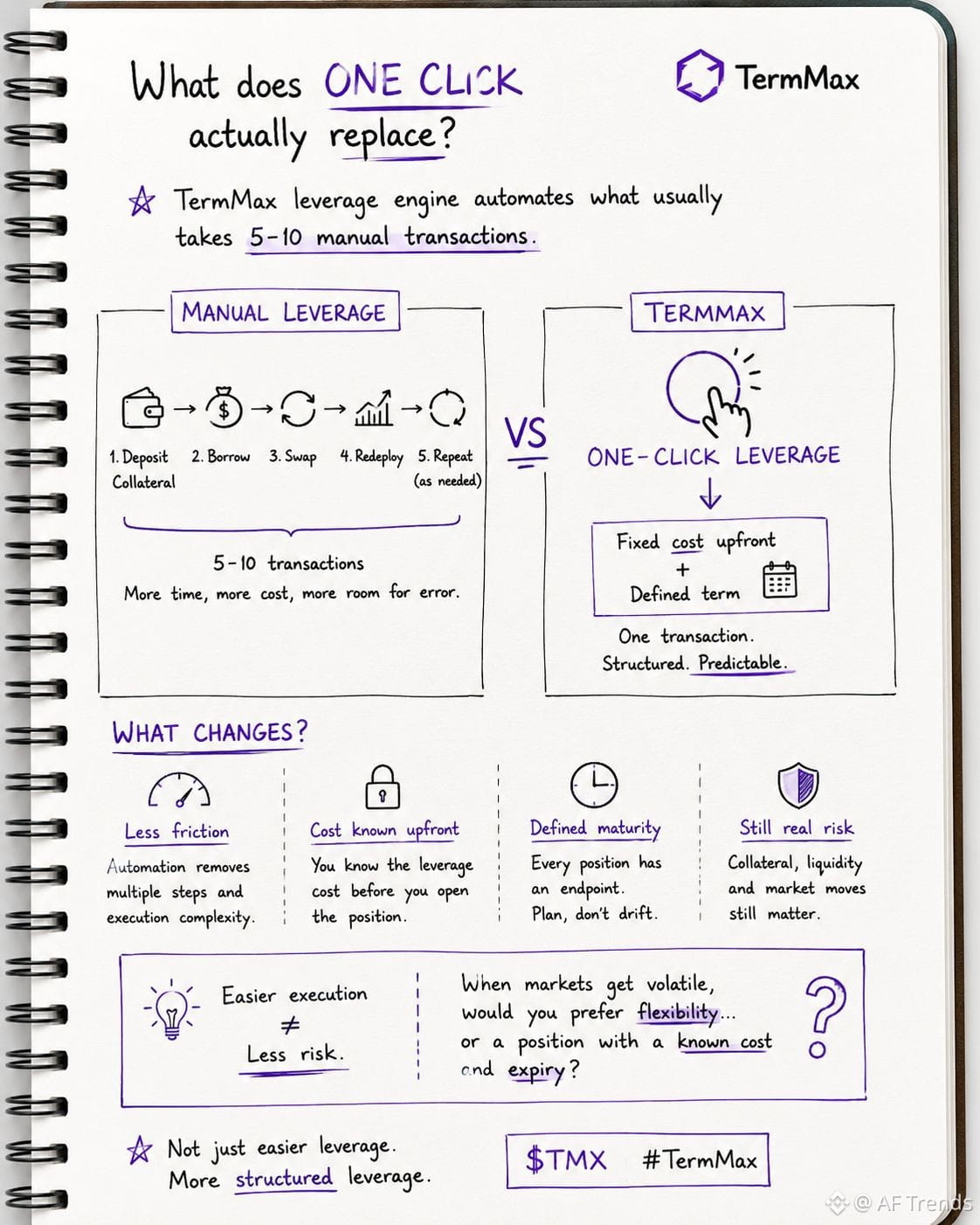
I think the most interesting part of @termmax leverage isn’t actually the “one-click” part.
It’s what that one click replaces.
A leveraged DeFi strategy can involve depositing collateral, borrowing, swapping, then redepositing — and TermMax says its leverage engine can automate what would otherwise take roughly 5–10 manual transactions.
But the bigger detail is easy to miss: the leverage cost is fixed upfront and the position has a defined term.
That changes the question I ask.
I’m less interested in “how much leverage can I get?” and more interested in “how predictable is the leverage I’m taking?”
Automation removes friction. Fixed cost removes one layer of uncertainty. A defined maturity forces the strategy to have an endpoint.
Of course, none of that makes leverage risk-free. The collateral still matters, and maturity still has to be managed.
But I think this is where @termmax gets interesting: it isn't just making leverage easier to execute — it is trying to make leveraged positions more structured.
If users can choose between flexible, constantly changing leverage and a position with a known cost and expiry, which model wins when markets get volatile?
That’s the part of TermMax I’m watching.
#TermMax #termmax
I think the most interesting part of @TermMax leverage isn’t actually the “one-click” part.
It’s what that one click replaces.
A leveraged DeFi strategy can involve depositing collateral, borrowing, swapping, then redepositing — and TermMax says its leverage engine can automate what would otherwise take roughly 5–10 manual transactions.
But the bigger detail is easy to miss: the leverage cost is fixed upfront and the position has a defined term.
That changes the question I ask.
I’m less interested in “how much leverage can I get?” and more interested in “how predictable is the leverage I’m taking?”
Automation removes friction. Fixed cost removes one layer of uncertainty. A defined maturity forces the strategy to have an endpoint.
Of course, none of that makes leverage risk-free. The collateral still matters, and maturity still has to be managed.
But I think this is where @TermMax gets interesting: it isn't just making leverage easier to execute — it is trying to make leveraged positions more structured.
If users can choose between flexible, constantly changing leverage and a position with a known cost and expiry, which model wins when markets get volatile?
That’s the part of TermMax I’m watching.
#TermMax #termmax
It’s what that one click replaces.
A leveraged DeFi strategy can involve depositing collateral, borrowing, swapping, then redepositing — and TermMax says its leverage engine can automate what would otherwise take roughly 5–10 manual transactions.
But the bigger detail is easy to miss: the leverage cost is fixed upfront and the position has a defined term.
That changes the question I ask.
I’m less interested in “how much leverage can I get?” and more interested in “how predictable is the leverage I’m taking?”
Automation removes friction. Fixed cost removes one layer of uncertainty. A defined maturity forces the strategy to have an endpoint.
Of course, none of that makes leverage risk-free. The collateral still matters, and maturity still has to be managed.
But I think this is where @TermMax gets interesting: it isn't just making leverage easier to execute — it is trying to make leveraged positions more structured.
If users can choose between flexible, constantly changing leverage and a position with a known cost and expiry, which model wins when markets get volatile?
That’s the part of TermMax I’m watching.
#TermMax #termmax
30
8
120
·
--
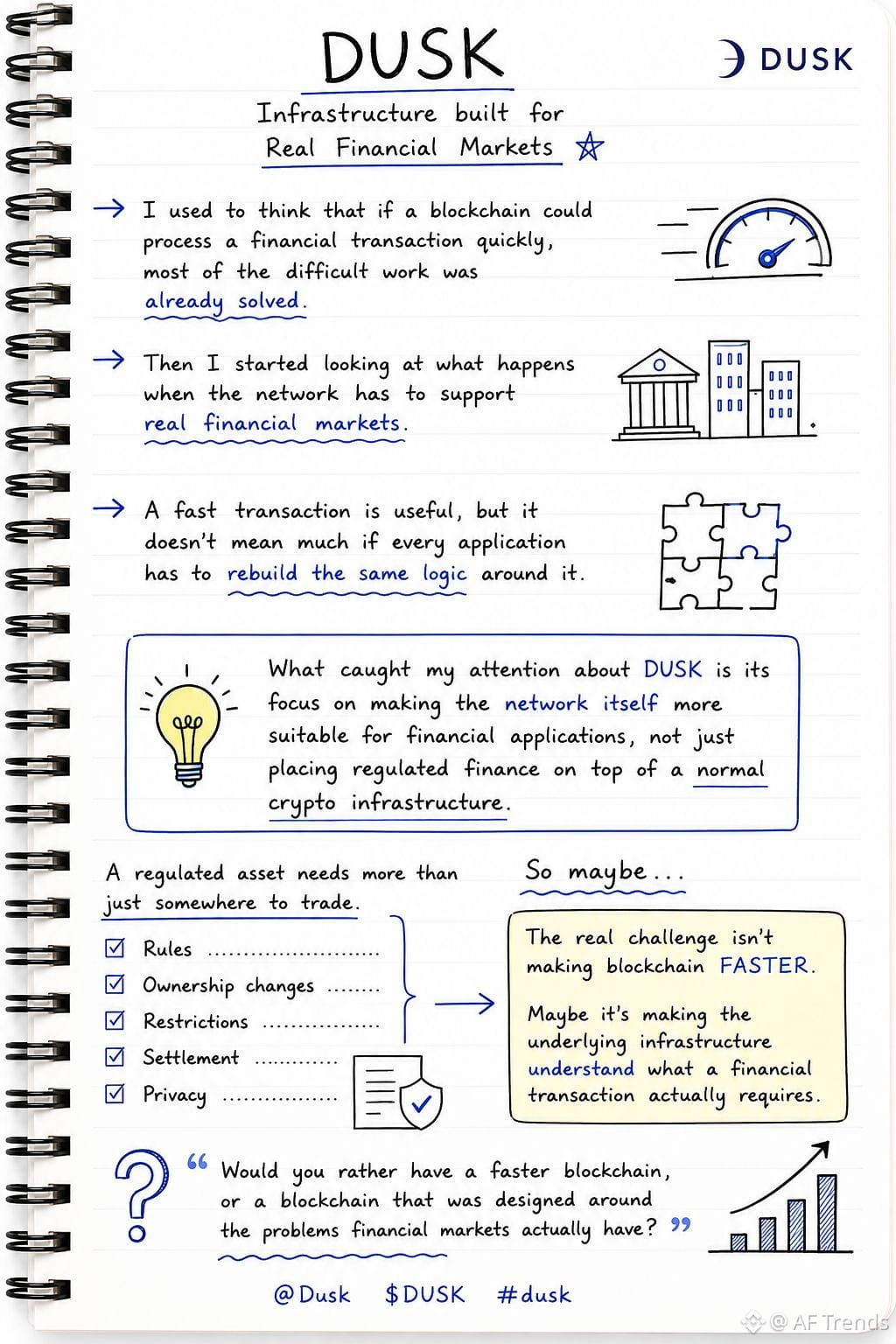
#dusk $DUSK @Dusk_Foundation
I used to think that if a blockchain could process a financial transaction quickly, most of the difficult work was already solved.
Then I started looking at what happens when the network has to support real financial markets.
A fast transaction is useful, but it doesn't mean much if every application has to rebuild the same logic around it.
What caught my attention about Dusk is its focus on making the network itself more suitable for financial applications, rather than treating regulated finance as something that can simply be placed on top of a normal crypto infrastructure.
That distinction feels important.
A bond, ETF or other regulated asset doesn't only need somewhere to trade. The network has to deal with the rules, ownership changes, settlement and privacy surrounding it.
So maybe the real challenge isn't making blockchain faster.
Maybe it's making the underlying infrastructure understand what a financial transaction actually requires.
I'm still wondering how much of that complexity can realistically be handled at the protocol level once the market gets much bigger.
Would you rather have a faster blockchain, or a blockchain that was designed around the problems financial markets actually have?
#dusk $DUSK @Dusk
I used to think that if a blockchain could process a financial transaction quickly, most of the difficult work was already solved.
Then I started looking at what happens when the network has to support real financial markets.
A fast transaction is useful, but it doesn't mean much if every application has to rebuild the same logic around it.
What caught my attention about Dusk is its focus on making the network itself more suitable for financial applications, rather than treating regulated finance as something that can simply be placed on top of a normal crypto infrastructure.
That distinction feels important.
A bond, ETF or other regulated asset doesn't only need somewhere to trade. The network has to deal with the rules, ownership changes, settlement and privacy surrounding it.
So maybe the real challenge isn't making blockchain faster.
Maybe it's making the underlying infrastructure understand what a financial transaction actually requires.
I'm still wondering how much of that complexity can realistically be handled at the protocol level once the market gets much bigger.
Would you rather have a faster blockchain, or a blockchain that was designed around the problems financial markets actually have?
I used to think that if a blockchain could process a financial transaction quickly, most of the difficult work was already solved.
Then I started looking at what happens when the network has to support real financial markets.
A fast transaction is useful, but it doesn't mean much if every application has to rebuild the same logic around it.
What caught my attention about Dusk is its focus on making the network itself more suitable for financial applications, rather than treating regulated finance as something that can simply be placed on top of a normal crypto infrastructure.
That distinction feels important.
A bond, ETF or other regulated asset doesn't only need somewhere to trade. The network has to deal with the rules, ownership changes, settlement and privacy surrounding it.
So maybe the real challenge isn't making blockchain faster.
Maybe it's making the underlying infrastructure understand what a financial transaction actually requires.
I'm still wondering how much of that complexity can realistically be handled at the protocol level once the market gets much bigger.
Would you rather have a faster blockchain, or a blockchain that was designed around the problems financial markets actually have?
30
7
113
·
--
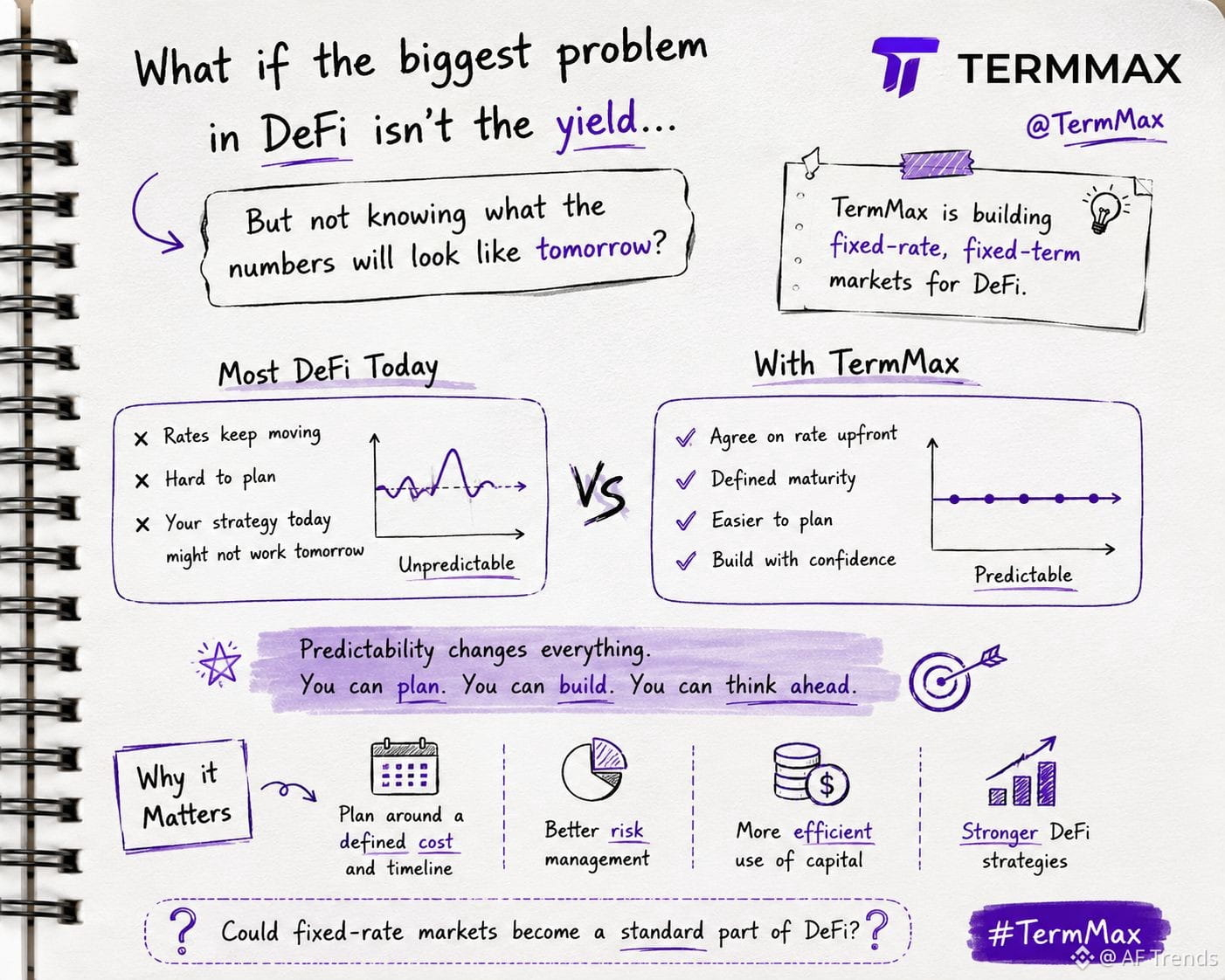
#termmax @termmax
What if the biggest problem with DeFi isn’t the yield — but not knowing what the numbers will look like tomorrow?
That thought made me look closer at @termmax .
What I find interesting is the idea of fixed-term markets where borrowers and lenders can agree on the rate and maturity upfront.
It changes the way I think about DeFi.
Instead of constantly reacting to changing rates, you can actually build a plan around a defined cost and timeline.
And that matters beyond borrowing.
More predictable markets could make it easier to structure strategies, manage capital, and think further ahead.
I’m still exploring TermMax, but this is one of the ideas that genuinely stood out to me.
Could fixed-rate markets eventually become a standard part of DeFi?
#TermMax
#termmax @TermMax
What if the biggest problem with DeFi isn’t the yield — but not knowing what the numbers will look like tomorrow?
That thought made me look closer at @TermMax .
What I find interesting is the idea of fixed-term markets where borrowers and lenders can agree on the rate and maturity upfront.
It changes the way I think about DeFi.
Instead of constantly reacting to changing rates, you can actually build a plan around a defined cost and timeline.
And that matters beyond borrowing.
More predictable markets could make it easier to structure strategies, manage capital, and think further ahead.
I’m still exploring TermMax, but this is one of the ideas that genuinely stood out to me.
Could fixed-rate markets eventually become a standard part of DeFi?
#TermMax
What if the biggest problem with DeFi isn’t the yield — but not knowing what the numbers will look like tomorrow?
That thought made me look closer at @TermMax .
What I find interesting is the idea of fixed-term markets where borrowers and lenders can agree on the rate and maturity upfront.
It changes the way I think about DeFi.
Instead of constantly reacting to changing rates, you can actually build a plan around a defined cost and timeline.
And that matters beyond borrowing.
More predictable markets could make it easier to structure strategies, manage capital, and think further ahead.
I’m still exploring TermMax, but this is one of the ideas that genuinely stood out to me.
Could fixed-rate markets eventually become a standard part of DeFi?
#TermMax
19
8
131
·
--
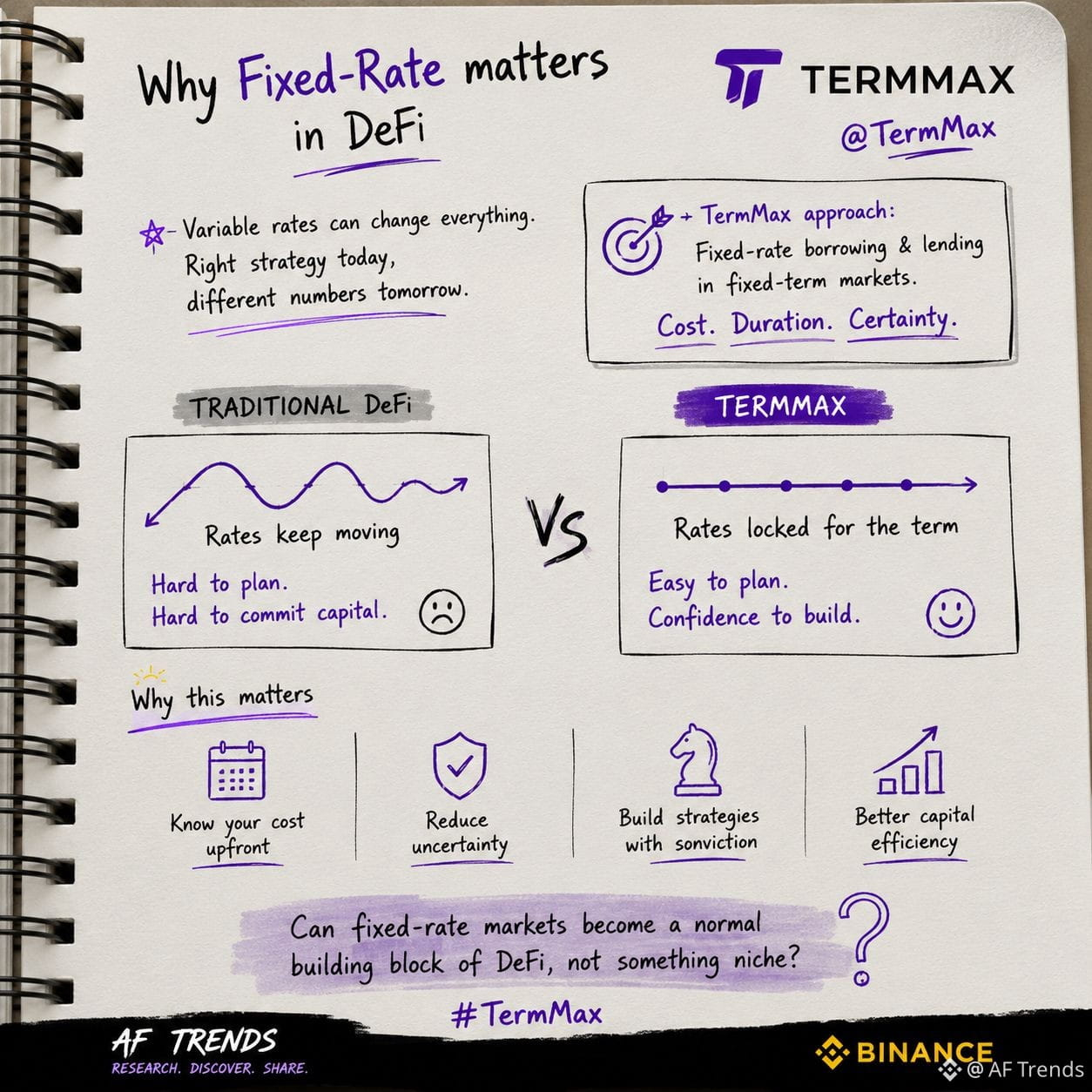
#termmax @termmax
The more I study DeFi, the more I realize that variable rates can quietly change an entire strategy.
You can have the right collateral, the right entry and even the right thesis — but if borrowing costs keep moving, the numbers can change underneath you.
That’s what makes @termmax interesting to me.
Instead of treating borrowing and lending as something that should constantly reprice, TermMax is building around fixed-rate, fixed-term markets.
That sounds like a small change.
But I think giving capital a defined cost and maturity could make onchain finance much easier to plan around.
The bigger question for me is whether fixed-rate markets can become a normal building block of DeFi, rather than something niche.
#TermMax
#termmax @TermMax
The more I study DeFi, the more I realize that variable rates can quietly change an entire strategy.
You can have the right collateral, the right entry and even the right thesis — but if borrowing costs keep moving, the numbers can change underneath you.
That’s what makes @TermMax interesting to me.
Instead of treating borrowing and lending as something that should constantly reprice, TermMax is building around fixed-rate, fixed-term markets.
That sounds like a small change.
But I think giving capital a defined cost and maturity could make onchain finance much easier to plan around.
The bigger question for me is whether fixed-rate markets can become a normal building block of DeFi, rather than something niche.
#TermMax
The more I study DeFi, the more I realize that variable rates can quietly change an entire strategy.
You can have the right collateral, the right entry and even the right thesis — but if borrowing costs keep moving, the numbers can change underneath you.
That’s what makes @TermMax interesting to me.
Instead of treating borrowing and lending as something that should constantly reprice, TermMax is building around fixed-rate, fixed-term markets.
That sounds like a small change.
But I think giving capital a defined cost and maturity could make onchain finance much easier to plan around.
The bigger question for me is whether fixed-rate markets can become a normal building block of DeFi, rather than something niche.
#TermMax
18
8
94
·
--
Bullish
#dusk $DUSK @Dusk_Foundation
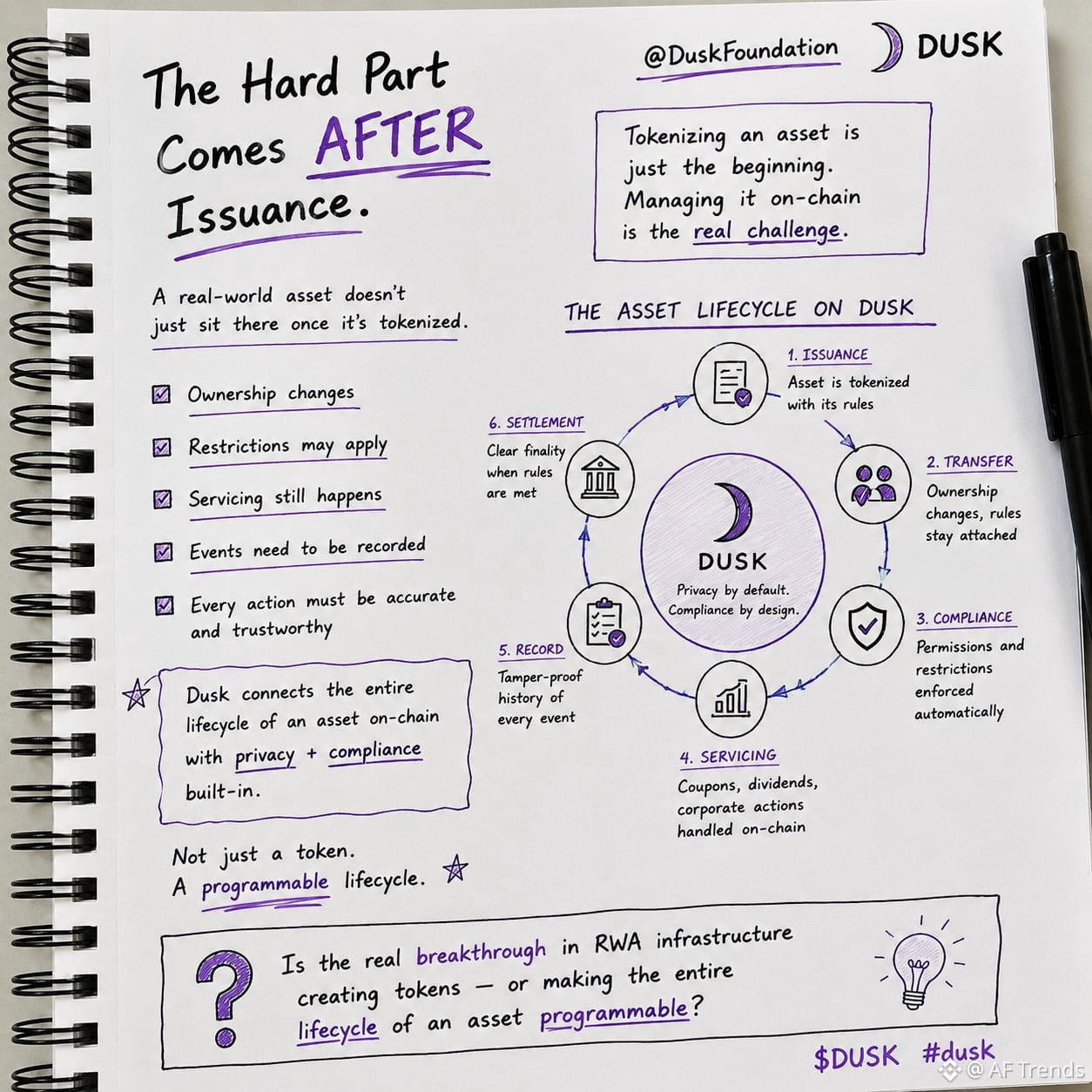
I used to think the hardest part of putting regulated assets on-chain would be getting the asset there in the first place.
The more I look at Dusk, the more I’m wondering if the harder problem comes after issuance.
A bond doesn't just sit there once it's tokenized. Ownership can change, restrictions can apply, servicing still happens, and eventually someone needs an accurate record of what actually happened.
That made Dusk’s approach feel different to me.
The interesting part isn't simply creating a digital version of an asset. It's whether the blockchain can keep the asset's identity, rules and lifecycle connected as it moves through the market.
That sounds obvious until you think about how many systems traditionally touch one financial asset.
I'm still not convinced putting everything on-chain automatically makes finance simpler.
But if the asset can carry its rules with it instead of relying on separate systems to keep checking them, that could be a much bigger change than tokenization itself.
Is the real breakthrough in RWA infrastructure creating tokens — or making the entire lifecycle of an asset programmable?
#dusk $DUSK @Dusk
I used to think the hardest part of putting regulated assets on-chain would be getting the asset there in the first place.
The more I look at Dusk, the more I’m wondering if the harder problem comes after issuance.
A bond doesn't just sit there once it's tokenized. Ownership can change, restrictions can apply, servicing still happens, and eventually someone needs an accurate record of what actually happened.
That made Dusk’s approach feel different to me.
The interesting part isn't simply creating a digital version of an asset. It's whether the blockchain can keep the asset's identity, rules and lifecycle connected as it moves through the market.
That sounds obvious until you think about how many systems traditionally touch one financial asset.
I'm still not convinced putting everything on-chain automatically makes finance simpler.
But if the asset can carry its rules with it instead of relying on separate systems to keep checking them, that could be a much bigger change than tokenization itself.
Is the real breakthrough in RWA infrastructure creating tokens — or making the entire lifecycle of an asset programmable?
I used to think the hardest part of putting regulated assets on-chain would be getting the asset there in the first place.
The more I look at Dusk, the more I’m wondering if the harder problem comes after issuance.
A bond doesn't just sit there once it's tokenized. Ownership can change, restrictions can apply, servicing still happens, and eventually someone needs an accurate record of what actually happened.
That made Dusk’s approach feel different to me.
The interesting part isn't simply creating a digital version of an asset. It's whether the blockchain can keep the asset's identity, rules and lifecycle connected as it moves through the market.
That sounds obvious until you think about how many systems traditionally touch one financial asset.
I'm still not convinced putting everything on-chain automatically makes finance simpler.
But if the asset can carry its rules with it instead of relying on separate systems to keep checking them, that could be a much bigger change than tokenization itself.
Is the real breakthrough in RWA infrastructure creating tokens — or making the entire lifecycle of an asset programmable?
20
5
120
·
--
Bullish
#dusk $DUSK @Dusk_Foundation
I used to think compliance on a blockchain mostly meant checking someone’s identity before they were allowed to use an asset.
But looking deeper into Dusk made me realize the harder part might actually happen after that check.
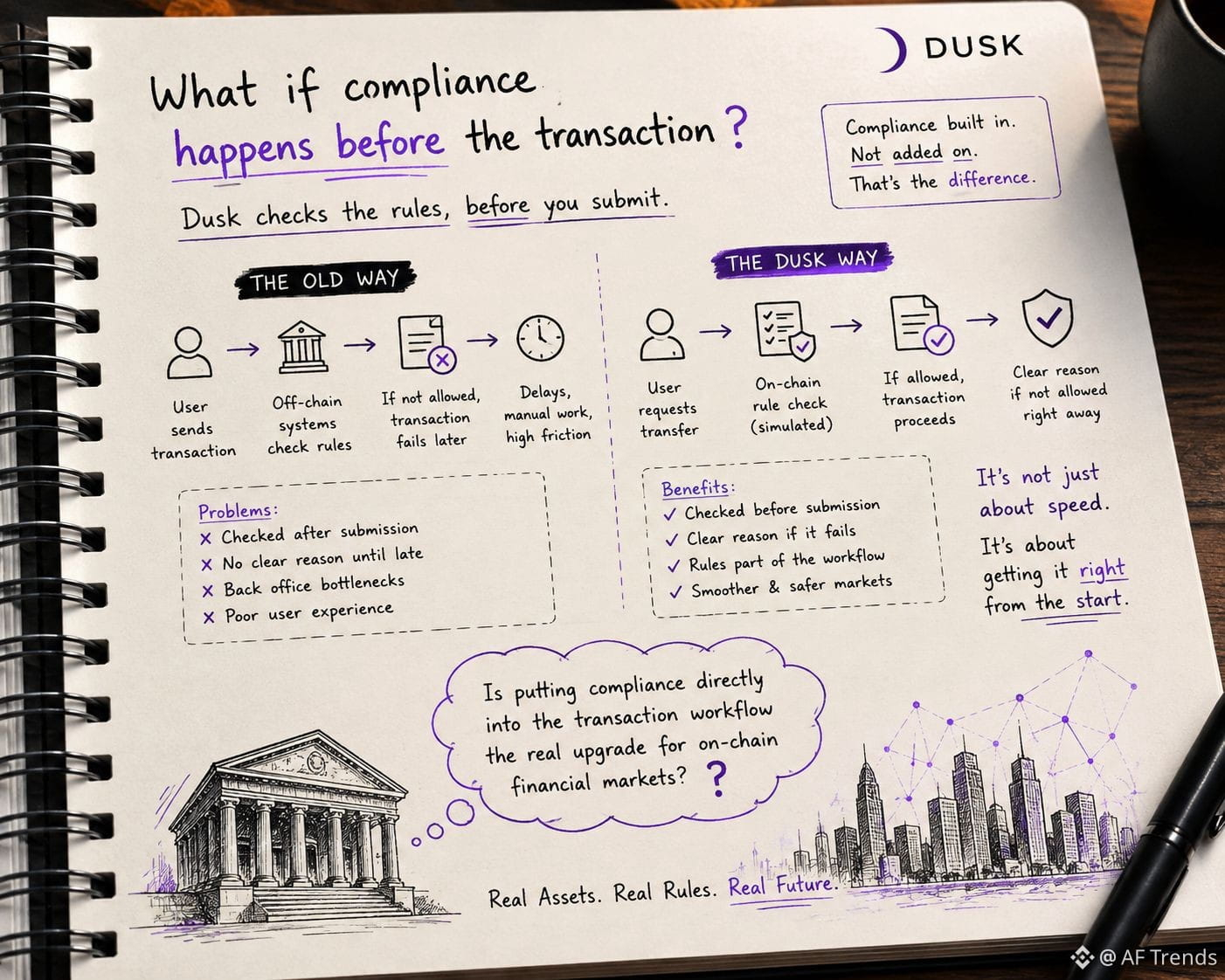
What caught my attention is the idea that a regulated transfer can be checked before it is submitted — including whether the transfer is allowed and, if not, why it would fail. 🧐
That sounds like a small detail, but it changes how I think about putting financial assets on-chain.
A blockchain doesn't just need to know who you are.
It may need to understand whether this particular transfer is allowed under the rules attached to the asset.
Eligibility, transfer restrictions, limits and other conditions can become part of the workflow instead of something a back office has to check after the transaction happens. 🔍
I actually like that idea more than simply saying “blockchain makes finance faster.”
Because speed doesn't help much if a transaction still has to stop somewhere else for someone to decide whether it was allowed.
But it also makes me wonder how complicated these rules become when real financial products have dozens of conditions and exceptions.
Does putting compliance directly into the transaction workflow actually simplify financial markets, or are we just moving the complexity from the back office into the blockchain?
@Dusk_Foundation #dusk $DUSK
#dusk $DUSK @Dusk
I used to think compliance on a blockchain mostly meant checking someone’s identity before they were allowed to use an asset.
But looking deeper into Dusk made me realize the harder part might actually happen after that check.
What caught my attention is the idea that a regulated transfer can be checked before it is submitted — including whether the transfer is allowed and, if not, why it would fail. 🧐
That sounds like a small detail, but it changes how I think about putting financial assets on-chain.
A blockchain doesn't just need to know who you are.
It may need to understand whether this particular transfer is allowed under the rules attached to the asset.
Eligibility, transfer restrictions, limits and other conditions can become part of the workflow instead of something a back office has to check after the transaction happens. 🔍
I actually like that idea more than simply saying “blockchain makes finance faster.”
Because speed doesn't help much if a transaction still has to stop somewhere else for someone to decide whether it was allowed.
But it also makes me wonder how complicated these rules become when real financial products have dozens of conditions and exceptions.
Does putting compliance directly into the transaction workflow actually simplify financial markets, or are we just moving the complexity from the back office into the blockchain?
@Dusk #dusk $DUSK
I used to think compliance on a blockchain mostly meant checking someone’s identity before they were allowed to use an asset.
But looking deeper into Dusk made me realize the harder part might actually happen after that check.
What caught my attention is the idea that a regulated transfer can be checked before it is submitted — including whether the transfer is allowed and, if not, why it would fail. 🧐
That sounds like a small detail, but it changes how I think about putting financial assets on-chain.
A blockchain doesn't just need to know who you are.
It may need to understand whether this particular transfer is allowed under the rules attached to the asset.
Eligibility, transfer restrictions, limits and other conditions can become part of the workflow instead of something a back office has to check after the transaction happens. 🔍
I actually like that idea more than simply saying “blockchain makes finance faster.”
Because speed doesn't help much if a transaction still has to stop somewhere else for someone to decide whether it was allowed.
But it also makes me wonder how complicated these rules become when real financial products have dozens of conditions and exceptions.
Does putting compliance directly into the transaction workflow actually simplify financial markets, or are we just moving the complexity from the back office into the blockchain?
@Dusk #dusk $DUSK
23
5
135
·
--
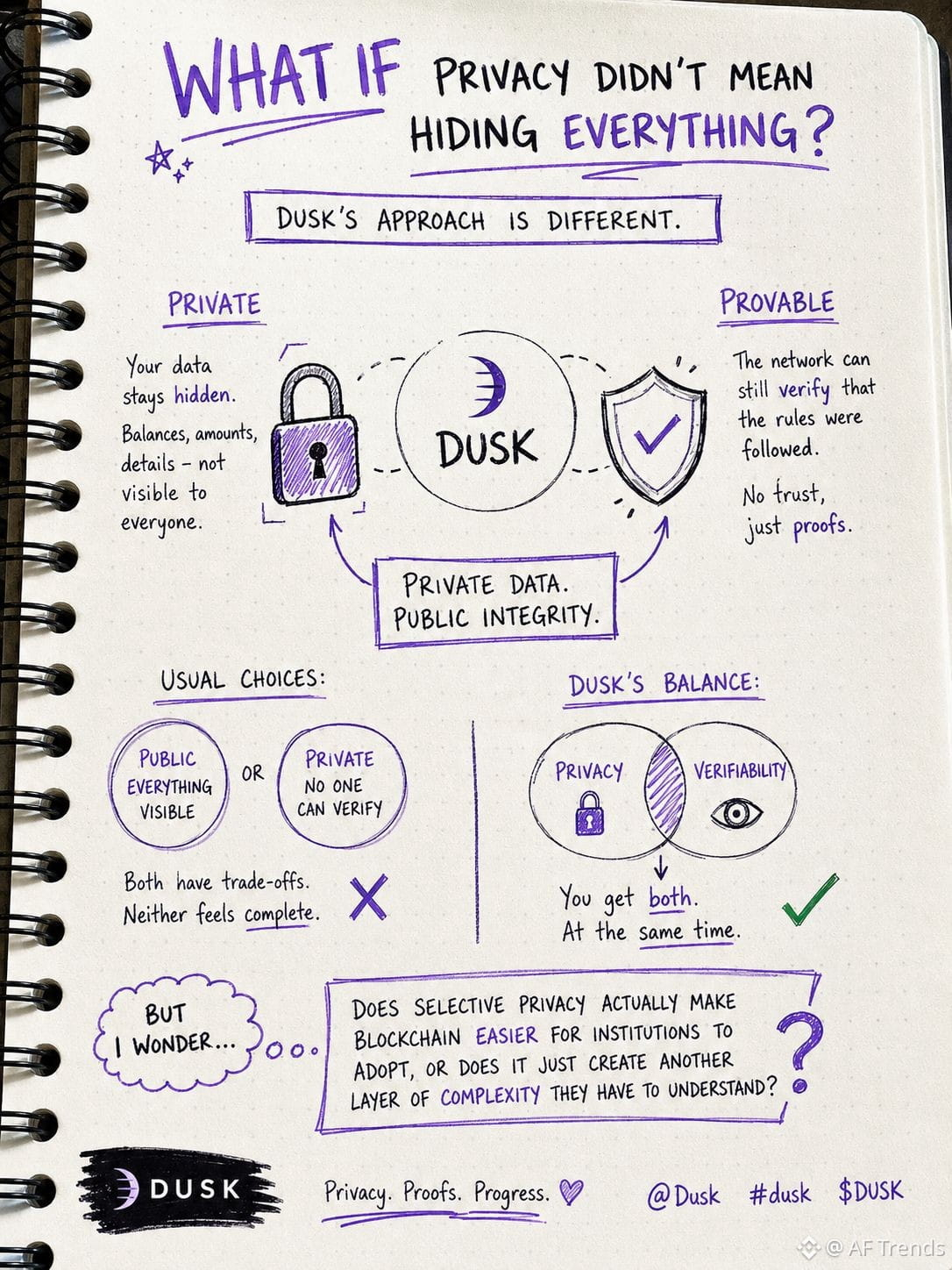
The thing I keep coming back to with Dusk is that privacy doesn't seem to mean simply hiding everything. 🧐
The interesting part is the idea of keeping sensitive transaction details private while still allowing the network to prove that the rules were followed. That's a very different approach from the usual “public blockchain vs completely private system” choice, and it makes me wonder whether privacy becomes more useful when institutions don't have to sacrifice compliance to get it 🔍
I like the idea in theory, but there's a bigger question: does selective privacy actually make blockchain easier for institutions to adopt, or does it just create another layer of complexity they have to understand?
#dusk $DUSK @Dusk_Foundation
The thing I keep coming back to with Dusk is that privacy doesn't seem to mean simply hiding everything. 🧐
The interesting part is the idea of keeping sensitive transaction details private while still allowing the network to prove that the rules were followed. That's a very different approach from the usual “public blockchain vs completely private system” choice, and it makes me wonder whether privacy becomes more useful when institutions don't have to sacrifice compliance to get it 🔍
I like the idea in theory, but there's a bigger question: does selective privacy actually make blockchain easier for institutions to adopt, or does it just create another layer of complexity they have to understand?
#dusk $DUSK @Dusk
The interesting part is the idea of keeping sensitive transaction details private while still allowing the network to prove that the rules were followed. That's a very different approach from the usual “public blockchain vs completely private system” choice, and it makes me wonder whether privacy becomes more useful when institutions don't have to sacrifice compliance to get it 🔍
I like the idea in theory, but there's a bigger question: does selective privacy actually make blockchain easier for institutions to adopt, or does it just create another layer of complexity they have to understand?
#dusk $DUSK @Dusk
5
5
133
·
--
@Dusk_Foundation $DUSK
I went back into Dusk’s transaction architecture today because I wanted to understand something I had overlooked.
At first, I assumed a privacy-focused chain would basically have one “private” way of moving assets.
But Dusk doesn’t seem to make that choice.
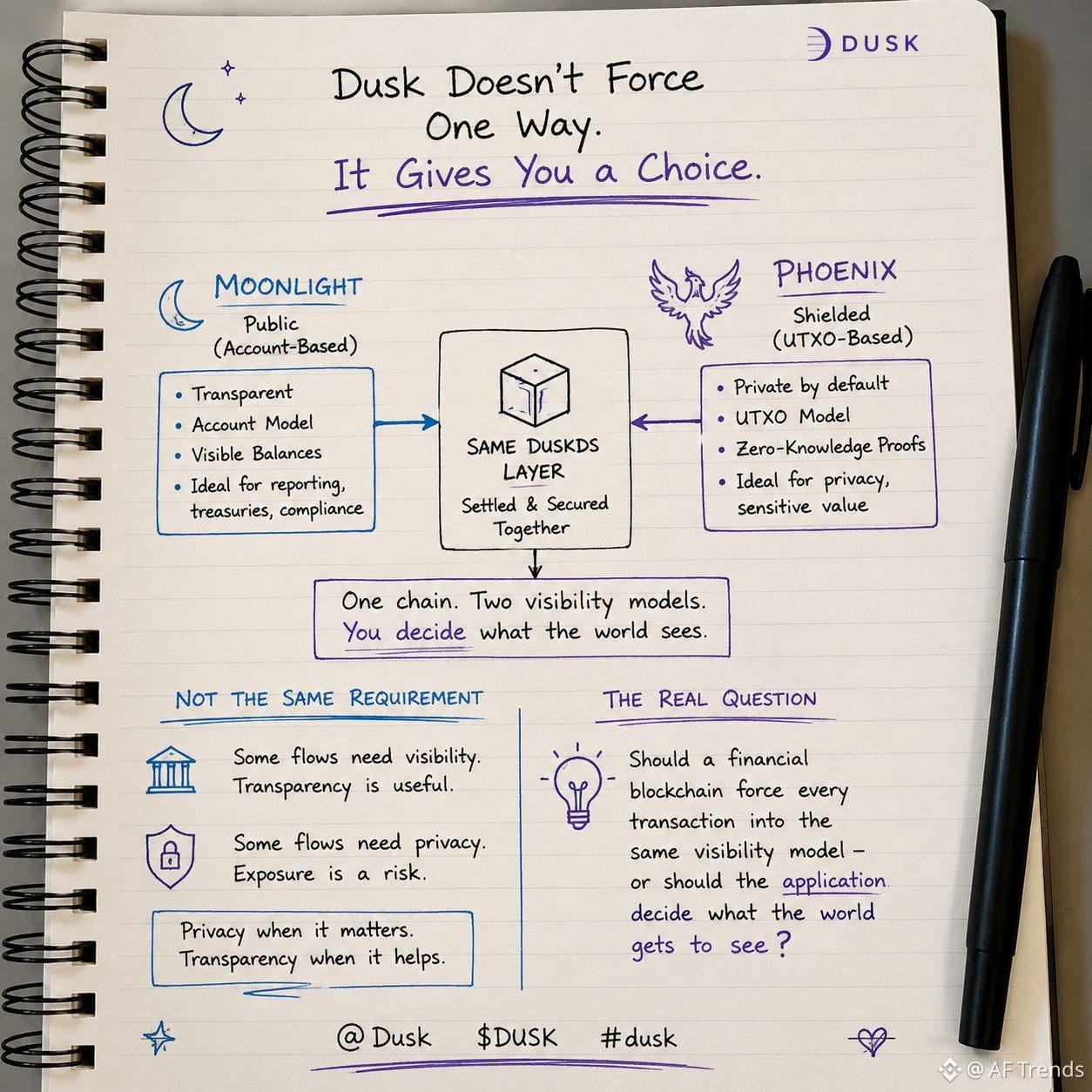
It has Moonlight for public, account-based transfers — and Phoenix for shielded, UTXO-based transfers.
What caught my attention is that these aren't two separate blockchains.
They settle on the same DuskDS layer.
That changes how I think about Dusk.
The interesting part isn't simply:
“Can a transaction be private?”
It’s:
“Does the transaction actually need to be private in the first place?”
A treasury or reporting flow might need visible balances and transfers.
Another financial workflow might need the opposite — shielded value with zero-knowledge proofs.
And both can exist within the same settlement architecture.
Those aren't the same requirement.
I initially thought privacy was the main feature Dusk was adding to blockchain finance.
Now I'm starting to think the more interesting idea is choice.
Privacy when sensitive information shouldn't be public.
Transparency when visibility is actually useful.
The real question might be:
Should a financial blockchain force every transaction into the same visibility model — or should the application decide what the world gets to see?
#dusk $DUSK
@Dusk $DUSK
I went back into Dusk’s transaction architecture today because I wanted to understand something I had overlooked.
At first, I assumed a privacy-focused chain would basically have one “private” way of moving assets.
But Dusk doesn’t seem to make that choice.
It has Moonlight for public, account-based transfers — and Phoenix for shielded, UTXO-based transfers.
What caught my attention is that these aren't two separate blockchains.
They settle on the same DuskDS layer.
That changes how I think about Dusk.
The interesting part isn't simply:
“Can a transaction be private?”
It’s:
“Does the transaction actually need to be private in the first place?”
A treasury or reporting flow might need visible balances and transfers.
Another financial workflow might need the opposite — shielded value with zero-knowledge proofs.
And both can exist within the same settlement architecture.
Those aren't the same requirement.
I initially thought privacy was the main feature Dusk was adding to blockchain finance.
Now I'm starting to think the more interesting idea is choice.
Privacy when sensitive information shouldn't be public.
Transparency when visibility is actually useful.
The real question might be:
Should a financial blockchain force every transaction into the same visibility model — or should the application decide what the world gets to see?
#dusk $DUSK
I went back into Dusk’s transaction architecture today because I wanted to understand something I had overlooked.
At first, I assumed a privacy-focused chain would basically have one “private” way of moving assets.
But Dusk doesn’t seem to make that choice.
It has Moonlight for public, account-based transfers — and Phoenix for shielded, UTXO-based transfers.
What caught my attention is that these aren't two separate blockchains.
They settle on the same DuskDS layer.
That changes how I think about Dusk.
The interesting part isn't simply:
“Can a transaction be private?”
It’s:
“Does the transaction actually need to be private in the first place?”
A treasury or reporting flow might need visible balances and transfers.
Another financial workflow might need the opposite — shielded value with zero-knowledge proofs.
And both can exist within the same settlement architecture.
Those aren't the same requirement.
I initially thought privacy was the main feature Dusk was adding to blockchain finance.
Now I'm starting to think the more interesting idea is choice.
Privacy when sensitive information shouldn't be public.
Transparency when visibility is actually useful.
The real question might be:
Should a financial blockchain force every transaction into the same visibility model — or should the application decide what the world gets to see?
#dusk $DUSK
17
8
123
·
--
Bullish
@Dusk_Foundation $DUSK
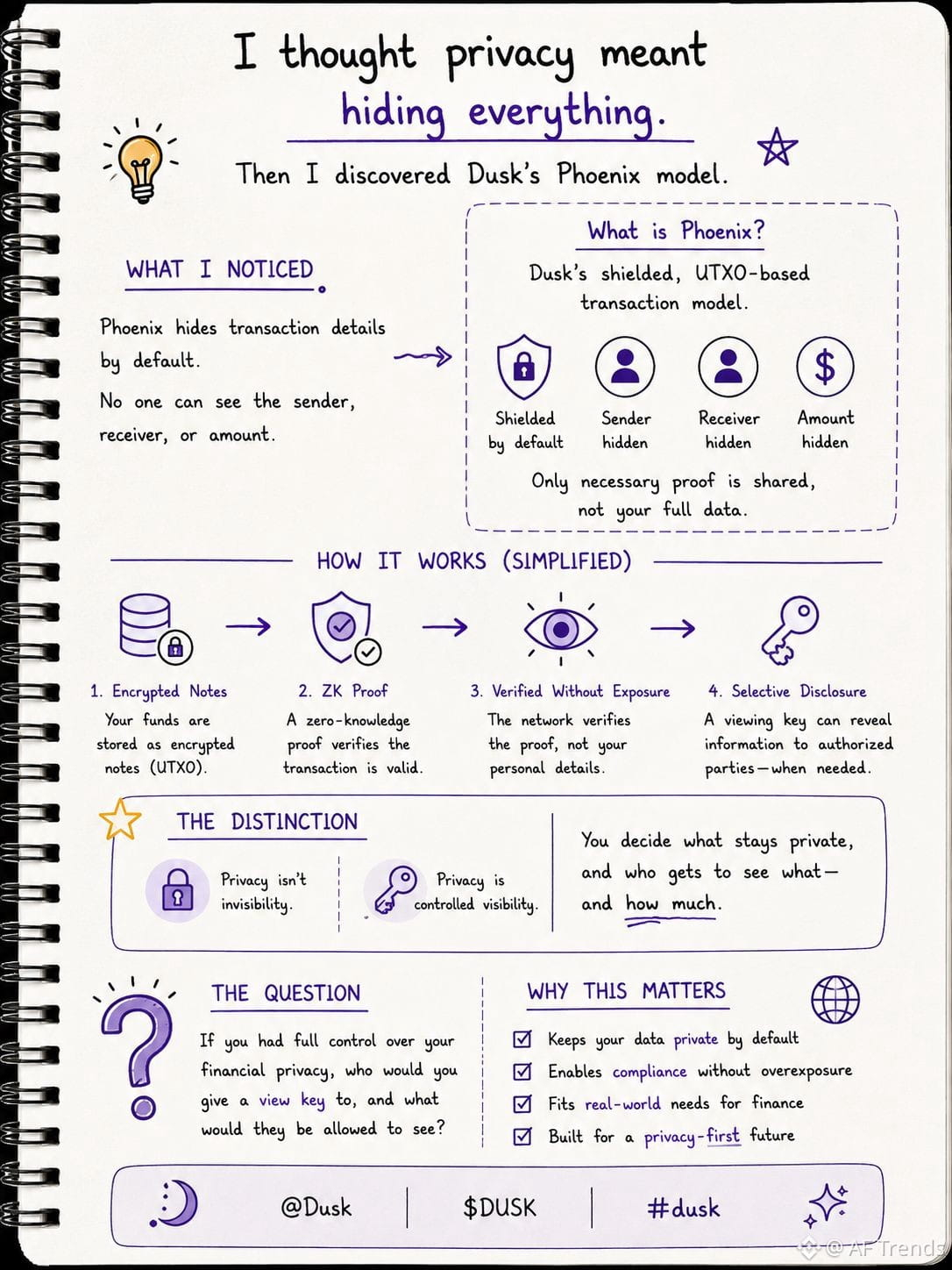
I used to think privacy on a blockchain meant hiding the transaction and leaving it at that.
Then I started looking at how Dusk handles it.
The interesting part isn't simply that Phoenix can hide the sender, receiver and amount.
It's that privacy doesn't necessarily mean nobody can ever see what's happening.
A shielded account can keep transaction details private, while a view key can give someone else controlled visibility into the information they’re authorized to see.
That distinction caught me.
Because I had been thinking about privacy as:
“Who can see the transaction?”
But Dusk seems to be asking a slightly different question:
“Who should be allowed to see it, and how much should they be allowed to see?”
Those aren't the same thing.
And I think that's where blockchain privacy becomes much more interesting than simply making everything invisible.
If financial applications need privacy and selective disclosure, should privacy mean hiding everything — or deciding exactly what gets revealed and to whom?
#dusk $DUSK
@Dusk $DUSK
I used to think privacy on a blockchain meant hiding the transaction and leaving it at that.
Then I started looking at how Dusk handles it.
The interesting part isn't simply that Phoenix can hide the sender, receiver and amount.
It's that privacy doesn't necessarily mean nobody can ever see what's happening.
A shielded account can keep transaction details private, while a view key can give someone else controlled visibility into the information they’re authorized to see.
That distinction caught me.
Because I had been thinking about privacy as:
“Who can see the transaction?”
But Dusk seems to be asking a slightly different question:
“Who should be allowed to see it, and how much should they be allowed to see?”
Those aren't the same thing.
And I think that's where blockchain privacy becomes much more interesting than simply making everything invisible.
If financial applications need privacy and selective disclosure, should privacy mean hiding everything — or deciding exactly what gets revealed and to whom?
#dusk $DUSK
I used to think privacy on a blockchain meant hiding the transaction and leaving it at that.
Then I started looking at how Dusk handles it.
The interesting part isn't simply that Phoenix can hide the sender, receiver and amount.
It's that privacy doesn't necessarily mean nobody can ever see what's happening.
A shielded account can keep transaction details private, while a view key can give someone else controlled visibility into the information they’re authorized to see.
That distinction caught me.
Because I had been thinking about privacy as:
“Who can see the transaction?”
But Dusk seems to be asking a slightly different question:
“Who should be allowed to see it, and how much should they be allowed to see?”
Those aren't the same thing.
And I think that's where blockchain privacy becomes much more interesting than simply making everything invisible.
If financial applications need privacy and selective disclosure, should privacy mean hiding everything — or deciding exactly what gets revealed and to whom?
#dusk $DUSK
17
5
157
·
--
@babylonlabs_io
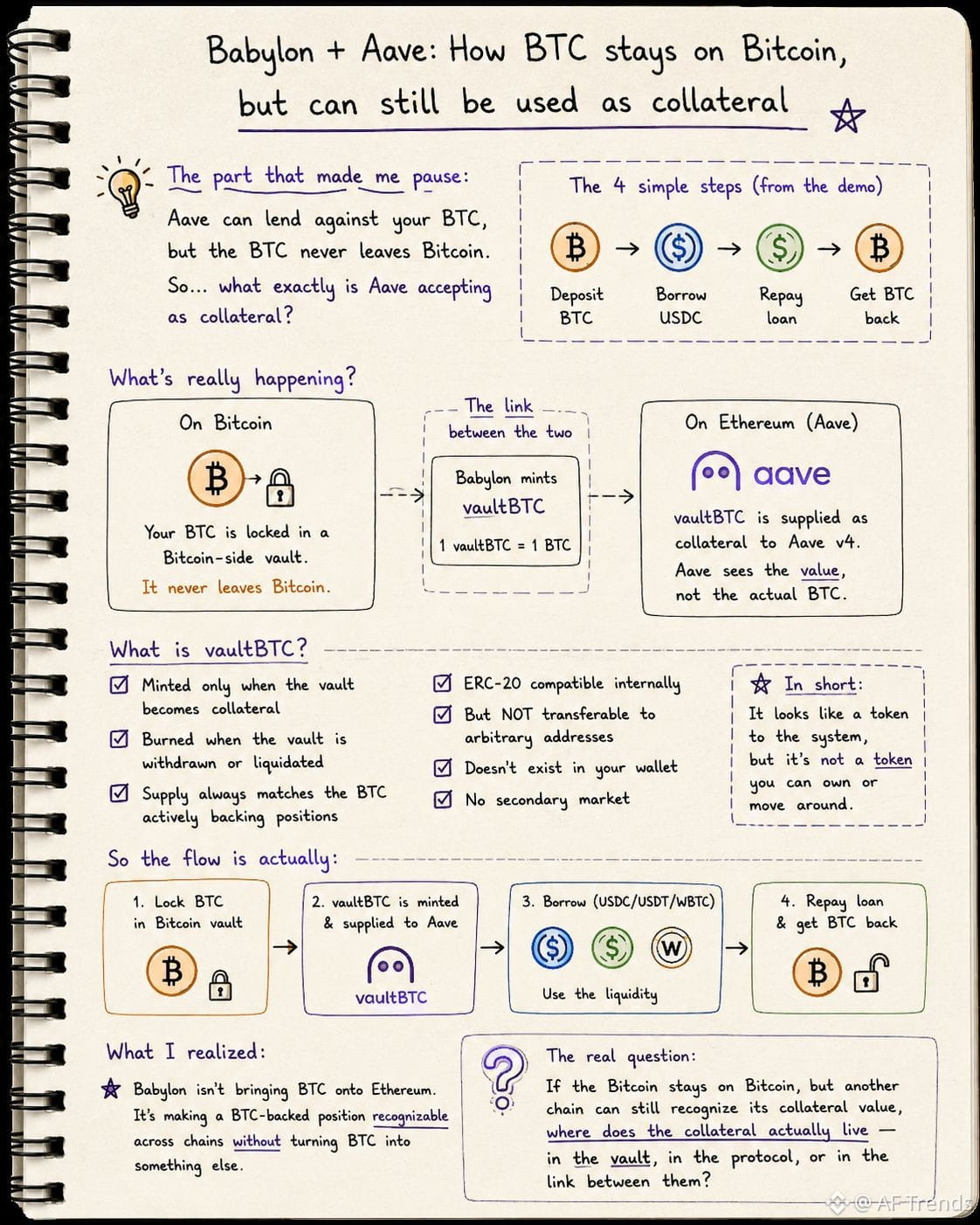
I couldn’t stop thinking about one part of Babylon’s latest Aave demo.
Your BTC stays on Bitcoin.
But Aave can still treat that BTC-backed position as collateral.
That sounds simple until you ask what Aave is actually seeing.
Because the Bitcoin itself never becomes a normal Ethereum token.
The BTC stays locked inside the Bitcoin-side vault.
So I went looking for what connects that vault to the lending side.
That’s where I found vaultBTC.
And this is the part I hadn’t fully understood before.
It looks like an ERC-20 to the authorized Aave-side contracts, but it isn't a normal token you can send around.
You can't transfer it to another wallet.
There’s no secondary market for it.
It doesn't sit in your wallet.
It exists as an internal accounting representation of the BTC that is actually locked in the vault. 1 vaultBTC represents 1 BTC.
That made the whole design click differently for me.
Babylon isn't taking BTC onto Ethereum and asking Aave to pretend it's Bitcoin.
It's keeping the Bitcoin where Bitcoin is, while creating a restricted representation that the lending system can understand.
So the interesting part isn't really:
“How does BTC move to Aave?”
It doesn't.
The more interesting question is:
“How does Aave recognize BTC collateral without the BTC itself becoming an Ethereum asset?”
That feels like the harder problem Babylon is actually solving.
And now I'm wondering:
If the Bitcoin stays on Bitcoin, but another chain can still recognize its collateral value, where does the collateral actually live — in the Bitcoin vault, in the lending protocol, or in the link between them?
@babylonlabs_io
#baby $BABY
@BabylonLabs_io
I couldn’t stop thinking about one part of Babylon’s latest Aave demo.
Your BTC stays on Bitcoin.
But Aave can still treat that BTC-backed position as collateral.
That sounds simple until you ask what Aave is actually seeing.
Because the Bitcoin itself never becomes a normal Ethereum token.
The BTC stays locked inside the Bitcoin-side vault.
So I went looking for what connects that vault to the lending side.
That’s where I found vaultBTC.
And this is the part I hadn’t fully understood before.
It looks like an ERC-20 to the authorized Aave-side contracts, but it isn't a normal token you can send around.
You can't transfer it to another wallet.
There’s no secondary market for it.
It doesn't sit in your wallet.
It exists as an internal accounting representation of the BTC that is actually locked in the vault. 1 vaultBTC represents 1 BTC.
That made the whole design click differently for me.
Babylon isn't taking BTC onto Ethereum and asking Aave to pretend it's Bitcoin.
It's keeping the Bitcoin where Bitcoin is, while creating a restricted representation that the lending system can understand.
So the interesting part isn't really:
“How does BTC move to Aave?”
It doesn't.
The more interesting question is:
“How does Aave recognize BTC collateral without the BTC itself becoming an Ethereum asset?”
That feels like the harder problem Babylon is actually solving.
And now I'm wondering:
If the Bitcoin stays on Bitcoin, but another chain can still recognize its collateral value, where does the collateral actually live — in the Bitcoin vault, in the lending protocol, or in the link between them?
@BabylonLabs_io
#baby $BABY
I couldn’t stop thinking about one part of Babylon’s latest Aave demo.
Your BTC stays on Bitcoin.
But Aave can still treat that BTC-backed position as collateral.
That sounds simple until you ask what Aave is actually seeing.
Because the Bitcoin itself never becomes a normal Ethereum token.
The BTC stays locked inside the Bitcoin-side vault.
So I went looking for what connects that vault to the lending side.
That’s where I found vaultBTC.
And this is the part I hadn’t fully understood before.
It looks like an ERC-20 to the authorized Aave-side contracts, but it isn't a normal token you can send around.
You can't transfer it to another wallet.
There’s no secondary market for it.
It doesn't sit in your wallet.
It exists as an internal accounting representation of the BTC that is actually locked in the vault. 1 vaultBTC represents 1 BTC.
That made the whole design click differently for me.
Babylon isn't taking BTC onto Ethereum and asking Aave to pretend it's Bitcoin.
It's keeping the Bitcoin where Bitcoin is, while creating a restricted representation that the lending system can understand.
So the interesting part isn't really:
“How does BTC move to Aave?”
It doesn't.
The more interesting question is:
“How does Aave recognize BTC collateral without the BTC itself becoming an Ethereum asset?”
That feels like the harder problem Babylon is actually solving.
And now I'm wondering:
If the Bitcoin stays on Bitcoin, but another chain can still recognize its collateral value, where does the collateral actually live — in the Bitcoin vault, in the lending protocol, or in the link between them?
@BabylonLabs_io
#baby $BABY
34
9
213
·
--
Bullish
@babylonlabs_io
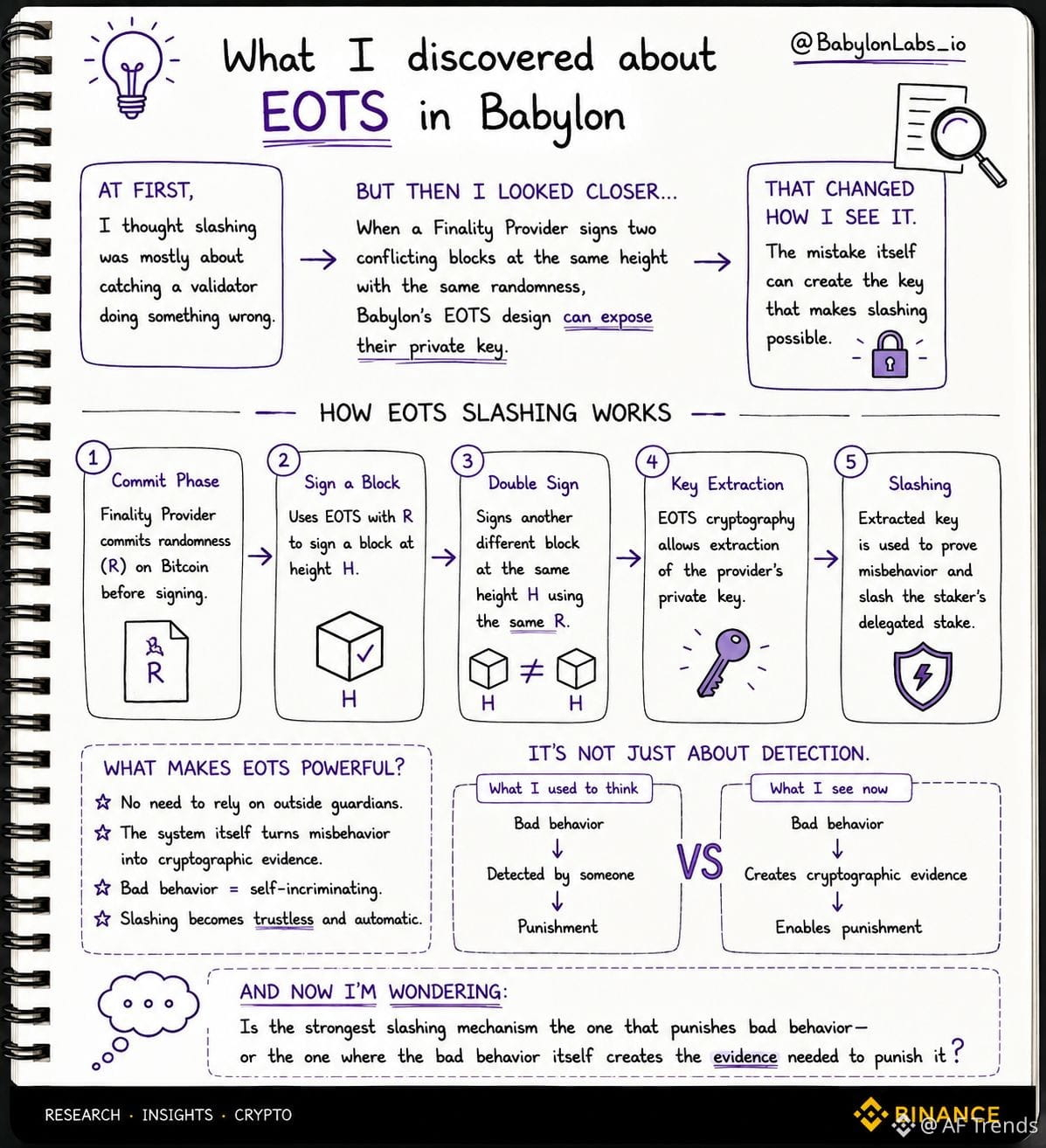
I kept thinking Babylon's slashing mechanism was mostly about catching a validator doing something wrong.
Then I started looking at what actually happens when a Finality Provider signs two conflicting blocks.
That's where the design became more interesting to me.
Babylon uses something called an Extractable One-Time Signature, or EOTS.
The basic idea sounds almost backwards at first.
A Finality Provider commits randomness before signing.
If they later use the same randomness to sign two different blocks at the same height, the system can extract their EOTS private key.
So the double-signing isn't just evidence that something went wrong.
The mistake itself can expose the key that makes the consequence possible.
That made me rethink what “slashing” means here.
I had been imagining it as:
Someone detects bad behavior → someone decides to punish it.
But the more I looked at EOTS, the more I saw a different relationship.
The signing rules are designed so that certain conflicting behavior creates a cryptographic consequence.
And that's the part I hadn't really appreciated.
The interesting question isn't only:
“How does Babylon detect a dishonest Finality Provider?”
It's:
“What happens to the cryptographic key when that provider proves they violated the rules?”
That's a much more interesting design to me.
Because Babylon isn't just trying to tell validators “don't double-sign.”
It's creating a system where the act of double-signing can become part of the mechanism that makes slashing possible.
And now I'm wondering:
Is the strongest slashing mechanism the one that punishes bad behavior—or the one where the bad behavior itself creates the evidence needed to punish it?
@babylonlabs_io
#baby $BABY
@BabylonLabs_io
I kept thinking Babylon's slashing mechanism was mostly about catching a validator doing something wrong.
Then I started looking at what actually happens when a Finality Provider signs two conflicting blocks.
That's where the design became more interesting to me.
Babylon uses something called an Extractable One-Time Signature, or EOTS.
The basic idea sounds almost backwards at first.
A Finality Provider commits randomness before signing.
If they later use the same randomness to sign two different blocks at the same height, the system can extract their EOTS private key.
So the double-signing isn't just evidence that something went wrong.
The mistake itself can expose the key that makes the consequence possible.
That made me rethink what “slashing” means here.
I had been imagining it as:
Someone detects bad behavior → someone decides to punish it.
But the more I looked at EOTS, the more I saw a different relationship.
The signing rules are designed so that certain conflicting behavior creates a cryptographic consequence.
And that's the part I hadn't really appreciated.
The interesting question isn't only:
“How does Babylon detect a dishonest Finality Provider?”
It's:
“What happens to the cryptographic key when that provider proves they violated the rules?”
That's a much more interesting design to me.
Because Babylon isn't just trying to tell validators “don't double-sign.”
It's creating a system where the act of double-signing can become part of the mechanism that makes slashing possible.
And now I'm wondering:
Is the strongest slashing mechanism the one that punishes bad behavior—or the one where the bad behavior itself creates the evidence needed to punish it?
@BabylonLabs_io
#baby $BABY
I kept thinking Babylon's slashing mechanism was mostly about catching a validator doing something wrong.
Then I started looking at what actually happens when a Finality Provider signs two conflicting blocks.
That's where the design became more interesting to me.
Babylon uses something called an Extractable One-Time Signature, or EOTS.
The basic idea sounds almost backwards at first.
A Finality Provider commits randomness before signing.
If they later use the same randomness to sign two different blocks at the same height, the system can extract their EOTS private key.
So the double-signing isn't just evidence that something went wrong.
The mistake itself can expose the key that makes the consequence possible.
That made me rethink what “slashing” means here.
I had been imagining it as:
Someone detects bad behavior → someone decides to punish it.
But the more I looked at EOTS, the more I saw a different relationship.
The signing rules are designed so that certain conflicting behavior creates a cryptographic consequence.
And that's the part I hadn't really appreciated.
The interesting question isn't only:
“How does Babylon detect a dishonest Finality Provider?”
It's:
“What happens to the cryptographic key when that provider proves they violated the rules?”
That's a much more interesting design to me.
Because Babylon isn't just trying to tell validators “don't double-sign.”
It's creating a system where the act of double-signing can become part of the mechanism that makes slashing possible.
And now I'm wondering:
Is the strongest slashing mechanism the one that punishes bad behavior—or the one where the bad behavior itself creates the evidence needed to punish it?
@BabylonLabs_io
#baby $BABY
13
6
125
·
--
Bullish
@babylonlabs_io
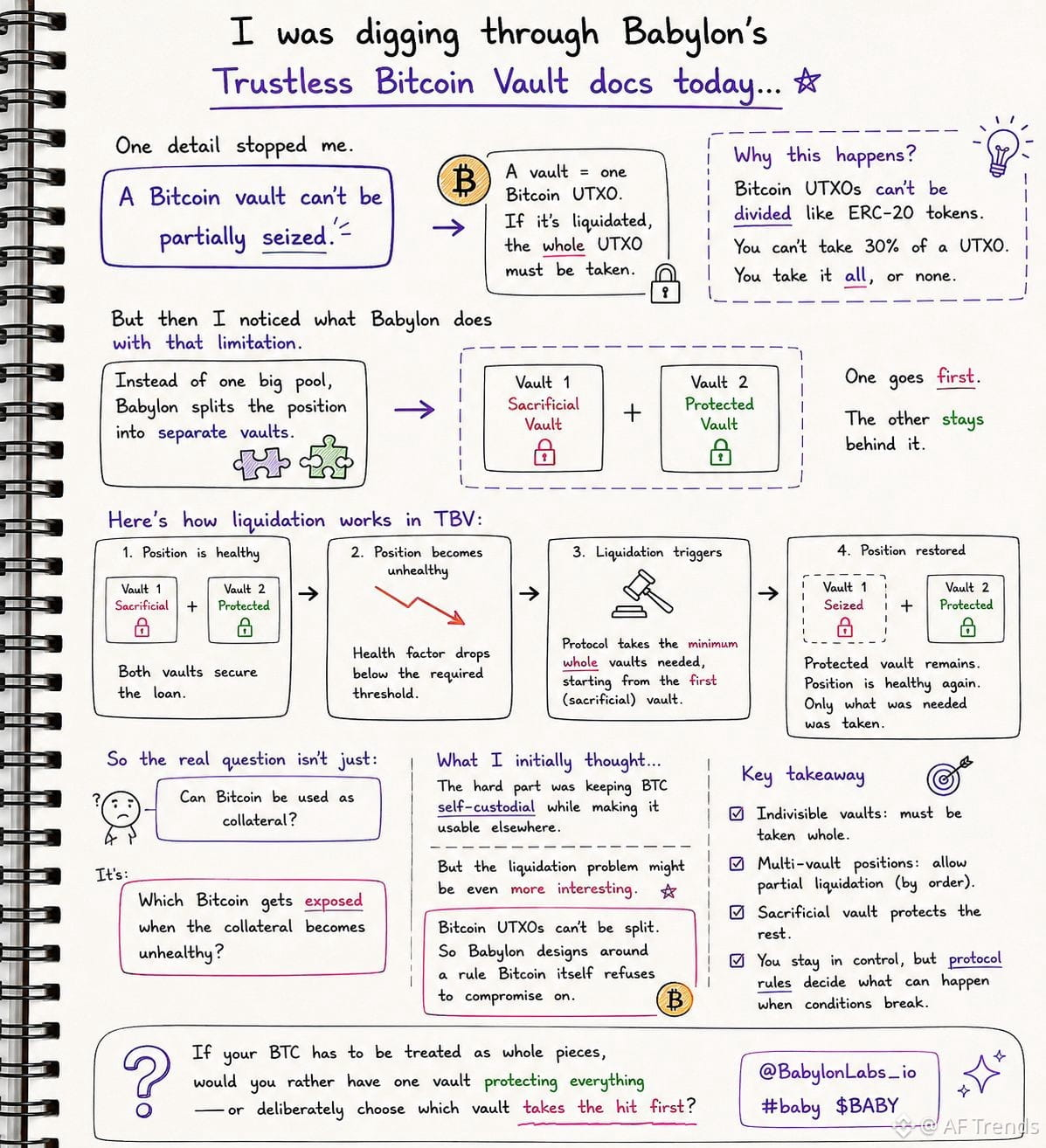
I was digging through Babylon's Trustless Bitcoin Vault documentation today, and one detail stopped me.
A Bitcoin vault can't be partially seized.
At first, that sounded like a limitation.
A BTC vault is a single Bitcoin UTXO. If the protocol needs to liquidate it, it can't simply take 30% of that one vault.
It has to take the whole thing.
But then I noticed what Babylon does with that limitation.
Instead of treating all the BTC in a position like one big pool, it can split the position into separate vaults.
One can be placed first as the sacrificial vault.
The other can sit behind it as the protected vault.
And suddenly the design made much more sense to me.
If liquidation happens, Babylon doesn't need to destroy the entire position.
It can walk through the vaults in order and take the minimum whole vaults needed to restore the position's health.
That means the interesting question isn't simply:
“Can Bitcoin be used as collateral?”
It's:
“Which Bitcoin gets exposed when the collateral becomes unhealthy?”
That distinction is easy to miss.
I initially thought the difficult part of native BTC lending was keeping Bitcoin self-custodial while making it usable elsewhere.
But the liquidation problem is almost more interesting.
Ethereum-style collateral can be divided.
Bitcoin UTXOs can't.
So Babylon isn't just trying to bring BTC into DeFi.
It's designing around a rule Bitcoin itself refuses to compromise on.
And now I'm wondering:
If your BTC has to be treated as whole pieces, would you rather have one vault protecting everything—or deliberately choose which vault takes the hit first?
@babylonlabs_io
#baby $BABY
@BabylonLabs_io
I was digging through Babylon's Trustless Bitcoin Vault documentation today, and one detail stopped me.
A Bitcoin vault can't be partially seized.
At first, that sounded like a limitation.
A BTC vault is a single Bitcoin UTXO. If the protocol needs to liquidate it, it can't simply take 30% of that one vault.
It has to take the whole thing.
But then I noticed what Babylon does with that limitation.
Instead of treating all the BTC in a position like one big pool, it can split the position into separate vaults.
One can be placed first as the sacrificial vault.
The other can sit behind it as the protected vault.
And suddenly the design made much more sense to me.
If liquidation happens, Babylon doesn't need to destroy the entire position.
It can walk through the vaults in order and take the minimum whole vaults needed to restore the position's health.
That means the interesting question isn't simply:
“Can Bitcoin be used as collateral?”
It's:
“Which Bitcoin gets exposed when the collateral becomes unhealthy?”
That distinction is easy to miss.
I initially thought the difficult part of native BTC lending was keeping Bitcoin self-custodial while making it usable elsewhere.
But the liquidation problem is almost more interesting.
Ethereum-style collateral can be divided.
Bitcoin UTXOs can't.
So Babylon isn't just trying to bring BTC into DeFi.
It's designing around a rule Bitcoin itself refuses to compromise on.
And now I'm wondering:
If your BTC has to be treated as whole pieces, would you rather have one vault protecting everything—or deliberately choose which vault takes the hit first?
@BabylonLabs_io
#baby $BABY
I was digging through Babylon's Trustless Bitcoin Vault documentation today, and one detail stopped me.
A Bitcoin vault can't be partially seized.
At first, that sounded like a limitation.
A BTC vault is a single Bitcoin UTXO. If the protocol needs to liquidate it, it can't simply take 30% of that one vault.
It has to take the whole thing.
But then I noticed what Babylon does with that limitation.
Instead of treating all the BTC in a position like one big pool, it can split the position into separate vaults.
One can be placed first as the sacrificial vault.
The other can sit behind it as the protected vault.
And suddenly the design made much more sense to me.
If liquidation happens, Babylon doesn't need to destroy the entire position.
It can walk through the vaults in order and take the minimum whole vaults needed to restore the position's health.
That means the interesting question isn't simply:
“Can Bitcoin be used as collateral?”
It's:
“Which Bitcoin gets exposed when the collateral becomes unhealthy?”
That distinction is easy to miss.
I initially thought the difficult part of native BTC lending was keeping Bitcoin self-custodial while making it usable elsewhere.
But the liquidation problem is almost more interesting.
Ethereum-style collateral can be divided.
Bitcoin UTXOs can't.
So Babylon isn't just trying to bring BTC into DeFi.
It's designing around a rule Bitcoin itself refuses to compromise on.
And now I'm wondering:
If your BTC has to be treated as whole pieces, would you rather have one vault protecting everything—or deliberately choose which vault takes the hit first?
@BabylonLabs_io
#baby $BABY
25
9
137
Log in to explore more content
Join global crypto users on Binance Square
⚡️ Get latest and useful information about crypto.
💬 Trusted by the world’s largest crypto exchange.
👍 Discover real insights from verified creators.
Email / Phone number
Trending Topics
BinancePick
2.5M views
138,800 Discussing
Join #EarningsSeason: Predict Earnings on Binance Pick, Share Your Take on Binance Square!
Binance Square Official
·400 Likes
·337.4k views
EarningsSeason
5M views
24,021 Discussing
ElectrumWalletBugLetRogueServersStealFunds
3,254 views
168 Discussing