

Muzzamil Baig
1.2k Posts

Muzzamil Baig
Report
Block User
🌐Sharing the Crypto Future knowledge 🚀
193 Following
1.2K+ Followers
450 Liked
Posts
All
Live
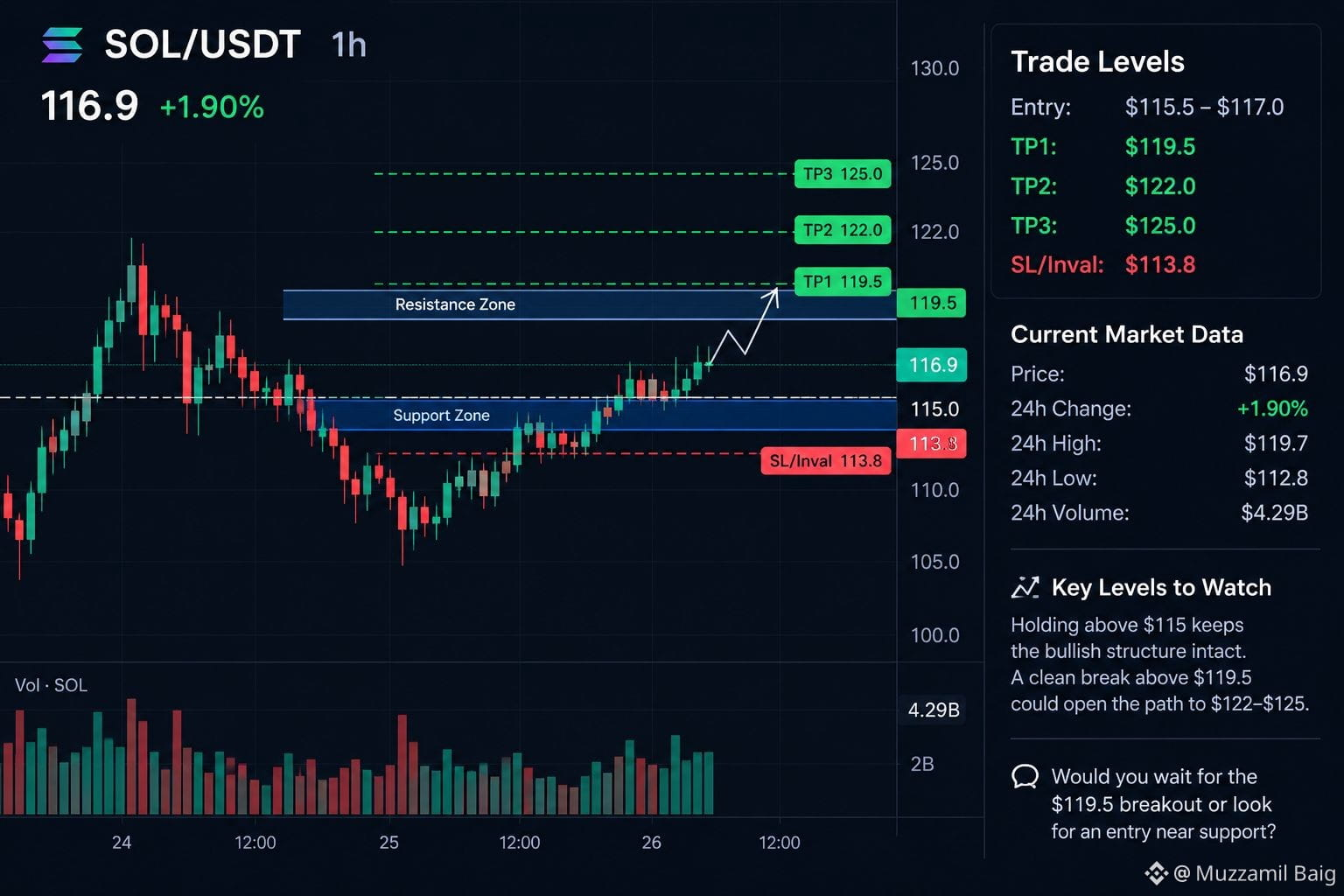
$SOL is sitting near $116.9 after reclaiming the $115 area and holding above it.
Entry: $115.5–$117.0
TP1: $119.5
TP2: $122
TP3: $125
SL/Inval: $113.8
I’m watching the $115 support and a clean break above $119.5; volume needs to stay supportive for continuation.
Would you wait for the $119.5 breakout or look for an entry near support?
{future}(SOLUSDT)
$SOL is sitting near $116.9 after reclaiming the $115 area and holding above it.
Entry: $115.5–$117.0
TP1: $119.5
TP2: $122
TP3: $125
SL/Inval: $113.8
I’m watching the $115 support and a clean break above $119.5; volume needs to stay supportive for continuation.
Would you wait for the $119.5 breakout or look for an entry near support?
Entry: $115.5–$117.0
TP1: $119.5
TP2: $122
TP3: $125
SL/Inval: $113.8
I’m watching the $115 support and a clean break above $119.5; volume needs to stay supportive for continuation.
Would you wait for the $119.5 breakout or look for an entry near support?
78
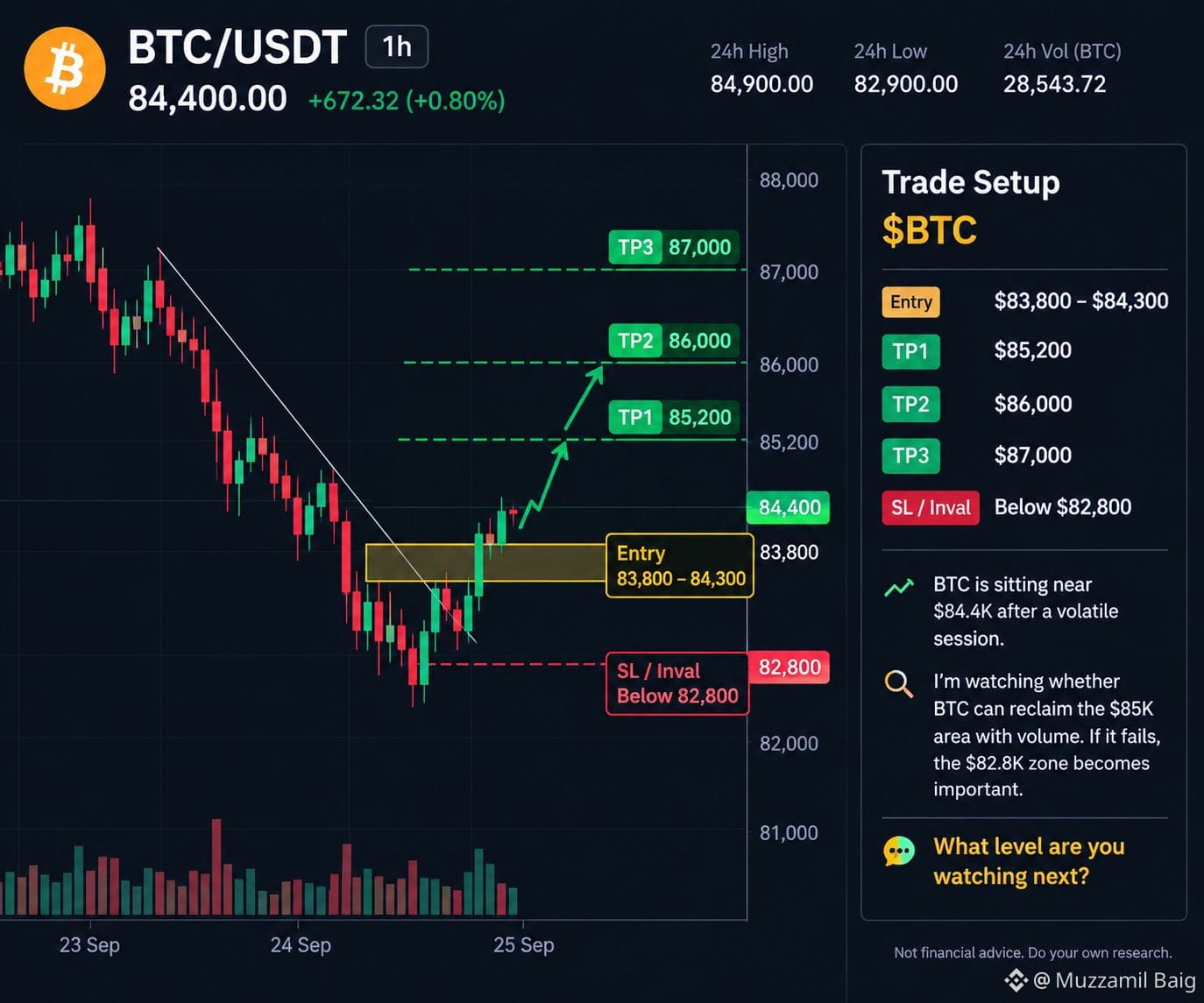
$BTC is sitting near $84.4K after a volatile session.
Entry: $83,800–$84,300
TP1: $85,200
TP2: $86,000
TP3: $87,000
SL/Inval: Below $82,800
I’m watching whether BTC can reclaim the $85K area with volume. If it fails, the $82.8K zone becomes important.
What level are you watching next?
{future}(BTCUSDT)
$BTC is sitting near $84.4K after a volatile session.
Entry: $83,800–$84,300
TP1: $85,200
TP2: $86,000
TP3: $87,000
SL/Inval: Below $82,800
I’m watching whether BTC can reclaim the $85K area with volume. If it fails, the $82.8K zone becomes important.
What level are you watching next?
Entry: $83,800–$84,300
TP1: $85,200
TP2: $86,000
TP3: $87,000
SL/Inval: Below $82,800
I’m watching whether BTC can reclaim the $85K area with volume. If it fails, the $82.8K zone becomes important.
What level are you watching next?
85
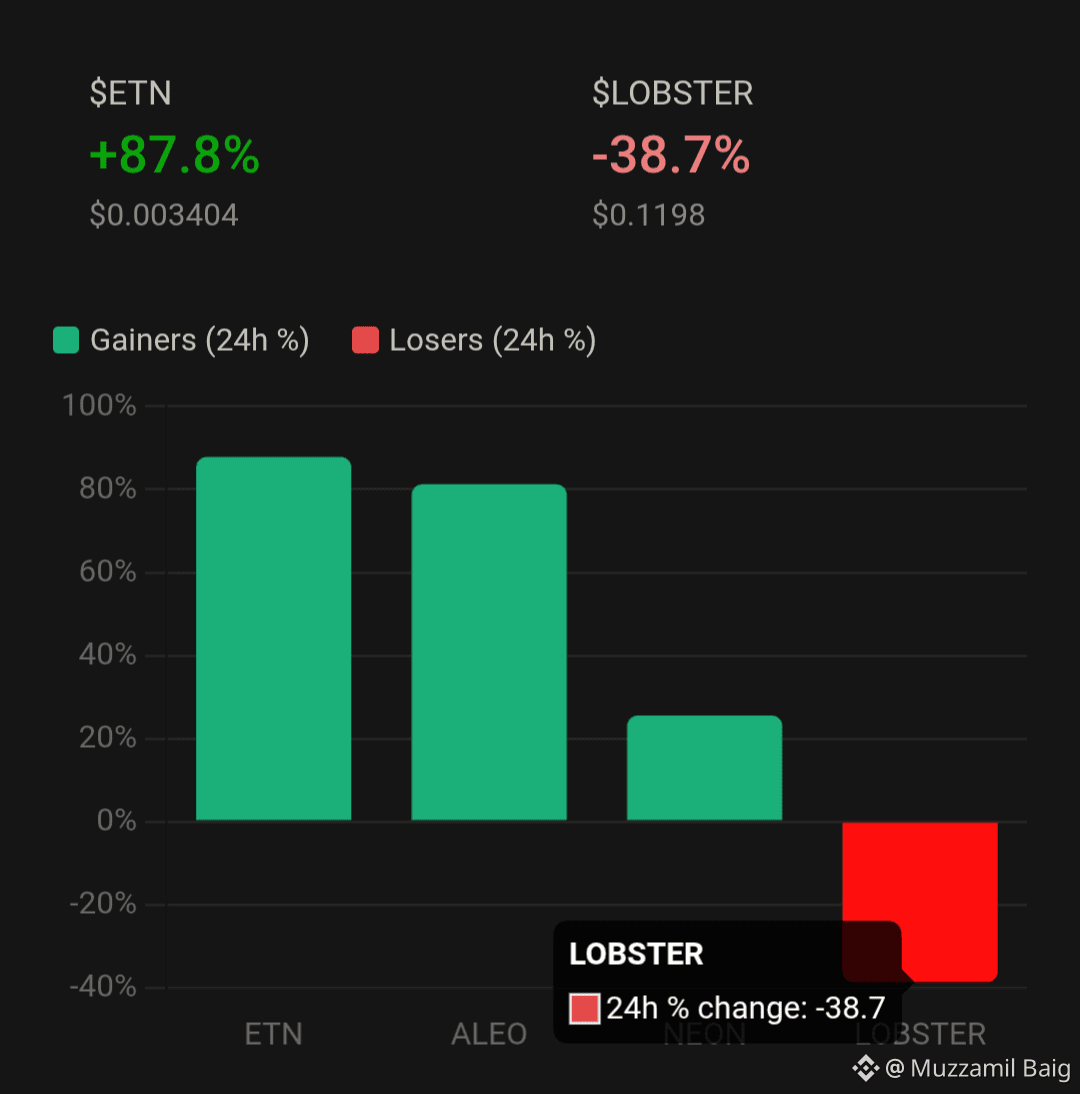
📈 $ETN.US (ETN) is today's top gainer, up +87.8% in the last 24h — now at $0.003404
📉 $LOB.US leads the losers, down -38.7%, trading at $0.1198
Also trending: $ALEO (+81.2%) and $NEON (+25.5%) showing strong momentum today.
Not financial advice, just tracking today's market moves. 📊
{stock_us}(ETN.US)
{stock_us}(LOB.US)
{alpha}(560x6cfffa5bfd4277a04d83307feedfe2d18d944dd2)
📈 $ETN.US (ETN) is today's top gainer, up +87.8% in the last 24h — now at $0.003404
📉 $LOB.US leads the losers, down -38.7%, trading at $0.1198
Also trending: $ALEO (+81.2%) and $NEON (+25.5%) showing strong momentum today.
Not financial advice, just tracking today's market moves. 📊
📉 $LOB.US leads the losers, down -38.7%, trading at $0.1198
Also trending: $ALEO (+81.2%) and $NEON (+25.5%) showing strong momentum today.
Not financial advice, just tracking today's market moves. 📊
217
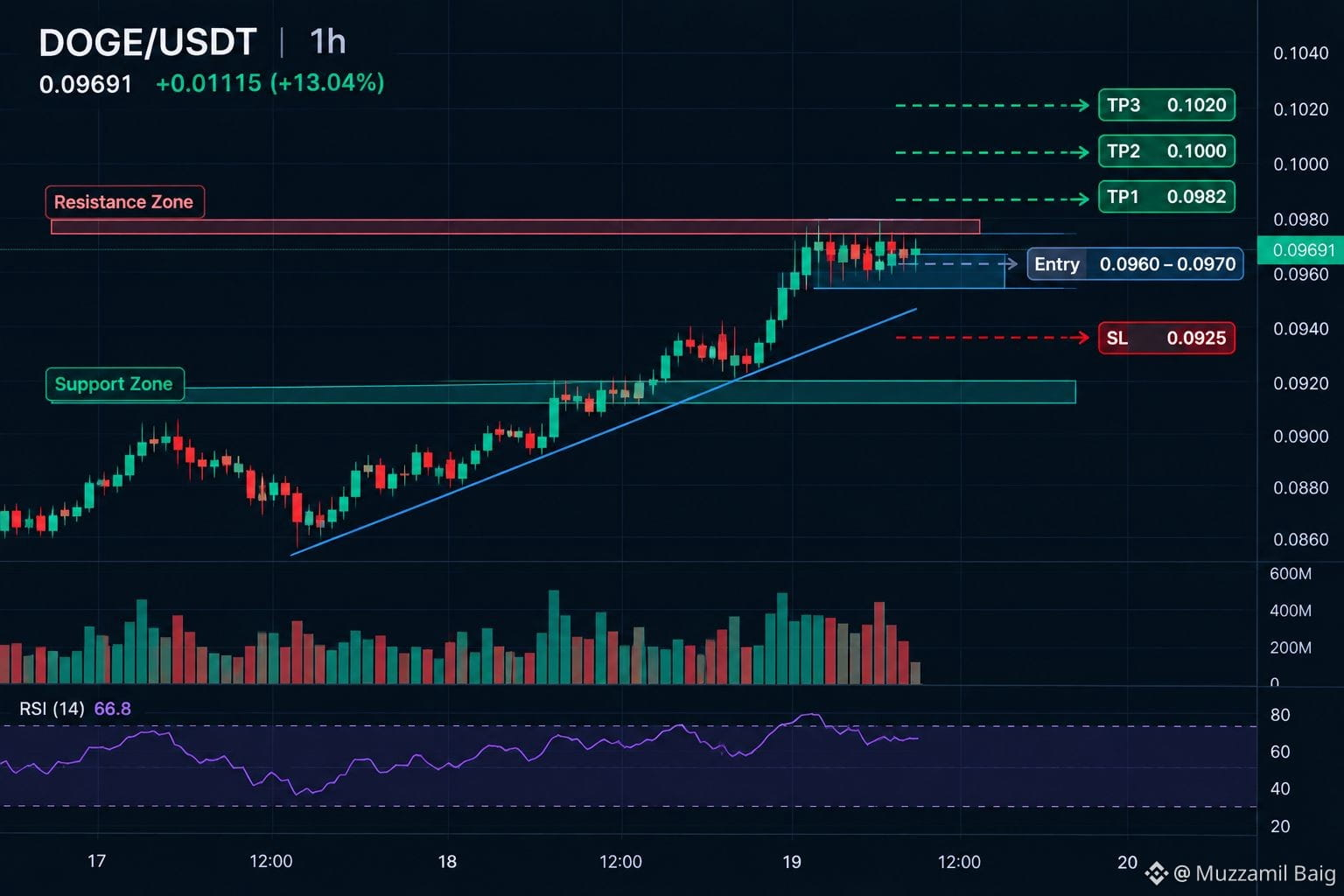
$DOGE is holding near the $0.098 resistance
Entry: $0.0960–$0.0970
TP1: $0.0982
TP2: $0.1000
TP3: $0.1020
SL: $0.0925
Momentum is strong — confirmation above $0.0982 matters.
**Can $DOGE break the daily high?**
$DOGE is holding near the $0.098 resistance
Entry: $0.0960–$0.0970
TP1: $0.0982
TP2: $0.1000
TP3: $0.1020
SL: $0.0925
Momentum is strong — confirmation above $0.0982 matters.
**Can $DOGE break the daily high?**
Entry: $0.0960–$0.0970
TP1: $0.0982
TP2: $0.1000
TP3: $0.1020
SL: $0.0925
Momentum is strong — confirmation above $0.0982 matters.
**Can $DOGE break the daily high?**
95
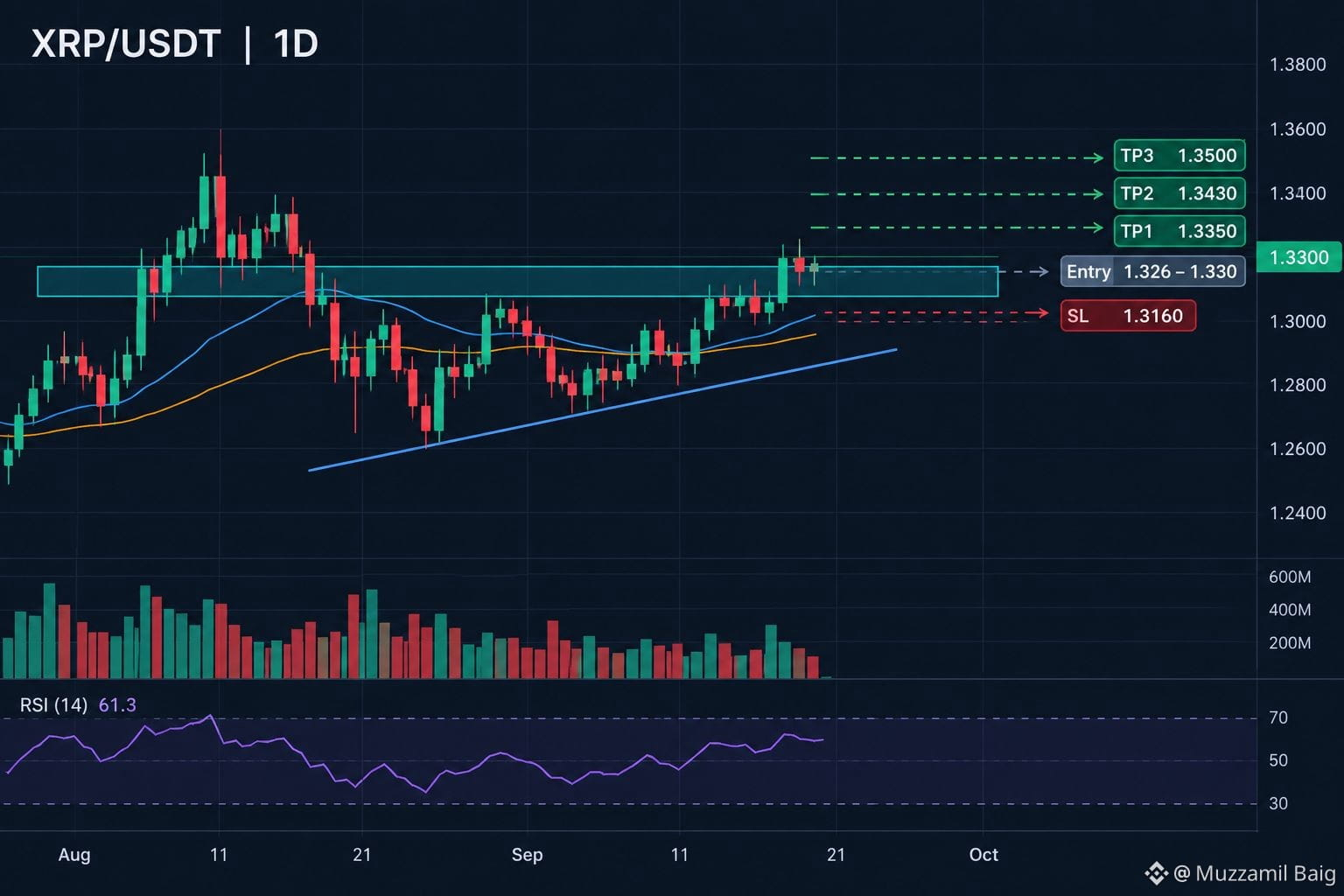
$XRP is testing the $1.33–$1.34 zone
Entry: $1.326–$1.330
TP1: $1.335
TP2: $1.343
TP3: $1.350
SL: $1.316
Momentum is improving, but confirmation above resistance matters.
Can $XRP break $1.34?
$XRP is testing the $1.33–$1.34 zone
Entry: $1.326–$1.330
TP1: $1.335
TP2: $1.343
TP3: $1.350
SL: $1.316
Momentum is improving, but confirmation above resistance matters.
Can $XRP break $1.34?
Entry: $1.326–$1.330
TP1: $1.335
TP2: $1.343
TP3: $1.350
SL: $1.316
Momentum is improving, but confirmation above resistance matters.
Can $XRP break $1.34?
104
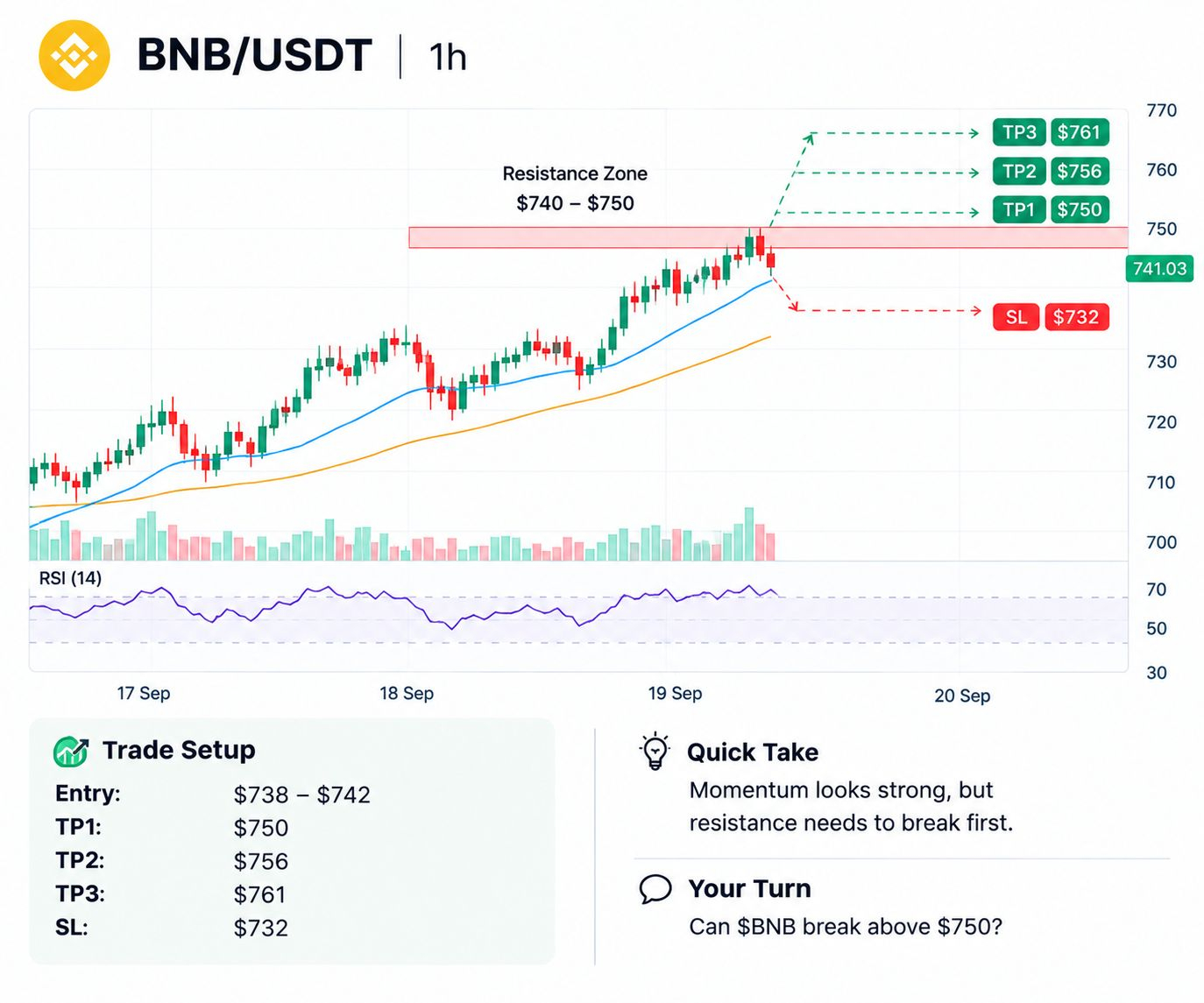
$BNB is testing the $740–$750 resistance zone
Entry: $738–$742
TP1: $750
TP2: $756
TP3: $761
SL: $732
Momentum looks strong, but resistance needs to break first.
Can $BNB break above $750?
{future}(BNBUSDT)
$BNB is testing the $740–$750 resistance zone
Entry: $738–$742
TP1: $750
TP2: $756
TP3: $761
SL: $732
Momentum looks strong, but resistance needs to break first.
Can $BNB break above $750?
Entry: $738–$742
TP1: $750
TP2: $756
TP3: $761
SL: $732
Momentum looks strong, but resistance needs to break first.
Can $BNB break above $750?
63
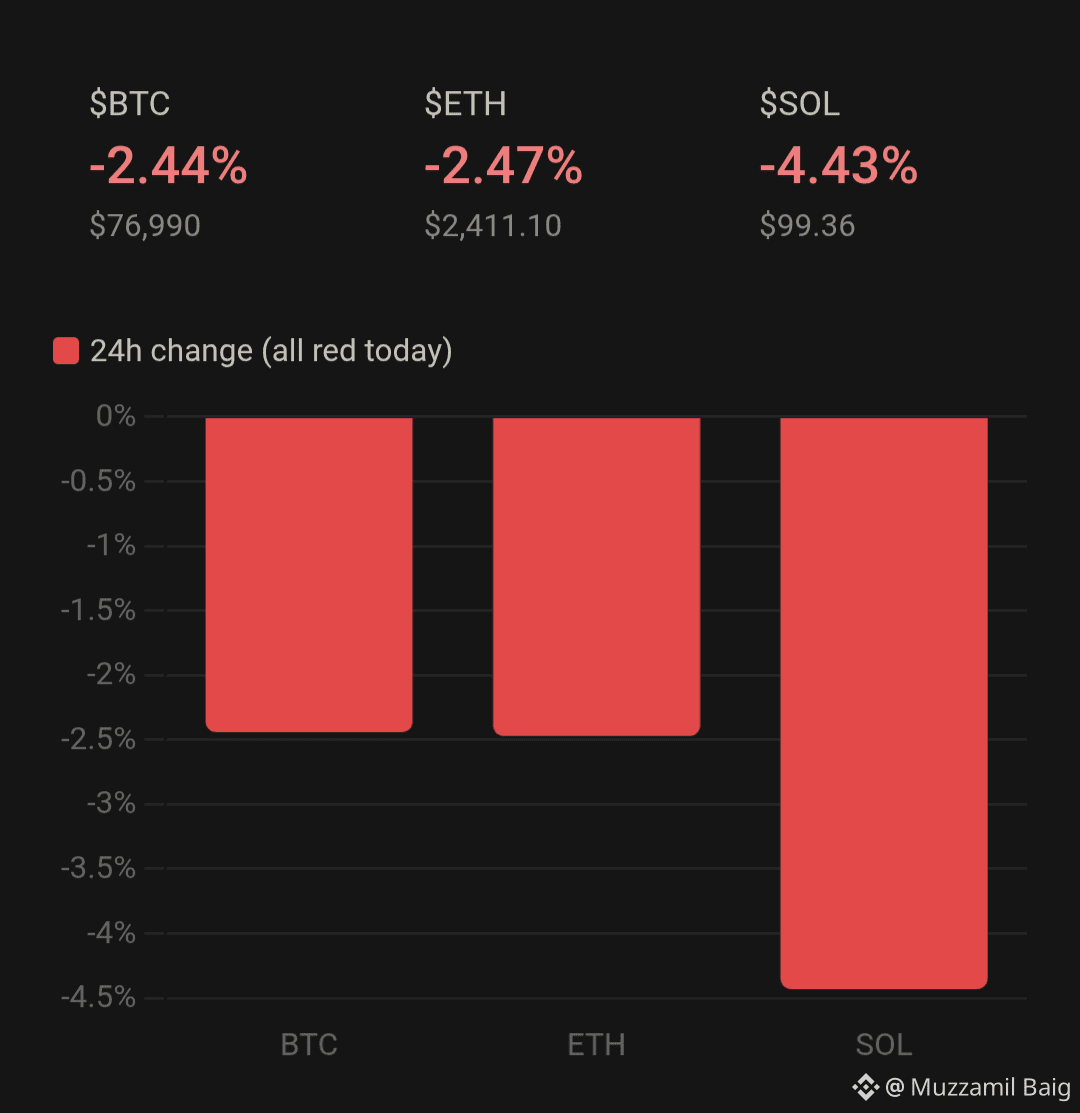
📉 $BTC now at $76,990, down -2.44% in the last 24h
$ETH also slipping, trading at $2,411.10, down -2.47%
$SOL leading the losses among majors, down -4.43% at $99.36
Not financial advice, just tracking today's market mood. 📊
{future}(BTCUSDT)
{future}(ETHUSDT)
{future}(SOLUSDT)
📉 $BTC now at $76,990, down -2.44% in the last 24h
$ETH also slipping, trading at $2,411.10, down -2.47%
$SOL leading the losses among majors, down -4.43% at $99.36
Not financial advice, just tracking today's market mood. 📊
$ETH also slipping, trading at $2,411.10, down -2.47%
$SOL leading the losses among majors, down -4.43% at $99.36
Not financial advice, just tracking today's market mood. 📊
93
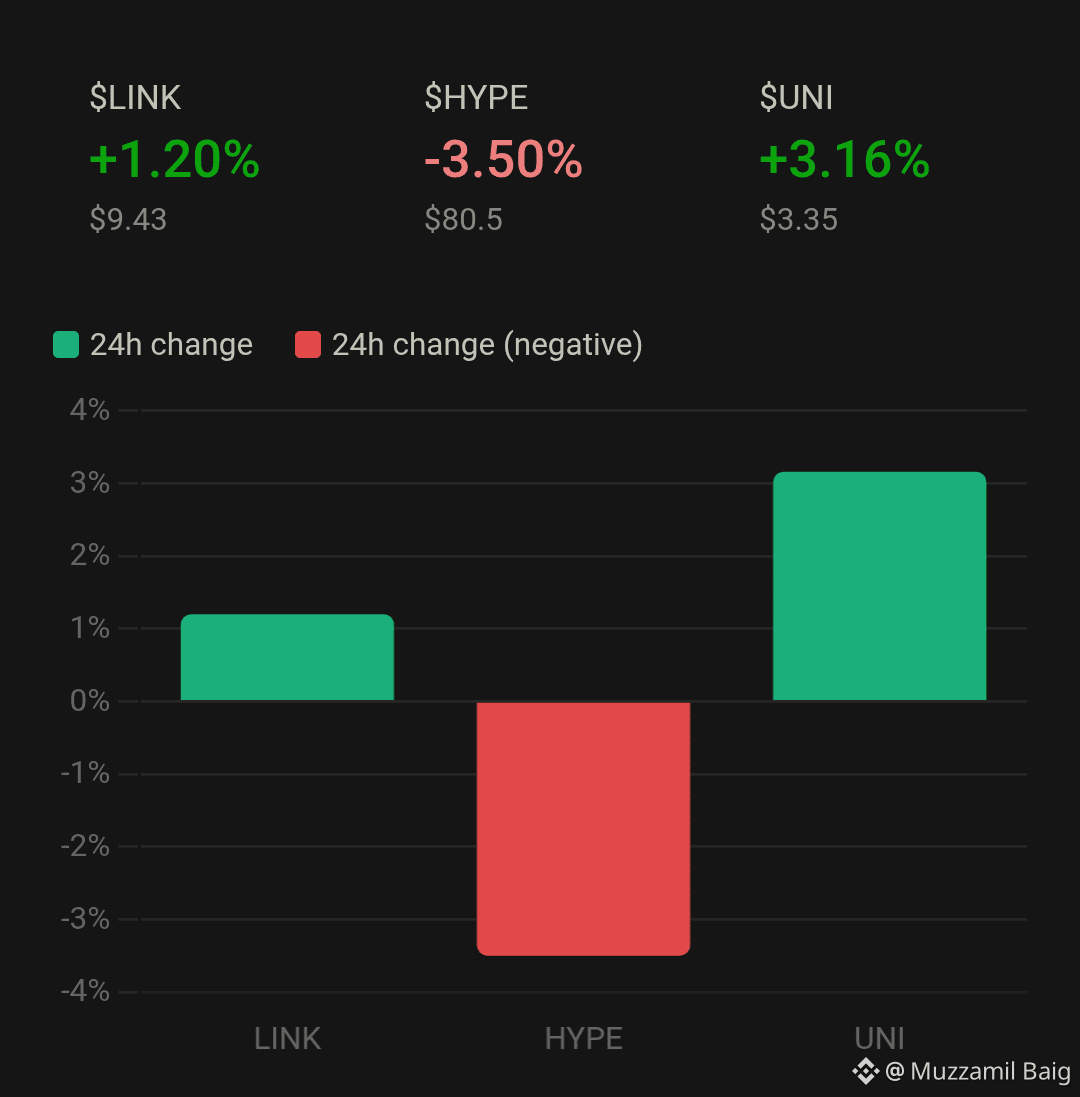
$LINK (Chainlink) up +1.20% in 24h, trading at $9.43 — steady demand for oracle infra
$HYPE (Hyperliquid) down -3.50% today but still +7.37% for the week, at $80.5
$UNI (Uniswap) climbing too — +3.16% today, +7.57% this week, now at $3.35
Not financial advice, just tracking DeFi sector moves.
{future}(LINKUSDT)
{future}(HYPEUSDT)
{future}(UNIUSDT)
$LINK (Chainlink) up +1.20% in 24h, trading at $9.43 — steady demand for oracle infra
$HYPE (Hyperliquid) down -3.50% today but still +7.37% for the week, at $80.5
$UNI (Uniswap) climbing too — +3.16% today, +7.57% this week, now at $3.35
Not financial advice, just tracking DeFi sector moves.
$HYPE (Hyperliquid) down -3.50% today but still +7.37% for the week, at $80.5
$UNI (Uniswap) climbing too — +3.16% today, +7.57% this week, now at $3.35
Not financial advice, just tracking DeFi sector moves.
334
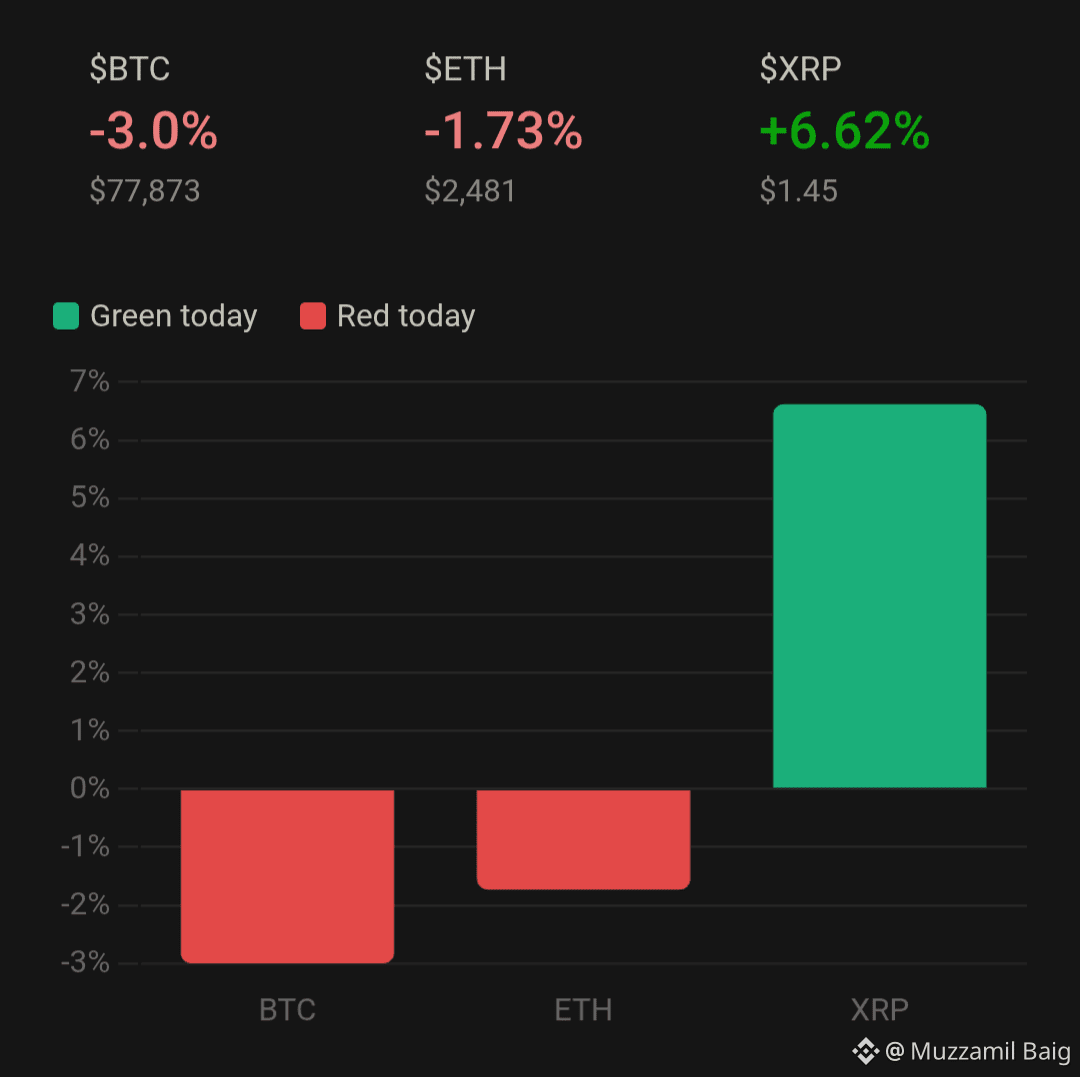
📉 $BTC slipped ~3% from overnight high, now trading around $77,873 as Senate votes on Clarity Act
$ETH down too, holding near $2,481 with short-term momentum turning bearish
Bright spot: $XRP up +6.62%, one of the few majors still green today 🟢
Not financial advice, just tracking today's market mood. 📊
{future}(BTCUSDT)
{future}(ETHUSDT)
{future}(XRPUSDT)
📉 $BTC slipped ~3% from overnight high, now trading around $77,873 as Senate votes on Clarity Act
$ETH down too, holding near $2,481 with short-term momentum turning bearish
Bright spot: $XRP up +6.62%, one of the few majors still green today 🟢
Not financial advice, just tracking today's market mood. 📊
$ETH down too, holding near $2,481 with short-term momentum turning bearish
Bright spot: $XRP up +6.62%, one of the few majors still green today 🟢
Not financial advice, just tracking today's market mood. 📊
120
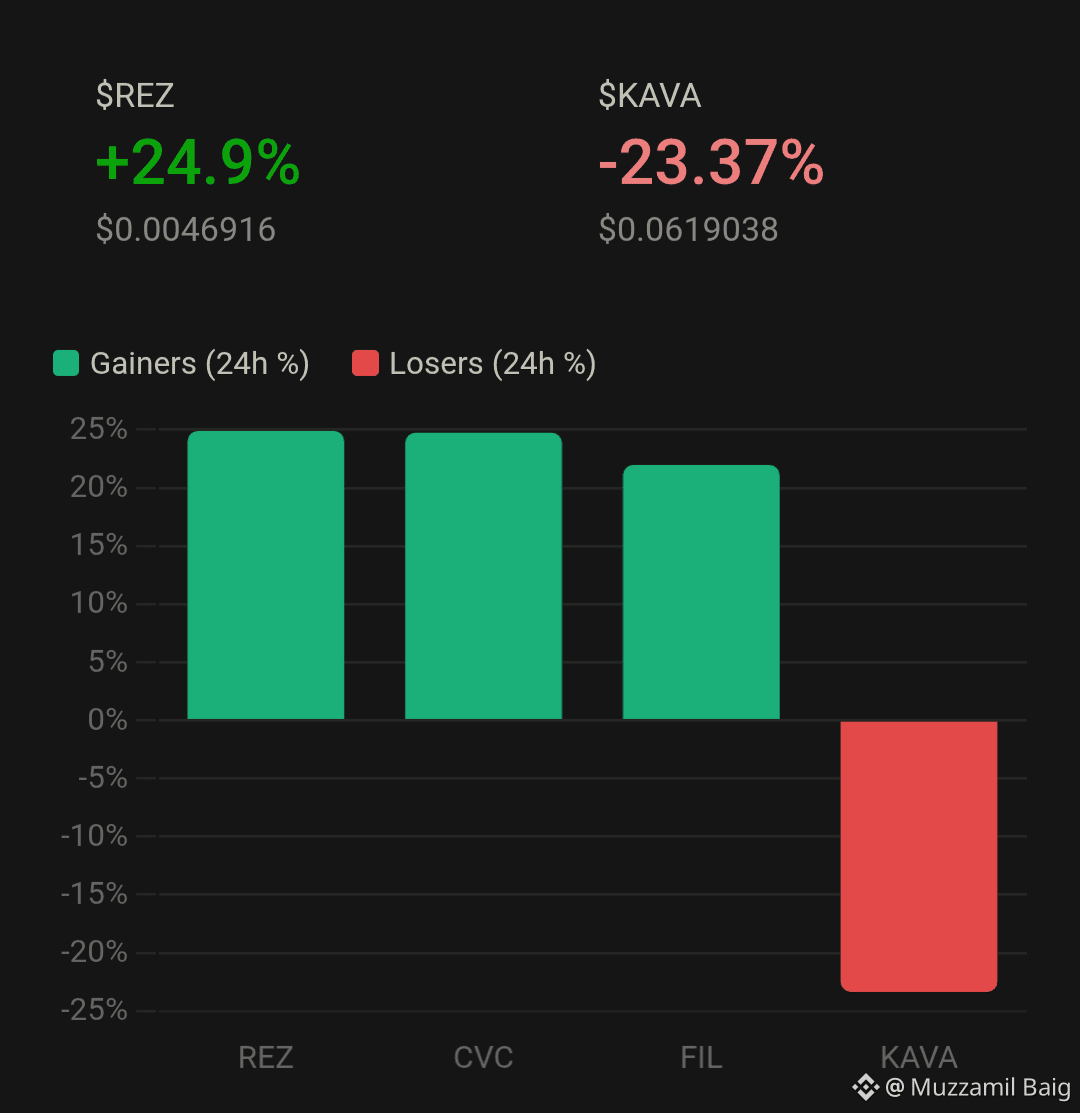
📈 $REZ (Renzo) is today's top gainer, up +24.9% in the last 24h — now at $0.0046916
📉 $KAVA leads the losers, down -23.37%, trading at $0.0619038
Also trending: $CVC (Civic) +24.74% and $FIL (Filecoin) +21.97% showing strong momentum.
Not financial advice, just tracking today's market moves. 📊
{future}(REZUSDT)
{future}(KAVAUSDT)
{future}(CVCUSDT)
📈 $REZ (Renzo) is today's top gainer, up +24.9% in the last 24h — now at $0.0046916
📉 $KAVA leads the losers, down -23.37%, trading at $0.0619038
Also trending: $CVC (Civic) +24.74% and $FIL (Filecoin) +21.97% showing strong momentum.
Not financial advice, just tracking today's market moves. 📊
📉 $KAVA leads the losers, down -23.37%, trading at $0.0619038
Also trending: $CVC (Civic) +24.74% and $FIL (Filecoin) +21.97% showing strong momentum.
Not financial advice, just tracking today's market moves. 📊
300
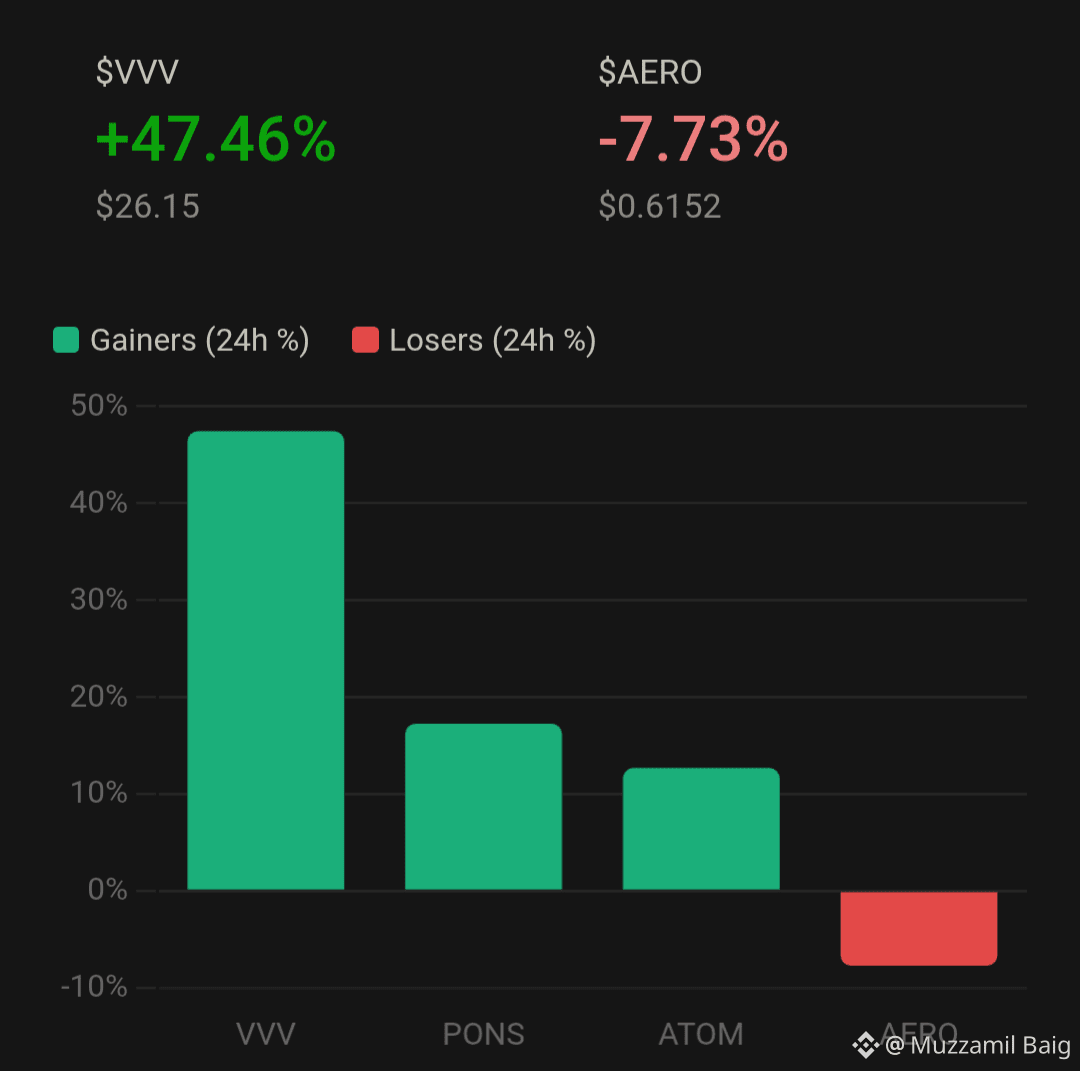
📈 $VVV (Venice Token) is today's top gainer, up +47.46% in the last 24h — now at $26.15
📉 $AERO (Aerodrome Finance) leads the losers, down -7.73%, trading at $0.6152
Also trending: $PONS (+17.25%) and $ATOM (+12.67%) showing strong momentum today.
Not financial advice, just tracking today's market moves. 📊
📈 $VVV (Venice Token) is today's top gainer, up +47.46% in the last 24h — now at $26.15
📉 $AERO (Aerodrome Finance) leads the losers, down -7.73%, trading at $0.6152
Also trending: $PONS (+17.25%) and $ATOM (+12.67%) showing strong momentum today.
Not financial advice, just tracking today's market moves. 📊
📉 $AERO (Aerodrome Finance) leads the losers, down -7.73%, trading at $0.6152
Also trending: $PONS (+17.25%) and $ATOM (+12.67%) showing strong momentum today.
Not financial advice, just tracking today's market moves. 📊
70
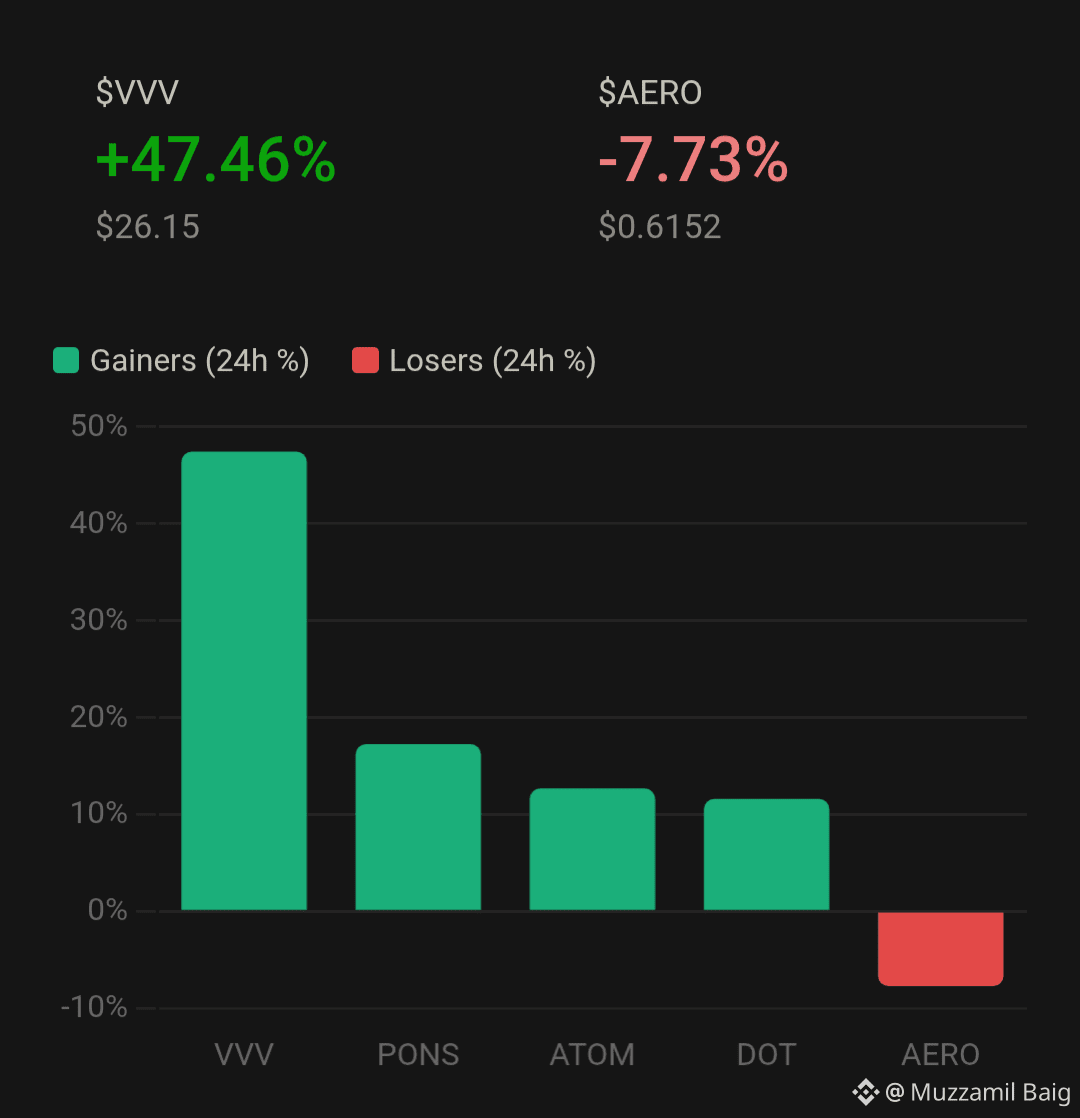
📈 $VVV (Venice Token) is today's top gainer, up +47.46% in the last 24h — now at $26.15
📉 $AERO (Aerodrome Finance) leads the losers, down -7.73%, trading at $0.6152
Also worth watching: $ATOM (+12.67%) and $DOT (+11.60%) showing strong momentum today.
Not financial advice, just tracking today's market moves. 📊
📈 $VVV (Venice Token) is today's top gainer, up +47.46% in the last 24h — now at $26.15
📉 $AERO (Aerodrome Finance) leads the losers, down -7.73%, trading at $0.6152
Also worth watching: $ATOM (+12.67%) and $DOT (+11.60%) showing strong momentum today.
Not financial advice, just tracking today's market moves. 📊
📉 $AERO (Aerodrome Finance) leads the losers, down -7.73%, trading at $0.6152
Also worth watching: $ATOM (+12.67%) and $DOT (+11.60%) showing strong momentum today.
Not financial advice, just tracking today's market moves. 📊
218
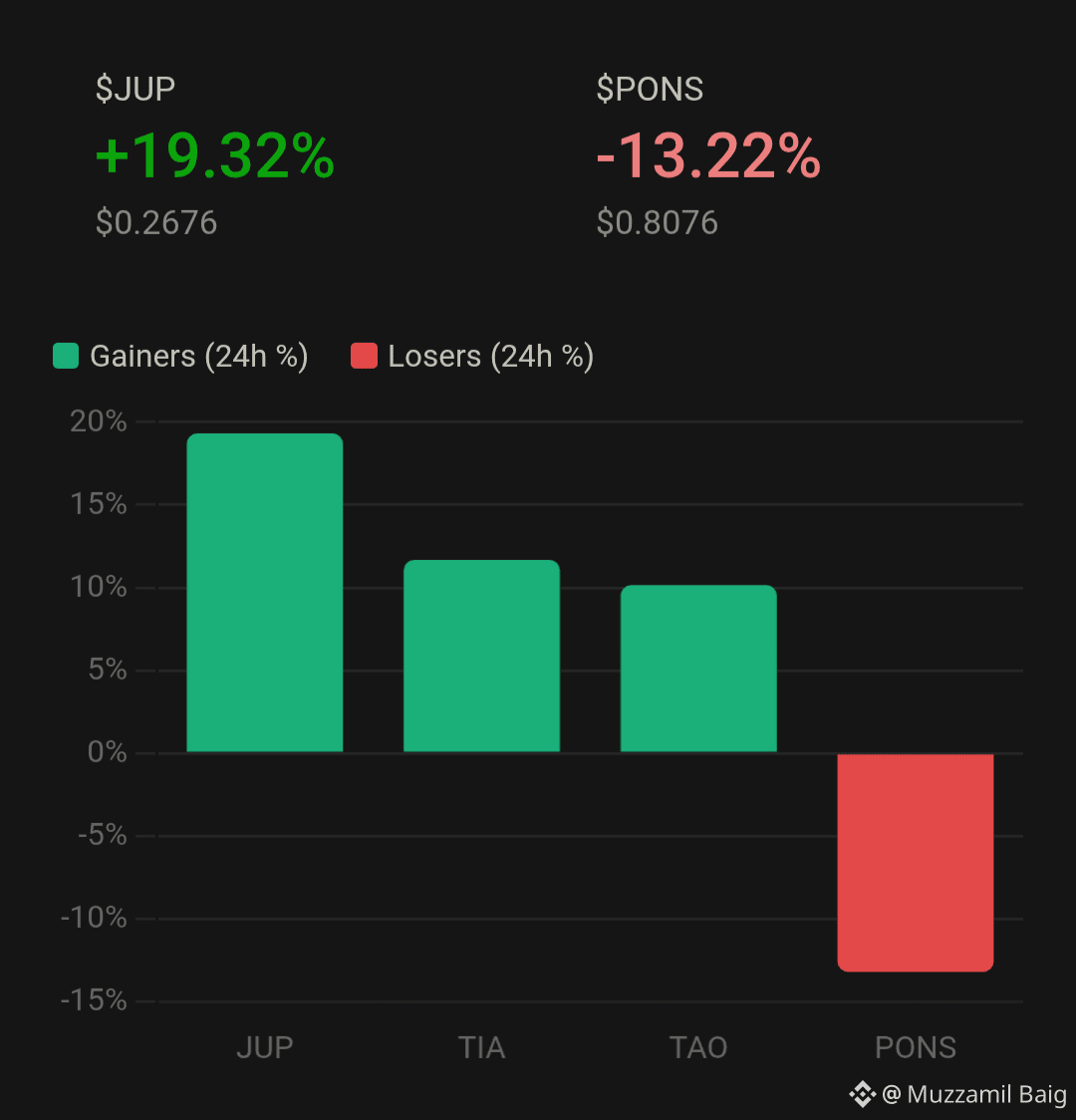
📈 $JUP leads today's gainers, up +19.32% in the last 24h — now at $0.2676
📉 $PONS is today's top loser, down -13.22%, trading at $0.8076
Also trending: $TIA (+11.68%) and $TAO (+10.15%). Fear & Greed Index at 74 — market in "Greed" zone.
Not financial advice, just sharing today's market snapshot. 📊
📈 $JUP leads today's gainers, up +19.32% in the last 24h — now at $0.2676
📉 $PONS is today's top loser, down -13.22%, trading at $0.8076
Also trending: $TIA (+11.68%) and $TAO (+10.15%). Fear & Greed Index at 74 — market in "Greed" zone.
Not financial advice, just sharing today's market snapshot. 📊
📉 $PONS is today's top loser, down -13.22%, trading at $0.8076
Also trending: $TIA (+11.68%) and $TAO (+10.15%). Fear & Greed Index at 74 — market in "Greed" zone.
Not financial advice, just sharing today's market snapshot. 📊
72
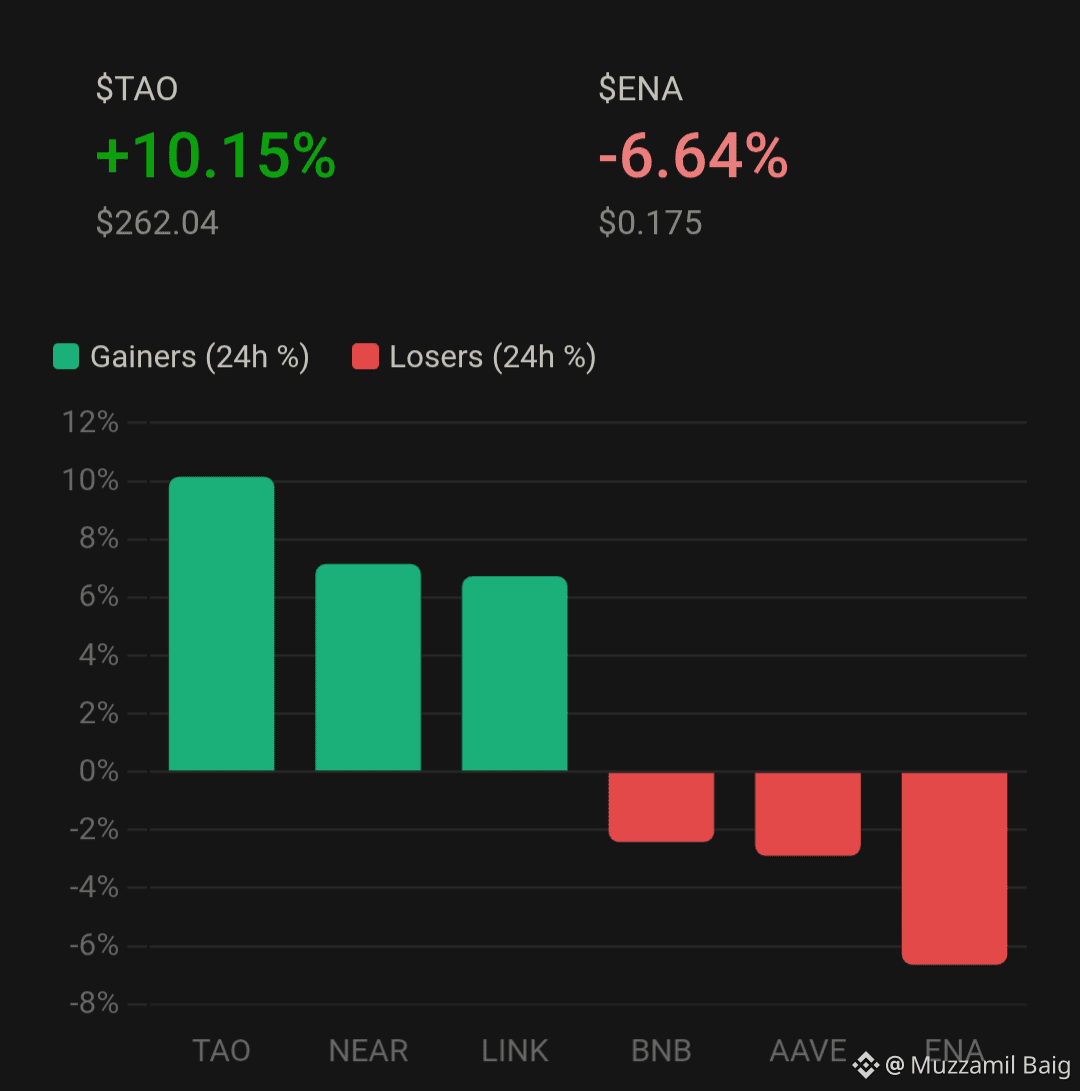
Big mover today: $TAO (Bittensor) up +10.15%, now at $262.04 📈
On the flip side, $ENA down -6.64%, trading at $0.175 📉
Overall market sentiment: Fear & Greed Index at 74 — we're in "Greed" territory. BTC dominance holding steady at 59.2%.
Just sharing today's market snapshot, not financial advice. 📊
Big mover today: $TAO (Bittensor) up +10.15%, now at $262.04 📈
On the flip side, $ENA down -6.64%, trading at $0.175 📉
Overall market sentiment: Fear & Greed Index at 74 — we're in "Greed" territory. BTC dominance holding steady at 59.2%.
Just sharing today's market snapshot, not financial advice. 📊
On the flip side, $ENA down -6.64%, trading at $0.175 📉
Overall market sentiment: Fear & Greed Index at 74 — we're in "Greed" territory. BTC dominance holding steady at 59.2%.
Just sharing today's market snapshot, not financial advice. 📊
167
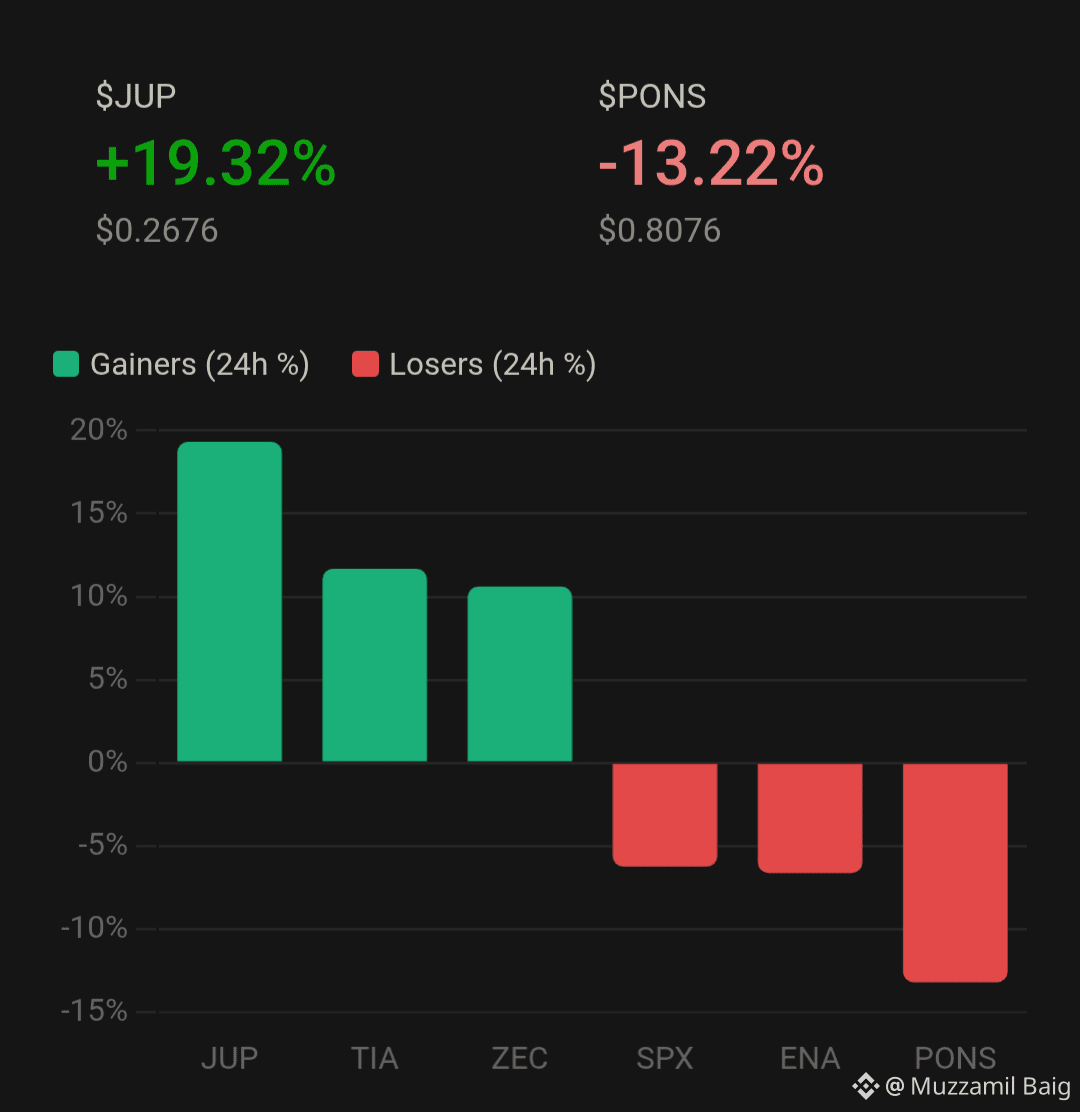
📈 $JUP is today's top gainer, up +19.32% in the last 24h — now trading around $0.2676
📉 $PONS leads the losers, down -13.22%, currently at $0.8076
Also worth watching: $TIA (+11.68%) and $ZEC (+10.60%) showing strong momentum. Market cap up slightly, Fear & Greed Index at 74 (Greed zone).
Not financial advice — just tracking today's moves. 📊
📈 $JUP is today's top gainer, up +19.32% in the last 24h — now trading around $0.2676
📉 $PONS leads the losers, down -13.22%, currently at $0.8076
Also worth watching: $TIA (+11.68%) and $ZEC (+10.60%) showing strong momentum. Market cap up slightly, Fear & Greed Index at 74 (Greed zone).
Not financial advice — just tracking today's moves. 📊
📉 $PONS leads the losers, down -13.22%, currently at $0.8076
Also worth watching: $TIA (+11.68%) and $ZEC (+10.60%) showing strong momentum. Market cap up slightly, Fear & Greed Index at 74 (Greed zone).
Not financial advice — just tracking today's moves. 📊
272
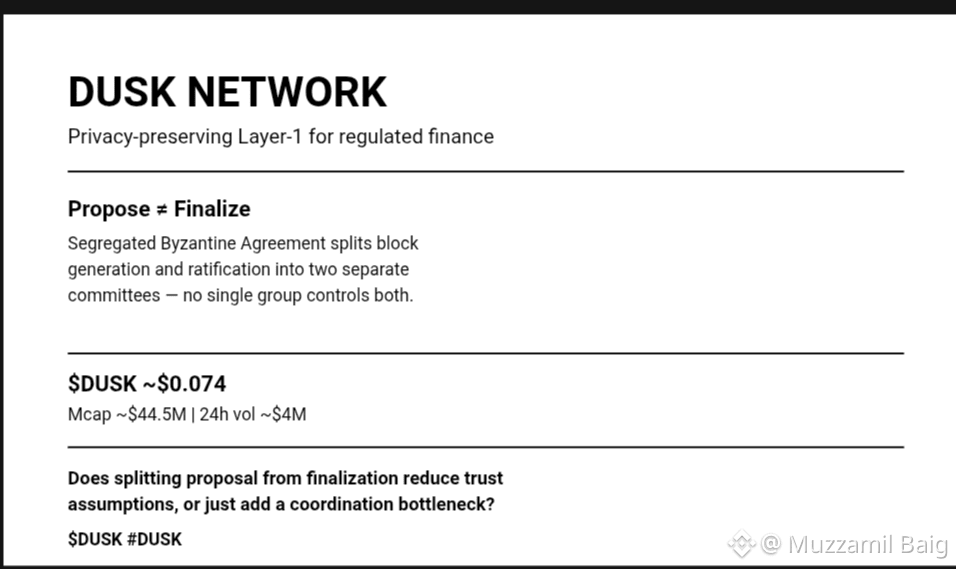
$DUSK is down about 5% today, trading near $0.074, with market cap around $44.5M and roughly $4M in 24h volume — small enough that a few large trades can move it more than you'd expect.
What's more interesting than the chart, though, is how Dusk actually reaches consensus. Most Layer-1s let the same group of validators both propose a block and finalize it. Dusk's Segregated Byzantine Agreement splits that into two separate steps — one committee generates the block, a different one ratifies it. No single group controls both ends of the process at once.
Why does that matter for a chain built on private, ZK-verified transactions? Because if the same validators who build a block could also approve it unilaterally, there's more room for that block to include something no one outside the group can verify. Separating the roles gives an extra check specifically suited to a chain where transaction contents aren't publicly visible by default.
The trade-off is coordination overhead — two committees agreeing takes more communication than one group voting alone, and that has to stay fast enough for actual settlement, not just a testnet demo.
@Dusk_Foundation is betting that extra step is worth the latency cost for institutions that need auditability guarantees, not just speed.
Does splitting proposal from finalization actually reduce trust assumptions, or just add a coordination bottleneck dressed up as security?
$DUSK #dusk
$DUSK is down about 5% today, trading near $0.074, with market cap around $44.5M and roughly $4M in 24h volume — small enough that a few large trades can move it more than you'd expect.
What's more interesting than the chart, though, is how Dusk actually reaches consensus. Most Layer-1s let the same group of validators both propose a block and finalize it. Dusk's Segregated Byzantine Agreement splits that into two separate steps — one committee generates the block, a different one ratifies it. No single group controls both ends of the process at once.
Why does that matter for a chain built on private, ZK-verified transactions? Because if the same validators who build a block could also approve it unilaterally, there's more room for that block to include something no one outside the group can verify. Separating the roles gives an extra check specifically suited to a chain where transaction contents aren't publicly visible by default.
The trade-off is coordination overhead — two committees agreeing takes more communication than one group voting alone, and that has to stay fast enough for actual settlement, not just a testnet demo.
@Dusk is betting that extra step is worth the latency cost for institutions that need auditability guarantees, not just speed.
Does splitting proposal from finalization actually reduce trust assumptions, or just add a coordination bottleneck dressed up as security?
$DUSK #dusk
What's more interesting than the chart, though, is how Dusk actually reaches consensus. Most Layer-1s let the same group of validators both propose a block and finalize it. Dusk's Segregated Byzantine Agreement splits that into two separate steps — one committee generates the block, a different one ratifies it. No single group controls both ends of the process at once.
Why does that matter for a chain built on private, ZK-verified transactions? Because if the same validators who build a block could also approve it unilaterally, there's more room for that block to include something no one outside the group can verify. Separating the roles gives an extra check specifically suited to a chain where transaction contents aren't publicly visible by default.
The trade-off is coordination overhead — two committees agreeing takes more communication than one group voting alone, and that has to stay fast enough for actual settlement, not just a testnet demo.
@Dusk is betting that extra step is worth the latency cost for institutions that need auditability guarantees, not just speed.
Does splitting proposal from finalization actually reduce trust assumptions, or just add a coordination bottleneck dressed up as security?
$DUSK #dusk
31
14
192
Verified
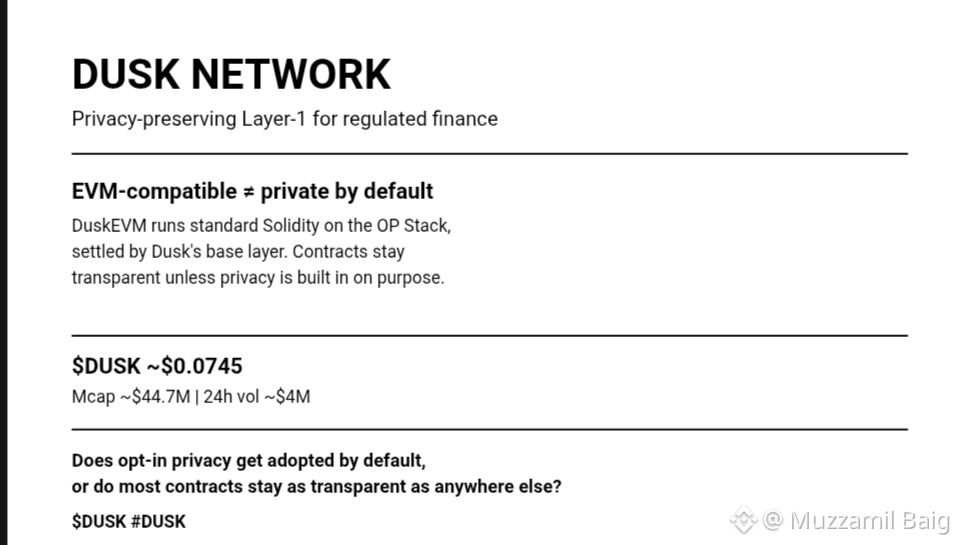
Quick one for anyone confused about what "EVM-compatible" actually means for a privacy chain — because DuskEVM doesn't work the way people assume.
The common assumption: Dusk is a privacy chain, so anything built on it must be private by default. Not how DuskEVM works. It runs standard Solidity contracts using the OP Stack for execution, with Dusk's base layer handling settlement. That means developers get familiar tooling — same contracts, same deployment flow as any other EVM chain. But those contracts are transparent unless a developer specifically builds with Dusk's confidential primitives instead.
So EVM compatibility and privacy are two separate design choices here, not one bundled feature. A team could deploy on DuskEVM today and end up with a fully public contract, same as deploying on any L2. The privacy tooling exists, but it's opt-in, not automatic.
That's worth knowing before assuming every dApp on Dusk inherits the chain's privacy reputation.
$DUSK is trading around $0.0745 today, market cap near $44.7M, with roughly $4M in 24h volume.
@Dusk_Foundation is clearly betting developers will choose the confidential path once it's easy enough to reach. Question is whether "opt-in privacy" gets adopted by default, or whether most contracts on DuskEVM end up just as transparent as everywhere else.
$DUSK #dusk
Quick one for anyone confused about what "EVM-compatible" actually means for a privacy chain — because DuskEVM doesn't work the way people assume.
The common assumption: Dusk is a privacy chain, so anything built on it must be private by default. Not how DuskEVM works. It runs standard Solidity contracts using the OP Stack for execution, with Dusk's base layer handling settlement. That means developers get familiar tooling — same contracts, same deployment flow as any other EVM chain. But those contracts are transparent unless a developer specifically builds with Dusk's confidential primitives instead.
So EVM compatibility and privacy are two separate design choices here, not one bundled feature. A team could deploy on DuskEVM today and end up with a fully public contract, same as deploying on any L2. The privacy tooling exists, but it's opt-in, not automatic.
That's worth knowing before assuming every dApp on Dusk inherits the chain's privacy reputation.
$DUSK is trading around $0.0745 today, market cap near $44.7M, with roughly $4M in 24h volume.
@Dusk is clearly betting developers will choose the confidential path once it's easy enough to reach. Question is whether "opt-in privacy" gets adopted by default, or whether most contracts on DuskEVM end up just as transparent as everywhere else.
$DUSK #dusk
The common assumption: Dusk is a privacy chain, so anything built on it must be private by default. Not how DuskEVM works. It runs standard Solidity contracts using the OP Stack for execution, with Dusk's base layer handling settlement. That means developers get familiar tooling — same contracts, same deployment flow as any other EVM chain. But those contracts are transparent unless a developer specifically builds with Dusk's confidential primitives instead.
So EVM compatibility and privacy are two separate design choices here, not one bundled feature. A team could deploy on DuskEVM today and end up with a fully public contract, same as deploying on any L2. The privacy tooling exists, but it's opt-in, not automatic.
That's worth knowing before assuming every dApp on Dusk inherits the chain's privacy reputation.
$DUSK is trading around $0.0745 today, market cap near $44.7M, with roughly $4M in 24h volume.
@Dusk is clearly betting developers will choose the confidential path once it's easy enough to reach. Question is whether "opt-in privacy" gets adopted by default, or whether most contracts on DuskEVM end up just as transparent as everywhere else.
$DUSK #dusk
40
19
160
Verified
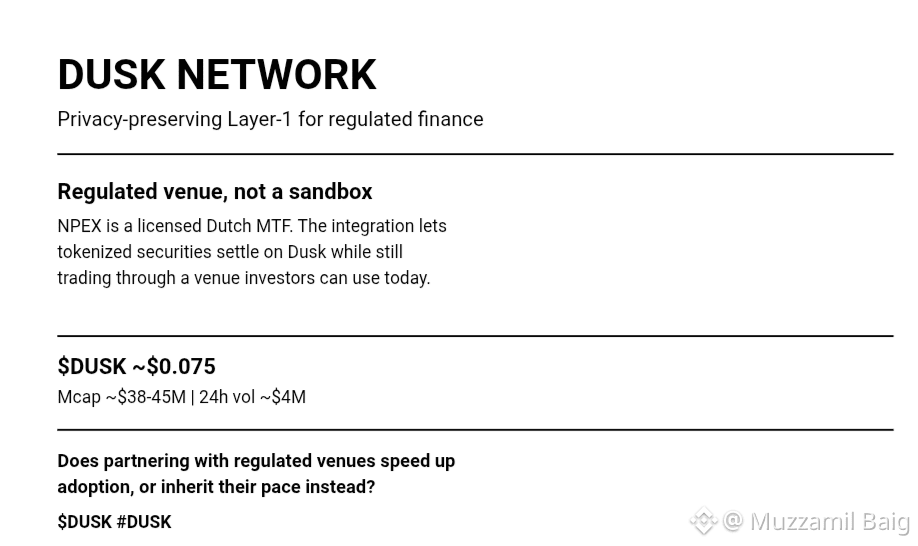
$DUSK is around $0.075 today, market cap roughly in the $38–45M range depending on the tracker, with about $4M in 24h volume.
Numbers aside, the more interesting thing this week was going through Dusk's NPEX partnership details instead of the price chart. Assumed it was another "we partnered with an exchange" press release, the kind every L1 puts out. It's not that. NPEX is a Dutch MTF — a regulated trading venue under EU law — and the integration lets tokenized securities settle on Dusk while still trading through a licensed venue investors can actually use today, not a sandbox.
That's a narrower thing than "RWA tokenization," which gets thrown around loosely right now. Most tokenization projects wrap an asset and hope a regulated venue picks it up later. Dusk built toward the venue relationship first.
The trade-off worth naming: settlement speed and privacy on-chain don't matter much if the regulated venue on the other end still runs on its own timeline and rules. Dusk's infrastructure can only move as fast as the slowest regulated counterparty it's plugged into.
@Dusk_Foundation is betting that pairing with licensed venues early beats building infrastructure and waiting for regulators to catch up later.
Does partnering with regulated venues actually speed up institutional adoption, or does it just inherit their pace instead?
$DUSK #dusk
$DUSK is around $0.075 today, market cap roughly in the $38–45M range depending on the tracker, with about $4M in 24h volume.
Numbers aside, the more interesting thing this week was going through Dusk's NPEX partnership details instead of the price chart. Assumed it was another "we partnered with an exchange" press release, the kind every L1 puts out. It's not that. NPEX is a Dutch MTF — a regulated trading venue under EU law — and the integration lets tokenized securities settle on Dusk while still trading through a licensed venue investors can actually use today, not a sandbox.
That's a narrower thing than "RWA tokenization," which gets thrown around loosely right now. Most tokenization projects wrap an asset and hope a regulated venue picks it up later. Dusk built toward the venue relationship first.
The trade-off worth naming: settlement speed and privacy on-chain don't matter much if the regulated venue on the other end still runs on its own timeline and rules. Dusk's infrastructure can only move as fast as the slowest regulated counterparty it's plugged into.
@Dusk is betting that pairing with licensed venues early beats building infrastructure and waiting for regulators to catch up later.
Does partnering with regulated venues actually speed up institutional adoption, or does it just inherit their pace instead?
$DUSK #dusk
Numbers aside, the more interesting thing this week was going through Dusk's NPEX partnership details instead of the price chart. Assumed it was another "we partnered with an exchange" press release, the kind every L1 puts out. It's not that. NPEX is a Dutch MTF — a regulated trading venue under EU law — and the integration lets tokenized securities settle on Dusk while still trading through a licensed venue investors can actually use today, not a sandbox.
That's a narrower thing than "RWA tokenization," which gets thrown around loosely right now. Most tokenization projects wrap an asset and hope a regulated venue picks it up later. Dusk built toward the venue relationship first.
The trade-off worth naming: settlement speed and privacy on-chain don't matter much if the regulated venue on the other end still runs on its own timeline and rules. Dusk's infrastructure can only move as fast as the slowest regulated counterparty it's plugged into.
@Dusk is betting that pairing with licensed venues early beats building infrastructure and waiting for regulators to catch up later.
Does partnering with regulated venues actually speed up institutional adoption, or does it just inherit their pace instead?
$DUSK #dusk
30
13
155
Partly True
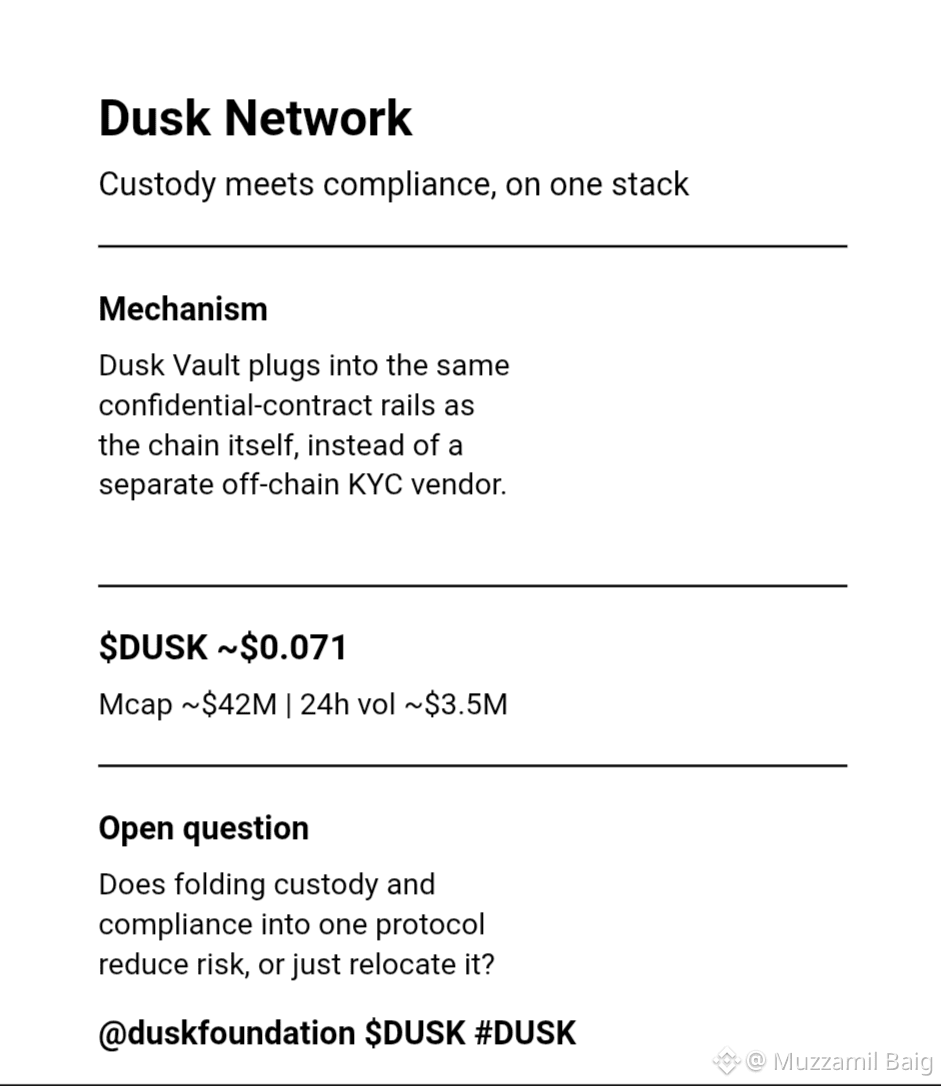
Skimmed past another "custody solution" headline and almost scrolled by, until I noticed Dusk Vault sits closer to settlement than a normal wallet product. Assumed it was cold storage with a Dusk logo on it. It actually plugs into the same confidential-contract rails the chain uses for regulated assets, so custody and compliance run through one stack instead of a wallet talking to a separate KYC vendor bolted on after the fact.
Most institutional crypto custody today works the opposite way — the chain stays dumb and transparent, compliance happens off-chain in someone's database. Dusk is folding that logic into the protocol itself.
$DUSK is around $0.071 today, down a few percent, market cap near $42M, about $3.5M moving through in 24h volume.
Cleaner on paper, but it also means Dusk Network now owns more of the trust surface institutions used to outsource to specialized custodians. @Dusk_Foundation is betting that's the right trade for compliant finance.
Does folding custody and compliance into one protocol actually reduce risk, or just relocate the single point of failure somewhere less familiar?
$DUSK #dusk
Skimmed past another "custody solution" headline and almost scrolled by, until I noticed Dusk Vault sits closer to settlement than a normal wallet product. Assumed it was cold storage with a Dusk logo on it. It actually plugs into the same confidential-contract rails the chain uses for regulated assets, so custody and compliance run through one stack instead of a wallet talking to a separate KYC vendor bolted on after the fact.
Most institutional crypto custody today works the opposite way — the chain stays dumb and transparent, compliance happens off-chain in someone's database. Dusk is folding that logic into the protocol itself.
$DUSK is around $0.071 today, down a few percent, market cap near $42M, about $3.5M moving through in 24h volume.
Cleaner on paper, but it also means Dusk Network now owns more of the trust surface institutions used to outsource to specialized custodians. @Dusk is betting that's the right trade for compliant finance.
Does folding custody and compliance into one protocol actually reduce risk, or just relocate the single point of failure somewhere less familiar?
$DUSK #dusk
Most institutional crypto custody today works the opposite way — the chain stays dumb and transparent, compliance happens off-chain in someone's database. Dusk is folding that logic into the protocol itself.
$DUSK is around $0.071 today, down a few percent, market cap near $42M, about $3.5M moving through in 24h volume.
Cleaner on paper, but it also means Dusk Network now owns more of the trust surface institutions used to outsource to specialized custodians. @Dusk is betting that's the right trade for compliant finance.
Does folding custody and compliance into one protocol actually reduce risk, or just relocate the single point of failure somewhere less familiar?
$DUSK #dusk
36
18
123
Verified
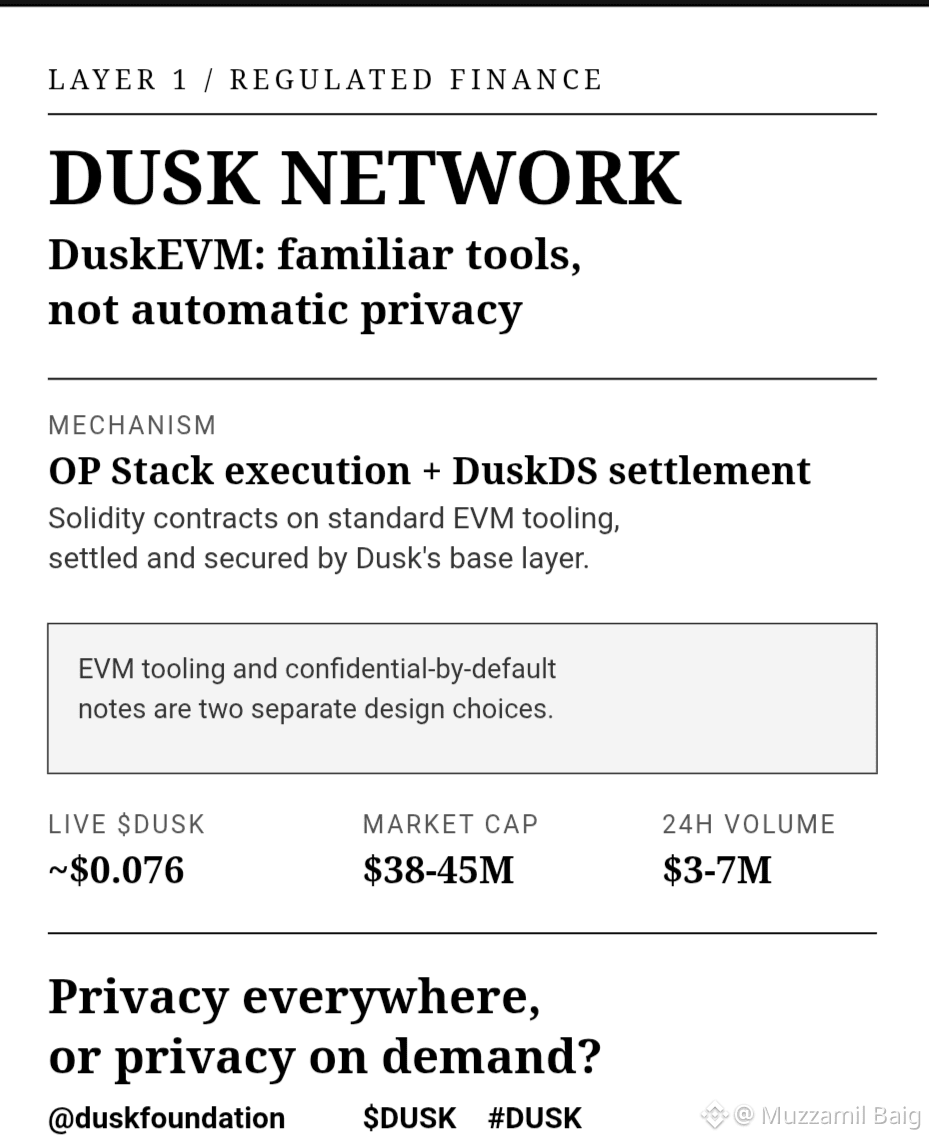
$DUSK sitting around $0.076 today, market cap somewhere in the $38-45M band depending on the tracker, daily volume in the $3-7M range. Small numbers. What actually caught my attention this week was a docs page, not the chart.
Was reading about DuskEVM expecting the usual "EVM-compatible chain" pitch — deploy your Solidity contracts, done, nothing to see here. That's not quite what it is. DuskEVM is an OP Stack-based execution environment sitting on top of DuskDS, meaning it settles and gets its data availability from Dusk's base layer while giving developers standard EVM tooling instead of forcing them to learn a new stack.
Compare that to how most privacy chains handle compatibility: they either stay isolated with custom tooling nobody outside the ecosystem wants to learn, or they go fully transparent to plug into existing DeFi. Dusk Network is trying a third path — keep the privacy-native settlement layer (Phoenix, shielded notes) underneath, but let Solidity contracts run in a familiar EVM-equivalent environment on top.
Here's what that actually means in practice: contracts deployed on DuskEVM don't automatically inherit the confidential-by-default treatment that Phoenix gives native Dusk transactions. You get familiar tooling, not automatic privacy — those are two separate design decisions, not one.
@Dusk_Foundation is clearly betting compatibility gets more developers in the door faster than privacy purity would. Fair bet, maybe.
So which actually gets institutional dev teams building on regulated-finance infra faster — a chain that's privacy-native everywhere, or one that only guarantees it in specific execution environments?
#dusk
$DUSK sitting around $0.076 today, market cap somewhere in the $38-45M band depending on the tracker, daily volume in the $3-7M range. Small numbers. What actually caught my attention this week was a docs page, not the chart.
Was reading about DuskEVM expecting the usual "EVM-compatible chain" pitch — deploy your Solidity contracts, done, nothing to see here. That's not quite what it is. DuskEVM is an OP Stack-based execution environment sitting on top of DuskDS, meaning it settles and gets its data availability from Dusk's base layer while giving developers standard EVM tooling instead of forcing them to learn a new stack.
Compare that to how most privacy chains handle compatibility: they either stay isolated with custom tooling nobody outside the ecosystem wants to learn, or they go fully transparent to plug into existing DeFi. Dusk Network is trying a third path — keep the privacy-native settlement layer (Phoenix, shielded notes) underneath, but let Solidity contracts run in a familiar EVM-equivalent environment on top.
Here's what that actually means in practice: contracts deployed on DuskEVM don't automatically inherit the confidential-by-default treatment that Phoenix gives native Dusk transactions. You get familiar tooling, not automatic privacy — those are two separate design decisions, not one.
@Dusk is clearly betting compatibility gets more developers in the door faster than privacy purity would. Fair bet, maybe.
So which actually gets institutional dev teams building on regulated-finance infra faster — a chain that's privacy-native everywhere, or one that only guarantees it in specific execution environments?
#dusk
Was reading about DuskEVM expecting the usual "EVM-compatible chain" pitch — deploy your Solidity contracts, done, nothing to see here. That's not quite what it is. DuskEVM is an OP Stack-based execution environment sitting on top of DuskDS, meaning it settles and gets its data availability from Dusk's base layer while giving developers standard EVM tooling instead of forcing them to learn a new stack.
Compare that to how most privacy chains handle compatibility: they either stay isolated with custom tooling nobody outside the ecosystem wants to learn, or they go fully transparent to plug into existing DeFi. Dusk Network is trying a third path — keep the privacy-native settlement layer (Phoenix, shielded notes) underneath, but let Solidity contracts run in a familiar EVM-equivalent environment on top.
Here's what that actually means in practice: contracts deployed on DuskEVM don't automatically inherit the confidential-by-default treatment that Phoenix gives native Dusk transactions. You get familiar tooling, not automatic privacy — those are two separate design decisions, not one.
@Dusk is clearly betting compatibility gets more developers in the door faster than privacy purity would. Fair bet, maybe.
So which actually gets institutional dev teams building on regulated-finance infra faster — a chain that's privacy-native everywhere, or one that only guarantees it in specific execution environments?
#dusk
50
23
847
Log in to explore more content
Join global crypto users on Binance Square
⚡️ Get latest and useful information about crypto.
💬 Trusted by the world’s largest crypto exchange.
👍 Discover real insights from verified creators.
Email / Phone number