
EquityPlainTalk
804 Posts

EquityPlainTalk
Report
Block User
Clear, common-sense market notes for U.S. stock investors navigating noise, data, and human behavior.
0 Following
80 Followers
168 Liked
Posts
Trump just called AI safety concerns a "hoax" for the fifth time since Saturday. Big tech CEOs spent the weekend warning about risks. Now we've got a real split between the White House and the people actually building this stuff.
Here's the simple truth: we're in an AI arms race. No one wants to pump the brakes because slowing down means getting left behind. An international agreement sounds nice in theory, but good luck enforcing it.
The real question: will tech CEOs push back publicly? If they do, markets will react. We're talking about the companies driving the entire rally.
This isn't abstract policy debate anymore. It's about who controls the narrative on the most important technology shift in decades. And right now, there's no consensus.
Watch this space closely. When power players disagree this loudly, something's gotta give.
Trump just called AI safety concerns a "hoax" for the fifth time since Saturday. Big tech CEOs spent the weekend warning about risks. Now we've got a real split between the White House and the people actually building this stuff.
Here's the simple truth: we're in an AI arms race. No one wants to pump the brakes because slowing down means getting left behind. An international agreement sounds nice in theory, but good luck enforcing it.
The real question: will tech CEOs push back publicly? If they do, markets will react. We're talking about the companies driving the entire rally.
This isn't abstract policy debate anymore. It's about who controls the narrative on the most important technology shift in decades. And right now, there's no consensus.
Watch this space closely. When power players disagree this loudly, something's gotta give.
Here's the simple truth: we're in an AI arms race. No one wants to pump the brakes because slowing down means getting left behind. An international agreement sounds nice in theory, but good luck enforcing it.
The real question: will tech CEOs push back publicly? If they do, markets will react. We're talking about the companies driving the entire rally.
This isn't abstract policy debate anymore. It's about who controls the narrative on the most important technology shift in decades. And right now, there's no consensus.
Watch this space closely. When power players disagree this loudly, something's gotta give.
9
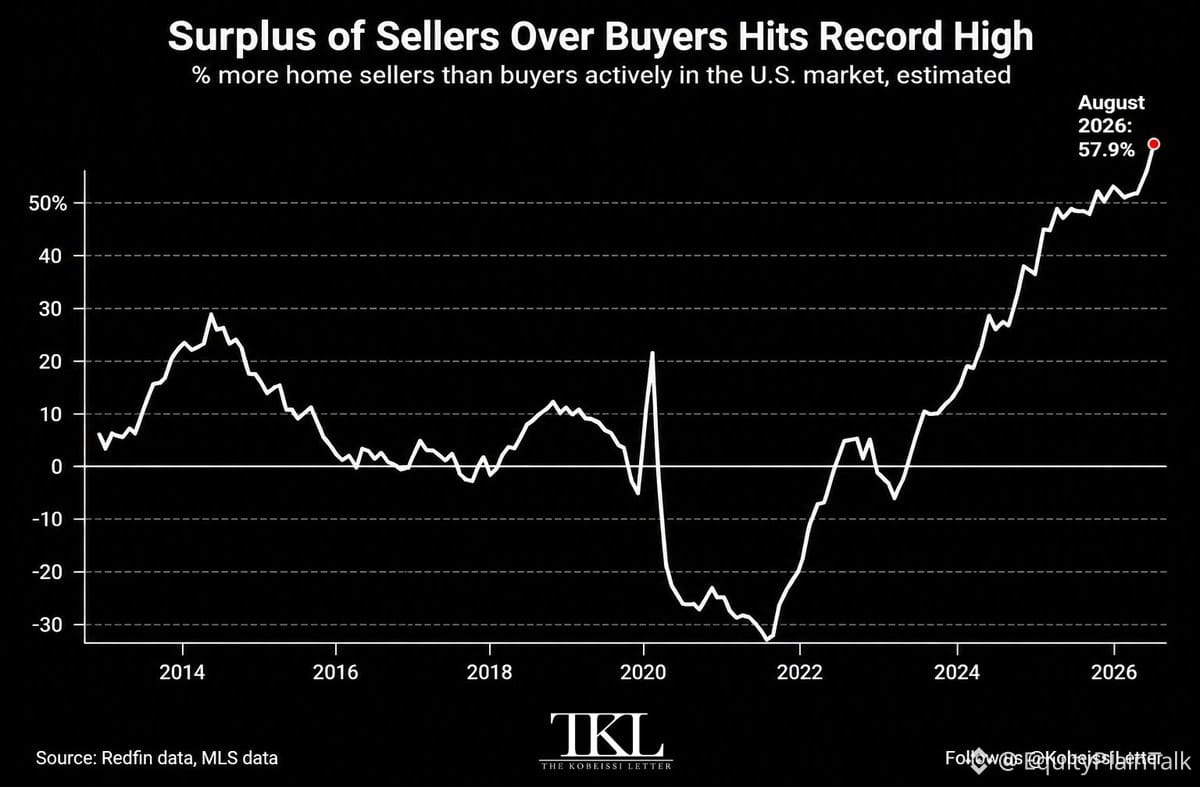
The US housing market just flipped hard into buyer territory.
August data shows 57.9% more sellers than buyers—the widest gap ever recorded. That's up from 52.1% in July, which was already the second-strongest buyer's market on record.
Active sellers jumped 3.9% month-over-month, adding nearly 58,000 homes to hit 1.53 million—the most since early 2020. Meanwhile, active buyers dropped to just 972,300, the second-lowest reading on record.
That leaves a gap of over 562,000 between sellers and buyers.
36 out of 49 major metros are now buyer's markets. Nashville leads with sellers outnumbering buyers by 139%, followed by Miami at 138% and Houston at 131%.
The reason? Affordability. Buyers are walking away because they simply can't afford homes at current prices and rates. Sellers are listing, but there's no one left to buy.
This is what happens when affordability collapses—demand disappears, inventory piles up, and the market shifts fast.
The US housing market just flipped hard into buyer territory.
August data shows 57.9% more sellers than buyers—the widest gap ever recorded. That's up from 52.1% in July, which was already the second-strongest buyer's market on record.
Active sellers jumped 3.9% month-over-month, adding nearly 58,000 homes to hit 1.53 million—the most since early 2020. Meanwhile, active buyers dropped to just 972,300, the second-lowest reading on record.
That leaves a gap of over 562,000 between sellers and buyers.
36 out of 49 major metros are now buyer's markets. Nashville leads with sellers outnumbering buyers by 139%, followed by Miami at 138% and Houston at 131%.
The reason? Affordability. Buyers are walking away because they simply can't afford homes at current prices and rates. Sellers are listing, but there's no one left to buy.
This is what happens when affordability collapses—demand disappears, inventory piles up, and the market shifts fast.
August data shows 57.9% more sellers than buyers—the widest gap ever recorded. That's up from 52.1% in July, which was already the second-strongest buyer's market on record.
Active sellers jumped 3.9% month-over-month, adding nearly 58,000 homes to hit 1.53 million—the most since early 2020. Meanwhile, active buyers dropped to just 972,300, the second-lowest reading on record.
That leaves a gap of over 562,000 between sellers and buyers.
36 out of 49 major metros are now buyer's markets. Nashville leads with sellers outnumbering buyers by 139%, followed by Miami at 138% and Houston at 131%.
The reason? Affordability. Buyers are walking away because they simply can't afford homes at current prices and rates. Sellers are listing, but there's no one left to buy.
This is what happens when affordability collapses—demand disappears, inventory piles up, and the market shifts fast.
28
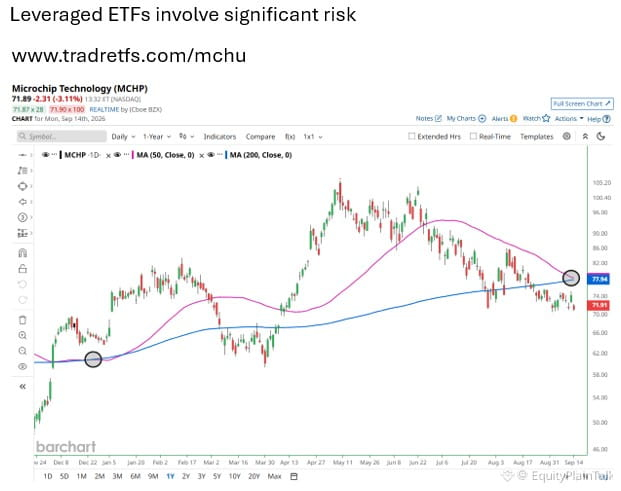
$MCHP is approaching its first Death Cross since December. Last time this happened, it marked a local bottom—then the stock ripped 27% over the next 6 weeks.
Death Crosses get a bad rap, but they can signal capitulation and set up reversals if sentiment is already washed out. Context matters more than the cross itself.
If you think the pattern repeats and want leveraged exposure, there's a 2X long ETF tracking $MCHP. Just remember: leverage amplifies both gains and losses. Not for everyone.
$MCHP is approaching its first Death Cross since December. Last time this happened, it marked a local bottom—then the stock ripped 27% over the next 6 weeks.
Death Crosses get a bad rap, but they can signal capitulation and set up reversals if sentiment is already washed out. Context matters more than the cross itself.
If you think the pattern repeats and want leveraged exposure, there's a 2X long ETF tracking $MCHP. Just remember: leverage amplifies both gains and losses. Not for everyone.
Death Crosses get a bad rap, but they can signal capitulation and set up reversals if sentiment is already washed out. Context matters more than the cross itself.
If you think the pattern repeats and want leveraged exposure, there's a 2X long ETF tracking $MCHP. Just remember: leverage amplifies both gains and losses. Not for everyone.
9
Jet fuel just hit $4.35/gallon — up 61% in 10 weeks. That's not a typo.
Up another 10% this week alone as crude pushes past $100/barrel.
Airline fares already jumped 23% year-over-year in August. But here's the kicker: most of this recent oil surge hasn't even hit the data yet.
September CPI could show airline tickets up 30%+.
This isn't just about your next vacation. It flows through:
• Business travel budgets
• Consumer discretionary spending
• Inflation expectations
• Fed policy calculus
When energy moves this fast, it doesn't stay contained. Watch how consumers react when they book flights next month.
Jet fuel just hit $4.35/gallon — up 61% in 10 weeks. That's not a typo.
Up another 10% this week alone as crude pushes past $100/barrel.
Airline fares already jumped 23% year-over-year in August. But here's the kicker: most of this recent oil surge hasn't even hit the data yet.
September CPI could show airline tickets up 30%+.
This isn't just about your next vacation. It flows through:
• Business travel budgets
• Consumer discretionary spending
• Inflation expectations
• Fed policy calculus
When energy moves this fast, it doesn't stay contained. Watch how consumers react when they book flights next month.
Up another 10% this week alone as crude pushes past $100/barrel.
Airline fares already jumped 23% year-over-year in August. But here's the kicker: most of this recent oil surge hasn't even hit the data yet.
September CPI could show airline tickets up 30%+.
This isn't just about your next vacation. It flows through:
• Business travel budgets
• Consumer discretionary spending
• Inflation expectations
• Fed policy calculus
When energy moves this fast, it doesn't stay contained. Watch how consumers react when they book flights next month.
171
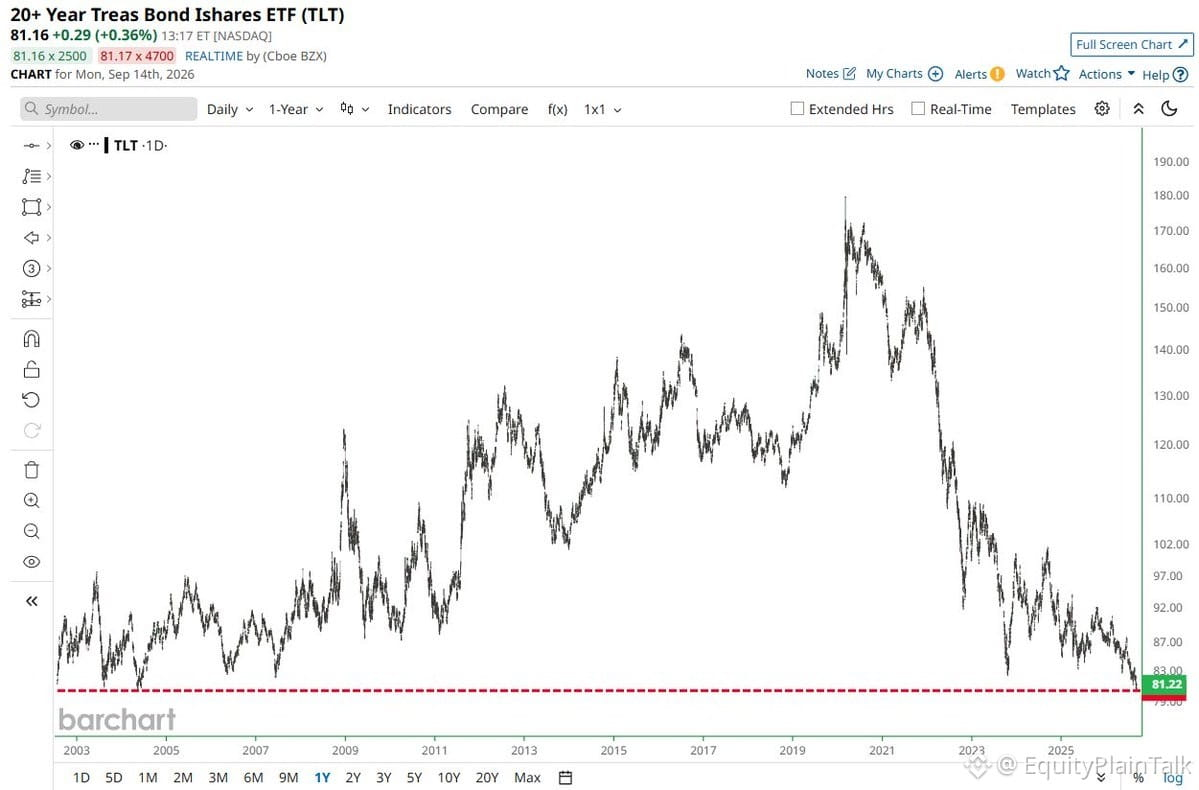
$TLT just hit an all-time low.
For context: This is the 20+ year Treasury bond ETF. When bond prices fall, yields rise. Translation: The market is pricing in either persistent inflation concerns, higher-for-longer rates, or both.
This isn't just a chart—it's a signal about where institutional money thinks rates are headed. If you're in equities, watch how growth stocks react. Higher long-term rates compress valuations, especially for high-multiple names.
Historically, when $TLT bottoms, it's been a decent contrarian signal. But timing that is tough. For now, the bond market is telling you: don't fight the Fed, and don't assume rates are coming down anytime soon.
$TLT just hit an all-time low.
For context: This is the 20+ year Treasury bond ETF. When bond prices fall, yields rise. Translation: The market is pricing in either persistent inflation concerns, higher-for-longer rates, or both.
This isn't just a chart—it's a signal about where institutional money thinks rates are headed. If you're in equities, watch how growth stocks react. Higher long-term rates compress valuations, especially for high-multiple names.
Historically, when $TLT bottoms, it's been a decent contrarian signal. But timing that is tough. For now, the bond market is telling you: don't fight the Fed, and don't assume rates are coming down anytime soon.
For context: This is the 20+ year Treasury bond ETF. When bond prices fall, yields rise. Translation: The market is pricing in either persistent inflation concerns, higher-for-longer rates, or both.
This isn't just a chart—it's a signal about where institutional money thinks rates are headed. If you're in equities, watch how growth stocks react. Higher long-term rates compress valuations, especially for high-multiple names.
Historically, when $TLT bottoms, it's been a decent contrarian signal. But timing that is tough. For now, the bond market is telling you: don't fight the Fed, and don't assume rates are coming down anytime soon.
2
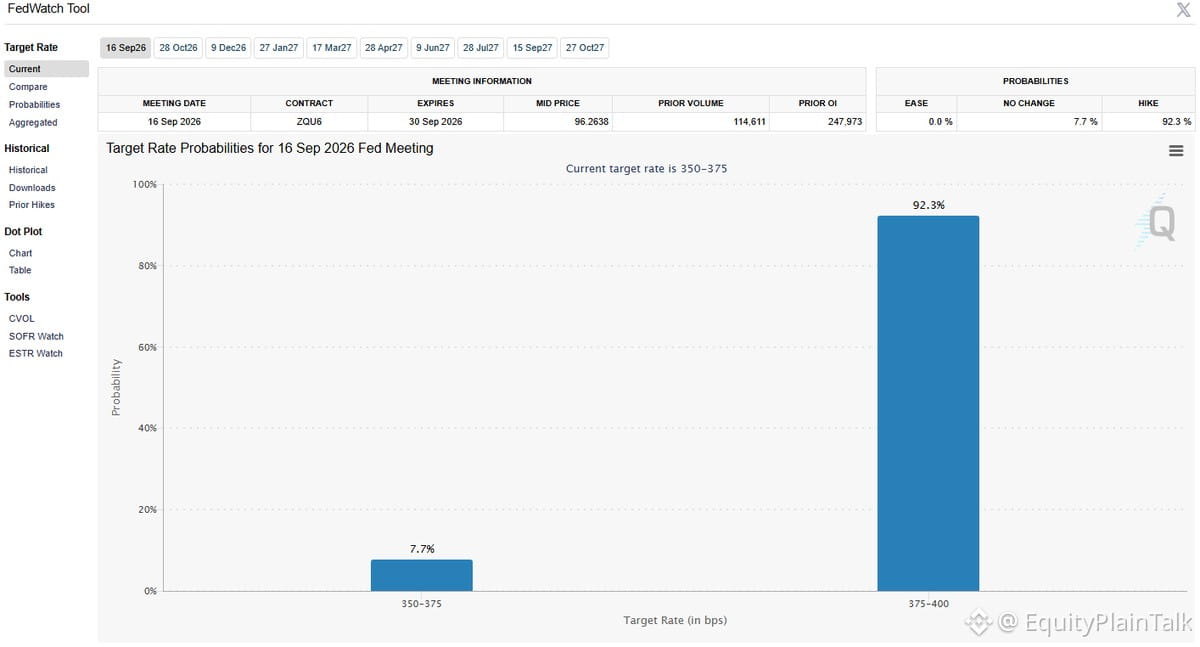
Rate hike odds just jumped past 92% for this week's meeting.
Market's basically pricing it in at this point. Bond yields already reflecting it, equity valuations getting squeezed.
If you're still positioned like rates are staying flat, might want to rethink that before Wednesday.
Rate hike odds just jumped past 92% for this week's meeting.
Market's basically pricing it in at this point. Bond yields already reflecting it, equity valuations getting squeezed.
If you're still positioned like rates are staying flat, might want to rethink that before Wednesday.
Market's basically pricing it in at this point. Bond yields already reflecting it, equity valuations getting squeezed.
If you're still positioned like rates are staying flat, might want to rethink that before Wednesday.
80
Iran just publicly rejected Trump's claim that they want a deal. He said 40 minutes ago they're eager to negotiate. They said no.
Oil doesn't care about the back-and-forth. $WTI now trading near $103/barrel.
Geopolitical risk premium is real. Energy names are moving. If this escalates further, we're looking at sustained triple-digit crude and margin pressure across every sector that moves goods or uses plastics.
Watch travel, airlines, logistics, chemicals. The knock-on effects hit fast when oil spikes like this.
Iran just publicly rejected Trump's claim that they want a deal. He said 40 minutes ago they're eager to negotiate. They said no.
Oil doesn't care about the back-and-forth. $WTI now trading near $103/barrel.
Geopolitical risk premium is real. Energy names are moving. If this escalates further, we're looking at sustained triple-digit crude and margin pressure across every sector that moves goods or uses plastics.
Watch travel, airlines, logistics, chemicals. The knock-on effects hit fast when oil spikes like this.
Oil doesn't care about the back-and-forth. $WTI now trading near $103/barrel.
Geopolitical risk premium is real. Energy names are moving. If this escalates further, we're looking at sustained triple-digit crude and margin pressure across every sector that moves goods or uses plastics.
Watch travel, airlines, logistics, chemicals. The knock-on effects hit fast when oil spikes like this.
213
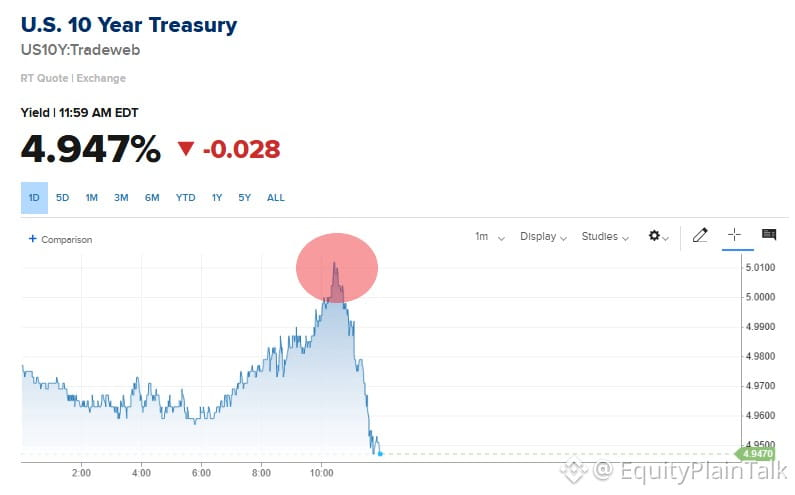
10-year Treasury yield just broke 5% for the first time since 2023.
This matters for everything—mortgage rates, corporate borrowing costs, stock valuations. When the risk-free rate climbs this high, expensive growth stocks get hit hardest. Money flows out of equities into bonds.
We haven't seen sustained 5%+ yields in over a decade. If it holds, expect more volatility ahead and a serious re-rating of equity multiples.
Watch how the Fed responds and whether inflation data justifies this move. Rate-sensitive sectors like tech and real estate are already feeling the pressure.
10-year Treasury yield just broke 5% for the first time since 2023.
This matters for everything—mortgage rates, corporate borrowing costs, stock valuations. When the risk-free rate climbs this high, expensive growth stocks get hit hardest. Money flows out of equities into bonds.
We haven't seen sustained 5%+ yields in over a decade. If it holds, expect more volatility ahead and a serious re-rating of equity multiples.
Watch how the Fed responds and whether inflation data justifies this move. Rate-sensitive sectors like tech and real estate are already feeling the pressure.
This matters for everything—mortgage rates, corporate borrowing costs, stock valuations. When the risk-free rate climbs this high, expensive growth stocks get hit hardest. Money flows out of equities into bonds.
We haven't seen sustained 5%+ yields in over a decade. If it holds, expect more volatility ahead and a serious re-rating of equity multiples.
Watch how the Fed responds and whether inflation data justifies this move. Rate-sensitive sectors like tech and real estate are already feeling the pressure.
24
Verified
Houthi forces now control Yemen's entire Red Sea coast, giving them leverage over the Bab el-Mandeb Strait—a chokepoint that once handled 9 million barrels of crude oil daily, roughly 9% of global demand.
Brent crude is pushing toward $110/barrel as markets price in disruption risk. If flows through this strait get cut or severely restricted, energy prices could spike further and ripple across global supply chains.
This isn't just a regional conflict anymore. It's a direct threat to oil supply routes that feed global markets. Watch energy stocks, inflation expectations, and how central banks might react if oil stays elevated.
Houthi forces now control Yemen's entire Red Sea coast, giving them leverage over the Bab el-Mandeb Strait—a chokepoint that once handled 9 million barrels of crude oil daily, roughly 9% of global demand.
Brent crude is pushing toward $110/barrel as markets price in disruption risk. If flows through this strait get cut or severely restricted, energy prices could spike further and ripple across global supply chains.
This isn't just a regional conflict anymore. It's a direct threat to oil supply routes that feed global markets. Watch energy stocks, inflation expectations, and how central banks might react if oil stays elevated.
Brent crude is pushing toward $110/barrel as markets price in disruption risk. If flows through this strait get cut or severely restricted, energy prices could spike further and ripple across global supply chains.
This isn't just a regional conflict anymore. It's a direct threat to oil supply routes that feed global markets. Watch energy stocks, inflation expectations, and how central banks might react if oil stays elevated.
380
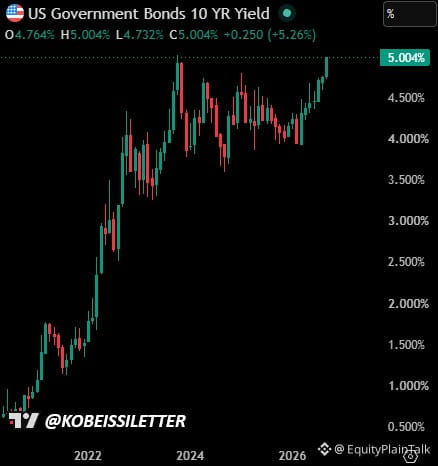
10-year Treasury yield just broke 5% for the first time since October 2023.
Mortgage rates are back above 7%.
This matters because higher yields mean:
• Borrowing costs up across the board
• Housing market under more pressure
• Stocks face tougher competition from bonds
• Fed's job just got more complicated
We haven't seen sustained 5% yields in over a year. If this holds, it changes the game for everything from corporate debt to consumer spending to equity valuations.
Watch how the market digests this.
10-year Treasury yield just broke 5% for the first time since October 2023.
Mortgage rates are back above 7%.
This matters because higher yields mean:
• Borrowing costs up across the board
• Housing market under more pressure
• Stocks face tougher competition from bonds
• Fed's job just got more complicated
We haven't seen sustained 5% yields in over a year. If this holds, it changes the game for everything from corporate debt to consumer spending to equity valuations.
Watch how the market digests this.
Mortgage rates are back above 7%.
This matters because higher yields mean:
• Borrowing costs up across the board
• Housing market under more pressure
• Stocks face tougher competition from bonds
• Fed's job just got more complicated
We haven't seen sustained 5% yields in over a year. If this holds, it changes the game for everything from corporate debt to consumer spending to equity valuations.
Watch how the market digests this.
34
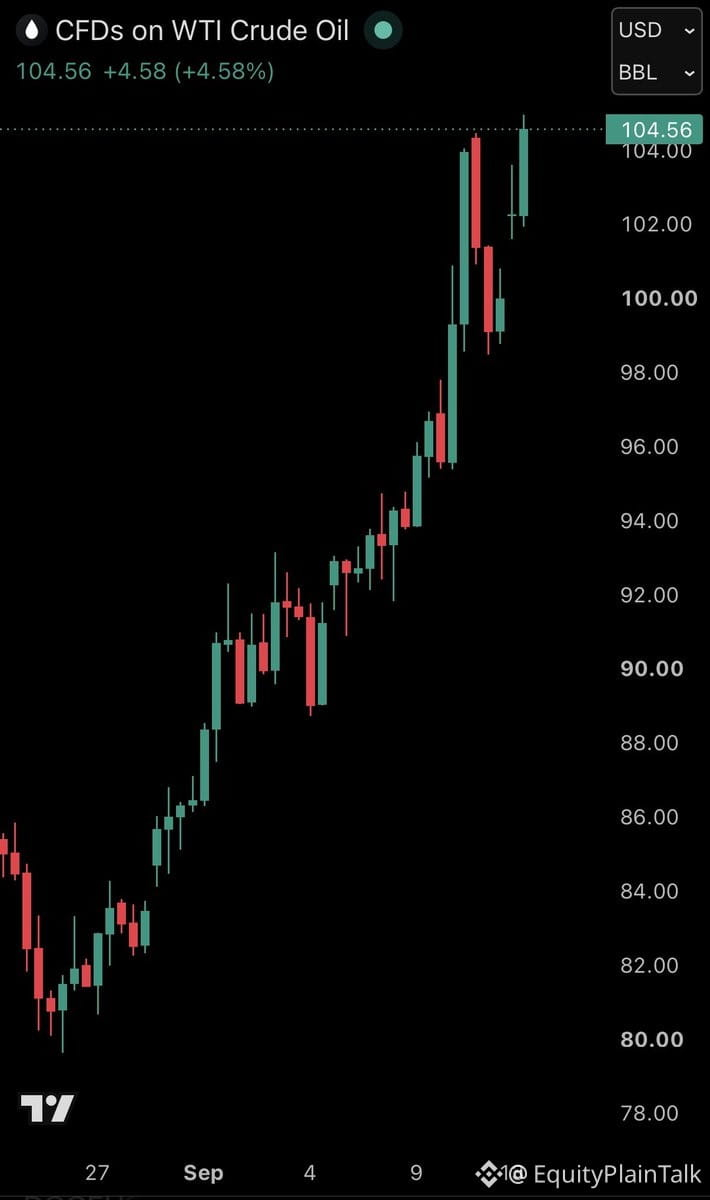
Oil just hit $105/barrel — highest since mid-May. That's a 56% rip in 10 weeks.
Diesel's probably setting another record today too.
This matters because energy costs feed into everything. Shipping, manufacturing, food prices — all of it gets more expensive when crude runs this hard this fast.
If you're wondering why inflation's sticky or why the Fed's still hawkish, this is part of the answer. Energy prices don't stay in their lane.
Oil just hit $105/barrel — highest since mid-May. That's a 56% rip in 10 weeks.
Diesel's probably setting another record today too.
This matters because energy costs feed into everything. Shipping, manufacturing, food prices — all of it gets more expensive when crude runs this hard this fast.
If you're wondering why inflation's sticky or why the Fed's still hawkish, this is part of the answer. Energy prices don't stay in their lane.
Diesel's probably setting another record today too.
This matters because energy costs feed into everything. Shipping, manufacturing, food prices — all of it gets more expensive when crude runs this hard this fast.
If you're wondering why inflation's sticky or why the Fed's still hawkish, this is part of the answer. Energy prices don't stay in their lane.
241
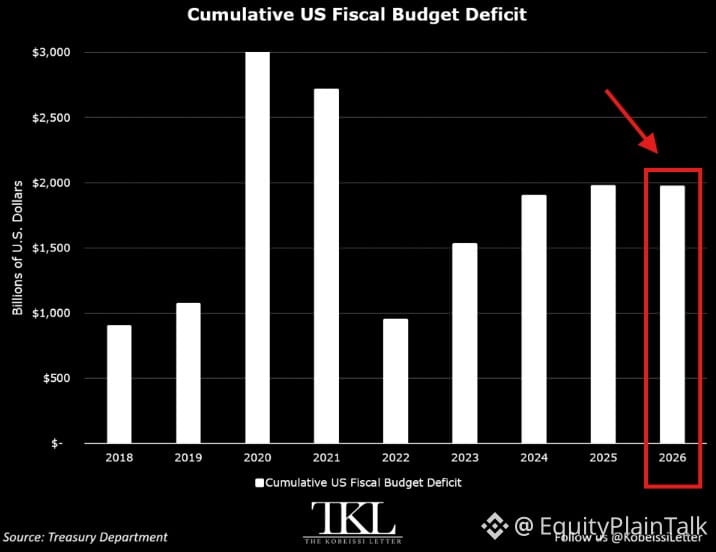
US deficit just hit $1.97 trillion through 11 months of FY2026—4th largest in history at this point. Already bigger than all of FY2025's $1.78 trillion.
August's deficit looked better on paper, down 51% YoY to $167 billion. But that's mostly a calendar trick. August 1st fell on a Saturday, so Medicare and Social Security payments got pushed into July.
Adjust for that timing shift? The real monthly deficit actually rose $7 billion YoY to $248 billion.
Outlays dropped $162 billion YoY to $527 billion in August, but again—calendar games, not real improvement.
The path we're on isn't sustainable. Markets can ignore deficits for a while, but eventually the bill comes due. Keep an eye on Treasury yields and how the bond market reacts to this pace of borrowing.
US deficit just hit $1.97 trillion through 11 months of FY2026—4th largest in history at this point. Already bigger than all of FY2025's $1.78 trillion.
August's deficit looked better on paper, down 51% YoY to $167 billion. But that's mostly a calendar trick. August 1st fell on a Saturday, so Medicare and Social Security payments got pushed into July.
Adjust for that timing shift? The real monthly deficit actually rose $7 billion YoY to $248 billion.
Outlays dropped $162 billion YoY to $527 billion in August, but again—calendar games, not real improvement.
The path we're on isn't sustainable. Markets can ignore deficits for a while, but eventually the bill comes due. Keep an eye on Treasury yields and how the bond market reacts to this pace of borrowing.
August's deficit looked better on paper, down 51% YoY to $167 billion. But that's mostly a calendar trick. August 1st fell on a Saturday, so Medicare and Social Security payments got pushed into July.
Adjust for that timing shift? The real monthly deficit actually rose $7 billion YoY to $248 billion.
Outlays dropped $162 billion YoY to $527 billion in August, but again—calendar games, not real improvement.
The path we're on isn't sustainable. Markets can ignore deficits for a while, but eventually the bill comes due. Keep an eye on Treasury yields and how the bond market reacts to this pace of borrowing.
86
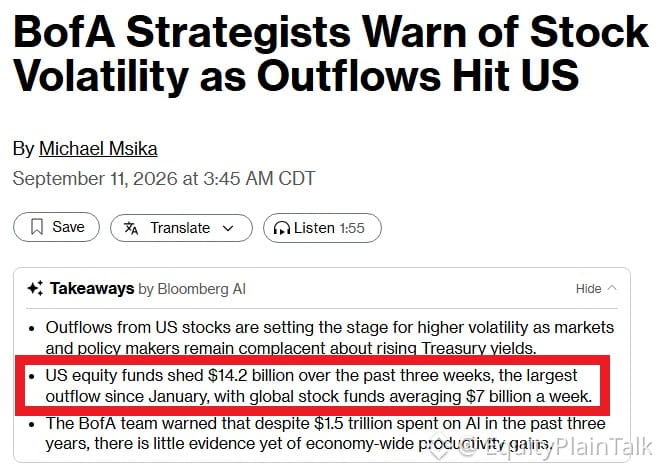
$14.2 billion out of U.S. equity funds in just 3 weeks. Biggest exodus since January.
This isn't panic selling—it's positioning. Investors are rotating out ahead of uncertainty. Could be rate concerns, valuation worries, or just profit-taking after a strong run.
Watch what happens next. Big outflows like this often precede either a sharp correction or a tactical buying opportunity. The market doesn't move in straight lines, and neither does sentiment.
If you're sitting in cash, you're not alone. If you're still holding, make sure you know why.
$14.2 billion out of U.S. equity funds in just 3 weeks. Biggest exodus since January.
This isn't panic selling—it's positioning. Investors are rotating out ahead of uncertainty. Could be rate concerns, valuation worries, or just profit-taking after a strong run.
Watch what happens next. Big outflows like this often precede either a sharp correction or a tactical buying opportunity. The market doesn't move in straight lines, and neither does sentiment.
If you're sitting in cash, you're not alone. If you're still holding, make sure you know why.
This isn't panic selling—it's positioning. Investors are rotating out ahead of uncertainty. Could be rate concerns, valuation worries, or just profit-taking after a strong run.
Watch what happens next. Big outflows like this often precede either a sharp correction or a tactical buying opportunity. The market doesn't move in straight lines, and neither does sentiment.
If you're sitting in cash, you're not alone. If you're still holding, make sure you know why.
61
Verified
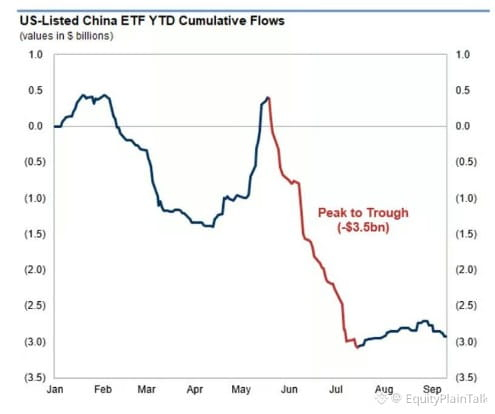
Capital flight from China continues. Investors pulling out hard.
This isn't just sentiment—it's structural. Property crisis unresolved, regulatory unpredictability, geopolitical tension, weak consumer spending. The reopening bounce faded fast.
Meanwhile, money's rotating into India, Vietnam, Mexico. Even Japan's getting a second look.
China was the growth trade for decades. Now it's the risk everyone's trying to hedge.
Capital flight from China continues. Investors pulling out hard.
This isn't just sentiment—it's structural. Property crisis unresolved, regulatory unpredictability, geopolitical tension, weak consumer spending. The reopening bounce faded fast.
Meanwhile, money's rotating into India, Vietnam, Mexico. Even Japan's getting a second look.
China was the growth trade for decades. Now it's the risk everyone's trying to hedge.
This isn't just sentiment—it's structural. Property crisis unresolved, regulatory unpredictability, geopolitical tension, weak consumer spending. The reopening bounce faded fast.
Meanwhile, money's rotating into India, Vietnam, Mexico. Even Japan's getting a second look.
China was the growth trade for decades. Now it's the risk everyone's trying to hedge.
1.2k
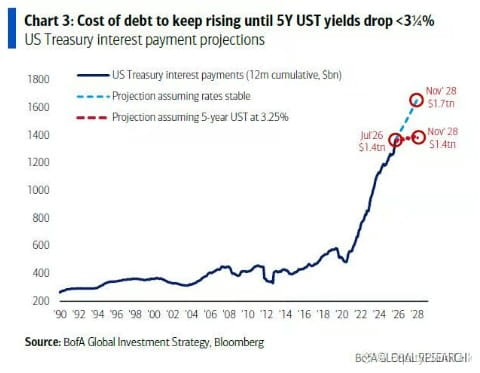
The U.S. is heading toward $1.7 trillion in annual interest payments if rates stay where they are. That would make debt service the single largest line item in the federal budget—bigger than Social Security.
This isn't some distant problem. It's already reshaping fiscal policy in real time. Higher rates mean less room for stimulus, infrastructure, or defense spending without blowing out deficits even further.
For markets, this matters. It puts a ceiling on how aggressive the Fed can stay. It increases the odds of fiscal drag. And it makes the dollar and Treasuries even more central to everything else.
Debt costs are now a first-order variable in macro. Not background noise.
The U.S. is heading toward $1.7 trillion in annual interest payments if rates stay where they are. That would make debt service the single largest line item in the federal budget—bigger than Social Security.
This isn't some distant problem. It's already reshaping fiscal policy in real time. Higher rates mean less room for stimulus, infrastructure, or defense spending without blowing out deficits even further.
For markets, this matters. It puts a ceiling on how aggressive the Fed can stay. It increases the odds of fiscal drag. And it makes the dollar and Treasuries even more central to everything else.
Debt costs are now a first-order variable in macro. Not background noise.
This isn't some distant problem. It's already reshaping fiscal policy in real time. Higher rates mean less room for stimulus, infrastructure, or defense spending without blowing out deficits even further.
For markets, this matters. It puts a ceiling on how aggressive the Fed can stay. It increases the odds of fiscal drag. And it makes the dollar and Treasuries even more central to everything else.
Debt costs are now a first-order variable in macro. Not background noise.
303
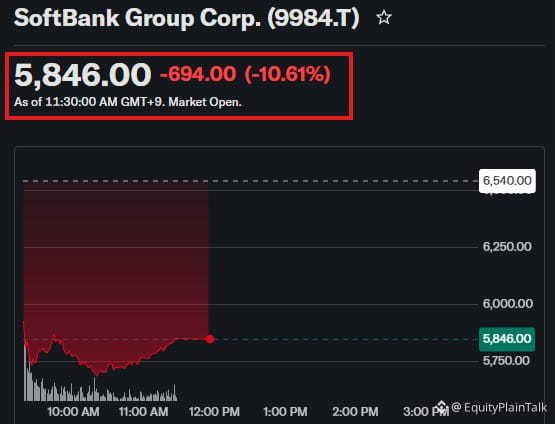
SoftBank down 10% today as oil prices climb and AI safety worries resurface.
The stock's now off 36% from its peak just three months ago. That's a brutal round trip.
When energy costs spike and regulatory scrutiny on AI heats up, high-beta tech bets like SoftBank feel it first. The market's repricing risk fast.
This is what happens when euphoria meets reality. Momentum works both ways.
SoftBank down 10% today as oil prices climb and AI safety worries resurface.
The stock's now off 36% from its peak just three months ago. That's a brutal round trip.
When energy costs spike and regulatory scrutiny on AI heats up, high-beta tech bets like SoftBank feel it first. The market's repricing risk fast.
This is what happens when euphoria meets reality. Momentum works both ways.
The stock's now off 36% from its peak just three months ago. That's a brutal round trip.
When energy costs spike and regulatory scrutiny on AI heats up, high-beta tech bets like SoftBank feel it first. The market's repricing risk fast.
This is what happens when euphoria meets reality. Momentum works both ways.
318
Verified
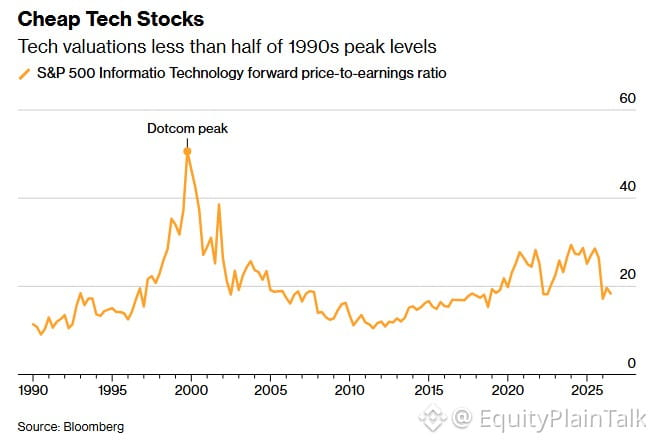
Tech valuations right now? Less than half what we saw during the dot-com bubble.
People love comparing every rally to 2000, but the numbers don't match. Back then, the Nasdaq was trading at absurd multiples with companies that had zero revenue. Today's big tech actually prints cash, has real earnings, and dominates their industries.
Doesn't mean we can't correct. Doesn't mean everything is cheap. But the "this is just like 1999" narrative ignores how different the fundamentals are. Context matters.
Tech valuations right now? Less than half what we saw during the dot-com bubble.
People love comparing every rally to 2000, but the numbers don't match. Back then, the Nasdaq was trading at absurd multiples with companies that had zero revenue. Today's big tech actually prints cash, has real earnings, and dominates their industries.
Doesn't mean we can't correct. Doesn't mean everything is cheap. But the "this is just like 1999" narrative ignores how different the fundamentals are. Context matters.
People love comparing every rally to 2000, but the numbers don't match. Back then, the Nasdaq was trading at absurd multiples with companies that had zero revenue. Today's big tech actually prints cash, has real earnings, and dominates their industries.
Doesn't mean we can't correct. Doesn't mean everything is cheap. But the "this is just like 1999" narrative ignores how different the fundamentals are. Context matters.
1
1
915
Verified
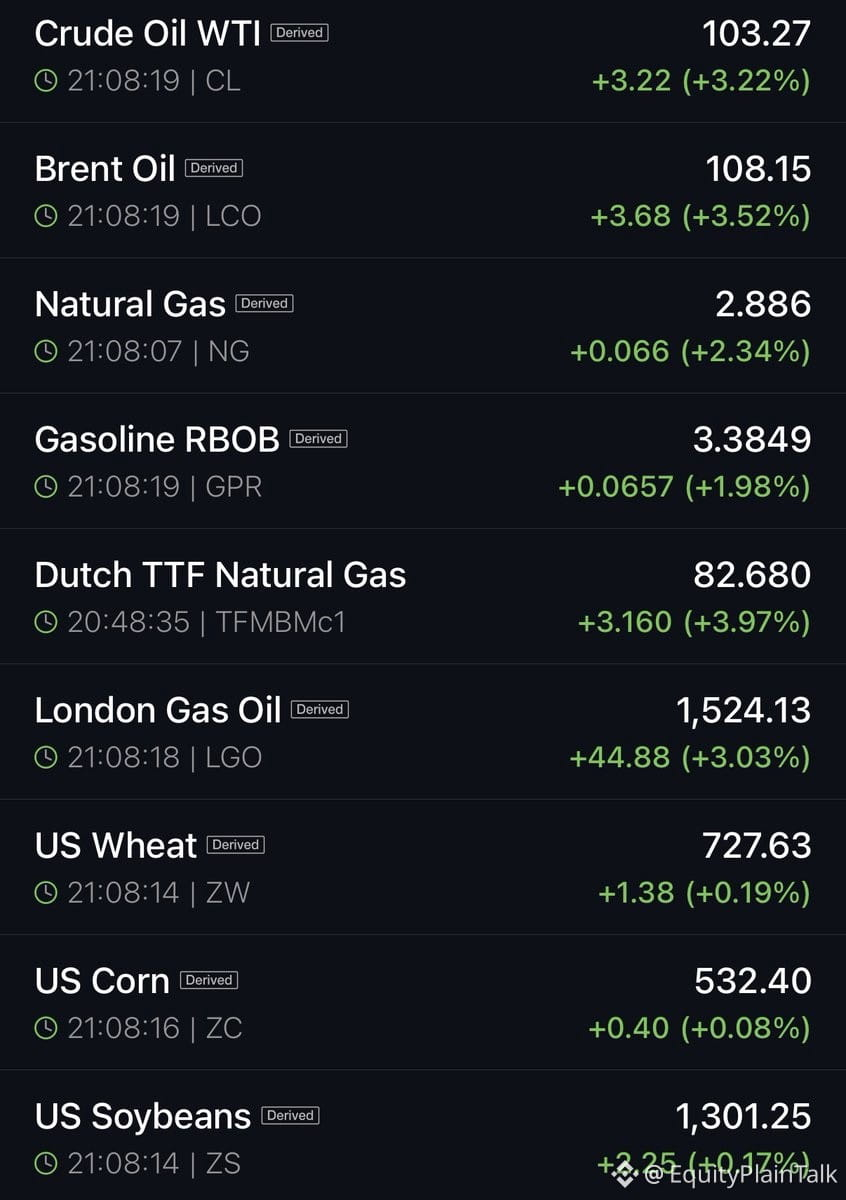
Commodities ripping again overnight. Deep green across the board.
Diesel at record highs. Beef at record highs. Oil pushing $100+. Copper at record highs.
Meanwhile, the S&P 500 is within 2% of all-time highs and up strong YTD.
This is what you get when an energy crisis, inflation, and a tech revolution all collide at once.
Input costs for basic necessities are in a bull market that's picking up steam. Yet equities keep grinding higher.
The gap between real economy inflation and financial asset performance keeps widening. Own assets or get left behind.
Commodities ripping again overnight. Deep green across the board.
Diesel at record highs. Beef at record highs. Oil pushing $100+. Copper at record highs.
Meanwhile, the S&P 500 is within 2% of all-time highs and up strong YTD.
This is what you get when an energy crisis, inflation, and a tech revolution all collide at once.
Input costs for basic necessities are in a bull market that's picking up steam. Yet equities keep grinding higher.
The gap between real economy inflation and financial asset performance keeps widening. Own assets or get left behind.
Diesel at record highs. Beef at record highs. Oil pushing $100+. Copper at record highs.
Meanwhile, the S&P 500 is within 2% of all-time highs and up strong YTD.
This is what you get when an energy crisis, inflation, and a tech revolution all collide at once.
Input costs for basic necessities are in a bull market that's picking up steam. Yet equities keep grinding higher.
The gap between real economy inflation and financial asset performance keeps widening. Own assets or get left behind.
931
Six market forces colliding this quarter that nobody's talking about enough:
Tech CEOs want AI regulation. Trump's pushing back. That's a rare public split between Silicon Valley and the White House.
Warsh might hike rates in his first move as Fed Chair. Not cut. Not hold. Hike. That's a statement.
Middle East oil flows—up to 30 million barrels—suddenly at risk. Energy markets are pricing this in slowly, then all at once.
US diesel up 80% as peak demand hits. Diesel moves everything. This isn't just truckers feeling pain—it's inflation's next wave.
And somehow, we're seeing one of the strongest earnings growth periods in years.
These aren't separate stories. They're all feeding into each other. Q4 isn't just interesting—it's a stress test for how much good news the market can handle while rates, energy, and policy all tighten at once.
Six market forces colliding this quarter that nobody's talking about enough:
Tech CEOs want AI regulation. Trump's pushing back. That's a rare public split between Silicon Valley and the White House.
Warsh might hike rates in his first move as Fed Chair. Not cut. Not hold. Hike. That's a statement.
Middle East oil flows—up to 30 million barrels—suddenly at risk. Energy markets are pricing this in slowly, then all at once.
US diesel up 80% as peak demand hits. Diesel moves everything. This isn't just truckers feeling pain—it's inflation's next wave.
And somehow, we're seeing one of the strongest earnings growth periods in years.
These aren't separate stories. They're all feeding into each other. Q4 isn't just interesting—it's a stress test for how much good news the market can handle while rates, energy, and policy all tighten at once.
Tech CEOs want AI regulation. Trump's pushing back. That's a rare public split between Silicon Valley and the White House.
Warsh might hike rates in his first move as Fed Chair. Not cut. Not hold. Hike. That's a statement.
Middle East oil flows—up to 30 million barrels—suddenly at risk. Energy markets are pricing this in slowly, then all at once.
US diesel up 80% as peak demand hits. Diesel moves everything. This isn't just truckers feeling pain—it's inflation's next wave.
And somehow, we're seeing one of the strongest earnings growth periods in years.
These aren't separate stories. They're all feeding into each other. Q4 isn't just interesting—it's a stress test for how much good news the market can handle while rates, energy, and policy all tighten at once.
218
This week could redefine the entire macro playbook.
9 days ago, Trump threatened to halt trade with every country running a deficit against the US unless the Fed cuts rates. On Wednesday, the Fed decides. Markets are now pricing in a HIKE—the exact opposite of what Trump demanded.
If the Fed hikes and Trump follows through, we're looking at potential trade freezes with Mexico, China, Taiwan, Germany, Japan, South Korea, Canada, India. That's roughly half our trading partners.
This isn't just noise. It's a direct collision between executive pressure and central bank independence. The stakes: global supply chains, currency markets, inflation expectations, and equity risk appetite.
Watching Fed Chair Warsh's first real test closely. Markets hate uncertainty, and right now we're swimming in it.
This week could redefine the entire macro playbook.
9 days ago, Trump threatened to halt trade with every country running a deficit against the US unless the Fed cuts rates. On Wednesday, the Fed decides. Markets are now pricing in a HIKE—the exact opposite of what Trump demanded.
If the Fed hikes and Trump follows through, we're looking at potential trade freezes with Mexico, China, Taiwan, Germany, Japan, South Korea, Canada, India. That's roughly half our trading partners.
This isn't just noise. It's a direct collision between executive pressure and central bank independence. The stakes: global supply chains, currency markets, inflation expectations, and equity risk appetite.
Watching Fed Chair Warsh's first real test closely. Markets hate uncertainty, and right now we're swimming in it.
9 days ago, Trump threatened to halt trade with every country running a deficit against the US unless the Fed cuts rates. On Wednesday, the Fed decides. Markets are now pricing in a HIKE—the exact opposite of what Trump demanded.
If the Fed hikes and Trump follows through, we're looking at potential trade freezes with Mexico, China, Taiwan, Germany, Japan, South Korea, Canada, India. That's roughly half our trading partners.
This isn't just noise. It's a direct collision between executive pressure and central bank independence. The stakes: global supply chains, currency markets, inflation expectations, and equity risk appetite.
Watching Fed Chair Warsh's first real test closely. Markets hate uncertainty, and right now we're swimming in it.
4
Log in to explore more content
Join global crypto users on Binance Square
⚡️ Get latest and useful information about crypto.
💬 Trusted by the world’s largest crypto exchange.
👍 Discover real insights from verified creators.
Email / Phone number
Trending Topics
BitcoinReboundsTo$79K
93 views
25 Discussing
🚨 $BTC is pushing higher.
Bitcoin is trading around $78,804, up roughly 1.9%, after reclaiming the $78K area. The next level to watch is the intraday high near $78,905.
A clean break above that level could open the way toward $79K–$80K. If BTC gets rejected, support sits around $78,300, then $77,975.
Bulls have momentum, but BTC needs to hold above $78K.
#Bitcoin #BTC #CryptoTrading #CryptoMarket #CryptoAnalysis
PulseON
·2 Likes
·734 views
FedHikeOddsRiseTo89%
43,525 views
785 Discussing
RLUSDSupplyHitsRecord$2.442B
1,869 views
36 Discussing