

Decentralised News
514 Posts

Decentralised News
Report
Block User
X: @decentraliseda
Coinmarketcap @decentralisednews
0 Following
891 Followers
1.6K+ Liked
Posts
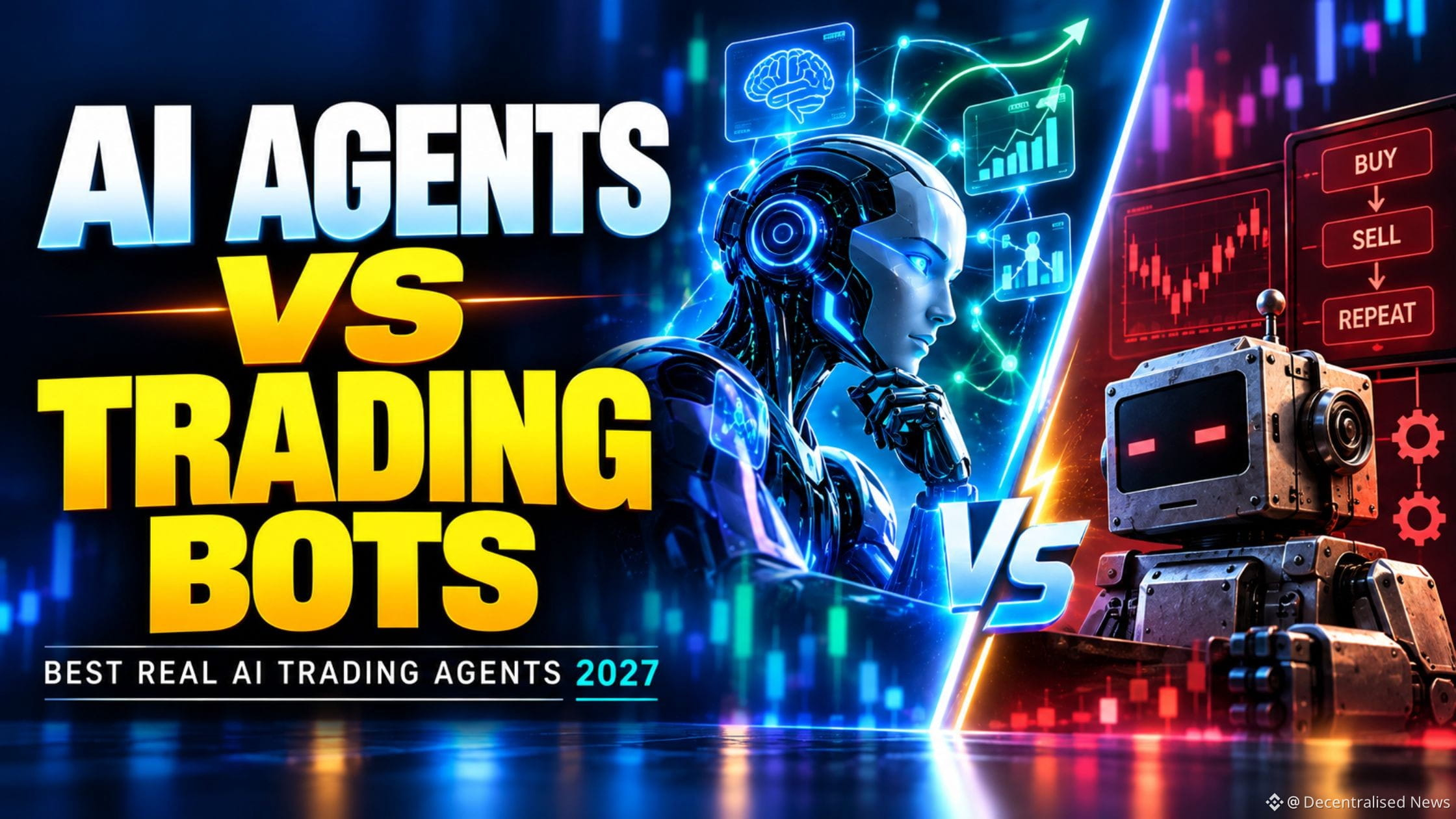
AI Trading Agent vs Trading Bot: 7 Platforms Compared
A traditional trading bot follows rules.
An AI trading agent can decide **which steps are needed to achieve an objective.**
That distinction is becoming much more important.
We compared **7 real AI trading-agent architectures**:
Wayfinder
QuantPilot
Coinrule MCP
3Commas MCP
HaasOnline MCP
Tickeron AI Agents
ASCN AI
against traditional trading bots such as:
Gunbot
Bitsgap
Pionex
Cryptohopper
The difference is not simply whether the software uses AI.
It is:
**How much discretion exists between your objective and the financial action?**
Tell a Grid bot:
“Trade BTC between these two prices using 50 grids.”
It executes the rule.
Tell an AI agent:
“My BTC portfolio has too much downside exposure. Find a reasonable hedge without selling the spot position.”
Now the system may need to:
inspect the portfolio,
research markets,
compare venues,
check funding,
evaluate hedge structures,
select tools,
calculate size,
and potentially execute.
We call the range of decisions the machine can make:
**The Discretion Envelope.**
And the useful capability created by that discretion:
**The Agentic Delta.**
If the task is:
buy every Monday,
maintain a Grid,
rebalance monthly,
or execute a fixed indicator rule,
the Agentic Delta may be close to zero.
A deterministic bot may actually be the better tool.
But if the task is:
research several hedge structures,
investigate why a strategy stopped working,
build and test new logic,
compare execution routes,
or coordinate multiple tools,
agency starts to matter.
The most interesting architectures also keep intelligence and financial authority separate.
Read the complete research and use the free Agent-or-Bot Classifier on Decentralised.News
#AITrading #AIAgents #TradingBots #AgenticFinance #CryptoTrading #ArtificialIntelligence #Automation #MCP #Crypto #Fintech #DecentralisedNews
AI Trading Agent vs Trading Bot: 7 Platforms Compared
A traditional trading bot follows rules.
An AI trading agent can decide **which steps are needed to achieve an objective.**
That distinction is becoming much more important.
We compared **7 real AI trading-agent architectures**:
Wayfinder
QuantPilot
Coinrule MCP
3Commas MCP
HaasOnline MCP
Tickeron AI Agents
ASCN AI
against traditional trading bots such as:
Gunbot
Bitsgap
Pionex
Cryptohopper
The difference is not simply whether the software uses AI.
It is:
**How much discretion exists between your objective and the financial action?**
Tell a Grid bot:
“Trade BTC between these two prices using 50 grids.”
It executes the rule.
Tell an AI agent:
“My BTC portfolio has too much downside exposure. Find a reasonable hedge without selling the spot position.”
Now the system may need to:
inspect the portfolio,
research markets,
compare venues,
check funding,
evaluate hedge structures,
select tools,
calculate size,
and potentially execute.
We call the range of decisions the machine can make:
**The Discretion Envelope.**
And the useful capability created by that discretion:
**The Agentic Delta.**
If the task is:
buy every Monday,
maintain a Grid,
rebalance monthly,
or execute a fixed indicator rule,
the Agentic Delta may be close to zero.
A deterministic bot may actually be the better tool.
But if the task is:
research several hedge structures,
investigate why a strategy stopped working,
build and test new logic,
compare execution routes,
or coordinate multiple tools,
agency starts to matter.
The most interesting architectures also keep intelligence and financial authority separate.
Read the complete research and use the free Agent-or-Bot Classifier on Decentralised.News
#AITrading #AIAgents #TradingBots #AgenticFinance #CryptoTrading #ArtificialIntelligence #Automation #MCP #Crypto #Fintech #DecentralisedNews
A traditional trading bot follows rules.
An AI trading agent can decide **which steps are needed to achieve an objective.**
That distinction is becoming much more important.
We compared **7 real AI trading-agent architectures**:
Wayfinder
QuantPilot
Coinrule MCP
3Commas MCP
HaasOnline MCP
Tickeron AI Agents
ASCN AI
against traditional trading bots such as:
Gunbot
Bitsgap
Pionex
Cryptohopper
The difference is not simply whether the software uses AI.
It is:
**How much discretion exists between your objective and the financial action?**
Tell a Grid bot:
“Trade BTC between these two prices using 50 grids.”
It executes the rule.
Tell an AI agent:
“My BTC portfolio has too much downside exposure. Find a reasonable hedge without selling the spot position.”
Now the system may need to:
inspect the portfolio,
research markets,
compare venues,
check funding,
evaluate hedge structures,
select tools,
calculate size,
and potentially execute.
We call the range of decisions the machine can make:
**The Discretion Envelope.**
And the useful capability created by that discretion:
**The Agentic Delta.**
If the task is:
buy every Monday,
maintain a Grid,
rebalance monthly,
or execute a fixed indicator rule,
the Agentic Delta may be close to zero.
A deterministic bot may actually be the better tool.
But if the task is:
research several hedge structures,
investigate why a strategy stopped working,
build and test new logic,
compare execution routes,
or coordinate multiple tools,
agency starts to matter.
The most interesting architectures also keep intelligence and financial authority separate.
Read the complete research and use the free Agent-or-Bot Classifier on Decentralised.News
#AITrading #AIAgents #TradingBots #AgenticFinance #CryptoTrading #ArtificialIntelligence #Automation #MCP #Crypto #Fintech #DecentralisedNews
74
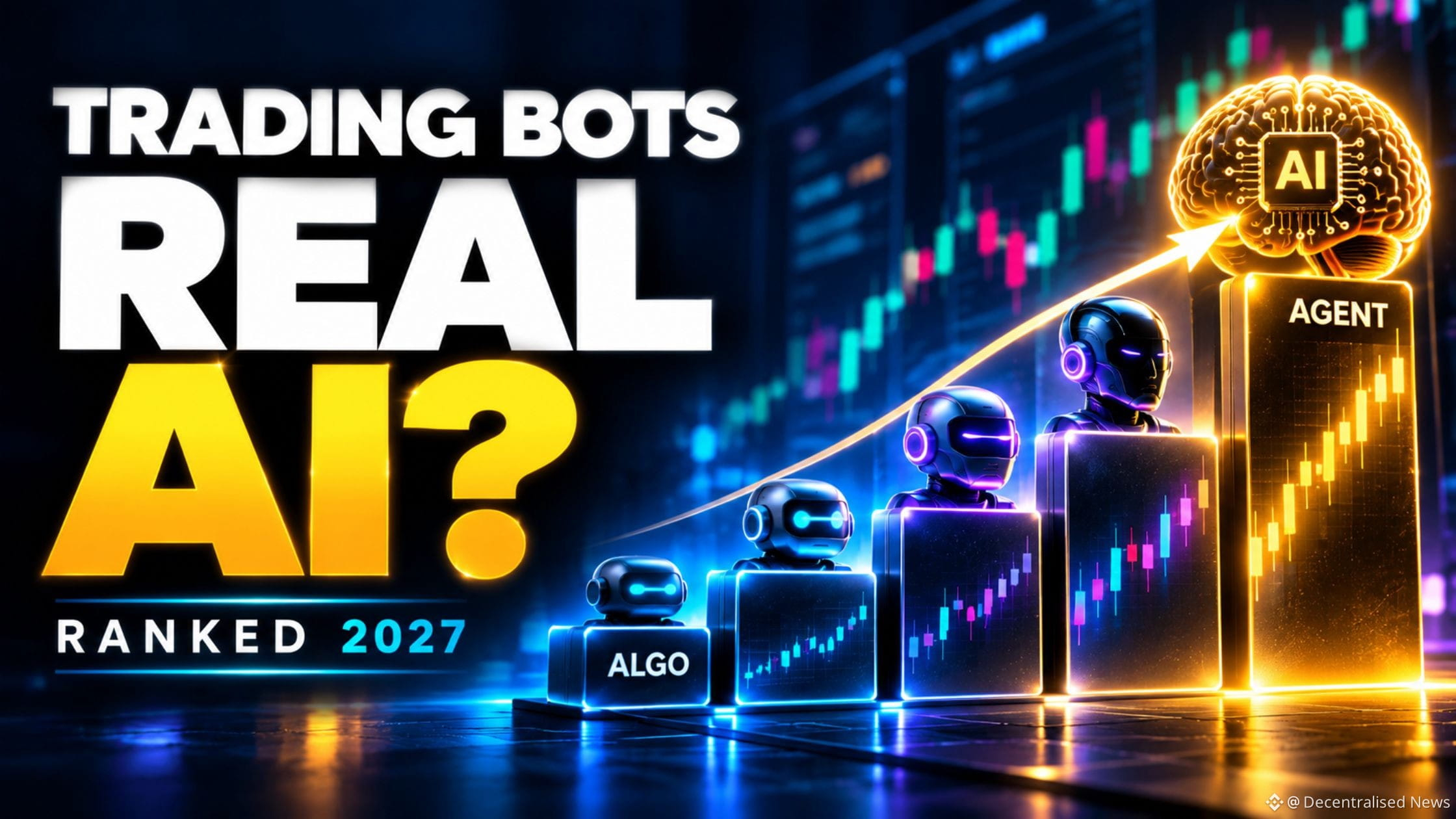
Which AI Trading Bots Actually Use AI? 10 Platforms Compared
Almost every trading bot is suddenly **“AI-powered.”**
But what does the AI actually do?
We investigated **10 AI-labelled and AI-adjacent trading platforms**:
QuantPilot
Tickeron
Coinrule
3Commas v2
HaasOnline
Capitalise(dot)ai
Gunbot
Bitsgap
Pionex
Cryptohopper
And found completely different technologies hiding behind the same phrase:
**AI trading bot.**
Some use machine learning to generate signals.
Some let LLMs call trading tools.
Some use AI to write strategy code.
Some use AI only to configure a bot.
Some use historical algorithms to recommend parameters.
And some are mostly deterministic automation.
One of the clearest examples?
Cryptohopper explicitly says its established **“A.I.” means Algorithmic Intelligence, not Artificial Intelligence.**
Pionex AI Grid uses historical backtests and quantitative algorithms to suggest Grid settings.
Bitsgap's AI Assistant helps configure a portfolio of bots, but the underlying bots execute rule-based strategies.
Coinrule lets compatible LLMs use authorized trading tools through MCP.
HaasOnline goes even further upstream.
Its AI agent can:
inspect bots,
analyze live context,
write strategy code,
compile it,
and run backtests.
But its current Cloud MCP deliberately does **not** expose live order-placement tools.
Then there is QuantPilot, where autonomous agents can research markets, write strategy code, backtest and iteratively optimize strategies.
These are not the same architecture.
So we created the:
**DN AI Trading Reality Ladder**
0 → Deterministic Bot
1 → Algorithmic Optimizer
2 → AI-Assisted Builder
3 → ML Decision System
4 → LLM Tool User
5 → Bounded Agent
And introduced another concept:
**AI Proximity to Capital.**
The important question isn't merely how much AI a platform uses.
It is:
**How close is probabilistic AI output to irreversible financial action?**
Read the complete research and use the free AI Trading Reality Checker on Decentralised.News
#AITrading #AIAgents #TradingBots
Which AI Trading Bots Actually Use AI? 10 Platforms Compared
Almost every trading bot is suddenly **“AI-powered.”**
But what does the AI actually do?
We investigated **10 AI-labelled and AI-adjacent trading platforms**:
QuantPilot
Tickeron
Coinrule
3Commas v2
HaasOnline
Capitalise(dot)ai
Gunbot
Bitsgap
Pionex
Cryptohopper
And found completely different technologies hiding behind the same phrase:
**AI trading bot.**
Some use machine learning to generate signals.
Some let LLMs call trading tools.
Some use AI to write strategy code.
Some use AI only to configure a bot.
Some use historical algorithms to recommend parameters.
And some are mostly deterministic automation.
One of the clearest examples?
Cryptohopper explicitly says its established **“A.I.” means Algorithmic Intelligence, not Artificial Intelligence.**
Pionex AI Grid uses historical backtests and quantitative algorithms to suggest Grid settings.
Bitsgap's AI Assistant helps configure a portfolio of bots, but the underlying bots execute rule-based strategies.
Coinrule lets compatible LLMs use authorized trading tools through MCP.
HaasOnline goes even further upstream.
Its AI agent can:
inspect bots,
analyze live context,
write strategy code,
compile it,
and run backtests.
But its current Cloud MCP deliberately does **not** expose live order-placement tools.
Then there is QuantPilot, where autonomous agents can research markets, write strategy code, backtest and iteratively optimize strategies.
These are not the same architecture.
So we created the:
**DN AI Trading Reality Ladder**
0 → Deterministic Bot
1 → Algorithmic Optimizer
2 → AI-Assisted Builder
3 → ML Decision System
4 → LLM Tool User
5 → Bounded Agent
And introduced another concept:
**AI Proximity to Capital.**
The important question isn't merely how much AI a platform uses.
It is:
**How close is probabilistic AI output to irreversible financial action?**
Read the complete research and use the free AI Trading Reality Checker on Decentralised.News
#AITrading #AIAgents #TradingBots
Almost every trading bot is suddenly **“AI-powered.”**
But what does the AI actually do?
We investigated **10 AI-labelled and AI-adjacent trading platforms**:
QuantPilot
Tickeron
Coinrule
3Commas v2
HaasOnline
Capitalise(dot)ai
Gunbot
Bitsgap
Pionex
Cryptohopper
And found completely different technologies hiding behind the same phrase:
**AI trading bot.**
Some use machine learning to generate signals.
Some let LLMs call trading tools.
Some use AI to write strategy code.
Some use AI only to configure a bot.
Some use historical algorithms to recommend parameters.
And some are mostly deterministic automation.
One of the clearest examples?
Cryptohopper explicitly says its established **“A.I.” means Algorithmic Intelligence, not Artificial Intelligence.**
Pionex AI Grid uses historical backtests and quantitative algorithms to suggest Grid settings.
Bitsgap's AI Assistant helps configure a portfolio of bots, but the underlying bots execute rule-based strategies.
Coinrule lets compatible LLMs use authorized trading tools through MCP.
HaasOnline goes even further upstream.
Its AI agent can:
inspect bots,
analyze live context,
write strategy code,
compile it,
and run backtests.
But its current Cloud MCP deliberately does **not** expose live order-placement tools.
Then there is QuantPilot, where autonomous agents can research markets, write strategy code, backtest and iteratively optimize strategies.
These are not the same architecture.
So we created the:
**DN AI Trading Reality Ladder**
0 → Deterministic Bot
1 → Algorithmic Optimizer
2 → AI-Assisted Builder
3 → ML Decision System
4 → LLM Tool User
5 → Bounded Agent
And introduced another concept:
**AI Proximity to Capital.**
The important question isn't merely how much AI a platform uses.
It is:
**How close is probabilistic AI output to irreversible financial action?**
Read the complete research and use the free AI Trading Reality Checker on Decentralised.News
#AITrading #AIAgents #TradingBots
29
How to Test MCP Servers Before Giving Agents Real Authority
An MCP server can be online while the agent’s workflow fails.
A market-data tool can return a stale price.
A CRM tool can create the same record twice after a retry.
A reachable endpoint can still reject valid requests or accept unauthorized ones.
Our MCP Server Reliability Index 2027 proposes five dimensions for evaluation:
• Accepted tool outcomes
• Availability
• Schema compatibility
• Recovery
• Authorization enforcement
The DN calculator keeps serious failures separate from the weighted score, so a high average cannot hide an unauthorized action or duplicate write.
This first edition publishes the methodology and illustrative calculator. It does not claim a tested vendor leaderboard.
Read the complete guide on Decentralised.News
#MCP #AIAgents #AgenticAI #AIInfrastructure
How to Test MCP Servers Before Giving Agents Real Authority
An MCP server can be online while the agent’s workflow fails.
A market-data tool can return a stale price.
A CRM tool can create the same record twice after a retry.
A reachable endpoint can still reject valid requests or accept unauthorized ones.
Our MCP Server Reliability Index 2027 proposes five dimensions for evaluation:
• Accepted tool outcomes
• Availability
• Schema compatibility
• Recovery
• Authorization enforcement
The DN calculator keeps serious failures separate from the weighted score, so a high average cannot hide an unauthorized action or duplicate write.
This first edition publishes the methodology and illustrative calculator. It does not claim a tested vendor leaderboard.
Read the complete guide on Decentralised.News
#MCP #AIAgents #AgenticAI #AIInfrastructure
An MCP server can be online while the agent’s workflow fails.
A market-data tool can return a stale price.
A CRM tool can create the same record twice after a retry.
A reachable endpoint can still reject valid requests or accept unauthorized ones.
Our MCP Server Reliability Index 2027 proposes five dimensions for evaluation:
• Accepted tool outcomes
• Availability
• Schema compatibility
• Recovery
• Authorization enforcement
The DN calculator keeps serious failures separate from the weighted score, so a high average cannot hide an unauthorized action or duplicate write.
This first edition publishes the methodology and illustrative calculator. It does not claim a tested vendor leaderboard.
Read the complete guide on Decentralised.News
#MCP #AIAgents #AgenticAI #AIInfrastructure

1
97
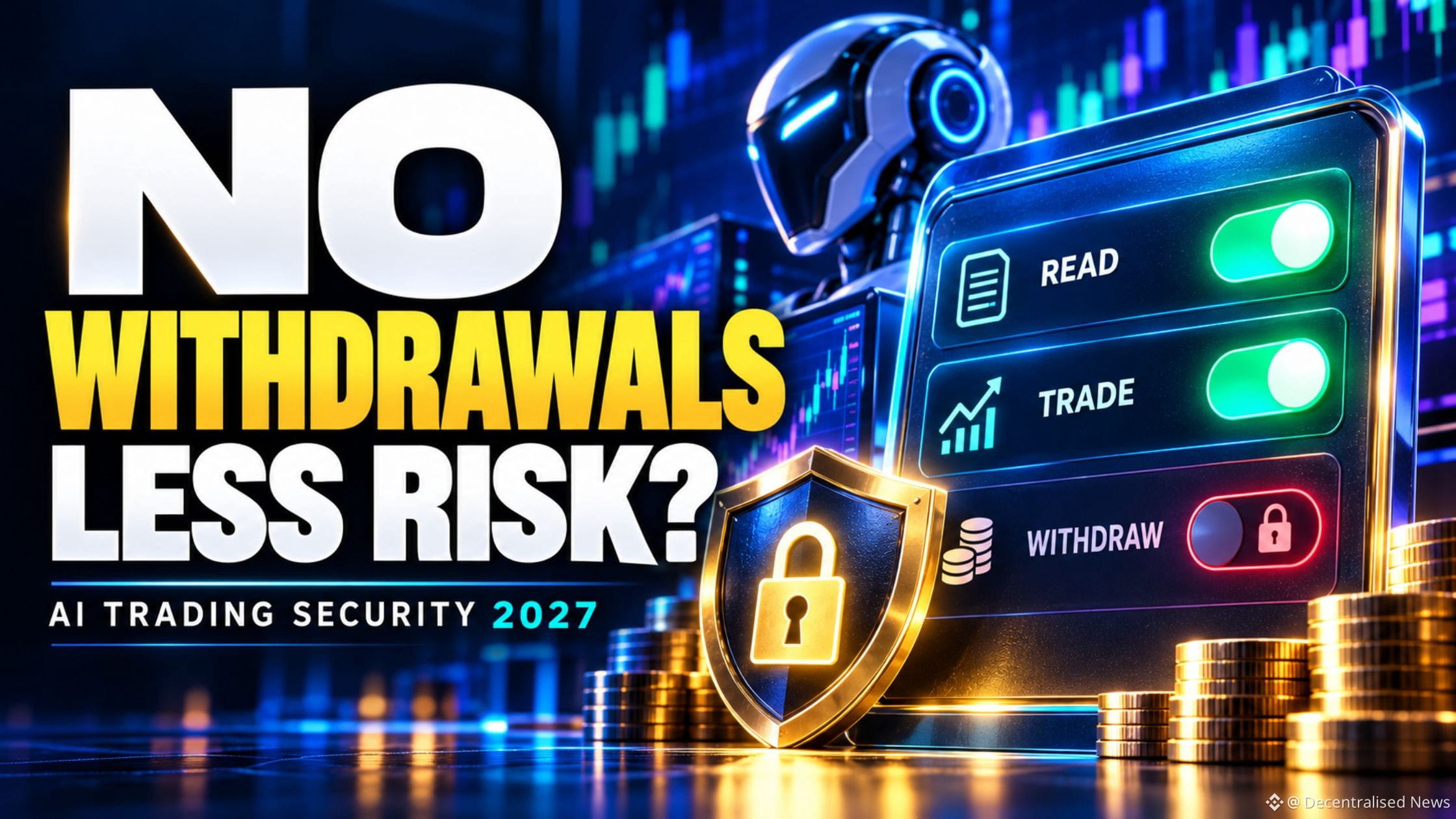
Best AI Crypto Trading Tools for Beginners: 11 Platforms Compared
AI trading is getting easier.
That does not automatically make it safer for beginners.
A complete beginner can now:
ask AI for a strategy,
turn plain English into trading rules,
backtest it,
launch a bot,
connect an exchange,
and automate execution.
Sometimes in minutes.
The problem?
**Software can become capable faster than the user becomes knowledgeable.**
We call this the:
**Automation Comprehension Gap.**
It is the difference between:
**what the trading system can do**
and
**what the user actually understands about what it is doing.**
That is why we compared **11 AI crypto trading tools for complete beginners** using a very different framework.
Not:
Who promises the highest return?
Instead:
• Setup Simplicity
• Learning Value
• Simulation Access
• Permission Safety
• Observability
• AI Authenticity
• Complexity Burden
The current list includes:
Coinrule
Capitalise(dot)ai
3Commas v2
Cornix
TradeSanta
TradingView
ASCN AI
Cryptohopper
Bitsgap
Tickeron
Gunbot
And the differences matter.
Some use genuine AI.
Some use LLM-connected tools.
Some are deterministic bots.
Some are research systems.
Some use machine learning.
+ Cryptohopper's established **A.I.** actually means **Algorithmic Intelligence**, not Artificial Intelligence.
+ Bitsgap lets users demo its bots, but its AI Assistant is not currently included in Demo Mode.
+ TradingView is not an autonomous AI trader at all.
Yet it may be one of the smartest beginner tools because learning how to define an alert can be more useful than immediately automating an order.
That leads to another DN concept:
**Beginner Authority Ceiling.**
A beginner should not give a machine more financial authority simply because the software supports it.
Permissions should expand more slowly than understanding.
Read the complete guide on Decentralised.News
#AITrading #CryptoTrading #AIAgents #TradingBots #ChatGPT #Crypto #AgenticFinance #Automation #ArtificialIntelligence #Fintech #DecentralisedNews
Best AI Crypto Trading Tools for Beginners: 11 Platforms Compared
AI trading is getting easier.
That does not automatically make it safer for beginners.
A complete beginner can now:
ask AI for a strategy,
turn plain English into trading rules,
backtest it,
launch a bot,
connect an exchange,
and automate execution.
Sometimes in minutes.
The problem?
**Software can become capable faster than the user becomes knowledgeable.**
We call this the:
**Automation Comprehension Gap.**
It is the difference between:
**what the trading system can do**
and
**what the user actually understands about what it is doing.**
That is why we compared **11 AI crypto trading tools for complete beginners** using a very different framework.
Not:
Who promises the highest return?
Instead:
• Setup Simplicity
• Learning Value
• Simulation Access
• Permission Safety
• Observability
• AI Authenticity
• Complexity Burden
The current list includes:
Coinrule
Capitalise(dot)ai
3Commas v2
Cornix
TradeSanta
TradingView
ASCN AI
Cryptohopper
Bitsgap
Tickeron
Gunbot
And the differences matter.
Some use genuine AI.
Some use LLM-connected tools.
Some are deterministic bots.
Some are research systems.
Some use machine learning.
+ Cryptohopper's established **A.I.** actually means **Algorithmic Intelligence**, not Artificial Intelligence.
+ Bitsgap lets users demo its bots, but its AI Assistant is not currently included in Demo Mode.
+ TradingView is not an autonomous AI trader at all.
Yet it may be one of the smartest beginner tools because learning how to define an alert can be more useful than immediately automating an order.
That leads to another DN concept:
**Beginner Authority Ceiling.**
A beginner should not give a machine more financial authority simply because the software supports it.
Permissions should expand more slowly than understanding.
Read the complete guide on Decentralised.News
#AITrading #CryptoTrading #AIAgents #TradingBots #ChatGPT #Crypto #AgenticFinance #Automation #ArtificialIntelligence #Fintech #DecentralisedNews
AI trading is getting easier.
That does not automatically make it safer for beginners.
A complete beginner can now:
ask AI for a strategy,
turn plain English into trading rules,
backtest it,
launch a bot,
connect an exchange,
and automate execution.
Sometimes in minutes.
The problem?
**Software can become capable faster than the user becomes knowledgeable.**
We call this the:
**Automation Comprehension Gap.**
It is the difference between:
**what the trading system can do**
and
**what the user actually understands about what it is doing.**
That is why we compared **11 AI crypto trading tools for complete beginners** using a very different framework.
Not:
Who promises the highest return?
Instead:
• Setup Simplicity
• Learning Value
• Simulation Access
• Permission Safety
• Observability
• AI Authenticity
• Complexity Burden
The current list includes:
Coinrule
Capitalise(dot)ai
3Commas v2
Cornix
TradeSanta
TradingView
ASCN AI
Cryptohopper
Bitsgap
Tickeron
Gunbot
And the differences matter.
Some use genuine AI.
Some use LLM-connected tools.
Some are deterministic bots.
Some are research systems.
Some use machine learning.
+ Cryptohopper's established **A.I.** actually means **Algorithmic Intelligence**, not Artificial Intelligence.
+ Bitsgap lets users demo its bots, but its AI Assistant is not currently included in Demo Mode.
+ TradingView is not an autonomous AI trader at all.
Yet it may be one of the smartest beginner tools because learning how to define an alert can be more useful than immediately automating an order.
That leads to another DN concept:
**Beginner Authority Ceiling.**
A beginner should not give a machine more financial authority simply because the software supports it.
Permissions should expand more slowly than understanding.
Read the complete guide on Decentralised.News
#AITrading #CryptoTrading #AIAgents #TradingBots #ChatGPT #Crypto #AgenticFinance #Automation #ArtificialIntelligence #Fintech #DecentralisedNews
56
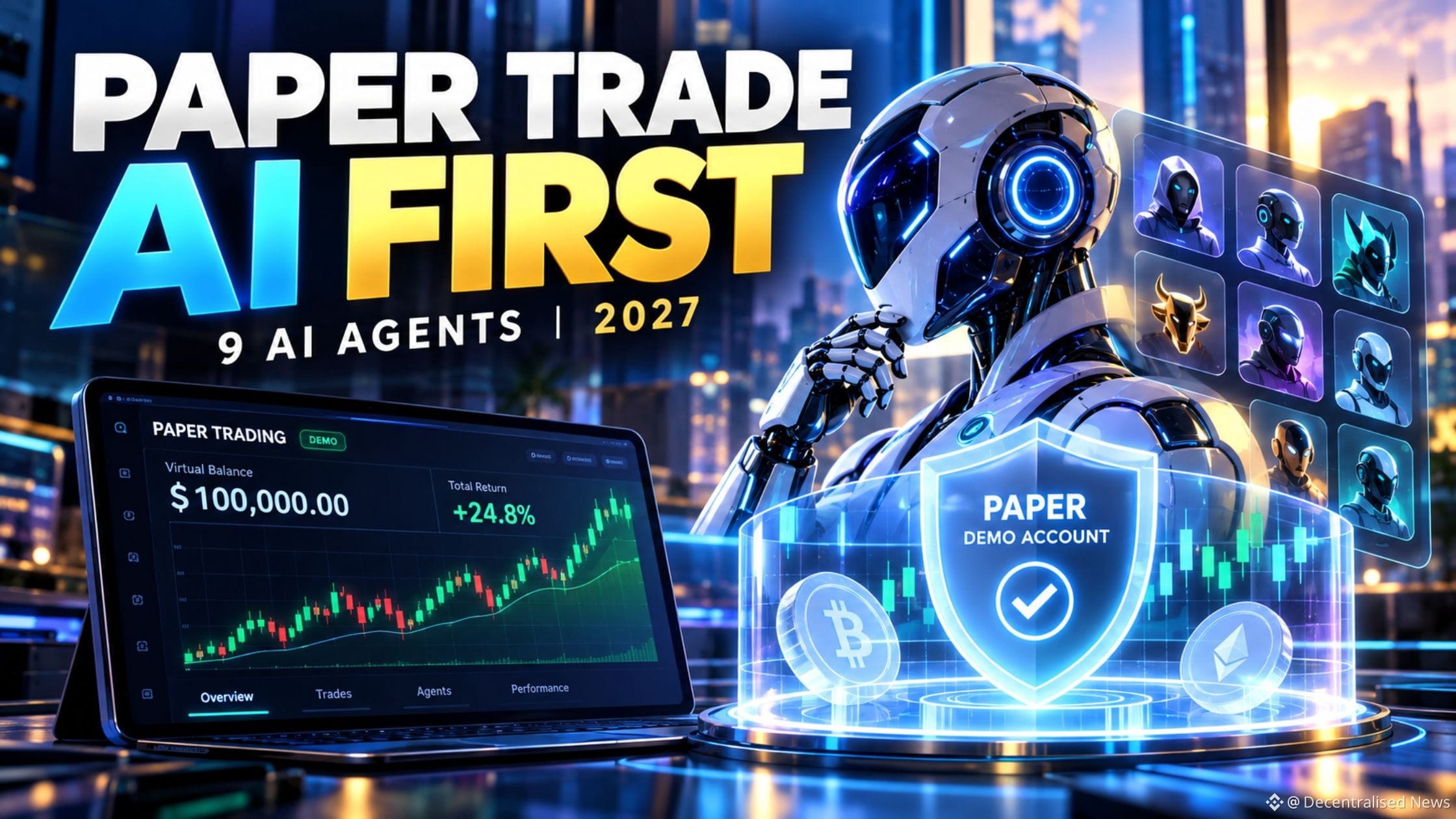
The Best AI Trading Demo Accounts for 2027
You do **not** need to risk real money to find out whether an AI trading system is useful.
In fact, that should probably be the last thing you do.
We compared **9 AI trading agents and automated platforms you can test with paper money, demo accounts or simulation before going live.**
The most important finding:
**Paper trading is not one thing.**
There are at least four different types:
Historical backtesting
Real-time paper trading
Platform demo accounts
Read-only AI sandboxes
And they test different things.
A profitable backtest does not prove live execution.
A demo bot does not prove the AI layer works.
A read-only agent does not prove write-enabled behavior will be safe.
And a green virtual P&L definitely does not prove future profitability.
That is why we built the:
**DN Paper-First Fit**
We evaluated platforms on:
• Simulation Depth
• AI / Agent Relevance
• Permission Safety
• Observability
• Live Transition Discipline
• Evidence Freshness
Read the complete guide and check out the **DN Paper-First AI Trading Selector** to match users with the right type of experiment on our main site.
#AITrading #TradingBots #AIAgents #CryptoTrading #PaperTrading #ChatGPT #AgenticFinance #Automation #ArtificialIntelligence #Crypto #DecentralisedNews
The Best AI Trading Demo Accounts for 2027
You do **not** need to risk real money to find out whether an AI trading system is useful.
In fact, that should probably be the last thing you do.
We compared **9 AI trading agents and automated platforms you can test with paper money, demo accounts or simulation before going live.**
The most important finding:
**Paper trading is not one thing.**
There are at least four different types:
Historical backtesting
Real-time paper trading
Platform demo accounts
Read-only AI sandboxes
And they test different things.
A profitable backtest does not prove live execution.
A demo bot does not prove the AI layer works.
A read-only agent does not prove write-enabled behavior will be safe.
And a green virtual P&L definitely does not prove future profitability.
That is why we built the:
**DN Paper-First Fit**
We evaluated platforms on:
• Simulation Depth
• AI / Agent Relevance
• Permission Safety
• Observability
• Live Transition Discipline
• Evidence Freshness
Read the complete guide and check out the **DN Paper-First AI Trading Selector** to match users with the right type of experiment on our main site.
#AITrading #TradingBots #AIAgents #CryptoTrading #PaperTrading #ChatGPT #AgenticFinance #Automation #ArtificialIntelligence #Crypto #DecentralisedNews
You do **not** need to risk real money to find out whether an AI trading system is useful.
In fact, that should probably be the last thing you do.
We compared **9 AI trading agents and automated platforms you can test with paper money, demo accounts or simulation before going live.**
The most important finding:
**Paper trading is not one thing.**
There are at least four different types:
Historical backtesting
Real-time paper trading
Platform demo accounts
Read-only AI sandboxes
And they test different things.
A profitable backtest does not prove live execution.
A demo bot does not prove the AI layer works.
A read-only agent does not prove write-enabled behavior will be safe.
And a green virtual P&L definitely does not prove future profitability.
That is why we built the:
**DN Paper-First Fit**
We evaluated platforms on:
• Simulation Depth
• AI / Agent Relevance
• Permission Safety
• Observability
• Live Transition Discipline
• Evidence Freshness
Read the complete guide and check out the **DN Paper-First AI Trading Selector** to match users with the right type of experiment on our main site.
#AITrading #TradingBots #AIAgents #CryptoTrading #PaperTrading #ChatGPT #AgenticFinance #Automation #ArtificialIntelligence #Crypto #DecentralisedNews
114
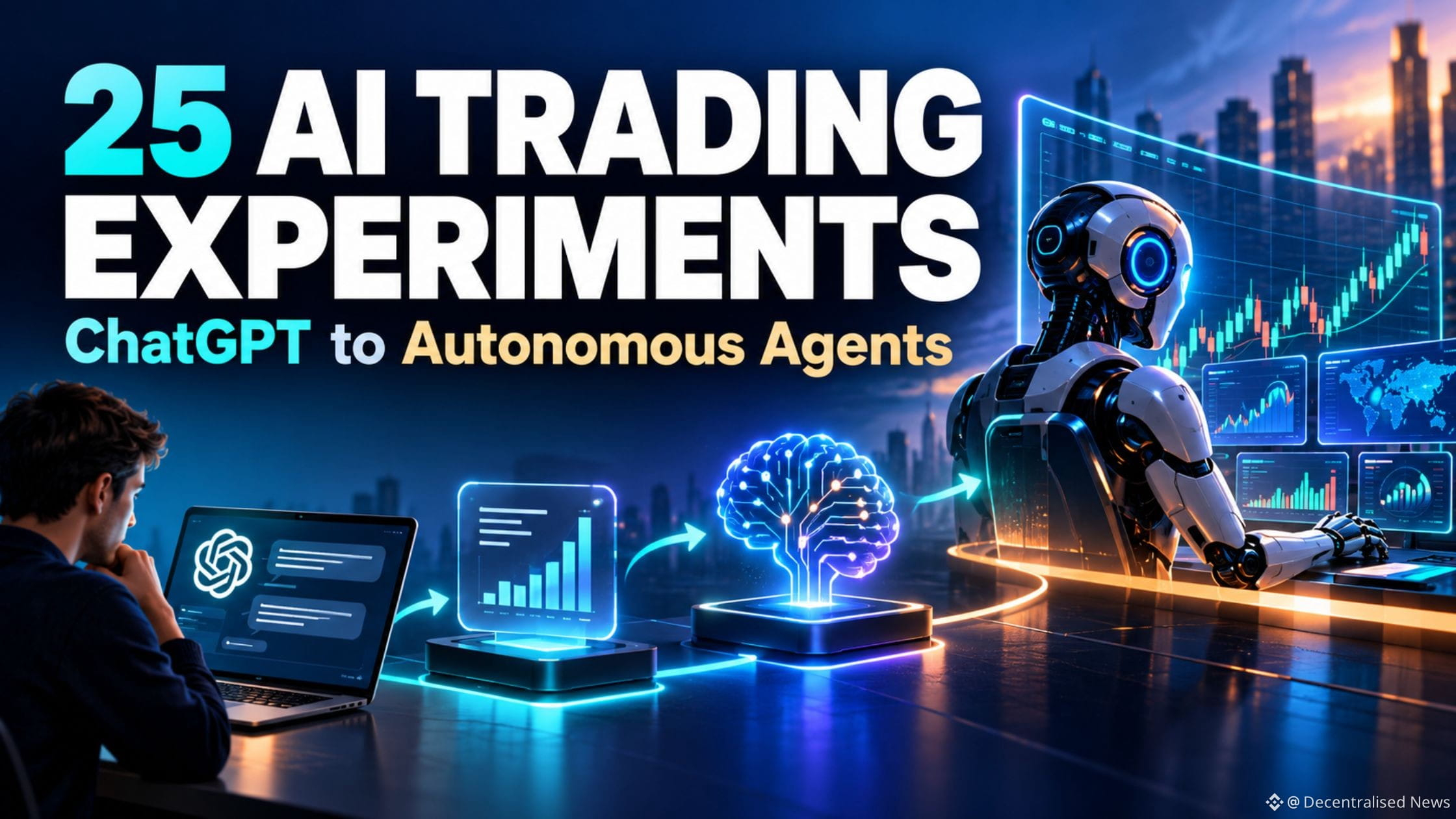
The 25 Best AI Trading Experiments to Try in 2027: From ChatGPT to Fully Autonomous Agents
Everyone wants to know:
**“What is the best AI trading bot?”**
That may be the wrong question.
Before handing an AI access to real capital, there are dozens of lower-risk experiments you can run first.
We mapped **25 AI trading experiments for 2027**, progressing from:
AI market research
↓
trade-thesis red teaming
↓
AI trading journals
↓
market-regime monitoring
↓
TradingView alerts
↓
paper trading
↓
AI-generated strategies
↓
ChatGPT-connected trading tools
↓
human-approved execution
↓
trade-only API bots
↓
multi-agent trading desks
↓
bounded wallet agents
↓
fully autonomous trading agents
The important variable is not just how intelligent the AI is.
It is how much **authority** you give it.
We call this:
**Authority Surface.**
A research assistant cannot directly lose your portfolio.
A trade-enabled bot can.
An agent that can transfer assets creates an even larger failure surface.
That leads to another DN framework:
**Agent Blast Radius.**
If the agent makes the worst mistake permitted by its current access, what can actually happen?
This is why the smartest path into AI trading is not:
Human → autonomous AI trader.
It is:
**Research → Monitor → Simulate → Approve → Automate → Agent.**
We also built the **DN AI Trading Pathfinder**, which recommends the lowest-authority experiment capable of achieving your objective based on:
• experience
• capital
• technical ability
• desired automation
• machine authority
AI trading is becoming real.
But the winning architecture may not be:
**“Let the smartest model control the money.”**
It may be:
**probabilistic reasoning upstream, deterministic risk control downstream.**
Let AI interpret messy information.
Let code decide what AI is allowed to do with capital.
Read the full Decentralised News research on our main site.
#AITrading
The 25 Best AI Trading Experiments to Try in 2027: From ChatGPT to Fully Autonomous Agents
Everyone wants to know:
**“What is the best AI trading bot?”**
That may be the wrong question.
Before handing an AI access to real capital, there are dozens of lower-risk experiments you can run first.
We mapped **25 AI trading experiments for 2027**, progressing from:
AI market research
↓
trade-thesis red teaming
↓
AI trading journals
↓
market-regime monitoring
↓
TradingView alerts
↓
paper trading
↓
AI-generated strategies
↓
ChatGPT-connected trading tools
↓
human-approved execution
↓
trade-only API bots
↓
multi-agent trading desks
↓
bounded wallet agents
↓
fully autonomous trading agents
The important variable is not just how intelligent the AI is.
It is how much **authority** you give it.
We call this:
**Authority Surface.**
A research assistant cannot directly lose your portfolio.
A trade-enabled bot can.
An agent that can transfer assets creates an even larger failure surface.
That leads to another DN framework:
**Agent Blast Radius.**
If the agent makes the worst mistake permitted by its current access, what can actually happen?
This is why the smartest path into AI trading is not:
Human → autonomous AI trader.
It is:
**Research → Monitor → Simulate → Approve → Automate → Agent.**
We also built the **DN AI Trading Pathfinder**, which recommends the lowest-authority experiment capable of achieving your objective based on:
• experience
• capital
• technical ability
• desired automation
• machine authority
AI trading is becoming real.
But the winning architecture may not be:
**“Let the smartest model control the money.”**
It may be:
**probabilistic reasoning upstream, deterministic risk control downstream.**
Let AI interpret messy information.
Let code decide what AI is allowed to do with capital.
Read the full Decentralised News research on our main site.
#AITrading
Everyone wants to know:
**“What is the best AI trading bot?”**
That may be the wrong question.
Before handing an AI access to real capital, there are dozens of lower-risk experiments you can run first.
We mapped **25 AI trading experiments for 2027**, progressing from:
AI market research
↓
trade-thesis red teaming
↓
AI trading journals
↓
market-regime monitoring
↓
TradingView alerts
↓
paper trading
↓
AI-generated strategies
↓
ChatGPT-connected trading tools
↓
human-approved execution
↓
trade-only API bots
↓
multi-agent trading desks
↓
bounded wallet agents
↓
fully autonomous trading agents
The important variable is not just how intelligent the AI is.
It is how much **authority** you give it.
We call this:
**Authority Surface.**
A research assistant cannot directly lose your portfolio.
A trade-enabled bot can.
An agent that can transfer assets creates an even larger failure surface.
That leads to another DN framework:
**Agent Blast Radius.**
If the agent makes the worst mistake permitted by its current access, what can actually happen?
This is why the smartest path into AI trading is not:
Human → autonomous AI trader.
It is:
**Research → Monitor → Simulate → Approve → Automate → Agent.**
We also built the **DN AI Trading Pathfinder**, which recommends the lowest-authority experiment capable of achieving your objective based on:
• experience
• capital
• technical ability
• desired automation
• machine authority
AI trading is becoming real.
But the winning architecture may not be:
**“Let the smartest model control the money.”**
It may be:
**probabilistic reasoning upstream, deterministic risk control downstream.**
Let AI interpret messy information.
Let code decide what AI is allowed to do with capital.
Read the full Decentralised News research on our main site.
#AITrading
114
Are Crypto VIP Tiers Worth It? Binance vs Bybit vs OKX vs Kraken vs Deribit
The cheapest crypto trading fee is not always the cheapest trade.
That becomes especially important once exchanges start pushing traders toward VIP tiers.
We built the DN VIP Break-Even Model to answer a more useful question:
When is a crypto VIP tier actually worth pursuing?
The model looks beyond the advertised fee and includes:
• Organic monthly turnover
• Maker vs taker mix
• Extra volume traded only to qualify
• Spread and slippage penalties
• Asset-balance requirements
• Exchange-token requirements
• Capital opportunity cost
• Routing concentration
At $1M of spot turnover and a 50/50 maker-taker mix, the modelled gross fee reduction at the first major VIP tier is roughly:
[Binance](https://www.binance.com/en/activity/referral-entry/CPA?fromActivityPage=true&ref=CPA_00SXKU7IO9): $50/month
OKX: $162.50/month
Bybit: $262.50/month
But those numbers alone can be misleading.
If reaching the tier requires unnecessary turnover, worse execution or additional idle capital, the “discount” can disappear.
We also introduce two DN concepts:
Tier-Chase Ratio
VIP benefit ÷ cost of trading only to qualify.
VIP Routing Lock-In Effect
The tendency to route orders to an inferior venue because maintaining a VIP threshold has become economically important.
The core conclusion:
Don’t optimise for the lowest trading fee. Optimise for the lowest total cost of execution.
The research includes an interactive DN VIP Break-Even Calculator.
Read the full analysis on Decentralised.News
#Crypto #CryptoTrading #QuantTrading #InstitutionalTrading #HFT #MarketStructure #Exchanges #FinTech
Are Crypto VIP Tiers Worth It? Binance vs Bybit vs OKX vs Kraken vs Deribit
The cheapest crypto trading fee is not always the cheapest trade.
That becomes especially important once exchanges start pushing traders toward VIP tiers.
We built the DN VIP Break-Even Model to answer a more useful question:
When is a crypto VIP tier actually worth pursuing?
The model looks beyond the advertised fee and includes:
• Organic monthly turnover
• Maker vs taker mix
• Extra volume traded only to qualify
• Spread and slippage penalties
• Asset-balance requirements
• Exchange-token requirements
• Capital opportunity cost
• Routing concentration
At $1M of spot turnover and a 50/50 maker-taker mix, the modelled gross fee reduction at the first major VIP tier is roughly:
Binance: $50/month
OKX: $162.50/month
Bybit: $262.50/month
But those numbers alone can be misleading.
If reaching the tier requires unnecessary turnover, worse execution or additional idle capital, the “discount” can disappear.
We also introduce two DN concepts:
Tier-Chase Ratio
VIP benefit ÷ cost of trading only to qualify.
VIP Routing Lock-In Effect
The tendency to route orders to an inferior venue because maintaining a VIP threshold has become economically important.
The core conclusion:
Don’t optimise for the lowest trading fee. Optimise for the lowest total cost of execution.
The research includes an interactive DN VIP Break-Even Calculator.
Read the full analysis on Decentralised.News
#Crypto #CryptoTrading #QuantTrading #InstitutionalTrading #HFT #MarketStructure #Exchanges #FinTech
The cheapest crypto trading fee is not always the cheapest trade.
That becomes especially important once exchanges start pushing traders toward VIP tiers.
We built the DN VIP Break-Even Model to answer a more useful question:
When is a crypto VIP tier actually worth pursuing?
The model looks beyond the advertised fee and includes:
• Organic monthly turnover
• Maker vs taker mix
• Extra volume traded only to qualify
• Spread and slippage penalties
• Asset-balance requirements
• Exchange-token requirements
• Capital opportunity cost
• Routing concentration
At $1M of spot turnover and a 50/50 maker-taker mix, the modelled gross fee reduction at the first major VIP tier is roughly:
Binance: $50/month
OKX: $162.50/month
Bybit: $262.50/month
But those numbers alone can be misleading.
If reaching the tier requires unnecessary turnover, worse execution or additional idle capital, the “discount” can disappear.
We also introduce two DN concepts:
Tier-Chase Ratio
VIP benefit ÷ cost of trading only to qualify.
VIP Routing Lock-In Effect
The tendency to route orders to an inferior venue because maintaining a VIP threshold has become economically important.
The core conclusion:
Don’t optimise for the lowest trading fee. Optimise for the lowest total cost of execution.
The research includes an interactive DN VIP Break-Even Calculator.
Read the full analysis on Decentralised.News
#Crypto #CryptoTrading #QuantTrading #InstitutionalTrading #HFT #MarketStructure #Exchanges #FinTech

109
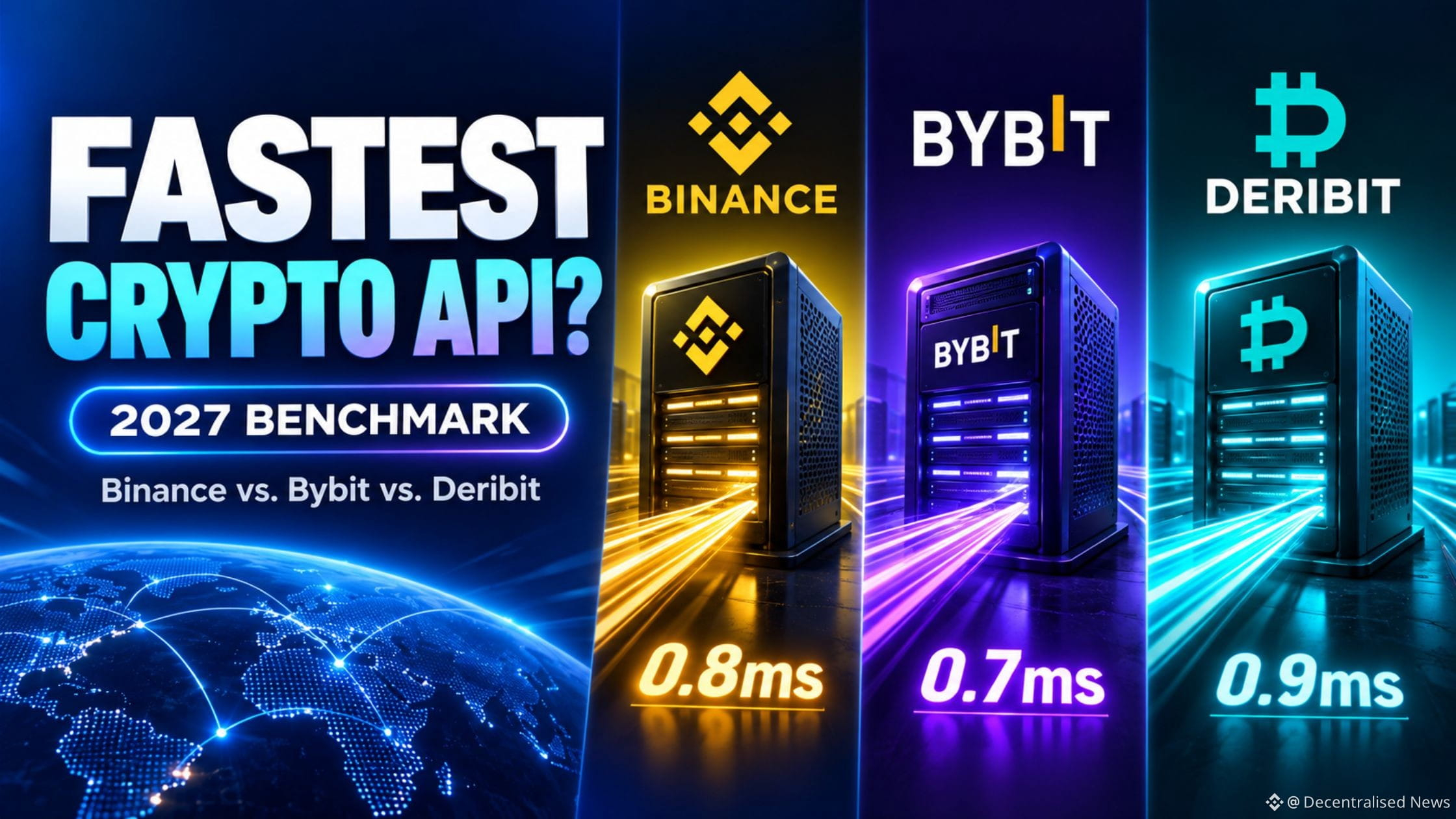
Best Crypto Exchange APIs for Bots, Quants and HFT in 2027
The “fastest crypto exchange API” is not necessarily the one with the lowest ping.
For bots, quants and market makers, the real execution loop is:
Strategy → Serialization → Network → Gateway → Matching Engine → ACK → Market Data
That means raw RTT is only one piece of the latency puzzle.
We built the DN API Latency Benchmark 2027 to compare the infrastructure behind major crypto exchanges across:
• WebSocket and REST architecture
• FIX and SBE support
• Order-entry throughput
• Order acknowledgement telemetry
• Market-data delivery
• Rate limits
• Failover and resilience
• Institutional connectivity
• P95/P99 latency stability
One of the biggest findings:
Latency variance can matter more than median latency.
A venue with a 15 ms median response but frequent 200–500 ms spikes can be harder to trade systematically than one with a stable 25–30 ms path.
That is why we introduced the DN Latency Stability Ratio:
P95 Order ACK Latency ÷ Median Order ACK Latency
The lower the ratio, the more predictable the execution path.
We also built an interactive DN API Latency Lab so traders can enter their own RTT, acknowledgement times, feed delay and disconnect data to calculate a live latency score.
Read the full benchmark on Decentralised.News
#Crypto #QuantTrading #AlgorithmicTrading #HFT #TradingBots #MarketMaking #WebSocket #FIX #CryptoTrading #APIs #FinTech
Best Crypto Exchange APIs for Bots, Quants and HFT in 2027
The “fastest crypto exchange API” is not necessarily the one with the lowest ping.
For bots, quants and market makers, the real execution loop is:
Strategy → Serialization → Network → Gateway → Matching Engine → ACK → Market Data
That means raw RTT is only one piece of the latency puzzle.
We built the DN API Latency Benchmark 2027 to compare the infrastructure behind major crypto exchanges across:
• WebSocket and REST architecture
• FIX and SBE support
• Order-entry throughput
• Order acknowledgement telemetry
• Market-data delivery
• Rate limits
• Failover and resilience
• Institutional connectivity
• P95/P99 latency stability
One of the biggest findings:
Latency variance can matter more than median latency.
A venue with a 15 ms median response but frequent 200–500 ms spikes can be harder to trade systematically than one with a stable 25–30 ms path.
That is why we introduced the DN Latency Stability Ratio:
P95 Order ACK Latency ÷ Median Order ACK Latency
The lower the ratio, the more predictable the execution path.
We also built an interactive DN API Latency Lab so traders can enter their own RTT, acknowledgement times, feed delay and disconnect data to calculate a live latency score.
Read the full benchmark on Decentralised.News
#Crypto #QuantTrading #AlgorithmicTrading #HFT #TradingBots #MarketMaking #WebSocket #FIX #CryptoTrading #APIs #FinTech
The “fastest crypto exchange API” is not necessarily the one with the lowest ping.
For bots, quants and market makers, the real execution loop is:
Strategy → Serialization → Network → Gateway → Matching Engine → ACK → Market Data
That means raw RTT is only one piece of the latency puzzle.
We built the DN API Latency Benchmark 2027 to compare the infrastructure behind major crypto exchanges across:
• WebSocket and REST architecture
• FIX and SBE support
• Order-entry throughput
• Order acknowledgement telemetry
• Market-data delivery
• Rate limits
• Failover and resilience
• Institutional connectivity
• P95/P99 latency stability
One of the biggest findings:
Latency variance can matter more than median latency.
A venue with a 15 ms median response but frequent 200–500 ms spikes can be harder to trade systematically than one with a stable 25–30 ms path.
That is why we introduced the DN Latency Stability Ratio:
P95 Order ACK Latency ÷ Median Order ACK Latency
The lower the ratio, the more predictable the execution path.
We also built an interactive DN API Latency Lab so traders can enter their own RTT, acknowledgement times, feed delay and disconnect data to calculate a live latency score.
Read the full benchmark on Decentralised.News
#Crypto #QuantTrading #AlgorithmicTrading #HFT #TradingBots #MarketMaking #WebSocket #FIX #CryptoTrading #APIs #FinTech
81
How to Set Up a Crypto Trading Bot on Binance Using 3Commas
Algorithmic trading isn't just for hedge funds anymore.
Platforms like 3Commas are democratising automation for retail traders... connecting directly to [Binance](https://www.binance.com/en/activity/referral-entry/CPA?fromActivityPage=true&ref=CPA_00SXKU7IO9), the world's largest exchange.
I wrote a full guide on:
• Setting up API keys securely
• Configuring DCA bots
• Backtesting strategies
• Risk management for automation
If you're trading crypto manually, you're competing against machines.
Full guide on Decentralised.News
#Crypto #Trading #Automation #Binance #3Commas #fintech
How to Set Up a Crypto Trading Bot on Binance Using 3Commas
Algorithmic trading isn't just for hedge funds anymore.
Platforms like 3Commas are democratising automation for retail traders... connecting directly to Binance, the world's largest exchange.
I wrote a full guide on:
• Setting up API keys securely
• Configuring DCA bots
• Backtesting strategies
• Risk management for automation
If you're trading crypto manually, you're competing against machines.
Full guide on Decentralised.News
#Crypto #Trading #Automation #Binance #3Commas #fintech
Algorithmic trading isn't just for hedge funds anymore.
Platforms like 3Commas are democratising automation for retail traders... connecting directly to Binance, the world's largest exchange.
I wrote a full guide on:
• Setting up API keys securely
• Configuring DCA bots
• Backtesting strategies
• Risk management for automation
If you're trading crypto manually, you're competing against machines.
Full guide on Decentralised.News
#Crypto #Trading #Automation #Binance #3Commas #fintech
60
How to Automate Crypto Trading When You Can’t Code (2026 Guide)
Algorithmic trading isn't just for hedge funds anymore.
Platforms like CoinRule are democratising automation — no code required.
I wrote a full guide on how to:
• Build "If This, Then That" trading rules
• Backtest strategies against historical data
• Connect to 20+ exchanges including [Binance](https://www.binance.com/en/activity/referral-entry/CPA?fromActivityPage=true&ref=CPA_00SXKU7IO9)
• Deploy with paper trading first
If you're in crypto and not automating, you're competing against machines manually.
Full guide on Decentralised.News
Disclaimer: This is not financial advice. Automated trading carries significant risk, including the potential loss of your entire investment. Past performance of trading strategies does not guarantee future results. Always do your own research and never deploy capital you cannot afford to lose.
#Crypto #Trading #Automation #FinTech #CoinRule
How to Automate Crypto Trading When You Can’t Code (2026 Guide)
Algorithmic trading isn't just for hedge funds anymore.
Platforms like CoinRule are democratising automation — no code required.
I wrote a full guide on how to:
• Build "If This, Then That" trading rules
• Backtest strategies against historical data
• Connect to 20+ exchanges including Binance
• Deploy with paper trading first
If you're in crypto and not automating, you're competing against machines manually.
Full guide on Decentralised.News
Disclaimer: This is not financial advice. Automated trading carries significant risk, including the potential loss of your entire investment. Past performance of trading strategies does not guarantee future results. Always do your own research and never deploy capital you cannot afford to lose.
#Crypto #Trading #Automation #FinTech #CoinRule
Algorithmic trading isn't just for hedge funds anymore.
Platforms like CoinRule are democratising automation — no code required.
I wrote a full guide on how to:
• Build "If This, Then That" trading rules
• Backtest strategies against historical data
• Connect to 20+ exchanges including Binance
• Deploy with paper trading first
If you're in crypto and not automating, you're competing against machines manually.
Full guide on Decentralised.News
Disclaimer: This is not financial advice. Automated trading carries significant risk, including the potential loss of your entire investment. Past performance of trading strategies does not guarantee future results. Always do your own research and never deploy capital you cannot afford to lose.
#Crypto #Trading #Automation #FinTech #CoinRule

79
Which Perp DEX Has the Most Reliable Stop-Loss Execution?
Can you trust a perpetual DEX stop-loss during extreme volatility?
Entering a stop price does not guarantee that your position will close at that price. The order must still detect the correct trigger, reach the execution system, find sufficient liquidity, remain within its slippage limits and complete before liquidation.
The new Decentralised News Perp DEX Stop-Loss Reliability Test examines the full execution path rather than treating “order accepted” as proof of protection.
The research introduces a proprietary scoring system covering trigger integrity, completion rate, execution latency, adverse slippage, stress resilience and failure recovery.
It also includes an interactive calculator that estimates reliability and potential loss leakage under different trading conditions.
Before increasing leverage, test the exit rather than focusing only on the entry.
Read the research on Decentralised.News
#Crypto #DeFi #PerpDEX #CryptoTrading #RiskManagement #PerpetualFutures
Which Perp DEX Has the Most Reliable Stop-Loss Execution?
Can you trust a perpetual DEX stop-loss during extreme volatility?
Entering a stop price does not guarantee that your position will close at that price. The order must still detect the correct trigger, reach the execution system, find sufficient liquidity, remain within its slippage limits and complete before liquidation.
The new Decentralised News Perp DEX Stop-Loss Reliability Test examines the full execution path rather than treating “order accepted” as proof of protection.
The research introduces a proprietary scoring system covering trigger integrity, completion rate, execution latency, adverse slippage, stress resilience and failure recovery.
It also includes an interactive calculator that estimates reliability and potential loss leakage under different trading conditions.
Before increasing leverage, test the exit rather than focusing only on the entry.
Read the research on Decentralised.News
#Crypto #DeFi #PerpDEX #CryptoTrading #RiskManagement #PerpetualFutures
Can you trust a perpetual DEX stop-loss during extreme volatility?
Entering a stop price does not guarantee that your position will close at that price. The order must still detect the correct trigger, reach the execution system, find sufficient liquidity, remain within its slippage limits and complete before liquidation.
The new Decentralised News Perp DEX Stop-Loss Reliability Test examines the full execution path rather than treating “order accepted” as proof of protection.
The research introduces a proprietary scoring system covering trigger integrity, completion rate, execution latency, adverse slippage, stress resilience and failure recovery.
It also includes an interactive calculator that estimates reliability and potential loss leakage under different trading conditions.
Before increasing leverage, test the exit rather than focusing only on the entry.
Read the research on Decentralised.News
#Crypto #DeFi #PerpDEX #CryptoTrading #RiskManagement #PerpetualFutures
72
Which Perp DEX Would You Trust an AI Agent to Trade On?
The strongest exchange for a human trader may not be the strongest exchange for an AI trading agent.
That distinction is becoming increasingly important.
Most exchange comparisons still focus on:
fees
liquidity
leverage
markets
UI
But autonomous financial systems introduce an entirely different set of requirements.
An AI trader must be able to determine:
Was the order accepted?
Was it rejected?
Did it partially fill?
Did a WebSocket disconnect hide an update?
Was the timeout a failed trade or merely a failed response?
Can the credential withdraw money?
Can the process be revoked independently?
Can resting orders disappear automatically if the agent crashes?
This leads to what we call:
Agent Execution Certainty
The degree of confidence with which an autonomous trading system can establish its canonical economic state before issuing another financially consequential instruction.
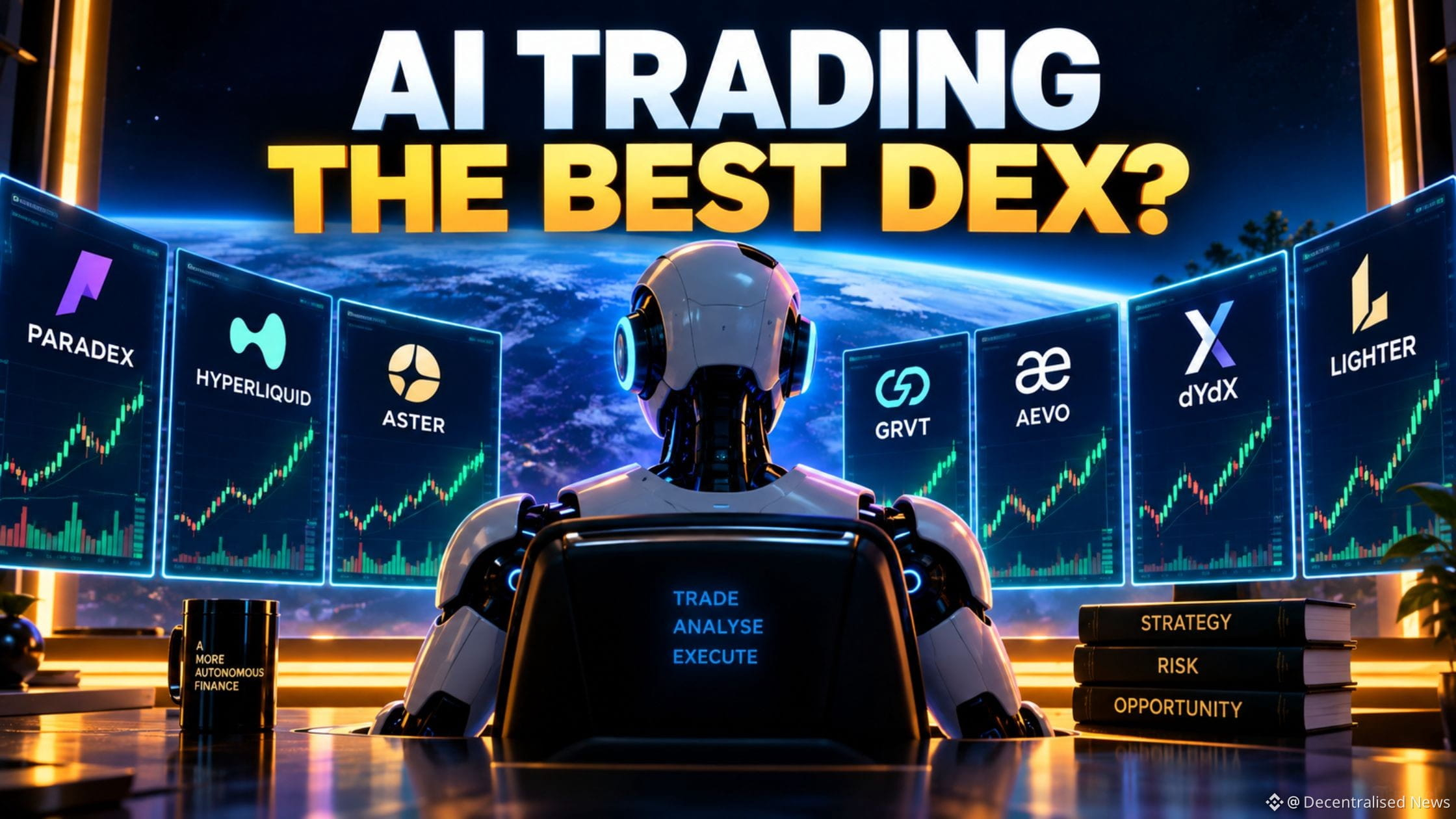
Our latest Decentralised News research benchmarks seven perpetual-trading venues against this emerging standard:
Aster
Paradex
Hyperliquid
GRVT
Aevo
dYdX
Lighter
The study evaluates documented infrastructure including:
• delegated trading credentials
• withdrawal isolation
• credential expiry
• subaccounts
• client order IDs
• private order and fill streams
• sequence integrity
• reduce-only execution
• emergency cancellation
• reconciliation
• agent-native interfaces
One especially important principle emerges:
ACK is not execution.
A timeout does not prove rejection.
A successful API response does not necessarily prove a fill.
And an AI system should never update its portfolio simply because it intended to trade.
That state needs authoritative evidence.
We also introduce several additional concepts:
Position State Lag
Order Identity Integrity
Autonomous Perp Safety Envelope
Read the complete research and use the DN Autonomous Perp Agent Readiness Calculator on Decentralised.News
#AgenticFinance #AITrading
Which Perp DEX Would You Trust an AI Agent to Trade On?
The strongest exchange for a human trader may not be the strongest exchange for an AI trading agent.
That distinction is becoming increasingly important.
Most exchange comparisons still focus on:
fees
liquidity
leverage
markets
UI
But autonomous financial systems introduce an entirely different set of requirements.
An AI trader must be able to determine:
Was the order accepted?
Was it rejected?
Did it partially fill?
Did a WebSocket disconnect hide an update?
Was the timeout a failed trade or merely a failed response?
Can the credential withdraw money?
Can the process be revoked independently?
Can resting orders disappear automatically if the agent crashes?
This leads to what we call:
Agent Execution Certainty
The degree of confidence with which an autonomous trading system can establish its canonical economic state before issuing another financially consequential instruction.
Our latest Decentralised News research benchmarks seven perpetual-trading venues against this emerging standard:
Aster
Paradex
Hyperliquid
GRVT
Aevo
dYdX
Lighter
The study evaluates documented infrastructure including:
• delegated trading credentials
• withdrawal isolation
• credential expiry
• subaccounts
• client order IDs
• private order and fill streams
• sequence integrity
• reduce-only execution
• emergency cancellation
• reconciliation
• agent-native interfaces
One especially important principle emerges:
ACK is not execution.
A timeout does not prove rejection.
A successful API response does not necessarily prove a fill.
And an AI system should never update its portfolio simply because it intended to trade.
That state needs authoritative evidence.
We also introduce several additional concepts:
Position State Lag
Order Identity Integrity
Autonomous Perp Safety Envelope
Read the complete research and use the DN Autonomous Perp Agent Readiness Calculator on Decentralised.News
#AgenticFinance #AITrading
The strongest exchange for a human trader may not be the strongest exchange for an AI trading agent.
That distinction is becoming increasingly important.
Most exchange comparisons still focus on:
fees
liquidity
leverage
markets
UI
But autonomous financial systems introduce an entirely different set of requirements.
An AI trader must be able to determine:
Was the order accepted?
Was it rejected?
Did it partially fill?
Did a WebSocket disconnect hide an update?
Was the timeout a failed trade or merely a failed response?
Can the credential withdraw money?
Can the process be revoked independently?
Can resting orders disappear automatically if the agent crashes?
This leads to what we call:
Agent Execution Certainty
The degree of confidence with which an autonomous trading system can establish its canonical economic state before issuing another financially consequential instruction.
Our latest Decentralised News research benchmarks seven perpetual-trading venues against this emerging standard:
Aster
Paradex
Hyperliquid
GRVT
Aevo
dYdX
Lighter
The study evaluates documented infrastructure including:
• delegated trading credentials
• withdrawal isolation
• credential expiry
• subaccounts
• client order IDs
• private order and fill streams
• sequence integrity
• reduce-only execution
• emergency cancellation
• reconciliation
• agent-native interfaces
One especially important principle emerges:
ACK is not execution.
A timeout does not prove rejection.
A successful API response does not necessarily prove a fill.
And an AI system should never update its portfolio simply because it intended to trade.
That state needs authoritative evidence.
We also introduce several additional concepts:
Position State Lag
Order Identity Integrity
Autonomous Perp Safety Envelope
Read the complete research and use the DN Autonomous Perp Agent Readiness Calculator on Decentralised.News
#AgenticFinance #AITrading
1
1
1.3k
The Next Billion Crypto Users May Never Know They’re Using Crypto
Crypto’s next phase of adoption may come from people who never think of themselves as crypto users.
That sounds counterintuitive.
But it is how major technologies usually mature.
Most people never learned TCP/IP before using the internet.
They never studied mobile operating systems before downloading apps.
Infrastructure becomes transformative when it disappears behind useful interfaces.
We think crypto may now be approaching that transition.
+ World Money is combining stablecoins, payments, investing, earning, identity and Mini Apps inside one financial application.
+ Robinhood is combining brokerage, crypto, tokenized stocks, DeFi, self-custody, perpetuals and agentic trading while building its own blockchain infrastructure.
+ At the institutional level, BlackRock is expanding digital-asset investment products while J.P. Morgan is operating blockchain-based settlement and deposit infrastructure.
These developments appear separate.
They may actually be parts of the same transition.
The Financial App Layer
We define this as the layer that converts:
blockchain infrastructure
into:
familiar financial actions
Instead of:
wallet → bridge → chain → DEX → gas
the user experiences:
pay → invest → save → borrow → trade
That shift could matter more to mass adoption than another blockchain throughput increase.
The data also highlights an important gap.
There are hundreds of millions of estimated crypto owners globally, but estimates of regularly active users remain dramatically lower.
That leads to what we call the:
Ownership-to-Activity Conversion Gap
The next growth opportunity may therefore not be finding a billion completely new people.
It may be activating hundreds of millions who already have digital-asset exposure but rarely use the underlying financial infrastructure.
Read the complete analysis and check out the DN Billion-User Financialization Engine on Decentralised.News
#DigitalAssets #Crypto #Tokenization #Stablecoins #FinTech
The Next Billion Crypto Users May Never Know They’re Using Crypto
Crypto’s next phase of adoption may come from people who never think of themselves as crypto users.
That sounds counterintuitive.
But it is how major technologies usually mature.
Most people never learned TCP/IP before using the internet.
They never studied mobile operating systems before downloading apps.
Infrastructure becomes transformative when it disappears behind useful interfaces.
We think crypto may now be approaching that transition.
+ World Money is combining stablecoins, payments, investing, earning, identity and Mini Apps inside one financial application.
+ Robinhood is combining brokerage, crypto, tokenized stocks, DeFi, self-custody, perpetuals and agentic trading while building its own blockchain infrastructure.
+ At the institutional level, BlackRock is expanding digital-asset investment products while J.P. Morgan is operating blockchain-based settlement and deposit infrastructure.
These developments appear separate.
They may actually be parts of the same transition.
The Financial App Layer
We define this as the layer that converts:
blockchain infrastructure
into:
familiar financial actions
Instead of:
wallet → bridge → chain → DEX → gas
the user experiences:
pay → invest → save → borrow → trade
That shift could matter more to mass adoption than another blockchain throughput increase.
The data also highlights an important gap.
There are hundreds of millions of estimated crypto owners globally, but estimates of regularly active users remain dramatically lower.
That leads to what we call the:
Ownership-to-Activity Conversion Gap
The next growth opportunity may therefore not be finding a billion completely new people.
It may be activating hundreds of millions who already have digital-asset exposure but rarely use the underlying financial infrastructure.
Read the complete analysis and check out the DN Billion-User Financialization Engine on Decentralised.News
#DigitalAssets #Crypto #Tokenization #Stablecoins #FinTech
Crypto’s next phase of adoption may come from people who never think of themselves as crypto users.
That sounds counterintuitive.
But it is how major technologies usually mature.
Most people never learned TCP/IP before using the internet.
They never studied mobile operating systems before downloading apps.
Infrastructure becomes transformative when it disappears behind useful interfaces.
We think crypto may now be approaching that transition.
+ World Money is combining stablecoins, payments, investing, earning, identity and Mini Apps inside one financial application.
+ Robinhood is combining brokerage, crypto, tokenized stocks, DeFi, self-custody, perpetuals and agentic trading while building its own blockchain infrastructure.
+ At the institutional level, BlackRock is expanding digital-asset investment products while J.P. Morgan is operating blockchain-based settlement and deposit infrastructure.
These developments appear separate.
They may actually be parts of the same transition.
The Financial App Layer
We define this as the layer that converts:
blockchain infrastructure
into:
familiar financial actions
Instead of:
wallet → bridge → chain → DEX → gas
the user experiences:
pay → invest → save → borrow → trade
That shift could matter more to mass adoption than another blockchain throughput increase.
The data also highlights an important gap.
There are hundreds of millions of estimated crypto owners globally, but estimates of regularly active users remain dramatically lower.
That leads to what we call the:
Ownership-to-Activity Conversion Gap
The next growth opportunity may therefore not be finding a billion completely new people.
It may be activating hundreds of millions who already have digital-asset exposure but rarely use the underlying financial infrastructure.
Read the complete analysis and check out the DN Billion-User Financialization Engine on Decentralised.News
#DigitalAssets #Crypto #Tokenization #Stablecoins #FinTech

146
The Liquidity Convexity Ladder: How Capital Actually Flows Into Crypto
The biggest mistake in crypto right now may be treating BTC and “crypto” as the same liquidity trade.
They're increasingly not.
BTC now has:
ETFs
institutions
corporate treasuries
deep derivatives
macro allocators
That means BTC can reprice early.
But altcoins still need:
stablecoin growth
ETH strength
DeFi leverage
retail risk appetite
falling BTC dominance
So the new cycle may look more like:
Liquidity → BTC → ETH → DeFi → alts → memes
Not:
Fed eases → everything pumps.
Our latest DN research calls this the Liquidity-to-Breadth Lag.
And right now?
BTC looks much further along the relay than the rest of crypto.
That is why a Bitcoin rally still does not equal altseason.
Read the complete research and use the free Crypto Liquidity Regime Engine on Decentralised.News
#Bitcoin #Crypto #Altcoins #DeFi #Liquidity
The Liquidity Convexity Ladder: How Capital Actually Flows Into Crypto
The biggest mistake in crypto right now may be treating BTC and “crypto” as the same liquidity trade.
They're increasingly not.
BTC now has:
ETFs
institutions
corporate treasuries
deep derivatives
macro allocators
That means BTC can reprice early.
But altcoins still need:
stablecoin growth
ETH strength
DeFi leverage
retail risk appetite
falling BTC dominance
So the new cycle may look more like:
Liquidity → BTC → ETH → DeFi → alts → memes
Not:
Fed eases → everything pumps.
Our latest DN research calls this the Liquidity-to-Breadth Lag.
And right now?
BTC looks much further along the relay than the rest of crypto.
That is why a Bitcoin rally still does not equal altseason.
Read the complete research and use the free Crypto Liquidity Regime Engine on Decentralised.News
#Bitcoin #Crypto #Altcoins #DeFi #Liquidity
The biggest mistake in crypto right now may be treating BTC and “crypto” as the same liquidity trade.
They're increasingly not.
BTC now has:
ETFs
institutions
corporate treasuries
deep derivatives
macro allocators
That means BTC can reprice early.
But altcoins still need:
stablecoin growth
ETH strength
DeFi leverage
retail risk appetite
falling BTC dominance
So the new cycle may look more like:
Liquidity → BTC → ETH → DeFi → alts → memes
Not:
Fed eases → everything pumps.
Our latest DN research calls this the Liquidity-to-Breadth Lag.
And right now?
BTC looks much further along the relay than the rest of crypto.
That is why a Bitcoin rally still does not equal altseason.
Read the complete research and use the free Crypto Liquidity Regime Engine on Decentralised.News
#Bitcoin #Crypto #Altcoins #DeFi #Liquidity

78
The AI Capital Absorption Test: When the Compute Boom Must Prove Itself
AI may be one of the most important technologies in modern history.
That does not mean every dollar being spent to build it will earn an acceptable return.
Big Tech is now committing roughly $700B+ annually to infrastructure across Amazon, Microsoft, Alphabet and Meta.
Yet the operating evidence still looks remarkably strong:
Microsoft commercial RPO: $678B
Google Cloud growth: +82%
AWS growth: +37%
Nvidia Data Center: +117%
AMD Data Center: +107%
Broadcom AI semiconductor revenue: +221%
So is AI already overbuilt?
Our conclusion is:
Probably not yet.
The stronger risk appears later.
The huge 2025–2027 infrastructure wave still has to enter service.
Then comes the real test:
Can AI generate enough gross profit before the hardware economically ages?
Our new Decentralised News research introduces the:
AI Capital Absorption Test 2027–2028
We analyze:
• hyperscaler CapEx
• cloud backlogs
• GPU demand
• data-center utilization
• inference-price deflation
• depreciation
• free cash flow
• power constraints
• interest rates
• agentic AI workload growth
The most important hypothesis:
2026 still looks primarily like scarcity and installation.
2027–2028 may be the real Capital Absorption Window.
That is when today's infrastructure has to start proving its economics.
And agentic AI may decide the outcome.
Read the complete insights and use the free AI Capital Absorption Stress Engine on Decentralised.News
#ArtificialIntelligence #AI #AIBubble #DataCenters
The AI Capital Absorption Test: When the Compute Boom Must Prove Itself
AI may be one of the most important technologies in modern history.
That does not mean every dollar being spent to build it will earn an acceptable return.
Big Tech is now committing roughly $700B+ annually to infrastructure across Amazon, Microsoft, Alphabet and Meta.
Yet the operating evidence still looks remarkably strong:
Microsoft commercial RPO: $678B
Google Cloud growth: +82%
AWS growth: +37%
Nvidia Data Center: +117%
AMD Data Center: +107%
Broadcom AI semiconductor revenue: +221%
So is AI already overbuilt?
Our conclusion is:
Probably not yet.
The stronger risk appears later.
The huge 2025–2027 infrastructure wave still has to enter service.
Then comes the real test:
Can AI generate enough gross profit before the hardware economically ages?
Our new Decentralised News research introduces the:
AI Capital Absorption Test 2027–2028
We analyze:
• hyperscaler CapEx
• cloud backlogs
• GPU demand
• data-center utilization
• inference-price deflation
• depreciation
• free cash flow
• power constraints
• interest rates
• agentic AI workload growth
The most important hypothesis:
2026 still looks primarily like scarcity and installation.
2027–2028 may be the real Capital Absorption Window.
That is when today's infrastructure has to start proving its economics.
And agentic AI may decide the outcome.
Read the complete insights and use the free AI Capital Absorption Stress Engine on Decentralised.News
#ArtificialIntelligence #AI #AIBubble #DataCenters
AI may be one of the most important technologies in modern history.
That does not mean every dollar being spent to build it will earn an acceptable return.
Big Tech is now committing roughly $700B+ annually to infrastructure across Amazon, Microsoft, Alphabet and Meta.
Yet the operating evidence still looks remarkably strong:
Microsoft commercial RPO: $678B
Google Cloud growth: +82%
AWS growth: +37%
Nvidia Data Center: +117%
AMD Data Center: +107%
Broadcom AI semiconductor revenue: +221%
So is AI already overbuilt?
Our conclusion is:
Probably not yet.
The stronger risk appears later.
The huge 2025–2027 infrastructure wave still has to enter service.
Then comes the real test:
Can AI generate enough gross profit before the hardware economically ages?
Our new Decentralised News research introduces the:
AI Capital Absorption Test 2027–2028
We analyze:
• hyperscaler CapEx
• cloud backlogs
• GPU demand
• data-center utilization
• inference-price deflation
• depreciation
• free cash flow
• power constraints
• interest rates
• agentic AI workload growth
The most important hypothesis:
2026 still looks primarily like scarcity and installation.
2027–2028 may be the real Capital Absorption Window.
That is when today's infrastructure has to start proving its economics.
And agentic AI may decide the outcome.
Read the complete insights and use the free AI Capital Absorption Stress Engine on Decentralised.News
#ArtificialIntelligence #AI #AIBubble #DataCenters

69
Best Crypto Platforms for AI Agents 2027 | Agentic Finance Rankings
The next generation of crypto platforms may compete for autonomous agents rather than human clicks.
That changes almost everything about how a financial platform should be evaluated.
A strong mobile app matters to humans.
An AI agent cares about something else:
structured APIs, machine-readable documentation, MCP access, scoped permissions, credential security, deterministic execution, wallets, payment rails, auditability and the ability to recover when something goes wrong.
That is why we created our latest Decentralised News research piece:
Best Crypto Platforms for AI Agents 2027
We compared [Binance](https://www.binance.com/en/activity/referral-entry/CPA?fromActivityPage=true&ref=CPA_00SXKU7IO9), Gate, Bitget, Coinbase, Bybit, Gemini and Kraken across six dimensions of agent readiness. A few things stood out. Binance remains a liquidity leader. Gate is building an unusually broad full-stack agent layer across centralized trading, Web3, wallets and data.
Bitget's dedicated agent-account architecture is particularly interesting because it addresses one of the biggest agentic-finance problems: limiting how much capital an autonomous system can access.
Coinbase is strategically positioned around the wider machine economy through agents, wallets and x402. Others are taking a strong local-control approach with MCP, CLI, Skills, read-only operation and local key management.
And the larger conclusion is more important than any individual ranking:
Financial distribution may increasingly move from search → website → human decision to intent → agent comparison → machine selection → execution.
If that happens, exchanges will have to optimize not only for humans, but for machines deciding where capital should move.
We also built a proprietary DN AI Agent Crypto Platform Matcher so readers can compare platforms by use case rather than relying on a generic ranking.
Complete guide on Decentralised News
#AgenticFinance #AIAgents
Best Crypto Platforms for AI Agents 2027 | Agentic Finance Rankings
The next generation of crypto platforms may compete for autonomous agents rather than human clicks.
That changes almost everything about how a financial platform should be evaluated.
A strong mobile app matters to humans.
An AI agent cares about something else:
structured APIs, machine-readable documentation, MCP access, scoped permissions, credential security, deterministic execution, wallets, payment rails, auditability and the ability to recover when something goes wrong.
That is why we created our latest Decentralised News research piece:
Best Crypto Platforms for AI Agents 2027
We compared Binance, Gate, Bitget, Coinbase, Bybit, Gemini and Kraken across six dimensions of agent readiness. A few things stood out. Binance remains a liquidity leader. Gate is building an unusually broad full-stack agent layer across centralized trading, Web3, wallets and data.
Bitget's dedicated agent-account architecture is particularly interesting because it addresses one of the biggest agentic-finance problems: limiting how much capital an autonomous system can access.
Coinbase is strategically positioned around the wider machine economy through agents, wallets and x402. Others are taking a strong local-control approach with MCP, CLI, Skills, read-only operation and local key management.
And the larger conclusion is more important than any individual ranking:
Financial distribution may increasingly move from search → website → human decision to intent → agent comparison → machine selection → execution.
If that happens, exchanges will have to optimize not only for humans, but for machines deciding where capital should move.
We also built a proprietary DN AI Agent Crypto Platform Matcher so readers can compare platforms by use case rather than relying on a generic ranking.
Complete guide on Decentralised News
#AgenticFinance #AIAgents
The next generation of crypto platforms may compete for autonomous agents rather than human clicks.
That changes almost everything about how a financial platform should be evaluated.
A strong mobile app matters to humans.
An AI agent cares about something else:
structured APIs, machine-readable documentation, MCP access, scoped permissions, credential security, deterministic execution, wallets, payment rails, auditability and the ability to recover when something goes wrong.
That is why we created our latest Decentralised News research piece:
Best Crypto Platforms for AI Agents 2027
We compared Binance, Gate, Bitget, Coinbase, Bybit, Gemini and Kraken across six dimensions of agent readiness. A few things stood out. Binance remains a liquidity leader. Gate is building an unusually broad full-stack agent layer across centralized trading, Web3, wallets and data.
Bitget's dedicated agent-account architecture is particularly interesting because it addresses one of the biggest agentic-finance problems: limiting how much capital an autonomous system can access.
Coinbase is strategically positioned around the wider machine economy through agents, wallets and x402. Others are taking a strong local-control approach with MCP, CLI, Skills, read-only operation and local key management.
And the larger conclusion is more important than any individual ranking:
Financial distribution may increasingly move from search → website → human decision to intent → agent comparison → machine selection → execution.
If that happens, exchanges will have to optimize not only for humans, but for machines deciding where capital should move.
We also built a proprietary DN AI Agent Crypto Platform Matcher so readers can compare platforms by use case rather than relying on a generic ranking.
Complete guide on Decentralised News
#AgenticFinance #AIAgents

6
Agent-Ready Crypto Exchange Index 2027 | Best Exchanges for AI Agents
The next crypto exchange battle may not be fought over human users. It may be fought over autonomous agents.
As AI systems evolve from answering questions to taking financial actions, the infrastructure requirements of an exchange change.
A good mobile app is not enough.
An agent increasingly needs structured market data, deterministic execution, machine-readable documentation, scoped permissions, streaming connectivity, auditable actions and reliable APIs.
That is why we created the Decentralised News Agent-Ready Crypto Exchange Index 2027.
Version 1.0 evaluates major venues across six dimensions:
• Native agent infrastructure
• Execution API breadth
• Connectivity
• Permissions and controls
• Developer ergonomics
• Operational transparency
[Binance,](https://www.binance.com/en/activity/referral-entry/CPA?fromActivityPage=true&ref=CPA_00SXKU7IO9) Coinbase and Bitget currently lead our documented agent-readiness ranking, while Kraken and Bybit remain particularly strong API-native venues.
We have also built a proprietary DN Agent-Ready Exchange Selector so readers can weight the characteristics most important to their own use case.
Our broader thesis is simple:
As financial activity becomes increasingly agentic, exchanges may evolve from destinations humans visit into financial capabilities software calls.
That creates an entirely new competitive layer in crypto markets.
Read the full benchmark on Decentralised News
#AgenticFinance #ArtificialIntelligence #AIAgents #Crypto #FinTech #TradingTechnology #MCP #DigitalAssets
Agent-Ready Crypto Exchange Index 2027 | Best Exchanges for AI Agents
The next crypto exchange battle may not be fought over human users. It may be fought over autonomous agents.
As AI systems evolve from answering questions to taking financial actions, the infrastructure requirements of an exchange change.
A good mobile app is not enough.
An agent increasingly needs structured market data, deterministic execution, machine-readable documentation, scoped permissions, streaming connectivity, auditable actions and reliable APIs.
That is why we created the Decentralised News Agent-Ready Crypto Exchange Index 2027.
Version 1.0 evaluates major venues across six dimensions:
• Native agent infrastructure
• Execution API breadth
• Connectivity
• Permissions and controls
• Developer ergonomics
• Operational transparency
Binance, Coinbase and Bitget currently lead our documented agent-readiness ranking, while Kraken and Bybit remain particularly strong API-native venues.
We have also built a proprietary DN Agent-Ready Exchange Selector so readers can weight the characteristics most important to their own use case.
Our broader thesis is simple:
As financial activity becomes increasingly agentic, exchanges may evolve from destinations humans visit into financial capabilities software calls.
That creates an entirely new competitive layer in crypto markets.
Read the full benchmark on Decentralised News
#AgenticFinance #ArtificialIntelligence #AIAgents #Crypto #FinTech #TradingTechnology #MCP #DigitalAssets
The next crypto exchange battle may not be fought over human users. It may be fought over autonomous agents.
As AI systems evolve from answering questions to taking financial actions, the infrastructure requirements of an exchange change.
A good mobile app is not enough.
An agent increasingly needs structured market data, deterministic execution, machine-readable documentation, scoped permissions, streaming connectivity, auditable actions and reliable APIs.
That is why we created the Decentralised News Agent-Ready Crypto Exchange Index 2027.
Version 1.0 evaluates major venues across six dimensions:
• Native agent infrastructure
• Execution API breadth
• Connectivity
• Permissions and controls
• Developer ergonomics
• Operational transparency
Binance, Coinbase and Bitget currently lead our documented agent-readiness ranking, while Kraken and Bybit remain particularly strong API-native venues.
We have also built a proprietary DN Agent-Ready Exchange Selector so readers can weight the characteristics most important to their own use case.
Our broader thesis is simple:
As financial activity becomes increasingly agentic, exchanges may evolve from destinations humans visit into financial capabilities software calls.
That creates an entirely new competitive layer in crypto markets.
Read the full benchmark on Decentralised News
#AgenticFinance #ArtificialIntelligence #AIAgents #Crypto #FinTech #TradingTechnology #MCP #DigitalAssets

54
Best Intent-Based DEXs 2026-2027: Which Solvers Actually Improve Your Trade?
The next phase of DEX competition is not simply about who has the deepest liquidity or shows the best quote.
It is increasingly about who executes your trading intent best.
Our latest Decentralised News research introduces the DN Intent Solver Quality Benchmark 2027, examining the execution models behind CoW Protocol, 1inch Fusion, UniswapX and Bebop.
Instead of comparing headline quotes, the framework asks a harder question:
Did the solver actually produce more usable value than a comparable direct route?
We introduce metrics for:
• Net Solver Improvement
• gas-adjusted execution advantage
• fill reliability
• time to fill
• quote-to-fill integrity
• adverse execution tails
• execution consistency
• effective solver competition
And because a +5 bps improvement means something very different on a $1,000 swap versus a $1 million transaction, the framework evaluates execution across multiple trade sizes.
There is also a proprietary DN Solver Outcome Simulator inside the article.
The goal is to move beyond claims like “gasless,” “MEV protected” or “best price” and start measuring what traders actually receive.
Read the full research on Decentralised.News
#DeFi #DEX #CryptoTrading #MarketStructure #Web3 #Ethereum #CoWSwap #UniswapX #1inch #DigitalAssets
Best Intent-Based DEXs 2026-2027: Which Solvers Actually Improve Your Trade?
The next phase of DEX competition is not simply about who has the deepest liquidity or shows the best quote.
It is increasingly about who executes your trading intent best.
Our latest Decentralised News research introduces the DN Intent Solver Quality Benchmark 2027, examining the execution models behind CoW Protocol, 1inch Fusion, UniswapX and Bebop.
Instead of comparing headline quotes, the framework asks a harder question:
Did the solver actually produce more usable value than a comparable direct route?
We introduce metrics for:
• Net Solver Improvement
• gas-adjusted execution advantage
• fill reliability
• time to fill
• quote-to-fill integrity
• adverse execution tails
• execution consistency
• effective solver competition
And because a +5 bps improvement means something very different on a $1,000 swap versus a $1 million transaction, the framework evaluates execution across multiple trade sizes.
There is also a proprietary DN Solver Outcome Simulator inside the article.
The goal is to move beyond claims like “gasless,” “MEV protected” or “best price” and start measuring what traders actually receive.
Read the full research on Decentralised.News
#DeFi #DEX #CryptoTrading #MarketStructure #Web3 #Ethereum #CoWSwap #UniswapX #1inch #DigitalAssets
The next phase of DEX competition is not simply about who has the deepest liquidity or shows the best quote.
It is increasingly about who executes your trading intent best.
Our latest Decentralised News research introduces the DN Intent Solver Quality Benchmark 2027, examining the execution models behind CoW Protocol, 1inch Fusion, UniswapX and Bebop.
Instead of comparing headline quotes, the framework asks a harder question:
Did the solver actually produce more usable value than a comparable direct route?
We introduce metrics for:
• Net Solver Improvement
• gas-adjusted execution advantage
• fill reliability
• time to fill
• quote-to-fill integrity
• adverse execution tails
• execution consistency
• effective solver competition
And because a +5 bps improvement means something very different on a $1,000 swap versus a $1 million transaction, the framework evaluates execution across multiple trade sizes.
There is also a proprietary DN Solver Outcome Simulator inside the article.
The goal is to move beyond claims like “gasless,” “MEV protected” or “best price” and start measuring what traders actually receive.
Read the full research on Decentralised.News
#DeFi #DEX #CryptoTrading #MarketStructure #Web3 #Ethereum #CoWSwap #UniswapX #1inch #DigitalAssets
380
Partly True
The Decentralized Compute Risk Matrix: Render vs. Akash vs. IO.NET (Cost Benchmark: AWS vs. Decentralized GPU Clouds: Cutting AI Training Costs by 70%)
As enterprise demand for high-performance GPU compute skyrockets, decentralized physical infrastructure networks (DePIN) offer an alternative to centralized cloud monopolies like AWS, GCP, and Azure.
However, decentralized compute comes with operational trade-offs: node latency variance, cluster interconnect bottlenecks, and host dropout risk.
Decentralised News has published the Decentralized Compute Risk Matrix 2026, evaluating Render Network, Akash Network, and io.net.
Key Findings:
- Cost Reduction: DePIN providers offer 60-80% savings compared to legacy hyper-scalers.
- Hardware Verification: Proof-of-Compute mechanisms vary significantly in preventing bad-actor nodes.
- Uptime SLA: Cluster stability remains the single biggest differentiator for LLM pre-training.
Read the full empirical benchmark and test your workload savings using our proprietary tool: 👉 Full Article on Decentralised.News
#DePIN #AICompute #AkashNetwork #RenderNetwork #ionet #CloudComputing #Web3 #DecentralisedNews
The Decentralized Compute Risk Matrix: Render vs. Akash vs. IO.NET (Cost Benchmark: AWS vs. Decentralized GPU Clouds: Cutting AI Training Costs by 70%)
As enterprise demand for high-performance GPU compute skyrockets, decentralized physical infrastructure networks (DePIN) offer an alternative to centralized cloud monopolies like AWS, GCP, and Azure.
However, decentralized compute comes with operational trade-offs: node latency variance, cluster interconnect bottlenecks, and host dropout risk.
Decentralised News has published the Decentralized Compute Risk Matrix 2026, evaluating Render Network, Akash Network, and io.net.
Key Findings:
- Cost Reduction: DePIN providers offer 60-80% savings compared to legacy hyper-scalers.
- Hardware Verification: Proof-of-Compute mechanisms vary significantly in preventing bad-actor nodes.
- Uptime SLA: Cluster stability remains the single biggest differentiator for LLM pre-training.
Read the full empirical benchmark and test your workload savings using our proprietary tool: 👉 Full Article on Decentralised.News
#DePIN #AICompute #AkashNetwork #RenderNetwork #ionet #CloudComputing #Web3 #DecentralisedNews
As enterprise demand for high-performance GPU compute skyrockets, decentralized physical infrastructure networks (DePIN) offer an alternative to centralized cloud monopolies like AWS, GCP, and Azure.
However, decentralized compute comes with operational trade-offs: node latency variance, cluster interconnect bottlenecks, and host dropout risk.
Decentralised News has published the Decentralized Compute Risk Matrix 2026, evaluating Render Network, Akash Network, and io.net.
Key Findings:
- Cost Reduction: DePIN providers offer 60-80% savings compared to legacy hyper-scalers.
- Hardware Verification: Proof-of-Compute mechanisms vary significantly in preventing bad-actor nodes.
- Uptime SLA: Cluster stability remains the single biggest differentiator for LLM pre-training.
Read the full empirical benchmark and test your workload savings using our proprietary tool: 👉 Full Article on Decentralised.News
#DePIN #AICompute #AkashNetwork #RenderNetwork #ionet #CloudComputing #Web3 #DecentralisedNews
1
272
Best Crypto Exchanges for Non-USD Traders: Lowest FX Friction for EUR, GBP, ZAR and More!
Most crypto exchange fee comparisons have a hidden assumption:
You bank in U.S. dollars.
But if your financial life is actually in:
• EUR
• GBP
• ZAR
• AUD
• CAD
• CHF
• BRL
the trading fee may be one of the smallest costs you pay.
A user might see:
0.10% trading fee
but unknowingly follow:
Home Currency → USD → USDT → Crypto
and then reverse the process when cashing out.
That can introduce:
• Bank FX markup
• Stablecoin conversion costs
• Card FX fees
• P2P premiums
• Wider spreads
• Extra withdrawal charges
So we built the DN Hidden FX Cost Index.
We compared Binance, Kraken, Bybit, Bitget, VALR, CEX and Luno across:
• Native fiat support
• Local bank deposits
• Local bank withdrawals
• Direct fiat trading pairs
• Stablecoin conversion
• FX markup
• Card costs
• P2P pricing
• Local payment rails
• Limits and transparency
Our current findings:
[Binance](https://www.binance.com/en/activity/referral-entry/CPA?fromActivityPage=true&ref=CPA_00SXKU7IO9) remains important where P2P is the main local-currency bridge.
Kraken leads overall for non-USD traders because of its strong EUR, GBP, AUD, CAD and CHF infrastructure.
Bybit and Bitget continue to expand regional fiat banking rapidly.
For South Africans, the global ranking changes completely:
VALR is currently the strongest ZAR-native route, with Luno remaining a strong local alternative.
The key lesson:
A 0.1% trading fee means very little if your currency path costs another 1.5%.
The right comparison is:
Home Currency → Crypto → Home Currency
not just:
maker fee vs taker fee.
Read the full 2027 benchmark and use the DN Hidden FX Cost Calculator on Decentralised News
#Crypto #Bitcoin #Forex #FX #CryptoExchange #Kraken #OKX #Bybit #Bitget #VALR #Luno #EUR #GBP #ZAR #DigitalAssets
Best Crypto Exchanges for Non-USD Traders: Lowest FX Friction for EUR, GBP, ZAR and More!
Most crypto exchange fee comparisons have a hidden assumption:
You bank in U.S. dollars.
But if your financial life is actually in:
• EUR
• GBP
• ZAR
• AUD
• CAD
• CHF
• BRL
the trading fee may be one of the smallest costs you pay.
A user might see:
0.10% trading fee
but unknowingly follow:
Home Currency → USD → USDT → Crypto
and then reverse the process when cashing out.
That can introduce:
• Bank FX markup
• Stablecoin conversion costs
• Card FX fees
• P2P premiums
• Wider spreads
• Extra withdrawal charges
So we built the DN Hidden FX Cost Index.
We compared Binance, Kraken, Bybit, Bitget, VALR, CEX and Luno across:
• Native fiat support
• Local bank deposits
• Local bank withdrawals
• Direct fiat trading pairs
• Stablecoin conversion
• FX markup
• Card costs
• P2P pricing
• Local payment rails
• Limits and transparency
Our current findings:
Binance remains important where P2P is the main local-currency bridge.
Kraken leads overall for non-USD traders because of its strong EUR, GBP, AUD, CAD and CHF infrastructure.
Bybit and Bitget continue to expand regional fiat banking rapidly.
For South Africans, the global ranking changes completely:
VALR is currently the strongest ZAR-native route, with Luno remaining a strong local alternative.
The key lesson:
A 0.1% trading fee means very little if your currency path costs another 1.5%.
The right comparison is:
Home Currency → Crypto → Home Currency
not just:
maker fee vs taker fee.
Read the full 2027 benchmark and use the DN Hidden FX Cost Calculator on Decentralised News
#Crypto #Bitcoin #Forex #FX #CryptoExchange #Kraken #OKX #Bybit #Bitget #VALR #Luno #EUR #GBP #ZAR #DigitalAssets
Most crypto exchange fee comparisons have a hidden assumption:
You bank in U.S. dollars.
But if your financial life is actually in:
• EUR
• GBP
• ZAR
• AUD
• CAD
• CHF
• BRL
the trading fee may be one of the smallest costs you pay.
A user might see:
0.10% trading fee
but unknowingly follow:
Home Currency → USD → USDT → Crypto
and then reverse the process when cashing out.
That can introduce:
• Bank FX markup
• Stablecoin conversion costs
• Card FX fees
• P2P premiums
• Wider spreads
• Extra withdrawal charges
So we built the DN Hidden FX Cost Index.
We compared Binance, Kraken, Bybit, Bitget, VALR, CEX and Luno across:
• Native fiat support
• Local bank deposits
• Local bank withdrawals
• Direct fiat trading pairs
• Stablecoin conversion
• FX markup
• Card costs
• P2P pricing
• Local payment rails
• Limits and transparency
Our current findings:
Binance remains important where P2P is the main local-currency bridge.
Kraken leads overall for non-USD traders because of its strong EUR, GBP, AUD, CAD and CHF infrastructure.
Bybit and Bitget continue to expand regional fiat banking rapidly.
For South Africans, the global ranking changes completely:
VALR is currently the strongest ZAR-native route, with Luno remaining a strong local alternative.
The key lesson:
A 0.1% trading fee means very little if your currency path costs another 1.5%.
The right comparison is:
Home Currency → Crypto → Home Currency
not just:
maker fee vs taker fee.
Read the full 2027 benchmark and use the DN Hidden FX Cost Calculator on Decentralised News
#Crypto #Bitcoin #Forex #FX #CryptoExchange #Kraken #OKX #Bybit #Bitget #VALR #Luno #EUR #GBP #ZAR #DigitalAssets
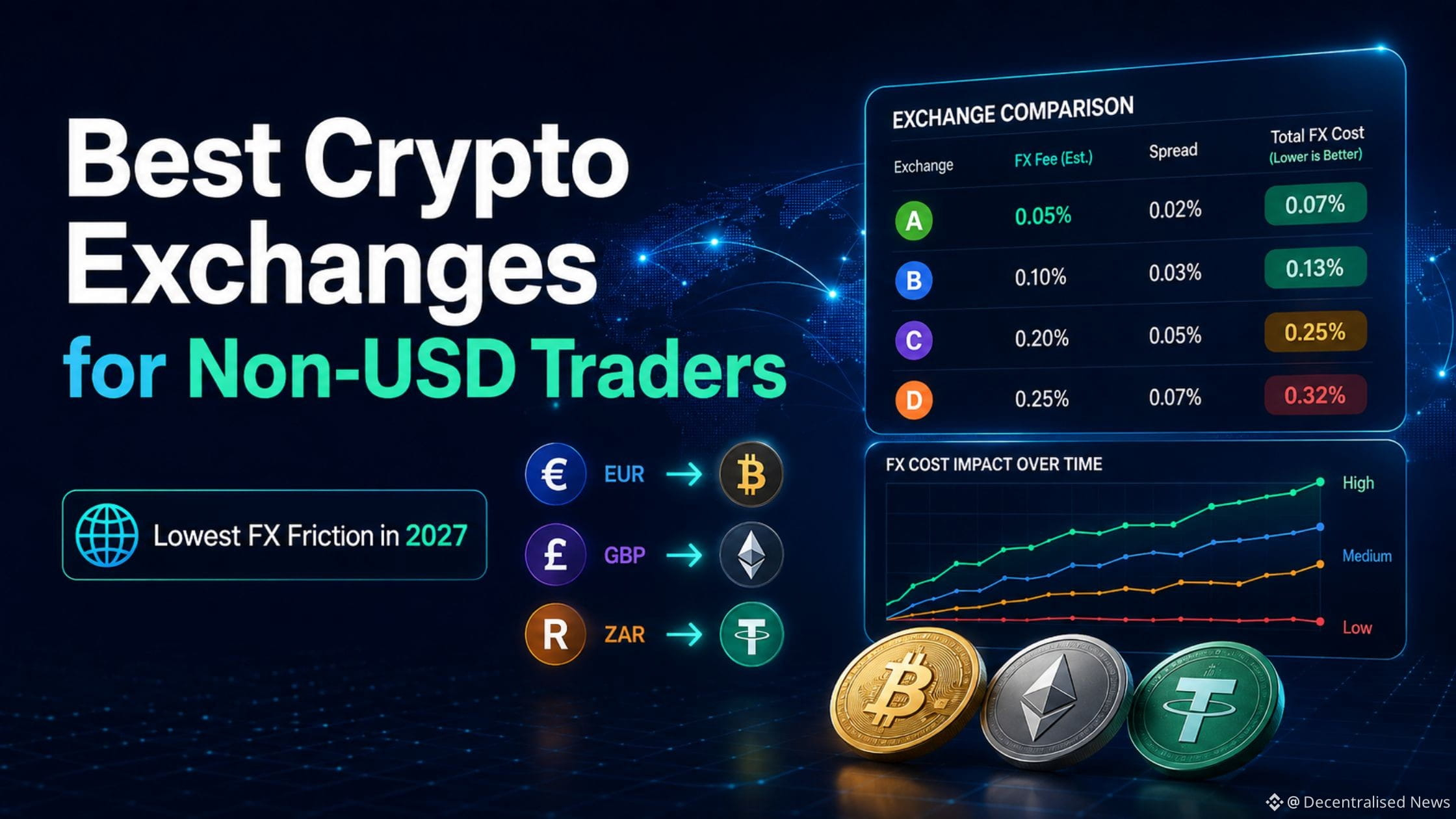
19
Log in to explore more content
Join global crypto users on Binance Square
⚡️ Get latest and useful information about crypto.
💬 Trusted by the world’s largest crypto exchange.
👍 Discover real insights from verified creators.
Email / Phone number
Trending Topics
DriftHackVictimsBeginClaims
57,642 views
685 Discussing
Drift hack victims can now start claiming DFX recovery tokens for their losses from the April 2026 exploit.
Around $295.4M in losses were verified.
The recovery pool initially had only about $3.11M.
So, at launch, 1 DFX represented $1 of loss, but the first redemption was worth only about $0.0104 — roughly 1 cent for every $1 lost.
Victims can redeem, sell, or hold their DFX.
The big catch: redeeming burns the DFX, so you give up that token’s potential share of future recovery funds.
👉 The key question: If Drift adds much more money to the recovery pool, could DFX eventually help victims recover a much larger percentage of what they lost
#DriftHackVictimsBeginClaims
$NVDAB
Irfanba
·0 Likes
·86 views
SolanaTokenizedStockVolumeTops$4.4BInSeptember
6,967 views
71 Discussing
BitcoinSpotETFsDraw$6.34BInflowsInQ3
23,059 views
184 Discussing