
iPreMyZX
2.3k Posts

iPreMyZX
Open Trade
Frequent Trader
2.5 Years
40 Following
10.5K+ Followers
7.0K+ Liked
Posts
Portfolio
All
Quotes
I initially looked at $DUSK like I would look at most L1 tokens: supply, liquidity, staking yield and market demand.
But the more I studied Dusk, the more I realized the token has a much more practical role inside the network.
DUSK is used for transaction fees and staking. Every transaction consumes gas, while staking DUSK allows provisioners to participate in consensus and earn protocol rewards.
That creates an assumption I’m not completely comfortable with:
If Dusk grows, does token demand actually grow with it?
It depends on what kind of activity grows.
More applications could mean more transactions and therefore more gas usage. More financial activity could also increase the importance of reliable validators securing the network.
But there is another side.
Dusk currently has an initial supply of 500 million DUSK, with another 500 million scheduled to be emitted over 36 years for staking incentives.
So I don't think it makes sense to look at DUSK economics through supply alone.
I’m more interested in the relationship between network activity → gas consumption → staking → security → token demand.
If Dusk becomes infrastructure for regulated assets, private transactions and financial applications, then DUSK could gradually become less about simply holding a blockchain token and more about accessing and securing an actual financial network.
But that is still an assumption.
The real test is whether meaningful usage eventually creates enough onchain activity for DUSK’s utility to matter economically.
That’s the part I’m watching.
Not just what $DUSK is worth today, but how necessary it becomes if Dusk actually gets used.
@Dusk #dusk
But the more I studied Dusk, the more I realized the token has a much more practical role inside the network.
DUSK is used for transaction fees and staking. Every transaction consumes gas, while staking DUSK allows provisioners to participate in consensus and earn protocol rewards.
That creates an assumption I’m not completely comfortable with:
If Dusk grows, does token demand actually grow with it?
It depends on what kind of activity grows.
More applications could mean more transactions and therefore more gas usage. More financial activity could also increase the importance of reliable validators securing the network.
But there is another side.
Dusk currently has an initial supply of 500 million DUSK, with another 500 million scheduled to be emitted over 36 years for staking incentives.
So I don't think it makes sense to look at DUSK economics through supply alone.
I’m more interested in the relationship between network activity → gas consumption → staking → security → token demand.
If Dusk becomes infrastructure for regulated assets, private transactions and financial applications, then DUSK could gradually become less about simply holding a blockchain token and more about accessing and securing an actual financial network.
But that is still an assumption.
The real test is whether meaningful usage eventually creates enough onchain activity for DUSK’s utility to matter economically.
That’s the part I’m watching.
Not just what $DUSK is worth today, but how necessary it becomes if Dusk actually gets used.
@Dusk #dusk
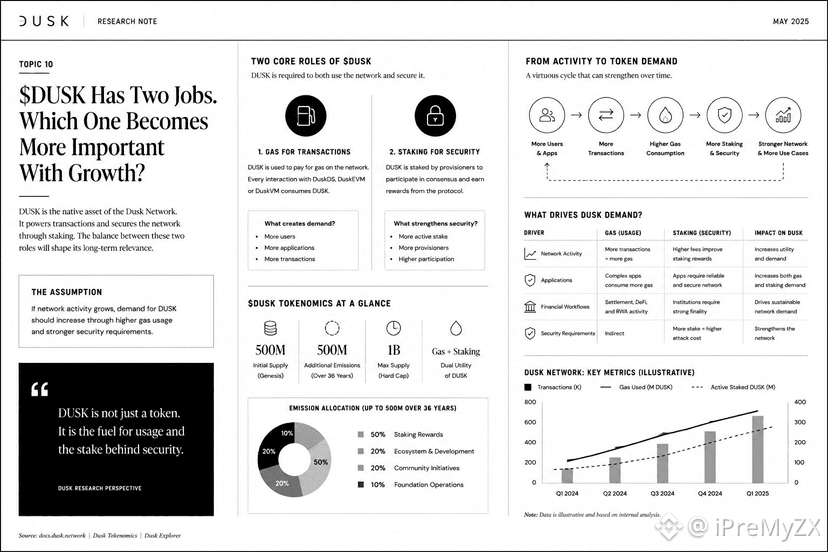
I used to assume that when a blockchain talks about fast finality, the main benefit is simple: transactions feel faster.
The more I look at Dusk, the more I think that misses the bigger point.
Dusk’s architecture is built around deterministic settlement through DuskDS and its Succinct Attestation consensus mechanism. Once a block is finalized, the network treats that state as final rather than leaving users to think about the usual uncertainty around reorganizations.
So I started asking a different question:
What does deterministic finality actually change for financial workflows?
My assumption was that it would mostly improve the user experience.
But if I’m looking at tokenized assets, the consequences seem more interesting.
A regulated transaction isn't just “send token A from wallet X to wallet Y.” There can be an asset leg, a payment leg, eligibility requirements, transfer restrictions and settlement conditions. Dusk's market-infrastructure design specifically connects deterministic finality with these workflows, including delivery-versus-payment.
That changes how I interpret speed.
The value may not be saving someone a few seconds while transferring an asset.
The value could be reducing the uncertainty between trade execution and actual settlement.
And that matters even more when the asset being transferred represents something like a regulated security, fund or other financial instrument.
I’m still cautious about assuming that better settlement automatically creates adoption. Infrastructure can be technically elegant without becoming commercially important.
But my working assumption has changed:
Dusk’s finality isn't interesting because it is fast. It's interesting if that finality makes financial workflows easier to coordinate onchain.
That is the part I want to watch.
@Dusk #dusk $DUSK
The more I look at Dusk, the more I think that misses the bigger point.
Dusk’s architecture is built around deterministic settlement through DuskDS and its Succinct Attestation consensus mechanism. Once a block is finalized, the network treats that state as final rather than leaving users to think about the usual uncertainty around reorganizations.
So I started asking a different question:
What does deterministic finality actually change for financial workflows?
My assumption was that it would mostly improve the user experience.
But if I’m looking at tokenized assets, the consequences seem more interesting.
A regulated transaction isn't just “send token A from wallet X to wallet Y.” There can be an asset leg, a payment leg, eligibility requirements, transfer restrictions and settlement conditions. Dusk's market-infrastructure design specifically connects deterministic finality with these workflows, including delivery-versus-payment.
That changes how I interpret speed.
The value may not be saving someone a few seconds while transferring an asset.
The value could be reducing the uncertainty between trade execution and actual settlement.
And that matters even more when the asset being transferred represents something like a regulated security, fund or other financial instrument.
I’m still cautious about assuming that better settlement automatically creates adoption. Infrastructure can be technically elegant without becoming commercially important.
But my working assumption has changed:
Dusk’s finality isn't interesting because it is fast. It's interesting if that finality makes financial workflows easier to coordinate onchain.
That is the part I want to watch.
@Dusk #dusk $DUSK
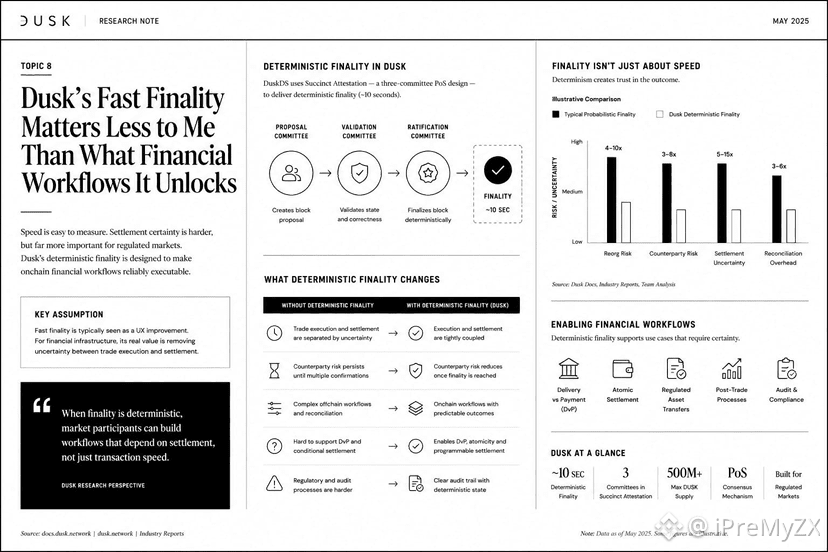
At first, this looked like an unnecessary complication to me.
If Dusk already offers an EVM environment with Solidity, familiar wallets and tools like Hardhat and Foundry, why would anyone choose a separate native execution environment?
The answer becomes clearer when you look at what the two paths are actually designed to do.
DuskEVM is built for compatibility. It gives developers a familiar Ethereum-style environment while using DuskDS underneath for settlement and data availability. That makes sense for DeFi, tokenized-asset applications and projects that want existing EVM infrastructure.
DuskVM is solving a different problem.
It runs Rust/WASM contracts directly on the Dusk L1 and is intended for applications that need deeper access to native assets, Dusk's transaction models, privacy or zero-knowledge capabilities.
That creates an interesting trade-off.
DuskEVM lowers the barrier to entry.
DuskVM increases access to the underlying protocol.
So I don't think the question is really “Which one is better?”
It's more about what the application is trying to optimize.
If compatibility is the priority, EVM makes obvious sense. But if the application needs functionality that sits close to Dusk's privacy and L1 primitives, adding another abstraction layer may not be desirable.
That is what I find interesting about Dusk's architecture.
It isn't forcing every developer into one execution model. It is separating compatibility from native capability, while keeping both connected to the same settlement foundation.
The real test now is whether developers actually find that choice valuable enough to use.
Because architecture only becomes an advantage when builders can feel the difference.
@Dusk #dusk $DUSK
If Dusk already offers an EVM environment with Solidity, familiar wallets and tools like Hardhat and Foundry, why would anyone choose a separate native execution environment?
The answer becomes clearer when you look at what the two paths are actually designed to do.
DuskEVM is built for compatibility. It gives developers a familiar Ethereum-style environment while using DuskDS underneath for settlement and data availability. That makes sense for DeFi, tokenized-asset applications and projects that want existing EVM infrastructure.
DuskVM is solving a different problem.
It runs Rust/WASM contracts directly on the Dusk L1 and is intended for applications that need deeper access to native assets, Dusk's transaction models, privacy or zero-knowledge capabilities.
That creates an interesting trade-off.
DuskEVM lowers the barrier to entry.
DuskVM increases access to the underlying protocol.
So I don't think the question is really “Which one is better?”
It's more about what the application is trying to optimize.
If compatibility is the priority, EVM makes obvious sense. But if the application needs functionality that sits close to Dusk's privacy and L1 primitives, adding another abstraction layer may not be desirable.
That is what I find interesting about Dusk's architecture.
It isn't forcing every developer into one execution model. It is separating compatibility from native capability, while keeping both connected to the same settlement foundation.
The real test now is whether developers actually find that choice valuable enough to use.
Because architecture only becomes an advantage when builders can feel the difference.
@Dusk #dusk $DUSK
At first, this looked like an unnecessary complication to me.
If Dusk already offers an EVM environment with Solidity, familiar wallets and tools like Hardhat and Foundry, why would anyone choose a separate native execution environment?
The answer becomes clearer when you look at what the two paths are actually designed to do.
DuskEVM is built for compatibility. It gives developers a familiar Ethereum-style environment while using DuskDS underneath for settlement and data availability. That makes sense for DeFi, tokenized-asset applications and projects that want existing EVM infrastructure.
DuskVM is solving a different problem.
It runs Rust/WASM contracts directly on the Dusk L1 and is intended for applications that need deeper access to native assets, Dusk's transaction models, privacy or zero-knowledge capabilities.
That creates an interesting trade-off.
DuskEVM lowers the barrier to entry.
DuskVM increases access to the underlying protocol.
So I don't think the question is really “Which one is better?”
It's more about what the application is trying to optimize.
If compatibility is the priority, EVM makes obvious sense. But if the application needs functionality that sits close to Dusk's privacy and L1 primitives, adding another abstraction layer may not be desirable.
That is what I find interesting about Dusk's architecture.
It isn't forcing every developer into one execution model. It is separating compatibility from native capability, while keeping both connected to the same settlement foundation.
The real test now is whether developers actually find that choice valuable enough to use.
Because architecture only becomes an advantage when builders can feel the difference.
@Dusk #dusk $DUSK
If Dusk already offers an EVM environment with Solidity, familiar wallets and tools like Hardhat and Foundry, why would anyone choose a separate native execution environment?
The answer becomes clearer when you look at what the two paths are actually designed to do.
DuskEVM is built for compatibility. It gives developers a familiar Ethereum-style environment while using DuskDS underneath for settlement and data availability. That makes sense for DeFi, tokenized-asset applications and projects that want existing EVM infrastructure.
DuskVM is solving a different problem.
It runs Rust/WASM contracts directly on the Dusk L1 and is intended for applications that need deeper access to native assets, Dusk's transaction models, privacy or zero-knowledge capabilities.
That creates an interesting trade-off.
DuskEVM lowers the barrier to entry.
DuskVM increases access to the underlying protocol.
So I don't think the question is really “Which one is better?”
It's more about what the application is trying to optimize.
If compatibility is the priority, EVM makes obvious sense. But if the application needs functionality that sits close to Dusk's privacy and L1 primitives, adding another abstraction layer may not be desirable.
That is what I find interesting about Dusk's architecture.
It isn't forcing every developer into one execution model. It is separating compatibility from native capability, while keeping both connected to the same settlement foundation.
The real test now is whether developers actually find that choice valuable enough to use.
Because architecture only becomes an advantage when builders can feel the difference.
@Dusk #dusk $DUSK
I initially looked at Dusk’s architecture from the execution side.
That felt natural. Smart contracts are where applications live, so I assumed that was the main story.
Then I looked more closely at DuskDS.
Dusk separates its settlement and data-availability foundation from its execution environments. DuskDS handles consensus, finality, data availability and the network’s transaction models, while DuskVM and DuskEVM provide different ways for applications to execute logic.
That separation changes how I think about the design.
Instead of asking, “Which execution environment is better?” I think the more useful question is: which responsibilities should actually be coupled?
DuskEVM gives developers Solidity, familiar EVM tooling and Ethereum-compatible infrastructure. DuskVM takes a different route, allowing Rust/WASM contracts to execute directly on the Dusk L1 when applications need deeper access to native assets, privacy or zero-knowledge capabilities.
Meanwhile, DuskDS remains underneath them as the settlement layer.
For regulated financial applications, that distinction could matter more than it initially appears.
A tokenized asset may need one environment for application logic, another set of primitives for privacy, and deterministic settlement underneath everything. Dusk is essentially trying to separate those jobs instead of forcing every application into one execution model.
The interesting part isn't simply that Dusk is modular.
It's whether this modularity lets financial applications choose the execution environment they actually need without sacrificing a common settlement foundation.
That is the architectural trade-off I'm watching more closely now.
@Dusk #dusk $DUSK
That felt natural. Smart contracts are where applications live, so I assumed that was the main story.
Then I looked more closely at DuskDS.
Dusk separates its settlement and data-availability foundation from its execution environments. DuskDS handles consensus, finality, data availability and the network’s transaction models, while DuskVM and DuskEVM provide different ways for applications to execute logic.
That separation changes how I think about the design.
Instead of asking, “Which execution environment is better?” I think the more useful question is: which responsibilities should actually be coupled?
DuskEVM gives developers Solidity, familiar EVM tooling and Ethereum-compatible infrastructure. DuskVM takes a different route, allowing Rust/WASM contracts to execute directly on the Dusk L1 when applications need deeper access to native assets, privacy or zero-knowledge capabilities.
Meanwhile, DuskDS remains underneath them as the settlement layer.
For regulated financial applications, that distinction could matter more than it initially appears.
A tokenized asset may need one environment for application logic, another set of primitives for privacy, and deterministic settlement underneath everything. Dusk is essentially trying to separate those jobs instead of forcing every application into one execution model.
The interesting part isn't simply that Dusk is modular.
It's whether this modularity lets financial applications choose the execution environment they actually need without sacrificing a common settlement foundation.
That is the architectural trade-off I'm watching more closely now.
@Dusk #dusk $DUSK
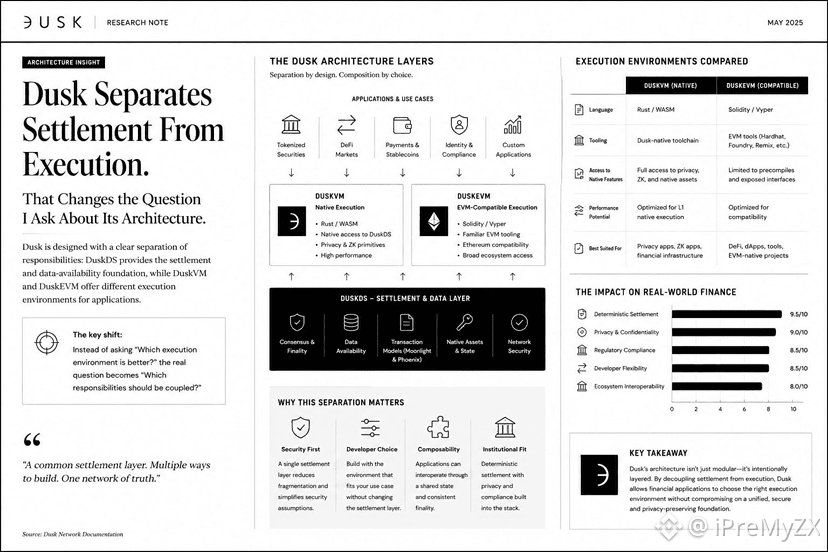
I used to think tokenization was mostly about taking an existing financial asset and putting a token around it.
The more I looked at Dusk Trade, the less complete that definition felt.
Dusk Trade is positioned as the application layer for tokenized financial assets, but the workflow goes far beyond creating and transferring a token. It includes asset discovery, investor onboarding, wallet connection, eligibility, trading, payment coordination and settlement.
That distinction matters.
A token can exist onchain while the important parts of the financial process remain somewhere else. Dusk's own documentation separates ordinary tokenization from native issuance, where issuance, transfers, servicing and settlement can be designed around the ledger itself.
That's the part I find more interesting.
If an investor still has to move between separate systems for identity, eligibility, custody, trading and settlement, then putting the asset onchain hasn't necessarily changed the market structure. It may have only digitized one component.
Dusk is trying to approach the problem differently: connect those pieces around the same infrastructure, while keeping sensitive information private and allowing specific information to be disclosed when required.
So my question isn't simply whether Dusk can tokenize securities.
It's whether a blockchain can actually absorb enough of the surrounding financial workflow to make tokenization meaningfully different from the systems it is supposed to improve.
That feels like the harder test.
And probably the more important one.
@Dusk #dusk $DUSK
The more I looked at Dusk Trade, the less complete that definition felt.
Dusk Trade is positioned as the application layer for tokenized financial assets, but the workflow goes far beyond creating and transferring a token. It includes asset discovery, investor onboarding, wallet connection, eligibility, trading, payment coordination and settlement.
That distinction matters.
A token can exist onchain while the important parts of the financial process remain somewhere else. Dusk's own documentation separates ordinary tokenization from native issuance, where issuance, transfers, servicing and settlement can be designed around the ledger itself.
That's the part I find more interesting.
If an investor still has to move between separate systems for identity, eligibility, custody, trading and settlement, then putting the asset onchain hasn't necessarily changed the market structure. It may have only digitized one component.
Dusk is trying to approach the problem differently: connect those pieces around the same infrastructure, while keeping sensitive information private and allowing specific information to be disclosed when required.
So my question isn't simply whether Dusk can tokenize securities.
It's whether a blockchain can actually absorb enough of the surrounding financial workflow to make tokenization meaningfully different from the systems it is supposed to improve.
That feels like the harder test.
And probably the more important one.
@Dusk #dusk $DUSK
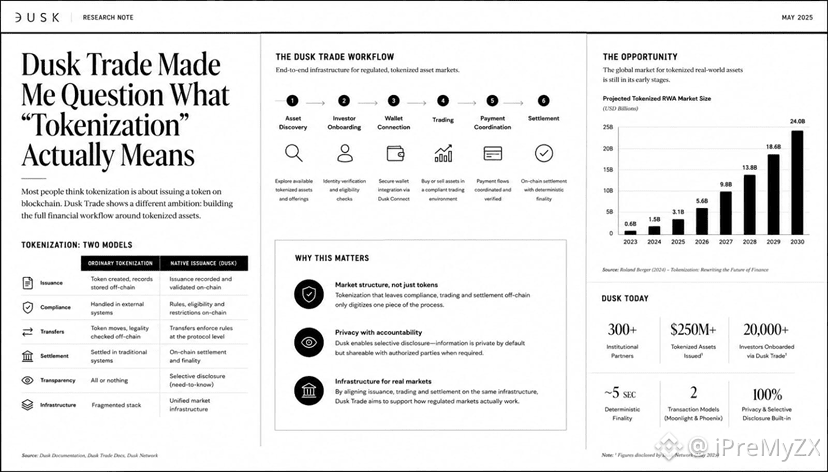
👀 I went a little deeper into Zedger today, and I think I was looking at the wrong thing at first.
My first thought was basically: okay, @Dusk is putting regulated securities onchain. Got it.
But Zedger gets more interesting when you look beyond the token itself.
It’s built around regulated assets and supports things like minting, burning and corporate actions. In other words, the chain isn't necessarily just acting like a digital receipt for an asset that lives somewhere else.
More of the actual lifecycle can be handled as part of the infrastructure.
And that changes the way I think about tokenized securities.
A security isn't just a balance sitting in a wallet. Ownership can change. Rules can apply. Corporate events can happen. The asset can be created, modified, redeemed or removed.
If some of those processes can happen directly within the infrastructure, there's potentially less separation between “the asset” and “the system managing the asset.”
That's the part I find genuinely interesting about Zedger.
But there's also a catch.
The more financial logic you bring onchain, the more real-world complexity the protocol has to deal with correctly.
You aren't just moving tokens anymore. You're trying to represent legal and financial rules in a system that has to behave predictably.
So I'm left with a question rather than a conclusion:
Does putting more of a security's lifecycle onchain actually make financial infrastructure simpler… or are we just moving more of the complexity onto the blockchain?
That's the part of Zedger I'm still thinking about.
#dusk $DUSK
My first thought was basically: okay, @Dusk is putting regulated securities onchain. Got it.
But Zedger gets more interesting when you look beyond the token itself.
It’s built around regulated assets and supports things like minting, burning and corporate actions. In other words, the chain isn't necessarily just acting like a digital receipt for an asset that lives somewhere else.
More of the actual lifecycle can be handled as part of the infrastructure.
And that changes the way I think about tokenized securities.
A security isn't just a balance sitting in a wallet. Ownership can change. Rules can apply. Corporate events can happen. The asset can be created, modified, redeemed or removed.
If some of those processes can happen directly within the infrastructure, there's potentially less separation between “the asset” and “the system managing the asset.”
That's the part I find genuinely interesting about Zedger.
But there's also a catch.
The more financial logic you bring onchain, the more real-world complexity the protocol has to deal with correctly.
You aren't just moving tokens anymore. You're trying to represent legal and financial rules in a system that has to behave predictably.
So I'm left with a question rather than a conclusion:
Does putting more of a security's lifecycle onchain actually make financial infrastructure simpler… or are we just moving more of the complexity onto the blockchain?
That's the part of Zedger I'm still thinking about.
#dusk $DUSK
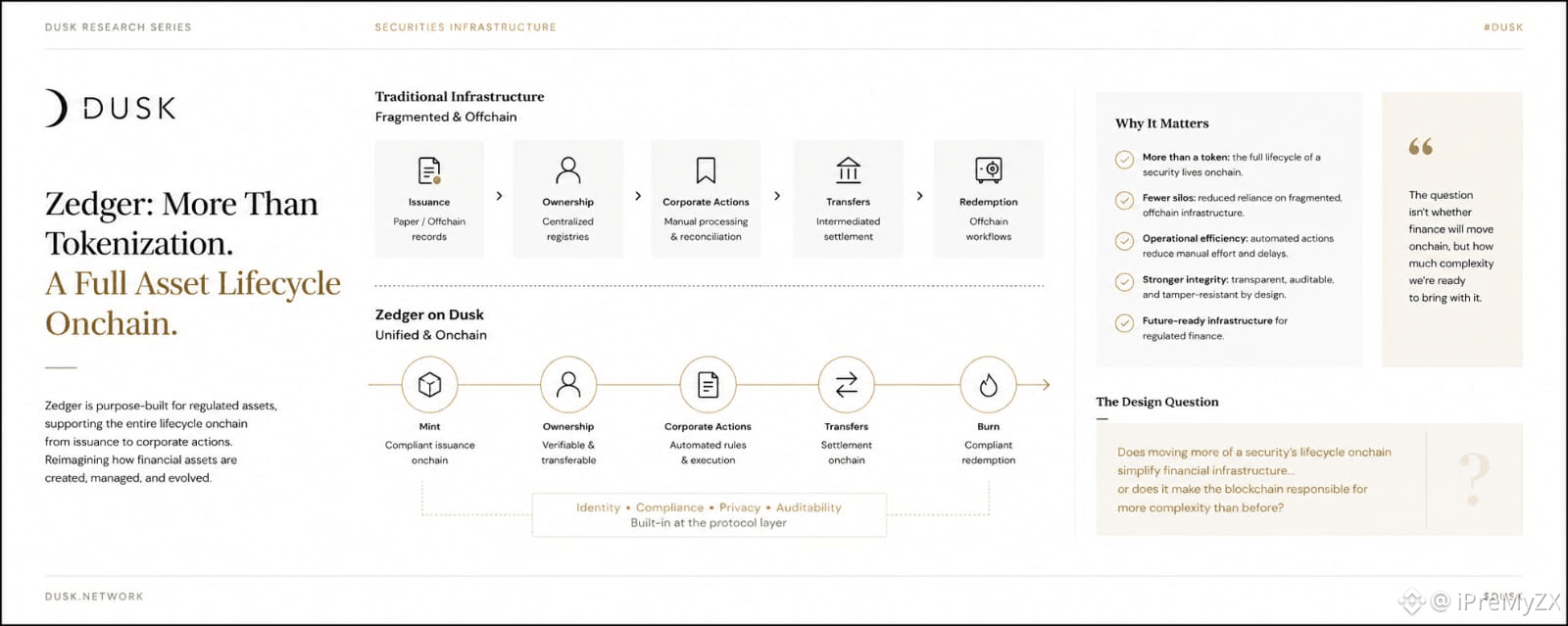
I started looking at Dusk’s zero-knowledge technology from the privacy side.
That was the obvious place to start.
If a blockchain can verify something without exposing all of the underlying information, it seems natural to think about ZK as a way to keep transactions and balances private.
But the more I looked at Dusk, the more interesting the compliance side became.
Think about a regulated asset.
An investor might need to prove they are eligible to buy it. A transaction may need to satisfy certain rules. An organization may need to demonstrate that the right conditions were met.
But none of that necessarily means everyone should see the investor’s complete identity, financial position, or transaction history.
That distinction is where Dusk’s approach caught my attention.
With Citadel providing identity infrastructure and Dusk using zero-knowledge and selective-disclosure mechanisms, the interesting possibility isn't simply hiding information.
It is proving a specific fact without exposing everything behind that fact.
You don't necessarily need to reveal someone's entire financial profile to prove they are eligible.
You need a reliable way to prove that they meet the required condition.
That changes how I think about ZK on Dusk.
Maybe its most important role isn't making blockchain transactions private.
Maybe it's making compliance itself more selective.
The bigger question for @Dusk is how far this model can actually go.
Can regulatory requirements become things a blockchain verifies cryptographically, while sensitive information remains protected?
If that works, privacy and compliance stop looking like opposing requirements.
They start looking like two parts of the same infrastructure.
$DUSK #dusk
That was the obvious place to start.
If a blockchain can verify something without exposing all of the underlying information, it seems natural to think about ZK as a way to keep transactions and balances private.
But the more I looked at Dusk, the more interesting the compliance side became.
Think about a regulated asset.
An investor might need to prove they are eligible to buy it. A transaction may need to satisfy certain rules. An organization may need to demonstrate that the right conditions were met.
But none of that necessarily means everyone should see the investor’s complete identity, financial position, or transaction history.
That distinction is where Dusk’s approach caught my attention.
With Citadel providing identity infrastructure and Dusk using zero-knowledge and selective-disclosure mechanisms, the interesting possibility isn't simply hiding information.
It is proving a specific fact without exposing everything behind that fact.
You don't necessarily need to reveal someone's entire financial profile to prove they are eligible.
You need a reliable way to prove that they meet the required condition.
That changes how I think about ZK on Dusk.
Maybe its most important role isn't making blockchain transactions private.
Maybe it's making compliance itself more selective.
The bigger question for @Dusk is how far this model can actually go.
Can regulatory requirements become things a blockchain verifies cryptographically, while sensitive information remains protected?
If that works, privacy and compliance stop looking like opposing requirements.
They start looking like two parts of the same infrastructure.
$DUSK #dusk
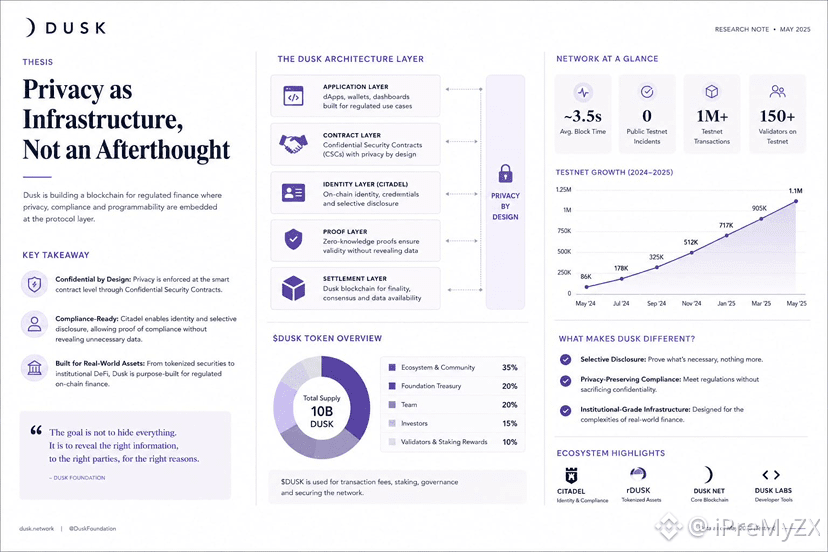
The more I study Dusk, the less convincing the usual “private blockchain” description becomes.
A truly interesting privacy system can't simply make information disappear. Financial markets still need verification. Someone has to establish that a transaction is valid, an investor is eligible, or a financial rule has been followed.
That creates a tension I find much more interesting than privacy alone.
Dusk approaches it through a combination of shielded transactions, zero-knowledge proofs and selective disclosure.
The idea isn't necessarily to expose the underlying information. Instead, cryptographic proofs can demonstrate that certain conditions are satisfied without revealing everything behind the transaction.
That distinction matters.
Imagine an institution needs to prove that a transaction followed the required rules. On a completely transparent blockchain, the easiest solution is often to publish the underlying activity and let everyone inspect it.
But that creates another problem: sensitive financial information becomes permanently visible.
Dusk's approach asks a different question:
Do you actually need to reveal the data, or do you only need to prove something about the data?
That's where zero-knowledge technology becomes particularly interesting to me.
The objective isn't “hide everything.”
It's closer to prove what needs to be proven while keeping unnecessary information private.
Selective disclosure adds another layer. When an authorized party genuinely needs additional information, privacy doesn't necessarily mean refusing access. It can mean controlling who receives it and under what circumstances.
So I'm starting to see Dusk's privacy architecture less as an attempt to escape verification and more as an attempt to separate verification from exposure.
The bigger test, though, is practical.
Can institutions actually operate this way at scale?
Because proving something without revealing everything sounds elegant on paper. The real story begins when financial markets depend on it.
@Dusk #dusk $DUSK
A truly interesting privacy system can't simply make information disappear. Financial markets still need verification. Someone has to establish that a transaction is valid, an investor is eligible, or a financial rule has been followed.
That creates a tension I find much more interesting than privacy alone.
Dusk approaches it through a combination of shielded transactions, zero-knowledge proofs and selective disclosure.
The idea isn't necessarily to expose the underlying information. Instead, cryptographic proofs can demonstrate that certain conditions are satisfied without revealing everything behind the transaction.
That distinction matters.
Imagine an institution needs to prove that a transaction followed the required rules. On a completely transparent blockchain, the easiest solution is often to publish the underlying activity and let everyone inspect it.
But that creates another problem: sensitive financial information becomes permanently visible.
Dusk's approach asks a different question:
Do you actually need to reveal the data, or do you only need to prove something about the data?
That's where zero-knowledge technology becomes particularly interesting to me.
The objective isn't “hide everything.”
It's closer to prove what needs to be proven while keeping unnecessary information private.
Selective disclosure adds another layer. When an authorized party genuinely needs additional information, privacy doesn't necessarily mean refusing access. It can mean controlling who receives it and under what circumstances.
So I'm starting to see Dusk's privacy architecture less as an attempt to escape verification and more as an attempt to separate verification from exposure.
The bigger test, though, is practical.
Can institutions actually operate this way at scale?
Because proving something without revealing everything sounds elegant on paper. The real story begins when financial markets depend on it.
@Dusk #dusk $DUSK
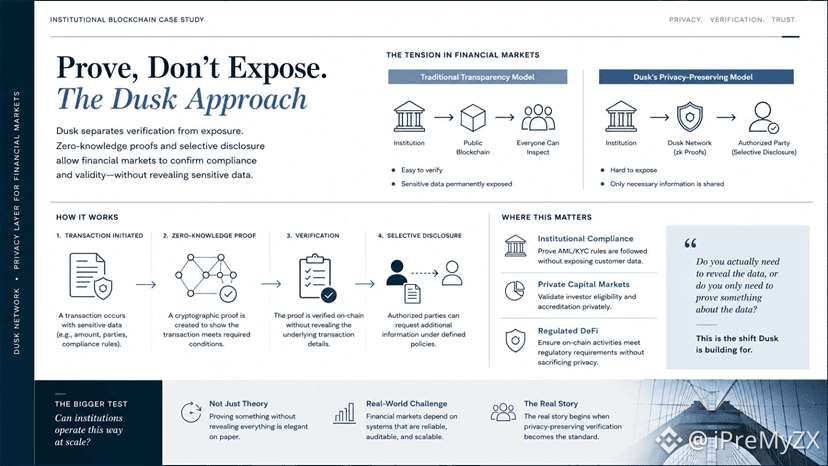
I initially looked at Phoenix through the usual lens: private transactions, hidden amounts, and less information exposed onchain.
That description is technically useful, but I think it misses the more interesting part of Dusk.
Phoenix isn't simply about making financial activity disappear. The architecture is built around shielded transactions while still allowing authorized access to relevant information through viewing mechanisms.
That changes the question.
Instead of asking, “How anonymous is this blockchain?” I think the better question is:
Who should be able to see what, and under which conditions?
That's a very different way to think about privacy.
For an ordinary user, privacy might mean keeping balances and transaction history away from public observers. But financial institutions have a more complicated requirement. They may need confidentiality from the wider market while still being able to demonstrate information to an auditor, regulator, counterparty, or other authorized party.
This is where Phoenix becomes more interesting to me.
Zero-knowledge proofs can establish that a transaction follows the required rules without exposing every underlying detail. Selective disclosure can then create a controlled path for revealing information when there is a legitimate reason to do so.
So Dusk isn't necessarily choosing between privacy and compliance.
It's exploring whether they can coexist through controlled visibility.
And that may be a much more relevant model for regulated financial markets than simply making everything public or everything private.
The part I'm watching now is whether this architecture actually changes how institutions behave.
Because building selective privacy is one challenge.
Getting real financial activity to depend on it is the much harder test.
@Dusk #dusk $DUSK
That description is technically useful, but I think it misses the more interesting part of Dusk.
Phoenix isn't simply about making financial activity disappear. The architecture is built around shielded transactions while still allowing authorized access to relevant information through viewing mechanisms.
That changes the question.
Instead of asking, “How anonymous is this blockchain?” I think the better question is:
Who should be able to see what, and under which conditions?
That's a very different way to think about privacy.
For an ordinary user, privacy might mean keeping balances and transaction history away from public observers. But financial institutions have a more complicated requirement. They may need confidentiality from the wider market while still being able to demonstrate information to an auditor, regulator, counterparty, or other authorized party.
This is where Phoenix becomes more interesting to me.
Zero-knowledge proofs can establish that a transaction follows the required rules without exposing every underlying detail. Selective disclosure can then create a controlled path for revealing information when there is a legitimate reason to do so.
So Dusk isn't necessarily choosing between privacy and compliance.
It's exploring whether they can coexist through controlled visibility.
And that may be a much more relevant model for regulated financial markets than simply making everything public or everything private.
The part I'm watching now is whether this architecture actually changes how institutions behave.
Because building selective privacy is one challenge.
Getting real financial activity to depend on it is the much harder test.
@Dusk #dusk $DUSK
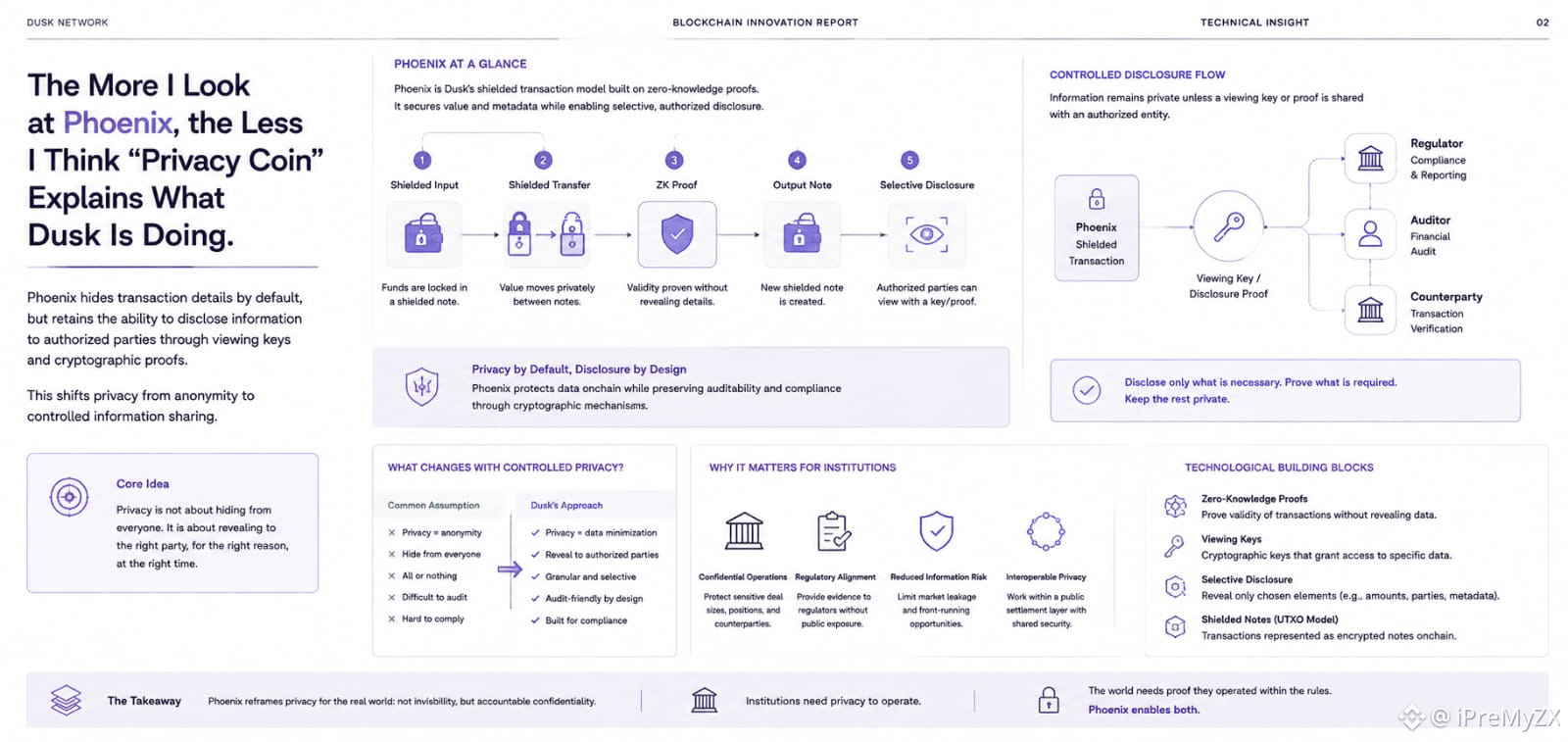
When I first looked at Dusk’s transaction architecture, I expected the privacy story to be straightforward: a blockchain designed around confidential transactions.
Then I noticed something more interesting.
DuskDS supports two different transaction models: Moonlight, which uses a transparent account-based approach, and Phoenix, which uses shielded notes for confidential transfers.
At first, having both can look like unnecessary complexity. If privacy is such an important part of Dusk, why not make everything private?
But the more I think about regulated financial markets, the more this design starts to make sense.
Not every transaction needs the same level of confidentiality.
There are situations where transparent activity is useful. A public transfer can make accounting, monitoring, treasury operations or certain forms of verification easier.
Then there are transactions where exposing the amount, participants or financial relationships creates information leakage that an institution simply doesn't want.
That's where Phoenix becomes more interesting.
Instead of forcing the entire network into one privacy model, Dusk appears to be treating transaction visibility as something that can depend on the use case.
And I think that's the bigger idea.
A regulated asset might need compliance without requiring every market participant to see every transaction detail. An institution could need to prove something to an authorized party while keeping sensitive financial information away from the wider market.
So I'm starting to see Moonlight and Phoenix less as competing transaction systems and more as two different tools operating on the same settlement layer.
The real question for me isn't whether one is better.
It's whether having both allows Dusk to serve financial applications that sit somewhere between completely transparent blockchains and completely private systems.
That middle ground could be where the interesting part of Dusk's architecture actually lives.
@Dusk #dusk $DUSK
Then I noticed something more interesting.
DuskDS supports two different transaction models: Moonlight, which uses a transparent account-based approach, and Phoenix, which uses shielded notes for confidential transfers.
At first, having both can look like unnecessary complexity. If privacy is such an important part of Dusk, why not make everything private?
But the more I think about regulated financial markets, the more this design starts to make sense.
Not every transaction needs the same level of confidentiality.
There are situations where transparent activity is useful. A public transfer can make accounting, monitoring, treasury operations or certain forms of verification easier.
Then there are transactions where exposing the amount, participants or financial relationships creates information leakage that an institution simply doesn't want.
That's where Phoenix becomes more interesting.
Instead of forcing the entire network into one privacy model, Dusk appears to be treating transaction visibility as something that can depend on the use case.
And I think that's the bigger idea.
A regulated asset might need compliance without requiring every market participant to see every transaction detail. An institution could need to prove something to an authorized party while keeping sensitive financial information away from the wider market.
So I'm starting to see Moonlight and Phoenix less as competing transaction systems and more as two different tools operating on the same settlement layer.
The real question for me isn't whether one is better.
It's whether having both allows Dusk to serve financial applications that sit somewhere between completely transparent blockchains and completely private systems.
That middle ground could be where the interesting part of Dusk's architecture actually lives.
@Dusk #dusk $DUSK
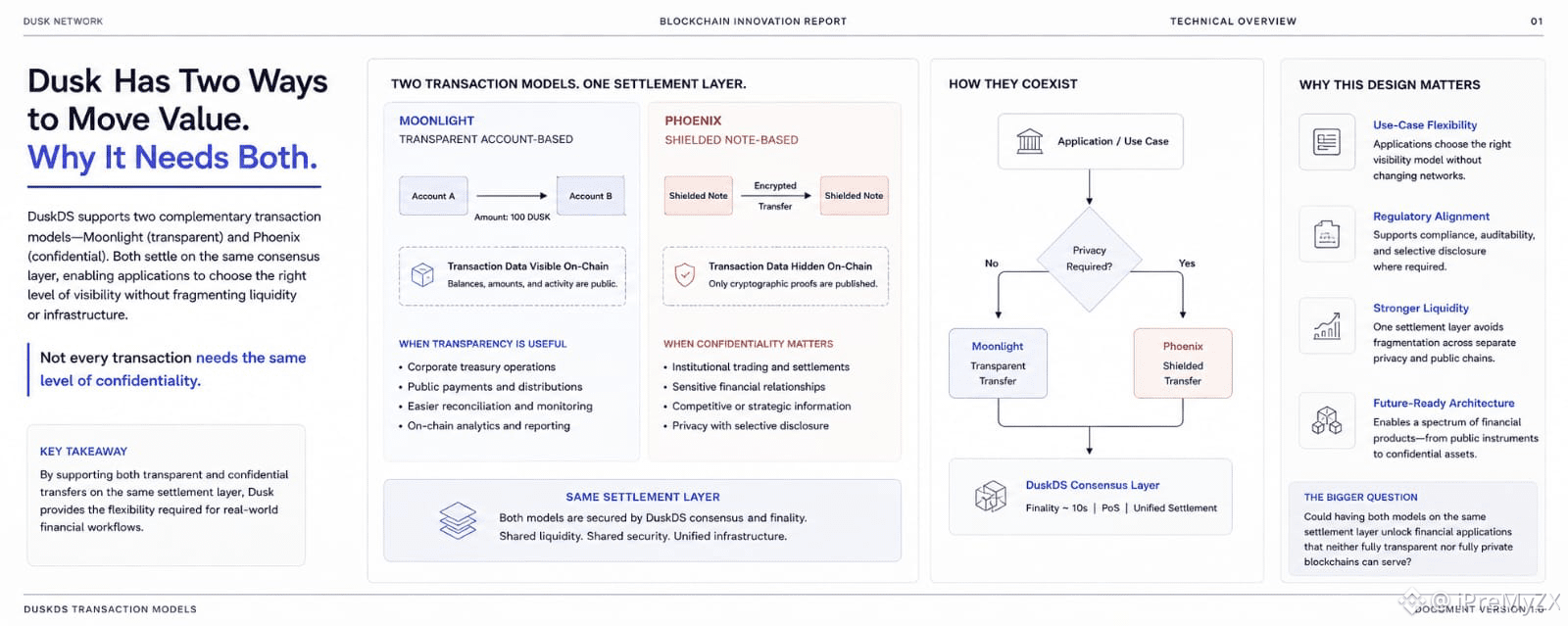
I went into the Trustless Bitcoin Vaults (TBV) docs thinking wrapped BTC and native BTC-backed borrowing were solving the same problem with different tools.
After a few hours of reading, I don't think they even start from the same assumption.
Wrapped BTC asks, "How do we bring Bitcoin into DeFi?"
TBV seems to ask, "Why does Bitcoin have to become something else before DeFi can use it?"
That distinction stuck with me more than the borrowing flow itself.
The easiest way to think about wrapped BTC is that it creates another version of Bitcoin that applications already know how to work with. It's practical, and that's why it became the standard. But every additional layer also comes with another set of assumptions that has to keep working as expected.
TBV doesn't remove complexity—it moves it.
Instead of creating another Bitcoin representation, the protocol tries to keep native BTC where it already belongs while proving its collateral status to applications like Aave v4. The engineering challenge shifts from creating a wrapped asset to coordinating verification across different systems.
That's a different design philosophy.
I'm not saying one approach automatically replaces the other. Wrapped BTC has an established ecosystem and deep liquidity today. But after comparing both models, I realized they optimize for different things. One prioritizes compatibility with existing DeFi. The other prioritizes reducing changes to Bitcoin itself.
That was my biggest takeaway.
I started this rabbit hole thinking the innovation was "borrowing against Bitcoin." I came away thinking the more interesting question is where the trust assumptions are introduced—and whether they can be reduced without giving up usability.
That feels like the conversation worth following as Trustless Bitcoin Vaults (TBV) moves beyond the public testnet.
@BabylonLabs_io $BABY #baby
After a few hours of reading, I don't think they even start from the same assumption.
Wrapped BTC asks, "How do we bring Bitcoin into DeFi?"
TBV seems to ask, "Why does Bitcoin have to become something else before DeFi can use it?"
That distinction stuck with me more than the borrowing flow itself.
The easiest way to think about wrapped BTC is that it creates another version of Bitcoin that applications already know how to work with. It's practical, and that's why it became the standard. But every additional layer also comes with another set of assumptions that has to keep working as expected.
TBV doesn't remove complexity—it moves it.
Instead of creating another Bitcoin representation, the protocol tries to keep native BTC where it already belongs while proving its collateral status to applications like Aave v4. The engineering challenge shifts from creating a wrapped asset to coordinating verification across different systems.
That's a different design philosophy.
I'm not saying one approach automatically replaces the other. Wrapped BTC has an established ecosystem and deep liquidity today. But after comparing both models, I realized they optimize for different things. One prioritizes compatibility with existing DeFi. The other prioritizes reducing changes to Bitcoin itself.
That was my biggest takeaway.
I started this rabbit hole thinking the innovation was "borrowing against Bitcoin." I came away thinking the more interesting question is where the trust assumptions are introduced—and whether they can be reduced without giving up usability.
That feels like the conversation worth following as Trustless Bitcoin Vaults (TBV) moves beyond the public testnet.
@BabylonLabs_io $BABY #baby
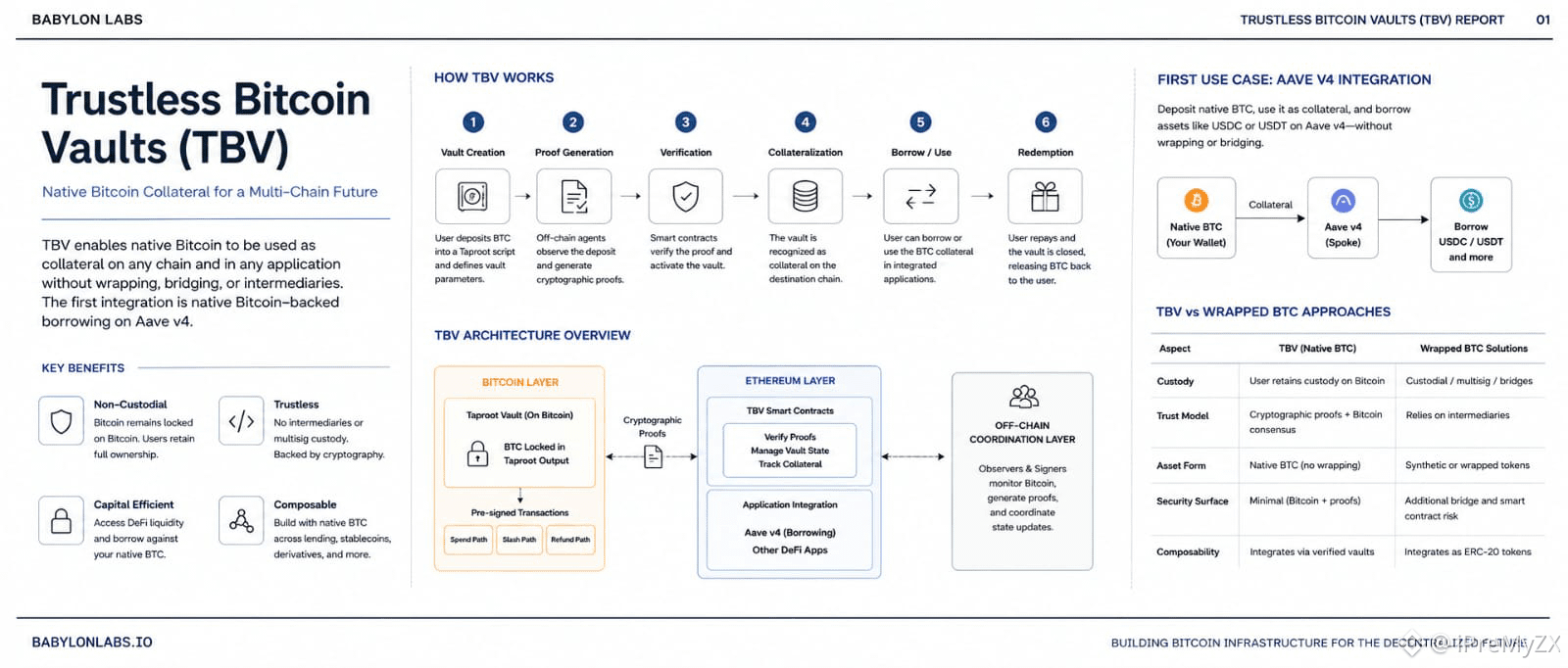
I opened the Trustless Bitcoin Vaults (TBV) testnet thinking the interesting part would be the borrowing flow. Lock BTC, borrow assets through Aave v4, done. That's what the headlines focus on.
I ended up paying attention to something else entirely.
The part that kept pulling me back wasn't what I could borrow. It was what didn't happen before the borrowing. Native Bitcoin wasn't being wrapped into another token first, and that changes where the trust assumptions live.
That's a subtle difference, but I think it's an important one.
Most Bitcoin DeFi discussions eventually become conversations about bridges, custodians, or synthetic representations. TBV feels like it's asking a different question: if Bitcoin is already the collateral, why should it first become something else just to participate?
The testnet also reminded me that making this work isn't simple. Behind what looks like a straightforward user flow is a lot of coordination between Bitcoin, Ethereum, and the protocol itself. The interface is clean enough that it's easy to miss how many moving pieces have to stay in sync.
I left feedback after testing because that's probably the most valuable part of a public testnet. Documentation explains the design, but real users expose the friction points that diagrams never will.
My biggest takeaway wasn't that I managed to borrow against Bitcoin. It was realizing that Babylon seems less interested in competing with existing BTC lending markets and more interested in changing the assumptions those markets have relied on for years.
Whether that approach becomes the new standard is still an open question. But after trying the flow myself, I think that's the question worth following.
@BabylonLabs_io $BABY #baby
I ended up paying attention to something else entirely.
The part that kept pulling me back wasn't what I could borrow. It was what didn't happen before the borrowing. Native Bitcoin wasn't being wrapped into another token first, and that changes where the trust assumptions live.
That's a subtle difference, but I think it's an important one.
Most Bitcoin DeFi discussions eventually become conversations about bridges, custodians, or synthetic representations. TBV feels like it's asking a different question: if Bitcoin is already the collateral, why should it first become something else just to participate?
The testnet also reminded me that making this work isn't simple. Behind what looks like a straightforward user flow is a lot of coordination between Bitcoin, Ethereum, and the protocol itself. The interface is clean enough that it's easy to miss how many moving pieces have to stay in sync.
I left feedback after testing because that's probably the most valuable part of a public testnet. Documentation explains the design, but real users expose the friction points that diagrams never will.
My biggest takeaway wasn't that I managed to borrow against Bitcoin. It was realizing that Babylon seems less interested in competing with existing BTC lending markets and more interested in changing the assumptions those markets have relied on for years.
Whether that approach becomes the new standard is still an open question. But after trying the flow myself, I think that's the question worth following.
@BabylonLabs_io $BABY #baby
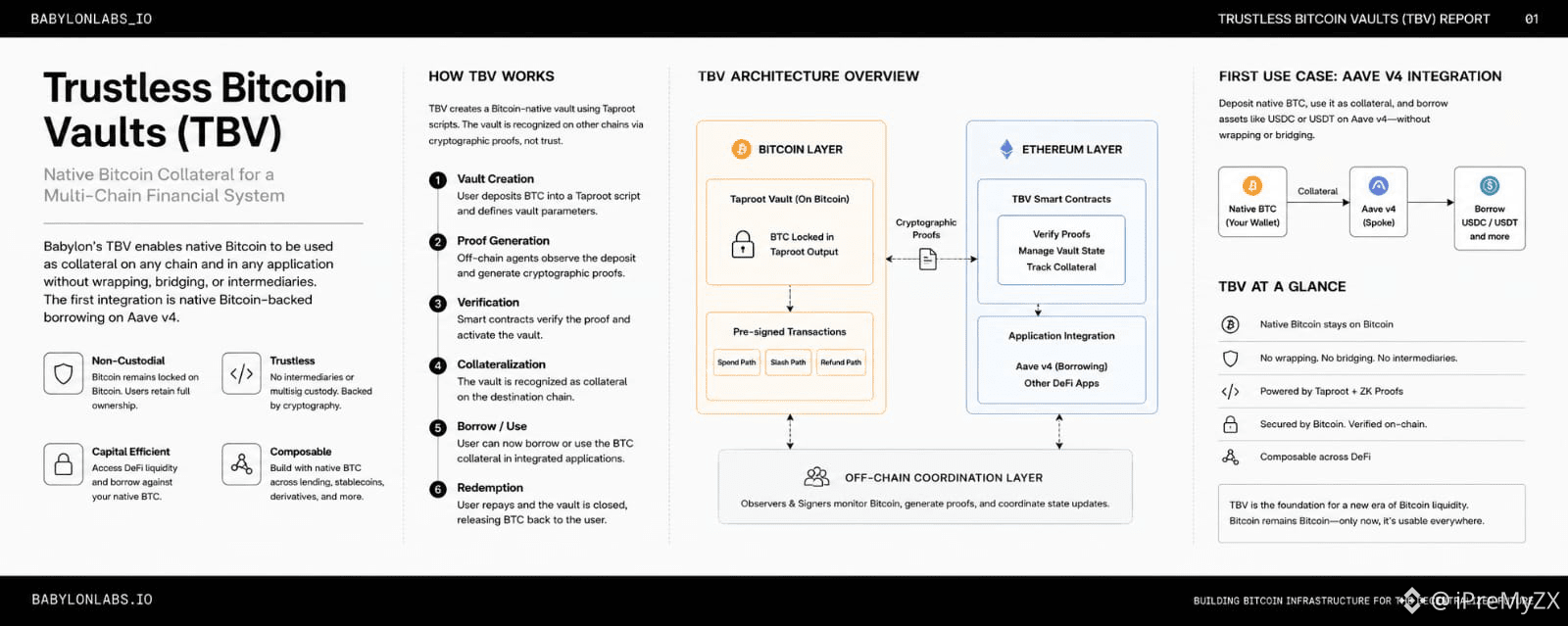
#baby $BABY
I started reading about Trustless Bitcoin Vaults (TBV) because I wanted to understand the borrowing flow.
I ended up thinking much more about where the protocol chooses to keep trust.
At first, "native Bitcoin collateral" sounded like another product description. The deeper I went into the architecture, the more it became a design decision.
Bitcoin isn't being asked to become faster.
It isn't being asked to become an EVM asset.
Instead, the system is built around accepting Bitcoin's own rules and designing the rest of the infrastructure around them.
That feels like a surprisingly different philosophy.
Most cross-chain systems try to minimize friction by introducing another layer that makes assets easier to move. TBV seems to take almost the opposite approach. It accepts that Bitcoin has its own settlement model and then asks how lending infrastructure can respect that instead of replacing it.
The more I compared those approaches, the less I thought this was a discussion about capital efficiency.
It became a discussion about which assumptions deserve to remain untouched.
Every protocol has trade-offs. TBV isn't exempt from that. Coordination, verification, and operational complexity don't disappear just because custody is minimized.
But complexity and trust aren't always the same thing.
One comes from engineering.
The other comes from asking users to believe in additional parties.
I'm still working through the documentation, but that's the distinction that stayed with me.
Maybe the future of Bitcoin in DeFi won't be decided by whichever protocol moves BTC the fastest.
Maybe it'll be decided by whichever protocol changes the fewest things about why people trusted Bitcoin in the first place.
@BabylonLabs_io
#baby $BABY
I started reading about Trustless Bitcoin Vaults (TBV) because I wanted to understand the borrowing flow.
I ended up thinking much more about where the protocol chooses to keep trust.
At first, "native Bitcoin collateral" sounded like another product description. The deeper I went into the architecture, the more it became a design decision.
Bitcoin isn't being asked to become faster.
It isn't being asked to become an EVM asset.
Instead, the system is built around accepting Bitcoin's own rules and designing the rest of the infrastructure around them.
That feels like a surprisingly different philosophy.
Most cross-chain systems try to minimize friction by introducing another layer that makes assets easier to move. TBV seems to take almost the opposite approach. It accepts that Bitcoin has its own settlement model and then asks how lending infrastructure can respect that instead of replacing it.
The more I compared those approaches, the less I thought this was a discussion about capital efficiency.
It became a discussion about which assumptions deserve to remain untouched.
Every protocol has trade-offs. TBV isn't exempt from that. Coordination, verification, and operational complexity don't disappear just because custody is minimized.
But complexity and trust aren't always the same thing.
One comes from engineering.
The other comes from asking users to believe in additional parties.
I'm still working through the documentation, but that's the distinction that stayed with me.
Maybe the future of Bitcoin in DeFi won't be decided by whichever protocol moves BTC the fastest.
Maybe it'll be decided by whichever protocol changes the fewest things about why people trusted Bitcoin in the first place.
@BabylonLabs_io
#baby $BABY
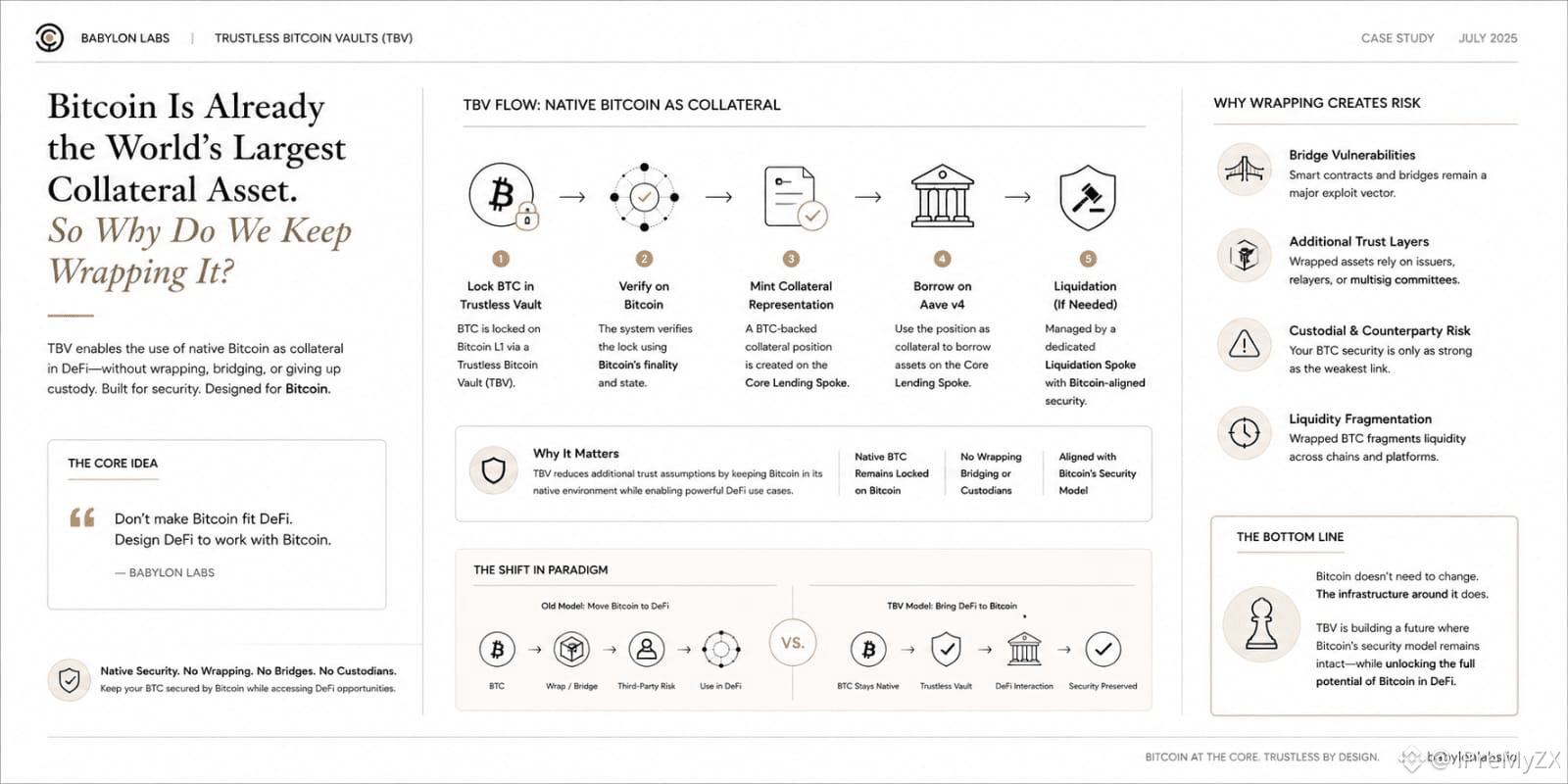
#baby $BABY
Started reading about Trustless Bitcoin Vaults (TBV) thinking I'd end up comparing borrow rates.
Didn't happen.
I kept drifting back to something much less obvious: where the trust sits once native Bitcoin becomes collateral.
For years, the default path felt settled. Wrap BTC, bridge it, interact with DeFi, move on. I treated those extra layers as the unavoidable cost of making Bitcoin useful outside its own chain.
TBV made me question whether that assumption deserved to become the default.
What stood out wasn't that Bitcoin suddenly becomes frictionless. It doesn't. Native BTC still follows Bitcoin's own settlement cadence, and that rhythm doesn't disappear just because another chain wants faster execution.
The difference is where the protocol chooses to absorb that friction.
Instead of introducing another representation of Bitcoin, TBV keeps the collateral tied to Bitcoin itself while building the lending logic around that reality. The waiting doesn't vanish—it simply follows Bitcoin's own rules rather than those of a bridge or custodian.
The more I think about it, the less this feels like a discussion about borrowing.
It's a discussion about design priorities.
Is it better to optimize for immediate convenience, or to preserve the security assumptions that made Bitcoin valuable in the first place?
I'm still working through the architecture, and I'm sure there are trade-offs I haven't fully appreciated yet.
But one thing has changed.
I no longer judge Bitcoin infrastructure by how quickly it moves BTC.
I'm paying much closer attention to what it asks me to trust before it moves anything at all.
@BabylonLabs_io
#baby
Started reading about Trustless Bitcoin Vaults (TBV) thinking I'd end up comparing borrow rates.
Didn't happen.
I kept drifting back to something much less obvious: where the trust sits once native Bitcoin becomes collateral.
For years, the default path felt settled. Wrap BTC, bridge it, interact with DeFi, move on. I treated those extra layers as the unavoidable cost of making Bitcoin useful outside its own chain.
TBV made me question whether that assumption deserved to become the default.
What stood out wasn't that Bitcoin suddenly becomes frictionless. It doesn't. Native BTC still follows Bitcoin's own settlement cadence, and that rhythm doesn't disappear just because another chain wants faster execution.
The difference is where the protocol chooses to absorb that friction.
Instead of introducing another representation of Bitcoin, TBV keeps the collateral tied to Bitcoin itself while building the lending logic around that reality. The waiting doesn't vanish—it simply follows Bitcoin's own rules rather than those of a bridge or custodian.
The more I think about it, the less this feels like a discussion about borrowing.
It's a discussion about design priorities.
Is it better to optimize for immediate convenience, or to preserve the security assumptions that made Bitcoin valuable in the first place?
I'm still working through the architecture, and I'm sure there are trade-offs I haven't fully appreciated yet.
But one thing has changed.
I no longer judge Bitcoin infrastructure by how quickly it moves BTC.
I'm paying much closer attention to what it asks me to trust before it moves anything at all.
@BabylonLabs_io
#baby
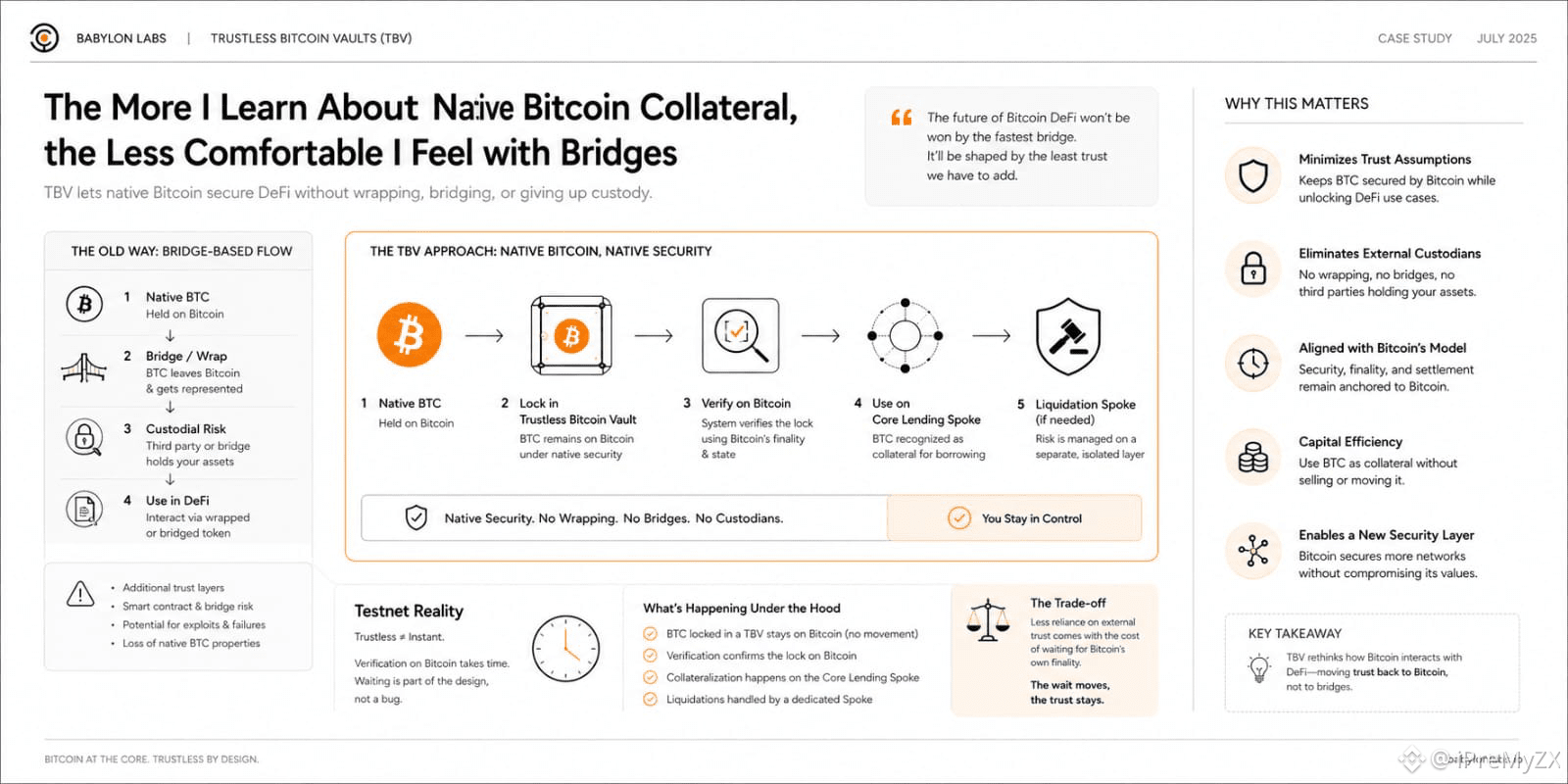
#baby $BABY
Spent more time than I expected reading about Trustless Bitcoin Vaults (TBV) last night.
I went in thinking the interesting part would be borrowing against native Bitcoin. That's the feature everyone notices first.
Instead, I kept coming back to something much quieter.
Where does the trust actually move?
Most Bitcoin DeFi designs solve interoperability by adding another layer—a wrapped asset, a bridge, or a custodian. You gain flexibility, but you also inherit another system whose security matters almost as much as Bitcoin's.
TBV doesn't pretend those trade-offs disappear.
It changes where they live.
Native BTC remains secured by Bitcoin while its collateral status is recognized for applications like borrowing. That sounds like a small architectural decision until you realize it shifts the protocol's priority from moving Bitcoin to preserving Bitcoin's trust model.
The more I compared it with earlier approaches, the less I thought this was a story about lending.
It started looking like a story about design philosophy.
One path asks Bitcoin to adapt to existing DeFi infrastructure.
The other asks infrastructure to adapt around Bitcoin.
I'm still reading through the mechanics because every system has limits, and those limits are usually where the most interesting lessons are hiding.
But that's the question I closed my notebook with:
As Bitcoin becomes usable across more ecosystems, will the winning designs be the ones that maximize convenience—or the ones that minimize changes to Bitcoin itself?
@BabylonLabs_io
#baby
Spent more time than I expected reading about Trustless Bitcoin Vaults (TBV) last night.
I went in thinking the interesting part would be borrowing against native Bitcoin. That's the feature everyone notices first.
Instead, I kept coming back to something much quieter.
Where does the trust actually move?
Most Bitcoin DeFi designs solve interoperability by adding another layer—a wrapped asset, a bridge, or a custodian. You gain flexibility, but you also inherit another system whose security matters almost as much as Bitcoin's.
TBV doesn't pretend those trade-offs disappear.
It changes where they live.
Native BTC remains secured by Bitcoin while its collateral status is recognized for applications like borrowing. That sounds like a small architectural decision until you realize it shifts the protocol's priority from moving Bitcoin to preserving Bitcoin's trust model.
The more I compared it with earlier approaches, the less I thought this was a story about lending.
It started looking like a story about design philosophy.
One path asks Bitcoin to adapt to existing DeFi infrastructure.
The other asks infrastructure to adapt around Bitcoin.
I'm still reading through the mechanics because every system has limits, and those limits are usually where the most interesting lessons are hiding.
But that's the question I closed my notebook with:
As Bitcoin becomes usable across more ecosystems, will the winning designs be the ones that maximize convenience—or the ones that minimize changes to Bitcoin itself?
@BabylonLabs_io
#baby
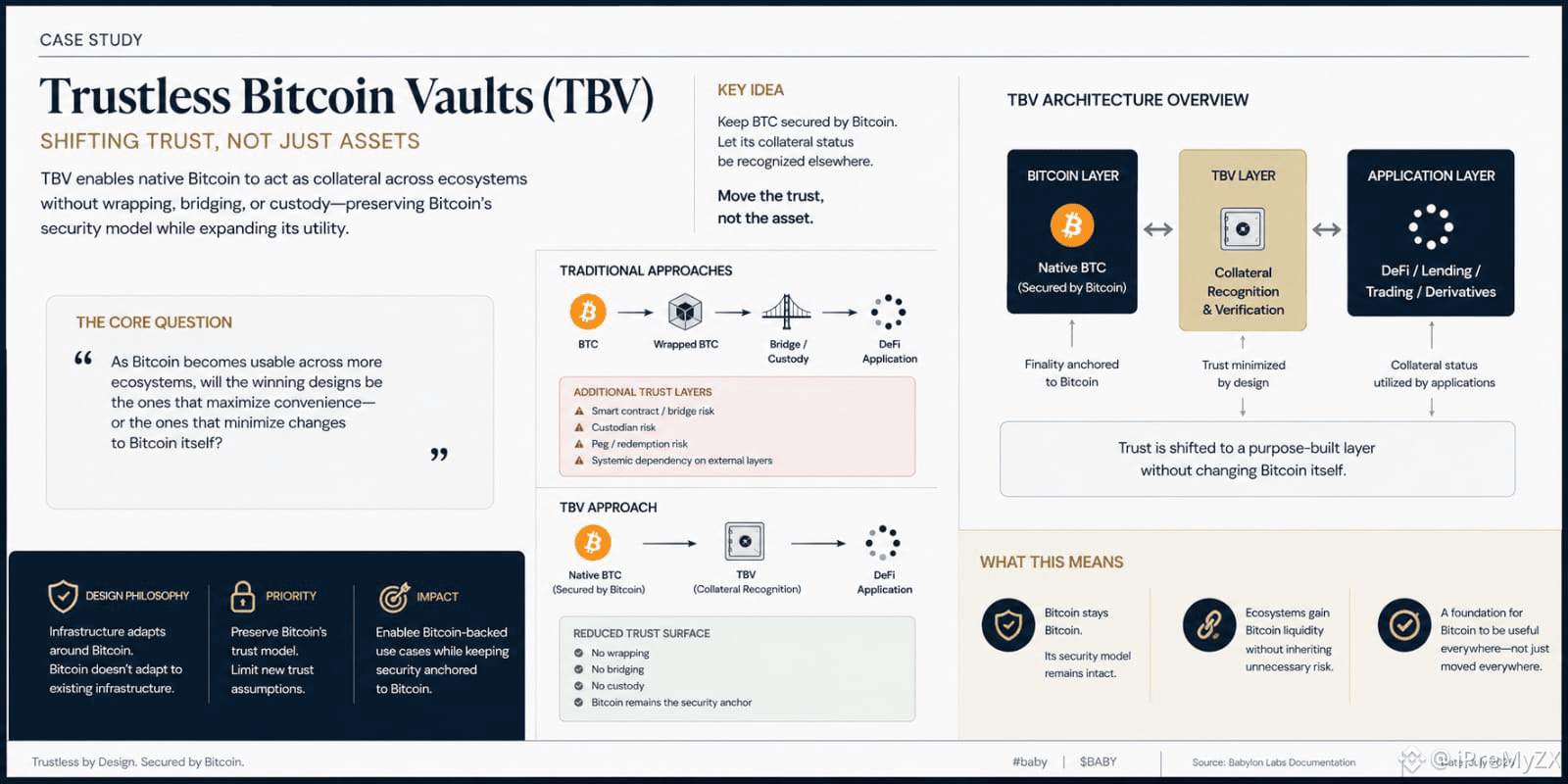
#baby $BABY
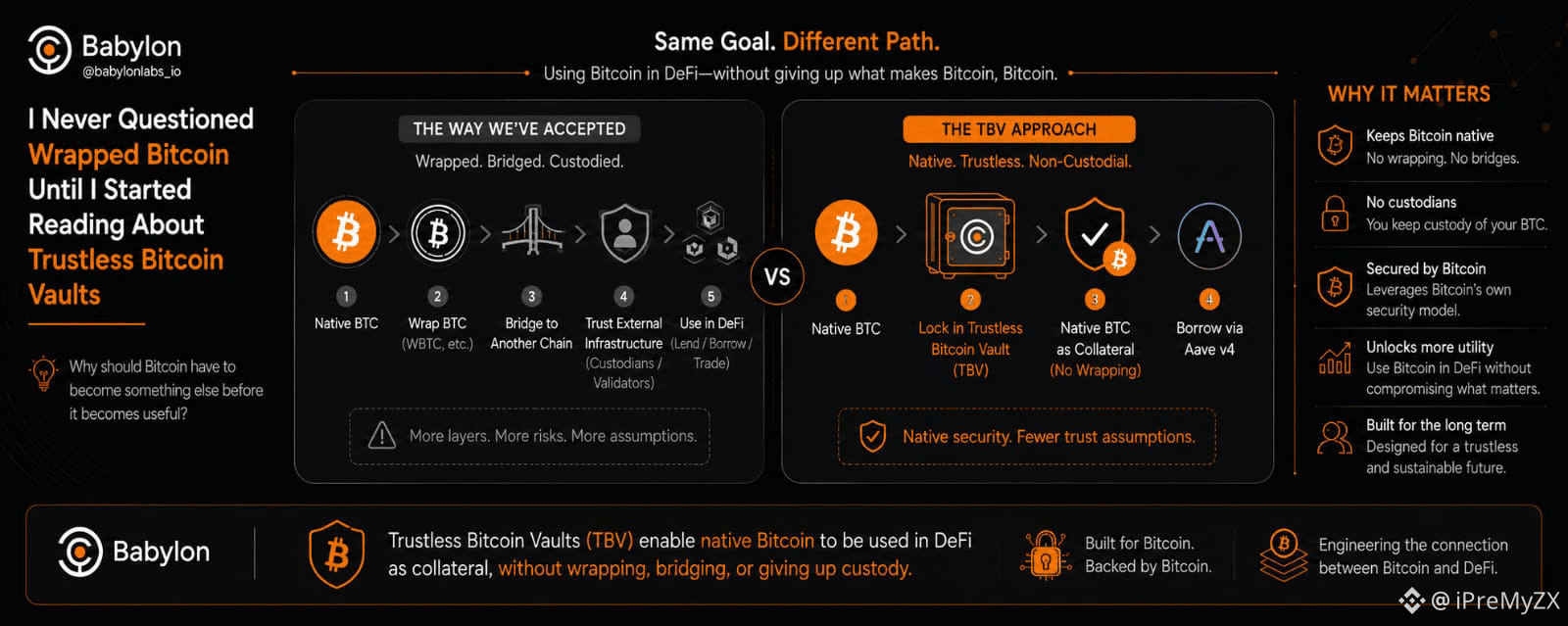
I used to think I understood why people wrapped Bitcoin.
It just felt like the normal path. If you wanted to use BTC in DeFi, you wrapped it, bridged it, and moved on. I never really questioned it because everyone seemed to treat it as the price of participating.
Then one evening I found myself reading about Trustless Bitcoin Vaults (TBV) from @BabylonLabs_io.
What started as casual research turned into a much longer rabbit hole than I expected.
The interesting part wasn't that TBV offers another way to use Bitcoin. It was the question hiding underneath it.
Why does Bitcoin have to become something else before it becomes useful?
That thought stayed with me.
The more I learned, the more I realized we've become comfortable adding extra layers around Bitcoin instead of asking whether those layers were necessary in the first place. Wrappers, bridges, custodians—they solved real problems, but they also became assumptions we rarely challenged.
TBV approaches it differently by letting native Bitcoin serve as collateral while remaining anchored to Bitcoin's own security model. It's not about pretending trade-offs don't exist. It's about changing which trade-offs users have to accept.
I'm still learning, so I don't pretend to have all the answers.
But every now and then, a protocol changes the way you think instead of simply adding another feature to compare.
For me, @BabylonLabs_io has done exactly that.
Maybe the most valuable thing I gained wasn't a new product to follow—it was a new question to keep asking.
I used to think I understood why people wrapped Bitcoin.
It just felt like the normal path. If you wanted to use BTC in DeFi, you wrapped it, bridged it, and moved on. I never really questioned it because everyone seemed to treat it as the price of participating.
Then one evening I found myself reading about Trustless Bitcoin Vaults (TBV) from @BabylonLabs_io.
What started as casual research turned into a much longer rabbit hole than I expected.
The interesting part wasn't that TBV offers another way to use Bitcoin. It was the question hiding underneath it.
Why does Bitcoin have to become something else before it becomes useful?
That thought stayed with me.
The more I learned, the more I realized we've become comfortable adding extra layers around Bitcoin instead of asking whether those layers were necessary in the first place. Wrappers, bridges, custodians—they solved real problems, but they also became assumptions we rarely challenged.
TBV approaches it differently by letting native Bitcoin serve as collateral while remaining anchored to Bitcoin's own security model. It's not about pretending trade-offs don't exist. It's about changing which trade-offs users have to accept.
I'm still learning, so I don't pretend to have all the answers.
But every now and then, a protocol changes the way you think instead of simply adding another feature to compare.
For me, @BabylonLabs_io has done exactly that.
Maybe the most valuable thing I gained wasn't a new product to follow—it was a new question to keep asking.
#baby $BABY
I didn't expect one document to make me question something I'd accepted for years.
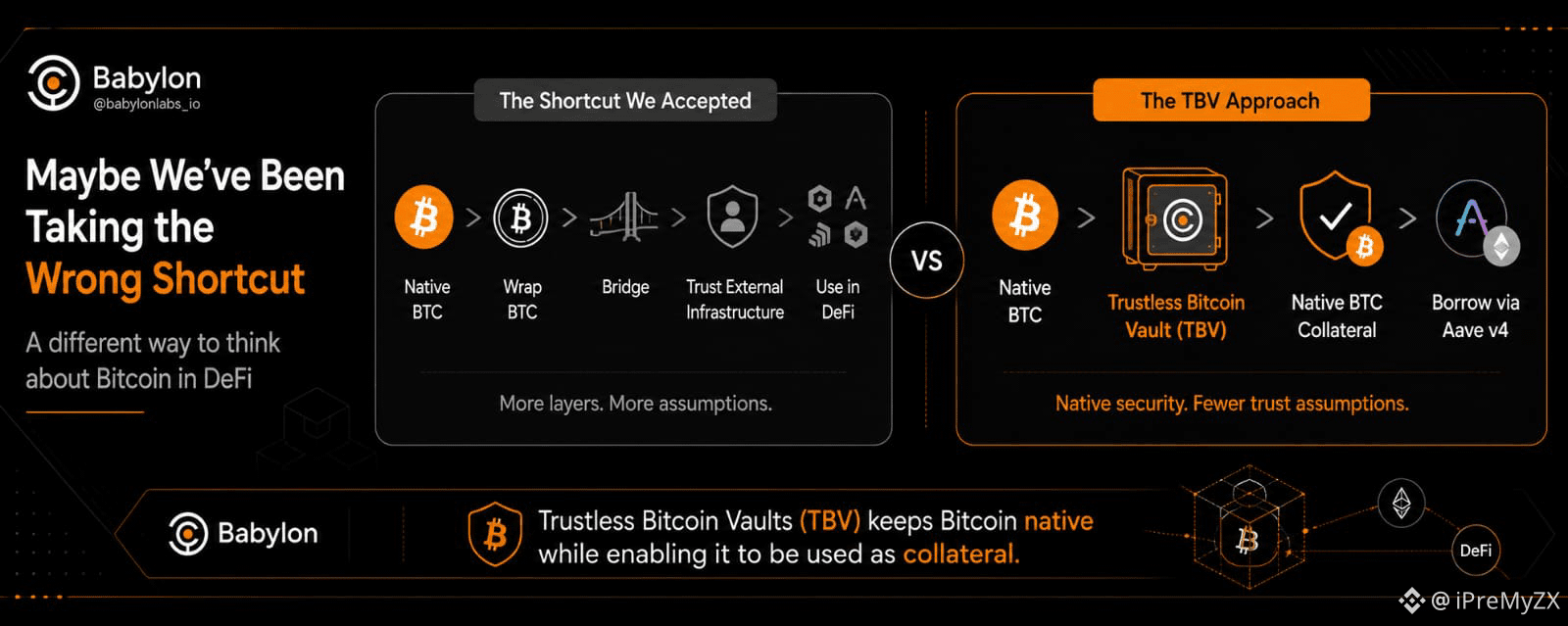
It happened late at night while I was reading about Bitcoin infrastructure. I kept seeing the same pattern over and over. Every time Bitcoin wanted to participate in DeFi, the first instruction was almost automatic.
Wrap it.
Bridge it.
Move it somewhere else.
At some point I realized I'd stopped asking why.
Maybe that's what happens when an idea gets repeated long enough. It stops feeling like a compromise and starts feeling like the only option.
Then I started reading about Trustless Bitcoin Vaults (TBV) from @BabylonLabs_io .
What caught my attention wasn't that it promised something faster or bigger. It was that it questioned the assumption I'd never questioned myself.
Why should Bitcoin have to leave Bitcoin just to become useful?
The more I sat with that idea, the more everything else started to look backwards. Maybe we've spent years designing ways to adapt Bitcoin to DeFi, instead of adapting DeFi to respect Bitcoin's own security model.
TBV doesn't magically remove every trade-off. Bitcoin is still Bitcoin. Settlement still takes time.
But the trust shifts.
Instead of asking users to believe in wrappers, bridges, or custodians, the system leans more heavily on Bitcoin's own rules.
That feels less like chasing convenience and more like respecting the asset you're trying to unlock.
Maybe that's the direction Bitcoin DeFi has been missing all along.
I didn't expect one document to make me question something I'd accepted for years.
It happened late at night while I was reading about Bitcoin infrastructure. I kept seeing the same pattern over and over. Every time Bitcoin wanted to participate in DeFi, the first instruction was almost automatic.
Wrap it.
Bridge it.
Move it somewhere else.
At some point I realized I'd stopped asking why.
Maybe that's what happens when an idea gets repeated long enough. It stops feeling like a compromise and starts feeling like the only option.
Then I started reading about Trustless Bitcoin Vaults (TBV) from @BabylonLabs_io .
What caught my attention wasn't that it promised something faster or bigger. It was that it questioned the assumption I'd never questioned myself.
Why should Bitcoin have to leave Bitcoin just to become useful?
The more I sat with that idea, the more everything else started to look backwards. Maybe we've spent years designing ways to adapt Bitcoin to DeFi, instead of adapting DeFi to respect Bitcoin's own security model.
TBV doesn't magically remove every trade-off. Bitcoin is still Bitcoin. Settlement still takes time.
But the trust shifts.
Instead of asking users to believe in wrappers, bridges, or custodians, the system leans more heavily on Bitcoin's own rules.
That feels less like chasing convenience and more like respecting the asset you're trying to unlock.
Maybe that's the direction Bitcoin DeFi has been missing all along.
#baby $BABY
A few days ago, I was going through my usual routine. Coffee on the desk, a few tabs open, and another evening spent reading about crypto infrastructure instead of checking charts.
I wasn't looking for a new project. I was actually trying to understand why Bitcoin still feels disconnected from so much of DeFi despite being the biggest asset in the space.
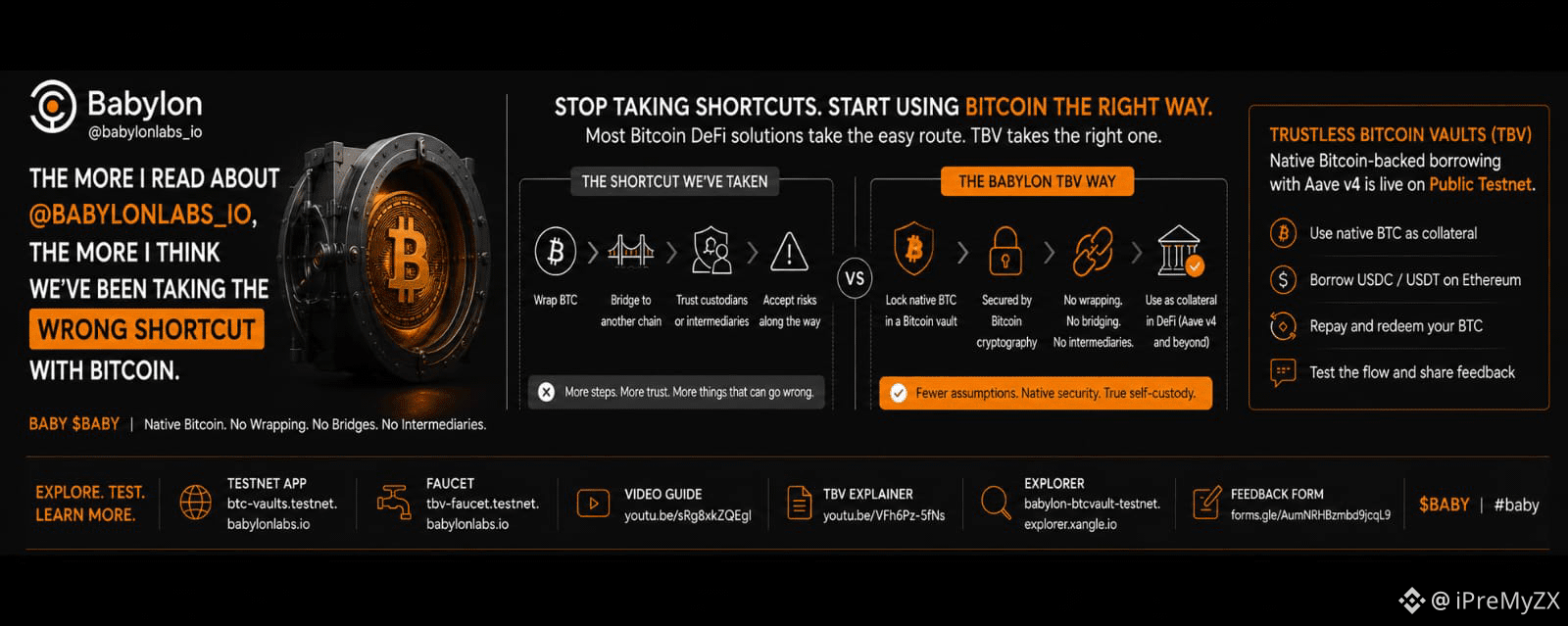
The obvious answer always seemed to be, "Just wrap it."
For years, I accepted that without giving it much thought.
But the more I read about @BabylonLabs_io and Trustless Bitcoin Vaults (TBV), the more I realized that wrapping Bitcoin might have been a shortcut we became comfortable with—not necessarily the best solution.
It solved one problem by introducing several others.
Moving Bitcoin across chains, depending on bridges, or trusting intermediaries slowly became the normal path. I don't think many of us stopped to ask whether Bitcoin really needed to leave its own security model just to become useful elsewhere.
That's what caught my attention about TBV.
Instead of changing Bitcoin, the idea is to let native Bitcoin be used as collateral while keeping it anchored to Bitcoin itself. It feels less like forcing Bitcoin to fit into DeFi and more like designing infrastructure that respects what Bitcoin already is.
I'm still learning, and I don't think any protocol has all the answers.
But every now and then you come across an idea that makes you rethink an assumption you've carried for years.
For me, @BabylonLabs_io has been one of those projects.
A few days ago, I was going through my usual routine. Coffee on the desk, a few tabs open, and another evening spent reading about crypto infrastructure instead of checking charts.
I wasn't looking for a new project. I was actually trying to understand why Bitcoin still feels disconnected from so much of DeFi despite being the biggest asset in the space.
The obvious answer always seemed to be, "Just wrap it."
For years, I accepted that without giving it much thought.
But the more I read about @BabylonLabs_io and Trustless Bitcoin Vaults (TBV), the more I realized that wrapping Bitcoin might have been a shortcut we became comfortable with—not necessarily the best solution.
It solved one problem by introducing several others.
Moving Bitcoin across chains, depending on bridges, or trusting intermediaries slowly became the normal path. I don't think many of us stopped to ask whether Bitcoin really needed to leave its own security model just to become useful elsewhere.
That's what caught my attention about TBV.
Instead of changing Bitcoin, the idea is to let native Bitcoin be used as collateral while keeping it anchored to Bitcoin itself. It feels less like forcing Bitcoin to fit into DeFi and more like designing infrastructure that respects what Bitcoin already is.
I'm still learning, and I don't think any protocol has all the answers.
But every now and then you come across an idea that makes you rethink an assumption you've carried for years.
For me, @BabylonLabs_io has been one of those projects.
#baby $BABY
When people talk about Bitcoin in DeFi, the conversation usually revolves around yield. Which protocol offers more? Which strategy is more efficient?
The more I explored the space, the more I felt those discussions were skipping a much bigger question.
What are we agreeing to before we even earn that yield?
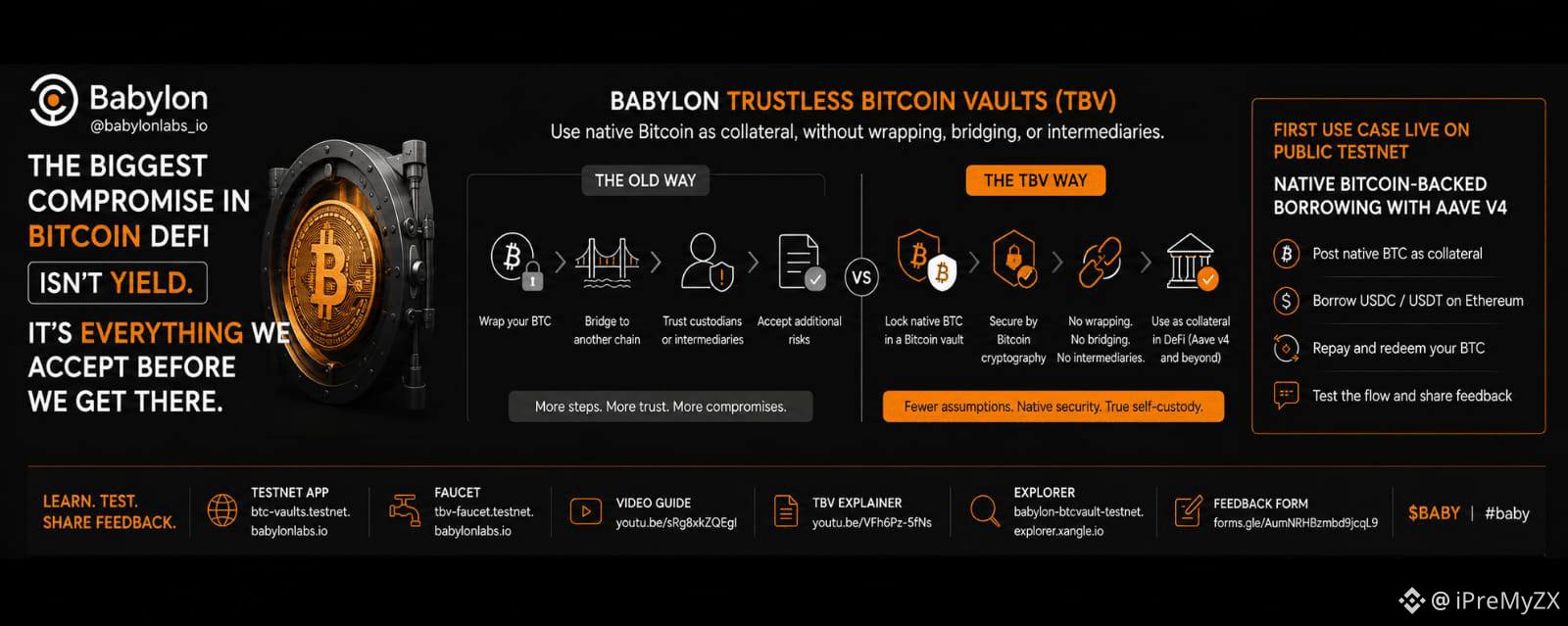
For years, using Bitcoin in DeFi has often meant accepting a series of trade-offs. Wrap your BTC. Bridge it to another chain. Trust a custodian or another layer of infrastructure. Those steps became so common that many of us stopped thinking of them as compromises.
Reading about Trustless Bitcoin Vaults (TBV) from @BabylonLabs_io made me revisit that assumption.
What stood out wasn't the promise of higher returns—it was the attempt to reduce unnecessary trust. TBV is designed to let native Bitcoin serve as collateral without wrapping it, bridging it, or relying on centralized intermediaries. That approach feels much closer to Bitcoin's original security model.
I also find it interesting that the first implementation focuses on native Bitcoin-backed borrowing with Aave v4. Instead of trying to reinvent DeFi, it rethinks how Bitcoin enters it in the first place.
I'm not saying every existing solution is wrong or that TBV is the final answer. But I do think it shifts the conversation toward something more fundamental.
Maybe the biggest innovation isn't finding another way to generate yield.
Maybe it's reducing the number of compromises we quietly accept before we ever get there.
That's the perspective @BabylonLabs_io left me thinking about.
When people talk about Bitcoin in DeFi, the conversation usually revolves around yield. Which protocol offers more? Which strategy is more efficient?
The more I explored the space, the more I felt those discussions were skipping a much bigger question.
What are we agreeing to before we even earn that yield?
For years, using Bitcoin in DeFi has often meant accepting a series of trade-offs. Wrap your BTC. Bridge it to another chain. Trust a custodian or another layer of infrastructure. Those steps became so common that many of us stopped thinking of them as compromises.
Reading about Trustless Bitcoin Vaults (TBV) from @BabylonLabs_io made me revisit that assumption.
What stood out wasn't the promise of higher returns—it was the attempt to reduce unnecessary trust. TBV is designed to let native Bitcoin serve as collateral without wrapping it, bridging it, or relying on centralized intermediaries. That approach feels much closer to Bitcoin's original security model.
I also find it interesting that the first implementation focuses on native Bitcoin-backed borrowing with Aave v4. Instead of trying to reinvent DeFi, it rethinks how Bitcoin enters it in the first place.
I'm not saying every existing solution is wrong or that TBV is the final answer. But I do think it shifts the conversation toward something more fundamental.
Maybe the biggest innovation isn't finding another way to generate yield.
Maybe it's reducing the number of compromises we quietly accept before we ever get there.
That's the perspective @BabylonLabs_io left me thinking about.
Log in to explore more content