

Coinstages
6k Posts

Coinstages
 Square Verified
Report
Block User
We Show The Invisible :) | #News | #Articles | #PressRelease | #TradingSignal | #PricePredictions | #Altcoin | #Memecoin | #BinancePride

Top Voices

Level 2 Creator
Open Trade

SOLV Holder
Frequent Trader
5.8 Years
17 Following
131.2K+ Followers
96.1K+ Liked
3 Badges
Posts
Portfolio
All
Quotes
Videos
PINNED
·
--
🤩We are excited to announce that we are getting Binance 6th Anniversary gifts 🎁
Thanks a lot #binance team
What’s in the box📦
~ Mini Luggage
~ Hoodies
~ Yoga Mat
~ Zipper Pouch
#Binanceturns6
🤩We are excited to announce that we are getting Binance 6th Anniversary gifts 🎁
Thanks a lot #binance team
What’s in the box📦
~ Mini Luggage
~ Hoodies
~ Yoga Mat
~ Zipper Pouch
#Binanceturns6
Thanks a lot #binance team
What’s in the box📦
~ Mini Luggage
~ Hoodies
~ Yoga Mat
~ Zipper Pouch
#Binanceturns6

134
10
366
41.3k
·
--
Article
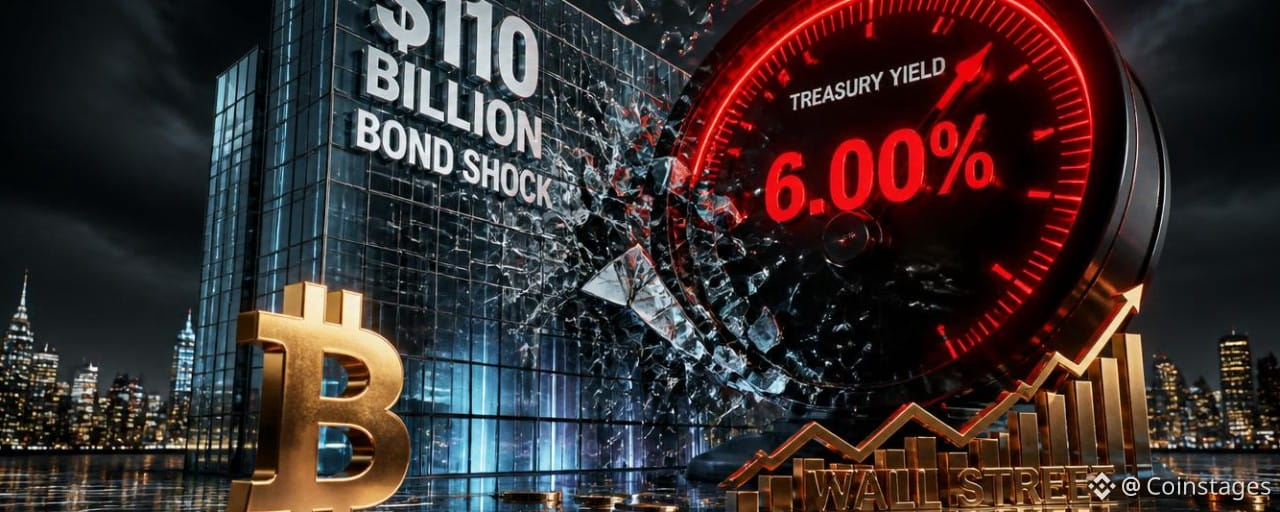
Wall Street's $110 Billion Bond Warning: What It Means for Stocks and BitcoinA new warning from Wall Street bond strategists has put traditional financial markets and digital asset investors on high alert. Veteran bond analyst Harley Bassman has cautioned that if the 20-year U.S. Treasury yield reaches the critical 6.00% threshold, mechanical trading rules and delivery-switch hedging in the futures market could unleash forced selling pressure equivalent to a massive $110 billion bond shock.
With yields hovering near 5.68%, rising borrowing costs threaten to drain liquidity from expensive technology stocks and high-beta risk assets like Bitcoin ($83,163), creating a significant cross-market test.
📊 The 6% Yield Threshold & The $110B Mechanics
The Delivery Switch Mechanism: The risk stems from roughly $200 billion in U.S. Treasury futures contracts. When yields rise, longer-dated bonds lose value faster and become the cheapest-to-deliver options for contract sellers. Managing these shifting exposures forces asset managers to sell or hedge more bonds, accelerating the upward yield spiral.Equivalent to 4 Months of Auctions: Bassman estimates that crossing the 6.00% mark could generate hedging pressure equivalent to the U.S. Treasury auctioning an additional $110 billion in 20-year bonds over four months, severely overwhelming market demand.Equity Realignment Trigger: A separate Bank of America survey identified that a 5.90% yield on the 10-year Treasury (currently at 5.22%) would prompt institutional fund managers to aggressively reallocate capital from equities into risk-free government debt.
⚔️ Cross-Asset Impact: Stocks vs. Bitcoin
The rising yield environment creates distinct structural risks across major global asset classes:
U.S. Equities (Stocks): Facing valuation multiple compression, high-valuation technology and AI stocks are directly vulnerable to a 5.90% 10-Year or 6.00% 20-Year yield trigger. As risk-free bond yields soar, institutional capital is expected to shift out of equities and into sovereign debt.Bitcoin (BTC): Trading near the $83,000 support zone, Bitcoin remains susceptible to macro liquidity contraction. Higher risk-free rates raise borrowing costs and reduce appetite for speculative risk assets.U.S. Treasuries: Facing a structural trust deficit driven by a expanding 6.2% U.S. fiscal deficit, the move in 20-year yields from 5.68% toward 6.00% risks triggering forced futures-hedging cascades.
⚠️ Essential Financial Disclaimer
This article is strictly for educational, analytical, and informational purposes only and does not constitute financial, investment, legal, or trading advice. Digital assets, U.S. Treasury yields, and equity markets carry inherent price volatility and macroeconomic risks. Always perform independent research (DYOR) and consult a certified financial advisor before making investment decisions.
Do you think a 6% Treasury yield will trigger a major correction in stocks and Bitcoin, or will risk assets absorb the pressure? Share your macro outlook and target predictions in the comments below! 📊⚡
Wall Street's $110 Billion Bond Warning: What It Means for Stocks and Bitcoin
A new warning from Wall Street bond strategists has put traditional financial markets and digital asset investors on high alert. Veteran bond analyst Harley Bassman has cautioned that if the 20-year U.S. Treasury yield reaches the critical 6.00% threshold, mechanical trading rules and delivery-switch hedging in the futures market could unleash forced selling pressure equivalent to a massive $110 billion bond shock.
With yields hovering near 5.68%, rising borrowing costs threaten to drain liquidity from expensive technology stocks and high-beta risk assets like Bitcoin ($83,163), creating a significant cross-market test.
📊 The 6% Yield Threshold & The $110B Mechanics
The Delivery Switch Mechanism: The risk stems from roughly $200 billion in U.S. Treasury futures contracts. When yields rise, longer-dated bonds lose value faster and become the cheapest-to-deliver options for contract sellers. Managing these shifting exposures forces asset managers to sell or hedge more bonds, accelerating the upward yield spiral.Equivalent to 4 Months of Auctions: Bassman estimates that crossing the 6.00% mark could generate hedging pressure equivalent to the U.S. Treasury auctioning an additional $110 billion in 20-year bonds over four months, severely overwhelming market demand.Equity Realignment Trigger: A separate Bank of America survey identified that a 5.90% yield on the 10-year Treasury (currently at 5.22%) would prompt institutional fund managers to aggressively reallocate capital from equities into risk-free government debt.
⚔️ Cross-Asset Impact: Stocks vs. Bitcoin
The rising yield environment creates distinct structural risks across major global asset classes:
U.S. Equities (Stocks): Facing valuation multiple compression, high-valuation technology and AI stocks are directly vulnerable to a 5.90% 10-Year or 6.00% 20-Year yield trigger. As risk-free bond yields soar, institutional capital is expected to shift out of equities and into sovereign debt.Bitcoin (BTC): Trading near the $83,000 support zone, Bitcoin remains susceptible to macro liquidity contraction. Higher risk-free rates raise borrowing costs and reduce appetite for speculative risk assets.U.S. Treasuries: Facing a structural trust deficit driven by a expanding 6.2% U.S. fiscal deficit, the move in 20-year yields from 5.68% toward 6.00% risks triggering forced futures-hedging cascades.
⚠️ Essential Financial Disclaimer
This article is strictly for educational, analytical, and informational purposes only and does not constitute financial, investment, legal, or trading advice. Digital assets, U.S. Treasury yields, and equity markets carry inherent price volatility and macroeconomic risks. Always perform independent research (DYOR) and consult a certified financial advisor before making investment decisions.
Do you think a 6% Treasury yield will trigger a major correction in stocks and Bitcoin, or will risk assets absorb the pressure? Share your macro outlook and target predictions in the comments below! 📊⚡
With yields hovering near 5.68%, rising borrowing costs threaten to drain liquidity from expensive technology stocks and high-beta risk assets like Bitcoin ($83,163), creating a significant cross-market test.
📊 The 6% Yield Threshold & The $110B Mechanics
The Delivery Switch Mechanism: The risk stems from roughly $200 billion in U.S. Treasury futures contracts. When yields rise, longer-dated bonds lose value faster and become the cheapest-to-deliver options for contract sellers. Managing these shifting exposures forces asset managers to sell or hedge more bonds, accelerating the upward yield spiral.Equivalent to 4 Months of Auctions: Bassman estimates that crossing the 6.00% mark could generate hedging pressure equivalent to the U.S. Treasury auctioning an additional $110 billion in 20-year bonds over four months, severely overwhelming market demand.Equity Realignment Trigger: A separate Bank of America survey identified that a 5.90% yield on the 10-year Treasury (currently at 5.22%) would prompt institutional fund managers to aggressively reallocate capital from equities into risk-free government debt.
⚔️ Cross-Asset Impact: Stocks vs. Bitcoin
The rising yield environment creates distinct structural risks across major global asset classes:
U.S. Equities (Stocks): Facing valuation multiple compression, high-valuation technology and AI stocks are directly vulnerable to a 5.90% 10-Year or 6.00% 20-Year yield trigger. As risk-free bond yields soar, institutional capital is expected to shift out of equities and into sovereign debt.Bitcoin (BTC): Trading near the $83,000 support zone, Bitcoin remains susceptible to macro liquidity contraction. Higher risk-free rates raise borrowing costs and reduce appetite for speculative risk assets.U.S. Treasuries: Facing a structural trust deficit driven by a expanding 6.2% U.S. fiscal deficit, the move in 20-year yields from 5.68% toward 6.00% risks triggering forced futures-hedging cascades.
⚠️ Essential Financial Disclaimer
This article is strictly for educational, analytical, and informational purposes only and does not constitute financial, investment, legal, or trading advice. Digital assets, U.S. Treasury yields, and equity markets carry inherent price volatility and macroeconomic risks. Always perform independent research (DYOR) and consult a certified financial advisor before making investment decisions.
Do you think a 6% Treasury yield will trigger a major correction in stocks and Bitcoin, or will risk assets absorb the pressure? Share your macro outlook and target predictions in the comments below! 📊⚡
1
1.8k
·
--
Partly True

Article
EX-NEAR CORE MEMBER HELPS LAUNCH DARKSWAP PRIVACY TERMINAL ON SOLANA!Cross-chain privacy infrastructure has taken a major leap forward with the debut of DarkSwap, an intent-driven privacy terminal designed to bridge privacy gaps across Solana, NEAR Protocol, and major EVM chains.
Co-founded with input from Crasskitty, one of NEAR Protocol's original early team members, DarkSwap leverages NEAR Intents and 1Click Confidential Intents to enable non-custodial, wallet-free private swaps. Rather than requiring complex account setups or seed phrase imports, users execute trades directly from their own Solana wallets using manual deposit routing to keep transaction trails off public eyes.
🗺️ The 4-Stage Product Roadmap: Tagged Architecture
To maintain transparent user expectations across development stages, DarkSwap structures its product offerings under four clear status tags: live, scheduled, built, and live.
01. Private Swaps (live): Users choose a token pair, receive a live quote, review terms, and manually transfer funds directly from their personal wallet. Routing relies on NEAR Intents' confidential transaction layers with zero wallet-connection signatures required.02. Dark Pool on NEAR (scheduled): A fully hidden balance ledger allowing users to deposit, hold, execute internal swaps, and withdraw. Target deployment is set for late October 2026, subject to NEAR Protocol enabling access to its private shard infrastructure.03. Custom Zero-Knowledge Pools (built): Native ZK shielded pools built for Solana, Ethereum, and Base. Currently in local-development preview, these contracts are being held back from public networks until public testnet phases, a production ceremony, and an independent third-party audit are complete.04. $DARK Holder Rewards (live): Automated $DARK reward distributions paid directly in wNEAR twice daily without requiring an active claim step. Payout records and historical eligibility snapshots are displayed directly on the rewards console.
📊 Solana On-Chain Metrics: ZEC-DARK Liquidity Pool
Alongside its privacy routing terminal, DarkSwap operates protocol-funded liquidity on Solana via Meteora’s Dynamic Automated Market Maker (DAMM v2).
Pool Liquidity: $29,27224h Trading Volume: $182,00724h Generated Fees: $1,542.86Base Fee Structure: 1% (Dynamic fees may apply depending on market conditions)Compounded Fees: 10% of LP fees are configured to automatically compound into pool liquidity.Permanently Locked Position: 1.31%Creator Wallet Allocation: Protocol reports reveal the $DARK creator wallet funded 99.9% of the ZEC-DARK pool liquidity, initially pairing 2 ZEC to buy DARK alongside another 2 ZEC. (Note: ZEC on Solana represents a tokenized asset on Solana, not native or shielded Zcash).
CA: 7KEPApdbBMByrmqihz3bht2uMhFQcatjfSFQCKq66kH3{web3_wallet_create}(CT_5017KEPApdbBMByrmqihz3bht2uMhFQcatjfSFQCKq66kH3)
Essential Financial Disclaimer
This article is strictly for educational, informational, and technology review purposes only and does not constitute financial, investment, legal, or trading advice. Digital assets, liquidity pools, cross-chain intent bridges, and early-stage privacy protocols carry significant technical, market, and smart contract risks. Always conduct independent research (DYOR) and consult a certified financial advisor before interacting with new protocols.
What are your thoughts on intent-driven cross-chain privacy and non-custodial swaps? Share your opinions and tech predictions in the comments below! 🔒⚡
EX-NEAR CORE MEMBER HELPS LAUNCH DARKSWAP PRIVACY TERMINAL ON SOLANA!
Cross-chain privacy infrastructure has taken a major leap forward with the debut of DarkSwap, an intent-driven privacy terminal designed to bridge privacy gaps across Solana, NEAR Protocol, and major EVM chains.
Co-founded with input from Crasskitty, one of NEAR Protocol's original early team members, DarkSwap leverages NEAR Intents and 1Click Confidential Intents to enable non-custodial, wallet-free private swaps. Rather than requiring complex account setups or seed phrase imports, users execute trades directly from their own Solana wallets using manual deposit routing to keep transaction trails off public eyes.
🗺️ The 4-Stage Product Roadmap: Tagged Architecture
To maintain transparent user expectations across development stages, DarkSwap structures its product offerings under four clear status tags: live, scheduled, built, and live.
01. Private Swaps (live): Users choose a token pair, receive a live quote, review terms, and manually transfer funds directly from their personal wallet. Routing relies on NEAR Intents' confidential transaction layers with zero wallet-connection signatures required.02. Dark Pool on NEAR (scheduled): A fully hidden balance ledger allowing users to deposit, hold, execute internal swaps, and withdraw. Target deployment is set for late October 2026, subject to NEAR Protocol enabling access to its private shard infrastructure.03. Custom Zero-Knowledge Pools (built): Native ZK shielded pools built for Solana, Ethereum, and Base. Currently in local-development preview, these contracts are being held back from public networks until public testnet phases, a production ceremony, and an independent third-party audit are complete.04. $DARK Holder Rewards (live): Automated $DARK reward distributions paid directly in wNEAR twice daily without requiring an active claim step. Payout records and historical eligibility snapshots are displayed directly on the rewards console.
📊 Solana On-Chain Metrics: ZEC-DARK Liquidity Pool
Alongside its privacy routing terminal, DarkSwap operates protocol-funded liquidity on Solana via Meteora’s Dynamic Automated Market Maker (DAMM v2).
Pool Liquidity: $29,27224h Trading Volume: $182,00724h Generated Fees: $1,542.86Base Fee Structure: 1% (Dynamic fees may apply depending on market conditions)Compounded Fees: 10% of LP fees are configured to automatically compound into pool liquidity.Permanently Locked Position: 1.31%Creator Wallet Allocation: Protocol reports reveal the $DARK creator wallet funded 99.9% of the ZEC-DARK pool liquidity, initially pairing 2 ZEC to buy DARK alongside another 2 ZEC. (Note: ZEC on Solana represents a tokenized asset on Solana, not native or shielded Zcash).
CA: 7KEPApdbBMByrmqihz3bht2uMhFQcatjfSFQCKq66kH3Essential Financial Disclaimer
This article is strictly for educational, informational, and technology review purposes only and does not constitute financial, investment, legal, or trading advice. Digital assets, liquidity pools, cross-chain intent bridges, and early-stage privacy protocols carry significant technical, market, and smart contract risks. Always conduct independent research (DYOR) and consult a certified financial advisor before interacting with new protocols.
What are your thoughts on intent-driven cross-chain privacy and non-custodial swaps? Share your opinions and tech predictions in the comments below! 🔒⚡
Co-founded with input from Crasskitty, one of NEAR Protocol's original early team members, DarkSwap leverages NEAR Intents and 1Click Confidential Intents to enable non-custodial, wallet-free private swaps. Rather than requiring complex account setups or seed phrase imports, users execute trades directly from their own Solana wallets using manual deposit routing to keep transaction trails off public eyes.
🗺️ The 4-Stage Product Roadmap: Tagged Architecture
To maintain transparent user expectations across development stages, DarkSwap structures its product offerings under four clear status tags: live, scheduled, built, and live.
01. Private Swaps (live): Users choose a token pair, receive a live quote, review terms, and manually transfer funds directly from their personal wallet. Routing relies on NEAR Intents' confidential transaction layers with zero wallet-connection signatures required.02. Dark Pool on NEAR (scheduled): A fully hidden balance ledger allowing users to deposit, hold, execute internal swaps, and withdraw. Target deployment is set for late October 2026, subject to NEAR Protocol enabling access to its private shard infrastructure.03. Custom Zero-Knowledge Pools (built): Native ZK shielded pools built for Solana, Ethereum, and Base. Currently in local-development preview, these contracts are being held back from public networks until public testnet phases, a production ceremony, and an independent third-party audit are complete.04. $DARK Holder Rewards (live): Automated $DARK reward distributions paid directly in wNEAR twice daily without requiring an active claim step. Payout records and historical eligibility snapshots are displayed directly on the rewards console.
📊 Solana On-Chain Metrics: ZEC-DARK Liquidity Pool
Alongside its privacy routing terminal, DarkSwap operates protocol-funded liquidity on Solana via Meteora’s Dynamic Automated Market Maker (DAMM v2).
Pool Liquidity: $29,27224h Trading Volume: $182,00724h Generated Fees: $1,542.86Base Fee Structure: 1% (Dynamic fees may apply depending on market conditions)Compounded Fees: 10% of LP fees are configured to automatically compound into pool liquidity.Permanently Locked Position: 1.31%Creator Wallet Allocation: Protocol reports reveal the $DARK creator wallet funded 99.9% of the ZEC-DARK pool liquidity, initially pairing 2 ZEC to buy DARK alongside another 2 ZEC. (Note: ZEC on Solana represents a tokenized asset on Solana, not native or shielded Zcash).
CA: 7KEPApdbBMByrmqihz3bht2uMhFQcatjfSFQCKq66kH3Essential Financial Disclaimer
This article is strictly for educational, informational, and technology review purposes only and does not constitute financial, investment, legal, or trading advice. Digital assets, liquidity pools, cross-chain intent bridges, and early-stage privacy protocols carry significant technical, market, and smart contract risks. Always conduct independent research (DYOR) and consult a certified financial advisor before interacting with new protocols.
What are your thoughts on intent-driven cross-chain privacy and non-custodial swaps? Share your opinions and tech predictions in the comments below! 🔒⚡
2
6
3.2k
·
--
Article
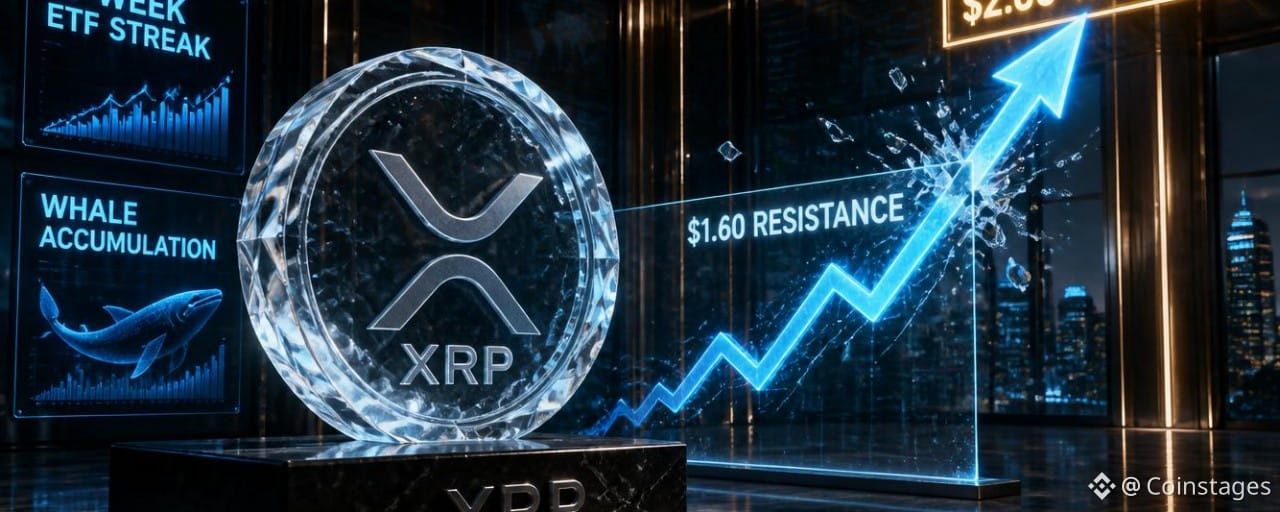
Is This the Rally That Finally Takes XRP Back Above $2.00?Following weeks of consolidation, XRP is building powerful momentum that technical analysts believe could spearhead a breakout past the psychological $2.00 threshold. Driven by a surge in institutional interest, expanding derivatives volume, and persistent multi-million dollar whale accumulation, XRP is testing key resistance zones that have capped its price action for months.
As market sentiment tilts sharply back toward risk-on expansion, market participants are weighing the core technical and on-chain catalysts positioning XRP for its next macro leg up.
🏛️ Dual-Engine Growth: Institutional Inflows Meet On-Chain Accumulation
XRP's recent strength is anchored by sustained buying pressure across both institutional and retail channels:
Sustained Spot ETF Demand: Institutional interest continues to accelerate, backed by an impressive 11-week consecutive net inflow streak into U.S. spot XRP ETFs. Total cumulative net inflows have surpassed $1.79 billion, signaling persistent institutional allocation.Aggressive Whale Accumulation: On-chain metrics reveal that large holder addresses accumulated over 470 million XRP (worth roughly $724 million) in late September alone, taking supply off exchanges and into long-term self-custody wallets.Rebound in Open Interest: Futures market data shows open interest rebounding sharply toward yearly highs, indicating that derivatives traders are positioning heavily for volatility expansion.
📊 Technical Setup: The $1.60 Neckline Breakout
On the technical front, XRP’s chart structure is displaying a classic high-timeframe inverse head-and-shoulders pattern on the daily chart:
Key Resistance at $1.60: The $1.60 level acts as the critical neckline for the reversal pattern. A decisive daily close above this barrier is required to confirm the breakout.Measured Target of $2.00: Clearing $1.60 activates a measured chart move targeting $2.00, representing a potential ~25% to 30% rally from current accumulation zones.Crucial Downside Support: Should bulls face temporary rejection at $1.60, primary structural support sits between $1.45 and $1.50, with deeper macro demand anchored around $1.32.
Essential Financial Disclaimer
This article is strictly for educational and informational purposes only and does not constitute financial, investment, legal, or trading advice. Digital assets, cryptocurrency markets, and technical chart setups carry inherent volatility and capital risk. Always perform independent research (DYOR) and consult a certified financial advisor before making any investment decisions.
Do you think XRP will break past $1.60 and push straight toward $2.00, or will macro consolidation slow the rally? Share your chart analysis and price predictions in the comments below! 🚀📊
Is This the Rally That Finally Takes XRP Back Above $2.00?
Following weeks of consolidation, XRP is building powerful momentum that technical analysts believe could spearhead a breakout past the psychological $2.00 threshold. Driven by a surge in institutional interest, expanding derivatives volume, and persistent multi-million dollar whale accumulation, XRP is testing key resistance zones that have capped its price action for months.
As market sentiment tilts sharply back toward risk-on expansion, market participants are weighing the core technical and on-chain catalysts positioning XRP for its next macro leg up.
🏛️ Dual-Engine Growth: Institutional Inflows Meet On-Chain Accumulation
XRP's recent strength is anchored by sustained buying pressure across both institutional and retail channels:
Sustained Spot ETF Demand: Institutional interest continues to accelerate, backed by an impressive 11-week consecutive net inflow streak into U.S. spot XRP ETFs. Total cumulative net inflows have surpassed $1.79 billion, signaling persistent institutional allocation.Aggressive Whale Accumulation: On-chain metrics reveal that large holder addresses accumulated over 470 million XRP (worth roughly $724 million) in late September alone, taking supply off exchanges and into long-term self-custody wallets.Rebound in Open Interest: Futures market data shows open interest rebounding sharply toward yearly highs, indicating that derivatives traders are positioning heavily for volatility expansion.
📊 Technical Setup: The $1.60 Neckline Breakout
On the technical front, XRP’s chart structure is displaying a classic high-timeframe inverse head-and-shoulders pattern on the daily chart:
Key Resistance at $1.60: The $1.60 level acts as the critical neckline for the reversal pattern. A decisive daily close above this barrier is required to confirm the breakout.Measured Target of $2.00: Clearing $1.60 activates a measured chart move targeting $2.00, representing a potential ~25% to 30% rally from current accumulation zones.Crucial Downside Support: Should bulls face temporary rejection at $1.60, primary structural support sits between $1.45 and $1.50, with deeper macro demand anchored around $1.32.
Essential Financial Disclaimer
This article is strictly for educational and informational purposes only and does not constitute financial, investment, legal, or trading advice. Digital assets, cryptocurrency markets, and technical chart setups carry inherent volatility and capital risk. Always perform independent research (DYOR) and consult a certified financial advisor before making any investment decisions.
Do you think XRP will break past $1.60 and push straight toward $2.00, or will macro consolidation slow the rally? Share your chart analysis and price predictions in the comments below! 🚀📊
As market sentiment tilts sharply back toward risk-on expansion, market participants are weighing the core technical and on-chain catalysts positioning XRP for its next macro leg up.
🏛️ Dual-Engine Growth: Institutional Inflows Meet On-Chain Accumulation
XRP's recent strength is anchored by sustained buying pressure across both institutional and retail channels:
Sustained Spot ETF Demand: Institutional interest continues to accelerate, backed by an impressive 11-week consecutive net inflow streak into U.S. spot XRP ETFs. Total cumulative net inflows have surpassed $1.79 billion, signaling persistent institutional allocation.Aggressive Whale Accumulation: On-chain metrics reveal that large holder addresses accumulated over 470 million XRP (worth roughly $724 million) in late September alone, taking supply off exchanges and into long-term self-custody wallets.Rebound in Open Interest: Futures market data shows open interest rebounding sharply toward yearly highs, indicating that derivatives traders are positioning heavily for volatility expansion.
📊 Technical Setup: The $1.60 Neckline Breakout
On the technical front, XRP’s chart structure is displaying a classic high-timeframe inverse head-and-shoulders pattern on the daily chart:
Key Resistance at $1.60: The $1.60 level acts as the critical neckline for the reversal pattern. A decisive daily close above this barrier is required to confirm the breakout.Measured Target of $2.00: Clearing $1.60 activates a measured chart move targeting $2.00, representing a potential ~25% to 30% rally from current accumulation zones.Crucial Downside Support: Should bulls face temporary rejection at $1.60, primary structural support sits between $1.45 and $1.50, with deeper macro demand anchored around $1.32.
Essential Financial Disclaimer
This article is strictly for educational and informational purposes only and does not constitute financial, investment, legal, or trading advice. Digital assets, cryptocurrency markets, and technical chart setups carry inherent volatility and capital risk. Always perform independent research (DYOR) and consult a certified financial advisor before making any investment decisions.
Do you think XRP will break past $1.60 and push straight toward $2.00, or will macro consolidation slow the rally? Share your chart analysis and price predictions in the comments below! 🚀📊
1.4k
·
--
Article
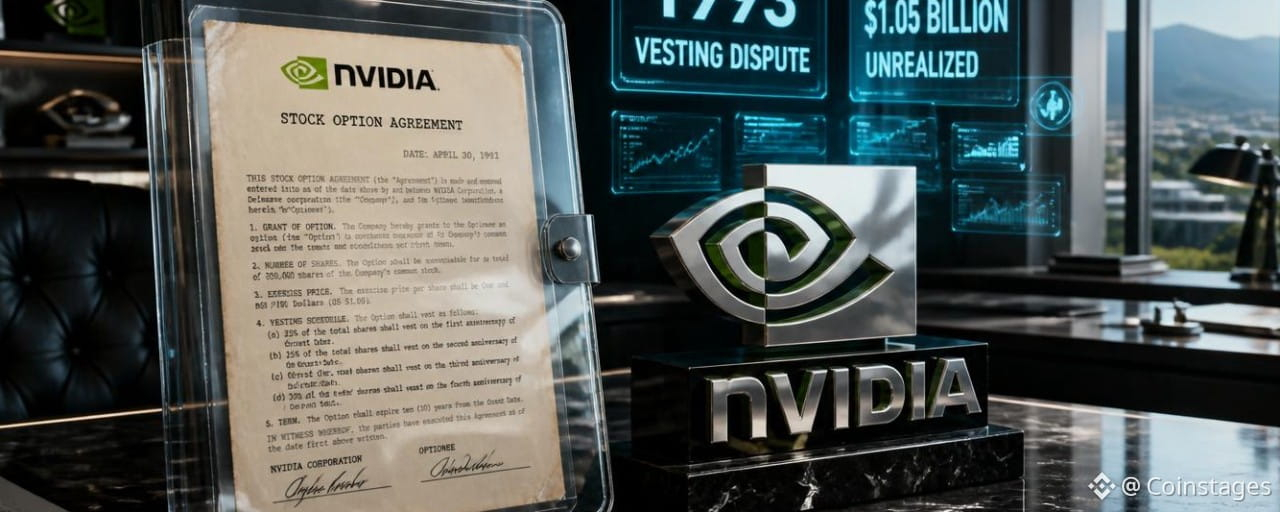
The $1 Billion Contract Error: Why an Early Nvidia Advisor Lost a FortuneA 30-year-old paperwork discrepancy has cost early technology pioneer Eric Gullichsen a staggering $1.05 billion in Nvidia stock. Gullichsen, a virtual reality innovator who joined Nvidia’s Technical Advisory Board in 1993, revealed that a contract mistake regarding 9,375 stock options deprived him of millions of shares following decades of stock splits.
While Nvidia did not dispute the authenticity of the original 1993 contract documents, its legal team rejected settlement demands on the grounds that the claim is strictly time-barred by statutory limitations.
📜 A Houseboat Demo & The Disputed 1993 Contract
The dispute originates from the earliest days of Nvidia's founding:
The 1993 Invitation: In September 1993, Nvidia co-founders Jensen Huang and Curtis Priem visited Gullichsen's Sausalito houseboat to evaluate his virtual reality graphics work. Impressed by his technical demonstrations, Huang invited Gullichsen to join Nvidia's Technical Advisory Board, offering 25,000 stock options via an invitation letter specifying a 4-year vesting schedule.The Signed Agreement Conflict: The formally executed stock option agreement stated something entirely different: all 25,000 shares would vest fully after just one year.The 1996 Vesting Cutoff: In April 1996, Nvidia's finance department informed Gullichsen that only 15,625 options had vested (aligned with 10 quarters on a 4-year clock). Gullichsen exercised those 15,625 shares and forgot about the remaining 9,375 options for nearly three decades.
📈 From $468 to $1.05 Billion: The Math of 480x Stock Splits
It was not until 2024 that Gullichsen re-examined his old 1993 records and realized that under the signed 1-year agreement, all 25,000 options should have fully vested by September 1994:
Stock Split Acceleration: Following cumulative 480-for-1 stock splits over the past 30 years, those missing 9,375 options translate to approximately 4.5 million shares of NVDA today.Astounding Valuation: At Nvidia's recent close of $233.95 per share, those 4.5 million shares carry a market value of roughly $1.05 billion.Exercise Cost: Back in 1996, exercising those 9,375 disputed options would have cost Gullichsen just $468.75.
🏛️ Why the $1B Claim Never Reached a Courtroom
After discovering the contract mismatch, Gullichsen hired legal counsel to seek a settlement with Nvidia. However, the case ran into insurmountable legal hurdles:
Statute of Limitations: Nvidia's external counsel (Cooley LLP) noted that the claim was long since time-barred. In California, the statute of limitations for written contract disputes is generally four years.No Lawsuit Filed: Recognizing that courts would likely dismiss the case early due to the multi-decade delay, Gullichsen's legal team advised against filing a formal lawsuit.The Takeaway: Reflecting on the lost billion-dollar fortune, Gullichsen offered a simple warning to future tech founders and advisors: "Read the contracts. Carefully."
Essential Financial Disclaimer
This article is strictly for educational, historical, and corporate case study purposes only and does not constitute financial, investment, legal, or stock market advice. Equity contracts, stock options, and securities markets carry complex legal frameworks and valuation risks. Always perform independent research (DYOR) and consult a qualified attorney or financial advisor before making contractual or investment decisions.
What is the biggest contract or investment lesson you’ve learned in tech? Share your thoughts on stock options and early advisory agreements in the comments below! 💻📊
The $1 Billion Contract Error: Why an Early Nvidia Advisor Lost a Fortune
A 30-year-old paperwork discrepancy has cost early technology pioneer Eric Gullichsen a staggering $1.05 billion in Nvidia stock. Gullichsen, a virtual reality innovator who joined Nvidia’s Technical Advisory Board in 1993, revealed that a contract mistake regarding 9,375 stock options deprived him of millions of shares following decades of stock splits.
While Nvidia did not dispute the authenticity of the original 1993 contract documents, its legal team rejected settlement demands on the grounds that the claim is strictly time-barred by statutory limitations.
📜 A Houseboat Demo & The Disputed 1993 Contract
The dispute originates from the earliest days of Nvidia's founding:
The 1993 Invitation: In September 1993, Nvidia co-founders Jensen Huang and Curtis Priem visited Gullichsen's Sausalito houseboat to evaluate his virtual reality graphics work. Impressed by his technical demonstrations, Huang invited Gullichsen to join Nvidia's Technical Advisory Board, offering 25,000 stock options via an invitation letter specifying a 4-year vesting schedule.The Signed Agreement Conflict: The formally executed stock option agreement stated something entirely different: all 25,000 shares would vest fully after just one year.The 1996 Vesting Cutoff: In April 1996, Nvidia's finance department informed Gullichsen that only 15,625 options had vested (aligned with 10 quarters on a 4-year clock). Gullichsen exercised those 15,625 shares and forgot about the remaining 9,375 options for nearly three decades.
📈 From $468 to $1.05 Billion: The Math of 480x Stock Splits
It was not until 2024 that Gullichsen re-examined his old 1993 records and realized that under the signed 1-year agreement, all 25,000 options should have fully vested by September 1994:
Stock Split Acceleration: Following cumulative 480-for-1 stock splits over the past 30 years, those missing 9,375 options translate to approximately 4.5 million shares of NVDA today.Astounding Valuation: At Nvidia's recent close of $233.95 per share, those 4.5 million shares carry a market value of roughly $1.05 billion.Exercise Cost: Back in 1996, exercising those 9,375 disputed options would have cost Gullichsen just $468.75.
🏛️ Why the $1B Claim Never Reached a Courtroom
After discovering the contract mismatch, Gullichsen hired legal counsel to seek a settlement with Nvidia. However, the case ran into insurmountable legal hurdles:
Statute of Limitations: Nvidia's external counsel (Cooley LLP) noted that the claim was long since time-barred. In California, the statute of limitations for written contract disputes is generally four years.No Lawsuit Filed: Recognizing that courts would likely dismiss the case early due to the multi-decade delay, Gullichsen's legal team advised against filing a formal lawsuit.The Takeaway: Reflecting on the lost billion-dollar fortune, Gullichsen offered a simple warning to future tech founders and advisors: "Read the contracts. Carefully."
Essential Financial Disclaimer
This article is strictly for educational, historical, and corporate case study purposes only and does not constitute financial, investment, legal, or stock market advice. Equity contracts, stock options, and securities markets carry complex legal frameworks and valuation risks. Always perform independent research (DYOR) and consult a qualified attorney or financial advisor before making contractual or investment decisions.
What is the biggest contract or investment lesson you’ve learned in tech? Share your thoughts on stock options and early advisory agreements in the comments below! 💻📊
While Nvidia did not dispute the authenticity of the original 1993 contract documents, its legal team rejected settlement demands on the grounds that the claim is strictly time-barred by statutory limitations.
📜 A Houseboat Demo & The Disputed 1993 Contract
The dispute originates from the earliest days of Nvidia's founding:
The 1993 Invitation: In September 1993, Nvidia co-founders Jensen Huang and Curtis Priem visited Gullichsen's Sausalito houseboat to evaluate his virtual reality graphics work. Impressed by his technical demonstrations, Huang invited Gullichsen to join Nvidia's Technical Advisory Board, offering 25,000 stock options via an invitation letter specifying a 4-year vesting schedule.The Signed Agreement Conflict: The formally executed stock option agreement stated something entirely different: all 25,000 shares would vest fully after just one year.The 1996 Vesting Cutoff: In April 1996, Nvidia's finance department informed Gullichsen that only 15,625 options had vested (aligned with 10 quarters on a 4-year clock). Gullichsen exercised those 15,625 shares and forgot about the remaining 9,375 options for nearly three decades.
📈 From $468 to $1.05 Billion: The Math of 480x Stock Splits
It was not until 2024 that Gullichsen re-examined his old 1993 records and realized that under the signed 1-year agreement, all 25,000 options should have fully vested by September 1994:
Stock Split Acceleration: Following cumulative 480-for-1 stock splits over the past 30 years, those missing 9,375 options translate to approximately 4.5 million shares of NVDA today.Astounding Valuation: At Nvidia's recent close of $233.95 per share, those 4.5 million shares carry a market value of roughly $1.05 billion.Exercise Cost: Back in 1996, exercising those 9,375 disputed options would have cost Gullichsen just $468.75.
🏛️ Why the $1B Claim Never Reached a Courtroom
After discovering the contract mismatch, Gullichsen hired legal counsel to seek a settlement with Nvidia. However, the case ran into insurmountable legal hurdles:
Statute of Limitations: Nvidia's external counsel (Cooley LLP) noted that the claim was long since time-barred. In California, the statute of limitations for written contract disputes is generally four years.No Lawsuit Filed: Recognizing that courts would likely dismiss the case early due to the multi-decade delay, Gullichsen's legal team advised against filing a formal lawsuit.The Takeaway: Reflecting on the lost billion-dollar fortune, Gullichsen offered a simple warning to future tech founders and advisors: "Read the contracts. Carefully."
Essential Financial Disclaimer
This article is strictly for educational, historical, and corporate case study purposes only and does not constitute financial, investment, legal, or stock market advice. Equity contracts, stock options, and securities markets carry complex legal frameworks and valuation risks. Always perform independent research (DYOR) and consult a qualified attorney or financial advisor before making contractual or investment decisions.
What is the biggest contract or investment lesson you’ve learned in tech? Share your thoughts on stock options and early advisory agreements in the comments below! 💻📊
2
1.1k
·
--
Verified
Article
MEET $CAT: THE MEME COIN CELEBRATING THE ART OF CATCHING ABSOLUTE TOPS!In a Web3 landscape filled with self-proclaimed trading gurus and financial promises, a new satirical meme coin on Solana is flipping the script. Meet $CAT (Catching Absolute Tops) a token built explicitly around the relatable pain of buying the local peak, max-leveraging the top, and watching a portfolio drop -99% in a matter of seconds.
Rather than promising "to the moon" projections, $CAT embraces degenerate trading culture as a lifestyle, turning terrible market timing into a shared community participation trophy.
😼 The $CAT Philosophy: Buy High, Scream "DEV SCAM!"
The Anti-Strategy Lifestyle: $CAT doesn't wait for dips or bottom-retests. According to its creators, the all-time high (ATH) is the only home it knows. Dips are too early, and bottoms are completely uncharted territory.Passive Loss Notifications via $SPYx: The protocol introduces an automated reflection mechanic where 100% of the token's 1% transaction tax is redistributed directly to holders in $SPYx rewards.The "Nuke" Indicator: In true satirical fashion, holders don't even need to open price charts. The exact moment $SPYx rewards stop hitting your wallet serves as an automated signal that the token chart has officially nuked -99%!
📊 On-Chain Tokenomics & Contract Details
For crypto participants exploring the meme coin space, here are the key operational metrics behind $CAT:
Blockchain Network: Solana (SOL)Contract Address (CA): 8erE7RkkoiGYJtCyQdfwMpnNA8cAkY14Xe6RYjjHAdKPCirculating Supply: ~999,982,314 $CATMarket Capitalization: ~$270K USDOfficial Website: catchingabsolutetops.com
⚡ The Synergy Between xAI, Tesla, & Community Ecosystems
The interaction highlights the growing convergence across Elon Musk’s technology ecosystem, where xAI’s Grok continues to push the boundaries of real-time intelligence and software automation:
Rapid AI Evolution: From in-car voice integration across Tesla’s infotainment systems to autonomous code and web generation, Grok is rapidly positioning itself as a core full-stack productivity tool.Next-Gen Web Architecture: Developers and creators can now leverage Grok to generate database schemas, API connectors, and modern web application logic in seconds.Streamlined Workflow for Brands: Social media managers, community leaders, and technical founders can bypass weeks of frontend engineering to publish tailored web hubs almost instantly.
Essential Financial Disclaimer
This article is strictly for educational, satirical, and informational purposes only and does not constitute financial, investment, legal, or trading advice. $CAT (Catching Absolute Tops) is a meme coin created for purely satirical purposes with no intrinsic value, utility, or expectations of financial return. You will likely buy the all-time high and experience extreme capital loss. Always perform independent research (DYOR) and trade responsibly!
Have you ever aped into the absolute top of a chart right before a -99% dump? Share your worst trading stories in the comments below, tag a friend who always buys the ATH, and join the $CAT community! 😼📉
MEET $CAT: THE MEME COIN CELEBRATING THE ART OF CATCHING ABSOLUTE TOPS!
In a Web3 landscape filled with self-proclaimed trading gurus and financial promises, a new satirical meme coin on Solana is flipping the script. Meet $CAT (Catching Absolute Tops) a token built explicitly around the relatable pain of buying the local peak, max-leveraging the top, and watching a portfolio drop -99% in a matter of seconds.
Rather than promising "to the moon" projections, $CAT embraces degenerate trading culture as a lifestyle, turning terrible market timing into a shared community participation trophy.
😼 The $CAT Philosophy: Buy High, Scream "DEV SCAM!"
The Anti-Strategy Lifestyle: $CAT doesn't wait for dips or bottom-retests. According to its creators, the all-time high (ATH) is the only home it knows. Dips are too early, and bottoms are completely uncharted territory.Passive Loss Notifications via $SPYx: The protocol introduces an automated reflection mechanic where 100% of the token's 1% transaction tax is redistributed directly to holders in $SPYx rewards.The "Nuke" Indicator: In true satirical fashion, holders don't even need to open price charts. The exact moment $SPYx rewards stop hitting your wallet serves as an automated signal that the token chart has officially nuked -99%!
📊 On-Chain Tokenomics & Contract Details
For crypto participants exploring the meme coin space, here are the key operational metrics behind $CAT:
Blockchain Network: Solana (SOL)Contract Address (CA): 8erE7RkkoiGYJtCyQdfwMpnNA8cAkY14Xe6RYjjHAdKPCirculating Supply: ~999,982,314 $CATMarket Capitalization: ~$270K USDOfficial Website: catchingabsolutetops.com
⚡ The Synergy Between xAI, Tesla, & Community Ecosystems
The interaction highlights the growing convergence across Elon Musk’s technology ecosystem, where xAI’s Grok continues to push the boundaries of real-time intelligence and software automation:
Rapid AI Evolution: From in-car voice integration across Tesla’s infotainment systems to autonomous code and web generation, Grok is rapidly positioning itself as a core full-stack productivity tool.Next-Gen Web Architecture: Developers and creators can now leverage Grok to generate database schemas, API connectors, and modern web application logic in seconds.Streamlined Workflow for Brands: Social media managers, community leaders, and technical founders can bypass weeks of frontend engineering to publish tailored web hubs almost instantly.
Essential Financial Disclaimer
This article is strictly for educational, satirical, and informational purposes only and does not constitute financial, investment, legal, or trading advice. $CAT (Catching Absolute Tops) is a meme coin created for purely satirical purposes with no intrinsic value, utility, or expectations of financial return. You will likely buy the all-time high and experience extreme capital loss. Always perform independent research (DYOR) and trade responsibly!
Have you ever aped into the absolute top of a chart right before a -99% dump? Share your worst trading stories in the comments below, tag a friend who always buys the ATH, and join the $CAT community! 😼📉
Rather than promising "to the moon" projections, $CAT embraces degenerate trading culture as a lifestyle, turning terrible market timing into a shared community participation trophy.
😼 The $CAT Philosophy: Buy High, Scream "DEV SCAM!"
The Anti-Strategy Lifestyle: $CAT doesn't wait for dips or bottom-retests. According to its creators, the all-time high (ATH) is the only home it knows. Dips are too early, and bottoms are completely uncharted territory.Passive Loss Notifications via $SPYx: The protocol introduces an automated reflection mechanic where 100% of the token's 1% transaction tax is redistributed directly to holders in $SPYx rewards.The "Nuke" Indicator: In true satirical fashion, holders don't even need to open price charts. The exact moment $SPYx rewards stop hitting your wallet serves as an automated signal that the token chart has officially nuked -99%!
📊 On-Chain Tokenomics & Contract Details
For crypto participants exploring the meme coin space, here are the key operational metrics behind $CAT:
Blockchain Network: Solana (SOL)Contract Address (CA): 8erE7RkkoiGYJtCyQdfwMpnNA8cAkY14Xe6RYjjHAdKPCirculating Supply: ~999,982,314 $CATMarket Capitalization: ~$270K USDOfficial Website: catchingabsolutetops.com
⚡ The Synergy Between xAI, Tesla, & Community Ecosystems
The interaction highlights the growing convergence across Elon Musk’s technology ecosystem, where xAI’s Grok continues to push the boundaries of real-time intelligence and software automation:
Rapid AI Evolution: From in-car voice integration across Tesla’s infotainment systems to autonomous code and web generation, Grok is rapidly positioning itself as a core full-stack productivity tool.Next-Gen Web Architecture: Developers and creators can now leverage Grok to generate database schemas, API connectors, and modern web application logic in seconds.Streamlined Workflow for Brands: Social media managers, community leaders, and technical founders can bypass weeks of frontend engineering to publish tailored web hubs almost instantly.
Essential Financial Disclaimer
This article is strictly for educational, satirical, and informational purposes only and does not constitute financial, investment, legal, or trading advice. $CAT (Catching Absolute Tops) is a meme coin created for purely satirical purposes with no intrinsic value, utility, or expectations of financial return. You will likely buy the all-time high and experience extreme capital loss. Always perform independent research (DYOR) and trade responsibly!
Have you ever aped into the absolute top of a chart right before a -99% dump? Share your worst trading stories in the comments below, tag a friend who always buys the ATH, and join the $CAT community! 😼📉
3
5
1.1k
·
--

Article
Michael Saylor Pushes for Bitcoin in Banks & a $100 Trillion Digital Asset MarketMichael Saylor, Executive Chairman of Strategy (formerly MicroStrategy), has unveiled a bold policy vision calling for U.S. commercial banks to adopt Bitcoin custody and collateralized lending. Speaking at the Bitcoin Policy Institute’s Freedom Tech DC summit, Saylor argued that opening institutional banking rails to Bitcoin, alongside the rise of autonomous AI agents, could propel the digital asset industry toward a staggering $100 trillion valuation.
Rather than relying on restrictive legislative bills, Saylor is urging regulators to establish a "Bill of Digital Rights" that clears the path for traditional financial institutions to integrate crypto natively.
🏛️ The Plan: Custody, Credit, & Reform of the 1,250% Penalty
To unleash institutional adoption, Saylor outlined three core mandates for banking regulators and policymakers:
Separation of Banking Activities: Regulators must clearly distinguish between three separate operations: storing Bitcoin on behalf of clients (custody), issuing loans backed by Bitcoin (collateralized lending), and banks holding crypto directly on their own balance sheets.Revising Severe Capital Charges: Under current Basel framework rules, banks face an aggressive 1,250% risk weight on unbacked crypto exposures, effectively penalizing commercial institutions from offering crypto products. Saylor argues this treatment must be modernized to allow credit facilities backed by pristine digital collateral.Expanding Capital Mobility: Allowing major banks to compete for Bitcoin holders will unlock fresh liquidity, enabling owners to secure low-friction loans against their holdings without triggering taxable sell-offs.
🤖 Why AI Agents Need a $100 Trillion Financial Rail
Saylor connected his long-term $100 trillion valuation explicitly to the rapid evolution of artificial intelligence (AI):
Software-Speed Settlement: Autonomous AI agents that research, negotiate, and execute transactions on behalf of users require money that operates 24/7 at code execution speed, a task legacy banking systems operating on human business hours cannot support.Programmable Digital Dollars & Tokenization: Combining AI-native execution with tokenized securities, friction-free digital dollar competition, and native Bitcoin settlement creates a global digital economy capable of scaling exponentially.
📜 Regulatory Strategy: A Bill of Digital Rights Over Restrictions
Following the Senate’s 49–50 vote blocking the CLARITY Act on September 15, Saylor emphasized that executive regulatory agencies—including the SEC, CFTC, Treasury, and the White House—are better positioned than Congress to deliver workable frameworks over the next two years.
"The age of Digital Assets and Digital Intelligence needs a bill of digital rights, not a bill of restrictions." — Michael Saylor
Essential Financial Disclaimer
This article is strictly for educational and informational purposes only and does not constitute financial, investment, legal, or trading advice. Digital assets, Bitcoin-backed credit products, and cryptocurrency markets carry significant volatility and risk. Always perform independent research (DYOR) and consult a certified financial advisor before making any investment decisions.
Do you agree with Michael Saylor that banks holding Bitcoin will push the industry to $100 trillion, or are current regulatory rules too strict? Drop your thoughts and long-term targets in the comments below! 🚀💬
Michael Saylor Pushes for Bitcoin in Banks & a $100 Trillion Digital Asset Market
Michael Saylor, Executive Chairman of Strategy (formerly MicroStrategy), has unveiled a bold policy vision calling for U.S. commercial banks to adopt Bitcoin custody and collateralized lending. Speaking at the Bitcoin Policy Institute’s Freedom Tech DC summit, Saylor argued that opening institutional banking rails to Bitcoin, alongside the rise of autonomous AI agents, could propel the digital asset industry toward a staggering $100 trillion valuation.
Rather than relying on restrictive legislative bills, Saylor is urging regulators to establish a "Bill of Digital Rights" that clears the path for traditional financial institutions to integrate crypto natively.
🏛️ The Plan: Custody, Credit, & Reform of the 1,250% Penalty
To unleash institutional adoption, Saylor outlined three core mandates for banking regulators and policymakers:
Separation of Banking Activities: Regulators must clearly distinguish between three separate operations: storing Bitcoin on behalf of clients (custody), issuing loans backed by Bitcoin (collateralized lending), and banks holding crypto directly on their own balance sheets.Revising Severe Capital Charges: Under current Basel framework rules, banks face an aggressive 1,250% risk weight on unbacked crypto exposures, effectively penalizing commercial institutions from offering crypto products. Saylor argues this treatment must be modernized to allow credit facilities backed by pristine digital collateral.Expanding Capital Mobility: Allowing major banks to compete for Bitcoin holders will unlock fresh liquidity, enabling owners to secure low-friction loans against their holdings without triggering taxable sell-offs.
🤖 Why AI Agents Need a $100 Trillion Financial Rail
Saylor connected his long-term $100 trillion valuation explicitly to the rapid evolution of artificial intelligence (AI):
Software-Speed Settlement: Autonomous AI agents that research, negotiate, and execute transactions on behalf of users require money that operates 24/7 at code execution speed, a task legacy banking systems operating on human business hours cannot support.Programmable Digital Dollars & Tokenization: Combining AI-native execution with tokenized securities, friction-free digital dollar competition, and native Bitcoin settlement creates a global digital economy capable of scaling exponentially.
📜 Regulatory Strategy: A Bill of Digital Rights Over Restrictions
Following the Senate’s 49–50 vote blocking the CLARITY Act on September 15, Saylor emphasized that executive regulatory agencies—including the SEC, CFTC, Treasury, and the White House—are better positioned than Congress to deliver workable frameworks over the next two years.
"The age of Digital Assets and Digital Intelligence needs a bill of digital rights, not a bill of restrictions." — Michael Saylor
Essential Financial Disclaimer
This article is strictly for educational and informational purposes only and does not constitute financial, investment, legal, or trading advice. Digital assets, Bitcoin-backed credit products, and cryptocurrency markets carry significant volatility and risk. Always perform independent research (DYOR) and consult a certified financial advisor before making any investment decisions.
Do you agree with Michael Saylor that banks holding Bitcoin will push the industry to $100 trillion, or are current regulatory rules too strict? Drop your thoughts and long-term targets in the comments below! 🚀💬
Rather than relying on restrictive legislative bills, Saylor is urging regulators to establish a "Bill of Digital Rights" that clears the path for traditional financial institutions to integrate crypto natively.
🏛️ The Plan: Custody, Credit, & Reform of the 1,250% Penalty
To unleash institutional adoption, Saylor outlined three core mandates for banking regulators and policymakers:
Separation of Banking Activities: Regulators must clearly distinguish between three separate operations: storing Bitcoin on behalf of clients (custody), issuing loans backed by Bitcoin (collateralized lending), and banks holding crypto directly on their own balance sheets.Revising Severe Capital Charges: Under current Basel framework rules, banks face an aggressive 1,250% risk weight on unbacked crypto exposures, effectively penalizing commercial institutions from offering crypto products. Saylor argues this treatment must be modernized to allow credit facilities backed by pristine digital collateral.Expanding Capital Mobility: Allowing major banks to compete for Bitcoin holders will unlock fresh liquidity, enabling owners to secure low-friction loans against their holdings without triggering taxable sell-offs.
🤖 Why AI Agents Need a $100 Trillion Financial Rail
Saylor connected his long-term $100 trillion valuation explicitly to the rapid evolution of artificial intelligence (AI):
Software-Speed Settlement: Autonomous AI agents that research, negotiate, and execute transactions on behalf of users require money that operates 24/7 at code execution speed, a task legacy banking systems operating on human business hours cannot support.Programmable Digital Dollars & Tokenization: Combining AI-native execution with tokenized securities, friction-free digital dollar competition, and native Bitcoin settlement creates a global digital economy capable of scaling exponentially.
📜 Regulatory Strategy: A Bill of Digital Rights Over Restrictions
Following the Senate’s 49–50 vote blocking the CLARITY Act on September 15, Saylor emphasized that executive regulatory agencies—including the SEC, CFTC, Treasury, and the White House—are better positioned than Congress to deliver workable frameworks over the next two years.
"The age of Digital Assets and Digital Intelligence needs a bill of digital rights, not a bill of restrictions." — Michael Saylor
Essential Financial Disclaimer
This article is strictly for educational and informational purposes only and does not constitute financial, investment, legal, or trading advice. Digital assets, Bitcoin-backed credit products, and cryptocurrency markets carry significant volatility and risk. Always perform independent research (DYOR) and consult a certified financial advisor before making any investment decisions.
Do you agree with Michael Saylor that banks holding Bitcoin will push the industry to $100 trillion, or are current regulatory rules too strict? Drop your thoughts and long-term targets in the comments below! 🚀💬
2
851
·
--
Article
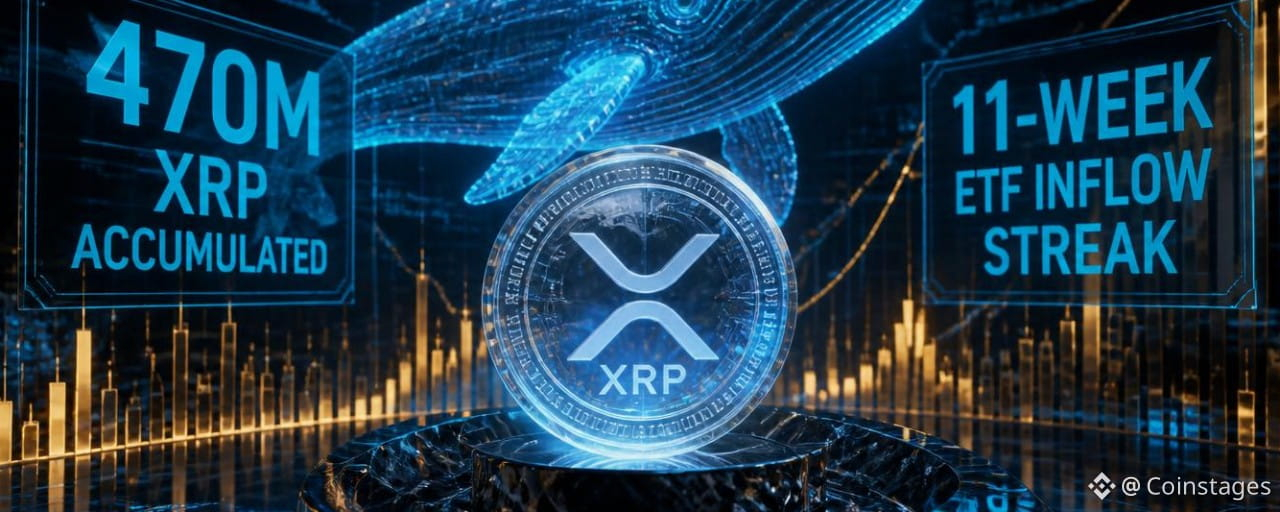
XRP Whales Accumulate $724M in 5 Days Amid 11-Week Spot ETF Inflow Streak!XRP is testing key resistance near $1.60 as institutional capital and large investors pile into the digital asset. On-chain data reveals that large holders accumulated over 470 million XRP (worth approximately $724 million) in just five days. Combined with an 11-week consecutive net inflow streak for U.S. spot XRP ETFs, market participants are eyeing a potential technical breakout toward $2.00.
🏛️ Double-Engine Demand: Whale Accumulation Meets Institutional ETFs
The current price recovery is supported by strong spot accumulation across two major fronts:
Massive Whale Outflows to Self-Custody: On-chain data highlighted by analyst Ali Martinez shows whale addresses (holding large balances) expanded their holdings from 12.37 billion to 12.80 billion XRP within five days. This $724M buying spree signals strong conviction among high-net-worth market participants.11 Consecutive Weeks of ETF Inflows: Data from SoSoValue shows U.S. spot XRP ETFs brought in $75.59 million in the week ending September 25. This extends the funds' positive inflow streak to 11 straight weeks since mid-July, pushing total cumulative net inflows to $1.79 billion with total assets under management near $1.77 billion.Institutional Fund Updates: Bitwise recently submitted an updated registration statement amendment for its spot XRP product, pointing toward continued institutional infrastructure expansion.
📊 Key Technical Levels to Watch
XRP has rebounded roughly 28% from its $1.25 local bottom to trade around $1.54–$1.58. Technical chartists are observing an inverse head-and-shoulders structure forming on the daily timeframe.
Neckline Resistance ($1.60): The primary hurdle capping the pattern. A confirmed daily close above $1.60 activates a measured technical breakout target near $2.00 (~30% upside from current levels).Immediate Support ($1.50 – $1.53): The first defense zone on localized pullbacks.Macro Demand Floor ($1.32 – $1.46): Key structural support required to keep the broader bullish pattern intact if the $1.60 rejection occurs.
⚠️ Essential Financial Disclaimer
This article is strictly for educational and informational purposes only and does not constitute financial, investment, legal, or trading advice. Digital assets, cryptocurrency markets, and technical chart formations carry inherent financial risk and volatility. Always perform independent research (DYOR) and consult a certified financial advisor before making any investment decisions.
Do you think whale accumulation and ETF inflows will push XRP past $1.60 to hit $2.00, or will sellers defend resistance? Share your technical targets and market outlook in the comments below! 🚀⚡
XRP Whales Accumulate $724M in 5 Days Amid 11-Week Spot ETF Inflow Streak!
XRP is testing key resistance near $1.60 as institutional capital and large investors pile into the digital asset. On-chain data reveals that large holders accumulated over 470 million XRP (worth approximately $724 million) in just five days. Combined with an 11-week consecutive net inflow streak for U.S. spot XRP ETFs, market participants are eyeing a potential technical breakout toward $2.00.
🏛️ Double-Engine Demand: Whale Accumulation Meets Institutional ETFs
The current price recovery is supported by strong spot accumulation across two major fronts:
Massive Whale Outflows to Self-Custody: On-chain data highlighted by analyst Ali Martinez shows whale addresses (holding large balances) expanded their holdings from 12.37 billion to 12.80 billion XRP within five days. This $724M buying spree signals strong conviction among high-net-worth market participants.11 Consecutive Weeks of ETF Inflows: Data from SoSoValue shows U.S. spot XRP ETFs brought in $75.59 million in the week ending September 25. This extends the funds' positive inflow streak to 11 straight weeks since mid-July, pushing total cumulative net inflows to $1.79 billion with total assets under management near $1.77 billion.Institutional Fund Updates: Bitwise recently submitted an updated registration statement amendment for its spot XRP product, pointing toward continued institutional infrastructure expansion.
📊 Key Technical Levels to Watch
XRP has rebounded roughly 28% from its $1.25 local bottom to trade around $1.54–$1.58. Technical chartists are observing an inverse head-and-shoulders structure forming on the daily timeframe.
Neckline Resistance ($1.60): The primary hurdle capping the pattern. A confirmed daily close above $1.60 activates a measured technical breakout target near $2.00 (~30% upside from current levels).Immediate Support ($1.50 – $1.53): The first defense zone on localized pullbacks.Macro Demand Floor ($1.32 – $1.46): Key structural support required to keep the broader bullish pattern intact if the $1.60 rejection occurs.
⚠️ Essential Financial Disclaimer
This article is strictly for educational and informational purposes only and does not constitute financial, investment, legal, or trading advice. Digital assets, cryptocurrency markets, and technical chart formations carry inherent financial risk and volatility. Always perform independent research (DYOR) and consult a certified financial advisor before making any investment decisions.
Do you think whale accumulation and ETF inflows will push XRP past $1.60 to hit $2.00, or will sellers defend resistance? Share your technical targets and market outlook in the comments below! 🚀⚡
🏛️ Double-Engine Demand: Whale Accumulation Meets Institutional ETFs
The current price recovery is supported by strong spot accumulation across two major fronts:
Massive Whale Outflows to Self-Custody: On-chain data highlighted by analyst Ali Martinez shows whale addresses (holding large balances) expanded their holdings from 12.37 billion to 12.80 billion XRP within five days. This $724M buying spree signals strong conviction among high-net-worth market participants.11 Consecutive Weeks of ETF Inflows: Data from SoSoValue shows U.S. spot XRP ETFs brought in $75.59 million in the week ending September 25. This extends the funds' positive inflow streak to 11 straight weeks since mid-July, pushing total cumulative net inflows to $1.79 billion with total assets under management near $1.77 billion.Institutional Fund Updates: Bitwise recently submitted an updated registration statement amendment for its spot XRP product, pointing toward continued institutional infrastructure expansion.
📊 Key Technical Levels to Watch
XRP has rebounded roughly 28% from its $1.25 local bottom to trade around $1.54–$1.58. Technical chartists are observing an inverse head-and-shoulders structure forming on the daily timeframe.
Neckline Resistance ($1.60): The primary hurdle capping the pattern. A confirmed daily close above $1.60 activates a measured technical breakout target near $2.00 (~30% upside from current levels).Immediate Support ($1.50 – $1.53): The first defense zone on localized pullbacks.Macro Demand Floor ($1.32 – $1.46): Key structural support required to keep the broader bullish pattern intact if the $1.60 rejection occurs.
⚠️ Essential Financial Disclaimer
This article is strictly for educational and informational purposes only and does not constitute financial, investment, legal, or trading advice. Digital assets, cryptocurrency markets, and technical chart formations carry inherent financial risk and volatility. Always perform independent research (DYOR) and consult a certified financial advisor before making any investment decisions.
Do you think whale accumulation and ETF inflows will push XRP past $1.60 to hit $2.00, or will sellers defend resistance? Share your technical targets and market outlook in the comments below! 🚀⚡
2
1.3k
·
--
Verified

Article
FC Barcelona Bets on Cardano With New 'Barça Fan Lab' PlatformFC Barcelona has taken a major step into decentralized community engagement by launching Barça Fan Lab, a digital fan platform built on the Cardano network. Developed in collaboration with Web3 tech partner Andamio, the initiative connects the club's global fan base with blockchain-backed credentials and interactive learning pathways.
Backed and funded by Catalyst Fund 13, Cardano's decentralized community grant program, the launch demonstrates how mainstream sports giants are utilizing Web3 infrastructure to foster digital identity and fan engagement.
🏛️ BarçaID Meets Cardano Web3 Portfolios
Seamless Identity Integration: The platform links the pre-existing BarçaID digital identity framework with custom Cardano Web3 wallets. When users log in, a Cardano-based portfolio is automatically provisioned to store verifiable credentials, access tokens, and digital collectibles, without requiring fans to navigate complex self-custody processes.Powered by Andamio Infrastructure: Technology partner Andamio provides the course management and decentralized credentialing software, allowing the club to reward fan activity with verified blockchain records.Catalyst Fund 13 Grant: The project's development was made possible after winning approval through Cardano's Catalyst Fund 13, where $ADA holders voted directly to allocate treasury capital toward the FC Barcelona integration.
📚 The 4 Educational & Participatory Pillars
Rather than launching as a purely commercial product, FC Barcelona designed Barça Fan Lab as an interactive learning sandbox structured across four core pillars:
History & Values: Covers the athletic milestones, identity, and foundational philosophy of "Més que un club".Sustainability & Innovation: Focuses on environmental responsibility, social inclusion, women's empowerment, and ethical digital tech.Physical-to-Digital Communities: Explores methods to bridge traditional supporters' clubs (penyes) into online decentralized groups.Web3 & Blockchain Mechanics: Introduces fans to smart contracts, digital collectibles, community governance, and blockchain-based loyalty systems.
📊 Market Impact & On-Chain Significance
The announcement provided a timely boost for Cardano's real-world utility metrics, coming at a time when community discussions have centered on generating sustained on-chain transaction activity.
ADA Price Action: Following the announcement, Cardano ($ADA) experienced a brief bump toward $0.2544 before settling near $0.252, recording modest gains while remaining roughly 92% below its $3.10 peak from 2021.Long-Term Adoption Sandbox: FC Barcelona will keep the initial learning tracks active throughout Q4 2026 to track user retention and evaluate future rewards distributions.
⚠️ Essential Financial Disclaimer
This article is strictly for educational and informational purposes only and does not constitute financial, investment, legal, or trading advice. Digital tokens, Web3 fan loyalty products, and cryptocurrency markets carry inherent risk and price volatility. Always perform independent research (DYOR) and consult a certified financial advisor before making any investment decisions.
Do you think mainstream sports partnerships like Barça Fan Lab will drive mass Web3 adoption for Cardano? Share your thoughts and predictions in the comments below! ⚽⚡
FC Barcelona Bets on Cardano With New 'Barça Fan Lab' Platform
FC Barcelona has taken a major step into decentralized community engagement by launching Barça Fan Lab, a digital fan platform built on the Cardano network. Developed in collaboration with Web3 tech partner Andamio, the initiative connects the club's global fan base with blockchain-backed credentials and interactive learning pathways.
Backed and funded by Catalyst Fund 13, Cardano's decentralized community grant program, the launch demonstrates how mainstream sports giants are utilizing Web3 infrastructure to foster digital identity and fan engagement.
🏛️ BarçaID Meets Cardano Web3 Portfolios
Seamless Identity Integration: The platform links the pre-existing BarçaID digital identity framework with custom Cardano Web3 wallets. When users log in, a Cardano-based portfolio is automatically provisioned to store verifiable credentials, access tokens, and digital collectibles, without requiring fans to navigate complex self-custody processes.Powered by Andamio Infrastructure: Technology partner Andamio provides the course management and decentralized credentialing software, allowing the club to reward fan activity with verified blockchain records.Catalyst Fund 13 Grant: The project's development was made possible after winning approval through Cardano's Catalyst Fund 13, where $ADA holders voted directly to allocate treasury capital toward the FC Barcelona integration.
📚 The 4 Educational & Participatory Pillars
Rather than launching as a purely commercial product, FC Barcelona designed Barça Fan Lab as an interactive learning sandbox structured across four core pillars:
History & Values: Covers the athletic milestones, identity, and foundational philosophy of "Més que un club".Sustainability & Innovation: Focuses on environmental responsibility, social inclusion, women's empowerment, and ethical digital tech.Physical-to-Digital Communities: Explores methods to bridge traditional supporters' clubs (penyes) into online decentralized groups.Web3 & Blockchain Mechanics: Introduces fans to smart contracts, digital collectibles, community governance, and blockchain-based loyalty systems.
📊 Market Impact & On-Chain Significance
The announcement provided a timely boost for Cardano's real-world utility metrics, coming at a time when community discussions have centered on generating sustained on-chain transaction activity.
ADA Price Action: Following the announcement, Cardano ($ADA) experienced a brief bump toward $0.2544 before settling near $0.252, recording modest gains while remaining roughly 92% below its $3.10 peak from 2021.Long-Term Adoption Sandbox: FC Barcelona will keep the initial learning tracks active throughout Q4 2026 to track user retention and evaluate future rewards distributions.
⚠️ Essential Financial Disclaimer
This article is strictly for educational and informational purposes only and does not constitute financial, investment, legal, or trading advice. Digital tokens, Web3 fan loyalty products, and cryptocurrency markets carry inherent risk and price volatility. Always perform independent research (DYOR) and consult a certified financial advisor before making any investment decisions.
Do you think mainstream sports partnerships like Barça Fan Lab will drive mass Web3 adoption for Cardano? Share your thoughts and predictions in the comments below! ⚽⚡
Backed and funded by Catalyst Fund 13, Cardano's decentralized community grant program, the launch demonstrates how mainstream sports giants are utilizing Web3 infrastructure to foster digital identity and fan engagement.
🏛️ BarçaID Meets Cardano Web3 Portfolios
Seamless Identity Integration: The platform links the pre-existing BarçaID digital identity framework with custom Cardano Web3 wallets. When users log in, a Cardano-based portfolio is automatically provisioned to store verifiable credentials, access tokens, and digital collectibles, without requiring fans to navigate complex self-custody processes.Powered by Andamio Infrastructure: Technology partner Andamio provides the course management and decentralized credentialing software, allowing the club to reward fan activity with verified blockchain records.Catalyst Fund 13 Grant: The project's development was made possible after winning approval through Cardano's Catalyst Fund 13, where $ADA holders voted directly to allocate treasury capital toward the FC Barcelona integration.
📚 The 4 Educational & Participatory Pillars
Rather than launching as a purely commercial product, FC Barcelona designed Barça Fan Lab as an interactive learning sandbox structured across four core pillars:
History & Values: Covers the athletic milestones, identity, and foundational philosophy of "Més que un club".Sustainability & Innovation: Focuses on environmental responsibility, social inclusion, women's empowerment, and ethical digital tech.Physical-to-Digital Communities: Explores methods to bridge traditional supporters' clubs (penyes) into online decentralized groups.Web3 & Blockchain Mechanics: Introduces fans to smart contracts, digital collectibles, community governance, and blockchain-based loyalty systems.
📊 Market Impact & On-Chain Significance
The announcement provided a timely boost for Cardano's real-world utility metrics, coming at a time when community discussions have centered on generating sustained on-chain transaction activity.
ADA Price Action: Following the announcement, Cardano ($ADA) experienced a brief bump toward $0.2544 before settling near $0.252, recording modest gains while remaining roughly 92% below its $3.10 peak from 2021.Long-Term Adoption Sandbox: FC Barcelona will keep the initial learning tracks active throughout Q4 2026 to track user retention and evaluate future rewards distributions.
⚠️ Essential Financial Disclaimer
This article is strictly for educational and informational purposes only and does not constitute financial, investment, legal, or trading advice. Digital tokens, Web3 fan loyalty products, and cryptocurrency markets carry inherent risk and price volatility. Always perform independent research (DYOR) and consult a certified financial advisor before making any investment decisions.
Do you think mainstream sports partnerships like Barça Fan Lab will drive mass Web3 adoption for Cardano? Share your thoughts and predictions in the comments below! ⚽⚡
1
2
1k
·
--
Verified
Article
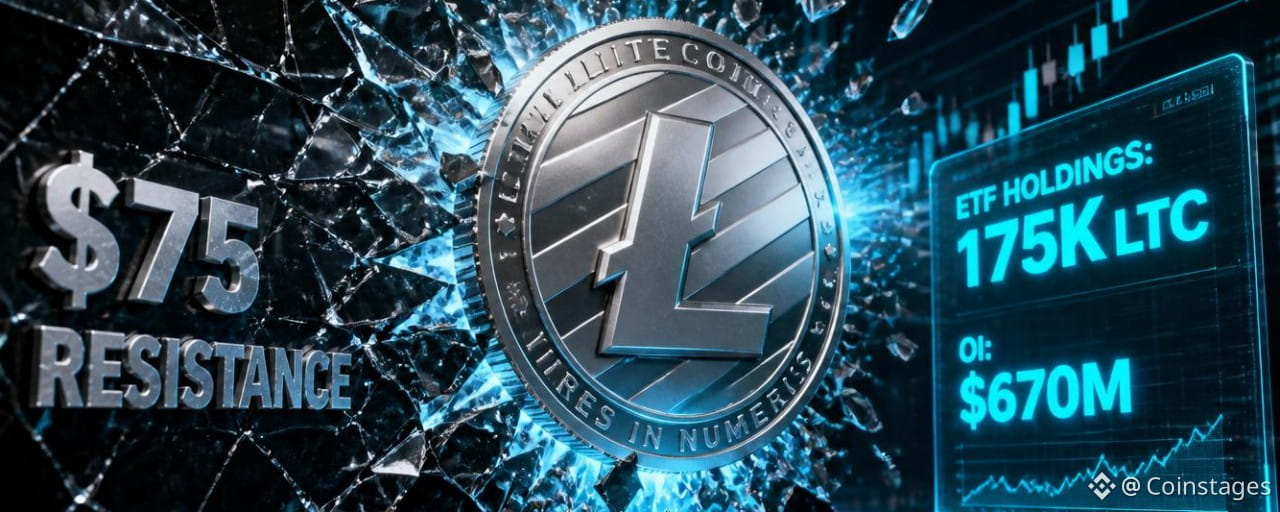
LITECOIN HITS 8-MONTH HIGH AS ETF HOLDINGS SET RECORD — CAN BULLS CLEAR $75?Litecoin (LTC) has staged a powerful recovery, surging over 16% on record 2026 trading volume to reach an eight-month high. The explosive move comes as institutional spot Litecoin ETF holdings hit unprecedented record levels and futures open interest approaches its yearly peak near $670 million. However, underlying derivatives data suggests that heavy leverage, rather than spot ETF buying alone, is driving the current momentum.
🏛️ ETF Holdings Hit Record Highs vs. Derivatives Surge
While institutional interest in Litecoin continues to build steadily, market mechanics reveal a notable divergence between spot accumulation and leveraged futures activity:
Record Spot ETF Balances: U.S. spot Litecoin ETF holdings tracked by Glassnode reached a new all-time high of roughly 175,000 LTC. Canary Capital's LTCC trust led the inflows, adding approximately 39,000 LTC in its largest single-day expansion to date.Derivatives-Driven Momentum: Despite positive spot ETF inflows (~$2.8 million over the week), futures open interest added roughly $140 million in just 48 hours to reach $670 million, nearly doubling since June. This indicates that aggressive derivative leverage is the primary catalyst pushing prices higher.
📊 Key Technical Levels to Watch
Litecoin’s daily chart reflects a strong structural shift after breaking above the 0.5 ($62.09) and 0.618 ($67.47) Fibonacci retracement levels in a single daily candle. The move marks LTC's first higher high since the February–May range.
Key Resistance ($75.00): The primary hurdle where price previously broke down in late January. A decisive daily close above $75 opens a clear path toward $80.00 and the January peak of $84.89.Primary Support Zone ($67.47): The 0.618 Fib retracement level serves as the immediate demand floor during temporary pullbacks.Strong Base Support ($60.00 – $62.00): The confluence of the 0.5 Fib level and the former May high serves as a vital structural buffer. A daily close below $56.70 would invalidate the breakout structure.Overbought RSI Warning: The daily Relative Strength Index (RSI) stands at 81—its highest reading of the year. While no bearish divergence is present, overbought conditions raise the probability of a short-term leverage flush before continuation.
⚠️ Essential Financial Disclaimer
This article is strictly for educational and informational purposes only and does not constitute financial, investment, legal, or trading advice. Digital assets, futures leverage, and cryptocurrency markets carry significant volatility and risk. Always perform independent research (DYOR) and consult a certified financial advisor before making any investment decisions.
Do you think Litecoin bulls will clear the $75 resistance zone and push toward $85, or will leverage liquidations trigger a pullback? Share your technical analysis and target predictions in the comments below! 📊⚡
LITECOIN HITS 8-MONTH HIGH AS ETF HOLDINGS SET RECORD — CAN BULLS CLEAR $75?
Litecoin (LTC) has staged a powerful recovery, surging over 16% on record 2026 trading volume to reach an eight-month high. The explosive move comes as institutional spot Litecoin ETF holdings hit unprecedented record levels and futures open interest approaches its yearly peak near $670 million. However, underlying derivatives data suggests that heavy leverage, rather than spot ETF buying alone, is driving the current momentum.
🏛️ ETF Holdings Hit Record Highs vs. Derivatives Surge
While institutional interest in Litecoin continues to build steadily, market mechanics reveal a notable divergence between spot accumulation and leveraged futures activity:
Record Spot ETF Balances: U.S. spot Litecoin ETF holdings tracked by Glassnode reached a new all-time high of roughly 175,000 LTC. Canary Capital's LTCC trust led the inflows, adding approximately 39,000 LTC in its largest single-day expansion to date.Derivatives-Driven Momentum: Despite positive spot ETF inflows (~$2.8 million over the week), futures open interest added roughly $140 million in just 48 hours to reach $670 million, nearly doubling since June. This indicates that aggressive derivative leverage is the primary catalyst pushing prices higher.
📊 Key Technical Levels to Watch
Litecoin’s daily chart reflects a strong structural shift after breaking above the 0.5 ($62.09) and 0.618 ($67.47) Fibonacci retracement levels in a single daily candle. The move marks LTC's first higher high since the February–May range.
Key Resistance ($75.00): The primary hurdle where price previously broke down in late January. A decisive daily close above $75 opens a clear path toward $80.00 and the January peak of $84.89.Primary Support Zone ($67.47): The 0.618 Fib retracement level serves as the immediate demand floor during temporary pullbacks.Strong Base Support ($60.00 – $62.00): The confluence of the 0.5 Fib level and the former May high serves as a vital structural buffer. A daily close below $56.70 would invalidate the breakout structure.Overbought RSI Warning: The daily Relative Strength Index (RSI) stands at 81—its highest reading of the year. While no bearish divergence is present, overbought conditions raise the probability of a short-term leverage flush before continuation.
⚠️ Essential Financial Disclaimer
This article is strictly for educational and informational purposes only and does not constitute financial, investment, legal, or trading advice. Digital assets, futures leverage, and cryptocurrency markets carry significant volatility and risk. Always perform independent research (DYOR) and consult a certified financial advisor before making any investment decisions.
Do you think Litecoin bulls will clear the $75 resistance zone and push toward $85, or will leverage liquidations trigger a pullback? Share your technical analysis and target predictions in the comments below! 📊⚡
🏛️ ETF Holdings Hit Record Highs vs. Derivatives Surge
While institutional interest in Litecoin continues to build steadily, market mechanics reveal a notable divergence between spot accumulation and leveraged futures activity:
Record Spot ETF Balances: U.S. spot Litecoin ETF holdings tracked by Glassnode reached a new all-time high of roughly 175,000 LTC. Canary Capital's LTCC trust led the inflows, adding approximately 39,000 LTC in its largest single-day expansion to date.Derivatives-Driven Momentum: Despite positive spot ETF inflows (~$2.8 million over the week), futures open interest added roughly $140 million in just 48 hours to reach $670 million, nearly doubling since June. This indicates that aggressive derivative leverage is the primary catalyst pushing prices higher.
📊 Key Technical Levels to Watch
Litecoin’s daily chart reflects a strong structural shift after breaking above the 0.5 ($62.09) and 0.618 ($67.47) Fibonacci retracement levels in a single daily candle. The move marks LTC's first higher high since the February–May range.
Key Resistance ($75.00): The primary hurdle where price previously broke down in late January. A decisive daily close above $75 opens a clear path toward $80.00 and the January peak of $84.89.Primary Support Zone ($67.47): The 0.618 Fib retracement level serves as the immediate demand floor during temporary pullbacks.Strong Base Support ($60.00 – $62.00): The confluence of the 0.5 Fib level and the former May high serves as a vital structural buffer. A daily close below $56.70 would invalidate the breakout structure.Overbought RSI Warning: The daily Relative Strength Index (RSI) stands at 81—its highest reading of the year. While no bearish divergence is present, overbought conditions raise the probability of a short-term leverage flush before continuation.
⚠️ Essential Financial Disclaimer
This article is strictly for educational and informational purposes only and does not constitute financial, investment, legal, or trading advice. Digital assets, futures leverage, and cryptocurrency markets carry significant volatility and risk. Always perform independent research (DYOR) and consult a certified financial advisor before making any investment decisions.
Do you think Litecoin bulls will clear the $75 resistance zone and push toward $85, or will leverage liquidations trigger a pullback? Share your technical analysis and target predictions in the comments below! 📊⚡
1
2
1.1k
·
--
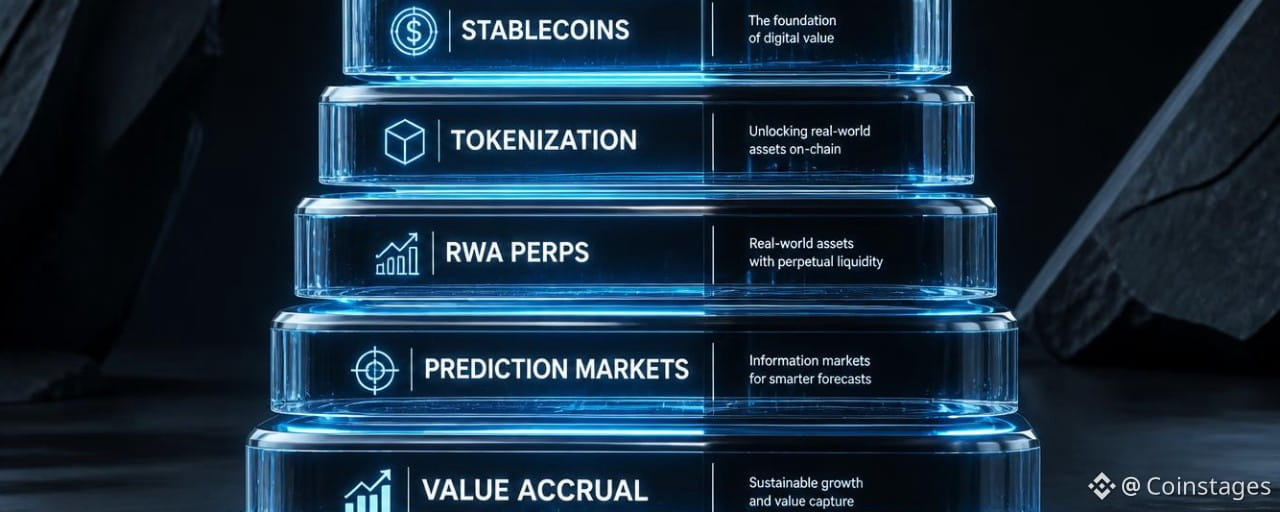
Article
5 Financial Layers Could Power the Next Crypto Bull MarketPrevious cryptocurrency bull cycles were largely defined by singular headline narratives—from Bitcoin as digital gold to the rise of smart-contract platforms, ICOs, DeFi, and NFTs. In those earlier eras, most capital and user activity remained contained within the crypto ecosystem. According to a new report from BloFin Research, the upcoming market expansion will look fundamentally different, driven by five interconnected financial layers that position Web3 as a parallel market for mainstream global finance.
🏛️ The 5-Layer Financial Stack Explained
Rather than competing as isolated trends, BloFin Research outlines how five core sectors are combining into a unified, institutional-grade financial stack:
1. Stablecoins (The Cash Layer): Serving as digital cash, stablecoins are expanding rapidly beyond trading venues into real-world payments and machine-native execution. Visa's annualized stablecoin settlement volume crossed $20 billion, while institutional funds highlight stablecoins as primary candidates for AI agent payments.2. Tokenization (The Asset Layer): Tokenized commodities reached $5.55 billion by Q1 2026, up 289% since 2025, while tokenized equities surged 390% to $4.43 billion. With only 0.0029% of the $151.9 trillion global stock market currently on-chain, tokenized real-world assets (RWAs) hold massive structural runway.3. RWA Perps (The Synthetic Leverage Layer): Perpetual futures on real-world assets offer high-leverage exposure to traditional markets without requiring complex asset custody or compliance friction. DefiLlama data shows RWA-perp trading volumes surged from $122 billion in Q1 to $2.2 trillion by Q3 2026, pushing open interest past $15.3 billion.4. Prediction Markets (The Information Layer): Platforms like Kalshi and Polymarket convert real-world news and economic events into live, monetary-backed probability feeds. These real-time probability signals are increasingly utilized by both human traders and machine-learning models prior to major Fed FOMC decisions.5. Token Value Accrual (The Sustainable Yield Layer): Bridging protocol usage with long-term holder value, decentralized applications are adopting traditional cash-flow models. Protocols like Hyperliquid and Uniswap actively redirect protocol fee revenues toward systematic token buybacks and burns.
🔄 How the Layers Reinforce One Another
Each component in this five-layer framework functions synergistically. Stablecoins provide liquidity and collateral for derivative trades, while tokenization and RWA perps import price feeds and ownership rights directly from traditional financial markets.
Data generated across prediction markets and perpetual contracts supplies real-time intelligence for algorithmic AI agents. Ultimately, fees generated across all four underlying layers flow upward into protocol value accrual models, rewarding long-term token holders with measurable economic yields.
Essential Financial Disclaimer
This article is strictly for educational and informational purposes only and does not constitute financial, investment, legal, or trading advice. Digital assets, decentralized finance protocols, and synthetic real-world asset products carry significant volatility and regulatory risks. Always conduct independent research (DYOR) and consult a certified financial advisor before making any investment decisions.
Which of the five financial layers do you believe will drive the highest growth in the upcoming bull cycle? Drop your thoughts and portfolio strategy in the comments below! 🚀📊
5 Financial Layers Could Power the Next Crypto Bull Market
Previous cryptocurrency bull cycles were largely defined by singular headline narratives—from Bitcoin as digital gold to the rise of smart-contract platforms, ICOs, DeFi, and NFTs. In those earlier eras, most capital and user activity remained contained within the crypto ecosystem. According to a new report from BloFin Research, the upcoming market expansion will look fundamentally different, driven by five interconnected financial layers that position Web3 as a parallel market for mainstream global finance.
🏛️ The 5-Layer Financial Stack Explained
Rather than competing as isolated trends, BloFin Research outlines how five core sectors are combining into a unified, institutional-grade financial stack:
1. Stablecoins (The Cash Layer): Serving as digital cash, stablecoins are expanding rapidly beyond trading venues into real-world payments and machine-native execution. Visa's annualized stablecoin settlement volume crossed $20 billion, while institutional funds highlight stablecoins as primary candidates for AI agent payments.2. Tokenization (The Asset Layer): Tokenized commodities reached $5.55 billion by Q1 2026, up 289% since 2025, while tokenized equities surged 390% to $4.43 billion. With only 0.0029% of the $151.9 trillion global stock market currently on-chain, tokenized real-world assets (RWAs) hold massive structural runway.3. RWA Perps (The Synthetic Leverage Layer): Perpetual futures on real-world assets offer high-leverage exposure to traditional markets without requiring complex asset custody or compliance friction. DefiLlama data shows RWA-perp trading volumes surged from $122 billion in Q1 to $2.2 trillion by Q3 2026, pushing open interest past $15.3 billion.4. Prediction Markets (The Information Layer): Platforms like Kalshi and Polymarket convert real-world news and economic events into live, monetary-backed probability feeds. These real-time probability signals are increasingly utilized by both human traders and machine-learning models prior to major Fed FOMC decisions.5. Token Value Accrual (The Sustainable Yield Layer): Bridging protocol usage with long-term holder value, decentralized applications are adopting traditional cash-flow models. Protocols like Hyperliquid and Uniswap actively redirect protocol fee revenues toward systematic token buybacks and burns.
🔄 How the Layers Reinforce One Another
Each component in this five-layer framework functions synergistically. Stablecoins provide liquidity and collateral for derivative trades, while tokenization and RWA perps import price feeds and ownership rights directly from traditional financial markets.
Data generated across prediction markets and perpetual contracts supplies real-time intelligence for algorithmic AI agents. Ultimately, fees generated across all four underlying layers flow upward into protocol value accrual models, rewarding long-term token holders with measurable economic yields.
Essential Financial Disclaimer
This article is strictly for educational and informational purposes only and does not constitute financial, investment, legal, or trading advice. Digital assets, decentralized finance protocols, and synthetic real-world asset products carry significant volatility and regulatory risks. Always conduct independent research (DYOR) and consult a certified financial advisor before making any investment decisions.
Which of the five financial layers do you believe will drive the highest growth in the upcoming bull cycle? Drop your thoughts and portfolio strategy in the comments below! 🚀📊
🏛️ The 5-Layer Financial Stack Explained
Rather than competing as isolated trends, BloFin Research outlines how five core sectors are combining into a unified, institutional-grade financial stack:
1. Stablecoins (The Cash Layer): Serving as digital cash, stablecoins are expanding rapidly beyond trading venues into real-world payments and machine-native execution. Visa's annualized stablecoin settlement volume crossed $20 billion, while institutional funds highlight stablecoins as primary candidates for AI agent payments.2. Tokenization (The Asset Layer): Tokenized commodities reached $5.55 billion by Q1 2026, up 289% since 2025, while tokenized equities surged 390% to $4.43 billion. With only 0.0029% of the $151.9 trillion global stock market currently on-chain, tokenized real-world assets (RWAs) hold massive structural runway.3. RWA Perps (The Synthetic Leverage Layer): Perpetual futures on real-world assets offer high-leverage exposure to traditional markets without requiring complex asset custody or compliance friction. DefiLlama data shows RWA-perp trading volumes surged from $122 billion in Q1 to $2.2 trillion by Q3 2026, pushing open interest past $15.3 billion.4. Prediction Markets (The Information Layer): Platforms like Kalshi and Polymarket convert real-world news and economic events into live, monetary-backed probability feeds. These real-time probability signals are increasingly utilized by both human traders and machine-learning models prior to major Fed FOMC decisions.5. Token Value Accrual (The Sustainable Yield Layer): Bridging protocol usage with long-term holder value, decentralized applications are adopting traditional cash-flow models. Protocols like Hyperliquid and Uniswap actively redirect protocol fee revenues toward systematic token buybacks and burns.
🔄 How the Layers Reinforce One Another
Each component in this five-layer framework functions synergistically. Stablecoins provide liquidity and collateral for derivative trades, while tokenization and RWA perps import price feeds and ownership rights directly from traditional financial markets.
Data generated across prediction markets and perpetual contracts supplies real-time intelligence for algorithmic AI agents. Ultimately, fees generated across all four underlying layers flow upward into protocol value accrual models, rewarding long-term token holders with measurable economic yields.
Essential Financial Disclaimer
This article is strictly for educational and informational purposes only and does not constitute financial, investment, legal, or trading advice. Digital assets, decentralized finance protocols, and synthetic real-world asset products carry significant volatility and regulatory risks. Always conduct independent research (DYOR) and consult a certified financial advisor before making any investment decisions.
Which of the five financial layers do you believe will drive the highest growth in the upcoming bull cycle? Drop your thoughts and portfolio strategy in the comments below! 🚀📊
1
755
·
--
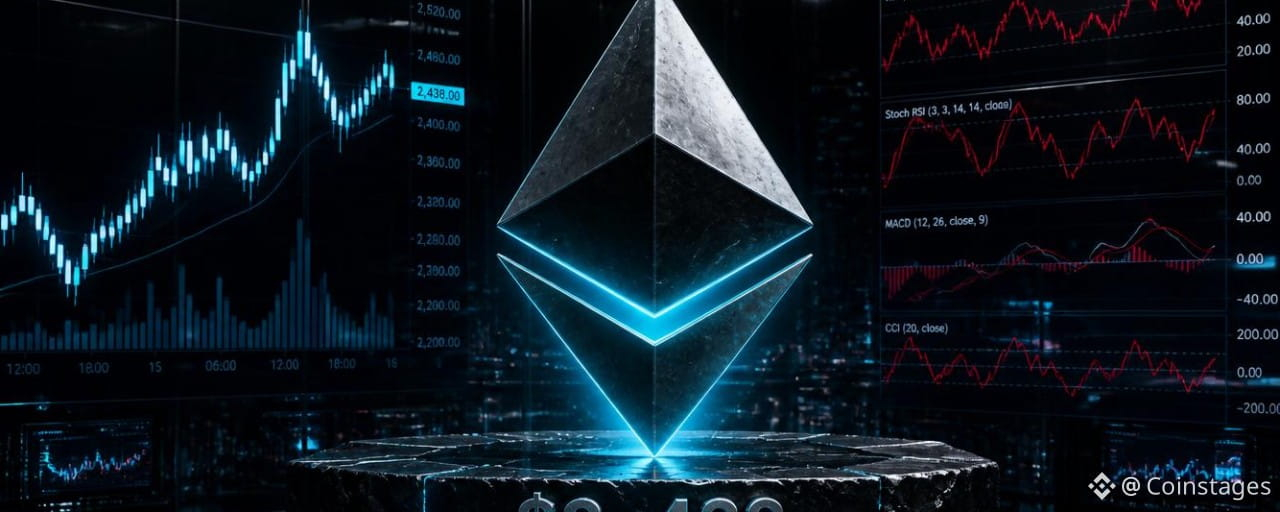
Article
Ethereum Prints First Higher High Since 2025, But Bearish Divergence Signals CautionEthereum (ETH) has officially broken a year-long pattern of lower highs by printing its first higher high since August 2025. Reclaiming key resistance at $2,438 and flipping it into new structural support marks a significant milestone for ETH's long-term weekly chart.
However, beneath the surface of this bullish price action, technical momentum indicators are flashing a classic bearish divergence. While the price pushed to higher peaks, momentum oscillators and daily trading volumes continue to trend downward, signaling that buyers may be losing steam in the near term.
📊 Technical Breakout vs. Momentum Exhaustion
Year-Long Trendline Broken: By surging past $2,438, Ethereum successfully disrupted the multi-month sequence of lower highs that capped price expansion throughout 2025 and mid-2026. Reclaiming $2,438 secures a more favorable high-timeframe structural foundation.RSI & Volume Divergence: Despite higher price peaks, daily Relative Strength Index (RSI) readings and spot trading volumes are failing to make higher highs. This momentum mismatch often warns of impending exhaustion or a short-term pullback before further upside continuation.Macro Range Boundaries: Technical chartists identify a clear path forward: a sustained push above key resistance near $2,920 opens the doors toward the $3,400 macro target, whereas losing support at $2,440 risks a deeper retest down toward the $1,950 – $2,000 liquidity zone.
⚔️ Two Scenarios for Ethereum Traders
Bullish Continuation Thesis: To confirm a true macro breakout and invalidate the bearish divergence, ETH must hold above the newly established $2,438–$2,440 support zone on daily closes and push past $2,920 on expanding trading volume. A successful breakout clears the runway for a run toward $3,400.Pullback & Retest Risk: If seller exhaustion forces a retest and price fails to defend the $2,440 pivot, the active bearish divergence could trigger a corrective wave down toward the primary demand floor between $1,950 and $2,000.
Essential Financial Disclaimer
This article is strictly for educational and informational purposes only and does not constitute financial, investment, legal, or trading advice. Cryptocurrency markets, high-timeframe technical patterns, and momentum indicators carry inherent financial risk and volatility. Always conduct independent research (DYOR) and consult a certified financial advisor before making any investment decisions.
Will Ethereum overcome its bearish divergence to break above $2,920, or are we due for a retest of lower support levels first? Share your chart analysis and price targets in the comments below! 📊⚡
Ethereum Prints First Higher High Since 2025, But Bearish Divergence Signals Caution
Ethereum (ETH) has officially broken a year-long pattern of lower highs by printing its first higher high since August 2025. Reclaiming key resistance at $2,438 and flipping it into new structural support marks a significant milestone for ETH's long-term weekly chart.
However, beneath the surface of this bullish price action, technical momentum indicators are flashing a classic bearish divergence. While the price pushed to higher peaks, momentum oscillators and daily trading volumes continue to trend downward, signaling that buyers may be losing steam in the near term.
📊 Technical Breakout vs. Momentum Exhaustion
Year-Long Trendline Broken: By surging past $2,438, Ethereum successfully disrupted the multi-month sequence of lower highs that capped price expansion throughout 2025 and mid-2026. Reclaiming $2,438 secures a more favorable high-timeframe structural foundation.RSI & Volume Divergence: Despite higher price peaks, daily Relative Strength Index (RSI) readings and spot trading volumes are failing to make higher highs. This momentum mismatch often warns of impending exhaustion or a short-term pullback before further upside continuation.Macro Range Boundaries: Technical chartists identify a clear path forward: a sustained push above key resistance near $2,920 opens the doors toward the $3,400 macro target, whereas losing support at $2,440 risks a deeper retest down toward the $1,950 – $2,000 liquidity zone.
⚔️ Two Scenarios for Ethereum Traders
Bullish Continuation Thesis: To confirm a true macro breakout and invalidate the bearish divergence, ETH must hold above the newly established $2,438–$2,440 support zone on daily closes and push past $2,920 on expanding trading volume. A successful breakout clears the runway for a run toward $3,400.Pullback & Retest Risk: If seller exhaustion forces a retest and price fails to defend the $2,440 pivot, the active bearish divergence could trigger a corrective wave down toward the primary demand floor between $1,950 and $2,000.
Essential Financial Disclaimer
This article is strictly for educational and informational purposes only and does not constitute financial, investment, legal, or trading advice. Cryptocurrency markets, high-timeframe technical patterns, and momentum indicators carry inherent financial risk and volatility. Always conduct independent research (DYOR) and consult a certified financial advisor before making any investment decisions.
Will Ethereum overcome its bearish divergence to break above $2,920, or are we due for a retest of lower support levels first? Share your chart analysis and price targets in the comments below! 📊⚡
However, beneath the surface of this bullish price action, technical momentum indicators are flashing a classic bearish divergence. While the price pushed to higher peaks, momentum oscillators and daily trading volumes continue to trend downward, signaling that buyers may be losing steam in the near term.
📊 Technical Breakout vs. Momentum Exhaustion
Year-Long Trendline Broken: By surging past $2,438, Ethereum successfully disrupted the multi-month sequence of lower highs that capped price expansion throughout 2025 and mid-2026. Reclaiming $2,438 secures a more favorable high-timeframe structural foundation.RSI & Volume Divergence: Despite higher price peaks, daily Relative Strength Index (RSI) readings and spot trading volumes are failing to make higher highs. This momentum mismatch often warns of impending exhaustion or a short-term pullback before further upside continuation.Macro Range Boundaries: Technical chartists identify a clear path forward: a sustained push above key resistance near $2,920 opens the doors toward the $3,400 macro target, whereas losing support at $2,440 risks a deeper retest down toward the $1,950 – $2,000 liquidity zone.
⚔️ Two Scenarios for Ethereum Traders
Bullish Continuation Thesis: To confirm a true macro breakout and invalidate the bearish divergence, ETH must hold above the newly established $2,438–$2,440 support zone on daily closes and push past $2,920 on expanding trading volume. A successful breakout clears the runway for a run toward $3,400.Pullback & Retest Risk: If seller exhaustion forces a retest and price fails to defend the $2,440 pivot, the active bearish divergence could trigger a corrective wave down toward the primary demand floor between $1,950 and $2,000.
Essential Financial Disclaimer
This article is strictly for educational and informational purposes only and does not constitute financial, investment, legal, or trading advice. Cryptocurrency markets, high-timeframe technical patterns, and momentum indicators carry inherent financial risk and volatility. Always conduct independent research (DYOR) and consult a certified financial advisor before making any investment decisions.
Will Ethereum overcome its bearish divergence to break above $2,920, or are we due for a retest of lower support levels first? Share your chart analysis and price targets in the comments below! 📊⚡
664
·
--
Article
One Weekly Candle Will Decide If Bitcoin Can Break Out Toward $100,000!Bitcoin has pushed above May 2026 highs near $82,500, sparking fresh optimism across the crypto market. However, technical analysts warn that the entire move hinges on a single crucial factor: Bitcoin's upcoming weekly candle close. A decisive close above key resistance could officially confirm a macro bull market expansion, while a failure to hold those gains risks turning the rally into a bull trap.
📊 The $82,500 Weekly Close Test: Make or Break
Filtering Volatility Wicks: Crypto analyst Benjamin Cowen emphasizes that a high-timeframe weekly close above $82,000–$82,500 is required to confirm a genuine breakout. Without a strong close, intraday spikes above resistance risk turning into long upper wicks that quickly reverse.Re-testing Previous Highs: Market strategist Michaël van de Poppe noted that even if BTC faces short-term consolidation, re-testing the previous resistance zone as new structural support presents an optimal entry point for swing traders.Macro Headwinds in Play: The technical breakout attempt faces broader macroeconomic pressure. The 10-year U.S. Treasury yield recently reached multi-decade highs above 5%, while strong economic data keeps bond yields elevated—historically tightening liquidity for risk assets like cryptocurrencies.
📈 Bullish Confirmation vs. False Start Risks
Bullish Reversal Thesis: A sustained weekly close above $82,500 solidifies structural support and opens the technical pathway toward the psychological $100,000 target.Bearish Rejection Risk: A close back below $82,000 invalidates the breakout attempt, risking a pullback toward lower support ranges to retest buyer demand before another attempt higher.
⚠️ Essential Financial Disclaimer
This article is strictly for educational and informational purposes only and does not constitute financial, investment, legal, or trading advice. Digital assets, high-timeframe technical candle analysis, and macro market breakouts carry inherent risk and price volatility. Always perform independent research (DYOR) and consult a certified financial advisor before making any investment decisions.
Do you think Bitcoin will secure a strong weekly close above $82,500 and trigger a run toward $100,000, or will macro yields force a pullback? Share your technical analysis and predictions in the comments below! 📊⚡
One Weekly Candle Will Decide If Bitcoin Can Break Out Toward $100,000!
Bitcoin has pushed above May 2026 highs near $82,500, sparking fresh optimism across the crypto market. However, technical analysts warn that the entire move hinges on a single crucial factor: Bitcoin's upcoming weekly candle close. A decisive close above key resistance could officially confirm a macro bull market expansion, while a failure to hold those gains risks turning the rally into a bull trap.
📊 The $82,500 Weekly Close Test: Make or Break
Filtering Volatility Wicks: Crypto analyst Benjamin Cowen emphasizes that a high-timeframe weekly close above $82,000–$82,500 is required to confirm a genuine breakout. Without a strong close, intraday spikes above resistance risk turning into long upper wicks that quickly reverse.Re-testing Previous Highs: Market strategist Michaël van de Poppe noted that even if BTC faces short-term consolidation, re-testing the previous resistance zone as new structural support presents an optimal entry point for swing traders.Macro Headwinds in Play: The technical breakout attempt faces broader macroeconomic pressure. The 10-year U.S. Treasury yield recently reached multi-decade highs above 5%, while strong economic data keeps bond yields elevated—historically tightening liquidity for risk assets like cryptocurrencies.
📈 Bullish Confirmation vs. False Start Risks
Bullish Reversal Thesis: A sustained weekly close above $82,500 solidifies structural support and opens the technical pathway toward the psychological $100,000 target.Bearish Rejection Risk: A close back below $82,000 invalidates the breakout attempt, risking a pullback toward lower support ranges to retest buyer demand before another attempt higher.
⚠️ Essential Financial Disclaimer
This article is strictly for educational and informational purposes only and does not constitute financial, investment, legal, or trading advice. Digital assets, high-timeframe technical candle analysis, and macro market breakouts carry inherent risk and price volatility. Always perform independent research (DYOR) and consult a certified financial advisor before making any investment decisions.
Do you think Bitcoin will secure a strong weekly close above $82,500 and trigger a run toward $100,000, or will macro yields force a pullback? Share your technical analysis and predictions in the comments below! 📊⚡
📊 The $82,500 Weekly Close Test: Make or Break
Filtering Volatility Wicks: Crypto analyst Benjamin Cowen emphasizes that a high-timeframe weekly close above $82,000–$82,500 is required to confirm a genuine breakout. Without a strong close, intraday spikes above resistance risk turning into long upper wicks that quickly reverse.Re-testing Previous Highs: Market strategist Michaël van de Poppe noted that even if BTC faces short-term consolidation, re-testing the previous resistance zone as new structural support presents an optimal entry point for swing traders.Macro Headwinds in Play: The technical breakout attempt faces broader macroeconomic pressure. The 10-year U.S. Treasury yield recently reached multi-decade highs above 5%, while strong economic data keeps bond yields elevated—historically tightening liquidity for risk assets like cryptocurrencies.
📈 Bullish Confirmation vs. False Start Risks
Bullish Reversal Thesis: A sustained weekly close above $82,500 solidifies structural support and opens the technical pathway toward the psychological $100,000 target.Bearish Rejection Risk: A close back below $82,000 invalidates the breakout attempt, risking a pullback toward lower support ranges to retest buyer demand before another attempt higher.
⚠️ Essential Financial Disclaimer
This article is strictly for educational and informational purposes only and does not constitute financial, investment, legal, or trading advice. Digital assets, high-timeframe technical candle analysis, and macro market breakouts carry inherent risk and price volatility. Always perform independent research (DYOR) and consult a certified financial advisor before making any investment decisions.
Do you think Bitcoin will secure a strong weekly close above $82,500 and trigger a run toward $100,000, or will macro yields force a pullback? Share your technical analysis and predictions in the comments below! 📊⚡
1
704
·
--
Article
Macro XRP Chart Maps Path Toward $8.00 as Price Tests Key SupportDespite a short-term pullback to $1.49 (down ~5.1%), structural chart analysis reveals that $XRP is currently completing a crucial retest phase following a major multi-year compression breakout.
According to macro technical analysis, XRP’s current price action isn’t a breakdown, but rather a classic post-breakout structural test near the 50-week Exponential Moving Average (EMA), setting the foundation for a potential $8.00 price target in the long term.
1. Multi-Year Compression & The Post-Breakout Retest
The macro chart highlights a repeating structural pattern between XRP’s historical consolidation cycles:
[Multi-Year Compression] ──> [Structure Breakout] ──> [50-Week EMA Retest] ──> [Macro Expansion]
Structural Retest: Unlike past dips, the current pullback is taking place after XRP broke out of its macro descending boundary.Crucial Zone: Price is hovering between $1.29 (key support) and $1.52 (immediate resistance), right around the vital 50-week EMA.Macro Convergence: Analysts point to 2026 as the primary convergence window where this multi-year retest completes before the next macro leg up.
2. Fibonacci Extensions Outline Macro Targets
Using Fibonacci-derived expansion levels mapped from the multi-year consolidation base, the macro chart outlines step-by-step price milestones:
$2.80 Zone: The 1.618 Fib extension level serving as the first major resistance.$4.20 Zone: The 2.618 Fib extension level for mid-term continuation.$5.85 Zone: The 3.618 Fib extension marking an aggressive expansion phase.$8.00 Target: The upper 4.236 Fib extension level, representing a ~437% gain (5.37x) from current $1.49 levels.
3. Immediate Key Levels to Watch
While the $8.00 macro target remains a long-term technical projection, near-term price action hinges on how XRP behaves within its active support-resistance channel:
Support Defense ($1.29): Holding above $1.29 is critical to maintaining structural macro integrity.Breakout Trigger ($1.52): A decisive close above $1.52 and the 50-week EMA confirms that the retest phase is complete and unlocks higher Fibonacci levels.
Essential Financial Disclaimer
This article is provided strictly for educational, news, and informational purposes only. Digital assets, including XRP, are highly volatile and subject to market risks, regulatory shifts, and technical volatility. Technical targets and Fibonacci extensions are speculative projections and do not constitute guaranteed future performance. Nothing contained herein constitutes financial, legal, tax, or investment advice. Always perform independent research (DYOR) before making market decisions.
📢 Will XRP defend key support and hit its macro targets?
Macro XRP Chart Maps Path Toward $8.00 as Price Tests Key Support
Despite a short-term pullback to $1.49 (down ~5.1%), structural chart analysis reveals that $XRP is currently completing a crucial retest phase following a major multi-year compression breakout.
According to macro technical analysis, XRP’s current price action isn’t a breakdown, but rather a classic post-breakout structural test near the 50-week Exponential Moving Average (EMA), setting the foundation for a potential $8.00 price target in the long term.
1. Multi-Year Compression & The Post-Breakout Retest
The macro chart highlights a repeating structural pattern between XRP’s historical consolidation cycles:
[Multi-Year Compression] ──> [Structure Breakout] ──> [50-Week EMA Retest] ──> [Macro Expansion]
Structural Retest: Unlike past dips, the current pullback is taking place after XRP broke out of its macro descending boundary.Crucial Zone: Price is hovering between $1.29 (key support) and $1.52 (immediate resistance), right around the vital 50-week EMA.Macro Convergence: Analysts point to 2026 as the primary convergence window where this multi-year retest completes before the next macro leg up.
2. Fibonacci Extensions Outline Macro Targets
Using Fibonacci-derived expansion levels mapped from the multi-year consolidation base, the macro chart outlines step-by-step price milestones:
$2.80 Zone: The 1.618 Fib extension level serving as the first major resistance.$4.20 Zone: The 2.618 Fib extension level for mid-term continuation.$5.85 Zone: The 3.618 Fib extension marking an aggressive expansion phase.$8.00 Target: The upper 4.236 Fib extension level, representing a ~437% gain (5.37x) from current $1.49 levels.
3. Immediate Key Levels to Watch
While the $8.00 macro target remains a long-term technical projection, near-term price action hinges on how XRP behaves within its active support-resistance channel:
Support Defense ($1.29): Holding above $1.29 is critical to maintaining structural macro integrity.Breakout Trigger ($1.52): A decisive close above $1.52 and the 50-week EMA confirms that the retest phase is complete and unlocks higher Fibonacci levels.
Essential Financial Disclaimer
This article is provided strictly for educational, news, and informational purposes only. Digital assets, including XRP, are highly volatile and subject to market risks, regulatory shifts, and technical volatility. Technical targets and Fibonacci extensions are speculative projections and do not constitute guaranteed future performance. Nothing contained herein constitutes financial, legal, tax, or investment advice. Always perform independent research (DYOR) before making market decisions.
📢 Will XRP defend key support and hit its macro targets?
According to macro technical analysis, XRP’s current price action isn’t a breakdown, but rather a classic post-breakout structural test near the 50-week Exponential Moving Average (EMA), setting the foundation for a potential $8.00 price target in the long term.
1. Multi-Year Compression & The Post-Breakout Retest
The macro chart highlights a repeating structural pattern between XRP’s historical consolidation cycles:
[Multi-Year Compression] ──> [Structure Breakout] ──> [50-Week EMA Retest] ──> [Macro Expansion]
Structural Retest: Unlike past dips, the current pullback is taking place after XRP broke out of its macro descending boundary.Crucial Zone: Price is hovering between $1.29 (key support) and $1.52 (immediate resistance), right around the vital 50-week EMA.Macro Convergence: Analysts point to 2026 as the primary convergence window where this multi-year retest completes before the next macro leg up.
2. Fibonacci Extensions Outline Macro Targets
Using Fibonacci-derived expansion levels mapped from the multi-year consolidation base, the macro chart outlines step-by-step price milestones:
$2.80 Zone: The 1.618 Fib extension level serving as the first major resistance.$4.20 Zone: The 2.618 Fib extension level for mid-term continuation.$5.85 Zone: The 3.618 Fib extension marking an aggressive expansion phase.$8.00 Target: The upper 4.236 Fib extension level, representing a ~437% gain (5.37x) from current $1.49 levels.
3. Immediate Key Levels to Watch
While the $8.00 macro target remains a long-term technical projection, near-term price action hinges on how XRP behaves within its active support-resistance channel:
Support Defense ($1.29): Holding above $1.29 is critical to maintaining structural macro integrity.Breakout Trigger ($1.52): A decisive close above $1.52 and the 50-week EMA confirms that the retest phase is complete and unlocks higher Fibonacci levels.
Essential Financial Disclaimer
This article is provided strictly for educational, news, and informational purposes only. Digital assets, including XRP, are highly volatile and subject to market risks, regulatory shifts, and technical volatility. Technical targets and Fibonacci extensions are speculative projections and do not constitute guaranteed future performance. Nothing contained herein constitutes financial, legal, tax, or investment advice. Always perform independent research (DYOR) before making market decisions.
📢 Will XRP defend key support and hit its macro targets?
4
2
28
26.4k
·
--
Article
Tesla Gains $100M+ in Bitcoin Value Without Buying a Single TokenIn a striking demonstration of corporate treasury endurance, electric vehicle giant Tesla saw its Bitcoin ($BTC) portfolio valuation surge by over $122 million in a single week—all without executing a single trade.
Data from on-chain analytics firm Arkham reveals that the value of Tesla's long-standing Bitcoin treasury is now rapidly approaching the $1 billion mark as the broader crypto market experiences explosive upside momentum.
1. 11,509 BTC Balance Remains Untouched
According to on-chain figures, Tesla currently holds 11,509 BTC, a balance that has remained largely static since the company liquidated roughly 75% of its original position during the 2022 crypto winter.
[11,509 BTC Treasury] ──> [14% Weekly BTC Surge] ──> [+$122M Valuation Gain]
Weekly Surge: Fueled by a ~14% price rally across the crypto asset class, Tesla’s holdings expanded from approximately $872.28 million to $994.90 million.Nearing $1B Milestone: The valuation now sits just $5.1 million away from cross-cutting the $1 billion milestone once again.Sensitivity: Due to the size of the position, every $1,000 shift in Bitcoin’s market price moves Tesla’s corporate balance sheet valuation by approximately $11.51 million.
2. Unrealized Capital Gains vs. Cash Flow
It is crucial to differentiate between paper appreciation and realized cash profit:
Unrealized Valuation Increase: The $120M+ gain represents an upward adjustment in the mark-to-market valuation of Tesla's existing treasury reserves, rather than new operational cash flow or realized capital gains.Long-Term Strategy: After acquiring $1.5 billion in $BTC in early 2021, Tesla's decision to maintain its residual stack through multiple market cycles underscores the growing role of digital assets as secondary treasury reserve assets for major tech institutions.
3. Broader Impact on Institutional Treasury Adoption
Tesla’s passive valuation surge highlights the asymmetrical upside digital assets offer corporate balance sheets during macro expansion phases. As Bitcoin continues testing crucial upper resistance levels, institutional observers are monitoring whether other S&P 500 companies will follow suit and integrate digital asset reserves into their balance sheet strategies.
Essential Financial Disclaimer
This article is provided strictly for educational, news, and informational purposes only. Digital assets, including Bitcoin ($BTC), carry substantial volatility, accounting complexities, and market risks. Nothing contained herein should be interpreted as financial, legal, tax, or investment advice. Always conduct independent research (DYOR) before making investment or corporate treasury decisions.
📢 Are institutional treasuries ready for the next mega-bull leg?
Tesla Gains $100M+ in Bitcoin Value Without Buying a Single Token
In a striking demonstration of corporate treasury endurance, electric vehicle giant Tesla saw its Bitcoin ($BTC) portfolio valuation surge by over $122 million in a single week—all without executing a single trade.
Data from on-chain analytics firm Arkham reveals that the value of Tesla's long-standing Bitcoin treasury is now rapidly approaching the $1 billion mark as the broader crypto market experiences explosive upside momentum.
1. 11,509 BTC Balance Remains Untouched
According to on-chain figures, Tesla currently holds 11,509 BTC, a balance that has remained largely static since the company liquidated roughly 75% of its original position during the 2022 crypto winter.
[11,509 BTC Treasury] ──> [14% Weekly BTC Surge] ──> [+$122M Valuation Gain]
Weekly Surge: Fueled by a ~14% price rally across the crypto asset class, Tesla’s holdings expanded from approximately $872.28 million to $994.90 million.Nearing $1B Milestone: The valuation now sits just $5.1 million away from cross-cutting the $1 billion milestone once again.Sensitivity: Due to the size of the position, every $1,000 shift in Bitcoin’s market price moves Tesla’s corporate balance sheet valuation by approximately $11.51 million.
2. Unrealized Capital Gains vs. Cash Flow
It is crucial to differentiate between paper appreciation and realized cash profit:
Unrealized Valuation Increase: The $120M+ gain represents an upward adjustment in the mark-to-market valuation of Tesla's existing treasury reserves, rather than new operational cash flow or realized capital gains.Long-Term Strategy: After acquiring $1.5 billion in $BTC in early 2021, Tesla's decision to maintain its residual stack through multiple market cycles underscores the growing role of digital assets as secondary treasury reserve assets for major tech institutions.
3. Broader Impact on Institutional Treasury Adoption
Tesla’s passive valuation surge highlights the asymmetrical upside digital assets offer corporate balance sheets during macro expansion phases. As Bitcoin continues testing crucial upper resistance levels, institutional observers are monitoring whether other S&P 500 companies will follow suit and integrate digital asset reserves into their balance sheet strategies.
Essential Financial Disclaimer
This article is provided strictly for educational, news, and informational purposes only. Digital assets, including Bitcoin ($BTC), carry substantial volatility, accounting complexities, and market risks. Nothing contained herein should be interpreted as financial, legal, tax, or investment advice. Always conduct independent research (DYOR) before making investment or corporate treasury decisions.
📢 Are institutional treasuries ready for the next mega-bull leg?
Data from on-chain analytics firm Arkham reveals that the value of Tesla's long-standing Bitcoin treasury is now rapidly approaching the $1 billion mark as the broader crypto market experiences explosive upside momentum.
1. 11,509 BTC Balance Remains Untouched
According to on-chain figures, Tesla currently holds 11,509 BTC, a balance that has remained largely static since the company liquidated roughly 75% of its original position during the 2022 crypto winter.
[11,509 BTC Treasury] ──> [14% Weekly BTC Surge] ──> [+$122M Valuation Gain]
Weekly Surge: Fueled by a ~14% price rally across the crypto asset class, Tesla’s holdings expanded from approximately $872.28 million to $994.90 million.Nearing $1B Milestone: The valuation now sits just $5.1 million away from cross-cutting the $1 billion milestone once again.Sensitivity: Due to the size of the position, every $1,000 shift in Bitcoin’s market price moves Tesla’s corporate balance sheet valuation by approximately $11.51 million.
2. Unrealized Capital Gains vs. Cash Flow
It is crucial to differentiate between paper appreciation and realized cash profit:
Unrealized Valuation Increase: The $120M+ gain represents an upward adjustment in the mark-to-market valuation of Tesla's existing treasury reserves, rather than new operational cash flow or realized capital gains.Long-Term Strategy: After acquiring $1.5 billion in $BTC in early 2021, Tesla's decision to maintain its residual stack through multiple market cycles underscores the growing role of digital assets as secondary treasury reserve assets for major tech institutions.
3. Broader Impact on Institutional Treasury Adoption
Tesla’s passive valuation surge highlights the asymmetrical upside digital assets offer corporate balance sheets during macro expansion phases. As Bitcoin continues testing crucial upper resistance levels, institutional observers are monitoring whether other S&P 500 companies will follow suit and integrate digital asset reserves into their balance sheet strategies.
Essential Financial Disclaimer
This article is provided strictly for educational, news, and informational purposes only. Digital assets, including Bitcoin ($BTC), carry substantial volatility, accounting complexities, and market risks. Nothing contained herein should be interpreted as financial, legal, tax, or investment advice. Always conduct independent research (DYOR) before making investment or corporate treasury decisions.
📢 Are institutional treasuries ready for the next mega-bull leg?
506
·
--

Article
Nearly $20M Drained in Mass D’CENT Wallet Attack Impacting 6,600+ XRP AddressesA massive security incident has shaken the XRP community after on-chain tracking revealed that nearly $20 million worth of $XRP (approx. 11.75M XRP) was systematically drained from thousands of non-custodial software and hardware wallets. Operated by South Korean security firm IoTrust, the D’CENT Wallet ecosystem experienced six distinct waves of unauthorized draining transactions between September 15 and September 20.
The breach has prompted urgent security warnings across the crypto space as investigators work to determine how signing keys were exposed.
1. Six Waves of Exploits Drain 6,678 Wallets
Blockchain analytics firm XRPL.to identified that the drainers executed validly signed transactions across 6,678 individual wallet addresses. The attacks were executed using two primary methods:
Payment Sweeps: Over 4,200 wallets were drained via standard payment transfers.Account Deletions: Nearly 2,500 addresses were completely wiped out using the XRP Ledger’s AccountDelete function, allowing attackers to claim the base account reserve balances that ordinary sweeps leave behind.
Subsequent tracking showed that over 5.6 million XRP was immediately routed through cross-chain protocols like THORChain, NEAR Intents, and centralized exchange deposit addresses to obscure the money trail.
2. Root Cause & App Version Vulnerability
Preliminary findings indicate that the vulnerability stems from older versions of the D’CENT mobile App Wallet:
[Legacy App Key Exposure] ──> [Validly Signed Sweeps] ──> [Cross-Chain Laundering]
Vulnerable Versions: Users who entered or restored their seed phrases in D’CENT App Wallet versions prior to v8.1.0 (released Nov 5, 2025) are at high risk.Hardware Wallet Impact: Standalone D’CENT hardware wallets remain secure unless their recovery phrase was previously entered into the mobile software app.Crucial Action: Updating the app alone is not sufficient. Users must generate an entirely new recovery phrase on a clean wallet and migrate all remaining assets immediately.
3. Law Enforcement Involvement & Recovery Process
IoTrust has engaged Korean law enforcement cyber-crime units, security specialists, and major exchanges to attempt asset freezes. However, due to the rapid cross-chain movement through decentralized protocols, no completed recoveries have been confirmed yet.
D’CENT has issued warnings regarding secondary scam attempts, reminding users that team members will never request private keys, seed phrases, or ask for assets to be sent to "recovery addresses".
Essential Financial Disclaimer
This article is provided strictly for educational, news, and informational purposes only. Non-custodial storage, smart contracts, and digital asset wallets carry inherent technical risks, including potential key compromise and software vulnerabilities. Nothing contained herein constitutes financial, legal, or investment advice. Always perform independent security reviews (DYOR) and follow official security guidelines from wallet providers.
📢 Is your wallet secure? Don't take chances with self-custody security vulnerabilities!
Nearly $20M Drained in Mass D’CENT Wallet Attack Impacting 6,600+ XRP Addresses
A massive security incident has shaken the XRP community after on-chain tracking revealed that nearly $20 million worth of $XRP (approx. 11.75M XRP) was systematically drained from thousands of non-custodial software and hardware wallets. Operated by South Korean security firm IoTrust, the D’CENT Wallet ecosystem experienced six distinct waves of unauthorized draining transactions between September 15 and September 20.
The breach has prompted urgent security warnings across the crypto space as investigators work to determine how signing keys were exposed.
1. Six Waves of Exploits Drain 6,678 Wallets
Blockchain analytics firm XRPL.to identified that the drainers executed validly signed transactions across 6,678 individual wallet addresses. The attacks were executed using two primary methods:
Payment Sweeps: Over 4,200 wallets were drained via standard payment transfers.Account Deletions: Nearly 2,500 addresses were completely wiped out using the XRP Ledger’s AccountDelete function, allowing attackers to claim the base account reserve balances that ordinary sweeps leave behind.
Subsequent tracking showed that over 5.6 million XRP was immediately routed through cross-chain protocols like THORChain, NEAR Intents, and centralized exchange deposit addresses to obscure the money trail.
2. Root Cause & App Version Vulnerability
Preliminary findings indicate that the vulnerability stems from older versions of the D’CENT mobile App Wallet:
[Legacy App Key Exposure] ──> [Validly Signed Sweeps] ──> [Cross-Chain Laundering]
Vulnerable Versions: Users who entered or restored their seed phrases in D’CENT App Wallet versions prior to v8.1.0 (released Nov 5, 2025) are at high risk.Hardware Wallet Impact: Standalone D’CENT hardware wallets remain secure unless their recovery phrase was previously entered into the mobile software app.Crucial Action: Updating the app alone is not sufficient. Users must generate an entirely new recovery phrase on a clean wallet and migrate all remaining assets immediately.
3. Law Enforcement Involvement & Recovery Process
IoTrust has engaged Korean law enforcement cyber-crime units, security specialists, and major exchanges to attempt asset freezes. However, due to the rapid cross-chain movement through decentralized protocols, no completed recoveries have been confirmed yet.
D’CENT has issued warnings regarding secondary scam attempts, reminding users that team members will never request private keys, seed phrases, or ask for assets to be sent to "recovery addresses".
Essential Financial Disclaimer
This article is provided strictly for educational, news, and informational purposes only. Non-custodial storage, smart contracts, and digital asset wallets carry inherent technical risks, including potential key compromise and software vulnerabilities. Nothing contained herein constitutes financial, legal, or investment advice. Always perform independent security reviews (DYOR) and follow official security guidelines from wallet providers.
📢 Is your wallet secure? Don't take chances with self-custody security vulnerabilities!
The breach has prompted urgent security warnings across the crypto space as investigators work to determine how signing keys were exposed.
1. Six Waves of Exploits Drain 6,678 Wallets
Blockchain analytics firm XRPL.to identified that the drainers executed validly signed transactions across 6,678 individual wallet addresses. The attacks were executed using two primary methods:
Payment Sweeps: Over 4,200 wallets were drained via standard payment transfers.Account Deletions: Nearly 2,500 addresses were completely wiped out using the XRP Ledger’s AccountDelete function, allowing attackers to claim the base account reserve balances that ordinary sweeps leave behind.
Subsequent tracking showed that over 5.6 million XRP was immediately routed through cross-chain protocols like THORChain, NEAR Intents, and centralized exchange deposit addresses to obscure the money trail.
2. Root Cause & App Version Vulnerability
Preliminary findings indicate that the vulnerability stems from older versions of the D’CENT mobile App Wallet:
[Legacy App Key Exposure] ──> [Validly Signed Sweeps] ──> [Cross-Chain Laundering]
Vulnerable Versions: Users who entered or restored their seed phrases in D’CENT App Wallet versions prior to v8.1.0 (released Nov 5, 2025) are at high risk.Hardware Wallet Impact: Standalone D’CENT hardware wallets remain secure unless their recovery phrase was previously entered into the mobile software app.Crucial Action: Updating the app alone is not sufficient. Users must generate an entirely new recovery phrase on a clean wallet and migrate all remaining assets immediately.
3. Law Enforcement Involvement & Recovery Process
IoTrust has engaged Korean law enforcement cyber-crime units, security specialists, and major exchanges to attempt asset freezes. However, due to the rapid cross-chain movement through decentralized protocols, no completed recoveries have been confirmed yet.
D’CENT has issued warnings regarding secondary scam attempts, reminding users that team members will never request private keys, seed phrases, or ask for assets to be sent to "recovery addresses".
Essential Financial Disclaimer
This article is provided strictly for educational, news, and informational purposes only. Non-custodial storage, smart contracts, and digital asset wallets carry inherent technical risks, including potential key compromise and software vulnerabilities. Nothing contained herein constitutes financial, legal, or investment advice. Always perform independent security reviews (DYOR) and follow official security guidelines from wallet providers.
📢 Is your wallet secure? Don't take chances with self-custody security vulnerabilities!
1
1.4k
·
--
Article
Bitcoin Reclaims $87K as Short Squeeze & Institutional Flows Ignites RallyBitcoin ($BTC) has surged past the critical $87,000 zone, marking a sharp multi-month high and triggering over $1 billion in derivatives liquidations across digital asset markets. What started as steady spot accumulation accelerated into an explosive short squeeze, flipping broader crypto market sentiment heavily bullish.
The sudden breakout highlights a major shift in market structure as seller resistance yielded to overwhelming institutional and retail demand.
1. Short Squeeze & Macro Catalyst Drive the Reclaim
The engine behind Bitcoin’s swift reclaim of $87,000 was a cascade of forced short liquidations combined with improving risk-on macro conditions:
Derivatives Squeeze: Aggressive leverage on short positions was caught off-guard, liquidating over $1B across exchanges within 24 hours.Macro Risk Sentiment: Easing U.S. Treasury yields, declining oil prices, and renewed institutional ETF accumulation provided strong tailwinds for risk assets.Spot Market Demand: Coinbase premium index uptick and spot ETF inflows confirmed true institutional backing behind the price expansion.
2. On-Chain Metrics & Market-Wide Impact
Unlike brief speculation-led pumps, this move reflects tightening liquidity and strong structural support across the ecosystem:
[Macro Alignment & ETF Inflows] ──> [$1B+ Liquidation Squeeze] ──> [BTC Reclaims $87K Level]
Supply Migration: Exchange outflows remain steady as long-term holders continue moving coins to non-custodial storage.Altcoin Momentum: The $87K milestone ignited secondary market rallies across major networks, lifting the total cryptocurrency market cap back toward $1.8 Trillion.
3. Path Forward: Is $90K Next?
With $87,000 reclaimed, traders and technical analysts are targeting the psychological $90,000 milestone. Establishing a solid support floor around $85,000–$87,000 will be key to sustaining this momentum leg and invalidating fakeout risks.
Sustained spot volume through this level could set up a clean continuation toward fresh macro highs.
Essential Financial Disclaimer
This article is provided strictly for educational, news, and informational purposes only. Cryptocurrency assets, including Bitcoin ($BTC), are subject to extreme price volatility, leverage risk, and regulatory changes. Nothing contained herein constitutes financial, legal, or investment advice. Always perform independent research (DYOR) and evaluate your personal risk tolerance before making trading or investment decisions.
📢 Are you positioned for the $90K rally? Don't get caught on the wrong side of market volatility!
Bitcoin Reclaims $87K as Short Squeeze & Institutional Flows Ignites Rally
Bitcoin ($BTC) has surged past the critical $87,000 zone, marking a sharp multi-month high and triggering over $1 billion in derivatives liquidations across digital asset markets. What started as steady spot accumulation accelerated into an explosive short squeeze, flipping broader crypto market sentiment heavily bullish.
The sudden breakout highlights a major shift in market structure as seller resistance yielded to overwhelming institutional and retail demand.
1. Short Squeeze & Macro Catalyst Drive the Reclaim
The engine behind Bitcoin’s swift reclaim of $87,000 was a cascade of forced short liquidations combined with improving risk-on macro conditions:
Derivatives Squeeze: Aggressive leverage on short positions was caught off-guard, liquidating over $1B across exchanges within 24 hours.Macro Risk Sentiment: Easing U.S. Treasury yields, declining oil prices, and renewed institutional ETF accumulation provided strong tailwinds for risk assets.Spot Market Demand: Coinbase premium index uptick and spot ETF inflows confirmed true institutional backing behind the price expansion.
2. On-Chain Metrics & Market-Wide Impact
Unlike brief speculation-led pumps, this move reflects tightening liquidity and strong structural support across the ecosystem:
[Macro Alignment & ETF Inflows] ──> [$1B+ Liquidation Squeeze] ──> [BTC Reclaims $87K Level]
Supply Migration: Exchange outflows remain steady as long-term holders continue moving coins to non-custodial storage.Altcoin Momentum: The $87K milestone ignited secondary market rallies across major networks, lifting the total cryptocurrency market cap back toward $1.8 Trillion.
3. Path Forward: Is $90K Next?
With $87,000 reclaimed, traders and technical analysts are targeting the psychological $90,000 milestone. Establishing a solid support floor around $85,000–$87,000 will be key to sustaining this momentum leg and invalidating fakeout risks.
Sustained spot volume through this level could set up a clean continuation toward fresh macro highs.
Essential Financial Disclaimer
This article is provided strictly for educational, news, and informational purposes only. Cryptocurrency assets, including Bitcoin ($BTC), are subject to extreme price volatility, leverage risk, and regulatory changes. Nothing contained herein constitutes financial, legal, or investment advice. Always perform independent research (DYOR) and evaluate your personal risk tolerance before making trading or investment decisions.
📢 Are you positioned for the $90K rally? Don't get caught on the wrong side of market volatility!
The sudden breakout highlights a major shift in market structure as seller resistance yielded to overwhelming institutional and retail demand.
1. Short Squeeze & Macro Catalyst Drive the Reclaim
The engine behind Bitcoin’s swift reclaim of $87,000 was a cascade of forced short liquidations combined with improving risk-on macro conditions:
Derivatives Squeeze: Aggressive leverage on short positions was caught off-guard, liquidating over $1B across exchanges within 24 hours.Macro Risk Sentiment: Easing U.S. Treasury yields, declining oil prices, and renewed institutional ETF accumulation provided strong tailwinds for risk assets.Spot Market Demand: Coinbase premium index uptick and spot ETF inflows confirmed true institutional backing behind the price expansion.
2. On-Chain Metrics & Market-Wide Impact
Unlike brief speculation-led pumps, this move reflects tightening liquidity and strong structural support across the ecosystem:
[Macro Alignment & ETF Inflows] ──> [$1B+ Liquidation Squeeze] ──> [BTC Reclaims $87K Level]
Supply Migration: Exchange outflows remain steady as long-term holders continue moving coins to non-custodial storage.Altcoin Momentum: The $87K milestone ignited secondary market rallies across major networks, lifting the total cryptocurrency market cap back toward $1.8 Trillion.
3. Path Forward: Is $90K Next?
With $87,000 reclaimed, traders and technical analysts are targeting the psychological $90,000 milestone. Establishing a solid support floor around $85,000–$87,000 will be key to sustaining this momentum leg and invalidating fakeout risks.
Sustained spot volume through this level could set up a clean continuation toward fresh macro highs.
Essential Financial Disclaimer
This article is provided strictly for educational, news, and informational purposes only. Cryptocurrency assets, including Bitcoin ($BTC), are subject to extreme price volatility, leverage risk, and regulatory changes. Nothing contained herein constitutes financial, legal, or investment advice. Always perform independent research (DYOR) and evaluate your personal risk tolerance before making trading or investment decisions.
📢 Are you positioned for the $90K rally? Don't get caught on the wrong side of market volatility!
713
·
--
Verified
Article
SAYLOR HINTS AT NEW MICROSTRATEGY BITCOIN BUYS FOLLOWING 'DEAD CAT BOUNCE' DEBATEMicroStrategy Executive Chairman Michael Saylor has reignited market excitement after posting a subtle social media hint suggesting the firm may have resumed its Bitcoin purchases. Sharing an updated holdings chart with the caption "A little more orange," Saylor utilized a familiar formula that historically precedes official corporate SEC buying disclosures.
This teaser comes directly on the heels of a high-profile debate on social media where critics labeled Bitcoin's recent price recovery a temporary "dead cat bounce".
🍊 The Teaser & Corporate Holdings Context
"A Little More Orange": Saylor's cryptic post signals a potential end to MicroStrategy's two-week buying pause between September 8 and September 13.Massive Treasury Reserve: MicroStrategy currently holds 845,050 BTC acquired for approximately $63.73 billion, representing an average purchase price of $75,412 per coin.Dry Powder Ready: Regulatory filings indicate the company retained $1.30 billion in its purchase account as of mid-September, providing substantial capital runway for additional spot acquisitions.
🐱 The "Dead Cat Bounce" Debated & Refuted
The Critic's Claim: Angel investor Jason Calacanis sparked controversy by sharing a 1-year chart showing Bitcoin down 31%, claiming the current recovery is a "dead cat bounce" and arguing Bitcoin has lost public excitement.Saylor's Rebuttal: Saylor defended the digital asset, emphasizing its evolution into a $1.6 trillion network and framing "Digital Capital" as the ultimate store-of-value application for generational wealth preservation.Cathie Wood & Technicals: ARK Invest founder Cathie Wood similarly rejected the "dead cat" label. Furthermore, technical market definitions require price action to breakdown below previous lows (~$75,000) to confirm a dead cat bounce—whereas Bitcoin continues trading comfortably above $81,000.
Essential Financial Disclaimer
This article is strictly for educational and informational purposes only and does not constitute financial, investment, legal, or trading advice. Corporate Treasury balance sheet moves, digital assets, and high-beta market cycles carry significant volatility and risk. Always perform independent research (DYOR) and consult a certified financial advisor before making any investment decisions.
Do you think Saylor’s latest hint confirms a massive new Bitcoin buy, or is the market facing macro resistance ahead? Share your thoughts and price predictions in the comments below! 📊⚡
SAYLOR HINTS AT NEW MICROSTRATEGY BITCOIN BUYS FOLLOWING 'DEAD CAT BOUNCE' DEBATE
MicroStrategy Executive Chairman Michael Saylor has reignited market excitement after posting a subtle social media hint suggesting the firm may have resumed its Bitcoin purchases. Sharing an updated holdings chart with the caption "A little more orange," Saylor utilized a familiar formula that historically precedes official corporate SEC buying disclosures.
This teaser comes directly on the heels of a high-profile debate on social media where critics labeled Bitcoin's recent price recovery a temporary "dead cat bounce".
🍊 The Teaser & Corporate Holdings Context
"A Little More Orange": Saylor's cryptic post signals a potential end to MicroStrategy's two-week buying pause between September 8 and September 13.Massive Treasury Reserve: MicroStrategy currently holds 845,050 BTC acquired for approximately $63.73 billion, representing an average purchase price of $75,412 per coin.Dry Powder Ready: Regulatory filings indicate the company retained $1.30 billion in its purchase account as of mid-September, providing substantial capital runway for additional spot acquisitions.
🐱 The "Dead Cat Bounce" Debated & Refuted
The Critic's Claim: Angel investor Jason Calacanis sparked controversy by sharing a 1-year chart showing Bitcoin down 31%, claiming the current recovery is a "dead cat bounce" and arguing Bitcoin has lost public excitement.Saylor's Rebuttal: Saylor defended the digital asset, emphasizing its evolution into a $1.6 trillion network and framing "Digital Capital" as the ultimate store-of-value application for generational wealth preservation.Cathie Wood & Technicals: ARK Invest founder Cathie Wood similarly rejected the "dead cat" label. Furthermore, technical market definitions require price action to breakdown below previous lows (~$75,000) to confirm a dead cat bounce—whereas Bitcoin continues trading comfortably above $81,000.
Essential Financial Disclaimer
This article is strictly for educational and informational purposes only and does not constitute financial, investment, legal, or trading advice. Corporate Treasury balance sheet moves, digital assets, and high-beta market cycles carry significant volatility and risk. Always perform independent research (DYOR) and consult a certified financial advisor before making any investment decisions.
Do you think Saylor’s latest hint confirms a massive new Bitcoin buy, or is the market facing macro resistance ahead? Share your thoughts and price predictions in the comments below! 📊⚡
This teaser comes directly on the heels of a high-profile debate on social media where critics labeled Bitcoin's recent price recovery a temporary "dead cat bounce".
🍊 The Teaser & Corporate Holdings Context
"A Little More Orange": Saylor's cryptic post signals a potential end to MicroStrategy's two-week buying pause between September 8 and September 13.Massive Treasury Reserve: MicroStrategy currently holds 845,050 BTC acquired for approximately $63.73 billion, representing an average purchase price of $75,412 per coin.Dry Powder Ready: Regulatory filings indicate the company retained $1.30 billion in its purchase account as of mid-September, providing substantial capital runway for additional spot acquisitions.
🐱 The "Dead Cat Bounce" Debated & Refuted
The Critic's Claim: Angel investor Jason Calacanis sparked controversy by sharing a 1-year chart showing Bitcoin down 31%, claiming the current recovery is a "dead cat bounce" and arguing Bitcoin has lost public excitement.Saylor's Rebuttal: Saylor defended the digital asset, emphasizing its evolution into a $1.6 trillion network and framing "Digital Capital" as the ultimate store-of-value application for generational wealth preservation.Cathie Wood & Technicals: ARK Invest founder Cathie Wood similarly rejected the "dead cat" label. Furthermore, technical market definitions require price action to breakdown below previous lows (~$75,000) to confirm a dead cat bounce—whereas Bitcoin continues trading comfortably above $81,000.
Essential Financial Disclaimer
This article is strictly for educational and informational purposes only and does not constitute financial, investment, legal, or trading advice. Corporate Treasury balance sheet moves, digital assets, and high-beta market cycles carry significant volatility and risk. Always perform independent research (DYOR) and consult a certified financial advisor before making any investment decisions.
Do you think Saylor’s latest hint confirms a massive new Bitcoin buy, or is the market facing macro resistance ahead? Share your thoughts and price predictions in the comments below! 📊⚡
1
3.3k
·
--
Partly True
Article
WILL DOGECOIN REACH $1 BY THE END OF 2026? HERE’S WHAT THE DATA SHOWS!The elusive $1 target for Dogecoin (DOGE) remains the ultimate rally cry for the meme coin community. Following recent macro-driven market rebounds, analysts and investors are once again debating whether the original meme asset can finally break its previous all-time high of $0.73 and cross the dollar milestone.
However, evaluating DOGE's journey to $1 requires looking past social media hype to analyze the stark mathematical, structural, and fundamental realities governing its supply dynamics.
🧮 The $1 Math: Market Cap & Supply Realities
To understand if $1 is achievable by the end of 2026, traders must evaluate the tokenomics behind the network:
Unlimited Supply Mechanics: Unlike Bitcoin's hard cap of 21 million coins, Dogecoin features an inflationary supply model that introduces 5 billion new DOGE into circulation every year.The $170B+ Threshold: With circulating supply exceeding 170 billion tokens, a $1 Dogecoin would require a massive market capitalization of over $170 billion, a valuation that would eclipse many major Fortune 500 corporations and rival primary Layer-1 networks.Capital Inflow Requirements: Reaching a $170B valuation demands billions of dollars in sustained, organic capital inflows rather than short-lived speculative retail spikes.
📊 Structural Challenges vs. Ecosystem Catalysts
Lack of Core Utility Drivers: Analysts point out that Dogecoin still faces fundamental headwinds. Without large-scale burn mechanisms, major smart contract utility, or native DeFi integration, price surges remain highly dependent on macro market sentiment and social volume.Institutional & Payment Integration: On the bullish side, long-term adoption through X payment integrations, retail merchant acceptance, and spot ETF products (such as Grayscale’s trust conversions) represent the primary structural catalysts that could drive long-term institutional demand.Macro Risk-On Waves: As seen during recent Fed rate decisions and broader altcoin rallies, DOGE continues to act as a high-beta proxy for market liquidity, surging rapidly when overall risk asset demand turns positive.
⚠️ Essential Financial Disclaimer
This article is strictly for educational and informational purposes only and does not constitute financial, investment, legal, or trading advice. Digital assets, meme coins, and price prediction scenarios carry extreme volatility and financial risk. Always perform independent research (DYOR) and consult a certified financial advisor before making any investment decisions.
Do you think Dogecoin has what it takes to reach $1 by the end of 2026, or will supply inflation keep it below its all-time high? Share your target price predictions in the comments below! 🐕📈
WILL DOGECOIN REACH $1 BY THE END OF 2026? HERE’S WHAT THE DATA SHOWS!
The elusive $1 target for Dogecoin (DOGE) remains the ultimate rally cry for the meme coin community. Following recent macro-driven market rebounds, analysts and investors are once again debating whether the original meme asset can finally break its previous all-time high of $0.73 and cross the dollar milestone.
However, evaluating DOGE's journey to $1 requires looking past social media hype to analyze the stark mathematical, structural, and fundamental realities governing its supply dynamics.
🧮 The $1 Math: Market Cap & Supply Realities
To understand if $1 is achievable by the end of 2026, traders must evaluate the tokenomics behind the network:
Unlimited Supply Mechanics: Unlike Bitcoin's hard cap of 21 million coins, Dogecoin features an inflationary supply model that introduces 5 billion new DOGE into circulation every year.The $170B+ Threshold: With circulating supply exceeding 170 billion tokens, a $1 Dogecoin would require a massive market capitalization of over $170 billion, a valuation that would eclipse many major Fortune 500 corporations and rival primary Layer-1 networks.Capital Inflow Requirements: Reaching a $170B valuation demands billions of dollars in sustained, organic capital inflows rather than short-lived speculative retail spikes.
📊 Structural Challenges vs. Ecosystem Catalysts
Lack of Core Utility Drivers: Analysts point out that Dogecoin still faces fundamental headwinds. Without large-scale burn mechanisms, major smart contract utility, or native DeFi integration, price surges remain highly dependent on macro market sentiment and social volume.Institutional & Payment Integration: On the bullish side, long-term adoption through X payment integrations, retail merchant acceptance, and spot ETF products (such as Grayscale’s trust conversions) represent the primary structural catalysts that could drive long-term institutional demand.Macro Risk-On Waves: As seen during recent Fed rate decisions and broader altcoin rallies, DOGE continues to act as a high-beta proxy for market liquidity, surging rapidly when overall risk asset demand turns positive.
⚠️ Essential Financial Disclaimer
This article is strictly for educational and informational purposes only and does not constitute financial, investment, legal, or trading advice. Digital assets, meme coins, and price prediction scenarios carry extreme volatility and financial risk. Always perform independent research (DYOR) and consult a certified financial advisor before making any investment decisions.
Do you think Dogecoin has what it takes to reach $1 by the end of 2026, or will supply inflation keep it below its all-time high? Share your target price predictions in the comments below! 🐕📈
However, evaluating DOGE's journey to $1 requires looking past social media hype to analyze the stark mathematical, structural, and fundamental realities governing its supply dynamics.
🧮 The $1 Math: Market Cap & Supply Realities
To understand if $1 is achievable by the end of 2026, traders must evaluate the tokenomics behind the network:
Unlimited Supply Mechanics: Unlike Bitcoin's hard cap of 21 million coins, Dogecoin features an inflationary supply model that introduces 5 billion new DOGE into circulation every year.The $170B+ Threshold: With circulating supply exceeding 170 billion tokens, a $1 Dogecoin would require a massive market capitalization of over $170 billion, a valuation that would eclipse many major Fortune 500 corporations and rival primary Layer-1 networks.Capital Inflow Requirements: Reaching a $170B valuation demands billions of dollars in sustained, organic capital inflows rather than short-lived speculative retail spikes.
📊 Structural Challenges vs. Ecosystem Catalysts
Lack of Core Utility Drivers: Analysts point out that Dogecoin still faces fundamental headwinds. Without large-scale burn mechanisms, major smart contract utility, or native DeFi integration, price surges remain highly dependent on macro market sentiment and social volume.Institutional & Payment Integration: On the bullish side, long-term adoption through X payment integrations, retail merchant acceptance, and spot ETF products (such as Grayscale’s trust conversions) represent the primary structural catalysts that could drive long-term institutional demand.Macro Risk-On Waves: As seen during recent Fed rate decisions and broader altcoin rallies, DOGE continues to act as a high-beta proxy for market liquidity, surging rapidly when overall risk asset demand turns positive.
⚠️ Essential Financial Disclaimer
This article is strictly for educational and informational purposes only and does not constitute financial, investment, legal, or trading advice. Digital assets, meme coins, and price prediction scenarios carry extreme volatility and financial risk. Always perform independent research (DYOR) and consult a certified financial advisor before making any investment decisions.
Do you think Dogecoin has what it takes to reach $1 by the end of 2026, or will supply inflation keep it below its all-time high? Share your target price predictions in the comments below! 🐕📈
1
5
1.5k
·
--
Article
XRP SHAKES OFF SENATE CLARITY ACT FAILURE AND FED RATE HIKE TO SURGE OVER 7%!Digital asset markets have demonstrated remarkable resilience following a volatile week. After a double blow from the U.S. Senate blocking the CLARITY Act (H.R. 3633) procedural vote and an unexpected 25 bps Federal Reserve rate hike, XRP completely absorbed the selling pressure. Rebounding from local lows of $1.27, XRP surged over 7% to reclaim the $1.39 mark alongside a broader altcoin market rally.
🏛️ The Dual Setback: Senate Failure & Fed Hawkishness
Market participants were hit by two macro headwinds in short succession earlier this week:
CLARITY Act Stalls: On September 15, the Senate cloture vote fell narrow at 50-49, missing the 60-vote threshold required to advance statutory market structure rules. XRP immediately dropped 8% toward $1.27.Federal Reserve Rate Increase: The macro pressure intensified when the Fed bumped its benchmark interest rate by 25 basis points to a 3.75%–4.00% range, tightening financial liquidity.Fast Absorption: Despite the initial panic liquidations, the drawdown proved exceptionally short-lived as spot buyers stepped in to absorb supply, driving trading volume near its 30-day average of $3.9 billion.
📊 On-Chain Whales & Technical Inverse Head-and-Shoulders
Technical and on-chain metrics point toward steady accumulation rather than low-liquidity speculation:
Institutional Futures & Whale Inflows: CryptoQuant data revealed Binance whale deposits reaching 6-month highs, while futures open interest fully erased its post-vote decline, signaling institutional position rebuilding.Altcoin Market Cap Highs: Broad crypto sentiment turned sharply bullish as the total altcoin market capitalization broke $222 billion for the first time in eight months, led by Solana (+10.75%), Bitcoin ($80,750+), and Ethereum ($2,595+).The $1.55 Neckline Breakout: Chart analysts highlight a developing inverse head-and-shoulders pattern. A confirmed daily close above the $1.41-$1.55 resistance zone could validate a bullish reversal targeting $2.00.
⚠️ Essential Financial Disclaimer
This article is strictly for educational and informational purposes only and does not constitute financial, investment, legal, or trading advice. Digital assets carry high price volatility and legislative uncertainty. Always perform independent research (DYOR) and consult a certified financial advisor before making any investment decisions.
Will XRP break above the crucial $1.55 technical neckline to target $2.00, or will macro consolidation continue? Share your technical analysis and target predictions in the comments below! 📊⚡
XRP SHAKES OFF SENATE CLARITY ACT FAILURE AND FED RATE HIKE TO SURGE OVER 7%!
Digital asset markets have demonstrated remarkable resilience following a volatile week. After a double blow from the U.S. Senate blocking the CLARITY Act (H.R. 3633) procedural vote and an unexpected 25 bps Federal Reserve rate hike, XRP completely absorbed the selling pressure. Rebounding from local lows of $1.27, XRP surged over 7% to reclaim the $1.39 mark alongside a broader altcoin market rally.
🏛️ The Dual Setback: Senate Failure & Fed Hawkishness
Market participants were hit by two macro headwinds in short succession earlier this week:
CLARITY Act Stalls: On September 15, the Senate cloture vote fell narrow at 50-49, missing the 60-vote threshold required to advance statutory market structure rules. XRP immediately dropped 8% toward $1.27.Federal Reserve Rate Increase: The macro pressure intensified when the Fed bumped its benchmark interest rate by 25 basis points to a 3.75%–4.00% range, tightening financial liquidity.Fast Absorption: Despite the initial panic liquidations, the drawdown proved exceptionally short-lived as spot buyers stepped in to absorb supply, driving trading volume near its 30-day average of $3.9 billion.
📊 On-Chain Whales & Technical Inverse Head-and-Shoulders
Technical and on-chain metrics point toward steady accumulation rather than low-liquidity speculation:
Institutional Futures & Whale Inflows: CryptoQuant data revealed Binance whale deposits reaching 6-month highs, while futures open interest fully erased its post-vote decline, signaling institutional position rebuilding.Altcoin Market Cap Highs: Broad crypto sentiment turned sharply bullish as the total altcoin market capitalization broke $222 billion for the first time in eight months, led by Solana (+10.75%), Bitcoin ($80,750+), and Ethereum ($2,595+).The $1.55 Neckline Breakout: Chart analysts highlight a developing inverse head-and-shoulders pattern. A confirmed daily close above the $1.41-$1.55 resistance zone could validate a bullish reversal targeting $2.00.
⚠️ Essential Financial Disclaimer
This article is strictly for educational and informational purposes only and does not constitute financial, investment, legal, or trading advice. Digital assets carry high price volatility and legislative uncertainty. Always perform independent research (DYOR) and consult a certified financial advisor before making any investment decisions.
Will XRP break above the crucial $1.55 technical neckline to target $2.00, or will macro consolidation continue? Share your technical analysis and target predictions in the comments below! 📊⚡
🏛️ The Dual Setback: Senate Failure & Fed Hawkishness
Market participants were hit by two macro headwinds in short succession earlier this week:
CLARITY Act Stalls: On September 15, the Senate cloture vote fell narrow at 50-49, missing the 60-vote threshold required to advance statutory market structure rules. XRP immediately dropped 8% toward $1.27.Federal Reserve Rate Increase: The macro pressure intensified when the Fed bumped its benchmark interest rate by 25 basis points to a 3.75%–4.00% range, tightening financial liquidity.Fast Absorption: Despite the initial panic liquidations, the drawdown proved exceptionally short-lived as spot buyers stepped in to absorb supply, driving trading volume near its 30-day average of $3.9 billion.
📊 On-Chain Whales & Technical Inverse Head-and-Shoulders
Technical and on-chain metrics point toward steady accumulation rather than low-liquidity speculation:
Institutional Futures & Whale Inflows: CryptoQuant data revealed Binance whale deposits reaching 6-month highs, while futures open interest fully erased its post-vote decline, signaling institutional position rebuilding.Altcoin Market Cap Highs: Broad crypto sentiment turned sharply bullish as the total altcoin market capitalization broke $222 billion for the first time in eight months, led by Solana (+10.75%), Bitcoin ($80,750+), and Ethereum ($2,595+).The $1.55 Neckline Breakout: Chart analysts highlight a developing inverse head-and-shoulders pattern. A confirmed daily close above the $1.41-$1.55 resistance zone could validate a bullish reversal targeting $2.00.
⚠️ Essential Financial Disclaimer
This article is strictly for educational and informational purposes only and does not constitute financial, investment, legal, or trading advice. Digital assets carry high price volatility and legislative uncertainty. Always perform independent research (DYOR) and consult a certified financial advisor before making any investment decisions.
Will XRP break above the crucial $1.55 technical neckline to target $2.00, or will macro consolidation continue? Share your technical analysis and target predictions in the comments below! 📊⚡
1.2k
Log in to explore more content
Join global crypto users on Binance Square
⚡️ Get latest and useful information about crypto.
💬 Trusted by the world’s largest crypto exchange.
👍 Discover real insights from verified creators.
Email / Phone number