

Professor Of Chart By S
4.7k Posts

Professor Of Chart By S
Report
Block User
Full-Time Trader | Technical Analysis | Sharing Setups on Binance Spot/Perps Daily I On-chain Technicals |
9 Following
2.2K+ Followers
5.1K+ Liked
Posts
All
Quotes
Videos
Live
$11.47M $ARIA WALLET MOVES AGAIN — FRESH WALLET FUNDED BY GATE
$ARIA is up around 20% today, and this wallet activity caught my attention.
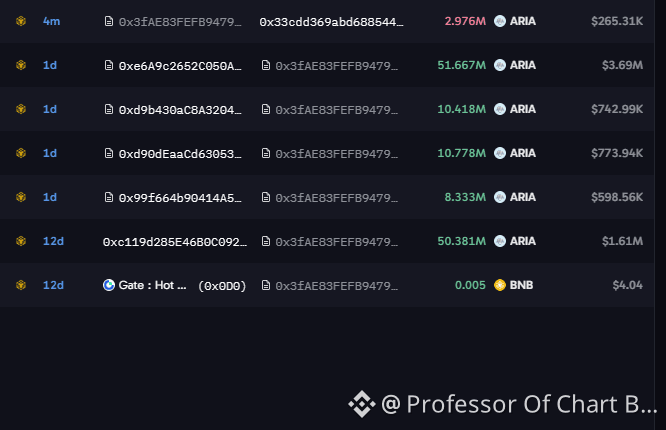
The main wallet holds 128.6M ARIA worth around $11.47M. After receiving large transfers from four wallets yesterday, it just sent 2.976M ARIA (~$265K) to a new wallet.
Here’s the interesting detail: the receiving wallet got 0.049 from Gate for gas just 24 minutes before the ARIA arrived.
That suggests the wallet may have been prepared in advance, but it doesn’t prove a sale is coming.
With ARIA pumping and millions of tokens moving between wallets, I’m watching whether more transfers follow especially toward exchanges.
#ARİA
$11.47M $ARIA WALLET MOVES AGAIN — FRESH WALLET FUNDED BY GATE
$ARIA is up around 20% today, and this wallet activity caught my attention.
The main wallet holds 128.6M ARIA worth around $11.47M. After receiving large transfers from four wallets yesterday, it just sent 2.976M ARIA (~$265K) to a new wallet.
Here’s the interesting detail: the receiving wallet got 0.049 from Gate for gas just 24 minutes before the ARIA arrived.
That suggests the wallet may have been prepared in advance, but it doesn’t prove a sale is coming.
With ARIA pumping and millions of tokens moving between wallets, I’m watching whether more transfers follow especially toward exchanges.
#ARİA
$ARIA is up around 20% today, and this wallet activity caught my attention.
The main wallet holds 128.6M ARIA worth around $11.47M. After receiving large transfers from four wallets yesterday, it just sent 2.976M ARIA (~$265K) to a new wallet.
Here’s the interesting detail: the receiving wallet got 0.049 from Gate for gas just 24 minutes before the ARIA arrived.
That suggests the wallet may have been prepared in advance, but it doesn’t prove a sale is coming.
With ARIA pumping and millions of tokens moving between wallets, I’m watching whether more transfers follow especially toward exchanges.
#ARİA
2
1k
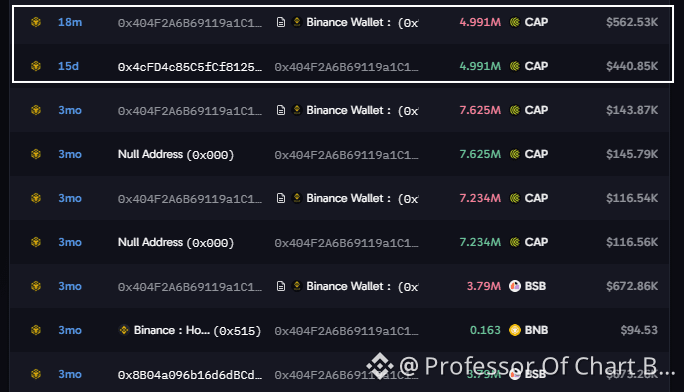
A $CAP whale just moved 4.991M tokens worth around $562K to a Binance-labeled wallet.
The interesting part? The same amount moved in the opposite direction 15 days ago, when it was worth around $441K.
That's about $122K more in value now, but that doesn't automatically mean the whale made a $122K profit.
Three months ago, this wallet also received millions of $CAP from the null address before sending similar amounts to Binance.
Is this profit-taking or just another wallet reshuffle? No confirmed sale yet, but I'm keeping this wallet on my watchlist.
#CAP
A $CAP whale just moved 4.991M tokens worth around $562K to a Binance-labeled wallet.
The interesting part? The same amount moved in the opposite direction 15 days ago, when it was worth around $441K.
That's about $122K more in value now, but that doesn't automatically mean the whale made a $122K profit.
Three months ago, this wallet also received millions of $CAP from the null address before sending similar amounts to Binance.
Is this profit-taking or just another wallet reshuffle? No confirmed sale yet, but I'm keeping this wallet on my watchlist.
#CAP
The interesting part? The same amount moved in the opposite direction 15 days ago, when it was worth around $441K.
That's about $122K more in value now, but that doesn't automatically mean the whale made a $122K profit.
Three months ago, this wallet also received millions of $CAP from the null address before sending similar amounts to Binance.
Is this profit-taking or just another wallet reshuffle? No confirmed sale yet, but I'm keeping this wallet on my watchlist.
#CAP
1.2k
$5.6M $JCT TRANSFER — EXCHANGE FLOWS ARE GETTING INTERESTING
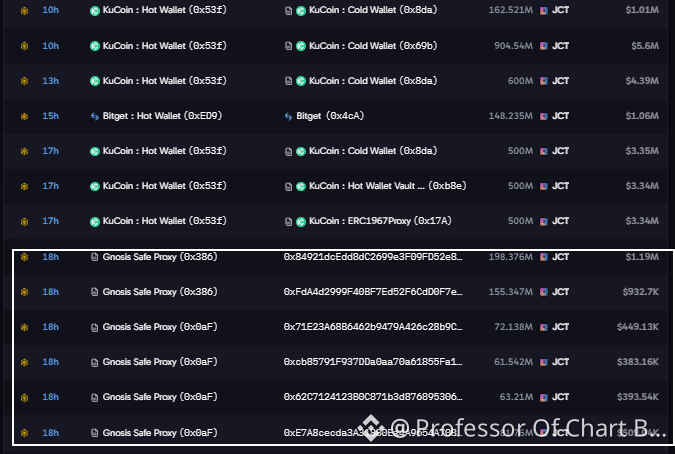
Hundreds of millions of $JCT tokens are moving between KuCoin wallets, while Gnosis Safe addresses are sending large amounts to multiple wallets.
One transfer alone involved 904.5M JCT worth around $5.6M, according to the tracker.
With JCT rallying hard recently and more unlocks approaching, these movements deserve attention.
But here’s the key distinction: exchange wallet transfers can be internal reshuffling, not necessarily selling.
I’m watching where this supply goes next especially whether it reaches deposit addresses and turns into actual sell pressure.
#JCT
$5.6M $JCT TRANSFER — EXCHANGE FLOWS ARE GETTING INTERESTING
Hundreds of millions of $JCT tokens are moving between KuCoin wallets, while Gnosis Safe addresses are sending large amounts to multiple wallets.
One transfer alone involved 904.5M JCT worth around $5.6M, according to the tracker.
With JCT rallying hard recently and more unlocks approaching, these movements deserve attention.
But here’s the key distinction: exchange wallet transfers can be internal reshuffling, not necessarily selling.
I’m watching where this supply goes next especially whether it reaches deposit addresses and turns into actual sell pressure.
#JCT
Hundreds of millions of $JCT tokens are moving between KuCoin wallets, while Gnosis Safe addresses are sending large amounts to multiple wallets.
One transfer alone involved 904.5M JCT worth around $5.6M, according to the tracker.
With JCT rallying hard recently and more unlocks approaching, these movements deserve attention.
But here’s the key distinction: exchange wallet transfers can be internal reshuffling, not necessarily selling.
I’m watching where this supply goes next especially whether it reaches deposit addresses and turns into actual sell pressure.
#JCT
750
3X PUMP THE $ORDER WALLET FINALLY MOVED ITS BAG
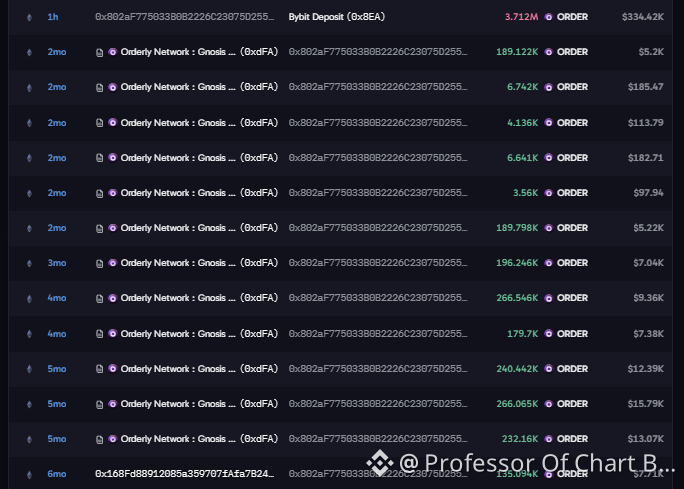
This wallet received $ORDER from Orderly every month and held through 9 months of price action, even as the token crashed.
Today, after ORDER pumped roughly 3x, it sent its entire 3.71M ORDER position worth around $334K to Bybit.
But here’s the detail that makes this worth tracking: it used the same Bybit deposit address a year ago to send 4M ORDER worth approximately $1.19M.
The wallet has a history with this exchange, and the timing of today’s transfer stands out after the rally.
A deposit doesn’t confirm the tokens were sold, but this is definitely a wallet movement worth watching.
#Order #ORDERUSDT
3X PUMP THE $ORDER WALLET FINALLY MOVED ITS BAG
This wallet received $ORDER from Orderly every month and held through 9 months of price action, even as the token crashed.
Today, after ORDER pumped roughly 3x, it sent its entire 3.71M ORDER position worth around $334K to Bybit.
But here’s the detail that makes this worth tracking: it used the same Bybit deposit address a year ago to send 4M ORDER worth approximately $1.19M.
The wallet has a history with this exchange, and the timing of today’s transfer stands out after the rally.
A deposit doesn’t confirm the tokens were sold, but this is definitely a wallet movement worth watching.
#Order #ORDERUSDT
This wallet received $ORDER from Orderly every month and held through 9 months of price action, even as the token crashed.
Today, after ORDER pumped roughly 3x, it sent its entire 3.71M ORDER position worth around $334K to Bybit.
But here’s the detail that makes this worth tracking: it used the same Bybit deposit address a year ago to send 4M ORDER worth approximately $1.19M.
The wallet has a history with this exchange, and the timing of today’s transfer stands out after the rally.
A deposit doesn’t confirm the tokens were sold, but this is definitely a wallet movement worth watching.
#Order #ORDERUSDT
2.5k
Partly True
$10.3M IN $IRYS MOVED TO FRESH WALLETS — UNLOCK TOMORROW
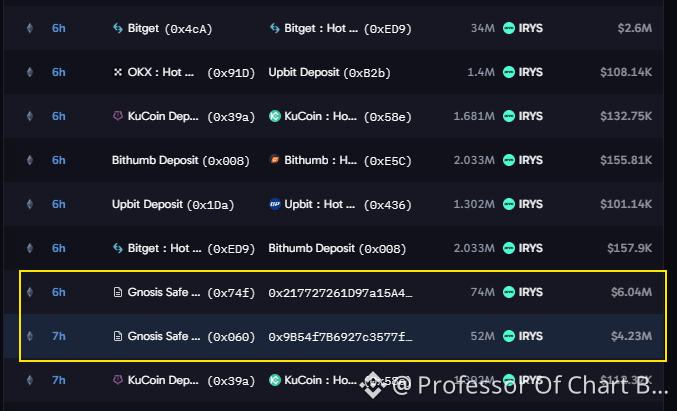
Two multisigs sent 126M $IRYS worth around $10.3M to two brand-new wallets last night.
Here’s the detail that caught my attention: both wallets received gas from a Gate-linked account roughly 3 hours before the tokens arrived. That suggests the wallets were prepared in advance.
Neither wallet has moved a single token yet, but both have gas and are ready to make a move.
The timing is what makes this interesting. IRYS had just surged around 570% in a single day, and another 77.6M tokens unlock tomorrow.
Are these wallets preparing for distribution, or is there another plan? We can’t know from transfers alone.
126M tokens sitting untouched. A major unlock ahead. This is one I’m watching closely.
#Irys
$10.3M IN $IRYS MOVED TO FRESH WALLETS — UNLOCK TOMORROW
Two multisigs sent 126M $IRYS worth around $10.3M to two brand-new wallets last night.
Here’s the detail that caught my attention: both wallets received gas from a Gate-linked account roughly 3 hours before the tokens arrived. That suggests the wallets were prepared in advance.
Neither wallet has moved a single token yet, but both have gas and are ready to make a move.
The timing is what makes this interesting. IRYS had just surged around 570% in a single day, and another 77.6M tokens unlock tomorrow.
Are these wallets preparing for distribution, or is there another plan? We can’t know from transfers alone.
126M tokens sitting untouched. A major unlock ahead. This is one I’m watching closely.
#Irys
Two multisigs sent 126M $IRYS worth around $10.3M to two brand-new wallets last night.
Here’s the detail that caught my attention: both wallets received gas from a Gate-linked account roughly 3 hours before the tokens arrived. That suggests the wallets were prepared in advance.
Neither wallet has moved a single token yet, but both have gas and are ready to make a move.
The timing is what makes this interesting. IRYS had just surged around 570% in a single day, and another 77.6M tokens unlock tomorrow.
Are these wallets preparing for distribution, or is there another plan? We can’t know from transfers alone.
126M tokens sitting untouched. A major unlock ahead. This is one I’m watching closely.
#Irys
3
2
787
$10M $BTW TRANSFER + EXTREME NEGATIVE FUNDING — SHORTS ARE PAYING UP
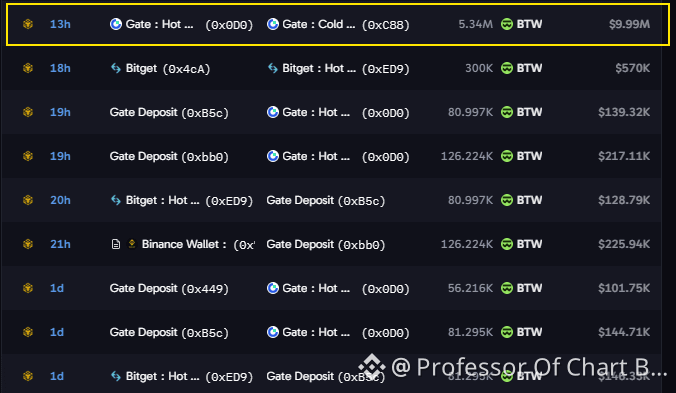
13 hours ago, 5.34M $BTW worth around $9.99M moved from Gate’s hot wallet to its cold wallet.
But the derivatives data makes this even more interesting.
BTW is trading around $1.755, with open interest at $36.6M.
Funding is deeply negative at -1.251% per 4 hours, meaning shorts are paying longs. Around 58% of accounts are short, while futures volume is 13x spot volume.
Meanwhile, Gate deposit wallets and Bitget-related wallets have continued moving tokens around.
Here’s the setup: if price pushes higher while funding stays deeply negative, crowded shorts could face pressure. But if momentum fades, leverage can unwind quickly.
Exchange flows, extreme funding, and a heavily short-skewed market BTW is worth watching closely.
A hot-to-cold transfer doesn’t confirm selling, and account ratios don’t necessarily reflect position size.
#BTW
$10M $BTW TRANSFER + EXTREME NEGATIVE FUNDING — SHORTS ARE PAYING UP
13 hours ago, 5.34M $BTW worth around $9.99M moved from Gate’s hot wallet to its cold wallet.
But the derivatives data makes this even more interesting.
BTW is trading around $1.755, with open interest at $36.6M.
Funding is deeply negative at -1.251% per 4 hours, meaning shorts are paying longs. Around 58% of accounts are short, while futures volume is 13x spot volume.
Meanwhile, Gate deposit wallets and Bitget-related wallets have continued moving tokens around.
Here’s the setup: if price pushes higher while funding stays deeply negative, crowded shorts could face pressure. But if momentum fades, leverage can unwind quickly.
Exchange flows, extreme funding, and a heavily short-skewed market BTW is worth watching closely.
A hot-to-cold transfer doesn’t confirm selling, and account ratios don’t necessarily reflect position size.
#BTW
13 hours ago, 5.34M $BTW worth around $9.99M moved from Gate’s hot wallet to its cold wallet.
But the derivatives data makes this even more interesting.
BTW is trading around $1.755, with open interest at $36.6M.
Funding is deeply negative at -1.251% per 4 hours, meaning shorts are paying longs. Around 58% of accounts are short, while futures volume is 13x spot volume.
Meanwhile, Gate deposit wallets and Bitget-related wallets have continued moving tokens around.
Here’s the setup: if price pushes higher while funding stays deeply negative, crowded shorts could face pressure. But if momentum fades, leverage can unwind quickly.
Exchange flows, extreme funding, and a heavily short-skewed market BTW is worth watching closely.
A hot-to-cold transfer doesn’t confirm selling, and account ratios don’t necessarily reflect position size.
#BTW
805
$BIRB IS UP 55% — AND 119.6M TOKENS ARE STILL SITTING IN A MULTISIG
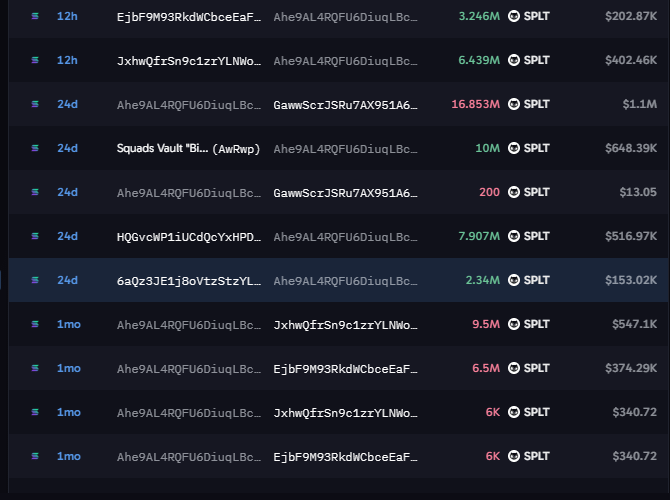
A Squads multisig named “Birb Holdings” holds 119.6M $BIRB , worth around $11.9M. That’s roughly 12% of total supply and 42% of circulating supply.
24 days ago, it sent 10M tokens to another wallet, which split them between two helper wallets.
Then, 12 hours ago, both helpers sent around 9.7M $BIRB back to the original wallet.
During this period, price climbed from roughly $0.0625 to $0.097 — a 55% move.
the main wallet now holds 13.57M tokens, while the multisig still holds 119.6M. Neither has sold, based on the activity tracked so far.
The transfers show tokens moving between related wallets, but they don’t confirm what comes next.
#BIRB
$BIRB IS UP 55% — AND 119.6M TOKENS ARE STILL SITTING IN A MULTISIG
A Squads multisig named “Birb Holdings” holds 119.6M $BIRB , worth around $11.9M. That’s roughly 12% of total supply and 42% of circulating supply.
24 days ago, it sent 10M tokens to another wallet, which split them between two helper wallets.
Then, 12 hours ago, both helpers sent around 9.7M $BIRB back to the original wallet.
During this period, price climbed from roughly $0.0625 to $0.097 — a 55% move.
the main wallet now holds 13.57M tokens, while the multisig still holds 119.6M. Neither has sold, based on the activity tracked so far.
The transfers show tokens moving between related wallets, but they don’t confirm what comes next.
#BIRB
A Squads multisig named “Birb Holdings” holds 119.6M $BIRB , worth around $11.9M. That’s roughly 12% of total supply and 42% of circulating supply.
24 days ago, it sent 10M tokens to another wallet, which split them between two helper wallets.
Then, 12 hours ago, both helpers sent around 9.7M $BIRB back to the original wallet.
During this period, price climbed from roughly $0.0625 to $0.097 — a 55% move.
the main wallet now holds 13.57M tokens, while the multisig still holds 119.6M. Neither has sold, based on the activity tracked so far.
The transfers show tokens moving between related wallets, but they don’t confirm what comes next.
#BIRB
414
$IRYS IS STILL PUMPING BUT EXCHANGE INFLOWS ARE GETTING INTERESTING
My scanner flagged $IRYS 8 hours ago: +14% in one hour, with open interest up 21%.
Then leverage kept piling in. OI jumped from $19.2M to $31M in just 3 hours.
And the move hasn’t stopped. Price just ran from roughly $0.066 to $0.080 in 22 minutes.
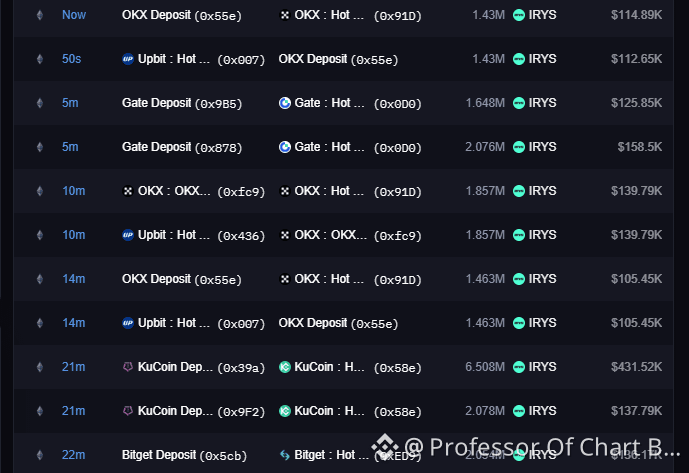
But look at the flows. Around 14M IRYS moved into KuCoin, Gate, and Bitget while price was pumping. Another 4.75M IRYS moved from Upbit to OKX in three transfers.
That’s the part I’m watching. Exchange deposits can mean potential selling pressure, but transfers alone don’t confirm a sell
Price is climbing. OI is expanding. Tokens are moving onto exchanges.
#Irys
$IRYS IS STILL PUMPING BUT EXCHANGE INFLOWS ARE GETTING INTERESTING
My scanner flagged $IRYS 8 hours ago: +14% in one hour, with open interest up 21%.
Then leverage kept piling in. OI jumped from $19.2M to $31M in just 3 hours.
And the move hasn’t stopped. Price just ran from roughly $0.066 to $0.080 in 22 minutes.
But look at the flows. Around 14M IRYS moved into KuCoin, Gate, and Bitget while price was pumping. Another 4.75M IRYS moved from Upbit to OKX in three transfers.
That’s the part I’m watching. Exchange deposits can mean potential selling pressure, but transfers alone don’t confirm a sell
Price is climbing. OI is expanding. Tokens are moving onto exchanges.
#Irys
My scanner flagged $IRYS 8 hours ago: +14% in one hour, with open interest up 21%.
Then leverage kept piling in. OI jumped from $19.2M to $31M in just 3 hours.
And the move hasn’t stopped. Price just ran from roughly $0.066 to $0.080 in 22 minutes.
But look at the flows. Around 14M IRYS moved into KuCoin, Gate, and Bitget while price was pumping. Another 4.75M IRYS moved from Upbit to OKX in three transfers.
That’s the part I’m watching. Exchange deposits can mean potential selling pressure, but transfers alone don’t confirm a sell
Price is climbing. OI is expanding. Tokens are moving onto exchanges.
#Irys
1
778
$IRYS +119% — SHORT SQUEEZE OR LEVERAGED TOP?
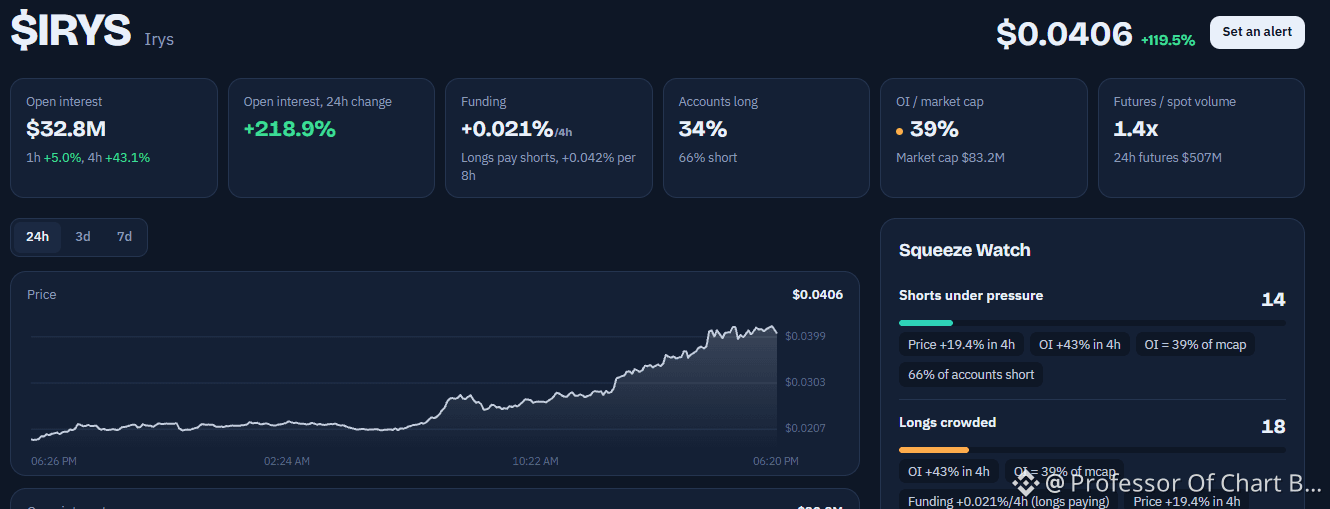
$IRYS is trading around $0.0406, up 119%, and the derivatives setup is getting wild.
66% of accounts are reportedly short, while open interest has surged 218% to $32.8M roughly 39% of market cap.
Meanwhile, over 40M IRYS tokens moved across Upbit, OKX, and KuCoin hot wallets, reportedly starting around $0.021. But exchange wallet movements alone don’t confirm fresh buying or coordinated preparation.
if spot demand keeps pushing higher, crowded shorts could face liquidations and fuel another leg up.
But there’s a flip side. When OI climbs this fast, leverage can amplify the downside just as quickly if momentum fades.
IRYS has squeeze potential, but the next move depends on actual buying pressure and whether shorts start getting forced out.
#Irys
$IRYS +119% — SHORT SQUEEZE OR LEVERAGED TOP?
$IRYS is trading around $0.0406, up 119%, and the derivatives setup is getting wild.
66% of accounts are reportedly short, while open interest has surged 218% to $32.8M roughly 39% of market cap.
Meanwhile, over 40M IRYS tokens moved across Upbit, OKX, and KuCoin hot wallets, reportedly starting around $0.021. But exchange wallet movements alone don’t confirm fresh buying or coordinated preparation.
if spot demand keeps pushing higher, crowded shorts could face liquidations and fuel another leg up.
But there’s a flip side. When OI climbs this fast, leverage can amplify the downside just as quickly if momentum fades.
IRYS has squeeze potential, but the next move depends on actual buying pressure and whether shorts start getting forced out.
#Irys
$IRYS is trading around $0.0406, up 119%, and the derivatives setup is getting wild.
66% of accounts are reportedly short, while open interest has surged 218% to $32.8M roughly 39% of market cap.
Meanwhile, over 40M IRYS tokens moved across Upbit, OKX, and KuCoin hot wallets, reportedly starting around $0.021. But exchange wallet movements alone don’t confirm fresh buying or coordinated preparation.
if spot demand keeps pushing higher, crowded shorts could face liquidations and fuel another leg up.
But there’s a flip side. When OI climbs this fast, leverage can amplify the downside just as quickly if momentum fades.
IRYS has squeeze potential, but the next move depends on actual buying pressure and whether shorts start getting forced out.
#Irys
416
the $AKE unlock everyone talked about on oct 21? the tokens only just reached the investors
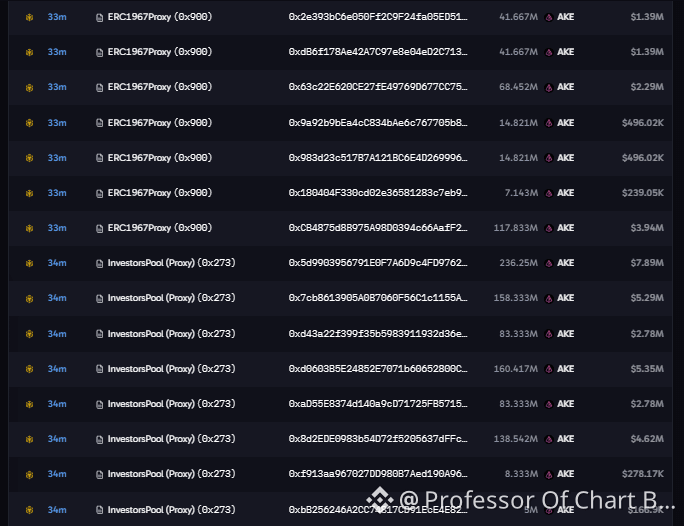
34 minutes ago an “InvestorsPool” contract sent ~994M $AKE (~$33M) to 11 wallets.
that’s almost exactly the investor share of that unlock
another contract sent ~306M (~$10M) to 7 more wallets at the same time
~1.3B AKE (~$43M) now sitting in 18 wallets that can sell whenever they want. ~5.7% of circulating
after the last 2 unlocks AKE dropped 22% and 49% the following week. watching these wallets
#AKEUSDT
the $AKE unlock everyone talked about on oct 21? the tokens only just reached the investors
34 minutes ago an “InvestorsPool” contract sent ~994M $AKE (~$33M) to 11 wallets.
that’s almost exactly the investor share of that unlock
another contract sent ~306M (~$10M) to 7 more wallets at the same time
~1.3B AKE (~$43M) now sitting in 18 wallets that can sell whenever they want. ~5.7% of circulating
after the last 2 unlocks AKE dropped 22% and 49% the following week. watching these wallets
#AKEUSDT
34 minutes ago an “InvestorsPool” contract sent ~994M $AKE (~$33M) to 11 wallets.
that’s almost exactly the investor share of that unlock
another contract sent ~306M (~$10M) to 7 more wallets at the same time
~1.3B AKE (~$43M) now sitting in 18 wallets that can sell whenever they want. ~5.7% of circulating
after the last 2 unlocks AKE dropped 22% and 49% the following week. watching these wallets
#AKEUSDT
1
2
1.9k
Partly True
$62M UNLOCKED — WHY IS $AKE UP 33% INSTEAD?
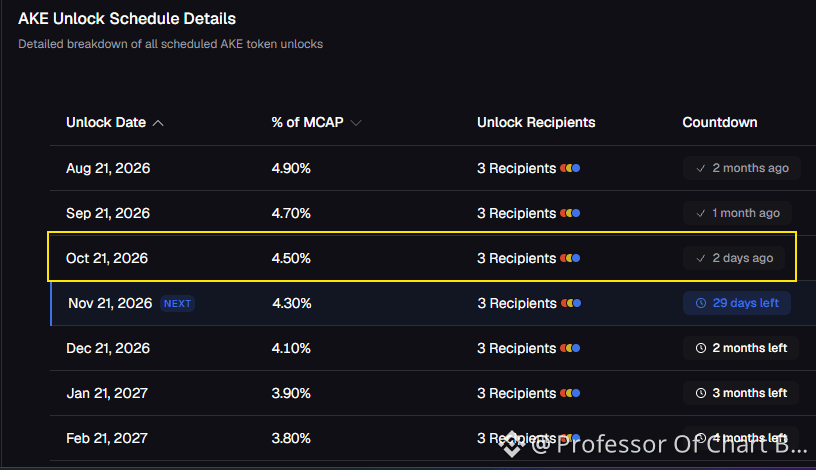
$AKE unlocked around $62M worth of tokens two days ago roughly 9% of its circulating supply.
The last two unlocks were followed by drops of 22% and 49% over the next week.
This time, price dipped to around $0.021 before bouncing straight back to $0.031, up 33% on the day.
But here’s the catch: futures volume is roughly 93x spot volume.
That means leverage is dominating activity. The bounce looks strong, but it doesn’t necessarily mean genuine spot demand is driving it.
With the unlock fresh and leverage this high, I’m watching whether buyers can sustain the move or if volatility hits again.
Strong bounce, heavy leverage. ake still has something to prove.
#AKE
$62M UNLOCKED — WHY IS $AKE UP 33% INSTEAD?
$AKE unlocked around $62M worth of tokens two days ago roughly 9% of its circulating supply.
The last two unlocks were followed by drops of 22% and 49% over the next week.
This time, price dipped to around $0.021 before bouncing straight back to $0.031, up 33% on the day.
But here’s the catch: futures volume is roughly 93x spot volume.
That means leverage is dominating activity. The bounce looks strong, but it doesn’t necessarily mean genuine spot demand is driving it.
With the unlock fresh and leverage this high, I’m watching whether buyers can sustain the move or if volatility hits again.
Strong bounce, heavy leverage. ake still has something to prove.
#AKE
$AKE unlocked around $62M worth of tokens two days ago roughly 9% of its circulating supply.
The last two unlocks were followed by drops of 22% and 49% over the next week.
This time, price dipped to around $0.021 before bouncing straight back to $0.031, up 33% on the day.
But here’s the catch: futures volume is roughly 93x spot volume.
That means leverage is dominating activity. The bounce looks strong, but it doesn’t necessarily mean genuine spot demand is driving it.
With the unlock fresh and leverage this high, I’m watching whether buyers can sustain the move or if volatility hits again.
Strong bounce, heavy leverage. ake still has something to prove.
#AKE
833
$MAGMA LIQUIDATION MAP: SHORTS ARE NOW IN FOCUS
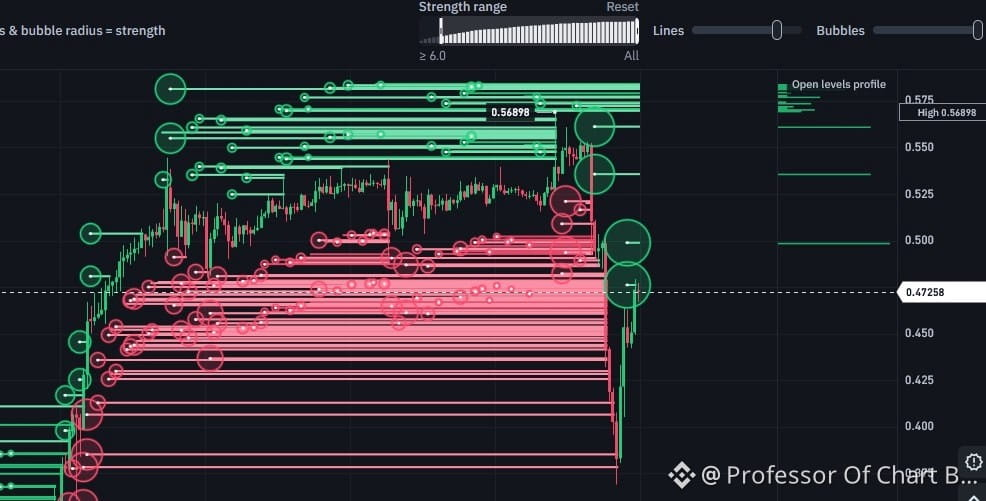
The drop to $0.37 wiped out most of the long liquidation clusters. Now the bigger liquidity zones sit above price.
$MAGMA ’s nearest short liquidation zone is around $0.48–$0.50, with the largest cluster near $0.55–$0.58.
On the downside, the main long liquidation cluster left is around $0.36.
If price moves, these levels could become important but liquidation zones aren’t price targets, and they don’t guarantee a squeeze.
Not a trade call. Just watching the map.
#MAGMAUSDT
$MAGMA LIQUIDATION MAP: SHORTS ARE NOW IN FOCUS
The drop to $0.37 wiped out most of the long liquidation clusters. Now the bigger liquidity zones sit above price.
$MAGMA ’s nearest short liquidation zone is around $0.48–$0.50, with the largest cluster near $0.55–$0.58.
On the downside, the main long liquidation cluster left is around $0.36.
If price moves, these levels could become important but liquidation zones aren’t price targets, and they don’t guarantee a squeeze.
Not a trade call. Just watching the map.
#MAGMAUSDT
The drop to $0.37 wiped out most of the long liquidation clusters. Now the bigger liquidity zones sit above price.
$MAGMA ’s nearest short liquidation zone is around $0.48–$0.50, with the largest cluster near $0.55–$0.58.
On the downside, the main long liquidation cluster left is around $0.36.
If price moves, these levels could become important but liquidation zones aren’t price targets, and they don’t guarantee a squeeze.
Not a trade call. Just watching the map.
#MAGMAUSDT
586
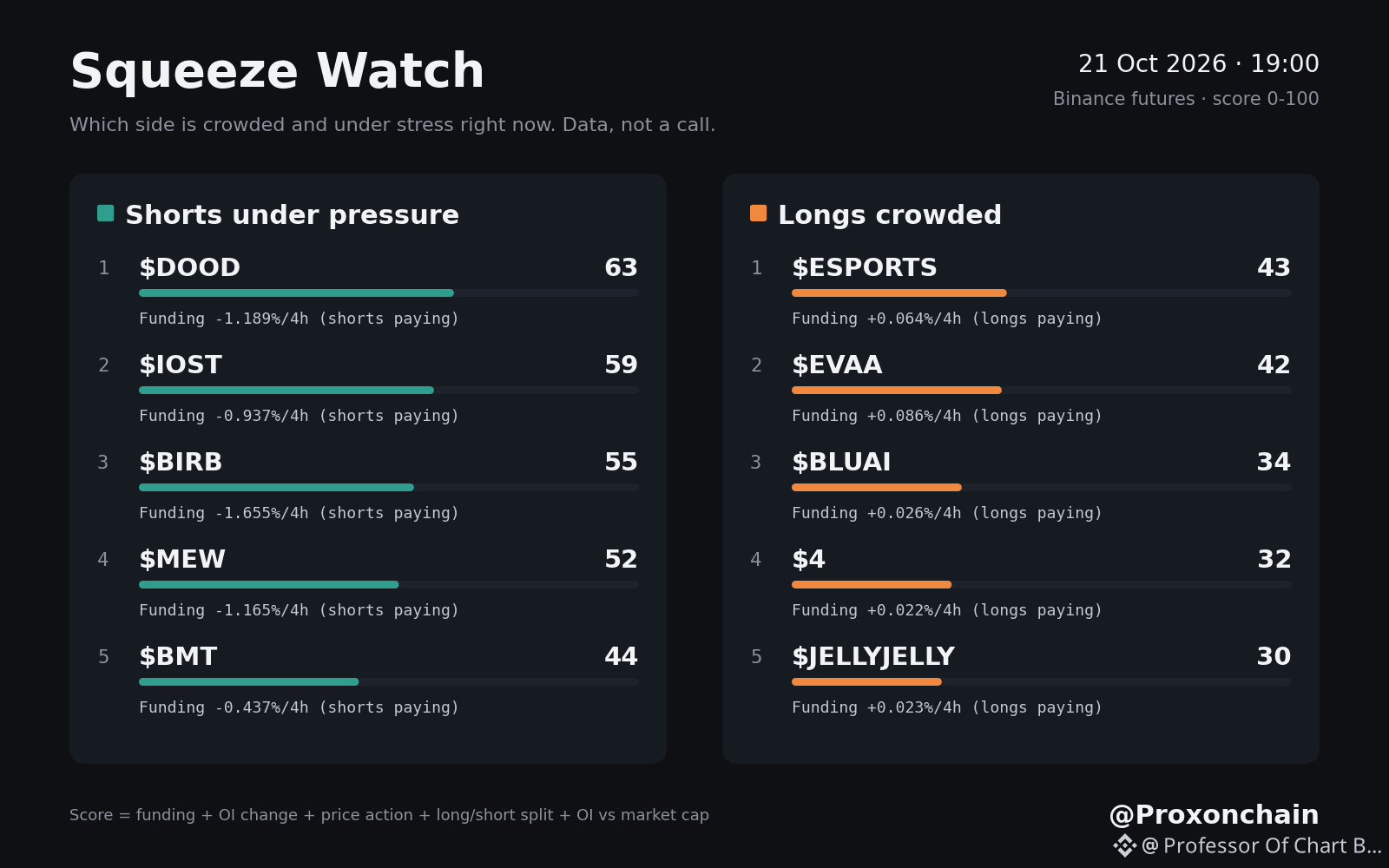
shorts on some of these are paying insane fees right now
$BIRB shorts pay ~1.65% every 4h. that’s almost 10% a day just to hold the position
$DOOD and $MEW ~7% a day. $IOST ~5.6%
the long side is crowded too but way calmer. ESPORTS and EVAA longs pay ~0.5% a day
shorts can’t sit on 10% a day for long. either price drops fast, or they get forced out and it squeezes up
not a call. just showing who’s under the most pressure right now
#BIRB #DOOD
shorts on some of these are paying insane fees right now
$BIRB shorts pay ~1.65% every 4h. that’s almost 10% a day just to hold the position
$DOOD and $MEW ~7% a day. $IOST ~5.6%
the long side is crowded too but way calmer. ESPORTS and EVAA longs pay ~0.5% a day
shorts can’t sit on 10% a day for long. either price drops fast, or they get forced out and it squeezes up
not a call. just showing who’s under the most pressure right now
#BIRB #DOOD
$BIRB shorts pay ~1.65% every 4h. that’s almost 10% a day just to hold the position
$DOOD and $MEW ~7% a day. $IOST ~5.6%
the long side is crowded too but way calmer. ESPORTS and EVAA longs pay ~0.5% a day
shorts can’t sit on 10% a day for long. either price drops fast, or they get forced out and it squeezes up
not a call. just showing who’s under the most pressure right now
#BIRB #DOOD
1.5k
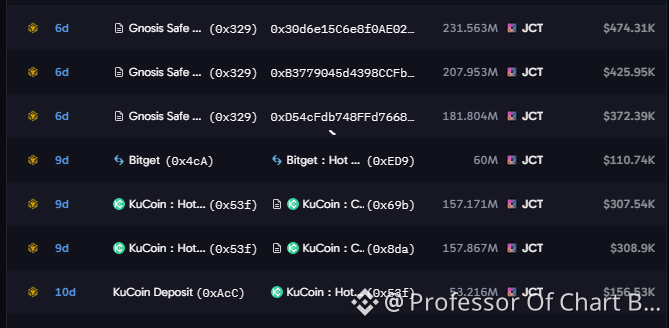
$12.5M IN $JCT 14 FRESH WALLETS, ZERO TOKENS SOLD?
Over the last 6 days, 2.79B $JCT moved from just 3 multisigs into 14 fresh wallets — worth around $5.6M at the time.
Then $JCT more than doubled. That same supply is now worth roughly $12.5M.
I checked one wallet holding 231.6M tokens. Not a single token has been sold.
But here’s the detail that caught my attention: the wallet received gas from a Gate-linked account 3 days before the tokens arrived.
That suggests the wallet was prepared in advance. And with the funds still sitting there, they could move at any time.
14 wallets. $12.5M in unrealized value. No tokens sold so far.
#JCT
$12.5M IN $JCT 14 FRESH WALLETS, ZERO TOKENS SOLD?
Over the last 6 days, 2.79B $JCT moved from just 3 multisigs into 14 fresh wallets — worth around $5.6M at the time.
Then $JCT more than doubled. That same supply is now worth roughly $12.5M.
I checked one wallet holding 231.6M tokens. Not a single token has been sold.
But here’s the detail that caught my attention: the wallet received gas from a Gate-linked account 3 days before the tokens arrived.
That suggests the wallet was prepared in advance. And with the funds still sitting there, they could move at any time.
14 wallets. $12.5M in unrealized value. No tokens sold so far.
#JCT
Over the last 6 days, 2.79B $JCT moved from just 3 multisigs into 14 fresh wallets — worth around $5.6M at the time.
Then $JCT more than doubled. That same supply is now worth roughly $12.5M.
I checked one wallet holding 231.6M tokens. Not a single token has been sold.
But here’s the detail that caught my attention: the wallet received gas from a Gate-linked account 3 days before the tokens arrived.
That suggests the wallet was prepared in advance. And with the funds still sitting there, they could move at any time.
14 wallets. $12.5M in unrealized value. No tokens sold so far.
#JCT
1
1.3k
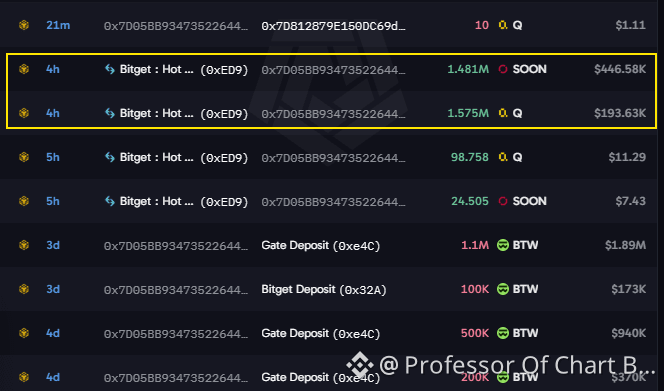
$640K ROTATION THE WHALE BEHIND THE $BTW EXIT IS BUYING $SOON & $Q
Remember the wallet that sent around $3.4M worth of BTW to exchanges just days before the token topped? Its next moves are getting interesting.
Four hours ago, the wallet withdrew 1.48M SOON worth around $447K and 1.58M Q worth around $194K from Bitget, using test transfers before moving the full amounts.
That’s roughly $640K moved into two positions, with SOON now reportedly its largest holding.
Then, 21 minutes ago, it sent 10 Q to a brand-new wallet — potentially another test transfer before a larger move, though that’s not confirmed.
The timing raises questions about whether this wallet is rotating capital after its BTW activity. But exchange withdrawals alone don’t prove a bullish position or predict the next move.
#BTW #q #Soon
$640K ROTATION THE WHALE BEHIND THE $BTW EXIT IS BUYING $SOON & $Q
Remember the wallet that sent around $3.4M worth of BTW to exchanges just days before the token topped? Its next moves are getting interesting.
Four hours ago, the wallet withdrew 1.48M SOON worth around $447K and 1.58M Q worth around $194K from Bitget, using test transfers before moving the full amounts.
That’s roughly $640K moved into two positions, with SOON now reportedly its largest holding.
Then, 21 minutes ago, it sent 10 Q to a brand-new wallet — potentially another test transfer before a larger move, though that’s not confirmed.
The timing raises questions about whether this wallet is rotating capital after its BTW activity. But exchange withdrawals alone don’t prove a bullish position or predict the next move.
#BTW #q #Soon
Remember the wallet that sent around $3.4M worth of BTW to exchanges just days before the token topped? Its next moves are getting interesting.
Four hours ago, the wallet withdrew 1.48M SOON worth around $447K and 1.58M Q worth around $194K from Bitget, using test transfers before moving the full amounts.
That’s roughly $640K moved into two positions, with SOON now reportedly its largest holding.
Then, 21 minutes ago, it sent 10 Q to a brand-new wallet — potentially another test transfer before a larger move, though that’s not confirmed.
The timing raises questions about whether this wallet is rotating capital after its BTW activity. But exchange withdrawals alone don’t prove a bullish position or predict the next move.
#BTW #q #Soon
1
1.1k
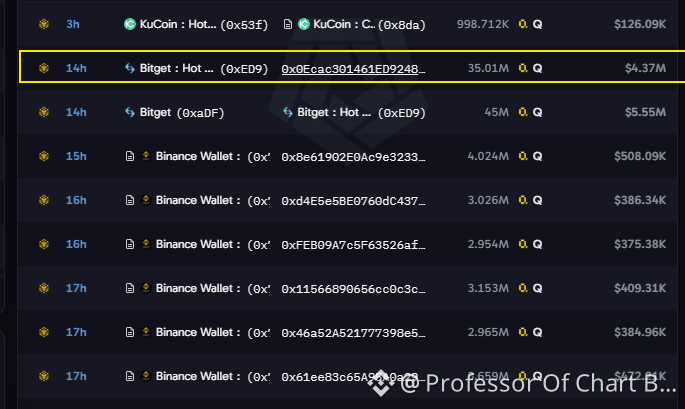
$4.4M INTO $Q — THIS WHALE IS ALREADY DOWN 10%
Someone withdrew 35M $Q worth around $4.4M from Bitget last night into a fresh wallet, buying around $0.125.
Now is Q trading near $0.112, putting that position at roughly $3.92M an estimated $480K unrealized loss if the wallet still holds the full amount.
The wallet holds nothing else and has no BNB for gas, so it currently can’t move the tokens on-chain without funding its gas balance.
Here’s the interesting part: on the same day, the whale I’ve been tracking sent 33M Q to Gate. One wallet withdrew heavily while another sent a huge amount toward an exchange.
After spiking near $0.21, Q is back near the lower end of its range.
#QUSDT
$4.4M INTO $Q — THIS WHALE IS ALREADY DOWN 10%
Someone withdrew 35M $Q worth around $4.4M from Bitget last night into a fresh wallet, buying around $0.125.
Now is Q trading near $0.112, putting that position at roughly $3.92M an estimated $480K unrealized loss if the wallet still holds the full amount.
The wallet holds nothing else and has no BNB for gas, so it currently can’t move the tokens on-chain without funding its gas balance.
Here’s the interesting part: on the same day, the whale I’ve been tracking sent 33M Q to Gate. One wallet withdrew heavily while another sent a huge amount toward an exchange.
After spiking near $0.21, Q is back near the lower end of its range.
#QUSDT
Someone withdrew 35M $Q worth around $4.4M from Bitget last night into a fresh wallet, buying around $0.125.
Now is Q trading near $0.112, putting that position at roughly $3.92M an estimated $480K unrealized loss if the wallet still holds the full amount.
The wallet holds nothing else and has no BNB for gas, so it currently can’t move the tokens on-chain without funding its gas balance.
Here’s the interesting part: on the same day, the whale I’ve been tracking sent 33M Q to Gate. One wallet withdrew heavily while another sent a huge amount toward an exchange.
After spiking near $0.21, Q is back near the lower end of its range.
#QUSDT
1
514
+$106K UNREALIZED — THE $BR WHALE STILL HASN’T SOLD
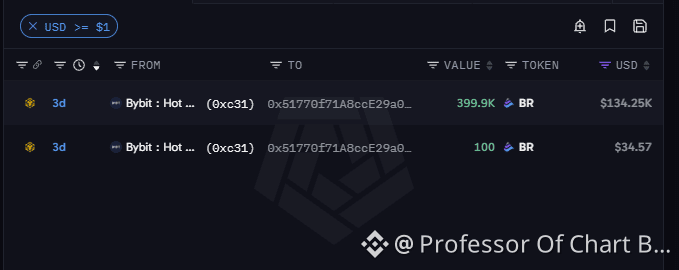
Remember the wallet that withdrew around 400K $BR from Bybit three days ago? It still hasn’t moved a single token.
The wallet pulled its position at roughly $0.34, putting the original value near $134K. With $BR now around $0.60, that same stack is worth approximately $240K an unrealized gain of about 79% based on the original entry.
What makes this interesting is the patience. Despite the price moving sharply higher, the wallet continues to hold.
#BRUSDT
+$106K UNREALIZED — THE $BR WHALE STILL HASN’T SOLD
Remember the wallet that withdrew around 400K $BR from Bybit three days ago? It still hasn’t moved a single token.
The wallet pulled its position at roughly $0.34, putting the original value near $134K. With $BR now around $0.60, that same stack is worth approximately $240K an unrealized gain of about 79% based on the original entry.
What makes this interesting is the patience. Despite the price moving sharply higher, the wallet continues to hold.
#BRUSDT
Remember the wallet that withdrew around 400K $BR from Bybit three days ago? It still hasn’t moved a single token.
The wallet pulled its position at roughly $0.34, putting the original value near $134K. With $BR now around $0.60, that same stack is worth approximately $240K an unrealized gain of about 79% based on the original entry.
What makes this interesting is the patience. Despite the price moving sharply higher, the wallet continues to hold.
#BRUSDT
2
657
$4.54M BUYING PATTERN — SOMEONE IS LOADING UP ON $Q
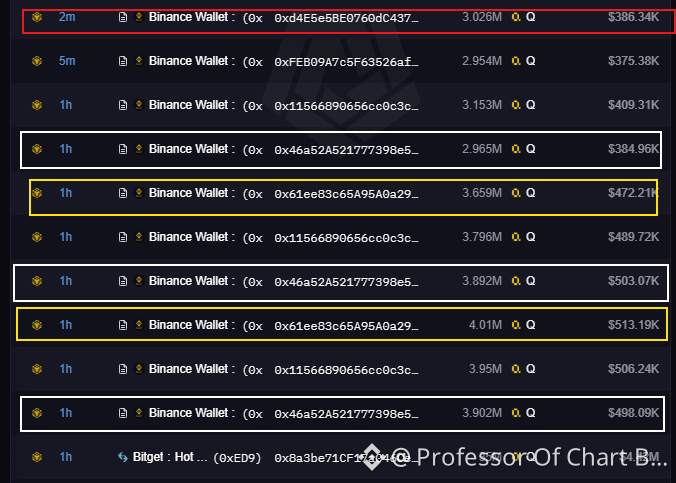
Around 35.3M $Q worth of $4.54M moved through a repeating buying pattern in roughly one hour.
The wallets are receiving $Q in 3–4M batches through Binance-linked flows, with tokens going to three addresses in the same rotation: Wallet A → Wallet B → Wallet C, then repeating again and again.
The reported buying range is around $0.127–$0.130, and two new wallets started receiving tokens in the last five minutes.
That repeated sequence makes the activity look coordinated. It could be one buyer or an automated system splitting a larger operation across multiple wallets, but wallet links alone don’t prove who controls them or why they’re split.
#QUSDT
$4.54M BUYING PATTERN — SOMEONE IS LOADING UP ON $Q
Around 35.3M $Q worth of $4.54M moved through a repeating buying pattern in roughly one hour.
The wallets are receiving $Q in 3–4M batches through Binance-linked flows, with tokens going to three addresses in the same rotation: Wallet A → Wallet B → Wallet C, then repeating again and again.
The reported buying range is around $0.127–$0.130, and two new wallets started receiving tokens in the last five minutes.
That repeated sequence makes the activity look coordinated. It could be one buyer or an automated system splitting a larger operation across multiple wallets, but wallet links alone don’t prove who controls them or why they’re split.
#QUSDT
Around 35.3M $Q worth of $4.54M moved through a repeating buying pattern in roughly one hour.
The wallets are receiving $Q in 3–4M batches through Binance-linked flows, with tokens going to three addresses in the same rotation: Wallet A → Wallet B → Wallet C, then repeating again and again.
The reported buying range is around $0.127–$0.130, and two new wallets started receiving tokens in the last five minutes.
That repeated sequence makes the activity look coordinated. It could be one buyer or an automated system splitting a larger operation across multiple wallets, but wallet links alone don’t prove who controls them or why they’re split.
#QUSDT
3
5
3.3k
$1.16M WHALE POSITION — IS THIS FRESH $BR ACCUMULATION?
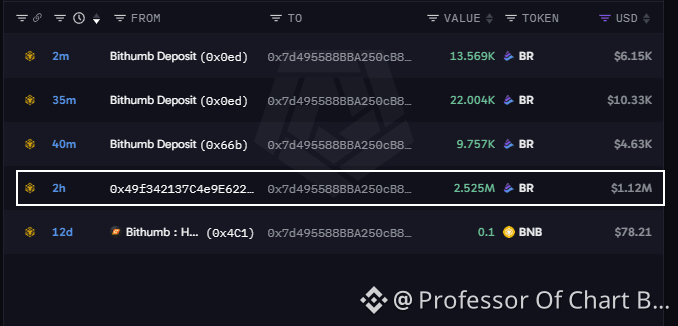
A fresh wallet is quietly building a sizeable $BR position, and the latest transfers caught my attention.
The wallet was funded with just 0.1 B from Bithumb 12 days ago.
Today, it received 2.525M BR worth around $1.12M from wallet 0x49f3, followed by another roughly 45K BR from Bithumb-linked addresses in just 40 minutes.
Its total balance now stands at 2.571M $BR, worth approximately $1.16M.
So far, no tokens have moved out. The wallet also has gas available, meaning it can move the tokens at any time.
This could be accumulation or wallet consolidation, so I’m not calling it a confirmed buy signal yet.
#BR
$1.16M WHALE POSITION — IS THIS FRESH $BR ACCUMULATION?
A fresh wallet is quietly building a sizeable $BR position, and the latest transfers caught my attention.
The wallet was funded with just 0.1 B from Bithumb 12 days ago.
Today, it received 2.525M BR worth around $1.12M from wallet 0x49f3, followed by another roughly 45K BR from Bithumb-linked addresses in just 40 minutes.
Its total balance now stands at 2.571M $BR , worth approximately $1.16M.
So far, no tokens have moved out. The wallet also has gas available, meaning it can move the tokens at any time.
This could be accumulation or wallet consolidation, so I’m not calling it a confirmed buy signal yet.
#BR
A fresh wallet is quietly building a sizeable $BR position, and the latest transfers caught my attention.
The wallet was funded with just 0.1 B from Bithumb 12 days ago.
Today, it received 2.525M BR worth around $1.12M from wallet 0x49f3, followed by another roughly 45K BR from Bithumb-linked addresses in just 40 minutes.
Its total balance now stands at 2.571M $BR , worth approximately $1.16M.
So far, no tokens have moved out. The wallet also has gas available, meaning it can move the tokens at any time.
This could be accumulation or wallet consolidation, so I’m not calling it a confirmed buy signal yet.
#BR
1
640
14M $Q SENT TO GATE THE ROTATION I CALLED 4 DAYS AGO MAY BE STARTING
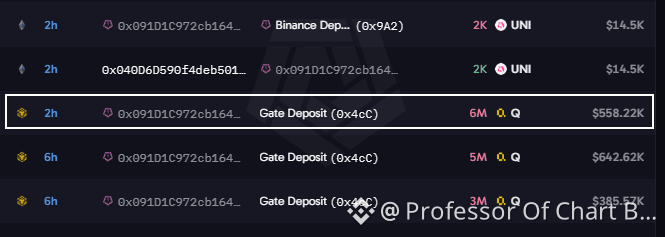
Four days ago, I said this “Cumberland DRW?” wallet could rotate out of $Q next. Today, it sent another 14M Q to Gate.
The transfers came in three batches: 3M and 5M tokens worth around $1.03M combined, followed by another 6M worth roughly $558K.
Here’s the bigger picture: the wallet previously withdrew 33M Q from Gate around $0.022–$0.049, while the recent deposits are happening around $0.09–$0.13.
It still holds around 19M Q worth $2.1M.
The pattern looks similar to its earlier $BTW activity: accumulation, price expansion, exchange deposits, then a possible rotation. That doesn’t prove the tokens were sold or confirm what comes next.
#QUSDT
14M $Q SENT TO GATE THE ROTATION I CALLED 4 DAYS AGO MAY BE STARTING
Four days ago, I said this “Cumberland DRW?” wallet could rotate out of $Q next. Today, it sent another 14M Q to Gate.
The transfers came in three batches: 3M and 5M tokens worth around $1.03M combined, followed by another 6M worth roughly $558K.
Here’s the bigger picture: the wallet previously withdrew 33M Q from Gate around $0.022–$0.049, while the recent deposits are happening around $0.09–$0.13.
It still holds around 19M Q worth $2.1M.
The pattern looks similar to its earlier $BTW activity: accumulation, price expansion, exchange deposits, then a possible rotation. That doesn’t prove the tokens were sold or confirm what comes next.
#QUSDT
Four days ago, I said this “Cumberland DRW?” wallet could rotate out of $Q next. Today, it sent another 14M Q to Gate.
The transfers came in three batches: 3M and 5M tokens worth around $1.03M combined, followed by another 6M worth roughly $558K.
Here’s the bigger picture: the wallet previously withdrew 33M Q from Gate around $0.022–$0.049, while the recent deposits are happening around $0.09–$0.13.
It still holds around 19M Q worth $2.1M.
The pattern looks similar to its earlier $BTW activity: accumulation, price expansion, exchange deposits, then a possible rotation. That doesn’t prove the tokens were sold or confirm what comes next.
#QUSDT
1k
Log in to explore more content
Join global crypto users on Binance Square
⚡️ Get latest and useful information about crypto.
💬 Trusted by the world’s largest crypto exchange.
👍 Discover real insights from verified creators.
Email / Phone number