

Sheemm
10k Posts

Sheemm
 Square Verified+
Report
Block User
Nothing to say🤗
High-Frequency Trader
5.6 Years
959 Following
47.5K+ Followers
48.1K+ Liked
Posts
All
Quotes
Live
PINNED
·
--
🎁🎁🎁🎁🎁🎁
GOOD EVENING 👋👋👋
LIKE REPOST COMMENT
AND CLAIM 🎁 🎁 🎁 🎁 🎁 🎁
$BNB
$T
$CHIP
🎁🎁🎁🎁🎁🎁
GOOD EVENING 👋👋👋
LIKE REPOST COMMENT
AND CLAIM 🎁 🎁 🎁 🎁 🎁 🎁
$BNB
$T
$CHIP
GOOD EVENING 👋👋👋
LIKE REPOST COMMENT
AND CLAIM 🎁 🎁 🎁 🎁 🎁 🎁
$BNB
$T
$CHIP
425
4
29
879
PINNED
·
--
Verified
AI agents don’t just need intelligence they need financial boundaries.
Right now, the key bottleneck in the agent economy isn’t capability; it’s trust. We can build autonomous models capable of executing complex multi-step workflows, but granting them unmonitored access to capital remains a massive structural risk. Web2 payment rails were built for human speeds and manual approvals, making them ill-suited for friction-free machine-to-machine transactions.
This is where Kite introduces a critical infrastructure layer.
By combining its EVM-compatible layer-1 architecture with features like the Agent Passport and controlled payment sessions, Kite bridges execution with granular safety parameters. Instead of handing an agent unlimited financial freedom, users can define strict operational sandboxes—such as hard spending limits, specific API call allowances, and auto-expiring session keys.
Raw intelligence alone cannot scale autonomous systems. For the agentic web to achieve mainstream adoption, it requires a complete foundation: verifiable identity, dedicated micropayment rails, scoped permissions, and on-chain accountability.
Would you trust an AI agent to handle payments for you under set spending caps?
#KiteBBW $KITE @GoKiteAI
AI agents don’t just need intelligence they need financial boundaries.
Right now, the key bottleneck in the agent economy isn’t capability; it’s trust. We can build autonomous models capable of executing complex multi-step workflows, but granting them unmonitored access to capital remains a massive structural risk. Web2 payment rails were built for human speeds and manual approvals, making them ill-suited for friction-free machine-to-machine transactions.
This is where Kite introduces a critical infrastructure layer.
By combining its EVM-compatible layer-1 architecture with features like the Agent Passport and controlled payment sessions, Kite bridges execution with granular safety parameters. Instead of handing an agent unlimited financial freedom, users can define strict operational sandboxes—such as hard spending limits, specific API call allowances, and auto-expiring session keys.
Raw intelligence alone cannot scale autonomous systems. For the agentic web to achieve mainstream adoption, it requires a complete foundation: verifiable identity, dedicated micropayment rails, scoped permissions, and on-chain accountability.
Would you trust an AI agent to handle payments for you under set spending caps?
#KiteBBW $KITE @KITE AI 中文
Right now, the key bottleneck in the agent economy isn’t capability; it’s trust. We can build autonomous models capable of executing complex multi-step workflows, but granting them unmonitored access to capital remains a massive structural risk. Web2 payment rails were built for human speeds and manual approvals, making them ill-suited for friction-free machine-to-machine transactions.
This is where Kite introduces a critical infrastructure layer.
By combining its EVM-compatible layer-1 architecture with features like the Agent Passport and controlled payment sessions, Kite bridges execution with granular safety parameters. Instead of handing an agent unlimited financial freedom, users can define strict operational sandboxes—such as hard spending limits, specific API call allowances, and auto-expiring session keys.
Raw intelligence alone cannot scale autonomous systems. For the agentic web to achieve mainstream adoption, it requires a complete foundation: verifiable identity, dedicated micropayment rails, scoped permissions, and on-chain accountability.
Would you trust an AI agent to handle payments for you under set spending caps?
#KiteBBW $KITE @KITE AI 中文


13
22
25
573
·
--
#ArgentineCourtDismissesLIBRACaseAgainstMilei ⚖️ Legal Victory for Argentina's President
An Argentine federal judge has officially dismissed the criminal investigation into President Javier Milei and his sister Karina regarding the $LIBRA token promotion.
The court ruled that the events surrounding the token's collapse did not constitute a criminal offense, finding no intent to deceive.
While critics initially alleged a rug pull, the ruling completely clears Milei of fraud charges, marking a huge moment for crypto regulation and political accountability in South America. 🇦🇷
$BNB
{future}(BNBUSDT)
#CryptoNews #ArgentinaElection #JavierMilei
#ArgentineCourtDismissesLIBRACaseAgainstMilei ⚖️ Legal Victory for Argentina's President
An Argentine federal judge has officially dismissed the criminal investigation into President Javier Milei and his sister Karina regarding the $LIBRA token promotion.
The court ruled that the events surrounding the token's collapse did not constitute a criminal offense, finding no intent to deceive.
While critics initially alleged a rug pull, the ruling completely clears Milei of fraud charges, marking a huge moment for crypto regulation and political accountability in South America. 🇦🇷
$BNB
#CryptoNews #ArgentinaElection #JavierMilei
An Argentine federal judge has officially dismissed the criminal investigation into President Javier Milei and his sister Karina regarding the $LIBRA token promotion.
The court ruled that the events surrounding the token's collapse did not constitute a criminal offense, finding no intent to deceive.
While critics initially alleged a rug pull, the ruling completely clears Milei of fraud charges, marking a huge moment for crypto regulation and political accountability in South America. 🇦🇷
$BNB
#CryptoNews #ArgentinaElection #JavierMilei

1
159
·
--
Bullish
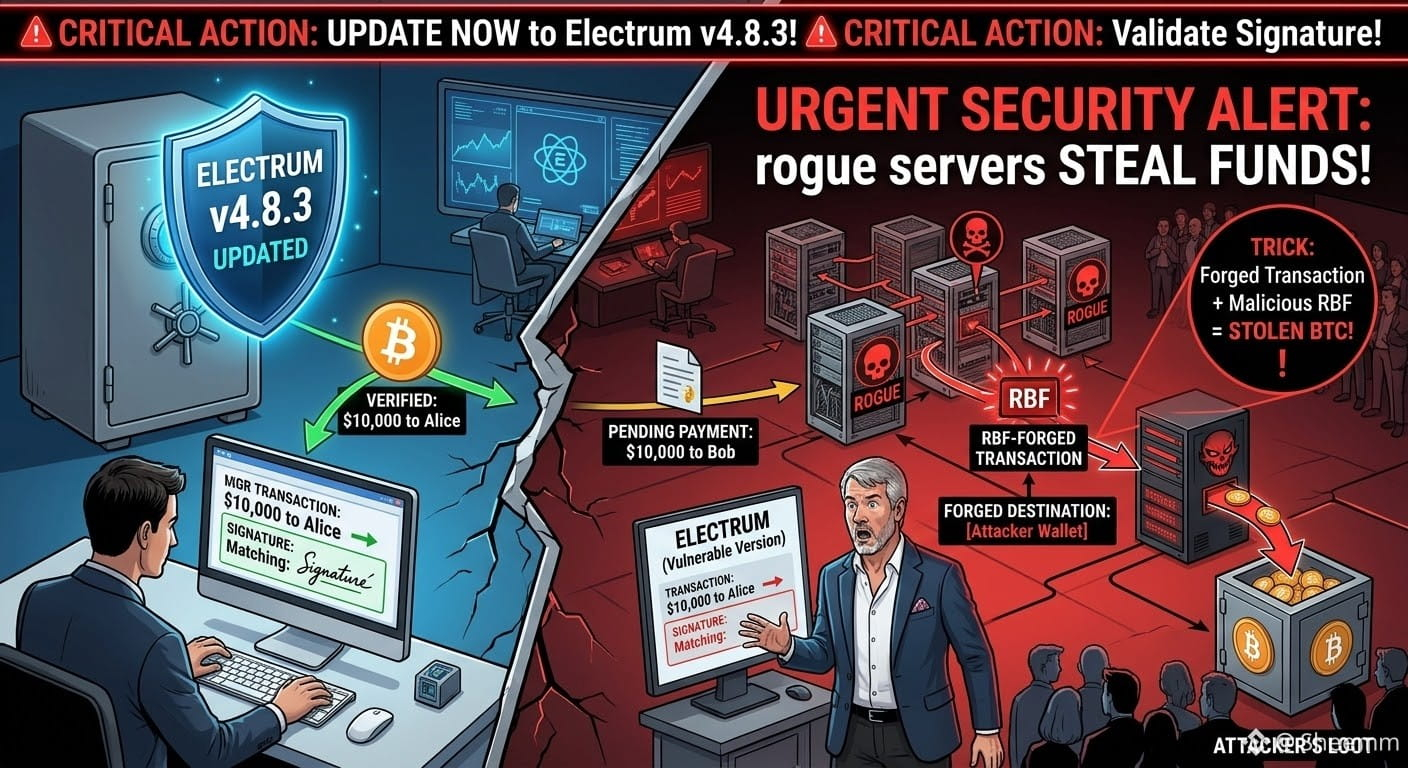
#ElectrumWalletBugLetRogueServersStealFunds
⚠️ Urgent Security Alert for Electrum Wallet Users!
A severe vulnerability in older Electrum versions allows rogue servers to exploit Replace-by-Fee (RBF) features. When users try to speed up a pending payment, malicious nodes can substitute forged transactions, tricking victims into authorizing payments to attackers.
⚡️ Action Required:
Update your app to v4.8.3 immediately! The patch adds critical signature validation to unconfirmed transactions. Double-check recipient addresses before broadcasting transactions!
$BNB
{future}(BNBUSDT)
#ElectrumWalletBugLetRogueServersStealFunds #CryptoSecurity #Electrum
#ElectrumWalletBugLetRogueServersStealFunds
⚠️ Urgent Security Alert for Electrum Wallet Users!
A severe vulnerability in older Electrum versions allows rogue servers to exploit Replace-by-Fee (RBF) features. When users try to speed up a pending payment, malicious nodes can substitute forged transactions, tricking victims into authorizing payments to attackers.
⚡️ Action Required:
Update your app to v4.8.3 immediately! The patch adds critical signature validation to unconfirmed transactions. Double-check recipient addresses before broadcasting transactions!
$BNB
#ElectrumWalletBugLetRogueServersStealFunds #CryptoSecurity #Electrum
⚠️ Urgent Security Alert for Electrum Wallet Users!
A severe vulnerability in older Electrum versions allows rogue servers to exploit Replace-by-Fee (RBF) features. When users try to speed up a pending payment, malicious nodes can substitute forged transactions, tricking victims into authorizing payments to attackers.
⚡️ Action Required:
Update your app to v4.8.3 immediately! The patch adds critical signature validation to unconfirmed transactions. Double-check recipient addresses before broadcasting transactions!
$BNB
#ElectrumWalletBugLetRogueServersStealFunds #CryptoSecurity #Electrum
2
466
·
--
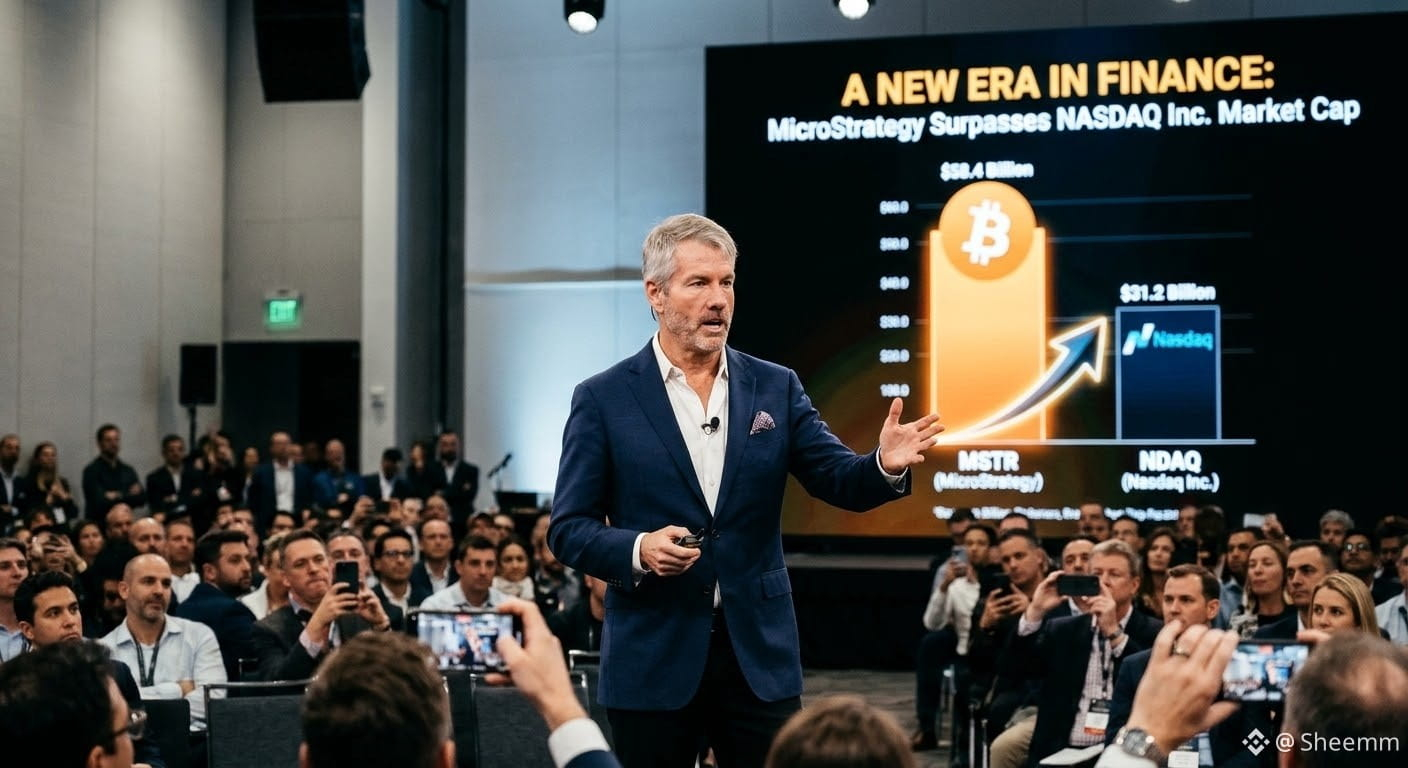
#StrategyMSTRSurpassesNasdaqInMarketCap
The lines between traditional finance and hyper-bitcoinization are officially blurring. ⚡️
MicroStrategy ($MSTRB ) surpassing Nasdaq Inc. ($NDAQ.US ) in total market capitalization isn't just a corporate win—it’s a massive paradigm shift.
A enterprise software company converted its balance sheet into a Bitcoin vault, and now outvalues the traditional financial exchange hosting its own stock.
Wall Street is learning that fixed-supply capital assets beat paper printing every time. 🚀📦
$BTC
{future}(BTCUSDT)
#EarningsSeason
#StrategyMSTRSurpassesNasdaqInMarketCap
The lines between traditional finance and hyper-bitcoinization are officially blurring. ⚡️
MicroStrategy ($MSTRB ) surpassing Nasdaq Inc. ($NDAQ.US ) in total market capitalization isn't just a corporate win—it’s a massive paradigm shift.
A enterprise software company converted its balance sheet into a Bitcoin vault, and now outvalues the traditional financial exchange hosting its own stock.
Wall Street is learning that fixed-supply capital assets beat paper printing every time. 🚀📦
$BTC
#EarningsSeason
The lines between traditional finance and hyper-bitcoinization are officially blurring. ⚡️
MicroStrategy ($MSTRB ) surpassing Nasdaq Inc. ($NDAQ.US ) in total market capitalization isn't just a corporate win—it’s a massive paradigm shift.
A enterprise software company converted its balance sheet into a Bitcoin vault, and now outvalues the traditional financial exchange hosting its own stock.
Wall Street is learning that fixed-supply capital assets beat paper printing every time. 🚀📦
$BTC
#EarningsSeason
1
195
·
--
🚀 $ZEC
{future}(ZECUSDT)
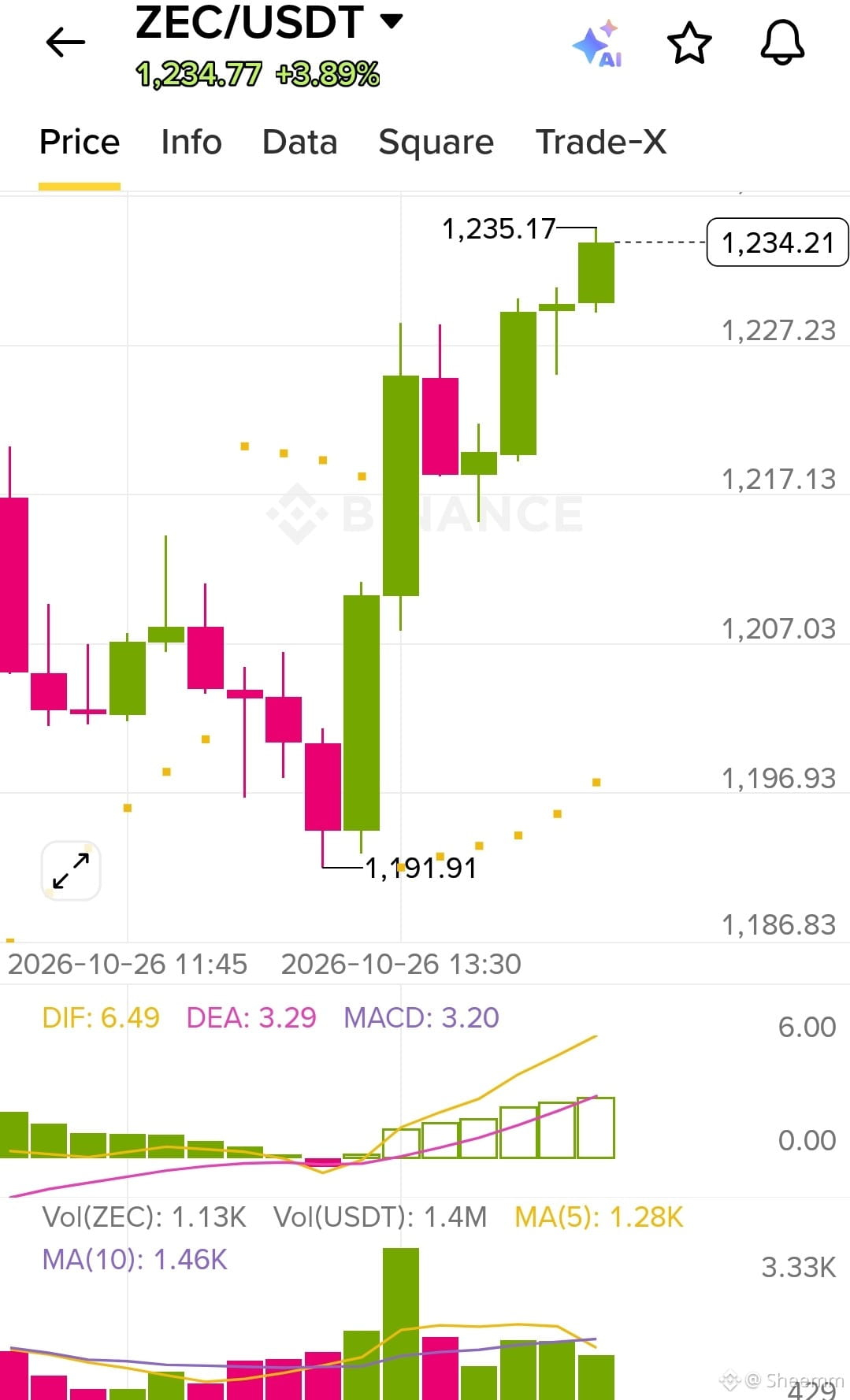
bulls are making strong moves on the charts today, pushing momentum higher as privacy infrastructure gains renewed traction. Accumulation zones are holding firm, and volume is stepping in nicely.
ZEC trades at $1,234.21 (+3.89%), rebounding sharply from $1,191.91. MACD shows bullish crossover (DIF 6.49, DEA 3.29) with rising green bars, while Parabolic SAR dots support upside continuation above MA(5).
$DOGE
$MITO
{spot}(MITOUSDT)
#TradeHere☝️🤗
🚀 $ZEC
bulls are making strong moves on the charts today, pushing momentum higher as privacy infrastructure gains renewed traction. Accumulation zones are holding firm, and volume is stepping in nicely.
ZEC trades at $1,234.21 (+3.89%), rebounding sharply from $1,191.91. MACD shows bullish crossover (DIF 6.49, DEA 3.29) with rising green bars, while Parabolic SAR dots support upside continuation above MA(5).
$DOGE
$MITO
#TradeHere☝️🤗
bulls are making strong moves on the charts today, pushing momentum higher as privacy infrastructure gains renewed traction. Accumulation zones are holding firm, and volume is stepping in nicely.
ZEC trades at $1,234.21 (+3.89%), rebounding sharply from $1,191.91. MACD shows bullish crossover (DIF 6.49, DEA 3.29) with rising green bars, while Parabolic SAR dots support upside continuation above MA(5).
$DOGE
$MITO
#TradeHere☝️🤗
3
560
·
--
Verified
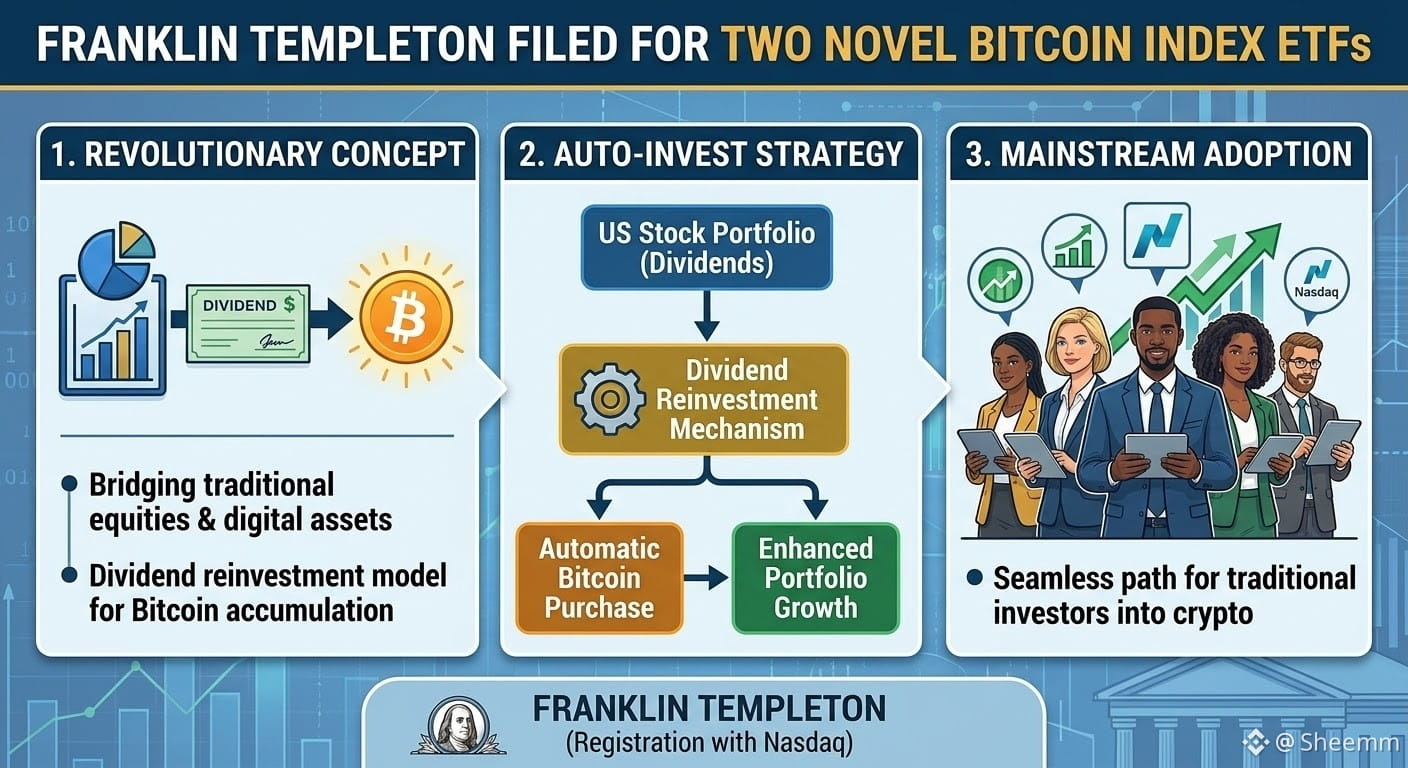
#FranklinTempletonFilesForTwoDividendToBitcoinETFs
Franklin Templeton has officially registered two innovative index exchange-traded funds with Nasdaq that fundamentally bridge traditional equities and digital assets. The strategy introduces a unique dividend reinvestment mechanism where ordinary and special payouts from major U.S. stock holdings are automatically channeled to acquire Bitcoin rather than being returned as cash or standard equity. Designed to start with a balanced exposure featuring a solid foundation of large-cap or innovation equities paired with targeted crypto allocation, these funds offer mainstream investors a seamless way to accumulate digital assets passively over time. This milestone underscores how institutional financial products continue evolving to integrate crypto deeper into everyday portfolios.
$XPL
{future}(XPLUSDT)
$PEPE
{alpha}()
$BANANAS31
{future}(BANANAS31USDT)
#BinanceSquareFamily
#Write2Earn
#FranklinTempletonFilesForTwoDividendToBitcoinETFs
Franklin Templeton has officially registered two innovative index exchange-traded funds with Nasdaq that fundamentally bridge traditional equities and digital assets. The strategy introduces a unique dividend reinvestment mechanism where ordinary and special payouts from major U.S. stock holdings are automatically channeled to acquire Bitcoin rather than being returned as cash or standard equity. Designed to start with a balanced exposure featuring a solid foundation of large-cap or innovation equities paired with targeted crypto allocation, these funds offer mainstream investors a seamless way to accumulate digital assets passively over time. This milestone underscores how institutional financial products continue evolving to integrate crypto deeper into everyday portfolios.
$XPL
$PEPE
$BANANAS31
#BinanceSquareFamily
#Write2Earn
Franklin Templeton has officially registered two innovative index exchange-traded funds with Nasdaq that fundamentally bridge traditional equities and digital assets. The strategy introduces a unique dividend reinvestment mechanism where ordinary and special payouts from major U.S. stock holdings are automatically channeled to acquire Bitcoin rather than being returned as cash or standard equity. Designed to start with a balanced exposure featuring a solid foundation of large-cap or innovation equities paired with targeted crypto allocation, these funds offer mainstream investors a seamless way to accumulate digital assets passively over time. This milestone underscores how institutional financial products continue evolving to integrate crypto deeper into everyday portfolios.
$XPL
$PEPE
$BANANAS31
#BinanceSquareFamily
#Write2Earn
5
901
·
--
$BNB
{future}(BNBUSDT)
🚀 The Power of BNB in the Modern Crypto Ecosystem
Binance Coin ($BNB) continues to prove its resilience, driven by strong utility across the BNB Chain, continuous token burns, and robust ecosystem expansion. From powering decentralized apps to offering lower trading fees, BNB remains a fundamental pillar for both retail and institutional crypto participants worldwide. With a solid foundation and steady development cadence, it holds a prominent position among major digital assets. Whether you're navigating market shifts or looking at long-term utility, BNB’s ecosystem adoption keeps it a major focal point for crypto traders! 📈
📊 Current Price Analysis:
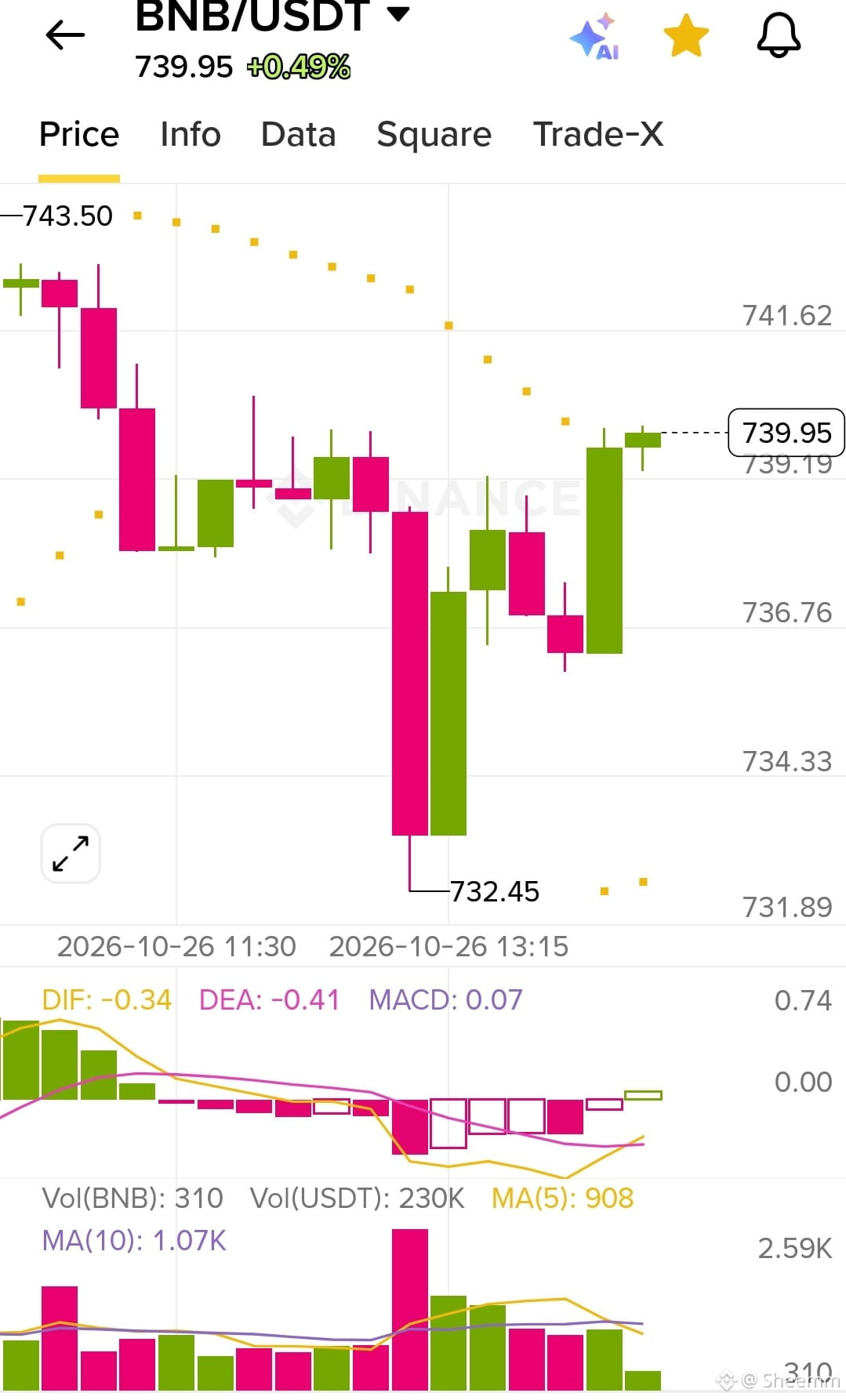
BNB is trading at $739.95 (+0.49%). After finding solid support near $732.45, the asset formed a strong bullish recovery candle. MACD shows early signs of flattening with a minor positive value (0.07), while short-term moving averages hint at consolidation. Watch immediate resistance near $743.50; breaking this level could trigger further upside momentum.
$NEAR
{future}(NEARUSDT)
$XRP
{future}(XRPUSDT)
#EarningsSeason
#binanecCoin
#BNBATH
$BNB
🚀 The Power of BNB in the Modern Crypto Ecosystem
Binance Coin ($BNB ) continues to prove its resilience, driven by strong utility across the BNB Chain, continuous token burns, and robust ecosystem expansion. From powering decentralized apps to offering lower trading fees, BNB remains a fundamental pillar for both retail and institutional crypto participants worldwide. With a solid foundation and steady development cadence, it holds a prominent position among major digital assets. Whether you're navigating market shifts or looking at long-term utility, BNB’s ecosystem adoption keeps it a major focal point for crypto traders! 📈
📊 Current Price Analysis:
BNB is trading at $739.95 (+0.49%). After finding solid support near $732.45, the asset formed a strong bullish recovery candle. MACD shows early signs of flattening with a minor positive value (0.07), while short-term moving averages hint at consolidation. Watch immediate resistance near $743.50; breaking this level could trigger further upside momentum.
$NEAR
$XRP
#EarningsSeason
#binanecCoin
#BNBATH
🚀 The Power of BNB in the Modern Crypto Ecosystem
Binance Coin ($BNB ) continues to prove its resilience, driven by strong utility across the BNB Chain, continuous token burns, and robust ecosystem expansion. From powering decentralized apps to offering lower trading fees, BNB remains a fundamental pillar for both retail and institutional crypto participants worldwide. With a solid foundation and steady development cadence, it holds a prominent position among major digital assets. Whether you're navigating market shifts or looking at long-term utility, BNB’s ecosystem adoption keeps it a major focal point for crypto traders! 📈
📊 Current Price Analysis:
BNB is trading at $739.95 (+0.49%). After finding solid support near $732.45, the asset formed a strong bullish recovery candle. MACD shows early signs of flattening with a minor positive value (0.07), while short-term moving averages hint at consolidation. Watch immediate resistance near $743.50; breaking this level could trigger further upside momentum.
$NEAR
$XRP
#EarningsSeason
#binanecCoin
#BNBATH
3
359
·
--
#BinancePick
🚀 Binance Pick is live! Predict market moves, complete daily tasks, and climb the leaderboard to share up to 1,000,000 USDC in rewards! 🏆
Are you making predictions or playing it safe this week? Let’s hear your market moves! 👇
#BinancePick
🚀 Binance Pick is live! Predict market moves, complete daily tasks, and climb the leaderboard to share up to 1,000,000 USDC in rewards! 🏆
Are you making predictions or playing it safe this week? Let’s hear your market moves! 👇
🚀 Binance Pick is live! Predict market moves, complete daily tasks, and climb the leaderboard to share up to 1,000,000 USDC in rewards! 🏆
Are you making predictions or playing it safe this week? Let’s hear your market moves! 👇

1
210
·
--
🚀 Major breakout for $ERA
{future}(ERAUSDT)
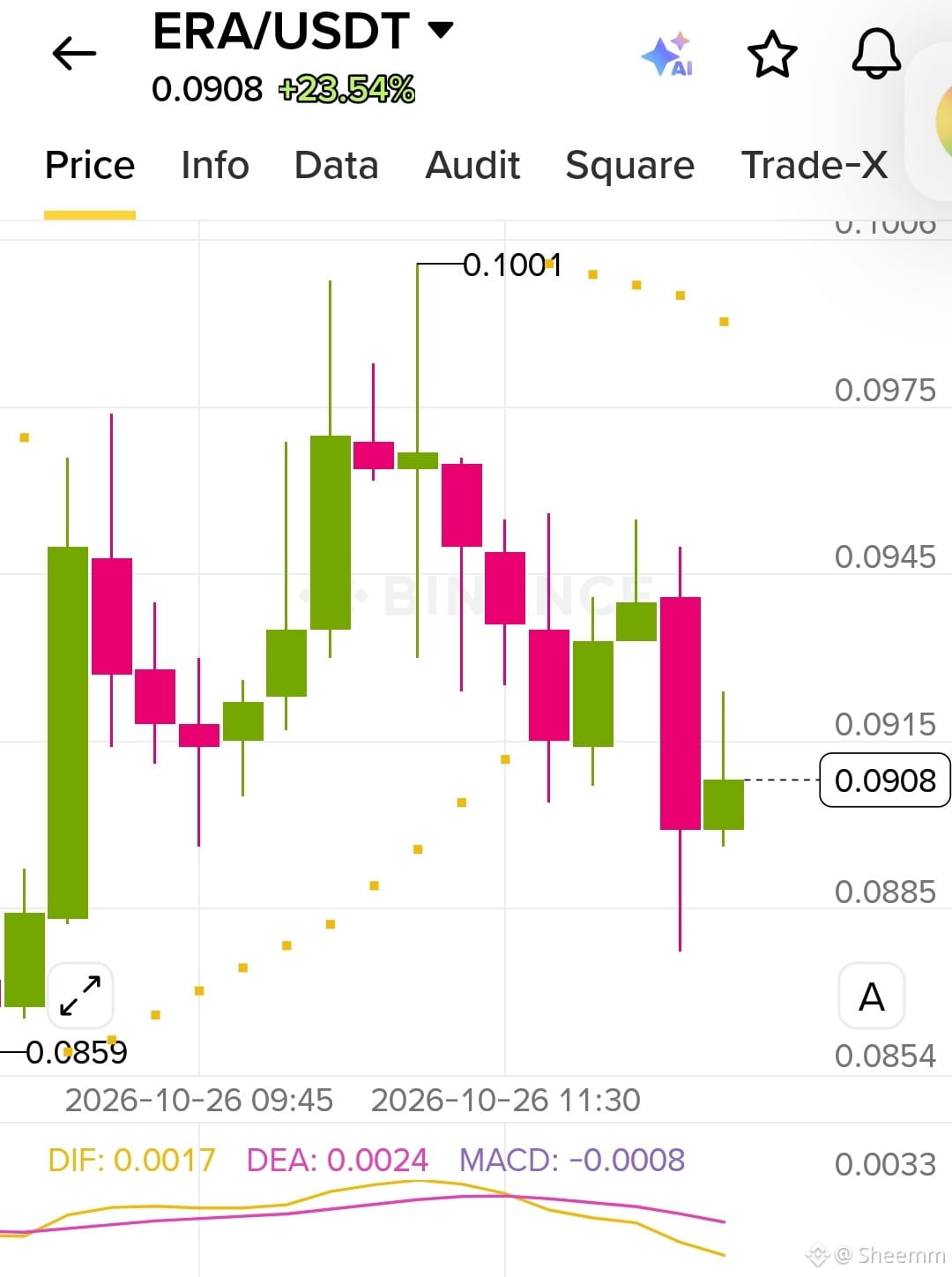
on Binance today! Over 23% gain to reach a high of 0.1001. Though experiencing a pullback to 0.0908, the strong daily volume and DIF/DEA lines indicate robust bullish momentum. The trend is looking solid. Stay sharp, traders!
$ZEC
{future}(ZECUSDT)
$NEAR
{future}(NEARUSDT)
#DYORAlways
🚀 Major breakout for $ERA
on Binance today! Over 23% gain to reach a high of 0.1001. Though experiencing a pullback to 0.0908, the strong daily volume and DIF/DEA lines indicate robust bullish momentum. The trend is looking solid. Stay sharp, traders!
$ZEC
$NEAR
#DYORAlways
on Binance today! Over 23% gain to reach a high of 0.1001. Though experiencing a pullback to 0.0908, the strong daily volume and DIF/DEA lines indicate robust bullish momentum. The trend is looking solid. Stay sharp, traders!
$ZEC
$NEAR
#DYORAlways
1
1
483
·
--
$PEPE
{alpha}()
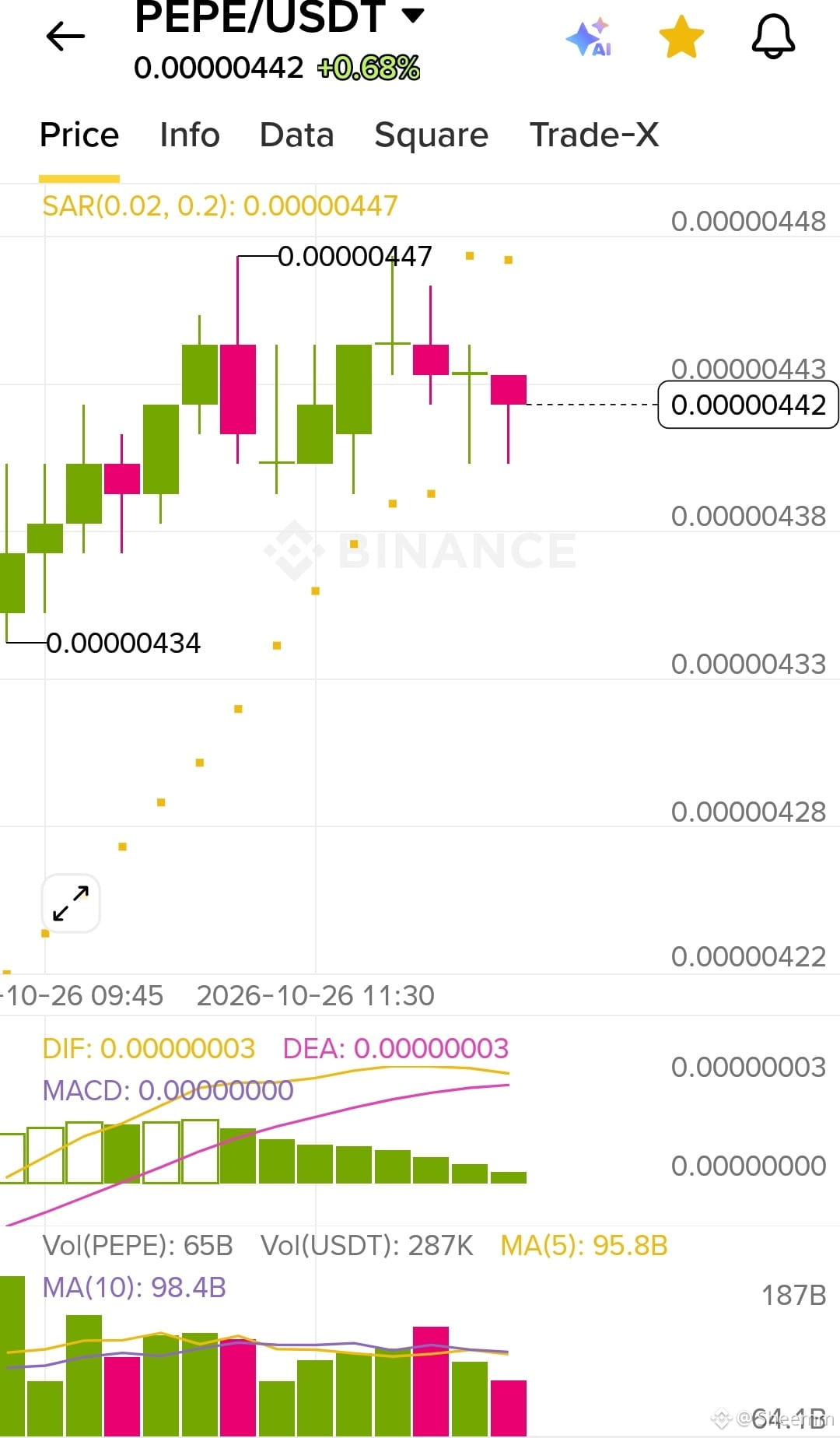
PEPE shows consolidation on the fifteen minute chart. Parabolic SAR dots hovering above price action signal caution, while declining MACD histogram bars reflect fading bullish momentum. Volume remains subdued, pointing toward a potential short-term pullback before the next decisive directional move.
$XRP $SOL
#BinancePick
$PEPE
PEPE shows consolidation on the fifteen minute chart. Parabolic SAR dots hovering above price action signal caution, while declining MACD histogram bars reflect fading bullish momentum. Volume remains subdued, pointing toward a potential short-term pullback before the next decisive directional move.
$XRP $SOL
#BinancePick
PEPE shows consolidation on the fifteen minute chart. Parabolic SAR dots hovering above price action signal caution, while declining MACD histogram bars reflect fading bullish momentum. Volume remains subdued, pointing toward a potential short-term pullback before the next decisive directional move.
$XRP $SOL
#BinancePick
2
407
·
--
$BTC
{future}(BTCUSDT)
Bitcoin's Resilience in a Shifting Market! 📉
Crypto markets continue to test the nerves of traders as macroeconomic headwinds and profit-taking keep major assets on edge. Yet, Bitcoin remains the ultimate digital cornerstone, defending critical psychological levels while broader financial markets navigate inflation data and shifting institutional flows.
Volatility is the price of admission in crypto. Diamond hands look past short-term noise and focus on long-term adoption, network strength, and scarcity. Are you stacking or sitting on the sidelines? Let’s hear your strategy below! 👇
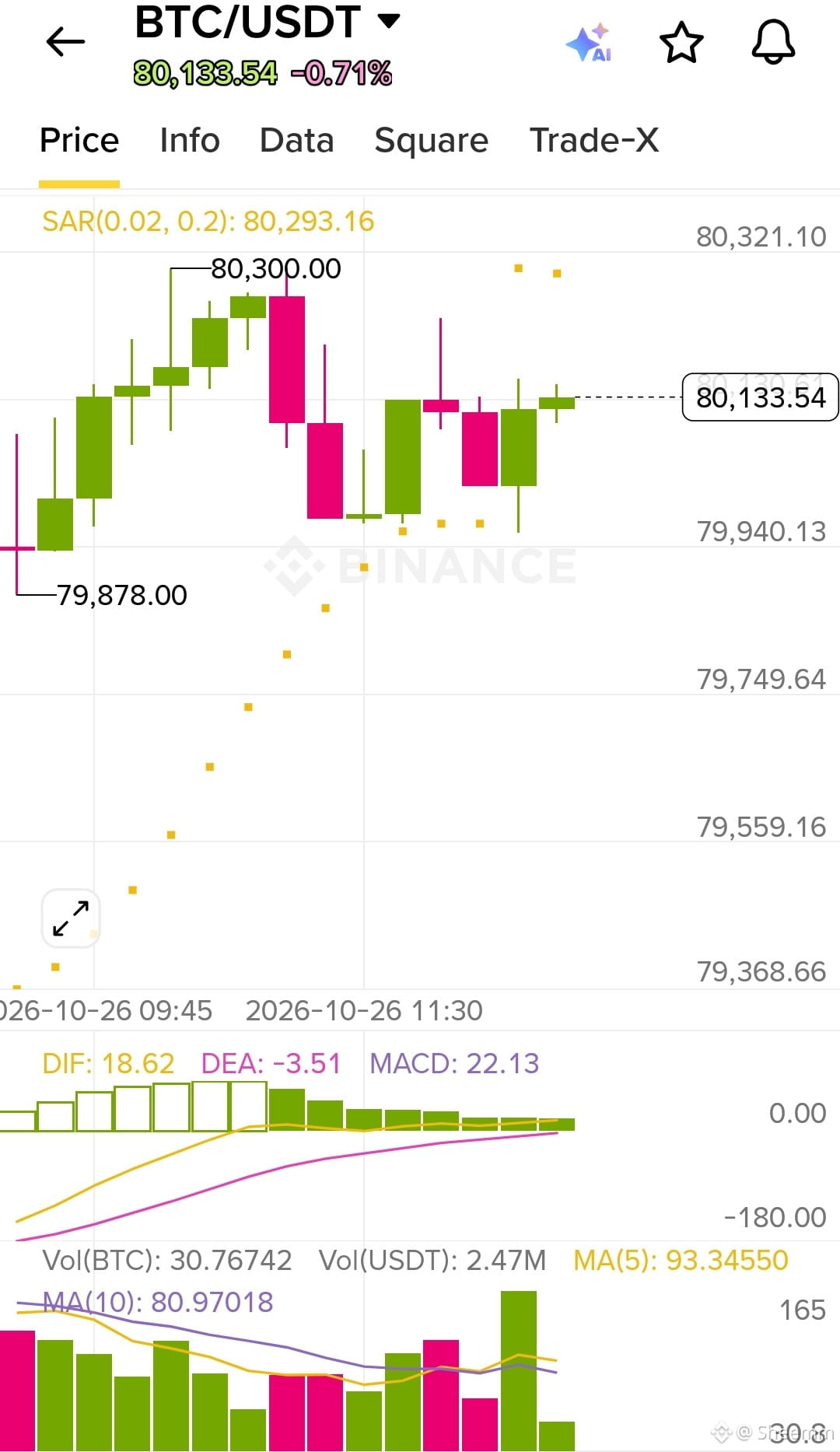
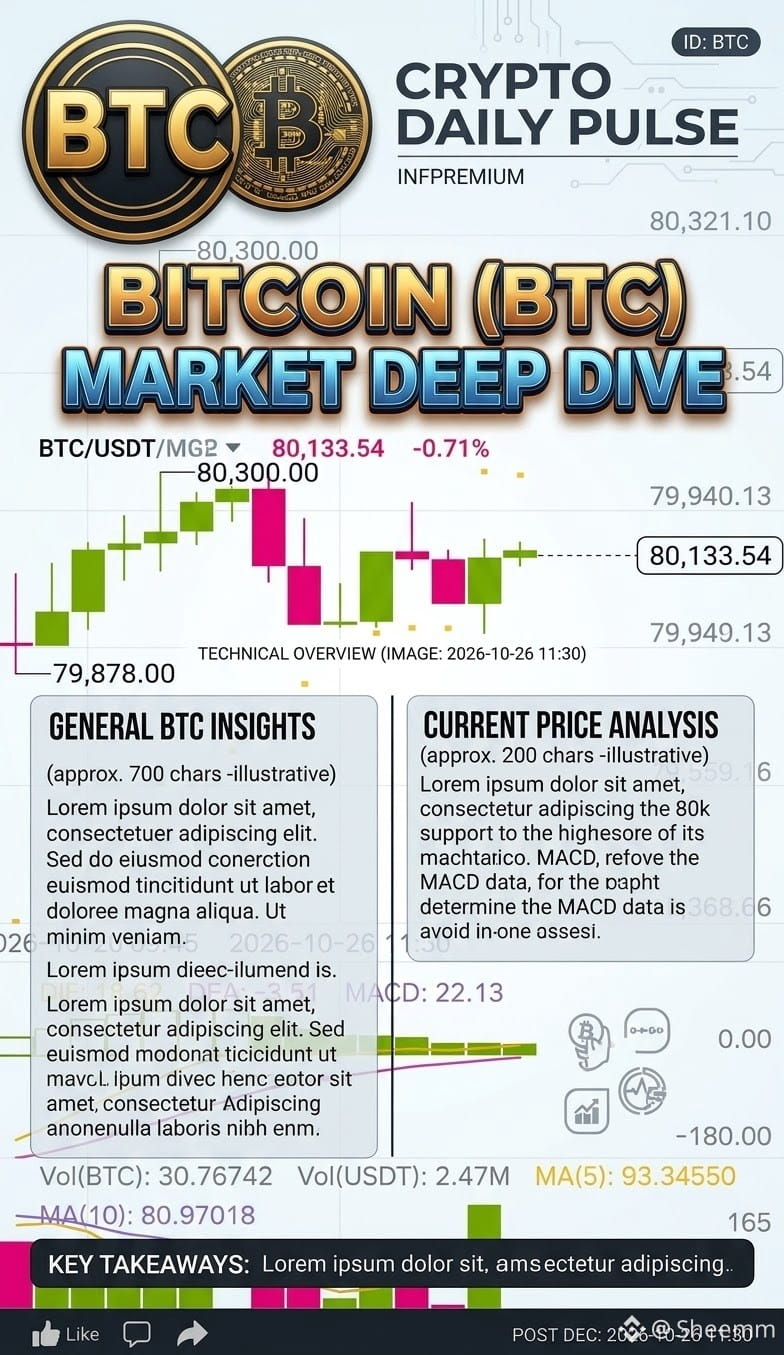
Currently BTC is tradeing near $80,133, testing the $80K support. MACD shows slight bullish momentum, but caution is warranted near the SAR ($80,293) resistance. Watch for a decisive breakout.
$ETH
{future}(ETHUSDT)
$BNB
{future}(BNBUSDT)
#EarningsSeason
#BinanceSquareTalks
#Write2Earn!
$BTC
Bitcoin's Resilience in a Shifting Market! 📉
Crypto markets continue to test the nerves of traders as macroeconomic headwinds and profit-taking keep major assets on edge. Yet, Bitcoin remains the ultimate digital cornerstone, defending critical psychological levels while broader financial markets navigate inflation data and shifting institutional flows.
Volatility is the price of admission in crypto. Diamond hands look past short-term noise and focus on long-term adoption, network strength, and scarcity. Are you stacking or sitting on the sidelines? Let’s hear your strategy below! 👇
Currently BTC is tradeing near $80,133, testing the $80K support. MACD shows slight bullish momentum, but caution is warranted near the SAR ($80,293) resistance. Watch for a decisive breakout.
$ETH
$BNB
#EarningsSeason
#BinanceSquareTalks
#Write2Earn!
Bitcoin's Resilience in a Shifting Market! 📉
Crypto markets continue to test the nerves of traders as macroeconomic headwinds and profit-taking keep major assets on edge. Yet, Bitcoin remains the ultimate digital cornerstone, defending critical psychological levels while broader financial markets navigate inflation data and shifting institutional flows.
Volatility is the price of admission in crypto. Diamond hands look past short-term noise and focus on long-term adoption, network strength, and scarcity. Are you stacking or sitting on the sidelines? Let’s hear your strategy below! 👇
Currently BTC is tradeing near $80,133, testing the $80K support. MACD shows slight bullish momentum, but caution is warranted near the SAR ($80,293) resistance. Watch for a decisive breakout.
$ETH
$BNB
#EarningsSeason
#BinanceSquareTalks
#Write2Earn!
2
421
·
--
$ENA
{future}(ENAUSDT)
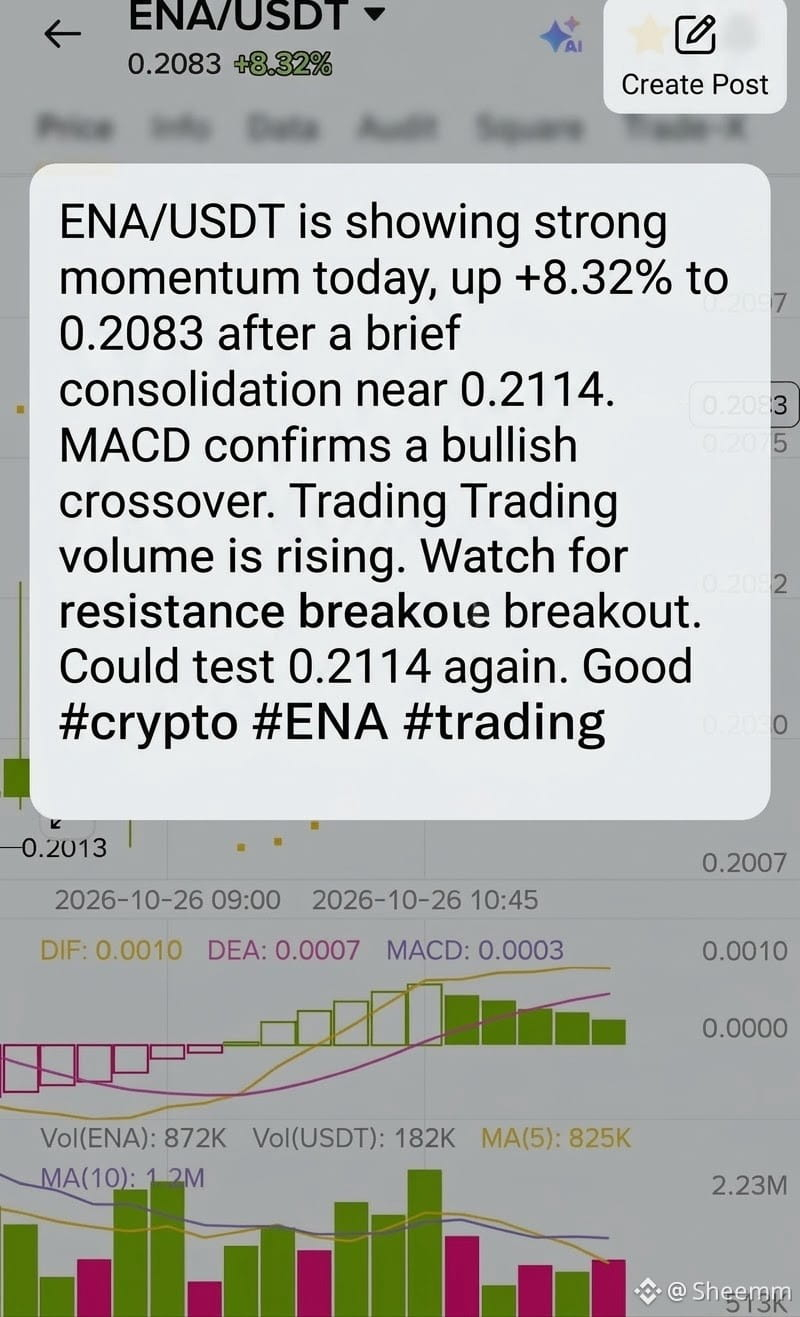
ENA/USDT chart is looking very strong right now, sitting up +8.32% at 0.2083. It's consolidating after a nice peak of 0.2114. Volume is high at over 800K, and the MACD has just crossed bullish. I'm keeping a close watch for the next breakout!
$DODO
{spot}(DODOUSDT)
$OSMO
{spot}(OSMOUSDT)
#EarningsSeason
$ENA
ENA/USDT chart is looking very strong right now, sitting up +8.32% at 0.2083. It's consolidating after a nice peak of 0.2114. Volume is high at over 800K, and the MACD has just crossed bullish. I'm keeping a close watch for the next breakout!
$DODO
$OSMO
#EarningsSeason
ENA/USDT chart is looking very strong right now, sitting up +8.32% at 0.2083. It's consolidating after a nice peak of 0.2114. Volume is high at over 800K, and the MACD has just crossed bullish. I'm keeping a close watch for the next breakout!
$DODO
$OSMO
#EarningsSeason
2
601
·
--
#BinancePick
The crypto market always creates new opportunities, but smart decisions matter more than hype. I’m watching projects with real utility, strong development, and long-term potential rather than chasing every sudden pump. Research before you invest, manage your risk, and remember that consistency beats impulsive trading. 📊 DYOR!
$XRP $PEPE $NVDAB
#BinancePick
The crypto market always creates new opportunities, but smart decisions matter more than hype. I’m watching projects with real utility, strong development, and long-term potential rather than chasing every sudden pump. Research before you invest, manage your risk, and remember that consistency beats impulsive trading. 📊 DYOR!
$XRP $PEPE $NVDAB
The crypto market always creates new opportunities, but smart decisions matter more than hype. I’m watching projects with real utility, strong development, and long-term potential rather than chasing every sudden pump. Research before you invest, manage your risk, and remember that consistency beats impulsive trading. 📊 DYOR!
$XRP $PEPE $NVDAB

1
2
456
·
--
🚀 $ORDER
{alpha}(560x4e200fe2f3efb977d5fd9c430a41531fb04d97b8)
is flying! 📈 Up +167.54% and breaking new highs. 💚 Parabolic green candles, volume spike to 191M, and the MACD is strongly bullish. Is a pullback due at this speed or is this just the beginning? A masterclass in momentum trading. Remember to manage risk.
$BIRB
{alpha}(CT_501G7vQWurMkMMm2dU3iZpXYFTHT9Biio4F4gZCrwFpKNwG)
$IRYS
{alpha}(560x91152b4ef635403efbae860edd0f8c321d7c035d)
#BinancePick
#EarningsSeason
#Write2Earrn
🚀 $ORDER
is flying! 📈 Up +167.54% and breaking new highs. 💚 Parabolic green candles, volume spike to 191M, and the MACD is strongly bullish. Is a pullback due at this speed or is this just the beginning? A masterclass in momentum trading. Remember to manage risk.
$BIRB
$IRYS
#BinancePick
#EarningsSeason
#Write2Earrn
is flying! 📈 Up +167.54% and breaking new highs. 💚 Parabolic green candles, volume spike to 191M, and the MACD is strongly bullish. Is a pullback due at this speed or is this just the beginning? A masterclass in momentum trading. Remember to manage risk.
$BIRB
$IRYS
#BinancePick
#EarningsSeason
#Write2Earrn
2
1.9k
·
--
#BinancePick
#BinancePick 🔶
I always look for projects that offer real utility, strong development, and long-term potential rather than following hype alone. Binance Pick is a chance to explore opportunities, but research and risk management should always come first. In crypto, smart decisions matter more than quick profits. DYOR! 🚀
#BinancePick
#BinancePick 🔶
I always look for projects that offer real utility, strong development, and long-term potential rather than following hype alone. Binance Pick is a chance to explore opportunities, but research and risk management should always come first. In crypto, smart decisions matter more than quick profits. DYOR! 🚀
#BinancePick 🔶
I always look for projects that offer real utility, strong development, and long-term potential rather than following hype alone. Binance Pick is a chance to explore opportunities, but research and risk management should always come first. In crypto, smart decisions matter more than quick profits. DYOR! 🚀

2
331
·
--
Bullish
$PEPE
{alpha}()
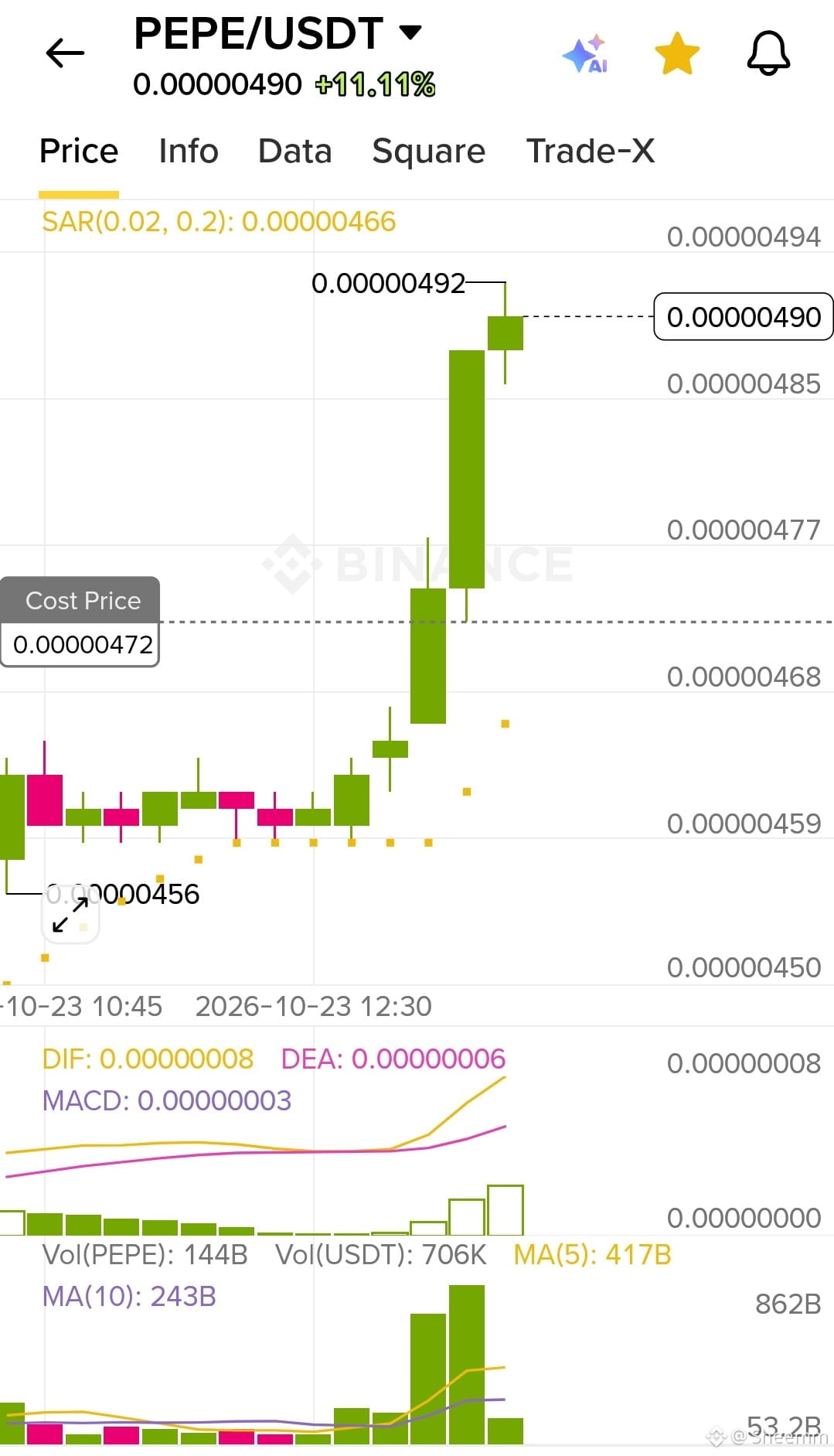
A massive breakout for PEPE/USDT, up +11.11% in minutes! Chart shows a parabolic move past the 0.00000472 cost price on strong volume. MACD is also bullish. This is significant momentum. Who caught this wave? Hold or take profits?
$XRP
{future}(XRPUSDT)
$DOT
{future}(DOTUSDT)
#CryptoAlert #AltcoinSeason #EarningsSeason #Write2Earrn
$PEPE
A massive breakout for PEPE/USDT, up +11.11% in minutes! Chart shows a parabolic move past the 0.00000472 cost price on strong volume. MACD is also bullish. This is significant momentum. Who caught this wave? Hold or take profits?
$XRP
$DOT
#CryptoAlert #AltcoinSeason #EarningsSeason #Write2Earrn
A massive breakout for PEPE/USDT, up +11.11% in minutes! Chart shows a parabolic move past the 0.00000472 cost price on strong volume. MACD is also bullish. This is significant momentum. Who caught this wave? Hold or take profits?
$XRP
$DOT
#CryptoAlert #AltcoinSeason #EarningsSeason #Write2Earrn
1
346
·
--
Verified
$DOT
{future}(DOTUSDT)
🚀 Polkadot : The Evolution of Modular Interoperability
Polkadot continues to transform the Web3 landscape by shifting focus from core infrastructure toward seamless application-layer adoption.
With Polkadot 2.0 features—including Agile Coretime, Asynchronous Backing, and Elastic Scaling—networks are experiencing dynamic resource management and dramatic throughput boosts. Coupled with the Revive EVM execution layer, developers can leverage Ethereum compatibility while retaining high performance.
Furthermore, the structural tokenomics overhaul introduced a hard supply cap of 2.1 billion DOT, effectively removing legacy inflation pressure and establishing a solid foundation for long-term value preservation.
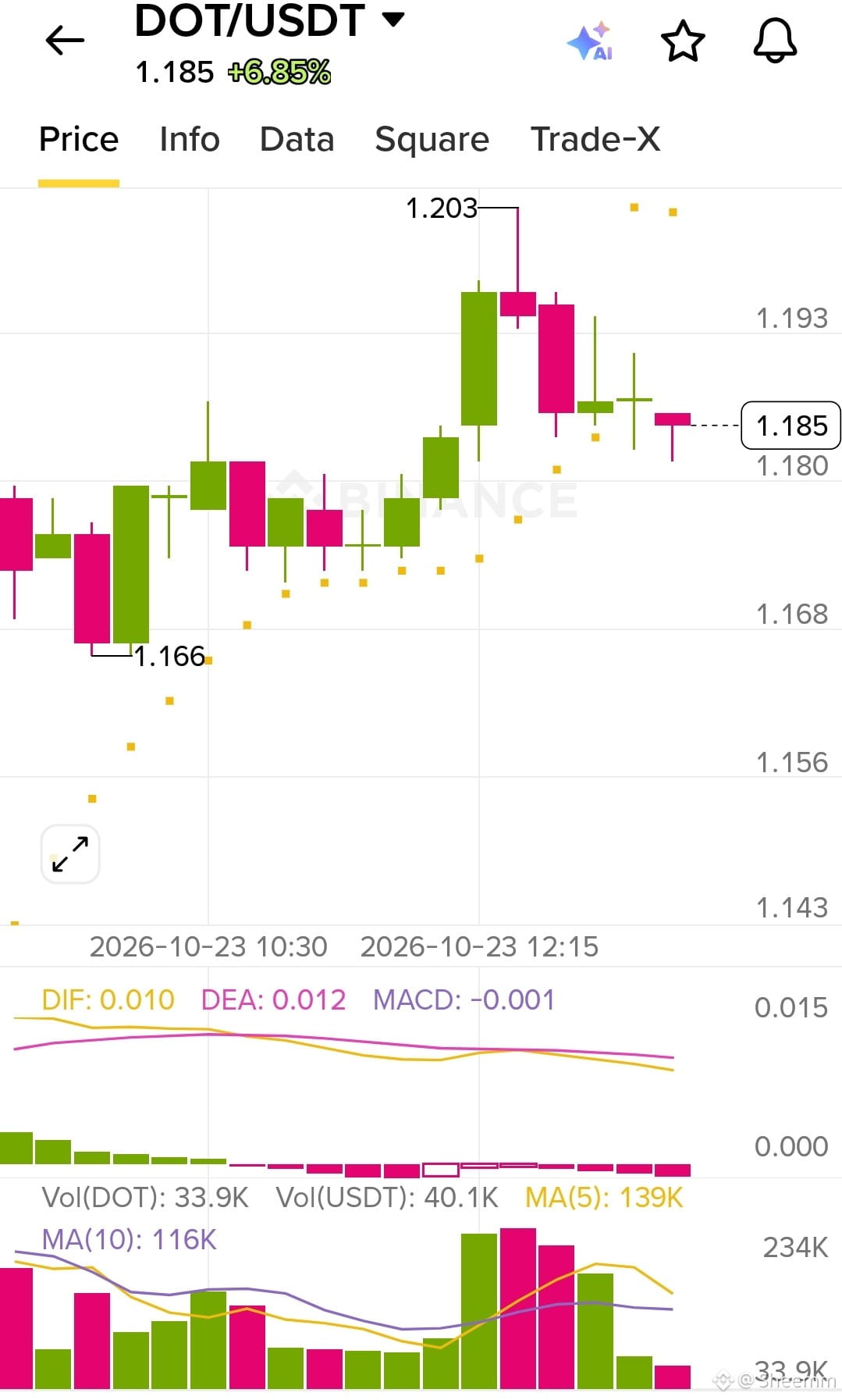
📊 Short-Term Price Analysis (DOT/USDT)
* Current Price: $1.185 (+6.85%)
* Local High / Resistance: $1.203
* Local Support Zone: $1.166
* Technical Indicators: On the 15-minute chart, DOT experienced a bullish push hitting $1.203 before pulling back into consolidation around $1.185.
* MACD & Volume: The MACD line (DIF: 0.010) sits below the signal line (DEA: 0.012), producing a slightly negative histogram (-0.001) as momentum cools off. Meanwhile, recent red volume spikes indicate light profit-taking.
* Outlook: A breakdown below 1.180 may test the lower support near 1.166, while reclaiming 1.193 with rising volume could open another retest toward 1.203+.
Disclaimer: Not financial advice. Always perform your own research (DYOR) and manage risks carefully before trading.
$ENA
{future}(ENAUSDT)
$ERA
{future}(ERAUSDT)
#EarningsSeason
#Write2Earrn
#BinancePick
$DOT
🚀 Polkadot : The Evolution of Modular Interoperability
Polkadot continues to transform the Web3 landscape by shifting focus from core infrastructure toward seamless application-layer adoption.
With Polkadot 2.0 features—including Agile Coretime, Asynchronous Backing, and Elastic Scaling—networks are experiencing dynamic resource management and dramatic throughput boosts. Coupled with the Revive EVM execution layer, developers can leverage Ethereum compatibility while retaining high performance.
Furthermore, the structural tokenomics overhaul introduced a hard supply cap of 2.1 billion DOT, effectively removing legacy inflation pressure and establishing a solid foundation for long-term value preservation.
📊 Short-Term Price Analysis (DOT/USDT)
* Current Price: $1.185 (+6.85%)
* Local High / Resistance: $1.203
* Local Support Zone: $1.166
* Technical Indicators: On the 15-minute chart, DOT experienced a bullish push hitting $1.203 before pulling back into consolidation around $1.185.
* MACD & Volume: The MACD line (DIF: 0.010) sits below the signal line (DEA: 0.012), producing a slightly negative histogram (-0.001) as momentum cools off. Meanwhile, recent red volume spikes indicate light profit-taking.
* Outlook: A breakdown below 1.180 may test the lower support near 1.166, while reclaiming 1.193 with rising volume could open another retest toward 1.203+.
Disclaimer: Not financial advice. Always perform your own research (DYOR) and manage risks carefully before trading.
$ENA
$ERA
#EarningsSeason
#Write2Earrn
#BinancePick
🚀 Polkadot : The Evolution of Modular Interoperability
Polkadot continues to transform the Web3 landscape by shifting focus from core infrastructure toward seamless application-layer adoption.
With Polkadot 2.0 features—including Agile Coretime, Asynchronous Backing, and Elastic Scaling—networks are experiencing dynamic resource management and dramatic throughput boosts. Coupled with the Revive EVM execution layer, developers can leverage Ethereum compatibility while retaining high performance.
Furthermore, the structural tokenomics overhaul introduced a hard supply cap of 2.1 billion DOT, effectively removing legacy inflation pressure and establishing a solid foundation for long-term value preservation.
📊 Short-Term Price Analysis (DOT/USDT)
* Current Price: $1.185 (+6.85%)
* Local High / Resistance: $1.203
* Local Support Zone: $1.166
* Technical Indicators: On the 15-minute chart, DOT experienced a bullish push hitting $1.203 before pulling back into consolidation around $1.185.
* MACD & Volume: The MACD line (DIF: 0.010) sits below the signal line (DEA: 0.012), producing a slightly negative histogram (-0.001) as momentum cools off. Meanwhile, recent red volume spikes indicate light profit-taking.
* Outlook: A breakdown below 1.180 may test the lower support near 1.166, while reclaiming 1.193 with rising volume could open another retest toward 1.203+.
Disclaimer: Not financial advice. Always perform your own research (DYOR) and manage risks carefully before trading.
$ENA
$ERA
#EarningsSeason
#Write2Earrn
#BinancePick
3
636
·
--
Verified
$SOL
{future}(SOLUSDT)
Solana continues to prove why it remains a powerhouse in the layer-1 ecosystem. With sub-second transaction finality, expanding real-world asset tokenization, and record-high network activity, builders and institutional players are taking notice. The upcoming Breakpoint 2026 conference in London, featuring key institutions, highlights how SOL is cementing its role as the go-to platform for scalable, low-cost decentralized applications. With strong fundamental growth and active developer momentum, SOL is well-positioned for sustained long-term adoption.
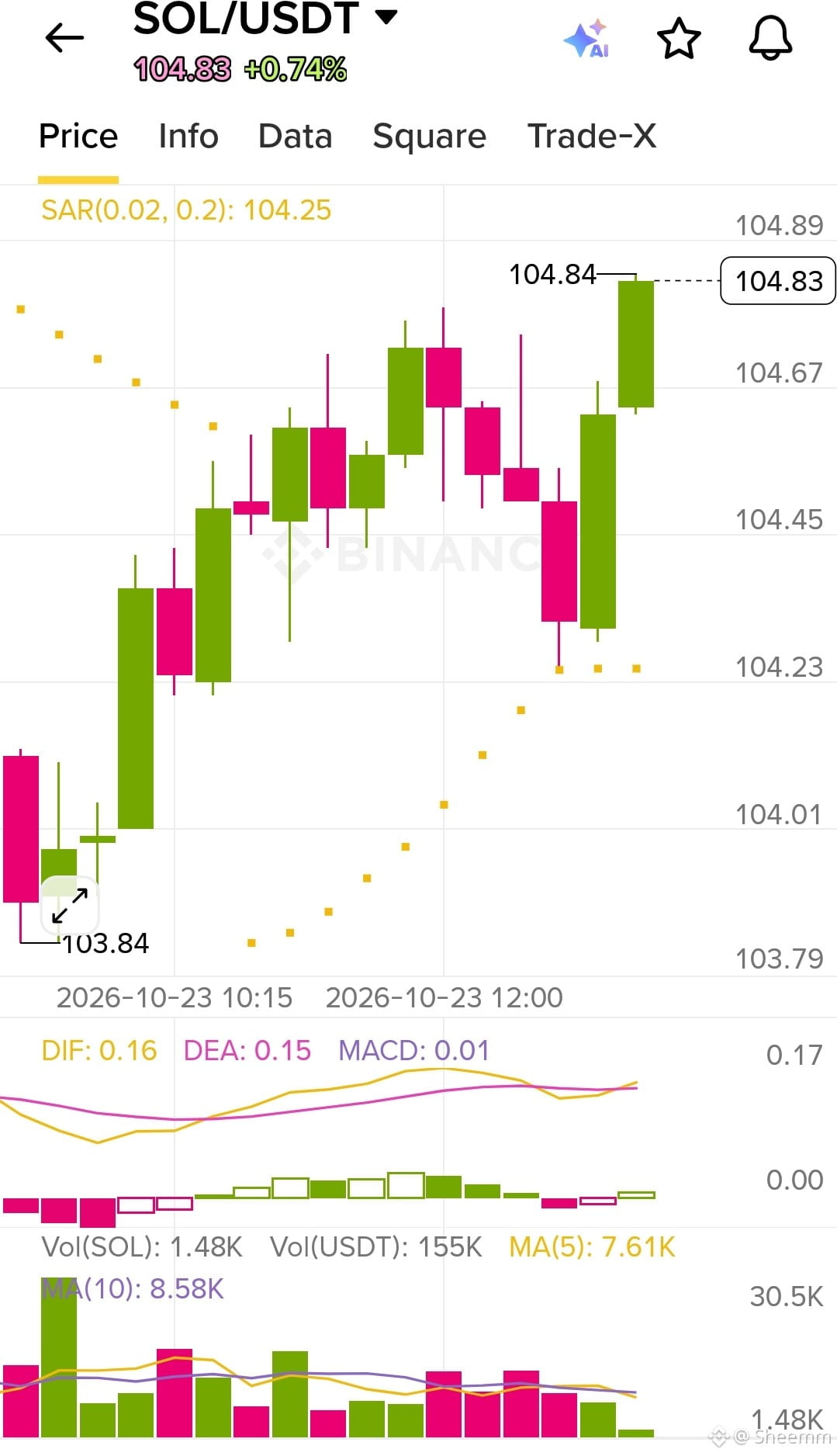
SOL/USDT trades near $104.83, bouncing off the $103.84 low. Momentum is tilting bullish as a strong green candle breaks above the Parabolic SAR dots at $104.25, while the MACD histogram flips positive with a bullish crossover.
$BNB
{future}(BNBUSDT)
$PEPE
{alpha}()
#EarningsSeason #HSBCBeginsPhasedRolloutOfHKDStablecoinRedCoin #write2earn🌐💹
$SOL
Solana continues to prove why it remains a powerhouse in the layer-1 ecosystem. With sub-second transaction finality, expanding real-world asset tokenization, and record-high network activity, builders and institutional players are taking notice. The upcoming Breakpoint 2026 conference in London, featuring key institutions, highlights how SOL is cementing its role as the go-to platform for scalable, low-cost decentralized applications. With strong fundamental growth and active developer momentum, SOL is well-positioned for sustained long-term adoption.
SOL/USDT trades near $104.83, bouncing off the $103.84 low. Momentum is tilting bullish as a strong green candle breaks above the Parabolic SAR dots at $104.25, while the MACD histogram flips positive with a bullish crossover.
$BNB
$PEPE
#EarningsSeason #HSBCBeginsPhasedRolloutOfHKDStablecoinRedCoin #write2earn🌐💹
Solana continues to prove why it remains a powerhouse in the layer-1 ecosystem. With sub-second transaction finality, expanding real-world asset tokenization, and record-high network activity, builders and institutional players are taking notice. The upcoming Breakpoint 2026 conference in London, featuring key institutions, highlights how SOL is cementing its role as the go-to platform for scalable, low-cost decentralized applications. With strong fundamental growth and active developer momentum, SOL is well-positioned for sustained long-term adoption.
SOL/USDT trades near $104.83, bouncing off the $103.84 low. Momentum is tilting bullish as a strong green candle breaks above the Parabolic SAR dots at $104.25, while the MACD histogram flips positive with a bullish crossover.
$BNB
$PEPE
#EarningsSeason #HSBCBeginsPhasedRolloutOfHKDStablecoinRedCoin #write2earn🌐💹
2
583
·
--
#BinancePick
Binance Pick is live with 1 Million USDC in rewards! Track market trends, check in daily for guaranteed entry into the participation pool, and optimize your trade setups. Consistency and precision lead the leaderboards. Capitalize on volatility and claim your share.
#BinanceSquareTalks
#BinancePick
Binance Pick is live with 1 Million USDC in rewards! Track market trends, check in daily for guaranteed entry into the participation pool, and optimize your trade setups. Consistency and precision lead the leaderboards. Capitalize on volatility and claim your share.
#BinanceSquareTalks
Binance Pick is live with 1 Million USDC in rewards! Track market trends, check in daily for guaranteed entry into the participation pool, and optimize your trade setups. Consistency and precision lead the leaderboards. Capitalize on volatility and claim your share.
#BinanceSquareTalks

2
283
Log in to explore more content
Join global crypto users on Binance Square
⚡️ Get latest and useful information about crypto.
💬 Trusted by the world’s largest crypto exchange.
👍 Discover real insights from verified creators.
Email / Phone number
Trending Topics
BinancePick
2.6M views
142,481 Discussing
Join #EarningsSeason: Predict Earnings on Binance Pick, Share Your Take on Binance Square!
Binance Square Official
·401 Likes
·338.7k views
EarningsSeason
5M views
24,451 Discussing
SouthKoreaReportedlyWeighsFourthCryptoTaxDelay
0 views
0 Discussing