

YohannaOlva 1
126 Posts

YohannaOlva 1
Report
Block User
Verified BS creator || KOL || TG~ @YohannaOlva56 24/7 Dm me
0 Following
8 Followers
32 Liked
Posts
Privacy Is Becoming Payment Infrastructure 🔐
$ZEC and $VFY now sit inside a much bigger conversation about how digital payments can be private and auditable.
On September 29, the Bank of Italy published research into privacy-enhancing technologies for payment systems.
Zero-knowledge proofs were specifically included alongside tools for selective oversight.
This is important.
Privacy is gradually moving from a crypto subculture into the design conversation around institutional payments.
The challenge is no longer choosing between total exposure and zero accountability.
A payment application can generate a ZK proof confirming that its required conditions were met without publishing the private transaction data underneath. The privacy properties come from that application and its proving system.
zkVerify independently checks whether the submitted proof is cryptographically valid.
This checking step sounds minor until banks, payment networks and regulated applications begin producing proofs continuously.
Each one needs reliable verification before another system can use the result.
A specialised verification network turns that repeated cryptographic work into shared infrastructure, with VFY providing access to the checking layer.
I see the Bank of Italy paper as another sign that selective disclosure is moving closer to real financial architecture.
The systems verifying those proofs could become just as important as the systems generating them.
#Privacy #Altcoin Season#
Privacy Is Becoming Payment Infrastructure 🔐
$ZEC and $VFY now sit inside a much bigger conversation about how digital payments can be private and auditable.
On September 29, the Bank of Italy published research into privacy-enhancing technologies for payment systems.
Zero-knowledge proofs were specifically included alongside tools for selective oversight.
This is important.
Privacy is gradually moving from a crypto subculture into the design conversation around institutional payments.
The challenge is no longer choosing between total exposure and zero accountability.
A payment application can generate a ZK proof confirming that its required conditions were met without publishing the private transaction data underneath. The privacy properties come from that application and its proving system.
zkVerify independently checks whether the submitted proof is cryptographically valid.
This checking step sounds minor until banks, payment networks and regulated applications begin producing proofs continuously.
Each one needs reliable verification before another system can use the result.
A specialised verification network turns that repeated cryptographic work into shared infrastructure, with VFY providing access to the checking layer.
I see the Bank of Italy paper as another sign that selective disclosure is moving closer to real financial architecture.
The systems verifying those proofs could become just as important as the systems generating them.
#Privacy #Altcoin Season#
$ZEC and $VFY now sit inside a much bigger conversation about how digital payments can be private and auditable.
On September 29, the Bank of Italy published research into privacy-enhancing technologies for payment systems.
Zero-knowledge proofs were specifically included alongside tools for selective oversight.
This is important.
Privacy is gradually moving from a crypto subculture into the design conversation around institutional payments.
The challenge is no longer choosing between total exposure and zero accountability.
A payment application can generate a ZK proof confirming that its required conditions were met without publishing the private transaction data underneath. The privacy properties come from that application and its proving system.
zkVerify independently checks whether the submitted proof is cryptographically valid.
This checking step sounds minor until banks, payment networks and regulated applications begin producing proofs continuously.
Each one needs reliable verification before another system can use the result.
A specialised verification network turns that repeated cryptographic work into shared infrastructure, with VFY providing access to the checking layer.
I see the Bank of Italy paper as another sign that selective disclosure is moving closer to real financial architecture.
The systems verifying those proofs could become just as important as the systems generating them.
#Privacy #Altcoin Season#
Most Blockchains Start With Technology. Midnight Starts With Agency. 🕊️
There is a useful reason Midnight keeps talking about privacy differently from anonymity coins.
Its stated mission is broader than hiding transactions.
The project organizes that idea around three freedoms: association without restriction, commerce without permission and expression without censorship.
That puts it surprisingly close to the original values that made $BTC interesting in the first place.
The difference is the world blockchains operate in now.
People, businesses and autonomous agents need to interact with institutions, applications and rules without automatically handing every piece of their information to everyone involved.
Midnight’s answer is to let those participants decide what becomes public, what remains private and what can still be verified.
The cryptography is how that gets implemented.
The actual product thesis is agency.
And I think that distinction matters, because privacy is much easier to understand when it stops being about having something to hide and starts being about deciding what was anyone else’s business in the first place.
#Privacy #Web3
Most Blockchains Start With Technology. Midnight Starts With Agency. 🕊️
There is a useful reason Midnight keeps talking about privacy differently from anonymity coins.
Its stated mission is broader than hiding transactions.
The project organizes that idea around three freedoms: association without restriction, commerce without permission and expression without censorship.
That puts it surprisingly close to the original values that made $BTC interesting in the first place.
The difference is the world blockchains operate in now.
People, businesses and autonomous agents need to interact with institutions, applications and rules without automatically handing every piece of their information to everyone involved.
Midnight’s answer is to let those participants decide what becomes public, what remains private and what can still be verified.
The cryptography is how that gets implemented.
The actual product thesis is agency.
And I think that distinction matters, because privacy is much easier to understand when it stops being about having something to hide and starts being about deciding what was anyone else’s business in the first place.
#Privacy #Web3
There is a useful reason Midnight keeps talking about privacy differently from anonymity coins.
Its stated mission is broader than hiding transactions.
The project organizes that idea around three freedoms: association without restriction, commerce without permission and expression without censorship.
That puts it surprisingly close to the original values that made $BTC interesting in the first place.
The difference is the world blockchains operate in now.
People, businesses and autonomous agents need to interact with institutions, applications and rules without automatically handing every piece of their information to everyone involved.
Midnight’s answer is to let those participants decide what becomes public, what remains private and what can still be verified.
The cryptography is how that gets implemented.
The actual product thesis is agency.
And I think that distinction matters, because privacy is much easier to understand when it stops being about having something to hide and starts being about deciding what was anyone else’s business in the first place.
#Privacy #Web3
87
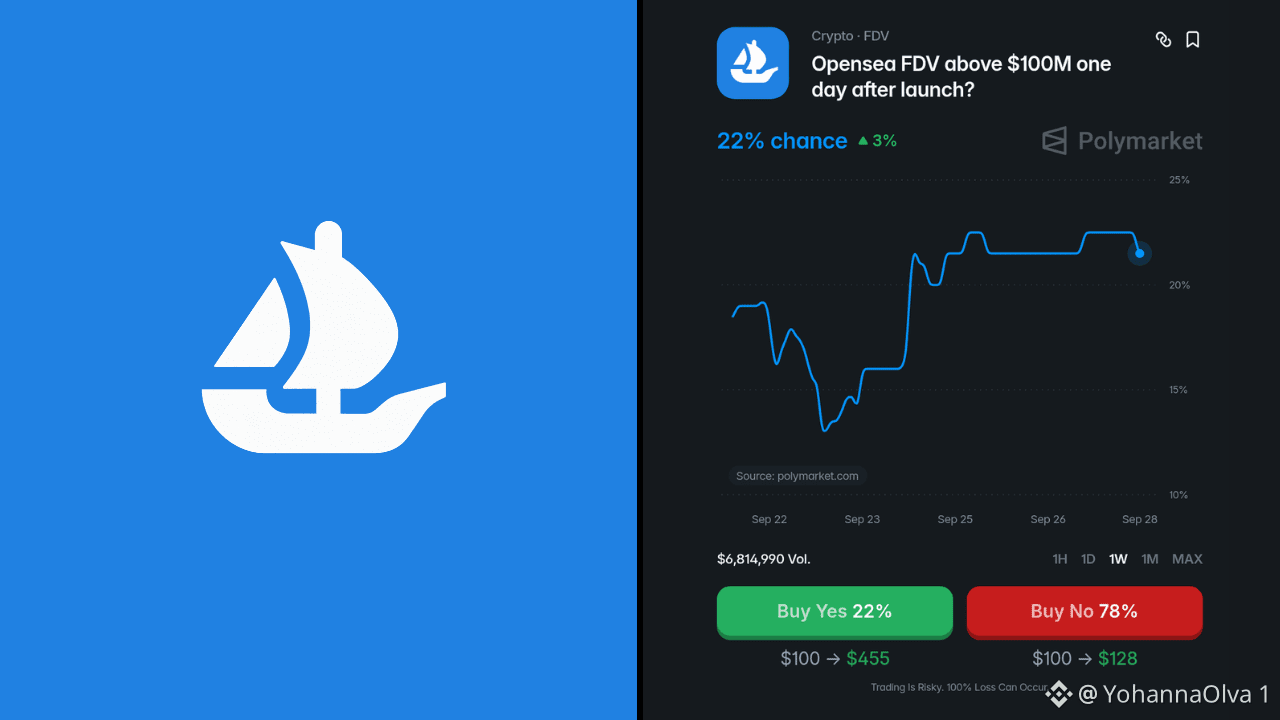
$6.8M in volume on one prediction 👀
That's the kind of activity that makes me keep Polymarket open.
The question is whether OpenSea's FDV will be above $100M one day after launch, and traders currently give YES only a 22% chance.
Low probability means higher risk, but it also creates a much larger potential payout.
💰 $100 on YES → roughly $455 if correct.
That's more than 4.5x.
What I like about Polymarket is that I don't need to buy whatever launches next and then wait for the market to decide whether my investment was good.
I can trade the event directly.
And I still control my exit.
If OpenSea hype accelerates and that 22% probability starts moving toward 30%, 40% or beyond, I can potentially sell the position before the market even resolves.
That's a completely different way of finding opportunities in crypto.
Rather than relying on one $HYPE position to appreciate, Polymarket gives me thousands of events and changing probabilities to explore for the next setup.
#Altcoin Season#
$6.8M in volume on one prediction 👀
That's the kind of activity that makes me keep Polymarket open.
The question is whether OpenSea's FDV will be above $100M one day after launch, and traders currently give YES only a 22% chance.
Low probability means higher risk, but it also creates a much larger potential payout.
💰 $100 on YES → roughly $455 if correct.
That's more than 4.5x.
What I like about Polymarket is that I don't need to buy whatever launches next and then wait for the market to decide whether my investment was good.
I can trade the event directly.
And I still control my exit.
If OpenSea hype accelerates and that 22% probability starts moving toward 30%, 40% or beyond, I can potentially sell the position before the market even resolves.
That's a completely different way of finding opportunities in crypto.
Rather than relying on one $HYPE position to appreciate, Polymarket gives me thousands of events and changing probabilities to explore for the next setup.
#Altcoin Season#
That's the kind of activity that makes me keep Polymarket open.
The question is whether OpenSea's FDV will be above $100M one day after launch, and traders currently give YES only a 22% chance.
Low probability means higher risk, but it also creates a much larger potential payout.
💰 $100 on YES → roughly $455 if correct.
That's more than 4.5x.
What I like about Polymarket is that I don't need to buy whatever launches next and then wait for the market to decide whether my investment was good.
I can trade the event directly.
And I still control my exit.
If OpenSea hype accelerates and that 22% probability starts moving toward 30%, 40% or beyond, I can potentially sell the position before the market even resolves.
That's a completely different way of finding opportunities in crypto.
Rather than relying on one $HYPE position to appreciate, Polymarket gives me thousands of events and changing probabilities to explore for the next setup.
#Altcoin Season#
124
Web3 underestimates the power of events 🔥
Communities around $SOL and $INJ show how easily crypto culture can travel across borders, but bringing people into the same city is only the first step.
When people meet IRL, the details around them shape how much time they can actually spend connecting with one another.
Good hospitality reduces the planning around an experience, allowing the people and conversations to remain at the centre of it.
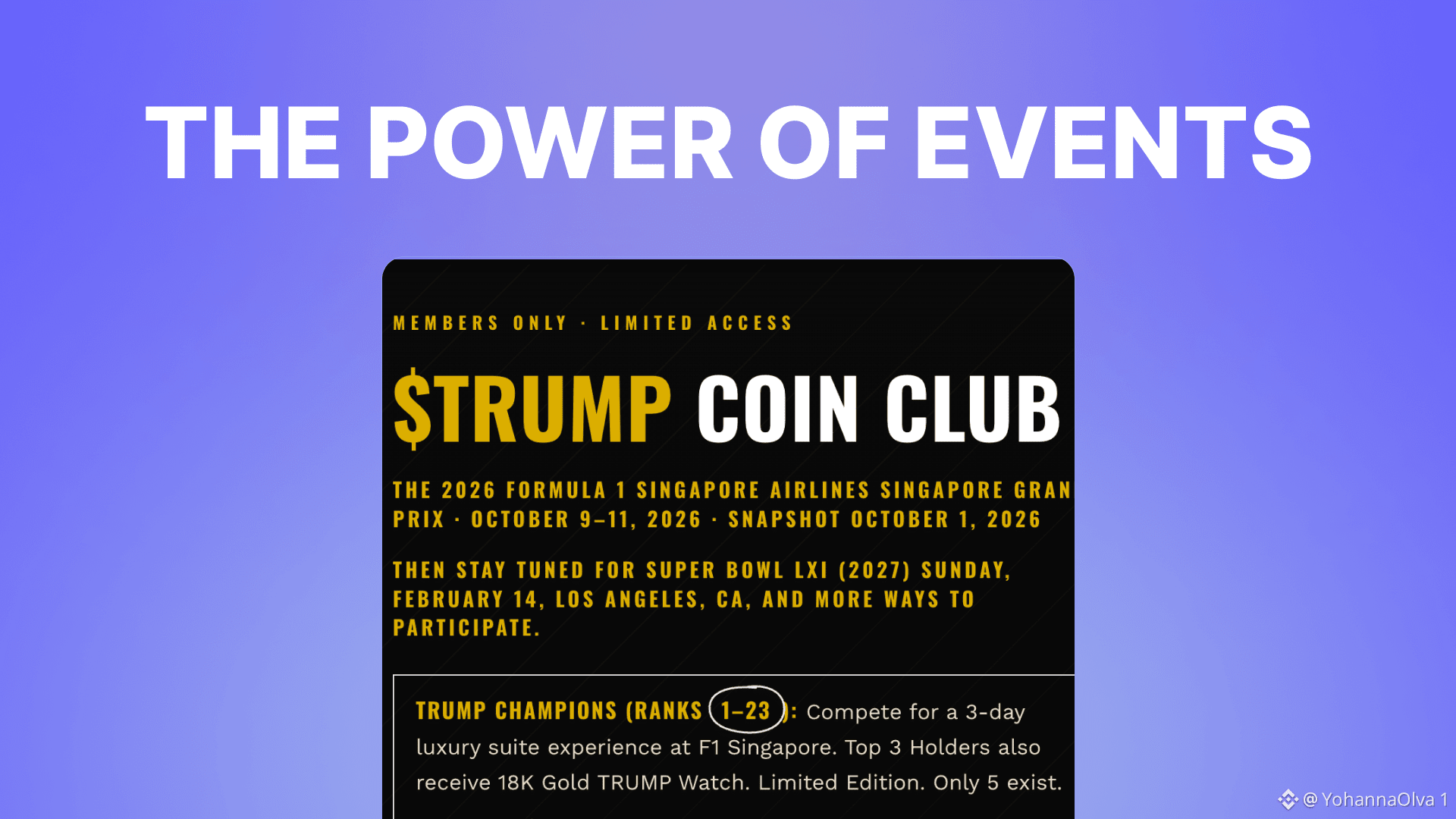
This is what makes the planned $Trump Coin Club Singapore experience interesting to me.
Its three-day format is expected to include hotel accommodation, private ground transportation and meals, all subject to availability.
Those details may sound operational, but they determine whether attendees can focus on the experience instead of organizing every part of it themselves.
Imo the strongest hospitality is the kind people barely have to think about, because everything around the connection already works 🌏
#Altcoin Season#
Web3 underestimates the power of events 🔥
Communities around $SOL and $INJ show how easily crypto culture can travel across borders, but bringing people into the same city is only the first step.
When people meet IRL, the details around them shape how much time they can actually spend connecting with one another.
Good hospitality reduces the planning around an experience, allowing the people and conversations to remain at the centre of it.
This is what makes the planned $Trump Coin Club Singapore experience interesting to me.
Its three-day format is expected to include hotel accommodation, private ground transportation and meals, all subject to availability.
Those details may sound operational, but they determine whether attendees can focus on the experience instead of organizing every part of it themselves.
Imo the strongest hospitality is the kind people barely have to think about, because everything around the connection already works 🌏
#Altcoin Season#
Communities around $SOL and $INJ show how easily crypto culture can travel across borders, but bringing people into the same city is only the first step.
When people meet IRL, the details around them shape how much time they can actually spend connecting with one another.
Good hospitality reduces the planning around an experience, allowing the people and conversations to remain at the centre of it.
This is what makes the planned $Trump Coin Club Singapore experience interesting to me.
Its three-day format is expected to include hotel accommodation, private ground transportation and meals, all subject to availability.
Those details may sound operational, but they determine whether attendees can focus on the experience instead of organizing every part of it themselves.
Imo the strongest hospitality is the kind people barely have to think about, because everything around the connection already works 🌏
#Altcoin Season#
2
223
**$SYN Is Building A Potential Bull Flag 🚩**
$LINK shows how infrastructure assets can consolidate sharply after a major expansion before choosing their next direction.
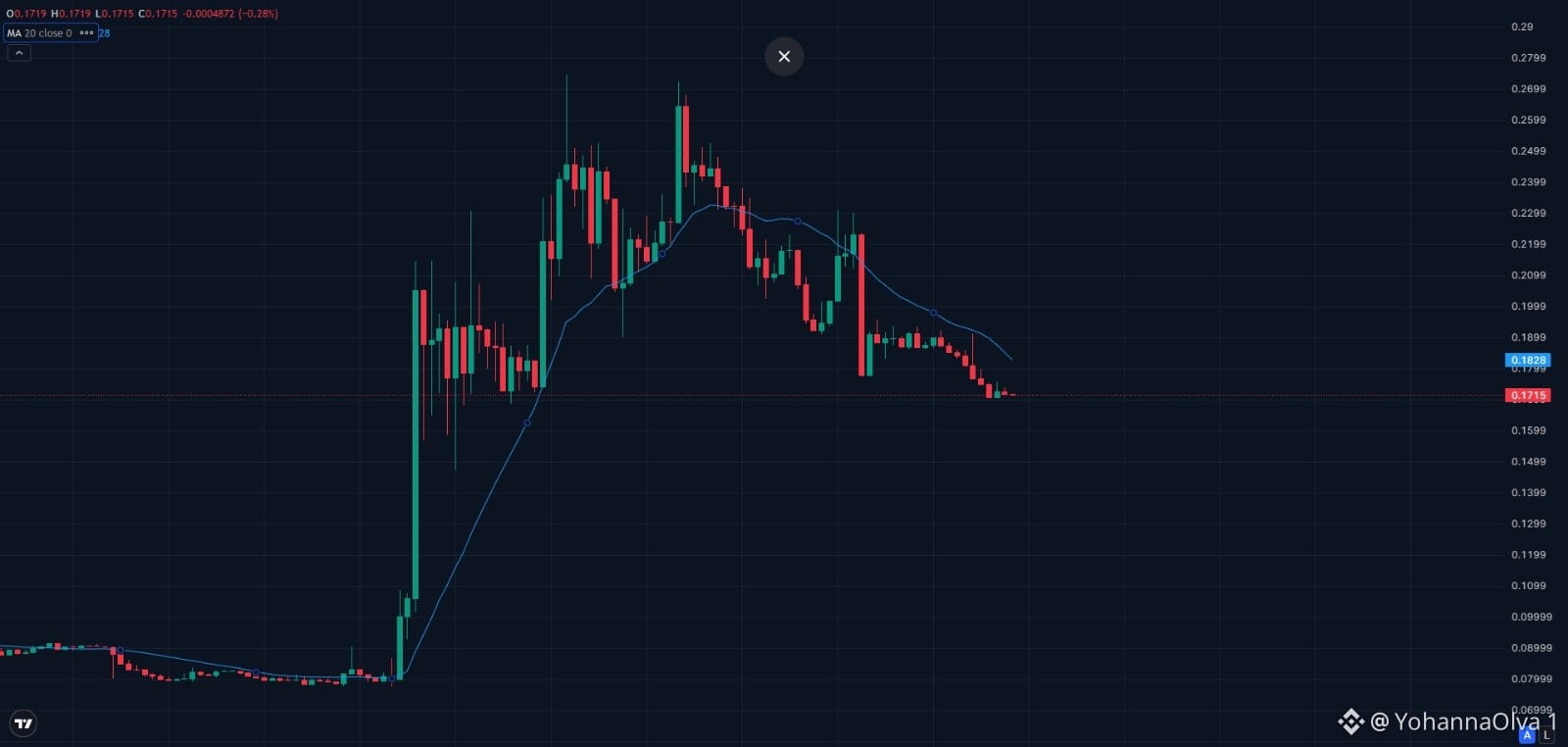
$SYN may now be forming that type of continuation structure. Price surged from approximately $0.08 to above $0.24 before entering a consolidation.
That combination resembles a potential bull flag: a strong initial move, an orderly pullback and reduced participation as price approaches support.
The immediate support zone sits around $0.165–$0.170.
A recovery above $0.190 would provide the first bullish confirmation, while reclaiming the 20-day moving average near $0.208 would strengthen the setup considerably.
The upside levels to watch are:
🎯 $0.208
🎯 $0.220
🎯 $0.240
\#TechnicalAnalysis #Altcoin Season#
**$SYN Is Building A Potential Bull Flag 🚩**
$LINK shows how infrastructure assets can consolidate sharply after a major expansion before choosing their next direction.
$SYN may now be forming that type of continuation structure. Price surged from approximately $0.08 to above $0.24 before entering a consolidation.
That combination resembles a potential bull flag: a strong initial move, an orderly pullback and reduced participation as price approaches support.
The immediate support zone sits around $0.165–$0.170.
A recovery above $0.190 would provide the first bullish confirmation, while reclaiming the 20-day moving average near $0.208 would strengthen the setup considerably.
The upside levels to watch are:
🎯 $0.208
🎯 $0.220
🎯 $0.240
\#TechnicalAnalysis #Altcoin Season#
$LINK shows how infrastructure assets can consolidate sharply after a major expansion before choosing their next direction.
$SYN may now be forming that type of continuation structure. Price surged from approximately $0.08 to above $0.24 before entering a consolidation.
That combination resembles a potential bull flag: a strong initial move, an orderly pullback and reduced participation as price approaches support.
The immediate support zone sits around $0.165–$0.170.
A recovery above $0.190 would provide the first bullish confirmation, while reclaiming the 20-day moving average near $0.208 would strengthen the setup considerably.
The upside levels to watch are:
🎯 $0.208
🎯 $0.220
🎯 $0.240
\#TechnicalAnalysis #Altcoin Season#
1
165
The Best Yield Doesn't Sit Still 🌐
That's something people miss when they compare DeFi vaults by APY.
The opportunity can move.
One lending market gets crowded and its spread compresses.
Another chain suddenly has cheaper borrowing.
A Pendle market reprices.
A redemption dislocation opens somewhere else.
Theoriq's AlphaVault is built around that reality rather than treating one protocol as a permanent home for capital.
Its strategy universe has included Aave, Morpho and Euler deployments across multiple environments, with capital moving toward relative-value, credit-spread and term-yield opportunities when the risk-adjusted economics justify it.
That makes me think differently about ecosystems like $SUI and $NEAR too.
More chains don't only mean fragmented liquidity.
They create fragmented pricing.
And fragmented pricing can become opportunity if the infrastructure can compare venues, move efficiently and understand the extra risk introduced by crossing between them.
The edge isn't finding the protocol with the biggest number today.
It's recognizing when today's best opportunity stops being tomorrow's.
#Altcoin Season#
The Best Yield Doesn't Sit Still 🌐
That's something people miss when they compare DeFi vaults by APY.
The opportunity can move.
One lending market gets crowded and its spread compresses.
Another chain suddenly has cheaper borrowing.
A Pendle market reprices.
A redemption dislocation opens somewhere else.
Theoriq's AlphaVault is built around that reality rather than treating one protocol as a permanent home for capital.
Its strategy universe has included Aave, Morpho and Euler deployments across multiple environments, with capital moving toward relative-value, credit-spread and term-yield opportunities when the risk-adjusted economics justify it.
That makes me think differently about ecosystems like $SUI and $NEAR too.
More chains don't only mean fragmented liquidity.
They create fragmented pricing.
And fragmented pricing can become opportunity if the infrastructure can compare venues, move efficiently and understand the extra risk introduced by crossing between them.
The edge isn't finding the protocol with the biggest number today.
It's recognizing when today's best opportunity stops being tomorrow's.
#Altcoin Season#
That's something people miss when they compare DeFi vaults by APY.
The opportunity can move.
One lending market gets crowded and its spread compresses.
Another chain suddenly has cheaper borrowing.
A Pendle market reprices.
A redemption dislocation opens somewhere else.
Theoriq's AlphaVault is built around that reality rather than treating one protocol as a permanent home for capital.
Its strategy universe has included Aave, Morpho and Euler deployments across multiple environments, with capital moving toward relative-value, credit-spread and term-yield opportunities when the risk-adjusted economics justify it.
That makes me think differently about ecosystems like $SUI and $NEAR too.
More chains don't only mean fragmented liquidity.
They create fragmented pricing.
And fragmented pricing can become opportunity if the infrastructure can compare venues, move efficiently and understand the extra risk introduced by crossing between them.
The edge isn't finding the protocol with the biggest number today.
It's recognizing when today's best opportunity stops being tomorrow's.
#Altcoin Season#
92
The Internet Needs Proof Of Humanity 🧍
$VFY and $WLD sit close to one of the internet’s next major bottlenecks.
AI agents can submit forms, create accounts and overwhelm public services at a scale that human attackers never could. This is inevitable, and it is also going to cause major issues.
Large platforms may build custom defences, but small businesses and government websites rarely have the same resources.
CAPTCHAs are already frustrating for humans but increasingly manageable for machines.
Future websites may need cryptographic evidence that a request came from a real and eligible person.
A privacy-preserving identity system could generate a ZK proof confirming humanity without disclosing the user’s name or identity document. The credential and privacy would come from that identity system.
zkVerify could independently check whether the resulting proof is cryptographically valid.
The website would receive a usable result and could limit sensitive actions to verified users.
One verified person could receive one application, claim or account without the organisation collecting another database of personal documents.
That makes the role of VFY much easier to understand.
If proof-based access becomes common, websites will need somewhere reliable to send those proofs for checking.
I think human verification could become one of the largest real-world demand sources for dedicated Zero Knowledge infrastructure.
#AI #Privacy
The Internet Needs Proof Of Humanity 🧍
$VFY and $WLD sit close to one of the internet’s next major bottlenecks.
AI agents can submit forms, create accounts and overwhelm public services at a scale that human attackers never could. This is inevitable, and it is also going to cause major issues.
Large platforms may build custom defences, but small businesses and government websites rarely have the same resources.
CAPTCHAs are already frustrating for humans but increasingly manageable for machines.
Future websites may need cryptographic evidence that a request came from a real and eligible person.
A privacy-preserving identity system could generate a ZK proof confirming humanity without disclosing the user’s name or identity document. The credential and privacy would come from that identity system.
zkVerify could independently check whether the resulting proof is cryptographically valid.
The website would receive a usable result and could limit sensitive actions to verified users.
One verified person could receive one application, claim or account without the organisation collecting another database of personal documents.
That makes the role of VFY much easier to understand.
If proof-based access becomes common, websites will need somewhere reliable to send those proofs for checking.
I think human verification could become one of the largest real-world demand sources for dedicated Zero Knowledge infrastructure.
#AI #Privacy
$VFY and $WLD sit close to one of the internet’s next major bottlenecks.
AI agents can submit forms, create accounts and overwhelm public services at a scale that human attackers never could. This is inevitable, and it is also going to cause major issues.
Large platforms may build custom defences, but small businesses and government websites rarely have the same resources.
CAPTCHAs are already frustrating for humans but increasingly manageable for machines.
Future websites may need cryptographic evidence that a request came from a real and eligible person.
A privacy-preserving identity system could generate a ZK proof confirming humanity without disclosing the user’s name or identity document. The credential and privacy would come from that identity system.
zkVerify could independently check whether the resulting proof is cryptographically valid.
The website would receive a usable result and could limit sensitive actions to verified users.
One verified person could receive one application, claim or account without the organisation collecting another database of personal documents.
That makes the role of VFY much easier to understand.
If proof-based access becomes common, websites will need somewhere reliable to send those proofs for checking.
I think human verification could become one of the largest real-world demand sources for dedicated Zero Knowledge infrastructure.
#AI #Privacy
1
1
290
Three Venues. One Borrower. Now What? 🔐
Here's where institutional crypto credit gets messy.
A borrower might hold collateral on a centralized exchange, another position in DeFi and something else sitting with a custodian.
Each venue can show its own balance.
But the lender needs the whole picture.
Space and Time's Virtual Vault approach is designed around bringing those separate sources into one verifiable collateral view rather than making the lender reconcile different versions manually.
That's the piece I think gets overlooked.
The problem isn't always missing data.
Sometimes you have plenty of data and none of it agrees cleanly.
As liquidity spreads across ecosystems like $AVAX , that fragmentation isn't disappearing.
Credit infrastructure needs to work around it.
One borrower shouldn't create five different versions of reality.
#Altcoin Season#
Three Venues. One Borrower. Now What? 🔐
Here's where institutional crypto credit gets messy.
A borrower might hold collateral on a centralized exchange, another position in DeFi and something else sitting with a custodian.
Each venue can show its own balance.
But the lender needs the whole picture.
Space and Time's Virtual Vault approach is designed around bringing those separate sources into one verifiable collateral view rather than making the lender reconcile different versions manually.
That's the piece I think gets overlooked.
The problem isn't always missing data.
Sometimes you have plenty of data and none of it agrees cleanly.
As liquidity spreads across ecosystems like $AVAX , that fragmentation isn't disappearing.
Credit infrastructure needs to work around it.
One borrower shouldn't create five different versions of reality.
#Altcoin Season#
Here's where institutional crypto credit gets messy.
A borrower might hold collateral on a centralized exchange, another position in DeFi and something else sitting with a custodian.
Each venue can show its own balance.
But the lender needs the whole picture.
Space and Time's Virtual Vault approach is designed around bringing those separate sources into one verifiable collateral view rather than making the lender reconcile different versions manually.
That's the piece I think gets overlooked.
The problem isn't always missing data.
Sometimes you have plenty of data and none of it agrees cleanly.
As liquidity spreads across ecosystems like $AVAX , that fragmentation isn't disappearing.
Credit infrastructure needs to work around it.
One borrower shouldn't create five different versions of reality.
#Altcoin Season#
63
Pairing Memes Against Stocks Changes Everything 🧬
$ONDO helped make tokenized assets understandable to a much wider crypto audience.
Now $ZORA is exploring what happens when those assets become the foundation for entirely new markets.
Most launchpads let users create another token against the same default currency.
Custom Pairs break that pattern.
A creator can launch a token against a meme, crypto major or tokenized stock, creating a market around the relationship between two different narratives.
Zora CEO Dee Goens believes this could become a breakout phenomenon for crypto, and I understand why.
The mobile app now lets users
- Create Custom Pairs in a few clicks
- Choose what their token trades against
- Access crosschain trading across Solana, BNB Chain, Robinhood Chain and Base
I think this is the kind of market behaviour that could only emerge in crypto.
Custom Pairs turn speculation into a creative medium. The stranger and more culturally relevant the pairing, the more interesting the market becomes.
Dee is pursuing the format hard, and Zora has already placed it at the centre of its mobile expansion.
This could become much larger than another token-launch feature.
#RWA #Altcoin Season#
Pairing Memes Against Stocks Changes Everything 🧬
$ONDO helped make tokenized assets understandable to a much wider crypto audience.
Now $ZORA is exploring what happens when those assets become the foundation for entirely new markets.
Most launchpads let users create another token against the same default currency.
Custom Pairs break that pattern.
A creator can launch a token against a meme, crypto major or tokenized stock, creating a market around the relationship between two different narratives.
Zora CEO Dee Goens believes this could become a breakout phenomenon for crypto, and I understand why.
The mobile app now lets users
- Create Custom Pairs in a few clicks
- Choose what their token trades against
- Access crosschain trading across Solana, BNB Chain, Robinhood Chain and Base
I think this is the kind of market behaviour that could only emerge in crypto.
Custom Pairs turn speculation into a creative medium. The stranger and more culturally relevant the pairing, the more interesting the market becomes.
Dee is pursuing the format hard, and Zora has already placed it at the centre of its mobile expansion.
This could become much larger than another token-launch feature.
#RWA #Altcoin Season#
$ONDO helped make tokenized assets understandable to a much wider crypto audience.
Now $ZORA is exploring what happens when those assets become the foundation for entirely new markets.
Most launchpads let users create another token against the same default currency.
Custom Pairs break that pattern.
A creator can launch a token against a meme, crypto major or tokenized stock, creating a market around the relationship between two different narratives.
Zora CEO Dee Goens believes this could become a breakout phenomenon for crypto, and I understand why.
The mobile app now lets users
- Create Custom Pairs in a few clicks
- Choose what their token trades against
- Access crosschain trading across Solana, BNB Chain, Robinhood Chain and Base
I think this is the kind of market behaviour that could only emerge in crypto.
Custom Pairs turn speculation into a creative medium. The stranger and more culturally relevant the pairing, the more interesting the market becomes.
Dee is pursuing the format hard, and Zora has already placed it at the centre of its mobile expansion.
This could become much larger than another token-launch feature.
#RWA #Altcoin Season#
61
Options Are Crypto’s Next Major Market 🌊
$AAVE showed that a major financial category such as lending could become a foundational part of DeFi. $SYN targets another established category through Hypercall: options.
Listed options represent roughly 50 trillion USD in annual notional volume globally, yet onchain options still lack a clear category leader.
Perpetuals already proved that traders want derivatives onchain. Options expand what those traders can express through strikes, expiries and structured payoffs.
Hypercall approaches that opportunity with equity-linked markets, fractional sizing and trading outside traditional market hours.
It is built on Hyperliquid, giving the product access to an active derivatives ecosystem instead of starting from an empty market.
That is why I see Hypercall as more than another trading interface. It is targeting a financial category that crypto has barely captured.
For SYN, even a small share of that migration could make product adoption increasingly relevant to the wider thesis.
#Altcoin Season#
Options Are Crypto’s Next Major Market 🌊
$AAVE showed that a major financial category such as lending could become a foundational part of DeFi. $SYN targets another established category through Hypercall: options.
Listed options represent roughly 50 trillion USD in annual notional volume globally, yet onchain options still lack a clear category leader.
Perpetuals already proved that traders want derivatives onchain. Options expand what those traders can express through strikes, expiries and structured payoffs.
Hypercall approaches that opportunity with equity-linked markets, fractional sizing and trading outside traditional market hours.
It is built on Hyperliquid, giving the product access to an active derivatives ecosystem instead of starting from an empty market.
That is why I see Hypercall as more than another trading interface. It is targeting a financial category that crypto has barely captured.
For SYN, even a small share of that migration could make product adoption increasingly relevant to the wider thesis.
#Altcoin Season#
$AAVE showed that a major financial category such as lending could become a foundational part of DeFi. $SYN targets another established category through Hypercall: options.
Listed options represent roughly 50 trillion USD in annual notional volume globally, yet onchain options still lack a clear category leader.
Perpetuals already proved that traders want derivatives onchain. Options expand what those traders can express through strikes, expiries and structured payoffs.
Hypercall approaches that opportunity with equity-linked markets, fractional sizing and trading outside traditional market hours.
It is built on Hyperliquid, giving the product access to an active derivatives ecosystem instead of starting from an empty market.
That is why I see Hypercall as more than another trading interface. It is targeting a financial category that crypto has barely captured.
For SYN, even a small share of that migration could make product adoption increasingly relevant to the wider thesis.
#Altcoin Season#
65
$B3 might be early to a 10x compute narrative 👀
BlackRock just pushed AI infrastructure into a much bigger conversation.
Its latest research says claims on compute capacity could eventually be tokenized, traded and used for programmable settlement, while $VVV already gives the market a crypto-native way to access AI inference through Venice.
I think $B3 sits where those ideas begin to overlap.
Not simply trading access to compute, but turning the physical GPU itself into productive infrastructure.
B3IQ already lets buyers own NVIDIA systems while B3 handles the build, hosting and commercial demand.
On select machines:
• Buyers can start with roughly 30% down.
• The machine can earn while the remaining balance is paid down.
• Owners keep 85% of realized gross revenue after B3’s network share.
That model looks more interesting if compute itself starts becoming a financial asset.
VVV gives exposure to the usage of AI compute.
B3 is building around ownership of the machines producing it.
If BlackRock is right that compute becomes tokenizable infrastructure, B3IQ is already building around the physical asset underneath that market.
For me, that is where the B3 thesis starts getting much bigger 🔥
#Altcoin Season# #DePIN
$B3 might be early to a 10x compute narrative 👀
BlackRock just pushed AI infrastructure into a much bigger conversation.
Its latest research says claims on compute capacity could eventually be tokenized, traded and used for programmable settlement, while $VVV already gives the market a crypto-native way to access AI inference through Venice.
I think $B3 sits where those ideas begin to overlap.
Not simply trading access to compute, but turning the physical GPU itself into productive infrastructure.
B3IQ already lets buyers own NVIDIA systems while B3 handles the build, hosting and commercial demand.
On select machines:
• Buyers can start with roughly 30% down.
• The machine can earn while the remaining balance is paid down.
• Owners keep 85% of realized gross revenue after B3’s network share.
That model looks more interesting if compute itself starts becoming a financial asset.
VVV gives exposure to the usage of AI compute.
B3 is building around ownership of the machines producing it.
If BlackRock is right that compute becomes tokenizable infrastructure, B3IQ is already building around the physical asset underneath that market.
For me, that is where the B3 thesis starts getting much bigger 🔥
#Altcoin Season# #DePIN
BlackRock just pushed AI infrastructure into a much bigger conversation.
Its latest research says claims on compute capacity could eventually be tokenized, traded and used for programmable settlement, while $VVV already gives the market a crypto-native way to access AI inference through Venice.
I think $B3 sits where those ideas begin to overlap.
Not simply trading access to compute, but turning the physical GPU itself into productive infrastructure.
B3IQ already lets buyers own NVIDIA systems while B3 handles the build, hosting and commercial demand.
On select machines:
• Buyers can start with roughly 30% down.
• The machine can earn while the remaining balance is paid down.
• Owners keep 85% of realized gross revenue after B3’s network share.
That model looks more interesting if compute itself starts becoming a financial asset.
VVV gives exposure to the usage of AI compute.
B3 is building around ownership of the machines producing it.
If BlackRock is right that compute becomes tokenizable infrastructure, B3IQ is already building around the physical asset underneath that market.
For me, that is where the B3 thesis starts getting much bigger 🔥
#Altcoin Season# #DePIN

57
You Can Now Vest Tokens To The Holders 💎
$JUP and Ethena taught this market that distribution design decides who stays. $BNKR is testing a version where holding is the thing that earns.
New on Arbitrum and Arc: a launch can vest tokens directly to holders rather than to the team, with a second option to route fees to holders in the quote token, the base token, or both. Both are written into the contract rather than administered by the platform.
What interests me is what it rewards.
Most token distribution pays for arrival. Airdrops reward being early, points reward activity, and neither pays anyone for still being there a year later. A vest that accrues to holders inverts that entirely.
The counterpoint deserves saying, because it is the obvious one.
Paying people to hold does not give them a reason to hold. Emissions aimed at loyalty still dilute somebody, and a token whose main attraction is receiving more of itself has a circular problem this industry has already lived through twice.
The version that survives contact with reality is the one where the payout comes from fee income rather than from supply, which is why the fees-to-holders option is the more interesting of the two.
Status matters here. These are experimental, live on two chains, with Base and Robinhood Chain described only as possible.
Before judging it I want to see one launch using it with real volume behind it, and then whether the holders it paid actually stayed.
#Arbitrum #Altcoin Season#
You Can Now Vest Tokens To The Holders 💎
$JUP and Ethena taught this market that distribution design decides who stays. $BNKR is testing a version where holding is the thing that earns.
New on Arbitrum and Arc: a launch can vest tokens directly to holders rather than to the team, with a second option to route fees to holders in the quote token, the base token, or both. Both are written into the contract rather than administered by the platform.
What interests me is what it rewards.
Most token distribution pays for arrival. Airdrops reward being early, points reward activity, and neither pays anyone for still being there a year later. A vest that accrues to holders inverts that entirely.
The counterpoint deserves saying, because it is the obvious one.
Paying people to hold does not give them a reason to hold. Emissions aimed at loyalty still dilute somebody, and a token whose main attraction is receiving more of itself has a circular problem this industry has already lived through twice.
The version that survives contact with reality is the one where the payout comes from fee income rather than from supply, which is why the fees-to-holders option is the more interesting of the two.
Status matters here. These are experimental, live on two chains, with Base and Robinhood Chain described only as possible.
Before judging it I want to see one launch using it with real volume behind it, and then whether the holders it paid actually stayed.
#Arbitrum #Altcoin Season#
$JUP and Ethena taught this market that distribution design decides who stays. $BNKR is testing a version where holding is the thing that earns.
New on Arbitrum and Arc: a launch can vest tokens directly to holders rather than to the team, with a second option to route fees to holders in the quote token, the base token, or both. Both are written into the contract rather than administered by the platform.
What interests me is what it rewards.
Most token distribution pays for arrival. Airdrops reward being early, points reward activity, and neither pays anyone for still being there a year later. A vest that accrues to holders inverts that entirely.
The counterpoint deserves saying, because it is the obvious one.
Paying people to hold does not give them a reason to hold. Emissions aimed at loyalty still dilute somebody, and a token whose main attraction is receiving more of itself has a circular problem this industry has already lived through twice.
The version that survives contact with reality is the one where the payout comes from fee income rather than from supply, which is why the fees-to-holders option is the more interesting of the two.
Status matters here. These are experimental, live on two chains, with Base and Robinhood Chain described only as possible.
Before judging it I want to see one launch using it with real volume behind it, and then whether the holders it paid actually stayed.
#Arbitrum #Altcoin Season#
93
Injective might surprise everyone with an 8x 👀
The market is already rewarding two of the clearest narratives across onchain finance with $HYPE becoming a major trading infrastructure bet, while $ONDO made institutional tokenization one of the strongest RWA themes.
I think Injective sits where those narratives begin to overlap, with equities and RWAs trading onchain alongside infrastructure designed for American financial markets.
An 8x sounds aggressive, I know but still, the version of Injective trading today is materially different from the one that reached its previous ATH.
Its position in the U.S. has developed across several fronts:
• Injective is the first L1 to have an SEC-registered transfer agent.
• INJ futures are live on Bitnomial’s CFTC-regulated U.S. exchange.
• Canary Capital has filed for a staked INJ ETF.
Those developments do not guarantee institutional adoption or price appreciation, but they give Injective an actual pathway across tokenization, onchain markets, and regulated access.
For me, the American angle is becoming a major part of the Injective thesis 🔥
#Macro Insights#
Injective might surprise everyone with an 8x 👀
The market is already rewarding two of the clearest narratives across onchain finance with $HYPE becoming a major trading infrastructure bet, while $ONDO made institutional tokenization one of the strongest RWA themes.
I think Injective sits where those narratives begin to overlap, with equities and RWAs trading onchain alongside infrastructure designed for American financial markets.
An 8x sounds aggressive, I know but still, the version of Injective trading today is materially different from the one that reached its previous ATH.
Its position in the U.S. has developed across several fronts:
• Injective is the first L1 to have an SEC-registered transfer agent.
• INJ futures are live on Bitnomial’s CFTC-regulated U.S. exchange.
• Canary Capital has filed for a staked INJ ETF.
Those developments do not guarantee institutional adoption or price appreciation, but they give Injective an actual pathway across tokenization, onchain markets, and regulated access.
For me, the American angle is becoming a major part of the Injective thesis 🔥
#Macro Insights#
The market is already rewarding two of the clearest narratives across onchain finance with $HYPE becoming a major trading infrastructure bet, while $ONDO made institutional tokenization one of the strongest RWA themes.
I think Injective sits where those narratives begin to overlap, with equities and RWAs trading onchain alongside infrastructure designed for American financial markets.
An 8x sounds aggressive, I know but still, the version of Injective trading today is materially different from the one that reached its previous ATH.
Its position in the U.S. has developed across several fronts:
• Injective is the first L1 to have an SEC-registered transfer agent.
• INJ futures are live on Bitnomial’s CFTC-regulated U.S. exchange.
• Canary Capital has filed for a staked INJ ETF.
Those developments do not guarantee institutional adoption or price appreciation, but they give Injective an actual pathway across tokenization, onchain markets, and regulated access.
For me, the American angle is becoming a major part of the Injective thesis 🔥
#Macro Insights#
49
$516M market cap for this story? 🟢
$ONDO owns a lot of the tokenized asset conversation on CMC. $RENDER brings the AI compute and infrastructure crowd that cares about what machines can actually use. Pyth connects both through the part nobody can skip: market data.
The Nasdaq Basic update makes that clearer.
Pyth has been approved as an external distributor to offer Nasdaq Basic, Nasdaq’s real-time quote and trade product for U.S. equities, through its Data Marketplace.
This gives Pyth stronger positioning inside the institutional market-data conversation.
The token chart already started reacting, with PYTH up over 8% in 24H and volume up more than 23%.
But the larger setup is still the product-to-market-cap gap.
3,500+ market feeds.
138+ first-party publishers.
1,901 equity feeds.
45 live Pyth Indices.
$10.4M ARR in August.
$2.9M gross new ARR.
$723.77B in August RWA perp volume priced by Pyth.
Now Nasdaq Basic enters the marketplace narrative.
At around $516M market cap, PYTH still looks like the market is pricing an oracle ticker while the product is moving toward a market-data business.
That is exactly the kind of gap I want to watch 📈
#Altcoin Season# #Trading
$516M market cap for this story? 🟢
$ONDO owns a lot of the tokenized asset conversation on CMC. $RENDER brings the AI compute and infrastructure crowd that cares about what machines can actually use. Pyth connects both through the part nobody can skip: market data.
The Nasdaq Basic update makes that clearer.
Pyth has been approved as an external distributor to offer Nasdaq Basic, Nasdaq’s real-time quote and trade product for U.S. equities, through its Data Marketplace.
This gives Pyth stronger positioning inside the institutional market-data conversation.
The token chart already started reacting, with PYTH up over 8% in 24H and volume up more than 23%.
But the larger setup is still the product-to-market-cap gap.
3,500+ market feeds.
138+ first-party publishers.
1,901 equity feeds.
45 live Pyth Indices.
$10.4M ARR in August.
$2.9M gross new ARR.
$723.77B in August RWA perp volume priced by Pyth.
Now Nasdaq Basic enters the marketplace narrative.
At around $516M market cap, PYTH still looks like the market is pricing an oracle ticker while the product is moving toward a market-data business.
That is exactly the kind of gap I want to watch 📈
#Altcoin Season# #Trading
$ONDO owns a lot of the tokenized asset conversation on CMC. $RENDER brings the AI compute and infrastructure crowd that cares about what machines can actually use. Pyth connects both through the part nobody can skip: market data.
The Nasdaq Basic update makes that clearer.
Pyth has been approved as an external distributor to offer Nasdaq Basic, Nasdaq’s real-time quote and trade product for U.S. equities, through its Data Marketplace.
This gives Pyth stronger positioning inside the institutional market-data conversation.
The token chart already started reacting, with PYTH up over 8% in 24H and volume up more than 23%.
But the larger setup is still the product-to-market-cap gap.
3,500+ market feeds.
138+ first-party publishers.
1,901 equity feeds.
45 live Pyth Indices.
$10.4M ARR in August.
$2.9M gross new ARR.
$723.77B in August RWA perp volume priced by Pyth.
Now Nasdaq Basic enters the marketplace narrative.
At around $516M market cap, PYTH still looks like the market is pricing an oracle ticker while the product is moving toward a market-data business.
That is exactly the kind of gap I want to watch 📈
#Altcoin Season# #Trading
48
Basecamp Could Reprice Sui’s Finance Thesis 🔥
$SUI has spent many years now building the foundations. Even its co-founder says the next reveal will unleash the full power of Sui’s financial composability.
That is a massive claim.
The ambition is to make Sui the best place in the world to put capital to work.
The foundations are already visible across DeepBook’s native liquidity, gasless stablecoin transfers and Hashi becoming the Bitcoin collateral layer.
Basecamp is where those separate pieces could finally become one connected financial system.
If capital can trade, borrow, settle and move across Sui without fragmented infrastructure, the network becomes much harder to value as just another Layer 1.
I’m watching this super closely, because composability is where good technology becomes an actual financial economy.
Sui has set the expectations extremely high.
Now Basecamp needs to show the market why.
#Altcoin Season# #DeFi
Basecamp Could Reprice Sui’s Finance Thesis 🔥
$SUI has spent many years now building the foundations. Even its co-founder says the next reveal will unleash the full power of Sui’s financial composability.
That is a massive claim.
The ambition is to make Sui the best place in the world to put capital to work.
The foundations are already visible across DeepBook’s native liquidity, gasless stablecoin transfers and Hashi becoming the Bitcoin collateral layer.
Basecamp is where those separate pieces could finally become one connected financial system.
If capital can trade, borrow, settle and move across Sui without fragmented infrastructure, the network becomes much harder to value as just another Layer 1.
I’m watching this super closely, because composability is where good technology becomes an actual financial economy.
Sui has set the expectations extremely high.
Now Basecamp needs to show the market why.
#Altcoin Season# #DeFi
$SUI has spent many years now building the foundations. Even its co-founder says the next reveal will unleash the full power of Sui’s financial composability.
That is a massive claim.
The ambition is to make Sui the best place in the world to put capital to work.
The foundations are already visible across DeepBook’s native liquidity, gasless stablecoin transfers and Hashi becoming the Bitcoin collateral layer.
Basecamp is where those separate pieces could finally become one connected financial system.
If capital can trade, borrow, settle and move across Sui without fragmented infrastructure, the network becomes much harder to value as just another Layer 1.
I’m watching this super closely, because composability is where good technology becomes an actual financial economy.
Sui has set the expectations extremely high.
Now Basecamp needs to show the market why.
#Altcoin Season# #DeFi

74
Get Smarter Position Sizing With AI 📊
Figuring out how much of your money actually deserves to go behind certain trades is an underrated skill.
Most people mismanage this part, but luckily there's a new vault from Pear Protocol that handles that automatically.
Every opportunity gets scored from 1–10 using factors like the strength of the statistical signal, liquidity, open interest and pair volatility. Position sizing then follows the quality of that signal.
So a potential $ZEC pair trade with stronger data behind it doesn't have to get treated the same as a weaker $SUI setup.
Your capital can be allocated based on conviction instead of giving every opportunity the same weight.
I think that's one of the more underrated parts of automated trading. The question isn't always just "WHAT is worth trading?”, but also “how much is this trade worth risking?”
Agent Pear Vault makes both decisions part of the strategy.
Trade with Agent Pear at pear.garden
#Altcoin Season#
Get Smarter Position Sizing With AI 📊
Figuring out how much of your money actually deserves to go behind certain trades is an underrated skill.
Most people mismanage this part, but luckily there's a new vault from Pear Protocol that handles that automatically.
Every opportunity gets scored from 1–10 using factors like the strength of the statistical signal, liquidity, open interest and pair volatility. Position sizing then follows the quality of that signal.
So a potential $ZEC pair trade with stronger data behind it doesn't have to get treated the same as a weaker $SUI setup.
Your capital can be allocated based on conviction instead of giving every opportunity the same weight.
I think that's one of the more underrated parts of automated trading. The question isn't always just "WHAT is worth trading?”, but also “how much is this trade worth risking?”
Agent Pear Vault makes both decisions part of the strategy.
Trade with Agent Pear at pear.garden
#Altcoin Season#
Figuring out how much of your money actually deserves to go behind certain trades is an underrated skill.
Most people mismanage this part, but luckily there's a new vault from Pear Protocol that handles that automatically.
Every opportunity gets scored from 1–10 using factors like the strength of the statistical signal, liquidity, open interest and pair volatility. Position sizing then follows the quality of that signal.
So a potential $ZEC pair trade with stronger data behind it doesn't have to get treated the same as a weaker $SUI setup.
Your capital can be allocated based on conviction instead of giving every opportunity the same weight.
I think that's one of the more underrated parts of automated trading. The question isn't always just "WHAT is worth trading?”, but also “how much is this trade worth risking?”
Agent Pear Vault makes both decisions part of the strategy.
Trade with Agent Pear at pear.garden
#Altcoin Season#
58
Every Token Treasury Is An Allocation Decision 💼
Anyone holding $TAO or $ONDO chose the kind of exposure they wanted. Projects have rarely had that choice, and most end up holding whatever their launch left them with.
Bankr changed one input this week. TAO is now selectable as the pairing asset for token launches on Base.
The pairing asset is what a pool's swap fees accrue in, so the choice quietly sets what the project's reserves are denominated in before a single trade happens.
That makes it an allocation decision, taken at launch, with no revenue yet to judge it by.
The case for choosing TAO is alignment. An AI or agent project ends up holding a position in the network its thesis depends on, built out of its own trading rather than out of a purchase or a treasury vote.
The counterpoint deserves equal airtime, and it is one I would want a team to answer.
That exposure is correlated. If the AI sector has a bad quarter, the token and the reserves behind it move down together, exactly when the reserves matter most. A less correlated denomination does the opposite, holding steadier through the periods when your own market is quiet.
Neither answer is wrong. They solve different problems, and a team should be able to say which one they were solving.
The usual conditions apply underneath all of it. Fees only accumulate where there is volume, so a market nobody trades allocates nothing. And TAO's volatility runs in both directions.
What I take from this is not about TAO specifically. It is that the denomination of a project's reserves has become a deliberate choice, made in public, at launch.
That is one more thing investors can actually read a team on.
#AI #Base
Every Token Treasury Is An Allocation Decision 💼
Anyone holding $TAO or $ONDO chose the kind of exposure they wanted. Projects have rarely had that choice, and most end up holding whatever their launch left them with.
Bankr changed one input this week. TAO is now selectable as the pairing asset for token launches on Base.
The pairing asset is what a pool's swap fees accrue in, so the choice quietly sets what the project's reserves are denominated in before a single trade happens.
That makes it an allocation decision, taken at launch, with no revenue yet to judge it by.
The case for choosing TAO is alignment. An AI or agent project ends up holding a position in the network its thesis depends on, built out of its own trading rather than out of a purchase or a treasury vote.
The counterpoint deserves equal airtime, and it is one I would want a team to answer.
That exposure is correlated. If the AI sector has a bad quarter, the token and the reserves behind it move down together, exactly when the reserves matter most. A less correlated denomination does the opposite, holding steadier through the periods when your own market is quiet.
Neither answer is wrong. They solve different problems, and a team should be able to say which one they were solving.
The usual conditions apply underneath all of it. Fees only accumulate where there is volume, so a market nobody trades allocates nothing. And TAO's volatility runs in both directions.
What I take from this is not about TAO specifically. It is that the denomination of a project's reserves has become a deliberate choice, made in public, at launch.
That is one more thing investors can actually read a team on.
#AI #Base
Anyone holding $TAO or $ONDO chose the kind of exposure they wanted. Projects have rarely had that choice, and most end up holding whatever their launch left them with.
Bankr changed one input this week. TAO is now selectable as the pairing asset for token launches on Base.
The pairing asset is what a pool's swap fees accrue in, so the choice quietly sets what the project's reserves are denominated in before a single trade happens.
That makes it an allocation decision, taken at launch, with no revenue yet to judge it by.
The case for choosing TAO is alignment. An AI or agent project ends up holding a position in the network its thesis depends on, built out of its own trading rather than out of a purchase or a treasury vote.
The counterpoint deserves equal airtime, and it is one I would want a team to answer.
That exposure is correlated. If the AI sector has a bad quarter, the token and the reserves behind it move down together, exactly when the reserves matter most. A less correlated denomination does the opposite, holding steadier through the periods when your own market is quiet.
Neither answer is wrong. They solve different problems, and a team should be able to say which one they were solving.
The usual conditions apply underneath all of it. Fees only accumulate where there is volume, so a market nobody trades allocates nothing. And TAO's volatility runs in both directions.
What I take from this is not about TAO specifically. It is that the denomination of a project's reserves has become a deliberate choice, made in public, at launch.
That is one more thing investors can actually read a team on.
#AI #Base
69
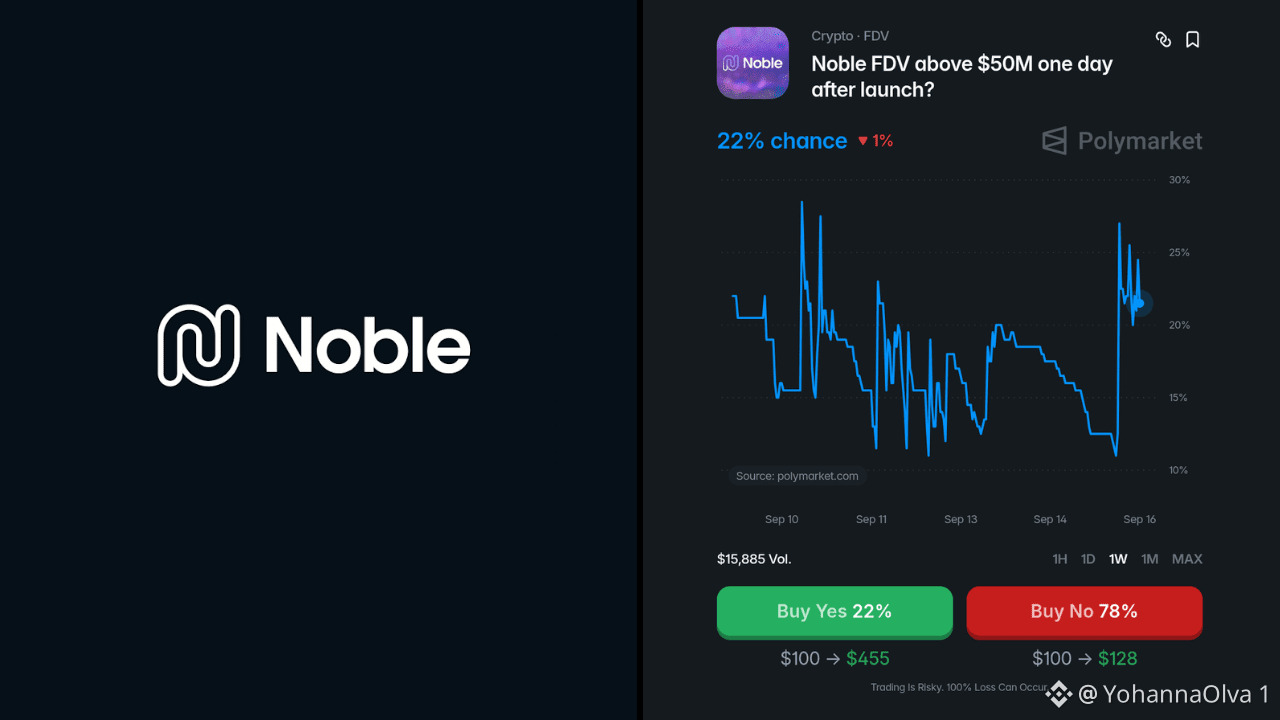
Noble can clear this line 🚀
22% on Yes with only around $16K traded.
This feels early.
Polymarket is asking whether Noble can be above a $50M FDV one day after launch, and I think the market is being too conservative.
I'm taking Yes.
What matters to me is the size of the hurdle. We're not talking about Noble instantly becoming a multi-billion-dollar token. $50M during the first wave of launch speculation, liquidity and price discovery is a much more achievable target.
Noble itself remains an actively developed network, with mainnet software upgrades continuing through 2026.
At 22%, the payout is still attractive too.
A $10 position bought around 22% would represent roughly $45 at resolution if Yes wins, before fees and execution differences. That's why I like looking at probabilities before simply deciding whether something is "likely" or "unlikely."
The price matters.
I'd rather take a calculated prediction here than leave the same capital sitting in another $HYPE swing and hope the market gives me direction.
And if Noble expectations improve before launch, I can sell the Polymarket position early.
I don't need to wait for the final answer.
That's where prediction markets become trading markets.
#Altcoin Season#
Noble can clear this line 🚀
22% on Yes with only around $16K traded.
This feels early.
Polymarket is asking whether Noble can be above a $50M FDV one day after launch, and I think the market is being too conservative.
I'm taking Yes.
What matters to me is the size of the hurdle. We're not talking about Noble instantly becoming a multi-billion-dollar token. $50M during the first wave of launch speculation, liquidity and price discovery is a much more achievable target.
Noble itself remains an actively developed network, with mainnet software upgrades continuing through 2026.
At 22%, the payout is still attractive too.
A $10 position bought around 22% would represent roughly $45 at resolution if Yes wins, before fees and execution differences. That's why I like looking at probabilities before simply deciding whether something is "likely" or "unlikely."
The price matters.
I'd rather take a calculated prediction here than leave the same capital sitting in another $HYPE swing and hope the market gives me direction.
And if Noble expectations improve before launch, I can sell the Polymarket position early.
I don't need to wait for the final answer.
That's where prediction markets become trading markets.
#Altcoin Season#
22% on Yes with only around $16K traded.
This feels early.
Polymarket is asking whether Noble can be above a $50M FDV one day after launch, and I think the market is being too conservative.
I'm taking Yes.
What matters to me is the size of the hurdle. We're not talking about Noble instantly becoming a multi-billion-dollar token. $50M during the first wave of launch speculation, liquidity and price discovery is a much more achievable target.
Noble itself remains an actively developed network, with mainnet software upgrades continuing through 2026.
At 22%, the payout is still attractive too.
A $10 position bought around 22% would represent roughly $45 at resolution if Yes wins, before fees and execution differences. That's why I like looking at probabilities before simply deciding whether something is "likely" or "unlikely."
The price matters.
I'd rather take a calculated prediction here than leave the same capital sitting in another $HYPE swing and hope the market gives me direction.
And if Noble expectations improve before launch, I can sell the Polymarket position early.
I don't need to wait for the final answer.
That's where prediction markets become trading markets.
#Altcoin Season#
59
The Bar Gets Higher 📜
Did you know Space and Time has been thinking about compliance at the infrastructure level?
That's much more important to me than adding compliance after a product reaches scale.
The CLARITY framework raises a simple question for crypto projects:
Who controls what, and can the system prove how it operates?
Space and Time's answer is built around cryptographic verification.
Data computation can be proven.
Validator infrastructure distributes responsibility.
And applications don't need to treat every offchain result as trusted truth.
$NEAR has pushed the idea that blockchain infrastructure should become easier for users and applications to consume.
I think the next requirement is equally important.
That infrastructure also needs to become easier to verify.
Projects preparing for that standard before they're forced to are the ones I'm watching.
#Altcoin Season#
The Bar Gets Higher 📜
Did you know Space and Time has been thinking about compliance at the infrastructure level?
That's much more important to me than adding compliance after a product reaches scale.
The CLARITY framework raises a simple question for crypto projects:
Who controls what, and can the system prove how it operates?
Space and Time's answer is built around cryptographic verification.
Data computation can be proven.
Validator infrastructure distributes responsibility.
And applications don't need to treat every offchain result as trusted truth.
$NEAR has pushed the idea that blockchain infrastructure should become easier for users and applications to consume.
I think the next requirement is equally important.
That infrastructure also needs to become easier to verify.
Projects preparing for that standard before they're forced to are the ones I'm watching.
#Altcoin Season#
Did you know Space and Time has been thinking about compliance at the infrastructure level?
That's much more important to me than adding compliance after a product reaches scale.
The CLARITY framework raises a simple question for crypto projects:
Who controls what, and can the system prove how it operates?
Space and Time's answer is built around cryptographic verification.
Data computation can be proven.
Validator infrastructure distributes responsibility.
And applications don't need to treat every offchain result as trusted truth.
$NEAR has pushed the idea that blockchain infrastructure should become easier for users and applications to consume.
I think the next requirement is equally important.
That infrastructure also needs to become easier to verify.
Projects preparing for that standard before they're forced to are the ones I'm watching.
#Altcoin Season#
60
A Memecoin That Pays Holders In Nvidia 📈
Fee revenue actually reaching holders is why people track $HYPE and $SKY so closely. Until now it took a large protocol and a lot of governance to arrange.
Pools.fun , built by the Bankr team with SushiSwap on Robinhood Chain, just turned it into a toggle at launch.
A creator can send all of a token's fees to holders, and choose what those holders are paid in.
• Launch against NVDA and pay from the quote side, and holders receive NVDA
• Launch against WETH and pay in the token, and the fees are converted into the token and streamed to holders
• Launch against USDG and pay both sides, and holders receive each asset exactly as the fees arrive, with no conversion in between
The choice of payout asset is the part I keep thinking about.
A community token can distribute something the project does not issue itself. Holding it becomes a claim on trading activity, settled in an asset with its own market outside crypto entirely.
Distribution is also open. On tokens that convert one side, anyone can trigger the payout and keeps 0.5% of the amount converted, so the mechanism does not depend on the team or a keeper bot showing up.
Now the parts to be clear-eyed about.
Payouts come from trading fees, so a token nobody trades pays nothing. A payout in a tokenized stock carries that stock's drawdowns. Converting fees into the token is a mechanic, not a promise about anything else. And availability of tokenized assets depends on your jurisdiction.
Every cycle promises holders a share of revenue and mostly delivers emissions. This is a smaller, more honest version of that idea, and the payout asset is finally a real decision. $sky
#DeFi #Robinhood
A Memecoin That Pays Holders In Nvidia 📈
Fee revenue actually reaching holders is why people track $HYPE and $SKY so closely. Until now it took a large protocol and a lot of governance to arrange.
Pools.fun , built by the Bankr team with SushiSwap on Robinhood Chain, just turned it into a toggle at launch.
A creator can send all of a token's fees to holders, and choose what those holders are paid in.
• Launch against NVDA and pay from the quote side, and holders receive NVDA
• Launch against WETH and pay in the token, and the fees are converted into the token and streamed to holders
• Launch against USDG and pay both sides, and holders receive each asset exactly as the fees arrive, with no conversion in between
The choice of payout asset is the part I keep thinking about.
A community token can distribute something the project does not issue itself. Holding it becomes a claim on trading activity, settled in an asset with its own market outside crypto entirely.
Distribution is also open. On tokens that convert one side, anyone can trigger the payout and keeps 0.5% of the amount converted, so the mechanism does not depend on the team or a keeper bot showing up.
Now the parts to be clear-eyed about.
Payouts come from trading fees, so a token nobody trades pays nothing. A payout in a tokenized stock carries that stock's drawdowns. Converting fees into the token is a mechanic, not a promise about anything else. And availability of tokenized assets depends on your jurisdiction.
Every cycle promises holders a share of revenue and mostly delivers emissions. This is a smaller, more honest version of that idea, and the payout asset is finally a real decision. $sky
#DeFi #Robinhood
Fee revenue actually reaching holders is why people track $HYPE and $SKY so closely. Until now it took a large protocol and a lot of governance to arrange.
Pools.fun , built by the Bankr team with SushiSwap on Robinhood Chain, just turned it into a toggle at launch.
A creator can send all of a token's fees to holders, and choose what those holders are paid in.
• Launch against NVDA and pay from the quote side, and holders receive NVDA
• Launch against WETH and pay in the token, and the fees are converted into the token and streamed to holders
• Launch against USDG and pay both sides, and holders receive each asset exactly as the fees arrive, with no conversion in between
The choice of payout asset is the part I keep thinking about.
A community token can distribute something the project does not issue itself. Holding it becomes a claim on trading activity, settled in an asset with its own market outside crypto entirely.
Distribution is also open. On tokens that convert one side, anyone can trigger the payout and keeps 0.5% of the amount converted, so the mechanism does not depend on the team or a keeper bot showing up.
Now the parts to be clear-eyed about.
Payouts come from trading fees, so a token nobody trades pays nothing. A payout in a tokenized stock carries that stock's drawdowns. Converting fees into the token is a mechanic, not a promise about anything else. And availability of tokenized assets depends on your jurisdiction.
Every cycle promises holders a share of revenue and mostly delivers emissions. This is a smaller, more honest version of that idea, and the payout asset is finally a real decision. $sky
#DeFi #Robinhood
45
Log in to explore more content
Join global crypto users on Binance Square
⚡️ Get latest and useful information about crypto.
💬 Trusted by the world’s largest crypto exchange.
👍 Discover real insights from verified creators.
Email / Phone number
Trending Topics
EtherGains70.9%InQ3
43,218 views
554 Discussing
One of the best third quarters in history 💰
September closed out last night, and with it, the quarter. For the quarter, BTC is up 42%—the second-best Q3 on record. ETH had a record-breaking Q3 overall, up 70%.
Looking at the chart, things are still looking good: we’re holding support, but we’re testing it more and more often. Plus, ETF momentum is weakening — inflows are gradually declining, and yesterday saw outflows for the first time in a long while.
Yes, historically, October has been a good month for crypto — it’s not called “Uptober” for nothing. But it’s also one of the most volatile months. Last year, for example, we managed to hit a new all-time high (ATH) and experience a flash crash.
🚀 High Accuracy Trades.
$BTC
$ETH
$SOL
#EtherGains70.9%InQ3 #DollarIndexHitsHighestSinceMay2025 #CFTCSubmitsTwoEventContractRulesToWhiteHouse #MicronBeatsEarningsLiftsGuidance
Knowledge is Power
·0 Likes
·112 views
TreasuryLetsStatesFileStablecoinCertificationsEarly
1,104 views
20 Discussing
US10YearYieldNears5.3%
78,762 views
732 Discussing