
B I T G A L
673 Posts

B I T G A L
Report
Block User
Empowering smarter crypto decisions with actionable insights, market analysis & data-driven strategies.📈
Open Trade
Frequent Trader
1.5 Years
63 Following
1.5K+ Followers
2.2K+ Liked
Posts
Portfolio
All
Quotes
PINNED
·
--
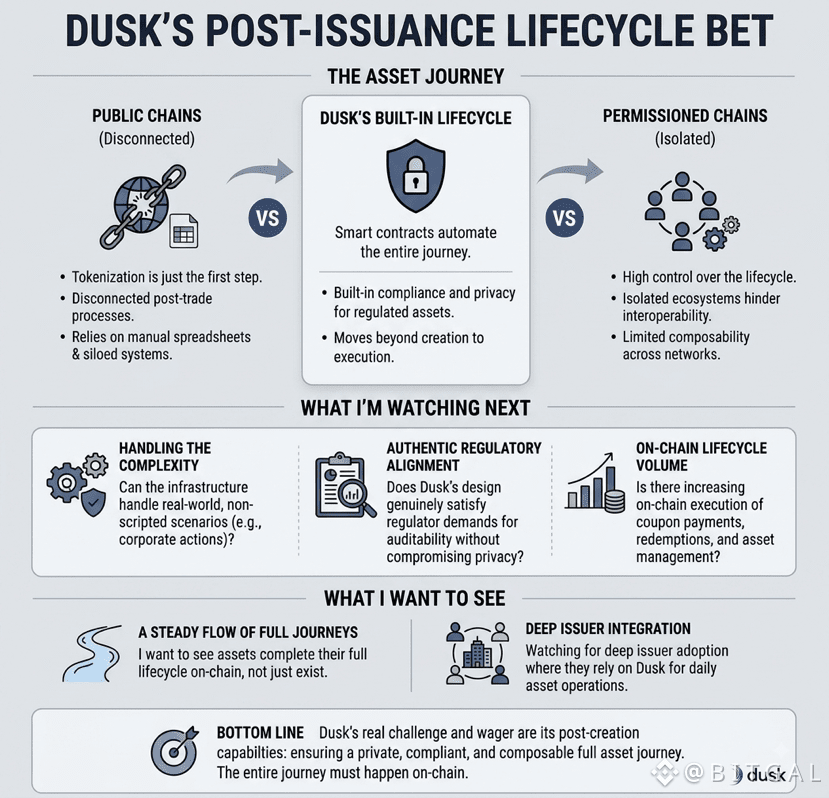
I started reading about tokenized bonds today and ended up thinking about everything that happens after the asset is created. 👀
A bond has a lot going on behind the scenes. Someone has to keep track of ownership, handle payments, deal with the final repayment, and make sure the right people receive what they are supposed to receive.
That made me realize why putting a financial asset on a blockchain is not just about creating a token. If the rest of the process still depends on spreadsheets and manual work, the blockchain has only changed one small part of the job.
There is another problem too. Financial information cannot always be public. Investors may need privacy, while certain authorized parties still need access when checks or reporting are required.
This is one reason I find Dusk interesting. Its design is focused on giving regulated assets a way to use onchain infrastructure while keeping sensitive information protected when necessary. 🔐
I think the real challenge will be everything that happens once the asset is already live. Real financial products rarely follow a perfect script, so the infrastructure has to handle the complicated situations too.
That is the part I’ll be watching as Dusk develops.
Not just whether an asset can exist onchain, but whether its whole journey can happen there. 🤔
@Dusk_Foundation $DUSK #dusk
I started reading about tokenized bonds today and ended up thinking about everything that happens after the asset is created. 👀
A bond has a lot going on behind the scenes. Someone has to keep track of ownership, handle payments, deal with the final repayment, and make sure the right people receive what they are supposed to receive.
That made me realize why putting a financial asset on a blockchain is not just about creating a token. If the rest of the process still depends on spreadsheets and manual work, the blockchain has only changed one small part of the job.
There is another problem too. Financial information cannot always be public. Investors may need privacy, while certain authorized parties still need access when checks or reporting are required.
This is one reason I find Dusk interesting. Its design is focused on giving regulated assets a way to use onchain infrastructure while keeping sensitive information protected when necessary. 🔐
I think the real challenge will be everything that happens once the asset is already live. Real financial products rarely follow a perfect script, so the infrastructure has to handle the complicated situations too.
That is the part I’ll be watching as Dusk develops.
Not just whether an asset can exist onchain, but whether its whole journey can happen there. 🤔
@Dusk $DUSK #dusk
A bond has a lot going on behind the scenes. Someone has to keep track of ownership, handle payments, deal with the final repayment, and make sure the right people receive what they are supposed to receive.
That made me realize why putting a financial asset on a blockchain is not just about creating a token. If the rest of the process still depends on spreadsheets and manual work, the blockchain has only changed one small part of the job.
There is another problem too. Financial information cannot always be public. Investors may need privacy, while certain authorized parties still need access when checks or reporting are required.
This is one reason I find Dusk interesting. Its design is focused on giving regulated assets a way to use onchain infrastructure while keeping sensitive information protected when necessary. 🔐
I think the real challenge will be everything that happens once the asset is already live. Real financial products rarely follow a perfect script, so the infrastructure has to handle the complicated situations too.
That is the part I’ll be watching as Dusk develops.
Not just whether an asset can exist onchain, but whether its whole journey can happen there. 🤔
@Dusk $DUSK #dusk
11
9
96
PINNED
·
--
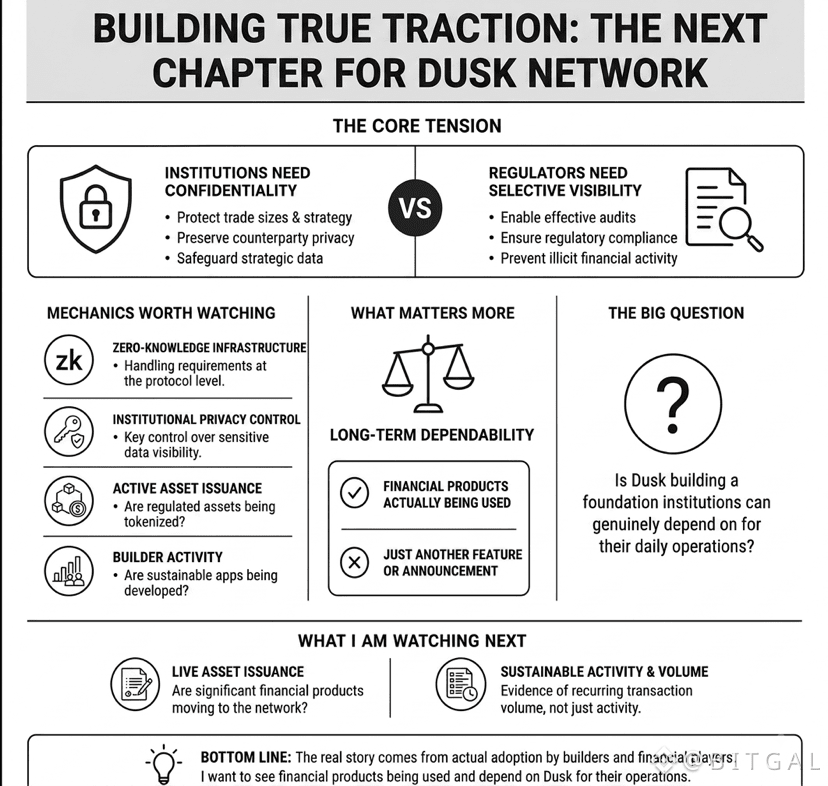
I was going through some Dusk updates today and caught myself asking a pretty simple question: what would make me believe the network is really gaining traction? 🤔
The more I thought about it, the answer wasn’t another feature or another announcement. It would be seeing financial products actually being used on the network.
Dusk is building for a very specific kind of activity. Regulated assets need privacy, but they also need rules around who can see and verify information. That makes the problem much harder than simply putting a token on a blockchain.
What caught my attention is that Dusk is trying to handle those requirements at the infrastructure level. If that works well, it could give institutions a way to use blockchain without having to choose between keeping everything private and making everything visible. 🔐
But I think the real story will come from what happens when more builders and financial players start using it. Are assets actually being issued? Are transactions happening regularly? Are applications creating activity that lasts?
Those are the signs I would personally watch.
The technology is interesting, but I want to see it become something people actually depend on.
That is where I think the next chapter for @Dusk_Foundation gets interesting. 👀
$DUSK #dusk
I was going through some Dusk updates today and caught myself asking a pretty simple question: what would make me believe the network is really gaining traction? 🤔
The more I thought about it, the answer wasn’t another feature or another announcement. It would be seeing financial products actually being used on the network.
Dusk is building for a very specific kind of activity. Regulated assets need privacy, but they also need rules around who can see and verify information. That makes the problem much harder than simply putting a token on a blockchain.
What caught my attention is that Dusk is trying to handle those requirements at the infrastructure level. If that works well, it could give institutions a way to use blockchain without having to choose between keeping everything private and making everything visible. 🔐
But I think the real story will come from what happens when more builders and financial players start using it. Are assets actually being issued? Are transactions happening regularly? Are applications creating activity that lasts?
Those are the signs I would personally watch.
The technology is interesting, but I want to see it become something people actually depend on.
That is where I think the next chapter for @Dusk gets interesting. 👀
$DUSK #dusk
The more I thought about it, the answer wasn’t another feature or another announcement. It would be seeing financial products actually being used on the network.
Dusk is building for a very specific kind of activity. Regulated assets need privacy, but they also need rules around who can see and verify information. That makes the problem much harder than simply putting a token on a blockchain.
What caught my attention is that Dusk is trying to handle those requirements at the infrastructure level. If that works well, it could give institutions a way to use blockchain without having to choose between keeping everything private and making everything visible. 🔐
But I think the real story will come from what happens when more builders and financial players start using it. Are assets actually being issued? Are transactions happening regularly? Are applications creating activity that lasts?
Those are the signs I would personally watch.
The technology is interesting, but I want to see it become something people actually depend on.
That is where I think the next chapter for @Dusk gets interesting. 👀
$DUSK #dusk
3
3
100
·
--
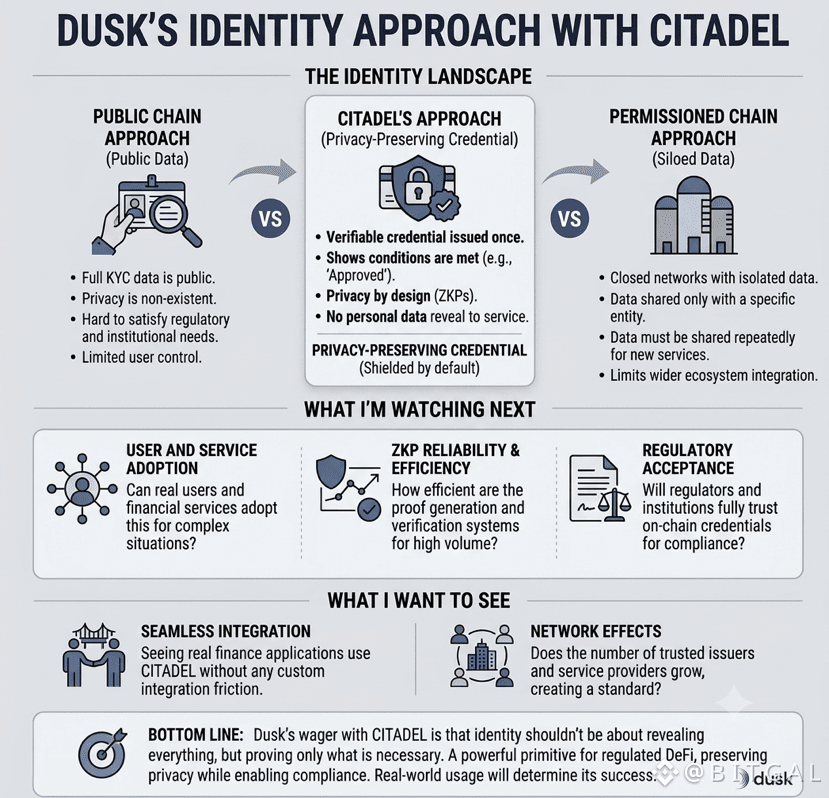
I was looking into how identity checks could work onchain, and something about Dusk’s approach made me stop and think. 👀
Usually, when a service asks for KYC, you give them your personal information and trust them to handle it properly. Then another service comes along and may ask for much of the same information again. That can become uncomfortable pretty quickly.
CITADEL takes an interesting approach to this. Instead of treating your personal information as something that needs to be passed around again and again, a verified user can have a credential that shows they meet the required conditions.
What I like about that idea is the separation between proving something and revealing everything. A financial service may need to know that you are approved to use it without needing access to every detail from your original identity check. 🔐
That could be a useful piece of infrastructure for regulated applications, especially as more financial activity moves onchain.
I’m still interested in seeing how this works outside the concept itself, because real users and real financial services will bring a lot more situations to deal with.
But the basic idea makes sense to me.
Why reveal more personal information than a service actually needs? 🤔
@Dusk_Foundation $DUSK #dusk
I was looking into how identity checks could work onchain, and something about Dusk’s approach made me stop and think. 👀
Usually, when a service asks for KYC, you give them your personal information and trust them to handle it properly. Then another service comes along and may ask for much of the same information again. That can become uncomfortable pretty quickly.
CITADEL takes an interesting approach to this. Instead of treating your personal information as something that needs to be passed around again and again, a verified user can have a credential that shows they meet the required conditions.
What I like about that idea is the separation between proving something and revealing everything. A financial service may need to know that you are approved to use it without needing access to every detail from your original identity check. 🔐
That could be a useful piece of infrastructure for regulated applications, especially as more financial activity moves onchain.
I’m still interested in seeing how this works outside the concept itself, because real users and real financial services will bring a lot more situations to deal with.
But the basic idea makes sense to me.
Why reveal more personal information than a service actually needs? 🤔
@Dusk $DUSK #dusk
Usually, when a service asks for KYC, you give them your personal information and trust them to handle it properly. Then another service comes along and may ask for much of the same information again. That can become uncomfortable pretty quickly.
CITADEL takes an interesting approach to this. Instead of treating your personal information as something that needs to be passed around again and again, a verified user can have a credential that shows they meet the required conditions.
What I like about that idea is the separation between proving something and revealing everything. A financial service may need to know that you are approved to use it without needing access to every detail from your original identity check. 🔐
That could be a useful piece of infrastructure for regulated applications, especially as more financial activity moves onchain.
I’m still interested in seeing how this works outside the concept itself, because real users and real financial services will bring a lot more situations to deal with.
But the basic idea makes sense to me.
Why reveal more personal information than a service actually needs? 🤔
@Dusk $DUSK #dusk
128
·
--
The growth of tokenized assets makes networks built for regulated markets increasingly important.
The growth of tokenized assets makes networks built for regulated markets increasingly important.
2
·
--
Dusk is positioning itself around a use case where compliance is part of the core infrastructure.
Dusk is positioning itself around a use case where compliance is part of the core infrastructure.
5
·
--
Onchain finance will need infrastructure that can handle both transparency and privacy requirements.
Onchain finance will need infrastructure that can handle both transparency and privacy requirements.
1
·
--
Dusk is exploring a practical route for regulated finance to use blockchain infrastructure.
Dusk is exploring a practical route for regulated finance to use blockchain infrastructure.
·
--
Dusk is building with the needs of regulated markets in mind from the foundation up.
Dusk is building with the needs of regulated markets in mind from the foundation up.
1
·
--
The regulated finance narrative keeps getting stronger, and Dusk is building directly around it.
The regulated finance narrative keeps getting stronger, and Dusk is building directly around it.
3
·
--
Purpose-built infrastructure could be important for the next phase of regulated onchain finance, and Dusk is heading in that direction.
Purpose-built infrastructure could be important for the next phase of regulated onchain finance, and Dusk is heading in that direction.
5
·
--
The move toward tokenized assets makes Dusk’s focus on regulated markets especially relevant.
The move toward tokenized assets makes Dusk’s focus on regulated markets especially relevant.
4
·
--
Dusk is creating a strong foundation for financial applications that need blockchain and regulatory requirements to coexist.
Dusk is creating a strong foundation for financial applications that need blockchain and regulatory requirements to coexist.
30
·
--
Regulated finance needs privacy without giving up accountability, and Dusk is working in that exact space.
Regulated finance needs privacy without giving up accountability, and Dusk is working in that exact space.
34
·
--
Dusk is building infrastructure around financial use cases that require more than basic blockchain functionality.
Dusk is building infrastructure around financial use cases that require more than basic blockchain functionality.
39
·
--
The combination of privacy and compliance makes Dusk a notable project in the Layer 1 space.
The combination of privacy and compliance makes Dusk a notable project in the Layer 1 space.
61
·
--
The financial infrastructure story behind Dusk is becoming increasingly relevant as tokenization grows.
The financial infrastructure story behind Dusk is becoming increasingly relevant as tokenization grows.
8
·
--
Dusk is showing how blockchain networks can be designed around real industry requirements.
Dusk is showing how blockchain networks can be designed around real industry requirements.
1
·
--
Regulated onchain markets could need purpose-built infrastructure, which is exactly the space Dusk is exploring.
Regulated onchain markets could need purpose-built infrastructure, which is exactly the space Dusk is exploring.
4
·
--
The combination of privacy and regulation is still an interesting challenge, and Dusk is taking it seriously.
The combination of privacy and regulation is still an interesting challenge, and Dusk is taking it seriously.
2
·
--
Dusk is working on the infrastructure needed for compliant finance to move further onchain.
Dusk is working on the infrastructure needed for compliant finance to move further onchain.
1
30
Log in to explore more content
Join global crypto users on Binance Square
⚡️ Get latest and useful information about crypto.
💬 Trusted by the world’s largest crypto exchange.
👍 Discover real insights from verified creators.
Email / Phone number
Trending Topics
AppleDebutsFoldablePhone
11,472 views
261 Discussing
#appledebutsfoldablephone I Got My Hands on the iPhone Duo, Apple’s First Foldable Phone. Here’s What Stands Out
The palm-size phone is Apple's boldest handset in years, with a 5.4-inch cover screen and a 7.6-inch main display. I spent some time with the Duo before its October launch.It’s finally here: Apple on Wednesday unveiled its first foldable iPhone, called the iPhone Duo.
iPhone Duo design and build
The iPhone Duo is compact, with a passport-size design. It has a 7.6-inch display on the inside and a 5.4-inch outer display. It fits squarely in my palm, with dimensions similar to Samsung’s Galaxy Z Fold 8, which has a 7.6-inch inner display and a 5.5-inch cover display.
Apple says the Duo is the thinnest iPhone ever when open, measuring 5.2mm. It’s 11.3mm thick when closed. A titanium frame keeps it lightweight at 254 grams.
One of the key differences in feel between Apple’s and Samsung’s phones is that the iPhone Duo has a matte, nano-textured finish on the inner display, which reduces the phone’s crease while also curbing reflections. It has a satisfying feel and really makes the crease virtually disappear when the screen is on. I find it even harder to notice than the Z Fold 8’s, which also has an anti-reflective display.$ONG $IMX $TAC
Isabella-I
·4 Likes
·962 views
EUExtendsCentralContactPointToCASPs
384 views
30 Discussing
US10YTreasuryYieldHitsHighestSinceNov2023
14,854 views
269 Discussing