

BitcoinKE
3.3k Posts

BitcoinKE
 Square Verified+
Report
Block User
BitKE is a leading crypto and Web3 focussed media outlet in Africa publishing daily informative and investment news and content.
1 Following
28.4K+ Followers
5.0K+ Liked
Posts
All
Quotes
·
--
Article
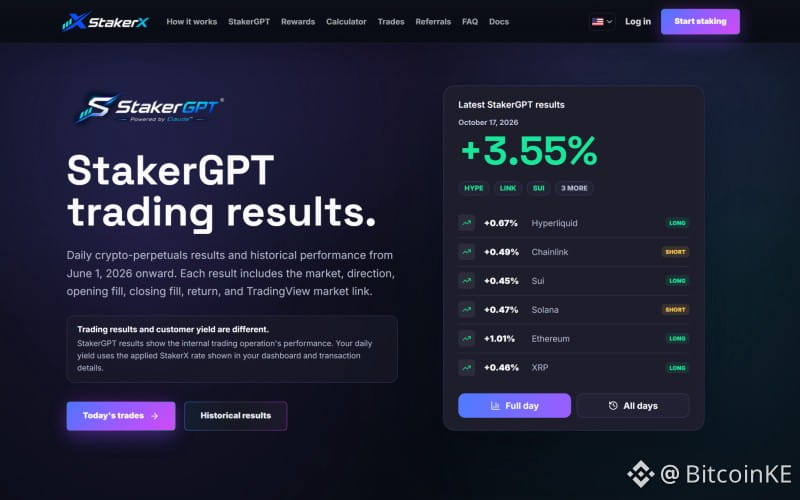
CASE STUDY | This AI Crypto Trading Agent Has Attracted Over $40 Million in Just 3 MonthsStakerX, a Switzerland-based crypto trading platform, said its AI agent StakerGPT has attracted more than $40 million in staked assets on Solana within three months of its public launch, highlighting growing interest in automated cryptocurrency trading.
StakerX in the press- $40M staked on Solana within three months of launch, now covered by Business Insider, CoinMarketCap, Binance Square, Investing .com, TradingView, Benzinga, Decrypt, The Block and more.
Read the coverage https://t.co/8IjgXVXjqn https://t.co/SFRB9t30uJ
— StakerX (@StakerXAI) October 19, 2026
The platform reported more than 8,200 registered users, including over 3,000 who have funded accounts, as of October 18 2026. StakerGPT monitors markets around the clock and executes approved trades in perpetual futures markets using automated risk controls.
Every trade is public.
StakerX publishes the full record daily at stakerx.ai/trades, with the market, direction, entry and exit prices and return of each position, including both live-executed and signal-derived trades.
StakerX said it had published a record of 804 trades across 139 trading days and credited users with nearly $12 million in yield since launch.
Users can deposit
USDC,
USDT,
BTC,
ETH,
SOL,
BNB,
TRX
and more than 30 other cryptocurrencies from
Solana,
Ethereum,
Bitcoin,
BNB Chain,
Base,
Arbitrum,
Polygon,
TRON
and other networks.
Each deposit is converted and credited as USDC, a dollar-backed stablecoin, on Solana, so users do not need to bridge or swap anything themselves. Stakes start at $10 and run for 30 days.
The platform’s agentic trading agent puts that capital to work in crypto perpetual futures markets every day.
The platform accepts deposits in more than 40 cryptocurrencies which are converted into USDC on Solana. Users’ funds are exposed to trading and platform risks and reported yields do not guarantee future returns.
REALITY CHECK | The World’s Largest Asset Manager Says AI Agents Will Drive Demand for Stablecoins
Stay tuned to BitKE for the interesting crypto case studies.
Join our WhatsApp channel here.
Follow us on X for the latest posts and updates
Join and interact with our Telegram community
________
CASE STUDY | This AI Crypto Trading Agent Has Attracted Over $40 Million in Just 3 Months
StakerX, a Switzerland-based crypto trading platform, said its AI agent StakerGPT has attracted more than $40 million in staked assets on Solana within three months of its public launch, highlighting growing interest in automated cryptocurrency trading.
StakerX in the press- $40M staked on Solana within three months of launch, now covered by Business Insider, CoinMarketCap, Binance Square, Investing .com, TradingView, Benzinga, Decrypt, The Block and more.
Read the coverage https://t.co/8IjgXVXjqn https://t.co/SFRB9t30uJ
— StakerX (@StakerXAI) October 19, 2026
The platform reported more than 8,200 registered users, including over 3,000 who have funded accounts, as of October 18 2026. StakerGPT monitors markets around the clock and executes approved trades in perpetual futures markets using automated risk controls.
Every trade is public.
StakerX publishes the full record daily at stakerx.ai/trades, with the market, direction, entry and exit prices and return of each position, including both live-executed and signal-derived trades.
StakerX said it had published a record of 804 trades across 139 trading days and credited users with nearly $12 million in yield since launch.
Users can deposit
USDC,
USDT,
BTC,
ETH,
SOL,
BNB,
TRX
and more than 30 other cryptocurrencies from
Solana,
Ethereum,
Bitcoin,
BNB Chain,
Base,
Arbitrum,
Polygon,
TRON
and other networks.
Each deposit is converted and credited as USDC, a dollar-backed stablecoin, on Solana, so users do not need to bridge or swap anything themselves. Stakes start at $10 and run for 30 days.
The platform’s agentic trading agent puts that capital to work in crypto perpetual futures markets every day.
The platform accepts deposits in more than 40 cryptocurrencies which are converted into USDC on Solana. Users’ funds are exposed to trading and platform risks and reported yields do not guarantee future returns.
REALITY CHECK | The World’s Largest Asset Manager Says AI Agents Will Drive Demand for Stablecoins
Stay tuned to BitKE for the interesting crypto case studies.
Join our WhatsApp channel here.
Follow us on X for the latest posts and updates
Join and interact with our Telegram community
________
StakerX in the press- $40M staked on Solana within three months of launch, now covered by Business Insider, CoinMarketCap, Binance Square, Investing .com, TradingView, Benzinga, Decrypt, The Block and more.
Read the coverage https://t.co/8IjgXVXjqn https://t.co/SFRB9t30uJ
— StakerX (@StakerXAI) October 19, 2026
The platform reported more than 8,200 registered users, including over 3,000 who have funded accounts, as of October 18 2026. StakerGPT monitors markets around the clock and executes approved trades in perpetual futures markets using automated risk controls.
Every trade is public.
StakerX publishes the full record daily at stakerx.ai/trades, with the market, direction, entry and exit prices and return of each position, including both live-executed and signal-derived trades.
StakerX said it had published a record of 804 trades across 139 trading days and credited users with nearly $12 million in yield since launch.
Users can deposit
USDC,
USDT,
BTC,
ETH,
SOL,
BNB,
TRX
and more than 30 other cryptocurrencies from
Solana,
Ethereum,
Bitcoin,
BNB Chain,
Base,
Arbitrum,
Polygon,
TRON
and other networks.
Each deposit is converted and credited as USDC, a dollar-backed stablecoin, on Solana, so users do not need to bridge or swap anything themselves. Stakes start at $10 and run for 30 days.
The platform’s agentic trading agent puts that capital to work in crypto perpetual futures markets every day.
The platform accepts deposits in more than 40 cryptocurrencies which are converted into USDC on Solana. Users’ funds are exposed to trading and platform risks and reported yields do not guarantee future returns.
REALITY CHECK | The World’s Largest Asset Manager Says AI Agents Will Drive Demand for Stablecoins
Stay tuned to BitKE for the interesting crypto case studies.
Join our WhatsApp channel here.
Follow us on X for the latest posts and updates
Join and interact with our Telegram community
________
176
·
--
INSTITUTIONAL | ‘Our Crypto Custody Asset Service Is Going Evolve Into Other Services,’ Reveals A...The Director of Global Markets at ABSA Bank Kenya, Wambere Mambo, has revealed that the bank is looking offering subsidiary services that come with digital assets custody.
Speaking about the banks latest digital asset custody, Mambo said the bank envisions many other services that can emerge from custody of digital assets.
“When you have a custody asset that has a digital format, it is going to evolve into other services be it trading, be it lending. We utilize some of those securities to be able to give funding and it will also bring up treasury solutions.
So the magnitude of just having that digital asset class is not just being able to store the value of that asset class, but it is the other services that can come from that solution.”
"When you have a custody asset that has a digital format, it’s going to evolve into other services be it trading, be it lending." – Director, Global Markets, @AbsaKenya
#CryptoCustody #CryptoCustodyKE #ABSAKenya #ABSAAfrica #InstitutionalCrypto #CryptoKenya #CryptoKE
— BitKE (@BitcoinKE) October 26, 2026
ABSA Group has become the first African bank to offer institutional digital-asset custody moving into a market that is gaining traction as traditional financial institutions expand into cryptocurrencies and tokenised assets.
The Johannesburg-based lender said its ABSA Digital Asset Custody service is initially available to institutional clients in South Africa, including
asset managers,
non-bank financial institutions, and
corporates.
The service provides the
safekeeping,
administration, and
transfer
of digital assets within a regulated banking environment.
MILESTONE | ABSA Becomes First African Bank to Offer Crypto Asset Custody
The new service comes exactly one year after Ripple announced a strategic partnership with ABSA bank to provide digital asset custody to the bank’s customers in South Africa.
PRESS RELEASE | Ripple Brings Institutional Digital Asset Custody to South Africa in Partnership with One of Africa’s Leading Financial Institutions
The latest comments from ABSA Bank Kenya point to a potential expansion of the services into Kenya, likely following authorization for virtual assets service providers which is expected to take place from November 2026.
REGULATION | Chief of Staff and Head of Public Service, Kenya, Receives VASP Regulations Briefing Ahead of November 2026 Compliance Deadline
Stay tuned to BitKE for institutional crypto developments across Africa.
Join our WhatsApp channel here.
Follow us on X for the latest posts and updates
Join and interact with our Telegram community
__________
INSTITUTIONAL | ‘Our Crypto Custody Asset Service Is Going Evolve Into Other Services,’ Reveals A...
The Director of Global Markets at ABSA Bank Kenya, Wambere Mambo, has revealed that the bank is looking offering subsidiary services that come with digital assets custody.
Speaking about the banks latest digital asset custody, Mambo said the bank envisions many other services that can emerge from custody of digital assets.
“When you have a custody asset that has a digital format, it is going to evolve into other services be it trading, be it lending. We utilize some of those securities to be able to give funding and it will also bring up treasury solutions.
So the magnitude of just having that digital asset class is not just being able to store the value of that asset class, but it is the other services that can come from that solution.”
"When you have a custody asset that has a digital format, it’s going to evolve into other services be it trading, be it lending." – Director, Global Markets, @AbsaKenya
#CryptoCustody #CryptoCustodyKE #ABSAKenya #ABSAAfrica #InstitutionalCrypto #CryptoKenya #CryptoKE
— BitKE (@BitcoinKE) October 26, 2026
ABSA Group has become the first African bank to offer institutional digital-asset custody moving into a market that is gaining traction as traditional financial institutions expand into cryptocurrencies and tokenised assets.
The Johannesburg-based lender said its ABSA Digital Asset Custody service is initially available to institutional clients in South Africa, including
asset managers,
non-bank financial institutions, and
corporates.
The service provides the
safekeeping,
administration, and
transfer
of digital assets within a regulated banking environment.
MILESTONE | ABSA Becomes First African Bank to Offer Crypto Asset Custody
The new service comes exactly one year after Ripple announced a strategic partnership with ABSA bank to provide digital asset custody to the bank’s customers in South Africa.
PRESS RELEASE | Ripple Brings Institutional Digital Asset Custody to South Africa in Partnership with One of Africa’s Leading Financial Institutions
The latest comments from ABSA Bank Kenya point to a potential expansion of the services into Kenya, likely following authorization for virtual assets service providers which is expected to take place from November 2026.
REGULATION | Chief of Staff and Head of Public Service, Kenya, Receives VASP Regulations Briefing Ahead of November 2026 Compliance Deadline
Stay tuned to BitKE for institutional crypto developments across Africa.
Join our WhatsApp channel here.
Follow us on X for the latest posts and updates
Join and interact with our Telegram community
__________
Speaking about the banks latest digital asset custody, Mambo said the bank envisions many other services that can emerge from custody of digital assets.
“When you have a custody asset that has a digital format, it is going to evolve into other services be it trading, be it lending. We utilize some of those securities to be able to give funding and it will also bring up treasury solutions.
So the magnitude of just having that digital asset class is not just being able to store the value of that asset class, but it is the other services that can come from that solution.”
"When you have a custody asset that has a digital format, it’s going to evolve into other services be it trading, be it lending." – Director, Global Markets, @AbsaKenya
#CryptoCustody #CryptoCustodyKE #ABSAKenya #ABSAAfrica #InstitutionalCrypto #CryptoKenya #CryptoKE
— BitKE (@BitcoinKE) October 26, 2026
ABSA Group has become the first African bank to offer institutional digital-asset custody moving into a market that is gaining traction as traditional financial institutions expand into cryptocurrencies and tokenised assets.
The Johannesburg-based lender said its ABSA Digital Asset Custody service is initially available to institutional clients in South Africa, including
asset managers,
non-bank financial institutions, and
corporates.
The service provides the
safekeeping,
administration, and
transfer
of digital assets within a regulated banking environment.
MILESTONE | ABSA Becomes First African Bank to Offer Crypto Asset Custody
The new service comes exactly one year after Ripple announced a strategic partnership with ABSA bank to provide digital asset custody to the bank’s customers in South Africa.
PRESS RELEASE | Ripple Brings Institutional Digital Asset Custody to South Africa in Partnership with One of Africa’s Leading Financial Institutions
The latest comments from ABSA Bank Kenya point to a potential expansion of the services into Kenya, likely following authorization for virtual assets service providers which is expected to take place from November 2026.
REGULATION | Chief of Staff and Head of Public Service, Kenya, Receives VASP Regulations Briefing Ahead of November 2026 Compliance Deadline
Stay tuned to BitKE for institutional crypto developments across Africa.
Join our WhatsApp channel here.
Follow us on X for the latest posts and updates
Join and interact with our Telegram community
__________
36
·
--
LIST | Solana Company Is Only Blockchain Infrastructure Out of 7 on Hong Kong’s OASES 2026Hong Kong has designated Nasdaq-listed Solana Company (HSDT) as a strategic enterprise under a government programme aimed at attracting businesses that support economic growth, as the city seeks to expand its digital asset and blockchain infrastructure sector.
The company, the only blockchain infrastructure firm selected in the programme in 2026, plans to establish Solana validator operations in Hong Kong under its Pacific Backbone initiative, which aims to build a low-latency blockchain network across the Asia-Pacific region.
The designation provides support for engagement with government agencies and regulators, overseas recruitment and partnerships with local institutions.
Solana Company
operates staking and validator infrastructure,
advises financial institutions on blockchain adoption, and
holds Solana (SOL) as part of its digital asset treasury strategy.
Hong Kong added 18 enterprises in the latest selection round bringing the total number of companies under the programme to 142. The move comes as the city advances efforts to strengthen its position as a regional digital asset hub through regulatory initiatives and on-chain financial infrastructure.
PRESS RELEASE | The Hong Kong Monetary Authority Grants First Stablecoin Licenses to HSBC and AnchorPoint
Stay tuned to BitKE on crypto developments globally.
Join our WhatsApp channel here.
Follow us on X for the latest posts and updates
Join and interact with our Telegram community
__________
LIST | Solana Company Is Only Blockchain Infrastructure Out of 7 on Hong Kong’s OASES 2026
Hong Kong has designated Nasdaq-listed Solana Company (HSDT) as a strategic enterprise under a government programme aimed at attracting businesses that support economic growth, as the city seeks to expand its digital asset and blockchain infrastructure sector.
The company, the only blockchain infrastructure firm selected in the programme in 2026, plans to establish Solana validator operations in Hong Kong under its Pacific Backbone initiative, which aims to build a low-latency blockchain network across the Asia-Pacific region.
The designation provides support for engagement with government agencies and regulators, overseas recruitment and partnerships with local institutions.
Solana Company
operates staking and validator infrastructure,
advises financial institutions on blockchain adoption, and
holds Solana (SOL) as part of its digital asset treasury strategy.
Hong Kong added 18 enterprises in the latest selection round bringing the total number of companies under the programme to 142. The move comes as the city advances efforts to strengthen its position as a regional digital asset hub through regulatory initiatives and on-chain financial infrastructure.
PRESS RELEASE | The Hong Kong Monetary Authority Grants First Stablecoin Licenses to HSBC and AnchorPoint
Stay tuned to BitKE on crypto developments globally.
Join our WhatsApp channel here.
Follow us on X for the latest posts and updates
Join and interact with our Telegram community
__________
The company, the only blockchain infrastructure firm selected in the programme in 2026, plans to establish Solana validator operations in Hong Kong under its Pacific Backbone initiative, which aims to build a low-latency blockchain network across the Asia-Pacific region.
The designation provides support for engagement with government agencies and regulators, overseas recruitment and partnerships with local institutions.
Solana Company
operates staking and validator infrastructure,
advises financial institutions on blockchain adoption, and
holds Solana (SOL) as part of its digital asset treasury strategy.
Hong Kong added 18 enterprises in the latest selection round bringing the total number of companies under the programme to 142. The move comes as the city advances efforts to strengthen its position as a regional digital asset hub through regulatory initiatives and on-chain financial infrastructure.
PRESS RELEASE | The Hong Kong Monetary Authority Grants First Stablecoin Licenses to HSBC and AnchorPoint
Stay tuned to BitKE on crypto developments globally.
Join our WhatsApp channel here.
Follow us on X for the latest posts and updates
Join and interact with our Telegram community
__________
61
·
--
REALITY CHECK | Largest Crypto Exchange in India Absorbs Over $15 Million Loss From a Retired WalletIndia’s CoinDCX said it had absorbed a $15.99 million loss after a failed internal process allowed customer deposits to accumulate in a retired cryptocurrency wallet linked to a $44 million security breach in July 2025.
The exchange said some users continued depositing funds into the old addresses despite instructions to use updated wallets. An automated service designed to transfer those deposits to its primary wallets failed for an unspecified period, resulting in the loss.
CoinDCX said its active wallets, trading systems, and customer balances were unaffected, adding that user funds remained protected in segregated cold wallets.
The disclosure followed initial denials of suspicious outflows flagged by blockchain investigators, including the popular on-chain investigator, ZachXBT, who questioned the exchange’s account of activity involving the retired addresses.
DeFi | Humanity Protocol Looses Over $30 Million Due to a Compromised Laptop
The CEO, Sumit Gupta, had initially described the reports as a false alarm.
The incident highlights operational and security risks associated with managing legacy wallet infrastructure even after addresses have been retired following a breach. CoinDCX said it would strengthen monitoring and controls around its deprecated systems.
CASE STUDY | Why This Decentralized Protocol is Giving Top Priority to Operational Security
Stay tuned to BitKE on crypto developments globally.
Join our WhatsApp channel here.
Follow us on X for the latest posts and updates
Join and interact with our Telegram community
__________
REALITY CHECK | Largest Crypto Exchange in India Absorbs Over $15 Million Loss From a Retired Wallet
India’s CoinDCX said it had absorbed a $15.99 million loss after a failed internal process allowed customer deposits to accumulate in a retired cryptocurrency wallet linked to a $44 million security breach in July 2025.
The exchange said some users continued depositing funds into the old addresses despite instructions to use updated wallets. An automated service designed to transfer those deposits to its primary wallets failed for an unspecified period, resulting in the loss.
CoinDCX said its active wallets, trading systems, and customer balances were unaffected, adding that user funds remained protected in segregated cold wallets.
The disclosure followed initial denials of suspicious outflows flagged by blockchain investigators, including the popular on-chain investigator, ZachXBT, who questioned the exchange’s account of activity involving the retired addresses.
DeFi | Humanity Protocol Looses Over $30 Million Due to a Compromised Laptop
The CEO, Sumit Gupta, had initially described the reports as a false alarm.
The incident highlights operational and security risks associated with managing legacy wallet infrastructure even after addresses have been retired following a breach. CoinDCX said it would strengthen monitoring and controls around its deprecated systems.
CASE STUDY | Why This Decentralized Protocol is Giving Top Priority to Operational Security
Stay tuned to BitKE on crypto developments globally.
Join our WhatsApp channel here.
Follow us on X for the latest posts and updates
Join and interact with our Telegram community
__________
The exchange said some users continued depositing funds into the old addresses despite instructions to use updated wallets. An automated service designed to transfer those deposits to its primary wallets failed for an unspecified period, resulting in the loss.
CoinDCX said its active wallets, trading systems, and customer balances were unaffected, adding that user funds remained protected in segregated cold wallets.
The disclosure followed initial denials of suspicious outflows flagged by blockchain investigators, including the popular on-chain investigator, ZachXBT, who questioned the exchange’s account of activity involving the retired addresses.
DeFi | Humanity Protocol Looses Over $30 Million Due to a Compromised Laptop
The CEO, Sumit Gupta, had initially described the reports as a false alarm.
The incident highlights operational and security risks associated with managing legacy wallet infrastructure even after addresses have been retired following a breach. CoinDCX said it would strengthen monitoring and controls around its deprecated systems.
CASE STUDY | Why This Decentralized Protocol is Giving Top Priority to Operational Security
Stay tuned to BitKE on crypto developments globally.
Join our WhatsApp channel here.
Follow us on X for the latest posts and updates
Join and interact with our Telegram community
__________
80
·
--
Crypto Losses Jumped 55% in Q3 2026. 5 On-Chain Checks to Run Before You Buy Any New TokenCrypto theft rose 55% quarter-on-quarter to $1.18 billion in the third quarter of 2026, according to blockchain security firm Hacken, as BitKE reported. Most of those losses came from exploited smart contracts and access-control failures at platforms.
But not every loss starts with a hack.
When you buy a newly launched token, some of the biggest risks are written into the token itself. On Solana, you can check them in a few minutes with a block explorer such as Solscan or Solana Explorer.
Here are five checks worth running before you buy.
1.) Can the supply still grow?
Look up the token’s mint address and find the mint authority field. If it shows an address, that account can create new tokens at any time and dilute everyone who already holds them. If it is empty, the supply is fixed.
2.) Can your tokens be frozen?
The freeze authority field works the same way. If it is set, the issuer can freeze the token in any holder’s account, including yours. Regulated issuers may keep it for compliance reasons, but for a new community or meme token it is a red flag.
3.) Who holds the supply?
Open the holders list. If a handful of wallets control most of the supply, a few sales can crash the price. The largest holder is often the liquidity pool itself, so check which addresses belong to the pool before drawing conclusions.
4.) Can the liquidity disappear?
A token is only as tradable as its liquidity. Check where it trades and whether the liquidity provider (LP) tokens have been burned or locked. If the creator can withdraw the pool, buyers can be left holding a token nobody can sell.
5.) Is it the real token?
Copycat tokens reuse popular names, symbols and logos. Always confirm the mint address through the project’s official website or social channels, never through a link in a direct message. Also check the update authority: if it is still active, the name and logo can be changed later.
What trustworthy teams do differently
Teams that want to be trusted usually switch these powers off at launch, and tools such as JTools have made that a simple choice. With its Token Creator, teams can revoke the mint, freeze and update authorities while creating the token, so buyers can verify the decision on-chain from day one. Solana’s official token documentation explains each of these settings in more detail.
Passing all five checks does not make a token a good investment. It only removes some of the easiest ways to lose money. Do your own research, and never share your seed phrase with anyone.
This article is for educational purposes only and is not investment advice.
Sign up to BitKE for educational content around crypto.
Join our WhatsApp channel here.
Follow us on X for the latest posts and updates
Join and interact with our Telegram community
__________
This is a sponsored post.
Crypto Losses Jumped 55% in Q3 2026. 5 On-Chain Checks to Run Before You Buy Any New Token
Crypto theft rose 55% quarter-on-quarter to $1.18 billion in the third quarter of 2026, according to blockchain security firm Hacken, as BitKE reported. Most of those losses came from exploited smart contracts and access-control failures at platforms.
But not every loss starts with a hack.
When you buy a newly launched token, some of the biggest risks are written into the token itself. On Solana, you can check them in a few minutes with a block explorer such as Solscan or Solana Explorer.
Here are five checks worth running before you buy.
1.) Can the supply still grow?
Look up the token’s mint address and find the mint authority field. If it shows an address, that account can create new tokens at any time and dilute everyone who already holds them. If it is empty, the supply is fixed.
2.) Can your tokens be frozen?
The freeze authority field works the same way. If it is set, the issuer can freeze the token in any holder’s account, including yours. Regulated issuers may keep it for compliance reasons, but for a new community or meme token it is a red flag.
3.) Who holds the supply?
Open the holders list. If a handful of wallets control most of the supply, a few sales can crash the price. The largest holder is often the liquidity pool itself, so check which addresses belong to the pool before drawing conclusions.
4.) Can the liquidity disappear?
A token is only as tradable as its liquidity. Check where it trades and whether the liquidity provider (LP) tokens have been burned or locked. If the creator can withdraw the pool, buyers can be left holding a token nobody can sell.
5.) Is it the real token?
Copycat tokens reuse popular names, symbols and logos. Always confirm the mint address through the project’s official website or social channels, never through a link in a direct message. Also check the update authority: if it is still active, the name and logo can be changed later.
What trustworthy teams do differently
Teams that want to be trusted usually switch these powers off at launch, and tools such as JTools have made that a simple choice. With its Token Creator, teams can revoke the mint, freeze and update authorities while creating the token, so buyers can verify the decision on-chain from day one. Solana’s official token documentation explains each of these settings in more detail.
Passing all five checks does not make a token a good investment. It only removes some of the easiest ways to lose money. Do your own research, and never share your seed phrase with anyone.
This article is for educational purposes only and is not investment advice.
Sign up to BitKE for educational content around crypto.
Join our WhatsApp channel here.
Follow us on X for the latest posts and updates
Join and interact with our Telegram community
__________
This is a sponsored post.
But not every loss starts with a hack.
When you buy a newly launched token, some of the biggest risks are written into the token itself. On Solana, you can check them in a few minutes with a block explorer such as Solscan or Solana Explorer.
Here are five checks worth running before you buy.
1.) Can the supply still grow?
Look up the token’s mint address and find the mint authority field. If it shows an address, that account can create new tokens at any time and dilute everyone who already holds them. If it is empty, the supply is fixed.
2.) Can your tokens be frozen?
The freeze authority field works the same way. If it is set, the issuer can freeze the token in any holder’s account, including yours. Regulated issuers may keep it for compliance reasons, but for a new community or meme token it is a red flag.
3.) Who holds the supply?
Open the holders list. If a handful of wallets control most of the supply, a few sales can crash the price. The largest holder is often the liquidity pool itself, so check which addresses belong to the pool before drawing conclusions.
4.) Can the liquidity disappear?
A token is only as tradable as its liquidity. Check where it trades and whether the liquidity provider (LP) tokens have been burned or locked. If the creator can withdraw the pool, buyers can be left holding a token nobody can sell.
5.) Is it the real token?
Copycat tokens reuse popular names, symbols and logos. Always confirm the mint address through the project’s official website or social channels, never through a link in a direct message. Also check the update authority: if it is still active, the name and logo can be changed later.
What trustworthy teams do differently
Teams that want to be trusted usually switch these powers off at launch, and tools such as JTools have made that a simple choice. With its Token Creator, teams can revoke the mint, freeze and update authorities while creating the token, so buyers can verify the decision on-chain from day one. Solana’s official token documentation explains each of these settings in more detail.
Passing all five checks does not make a token a good investment. It only removes some of the easiest ways to lose money. Do your own research, and never share your seed phrase with anyone.
This article is for educational purposes only and is not investment advice.
Sign up to BitKE for educational content around crypto.
Join our WhatsApp channel here.
Follow us on X for the latest posts and updates
Join and interact with our Telegram community
__________
This is a sponsored post.
82
·
--
CBDC | ECB Says Digital Euro Could Strengthen Europe’s Payment SovereigntyThe European Central Bank (ECB) sees a digital euro as a way to reduce the European Union’s reliance on foreign payment providers and strengthen control over its financial infrastructure as the bloc seeks greater technological and economic autonomy.
ECB Executive Board member, Piero Cipollone, said Europe’s dependence on non-European companies creates vulnerabilities in essential payment services. He said the digital euro would give the bloc a publicly-backed alternative without excluding foreign providers from the market.
In an interview, Cipollone said:
“Payments constitute a strategic infrastructure for Europe and, as a central bank, ensuring the smooth functioning of payment systems falls within our mandate. Whenever we buy something online or pay for a coffee, we think about the price of what we’re buying. But we hardly ever think about how the payment is made. Yet if the payment system stops working, the economy stops working.”
Cipollone revealed that purchases are increasingly being made online.
“In Italy, for example, according to the latest available data, online payments grew from 6% of the total in 2019 to 24% in 2024. And I expect they’ve grown even more since then.
REALITY CHECK | The European Central Bank (ECB) Says a Digital Euro is Needed to Protect Europe’s Monetary Sovereignty
Highlighting the risks of over-dependency on non-Euro operators, Cipollone said:
“These online purchases are normally made via card payments and two thirds of these payments are made using non-European card schemes. For most euro area countries, this dependence on non-European operators is not limited to online payments but also extends to physical shops, because they don’t even have anything like Italy’s Bancomat that would enable payments to be made in local shops.
In short, for an essential service like payments, we are heavily dependent on an infrastructure over which we have no direct control.”
STABLECOINS | European Central Bank (ECB) Opens Digital Euro Pilot to Online and Mobile Merchants
There will be two options.
Banks will be able to integrate the digital euro into the apps their clients already use, while
the Eurosystem will offer an easy-to-use, standardised, reliable app with the basic functions.
“Even if you use the latter option, your relationship will nevertheless still be with your own bank; the ECB will not open accounts for people,” says Cipollone.
The digital euro payments will also work offline during a power cut or in remote and isolated areas where there’s no internet connection or where the connection is weak and sporadic.
“It will suffice to bring two devices together, as when using a contactless card today.
The payment will be made directly between the payor and payee, without going via the internet. It means merchants can keep receiving payments even when other digital payment methods are not available.”
The ECB plans to pilot test real transactions in 2027 with ECB and other national central banks with a potential launch in 2029 subject to EU legislation expected to advance by the end of 2026.
STABLECOINS | European Central Bank (ECB) Opens Digital Euro Pilot to Online and Mobile Merchants
The project aims to provide a digital form of central bank money for everyday payments, complementing cash and existing payment systems.
CBDC | European Central Bank Selects 36 Payment Providers for Digital Euro Pilot Ahead of 2027 Trial
Sign up to BitKE for all the CBDC updates globally.
Join our WhatsApp channel here.
Follow us on X for the latest posts and updates
Join and interact with our Telegram community
__________
CBDC | ECB Says Digital Euro Could Strengthen Europe’s Payment Sovereignty
The European Central Bank (ECB) sees a digital euro as a way to reduce the European Union’s reliance on foreign payment providers and strengthen control over its financial infrastructure as the bloc seeks greater technological and economic autonomy.
ECB Executive Board member, Piero Cipollone, said Europe’s dependence on non-European companies creates vulnerabilities in essential payment services. He said the digital euro would give the bloc a publicly-backed alternative without excluding foreign providers from the market.
In an interview, Cipollone said:
“Payments constitute a strategic infrastructure for Europe and, as a central bank, ensuring the smooth functioning of payment systems falls within our mandate. Whenever we buy something online or pay for a coffee, we think about the price of what we’re buying. But we hardly ever think about how the payment is made. Yet if the payment system stops working, the economy stops working.”
Cipollone revealed that purchases are increasingly being made online.
“In Italy, for example, according to the latest available data, online payments grew from 6% of the total in 2019 to 24% in 2024. And I expect they’ve grown even more since then.
REALITY CHECK | The European Central Bank (ECB) Says a Digital Euro is Needed to Protect Europe’s Monetary Sovereignty
Highlighting the risks of over-dependency on non-Euro operators, Cipollone said:
“These online purchases are normally made via card payments and two thirds of these payments are made using non-European card schemes. For most euro area countries, this dependence on non-European operators is not limited to online payments but also extends to physical shops, because they don’t even have anything like Italy’s Bancomat that would enable payments to be made in local shops.
In short, for an essential service like payments, we are heavily dependent on an infrastructure over which we have no direct control.”
STABLECOINS | European Central Bank (ECB) Opens Digital Euro Pilot to Online and Mobile Merchants
There will be two options.
Banks will be able to integrate the digital euro into the apps their clients already use, while
the Eurosystem will offer an easy-to-use, standardised, reliable app with the basic functions.
“Even if you use the latter option, your relationship will nevertheless still be with your own bank; the ECB will not open accounts for people,” says Cipollone.
The digital euro payments will also work offline during a power cut or in remote and isolated areas where there’s no internet connection or where the connection is weak and sporadic.
“It will suffice to bring two devices together, as when using a contactless card today.
The payment will be made directly between the payor and payee, without going via the internet. It means merchants can keep receiving payments even when other digital payment methods are not available.”
The ECB plans to pilot test real transactions in 2027 with ECB and other national central banks with a potential launch in 2029 subject to EU legislation expected to advance by the end of 2026.
STABLECOINS | European Central Bank (ECB) Opens Digital Euro Pilot to Online and Mobile Merchants
The project aims to provide a digital form of central bank money for everyday payments, complementing cash and existing payment systems.
CBDC | European Central Bank Selects 36 Payment Providers for Digital Euro Pilot Ahead of 2027 Trial
Sign up to BitKE for all the CBDC updates globally.
Join our WhatsApp channel here.
Follow us on X for the latest posts and updates
Join and interact with our Telegram community
__________
ECB Executive Board member, Piero Cipollone, said Europe’s dependence on non-European companies creates vulnerabilities in essential payment services. He said the digital euro would give the bloc a publicly-backed alternative without excluding foreign providers from the market.
In an interview, Cipollone said:
“Payments constitute a strategic infrastructure for Europe and, as a central bank, ensuring the smooth functioning of payment systems falls within our mandate. Whenever we buy something online or pay for a coffee, we think about the price of what we’re buying. But we hardly ever think about how the payment is made. Yet if the payment system stops working, the economy stops working.”
Cipollone revealed that purchases are increasingly being made online.
“In Italy, for example, according to the latest available data, online payments grew from 6% of the total in 2019 to 24% in 2024. And I expect they’ve grown even more since then.
REALITY CHECK | The European Central Bank (ECB) Says a Digital Euro is Needed to Protect Europe’s Monetary Sovereignty
Highlighting the risks of over-dependency on non-Euro operators, Cipollone said:
“These online purchases are normally made via card payments and two thirds of these payments are made using non-European card schemes. For most euro area countries, this dependence on non-European operators is not limited to online payments but also extends to physical shops, because they don’t even have anything like Italy’s Bancomat that would enable payments to be made in local shops.
In short, for an essential service like payments, we are heavily dependent on an infrastructure over which we have no direct control.”
STABLECOINS | European Central Bank (ECB) Opens Digital Euro Pilot to Online and Mobile Merchants
There will be two options.
Banks will be able to integrate the digital euro into the apps their clients already use, while
the Eurosystem will offer an easy-to-use, standardised, reliable app with the basic functions.
“Even if you use the latter option, your relationship will nevertheless still be with your own bank; the ECB will not open accounts for people,” says Cipollone.
The digital euro payments will also work offline during a power cut or in remote and isolated areas where there’s no internet connection or where the connection is weak and sporadic.
“It will suffice to bring two devices together, as when using a contactless card today.
The payment will be made directly between the payor and payee, without going via the internet. It means merchants can keep receiving payments even when other digital payment methods are not available.”
The ECB plans to pilot test real transactions in 2027 with ECB and other national central banks with a potential launch in 2029 subject to EU legislation expected to advance by the end of 2026.
STABLECOINS | European Central Bank (ECB) Opens Digital Euro Pilot to Online and Mobile Merchants
The project aims to provide a digital form of central bank money for everyday payments, complementing cash and existing payment systems.
CBDC | European Central Bank Selects 36 Payment Providers for Digital Euro Pilot Ahead of 2027 Trial
Sign up to BitKE for all the CBDC updates globally.
Join our WhatsApp channel here.
Follow us on X for the latest posts and updates
Join and interact with our Telegram community
__________
86
·
--
INSTITUTIONAL | Wells Fargo, Arm, and Intuit Join Growing Pushback Against Tokenized StocksSix more companies, including
Wells Fargo,
Arm Holdings, and
Intuit
have objected to plans by crypto exchange, OKX, and Intercontinental Exchange (ICE) to offer on-chain tokenized versions of their shares bringing the total number of objecting companies to 22, according to a regulatory document reviewed by Reuters.
The new additions come less than a week after 7 more companies, most notably:
Microsoft,
Alphabet,
Goldman Sachs,
Qualcomm,
Caterpillar,
McDonald’s, and
Western Digital
were named in an updated notice dated October 19, joining earlier objectors including
Broadcom,
Verizon, and
United Health Group.
INSTITUTIONAL | Microsoft, Alphabet, Qualcomm, Goldman Sachs Join Opposition to OKX-ICE Tokenized Stock Trading
OKX and ICE had planned to tokenize 63 stocks through their joint venture, OKXICE. Tokenization involves representing traditional financial assets as digital tokens on a blockchain, potentially enabling round-the-clock trading and faster settlement.
INSTITUTIONAL | NYSE and OKX File for 24/7 Tokenised U.S Stock Trading
The companies’ objections pose a challenge to the initiative despite the U.S. Securities and Exchange Commission’s recent introduction of a regulatory exemption for tokenized securities. Under the framework, platforms must notify companies before listing tokenized versions of their shares and cannot proceed if an issuer objects.
The document does not specify why the companies objected. Nasdaq has also raised concerns that inadequately regulated tokenized stocks could fragment market liquidity and undermine price discovery.
INSTITUTIONAL | Why Major U.S-Listed Companies are Opposing New York Stock Exchange Tokenization Plans
Stay tuned to BitKE for tokenisation updates.
Join our WhatsApp channel here.
Follow us on X for the latest posts and updates
Join and interact with our Telegram community
__________
INSTITUTIONAL | Wells Fargo, Arm, and Intuit Join Growing Pushback Against Tokenized Stocks
Six more companies, including
Wells Fargo,
Arm Holdings, and
Intuit
have objected to plans by crypto exchange, OKX, and Intercontinental Exchange (ICE) to offer on-chain tokenized versions of their shares bringing the total number of objecting companies to 22, according to a regulatory document reviewed by Reuters.
The new additions come less than a week after 7 more companies, most notably:
Microsoft,
Alphabet,
Goldman Sachs,
Qualcomm,
Caterpillar,
McDonald’s, and
Western Digital
were named in an updated notice dated October 19, joining earlier objectors including
Broadcom,
Verizon, and
United Health Group.
INSTITUTIONAL | Microsoft, Alphabet, Qualcomm, Goldman Sachs Join Opposition to OKX-ICE Tokenized Stock Trading
OKX and ICE had planned to tokenize 63 stocks through their joint venture, OKXICE. Tokenization involves representing traditional financial assets as digital tokens on a blockchain, potentially enabling round-the-clock trading and faster settlement.
INSTITUTIONAL | NYSE and OKX File for 24/7 Tokenised U.S Stock Trading
The companies’ objections pose a challenge to the initiative despite the U.S. Securities and Exchange Commission’s recent introduction of a regulatory exemption for tokenized securities. Under the framework, platforms must notify companies before listing tokenized versions of their shares and cannot proceed if an issuer objects.
The document does not specify why the companies objected. Nasdaq has also raised concerns that inadequately regulated tokenized stocks could fragment market liquidity and undermine price discovery.
INSTITUTIONAL | Why Major U.S-Listed Companies are Opposing New York Stock Exchange Tokenization Plans
Stay tuned to BitKE for tokenisation updates.
Join our WhatsApp channel here.
Follow us on X for the latest posts and updates
Join and interact with our Telegram community
__________
Wells Fargo,
Arm Holdings, and
Intuit
have objected to plans by crypto exchange, OKX, and Intercontinental Exchange (ICE) to offer on-chain tokenized versions of their shares bringing the total number of objecting companies to 22, according to a regulatory document reviewed by Reuters.
The new additions come less than a week after 7 more companies, most notably:
Microsoft,
Alphabet,
Goldman Sachs,
Qualcomm,
Caterpillar,
McDonald’s, and
Western Digital
were named in an updated notice dated October 19, joining earlier objectors including
Broadcom,
Verizon, and
United Health Group.
INSTITUTIONAL | Microsoft, Alphabet, Qualcomm, Goldman Sachs Join Opposition to OKX-ICE Tokenized Stock Trading
OKX and ICE had planned to tokenize 63 stocks through their joint venture, OKXICE. Tokenization involves representing traditional financial assets as digital tokens on a blockchain, potentially enabling round-the-clock trading and faster settlement.
INSTITUTIONAL | NYSE and OKX File for 24/7 Tokenised U.S Stock Trading
The companies’ objections pose a challenge to the initiative despite the U.S. Securities and Exchange Commission’s recent introduction of a regulatory exemption for tokenized securities. Under the framework, platforms must notify companies before listing tokenized versions of their shares and cannot proceed if an issuer objects.
The document does not specify why the companies objected. Nasdaq has also raised concerns that inadequately regulated tokenized stocks could fragment market liquidity and undermine price discovery.
INSTITUTIONAL | Why Major U.S-Listed Companies are Opposing New York Stock Exchange Tokenization Plans
Stay tuned to BitKE for tokenisation updates.
Join our WhatsApp channel here.
Follow us on X for the latest posts and updates
Join and interact with our Telegram community
__________
169
·
--
GEOPOLITICS | Israel Is Exploring Blockchain to Shield Economy From Potential SanctionsIsraeli Prime Minister, Benjamin Netanyahu, has called for a plan exploring alternative economic infrastructure, including blockchain technology and digital currencies, to help Israel withstand potential international sanctions, according to reports.
On-chain payment systems could offer alternative channels for transferring money, settling transactions, and tokenizing assets potentially reducing reliance on individual financial intermediaries. However, they cannot guarantee access to foreign exchange, overseas suppliers, or international markets if sanctions restrict financial relationships.
STABLECOINS | ‘USDT has Become a Significant Financial Lifeline Within Iran’s Shadow Banking Network,’ Says a Senate Democrats Report
Israel has already taken steps toward integrating blockchain into its financial system.
In April 2026, the country approved BILS, a shekel-pegged stablecoin developed by Bits of Gold following a pilot on the Solana blockchain. Bank Leumi has also partnered with Galaxy Digital to develop cryptocurrency trading services for customers while the Bank of Israel continues to assess a potential digital shekel.
REGULATION | Israel Approves Shekel-Pegged Stablecoin After Solana Pilot
These initiatives demonstrate how blockchain could support digital payments and settlement within regulated financial markets. They do not, however, establish that Israel could bypass international sanctions or operate independently of the global financial system.
GEOPOLITICS | Sanctions Imposed by the West Are Blocking African Development Financing, Says Russia
The effectiveness of any proposed alternative would depend on regulatory approval, liquidity, participating institutions, and whether overseas businesses were willing and legally permitted to accept payments through the system.
REGULATION | U.S. Targets Iran’s Largest Crypto Exchange in Escalation of Financial Pressure Campaign
Stay tuned to BitKE on blockchain use cases.
Join our WhatsApp channel here.
Follow us on X for the latest posts and updates
Join and interact with our Telegram community
________
GEOPOLITICS | Israel Is Exploring Blockchain to Shield Economy From Potential Sanctions
Israeli Prime Minister, Benjamin Netanyahu, has called for a plan exploring alternative economic infrastructure, including blockchain technology and digital currencies, to help Israel withstand potential international sanctions, according to reports.
On-chain payment systems could offer alternative channels for transferring money, settling transactions, and tokenizing assets potentially reducing reliance on individual financial intermediaries. However, they cannot guarantee access to foreign exchange, overseas suppliers, or international markets if sanctions restrict financial relationships.
STABLECOINS | ‘USDT has Become a Significant Financial Lifeline Within Iran’s Shadow Banking Network,’ Says a Senate Democrats Report
Israel has already taken steps toward integrating blockchain into its financial system.
In April 2026, the country approved BILS, a shekel-pegged stablecoin developed by Bits of Gold following a pilot on the Solana blockchain. Bank Leumi has also partnered with Galaxy Digital to develop cryptocurrency trading services for customers while the Bank of Israel continues to assess a potential digital shekel.
REGULATION | Israel Approves Shekel-Pegged Stablecoin After Solana Pilot
These initiatives demonstrate how blockchain could support digital payments and settlement within regulated financial markets. They do not, however, establish that Israel could bypass international sanctions or operate independently of the global financial system.
GEOPOLITICS | Sanctions Imposed by the West Are Blocking African Development Financing, Says Russia
The effectiveness of any proposed alternative would depend on regulatory approval, liquidity, participating institutions, and whether overseas businesses were willing and legally permitted to accept payments through the system.
REGULATION | U.S. Targets Iran’s Largest Crypto Exchange in Escalation of Financial Pressure Campaign
Stay tuned to BitKE on blockchain use cases.
Join our WhatsApp channel here.
Follow us on X for the latest posts and updates
Join and interact with our Telegram community
________
On-chain payment systems could offer alternative channels for transferring money, settling transactions, and tokenizing assets potentially reducing reliance on individual financial intermediaries. However, they cannot guarantee access to foreign exchange, overseas suppliers, or international markets if sanctions restrict financial relationships.
STABLECOINS | ‘USDT has Become a Significant Financial Lifeline Within Iran’s Shadow Banking Network,’ Says a Senate Democrats Report
Israel has already taken steps toward integrating blockchain into its financial system.
In April 2026, the country approved BILS, a shekel-pegged stablecoin developed by Bits of Gold following a pilot on the Solana blockchain. Bank Leumi has also partnered with Galaxy Digital to develop cryptocurrency trading services for customers while the Bank of Israel continues to assess a potential digital shekel.
REGULATION | Israel Approves Shekel-Pegged Stablecoin After Solana Pilot
These initiatives demonstrate how blockchain could support digital payments and settlement within regulated financial markets. They do not, however, establish that Israel could bypass international sanctions or operate independently of the global financial system.
GEOPOLITICS | Sanctions Imposed by the West Are Blocking African Development Financing, Says Russia
The effectiveness of any proposed alternative would depend on regulatory approval, liquidity, participating institutions, and whether overseas businesses were willing and legally permitted to accept payments through the system.
REGULATION | U.S. Targets Iran’s Largest Crypto Exchange in Escalation of Financial Pressure Campaign
Stay tuned to BitKE on blockchain use cases.
Join our WhatsApp channel here.
Follow us on X for the latest posts and updates
Join and interact with our Telegram community
________
1
165
·
--
REGULATION | South Korea Plans to Bring Stablecoins Under Foreign Exchange LawSouth Korea’s government and central bank plan to amend the country’s Foreign Exchange Transactions Act in 2026 to regulate stablecoins as payment instruments as authorities seek tighter oversight of cross-border digital asset transactions.
The Bank of Korea said it intends to work with the government on legislation and develop a monitoring framework for virtual asset transactions, including reporting through the country’s foreign exchange information network.
REGULATION | South Korea Draft Bill to Classify Stablecoins as Foreign Exchange Payment Instruments
The measures aim to address potential gaps in oversight as digital assets enable transfers that bypass traditional financial institutions.
The central bank has also raised concerns about the use of cryptocurrency mixers and unhosted wallets which can make transactions harder to trace and increase the risk of illicit financial activity.
Separately, South Korea is developing the Digital Asset Basic Act which would establish a broader regulatory framework for the cryptocurrency industry, including licensing requirements for exchanges and rules governing stablecoin issuance. Financial Services Commission Chairman, Lee Eog-weon, said discussions on the legislation were nearing completion.
The proposed foreign exchange law changes remain under development with details on their scope and implementation yet to be finalised.
REGULATION | A South Korean Policy Report Proposes Stablecoin Oversight Ahead of the Digital Asset Basic Act
Stay tuned to BitKE on crypto regulations globally.
Join our WhatsApp channel here.
Follow us on X for the latest posts and updates
Join and interact with our Telegram community
________
REGULATION | South Korea Plans to Bring Stablecoins Under Foreign Exchange Law
South Korea’s government and central bank plan to amend the country’s Foreign Exchange Transactions Act in 2026 to regulate stablecoins as payment instruments as authorities seek tighter oversight of cross-border digital asset transactions.
The Bank of Korea said it intends to work with the government on legislation and develop a monitoring framework for virtual asset transactions, including reporting through the country’s foreign exchange information network.
REGULATION | South Korea Draft Bill to Classify Stablecoins as Foreign Exchange Payment Instruments
The measures aim to address potential gaps in oversight as digital assets enable transfers that bypass traditional financial institutions.
The central bank has also raised concerns about the use of cryptocurrency mixers and unhosted wallets which can make transactions harder to trace and increase the risk of illicit financial activity.
Separately, South Korea is developing the Digital Asset Basic Act which would establish a broader regulatory framework for the cryptocurrency industry, including licensing requirements for exchanges and rules governing stablecoin issuance. Financial Services Commission Chairman, Lee Eog-weon, said discussions on the legislation were nearing completion.
The proposed foreign exchange law changes remain under development with details on their scope and implementation yet to be finalised.
REGULATION | A South Korean Policy Report Proposes Stablecoin Oversight Ahead of the Digital Asset Basic Act
Stay tuned to BitKE on crypto regulations globally.
Join our WhatsApp channel here.
Follow us on X for the latest posts and updates
Join and interact with our Telegram community
________
The Bank of Korea said it intends to work with the government on legislation and develop a monitoring framework for virtual asset transactions, including reporting through the country’s foreign exchange information network.
REGULATION | South Korea Draft Bill to Classify Stablecoins as Foreign Exchange Payment Instruments
The measures aim to address potential gaps in oversight as digital assets enable transfers that bypass traditional financial institutions.
The central bank has also raised concerns about the use of cryptocurrency mixers and unhosted wallets which can make transactions harder to trace and increase the risk of illicit financial activity.
Separately, South Korea is developing the Digital Asset Basic Act which would establish a broader regulatory framework for the cryptocurrency industry, including licensing requirements for exchanges and rules governing stablecoin issuance. Financial Services Commission Chairman, Lee Eog-weon, said discussions on the legislation were nearing completion.
The proposed foreign exchange law changes remain under development with details on their scope and implementation yet to be finalised.
REGULATION | A South Korean Policy Report Proposes Stablecoin Oversight Ahead of the Digital Asset Basic Act
Stay tuned to BitKE on crypto regulations globally.
Join our WhatsApp channel here.
Follow us on X for the latest posts and updates
Join and interact with our Telegram community
________
1
1.1k
·
--
Verified
Bitcoin, Gold, Crude Oil Prediction Markets Contracts Among the Fastest Growing Products Our Plat...Robinhood Markets is seeing rising demand for prediction-market contracts tied to Bitcoin, gold and crude oil as traders increasingly use the products to speculate on financial markets rather than sports and elections.
JB Mackenzie, Robinhood’s Vice President and General Manager for Futures and Prediction Markets, said the contracts were among the platform’s fastest-growing products, although sports remained its largest category.
“Price volatility contracts, such as bitcoin, crude oil, gold, start to dominate the marketplace,” Mackenzie said at the NEXTPredict conference in New York.
The shift is expanding Robinhood’s event-contract business beyond traditional betting markets. The platform’s largest event contract in September 2026 was tied to the Federal Reserve’s interest-rate decision highlighting demand for contracts linked to economic policy.
Crypto-related contracts are also moving toward shorter trading windows with some settling in as little as 15 minutes. Mackenzie compared the risks of such contracts to zero-day options which expire on the same trading day and can expose traders to rapid losses.
REALITY CHECK | Traditional Bitcoin Futures Market Down 97% in 5 Years as Perpetuals, Options Gain Ground
Robinhood, which entered prediction markets through a partnership with federally regulated exchange, Kalshi, is also using the products to attract customers to its broader platform, including stocks, cryptocurrencies, futures, and options.
The expansion comes as sports-related prediction contracts face legal challenges from state gambling regulators potentially increasing the importance of financial-market contracts as a source of growth for the company.
Mackenzie said prediction markets could become Robinhood’s fastest-growing business segment among 11 business lines that each generate more than $100 million in annual revenue.
AI | Over 150, 000 Agentic Accounts Have Been Created on Our Platform, Says Robinhood
Want to keep up with relevant updates into crypto markets developments?
Join our WhatsApp channel here.
Follow us on X for the latest posts and updates
Join and interact with our Telegram community
___________
Bitcoin, Gold, Crude Oil Prediction Markets Contracts Among the Fastest Growing Products Our Plat...
Robinhood Markets is seeing rising demand for prediction-market contracts tied to Bitcoin, gold and crude oil as traders increasingly use the products to speculate on financial markets rather than sports and elections.
JB Mackenzie, Robinhood’s Vice President and General Manager for Futures and Prediction Markets, said the contracts were among the platform’s fastest-growing products, although sports remained its largest category.
“Price volatility contracts, such as bitcoin, crude oil, gold, start to dominate the marketplace,” Mackenzie said at the NEXTPredict conference in New York.
The shift is expanding Robinhood’s event-contract business beyond traditional betting markets. The platform’s largest event contract in September 2026 was tied to the Federal Reserve’s interest-rate decision highlighting demand for contracts linked to economic policy.
Crypto-related contracts are also moving toward shorter trading windows with some settling in as little as 15 minutes. Mackenzie compared the risks of such contracts to zero-day options which expire on the same trading day and can expose traders to rapid losses.
REALITY CHECK | Traditional Bitcoin Futures Market Down 97% in 5 Years as Perpetuals, Options Gain Ground
Robinhood, which entered prediction markets through a partnership with federally regulated exchange, Kalshi, is also using the products to attract customers to its broader platform, including stocks, cryptocurrencies, futures, and options.
The expansion comes as sports-related prediction contracts face legal challenges from state gambling regulators potentially increasing the importance of financial-market contracts as a source of growth for the company.
Mackenzie said prediction markets could become Robinhood’s fastest-growing business segment among 11 business lines that each generate more than $100 million in annual revenue.
AI | Over 150, 000 Agentic Accounts Have Been Created on Our Platform, Says Robinhood
Want to keep up with relevant updates into crypto markets developments?
Join our WhatsApp channel here.
Follow us on X for the latest posts and updates
Join and interact with our Telegram community
___________
JB Mackenzie, Robinhood’s Vice President and General Manager for Futures and Prediction Markets, said the contracts were among the platform’s fastest-growing products, although sports remained its largest category.
“Price volatility contracts, such as bitcoin, crude oil, gold, start to dominate the marketplace,” Mackenzie said at the NEXTPredict conference in New York.
The shift is expanding Robinhood’s event-contract business beyond traditional betting markets. The platform’s largest event contract in September 2026 was tied to the Federal Reserve’s interest-rate decision highlighting demand for contracts linked to economic policy.
Crypto-related contracts are also moving toward shorter trading windows with some settling in as little as 15 minutes. Mackenzie compared the risks of such contracts to zero-day options which expire on the same trading day and can expose traders to rapid losses.
REALITY CHECK | Traditional Bitcoin Futures Market Down 97% in 5 Years as Perpetuals, Options Gain Ground
Robinhood, which entered prediction markets through a partnership with federally regulated exchange, Kalshi, is also using the products to attract customers to its broader platform, including stocks, cryptocurrencies, futures, and options.
The expansion comes as sports-related prediction contracts face legal challenges from state gambling regulators potentially increasing the importance of financial-market contracts as a source of growth for the company.
Mackenzie said prediction markets could become Robinhood’s fastest-growing business segment among 11 business lines that each generate more than $100 million in annual revenue.
AI | Over 150, 000 Agentic Accounts Have Been Created on Our Platform, Says Robinhood
Want to keep up with relevant updates into crypto markets developments?
Join our WhatsApp channel here.
Follow us on X for the latest posts and updates
Join and interact with our Telegram community
___________
1
699
·
--
Phantom Rolls Out Kalshi Prediction Markets to U.S. Users With Funding Via Its CASH StablecoinCrypto wallet provider, Phantom, has began rolling out access to Kalshi’s prediction markets to U.S. users allowing them to trade contracts tied to real-world events directly through its app.
Users will fund trades through Phantom Cash using its dollar-pegged CASH stablecoin, with identity verification required. Phantom will restrict certain markets in Michigan, Nevada, and Washington as legal disputes continue over whether federally regulated prediction markets are subject to state gambling laws.
REGULATION | Kalshi Looses Appeal as U.S Court Backs State Regulation of Sports Gambling Contracts
Phantom General Counsel, Kevin Jacobs, said the company was comfortable proceeding citing the Commodity Futures Trading Commission’s jurisdiction over the products. The regulator granted Phantom conditional ‘No Action’ relief from broker registration requirements in March 2026.
REGULATION | The Phantom Crypto Wallet Receives First-of-its-Kind No Action Relief from CFTC
The regulator said the position applies under specific conditions, including that Phantom does not hold customer funds or intermediate trades, with orders routed directly to registered market participants.
The integration gives Kalshi access to Phantom’s crypto-native user base as competition intensifies across prediction markets. Kalshi has recorded more than $291 billion in trading volume in 2026 so far with October 2026 activity approaching a new monthly record.
The rollout highlights a broader push by crypto platforms to embed prediction markets into wallets and trading apps while regulatory uncertainty over sports and other event contracts remains unresolved.
MILESTONE | Prediction Markets, Kalshi, Sees Over 1,500% YoY Growth in Website Visits in July 2026
Want to keep up with the latest news on crypto developments globally?
Join our WhatsApp channel here.
Follow us on X for the latest posts and updates
Join and interact with our Telegram community
__________
Phantom Rolls Out Kalshi Prediction Markets to U.S. Users With Funding Via Its CASH Stablecoin
Crypto wallet provider, Phantom, has began rolling out access to Kalshi’s prediction markets to U.S. users allowing them to trade contracts tied to real-world events directly through its app.
Users will fund trades through Phantom Cash using its dollar-pegged CASH stablecoin, with identity verification required. Phantom will restrict certain markets in Michigan, Nevada, and Washington as legal disputes continue over whether federally regulated prediction markets are subject to state gambling laws.
REGULATION | Kalshi Looses Appeal as U.S Court Backs State Regulation of Sports Gambling Contracts
Phantom General Counsel, Kevin Jacobs, said the company was comfortable proceeding citing the Commodity Futures Trading Commission’s jurisdiction over the products. The regulator granted Phantom conditional ‘No Action’ relief from broker registration requirements in March 2026.
REGULATION | The Phantom Crypto Wallet Receives First-of-its-Kind No Action Relief from CFTC
The regulator said the position applies under specific conditions, including that Phantom does not hold customer funds or intermediate trades, with orders routed directly to registered market participants.
The integration gives Kalshi access to Phantom’s crypto-native user base as competition intensifies across prediction markets. Kalshi has recorded more than $291 billion in trading volume in 2026 so far with October 2026 activity approaching a new monthly record.
The rollout highlights a broader push by crypto platforms to embed prediction markets into wallets and trading apps while regulatory uncertainty over sports and other event contracts remains unresolved.
MILESTONE | Prediction Markets, Kalshi, Sees Over 1,500% YoY Growth in Website Visits in July 2026
Want to keep up with the latest news on crypto developments globally?
Join our WhatsApp channel here.
Follow us on X for the latest posts and updates
Join and interact with our Telegram community
__________
Users will fund trades through Phantom Cash using its dollar-pegged CASH stablecoin, with identity verification required. Phantom will restrict certain markets in Michigan, Nevada, and Washington as legal disputes continue over whether federally regulated prediction markets are subject to state gambling laws.
REGULATION | Kalshi Looses Appeal as U.S Court Backs State Regulation of Sports Gambling Contracts
Phantom General Counsel, Kevin Jacobs, said the company was comfortable proceeding citing the Commodity Futures Trading Commission’s jurisdiction over the products. The regulator granted Phantom conditional ‘No Action’ relief from broker registration requirements in March 2026.
REGULATION | The Phantom Crypto Wallet Receives First-of-its-Kind No Action Relief from CFTC
The regulator said the position applies under specific conditions, including that Phantom does not hold customer funds or intermediate trades, with orders routed directly to registered market participants.
The integration gives Kalshi access to Phantom’s crypto-native user base as competition intensifies across prediction markets. Kalshi has recorded more than $291 billion in trading volume in 2026 so far with October 2026 activity approaching a new monthly record.
The rollout highlights a broader push by crypto platforms to embed prediction markets into wallets and trading apps while regulatory uncertainty over sports and other event contracts remains unresolved.
MILESTONE | Prediction Markets, Kalshi, Sees Over 1,500% YoY Growth in Website Visits in July 2026
Want to keep up with the latest news on crypto developments globally?
Join our WhatsApp channel here.
Follow us on X for the latest posts and updates
Join and interact with our Telegram community
__________
91
·
--
STABLECOINS | HSBC Launches RedCoin, a Hong Kong Dollar-Backed StablecoinHSBC has launched its first Hong Kong dollar-backed stablecoin, RedCoin, through its PayMe payments platform, targeting more than 3.3 million users as the bank expands its digital asset business.
The stablecoin, which is licensed and regulated by the Hong Kong Monetary Authority (HKMA), will initially support peer-to-peer transfers and payments at more than 100,000 merchants through PayMe. Users will be able to activate wallets in the app in the coming days, HSBC said.
REGULATION | China Formalizes a Broad Ban on RMB-Linked Stablecoins and RWA Tokenization
The bank plans to add RedCoin functionality to its Hong Kong mobile banking app later this year and enable customers to use the stablecoin to subscribe to tokenised investment products, including a share class of an existing Hong Kong dollar money market fund.
“Money, assets and information are moving from traditional infrastructure to always-on, data-rich and increasingly programmable digital networks,” said Maggie Ng, HSBC’s chief executive for Hong Kong and head of retail banking and wealth.
HSBC also plans to expand RedCoin into wholesale corporate and institutional applications, according to John O’Neill, the bank’s managing director for digital assets and currencies.
The launch follows the HKMA’s decision in April 2026 to grant its first stablecoin issuer licences to HSBC and Anchorpoint Financial, a venture involving
Standard Chartered,
Hong Kong Telecommunications, and
Animoca Brands.
PRESS RELEASE | The Hong Kong Monetary Authority Grants First Stablecoin Licenses to HSBC and AnchorPoint
Hong Kong’s stablecoin licensing regime took effect in August 2025.
RedCoin extends HSBC’s existing digital asset offerings, which include tokenised deposits for wholesale payments, digital bonds for institutional investors and a gold-backed token for retail customers.
STABLECOINS | Standard Chartered Becomes First Bank to Distribute a Regulated Hong Kong Stablecoin
Stay tuned to BitKE for updates into the evolving stablecoin space globally.
Join our WhatsApp channel here.
Follow us on X for the latest posts and updates
Join and interact with our Telegram community
__________
STABLECOINS | HSBC Launches RedCoin, a Hong Kong Dollar-Backed Stablecoin
HSBC has launched its first Hong Kong dollar-backed stablecoin, RedCoin, through its PayMe payments platform, targeting more than 3.3 million users as the bank expands its digital asset business.
The stablecoin, which is licensed and regulated by the Hong Kong Monetary Authority (HKMA), will initially support peer-to-peer transfers and payments at more than 100,000 merchants through PayMe. Users will be able to activate wallets in the app in the coming days, HSBC said.
REGULATION | China Formalizes a Broad Ban on RMB-Linked Stablecoins and RWA Tokenization
The bank plans to add RedCoin functionality to its Hong Kong mobile banking app later this year and enable customers to use the stablecoin to subscribe to tokenised investment products, including a share class of an existing Hong Kong dollar money market fund.
“Money, assets and information are moving from traditional infrastructure to always-on, data-rich and increasingly programmable digital networks,” said Maggie Ng, HSBC’s chief executive for Hong Kong and head of retail banking and wealth.
HSBC also plans to expand RedCoin into wholesale corporate and institutional applications, according to John O’Neill, the bank’s managing director for digital assets and currencies.
The launch follows the HKMA’s decision in April 2026 to grant its first stablecoin issuer licences to HSBC and Anchorpoint Financial, a venture involving
Standard Chartered,
Hong Kong Telecommunications, and
Animoca Brands.
PRESS RELEASE | The Hong Kong Monetary Authority Grants First Stablecoin Licenses to HSBC and AnchorPoint
Hong Kong’s stablecoin licensing regime took effect in August 2025.
RedCoin extends HSBC’s existing digital asset offerings, which include tokenised deposits for wholesale payments, digital bonds for institutional investors and a gold-backed token for retail customers.
STABLECOINS | Standard Chartered Becomes First Bank to Distribute a Regulated Hong Kong Stablecoin
Stay tuned to BitKE for updates into the evolving stablecoin space globally.
Join our WhatsApp channel here.
Follow us on X for the latest posts and updates
Join and interact with our Telegram community
__________
The stablecoin, which is licensed and regulated by the Hong Kong Monetary Authority (HKMA), will initially support peer-to-peer transfers and payments at more than 100,000 merchants through PayMe. Users will be able to activate wallets in the app in the coming days, HSBC said.
REGULATION | China Formalizes a Broad Ban on RMB-Linked Stablecoins and RWA Tokenization
The bank plans to add RedCoin functionality to its Hong Kong mobile banking app later this year and enable customers to use the stablecoin to subscribe to tokenised investment products, including a share class of an existing Hong Kong dollar money market fund.
“Money, assets and information are moving from traditional infrastructure to always-on, data-rich and increasingly programmable digital networks,” said Maggie Ng, HSBC’s chief executive for Hong Kong and head of retail banking and wealth.
HSBC also plans to expand RedCoin into wholesale corporate and institutional applications, according to John O’Neill, the bank’s managing director for digital assets and currencies.
The launch follows the HKMA’s decision in April 2026 to grant its first stablecoin issuer licences to HSBC and Anchorpoint Financial, a venture involving
Standard Chartered,
Hong Kong Telecommunications, and
Animoca Brands.
PRESS RELEASE | The Hong Kong Monetary Authority Grants First Stablecoin Licenses to HSBC and AnchorPoint
Hong Kong’s stablecoin licensing regime took effect in August 2025.
RedCoin extends HSBC’s existing digital asset offerings, which include tokenised deposits for wholesale payments, digital bonds for institutional investors and a gold-backed token for retail customers.
STABLECOINS | Standard Chartered Becomes First Bank to Distribute a Regulated Hong Kong Stablecoin
Stay tuned to BitKE for updates into the evolving stablecoin space globally.
Join our WhatsApp channel here.
Follow us on X for the latest posts and updates
Join and interact with our Telegram community
__________
1
217
·
--
REGULATION | Ireland Fines Coinbase Subsidiary Over $3 Million Over Customer Fund Safeguards BreachThe Central Bank of Ireland has fined Coinbase Ireland €3.25 million ($3.6 million) for breaching customer fund safeguarding and outsourcing rules between November 2020 and August 2025.
The regulator said the crypto exchange’s Irish unit
relied excessively on its US-based parent for safeguarding controls,
lacked sufficient local expertise to oversee customer funds, and
allowed its designated safeguarding account to remain underfunded for extended periods.
The breaches included arrangements that resulted in some customer funds being held alongside funds belonging to customers of other Coinbase entities as well as technical errors that affected daily safeguarding calculations.
“Payment and e-money firms have a fundamental obligation to fully safeguard customers’ funds,” said Karen O’Leary, the Central Bank of Ireland’s Director of Enforcement, adding that the regulator had “no tolerance for weaknesses in safeguarding arrangements.”
REGULATION | BitPanda Fined €70,000 in Austria’s First Published MiCA Penalty
Coinbase said it had self-reported several issues and strengthened its controls. The company said no customers suffered financial losses or were unable to access their funds.
The fine reflects a 30% settlement discount and remains subject to confirmation by Ireland’s High Court. It follows a separate €21.5 million fine imposed on Coinbase Europe in 2025 over anti-money laundering compliance failures.
The case underscores the regulatory risks facing crypto firms that rely on group-wide infrastructure while operating under local financial rules particularly where customer money must be segregated and protected.
According to the Central Bank of Ireland, firms operating as part of larger international groups must demonstrate:
The ability to make independent strategic decisions and maintain responsibility for core activities, with appropriate oversight of material risks including outsourced services.
Sufficient financial and operational capacity to deliver strategy sustainably and in a customer-centric manner, whilst complying with Irish regulatory and legislative obligations.
Effective internal governance arrangements, control mechanisms, and administrative policies designed to enable effective operation, manage risks, and protect customer interests.
Effective board oversight to identify, challenge, and constrain excessive risktaking, with implementation of appropriate risk mitigation measures.
Sufficiently integrated governance arrangements and internal control functions with appropriate resources, stature, and expertise to respond to the range of risks facing the firm and safeguard customer interests.
According to the regulator:
The safeguarding of Users’ Funds is a key supervisory priority for the Central Bank and a fundamental requirement for all EMIs under the EMR 2011. Customers entrust their funds to EMIs with the expectation that those funds will be protected and readily available for redemption. If Users’ Funds are not adequately safeguarded there is potential for loss or detriment.
REGULATION | South Korean Exchange, CoinOne, Fined ~$3.5 Million and 3-Month Suspension Over AML, KYC Failures
Stay tuned to BitKE for insights into crypto law enforcement globally.
Join our WhatsApp channel here.
Follow us on X for the latest posts and updates
Join and interact with our Telegram community
___________
REGULATION | Ireland Fines Coinbase Subsidiary Over $3 Million Over Customer Fund Safeguards Breach
The Central Bank of Ireland has fined Coinbase Ireland €3.25 million ($3.6 million) for breaching customer fund safeguarding and outsourcing rules between November 2020 and August 2025.
The regulator said the crypto exchange’s Irish unit
relied excessively on its US-based parent for safeguarding controls,
lacked sufficient local expertise to oversee customer funds, and
allowed its designated safeguarding account to remain underfunded for extended periods.
The breaches included arrangements that resulted in some customer funds being held alongside funds belonging to customers of other Coinbase entities as well as technical errors that affected daily safeguarding calculations.
“Payment and e-money firms have a fundamental obligation to fully safeguard customers’ funds,” said Karen O’Leary, the Central Bank of Ireland’s Director of Enforcement, adding that the regulator had “no tolerance for weaknesses in safeguarding arrangements.”
REGULATION | BitPanda Fined €70,000 in Austria’s First Published MiCA Penalty
Coinbase said it had self-reported several issues and strengthened its controls. The company said no customers suffered financial losses or were unable to access their funds.
The fine reflects a 30% settlement discount and remains subject to confirmation by Ireland’s High Court. It follows a separate €21.5 million fine imposed on Coinbase Europe in 2025 over anti-money laundering compliance failures.
The case underscores the regulatory risks facing crypto firms that rely on group-wide infrastructure while operating under local financial rules particularly where customer money must be segregated and protected.
According to the Central Bank of Ireland, firms operating as part of larger international groups must demonstrate:
The ability to make independent strategic decisions and maintain responsibility for core activities, with appropriate oversight of material risks including outsourced services.
Sufficient financial and operational capacity to deliver strategy sustainably and in a customer-centric manner, whilst complying with Irish regulatory and legislative obligations.
Effective internal governance arrangements, control mechanisms, and administrative policies designed to enable effective operation, manage risks, and protect customer interests.
Effective board oversight to identify, challenge, and constrain excessive risktaking, with implementation of appropriate risk mitigation measures.
Sufficiently integrated governance arrangements and internal control functions with appropriate resources, stature, and expertise to respond to the range of risks facing the firm and safeguard customer interests.
According to the regulator:
The safeguarding of Users’ Funds is a key supervisory priority for the Central Bank and a fundamental requirement for all EMIs under the EMR 2011. Customers entrust their funds to EMIs with the expectation that those funds will be protected and readily available for redemption. If Users’ Funds are not adequately safeguarded there is potential for loss or detriment.
REGULATION | South Korean Exchange, CoinOne, Fined ~$3.5 Million and 3-Month Suspension Over AML, KYC Failures
Stay tuned to BitKE for insights into crypto law enforcement globally.
Join our WhatsApp channel here.
Follow us on X for the latest posts and updates
Join and interact with our Telegram community
___________
The regulator said the crypto exchange’s Irish unit
relied excessively on its US-based parent for safeguarding controls,
lacked sufficient local expertise to oversee customer funds, and
allowed its designated safeguarding account to remain underfunded for extended periods.
The breaches included arrangements that resulted in some customer funds being held alongside funds belonging to customers of other Coinbase entities as well as technical errors that affected daily safeguarding calculations.
“Payment and e-money firms have a fundamental obligation to fully safeguard customers’ funds,” said Karen O’Leary, the Central Bank of Ireland’s Director of Enforcement, adding that the regulator had “no tolerance for weaknesses in safeguarding arrangements.”
REGULATION | BitPanda Fined €70,000 in Austria’s First Published MiCA Penalty
Coinbase said it had self-reported several issues and strengthened its controls. The company said no customers suffered financial losses or were unable to access their funds.
The fine reflects a 30% settlement discount and remains subject to confirmation by Ireland’s High Court. It follows a separate €21.5 million fine imposed on Coinbase Europe in 2025 over anti-money laundering compliance failures.
The case underscores the regulatory risks facing crypto firms that rely on group-wide infrastructure while operating under local financial rules particularly where customer money must be segregated and protected.
According to the Central Bank of Ireland, firms operating as part of larger international groups must demonstrate:
The ability to make independent strategic decisions and maintain responsibility for core activities, with appropriate oversight of material risks including outsourced services.
Sufficient financial and operational capacity to deliver strategy sustainably and in a customer-centric manner, whilst complying with Irish regulatory and legislative obligations.
Effective internal governance arrangements, control mechanisms, and administrative policies designed to enable effective operation, manage risks, and protect customer interests.
Effective board oversight to identify, challenge, and constrain excessive risktaking, with implementation of appropriate risk mitigation measures.
Sufficiently integrated governance arrangements and internal control functions with appropriate resources, stature, and expertise to respond to the range of risks facing the firm and safeguard customer interests.
According to the regulator:
The safeguarding of Users’ Funds is a key supervisory priority for the Central Bank and a fundamental requirement for all EMIs under the EMR 2011. Customers entrust their funds to EMIs with the expectation that those funds will be protected and readily available for redemption. If Users’ Funds are not adequately safeguarded there is potential for loss or detriment.
REGULATION | South Korean Exchange, CoinOne, Fined ~$3.5 Million and 3-Month Suspension Over AML, KYC Failures
Stay tuned to BitKE for insights into crypto law enforcement globally.
Join our WhatsApp channel here.
Follow us on X for the latest posts and updates
Join and interact with our Telegram community
___________
89
·
--
REGULATION | Payments Firm, Wiremit, Reportedly Becomes First FIU Regulated Crypto Firm in ZimbabweZimbabwean payments company, Wiremit, says it has become the country’s first regulated cryptocurrency firm marking a milestone in the government’s efforts to bring digital asset businesses under formal financial oversight.
The announcement follows Zimbabwe’s introduction of a dedicated regulatory framework for virtual asset service providers (VASPs) in June 2026. Under Statutory Instrument 99 of 2026, businesses involved in cryptocurrency trading, transfers, and custody must register with the Financial Intelligence Unit (FIU), the anti-money laundering arm of the Reserve Bank of Zimbabwe.
About 4 months ago, Zimbabwe has introduced its first dedicated regulatory framework for cryptocurrency businesses requiring all Virtual Asset Service Providers (VASPs) to register with the Financial Intelligence Unit (FIU) as authorities seek to bring the country’s largely informal digital asset sector under anti-money laundering oversight.
REGULATION | Zimbabwe Brings Crypto Firms Under Formal Oversight With New VASP Rules
The regulations require annual registration with an initial fee of $500 and a renewal fee of $400. Operating without the required registration is an offence under the new framework.
Zimbabwe’s regulatory shift follows years of uncertainty over cryptocurrency businesses.
We Don’t Believe in Cryptocurrencies, Says Reserve Bank of Zimbabwe
In 2018, authorities barred banks and other financial institutions from facilitating crypto transactions pushing much of the market towards peer-to-peer trading and informal channels.
Cryptocurrency demand has persisted amid the country’s history of monetary instability, currency changes, and limited confidence in traditional financial services. Digital assets have also provided alternative channels for storing value and transferring money across borders.
INFLATION | Zimbabwe Devalues the ZiG Local Currency in Response to Rising Demand for Dollars
The new framework seeks to formalise these activities while strengthening safeguards against money laundering and terrorist financing.
Registered providers must meet customer due diligence, record-keeping, and suspicious-transaction reporting requirements alongside obligations under the Financial Action Task Force’s Travel Rule, which requires identifying information about parties to covered crypto transfers to be collected and transmitted.
Wiremit operates in the payments and remittances market positioning its services around international money transfers and financial inclusion. The company lists operations across several markets, including
Zimbabwe,
Mozambique,
South Africa,
Ghana, and
Zambia.
The company’s announcement, however, should be distinguished from the broader regulatory framework: the FIU has said that registration for anti-money-laundering purposes does not, by itself, constitute authorisation to conduct business. Depending on the services offered, providers may need additional licences or approvals from the Reserve Bank of Zimbabwe, the Securities and Exchange Commission of Zimbabwe, or other relevant authorities.
Zimbabwe’s approach reflects a wider shift across Africa where regulators are developing frameworks for crypto businesses as digital asset use expands. Sub-Saharan Africa received more than $205 billion in on-chain cryptocurrency value between July 2024 and June 2025, a 52% increase from the previous year, according to Chainalysis data.
REPORT | Sub-Saharan Africa is the 3rd Fastest-Growing Region Globally in OnChain Value
For Zimbabwe, the challenge will be to bring existing operators into the formal system while establishing clear requirements for consumer protection, financial crime controls and legitimate digital asset activity.
Wiremit’s claim to be Zimbabwe’s first regulated crypto firm could therefore signal an early test of the new regime although the designation has not been independently verified.
REGULATION | Ghanaian Bank, UMB, Reportedly Wins First Regulatory Approval to Serve Virtual Asset Businesses
Stay tuned to BitKE on crypto regulation in Africa.
Join our WhatsApp channel here.
Follow us on X for the latest posts and updates
Join and interact with our Telegram community
_________
REGULATION | Payments Firm, Wiremit, Reportedly Becomes First FIU Regulated Crypto Firm in Zimbabwe
Zimbabwean payments company, Wiremit, says it has become the country’s first regulated cryptocurrency firm marking a milestone in the government’s efforts to bring digital asset businesses under formal financial oversight.
The announcement follows Zimbabwe’s introduction of a dedicated regulatory framework for virtual asset service providers (VASPs) in June 2026. Under Statutory Instrument 99 of 2026, businesses involved in cryptocurrency trading, transfers, and custody must register with the Financial Intelligence Unit (FIU), the anti-money laundering arm of the Reserve Bank of Zimbabwe.
About 4 months ago, Zimbabwe has introduced its first dedicated regulatory framework for cryptocurrency businesses requiring all Virtual Asset Service Providers (VASPs) to register with the Financial Intelligence Unit (FIU) as authorities seek to bring the country’s largely informal digital asset sector under anti-money laundering oversight.
REGULATION | Zimbabwe Brings Crypto Firms Under Formal Oversight With New VASP Rules
The regulations require annual registration with an initial fee of $500 and a renewal fee of $400. Operating without the required registration is an offence under the new framework.
Zimbabwe’s regulatory shift follows years of uncertainty over cryptocurrency businesses.
We Don’t Believe in Cryptocurrencies, Says Reserve Bank of Zimbabwe
In 2018, authorities barred banks and other financial institutions from facilitating crypto transactions pushing much of the market towards peer-to-peer trading and informal channels.
Cryptocurrency demand has persisted amid the country’s history of monetary instability, currency changes, and limited confidence in traditional financial services. Digital assets have also provided alternative channels for storing value and transferring money across borders.
INFLATION | Zimbabwe Devalues the ZiG Local Currency in Response to Rising Demand for Dollars
The new framework seeks to formalise these activities while strengthening safeguards against money laundering and terrorist financing.
Registered providers must meet customer due diligence, record-keeping, and suspicious-transaction reporting requirements alongside obligations under the Financial Action Task Force’s Travel Rule, which requires identifying information about parties to covered crypto transfers to be collected and transmitted.
Wiremit operates in the payments and remittances market positioning its services around international money transfers and financial inclusion. The company lists operations across several markets, including
Zimbabwe,
Mozambique,
South Africa,
Ghana, and
Zambia.
The company’s announcement, however, should be distinguished from the broader regulatory framework: the FIU has said that registration for anti-money-laundering purposes does not, by itself, constitute authorisation to conduct business. Depending on the services offered, providers may need additional licences or approvals from the Reserve Bank of Zimbabwe, the Securities and Exchange Commission of Zimbabwe, or other relevant authorities.
Zimbabwe’s approach reflects a wider shift across Africa where regulators are developing frameworks for crypto businesses as digital asset use expands. Sub-Saharan Africa received more than $205 billion in on-chain cryptocurrency value between July 2024 and June 2025, a 52% increase from the previous year, according to Chainalysis data.
REPORT | Sub-Saharan Africa is the 3rd Fastest-Growing Region Globally in OnChain Value
For Zimbabwe, the challenge will be to bring existing operators into the formal system while establishing clear requirements for consumer protection, financial crime controls and legitimate digital asset activity.
Wiremit’s claim to be Zimbabwe’s first regulated crypto firm could therefore signal an early test of the new regime although the designation has not been independently verified.
REGULATION | Ghanaian Bank, UMB, Reportedly Wins First Regulatory Approval to Serve Virtual Asset Businesses
Stay tuned to BitKE on crypto regulation in Africa.
Join our WhatsApp channel here.
Follow us on X for the latest posts and updates
Join and interact with our Telegram community
_________
The announcement follows Zimbabwe’s introduction of a dedicated regulatory framework for virtual asset service providers (VASPs) in June 2026. Under Statutory Instrument 99 of 2026, businesses involved in cryptocurrency trading, transfers, and custody must register with the Financial Intelligence Unit (FIU), the anti-money laundering arm of the Reserve Bank of Zimbabwe.
About 4 months ago, Zimbabwe has introduced its first dedicated regulatory framework for cryptocurrency businesses requiring all Virtual Asset Service Providers (VASPs) to register with the Financial Intelligence Unit (FIU) as authorities seek to bring the country’s largely informal digital asset sector under anti-money laundering oversight.
REGULATION | Zimbabwe Brings Crypto Firms Under Formal Oversight With New VASP Rules
The regulations require annual registration with an initial fee of $500 and a renewal fee of $400. Operating without the required registration is an offence under the new framework.
Zimbabwe’s regulatory shift follows years of uncertainty over cryptocurrency businesses.
We Don’t Believe in Cryptocurrencies, Says Reserve Bank of Zimbabwe
In 2018, authorities barred banks and other financial institutions from facilitating crypto transactions pushing much of the market towards peer-to-peer trading and informal channels.
Cryptocurrency demand has persisted amid the country’s history of monetary instability, currency changes, and limited confidence in traditional financial services. Digital assets have also provided alternative channels for storing value and transferring money across borders.
INFLATION | Zimbabwe Devalues the ZiG Local Currency in Response to Rising Demand for Dollars
The new framework seeks to formalise these activities while strengthening safeguards against money laundering and terrorist financing.
Registered providers must meet customer due diligence, record-keeping, and suspicious-transaction reporting requirements alongside obligations under the Financial Action Task Force’s Travel Rule, which requires identifying information about parties to covered crypto transfers to be collected and transmitted.
Wiremit operates in the payments and remittances market positioning its services around international money transfers and financial inclusion. The company lists operations across several markets, including
Zimbabwe,
Mozambique,
South Africa,
Ghana, and
Zambia.
The company’s announcement, however, should be distinguished from the broader regulatory framework: the FIU has said that registration for anti-money-laundering purposes does not, by itself, constitute authorisation to conduct business. Depending on the services offered, providers may need additional licences or approvals from the Reserve Bank of Zimbabwe, the Securities and Exchange Commission of Zimbabwe, or other relevant authorities.
Zimbabwe’s approach reflects a wider shift across Africa where regulators are developing frameworks for crypto businesses as digital asset use expands. Sub-Saharan Africa received more than $205 billion in on-chain cryptocurrency value between July 2024 and June 2025, a 52% increase from the previous year, according to Chainalysis data.
REPORT | Sub-Saharan Africa is the 3rd Fastest-Growing Region Globally in OnChain Value
For Zimbabwe, the challenge will be to bring existing operators into the formal system while establishing clear requirements for consumer protection, financial crime controls and legitimate digital asset activity.
Wiremit’s claim to be Zimbabwe’s first regulated crypto firm could therefore signal an early test of the new regime although the designation has not been independently verified.
REGULATION | Ghanaian Bank, UMB, Reportedly Wins First Regulatory Approval to Serve Virtual Asset Businesses
Stay tuned to BitKE on crypto regulation in Africa.
Join our WhatsApp channel here.
Follow us on X for the latest posts and updates
Join and interact with our Telegram community
_________
123
·
--
REALITY CHECK | Leading Capital Giant, A16z, Becomes Latest VC to Rebrand and Expand Beyond CryptoAndreessen Horowitz (a16z) is the latest venture capital giant to expand beyond crypto into AI and emerging technologies. The industry that once promised to change the world is struggling to keep its own investors focused.
a16z said it is broadening its crypto investment arm, a16z Frontier, to cover artificial intelligence, robotics and other emerging technologies.
Today we’re announcing that we’re expanding the scope of our new fund beyond crypto startups to the broader category of frontier startups: companies building new technologies and creating markets that may take years to develop.
To reflect this, we’re renaming a16z Crypto to a16z Frontier.
This is an expansion: we will continue to invest in crypto and related ventures and advocate for sensible crypto regulation.
It follows a similar move by Paradigm, another major crypto investor, which has expanded beyond digital assets into AI and robotics.
FUNDING | One of Crypto’s Largest Native VCs Raises Over $1 Billion to Expand into AI for the First Time
The shift exposes an uncomfortable reality for crypto:
Even the investors who helped build the industry are looking elsewhere for the next big opportunity.
Crypto promised to reinvent finance, ownership, and the internet. Yet years of funding, token launches, and billion-dollar valuations have not translated into equally compelling real-world utility across much of the industry.
AI, meanwhile, is attracting capital with a broader range of applications from software development and business automation to autonomous machines.
REALITY CHECK | The Crypto Startup is Dying. Regulation Didn’t Kill it Alone
According to Chris Dixon, Managing Partner at a16z Frontier:
Now we are in the middle of another major tech wave centered on AI.
The buildout of AI models and infrastructure will continue, but the tech is already sufficiently advanced to spawn a new generation of products and services.
Blockchain may still have a role in that future, particularly in payments, financial infrastructure, and machine-to-machine transactions. But crypto can no longer assume that venture capital will keep treating it as the centre of technological innovation.
The question is no longer how much money crypto can raise.
It is whether the industry can build something valuable enough to keep that money from going elsewhere.
REALITY CHECK | Crypto VC Participation Drops by Nearly 90% in Just 4 Years
Stay tuned to BitKE for the latest crypto developments globally.
Join our WhatsApp channel here.
Follow us on X for the latest posts and updates
Join and interact with our Telegram community
_________
REALITY CHECK | Leading Capital Giant, A16z, Becomes Latest VC to Rebrand and Expand Beyond Crypto
Andreessen Horowitz (a16z) is the latest venture capital giant to expand beyond crypto into AI and emerging technologies. The industry that once promised to change the world is struggling to keep its own investors focused.
a16z said it is broadening its crypto investment arm, a16z Frontier, to cover artificial intelligence, robotics and other emerging technologies.
Today we’re announcing that we’re expanding the scope of our new fund beyond crypto startups to the broader category of frontier startups: companies building new technologies and creating markets that may take years to develop.
To reflect this, we’re renaming a16z Crypto to a16z Frontier.
This is an expansion: we will continue to invest in crypto and related ventures and advocate for sensible crypto regulation.
It follows a similar move by Paradigm, another major crypto investor, which has expanded beyond digital assets into AI and robotics.
FUNDING | One of Crypto’s Largest Native VCs Raises Over $1 Billion to Expand into AI for the First Time
The shift exposes an uncomfortable reality for crypto:
Even the investors who helped build the industry are looking elsewhere for the next big opportunity.
Crypto promised to reinvent finance, ownership, and the internet. Yet years of funding, token launches, and billion-dollar valuations have not translated into equally compelling real-world utility across much of the industry.
AI, meanwhile, is attracting capital with a broader range of applications from software development and business automation to autonomous machines.
REALITY CHECK | The Crypto Startup is Dying. Regulation Didn’t Kill it Alone
According to Chris Dixon, Managing Partner at a16z Frontier:
Now we are in the middle of another major tech wave centered on AI.
The buildout of AI models and infrastructure will continue, but the tech is already sufficiently advanced to spawn a new generation of products and services.
Blockchain may still have a role in that future, particularly in payments, financial infrastructure, and machine-to-machine transactions. But crypto can no longer assume that venture capital will keep treating it as the centre of technological innovation.
The question is no longer how much money crypto can raise.
It is whether the industry can build something valuable enough to keep that money from going elsewhere.
REALITY CHECK | Crypto VC Participation Drops by Nearly 90% in Just 4 Years
Stay tuned to BitKE for the latest crypto developments globally.
Join our WhatsApp channel here.
Follow us on X for the latest posts and updates
Join and interact with our Telegram community
_________
a16z said it is broadening its crypto investment arm, a16z Frontier, to cover artificial intelligence, robotics and other emerging technologies.
Today we’re announcing that we’re expanding the scope of our new fund beyond crypto startups to the broader category of frontier startups: companies building new technologies and creating markets that may take years to develop.
To reflect this, we’re renaming a16z Crypto to a16z Frontier.
This is an expansion: we will continue to invest in crypto and related ventures and advocate for sensible crypto regulation.
It follows a similar move by Paradigm, another major crypto investor, which has expanded beyond digital assets into AI and robotics.
FUNDING | One of Crypto’s Largest Native VCs Raises Over $1 Billion to Expand into AI for the First Time
The shift exposes an uncomfortable reality for crypto:
Even the investors who helped build the industry are looking elsewhere for the next big opportunity.
Crypto promised to reinvent finance, ownership, and the internet. Yet years of funding, token launches, and billion-dollar valuations have not translated into equally compelling real-world utility across much of the industry.
AI, meanwhile, is attracting capital with a broader range of applications from software development and business automation to autonomous machines.
REALITY CHECK | The Crypto Startup is Dying. Regulation Didn’t Kill it Alone
According to Chris Dixon, Managing Partner at a16z Frontier:
Now we are in the middle of another major tech wave centered on AI.
The buildout of AI models and infrastructure will continue, but the tech is already sufficiently advanced to spawn a new generation of products and services.
Blockchain may still have a role in that future, particularly in payments, financial infrastructure, and machine-to-machine transactions. But crypto can no longer assume that venture capital will keep treating it as the centre of technological innovation.
The question is no longer how much money crypto can raise.
It is whether the industry can build something valuable enough to keep that money from going elsewhere.
REALITY CHECK | Crypto VC Participation Drops by Nearly 90% in Just 4 Years
Stay tuned to BitKE for the latest crypto developments globally.
Join our WhatsApp channel here.
Follow us on X for the latest posts and updates
Join and interact with our Telegram community
_________
117
·
--
REALITY CHECK | China Stocks Slide Toward Bear Market As AI Sell-Off and Fading Stimulus Hopes WeighChinese stocks moved closer to bear-market territory on Thursday as a global sell-off in technology shares, weak domestic consumption and fading expectations for stronger government stimulus weighed on investor sentiment.
The CSI 300 Index fell as much as 1.6%, bringing losses from its June 2026 peak to around 20%, the threshold commonly used to define a technical bear market. The decline has erased about $2.4 trillion in Chinese stock market value since the market’s peak in May 2026, according to Bloomberg data.
The sell-off marks a reversal of the rally that began in late 2024 when government support and optimism over Chinese artificial intelligence companies lifted valuations. Investors are now questioning whether heavy spending on AI infrastructure and technology will translate into sustainable earnings particularly as concerns over the global AI trade intensify.
Hopes for a stronger economic recovery have also weakened.
Although China’s economy grew faster than expected in the third quarter, resilient exports have offset subdued domestic consumption while Beijing’s targeted support measures have fallen short of expectations for a broader fiscal stimulus package.
Technology shares led the latest declines.
Hong Kong’s Hang Seng Tech Index fell as much as 5.3% on October 22 2026 while
a gauge of major Chinese companies listed in the city dropped as much as 3.5%.
Alibaba and other technology companies came under pressure amid concerns over earnings growth, valuations and regulatory challenges.
Chinese authorities have stepped up efforts to stabilise the market through state-backed buying but analysts have cautioned that these measures may not deliver a sustained recovery without stronger economic support and improved investor confidence.
The downturn highlights a broader challenge for Beijing – turning advances in AI and other strategic technologies into profitable businesses while relying on capital markets to finance future growth.
DOLLARISATION | China Reportedly Urges Domestic Banks to Limit and Reduce Exposure to U.S Treasuries
Want to keep updated on financial markets developments?
Join our WhatsApp channel here.
Follow us on X for the latest posts and updates
Join and interact with our Telegram community
_________
REALITY CHECK | China Stocks Slide Toward Bear Market As AI Sell-Off and Fading Stimulus Hopes Weigh
Chinese stocks moved closer to bear-market territory on Thursday as a global sell-off in technology shares, weak domestic consumption and fading expectations for stronger government stimulus weighed on investor sentiment.
The CSI 300 Index fell as much as 1.6%, bringing losses from its June 2026 peak to around 20%, the threshold commonly used to define a technical bear market. The decline has erased about $2.4 trillion in Chinese stock market value since the market’s peak in May 2026, according to Bloomberg data.
The sell-off marks a reversal of the rally that began in late 2024 when government support and optimism over Chinese artificial intelligence companies lifted valuations. Investors are now questioning whether heavy spending on AI infrastructure and technology will translate into sustainable earnings particularly as concerns over the global AI trade intensify.
Hopes for a stronger economic recovery have also weakened.
Although China’s economy grew faster than expected in the third quarter, resilient exports have offset subdued domestic consumption while Beijing’s targeted support measures have fallen short of expectations for a broader fiscal stimulus package.
Technology shares led the latest declines.
Hong Kong’s Hang Seng Tech Index fell as much as 5.3% on October 22 2026 while
a gauge of major Chinese companies listed in the city dropped as much as 3.5%.
Alibaba and other technology companies came under pressure amid concerns over earnings growth, valuations and regulatory challenges.
Chinese authorities have stepped up efforts to stabilise the market through state-backed buying but analysts have cautioned that these measures may not deliver a sustained recovery without stronger economic support and improved investor confidence.
The downturn highlights a broader challenge for Beijing – turning advances in AI and other strategic technologies into profitable businesses while relying on capital markets to finance future growth.
DOLLARISATION | China Reportedly Urges Domestic Banks to Limit and Reduce Exposure to U.S Treasuries
Want to keep updated on financial markets developments?
Join our WhatsApp channel here.
Follow us on X for the latest posts and updates
Join and interact with our Telegram community
_________
The CSI 300 Index fell as much as 1.6%, bringing losses from its June 2026 peak to around 20%, the threshold commonly used to define a technical bear market. The decline has erased about $2.4 trillion in Chinese stock market value since the market’s peak in May 2026, according to Bloomberg data.
The sell-off marks a reversal of the rally that began in late 2024 when government support and optimism over Chinese artificial intelligence companies lifted valuations. Investors are now questioning whether heavy spending on AI infrastructure and technology will translate into sustainable earnings particularly as concerns over the global AI trade intensify.
Hopes for a stronger economic recovery have also weakened.
Although China’s economy grew faster than expected in the third quarter, resilient exports have offset subdued domestic consumption while Beijing’s targeted support measures have fallen short of expectations for a broader fiscal stimulus package.
Technology shares led the latest declines.
Hong Kong’s Hang Seng Tech Index fell as much as 5.3% on October 22 2026 while
a gauge of major Chinese companies listed in the city dropped as much as 3.5%.
Alibaba and other technology companies came under pressure amid concerns over earnings growth, valuations and regulatory challenges.
Chinese authorities have stepped up efforts to stabilise the market through state-backed buying but analysts have cautioned that these measures may not deliver a sustained recovery without stronger economic support and improved investor confidence.
The downturn highlights a broader challenge for Beijing – turning advances in AI and other strategic technologies into profitable businesses while relying on capital markets to finance future growth.
DOLLARISATION | China Reportedly Urges Domestic Banks to Limit and Reduce Exposure to U.S Treasuries
Want to keep updated on financial markets developments?
Join our WhatsApp channel here.
Follow us on X for the latest posts and updates
Join and interact with our Telegram community
_________
48
·
--
CASE STUDY | the Largest IPO in Indian History Reveals How Crypto Markets Are Becoming Price Disc...Traders on Bitget are pricing Reliance Industries’ Jio Platforms at about $110 billion through a pre-IPO perpetual futures contract, roughly 3.8% above the $106 billion valuation implied by the IPO’s upper price band.
The timing is significant.
CASE STUDY | The Tesla Stock Surge Shows How Crypto Exchanges Are Emerging as First Stop for Price Discovery
Jio’s $3.2 billion IPO is India’s largest-ever share offering with the 3-day subscription period running from October 21-23 2026. The telecom and digital services business has more than 500 million subscribers and is central to Reliance’s shift towards consumer technology.
The JIOUSDT contract, launched on October 14 2026, has generated about $4.4 million in trading volume. It trades around the clock and offers leveraged exposure allowing traders to express views on Jio’s valuation before its shares begin trading publicly.
The $JIO / $USDT perpetual contract on @bitget is trading at slightly above $12 as of this writing.
#Perps #BitGetPerps #RelianceJIO #RelianceJIOIPO #India #IndianIPO https://t.co/xGiRvTkdRu
— BitKE (@BitcoinKE) October 22, 2026
This is another example of crypto markets moving beyond token speculation into price discovery for traditional assets.
INSIGHTS | Why On-Chain Gold Markets Are Now Setting Weekend Gold Prices
Similar pre-IPO contracts have tracked SpaceX and Cerebras although their implied valuations have diverged from eventual IPO pricing.
The caveat – these contracts confer no equity ownership, voting rights or dividends. They reflect traders’ expectations, not an official valuation and can move sharply if IPO terms change.
As a result, a number of large U.S.-listed companies, including the largest technology companies globally, have opposed the recent plans by OKX and Intercontinental Exchange (ICE) to offer tokenized verions of their shares citing concerns over
pricing,
liquidity,
investor protection, and
potential confusion about issuer approval.
INSTITUTIONAL | Microsoft, Alphabet, Qualcomm, Goldman Sachs Join Opposition to OKX-ICE Tokenized Stock Trading
The pushback highlights a central tension in tokenized equities where crypto platforms want to expand stock trading beyond traditional market hours while companies fear third-party tokens could create parallel markets without adequate transparency or clear links to underlying shareholder rights.
INSTITUTIONAL | Why Major U.S-Listed Companies are Opposing New York Stock Exchange Tokenization Plans
Want to keep updated on crypto markets developments?
Join our WhatsApp channel here.
Follow us on X for the latest posts and updates
Join and interact with our Telegram community
_________
CASE STUDY | the Largest IPO in Indian History Reveals How Crypto Markets Are Becoming Price Disc...
Traders on Bitget are pricing Reliance Industries’ Jio Platforms at about $110 billion through a pre-IPO perpetual futures contract, roughly 3.8% above the $106 billion valuation implied by the IPO’s upper price band.
The timing is significant.
CASE STUDY | The Tesla Stock Surge Shows How Crypto Exchanges Are Emerging as First Stop for Price Discovery
Jio’s $3.2 billion IPO is India’s largest-ever share offering with the 3-day subscription period running from October 21-23 2026. The telecom and digital services business has more than 500 million subscribers and is central to Reliance’s shift towards consumer technology.
The JIOUSDT contract, launched on October 14 2026, has generated about $4.4 million in trading volume. It trades around the clock and offers leveraged exposure allowing traders to express views on Jio’s valuation before its shares begin trading publicly.
The $JIO / $USDT perpetual contract on @bitget is trading at slightly above $12 as of this writing.
#Perps #BitGetPerps #RelianceJIO #RelianceJIOIPO #India #IndianIPO https://t.co/xGiRvTkdRu
— BitKE (@BitcoinKE) October 22, 2026
This is another example of crypto markets moving beyond token speculation into price discovery for traditional assets.
INSIGHTS | Why On-Chain Gold Markets Are Now Setting Weekend Gold Prices
Similar pre-IPO contracts have tracked SpaceX and Cerebras although their implied valuations have diverged from eventual IPO pricing.
The caveat – these contracts confer no equity ownership, voting rights or dividends. They reflect traders’ expectations, not an official valuation and can move sharply if IPO terms change.
As a result, a number of large U.S.-listed companies, including the largest technology companies globally, have opposed the recent plans by OKX and Intercontinental Exchange (ICE) to offer tokenized verions of their shares citing concerns over
pricing,
liquidity,
investor protection, and
potential confusion about issuer approval.
INSTITUTIONAL | Microsoft, Alphabet, Qualcomm, Goldman Sachs Join Opposition to OKX-ICE Tokenized Stock Trading
The pushback highlights a central tension in tokenized equities where crypto platforms want to expand stock trading beyond traditional market hours while companies fear third-party tokens could create parallel markets without adequate transparency or clear links to underlying shareholder rights.
INSTITUTIONAL | Why Major U.S-Listed Companies are Opposing New York Stock Exchange Tokenization Plans
Want to keep updated on crypto markets developments?
Join our WhatsApp channel here.
Follow us on X for the latest posts and updates
Join and interact with our Telegram community
_________
The timing is significant.
CASE STUDY | The Tesla Stock Surge Shows How Crypto Exchanges Are Emerging as First Stop for Price Discovery
Jio’s $3.2 billion IPO is India’s largest-ever share offering with the 3-day subscription period running from October 21-23 2026. The telecom and digital services business has more than 500 million subscribers and is central to Reliance’s shift towards consumer technology.
The JIOUSDT contract, launched on October 14 2026, has generated about $4.4 million in trading volume. It trades around the clock and offers leveraged exposure allowing traders to express views on Jio’s valuation before its shares begin trading publicly.
The $JIO / $USDT perpetual contract on @bitget is trading at slightly above $12 as of this writing.
#Perps #BitGetPerps #RelianceJIO #RelianceJIOIPO #India #IndianIPO https://t.co/xGiRvTkdRu
— BitKE (@BitcoinKE) October 22, 2026
This is another example of crypto markets moving beyond token speculation into price discovery for traditional assets.
INSIGHTS | Why On-Chain Gold Markets Are Now Setting Weekend Gold Prices
Similar pre-IPO contracts have tracked SpaceX and Cerebras although their implied valuations have diverged from eventual IPO pricing.
The caveat – these contracts confer no equity ownership, voting rights or dividends. They reflect traders’ expectations, not an official valuation and can move sharply if IPO terms change.
As a result, a number of large U.S.-listed companies, including the largest technology companies globally, have opposed the recent plans by OKX and Intercontinental Exchange (ICE) to offer tokenized verions of their shares citing concerns over
pricing,
liquidity,
investor protection, and
potential confusion about issuer approval.
INSTITUTIONAL | Microsoft, Alphabet, Qualcomm, Goldman Sachs Join Opposition to OKX-ICE Tokenized Stock Trading
The pushback highlights a central tension in tokenized equities where crypto platforms want to expand stock trading beyond traditional market hours while companies fear third-party tokens could create parallel markets without adequate transparency or clear links to underlying shareholder rights.
INSTITUTIONAL | Why Major U.S-Listed Companies are Opposing New York Stock Exchange Tokenization Plans
Want to keep updated on crypto markets developments?
Join our WhatsApp channel here.
Follow us on X for the latest posts and updates
Join and interact with our Telegram community
_________
442
·
--
REALITY CHECK | Robinhood’s Potential Single-Stock Perps Launch Draws Over 90% User Interest, Rev...Robinhood Markets could expand its trading business with single-stock perpetual futures with a Mizuho survey finding that 94% of more than 600 active users would likely trade the contracts.
The survey also found that 84% of respondents would fund the activity mostly or entirely with new money suggesting the product could generate incremental trading activity rather than simply shift volume away from existing stock trading.
Mizuho reiterated its Outperform rating and $140 price target on Robinhood describing a potential launch as a strong positive for the company.
STABLECOINS | A ‘Big Three’ Investment Bank in Japan Bets on USDC as it Overtakes USDT in Transaction Volume
Robinhood has not confirmed plans or a launch timeline for single-stock perpetual futures leaving the potential revenue contribution uncertain.
A recent Dune report revealed that tokenized real-world assets reached $34.5 billion in value in August 2026, up more than 140% from a year earlier but trading activity is increasingly showing that on-chain markets do not necessarily behave like the traditional assets they represent.
Single stocks accounted for 81% of tokenized equity supply, compared with 19% for exchange-traded funds, suggesting investors on-chain are showing a stronger preference for individual companies than for diversified funds.
REPORT | Tokenized Asset Market Up Over 140% YoY as On-Chain Trading Diverges from Traditional Markets
Stay tuned to BitKE on tokenisation developments.
Join our WhatsApp channel here.
Follow us on X for the latest posts and updates
Join and interact with our Telegram community
__________
REALITY CHECK | Robinhood’s Potential Single-Stock Perps Launch Draws Over 90% User Interest, Rev...
Robinhood Markets could expand its trading business with single-stock perpetual futures with a Mizuho survey finding that 94% of more than 600 active users would likely trade the contracts.
The survey also found that 84% of respondents would fund the activity mostly or entirely with new money suggesting the product could generate incremental trading activity rather than simply shift volume away from existing stock trading.
Mizuho reiterated its Outperform rating and $140 price target on Robinhood describing a potential launch as a strong positive for the company.
STABLECOINS | A ‘Big Three’ Investment Bank in Japan Bets on USDC as it Overtakes USDT in Transaction Volume
Robinhood has not confirmed plans or a launch timeline for single-stock perpetual futures leaving the potential revenue contribution uncertain.
A recent Dune report revealed that tokenized real-world assets reached $34.5 billion in value in August 2026, up more than 140% from a year earlier but trading activity is increasingly showing that on-chain markets do not necessarily behave like the traditional assets they represent.
Single stocks accounted for 81% of tokenized equity supply, compared with 19% for exchange-traded funds, suggesting investors on-chain are showing a stronger preference for individual companies than for diversified funds.
REPORT | Tokenized Asset Market Up Over 140% YoY as On-Chain Trading Diverges from Traditional Markets
Stay tuned to BitKE on tokenisation developments.
Join our WhatsApp channel here.
Follow us on X for the latest posts and updates
Join and interact with our Telegram community
__________
The survey also found that 84% of respondents would fund the activity mostly or entirely with new money suggesting the product could generate incremental trading activity rather than simply shift volume away from existing stock trading.
Mizuho reiterated its Outperform rating and $140 price target on Robinhood describing a potential launch as a strong positive for the company.
STABLECOINS | A ‘Big Three’ Investment Bank in Japan Bets on USDC as it Overtakes USDT in Transaction Volume
Robinhood has not confirmed plans or a launch timeline for single-stock perpetual futures leaving the potential revenue contribution uncertain.
A recent Dune report revealed that tokenized real-world assets reached $34.5 billion in value in August 2026, up more than 140% from a year earlier but trading activity is increasingly showing that on-chain markets do not necessarily behave like the traditional assets they represent.
Single stocks accounted for 81% of tokenized equity supply, compared with 19% for exchange-traded funds, suggesting investors on-chain are showing a stronger preference for individual companies than for diversified funds.
REPORT | Tokenized Asset Market Up Over 140% YoY as On-Chain Trading Diverges from Traditional Markets
Stay tuned to BitKE on tokenisation developments.
Join our WhatsApp channel here.
Follow us on X for the latest posts and updates
Join and interact with our Telegram community
__________
110
·
--
INSTITUTIONAL | Standard Chartered Moves to Consolidate Institutional Crypto Custody Business Wit...Standard Chartered has signed definitive agreements to acquire 100% of digital asset custodian, Zodia Custody, advancing its strategy to expand regulated cryptocurrency services for institutional clients.
The transaction, subject to regulatory approvals and customary closing conditions, will bring Zodia’s regulated custody operations in Singapore, Hong Kong, Australia, the United Arab Emirates (UAE) and Luxembourg into the bank’s Securities Services business.
STABLECOINS | VISA and Standard Chartered Launch Validator Nodes on Stripe-Owned Blockchain, Tempo
Financial terms were not disclosed.
Zodia’s digital asset software and professional services business will be separated into an independent entity, Zodia Solutions, under Standard Chartered’s venture-building arm, SC Ventures. The company will continue providing infrastructure to financial institutions seeking to launch and scale digital asset services.
The deal follows the acceptance of Standard Chartered’s non-binding acquisition offer in May 2026. It comes as the bank expands its digital asset custody and trading capabilities seeking to integrate traditional securities services with crypto infrastructure for institutional investors.
The separation preserves a technology business serving financial institutions while consolidating the regulated custody operations within the bank. Existing Zodia Custody clients are expected to continue receiving services without disruption, Standard Chartered said.
INSTITUTIONAL | StanChart Launches Direct Crypto Trading for Affluent Clients in the UAE
Stay tuned to BitKE for updates into institutional crypto adoption.
Join our WhatsApp channel here.
Follow us on X for the latest posts and updates
Join and interact with our Telegram community
______________
INSTITUTIONAL | Standard Chartered Moves to Consolidate Institutional Crypto Custody Business Wit...
Standard Chartered has signed definitive agreements to acquire 100% of digital asset custodian, Zodia Custody, advancing its strategy to expand regulated cryptocurrency services for institutional clients.
The transaction, subject to regulatory approvals and customary closing conditions, will bring Zodia’s regulated custody operations in Singapore, Hong Kong, Australia, the United Arab Emirates (UAE) and Luxembourg into the bank’s Securities Services business.
STABLECOINS | VISA and Standard Chartered Launch Validator Nodes on Stripe-Owned Blockchain, Tempo
Financial terms were not disclosed.
Zodia’s digital asset software and professional services business will be separated into an independent entity, Zodia Solutions, under Standard Chartered’s venture-building arm, SC Ventures. The company will continue providing infrastructure to financial institutions seeking to launch and scale digital asset services.
The deal follows the acceptance of Standard Chartered’s non-binding acquisition offer in May 2026. It comes as the bank expands its digital asset custody and trading capabilities seeking to integrate traditional securities services with crypto infrastructure for institutional investors.
The separation preserves a technology business serving financial institutions while consolidating the regulated custody operations within the bank. Existing Zodia Custody clients are expected to continue receiving services without disruption, Standard Chartered said.
INSTITUTIONAL | StanChart Launches Direct Crypto Trading for Affluent Clients in the UAE
Stay tuned to BitKE for updates into institutional crypto adoption.
Join our WhatsApp channel here.
Follow us on X for the latest posts and updates
Join and interact with our Telegram community
______________
The transaction, subject to regulatory approvals and customary closing conditions, will bring Zodia’s regulated custody operations in Singapore, Hong Kong, Australia, the United Arab Emirates (UAE) and Luxembourg into the bank’s Securities Services business.
STABLECOINS | VISA and Standard Chartered Launch Validator Nodes on Stripe-Owned Blockchain, Tempo
Financial terms were not disclosed.
Zodia’s digital asset software and professional services business will be separated into an independent entity, Zodia Solutions, under Standard Chartered’s venture-building arm, SC Ventures. The company will continue providing infrastructure to financial institutions seeking to launch and scale digital asset services.
The deal follows the acceptance of Standard Chartered’s non-binding acquisition offer in May 2026. It comes as the bank expands its digital asset custody and trading capabilities seeking to integrate traditional securities services with crypto infrastructure for institutional investors.
The separation preserves a technology business serving financial institutions while consolidating the regulated custody operations within the bank. Existing Zodia Custody clients are expected to continue receiving services without disruption, Standard Chartered said.
INSTITUTIONAL | StanChart Launches Direct Crypto Trading for Affluent Clients in the UAE
Stay tuned to BitKE for updates into institutional crypto adoption.
Join our WhatsApp channel here.
Follow us on X for the latest posts and updates
Join and interact with our Telegram community
______________
104
·
--
MARKET ANALYSIS | Why Over $1 Billion in Bitcoin ETF Inflows Surge Failed to Trigger a RallyU.S. spot Bitcoin ETFs attracted $1.08 billion in net inflows over 3 days but the buying has yet to translate into a sustained market rally.
The gap is about the pace and consistency of demand.
$BTC price today despite over $1 billion in #BitcoinETFs inflows over the last 3 days. https://t.co/NXgaSgTCiF
— BitKE (@BitcoinKE) October 22, 2026
Previous steep Bitcoin rallies and historical data coincided with average daily ETF inflows of roughly $235 million, according to analysis of historical fund data. The latest inflows have not yet established the sustained buying pattern seen during those advances.
Since the funds launched in January 2024, Bitcoin has recorded three steep rallies, each involving a gain of more than 50% without a drawdown exceeding 20% from its previous peak during the advance.
During the first rally, from Jan. 23 to March 14, 2024, Bitcoin rose 79% from about $39,900 to $71,400. ETF inflows averaged $294 million a day, including 10 days with inflows of at least $500 million and one day exceeding $1 billion.
MILESTONE | Bitcoin Hits $70,000 for the First Time in History
In the second rally, from Aug. 5 to Dec. 17, 2024, Bitcoin gained 96%, climbing from about $54,100 to $106,100. Daily inflows averaged $202 million, with 16 days recording at least $500 million and three exceeding $1 billion.
MILESTONE | Bitcoin Surpasses the $100,000 Mark for the First Time in History
The third rally, from April 6 to July 14, 2025, saw Bitcoin rise 53% from about $78,400 to $119,900. Average daily inflows reached $248 million, with 13 days recording at least $500 million and two exceeding $1 billion.
MILESTONE | Bitcoin Breaks $110K for the First Time Amid Market Rally
Across the 199 trading days spanning the three rallies, the ETFs attracted a combined $46.7 billion, equivalent to average daily net inflows of about $235 million. Inflows reached at least $500 million on 39 days and exceeded $1 billion on six days.
CRYPTO MARKETS | August Was the Strongest Month for Bitcoin ETFs in 2026 So Far
The distinction matters because large inflows over a short period do not automatically guarantee further price gains. Markets also respond to
broader risk appetite,
investor positioning, and
selling pressure.
ETF demand must be strong enough to absorb available supply and persist long enough to support a breakout.
$1 billion in inflows signals renewed institutional demand but the historical pattern suggests that sustained capital flows, rather than a headline-grabbing three-day total, may be what Bitcoin needs for a steeper rally.
STATISTICS | ETFs Now Drive U.S. Bitcoin Trading More Than Spot Exchanges – Now Accounting for Over 50% Bitcoin Trading Volume
Stay tuned to BitKE for updates into institutional crypto adoption.
Join our WhatsApp channel here.
Follow us on X for the latest posts and updates
Join and interact with our Telegram community
__________
MARKET ANALYSIS | Why Over $1 Billion in Bitcoin ETF Inflows Surge Failed to Trigger a Rally
U.S. spot Bitcoin ETFs attracted $1.08 billion in net inflows over 3 days but the buying has yet to translate into a sustained market rally.
The gap is about the pace and consistency of demand.
$BTC price today despite over $1 billion in #BitcoinETFs inflows over the last 3 days. https://t.co/NXgaSgTCiF
— BitKE (@BitcoinKE) October 22, 2026
Previous steep Bitcoin rallies and historical data coincided with average daily ETF inflows of roughly $235 million, according to analysis of historical fund data. The latest inflows have not yet established the sustained buying pattern seen during those advances.
Since the funds launched in January 2024, Bitcoin has recorded three steep rallies, each involving a gain of more than 50% without a drawdown exceeding 20% from its previous peak during the advance.
During the first rally, from Jan. 23 to March 14, 2024, Bitcoin rose 79% from about $39,900 to $71,400. ETF inflows averaged $294 million a day, including 10 days with inflows of at least $500 million and one day exceeding $1 billion.
MILESTONE | Bitcoin Hits $70,000 for the First Time in History
In the second rally, from Aug. 5 to Dec. 17, 2024, Bitcoin gained 96%, climbing from about $54,100 to $106,100. Daily inflows averaged $202 million, with 16 days recording at least $500 million and three exceeding $1 billion.
MILESTONE | Bitcoin Surpasses the $100,000 Mark for the First Time in History
The third rally, from April 6 to July 14, 2025, saw Bitcoin rise 53% from about $78,400 to $119,900. Average daily inflows reached $248 million, with 13 days recording at least $500 million and two exceeding $1 billion.
MILESTONE | Bitcoin Breaks $110K for the First Time Amid Market Rally
Across the 199 trading days spanning the three rallies, the ETFs attracted a combined $46.7 billion, equivalent to average daily net inflows of about $235 million. Inflows reached at least $500 million on 39 days and exceeded $1 billion on six days.
CRYPTO MARKETS | August Was the Strongest Month for Bitcoin ETFs in 2026 So Far
The distinction matters because large inflows over a short period do not automatically guarantee further price gains. Markets also respond to
broader risk appetite,
investor positioning, and
selling pressure.
ETF demand must be strong enough to absorb available supply and persist long enough to support a breakout.
$1 billion in inflows signals renewed institutional demand but the historical pattern suggests that sustained capital flows, rather than a headline-grabbing three-day total, may be what Bitcoin needs for a steeper rally.
STATISTICS | ETFs Now Drive U.S. Bitcoin Trading More Than Spot Exchanges – Now Accounting for Over 50% Bitcoin Trading Volume
Stay tuned to BitKE for updates into institutional crypto adoption.
Join our WhatsApp channel here.
Follow us on X for the latest posts and updates
Join and interact with our Telegram community
__________
The gap is about the pace and consistency of demand.
$BTC price today despite over $1 billion in #BitcoinETFs inflows over the last 3 days. https://t.co/NXgaSgTCiF
— BitKE (@BitcoinKE) October 22, 2026
Previous steep Bitcoin rallies and historical data coincided with average daily ETF inflows of roughly $235 million, according to analysis of historical fund data. The latest inflows have not yet established the sustained buying pattern seen during those advances.
Since the funds launched in January 2024, Bitcoin has recorded three steep rallies, each involving a gain of more than 50% without a drawdown exceeding 20% from its previous peak during the advance.
During the first rally, from Jan. 23 to March 14, 2024, Bitcoin rose 79% from about $39,900 to $71,400. ETF inflows averaged $294 million a day, including 10 days with inflows of at least $500 million and one day exceeding $1 billion.
MILESTONE | Bitcoin Hits $70,000 for the First Time in History
In the second rally, from Aug. 5 to Dec. 17, 2024, Bitcoin gained 96%, climbing from about $54,100 to $106,100. Daily inflows averaged $202 million, with 16 days recording at least $500 million and three exceeding $1 billion.
MILESTONE | Bitcoin Surpasses the $100,000 Mark for the First Time in History
The third rally, from April 6 to July 14, 2025, saw Bitcoin rise 53% from about $78,400 to $119,900. Average daily inflows reached $248 million, with 13 days recording at least $500 million and two exceeding $1 billion.
MILESTONE | Bitcoin Breaks $110K for the First Time Amid Market Rally
Across the 199 trading days spanning the three rallies, the ETFs attracted a combined $46.7 billion, equivalent to average daily net inflows of about $235 million. Inflows reached at least $500 million on 39 days and exceeded $1 billion on six days.
CRYPTO MARKETS | August Was the Strongest Month for Bitcoin ETFs in 2026 So Far
The distinction matters because large inflows over a short period do not automatically guarantee further price gains. Markets also respond to
broader risk appetite,
investor positioning, and
selling pressure.
ETF demand must be strong enough to absorb available supply and persist long enough to support a breakout.
$1 billion in inflows signals renewed institutional demand but the historical pattern suggests that sustained capital flows, rather than a headline-grabbing three-day total, may be what Bitcoin needs for a steeper rally.
STATISTICS | ETFs Now Drive U.S. Bitcoin Trading More Than Spot Exchanges – Now Accounting for Over 50% Bitcoin Trading Volume
Stay tuned to BitKE for updates into institutional crypto adoption.
Join our WhatsApp channel here.
Follow us on X for the latest posts and updates
Join and interact with our Telegram community
__________
199
Log in to explore more content
Join global crypto users on Binance Square
⚡️ Get latest and useful information about crypto.
💬 Trusted by the world’s largest crypto exchange.
👍 Discover real insights from verified creators.
Email / Phone number