

MASAB ⁰⁰⁷-国王
4k Posts

MASAB ⁰⁰⁷-国王
 Square Verified+
Report
Block User
Trader | 🔗 Blockchain Believer | 🌍 Exploring the Future of Finance | Turning Ideas into Assets | Always Learning, Always Growing✨ | x:@masab0077
Open Trade
Frequent Trader
2.8 Years
1.6K+ Following
30.3K+ Followers
9.9K+ Liked
Posts
Portfolio
All
Quotes
Live
·
--
Verified
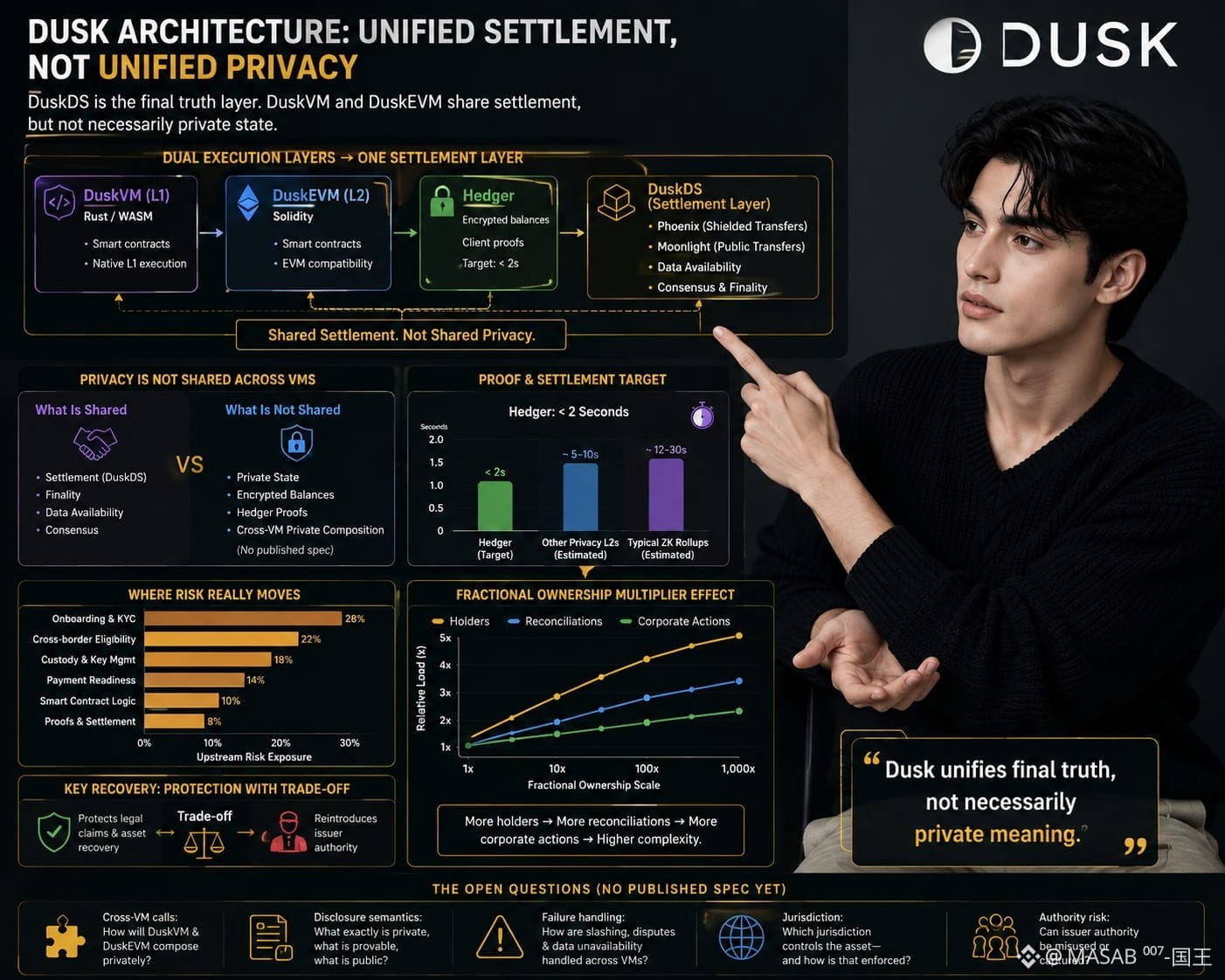
Charts were flat, so I reopened Dusk’s architecture notes. I kept seeing “privacy” as if DuskDS, DuskVM and DuskEVM shared one confidential state.
DuskVM runs Rust/WASM on L1; DuskEVM runs Solidity, with Hedger adding encrypted balances and client proofs targeted below two seconds. Both settle through DuskDS—Phoenix provides shielded transfers, Moonlight public ones—alongside data availability, consensus and finality. Yet shared settlement is not shared privacy: I found no published specification showing a DuskVM contract privately composing with Hedger state.
Dusk unifies final truth, not necessarily private meaning.
For RWAs, institutions need confidential positions and verifiable ownership; hiding a retail balance isn’t hiding a business workflow. Faster proofs and settlement can move risk upstream into onboarding, cross-border eligibility, custody and payment readiness. Developers still reconcile Solidity, confidential state and compliance logic.
Fractional ownership multiplies holders, reconciliation and corporate actions. Lost-key recovery powers protect legal claims, but reintroduce issuer authority. Cryptography cannot decide which jurisdiction controls the asset—or whether that authority acts wisely.
This isn’t unique to Dusk. Until cross-VM calls, disclosure semantics and failure handling are documented, “unified privacy” outruns the published guarantee. The charts remain flat; the phrase doesn’t.
@Dusk_Foundation $DUSK #dusk
{future}(DUSKUSDT)
Charts were flat, so I reopened Dusk’s architecture notes. I kept seeing “privacy” as if DuskDS, DuskVM and DuskEVM shared one confidential state.
DuskVM runs Rust/WASM on L1; DuskEVM runs Solidity, with Hedger adding encrypted balances and client proofs targeted below two seconds. Both settle through DuskDS—Phoenix provides shielded transfers, Moonlight public ones—alongside data availability, consensus and finality. Yet shared settlement is not shared privacy: I found no published specification showing a DuskVM contract privately composing with Hedger state.
Dusk unifies final truth, not necessarily private meaning.
For RWAs, institutions need confidential positions and verifiable ownership; hiding a retail balance isn’t hiding a business workflow. Faster proofs and settlement can move risk upstream into onboarding, cross-border eligibility, custody and payment readiness. Developers still reconcile Solidity, confidential state and compliance logic.
Fractional ownership multiplies holders, reconciliation and corporate actions. Lost-key recovery powers protect legal claims, but reintroduce issuer authority. Cryptography cannot decide which jurisdiction controls the asset—or whether that authority acts wisely.
This isn’t unique to Dusk. Until cross-VM calls, disclosure semantics and failure handling are documented, “unified privacy” outruns the published guarantee. The charts remain flat; the phrase doesn’t.
@Dusk $DUSK #dusk
DuskVM runs Rust/WASM on L1; DuskEVM runs Solidity, with Hedger adding encrypted balances and client proofs targeted below two seconds. Both settle through DuskDS—Phoenix provides shielded transfers, Moonlight public ones—alongside data availability, consensus and finality. Yet shared settlement is not shared privacy: I found no published specification showing a DuskVM contract privately composing with Hedger state.
Dusk unifies final truth, not necessarily private meaning.
For RWAs, institutions need confidential positions and verifiable ownership; hiding a retail balance isn’t hiding a business workflow. Faster proofs and settlement can move risk upstream into onboarding, cross-border eligibility, custody and payment readiness. Developers still reconcile Solidity, confidential state and compliance logic.
Fractional ownership multiplies holders, reconciliation and corporate actions. Lost-key recovery powers protect legal claims, but reintroduce issuer authority. Cryptography cannot decide which jurisdiction controls the asset—or whether that authority acts wisely.
This isn’t unique to Dusk. Until cross-VM calls, disclosure semantics and failure handling are documented, “unified privacy” outruns the published guarantee. The charts remain flat; the phrase doesn’t.
@Dusk $DUSK #dusk
6
10
30.2k
·
--
Verified
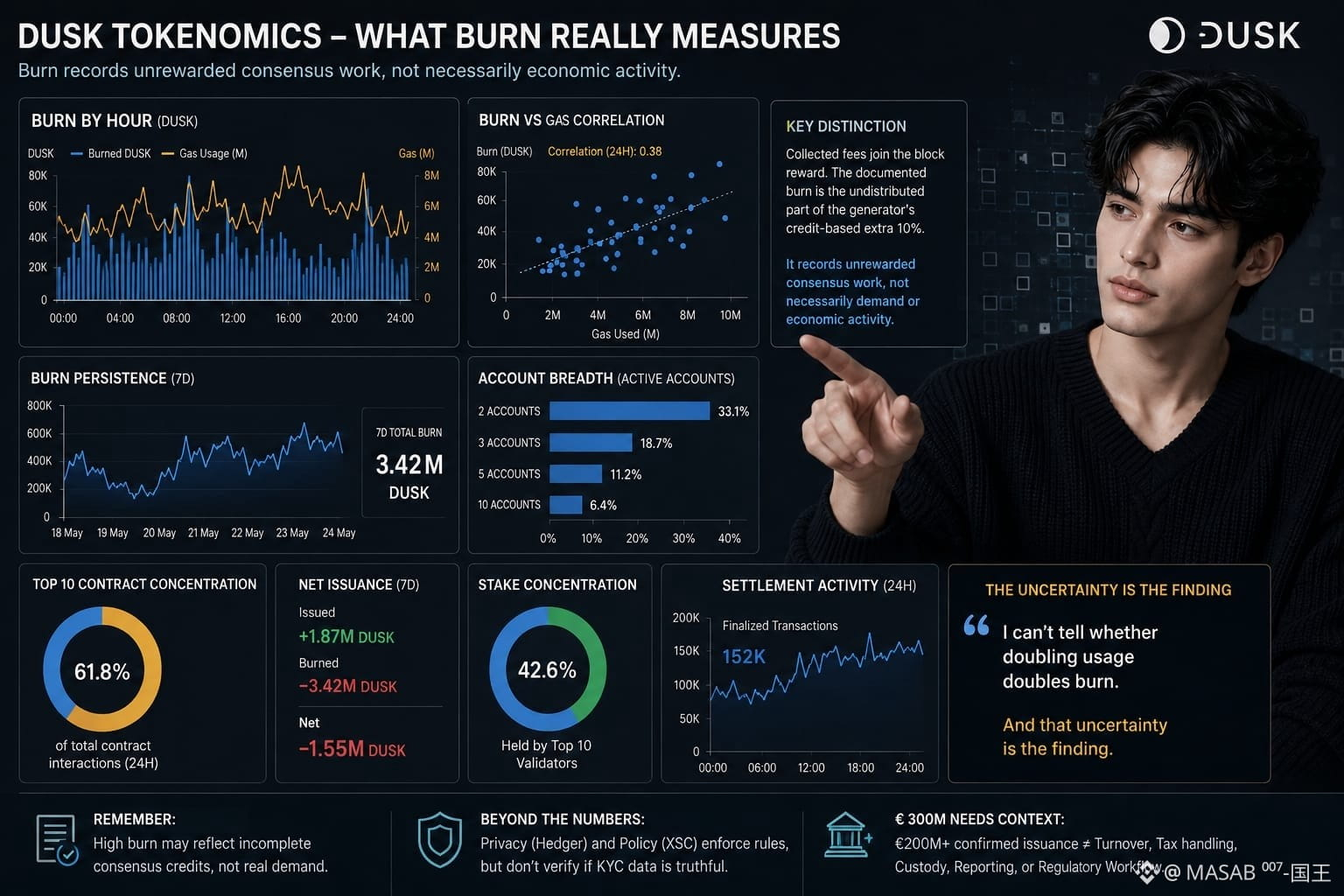
Charts were flat, so I opened Dusk’s tokenomics page to map burn by hour. I assumed busy blocks, high gas and more users meant more DUSK burned. Something didn’t line up.
Fees are paid in DUSK, but collected fees join the block reward. The documented burn is the undistributed part of the generator’s credit-based extra 10%. Burn per block, epoch, contract or million gas cannot automatically measure demand; high burn may reflect incomplete consensus credits.
It records unrewarded consensus work, not necessarily economic activity.
That distinction followed me. 210M+ staked can protect consensus, not credential accuracy or application logic. Hedger can conceal values while proving computations, and XSC can enforce transfer policy, but neither proves KYC data is truthful. Rejections might still leak eligibility clues.
Even €300M needs labeling: Dusk cited NPEX’s €300M AUM in 2025; its current site shows €200M+ confirmed issuance. Neither measures turnover, wallet conversion, tax handling, custody, reporting, reconciliation, or whether four regulatory functions work as one workflow.
My dashboard now needs burn persistence, gas/fee correlation, 2/3/5/10-contract account breadth, top-ten concentration, net issuance, stake concentration and settlement activity. The charts remain open. I can’t tell whether doubling usage doubles burn and that uncertainty is the finding.
@Dusk_Foundation $DUSK #dusk
{future}(DUSKUSDT)
Charts were flat, so I opened Dusk’s tokenomics page to map burn by hour. I assumed busy blocks, high gas and more users meant more DUSK burned. Something didn’t line up.
Fees are paid in DUSK, but collected fees join the block reward. The documented burn is the undistributed part of the generator’s credit-based extra 10%. Burn per block, epoch, contract or million gas cannot automatically measure demand; high burn may reflect incomplete consensus credits.
It records unrewarded consensus work, not necessarily economic activity.
That distinction followed me. 210M+ staked can protect consensus, not credential accuracy or application logic. Hedger can conceal values while proving computations, and XSC can enforce transfer policy, but neither proves KYC data is truthful. Rejections might still leak eligibility clues.
Even €300M needs labeling: Dusk cited NPEX’s €300M AUM in 2025; its current site shows €200M+ confirmed issuance. Neither measures turnover, wallet conversion, tax handling, custody, reporting, reconciliation, or whether four regulatory functions work as one workflow.
My dashboard now needs burn persistence, gas/fee correlation, 2/3/5/10-contract account breadth, top-ten concentration, net issuance, stake concentration and settlement activity. The charts remain open. I can’t tell whether doubling usage doubles burn and that uncertainty is the finding.
@Dusk $DUSK #dusk
Fees are paid in DUSK, but collected fees join the block reward. The documented burn is the undistributed part of the generator’s credit-based extra 10%. Burn per block, epoch, contract or million gas cannot automatically measure demand; high burn may reflect incomplete consensus credits.
It records unrewarded consensus work, not necessarily economic activity.
That distinction followed me. 210M+ staked can protect consensus, not credential accuracy or application logic. Hedger can conceal values while proving computations, and XSC can enforce transfer policy, but neither proves KYC data is truthful. Rejections might still leak eligibility clues.
Even €300M needs labeling: Dusk cited NPEX’s €300M AUM in 2025; its current site shows €200M+ confirmed issuance. Neither measures turnover, wallet conversion, tax handling, custody, reporting, reconciliation, or whether four regulatory functions work as one workflow.
My dashboard now needs burn persistence, gas/fee correlation, 2/3/5/10-contract account breadth, top-ten concentration, net issuance, stake concentration and settlement activity. The charts remain open. I can’t tell whether doubling usage doubles burn and that uncertainty is the finding.
@Dusk $DUSK #dusk
8
14
11.6k
·
--
Yesterday, during a flat market, I kept seeing DUSK burn treated as proof of deflation. I sat with that claim. Something didn’t line up.
A Dusk dashboard must compare daily, weekly and monthly emissions with burns, then attribute burn by wallet, application, epoch and block. If one contract or a few blocks dominate, the total means something different from broad demand.
Burn proves supply was removed, not that demand was distributed or durable.
Its value appears beside staking rewards, active stake, provisioner rewards, epoch fee density and activity acceleration, burn per 1 million DUSK staked and net supply growth. Together these show whether security issuance is offset by activity and whether higher staking creates more or less supply pressure.
But the mechanism still needs stress tests. If active accounts rise 50% or contract calls double, do transactions and gas double? At 2×, 5× and 10× activity, which moves first: gas per transaction, fees, mempool size, block density or DuskEVM P95 inclusion time?
I’d separate social growth, exchange depth, cross-chain coverage and announced assets from users, application liquidity, finalized settlements and actual issuance.
The market remains flat. The burn headline looks incomplete.
@Dusk_Foundation $DUSK #dusk
{future}(DUSKUSDT)
Yesterday, during a flat market, I kept seeing DUSK burn treated as proof of deflation. I sat with that claim. Something didn’t line up.
A Dusk dashboard must compare daily, weekly and monthly emissions with burns, then attribute burn by wallet, application, epoch and block. If one contract or a few blocks dominate, the total means something different from broad demand.
Burn proves supply was removed, not that demand was distributed or durable.
Its value appears beside staking rewards, active stake, provisioner rewards, epoch fee density and activity acceleration, burn per 1 million DUSK staked and net supply growth. Together these show whether security issuance is offset by activity and whether higher staking creates more or less supply pressure.
But the mechanism still needs stress tests. If active accounts rise 50% or contract calls double, do transactions and gas double? At 2×, 5× and 10× activity, which moves first: gas per transaction, fees, mempool size, block density or DuskEVM P95 inclusion time?
I’d separate social growth, exchange depth, cross-chain coverage and announced assets from users, application liquidity, finalized settlements and actual issuance.
The market remains flat. The burn headline looks incomplete.
@Dusk $DUSK #dusk
A Dusk dashboard must compare daily, weekly and monthly emissions with burns, then attribute burn by wallet, application, epoch and block. If one contract or a few blocks dominate, the total means something different from broad demand.
Burn proves supply was removed, not that demand was distributed or durable.
Its value appears beside staking rewards, active stake, provisioner rewards, epoch fee density and activity acceleration, burn per 1 million DUSK staked and net supply growth. Together these show whether security issuance is offset by activity and whether higher staking creates more or less supply pressure.
But the mechanism still needs stress tests. If active accounts rise 50% or contract calls double, do transactions and gas double? At 2×, 5× and 10× activity, which moves first: gas per transaction, fees, mempool size, block density or DuskEVM P95 inclusion time?
I’d separate social growth, exchange depth, cross-chain coverage and announced assets from users, application liquidity, finalized settlements and actual issuance.
The market remains flat. The burn headline looks incomplete.
@Dusk $DUSK #dusk

15
20
10.3k
·
--
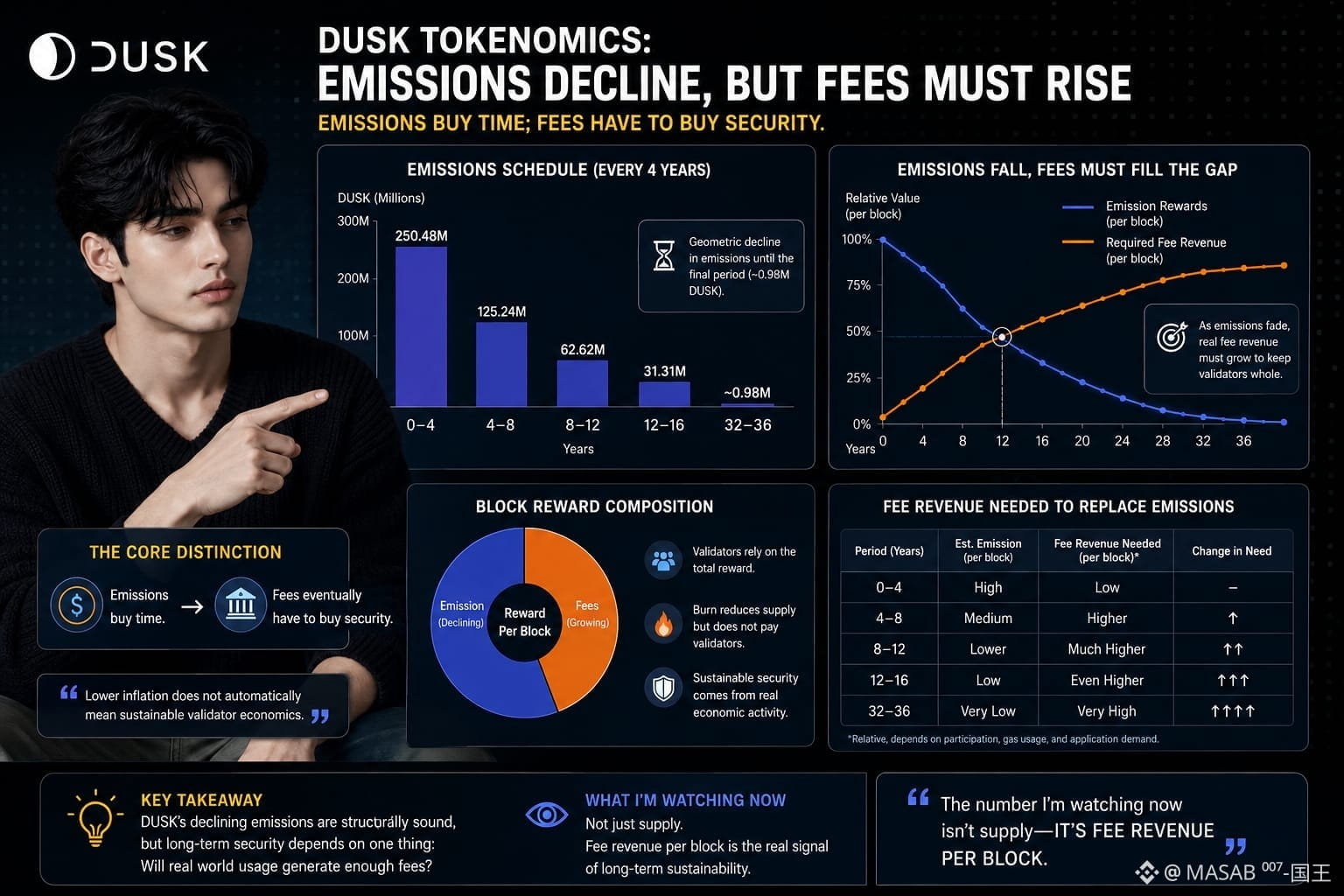
While revisiting Dusk’s tokenomics docs tonight, one number kept pulling me back: 250.48M DUSK is scheduled for the first four years, then 125.24M, 62.62M, 31.31M, until the final four-year period falls to roughly 0.98M.
The headline interpretation is easy: emissions decline,......inflation falls, scarcity improves.
But that isn’t the security question.
Dusk block rewards combine newly emitted DUSK with transaction fees.....So as issuance geometrically fades, the network increasingly needs real fee-paying activity to replace the subsidy validators are losing.
Emissions buy time; fees eventually have to buy security.
That distinction matters because lower inflation does not automatically mean sustainable validator economics. A smaller reward pool is only comfortable if gas, settlement and application activity grow enough to compensate. Burn complicates the picture further: burning undistributed rewards may reduce supply, but it does not fund the operators securing consensus.
I’m not saying Dusk’s schedule is flawed. A declining subsidy is structurally understandable. I just can’t tell yet whether future institutional usage will generate enough fees when emissions become tiny.
The tokenomics tab is still open. The number I’m watching now isn’t supply—it’s fee revenue per block.
@Dusk_Foundation $DUSK #dusk
{future}(DUSKUSDT)
While revisiting Dusk’s tokenomics docs tonight, one number kept pulling me back: 250.48M DUSK is scheduled for the first four years, then 125.24M, 62.62M, 31.31M, until the final four-year period falls to roughly 0.98M.
The headline interpretation is easy: emissions decline,......inflation falls, scarcity improves.
But that isn’t the security question.
Dusk block rewards combine newly emitted DUSK with transaction fees.....So as issuance geometrically fades, the network increasingly needs real fee-paying activity to replace the subsidy validators are losing.
Emissions buy time; fees eventually have to buy security.
That distinction matters because lower inflation does not automatically mean sustainable validator economics. A smaller reward pool is only comfortable if gas, settlement and application activity grow enough to compensate. Burn complicates the picture further: burning undistributed rewards may reduce supply, but it does not fund the operators securing consensus.
I’m not saying Dusk’s schedule is flawed. A declining subsidy is structurally understandable. I just can’t tell yet whether future institutional usage will generate enough fees when emissions become tiny.
The tokenomics tab is still open. The number I’m watching now isn’t supply—it’s fee revenue per block.
@Dusk $DUSK #dusk
The headline interpretation is easy: emissions decline,......inflation falls, scarcity improves.
But that isn’t the security question.
Dusk block rewards combine newly emitted DUSK with transaction fees.....So as issuance geometrically fades, the network increasingly needs real fee-paying activity to replace the subsidy validators are losing.
Emissions buy time; fees eventually have to buy security.
That distinction matters because lower inflation does not automatically mean sustainable validator economics. A smaller reward pool is only comfortable if gas, settlement and application activity grow enough to compensate. Burn complicates the picture further: burning undistributed rewards may reduce supply, but it does not fund the operators securing consensus.
I’m not saying Dusk’s schedule is flawed. A declining subsidy is structurally understandable. I just can’t tell yet whether future institutional usage will generate enough fees when emissions become tiny.
The tokenomics tab is still open. The number I’m watching now isn’t supply—it’s fee revenue per block.
@Dusk $DUSK #dusk
15
17
13.7k
·
--
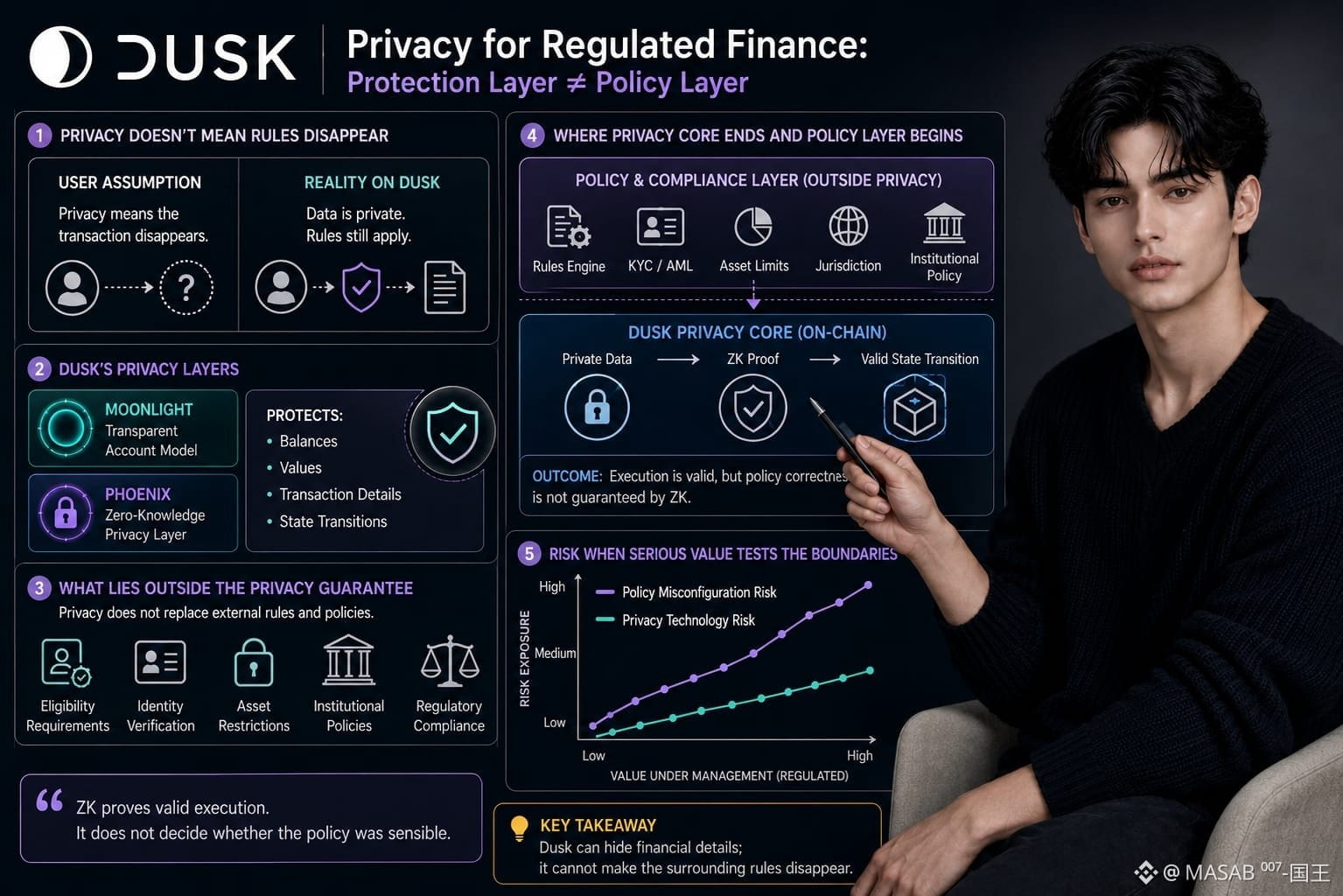
Trading was quiet today, so I reopened Dusk’s documentation.... I kept seeing the phrase “privacy for regulated finance,” and something about it made me look closer.
At first, I assumed privacy meant the transaction itself simply disappeared from public view.
But Dusk is more layered than that.
Moonlight provides a transparent account model, while Phoenix uses zero-knowledge technology to keep transaction values and balances confidential..... The important point is that privacy does not automatically remove every compliance rule surrounding the transaction.
Dusk can hide financial details; it cannot make the surrounding rules disAppear.
That distinction seemed almost semantic at first. It isn’t.
The cryptographic layer can protect confidential transaction data and verify valid state transitions. But eligibility, identity requirements, asset restrictions, and institutional policies may still depend on rules defined outside that privacy guarantee.
Imagine an authorized investor satisfying every technical requirement but operating under a poorly configured pOlicy. The ZK proof can confirm valid execution. It cannot decide whether the policy itself was sensible.
That isn’t uniquely a Dusk problem.
The harder question is what happens when serious regulated value starts testing those bOundaries.
My documentation tab is still open. “Privacy” now feels like a much narrower word than it did this morning.
@Dusk_Foundation $DUSK #dusk
{future}(DUSKUSDT)
Trading was quiet today, so I reopened Dusk’s documentation.... I kept seeing the phrase “privacy for regulated finance,” and something about it made me look closer.
At first, I assumed privacy meant the transaction itself simply disappeared from public view.
But Dusk is more layered than that.
Moonlight provides a transparent account model, while Phoenix uses zero-knowledge technology to keep transaction values and balances confidential..... The important point is that privacy does not automatically remove every compliance rule surrounding the transaction.
Dusk can hide financial details; it cannot make the surrounding rules disAppear.
That distinction seemed almost semantic at first. It isn’t.
The cryptographic layer can protect confidential transaction data and verify valid state transitions. But eligibility, identity requirements, asset restrictions, and institutional policies may still depend on rules defined outside that privacy guarantee.
Imagine an authorized investor satisfying every technical requirement but operating under a poorly configured pOlicy. The ZK proof can confirm valid execution. It cannot decide whether the policy itself was sensible.
That isn’t uniquely a Dusk problem.
The harder question is what happens when serious regulated value starts testing those bOundaries.
My documentation tab is still open. “Privacy” now feels like a much narrower word than it did this morning.
@Dusk $DUSK #dusk
At first, I assumed privacy meant the transaction itself simply disappeared from public view.
But Dusk is more layered than that.
Moonlight provides a transparent account model, while Phoenix uses zero-knowledge technology to keep transaction values and balances confidential..... The important point is that privacy does not automatically remove every compliance rule surrounding the transaction.
Dusk can hide financial details; it cannot make the surrounding rules disAppear.
That distinction seemed almost semantic at first. It isn’t.
The cryptographic layer can protect confidential transaction data and verify valid state transitions. But eligibility, identity requirements, asset restrictions, and institutional policies may still depend on rules defined outside that privacy guarantee.
Imagine an authorized investor satisfying every technical requirement but operating under a poorly configured pOlicy. The ZK proof can confirm valid execution. It cannot decide whether the policy itself was sensible.
That isn’t uniquely a Dusk problem.
The harder question is what happens when serious regulated value starts testing those bOundaries.
My documentation tab is still open. “Privacy” now feels like a much narrower word than it did this morning.
@Dusk $DUSK #dusk
26
28
13.1k
·
--
I was checking TermMax leverage markets tonight and kept coming back to the phrase “one-click leverage.” It sounds like the hard problem has been removed.
So I actually sat with the flow.
TermMax uses a flash loan to combine my capital with borrowed funds, buy collateral, lock it inside a GT, and settle the leverage transaction atomically. That is cleaner than manually borrowing, swapping, redepositing and looping several times.
But execution simplicity is not economic simplicity.
At 4.8× leverage, roughly 3.8× of my equity is borrowed capital. About 79% of the gross position is debt-funded.... If I’m levering a yield-bearing asset or Principal Token, asset yield scales with exposure—but fixed borrowing cost scales too.
A rough carry equation is:
Net return ≈ 4.8 × asset yield − 3.8 × borrow rate − fees/slippage.
That is where “one click” stops helping.
Atomic entry can reduce gas, sequencing and failed-transaction risk.... It cannot guarantee cheap liquidity, favorable pricing, or an equally clean exit. Borrowers get streamlined execution; lenders still provide the range liquidity underneath.
If volatility hits and DEX liquidity thins, does exit slippage rise faster than leverage?
TermMax simplifies entry. I’m less convinced it simplifies unwinding.
#termmax @termmax
I was checking TermMax leverage markets tonight and kept coming back to the phrase “one-click leverage.” It sounds like the hard problem has been removed.
So I actually sat with the flow.
TermMax uses a flash loan to combine my capital with borrowed funds, buy collateral, lock it inside a GT, and settle the leverage transaction atomically. That is cleaner than manually borrowing, swapping, redepositing and looping several times.
But execution simplicity is not economic simplicity.
At 4.8× leverage, roughly 3.8× of my equity is borrowed capital. About 79% of the gross position is debt-funded.... If I’m levering a yield-bearing asset or Principal Token, asset yield scales with exposure—but fixed borrowing cost scales too.
A rough carry equation is:
Net return ≈ 4.8 × asset yield − 3.8 × borrow rate − fees/slippage.
That is where “one click” stops helping.
Atomic entry can reduce gas, sequencing and failed-transaction risk.... It cannot guarantee cheap liquidity, favorable pricing, or an equally clean exit. Borrowers get streamlined execution; lenders still provide the range liquidity underneath.
If volatility hits and DEX liquidity thins, does exit slippage rise faster than leverage?
TermMax simplifies entry. I’m less convinced it simplifies unwinding.
#termmax @TermMax
So I actually sat with the flow.
TermMax uses a flash loan to combine my capital with borrowed funds, buy collateral, lock it inside a GT, and settle the leverage transaction atomically. That is cleaner than manually borrowing, swapping, redepositing and looping several times.
But execution simplicity is not economic simplicity.
At 4.8× leverage, roughly 3.8× of my equity is borrowed capital. About 79% of the gross position is debt-funded.... If I’m levering a yield-bearing asset or Principal Token, asset yield scales with exposure—but fixed borrowing cost scales too.
A rough carry equation is:
Net return ≈ 4.8 × asset yield − 3.8 × borrow rate − fees/slippage.
That is where “one click” stops helping.
Atomic entry can reduce gas, sequencing and failed-transaction risk.... It cannot guarantee cheap liquidity, favorable pricing, or an equally clean exit. Borrowers get streamlined execution; lenders still provide the range liquidity underneath.
If volatility hits and DEX liquidity thins, does exit slippage rise faster than leverage?
TermMax simplifies entry. I’m less convinced it simplifies unwinding.
#termmax @TermMax

8
11
11.6k
·
--
Partly True
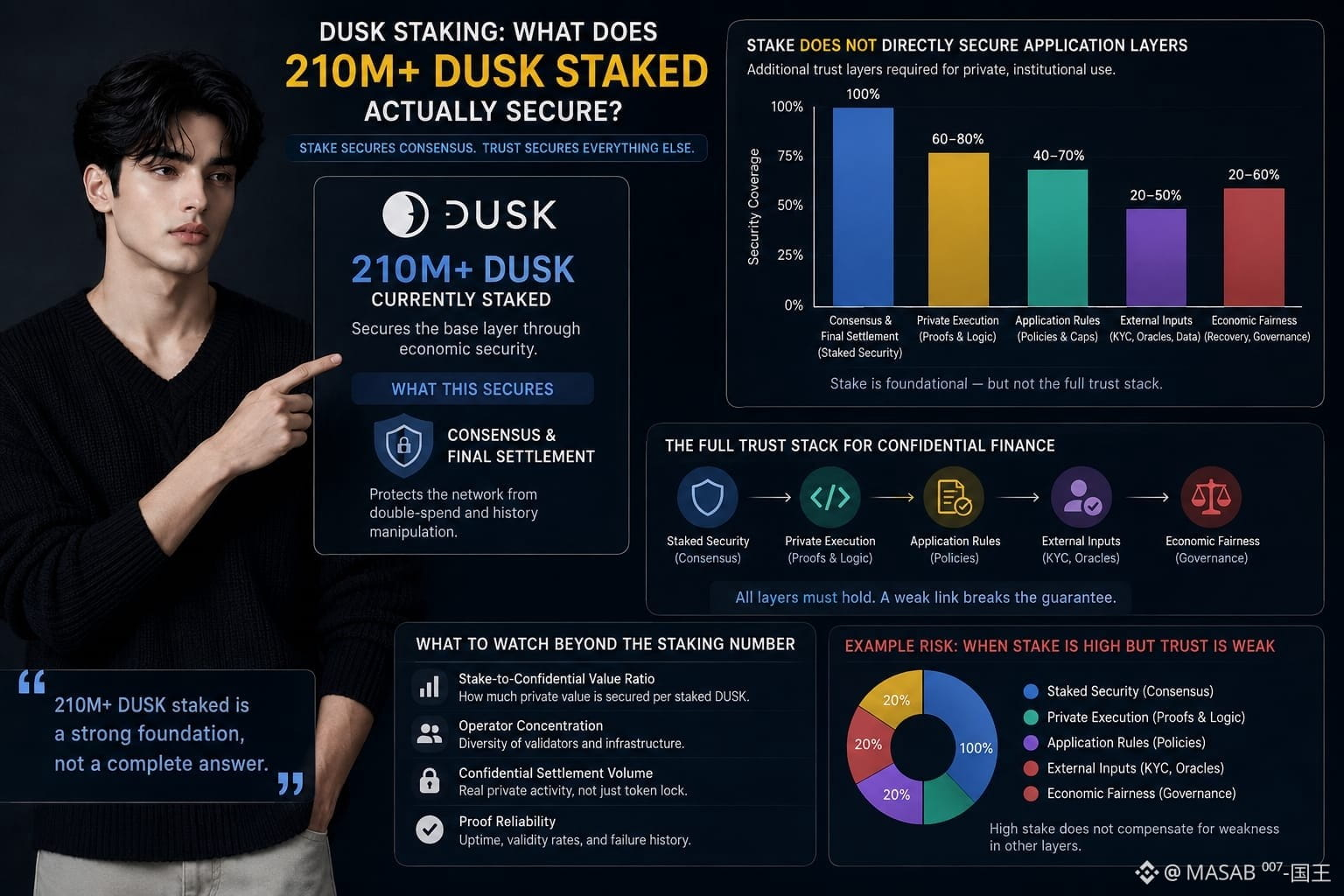
I was revisiting Dusk’s staking numbers while the market was quiet, and 210M+ DUSK staked kept looking reassuring. Then I asked what that number actually secures.
The intuitive reading is simple: more stake means confidential financial applications are safer. But the guarantee is narrower. Active stake protects consensus and final settlement at the base layer. A private contract still depends on correct proof logic, sound application rules and, for regulated assets, trustworthy external inputs such as eligibility data.
That distinction matters.
Dusk can make private state verifiable without publishing the underlying position. That is genuinely useful. But a valid proof cannot tell whether a KYC provider supplied bad data, a policy encoded the wrong ownership cap, or an authorized recovery action was economically fair.
So 210M staked measures one security layer, not the whole institutional trust stack.
I thought that was pedantic at first. It isn’t. If private applications secure serious real-world value, I’d rather watch stake relative to confidential settlement value, operator concentration and proof reliability.
The staking tab is still open. The number now feels less like an answer and more like the start of one.
@Dusk_Foundation $DUSK #dusk
{future}(DUSKUSDT)
I was revisiting Dusk’s staking numbers while the market was quiet, and 210M+ DUSK staked kept looking reassuring. Then I asked what that number actually secures.
The intuitive reading is simple: more stake means confidential financial applications are safer. But the guarantee is narrower. Active stake protects consensus and final settlement at the base layer. A private contract still depends on correct proof logic, sound application rules and, for regulated assets, trustworthy external inputs such as eligibility data.
That distinction matters.
Dusk can make private state verifiable without publishing the underlying position. That is genuinely useful. But a valid proof cannot tell whether a KYC provider supplied bad data, a policy encoded the wrong ownership cap, or an authorized recovery action was economically fair.
So 210M staked measures one security layer, not the whole institutional trust stack.
I thought that was pedantic at first. It isn’t. If private applications secure serious real-world value, I’d rather watch stake relative to confidential settlement value, operator concentration and proof reliability.
The staking tab is still open. The number now feels less like an answer and more like the start of one.
@Dusk $DUSK #dusk
The intuitive reading is simple: more stake means confidential financial applications are safer. But the guarantee is narrower. Active stake protects consensus and final settlement at the base layer. A private contract still depends on correct proof logic, sound application rules and, for regulated assets, trustworthy external inputs such as eligibility data.
That distinction matters.
Dusk can make private state verifiable without publishing the underlying position. That is genuinely useful. But a valid proof cannot tell whether a KYC provider supplied bad data, a policy encoded the wrong ownership cap, or an authorized recovery action was economically fair.
So 210M staked measures one security layer, not the whole institutional trust stack.
I thought that was pedantic at first. It isn’t. If private applications secure serious real-world value, I’d rather watch stake relative to confidential settlement value, operator concentration and proof reliability.
The staking tab is still open. The number now feels less like an answer and more like the start of one.
@Dusk $DUSK #dusk
30
22
32k
·
--
Verified
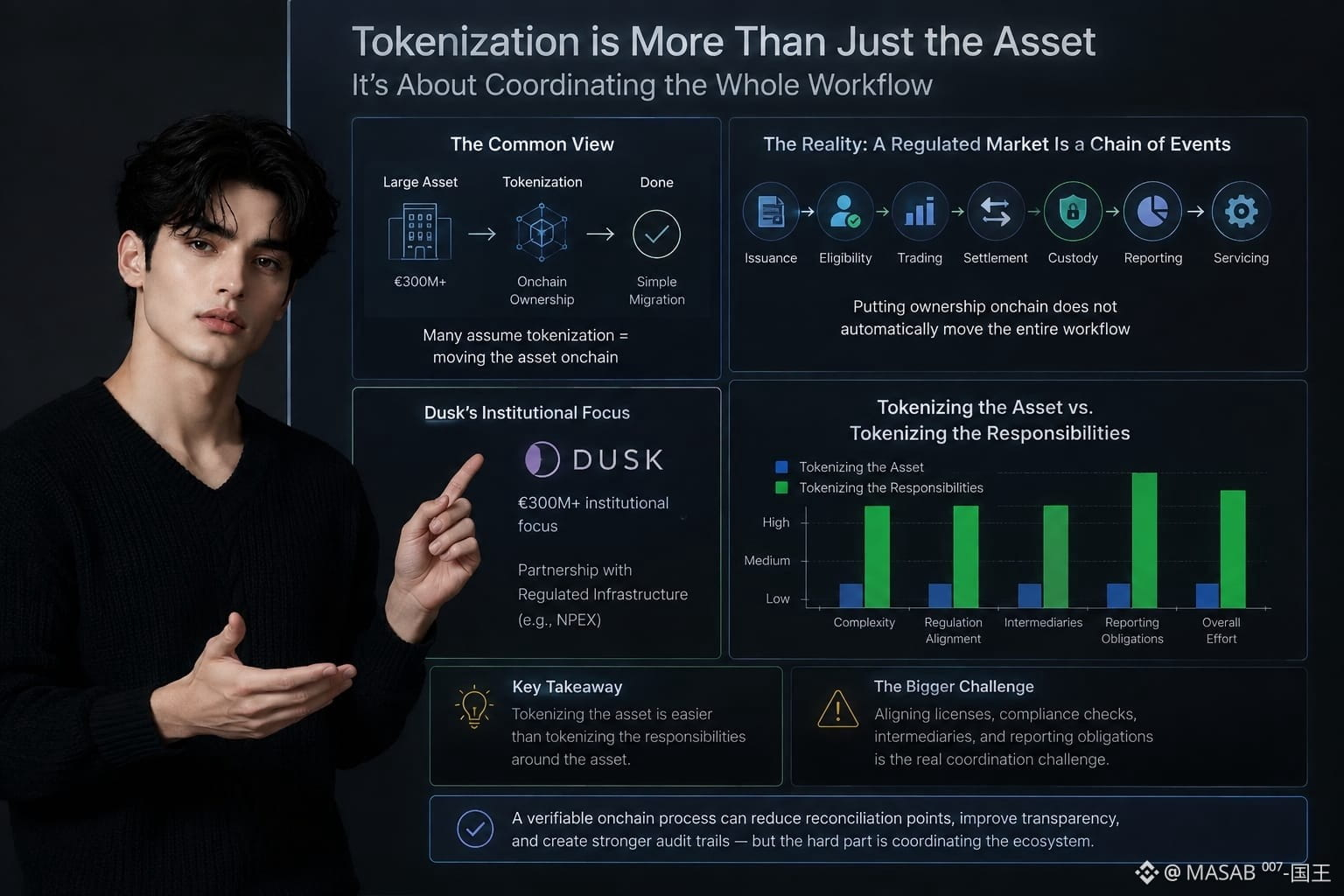
Last night I was scrolling through tokenization discussions and kept seeing the same idea: moving large assets onchain is mainly a technical migration problem. That sounded reasonable, but when I looked deeper into Dusk’s €300M+ institutional focus, something did not line up.
The asset itself is only one piece. A regulated market is a chain of events: issuance, eligibility, trading, settlement, custody, reporting, and servicing. Putting ownership records onchain does not automatically move the entire workflow.
An ordinary reader might assume tokenization means replacing the old system with a blockchain transaction. But Dusk’s connection with regulated infrastructure such as NPEX highlights a different challenge: coordinating the functions around the asset.
The distinction I keep coming back to is this:
“Tokenizing the asset is easier than tokenizing the responsibilities around the asset.”
That does not reduce the value of Dusk. A verifiable onchain process can reduce reconciliation points, improve transparency, and create stronger audit trails.
But I wondered if the hard part was actually the blockchain layer. Maybe the bigger challenge is aligning licenses, compliance checks, intermediaries, and reporting obligations.
I am not sure the market fully measures that coordination problem yet. The documentation tab is still open on my screen, and now I look at “onchain assets” a little differently.
@Dusk_Foundation $DUSK #dusk
{future}(DUSKUSDT)
Last night I was scrolling through tokenization discussions and kept seeing the same idea: moving large assets onchain is mainly a technical migration problem. That sounded reasonable, but when I looked deeper into Dusk’s €300M+ institutional focus, something did not line up.
The asset itself is only one piece. A regulated market is a chain of events: issuance, eligibility, trading, settlement, custody, reporting, and servicing. Putting ownership records onchain does not automatically move the entire workflow.
An ordinary reader might assume tokenization means replacing the old system with a blockchain transaction. But Dusk’s connection with regulated infrastructure such as NPEX highlights a different challenge: coordinating the functions around the asset.
The distinction I keep coming back to is this:
“Tokenizing the asset is easier than tokenizing the responsibilities around the asset.”
That does not reduce the value of Dusk. A verifiable onchain process can reduce reconciliation points, improve transparency, and create stronger audit trails.
But I wondered if the hard part was actually the blockchain layer. Maybe the bigger challenge is aligning licenses, compliance checks, intermediaries, and reporting obligations.
I am not sure the market fully measures that coordination problem yet. The documentation tab is still open on my screen, and now I look at “onchain assets” a little differently.
@Dusk $DUSK #dusk
The asset itself is only one piece. A regulated market is a chain of events: issuance, eligibility, trading, settlement, custody, reporting, and servicing. Putting ownership records onchain does not automatically move the entire workflow.
An ordinary reader might assume tokenization means replacing the old system with a blockchain transaction. But Dusk’s connection with regulated infrastructure such as NPEX highlights a different challenge: coordinating the functions around the asset.
The distinction I keep coming back to is this:
“Tokenizing the asset is easier than tokenizing the responsibilities around the asset.”
That does not reduce the value of Dusk. A verifiable onchain process can reduce reconciliation points, improve transparency, and create stronger audit trails.
But I wondered if the hard part was actually the blockchain layer. Maybe the bigger challenge is aligning licenses, compliance checks, intermediaries, and reporting obligations.
I am not sure the market fully measures that coordination problem yet. The documentation tab is still open on my screen, and now I look at “onchain assets” a little differently.
@Dusk $DUSK #dusk
19
16
24.4k
·
--
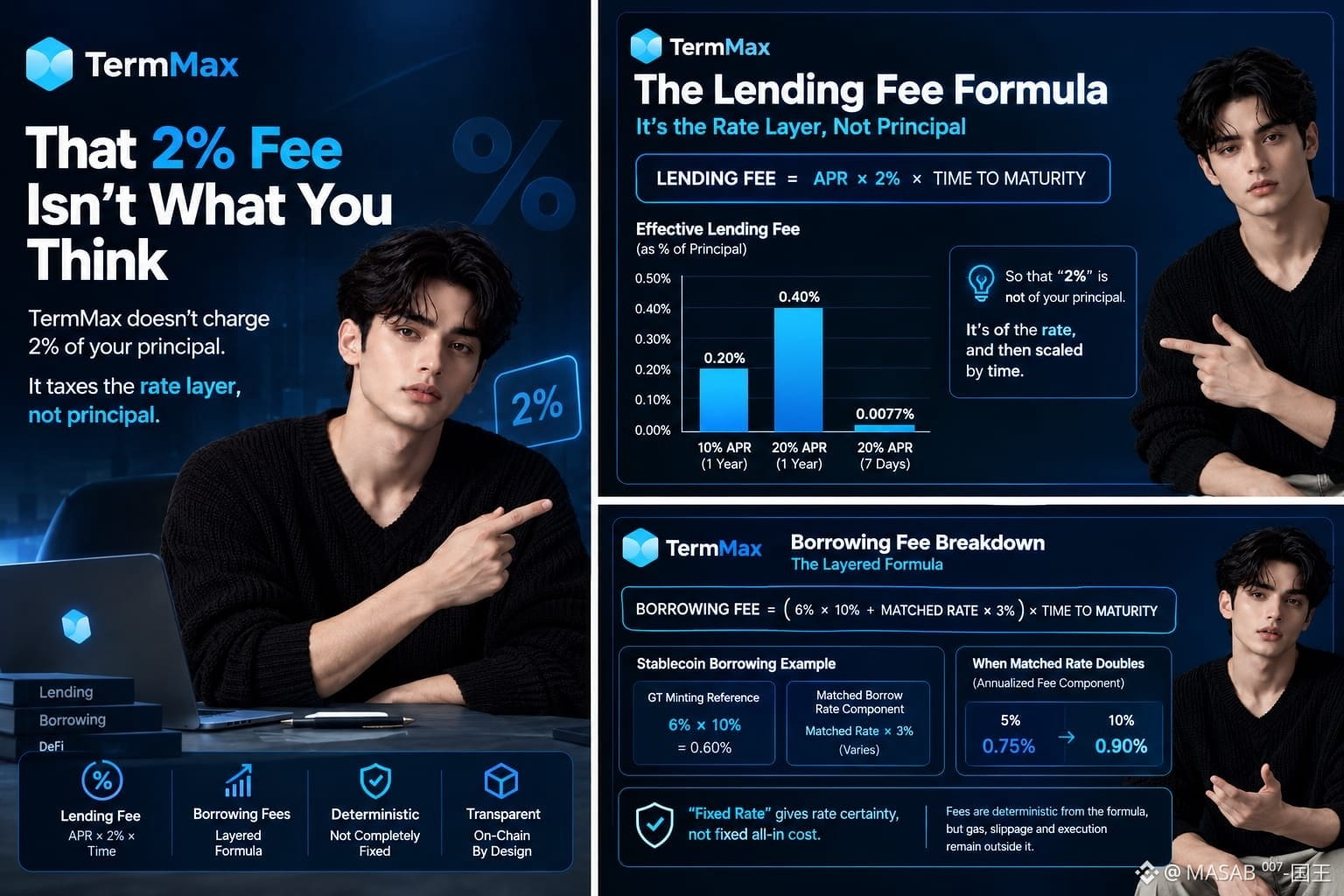
I was revisiting TermMax’s fee page while the market was quiet, and one line kept catching my eye: a 2% lending fee. My first reaction was simple 2% of principal sounds expensive.
So I actually sat with the formula. That isn’t what TermMax charges.
The lending fee rate is APR × 2% × time to maturity. At 10% APR for one year, the effective fee is 0.20% of the lend amount. At 20% APR, it becomes 0.40%. For a seven-day loan at 20% APR, it is only about 0.0077% of principal.
That distinction matters.
TermMax taxes the rate layer, not principal at the headline percentage.
Borrowing is more layered. For stablecoins, the documented formula combines a 6% GT minting reference rate × 10% with the matched borrow rate × 3%, then scales both by maturity. If the matched rate doubles from 5% to 10%, the annualized fee component rises from 0.75% to 0.90% before time scaling.
So “fixed rate” gives rate certainty, not fixed all-in cost. Fees are deterministic from the formula, but gas, slippage and execution remain outside it.
The tab is still open. That 2% now looks very different.
#termmax @termmax
I was revisiting TermMax’s fee page while the market was quiet, and one line kept catching my eye: a 2% lending fee. My first reaction was simple 2% of principal sounds expensive.
So I actually sat with the formula. That isn’t what TermMax charges.
The lending fee rate is APR × 2% × time to maturity. At 10% APR for one year, the effective fee is 0.20% of the lend amount. At 20% APR, it becomes 0.40%. For a seven-day loan at 20% APR, it is only about 0.0077% of principal.
That distinction matters.
TermMax taxes the rate layer, not principal at the headline percentage.
Borrowing is more layered. For stablecoins, the documented formula combines a 6% GT minting reference rate × 10% with the matched borrow rate × 3%, then scales both by maturity. If the matched rate doubles from 5% to 10%, the annualized fee component rises from 0.75% to 0.90% before time scaling.
So “fixed rate” gives rate certainty, not fixed all-in cost. Fees are deterministic from the formula, but gas, slippage and execution remain outside it.
The tab is still open. That 2% now looks very different.
#termmax @TermMax
So I actually sat with the formula. That isn’t what TermMax charges.
The lending fee rate is APR × 2% × time to maturity. At 10% APR for one year, the effective fee is 0.20% of the lend amount. At 20% APR, it becomes 0.40%. For a seven-day loan at 20% APR, it is only about 0.0077% of principal.
That distinction matters.
TermMax taxes the rate layer, not principal at the headline percentage.
Borrowing is more layered. For stablecoins, the documented formula combines a 6% GT minting reference rate × 10% with the matched borrow rate × 3%, then scales both by maturity. If the matched rate doubles from 5% to 10%, the annualized fee component rises from 0.75% to 0.90% before time scaling.
So “fixed rate” gives rate certainty, not fixed all-in cost. Fees are deterministic from the formula, but gas, slippage and execution remain outside it.
The tab is still open. That 2% now looks very different.
#termmax @TermMax
1
8
9.4k
·
--
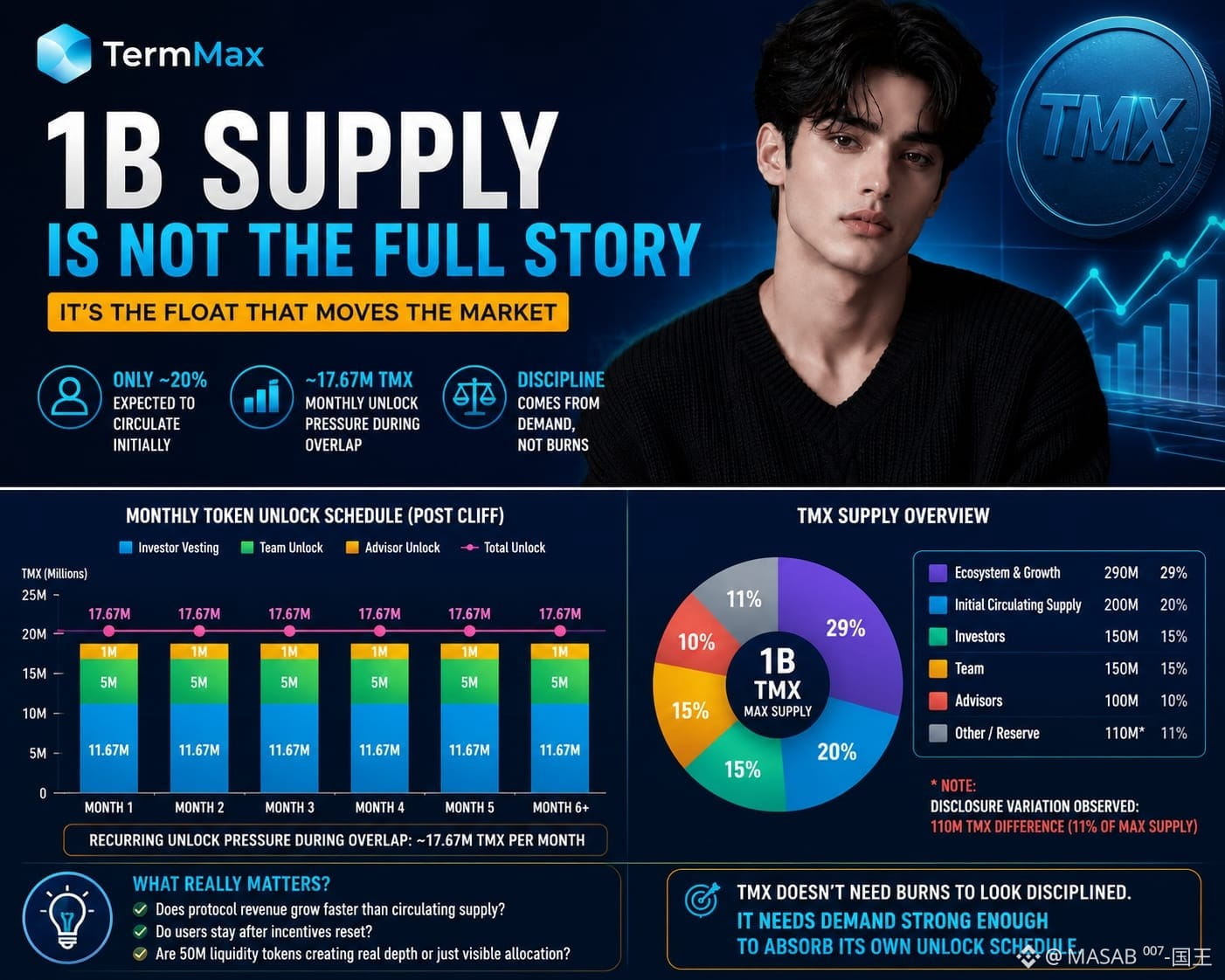
I completely dismissed TMX’s 1B fixed supply the moment I noticed only about 20% is expected to circulate initially.
Max supply is the clean number. Float is the behavioral one.
What matters next is how quickly that float expands. Investor vesting alone could add roughly 11.67M TMX per month after its cliff. Team unlocks add another 5M, advisors another 1M. During overlap, that is around 17.67M TMX of recurring monthly flow.
That is not automatically bearish. Vesting is normal. Ecosystem distribution is normal too.
But distribution is not circulation, and a 29% ecosystem allocation tells me less than how efficiently those tokens create lasting users, matched volume, and liquidity depth.
This is where I think TermMax gets tested.
Does protocol revenue grow faster than circulating supply? Do incentive-heavy users remain after seasons reset? Are 50M liquidity tokens creating real market depth, or mostly visible allocation?
I also keep watching document changes. A 110M-TMX disclosure difference is 11% of max supply. That is not formatting noise.
TMX does not need token burns to look disciplined.
It needs demand growth strong enough to absorb its own unlock schedule.
#termmax @termmax
I completely dismissed TMX’s 1B fixed supply the moment I noticed only about 20% is expected to circulate initially.
Max supply is the clean number. Float is the behavioral one.
What matters next is how quickly that float expands. Investor vesting alone could add roughly 11.67M TMX per month after its cliff. Team unlocks add another 5M, advisors another 1M. During overlap, that is around 17.67M TMX of recurring monthly flow.
That is not automatically bearish. Vesting is normal. Ecosystem distribution is normal too.
But distribution is not circulation, and a 29% ecosystem allocation tells me less than how efficiently those tokens create lasting users, matched volume, and liquidity depth.
This is where I think TermMax gets tested.
Does protocol revenue grow faster than circulating supply? Do incentive-heavy users remain after seasons reset? Are 50M liquidity tokens creating real market depth, or mostly visible allocation?
I also keep watching document changes. A 110M-TMX disclosure difference is 11% of max supply. That is not formatting noise.
TMX does not need token burns to look disciplined.
It needs demand growth strong enough to absorb its own unlock schedule.
#termmax @TermMax
Max supply is the clean number. Float is the behavioral one.
What matters next is how quickly that float expands. Investor vesting alone could add roughly 11.67M TMX per month after its cliff. Team unlocks add another 5M, advisors another 1M. During overlap, that is around 17.67M TMX of recurring monthly flow.
That is not automatically bearish. Vesting is normal. Ecosystem distribution is normal too.
But distribution is not circulation, and a 29% ecosystem allocation tells me less than how efficiently those tokens create lasting users, matched volume, and liquidity depth.
This is where I think TermMax gets tested.
Does protocol revenue grow faster than circulating supply? Do incentive-heavy users remain after seasons reset? Are 50M liquidity tokens creating real market depth, or mostly visible allocation?
I also keep watching document changes. A 110M-TMX disclosure difference is 11% of max supply. That is not formatting noise.
TMX does not need token burns to look disciplined.
It needs demand growth strong enough to absorb its own unlock schedule.
#termmax @TermMax
18
20
7.9k
·
--
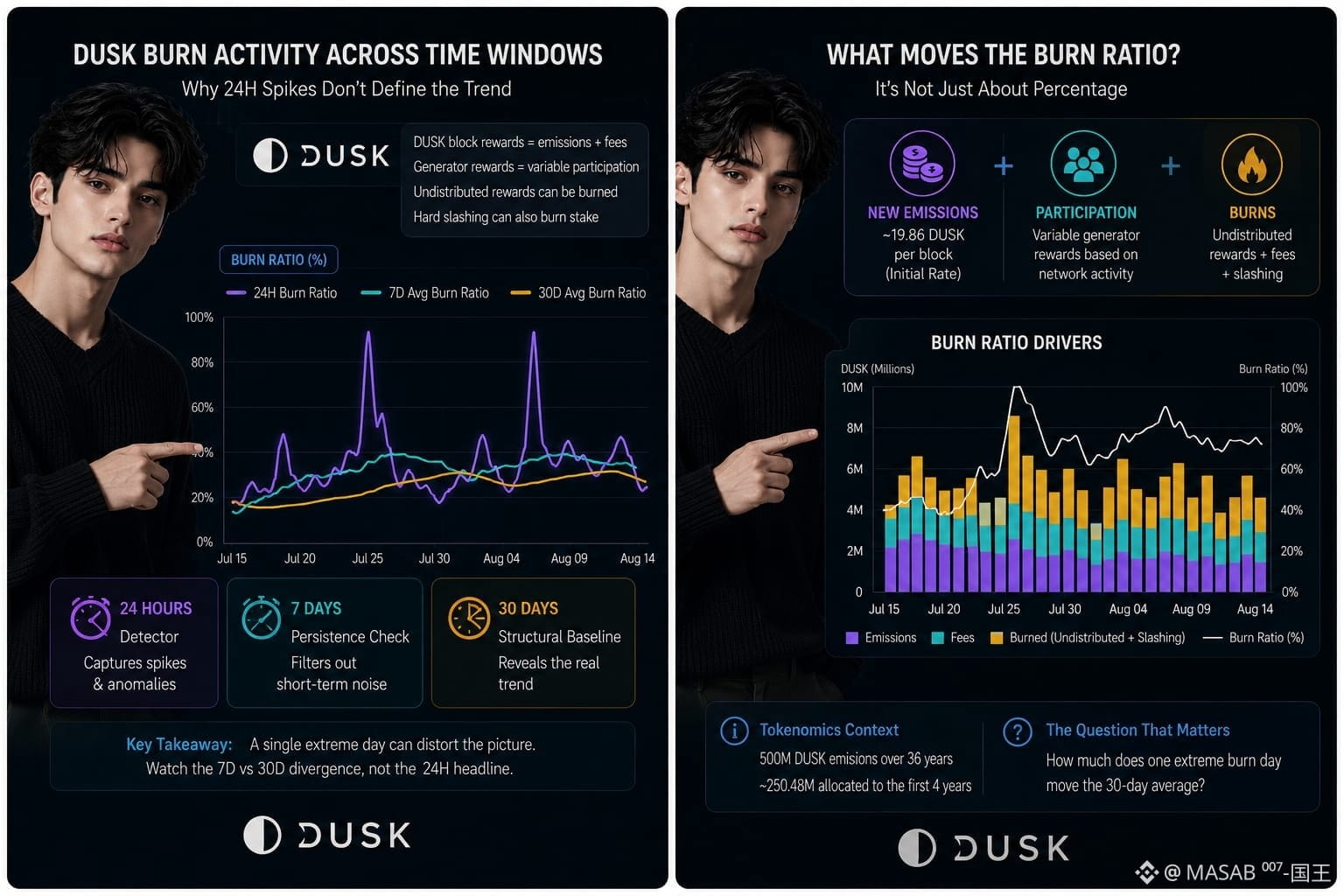
I was comparing how DUSK’s burn activity looks across different windows, and one thing kept bothering me: a dramatic 24-hour burn ratio can say very little about the underlying token economy.
The reason is mechanical.... DUSK block rewards combine newly emitted tokens with transaction fees, while generator rewards include a variable participation component. Any undistributed portion can be burned. Hard slashing can also burn stake.
That makes the daily number partly a measure of network behavior, not simply “deflation.” .....If participation changes sharply for a few hours, the burn ratio can jump without representing a lasting trend.
The scale matters too. Current tokenomics target 500 million DUSK of emissions over 36 years, with about 250.48 million allocated to the first four years. The initial emission rate is roughly 19.86 DUSK per block.
So I would treat 24 hours as a detector, 7 days as a persistence check, and 30 days as the structural baseline.
But a percentage alone hides whether the change came from fewer rewards, more burns, or both.
The uncomfortable question is: how much does one extreme burn day move the 30-day average?
That 7-day versus 30-day divergence is the number I would watch next.
@Dusk_Foundation $DUSK #dusk
{future}(DUSKUSDT)
I was comparing how DUSK’s burn activity looks across different windows, and one thing kept bothering me: a dramatic 24-hour burn ratio can say very little about the underlying token economy.
The reason is mechanical.... DUSK block rewards combine newly emitted tokens with transaction fees, while generator rewards include a variable participation component. Any undistributed portion can be burned. Hard slashing can also burn stake.
That makes the daily number partly a measure of network behavior, not simply “deflation.” .....If participation changes sharply for a few hours, the burn ratio can jump without representing a lasting trend.
The scale matters too. Current tokenomics target 500 million DUSK of emissions over 36 years, with about 250.48 million allocated to the first four years. The initial emission rate is roughly 19.86 DUSK per block.
So I would treat 24 hours as a detector, 7 days as a persistence check, and 30 days as the structural baseline.
But a percentage alone hides whether the change came from fewer rewards, more burns, or both.
The uncomfortable question is: how much does one extreme burn day move the 30-day average?
That 7-day versus 30-day divergence is the number I would watch next.
@Dusk $DUSK #dusk
The reason is mechanical.... DUSK block rewards combine newly emitted tokens with transaction fees, while generator rewards include a variable participation component. Any undistributed portion can be burned. Hard slashing can also burn stake.
That makes the daily number partly a measure of network behavior, not simply “deflation.” .....If participation changes sharply for a few hours, the burn ratio can jump without representing a lasting trend.
The scale matters too. Current tokenomics target 500 million DUSK of emissions over 36 years, with about 250.48 million allocated to the first four years. The initial emission rate is roughly 19.86 DUSK per block.
So I would treat 24 hours as a detector, 7 days as a persistence check, and 30 days as the structural baseline.
But a percentage alone hides whether the change came from fewer rewards, more burns, or both.
The uncomfortable question is: how much does one extreme burn day move the 30-day average?
That 7-day versus 30-day divergence is the number I would watch next.
@Dusk $DUSK #dusk
31
21
21.8k
·
--
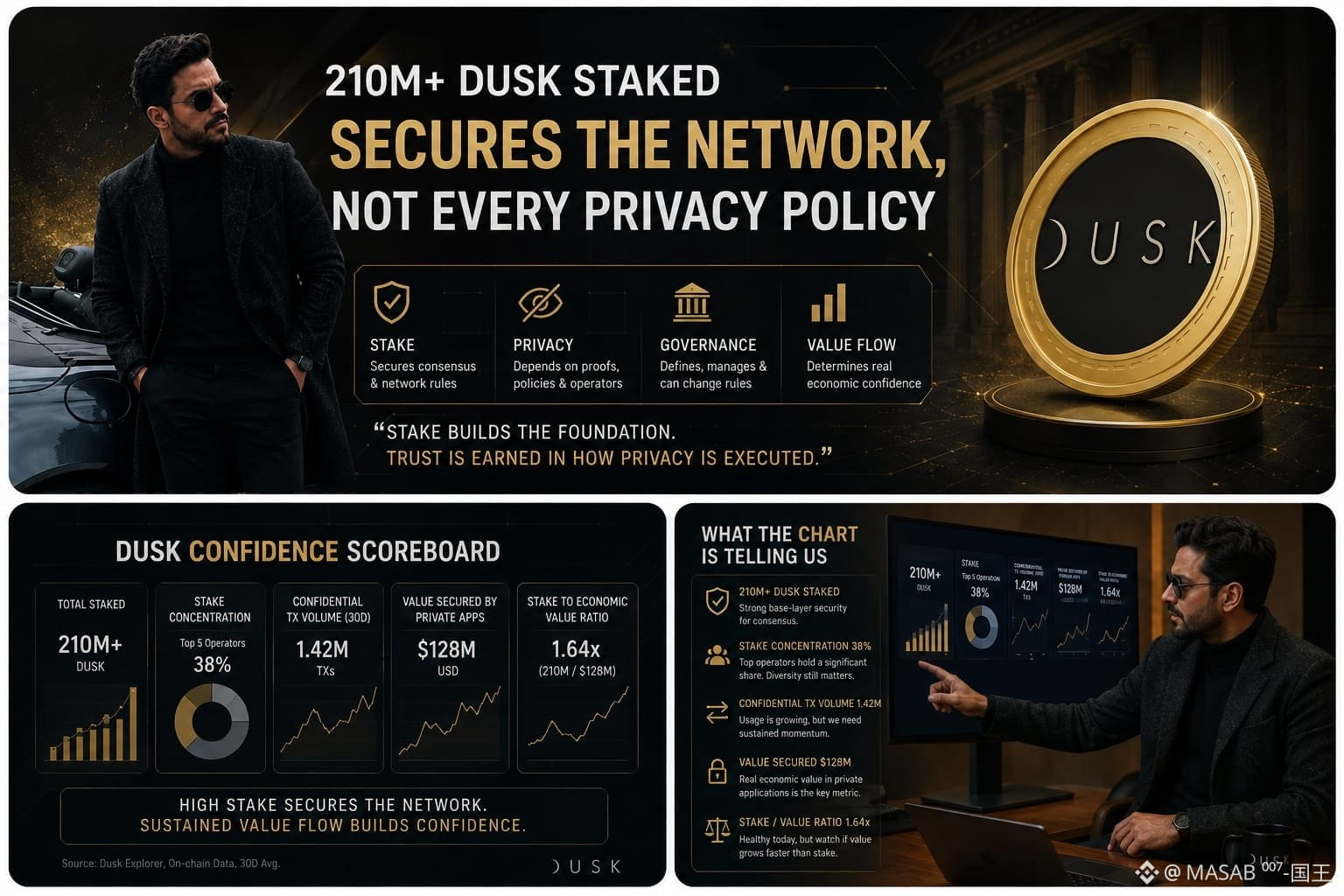
The market was quiet tonight, so I reopened Dusk’s material and kept staring at one number: 210M+ DUSK staked.
It’s tempting to read that as “confidential financial applications are secure.” But something didn’t line up. Base-layer economic security and privacy-execution confidence aren’t automatically the same thing.
The stake can protect consensus, while confidential applications still depend on privacy proofs, disclosure policies, operators, governance, and how much value actually flows through them.
So I started thinking about a different scoreboard: stake concentration, operator concentration, confidential transaction volume, value secured by private applications, and the stake-to-economic-value ratio.
Here’s the distinction I keep coming back to: **stake secures the network’s rules; it doesn’t automatically validate every privacy policy built above them.**
That doesn’t make Dusk’s privacy model weak. Selective disclosure can be genuinely useful: an investor might prove ownership, a venue eligibility, and a regulator only the compliance evidence required.
But who decides those disclosure rules? Who can change them? How quickly can authorized observers obtain evidence during an emergency?
I don’t know yet whether 210M+ staked provides enough confidence for high-value confidential markets.
The charts are still quiet. I’m leaving that question open.
@Dusk_Foundation $DUSK #dusk
{future}(DUSKUSDT)
The market was quiet tonight, so I reopened Dusk’s material and kept staring at one number: 210M+ DUSK staked.
It’s tempting to read that as “confidential financial applications are secure.” But something didn’t line up. Base-layer economic security and privacy-execution confidence aren’t automatically the same thing.
The stake can protect consensus, while confidential applications still depend on privacy proofs, disclosure policies, operators, governance, and how much value actually flows through them.
So I started thinking about a different scoreboard: stake concentration, operator concentration, confidential transaction volume, value secured by private applications, and the stake-to-economic-value ratio.
Here’s the distinction I keep coming back to: **stake secures the network’s rules; it doesn’t automatically validate every privacy policy built above them.**
That doesn’t make Dusk’s privacy model weak. Selective disclosure can be genuinely useful: an investor might prove ownership, a venue eligibility, and a regulator only the compliance evidence required.
But who decides those disclosure rules? Who can change them? How quickly can authorized observers obtain evidence during an emergency?
I don’t know yet whether 210M+ staked provides enough confidence for high-value confidential markets.
The charts are still quiet. I’m leaving that question open.
@Dusk $DUSK #dusk
It’s tempting to read that as “confidential financial applications are secure.” But something didn’t line up. Base-layer economic security and privacy-execution confidence aren’t automatically the same thing.
The stake can protect consensus, while confidential applications still depend on privacy proofs, disclosure policies, operators, governance, and how much value actually flows through them.
So I started thinking about a different scoreboard: stake concentration, operator concentration, confidential transaction volume, value secured by private applications, and the stake-to-economic-value ratio.
Here’s the distinction I keep coming back to: **stake secures the network’s rules; it doesn’t automatically validate every privacy policy built above them.**
That doesn’t make Dusk’s privacy model weak. Selective disclosure can be genuinely useful: an investor might prove ownership, a venue eligibility, and a regulator only the compliance evidence required.
But who decides those disclosure rules? Who can change them? How quickly can authorized observers obtain evidence during an emergency?
I don’t know yet whether 210M+ staked provides enough confidence for high-value confidential markets.
The charts are still quiet. I’m leaving that question open.
@Dusk $DUSK #dusk
35
30
11.1k
·
--
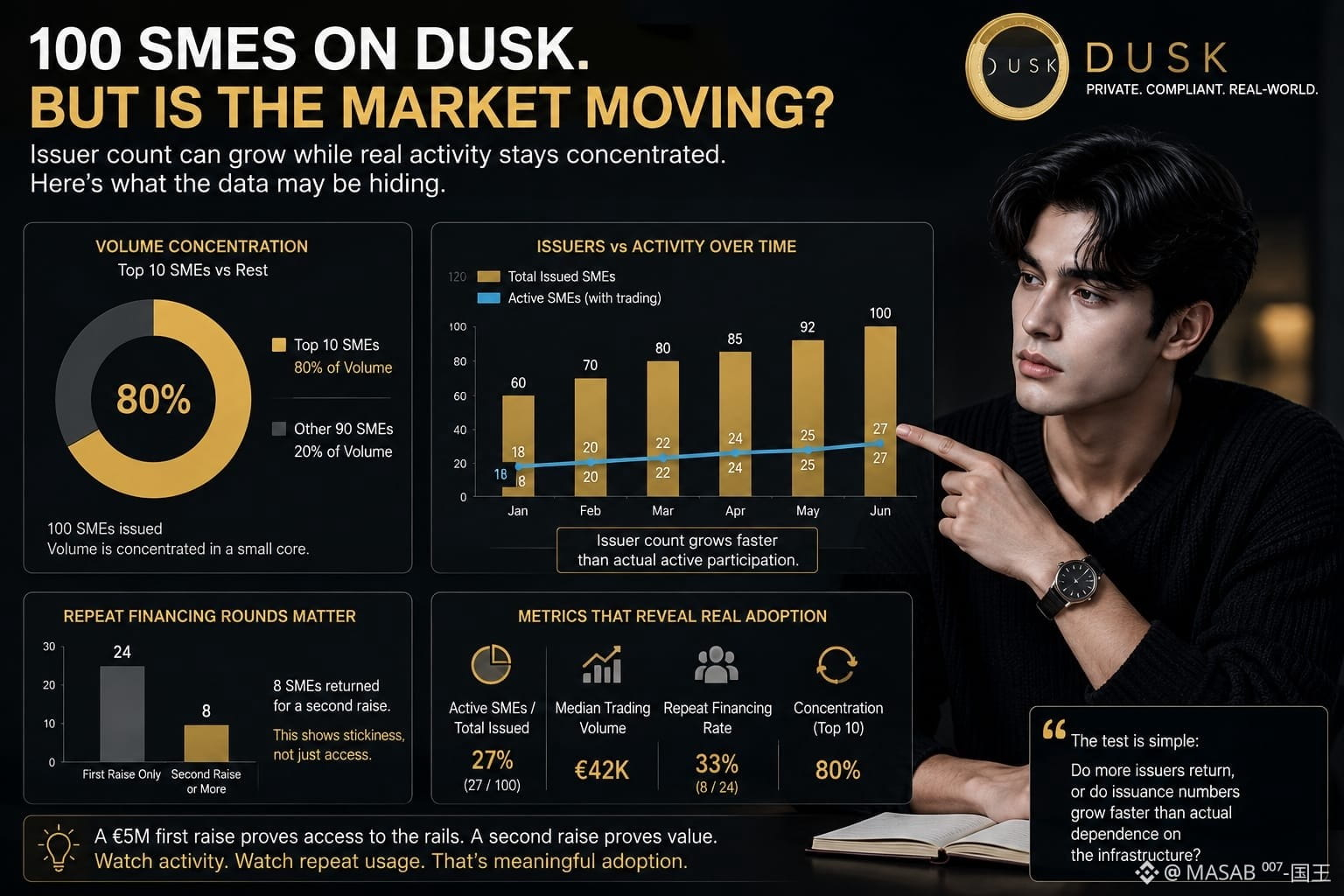
One thing kept bothering me while looking at DUSK’s SME story issuer count can rise even when the actual market underneath barely moves.
Imagine DUSK has 100 tokenized SMEs, but the top 10 generate 80% of all trading volume. On paper, 100 issuers looks like broad adoption. In practice, it may mean investor attention, liquidity and repeat activity are concentrated in a very small core.
That is why I would watch active SMEs / total issued SMEs, median trading volume, and repeat financing rounds more closely than headline issuance count.
A €5M first raise proves a company can access the rails. A second raise later is different. It suggests the issuer found enough value in DUSK’s ownership administration, transfer controls and investor workflow to come back.
This is where activity and meaningful adoption separate.
An SME might need DUSK more for maintaining a programmable shareholder structure than for daily secondary trading. That still matters. But if the onchain register must constantly be reconciled with an offchain legal record, the operational advantage can shrink quickly.
The test I’m still watching is simple do more issuers return, or do issuance numbers grow faster than actual dependence on the infrastructure?
@Dusk_Foundation #dusk $DUSK
{future}(DUSKUSDT)
One thing kept bothering me while looking at DUSK’s SME story issuer count can rise even when the actual market underneath barely moves.
Imagine DUSK has 100 tokenized SMEs, but the top 10 generate 80% of all trading volume. On paper, 100 issuers looks like broad adoption. In practice, it may mean investor attention, liquidity and repeat activity are concentrated in a very small core.
That is why I would watch active SMEs / total issued SMEs, median trading volume, and repeat financing rounds more closely than headline issuance count.
A €5M first raise proves a company can access the rails. A second raise later is different. It suggests the issuer found enough value in DUSK’s ownership administration, transfer controls and investor workflow to come back.
This is where activity and meaningful adoption separate.
An SME might need DUSK more for maintaining a programmable shareholder structure than for daily secondary trading. That still matters. But if the onchain register must constantly be reconciled with an offchain legal record, the operational advantage can shrink quickly.
The test I’m still watching is simple do more issuers return, or do issuance numbers grow faster than actual dependence on the infrastructure?
@Dusk #dusk $DUSK
Imagine DUSK has 100 tokenized SMEs, but the top 10 generate 80% of all trading volume. On paper, 100 issuers looks like broad adoption. In practice, it may mean investor attention, liquidity and repeat activity are concentrated in a very small core.
That is why I would watch active SMEs / total issued SMEs, median trading volume, and repeat financing rounds more closely than headline issuance count.
A €5M first raise proves a company can access the rails. A second raise later is different. It suggests the issuer found enough value in DUSK’s ownership administration, transfer controls and investor workflow to come back.
This is where activity and meaningful adoption separate.
An SME might need DUSK more for maintaining a programmable shareholder structure than for daily secondary trading. That still matters. But if the onchain register must constantly be reconciled with an offchain legal record, the operational advantage can shrink quickly.
The test I’m still watching is simple do more issuers return, or do issuance numbers grow faster than actual dependence on the infrastructure?
@Dusk #dusk $DUSK
48
42
12.7k
·
--
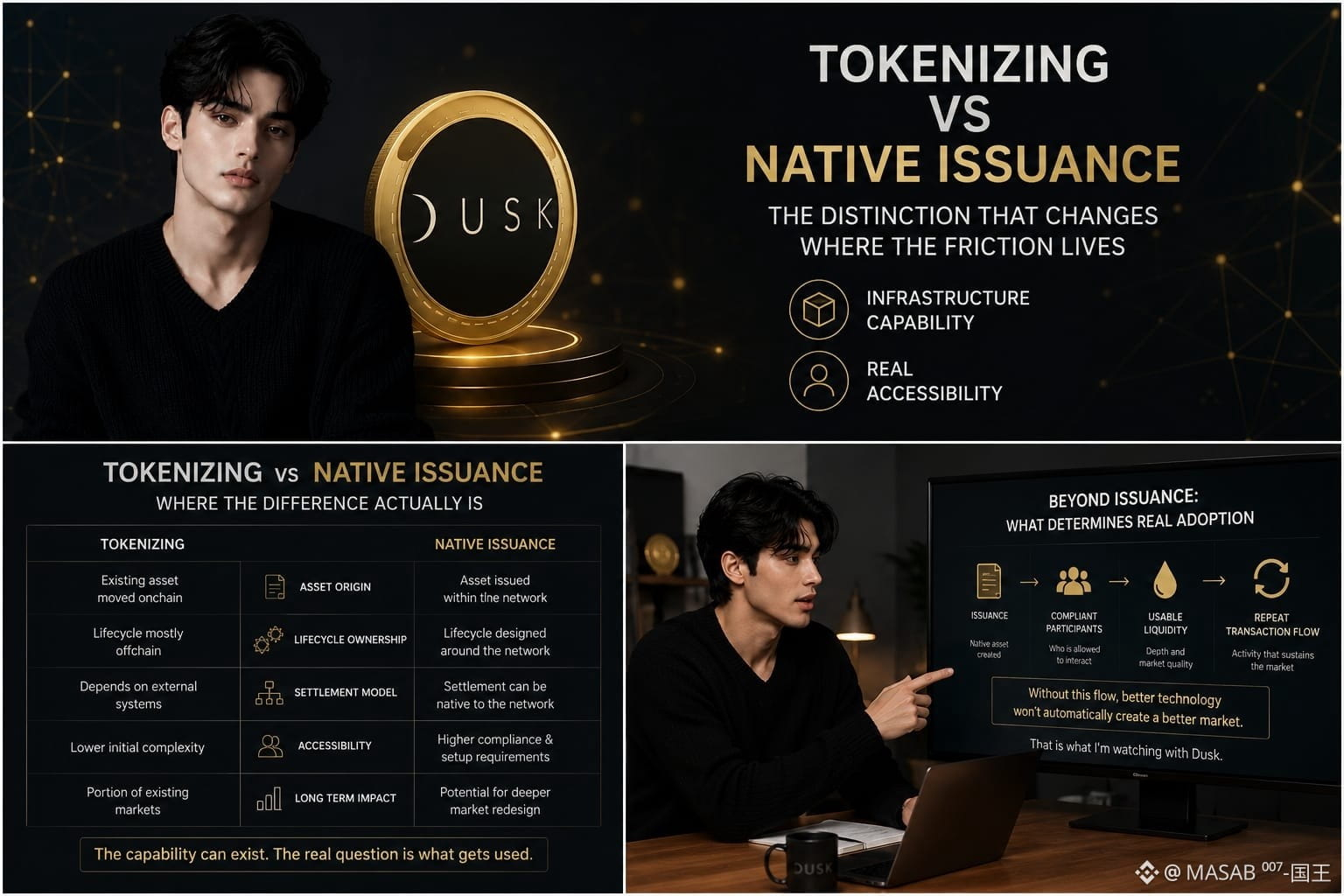
I found myself repeatedly returning to one distinction in Dusk’s RWA design: a token can exist onchain while an asset’s real lifecycle still lives somewhere else.
That matters more than it sounds. With tokenization, the blockchain can improve distribution or programmability, but issuance, custody, settlement, servicing and records may still require separate systems and reconciliation. Dusk’s native-issuance model is more ambitious in a narrower sense: the asset itself can be created and managed around the ledger, so those handoffs can happen inside one coordinated environment.
The hidden layer, though, is not the token. It is coordination.
Dusk combines settlement, access controls, privacy and selective disclosure because regulated securities cannot simply become public blockchain objects. Someone still has to define eligibility, permissions, reporting and the legal structure around the asset. Dusk can provide the infrastructure; it cannot manufacture authorization, liquidity or institutional participation.
That is why I see the real comparison as technical capability vs real accessibility. A network supporting native issuance is different from one proving institutions will use it.
The uncomfortable part is adoption. If issuers and venues keep critical lifecycle steps elsewhere, native issuance becomes architectural capability rather than meaningful market infrastructure.
That is the part I’m still watching.
@Dusk_Foundation $DUSK #dusk
{future}(DUSKUSDT)
I found myself repeatedly returning to one distinction in Dusk’s RWA design: a token can exist onchain while an asset’s real lifecycle still lives somewhere else.
That matters more than it sounds. With tokenization, the blockchain can improve distribution or programmability, but issuance, custody, settlement, servicing and records may still require separate systems and reconciliation. Dusk’s native-issuance model is more ambitious in a narrower sense: the asset itself can be created and managed around the ledger, so those handoffs can happen inside one coordinated environment.
The hidden layer, though, is not the token. It is coordination.
Dusk combines settlement, access controls, privacy and selective disclosure because regulated securities cannot simply become public blockchain objects. Someone still has to define eligibility, permissions, reporting and the legal structure around the asset. Dusk can provide the infrastructure; it cannot manufacture authorization, liquidity or institutional participation.
That is why I see the real comparison as technical capability vs real accessibility. A network supporting native issuance is different from one proving institutions will use it.
The uncomfortable part is adoption. If issuers and venues keep critical lifecycle steps elsewhere, native issuance becomes architectural capability rather than meaningful market infrastructure.
That is the part I’m still watching.
@Dusk $DUSK #dusk
That matters more than it sounds. With tokenization, the blockchain can improve distribution or programmability, but issuance, custody, settlement, servicing and records may still require separate systems and reconciliation. Dusk’s native-issuance model is more ambitious in a narrower sense: the asset itself can be created and managed around the ledger, so those handoffs can happen inside one coordinated environment.
The hidden layer, though, is not the token. It is coordination.
Dusk combines settlement, access controls, privacy and selective disclosure because regulated securities cannot simply become public blockchain objects. Someone still has to define eligibility, permissions, reporting and the legal structure around the asset. Dusk can provide the infrastructure; it cannot manufacture authorization, liquidity or institutional participation.
That is why I see the real comparison as technical capability vs real accessibility. A network supporting native issuance is different from one proving institutions will use it.
The uncomfortable part is adoption. If issuers and venues keep critical lifecycle steps elsewhere, native issuance becomes architectural capability rather than meaningful market infrastructure.
That is the part I’m still watching.
@Dusk $DUSK #dusk
40
30
10.3k
·
--
Verified
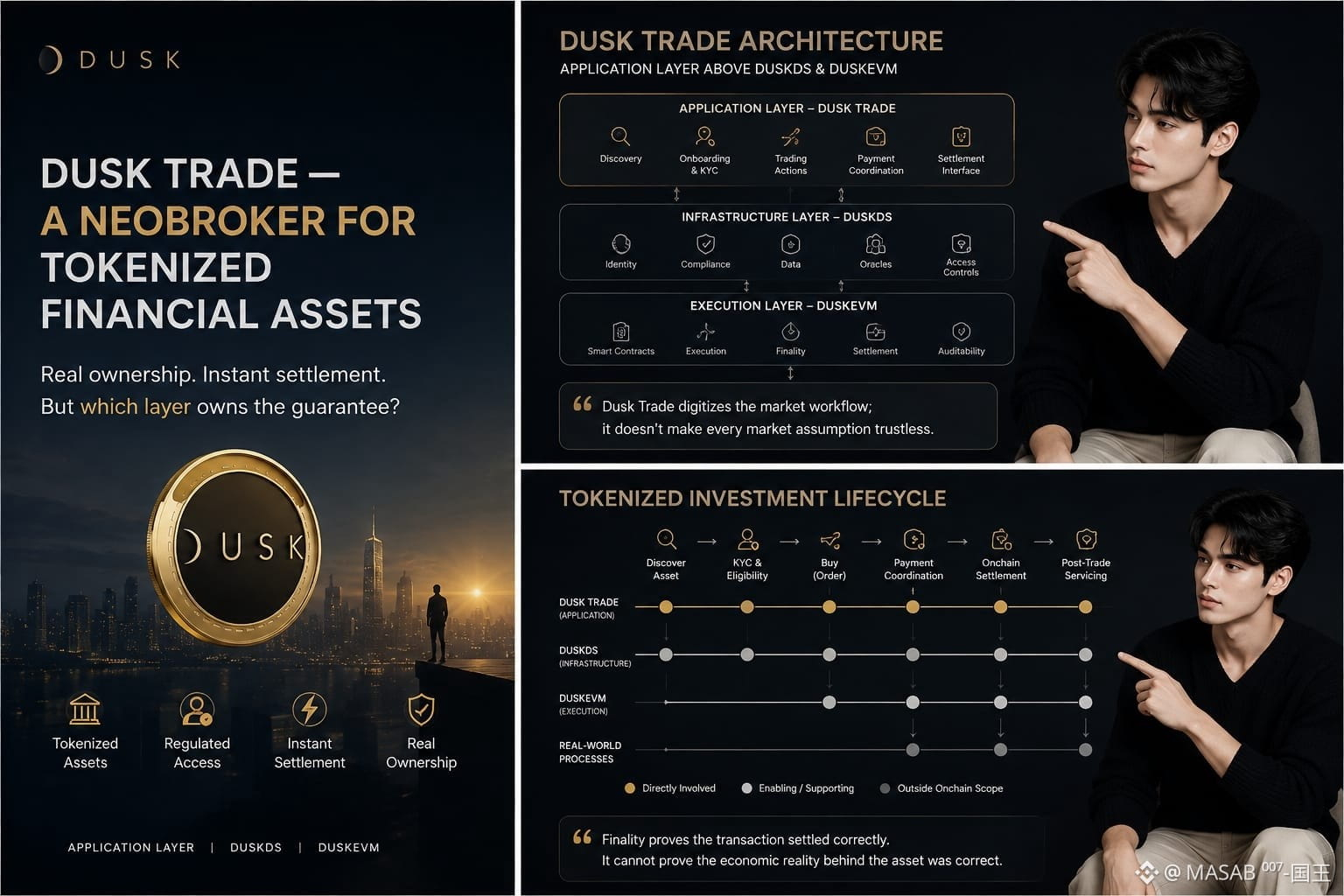
Last night I was scrolling through Dusk Trade while the market was unusually quiet. I kept seeing the same phrases: tokenized assets, real ownership, instant settlement. Then “neobroker” made me stop and look underneath the interface.
The intuitive assumption is simple: buy an ETF, MMF or bond through Dusk Trade, and the entire investment lifecycle becomes blockchain-native.
But something didn’t line up.
Dusk Trade is the application layer on DuskEVM. It connects users to tokenized financial assets and trading workflows, while the underlying infrastructure handles execution and settlement. That’s meaningful, but it isn’t the same as making every financial assumption trustless.
It secures the transaction, not every assumption behind the asset.
That distinction matters. Deterministic settlement can prove that an authorized transaction was processed correctly. It cannot, by itself, prove that every off-chain record, eligibility decision, disclosure, valuation or servicing process surrounding a real-world asset is correct.
I thought that distinction was mostly technical at first. It isn’t.
If an upstream data source is wrong, the blockchain can faithfully settle the wrong economic reality.
This isn’t uniquely a Dusk problem; tokenized finance inherits these boundaries from traditional markets.
The real test comes when institutional value creates incentives to attack the weaker layers.
I’m still wondering how that boundary behaves under sustained pressure. That’s the part I’ll be watching.
@Dusk_Foundation $DUSK #dusk
{future}(DUSKUSDT)
Last night I was scrolling through Dusk Trade while the market was unusually quiet. I kept seeing the same phrases: tokenized assets, real ownership, instant settlement. Then “neobroker” made me stop and look underneath the interface.
The intuitive assumption is simple: buy an ETF, MMF or bond through Dusk Trade, and the entire investment lifecycle becomes blockchain-native.
But something didn’t line up.
Dusk Trade is the application layer on DuskEVM. It connects users to tokenized financial assets and trading workflows, while the underlying infrastructure handles execution and settlement. That’s meaningful, but it isn’t the same as making every financial assumption trustless.
It secures the transaction, not every assumption behind the asset.
That distinction matters. Deterministic settlement can prove that an authorized transaction was processed correctly. It cannot, by itself, prove that every off-chain record, eligibility decision, disclosure, valuation or servicing process surrounding a real-world asset is correct.
I thought that distinction was mostly technical at first. It isn’t.
If an upstream data source is wrong, the blockchain can faithfully settle the wrong economic reality.
This isn’t uniquely a Dusk problem; tokenized finance inherits these boundaries from traditional markets.
The real test comes when institutional value creates incentives to attack the weaker layers.
I’m still wondering how that boundary behaves under sustained pressure. That’s the part I’ll be watching.
@Dusk $DUSK #dusk
The intuitive assumption is simple: buy an ETF, MMF or bond through Dusk Trade, and the entire investment lifecycle becomes blockchain-native.
But something didn’t line up.
Dusk Trade is the application layer on DuskEVM. It connects users to tokenized financial assets and trading workflows, while the underlying infrastructure handles execution and settlement. That’s meaningful, but it isn’t the same as making every financial assumption trustless.
It secures the transaction, not every assumption behind the asset.
That distinction matters. Deterministic settlement can prove that an authorized transaction was processed correctly. It cannot, by itself, prove that every off-chain record, eligibility decision, disclosure, valuation or servicing process surrounding a real-world asset is correct.
I thought that distinction was mostly technical at first. It isn’t.
If an upstream data source is wrong, the blockchain can faithfully settle the wrong economic reality.
This isn’t uniquely a Dusk problem; tokenized finance inherits these boundaries from traditional markets.
The real test comes when institutional value creates incentives to attack the weaker layers.
I’m still wondering how that boundary behaves under sustained pressure. That’s the part I’ll be watching.
@Dusk $DUSK #dusk
40
33
7.4k
·
--
Verified
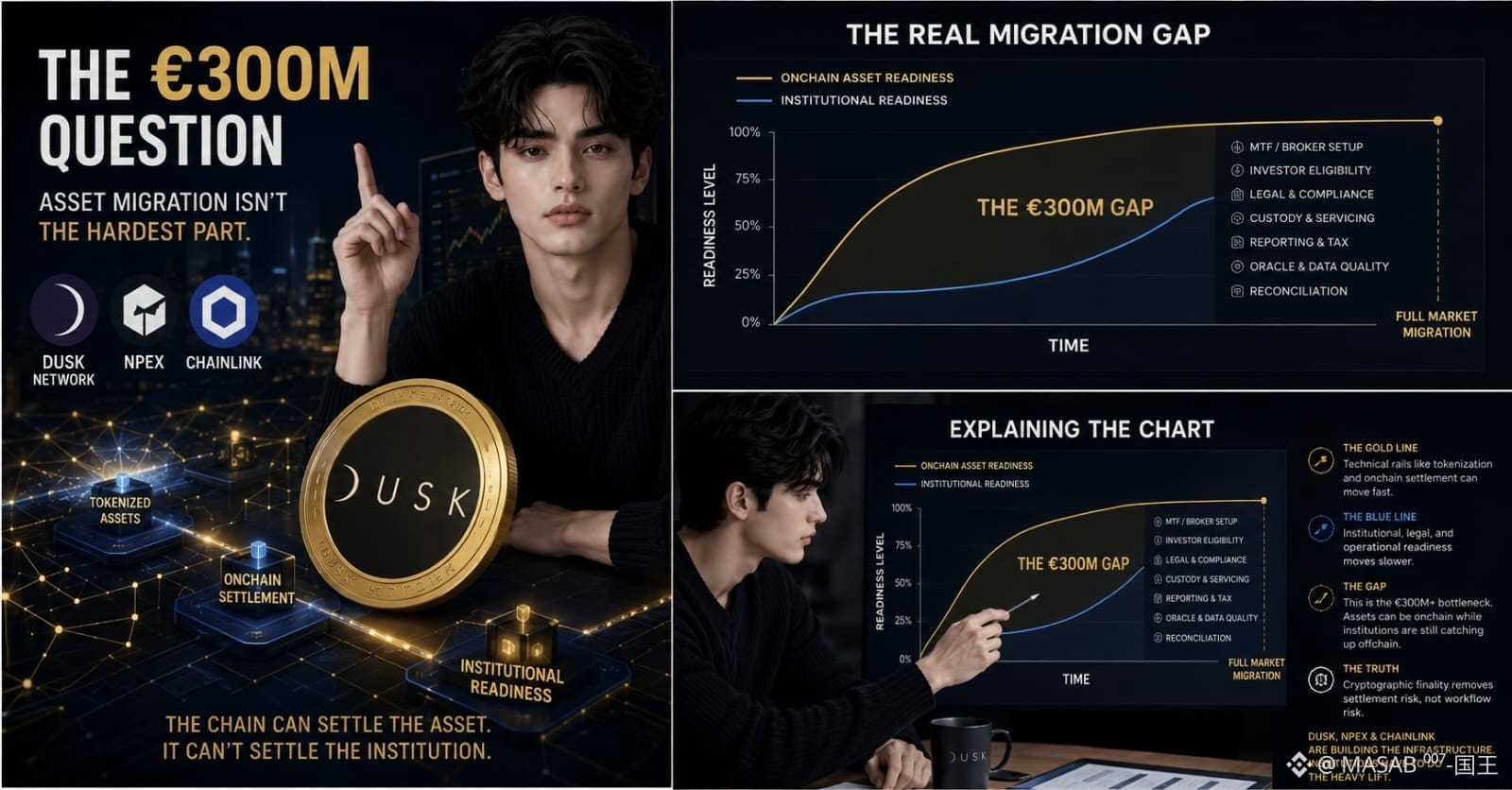
I was checking Dusk’s documentation late last night and kept coming back to one number: €300M+. It sounds like an asset-migration problem. But NPEX made me wonder if the harder migration is everything around the asset.
Dusk and NPEX are targeting regulated issuance, trading and settlement onchain, while Chainlink adds CCIP, DataLink and Data Streams for cross-chain connectivity and market data.
The intuitive assumption is simple: once the securities are tokenized, the market has moved.
I’m not sure that follows.
An asset can be onchain while onboarding, investor eligibility, legal review, custody, reporting, servicing and operational controls still depend on institutional processes outside the settlement layer.
The chain can settle the asset; it cannot settle the institution’s readiness.
That distinction initially felt pedantic. Then I counted the moving pieces: MTF, broker, ECSP and the forthcoming DLT-TSS functions referenced around NPEX.
Now add oracle freshness, compliance checkpoints, reconciliation and external data dependencies.
If a price arrives stale, deterministic settlement can still be perfectly deterministic.
That’s the uncomfortable part: cryptographic finality can remove uncertainty from settlement without removing uncertainty from the market workflow.
I think Dusk is addressing a real bottleneck. I just don’t know yet whether €300M can migrate faster than the organizations responsible for approving, servicing and supervising it.
My chart is still open. So is the documentation.
{future}(DUSKUSDT)
@Dusk_Foundation $DUSK #dusk
I was checking Dusk’s documentation late last night and kept coming back to one number: €300M+. It sounds like an asset-migration problem. But NPEX made me wonder if the harder migration is everything around the asset.
Dusk and NPEX are targeting regulated issuance, trading and settlement onchain, while Chainlink adds CCIP, DataLink and Data Streams for cross-chain connectivity and market data.
The intuitive assumption is simple: once the securities are tokenized, the market has moved.
I’m not sure that follows.
An asset can be onchain while onboarding, investor eligibility, legal review, custody, reporting, servicing and operational controls still depend on institutional processes outside the settlement layer.
The chain can settle the asset; it cannot settle the institution’s readiness.
That distinction initially felt pedantic. Then I counted the moving pieces: MTF, broker, ECSP and the forthcoming DLT-TSS functions referenced around NPEX.
Now add oracle freshness, compliance checkpoints, reconciliation and external data dependencies.
If a price arrives stale, deterministic settlement can still be perfectly deterministic.
That’s the uncomfortable part: cryptographic finality can remove uncertainty from settlement without removing uncertainty from the market workflow.
I think Dusk is addressing a real bottleneck. I just don’t know yet whether €300M can migrate faster than the organizations responsible for approving, servicing and supervising it.
My chart is still open. So is the documentation.
@Dusk $DUSK #dusk
Dusk and NPEX are targeting regulated issuance, trading and settlement onchain, while Chainlink adds CCIP, DataLink and Data Streams for cross-chain connectivity and market data.
The intuitive assumption is simple: once the securities are tokenized, the market has moved.
I’m not sure that follows.
An asset can be onchain while onboarding, investor eligibility, legal review, custody, reporting, servicing and operational controls still depend on institutional processes outside the settlement layer.
The chain can settle the asset; it cannot settle the institution’s readiness.
That distinction initially felt pedantic. Then I counted the moving pieces: MTF, broker, ECSP and the forthcoming DLT-TSS functions referenced around NPEX.
Now add oracle freshness, compliance checkpoints, reconciliation and external data dependencies.
If a price arrives stale, deterministic settlement can still be perfectly deterministic.
That’s the uncomfortable part: cryptographic finality can remove uncertainty from settlement without removing uncertainty from the market workflow.
I think Dusk is addressing a real bottleneck. I just don’t know yet whether €300M can migrate faster than the organizations responsible for approving, servicing and supervising it.
My chart is still open. So is the documentation.
@Dusk $DUSK #dusk
42
25
9k
·
--
The market was quiet tonight, so I ended up rereading DuskEVM material instead of the charts. I kept seeing the phrase “confidential EVM workflows,” and at first I took that to mean the EVM itself could somehow make financial activity private end to end.
So I actually sat with the mechanism.
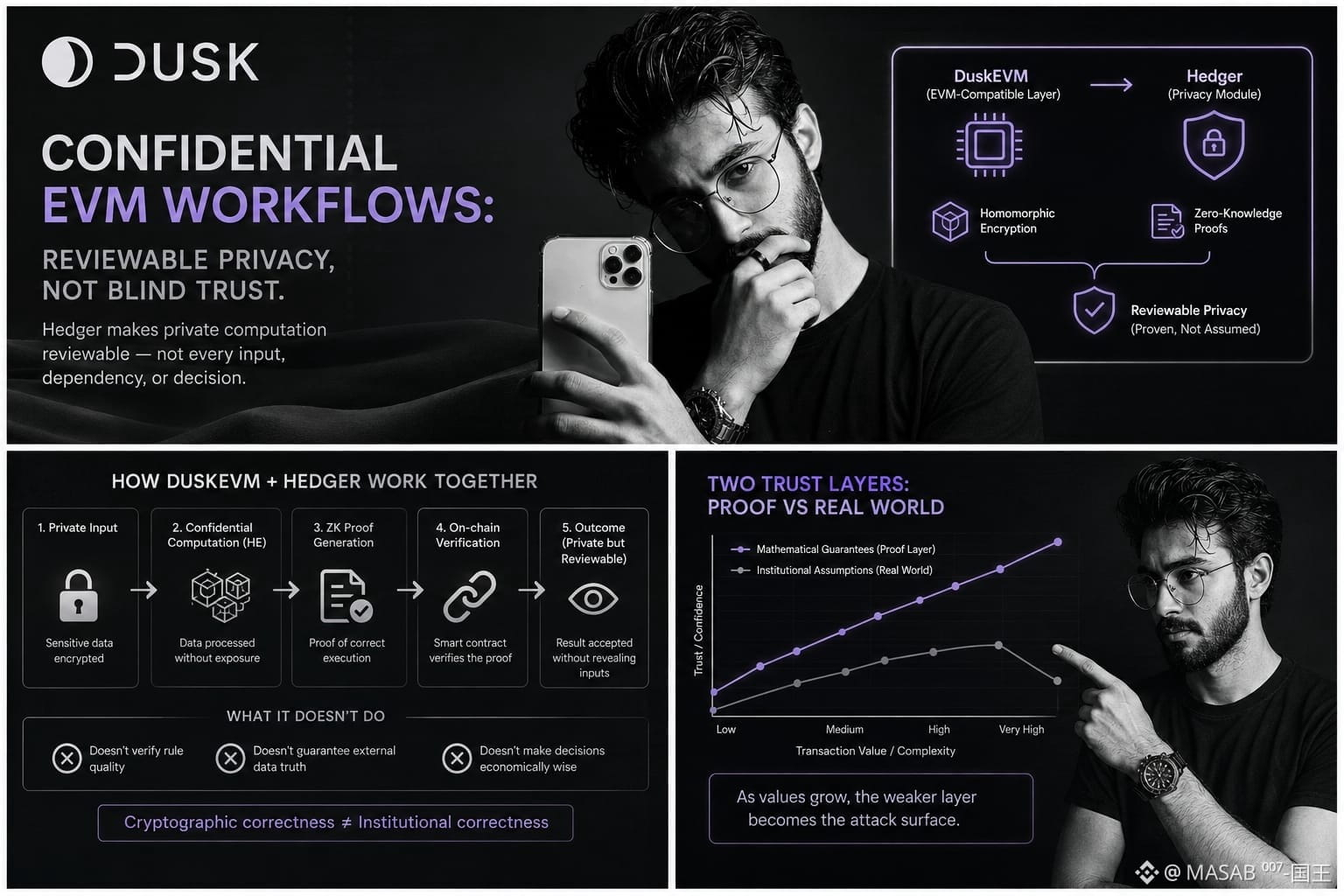
DuskEVM is the EVM-compatible application layer, giving Solidity developers a familiar route into Dusk. The interesting part is Hedger, the privacy module using homomorphic encryption and zero-knowledge proofs for reviewable privacy.
Here is the distinction I think is easy to miss: Hedger can make private computation reviewable; it doesn’t make every input, dependency, or institutional decision inherently trustworthy.
That’s still meaningful. Homomorphic encryption can let protected data be processed without exposing the underlying values, while ZK proofs can provide evidence about computation or validity. For regulated finance, that combination has obvious value: less disclosure without abandoning auditability.
But I thought the distinction was pedantic at first.
It isn’t. Cryptographic correctness and institutional correctness are different trust models. A proof can show that an operation followed defined rules. It cannot know whether those rules were sensible, whether an external data source was truthful, or whether an authorized financial decision was economically wise.
The branding can make those layers sound closer than they are.
I’m not saying this is unique to DuskEVM. Most serious financial infrastructure mixes mathematical guarantees with assumptions outside the proof boundary.
The real question is what happens when transaction values become large enough for someone to attack the weaker layer.
I genuinely can’t answer that from the architecture alone.
The documentation tab is still open. I’ll probably read it again tomorrow, because “confidential” now makes me ask: confidential from whom, and proven about what?
@Dusk_Foundation $DUSK #dusk
{future}(DUSKUSDT)
The market was quiet tonight, so I ended up rereading DuskEVM material instead of the charts. I kept seeing the phrase “confidential EVM workflows,” and at first I took that to mean the EVM itself could somehow make financial activity private end to end.
So I actually sat with the mechanism.
DuskEVM is the EVM-compatible application layer, giving Solidity developers a familiar route into Dusk. The interesting part is Hedger, the privacy module using homomorphic encryption and zero-knowledge proofs for reviewable privacy.
Here is the distinction I think is easy to miss: Hedger can make private computation reviewable; it doesn’t make every input, dependency, or institutional decision inherently trustworthy.
That’s still meaningful. Homomorphic encryption can let protected data be processed without exposing the underlying values, while ZK proofs can provide evidence about computation or validity. For regulated finance, that combination has obvious value: less disclosure without abandoning auditability.
But I thought the distinction was pedantic at first.
It isn’t. Cryptographic correctness and institutional correctness are different trust models. A proof can show that an operation followed defined rules. It cannot know whether those rules were sensible, whether an external data source was truthful, or whether an authorized financial decision was economically wise.
The branding can make those layers sound closer than they are.
I’m not saying this is unique to DuskEVM. Most serious financial infrastructure mixes mathematical guarantees with assumptions outside the proof boundary.
The real question is what happens when transaction values become large enough for someone to attack the weaker layer.
I genuinely can’t answer that from the architecture alone.
The documentation tab is still open. I’ll probably read it again tomorrow, because “confidential” now makes me ask: confidential from whom, and proven about what?
@Dusk $DUSK #dusk
So I actually sat with the mechanism.
DuskEVM is the EVM-compatible application layer, giving Solidity developers a familiar route into Dusk. The interesting part is Hedger, the privacy module using homomorphic encryption and zero-knowledge proofs for reviewable privacy.
Here is the distinction I think is easy to miss: Hedger can make private computation reviewable; it doesn’t make every input, dependency, or institutional decision inherently trustworthy.
That’s still meaningful. Homomorphic encryption can let protected data be processed without exposing the underlying values, while ZK proofs can provide evidence about computation or validity. For regulated finance, that combination has obvious value: less disclosure without abandoning auditability.
But I thought the distinction was pedantic at first.
It isn’t. Cryptographic correctness and institutional correctness are different trust models. A proof can show that an operation followed defined rules. It cannot know whether those rules were sensible, whether an external data source was truthful, or whether an authorized financial decision was economically wise.
The branding can make those layers sound closer than they are.
I’m not saying this is unique to DuskEVM. Most serious financial infrastructure mixes mathematical guarantees with assumptions outside the proof boundary.
The real question is what happens when transaction values become large enough for someone to attack the weaker layer.
I genuinely can’t answer that from the architecture alone.
The documentation tab is still open. I’ll probably read it again tomorrow, because “confidential” now makes me ask: confidential from whom, and proven about what?
@Dusk $DUSK #dusk
30
31
5.3k
·
--
Verified
A fire alarm looks reassuring on the wall. You rarely think about who is allowed to press it, whether they are available, or what happens if the wrong person reaches it first.
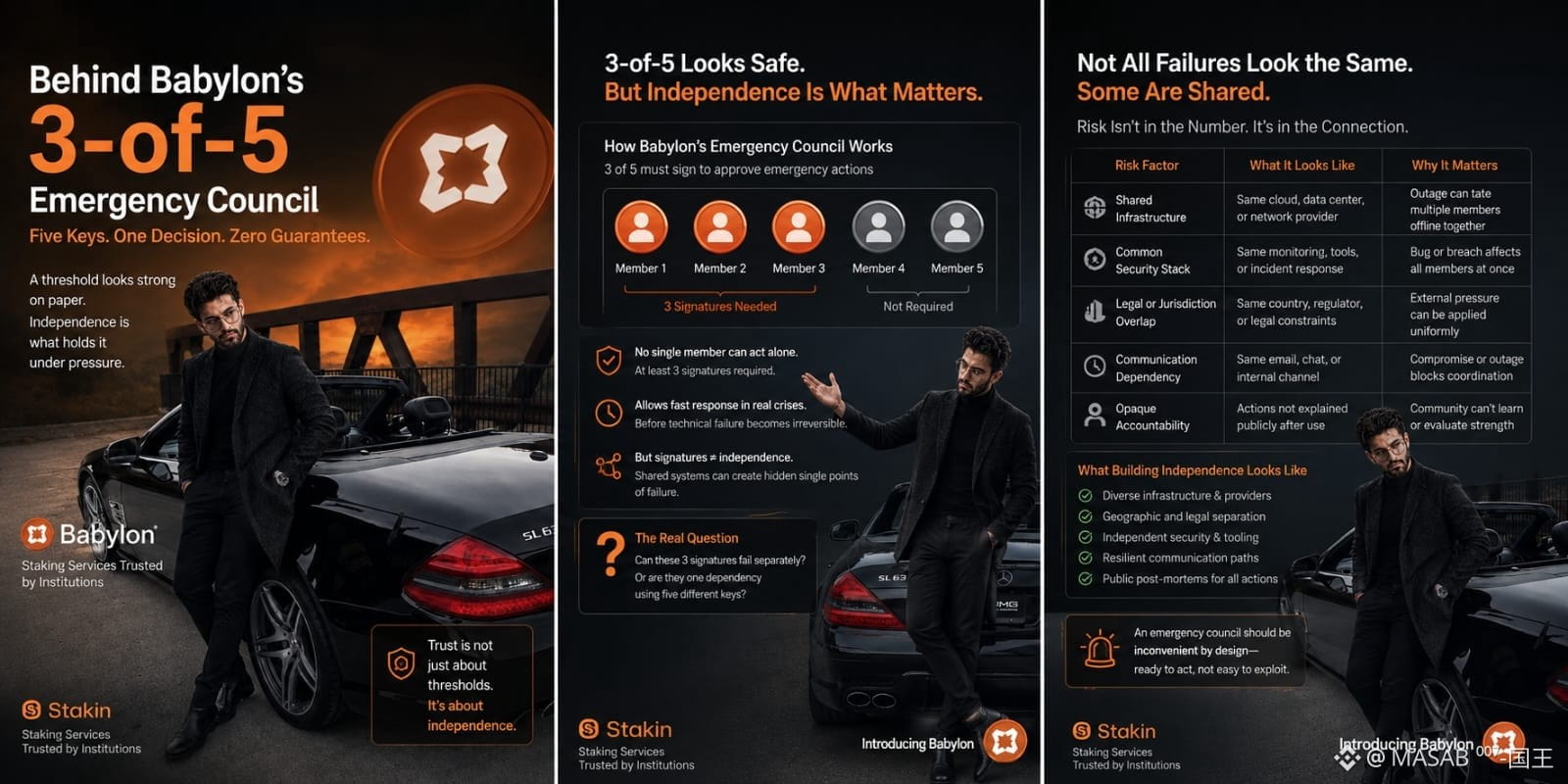
That is how I started thinking about Babylon’s 3-of-5 emergency council. The number sounds reasonable. No single member can act alone, while three people can still respond before a technical failure becomes irreversible. On paper, BABY gets both speed and restraint.
But the threshold only counts signatures. It cannot measure independence.
Three council members may hold separate keys and still depend on the same cloud provider, security company, legal jurisdiction, or internal communication channel. During normal conditions, that connection stays invisible. Under pressure, it can turn five supposed decision-makers into one operational unit. A shared outage could block intervention. A shared compromise could authorize it.
Most people judge the council by asking whether three signatures are safer than one. I think the harder question is whether those three signatures can fail separately. Has Babylon tested members going offline without warning? Are emergency actions publicly explained afterward? Can the community see whether BABY’s crisis layer is becoming stronger, or simply more comfortable to use?
An emergency council should feel inconvenient. Slow enough to demand proof, but prepared enough to act when waiting becomes dangerous.
I’m not worried that Babylon has an emergency switch. I’m watching whether five keys represent five genuinely independent defenses—or one decision wearing five different names.
@babylonlabs_io #baby $BABY
A fire alarm looks reassuring on the wall. You rarely think about who is allowed to press it, whether they are available, or what happens if the wrong person reaches it first.
That is how I started thinking about Babylon’s 3-of-5 emergency council. The number sounds reasonable. No single member can act alone, while three people can still respond before a technical failure becomes irreversible. On paper, BABY gets both speed and restraint.
But the threshold only counts signatures. It cannot measure independence.
Three council members may hold separate keys and still depend on the same cloud provider, security company, legal jurisdiction, or internal communication channel. During normal conditions, that connection stays invisible. Under pressure, it can turn five supposed decision-makers into one operational unit. A shared outage could block intervention. A shared compromise could authorize it.
Most people judge the council by asking whether three signatures are safer than one. I think the harder question is whether those three signatures can fail separately. Has Babylon tested members going offline without warning? Are emergency actions publicly explained afterward? Can the community see whether BABY’s crisis layer is becoming stronger, or simply more comfortable to use?
An emergency council should feel inconvenient. Slow enough to demand proof, but prepared enough to act when waiting becomes dangerous.
I’m not worried that Babylon has an emergency switch. I’m watching whether five keys represent five genuinely independent defenses—or one decision wearing five different names.
@BabylonLabs_io #baby $BABY
That is how I started thinking about Babylon’s 3-of-5 emergency council. The number sounds reasonable. No single member can act alone, while three people can still respond before a technical failure becomes irreversible. On paper, BABY gets both speed and restraint.
But the threshold only counts signatures. It cannot measure independence.
Three council members may hold separate keys and still depend on the same cloud provider, security company, legal jurisdiction, or internal communication channel. During normal conditions, that connection stays invisible. Under pressure, it can turn five supposed decision-makers into one operational unit. A shared outage could block intervention. A shared compromise could authorize it.
Most people judge the council by asking whether three signatures are safer than one. I think the harder question is whether those three signatures can fail separately. Has Babylon tested members going offline without warning? Are emergency actions publicly explained afterward? Can the community see whether BABY’s crisis layer is becoming stronger, or simply more comfortable to use?
An emergency council should feel inconvenient. Slow enough to demand proof, but prepared enough to act when waiting becomes dangerous.
I’m not worried that Babylon has an emergency switch. I’m watching whether five keys represent five genuinely independent defenses—or one decision wearing five different names.
@BabylonLabs_io #baby $BABY
12
11
4.7k
Log in to explore more content
Join global crypto users on Binance Square
⚡️ Get latest and useful information about crypto.
💬 Trusted by the world’s largest crypto exchange.
👍 Discover real insights from verified creators.
Email / Phone number