

Joshua Brown 007
3k Posts

Joshua Brown 007
Report
Block User
I am a forward-thinking crypto advisor with a strong grasp of blockchain innovation and digital asset management. @JavedJatt331726
Open Trade
High-Frequency Trader
2.6 Years
1.2K+ Following
15.7K+ Followers
6.5K+ Liked
Posts
Portfolio
All
Quotes
Videos
Live
Article
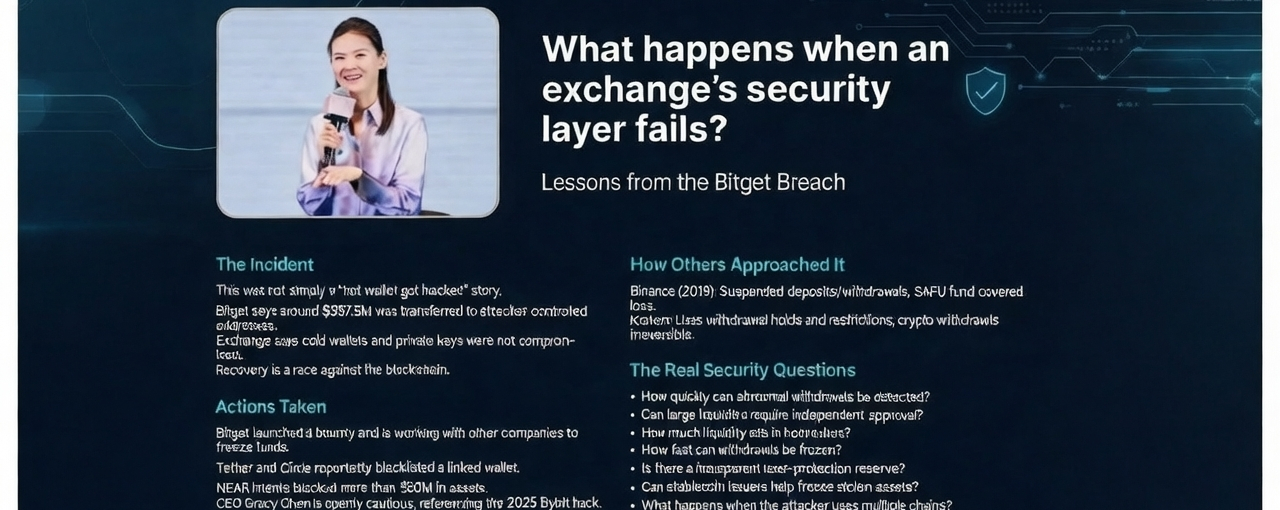
What happens when an exchange’s security layer fails?I’ve been watching the Bitget breach, and one detail stands out to me:
This was not simply a “hot wallet got hacked” story.
Bitget says around $387.5M was transferred to attacker-controlled addresses, with the figure revised after a fuller on-chain accounting. The exchange says its cold wallets and private keys were not compromised.
But here is the difficult part:
Once crypto leaves an exchange wallet, recovery becomes a race against the blockchain.
Bitget has launched a bounty and is working with other companies to freeze funds. Tether and Circle reportedly blacklisted a linked wallet, while NEAR Intents said it blocked more than $50M in assets connected to the attack.
And Bitget CEO Gracy Chen is openly cautious about full recovery, using the 2025 Bybit hack as a reference.
That matters.
How do other exchanges approach this?
Binance:
During its 2019 security incident, Binance suspended deposits and withdrawals, investigated the entire system and said its SAFU fund would cover the loss so users would not be affected.
Kraken:
Kraken uses withdrawal holds and restrictions when transactions trigger security concerns. Its current documentation explicitly notes that crypto withdrawals are irreversible and may be held for review.
So the real security question for any exchange isn't:
“Can hackers get in?
No system can honestly promise zero risk.
The better questions are:
• How quickly can abnormal withdrawals be detected?
• Can large transfers require independent approval?
• How much liquidity sits in hot wallets?
• How fast can withdrawals be frozen?
• Is there a transparent user-protection reserve?
• Can stablecoin issuers and other platforms help freeze stolen assets?
• What happens when the attacker uses multiple chains?
The Bitget case also shows why small test transactions and withdrawal-risk thresholds matter. Reports say the attacker first tested small transfers before the much larger drain.
For me, this is bigger than Bitget.
Exchange security is becoming part of crypto market structure itself.
Your trading fee can be 0.1%.
But if the withdrawal-control layer fails, the number that matters is 100% of your balance.
Not your keys.
Not your leverage.
Not your entry.
Your ability to withdraw.
$SOON
$0G
{future}(0GUSDT)
{future}(SOONUSDT)
What happens when an exchange’s security layer fails?
I’ve been watching the Bitget breach, and one detail stands out to me:
This was not simply a “hot wallet got hacked” story.
Bitget says around $387.5M was transferred to attacker-controlled addresses, with the figure revised after a fuller on-chain accounting. The exchange says its cold wallets and private keys were not compromised.
But here is the difficult part:
Once crypto leaves an exchange wallet, recovery becomes a race against the blockchain.
Bitget has launched a bounty and is working with other companies to freeze funds. Tether and Circle reportedly blacklisted a linked wallet, while NEAR Intents said it blocked more than $50M in assets connected to the attack.
And Bitget CEO Gracy Chen is openly cautious about full recovery, using the 2025 Bybit hack as a reference.
That matters.
How do other exchanges approach this?
Binance:
During its 2019 security incident, Binance suspended deposits and withdrawals, investigated the entire system and said its SAFU fund would cover the loss so users would not be affected.
Kraken:
Kraken uses withdrawal holds and restrictions when transactions trigger security concerns. Its current documentation explicitly notes that crypto withdrawals are irreversible and may be held for review.
So the real security question for any exchange isn't:
“Can hackers get in?
No system can honestly promise zero risk.
The better questions are:
• How quickly can abnormal withdrawals be detected?
• Can large transfers require independent approval?
• How much liquidity sits in hot wallets?
• How fast can withdrawals be frozen?
• Is there a transparent user-protection reserve?
• Can stablecoin issuers and other platforms help freeze stolen assets?
• What happens when the attacker uses multiple chains?
The Bitget case also shows why small test transactions and withdrawal-risk thresholds matter. Reports say the attacker first tested small transfers before the much larger drain.
For me, this is bigger than Bitget.
Exchange security is becoming part of crypto market structure itself.
Your trading fee can be 0.1%.
But if the withdrawal-control layer fails, the number that matters is 100% of your balance.
Not your keys.
Not your leverage.
Not your entry.
Your ability to withdraw.
$SOON
$0G
This was not simply a “hot wallet got hacked” story.
Bitget says around $387.5M was transferred to attacker-controlled addresses, with the figure revised after a fuller on-chain accounting. The exchange says its cold wallets and private keys were not compromised.
But here is the difficult part:
Once crypto leaves an exchange wallet, recovery becomes a race against the blockchain.
Bitget has launched a bounty and is working with other companies to freeze funds. Tether and Circle reportedly blacklisted a linked wallet, while NEAR Intents said it blocked more than $50M in assets connected to the attack.
And Bitget CEO Gracy Chen is openly cautious about full recovery, using the 2025 Bybit hack as a reference.
That matters.
How do other exchanges approach this?
Binance:
During its 2019 security incident, Binance suspended deposits and withdrawals, investigated the entire system and said its SAFU fund would cover the loss so users would not be affected.
Kraken:
Kraken uses withdrawal holds and restrictions when transactions trigger security concerns. Its current documentation explicitly notes that crypto withdrawals are irreversible and may be held for review.
So the real security question for any exchange isn't:
“Can hackers get in?
No system can honestly promise zero risk.
The better questions are:
• How quickly can abnormal withdrawals be detected?
• Can large transfers require independent approval?
• How much liquidity sits in hot wallets?
• How fast can withdrawals be frozen?
• Is there a transparent user-protection reserve?
• Can stablecoin issuers and other platforms help freeze stolen assets?
• What happens when the attacker uses multiple chains?
The Bitget case also shows why small test transactions and withdrawal-risk thresholds matter. Reports say the attacker first tested small transfers before the much larger drain.
For me, this is bigger than Bitget.
Exchange security is becoming part of crypto market structure itself.
Your trading fee can be 0.1%.
But if the withdrawal-control layer fails, the number that matters is 100% of your balance.
Not your keys.
Not your leverage.
Not your entry.
Your ability to withdraw.
$SOON
$0G
518
#QNT Short scalp
Entry 272
SL 278
TP 251
TP 233
Invalidation Conditions:
Short Setup: Invalidated if price closes above 278 on the 15m chart.
Long Setup: Invalidated if price falls below 260.
{future}(QNTUSDT)
#QNT Short scalp
Entry 272
SL 278
TP 251
TP 233
Invalidation Conditions:
Short Setup: Invalidated if price closes above 278 on the 15m chart.
Long Setup: Invalidated if price falls below 260.
Entry 272
SL 278
TP 251
TP 233
Invalidation Conditions:
Short Setup: Invalidated if price closes above 278 on the 15m chart.
Long Setup: Invalidated if price falls below 260.
98
Article
BTC + GOLD + CFD: Is “Uptober” Really Coming?September is almost closed green.
And the chart is giving me something interesting to watch:
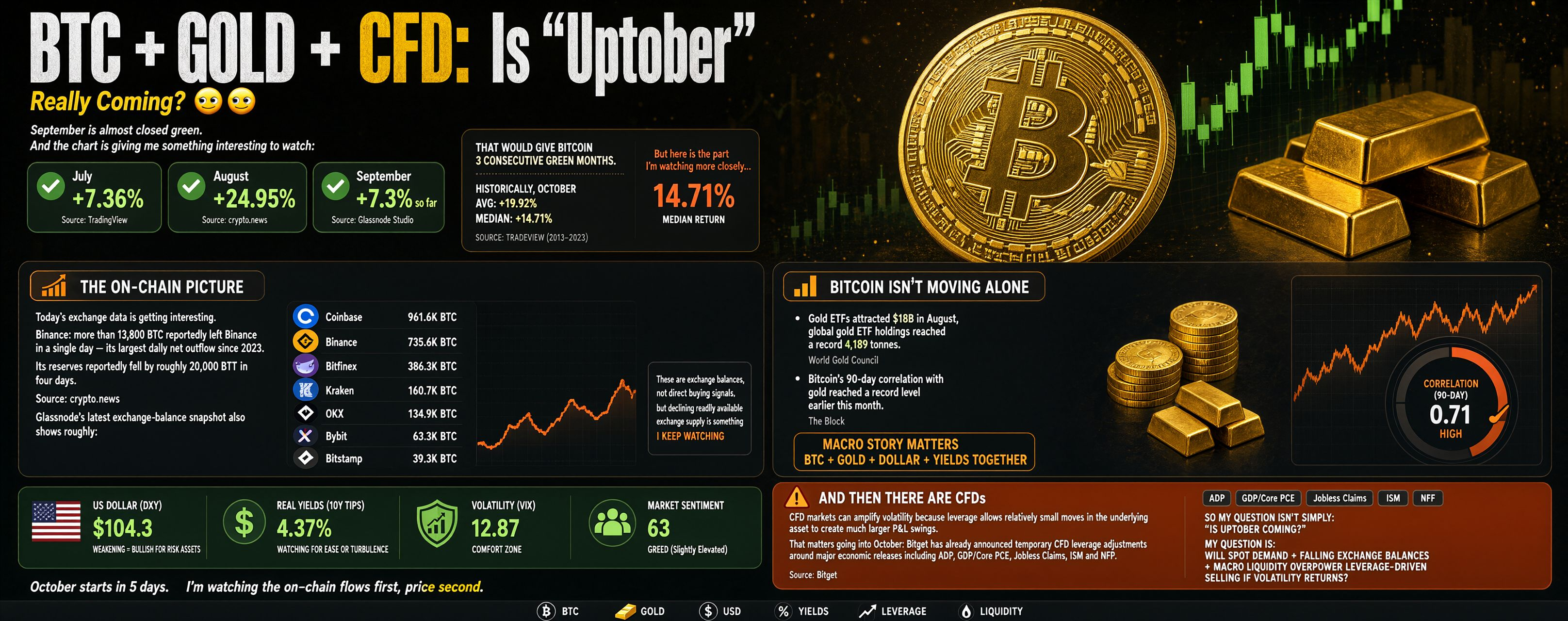
🟢 July: +7.36%
🟢 August: +24.95%
🟢 September: +7.3% so far
That would give Bitcoin 3 consecutive green months.
But here is the part I’m watching more closely…
Historically, the chart shows October averaging +19.92% with a +14.71% median. That sounds bullish, but seasonality is not a guarantee.
TradingView
The on chain picture
Today’s exchange data is getting interesting.
Binance: more than 13,800 BTC reportedly left Binance in a single day — its largest daily net outflow since 2023. Its reserves reportedly fell by roughly 20,000 BTC in four days.
crypto.news
Glassnode’s latest exchange-balance snapshot also shows roughly:
Coinbase: 961.6K BTC
Binance: 735.6K BTC
Bitfinex: 386.3K BTC
Kraken: 160.7K BTC
OKX: 134.9K BTC
Bybit: 63.3K BTC
Bitstamp: 39.3K BTC
These are exchange balances, not direct buying signals, but declining readily available exchange supply is something I keep watching when price is holding higher levels.
Glassnode Studio
But Bitcoin isn't moving alone
Gold is telling another part of the same macro story.
Gold ETFs attracted $18B in August, while global gold ETF holdings reached a record 4,189 tonnes.
World Gold Council
And The Block reported that Bitcoin's 90-day correlation with gold reached a record level earlier this month.
The Block
So I’m watching BTC + Gold + Dollar + yields together, not BTC in isolation.
And then there are CFDs
CFD markets can amplify volatility because leverage allows relatively small moves in the underlying asset to create much larger P&L swings.
That matters going into October: Bitget has already announced temporary CFD leverage adjustments around major economic releases including ADP, GDP/Core PCE, Jobless Claims, ISM and NFP.
Bitget
So my question isn't simply:
“Is Uptober coming?”
My question is:
Will spot demand + falling exchange balances + macro liquidity overpower leverage-driven selling if volatility returns?
October starts in 5 days.
I'm watching the on chain flows first, price second.
#QNTRises39% #BitgetBreachForgedRequestsNotStolenKeys #CFTCUpdatesGuidanceOnTokenizedAssets #BitcoinSpotETFsNetInflow$191M
$BTC
{spot}(BTCUSDT)
$NVDAB
{spot}(NVDABUSDT)
$XAU
{future}(XAUUSDT)
BTC + GOLD + CFD: Is “Uptober” Really Coming?
September is almost closed green.
And the chart is giving me something interesting to watch:
🟢 July: +7.36%
🟢 August: +24.95%
🟢 September: +7.3% so far
That would give Bitcoin 3 consecutive green months.
But here is the part I’m watching more closely…
Historically, the chart shows October averaging +19.92% with a +14.71% median. That sounds bullish, but seasonality is not a guarantee.
TradingView
The on chain picture
Today’s exchange data is getting interesting.
Binance: more than 13,800 BTC reportedly left Binance in a single day — its largest daily net outflow since 2023. Its reserves reportedly fell by roughly 20,000 BTC in four days.
crypto.news
Glassnode’s latest exchange-balance snapshot also shows roughly:
Coinbase: 961.6K BTC
Binance: 735.6K BTC
Bitfinex: 386.3K BTC
Kraken: 160.7K BTC
OKX: 134.9K BTC
Bybit: 63.3K BTC
Bitstamp: 39.3K BTC
These are exchange balances, not direct buying signals, but declining readily available exchange supply is something I keep watching when price is holding higher levels.
Glassnode Studio
But Bitcoin isn't moving alone
Gold is telling another part of the same macro story.
Gold ETFs attracted $18B in August, while global gold ETF holdings reached a record 4,189 tonnes.
World Gold Council
And The Block reported that Bitcoin's 90-day correlation with gold reached a record level earlier this month.
The Block
So I’m watching BTC + Gold + Dollar + yields together, not BTC in isolation.
And then there are CFDs
CFD markets can amplify volatility because leverage allows relatively small moves in the underlying asset to create much larger P&L swings.
That matters going into October: Bitget has already announced temporary CFD leverage adjustments around major economic releases including ADP, GDP/Core PCE, Jobless Claims, ISM and NFP.
Bitget
So my question isn't simply:
“Is Uptober coming?”
My question is:
Will spot demand + falling exchange balances + macro liquidity overpower leverage-driven selling if volatility returns?
October starts in 5 days.
I'm watching the on chain flows first, price second.
#QNTRises39% #BitgetBreachForgedRequestsNotStolenKeys #CFTCUpdatesGuidanceOnTokenizedAssets #BitcoinSpotETFsNetInflow$191M
$BTC
$NVDAB
$XAU
And the chart is giving me something interesting to watch:
🟢 July: +7.36%
🟢 August: +24.95%
🟢 September: +7.3% so far
That would give Bitcoin 3 consecutive green months.
But here is the part I’m watching more closely…
Historically, the chart shows October averaging +19.92% with a +14.71% median. That sounds bullish, but seasonality is not a guarantee.
TradingView
The on chain picture
Today’s exchange data is getting interesting.
Binance: more than 13,800 BTC reportedly left Binance in a single day — its largest daily net outflow since 2023. Its reserves reportedly fell by roughly 20,000 BTC in four days.
crypto.news
Glassnode’s latest exchange-balance snapshot also shows roughly:
Coinbase: 961.6K BTC
Binance: 735.6K BTC
Bitfinex: 386.3K BTC
Kraken: 160.7K BTC
OKX: 134.9K BTC
Bybit: 63.3K BTC
Bitstamp: 39.3K BTC
These are exchange balances, not direct buying signals, but declining readily available exchange supply is something I keep watching when price is holding higher levels.
Glassnode Studio
But Bitcoin isn't moving alone
Gold is telling another part of the same macro story.
Gold ETFs attracted $18B in August, while global gold ETF holdings reached a record 4,189 tonnes.
World Gold Council
And The Block reported that Bitcoin's 90-day correlation with gold reached a record level earlier this month.
The Block
So I’m watching BTC + Gold + Dollar + yields together, not BTC in isolation.
And then there are CFDs
CFD markets can amplify volatility because leverage allows relatively small moves in the underlying asset to create much larger P&L swings.
That matters going into October: Bitget has already announced temporary CFD leverage adjustments around major economic releases including ADP, GDP/Core PCE, Jobless Claims, ISM and NFP.
Bitget
So my question isn't simply:
“Is Uptober coming?”
My question is:
Will spot demand + falling exchange balances + macro liquidity overpower leverage-driven selling if volatility returns?
October starts in 5 days.
I'm watching the on chain flows first, price second.
#QNTRises39% #BitgetBreachForgedRequestsNotStolenKeys #CFTCUpdatesGuidanceOnTokenizedAssets #BitcoinSpotETFsNetInflow$191M
$BTC
$NVDAB
$XAU
1
193
#USGovernment
US Durable Goods just came in better than expected
Expectations: -0.3% Actual: 0.0% Previous: +1.1%
At first glance, this looks bullish for risk assets.
Why?
The market was positioned for a contraction in new durable goods orders. Instead, demand held flat, meaning the US economy is showing more resilience than the headline forecast suggested.
The interesting part is underneath the headline:
➡️ Core durable goods ex-transportation: +0.3% ➡️ Non-defense capital goods orders ex-aircraft: +1.6%
That matters because these measures give a better read on business investment and underlying demand.
For BTC and crypto, the reaction can be positive if this data supports a softer-dollar / risk-on move.
But there is a catch:
Strong economic data can also keep the Fed more cautious on rate cuts. Treasury yields and the dollar therefore remain important confirmation signals. Recent market commentary has highlighted elevated yields and hawkish Fed expectations as a major cross-asset driver.
So I’m watching:
DXY ↓ + yields ↓ + BTC volume ↑ = stronger bullish confirmation
Without that confirmation, I would not chase the first green candle.
Data beat expectations. Now the market has to prove the move.
$BTC
{future}(BTCUSDT)
$NEAR
{future}(NEARUSDT)
$ETC
{future}(ETCUSDT)
#USGovernment
US Durable Goods just came in better than expected
Expectations: -0.3% Actual: 0.0% Previous: +1.1%
At first glance, this looks bullish for risk assets.
Why?
The market was positioned for a contraction in new durable goods orders. Instead, demand held flat, meaning the US economy is showing more resilience than the headline forecast suggested.
The interesting part is underneath the headline:
➡️ Core durable goods ex-transportation: +0.3% ➡️ Non-defense capital goods orders ex-aircraft: +1.6%
That matters because these measures give a better read on business investment and underlying demand.
For BTC and crypto, the reaction can be positive if this data supports a softer-dollar / risk-on move.
But there is a catch:
Strong economic data can also keep the Fed more cautious on rate cuts. Treasury yields and the dollar therefore remain important confirmation signals. Recent market commentary has highlighted elevated yields and hawkish Fed expectations as a major cross-asset driver.
So I’m watching:
DXY ↓ + yields ↓ + BTC volume ↑ = stronger bullish confirmation
Without that confirmation, I would not chase the first green candle.
Data beat expectations. Now the market has to prove the move.
$BTC
$NEAR
$ETC
US Durable Goods just came in better than expected
Expectations: -0.3% Actual: 0.0% Previous: +1.1%
At first glance, this looks bullish for risk assets.
Why?
The market was positioned for a contraction in new durable goods orders. Instead, demand held flat, meaning the US economy is showing more resilience than the headline forecast suggested.
The interesting part is underneath the headline:
➡️ Core durable goods ex-transportation: +0.3% ➡️ Non-defense capital goods orders ex-aircraft: +1.6%
That matters because these measures give a better read on business investment and underlying demand.
For BTC and crypto, the reaction can be positive if this data supports a softer-dollar / risk-on move.
But there is a catch:
Strong economic data can also keep the Fed more cautious on rate cuts. Treasury yields and the dollar therefore remain important confirmation signals. Recent market commentary has highlighted elevated yields and hawkish Fed expectations as a major cross-asset driver.
So I’m watching:
DXY ↓ + yields ↓ + BTC volume ↑ = stronger bullish confirmation
Without that confirmation, I would not chase the first green candle.
Data beat expectations. Now the market has to prove the move.
$BTC
$NEAR
$ETC

188
#NEAR
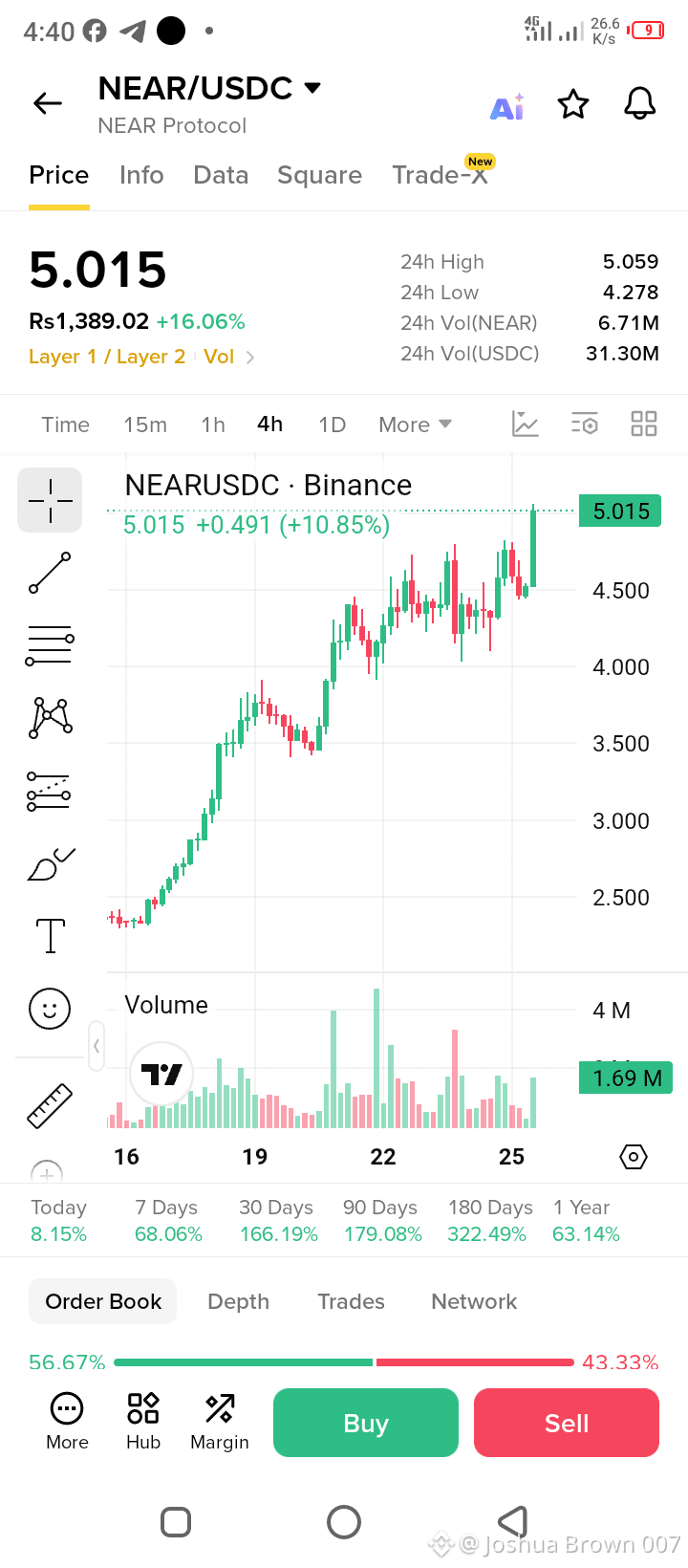
$NEAR USDC is in a powerful macro uptrend, having rallied +68% this week. The indicators are extended on the micro timeframe, and the price is consolidating below the 5.059 high.
Limit Long Entry 4.800 - 4.900
SL 4.650
TP 5.059
TP 5.500
Invalidation Conditions:
4H candle close below 4.500 completely invalidates the bullish macro thesis.
{future}(NEARUSDT)
$AVAX
{future}(AVAXUSDT)
#NEAR
$NEAR USDC is in a powerful macro uptrend, having rallied +68% this week. The indicators are extended on the micro timeframe, and the price is consolidating below the 5.059 high.
Limit Long Entry 4.800 - 4.900
SL 4.650
TP 5.059
TP 5.500
Invalidation Conditions:
4H candle close below 4.500 completely invalidates the bullish macro thesis.
$AVAX
$NEAR USDC is in a powerful macro uptrend, having rallied +68% this week. The indicators are extended on the micro timeframe, and the price is consolidating below the 5.059 high.
Limit Long Entry 4.800 - 4.900
SL 4.650
TP 5.059
TP 5.500
Invalidation Conditions:
4H candle close below 4.500 completely invalidates the bullish macro thesis.
$AVAX
210
#TradeNTell
$2.5 MILLION AT RISK AS MASSIVE BITCOIN LONG APPROACHES LIQUIDATION
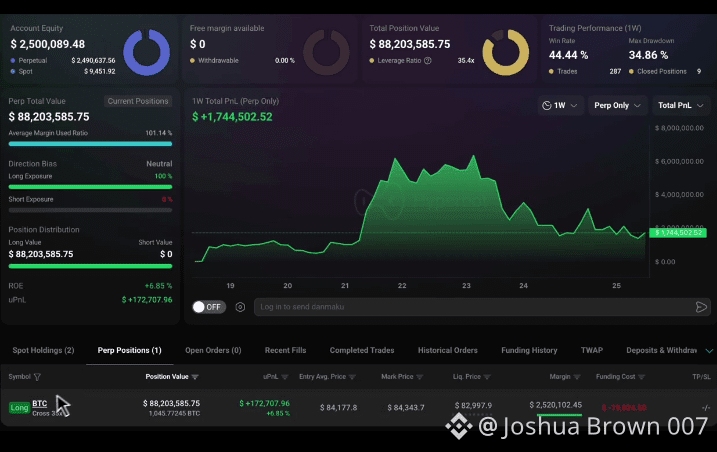
A high-stakes cryptocurrency trader on the decentralized trading platform Hyperliquid is facing complete wipeout. The trader's massive $88,203,585.75 leveraged Bitcoin (BTC) long position is dangerously close to its breaking point.
If the market drops slightly lower and triggers a forced liquidation, the trader will face an immediate loss of $2,500,089.48, completely obliterating their total account equity.
The Numbers Behind the High-Stakes Trade
Total Position Size: 1,048.77 BTC (valued at $88,203,585.75)
Leverage Ratio: 35.4x
Margin Deposited: $2,520,102.45
Entry Average Price: $84,177.8 per BTC
Current Mark Price: $84,343.7 per BTC
Liquidation Price: $82,997.9 per BTC
Running on Fumes: $0 Free Margin Available
The trader's dashboard shows an active unrealized profit (uPnL) of +$172,707.96 (+6.85%). Despite this temporary green flash, they are operating with $0 in free margin available.
Because the leverage is stretched to a volatile 35.4x, the buffer zone is incredibly thin. The distance between the current market price ($84,343.7) and the liquidation price ($82,997.9) is less than 1.6%. If Bitcoin's price slips below the $82,997.9 mark, the protocol will automatically seize and liquidate the position to protect the platform's liquidity pools. This move will instantly vaporize the trader's $2.5 million nest egg, turning a highly profitable weekly run into a catastrophic loss.
$BTC
{future}(BTCUSDT)
$ETH
{future}(ETHUSDT)
#Whale.Alert #BinanceWillListHyperliquid(HYPE) #OndoFinanceSoughtSaleAfterFoundersDeath
#TradeNTell
$2.5 MILLION AT RISK AS MASSIVE BITCOIN LONG APPROACHES LIQUIDATION
A high-stakes cryptocurrency trader on the decentralized trading platform Hyperliquid is facing complete wipeout. The trader's massive $88,203,585.75 leveraged Bitcoin (BTC) long position is dangerously close to its breaking point.
If the market drops slightly lower and triggers a forced liquidation, the trader will face an immediate loss of $2,500,089.48, completely obliterating their total account equity.
The Numbers Behind the High-Stakes Trade
Total Position Size: 1,048.77 BTC (valued at $88,203,585.75)
Leverage Ratio: 35.4x
Margin Deposited: $2,520,102.45
Entry Average Price: $84,177.8 per BTC
Current Mark Price: $84,343.7 per BTC
Liquidation Price: $82,997.9 per BTC
Running on Fumes: $0 Free Margin Available
The trader's dashboard shows an active unrealized profit (uPnL) of +$172,707.96 (+6.85%). Despite this temporary green flash, they are operating with $0 in free margin available.
Because the leverage is stretched to a volatile 35.4x, the buffer zone is incredibly thin. The distance between the current market price ($84,343.7) and the liquidation price ($82,997.9) is less than 1.6%. If Bitcoin's price slips below the $82,997.9 mark, the protocol will automatically seize and liquidate the position to protect the platform's liquidity pools. This move will instantly vaporize the trader's $2.5 million nest egg, turning a highly profitable weekly run into a catastrophic loss.
$BTC
$ETH
#Whale.Alert #BinanceWillListHyperliquid(HYPE) #OndoFinanceSoughtSaleAfterFoundersDeath
$2.5 MILLION AT RISK AS MASSIVE BITCOIN LONG APPROACHES LIQUIDATION
A high-stakes cryptocurrency trader on the decentralized trading platform Hyperliquid is facing complete wipeout. The trader's massive $88,203,585.75 leveraged Bitcoin (BTC) long position is dangerously close to its breaking point.
If the market drops slightly lower and triggers a forced liquidation, the trader will face an immediate loss of $2,500,089.48, completely obliterating their total account equity.
The Numbers Behind the High-Stakes Trade
Total Position Size: 1,048.77 BTC (valued at $88,203,585.75)
Leverage Ratio: 35.4x
Margin Deposited: $2,520,102.45
Entry Average Price: $84,177.8 per BTC
Current Mark Price: $84,343.7 per BTC
Liquidation Price: $82,997.9 per BTC
Running on Fumes: $0 Free Margin Available
The trader's dashboard shows an active unrealized profit (uPnL) of +$172,707.96 (+6.85%). Despite this temporary green flash, they are operating with $0 in free margin available.
Because the leverage is stretched to a volatile 35.4x, the buffer zone is incredibly thin. The distance between the current market price ($84,343.7) and the liquidation price ($82,997.9) is less than 1.6%. If Bitcoin's price slips below the $82,997.9 mark, the protocol will automatically seize and liquidate the position to protect the platform's liquidity pools. This move will instantly vaporize the trader's $2.5 million nest egg, turning a highly profitable weekly run into a catastrophic loss.
$BTC
$ETH
#Whale.Alert #BinanceWillListHyperliquid(HYPE) #OndoFinanceSoughtSaleAfterFoundersDeath
95
I’m watching one number before making my next BTC move:
🇺🇸 US Jobless Claims
The market was looking around 201K, after last week’s surprisingly low 196K.
But here’s what matters to me:
🔹 Below 198K → Strong labor market
→ Less pressure for easier Fed policy
→ Could support USD/yields
→ Risk assets may face pressure
🔹 Around 202K → Close to expectations
→ Likely limited immediate reaction
→ BTC may return to technical levels
🔹 Above 210K → Clearer labor-market cooling
→ More attention on future Fed policy
→ Could support rate-sensitive assets, including crypto
The bigger picture is interesting.
Reuters reported that the recent 196K reading may have been distorted by Labor Day seasonal volatility, while the underlying labor market remained relatively steady.
And another important warning: jobless claims mainly measure layoffs, not hiring. So a low number alone doesn't prove the entire labor market is getting stronger.
For BTC, I’m not trading the headline alone.
I’ll watch:
Claims → DXY → Treasury yields → Fed expectations → BTC liquidity
That chain reaction matters more than one economic number.
No blind long.
No blind short.
Let the data hit first, then watch how price reacts.
#USGovernment
{future}(BTCUSDT)
{future}(BNBUSDT)
{future}(XRPUSDT)
I’m watching one number before making my next BTC move:
🇺🇸 US Jobless Claims
The market was looking around 201K, after last week’s surprisingly low 196K.
But here’s what matters to me:
🔹 Below 198K → Strong labor market
→ Less pressure for easier Fed policy
→ Could support USD/yields
→ Risk assets may face pressure
🔹 Around 202K → Close to expectations
→ Likely limited immediate reaction
→ BTC may return to technical levels
🔹 Above 210K → Clearer labor-market cooling
→ More attention on future Fed policy
→ Could support rate-sensitive assets, including crypto
The bigger picture is interesting.
Reuters reported that the recent 196K reading may have been distorted by Labor Day seasonal volatility, while the underlying labor market remained relatively steady.
And another important warning: jobless claims mainly measure layoffs, not hiring. So a low number alone doesn't prove the entire labor market is getting stronger.
For BTC, I’m not trading the headline alone.
I’ll watch:
Claims → DXY → Treasury yields → Fed expectations → BTC liquidity
That chain reaction matters more than one economic number.
No blind long.
No blind short.
Let the data hit first, then watch how price reacts.
#USGovernment
🇺🇸 US Jobless Claims
The market was looking around 201K, after last week’s surprisingly low 196K.
But here’s what matters to me:
🔹 Below 198K → Strong labor market
→ Less pressure for easier Fed policy
→ Could support USD/yields
→ Risk assets may face pressure
🔹 Around 202K → Close to expectations
→ Likely limited immediate reaction
→ BTC may return to technical levels
🔹 Above 210K → Clearer labor-market cooling
→ More attention on future Fed policy
→ Could support rate-sensitive assets, including crypto
The bigger picture is interesting.
Reuters reported that the recent 196K reading may have been distorted by Labor Day seasonal volatility, while the underlying labor market remained relatively steady.
And another important warning: jobless claims mainly measure layoffs, not hiring. So a low number alone doesn't prove the entire labor market is getting stronger.
For BTC, I’m not trading the headline alone.
I’ll watch:
Claims → DXY → Treasury yields → Fed expectations → BTC liquidity
That chain reaction matters more than one economic number.
No blind long.
No blind short.
Let the data hit first, then watch how price reacts.
#USGovernment
126
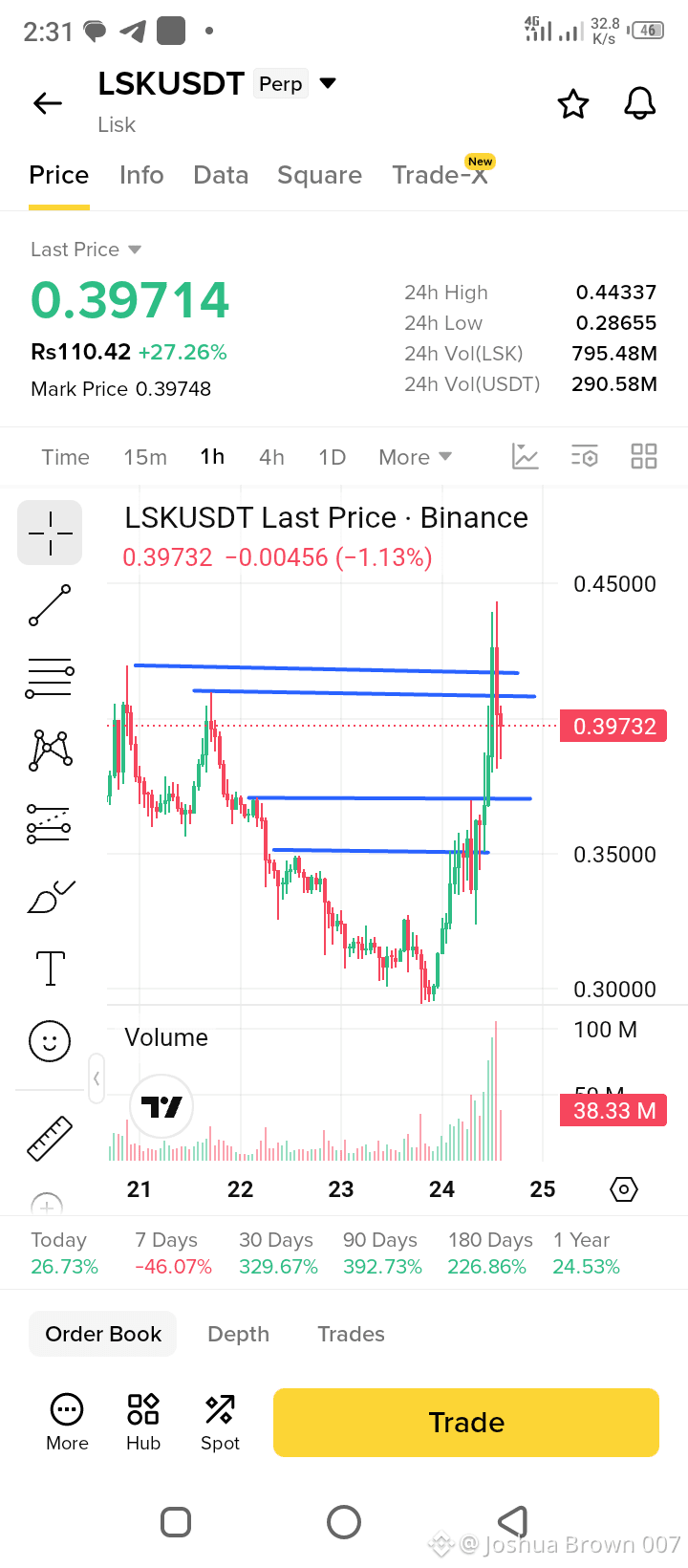
30D trade $LSK 10.7K USDT
#Trade Short scalp $LSK
Entry 0.3930 - 0.4000
SL 0.4150
TP 0.3700 FVG 1H
TP 0.3500 major demand Zone
Invalidation Conditions:
1H candle close above 0.4200 completely invalidates the bearish micro thesis.
$LSK
{future}(LSKUSDT)
#Trade Short scalp $LSK
Entry 0.3930 - 0.4000
SL 0.4150
TP 0.3700 FVG 1H
TP 0.3500 major demand Zone
Invalidation Conditions:
1H candle close above 0.4200 completely invalidates the bearish micro thesis.
$LSK
Entry 0.3930 - 0.4000
SL 0.4150
TP 0.3700 FVG 1H
TP 0.3500 major demand Zone
Invalidation Conditions:
1H candle close above 0.4200 completely invalidates the bearish micro thesis.
$LSK
205
·
--
Bullish
30D trade $FLOCK 7K USDT
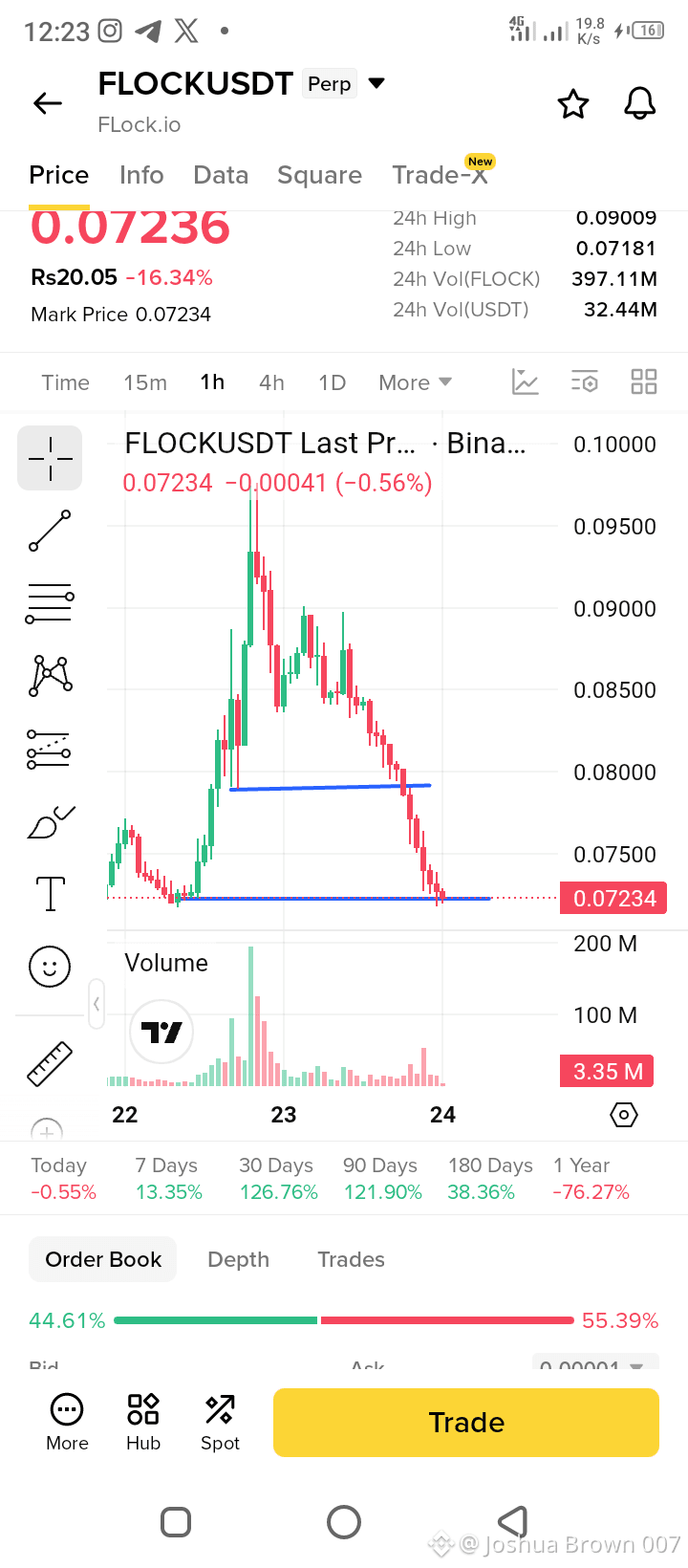
#Trade $FLOCK LONG Setup
Limit Entry 0.0715 - 0.0725
SL 0.0690
TP 0.07482
TP 0.08050
Invalidation Conditions:
1H candle close below 0.0690 invalidates the immediate bounce thesis.
sudden spike in selling volume that breaks the 0.0650 support.
If the price breaks below 0.0690 with high volume, enter short on the retest of 0.0710, targeting 0.0650. SL at 0.0730.
$TAKE $CAP
{future}(FLOCKUSDT)
{future}(TAKEUSDT)
{future}(CAPUSDT)
#Trade $FLOCK LONG Setup
Limit Entry 0.0715 - 0.0725
SL 0.0690
TP 0.07482
TP 0.08050
Invalidation Conditions:
1H candle close below 0.0690 invalidates the immediate bounce thesis.
sudden spike in selling volume that breaks the 0.0650 support.
If the price breaks below 0.0690 with high volume, enter short on the retest of 0.0710, targeting 0.0650. SL at 0.0730.
$TAKE $CAP
Limit Entry 0.0715 - 0.0725
SL 0.0690
TP 0.07482
TP 0.08050
Invalidation Conditions:
1H candle close below 0.0690 invalidates the immediate bounce thesis.
sudden spike in selling volume that breaks the 0.0650 support.
If the price breaks below 0.0690 with high volume, enter short on the retest of 0.0710, targeting 0.0650. SL at 0.0730.
$TAKE $CAP
582
Article
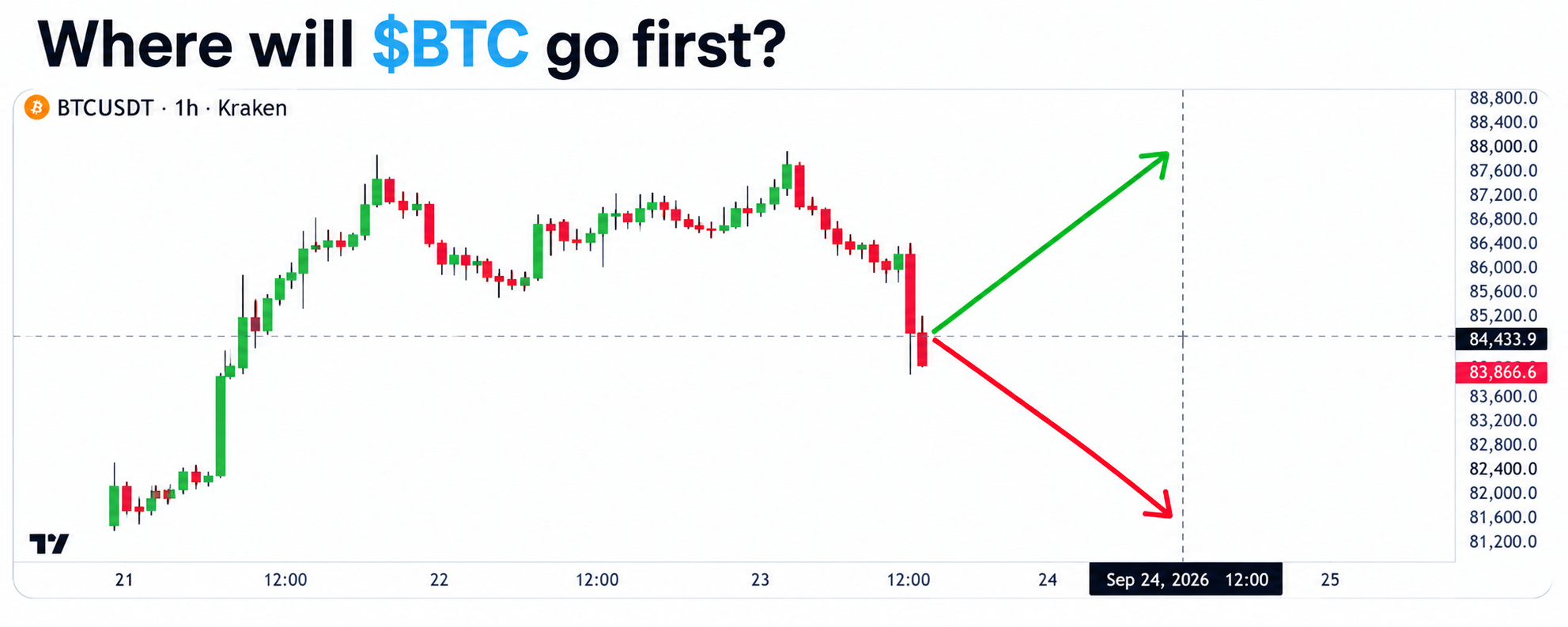
Where will $BTC go first up or down?I keep looking at this chart and one question stands out:
Will Bitcoin take the liquidity above first, or sweep the downside before the next move?
The chart shows the key decision area around $84.4K, with roughly $87.6K on the upside and $81.6K on the downside.
But there is an important update: BTC has already pushed into the $87K area today, so this chart should be treated as a snapshot of the earlier setup, not the current live structure. CryptoQuant's latest dashboard had BTC around $87.36K and its Bull/Bear Indicator had turned positive at +0.27.
CryptoQuant Alpha Library
What the data is telling me 👇
Technical structure
The original chart's $84K–$85K zone remains important. Glassnode currently identifies a large long-term-holder supply cluster around $84K–$85K. Above that, its next major on-chain resistance is around $96.7K, the mean MVRV price.
So my levels to watch:
Resistance: $88K → $92K → $95K → $96.7K
Support: $85K → $84K → $82K → $81.6K
A sustained move above $88K would put the market closer to the $92K–$96.7K resistance zone.
A rejection followed by a loss of $84K would reopen the downside liquidity area.
On chain demand
There is a mixed but improving picture.
Glassnode says spot buying has returned, spot volume has more than doubled from its August low, ETF buying is picking up, and profit-taking remains relatively light compared with previous cycle tops.
But exchange data needs watching: another recent report showed Bitcoin exchange reserves had risen by about 14,800 BTC from the September 5 low, meaning some supply has moved back toward exchanges.
That's why I don't want to call every green candle a guaranteed breakout.
What is Polymarket saying?
This is interesting.
Polymarket currently prices the September market with $82.5K downside at about 68%, while the $88K level for the Sept. 21–27 window is around 23%. The hourly BTC market was showing 81% Up, while the daily market was around 57% Up when I checked.
But remember: these are market-implied probabilities, not guaranteed predictions. Polymarket itself says the odds represent trader consensus at a point in time.
What are major analysts saying?
There isn't one universal forecast.
Glassnode: BTC has moved above important cost bases, with $84K–$85K as a major supply area and $96.7K as the next major on-chain resistance.
CryptoQuant: previously identified $81.7K, $83.6K and $88.7K as important resistance levels; its latest dashboard now shows a positive bull/bear reading.
The Block +1
Grayscale's Zach Pandl: said the roughly $58K June low remained his view of the cycle bottom.
Coinbase CEO Brian Armstrong: also said he believed BTC had likely bottomed and expected an upward trend over the next 1–2 years.
Bernstein: has a much longer-term scenario of $150K by mid 2027, with a projected next cycle peak around $300K in 2029. That's a long term forecast, not a short term target.
Standard Chartered's Geoffrey Kendrick: has maintained a $100K end-2026 view despite earlier volatility.
My trading map
Bullish path:
$87K → $88K → $92K → $95K → $96.7K
Bearish path:
$87K rejection → $85K → $84K → $82K → $81.6K
The important part for me isn't guessing the exact next candle.
I want to see which liquidity zone BTC takes first and whether price can hold after the sweep.
If BTC breaks resistance with spot demand + volume + positive on chain flows, the upside structure becomes stronger.
If it loses $84K with increasing exchange inflows and selling pressure, I would start watching the lower liquidity levels instead.
No blind long. No blind short.
Let BTC show the direction first.
#Bitcoin #BTC #BitcoinAnalysis #Polymarket #Trading
{spot}(BTCUSDT)
Where will $BTC go first up or down?
I keep looking at this chart and one question stands out:
Will Bitcoin take the liquidity above first, or sweep the downside before the next move?
The chart shows the key decision area around $84.4K, with roughly $87.6K on the upside and $81.6K on the downside.
But there is an important update: BTC has already pushed into the $87K area today, so this chart should be treated as a snapshot of the earlier setup, not the current live structure. CryptoQuant's latest dashboard had BTC around $87.36K and its Bull/Bear Indicator had turned positive at +0.27.
CryptoQuant Alpha Library
What the data is telling me 👇
Technical structure
The original chart's $84K–$85K zone remains important. Glassnode currently identifies a large long-term-holder supply cluster around $84K–$85K. Above that, its next major on-chain resistance is around $96.7K, the mean MVRV price.
So my levels to watch:
Resistance: $88K → $92K → $95K → $96.7K
Support: $85K → $84K → $82K → $81.6K
A sustained move above $88K would put the market closer to the $92K–$96.7K resistance zone.
A rejection followed by a loss of $84K would reopen the downside liquidity area.
On chain demand
There is a mixed but improving picture.
Glassnode says spot buying has returned, spot volume has more than doubled from its August low, ETF buying is picking up, and profit-taking remains relatively light compared with previous cycle tops.
But exchange data needs watching: another recent report showed Bitcoin exchange reserves had risen by about 14,800 BTC from the September 5 low, meaning some supply has moved back toward exchanges.
That's why I don't want to call every green candle a guaranteed breakout.
What is Polymarket saying?
This is interesting.
Polymarket currently prices the September market with $82.5K downside at about 68%, while the $88K level for the Sept. 21–27 window is around 23%. The hourly BTC market was showing 81% Up, while the daily market was around 57% Up when I checked.
But remember: these are market-implied probabilities, not guaranteed predictions. Polymarket itself says the odds represent trader consensus at a point in time.
What are major analysts saying?
There isn't one universal forecast.
Glassnode: BTC has moved above important cost bases, with $84K–$85K as a major supply area and $96.7K as the next major on-chain resistance.
CryptoQuant: previously identified $81.7K, $83.6K and $88.7K as important resistance levels; its latest dashboard now shows a positive bull/bear reading.
The Block +1
Grayscale's Zach Pandl: said the roughly $58K June low remained his view of the cycle bottom.
Coinbase CEO Brian Armstrong: also said he believed BTC had likely bottomed and expected an upward trend over the next 1–2 years.
Bernstein: has a much longer-term scenario of $150K by mid 2027, with a projected next cycle peak around $300K in 2029. That's a long term forecast, not a short term target.
Standard Chartered's Geoffrey Kendrick: has maintained a $100K end-2026 view despite earlier volatility.
My trading map
Bullish path:
$87K → $88K → $92K → $95K → $96.7K
Bearish path:
$87K rejection → $85K → $84K → $82K → $81.6K
The important part for me isn't guessing the exact next candle.
I want to see which liquidity zone BTC takes first and whether price can hold after the sweep.
If BTC breaks resistance with spot demand + volume + positive on chain flows, the upside structure becomes stronger.
If it loses $84K with increasing exchange inflows and selling pressure, I would start watching the lower liquidity levels instead.
No blind long. No blind short.
Let BTC show the direction first.
#Bitcoin #BTC #BitcoinAnalysis #Polymarket #Trading
Will Bitcoin take the liquidity above first, or sweep the downside before the next move?
The chart shows the key decision area around $84.4K, with roughly $87.6K on the upside and $81.6K on the downside.
But there is an important update: BTC has already pushed into the $87K area today, so this chart should be treated as a snapshot of the earlier setup, not the current live structure. CryptoQuant's latest dashboard had BTC around $87.36K and its Bull/Bear Indicator had turned positive at +0.27.
CryptoQuant Alpha Library
What the data is telling me 👇
Technical structure
The original chart's $84K–$85K zone remains important. Glassnode currently identifies a large long-term-holder supply cluster around $84K–$85K. Above that, its next major on-chain resistance is around $96.7K, the mean MVRV price.
So my levels to watch:
Resistance: $88K → $92K → $95K → $96.7K
Support: $85K → $84K → $82K → $81.6K
A sustained move above $88K would put the market closer to the $92K–$96.7K resistance zone.
A rejection followed by a loss of $84K would reopen the downside liquidity area.
On chain demand
There is a mixed but improving picture.
Glassnode says spot buying has returned, spot volume has more than doubled from its August low, ETF buying is picking up, and profit-taking remains relatively light compared with previous cycle tops.
But exchange data needs watching: another recent report showed Bitcoin exchange reserves had risen by about 14,800 BTC from the September 5 low, meaning some supply has moved back toward exchanges.
That's why I don't want to call every green candle a guaranteed breakout.
What is Polymarket saying?
This is interesting.
Polymarket currently prices the September market with $82.5K downside at about 68%, while the $88K level for the Sept. 21–27 window is around 23%. The hourly BTC market was showing 81% Up, while the daily market was around 57% Up when I checked.
But remember: these are market-implied probabilities, not guaranteed predictions. Polymarket itself says the odds represent trader consensus at a point in time.
What are major analysts saying?
There isn't one universal forecast.
Glassnode: BTC has moved above important cost bases, with $84K–$85K as a major supply area and $96.7K as the next major on-chain resistance.
CryptoQuant: previously identified $81.7K, $83.6K and $88.7K as important resistance levels; its latest dashboard now shows a positive bull/bear reading.
The Block +1
Grayscale's Zach Pandl: said the roughly $58K June low remained his view of the cycle bottom.
Coinbase CEO Brian Armstrong: also said he believed BTC had likely bottomed and expected an upward trend over the next 1–2 years.
Bernstein: has a much longer-term scenario of $150K by mid 2027, with a projected next cycle peak around $300K in 2029. That's a long term forecast, not a short term target.
Standard Chartered's Geoffrey Kendrick: has maintained a $100K end-2026 view despite earlier volatility.
My trading map
Bullish path:
$87K → $88K → $92K → $95K → $96.7K
Bearish path:
$87K rejection → $85K → $84K → $82K → $81.6K
The important part for me isn't guessing the exact next candle.
I want to see which liquidity zone BTC takes first and whether price can hold after the sweep.
If BTC breaks resistance with spot demand + volume + positive on chain flows, the upside structure becomes stronger.
If it loses $84K with increasing exchange inflows and selling pressure, I would start watching the lower liquidity levels instead.
No blind long. No blind short.
Let BTC show the direction first.
#Bitcoin #BTC #BitcoinAnalysis #Polymarket #Trading
1
8
9k
#zec
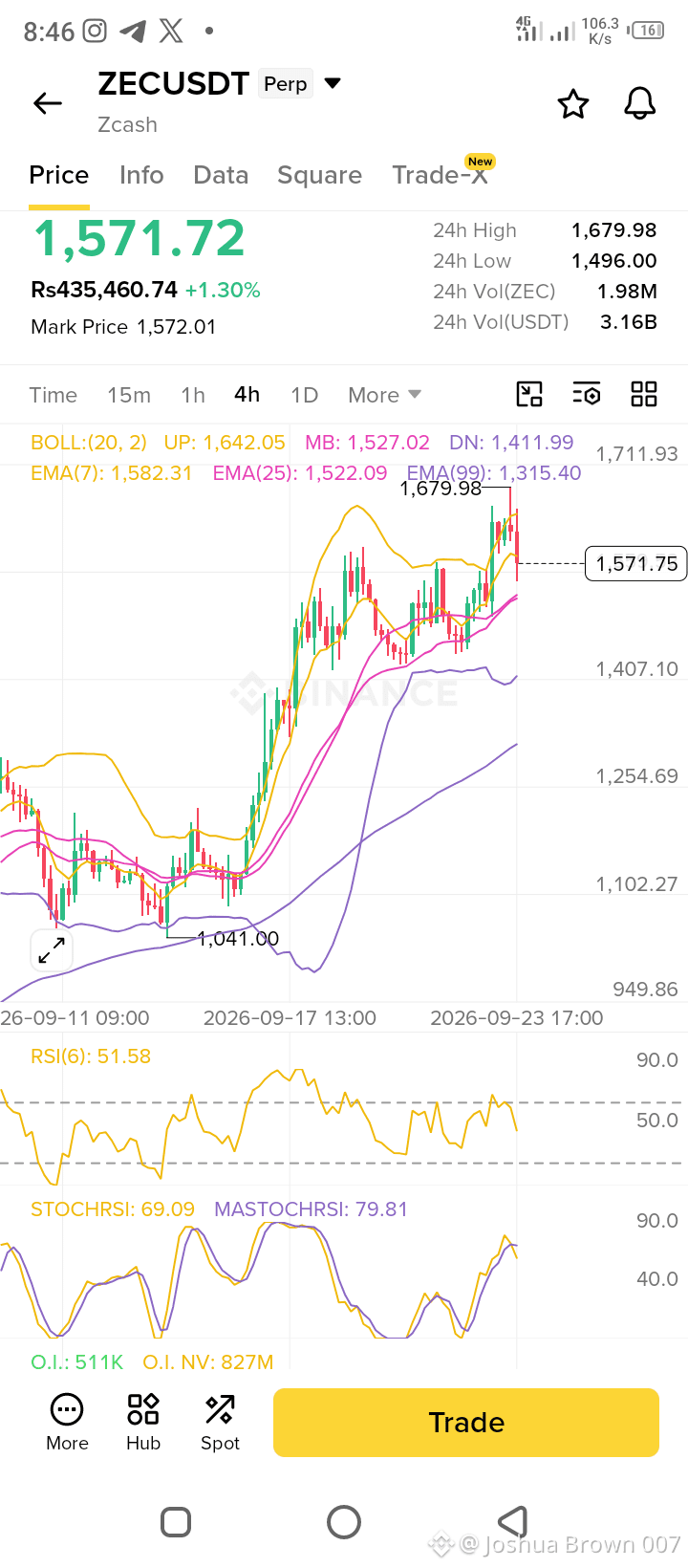
WAIT FOR PULLBACK AND Go LONG.
$ZEC USDT is in a powerful uptrend but is currently experiencing a necessary short-term correction. The indicators have cooled off significantly, and the price is testing the EMA(25). Do not FOMO into the current price (1,571).
Entry Long 1,520 - 1,540
SL 1,480
TP 1,645
TP 1,780
Expected Time frame 08 hrs - 1 Days
Invalidation Conditions:
If 4H candle close below 1,315 (EMA 99) completely invalidates the bullish macro thesis.
{future}(ZECUSDT)
$TAO
{future}(TAOUSDT)
$ZEN
{future}(ZENUSDT)
#zec
WAIT FOR PULLBACK AND Go LONG.
$ZEC USDT is in a powerful uptrend but is currently experiencing a necessary short-term correction. The indicators have cooled off significantly, and the price is testing the EMA(25). Do not FOMO into the current price (1,571).
Entry Long 1,520 - 1,540
SL 1,480
TP 1,645
TP 1,780
Expected Time frame 08 hrs - 1 Days
Invalidation Conditions:
If 4H candle close below 1,315 (EMA 99) completely invalidates the bullish macro thesis.
$TAO
$ZEN
WAIT FOR PULLBACK AND Go LONG.
$ZEC USDT is in a powerful uptrend but is currently experiencing a necessary short-term correction. The indicators have cooled off significantly, and the price is testing the EMA(25). Do not FOMO into the current price (1,571).
Entry Long 1,520 - 1,540
SL 1,480
TP 1,645
TP 1,780
Expected Time frame 08 hrs - 1 Days
Invalidation Conditions:
If 4H candle close below 1,315 (EMA 99) completely invalidates the bullish macro thesis.
$TAO
$ZEN
437
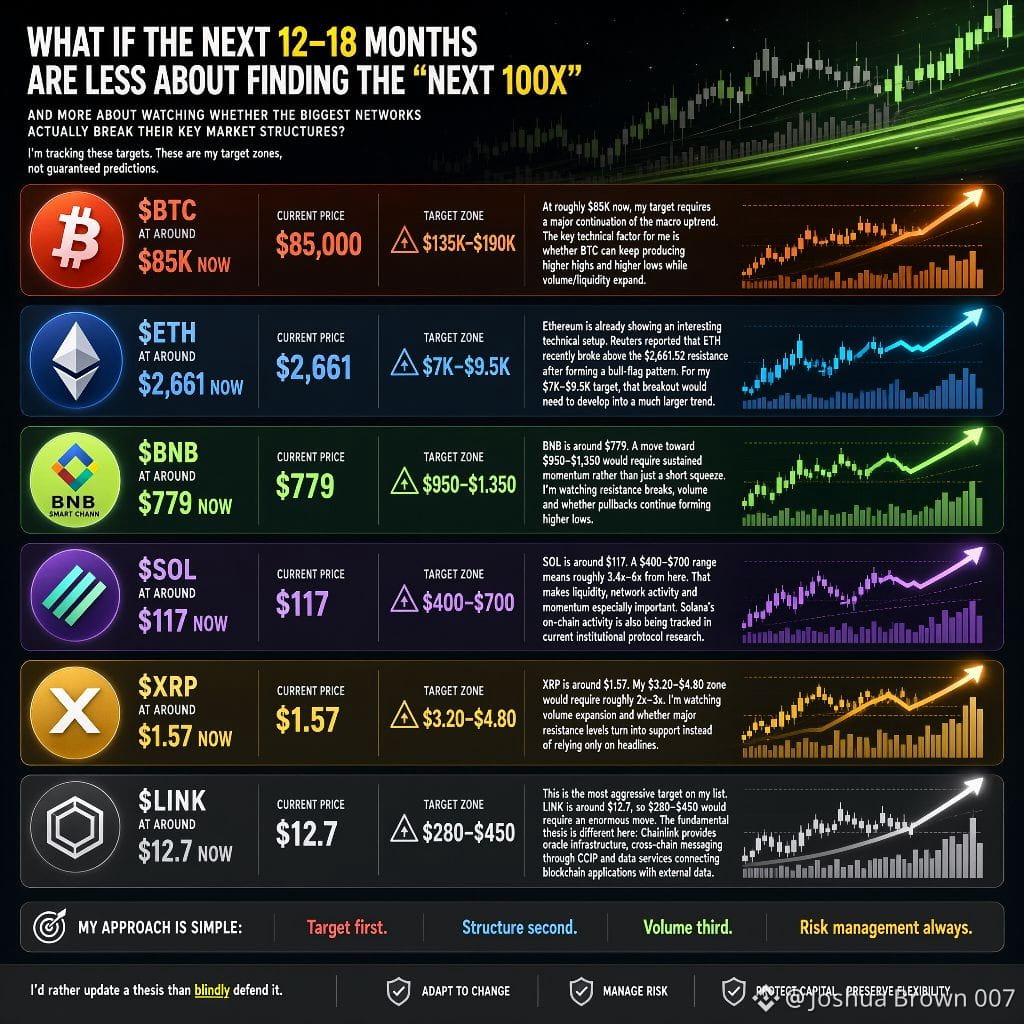
What if the next 12–18 months are less about finding the “next 100x” and more about watching whether the biggest networks actually break their key market structures?
I’m tracking these targets:
$BTC → $135K–$190K
$ETH → $7K–$9.5K
$BNB → $950–$1,350
$SOL → $400–$700
$XRP → $3.20–$4.80
$LINK → $280–$450
These are my target zones, not guaranteed predictions.
🔹 $BTC
At roughly $85K now, my target requires a major continuation of the macro uptrend. The key technical factor for me is whether BTC can keep producing higher highs and higher lows while volume/liquidity expand.
🔹 $ETH
Ethereum is already showing an interesting technical setup. Reuters reported that ETH recently broke above the $2,661.52 resistance after forming a bull-flag pattern.
For my $7K–$9.5K target, that breakout would need to develop into a much larger trend.
🔹 $BNB
BNB is around $779. A move toward $950–$1,350 would require sustained momentum rather than just a short squeeze. I’m watching resistance breaks, volume and whether pullbacks continue forming higher lows.
🔹 $SOL
SOL is around $117. A $400–$700 range means roughly 3.4x–6x from here.
That makes liquidity, network activity and momentum especially important. Solana's on-chain activity is also being tracked in current institutional protocol research.
🔹 $XRP
XRP is around $1.57. My $3.20–$4.80 zone would require roughly 2x–3x. I’m watching volume expansion and whether major resistance levels turn into support instead of relying only on headlines.
My approach is simple:
Target first.
Structure second.
Volume third.
Risk management always.
If the market structure changes, my targets can change too.
I’d rather update a thesis than blindly defend it.
{spot}(BTCUSDT)
{spot}(ETHUSDT)
{spot}(BNBUSDT)
What if the next 12–18 months are less about finding the “next 100x” and more about watching whether the biggest networks actually break their key market structures?
I’m tracking these targets:
$BTC → $135K–$190K
$ETH → $7K–$9.5K
$BNB → $950–$1,350
$SOL → $400–$700
$XRP → $3.20–$4.80
$LINK → $280–$450
These are my target zones, not guaranteed predictions.
🔹 $BTC
At roughly $85K now, my target requires a major continuation of the macro uptrend. The key technical factor for me is whether BTC can keep producing higher highs and higher lows while volume/liquidity expand.
🔹 $ETH
Ethereum is already showing an interesting technical setup. Reuters reported that ETH recently broke above the $2,661.52 resistance after forming a bull-flag pattern.
For my $7K–$9.5K target, that breakout would need to develop into a much larger trend.
🔹 $BNB
BNB is around $779. A move toward $950–$1,350 would require sustained momentum rather than just a short squeeze. I’m watching resistance breaks, volume and whether pullbacks continue forming higher lows.
🔹 $SOL
SOL is around $117. A $400–$700 range means roughly 3.4x–6x from here.
That makes liquidity, network activity and momentum especially important. Solana's on-chain activity is also being tracked in current institutional protocol research.
🔹 $XRP
XRP is around $1.57. My $3.20–$4.80 zone would require roughly 2x–3x. I’m watching volume expansion and whether major resistance levels turn into support instead of relying only on headlines.
My approach is simple:
Target first.
Structure second.
Volume third.
Risk management always.
If the market structure changes, my targets can change too.
I’d rather update a thesis than blindly defend it.
I’m tracking these targets:
$BTC → $135K–$190K
$ETH → $7K–$9.5K
$BNB → $950–$1,350
$SOL → $400–$700
$XRP → $3.20–$4.80
$LINK → $280–$450
These are my target zones, not guaranteed predictions.
🔹 $BTC
At roughly $85K now, my target requires a major continuation of the macro uptrend. The key technical factor for me is whether BTC can keep producing higher highs and higher lows while volume/liquidity expand.
🔹 $ETH
Ethereum is already showing an interesting technical setup. Reuters reported that ETH recently broke above the $2,661.52 resistance after forming a bull-flag pattern.
For my $7K–$9.5K target, that breakout would need to develop into a much larger trend.
🔹 $BNB
BNB is around $779. A move toward $950–$1,350 would require sustained momentum rather than just a short squeeze. I’m watching resistance breaks, volume and whether pullbacks continue forming higher lows.
🔹 $SOL
SOL is around $117. A $400–$700 range means roughly 3.4x–6x from here.
That makes liquidity, network activity and momentum especially important. Solana's on-chain activity is also being tracked in current institutional protocol research.
🔹 $XRP
XRP is around $1.57. My $3.20–$4.80 zone would require roughly 2x–3x. I’m watching volume expansion and whether major resistance levels turn into support instead of relying only on headlines.
My approach is simple:
Target first.
Structure second.
Volume third.
Risk management always.
If the market structure changes, my targets can change too.
I’d rather update a thesis than blindly defend it.
202
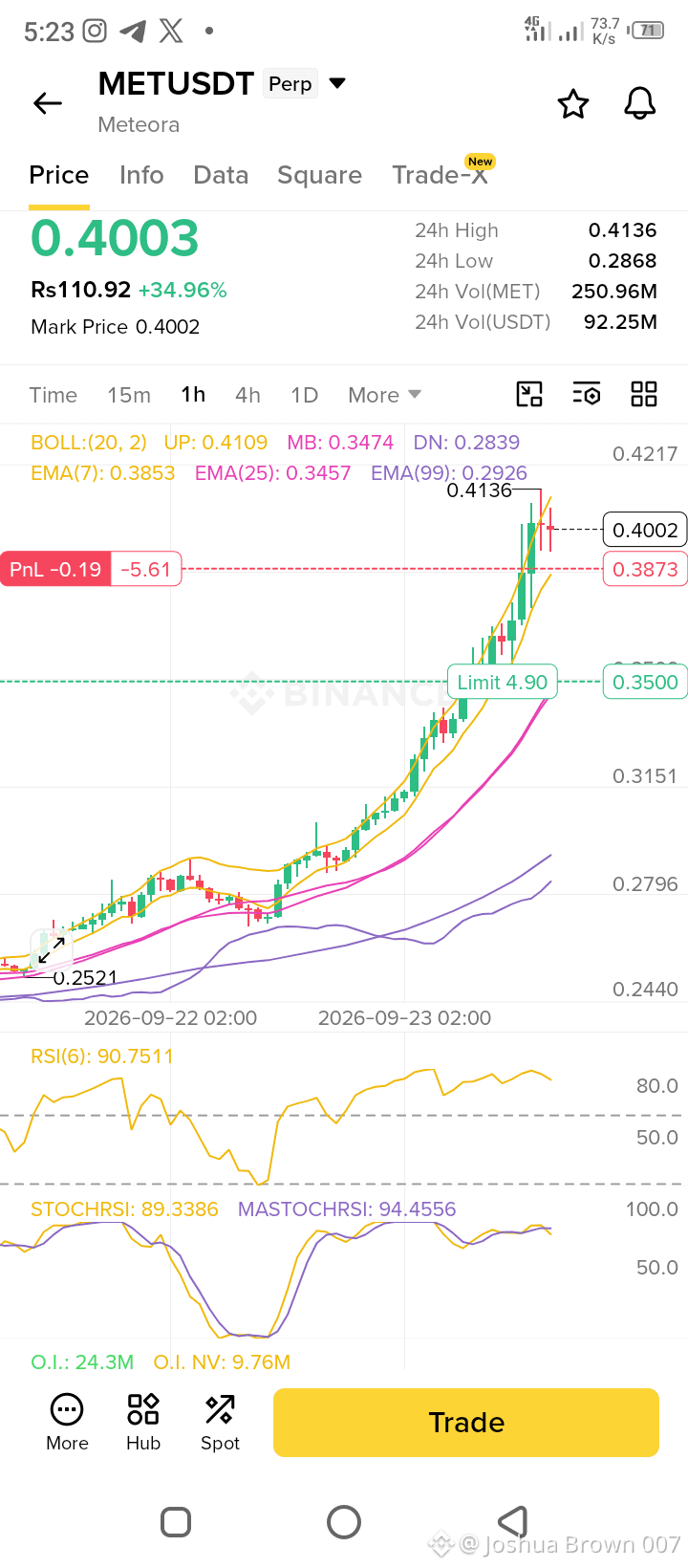
$MET Short Sell
Entry0.4000 - 0.4050
SL 0.4150
TP 0.3860 and 0.3490
caution:
If the price reclaims 0.4136 with high volume and breaks 0.4217, enter long targeting 0.450. SL at 0.400.
{future}(METUSDT)
$MET Short Sell
Entry0.4000 - 0.4050
SL 0.4150
TP 0.3860 and 0.3490
caution:
If the price reclaims 0.4136 with high volume and breaks 0.4217, enter long targeting 0.450. SL at 0.400.
Entry0.4000 - 0.4050
SL 0.4150
TP 0.3860 and 0.3490
caution:
If the price reclaims 0.4136 with high volume and breaks 0.4217, enter long targeting 0.450. SL at 0.400.
155
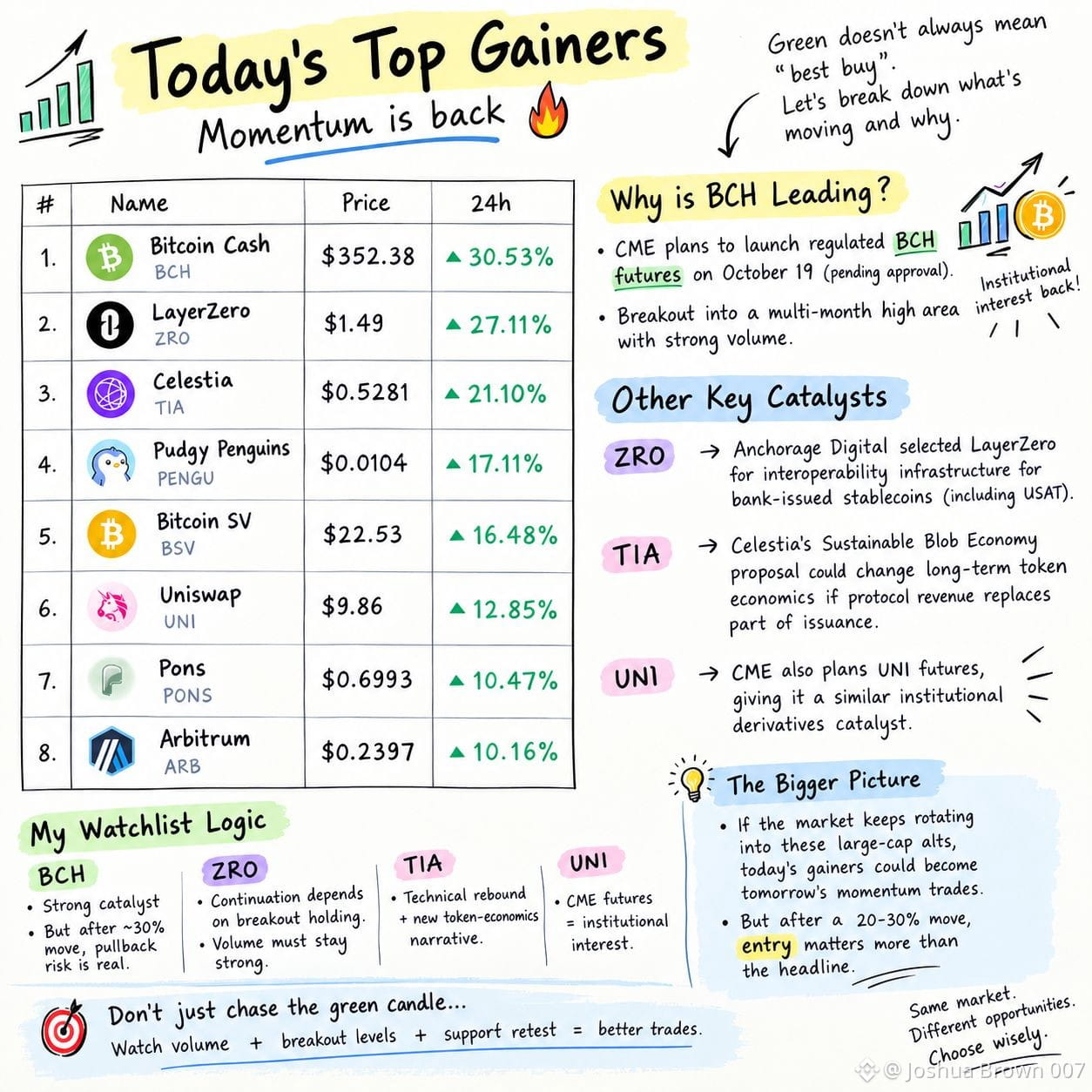
Today’s Top Gainers Momentum Is Back 🔥
Today’s leaderboard is interesting because this is not just a small cap pump.
$BCH +30.53%
$ZRO +27.11%
$TIA +21.10%
$PENGU +17.11%
$BSV +16.48%
$UNI +12.85%
$PONS +10.47%
$ARB +10.16%
The biggest story is BCH. The move is linked to CME plans for regulated BCH futures, scheduled for October 19, pending regulatory approval. BCH has also broken into a multi-month high area with heavy volume.
But here is the important part 👇
A coin that already pumped 30% is not automatically the coin with the most upside left.
ZRO has another interesting fundamental catalyst: Anchorage Digital selected LayerZero for interoperability infrastructure for bank-issued stablecoins, including Tether's USAT.
TIA also deserves attention because Celestia's new Sustainable Blob Economy proposal could change the long term token economics if protocol revenue eventually replaces part of issuance.
My watchlist logic
BCH: strongest current catalyst, but after a ~30% daily move, pullback risk matters.
ZRO: continuation depends on whether today's breakout holds and volume remains strong.
TIA: interesting combination of technical rebound + new token economics narrative.
UNI: CME also plans UNI futures, giving it a similar institutional-derivatives catalyst.
So instead of blindly chasing the biggest green candle, I'm watching volume + breakout level + support retest.
If the market keeps rotating into these large cap Alts, today's gainers could become tomorrow's momentum trades but after a 20–30% move, entry matters more than the headline.
{future}(BCHUSDT)
{future}(ZROUSDT)
{future}(TIAUSDT)
Today’s Top Gainers Momentum Is Back 🔥
Today’s leaderboard is interesting because this is not just a small cap pump.
$BCH +30.53%
$ZRO +27.11%
$TIA +21.10%
$PENGU +17.11%
$BSV +16.48%
$UNI +12.85%
$PONS +10.47%
$ARB +10.16%
The biggest story is BCH. The move is linked to CME plans for regulated BCH futures, scheduled for October 19, pending regulatory approval. BCH has also broken into a multi-month high area with heavy volume.
But here is the important part 👇
A coin that already pumped 30% is not automatically the coin with the most upside left.
ZRO has another interesting fundamental catalyst: Anchorage Digital selected LayerZero for interoperability infrastructure for bank-issued stablecoins, including Tether's USAT.
TIA also deserves attention because Celestia's new Sustainable Blob Economy proposal could change the long term token economics if protocol revenue eventually replaces part of issuance.
My watchlist logic
BCH: strongest current catalyst, but after a ~30% daily move, pullback risk matters.
ZRO: continuation depends on whether today's breakout holds and volume remains strong.
TIA: interesting combination of technical rebound + new token economics narrative.
UNI: CME also plans UNI futures, giving it a similar institutional-derivatives catalyst.
So instead of blindly chasing the biggest green candle, I'm watching volume + breakout level + support retest.
If the market keeps rotating into these large cap Alts, today's gainers could become tomorrow's momentum trades but after a 20–30% move, entry matters more than the headline.
Today’s leaderboard is interesting because this is not just a small cap pump.
$BCH +30.53%
$ZRO +27.11%
$TIA +21.10%
$PENGU +17.11%
$BSV +16.48%
$UNI +12.85%
$PONS +10.47%
$ARB +10.16%
The biggest story is BCH. The move is linked to CME plans for regulated BCH futures, scheduled for October 19, pending regulatory approval. BCH has also broken into a multi-month high area with heavy volume.
But here is the important part 👇
A coin that already pumped 30% is not automatically the coin with the most upside left.
ZRO has another interesting fundamental catalyst: Anchorage Digital selected LayerZero for interoperability infrastructure for bank-issued stablecoins, including Tether's USAT.
TIA also deserves attention because Celestia's new Sustainable Blob Economy proposal could change the long term token economics if protocol revenue eventually replaces part of issuance.
My watchlist logic
BCH: strongest current catalyst, but after a ~30% daily move, pullback risk matters.
ZRO: continuation depends on whether today's breakout holds and volume remains strong.
TIA: interesting combination of technical rebound + new token economics narrative.
UNI: CME also plans UNI futures, giving it a similar institutional-derivatives catalyst.
So instead of blindly chasing the biggest green candle, I'm watching volume + breakout level + support retest.
If the market keeps rotating into these large cap Alts, today's gainers could become tomorrow's momentum trades but after a 20–30% move, entry matters more than the headline.
1
320
#AIStocksWhatNext
Trade need calculate the market + passion and wait for Result😎
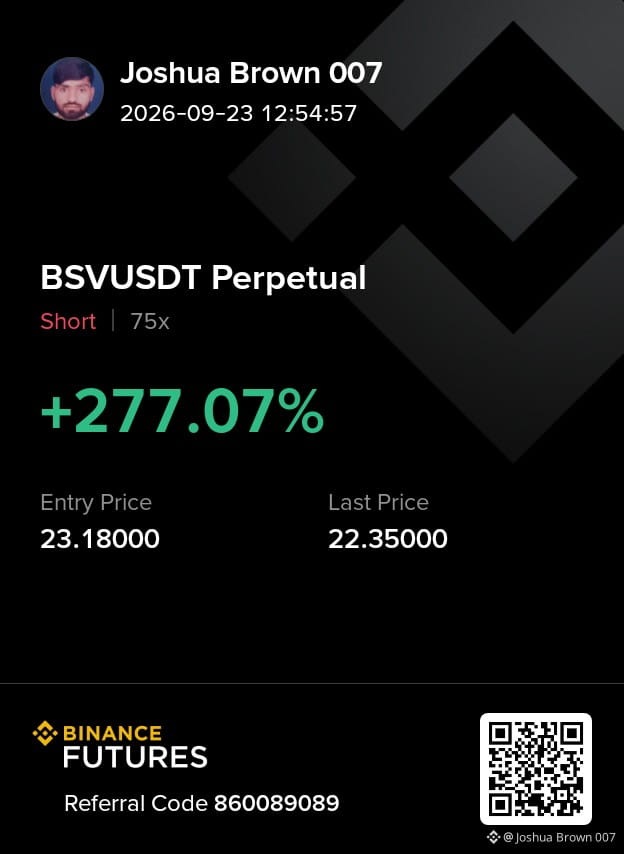
{future}(BSVUSDT)
[https://www.binance.info/en/futures/ref/860089089](https://www.binance.info/en/futures/ref/860089089)
#AIStocksWhatNext
Trade need calculate the market + passion and wait for Result😎
https://www.binance.info/en/futures/ref/860089089
Trade need calculate the market + passion and wait for Result😎
https://www.binance.info/en/futures/ref/860089089
135
Article
SEC Innovation Exemption Could Open the Door to Tokenized Stock Platforms in Q4Something important is changing between traditional Wall Street and blockchain.
On September 17, 2026, the U.S. Securities and Exchange Commission (SEC) introduced its temporary Innovation Exemption, creating a regulatory pathway for certain platforms to trade tokenized U.S. stocks on blockchain-based venues. The development could allow interested tokenized-stock platforms to announce plans as early as Q4 2026.
But before looking at the crypto impact, it is important to understand what the SEC actually does.
What is the SEC?
The Securities and Exchange Commission is the U.S. federal regulator responsible for overseeing the securities markets.
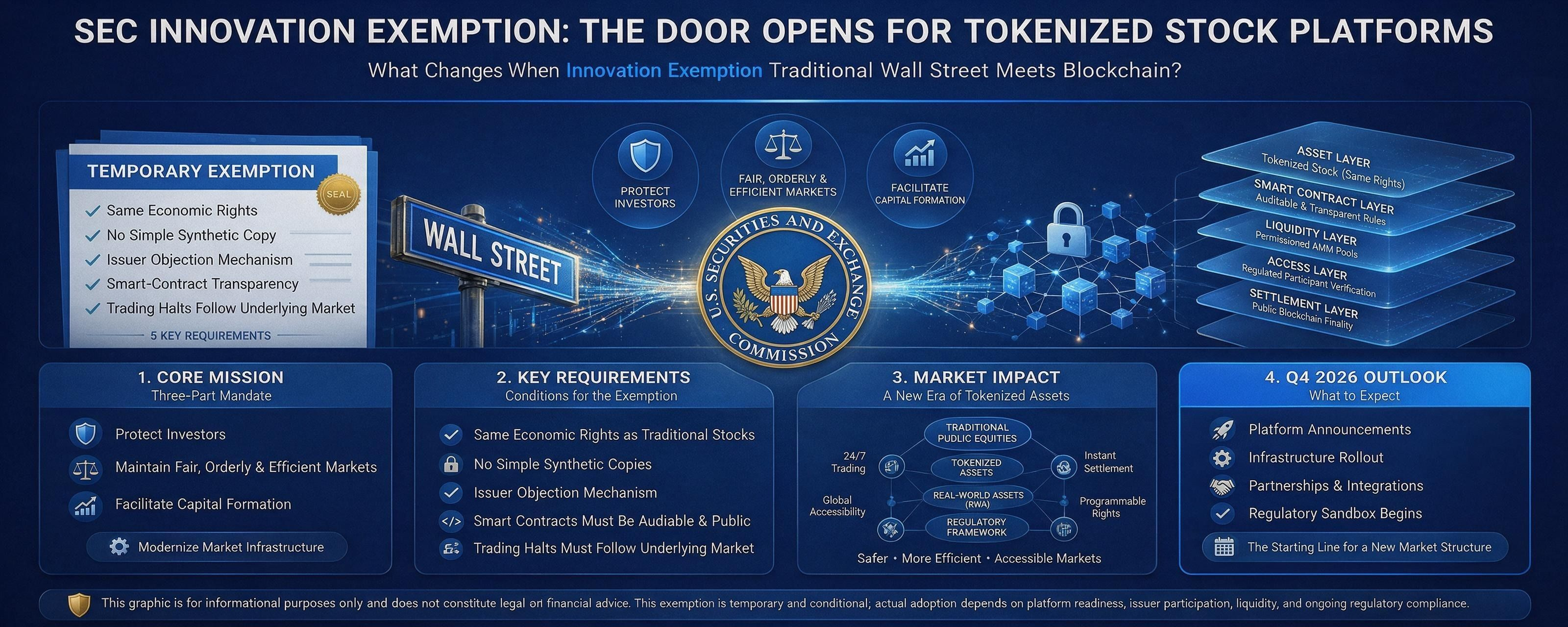
Its core mission has three parts:
Protect investorsMaintain fair, orderly and efficient marketsFacilitate capital formation
The SEC also oversees securities exchanges, brokers, dealers, investment advisers and other important parts of the U.S. securities ecosystem.
So when the SEC changes how tokenized stocks can be traded, this isn't simply a crypto announcement.
It potentially changes the infrastructure connecting blockchain + traditional equities.
What exactly changed?
The SEC granted temporary, conditional exemptions to Tokenized Securities Venues (TSVs).
These venues can use permissioned automated market makers and liquidity pools to facilitate trading of certain tokenized National Market System (NMS) stocks. The order also provides conditional relief for certain liquidity providers from the dealer definition.
The important word is conditional.
This is not a blanket approval for every crypto platform to tokenize every stock.
The framework includes several requirements.
For example:
1. Same economic rights
A tokenized stock must provide holders with the same rights and privileges as the equivalent traditional stock, including relevant dividend and voting rights.
2. No simple synthetic copy
The framework is designed around tokenized securities rather than tokens that merely imitate a stock's price without representing the underlying security rights.
3. Issuer objection mechanism
When a third party tokenizes a stock, the issuer must receive notice and an opportunity to object.
4. Smart-contract transparency
Smart contracts used by TSVs must be auditable and public, and deployed on a public, permissionless distributed ledger.
5. Trading halts must follow the underlying market
If trading in the underlying stock stops on its primary exchange, trading of its tokenized version must also stop.
The exemption is temporary and is scheduled to expire five years after publication, while the SEC collects public comments and considers longer-term rules.
Fundamental Analysis
The fundamental story is bigger than simply putting stock tickers on a blockchain.
Tokenization could potentially change several layers of market infrastructure:
Settlement:
Blockchain-based settlement can reduce the number of intermediaries involved in transferring ownership.
Transparency:
Onchain records can provide a verifiable transaction history.
Liquidity:
Permissioned AMM liquidity pools create a different mechanism for matching buyers and sellers.
Market access:
Tokenized securities could eventually make equity infrastructure more interoperable with digital-asset markets.
24/7 infrastructure:
Blockchain markets can technically operate outside traditional exchange hours, although the SEC framework still requires tokenized trading to respect restrictions such as underlying-stock trading halts.
The SEC itself has described tokenization as having potential to modernize issuance, trading, transfer, settlement and ownership-recording infrastructure.
That is why this development matters beyond crypto.
It is potentially an infrastructure upgrade, not simply another token narrative.
Technical Analysis What Changes on the Blockchain Side?
From a technical perspective, the interesting part is the combination of:
Tokenized equity + smart contracts + AMM liquidity + permissioned access + public blockchain settlement.
The architecture creates several important components:
Asset layer → token represents the underlying stock rights.
Smart-contract layer → rules govern transfers and trading.
Liquidity layer → AMM pools provide liquidity.
Access layer → only permitted participants can interact with the relevant trading venue.
Settlement layer → blockchain records transactions and ownership.
This is different from many existing crypto platforms where a token simply tracks the price of an external asset.
The SEC framework specifically focuses on tokenized NMS stock with underlying securities rights.
That distinction could become extremely important for the future of RWA markets.
What Could Happen in Q4 2026?
The current headline says platforms could announce plans as early as next quarter.
That should not be interpreted as:
Tokenized stock trading is guaranteed to launch next quarter.
The SEC has created a regulatory pathway. Individual platforms still need to satisfy the conditions, build the infrastructure, establish liquidity, address issuer participation and meet applicable requirements.
But Q4 could become an important period for announcements, partnerships and platform development.
Major financial and crypto companies have already shown interest in tokenized equities, while traditional market infrastructure providers are also exploring tokenization.
The Bigger Crypto Impact
If tokenized equities gain meaningful adoption, the boundary between crypto markets and traditional capital markets becomes much thinner.
Imagine one infrastructure where investors can interact with:
BTC
ETH
Tokenized equities
Tokenized funds
Tokenized Treasuries
Other RWAs
The technology doesn't automatically guarantee adoption.
The real test will be:
Liquidity → regulation → issuer participation → custody → settlement → investor demand.
That is where the next phase of tokenization will be decided.
For me, the most interesting part of this SEC decision isn't the headline that “stocks are coming onchain.”
It is that regulators are now experimenting with the market infrastructure itself.
And if Q4 2026 brings actual platform announcements, the tokenization narrative could move from an RWA concept into a real market-structure experiment.
Not financial advice. The exemption is temporary and conditional, and actual adoption remains dependent on platforms, issuers, liquidity and regulatory requirements.
#Binance #SEC #TokenizedStockPlatformsCouldLaunchNextQuarter $NVDAB $NVDA.US $GOOGL.US
{spot}(NVDABUSDT)
{future}(NVDAUSDT)
SEC Innovation Exemption Could Open the Door to Tokenized Stock Platforms in Q4
Something important is changing between traditional Wall Street and blockchain.
On September 17, 2026, the U.S. Securities and Exchange Commission (SEC) introduced its temporary Innovation Exemption, creating a regulatory pathway for certain platforms to trade tokenized U.S. stocks on blockchain-based venues. The development could allow interested tokenized-stock platforms to announce plans as early as Q4 2026.
But before looking at the crypto impact, it is important to understand what the SEC actually does.
What is the SEC?
The Securities and Exchange Commission is the U.S. federal regulator responsible for overseeing the securities markets.
Its core mission has three parts:
Protect investorsMaintain fair, orderly and efficient marketsFacilitate capital formation
The SEC also oversees securities exchanges, brokers, dealers, investment advisers and other important parts of the U.S. securities ecosystem.
So when the SEC changes how tokenized stocks can be traded, this isn't simply a crypto announcement.
It potentially changes the infrastructure connecting blockchain + traditional equities.
What exactly changed?
The SEC granted temporary, conditional exemptions to Tokenized Securities Venues (TSVs).
These venues can use permissioned automated market makers and liquidity pools to facilitate trading of certain tokenized National Market System (NMS) stocks. The order also provides conditional relief for certain liquidity providers from the dealer definition.
The important word is conditional.
This is not a blanket approval for every crypto platform to tokenize every stock.
The framework includes several requirements.
For example:
1. Same economic rights
A tokenized stock must provide holders with the same rights and privileges as the equivalent traditional stock, including relevant dividend and voting rights.
2. No simple synthetic copy
The framework is designed around tokenized securities rather than tokens that merely imitate a stock's price without representing the underlying security rights.
3. Issuer objection mechanism
When a third party tokenizes a stock, the issuer must receive notice and an opportunity to object.
4. Smart-contract transparency
Smart contracts used by TSVs must be auditable and public, and deployed on a public, permissionless distributed ledger.
5. Trading halts must follow the underlying market
If trading in the underlying stock stops on its primary exchange, trading of its tokenized version must also stop.
The exemption is temporary and is scheduled to expire five years after publication, while the SEC collects public comments and considers longer-term rules.
Fundamental Analysis
The fundamental story is bigger than simply putting stock tickers on a blockchain.
Tokenization could potentially change several layers of market infrastructure:
Settlement:
Blockchain-based settlement can reduce the number of intermediaries involved in transferring ownership.
Transparency:
Onchain records can provide a verifiable transaction history.
Liquidity:
Permissioned AMM liquidity pools create a different mechanism for matching buyers and sellers.
Market access:
Tokenized securities could eventually make equity infrastructure more interoperable with digital-asset markets.
24/7 infrastructure:
Blockchain markets can technically operate outside traditional exchange hours, although the SEC framework still requires tokenized trading to respect restrictions such as underlying-stock trading halts.
The SEC itself has described tokenization as having potential to modernize issuance, trading, transfer, settlement and ownership-recording infrastructure.
That is why this development matters beyond crypto.
It is potentially an infrastructure upgrade, not simply another token narrative.
Technical Analysis What Changes on the Blockchain Side?
From a technical perspective, the interesting part is the combination of:
Tokenized equity + smart contracts + AMM liquidity + permissioned access + public blockchain settlement.
The architecture creates several important components:
Asset layer → token represents the underlying stock rights.
Smart-contract layer → rules govern transfers and trading.
Liquidity layer → AMM pools provide liquidity.
Access layer → only permitted participants can interact with the relevant trading venue.
Settlement layer → blockchain records transactions and ownership.
This is different from many existing crypto platforms where a token simply tracks the price of an external asset.
The SEC framework specifically focuses on tokenized NMS stock with underlying securities rights.
That distinction could become extremely important for the future of RWA markets.
What Could Happen in Q4 2026?
The current headline says platforms could announce plans as early as next quarter.
That should not be interpreted as:
Tokenized stock trading is guaranteed to launch next quarter.
The SEC has created a regulatory pathway. Individual platforms still need to satisfy the conditions, build the infrastructure, establish liquidity, address issuer participation and meet applicable requirements.
But Q4 could become an important period for announcements, partnerships and platform development.
Major financial and crypto companies have already shown interest in tokenized equities, while traditional market infrastructure providers are also exploring tokenization.
The Bigger Crypto Impact
If tokenized equities gain meaningful adoption, the boundary between crypto markets and traditional capital markets becomes much thinner.
Imagine one infrastructure where investors can interact with:
BTC
ETH
Tokenized equities
Tokenized funds
Tokenized Treasuries
Other RWAs
The technology doesn't automatically guarantee adoption.
The real test will be:
Liquidity → regulation → issuer participation → custody → settlement → investor demand.
That is where the next phase of tokenization will be decided.
For me, the most interesting part of this SEC decision isn't the headline that “stocks are coming onchain.”
It is that regulators are now experimenting with the market infrastructure itself.
And if Q4 2026 brings actual platform announcements, the tokenization narrative could move from an RWA concept into a real market-structure experiment.
Not financial advice. The exemption is temporary and conditional, and actual adoption remains dependent on platforms, issuers, liquidity and regulatory requirements.
#Binance #SEC #TokenizedStockPlatformsCouldLaunchNextQuarter $NVDAB $NVDA.US $GOOGL.US
On September 17, 2026, the U.S. Securities and Exchange Commission (SEC) introduced its temporary Innovation Exemption, creating a regulatory pathway for certain platforms to trade tokenized U.S. stocks on blockchain-based venues. The development could allow interested tokenized-stock platforms to announce plans as early as Q4 2026.
But before looking at the crypto impact, it is important to understand what the SEC actually does.
What is the SEC?
The Securities and Exchange Commission is the U.S. federal regulator responsible for overseeing the securities markets.
Its core mission has three parts:
Protect investorsMaintain fair, orderly and efficient marketsFacilitate capital formation
The SEC also oversees securities exchanges, brokers, dealers, investment advisers and other important parts of the U.S. securities ecosystem.
So when the SEC changes how tokenized stocks can be traded, this isn't simply a crypto announcement.
It potentially changes the infrastructure connecting blockchain + traditional equities.
What exactly changed?
The SEC granted temporary, conditional exemptions to Tokenized Securities Venues (TSVs).
These venues can use permissioned automated market makers and liquidity pools to facilitate trading of certain tokenized National Market System (NMS) stocks. The order also provides conditional relief for certain liquidity providers from the dealer definition.
The important word is conditional.
This is not a blanket approval for every crypto platform to tokenize every stock.
The framework includes several requirements.
For example:
1. Same economic rights
A tokenized stock must provide holders with the same rights and privileges as the equivalent traditional stock, including relevant dividend and voting rights.
2. No simple synthetic copy
The framework is designed around tokenized securities rather than tokens that merely imitate a stock's price without representing the underlying security rights.
3. Issuer objection mechanism
When a third party tokenizes a stock, the issuer must receive notice and an opportunity to object.
4. Smart-contract transparency
Smart contracts used by TSVs must be auditable and public, and deployed on a public, permissionless distributed ledger.
5. Trading halts must follow the underlying market
If trading in the underlying stock stops on its primary exchange, trading of its tokenized version must also stop.
The exemption is temporary and is scheduled to expire five years after publication, while the SEC collects public comments and considers longer-term rules.
Fundamental Analysis
The fundamental story is bigger than simply putting stock tickers on a blockchain.
Tokenization could potentially change several layers of market infrastructure:
Settlement:
Blockchain-based settlement can reduce the number of intermediaries involved in transferring ownership.
Transparency:
Onchain records can provide a verifiable transaction history.
Liquidity:
Permissioned AMM liquidity pools create a different mechanism for matching buyers and sellers.
Market access:
Tokenized securities could eventually make equity infrastructure more interoperable with digital-asset markets.
24/7 infrastructure:
Blockchain markets can technically operate outside traditional exchange hours, although the SEC framework still requires tokenized trading to respect restrictions such as underlying-stock trading halts.
The SEC itself has described tokenization as having potential to modernize issuance, trading, transfer, settlement and ownership-recording infrastructure.
That is why this development matters beyond crypto.
It is potentially an infrastructure upgrade, not simply another token narrative.
Technical Analysis What Changes on the Blockchain Side?
From a technical perspective, the interesting part is the combination of:
Tokenized equity + smart contracts + AMM liquidity + permissioned access + public blockchain settlement.
The architecture creates several important components:
Asset layer → token represents the underlying stock rights.
Smart-contract layer → rules govern transfers and trading.
Liquidity layer → AMM pools provide liquidity.
Access layer → only permitted participants can interact with the relevant trading venue.
Settlement layer → blockchain records transactions and ownership.
This is different from many existing crypto platforms where a token simply tracks the price of an external asset.
The SEC framework specifically focuses on tokenized NMS stock with underlying securities rights.
That distinction could become extremely important for the future of RWA markets.
What Could Happen in Q4 2026?
The current headline says platforms could announce plans as early as next quarter.
That should not be interpreted as:
Tokenized stock trading is guaranteed to launch next quarter.
The SEC has created a regulatory pathway. Individual platforms still need to satisfy the conditions, build the infrastructure, establish liquidity, address issuer participation and meet applicable requirements.
But Q4 could become an important period for announcements, partnerships and platform development.
Major financial and crypto companies have already shown interest in tokenized equities, while traditional market infrastructure providers are also exploring tokenization.
The Bigger Crypto Impact
If tokenized equities gain meaningful adoption, the boundary between crypto markets and traditional capital markets becomes much thinner.
Imagine one infrastructure where investors can interact with:
BTC
ETH
Tokenized equities
Tokenized funds
Tokenized Treasuries
Other RWAs
The technology doesn't automatically guarantee adoption.
The real test will be:
Liquidity → regulation → issuer participation → custody → settlement → investor demand.
That is where the next phase of tokenization will be decided.
For me, the most interesting part of this SEC decision isn't the headline that “stocks are coming onchain.”
It is that regulators are now experimenting with the market infrastructure itself.
And if Q4 2026 brings actual platform announcements, the tokenization narrative could move from an RWA concept into a real market-structure experiment.
Not financial advice. The exemption is temporary and conditional, and actual adoption remains dependent on platforms, issuers, liquidity and regulatory requirements.
#Binance #SEC #TokenizedStockPlatformsCouldLaunchNextQuarter $NVDAB $NVDA.US $GOOGL.US
1
178
Top 10 assets By volume Crypto Market Snapshot | September 20, 2026.
The Rotation Is Getting Interesting
September 20 data shows strong 7 day momentum across several major altcoins.
🔹 $NEAR: +81.10% in 7D biggest move in this group
🔹 $AVAX: +55.49%
🔹 $UNI: +42.89%
🔹 $HYPE: +21.17%
🔹 $DOT: +13.53%
🔹 $LINK: +11.70%
🔹 $LTC: +9.31%
🔹 $XRP: +5.16%
The interesting part is volume.
$XRP traded $2.69B, $NEAR $2.05B, $AVAX $1.48B and $HYPE $854M in 24h.
This isn't just a price move capital and volume are rotating across different sectors.
But after such sharp weekly gains, volatility can expand quickly.
I’m watching whether volume continues to confirm the move or starts fading.
Not chasing candles. Watching the flow.
Top 10 assets By volume Crypto Market Snapshot | September 20, 2026.
The Rotation Is Getting Interesting
September 20 data shows strong 7 day momentum across several major altcoins.
🔹 $NEAR: +81.10% in 7D biggest move in this group
🔹 $AVAX: +55.49%
🔹 $UNI: +42.89%
🔹 $HYPE: +21.17%
🔹 $DOT: +13.53%
🔹 $LINK: +11.70%
🔹 $LTC: +9.31%
🔹 $XRP: +5.16%
The interesting part is volume.
$XRP traded $2.69B, $NEAR $2.05B, $AVAX $1.48B and $HYPE $854M in 24h.
This isn't just a price move capital and volume are rotating across different sectors.
But after such sharp weekly gains, volatility can expand quickly.
I’m watching whether volume continues to confirm the move or starts fading.
Not chasing candles. Watching the flow.
The Rotation Is Getting Interesting
September 20 data shows strong 7 day momentum across several major altcoins.
🔹 $NEAR: +81.10% in 7D biggest move in this group
🔹 $AVAX: +55.49%
🔹 $UNI: +42.89%
🔹 $HYPE: +21.17%
🔹 $DOT: +13.53%
🔹 $LINK: +11.70%
🔹 $LTC: +9.31%
🔹 $XRP: +5.16%
The interesting part is volume.
$XRP traded $2.69B, $NEAR $2.05B, $AVAX $1.48B and $HYPE $854M in 24h.
This isn't just a price move capital and volume are rotating across different sectors.
But after such sharp weekly gains, volatility can expand quickly.
I’m watching whether volume continues to confirm the move or starts fading.
Not chasing candles. Watching the flow.
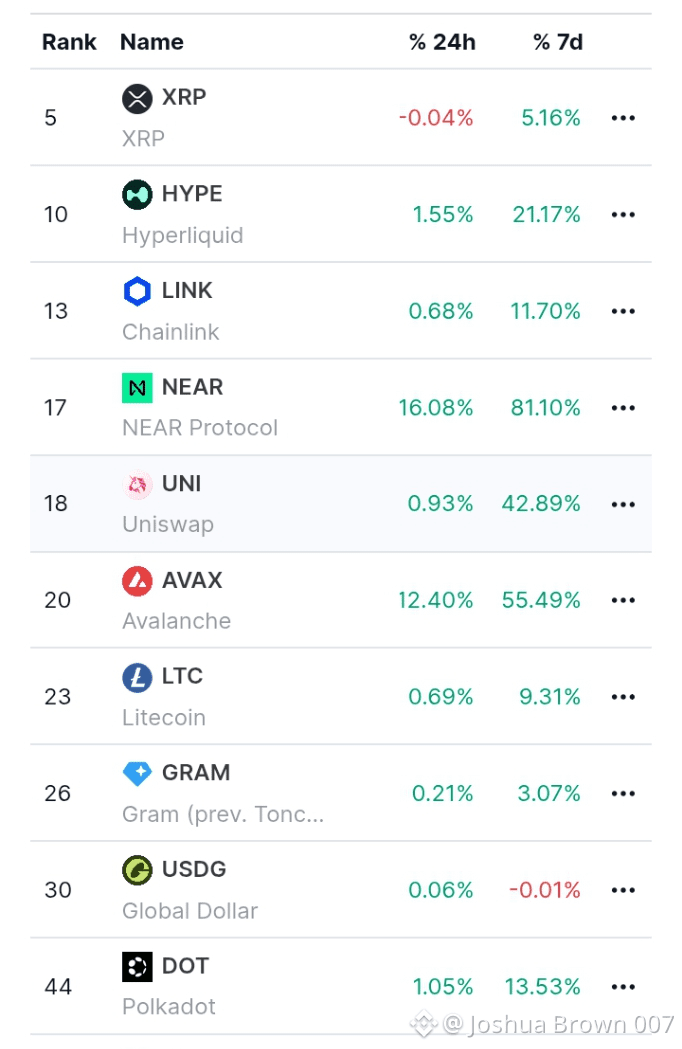
1
386
$KERNEL is up sharply but tomorrow starts a supply test.
KERNEL is around $0.0673, already +57% on the screen I’m watching.
But from Sept. 23, the token unlock schedule shows:
492,182 KERNEL every day = 0.05% of max supply
Sept 23 → 24 → 25 → 26 → 27…
This same rate continues, that’s ~1% of max supply next 20 days.
At $0.0673, each daily unlock is roughly $33K worth of tokens.
That sounds small but KERNEL’s circulating supply is only around 28.8% of the 1B max supply, so even a relatively small daily release increases available supply.
Tokenomist +1
The interesting part:
Price is pumping +57%, while new supply is entering daily.
That creates two forces:
🟢 Strong volume can absorb the new tokens
🔴 Weak demand can turn unlocks into selling pressure
And KERNEL has historically shown notable volatility around larger unlock events; previous unlocks were followed by declines in several periods, although that does not mean the same pattern must repeat.
So tomorrow I’m watching:
Price + Volume + CEX inflows + Daily unlocks
The pump is one story.
The supply entering the market is the story I’m watching next.
#DAO #ARB🔥🔥🔥 #NEARRisesNearly80%InAWeek
{future}(KERNELUSDT)
{future}(ARBUSDT)
{future}(NEARUSDT)
$KERNEL is up sharply but tomorrow starts a supply test.
KERNEL is around $0.0673, already +57% on the screen I’m watching.
But from Sept. 23, the token unlock schedule shows:
492,182 KERNEL every day = 0.05% of max supply
Sept 23 → 24 → 25 → 26 → 27…
This same rate continues, that’s ~1% of max supply next 20 days.
At $0.0673, each daily unlock is roughly $33K worth of tokens.
That sounds small but KERNEL’s circulating supply is only around 28.8% of the 1B max supply, so even a relatively small daily release increases available supply.
Tokenomist +1
The interesting part:
Price is pumping +57%, while new supply is entering daily.
That creates two forces:
🟢 Strong volume can absorb the new tokens
🔴 Weak demand can turn unlocks into selling pressure
And KERNEL has historically shown notable volatility around larger unlock events; previous unlocks were followed by declines in several periods, although that does not mean the same pattern must repeat.
So tomorrow I’m watching:
Price + Volume + CEX inflows + Daily unlocks
The pump is one story.
The supply entering the market is the story I’m watching next.
#DAO #ARB🔥🔥🔥 #NEARRisesNearly80%InAWeek
KERNEL is around $0.0673, already +57% on the screen I’m watching.
But from Sept. 23, the token unlock schedule shows:
492,182 KERNEL every day = 0.05% of max supply
Sept 23 → 24 → 25 → 26 → 27…
This same rate continues, that’s ~1% of max supply next 20 days.
At $0.0673, each daily unlock is roughly $33K worth of tokens.
That sounds small but KERNEL’s circulating supply is only around 28.8% of the 1B max supply, so even a relatively small daily release increases available supply.
Tokenomist +1
The interesting part:
Price is pumping +57%, while new supply is entering daily.
That creates two forces:
🟢 Strong volume can absorb the new tokens
🔴 Weak demand can turn unlocks into selling pressure
And KERNEL has historically shown notable volatility around larger unlock events; previous unlocks were followed by declines in several periods, although that does not mean the same pattern must repeat.
So tomorrow I’m watching:
Price + Volume + CEX inflows + Daily unlocks
The pump is one story.
The supply entering the market is the story I’m watching next.
#DAO #ARB🔥🔥🔥 #NEARRisesNearly80%InAWeek
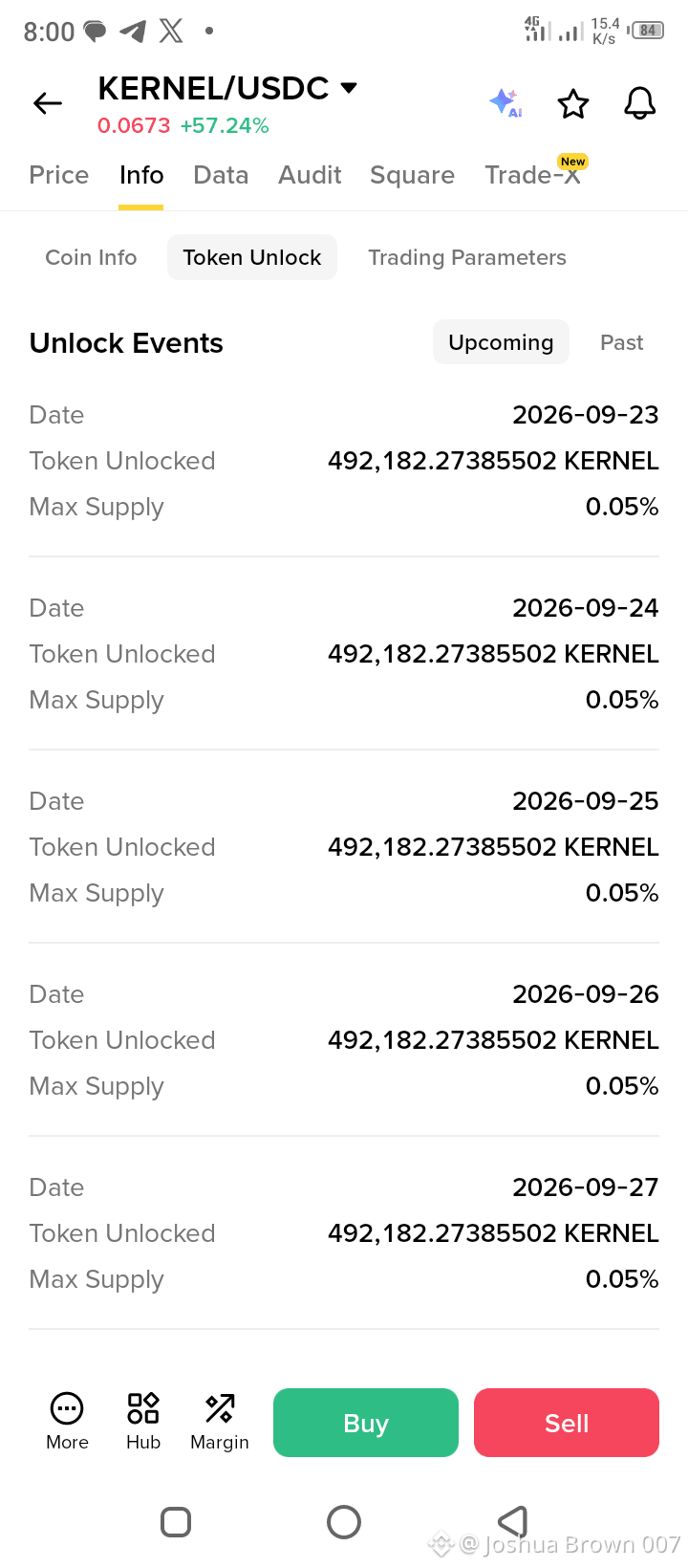
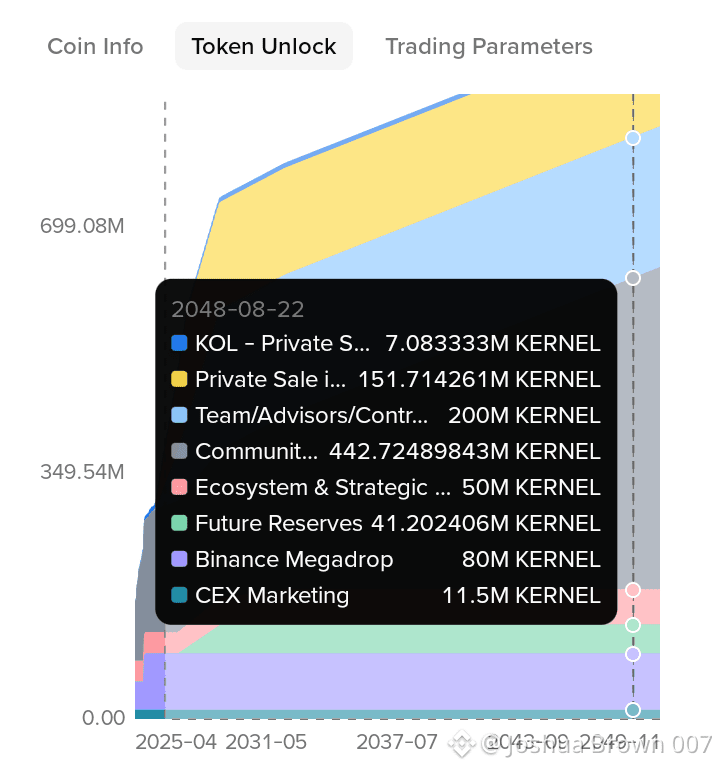
1
1
454
#Binance
I checked the latest CoinMarketCap derivatives data and one number immediately stands out:
$BNB’s ecosystem exchange, Binance, is still dominating derivatives.
Binance • $35.09B Open Interest • $51.10B 24H derivatives volume • 803 markets • 0.02% maker fee • 0.04% taker fee
For comparison, OKX has ~$7.86B OI and Bybit ~$6.76B.
That gap matters.
Open Interest shows how much derivative exposure is still active, while volume shows how aggressively traders are moving capital through the market.
But remember: high OI doesn't automatically mean bullish.
It means leverage and positioning are building.
And when leverage gets crowded, volatility can become brutal in either direction.
I’m watching OI + volume + funding + liquidations together not just price.
{spot}(BNBUSDT)
$PHA
{future}(PHAUSDT)
$SUI
{future}(SUIUSDT)
#Binance
I checked the latest CoinMarketCap derivatives data and one number immediately stands out:
$BNB’s ecosystem exchange, Binance, is still dominating derivatives.
Binance • $35.09B Open Interest • $51.10B 24H derivatives volume • 803 markets • 0.02% maker fee • 0.04% taker fee
For comparison, OKX has ~$7.86B OI and Bybit ~$6.76B.
That gap matters.
Open Interest shows how much derivative exposure is still active, while volume shows how aggressively traders are moving capital through the market.
But remember: high OI doesn't automatically mean bullish.
It means leverage and positioning are building.
And when leverage gets crowded, volatility can become brutal in either direction.
I’m watching OI + volume + funding + liquidations together not just price.
$PHA
$SUI
I checked the latest CoinMarketCap derivatives data and one number immediately stands out:
$BNB’s ecosystem exchange, Binance, is still dominating derivatives.
Binance • $35.09B Open Interest • $51.10B 24H derivatives volume • 803 markets • 0.02% maker fee • 0.04% taker fee
For comparison, OKX has ~$7.86B OI and Bybit ~$6.76B.
That gap matters.
Open Interest shows how much derivative exposure is still active, while volume shows how aggressively traders are moving capital through the market.
But remember: high OI doesn't automatically mean bullish.
It means leverage and positioning are building.
And when leverage gets crowded, volatility can become brutal in either direction.
I’m watching OI + volume + funding + liquidations together not just price.
$PHA
$SUI
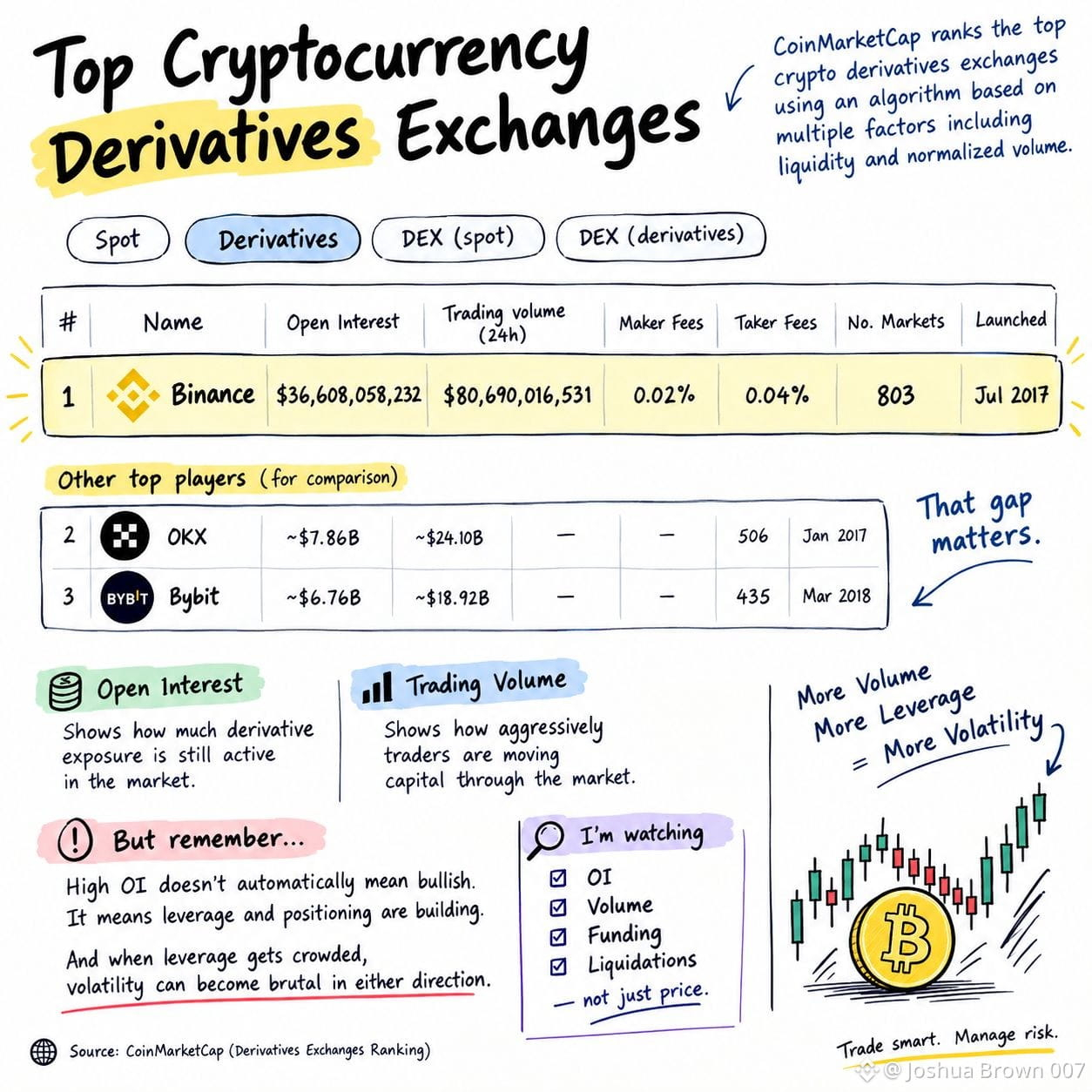
1
214
Log in to explore more content
Join global crypto users on Binance Square
⚡️ Get latest and useful information about crypto.
💬 Trusted by the world’s largest crypto exchange.
👍 Discover real insights from verified creators.
Email / Phone number
Trending Topics
BitcoinClears$85200
7,168 views
179 Discussing
We got the move, and $BTC is standing exactly where we were before the data. That’s what actual patience for a trade looks like.
The data came in mixed but with some important numbers. ADP Non-Farm Employment Change came at 90K vs 73K forecast, while Core PCE came in at 0.2% vs 0.3% expected. Final GDP was also stronger at 2.2% vs 1.5% forecast, while Personal Spending came in at 0.9% vs 0.8% expected. At the same time, Personal Income missed at 0.2% vs 0.5% forecast.
BTC initially surged to $85,600 and is now back where it needs to be. I’m still looking toward the lower ranges at $82,759 and the $80,000 liquidity, because the overhead liquidity is done and dusted.
We had a live session during the data, and during that session we saw the market at $83,800, then $85,600, and then back toward $83,000 and we still didn’t enter a trade.
That’s what patience is.
We can’t force an entry when the market has no clear direction. The same range is still in focus, and we’ll wait for the market to give us the setup.
Let me know, guys, how was the session? And should we have more regular sessions with our respected members so we can have proper discussions regarding the market?
#BitcoinClears$85200 #AltcoinSeasonIndexHoldsAbove60For5Days #USADPAdds90000JobsInSeptember #BitcoinSlipsBelow$84000 #SECToClarifyOnChainFundraisingRules
Crypto_LUX
·24 Likes
·13.7k views
AltcoinSeasonIndexHoldsAbove60For5Days
38,837 views
984 Discussing
USADPAdds90000JobsInSeptember
17,534 views
559 Discussing