
Finance_fx
1k Posts

Finance_fx
Report
Block User
Crypto & macro analyst | Focus on BTC, ETH & altcoins | Sharing insights on markets, adoption & finance trends.
0 Following
3.8K+ Followers
2.8K+ Liked
Posts
·
--
$API3 is starting to look interesting again, and this move has more behind it than just a random small-cap pump.
API3 trades around $0.246, up roughly 5.6% over 24H, with about $8.9M in volume. At only ~$21M market cap and CMC rank #661, volume relative to valuation is unusually high.
API3 provides first-party oracle infrastructure, allowing data providers to deliver information directly onchain. Its OEV Network also lets DeFi protocols recapture value normally lost through oracle-related liquidations.
Fundamentally, there's a new angle: the DAO recently approved using OEV revenue, curator fees and ETH staking yield for recurring API3 market purchases. That creates a direct link between protocol revenue and token demand.
Technically, price has reclaimed the 20, 50 and 100-day EMAs. Daily RSI sits near 60 and MACD has turned positive, showing improving momentum. The 200-day EMA remains overhead, so the larger reversal isn't confirmed yet.
Support: $0.236, then $0.224
Resistance: $0.255–$0.266, then $0.274
Bull case: hold $0.236 and break $0.266 with sustained volume. A move through $0.274 would strengthen the higher-high structure.
Bear case: losing $0.236 would weaken momentum and put $0.224 back in play.
One risk matters: API3 has no fixed max supply and staking emissions remain significant.
For me, $0.266–$0.274 is the confirmation zone. Until that breaks, this is an early recovery with a genuine fundamental catalyst, not a confirmed breakout.
#Oracles #DeFi #CryptoAnalysis
$API3 is starting to look interesting again, and this move has more behind it than just a random small-cap pump.
API3 trades around $0.246, up roughly 5.6% over 24H, with about $8.9M in volume. At only ~$21M market cap and CMC rank #661, volume relative to valuation is unusually high.
API3 provides first-party oracle infrastructure, allowing data providers to deliver information directly onchain. Its OEV Network also lets DeFi protocols recapture value normally lost through oracle-related liquidations.
Fundamentally, there's a new angle: the DAO recently approved using OEV revenue, curator fees and ETH staking yield for recurring API3 market purchases. That creates a direct link between protocol revenue and token demand.
Technically, price has reclaimed the 20, 50 and 100-day EMAs. Daily RSI sits near 60 and MACD has turned positive, showing improving momentum. The 200-day EMA remains overhead, so the larger reversal isn't confirmed yet.
Support: $0.236, then $0.224
Resistance: $0.255–$0.266, then $0.274
Bull case: hold $0.236 and break $0.266 with sustained volume. A move through $0.274 would strengthen the higher-high structure.
Bear case: losing $0.236 would weaken momentum and put $0.224 back in play.
One risk matters: API3 has no fixed max supply and staking emissions remain significant.
For me, $0.266–$0.274 is the confirmation zone. Until that breaks, this is an early recovery with a genuine fundamental catalyst, not a confirmed breakout.
#Oracles #DeFi #CryptoAnalysis
API3 trades around $0.246, up roughly 5.6% over 24H, with about $8.9M in volume. At only ~$21M market cap and CMC rank #661, volume relative to valuation is unusually high.
API3 provides first-party oracle infrastructure, allowing data providers to deliver information directly onchain. Its OEV Network also lets DeFi protocols recapture value normally lost through oracle-related liquidations.
Fundamentally, there's a new angle: the DAO recently approved using OEV revenue, curator fees and ETH staking yield for recurring API3 market purchases. That creates a direct link between protocol revenue and token demand.
Technically, price has reclaimed the 20, 50 and 100-day EMAs. Daily RSI sits near 60 and MACD has turned positive, showing improving momentum. The 200-day EMA remains overhead, so the larger reversal isn't confirmed yet.
Support: $0.236, then $0.224
Resistance: $0.255–$0.266, then $0.274
Bull case: hold $0.236 and break $0.266 with sustained volume. A move through $0.274 would strengthen the higher-high structure.
Bear case: losing $0.236 would weaken momentum and put $0.224 back in play.
One risk matters: API3 has no fixed max supply and staking emissions remain significant.
For me, $0.266–$0.274 is the confirmation zone. Until that breaks, this is an early recovery with a genuine fundamental catalyst, not a confirmed breakout.
#Oracles #DeFi #CryptoAnalysis
203
·
--
$BTC rallying alongside bond purchases makes for a great “stealth QE” headline, but the mechanics matter.
The Treasury buybacks and Fed balance-sheet operations are not the same thing.
Treasury expanded its long-end liquidity-support buybacks from $2B to at least $4B per operation, with one recent operation authorized up to $6B. The objective is improving liquidity in older, less-liquid Treasury securities, not creating new bank reserves through monetary QE.
That distinction becomes even more important after the Fed just raised rates by 25bps to 3.75–4.00%. Calling the current setup outright QE while monetary policy is simultaneously being tightened misses a big part of the picture.
But markets trade liquidity expectations as well as definitions.
Lower long-term yields can loosen financial conditions, weaken the dollar narrative and improve the relative appeal of scarce assets. Add heavy short positioning and Bitcoin can move much faster than the underlying macro impulse alone would suggest.
So I wouldn't call this stealth QE.
I'd call it a reminder that Bitcoin is extremely sensitive to changes in marginal liquidity and bond-market expectations. The bigger test comes if actual monetary policy eventually turns easier while that sensitivity remains.
#Bitcoin #Macro
$BTC rallying alongside bond purchases makes for a great “stealth QE” headline, but the mechanics matter.
The Treasury buybacks and Fed balance-sheet operations are not the same thing.
Treasury expanded its long-end liquidity-support buybacks from $2B to at least $4B per operation, with one recent operation authorized up to $6B. The objective is improving liquidity in older, less-liquid Treasury securities, not creating new bank reserves through monetary QE.
That distinction becomes even more important after the Fed just raised rates by 25bps to 3.75–4.00%. Calling the current setup outright QE while monetary policy is simultaneously being tightened misses a big part of the picture.
But markets trade liquidity expectations as well as definitions.
Lower long-term yields can loosen financial conditions, weaken the dollar narrative and improve the relative appeal of scarce assets. Add heavy short positioning and Bitcoin can move much faster than the underlying macro impulse alone would suggest.
So I wouldn't call this stealth QE.
I'd call it a reminder that Bitcoin is extremely sensitive to changes in marginal liquidity and bond-market expectations. The bigger test comes if actual monetary policy eventually turns easier while that sensitivity remains.
#Bitcoin #Macro
The Treasury buybacks and Fed balance-sheet operations are not the same thing.
Treasury expanded its long-end liquidity-support buybacks from $2B to at least $4B per operation, with one recent operation authorized up to $6B. The objective is improving liquidity in older, less-liquid Treasury securities, not creating new bank reserves through monetary QE.
That distinction becomes even more important after the Fed just raised rates by 25bps to 3.75–4.00%. Calling the current setup outright QE while monetary policy is simultaneously being tightened misses a big part of the picture.
But markets trade liquidity expectations as well as definitions.
Lower long-term yields can loosen financial conditions, weaken the dollar narrative and improve the relative appeal of scarce assets. Add heavy short positioning and Bitcoin can move much faster than the underlying macro impulse alone would suggest.
So I wouldn't call this stealth QE.
I'd call it a reminder that Bitcoin is extremely sensitive to changes in marginal liquidity and bond-market expectations. The bigger test comes if actual monetary policy eventually turns easier while that sensitivity remains.
#Bitcoin #Macro
135
·
--
$KAITO is attempting to build momentum again after spending months near the bottom of its range.
KAITO trades around $0.308, up roughly 4.5% over 24H, with a market cap near $74M and around $14M in daily volume. Price has recovered from today's $0.293 low and is now testing the upper end of its recent range.
Kaito sits in the AI/InfoFi sector. The network uses AI to organize crypto information and attention, while KAITO acts as its ecosystem currency and governance token.
Technically, the short-term structure is improving, but the bigger trend still needs confirmation. Momentum is bullish on the lower timeframes while the daily trend remains weak.
Support: $0.293–$0.296
Major support: $0.271
Resistance: $0.308–$0.310
Major resistance: $0.323
Bull case: holding $0.293 and breaking $0.310 with sustained volume would strengthen the higher-low structure. A clean move above $0.323 would be the more important breakout confirmation.
Bear case: failure around current resistance followed by a loss of $0.293 puts the $0.271 all-time-low area back in focus.
Tokenomics are the biggest risk. Only about 241M of the maximum 1B KAITO are circulating, meaning substantial future dilution remains.
For me, $0.323 is the level that changes the setup. Until then, this is an early recovery attempt, not a confirmed reversal.
#InfoFi #AI #CryptoAnalysis
$KAITO is attempting to build momentum again after spending months near the bottom of its range.
KAITO trades around $0.308, up roughly 4.5% over 24H, with a market cap near $74M and around $14M in daily volume. Price has recovered from today's $0.293 low and is now testing the upper end of its recent range.
Kaito sits in the AI/InfoFi sector. The network uses AI to organize crypto information and attention, while KAITO acts as its ecosystem currency and governance token.
Technically, the short-term structure is improving, but the bigger trend still needs confirmation. Momentum is bullish on the lower timeframes while the daily trend remains weak.
Support: $0.293–$0.296
Major support: $0.271
Resistance: $0.308–$0.310
Major resistance: $0.323
Bull case: holding $0.293 and breaking $0.310 with sustained volume would strengthen the higher-low structure. A clean move above $0.323 would be the more important breakout confirmation.
Bear case: failure around current resistance followed by a loss of $0.293 puts the $0.271 all-time-low area back in focus.
Tokenomics are the biggest risk. Only about 241M of the maximum 1B KAITO are circulating, meaning substantial future dilution remains.
For me, $0.323 is the level that changes the setup. Until then, this is an early recovery attempt, not a confirmed reversal.
#InfoFi #AI #CryptoAnalysis
KAITO trades around $0.308, up roughly 4.5% over 24H, with a market cap near $74M and around $14M in daily volume. Price has recovered from today's $0.293 low and is now testing the upper end of its recent range.
Kaito sits in the AI/InfoFi sector. The network uses AI to organize crypto information and attention, while KAITO acts as its ecosystem currency and governance token.
Technically, the short-term structure is improving, but the bigger trend still needs confirmation. Momentum is bullish on the lower timeframes while the daily trend remains weak.
Support: $0.293–$0.296
Major support: $0.271
Resistance: $0.308–$0.310
Major resistance: $0.323
Bull case: holding $0.293 and breaking $0.310 with sustained volume would strengthen the higher-low structure. A clean move above $0.323 would be the more important breakout confirmation.
Bear case: failure around current resistance followed by a loss of $0.293 puts the $0.271 all-time-low area back in focus.
Tokenomics are the biggest risk. Only about 241M of the maximum 1B KAITO are circulating, meaning substantial future dilution remains.
For me, $0.323 is the level that changes the setup. Until then, this is an early recovery attempt, not a confirmed reversal.
#InfoFi #AI #CryptoAnalysis
344
·
--
$ZRO is showing one of the more interesting interoperability setups today.
LayerZero trades around $1.01 with a market cap near $358M, ranking around #123. Price is up roughly 5% over 24H after trading as low as $0.95, while volume sits around $30M.
The catalyst matters: LayerZero's cross-chain messaging went live with Circle's Arc mainnet, connecting the institutional-focused blockchain to LayerZero's network of 170+ chains. That's a meaningful validation of the protocol's interoperability thesis.
Technically, momentum is improving. RSI is around 61 and MACD has turned positive, while price has reclaimed the short and medium-term moving averages. However, ZRO is now approaching the 200-day EMA around $1.01, making this a real decision zone.
Support: $0.97, then $0.94–$0.95
Resistance: $1.02–$1.06, then $1.15
Bull case: ZRO holds $0.97 and breaks $1.06 with sustained volume. That would strengthen the recovery structure and put $1.15 back in focus.
Bear case: rejection around $1.02–$1.06 followed by a loss of $0.94 would make today's move look like another failed breakout.
Tokenomics remain the main risk. Only about 353M of the maximum 1B ZRO are circulating, leaving substantial future dilution.
For me, $1.06 is the confirmation. The Arc integration gives the move a real fundamental catalyst, but bulls still need to prove they can break the larger downtrend.
#Interoperability #LayerZero #CryptoAnalysis
$ZRO is showing one of the more interesting interoperability setups today.
LayerZero trades around $1.01 with a market cap near $358M, ranking around #123. Price is up roughly 5% over 24H after trading as low as $0.95, while volume sits around $30M.
The catalyst matters: LayerZero's cross-chain messaging went live with Circle's Arc mainnet, connecting the institutional-focused blockchain to LayerZero's network of 170+ chains. That's a meaningful validation of the protocol's interoperability thesis.
Technically, momentum is improving. RSI is around 61 and MACD has turned positive, while price has reclaimed the short and medium-term moving averages. However, ZRO is now approaching the 200-day EMA around $1.01, making this a real decision zone.
Support: $0.97, then $0.94–$0.95
Resistance: $1.02–$1.06, then $1.15
Bull case: ZRO holds $0.97 and breaks $1.06 with sustained volume. That would strengthen the recovery structure and put $1.15 back in focus.
Bear case: rejection around $1.02–$1.06 followed by a loss of $0.94 would make today's move look like another failed breakout.
Tokenomics remain the main risk. Only about 353M of the maximum 1B ZRO are circulating, leaving substantial future dilution.
For me, $1.06 is the confirmation. The Arc integration gives the move a real fundamental catalyst, but bulls still need to prove they can break the larger downtrend.
#Interoperability #LayerZero #CryptoAnalysis
LayerZero trades around $1.01 with a market cap near $358M, ranking around #123. Price is up roughly 5% over 24H after trading as low as $0.95, while volume sits around $30M.
The catalyst matters: LayerZero's cross-chain messaging went live with Circle's Arc mainnet, connecting the institutional-focused blockchain to LayerZero's network of 170+ chains. That's a meaningful validation of the protocol's interoperability thesis.
Technically, momentum is improving. RSI is around 61 and MACD has turned positive, while price has reclaimed the short and medium-term moving averages. However, ZRO is now approaching the 200-day EMA around $1.01, making this a real decision zone.
Support: $0.97, then $0.94–$0.95
Resistance: $1.02–$1.06, then $1.15
Bull case: ZRO holds $0.97 and breaks $1.06 with sustained volume. That would strengthen the recovery structure and put $1.15 back in focus.
Bear case: rejection around $1.02–$1.06 followed by a loss of $0.94 would make today's move look like another failed breakout.
Tokenomics remain the main risk. Only about 353M of the maximum 1B ZRO are circulating, leaving substantial future dilution.
For me, $1.06 is the confirmation. The Arc integration gives the move a real fundamental catalyst, but bulls still need to prove they can break the larger downtrend.
#Interoperability #LayerZero #CryptoAnalysis
165
·
--
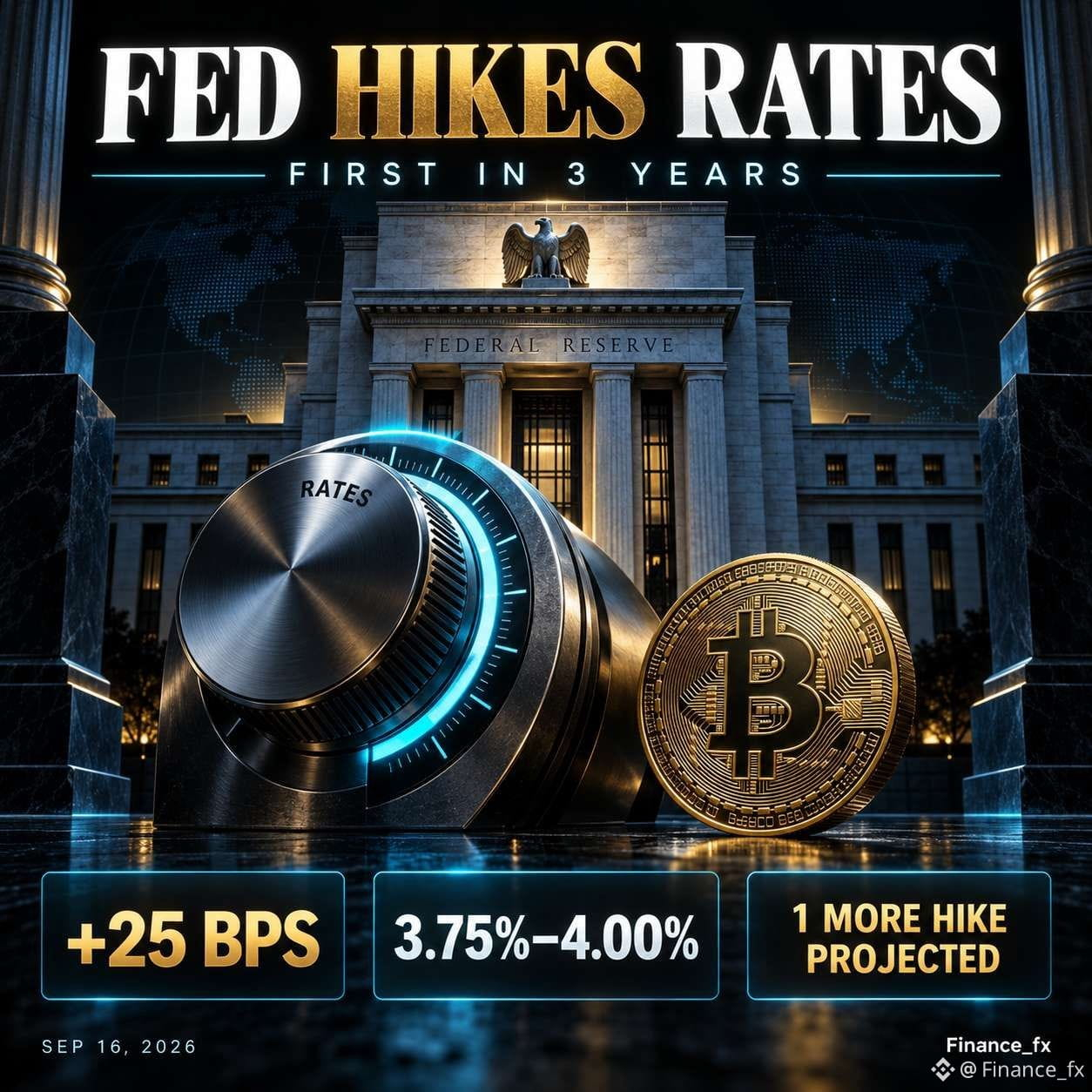
The Fed raised rates by 25 bps to 3.75%–4.00%, its first hike since 2023.
The vote was unanimous, and 16 of 18 projections point to at least one more hike this year. $BTC is holding near $75.8K.
One hike was priced in. The path from here is the real risk. #Bitcoin
The Fed raised rates by 25 bps to 3.75%–4.00%, its first hike since 2023.
The vote was unanimous, and 16 of 18 projections point to at least one more hike this year. $BTC is holding near $75.8K.
One hike was priced in. The path from here is the real risk. #Bitcoin
The vote was unanimous, and 16 of 18 projections point to at least one more hike this year. $BTC is holding near $75.8K.
One hike was priced in. The path from here is the real risk. #Bitcoin
1
1
186
·
--
PLOT TWIST: THE HOLD MAY BE THE REAL RISK
A 25bp hike is already about 92.5% priced in. It would lift the target range to 3.75–4.00% and mark the Fed’s first increase since July 2023, but the headline itself should surprise almost nobody.
A surprise hold sounds bullish for $BTC, yet the first reaction could be the opposite. Markets may ask what the Fed sees that they don’t. With inflation still sticky and oil above $100, investors could also conclude that policymakers are falling behind the curve. That would raise uncertainty, long-term yields and the risk premium across markets.
Still, I don’t think a hold would sink crypto for long. A weaker dollar and a growing “policy error” narrative could eventually support Bitcoin as a hedge.
Positioning is defensive rather than overleveraged: traders have shown a 28% net buying tilt toward stablecoins, while Bitcoin leverage remains below its yearly average. Less liquidation fuel, more cash waiting on the sidelines.
My base case: the expected hike creates a muted first move. The dot plot and Warsh’s press conference decide the real direction. Hawkish guidance hurts liquidity; a one-and-done signal could trigger a relief rally.
The rate decision is only the headline. The guidance decides the trade.
#Bitcoin #Fed #Crypto
PLOT TWIST: THE HOLD MAY BE THE REAL RISK
A 25bp hike is already about 92.5% priced in. It would lift the target range to 3.75–4.00% and mark the Fed’s first increase since July 2023, but the headline itself should surprise almost nobody.
A surprise hold sounds bullish for $BTC, yet the first reaction could be the opposite. Markets may ask what the Fed sees that they don’t. With inflation still sticky and oil above $100, investors could also conclude that policymakers are falling behind the curve. That would raise uncertainty, long-term yields and the risk premium across markets.
Still, I don’t think a hold would sink crypto for long. A weaker dollar and a growing “policy error” narrative could eventually support Bitcoin as a hedge.
Positioning is defensive rather than overleveraged: traders have shown a 28% net buying tilt toward stablecoins, while Bitcoin leverage remains below its yearly average. Less liquidation fuel, more cash waiting on the sidelines.
My base case: the expected hike creates a muted first move. The dot plot and Warsh’s press conference decide the real direction. Hawkish guidance hurts liquidity; a one-and-done signal could trigger a relief rally.
The rate decision is only the headline. The guidance decides the trade.
#Bitcoin #Fed #Crypto
A 25bp hike is already about 92.5% priced in. It would lift the target range to 3.75–4.00% and mark the Fed’s first increase since July 2023, but the headline itself should surprise almost nobody.
A surprise hold sounds bullish for $BTC, yet the first reaction could be the opposite. Markets may ask what the Fed sees that they don’t. With inflation still sticky and oil above $100, investors could also conclude that policymakers are falling behind the curve. That would raise uncertainty, long-term yields and the risk premium across markets.
Still, I don’t think a hold would sink crypto for long. A weaker dollar and a growing “policy error” narrative could eventually support Bitcoin as a hedge.
Positioning is defensive rather than overleveraged: traders have shown a 28% net buying tilt toward stablecoins, while Bitcoin leverage remains below its yearly average. Less liquidation fuel, more cash waiting on the sidelines.
My base case: the expected hike creates a muted first move. The dot plot and Warsh’s press conference decide the real direction. Hawkish guidance hurts liquidity; a one-and-done signal could trigger a relief rally.
The rate decision is only the headline. The guidance decides the trade.
#Bitcoin #Fed #Crypto
104
·
--
$T is back on my radar after a sharp volatility expansion, but the real question is whether buyers can turn that move into a higher base.
Threshold trades around $0.0044 with a market cap near $49M, ranking around #358 on CoinMarketCap. T recently pushed toward $0.0051 before giving back much of the move. Despite that rejection, it remains roughly 32% higher over the past 30 days.
Technically, $0.0043–$0.0044 is the first key support. Below that, $0.0040 becomes critical. Resistance sits around $0.0047–$0.0048, followed by the recent $0.0050–$0.0051 high.
Fundamentally, Threshold powers tBTC, a decentralized way to bring Bitcoin liquidity into DeFi without relying on a conventional centralized wrapped-BTC custodian. The protocol reports 30,000+ tBTC minted since launch and over $5B in cumulative bridge volume.
T is used for staking and governance. Roughly 11.15B T are circulating, essentially matching the reported max supply, so there isn't a large future token unlock overhang.
Bull case: $0.0043 holds, volume returns and T reclaims $0.0048. Breaking $0.0051 with strong volume would confirm improving structure.
Bear case: losing $0.0043 and especially $0.0040 would suggest the recent spike was mainly speculative liquidity.
For me, $0.0051 is the confirmation level. Until then, this is an interesting BTCFi small-cap setup, not a confirmed breakout.
#BTCFi #DeFi #CryptoAnalysis
$T is back on my radar after a sharp volatility expansion, but the real question is whether buyers can turn that move into a higher base.
Threshold trades around $0.0044 with a market cap near $49M, ranking around #358 on CoinMarketCap. T recently pushed toward $0.0051 before giving back much of the move. Despite that rejection, it remains roughly 32% higher over the past 30 days.
Technically, $0.0043–$0.0044 is the first key support. Below that, $0.0040 becomes critical. Resistance sits around $0.0047–$0.0048, followed by the recent $0.0050–$0.0051 high.
Fundamentally, Threshold powers tBTC, a decentralized way to bring Bitcoin liquidity into DeFi without relying on a conventional centralized wrapped-BTC custodian. The protocol reports 30,000+ tBTC minted since launch and over $5B in cumulative bridge volume.
T is used for staking and governance. Roughly 11.15B T are circulating, essentially matching the reported max supply, so there isn't a large future token unlock overhang.
Bull case: $0.0043 holds, volume returns and T reclaims $0.0048. Breaking $0.0051 with strong volume would confirm improving structure.
Bear case: losing $0.0043 and especially $0.0040 would suggest the recent spike was mainly speculative liquidity.
For me, $0.0051 is the confirmation level. Until then, this is an interesting BTCFi small-cap setup, not a confirmed breakout.
#BTCFi #DeFi #CryptoAnalysis
Threshold trades around $0.0044 with a market cap near $49M, ranking around #358 on CoinMarketCap. T recently pushed toward $0.0051 before giving back much of the move. Despite that rejection, it remains roughly 32% higher over the past 30 days.
Technically, $0.0043–$0.0044 is the first key support. Below that, $0.0040 becomes critical. Resistance sits around $0.0047–$0.0048, followed by the recent $0.0050–$0.0051 high.
Fundamentally, Threshold powers tBTC, a decentralized way to bring Bitcoin liquidity into DeFi without relying on a conventional centralized wrapped-BTC custodian. The protocol reports 30,000+ tBTC minted since launch and over $5B in cumulative bridge volume.
T is used for staking and governance. Roughly 11.15B T are circulating, essentially matching the reported max supply, so there isn't a large future token unlock overhang.
Bull case: $0.0043 holds, volume returns and T reclaims $0.0048. Breaking $0.0051 with strong volume would confirm improving structure.
Bear case: losing $0.0043 and especially $0.0040 would suggest the recent spike was mainly speculative liquidity.
For me, $0.0051 is the confirmation level. Until then, this is an interesting BTCFi small-cap setup, not a confirmed breakout.
#BTCFi #DeFi #CryptoAnalysis
236
·
--
$BTC is facing a regulatory catalyst where the market has already moved from optimism to damage control.
The revised CLARITY Act included 126 substantive changes requested by Democrats, including tougher ethics restrictions and greater enforcement powers for state attorneys general. That initially pushed prediction-market odds back above 30%.
But the compromise still hasn’t solved the core political problem. Democrats remain concerned that the ethics provisions do not go far enough, while banking groups are separately pushing back on stablecoin reward rules.
Now the real number isn’t 14%, 19% or 30%.
It’s 60.
Republicans control 53 Senate seats, meaning they need at least seven Democrats or independents if every Republican votes yes. Today’s cloture vote also does not pass CLARITY. It only allows the legislation to advance toward debate.
That distinction matters for crypto markets. A failed vote would extend regulatory uncertainty, but much of that disappointment is already being priced in. Clearing 60 votes, however, would be the genuine surprise and could produce the larger asymmetric market reaction.
For Bitcoin, this is less about one prediction-market percentage and more about whether Washington can finally turn years of crypto negotiations into an actual legislative path forward.
#Bitcoin #Crypto
$BTC is facing a regulatory catalyst where the market has already moved from optimism to damage control.
The revised CLARITY Act included 126 substantive changes requested by Democrats, including tougher ethics restrictions and greater enforcement powers for state attorneys general. That initially pushed prediction-market odds back above 30%.
But the compromise still hasn’t solved the core political problem. Democrats remain concerned that the ethics provisions do not go far enough, while banking groups are separately pushing back on stablecoin reward rules.
Now the real number isn’t 14%, 19% or 30%.
It’s 60.
Republicans control 53 Senate seats, meaning they need at least seven Democrats or independents if every Republican votes yes. Today’s cloture vote also does not pass CLARITY. It only allows the legislation to advance toward debate.
That distinction matters for crypto markets. A failed vote would extend regulatory uncertainty, but much of that disappointment is already being priced in. Clearing 60 votes, however, would be the genuine surprise and could produce the larger asymmetric market reaction.
For Bitcoin, this is less about one prediction-market percentage and more about whether Washington can finally turn years of crypto negotiations into an actual legislative path forward.
#Bitcoin #Crypto
The revised CLARITY Act included 126 substantive changes requested by Democrats, including tougher ethics restrictions and greater enforcement powers for state attorneys general. That initially pushed prediction-market odds back above 30%.
But the compromise still hasn’t solved the core political problem. Democrats remain concerned that the ethics provisions do not go far enough, while banking groups are separately pushing back on stablecoin reward rules.
Now the real number isn’t 14%, 19% or 30%.
It’s 60.
Republicans control 53 Senate seats, meaning they need at least seven Democrats or independents if every Republican votes yes. Today’s cloture vote also does not pass CLARITY. It only allows the legislation to advance toward debate.
That distinction matters for crypto markets. A failed vote would extend regulatory uncertainty, but much of that disappointment is already being priced in. Clearing 60 votes, however, would be the genuine surprise and could produce the larger asymmetric market reaction.
For Bitcoin, this is less about one prediction-market percentage and more about whether Washington can finally turn years of crypto negotiations into an actual legislative path forward.
#Bitcoin #Crypto
83
·
--
$UMA Coin Analysis — September 15, 2026
UMA trades around $0.369 and ranks roughly #493 on CoinMarketCap. Market cap is only around $34M, while 24H volume has jumped to roughly $5.6M, up about 148%. That volume expansion makes the current consolidation worth watching.
UMA is an Ethereum-based optimistic oracle. Instead of continuously pushing price feeds onchain, its system allows claims to be proposed and challenged, with disputes ultimately resolved by token holders. The infrastructure is used by applications including prediction markets, bridges and DAO tooling.
Around 91.1M UMA are circulating from roughly 129.9M total supply. There is no fixed maximum supply, so emissions remain a tokenomics risk.
Technically, the picture is mixed. Daily RSI sits near 51, essentially neutral. Price is above the 50-day SMA near $0.354 but remains below the 200-day SMA around $0.405, so the long-term trend has not flipped.
Support: $0.350, then $0.317
Resistance: $0.397–$0.417, then $0.428
Bull case: holding $0.35 and reclaiming $0.417 with sustained volume would materially improve the structure.
Bear case: losing $0.35 puts the August low near $0.317 back in play.
For me, $0.417 is the confirmation. Until then, this is an early recovery setup rather than a confirmed reversal.
#DeFi #CryptoAnalysis
$UMA Coin Analysis — September 15, 2026
UMA trades around $0.369 and ranks roughly #493 on CoinMarketCap. Market cap is only around $34M, while 24H volume has jumped to roughly $5.6M, up about 148%. That volume expansion makes the current consolidation worth watching.
UMA is an Ethereum-based optimistic oracle. Instead of continuously pushing price feeds onchain, its system allows claims to be proposed and challenged, with disputes ultimately resolved by token holders. The infrastructure is used by applications including prediction markets, bridges and DAO tooling.
Around 91.1M UMA are circulating from roughly 129.9M total supply. There is no fixed maximum supply, so emissions remain a tokenomics risk.
Technically, the picture is mixed. Daily RSI sits near 51, essentially neutral. Price is above the 50-day SMA near $0.354 but remains below the 200-day SMA around $0.405, so the long-term trend has not flipped.
Support: $0.350, then $0.317
Resistance: $0.397–$0.417, then $0.428
Bull case: holding $0.35 and reclaiming $0.417 with sustained volume would materially improve the structure.
Bear case: losing $0.35 puts the August low near $0.317 back in play.
For me, $0.417 is the confirmation. Until then, this is an early recovery setup rather than a confirmed reversal.
#DeFi #CryptoAnalysis
UMA trades around $0.369 and ranks roughly #493 on CoinMarketCap. Market cap is only around $34M, while 24H volume has jumped to roughly $5.6M, up about 148%. That volume expansion makes the current consolidation worth watching.
UMA is an Ethereum-based optimistic oracle. Instead of continuously pushing price feeds onchain, its system allows claims to be proposed and challenged, with disputes ultimately resolved by token holders. The infrastructure is used by applications including prediction markets, bridges and DAO tooling.
Around 91.1M UMA are circulating from roughly 129.9M total supply. There is no fixed maximum supply, so emissions remain a tokenomics risk.
Technically, the picture is mixed. Daily RSI sits near 51, essentially neutral. Price is above the 50-day SMA near $0.354 but remains below the 200-day SMA around $0.405, so the long-term trend has not flipped.
Support: $0.350, then $0.317
Resistance: $0.397–$0.417, then $0.428
Bull case: holding $0.35 and reclaiming $0.417 with sustained volume would materially improve the structure.
Bear case: losing $0.35 puts the August low near $0.317 back in play.
For me, $0.417 is the confirmation. Until then, this is an early recovery setup rather than a confirmed reversal.
#DeFi #CryptoAnalysis
167
·
--
$BTC has two major U.S. catalysts this week, but they are no longer equal coin flips.
The CLARITY Act is back in play after Senate Republicans released a revised draft with 126 changes, including tougher ethics provisions designed to address concerns over political crypto conflicts.
Trump has accepted much of the new ethics framework, but the bill still needs 60 votes to advance. Prediction markets currently put the probability of CLARITY becoming law in 2026 at only around 31%.
The Fed is the more immediate risk.
Markets now price roughly an 87–90% probability of a 25bp rate hike this week after stronger inflation data. That is a major shift from the near-50/50 pricing seen earlier this month.
For Bitcoin, monetary policy matters more in the short term. CLARITY could improve the long-term regulatory environment for U.S. crypto, but a Fed hike directly affects liquidity, Treasury yields, the dollar and risk appetite.
Even a positive CLARITY development would not automatically offset tighter monetary policy.
Tuesday puts regulation in focus. Wednesday puts liquidity in focus.
For BTC, the Fed is the bigger immediate catalyst.
#Bitcoin #Macro
$BTC has two major U.S. catalysts this week, but they are no longer equal coin flips.
The CLARITY Act is back in play after Senate Republicans released a revised draft with 126 changes, including tougher ethics provisions designed to address concerns over political crypto conflicts.
Trump has accepted much of the new ethics framework, but the bill still needs 60 votes to advance. Prediction markets currently put the probability of CLARITY becoming law in 2026 at only around 31%.
The Fed is the more immediate risk.
Markets now price roughly an 87–90% probability of a 25bp rate hike this week after stronger inflation data. That is a major shift from the near-50/50 pricing seen earlier this month.
For Bitcoin, monetary policy matters more in the short term. CLARITY could improve the long-term regulatory environment for U.S. crypto, but a Fed hike directly affects liquidity, Treasury yields, the dollar and risk appetite.
Even a positive CLARITY development would not automatically offset tighter monetary policy.
Tuesday puts regulation in focus. Wednesday puts liquidity in focus.
For BTC, the Fed is the bigger immediate catalyst.
#Bitcoin #Macro
The CLARITY Act is back in play after Senate Republicans released a revised draft with 126 changes, including tougher ethics provisions designed to address concerns over political crypto conflicts.
Trump has accepted much of the new ethics framework, but the bill still needs 60 votes to advance. Prediction markets currently put the probability of CLARITY becoming law in 2026 at only around 31%.
The Fed is the more immediate risk.
Markets now price roughly an 87–90% probability of a 25bp rate hike this week after stronger inflation data. That is a major shift from the near-50/50 pricing seen earlier this month.
For Bitcoin, monetary policy matters more in the short term. CLARITY could improve the long-term regulatory environment for U.S. crypto, but a Fed hike directly affects liquidity, Treasury yields, the dollar and risk appetite.
Even a positive CLARITY development would not automatically offset tighter monetary policy.
Tuesday puts regulation in focus. Wednesday puts liquidity in focus.
For BTC, the Fed is the bigger immediate catalyst.
#Bitcoin #Macro
100
·
--
$ZETA Coin Analysis — September 14, 2026
ZetaChain is trading around $0.034 after recovering roughly 20% from its August all-time low, but the chart is now reaching an important decision area.
ZetaChain is a Layer 1 focused on universal interoperability. Its Universal Apps can interact with assets and smart contracts across multiple chains from one application, including networks such as Bitcoin and Ethereum. ZETA is the native Proof-of-Stake asset used within the network.
The technical setup is interesting but not clean enough to chase. Price has recently been testing the $0.034–$0.035 area after a volatile rebound. Momentum strengthened sharply during the recovery, while recent data also showed RSI reaching overbought territory before the latest pullback. That makes confirmation more important than FOMO.
Support: $0.0325–$0.0330
Major support: $0.0300
Resistance: $0.0350–$0.0363
Major resistance: $0.0380
Bull case: ZETA holds above $0.033 and breaks $0.0363 with expanding volume. That would strengthen the higher-low structure and make $0.038 the next test.
Bear case: failure around resistance followed by a loss of $0.0325 would suggest the rebound is losing momentum and could put $0.030 back in play.
One risk is dilution. Around 1.61B of the 2.1B maximum supply is circulating, meaning additional supply still has to enter the market.
For me, $0.0363 is the confirmation level. Until buyers reclaim it convincingly, this remains a recovery setup rather than a confirmed trend reversal.
#Interoperability #CryptoAnalysis
$ZETA Coin Analysis — September 14, 2026
ZetaChain is trading around $0.034 after recovering roughly 20% from its August all-time low, but the chart is now reaching an important decision area.
ZetaChain is a Layer 1 focused on universal interoperability. Its Universal Apps can interact with assets and smart contracts across multiple chains from one application, including networks such as Bitcoin and Ethereum. ZETA is the native Proof-of-Stake asset used within the network.
The technical setup is interesting but not clean enough to chase. Price has recently been testing the $0.034–$0.035 area after a volatile rebound. Momentum strengthened sharply during the recovery, while recent data also showed RSI reaching overbought territory before the latest pullback. That makes confirmation more important than FOMO.
Support: $0.0325–$0.0330
Major support: $0.0300
Resistance: $0.0350–$0.0363
Major resistance: $0.0380
Bull case: ZETA holds above $0.033 and breaks $0.0363 with expanding volume. That would strengthen the higher-low structure and make $0.038 the next test.
Bear case: failure around resistance followed by a loss of $0.0325 would suggest the rebound is losing momentum and could put $0.030 back in play.
One risk is dilution. Around 1.61B of the 2.1B maximum supply is circulating, meaning additional supply still has to enter the market.
For me, $0.0363 is the confirmation level. Until buyers reclaim it convincingly, this remains a recovery setup rather than a confirmed trend reversal.
#Interoperability #CryptoAnalysis
ZetaChain is trading around $0.034 after recovering roughly 20% from its August all-time low, but the chart is now reaching an important decision area.
ZetaChain is a Layer 1 focused on universal interoperability. Its Universal Apps can interact with assets and smart contracts across multiple chains from one application, including networks such as Bitcoin and Ethereum. ZETA is the native Proof-of-Stake asset used within the network.
The technical setup is interesting but not clean enough to chase. Price has recently been testing the $0.034–$0.035 area after a volatile rebound. Momentum strengthened sharply during the recovery, while recent data also showed RSI reaching overbought territory before the latest pullback. That makes confirmation more important than FOMO.
Support: $0.0325–$0.0330
Major support: $0.0300
Resistance: $0.0350–$0.0363
Major resistance: $0.0380
Bull case: ZETA holds above $0.033 and breaks $0.0363 with expanding volume. That would strengthen the higher-low structure and make $0.038 the next test.
Bear case: failure around resistance followed by a loss of $0.0325 would suggest the rebound is losing momentum and could put $0.030 back in play.
One risk is dilution. Around 1.61B of the 2.1B maximum supply is circulating, meaning additional supply still has to enter the market.
For me, $0.0363 is the confirmation level. Until buyers reclaim it convincingly, this remains a recovery setup rather than a confirmed trend reversal.
#Interoperability #CryptoAnalysis
235
·
--
$DUSK Coin Analysis — September 12, 2026
DUSK is sitting at an interesting decision point around $0.070 after giving back the recent push toward $0.08. The pullback has weakened short-term momentum, but it also puts price directly into an area where buyers need to show up.
Dusk is a privacy-focused Layer 1 built specifically for regulated onchain finance and tokenized real-world assets. Its architecture combines zero-knowledge privacy, selective disclosure and deterministic settlement, targeting institutions that need compliance without making every transaction fully public.
Tokenomics deserve attention. Around 499M DUSK are circulating against a 1B maximum supply, leaving meaningful future dilution. On the other hand, DUSK also has staking utility for securing the network.
Technically, the short-term structure is bearish. RSI recently dropped into the low-30s, MACD remains negative and price is below the major 50, 100 and 200-period moving averages. That makes this a potential reversal setup, not a confirmed reversal.
Support: $0.069, then $0.065
Resistance: $0.075, then $0.080–$0.085
Bull case: buyers defend $0.069 and reclaim $0.075. A break above $0.080 with stronger volume would materially improve the structure.
Bear case: losing $0.069 keeps sellers in control and increases the probability of another leg lower.
For me, $0.075 is the first confirmation. Until DUSK reclaims it, catching the bounce is still catching a falling knife.
#RWA #CryptoAnalysis
$DUSK Coin Analysis — September 12, 2026
DUSK is sitting at an interesting decision point around $0.070 after giving back the recent push toward $0.08. The pullback has weakened short-term momentum, but it also puts price directly into an area where buyers need to show up.
Dusk is a privacy-focused Layer 1 built specifically for regulated onchain finance and tokenized real-world assets. Its architecture combines zero-knowledge privacy, selective disclosure and deterministic settlement, targeting institutions that need compliance without making every transaction fully public.
Tokenomics deserve attention. Around 499M DUSK are circulating against a 1B maximum supply, leaving meaningful future dilution. On the other hand, DUSK also has staking utility for securing the network.
Technically, the short-term structure is bearish. RSI recently dropped into the low-30s, MACD remains negative and price is below the major 50, 100 and 200-period moving averages. That makes this a potential reversal setup, not a confirmed reversal.
Support: $0.069, then $0.065
Resistance: $0.075, then $0.080–$0.085
Bull case: buyers defend $0.069 and reclaim $0.075. A break above $0.080 with stronger volume would materially improve the structure.
Bear case: losing $0.069 keeps sellers in control and increases the probability of another leg lower.
For me, $0.075 is the first confirmation. Until DUSK reclaims it, catching the bounce is still catching a falling knife.
#RWA #CryptoAnalysis
DUSK is sitting at an interesting decision point around $0.070 after giving back the recent push toward $0.08. The pullback has weakened short-term momentum, but it also puts price directly into an area where buyers need to show up.
Dusk is a privacy-focused Layer 1 built specifically for regulated onchain finance and tokenized real-world assets. Its architecture combines zero-knowledge privacy, selective disclosure and deterministic settlement, targeting institutions that need compliance without making every transaction fully public.
Tokenomics deserve attention. Around 499M DUSK are circulating against a 1B maximum supply, leaving meaningful future dilution. On the other hand, DUSK also has staking utility for securing the network.
Technically, the short-term structure is bearish. RSI recently dropped into the low-30s, MACD remains negative and price is below the major 50, 100 and 200-period moving averages. That makes this a potential reversal setup, not a confirmed reversal.
Support: $0.069, then $0.065
Resistance: $0.075, then $0.080–$0.085
Bull case: buyers defend $0.069 and reclaim $0.075. A break above $0.080 with stronger volume would materially improve the structure.
Bear case: losing $0.069 keeps sellers in control and increases the probability of another leg lower.
For me, $0.075 is the first confirmation. Until DUSK reclaims it, catching the bounce is still catching a falling knife.
#RWA #CryptoAnalysis
158
·
--
$ETH institutional demand is real, but the latest data adds an important reality check.
BlackRock’s ETHA did attract roughly $1.02B across nine straight positive sessions, accounting for around 72% of U.S. spot Ethereum ETF inflows during that run.
But the streak didn’t last forever. ETHA later recorded a $53.4M daily outflow as the broader ETH ETF complex flipped negative.
That matters because ETF flows aren’t BlackRock making a directional bet with its own money. They largely reflect investor demand flowing through BlackRock’s product.
Still, the bigger picture is impressive: Ethereum ETFs have reached a level where their daily flows can genuinely compete with Bitcoin ETFs.
For me, the next signal isn’t another headline about one strong day. It’s whether ETH can keep attracting institutional capital through weaker price action.
If inflows resume while ETH/BTC strengthens, the institutional rotation thesis becomes much harder to dismiss.
#Ethereum #CryptoAnalysis
$ETH institutional demand is real, but the latest data adds an important reality check.
BlackRock’s ETHA did attract roughly $1.02B across nine straight positive sessions, accounting for around 72% of U.S. spot Ethereum ETF inflows during that run.
But the streak didn’t last forever. ETHA later recorded a $53.4M daily outflow as the broader ETH ETF complex flipped negative.
That matters because ETF flows aren’t BlackRock making a directional bet with its own money. They largely reflect investor demand flowing through BlackRock’s product.
Still, the bigger picture is impressive: Ethereum ETFs have reached a level where their daily flows can genuinely compete with Bitcoin ETFs.
For me, the next signal isn’t another headline about one strong day. It’s whether ETH can keep attracting institutional capital through weaker price action.
If inflows resume while ETH/BTC strengthens, the institutional rotation thesis becomes much harder to dismiss.
#Ethereum #CryptoAnalysis
BlackRock’s ETHA did attract roughly $1.02B across nine straight positive sessions, accounting for around 72% of U.S. spot Ethereum ETF inflows during that run.
But the streak didn’t last forever. ETHA later recorded a $53.4M daily outflow as the broader ETH ETF complex flipped negative.
That matters because ETF flows aren’t BlackRock making a directional bet with its own money. They largely reflect investor demand flowing through BlackRock’s product.
Still, the bigger picture is impressive: Ethereum ETFs have reached a level where their daily flows can genuinely compete with Bitcoin ETFs.
For me, the next signal isn’t another headline about one strong day. It’s whether ETH can keep attracting institutional capital through weaker price action.
If inflows resume while ETH/BTC strengthens, the institutional rotation thesis becomes much harder to dismiss.
#Ethereum #CryptoAnalysis
78
·
--
$1T+ in checks would absolutely matter for $BTC — but calling it “2020 again” is too simple.
The 2020 Bitcoin run wasn’t powered by stimulus checks alone. We had near-zero rates, massive QE, exploding money supply and a huge wave of global liquidity hitting risk assets.
Today the setup is almost the opposite. US 10Y yields are flirting with 5%, inflation is still a problem and markets are even pricing a meaningful chance of another Fed hike.
That’s why the proposed $5,000 Trump Dividend is interesting, but not automatically a Bitcoin moon button. It would also need Congress and hasn’t been approved yet.
If $1T+ actually gets distributed while yields start falling and liquidity conditions loosen, then things get much more bullish. Fiscal stimulus + easier monetary conditions would be the combo to watch.
Checks alone? Bullish impulse.
Checks + liquidity pivot? That’s where it gets serious.
#Bitcoin #Crypto
$1T+ in checks would absolutely matter for $BTC — but calling it “2020 again” is too simple.
The 2020 Bitcoin run wasn’t powered by stimulus checks alone. We had near-zero rates, massive QE, exploding money supply and a huge wave of global liquidity hitting risk assets.
Today the setup is almost the opposite. US 10Y yields are flirting with 5%, inflation is still a problem and markets are even pricing a meaningful chance of another Fed hike.
That’s why the proposed $5,000 Trump Dividend is interesting, but not automatically a Bitcoin moon button. It would also need Congress and hasn’t been approved yet.
If $1T+ actually gets distributed while yields start falling and liquidity conditions loosen, then things get much more bullish. Fiscal stimulus + easier monetary conditions would be the combo to watch.
Checks alone? Bullish impulse.
Checks + liquidity pivot? That’s where it gets serious.
#Bitcoin #Crypto
The 2020 Bitcoin run wasn’t powered by stimulus checks alone. We had near-zero rates, massive QE, exploding money supply and a huge wave of global liquidity hitting risk assets.
Today the setup is almost the opposite. US 10Y yields are flirting with 5%, inflation is still a problem and markets are even pricing a meaningful chance of another Fed hike.
That’s why the proposed $5,000 Trump Dividend is interesting, but not automatically a Bitcoin moon button. It would also need Congress and hasn’t been approved yet.
If $1T+ actually gets distributed while yields start falling and liquidity conditions loosen, then things get much more bullish. Fiscal stimulus + easier monetary conditions would be the combo to watch.
Checks alone? Bullish impulse.
Checks + liquidity pivot? That’s where it gets serious.
#Bitcoin #Crypto
73
·
--
$HONEY Coin Analysis — September 11, 2026
Hivemapper is trading around $0.00135 after a strong recovery from its August low near $0.00053. The interesting part now is whether that rebound can develop into an actual trend reversal.
Hivemapper is a Solana-based DePIN project building a decentralized global mapping network. Drivers contribute street-level imagery and receive HONEY rewards, while customers can purchase fresh mapping data. Maximum supply is 10B HONEY, with roughly 6.1B currently circulating.
Technically, the picture is mixed but improving. Price is above the 50-day EMA but still below the 200-day average, so the larger trend has not fully flipped. Daily RSI sits around 57, neutral with a slight bullish bias, while volatility remains high.
Support: $0.00123, then $0.00116
Resistance: $0.00149–$0.00159, then $0.00165
Bull case: holding above $0.00123 and breaking $0.00159 on stronger volume would add credibility to the recovery.
Bear case: volume remains thin. Losing $0.00116 would weaken the higher-low structure and put the rebound at risk.
For me, $0.00159 is the level that matters. Until buyers clear it with volume, this is an interesting recovery setup rather than a confirmed reversal.
#DePIN #CryptoAnalysis
$HONEY Coin Analysis — September 11, 2026
Hivemapper is trading around $0.00135 after a strong recovery from its August low near $0.00053. The interesting part now is whether that rebound can develop into an actual trend reversal.
Hivemapper is a Solana-based DePIN project building a decentralized global mapping network. Drivers contribute street-level imagery and receive HONEY rewards, while customers can purchase fresh mapping data. Maximum supply is 10B HONEY, with roughly 6.1B currently circulating.
Technically, the picture is mixed but improving. Price is above the 50-day EMA but still below the 200-day average, so the larger trend has not fully flipped. Daily RSI sits around 57, neutral with a slight bullish bias, while volatility remains high.
Support: $0.00123, then $0.00116
Resistance: $0.00149–$0.00159, then $0.00165
Bull case: holding above $0.00123 and breaking $0.00159 on stronger volume would add credibility to the recovery.
Bear case: volume remains thin. Losing $0.00116 would weaken the higher-low structure and put the rebound at risk.
For me, $0.00159 is the level that matters. Until buyers clear it with volume, this is an interesting recovery setup rather than a confirmed reversal.
#DePIN #CryptoAnalysis
Hivemapper is trading around $0.00135 after a strong recovery from its August low near $0.00053. The interesting part now is whether that rebound can develop into an actual trend reversal.
Hivemapper is a Solana-based DePIN project building a decentralized global mapping network. Drivers contribute street-level imagery and receive HONEY rewards, while customers can purchase fresh mapping data. Maximum supply is 10B HONEY, with roughly 6.1B currently circulating.
Technically, the picture is mixed but improving. Price is above the 50-day EMA but still below the 200-day average, so the larger trend has not fully flipped. Daily RSI sits around 57, neutral with a slight bullish bias, while volatility remains high.
Support: $0.00123, then $0.00116
Resistance: $0.00149–$0.00159, then $0.00165
Bull case: holding above $0.00123 and breaking $0.00159 on stronger volume would add credibility to the recovery.
Bear case: volume remains thin. Losing $0.00116 would weaken the higher-low structure and put the rebound at risk.
For me, $0.00159 is the level that matters. Until buyers clear it with volume, this is an interesting recovery setup rather than a confirmed reversal.
#DePIN #CryptoAnalysis
223
·
--
$LAPTOP is a good reminder that launch-day price action is often more about positioning than conviction.
If Bubblemaps’ figures are accurate, roughly 80% of traders losing money while a tiny number of wallets captured outsized gains tells the real story: distribution matters.
Large pre-trading transfers, market-maker wallets and exchange deposits deserve attention, but position does not automatically prove intent. A wallet being early or moving tokens toward an exchange is not evidence by itself that it caused the dump.
The bigger lesson is risk management. On a fresh memecoin launch, you usually have incomplete information, extreme volatility and participants with much better positioning than retail.
Turning $200K into $3K while another wallet reportedly clears $1M in the same window shows why launch timing can matter more than the narrative.
For me, this deserves scrutiny, not accusations. Follow the wallet flows, understand concentration and never assume a fresh chart means a fair starting line.
#Memecoins #CryptoAnalysis
$LAPTOP is a good reminder that launch-day price action is often more about positioning than conviction.
If Bubblemaps’ figures are accurate, roughly 80% of traders losing money while a tiny number of wallets captured outsized gains tells the real story: distribution matters.
Large pre-trading transfers, market-maker wallets and exchange deposits deserve attention, but position does not automatically prove intent. A wallet being early or moving tokens toward an exchange is not evidence by itself that it caused the dump.
The bigger lesson is risk management. On a fresh memecoin launch, you usually have incomplete information, extreme volatility and participants with much better positioning than retail.
Turning $200K into $3K while another wallet reportedly clears $1M in the same window shows why launch timing can matter more than the narrative.
For me, this deserves scrutiny, not accusations. Follow the wallet flows, understand concentration and never assume a fresh chart means a fair starting line.
#Memecoins #CryptoAnalysis
If Bubblemaps’ figures are accurate, roughly 80% of traders losing money while a tiny number of wallets captured outsized gains tells the real story: distribution matters.
Large pre-trading transfers, market-maker wallets and exchange deposits deserve attention, but position does not automatically prove intent. A wallet being early or moving tokens toward an exchange is not evidence by itself that it caused the dump.
The bigger lesson is risk management. On a fresh memecoin launch, you usually have incomplete information, extreme volatility and participants with much better positioning than retail.
Turning $200K into $3K while another wallet reportedly clears $1M in the same window shows why launch timing can matter more than the narrative.
For me, this deserves scrutiny, not accusations. Follow the wallet flows, understand concentration and never assume a fresh chart means a fair starting line.
#Memecoins #CryptoAnalysis
78
·
--
$SAFE Coin Analysis — September 10, 2026
SAFE is getting interesting after a sharp increase in activity. Price trades around $0.101 and the token ranks roughly #276 on CoinMarketCap, with a market cap near $78M. Recent volume has expanded significantly, giving the move more weight than a typical low-volume bounce.
Fundamentally, Safe is smart-account infrastructure for Web3. Safe Wallet provides multisig and programmable self-custody, while Safe Core gives developers infrastructure for account abstraction. The token is primarily used for ecosystem governance.
Tokenomics are relatively mature for a smaller altcoin. Around 775M of the 1B maximum supply is already circulating, although the remaining supply still creates some dilution risk.
Technically, price recently reached roughly $0.110 before pulling back toward $0.10. RSI remains around neutral territory, so momentum is not overheated.
Support: $0.099–$0.100, then $0.090
Resistance: $0.110, then $0.120
Bull case: holding $0.10 and reclaiming $0.110 with stronger volume would improve the breakout structure and put $0.12 in focus.
Bear case: losing $0.099 would weaken the setup and make $0.090 the next important area.
For me, $0.110 is the confirmation. Strong infrastructure fundamentals plus renewed activity make SAFE worth watching, but buyers still need to prove they can turn $0.10 into support.
#CryptoAnalysis #Altcoins
$SAFE Coin Analysis — September 10, 2026
SAFE is getting interesting after a sharp increase in activity. Price trades around $0.101 and the token ranks roughly #276 on CoinMarketCap, with a market cap near $78M. Recent volume has expanded significantly, giving the move more weight than a typical low-volume bounce.
Fundamentally, Safe is smart-account infrastructure for Web3. Safe Wallet provides multisig and programmable self-custody, while Safe Core gives developers infrastructure for account abstraction. The token is primarily used for ecosystem governance.
Tokenomics are relatively mature for a smaller altcoin. Around 775M of the 1B maximum supply is already circulating, although the remaining supply still creates some dilution risk.
Technically, price recently reached roughly $0.110 before pulling back toward $0.10. RSI remains around neutral territory, so momentum is not overheated.
Support: $0.099–$0.100, then $0.090
Resistance: $0.110, then $0.120
Bull case: holding $0.10 and reclaiming $0.110 with stronger volume would improve the breakout structure and put $0.12 in focus.
Bear case: losing $0.099 would weaken the setup and make $0.090 the next important area.
For me, $0.110 is the confirmation. Strong infrastructure fundamentals plus renewed activity make SAFE worth watching, but buyers still need to prove they can turn $0.10 into support.
#CryptoAnalysis #Altcoins
SAFE is getting interesting after a sharp increase in activity. Price trades around $0.101 and the token ranks roughly #276 on CoinMarketCap, with a market cap near $78M. Recent volume has expanded significantly, giving the move more weight than a typical low-volume bounce.
Fundamentally, Safe is smart-account infrastructure for Web3. Safe Wallet provides multisig and programmable self-custody, while Safe Core gives developers infrastructure for account abstraction. The token is primarily used for ecosystem governance.
Tokenomics are relatively mature for a smaller altcoin. Around 775M of the 1B maximum supply is already circulating, although the remaining supply still creates some dilution risk.
Technically, price recently reached roughly $0.110 before pulling back toward $0.10. RSI remains around neutral territory, so momentum is not overheated.
Support: $0.099–$0.100, then $0.090
Resistance: $0.110, then $0.120
Bull case: holding $0.10 and reclaiming $0.110 with stronger volume would improve the breakout structure and put $0.12 in focus.
Bear case: losing $0.099 would weaken the setup and make $0.090 the next important area.
For me, $0.110 is the confirmation. Strong infrastructure fundamentals plus renewed activity make SAFE worth watching, but buyers still need to prove they can turn $0.10 into support.
#CryptoAnalysis #Altcoins
68
·
--
Trezor, BitBox and CoinTracking warn of phishing emails tied to third-party email infrastructure.
CoinTracking confirms a Brevo breach. BitBox says Bitcoin firms appear to share the provider.
Do not click links, download files or share your seed. $BTC #Crypto #Security
Trezor, BitBox and CoinTracking warn of phishing emails tied to third-party email infrastructure.
CoinTracking confirms a Brevo breach. BitBox says Bitcoin firms appear to share the provider.
Do not click links, download files or share your seed. $BTC #Crypto #Security
CoinTracking confirms a Brevo breach. BitBox says Bitcoin firms appear to share the provider.
Do not click links, download files or share your seed. $BTC #Crypto #Security

73
·
--
$LAPTOP airdropping tokens to $TRUMP bag holders might be the most 2026 crypto story possible 😂
But underneath the political trolling, the tokenomics matter.
LAPTOP launches on Base, an Ethereum Layer 2, with a fixed 1B token supply. 30% is allocated to the founders, locked for six months and then vesting over more than two years. Another 20% is reserved for airdrops, including wallets that lost money holding TRUMP Up to 30% can potentially be burned depending on political and market milestones.
That makes this less of a tech play and much more of a narrative-driven memecoin. There’s basically no fundamental utility yet — attention IS the utility.
The airdrop strategy is clever marketing, but it could also create instant sell pressure. Give free tokens to burned $TRUMP holders and plenty of them may simply dump the gift.
So which side gets the degen vote?
Probably neither. Degens vote for liquidity, volatility and number go up. 😅
$LAPTOP $TRUMP
$LAPTOP airdropping tokens to $TRUMP bag holders might be the most 2026 crypto story possible 😂
But underneath the political trolling, the tokenomics matter.
LAPTOP launches on Base, an Ethereum Layer 2, with a fixed 1B token supply. 30% is allocated to the founders, locked for six months and then vesting over more than two years. Another 20% is reserved for airdrops, including wallets that lost money holding TRUMP Up to 30% can potentially be burned depending on political and market milestones.
That makes this less of a tech play and much more of a narrative-driven memecoin. There’s basically no fundamental utility yet — attention IS the utility.
The airdrop strategy is clever marketing, but it could also create instant sell pressure. Give free tokens to burned $TRUMP holders and plenty of them may simply dump the gift.
So which side gets the degen vote?
Probably neither. Degens vote for liquidity, volatility and number go up. 😅
$LAPTOP $TRUMP
But underneath the political trolling, the tokenomics matter.
LAPTOP launches on Base, an Ethereum Layer 2, with a fixed 1B token supply. 30% is allocated to the founders, locked for six months and then vesting over more than two years. Another 20% is reserved for airdrops, including wallets that lost money holding TRUMP Up to 30% can potentially be burned depending on political and market milestones.
That makes this less of a tech play and much more of a narrative-driven memecoin. There’s basically no fundamental utility yet — attention IS the utility.
The airdrop strategy is clever marketing, but it could also create instant sell pressure. Give free tokens to burned $TRUMP holders and plenty of them may simply dump the gift.
So which side gets the degen vote?
Probably neither. Degens vote for liquidity, volatility and number go up. 😅
$LAPTOP $TRUMP
210
·
--
$API3 Coin Analysis — September 8, 2026
$API3 is starting to look interesting after recovering from its August low. Price trades around $0.240, up roughly 2.4% in 24H. With a market cap near $21M and about $7.7M in daily volume, turnover is unusually strong for a coin ranked around #658.
API3 is an oracle infrastructure project that connects smart contracts with real-world API data. Its approach lets data providers operate first-party oracle nodes through Airnode, reducing reliance on traditional third-party oracle middlemen. $API3 is used for governance and staking within the ecosystem.
Tokenomics remain a risk: around 86.4M API3 are circulating versus roughly 182.4M total supply, so dilution should not be ignored.
Technically, the recovery is improving. RSI(14) sits near 52, while price is trading above the 50, 100 and 200-period moving averages.
Support: $0.236, then $0.230
Resistance: $0.244–$0.250, then $0.277
Bull case: hold $0.230–$0.236 and break $0.250 with sustained volume. That would strengthen the emerging higher-low structure.
Bear case: rejection around $0.244–$0.250 followed by a loss of $0.230 would weaken the recovery and reopen lower levels.
For me, $0.250 is the confirmation. Strong relative volume plus a recovery from the August low makes $API3 worth watching, but bulls still need to prove they can clear resistance.
$API3 #Oracle #DeFi
$API3 Coin Analysis — September 8, 2026
$API3 is starting to look interesting after recovering from its August low. Price trades around $0.240, up roughly 2.4% in 24H. With a market cap near $21M and about $7.7M in daily volume, turnover is unusually strong for a coin ranked around #658.
API3 is an oracle infrastructure project that connects smart contracts with real-world API data. Its approach lets data providers operate first-party oracle nodes through Airnode, reducing reliance on traditional third-party oracle middlemen. $API3 is used for governance and staking within the ecosystem.
Tokenomics remain a risk: around 86.4M API3 are circulating versus roughly 182.4M total supply, so dilution should not be ignored.
Technically, the recovery is improving. RSI(14) sits near 52, while price is trading above the 50, 100 and 200-period moving averages.
Support: $0.236, then $0.230
Resistance: $0.244–$0.250, then $0.277
Bull case: hold $0.230–$0.236 and break $0.250 with sustained volume. That would strengthen the emerging higher-low structure.
Bear case: rejection around $0.244–$0.250 followed by a loss of $0.230 would weaken the recovery and reopen lower levels.
For me, $0.250 is the confirmation. Strong relative volume plus a recovery from the August low makes $API3 worth watching, but bulls still need to prove they can clear resistance.
$API3 #Oracle #DeFi
$API3 is starting to look interesting after recovering from its August low. Price trades around $0.240, up roughly 2.4% in 24H. With a market cap near $21M and about $7.7M in daily volume, turnover is unusually strong for a coin ranked around #658.
API3 is an oracle infrastructure project that connects smart contracts with real-world API data. Its approach lets data providers operate first-party oracle nodes through Airnode, reducing reliance on traditional third-party oracle middlemen. $API3 is used for governance and staking within the ecosystem.
Tokenomics remain a risk: around 86.4M API3 are circulating versus roughly 182.4M total supply, so dilution should not be ignored.
Technically, the recovery is improving. RSI(14) sits near 52, while price is trading above the 50, 100 and 200-period moving averages.
Support: $0.236, then $0.230
Resistance: $0.244–$0.250, then $0.277
Bull case: hold $0.230–$0.236 and break $0.250 with sustained volume. That would strengthen the emerging higher-low structure.
Bear case: rejection around $0.244–$0.250 followed by a loss of $0.230 would weaken the recovery and reopen lower levels.
For me, $0.250 is the confirmation. Strong relative volume plus a recovery from the August low makes $API3 worth watching, but bulls still need to prove they can clear resistance.
$API3 #Oracle #DeFi
148
Log in to explore more content
Join global crypto users on Binance Square
⚡️ Get latest and useful information about crypto.
💬 Trusted by the world’s largest crypto exchange.
👍 Discover real insights from verified creators.
Email / Phone number
Trending Topics
BOJRaisesRatesTo31YearHigh
61,958 views
1,057 Discussing
#bojraisesratesto31yearhigh
🌏 BOJ JUST SHOCKED MARKETS: RATES HIT A 31-YEAR HIGH 🌏
For decades, Japan was the land of cheap money.
Now the tide is turning, and global capital is listening.
The Bank of Japan raised its policy rate from 1% to 1.25%, the highest level since 1995. The 7-2 decision reflects growing concern that inflation could move above the BOJ’s 2% target.
The bigger story is not the 25-basis-point hike itself. Japan is moving further away from the ultra-low-rate environment that made the yen a major global funding currency.
My Take: This matters beyond Japan. Higher Japanese yields can gradually change where capital seeks returns, potentially affecting global bonds, currencies, equities and risk assets, including crypto.
Yet the immediate reaction was unusual. Instead of strengthening, the yen weakened after the decision, partly because two policymakers opposed the hike and markets saw the move as less aggressive than some had expected.
That distinction matters. A rate hike does not automatically mean tighter financial conditions everywhere overnight. The pace of future increases, inflation, oil prices and the yen’s response may matter more than this single decision.
The era of effortless cheap money is slowly becoming a different story.
❓Could Japan’s tightening cycle become an overlooked driver of global crypto liquidity?
Disclaimer: This is market analysis, not financial advice.
#BOJ #CryptoMarket #GrowWithSAC $AR $G $STRK
#BOJRaisesRatesTo31YearHigh
SAC-King-你真棒-带我走
·3 Likes
·2.9k views
BuffettStepsDownAsBerkshireChairman
26,552 views
482 Discussing
XRPExchangeReservesHitSevenYearLow
32,532 views
456 Discussing